هندسة النفط والغاز الضوضاء في الاستكشافات النفطية يكان .pptx
1.
SEISMIC NOISE
UNIVERSITY OFTHI QAR
COLLEGE OF ENGINEERING
OIL AND GAS DEPARTMENT
presented by
Ali Majid -A-
presented to
Dr.Ahmed Jalal
Evening study third Stage
/ 18/11/2025
2.
INTRODUCTION
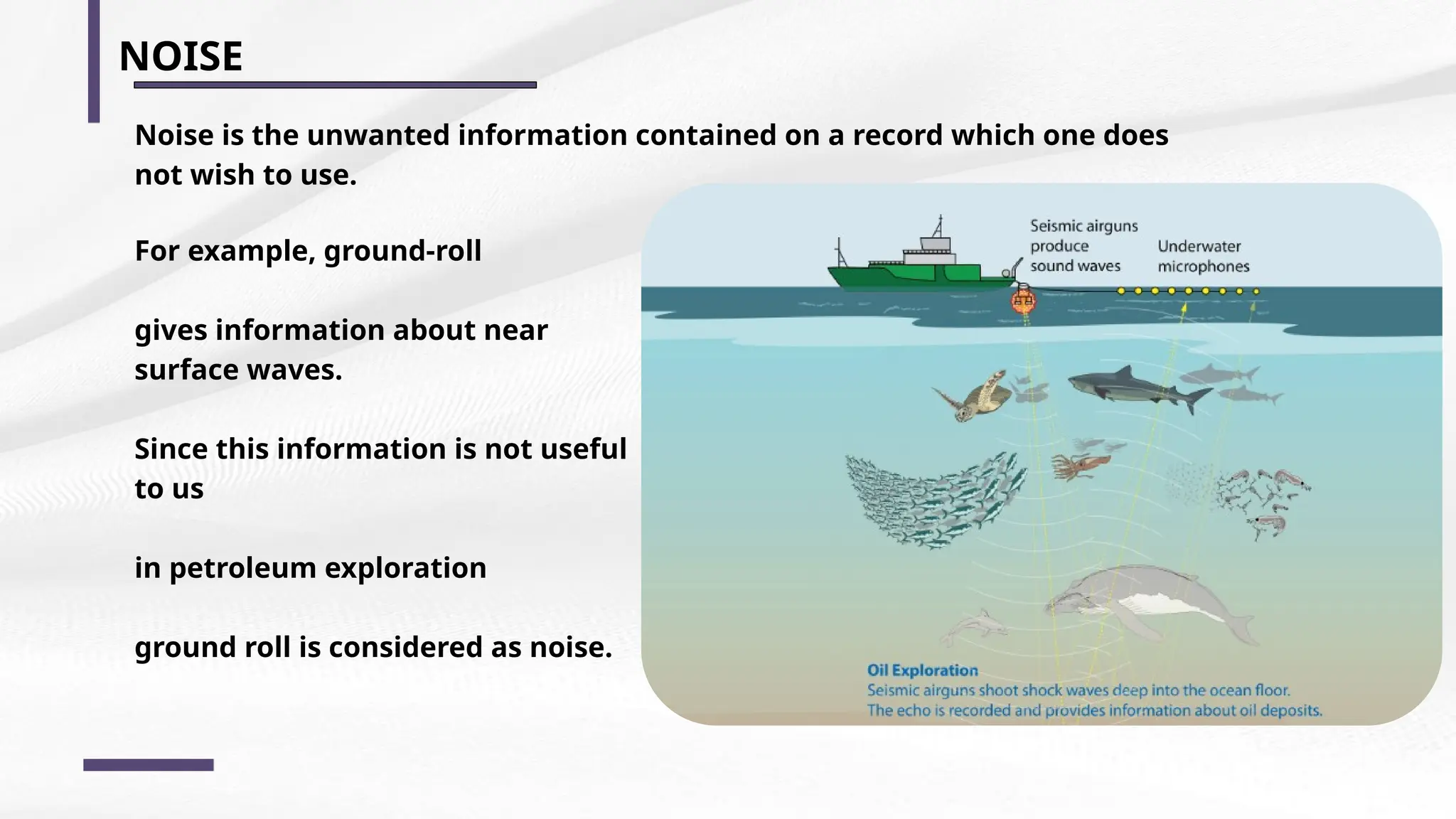
This document discussesdifferent types of noise and
signals that can appear in seismic data. It defines
noise as unwanted information that is not useful for
purposes like petroleum exploration. Common types
of noise include ground roll, multiples, reverberations,
and random noise caused by things in the
environment. Signal is the desirable seismic energy,
such as reflections from geological formations. The
ratio of signal to noise is used to describe data quality.
Noise can be divided into random and coherent
categories. Random noise is made up of sporadic
pulses and can be reduced by summing multiple
traces, while coherent noise aligns across traces and
is more difficult to overcome.
3.
NOISE
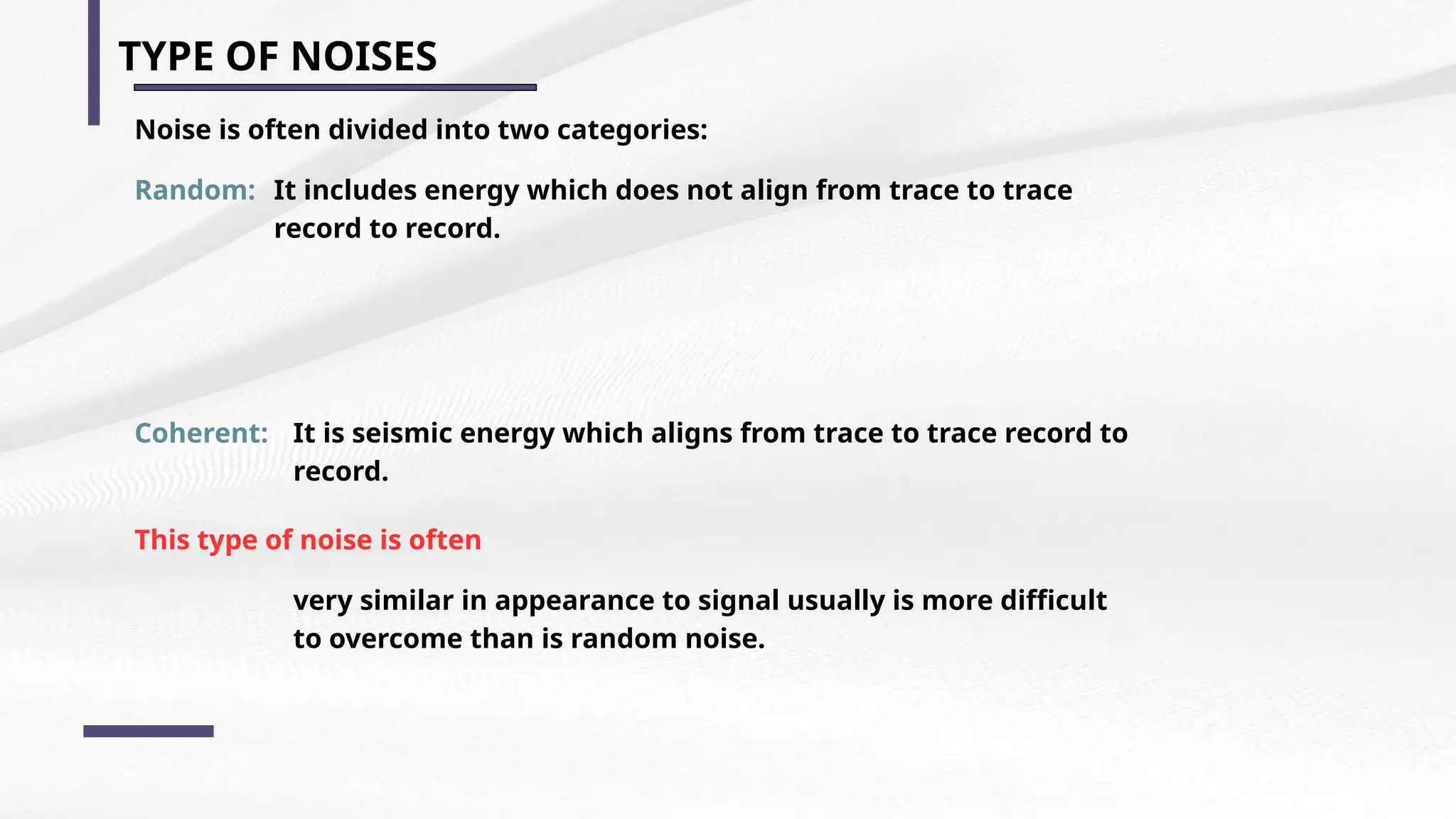
Noise is theunwanted information contained on a record which one does
not wish to use.
For example, ground-roll
gives information about near
surface waves.
Since this information is not useful
to us
in petroleum exploration
ground roll is considered as noise.
4.
SIGNAL
Signal is thatseismic energy which contains desirable information.
For example,
reflections from geological formations. It
should be noted that
certain types of energy.such as diffractions,might
be considered
noise for one purpose,and signal for another
5.
SIGNAL TO NOISERATIO (S/N)
The term signal to noise ratio (S/N) is frequently used to describe the quality of data.
The term is sometimes used to mean the ratio of signal energy to noise energy.
It is also used to mean the ratio of signal amplitude to noise amplitude, which is the square
root of the first definition.
Using the amplitude ratio definition statistical analysis shows that S/N increases by square
root of n when 'n' traces containing signal and random noise are summed.
6.
TYPE OF NOISES
Noiseis often divided into two categories:
Random: It includes energy which does not align from trace to trace
record to record.
Coherent: It is seismic energy which aligns from trace to trace record to
record.
This type of noise is often
very similar in appearance to signal usually is more difficult
to overcome than is random noise.
7.
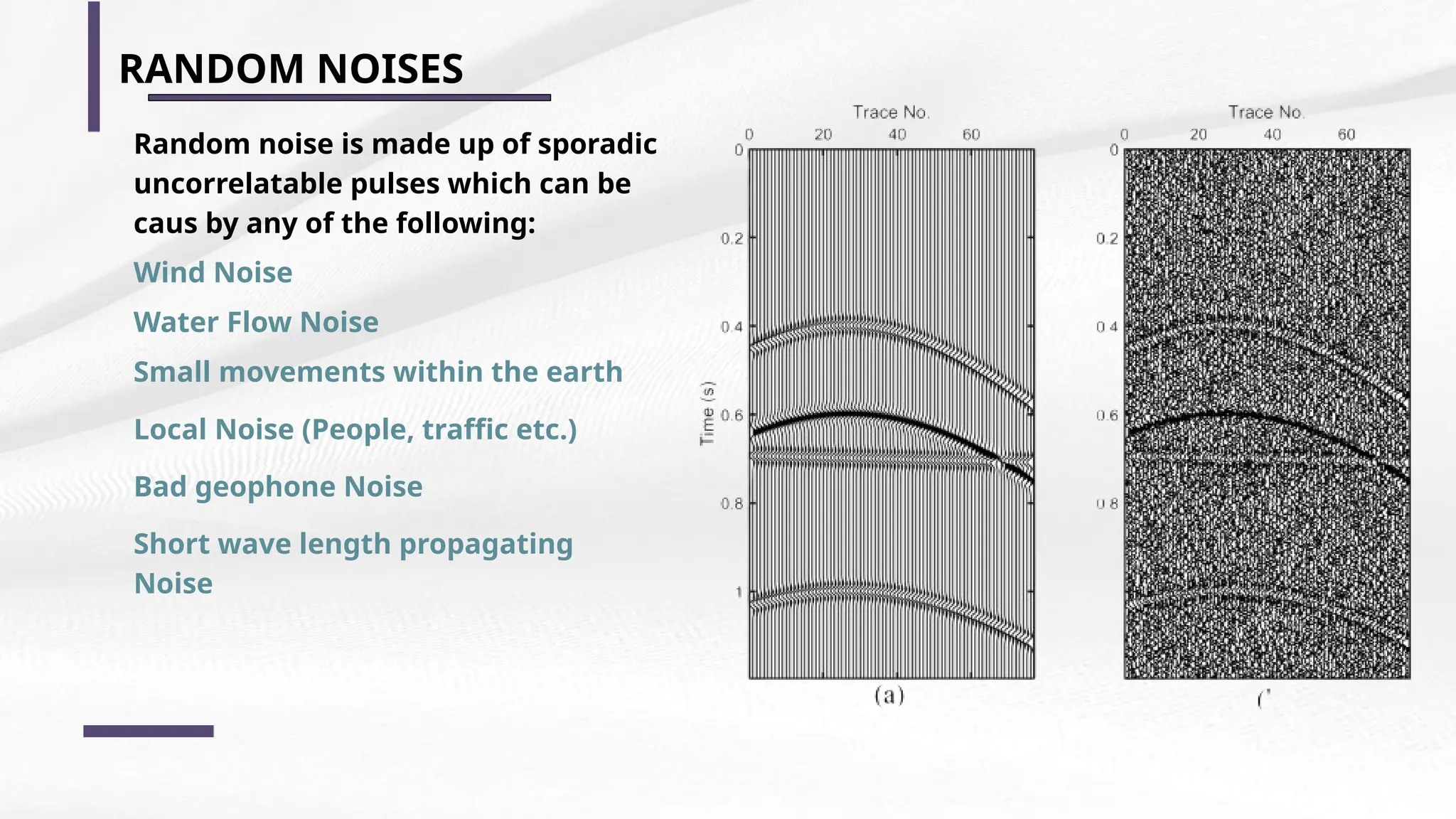
RANDOM NOISES
Random noiseis made up of sporadic
uncorrelatable pulses which can be
caus by any of the following:
Wind Noise
Water Flow Noise
Small movements within the earth
Local Noise (People, traffic etc.)
Bad geophone Noise
Short wave length propagating
Noise
8.
SOURCE OF COHERENTNOISE
Multiple reflections
Reflections from locations outside the
vertical plane through thesource and
receiver and from other sources of energy
not associated with the seismic project.
Sometimes called
Refracted events
Diffraction events
Ground roll
Direct arrivals
"side-swipe".
Seismic stack section showing the
disturbances caused by coherent
noise from another seismic source.
The arrows indicate the coherent
noise which overshadow the
primary signals. The CDP interval is
6.25 m
9.
MULTIPLE REFLECTIONS
Multiple Reflections
SimpleMultiple are those which have paths back and forth
between the surface and one interface Interbed or Peg-Leg
Multiple
if they have paths back and forth between the surfaces and
more than one interface.
This is another kind of coherent noise. It is common for
both marine and land recording source is placed beneath
the water or earth surface in order to create good coupling
of the energy energy sources To the surrounding medium.
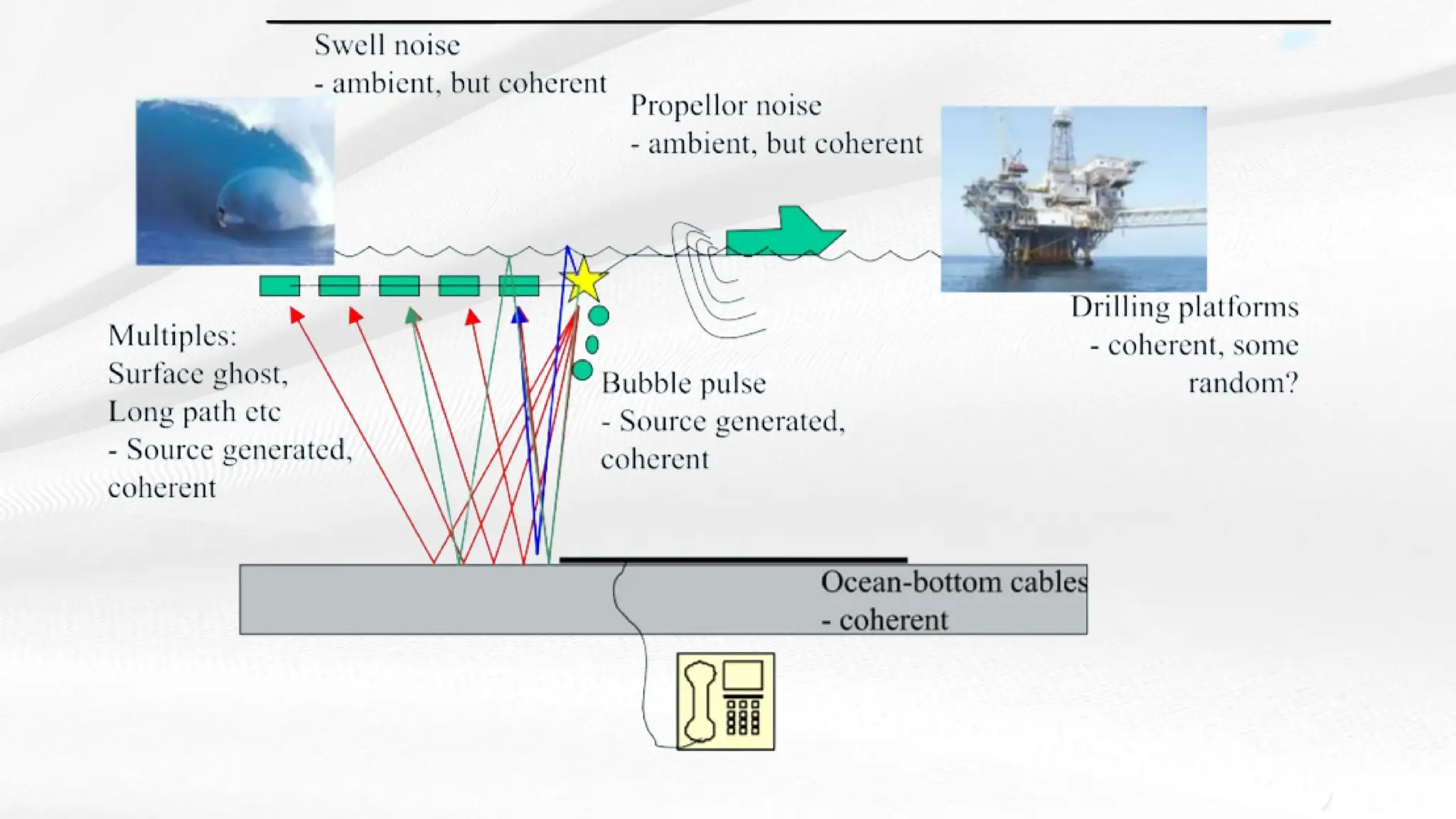
Ghost
10.
GHOST
part of theenergy travels upward to the surface and then being reflected downward.
The recorded trace then gives the
appearance of two sources slightly separated in time, or it might be misinterpreted as
two closely-spaced
reflections.
If the shot is not buried very deep,
the ghost pulse merges with the end of the primary,
⚫ thus, changing its wave shape and adding a tail.
12.
REVERBERATION
Reverberation is seismicnoise caused by waves bouncing between strong reflective
layers, especially in shallow water. This makes the waves appear to extend over time,
obscuring real events instead of appearing as short, clear bursts, thus making it
difficult to analyze and interpret the data.
13.
IDENTIFICATION & SUPPRESSIONOF RANDOM NOIS
Statistical methods are often used to reduce the impact of random noise. When
multiple seismic records are taken from the same location, the underlying signal is
theoretically constant in each recording, while the random noise varies from one
recording to another. When these recordings are combined, the signal is amplified
because it is in phase, while the random noise is diminished due to its phase
variations and dispersion.
14.
REFERENCE
Ground Motion SeismologyBy Kazuki Koketsu. link.springer.com
Seismic Ambient Noise Andreas Fichtner, Cambridge University Press & Assessment
+2Edited by Nori Nakata, Lucia Gualtieri &
Exploiting Seismic Waveforms - Chapter: Correlations and Ambient Noise In the book
Exploiting Seismic Waveforms by Brian L. N. Kennett & Andreas Fichtner