UNDERSTANDING PUBLIC
INTEREST LITIGATION (PIL)
AND THE RIGHT TO
INFORMATION (RTI) ACT 2005
FOR
“Capacity Building for the NGOs in
North Eastern States of India”
organized by Manav Charities and
supported by
British High Commission
31 OCTOBER 2015, GUWAHATI
PUBLIC INTEREST LITIGATION
 Litigation introduced in a court of law for the
protection of public/general interest
 Have pecuniary interest or some interest by
which their legal rights or liabilities are affected.
(Black’s Law Dictionary)
 There are various areas where a PUBLIC
INTEREST LITIGATION can be filed.
 Power of Judicial Activism (what is this?)
 The court can itself take cognizance of the
matter and proceed Suo motu (what is this?)
Purpose/Objectives of PIL
 purpose is to alleviate the sufferings of
all those who have borne the burnt of
insensitivity of fellow human beings.
 obtaining justice for the people, of
voicing people's grievances through the
legal process.
 to give to the common people of this
country access to the courts to obtain
legal redress
Short History
 Beginnings : mid 1970s….
 JusticeV.K.Krishna Iyer
 Justice P.N. Bhagawati
 Emergency
 Powerful tool for promoting social justice
and for protecting the rights of the poor.
All who can file a PIL application
 Any socially conscious
individual/public-spirited NGO can file
a Public Interest Litigation application
(PIL) on behalf of general mass of
people /at times for a large section of
society, whose rights & interests are
adversely affected & or for
general/social welfare/Social Cause
 It is not necessary, that person filing
Any individual can file a
PIL application, provided
 S/He is not a mere busy body or a
meddlesome interloper.
 Her / His action is not motivated by personal
gains or any other oblique considerations.
Conditions to be fulfilled
 public injury and public wrong caused by the
wrongful act or omission of the state or public
authority
 enforcement of basic human rights of weaker
sections of the community
 not be frivolous litigation by persons having
vested interests
 the action has sufficient interest to maintain
an action of public injury
Which Courts can take up:
 High Courts: Article 226 (What is this?)
 Supreme Court of India: Article 32 (What is
this?)
Process
 Sending letter petitions with relevant facts and
documents to the Chief Justice of the concerned
High Court of the State/Apex Court.
 The matter must be sent by registered post.
 By directly filing the PIL application in the court
through the Free Legal Aid Facilities
 Directly filing the application
 Filing the application through a registered NGOs
PIL Filed/Drawn Against
whom?
 A Public Interest Litigation can be filed against a
State Govt., Central Government, Municipal
Authorities etc, any public authority and not any
private party alone
 However a "Private party" can be included in the
Public Interest Litigation as a "Respondent“/Party

 However, a PIL cannot be filed against the private
party alone; the concerned State Government,
and State authority has to be made a party
Procedure
 A PIL is filed in a High court, and then two
copies of the petition have to be filed.
 If a PIL is filed in the Supreme Court, then five
sets of petition have to be filed.
 Proceedings commence and carry on in the
same manner as in other cases.
 In between a commissioner may be
appointed to conduct any inquires.
Court Fee:
 A Court fee/Process fee of Rs. 5o, per
Respondent (i.e. for each number of
opposite party, court fees of Rs. 5o) has to
be affixed on the petition.
Challenges, NGOs face
 Informed Decision
 Litigation is expensive and time consuming
 An NGO needs to be registered 1st to file a PIL
 Finding a good lawyer with experience
 Sensitization of lawyers on an on going process
 Sensitize law students
Follow the following:
 Discuss the legal issue.
 Whether the matter infringes on the fundamental
rights.
 Help the people to decide whether legal action must
be taken.
 Write out a petition with all the facts and details,
dates, etc
 Specify in the petition the type of relief wanted by the
people.
 Contd…………….
 Contd….
 Get the signatures of all the affected people
 Collect all the available documents, paper clippings,
photographs, investigation reports, certificates and affidavits
related to the issue and attach them to the main petition as
annexure.
 If possible, consult a socially conscious lawyer or the members
of the local legal aid society before sending the petition.
 Send the registered petition to the Chairman of the High Court
Legal Services Committee of the respective High Court or to
the Chairman of the SupremeCourt Legal Services Committee,
New Delhi-110 001.

RTI & PIL
 Right to ask for any
information from a
public authority
 Following a procedure
and paying a prescribed
fee
 Provision for appeals
 No Lawyer required &
can be filed online
 Approaching HC or SC
 Affects the public at
large.
 Follows similar processes
of a judicial remedy
 Damages awarded are
paltry
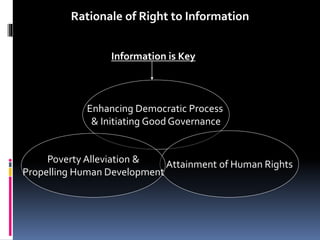
Information is Key
Enhancing Democratic Process
& Initiating GoodGovernance
Attainment of Human Rights
Poverty Alleviation &
Propelling Human Development
Rationale of Right to Information
Right to Information in India
 Right to Information is a Fundamental Right
 IT IS a part of the Fundamental Right to
Freedom of Speech and Expression recognized
in various Supreme Court decisions.
 IT IS directly linked to the Right to Life - the
Supreme Court has widened the definition of
Right to Life to include the right to food,
health, education, liberty, etc. denial of
information is a denial of these rights.
Problems in Accessing Information
 Laws like the Official Secrets Act, Indian Evidence
Act and the Civil Servants Code of Conduct Rules
contain provisions that restrict the fundamental right
to information
 Culture of secrecy prevalent in government
 Lack of accountability in public office
 People do not know where to go for information
 Illiteracy
 Badly maintained records
Short History
 RTI Act 2005 emanates from Article 19 of the Indian
Constitution
 Art. 19 : Protection of certain rights regarding
Freedom of Speech & Expression among others
 The RTI Act replaces the erstwhile Freedom of
Information Act, 2002
Scope & Applicability
 Covers the whole of India except Jammu and Kashmir
 All constitutional authorities, including the executive, legislature
and judiciary
 any institution or body established or constituted by an Act of
Parliament or a State Legislature
 Bodies or Authorities established/ constituted by
order/notification of appropriate government including bodies
"owned, controlled or substantially financed" by government, or
Non-Government Organizations "substantially financed, directly
or indirectly by funds" provided by the Government
 As per recent verdict, Private Bodies and NGOs as well come
under the purview of RTI Act but Political Parties are fighting it
out
DEFINITIONS
 What is INFORMATION?
 Any material in any form, including the
records, documents, memos, e-mails,
opinions, advices, press releases, circulars,
orders, log books, contracts, reports, papers,
samples, models, data material held in any
electronic form, manuscript, file, any
microfilm, facsimile copy of a document, any
reproduction of image/ images embodied in
such microfilm, any other material produced
by a computer or any other device.
“Substantial Funding”
 ‘SC has defined the meaning of
substantial funding’
 “Organisations or institutions which get more
than 95 per cent of government funds for
infrastructure will have to provide all their
information under the RTI Act.
Defining: Right to Information
 The “right to information” is defined as a right to
information accessible under the Act which is held
by or under the control of any public authority and
includes a
- right to (i) inspection of work, documents, records,
- (ii) taking notes, extracts or certified copies of
documents or records,
- (iii) taking separate samples of material,
- (iv) obtaining information in the form of diskettes,
floppies, tapes, video cassettes or in any other
electronic mode or through printouts where such
information is stored in a computer or in any other
device.
Exclusions:
US 8 of theAct:-
 Information, disclosure of which would
prejudicially affect the sovereignty and integrity of
India, the security, "strategic, scientific or
economic" interests of the State, relation with
foreign State or lead to incitement of an offense
 Information which has been expressly forbidden to
be published by any court of law or tribunal or the
disclosure of which may constitute contempt of
court
 Information, the disclosure of which would
cause a breach of privilege of Parliament or
the State Legislature
 Information including commercial
confidence, trade secrets or intellectual
property, the disclosure of which would harm
the competitive position of a third party,
unless the competent authority is satisfied
that larger public interest warrants the
disclosure of such information
 Information available to a person in his fiduciary
relationship, unless the competent authority is
satisfied that the larger public interest warrants
the disclosure of such information;
 Information received in confidence from foreign
Government;
 Information, the disclosure of which would
endanger the life or physical safety of any person
or identify the source of information or
assistance given in confidence for law
enforcement or security purposes;
 Information which would impede the process of
investigation or apprehension or prosecution of
offenders
 Cabinet papers including records of deliberations
of the Council of Ministers, Secretaries and other
officers
 Information which relates to personal
information the disclosure of which has no
relationship to any public activity or interest, or
which would cause unwarranted invasion of the
privacy of the individual (but it is also provided
that the information which cannot be denied to
the Parliament or a State Legislature shall not be
denied by this exemption)
How to do it:
 Step 1: Identify the department you want information from
 Step 2:On a sheet of white paper, write out the application
by hand, or type it, in English, Hindi or the official language
of the area.
 Step 3:To the State/Central Public Information Officer.
Write the name of the office from which you seek
information, and the complete, correct address. Clearly
mention ‘Seeking information under the RTI Act, 2005’ in
your Subject Line
 Step 4:State your request in the form of specific, detailed
questions, and mention the period/year your request falls
into. Ask for documents or extracts of documents, if
required. To obtain documents, the applicant has to make a
payment of Rs. 2 per page
 Step 5:Pay Rs. 10 to file the plea. This can be done in
the form of cash, money order, bank draft or a court
fee stamp. The stamp should be affixed to the
application. Applicants below the poverty line (BPL)
need not make the payment but have to attach a
copy of the BPL certificate along with the
application
 Step 6: Provide your full name and address, contact
details, email address and sign the application
clearly. Put in the date and the name of your town
 Step 7: Take a photocopy of the application and keep
one with you for future reference. Send your
application by post or hand it in personally to the
department concerned. Don’t forget to get an
acknowledgement
 Step 8: The law mandates that information
be provided in 30 days. If this does not
happen, you can file an appeal. The first
appeal should be addressed to ‘The Appellate
Authority’ with the name of the department
and the address. The appellate authority is
mandated to revert in 30 days from the date
of receipt of the appeal. If the Appellate
authority fails to reply, further appeals lie
with the Information Commission, the Chief
Information Commissioner, State/Central
Information Commission
 It can be filed online too these days....
Penalties:
 As per Section 20(1) of the RTI Act, the CIC or the SIC, has the
powers to impose a penalty on the PIO, while deciding on a
complaint or a second appeal.
Penalty can be imposed, if the PIO has:
Refused to receive an application
 Not furnished the requested information within 30 days of
receiving the application
 Malafidely intention denied the request for information
 Knowingly given incorrect, incomplete or misleading
information
 Destroyed information which was the subject of the request
 Obstructed in any manner, in furnishing the information
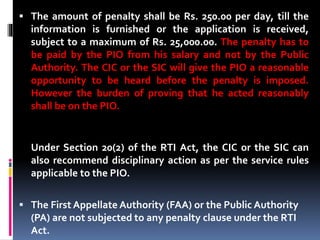
 The amount of penalty shall be Rs. 250.00 per day, till the
information is furnished or the application is received,
subject to a maximum of Rs. 25,000.00. The penalty has to
be paid by the PIO from his salary and not by the Public
Authority. The CIC or the SIC will give the PIO a reasonable
opportunity to be heard before the penalty is imposed.
However the burden of proving that he acted reasonably
shall be on the PIO.
Under Section 20(2) of the RTI Act, the CIC or the SIC can
also recommend disciplinary action as per the service rules
applicable to the PIO.
 The First Appellate Authority (FAA) or the Public Authority
(PA) are not subjected to any penalty clause under the RTI
Act.
Compensation Provision

Under Section 19(8)(b) of the RTI Act, the CIC or
the SIC, can require the Public Authority to
compensate the complainant/appellant for any
loss or detriment suffered.
 The complainant/appellant should be able to
justify the claim for compensation as well as the
amount of compensation sought.
Constitutional Provisions
 Article 226/High Courts’ power to issueWrits.
At the Discretion of the HCs, not a
Fundamental Right
 Article 32/Supreme Court: Remedies for the
enforcement of Fundamental Rights/can be
suspended during Emergency/ a
Fundamental Right
Other follow up Legislations
 Whistle Blowers Protection Act
2014
 2015 Amendment Bill- 13
amendments
DR. SOMA BHOWMICK
ASST. PROFESSOR & RESEARCH
COORDINATOR
WILLIAM CAREY UNIVERSITY,
SHILLONG, MEGHALAYA
PH: 9436702626

PPT_on_PIL_and_RTI.pptx

  • 1.
    UNDERSTANDING PUBLIC INTEREST LITIGATION(PIL) AND THE RIGHT TO INFORMATION (RTI) ACT 2005 FOR “Capacity Building for the NGOs in North Eastern States of India” organized by Manav Charities and supported by British High Commission 31 OCTOBER 2015, GUWAHATI
  • 2.
    PUBLIC INTEREST LITIGATION Litigation introduced in a court of law for the protection of public/general interest  Have pecuniary interest or some interest by which their legal rights or liabilities are affected. (Black’s Law Dictionary)  There are various areas where a PUBLIC INTEREST LITIGATION can be filed.  Power of Judicial Activism (what is this?)  The court can itself take cognizance of the matter and proceed Suo motu (what is this?)
  • 3.
    Purpose/Objectives of PIL purpose is to alleviate the sufferings of all those who have borne the burnt of insensitivity of fellow human beings.  obtaining justice for the people, of voicing people's grievances through the legal process.  to give to the common people of this country access to the courts to obtain legal redress
  • 4.
    Short History  Beginnings: mid 1970s….  JusticeV.K.Krishna Iyer  Justice P.N. Bhagawati  Emergency  Powerful tool for promoting social justice and for protecting the rights of the poor.
  • 5.
    All who canfile a PIL application  Any socially conscious individual/public-spirited NGO can file a Public Interest Litigation application (PIL) on behalf of general mass of people /at times for a large section of society, whose rights & interests are adversely affected & or for general/social welfare/Social Cause  It is not necessary, that person filing
  • 6.
    Any individual canfile a PIL application, provided  S/He is not a mere busy body or a meddlesome interloper.  Her / His action is not motivated by personal gains or any other oblique considerations.
  • 7.
    Conditions to befulfilled  public injury and public wrong caused by the wrongful act or omission of the state or public authority  enforcement of basic human rights of weaker sections of the community  not be frivolous litigation by persons having vested interests  the action has sufficient interest to maintain an action of public injury
  • 8.
    Which Courts cantake up:  High Courts: Article 226 (What is this?)  Supreme Court of India: Article 32 (What is this?)
  • 9.
    Process  Sending letterpetitions with relevant facts and documents to the Chief Justice of the concerned High Court of the State/Apex Court.  The matter must be sent by registered post.  By directly filing the PIL application in the court through the Free Legal Aid Facilities  Directly filing the application  Filing the application through a registered NGOs
  • 10.
    PIL Filed/Drawn Against whom? A Public Interest Litigation can be filed against a State Govt., Central Government, Municipal Authorities etc, any public authority and not any private party alone  However a "Private party" can be included in the Public Interest Litigation as a "Respondent“/Party   However, a PIL cannot be filed against the private party alone; the concerned State Government, and State authority has to be made a party
  • 11.
    Procedure  A PILis filed in a High court, and then two copies of the petition have to be filed.  If a PIL is filed in the Supreme Court, then five sets of petition have to be filed.  Proceedings commence and carry on in the same manner as in other cases.  In between a commissioner may be appointed to conduct any inquires.
  • 12.
    Court Fee:  ACourt fee/Process fee of Rs. 5o, per Respondent (i.e. for each number of opposite party, court fees of Rs. 5o) has to be affixed on the petition.
  • 13.
    Challenges, NGOs face Informed Decision  Litigation is expensive and time consuming  An NGO needs to be registered 1st to file a PIL  Finding a good lawyer with experience  Sensitization of lawyers on an on going process  Sensitize law students
  • 14.
    Follow the following: Discuss the legal issue.  Whether the matter infringes on the fundamental rights.  Help the people to decide whether legal action must be taken.  Write out a petition with all the facts and details, dates, etc  Specify in the petition the type of relief wanted by the people.  Contd…………….
  • 15.
     Contd….  Getthe signatures of all the affected people  Collect all the available documents, paper clippings, photographs, investigation reports, certificates and affidavits related to the issue and attach them to the main petition as annexure.  If possible, consult a socially conscious lawyer or the members of the local legal aid society before sending the petition.  Send the registered petition to the Chairman of the High Court Legal Services Committee of the respective High Court or to the Chairman of the SupremeCourt Legal Services Committee, New Delhi-110 001. 
  • 16.
    RTI & PIL Right to ask for any information from a public authority  Following a procedure and paying a prescribed fee  Provision for appeals  No Lawyer required & can be filed online  Approaching HC or SC  Affects the public at large.  Follows similar processes of a judicial remedy  Damages awarded are paltry
  • 17.
    Information is Key EnhancingDemocratic Process & Initiating GoodGovernance Attainment of Human Rights Poverty Alleviation & Propelling Human Development Rationale of Right to Information
  • 18.
    Right to Informationin India  Right to Information is a Fundamental Right  IT IS a part of the Fundamental Right to Freedom of Speech and Expression recognized in various Supreme Court decisions.  IT IS directly linked to the Right to Life - the Supreme Court has widened the definition of Right to Life to include the right to food, health, education, liberty, etc. denial of information is a denial of these rights.
  • 19.
    Problems in AccessingInformation  Laws like the Official Secrets Act, Indian Evidence Act and the Civil Servants Code of Conduct Rules contain provisions that restrict the fundamental right to information  Culture of secrecy prevalent in government  Lack of accountability in public office  People do not know where to go for information  Illiteracy  Badly maintained records
  • 20.
    Short History  RTIAct 2005 emanates from Article 19 of the Indian Constitution  Art. 19 : Protection of certain rights regarding Freedom of Speech & Expression among others  The RTI Act replaces the erstwhile Freedom of Information Act, 2002
  • 21.
    Scope & Applicability Covers the whole of India except Jammu and Kashmir  All constitutional authorities, including the executive, legislature and judiciary  any institution or body established or constituted by an Act of Parliament or a State Legislature  Bodies or Authorities established/ constituted by order/notification of appropriate government including bodies "owned, controlled or substantially financed" by government, or Non-Government Organizations "substantially financed, directly or indirectly by funds" provided by the Government  As per recent verdict, Private Bodies and NGOs as well come under the purview of RTI Act but Political Parties are fighting it out
  • 22.
    DEFINITIONS  What isINFORMATION?  Any material in any form, including the records, documents, memos, e-mails, opinions, advices, press releases, circulars, orders, log books, contracts, reports, papers, samples, models, data material held in any electronic form, manuscript, file, any microfilm, facsimile copy of a document, any reproduction of image/ images embodied in such microfilm, any other material produced by a computer or any other device.
  • 23.
    “Substantial Funding”  ‘SChas defined the meaning of substantial funding’  “Organisations or institutions which get more than 95 per cent of government funds for infrastructure will have to provide all their information under the RTI Act.
  • 24.
    Defining: Right toInformation  The “right to information” is defined as a right to information accessible under the Act which is held by or under the control of any public authority and includes a - right to (i) inspection of work, documents, records, - (ii) taking notes, extracts or certified copies of documents or records, - (iii) taking separate samples of material, - (iv) obtaining information in the form of diskettes, floppies, tapes, video cassettes or in any other electronic mode or through printouts where such information is stored in a computer or in any other device.
  • 25.
    Exclusions: US 8 oftheAct:-  Information, disclosure of which would prejudicially affect the sovereignty and integrity of India, the security, "strategic, scientific or economic" interests of the State, relation with foreign State or lead to incitement of an offense  Information which has been expressly forbidden to be published by any court of law or tribunal or the disclosure of which may constitute contempt of court
  • 26.
     Information, thedisclosure of which would cause a breach of privilege of Parliament or the State Legislature  Information including commercial confidence, trade secrets or intellectual property, the disclosure of which would harm the competitive position of a third party, unless the competent authority is satisfied that larger public interest warrants the disclosure of such information
  • 27.
     Information availableto a person in his fiduciary relationship, unless the competent authority is satisfied that the larger public interest warrants the disclosure of such information;  Information received in confidence from foreign Government;  Information, the disclosure of which would endanger the life or physical safety of any person or identify the source of information or assistance given in confidence for law enforcement or security purposes;
  • 28.
     Information whichwould impede the process of investigation or apprehension or prosecution of offenders  Cabinet papers including records of deliberations of the Council of Ministers, Secretaries and other officers  Information which relates to personal information the disclosure of which has no relationship to any public activity or interest, or which would cause unwarranted invasion of the privacy of the individual (but it is also provided that the information which cannot be denied to the Parliament or a State Legislature shall not be denied by this exemption)
  • 29.
    How to doit:  Step 1: Identify the department you want information from  Step 2:On a sheet of white paper, write out the application by hand, or type it, in English, Hindi or the official language of the area.  Step 3:To the State/Central Public Information Officer. Write the name of the office from which you seek information, and the complete, correct address. Clearly mention ‘Seeking information under the RTI Act, 2005’ in your Subject Line  Step 4:State your request in the form of specific, detailed questions, and mention the period/year your request falls into. Ask for documents or extracts of documents, if required. To obtain documents, the applicant has to make a payment of Rs. 2 per page
  • 30.
     Step 5:PayRs. 10 to file the plea. This can be done in the form of cash, money order, bank draft or a court fee stamp. The stamp should be affixed to the application. Applicants below the poverty line (BPL) need not make the payment but have to attach a copy of the BPL certificate along with the application  Step 6: Provide your full name and address, contact details, email address and sign the application clearly. Put in the date and the name of your town  Step 7: Take a photocopy of the application and keep one with you for future reference. Send your application by post or hand it in personally to the department concerned. Don’t forget to get an acknowledgement
  • 31.
     Step 8:The law mandates that information be provided in 30 days. If this does not happen, you can file an appeal. The first appeal should be addressed to ‘The Appellate Authority’ with the name of the department and the address. The appellate authority is mandated to revert in 30 days from the date of receipt of the appeal. If the Appellate authority fails to reply, further appeals lie with the Information Commission, the Chief Information Commissioner, State/Central Information Commission  It can be filed online too these days....
  • 32.
    Penalties:  As perSection 20(1) of the RTI Act, the CIC or the SIC, has the powers to impose a penalty on the PIO, while deciding on a complaint or a second appeal. Penalty can be imposed, if the PIO has: Refused to receive an application  Not furnished the requested information within 30 days of receiving the application  Malafidely intention denied the request for information  Knowingly given incorrect, incomplete or misleading information  Destroyed information which was the subject of the request  Obstructed in any manner, in furnishing the information
  • 33.
     The amountof penalty shall be Rs. 250.00 per day, till the information is furnished or the application is received, subject to a maximum of Rs. 25,000.00. The penalty has to be paid by the PIO from his salary and not by the Public Authority. The CIC or the SIC will give the PIO a reasonable opportunity to be heard before the penalty is imposed. However the burden of proving that he acted reasonably shall be on the PIO. Under Section 20(2) of the RTI Act, the CIC or the SIC can also recommend disciplinary action as per the service rules applicable to the PIO.  The First Appellate Authority (FAA) or the Public Authority (PA) are not subjected to any penalty clause under the RTI Act.
  • 34.
    Compensation Provision  Under Section19(8)(b) of the RTI Act, the CIC or the SIC, can require the Public Authority to compensate the complainant/appellant for any loss or detriment suffered.  The complainant/appellant should be able to justify the claim for compensation as well as the amount of compensation sought.
  • 35.
    Constitutional Provisions  Article226/High Courts’ power to issueWrits. At the Discretion of the HCs, not a Fundamental Right  Article 32/Supreme Court: Remedies for the enforcement of Fundamental Rights/can be suspended during Emergency/ a Fundamental Right
  • 36.
    Other follow upLegislations  Whistle Blowers Protection Act 2014  2015 Amendment Bill- 13 amendments
  • 37.
    DR. SOMA BHOWMICK ASST.PROFESSOR & RESEARCH COORDINATOR WILLIAM CAREY UNIVERSITY, SHILLONG, MEGHALAYA PH: 9436702626