Subject: Business Etiquettes & Presentation Skills II
Submitted By: Himanshu T.Patel
Class: TYBBA
Roll No: 26
College: C.P.Patet & F.H.Shah College,Anand.
RIGHT
TO
INFORMATION ACT
(RTI)
A Tool for Good Governance
PURPOSE :-
 Transparency
 Accountability
Introduction :-
• Comes into effect 120 days after enactment.
• Covers central, state and local governments, and
– all bodies owned, controlled or substantially financed;
– non-government organisation substantially financed,
directly or indirectly by funds provided by the
appropriate Government (2(h))
• Covers executive, judiciary and legislature (2(e))
• Covers central, state and local governments.
• Includes information relating to private bodies which can be
accessed under any other law for the time being in force (2(f))
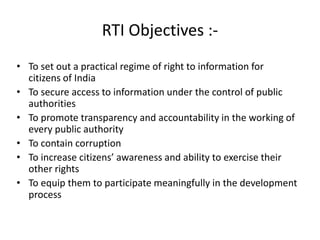
RTI Objectives :-
• To set out a practical regime of right to information for
citizens of India
• To secure access to information under the control of public
authorities
• To promote transparency and accountability in the working of
every public authority
• To contain corruption
• To increase citizens’ awareness and ability to exercise their
other rights
• To equip them to participate meaningfully in the development
process
The RTI Act Definition :-
• What does information mean?
“Information means any material in any form including records,
documents, memos, e-mails, opinions, advices, press
releases, circulars, orders, logbooks, contracts, reports,
papers, samples, models, data material held in any electronic
form and information relating to any private body which can
be accessed by a public authority under any other law for the
time being in force”.
• "information" includes any material in any form, opinions,
advices, and samples.
• "right to information" includes inspection of work, records;
taking certified samples of material.
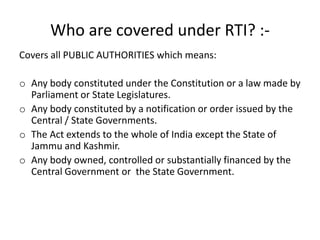
Who are covered under RTI? :-
Covers all PUBLIC AUTHORITIES which means:
o Any body constituted under the Constitution or a law made by
Parliament or State Legislatures.
o Any body constituted by a notification or order issued by the
Central / State Governments.
o The Act extends to the whole of India except the State of
Jammu and Kashmir.
o Any body owned, controlled or substantially financed by the
Central Government or the State Government.
Role of Public information Officers (PIOs)
Who are Public Information Officers (PIOs)?
- PIOs are officers designated by the public authorities in all
administrative units or offices under it to provide information
to the citizens requesting for information under the Act.
-Any officer, whose assistance has been sought by the PIO
forth proper discharge of his or her duties, shall render all
assistance and for the purpose of contraventions of the
provisions of this Act, such other officer shall be treated as aPIO.
-PIO shall deal with requests from persons seeking information
and where the request cannot be made in writing, to render
reasonable assistance to the person to reduce the same in
writing.
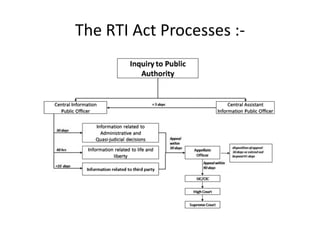
The RTI Act Processes :-
Exemption :-
 Who are Exempted ?
Intelligence and security organizations established by the Central
or State Governments as notified from time to
time.However, information relating to alleged corruption or
human rights violations is not exempted from disclosure.
 Exempt Information:
 Information which would prejudicially affect
sovereignty and integrity of India; security/ strategic/
scientific/ economic interests of the State;relation with
foreign State .
 Information which might incite an offence
 Information which
i. is forbidden by a court;
ii. that causes a breach of privilege of the Legislature;
iii. would harm the competitive position of a third party;
Appeals(Section 19) :-
• Appeals: Internal and External Level
– First appeal with senior in the department
– Second appeal with Information Commission
– Appeals to be settled in 30-45 days
– Onus of proof on denial/public authority
• Envisages an independent Information Commission at the
Central and State level.
• To be appointed by a committee of PM/CM, leader of
opposition and one minister.
Penalty Provisions (Section 20):-
PIO liable to a fine of Rs. 250 per day up to a maximum of Rs.
25,000/- for
 not accepting an application;
delaying information release without reasonable cause;
malafidely denying information;
knowingly giving incomplete, incorrect or misleading
information;
destroying information that has been requested; and
obstructing furnishing of information in any manner.
CIC/SIC empowered to impose penalty on PIO. They can also
recommend disciplinary action against an erring PIO.
Conclusion : What You Can Do?
 People holding ration cards can check the stocks and sales registers
held by ration card dealers and the food department to make sure
that they are getting their proper amount of rations and that
rations are not being siphoned off in their name;
 Parents can ask for details of grants made to government-aided
schools to ensure that funds are being spent properly, or can check
that admissions are not being bought through bribes or that funds
meant to education are not being diverted for other purposes;
 Owners of small businesses can find out the basis on which licenses
and/or tax concession and subsidies are granted by government in
granting licenses / concessions/ subsidies on the basis of properly
applied criteria;
 Unemployed people can ask about the criteria for giving
government jobs or the status of their application and position in
the waitlist;
 People can check on the progress of their applications for
government services, e.g.. By checking the status of an application
for an electricity or water connection, including which officers have
handled the file, over what period of time and what action was
taken.
Conclusion:
The largest democratic nation, India has survived all
vicissitudes, turbulences of all kinds over the last half century
and more.
In that context, the bringing into being of the RTI has been an
important milestone. The Act that came into being last year
assures every citizen the right to know what the citizen
should, and throws open the system of governance to total
transparency and therefore inescapable accountability.
Dr. APJ Abdul Kalam
Inaugural Address at the National
Convention on RTI
Thank You

Right to Information Act

  • 1.
    Subject: Business Etiquettes& Presentation Skills II Submitted By: Himanshu T.Patel Class: TYBBA Roll No: 26 College: C.P.Patet & F.H.Shah College,Anand.
  • 2.
    RIGHT TO INFORMATION ACT (RTI) A Toolfor Good Governance PURPOSE :-  Transparency  Accountability
  • 3.
    Introduction :- • Comesinto effect 120 days after enactment. • Covers central, state and local governments, and – all bodies owned, controlled or substantially financed; – non-government organisation substantially financed, directly or indirectly by funds provided by the appropriate Government (2(h)) • Covers executive, judiciary and legislature (2(e)) • Covers central, state and local governments. • Includes information relating to private bodies which can be accessed under any other law for the time being in force (2(f))
  • 4.
    RTI Objectives :- •To set out a practical regime of right to information for citizens of India • To secure access to information under the control of public authorities • To promote transparency and accountability in the working of every public authority • To contain corruption • To increase citizens’ awareness and ability to exercise their other rights • To equip them to participate meaningfully in the development process
  • 5.
    The RTI ActDefinition :- • What does information mean? “Information means any material in any form including records, documents, memos, e-mails, opinions, advices, press releases, circulars, orders, logbooks, contracts, reports, papers, samples, models, data material held in any electronic form and information relating to any private body which can be accessed by a public authority under any other law for the time being in force”. • "information" includes any material in any form, opinions, advices, and samples. • "right to information" includes inspection of work, records; taking certified samples of material.
  • 6.
    Who are coveredunder RTI? :- Covers all PUBLIC AUTHORITIES which means: o Any body constituted under the Constitution or a law made by Parliament or State Legislatures. o Any body constituted by a notification or order issued by the Central / State Governments. o The Act extends to the whole of India except the State of Jammu and Kashmir. o Any body owned, controlled or substantially financed by the Central Government or the State Government.
  • 7.
    Role of Publicinformation Officers (PIOs) Who are Public Information Officers (PIOs)? - PIOs are officers designated by the public authorities in all administrative units or offices under it to provide information to the citizens requesting for information under the Act. -Any officer, whose assistance has been sought by the PIO forth proper discharge of his or her duties, shall render all assistance and for the purpose of contraventions of the provisions of this Act, such other officer shall be treated as aPIO. -PIO shall deal with requests from persons seeking information and where the request cannot be made in writing, to render reasonable assistance to the person to reduce the same in writing.
  • 8.
    The RTI ActProcesses :-
  • 9.
    Exemption :-  Whoare Exempted ? Intelligence and security organizations established by the Central or State Governments as notified from time to time.However, information relating to alleged corruption or human rights violations is not exempted from disclosure.  Exempt Information:  Information which would prejudicially affect sovereignty and integrity of India; security/ strategic/ scientific/ economic interests of the State;relation with foreign State .  Information which might incite an offence  Information which i. is forbidden by a court; ii. that causes a breach of privilege of the Legislature; iii. would harm the competitive position of a third party;
  • 10.
    Appeals(Section 19) :- •Appeals: Internal and External Level – First appeal with senior in the department – Second appeal with Information Commission – Appeals to be settled in 30-45 days – Onus of proof on denial/public authority • Envisages an independent Information Commission at the Central and State level. • To be appointed by a committee of PM/CM, leader of opposition and one minister.
  • 11.
    Penalty Provisions (Section20):- PIO liable to a fine of Rs. 250 per day up to a maximum of Rs. 25,000/- for  not accepting an application; delaying information release without reasonable cause; malafidely denying information; knowingly giving incomplete, incorrect or misleading information; destroying information that has been requested; and obstructing furnishing of information in any manner. CIC/SIC empowered to impose penalty on PIO. They can also recommend disciplinary action against an erring PIO.
  • 12.
    Conclusion : WhatYou Can Do?  People holding ration cards can check the stocks and sales registers held by ration card dealers and the food department to make sure that they are getting their proper amount of rations and that rations are not being siphoned off in their name;  Parents can ask for details of grants made to government-aided schools to ensure that funds are being spent properly, or can check that admissions are not being bought through bribes or that funds meant to education are not being diverted for other purposes;  Owners of small businesses can find out the basis on which licenses and/or tax concession and subsidies are granted by government in granting licenses / concessions/ subsidies on the basis of properly applied criteria;  Unemployed people can ask about the criteria for giving government jobs or the status of their application and position in the waitlist;  People can check on the progress of their applications for government services, e.g.. By checking the status of an application for an electricity or water connection, including which officers have handled the file, over what period of time and what action was taken.
  • 13.
    Conclusion: The largest democraticnation, India has survived all vicissitudes, turbulences of all kinds over the last half century and more. In that context, the bringing into being of the RTI has been an important milestone. The Act that came into being last year assures every citizen the right to know what the citizen should, and throws open the system of governance to total transparency and therefore inescapable accountability. Dr. APJ Abdul Kalam Inaugural Address at the National Convention on RTI
  • 14.