FREUD’S
PSYCHOANALYTIC
THEORY
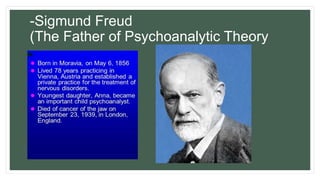
-Sigmund Freud
(The Father of Psychoanalytic Theory
Freud’s Stages of Psychosexual
Development
• Freud is the most popular psychologist that studied the development
of personality, also probably the most controversial. His theory of
psychosexual development includes five distinct stages.
• The theory is quiet interesting for many because Freud identified
specific “erogenous zones” for each stage of development. These
are specific “pleasure areas” that become focal points for the
particular stage.
• Fixation - results from failure to satisfy the needs of a particular
psychosexual stage.
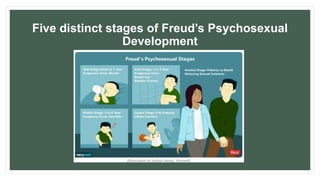
Five distinct stages of Freud’s Psychosexual
Development
Oral Stage (Birth to 18 months)
• The erogenous zone is the mouth. During the oral stage, the
child is focused on oral pleasures (sucking). Too much or too
little satisfaction can lead to an Oral Fixation or Oral
Personality which is shown in an increased focus on oral
activities. This type of personality may be oral receptive, that
is, have a stronger tendency to smoke, drink alcohol, over
eat, or oral aggressive, that is, with a tendency to bite his or
her nails, or use curse words or even gossip.
Anal Stage (18 months to 3 years)
• The child’s focus of pleasure in this stage is the anus. The
child finds satisfaction in eliminating and retaining feces.
Through society’s expectations, particularly the parent’s the
child needs to work on toilet training.
• Between 1 year old to 3 years the child’s favorite word might
be “No”. Therefore, a struggle might exist in the toilet training
process when the child retains feces for some reason.
Phallic Stage(ages 3 to 6)
• The pleasure or erogenous zone is the genitals. During the
preschool age, children become interested in what makes
boys and girls different. Preschoolers will sometimes be seen
fondling their genitals.
• Freud’s studies led him to believe that during his stage boys
develop unconscious sexual desire for their mother. Boys
then see their father as a rival for her mother’s affection.
Boys may fear that their father will punish them for these
feelings, thus the castration anxiety.
• Oedipus Complex, in Greek Mythology, Oedipus
unintentionally killed his father and married his mother
Jocasta.
• Electra Complex, developing unconscious sexual attraction
towards his father.
• According to Freud, out of fear of castration and due to the
strong competition of their father, boys eventually decide to
identify with them rather fight them. By identifying with their
father, the boys develop masculine characteristics and
identify themselves as males and repress their sexual
feelings toward their mother.
Latency Stage(age 6 to puberty)
• It's during this stage that sexual urges remain repressed. The
children's focus is the acquisition of physical and academic
skills. Boys usually relate more with boys and girls with girls
during this stage.
Genital Stage (puberty onwards)
• The fifth stage of psychosexual development begins at the
start of puberty when sexual urges are once again
awakened. in the earlier stages, adolescents focus their
sexual urges towars the opposite sex peers, with pleasure
centered on the genitals.
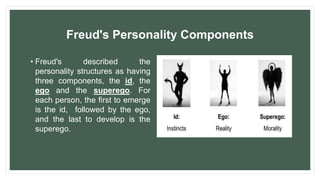
Freud's Personality Components
• Freud's described the
personality structures as having
three components, the id, the
ego and the superego. For
each person, the first to emerge
is the id, followed by the ego,
and the last to develop is the
superego.
The id.
• Freud say's that, a child is born with the id. The id plays a vital role in
one's personality because as a baby, it works so that the baby's
essential needs are met.
• The id operates on the pleasure principle. It focuses on immediate
gratification or satisfaction of its needs. So whatever feels good now is
what it will pursue with no consideration for the reality, logicality or
practicality of the situation
• Nothing else matters to the id except the satisfaction of its own needs. It
is not oriented towards considering reality nor the needs of others.
The ego.
• As the baby turns into a toddler and then into a preschooler,
he/she relates more with the environment, the ego slowly
begins to emerge.
• The ego operates using the reality principle. It is aware that
others also nhave needs to be met. It is practical because it
knows that being impilsive or selfish can result to negative
consequences later, so it reason's and considers the best
response to situations.
The superego.
• Near the end of the preschool years, or the end of the phallic
stage, the superego develops. The superego embodies
person's moral aspect.
• The superego is likened to conscience because it exerts
influence on what one considers right and wrong.
The Three Components and Pesonality
Adjustment
• Freud said that a well-adjusted person is one who has strong ego, who can
help satisfy the needs of the id without going againts the superego while
maintaining the person's sense of what is logical, practical and real.
• The ability of a learner to be well-adjusted is largely influenced by how the
learner was brought up. His experiences about how his parents met his
needs, the extent to which he was allowed to do the things he wanted to do,
and also the how he was taught about right and wrong, all figures to the type
of personality and consequent adjustment that a person will make.
• Freud believed that the personality of an individual is formed during the the
childhood years.
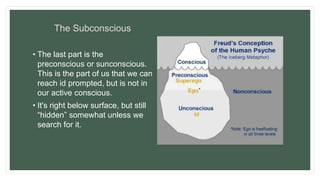
Topographical Model
The Unconscious
• Freud said that most what we
go through in our lives,
emotions, beliefs, feelings, and
impulses deep within are not
available to us at a conscious
level.
• He believed that most of what
influence us is our unconscious.
The Conscious
• Freud also said that all that we are
aware of is stored in our conscious
mind. Our conscious mind only
comprises a very small part of who
we are so that, in our everyday life,
we are only aware of a very small
part of what makes up our
personality: mos of what we are is
hidden and out of reach.
The Subconscious
• The last part is the
preconscious or sunconscious.
This is the part of us that we can
reach id prompted, but is not in
our active conscious.
• It's right below surface, but still
“hidden” somewhat unless we
search for it.
Erikson’s Psychosocial
Stages of Development
Psychosocial Development
There were two psychologists who had
developed famous psychosocial theories:
Freud, and Erikson.
Erikson believes that personality develops in
a series of stages.
Freud’s theory is well known but also very
controversial.
Erikson’s Theory of Development
Shows impact of social experiences across ones
whole lifespan.
There are eight stages over a lifespan showing the
development.
The main elements behind his theory is the identity
of ones ego.
According to his theory when conflicts arise people
have the opportunity to grow or fail equally.
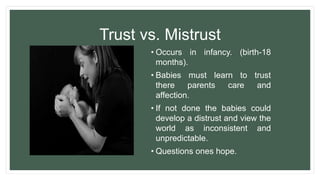
Trust vs. Mistrust
• Occurs in infancy. (birth-18
months).
• Babies must learn to trust
there parents care and
affection.
• If not done the babies could
develop a distrust and view the
world as inconsistent and
unpredictable.
• Questions ones hope.
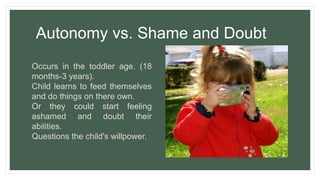
Autonomy vs. Shame and Doubt
Occurs in the toddler age. (18
months-3 years).
Child learns to feed themselves
and do things on there own.
Or they could start feeling
ashamed and doubt their
abilities.
Questions the child's willpower.
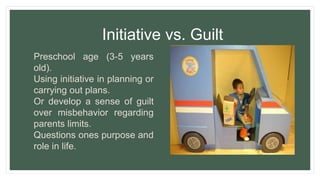
Initiative vs. Guilt
Preschool age (3-5 years
old).
Using initiative in planning or
carrying out plans.
Or develop a sense of guilt
over misbehavior regarding
parents limits.
Questions ones purpose and
role in life.
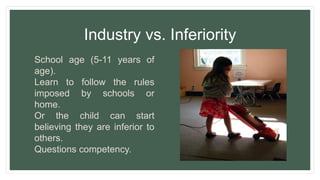
Industry vs. Inferiority

School age (5-11 years of
age).
Learn to follow the rules
imposed by schools or
home.
Or the child can start
believing they are inferior to
others.
Questions competency.
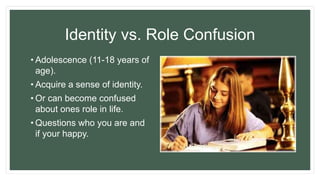
Identity vs. Role Confusion
• Adolescence (11-18 years of
age).
• Acquire a sense of identity.
• Or can become confused
about ones role in life.
• Questions who you are and
if your happy.
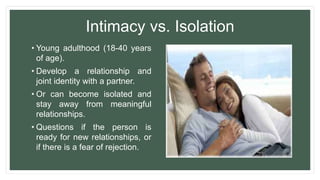
Intimacy vs. Isolation
• Young adulthood (18-40 years
of age).
• Develop a relationship and
joint identity with a partner.
• Or can become isolated and
stay away from meaningful
relationships.
• Questions if the person is
ready for new relationships, or
if there is a fear of rejection.
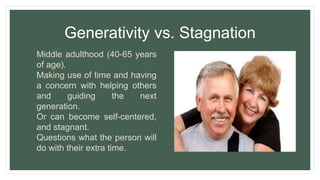
Generativity vs. Stagnation
Middle adulthood (40-65 years
of age).
Making use of time and having
a concern with helping others
and guiding the next
generation.
Or can become self-centered,
and stagnant.
Questions what the person will
do with their extra time.
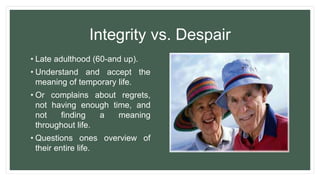
Integrity vs. Despair
• Late adulthood (60-and up).
• Understand and accept the
meaning of temporary life.
• Or complains about regrets,
not having enough time, and
not finding a meaning
throughout life.
• Questions ones overview of
their entire life.
History of Psychosocial Theory
• Erikson was one of the first psychologists to
become aware of the influence of culture on
behavior.
• He placed more emphasis on the external
world, meaning depression and wars.
• The three key factors to Erikson’s theory are
the interaction of the body, mind, and cultural
influences.
• His basic philosophy rests on two themes:
- The world gets bigger as we go along
- And failure is cumulative.
• If an individual has dealt with a terrible past
as a child, they might not be able to cope
with scenarios that life presents later on.
• However, human spirit can always be ignited
and overcome these problems.
Erikson’s Philosophy
Overview
• Erikson has eight developmental stages that gives
people an idea of what to expect throughout life.
• Behavior is based on culture experiences.
• Each person has the ability to choose their path when it
comes to his eight stages.
THE SELF AS COGNITIVE
CONSTRUCT
Relating to, being, or involving conscious intellectual
activity (such as thinking, reasoning, or
remembering).
COGNITIVE
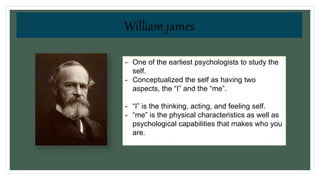
“I” vs. “me”
- One of the earliest psychologists to study the
self.
- Conceptualized the self as having two
aspects, the “I” and the “me”.
- “I” is the thinking, acting, and feeling self.
- “me” is the physical characteristics as well as
psychological capabilities that makes who you
are.
William james
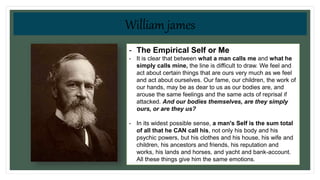
• William James
- The Empirical Self or Me
- It is clear that between what a man calls me and what he
simply calls mine, the line is difficult to draw. We feel and
act about certain things that are ours very much as we feel
and act about ourselves. Our fame, our children, the work of
our hands, may be as dear to us as our bodies are, and
arouse the same feelings and the same acts of reprisal if
attacked. And our bodies themselves, are they simply
ours, or are they us?
- In its widest possible sense, a man's Self is the sum total
of all that he CAN call his, not only his body and his
psychic powers, but his clothes and his house, his wife and
children, his ancestors and friends, his reputation and
works, his lands and horses, and yacht and bank-account.
All these things give him the same emotions.
William james
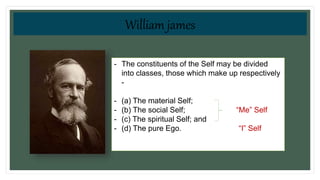
- The constituents of the Self may be divided
into classes, those which make up respectively
-
- (a) The material Self;
- (b) The social Self; “Me” Self
- (c) The spiritual Self; and
- (d) The pure Ego. “I” Self
William james
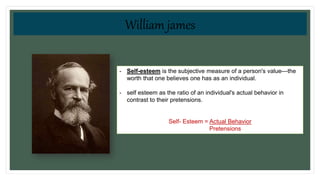
- Self-esteem is the subjective measure of a person's value—the
worth that one believes one has as an individual.
- self esteem as the ratio of an individual's actual behavior in
contrast to their pretensions.
Self- Esteem = Actual Behavior
Pretensions
William james
THANK YOU
AND
HAVE A GREAT DAY!

PPT-GROUP-1 - Copy.pptx

  • 1.
  • 2.
    -Sigmund Freud (The Fatherof Psychoanalytic Theory
  • 3.
    Freud’s Stages ofPsychosexual Development • Freud is the most popular psychologist that studied the development of personality, also probably the most controversial. His theory of psychosexual development includes five distinct stages. • The theory is quiet interesting for many because Freud identified specific “erogenous zones” for each stage of development. These are specific “pleasure areas” that become focal points for the particular stage. • Fixation - results from failure to satisfy the needs of a particular psychosexual stage.
  • 4.
    Five distinct stagesof Freud’s Psychosexual Development
  • 5.
    Oral Stage (Birthto 18 months) • The erogenous zone is the mouth. During the oral stage, the child is focused on oral pleasures (sucking). Too much or too little satisfaction can lead to an Oral Fixation or Oral Personality which is shown in an increased focus on oral activities. This type of personality may be oral receptive, that is, have a stronger tendency to smoke, drink alcohol, over eat, or oral aggressive, that is, with a tendency to bite his or her nails, or use curse words or even gossip.
  • 6.
    Anal Stage (18months to 3 years) • The child’s focus of pleasure in this stage is the anus. The child finds satisfaction in eliminating and retaining feces. Through society’s expectations, particularly the parent’s the child needs to work on toilet training. • Between 1 year old to 3 years the child’s favorite word might be “No”. Therefore, a struggle might exist in the toilet training process when the child retains feces for some reason.
  • 7.
    Phallic Stage(ages 3to 6) • The pleasure or erogenous zone is the genitals. During the preschool age, children become interested in what makes boys and girls different. Preschoolers will sometimes be seen fondling their genitals. • Freud’s studies led him to believe that during his stage boys develop unconscious sexual desire for their mother. Boys then see their father as a rival for her mother’s affection. Boys may fear that their father will punish them for these feelings, thus the castration anxiety.
  • 8.
    • Oedipus Complex,in Greek Mythology, Oedipus unintentionally killed his father and married his mother Jocasta. • Electra Complex, developing unconscious sexual attraction towards his father. • According to Freud, out of fear of castration and due to the strong competition of their father, boys eventually decide to identify with them rather fight them. By identifying with their father, the boys develop masculine characteristics and identify themselves as males and repress their sexual feelings toward their mother.
  • 9.
    Latency Stage(age 6to puberty) • It's during this stage that sexual urges remain repressed. The children's focus is the acquisition of physical and academic skills. Boys usually relate more with boys and girls with girls during this stage.
  • 10.
    Genital Stage (pubertyonwards) • The fifth stage of psychosexual development begins at the start of puberty when sexual urges are once again awakened. in the earlier stages, adolescents focus their sexual urges towars the opposite sex peers, with pleasure centered on the genitals.
  • 11.
    Freud's Personality Components •Freud's described the personality structures as having three components, the id, the ego and the superego. For each person, the first to emerge is the id, followed by the ego, and the last to develop is the superego.
  • 12.
    The id. • Freudsay's that, a child is born with the id. The id plays a vital role in one's personality because as a baby, it works so that the baby's essential needs are met. • The id operates on the pleasure principle. It focuses on immediate gratification or satisfaction of its needs. So whatever feels good now is what it will pursue with no consideration for the reality, logicality or practicality of the situation • Nothing else matters to the id except the satisfaction of its own needs. It is not oriented towards considering reality nor the needs of others.
  • 13.
    The ego. • Asthe baby turns into a toddler and then into a preschooler, he/she relates more with the environment, the ego slowly begins to emerge. • The ego operates using the reality principle. It is aware that others also nhave needs to be met. It is practical because it knows that being impilsive or selfish can result to negative consequences later, so it reason's and considers the best response to situations.
  • 14.
    The superego. • Nearthe end of the preschool years, or the end of the phallic stage, the superego develops. The superego embodies person's moral aspect. • The superego is likened to conscience because it exerts influence on what one considers right and wrong.
  • 15.
    The Three Componentsand Pesonality Adjustment • Freud said that a well-adjusted person is one who has strong ego, who can help satisfy the needs of the id without going againts the superego while maintaining the person's sense of what is logical, practical and real. • The ability of a learner to be well-adjusted is largely influenced by how the learner was brought up. His experiences about how his parents met his needs, the extent to which he was allowed to do the things he wanted to do, and also the how he was taught about right and wrong, all figures to the type of personality and consequent adjustment that a person will make. • Freud believed that the personality of an individual is formed during the the childhood years.
  • 16.
    Topographical Model The Unconscious •Freud said that most what we go through in our lives, emotions, beliefs, feelings, and impulses deep within are not available to us at a conscious level. • He believed that most of what influence us is our unconscious. The Conscious • Freud also said that all that we are aware of is stored in our conscious mind. Our conscious mind only comprises a very small part of who we are so that, in our everyday life, we are only aware of a very small part of what makes up our personality: mos of what we are is hidden and out of reach.
  • 17.
    The Subconscious • Thelast part is the preconscious or sunconscious. This is the part of us that we can reach id prompted, but is not in our active conscious. • It's right below surface, but still “hidden” somewhat unless we search for it.
  • 18.
  • 19.
    Psychosocial Development There weretwo psychologists who had developed famous psychosocial theories: Freud, and Erikson. Erikson believes that personality develops in a series of stages. Freud’s theory is well known but also very controversial.
  • 20.
    Erikson’s Theory ofDevelopment Shows impact of social experiences across ones whole lifespan. There are eight stages over a lifespan showing the development. The main elements behind his theory is the identity of ones ego. According to his theory when conflicts arise people have the opportunity to grow or fail equally.
  • 21.
    Trust vs. Mistrust •Occurs in infancy. (birth-18 months). • Babies must learn to trust there parents care and affection. • If not done the babies could develop a distrust and view the world as inconsistent and unpredictable. • Questions ones hope.
  • 22.
    Autonomy vs. Shameand Doubt Occurs in the toddler age. (18 months-3 years). Child learns to feed themselves and do things on there own. Or they could start feeling ashamed and doubt their abilities. Questions the child's willpower.
  • 23.
    Initiative vs. Guilt Preschoolage (3-5 years old). Using initiative in planning or carrying out plans. Or develop a sense of guilt over misbehavior regarding parents limits. Questions ones purpose and role in life.
  • 24.
    Industry vs. Inferiority Schoolage (5-11 years of age). Learn to follow the rules imposed by schools or home. Or the child can start believing they are inferior to others. Questions competency.
  • 25.
    Identity vs. RoleConfusion • Adolescence (11-18 years of age). • Acquire a sense of identity. • Or can become confused about ones role in life. • Questions who you are and if your happy.
  • 26.
    Intimacy vs. Isolation •Young adulthood (18-40 years of age). • Develop a relationship and joint identity with a partner. • Or can become isolated and stay away from meaningful relationships. • Questions if the person is ready for new relationships, or if there is a fear of rejection.
  • 27.
    Generativity vs. Stagnation Middleadulthood (40-65 years of age). Making use of time and having a concern with helping others and guiding the next generation. Or can become self-centered, and stagnant. Questions what the person will do with their extra time.
  • 28.
    Integrity vs. Despair •Late adulthood (60-and up). • Understand and accept the meaning of temporary life. • Or complains about regrets, not having enough time, and not finding a meaning throughout life. • Questions ones overview of their entire life.
  • 29.
    History of PsychosocialTheory • Erikson was one of the first psychologists to become aware of the influence of culture on behavior. • He placed more emphasis on the external world, meaning depression and wars. • The three key factors to Erikson’s theory are the interaction of the body, mind, and cultural influences.
  • 30.
    • His basicphilosophy rests on two themes: - The world gets bigger as we go along - And failure is cumulative. • If an individual has dealt with a terrible past as a child, they might not be able to cope with scenarios that life presents later on. • However, human spirit can always be ignited and overcome these problems. Erikson’s Philosophy
  • 31.
    Overview • Erikson haseight developmental stages that gives people an idea of what to expect throughout life. • Behavior is based on culture experiences. • Each person has the ability to choose their path when it comes to his eight stages.
  • 32.
    THE SELF ASCOGNITIVE CONSTRUCT
  • 33.
    Relating to, being,or involving conscious intellectual activity (such as thinking, reasoning, or remembering). COGNITIVE
  • 34.
    “I” vs. “me” -One of the earliest psychologists to study the self. - Conceptualized the self as having two aspects, the “I” and the “me”. - “I” is the thinking, acting, and feeling self. - “me” is the physical characteristics as well as psychological capabilities that makes who you are. William james
  • 35.
    • William James -The Empirical Self or Me - It is clear that between what a man calls me and what he simply calls mine, the line is difficult to draw. We feel and act about certain things that are ours very much as we feel and act about ourselves. Our fame, our children, the work of our hands, may be as dear to us as our bodies are, and arouse the same feelings and the same acts of reprisal if attacked. And our bodies themselves, are they simply ours, or are they us? - In its widest possible sense, a man's Self is the sum total of all that he CAN call his, not only his body and his psychic powers, but his clothes and his house, his wife and children, his ancestors and friends, his reputation and works, his lands and horses, and yacht and bank-account. All these things give him the same emotions. William james
  • 36.
    - The constituentsof the Self may be divided into classes, those which make up respectively - - (a) The material Self; - (b) The social Self; “Me” Self - (c) The spiritual Self; and - (d) The pure Ego. “I” Self William james
  • 37.
    - Self-esteem isthe subjective measure of a person's value—the worth that one believes one has as an individual. - self esteem as the ratio of an individual's actual behavior in contrast to their pretensions. Self- Esteem = Actual Behavior Pretensions William james
  • 38.