Egyptian Musical
Instruments
Made by:
Section B
Angnyei Angh (5000018359)
Hermnn Singh (5000018497)
Kavya Goel (5000019049)
Tanishka Gupta (5000018391)
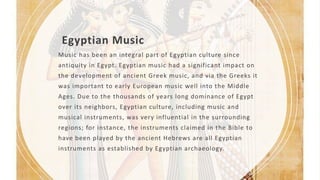
Egyptian Music
Music has been an integral part of Egyptian culture since
antiquity in Egypt. Egyptian music had a significant impact on
the development of ancient Greek music, and via the Greeks it
was important to early European music well into the Middle
Ages. Due to the thousands of years long dominance of Egypt
over its neighbors, Egyptian culture, including music and
musical instruments, was very influential in the surrounding
regions; for instance, the instruments claimed in the Bible to
have been played by the ancient Hebrews are all Egyptian
instruments as established by Egyptian archaeology.
Benet
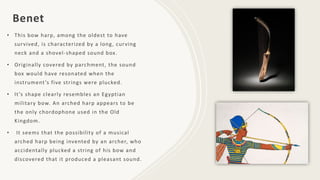
• This bow harp, among the oldest to have
survived, is characterized by a long, curving
neck and a shovel-shaped sound box.
• Originally covered by parchment, the sound
box would have resonated when the
instrument’s five strings were plucked.
• It’s shape clearly resembles an Egyptian
military bow. An arched harp appears to be
the only chordophone used in the Old
Kingdom.
• It seems that the possibility of a musical
arched harp being invented by an archer, who
accidentally plucked a string of his bow and
discovered that it produced a pleasant sound.
• The sound of a single bowstring can vary with
altered bending of the limb (in the terminology of
archery, the wooden part of a bow). There might
have included installation of the additional few
strings to the limb of the bow.
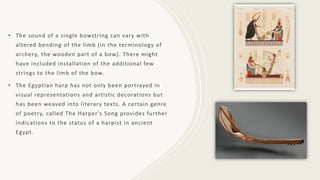
• The Egyptian harp has not only been portrayed in
visual representations and artistic decorations but
has been weaved into literary texts. A certain genre
of poetry, called The Harper's Song provides further
indications to the status of a harpist in ancient
Egypt.
Sistrum
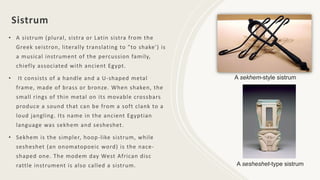
• A sistrum (plural, sistra or Latin sistra from the
Greek seistron, literally translating to "to shake') is
a musical instrument of the percussion family,
chiefly associated with ancient Egypt.
• It consists of a handle and a U-shaped metal
frame, made of brass or bronze. When shaken, the
small rings of thin metal on its movable crossbars
produce a sound that can be from a soft clank to a
loud jangling. Its name in the ancient Egyptian
language was sekhem and sesheshet.
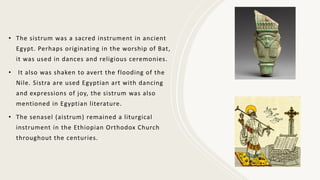
• Sekhem is the simpler, hoop-like sistrum, while
sesheshet (an onomatopoeic word) is the nace-
shaped one. The modem day West African disc
rattle instrument is also called a sistrum.
A sekhem-style sistrum
A sesheshet-type sistrum
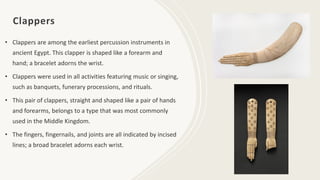
• The sistrum was a sacred instrument in ancient
Egypt. Perhaps originating in the worship of Bat,
it was used in dances and religious ceremonies.
• It also was shaken to avert the flooding of the
Nile. Sistra are used Egyptian art with dancing
and expressions of joy, the sistrum was also
mentioned in Egyptian literature.
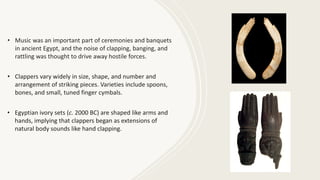
• The senasel (aistrum) remained a liturgical
instrument in the Ethiopian Orthodox Church
throughout the centuries.
Clappers
• Clappers are among the earliest percussion instruments in
ancient Egypt. This clapper is shaped like a forearm and
hand; a bracelet adorns the wrist.
• Clappers were used in all activities featuring music or singing,
such as banquets, funerary processions, and rituals.
• This pair of clappers, straight and shaped like a pair of hands
and forearms, belongs to a type that was most commonly
used in the Middle Kingdom.
• The fingers, fingernails, and joints are all indicated by incised
lines; a broad bracelet adorns each wrist.
• Music was an important part of ceremonies and banquets
in ancient Egypt, and the noise of clapping, banging, and
rattling was thought to drive away hostile forces.
• Clappers vary widely in size, shape, and number and
arrangement of striking pieces. Varieties include spoons,
bones, and small, tuned finger cymbals.
• Egyptian ivory sets (c. 2000 BC) are shaped like arms and
hands, implying that clappers began as extensions of
natural body sounds like hand clapping.
Ney
• The ney is the oblique rim blown flute common to the
Middle East, and used in classical, folk and religious
music. It is believed to have originated in Egypt over
five thousand years ago.
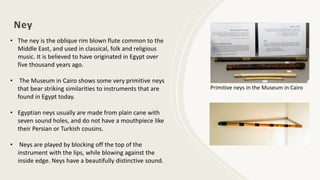
• The Museum in Cairo shows some very primitive neys
that bear striking similarities to instruments that are
found in Egypt today.
• Egyptian neys usually are made from plain cane with
seven sound holes, and do not have a mouthpiece like
their Persian or Turkish cousins.
• Neys are played by blocking off the top of the
instrument with the lips, while blowing against the
inside edge. Neys have a beautifully distinctive sound.
Primitive neys in the Museum in Cairo
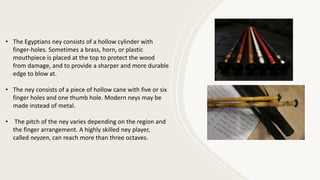
• The Egyptians ney consists of a hollow cylinder with
finger-holes. Sometimes a brass, horn, or plastic
mouthpiece is placed at the top to protect the wood
from damage, and to provide a sharper and more durable
edge to blow at.
• The ney consists of a piece of hollow cane with five or six
finger holes and one thumb hole. Modern neys may be
made instead of metal.
• The pitch of the ney varies depending on the region and
the finger arrangement. A highly skilled ney player,
called neyzen, can reach more than three octaves.
BIBLIOGRAPHY
Links used:
• Benet:
https://www.metmuseum.org/art/collection/search/546194
https://www.academia.edu/31747764/Ancient_Egyptian_Harp_Its_origins_and_status_within_the_Ancient_Egyptian_society
• Sistrum:
https://www.britannica.com/art/sistrum
https://www.metmuseum.org/art/collection/search/546194
• Clappers
https://www.metmuseum.org/art/collection/search/546194
https://collections.artsmia.org/art/115320/pair-of-clappers-ancient-egyptian
• Ney
https://www.metmuseum.org/art/collection/search/546194
https://www.ethnicmusical.com/ney/5-interesting-facts-about-arabic-ney
THANKYOU

ppt.egyptianmusicalinstruments2dffffcffc

  • 1.
    Egyptian Musical Instruments Made by: SectionB Angnyei Angh (5000018359) Hermnn Singh (5000018497) Kavya Goel (5000019049) Tanishka Gupta (5000018391)
  • 2.
    Egyptian Music Music hasbeen an integral part of Egyptian culture since antiquity in Egypt. Egyptian music had a significant impact on the development of ancient Greek music, and via the Greeks it was important to early European music well into the Middle Ages. Due to the thousands of years long dominance of Egypt over its neighbors, Egyptian culture, including music and musical instruments, was very influential in the surrounding regions; for instance, the instruments claimed in the Bible to have been played by the ancient Hebrews are all Egyptian instruments as established by Egyptian archaeology.
  • 3.
    Benet • This bowharp, among the oldest to have survived, is characterized by a long, curving neck and a shovel-shaped sound box. • Originally covered by parchment, the sound box would have resonated when the instrument’s five strings were plucked. • It’s shape clearly resembles an Egyptian military bow. An arched harp appears to be the only chordophone used in the Old Kingdom. • It seems that the possibility of a musical arched harp being invented by an archer, who accidentally plucked a string of his bow and discovered that it produced a pleasant sound.
  • 4.
    • The soundof a single bowstring can vary with altered bending of the limb (in the terminology of archery, the wooden part of a bow). There might have included installation of the additional few strings to the limb of the bow. • The Egyptian harp has not only been portrayed in visual representations and artistic decorations but has been weaved into literary texts. A certain genre of poetry, called The Harper's Song provides further indications to the status of a harpist in ancient Egypt.
  • 5.
    Sistrum • A sistrum(plural, sistra or Latin sistra from the Greek seistron, literally translating to "to shake') is a musical instrument of the percussion family, chiefly associated with ancient Egypt. • It consists of a handle and a U-shaped metal frame, made of brass or bronze. When shaken, the small rings of thin metal on its movable crossbars produce a sound that can be from a soft clank to a loud jangling. Its name in the ancient Egyptian language was sekhem and sesheshet. • Sekhem is the simpler, hoop-like sistrum, while sesheshet (an onomatopoeic word) is the nace- shaped one. The modem day West African disc rattle instrument is also called a sistrum. A sekhem-style sistrum A sesheshet-type sistrum
  • 6.
    • The sistrumwas a sacred instrument in ancient Egypt. Perhaps originating in the worship of Bat, it was used in dances and religious ceremonies. • It also was shaken to avert the flooding of the Nile. Sistra are used Egyptian art with dancing and expressions of joy, the sistrum was also mentioned in Egyptian literature. • The senasel (aistrum) remained a liturgical instrument in the Ethiopian Orthodox Church throughout the centuries.
  • 7.
    Clappers • Clappers areamong the earliest percussion instruments in ancient Egypt. This clapper is shaped like a forearm and hand; a bracelet adorns the wrist. • Clappers were used in all activities featuring music or singing, such as banquets, funerary processions, and rituals. • This pair of clappers, straight and shaped like a pair of hands and forearms, belongs to a type that was most commonly used in the Middle Kingdom. • The fingers, fingernails, and joints are all indicated by incised lines; a broad bracelet adorns each wrist.
  • 8.
    • Music wasan important part of ceremonies and banquets in ancient Egypt, and the noise of clapping, banging, and rattling was thought to drive away hostile forces. • Clappers vary widely in size, shape, and number and arrangement of striking pieces. Varieties include spoons, bones, and small, tuned finger cymbals. • Egyptian ivory sets (c. 2000 BC) are shaped like arms and hands, implying that clappers began as extensions of natural body sounds like hand clapping.
  • 9.
    Ney • The neyis the oblique rim blown flute common to the Middle East, and used in classical, folk and religious music. It is believed to have originated in Egypt over five thousand years ago. • The Museum in Cairo shows some very primitive neys that bear striking similarities to instruments that are found in Egypt today. • Egyptian neys usually are made from plain cane with seven sound holes, and do not have a mouthpiece like their Persian or Turkish cousins. • Neys are played by blocking off the top of the instrument with the lips, while blowing against the inside edge. Neys have a beautifully distinctive sound. Primitive neys in the Museum in Cairo
  • 10.
    • The Egyptiansney consists of a hollow cylinder with finger-holes. Sometimes a brass, horn, or plastic mouthpiece is placed at the top to protect the wood from damage, and to provide a sharper and more durable edge to blow at. • The ney consists of a piece of hollow cane with five or six finger holes and one thumb hole. Modern neys may be made instead of metal. • The pitch of the ney varies depending on the region and the finger arrangement. A highly skilled ney player, called neyzen, can reach more than three octaves.
  • 11.
    BIBLIOGRAPHY Links used: • Benet: https://www.metmuseum.org/art/collection/search/546194 https://www.academia.edu/31747764/Ancient_Egyptian_Harp_Its_origins_and_status_within_the_Ancient_Egyptian_society •Sistrum: https://www.britannica.com/art/sistrum https://www.metmuseum.org/art/collection/search/546194 • Clappers https://www.metmuseum.org/art/collection/search/546194 https://collections.artsmia.org/art/115320/pair-of-clappers-ancient-egyptian • Ney https://www.metmuseum.org/art/collection/search/546194 https://www.ethnicmusical.com/ney/5-interesting-facts-about-arabic-ney
  • 12.