©2007, The McGraw-Hill Companies, All Rights Reserved
Chapter One
Introduction
©2007, The McGraw-Hill Companies, All Rights Reserved
1-3
McGraw-Hill/Irwin
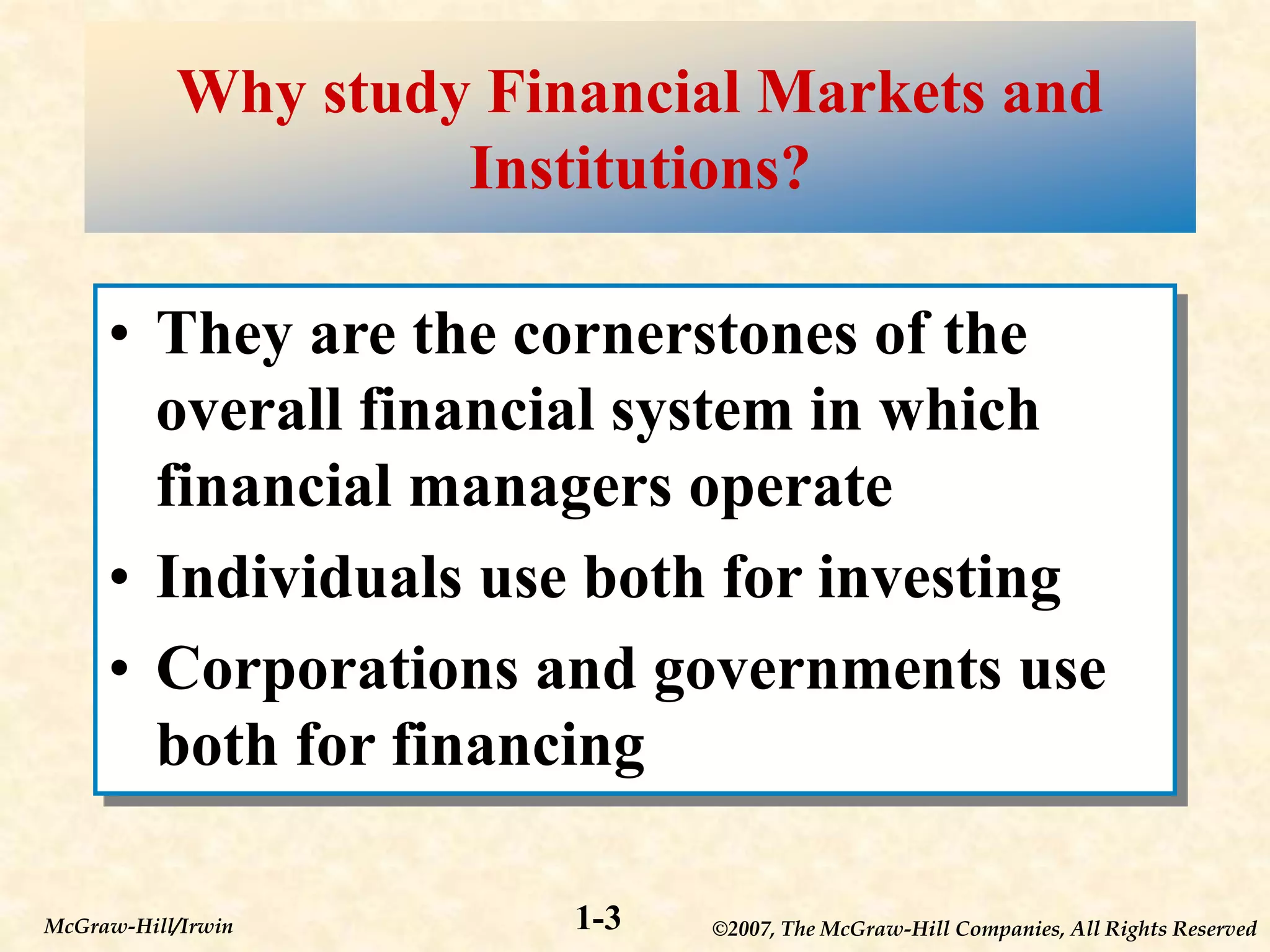
Why study Financial Markets and
Institutions?
• They are the cornerstones of the
overall financial system in which
financial managers operate
• Individuals use both for investing
• Corporations and governments use
both for financing
©2007, The McGraw-Hill Companies, All Rights Reserved
1-4
McGraw-Hill/Irwin
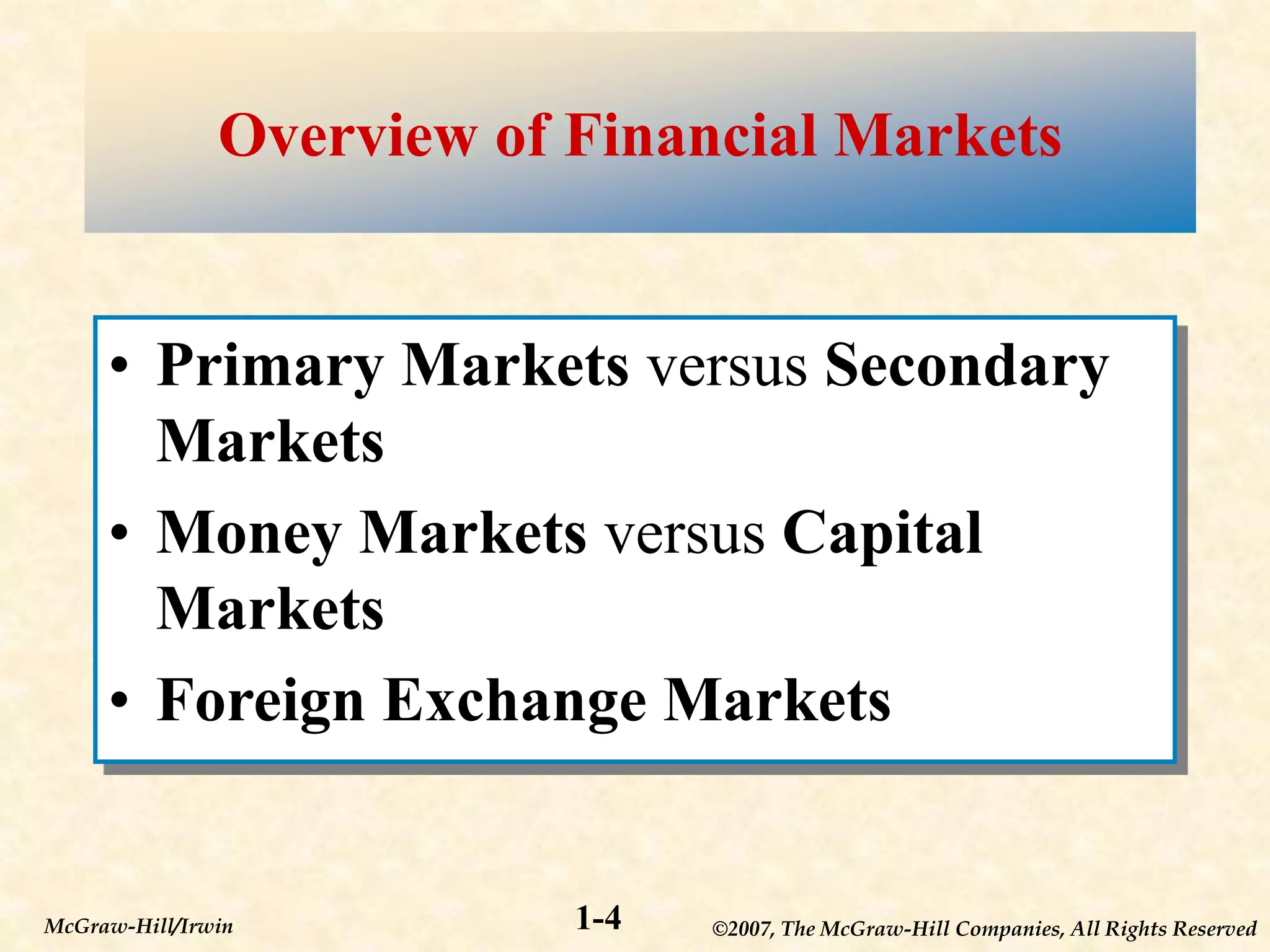
Overview of Financial Markets
• Primary Markets versus Secondary
Markets
• Money Markets versus Capital
Markets
• Foreign Exchange Markets
©2007, The McGraw-Hill Companies, All Rights Reserved
1-5
McGraw-Hill/Irwin
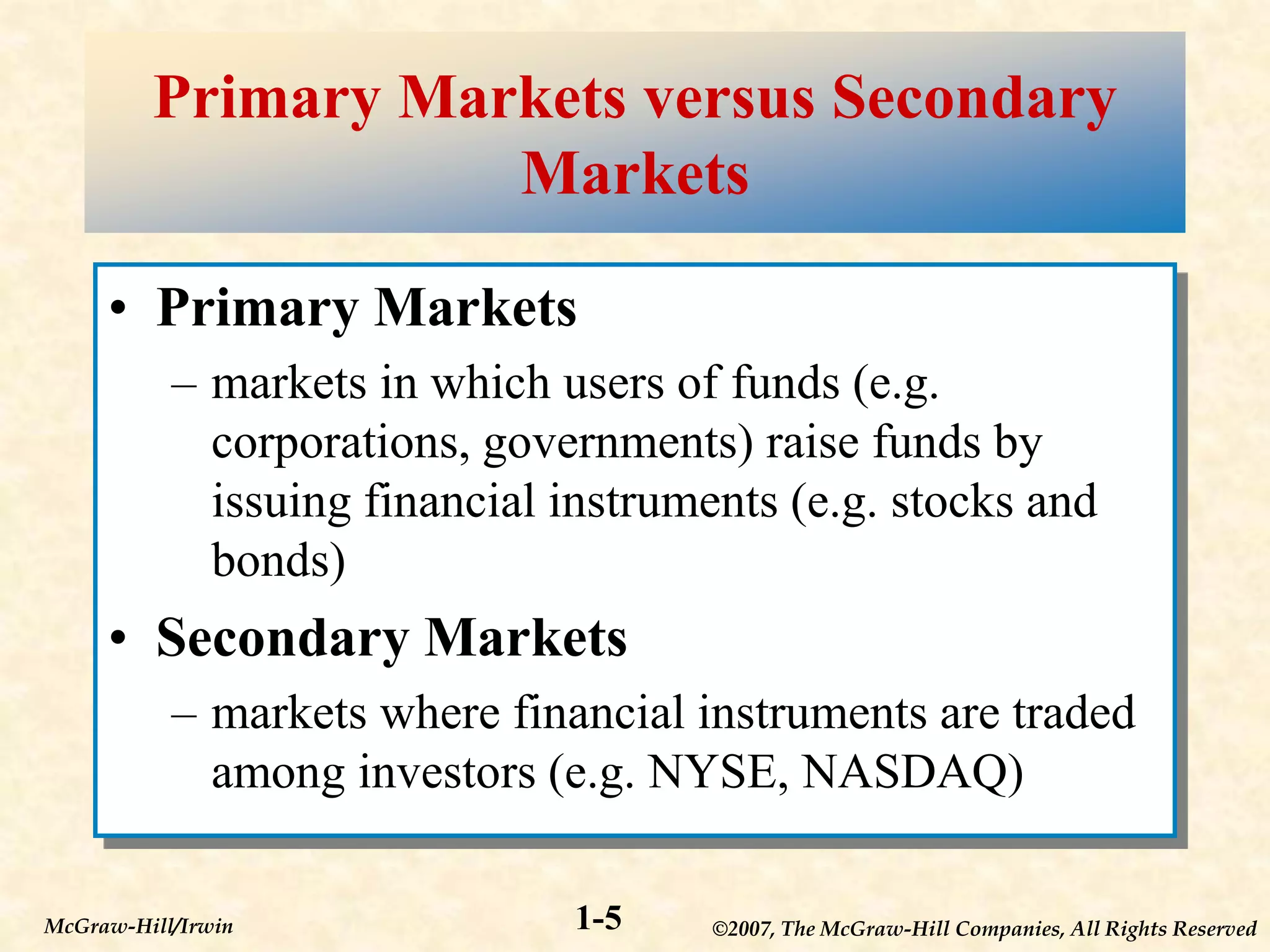
Primary Markets versus Secondary
Markets
• Primary Markets
– markets in which users of funds (e.g.
corporations, governments) raise funds by
issuing financial instruments (e.g. stocks and
bonds)
• Secondary Markets
– markets where financial instruments are traded
among investors (e.g. NYSE, NASDAQ)
©2007, The McGraw-Hill Companies, All Rights Reserved
1-6
McGraw-Hill/Irwin
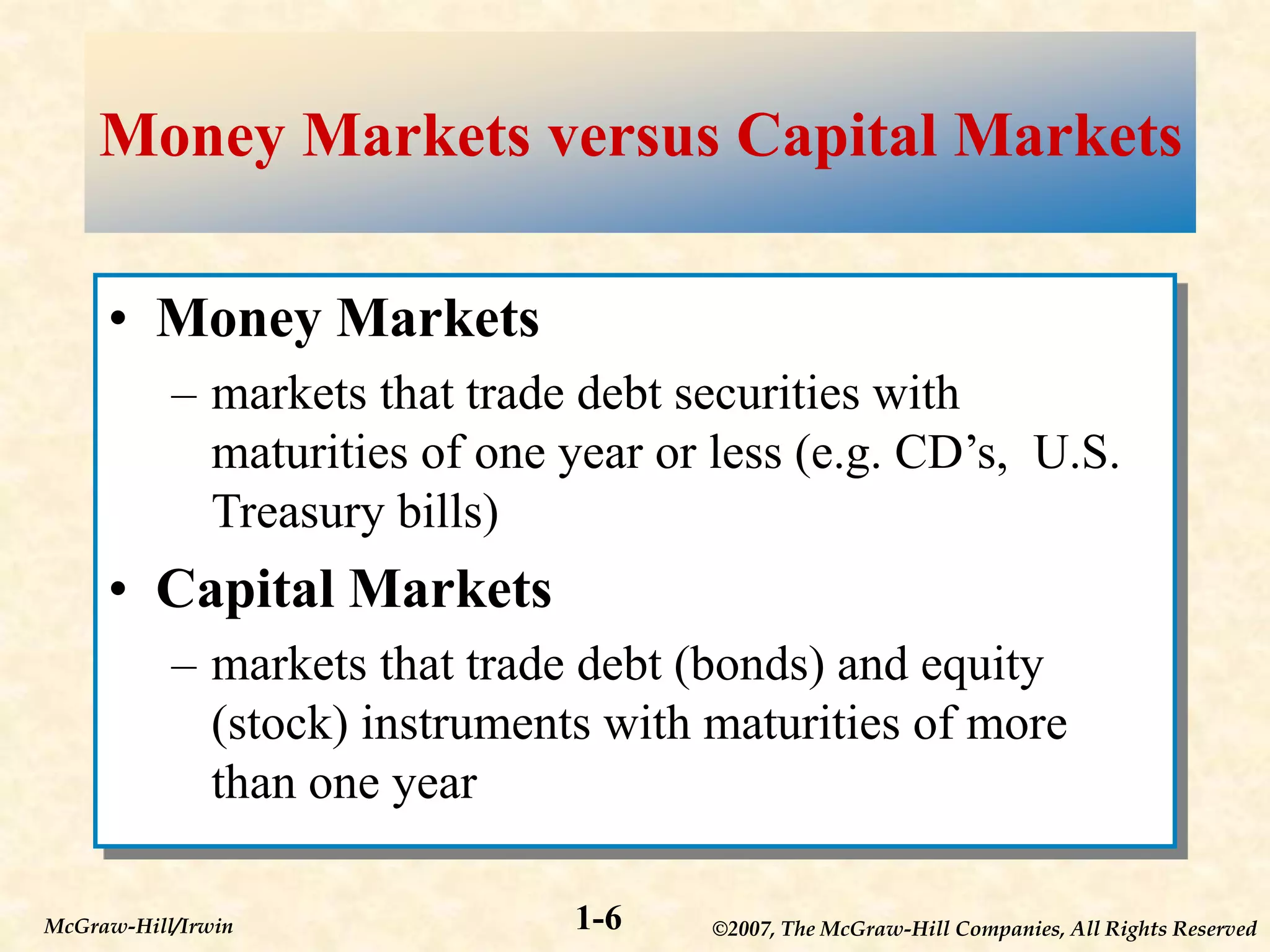
Money Markets versus Capital Markets
• Money Markets
– markets that trade debt securities with
maturities of one year or less (e.g. CD’s, U.S.
Treasury bills)
• Capital Markets
– markets that trade debt (bonds) and equity
(stock) instruments with maturities of more
than one year
©2007, The McGraw-Hill Companies, All Rights Reserved
1-7
McGraw-Hill/Irwin
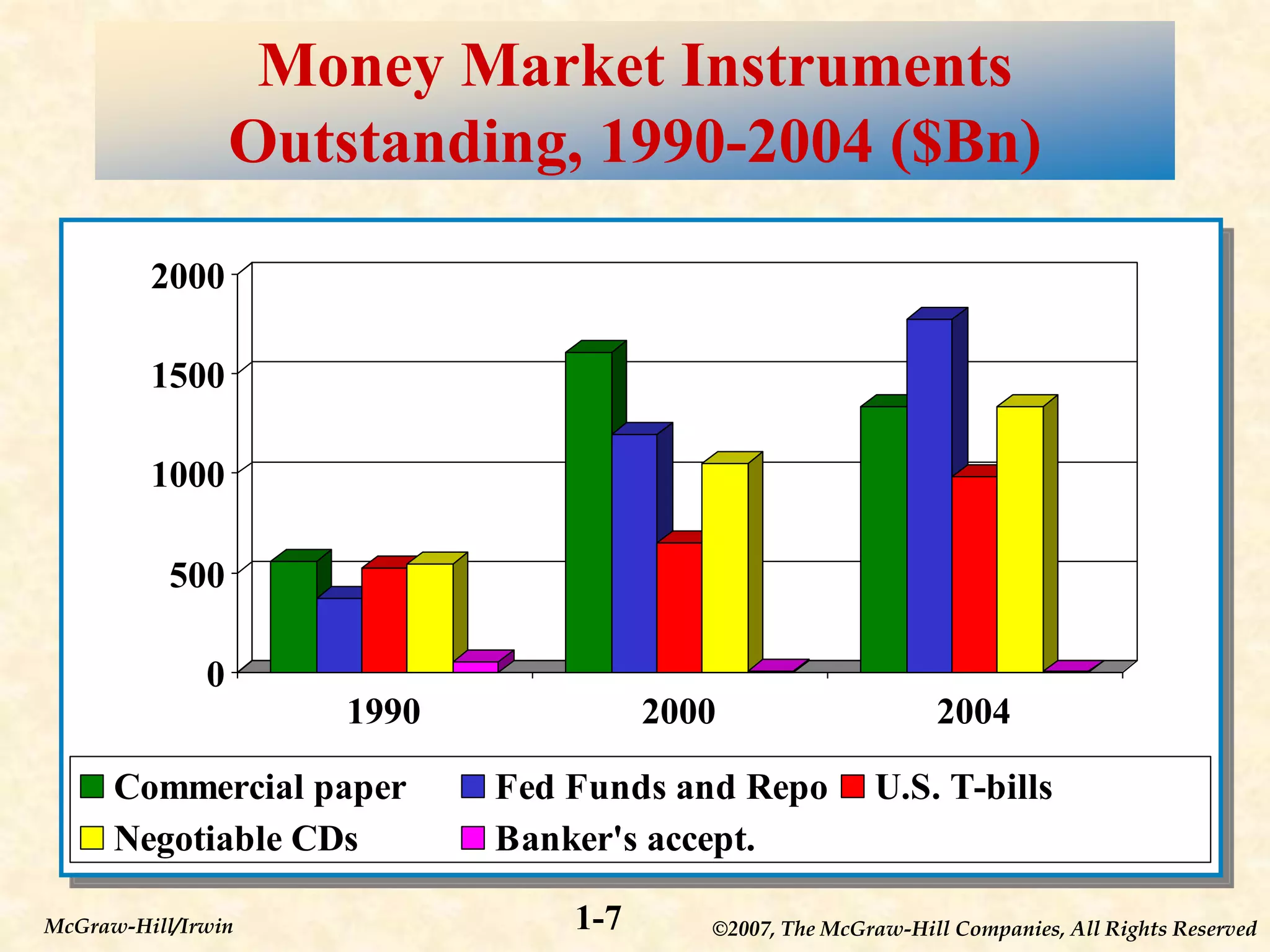
Money Market Instruments
Outstanding, 1990-2004 ($Bn)
0
500
1000
1500
2000
1990 2000 2004
Commercial paper Fed Funds and Repo U.S. T-bills
Negotiable CDs Banker's accept.
©2007, The McGraw-Hill Companies, All Rights Reserved
1-8
McGraw-Hill/Irwin
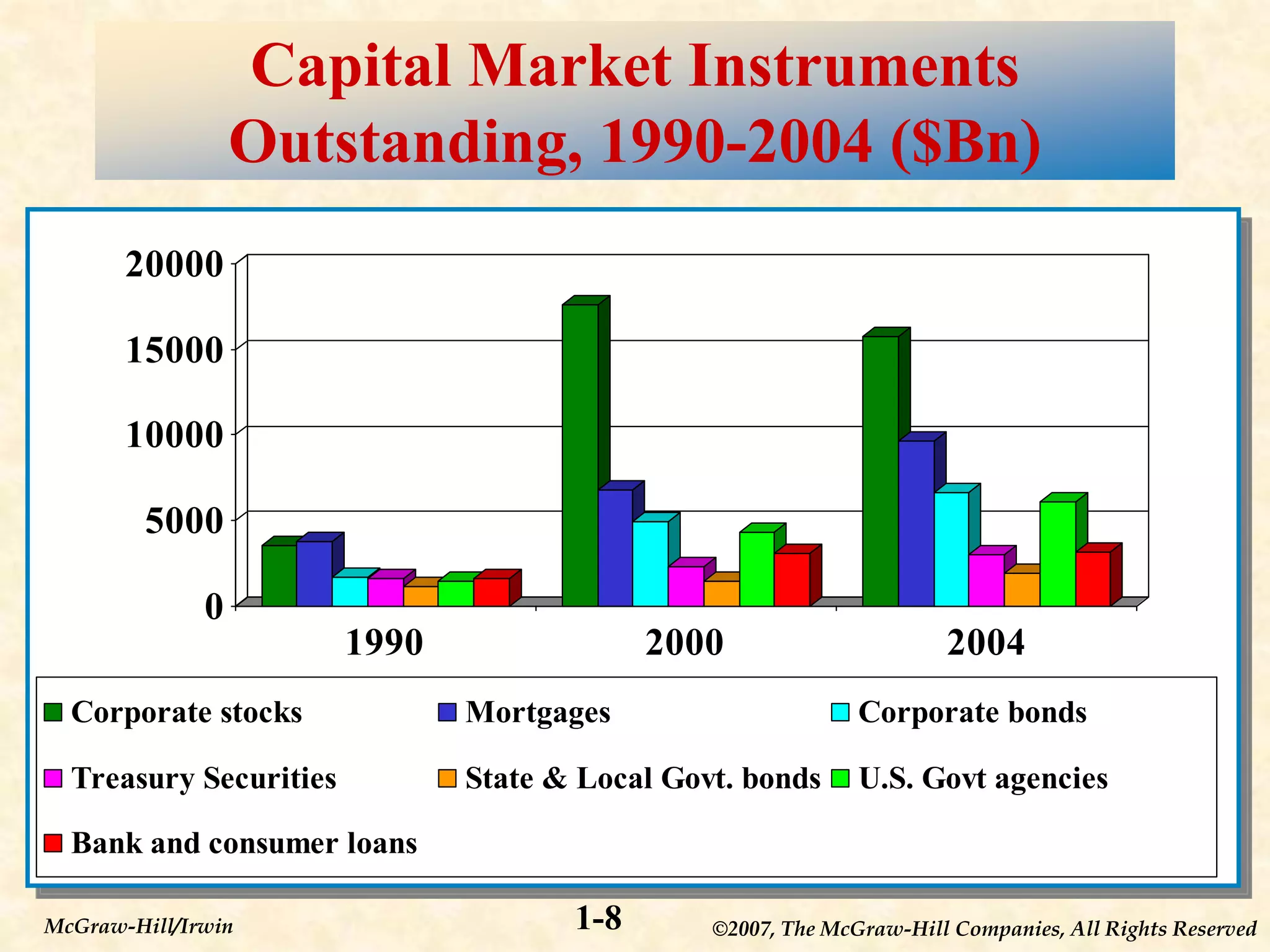
Capital Market Instruments
Outstanding, 1990-2004 ($Bn)
0
5000
10000
15000
20000
1990 2000 2004
Corporate stocks Mortgages Corporate bonds
Treasury Securities State & Local Govt. bonds U.S. Govt agencies
Bank and consumer loans
©2007, The McGraw-Hill Companies, All Rights Reserved
1-9
McGraw-Hill/Irwin
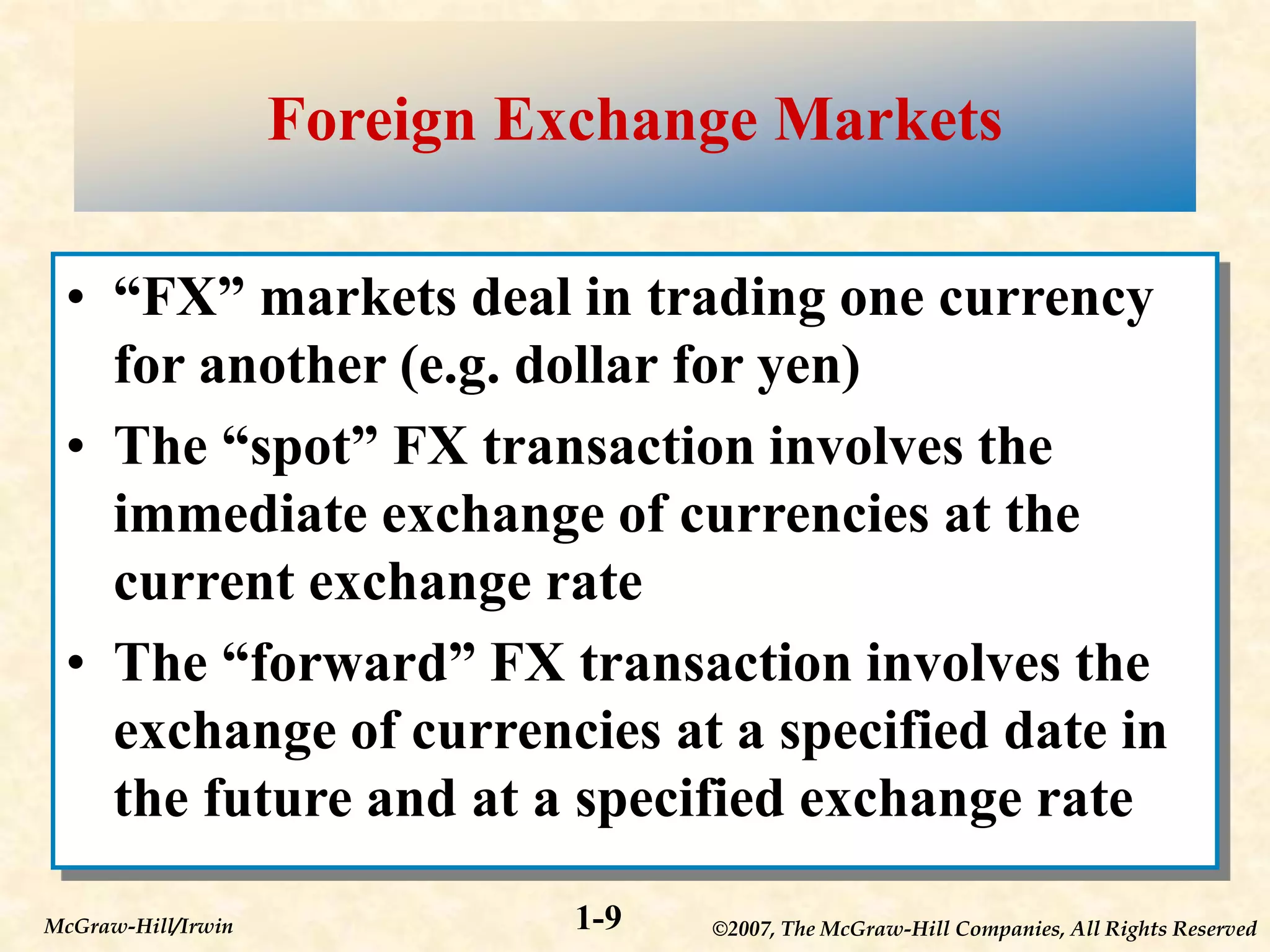
Foreign Exchange Markets
• “FX” markets deal in trading one currency
for another (e.g. dollar for yen)
• The “spot” FX transaction involves the
immediate exchange of currencies at the
current exchange rate
• The “forward” FX transaction involves the
exchange of currencies at a specified date in
the future and at a specified exchange rate
©2007, The McGraw-Hill Companies, All Rights Reserved
1-10
McGraw-Hill/Irwin
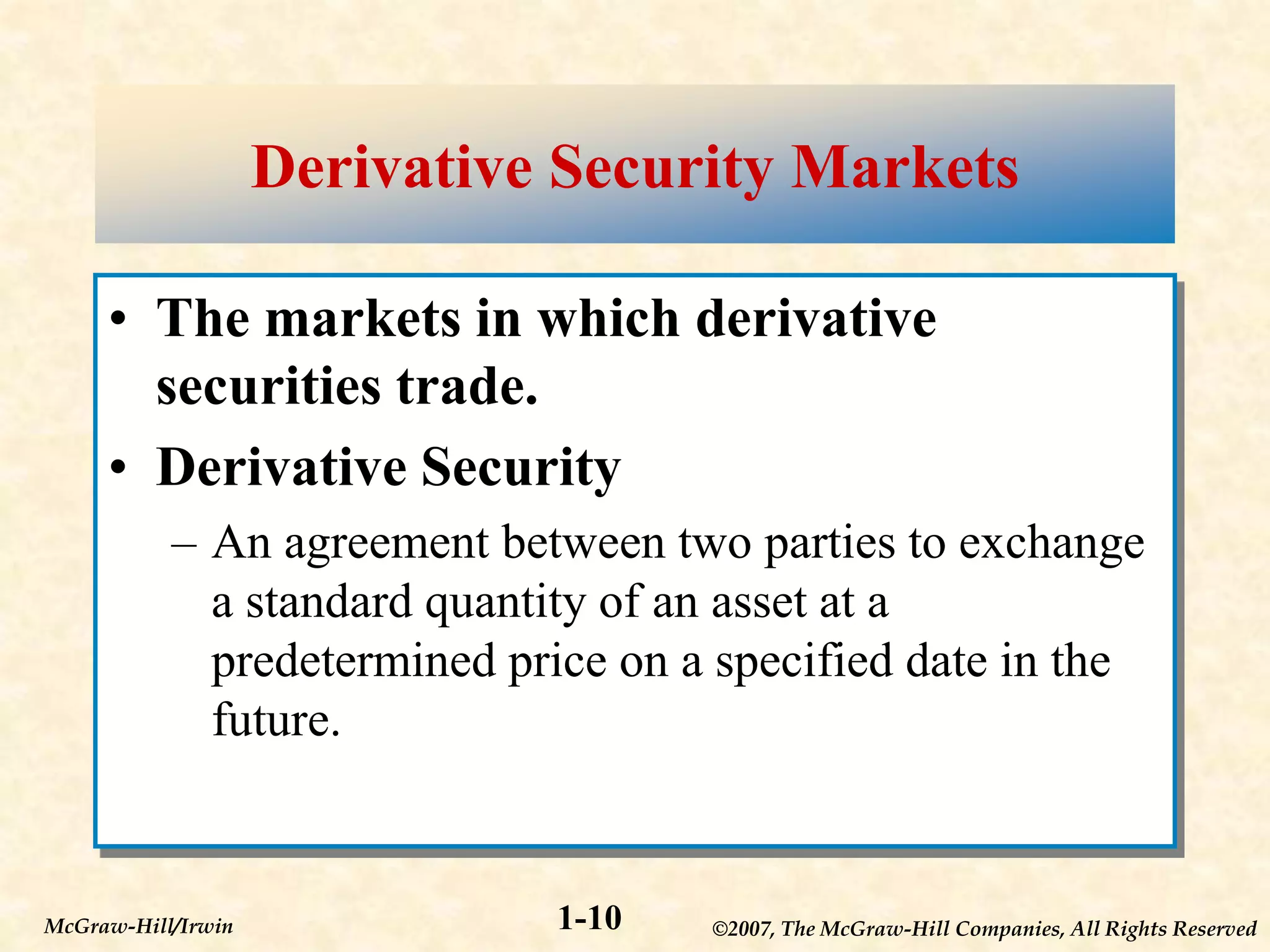
Derivative Security Markets
• The markets in which derivative
securities trade.
• Derivative Security
– An agreement between two parties to exchange
a standard quantity of an asset at a
predetermined price on a specified date in the
future.
©2007, The McGraw-Hill Companies, All Rights Reserved
1-11
McGraw-Hill/Irwin
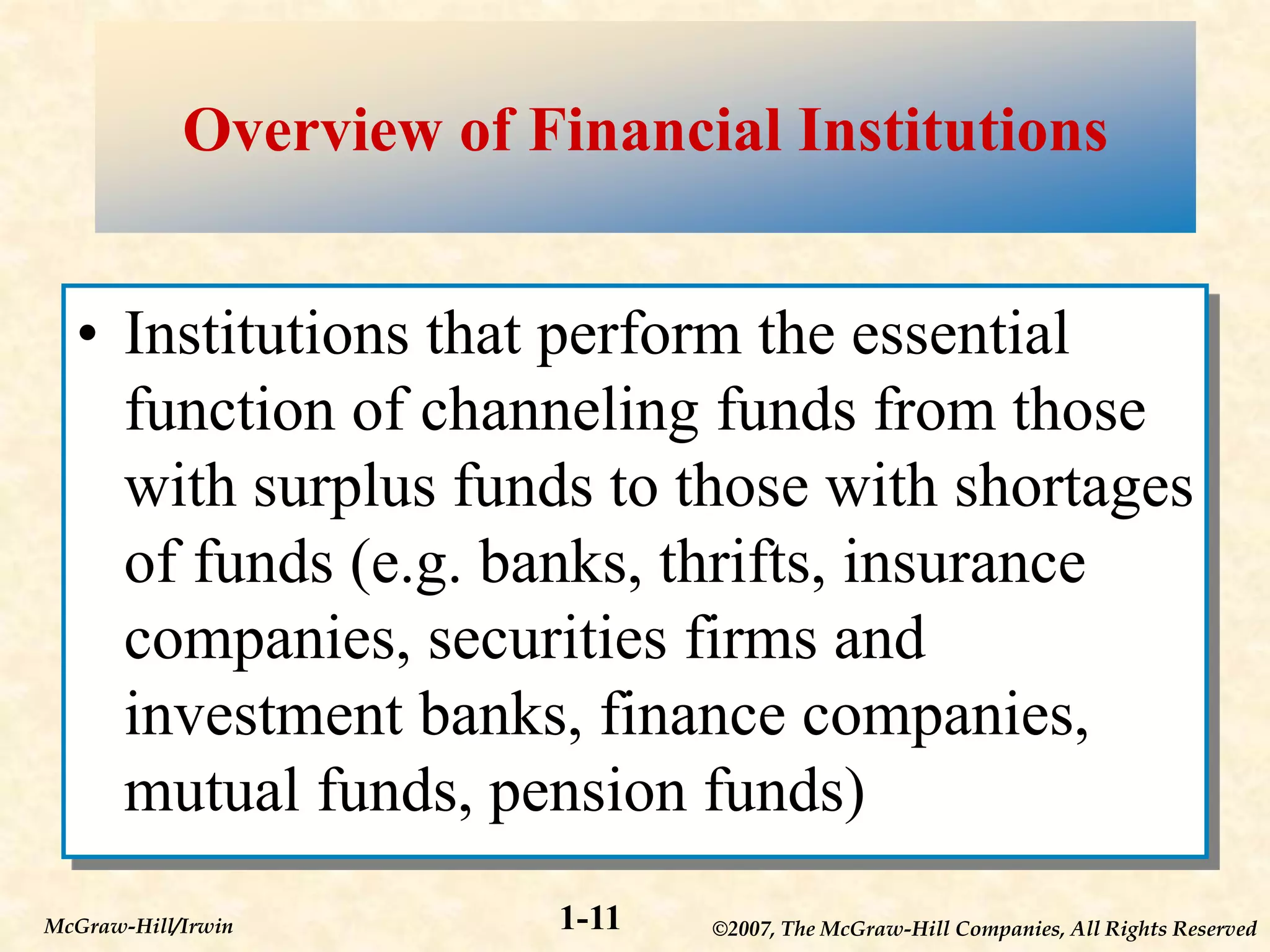
Overview of Financial Institutions
• Institutions that perform the essential
function of channeling funds from those
with surplus funds to those with shortages
of funds (e.g. banks, thrifts, insurance
companies, securities firms and
investment banks, finance companies,
mutual funds, pension funds)
©2007, The McGraw-Hill Companies, All Rights Reserved
1-12
McGraw-Hill/Irwin
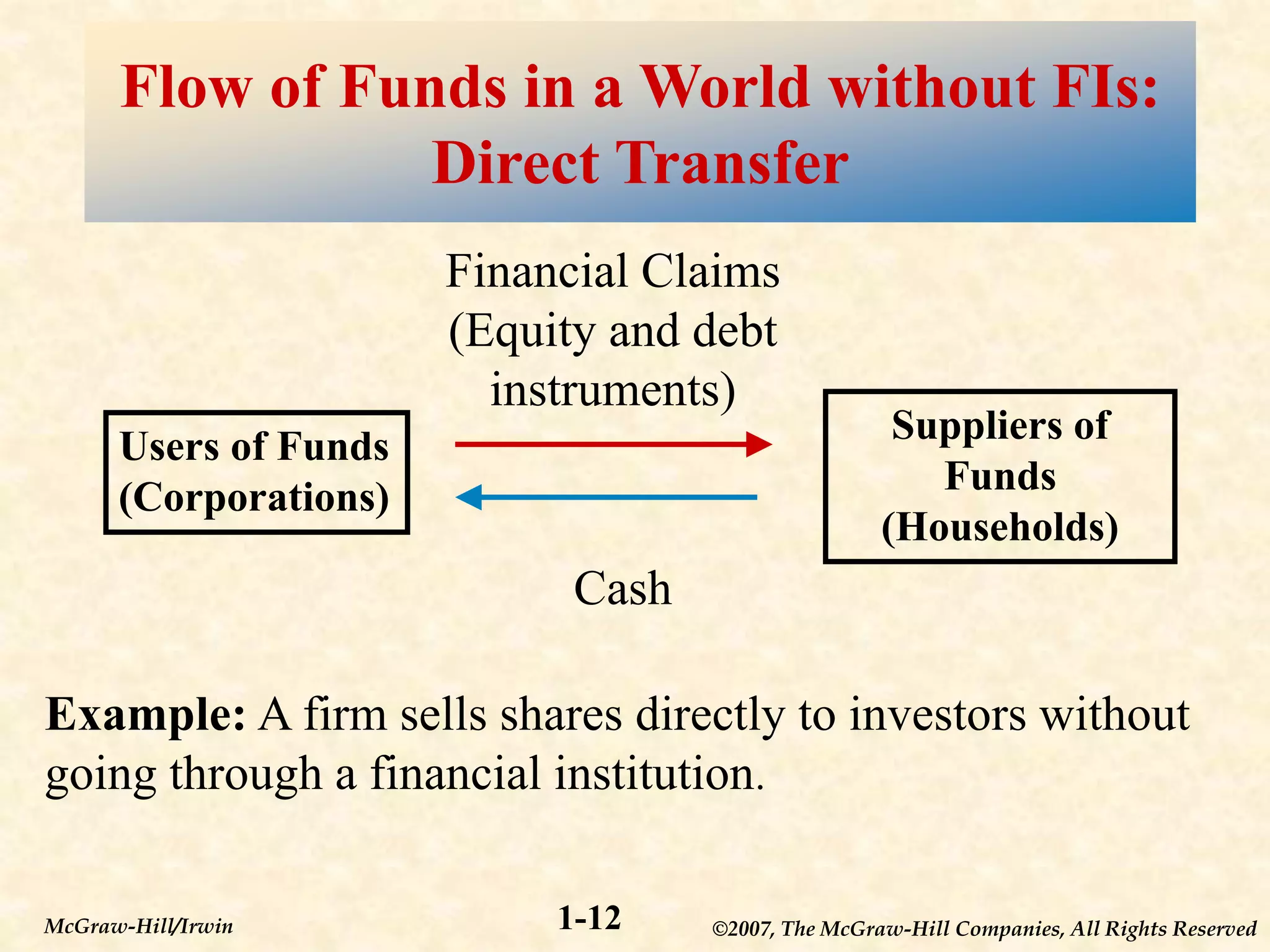
Flow of Funds in a World without FIs:
Direct Transfer
Users of Funds
(Corporations)
Suppliers of
Funds
(Households)
Financial Claims
(Equity and debt
instruments)
Cash
Example: A firm sells shares directly to investors without
going through a financial institution.
©2007, The McGraw-Hill Companies, All Rights Reserved
1-13
McGraw-Hill/Irwin
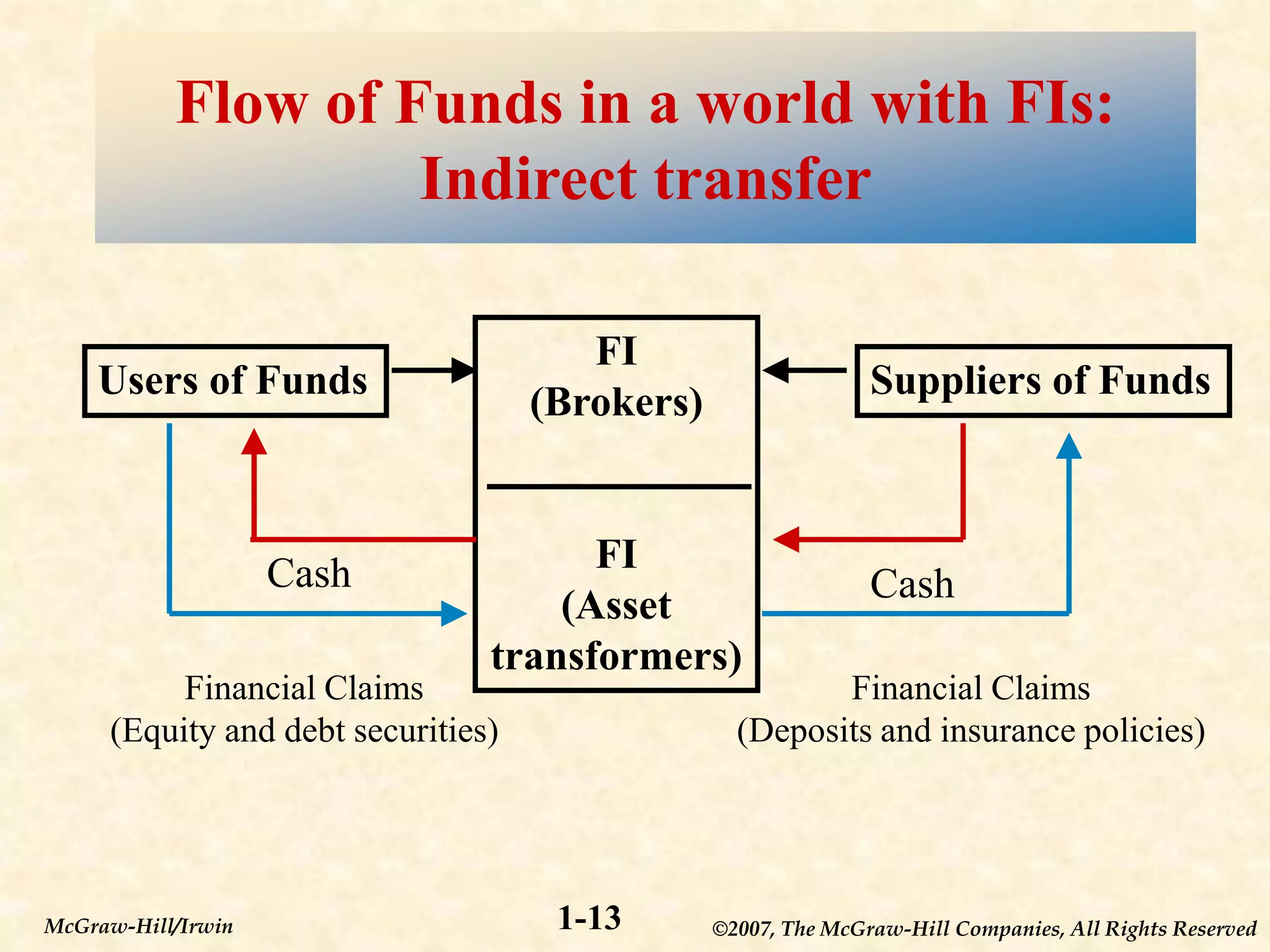
Flow of Funds in a world with FIs:
Indirect transfer
Users of Funds
FI
(Brokers)
FI
(Asset
transformers)
Suppliers of Funds
Financial Claims
(Equity and debt securities)
Financial Claims
(Deposits and insurance policies)
Cash Cash
©2007, The McGraw-Hill Companies, All Rights Reserved
1-14
McGraw-Hill/Irwin
Types of FIs
• Commercial banks
– depository institutions whose major assets are
loans and major liabilities are deposits
• Thrifts
– depository institutions in the form of savings
and loans, credit unions
• Insurance companies
– financial institutions that protect individuals
and corporations from adverse events
(continued)
©2007, The McGraw-Hill Companies, All Rights Reserved
1-15
McGraw-Hill/Irwin
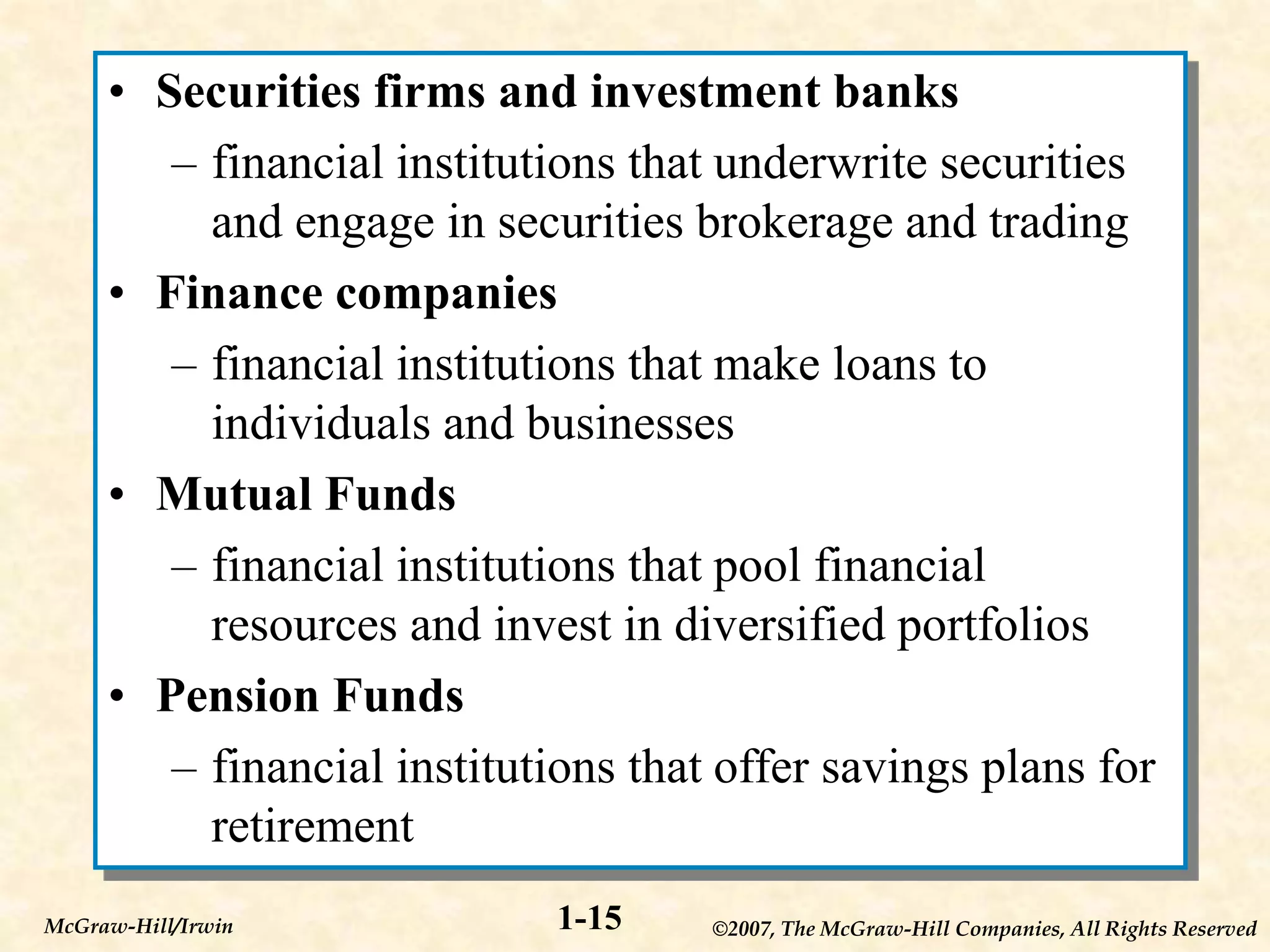
• Securities firms and investment banks
– financial institutions that underwrite securities
and engage in securities brokerage and trading
• Finance companies
– financial institutions that make loans to
individuals and businesses
• Mutual Funds
– financial institutions that pool financial
resources and invest in diversified portfolios
• Pension Funds
– financial institutions that offer savings plans for
retirement
©2007, The McGraw-Hill Companies, All Rights Reserved
1-16
McGraw-Hill/Irwin
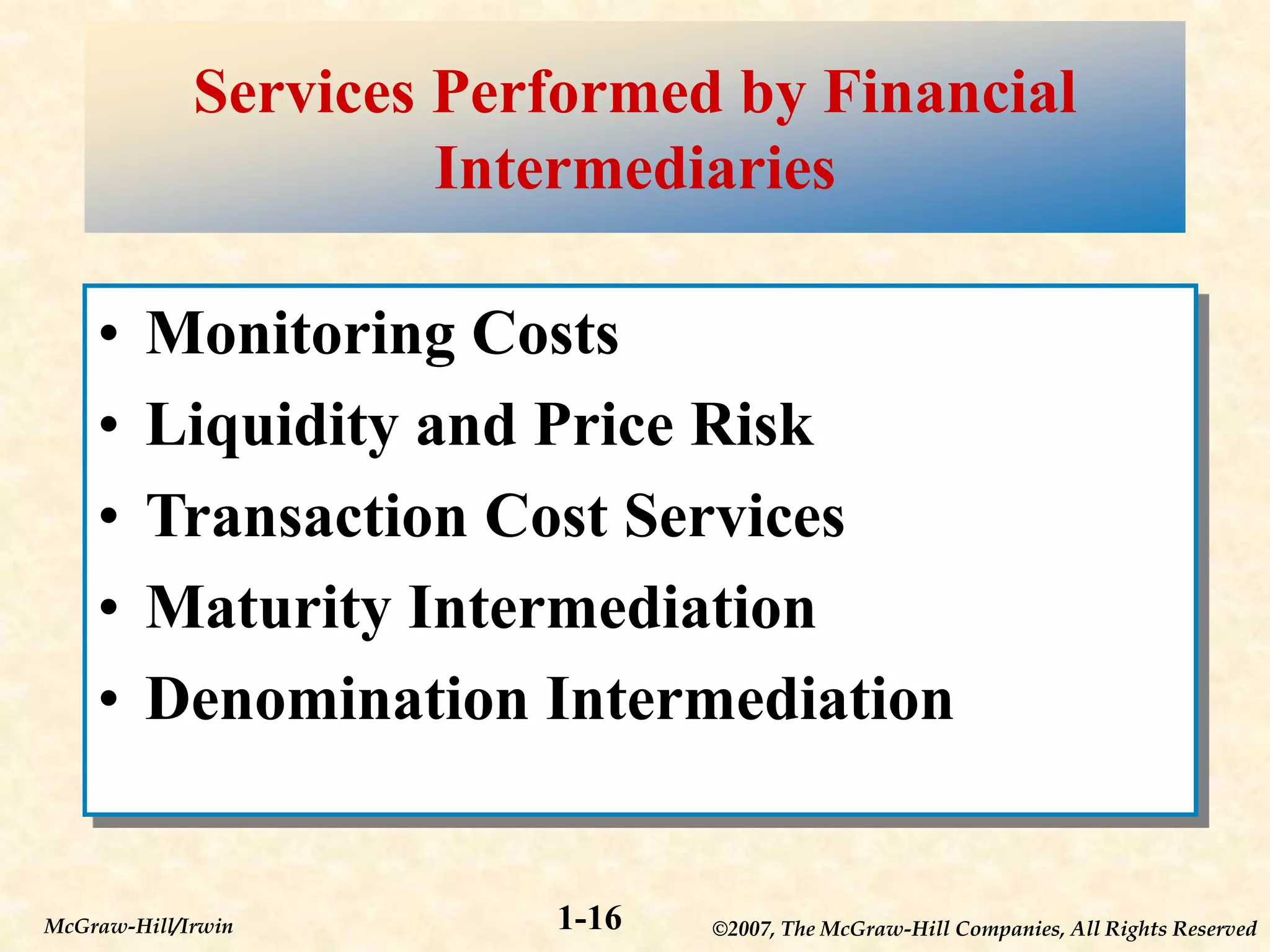
Services Performed by Financial
Intermediaries
• Monitoring Costs
• Liquidity and Price Risk
• Transaction Cost Services
• Maturity Intermediation
• Denomination Intermediation
©2007, The McGraw-Hill Companies, All Rights Reserved
1-17
McGraw-Hill/Irwin
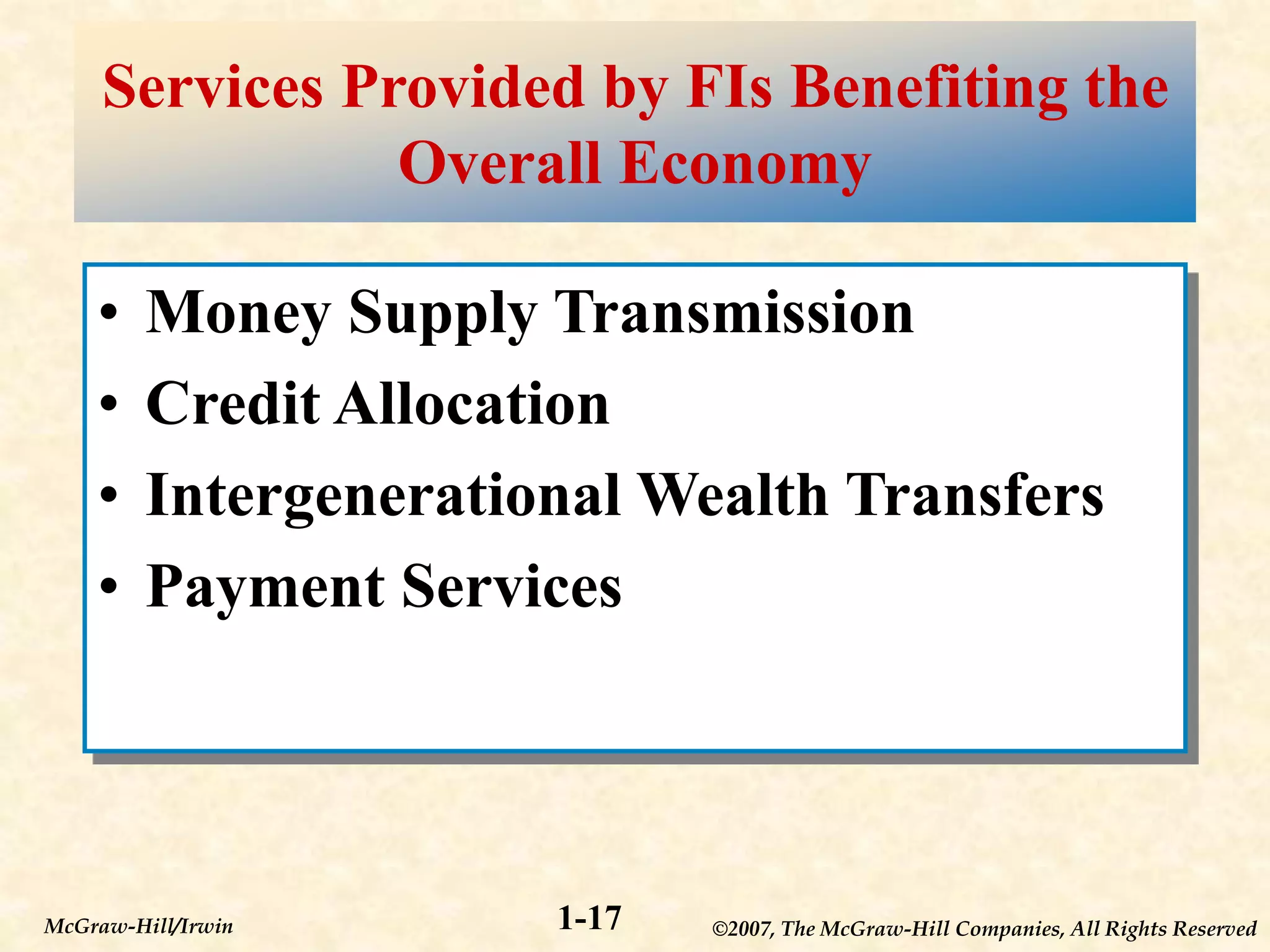
Services Provided by FIs Benefiting the
Overall Economy
• Money Supply Transmission
• Credit Allocation
• Intergenerational Wealth Transfers
• Payment Services
©2007, The McGraw-Hill Companies, All Rights Reserved
1-18
McGraw-Hill/Irwin
Risks Faced by Financial Institutions
• Interest Rate Risk
• Foreign Exchange Risk
• Market Risk
• Credit Risk
• Liquidity Risk
• Off-Balance-Sheet Risk
• Technology Risk
• Operational Risk
• Country or Sovereign Risk
• Insolvency Risk
©2007, The McGraw-Hill Companies, All Rights Reserved
1-19
McGraw-Hill/Irwin
Regulation of Financial Institutions
• FIs provide vital financial services to
all sectors of the economy; therefore,
their regulation is in the public interest
• In an attempt to prevent their failure
and the failure of financial markets
overall
©2007, The McGraw-Hill Companies, All Rights Reserved
1-20
McGraw-Hill/Irwin
Globalization of Financial Markets and
Institutions
• Financial Markets became more
global as the value of stocks traded in
foreign markets soared
• Foreign bond markets have served as
a major source of international capital
• Globalization also evident in the
derivative securities market
©2007, The McGraw-Hill Companies, All Rights Reserved
1-21
McGraw-Hill/Irwin
Factors Leading to Significant Growth
in Foreign Markets
• The pool of savings from foreign investors has
increased
• International investors have turned to U.S. and other
markets to expand their investment opportunities
• Information on foreign investments and markets is
now more accessible (e.g. internet)
• Some mutual funds allow ability to invest in foreign
securities with low transaction costs
• Deregulation has enhanced globalization of capital
flows

PPT_Chapter_01.ppt

  • 2.
    ©2007, The McGraw-HillCompanies, All Rights Reserved Chapter One Introduction
  • 3.
    ©2007, The McGraw-HillCompanies, All Rights Reserved 1-3 McGraw-Hill/Irwin Why study Financial Markets and Institutions? • They are the cornerstones of the overall financial system in which financial managers operate • Individuals use both for investing • Corporations and governments use both for financing
  • 4.
    ©2007, The McGraw-HillCompanies, All Rights Reserved 1-4 McGraw-Hill/Irwin Overview of Financial Markets • Primary Markets versus Secondary Markets • Money Markets versus Capital Markets • Foreign Exchange Markets
  • 5.
    ©2007, The McGraw-HillCompanies, All Rights Reserved 1-5 McGraw-Hill/Irwin Primary Markets versus Secondary Markets • Primary Markets – markets in which users of funds (e.g. corporations, governments) raise funds by issuing financial instruments (e.g. stocks and bonds) • Secondary Markets – markets where financial instruments are traded among investors (e.g. NYSE, NASDAQ)
  • 6.
    ©2007, The McGraw-HillCompanies, All Rights Reserved 1-6 McGraw-Hill/Irwin Money Markets versus Capital Markets • Money Markets – markets that trade debt securities with maturities of one year or less (e.g. CD’s, U.S. Treasury bills) • Capital Markets – markets that trade debt (bonds) and equity (stock) instruments with maturities of more than one year
  • 7.
    ©2007, The McGraw-HillCompanies, All Rights Reserved 1-7 McGraw-Hill/Irwin Money Market Instruments Outstanding, 1990-2004 ($Bn) 0 500 1000 1500 2000 1990 2000 2004 Commercial paper Fed Funds and Repo U.S. T-bills Negotiable CDs Banker's accept.
  • 8.
    ©2007, The McGraw-HillCompanies, All Rights Reserved 1-8 McGraw-Hill/Irwin Capital Market Instruments Outstanding, 1990-2004 ($Bn) 0 5000 10000 15000 20000 1990 2000 2004 Corporate stocks Mortgages Corporate bonds Treasury Securities State & Local Govt. bonds U.S. Govt agencies Bank and consumer loans
  • 9.
    ©2007, The McGraw-HillCompanies, All Rights Reserved 1-9 McGraw-Hill/Irwin Foreign Exchange Markets • “FX” markets deal in trading one currency for another (e.g. dollar for yen) • The “spot” FX transaction involves the immediate exchange of currencies at the current exchange rate • The “forward” FX transaction involves the exchange of currencies at a specified date in the future and at a specified exchange rate
  • 10.
    ©2007, The McGraw-HillCompanies, All Rights Reserved 1-10 McGraw-Hill/Irwin Derivative Security Markets • The markets in which derivative securities trade. • Derivative Security – An agreement between two parties to exchange a standard quantity of an asset at a predetermined price on a specified date in the future.
  • 11.
    ©2007, The McGraw-HillCompanies, All Rights Reserved 1-11 McGraw-Hill/Irwin Overview of Financial Institutions • Institutions that perform the essential function of channeling funds from those with surplus funds to those with shortages of funds (e.g. banks, thrifts, insurance companies, securities firms and investment banks, finance companies, mutual funds, pension funds)
  • 12.
    ©2007, The McGraw-HillCompanies, All Rights Reserved 1-12 McGraw-Hill/Irwin Flow of Funds in a World without FIs: Direct Transfer Users of Funds (Corporations) Suppliers of Funds (Households) Financial Claims (Equity and debt instruments) Cash Example: A firm sells shares directly to investors without going through a financial institution.
  • 13.
    ©2007, The McGraw-HillCompanies, All Rights Reserved 1-13 McGraw-Hill/Irwin Flow of Funds in a world with FIs: Indirect transfer Users of Funds FI (Brokers) FI (Asset transformers) Suppliers of Funds Financial Claims (Equity and debt securities) Financial Claims (Deposits and insurance policies) Cash Cash
  • 14.
    ©2007, The McGraw-HillCompanies, All Rights Reserved 1-14 McGraw-Hill/Irwin Types of FIs • Commercial banks – depository institutions whose major assets are loans and major liabilities are deposits • Thrifts – depository institutions in the form of savings and loans, credit unions • Insurance companies – financial institutions that protect individuals and corporations from adverse events (continued)
  • 15.
    ©2007, The McGraw-HillCompanies, All Rights Reserved 1-15 McGraw-Hill/Irwin • Securities firms and investment banks – financial institutions that underwrite securities and engage in securities brokerage and trading • Finance companies – financial institutions that make loans to individuals and businesses • Mutual Funds – financial institutions that pool financial resources and invest in diversified portfolios • Pension Funds – financial institutions that offer savings plans for retirement
  • 16.
    ©2007, The McGraw-HillCompanies, All Rights Reserved 1-16 McGraw-Hill/Irwin Services Performed by Financial Intermediaries • Monitoring Costs • Liquidity and Price Risk • Transaction Cost Services • Maturity Intermediation • Denomination Intermediation
  • 17.
    ©2007, The McGraw-HillCompanies, All Rights Reserved 1-17 McGraw-Hill/Irwin Services Provided by FIs Benefiting the Overall Economy • Money Supply Transmission • Credit Allocation • Intergenerational Wealth Transfers • Payment Services
  • 18.
    ©2007, The McGraw-HillCompanies, All Rights Reserved 1-18 McGraw-Hill/Irwin Risks Faced by Financial Institutions • Interest Rate Risk • Foreign Exchange Risk • Market Risk • Credit Risk • Liquidity Risk • Off-Balance-Sheet Risk • Technology Risk • Operational Risk • Country or Sovereign Risk • Insolvency Risk
  • 19.
    ©2007, The McGraw-HillCompanies, All Rights Reserved 1-19 McGraw-Hill/Irwin Regulation of Financial Institutions • FIs provide vital financial services to all sectors of the economy; therefore, their regulation is in the public interest • In an attempt to prevent their failure and the failure of financial markets overall
  • 20.
    ©2007, The McGraw-HillCompanies, All Rights Reserved 1-20 McGraw-Hill/Irwin Globalization of Financial Markets and Institutions • Financial Markets became more global as the value of stocks traded in foreign markets soared • Foreign bond markets have served as a major source of international capital • Globalization also evident in the derivative securities market
  • 21.
    ©2007, The McGraw-HillCompanies, All Rights Reserved 1-21 McGraw-Hill/Irwin Factors Leading to Significant Growth in Foreign Markets • The pool of savings from foreign investors has increased • International investors have turned to U.S. and other markets to expand their investment opportunities • Information on foreign investments and markets is now more accessible (e.g. internet) • Some mutual funds allow ability to invest in foreign securities with low transaction costs • Deregulation has enhanced globalization of capital flows