Download to read offline


![Βαθμονόμηση Μαζών
Διάλυμα Αναφοράς
Διάλυμα Ελέγχου Καταλληλότητας
m
(amu)
Χρόνοι
πτήσης
(μs)
118.0863 20.79841
322.0481 33.53829
622.029 46.12659
922.0098 55.88826
1521.971 71.45158
2121.933 84.14302
2721.895 95.13425
Ιόν m/z Ακριβής
μάζα
ψευδομοριακό ιόν
[ΜΗ+
]
C8H15ClN5
+
216,110
Θραύσμα C5H9ClN5
+
174,0541
Positive Ion (m/z) Empirical Formula
121.050873 C5H5N4
922.009798 C18H19O6N3P3F24
Έλεγχος καταλληλότητας συστήματος
2
o )( ttAm m −=](https://image.slidesharecdn.com/ppt2-150515151419-lva1-app6891/85/HRMS-8-320.jpg)


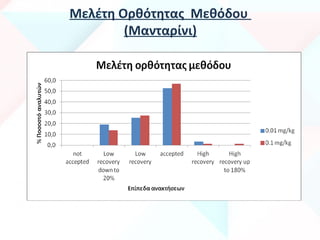


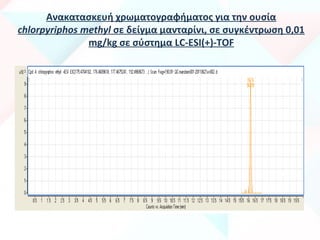


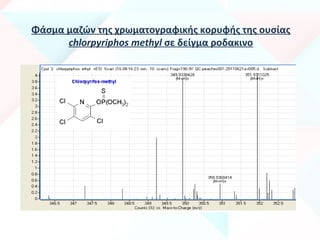
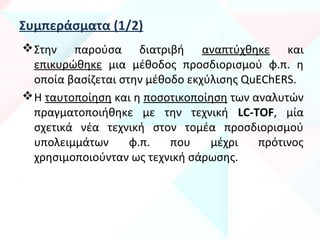



A trend in the field of pesticide residue analysis is the implementation of easy, robust, cheap and multiresidue analytical methods. The recent advances of analytical instrumentation, offers new tools for the reliable and more accurate determination of unknown analytes in a variety of complex matrices like fruits and vegetables. Under the current work a multiresidue analytical method, based on the extraction method QuEChERS, a short extraction procedure without complex equipment, low consumption of consumables and appropriate isolation of pesticide residues of different chemical classes was developed and validated. The identification and quantification of the analytes was performed using liquid chromatography coupled with mass spectrometry time of flight (LC-TOF), a relatively new technique in the field of pesticide residue, mostly applied for a screening method. The method was successfully validated in three matrices (cauliflower, mandarin and peach), representative commodities of the group of plant commodities with high water and high acid content, for 163 analytes of different chemical groups. Accuracy, precision, linearity and matrix effect were investigated. The majority of analysts showed acceptable linearity with r ≥ 0,99, accuracy with 70-120% recovery rates and precision with SDR ≤ 20%. The limit of quantification was set at 0.01 mg / kg. Thus the method was found suitable for the determination of multiclass pesticide residues in cauliflower, peach and mandarins.


