ANALYZING THE
AUDIENCE
AUDIENCE-CENTEREDNESS
• Audience-centeredness: Keeping the audience foremost in mind at
every step of speech preparation and presentation
– Objective is to gain a desired response from the listeners
• Do not have to compromise your beliefs
• Do not have to use unethical tactics to achieve your goal
AUDIENCE-CENTEREDNESS
• Keep in mind these questions to be audience centered:
– To whom am I speaking?
– What do I want them to know, believe, or do as a result of my
speech?
– What is the most effective way of composing and presenting my
speech to accomplish that aim?
YOUR CLASSMATES AS AN
AUDIENCE
• The best classroom speeches are those that take
the audience as seriously as a lawyer, politician,
or advertiser takes an audience
THE PSYCHOLOGY OF AUDIENCES
• The speaker must make the audience choose to pay attention
• Every speech contains 2 messages:
– One sent by the speaker
– One received by the listener
• What the speaker says is filtered through the listener’s frame of reference
• Listeners want to hear about things that are meaningful to them
– Egocentrism: The tendency of people to be concerned above all with their own
values, beliefs, and well-being
• How does this affect you as a speaker?
– Listeners will hear and judge based on what they already know and believe
– You must relate your message to your listeners
DEMOGRAPHIC AUDIENCE ANALYSIS
• Demographic audience analysis: Audience analysis that focuses on
demographic factors such as age, gender, religion, sexual orientation,
group membership, and racial ethnic or cultural background
• There are two steps of demographic audience analysis:
– Identifying the general demographic features of your audience
– Gauging the importance of those features to a particular speaking situation
• When used improperly, it can lead to stereotyping
– Stereotyping: Creating an oversimplified image of a particular group of
people, usually by assuming that all members of a group are alike
DEMOGRAPHIC AUDIENCE ANALYSIS
• Consider the following demographic factors:
– Age
• Speaking to an older audience vs. a younger audience
– Gender
• Take in current gender attitude and practices
• Be aware of both gender differences and similarities
• Avoid generalizations
– Sexual Orientation
• Be mindful of language, examples, and other elements that may exclude listeners with same-sex partners
– Religion
• Current events around the world show religious views are among the most emotionally charged of all
human concerns
• There is great diversity within different faiths
• Consider the religious orientation of your listeners
– Racial, Ethnic, and Cultural Background
• Some listeners may have perspectives that will affect how they are listening to the speech
– Group Membership
• Knowing the groups or memberships you audience is in may give excellent clues about your listeners
interests and attitudes
SITUATIONAL AUDIENCE ANALYSIS
• Situational audience analysis: Audience analysis that focuses on situational factors such
as size of the audience, the physical setting of the speech, and the disposition of the
audience towards the topic, the speaker, and the occasion
• Consider the following demographic factors:
– Size
• The larger the audience, the more formal your presentation must be
• Audience size may affect you language, choice of requests, and use of visual aids
– Physical Setting
• Know in advance of any difficulties in the physical setting
• Do everything you can to control the influence of the physical setting
• If the physical setting is not desirable, work hard to adapt to the aspects
SITUATIONAL AUDIENCE ANALYSIS
– Disposition Toward the Topic
• Interest
– Assess the interest in advance and adjust your speech accordingly
– If interest is not there, take special steps to involve the audience
• Knowledge
– Often a strong correlation between interest in a topic and knowledge on it
– Audiences like learning about a subject that interests them
– Your ability to talk more technically or more trivially on a topic depends on your
audience’s knowledge of the subject
• Attitude
– Attitude: A frame of mind in favor of or opposed to a person, policy, belief, institution,
etc.
– If you know in advance the prevailing attitude among members of your audience, you
can adjust your speech to address the concerns or answer their objections
SITUATIONAL AUDIENCE ANALYSIS
• Disposition Toward the Speaker
– An audience’s response to a message is colored by their perception of the
speaker
– The more competent, honest, and thoughtful the listeners perceive the
speaker to be, the more they will respond positively to the message
• Disposition Toward the Occasion
– Do not exploit a situation for your own purposes with a speech
– The occasion will dictate how long a speech should be
GETTING INFORMATION ABOUT THE
AUDIENCE
• Audience Analysis Questionnaire
– There are 3 major types of questions to choose from
• Fixed-alternative questions
• Scale questions
• Open-ended questions
GETTING INFORMATION ABOUT THE
AUDIENCE
• Fixed-alternative questions
– Questions that offer a fixed choice between 2 or more alternatives
– Find clear answers but ambiguous answers
Do you know what the insanity plea is in the U.S Legal System?
Yes______
No_____
Not sure_______
GETTING INFORMATION ABOUT THE
AUDIENCE
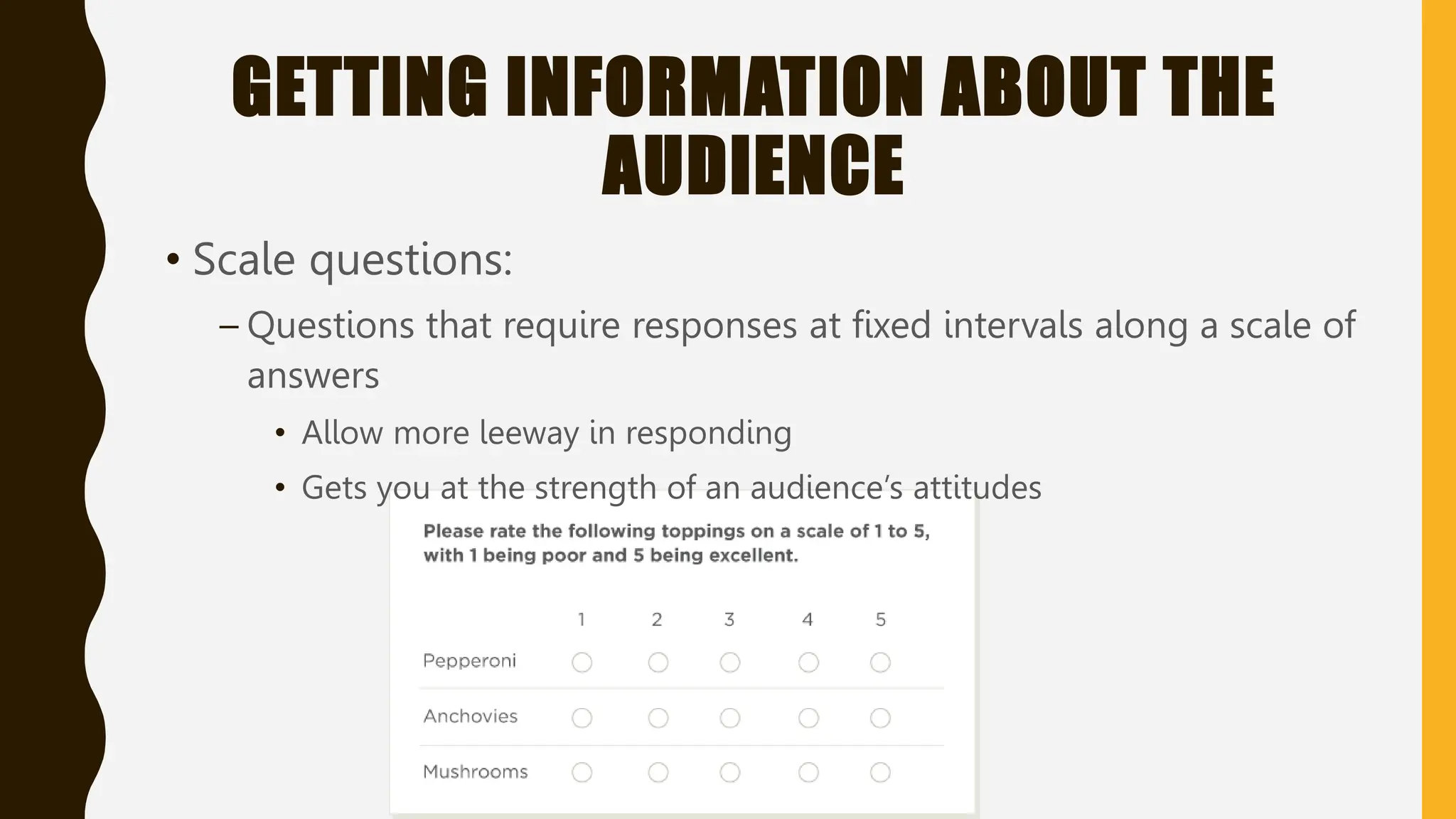
• Scale questions:
– Questions that require responses at fixed intervals along a scale of
answers
• Allow more leeway in responding
• Gets you at the strength of an audience’s attitudes
GETTING INFORMATION ABOUT THE
AUDIENCE
• Open-ended questions:
– Questions that allow respondents to answer however they want
– Gives maximum leeway in responding
– Increases the likelihood of getting answers that do not give the
information you need
– How do you feel about the parking situation at GCIT?
– It is common for questionnaires to utilize all 3 types of questions
GETTING INFORMATION ABOUT THE
AUDIENCE
– When putting one together keep the following in mind:
1. Plan the questionnaire carefully to elicit precisely the information you
need
2. Use all 3 types of questions
3. Make sure the questions are clear and unambiguous
4. Keep the questionnaire relatively brief
ADAPTING TO THE AUDIENCE
• There are 2 stages in the process of audience adaptation
– Audience Adaptation Before the Speech
• Remember who the listeners will be
• Assess how you audience is likely to respond to what you say in your speech
• Adjust what you say to make it as clear, appropriate, and convincing as possible
• Anticipate how your audience will respond
– Audience Adaptation During the Speech
• If something unexpected happens do not panic. Modify based on the challenge and continue
– Examples:
• Projector is broken
• Your time is more or less than planned
• Someone else has your topic
• Look for audience feedback and adjust
THANK YOU🙌

PPT Public Speaking (Audience) Education.pptx

  • 1.
  • 2.
    AUDIENCE-CENTEREDNESS • Audience-centeredness: Keepingthe audience foremost in mind at every step of speech preparation and presentation – Objective is to gain a desired response from the listeners • Do not have to compromise your beliefs • Do not have to use unethical tactics to achieve your goal
  • 3.
    AUDIENCE-CENTEREDNESS • Keep inmind these questions to be audience centered: – To whom am I speaking? – What do I want them to know, believe, or do as a result of my speech? – What is the most effective way of composing and presenting my speech to accomplish that aim?
  • 4.
    YOUR CLASSMATES ASAN AUDIENCE • The best classroom speeches are those that take the audience as seriously as a lawyer, politician, or advertiser takes an audience
  • 5.
    THE PSYCHOLOGY OFAUDIENCES • The speaker must make the audience choose to pay attention • Every speech contains 2 messages: – One sent by the speaker – One received by the listener • What the speaker says is filtered through the listener’s frame of reference • Listeners want to hear about things that are meaningful to them – Egocentrism: The tendency of people to be concerned above all with their own values, beliefs, and well-being • How does this affect you as a speaker? – Listeners will hear and judge based on what they already know and believe – You must relate your message to your listeners
  • 6.
    DEMOGRAPHIC AUDIENCE ANALYSIS •Demographic audience analysis: Audience analysis that focuses on demographic factors such as age, gender, religion, sexual orientation, group membership, and racial ethnic or cultural background • There are two steps of demographic audience analysis: – Identifying the general demographic features of your audience – Gauging the importance of those features to a particular speaking situation • When used improperly, it can lead to stereotyping – Stereotyping: Creating an oversimplified image of a particular group of people, usually by assuming that all members of a group are alike
  • 7.
    DEMOGRAPHIC AUDIENCE ANALYSIS •Consider the following demographic factors: – Age • Speaking to an older audience vs. a younger audience – Gender • Take in current gender attitude and practices • Be aware of both gender differences and similarities • Avoid generalizations – Sexual Orientation • Be mindful of language, examples, and other elements that may exclude listeners with same-sex partners – Religion • Current events around the world show religious views are among the most emotionally charged of all human concerns • There is great diversity within different faiths • Consider the religious orientation of your listeners – Racial, Ethnic, and Cultural Background • Some listeners may have perspectives that will affect how they are listening to the speech – Group Membership • Knowing the groups or memberships you audience is in may give excellent clues about your listeners interests and attitudes
  • 8.
    SITUATIONAL AUDIENCE ANALYSIS •Situational audience analysis: Audience analysis that focuses on situational factors such as size of the audience, the physical setting of the speech, and the disposition of the audience towards the topic, the speaker, and the occasion • Consider the following demographic factors: – Size • The larger the audience, the more formal your presentation must be • Audience size may affect you language, choice of requests, and use of visual aids – Physical Setting • Know in advance of any difficulties in the physical setting • Do everything you can to control the influence of the physical setting • If the physical setting is not desirable, work hard to adapt to the aspects
  • 9.
    SITUATIONAL AUDIENCE ANALYSIS –Disposition Toward the Topic • Interest – Assess the interest in advance and adjust your speech accordingly – If interest is not there, take special steps to involve the audience • Knowledge – Often a strong correlation between interest in a topic and knowledge on it – Audiences like learning about a subject that interests them – Your ability to talk more technically or more trivially on a topic depends on your audience’s knowledge of the subject • Attitude – Attitude: A frame of mind in favor of or opposed to a person, policy, belief, institution, etc. – If you know in advance the prevailing attitude among members of your audience, you can adjust your speech to address the concerns or answer their objections
  • 10.
    SITUATIONAL AUDIENCE ANALYSIS •Disposition Toward the Speaker – An audience’s response to a message is colored by their perception of the speaker – The more competent, honest, and thoughtful the listeners perceive the speaker to be, the more they will respond positively to the message • Disposition Toward the Occasion – Do not exploit a situation for your own purposes with a speech – The occasion will dictate how long a speech should be
  • 11.
    GETTING INFORMATION ABOUTTHE AUDIENCE • Audience Analysis Questionnaire – There are 3 major types of questions to choose from • Fixed-alternative questions • Scale questions • Open-ended questions
  • 12.
    GETTING INFORMATION ABOUTTHE AUDIENCE • Fixed-alternative questions – Questions that offer a fixed choice between 2 or more alternatives – Find clear answers but ambiguous answers Do you know what the insanity plea is in the U.S Legal System? Yes______ No_____ Not sure_______
  • 13.
    GETTING INFORMATION ABOUTTHE AUDIENCE • Scale questions: – Questions that require responses at fixed intervals along a scale of answers • Allow more leeway in responding • Gets you at the strength of an audience’s attitudes
  • 14.
    GETTING INFORMATION ABOUTTHE AUDIENCE • Open-ended questions: – Questions that allow respondents to answer however they want – Gives maximum leeway in responding – Increases the likelihood of getting answers that do not give the information you need – How do you feel about the parking situation at GCIT? – It is common for questionnaires to utilize all 3 types of questions
  • 15.
    GETTING INFORMATION ABOUTTHE AUDIENCE – When putting one together keep the following in mind: 1. Plan the questionnaire carefully to elicit precisely the information you need 2. Use all 3 types of questions 3. Make sure the questions are clear and unambiguous 4. Keep the questionnaire relatively brief
  • 16.
    ADAPTING TO THEAUDIENCE • There are 2 stages in the process of audience adaptation – Audience Adaptation Before the Speech • Remember who the listeners will be • Assess how you audience is likely to respond to what you say in your speech • Adjust what you say to make it as clear, appropriate, and convincing as possible • Anticipate how your audience will respond – Audience Adaptation During the Speech • If something unexpected happens do not panic. Modify based on the challenge and continue – Examples: • Projector is broken • Your time is more or less than planned • Someone else has your topic • Look for audience feedback and adjust
  • 17.