1
Inflammatory bowel disease(IBD)
Done by: Inaam hodroj
Date: 17 April 2015
Dr: Nermin Chouman
LIU pharmacy
2
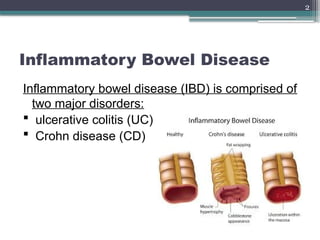
Inflammatory Bowel Disease
Inflammatory bowel disease (IBD) is comprised of
two major disorders:
 ulcerative colitis (UC)
 Crohn disease (CD)
3
Crohn’s disease and ulcerative
colitis
Ulcerative colitis:
Is a chronic inflammatory disease characterized
by mucosal inflammation limited to the rectum
and colon.
Crohn’s disease:
Characterized by focal, asymmetric, transmural,
and, occasionally, granulomatous
inflammation that can affect any part of the GIT
from mouth to the anus
4
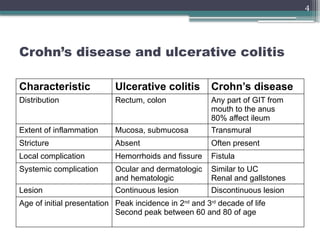
Crohn’s disease and ulcerative colitis
Characteristic Ulcerative colitis Crohn’s disease
Distribution Rectum, colon Any part of GIT from
mouth to the anus
80% affect ileum
Extent of inflammation Mucosa, submucosa Transmural
Stricture Absent Often present
Local complication Hemorrhoids and fissure Fistula
Systemic complication Ocular and dermatologic
and hematologic
Similar to UC
Renal and gallstones
Lesion Continuous lesion Discontinuous lesion
Age of initial presentation Peak incidence in 2nd
and 3rd
decade of life
Second peak between 60 and 80 of age
5
Etiology
Proposed etiology include:
 Infectious agent
 Environmental factors(Diet,Smoking,NSAIDs)
 Genetics(metabolic deffect)
 Psychological factors
6
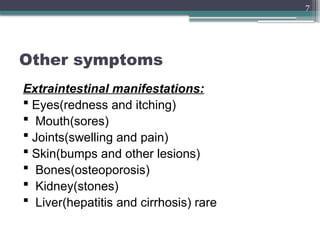
Clinical presentation
Crohn’s disease:
 Abdominal pain
 Hematochezia
 Fever
 Weight loss
 Malaise
7
Other symptoms
Extraintestinal manifestations:
 Eyes(redness and itching)
 Mouth(sores)
 Joints(swelling and pain)
 Skin(bumps and other lesions)
 Bones(osteoporosis)
 Kidney(stones)
 Liver(hepatitis and cirrhosis) rare
8
Symptom assessment
Should R/O:
 Bile salt diarrhea
 Intestinal infection
(e.g., Salmonella, Shigella, Campylobacter, and
C. Difficile)
 lactose intolerance
 Irritable bowel syndrome
 Intestinal obstruction or a stricture
9
Diagnosis
Based on:
 Clinical presentation
 Stool examination
 Sigmoidoscopy/colonoscopy
 Radiography
10
Diagnosis(con’t)
 Laboratory tests:
 Complete blood count (CBC)
 Blood chemistry including electrolytes, renal
function tests, liver enzymes , and blood glucose
 Erythrocyte sedimentation rate (ESR)
 C-reactive protein (CRP)
 Serum iron and vitamin B12 levels
11
New serologic findings
New serologic test available to aid in the diagnosis of
IBD and differantiate CD and UC(not sensitive):
 Perinuclear antineutrophil cytoplasmic
antibodies(pANCA) have been identified in some
with UC.
 Anti-saccharomyces cerevisiae antibodies(ASCA)
have been found in patients with CD.
12
Classification/CD
Mild- Moderate:
 Tolerate oral administration
 Absence of fever, dehydration, abdominal
tenderness, mass or obstruction
 Less than 10% weight loss
13
Classification(con’t)
Moderate-Severe:
 Failed treatment for mild-moderate
 Nausea and vomiting
 Possible anemia
 Significant weight loss( greater than 10%)
14
Classification(con’t)
Severe-Fulminant:
 Failed treatment for moderate-severe
 High fever
 Abdominal pain
 Persistent vomiting
 Possible obstruction,abscess
15
Classification(con’t)
Remission:
 Asymptomatic(without treatment)
 After medical or surgical intervention
 Note: patients who require CS therapy to
remain asymptomatic are not considered to be
in remission
16
Treatment /non pharmacologic
Nutritional support
Proper nutritional support is very important
 Patient with moderate-severe disease are often
malnourished
 Protein loss and muscle wasting
 “Short gut”: multiple small-bowel resections
 Maldigestion with accompaying diarrhea
17
Non-pharmacologic(con’t)
Enteral feeding may be needed
 Lipid administration
 May facilitate induction of remission
Parenteral nutrition is important
 In severe CD and UC
 Allow complete bowel rest
Probiotic formulation
Effective in maintaining remission in UC
18
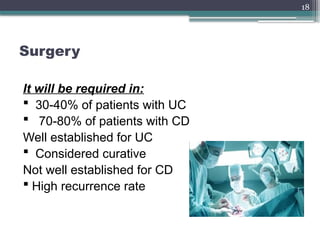
Surgery
It will be required in:
 30-40% of patients with UC
 70-80% of patients with CD
Well established for UC
 Considered curative
Not well established for CD
 High recurrence rate
19
Treatment/pharmacologic
Treatment is non-curative it is focused to:
 Control the disease process
 Control the disease symptoms
 Induce patient remission
 Maintain remission
 Resolution of complication
20
Treatment(con’t)
Choice of drug depends on several factors
including:
 Type of IBD and site of inflammation
 Severity of the disease
 Acute management versus remission
maintenance
 Presence of complication
21
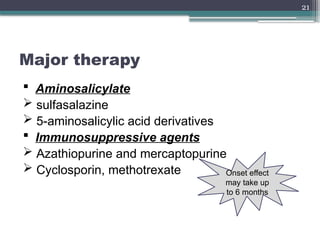
Major therapy
 Aminosalicylate
 sulfasalazine
 5-aminosalicylic acid derivatives
 Immunosuppressive agents
 Azathiopurine and mercaptopurine
 Cyclosporin, methotrexate Onset effect
may take up
to 6 months
22
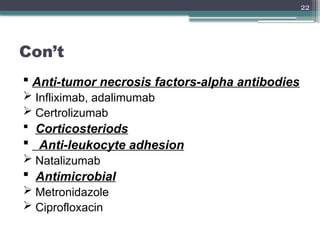
Con’t
 Anti-tumor necrosis factors-alpha antibodies
 Infliximab, adalimumab
 Certrolizumab
 Corticosteriods
 Anti-leukocyte adhesion
 Natalizumab
 Antimicrobial
 Metronidazole
 Ciprofloxacin
23
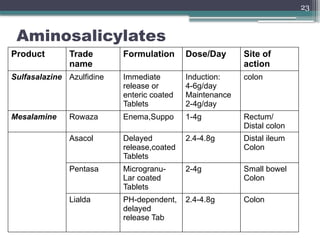
Aminosalicylates
Product Trade
name
Formulation Dose/Day Site of
action
Sulfasalazine Azulfidine Immediate
release or
enteric coated
Tablets
Induction:
4-6g/day
Maintenance
2-4g/day
colon
Mesalamine Rowaza Enema,Suppo 1-4g Rectum/
Distal colon
Asacol Delayed
release,coated
Tablets
2.4-4.8g Distal ileum
Colon
Pentasa Microgranu-
Lar coated
Tablets
2-4g Small bowel
Colon
Lialda PH-dependent,
delayed
release Tab
2.4-4.8g Colon
24
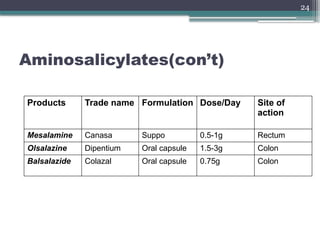
Aminosalicylates(con’t)
Products Trade name Formulation Dose/Day Site of
action
Mesalamine Canasa Suppo 0.5-1g Rectum
Olsalazine Dipentium Oral capsule 1.5-3g Colon
Balsalazide Colazal Oral capsule 0.75g Colon
25
Aminosalicylates(con’t)
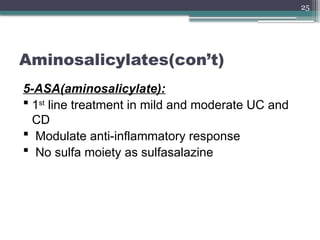
5-ASA(aminosalicylate):
 1st
line treatment in mild and moderate UC and
CD
 Modulate anti-inflammatory response
 No sulfa moiety as sulfasalazine
26
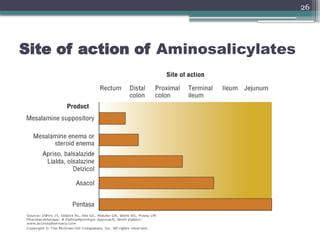
Site of action of Aminosalicylates
27
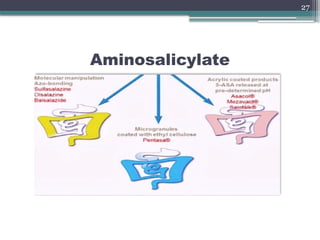
Aminosalicylate
28
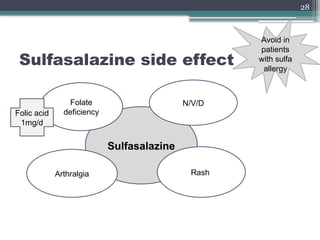
Sulfasalazine side effect
Sulfasalazine
N/V/D
Folate
deficiency
Folic acid
1mg/d
Rash
Arthralgia
Avoid in
patients
with sulfa
allergy
29
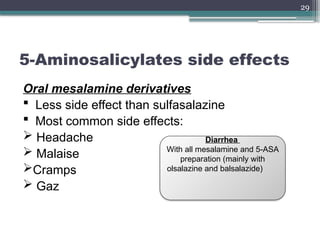
5-Aminosalicylates side effects
Oral mesalamine derivatives
 Less side effect than sulfasalazine
 Most common side effects:
 Headache
 Malaise
Cramps
 Gaz
Diarrhea
With all mesalamine and 5-ASA
preparation (mainly with
olsalazine and balsalazide)
30
Corticosteroids
Role in IBD:
Modulate the immune system and inhibit
production of cytokines and mediators.
 Used in acute setting
 No role in maintenance
31
Corticosteroids(con’t)
 Parenterally
 Hydrocortisone 100mg IV q8hr
 7-10days then change to po when gut is
functional
 Orally
Po prednisone dose: 40-60mg/day usually
effective for 3-4 weeks, then taper by 5mg/week
until the dose is 20mg then 2.5mg/week
32
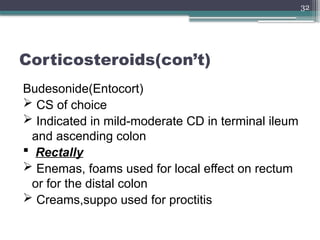
Corticosteroids(con’t)
Budesonide(Entocort)
 CS of choice
 Indicated in mild-moderate CD in terminal ileum
and ascending colon
 Rectally
 Enemas, foams used for local effect on rectum
or for the distal colon
 Creams,suppo used for proctitis
33
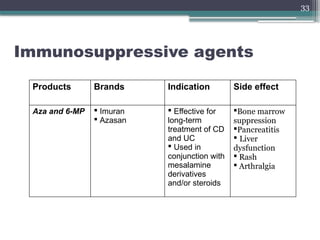
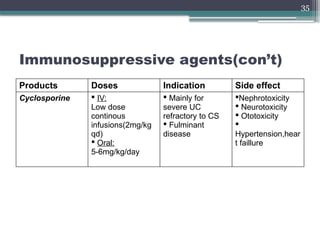
Immunosuppressive agents
Products Brands Indication Side effect
Aza and 6-MP  Imuran
 Azasan
 Effective for
long-term
treatment of CD
and UC
 Used in
conjunction with
mesalamine
derivatives
and/or steroids
Bone marrow
suppression
Pancreatitis
 Liver
dysfunction
 Rash
 Arthralgia
34
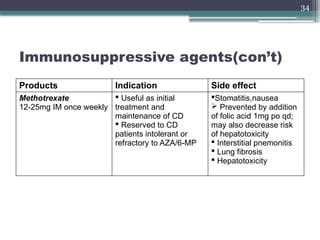
Immunosuppressive agents(con’t)
Products Indication Side effect
Methotrexate
12-25mg IM once weekly
 Useful as initial
treatment and
maintenance of CD
 Reserved to CD
patients intolerant or
refractory to AZA/6-MP
Stomatitis,nausea
 Prevented by addition
of folic acid 1mg po qd;
may also decrease risk
of hepatotoxicity
 Interstitial pnemonitis
 Lung fibrosis
 Hepatotoxicity
35
Immunosuppressive agents(con’t)
Products Doses Indication Side effect
Cyclosporine  IV:
Low dose
continous
infusions(2mg/kg
qd)
 Oral:
5-6mg/kg/day
 Mainly for
severe UC
refractory to CS
 Fulminant
disease
Nephrotoxicity
 Neurotoxicity
 Ototoxicity

Hypertension,hear
t faillure
36
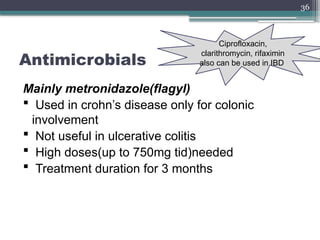
Antimicrobials
Mainly metronidazole(flagyl)
 Used in crohn’s disease only for colonic
involvement
 Not useful in ulcerative colitis
 High doses(up to 750mg tid)needed
 Treatment duration for 3 months
Ciprofloxacin,
clarithromycin, rifaximin
also can be used in IBD
37
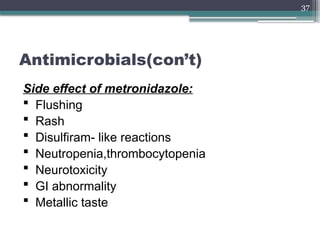
Antimicrobials(con’t)
Side effect of metronidazole:
 Flushing
 Rash
 Disulfiram- like reactions
 Neutropenia,thrombocytopenia
 Neurotoxicity
 GI abnormality
 Metallic taste
38
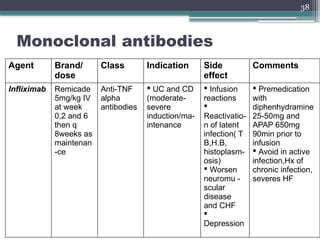
Monoclonal antibodies
Agent Brand/
dose
Class Indication Side
effect
Comments
Infliximab Remicade
5mg/kg IV
at week
0,2 and 6
then q
8weeks as
maintenan
-ce
Anti-TNF
alpha
antibodies
 UC and CD
(moderate-
severe
induction/ma-
intenance
 Infusion
reactions

Reactivatio-
n of latent
infection( T
B,H.B,
histoplasm-
osis)
 Worsen
neuromu -
scular
disease
and CHF

Depression
 Premedication
with
diphenhydramine
25-50mg and
APAP 650mg
90min prior to
infusion
 Avoid in active
infection,Hx of
chronic infection,
severes HF
39
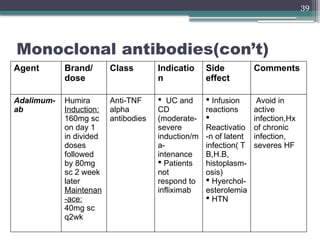
Monoclonal antibodies(con’t)
Agent Brand/
dose
Class Indicatio
n
Side
effect
Comments
Adalimum-
ab
Humira
Induction:
160mg sc
on day 1
in divided
doses
followed
by 80mg
sc 2 week
later
Maintenan
-ace:
40mg sc
q2wk
Anti-TNF
alpha
antibodies
 UC and
CD
(moderate-
severe
induction/m
a-
intenance
 Patients
not
respond to
infliximab
 Infusion
reactions

Reactivatio
-n of latent
infection( T
B,H.B,
histoplasm-
osis)
 Hyerchol-
esterolemia
 HTN
Avoid in
active
infection,Hx
of chronic
infection,
severes HF
40
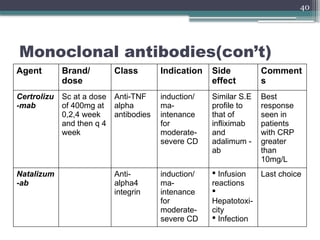
Monoclonal antibodies(con’t)
Agent Brand/
dose
Class Indication Side
effect
Comment
s
Certrolizu
-mab
Sc at a dose
of 400mg at
0,2,4 week
and then q 4
week
Anti-TNF
alpha
antibodies
induction/
ma-
intenance
for
moderate-
severe CD
Similar S.E
profile to
that of
infliximab
and
adalimum -
ab
Best
response
seen in
patients
with CRP
greater
than
10mg/L
Natalizum
-ab
Anti-
alpha4
integrin
induction/
ma-
intenance
for
moderate-
severe CD
 Infusion
reactions

Hepatotoxi-
city
 Infection
Last choice
41
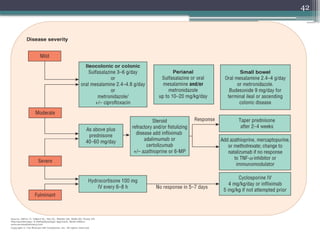
Treatment algorithm for CD
 Mild
 Moderate
 Severe
 Fulminant
42
43
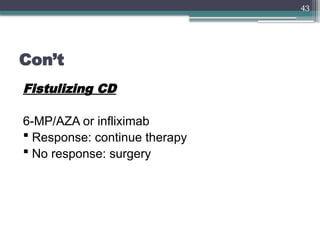
Con’t
Fistulizing CD
6-MP/AZA or infliximab
 Response: continue therapy
 No response: surgery
44
Pregnancy
IBD has little effect on the course of pregnancy
 Steroids and sulfasalazine
 Same guidelines to nonpregnant woman
 With sulfasalazine give supplement with folic
acid 1mg twice daily
 Immunosuppressives
 Associated with fetal abnormality
45
Pregnancy(con’t)
 Infliximab
 Safe to be used
 Metronidazole
 May be used for short term
 Prolonged use(mutagenic)
 MTX
 Category (X);should not be used
46
New article
A new oral delivery system for 5-ASA:
Preliminary clinical findings for MMx
Cosimo Prantera MD1,*
,
Angelo Viscido MD2
,
Livia Biancone MD3
,
Antonio Francavilla MD4
,
Lucio Giglio MD1and
Massimo Campieri MD5
Article first published online: 14 DEC 2006
DOI: 10.1097/01.MIB.0000158386.25660.
47
Abstract
Background: Multi-matrix (MMx), a new delivery
system for mesalazine, seems to release 5-
aminosalicyclic acid (5-ASA) preferentially in the
sigmoid colon. This study had 2 objectives: (1) to
evaluate the therapeutic response to MMx in
patients with active left-sided disease and (2) to
gain additional insights as to how the therapy
would compare with topical 5-ASA.
48
Con’t
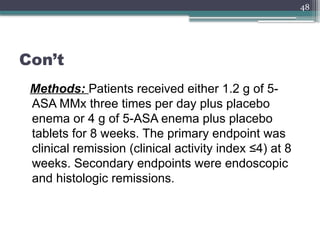
Methods: Patients received either 1.2 g of 5-
ASA MMx three times per day plus placebo
enema or 4 g of 5-ASA enema plus placebo
tablets for 8 weeks. The primary endpoint was
clinical remission (clinical activity index ≤4) at 8
weeks. Secondary endpoints were endoscopic
and histologic remissions.
49
Con’t
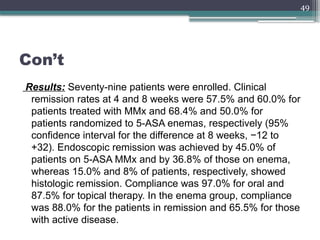
Results: Seventy-nine patients were enrolled. Clinical
remission rates at 4 and 8 weeks were 57.5% and 60.0% for
patients treated with MMx and 68.4% and 50.0% for
patients randomized to 5-ASA enemas, respectively (95%
confidence interval for the difference at 8 weeks, −12 to
+32). Endoscopic remission was achieved by 45.0% of
patients on 5-ASA MMx and by 36.8% of those on enema,
whereas 15.0% and 8% of patients, respectively, showed
histologic remission. Compliance was 97.0% for oral and
87.5% for topical therapy. In the enema group, compliance
was 88.0% for the patients in remission and 65.5% for those
with active disease.
50
Con’t
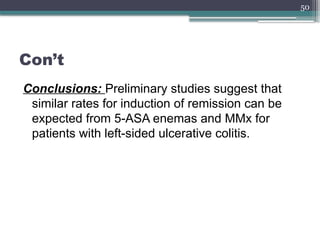
Conclusions: Preliminary studies suggest that
similar rates for induction of remission can be
expected from 5-ASA enemas and MMx for
patients with left-sided ulcerative colitis.
51
References
Department of Medicine, Division of
Gastroenterology, University of Pennsylvania
School of Medicine, Philadelphia, Pennsylvania,
USA(american college of gastroenterology

PPT.pptx...................................

  • 1.
    1 Inflammatory bowel disease(IBD) Doneby: Inaam hodroj Date: 17 April 2015 Dr: Nermin Chouman LIU pharmacy
  • 2.
    2 Inflammatory Bowel Disease Inflammatorybowel disease (IBD) is comprised of two major disorders:  ulcerative colitis (UC)  Crohn disease (CD)
  • 3.
    3 Crohn’s disease andulcerative colitis Ulcerative colitis: Is a chronic inflammatory disease characterized by mucosal inflammation limited to the rectum and colon. Crohn’s disease: Characterized by focal, asymmetric, transmural, and, occasionally, granulomatous inflammation that can affect any part of the GIT from mouth to the anus
  • 4.
    4 Crohn’s disease andulcerative colitis Characteristic Ulcerative colitis Crohn’s disease Distribution Rectum, colon Any part of GIT from mouth to the anus 80% affect ileum Extent of inflammation Mucosa, submucosa Transmural Stricture Absent Often present Local complication Hemorrhoids and fissure Fistula Systemic complication Ocular and dermatologic and hematologic Similar to UC Renal and gallstones Lesion Continuous lesion Discontinuous lesion Age of initial presentation Peak incidence in 2nd and 3rd decade of life Second peak between 60 and 80 of age
  • 5.
    5 Etiology Proposed etiology include: Infectious agent  Environmental factors(Diet,Smoking,NSAIDs)  Genetics(metabolic deffect)  Psychological factors
  • 6.
    6 Clinical presentation Crohn’s disease: Abdominal pain  Hematochezia  Fever  Weight loss  Malaise
  • 7.
    7 Other symptoms Extraintestinal manifestations: Eyes(redness and itching)  Mouth(sores)  Joints(swelling and pain)  Skin(bumps and other lesions)  Bones(osteoporosis)  Kidney(stones)  Liver(hepatitis and cirrhosis) rare
  • 8.
    8 Symptom assessment Should R/O: Bile salt diarrhea  Intestinal infection (e.g., Salmonella, Shigella, Campylobacter, and C. Difficile)  lactose intolerance  Irritable bowel syndrome  Intestinal obstruction or a stricture
  • 9.
    9 Diagnosis Based on:  Clinicalpresentation  Stool examination  Sigmoidoscopy/colonoscopy  Radiography
  • 10.
    10 Diagnosis(con’t)  Laboratory tests: Complete blood count (CBC)  Blood chemistry including electrolytes, renal function tests, liver enzymes , and blood glucose  Erythrocyte sedimentation rate (ESR)  C-reactive protein (CRP)  Serum iron and vitamin B12 levels
  • 11.
    11 New serologic findings Newserologic test available to aid in the diagnosis of IBD and differantiate CD and UC(not sensitive):  Perinuclear antineutrophil cytoplasmic antibodies(pANCA) have been identified in some with UC.  Anti-saccharomyces cerevisiae antibodies(ASCA) have been found in patients with CD.
  • 12.
    12 Classification/CD Mild- Moderate:  Tolerateoral administration  Absence of fever, dehydration, abdominal tenderness, mass or obstruction  Less than 10% weight loss
  • 13.
    13 Classification(con’t) Moderate-Severe:  Failed treatmentfor mild-moderate  Nausea and vomiting  Possible anemia  Significant weight loss( greater than 10%)
  • 14.
    14 Classification(con’t) Severe-Fulminant:  Failed treatmentfor moderate-severe  High fever  Abdominal pain  Persistent vomiting  Possible obstruction,abscess
  • 15.
    15 Classification(con’t) Remission:  Asymptomatic(without treatment) After medical or surgical intervention  Note: patients who require CS therapy to remain asymptomatic are not considered to be in remission
  • 16.
    16 Treatment /non pharmacologic Nutritionalsupport Proper nutritional support is very important  Patient with moderate-severe disease are often malnourished  Protein loss and muscle wasting  “Short gut”: multiple small-bowel resections  Maldigestion with accompaying diarrhea
  • 17.
    17 Non-pharmacologic(con’t) Enteral feeding maybe needed  Lipid administration  May facilitate induction of remission Parenteral nutrition is important  In severe CD and UC  Allow complete bowel rest Probiotic formulation Effective in maintaining remission in UC
  • 18.
    18 Surgery It will berequired in:  30-40% of patients with UC  70-80% of patients with CD Well established for UC  Considered curative Not well established for CD  High recurrence rate
  • 19.
    19 Treatment/pharmacologic Treatment is non-curativeit is focused to:  Control the disease process  Control the disease symptoms  Induce patient remission  Maintain remission  Resolution of complication
  • 20.
    20 Treatment(con’t) Choice of drugdepends on several factors including:  Type of IBD and site of inflammation  Severity of the disease  Acute management versus remission maintenance  Presence of complication
  • 21.
    21 Major therapy  Aminosalicylate sulfasalazine  5-aminosalicylic acid derivatives  Immunosuppressive agents  Azathiopurine and mercaptopurine  Cyclosporin, methotrexate Onset effect may take up to 6 months
  • 22.
    22 Con’t  Anti-tumor necrosisfactors-alpha antibodies  Infliximab, adalimumab  Certrolizumab  Corticosteriods  Anti-leukocyte adhesion  Natalizumab  Antimicrobial  Metronidazole  Ciprofloxacin
  • 23.
    23 Aminosalicylates Product Trade name Formulation Dose/DaySite of action Sulfasalazine Azulfidine Immediate release or enteric coated Tablets Induction: 4-6g/day Maintenance 2-4g/day colon Mesalamine Rowaza Enema,Suppo 1-4g Rectum/ Distal colon Asacol Delayed release,coated Tablets 2.4-4.8g Distal ileum Colon Pentasa Microgranu- Lar coated Tablets 2-4g Small bowel Colon Lialda PH-dependent, delayed release Tab 2.4-4.8g Colon
  • 24.
    24 Aminosalicylates(con’t) Products Trade nameFormulation Dose/Day Site of action Mesalamine Canasa Suppo 0.5-1g Rectum Olsalazine Dipentium Oral capsule 1.5-3g Colon Balsalazide Colazal Oral capsule 0.75g Colon
  • 25.
    25 Aminosalicylates(con’t) 5-ASA(aminosalicylate):  1st line treatmentin mild and moderate UC and CD  Modulate anti-inflammatory response  No sulfa moiety as sulfasalazine
  • 26.
    26 Site of actionof Aminosalicylates
  • 27.
  • 28.
    28 Sulfasalazine side effect Sulfasalazine N/V/D Folate deficiency Folicacid 1mg/d Rash Arthralgia Avoid in patients with sulfa allergy
  • 29.
    29 5-Aminosalicylates side effects Oralmesalamine derivatives  Less side effect than sulfasalazine  Most common side effects:  Headache  Malaise Cramps  Gaz Diarrhea With all mesalamine and 5-ASA preparation (mainly with olsalazine and balsalazide)
  • 30.
    30 Corticosteroids Role in IBD: Modulatethe immune system and inhibit production of cytokines and mediators.  Used in acute setting  No role in maintenance
  • 31.
    31 Corticosteroids(con’t)  Parenterally  Hydrocortisone100mg IV q8hr  7-10days then change to po when gut is functional  Orally Po prednisone dose: 40-60mg/day usually effective for 3-4 weeks, then taper by 5mg/week until the dose is 20mg then 2.5mg/week
  • 32.
    32 Corticosteroids(con’t) Budesonide(Entocort)  CS ofchoice  Indicated in mild-moderate CD in terminal ileum and ascending colon  Rectally  Enemas, foams used for local effect on rectum or for the distal colon  Creams,suppo used for proctitis
  • 33.
    33 Immunosuppressive agents Products BrandsIndication Side effect Aza and 6-MP  Imuran  Azasan  Effective for long-term treatment of CD and UC  Used in conjunction with mesalamine derivatives and/or steroids Bone marrow suppression Pancreatitis  Liver dysfunction  Rash  Arthralgia
  • 34.
    34 Immunosuppressive agents(con’t) Products IndicationSide effect Methotrexate 12-25mg IM once weekly  Useful as initial treatment and maintenance of CD  Reserved to CD patients intolerant or refractory to AZA/6-MP Stomatitis,nausea  Prevented by addition of folic acid 1mg po qd; may also decrease risk of hepatotoxicity  Interstitial pnemonitis  Lung fibrosis  Hepatotoxicity
  • 35.
    35 Immunosuppressive agents(con’t) Products DosesIndication Side effect Cyclosporine  IV: Low dose continous infusions(2mg/kg qd)  Oral: 5-6mg/kg/day  Mainly for severe UC refractory to CS  Fulminant disease Nephrotoxicity  Neurotoxicity  Ototoxicity  Hypertension,hear t faillure
  • 36.
    36 Antimicrobials Mainly metronidazole(flagyl)  Usedin crohn’s disease only for colonic involvement  Not useful in ulcerative colitis  High doses(up to 750mg tid)needed  Treatment duration for 3 months Ciprofloxacin, clarithromycin, rifaximin also can be used in IBD
  • 37.
    37 Antimicrobials(con’t) Side effect ofmetronidazole:  Flushing  Rash  Disulfiram- like reactions  Neutropenia,thrombocytopenia  Neurotoxicity  GI abnormality  Metallic taste
  • 38.
    38 Monoclonal antibodies Agent Brand/ dose ClassIndication Side effect Comments Infliximab Remicade 5mg/kg IV at week 0,2 and 6 then q 8weeks as maintenan -ce Anti-TNF alpha antibodies  UC and CD (moderate- severe induction/ma- intenance  Infusion reactions  Reactivatio- n of latent infection( T B,H.B, histoplasm- osis)  Worsen neuromu - scular disease and CHF  Depression  Premedication with diphenhydramine 25-50mg and APAP 650mg 90min prior to infusion  Avoid in active infection,Hx of chronic infection, severes HF
  • 39.
    39 Monoclonal antibodies(con’t) Agent Brand/ dose ClassIndicatio n Side effect Comments Adalimum- ab Humira Induction: 160mg sc on day 1 in divided doses followed by 80mg sc 2 week later Maintenan -ace: 40mg sc q2wk Anti-TNF alpha antibodies  UC and CD (moderate- severe induction/m a- intenance  Patients not respond to infliximab  Infusion reactions  Reactivatio -n of latent infection( T B,H.B, histoplasm- osis)  Hyerchol- esterolemia  HTN Avoid in active infection,Hx of chronic infection, severes HF
  • 40.
    40 Monoclonal antibodies(con’t) Agent Brand/ dose ClassIndication Side effect Comment s Certrolizu -mab Sc at a dose of 400mg at 0,2,4 week and then q 4 week Anti-TNF alpha antibodies induction/ ma- intenance for moderate- severe CD Similar S.E profile to that of infliximab and adalimum - ab Best response seen in patients with CRP greater than 10mg/L Natalizum -ab Anti- alpha4 integrin induction/ ma- intenance for moderate- severe CD  Infusion reactions  Hepatotoxi- city  Infection Last choice
  • 41.
    41 Treatment algorithm forCD  Mild  Moderate  Severe  Fulminant
  • 42.
  • 43.
    43 Con’t Fistulizing CD 6-MP/AZA orinfliximab  Response: continue therapy  No response: surgery
  • 44.
    44 Pregnancy IBD has littleeffect on the course of pregnancy  Steroids and sulfasalazine  Same guidelines to nonpregnant woman  With sulfasalazine give supplement with folic acid 1mg twice daily  Immunosuppressives  Associated with fetal abnormality
  • 45.
    45 Pregnancy(con’t)  Infliximab  Safeto be used  Metronidazole  May be used for short term  Prolonged use(mutagenic)  MTX  Category (X);should not be used
  • 46.
    46 New article A neworal delivery system for 5-ASA: Preliminary clinical findings for MMx Cosimo Prantera MD1,* , Angelo Viscido MD2 , Livia Biancone MD3 , Antonio Francavilla MD4 , Lucio Giglio MD1and Massimo Campieri MD5 Article first published online: 14 DEC 2006 DOI: 10.1097/01.MIB.0000158386.25660.
  • 47.
    47 Abstract Background: Multi-matrix (MMx),a new delivery system for mesalazine, seems to release 5- aminosalicyclic acid (5-ASA) preferentially in the sigmoid colon. This study had 2 objectives: (1) to evaluate the therapeutic response to MMx in patients with active left-sided disease and (2) to gain additional insights as to how the therapy would compare with topical 5-ASA.
  • 48.
    48 Con’t Methods: Patients receivedeither 1.2 g of 5- ASA MMx three times per day plus placebo enema or 4 g of 5-ASA enema plus placebo tablets for 8 weeks. The primary endpoint was clinical remission (clinical activity index ≤4) at 8 weeks. Secondary endpoints were endoscopic and histologic remissions.
  • 49.
    49 Con’t Results: Seventy-nine patientswere enrolled. Clinical remission rates at 4 and 8 weeks were 57.5% and 60.0% for patients treated with MMx and 68.4% and 50.0% for patients randomized to 5-ASA enemas, respectively (95% confidence interval for the difference at 8 weeks, −12 to +32). Endoscopic remission was achieved by 45.0% of patients on 5-ASA MMx and by 36.8% of those on enema, whereas 15.0% and 8% of patients, respectively, showed histologic remission. Compliance was 97.0% for oral and 87.5% for topical therapy. In the enema group, compliance was 88.0% for the patients in remission and 65.5% for those with active disease.
  • 50.
    50 Con’t Conclusions: Preliminary studiessuggest that similar rates for induction of remission can be expected from 5-ASA enemas and MMx for patients with left-sided ulcerative colitis.
  • 51.
    51 References Department of Medicine,Division of Gastroenterology, University of Pennsylvania School of Medicine, Philadelphia, Pennsylvania, USA(american college of gastroenterology