Spain
It borders withFrance, Andorra, and the Cantabrian Sea to the north; the
Mediterranean Sea to the east; Morocco, the Mediterranean Sea, and the
Atlantic Ocean to the south; and Portugal and the Atlantic Ocean to the west.
The capital of Spain is Madrid, and the country is made up of 17 autonomous
communities and two autonomous cities, which are divided into 52 provinces in
total.
The four regions of Spain are the Basque Country, Catalonia, Galicia, and
Andalusia.
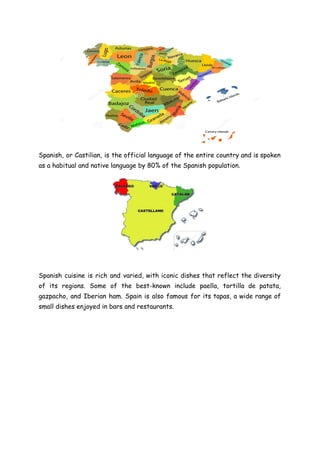
The 17 autonomous communities are: Andalusia, Aragon, the Balearic Islands,
the Canary Islands, Cantabria, Castilla-La Mancha, Castilla y León, Catalonia, the
Community of Madrid, the Chartered Community of Navarre, the Valencian
Community, Extremadura, Galicia, the Basque Country, the Principality of
Asturias, the Region of Murcia, and La Rioja.
3.
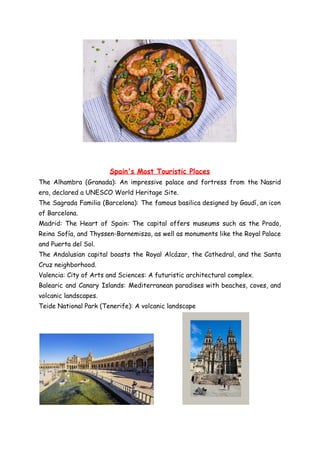
Spanish, or Castilian,is the official language of the entire country and is spoken
as a habitual and native language by 80% of the Spanish population.
Spanish cuisine is rich and varied, with iconic dishes that reflect the diversity
of its regions. Some of the best-known include paella, tortilla de patata,
gazpacho, and Iberian ham. Spain is also famous for its tapas, a wide range of
small dishes enjoyed in bars and restaurants.
4.
Spain's Most TouristicPlaces
The Alhambra (Granada): An impressive palace and fortress from the Nasrid
era, declared a UNESCO World Heritage Site.
The Sagrada Familia (Barcelona): The famous basilica designed by Gaudí, an icon
of Barcelona.
Madrid: The Heart of Spain: The capital offers museums such as the Prado,
Reina Sofía, and Thyssen-Bornemisza, as well as monuments like the Royal Palace
and Puerta del Sol.
The Andalusian capital boasts the Royal Alcázar, the Cathedral, and the Santa
Cruz neighborhood.
Valencia: City of Arts and Sciences: A futuristic architectural complex.
Balearic and Canary Islands: Mediterranean paradises with beaches, coves, and
volcanic landscapes.
Teide National Park (Tenerife): A volcanic landscape
5.
Spain is richin deep-rooted customs and traditions. Some of the best-known
include the siesta, flamenco, popular festivals such as San Fermín and Las Fallas,
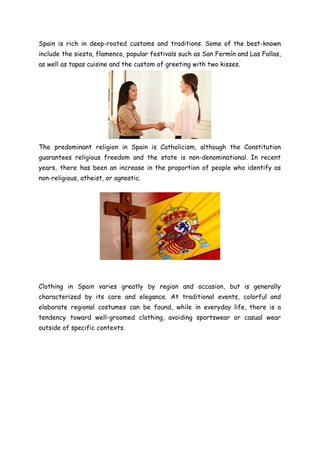
as well as tapas cuisine and the custom of greeting with two kisses.
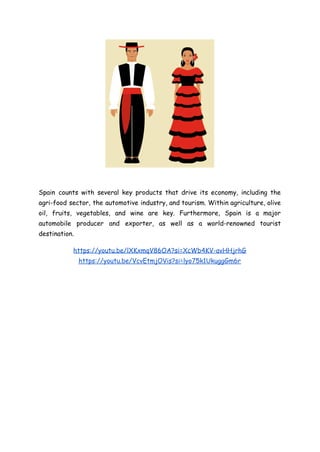
The predominant religion in Spain is Catholicism, although the Constitution
guarantees religious freedom and the state is non-denominational. In recent
years, there has been an increase in the proportion of people who identify as
non-religious, atheist, or agnostic.
Clothing in Spain varies greatly by region and occasion, but is generally
characterized by its care and elegance. At traditional events, colorful and
elaborate regional costumes can be found, while in everyday life, there is a
tendency toward well-groomed clothing, avoiding sportswear or casual wear
outside of specific contexts.
6.
Spain counts withseveral key products that drive its economy, including the
agri-food sector, the automotive industry, and tourism. Within agriculture, olive
oil, fruits, vegetables, and wine are key. Furthermore, Spain is a major
automobile producer and exporter, as well as a world-renowned tourist
destination.
https://youtu.be/lXKxmqV86OA?si=XcWb4KV-avHHjrhG
https://youtu.be/VcvEtmjOVis?si=lyo75k1UkuggGm6r