PPT Depression Detection from Text, Image & Speech using Deep Learning Algorithm BATCH4.pptx
1.
MALLA REDDY COLLEGEOF ENGINEERING
(Approved by AICTE, Permanently Affiliated to JNTUH)
Recognised under Section 2(f) & 12(B) of the UGC Act 1956, An ISO 9001:2015 Certified Institution.
Maisammaguda, Dhulapally, post via Kompally, Secunderabad - 500100
DEPARTMENT OF CSE-DS
MINI PROJECT REVIEW-2
ACADEMIC YEAR: 2024-2025
YEAR: III SEM:II
2.
Depression Detection fromText, Image & Speech using
Deep Learning Algorithm
TEAM MEMBERS
B.BHEEMESH - 22Q91A6709
J.PRAVALIKA - 22Q91A6724
NAVEEN - 22Q91A 6729
U.ANUSHA - 23Q95A6764
Under the Guidance
of
MS.M.NAGA SRAVYA
Assistant Professor-
CSE-DS
ABSTRACT
• Depression isa serious and widespread mental illness, affecting over 300 million people worldwide. With the rise of
social media, recognizing emotional signals early has become more critical than ever. Advances in machine learning
and the availability of depression-related data have opened new opportunities for early diagnosis.
• This paper proposes an effective model that combines Long Short-Term Memory (LSTM) consisting of
two hidden layers and large bias with a Recurrent Neural Network (RNN) with two dense layers to detect
signs of depression from text. . We train RNN on textual data to identify depression from text, semantics, and
written content. The system analyzes the semantics and content of text to predict depression, achieving
an impressive 99.0% accuracy — outperforming traditional frequency-based deep learning models
and significantly reducing the false positive rate. This framework demonstrates that RNN and LSTM
models can be powerful tools for early detection of depression through social media and online
content, helping prevent mental health crises and suicidal behaviors.
5.
• Depression isa major mental health challenge worldwide, affecting millions each year. According to the World Health
Organization (WHO), depression affects more than 300 million individuals across the world.
•Early detection and treatment of depression are critical to improving personal well-being and reducing socio-economic
impacts.Traditional methods like clinical interviews and questionnaires are slow, subjective, and not always accessible.
Traditional methods like clinical interviews and questionnaires are slow, subjective, and not always
accessible.
•Artificial Intelligence (AI), Deep Learning (DL), and Natural Language Processing (NLP) offer powerful techniques for
detecting depressive symptoms from multi-modal data sources.
•Our project proposes a deep learning-based system that automatically analyzes text, images, and speech to detect signs
of depression, enabling early and more objective diagnosis.
INTRODUCTION
6.
LITERATURE SURVEY
1. ArabicTwitter Depression Detection (Musleh, D. A.)
• Used N-gram and TF-IDF for feature extraction; applied Random Forest classifier.
• Achieved 82.39% accuracy for depression detection in Arabic tweets.
2. Social Network Depression Detection (Hasib, K. M.)
• Applied SVM, RF, RNN, CNN models on social media data.
• Showed automated techniques outperform traditional methods but data quality remains a
challenge.
3. EEG-Based Mild Depression Detection (Li, X.)
• Analyzed brain network abnormalities using EEG signals and CNNs.
• Graph theory and deep learning help objectively diagnose mild depression.
4. Early Depression Detection via LSTM-RNN (Amanat)
• Built an early diagnostic system based on textual data.
7.
EXISTING SYSTEM
In thisproject we are designing multimodal based deep learning and machine learning algorithms to detect depression
from User Text Comment, Facial Expression Image and Speech Tones. In the past many algorithms were introduced to
predict depression but all those algorithms were working on single data format like Text, Face or speech but not all. Main
intention of developing this application to detect user depression from all formats as humans are very sensitive and caring
and will not show is depression to closed family member in order to avoid giving tension to them but often their
depression can be identify either from face or his social media comments or in his speech. So we can detect depression in
humans in all 3 multimodal format.
DISADVANTAGE:
Accuracy Less
More Time Taking
8.
PROPOSED SYSTEM
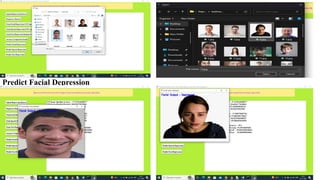
In proposework we deployed advanced deep learning algorithm called Convolution Neural Network (CNN2D)
to detect depression from faces and voices. CNN consider best to classify data from images and speech. To
identify depression from TEXT we employ Random Forest algorithm as in ML Random Forest is most
accurate compare to other algorithms.
ADVANTAGE:
Accuracy more.
Less Time Taking.
Early digonsis
MultiModelDetection(text,image,speech)
9.
HARDWARE REQUIREMENTS
• Processor- Intel i3 (min)
• Speed - 1.1 GHz
• RAM - 4GB(min)
• Hard Disk - 500 GB
• Camera: Integrated or external camera (for capturing images for dataset)
• GPU (Optional): NVIDIA GPU (for faster training on images and speech data)
10.
SOFTWARE REQUIREMENTS
• OperatingSystem: Windows 10
• Language : Python 3.7 Backend
• Frameworks and Libraries:
TensorFlow / PyTorch (for deep learning)
Keras
NLTK / spaCy (for text processing)
OpenCV (for image processing)
librosa (for audio/speech processing
• Speech Processing Libraries:
librosa
SpeechRecognition
pyAudioAnalysis
• Image Processing Libraries:
OpenCV
PIL (Pillow)
• Development Tools:
Jupyter Notebook / VS Code / PyCharm
CONCLUSION
• Our systemeffectively identifies depression from text, images,
and speech, which is crucial for healthcare departments to
support patients with mental health concerns. An accuracy of
99% was attained by implementing the proposed solution with a
reduced false positive rate.
• The evaluation results showed that our framework offers high
accuracy, precision, recall, and F1-measures compared to the
Naive Bayes, SVM, CNN, and Decision Trees.
17.
FUTURE ENHANCEMENTS
• Integrationwith Mental Health Platforms
Connect the system with telemedicine or mental health apps to recommend professional help when a high risk is
detected.
• Real-Time Detection System
Build a real-time system (mobile app or web app) that can detect depression during live conversations or video calls.
• Data Privacy and Security
Implement strong encryption techniques to protect sensitive speech, text, and image data during both storage and
transmission.
• Emotion Detection as a Precursor
Implement intermediate emotion detection (sadness, anger, fear) before final depression classification for more
nuanced results.
• Personalization
Tailor the model based on a user’s history, personality traits, and communication style to improve prediction accuracy.
18.
REFERENCES
1. Dong, Y.;Yang, X. A hierarchical depression detection model based on vocal and emotional
cues. Neurocomputing 2021, 441, 279–290. [Google Scholar] [CrossRef]
2. Javed, A.R.; Fahad, L.G.; Farhan, A.A.; Abbas, S.; Srivastava, G.; Parizi, R.M.; Khan, M.S. Automated cognitive health
assessment in smart homes using machine learning. Sustain. Cities Soc. 2021, 65, 102572. [Google Scholar] [CrossRef]
3. Javed, A.R.; Sarwar, M.U.; ur Rehman, S.; Khan, H.U.; Al-Otaibi, Y.D.; Alnumay, W.S. PP-SPA: Privacy preserved
smartphone-based personal assistant to improve routine life functioning of cognitive impaired individuals. Neural Process.
Lett. 2021, 1–18. [Google Scholar] [CrossRef]
4. Uddin, M.Z.; Dysthe, K.K.; Følstad, A.; Brandtzaeg, P.B. Deep learning for prediction of depressive symptoms in a large
textual dataset. Neural Comput. Appl. 2022, 34, 721–744. [Google Scholar] [CrossRef]
5. Depression, W. Other Common Mental Disorders: Global Health Estimates; World Health Organization: Geneva,
Switzerland, 2017; pp. 1–24. [Google Scholar]








![REFERENCES
1. Dong, Y.; Yang, X. A hierarchical depression detection model based on vocal and emotional
cues. Neurocomputing 2021, 441, 279–290. [Google Scholar] [CrossRef]
2. Javed, A.R.; Fahad, L.G.; Farhan, A.A.; Abbas, S.; Srivastava, G.; Parizi, R.M.; Khan, M.S. Automated cognitive health
assessment in smart homes using machine learning. Sustain. Cities Soc. 2021, 65, 102572. [Google Scholar] [CrossRef]
3. Javed, A.R.; Sarwar, M.U.; ur Rehman, S.; Khan, H.U.; Al-Otaibi, Y.D.; Alnumay, W.S. PP-SPA: Privacy preserved
smartphone-based personal assistant to improve routine life functioning of cognitive impaired individuals. Neural Process.
Lett. 2021, 1–18. [Google Scholar] [CrossRef]
4. Uddin, M.Z.; Dysthe, K.K.; Følstad, A.; Brandtzaeg, P.B. Deep learning for prediction of depressive symptoms in a large
textual dataset. Neural Comput. Appl. 2022, 34, 721–744. [Google Scholar] [CrossRef]
5. Depression, W. Other Common Mental Disorders: Global Health Estimates; World Health Organization: Geneva,
Switzerland, 2017; pp. 1–24. [Google Scholar]](https://image.slidesharecdn.com/pptbatch4-250509135807-e592655e/85/PPT-Depression-Detection-from-Text-Image-Speech-using-Deep-Learning-Algorithm-BATCH4-pptx-18-320.jpg)

![house price prediction w2_batc_4[1].pptx](https://cdn.slidesharecdn.com/ss_thumbnails/w2batc41-250509135959-1eb87be6-thumbnail.jpg?width=640&height=640&fit=bounds)


