Deep Hedging of Derivatives Using
Reinforcement Learning
Hull et al. working paper
발표자 : 윤지상
Graduate School of Information. Yonsei Univ.
Machine Learning & Computational Finance Lab.
1. Introduction
2. Hedging
3. Setting Hedging model
4. Experiments
5. Conclusion
INDEX
1 Introduction
1. Introduction
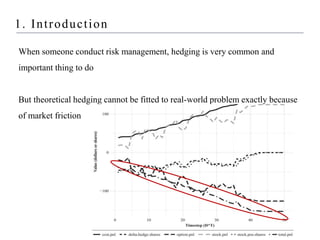
When someone conduct risk management, hedging is very common and
important thing to do
But theoretical hedging cannot be fitted to real-world problem exactly because
of market friction
1. Introduction
Hedging is sequential optimal control task
&
RL is sequential optimal control task
Then can we implement RL to hedging task to
reduce total hedging cost?
2 Hedging
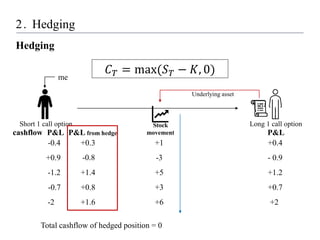
2. Hedging
Hedging
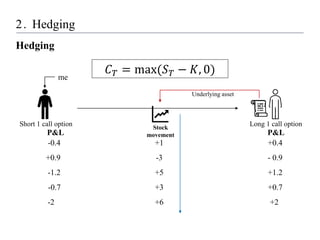
Short 1 call option
𝐶𝑇 = max(𝑆𝑇 − 𝐾, 0)
Long 1 call option
Underlying asset
-0.4 +0.4
+1
-3
+5
+3
+6
+0.9 - 0.9
+1.2
-1.2
+0.7
+2
-0.7
-2
P&L P&L
Stock
movement
me
2. Hedging
Hedging
Short 1 call option
𝐶𝑇 = max(𝑆𝑇 − 𝐾, 0)
Long 1 call option
Underlying asset
-0.4 +0.4
+1
-3
+5
+3
+6
+0.9 - 0.9
+1.2
-1.2
+0.7
+2
-0.7
-2
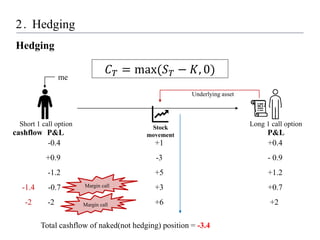
Margin call
P&L P&L
Stock
movement
cashflow
-1.4
Margin call
-2
Total cashflow of naked(not hedging) position = -3.4
me
2. Hedging
Hedging
Short 1 call option
𝐶𝑇 = max(𝑆𝑇 − 𝐾, 0)
Long 1 call option
Underlying asset
-0.4 +0.4
+1
-3
+5
+3
+6
+0.9 - 0.9
+1.2
-1.2
+0.7
+2
-0.7
-2
P&L P&L
Stock
movement
cashflow P&L from hedge
+0.3
-0.8
+1.4
+0.8
+1.6
Total cashflow of hedged position = 0
me
2. Hedging
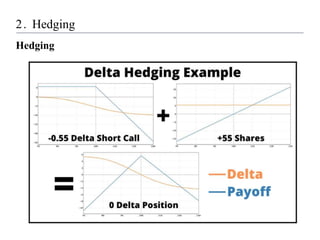
Hedging
2. Hedging
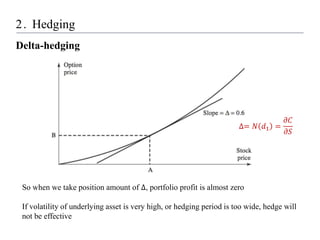
Delta-hedging
∆= 𝑁 𝑑1 =
𝜕𝐶
𝜕𝑆
So when we take position amount of ∆, portfolio profit is almost zero
If volatility of underlying asset is very high, or hedging period is too wide, hedge will
not be effective
2. Hedging
Delta-hedging
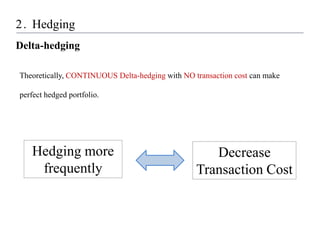
Theoretically, CONTINUOUS Delta-hedging with NO transaction cost can make
perfect hedged portfolio.
2. Hedging
Delta-hedging
Theoretically, CONTINUOUS Delta-hedging with NO transaction cost can make
perfect hedged portfolio.
Hedging more
frequently
Decrease
Transaction Cost
3 Setting Hedging model
3. Setting Hedging model
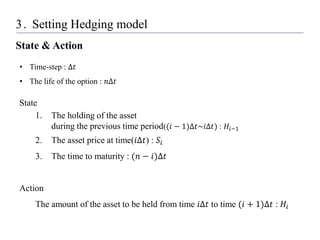
State
1. The holding of the asset
during the previous time period((𝑖 − 1)Δ𝑡~𝑖Δ𝑡) : 𝐻𝑖−1
2. The asset price at time(𝑖Δ𝑡) : 𝑆𝑖
3. The time to maturity : (𝑛 − 𝑖)Δ𝑡
Action
The amount of the asset to be held from time 𝑖Δ𝑡 to time (𝑖 + 1)Δ𝑡 : 𝐻𝑖
State & Action
• Time-step : Δ𝑡
• The life of the option : 𝑛Δ𝑡
3. Setting Hedging model
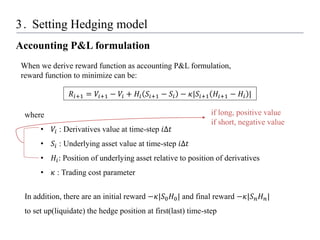
Accounting P&L formulation
𝑅𝑖+1 = 𝑉𝑖+1 − 𝑉𝑖 + 𝐻𝑖 𝑆𝑖+1 − 𝑆𝑖 − 𝜅|𝑆𝑖+1 𝐻𝑖+1 − 𝐻𝑖 |
When we derive reward function as accounting P&L formulation,
reward function to minimize can be:
where
• 𝑉𝑖 : Derivatives value at time-step 𝑖Δ𝑡
• 𝑆𝑖 : Underlying asset value at time-step 𝑖Δ𝑡
• 𝐻𝑖: Position of underlying asset relative to position of derivatives
• 𝜅 : Trading cost parameter
In addition, there are an initial reward −𝜅|𝑆0𝐻0| and final reward −𝜅|𝑆𝑛𝐻𝑛|
to set up(liquidate) the hedge position at first(last) time-step
if long, positive value
if short, negative value
3. Setting Hedging model
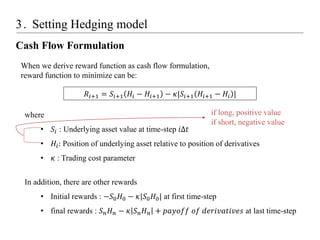
Cash Flow Formulation
𝑅𝑖+1 = 𝑆𝑖+1 𝐻𝑖 − 𝐻𝑖+1 − 𝜅|𝑆𝑖+1 𝐻𝑖+1 − 𝐻𝑖 |
When we derive reward function as cash flow formulation,
reward function to minimize can be:
where
• 𝑆𝑖 : Underlying asset value at time-step 𝑖Δ𝑡
• 𝐻𝑖: Position of underlying asset relative to position of derivatives
• 𝜅 : Trading cost parameter
In addition, there are other rewards
• Initial rewards : −𝑆0𝐻0 − 𝜅|𝑆0𝐻0| at first time-step
• final rewards : 𝑆𝑛𝐻𝑛 − 𝜅 𝑆𝑛𝐻𝑛 + 𝑝𝑎𝑦𝑜𝑓𝑓 𝑜𝑓 𝑑𝑒𝑟𝑖𝑣𝑎𝑡𝑖𝑣𝑒𝑠 at last time-step
if long, positive value
if short, negative value
3. Setting Hedging model
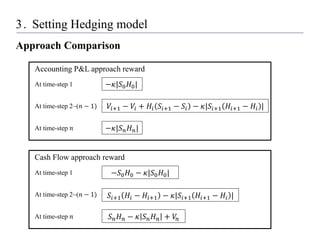
Approach Comparison
𝑆𝑖+1 𝐻𝑖 − 𝐻𝑖+1 − 𝜅|𝑆𝑖+1 𝐻𝑖+1 − 𝐻𝑖 |
𝑉𝑖+1 − 𝑉𝑖 + 𝐻𝑖 𝑆𝑖+1 − 𝑆𝑖 − 𝜅|𝑆𝑖+1 𝐻𝑖+1 − 𝐻𝑖 |
Accounting P&L approach reward
−𝜅|𝑆0𝐻0|
−𝜅|𝑆𝑛𝐻𝑛|
At time-step 1
At time-step 2~(𝑛 − 1)
At time-step 𝑛
Cash Flow approach reward
At time-step 1
At time-step 2~(𝑛 − 1)
At time-step 𝑛
−𝑆0𝐻0 − 𝜅|𝑆0𝐻0|
𝑆𝑛𝐻𝑛 − 𝜅 𝑆𝑛𝐻𝑛 + 𝑉
𝑛
3. Setting Hedging model
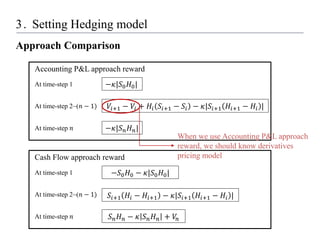
Approach Comparison
𝑆𝑖+1 𝐻𝑖 − 𝐻𝑖+1 − 𝜅|𝑆𝑖+1 𝐻𝑖+1 − 𝐻𝑖 |
𝑉𝑖+1 − 𝑉𝑖 + 𝐻𝑖 𝑆𝑖+1 − 𝑆𝑖 − 𝜅|𝑆𝑖+1 𝐻𝑖+1 − 𝐻𝑖 |
Accounting P&L approach reward
−𝜅|𝑆0𝐻0|
−𝜅|𝑆𝑛𝐻𝑛|
At time-step 1
At time-step 2~(𝑛 − 1)
At time-step 𝑛
Cash Flow approach reward
At time-step 1
At time-step 2~(𝑛 − 1)
At time-step 𝑛
−𝑆0𝐻0 − 𝜅|𝑆0𝐻0|
𝑆𝑛𝐻𝑛 − 𝜅 𝑆𝑛𝐻𝑛 + 𝑉
𝑛
When we use Accounting P&L approach
reward, we should know derivatives
pricing model
3. Setting Hedging model
Approach Comparison
…
…
Time-step
Time-step
reward
reward
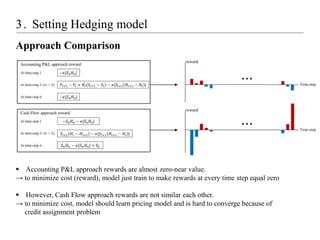
 Accounting P&L approach rewards are almost zero-near value.
→ to minimize cost (reward), model just train to make rewards at every time step equal zero
 However, Cash Flow approach rewards are not similar each other.
→ to minimize cost, model should learn pricing model and is hard to converge because of
credit assignment problem
3. Setting Hedging model
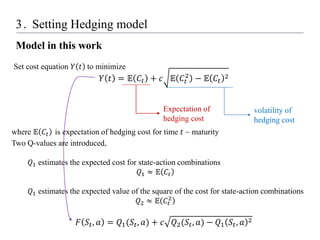
𝑌 𝑡 = 𝔼 𝐶𝑡 + 𝑐 𝔼 𝐶𝑡
2
− 𝔼 𝐶𝑡
2
Model in this work
𝐹 𝑆𝑡, 𝑎 = 𝑄1(𝑆𝑡, 𝑎) + 𝑐 𝑄2(𝑆𝑡, 𝑎) − 𝑄1 𝑆𝑡, 𝑎 2
Two Q-values are introduced,
𝑄1 estimates the expected cost for state-action combinations
𝑄1 ≈ 𝔼 𝐶𝑡
𝑄1 estimates the expected value of the square of the cost for state-action combinations
𝑄2 ≈ 𝔼 𝐶𝑡
2
Expectation of
hedging cost
volatility of
hedging cost
Set cost equation 𝑌 𝑡 to minimize
where 𝔼 𝐶𝑡 is expectation of hedging cost for time 𝑡 ~ maturity
3. Setting Hedging model
Model in this work
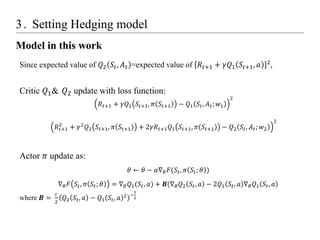
Critic 𝑄1& 𝑄2 update with loss function:
𝑅𝑡+1 + 𝛾𝑄1 𝑆𝑡+1, 𝜋 𝑆𝑡+1 − 𝑄1 𝑆𝑡, 𝐴𝑡; 𝑤1
2
𝑅𝑡+1
2
+ 𝛾2
𝑄2 𝑆𝑡+1, 𝜋 𝑆𝑡+1 + 2𝛾𝑅𝑡+1𝑄1 𝑆𝑡+1, 𝜋 𝑆𝑡+1 − 𝑄2 𝑆𝑡, 𝐴𝑡; 𝑤2
2
Actor 𝜋 update as:
𝜃 ← 𝜃 − 𝛼∇𝜃𝐹(𝑆𝑡, 𝜋 𝑆𝑡; 𝜃 )
∇𝜃𝐹 𝑆𝑡, 𝜋 𝑆𝑡; 𝜃 = ∇𝜃𝑄1(𝑆𝑡, 𝑎) + 𝑩(∇𝜃𝑄2 𝑆𝑡, 𝑎 − 2𝑄1 𝑆𝑡, 𝑎 ∇𝜃𝑄1 𝑆𝑡, 𝑎
where 𝑩 =
𝑐
2
𝑄2 𝑆𝑡, 𝑎 − 𝑄1 𝑆𝑡, 𝑎 2 −
1
2
Since expected value of 𝑄2 𝑆𝑡, 𝐴𝑡 =expected value of 𝑅𝑡+1 + 𝛾𝑄1 𝑆𝑡+1, 𝑎 2
,
4Experiments
4. Experiments
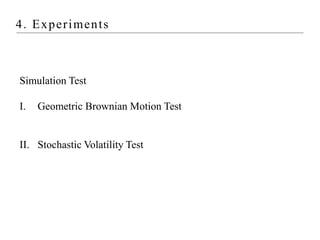
Simulation Test
I. Geometric Brownian Motion Test
II. Stochastic Volatility Test
4. Experiments
Setting
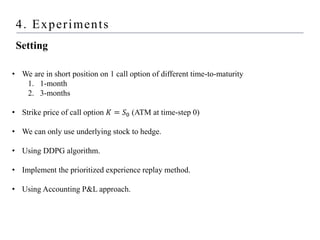
• We are in short position on 1 call option of different time-to-maturity
1. 1-month
2. 3-months
• Strike price of call option 𝐾 = 𝑆0 (ATM at time-step 0)
• We can only use underlying stock to hedge.
• Using DDPG algorithm.
• Implement the prioritized experience replay method.
• Using Accounting P&L approach.
4. Experiments
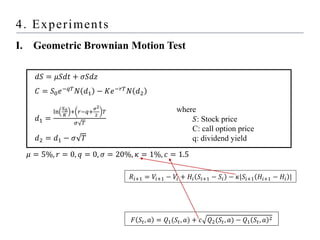
I. Geometric Brownian Motion Test
where
𝑆: Stock price
C: call option price
q: dividend yield
𝑅𝑖+1 = 𝑉𝑖+1 − 𝑉𝑖 + 𝐻𝑖 𝑆𝑖+1 − 𝑆𝑖 − 𝜅|𝑆𝑖+1 𝐻𝑖+1 − 𝐻𝑖 |
𝐹 𝑆𝑡, 𝑎 = 𝑄1(𝑆𝑡, 𝑎) + 𝑐 𝑄2(𝑆𝑡, 𝑎) − 𝑄1 𝑆𝑡, 𝑎 2
𝑑𝑆 = 𝜇𝑆𝑑𝑡 + 𝜎𝑆𝑑𝑧
𝐶 = 𝑆0𝑒−𝑞𝑇
𝑁 𝑑1 − 𝐾𝑒−𝑟𝑇
𝑁 𝑑2
𝑑1 =
ln
𝑆0
𝐾
+ 𝑟−𝑞+
𝜎2
2
𝑇
𝜎 𝑇
𝑑2 = 𝑑1 − 𝜎 𝑇
𝜇 = 5%, 𝑟 = 0, 𝑞 = 0, 𝜎 = 20%, 𝜅 = 1%, 𝑐 = 1.5
4. Experiments
I. Geometric Brownian Motion Test
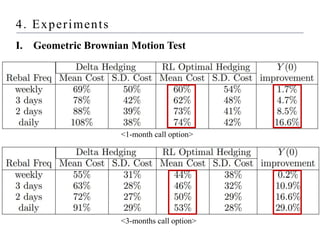
<1-month call option>
<3-months call option>
4. Experiments
II. Stochastic Volatility Test
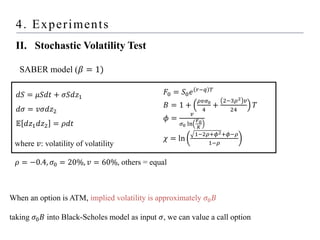
When an option is ATM, implied volatility is approximately 𝜎0𝐵
taking 𝜎0𝐵 into Black-Scholes model as input 𝜎, we can value a call option
SABER model (𝛽 = 1)
𝑑𝑆 = 𝜇𝑆𝑑𝑡 + 𝜎𝑆𝑑𝑧1
𝑑𝜎 = 𝑣𝜎𝑑𝑧2
𝔼 𝑑𝑧1𝑑𝑧2 = 𝜌𝑑𝑡
where 𝑣: volatility of volatility
𝜌 = −0.4, 𝜎0 = 20%, 𝑣 = 60%, others = equal
𝐹0 = 𝑆0𝑒 𝑟−𝑞 𝑇
𝐵 = 1 +
𝜌𝑣𝜎0
4
+
2−3𝜌2 𝑣
24
𝑇
𝜙 =
𝑣
𝜎0 ln
𝐹0
𝐾
𝜒 = ln
1−2𝜌+𝜙2+𝜙−𝜌
1−𝜌
4. Experiments
II. Stochastic Volatility Test
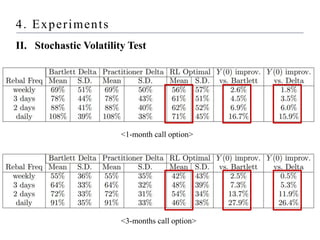
Our model is compared with 2 delta-hedging strategy
1. Bartlett Delta : Delta calculated by SABER
2. Practitioner Delta : Delta calculated by market implied volatility
4. Experiments
II. Stochastic Volatility Test
<1-month call option>
<3-months call option>
4. Experiments
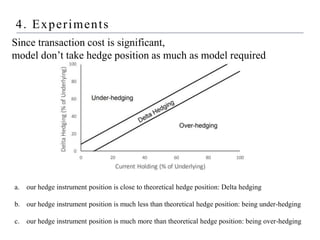
a. our hedge instrument position is close to theoretical hedge position: Delta hedging
b. our hedge instrument position is much less than theoretical hedge position: being under-hedging
c. our hedge instrument position is much more than theoretical hedge position: being over-hedging
Since transaction cost is significant,
model don’t take hedge position as much as model required
4. Experiments
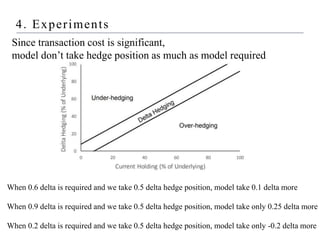
Since transaction cost is significant,
model don’t take hedge position as much as model required
When 0.6 delta is required and we take 0.5 delta hedge position, model take 0.1 delta more
When 0.9 delta is required and we take 0.5 delta hedge position, model take only 0.25 delta more
When 0.2 delta is required and we take 0.5 delta hedge position, model take only -0.2 delta more
5 Conclusion
1. Use not only simulated data but real-world data
2. More well-structured architecture is needed
3. Practical hedging method like hedging vol as well as delta-hedging should be
controlled by RL
4. Adaptive transaction cost can be introduced
5. Conclusion

PPT - Deep Hedging OF Derivatives Using Reinforcement Learning

  • 1.
    Deep Hedging ofDerivatives Using Reinforcement Learning Hull et al. working paper 발표자 : 윤지상 Graduate School of Information. Yonsei Univ. Machine Learning & Computational Finance Lab.
  • 2.
    1. Introduction 2. Hedging 3.Setting Hedging model 4. Experiments 5. Conclusion INDEX
  • 3.
  • 4.
    1. Introduction When someoneconduct risk management, hedging is very common and important thing to do But theoretical hedging cannot be fitted to real-world problem exactly because of market friction
  • 5.
    1. Introduction Hedging issequential optimal control task & RL is sequential optimal control task Then can we implement RL to hedging task to reduce total hedging cost?
  • 6.
  • 7.
    2. Hedging Hedging Short 1call option 𝐶𝑇 = max(𝑆𝑇 − 𝐾, 0) Long 1 call option Underlying asset -0.4 +0.4 +1 -3 +5 +3 +6 +0.9 - 0.9 +1.2 -1.2 +0.7 +2 -0.7 -2 P&L P&L Stock movement me
  • 8.
    2. Hedging Hedging Short 1call option 𝐶𝑇 = max(𝑆𝑇 − 𝐾, 0) Long 1 call option Underlying asset -0.4 +0.4 +1 -3 +5 +3 +6 +0.9 - 0.9 +1.2 -1.2 +0.7 +2 -0.7 -2 Margin call P&L P&L Stock movement cashflow -1.4 Margin call -2 Total cashflow of naked(not hedging) position = -3.4 me
  • 9.
    2. Hedging Hedging Short 1call option 𝐶𝑇 = max(𝑆𝑇 − 𝐾, 0) Long 1 call option Underlying asset -0.4 +0.4 +1 -3 +5 +3 +6 +0.9 - 0.9 +1.2 -1.2 +0.7 +2 -0.7 -2 P&L P&L Stock movement cashflow P&L from hedge +0.3 -0.8 +1.4 +0.8 +1.6 Total cashflow of hedged position = 0 me
  • 10.
  • 11.
    2. Hedging Delta-hedging ∆= 𝑁𝑑1 = 𝜕𝐶 𝜕𝑆 So when we take position amount of ∆, portfolio profit is almost zero If volatility of underlying asset is very high, or hedging period is too wide, hedge will not be effective
  • 12.
    2. Hedging Delta-hedging Theoretically, CONTINUOUSDelta-hedging with NO transaction cost can make perfect hedged portfolio.
  • 13.
    2. Hedging Delta-hedging Theoretically, CONTINUOUSDelta-hedging with NO transaction cost can make perfect hedged portfolio. Hedging more frequently Decrease Transaction Cost
  • 14.
  • 15.
    3. Setting Hedgingmodel State 1. The holding of the asset during the previous time period((𝑖 − 1)Δ𝑡~𝑖Δ𝑡) : 𝐻𝑖−1 2. The asset price at time(𝑖Δ𝑡) : 𝑆𝑖 3. The time to maturity : (𝑛 − 𝑖)Δ𝑡 Action The amount of the asset to be held from time 𝑖Δ𝑡 to time (𝑖 + 1)Δ𝑡 : 𝐻𝑖 State & Action • Time-step : Δ𝑡 • The life of the option : 𝑛Δ𝑡
  • 16.
    3. Setting Hedgingmodel Accounting P&L formulation 𝑅𝑖+1 = 𝑉𝑖+1 − 𝑉𝑖 + 𝐻𝑖 𝑆𝑖+1 − 𝑆𝑖 − 𝜅|𝑆𝑖+1 𝐻𝑖+1 − 𝐻𝑖 | When we derive reward function as accounting P&L formulation, reward function to minimize can be: where • 𝑉𝑖 : Derivatives value at time-step 𝑖Δ𝑡 • 𝑆𝑖 : Underlying asset value at time-step 𝑖Δ𝑡 • 𝐻𝑖: Position of underlying asset relative to position of derivatives • 𝜅 : Trading cost parameter In addition, there are an initial reward −𝜅|𝑆0𝐻0| and final reward −𝜅|𝑆𝑛𝐻𝑛| to set up(liquidate) the hedge position at first(last) time-step if long, positive value if short, negative value
  • 17.
    3. Setting Hedgingmodel Cash Flow Formulation 𝑅𝑖+1 = 𝑆𝑖+1 𝐻𝑖 − 𝐻𝑖+1 − 𝜅|𝑆𝑖+1 𝐻𝑖+1 − 𝐻𝑖 | When we derive reward function as cash flow formulation, reward function to minimize can be: where • 𝑆𝑖 : Underlying asset value at time-step 𝑖Δ𝑡 • 𝐻𝑖: Position of underlying asset relative to position of derivatives • 𝜅 : Trading cost parameter In addition, there are other rewards • Initial rewards : −𝑆0𝐻0 − 𝜅|𝑆0𝐻0| at first time-step • final rewards : 𝑆𝑛𝐻𝑛 − 𝜅 𝑆𝑛𝐻𝑛 + 𝑝𝑎𝑦𝑜𝑓𝑓 𝑜𝑓 𝑑𝑒𝑟𝑖𝑣𝑎𝑡𝑖𝑣𝑒𝑠 at last time-step if long, positive value if short, negative value
  • 18.
    3. Setting Hedgingmodel Approach Comparison 𝑆𝑖+1 𝐻𝑖 − 𝐻𝑖+1 − 𝜅|𝑆𝑖+1 𝐻𝑖+1 − 𝐻𝑖 | 𝑉𝑖+1 − 𝑉𝑖 + 𝐻𝑖 𝑆𝑖+1 − 𝑆𝑖 − 𝜅|𝑆𝑖+1 𝐻𝑖+1 − 𝐻𝑖 | Accounting P&L approach reward −𝜅|𝑆0𝐻0| −𝜅|𝑆𝑛𝐻𝑛| At time-step 1 At time-step 2~(𝑛 − 1) At time-step 𝑛 Cash Flow approach reward At time-step 1 At time-step 2~(𝑛 − 1) At time-step 𝑛 −𝑆0𝐻0 − 𝜅|𝑆0𝐻0| 𝑆𝑛𝐻𝑛 − 𝜅 𝑆𝑛𝐻𝑛 + 𝑉 𝑛
  • 19.
    3. Setting Hedgingmodel Approach Comparison 𝑆𝑖+1 𝐻𝑖 − 𝐻𝑖+1 − 𝜅|𝑆𝑖+1 𝐻𝑖+1 − 𝐻𝑖 | 𝑉𝑖+1 − 𝑉𝑖 + 𝐻𝑖 𝑆𝑖+1 − 𝑆𝑖 − 𝜅|𝑆𝑖+1 𝐻𝑖+1 − 𝐻𝑖 | Accounting P&L approach reward −𝜅|𝑆0𝐻0| −𝜅|𝑆𝑛𝐻𝑛| At time-step 1 At time-step 2~(𝑛 − 1) At time-step 𝑛 Cash Flow approach reward At time-step 1 At time-step 2~(𝑛 − 1) At time-step 𝑛 −𝑆0𝐻0 − 𝜅|𝑆0𝐻0| 𝑆𝑛𝐻𝑛 − 𝜅 𝑆𝑛𝐻𝑛 + 𝑉 𝑛 When we use Accounting P&L approach reward, we should know derivatives pricing model
  • 20.
    3. Setting Hedgingmodel Approach Comparison … … Time-step Time-step reward reward  Accounting P&L approach rewards are almost zero-near value. → to minimize cost (reward), model just train to make rewards at every time step equal zero  However, Cash Flow approach rewards are not similar each other. → to minimize cost, model should learn pricing model and is hard to converge because of credit assignment problem
  • 21.
    3. Setting Hedgingmodel 𝑌 𝑡 = 𝔼 𝐶𝑡 + 𝑐 𝔼 𝐶𝑡 2 − 𝔼 𝐶𝑡 2 Model in this work 𝐹 𝑆𝑡, 𝑎 = 𝑄1(𝑆𝑡, 𝑎) + 𝑐 𝑄2(𝑆𝑡, 𝑎) − 𝑄1 𝑆𝑡, 𝑎 2 Two Q-values are introduced, 𝑄1 estimates the expected cost for state-action combinations 𝑄1 ≈ 𝔼 𝐶𝑡 𝑄1 estimates the expected value of the square of the cost for state-action combinations 𝑄2 ≈ 𝔼 𝐶𝑡 2 Expectation of hedging cost volatility of hedging cost Set cost equation 𝑌 𝑡 to minimize where 𝔼 𝐶𝑡 is expectation of hedging cost for time 𝑡 ~ maturity
  • 22.
    3. Setting Hedgingmodel Model in this work Critic 𝑄1& 𝑄2 update with loss function: 𝑅𝑡+1 + 𝛾𝑄1 𝑆𝑡+1, 𝜋 𝑆𝑡+1 − 𝑄1 𝑆𝑡, 𝐴𝑡; 𝑤1 2 𝑅𝑡+1 2 + 𝛾2 𝑄2 𝑆𝑡+1, 𝜋 𝑆𝑡+1 + 2𝛾𝑅𝑡+1𝑄1 𝑆𝑡+1, 𝜋 𝑆𝑡+1 − 𝑄2 𝑆𝑡, 𝐴𝑡; 𝑤2 2 Actor 𝜋 update as: 𝜃 ← 𝜃 − 𝛼∇𝜃𝐹(𝑆𝑡, 𝜋 𝑆𝑡; 𝜃 ) ∇𝜃𝐹 𝑆𝑡, 𝜋 𝑆𝑡; 𝜃 = ∇𝜃𝑄1(𝑆𝑡, 𝑎) + 𝑩(∇𝜃𝑄2 𝑆𝑡, 𝑎 − 2𝑄1 𝑆𝑡, 𝑎 ∇𝜃𝑄1 𝑆𝑡, 𝑎 where 𝑩 = 𝑐 2 𝑄2 𝑆𝑡, 𝑎 − 𝑄1 𝑆𝑡, 𝑎 2 − 1 2 Since expected value of 𝑄2 𝑆𝑡, 𝐴𝑡 =expected value of 𝑅𝑡+1 + 𝛾𝑄1 𝑆𝑡+1, 𝑎 2 ,
  • 23.
  • 24.
    4. Experiments Simulation Test I.Geometric Brownian Motion Test II. Stochastic Volatility Test
  • 25.
    4. Experiments Setting • Weare in short position on 1 call option of different time-to-maturity 1. 1-month 2. 3-months • Strike price of call option 𝐾 = 𝑆0 (ATM at time-step 0) • We can only use underlying stock to hedge. • Using DDPG algorithm. • Implement the prioritized experience replay method. • Using Accounting P&L approach.
  • 26.
    4. Experiments I. GeometricBrownian Motion Test where 𝑆: Stock price C: call option price q: dividend yield 𝑅𝑖+1 = 𝑉𝑖+1 − 𝑉𝑖 + 𝐻𝑖 𝑆𝑖+1 − 𝑆𝑖 − 𝜅|𝑆𝑖+1 𝐻𝑖+1 − 𝐻𝑖 | 𝐹 𝑆𝑡, 𝑎 = 𝑄1(𝑆𝑡, 𝑎) + 𝑐 𝑄2(𝑆𝑡, 𝑎) − 𝑄1 𝑆𝑡, 𝑎 2 𝑑𝑆 = 𝜇𝑆𝑑𝑡 + 𝜎𝑆𝑑𝑧 𝐶 = 𝑆0𝑒−𝑞𝑇 𝑁 𝑑1 − 𝐾𝑒−𝑟𝑇 𝑁 𝑑2 𝑑1 = ln 𝑆0 𝐾 + 𝑟−𝑞+ 𝜎2 2 𝑇 𝜎 𝑇 𝑑2 = 𝑑1 − 𝜎 𝑇 𝜇 = 5%, 𝑟 = 0, 𝑞 = 0, 𝜎 = 20%, 𝜅 = 1%, 𝑐 = 1.5
  • 27.
    4. Experiments I. GeometricBrownian Motion Test <1-month call option> <3-months call option>
  • 28.
    4. Experiments II. StochasticVolatility Test When an option is ATM, implied volatility is approximately 𝜎0𝐵 taking 𝜎0𝐵 into Black-Scholes model as input 𝜎, we can value a call option SABER model (𝛽 = 1) 𝑑𝑆 = 𝜇𝑆𝑑𝑡 + 𝜎𝑆𝑑𝑧1 𝑑𝜎 = 𝑣𝜎𝑑𝑧2 𝔼 𝑑𝑧1𝑑𝑧2 = 𝜌𝑑𝑡 where 𝑣: volatility of volatility 𝜌 = −0.4, 𝜎0 = 20%, 𝑣 = 60%, others = equal 𝐹0 = 𝑆0𝑒 𝑟−𝑞 𝑇 𝐵 = 1 + 𝜌𝑣𝜎0 4 + 2−3𝜌2 𝑣 24 𝑇 𝜙 = 𝑣 𝜎0 ln 𝐹0 𝐾 𝜒 = ln 1−2𝜌+𝜙2+𝜙−𝜌 1−𝜌
  • 29.
    4. Experiments II. StochasticVolatility Test Our model is compared with 2 delta-hedging strategy 1. Bartlett Delta : Delta calculated by SABER 2. Practitioner Delta : Delta calculated by market implied volatility
  • 30.
    4. Experiments II. StochasticVolatility Test <1-month call option> <3-months call option>
  • 31.
    4. Experiments a. ourhedge instrument position is close to theoretical hedge position: Delta hedging b. our hedge instrument position is much less than theoretical hedge position: being under-hedging c. our hedge instrument position is much more than theoretical hedge position: being over-hedging Since transaction cost is significant, model don’t take hedge position as much as model required
  • 32.
    4. Experiments Since transactioncost is significant, model don’t take hedge position as much as model required When 0.6 delta is required and we take 0.5 delta hedge position, model take 0.1 delta more When 0.9 delta is required and we take 0.5 delta hedge position, model take only 0.25 delta more When 0.2 delta is required and we take 0.5 delta hedge position, model take only -0.2 delta more
  • 33.
  • 34.
    1. Use notonly simulated data but real-world data 2. More well-structured architecture is needed 3. Practical hedging method like hedging vol as well as delta-hedging should be controlled by RL 4. Adaptive transaction cost can be introduced 5. Conclusion