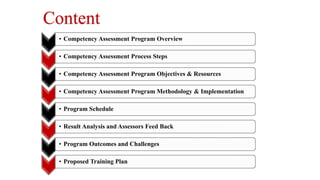
• Competency Assessment Program Overview
• Competency Assessment Process Steps
• Competency Assessment Program Objectives & Resources
• Competency Assessment Program Methodology & Implementation
• Program Schedule
• Result Analysis and Assessors Feed Back
• Program Outcomes and Challenges
• Proposed Training Plan
Content
A competency assessment program for oil and gas
industry employees is a comprehensive framework
designed to systematically evaluate and enhance the
skills, knowledge, and abilities crucial for success
within this high-risk and dynamic sector. It
encompasses the identification of key competencies
essential for various roles, including technical
expertise, safety protocols, regulatory compliance,
leadership capabilities, and problem-solving skills and
more. Utilizing a variety of assessment methods such
as questioning, written tests and self-assessment,
practical demonstrations, simulations, and
performance evaluations.
Competency Assessment Program Overview
What is a Competency Assessment Program?
Competency
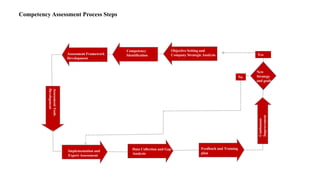
Identification
Objective Setting and
Company Strategic Analysis
Assessment Framework
Development
Implementation and
Expert Assessment
Data Collection and Gap
Analysis
Feedback and Training
plan
Continuous
Improvement
New
Strategy
and goals
Yes
No
Assessment
Tools
Development
Competency Assessment Process Steps
STAR
• Job description analysis
• Identification of core and
complementary competencies
• Identification of proficiency level
for each competency
• Identify competencies needed to
accomplish the business strategy
and technology plan
• Develop new ompetencies to
accomplish the business needs and
Technology plan
• Business strategy, plan, objective
• Achievements and challenges
• Technology plan
• Organizational Chart
• Individuals Self Assessment
using assessment tools
assigned
• Interview is one to one between the
assessors and individuals
• Interviews will also be performed with
other stakeholders
• Analyzes the gap and the
strength of each individual
• Develop training and
development plan
• Results Evaluations:
• How much Gap closed.
• Current and previous situations comparison.
• Cost-benefit analysis.
YES
NO
Competency Assessment Process Steps
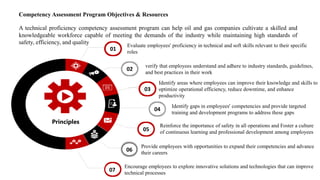
Competency Assessment Program Objectives & Resources
A technical proficiency competency assessment program can help oil and gas companies cultivate a skilled and
knowledgeable workforce capable of meeting the demands of the industry while maintaining high standards of
safety, efficiency, and quality
Evaluate employees' proficiency in technical and soft skills relevant to their specific
roles
01
verify that employees understand and adhere to industry standards, guidelines,
and best practices in their work
02
Identify areas where employees can improve their knowledge and skills to
optimize operational efficiency, reduce downtime, and enhance
productivity
03
Identify gaps in employees' competencies and provide targeted
training and development programs to address these gaps
04
Reinforce the importance of safety in all operations and Foster a culture
of continuous learning and professional development among employees
05
Provide employees with opportunities to expand their competencies and advance
their careers
06
Encourage employees to explore innovative solutions and technologies that can improve
technical processes
07
Principles
Assessors:
assessors play a crucial role in the competency assessment program for oil and gas industry employees,
contributing to the identification of skill gaps, the enhancement of workforce capabilities, and the overall effectiveness
and safety of operations within the sector, with several key responsibilities
Competency Assessment Program Objectives & Resources
Assessors’ Responsibilities:
- Plan and manage the assessment process and carry out assessments of Candidates’ performance against the relevant Standards, and
ensure that Candidates’ evidence is relevant, valid, authentic, reliable, current and sufficient;
- Are responsible for administering competency assessments to employees in accordance with established procedures and standards.
They ensure that assessments are conducted fairly, consistently, and impartially, adhering to predetermined criteria and guidelines
- Assess employee performance across various competency areas relevant to their roles in the oil and gas industry. They use
assessment tools such as written tests, practical demonstrations, simulations, and performance evaluations to accurately measure
employee proficiency
- Provide constructive feedback to employees based on their assessment results, highlighting areas of strength and areas needing
improvement. They offer guidance and support to help employees understand their performance and develop strategies for
enhancing their competencies
- Handle assessment data and results with strict confidentiality, ensuring that sensitive information about employees' performance is
safeguarded. They adhere to privacy regulations and organizational policies governing the handling of personal data.
- Ensure that competency assessments are conducted in compliance with relevant industry standards, regulations, and organizational
policies. They adhere to guidelines outlined by organizations such as OPITO (Offshore Petroleum Industry Training Organization)
to maintain consistency and reliability in assessments
- Maintain fairness and objectivity throughout the assessment process, avoiding bias or favoritism in evaluating employee
performance. They treat all employees with respect and professionalism, fostering a supportive and inclusive assessment
environment.
- Accurately document assessment results, recording employee performance data and feedback in accordance with organizational
procedures. They maintain detailed records of assessments for reporting, analysis, and compliance purposes.
- Collaborate with stakeholders including managers, HR personnel, and training professionals to ensure alignment between
competency assessments and organizational goals. They communicate assessment findings and recommendations effectively to
relevant parties to support decision-making and development planning.
Competency Assessment Program Objectives & Resources
Program Venue:
Competency Assessment Program Objectives & Resources
Competency Assessment Program Methodology & Implementation
Questioning Methodology
The Questioning method for competency assessment is a structured approach used to evaluate the skills, knowledge, and
abilities of employees in a specific role or position. This method typically involves asking a series of questions designed
to assess competencies relevant to the job. Questions were asked in a variety of forms, such as oral questions and written
multiple choice.
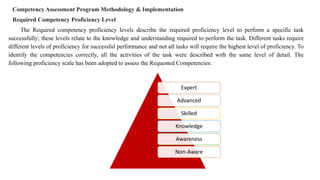
Required Competency Proficiency Level
The Required competency proficiency levels describe the required proficiency level to perform a specific task
successfully; these levels relate to the knowledge and understanding required to perform the task. Different tasks require
different levels of proficiency for successful performance and not all tasks will require the highest level of proficiency. To
identify the competencies correctly, all the activities of the task were described with the same level of detail. The
following proficiency scale has been adopted to assess the Requested Competencies:
Competency Assessment Program Methodology & Implementation
Expert
Advanced
Skilled
Knowledge
Awareness
Non-Aware
Core Competencies and Gap Measurement:
Competency Assessment Program Methodology & Implementation
Developing a competency assessment program involves identifying core competencies essential for success in a
particular role or organization, start by defining the key skills, knowledge, behaviors, and abilities required (Consider
both technical and soft skills competencies), and measure the Gap between current (assessed) and required competency
levels for each individual.
Program Outcomes and Challenges
Achievements and Outcomes:
A dedicated portfolio has been compiled for each candidate,
comprising: Competency Self-Assessment, MBTI Personality
Analysis, Soft Skills Assessment Form, Technical Skills
Assessment Form, Employee Skills Assessment Final Report,
Technical and Soft Skills Training Plan. A comprehensive
departmental report is generated for each department to
consolidate individual reports. These documents aid the
company in gauging the proficiency levels of employees, follow
up and monitoring their progress and development. They
provide managers with a more precise understanding of how to
enhance employees' performance and productivity to meet the
required level.
Proposed Training Plan:
To prepare the training plan, several factors were taken into consideration, including:
- The individual proposed training plans by Assessors for each participant.
- The number of employees and their respective positions within each department.
- The availability of employees, ensuring that the proposed plan does not disrupt or impede their regular
activities and their commitment toward the company.
- For document controllers, laboratory technicians and soft skills training plans were developed without
considering specific departmental affiliations.
- The training will encompass theoretical, practical, mentoring, and OJT training modalities.
- For production and pipeline department, due to the huge staff number we prepared different training plan
based on their positions.

PPT Competency Assessment programs development .pptx

  • 1.
    • Competency AssessmentProgram Overview • Competency Assessment Process Steps • Competency Assessment Program Objectives & Resources • Competency Assessment Program Methodology & Implementation • Program Schedule • Result Analysis and Assessors Feed Back • Program Outcomes and Challenges • Proposed Training Plan Content
  • 2.
    A competency assessmentprogram for oil and gas industry employees is a comprehensive framework designed to systematically evaluate and enhance the skills, knowledge, and abilities crucial for success within this high-risk and dynamic sector. It encompasses the identification of key competencies essential for various roles, including technical expertise, safety protocols, regulatory compliance, leadership capabilities, and problem-solving skills and more. Utilizing a variety of assessment methods such as questioning, written tests and self-assessment, practical demonstrations, simulations, and performance evaluations. Competency Assessment Program Overview What is a Competency Assessment Program?
  • 3.
    Competency Identification Objective Setting and CompanyStrategic Analysis Assessment Framework Development Implementation and Expert Assessment Data Collection and Gap Analysis Feedback and Training plan Continuous Improvement New Strategy and goals Yes No Assessment Tools Development Competency Assessment Process Steps
  • 4.
    STAR • Job descriptionanalysis • Identification of core and complementary competencies • Identification of proficiency level for each competency • Identify competencies needed to accomplish the business strategy and technology plan • Develop new ompetencies to accomplish the business needs and Technology plan • Business strategy, plan, objective • Achievements and challenges • Technology plan • Organizational Chart • Individuals Self Assessment using assessment tools assigned • Interview is one to one between the assessors and individuals • Interviews will also be performed with other stakeholders • Analyzes the gap and the strength of each individual • Develop training and development plan • Results Evaluations: • How much Gap closed. • Current and previous situations comparison. • Cost-benefit analysis. YES NO Competency Assessment Process Steps
  • 5.
    Competency Assessment ProgramObjectives & Resources A technical proficiency competency assessment program can help oil and gas companies cultivate a skilled and knowledgeable workforce capable of meeting the demands of the industry while maintaining high standards of safety, efficiency, and quality Evaluate employees' proficiency in technical and soft skills relevant to their specific roles 01 verify that employees understand and adhere to industry standards, guidelines, and best practices in their work 02 Identify areas where employees can improve their knowledge and skills to optimize operational efficiency, reduce downtime, and enhance productivity 03 Identify gaps in employees' competencies and provide targeted training and development programs to address these gaps 04 Reinforce the importance of safety in all operations and Foster a culture of continuous learning and professional development among employees 05 Provide employees with opportunities to expand their competencies and advance their careers 06 Encourage employees to explore innovative solutions and technologies that can improve technical processes 07 Principles
  • 6.
    Assessors: assessors play acrucial role in the competency assessment program for oil and gas industry employees, contributing to the identification of skill gaps, the enhancement of workforce capabilities, and the overall effectiveness and safety of operations within the sector, with several key responsibilities Competency Assessment Program Objectives & Resources
  • 7.
    Assessors’ Responsibilities: - Planand manage the assessment process and carry out assessments of Candidates’ performance against the relevant Standards, and ensure that Candidates’ evidence is relevant, valid, authentic, reliable, current and sufficient; - Are responsible for administering competency assessments to employees in accordance with established procedures and standards. They ensure that assessments are conducted fairly, consistently, and impartially, adhering to predetermined criteria and guidelines - Assess employee performance across various competency areas relevant to their roles in the oil and gas industry. They use assessment tools such as written tests, practical demonstrations, simulations, and performance evaluations to accurately measure employee proficiency - Provide constructive feedback to employees based on their assessment results, highlighting areas of strength and areas needing improvement. They offer guidance and support to help employees understand their performance and develop strategies for enhancing their competencies - Handle assessment data and results with strict confidentiality, ensuring that sensitive information about employees' performance is safeguarded. They adhere to privacy regulations and organizational policies governing the handling of personal data. - Ensure that competency assessments are conducted in compliance with relevant industry standards, regulations, and organizational policies. They adhere to guidelines outlined by organizations such as OPITO (Offshore Petroleum Industry Training Organization) to maintain consistency and reliability in assessments - Maintain fairness and objectivity throughout the assessment process, avoiding bias or favoritism in evaluating employee performance. They treat all employees with respect and professionalism, fostering a supportive and inclusive assessment environment. - Accurately document assessment results, recording employee performance data and feedback in accordance with organizational procedures. They maintain detailed records of assessments for reporting, analysis, and compliance purposes. - Collaborate with stakeholders including managers, HR personnel, and training professionals to ensure alignment between competency assessments and organizational goals. They communicate assessment findings and recommendations effectively to relevant parties to support decision-making and development planning. Competency Assessment Program Objectives & Resources
  • 8.
    Program Venue: Competency AssessmentProgram Objectives & Resources
  • 9.
    Competency Assessment ProgramMethodology & Implementation Questioning Methodology The Questioning method for competency assessment is a structured approach used to evaluate the skills, knowledge, and abilities of employees in a specific role or position. This method typically involves asking a series of questions designed to assess competencies relevant to the job. Questions were asked in a variety of forms, such as oral questions and written multiple choice.
  • 10.
    Required Competency ProficiencyLevel The Required competency proficiency levels describe the required proficiency level to perform a specific task successfully; these levels relate to the knowledge and understanding required to perform the task. Different tasks require different levels of proficiency for successful performance and not all tasks will require the highest level of proficiency. To identify the competencies correctly, all the activities of the task were described with the same level of detail. The following proficiency scale has been adopted to assess the Requested Competencies: Competency Assessment Program Methodology & Implementation Expert Advanced Skilled Knowledge Awareness Non-Aware
  • 11.
    Core Competencies andGap Measurement: Competency Assessment Program Methodology & Implementation Developing a competency assessment program involves identifying core competencies essential for success in a particular role or organization, start by defining the key skills, knowledge, behaviors, and abilities required (Consider both technical and soft skills competencies), and measure the Gap between current (assessed) and required competency levels for each individual.
  • 12.
    Program Outcomes andChallenges Achievements and Outcomes: A dedicated portfolio has been compiled for each candidate, comprising: Competency Self-Assessment, MBTI Personality Analysis, Soft Skills Assessment Form, Technical Skills Assessment Form, Employee Skills Assessment Final Report, Technical and Soft Skills Training Plan. A comprehensive departmental report is generated for each department to consolidate individual reports. These documents aid the company in gauging the proficiency levels of employees, follow up and monitoring their progress and development. They provide managers with a more precise understanding of how to enhance employees' performance and productivity to meet the required level.
  • 13.
    Proposed Training Plan: Toprepare the training plan, several factors were taken into consideration, including: - The individual proposed training plans by Assessors for each participant. - The number of employees and their respective positions within each department. - The availability of employees, ensuring that the proposed plan does not disrupt or impede their regular activities and their commitment toward the company. - For document controllers, laboratory technicians and soft skills training plans were developed without considering specific departmental affiliations. - The training will encompass theoretical, practical, mentoring, and OJT training modalities. - For production and pipeline department, due to the huge staff number we prepared different training plan based on their positions.

Editor's Notes

  • #11 Non-Aware (0): Competency not demonstrated. have no understanding of the competency. No use of competency required for the job. Awareness (1): General understanding or knowledge needed for the job. General understanding and knowledge not sufficient enough to handle routine tasks. have had limited opportunity to apply the competency. Knowledge (2): Requires some guidance or supervision when applying the competency. Understands and can discuss terminology and concepts related to the competency. understanding and knowledge sufficient enough to handle routine tasks. Skilled (3): Detailed knowledge, understanding, and application of the competency Ability to handle non-routine problems and situations. Requires minimal guidance or supervision / works independently. Consistently demonstrates success in the competency. Capable of assisting others in the application of the competency. Advanced (4): Highly developed knowledge, understanding, and application of the competency required to be successful in the job and organization (total mastery). Can apply knowledge outside the scope of one’s position. Is able to coach or teach others on the competency. Has a long-term perspective. Helps develop materials and resources in the competency. Expert (5): Specialist/Authority level knowledge, understanding, and application of the competency required to be successful in the job. Recognized by others as an expert in the competency and is sought out by others throughout the organization (expert in the area). Works across team, department, and organizational functions. Applies skill across multiple projects or functions. Able to explain issues in relation to broader organizational issues.