Evolution of the
earth
Origin and Early Evolution of Earth
• Age of universe is ~ 14.5 By, about 10 By older than Earth
• Early universe had only protons & helium nuclei as condensed particles we are
familiar with, rest was elementary particles & radiation
• First stars formed from hydrogen and helium, the rest of the elements formed in
protostars by nucleosynthesis
• Stars of a certain critical size exploded as supernovae, scattering hydrogen, He &
newly formed elements as intergalactic “dust”. Other stars became “black holes”,
brown dwarfs, etc.
• Inhomogeneities in dust clouds led to formation of secondary stars, similar to our
sun, but now could contain orbiting debris formed from elements in 1ˢᵗ generation
stars.
• Inherited angular momentum caused debris to orbit main condensation center, and
eventually gave rise to orbiting planets
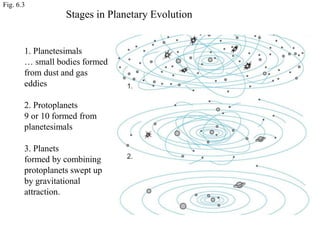
Fig. 6.3
Stages in Planetary Evolution
1. Planetesimals
… small bodies formed
from dust and gas
eddies
2. Protoplanets
9 or 10 formed from
planetesimals
3. Planets
formed by combining
protoplanets swept up
by gravitational
attraction.
Broadly, four stages can be identified in the process of planetary formation.
• The gravitational collapse of a star leads to the formation of a core to the gas cloud and the formation of a huge rotating
disc of gas and dust, which develops around the gas core. A star such as Beta Pictoris shows a central core of this type, with
a disc of matter rotating around the core. Beta Pictoris is thought to be a young star showing the early stages of planetary
formation.
• The condensation of the gas cloud and the formation of chondrules. Chondrules are small rounded objects found in some
meteorites.. The presence of chondrules gives rise to a special class of meteorites known as chondrites. For example, the
Allende meteorite is chondrule-rich and contains minerals rich in the elements Ca and Al, and Ti and Al, minerals which are
unlike terrestrial minerals. It also include metallic blobs of Os, Re, Zr. The chemistry of these unusual minerals suggest that
they are early solar system condensates.
• The accretion of gas and dust to form small bodies between 1-10 km in diameter. These bodies are known as
planetesimals. They form initially from small fragments of solar dust and chondrules by the processes of cohesion (sticking
together by weak electrostatic forces) and by gravitational instability. Cohesion forms fragments up to about 1 cm in
diameter. Larger bodies form by collisions at low speed which cause the material to stick together by gravitational attraction.
Support for this view of the process of accretion comes from a region on the edge of the solar system known as the Kuiper
Belt, where it is thought that the accretionary 'mopping up' has failed to take place.
• More violent and rapid impact accretion. The final stage of accretion has been described as 'runaway accretion'.
Planetesimals are swept up into well defined zones around the sun which approximate to the present orbits of the terrestrial
planets. The process leads eventually to a small number of large planetary bodies. Evidence for this impacting process can
be seen in the early impact craters found on planetary surfaces An explanation of the type given above for the origin of the
planets in the solar system is supported by mathematical simulations which show how accretion works by the progressive
gathering together of smaller particles into large. It also provides an explanation of the differences between planetary bodies
in the solar system and explains the differences between the heavier terrestrial planets close to the sun, and the lighter, more
gaseous planets situated at a greater distance.
http://www2.glos.ac.uk/gdn/origins/earth/ch3_2.htm
Beta Pictoris – a solar system in the making?
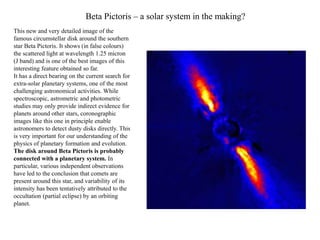
This new and very detailed image of the
famous circumstellar disk around the southern
star Beta Pictoris. It shows (in false colours)
the scattered light at wavelength 1.25 micron
(J band) and is one of the best images of this
interesting feature obtained so far.
It has a direct bearing on the current search for
extra-solar planetary systems, one of the most
challenging astronomical activities. While
spectroscopic, astrometric and photometric
studies may only provide indirect evidence for
planets around other stars, coronographic
images like this one in principle enable
astronomers to detect dusty disks directly. This
is very important for our understanding of the
physics of planetary formation and evolution.
The disk around Beta Pictoris is probably
connected with a planetary system. In
particular, various independent observations
have led to the conclusion that comets are
present around this star, and variability of its
intensity has been tentatively attributed to the
occultation (partial eclipse) by an orbiting
planet.
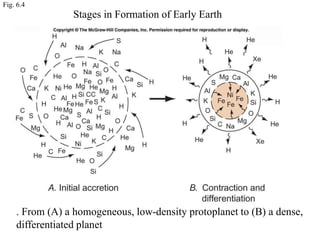
Fig. 6.4
. From (A) a homogeneous, low-density protoplanet to (B) a dense,
differentiated planet
Stages in Formation of Early Earth
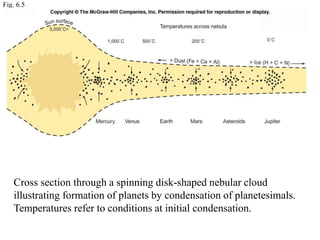
Fig. 6.5
Cross section through a spinning disk-shaped nebular cloud
illustrating formation of planets by condensation of planetesimals.
Temperatures refer to conditions at initial condensation.
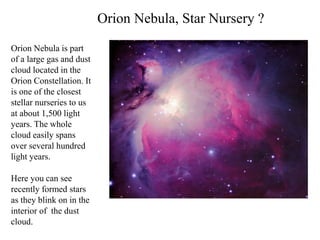
Orion Nebula is part
of a large gas and dust
cloud located in the
Orion Constellation. It
is one of the closest
stellar nurseries to us
at about 1,500 light
years. The whole
cloud easily spans
over several hundred
light years.
Here you can see
recently formed stars
as they blink on in the
interior of the dust
cloud.
Orion Nebula, Star Nursery ?
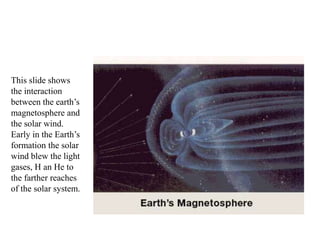
This slide shows
the interaction
between the earth’s
magnetosphere and
the solar wind.
Early in the Earth’s
formation the solar
wind blew the light
gases, H an He to
the farther reaches
of the solar system.
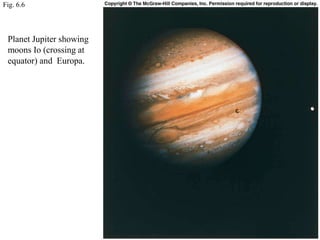
Fig. 6.6
Planet Jupiter showing
moons Io (crossing at
equator) and Europa.
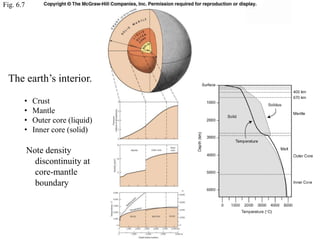
Fig. 6.7
The earth’s interior.
• Crust
• Mantle
• Outer core (liquid)
• Inner core (solid)
Note density
discontinuity at
core-mantle
boundary
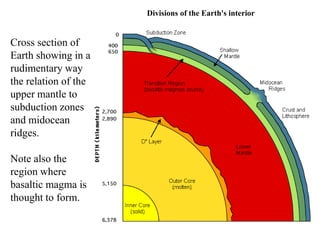
Divisions of the Earth's interior
Cross section of
Earth showing in a
rudimentary way
the relation of the
upper mantle to
subduction zones
and midocean
ridges.
Note also the
region where
basaltic magma is
thought to form.
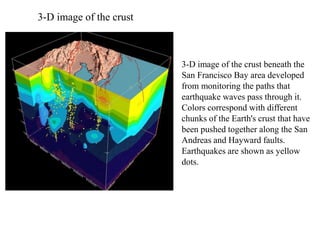
3-D image of the crust
3-D image of the crust beneath the
San Francisco Bay area developed
from monitoring the paths that
earthquake waves pass through it.
Colors correspond with different
chunks of the Earth's crust that have
been pushed together along the San
Andreas and Hayward faults.
Earthquakes are shown as yellow
dots.
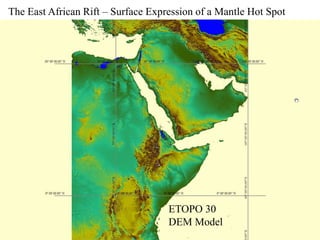
The East African Rift – Surface Expression of a Mantle Hot Spot
ETOPO 30
DEM Model
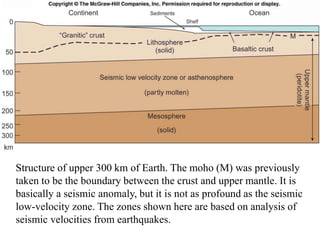
Fig. 6.8
Structure of upper 300 km of Earth. The moho (M) was previously
taken to be the boundary between the crust and upper mantle. It is
basically a seismic anomaly, but it is not as profound as the seismic
low-velocity zone. The zones shown here are based on analysis of
seismic velocities from earthquakes.
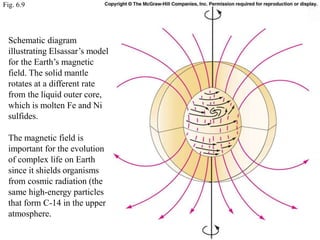
Fig. 6.9
Schematic diagram
illustrating Elsassar’s model
for the Earth’s magnetic
field. The solid mantle
rotates at a different rate
from the liquid outer core,
which is molten Fe and Ni
sulfides.
The magnetic field is
important for the evolution
of complex life on Earth
since it shields organisms
from cosmic radiation (the
same high-energy particles
that form C-14 in the upper
atmosphere.
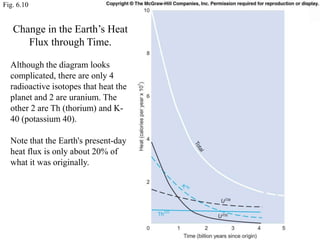
Fig. 6.10
Change in the Earth’s Heat
Flux through Time.
Although the diagram looks
complicated, there are only 4
radioactive isotopes that heat the
planet and 2 are uranium. The
other 2 are Th (thorium) and K-
40 (potassium 40).
Note that the Earth's present-day
heat flux is only about 20% of
what it was originally.
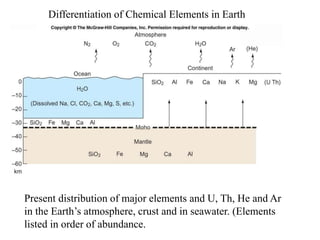
Differentiation of Chemical Elements in Earth
Present distribution of major elements and U, Th, He and Ar
in the Earth’s atmosphere, crust and in seawater. (Elements
listed in order of abundance.
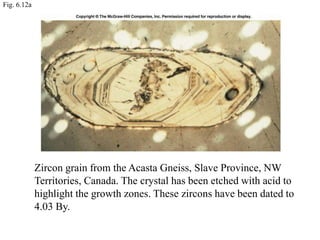
Fig. 6.12a
Zircon grain from the Acasta Gneiss, Slave Province, NW
Territories, Canada. The crystal has been etched with acid to
highlight the growth zones. These zircons have been dated to
4.03 By.
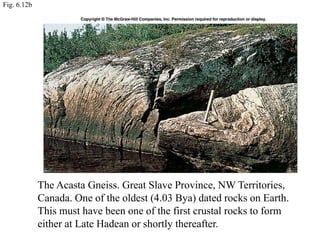
Fig. 6.12b
The Acasta Gneiss. Great Slave Province, NW Territories,
Canada. One of the oldest (4.03 Bya) dated rocks on Earth.
This must have been one of the first crustal rocks to form
either at Late Hadean or shortly thereafter.
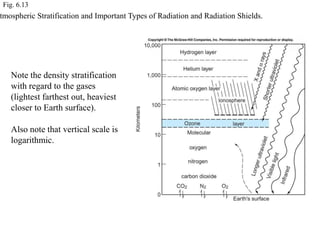
Fig. 6.13
Note the density stratification
with regard to the gases
(lightest farthest out, heaviest
closer to Earth surface).
Also note that vertical scale is
logarithmic.
tmospheric Stratification and Important Types of Radiation and Radiation Shields.
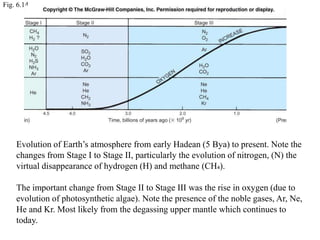
Fig. 6.14
Evolution of Earth’s atmosphere from early Hadean (5 Bya) to present. Note the
changes from Stage I to Stage II, particularly the evolution of nitrogen, (N) the
virtual disappearance of hydrogen (H) and methane (CH₄).
The important change from Stage II to Stage III was the rise in oxygen (due to
evolution of photosynthetic algae). Note the presence of the noble gases, Ar, Ne,
He and Kr. Most likely from the degassing upper mantle which continues to
today.
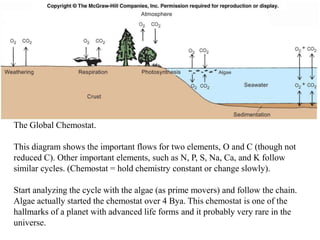
Fig. 6.15
The Global Chemostat.
This diagram shows the important flows for two elements, O and C (though not
reduced C). Other important elements, such as N, P, S, Na, Ca, and K follow
similar cycles. (Chemostat = hold chemistry constant or change slowly).
Start analyzing the cycle with the algae (as prime movers) and follow the chain.
Algae actually started the chemostat over 4 Bya. This chemostat is one of the
hallmarks of a planet with advanced life forms and it probably very rare in the
universe.
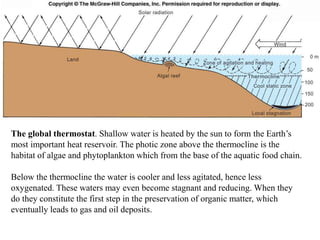
Fig. 6.16
The global thermostat. Shallow water is heated by the sun to form the Earth’s
most important heat reservoir. The photic zone above the thermocline is the
habitat of algae and phytoplankton which from the base of the aquatic food chain.
Below the thermocline the water is cooler and less agitated, hence less
oxygenated. These waters may even become stagnant and reducing. When they
do they constitute the first step in the preservation of organic matter, which
eventually leads to gas and oil deposits.

pprt_20231103_202234_0000.pptx

  • 1.
  • 2.
    Origin and EarlyEvolution of Earth • Age of universe is ~ 14.5 By, about 10 By older than Earth • Early universe had only protons & helium nuclei as condensed particles we are familiar with, rest was elementary particles & radiation • First stars formed from hydrogen and helium, the rest of the elements formed in protostars by nucleosynthesis • Stars of a certain critical size exploded as supernovae, scattering hydrogen, He & newly formed elements as intergalactic “dust”. Other stars became “black holes”, brown dwarfs, etc. • Inhomogeneities in dust clouds led to formation of secondary stars, similar to our sun, but now could contain orbiting debris formed from elements in 1ˢᵗ generation stars. • Inherited angular momentum caused debris to orbit main condensation center, and eventually gave rise to orbiting planets
  • 3.
    Fig. 6.3 Stages inPlanetary Evolution 1. Planetesimals … small bodies formed from dust and gas eddies 2. Protoplanets 9 or 10 formed from planetesimals 3. Planets formed by combining protoplanets swept up by gravitational attraction.
  • 4.
    Broadly, four stagescan be identified in the process of planetary formation. • The gravitational collapse of a star leads to the formation of a core to the gas cloud and the formation of a huge rotating disc of gas and dust, which develops around the gas core. A star such as Beta Pictoris shows a central core of this type, with a disc of matter rotating around the core. Beta Pictoris is thought to be a young star showing the early stages of planetary formation. • The condensation of the gas cloud and the formation of chondrules. Chondrules are small rounded objects found in some meteorites.. The presence of chondrules gives rise to a special class of meteorites known as chondrites. For example, the Allende meteorite is chondrule-rich and contains minerals rich in the elements Ca and Al, and Ti and Al, minerals which are unlike terrestrial minerals. It also include metallic blobs of Os, Re, Zr. The chemistry of these unusual minerals suggest that they are early solar system condensates. • The accretion of gas and dust to form small bodies between 1-10 km in diameter. These bodies are known as planetesimals. They form initially from small fragments of solar dust and chondrules by the processes of cohesion (sticking together by weak electrostatic forces) and by gravitational instability. Cohesion forms fragments up to about 1 cm in diameter. Larger bodies form by collisions at low speed which cause the material to stick together by gravitational attraction. Support for this view of the process of accretion comes from a region on the edge of the solar system known as the Kuiper Belt, where it is thought that the accretionary 'mopping up' has failed to take place. • More violent and rapid impact accretion. The final stage of accretion has been described as 'runaway accretion'. Planetesimals are swept up into well defined zones around the sun which approximate to the present orbits of the terrestrial planets. The process leads eventually to a small number of large planetary bodies. Evidence for this impacting process can be seen in the early impact craters found on planetary surfaces An explanation of the type given above for the origin of the planets in the solar system is supported by mathematical simulations which show how accretion works by the progressive gathering together of smaller particles into large. It also provides an explanation of the differences between planetary bodies in the solar system and explains the differences between the heavier terrestrial planets close to the sun, and the lighter, more gaseous planets situated at a greater distance. http://www2.glos.ac.uk/gdn/origins/earth/ch3_2.htm
  • 5.
    Beta Pictoris –a solar system in the making? This new and very detailed image of the famous circumstellar disk around the southern star Beta Pictoris. It shows (in false colours) the scattered light at wavelength 1.25 micron (J band) and is one of the best images of this interesting feature obtained so far. It has a direct bearing on the current search for extra-solar planetary systems, one of the most challenging astronomical activities. While spectroscopic, astrometric and photometric studies may only provide indirect evidence for planets around other stars, coronographic images like this one in principle enable astronomers to detect dusty disks directly. This is very important for our understanding of the physics of planetary formation and evolution. The disk around Beta Pictoris is probably connected with a planetary system. In particular, various independent observations have led to the conclusion that comets are present around this star, and variability of its intensity has been tentatively attributed to the occultation (partial eclipse) by an orbiting planet.
  • 6.
    Fig. 6.4 . From(A) a homogeneous, low-density protoplanet to (B) a dense, differentiated planet Stages in Formation of Early Earth
  • 7.
    Fig. 6.5 Cross sectionthrough a spinning disk-shaped nebular cloud illustrating formation of planets by condensation of planetesimals. Temperatures refer to conditions at initial condensation.
  • 8.
    Orion Nebula ispart of a large gas and dust cloud located in the Orion Constellation. It is one of the closest stellar nurseries to us at about 1,500 light years. The whole cloud easily spans over several hundred light years. Here you can see recently formed stars as they blink on in the interior of the dust cloud. Orion Nebula, Star Nursery ?
  • 9.
    This slide shows theinteraction between the earth’s magnetosphere and the solar wind. Early in the Earth’s formation the solar wind blew the light gases, H an He to the farther reaches of the solar system.
  • 10.
    Fig. 6.6 Planet Jupitershowing moons Io (crossing at equator) and Europa.
  • 11.
    Fig. 6.7 The earth’sinterior. • Crust • Mantle • Outer core (liquid) • Inner core (solid) Note density discontinuity at core-mantle boundary
  • 12.
    Divisions of theEarth's interior Cross section of Earth showing in a rudimentary way the relation of the upper mantle to subduction zones and midocean ridges. Note also the region where basaltic magma is thought to form.
  • 13.
    3-D image ofthe crust 3-D image of the crust beneath the San Francisco Bay area developed from monitoring the paths that earthquake waves pass through it. Colors correspond with different chunks of the Earth's crust that have been pushed together along the San Andreas and Hayward faults. Earthquakes are shown as yellow dots.
  • 14.
    The East AfricanRift – Surface Expression of a Mantle Hot Spot ETOPO 30 DEM Model
  • 15.
    Fig. 6.8 Structure ofupper 300 km of Earth. The moho (M) was previously taken to be the boundary between the crust and upper mantle. It is basically a seismic anomaly, but it is not as profound as the seismic low-velocity zone. The zones shown here are based on analysis of seismic velocities from earthquakes.
  • 16.
    Fig. 6.9 Schematic diagram illustratingElsassar’s model for the Earth’s magnetic field. The solid mantle rotates at a different rate from the liquid outer core, which is molten Fe and Ni sulfides. The magnetic field is important for the evolution of complex life on Earth since it shields organisms from cosmic radiation (the same high-energy particles that form C-14 in the upper atmosphere.
  • 17.
    Fig. 6.10 Change inthe Earth’s Heat Flux through Time. Although the diagram looks complicated, there are only 4 radioactive isotopes that heat the planet and 2 are uranium. The other 2 are Th (thorium) and K- 40 (potassium 40). Note that the Earth's present-day heat flux is only about 20% of what it was originally.
  • 18.
    Differentiation of ChemicalElements in Earth Present distribution of major elements and U, Th, He and Ar in the Earth’s atmosphere, crust and in seawater. (Elements listed in order of abundance.
  • 19.
    Fig. 6.12a Zircon grainfrom the Acasta Gneiss, Slave Province, NW Territories, Canada. The crystal has been etched with acid to highlight the growth zones. These zircons have been dated to 4.03 By.
  • 20.
    Fig. 6.12b The AcastaGneiss. Great Slave Province, NW Territories, Canada. One of the oldest (4.03 Bya) dated rocks on Earth. This must have been one of the first crustal rocks to form either at Late Hadean or shortly thereafter.
  • 21.
    Fig. 6.13 Note thedensity stratification with regard to the gases (lightest farthest out, heaviest closer to Earth surface). Also note that vertical scale is logarithmic. tmospheric Stratification and Important Types of Radiation and Radiation Shields.
  • 22.
    Fig. 6.14 Evolution ofEarth’s atmosphere from early Hadean (5 Bya) to present. Note the changes from Stage I to Stage II, particularly the evolution of nitrogen, (N) the virtual disappearance of hydrogen (H) and methane (CH₄). The important change from Stage II to Stage III was the rise in oxygen (due to evolution of photosynthetic algae). Note the presence of the noble gases, Ar, Ne, He and Kr. Most likely from the degassing upper mantle which continues to today.
  • 23.
    Fig. 6.15 The GlobalChemostat. This diagram shows the important flows for two elements, O and C (though not reduced C). Other important elements, such as N, P, S, Na, Ca, and K follow similar cycles. (Chemostat = hold chemistry constant or change slowly). Start analyzing the cycle with the algae (as prime movers) and follow the chain. Algae actually started the chemostat over 4 Bya. This chemostat is one of the hallmarks of a planet with advanced life forms and it probably very rare in the universe.
  • 24.
    Fig. 6.16 The globalthermostat. Shallow water is heated by the sun to form the Earth’s most important heat reservoir. The photic zone above the thermocline is the habitat of algae and phytoplankton which from the base of the aquatic food chain. Below the thermocline the water is cooler and less agitated, hence less oxygenated. These waters may even become stagnant and reducing. When they do they constitute the first step in the preservation of organic matter, which eventually leads to gas and oil deposits.