2012 ENGINE PERFORMANCE
Powertrain Control Module (PCM) - Electrical Diagnostics, 6.7L Diesel - 3500 Cab & Chassis,
4500 & 5500
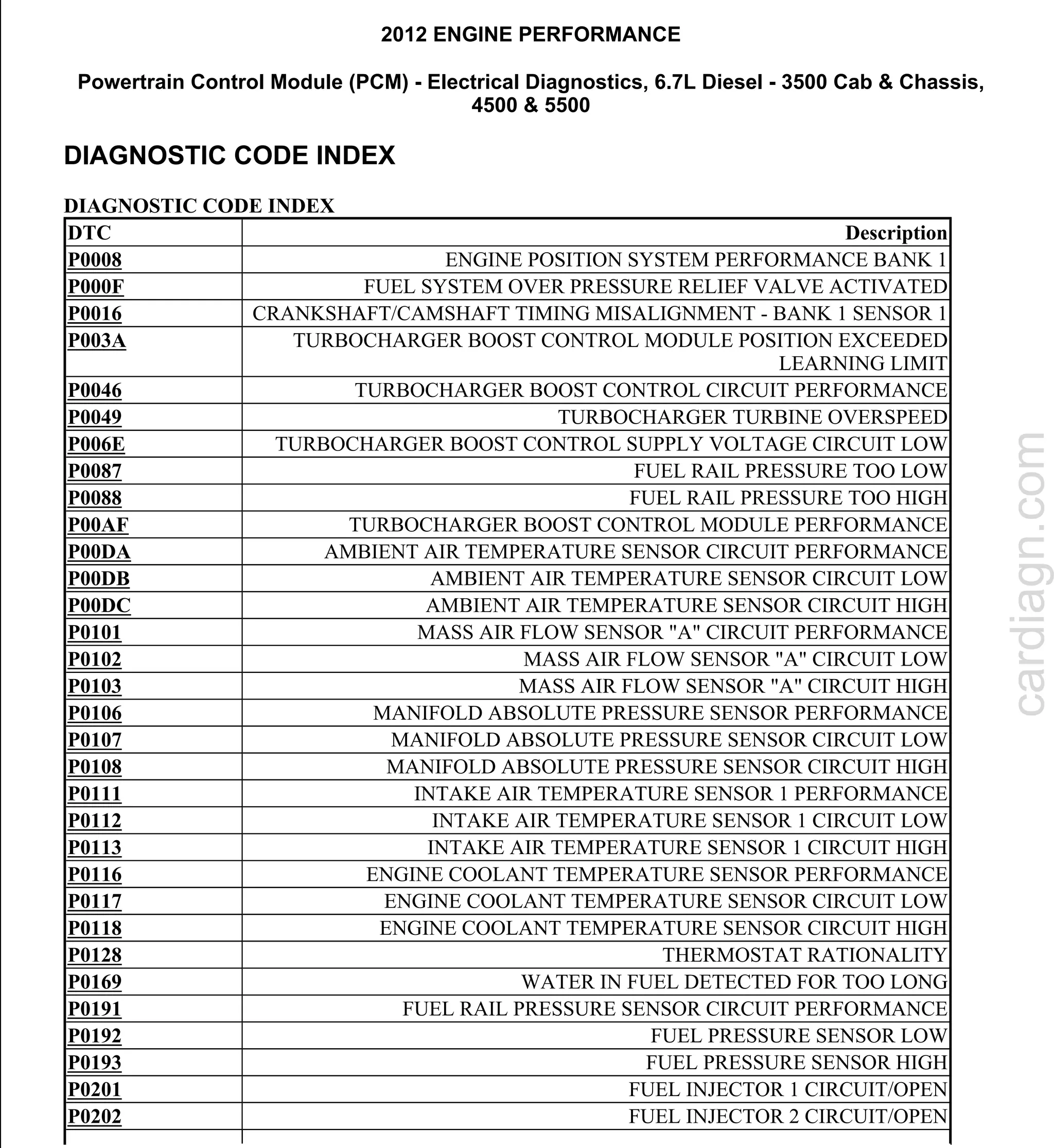
DIAGNOSTIC CODE INDEX
DTC Description
P0008 ENGINE POSITION SYSTEM PERFORMANCE BANK 1
P000F FUEL SYSTEM OVER PRESSURE RELIEF VALVE ACTIVATED
P0016 CRANKSHAFT/CAMSHAFT TIMING MISALIGNMENT - BANK 1 SENSOR 1
P003A TURBOCHARGER BOOST CONTROL MODULE POSITION EXCEEDED
LEARNING LIMIT
P0046 TURBOCHARGER BOOST CONTROL CIRCUIT PERFORMANCE
P0049 TURBOCHARGER TURBINE OVERSPEED
P006E TURBOCHARGER BOOST CONTROL SUPPLY VOLTAGE CIRCUIT LOW
P0087 FUEL RAIL PRESSURE TOO LOW
P0088 FUEL RAIL PRESSURE TOO HIGH
P00AF TURBOCHARGER BOOST CONTROL MODULE PERFORMANCE
P00DA AMBIENT AIR TEMPERATURE SENSOR CIRCUIT PERFORMANCE
P00DB AMBIENT AIR TEMPERATURE SENSOR CIRCUIT LOW
P00DC AMBIENT AIR TEMPERATURE SENSOR CIRCUIT HIGH
P0101 MASS AIR FLOW SENSOR "A" CIRCUIT PERFORMANCE
P0102 MASS AIR FLOW SENSOR "A" CIRCUIT LOW
P0103 MASS AIR FLOW SENSOR "A" CIRCUIT HIGH
P0106 MANIFOLD ABSOLUTE PRESSURE SENSOR PERFORMANCE
P0107 MANIFOLD ABSOLUTE PRESSURE SENSOR CIRCUIT LOW
P0108 MANIFOLD ABSOLUTE PRESSURE SENSOR CIRCUIT HIGH
P0111 INTAKE AIR TEMPERATURE SENSOR 1 PERFORMANCE
P0112 INTAKE AIR TEMPERATURE SENSOR 1 CIRCUIT LOW
P0113 INTAKE AIR TEMPERATURE SENSOR 1 CIRCUIT HIGH
P0116 ENGINE COOLANT TEMPERATURE SENSOR PERFORMANCE
P0117 ENGINE COOLANT TEMPERATURE SENSOR CIRCUIT LOW
P0118 ENGINE COOLANT TEMPERATURE SENSOR CIRCUIT HIGH
P0128 THERMOSTAT RATIONALITY
P0169 WATER IN FUEL DETECTED FOR TOO LONG
P0191 FUEL RAIL PRESSURE SENSOR CIRCUIT PERFORMANCE
P0192 FUEL PRESSURE SENSOR LOW
P0193 FUEL PRESSURE SENSOR HIGH
P0201 FUEL INJECTOR 1 CIRCUIT/OPEN
P0202 FUEL INJECTOR 2 CIRCUIT/OPEN
cardiagn.com
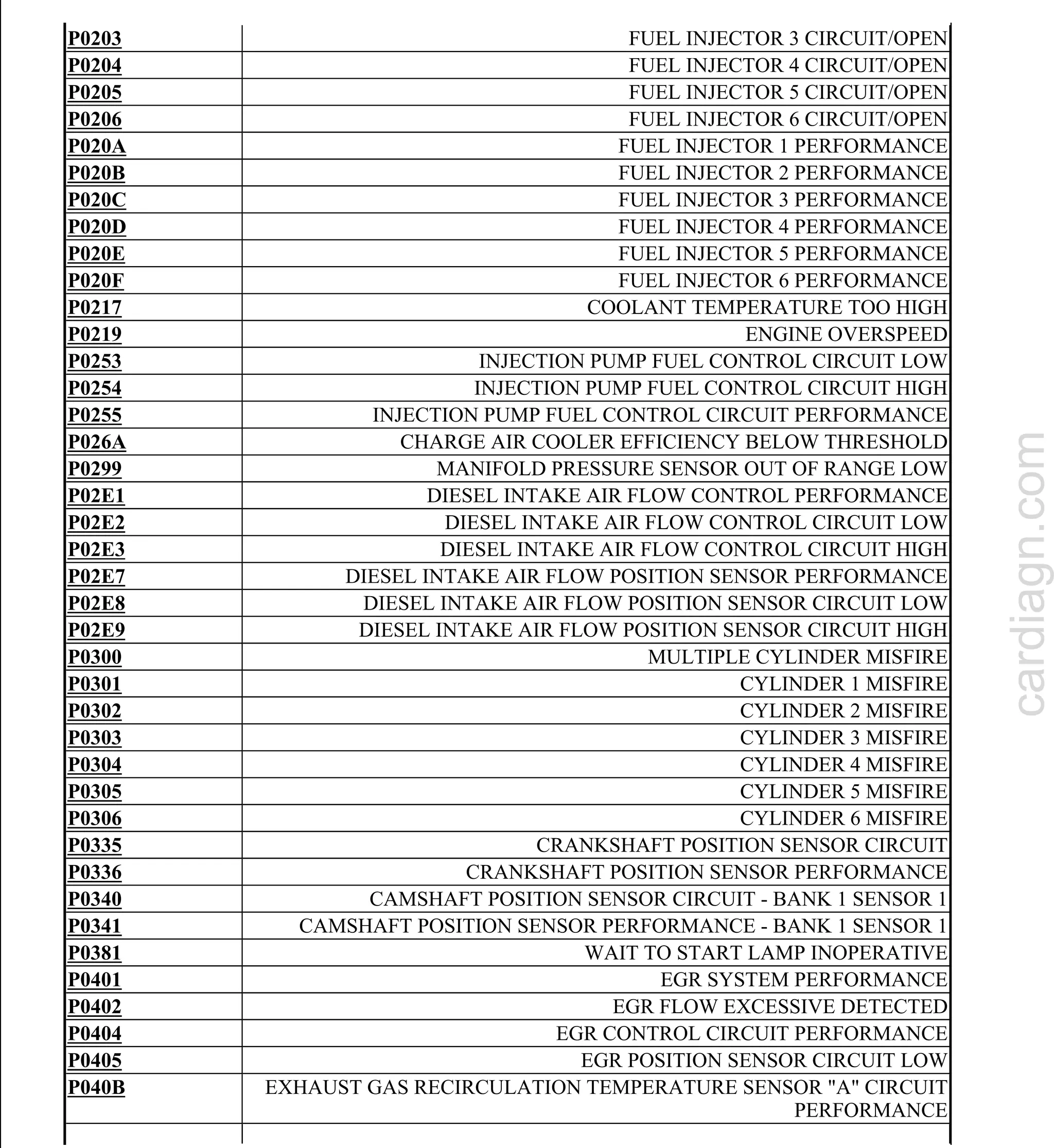
P0203 FUEL INJECTOR 3 CIRCUIT/OPEN
P0204 FUEL INJECTOR 4 CIRCUIT/OPEN
P0205 FUEL INJECTOR 5 CIRCUIT/OPEN
P0206 FUEL INJECTOR 6 CIRCUIT/OPEN
P020A FUEL INJECTOR 1 PERFORMANCE
P020B FUEL INJECTOR 2 PERFORMANCE
P020C FUEL INJECTOR 3 PERFORMANCE
P020D FUEL INJECTOR 4 PERFORMANCE
P020E FUEL INJECTOR 5 PERFORMANCE
P020F FUEL INJECTOR 6 PERFORMANCE
P0217 COOLANT TEMPERATURE TOO HIGH
P0219 ENGINE OVERSPEED
P0253 INJECTION PUMP FUEL CONTROL CIRCUIT LOW
P0254 INJECTION PUMP FUEL CONTROL CIRCUIT HIGH
P0255 INJECTION PUMP FUEL CONTROL CIRCUIT PERFORMANCE
P026A CHARGE AIR COOLER EFFICIENCY BELOW THRESHOLD
P0299 MANIFOLD PRESSURE SENSOR OUT OF RANGE LOW
P02E1 DIESEL INTAKE AIR FLOW CONTROL PERFORMANCE
P02E2 DIESEL INTAKE AIR FLOW CONTROL CIRCUIT LOW
P02E3 DIESEL INTAKE AIR FLOW CONTROL CIRCUIT HIGH
P02E7 DIESEL INTAKE AIR FLOW POSITION SENSOR PERFORMANCE
P02E8 DIESEL INTAKE AIR FLOW POSITION SENSOR CIRCUIT LOW
P02E9 DIESEL INTAKE AIR FLOW POSITION SENSOR CIRCUIT HIGH
P0300 MULTIPLE CYLINDER MISFIRE
P0301 CYLINDER 1 MISFIRE
P0302 CYLINDER 2 MISFIRE
P0303 CYLINDER 3 MISFIRE
P0304 CYLINDER 4 MISFIRE
P0305 CYLINDER 5 MISFIRE
P0306 CYLINDER 6 MISFIRE
P0335 CRANKSHAFT POSITION SENSOR CIRCUIT
P0336 CRANKSHAFT POSITION SENSOR PERFORMANCE
P0340 CAMSHAFT POSITION SENSOR CIRCUIT - BANK 1 SENSOR 1
P0341 CAMSHAFT POSITION SENSOR PERFORMANCE - BANK 1 SENSOR 1
P0381 WAIT TO START LAMP INOPERATIVE
P0401 EGR SYSTEM PERFORMANCE
P0402 EGR FLOW EXCESSIVE DETECTED
P0404 EGR CONTROL CIRCUIT PERFORMANCE
P0405 EGR POSITION SENSOR CIRCUIT LOW
P040B EXHAUST GAS RECIRCULATION TEMPERATURE SENSOR "A" CIRCUIT
PERFORMANCE
cardiagn.com
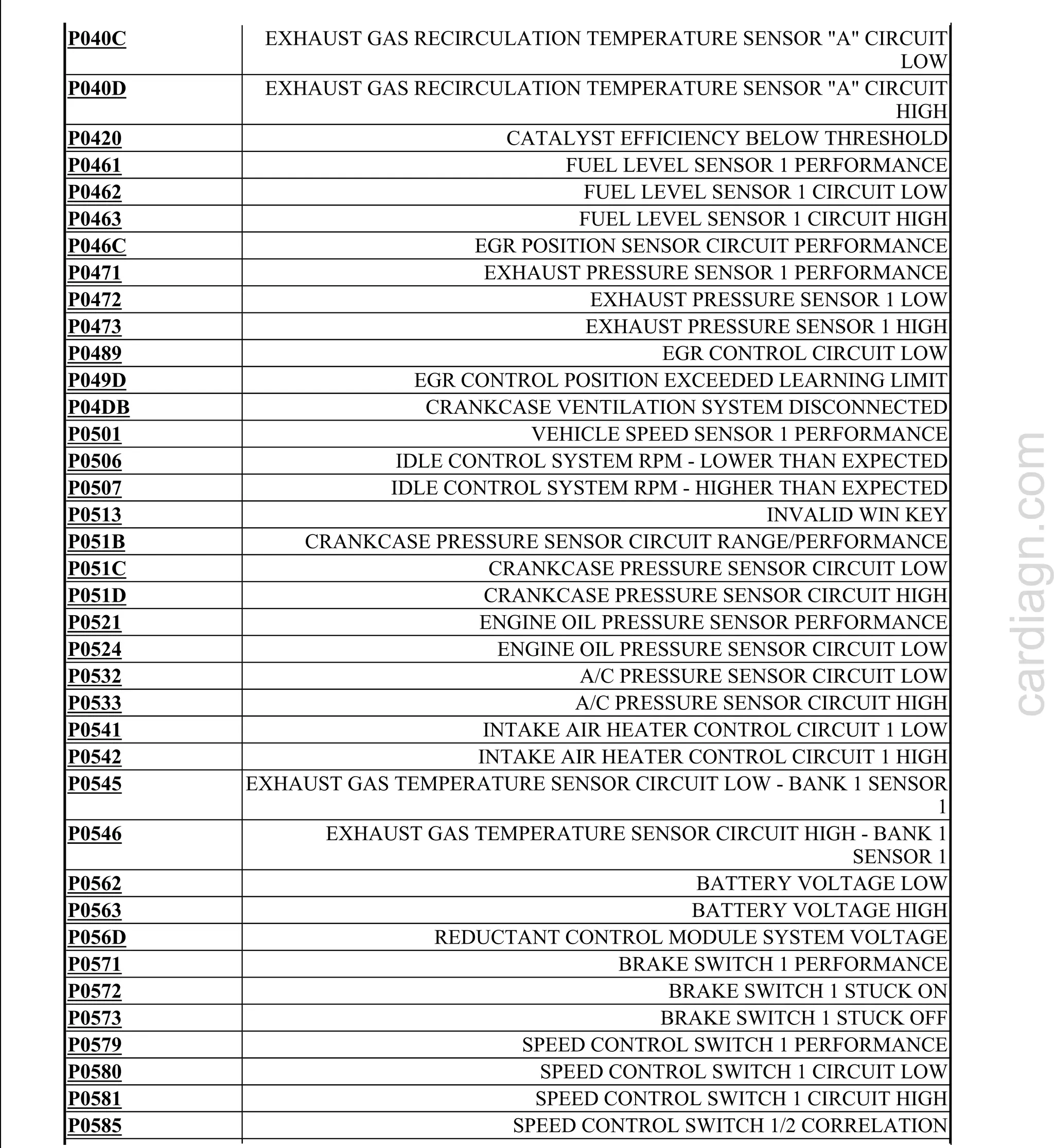
P040C EXHAUST GAS RECIRCULATION TEMPERATURE SENSOR "A" CIRCUIT
LOW
P040D EXHAUST GAS RECIRCULATION TEMPERATURE SENSOR "A" CIRCUIT
HIGH
P0420 CATALYST EFFICIENCY BELOW THRESHOLD
P0461 FUEL LEVEL SENSOR 1 PERFORMANCE
P0462 FUEL LEVEL SENSOR 1 CIRCUIT LOW
P0463 FUEL LEVEL SENSOR 1 CIRCUIT HIGH
P046C EGR POSITION SENSOR CIRCUIT PERFORMANCE
P0471 EXHAUST PRESSURE SENSOR 1 PERFORMANCE
P0472 EXHAUST PRESSURE SENSOR 1 LOW
P0473 EXHAUST PRESSURE SENSOR 1 HIGH
P0489 EGR CONTROL CIRCUIT LOW
P049D EGR CONTROL POSITION EXCEEDED LEARNING LIMIT
P04DB CRANKCASE VENTILATION SYSTEM DISCONNECTED
P0501 VEHICLE SPEED SENSOR 1 PERFORMANCE
P0506 IDLE CONTROL SYSTEM RPM - LOWER THAN EXPECTED
P0507 IDLE CONTROL SYSTEM RPM - HIGHER THAN EXPECTED
P0513 INVALID WIN KEY
P051B CRANKCASE PRESSURE SENSOR CIRCUIT RANGE/PERFORMANCE
P051C CRANKCASE PRESSURE SENSOR CIRCUIT LOW
P051D CRANKCASE PRESSURE SENSOR CIRCUIT HIGH
P0521 ENGINE OIL PRESSURE SENSOR PERFORMANCE
P0524 ENGINE OIL PRESSURE SENSOR CIRCUIT LOW
P0532 A/C PRESSURE SENSOR CIRCUIT LOW
P0533 A/C PRESSURE SENSOR CIRCUIT HIGH
P0541 INTAKE AIR HEATER CONTROL CIRCUIT 1 LOW
P0542 INTAKE AIR HEATER CONTROL CIRCUIT 1 HIGH
P0545 EXHAUST GAS TEMPERATURE SENSOR CIRCUIT LOW - BANK 1 SENSOR
1
P0546 EXHAUST GAS TEMPERATURE SENSOR CIRCUIT HIGH - BANK 1
SENSOR 1
P0562 BATTERY VOLTAGE LOW
P0563 BATTERY VOLTAGE HIGH
P056D REDUCTANT CONTROL MODULE SYSTEM VOLTAGE
P0571 BRAKE SWITCH 1 PERFORMANCE
P0572 BRAKE SWITCH 1 STUCK ON
P0573 BRAKE SWITCH 1 STUCK OFF
P0579 SPEED CONTROL SWITCH 1 PERFORMANCE
P0580 SPEED CONTROL SWITCH 1 CIRCUIT LOW
P0581 SPEED CONTROL SWITCH 1 CIRCUIT HIGH
P0585 SPEED CONTROL SWITCH 1/2 CORRELATION
cardiagn.com
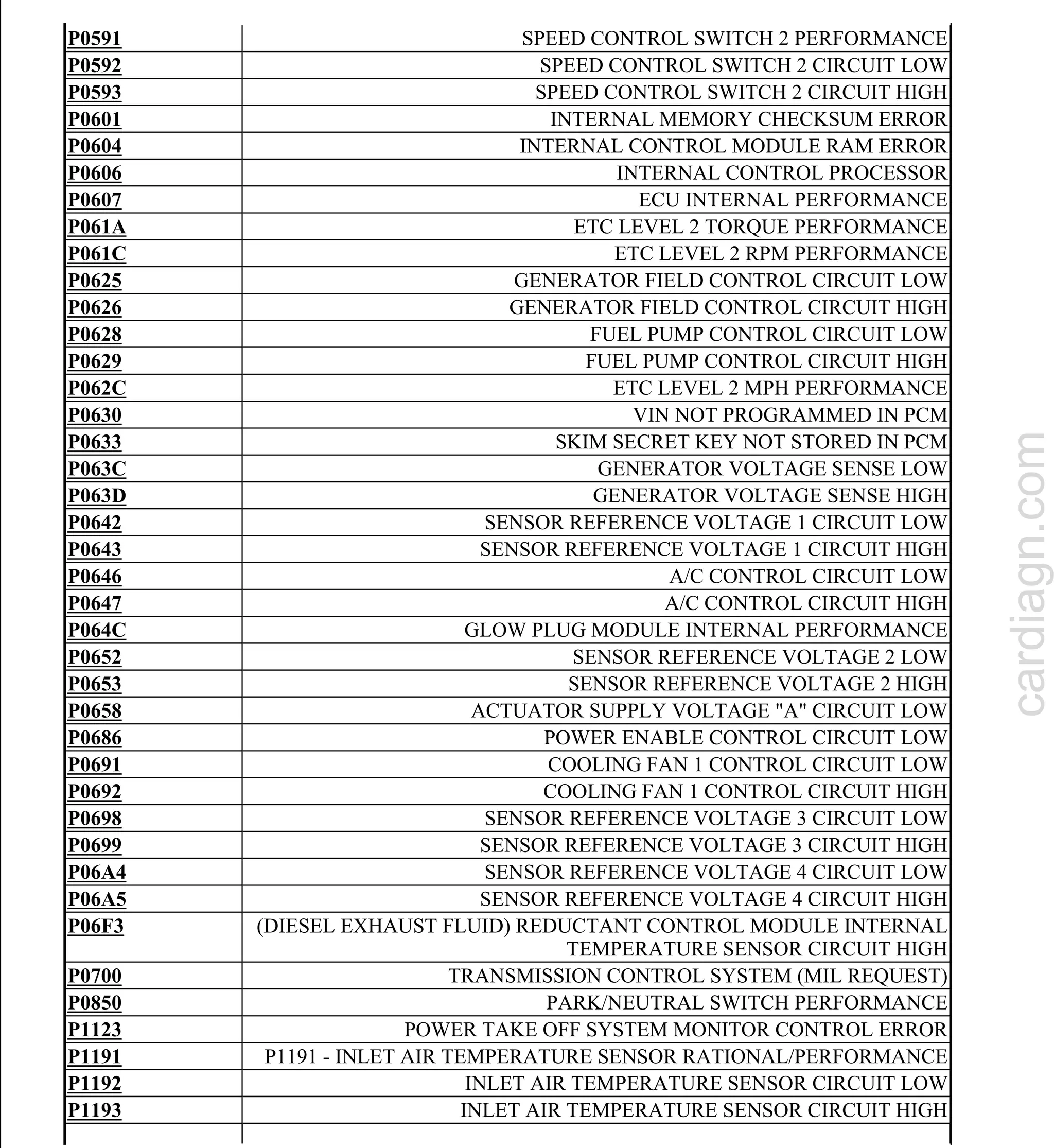
P0591 SPEED CONTROL SWITCH 2 PERFORMANCE
P0592 SPEED CONTROL SWITCH 2 CIRCUIT LOW
P0593 SPEED CONTROL SWITCH 2 CIRCUIT HIGH
P0601 INTERNAL MEMORY CHECKSUM ERROR
P0604 INTERNAL CONTROL MODULE RAM ERROR
P0606 INTERNAL CONTROL PROCESSOR
P0607 ECU INTERNAL PERFORMANCE
P061A ETC LEVEL 2 TORQUE PERFORMANCE
P061C ETC LEVEL 2 RPM PERFORMANCE
P0625 GENERATOR FIELD CONTROL CIRCUIT LOW
P0626 GENERATOR FIELD CONTROL CIRCUIT HIGH
P0628 FUEL PUMP CONTROL CIRCUIT LOW
P0629 FUEL PUMP CONTROL CIRCUIT HIGH
P062C ETC LEVEL 2 MPH PERFORMANCE
P0630 VIN NOT PROGRAMMED IN PCM
P0633 SKIM SECRET KEY NOT STORED IN PCM
P063C GENERATOR VOLTAGE SENSE LOW
P063D GENERATOR VOLTAGE SENSE HIGH
P0642 SENSOR REFERENCE VOLTAGE 1 CIRCUIT LOW
P0643 SENSOR REFERENCE VOLTAGE 1 CIRCUIT HIGH
P0646 A/C CONTROL CIRCUIT LOW
P0647 A/C CONTROL CIRCUIT HIGH
P064C GLOW PLUG MODULE INTERNAL PERFORMANCE
P0652 SENSOR REFERENCE VOLTAGE 2 LOW
P0653 SENSOR REFERENCE VOLTAGE 2 HIGH
P0658 ACTUATOR SUPPLY VOLTAGE "A" CIRCUIT LOW
P0686 POWER ENABLE CONTROL CIRCUIT LOW
P0691 COOLING FAN 1 CONTROL CIRCUIT LOW
P0692 COOLING FAN 1 CONTROL CIRCUIT HIGH
P0698 SENSOR REFERENCE VOLTAGE 3 CIRCUIT LOW
P0699 SENSOR REFERENCE VOLTAGE 3 CIRCUIT HIGH
P06A4 SENSOR REFERENCE VOLTAGE 4 CIRCUIT LOW
P06A5 SENSOR REFERENCE VOLTAGE 4 CIRCUIT HIGH
P06F3 (DIESEL EXHAUST FLUID) REDUCTANT CONTROL MODULE INTERNAL
TEMPERATURE SENSOR CIRCUIT HIGH
P0700 TRANSMISSION CONTROL SYSTEM (MIL REQUEST)
P0850 PARK/NEUTRAL SWITCH PERFORMANCE
P1123 POWER TAKE OFF SYSTEM MONITOR CONTROL ERROR
P1191 P1191 - INLET AIR TEMPERATURE SENSOR RATIONAL/PERFORMANCE
P1192 INLET AIR TEMPERATURE SENSOR CIRCUIT LOW
P1193 INLET AIR TEMPERATURE SENSOR CIRCUIT HIGH
cardiagn.com
P1451 DIESEL PARTICULATE FILTER SYSTEM PERFORMANCE
P1484 CATALYST OVERHEAT DETECTION
P1507 CRANKCASE FILTER RESTRICTION
P1593 SPEED CONTROL SWITCH 1 STUCK
P1C54 SCR NOx CATALYST MISSING
P1C55 NOx SENSOR INTERMITTENT - BANK 1 SENSOR 1
P1C56 NOx SENSOR INTERMITTENT - BANK 1 SENSOR 2
P1C57 REDUCTANT CONTROL MODULE SHUTDOWN - CRASH EVENT
DETECTED
P1C6F (DIESEL EXHAUST FLUID) REDUCTANT LINE HEATER RELAY CIRCUIT
PERFORMANCE
P1C70 SCR ERROR DETECTED - ENGINE DISABLED
P2002 DIESEL PARTICULATE FILTER EFFICIENCY BELOW THRESHOLD
P202A (DIESEL EXHAUST FLUID) REDUCTANT TANK HEATER CONTROL
CIRCUIT OPEN
P202B (DIESEL EXHAUST FLUID) REDUCTANT TANK HEATER CONTROL
CIRCUIT LOW
P202C (DIESEL EXHAUST FLUID) REDUCTANT TANK HEATER CONTROL
CIRCUIT HIGH
P202E (DIESEL EXHAUST FLUID) REDUCTANT INJECTOR PERFORMANCE
P2032 EXHAUST GAS TEMPERATURE SENSOR CIRCUIT LOW- BANK 1 SENSOR
2
P2033 EXHAUST GAS TEMPERATURE SENSOR CIRCUIT HIGH - BANK 1
SENSOR 2
P203C (DIESEL EXHAUST FLUID) REDUCTANT LEVEL SENSOR CIRCUIT LOW
P203D (DIESEL EXHAUST FLUID) REDUCTANT LEVEL SENSOR CIRCUIT HIGH
P203F (DIESEL EXHAUST FLUID) REDUCTANT LEVEL TOO LOW
P2048 (DIESEL EXHAUST FLUID) REDUCTANT INJECTOR CIRCUIT LOW
P2049 (DIESEL EXHAUST FLUID) REDUCTANT INJECTOR CIRCUIT HIGH
P204A (DIESEL EXHAUST FLUID) REDUCTANT PRESSURE SENSOR CIRCUIT
P204B (DIESEL EXHAUST FLUID) REDUCTANT PRESSURE SENSOR CIRCUIT
PERFORMANCE
P204C (DIESEL EXHAUST FLUID) REDUCTANT PRESSURE SENSOR CIRCUIT
LOW
P204D (DIESEL EXHAUST FLUID) REDUCTANT PRESSURE SENSOR CIRCUIT
HIGH
P204E (DIESEL EXHAUST FLUID) REDUCTANT PRESSURE SENSOR CIRCUIT
INTERMITTENT
P205B (DIESEL EXHAUST FLUID) REDUCTANT TANK TEMPERATURE SENSOR
CIRCUIT RANGE/PERFORMANCE
P205C (DIESEL EXHAUST FLUID) REDUCTANT TANK TEMPERATURE SENSOR
CIRCUIT LOW
P205D (DIESEL EXHAUST FLUID) REDUCTANT TANK TEMPERATURE SENSOR
cardiagn.com
CIRCUIT HIGH
P205E (DIESEL EXHAUST FLUID) REDUCTANT TANK TEMPERATURE SENSOR
CIRCUIT INTERMITTENT
P207F REDUCTANT QUALITY PERFORMANCE
P2080 EXHAUST GAS TEMP SENSOR CIRCUIT PERFORMANCE - BANK 1
SENSOR 1
P2084 EXHAUST GAS TEMP SENSOR CIRCUIT PERFORMANCE - BANK 1
SENSOR 2
P208A (DIESEL EXHAUST FLUID) REDUCTANT PUMP CONTROL CIRCUIT OPEN
P208B (DIESEL EXHAUST FLUID) REDUCTANT PUMP PERFORMANCE
P208C (DIESEL EXHAUST FLUID) REDUCTANT PUMP CONTROL CIRCUIT LOW
P208D (DIESEL EXHAUST FLUID) REDUCTANT PUMP CONTROL CIRCUIT HIGH
P209F (DIESEL EXHAUST FLUID) REDUCTANT TANK HEATER CONTROL
CIRCUIT PERFORMANCE
P20A0 (DIESEL EXHAUST FLUID) REDUCTANT PURGE CONTROL VALVE
CIRCUIT OPEN
P20A2 (DIESEL EXHAUST FLUID) REDUCTANT PURGE CONTROL VALVE
CIRCUIT LOW
P20A3 (DIESEL EXHAUST FLUID) REDUCTANT PURGE CONTROL VALVE
CIRCUIT HIGH
P20B0 (DIESEL EXHAUST FLUID) REDUCTANT PUMP TEMPERATURE
PERFORMANCE
P20B2 (DIESEL EXHAUST FLUID) REDUCTANT HEATER CONTROL VALVE
PERFORMANCE
P20B5 (DIESEL EXHAUST FLUID) REDUCTANT PUMP HEATER CONTROL
CIRCUIT OPEN
P20B7 (DIESEL EXHAUST FLUID) REDUCTANT PUMP HEATER CONTROL
CIRCUIT LOW
P20B8 (DIESEL EXHAUST FLUID) REDUCTANT PUMP HEATER CONTROL
CIRCUIT HIGH
P20BD (DIESEL EXHAUST FLUID) REDUCTANT PRESSURE LINE HEATER
CONTROL CIRCUIT/OPEN
P20BE (DIESEL EXHAUST FLUID) REDUCTANT PRESSURE LINE HEATER
CONTROL CIRCUIT PERFORMANCE
P20BF (DIESEL EXHAUST FLUID) REDUCTANT PRESSURE LINE HEATER
CONTROL CIRCUIT LOW
P20C0 (DIESEL EXHAUST FLUID) REDUCTANT PRESSURE LINE HEATER
CONTROL CIRCUIT HIGH
P20C1 (DIESEL EXHAUST FLUID) REDUCTANT RETURN LINE HEATER
CONTROL CIRCUIT/OPEN
P20C3 (DIESEL EXHAUST FLUID) REDUCTANT RETURN LINE HEATER
CONTROL CIRCUIT LOW
P20C4 (DIESEL EXHAUST FLUID) REDUCTANT RETURN LINE HEATER
CONTROL CIRCUIT HIGH
cardiagn.com
P20C6 (DIESEL EXHAUST FLUID) REDUCTANT HEATER D CONTROL
PERFORMANCE
P20E8 (DIESEL EXHAUST FLUID) REDUCTANT PRESSURE TOO LOW
P20E9 (DIESEL EXHAUST FLUID) REDUCTANT PRESSURE TOO HIGH
P20EC SCR NOx CATALYST - OVER TEMPERATURE BANK 1
P20EE SCR NOx CATALYST EFFICIENCY BELOW THRESHOLD - BANK 1
P20FE (DIESEL EXHAUST FLUID) REDUCTANT METERING UNIT
PERFORMANCE
P20FF (DIESEL EXHAUST FLUID) REDUCTANT CONTROL MODULE
PERFORMANCE
P2121 ACCELERATOR PEDAL POSITION SENSOR 1 PERFORMANCE
P2122 ACCELERATOR PEDAL POSITION SENSOR 1 CIRCUIT LOW
P2123 ACCELERATOR PEDAL POSITION SENSOR 1 CIRCUIT HIGH
P2127 ACCELERATOR PEDAL POSITION SENSOR 2 CIRCUIT LOW
P2128 ACCELERATOR PEDAL POSITION SENSOR 2 CIRCUIT HIGH
P214A SCR NOx CATALYST INLET TEMPERATURE TOO HIGH
P214B SCR NOx CATALYST INLET TEMPERATURE TOO HIGH DURING
PARTICULATE FILTER REGENERATION
P214C SCR NOx CATALYST OUTLET TEMPERATURE TOO HIGH
P214D SCR NOx CATALYST OUTLET TEMPERATURE TOO HIGH DURING
PARTICULATE FILTER REGENERATION
P21C2 (DIESEL EXHAUST FLUID) REDUCTANT LINE HEATER RELAY CONTROL
CIRCUIT OPEN
P21C3 (DIESEL EXHAUST FLUID) REDUCTANT LINE HEATER RELAY CONTROL
CIRCUIT LOW
P21C4 (DIESEL EXHAUST FLUID) REDUCTANT LINE HEATER RELAY CONTROL
CIRCUIT HIGH
P2201 AFTERTREATMENT NOx SENSOR CIRCUIT PERFORMANCE - BANK 1
SENSOR 1
P2202 AFTERTREATMENT NOx SENSOR CIRCUIT - BANK 1 SENSOR 1
P2209 NOx SENSOR HEATER CIRCUIT PERFORMANCE - BANK 1 SENSOR 1
P220A NOx SENSOR SUPPLY CIRCUIT PERFORMANCE - BANK 1 SENSOR 1
P220B NOx SENSOR SUPPLY CIRCUIT PERFORMANCE - BANK 1 SENSOR 2
P2227 BAROMETERIC PRESSURE SENSOR RATIONALITY
P2228 BAROMETRIC PRESSURE CIRCUIT LOW
P2229 BAROMETRIC PRESSURE CIRCUIT HIGH
P2262 TURBOCHARGER BOOST PRESSURE NOT DETECTED - MECHANICAL
P2266 WATER IN FUEL SENSOR CIRCUIT LOW
P2267 WATER IN FUEL SENSOR CIRCUIT HIGH
P2269 WATER IN FUEL CONDITION
P226B TURBOCHARGER BOOST PRESSURE NOT RESPONDING
P226C TURBOCHARGER BOOST CONTROL "A" SLOW RESPONSE
cardiagn.com
P2280 AIR FLOW RESTRICTION / LEAK BETWEEN AIR CLEANER AND MAF
P2281 AIR LEAK BETWEEN MAF AND THROTTLE BODY
P2299 BRAKE PEDAL POSITION / ACCELERATOR PEDAL POSITION
INCOMPATIBLE
P229E AFTERTREATMENT NOx SENSOR CIRCUIT - BANK 1 SENSOR 2
P229F AFTERTREATMENT NOx SENSOR CIRCUIT PERFORMANCE - BANK 1
SENSOR 2
P22A7 NOx SENSOR HEATER CIRCUIT PERFORMANCE - BANK 1 SENSOR 2
P240F EGR SLOW RESPONSE
P242B EXHAUST GAS TEMP SENSOR CIRCUIT PERFORMANCE - BANK 1
SENSOR 3
P242C EXHAUST GAS TEMPERATURE SENSOR CIRCUIT LOW- BANK 1 SENSOR
3
P242D EXHAUST GAS TEMPERATURE SENSOR CIRCUIT HIGH - BANK 1
SENSOR 3
P242F DIESEL PARTICULATE FILTER RESTRICTION - ASH ACCUMULATION
P244A DIESEL PARTICULATE FILTER DIFFERENTIAL PRESSURE TOO LOW
P244D EXHAUST TEMPERATURE TOO HIGH FOR PARTICULATE FILTER
REGENERATION
P2453 DIESEL PARTICULATE FILTER PRESSURE SENSOR A CIRCUIT
PERFORMANCE
P2454 DIESEL PARTICULATE FILTER PRESSURE SENSOR A CIRCUIT LOW
P2455 DIESEL PARTICULATE FILTER PRESSURE SENSOR A CIRCUIT HIGH
P2457 EXHAUST GAS RECIRCULATION COOLING SYSTEM PERFORMANCE
P2459 DIESEL PARTICULATE FILTER REGENERATION TOO FREQUENT
P2463 DIESEL PARTICULATE FILTER - SOOT ACCUMULATION
P246F EXHAUST GAS TEMP SENSOR CIRCUIT PERFORMANCE - BANK 1
SENSOR 4
P2470 EXHAUST GAS TEMPERATURE SENSOR CIRCUIT LOW - BANK 1 SENSOR
4
P242D EXHAUST GAS TEMPERATURE SENSOR CIRCUIT HIGH - BANK 1
SENSOR 4
P249C EXCESSIVE TIME TO ENTER CLOSED LOOP SCR REDUCTANT
INJECTION CONTROL
P249E CLOSED LOOP SCR REDUCTANT INJECTION CONTROL AT LIMIT - FLOW
TOO HIGH
P249F EXCESSIVE TIME TO ENTER CLOSED LOOP DPF REGENERATION
CONTROL
P24A0 CLOSED LOOP DPF REGENERATION CONTROL AT LIMIT -
TEMPERATURE TOO LOW
P2503 CHARGING SYSTEM OUTPUT LOW
P2504 CHARGING SYSTEM OUTPUT HIGH
P2509 PCM/PCM POWER INPUT SIGNAL INTERMITTENT
cardiagn.com
P2563 TURBOCHARGER BOOST CONTROL POSITION SENSOR PERFORMANCE
P2579 TURBOCHARGER SPEED SENSOR CIRCUIT PERFORMANCE
P2580 TURBOCHARGER SPEED SENSOR CIRCUIT LOW
P2609 INTAKE AIR HEATER SYSTEM PERFORMANCE
P268C CYLINDER 1 INJECTOR DATA INCOMPATIBLE
P268D CYLINDER 2 INJECTOR DATA INCOMPATIBLE
P268E CYLINDER 3 INJECTOR DATA INCOMPATIBLE
P268F CYLINDER 4 INJECTOR DATA INCOMPATIBLE
P2690 CYLINDER 5 INJECTOR DATA INCOMPATIBLE
P2691 CYLINDER 6 INJECTOR DATA INCOMPATIBLE
P2BAC NOx EXCEEDANCE - DEACTIVATION OF EGR
U0001 CAN C BUS
U0101 LOST COMMUNICATION WITH TCM
U010C LOST COMMUNICATION WITH TURBOCHARGER/SUPERCHARGER
CONTROL MODULE
U010E LOST COMMUNICATION WITH DIESEL EXHAUST FLUID CONTROL UNIT
U0121 LOST COMMUNICATION WITH ANTI-LOCK BRAKE MODULE
U0141 LOST COMMUNICATION WITH IPM (FCM/TIPM)
U029D LOST COMMUNICATION WITH NOx SENSOR "A"
U029E LOST COMMUNICATION WITH NOx SENSOR "B"
U040F INVALID DATA RECEIVED FROM REDUCTANT CONTROL MODULE
U059E INVALID DATA RECEIVED FROM NOx SENSOR "A"
U059F INVALID DATA RECEIVED FROM NOx SENSOR "B"
U11C1 LOST COMMUNICATION WITH DIESEL EXHAUST FLUID CONTROL UNIT
U1403 IMPLAUSIBLE FUEL LEVEL SIGNAL RECEIVED
U1412 IMPLAUSIBLE VEHICLE SPEED SIGNAL RECEIVED
U1421 IMPLAUSIBLE IGNITION KEY OFF TIME RECEIVED
U1601 ECU APPLICATION SOFTWARE CODE 1 MISSING OR CORRUPTED
cardiagn.com
2012 ENGINE PERFORMANCE
Powertrain Control Module (PCM) - Electrical Diagnostics, 6.7L Diesel - 3500 Cab & Chassis,
4500 & 5500
STANDARD PROCEDURE
DIESEL AFTERTREATMENT VALIDATION- 6.7L
Fig. 1: Diesel Aftertreatment System Diagram
Courtesy of CHRYSLER GROUP, LLC
SOOT GENERATION CAUSES AND EFFECTS
When trying to understand the functionality of the exhaust and aftertreatment system, (more precisely the
effects on the Diesel Particulate Filter (DPF)) you must think in terms of standard plumbing principals.
Everything flows downstream. Systems and components along the path are affected by the soot in the exhaust,
and these components can also contribute to the soot levels (cause and effect).
This overview will attempt to elaborate on the causes and effects of the Soot flowing downstream in the system.
The soot originates in the combustion chamber as a by-product of the combustion process. This is the beginning
of the stream. All soot generated in the combustion chamber flows downstream. Excessive amounts of soot can
be caused by faulty inputs to the engine controller, air handling system leaks or restrictions, fuel contamination,
or fuel injectors. Some soot will always be generated. Under proper operating conditions, soot levels will be low
cardiagn.com
and very manageable.
The next component downstream is the EGR. The EGR can be affected by soot coming from the combustion
process. The soot can cause the EGR to stick open or closed, or become restricted. If the EGR malfunctions, it
can cause soot generation which is then added to system.
The next component downstream is the Turbocharger. The Turbocharger can be affected by soot coming from
the combustion process and/or the EGR. If the Turbocharger malfunctions (sticks, or leaks oil or coolant
internally), it can cause soot generation which is then added to system.
The next components found downstream are the O2 Sensors. The O2 Sensors can be affected by soot coming
from the combustion process, the EGR, and/or the Turbocharger. If an O2 Sensor malfunctions, it can cause (to
a much lesser extent) soot generation which is added to system. O2 Sensor codes can be caused by excessive
soot.
ALL of the soot generated upstream will land in the DPF. If a vehicle sets a DPF DTC, such as P1451 or
P242F, which are related to the calculated amount of soot currently caught in the DPF this means the engine
controller has calculated that the DPF is getting full. This number is and estimation, hence the name; "Estimated
Soot Load Based on Delta" (ESL/D) and is measured in grams. Sometimes soot levels will be estimated high
and set faults and there is little soot in the DPF!
When a DPF fault sets, it is important to root cause the reason the soot landed in the filter and could not be
removed through a normal regeneration. Is fuel contamination the issue causing injectors to stick and over fuel?
Is the EGR or Turbocharger sticking causing excess soot? Or is it a combination of these?
A DPF should NEVER be replaced without first determining if there is another root cause of the source of the
high "Estimated Soot Load Based on Delta" and repairing this issue also. A DPF should also not be replaced
without performing the AFTERTREATMENT INSPECTION GUIDELINE procedure. This will visually show
you with examples how to determine if replacement of an aftertreatment component is necessary.
DIAGNOSTIC TEST
1. VALIDATION
1. Before starting the validation, confirm on the scan tool that the engine is still at an operating
temperature of 180°F (82°C).
2. The technician must perform a short light load steady state drive cycle to ensure the vehicle will
operate normally and allow a passive regeneration if necessary during the next step. During the
NOTE: The following procedure will provide the necessary drive cycle to
allow the PCM to learn normal system operation and the ability to
detect most aftertreatment sooting issues. It is not necessary to have
a technician perform the 50 minute drive cycle however, the
technician must verify Estimated Soot Load Based on Delta" (ESL/D),
measured in Grams while driving the vehicle at a steady state speed.
The technician will monitor the scan tool while another person drives
the vehicle.
cardiagn.com
drive cycle monitor Estimated Soot Load Based on Delta" (ESL/D), measured in Grams for a short
period to ensure that the Diesel Particulate Filter (DPF) will not plug during the next steps. In
addition, illumination of the MIL during the drive cycle indicates that further diagnosis may be
required before proceeding.
3. Record the mileage from the vehicle odometer into section 4D "After Treatment Validation Test"
of the Diesel Diagnostic Worksheet step 1.
4. Have an associate (porter) drive at the vehicle least 50 minutes at a steady state speed so the RPM
is maintained at about 1900. If highway access is not available, use a lower gear on surface streets.
A steady throttle is important. Use cruise control if possible.
5. Once the initial 50 minute drive cycle is complete, return to the repair shop and record the mileage
from the vehicle odometer into section 4D "After Treatment Validation Test" of the Diesel
Diagnostic Worksheet step 2. Turn the ignition key to OFF.
6. Have the associate restart the engine and record the key cycle event into step 3 of section 4D "After
Treatment Validation Test" of the Diesel Diagnostic Worksheet.
7. The technician will ride in the passenger seat while monitoring the scan tool. Monitor "Estimated
Soot Load Based on Delta" (ESL/D), measured in Grams.
8. Drive the vehicle and maintain steady engine speed of 1800 - 1900 RPM. Use cruise control if
possible, (steady throttle pressure).
9. ESL/D should maintain steady or even start to decrease slowly even though truck is NOT in deSoot
mode. This is because the latest software may actually "scrub" soot when driving at higher speeds.
10. Ensure vehicle is operating in "Normal" mode. (Not in desoot, desox or denox mode).
11. Take a reading of the ESL/D. Record the ESLD into step 4 of section 4D "After Treatment
Validation Test" of the Diesel Diagnostic Worksheet and continue to drive for 10 minutes.
12. Record that the 10 minute drive cycle has been completed in step 5 of section 4D "After Treatment
Validation Test" of the Diesel Diagnostic Worksheet.
13. After 10 minutes, take another reading of the ESL/D and record this number in step 6 of section 4D
"After Treatment Validation Test" of the Diesel Diagnostic Worksheet.
14. Step 7 of section 4D "After Treatment Validation Test" of the Diesel Diagnostic Worksheet will
automatically calculate the estimated soot load difference.
15. Step 8 of section 4D "After Treatment Validation Test" of the Diesel Diagnostic Worksheet will
automatically PASS or FAIL based upon results of step 7 of section 4D "After Treatment
Validation Test" of the Diesel Diagnostic Worksheet.
Did the ESL/D test pass?
Yes
 Vehicle is properly repaired.
NOTE: If the soot load threshold for a P242F DTC is reached during this
short drive cycle, the mil will illuminate and passive regeneration will
not occur.
cardiagn.com
No
 Vehicle is NOT repaired completely. Return back to the test that sent you here or continue
diagnosing the vehicle with the ENGINE MISFIRE/RUNS ROUGH/POOR
PERFORMANCE test procedure. Refer to DIAGNOSIS AND TESTING, 6.7L .
MIL LIGHT ON PRETEST PROCEDURE
For a complete wiring diagram, Refer to appropriate SYSTEM WIRING DIAGRAMS article .
DIAGNOSTIC TEST
1. FUEL SYSTEM, AIR HANDLING, OR AFTERTREATMENT RELATED DTCS PRESENT
1. With the scan tool, read and record all DTCs active and stored.
Are any one or more of the following DTCs present (P000F, P0087, P0402, P042E, P0489, P1011,
P1451, P2262, P226B, P242F, P245A, P2563)?
Yes
 Go To 2.
No
 Go To 5.
2. VISUALLY INSPECT FOR SIGNS OF AFTERMARKET COMPONENTS
1. Inspect for aftermarket engine components on the vehicle (including labels indicating aftermarket
software).
Is the vehicle equipped with aftermarket performance software/parts?
Yes
 Performance enhancing software/parts may be the root cause of the customers concern.
Performance enhancing software should be removed and the vehicle returned to stock before
proceeding.
 Go To 3.
CAUTION: Inspect for aftermarket engine components on the vehicle (including
labels indicating aftermarket software). If equipped with aftermarket
components or software, the vehicle must be returned to OEM
specifications.
NOTE: If equipped with aftermarket components or software, the vehicle
must be returned to OEM specifications.
cardiagn.com
No
 Go To 3.
3. REVIEW VEHICLE WARRANTY HISTORY
1. Review vehicle warranty history and/or previously authorized Diesel Diagnostic Worksheets to
determine if the vehicle has returned for a repeat repair.
Has the vehicle returned within the last 90 days for a repeat with any of the following DTCs
present, P000F, P0087, P0402, P042E, P0489, P1011, P1451, P2262, P226B, P242F, P245A,
P2563?
Yes
 Perform the DIESEL FUEL CONTAMINATION AND CLEANING PROCEDURE. Refer
to DIESEL FUEL SYSTEM CLEANING PROCEDURE .
No
 Go To 4.
4. VISUALLY INSPECT FOR EXTERNAL SIGNS OF FUEL CONTAMINATION
1. Inspect the vehicle for the following conditions:
 Review the vehicles repair history and verify proper Fuel Filter maintenance intervals have
been followed.
 Auxiliary fuel tank that is CONNECTED to the vehicles fuel system or used as a STORAGE
tank to fill the truck.
 Fuel stains on outside and inside of truck box/bed. This may be in indication that the driver is
fueling the vehicle from an auxiliary source.
 Inspect the fuel filler cap, filler tube, and fuel filler cavity for signs of dirt and possible
overfilling. Most auxiliary fuel tanks do not contain automatic shut off filler valves which
may lead to over filling of the fuel tank.
 Inspect the top of the vehicles fuel tank for excessive oily dirt stains. Sometimes, gravity feed
auxiliary fuel tank installers may feed the vehicles fuel tank from the auxiliary tank through
the fuel tank vent valves.
 Inspect the fuel tank vent valves for signs of dirt or moisture contamination.
 Both P1451 AND P242F are the ONLY DTCs present.
Were any of the above conditions noted?
Yes
 Perform the DIESEL FUEL CONTAMINATION AND CLEANING PROCEDURE. Refer
to DIESEL FUEL SYSTEM CLEANING PROCEDURE .
No
cardiagn.com
 Go To 5.
5. CHECK FOR TSBs/SOFTWARE FLASHES
1. Check for any TSBs/Software Flashes that may apply.
Were any TSBs/Software Flashes found and did they repair the problem?
Yes
 Repair complete.
 Perform POWERTRAIN VERIFICATION TEST - 6.7L. Refer to POWERTRAIN
VERIFICATION TEST - 6.7L .
No
 Perform the diagnostic trouble code test that was found to be present. Refer to
DIAGNOSTIC CODE INDEX .
PRE-DIAGNOSTIC TROUBLESHOOTING PROCEDURE - 6.7L
For a complete wiring diagram, Refer to appropriate SYSTEM WIRING DIAGRAMS article .
DIAGNOSTIC TEST
1. NO RESPONSE
1. Make sure the scan tool will communicate with the appropriate modules.
Are you currently experiencing a NO RESPONSE condition?
Yes
 The NO RESPONSE condition must be properly diagnosed before continuing.
 Perform the appropriate BUS Communication test . Refer to DIAGNOSIS AND
TESTING .
No
 Go To 2.
2. DTC PRESENT
1. Turn the ignition on.
2. With the scan tool, view PCM for DTCs.
NOTE: Before continuing, complete the 6.7L Cummins Turbo Diesel Diagnostic
Worksheet. Go to the TechConnect > submit the vehicle's VIN number >
Search Tab > and Select Create Diagnostic Worksheet.
cardiagn.com
Is there a DTC present?
Yes
 Proceed to the MIL LIGHT ON PRETEST PROCEDURE. Refer to MIL LIGHT ON
PRETEST PROCEDURE .
No
 Go To 3.
3. CHECK FOR SYMPTOM BASED ISSUES
1. Check the vehicle for one of the following conditions:
 Engine No Start / Hard Start
 Engine Misfires / Runs Rough / Poor Performance
 Engine Noise
 Excessive Smoke (Black/Blue/White)
Do one of the following conditions exist?
Yes
 Perform the appropriate symptom based diagnostic procedure. Refer to DIAGNOSIS AND
TESTING, 6.7L .
No
 Verify the vehicles performance by performing the Diesel Fuel System Validation procedure.
Refer to DIESEL AFTERTREATMENT VALIDATION- 6.7L .
PCM/ECM / TCM PROGRAMMING
PCM/ECM / TCM FLASH PROGRAMING
This procedure will need to be done when one or more of the following situations are true:
1. A vehicle's Powertrain Control Module/Engine Control Module (PCM/ECM) has been replaced.
2. A diagnostic trouble code (DTC) is set P1602 - PCM/ECM Not Programmed.
3. An updated calibration or software release is available for either the PCM/ECM or TCM ECUs.
This procedure assumes that the wiTECH™ Vehicle Connection Interface (VCI) pod, StarSCAN® and
StarMOBILE® devices are configured to your dealership's network with either a wired or wireless connection.
The wiTECH™ VCI pod, StarSCAN® and StarMOBILE® must also be running at the latest operating system
and software release level. For more help on how to network your StarSCAN® or StarMOBILE® reference the
StarSCAN® / StarMOBILE® Quick Start Networking Guide available on 'DealerCONNECT > Service >
StarSCAN® and StarMOBILE® Tools > Online Documentation' or at www.dcctools.com, under the Download
cardiagn.com
Center. For the wiTECH™ VCI pod use the "HELP" tab in the wiTECH™ Diagnostic Application.
TABLE OF CONTENTS
1. Refer to SECTION 1 - PCM/ECM / TCM FLASH PROCEDURE.
2. Refer to REQUIRED TOOLS / EQUIPMENT:
3. Refer to TECH TIPS AND INFORMATION:
4. Refer to PARTS REQUIRED.
SECTION 1 - PCM/ECM / TCM FLASH PROCEDURE
If using StarSCAN® or StarMOBILE® Desktop Client. Go to REPAIR PROCEDURE - USING
STARSCAN® OR STARMOBILE® DESKTOP CLIENT.
If using wiTECH™ Diagnostic Application. Go to REPAIR PROCEDURE - WITECH™ DIAGNOSTIC
APPLICATION.
REPAIR PROCEDURE - USING STARSCAN® OR STARMOBILE® DESKTOP CLIENT
1. Open the hood of the vehicle and install a battery charger. Verify that the charging rate provides a
continuous charge of 13.2 - 13.5 Volts.
2. Connect the StarSCAN® or StarMOBILE® to the vehicle data link connector located under the steering
column and turn the ignition key to the "RUN" position.
3. Power on the StarSCAN® or StarMOBILE®. If the StarMOBILE® is being used, launch the
StarMOBILE® Desktop Client and connect to the appropriate StarMOBILE® device.
4. Retrieve the old ECU part number. From the tool's Home screen,
a. Select "ECU View"
b. Select "PCM/ECM"
c. Select "More Options"
d. Select "ECU Flash"
e. Record the part number at the top of the Flash PCM/ECM screen for later reference.
5. Program the ECU as follows:
a. Using the StarSCAN® / StarMOBILE® at the Home screen, select "ECU View"
b. Select "PCM/ECM"
c. Select "More Options"
d. Select "ECU Flash"
e. Select "Browse for New File" and follow the on screen instructions
f. Highlight the appropriate calibration based on the part number recorded in Step 4e , or by using
Year/Model/Engine and appropriate emissions selection for the vehicle being worked on
g. Select "Download to Client/Scantool"
NOTE: If this flash process is interrupted or aborted, the flash should be restarted.
cardiagn.com
h. Once the download is complete, select "Close" and then "Back"
i. Highlight the listed calibration, select "Update Controller" and follow the on screen instructions
j. When the PCM/ECM update is complete, select "OK"
k. Verify that the part number at the top of the Flash PCM/ECM screen has updated to the new part
number
6. Continue to complete the process if the ECU has been replaced.
7. Type the necessary information on the "Authorized Modification Label" (p/n 04275086AB) and attach
near the VECI label (See Section 3 for details). Refer to SECTION 3 - AUTHORIZED
MODIFICATION LABEL.
REPAIR PROCEDURE - WITECH™ DIAGNOSTIC APPLICATION
1. Open the hood of the vehicle and install a battery charger. Verify that the charging rate provides a
continuous charge of 13.2 - 13.5 Volts.
2. Connect the wiTECH™ Vehicle Connection Interface (VCI) pod to the vehicle data link connector
located under the steering column and turn the ignition key to the "RUN" position.
3. Launch the wiTECH™ Diagnostic Application and connect to the appropriate wiTECH™ device.
4. From the wiTECH™ Diagnostic Application Home screen,
1. Select "HELP"
2. Select "HELP CONTENTS"
3. Follow the "HELP TOPIC" for flashing an ECU.
SECTION 2 - ADDITIONAL PCM/ECM / TCM REPLACEMENT PROCEDURES
If a 2.0L Controller was replaced, navigate to "Misc. Functions" and perform all applicable routines:
1. PCM/ECM Replaced - Located within the Security Module
2. ECU Replacement With Value Transfer - if the ECU to be replaced is still responsive
NOTE: If this flash process is interrupted or aborted, the flash should be
restarted.
NOTE: If this flash process is interrupted or aborted, the flash should be restarted.
NOTE: Find the PCM/ECM /TCM Type for the vehicle, read and write down the steps,
and then go to the step by step instructions for additional information on how
to perform these procedures. Refer to STEP-BY-STEP INSTRUCTIONS.
NOTE: The available routines may vary depending on model and year of vehicle.
NOTE: If the PCM/ECM data transfer is able to be completed, it may not be
necessary to perform routines 7 - 9.
cardiagn.com
3. ECU Replacement Without Value Transfer - if the ECU to be replaced is NOT responsive
4. Verify PCM/ECM VIN
5. Injector Quantity Adjustment
6. Program Variant Code
7. Service Diesel Particulate Filter Regeneration
8. Reset Zero Fuel
9. Reset of Lambda Values
If a PT Cruiser, 2.2L Controller was replaced, navigate to "Misc. Functions" and perform all applicable routines:
1. PCM/ECM Replaced - Located within the Security Module
2. Injector Quantity Adjustment - Only on 06 PT AND up
3. IMA Rapid Calibration Test - Only on 06 PT AND up
If a 3.0L Controller was replaced, navigate to "Misc. Functions" and perform all applicable routines:
1. PCM/ECM Replaced - Located within the Security Module
2. ECU Replacement With Value Transfer - if the ECU to be replaced is still responsive
3. ECU Replacement Without Value Transfer - if the ECU to be replaced is NOT responsive
4. Injector Quantity Adjustment
5. Program Variant Code
6. Verify PCM/ECM VIN
7. Diesel Particulate Filter (Used) Learning
8. Reset of Lambda Values
9. Reset Zero Fuel
10. NOx Catalyst (New) Initialization
11. IMA Rapid Calibration Test
12. Fuel Mean Value Adaptation Initialization
13. Exhaust Throttle Plate Adaptive Learn Position
If a 2.8L Controller was replaced, navigate to "Misc. Functions" and perform all applicable routines:
NOTE: The available routines may vary depending on model and year of vehicle.
NOTE: If the PCM/ECM data transfer is able to be completed, it may not be
necessary to perform routines 7 - 12.
NOTE: The available routines may vary depending on model and year of vehicle.
cardiagn.com
1. PCM/ECM Replaced - Located within the Security Module
2. ECU Replacement With Value Transfer - if the ECU to be replaced is still responsive
3. ECU Replacement Without Value Transfer - if the ECU to be replaced is NOT responsive
4. Injector Quantity Adjustment
5. Program Variant Code
6. Fuel Mean Value Adaptation Initialization
7. IMA Rapid Calibration Test
8. Set Oil Dilution Mass Value
If a PM/MK, 2.2L Controller was replaced, navigate to "Misc. Functions" and perform all applicable routines:
1. PCM/ECM Replaced - Located within the Security Module
2. Engine ECU Replacement
3. Injector Quantity Adjustment
4. Program Variant Code
5. Swirl Control Learn
6. Throttle Valve Learn
7. VGT Learn
8. MAF Sensor Replace
9. O2 Sensor Replace
10. Used DPF initialize
If a 5.9L Controller was replaced, navigate to "Misc. Functions" and perform all applicable routines:
1. PCM/ECM Replaced - Located within the Security Module
2. Check PCM/ECM VIN - if NOT WCM equipped
If a 6.7L Controller was replaced, navigate to "Misc. Functions" and perform all applicable routines:
NOTE: If the PCM/ECM data transfer is able to be completed, it may not be
necessary to perform routines 6 - 8.
NOTE: The available routines may vary depending on model and year of vehicle.
NOTE: If the PCM/ECM data transfer is able to be completed, it may not be
necessary to perform routines 5 - 10.
NOTE: The available routines may vary depending on model and year of vehicle.
cardiagn.com
1. PCM/ECM Replaced - Located within the Security Module
2. Injector Quantity Adjustment
3. Enable / Disable Vehicle Features - need to enable features
4. Set max vehicle speed
5. Set max cruise speed
6. Idle shutdown timer
7. PTO RPM adjustment
8. Set PTO Max vehicle speed
9. Reset Regenerative Filter Timers
TCM Replacement:
If an Aisin TCM was replaced, perform the following additional steps and/or routines:
If an EATX TCM was replaced, perform the following additional steps and/or routines:
If an NGC3 TCM ONLY was replaced, perform the following additional steps and/or routines:
If an NGC4 TCM ONLY was replaced, perform the following additional steps and/or routines:
1. Quicklearn
If an EGS TCM was replaced, perform the following additional steps and/or routines:
1. Initialize EGS
STEP-BY-STEP INSTRUCTIONS
PCM/ECM Replaced
The vehicle PIN (Personal Identification Number) will be required to complete the routine. This information
may be obtained in three ways:
1. The original selling invoice
2. DealerCONNECT > Parts > Key Codes
3. Contacting the District Manager.
From the "Home" screen, select "ECU View"
NOTE: The numbers can be retrieved from the old PCM/ECM using the scan tool if
the PCM/ECM is still functional or they may be retrieved from the Fuel
Injectors themselves. The numbers are stamped on the intake manifold
side of the injectors.
cardiagn.com
 Select the applicable Security Module
 Select "Misc. Functions"
 Select "PCM/ECM Replaced" and follow the on screen instructions.
 When complete, select "Finish"
Check PCM VIN
From the "Home" screen, select "ECU View"
 Select "PCM/ECM"
 Select "Misc. Functions"
 Select "Check PCM/ECM VIN" and follow the on screen instructions.
 When complete, select "Finish"
Diesel Particulate Filter (Used) Learning
From the "Home" screen, select "ECU View"
 Select "PCM/ECM"
 Select "Misc. Functions"
 Select "Diesel Particulate Filter (Used) Learning" and follow the on screen instructions.
 When complete, select "Finish"
ECU Replacement with Value Transfer
From the "Home" screen, select "ECU View"
 Select "PCM/ECM"
 Select "Misc. Functions"
 Select "ECU Replacement with Value Transfer" and follow the on screen instructions.
 When complete, select "Finish"
ECU Replacement without Value Transfer
From the "Home" screen, select "ECU View"
 Select "PCM/ECM"
 Select "Misc. Functions"
 Select "ECU Replacement without Value Transfer" and follow the on screen instructions.
 When complete, select "Finish"
Enable / Disable Vehicle Features
cardiagn.com
From the "Home" screen, select "ECU View"
 Select "PCM/ECM"
 Select "Misc. Functions"
 Select "Enable / Disable Vehicle Features" and follow the on screen instructions.
 When complete, select "Finish"
Exhaust Throttle Plate Adaptive Learn Position
From the "Home" screen, select "ECU View"
 Select "PCM/ECM"
 Select "Misc. Functions"
 Select "Exhaust Throttle Plate Adaptive Learn Position" and follow the on screen instructions.
 When complete, select "Finish"
Fuel Mean Value Adaptation Initialization
From the "Home" screen, select "ECU View"
 Select "PCM/ECM"
 Select "Misc. Functions"
 Select "Fuel Mean Value Adaptation Initialization" and follow the on screen instructions.
 When complete, select "Finish"
IMA Rapid Calibration
From the "Home" screen, select "ECU View"
 Select "PCM/ECM"
 Select "Misc. Functions"
 Select "IMA Rapid Calibration Test" and follow the on screen instructions.
 When complete, select "Finish"
Initialize EGS
From the "Home" screen, select "ECU View"
 Select "PCM/ECM"
 Select "Misc. Functions"
 Select "Initialize EGS" and follow the on screen instructions.
 When complete, select "Finish"
cardiagn.com
Injector Quantity Adjustment
From the "Home" screen, select "ECU View"
 Select "PCM/ECM"
 Select "Misc. Functions"
 Select "Injector Quantity Adjustment" and follow the on screen instructions.
 When complete, select "Finish"
Mobile DeSoot - NO Minimum Required Soot Load
From the "Home" screen, select "ECU View"
 Select "PCM/ECM"
 Select "Misc. Functions"
 Select "Mobile DeSoot - NO Minimum Required Soot Load" and follow the on screen instructions.
 When complete, select "Finish"
NOx Catalyst (New) Initialization
From the "Home" screen, select "ECU View"
 Select "PCM/ECM"
 Select "Misc. Functions"
 Select "NOx Catalyst (New) Initialization" and follow the on screen instructions.
 When complete, select "Finish"
Program Variant Code
From the "Home" screen, select "ECU View"
 Select "PCM/ECM"
 Select "Misc. Functions"
 Select "Program Variant Code" and follow the on screen instructions.
 When complete, select "Finish"
Quicklearn
From the "Home" screen, select "ECU View"
 Select "PCM/ECM"
 Select "Misc. Functions"
 Select "Quicklearn" and follow the on screen instructions.
cardiagn.com
 When complete, select "Finish"
Reset Regenerative Filter Timers
From the "Home" screen, select "ECU View"
 Select "PCM/ECM"
 Select "Misc. Functions"
 Select "Reset Regenerative Filter Times" and follow the on screen instructions.
 When complete, select "Finish"
Set Oil Dilution Mass Value
From the "Home" screen, select "ECU View"
 Select "PCM/ECM"
 Select "Misc. Functions"
 Select "Set Oil Dilution Mass Value" and follow the on screen instructions.
 When complete, select "Finish"
SECTION 3 - AUTHORIZED MODIFICATION LABEL
Type the necessary information on the "Authorized Modification Label" and attach near the VECI label.
Fig. 2: Authorized Modification Label
Courtesy of CHRYSLER GROUP, LLC
1. Powertrain Control / Transmission Control Module Part Numbers (Insert P/Ns) Used
2. Change Authority: TSB XX--XX
3. Dealer Code: XXXXX
4. Date: XX-XX-XX
REQUIRED TOOLS / EQUIPMENT:
NOTE: The following step is required by law when reprogramming a PCM/ECM and/or
TCM.
cardiagn.com
TECH TIPS AND INFORMATION:
1. The wiTECH™ Diagnostic Application is the preferred method for flashing any Chrysler vehicle ECU.
For more information, training tutorials are available under the "HELP" tab in the wiTECH™ Diagnostic
Application or at www.dcctools.com, under the 'Training Aids' link.
2. To use the StarMOBILE® in Pass-Through Mode requires that your StarMOBILE® is connected to the
dealership's network via a wired or wireless connection. For more information on how to use the
StarMOBILE in Pass-Through Mode see the StarMOBILE® training tutorials available on
'DealerCONNECT > Service > StarSCAN® and StarMOBILE® Tools > Training Aids' link or at
www.dcctools.com, under the 'Training Aids' link.
3. If the flash process is interrupted or aborted, the flash should be restarted.
4. Due to the PCM/ECM / TCM programming procedure, a DTC may be set in other ECUs within the
vehicle. Some DTCs may cause the MIL to illuminate. From the "Home" screen select "System View".
Then select "All DTCs". Press "Clear All Stored DTCs" if there are any DTCs shown on the list.
5. Do not allow the battery charger to time out or the charging rate to climb above 13.5 Volts during the
flash process.
6. The StarSCAN® and StarMOBILE® diagnostic tools fully support Internet connectivity and must be
configured for your dealership's network. For help on setting up your StarSCAN® / StarMOBILE® for
the dealership's network, Refer to the StarSCAN® / StarMOBILE® Quick Start Networking Guide
available on 'DealerCONNECT > Service > StarSCAN® and StarMOBILE® Tools > Online
Documentation' or at www.dcctools.com, under the download center.
7. The operating software in the StarSCAN® and StarMOBILE® must be programmed with the latest
software release level. The software level is visible in the blue header at the top of the StarSCAN® and
StarMOBILE® Desktop Client screens. For instructions on how to update your scan tool, Refer to the
StarSCAN® / StarMOBILE® Software Update guide available on 'DealerCONNECT > Service >
StarSCAN® and StarMOBILE® Tools > Online Documentation' or at www.dcctools.com, under the
download center.
PARTS REQUIRED
StarSCAN® StarMOBILE® wiTECH™
Battery Charger Battery Charger Battery Charger
StarSCAN® Tool Kit StarMOBILE® Tool Kit wiTECH™ Tool Kit
StarSCAN® Vehicle Cable StarMOBILE® Vehicle Cable wiTECH™ Vehicle Cable
TechCONNECT PC or
equivalent
TechCONNECT PC or
equivalent
wiTECH™ Diagnostic
Application
CAUTION: Extreme care must be taken when programming a calibration into a
generic PCM. Do not randomly select a calibration. Once a calibration is
selected and programmed, the controller cannot be reprogrammed to a
different calibration. The module can only be reprogrammed to a more
recent version of that calibration.
cardiagn.com
POWERTRAIN VERIFICATION TEST - 6.7L
DIAGNOSTIC TEST
1. POWERTRAIN VERIFICATION TEST
1. Clear the DTC before continuing.
2. Check if any of the following conditions exist.
3. The PCM has been disconnected or replaced.
4. The battery power has been disconnected.
5. If the PCM has been replaced, do the following:
6. Record injector correlation codes.
7. For ABS and Airbag Systems: Action: Enter correct VIN and Mileage in PCM. Erase ABS and
Airbag Module codes.
8. If the PCM has not been replaced, do the following.
9. Inspect the vehicles to ensure that all engine components are connected. Reassemble and reconnect
components as necessary.
10. Attempt to start the engine.
11. If the engine is unable to start, look for any Technical Service Bulletins that may relate to this
condition. Return to DTC list if necessary.
12. If this verification procedure is being performed after a No Trouble Code repair, do the following.
13. Check to see if the initial symptom still exists. If the initial or another symptom exists, the repair is
not complete. Check all pertinent Technical Service Bulletins and return to the DTC list if
necessary.
14. If this verification procedure is being performed after a Trouble Code repair, do the following.
15. Connect the scan tool to the data link connector and erase trouble codes.
16. With the scan tool, reset all memory values.
17. If this test is for an A/C trouble code, ensure it is operating during the following road test.
Qty Part
Number
DESCRIPTION
1 04275086AB
Label,
Authorized
Modification
NOTE: If the battery was disconnected for any reason, you must perform the
Battery Reconnection procedure in the BATTERY SYSTEM - SERVICE
INFORMATION .
NOTE: If the Powertrain Control Module has been replaced and the correct
VIN and mileage have not been programmed, a DTC will be set in the
ABS, Airbag Modules and Wireless Control Module.
cardiagn.com
18. Drive the vehicle for at least five minutes, For some of the drive, go at least 64 km/h (40 MPH). At
some point stop the vehicle and turn the engine off for 10 seconds or more; then restart and
continue. Make sure the transmission shifts through all gears.
19. Upon completion of the road test, turn the engine off and read trouble codes with the scan tool. If a
trouble code has been set, return to the DTC list and follow the path specified.
Are any DTCs present?
Yes
 Repair is not complete, perform appropriate diagnostic procedure. Refer to DIAGNOSTIC
CODE INDEX .
No
 Repair is complete.
INTERMITTENT CONDITION - 6.7L
POSSIBLE CAUSES
DIAGNOSTIC TEST
1. INTERMITTENT CONDITION
1. Perform any Technical Service Bulletins (TSBs) that may apply.
2. Review the scan tool Freeze Frame information. If possible, try to duplicate the conditions under
which the DTC set.
3. With the engine running at normal operating temperature, monitor the scan tool parameters related
to the DTC while wiggling the wire harness. Look for parameter values to change and/or a DTC to
set.
4. Turn the ignition off.
5. Visually inspect the related wire harness. Disconnect all the related harness connectors. Look for
any chafed, pierced, pinched, partially broken wires and broken, bent, pushed out, or corroded
POSSIBLE CAUSES
INTERMITTENT CONDITION
NOTE: The conditions that set the DTC are not present at this time. The following
list may help in identifying the intermittent condition.
WARNING: When the engine is operating, do not stand in direct line with the fan.
Do not put your hands near the pulleys, belts or fan. Do not wear
loose clothing. Failure to follow these instructions may result in
possible serious or fatal injury.
cardiagn.com
terminals.
6. Perform a voltage drop test on the related circuits between the suspected inoperative component
and the PCM.
7. Inspect and clean all PCM, engine, and chassis grounds that are related to the most current DTC.
8. If numerous trouble codes were set, use a wire schematic and look for any common ground or
supply circuits.
9. For any Relay DTCs, actuate the Relay with the scan tool and wiggle the related wire harness to try
to interrupt the actuation.
10. For intermittent Misfire DTCs check for restrictions in the Intake and Exhaust system, proper
installation of Sensors, vacuum leaks, and binding components that are run by the accessory drive
belt.
11. Use the scan tool to perform a System Test if one applies to failing component.
12. A co-pilot, data recorder, and/or lab scope should be used to help diagnose intermittent conditions.
Were any problems found during the above inspections?
Yes
 Perform the necessary repairs.
 Perform the POWERTRAIN VERIFICATION TEST 6.7L. Refer to POWERTRAIN
VERIFICATION TEST - 6.7L .
No
 Test Complete.
cardiagn.com
2012 ENGINE PERFORMANCE
Powertrain Control Module (PCM) - Electrical Diagnostics, 6.7L Diesel - 3500 Cab & Chassis,
4500 & 5500
DIAGNOSIS AND TESTING
P0008-ENGINE POSITION SYSTEM PERFORMANCE BANK 1
cardiagn.com
Fig. 1: Crankshaft Position Sensor & Camshaft Position Sensor Circuit Schematic
Courtesy of CHRYSLER GROUP, LLC
For a complete wiring diagram, refer to appropriate SYSTEM WIRING DIAGRAMS article .
THEORY OF OPERATION
The Powertrain Control Module (PCM) will turn on the MIL lamp immediately after this diagnostic runs and
cardiagn.com
fails. The PCM will turn off the MIL lamp after the diagnostic runs and passes in four consecutive drive cycles.
WHEN MONITORED:
With the engine running.
SET CONDITION:
The PCM has detected that the Crank Position Sensor (CKP) and Cam Position Sensor (CMP) signals are
reversed.
POSSIBLE CAUSES
Always perform the Pre-Diagnostic Troubleshooting procedure before proceeding. Refer to PRE-
DIAGNOSTIC TROUBLESHOOTING PROCEDURE - 6.7L .
DIAGNOSTIC TEST
1. ACTIVE DTC
1. Ignition on, engine not running.
2. With the scan tool, clear the DTC.
3. Start or crank the engine.
4. With the scan tool, read DTCs.
Did the DTC reset?
Yes
 Go To 2.
No
 Perform the INTERMITTENT CONDITION - 6.7L diagnostic procedure. Refer to
INTERMITTENT CONDITION - 6.7L .
2. CRANK AND CAM SENSOR CONNECTORS REVERSED
1. This DTC indicates that the CKP and CMP Position Sensor signals are reversed.
2. Switch the CKP and CMP Position Sensor connectors.
3. With the scan tool, clear the DTC.
4. Start or crank the engine.
5. With the scan tool, read DTCs.
Did the DTC reset?
Possible Causes
CRANK AND CAM POSITION SENSOR CONNECTORS REVERSED
cardiagn.com
Yes
 Using the wiring diagram as a guide, check the connectors and wiring for proper
configuration.
 Perform the POWERTRAIN VERIFICATION TEST - 6.7L. Refer to POWERTRAIN
VERIFICATION TEST - 6.7L .
No
 Repair complete.
 Perform the POWERTRAIN VERIFICATION TEST - 6.7L. Refer to POWERTRAIN
VERIFICATION TEST - 6.7L .
P000F-FUEL SYSTEM OVER PRESSURE RELIEF VALVE ACTIVATED
For a complete wiring diagram, refer to appropriate SYSTEM WIRING DIAGRAMS article .
THEORY OF OPERATION
The Powertrain Control Module (PCM) will turn on the MIL lamp immediately after this diagnostic runs and
fails. This DTC will cause active regeneration to be disabled. The PCM will turn off the MIL lamp after the
diagnostic runs and passes in 4 consecutive drive cycles.
WHEN MONITORED:
With the engine running.
SET CONDITION:
Fuel pressure deviation from setpoint occurs at a rate higher than a calibrated amount.
POSSIBLE CAUSES
Always perform the Pre-Diagnostic Troubleshooting procedure before proceeding. Refer to PRE-
DIAGNOSTIC TROUBLESHOOTING PROCEDURE - 6.7L .
DIAGNOSTIC TEST
1. CHECK THE FUEL DELIVERY SYSTEM
1. Perform the CHECKING THE FUEL DELIVERY SYSTEM diagnostic procedure. Refer to
Possible Causes
PRESSURE LIMITING VALVE
LIFT PUMP
HIGH PRESSURE PUMP
EXCESSIVE INJECTOR DRAINS cardiagn.com
DIAGNOSIS AND TESTING, 6.7L .
Were any problems found?
Yes
 Repair as necessary.
No
 Perform the INTERMITTENT CONDITION - 6.7L diagnostic procedure. Refer to
INTERMITTENT CONDITION - 6.7L .
P0016-CRANKSHAFT/CAMSHAFT TIMING MISALIGNMENT - BANK 1 SENSOR 1
cardiagn.com
Fig. 2: Crankshaft Position Sensor & Camshaft Position Sensor Circuit Schematic
Courtesy of CHRYSLER GROUP, LLC
For a complete wiring diagram, refer to appropriate SYSTEM WIRING DIAGRAMS article .
THEORY OF OPERATION
The Crankshaft Position Sensor (CKP) and Camshaft Position Sensor (CMP) are hall effect type sensors. The
cardiagn.com
Powertrain Control Module (PCM) provides the sensors with a 5-Volt supply and a ground on the sensor return
circuit. As the notch on the crank pulley or the windows on the camshaft gear travel by the position sensor, a
signal is generated on the position sensor signal circuit. The PCM interprets this signal and converts it to an
engine speed. If the fault is active the engine will run derated and a hard start/rough idle is possible.
WHEN MONITORED:
While engine is running. The Powertrain Control Module (PCM) monitors the position of the notch on the
crankshaft speed sensor target and the camshaft speed sensor target. If the two positions do not match, the PCM
then determines that there is a mechanical mis-alignment between the two sensors.
SET CONDITION:
When the Crankshaft Position Sensor (CKP) and Camshaft Position Sensor (CMP) are out of sync for more
than five seconds. The Powertrain Control Module (PCM) illuminates the MIL light immediately.
POSSIBLE CAUSES
Always perform the Pre-Diagnostic Troubleshooting procedure before proceeding. Refer to PRE-
DIAGNOSTIC TROUBLESHOOTING PROCEDURE - 6.7L .
DIAGNOSTIC TEST
1. DAMAGE TO THE CKP OR CMP
1. Visually inspect the condition of the tone wheel, CKP, and CMP for damage.
Are any of the components damaged?
Yes
 Repair or replace any damaged component.
 Perform the POWERTRAIN VERIFICATION TEST - 6.7L. Refer to POWERTRAIN
VERIFICATION TEST - 6.7L .
No
 Go To 2.
2. MECHANICAL MISALIGNMENT OF THE CKP OR CMP
1. Verify the tone wheel is properly positioned relative to the locating pin in the front face of the
Possible Causes
DAMAGE TO THE CRANKSHAFT POSITION SENSOR (CKP) OR CAMSHAFT POSITION
SENSOR (CMP)
DAMAGED TONE WHEEL
MECHANICAL MISALIGNMENT OF THE CKP OR CMP
MECHANICAL MISALIGNMENT OF THE CRANKSHAFT AND CAMSHAFT GEARS
cardiagn.com
crankshaft.
Is the tone wheel properly installed?
Yes
 Go To 3.
No
 Repair the tone wheel installation.
 Perform the POWERTRAIN VERIFICATION TEST - 6.7L. Refer to POWERTRAIN
VERIFICATION TEST - 6.7L .
3. MECHANICAL MISALIGNMENT OF THE CRANKSHAFT AND CAMSHAFT GEARS
1. Check the mechanical alignment of the camshaft gear to the crankshaft gear. Refer to service
information for assistance.
Are the gear teeth in proper alignment?
Yes
 Perform the INTERMITTENT CONDITION - 6.7L diagnostic procedure. Refer to
INTERMITTENT CONDITION - 6.7L .
No
 Repair the gear alignment.
 Perform the POWERTRAIN VERIFICATION TEST - 6.7L. Refer to POWERTRAIN
VERIFICATION TEST - 6.7L .
P003A-TURBOCHARGER BOOST CONTROL MODULE POSITION EXCEEDED LEARNING
LIMIT
cardiagn.com
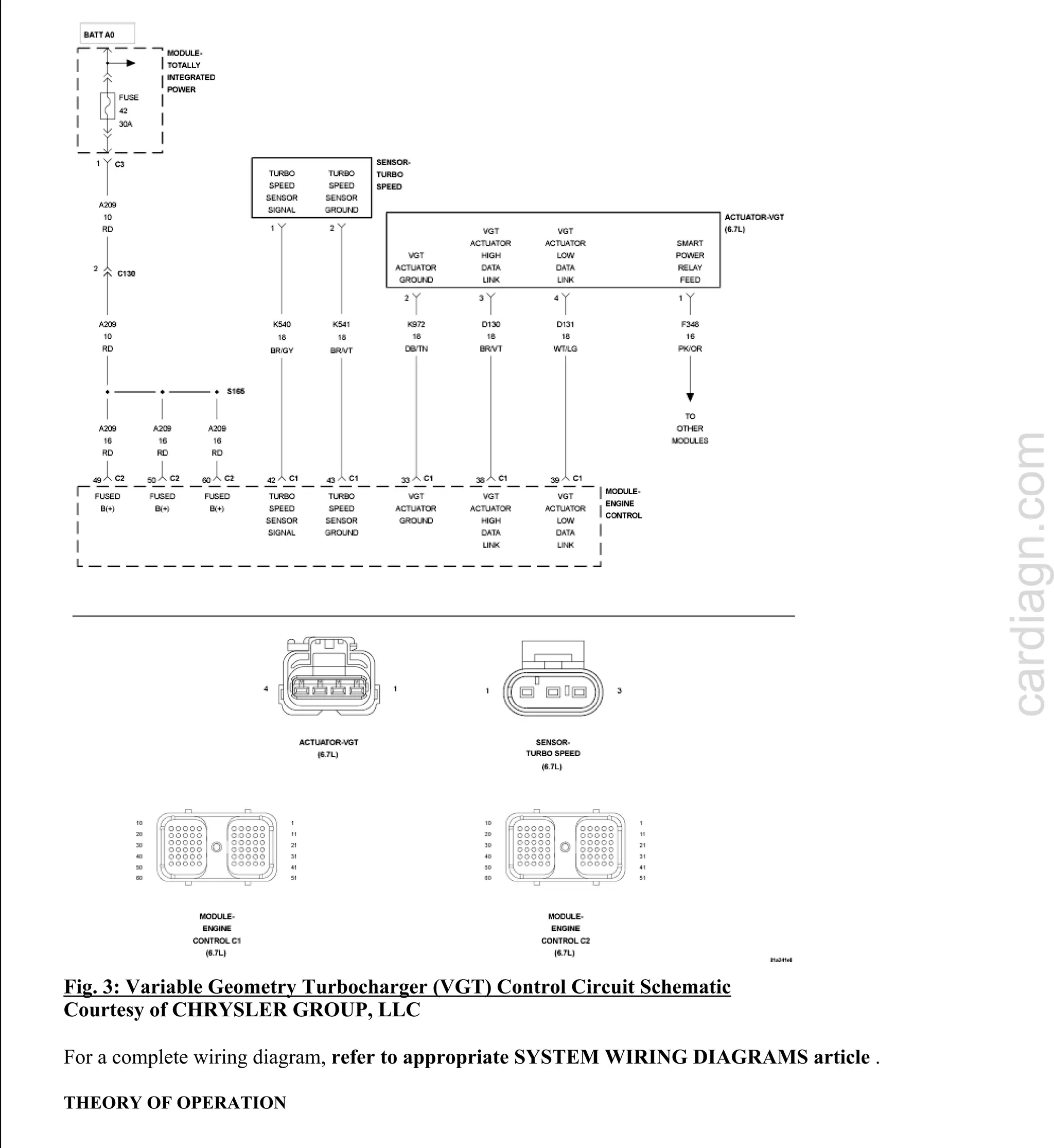
Fig. 3: Variable Geometry Turbocharger (VGT) Control Circuit Schematic
Courtesy of CHRYSLER GROUP, LLC
For a complete wiring diagram, refer to appropriate SYSTEM WIRING DIAGRAMS article .
THEORY OF OPERATION
cardiagn.com
The Variable Geometry Turbocharger (VGT) is electronically controlled by the Electronic Turbo Actuator. The
Electronic Turbo Actuator is a smart device; it communicates information with the Powertrain Control Module
(PCM) over the CAN C BUS. The Electronic Turbo Actuator performs its own internal diagnostics and reports
failures back to the PCM. The PCM then decodes the error message and converts it to a fault code. The PCM
lights the Malfunction Indicator Lamp (MIL) after the diagnostic runs and fails in two consecutive drive cycles.
The PCM will turn off the MIL immediately after this diagnostic runs and passes in four (4) consecutive drive
cycles.
WHEN MONITORED:
With the ignition on.
SET CONDITION:
The VGT Actuator calibrated end-stops were not detected.
POSSIBLE CAUSES
Always perform the Pre-Diagnostic Troubleshooting procedure before proceeding. Refer to PRE-
DIAGNOSTIC TROUBLESHOOTING PROCEDURE - 6.7L .
DIAGNOSTIC TEST
1. ACTIVE DTC
1. Turn ignition on, engine not running.
2. With the scan tool, read DTCs
Is P003A active?
Yes
 Replace the Turbocharger Assembly in accordance with the service information.
 Perform the POWERTRAIN VERIFICATION TEST - 6.7L. Refer to POWERTRAIN
VERIFICATION TEST - 6.7L .
No
 Perform the INTERMITTENT CONDITION - 6.7L diagnostic procedure. Refer to
INTERMITTENT CONDITION - 6.7L .
P0046-TURBOCHARGER BOOST CONTROL CIRCUIT PERFORMANCE
Possible Causes
VGT ACTUATOR CALIBRATION MISSING/CORRUPTED
cardiagn.com
Fig. 4: Turbocharger Boost Control Circuit Schematic
Courtesy of CHRYSLER GROUP, LLC
For a complete wiring diagram, refer to appropriate SYSTEM WIRING DIAGRAMS article .
THEORY OF OPERATION
The Variable Geometry Turbocharger (VGT) is electronically controlled by the Electronic Turbo Actuator. The
Electronic Turbo Actuator is a smart device; it communicates information with the Powertrain Control Module
cardiagn.com
(PCM) over the J1939 BUS. The Electronic Turbo Actuator performs its own internal diagnostics and reports
failures back to the PCM. The PCM then decodes the error message and converts it to a fault code. The PCM
lights the Malfunction Indicator Lamp (MIL) after the diagnostic runs and fails in two consecutive drive cycles.
The PCM will turn off the MIL immediately after this diagnostic runs and passes in four consecutive drive
cycles.
WHEN MONITORED:
With the ignition on.
SET CONDITION:
The Electronic Turbo Actuator does not receive a valid J1939 BUS message from the Powertrain Control
Module (PCM) for five seconds.
POSSIBLE CAUSES
Always perform the Pre-Diagnostic Troubleshooting procedure before proceeding. Refer to PRE-
DIAGNOSTIC TROUBLESHOOTING PROCEDURE - 6.7L .
DIAGNOSTIC TEST
1. OTHER DTCs
1. Ignition on, engine not running.
2. With the scan tool, read DTCs.
Is U010C active?
Yes
 Repair U010C first.
 Perform the POWERTRAIN VERIFICATION TEST - 6.7L. Refer to POWERTRAIN
VERIFICATION TEST - 6.7L .
No
 Go To 2.
2. POWERTRAIN CONTROL MODULE
1. Turn ignition off.
Possible Causes
(F344) SMART POWER RELAY FEED
(K918) ACTUATOR GROUND
TURBOCHARGER ASSEMBLY
POWERTRAIN CONTROL MODULE (PCM)
cardiagn.com
2. Disconnect the Electronic Turbo Actuator harness connector.
3. Ignition on, engine not running.
4. After 75 seconds, monitor the system response with the scan tool.
Is U010C active?
Yes
 Go To 3.
No
 Replace the Powertrain Control Module in accordance with the Service Information.
 Perform the POWERTRAIN VERIFICATION TEST - 6.7L. Refer to POWERTRAIN
VERIFICATION TEST - 6.7L .
3. INTERMITTENT CONNECTION
1. Turn ignition off.
2. Reconnect the Electronic Turbo Actuator harness connector.
3. Ignition on, engine not running.
4. After 75 seconds, monitor the system response with the scan tool.
Is P0046 active?
Yes
 Go To 4.
No
 Repair complete.
 Perform the POWERTRAIN VERIFICATION TEST - 6.7L. Refer to POWERTRAIN
VERIFICATION TEST - 6.7L .
4. PCM CONNECTION
1. Turn ignition off.
2. Disconnect the PCM harness connector.
Were their any dirty or damaged terminals?
NOTE: Check connectors - Clean/repair as necessary.
cardiagn.com
Yes
 Repair/Replace as necessary.
 Perform the POWERTRAIN VERIFICATION TEST - 6.7L. Refer to POWERTRAIN
VERIFICATION TEST - 6.7L .
No
 Go To 5.
5. INTERMITTENT CONNECTION
1. Turn ignition off.
2. Reconnect the Electronic Turbo Actuator harness connector.
3. Reconnect the PCM harness connector.
4. Ignition on, engine not running.
5. After 75 seconds, monitor the system response with the scan tool.
Is P0046 active?
Yes
 Replace the Turbocharger Assembly in accordance with the service information.
 Perform the POWERTRAIN VERIFICATION TEST - 6.7L. Refer to POWERTRAIN
VERIFICATION TEST - 6.7L .
No
 Repair complete.
 Perform the POWERTRAIN VERIFICATION TEST - 6.7L. Refer to POWERTRAIN
VERIFICATION TEST - 6.7L .
P0049-TURBOCHARGER TURBINE OVERSPEED
For a complete wiring diagram, refer to appropriate SYSTEM WIRING DIAGRAMS article .
THEORY OF OPERATION
The Turbocharger Speed Sensor is a variable reluctance speed sensor. It consists of a coil of wire and an iron
core. The target on the turbocharger shaft is a ground flat surface in the center of the shaft. As the flat surface on
the turbocharger shaft spins past the speed sensor, a signal is generated. The Powertrain Control Module (PCM)
interprets this signal and converts it to a turbocharger speed reading. If this fault becomes active the PCM will
light the MIL light immediately. During this time the PCM uses an estimated turbocharger speed. An engine
power derate may be experienced. The PCM turns off the MIL when the diagnostic runs and passes in four
consecutive drive cycles.
WHEN MONITORED:
cardiagn.com
When the key is on and the Powertrain Control Module (PCM) detects a valid turbocharger speed.
SET CONDITION:
Powertrain Control Module (PCM) detects that the Turbocharger Speed Sensor is out of range high.
POSSIBLE CAUSES
Always perform the Pre-Diagnostic Troubleshooting procedure before proceeding. Refer to PRE-
DIAGNOSTIC TROUBLESHOOTING PROCEDURE - 6.7L .
DIAGNOSTIC TEST
1. OTHER DTCS
1. With the scan tool, read DTCs.
Are any DTCs present for Inlet Air Pressure Sensor or Boost Pressure Sensor?
Yes
 Troubleshoot other DTCs first.
 Perform the POWERTRAIN VERIFICATION TEST - 6.7L. Refer to POWERTRAIN
VERIFICATION TEST - 6.7L .
No
 Go To 2.
2. INTERMITTENT CONDITION
1. Start the engine.
2. Using the accelerator pedal, accelerate the engine speed to high idle and hold the engine speed at
high idle for at least 20 seconds.
Does DTC P0049 become active?
Yes
 Go To 3.
No
Possible Causes
(K540) TURBO SPEED SENSOR SIGNAL CIRCUIT SHORTED TO GROUND
(K540) TURBO SPEED SENSOR SIGNAL CIRCUIT OPEN/HIGH RESISTANCE
(K541) TURBO SPEED SENSOR RETURN CIRCUIT OPEN/HIGH RESISTANCE
TURBOCHARGER SPEED SENSOR
cardiagn.com
 Perform the INTERMITTENT CONDITION - 6.7L diagnostic procedure. Refer to
INTERMITTENT CONDITION - 6.7L .
3. TURBOCHARGER SPEED SENSOR
Fig. 5: Checking Turbocharger Speed Sensor
Courtesy of CHRYSLER GROUP, LLC
1. Turn Ignition off.
2. Disconnect the Turbocharger Speed Sensor connector.
3. Measure the resistance across the (K540) Turbocharger Speed Sensor Signal circuit and the (K541)
NOTE: Check connectors - Clean/repair as necessary.
cardiagn.com
Turbocharger Speed Sensor Return circuit at the Turbocharger Speed Sensor.
Is the resistance between 600 and 1600 Ohms?
Yes
 Go To 4.
No
 Replace the Turbocharger Speed Sensor.
 Perform the POWERTRAIN VERIFICATION TEST - 6.7L. Refer to POWERTRAIN
VERIFICATION TEST - 6.7L .
4. CHECK THE (K540) TURBO SPEED SENSOR SIGNAL CIRCUIT FOR A SHORT TO
GROUND
Fig. 6: Checking Turbo Speed Sensor Signal Circuit For Short To Ground
Courtesy of CHRYSLER GROUP, LLC
1. Measure the resistance between ground and the (K540) Turbocharger Speed Sensor Signal circuit
at the Turbocharger Speed Sensor connector.
Is the resistance greater than 10k Ohms?
Yes
cardiagn.com
 Go To 5.
No
 Repair the (K540) Turbocharger Speed Sensor Signal circuit for a short to ground.
 Perform the POWERTRAIN VERIFICATION TEST - 6.7L. Refer to POWERTRAIN
VERIFICATION TEST - 6.7L .
5. CHECK THE (K540) TURBO SPEED SENSOR SIGNAL CIRCUIT FOR AN OPEN/HIGH
RESISTANCE
cardiagn.com
Fig. 7: Checking Turbo Speed Sensor Signal Circuit For Open Or High Resistance
Courtesy of CHRYSLER GROUP, LLC
1. Disconnect the PCM C1 harness connector.
2. Measure the resistance of the (K540) Turbocharger Speed Sensor Signal circuit between the
Turbocharger Speed Sensor harness connector and the PCM C1 harness connector.
Is the resistance below 5.0 Ohms?
Yes
 Go To 6.
No
 Repair the (K540) Turbocharger Speed Sensor Signal circuit for an open or high resistance.
 Perform the POWERTRAIN VERIFICATION TEST - 6.7L. Refer to POWERTRAIN
VERIFICATION TEST - 6.7L .
6. CHECK THE (K541) TURBO SPEED SENSOR RETURN CIRCUIT FOR AN OPEN/HIGH
RESISTANCE
NOTE: Check connectors - Clean/repair as necessary.
cardiagn.com
Fig. 8: Checking Turbo Speed Sensor Return Circuit For Open Or High Resistance
Courtesy of CHRYSLER GROUP, LLC
1. Measure the resistance of the (K541) Turbocharger Speed Sensor Return circuit between the
Turbocharger Speed Sensor harness connector and the PCM C1 harness connector.
Is the resistance below 5.0 Ohms?
Yes
 Go To 7.
cardiagn.com
No
 Repair the (K541) Turbocharger Speed Sensor Return circuit for an open or high resistance.
 Perform the POWERTRAIN VERIFICATION TEST - 6.7L. Refer to POWERTRAIN
VERIFICATION TEST - 6.7L .
7. POWERTRAIN CONTROL MODULE
1. Reconnect PCM C1 harness connector.
2. Reconnect the Turbocharger Speed Sensor connector.
3. Turn the ignition on.
4. With the scan tool, clear DTCs.
5. Test drive the vehicle.
Does DTC P0049 become active?
Yes
 Replace the Powertrain Control Module in accordance with the Service Information.
 Perform the POWERTRAIN VERIFICATION TEST - 6.7L. Refer to POWERTRAIN
VERIFICATION TEST - 6.7L .
No
 Repair complete.
 Perform the POWERTRAIN VERIFICATION TEST - 6.7L. Refer to POWERTRAIN
VERIFICATION TEST - 6.7L .
P006E-TURBOCHARGER BOOST CONTROL SUPPLY VOLTAGE CIRCUIT LOW
cardiagn.com
Fig. 9: Turbocharger Boost Control Circuit Schematic
Courtesy of CHRYSLER GROUP, LLC
For a complete wiring diagram, refer to appropriate SYSTEM WIRING DIAGRAMS article .
THEORY OF OPERATION
The Variable Geometry Turbocharger (VGT) is electronically controlled by the Electronic Turbo Actuator. The
Electronic Turbo Actuator is a smart device; it communicates information with the PCM over the J1939 BUS.
cardiagn.com
The Electronic Turbo Actuator performs its own internal diagnostics and reports failures back to the PCM. The
PCM then decodes the error message and converts it to a fault code. The PCM lights the Malfunction Indicator
Lamp (MIL) after the diagnostic runs and fails in two consecutive drive cycles. The PCM will turn off the MIL
immediately after this diagnostic runs and passes in four consecutive drive cycles.
WHEN MONITORED:
With the iIgnition on.
SET CONDITION:
Supplied voltage to the VGT Actuator dropped below 10.0 Volts.
POSSIBLE CAUSES
Always perform the Pre-Diagnostic Troubleshooting procedure before proceeding. Refer to PRE-
DIAGNOSTIC TROUBLESHOOTING PROCEDURE - 6.7L .
DIAGNOSTIC TEST
1. ACTIVE DTC
1. Turn the ignition on.
2. With the scan tool, read DTCs.
Is P006E active?
Yes
 Go To 2.
No
 Perform the INTERMITTENT CONDITION - 6.7L diagnostic procedure. Refer to
INTERMITTENT CONDITION - 6.7L .
2. RELATED DTCs
1. Ignition on.
2. With the scan tool, read DTCs.
Are there any other system voltage low DTCs present?
Yes
Possible Causes
(F344) SMART POWER RELAY FEED OPEN/HIGH RESISTANCE
SMART POWER RELAY
TURBOCHARGER ASSEMBLY
cardiagn.com
 Repair the (F344) Smart Power Relay Feed circuit for an open or high resistance.
 Perform the POWERTRAIN VERIFICATION TEST - 6.7L. Refer to POWERTRAIN
VERIFICATION TEST - 6.7L .
No
 Go To 3.
3. CHECK THE (F344) SMART POWER RELAY FEED FOR AN OPEN
1. Disconnect the VGT Actuator harness connector.
2. With a voltmeter connected to ground, measure the voltage of the (F344) Smart Power Relay Feed
circuit at the VGT Actuator harness connector.
Is the voltage above 12.0 Volts?
Yes
 Replace the Turbocharger Assembly in accordance with the service information.
 Perform the POWERTRAIN VERIFICATION TEST - 6.7L. Refer to POWERTRAIN
VERIFICATION TEST - 6.7L .
No
 Repair the (F344) Smart Power Relay Feed circuit for an open or high resistance.
 Perform the POWERTRAIN VERIFICATION TEST - 6.7L. Refer to POWERTRAIN
VERIFICATION TEST - 6.7L .
P0087-FUEL RAIL PRESSURE TOO LOW
cardiagn.com
cardiagn.com
Fig. 10: Fuel Rail Pressure Sensor Circuit Schematic
Courtesy of CHRYSLER GROUP, LLC
For a complete wiring diagram, refer to appropriate SYSTEM WIRING DIAGRAMS article .
THEORY OF OPERATION
The Powertrain Control Module (PCM) will turn on the MIL lamp immediately after this diagnostic runs and
fails. This DTC will cause active regeneration to be disabled. The PCM will turn off the MIL lamp after the
diagnostic runs and passes in four consecutive drive cycles.
WHEN MONITORED:
With the engine running.
SET CONDITION:
Actual fuel pressure differs from set point more than a calibrated amount for a calibrated amount of time.
POSSIBLE CAUSES
Always perform the Pre-Diagnostic Troubleshooting procedure before proceeding. Refer to PRE-
DIAGNOSTIC TROUBLESHOOTING PROCEDURE - 6.7L .
DIAGNOSTIC TEST
1. P000F PRESENT
1. Ignition on, engine not running.
2. With the scan tool, read DTCs.
Yes
 Troubleshoot P000F first.
 Perform the POWERTRAIN VERIFICATION TEST - 6.7L. Refer to POWERTRAIN
VERIFICATION TEST - 6.7L .
Possible Causes
P000F PRESENT
EXTERNAL FUEL LEAKS
LOW LIFT PUMP FLOW
FUEL FILTER
HIGH PRESSURE PUMP
INJECTOR LEAKAGE
IN TANK LIFT PUMP
FUEL PRESSURE LIMITING VALVE
cardiagn.com
No
 Go To 2.
2. OTHER DTCS
1. With the scan tool, read DTCs.
Are any other injector/fuel pressure related DTCs present?
Yes
 Troubleshoot other injector/fuel pressure related DTCs first.
No
 Go To 3.
3. EXTERNAL FUEL LEAKS
1. Put on personal protective equipment.
2. Operate engine at idle when looking for fuel leaks.
3. Use the scan tool to operate engine at a variety of engine speeds.
Any external leaks detected?
Yes
 Repair or replace component with external fuel leak.
 Perform the POWERTRAIN VERIFICATION TEST - 6.7L. Refer to POWERTRAIN
VERIFICATION TEST - 6.7L .
No
 Go To 4.
4. CHECK THE FUEL DELIVERY SYSTEM
1. Perform the CHECKING THE FUEL DELIVERY SYSTEM diagnostic procedure. Refer to
DIAGNOSIS AND TESTING, 6.7L .
Were any problems found?
Yes
 Repair as necessary.
No
 Perform the INTERMITTENT CONDITION - 6.7L diagnostic procedure. Refer to
INTERMITTENT CONDITION - 6.7L .
cardiagn.com
P0088-FUEL RAIL PRESSURE TOO HIGH
cardiagn.com
cardiagn.com
Fig. 11: Fuel Rail Pressure Sensor Circuit Schematic
Courtesy of CHRYSLER GROUP, LLC
For a complete wiring diagram, refer to appropriate SYSTEM WIRING DIAGRAMS article .
THEORY OF OPERATION
The Powertrain Control Module (PCM) will turn on the MIL lamp immediately after the diagnostic runs and
fails. During this time the ETC lamp will also illuminate. The PCM will turn off the MIL lamp after the
diagnostic runs and passes in four consecutive drive cycles.
WHEN MONITORED:
With the engine running.
SET CONDITION:
Fuel pressure is above a calibrated value for a calibrated amount of time.
POSSIBLE CAUSES
Always perform the Pre-Diagnostic Troubleshooting procedure before proceeding. Refer to PRE-
DIAGNOSTIC TROUBLESHOOTING PROCEDURE - 6.7L .
DIAGNOSTIC TEST
1. OTHER DTCs
1. With the scan tool, read DTCs.
Are any other injector/fuel pressure related DTCs present?
Yes
 Troubleshoot other injector/fuel pressure related DTCs first.
No
Possible Causes
FUEL CONTROL ACTUATOR
CHECK VALVE DAMAGED OR BLOCKED
LOW PRESSURE FUEL SYSTEM SUPPLY
HIGH PRESSURE FUEL SYSTEM LEAKS
HIGH INLET RESTRICTION
FUEL FILTER
FUEL PRESSURE SENSOR
IN TANK LIFT PUMP
cardiagn.com
 Go To 2.
2. CHECK THE FUEL DELIVERY SYSTEM
1. Perform the CHECKING THE FUEL DELIVERY SYSTEM procedure. Refer to DIAGNOSIS
AND TESTING, 6.7L .
Did vehicle pass the CHECKING THE FUEL DELIVERY SYSTEM TEST?
Yes
 Go To 3.
No
 Perform the appropriate repair.
 Perform the POWERTRAIN VERIFICATION TEST - 6.7L. Refer to POWERTRAIN
VERIFICATION TEST - 6.7L .
3. FUEL CONTROL ACTUATOR
1. Check for a mechanically stuck Fuel Control Actuator (FCA). Using the scan tool, actuate the Fuel
Control Actuator.
Do you hear a click from the Fuel Control Actuator when you cycle the actuator off with the scan
tool?
Yes
 Go To 4.
No
 Replace the Fuel Control Actuator in accordance with the service information.
 Perform the POWERTRAIN VERIFICATION TEST - 6.7L. Refer to POWERTRAIN
VERIFICATION TEST - 6.7L .
4. CHECK VALVE DAMAGED OR BLOCKED
1. Check the fuel drain line check valve in the rear of the cylinder head for signs of damage, blockage,
or debris.
Is the check valve damaged or blocked?
Yes
 Repair the cause of the damaged or blocked check valve or replace the valve.
 Perform the POWERTRAIN VERIFICATION TEST - 6.7L. Refer to POWERTRAIN
NOTE: The Fuel Control Actuator will only click when cycled off.
cardiagn.com
VERIFICATION TEST - 6.7L .
No
 Go To 5.
5. FUEL PRESSURE SENSOR
1. Using the scan tool, monitor the fuel pressure reading from the Fuel Rail Pressure Sensor at idle
and at 2000 RPM.
Is the fuel rail pressure reading higher at 2000 RPM than at idle?
Yes
 Repair Complete.
 Perform the POWERTRAIN VERIFICATION TEST - 6.7L. Refer to POWERTRAIN
VERIFICATION TEST - 6.7L .
No
 Replace the Fuel Rail Pressure Sensor in accordance with the service information.
 Perform the POWERTRAIN VERIFICATION TEST - 6.7L. Refer to POWERTRAIN
VERIFICATION TEST - 6.7L .
P00AF-TURBOCHARGER BOOST CONTROL MODULE PERFORMANCE
cardiagn.com
Fig. 12: Turbocharger Boost Control Circuit Schematic
Courtesy of CHRYSLER GROUP, LLC
For a complete wiring diagram, refer to appropriate SYSTEM WIRING DIAGRAMS article .
THEORY OF OPERATION
The Variable Geometry Turbocharger (VGT) is electronically controlled by the Electronic Turbo Actuator. The
Electronic Turbo Actuator is a smart device; it communicates information with the Powertrain Control Module
cardiagn.com
(PCM) over the J1939 BUS. The Electronic Turbo Actuator performs its own internal diagnostics and reports
failures back to the Powertrain Control Module (PCM). The PCM then decodes the error message and converts
it to a fault code. The PCM lights the Malfunction Indicator Lamp (MIL) after the diagnostic runs and fails in
two consecutive drive cycles. The PCM will turn off the MIL immediately after this diagnostic runs and passes
in four consecutive drive cycles.
WHEN MONITORED:
With the ignition on.
SET CONDITION:
The Electronic Turbo Actuator has detected an internal error in the Variable Geometry Turbocharger (VGT)
smart device.
POSSIBLE CAUSES
Always perform the Pre-Diagnostic Troubleshooting procedure before proceeding. Refer to PRE-
DIAGNOSTIC TROUBLESHOOTING PROCEDURE - 6.7L .
DIAGNOSTIC TEST
1. OTHER DTCS
1. Ignition on, engine not running.
2. With the scan tool, read DTCs.
Is U010C active?
Yes
 Repair U010C first.
 Perform the POWERTRAIN VERIFICATION TEST - 6.7L. Refer to POWERTRAIN
VERIFICATION TEST - 6.7L .
No
 Go To 2.
2. ELECTRONIC TURBO ACTUATOR
1. Turn ignition off.
2. Disconnect the Electronic Turbo Actuator harness connector.
Possible Causes
TURBOCHARGER ASSEMBLY
NOTE: Check connectors - Clean/repair as necessary.
cardiagn.com
Are there dirty or damaged pins?
Yes
 Repair/Replace as necessary.
 Perform the POWERTRAIN VERIFICATION TEST - 6.7L. Refer to POWERTRAIN
VERIFICATION TEST - 6.7L .
No
 Replace the Turbocharger Assembly in accordance with the service information.
 Perform the POWERTRAIN VERIFICATION TEST - 6.7L. Refer to POWERTRAIN
VERIFICATION TEST - 6.7L .
P00DA-AMBIENT AIR TEMPERATURE SENSOR CIRCUIT PERFORMANCE
cardiagn.com
Fig. 13: Diesel Exhaust Fluid (DEF) Dosing Control Unit Wiring Diagram
Courtesy of CHRYSLER GROUP, LLC
For a complete wiring diagram, refer to appropriate SYSTEM WIRING DIAGRAMS article .
THEORY OF OPERATION
The Diesel Exhaust Fluid (DEF) Ambient Air Temperature Sensor is mounted to the DEF Supply Pump
Assembly bracket. The Powertrain Control Module provides a 5-Volt Signal and a sensor ground circuit for the
DEF Ambient Air Temperature Sensor. The DEF Ambient Air Temperature Sensor signal is provided to the
cardiagn.com
DEF Dosing Control Unit via the PCM. The DEF Dosing Control Unit uses this information along with the
diesel exhaust fluid temperature information to determine when the DEF System heaters need to be turned on.
The PCM will turn on the MIL Lamp immediately after the monitor runs and fails and the PCM will substitute a
default value for the DEF Ambient Air Temperature Sensor.
WHEN MONITORED:
There are two for this DTC. The first monitor runs at initial key on after an eight hours cold soak. The DEF
Ambient Air Temperature Sensor is compared to the other temperature sensors. The second monitor runs after
the engine is running. The PCM looks for a change in temperature over time.
SET CONDITION:
The Powertrain Control Module (PCM) detects that the DEF Ambient Air Temperature Sensor is out of range
as compared to the other temperature sensors at key on or is not changing over time.
POSSIBLE CAUSES
Always perform the Pre-Diagnostic Troubleshooting procedure before proceeding. Refer to PRE-
DIAGNOSTIC TROUBLESHOOTING PROCEDURE - 6.7L .
DIAGNOSTIC TEST
1. ACTIVE DTC
1. Turn the ignition on.
2. With the scan tool, read DTCs.
Is the DTC active?
Yes
 Go To 2.
No
Possible Causes
HIGH RESISTANCE IN THE (G32) DEF AMBIENT AIR TEMPERATURE SENSOR SIGNAL
CIRCUIT
HIGH RESISTANCE IN THE (K900) DEF AMBIENT AIR TEMPERATURE SENSOR GROUND
CIRCUIT
DEF AMBIENT AIR TEMPERATURE SENSOR SIGNAL CIRCUIT
POWERTRAIN CONTROL MODULE (PCM)
NOTE: If there are any 5-Volt supply DTCs present, repair those DTCs before
proceeding with this test.
cardiagn.com
 Perform the INTERMITTENT CONDITION - 6.7L diagnostic procedure. Refer to
INTERMITTENT CONDITION - 6.7L .
2. CHECK THE DEF AMBIENT AIR TEMPERATURE SENSOR
1. With the scan tool, erase DTCs.
2. Turn the ignition off.
3. Disconnect the DEF Ambient Air Temperature Sensor harness connector.
4. Turn the ignition on and wait 30 seconds while monitoring the scan tool.
5. Use a jumper and connect the DEF Ambient Air Temperature Sensor Signal circuit to the DEF
Ambient Air Temperature Sensor Ground circuit at the DEF Ambient Air Temperature Sensor
harness connector and monitor the scan tool for 30 seconds.
Did the P00DC-DEF AMBIENT AIR TEMPERATURE SENSOR HIGH set with the sensor
disconnected and the P00DB-DEF AMBIENT AIR TEMPERATURE SENSOR LOW set with the
jumper in place?
Yes
 Replace the DEF Ambient Air Temperature Sensor in accordance with the service
information. Refer to SENSOR, DIESEL EXHAUST FLUID AMBIENT
TEMPERATURE, REMOVAL .
 Perform the POWERTRAIN VERIFICATION TEST - 6.7L. Refer to POWERTRAIN
VERIFICATION TEST - 6.7L .
No
 Go To 3.
3. CHECK THE (G32) DEF AMBIENT AIR TEMPERATURE SENSOR SIGNAL CIRCUIT FOR
AN OPEN/HIGH RESISTANCE
cardiagn.com
cardiagn.com
Fig. 14: Checking DEF Ambient Air Temperature Sensor Signal Circuit For An Open Or High
Resistance
Courtesy of CHRYSLER GROUP, LLC
1. Turn the ignition off.
2. Disconnect the PCM C2 harness connector.
3. Measure the resistance of the (G32) DEF Ambient Air Temperature Sensor Signal circuit between
the DEF Ambient Air Temperature Sensor harness connector and the PCM C2 harness connector.
Is the resistance below 5.0 Ohms?
Yes
 Go To 4.
No
 Repair the (G32) DEF Ambient Air Temperature Sensor Signal circuit for an open or high
resistance.
 Perform the POWERTRAIN VERIFICATION TEST - 6.7L. Refer to POWERTRAIN
VERIFICATION TEST - 6.7L .
4. CHECK THE (K900) DEF AMBIENT AIR TEMPERATURE SENSOR GROUND CIRCUIT FOR
AN OPEN/HIGH RESISTANCE
cardiagn.com
cardiagn.com
Fig. 15: Checking DEF Ambient Air Temperature Sensor Ground Circuit For An Open Or High
Resistance
Courtesy of CHRYSLER GROUP, LLC
1. Measure the resistance of the (K900) DEF Ambient Air Temperature Sensor Ground circuit
between the DEF Ambient Air Temperature Sensor harness connector and the PCM C2 harness
connector.
Is the resistance below 5.0 Ohms?
Yes
 Replace the Powertrain Control Module in accordance with the service information. Refer to
MODULE, POWERTRAIN CONTROL, 6.7L DIESEL, REMOVAL .
 Perform the POWERTRAIN VERIFICATION TEST - 6.7L. Refer to POWERTRAIN
VERIFICATION TEST - 6.7L .
No
 Repair the (K900) DEF Ambient Air Temperature Sensor Ground circuit for an open or high
resistance.
 Perform the POWERTRAIN VERIFICATION TEST - 6.7L. Refer to POWERTRAIN
VERIFICATION TEST - 6.7L .
P00DB-AMBIENT AIR TEMPERATURE SENSOR CIRCUIT LOW
cardiagn.com
Fig. 16: Diesel Exhaust Fluid (DEF) Dosing Control Unit Wiring Diagram
Courtesy of CHRYSLER GROUP, LLC
For a complete wiring diagram, refer to appropriate SYSTEM WIRING DIAGRAMS article .
THEORY OF OPERATION
The Diesel Exhaust Fluid (DEF) Ambient Air Temperature Sensor is mounted to the DEF Supply Pump
Assembly bracket. The Powertrain Control Module provides a 5-Volt Signal and a sensor ground circuit for the
DEF Ambient Air Temperature Sensor. The DEF Ambient Air Temperature Sensor signal is provided to the
cardiagn.com
DEF Dosing Control Unit via the PCM. The DEF Dosing Control Unit uses this information along with the
diesel exhaust fluid temperature information to determine if the Selective Catalytic Reduction (SCR) system is
required.
WHEN MONITORED:
With the ignition on.
SET CONDITION:
The Powertrain Control Module detects that the DEF Ambient Air Temperature Sensor signal voltage is below
0.12 of a volt for one second.
POSSIBLE CAUSES
Always perform the Pre-Diagnostic Troubleshooting procedure before proceeding. Refer to PRE-
DIAGNOSTIC TROUBLESHOOTING PROCEDURE - 6.7L .
DIAGNOSTIC TEST
1. ACTIVE DTC
1. Turn the ignition on.
2. With the scan tool, record all Freeze frame data.
3. With the scan tool, erase DTCs.
4. Turn the ignition off for 75 seconds.
5. Turn the ignition on.
6. With the scan tool, read DTCs.
Did the DTC return?
Yes
 Go To 2.
Possible Causes
(G32) DEF AMBIENT AIR TEMPERATURE SENSOR SIGNAL CIRCUIT SHORTED TO GROUND
(G32) DEF AMBIENT AIR TEMPERATURE SENSOR SIGNAL CIRCUIT SHORTED TO THE
(K900) DEF AMBIENT AIR TEMPERATURE SENSOR GROUND CIRCUIT
DEF AMBIENT AIR TEMPERATURE SENSOR
POWERTRAIN CONTROL MODULE (PCM)
NOTE: If there are any 5-Volt supply DTCs present, repair those DTCs before
proceeding with this test.
cardiagn.com
No
 Perform the INTERMITTENT CONDITION - 6.7L diagnostic procedure. Refer to
INTERMITTENT CONDITION - 6.7L .
2. CHECK THE DEF AMBIENT AIR TEMPERATURE SENSOR
1. With the scan tool, Erase DTCs.
2. Turn the ignition off.
3. Disconnect the DEF Ambient Air Temperature Sensor harness connector.
4. Turn the ignition on.
5. With the scan tool, View DTCs.
Did the DTC P00DC-DEF AMBIENT AIR TEMPERATURE SENSOR HIGH set as active?
Yes
 Replace the DEF Ambient Air Temperature Sensor in accordance with the service
information. Refer to SENSOR, DIESEL EXHAUST FLUID AMBIENT
TEMPERATURE, REMOVAL .
 Perform the POWERTRAIN VERIFICATION TEST - 6.7L. Refer to POWERTRAIN
VERIFICATION TEST - 6.7L .
No
 Go To 3.
3. CHECK THE (G32) DEF AMBIENT AIR TEMPERATURE SENSOR SIGNAL CIRCUIT FOR A
SHORT TO GROUND
cardiagn.com
Fig. 17: Checking DEF Ambient Air Temperature Sensor Signal Circuit For A Short To Ground
Courtesy of CHRYSLER GROUP, LLC
cardiagn.com
1. Turn the ignition off.
2. Disconnect the PCM C2 harness connector.
3. Measure the resistance between ground and the (G32) DEF Ambient Air Temperature Sensor
Signal circuit at the DEF Ambient Air Temperature Sensor harness connector.
Is the resistance above 10k Ohms?
Yes
 Go To 4.
No
 Repair the (G32) DEF Ambient Air Temperature Sensor Signal circuit for a short to ground.
 Perform the POWERTRAIN VERIFICATION TEST - 6.7L. Refer to POWERTRAIN
VERIFICATION TEST - 6.7L .
4. CHECK FOR THE (G32) DEF AMBIENT AIR TEMPERATURE SENSOR SIGNAL CIRCUIT
SHORTED TO ANOTHER CIRCUIT
1. Measure the resistance between the (G32) DEF Ambient Air Temperature Sensor Signal circuit and
the all other circuits at the PCM C2 harness connector.
Is the resistance above 10k Ohms?
Yes
 Replace the Powertrain Control Module in accordance with the service information. Refer to
MODULE, POWERTRAIN CONTROL, 6.7L DIESEL, REMOVAL .
 Perform the POWERTRAIN VERIFICATION TEST - 6.7L. Refer to POWERTRAIN
VERIFICATION TEST - 6.7L .
No
 Repair the short between the (G32) DEF Ambient Air Temperature Sensor Signal circuit and
the circuit that measured below 10k Ohms.
 Perform the POWERTRAIN VERIFICATION TEST - 6.7L. Refer to POWERTRAIN
VERIFICATION TEST - 6.7L .
P00DC-AMBIENT AIR TEMPERATURE SENSOR CIRCUIT HIGH
NOTE: Check connectors - Clean/repair as necessary.
cardiagn.com
Fig. 18: Diesel Exhaust Fluid (DEF) Dosing Control Unit Wiring Diagram
Courtesy of CHRYSLER GROUP, LLC
For a complete wiring diagram, refer to appropriate SYSTEM WIRING DIAGRAMS article .
THEORY OF OPERATION
The Diesel Exhaust Fluid (DEF) Ambient Air Temperature Sensor is mounted to the DEF Supply Pump
Assembly bracket. The Powertrain Control Module provides a 5-Volt Signal and a sensor ground circuit for the
DEF Ambient Air Temperature Sensor. The DEF Ambient Air Temperature Sensor signal is provided to the
cardiagn.com
DEF Dosing Control Unit via the PCM. The DEF Dosing Control Unit uses this information along with the
diesel exhaust fluid temperature information to determine if the Selective Catalytic Reduction (SCR) system is
required.
WHEN MONITORED:
With the ignition on.
SET CONDITION:
The Powertrain Control Module detects that the DEF Ambient Air Temperature Sensor is above 4.8 Volts for
one second.
POSSIBLE CAUSES
Always perform the Pre-Diagnostic Troubleshooting procedure before proceeding. Refer to PRE-
DIAGNOSTIC TROUBLESHOOTING PROCEDURE - 6.7L .
DIAGNOSTIC TEST
1. ACTIVE DTC
1. Turn the ignition on.
2. With the scan tool, record all Freeze frame data.
3. With the scan tool, erase DTCs.
4. Turn the ignition off for 75 seconds.
5. Turn the ignition on.
6. With the scan tool, read DTCs.
Did the DTC return?
Yes
Possible Causes
(G32) DEF AMBIENT AIR TEMPERATURE SENSOR SIGNAL CIRCUIT SHORTED TO
VOLTAGE
(G32) DEF AMBIENT AIR TEMPERATURE SENSOR SIGNAL CIRCUIT OPEN/HIGH
RESISTANCE
(K900) DEF AMBIENT AIR TEMPERATURE SENSOR GROUND CIRCUIT OPEN/HIGH
RESISTANCE
DEF AMBIENT AIR TEMPERATURE SENSOR
POWERTRAIN CONTROL MODULE (PCM)
NOTE: If there are any 5-Volt supply DTCs present, repair those DTCs before
proceeding with this test.
cardiagn.com
 Go To 2.
No
 Perform the INTERMITTENT CONDITION - 6.7L diagnostic procedure. Refer to
INTERMITTENT CONDITION - 6.7L .
2. CHECK THE (G32) DEF AMBIENT AIR TEMPERATURE SENSOR SIGNAL CIRCUIT FOR A
SHORT TO VOLTAGE
1. Disconnect the DEF Ambient Air Temperature Sensor harness connector.
2. With a voltmeter connected to ground, measure the voltage of the (G32) DEF Ambient Air
Temperature Sensor Signal circuit at the DEF Ambient Air Temperature Sensor harness connector.
Does the voltage measure above 5.1 Volts?
Yes
 Repair the (G32) DEF Ambient Air Temperature Sensor Signal circuit for a short to voltage.
 Perform the POWERTRAIN VERIFICATION TEST - 6.7L. Refer to POWERTRAIN
VERIFICATION TEST - 6.7L .
No
 Go To 3.
3. CHECK THE DEF AMBIENT AIR TEMPERATURE SENSOR
1. With the scan tool, erase DTCs.
2. While monitoring with scan tool, use a jumper and connect the DEF Ambient Air Temperature
Sensor Signal circuit to the DEF Ambient Air Temperature Sensor Ground circuit at the DEF
Ambient Air Temperature Sensor harness connector.
Did the DTC P00DB-DEF AMBIENT AIR TEMPERATURE SENSOR LOW set as active or
pending?
Yes
 Replace the DEF Ambient Air Temperature Sensor in accordance with the service
information. Refer to SENSOR, DIESEL EXHAUST FLUID AMBIENT
TEMPERATURE, REMOVAL .
 Perform the POWERTRAIN VERIFICATION TEST - 6.7L. Refer to POWERTRAIN
VERIFICATION TEST - 6.7L .
NOTE: Check connectors - Clean/repair as necessary.
NOTE: Be careful not to spread the terminals.
cardiagn.com
No
 Go To 4.
4. CHECK THE (G32) DEF AMBIENT AIR TEMPERATURE SENSOR SIGNAL CIRCUIT FOR
AN OPEN/HIGH RESISTANCE
cardiagn.com
cardiagn.com
Fig. 19: Checking DEF Ambient Air Temperature Sensor Signal Circuit For An Open Or High
Resistance
Courtesy of CHRYSLER GROUP, LLC
1. Turn the ignition off.
2. Disconnect the PCM C2 harness connector.
3. Measure the resistance of the (G32) DEF Ambient Air Temperature Sensor Signal circuit between
the DEF Ambient Air Temperature Sensor harness connector and the PCM C2 harness connector.
Is the resistance below 5.0 Ohms?
Yes
 Go To 5.
No
 Repair the (G32) DEF Ambient Air Temperature Sensor Signal circuit for an open or high
resistance.
 Perform the POWERTRAIN VERIFICATION TEST - 6.7L. Refer to POWERTRAIN
VERIFICATION TEST - 6.7L .
5. CHECK THE (K900) DEF AMBIENT AIR TEMPERATURE SENSOR GROUND CIRCUIT FOR
AN OPEN/HIGH RESISTANCE
cardiagn.com
cardiagn.com
Fig. 20: Checking DEF Ambient Air Temperature Sensor Ground Circuit For An Open Or High
Resistance
Courtesy of CHRYSLER GROUP, LLC
1. Measure the resistance of the (K900) DEF Ambient Air Temperature Sensor Ground circuit
between the DEF Ambient Air Temperature Sensor harness connector and the PCM C2 harness
connector.
Is the resistance below 5.0 Ohms?
Yes
 Replace the Powertrain Control Module in accordance with the service information. Refer to
MODULE, POWERTRAIN CONTROL, 6.7L DIESEL, REMOVAL .
 Perform the POWERTRAIN VERIFICATION TEST - 6.7L. Refer to POWERTRAIN
VERIFICATION TEST - 6.7L .
No
 Repair the (K900) DEF Ambient Air Temperature Sensor Ground circuit for an open or high
resistance.
 Perform the POWERTRAIN VERIFICATION TEST - 6.7L. Refer to POWERTRAIN
VERIFICATION TEST - 6.7L .
P0101-MASS AIR FLOW SENSOR "A" CIRCUIT PERFORMANCE
cardiagn.com
Fig. 21: Turbocharger Boost Control Circuit Schematic
Courtesy of CHRYSLER GROUP, LLC
For a complete wiring diagram, refer to appropriate SYSTEM WIRING DIAGRAMS article .
THEORY OF OPERATION
The Mass Air Flow Sensor is a frequency based device. A constant voltage is applied to a heated wire. This
wire is positioned in the air stream and is heated by the electrical current that the voltage produces. As air flows
cardiagn.com
across it, it cools down. The heated wire or film is a positive temperature coefficient (ptc) resistor. This means
that it's resistance drops when it's temperature drops. The drop in resistance allows more current to flow through
it in order to maintain the programmed temperature. This current is changed to a frequency which is sent to the
PCM and interpreted as air flow. Adjustments for air temperature and humidity are taken into consideration
since they also affect the temperature of the heated wire or film. This diagnostic has two parts, a key on monitor
and a monitor that runs in operating conditions when the EGR valve is closed. The key on monitor diagnostic
fails if the Mass Air Flow Sensor reads a non-zero value at key on, engine off. The engine running monitor
compares an estimated charge air flow value to the Mass Air Flow sensor reading. This monitor only runs when
the EGR valve is commanded closed. During this time the MAF sensor value should equal the charge air flow
estimate. The PCM will light the MIL lamp if this diagnostic runs and fails in two consecutive drive cycles. The
PCM will turn off the MIL lamp when the diagnostic runs and passes in four consecutive drive cycles.
WHEN MONITORED:
Ignition on.
SET CONDITION:
With the engine running and EGR flow equal to zero, the Mass Air Flow sensor value does not equal the charge
air flow estimate.
POSSIBLE CAUSES
Always perform the Pre-Diagnostic Troubleshooting procedure before proceeding. Refer to PRE-
DIAGNOSTIC TROUBLESHOOTING PROCEDURE - 6.7L .
DIAGNOSTIC TEST
1. ACTIVE DTC
1. Turn the ignition on.
2. With the scan tool, record all Freeze frame data.
3. With the scan tool, erase DTCs.
4. Turn the ignition off for 75 seconds.
5. Start the engine attempt to duplicate the conditions that set the DTC.
6. With the scan tool, read DTCs.
Possible Causes
TURBOCHARGER, EGR OR INTAKE AIR SYSTEM RELATED DTCS
MAF SENSOR
AIR FILTER
AIR INTAKE LEAK
NOTE: If there are any other EGR, Turbocharger, or Intake system DTCs present,
repair those DTCs before proceeding. cardiagn.com
Did the DTC reset?
Yes
 Go To 2.
No
 Perform the INTERMITTENT CONDITION - 6.7L diagnostic procedure. Refer to
INTERMITTENT CONDITION - 6.7L .
2. CHECK THE MAF SENSOR
1. Start the engine. Warm the engine up to operating temperature and then let it idle for five minutes.
2. With the scan tool in Data Display, verify that the EGR Valve is at 0%.
3. With the scan tool, read the MAF Sensor value.
Does the Mass Air Flow Sensor read from 3.0 - 6.75 lb/min for an auto transmission, or 3.5 - 7.5
lb/min for a manual transmission?
Yes
 Go To 3.
No
 Replace the Mass Air Flow Sensor in accordance with the service information.
 Perform the POWERTRAIN VERIFICATION TEST - 6.7L. Refer to POWERTRAIN
VERIFICATION TEST - 6.7L .
3. CHECK THE AIR FILTER
1. Remove lid from air filter box.
2. Remove air filter and inspect for excessive debris or filter media damage.
3. Make sure the filter was installed properly.
Was the air filter damaged or full of debris?
Yes
 Replace the Air Filter.
 Perform the POWERTRAIN VERIFICATION TEST - 6.7L. Refer to POWERTRAIN
VERIFICATION TEST - 6.7L .
No
NOTE: This is how long it takes for the EGR Valve to close.
cardiagn.com
 Go To 4.
4. CHECK THE MAF SENSOR
1. Turn the Ignition off.
2. Remove MAF sensor from the air filter box.
Is it free from debris?
Yes
 Go To 5.
No
 Clean the Mass Air Flow Sensor using low pressure air and reinstall, repair complete.
 Perform the POWERTRAIN VERIFICATION TEST - 6.7L. Refer to POWERTRAIN
VERIFICATION TEST - 6.7L .
5. CHECK FOR AN AIR LEAK IN THE INTAKE SYSTEM
1. Perform the INTAKE AIR SYSTEM PRESSURE TEST procedure. Refer to DIAGNOSIS AND
TESTING, 6.7L .
2. Any leak between the air box to the intake manifold could cause this fault.
Were there any Intake Air System leaks?
Yes
 Repair the leak in the Intake Air System.
 Perform the POWERTRAIN VERIFICATION TEST - 6.7L. Refer to POWERTRAIN
VERIFICATION TEST - 6.7L .
No
 Replace the Mass Air Flow Sensor in accordance with the service information.
 Perform the POWERTRAIN VERIFICATION TEST - 6.7L. Refer to POWERTRAIN
VERIFICATION TEST - 6.7L .
P0102-MASS AIR FLOW SENSOR "A" CIRCUIT LOW cardiagn.com
Fig. 22: Turbocharger Boost Control Circuit Schematic
Courtesy of CHRYSLER GROUP, LLC
For a complete wiring diagram, refer to appropriate SYSTEM WIRING DIAGRAMS article .
THEORY OF OPERATION
The Mass Air Flow (MAF) Sensor is a frequency based device. A constant voltage is applied to a heated wire.
This wire is positioned in the air stream and is heated by the electrical current that the voltage produces. As air
cardiagn.com
flows across it, it cools down. The heated wire or film is a Positive Temperature Coefficient (PTC) resistor,
which means that the resistance of it drops when the temperature drops. The drop in resistance allows more
current to flow through it in order to maintain the programmed temperature. The current flow is changed to a
frequency, which is sent to the Powertrain Control Module (PCM) and interpreted as air flow. Adjustments for
air temperature and humidity are taken into consideration, since they also affect the temperature of the heated
wire or film. The engine running monitor compares an estimated fresh air flow value to the Mass Air Flow
Sensor reading. The PCM will light the Malfunction Indicator Lamp (MIL) immediately after this diagnostic
runs and fails. The PCM will turn off the MIL when the diagnostic runs and passes in four consecutive drive
cycles.
WHEN MONITORED:
When the PCM is powered on.
SET CONDITION:
The frequency detected is below what is allowable for the sensor.
POSSIBLE CAUSES
Always perform the Pre-Diagnostic Troubleshooting procedure before proceeding. Refer to PRE-
DIAGNOSTIC TROUBLESHOOTING PROCEDURE - 6.7L .
DIAGNOSTIC TEST
1. ACTIVE DTC
1. Ignition on, engine not running.
2. With the scan tool, erase DTCs.
3. Start the engine and let idle for at least two minutes.
4. With the scan tool, read DTCs.
Did the DTC return?
Yes
Possible Causes
INTAKE OR EXHAUST SYSTEM LEAKING OR RESTRICTED
(F344) SMART POWER RELAY OUTPUT CIRCUIT OPEN
(F344) SMART POWER RELAY OUTPUT CIRCUIT SHORTED TO THE (K916) RETURN
CIRCUIT
(K157) MAF SENSOR SIGNAL CIRCUIT OPEN
(K157) MAF SENSOR SIGNAL CIRCUIT SHORTED TO THE (K916) RETURN CIRCUIT
(K157) MAF SENSOR SIGNAL CIRCUIT SHORTED TO GROUND
MASS AIR FLOW (MAF) SENSOR
POWERTRAIN CONTROL MODULE (PCM)
cardiagn.com
 Go To 2.
No
 Perform the INTERMITTENT CONDITION - 6.7L diagnostic procedure. Refer to
INTERMITTENT CONDITION - 6.7L .
2. CHECK THE (F344) SMART POWER RELAY OUTPUT CIRCUIT
1. Turn the ignition off.
2. Disconnect the MAF harness connector.
3. Turn the ignition on, engine not running.
4. Measure the voltage of the (F344) Smart Power Relay Output circuit at the MAF Sensor harness
connector.
Is the voltage equal to battery voltage?
Yes
 Go To 3.
No
 Repair the (F344) Smart Power Relay Output circuit for an open or short to ground.
 Perform the POWERTRAIN VERIFICATION TEST - 6.7L. Refer to POWERTRAIN
VERIFICATION TEST - 6.7L .
3. CHECK FOR THE (F344) SMART POWER RELAY OUTPUT CIRCUIT SHORTED TO THE
(K916) RETURN CIRCUIT
NOTE: Check connectors - Clean/repair as necessary.
cardiagn.com
Fig. 23: Checking For Smart Power Relay Feed Circuit & Return Circuit Shorted
Courtesy of CHRYSLER GROUP, LLC
1. Turn the ignition off.
2. Disconnect the PCM C1 harness connector.
3. Measure the resistance between the (F344) Smart Power Relay Output circuit and (K916) Return
circuit at the MAF Sensor harness connector.
Is the resistance below 10k Ohms?
Yes
cardiagn.com
 Repair the short between the (F344) Smart Power Relay Output circuit and (K916) Return
circuit.
 Perform the POWERTRAIN VERIFICATION TEST - 6.7L. Refer to POWERTRAIN
VERIFICATION TEST - 6.7L .
No
 Go To 4.
4. CHECK FOR THE (K157) MAF SENSOR SIGNAL CIRCUIT SHORTED TO THE (K916)
RETURN CIRCUIT
Fig. 24: Checking For MAF Sensor Signal Circuit Shorted To Return Circuit
Courtesy of CHRYSLER GROUP, LLC
cardiagn.com
1. Measure the resistance between the (K157) MAF Sensor Signal circuit and (K916) Return circuit at
the MAF Sensor harness connector.
Is the resistance below 10k Ohms?
Yes
 Repair the short between the (K157) MAF Sensor Signal Signal circuit and (K916) Return
circuit.
 Perform the POWERTRAIN VERIFICATION TEST - 6.7L. Refer to POWERTRAIN
VERIFICATION TEST - 6.7L .
No
 Go To 5.
5. CHECK THE (K157) MAF SENSOR SIGNAL CIRCUIT FOR AN OPEN/HIGH RESISTANCE
cardiagn.com
Fig. 25: Checking MAF Sensor Signal Circuit For An Open Or High Resistance
Courtesy of CHRYSLER GROUP, LLC
1. Measure the resistance of the (K157) MAF Sensor Signal circuit between the MAF Sensor harness
connector and the PCM C1 harness connector.
Is the resistance below 5.0 Ohms?
Yes
 Go To 6.
cardiagn.com
No
 Repair the (K157) MAF Sensor Signal circuit for an open or high resistance.
 Perform the POWERTRAIN VERIFICATION TEST - 6.7L. Refer to POWERTRAIN
VERIFICATION TEST - 6.7L .
6. CHECK THE (K157) MAF SENSOR SIGNAL CIRCUIT FOR A SHORT TO GROUND
Fig. 26: Checking MAF Sensor Signal Circuit For Short To Ground
Courtesy of CHRYSLER GROUP, LLC
1. Measure the resistance between ground and the (K157) MAF Sensor Signal circuit at the Mass Air
Flow Sensor harness connector.
cardiagn.com
Is the resistance below 10k Ohms?
Yes
 Repair the (K157) MAF Sensor Signal circuit for a short to ground.
 Perform the POWERTRAIN VERIFICATION TEST - 6.7L. Refer to POWERTRAIN
VERIFICATION TEST - 6.7L .
No
 Go To 7.
7. CHECK THE INTAKE SYSTEM
1. Visually inspect the Intake System for any restrictions.
2. Perform the INTAKE AIR PRESSURE TEST diagnostic procedure. Refer to DIAGNOSIS AND
TESTING, 6.7L .
Were any leaks or restrictions found?
Yes
 Repair as necessary.
 Perform the POWERTRAIN VERIFICATION TEST - 6.7L. Refer to POWERTRAIN
VERIFICATION TEST - 6.7L .
No
 Go To 8.
8. CHECK THE EXHAUST SYSTEM
1. Visually inspect the Exhaust System for any restrictions.
2. Perform the CHECKING THE EXHAUST SYSTEM FOR LEAKS diagnostic procedure. Refer to
DIAGNOSIS AND TESTING, 6.7L .
Were any leaks or restrictions found?
Yes
 Repair as necessary.
 Perform the POWERTRAIN VERIFICATION TEST - 6.7L. Refer to POWERTRAIN
VERIFICATION TEST - 6.7L .
No
 Go To 9.
9. CHECK THE MASS AIR FLOW SENSOR
cardiagn.com
1. Replace the MAF Sensor in accordance with the Service Information.
2. Reconnect the PCM C1 harness connector.
3. Turn the ignition on.
4. With the scan tool, erase DTCs.
5. Start the engine and allow it to idle for one minute.
6. With the scan tool, read DTCs.
Does the DTC P0102 return?
Yes
 Replace the Powertrain Control Module in accordance with the Service Information.
 Perform the POWERTRAIN VERIFICATION TEST - 6.7L. Refer to POWERTRAIN
VERIFICATION TEST - 6.7L .
No
 Test Complete.
 Perform the POWERTRAIN VERIFICATION TEST - 6.7L. Refer to POWERTRAIN
VERIFICATION TEST - 6.7L .
P0103-MASS AIR FLOW SENSOR "A" CIRCUIT HIGH
cardiagn.com
Fig. 27: Turbocharger Boost Control Circuit Schematic
Courtesy of CHRYSLER GROUP, LLC
For a complete wiring diagram, refer to appropriate SYSTEM WIRING DIAGRAMS article .
THEORY OF OPERATION
The Mass Air Flow (MAF) Sensor is a frequency based device. A constant voltage is applied to a heated wire.
This wire is positioned in the air stream and is heated by the electrical current that the voltage produces. As air
cardiagn.com
flows across it, it cools down. The heated wire or film is a Positive Temperature Coefficient (PTC) resistor,
which means that the resistance of it drops when the temperature drops. The drop in resistance allows more
current to flow through it in order to maintain the programmed temperature. The current flow is changed to a
frequency, which is sent to the Powertrain Control Module (PCM) and interpreted as air flow. Adjustments for
air temperature and humidity are taken into consideration, since they also affect the temperature of the heated
wire or film. The engine running monitor compares an estimated fresh air flow value to the Mass Air Flow
Sensor reading. The PCM will light the Malfunction Indicator Lamp (MIL) immediately after this diagnostic
runs and fails. The PCM will turn off the MIL when the diagnostic runs and passes in four consecutive drive
cycles.
WHEN MONITORED:
When the PCM is powered on.
SET CONDITION:
The frequency detected is above what is allowable for the sensor.
POSSIBLE CAUSES
Always perform the Pre-Diagnostic Troubleshooting procedure before proceeding. Refer to PRE-
DIAGNOSTIC TROUBLESHOOTING PROCEDURE - 6.7L .
DIAGNOSTIC TEST
1. ACTIVE DTC
1. Ignition on, engine not running.
2. Record freeze frame data and clear DTCs.
3. Turn the ignition off for one minute.
4. Turn the ignition on.
5. With the scan tool, read DTCs.
Did the DTC return?
Yes
Possible Causes
(K157) MAF SENSOR SIGNAL CIRCUIT SHORTED TO VOLTAGE
(K916) MAF SENSOR RETURN CIRCUIT OPEN/HIGH RESISTANCE
MASS AIR FLOW (MAF) SENSOR
POWERTRAIN CONTROL MODULE (PCM)
NOTE: The MAF Sensor, EGR Cooler Bypass Valve and Turbocharger Actuator
get a 12V power supply from the Smart Power Relay.
cardiagn.com
 Go To 2.
No
 Perform the INTERMITTENT CONDITION - 6.7L diagnostic procedure. Refer to
INTERMITTENT CONDITION - 6.7L .
2. CHECK THE (K157) MAF SENSOR SIGNAL CIRCUIT SHORT TO VOLTAGE
Fig. 28: Checking MAF Sensor Signal Circuit For Short To Voltage
Courtesy of CHRYSLER GROUP, LLC
1. Turn the ignition off.
2. Disconnect the MAF Sensor harness connector.
3. Turn the ignition on.
cardiagn.com
4. Measure the voltage of the (K157) MAF Sensor Signal circuit in the MAF Sensor harness
connector.
Is the voltage equal to battery voltage?
Yes
 Repair the short to battery in the (K157) MAF Sensor Signal circuit.
 Perform the POWERTRAIN VERIFICATION TEST - 6.7L. Refer to POWERTRAIN
VERIFICATION TEST - 6.7L .
No
 Go To 3.
3. CHECK THE (K916) MAF SENSOR RETURN CIRCUIT FOR AN OPEN/HIGH RESISTANCE
cardiagn.com
Fig. 29: Checking MAF Sensor Return Circuit For Open Or High Resistance
Courtesy of CHRYSLER GROUP, LLC
1. Turn the ignition off.
2. Disconnect the PCM C1 harness connector.
3. Measure the resistance of the (K916) MAF Sensor Return circuit between the MAF Sensor harness
connector and the PCM C1 harness connector.
Is the resistance below 5.0 Ohms?
Yes
cardiagn.com
 Go To 4.
No
 Repair the (K916) MAF Sensor Return circuit for an open or high resistance.
 Perform the POWERTRAIN VERIFICATION TEST - 6.7L. Refer to POWERTRAIN
VERIFICATION TEST - 6.7L .
4. CHECK THE MASS AIR FLOW SENSOR
1. Turn the ignition off.
2. Reconnect the PCM C1 harness connector.
3. Reconnect the MAF Sensor harness connector.
4. Turn the ignition on, engine not running.
5. With the scan tool, clear DTCs.
6. Disconnect the MAF Sensor harness connector and read DTCs.
Does the scan tool display DTC P0102 as active?
Yes
 Replace the MAF Sensor in accordance with the Service Information.
 Perform the POWERTRAIN VERIFICATION TEST - 6.7L. Refer to POWERTRAIN
VERIFICATION TEST - 6.7L .
No
 Replace the Powertrain Control Module in accordance with the Service Information.
 Perform the POWERTRAIN VERIFICATION TEST - 6.7L. Refer to POWERTRAIN
VERIFICATION TEST - 6.7L .
P0106-MANIFOLD ABSOLUTE PRESSURE SENSOR PERFORMANCE
cardiagn.com
Fig. 30: Inlet Air Temperature Sensor Circuit Schematic
Courtesy of CHRYSLER GROUP, LLC
For a complete wiring diagram, refer to appropriate SYSTEM WIRING DIAGRAMS article .
THEORY OF OPERATION
The Charge Air Cooler Temperature Sensor (CAC) and the Boost Pressure Sensor are combined in one sensor
and are located near the EGR Airflow Throttle Control Valve. The Boost Pressure Sensor is used to measure
pressure in the intake manifold. The Electronic Control Module (PCM) provides a 5-Volt supply and sensor
cardiagn.com
ground for the Boost Pressure Sensor. The Boost Pressure Sensor provides a signal back to the PCM on the
Boost Pressure Sensor Signal circuit. The PCM will detect a low signal voltage at operating conditions such as
during an idle or a deceleration. The PCM will detect a high signal voltage during high engine load operating
conditions. At key on, the readings for the Boost Pressure Sensor, Exhaust Gas Pressure Sensor, and Barometric
Pressure Sensor are compared. This fault code occurs if the boost pressure reading is different from the others.
During normal engine operation, the PCM estimates the Boost Pressure Sensor value using other fuel system
related inputs. The PCM compares the actual Boost Pressure Sensor reading to this estimated value. If the two
values are out of range for a calibrated period of time, an error is recorded. The key-on portion of the rationality
will light the MIL immediately after the diagnostic runs and fails.The rationality portion will light the MIL
immediately and the ETC lamp will also be illuminated. The PCM turns off the MIL when the diagnostic runs
and passes in four consecutive drive cycles.
WHEN MONITORED:
Continuosly with key on or engine running.
SET CONDITION:
The boost pressure recorded at key on is not within a calibrated range of the Inlet Air Pressure Sensor or the
boost pressure reading is not within a calibrated range of the of the estimated boost pressure value with engine
running.
POSSIBLE CAUSES
Always perform the Pre-Diagnostic Troubleshooting procedure before proceeding. Refer to PRE-
DIAGNOSTIC TROUBLESHOOTING PROCEDURE - 6.7L .
DIAGNOSTIC TEST
1. ACTIVE DTC
1. Turn the ignition on.
2. With the scan tool, record all Freeze frame data.
Possible Causes
INTAKE AIR SYSTEM LEAK
EGR AIRFLOW THROTTLE CONTROL VALVE
PLUGGED AIR FILTER
BOOST PRESSURE SENSOR
NOTE: If there are any EGR Valve or EGR Airflow Control Valve DTCs present,
repair those DTCs before proceeding.
NOTE: If customer states that there was an EVIC message "Service Air Filter", or
if Freeze Frame Data shows "Air Filter Plugged Error equals ON", replace
the Air Filter before continuing.
cardiagn.com
3. With the scan tool, erase DTCs.
4. Turn the ignition on for 75 seconds.
5. Start the engine and let idle.
6. With the scan tool, read DTCs.
Did the DTC return?
Yes
 Go To 2.
No
 Perform the INTERMITTENT CONDITION - 6.7L diagnostic procedure. Refer to
INTERMITTENT CONDITION - 6.7L .
2. CHECK FOR AN INTAKE AIR SYSTEM LEAK
1. Perform the INTAKE AIR SYSTEM PRESSURE TEST. Refer to DIAGNOSIS AND TESTING,
6.7L .
Where any leaks found?
Yes
 Repair the leak and perform a Mobile Desoot of the aftertreatment system.
 Perform the POWERTRAIN VERIFICATION TEST - 6.7L. Refer to POWERTRAIN
VERIFICATION TEST - 6.7L .
No
 Go To 3.
3. CHECK THE EGR AIRFLOW THROTTLE CONTROL VALVE
1. Remove the boot from the EGR Airflow Throttle Control Valve.
2. Using a mirror, look at the butterfly valve on the inside of the EGR Airflow Throttle Control Valve.
3. Start the vehicle, let idle for 10 seconds.
4. Turn the ignition off.
Did the EGR Airflow Throttle Control Valve cycle closed immediately after the engine was shut
down?
Yes
NOTE: If functioning properly the EGR Airflow Throttle Control Valve will
cycle closed immediately after the engine is shut down.
cardiagn.com
 Go To 4.
No
 Replace the EGR Airflow Throttle Control Valve in accordance with the service information.
 Perform the POWERTRAIN VERIFICATION TEST - 6.7L. Refer to POWERTRAIN
VERIFICATION TEST - 6.7L .
4. BOOST PRESSURE SENSOR
1. Turn ignition switch on. Wait five seconds after ignition switch is turned on.
2. Using the scan tool, read DTCs
Is P0106 stored?
Yes
 Go To 5.
No
 Replace the Boost Pressure Sensor in accordance with the service information.
 Perform the POWERTRAIN VERIFICATION TEST - 6.7L. Refer to POWERTRAIN
VERIFICATION TEST - 6.7L .
5. BOOST PRESSURE SENSOR
1. Erase the DTC with the scan tool.
2. Start the engine and let it idle for one minute.
3. With the scan tool, monitor the boost pressure reading.
Does the Boost Pressure Sensor fluctuate slightly, indicating the sensor is not stuck?
Yes
 Repair complete.
 Perform the POWERTRAIN VERIFICATION TEST - 6.7L. Refer to POWERTRAIN
VERIFICATION TEST - 6.7L .
No
 Replace the Boost Pressure Sensor in accordance with the service information.
 Perform the POWERTRAIN VERIFICATION TEST - 6.7L. Refer to POWERTRAIN
VERIFICATION TEST - 6.7L .
P0107-MANIFOLD ABSOLUTE PRESSURE SENSOR CIRCUIT LOW
cardiagn.com
Fig. 31: Inlet Air Temperature Sensor Circuit Schematic
Courtesy of CHRYSLER GROUP, LLC
For a complete wiring diagram, refer to appropriate SYSTEM WIRING DIAGRAMS article .
THEORY OF OPERATION
The Charge Air Cooler Temperature Sensor (CAC) and the Boost Pressure Sensor are combined in one sensor
and are located near the EGR Airflow Throttle Control Valve. The Boost Pressure Sensor is used to measure
pressure in the intake manifold. The Powertrain Control Module (PCM) provides a 5-Volt supply and sensor
cardiagn.com
ground for the Boost Pressure Sensor. The Boost Pressure Sensor provides a signal back to the PCM on the
Boost Pressure Sensor Signal circuit. The PCM will detect a low signal voltage at operating conditions such as
during an idle or a deceleration. The PCM will detect a high signal voltage during high engine load operating
conditions. At key on, the readings for the Boost Pressure Sensor, Exhaust Gas Pressure Sensor, and Barometric
Pressure Sensor are compared. This fault code occurs if the boost pressure reading is different from the others.
During normal engine operation, the PCM estimates the Boost Pressure Sensor value using other fuel system
related inputs. The PCM compares the actual Boost Pressure Sensor reading to this estimated value. If the two
values are out of range for a calibrated period of time, an error is recorded. The key-on portion of the rationality
will light the MIL immediately after the diagnostic runs and fails. The rationality portion will light the MIL
immediately and the ETC lamp will also be illuminated. The PCM turns off the MIL when the diagnostic runs
and passes in four consecutive drive cycles.
WHEN MONITORED:
With the ignition on and battery voltage greater than 10.4 Volts.
SET CONDITION:
The (K37) Boost Pressure Sensor Signal circuit drops below 0.25 Volts for five seconds.
POSSIBLE CAUSES
Always perform the Pre-Diagnostic Troubleshooting procedure before proceeding. Refer to PRE-
DIAGNOSTIC TROUBLESHOOTING PROCEDURE - 6.7L .
DIAGNOSTIC TEST
1. ACTIVE DTC
1. Turn the ignition on.
2. With the scan tool, record all Freeze frame data.
3. With the scan tool, erase DTCs.
4. Turn the ignition off for 75 seconds.
Possible Causes
(F857) 5-VOLT SUPPLY CIRCUIT OPEN/HIGH RESISTANCE
(K37) BOOST PRESSURE SENSOR SIGNAL CIRCUIT SHORTED TO THE (K916) BOOST
PRESSURE SENSOR RETURN CIRCUIT
(K37) BOOST PRESSURE SENSOR SIGNAL CIRCUIT SHORTED TO GROUND
(K37) BOOST PRESSURE SENSOR SIGNAL CIRCUIT OPEN/HIGH RESISTANCE
BOOST PRESSURE SENSOR
POWERTRAIN CONTROL MODULE (PCM)
NOTE: If there are any 5-Volt supply DTCs present, repair those DTCs before
proceeding.
cardiagn.com
5. Turn the ignition on.
6. With the scan tool, read DTCs.
Did the DTC reset?
Yes
 Go To 2.
No
 Perform the INTERMITTENT CONDITION - 6.7L diagnostic procedure. Refer to
INTERMITTENT CONDITION - 6.7L .
2. CHECK THE (F857) 5-VOLT SUPPLY CIRCUIT FOR AN OPEN/HIGH RESISTANCE
cardiagn.com
Fig. 32: Checking 5-Volt Supply Circuit For Open Or High Resistance
Courtesy of CHRYSLER GROUP, LLC
1. Ignition on.
2. Disconnect the Boost Pressure Sensor harness connector.
3. With a voltmeter, measure the voltage of the (F857) 5-Volt Supply circuit at the Boost Pressure
Sensor harness connector.
Is the voltage reading between 4.9 and 5.1 volts?
Yes
cardiagn.com
 Go To 3.
No
 Repair the (F857) 5-Volt Supply circuit for an open or high resistance.
 Perform the POWERTRAIN VERIFICATION TEST - 6.7L. Refer to POWERTRAIN
VERIFICATION TEST - 6.7L .
3. CHECK THE BOOST PRESSURE SENSOR
Fig. 33: MAP Pressure Sensor Harness Connector
Courtesy of CHRYSLER GROUP, LLC
1. While monitoring the scan tool, connect a jumper between the (F855) 5-Volt Supply circuit and the
(K37) Boost Pressure Sensor Signal circuit at the Boost Pressure Sensor harness connector.
cardiagn.com
Did the P0108 DTC set?
Yes
 Replace the Boost Pressure Sensor in accordance with the service information.
 Perform the POWERTRAIN VERIFICATION TEST - 6.7L. Refer to POWERTRAIN
VERIFICATION TEST - 6.7L .
No
 Go To 4.
4. CHECK FOR THE (K37) BOOST PRESSURE SENSOR SIGNAL CIRCUIT SHORTED TO THE
(K916) BOOST PRESSURE SENSOR RETURN CIRCUIT
cardiagn.com
Fig. 34: Checking For Boost Pressure Sensor Signal Circuit Shorted To Boost Pressure Sensor
Return Circuit
Courtesy of CHRYSLER GROUP, LLC
1. Turn the ignition off.
2. Disconnect the PCM C1 harness connector.
3. Measure the resistance between the (K37) Boost Pressure Sensor Signal circuit and (K916) Boost
Pressure Sensor Return circuit at the Boost Pressure Sensor harness connector.
Is the resistance below 10k Ohms?
Yes
cardiagn.com
 Repair the short between the (K37) Boost Pressure Sensor Signal circuit and (K916) Boost
Pressure Sensor Return circuit.
 Perform the POWERTRAIN VERIFICATION TEST - 6.7L. Refer to POWERTRAIN
VERIFICATION TEST - 6.7L .
No
 Go To 5.
5. CHECK THE (K37) BOOST PRESSURE SENSOR SIGNAL CIRCUIT FOR A SHORT TO
GROUND
Fig. 35: Checking Boost Pressure Sensor Signal Circuit For Short To Ground
Courtesy of CHRYSLER GROUP, LLC
cardiagn.com
1. Measure the resistance between ground and the (K37) Boost Pressure Sensor Signal circuit.
Is the resistance below 10k Ohms?
Yes
 Repair the (K37) Boost Pressure Sensor Signal circuit for a short to ground.
 Perform the POWERTRAIN VERIFICATION TEST - 6.7L. Refer to POWERTRAIN
VERIFICATION TEST - 6.7L .
No
 Go To 6.
6. CHECK THE (K37) BOOST PRESSURE SENSOR SIGNAL CIRCUIT FOR AN OPEN/HIGH
RESISTANCE
cardiagn.com
Fig. 36: Checking Boost Pressure Sensor Signal Circuit For An Open Or High Resistance
Courtesy of CHRYSLER GROUP, LLC
1. Measure the resistance of the (K37) Boost Pressure Sensor Signal circuit between the Boost
Pressure Sensor and the PCM C1 harness connectors.
Is the resistance below 5.0 Ohms?
Yes
 Replace the Powertrain Control Module in accordance with the service information.
cardiagn.com
 Perform the POWERTRAIN VERIFICATION TEST - 6.7L. Refer to POWERTRAIN
VERIFICATION TEST - 6.7L .
No
 Repair the (K37) Boost Pressure Sensor Signal circuit for an open or high resistance.
 Perform the POWERTRAIN VERIFICATION TEST - 6.7L. Refer to POWERTRAIN
VERIFICATION TEST - 6.7L .
P0108-MANIFOLD ABSOLUTE PRESSURE SENSOR CIRCUIT HIGH
cardiagn.com
Fig. 37: Inlet Air Temperature Sensor Circuit Schematic
Courtesy of CHRYSLER GROUP, LLC
For a complete wiring diagram, refer to appropriate SYSTEM WIRING DIAGRAMS article .
THEORY OF OPERATION
The Charge Air Cooler Temperature Sensor (CAC) and the Boost Pressure Sensor are combined in one sensor
and are located near the EGR Airflow Throttle Control Valve. The Boost Pressure Sensor is used to measure
pressure in the intake manifold. The Powertrain Control Module (PCM) provides a 5-Volt supply and sensor
cardiagn.com
ground for the Boost Pressure Sensor. The Boost Pressure Sensor provides a signal back to the PCM on the
Boost Pressure Sensor Signal circuit. The PCM will detect a low signal voltage at operating conditions such as
during an idle or a deceleration. The PCM will detect a high signal voltage during high engine load operating
conditions. The PCM performs a key on check and a rationality check. At key ON, the readings for the boost
pressure, exhaust gas pressure, and barometric pressure are compared. This fault code occurs if the boost
pressure reading is different from the other two. This diagnostic is run five seconds after key on. During normal
engine operation, the PCM estimates the Boost Pressure Sensor value using other fuel system related inputs.
The PCM compares the actual Boost Pressure Sensor reading to this estimated value. If the two values are out
of range for a calibrated period of time, an error is recorded. The key-on portion of the rationality will light the
MIL immediately after the diagnostic runs and fails. The rationality portion will light the MIL immediately and
the ETC lamp will also be illuminated. During this time the PCM uses an estimated boost pressure reading. The
PCM turns off the MIL when the diagnostic runs and passes in four consecutive drive cycles.
WHEN MONITORED:
With the ignition on and battery voltage greater than 10.4 Volts.
SET CONDITION:
The (K37) Boost Pressure Sensor Signal circuit is above 4.75 Volts for five seconds.
POSSIBLE CAUSES
Always perform the Pre-Diagnostic Troubleshooting procedure before proceeding. Refer to PRE-
DIAGNOSTIC TROUBLESHOOTING PROCEDURE - 6.7L .
DIAGNOSTIC TEST
1. ACTIVE DTC
1. Turn the ignition on.
2. With the scan tool, record all Freeze frame data.
3. With the scan tool, erase DTCs.
4. Turn the ignition off for 75 seconds.
Possible Causes
(F857) 5-VOLT SUPPLY CIRCUIT SHORTED TO VOLTAGE
(K37) BOOST PRESSURE SENSOR SIGNAL CIRCUIT SHORTED TO VOLTAGE
(K37) BOOST PRESSURE SENSOR SIGNAL CIRCUIT SHORTED TO THE (F855) 5-VOLT
SUPPLY CIRCUIT
(K916) BOOST PRESSURE SENSOR RETURN CIRCUIT OPEN/HIGH RESISTANCE
BOOST PRESSURE SENSOR
POWERTRAIN CONTROL MODULE (PCM)
NOTE: If there are any 5-Volt supply DTCs present, repair those DTCs before
proceeding.
cardiagn.com
5. Turn the ignition on.
6. With the scan tool, read DTCs.
Did the DTC reset?
Yes
 Go To 2.
No
 Perform the INTERMITTENT CONDITION - 6.7L diagnostic procedure. Refer to
INTERMITTENT CONDITION - 6.7L .
2. CHECK THE (K37) BOOST PRESSURE SENSOR SIGNAL CIRCUIT FOR A SHORT TO
VOLTAGE
cardiagn.com
Fig. 38: Checking Boost Pressure Sensor Signal Circuit For Short To Battery
Courtesy of CHRYSLER GROUP, LLC
1. Turn the ignition off.
2. Disconnect the Boost Pressure Sensor harness connector.
3. Turn the ignition on.
4. With a voltmeter, measure the voltage of the (K37) Boost Pressure Sensor Signal circuit at the
Boost Pressure Sensor harness connector.
Is the voltage reading near battery voltage?
Yes
cardiagn.com
 Repair the (K37) Boost Pressure Sensor Signal circuit for a short to voltage.
 Perform the POWERTRAIN VERIFICATION TEST - 6.7L. Refer to POWERTRAIN
VERIFICATION TEST - 6.7L .
No
 Go To 3.
3. CHECK FOR THE (K37) BOOST PRESSURE SENSOR SIGNAL CIRCUIT SHORTED TO THE
(F857) 5-VOLT SUPPLY CIRCUIT
cardiagn.com
Fig. 39: Checking Boost Pressure Sensor Signal Circuit Shorted To 5-Volt Supply Circuit
Courtesy of CHRYSLER GROUP, LLC
1. Turn the ignition off.
2. Disconnect the PCM C1 harness connector.
3. Measure the resistance between the (K37) Boost Pressure Sensor Signal circuit and (F857) 5-Volt
Supply circuit at the Boost Pressure Sensor harness connector.
Is the resistance below 10k Ohms?
Yes
 Repair the short between the (K37) Boost Pressure Sensor Signal circuit and (F857) 5-Volt
Supply circuit.
 Perform the POWERTRAIN VERIFICATION TEST - 6.7L. Refer to POWERTRAIN
VERIFICATION TEST - 6.7L .
No
 Go To 4.
4. CHECK THE (K916) BOOST PRESSURE SENSOR RETURN CIRCUIT FOR AN OPEN/HIGH
RESISTANCE
cardiagn.com
Fig. 40: Checking CAC Temperature Sensor Ground Circuit For An Open Or High Resistance
Courtesy of CHRYSLER GROUP, LLC
1. Measure the resistance of the (K916) Boost Pressure Sensor Return circuit between the Boost
Pressure Sensor and the PCM C1 harness connectors.
Is the resistance below 5.0 Ohms?
Yes
 Go To 4.
cardiagn.com
No
 Repair the (K916) Boost Pressure Sensor Return circuit for an open or high resistance.
 Perform the POWERTRAIN VERIFICATION TEST - 6.7L. Refer to POWERTRAIN
VERIFICATION TEST - 6.7L .
5. CHECK THE BOOST PRESSURE SENSOR
1. Reconnect the Boost Pressure Sensor harness connector.
2. Reconnect the PCM C1 harness connector.
3. Turn the ignition on.
4. With the scan tool, erase DTCs.
5. Turn the ignition off and disconnect the Boost Pressure Sensor harness connector.
6. Turn the ignition on.
7. With the scan tool, read DTCs.
Did the DTC P0107 set?
Yes
 Replace the Boost Pressure Sensor in accordance with the service information.
 Perform the POWERTRAIN VERIFICATION TEST - 6.7L. Refer to POWERTRAIN
VERIFICATION TEST - 6.7L .
No
 Replace the Powertrain Control Module in accordance with the service information.
 Perform the POWERTRAIN VERIFICATION TEST - 6.7L. Refer to POWERTRAIN
VERIFICATION TEST - 6.7L .
P0111-INTAKE AIR TEMPERATURE SENSOR 1 PERFORMANCE
cardiagn.com
Fig. 41: Intake Manifold Temp, Engine Coolant Temp, EGR Temp, & Water In Fuel Sensor Circuit
Schematic
Courtesy of CHRYSLER GROUP, LLC
For a complete wiring diagram, refer to appropriate SYSTEM WIRING DIAGRAMS article .
THEORY OF OPERATION
cardiagn.com
The Intake Manifold Temperature Sensor is located on the intake manifold and is used to measure the
temperature of the air in the intake manifold of the engine. The Powertrain Control Module (PCM) supplies 5
Volts to the Intake Manifold Temperature Sensor. The PCM monitors the change in voltage caused by changes
in the resistance of the sensor to determine the intake manifold temperature. The MIL lamp is illuminated
immediately when the diagnostic runs and fails. During this time the customer may notice periods of white
smoke as well as the fan running more often. The MIL lamp is turned off once the diagnostic runs and passes in
four consecutive drive cycles.
WHEN MONITORED:
Key on engine off and while engine is running.
SET CONDITION:
At key on engine off, the Intake Air Temperature Sensor reads differently than the Engine Coolant Temperature
Sensor and EGR Orifice Temperature Sensor, or while the engine is running the PCM does not read a change in
value from the Intake Air Temperature Sensor over time.
POSSIBLE CAUSES
Always perform the Pre-Diagnostic Troubleshooting procedure before proceeding. Refer to PRE-
DIAGNOSTIC TROUBLESHOOTING PROCEDURE - 6.7L .
DIAGNOSTIC TEST
1. CHECK THE AIR CLEANER BOX FOR PROPER SEALING
1. Check the connection between the Inlet Air Tube and the Air Cleaner Box to make sure that it is
sealed properly.
Is the Air Cleaner Box to Inlet Air Tube installed and sealed properly?
Yes
 Go To 2.
No
 Repair the connection between the Air Cleaner Box and the Inlet Air Tube.
 Perform the POWERTRAIN VERIFICATION TEST - 6.7L. Refer to POWERTRAIN
VERIFICATION TEST - 6.7L .
2. CHECK THE CHARGE AIR COOLER AND SYSTEM FOR DIRT OR DEBRIS
Possible Causes
AIR CLEANER BOX NOT SEALING PROPERLY TO THE AIR INLET TUBE
DIRT OR DEBRIS IN CHARGE AIR COOLING SYSTEM
INTAKE AIR TEMPERATURE SENSOR
cardiagn.com
1. Remove the hoses at the Charge Air Cooler and Turbo outlet and inspect the system for signs of
excessive oil, dirt or debris.
Does the Charge Air Cooling system show signs of excessive dirt or debris?
Yes
 Clean the Charge Air Cooling system in accordance with the service information.
 Perform the POWERTRAIN VERIFICATION TEST - 6.7L. Refer to POWERTRAIN
VERIFICATION TEST - 6.7L .
No
 Go To 3.
3. CHECK THE INTAKE AIR TEMPERATURE SENSOR
1. Disconnect the Intake Air Temperature Sensor harness connector.
2. Remove the Intake Air Temperature Sensor and reconnect the wiring harness connector to the
sensor.
3. With the scan tool in Sensors, Monitor the Intake Air Temperature Sensor.
4. While heating the sensor with an external heat source (DO NOT USE OPEN FLAME).
Does the reading from the sensor increase at least (5°F) on the scan tool?
Yes
 Go To 4.
No
 Replace the Intake Air Temperature Sensor in accordance with the service information.
 Perform the POWERTRAIN VERIFICATION TEST - 6.7L. Refer to POWERTRAIN
VERIFICATION TEST - 6.7L .
4. COMPARE THE INTAKE AIR TEMPERATURE SENSOR
1. After an eight hour cold soak, connect the scan tool and monitor intake air temperature, EGR
orifice temperature, and engine coolant temperature.
Does the Intake Air Temperature Sensor read differently from the other sensors?
NOTE: Make sure ambient air temperature is above -6.7°C (20°F) when
performing this test.
NOTE: Make sure there is no external heat source, such as a block heater,
operating during this test or within the eight hour cold soak.
cardiagn.com
Yes
 Replace the Intake Air Temperature Sensor in accordance with the service information.
 Perform the POWERTRAIN VERIFICATION TEST - 6.7L. Refer to POWERTRAIN
VERIFICATION TEST - 6.7L .
No
 Perform the INTERMITTENT CONDITION - 6.7L diagnostic procedure. Refer to
INTERMITTENT CONDITION - 6.7L .
P0112-INTAKE AIR TEMPERATURE SENSOR 1 CIRCUIT LOW
cardiagn.com
Fig. 42: Intake Manifold Temp, Engine Coolant Temp, EGR Temp, & Water In Fuel Sensor Circuit
Schematic
Courtesy of CHRYSLER GROUP, LLC
For a complete wiring diagram, refer to appropriate SYSTEM WIRING DIAGRAMS article .
THEORY OF OPERATION
cardiagn.com
The Intake Manifold Temperature Sensor is located on the intake manifold and is used to measure the
temperature of the air in the intake manifold of the engine. The Powertrain Control Module (PCM) supplies 5
volts to the intake manifold temperature signal circuit. The PCM monitors the change in voltage caused by
changes in the resistance of the sensor to determine the intake manifold temperature. The MIL lamp is
illuminated immediately when the diagnostic runs and fails. During this time the customer may notice periods
of white smoke as well as the fan running more often. The MIL lamp is turned off once the diagnostic runs and
passes in four consecutive drive cycles.
WHEN MONITORED:
The PCM monitors the change in signal voltage and converts this to a temperature value.
SET CONDITION:
The (K21) Intake Manifold Temperature Sensor Signal circuit drops below 0.25 of a Volt for five seconds.
POSSIBLE CAUSES
Always perform the Pre-Diagnostic Troubleshooting procedure before proceeding. Refer to PRE-
DIAGNOSTIC TROUBLESHOOTING PROCEDURE - 6.7L .
DIAGNOSTIC TEST
1. ACTIVE DTC
1. Turn the ignition on.
2. With the scan tool, record all Freeze frame data.
3. With the scan tool, erase DTCs.
4. Turn the ignition off for 75 seconds.
5. Turn the ignition on.
6. With the scan tool, read DTCs.
Did the DTC reset?
Yes
 Go To 2.
Possible Causes
(K21) INTAKE MANIFOLD TEMPERATURE SENSOR SIGNAL CIRCUIT SHORTED TO
GROUND
(K21) INTAKE MANIFOLD TEMPERATURE SENSOR SIGNAL CIRCUIT SHORTED TO (K914)
SENSOR GROUND CIRCUIT
INTAKE AIR TEMPERATURE SENSOR
POWERTRAIN CONTROL MODULE
cardiagn.com
No
 Perform the INTERMITTENT CONDITION - 6.7L diagnostic procedure. Refer to
INTERMITTENT CONDITION - 6.7L .
2. CHECK THE INTAKE MANIFOLD TEMPERATURE SENSOR
1. Turn the ignition off.
2. Disconnect the Intake Manifold Temperature Sensor harness connector.
3. Measure the resistance across the Intake Manifold Temperature Sensor.
Is the resistance between 300 and 90k Ohms?
Yes
 Go To 3.
No
 Replace the Intake Manifold Temperature Sensor in accordance with the service information.
 Perform the POWERTRAIN VERIFICATION TEST - 6.7L. Refer to POWERTRAIN
VERIFICATION TEST - 6.7L .
3. CHECK THE (K21) INTAKE MANIFOLD TEMPERATURE SENSOR SIGNAL CIRCUIT FOR
A SHORT TO GROUND
NOTE: Check connectors - Clean/repair as necessary.
cardiagn.com
Fig. 43: Checking Intake Manifold Temperature Sensor Signal Circuit For Short To Ground
Courtesy of CHRYSLER GROUP, LLC
1. Disconnect the PCM C1 harness connector.
2. Measure the resistance between ground and the (K21) Intake Manifold Temperature Sensor Signal
circuit at the Intake Manifold Temperature Sensor harness connector.
Is the resistance below 10k Ohms?
NOTE: Check connectors - Clean/repair as necessary.
cardiagn.com
Yes
 Repair the (K21) Intake Manifold Temperature Sensor Signal circuit for a short to ground.
 Perform the POWERTRAIN VERIFICATION TEST - 6.7L. Refer to POWERTRAIN
VERIFICATION TEST - 6.7L .
No
 Go To 4.
4. CHECK FOR THE (K21) INTAKE MANIFOLD TEMPERATURE SENSOR SIGNAL CIRCUIT
SHORTED TO THE (K914) SENSOR GROUND CIRCUIT
cardiagn.com
Fig. 44: Checking Intake Manifold Temperature Sensor Signal Circuit Shorted To Sensor Ground
Circuit
Courtesy of CHRYSLER GROUP, LLC
1. Measure the resistance between the (K21) Intake Manifold Temperature Sensor Signal circuit and
the (K914) Intake Manifold Temperature Sensor Ground circuit at the Intake Manifold
Temperature Sensor harness connector.
Is the resistance below 10k Ohms?
cardiagn.com
Yes
 Repair the short between the (K21) Intake Manifold Temperature Sensor Signal circuit and
the (K914) Intake Manifold Temperature Sensor Ground circuit.
 Perform the POWERTRAIN VERIFICATION TEST - 6.7L. Refer to POWERTRAIN
VERIFICATION TEST - 6.7L .
No
 Replace the Powertrain Control Module in accordance with the service information.
 Perform the POWERTRAIN VERIFICATION TEST - 6.7L. Refer to POWERTRAIN
VERIFICATION TEST - 6.7L .
P0113-INTAKE AIR TEMPERATURE SENSOR 1 CIRCUIT HIGH
cardiagn.com
Fig. 45: Intake Manifold Temp, Engine Coolant Temp, EGR Temp, & Water In Fuel Sensor Circuit
Schematic
Courtesy of CHRYSLER GROUP, LLC
For a complete wiring diagram, refer to appropriate SYSTEM WIRING DIAGRAMS article .
THEORY OF OPERATION
cardiagn.com
The Intake Manifold Temperature Sensor is located on the intake manifold and is used to measure the
temperature of the air in the intake manifold of the engine. The Powertrain Control Module (PCM) supplies 5-
Volts to the intake manifold temperature signal circuit. The PCM monitors the change in voltage caused by
changes in the resistance of the sensor to determine the intake manifold temperature. The MIL lamp is
illuminated immediately when the diagnostic runs and fails. During this time the customer may notice periods
of white smoke as well as the fan running more often. The MIL lamp is turned off once the diagnostic runs and
passes in four consecutive drive cycles.
WHEN MONITORED:
The PCM monitors the change in signal voltage and converts this to a temperature value.
SET CONDITION:
The (K21) Intake Manifold Temperature Sensor Signal circuit goes above 4.75 Volts for five seconds.
POSSIBLE CAUSES
Always perform the Pre-Diagnostic Troubleshooting procedure before proceeding. Refer to PRE-
DIAGNOSTIC TROUBLESHOOTING PROCEDURE - 6.7L .
DIAGNOSTIC TEST
1. ACTIVE DTC
1. Turn the ignition on.
2. With the scan tool, record all Freeze frame data.
3. With the scan tool, erase DTCs.
4. Turn the ignition off for 75 seconds.
5. Turn the ignition on.
6. With the scan tool, read DTCs.
Did the DTC reset?
Yes
Possible Causes
(K21) INTAKE MANIFOLD TEMPERATURE SENSOR SIGNAL CIRCUIT SHORTED TO
VOLTAGE
(K21) INTAKE MANIFOLD TEMPERATURE SENSOR SIGNAL CIRCUIT OPEN/HIGH
RESISTANCE
(K914) INTAKE MANIFOLD TEMPERATURE SENSOR RETURN CIRCUIT OPEN/HIGH
RESISTANCE
INTAKE AIR TEMPERATURE SENSOR
POWERTRAIN CONTROL MODULE (PCM)
cardiagn.com
 Go To 2.
No
 Perform the INTERMITTENT CONDITION - 6.7L diagnostic procedure. Refer to
INTERMITTENT CONDITION - 6.7L .
2. CHECK THE (K21) INTAKE MANIFOLD TEMPERATURE SENSOR SIGNAL CIRCUIT FOR
A SHORT TO VOLTAGE
Fig. 46: Checking Intake Manifold Temperature Sensor Signal Circuit Shorted To Voltage
Courtesy of CHRYSLER GROUP, LLC
cardiagn.com
1. Ignition on.
2. Disconnect the Intake Manifold Temperature Sensor harness connector.
3. With a voltmeter connected to ground, measure the voltage of the (K21) Intake Manifold
Temperature Sensor Signal circuit at the Intake Manifold Temperature Sensor harness connector.
Is the voltage above 5.1 Volts?
Yes
 Repair the (K21) Intake Manifold Temperature Sensor Signal circuit for a short to voltage.
 Perform the POWERTRAIN VERIFICATION TEST - 6.7L. Refer to POWERTRAIN
VERIFICATION TEST - 6.7L .
No
 Go To 3.
3. CHECK THE INTAKE AIR TEMPERATURE SENSOR
1. Turn the ignition off.
2. Measure the resistance across the terminals of the Intake Manifold Temperature Sensor.
Is the resistance between 300 and 90k Ohms?
Yes
 Go To 4.
No
 Replace the Intake Manifold Temperature Sensor in accordance with the service information.
 Perform the POWERTRAIN VERIFICATION TEST - 6.7L. Refer to POWERTRAIN
VERIFICATION TEST - 6.7L .
4. CHECK THE (K21) INTAKE MANIFOLD TEMPERATURE SENSOR SIGNAL CIRCUIT FOR
AN OPEN/HIGH RESISTANCE
NOTE: Check connectors - Clean/repair as necessary.
cardiagn.com
Fig. 47: Checking Intake Manifold Temperature Sensor Signal Circuit For Open Or High
Resistance
Courtesy of CHRYSLER GROUP, LLC
1. Disconnect the PCM C1 harness connector.
2. Measure the resistance of the (K21) Intake Manifold Temperature Sensor Signal circuit between
the Intake Manifold Temperature Sensor harness connector and the PCM C1 harness connector.
NOTE: Check connectors - Clean/repair as necessary.
cardiagn.com
Is the resistance below 5.0 Ohms?
Yes
 Go To 5.
No
 Repair the (K21) Intake Manifold Temperature Sensor Signal circuit for an open or high
resistance.
 Perform the POWERTRAIN VERIFICATION TEST - 6.7L. Refer to POWERTRAIN
VERIFICATION TEST - 6.7L .
5. CHECK THE (K914) INTAKE MANIFOLD TEMPERATURE SENSOR RETURN CIRCUIT
FOR AN OPEN/HIGH RESISTANCE
cardiagn.com
Fig. 48: Checking Intake Manifold Temperature Sensor Return Circuit For Open Or High
Resistance
Courtesy of CHRYSLER GROUP, LLC
1. Measure the resistance of the (K914) Intake Manifold Temperature Sensor Return circuit between
the Intake Manifold Temperature Sensor harness connector and the PCM C1 harness connector.
Is the resistance below 5.0 Ohms?
Yes
cardiagn.com
 Replace the Powertrain Control Module in accordance with the service information.
 Perform the POWERTRAIN VERIFICATION TEST - 6.7L. Refer to POWERTRAIN
VERIFICATION TEST - 6.7L .
No
 Repair the (K914) Intake Manifold Temperature Sensor Return circuit for an open or high
resistance.
 Perform the POWERTRAIN VERIFICATION TEST - 6.7L. Refer to POWERTRAIN
VERIFICATION TEST - 6.7L .
P0116-ENGINE COOLANT TEMPERATURE SENSOR PERFORMANCE
cardiagn.com
Fig. 49: Intake Manifold Temp, Engine Coolant Temp, EGR Temp, & Water In Fuel Sensor Circuit
Schematic
Courtesy of CHRYSLER GROUP, LLC
For a complete wiring diagram, refer to appropriate SYSTEM WIRING DIAGRAMS article .
THEORY OF OPERATION
cardiagn.com
The Engine Coolant Temperature Sensor (ECT) is located near the thermostat housing and is used to measure
the engine coolant temperature. The Engine Coolant Temperature Sensor recieves 5-Volts and a sensor ground
from the Powertrain Control Module (PCM). The PCM monitors the change in voltage to determine the coolant
temperature. There are two parts to this fault code, a key on check and a rationality check. After an eight hour
cold soak, at key on the readings for the EGR Temperature, Inlet Air Temperature and Engine Coolant
Temperature Sensors are all compared. If the temperatures differ more than a calibrated amount, then the
appropriate sensor fault code would be recorded. This monitor looks for all the sensors to be grouped on one
temperature or, in the case that the monitor fails, two sensors grouped at one temperature and one outlier. In the
case that all three sensor values are distributed over a range of temperatures this diagnostic will not run. A block
heater is one possible cause of such a distribution. The Coolant Temperature Sensor rationality check looks at
the temperature reading from the sensor over time and ensures that it changes with engine running. If the sensor
reading does not change over a calibrated time limit, the fault will be recorded. Both the key-on and rationality
portions of this monitor require that the diagnostic fails in two consecutive drive cycles before the MIL lamp is
lit. During this time the PCM uses a default value for the Coolant Temperature Sensor. The PCM turns off the
MIL lamp when the diagnostic runs and passes in four consecutive drive cycles.
WHEN MONITORED:
While the engine is running.
SET CONDITION:
The Powertrain Control Module (PCM) does not read a change in value from the sensor over time.
POSSIBLE CAUSES
Always perform the Pre-Diagnostic Troubleshooting procedure before proceeding. Refer to PRE-
DIAGNOSTIC TROUBLESHOOTING PROCEDURE - 6.7L .
DIAGNOSTIC TEST
1. CHECK THE COOLANT LEVEL
1. Turn the ignition off.
2. With the engine cold, verify the level of coolant in the cooling system.
Is the cooling system full of coolant?
Yes
 Go To 2.
No
Possible Causes
LOW COOLANT LEVEL
COOLANT TEMPERATURE SENSOR
THERMOSTAT
cardiagn.com
 Fill the cooling system to the proper level.
 Perform the POWERTRAIN VERIFICATION TEST - 6.7L. Refer to POWERTRAIN
VERIFICATION TEST - 6.7L .
2. THERMOSTAT
1. With the scan tool, check DTCs.
Is DTC P0128-Thermostat Rationality present?
Yes
 Replace the Thermostat.
 Perform the POWERTRAIN VERIFICATION TEST - 6.7L. Refer to POWERTRAIN
VERIFICATION TEST - 6.7L .
No
 Go To 3.
3. COOLANT TEMPERATURE SENSOR
1. Remove the Coolant Temperature Sensor and reconnect the wiring to the sensor.
2. Turn the ignition on.
3. Monitor scan tool while heating the sensor with an external heat source (DO NOT USE OPEN
FLAME).
Does the reading from the Coolant Temperature Sensor increase at least 5°F on the scan tool?
Yes
 Go To 4.
No
 Replace the Coolant Temperature Sensor.
 Perform the POWERTRAIN VERIFICATION TEST - 6.7L. Refer to POWERTRAIN
VERIFICATION TEST - 6.7L .
4. COOLANT TEMPERATURE SENSOR
1. Let vehicle cold soak for eight hours.
2. Turn the ignition on.
3. With a scan tool, monitor Inlet Air Temperature, EGR Temperature and Coolant Temperature
Sensors.
NOTE: If DTC P0117 or P0118 are present, repair those DTCs before
proceeding with this test.
cardiagn.com
Does the Coolant Temperature Sensor read more than a 18°F (10°C) above or below the other
sensors?
Yes
 Replace the Coolant Temperature Sensor.
 Perform the POWERTRAIN VERIFICATION TEST - 6.7L. Refer to POWERTRAIN
VERIFICATION TEST - 6.7L .
No
 Perform the INTERMITTENT CONDITION - 6.7L diagnostic procedure. Refer to
INTERMITTENT CONDITION - 6.7L .
P0117-ENGINE COOLANT TEMPERATURE SENSOR CIRCUIT LOW
NOTE: Make sure the Ambient Air Temperature is above 20°F.
NOTE: Make sure there is no external heat source, such as a block heater,
operating during this test or within the 8 hour cold soak.
cardiagn.com
Fig. 50: Intake Manifold Temp, Engine Coolant Temp, EGR Temp, & Water In Fuel Sensor Circuit
Schematic
Courtesy of CHRYSLER GROUP, LLC
For a complete wiring diagram, refer to appropriate SYSTEM WIRING DIAGRAMS article .
THEORY OF OPERATION
cardiagn.com
The Engine Coolant Temperature Sensor (ECT) is located near the thermostat housing and is used to measure
the engine coolant temperature. The Engine Coolant Temperature Sensor receives 5-Volts and a sensor ground
from the PCM. The PCM monitors the change in voltage to determine the coolant temperature. There are two
parts to this fault code, a key on check and a rationality check. After an eight hour cold soak, at key on the
readings for the Inlet Air Temperature, Intake Air Temperature and Engine Coolant Temperature Sensors are all
compared. If the temperatures differ more than a calibrated amount, then the appropriate sensor fault code
would be recorded. The key on monitor is disabled for ambient temperatures below 20°F. This monitor looks
for all the sensors to be grouped on one temperature or, in the case that the monitor fails, two sensors grouped at
one temperature and one outlier. In the case that all three sensor values are distributed over a range of
temperatures this diagnostic will not run. A block heater is one possible cause of such a distribution. The PCM
rationality check looks at the temperature reading from the sensor over time and ensures that it changes with
engine running. If the sensor reading does not change over a calibrated time limit, the fault will be recorded.
Both the key-on and rationality portions of this monitor require that the diagnostic fails in two consecutive drive
cycles before the MIL lamp is lit. The ETC lamp will also be illuminated. During this time the PCM uses a
default value for the Coolant Temperature Sensor. The PCM turns off the MIL lamp when the diagnostic runs
and passes in four consecutive drive cycles.
WHEN MONITORED:
With ignition on and battery voltage greater than 10.4 Volts.
SET CONDITION:
The circuit voltage to the Powertrain Control Module (PCM) falls below a calibrated threshold for a certain
period of time.
POSSIBLE CAUSES
Always perform the Pre-Diagnostic Troubleshooting procedure before proceeding. Refer to PRE-
DIAGNOSTIC TROUBLESHOOTING PROCEDURE - 6.7L .
DIAGNOSTIC TEST
1. ACTIVE DTC
1. Turn the ignition on.
2. With the scan tool, record all Freeze frame data.
3. With the scan tool, erase DTCs.
4. Turn the ignition off for 75 seconds.
5. Turn the ignition on.
Possible Causes
(K2) ENGINE COOLANT TEMPERATURE SENSOR SIGNAL CIRCUIT SHORTED TO GROUND
(K2) ENGINE COOLANT TEMPERATURE SENSOR SIGNAL CIRCUIT SHORTED TO (K914)
ENGINE COOLANT TEMPERATURE SENSOR RETURN CIRCUIT
ENGINE COOLANT TEMPERATURE SENSOR
POWERTRAIN CONTROL MODULE (PCM)
cardiagn.com
6. With the scan tool, read DTCs.
Did the DTC reset?
Yes
 Go To 2.
No
 Perform the INTERMITTENT CONDITION - 6.7L diagnostic procedure. Refer to
INTERMITTENT CONDITION - 6.7L .
2. CHECK THE COOLANT TEMPERATURE SENSOR
1. Turn the ignition off.
2. Disconnect the Engine Coolant Temperature Sensor (ECT) harness connector.
3. Measure the resistance between ground and one of the terminals of the ECT Sensor.
Is the resistance below 10k Ohms?
Yes
 Replace the Engine Coolant Temperature Sensor in accordance with the service information.
 Perform the POWERTRAIN VERIFICATION TEST - 6.7L. Refer to POWERTRAIN
VERIFICATION TEST - 6.7L .
No
 Go To 3.
3. CHECK THE (K2) ENGINE COOLANT TEMPERATURE SENSOR SIGNAL CIRCUIT FOR A
SHORT TO GROUND
NOTE: Check connectors - Clean/repair as necessary.
cardiagn.com
Fig. 51: Checking Coolant Temperature Sensor Signal Circuit For Short To Ground
Courtesy of CHRYSLER GROUP, LLC
1. Disconnect the PCM C1 harness connector.
2. Measure the resistance between ground and the (K2) ECT Sensor Signal circuit at the ECT Sensor
harness connector.
Is the resistance below 10k Ohms?
Yes
 Repair the (K2) ECT Sensor Signal circuit for a short to ground.
NOTE: Check connectors - Clean/repair as necessary.
cardiagn.com
 Perform the POWERTRAIN VERIFICATION TEST - 6.7L. Refer to POWERTRAIN
VERIFICATION TEST - 6.7L .
No
 Go To 4.
4. CHECK FOR THE (K2) ENGINE COOLANT TEMPERATURE SENSOR SIGNAL CIRCUIT
SHORTED TO THE (K914) ENGINE COOLANT TEMPERATURE SENSOR RETURN
CIRCUIT
Fig. 52: Checking Coolant Temperature Sensor Signal Circuit Shorted To Sensor Return Circuit
Courtesy of CHRYSLER GROUP, LLC
cardiagn.com
1. Measure the resistance between the (K2) ECT Sensor Signal circuit and the (K914) Sensor Ground
circuit at the Coolant Temperature Sensor harness connector.
Is the resistance below 10k Ohms?
Yes
 Repair the short between the (K2) ECT Sensor Signal circuit and the (K914) Sensor Ground
circuit.
 Perform the POWERTRAIN VERIFICATION TEST - 6.7L. Refer to POWERTRAIN
VERIFICATION TEST - 6.7L .
No
 Replace the Powertrain Control Module in accordance with the service information.
 Perform the POWERTRAIN VERIFICATION TEST - 6.7L. Refer to POWERTRAIN
VERIFICATION TEST - 6.7L .
P0118-ENGINE COOLANT TEMPERATURE SENSOR CIRCUIT HIGH
cardiagn.com
Fig. 53: Intake Manifold Temp, Engine Coolant Temp, EGR Temp, & Water In Fuel Sensor Circuit
Schematic
Courtesy of CHRYSLER GROUP, LLC
For a complete wiring diagram, refer to appropriate SYSTEM WIRING DIAGRAMS article .
THEORY OF OPERATION
cardiagn.com
The Engine Coolant Temperature Sensor (ECT) is located near the thermostat housing and is used to measure
the engine coolant temperature. The Engine Coolant Temperature Sensor receives 5-Volts and a sensor ground
from the Powertrain Control Module (PCM). The PCM monitors the change in voltage to determine the coolant
temperature. There are two parts to this fault code, a key on check and a rationality check. After an eight hour
cold soak, at key ON the readings for the Inlet Air Temperature, Intake Air Temperature and Engine Coolant
Temperature Sensors are all compared. If the temperatures differ more than a calibrated amount, then the
appropriate sensor fault code would be recorded. The key on monitor is disabled for ambient temperatures
below 20°F. This monitor looks for all the sensors to be grouped on one temperature or, in the case that the
monitor fails, two sensors grouped at one temperature and one outlier. In the case that all three sensor values are
distributed over a range of temperatures this diagnostic will not run. A block heater is one possible cause of
such a distribution. The PCM rationality check looks at the temperature reading from the sensor over time and
ensures that it changes with engine running. If the sensor reading does not change over a calibrated time limit,
the fault will be recorded. Both the key-on and rationality portions of this monitor require that the diagnostic
fails in two consecutive drive cycles before the MIL lamp is lit. The ETC lamp will also be illuminated. During
this time the PCM uses a default value for the Coolant Temperature Sensor. The PCM turns off the MIL lamp
when the diagnostic runs and passes in four consecutive drive cycles.
WHEN MONITORED:
With ignition on and battery voltage greater than 10.4 Volts.
SET CONDITION:
The circuit voltage to the Powertrain Control Module (PCM) is above a calibrated threshold for a certain period
of time.
POSSIBLE CAUSES
Always perform the Pre-Diagnostic Troubleshooting procedure before proceeding. Refer to PRE-
DIAGNOSTIC TROUBLESHOOTING PROCEDURE - 6.7L .
DIAGNOSTIC TEST
1. ACTIVE DTC
1. Turn the ignition on.
2. With the scan tool, record all Freeze frame data.
3. With the scan tool, erase DTCs.
4. Turn the ignition off for 75 seconds.
Possible Causes
(K2) ENGINE COOLANT TEMPERATURE SENSOR SIGNAL CIRCUIT OPEN/HIGH
RESISTANCE
(K2) ENGINE COOLANT TEMPERATURE SENSOR SIGNAL CIRCUIT SHORTED TO VOLTAGE
(K914) SENSOR RETURN CIRCUIT OPEN/HIGH RESISTANCE
ENGINE COOLANT TEMPERATURE SENSOR
POWERTRAIN CONTROL MODULE (PCM)
cardiagn.com
5. Turn the ignition on.
6. With the scan tool, read DTCs.
Did the DTC reset?
Yes
 Go To 2.
No
 Perform the INTERMITTENT CONDITION - 6.7L diagnostic procedure. Refer to
INTERMITTENT CONDITION - 6.7L .
2. CHECK THE (K2) ENGINE COOLANT TEMPERATURE SENSOR SIGNAL CIRCUIT FOR A
SHORT TO VOLTAGE
cardiagn.com
Fig. 54: Checking Coolant Temperature Sensor Signal Circuit For Short To Voltage
Courtesy of CHRYSLER GROUP, LLC
1. Ignition on.
2. Disconnect the Coolant Temperature Sensor harness connector.
3. Measure the voltage of the (K2) Engine Coolant Temperature Sensor (ECT) Signal circuit at the
sensor harness connector.
NOTE: The voltage should read approximately 5.0 Volts with connector
disconnected and key on.
cardiagn.com
Is the voltage above 5.1 Volts?
Yes
 Repair the (K2) ECT Sensor Signal circuit for a short to voltage.
 Perform the POWERTRAIN VERIFICATION TEST - 6.7L. Refer to POWERTRAIN
VERIFICATION TEST - 6.7L .
No
 Go To 3.
3. CHECK THE ENGINE COOLANT TEMPERATURE SENSOR
1. Turn the ignition off.
2. Measure the resistance across the terminals of the ECT Sensor.
Is the resistance between 300 and 90k Ohms?
Yes
 Go To 4.
No
 Replace the Engine Coolant Temperature Sensor in accordance with the service information.
 Perform the POWERTRAIN VERIFICATION TEST - 6.7L. Refer to POWERTRAIN
VERIFICATION TEST - 6.7L .
4. CHECK THE (K2) ENGINE COOLANT TEMPERATURE SENSOR SIGNAL CIRCUIT FOR
AN OPEN/HIGH RESISTANCE
NOTE: Check connectors - Clean/repair as necessary.
cardiagn.com
Fig. 55: Checking Engine Coolant Temperature Sensor Signal Circuit For Open Or High
Resistance
Courtesy of CHRYSLER GROUP, LLC
1. Disconnect the PCM C1 harness connector.
2. Measure the resistance of the (K2) ECT Sensor Signal circuit between the ECT Sensor harness
connector and the PCM C1 harness connector.
Is the resistance below 5.0 Ohms?
Yes
cardiagn.com
 Go To 5.
No
 Repair the (K2) ECT Sensor Signal circuit for an open or high resistance.
 Perform the POWERTRAIN VERIFICATION TEST - 6.7L. Refer to POWERTRAIN
VERIFICATION TEST - 6.7L .
5. CHECK THE (K914) SENSOR RETURN CIRCUIT FOR AN OPEN/HIGH RESISTANCE
Fig. 56: Checking Sensor Return Circuit For Open Or High Resistance
cardiagn.com
Courtesy of CHRYSLER GROUP, LLC
1. Measure the resistance of the (K914) ECT Sensor Return circuit between the ECT Sensor harness
connector and the PCM C1 harness connector.
Is the resistance below 5.0 Ohms?
Yes
 Replace the Powertrain Control Module in accordance with the Service Information.
 Perform the POWERTRAIN VERIFICATION TEST - 6.7L. Refer to POWERTRAIN
VERIFICATION TEST - 6.7L .
No
 Repair the (K914) ECT Sensor Return circuit for an open or high resistance.
 Perform the POWERTRAIN VERIFICATION TEST - 6.7L. Refer to POWERTRAIN
VERIFICATION TEST - 6.7L .
P0128-THERMOSTAT RATIONALITY
For a complete wiring diagram, refer to appropriate SYSTEM WIRING DIAGRAMS article .
THEORY OF OPERATION
The thermostat rationality diagnostic runs during a drive cycle that starts with the coolant temperature below
140°F. This diagnostic looks at the how cold the system is at start up, what the inlet air temperature is, and the
amount of fuel burned during that drive cycle. The PCM estimates what the coolant temperature should be. If
the coolant temperature is not above a calibrated threshold, the rationality fails. The PCM assumes that the
thermostat is stuck open.
WHEN MONITORED:
While the engine is running.
SET CONDITION:
The coolant temperature does not rise above a calibrated amount over a calibrated amount of time.
POSSIBLE CAUSES
Always perform the Pre-Diagnostic Troubleshooting procedure before proceeding. Refer to PRE-
Possible Causes
COOLANT LEVEL
COOLANT TEMPERATURE SENSOR
THERMOSTAT
cardiagn.com
DIAGNOSTIC TROUBLESHOOTING PROCEDURE - 6.7L .
DIAGNOSTIC TEST
1. CHECK THE COOLANT LEVEL
1. Turn the ignition off.
2. With the engine cold, verify the level of coolant in the cooling system.
Is the cooling system full of coolant?
Yes
 Go To 2.
No
 Fill the cooling system to the proper level.
 Perform the POWERTRAIN VERIFICATION TEST - 6.7L. Refer to POWERTRAIN
VERIFICATION TEST - 6.7L .
2. CHECK THE COOLANT TEMPERATURE SENSOR
1. Start the engine.
2. With the scan tool, monitor the coolant temperature for 10 minutes.
Did the coolant temperature change over time while the engine was running?
Yes
 Replace the Thermostat in accordance with the service information.
 Perform the POWERTRAIN VERIFICATION TEST - 6.7L. Refer to POWERTRAIN
VERIFICATION TEST - 6.7L .
No
 Replace the Coolant Temperature Sensor in accordance with the service information.
 Perform the POWERTRAIN VERIFICATION TEST - 6.7L. Refer to POWERTRAIN
VERIFICATION TEST - 6.7L .
P0169-WATER IN FUEL DETECTED FOR TOO LONG
NOTE: If DTC P0116 is also present, repair the P0116 DTC before proceeding with
this test.
NOTE: An engine block heater or oil heater can cause this DTC to set
erroneously.
cardiagn.com
For a complete wiring diagram, refer to appropriate SYSTEM WIRING DIAGRAMS article .
THEORY OF OPERATION
The Water-In-Fuel Sensor is attached to the bottom of the fuel filter. The Powertrain Control Module (PCM)
provides a 5-Volt reference signal to the Water-In-Fuel Sensor. When the water collected in the fuel filter
covers the sensor probes, the Water-In-Fuel Sensor then pulls the 5-Volt reference voltage to ground indicating
high water accumulation in the fuel filter. The PCM illuminates the MIL lamp immediately after the diagnostic
runs and fails. During this time water in fuel may cause white smoke, loss of power or hard starting. The MIL
lamp will turn off after the diagnostic runs and passes in four consecutive drive cycles.
WHEN MONITORED:
While the engine is running.
SET CONDITION:
Water-In-Fuel light was on for a calibrated amount of time.
POSSIBLE CAUSES
Always perform the Pre-Diagnostic Troubleshooting procedure before proceeding. Refer to PRE-
DIAGNOSTIC TROUBLESHOOTING PROCEDURE - 6.7L .
DIAGNOSTIC TEST
1. OTHER DTCS PRESENT
1. With the scan tool, read DTCs.
Is P2269 displayed?
Yes
 Repair P2269 DTC first.
 Perform the POWERTRAIN VERIFICATION TEST - 6.7L. Refer to POWERTRAIN
VERIFICATION TEST - 6.7L .
No
 Drain water from the fuel filter.
 Perform the POWERTRAIN VERIFICATION TEST - 6.7L. Refer to POWERTRAIN
VERIFICATION TEST - 6.7L .
P0191-FUEL RAIL PRESSURE SENSOR CIRCUIT PERFORMANCE
Possible Causes
WATER IN FUEL
cardiagn.com
Fig. 57: Fuel Rail Pressure, Exhaust Pressure, & Crankcase Sensor Circuit Schematic
Courtesy of CHRYSLER GROUP, LLC
For a complete wiring diagram, refer to appropriate SYSTEM WIRING DIAGRAMS article .
THEORY OF OPERATION
This DTC is mapped to an idle diagnostic, and runs only at idle. The key-on error monitors fuel pressure
voltage at key on after an eight hour cold soak. The Powertrain Control Module (PCM) varies fuel pressure and
monitors the final fueling and engine speed to determine if the rate of change of fueling with respect to rate of
cardiagn.com
change of pressure is with in the normal operation limits of the pressure sensor. The engine must be at operating
temperature and must not be in an active aftertreatment regeneration mode in order to run this diagnostic. The
idle monitor runs once per drive cycle and the PCM will light the MIL lamp after the diagnostic runs and fails
in two consecutive drive cycles. The PCM will turn off the MIL lamp after the diagnostic runs and passes in
four consecutive drive cycles.
WHEN MONITORED:
Engine running at idle.
SET CONDITION:
At idle, the rate of change in fueling with respect to the rate of change of pressure is below the calibrated fail
high threshold or above the calibrated fail low threshold while the monitor was running.
POSSIBLE CAUSES
Always perform the Pre-Diagnostic Troubleshooting procedure before proceeding. Refer to PRE-
DIAGNOSTIC TROUBLESHOOTING PROCEDURE - 6.7L .
DIAGNOSTIC TEST
1. ACTIVE DTC
1. Turn the ignition on.
2. With the scan tool, record all Freeze frame data.
3. With the scan tool, erase DTCs.
4. Turn the ignition off for 75 seconds.
5. Start the engine and let it idle for up to one minute.
6. With the scan tool, read DTCs.
Did the DTC reset?
Yes
 Go To 2.
No
Possible Causes
FUEL RAIL PRESSURE SENSOR
INJECTOR LEAKAGE
NOTE: If there are any other EGR, Turbocharger, or Intake system DTCs present,
repair those DTCs before proceeding.
cardiagn.com
 Perform the INTERMITTENT CONDITION - 6.7L diagnostic procedure. Refer to
INTERMITTENT CONDITION - 6.7L .
2. FUEL RAIL PRESSURE SENSOR
1. With the scan tool, monitor the actual fuel pressure reading while the ignition is on and engine is
not running.
Is the actual fuel pressure reading above 870 psi?
Yes
 Go To 3.
No
 Go To 4.
3. VISUALLY INSPECT THE FUEL RAIL PRESSURE SENSOR
1. Visually inspect the fuel system components for signs of tampering, pay particular attention to the
Fuel Pressure Sensor on the fuel rail and the Fuel Pressure Sensor wiring harness.
Were any signs of tampering discovered?
Yes
 Replace the Fuel Pressure Sensor in accordance with the service information.
 Perform the POWERTRAIN VERIFICATION TEST - 6.7L. Refer to POWERTRAIN
VERIFICATION TEST - 6.7L .
No
 Go To 4.
4. CHECK THE INJECTOR RETURN FLOW
1. Perform the INJECTOR RETURN FLOW TEST. Refer to DIAGNOSIS AND TESTING, 6.7L .
Does the injector drainage meet the test specification?
Yes
 Replace the Fuel Pressure Sensor in accordance with the service information.
 Perform the POWERTRAIN VERIFICATION TEST - 6.7L. Refer to POWERTRAIN
VERIFICATION TEST - 6.7L .
No
 Repair cause of high Fuel Injector leakage.
 Perform the POWERTRAIN VERIFICATION TEST - 6.7L. Refer to POWERTRAIN
cardiagn.com
VERIFICATION TEST - 6.7L .
P0192-FUEL PRESSURE SENSOR LOW
Fig. 58: Fuel Rail Pressure, Exhaust Pressure, & Crankcase Sensor Circuit Schematic
Courtesy of CHRYSLER GROUP, LLC
For a complete wiring diagram, refer to appropriate SYSTEM WIRING DIAGRAMS article .
THEORY OF OPERATION
cardiagn.com
The Powertrain Control Module (PCM) provides the Fuel Rail Pressure Sensor with a 5-Volt supply and sensor
ground, and receives a signal voltage back from the Fuel Rail Pressure Sensor. This sensor signal voltage
changes based on the pressure in the fuel rail. The PCM will light the MIL lamp immediately after the
diagnostic runs and fails. During this time the customer may experience a power and or speed derate. The PCM
will turn off the MIL light after the diagnostic runs and passes in four consecutive drive cycles.
WHEN MONITORED:
With the ignition on and battery voltage greater than 10.4 Volts.
SET CONDITION:
The circuit voltage to the Powertrain Control Module (PCM) falls below 0.25 of a Volt for five seconds.
POSSIBLE CAUSES
Always perform the Pre-Diagnostic Troubleshooting procedure before proceeding. Refer to PRE-
DIAGNOSTIC TROUBLESHOOTING PROCEDURE - 6.7L .
DIAGNOSTIC TEST
1. ACTIVE DTC
1. Turn the ignition on.
2. With the scan tool, record all Freeze frame data.
3. With the scan tool, erase DTCs.
4. Turn the ignition off for 75 seconds.
5. Turn the ignition on.
6. With the scan tool, read DTCs.
Did the DTC reset?
Yes
Possible Causes
(K181) FUEL RAIL PRESSURE SENSOR SIGNAL CIRCUIT SHORTED TO GROUND
(K181) FUEL RAIL PRESSURE SENSOR SIGNAL CIRCUIT SHORTED TO THE (K916) SENSOR
GROUND
(K916) SENSOR GROUND CIRCUIT OPEN/HIGH RESISTANCE
(F857) 5-VOLT SUPPLY CIRCUIT SHORTED TO GROUND
FUEL PRESSURE SENSOR
POWERTRAIN CONTROL MODULE (PCM)
NOTE: If a 5-Volt reference DTC is present, repair that DTC before proceeding
with this test.
cardiagn.com
 Go To 2.
No
 Perform the INTERMITTENT CONDITION - 6.7L diagnostic procedure. Refer to
INTERMITTENT CONDITION - 6.7L .
2. CHECK THE FUEL PRESSURE SENSOR
1. Turn the ignition off.
2. Disconnect the Fuel Pressure Sensor harness connector.
3. Turn the ignition on.
Does the DTC P0193 set?
Yes
 Replace the Fuel Pressure Sensor in accordance with the service information.
 Perform the POWERTRAIN VERIFICATION TEST - 6.7L. Refer to POWERTRAIN
VERIFICATION TEST - 6.7L .
No
 Go To 3.
3. CHECK THE (K181) FUEL RAIL PRESSURE SENSOR SIGNAL CIRCUIT FOR A SHORT TO
GROUND
cardiagn.com
Fig. 59: Checking Fuel Rail Pressure Sensor Signal Circuit For Short To Ground
Courtesy of CHRYSLER GROUP, LLC
1. Turn the ignition off.
2. Disconnect the PCM C1 harness connector.
3. Measure the resistance between ground and the (K181) Fuel Pressure Sensor Signal circuit in the
Fuel Pressure Sensor harness connector.
Is the resistance below 10k Ohms?
NOTE: Check connectors - Clean/repair as necessary.
cardiagn.com
Yes
 Repair the (K181) Fuel Pressure Sensor Signal circuit for a short to ground.
 Perform the POWERTRAIN VERIFICATION TEST - 6.7L. Refer to POWERTRAIN
VERIFICATION TEST - 6.7L .
No
 Go To 4.
4. CHECK FOR THE (K181) FUEL RAIL PRESSURE SENSOR SIGNAL CIRCUIT SHORTED TO
THE (K916) SENSOR GROUND
cardiagn.com
Fig. 60: Checking Fuel Rail Pressure Sensor Signal Circuit For Short To Sensor Ground
Courtesy of CHRYSLER GROUP, LLC
1. Measure the resistance between the (K181) Fuel Pressure Sensor Signal circuit and (K916) Sensor
Ground circuit at the Fuel Pressure Sensor harness connector.
Is the resistance below 10k Ohms?
Yes
cardiagn.com
 Repair the short between the (K181) Fuel Pressure Sensor Signal circuit and (K916) Sensor
Ground circuit.
 Perform the POWERTRAIN VERIFICATION TEST - 6.7L. Refer to POWERTRAIN
VERIFICATION TEST - 6.7L .
No
 Go To 5.
5. CHECK THE (K916) SENSOR GROUND CIRCUIT FOR AN OPEN/HIGH RESISTANCE
Fig. 61: Checking Sensor Ground Circuit For Open Or High Resistance
Courtesy of CHRYSLER GROUP, LLC
cardiagn.com
1. Measure the resistance of the (K916) Sensor Ground circuit between the Fuel Pressure Sensor
harness connector and the PCM C1 harness connector.
Is the resistance below 5.0 Ohms?
Yes
 Replace the Powertrain Control Module in accordance with the service information.
 Perform the POWERTRAIN VERIFICATION TEST - 6.7L. Refer to POWERTRAIN
VERIFICATION TEST - 6.7L .
No
 Repair the (K916) Sensor Ground circuit for an open circuit or high resistance.
 Perform the POWERTRAIN VERIFICATION TEST - 6.7L. Refer to POWERTRAIN
VERIFICATION TEST - 6.7L .
P0193-FUEL PRESSURE SENSOR HIGH
cardiagn.com
Fig. 62: Fuel Rail Pressure, Exhaust Pressure, & Crankcase Sensor Circuit Schematic
Courtesy of CHRYSLER GROUP, LLC
For a complete wiring diagram, refer to appropriate SYSTEM WIRING DIAGRAMS article .
THEORY OF OPERATION
The Powertrain Control Module (PCM) provides a 5-Volt supply to the Fuel Rail Pressure Sensor (RPS). The
PCM also provides a ground on the sensor return circuit. The Fuel Rail Pressure Sensor provides a signal to the
PCM on the Fuel Rail Pressure Sensor Signal circuit. This sensor signal voltage changes based on the pressure
cardiagn.com
in the fuel rail. The PCM will detect a low signal voltage at low rail pressures. The PCM will detect a high
signal voltage during high rail pressure conditions. The PCM will light the MIL lamp immediately after the
diagnostic runs and fails. During this time the customer may experience a power and or speed derate. The PCM
will turn off the MIL light after the diagnostic runs and passes in four consecutive drive cycles.
WHEN MONITORED:
With the ignition on and battery voltage greater than 10.4 Volts.
SET CONDITION:
The circuit voltage to the Powertrain Control Module (PCM) is above a calibrated threshold for a certain period
of time.
POSSIBLE CAUSES
Always perform the Pre-Diagnostic Troubleshooting procedure before proceeding. Refer to PRE-
DIAGNOSTIC TROUBLESHOOTING PROCEDURE - 6.7L .
DIAGNOSTIC TEST
1. ACTIVE DTC
1. Turn the ignition on.
2. With the scan tool, record all Freeze frame data.
3. With the scan tool, erase DTCs.
4. Turn the ignition off for 75 seconds.
5. Turn the ignition on.
6. With the scan tool, read DTCs.
Did the DTC reset?
Yes
Possible Causes
(F857) 5-VOLT SUPPLY CIRCUIT SHORTED TO VOLTAGE
(K181) FPS SIGNAL CIRCUIT SHORTED TO VOLTAGE
(K181) FPS SIGNAL CIRCUIT OPEN/HIGH RESISTANCE
(K181) FPS SIGNAL CIRCUIT SHORTED TO THE (F855) 5-VOLT SUPPLY CIRCUIT
(K916) SENSOR GROUND OPEN/HIGH RESISTANCE
FUEL PRESSURE SENSOR
POWERTRAIN CONTROL MODULE (PCM)
NOTE: If there are any 5-Volt supply DTCs present, repair those DTCs before
proceeding.
cardiagn.com
 Go To 2.
No
 Perform the INTERMITTENT CONDITION - 6.7L diagnostic procedure. Refer to
INTERMITTENT CONDITION - 6.7L .
2. CHECK THE (K181) SIGNAL CIRCUIT FOR A SHORT TO VOLTAGE
Fig. 63: Identifying Fuel Rail Pressure Sensor Harness Connector Terminals
Courtesy of CHRYSLER GROUP, LLC
1. Turn the ignition off.
2. Disconnect the Fuel Pressure Sensor harness connector.
3. Turn the ignition on.
4. Measure the voltage of the (K181) FPS Signal circuit at the Fuel Pressure Sensor harness
cardiagn.com
connector.
Is the reading above 5.2 volts?
Yes
 Repair the (K181) FPS Signal circuit for a short to voltage.
 Perform the POWERTRAIN VERIFICATION TEST - 6.7L. Refer to POWERTRAIN
VERIFICATION TEST - 6.7L .
No
 Go To 3.
3. CHECK FOR THE (K181) SIGNAL CIRCUIT SHORTED TO THE (F857) 5-VOLT SUPPLY
CIRCUIT
cardiagn.com
Fig. 64: Checking FPS Signal Circuit Shorted To 5-Volt Supply Circuit
Courtesy of CHRYSLER GROUP, LLC
1. Turn the ignition off.
2. Disconnected PCM C1 harness connector.
3. Measure the resistance between the (K181) FPS Signal circuit and the (F857) 5-Volt Supply circuit
at the Fuel Pressure Sensor harness connector.
Is the resistance below 10k Ohms?
Yes
 Repair the short between the (K181) FPS Signal circuit and the (F857) 5-Volt Supply circuit.
 Perform the POWERTRAIN VERIFICATION TEST - 6.7L. Refer to POWERTRAIN
VERIFICATION TEST - 6.7L .
No
 Go To 4.
4. CHECK THE (K181) SIGNAL CIRCUIT FOR AN OPEN/HIGH RESISTANCE
cardiagn.com
Fig. 65: Checking Signal Circuit For Open Or High Resistance
Courtesy of CHRYSLER GROUP, LLC
1. Measure the resistance of the (K181) FPS Signal circuit between the Fuel Pressure Sensor harness
connector and the PCM C1 harness connector.
Is the resistance below 5.0 Ohms?
Yes
 Go To 5.
cardiagn.com
No
 Repair the (K181) FPS Signal circuit for an open or high resistance.
 Perform the POWERTRAIN VERIFICATION TEST - 6.7L. Refer to POWERTRAIN
VERIFICATION TEST - 6.7L .
5. CHECK THE (K916) SENSOR GROUND FOR AN OPEN/HIGH RESISTANCE
Fig. 66: Checking Sensor Ground Circuit For Open Or High Resistance
Courtesy of CHRYSLER GROUP, LLC
1. Measure the resistance of the (K916) Sensor Ground circuit between the Fuel Pressure Sensor
harness connector and the PCM C1 harness connector.
cardiagn.com
Is the resistance below 5.0 Ohms?
Yes
 Go To 6.
No
 Repair the (K916) Sensor Ground circuit for an open or high resistance.
 Perform the POWERTRAIN VERIFICATION TEST - 6.7L. Refer to POWERTRAIN
VERIFICATION TEST - 6.7L .
6. CHECK THE FUEL PRESSURE SENSOR
Fig. 67: Identifying Fuel Rail Pressure Sensor Harness Connector Terminals
Courtesy of CHRYSLER GROUP, LLC
cardiagn.com
1. Turn the ignition off.
2. Reconnect the PCM C1 harness connector.
3. Reconnect the Fuel Pressure Sensor harness connector.
4. Turn the ignition on.
5. With the scan tool, erase DTCs.
6. While monitoring scan tool, connect a jumper between the (K181) FPS Signal circuit and the
(K916) Sensor Ground circuit at the Fuel Pressure Sensor harness connector.
Does the DTC P0192 set?
Yes
 Replace the Fuel Pressure Sensor in accordance with the service information.
 Perform the POWERTRAIN VERIFICATION TEST - 6.7L. Refer to POWERTRAIN
VERIFICATION TEST - 6.7L .
No
 Replace and program the Powertrain Control Module in accordance with the service
information.
 Perform the POWERTRAIN VERIFICATION TEST - 6.7L. Refer to POWERTRAIN
VERIFICATION TEST - 6.7L .
P0201-FUEL INJECTOR 1 CIRCUIT/OPEN
cardiagn.com
Fig. 68: Fuel Injector Circuit Schematic
Courtesy of CHRYSLER GROUP, LLC
For a complete wiring diagram, refer to appropriate SYSTEM WIRING DIAGRAMS article .
THEORY OF OPERATION
The Powertrain Control Module (PCM) actuates the solenoid in the Fuel Injector causing the needle valve to
rise and fuel flows through the spray holes in the nozzle tip into the combustion chamber. The PCM has a
cardiagn.com
common internal driver circuit to all three Fuel Injectors on each bank. If any injector circuit on a given bank
has a failure, a DTC will be set for all three Fuel Injectors on that bank. Fuel Injectors 1, 2, 3 are grouped
together on bank 1. Fuel Injectors 4, 5, 6 are grouped together on bank 2. The MIL lamp will light immediately
after the diagnostic runs and fails. During this time the customer may experience engine surge or stumble. The
MIL lamp will turn off once the diagnostic runs and passes in four consecutive drive cycles.
WHEN MONITORED:
While the engine is running.
SET CONDITION:
When the Fuel Injector current falls below a calibrated threshold.
POSSIBLE CAUSES
Always perform the Pre-Diagnostic Troubleshooting procedure before proceeding. Refer to PRE-
DIAGNOSTIC TROUBLESHOOTING PROCEDURE - 6.7L .
DIAGNOSTIC TEST
1. ACTIVE DTC
1. Ignition on, engine not running.
2. With the scan tool check for active DTCs.
Is the DTC active?
Yes
 Go To 2.
No
 Perform the INTERMITTENT CONDITION - 6.7L diagnostic procedure. Refer to
INTERMITTENT CONDITION - 6.7L .
Possible Causes
HIGH SIDE DRIVER CIRCUIT OPEN/HIGH RESISTANCE
LOW SIDE DRIVER CIRCUIT OPEN/HIGH RESISTANCE
HIGH SIDE DRIVER CIRCUIT SHORTED TO GROUND
LOW SIDE DRIVER CIRCUIT SHORTED TO GROUND
HIGH SIDE DRIVER CIRCUIT SHORTED TO VOLTAGE
LOW SIDE DRIVER CIRCUIT SHORTED TO VOLTAGE
DRIVER CIRCUITS SHORTED TOGETHER
FUEL INJECTOR
POWERTRAIN CONTROL MODULE (PCM)
cardiagn.com
2. CHECK EACH FUEL INJECTOR CIRCUIT FOR AN OPEN/HIGH RESISTANCE
1. Turn the ignition off.
2. Disconnect the PCM C1 harness connector.
3. Measure the resistance between the:
 (K11) Fuel Injector 1 High Side Driver circuit and the (K611) Fuel Injector 1 Low Side
Driver circuit at the PCM C1 harness connector.
 (K12) Fuel Injector 2 High Side Driver circuit and the (K612) Fuel Injector 2 Low Side
Driver circuit at the PCM C1 harness connector.
 (K13) Fuel Injector 3 High Side Driver circuit and the (K613) Fuel Injector 3 Low Side
Driver circuit at the PCM C1 harness connector.
Is the resistance between 0-1 Ohm for each Fuel Injector circuit?
Yes
 Go To 3.
No
 Go To 8.
3. CHECK EACH FUEL INJECTOR CIRCUIT FOR A SHORT TO GROUND
1. Measure the resistance between ground and the:
 (K11) Fuel Injector 1 High Side Driver circuit at the PCM C1 harness connector.
 (K12) Fuel Injector 2 High Side Driver circuit at the PCM C1 harness connector.
 (K13) Fuel Injector 3 High Side Driver circuit at the PCM C1 harness connector.
Is the resistance below 10k Ohms on all circuits?
Yes
 Go To 12.
No
 Go To 4.
4. CHECK EACH FUEL INJECTOR CIRCUIT FOR A SHORT TO VOLTAGE
1. Turn the ignition on.
2. Measure the voltage on the:
NOTE: Be sure to zero out the Ohm meter prior to checking the Fuel Injector
circuit. Resistance reading should be between 0-1 Ohm.
NOTE: There should be no continuity between the circuit and ground.
cardiagn.com
 (K11) Fuel Injector 1 High Side Driver circuit at the PCM C1 harness connector.
 (K12) Fuel Injector 2 High Side Driver circuit at the PCM C1 harness connector.
 (K13) Fuel Injector 3 High Side Driver circuit at the PCM C1 harness connector.
Is there voltage present on any circuit?
Yes
 Go To 6.
No
 Go To 5.
5. CHECKING FOR DRIVER CIRCUITS SHORTED TOGETHER
1. Turn ignition off.
2. Disconnect all bank 1 Fuel Injector wires at the Fuel Injectors.
3. Measure the resistance between all bank 1 Driver circuits at the PCM C1 harness connector.
Is the resistance below 10k Ohms between any Driver circuits?
Yes
 Repair the Driver circuits that are shorted together.
 Perform the POWERTRAIN VERIFICATION TEST - 6.7L. Refer to POWERTRAIN
VERIFICATION TEST - 6.7L .
No
 Replace the Powertrain Control Module in accordance with the service information.
 Perform the POWERTRAIN VERIFICATION TEST - 6.7L. Refer to POWERTRAIN
VERIFICATION TEST - 6.7L .
6. CHECK THE HIGH SIDE DRIVER FOR A SHORT TO VOLTAGE
1. Turn the ignition off.
2. Disconnect Fuel Injector wires at the Fuel Injector.
3. Turn the ignition on.
4. Measure the voltage of the High Side Driver circuit at the PCM C1 harness connector.
Is there any voltage present?
NOTE: There should be no voltage present.
NOTE: Perform the following tests on the Fuel Injector circuit which was faulty.
cardiagn.com
Yes
 Repair the High Side Driver circuit for a short to voltage.
 Perform the POWERTRAIN VERIFICATION TEST - 6.7L. Refer to POWERTRAIN
VERIFICATION TEST - 6.7L .
No
 Go To 7.
7. CHECK THE LOW SIDE DRIVER FOR A SHORT TO VOLTAGE
1. Measure the voltage of the Low Side Driver circuit at the PCM C1 harness connector.
Is there any voltage present?
Yes
 Repair the Low Side Driver circuit for a short to voltage.
 Perform the POWERTRAIN VERIFICATION TEST - 6.7L. Refer to POWERTRAIN
VERIFICATION TEST - 6.7L .
No
 Perform the INTERMITTENT CONDITION - 6.7L diagnostic procedure. Refer to
INTERMITTENT CONDITION - 6.7L .
8. CHECK THE VALVE COVER PASS THROUGH HARNESS CIRCUIT
cardiagn.com
Fig. 69: Checking Valve Cover Pass Through Harness Circuits
Courtesy of CHRYSLER GROUP, LLC
1. Disconnect the Valve Cover Pass Through harness connector.
2. Measure the resistance between the Low Side Driver circuit and the High Side Driver circuit at the
Valve Cover Pass Through connector terminals.
Is the resistance between 0-1 Ohm?
Yes
 Go To 9.
No
 Go To 11.
9. CHECK THE HIGH SIDE CIRCUIT IN ENGINE HARNESS
NOTE: Perform the following tests on the Fuel Injector circuit which was faulty.
NOTE: Be sure to zero the Ohm meter prior to checking the Fuel Injector
circuit.
cardiagn.com
1. Measure the resistance of the High Side Driver circuit between the Valve Cover Pass Through
harness connector and the PCM C1 harness connector.
Is the resistance between 0-1 Ohm?
Yes
 Go To 10.
No
 Repair the High Side Driver circuit for an open or high resistance.
 Perform the POWERTRAIN VERIFICATION TEST - 6.7L. Refer to POWERTRAIN
VERIFICATION TEST - 6.7L .
10. CHECK THE LOW SIDE CIRCUIT IN ENGINE HARNESS
1. Measure the resistance of the Low Side Driver circuit between the Valve Cover Pass Through
harness connector and the PCM C1 harness connector.
Is the resistance between 0-1 Ohm?
Yes
 Perform the INTERMITTENT CONDITION - 6.7L diagnostic procedure. Refer to
INTERMITTENT CONDITION - 6.7L .
No
 Repair the Low Side Driver circuit for an open or high resistance.
 Perform the POWERTRAIN VERIFICATION TEST - 6.7L. Refer to POWERTRAIN
VERIFICATION TEST - 6.7L .
11. CHECK THE FUEL INJECTORS
1. Disconnect all bank 1 Fuel Injector wires at the Fuel Injectors.
2. Measure the resistance across the terminals at the Fuel Injector.
Is the resistance between 0-1 Ohm?
NOTE: Be sure to zero the Ohm meter prior to checking the Fuel Injector
circuit.
NOTE: Be sure to zero the Ohm meter prior to checking the Fuel Injector
circuit.
NOTE: Be sure to zero the Ohm meter prior to checking the Fuel Injector
circuit.
cardiagn.com
Yes
 Replace the Valve Cover Pass Through harness.
 Perform the POWERTRAIN VERIFICATION TEST - 6.7L. Refer to POWERTRAIN
VERIFICATION TEST - 6.7L .
No
 Replace the Fuel Injector in accordance with the.
 Perform the POWERTRAIN VERIFICATION TEST - 6.7L. Refer to POWERTRAIN
VERIFICATION TEST - 6.7L .
12. CHECK FOR THE DRIVER CIRCUITS SHORTED TOGETHER
1. Disconnect all bank 1 Fuel Injector wires at the Fuel Injectors.
2. Measure the resistance between all bank 1 Driver circuits at the PCM C1 harness connector.
Is the resistance below 10k Ohms between any circuits?
Yes
 Go To 13.
No
 Go To 14.
13. CHECK THE VALVE COVER PASS THROUGH HARNESS CIRCUIT
cardiagn.com
Fig. 70: Checking Valve Cover Pass Through Harness Circuits
Courtesy of CHRYSLER GROUP, LLC
1. Disconnect the Valve Cover Pass Through harness connector.
2. Measure the resistance between all bank 1 Driver circuits of the Valve Cover Pass Through
connector terminals.
Is the resistance below 10k Ohms between any circuits?
Yes
 Replace the Valve Cover Pass Through harness in accordance with the service information.
 Perform the POWERTRAIN VERIFICATION TEST - 6.7L. Refer to POWERTRAIN
VERIFICATION TEST - 6.7L .
No
 Repair the short between the bank 1 Driver circuits in the engine harness.
 Perform the POWERTRAIN VERIFICATION TEST - 6.7L. Refer to POWERTRAIN
VERIFICATION TEST - 6.7L .
14. CHECK THE HIGH SIDE DRIVER CIRCUIT FOR A SHORT TO GROUND
cardiagn.com
1. Disconnect the Valve Cover Pass Through harness connector.
2. Measure the resistance between ground and the High Side Driver circuit at the PCM C1 harness
connector.
Is the resistance below 10k Ohms?
Yes
 Repair the High Side Driver circuit for a short to ground.
 Perform the POWERTRAIN VERIFICATION TEST - 6.7L. Refer to POWERTRAIN
VERIFICATION TEST - 6.7L .
No
 Go To 15.
15. CHECK THE LOW SIDE DRIVER CIRCUIT FOR A SHORT TO GROUND
1. Measure the resistance between ground and the Low Side Driver circuit at the PCM C1 harness
connector.
Is the resistance below 10k Ohms?
Yes
 Repair the Low Side Driver circuit for a short to ground.
 Perform the POWERTRAIN VERIFICATION TEST - 6.7L. Refer to POWERTRAIN
VERIFICATION TEST - 6.7L .
No
 Go To 16.
16. CHECK THE FUEL INJECTORS
1. Measure the resistance between ground and one of the Fuel Injector terminals.
Is the resistance below 10k Ohms?
Yes
 Replace the Fuel Injector in accordance with the service information.
 Perform the POWERTRAIN VERIFICATION TEST - 6.7L. Refer to POWERTRAIN
VERIFICATION TEST - 6.7L .
No
NOTE: Perform the following tests on the Fuel Injector circuit which was faulty.
cardiagn.com
 Replace the Valve Cover Pass Through harness in accordance with the service information.
 Perform the POWERTRAIN VERIFICATION TEST - 6.7L. Refer to POWERTRAIN
VERIFICATION TEST - 6.7L .
P0202-FUEL INJECTOR 2 CIRCUIT/OPEN
Fig. 71: Fuel Injector Circuit Schematic
Courtesy of CHRYSLER GROUP, LLC
cardiagn.com
For a complete wiring diagram, refer to appropriate SYSTEM WIRING DIAGRAMS article .
THEORY OF OPERATION
The Powertrain Control Module (PCM) actuates the solenoid in the Fuel Injector causing the needle valve to
rise and fuel flows through the spray holes in the nozzle tip into the combustion chamber. The PCM has a
common internal driver circuit to all three Fuel Injectors on each bank. If any injector circuit on a given bank
has a failure, a DTC will be set for all three Fuel Injectors on that bank. Fuel Injectors 1, 2, 3 are grouped
together on bank 1. Fuel Injectors 4, 5, 6 are grouped together on bank 2. The MIL lamp will light immediately
after the diagnostic runs and fails. During this time the customer may experience engine surge or stumble. The
MIL lamp will turn off once the diagnostic runs and passes in four consecutive drive cycles.
WHEN MONITORED:
While the engine is running.
SET CONDITION:
When the Fuel Injector current falls below a calibrated threshold.
POSSIBLE CAUSES
Always perform the Pre-Diagnostic Troubleshooting procedure before proceeding. Refer to PRE-
DIAGNOSTIC TROUBLESHOOTING PROCEDURE - 6.7L .
DIAGNOSTIC TEST
1. ACTIVE DTC
1. Ignition on, engine not running.
2. With the scan tool check for active DTCs.
Is the DTC active?
Yes
Possible Causes
HIGH SIDE DRIVER CIRCUIT OPEN/HIGH RESISTANCE
LOW SIDE DRIVER CIRCUIT OPEN/HIGH RESISTANCE
HIGH SIDE DRIVER CIRCUIT SHORTED TO GROUND
LOW SIDE DRIVER CIRCUIT SHORTED TO GROUND
HIGH SIDE DRIVER CIRCUIT SHORTED TO VOLTAGE
LOW SIDE DRIVER CIRCUIT SHORTED TO VOLTAGE
DRIVER CIRCUITS SHORTED TOGETHER
FUEL INJECTOR
POWERTRAIN CONTROL MODULE (PCM)
cardiagn.com
 Go To 2.
No
 Perform the INTERMITTENT CONDITION - 6.7L diagnostic procedure. Refer to
INTERMITTENT CONDITION - 6.7L .
2. CHECK EACH FUEL INJECTOR CIRCUIT FOR AN OPEN/HIGH RESISTANCE
1. Turn the ignition off.
2. Disconnect the PCM C1 harness connector.
3. Measure the resistance between the:
 (K11) Fuel Injector 1 High Side Driver circuit and the (K611) Fuel Injector 1 Low Side
Driver circuit at the PCM C1 harness connector.
 (K12) Fuel Injector 2 High Side Driver circuit and the (K612) Fuel Injector 2 Low Side
Driver circuit at the PCM C1 harness connector.
 (K13) Fuel Injector 3 High Side Driver circuit and the (K613) Fuel Injector 3 Low Side
Driver circuit at the PCM C1 harness connector.
Is the resistance between 0-1 Ohm on all circuits?
Yes
 Go To 3.
No
 Go To 8.
3. CHECK EACH FUEL INJECTOR CIRCUIT FOR A SHORT TO GROUND
1. Measure the resistance between ground and the:
 (K11) Fuel Injector 1 High Side Driver circuit at the PCM C1 harness connector.
 (K12) Fuel Injector 2 High Side Driver circuit at the PCM C1 harness connector.
 (K13) Fuel Injector 3 High Side Driver circuit at the PCM C1 harness connector.
Is the resistance below 10k Ohms on any circuits?
Yes
 Go To 4.
NOTE: Be sure to zero the Ohm meter prior to checking the Fuel Injector
circuit. Resistance reading should be between 0-1 Ohm.
NOTE: There should be no continuity between the circuit and ground.
cardiagn.com
No
 Go To 12.
4. CHECK EACH FUEL INJECTOR CIRCUIT FOR A SHORT TO VOLTAGE
1. Turn the ignition on.
2. Measure the voltage on the:
 (K11) Fuel Injector 1 High Side Driver circuit at the PCM C1 harness connector.
 (K12) Fuel Injector 2 High Side Driver circuit at the PCM C1 harness connector.
 (K13) Fuel Injector 3 High Side Driver circuit at the PCM C1 harness connector.
Is there voltage present on any circuit?
Yes
 Go To 6.
No
 Go To 5.
5. CHECK FOR THE DRIVER CIRCUITS SHORTED TOGETHER
1. Turn ignition off.
2. Disconnect all bank 1 Fuel Injector wires at the Fuel Injectors.
3. Measure the resistance between all bank 1 Driver circuits at the PCM C1 harness connector.
Is the resistance below 10k Ohms between any Driver circuits?
Yes
 Repair the Driver circuits that are shorted together.
 Perform the POWERTRAIN VERIFICATION TEST - 6.7L. Refer to POWERTRAIN
VERIFICATION TEST - 6.7L .
No
 Replace the Powertrain Control Module in accordance with the service information.
 Perform the POWERTRAIN VERIFICATION TEST - 6.7L. Refer to POWERTRAIN
VERIFICATION TEST - 6.7L .
6. HIGH SIDE DRIVER SHORTED TO VOLTAGE
NOTE: There should be no voltage present.
NOTE: Perform the following tests on the Fuel Injector circuit which was faulty.
cardiagn.com
1. Turn the ignition off.
2. Disconnect Fuel Injector wires at the Fuel Injector.
3. Turn the ignition on.
4. Measure the voltage of the High Side Driver circuit at the PCM C1 harness connector.
Is there any voltage present?
Yes
 Repair the High Side Driver circuit for a short to voltage.
 Perform the POWERTRAIN VERIFICATION TEST - 6.7L. Refer to POWERTRAIN
VERIFICATION TEST - 6.7L .
No
 Go To 7.
7. CHECK THE LOW SIDE DRIVERS FOR A SHORT TO VOLTAGE
1. Measure the voltage of the Low Side Driver circuit at the PCM C1 harness connector.
Is there any voltage present?
Yes
 Repair the Low Side Driver circuit for a short to voltage.
 Perform the POWERTRAIN VERIFICATION TEST - 6.7L. Refer to POWERTRAIN
VERIFICATION TEST - 6.7L .
No
 Test complete. Perform the INTERMITTENT CONDITION - 6.7L diagnostic procedure.
Refer to INTERMITTENT CONDITION - 6.7L .
8. CHECK THE VALVE COVER PASS THROUGH HARNESS CIRCUIT
cardiagn.com
Fig. 72: Checking Valve Cover Pass Through Harness Circuits
Courtesy of CHRYSLER GROUP, LLC
1. Turn the ignition off.
2. Disconnect the Valve Cover Pass Through harness connector.
3. Measure the resistance between Low Side Driver circuit and the High Side Driver circuit of the
Valve Cover Pass Through connector terminals.
Is the resistance between 0-1 Ohm?
Yes
 Go To 9.
No
 Go To 11.
NOTE: Perform the following tests on the Fuel Injector circuit which was faulty.
NOTE: Be sure to zero the Ohm meter prior to checking the Fuel Injector
circuit.
cardiagn.com
9. CHECK THE HIGH SIDE CIRCUITS IN ENGINE HARNESS
1. Measure the resistance of the High Side Driver circuit between the Valve Cover Pass Through
harness connector and the PCM C1 harness connector.
Is the resistance between 0-1 Ohm?
Yes
 Go To 10.
No
 Repair the High Side Driver circuit for an open or high resistance.
 Perform the POWERTRAIN VERIFICATION TEST - 6.7L. Refer to POWERTRAIN
VERIFICATION TEST - 6.7L .
10. CHECK THE LOW SIDE CIRCUITS IN ENGINE HARNESS
1. Measure the resistance of the Low Side Driver circuit between the Valve Cover Pass Through
harness connector and the PCM C1 harness connector.
Is the resistance between 0-1 Ohm?
Yes
 Test complete. Perform the INTERMITTENT CONDITION - 6.7L diagnostic procedure.
Refer to INTERMITTENT CONDITION - 6.7L .
No
 Repair the Low Side Driver circuit for an open or high resistance.
 Perform the POWERTRAIN VERIFICATION TEST - 6.7L. Refer to POWERTRAIN
VERIFICATION TEST - 6.7L .
11. CHECK THE FUEL INJECTORS
1. Disconnect all bank 1 Fuel Injector wires at the Fuel Injectors.
2. Measure the resistance across the terminals at the Fuel Injector.
NOTE: Be sure to zero the Ohm meter prior to checking the Fuel Injector
circuit.
NOTE: Be sure to zero the Ohm meter prior to checking the Fuel Injector
circuit.
NOTE: Be sure to zero the Ohm meter prior to checking the Fuel Injector
circuit.
cardiagn.com
Is the resistance between 0-1 Ohm?
Yes
 Replace the Valve Cover Pass Through harness in accordance with the service information.
 Perform the POWERTRAIN VERIFICATION TEST - 6.7L. Refer to POWERTRAIN
VERIFICATION TEST - 6.7L .
No
 Replace the Fuel Injector in accordance with the service information.
 Perform the POWERTRAIN VERIFICATION TEST - 6.7L. Refer to POWERTRAIN
VERIFICATION TEST - 6.7L .
12. CHECK FOR THE DRIVER CIRCUITS SHORTED TOGETHER
1. Disconnect all bank 1 Fuel Injector wires at the Fuel Injectors.
2. Measure the resistance between all bank 1 Driver circuits at the PCM C1 harness connector.
Is the resistance below 10k Ohms between any circuits?
Yes
 Go To 13.
No
 Go To 14.
13. CHECK THE VALVE COVER PASS THROUGH HARNESS CIRCUIT
cardiagn.com
Fig. 73: Checking Valve Cover Pass Through Harness Circuits
Courtesy of CHRYSLER GROUP, LLC
1. Disconnect the Valve Cover Pass Through harness connector.
2. Measure the resistance between all bank 1 Driver circuits of the Valve Cover Pass Through
harness.
Is the resistance below 10k Ohms between any circuits?
Yes
 Replace the Valve Cover Pass Through harness in accordance with the service information.
 Perform the POWERTRAIN VERIFICATION TEST - 6.7L. Refer to POWERTRAIN
VERIFICATION TEST - 6.7L .
No
 Repair the short between the bank 1 Driver circuits in the engine harness.
 Perform the POWERTRAIN VERIFICATION TEST - 6.7L. Refer to POWERTRAIN
VERIFICATION TEST - 6.7L .
14. CHECK THE HIGH SIDE DRIVER CIRCUIT FOR A SHORT TO GROUND
cardiagn.com
1. Disconnect the Valve Cover Pass Through harness connector.
2. Measure the resistance between ground and the High Side Driver circuit at the PCM C1 harness
connector.
Is the resistance below 10k Ohms?
Yes
 Repair the High Side Driver circuit for a short to ground.
 Perform the POWERTRAIN VERIFICATION TEST - 6.7L. Refer to POWERTRAIN
VERIFICATION TEST - 6.7L .
No
 Go To 15.
15. CHECK THE LOW SIDE DRIVER CIRCUIT FOR A SHORT TO GROUND
1. Measure the resistance between ground and the Low Side Driver circuit at the PCM C1 connector.
Is the resistance below 10k Ohms?
Yes
 Repair the Low Side Driver circuit for a short to ground.
 Perform the POWERTRAIN VERIFICATION TEST - 6.7L. Refer to POWERTRAIN
VERIFICATION TEST - 6.7L .
No
 Go To 16.
16. CHECK THE FUEL INJECTORS
1. Measure the resistance between ground and one of the Fuel Injector terminals.
Is the resistance below 10k Ohms?
Yes
 Replace the Fuel Injector in accordance with the service information.
 Perform the POWERTRAIN VERIFICATION TEST - 6.7L. Refer to POWERTRAIN
VERIFICATION TEST - 6.7L .
No
 Replace the Valve Cover Pass Through harness in accordance with the service information.
NOTE: Perform the following tests on the Fuel Injector circuit which was faulty.
cardiagn.com
 Perform the POWERTRAIN VERIFICATION TEST - 6.7L. Refer to POWERTRAIN
VERIFICATION TEST - 6.7L .
P0203-FUEL INJECTOR 3 CIRCUIT/OPEN
Fig. 74: Fuel Injector Circuit Schematic
Courtesy of CHRYSLER GROUP, LLC
cardiagn.com
For a complete wiring diagram, refer to appropriate SYSTEM WIRING DIAGRAMS article .
THEORY OF OPERATION
The Powertrain Control Module (PCM) actuates the solenoid in the Fuel Injector causing the needle valve to
rise and fuel flows through the spray holes in the nozzle tip into the combustion chamber. The PCM has a
common internal driver circuit to all three Fuel Injectors on each bank. If any injector circuit on a given bank
has a failure, a DTC will be set for all three Fuel Injectors on that bank. Fuel Injectors 1, 2, 3 are grouped
together on bank 1. Fuel Injectors 4, 5, 6 are grouped together on bank 2. The MIL lamp will light immediately
after the diagnostic runs and fails. During this time the customer may experience engine surge or stumble. The
MIL lamp will turn off once the diagnostic runs and passes in four consecutive drive cycles.
WHEN MONITORED:
While the engine is running.
SET CONDITION:
When the Fuel Injector current falls below a calibrated threshold.
POSSIBLE CAUSES
Always perform the Pre-Diagnostic Troubleshooting procedure before proceeding. Refer to PRE-
DIAGNOSTIC TROUBLESHOOTING PROCEDURE - 6.7L .
DIAGNOSTIC TEST
1. ACTIVE DTC
1. Ignition on, engine not running.
2. With the scan tool check for active DTCs.
Is the DTC active?
Yes
Possible Causes
HIGH SIDE DRIVER CIRCUIT OPEN/HIGH RESISTANCE
LOW SIDE DRIVER CIRCUIT OPEN/HIGH RESISTANCE
HIGH SIDE DRIVER CIRCUIT SHORTED TO GROUND
LOW SIDE DRIVER CIRCUIT SHORTED TO GROUND
HIGH SIDE DRIVER CIRCUIT SHORTED TO VOLTAGE
LOW SIDE DRIVER CIRCUIT SHORTED TO VOLTAGE
DRIVER CIRCUITS SHORTED TOGETHER
FUEL INJECTOR
POWERTRAIN CONTROL MODULE (PCM)
cardiagn.com
 Go To 2.
No
 Perform the INTERMITTENT CONDITION - 6.7L diagnostic procedure. Refer to
INTERMITTENT CONDITION - 6.7L .
2. CHECK EACH FUEL INJECTOR CIRCUIT FOR AN OPEN/HIGH RESISTANCE
1. Turn the ignition off.
2. Disconnect the PCM C1 harness connector.
3. Measure the resistance between the:
 (K11) Fuel Injector 1 High Side Driver circuit and the (K611) Fuel Injector 1 Low Side
Driver circuit at the PCM C1 harness connector.
 (K12) Fuel Injector 2 High Side Driver circuit and the (K612) Fuel Injector 2 Low Side
Driver circuit at the PCM C1 harness connector.
 (K13) Fuel Injector 3 High Side Driver circuit and the (K613) Fuel Injector 3 Low Side
Driver circuit at the PCM C1 harness connector.
Is the resistance between 0-1 Ohm on all circuits?
Yes
 Go To 3.
No
 Go To 8.
3. CHECK EACH FUEL INJECTOR CIRCUIT FOR A SHORT TO GROUND
1. Measure the resistance between ground and the:
 (K11) Fuel Injector 1 High Side Driver circuit at the PCM C1 harness connector.
 (K12) Fuel Injector 2 High Side Driver circuit at the PCM C1 harness connector.
 (K13) Fuel Injector 3 High Side Driver circuit at the PCM C1 harness connector.
Is the resistance less than 10k Ohms on any circuit?
Yes
 Go To 12.
NOTE: Be sure to zero the Ohm meter prior to checking the Fuel Injector
circuit. Resistance reading should be between 0-1 Ohm.
NOTE: There should be no continuity between the circuit and ground.
cardiagn.com
No
 Go To 4.
4. CHECK EACH FUEL INJECTOR CIRCUIT FOR A SHORT TO VOLTAGE
1. Turn Ignition on.
2. Measure the voltage on the:
 (K11) Fuel Injector 1 High Side Driver circuit at the PCM C1 harness connector.
 (K12) Fuel Injector 2 High Side Driver circuit at the PCM C1 harness connector.
 (K13) Fuel Injector 3 High Side Driver circuit at the PCM C1 harness connector.
Is there voltage present on any circuit?
Yes
 Go To 6.
No
 Go To 5.
5. CHECK FOR THE DRIVER CIRCUITS SHORTED TOGETHER
1. Turn ignition off.
2. Disconnect all bank 1 Fuel Injector wires at the Fuel Injectors.
3. Measure the resistance between all bank 1 Driver circuits at the PCM C1 harness connector.
Is the resistance below 10k Ohms between any Driver circuits?
Yes
 Repair the Driver circuits that are shorted together.
 Perform the POWERTRAIN VERIFICATION TEST - 6.7L. Refer to POWERTRAIN
VERIFICATION TEST - 6.7L .
No
 Replace the Powertrain Control Module in accordance with the service information.
 Perform the POWERTRAIN VERIFICATION TEST - 6.7L. Refer to POWERTRAIN
VERIFICATION TEST - 6.7L .
6. CHECK THE HIGH SIDE DRIVER CIRCUIT FOR A SHORT TO VOLTAGE
NOTE: There should be no voltage present.
NOTE: Perform the following tests on the Fuel Injector circuit which was faulty.
cardiagn.com
1. Turn the ignition off.
2. Disconnect Fuel Injector wires at the Fuel Injector.
3. Turn the ignition on.
4. Measure the voltage of the High Side Driver circuit at the PCM C1 harness connector.
Is there any voltage present?
Yes
 Repair the High Side Driver circuit for a short to voltage.
 Perform the POWERTRAIN VERIFICATION TEST - 6.7L. Refer to POWERTRAIN
VERIFICATION TEST - 6.7L .
No
 Go To 7.
7. CHECK THE LOW SIDE DRIVER CIRCUIT FOR A SHORT TO VOLTAGE
1. Measure the voltage of the Low Side Driver circuit at the PCM C1 harness connector.
Is there any voltage present?
Yes
 Repair the Low Side Driver circuit for a short to voltage.
 Perform the POWERTRAIN VERIFICATION TEST - 6.7L. Refer to POWERTRAIN
VERIFICATION TEST - 6.7L .
No
 Test complete. Perform the INTERMITTENT CONDITION - 6.7L diagnostic procedure.
Refer to INTERMITTENT CONDITION - 6.7L .
8. CHECK THE VALVE COVER PASS THROUGH HARNESS CIRCUIT
cardiagn.com
Fig. 75: Checking Valve Cover Pass Through Harness Circuits
Courtesy of CHRYSLER GROUP, LLC
1. Disconnect the Valve Cover Pass Through harness connector.
2. Measure the resistance between Low Side Driver circuit and the High Side Driver circuit at the
Valve Cover Pass Through connector terminals.
Is the resistance between 0-1 Ohm?
Yes
 Go To 9.
No
 Go To 11.
9. CHECK THE HIGH SIDE CIRCUITS IN ENGINE HARNESS
NOTE: Perform the following tests on the Fuel Injector circuit which was faulty.
NOTE: Be sure to zero the Ohm meter prior to checking the Fuel Injector
circuit.
cardiagn.com
1. Measure the resistance of the High Side Driver circuit between the Valve Cover Pass Through
harness connector and the PCM C1 harness connector.
Is the resistance between 0-1 Ohm?
Yes
 Go To 10.
No
 Repair the High Side Driver circuit for an open or high resistance.
 Perform the POWERTRAIN VERIFICATION TEST - 6.7L. Refer to POWERTRAIN
VERIFICATION TEST - 6.7L .
10. CHECK THE LOW SIDE CIRCUITS IN ENGINE HARNESS
1. Measure the resistance of the Low Side Driver circuit between the Valve Cover Pass Through
harness connector and the PCM C1 harness connector.
Is the resistance between 0-1 Ohm?
Yes
 Test complete. Perform the INTERMITTENT CONDITION - 6.7L diagnostic procedure.
Refer to INTERMITTENT CONDITION - 6.7L .
No
 Repair the Low Side Driver circuit for an open or high resistance.
 Perform the POWERTRAIN VERIFICATION TEST - 6.7L. Refer to POWERTRAIN
VERIFICATION TEST - 6.7L .
11. CHECK THE FUEL INJECTORS
1. Disconnect all bank 1 Fuel Injector wires at the Fuel Injectors.
2. Measure the resistance across the terminals at the Fuel Injector.
Is the resistance between 0-1 Ohm?
NOTE: Be sure to zero the Ohm meter prior to checking the Fuel Injector
circuit.
NOTE: Be sure to zero the Ohm meter prior to checking the Fuel Injector
circuit.
NOTE: Be sure to zero the Ohm meter prior to checking the Fuel Injector
circuit.
cardiagn.com
Yes
 Replace the Valve Cover Pass Through harness in accordance with the service information.
 Perform the POWERTRAIN VERIFICATION TEST - 6.7L. Refer to POWERTRAIN
VERIFICATION TEST - 6.7L .
No
 Replace the Fuel Injector in accordance with the service information.
 Perform the POWERTRAIN VERIFICATION TEST - 6.7L. Refer to POWERTRAIN
VERIFICATION TEST - 6.7L .
12. CHECK FOR THE DRIVER CIRCUITS SHORTED TOGETHER
1. Disconnect all bank 1 Fuel Injector wires at the Fuel Injectors.
2. Measure the resistance between all bank 1 Driver circuits at the PCM C1 harness connector.
Is the resistance below 10k Ohms between any circuits?
Yes
 Go To 13.
No
 Go To 14.
13. CHECK THE VALVE COVER PASS THROUGH HARNESS CIRCUITS
cardiagn.com
Fig. 76: Checking Valve Cover Pass Through Harness Circuits
Courtesy of CHRYSLER GROUP, LLC
1. Disconnect the Valve Cover Pass Through harness connector.
2. Measure the resistance between all bank 1 Driver circuits of the Valve Cover Pass Through
connector terminals.
Is the resistance below 10k Ohms between any circuits?
Yes
 Replace the Valve Cover Pass Through harness in accordance with the service information.
 Perform the POWERTRAIN VERIFICATION TEST - 6.7L. Refer to POWERTRAIN
VERIFICATION TEST - 6.7L .
No
 Repair the short between the bank 1 Driver circuits in the engine harness.
 Perform the POWERTRAIN VERIFICATION TEST - 6.7L. Refer to POWERTRAIN
VERIFICATION TEST - 6.7L .
14. CHECK THE HIGH SIDE DRIVER CIRCUIT FOR A SHORT TO GROUND
cardiagn.com
1. Disconnect the Valve Cover Pass Through harness connector.
2. Measure the resistance between ground and the High Side Driver circuit at the PCM C1 connector.
Is the resistance below 10k Ohms?
Yes
 Repair the short to ground in the High Side Driver circuit.
 Perform the POWERTRAIN VERIFICATION TEST - 6.7L. Refer to POWERTRAIN
VERIFICATION TEST - 6.7L .
No
 Go To 15.
15. CHECK THE LOW SIDE DRIVER CIRCUIT FOR A SHORT TO GROUND
1. Measure the resistance between ground and the Low Side Driver circuit at the PCM C1 connector.
Is the resistance below 10k Ohms?
Yes
 Repair the Low Side Driver circuit for a short to ground.
 Perform the POWERTRAIN VERIFICATION TEST - 6.7L. Refer to POWERTRAIN
VERIFICATION TEST - 6.7L .
No
 Go To 16.
16. CHECK THE FUEL INJECTORS
1. Measure the resistance between ground and one of the Fuel Injector terminals.
Is the resistance below 10k Ohms?
Yes
 Replace the Fuel Injector in accordance with the service information.
 Perform the POWERTRAIN VERIFICATION TEST - 6.7L. Refer to POWERTRAIN
VERIFICATION TEST - 6.7L .
No
 Replace the Valve Cover Pass Through harness in accordance with the service information.
 Perform the POWERTRAIN VERIFICATION TEST - 6.7L. Refer to POWERTRAIN
NOTE: Perform the following tests on the Fuel Injector circuit which was faulty.
cardiagn.com
VERIFICATION TEST - 6.7L .
P0204-FUEL INJECTOR 4 CIRCUIT/OPEN
Fig. 77: Fuel Injector Circuit Schematic
Courtesy of CHRYSLER GROUP, LLC
For a complete wiring diagram, refer to appropriate SYSTEM WIRING DIAGRAMS article .
cardiagn.com
THEORY OF OPERATION
The Powertrain Control Module (PCM) actuates the solenoid in the Fuel Injector causing the needle valve to
rise and fuel flows through the spray holes in the nozzle tip into the combustion chamber. The PCM has a
common internal driver circuit to all three Fuel Injectors on each bank. If any injector circuit on a given bank
has a failure, a DTC will be set for all three Fuel Injectors on that bank. Fuel Injectors 1, 2, 3 are grouped
together on bank 1. Fuel Injectors 4, 5, 6 are grouped together on bank 2. The MIL lamp will light immediately
after the diagnostic runs and fails. During this time the customer may experience engine surge or stumble. The
MIL lamp will turn off once the diagnostic runs and passes in four consecutive drive cycles.
WHEN MONITORED:
While the engine is running.
SET CONDITION:
When the Fuel Injector current falls below a calibrated threshold.
POSSIBLE CAUSES
Always perform the Pre-Diagnostic Troubleshooting procedure before proceeding. Refer to PRE-
DIAGNOSTIC TROUBLESHOOTING PROCEDURE - 6.7L .
DIAGNOSTIC TEST
1. ACTIVE DTC
1. Ignition on, engine not running.
2. With the scan tool check for active DTCs.
Is the DTC active?
Yes
 Go To 2.
Possible Causes
HIGH SIDE DRIVER CIRCUIT OPEN/HIGH RESISTANCE
LOW SIDE DRIVER CIRCUIT OPEN/HIGH RESISTANCE
HIGH SIDE DRIVER CIRCUIT SHORTED TO GROUND
LOW SIDE DRIVER CIRCUIT SHORTED TO GROUND
HIGH SIDE DRIVER CIRCUIT SHORTED TO VOLTAGE
LOW SIDE DRIVER CIRCUIT SHORTED TO VOLTAGE
DRIVER CIRCUITS SHORTED TOGETHER
FUEL INJECTOR
POWERTRAIN CONTROL MODULE (PCM)
cardiagn.com
No
 Perform the INTERMITTENT CONDITION - 6.7L diagnostic procedure. Refer to
INTERMITTENT CONDITION - 6.7L .
2. CHECK EACH FUEL INJECTOR CIRCUIT FOR AN OPEN/HIGH RESISTANCE
1. Turn the ignition off.
2. Disconnect the PCM C1 harness connector.
3. Measure the resistance between the:
 (K14) Fuel Injector 4 High Side Driver circuit and the (K611) Fuel Injector 4 Low Side
Driver circuit at the PCM C1 harness connector.
 (K38) Fuel Injector 5 High Side Driver circuit and the (K612) Fuel Injector 5 Low Side
Driver circuit at the PCM C1 harness connector.
 (K58) Fuel Injector 6 High Side Driver circuit and the (K613) Fuel Injector 6 Low Side
Driver circuit at the PCM C1 harness connector.
Is the resistance between 0-1 Ohm on all circuits?
Yes
 Go To 3.
No
 Go To 8.
3. CHECK EACH FUEL INJECTOR CIRCUIT FOR A SHORTED TO GROUND
1. Measure the resistance between ground and the:
 (K14) Fuel Injector 4 High Side Driver circuit at the PCM C1 harness connector.
 (K38) Fuel Injector 5 High Side Driver circuit at the PCM C1 harness connector.
 (K58) Fuel Injector 6 High Side Driver circuit at the PCM C1 harness connector.
Is the resistance less than 10k Ohms on any circuit?
Yes
 Go To 12.
No
NOTE: Be sure to zero the Ohm meter prior to checking the Fuel Injector
circuit. Resistance reading should be between 0-1 Ohm.
NOTE: There should be no continuity between the circuit and ground.
cardiagn.com
 Go To 4.
4. CHECK EACH FUEL INJECTOR CIRCUIT FOR A SHORTED TO VOLTAGE
1. Turn the ignition on.
2. Measure the voltage on the:
 (K14) Fuel Injector 4 High Side Driver circuit at the PCM C1 harness connector.
 (K38) Fuel Injector 5 High Side Driver circuit at the PCM C1 harness connector.
 (K58) Fuel Injector 6 High Side Driver circuit at the PCM C1 harness connector.
Is there voltage present on any circuit?
Yes
 Go To 6.
No
 Go To 5.
5. CHECK FOR THE DRIVER CIRCUITS SHORTED TOGETHER
1. Turn ignition off.
2. Disconnect all bank 2 Fuel Injector wires at the Fuel Injectors.
3. Measure the resistance between all bank 2 Driver circuits at the PCM C1 harness connector.
Is the resistance below 10k Ohms between any Driver circuits?
Yes
 Repair the Driver circuits that are shorted together.
 Perform the POWERTRAIN VERIFICATION TEST - 6.7L. Refer to POWERTRAIN
VERIFICATION TEST - 6.7L .
No
 Replace and program the Powertrain Control Module in accordance with the service
information.
 Perform the POWERTRAIN VERIFICATION TEST - 6.7L. Refer to POWERTRAIN
VERIFICATION TEST - 6.7L .
6. CHECK THE HIGH SIDE DRIVER CIRCUIT FOR A SHORT TO VOLTAGE
1. Turn the ignition off.
NOTE: There should be no voltage present.
NOTE: Perform the following tests on the Fuel Injector circuit which was faulty.
cardiagn.com
2. Disconnect Fuel Injector wires at the Fuel Injector.
3. Turn the ignition on.
4. Measure the voltage of the High Side Driver circuit at the PCM C1 harness connector.
Is there any voltage present?
Yes
 Repair the High Side Driver circuit for a short to voltage.
 Perform the POWERTRAIN VERIFICATION TEST - 6.7L. Refer to POWERTRAIN
VERIFICATION TEST - 6.7L .
No
 Go To 7.
7. CHECK THE LOW SIDE DRIVER CIRCUIT FOR A SHORT TO VOLTAGE
1. Measure the voltage of the Low Side Driver circuit at the PCM C1 harness connector.
Is there any voltage present?
Yes
 Repair the Low Side Driver circuit for a short to voltage.
 Perform the POWERTRAIN VERIFICATION TEST - 6.7L. Refer to POWERTRAIN
VERIFICATION TEST - 6.7L .
No
 Test complete. Perform the INTERMITTENT CONDITION - 6.7L diagnostic procedure.
Refer to INTERMITTENT CONDITION - 6.7L .
8. CHECK THE VALVE COVER PASS THROUGH HARNESS CIRCUIT
cardiagn.com
Fig. 78: Checking Valve Cover Pass Through Harness Circuits
Courtesy of CHRYSLER GROUP, LLC
1. Disconnect the Valve Cover Pass Through harness connector.
2. Measure the resistance between Low Side Driver circuit and the High Side Driver circuit at the
Valve Cover Pass Through connector terminals.
Is the resistance between 0-1 Ohm?
Yes
 Go To 9.
No
NOTE: Perform the following tests on the Fuel Injector circuit which was faulty.
NOTE: Be sure to zero the Ohm meter prior to checking the Fuel Injector
circuit. cardiagn.com
 Go To 11.
9. CHECK THE HIGH SIDE CIRCUITS IN ENGINE HARNESS
1. Measure the resistance of the High Side Driver circuit between the Valve Cover Pass Through
harness connector and the PCM C1 harness connector.
Is the resistance between 0-1 Ohm?
Yes
 Go To 10.
No
 Repair the High Side Driver circuit for an open or high resistance.
 Perform the POWERTRAIN VERIFICATION TEST - 6.7L. Refer to POWERTRAIN
VERIFICATION TEST - 6.7L .
10. CHECK THE LOW SIDE CIRCUITS IN ENGINE HARNESS
1. Measure the resistance of the Low Side Driver circuit between the Valve Cover Pass Through
harness connector and the PCM C1 harness connector.
Is the resistance between 0-1 Ohm?
Yes
 Test complete. Perform the INTERMITTENT CONDITION - 6.7L diagnostic procedure.
Refer to INTERMITTENT CONDITION - 6.7L .
No
 Repair the Low Side Driver circuit for an open or high resistance.
 Perform the POWERTRAIN VERIFICATION TEST - 6.7L. Refer to POWERTRAIN
VERIFICATION TEST - 6.7L .
11. CHECK FUEL INJECTORS
1. Disconnect all bank 2 Fuel Injector wires at the Fuel Injectors.
2. Measure the resistance across the terminals at the Fuel Injector.
NOTE: Be sure to zero the Ohm meter prior to checking the Fuel Injector
circuit.
NOTE: Be sure to zero the Ohm meter prior to checking the Fuel Injector
circuit.
NOTE: Be sure to zero the Ohm meter prior to checking the Fuel Injector
circuit.
cardiagn.com
Is the resistance between 0-1 Ohm?
Yes
 Replace the Valve Cover Pass Through harness in accordance with the service information.
 Perform the POWERTRAIN VERIFICATION TEST - 6.7L. Refer to POWERTRAIN
VERIFICATION TEST - 6.7L .
No
 Replace the Fuel Injector in accordance with the service information.
 Perform the POWERTRAIN VERIFICATION TEST - 6.7L. Refer to POWERTRAIN
VERIFICATION TEST - 6.7L .
12. CHECK FOR THE DRIVER CIRCUITS SHORTED TOGETHER
1. Disconnect all bank 2 Fuel Injector wires at the Fuel Injectors.
2. Measure the resistance between all bank 2 Driver circuits at the PCM C1 harness connector.
Is the resistance below 10k Ohms between any circuits?
Yes
 Go To 13.
No
 Go To 14.
13. CHECK THE VALVE COVER PASS THROUGH HARNESS CIRCUITS
cardiagn.com
Fig. 79: Checking Valve Cover Pass Through Harness Circuits
Courtesy of CHRYSLER GROUP, LLC
1. Disconnect the Valve Cover Pass Through harness connector.
2. Measure the resistance between all bank 2 Driver circuits of the Valve Cover Pass Through
connector terminals.
Is the resistance below 10k Ohms between any circuits?
Yes
 Replace the Valve Cover Pass Through harness in accordance with the service information.
 Perform the POWERTRAIN VERIFICATION TEST - 6.7L. Refer to POWERTRAIN
VERIFICATION TEST - 6.7L .
No
 Repair the short between the bank 2 Driver circuits in the engine harness.
 Perform the POWERTRAIN VERIFICATION TEST - 6.7L. Refer to POWERTRAIN
VERIFICATION TEST - 6.7L .
cardiagn.com
14. CHECK THE HIGH SIDE DRIVER CIRCUIT FOR A SHORT TO GROUND
1. Disconnect the Valve Cover Pass Through harness connector.
2. Measure the resistance between ground and the High Side Driver circuit at the PCM C1 connector.
Is the resistance below 10k Ohms?
Yes
 Repair the High Side Driver circuit for a short to ground.
 Perform the POWERTRAIN VERIFICATION TEST - 6.7L. Refer to POWERTRAIN
VERIFICATION TEST - 6.7L .
No
 Go To 15.
15. CHECK THE LOW SIDE DRIVER CIRCUIT FOR A SHORT TO GROUND
1. Measure the resistance between ground and the Low Side Driver circuit at the PCM C1 connector.
Is the resistance below 10k Ohms?
Yes
 Repair the Low Side Driver circuit for a short to ground.
 Perform the POWERTRAIN VERIFICATION TEST - 6.7L. Refer to POWERTRAIN
VERIFICATION TEST - 6.7L .
No
 Go To 16.
16. CHECK THE FUEL INJECTORS
1. Measure the resistance between ground and one of the Fuel Injector terminals.
Is the resistance below 10k Ohms?
Yes
 Replace the Fuel Injector in accordance with the service information.
 Perform the POWERTRAIN VERIFICATION TEST - 6.7L. Refer to POWERTRAIN
VERIFICATION TEST - 6.7L .
No
NOTE: Perform the following tests on the Fuel Injector circuit which was faulty.
cardiagn.com
 Replace the Valve Cover Pass Through harness in accordance with the service information.
 Perform the POWERTRAIN VERIFICATION TEST - 6.7L. Refer to POWERTRAIN
VERIFICATION TEST - 6.7L .
P0205-FUEL INJECTOR 5 CIRCUIT/OPEN
Fig. 80: Fuel Injector Circuit Schematic
Courtesy of CHRYSLER GROUP, LLC
cardiagn.com
For a complete wiring diagram, refer to appropriate SYSTEM WIRING DIAGRAMS article .
THEORY OF OPERATION
The Powertrain Control Module (PCM) actuates the solenoid in the Fuel Injector causing the needle valve to
rise and fuel flows through the spray holes in the nozzle tip into the combustion chamber. The PCM has a
common internal driver circuit to all three Fuel Injectors on each bank. If any injector circuit on a given bank
has a failure, a DTC will be set for all three Fuel Injectors on that bank. Fuel Injectors 1, 2, 3 are grouped
together on bank 1. Fuel Injectors 4, 5, 6 are grouped together on bank 2. The MIL lamp will light immediately
after the diagnostic runs and fails. During this time the customer may experience engine surge or stumble. The
MIL lamp will turn off once the diagnostic runs and passes in four consecutive drive cycles.
WHEN MONITORED:
While the engine is running.
SET CONDITION:
When the Fuel Injector current falls below a calibrated threshold.
POSSIBLE CAUSES
Always perform the Pre-Diagnostic Troubleshooting procedure before proceeding. Refer to PRE-
DIAGNOSTIC TROUBLESHOOTING PROCEDURE - 6.7L .
DIAGNOSTIC TEST
1. ACTIVE DTC
1. Ignition on, engine not running.
2. With the scan tool check for active DTCs.
Is the DTC active?
Yes
Possible Causes
HIGH SIDE DRIVER CIRCUIT OPEN/HIGH RESISTANCE
LOW SIDE DRIVER CIRCUIT OPEN/HIGH RESISTANCE
HIGH SIDE DRIVER CIRCUIT SHORTED TO GROUND
LOW SIDE DRIVER CIRCUIT SHORTED TO GROUND
HIGH SIDE DRIVER CIRCUIT SHORTED TO VOLTAGE
LOW SIDE DRIVER CIRCUIT SHORTED TO VOLTAGE
DRIVER CIRCUITS SHORTED TOGETHER
FUEL INJECTOR
POWERTRAIN CONTROL MODULE (PCM)
cardiagn.com
 Go To 2.
No
 Perform the INTERMITTENT CONDITION - 6.7L diagnostic procedure. Refer to
INTERMITTENT CONDITION - 6.7L .
2. CHECK EACH FUEL INJECTOR CIRCUIT FOR AN OPEN/HIGH RESISTANCE
1. Turn the ignition off.
2. Disconnect the PCM C1 harness connector.
3. Measure the resistance between the:
 (K14) Fuel Injector 4 High Side Driver circuit and the (K611) Fuel Injector 4 Low Side
Driver circuit at the PCM C1 harness connector.
 (K38) Fuel Injector 5 High Side Driver circuit and the (K612) Fuel Injector 5 Low Side
Driver circuit at the PCM C1 harness connector.
 (K58) Fuel Injector 6 High Side Driver circuit and the (K613) Fuel Injector 6 Low Side
Driver circuit at the PCM C1 harness connector.
Is the resistance between 0-1 Ohm on all circuits?
Yes
 Go To 3.
No
 Go To 8.
3. CHECK EACH FUEL INJECTOR CIRCUIT FOR A SHORTED TO GROUND
1. Measure the resistance between ground and the:
 (K14) Fuel Injector 4 High Side Driver circuit at the PCM C1 harness connector.
 (K38) Fuel Injector 5 High Side Driver circuit at the PCM C1 harness connector.
 (K58) Fuel Injector 6 High Side Driver circuit at the PCM C1 harness connector.
Is the resistance below 10k Ohms on any circuit?
Yes
 Go To 12.
NOTE: Be sure to zero the Ohm meter prior to checking the Fuel Injector
circuit. Resistance reading should be between 0-1 Ohm.
NOTE: There should be no continuity between the circuit and ground.
cardiagn.com
No
 Go To 4.
4. CHECK EACH FUEL INJECTOR CIRCUIT FOR A SHORTED TO VOLTAGE
1. Turn Ignition on.
2. Measure the voltage on the:
 (K14) Fuel Injector 4 High Side Driver circuit at the PCM C1 harness connector.
 (K38) Fuel Injector 5 High Side Driver circuit at the PCM C1 harness connector.
 (K58) Fuel Injector 6 High Side Driver circuit at the PCM C1 harness connector.
Is there voltage present on any circuit?
Yes
 Go To 6.
No
 Go To 5.
5. CHECK FOR THE DRIVER CIRCUITS SHORTED TOGETHER
1. Turn ignition off.
2. Disconnect all bank 2 Fuel Injector wires at the Fuel Injectors.
3. Measure the resistance between all bank 2 Driver circuits at the PCM C1 harness connector.
Is the resistance below 10k Ohms between any Driver circuits?
Yes
 Repair the Driver circuits that are shorted together.
 Perform the POWERTRAIN VERIFICATION TEST - 6.7L. Refer to POWERTRAIN
VERIFICATION TEST - 6.7L .
No
 Replace the Powertrain Control Module in accordance with the service information.
 Perform the POWERTRAIN VERIFICATION TEST - 6.7L. Refer to POWERTRAIN
VERIFICATION TEST - 6.7L .
6. CHECK THE HIGH SIDE DRIVER CIRCUIT FOR A SHORT TO VOLTAGE
NOTE: There should be no voltage present.
NOTE: Perform the following tests on the Fuel Injector circuit which was faulty.
cardiagn.com
1. Turn the ignition off.
2. Disconnect Fuel Injector wires at the Fuel Injector.
3. Turn the ignition on.
4. Measure the voltage of the High Side Driver circuit at the PCM C1 harness connector.
Is there any voltage present?
Yes
 Repair the High Side Driver circuit for a short to voltage.
 Perform the POWERTRAIN VERIFICATION TEST - 6.7L. Refer to POWERTRAIN
VERIFICATION TEST - 6.7L .
No
 Go To 7.
7. CHECK THE LOW SIDE DRIVER CIRCUIT FOR A SHORT TO VOLTAGE
1. Measure the voltage of the Low Side Driver circuit at the PCM C1 harness connector.
Is there any voltage present?
Yes
 Repair the Low Side Driver circuit for a short to voltage.
 Perform the POWERTRAIN VERIFICATION TEST - 6.7L. Refer to POWERTRAIN
VERIFICATION TEST - 6.7L .
No
 Test complete. Perform the INTERMITTENT CONDITION - 6.7L diagnostic procedure.
Refer to INTERMITTENT CONDITION - 6.7L .
8. CHECK THE VALVE COVER PASS THROUGH HARNESS CIRCUIT
cardiagn.com
Fig. 81: Checking Valve Cover Pass Through Harness Circuits
Courtesy of CHRYSLER GROUP, LLC
1. Disconnect the Valve Cover Pass Through harness connector.
2. Measure the resistance between Low Side Driver circuit and the High Side Driver circuit at the
Valve Cover Pass Through connector terminals.
Is the resistance between 0-1 Ohm?
Yes
 Go To 9.
No
NOTE: Perform the following tests on the Fuel Injector circuit which was faulty.
NOTE: Be sure to zero the Ohm meter prior to checking the Fuel Injector
circuit. cardiagn.com
 Go To 11.
9. CHECK THE HIGH SIDE CIRCUITS IN ENGINE HARNESS
1. Measure the resistance of the High Side Driver circuit between the Valve Cover Pass Through
harness connector and the PCM C1 harness connector.
Is the resistance between 0-1 Ohm?
Yes
 Go To 10.
No
 Repair the High Side Driver circuit for an open or high resistance.
 Perform the POWERTRAIN VERIFICATION TEST - 6.7L. Refer to POWERTRAIN
VERIFICATION TEST - 6.7L .
10. CHECK THE LOW SIDE CIRCUITS IN ENGINE HARNESS
1. Measure the resistance of the Low Side Driver circuit between the Valve Cover Pass Through
harness connector and the PCM C1 harness connector.
Is the resistance between 0-1 Ohm?
Yes
 Test complete. Perform the INTERMITTENT CONDITION - 6.7L diagnostic procedure.
Refer to INTERMITTENT CONDITION - 6.7L .
No
 Repair the Low Side Driver circuit for an open or high resistance.
 Perform the POWERTRAIN VERIFICATION TEST - 6.7L. Refer to POWERTRAIN
VERIFICATION TEST - 6.7L .
11. CHECK FUEL INJECTORS
1. Disconnect all bank 2 Fuel Injector wires at the Fuel Injectors.
2. Measure the resistance across the terminals at the Fuel Injector.
NOTE: Be sure to zero the Ohm meter prior to checking the Fuel Injector
circuit.
NOTE: Be sure to zero the Ohm meter prior to checking the Fuel Injector
circuit.
NOTE: Be sure to zero the Ohm meter prior to checking the Fuel Injector
circuit.
cardiagn.com
Is the resistance between 0-1 Ohm?
Yes
 Replace the Valve Cover Pass Through harness in accordance with the service information.
 Perform the POWERTRAIN VERIFICATION TEST - 6.7L. Refer to POWERTRAIN
VERIFICATION TEST - 6.7L .
No
 Replace the Fuel Injector in accordance with the service information.
 Perform the POWERTRAIN VERIFICATION TEST - 6.7L. Refer to POWERTRAIN
VERIFICATION TEST - 6.7L .
12. CHECK FOR THE DRIVER CIRCUITS SHORTED TOGETHER
1. Disconnect all bank 2 Fuel Injector wires at the Fuel Injectors.
2. Measure the resistance between all bank 2 Driver circuits at the PCM C1 harness connector.
Is the resistance below 10k Ohms between any circuits?
Yes
 Go To 13.
No
 Go To 14.
13. CHECK THE VALVE COVER PASS THROUGH HARNESS CIRCUITS
cardiagn.com
Fig. 82: Checking Valve Cover Pass Through Harness Circuits
Courtesy of CHRYSLER GROUP, LLC
1. Disconnect the Valve Cover Pass Through harness connector.
2. Measure the resistance between all bank 2 Driver circuits of the Valve Cover Pass Through
connector terminals.
Is the resistance below 10k Ohms between any circuits?
Yes
 Replace the Valve Cover Pass Through harness in accordance with the service information.
 Perform the POWERTRAIN VERIFICATION TEST - 6.7L. Refer to POWERTRAIN
VERIFICATION TEST - 6.7L .
No
 Repair the short between the bank 2 Driver circuits in the engine harness.
 Perform the POWERTRAIN VERIFICATION TEST - 6.7L. Refer to POWERTRAIN
VERIFICATION TEST - 6.7L .
cardiagn.com
14. CHECK THE HIGH SIDE DRIVER CIRCUIT FOR A SHORT TO GROUND
1. Disconnect the Valve Cover Pass Through harness connector.
2. Measure the resistance between ground and the High Side Driver circuit at the PCM C1 connector.
Is the resistance below 10k Ohms?
Yes
 Repair the High Side Driver circuit for a short to ground.
 Perform the POWERTRAIN VERIFICATION TEST - 6.7L. Refer to POWERTRAIN
VERIFICATION TEST - 6.7L .
No
 Go To 15.
15. CHECK THE LOW SIDE DRIVER CIRCUIT FOR A SHORT TO GROUND
1. Measure the resistance between ground and the Low Side Driver circuit at the PCM C1 connector.
Is the resistance below 10k Ohms?
Yes
 Repair the Low Side Driver circuit for a short to ground.
 Perform the POWERTRAIN VERIFICATION TEST - 6.7L. Refer to POWERTRAIN
VERIFICATION TEST - 6.7L .
No
 Go To 16.
16. CHECK THE FUEL INJECTORS
1. Measure the resistance between ground and one of the Fuel Injector terminals.
Is the resistance below 10k Ohms?
Yes
 Replace the Fuel Injector in accordance with the service information.
 Perform the POWERTRAIN VERIFICATION TEST - 6.7L. Refer to POWERTRAIN
VERIFICATION TEST - 6.7L .
No
NOTE: Perform the following tests on the Fuel Injector circuit which was faulty.
cardiagn.com
 Replace the Valve Cover Pass Through harness in accordance with the service information.
 Perform the POWERTRAIN VERIFICATION TEST - 6.7L. Refer to POWERTRAIN
VERIFICATION TEST - 6.7L .
P0206-FUEL INJECTOR 6 CIRCUIT/OPEN
Fig. 83: Fuel Injector Circuit Schematic
Courtesy of CHRYSLER GROUP, LLC
cardiagn.com
For a complete wiring diagram, refer to appropriate SYSTEM WIRING DIAGRAMS article .
THEORY OF OPERATION
The Powertrain Control Module (PCM) actuates the solenoid in the Fuel Injector causing the needle valve to
rise and fuel flows through the spray holes in the nozzle tip into the combustion chamber. The PCM has a
common internal driver circuit to all three Fuel Injectors on each bank. If any injector circuit on a given bank
has a failure, a DTC will be set for all three Fuel Injectors on that bank. Fuel Injectors 1, 2, 3 are grouped
together on bank 1. Fuel Injectors 4, 5, 6 are grouped together on bank 2. The MIL lamp will light immediately
after the diagnostic runs and fails. During this time the customer may experience engine surge or stumble. The
MIL lamp will turn off once the diagnostic runs and passes in four consecutive drive cycles.
WHEN MONITORED:
While the engine is running.
SET CONDITION:
When the Fuel Injector current falls below a calibrated threshold.
POSSIBLE CAUSES
Always perform the Pre-Diagnostic Troubleshooting procedure before proceeding. Refer to PRE-
DIAGNOSTIC TROUBLESHOOTING PROCEDURE - 6.7L .
DIAGNOSTIC TEST
1. ACTIVE DTC
1. Ignition on, engine not running.
2. With the scan tool check for active DTCs.
Is the DTC active?
Yes
Possible Causes
HIGH SIDE DRIVER CIRCUIT OPEN/HIGH RESISTANCE
LOW SIDE DRIVER CIRCUIT OPEN/HIGH RESISTANCE
HIGH SIDE DRIVER CIRCUIT SHORTED TO GROUND
LOW SIDE DRIVER CIRCUIT SHORTED TO GROUND
HIGH SIDE DRIVER CIRCUIT SHORTED TO VOLTAGE
LOW SIDE DRIVER CIRCUIT SHORTED TO VOLTAGE
DRIVER CIRCUITS SHORTED TOGETHER
FUEL INJECTOR
POWERTRAIN CONTROL MODULE (PCM)
cardiagn.com
 Go To 2.
No
 Perform the INTERMITTENT CONDITION - 6.7L diagnostic procedure. Refer to
INTERMITTENT CONDITION - 6.7L .
2. CHECK EACH FUEL INJECTOR CIRCUIT FOR AN OPEN/HIGH RESISTANCE
1. Turn the ignition off.
2. Disconnect the PCM C1 harness connector.
3. Measure the resistance between the:
 (K14) Fuel Injector 4 High Side Driver circuit and the (K611) Fuel Injector 4 Low Side
Driver circuit at the PCM C1 harness connector.
 (K38) Fuel Injector 5 High Side Driver circuit and the (K612) Fuel Injector 5 Low Side
Driver circuit at the PCM C1 harness connector.
 (K58) Fuel Injector 6 High Side Driver circuit and the (K613) Fuel Injector 6 Low Side
Driver circuit at the PCM C1 harness connector.
Is the resistance between 0-1 Ohm on all circuits?
Yes
 Go To 3.
No
 Go To 8.
3. CHECK EACH FUEL INJECTOR CIRCUIT FOR A SHORTED TO GROUND
1. Measure the resistance between ground and the:
 (K14) Fuel Injector 4 High Side Driver circuit at the PCM C1 harness connector.
 (K38) Fuel Injector 5 High Side Driver circuit at the PCM C1 harness connector.
 (K58) Fuel Injector 6 High Side Driver circuit at the PCM C1 harness connector.
Is the resistance below 10k Ohms on any circuit?
Yes
 Go To 12.
NOTE: Be sure to zero the Ohm meter prior to checking the Fuel Injector
circuit. Resistance reading should be between 0-1 Ohm.
NOTE: There should be no continuity between the circuit and ground.
cardiagn.com
No
 Go To 4.
4. CHECK EACH FUEL INJECTOR CIRCUIT FOR A SHORTED TO VOLTAGE
1. Turn Ignition on.
2. Measure the voltage on the:
 (K14) Fuel Injector 4 High Side Driver circuit at the PCM C1 harness connector.
 (K38) Fuel Injector 5 High Side Driver circuit at the PCM C1 harness connector.
 (K58) Fuel Injector 6 High Side Driver circuit at the PCM C1 harness connector.
Is there voltage present on any circuit?
Yes
 Go To 6.
No
 Go To 5.
5. CHECK FOR THE DRIVER CIRCUITS SHORTED TOGETHER
1. Turn ignition off.
2. Disconnect all bank 2 Fuel Injector wires at the Fuel Injectors.
3. Measure the resistance between all bank 2 Driver circuits at the PCM C1 harness connector.
Is the resistance below 10k Ohms between any Driver circuits?
Yes
 Repair the Driver circuits that are shorted together.
 Perform the POWERTRAIN VERIFICATION TEST - 6.7L. Refer to POWERTRAIN
VERIFICATION TEST - 6.7L .
No
 Replace the Powertrain Control Module in accordance with the service information.
 Perform the POWERTRAIN VERIFICATION TEST - 6.7L. Refer to POWERTRAIN
VERIFICATION TEST - 6.7L .
6. CHECK THE HIGH SIDE DRIVER CIRCUIT FOR A SHORT TO VOLTAGE
NOTE: There should be no voltage present.
NOTE: Perform the following tests on the Fuel Injector circuit which was faulty.
cardiagn.com
1. Turn the ignition off.
2. Disconnect Fuel Injector wires at the Fuel Injector.
3. Turn the ignition on.
4. Measure the voltage of the High Side Driver circuit at the PCM C1 harness connector.
Is there any voltage present?
Yes
 Repair the High Side Driver circuit for a short to voltage.
 Perform the POWERTRAIN VERIFICATION TEST - 6.7L. Refer to POWERTRAIN
VERIFICATION TEST - 6.7L .
No
 Go To 7.
7. CHECK THE LOW SIDE DRIVER CIRCUIT FOR A SHORT TO VOLTAGE
1. Measure the voltage of the Low Side Driver circuit at the PCM C1 harness connector.
Is there any voltage present?
Yes
 Repair the Low Side Driver circuit for a short to voltage.
 Perform the POWERTRAIN VERIFICATION TEST - 6.7L. Refer to POWERTRAIN
VERIFICATION TEST - 6.7L .
No
 Test complete. Perform the INTERMITTENT CONDITION - 6.7L diagnostic procedure.
Refer to INTERMITTENT CONDITION - 6.7L .
8. CHECK THE VALVE COVER PASS THROUGH HARNESS CIRCUIT
cardiagn.com
Fig. 84: Checking Valve Cover Pass Through Harness Circuits
Courtesy of CHRYSLER GROUP, LLC
1. Disconnect the Valve Cover Pass Through harness connector.
2. Measure the resistance between Low Side Driver circuit and the High Side Driver circuit at the
Valve Cover Pass Through connector terminals.
Is the resistance between 0-1 Ohm?
Yes
 Go To 9.
No
NOTE: Perform the following tests on the Fuel Injector circuit which was faulty.
NOTE: Be sure to zero the Ohm meter prior to checking the Fuel Injector
circuit. cardiagn.com
 Go To 11.
9. CHECK THE HIGH SIDE CIRCUITS IN ENGINE HARNESS
1. Measure the resistance of the High Side Driver circuit between the Valve Cover Pass Through
harness connector and the PCM C1 harness connector.
Is the resistance between 0-1 Ohm?
Yes
 Go To 10.
No
 Repair the High Side Driver circuit for an open or high resistance.
 Perform the POWERTRAIN VERIFICATION TEST - 6.7L. Refer to POWERTRAIN
VERIFICATION TEST - 6.7L .
10. CHECK THE LOW SIDE CIRCUITS IN ENGINE HARNESS
1. Measure the resistance of the Low Side Driver circuit between the Valve Cover Pass Through
harness connector and the PCM C1 harness connector.
Is the resistance between 0-1 Ohm?
Yes
 Test complete. Perform the INTERMITTENT CONDITION - 6.7L diagnostic procedure.
Refer to INTERMITTENT CONDITION - 6.7L .
No
 Repair the Low Side Driver circuit for an open or high resistance.
 Perform the POWERTRAIN VERIFICATION TEST - 6.7L. Refer to POWERTRAIN
VERIFICATION TEST - 6.7L .
11. CHECK FUEL INJECTORS
1. Disconnect all bank 2 Fuel Injector wires at the Fuel Injectors.
2. Measure the resistance across the terminals at the Fuel Injector.
NOTE: Be sure to zero the Ohm meter prior to checking the Fuel Injector
circuit.
NOTE: Be sure to zero the Ohm meter prior to checking the Fuel Injector
circuit.
NOTE: Be sure to zero the Ohm meter prior to checking the Fuel Injector
circuit.
cardiagn.com
Is the resistance between 0-1 Ohm?
Yes
 Replace the Valve Cover Pass Through harness in accordance with the service information.
 Perform the POWERTRAIN VERIFICATION TEST - 6.7L. Refer to POWERTRAIN
VERIFICATION TEST - 6.7L .
No
 Replace the Fuel Injector in accordance with the service information.
 Perform the POWERTRAIN VERIFICATION TEST - 6.7L. Refer to POWERTRAIN
VERIFICATION TEST - 6.7L .
12. CHECK FOR THE DRIVER CIRCUITS SHORTED TOGETHER
1. Disconnect all bank 2 Fuel Injector wires at the Fuel Injectors.
2. Measure the resistance between all bank 2 Driver circuits at the PCM C1 harness connector.
Is the resistance below 10k Ohms between any circuits?
Yes
 Go To 13.
No
 Go To 14.
13. CHECK THE VALVE COVER PASS THROUGH HARNESS CIRCUITS
cardiagn.com
Fig. 85: Checking Valve Cover Pass Through Harness Circuits
Courtesy of CHRYSLER GROUP, LLC
1. Disconnect the Valve Cover Pass Through harness connector.
2. Measure the resistance between all bank 2 Driver circuits of the Valve Cover Pass Through
connector terminals.
Is the resistance below 10k Ohms between any circuits?
Yes
 Replace the Valve Cover Pass Through harness in accordance with the service information.
 Perform the POWERTRAIN VERIFICATION TEST - 6.7L. Refer to POWERTRAIN
VERIFICATION TEST - 6.7L .
No
 Repair the short between the bank 2 Driver circuits in the engine harness.
 Perform the POWERTRAIN VERIFICATION TEST - 6.7L. Refer to POWERTRAIN
VERIFICATION TEST - 6.7L .
cardiagn.com
14. CHECK THE HIGH SIDE DRIVER CIRCUIT FOR A SHORT TO GROUND
1. Disconnect the Valve Cover Pass Through harness connector.
2. Measure the resistance between ground and the High Side Driver circuit at the PCM C1 connector.
Is the resistance below 10k Ohms?
Yes
 Repair the High Side Driver circuit for a short to ground.
 Perform the POWERTRAIN VERIFICATION TEST - 6.7L. Refer to POWERTRAIN
VERIFICATION TEST - 6.7L .
No
 Go To 15.
15. CHECK THE LOW SIDE DRIVER CIRCUIT FOR A SHORT TO GROUND
1. Measure the resistance between ground and the Low Side Driver circuit at the PCM C1 connector.
Is the resistance below 10k Ohms?
Yes
 Repair the Low Side Driver circuit for a short to ground.
 Perform the POWERTRAIN VERIFICATION TEST - 6.7L. Refer to POWERTRAIN
VERIFICATION TEST - 6.7L .
No
 Go To 16.
16. CHECK THE FUEL INJECTORS
1. Measure the resistance between ground and one of the Fuel Injector terminals.
Is the resistance below 10k Ohms?
Yes
 Replace the Fuel Injector in accordance with the service information.
 Perform the POWERTRAIN VERIFICATION TEST - 6.7L. Refer to POWERTRAIN
VERIFICATION TEST - 6.7L .
No
NOTE: Perform the following tests on the Fuel Injector circuit which was faulty.
cardiagn.com
 Replace the Valve Cover Pass Through harness in accordance with the service information.
 Perform the POWERTRAIN VERIFICATION TEST - 6.7L. Refer to POWERTRAIN
VERIFICATION TEST - 6.7L .
P020A-FUEL INJECTOR 1 PERFORMANCE
For a complete wiring diagram, refer to appropriate SYSTEM WIRING DIAGRAMS article .
THEORY OF OPERATION
The Powertrain Control Module (PCM) can detect when unintended fuel injection occurs by monitoring fuel
rail pressure and engine speed. If this condition occurs, the engine will typically die and not start. There will be
exhaust smoke during cranking and no fuel rail pressure will be developed during cranking. This DTC will be
active during cranking if this condition exists. Progressive cylinder damage may occur if the engine is operated
for an extended period of time with this condition. This fault code is logged when the PCM determines that
unintended fuel injection has occurred.
WHEN MONITORED:
While the engine is running.
SET CONDITION:
When the PCM determines that unintended fuel injection has occurred.
POSSIBLE CAUSES
Always perform the Pre-Diagnostic Troubleshooting procedure before proceeding. Refer to PRE-
DIAGNOSTIC TROUBLESHOOTING PROCEDURE - 6.7L .
DIAGNOSTIC TEST
1. ACTIVE DTC
1. Engine running.
2. With the scan tool check for active DTCs and listen for an engine knock.
Is the DTC active and engine knocking?
Yes
 Go To 2.
Possible Causes
ENGINE MECHANICAL FAILURE
FUEL INJECTOR
cardiagn.com
No
 Perform the INTERMITTENT CONDITION - 6.7L diagnostic procedure. Refer to
INTERMITTENT CONDITION - 6.7L .
2. CHECKING FOR A LEAKING FUEL INJECTOR
1. Turn the ignition off.
2. Use the fuel system leak tester blocking tool to block off Fuel Injector 1.
3. Start the engine and let idle for one minute.
Does the knock go away and P020A become inactive?
Yes
 Replace the Fuel Injector. If this DTC was accompanied by a Crankcase Pressure Sensor
DTC, damage to cylinder may have occurred.
 Perform the POWERTRAIN VERIFICATION TEST - 6.7L. Refer to POWERTRAIN
VERIFICATION TEST - 6.7L .
No
 Diagnose engine for a mechanical failure.
 Perform the POWERTRAIN VERIFICATION TEST - 6.7L. Refer to POWERTRAIN
VERIFICATION TEST - 6.7L .
P020B-FUEL INJECTOR 2 PERFORMANCE
For a complete wiring diagram, refer to appropriate SYSTEM WIRING DIAGRAMS article .
THEORY OF OPERATION
The Powertrain Control Module (PCM) can detect when unintended fuel injection occurs by monitoring fuel
rail pressure and engine speed. If this condition occurs, the engine will typically die and not start. There will be
exhaust smoke during cranking and no fuel rail pressure will be developed during cranking. This DTC will be
active during cranking if this condition exists. Progressive cylinder damage may occur if the engine is operated
for an extended period of time with this condition. This fault code is logged when the PCM determines that
unintended fuel injection has occurred.
WHEN MONITORED:
While the engine is running.
SET CONDITION:
When the PCM determines that unintended fuel injection has occurred.
POSSIBLE CAUSES
cardiagn.com
Always perform the Pre-Diagnostic Troubleshooting procedure before proceeding. Refer to PRE-
DIAGNOSTIC TROUBLESHOOTING PROCEDURE - 6.7L .
DIAGNOSTIC TEST
1. ACTIVE DTC
1. Engine running.
2. With the scan tool check for active DTCs and listen for an engine knock.
Is the DTC active and engine knocking?
Yes
 Go To 2.
No
 Perform the INTERMITTENT CONDITION - 6.7L diagnostic procedure. Refer to
INTERMITTENT CONDITION - 6.7L .
2. CHECKING FOR A LEAKING FUEL INJECTOR
1. Turn the ignition off.
2. Use the fuel system leak tester blocking tool to block off Fuel Injector 2.
3. Start the engine and let idle for one minute.
Does the knock go away and P020A become inactive?
Yes
 Replace the Fuel Injector. If this DTC was accompanied by a Crankcase Pressure Sensor
DTC, damage to cylinder may have occurred.
 Perform the POWERTRAIN VERIFICATION TEST - 6.7L. Refer to POWERTRAIN
VERIFICATION TEST - 6.7L .
No
 Diagnose engine for a mechanical failure.
 Perform the POWERTRAIN VERIFICATION TEST - 6.7L. Refer to POWERTRAIN
VERIFICATION TEST - 6.7L .
P020C-FUEL INJECTOR 3 PERFORMANCE
Possible Causes
ENGINE MECHANICAL FAILURE
FUEL INJECTOR
cardiagn.com
For a complete wiring diagram, refer to appropriate SYSTEM WIRING DIAGRAMS article .
THEORY OF OPERATION
The Powertrain Control Module (PCM) can detect when unintended fuel injection occurs by monitoring fuel
rail pressure and engine speed. If this condition occurs, the engine will typically die and not start. There will be
exhaust smoke during cranking and no fuel rail pressure will be developed during cranking. This DTC will be
active during cranking if this condition exists. Progressive cylinder damage may occur if the engine is operated
for an extended period of time with this condition. This fault code is logged when the PCM determines that
unintended fuel injection has occurred.
WHEN MONITORED:
While the engine is running.
SET CONDITION:
When the PCM determines that unintended fuel injection has occurred.
POSSIBLE CAUSES
Always perform the Pre-Diagnostic Troubleshooting procedure before proceeding. Refer to PRE-
DIAGNOSTIC TROUBLESHOOTING PROCEDURE - 6.7L .
DIAGNOSTIC TEST
1. ACTIVE DTC
1. Engine running.
2. With the scan tool check for active DTCs and listen for an engine knock.
Is the DTC active and engine knocking?
Yes
 Go To 2.
No
 Perform the INTERMITTENT CONDITION - 6.7L diagnostic procedure. Refer to
INTERMITTENT CONDITION - 6.7L .
2. CHECKING FOR A LEAKING FUEL INJECTOR
1. Turn the ignition off.
Possible Causes
ENGINE MECHANICAL FAILURE
FUEL INJECTOR
cardiagn.com
2. Use the fuel system leak tester blocking tool to block off Fuel Injector 3.
3. Start the engine and let idle for one minute.
Does the knock go away and P020A become inactive?
Yes
 Replace the Fuel Injector. If this DTC was accompanied by a Crankcase Pressure Sensor
DTC, damage to cylinder may have occurred.
 Perform the POWERTRAIN VERIFICATION TEST - 6.7L. Refer to POWERTRAIN
VERIFICATION TEST - 6.7L .
No
 Diagnose engine for a mechanical failure.
 Perform the POWERTRAIN VERIFICATION TEST - 6.7L. Refer to POWERTRAIN
VERIFICATION TEST - 6.7L .
P020D-FUEL INJECTOR 4 PERFORMANCE
For a complete wiring diagram, refer to appropriate SYSTEM WIRING DIAGRAMS article .
THEORY OF OPERATION
The Powertrain Control Module (PCM) can detect when unintended fuel injection occurs by monitoring fuel
rail pressure and engine speed. If this condition occurs, the engine will typically die and not start. There will be
exhaust smoke during cranking and no fuel rail pressure will be developed during cranking. This DTC will be
active during cranking if this condition exists. Progressive cylinder damage may occur if the engine is operated
for an extended period of time with this condition. This fault code is logged when the PCM determines that
unintended fuel injection has occurred.
WHEN MONITORED:
While the engine is running.
SET CONDITION:
When the PCM determines that unintended fuel injection has occurred.
POSSIBLE CAUSES
Always perform the Pre-Diagnostic Troubleshooting procedure before proceeding. Refer to PRE-
Possible Causes
ENGINE MECHANICAL FAILURE
FUEL INJECTOR
cardiagn.com
DIAGNOSTIC TROUBLESHOOTING PROCEDURE - 6.7L .
DIAGNOSTIC TEST
1. ACTIVE DTC
1. Engine running.
2. With the scan tool check for active DTCs and listen for an engine knock.
Is the DTC active and engine knocking?
Yes
 Go To 2.
No
 Perform the INTERMITTENT CONDITION - 6.7L diagnostic procedure. Refer to
INTERMITTENT CONDITION - 6.7L .
2. CHECKING FOR A LEAKING FUEL INJECTOR
1. Turn the ignition off.
2. Use the fuel system leak tester blocking tool to block off Fuel Injector 4.
3. Start the engine and let idle for one minute.
Does the knock go away and P020A become inactive?
Yes
 Replace the Fuel Injector. If this DTC was accompanied by a Crankcase Pressure Sensor
DTC, damage to cylinder may have occurred.
 Perform the POWERTRAIN VERIFICATION TEST - 6.7L. Refer to POWERTRAIN
VERIFICATION TEST - 6.7L .
No
 Diagnose engine for a mechanical failure.
 Perform the POWERTRAIN VERIFICATION TEST - 6.7L. Refer to POWERTRAIN
VERIFICATION TEST - 6.7L .
P020E-FUEL INJECTOR 5 PERFORMANCE
For a complete wiring diagram, refer to appropriate SYSTEM WIRING DIAGRAMS article .
THEORY OF OPERATION
The Powertrain Control Module (PCM) can detect when unintended fuel injection occurs by monitoring fuel
cardiagn.com
rail pressure and engine speed. If this condition occurs, the engine will typically die and not start. There will be
exhaust smoke during cranking and no fuel rail pressure will be developed during cranking. This DTC will be
active during cranking if this condition exists. Progressive cylinder damage may occur if the engine is operated
for an extended period of time with this condition. This fault code is logged when the PCM determines that
unintended fuel injection has occurred.
WHEN MONITORED:
While the engine is running.
SET CONDITION:
When the PCM determines that unintended fuel injection has occurred.
POSSIBLE CAUSES
Always perform the Pre-Diagnostic Troubleshooting procedure before proceeding. Refer to PRE-
DIAGNOSTIC TROUBLESHOOTING PROCEDURE - 6.7L .
DIAGNOSTIC TEST
1. ACTIVE DTC
1. Engine running.
2. With the scan tool check for active DTCs and listen for an engine knock.
Is the DTC active and engine knocking?
Yes
 Go To 2.
No
 Perform the INTERMITTENT CONDITION - 6.7L diagnostic procedure. Refer to
INTERMITTENT CONDITION - 6.7L .
2. CHECKING FOR A LEAKING FUEL INJECTOR
1. Turn the ignition off.
2. Use the fuel system leak tester blocking tool to block off Fuel Injector 5.
3. Start the engine and let idle for one minute.
Does the knock go away and P020A become inactive?
Possible Causes
ENGINE MECHANICAL FAILURE
FUEL INJECTOR
cardiagn.com
Yes
 Replace the Fuel Injector. If this DTC was accompanied by a Crankcase Pressure Sensor
DTC, damage to cylinder may have occurred.
 Perform the POWERTRAIN VERIFICATION TEST - 6.7L. Refer to POWERTRAIN
VERIFICATION TEST - 6.7L .
No
 Diagnose engine for a mechanical failure.
 Perform the POWERTRAIN VERIFICATION TEST - 6.7L. Refer to POWERTRAIN
VERIFICATION TEST - 6.7L .
P020F-FUEL INJECTOR 6 PERFORMANCE
For a complete wiring diagram, refer to appropriate SYSTEM WIRING DIAGRAMS article .
THEORY OF OPERATION
The Powertrain Control Module (PCM) can detect when unintended fuel injection occurs by monitoring fuel
rail pressure and engine speed. If this condition occurs, the engine will typically die and not start. There will be
exhaust smoke during cranking and no fuel rail pressure will be developed during cranking. This DTC will be
active during cranking if this condition exists. Progressive cylinder damage may occur if the engine is operated
for an extended period of time with this condition. This fault code is logged when the PCM determines that
unintended fuel injection has occurred.
WHEN MONITORED:
While the engine is running.
SET CONDITION:
When the PCM determines that unintended fuel injection has occurred.
POSSIBLE CAUSES
Always perform the Pre-Diagnostic Troubleshooting procedure before proceeding. Refer to PRE-
DIAGNOSTIC TROUBLESHOOTING PROCEDURE - 6.7L .
DIAGNOSTIC TEST
1. ACTIVE DTC
1. Engine running.
Possible Causes
ENGINE MECHANICAL FAILURE
FUEL INJECTOR
cardiagn.com
2. With the scan tool check for active DTCs and listen for an engine knock.
Is the DTC active and engine knocking?
Yes
 Go To 2.
No
 Perform the INTERMITTENT CONDITION - 6.7L diagnostic procedure. Refer to
INTERMITTENT CONDITION - 6.7L .
2. CHECKING FOR A LEAKING FUEL INJECTOR
1. Turn the ignition off.
2. Use the fuel system leak tester blocking tool to block off Fuel Injector 6.
3. Start the engine and let idle for one minute.
Does the knock go away and P020A become inactive?
Yes
 Replace the Fuel Injector. If this DTC was accompanied by a Crankcase Pressure Sensor
DTC, damage to cylinder may have occurred.
 Perform the POWERTRAIN VERIFICATION TEST - 6.7L. Refer to POWERTRAIN
VERIFICATION TEST - 6.7L .
No
 Diagnose engine for a mechanical failure.
 Perform the POWERTRAIN VERIFICATION TEST - 6.7L. Refer to POWERTRAIN
VERIFICATION TEST - 6.7L .
P0217-COOLANT TEMPERATURE TOO HIGH
For a complete wiring diagram, refer to appropriate SYSTEM WIRING DIAGRAMS article .
THEORY OF OPERATION
The Coolant Temperature Sensor is a variable resistor sensor and is used to measure the temperature of the
coolant of the engine. The PCM supplies 5-Volts to the Engine Coolant Temperature Sensor (ECT) Signal
circuit. The PCM monitors the change in voltage caused by changes in the resistance of the sensor to determine
the coolant temperature. The engine coolant temperature value is used by the PCM for the engine protection
system and engine emissions control. The Engine Coolant Temperature Sensor is located near the thermostat
housing. This fault becomes active when the PCM detects a coolant temperature higher than a calibrated limit
for a calibrated amount of time. The PCM illuminates the MIL lamp after the diagnostic runs and fails once.
During this time the customer may experience an engine power derate, and regeneration mode will be disabled.
cardiagn.com
The PCM will turn off the MIL lamp after the diagnostic runs and passes in four consecutive drive cycles.
WHEN MONITORED:
While the engine is running.
SET CONDITION:
The engine coolant temperature is above a calibrated value for a calibrated amount of time.
POSSIBLE CAUSES
Always perform the Pre-Diagnostic Troubleshooting procedure before proceeding. Refer to PRE-
DIAGNOSTIC TROUBLESHOOTING PROCEDURE - 6.7L .
DIAGNOSTIC TEST
1. COOLING SYSTEM FAILURE
1. Check the engine cooling system operation. Refer to cooling, Diagnosis and Testing, Preliminary
check. Refer to DIAGNOSIS AND TESTING .
Is the Cooling system operating normally?
Yes
 Go To 2.
No
 Repair the cooling system failure.
 Perform the POWERTRAIN VERIFICATION TEST - 6.7L. Refer to POWERTRAIN
VERIFICATION TEST - 6.7L .
2. CHECK THE ECT SENSOR
1. Allow the engine to reach normal operating temperature.
2. Use a temperature probe and measure the engine temperature near the ECT Sensor.
3. With the scan tool, read the Engine Coolant Temperature.
Possible Causes
COOLING SYSTEM FAILURE
ECT SENSOR
MECHANICAL FAILURE
NOTE: If other cooling system DTCs are present, repair those DTCs before
proceeding.
cardiagn.com
4. Compare the temperature probe reading with the scan tool reading.
Are the readings within 10°F of each other?
Yes
 Repair the cause of mechanical failure.
 Perform the POWERTRAIN VERIFICATION TEST - 6.7L. Refer to POWERTRAIN
VERIFICATION TEST - 6.7L .
No
 Replace the Engine Coolant Temperature Sensor in accordance with the service information.
 Perform the POWERTRAIN VERIFICATION TEST - 6.7L. Refer to POWERTRAIN
VERIFICATION TEST - 6.7L .
P0219-ENGINE OVERSPEED
For a complete wiring diagram, refer to appropriate SYSTEM WIRING DIAGRAMS article .
THEORY OF OPERATION
The Crankshaft Position and Camshaft Position Sensors are hall effect type sensors. The Powertrain Control
Module (PCM) provides a 5-Volt supply to the position sensor and return circuit. A notch on the crankshaft
gear is used to determine the position of the engine by the PCM. As the notch on the crankshaft speed ring or
the windows in the back of the camshaft gear move past the position sensor, a signal is generated on the
position sensor circuit. The PCM interprets this signal and converts it to an engine speed. The Powertrain
Control Module does not light a MIL for this DTC.
WHEN MONITORED:
While the engine is running.
SET CONDITION:
The Powertrain Control Module (PCM) detects engine speed is above a calibrated threshold.
POSSIBLE CAUSES
Always perform the Pre-Diagnostic Troubleshooting procedure before proceeding. Refer to PRE-
DIAGNOSTIC TROUBLESHOOTING PROCEDURE - 6.7L .
DIAGNOSTIC TEST
Possible Causes
MECHANICAL OVERSPEED OF ENGINE
cardiagn.com
1. OTHER DTCS
1. Turn the ignition on.
2. With the scan tool, read and record the freeze frame data.
3. With the scan tool, read the Engine DTCs.
Are there other Crankshaft Position Sensor DTCs set?
Yes
 Repair any other Crankshaft Position Sensor DTCs.
No
 Go To 2.
2. MECHANICAL OVERSPEED OF ENGINE
1. Visually inspect the engine for signs of mechanical overspeed. Such as, bent push rod, broken
rocker arms, bent valves, flywheel bolts backing out, etc.
Did you notice any overspeed damage?
Yes
 Repair or replace any damaged components.
 Perform the POWERTRAIN VERIFICATION TEST - 6.7L. Refer to POWERTRAIN
VERIFICATION TEST - 6.7L .
No
 Test Complete.
P0253-INJECTION PUMP FUEL CONTROL CIRCUIT LOW
NOTE: The most likely cause of this DTC is a mechanical overspeed. Examples of
this could be downshifting into to low of a gear on a manual transmission
or pulling a heavy load on a steep downgrade.
cardiagn.com
Fig. 86: Fuel Control Actuator Circuit Schematic
Courtesy of CHRYSLER GROUP, LLC
For a complete wiring diagram, refer to appropriate SYSTEM WIRING DIAGRAMS article .
cardiagn.com
THEORY OF OPERATION
The Powertrain Control Module (PCM) provides a PWM driver circuit and ground circuit to the Fuel Control
Actuator (FCA). The PCM varies the current to this valve to provide the correct fuel flow to the High Pressure
Pump based on operating conditions. The FCA is a normally open valve. High circuit resistance may cause fuel
pressure to be higher than commanded at light loads. Excessive current draw or a short circuit will cause the
PCM to turn the driver off during the remainder of that ignition cycle. The PCM will not turn the driver back on
until the ignition is cycled off, and back on, and the current draw or short circuit is gone. The PCM illuminates
the MIL lamp and the ETC lamp immediately after the diagnostic runs and fails. During this time the customer
may experience low power. The PCM turns off the MIL lamp after the diagnostic runs and passes in four
consecutive drive cycles.
WHEN MONITORED:
Continuously when the engine is running.
SET CONDITION:
The Powertrain Control Module (PCM) does not detect system voltage on the (K366) FCA Driver circuit when
the PWM signal is turned on.
POSSIBLE CAUSES
Always perform the Pre-Diagnostic Troubleshooting procedure before proceeding. Refer to PRE-
DIAGNOSTIC TROUBLESHOOTING PROCEDURE - 6.7L .
DIAGNOSTIC TEST
1. ACTIVE DTC
1. Ignition on, engine not running.
2. Record freeze frame data and clear DTCs.
3. Turn the ignition off for 75 seconds.
4. Start the engine and let idle for at least two minutes.
5. With the scan tool, read DTCs.
Did the DTC reset?
Yes
 Go To 2.
Possible Causes
(K366) FUEL CONTROL ACTUATOR DRIVER CIRCUIT SHORTED TO GROUND
(K366) FCA DRIVER CIRCUIT SHORTED TO THE (K365) FCA RETURN CIRCUIT
HIGH PRESSURE FUEL PUMP
POWERTRAIN CONTROL MODULE (PCM)
cardiagn.com
No
 Perform the INTERMITTENT CONDITION - 6.7L diagnostic procedure. Refer to
INTERMITTENT CONDITION - 6.7L .
2. CHECK THE (K365) FUEL CONTROL ACTUATOR DRIVER CIRCUIT FOR A SHORT TO
GROUND
Fig. 87: Checking Fuel Control Actuator Driver Circuit For Short To Ground
Courtesy of CHRYSLER GROUP, LLC
1. Turn the ignition off.
2. Disconnect the PCM C1 harness connector.
3. Disconnect the Fuel Control Actuator harness connector.
4. Measure the resistance between ground and the (K365) FCA Driver circuit at the FCA harness
connector.
cardiagn.com
Is the resistance below 10k Ohms?
Yes
 Repair the (K365) FCA Driver circuit for a short to ground.
 Perform the POWERTRAIN VERIFICATION TEST - 6.7L. Refer to POWERTRAIN
VERIFICATION TEST - 6.7L .
No
 Go To 3.
3. CHECK FOR THE (K365) FCA DRIVER CIRCUIT SHORTED TO THE (K366) FCA RETURN
CIRCUIT
Fig. 88: Checking FCA Return Circuit Shorted To FCA Driver Circuit
cardiagn.com
Courtesy of CHRYSLER GROUP, LLC
1. Measure the Resistance between the (K365) FCA Driver circuit and the (K366) FCA Return circuit
at the Fuel Control Actuator harness connector.
Is the resistance below 10k Ohms?
Yes
 Repair the short between the (K365) FCA Driver circuit and the (K366) FCA Return circuit.
 Perform the POWERTRAIN VERIFICATION TEST - 6.7L. Refer to POWERTRAIN
VERIFICATION TEST - 6.7L .
No
 Go To 4.
4. FUEL CONTROL ACTUATOR
1. Reconnect the PCM C1 harness connector.
2. Replace the Fuel Control Actuator in accordance with the service information.
3. Turn the ignition on and clear any DTCs.
4. Start the engine and allow it to idle for at least two minutes.
5. With the scan tool, read DTCs.
Did the DTC reset?
Yes
 Replace the Powertrain Control Module in accordance with the service information.
 Perform the POWERTRAIN VERIFICATION TEST - 6.7L. Refer to POWERTRAIN
VERIFICATION TEST - 6.7L .
No
 Repair complete.
 Perform the POWERTRAIN VERIFICATION TEST - 6.7L. Refer to POWERTRAIN
VERIFICATION TEST - 6.7L .
P0254-INJECTION PUMP FUEL CONTROL CIRCUIT HIGH
cardiagn.com
Fig. 89: Fuel Control Actuator Circuit Schematic
Courtesy of CHRYSLER GROUP, LLC
For a complete wiring diagram, refer to appropriate SYSTEM WIRING DIAGRAMS article .
cardiagn.com
THEORY OF OPERATION
The Fuel Control Actuator (FCA) is an electronically controlled solenoid valve. The Powertrain Control
Module (PCM) provides a PWM driver circuit and ground circuit to the FCA. The PCM varies the current to
this valve to provide the correct fuel flow to the High Pressure Pump based on operating conditions. The FCA is
a normally open valve. High circuit resistance may cause fuel pressure to be higher than commanded at light
loads. Although this is primarily an electrical diagnostic check, fuel supply issues and high pressure leaks can
cause the PCM to force the Fuel Control Actuator into a region where this fault code becomes active. The PCM
illuminates the MIL lamp and the ETC lamp immediately after the diagnostic runs and fails. During this time
the customer may experience low power. The PCM turns off the MIL lamp after the diagnostic runs and passes
in four consecutive drive cycles.
WHEN MONITORED:
Continuously with the engine running.
SET CONDITION:
The Powertrain Control Module (PCM) detects voltage on the (K366) FCA Driver circuit when the PWM signal
is turned off.
POSSIBLE CAUSES
Always perform the Pre-Diagnostic Troubleshooting procedure before proceeding. Refer to PRE-
DIAGNOSTIC TROUBLESHOOTING PROCEDURE - 6.7L .
DIAGNOSTIC TEST
1. ACTIVE DTC
1. Ignition on, engine not running.
2. Record freeze frame data and clear DTCs.
3. Turn the ignition off for 75 seconds.
4. Start the engine and let idle for at least two minutes.
5. With the scan tool, read DTCs.
Did the DTC reset?
Possible Causes
(K366) FUEL CONTROL ACTUATOR DRIVER CIRCUIT SHORTED TO VOLTAGE
(K365) FUEL CONTROL ACTUATOR RETURN CIRCUIT SHORTED TO VOLTAGE
(K366) FUEL CONTROL ACTUATOR DRIVER CIRCUIT OPEN/HIGH RESISTANCE
(K365) FUEL CONTROL ACTUATOR RETURN CIRCUIT OPEN/HIGH RESISTANCE
HIGH PRESSURE FUEL PUMP
POWERTRAIN CONTROL MODULE (PCM)
cardiagn.com
Yes
 Go To 2.
No
 Perform the INTERMITTENT CONDITION - 6.7L diagnostic procedure. Refer to
INTERMITTENT CONDITION - 6.7L .
2. CHECK THE (K365) FUEL CONTROL ACTUATOR DRIVER CIRCUIT FOR A SHORT TO
VOLTAGE
Fig. 90: Checking Fuel Control Actuator Driver Circuit For Short To Voltage
Courtesy of CHRYSLER GROUP, LLC
1. Turn the ignition off.
cardiagn.com
2. Disconnect the Fuel Control Actuator harness connector.
3. Turn the ignition on.
4. Measure the voltage of the (K365) FCA Driver circuit at the FCA harness connector.
Is the voltage reading near battery voltage?
Yes
 Repair the (K365) FCA Driver circuit for a short to voltage.
 Perform the POWERTRAIN VERIFICATION TEST - 6.7L. Refer to POWERTRAIN
VERIFICATION TEST - 6.7L .
No
 Go To 3.
3. CHECK THE (K366) FUEL CONTROL ACTUATOR RETURN CIRCUIT FOR A SHORT TO
VOLTAGE
NOTE: The (K365) FCA Driver circuit should read approximately 3.5 Volts.
cardiagn.com
Fig. 91: Checking Fuel Control Actuator Return Circuit For Short To Voltage
Courtesy of CHRYSLER GROUP, LLC
1. Disconnect the PCM C1 harness connector.
2. Measure the voltage of the (K366) FCA Return circuit at the FCA harness connector.
Is there any voltage present?
Yes
 Repair the (K366) FCA Return circuit for a short to voltage.
 Perform the POWERTRAIN VERIFICATION TEST - 6.7L. Refer to POWERTRAIN
VERIFICATION TEST - 6.7L .
No
NOTE: The (K366) FCA Return circuit should not have voltage present.
cardiagn.com
 Go To 4.
4. CHECK THE (K366) FUEL CONTROL ACTUATOR DRIVER CIRCUIT FOR AN OPEN/HIGH
RESISTANCE
Fig. 92: Checking Fuel Control Actuator Driver Circuit For Open Or High Resistance
Courtesy of CHRYSLER GROUP, LLC
1. Turn the ignition off.
2. Measure the resistance of the (K366) FCA Driver circuit between the FCA harness connector and
the PCM C1 harness connector.
cardiagn.com
Is the resistance below 5.0 Ohms?
Yes
 Go To 5.
No
 Repair the (K366) FCA Driver circuit for an open or high resistance.
 Perform the POWERTRAIN VERIFICATION TEST - 6.7L. Refer to POWERTRAIN
VERIFICATION TEST - 6.7L .
5. CHECK THE (K365) FUEL CONTROL ACTUATOR RETURN CIRCUIT FOR AN
OPEN/HIGH RESISTANCE
cardiagn.com
Fig. 93: Checking Fuel Control Actuator Return Circuit For Open Or High Resistance
Courtesy of CHRYSLER GROUP, LLC
1. Measure the resistance of the (K365) FCA Return circuit between the FCA harness connector and
the PCM C1 harness connector.
Is the resistance below 5.0 Ohms?
Yes
 Go To 6.
cardiagn.com
No
 Repair the (K365) FCA Return circuit for an open or high resistance.
 Perform the POWERTRAIN VERIFICATION TEST - 6.7L. Refer to POWERTRAIN
VERIFICATION TEST - 6.7L .
6. CHECK THE FUEL CONTROL ACTUATOR
1. Turn the ignition off.
2. Replace the Fuel Control Actuator in accordance with the service information.
3. Turn the ignition on.
4. With the scan tool, clear DTCs.
5. Start the engine.
6. With the scan tool, view DTCs.
Did the DTC reset?
Yes
 Replace the Powertrain Control Module in accordance with the service information.
 Perform the POWERTRAIN VERIFICATION TEST - 6.7L. Refer to POWERTRAIN
VERIFICATION TEST - 6.7L .
No
 Test complete.
 Perform the POWERTRAIN VERIFICATION TEST - 6.7L. Refer to POWERTRAIN
VERIFICATION TEST - 6.7L .
P0255-INJECTION PUMP FUEL CONTROL CIRCUIT PERFORMANCE
cardiagn.com
Fig. 94: Fuel Control Actuator Circuit Schematic
Courtesy of CHRYSLER GROUP, LLC
For a complete wiring diagram, refer to appropriate SYSTEM WIRING DIAGRAMS article .
cardiagn.com
THEORY OF OPERATION
The Fuel Control Actuator (FCA) is an electronically controlled solenoid valve. The Powertrain Control
Module (PCM) provides a PWM driver circuit and ground circuit to the FCA. The PCM varies the current to
this valve to provide the correct fuel flow to the High Pressure Pump based on operating conditions. The FCA is
a normally open valve. High circuit resistance may cause fuel pressure to be higher than commanded at light
loads. Although this is primarily an electrical diagnostic check, fuel supply issues and high pressure leaks can
cause the PCM to force the Fuel Control Actuator into a region where this fault code becomes active. The PCM
illuminates the MIL lamp and the ETC lamp immediately after the diagnostic runs and fails. During this time
the customer may experience low power. The PCM turns off the MIL lamp after the diagnostic runs and passes
in 4 consecutive drive cycles.
WHEN MONITORED:
Continuously with the engine running.
SET CONDITION:
The Powertrain Control Module (PCM) detects a discrepancy between the PWM signal supplied to the Fuel
Control Actuator and the PWM returned from the Fuel Control Actuator.
POSSIBLE CAUSES
Always perform the Pre-Diagnostic Troubleshooting procedure before proceeding. Refer to PRE-
DIAGNOSTIC TROUBLESHOOTING PROCEDURE - 6.7L .
DIAGNOSTIC TEST
1. ACTIVE DTC
1. Ignition on, engine not running.
2. Record freeze frame data and clear DTCs.
3. Turn the ignition off for 75 seconds.
4. Start the engine and let idle for up to two minutes.
5. With the scan tool, read DTCs.
Did the DTC reset?
Yes
 Go To 2.
Possible Causes
HIGH RESISTANCE IN THE (K366) FUEL CONTROL ACTUATOR DRIVER CIRCUIT
HIGH RESISTANCE IN THE (K365) FUEL CONTROL ACTUATOR RETURN CIRCUIT
FUEL CONTROL ACTUATOR
POWERTRAIN CONTROL MODULE (PCM)
cardiagn.com
No
 Perform the INTERMITTENT CONDITION - 6.7L diagnostic procedure. Refer to
INTERMITTENT CONDITION - 6.7L .
2. CHECK FOR HIGH RESISTANCE IN THE (K366) FUEL CONTROL ACTUATOR DRIVER
CIRCUIT
Fig. 95: Checking Fuel Control Actuator Driver Circuit For Open Or High Resistance
Courtesy of CHRYSLER GROUP, LLC
1. Turn the ignition off.
cardiagn.com
2. Disconnect the Fuel Control Actuator harness connector.
3. Disconnect the PCM C1 harness connector.
4. Measure the resistance of the (K366) FCA Driver circuit between the Fuel Control Actuator
harness connector and the PCM C1 harness connector.
Is the resistance below 5.0 Ohms?
Yes
 Go To 3.
No
 Repair the (K366) Fuel Control Actuator Driver circuit for an open or high resistance.
 Perform the POWERTRAIN VERIFICATION TEST - 6.7L. Refer to POWERTRAIN
VERIFICATION TEST - 6.7L .
3. CHECK FOR HIGH RESISTANCE IN THE (K365) FUEL CONTROL ACTUATOR RETURN
CIRCUIT
NOTE: Check connectors - Clean/repair as necessary.
cardiagn.com
Fig. 96: Checking Fuel Control Actuator Return Circuit For Open Or High Resistance
Courtesy of CHRYSLER GROUP, LLC
1. Measure the resistance of the (K365) FCA Return circuit between the Fuel Control Actuator
harness connector and the PCM C1 harness connector.
Is the resistance below 5.0 Ohms?
Yes
 Go To 4.
cardiagn.com
No
 Repair the (K365) FCA Return circuit for an open or high resistance.
 Perform the POWERTRAIN VERIFICATION TEST - 6.7L. Refer to POWERTRAIN
VERIFICATION TEST - 6.7L .
4. FUEL CONTROL ACTUATOR
1. Reconnect the PCM C1 harness connector.
2. Replace the Fuel Control Actuator in accordance with the service information.
3. Turn the ignition on and clear any DTCs.
4. Start the engine and let idle for at least two minutes.
5. With the scan tool, read DTCs.
Did the DTC reset?
Yes
 Replace and program the Powertrain Control Module in accordance with the service
information.
 Perform the POWERTRAIN VERIFICATION TEST - 6.7L. Refer to POWERTRAIN
VERIFICATION TEST - 6.7L .
No
 Test complete.
 Perform the POWERTRAIN VERIFICATION TEST - 6.7L. Refer to POWERTRAIN
VERIFICATION TEST - 6.7L .
P026A-CHARGE AIR COOLER EFFICIENCY BELOW THRESHOLD
For a complete wiring diagram, refer to appropriate SYSTEM WIRING DIAGRAMS article .
WHEN MONITORED:
With the engine running, Charge Air Cooler (CAC) Temperature Sensor, Inlet Air Temperature, and Ambient
Air Temperature Sensor status are valid.
SET CONDITION:
The Powertrain Control Module (PCM) compares the CAC Temperature Sensor reading to a calibrated
threshold. The calibrated threshold varies, and is dependant on the reading from the Ambient Air Temperature
Sensor. If the CAC Temperature Sensor reading is above the calibrated threshold for a cumulative total of 120
seconds, the PCM determines that the Charge Air Cooler is inefficient. Two trip fault.
POSSIBLE CAUSES
cardiagn.com
Always perform the Pre-Diagnostic Troubleshooting procedure before proceeding. Refer to PRE-
DIAGNOSTIC TROUBLESHOOTING PROCEDURE - 6.7L .
DIAGNOSTIC TEST
1. OTHER DTCS
1. Turn the ignition on.
2. With the scan tool, record all Freeze frame data.
3. With the scan tool, read DTCs.
Are there any CAC Temperature sensor or Cooling Fan DTCs present?
Yes
 Repair other DTCs before proceeding.
No
 Go To 2.
2. CAC TEMPERATURE SENSOR
1. Turn the ignition off.
2. Disconnect the CAC Temperature Sensor harness connector.
3. Remove the CAC Temperature Sensor and reconnect the wiring to the sensor.
4. Turn the ignition on.
5. With the scan tool in, monitor the CAC Temperature Sensor while heating the sensor with an
external heat source (DO NOT USE OPEN FLAME).
Does the reading from the sensor increase at least 5°F on the scan tool?
Yes
 Go To 3.
No
 Replace the Charge Air Cooler Temperature Sensor in accordance with the service
information.
 Perform the POWERTRAIN VERIFICATION TEST - 6.7L. Refer to POWERTRAIN
VERIFICATION TEST - 6.7L .
Possible Causes
CHARGE AIR COOLER TEMPERATURE SENSOR
CHARGE AIR COOLER FINS BLOCKED FROM DEBRIS
COOLING FAN FAULTY
cardiagn.com
3. VISUALLY INSPECT THE CHARGE AIR COOLER
1. Visually inspect the Charge Air Cooler and Radiator fins for excessive debris restricting air flow
through the Charge Air Cooler.
Are the Charge Air Cooler or Radiator restricted with debris?
Yes
 Clean the debris from the Charge Air Cooler or Radiator.
 Perform the POWERTRAIN VERIFICATION TEST - 6.7L. Refer to POWERTRAIN
VERIFICATION TEST - 6.7L .
No
 Go To 4.
4. CHECK THE COOLING FAN OPERATION
1. Check the Viscous Cooling Fan operation. Refer to FAN, COOLING, VISCOUS, DIAGNOSIS
AND TESTING .
Was the Viscous Fan found to be operating normal?
Yes
 Check for a base engine condition, such as an engine overheat or intake air restriction that
could cause the Charge Air Cooler to work inefficiently.
 Perform the INTERMITTENT CONDITION - 6.7L diagnostic procedure. Refer to
INTERMITTENT CONDITION - 6.7L .
No
 Clean the debris from the Charge Air Cooler or Radiator.
 Perform the POWERTRAIN VERIFICATION TEST - 6.7L. Refer to POWERTRAIN
VERIFICATION TEST - 6.7L .
P0299-MANIFOLD PRESSURE SENSOR OUT OF RANGE LOW
For a complete wiring diagram, refer to appropriate SYSTEM WIRING DIAGRAMS article .
WHEN MONITORED:
While the engine is running.
SET CONDITION:
The Powertrain Control Module (PCM) detects that the Inlet Air Pressure signal reading is below the expected
level for the present engine operating conditions.
cardiagn.com
POSSIBLE CAUSES
Always perform the Pre-Diagnostic Troubleshooting procedure before proceeding. Refer to PRE-
DIAGNOSTIC TROUBLESHOOTING PROCEDURE - 6.7L .
DIAGNOSTIC TEST
1. OTHER DTCS
1. Turn the ignition on.
2. With the scan tool, read and record the freeze frame data.
3. With the scan tool, read the Engine DTCs.
Are there any DTCs set for Turbocharger system, BARO Sensor, or Inlet Air Pressure Sensor?
Yes
 Repair other DTCs before proceeding.
No
 Go To 2.
2. CHECK THE INLET AIR PRESSURE SENSOR
1. Turn the ignition off.
2. Connect a mechanical intake manifold pressure gauge to the engine, as close to the Inlet Air
Pressure Sensor as possible.
3. Start the engine.
4. With the scan tool, monitor the Inlet Air Pressure Sensor reading.
Is the scan tool reading within 2.5 psi of the mechanical intake manifold pressure gauge?
Yes
 Go To 3.
No
 Replace the Inlet Air Pressure/Temperature Sensor in accordance with the service
information.
 Perform the POWERTRAIN VERIFICATION TEST - 6.7L. Refer to POWERTRAIN
Possible Causes
FAULTY INLET AIR PRESSURE/TEMPERATURE SENSOR
INTAKE SYSTEM LEAKS
RESTRICTION IN THE CHARGE AIR COOLER
cardiagn.com
VERIFICATION TEST - 6.7L .
3. CHECK THE INTAKE SYSTEM FOR LEAKS
1. Perform the INTAKE AIR SYSTEM PRESSURE TEST diagnostic procedure. Refer to
DIAGNOSIS AND TESTING, 6.7L .
Were any Intake System leaks found?
Yes
 Perform the appropriate repair.
 Perform the POWERTRAIN VERIFICATION TEST - 6.7L. Refer to POWERTRAIN
VERIFICATION TEST - 6.7L .
No
 Go To 4.
4. CHECK THE CHARGE AIR COOLER
1. Remove and clean the Charge Air Cooler with approved Mopar® EGR system cleaner.
2. Reinstall the Charge Air Cooler.
3. With the scan tool, erase DTCs.
4. Turn the ignition off for 75 seconds.
5. Start the engine.
6. Test drive the vehicle. With the scan tool in Data Display, verify that the engine operating mode is
normal.
7. With the scan tool, read DTCs.
Did the DTC return?
Yes
 Replace the Charge Air Cooler in accordance with the service information.
 Perform the POWERTRAIN VERIFICATION TEST - 6.7L. Refer to POWERTRAIN
VERIFICATION TEST - 6.7L .
No
 Repair complete.
 Perform the POWERTRAIN VERIFICATION TEST - 6.7L. Refer to POWERTRAIN
VERIFICATION TEST - 6.7L .
P02E1-DIESEL INTAKE AIR FLOW CONTROL PERFORMANCE
cardiagn.com
Fig. 97: EGR Airflow Control Valve Circuit Schematic
Courtesy of CHRYSLER GROUP, LLC
cardiagn.com
For a complete wiring diagram, refer to appropriate SYSTEM WIRING DIAGRAMS article .
THEORY OF OPERATION
The Powertrain Control Module (PCM) controls the operation of the Exhaust Gas Recirculation (EGR) Airflow
Control Valve. The EGR Airflow Control Valve also has a built in position sensor. The PCM monitors the EGR
Airflow Control Valve Signal circuit to determine if the EGR Airflow Control Valve is moving to the proper
position commanded by the PCM. The PCM will illuminate the MIL lamp after the diagnostic runs and fails in
two consecutive drive cycles. The PCM will turn off the MIL lamp after the diagnostic runs and passes in four
consecutive drive cycles.
WHEN MONITORED:
With the ignition on.
SET CONDITION:
The Powertrain Control Module (PCM) detects that the EGR Airflow Control Valve sticking or out of
calibration.
POSSIBLE CAUSES
Always perform the Pre-Diagnostic Troubleshooting procedure before proceeding. Refer to PRE-
DIAGNOSTIC TROUBLESHOOTING PROCEDURE - 6.7L .
DIAGNOSTIC TEST
1. DTC ACTIVE
1. Turn the ignition on.
2. With the scan tool, record all Freeze frame data.
3. With the scan tool, erase DTCs.
4. Turn the ignition off for 75 seconds.
5. Start the engine and let idle for one minute.
6. With the scan tool, read DTCs.
Is DTC P02E1 active?
Yes
Possible Causes
HIGH RESISTANCE IN THE (K674) EGR AIRFLOW CONTROL VALVE (-) CIRCUIT
HIGH RESISTANCE IN THE (K673) EGR AIRFLOW CONTROL VALVE (+) CIRCUIT
EGR AIRFLOW CONTROL VALVE
POWERTRAIN CONTROL MODULE (PCM)
cardiagn.com
 Go To 2.
No
 Perform the INTERMITTENT CONDITION - 6.7L diagnostic procedure. Refer to
INTERMITTENT CONDITION - 6.7L .
2. CHECK THE (K674) EGR AIRFLOW CONTROL VALVE (-) CIRCUIT FOR HIGH
RESISTANCE
Fig. 98: Checking EGR Airflow Control Valve (-) Circuit For Open Or High Resistance
Courtesy of CHRYSLER GROUP, LLC
cardiagn.com
1. Turn the ignition off.
2. Disconnect the EGR Airflow Control Valve harness connector.
3. Disconnect the PCM C1 harness connector.
4. Measure the resistance of the (K674) EGR Airflow Control Valve (-) circuit between the EGR
Airflow Control Valve harness connector and the PCM C1 harness connector.
Is the resistance below 5.0 Ohms?
Yes
 Go To 3.
No
 Repair the (K674) EGR Airflow Control Valve (-) circuit for an open or high resistance.
 Perform the POWERTRAIN VERIFICATION TEST - 6.7L. Refer to POWERTRAIN
VERIFICATION TEST - 6.7L .
3. CHECK THE (K673) EGR AIRFLOW CONTROL VALVE (+) CIRCUIT FOR HIGH
RESISTANCE
NOTE: Check connectors - Clean/repair as necessary.
cardiagn.com
Fig. 99: Checking EGR Airflow Control Valve (+) Circuit For Open Or High Resistance
Courtesy of CHRYSLER GROUP, LLC
1. Measure the resistance of the (K673) EGR Airflow Control Valve (+) circuit between the EGR
Airflow Control Valve harness connector and the PCM C1 harness connector.
Is the resistance below 5.0 Ohms?
Yes
 Go To 4.
No
cardiagn.com
 Repair the (K673) EGR Airflow Control Valve (+) circuit for an open or high resistance.
 Perform the POWERTRAIN VERIFICATION TEST - 6.7L. Refer to POWERTRAIN
VERIFICATION TEST - 6.7L .
4. EGR AIRFLOW CONTROL VALVE
1. Turn the ignition off.
2. Reconnect the PCM C1 harness connector.
3. Ignition on, engine not running.
4. Using a voltmeter connected to ground, measure the voltage on the:
 (K673) EGR Airflow Control Valve (+) circuit at the EGR Airflow Control Valve harness
connector.
 (K674) EGR Airflow Control Valve (-) circuit at the EGR Airflow Control Valve harness
connector.
Are both measurements equal to battery voltage?
Yes
 Replace the EGR Airflow Control Valve in accordance with the service information.
 Perform the POWERTRAIN VERIFICATION TEST - 6.7L. Refer to POWERTRAIN
VERIFICATION TEST - 6.7L .
No
 Replace the Powertrain Control Module in accordance with the service information.
 Perform the POWERTRAIN VERIFICATION TEST - 6.7L. Refer to POWERTRAIN
VERIFICATION TEST - 6.7L .
P02E2-DIESEL INTAKE AIR FLOW CONTROL CIRCUIT LOW
NOTE: The voltage on the control circuits should read approximately battery
voltage.
cardiagn.com
Fig. 100: EGR Airflow Control Valve Circuit Schematic
Courtesy of CHRYSLER GROUP, LLC
cardiagn.com
For a complete wiring diagram, refer to appropriate SYSTEM WIRING DIAGRAMS article .
THEORY OF OPERATION
The Powertrain Control Module (PCM) controls the operation of the Exhaust Gas Recirculation (EGR) Airflow
Control Valve. The EGR Airflow Control Valve also has a built in position sensor. The PCM monitors the EGR
Airflow Control Valve Signal circuit to determine if the EGR Airflow Control Valve is moving to the proper
position commanded by the PCM. The PCM will illuminate the MIL lamp after the diagnostic runs and fails in
two consecutive drive cycles. The PCM will turn off the MIL lamp after the diagnostic runs and passes in 4
consecutive drive cycles.
WHEN MONITORED:
With the ignition on.
SET CONDITION:
The Powertrain Control Module detects that the control circuit voltage for the EGR Airflow Control Valve is
below the calibrated limit.
POSSIBLE CAUSES
Always perform the Pre-Diagnostic Troubleshooting procedure before proceeding. Refer to PRE-
DIAGNOSTIC TROUBLESHOOTING PROCEDURE - 6.7L .
DIAGNOSTIC TEST
1. DTC ACTIVE
1. Turn the ignition on.
2. With the scan tool, record all Freeze frame data.
3. With the scan tool, erase DTCs.
4. Turn the ignition off for 75 seconds.
5. Start the engine and let idle for one minute.
6. With the scan tool, read DTCs.
Did the DTC return?
Yes
Possible Causes
(K674) EGR AIRFLOW CONTROL VALVE (-) CIRCUIT SHORTED TO GROUND
(K673) EGR AIRFLOW CONTROL VALVE (+) CIRCUIT SHORTED TO GROUND
EGR AIRFLOW CONTROL VALVE
POWERTRAIN CONTROL MODULE (PCM)
cardiagn.com
 Go To 2.
No
 Perform the INTERMITTENT CONDITION - 6.7L diagnostic procedure. Refer to
INTERMITTENT CONDITION - 6.7L .
2. CHECK THE (K674) EGR AIRFLOW CONTROL VALVE (-) CIRCUIT FOR A SHORT TO
GROUND
Fig. 101: Checking EGR Airflow Control Valve (-) Circuit For A Short To Ground
Courtesy of CHRYSLER GROUP, LLC
1. Turn the ignition off.
2. Disconnect the EGR Airflow Control Valve harness connector.
cardiagn.com
3. Disconnect the PCM C1 harness connector.
4. Measure the resistance between ground and the (K674) EGR Airflow Control Valve (-) circuit at
the EGR Airflow Control Valve harness connector.
Is the resistance below 10k Ohms?
Yes
 Repair the (K674) EGR Airflow Control Valve (-) circuit for an open or high resistance.
 Perform the POWERTRAIN VERIFICATION TEST - 6.7L. Refer to POWERTRAIN
VERIFICATION TEST - 6.7L .
No
 Go To 3.
3. CHECK THE (K673) EGR AIRFLOW CONTROL VALVE (+) CIRCUIT FOR A SHORT TO
GROUND
cardiagn.com
Fig. 102: Checking EGR Airflow Control Valve (+) Circuit For A Short To Ground
Courtesy of CHRYSLER GROUP, LLC
1. Measure the resistance between ground and the (K673) EGR Airflow Control Valve (+) circuit at
the EGR Airflow Control Valve harness connector.
Is the resistance below 10k Ohms?
Yes
 Repair the (K673) EGR Airflow Control Valve (+) circuit for a short to ground.
 Perform the POWERTRAIN VERIFICATION TEST - 6.7L. Refer to POWERTRAIN
VERIFICATION TEST - 6.7L .
cardiagn.com
No
 Go To 4.
4. EGR AIRFLOW CONTROL VALVE
1. Replace the EGR Airflow Control Valve in accordance with the Service Information.
2. Reconnect the EGR Airflow Control Valve harness connector.
3. Reconnect the PCM C1 harness connector.
4. Turn the ignition on.
5. With the scan tool, erase DTCs.
6. Start the engine and allow it to idle for one minute.
7. With the scan tool, read DTCs.
Did the DTC return?
Yes
 Replace Powertrain Control Module in accordance with the Service Information.
 Perform the POWERTRAIN VERIFICATION TEST - 6.7L. Refer to POWERTRAIN
VERIFICATION TEST - 6.7L .
No
 Repair complete.
 Perform the POWERTRAIN VERIFICATION TEST - 6.7L. Refer to POWERTRAIN
VERIFICATION TEST - 6.7L .
P02E3-DIESEL INTAKE AIR FLOW CONTROL CIRCUIT HIGH
cardiagn.com
Fig. 103: EGR Airflow Control Valve Circuit Schematic
Courtesy of CHRYSLER GROUP, LLC
cardiagn.com
For a complete wiring diagram, refer to appropriate SYSTEM WIRING DIAGRAMS article .
THEORY OF OPERATION
The Powertrain Control Module (PCM) controls the operation of the Exhaust Gas Recirculation (EGR) Airflow
Control Valve. The EGR Airflow Control Valve also has a built in position sensor. The PCM monitors the EGR
Airflow Control Valve Signal circuit to determine if the EGR Airflow Control Valve is moving to the proper
position commanded by the PCM. The PCM will illuminate the MIL lamp after the diagnostic runs and fails in
two consecutive drive cycles. The PCM will turn off the MIL lamp after the diagnostic runs and passes in 4
consecutive drive cycles.
WHEN MONITORED:
With the ignition on.
SET CONDITION:
The Powertrain Control Module detects that the control circuit voltage for the EGR Airflow Control Valve is
above the calibrated limit.
POSSIBLE CAUSES
Always perform the Pre-Diagnostic Troubleshooting procedure before proceeding. Refer to PRE-
DIAGNOSTIC TROUBLESHOOTING PROCEDURE - 6.7L .
DIAGNOSTIC TEST
1. ACTIVE DTC
1. Turn the ignition on.
2. With the scan tool, record all Freeze frame data.
3. With the scan tool, erase DTCs.
4. Turn the ignition off for 75 seconds.
5. Start the engine and let idle for one minute.
6. With the scan tool, read DTCs.
Did the DTC return?
Yes
Possible Causes
(K674) EGR AIRFLOW CONTROL VALVE (-) CIRCUIT OPEN/HIGH RESISTANCE
(K673) EGR AIRFLOW CONTROL VALVE (+) CIRCUIT OPEN/HIGH RESISTANCE
EGR AIRFLOW CONTROL VALVE
POWERTRAIN CONTROL MODULE (PCM)
cardiagn.com
 Go To 2.
No
 Perform the INTERMITTENT CONDITION - 6.7L diagnostic procedure. Refer to
INTERMITTENT CONDITION - 6.7L .
2. CHECK THE (K674) EGR AIRFLOW CONTROL VALVE (-) CIRCUIT FOR AN OPEN/HIGH
RESISTANCE
Fig. 104: Checking EGR Airflow Control Valve (-) Circuit For Open Or High Resistance
Courtesy of CHRYSLER GROUP, LLC
cardiagn.com
1. Turn the ignition off.
2. Disconnect the PCM C1 harness connector.
3. Disconnect the EGR Airflow Control Valve harness connector.
4. Measure the resistance of the (K674) EGR Airflow Control Valve (-) circuit between the EGR
Airflow Control Valve harness connector and the PCM C1 harness connector.
Is the resistance below 5.0 Ohms?
Yes
 Go To 3.
No
 Repair the (K674) EGR Airflow Control Valve (-) circuit for an open or high resistance.
 Perform the POWERTRAIN VERIFICATION TEST - 6.7L. Refer to POWERTRAIN
VERIFICATION TEST - 6.7L .
3. CHECK THE (K673) EGR AIRFLOW CONTROL VALVE (+) CIRCUIT FOR AN OPEN/HIGH
RESISTANCE
cardiagn.com
Fig. 105: Checking EGR Airflow Control Valve (+) Circuit For Open Or High Resistance
Courtesy of CHRYSLER GROUP, LLC
1. Measure the resistance of the (K673) EGR Airflow Control Valve Actuator (+) circuit between the
EGR Airflow Control Valve harness connector and the PCM C1 harness connector.
Is the resistance below 5.0 Ohms?
Yes
 Go To 4.
No
cardiagn.com
 Repair the (K673) EGR Airflow Control Valve Actuator (+) circuit for an open or high
resistance.
 Perform the POWERTRAIN VERIFICATION TEST - 6.7L. Refer to POWERTRAIN
VERIFICATION TEST - 6.7L .
4. EGR AIRFLOW CONTROL VALVE
1. Replace the EGR Airflow Control Valve in accordance with the Service Information.
2. Reconnect the EGR Airflow Control Valve harness connector.
3. Reconnect the PCM C1 harness connector.
4. Turn the ignition on.
5. With the scan tool, erase DTCs.
6. With the scan tool, read DTCs.
Did the DTC return?
Yes
 Replace Powertrain Control Module in accordance with the Service Information.
 Perform the POWERTRAIN VERIFICATION TEST - 6.7L. Refer to POWERTRAIN
VERIFICATION TEST - 6.7L .
No
 Repair complete.
 Perform the POWERTRAIN VERIFICATION TEST - 6.7L. Refer to POWERTRAIN
VERIFICATION TEST - 6.7L .
P02E7-DIESEL INTAKE AIR FLOW POSITION SENSOR PERFORMANCE
cardiagn.com
Fig. 106: EGR Airflow Control Valve Circuit Schematic
Courtesy of CHRYSLER GROUP, LLC
cardiagn.com
For a complete wiring diagram, refer to appropriate SYSTEM WIRING DIAGRAMS article .
THEORY OF OPERATION
The EGR Airflow Control Valve controlled by the Powertrain Control Module (PCM) and is actuated by an
electric motor. A spring internal to the actuator assembly attempts to drive the valve to the fully-open position.
The electric motor works to overcome the spring force when the engine control module commands the valve to
close. Position feedback from the valve is sent to the PCM to allow for closed-loop control. Discrepancy in
position feedback sent to the PCM, and commanded position sent to the EGR Airflow Control Valve by more
than a prescribed amount will result in failure of device rationality diagnostics. Failure to properly actuate the
EGR Airflow Control Valve can result in poor engine performance. The PCM will illuminate the MIL lamp
after the diagnostic runs and fails in two consecutive drive cycles. This may cause active Exhaust
Aftertreatment regenerations to last longer. The PCM will turn off the MIL lamp after the diagnostic runs and
passes in 4 consecutive drive cycles.
WHEN MONITORED:
With the engine running.
SET CONDITION:
Actual EGR Airflow Control Valve position differs from Commanded EGR Airflow Control Valve position by
more than 8% on average, over a 15 second diagnostic window.
POSSIBLE CAUSES
Always perform the Pre-Diagnostic Troubleshooting procedure before proceeding. Refer to PRE-
DIAGNOSTIC TROUBLESHOOTING PROCEDURE - 6.7L .
DIAGNOSTIC TEST
1. ACTIVE DTC
1. Start the engine and allow it to idle.
2. With the scan tool, read DTCs.
Is the DTC active?
Yes
 Go To 2.
Possible Causes
HIGH RESISTANCE IN THE (K672) AIR INTAKE THROTTLE SENSOR SIGNAL CIRCUIT
EGR AIRFLOW CONTROL VALVE OBSTRUCTED/STICKING
EGR AIRFLOW CONTROL VALVE
POWERTRAIN CONTROL MODULE (PCM)
cardiagn.com
No
 Perform the INTERMITTENT CONDITION - 6.7L diagnostic procedure. Refer to
INTERMITTENT CONDITION - 6.7L .
2. CHECK THE EGR AIRFLOW THROTTLE CONTROL VALVE
1. Remove the boot from the EGR Throttle Control Valve. Using a mirror, look at the butterfly valve
on the inside of the EGR Throttle Control Valve.
2. Start the vehicle, let idle for 10 seconds.
3. Turn ignition off.
Did the EGR Throttle Control Valve close immediately after the engine was shut down?
Yes
 Go To 4.
No
 Go To 3.
3. CHECK THE EGR AIRFLOW CONTROL VALVE FOR BINDING OR STICKING
1. Turn the ignition off.
2. Check the butterfly valve for signs of a physical obstruction.
Was there an obstruction found?
Yes
 Repair as necessary.
 Perform the POWERTRAIN VERIFICATION TEST - 6.7L. Refer to POWERTRAIN
VERIFICATION TEST - 6.7L .
No
 Replace the EGR Airflow Control Valve in accordance with the service information.
 Perform the POWERTRAIN VERIFICATION TEST - 6.7L. Refer to POWERTRAIN
VERIFICATION TEST - 6.7L .
4. CHECK FOR HIGH RESISTANCE IN THE (K672) AIR INTAKE THROTTLE SENSOR
SIGNAL CIRCUIT
NOTE: If functioning properly the EGR Throttle Control Valve will close
immediately after the engine is shut down.
cardiagn.com
Fig. 107: Checking For Open Or High Resistance In Air Intake Throttle Sensor Signal Circuit
Courtesy of CHRYSLER GROUP, LLC
1. Disconnect the EGR Airflow Control Valve harness connector.
2. Disconnect the PCM C1 harness connector.
3. Measure the resistance between ground and the (K672) Air Intake Throttle Sensor Signal circuit at
the EGR Airflow Control Valve harness connector.
Is the resistance below 10k Ohms?
Yes
cardiagn.com
 Go To 5.
No
 Repair the (K672) Air Intake Throttle Sensor Signal circuit for an open or high resistance.
 Perform the POWERTRAIN VERIFICATION TEST - 6.7L. Refer to POWERTRAIN
VERIFICATION TEST - 6.7L .
5. CHECK THE EGR AIRFLOW CONTROL VALVE
1. Turn the ignition off.
2. Reconnect the PCM harness connector.
3. Reconnect the EGR Airflow Control Valve harness connector.
4. Ignition on, engine not running.
5. With the scan tool, erase DTCs.
6. While monitoring the scan tool, disconnect the EGR Airflow Control Valve harness connector.
7. With the scan tool, read DTCs.
Is DTC P02E9 active?
Yes
 Replace the EGR Airflow Control Valve in accordance with the service information.
 Perform the POWERTRAIN VERIFICATION TEST - 6.7L. Refer to POWERTRAIN
VERIFICATION TEST - 6.7L .
No
 Replace the Powertrain Control Module in accordance with the service information.
 Perform the POWERTRAIN VERIFICATION TEST - 6.7L. Refer to POWERTRAIN
VERIFICATION TEST - 6.7L .
P02E8-DIESEL INTAKE AIR FLOW POSITION SENSOR CIRCUIT LOW
cardiagn.com
Fig. 108: EGR Airflow Control Valve Circuit Schematic
Courtesy of CHRYSLER GROUP, LLC
cardiagn.com
For a complete wiring diagram, refer to appropriate SYSTEM WIRING DIAGRAMS article .
THEORY OF OPERATION
The EGR Airflow Control Valve controlled by the Powertrain Control Module (PCM) and is actuated by an
electric motor. A spring internal to the actuator assembly attempts to drive the valve to the fully-open position.
The electric motor works to overcome the spring force when the engine control module commands the valve to
close. Position feedback from the valve is sent to the PCM to allow for closed-loop control. Discrepancy in
position feedback sent to the PCM, and commanded position sent to the EGR Airflow Control Valve by more
than a prescribed amount will result in failure of device rationality diagnostics. Failure to properly actuate the
EGR Airflow Control Valve can result in poor engine performance. The PCM will illuminate the MIL lamp
after the diagnostic runs and fails in two consecutive drive cycles. This may cause active Exhaust
Aftertreatment regenerations to last longer. The PCM will turn off the MIL lamp after the diagnostic runs and
passes in 4 consecutive drive cycles.
WHEN MONITORED:
Ignition on.
SET CONDITION:
The PCM detects that the (K672) Air Intake Throttle Sensor Signal circuit is below a calibrated voltage for a
calibrated amount of time.
POSSIBLE CAUSES
Always perform the Pre-Diagnostic Troubleshooting procedure before proceeding. Refer to PRE-
DIAGNOSTIC TROUBLESHOOTING PROCEDURE - 6.7L .
DIAGNOSTIC TEST
1. ACTIVE DTC
1. Turn the ignition on.
2. With the scan tool, record all Freeze frame data.
3. With the scan tool, erase DTCs.
4. Turn the ignition off for 75 seconds.
Possible Causes
(K672) AIR INTAKE THROTTLE SENSOR SIGNAL CIRCUIT SHORTED TO GROUND
EGR AIRFLOW CONTROL VALVE
POWERTRAIN CONTROL MODULE (PCM)
NOTE: If there are Mass Airflow Sensor and Turbocharger DTCs present with this
DTC, repair the (F348) 12-volt Supply circuit for an open or short to ground
condition.
cardiagn.com
5. Start the engine and let idle.
6. With the scan tool, read DTCs.
Did the DTC reset?
Yes
 Go To 2.
No
 Perform the INTERMITTENT CONDITION - 6.7L diagnostic procedure. Refer to
INTERMITTENT CONDITION - 6.7L .
2. CHECK THE (K672) AIR INTAKE THROTTLE SENSOR SIGNAL CIRCUIT FOR A SHORT
TO GROUND
Fig. 109: Checking Air Intake Throttle Sensor Signal Circuit For Short To Ground
Courtesy of CHRYSLER GROUP, LLC
cardiagn.com
1. Ignition on.
2. Disconnect the EGR Airflow Control Valve harness connector.
3. Disconnect the PCM C1 harness connector.
4. Measure the resistance of the (K672) Air Intake Throttle Sensor Signal circuit at the EGR Airflow
Control Valve harness connector.
Is the resistance below 10k Ohms?
Yes
 Repair the (K672) Air Intake Throttle Sensor Signal circuit for a short to ground.
 Perform the POWERTRAIN VERIFICATION TEST - 6.7L. Refer to POWERTRAIN
VERIFICATION TEST - 6.7L .
No
 Go To 3.
3. EGR AIRFLOW CONTROL VALVE
1. Replace the EGR Airflow Control Valve.
2. Reconnect the EGR Airflow Control Valve harness connector.
3. Reconnect the PCM C1 harness connector.
4. Turn the ignition on.
5. With the scan tool, erase DTCs.
6. Turn the ignition off for 75 seconds.
7. Start the engine and let idle.
8. With the scan tool, read DTCs.
Did the DTC reset?
Yes
 Replace Powertrain Control Module in accordance with the service information.
 Perform the POWERTRAIN VERIFICATION TEST - 6.7L. Refer to POWERTRAIN
VERIFICATION TEST - 6.7L .
No
 Repair complete.
 Perform the POWERTRAIN VERIFICATION TEST - 6.7L. Refer to POWERTRAIN
VERIFICATION TEST - 6.7L .
P02E9-DIESEL INTAKE AIR FLOW POSITION SENSOR CIRCUIT HIGH
cardiagn.com
Fig. 110: EGR Airflow Control Valve Circuit Schematic
Courtesy of CHRYSLER GROUP, LLC
cardiagn.com
For a complete wiring diagram, refer to appropriate SYSTEM WIRING DIAGRAMS article .
THEORY OF OPERATION
The EGR Airflow Control Valve controlled by the Powertrain Control Module (PCM) and is actuated by an
electric motor. A spring internal to the actuator assembly attempts to drive the valve to the fully-open position.
The electric motor works to overcome the spring force when the engine control module commands the valve to
close. Position feedback from the valve is sent to the PCM to allow for closed-loop control. Discrepancy in
position feedback sent to the PCM, and commanded position sent to the EGR Airflow Control Valve by more
than a prescribed amount will result in failure of device rationality diagnostics. Failure to properly actuate the
EGR Airflow Control Valve can result in poor engine performance. The PCM will illuminate the MIL lamp
after the diagnostic runs and fails in two consecutive drive cycles. This may cause active Exhaust
Aftertreatment regenerations to last longer. The PCM will turn off the MIL lamp after the diagnostic runs and
passes in 4 consecutive drive cycles.
WHEN MONITORED:
Ignition on.
SET CONDITION:
The PCM detects that the (K672) Air Intake Throttle Sensor Signal circuit is above a calibrated voltage for a
calibrated amount of time.
POSSIBLE CAUSES
Always perform the Pre-Diagnostic Troubleshooting procedure before proceeding. Refer to PRE-
DIAGNOSTIC TROUBLESHOOTING PROCEDURE - 6.7L .
DIAGNOSTIC TEST
1. ACTIVE DTC
1. Turn the ignition on.
Possible Causes
(K672) AIR INTAKE THROTTLE SENSOR SIGNAL CIRCUIT SHORTED TO VOLTAGE
(K672) AIR INTAKE THROTTLE SENSOR SIGNAL CIRCUIT SHORTED TO THE (F857) 5-VOLT
SUPPLY CIRCUIT
(K672) AIR INTAKE THROTTLE SENSOR SIGNAL CIRCUIT OPEN/HIGH RESISTANCE
EGR AIRFLOW CONTROL VALVE
POWERTRAIN CONTROL MODULE (PCM)
NOTE: If there are Mass Airflow Sensor and Turbocharger DTCs present with this
DTC, repair the (F348) 12-volt Supply circuit for an open or short to ground
condition.
cardiagn.com
2. With the scan tool, record all Freeze frame data.
3. With the scan tool, erase DTCs.
4. Turn the ignition off for 75 seconds.
5. Start the engine and let idle.
6. With the scan tool, read DTCs.
Did the DTC reset?
Yes
 Go To 2.
No
 Perform the INTERMITTENT CONDITION - 6.7L diagnostic procedure. Refer to
INTERMITTENT CONDITION - 6.7L .
2. CHECK THE (K672) AIR INTAKE THROTTLE SENSOR SIGNAL CIRCUIT FOR A SHORT
TO VOLTAGE
cardiagn.com
Fig. 111: Checking Air Intake Throttle Sensor Signal Circuit For Short To Voltage
Courtesy of CHRYSLER GROUP, LLC
1. Turn the ignition off.
2. Disconnect the EGR Airflow Control Valve harness connector.
3. Measure the voltage on the (K672) Air Intake Throttle Sensor Signal circuit at the EGR Airflow
Control Valve harness connector.
Is the voltage reading above 5.1 Volts?
Yes
 Repair the (K672) Air Intake Throttle Sensor Signal circuit for a short to voltage.
 Perform the POWERTRAIN VERIFICATION TEST - 6.7L. Refer to POWERTRAIN
VERIFICATION TEST - 6.7L .
No
cardiagn.com
 Go To 3.
3. CHECK FOR THE (K672) AIR INTAKE THROTTLE SENSOR SIGNAL CIRCUIT SHORTED
TO THE (F857) 5-VOLT SUPPLY CIRCUIT
Fig. 112: Checking For Air Intake Throttle Sensor Signal Circuit Shorted To 5-Volt Supply Circuit
Courtesy of CHRYSLER GROUP, LLC
1. Disconnect the PCM C1 harness connector.
2. Measure the resistance between the (K672) Air Intake Throttle Sensor Signal circuit and the (F857)
5-Volt Sensor Supply Circuit at the EGR Airflow Control Valve harness connector.
Is the resistance below 10k Ohms?
Yes
 Go To 5.
cardiagn.com
No
 Repair the short between the (K672) Air Intake Throttle Sensor Signal circuit and the (F857)
5-Volt Sensor Supply Circuit.
 Perform the POWERTRAIN VERIFICATION TEST - 6.7L. Refer to POWERTRAIN
VERIFICATION TEST - 6.7L .
4. CHECK THE (K672) AIR INTAKE THROTTLE SENSOR SIGNAL CIRCUIT FOR AN
OPEN/HIGH RESISTANCE
Fig. 113: Checking For Open Or High Resistance In Air Intake Throttle Sensor Signal Circuit
Courtesy of CHRYSLER GROUP, LLC
cardiagn.com
1. Measure the resistance between ground and the (K672) Air Intake Throttle Sensor Signal circuit at
the EGR Airflow Control Valve harness connector.
Is the resistance below 10k Ohms?
Yes
 Go To 5.
No
 Repair the (K672) Air Intake Throttle Sensor Signal circuit for a short to ground.
 Perform the POWERTRAIN VERIFICATION TEST - 6.7L. Refer to POWERTRAIN
VERIFICATION TEST - 6.7L .
5. EGR AIRFLOW CONTROL VALVE
1. Replace the EGR Airflow Control Valve.
2. Reconnect the EGR Airflow Control Valve harness connector.
3. Reconnect the PCM C1 harness connector.
4. Turn the ignition on.
5. With the scan tool, erase DTCs.
6. Turn the ignition off for 75 seconds.
7. Start the engine and let idle.
8. With the scan tool, read DTCs.
Did the DTC reset?
Yes
 Replace Powertrain Control Module in accordance with the service information.
 Perform the POWERTRAIN VERIFICATION TEST - 6.7L. Refer to POWERTRAIN
VERIFICATION TEST - 6.7L .
No
 Repair complete.
 Perform the POWERTRAIN VERIFICATION TEST - 6.7L. Refer to POWERTRAIN
VERIFICATION TEST - 6.7L .
P0300-MULTIPLE CYLINDER MISFIRE
For a complete wiring diagram, refer to appropriate SYSTEM WIRING DIAGRAMS article .
THEORY OF OPERATION
cardiagn.com
The Misfire Monitor gathers and filters engine crank speed data for 10.0 seconds once the monitor conditions
are met. If the crank speed deviation for a cylinder is less than a calibrated value, a misfire fault is set for that
cylinder. If more than one cylinder is failed, a multiple cylinder misfire fault is set in addition to the individual
faults of the failed cylinders. The engine must be at operating temperature and must not be in active
aftertreatment regeneration mode in order to run this monitor. The PCM illuminates the MIL lamp after the
diagnostic runs and fails twice in a row. During this time the customer may experience a cylinder miss or engine
stumble. The PCM will turn off the MIL lamp once the monitor runs and passes in three consecutive diagnostic
runs or drive cycles (which ever comes later).
WHEN MONITORED:
While the engine is idling.
SET CONDITION:
Misfire detected on multiple cylinders.
POSSIBLE CAUSES
Always perform the Pre-Diagnostic Troubleshooting procedure before proceeding. Refer to PRE-
DIAGNOSTIC TROUBLESHOOTING PROCEDURE - 6.7L .
DIAGNOSTIC TEST
1. LOW FUEL
1. Using the scan tool, verify that the fuel level is above 15%.
Is the fuel level above 15%?
Yes
 Go To 2.
No
Possible Causes
LOW FUEL
DAMAGED FUEL LINES
VALVE TRAIN
OBSTRUCTED FUEL INJECTOR SUPPLY LINES
DAMAGED OR OBSTRUCTED HIGH PRESSURE CONNECTORS
EXTERNAL DAMAGED FUEL INJECTOR
INTERNAL DAMAGED FUEL INJECTOR
LOW COMPRESSION
EXCESSIVE ENGINE LEAK DOWN
cardiagn.com
 Add fuel, Go To 2.
 Perform the POWERTRAIN VERIFICATION TEST - 6.7L. Refer to POWERTRAIN
VERIFICATION TEST - 6.7L .
2. OTHER DTCS
1. Read the Freeze frame data.
Is the DTC equal to the freeze frame DTC?
Yes
 Go To 3.
No
 Repair any other DTCs first.
 Perform the POWERTRAIN VERIFICATION TEST - 6.7L. Refer to POWERTRAIN
VERIFICATION TEST - 6.7L .
3. CHECK FOR DAMAGED FUEL LINES
1. Visually inspect the injector supply lines for damage.
Do you have any kinked or bent fuel lines?
Yes
 Repair or replace damaged fuel lines.
 Perform the POWERTRAIN VERIFICATION TEST - 6.7L. Refer to POWERTRAIN
VERIFICATION TEST - 6.7L .
No
 Go To 4.
4. CHECK THE VALVE TRAIN
1. Visually inspect the valve train and check the valve lash on the suspect cylinders.
Is the valve train functional and the lash within the specifications listed in the service information?
Yes
 Go To 5.
No
 Adjust the lash or fix or repair any damaged components.
 Perform the POWERTRAIN VERIFICATION TEST - 6.7L. Refer to POWERTRAIN
cardiagn.com
VERIFICATION TEST - 6.7L .
5. CHECK FOR OBSTRUCTED FUEL INJECTOR SUPPLY
1. Remove the fuel injector supply lines for the suspect cylinders.
2. Inspect both ends of the fuel injector supply lines for damage.
3. Using shop air pressure, blow out the fuel injector supply lines to verify that they are not
obstructed.
Are the fuel lines free of debris or damage?
Yes
 Go To 6.
No
 Replace the damaged or obstructed fuel injector supply lines.
 Perform the POWERTRAIN VERIFICATION TEST - 6.7L. Refer to POWERTRAIN
VERIFICATION TEST - 6.7L .
6. CHECK FOR DAMAGED OR OBSTRUCTED HIGH PRESSURE CONNECTORS
1. Remove the high pressure connectors for the suspect cylinders.
2. Inspect both ends of the high pressure connectors for signs of damage.
3. Using shop air pressure, blow out the high pressure connectors to verify that they are not
obstructed.
Are the high pressure connectors free of debris or damage?
Yes
 Go To 7.
No
 Replace the damaged or obstructed high pressure connectors.
 Perform the POWERTRAIN VERIFICATION TEST - 6.7L. Refer to POWERTRAIN
VERIFICATION TEST - 6.7L .
7. CHECK THE FUEL INJECTORS
1. Remove the suspect fuel injectors.
Are the fuel injectors damaged?
Yes
 Replace the external damaged fuel injectors and high pressure connectors.
 Perform the POWERTRAIN VERIFICATION TEST - 6.7L. Refer to POWERTRAIN
cardiagn.com
VERIFICATION TEST - 6.7L .
No
 Go To 8.
8. INTERNAL DAMAGED FUEL INJECTOR
1. With the scan tool, erase DTCs.
2. Switch the misfiring injectors and high pressure connectors with injectors and high pressure
connectors from cylinders that are firing properly.
3. Operate the vehicle.
Did the misfire DTC follow the suspect injectors and high pressure connectors?
Yes
 Replace the internal damaged fuel injector and high pressure connector.
 Perform the POWERTRAIN VERIFICATION TEST - 6.7L. Refer to POWERTRAIN
VERIFICATION TEST - 6.7L .
No
 Go To 9.
9. CHECK FOR INTERNAL ENGINE DAMAGE
1. Perform engine compression test. Refer to CYLINDER COMPRESSION/LEAKAGE TESTS .
Did the suspect cylinders pass the compression test?
Yes
 Go To 10.
No
 Repair the internal damage to the engine.
 Perform the POWERTRAIN VERIFICATION TEST - 6.7L. Refer to POWERTRAIN
VERIFICATION TEST - 6.7L .
10. CHECK FOR INTERNAL ENGINE DAMAGE
1. Perform engine leak down test. Refer to CYLINDER COMPRESSION/LEAKAGE TESTS .
Did the suspect cylinders pass the leak down test?
Yes
 Test Complete.
cardiagn.com
No
 Repair the internal damage to the engine.
 Perform the POWERTRAIN VERIFICATION TEST - 6.7L. Refer to POWERTRAIN
VERIFICATION TEST - 6.7L .
P0301-CYLINDER 1 MISFIRE
For a complete wiring diagram, refer to appropriate SYSTEM WIRING DIAGRAMS article .
THEORY OF OPERATION
The Crankshaft Position (CKP) and Camshaft Position (CMP) Sensors are hall effect type sensors. The
Powertrain Control Module (PCM) provides a 5-Volt supply to the position sensor and return circuit. A notch
on the crankshaft gear is used to determine the position of the engine by the PCM. As the notch on the
crankshaft speed ring or the windows in the back of the camshaft gear move past the position sensor, a signal is
generated on the position sensor circuit. The change in engine speed when different calibrated fuel quantities
are added by the injector to this cylinder is a measure of how well the cylinder is firing. This DTC is a two trip
fault. Active regeneration will be disabled when the mill lamp is on. The PCM will turn off the MIL lamp after
the monitor runs and passes three consecutive times.
WHEN MONITORED:
While the engine is idling at operating temperature.
SET CONDITION:
Misfire detected on this cylinder.
POSSIBLE CAUSES
Always perform the Pre-Diagnostic Troubleshooting procedure before proceeding. Refer to PRE-
DIAGNOSTIC TROUBLESHOOTING PROCEDURE - 6.7L .
DIAGNOSTIC TEST
Possible Causes
LOW FUEL
DAMAGED FUEL LINE
VALVE TRAIN
OBSTRUCTED FUEL INJECTOR SUPPLY LINE
DAMAGED OR OBSTRUCTED HIGH PRESSURE CONNECTOR
EXTERNAL DAMAGED FUEL INJECTOR
INTERNAL DAMAGED FUEL INJECTOR
LOW COMPRESSION
EXCESSIVE ENGINE LEAK DOWN
cardiagn.com
1. LOW FUEL
1. Using the scan tool, verify that the fuel level is above 15%.
Is the fuel level above 15%?
Yes
 Go To 2.
No
 Add fuel.
 Go To 2.
2. OTHER DTCS
1. Read the Freeze frame data.
Is the DTC equal to the freeze frame DTC?
Yes
 Go To 3.
No
 Repair any other DTCs first.
 Perform the POWERTRAIN VERIFICATION TEST - 6.7L. Refer to POWERTRAIN
VERIFICATION TEST - 6.7L .
3. CHECK FOR DAMAGED FUEL LINES
1. Visually inspect the injector supply line for damage.
Do you have any kinked or bent fuel lines?
Yes
 Repair or replace the damaged fuel line.
 Perform the POWERTRAIN VERIFICATION TEST - 6.7L. Refer to POWERTRAIN
VERIFICATION TEST - 6.7L .
No
 Go To 4.
4. CHECK THE VALVE TRAIN
1. Visually inspect the valve train and check the valve lash on the suspect cylinder.
cardiagn.com
Is the valve train functional and the lash within the specifications listed in the service information?
Yes
 Go To 5.
No
 Adjust the lash or fix or repair any damaged components.
 Perform the POWERTRAIN VERIFICATION TEST - 6.7L. Refer to POWERTRAIN
VERIFICATION TEST - 6.7L .
5. CHECK FOR OBSTRUCTED FUEL INJECTOR SUPPLY
1. Remove the fuel injector supply line for the suspect cylinder.
2. Inspect both ends of the fuel injector supply line for damage.
3. Using shop air pressure, blow out the fuel injector supply line to verify that they are not obstructed.
Are the fuel lines free of debris or damage?
Yes
 Go To 6.
No
 Replace the damaged or obstructed fuel injector supply line.
 Perform the POWERTRAIN VERIFICATION TEST - 6.7L. Refer to POWERTRAIN
VERIFICATION TEST - 6.7L .
6. CHECK FOR DAMAGED OR OBSTRUCTED HIGH PRESSURE CONNECTOR
1. Remove the high pressure connector for the suspect cylinder.
2. Inspect both ends of the high pressure connector for signs of damage.
3. Using shop air pressure, blow out the high pressure connector to verify that it is not obstructed.
Are the high pressure connectors free of debris or damage?
Yes
 Go To 7.
No
 Replace the damaged or obstructed high pressure connector.
 Perform the POWERTRAIN VERIFICATION TEST - 6.7L. Refer to POWERTRAIN
VERIFICATION TEST - 6.7L .
7. CHECK THE FUEL INJECTOR
cardiagn.com
1. Remove the suspect fuel injector.
Is the fuel injector damaged?
Yes
 Replace the external damaged fuel injector and high pressure connector.
 Perform the POWERTRAIN VERIFICATION TEST - 6.7L. Refer to POWERTRAIN
VERIFICATION TEST - 6.7L .
No
 Go To 8.
8. INTERNAL DAMAGED FUEL INJECTOR
1. With the scan tool, erase DTCs.
2. Switch the misfiring injector and high pressure connector with an injector and high pressure
connector from a cylinder that is firing properly.
3. Operate the vehicle.
Did the misfire DTC follow the suspect injectors and high pressure connectors?
Yes
 Replace the internal damaged fuel injector and high pressure connector.
 Perform the POWERTRAIN VERIFICATION TEST - 6.7L. Refer to POWERTRAIN
VERIFICATION TEST - 6.7L .
No
 Go To 9.
9. CHECK FOR INTERNAL ENGINE DAMAGE
1. Perform engine compression test. Refer to CYLINDER COMPRESSION/LEAKAGE TESTS .
Did the suspect cylinder pass the compression test?
Yes
 Go To 10.
No
 Repair the internal damage to the engine.
 Perform the POWERTRAIN VERIFICATION TEST - 6.7L. Refer to POWERTRAIN
VERIFICATION TEST - 6.7L .
cardiagn.com
10. CHECK FOR INTERNAL ENGINE DAMAGE
1. Perform engine leak down test. Refer to CYLINDER COMPRESSION/LEAKAGE TESTS .
Did the suspect cylinder pass the leak down test?
Yes
 Test Complete.
No
 Repair the internal damage to the engine.
 Perform the POWERTRAIN VERIFICATION TEST - 6.7L. Refer to POWERTRAIN
VERIFICATION TEST - 6.7L .
P0302-CYLINDER 2 MISFIRE
For a complete wiring diagram, refer to appropriate SYSTEM WIRING DIAGRAMS article .
THEORY OF OPERATION
The Crankshaft Position (CKP) and Camshaft Position (CMP) Sensors are hall effect type sensors. The
Powertrain Control Module (PCM) provides a 5-Volt supply to the position sensor and return circuit. A notch
on the crankshaft gear is used to determine the position of the engine by the PCM. As the notch on the
crankshaft speed ring or the windows in the back of the camshaft gear move past the position sensor, a signal is
generated on the position sensor circuit. The change in engine speed when different calibrated fuel quantities
are added by the injector to this cylinder is a measure of how well the cylinder is firing. This DTC is a two trip
fault. Active regeneration will be disabled when the mill lamp is on. The PCM will turn off the MIL lamp after
the monitor runs and passes three consecutive times.
WHEN MONITORED:
While the engine is idling at operating temperature.
SET CONDITION:
Misfire detected on this cylinder.
POSSIBLE CAUSES
Possible Causes
LOW FUEL
DAMAGED FUEL LINE
VALVE TRAIN
OBSTRUCTED FUEL INJECTOR SUPPLY LINE
DAMAGED OR OBSTRUCTED HIGH PRESSURE CONNECTOR
cardiagn.com
Always perform the Pre-Diagnostic Troubleshooting procedure before proceeding. Refer to PRE-
DIAGNOSTIC TROUBLESHOOTING PROCEDURE - 6.7L .
DIAGNOSTIC TEST
1. LOW FUEL
1. Using the scan tool, verify that the fuel level is above 15%.
Is the fuel level above 15%?
Yes
 Go To 2.
No
 Add fuel.
 Go To 2.
2. OTHER DTCS
1. Read the Freeze frame data.
Is the DTC equal to the freeze frame DTC?
Yes
 Go To 3.
No
 Repair any other DTCs first.
 Perform the POWERTRAIN VERIFICATION TEST - 6.7L. Refer to POWERTRAIN
VERIFICATION TEST - 6.7L .
3. CHECK FOR DAMAGED FUEL LINE
1. Visually inspect the injector supply line for damage.
Do you have any kinked or bent fuel line?
Yes
 Repair or replace the damaged fuel line.
EXTERNAL DAMAGED FUEL INJECTOR
INTERNAL DAMAGED FUEL INJECTOR
LOW COMPRESSION
EXCESSIVE ENGINE LEAK DOWN
cardiagn.com
 Perform the POWERTRAIN VERIFICATION TEST - 6.7L. Refer to POWERTRAIN
VERIFICATION TEST - 6.7L .
No
 Go To 4.
4. CHECK THE VALVE TRAIN
1. Visually inspect the valve train and check the valve lash on the suspect cylinder.
Is the valve train functional and the lash within the specifications listed in the service information?
Yes
 Go To 5.
No
 Adjust the lash or fix or repair any damaged components.
 Perform the POWERTRAIN VERIFICATION TEST - 6.7L. Refer to POWERTRAIN
VERIFICATION TEST - 6.7L .
5. CHECK FOR OBSTRUCTED FUEL INJECTOR SUPPLY
1. Remove the fuel injector supply line for the suspect cylinder.
2. Inspect both ends of the fuel injector supply line for damage.
3. Using shop air pressure, blow out the fuel injector supply line to verify that they are not obstructed.
Are the fuel lines free of debris or damage?
Yes
 Go To 6.
No
 Replace the damaged or obstructed fuel injector supply line.
 Perform the POWERTRAIN VERIFICATION TEST - 6.7L. Refer to POWERTRAIN
VERIFICATION TEST - 6.7L .
6. CHECK FOR DAMAGED OR OBSTRUCTED HIGH PRESSURE CONNECTOR
1. Remove the high pressure connector for the suspect cylinder.
2. Inspect both ends of the high pressure connector for signs of damage.
3. Using shop air pressure, blow out the high pressure connector to verify that it is not obstructed.
Are the high pressure connectors free of debris or damage?
Yes
cardiagn.com
 Go To 7.
No
 Replace the damaged or obstructed high pressure connector.
 Perform the POWERTRAIN VERIFICATION TEST - 6.7L. Refer to POWERTRAIN
VERIFICATION TEST - 6.7L .
7. CHECK THE FUEL INJECTOR
1. Remove the suspect fuel injector.
Is the fuel injector damaged?
Yes
 Replace the external damaged fuel injector and high pressure connector in accordance with
the service information.
 Perform the POWERTRAIN VERIFICATION TEST - 6.7L. Refer to POWERTRAIN
VERIFICATION TEST - 6.7L .
No
 Go To 8.
8. CHECK FOR INTERNAL DAMAGED FUEL INJECTOR
1. With the scan tool, erase DTCs.
2. Switch the misfiring injector and high pressure connector with an injector and high pressure
connector from a cylinder that is firing properly.
3. Operate the vehicle.
Did the misfire DTC follow the suspect injector and high pressure connector?
Yes
 Replace the internal damaged fuel injector and high pressure connector in accordance with
the service information.
 Perform the POWERTRAIN VERIFICATION TEST - 6.7L. Refer to POWERTRAIN
VERIFICATION TEST - 6.7L .
No
 Go To 9.
9. CHECK FOR INTERNAL ENGINE DAMAGE
1. Perform engine compression test. Refer to CYLINDER COMPRESSION/LEAKAGE TESTS .
Did the suspect cylinder pass the compression test?
cardiagn.com
Yes
 Go To 10.
No
 Repair the internal damage to the engine.
 Perform the POWERTRAIN VERIFICATION TEST - 6.7L. Refer to POWERTRAIN
VERIFICATION TEST - 6.7L .
10. CHECK FOR INTERNAL ENGINE DAMAGE
1. Perform engine leak down test. Refer to CYLINDER COMPRESSION/LEAKAGE TESTS .
Did the suspect cylinder pass the leak down test?
Yes
 Test Complete.
No
 Repair the internal damage to the engine.
 Perform the POWERTRAIN VERIFICATION TEST - 6.7L. Refer to POWERTRAIN
VERIFICATION TEST - 6.7L .
P0303-CYLINDER 3 MISFIRE
For a complete wiring diagram, refer to appropriate SYSTEM WIRING DIAGRAMS article .
THEORY OF OPERATION
The Crankshaft Position (CKP) and Camshaft Position (CMP) Sensors are hall effect type sensors. The
Powertrain Control Module (PCM) provides a 5-Volt supply to the position sensor and return circuit. A notch
on the crankshaft gear is used to determine the position of the engine by the PCM. As the notch on the
crankshaft speed ring or the windows in the back of the camshaft gear move past the position sensor, a signal is
generated on the position sensor circuit. The change in engine speed when different calibrated fuel quantities
are added by the injector to this cylinder is a measure of how well the cylinder is firing. This DTC is a two trip
fault. Active regeneration will be disabled when the mill lamp is on. The PCM will turn off the MIL lamp after
the monitor runs and passes three consecutive times.
WHEN MONITORED:
While the engine is idling at operating temperature.
SET CONDITION:
Misfire detected on this cylinder.
cardiagn.com
POSSIBLE CAUSES
Always perform the Pre-Diagnostic Troubleshooting procedure before proceeding. Refer to PRE-
DIAGNOSTIC TROUBLESHOOTING PROCEDURE - 6.7L .
DIAGNOSTIC TEST
1. LOW FUEL
1. Using the scan tool, verify that the fuel level is above 15%.
Is the fuel level above 15%?
Yes
 Go To 2.
No
 Add fuel, Go To 2.
2. OTHER DTCS
1. Read the Freeze frame data.
Is the DTC equal to the freeze frame DTC?
Yes
 Go To 3.
No
 Repair any other DTCs first.
 Perform the POWERTRAIN VERIFICATION TEST - 6.7L. Refer to POWERTRAIN
VERIFICATION TEST - 6.7L .
3. CHECK FOR DAMAGED FUEL LINE
Possible Causes
LOW FUEL
DAMAGED FUEL LINE
VALVE TRAIN
OBSTRUCTED FUEL INJECTOR SUPPLY LINE
DAMAGED OR OBSTRUCTED HIGH PRESSURE CONNECTOR
EXTERNAL DAMAGED FUEL INJECTOR
INTERNAL DAMAGED FUEL INJECTOR
LOW COMPRESSION
EXCESSIVE ENGINE LEAK DOWN
cardiagn.com
1. Visually inspect the injector supply line for damage.
Do you have any kinked or bent fuel line?
Yes
 Repair or replace the damaged fuel line.
 Perform the POWERTRAIN VERIFICATION TEST - 6.7L. Refer to POWERTRAIN
VERIFICATION TEST - 6.7L .
No
 Go To 4.
4. CHECK THE VALVE TRAIN
1. Visually inspect the valve train and check the valve lash on the suspect cylinder.
Is the valve train functional and the lash within the specifications listed in the service information?
Yes
 Go To 5.
No
 Adjust the lash or fix or repair any damaged components.
 Perform the POWERTRAIN VERIFICATION TEST - 6.7L. Refer to POWERTRAIN
VERIFICATION TEST - 6.7L .
5. CHECK FOR OBSTRUCTED FUEL INJECTOR SUPPLY
1. Remove the fuel injector supply line for the suspect cylinder.
2. Inspect both ends of the fuel injector supply lines for damage.
3. Using shop air pressure, blow out the fuel injector supply lines to verify that they are not
obstructed.
Are the fuel lines free of debris or damage?
Yes
 Go To 6.
No
 Replace the damaged or obstructed fuel injector supply line in accordance with the service
information.
 Perform the POWERTRAIN VERIFICATION TEST - 6.7L. Refer to POWERTRAIN
VERIFICATION TEST - 6.7L .
cardiagn.com
6. CHECK FOR DAMAGED OR OBSTRUCTED HIGH PRESSURE CONNECTOR
1. Remove the high pressure connector for the suspect cylinder.
2. Inspect both ends of the high pressure connector for signs of damage.
3. Using shop air pressure, blow out the high pressure connector to verify that it is not obstructed.
Are the high pressure connectors free of debris or damage?
Yes
 Go To 7.
No
 Replace the damaged or obstructed high pressure connector.
 Perform the POWERTRAIN VERIFICATION TEST - 6.7L. Refer to POWERTRAIN
VERIFICATION TEST - 6.7L .
7. CHECK THE FUEL INJECTOR
1. Remove the suspect fuel injector.
Are the fuel injectors damaged?
Yes
 Replace the external damaged fuel injector and high pressure connector in accordance with
the service information.
 Perform the POWERTRAIN VERIFICATION TEST - 6.7L. Refer to POWERTRAIN
VERIFICATION TEST - 6.7L .
No
 Go To 8.
8. CHECK FOR INTERNAL DAMAGED FUEL INJECTOR
1. With the scan tool, erase DTCs.
2. Switch the misfiring injector and high pressure connector with an injector and high pressure
connector from a cylinder that are firing properly.
3. Operate the vehicle.
Did the misfire DTC follow the suspect injectors and high pressure connectors?
Yes
 Replace the internal damaged fuel injector and high pressure connector in accordance with
the service information.
 Perform the POWERTRAIN VERIFICATION TEST - 6.7L. Refer to POWERTRAIN
cardiagn.com
VERIFICATION TEST - 6.7L .
No
 Go To 9.
9. CHECK FOR INTERNAL ENGINE DAMAGE
1. Perform engine compression test. Refer to CYLINDER COMPRESSION/LEAKAGE TESTS .
Did the suspect cylinder pass the compression test?
Yes
 Go To 10.
No
 Repair the internal damage to the engine.
 Perform the POWERTRAIN VERIFICATION TEST - 6.7L. Refer to POWERTRAIN
VERIFICATION TEST - 6.7L .
10. CHECK FOR INTERNAL ENGINE DAMAGE
1. Perform engine leak down test. Refer to CYLINDER COMPRESSION/LEAKAGE TESTS .
Did the suspect cylinder pass the leak down test?
Yes
 Test Complete.
No
 Repair the internal damage to the engine.
 Perform the POWERTRAIN VERIFICATION TEST - 6.7L. Refer to POWERTRAIN
VERIFICATION TEST - 6.7L .
P0304-CYLINDER 4 MISFIRE
For a complete wiring diagram, refer to appropriate SYSTEM WIRING DIAGRAMS article .
THEORY OF OPERATION
The Crankshaft Position (CKP) and Camshaft Position (CMP) Sensors are hall effect type sensors. The
Powertrain Control Module (PCM) provides a 5-Volt supply to the position sensor and return circuit. A notch
on the crankshaft gear is used to determine the position of the engine by the PCM. As the notch on the
crankshaft speed ring or the windows in the back of the camshaft gear move past the position sensor, a signal is
generated on the position sensor circuit. The change in engine speed when different calibrated fuel quantities
are added by the injector to this cylinder is a measure of how well the cylinder is firing. This DTC is a two trip
cardiagn.com
fault. Active regeneration will be disabled when the mill lamp is on. The PCM will turn off the MIL lamp after
the monitor runs and passes three consecutive times.
WHEN MONITORED:
While the engine is idling at operating temperature.
SET CONDITION:
Misfire detected on this cylinder.
POSSIBLE CAUSES
Always perform the Pre-Diagnostic Troubleshooting procedure before proceeding. Refer to PRE-
DIAGNOSTIC TROUBLESHOOTING PROCEDURE - 6.7L .
DIAGNOSTIC TEST
1. LOW FUEL
1. Using the scan tool, verify that the fuel level is above 15%.
Is the fuel level above 15%?
Yes
 Go To 2.
No
 Add fuel, Go To 2.
 Perform the POWERTRAIN VERIFICATION TEST - 6.7L. Refer to POWERTRAIN
VERIFICATION TEST - 6.7L .
2. OTHER DTCS
1. Read the Freeze frame data.
Possible Causes
LOW FUEL
DAMAGED FUEL LINE
VALVE TRAIN
OBSTRUCTED FUEL INJECTOR SUPPLY LINE
DAMAGED OR OBSTRUCTED HIGH PRESSURE CONNECTOR
EXTERNAL DAMAGED FUEL INJECTOR
INTERNAL DAMAGED FUEL INJECTOR
LOW COMPRESSION
EXCESSIVE ENGINE LEAK DOWN
cardiagn.com
Is the DTC equal to the freeze frame DTC?
Yes
 Go To 3.
No
 Repair any other DTCs first.
 Perform the POWERTRAIN VERIFICATION TEST - 6.7L. Refer to POWERTRAIN
VERIFICATION TEST - 6.7L .
3. CHECK FOR DAMAGED FUEL LINE
1. Visually inspect the injector supply line for damage.
Do you have any kinked or bent fuel line?
Yes
 Repair or replace the damaged fuel line.
 Perform the POWERTRAIN VERIFICATION TEST - 6.7L. Refer to POWERTRAIN
VERIFICATION TEST - 6.7L .
No
 Go To 4.
4. CHECK THE VALVE TRAIN
1. Visually inspect the valve train and check the valve lash on the suspect cylinder.
Is the valve train functional and the lash within the specifications listed in the service information?
Yes
 Go To 5.
No
 Adjust the lash or fix or repair any damaged component(s).
 Perform the POWERTRAIN VERIFICATION TEST - 6.7L. Refer to POWERTRAIN
VERIFICATION TEST - 6.7L .
5. CHECK FOR OBSTRUCTED FUEL INJECTOR SUPPLY
1. Remove the fuel injector supply line for the suspect cylinder.
2. Inspect both ends of the fuel injector supply line for damage.
3. Using shop air pressure, blow out the fuel injector supply lines to verify that they are not
obstructed.
cardiagn.com
Are the fuel lines free of debris or damage?
Yes
 Go To 6.
No
 Replace the damaged or obstructed fuel injector supply line in accordance with the service
information.
 Perform the POWERTRAIN VERIFICATION TEST - 6.7L. Refer to POWERTRAIN
VERIFICATION TEST - 6.7L .
6. CHECK FOR DAMAGED OR OBSTRUCTED HIGH PRESSURE CONNECTOR
1. Remove the high pressure connector for the suspect cylinder.
2. Inspect both ends of the high pressure connector for signs of damage.
3. Using shop air pressure, blow out the high pressure connectors to verify that it is not obstructed.
Are the high pressure connectors free of debris or damage?
Yes
 Go To 7.
No
 Replace the damaged or obstructed high pressure connector in accordance with the service
information.
 Perform the POWERTRAIN VERIFICATION TEST - 6.7L. Refer to POWERTRAIN
VERIFICATION TEST - 6.7L .
7. CHECK THE FUEL INJECTOR
1. Remove the suspect fuel injector.
Are the fuel injectors damaged?
Yes
 Replace the external damaged fuel injector and high pressure connector in accordance with
the service information.
 Perform the POWERTRAIN VERIFICATION TEST - 6.7L. Refer to POWERTRAIN
VERIFICATION TEST - 6.7L .
No
 Go To 8.
8. CHECK FOR INTERNAL DAMAGED FUEL INJECTOR
cardiagn.com
1. With the scan tool, erase DTCs.
2. Switch the misfiring injectors and high pressure connector with an injector and high pressure
connector from a cylinder that is firing properly.
3. Operate the vehicle.
Did the misfire DTC follow the suspect injectors and high pressure connectors?
Yes
 Replace the internal damaged fuel injector and high pressure connector in accordance with
the service information.
 Perform the POWERTRAIN VERIFICATION TEST - 6.7L. Refer to POWERTRAIN
VERIFICATION TEST - 6.7L .
No
 Go To 9.
9. CHECK FOR INTERNAL ENGINE DAMAGE
1. Perform engine compression test. Refer to CYLINDER COMPRESSION/LEAKAGE TESTS .
Did the suspect cylinder pass the compression test?
Yes
 Go To 10.
No
 Repair the internal damage to the engine.
 Perform the POWERTRAIN VERIFICATION TEST - 6.7L. Refer to POWERTRAIN
VERIFICATION TEST - 6.7L .
10. CHECK FOR INTERNAL ENGINE DAMAGE
1. Perform engine leak down test. Refer to CYLINDER COMPRESSION/LEAKAGE TESTS .
Did the suspect cylinder pass the leak down test?
Yes
 Test Complete.
No
 Repair the internal damage to the engine.
 Perform the POWERTRAIN VERIFICATION TEST - 6.7L. Refer to POWERTRAIN
VERIFICATION TEST - 6.7L .
cardiagn.com
P0305-CYLINDER 5 MISFIRE
For a complete wiring diagram, refer to appropriate SYSTEM WIRING DIAGRAMS article .
THEORY OF OPERATION
The Crankshaft Position (CKP) and Camshaft Position (CMP) Sensors are hall effect type sensors. The
Powertrain Control Module (PCM) provides a 5-Volt supply to the position sensor and return circuit. A notch
on the crankshaft gear is used to determine the position of the engine by the PCM. As the notch on the
crankshaft speed ring or the windows in the back of the camshaft gear move past the position sensor, a signal is
generated on the position sensor circuit. The change in engine speed when different calibrated fuel quantities
are added by the injector to this cylinder is a measure of how well the cylinder is firing. This DTC is a two trip
fault. Active regeneration will be disabled when the mill lamp is on. The PCM will turn off the MIL lamp after
the monitor runs and passes three consecutive times.
WHEN MONITORED:
While the engine is idling at operating temperature.
SET CONDITION:
Misfire detected on this cylinder.
POSSIBLE CAUSES
Always perform the Pre-Diagnostic Troubleshooting procedure before proceeding. Refer to PRE-
DIAGNOSTIC TROUBLESHOOTING PROCEDURE - 6.7L .
DIAGNOSTIC TEST
1. LOW FUEL
1. Using the scan tool, verify that the fuel level is above 15%.
Is the fuel level above 15%?
Possible Causes
LOW FUEL
DAMAGED FUEL LINE
VALVE TRAIN
OBSTRUCTED FUEL INJECTOR SUPPLY LINE
DAMAGED OR OBSTRUCTED HIGH PRESSURE CONNECTOR
EXTERNAL DAMAGED FUEL INJECTOR
INTERNAL DAMAGED FUEL INJECTOR
LOW COMPRESSION
EXCESSIVE ENGINE LEAK DOWN
cardiagn.com
Yes
 Go To 2.
No
 Add fuel.
 Go To 2.
2. OTHER DTCS
1. Read the Freeze frame data.
Is the DTC equal to the freeze frame DTC?
Yes
 Go To 3.
No
 Repair any other DTCs first.
 Perform the POWERTRAIN VERIFICATION TEST - 6.7L. Refer to POWERTRAIN
VERIFICATION TEST - 6.7L .
3. CHECK FOR DAMAGED FUEL LINE
1. Visually inspect the injector supply line for damage.
Do you have any kinked or bent fuel line?
Yes
 Repair or replace the damaged fuel line.
 Perform the POWERTRAIN VERIFICATION TEST - 6.7L. Refer to POWERTRAIN
VERIFICATION TEST - 6.7L .
No
 Go To 4.
4. CHECK THE VALVE TRAIN
1. Visually inspect the valve train and check the valve lash on the suspect cylinder.
Is the valve train functional and the lash within the specifications listed in the service information?
Yes
 Go To 5.
cardiagn.com
No
 Adjust the lash or fix or repair any damaged components.
 Perform the POWERTRAIN VERIFICATION TEST - 6.7L. Refer to POWERTRAIN
VERIFICATION TEST - 6.7L .
5. CHECK FOR OBSTRUCTED FUEL INJECTOR SUPPLY
1. Remove the fuel injector supply lines for the suspect cylinder.
2. Inspect both ends of the fuel injector supply lines for damage.
3. Using shop air pressure, blow out the fuel injector supply lines to verify that they are not
obstructed.
Are the fuel lines free of debris or damage?
Yes
 Go To 6.
No
 Replace the damaged or obstructed fuel injector supply lines in accordance with the service
information.
 Perform the POWERTRAIN VERIFICATION TEST - 6.7L. Refer to POWERTRAIN
VERIFICATION TEST - 6.7L .
6. CHECK FOR DAMAGED OR OBSTRUCTED HIGH PRESSURE CONNECTOR
1. Remove the high pressure connectors for the suspect cylinder.
2. Inspect both ends of the high pressure connector for signs of damage.
3. Using shop air pressure, blow out the high pressure connector to verify that they are not obstructed.
Are the high pressure connector free of debris or damage?
Yes
 Go To 7.
No
 Replace the damaged or obstructed high pressure connector in accordance with the service
information.
 Perform the POWERTRAIN VERIFICATION TEST - 6.7L. Refer to POWERTRAIN
VERIFICATION TEST - 6.7L .
7. CHECK THE FUEL INJECTOR
1. Remove the suspect fuel injector.
Are the fuel injectors damaged?
cardiagn.com
Yes
 Replace the external damaged fuel injector and high pressure connector in accordance with
the service information.
 Perform the POWERTRAIN VERIFICATION TEST - 6.7L. Refer to POWERTRAIN
VERIFICATION TEST - 6.7L .
No
 Go To 8.
8. CHECK FOR INTERNAL DAMAGED FUEL INJECTOR
1. With the scan tool, erase DTCs.
2. Switch the misfiring injector and high pressure connector with an injector and high pressure
connector from a cylinder that is firing properly.
3. Operate the vehicle.
Did the misfire DTC follow the suspect injector and high pressure connector?
Yes
 Replace the internal damaged fuel injector and high pressure connector in accordance with
the service information.
 Perform the POWERTRAIN VERIFICATION TEST - 6.7L. Refer to POWERTRAIN
VERIFICATION TEST - 6.7L .
No
 Go To 9.
9. CHECK FOR INTERNAL ENGINE DAMAGE
1. Perform engine compression test. Refer to CYLINDER COMPRESSION/LEAKAGE TESTS .
Did the suspect cylinder pass the compression test?
Yes
 Go To 10.
No
 Repair the internal damage to the engine.
 Perform the POWERTRAIN VERIFICATION TEST - 6.7L. Refer to POWERTRAIN
VERIFICATION TEST - 6.7L .
10. CHECK FOR INTERNAL ENGINE DAMAGE
1. Perform engine leak down test. Refer to CYLINDER COMPRESSION/LEAKAGE TESTS .
cardiagn.com
Did the suspect cylinder pass the leak down test?
Yes
 Test Complete.
No
 Repair the internal damage to the engine.
 Perform the POWERTRAIN VERIFICATION TEST - 6.7L. Refer to POWERTRAIN
VERIFICATION TEST - 6.7L .
P0306-CYLINDER 6 MISFIRE
For a complete wiring diagram, refer to appropriate SYSTEM WIRING DIAGRAMS article .
THEORY OF OPERATION
The Crankshaft Position (CKP) and Camshaft Position (CMP) Sensors are hall effect type sensors. The
Powertrain Control Module (PCM) provides a 5-Volt supply to the position sensor and return circuit. A notch
on the crankshaft gear is used to determine the position of the engine by the PCM. As the notch on the
crankshaft speed ring or the windows in the back of the camshaft gear move past the position sensor, a signal is
generated on the position sensor circuit. The change in engine speed when different calibrated fuel quantities
are added by the injector to this cylinder is a measure of how well the cylinder is firing. This DTC is a two trip
fault. Active regeneration will be disabled when the mill lamp is on. The PCM will turn off the MIL lamp after
the monitor runs and passes three consecutive times.
WHEN MONITORED:
While the engine is idling at operating temperature.
SET CONDITION:
Misfire detected on this cylinder.
POSSIBLE CAUSES
Possible Causes
LOW FUEL
DAMAGED FUEL LINE
VALVE TRAIN
OBSTRUCTED FUEL INJECTOR SUPPLY LINE
DAMAGED OR OBSTRUCTED HIGH PRESSURE CONNECTOR
EXTERNAL DAMAGED FUEL INJECTOR
INTERNAL DAMAGED FUEL INJECTOR
LOW COMPRESSION
cardiagn.com
Always perform the Pre-Diagnostic Troubleshooting procedure before proceeding. Refer to PRE-
DIAGNOSTIC TROUBLESHOOTING PROCEDURE - 6.7L .
DIAGNOSTIC TEST
1. LOW FUEL
1. Using the scan tool, verify that the fuel level is above 15%.
Is the fuel level above 15%?
Yes
 Go To 2.
No
 Add fuel.
 Go To 2.
2. OTHER DTCS
1. Read the Freeze frame data.
Is the DTC equal to the freeze frame DTC?
Yes
 Go To 3.
No
 Repair any other DTCs first.
 Perform the POWERTRAIN VERIFICATION TEST - 6.7L. Refer to POWERTRAIN
VERIFICATION TEST - 6.7L .
3. CHECK FOR DAMAGED FUEL LINE
1. Visually inspect the injector supply line for damage.
Do you have any kinked or bent fuel line?
Yes
 Repair or replace the damaged fuel line.
 Perform the POWERTRAIN VERIFICATION TEST - 6.7L. Refer to POWERTRAIN
VERIFICATION TEST - 6.7L .
EXCESSIVE ENGINE LEAK DOWN
cardiagn.com
No
 Go To 4.
4. CHECK THE VALVE TRAIN
1. Visually inspect the valve train and check the valve lash on the suspect cylinder.
Is the valve train functional and the lash within the specifications listed in the service information?
Yes
 Go To 5.
No
 Adjust the lash or fix or repair any damaged component(s).
 Perform the POWERTRAIN VERIFICATION TEST - 6.7L. Refer to POWERTRAIN
VERIFICATION TEST - 6.7L .
5. CHECK FOR OBSTRUCTED FUEL INJECTOR SUPPLY
1. Remove the fuel injector supply line for the suspect cylinder.
2. Inspect both ends of the fuel injector supply lines for damage.
3. Using shop air pressure, blow out the fuel injector supply line to verify that it is not obstructed.
Are the fuel lines free of debris or damage?
Yes
 Go To 6.
No
 Replace the damaged or obstructed fuel injector supply line in accordance with the service
information.
 Perform the POWERTRAIN VERIFICATION TEST - 6.7L. Refer to POWERTRAIN
VERIFICATION TEST - 6.7L .
6. CHECK FOR DAMAGED OR OBSTRUCTED HIGH PRESSURE CONNECTOR
1. Remove the high pressure connector for the suspect cylinder.
2. Inspect both ends of the high pressure connectors for signs of damage.
3. Using shop air pressure, blow out the high pressure connector to verify that they are not obstructed.
Are the high pressure connectors free of debris or damage?
Yes
 Go To 7.
cardiagn.com
No
 Replace the damaged or obstructed high pressure connector in accordance with the service
information.
 Perform the POWERTRAIN VERIFICATION TEST - 6.7L. Refer to POWERTRAIN
VERIFICATION TEST - 6.7L .
7. CHECK THE FUEL INJECTOR
1. Remove the suspect fuel injector.
Are the fuel injectors damaged?
Yes
 Replace the external damaged fuel injector and high pressure connector in accordance with
the service information.
 Perform the POWERTRAIN VERIFICATION TEST - 6.7L. Refer to POWERTRAIN
VERIFICATION TEST - 6.7L .
No
 Go To 8.
8. CHECK FOR INTERNAL DAMAGED FUEL INJECTOR
1. With the scan tool, erase DTCs.
2. Switch the misfiring injector and high pressure connector with an injector and high pressure
connector from a cylinder that is firing properly.
3. Operate the vehicle.
Did the misfire DTC follow the suspect injectors and high pressure connectors?
Yes
 Replace the internal damaged fuel injector and high pressure connector in accordance with
the service information.
 Perform the POWERTRAIN VERIFICATION TEST - 6.7L. Refer to POWERTRAIN
VERIFICATION TEST - 6.7L .
No
 Go To 9.
9. CHECK FOR INTERNAL ENGINE DAMAGE
1. Perform engine compression test. Refer to CYLINDER COMPRESSION/LEAKAGE TESTS .
Did the suspect cylinder pass the compression test?
cardiagn.com
Yes
 Go To 10.
No
 Repair the internal damage to the engine.
 Perform the POWERTRAIN VERIFICATION TEST - 6.7L. Refer to POWERTRAIN
VERIFICATION TEST - 6.7L .
10. CHECK FOR INTERNAL ENGINE DAMAGE
1. Perform engine leak down test. Refer to CYLINDER COMPRESSION/LEAKAGE TESTS .
Did the suspect cylinder pass the leak down test?
Yes
 Test Complete.
No
 Repair the internal damage to the engine.
 Perform the POWERTRAIN VERIFICATION TEST - 6.7L. Refer to POWERTRAIN
VERIFICATION TEST - 6.7L .
P0335-CRANKSHAFT POSITION SENSOR CIRCUIT
cardiagn.com
Fig. 114: Crankshaft Position Sensor & Camshaft Position Sensor Circuit Schematic
Courtesy of CHRYSLER GROUP, LLC
For a complete wiring diagram, refer to appropriate SYSTEM WIRING DIAGRAMS article .
THEORY OF OPERATION
The Powertrain Control Module (PCM) provides a 5-Volt supply to the Crankshaft Position Sensor (CKP) on
cardiagn.com
the sensor supply circuit. The PCM also provides a ground on the sensor return circuit. The Crankshaft Position
Sensor provides a signal to the PCM on the Crankshaft Position Sensor Signal circuit. The CKP Sensor
generates a signal to the PCM as a notch in the crank pulley travels by the sensor. The PCM uses this signal to
determine engine speed and engine position. The PCM illuminates the MIL lamp immediately after the
diagnostic runs and fails. During this time the Camshaft Position Sensor is used to provide engine speed and
position information to the PCM. The customer may experience an engine misfire as control switches from the
primary to the backup speed sensor. The PCM will turn off the MIL lamp when the diagnostic runs and passes
in four consecutive drive cycles.
WHEN MONITORED:
While the engine is running.
SET CONDITION:
The Powertrain Control Module (PCM) no longer detects a signal from the Crankshaft Position Sensor.
POSSIBLE CAUSES
Always perform the Pre-Diagnostic Troubleshooting procedure before proceeding. Refer to PRE-
DIAGNOSTIC TROUBLESHOOTING PROCEDURE - 6.7L .
DIAGNOSTIC TEST
1. ACTIVE DTC
1. Turn the ignition on.
2. With the scan tool, record all Freeze frame data.
3. With the scan tool, erase DTCs.
Possible Causes
PHYSICAL DAMAGE
(K24) SIGNAL CIRCUIT OPEN/HIGH RESISTANCE
(K824) 5-VOLT SUPPLY CIRCUIT OPEN/HIGH RESISTANCE
(K925) RETURN CIRCUIT OPEN/HIGH RESISTANCE
(K24) SIGNAL CIRCUIT SHORTED TO THE (K925) RETURN CIRCUIT
(K824) 5-VOLT SUPPLY CIRCUIT SHORTED TO THE (K925) RETURN CIRCUIT
(K24) SIGNAL CIRCUIT SHORTED TO THE (K824) 5-VOLT SUPPLY CIRCUIT
(K24) SIGNAL CIRCUIT SHORTED TO GROUND
(K824) 5-VOLT SUPPLY CIRCUIT SHORTED TO BATTERY NEGATIVE
CKP SENSOR
POWERTRAIN CONTROL MODULE (PCM)
NOTE: If there are any 5-Volt supply DTCs present, repair those DTCs before
proceeding.
cardiagn.com
4. Turn the ignition off for 75 seconds.
5. Start, or attempt to start the engine.
6. With the scan tool, read DTCs.
Did the DTC reset?
Yes
 Go To 2.
No
 Perform the INTERMITTENT CONDITION - 6.7L diagnostic procedure. Refer to
INTERMITTENT CONDITION - 6.7L .
2. CHECK FOR PHYSICAL DAMAGE
1. Turn the ignition off.
2. Visually inspect the CKP Sensor, accessory belt, CKP Sensor connector, and the PCM C1 harness
connector.
Is there any physical damage present?
Yes
 Repair or replace the CKP Sensor, accessory belt, or harness.
 Perform the POWERTRAIN VERIFICATION TEST - 6.7L. Refer to POWERTRAIN
VERIFICATION TEST - 6.7L .
No
 Go To 3.
3. CHECK THE (K24) SIGNAL CIRCUIT FOR AN OPEN/HIGH RESISTANCE
cardiagn.com
Fig. 115: Checking CKP Signal Circuit For Open Or High Resistance
Courtesy of CHRYSLER GROUP, LLC
1. Disconnect the PCM C1 harness connector.
2. Disconnect the CKP Sensor harness connector.
3. Measure the resistance of the (K24) CKP Signal circuit between the PCM C1 harness connector
and the CKP Sensor harness connector.
NOTE: Check connectors - Clean/repair as necessary.
cardiagn.com
Is the resistance below 5.0 Ohms?
Yes
 Go To 4.
No
 Repair the (K24) CKP Signal circuit for an open or high resistance.
 Perform the POWERTRAIN VERIFICATION TEST - 6.7L. Refer to POWERTRAIN
VERIFICATION TEST - 6.7L .
4. CHECK THE (K824) 5-VOLT SUPPLY CIRCUIT FOR AN OPEN/HIGH RESISTANCE
cardiagn.com
Fig. 116: Checking CKP 5-Volt Supply Circuit For An Open Or High Resistance
Courtesy of CHRYSLER GROUP, LLC
1. Measure the resistance of the (K824) 5-Volt Supply circuit between the PCM C1 harness connector
and the CKP Sensor harness connector.
Is the resistance below 5.0 Ohms?
Yes
 Go To 5.
cardiagn.com
No
 Repair the (K824) 5-Volt Supply circuit for an open or high resistance.
 Perform the POWERTRAIN VERIFICATION TEST - 6.7L. Refer to POWERTRAIN
VERIFICATION TEST - 6.7L .
5. CHECK THE (K925) RETURN CIRCUIT FOR AN OPEN/HIGH RESISTANCE
Fig. 117: Checking CKP Return Circuit For An Open Or High Resistance
Courtesy of CHRYSLER GROUP, LLC
1. Measure the resistance of the (K925) CKP Return circuit between the PCM C1 harness connector
cardiagn.com
and the CKP Sensor harness connector.
Is the resistance below 5.0 Ohms?
Yes
 Go To 6.
No
 Repair the (K925) CKP Return circuit for an open or high resistance.
 Perform the POWERTRAIN VERIFICATION TEST - 6.7L. Refer to POWERTRAIN
VERIFICATION TEST - 6.7L .
6. CHECK FOR THE (K24) SIGNAL CIRCUIT SHORTED TO THE (K925) RETURN CIRCUIT
cardiagn.com
Fig. 118: Checking Signal Circuit For Short To Return Circuit
Courtesy of CHRYSLER GROUP, LLC
1. Measure the resistance between the (K24) CKP Signal circuit and the (K925) CKP Return circuit at
the CKP Sensor harness connector.
Is the resistance below 10k Ohms?
Yes
 Repair the short between the (K24) CKP Signal circuit and the (K925) CKP Return circuit.
 Perform the POWERTRAIN VERIFICATION TEST - 6.7L. Refer to POWERTRAIN
VERIFICATION TEST - 6.7L .
cardiagn.com
No
 Go To 7.
7. CHECK FOR THE (K24) SIGNAL CIRCUIT SHORTED TO THE (K824) 5-VOLT SUPPLY
CIRCUIT
Fig. 119: Checking Signal Circuit For Short To 5-Volt Supply Circuit
Courtesy of CHRYSLER GROUP, LLC
1. Measure the resistance between the (K24) CKP Signal circuit and the (K824) 5-Volt Supply circuit
in the CKP Sensor harness connector.
Is the resistance below 10k Ohms?
cardiagn.com
Yes
 Repair the short between the (K24) CKP Signal circuit and the (K824) 5-Volt Supply circuit.
 Perform the POWERTRAIN VERIFICATION TEST - 6.7L. Refer to POWERTRAIN
VERIFICATION TEST - 6.7L .
No
 Go To 8.
8. CHECK THE (K24) SIGNAL CIRCUIT FOR A SHORT GROUND
Fig. 120: Checking CKP Signal Circuit For Short To Ground
Courtesy of CHRYSLER GROUP, LLC
cardiagn.com
1. Measure the resistance between ground and the (K24) CKP Signal circuit at the CKP Sensor
harness connector.
Is the resistance below 10k Ohms?
Yes
 Repair the (K24) CKP Signal circuit for a short to ground.
 Perform the POWERTRAIN VERIFICATION TEST - 6.7L. Refer to POWERTRAIN
VERIFICATION TEST - 6.7L .
No
 Go To 9.
9. CHECK THE CKP SENSOR
1. Measure the resistance between the (K824) 5-Volt Supply circuit and the (K24) CKP Signal circuit
through the CKP Sensor.
Is the resistance between 900 and 1100 Ohms?
Yes
 Replace and program the Powertrain Control Module in accordance with the service
information.
 Perform the POWERTRAIN VERIFICATION TEST - 6.7L. Refer to POWERTRAIN
VERIFICATION TEST - 6.7L .
No
 Replace the CKP Sensor in accordance with the service information.
 Perform the POWERTRAIN VERIFICATION TEST - 6.7L. Refer to POWERTRAIN
VERIFICATION TEST - 6.7L .
P0336-CRANKSHAFT POSITION SENSOR PERFORMANCE
cardiagn.com
Fig. 121: Crankshaft Position Sensor & Camshaft Position Sensor Circuit Schematic
Courtesy of CHRYSLER GROUP, LLC
For a complete wiring diagram, refer to appropriate SYSTEM WIRING DIAGRAMS article .
THEORY OF OPERATION
The Powertrain Control Module (PCM) provides a 5-Volt supply to the Crankshaft Position Sensor (CKP) on
cardiagn.com
the sensor supply circuit. The PCM also provides a ground on the sensor return circuit. The Crankshaft Position
Sensor provides a signal to the PCM on the Crankshaft Position Sensor Signal circuit. The CKP Sensor
generates a signal to the PCM as a notch in the crank pulley travels by the sensor. The PCM uses this signal to
determine engine speed and engine position. The PCM illuminates the MIL lamp immediately after the
diagnostic runs and fails. During this time the Camshaft Position Sensor is used to provide engine speed and
position information to the PCM. The customer may experience an engine misfire as control switches from the
primary to the backup speed sensor. The PCM will turn off the MIL lamp when the diagnostic runs and passes
in four consecutive drive cycles.
WHEN MONITORED:
With the key on.
SET CONDITION:
The voltage detected at the Crankshaft Position Sensor is below a calibrated value.
POSSIBLE CAUSES
Always perform the Pre-Diagnostic Troubleshooting procedure before proceeding. Refer to PRE-
DIAGNOSTIC TROUBLESHOOTING PROCEDURE - 6.7L .
DIAGNOSTIC TEST
1. ACTIVE DTC
1. Turn the ignition on.
2. With the scan tool, record all Freeze frame data.
3. With the scan tool, erase DTCs.
4. Turn the ignition off for 75 seconds.
5. Start, or attempt to start the engine.
Possible Causes
(K24) SIGNAL CIRCUIT OPEN/HIGH RESISTANCE
(K824) 5-VOLT SUPPLY CIRCUIT OPEN/HIGH RESISTANCE
(K925) RETURN CIRCUIT OPEN/HIGH RESISTANCE
(K24) SIGNAL CIRCUIT SHORTED TO THE (K925) RETURN CIRCUIT
(K824) 5-VOLT SUPPLY CIRCUIT SHORTED TO THE (K925) RETURN CIRCUIT
(K24) SIGNAL CIRCUIT SHORTED TO THE (K824) 5-VOLT SUPPLY CIRCUIT
(K24) SIGNAL CIRCUIT SHORTED TO GROUND
CRANKSHAFT POSITION SENSOR
POWERTRAIN CONTROL MODULE (PCM)
NOTE: If there are any 5-Volt supply DTCs present, repair those DTCs before
proceeding.
cardiagn.com
6. With the scan tool, read DTCs.
Did the DTC reset?
Yes
 Go To 2.
No
 Perform the INTERMITTENT CONDITION - 6.7L diagnostic procedure. Refer to
INTERMITTENT CONDITION - 6.7L .
2. CHECK THE (K24) SIGNAL CIRCUIT FOR AN OPEN/HIGH RESISTANCE
cardiagn.com
Fig. 122: Checking CKP Signal Circuit For Open Or High Resistance
Courtesy of CHRYSLER GROUP, LLC
1. Turn the ignition off.
2. Disconnect the PCM C1 harness connector.
3. Disconnect the CKP Sensor harness connector.
4. Measure the resistance of the (K24) CKP Signal circuit between the PCM C1 harness connector
NOTE: Check connectors - Clean/repair as necessary.
cardiagn.com
and the CKP Sensor harness connector.
Is the resistance below 5.0 Ohms?
Yes
 Go To 3.
No
 Repair the (K24) CKP Signal circuit for an open or high resistance.
 Perform the POWERTRAIN VERIFICATION TEST - 6.7L. Refer to POWERTRAIN
VERIFICATION TEST - 6.7L .
3. CHECK THE (K824) 5-VOLT SUPPLY CIRCUIT FOR AN OPEN/HIGH RESISTANCE
cardiagn.com
Fig. 123: Checking CKP 5-Volt Supply Circuit For An Open Or High Resistance
Courtesy of CHRYSLER GROUP, LLC
1. Measure the resistance of the (K824) 5-Volt Supply circuit between the PCM C1 harness connector
and the CKP Sensor harness connector.
Is the resistance below 5.0 Ohms?
Yes
 Go To 4.
cardiagn.com
No
 Repair the (K824) 5-Volt Supply circuit for an open or high resistance.
 Perform the POWERTRAIN VERIFICATION TEST - 6.7L. Refer to POWERTRAIN
VERIFICATION TEST - 6.7L .
4. CHECK THE (K925) RETURN CIRCUIT FOR AN OPEN/HIGH RESISTANCE
Fig. 124: Checking CKP Return Circuit For An Open Or High Resistance
Courtesy of CHRYSLER GROUP, LLC
1. Measure the resistance of the (K925) CKP Return circuit between the PCM C1 harness connector
cardiagn.com
and the CKP Sensor harness connector.
Is the resistance below 5.0 Ohms?
Yes
 Go To 5.
No
 Repair the (K925) CKP Return circuit for an open or high resistance.
 Perform the POWERTRAIN VERIFICATION TEST - 6.7L. Refer to POWERTRAIN
VERIFICATION TEST - 6.7L .
5. CHECK FOR THE (K24) SIGNAL CIRCUIT SHORTED TO THE (K925) RETURN CIRCUIT
cardiagn.com
Fig. 125: Checking Signal Circuit For Short To Return Circuit
Courtesy of CHRYSLER GROUP, LLC
1. Measure the resistance between the (K24) CKP Signal circuit and the (K925) CKP Return circuit at
the CKP Sensor harness connector.
Is the resistance below 10k Ohms?
Yes
 Repair the short between the (K24) CKP Signal circuit and the (K925) CKP Return circuit.
 Perform the POWERTRAIN VERIFICATION TEST - 6.7L. Refer to POWERTRAIN
VERIFICATION TEST - 6.7L .
cardiagn.com
No
 Go To 6.
6. CHECK FOR THE (K24) SIGNAL CIRCUIT SHORTED TO THE (K824) 5-VOLT SUPPLY
CIRCUIT
Fig. 126: Checking Signal Circuit For Short To 5-Volt Supply Circuit
Courtesy of CHRYSLER GROUP, LLC
1. Measure the resistance between the (K24) CKP Signal circuit and the (K824) 5-Volt Supply circuit
in the CKP Sensor harness connector.
Is the resistance below 10k Ohms?
cardiagn.com
Yes
 Repair the short between the (K24) CKP Signal circuit and the (K824) 5-Volt Supply circuit.
 Perform the POWERTRAIN VERIFICATION TEST - 6.7L. Refer to POWERTRAIN
VERIFICATION TEST - 6.7L .
No
 Go To 7.
7. CHECK THE (K24) SIGNAL CIRCUIT FOR A SHORT GROUND
Fig. 127: Checking CKP Signal Circuit For Short To Ground
Courtesy of CHRYSLER GROUP, LLC
cardiagn.com
1. Measure the resistance between ground and the (K24) CKP Signal circuit at the CKP Sensor
harness connector.
Is the resistance below 10k Ohms?
Yes
 Repair the (K24) CKP Signal circuit for a short to ground.
 Perform the POWERTRAIN VERIFICATION TEST - 6.7L. Refer to POWERTRAIN
VERIFICATION TEST - 6.7L .
No
 Go To 8.
8. CHECK THE CRANKSHAFT POSITION SENSOR
1. Measure the resistance between the (K824) 5-Volt Supply circuit and the (K24) CKP Signal circuit
through the CKP Sensor.
Is the resistance between 900 and 1100 Ohms?
Yes
 Replace and program the Powertrain Control Module in accordance with the service
information.
 Perform the POWERTRAIN VERIFICATION TEST - 6.7L. Refer to POWERTRAIN
VERIFICATION TEST - 6.7L .
No
 Replace the Crank Position Sensor in accordance with the service information.
 Perform the POWERTRAIN VERIFICATION TEST - 6.7L. Refer to POWERTRAIN
VERIFICATION TEST - 6.7L .
P0340-CAMSHAFT POSITION SENSOR CIRCUIT - BANK 1 SENSOR 1
cardiagn.com
Fig. 128: Crankshaft Position Sensor & Camshaft Position Sensor Circuit Schematic
Courtesy of CHRYSLER GROUP, LLC
For a complete wiring diagram, refer to appropriate SYSTEM WIRING DIAGRAMS article .
THEORY OF OPERATION
The Powertrain Control Module (PCM) provides a 5-Volt supply to the engine Camshaft Position Sensor
cardiagn.com
(CMP) on the sensor supply circuit. The PCM also provides a ground on the sensor return circuit. The Camshaft
Position Sensor provides a signal to the PCM on the sensor signal circuit. The CMP Sensor generates a signal to
the PCM as the camshaft speed indicator lobe moves past the sensor. The PCM interprets this signal into an
engine speed reading and determines engine position. This sensor is used as a backup sensor if the primary
Crankshaft Position Sensor Signal is lost. The PCM illuminates the MIL lamp immediately after the diagnostic
runs and fails. During the time the customer may experience a hard start/no start condition. The PCM will turn
off the MIL lamp after the diagnostic runs and passes in four consecutive drive cycles.
WHEN MONITORED:
While the engine is running.
SET CONDITION:
The Powertrain Control Module (PCM) no longer detects a signal from the Camshaft Position Sensor.
POSSIBLE CAUSES
Always perform the Pre-Diagnostic Troubleshooting procedure before proceeding. Refer to PRE-
DIAGNOSTIC TROUBLESHOOTING PROCEDURE - 6.7L .
DIAGNOSTIC TEST
1. ACTIVE DTC
1. Turn the ignition on.
2. With the scan tool, record all Freeze frame data.
Possible Causes
(F857) 5-VOLT SUPPLY CIRCUIT OPEN/HIGH RESISTANCE
(K916) SENSOR RETURN CIRCUIT OPEN/HIGH RESISTANCE
(K44) CMP SIGNAL CIRCUIT SHORTED TO GROUND
(K44) CMP SIGNAL CIRCUIT SHORTED TO SUPPLY (F857) CIRCUIT
(K44) CMP SIGNAL CIRCUIT SHORTED TO (K916) RETURN CIRCUIT
(K44) CMP SIGNAL CIRCUIT SHORTED TO VOLTAGE
FAULTY FUEL INJECTOR
CAMSHAFT POSITION SENSOR
POWERTRAIN CONTROL MODULE (PCM)
NOTE: A faulty fuel injector can cause an erroneous CKP or CMP DTC to set. If
there are any fuel injector related DTCs present, repair those DTCs before
proceeding.
NOTE: If there are any 5-Volt supply DTCs present, repair those DTCs before
proceeding.
cardiagn.com
3. With the scan tool, erase DTCs.
4. Turn the ignition off for 75 seconds.
5. Start, or attempt to start the engine.
6. With the scan tool, read DTCs.
Did the DTC reset?
Yes
 Go To 2.
No
 Perform the INTERMITTENT CONDITION - 6.7L diagnostic procedure. Refer to
INTERMITTENT CONDITION - 6.7L .
2. CHECK THE CAMSHAFT SENSOR
1. Turn the ignition off.
2. Disconnect the CMP Sensor harness connector.
3. Measure the resistance between the (F857) 5-Volt supply circuit and the (K44) CMP Signal circuit
of the CMP sensor.
Is the resistance between 900 and 1100 Ohms?
Yes
 Go To 3.
No
 Replace the Camshaft Position Sensor in accordance with the service information.
 Perform the POWERTRAIN VERIFICATION TEST - 6.7L. Refer to POWERTRAIN
VERIFICATION TEST - 6.7L .
3. CHECK THE (F857) 5-VOLT SUPPLY CIRCUIT FOR AN OPEN/HIGH RESISTANCE
NOTE: Check connectors - Clean/repair as necessary.
cardiagn.com
Fig. 129: Checking CMP 5-Volt Supply Circuit For Open Or High Resistance
Courtesy of CHRYSLER GROUP, LLC
1. Disconnect the PCM C1 harness connector.
2. Measure the resistance of the (F857) 5-Volt Supply circuit between the PCM C1 harness connector
and the CMP Sensor harness connector.
Is the resistance below 5.0 Ohms?
NOTE: Check connectors - Clean/repair as necessary.
cardiagn.com
Yes
 Go To 4.
No
 Repair the (F857) 5-Volt Supply circuit for an open or high resistance.
 Perform the POWERTRAIN VERIFICATION TEST - 6.7L. Refer to POWERTRAIN
VERIFICATION TEST - 6.7L .
4. CHECK THE (K916) RETURN CIRCUIT FOR AN OPEN/HIGH RESISTANCE
Fig. 130: Checking CMP Return Circuit For Open Or High Resistance
cardiagn.com
Courtesy of CHRYSLER GROUP, LLC
1. Measure the resistance of the (K916) Sensor Return circuit between the PCM C1 harness connector
and the CMP Sensor harness connector.
Is the resistance below 5.0 Ohms?
Yes
 Go To 5.
No
 Repair the (K916) Sensor Return circuit for an open or high resistance.
 Perform the POWERTRAIN VERIFICATION TEST - 6.7L. Refer to POWERTRAIN
VERIFICATION TEST - 6.7L .
5. CHECK THE (K44) SIGNAL CIRCUIT FOR A SHORT TO GROUND
cardiagn.com
Fig. 131: Checking CMP Signal Circuit For Short To Ground
Courtesy of CHRYSLER GROUP, LLC
1. Measure the resistance between ground and the (K44) CMP Signal circuit in the CMP Sensor
harness connector.
Is the resistance below 10k Ohms?
Yes
 Repair the (K44) CMP Signal circuit for a short to ground.
 Perform the POWERTRAIN VERIFICATION TEST - 6.7L. Refer to POWERTRAIN
VERIFICATION TEST - 6.7L .
cardiagn.com
No
 Go To 6.
6. CHECK FOR THE (K44) SIGNAL CIRCUIT SHORTED TO THE (F857) 5-VOLT SUPPLY
CIRCUIT
Fig. 132: Checking Signal Circuit For Short To 5-Volt Supply Circuit
Courtesy of CHRYSLER GROUP, LLC
cardiagn.com
1. Measure the resistance between the (K44) CMP Signal circuit and the (F857) 5-Volt Supply circuit
in the CMP Sensor harness connector.
Is the resistance below 10k Ohms?
Yes
 Repair the short between the (K44) CMP Sensor circuit and the (F857) 5-Volt supply circuit.
 Perform the POWERTRAIN VERIFICATION TEST - 6.7L. Refer to POWERTRAIN
VERIFICATION TEST - 6.7L .
No
 Go To 7.
7. CHECK FOR THE (K44) SIGNAL CIRCUIT SHORTED TO THE (K916) RETURN CIRCUIT
cardiagn.com
Fig. 133: Checking Signal Circuit For Short To Return Circuit
Courtesy of CHRYSLER GROUP, LLC
1. Measure the resistance between the (K44) CMP Signal circuit and the (K916) Sensor Return circuit
in the CMP Sensor harness connector.
Is the resistance below 10k Ohms?
Yes
 Repair the short between the (K44) CMP Signal circuit and the (K916) Sensor Return circuit.
 Perform the POWERTRAIN VERIFICATION TEST - 6.7L. Refer to POWERTRAIN
cardiagn.com
VERIFICATION TEST - 6.7L .
No
 Go To 8.
8. CHECK THE (K44) SIGNAL CIRCUIT FOR A SHORT TO VOLTAGE
Fig. 134: Checking Signal Circuit For Short To Voltage
Courtesy of CHRYSLER GROUP, LLC
1. Turn the ignition on.
2. Measure the voltage on the (K44) CMP Signal circuit at the CMP sensor harness connector.
cardiagn.com
Is there any voltage present?
Yes
 Repair (K44) CMP Signal circuit for a short to voltage.
 Perform the POWERTRAIN VERIFICATION TEST - 6.7L. Refer to POWERTRAIN
VERIFICATION TEST - 6.7L .
No
 Go To 9.
9. CHECK THE POWERTRAIN CONTROL MODULE
cardiagn.com
Fig. 135: Checking Signal Circuit For Short To Voltage
Courtesy of CHRYSLER GROUP, LLC
1. Reconnect the PCM C1 harness connector.
2. Measure the voltage of the (K44) CMP Signal circuit at the CMP sensor harness connector.
Is the voltage reading below 1.0 Volt?
Yes
 Perform the INTERMITTENT CONDITION - 6.7L diagnostic procedure. Refer to
INTERMITTENT CONDITION - 6.7L .
cardiagn.com
No
 Replace and program the Powertrain Control Module in accordance with the service
information.
 Perform the POWERTRAIN VERIFICATION TEST - 6.7L. Refer to POWERTRAIN
VERIFICATION TEST - 6.7L .
P0341-CAMSHAFT POSITION SENSOR PERFORMANCE - BANK 1 SENSOR 1
cardiagn.com
Fig. 136: Crankshaft Position Sensor & Camshaft Position Sensor Circuit Schematic
Courtesy of CHRYSLER GROUP, LLC
For a complete wiring diagram, refer to appropriate SYSTEM WIRING DIAGRAMS article .
THEORY OF OPERATION
The Powertrain Control Module (PCM) provides a 5-Volt supply to the engine Camshaft Position Sensor
cardiagn.com
(CMP) on the sensor supply circuit. The PCM also provides a ground on the sensor return circuit. The Camshaft
Position Sensor provides a signal to the PCM on the sensor signal circuit. The CMP Sensor generates a signal to
the PCM as the camshaft speed indicator lobe moves past the sensor. The PCM interprets this signal into an
engine speed reading and determines engine position. This sensor is used as a backup sensor if the primary
Crankshaft Position Sensor Signal is lost. The PCM illuminates the MIL lamp immediately after the diagnostic
runs and fails. During the time the customer may experience a hard start/no start condition. The PCM will turn
off the MIL lamp after the diagnostic runs and passes in four consecutive drive cycles.
WHEN MONITORED:
While the engine is running.
SET CONDITION:
The Powertrain Control Module (PCM) no longer detects a signal from the Camshaft Position Sensor.
POSSIBLE CAUSES
Always perform the Pre-Diagnostic Troubleshooting procedure before proceeding. Refer to PRE-
DIAGNOSTIC TROUBLESHOOTING PROCEDURE - 6.7L .
DIAGNOSTIC TEST
1. ACTIVE DTC
1. Turn the ignition on.
Possible Causes
(K44) CMP SIGNAL CIRCUIT OPEN/HIGH RESISTANCE
(F857) 5-VOLT SUPPLY CIRCUIT OPEN/HIGH RESISTANCE
(K916) SENSOR RETURN CIRCUIT OPEN/HIGH RESISTANCE
(K44) CMP SIGNAL CIRCUIT SHORTED TO GROUND
(K44) CMP SIGNAL CIRCUIT SHORTED TO THE (F855) 5-VOLT SUPPLY CIRCUIT
(K44) CMP SIGNAL CIRCUIT SHORTED TO THE (K916) RETURN CIRCUIT
(K44) CMP SIGNAL CIRCUIT SHORTED TO VOLTAGE
FAULTY FUEL INJECTOR
CAMSHAFT POSITION SENSOR
POWERTRAIN CONTROL MODULE (PCM)
NOTE: A faulty fuel injector can cause an erroneous CKP or CMP DTC to set. If
there are any fuel injector related DTCs present, repair those DTCs before
proceeding.
NOTE: If there are any 5-Volt supply DTCs present, repair those DTCs before
proceeding.
cardiagn.com
2. With the scan tool, record all Freeze frame data.
3. With the scan tool, erase DTCs.
4. Turn the ignition off for 75 seconds.
5. Start, or attempt to start the engine.
6. With the scan tool, read DTCs.
Did the DTC reset?
Yes
 Go To 2.
No
 Perform the INTERMITTENT CONDITION - 6.7L diagnostic procedure. Refer to
INTERMITTENT CONDITION - 6.7L .
2. CHECK THE CAMSHAFT SENSOR
1. Turn the ignition off.
2. Disconnect the CMP Sensor harness connector.
3. Measure the resistance between the (F857) 5-Volt Supply Circuit and the (K44) CMP Signal
Circuit at the CMP Sensor harness connector.
Is the resistance between 900 and 1100 Ohms?
Yes
 Go To 3.
No
 Replace the Camshaft Position Sensor in accordance with the service information.
 Perform the POWERTRAIN VERIFICATION TEST - 6.7L. Refer to POWERTRAIN
VERIFICATION TEST - 6.7L .
3. CHECK THE (K44) CMP SIGNAL CIRCUIT FOR AN OPEN/HIGH RESISTANCE
NOTE: Check connectors - Clean/repair as necessary.
cardiagn.com
Fig. 137: Checking CMP Signal Circuit For Open Or High Resistance
Courtesy of CHRYSLER GROUP, LLC
1. Disconnect the PCM C1 harness connector.
2. Measure the resistance of the (K44) CMP Signal Circuit between the PCM C1 harness connector
and the CMP Sensor harness connector.
Is the resistance below 5.0 Ohms?
NOTE: Check connectors - Clean/repair as necessary.
cardiagn.com
Yes
 Go To 4.
No
 Repair the (K44) CMP Signal circuit for an open or high resistance.
 Perform the POWERTRAIN VERIFICATION TEST - 6.7L. Refer to POWERTRAIN
VERIFICATION TEST - 6.7L .
4. CHECK THE (F857) 5-VOLT SUPPLY CIRCUIT FOR AN OPEN/HIGH RESISTANCE
cardiagn.com
Fig. 138: Checking CMP 5-Volt Supply Circuit For An Open Or High Resistance
Courtesy of CHRYSLER GROUP, LLC
1. Measure the resistance of the (F857) 5-Volt Supply circuit between the PCM C1 harness connector
and the CMP Sensor harness connector.
Is the resistance below 5.0 Ohms?
Yes
 Go To 5.
No
 Repair the (F857) 5-Volt Supply circuit for an open or high resistance.
 Perform the POWERTRAIN VERIFICATION TEST - 6.7L. Refer to POWERTRAIN
VERIFICATION TEST - 6.7L .
5. CHECK THE (K916) RETURN CIRCUIT FOR AN OPEN/HIGH RESISTANCE
cardiagn.com
Fig. 139: Checking CMP Return Circuit For An Open Or High Resistance
Courtesy of CHRYSLER GROUP, LLC
1. Measure the resistance of the (K916) Sensor Return circuit between the PCM C1 harness connector
and the CMP Sensor harness connector.
Is the resistance below 5.0 Ohms?
Yes
 Go To 6.
No
cardiagn.com
 Repair the (K916) Sensor Return circuit for an open or high resistance.
 Perform the POWERTRAIN VERIFICATION TEST - 6.7L. Refer to POWERTRAIN
VERIFICATION TEST - 6.7L .
6. CHECK THE (K44) SIGNAL CIRCUIT FOR A SHORT TO GROUND
Fig. 140: Checking CMP Signal Circuit For Short To Ground
Courtesy of CHRYSLER GROUP, LLC
1. Measure the resistance between ground and the (K44) CMP Signal circuit at the CMP Sensor
harness connector.
Is the resistance below 10k Ohms?
cardiagn.com
Yes
 Repair the (K44) CMP Signal circuit for a short to ground.
 Perform the POWERTRAIN VERIFICATION TEST - 6.7L. Refer to POWERTRAIN
VERIFICATION TEST - 6.7L .
No
 Go To 7.
7. CHECK FOR THE (K44) SIGNAL CIRCUIT SHORTED TO THE (F857) 5-VOLT SUPPLY
CIRCUIT
cardiagn.com
Fig. 141: Checking Signal Circuit For Short To 5-Volt Supply Circuit
Courtesy of CHRYSLER GROUP, LLC
1. Measure the resistance between the (K44) CMP Signal circuit and the (F857) 5-Volt Supply circuit
in the CMP Sensor harness connector.
Is the resistance below 10k Ohms?
Yes
cardiagn.com
 Repair the short between the (K44) CMP Signal circuit and the (F857) 5-Volt Supply circuit.
 Perform the POWERTRAIN VERIFICATION TEST - 6.7L. Refer to POWERTRAIN
VERIFICATION TEST - 6.7L .
No
 Go To 8.
8. CHECK FOR THE (K44) SIGNAL CIRCUIT SHORTED TO THE (K916) RETURN CIRCUIT
Fig. 142: Checking Signal Circuit For Short To Return Circuit
Courtesy of CHRYSLER GROUP, LLC
cardiagn.com
1. Measure the resistance between the (K44) CMP Signal circuit and the (K916) Sensor Return circuit
at the CMP Sensor harness connector.
Is the resistance below 10k Ohms?
Yes
 Repair the short between the (K44) CMP Signal circuit and the (K916) Sensor Return circuit.
 Perform the POWERTRAIN VERIFICATION TEST - 6.7L. Refer to POWERTRAIN
VERIFICATION TEST - 6.7L .
No
 Go To 9.
9. CHECK THE (K44) SIGNAL CIRCUIT FOR A SHORT TO VOLTAGE
cardiagn.com
Fig. 143: Checking Signal Circuit For Short To Voltage
Courtesy of CHRYSLER GROUP, LLC
1. Turn the ignition on.
2. Measure the voltage on the (K44) CMP Signal circuit at the CMP Sensor harness connector.
Is there any voltage present?
Yes
 Repair the (K44) CMP Signal circuit for a short to voltage.
 Perform the POWERTRAIN VERIFICATION TEST - 6.7L. Refer to POWERTRAIN
cardiagn.com
VERIFICATION TEST - 6.7L .
No
 Go To 10.
10. CHECK THE POWERTRAIN CONTROL MODULE
Fig. 144: Checking Signal Circuit For Short To Voltage
Courtesy of CHRYSLER GROUP, LLC
1. Reconnect the PCM C1 harness connector.
2. Measure the voltage of the (K44) CMP Signal circuit at the CMP Sensor harness connector.
cardiagn.com
Is the voltage below 1.0 volt?
Yes
 Test Complete.
No
 Replace and program the Powertrain Control Module in accordance with the service
information. Refer to PCM - REMOVAL , also see PCM/ECM / TCM
PROGRAMMING .
 Perform the POWERTRAIN VERIFICATION TEST - 6.7L. Refer to POWERTRAIN
VERIFICATION TEST - 6.7L .
P0381-WAIT TO START LAMP INOPERATIVE
For a complete wiring diagram, refer to appropriate SYSTEM WIRING DIAGRAMS article .
WHEN MONITORED:
Ignition on.
SET CONDITION:
The cluster sends a signal to the Powertrain Control Module (PCM) that it has detected a failed wait to start
lamp.
POSSIBLE CAUSES
Always perform the Pre-Diagnostic Troubleshooting procedure before proceeding. Refer to PRE-
DIAGNOSTIC TROUBLESHOOTING PROCEDURE - 6.7L .
DIAGNOSTIC TEST
1. WAIT-TO-START LAMP DOES NOT COME ON
1. Turn the ignition off.
2. While watching the Wait-To-Start lamp, turn the ignition key on.
Did the Wait-To-Start lamp light?
Yes
Possible Causes
FUSED IGNITION SWITCH OUTPUT CIRCUIT OPEN/HIGH RESISTANCE
WAIT-TO-START LIGHT BULB
WIRING/CONNECTOR PROBLEM
cardiagn.com
 Go To 2.
No
 Go To 3.
2. WAIT-TO-START LAMP STAYS ON ALL THE TIME
1. Turn the ignition off.
2. While watching the Wait-To-Start lamp, turn the ignition key on.
Does the Wait-To-Start lamp stay on all the time?
Yes
 Go To 3.
No
 Wait-To-Start Lamp operating normally. Test passed.
 Perform the POWERTRAIN VERIFICATION TEST - 6.7L. Refer to POWERTRAIN
VERIFICATION TEST - 6.7L .
3. CHECK THE FUSED IGNITION SWITCH OUTPUT CIRCUIT FOR AN OPEN/HIGH
RESISTANCE
cardiagn.com
Fig. 145: Locating Fused Ignition Switch Run/Start Circuit In IP Cluster C3 (Gray) Connector
Courtesy of CHRYSLER GROUP, LLC
1. Turn the ignition off.
2. Remove the cluster.
3. Turn the ignition on.
4. Using a 12-Volt test light, check the Fused Ignition Switch Run/Start circuit while the ignition is in
NOTE: Check connectors - Clean/repair as necessary.
cardiagn.com
the run/start position.
Is the light illuminated and bright?
Yes
 Go To 4.
No
 Repair the Fused Ignition Switch Output circuit for an open or high resistance.
 Perform the POWERTRAIN VERIFICATION TEST - 6.7L. Refer to POWERTRAIN
VERIFICATION TEST - 6.7L .
4. CHECK THE WAIT-TO-START LIGHT BULB
1. Remove and inspect the Wait-to-Start Bulb.
Is the Bulb Ok?
Yes
 Test complete.
No
 Replace the Wait-to-Start Bulb in accordance with the service information.
 Perform the POWERTRAIN VERIFICATION TEST - 6.7L. Refer to POWERTRAIN
VERIFICATION TEST - 6.7L .
P0401-EGR SYSTEM PERFORMANCE
cardiagn.com
Fig. 146: EGR Valve Assembly Circuit Schematic
Courtesy of CHRYSLER GROUP, LLC
For a complete wiring diagram, refer to appropriate SYSTEM WIRING DIAGRAMS article .
THEORY OF OPERATION
This diagnostic is used to check for low Exhaust Gas Recirculation (EGR) flow conditions by calculating an
error based on the commanded and actual EGR flow. If the error is too high for a calibrated period of time, the
diagnostic fails. This algorithm is not used at areas high on the torque curve. The Powertrain Control Module
(PCM) will light the MIL lamp after this monitor runs and fails twice. The PCM will turn off the MIL lamp
cardiagn.com
once the diagnostic runs and passes in four consecutive drive cycles.
WHEN MONITORED:
Engine running, coolant temperature above a calibrated threshold, intake manifold temperature above a
calibrated threshold, EGR valve is open to a calibrated amount.
SET CONDITION:
Commanded versus actual EGR fraction differs by a calibrated threshold.
POSSIBLE CAUSES
Always perform the Pre-Diagnostic Troubleshooting procedure before proceeding. Refer to PRE-
DIAGNOSTIC TROUBLESHOOTING PROCEDURE - 6.7L .
DIAGNOSTIC TEST
1. CHECK FOR AIR FILTER RESTRICTION
1. Examine the Air Filter minder.
Is the air filter restriction within allowable limits?
Yes
 Go To 2.
No
 Replace the Air Filter in accordance with the service information.
 Perform the POWERTRAIN VERIFICATION TEST - 6.7L. Refer to POWERTRAIN
VERIFICATION TEST - 6.7L .
2. CHECK FOR INTAKE AIR HEATER RESTRICTION
Possible Causes
EGR SYSTEM LEAK
INTAKE AIR SYSTEM LEAK
AIR FILTER RESTRICTION
EGR COOLER LEAK
EGR COOLER FOULING
CROSSOVER TUBE RESTRICTION
INTAKE AIR HEATER RESTRICTION
NOTE: Repair any other EGR related DTCs before proceeding.
cardiagn.com
1. Remove air inlet connection and inspect Intake Air Heater.
Is the Intake Air Heater restricted?
Yes
 Clean area and reassemble.
 Perform the POWERTRAIN VERIFICATION TEST - 6.7L. Refer to POWERTRAIN
VERIFICATION TEST - 6.7L .
No
 Go To 3.
3. CHECK FOR EGR SYSTEM LEAK
1. Look for visible signs (soot streaks) of an external EGR system leaks around the V-band clamps
and connections. Ensure that all torque is within specifications for alk EGR system components.
Are there any EGR leaks?
Yes
 Repair the leak in the EGR system.
 Perform the POWERTRAIN VERIFICATION TEST - 6.7L. Refer to POWERTRAIN
VERIFICATION TEST - 6.7L .
No
 Go To 4.
4. CHECK FOR INTAKE AIR SYSTEM LEAK
1. Check for leaks in the Intake Air System. Perform the INTAKE AIR SYSTEM PRESSURE TEST.
Refer to DIAGNOSIS AND TESTING, 6.7L .
Was an Intake Air System leak found?
Yes
 Repair the Intake Air System leak.
 Perform the POWERTRAIN VERIFICATION TEST - 6.7L. Refer to POWERTRAIN
VERIFICATION TEST - 6.7L .
No
 Go To 5.
5. CHECK THE THERMOSTAT OUTLET
1. Remove the EGR Outlet Temperature Sensor from the thermostat outlet.
cardiagn.com
Is the outlet free of debris?
Yes
 Go To 6.
No
 Remove debris from outlet.
 Perform the POWERTRAIN VERIFICATION TEST - 6.7L. Refer to POWERTRAIN
VERIFICATION TEST - 6.7L .
6. CHECK FOR EGR COOLER LEAK
1. Verify EGR Cooler is not leaking.
2. Check for coolant in EGR plumbing, engine overheat fault codes, and low coolant level.
Are there signs of an EGR Cooler leak?
Yes
 Replace the EGR Cooler in accordance with the service information.
 Perform the POWERTRAIN VERIFICATION TEST - 6.7L. Refer to POWERTRAIN
VERIFICATION TEST - 6.7L .
No
 Go To 7.
7. CHECK FOR EGR CROSSOVER TUBE RESTRICTION
1. Remove EGR Crossover tube from EGR Cooler and EGR Valve.
2. Inspect tube for restriction.
Is the EGR crossover tube restricted?
Yes
 If possible, clean the tube. If not, replace the tube.
 Perform the POWERTRAIN VERIFICATION TEST - 6.7L. Refer to POWERTRAIN
VERIFICATION TEST - 6.7L .
No
 Go To 8.
8. CHECK FOR EGR COOLER FOULING
1. Remove and clean the EGR Cooler with approved Mopar® EGR System cleaner.
2. Reinstall the EGR Cooler.
cardiagn.com
3. With the scan tool, erase DTCs.
4. Turn the ignition off for 75 seconds.
5. Start the engine. It may be necessary to test drive the vehicle.
6. With the scan tool, check for a one trip fault logged against DTC P0401.
Is there a one trip fault logged against DTC P0401?
Yes
 Replace the EGR Cooler in accordance with the service information.
 Perform the POWERTRAIN VERIFICATION TEST - 6.7L. Refer to POWERTRAIN
VERIFICATION TEST - 6.7L .
No
 Test complete.
P0402-EGR FLOW EXCESSIVE DETECTED
cardiagn.com
Fig. 147: EGR Valve Assembly Circuit Schematic
Courtesy of CHRYSLER GROUP, LLC
For a complete wiring diagram, refer to Wiring Information .
THEORY OF OPERATION
The purpose of this monitor is to check if the Exhaust Gas Recirculation (EGR) flow is higher than
commanded. The diagnostic closes the EGR valve, and limits the EGR Throttle Control Valve. It then looks at
fresh air flow fraction and the difference in pressure between the Exhaust Gas Pressure sensor and Boost
Pressure sensor to determine if the EGR valve is leaking. The Powertrain Control Module (PCM) will
cardiagn.com
illuminate the MIL lamp after the diagnostic runs and fails in two consecutive drive cycles. The PCM will also
illuminate the ETC lamp. The MIL lamp will turn off once the diagnostic runs and passes in 4 consecutive drive
cycles.
WHEN MONITORED:
Engine running, at idle, coolant temperature above a calibrated threshold, intake manifold temperature above a
calibrated threshold, EGR valve is closed.
SET CONDITION:
EGR Throttle Control Valve closed, EGR fraction increases more than a calibrated threshold.
POSSIBLE CAUSES
Always perform the Pre-Diagnostic Troubleshooting procedure before proceeding. Refer to PRE-
DIAGNOSTIC TROUBLESHOOTING PROCEDURE - 6.7L .
DIAGNOSTIC TEST
1. ACTIVE DTCS
1. Ignition on, engine not running.
2. With the scan tool, check for active DTCs.
Is the DTC active?
Yes
 Go To 2.
No
 Perform the INTERMITTENT CONDITION - 6.7L diagnostic procedure. Refer to
INTERMITTENT CONDITION - 6.7L .
2. CHECK THE THERMOSTAT OUTLET FOR A RESTRICTION
Possible Causes
EXHAUST GAS PRESSURE SENSOR
EGR AIRFLOW THROTTLE CONTROL VALVE
EXHAUST SYSTEM LEAK
INTAKE SYSTEM LEAK
EGR VALVE
NOTE: If other EGR related DTCs are present and active, repair those DTCs before
proceeding.
cardiagn.com
1. Turn the ignition off.
2. Remove the Exhaust Gas Pressure sensor from the thermostat outlet.
3. Inspect the Exhaust Gas Pressure sensor and the thermostat outlet for build up or debris.
Are the Exhaust Gas Pressure Sensor and the thermostat outlet free of debris?
Yes
 Go To 3.
No
 Remove debris from Exhaust Gas Pressure Sensor and the thermostat outlet.
 Go To 3.
3. CHECK THE EXHAUST GAS PRESSURE SENSOR TUBE
1. Remove the steel tube from the exhaust manifold to the Exhaust Gas Pressure Sensor port.
Is the tube free from debris?
Yes
 Go To 4.
No
 Clean the tube and reinstall.
 Go To 4.
4. CHECK THE EXHAUST SYSTEM
1. Perform the CHECKING THE EXHAUST SYSTEM FOR LEAKS diagnostic procedure. Refer to
DIAGNOSIS AND TESTING, 6.7L .
Was an Exhaust System leak found?
Yes
 Repair the Exhaust System leak.
 Perform the DIESEL AFTERTREATMENT VALIDATION - 6.7L procedure. Refer to
DIESEL AFTERTREATMENT VALIDATION- 6.7L .
No
 Go To 5.
5. CHECK THE INTAKE SYSTEM
1. Perform INTAKE AIR SYSTEM PRESSURE TEST diagnostic procedure. Refer to DIAGNOSIS
cardiagn.com
AND TESTING, 6.7L .
Was an Intake System leak found?
Yes
 Repair the Intake Air System leak.
 Perform the DIESEL AFTERTREATMENT VALIDATION - 6.7L procedure. Refer to
DIESEL AFTERTREATMENT VALIDATION- 6.7L .
No
 Go To 6.
6. CHECK THE EGR AIRFLOW THROTTLE CONTROL VALVE
1. Remove the boot from the EGR Throttle Control Valve. Using a mirror, look at the butterfly valve
on the inside of the EGR Throttle Control Valve.
2. Start the vehicle, let idle for 10 seconds.
3. Turn ignition off.
Did the EGR Throttle Control Valve close immediately after the engine was shut down?
Yes
 Go To 7.
No
 Replace the EGR Airflow Control Valve in accordance with the service information.
 Perform the DIESEL AFTERTREATMENT VALIDATION - 6.7L procedure. Refer to
DIESEL AFTERTREATMENT VALIDATION- 6.7L .
7. CHECK THE EGR VALVE
1. Ignition on, engine not running.
2. With the scan tool, erase DTC.
3. Turn the ignition off for 75 seconds.
4. Start engine and let idle to operating temperature.
Is DTC still active?
Yes
 Remove and clean the EGR valve with Mopar EGR Valve cleaner. Refer to
NOTE: If functioning properly the EGR Throttle Control Valve will close
immediately after the engine is shut down.
cardiagn.com
TURBOCHARGER SYSTEM, CLEANING, 6.7L .
 Go To 8.
No
 Repair complete.
 Perform the DIESEL AFTERTREATMENT VALIDATION - 6.7L procedure. Refer to
DIESEL AFTERTREATMENT VALIDATION- 6.7L .
8. ACTIVE DTC
1. Ignition on, engine not running.
2. With the scan tool, erase DTC.
3. Turn the ignition off for 75 seconds.
4. Start engine and let idle to operating temperature.
Is DTC still active?
Yes
 Replace EGR Valve in accordance with the service information.
 Perform the DIESEL AFTERTREATMENT VALIDATION - 6.7L procedure. Refer to
DIESEL AFTERTREATMENT VALIDATION- 6.7L .
No
 Repair complete.
 Perform the DIESEL AFTERTREATMENT VALIDATION - 6.7L procedure. Refer to
DIESEL AFTERTREATMENT VALIDATION- 6.7L .
P0404-EGR CONTROL CIRCUIT PERFORMANCE
cardiagn.com
Fig. 148: EGR Valve Assembly Circuit Schematic
Courtesy of CHRYSLER GROUP, LLC
For a complete wiring diagram, refer to appropriate SYSTEM WIRING DIAGRAMS article .
THEORY OF OPERATION
The Exhaust Gas Recirculation (EGR) Valve is opened by a motor located on top of the EGR valve. The EGR
Valve is spring loaded closed. The motor electronically opens the valve and is controlled by the Powertrain
Control Module (PCM). The EGR Valve motor contains three position sensors that detect to location of the
EGR Valve. The three position sensors correspond to six valid sectors that the valve can be in. If the valve
cardiagn.com
position skips a sector(s), a fault counter will increment by one. Once the counter equals a calibrated threshold,
the rationality fault becomes active. The position sensors are integral to the EGR Valve assembly and are not
serviced separately. The PCM lights the MIL lamp immediately after this diagnostic runs and fails. During this
time the PCM will stop controlling the EGR valve. The default position for the valve is closed. The PCM will
turn off the MIL lamp after the diagnostic runs and passes in four consecutive drive cycles.
WHEN MONITORED:
Key on, engine off and while running.
SET CONDITION:
The Powertrain Control Module (PCM) detects an overheat condition on the EGR control circuit.
POSSIBLE CAUSES
Always perform the Pre-Diagnostic Troubleshooting procedure before proceeding. Refer to PRE-
DIAGNOSTIC TROUBLESHOOTING PROCEDURE - 6.7L .
DIAGNOSTIC TEST
1. OTHER DTCS
1. Ignition on engine off.
2. With the scan tool, erase DTCs.
3. Turn the ignition off for 75 seconds.
4. Start the vehicle. It may be necessary to drive vehicle to reset DTC.
5. With the scan tool, read DTCs.
Do you have any additional EGR related DTCs?
Yes
 Repair all other EGR DTCs and retest.
No
 Replace the Powertrain Control Module in accordance with the service information.
 Perform the POWERTRAIN VERIFICATION TEST - 6.7L. Refer to POWERTRAIN
VERIFICATION TEST - 6.7L .
P0405-EGR POSITION SENSOR CIRCUIT LOW
Possible Causes
POWERTRAIN CONTROL MODULE (PCM)
cardiagn.com
Fig. 149: EGR Valve Assembly Circuit Schematic
Courtesy of CHRYSLER GROUP, LLC
For a complete wiring diagram, refer to appropriate SYSTEM WIRING DIAGRAMS article .
THEORY OF OPERATION
The Exhaust Gas Recirculation (EGR) Valve is opened by a motor located on top of the EGR valve. The EGR
Valve is spring loaded closed. The motor electronically opens the valve and is controlled by the PCM. The EGR
Valve motor contains three position sensors that detect to location of the EGR Valve. These sensors report the
position of the valve back to the PCM over the EGR position signal wires. This diagnostic monitors the EGR
cardiagn.com
solenoid driver circuits. If there is a short of open circuit detected for more than a calibrated period of time then
the diagnostic will fail. The PCM lights the MIL lamp immediately after this diagnostic runs and fails. During
this time the PCM will stop controlling the EGR valve. The default position for the valve is closed. The PCM
will turn off the MIL lamp after the diagnostic runs and passes in four consecutive drive cycles.
WHEN MONITORED:
Ignition on and battery voltage greater than 9 Volts.
SET CONDITION:
All three EGR Valve position sensors are reading either High or Low for five seconds.
POSSIBLE CAUSES
Always perform the Pre-Diagnostic Troubleshooting procedure before proceeding. Refer to PRE-
DIAGNOSTIC TROUBLESHOOTING PROCEDURE - 6.7L .
DIAGNOSTIC TEST
1. ACTIVE DTC
1. Turn the ignition on.
2. With the scan tool, record all Freeze frame data.
3. With the scan tool, erase DTCs.
4. Turn the ignition off for 75 seconds.
5. Start the vehicle. It may be necessary to drive vehicle to reset DTC.
6. With the scan tool, read DTCs.
Possible Causes
(F857) 5-VOLT SUPPLY VOLTAGE OPEN/HIGH RESISTANCE
(K916) SENSOR GROUND OPEN/HIGH RESISTANCE
EGR POSITION SIGNAL CIRCUITS SHORTED TO VOLTAGE
EGR POSITION SIGNAL CIRCUITS OPEN/HIGH RESISTANCE
EGR POSITION SIGNAL CIRCUITS SHORTED TO GROUND
EGR VALVE
POWERTRAIN CONTROL MODULE (PCM)
NOTE: The EGR Valve harness connector is difficult to lock on to the valve. A
connector not locked on completely will cause this DTC to set.
NOTE: If there are any 5-Volt supply DTCs present, repair those DTCs before
proceeding.
cardiagn.com
Did the DTC reset?
Yes
 Go To 2.
No
 Perform the INTERMITTENT CONDITION - 6.7L diagnostic procedure. Refer to
INTERMITTENT CONDITION - 6.7L .
2. CHECK THE (F857) 5-VOLT SUPPLY FOR AN OPEN/HIGH RESISTANCE
Fig. 150: Checking EGR Valve 5-Volt Supply For An Open
cardiagn.com
Courtesy of CHRYSLER GROUP, LLC
1. Turn the ignition off.
2. Disconnect the EGR Valve harness connector.
3. Turn the ignition on, engine not running.
4. Measure the voltage of the (F857) 5-Volt Supply circuit at the EGR Valve harness connector.
Is the voltage reading 5.0 Volts?
Yes
 Go To 3.
No
 Repair the (F857) 5-Volt Supply circuit.
 Perform the POWERTRAIN VERIFICATION TEST - 6.7L. Refer to POWERTRAIN
VERIFICATION TEST - 6.7L .
3. CHECK THE EGR POSITION SIGNAL CIRCUITS FOR A SHORT TO VOLTAGE
NOTE: Check connectors - Clean/repair as necessary.
cardiagn.com
Fig. 151: Checking EGR Position Signal Circuits For Short To Voltage
Courtesy of CHRYSLER GROUP, LLC
1. Measure the voltage of the (K683) EGR Position Sensor Signal 1 circuit at the EGR Valve harness
connector.
2. Measure the voltage of the (K685) EGR Position Sensor Signal 2 circuit at the EGR Valve harness
connector.
3. Measure the voltage of the (K687) EGR Position Sensor Signal 3 circuit at the EGR Valve harness
connector.
Is the voltage above 2.0 Volts?
cardiagn.com
Yes
 Repair the short to voltage in the appropriate circuit.
 Perform the POWERTRAIN VERIFICATION TEST - 6.7L. Refer to POWERTRAIN
VERIFICATION TEST - 6.7L .
No
 Go To 4.
4. CHECK THE (K916) SENSOR GROUND FOR AN OPEN/HIGH RESISTANCE
1. Turn the ignition off.
2. Disconnect the PCM C1 harness connector.
3. Measure the resistance of the (K916) Sensor Ground circuit between the EGR Valve harness
connector and the PCM C1 harness connector.
Is the resistance below 5.0 Ohms?
Yes
 Go To 5.
No
 Repair the (K916) Sensor Ground circuit for an open or high resistance.
 Perform the POWERTRAIN VERIFICATION TEST - 6.7L. Refer to POWERTRAIN
VERIFICATION TEST - 6.7L .
5. CHECK THE EGR POSITION SIGNAL CIRCUITS FOR AN OPEN/HIGH RESISTANCE
1. Measure the resistance of the (K683) EGR Position Sensor Signal 1 circuit between the EGR Valve
harness connector and the PCM harness connector.
2. Measure the resistance of the (K685) EGR Position Sensor Signal 2 circuit between the EGR Valve
harness connector and the PCM harness connector.
3. Measure the resistance of the (K687) EGR Position Sensor Signal 3 circuit between the EGR Valve
harness connector and the PCM harness connector.
Is the resistance less than 5.0 Ohms?
Yes
 Go To 6.
No
 Repair the open or high resistance in the appropriate circuit.
 Perform the POWERTRAIN VERIFICATION TEST - 6.7L. Refer to POWERTRAIN
cardiagn.com
VERIFICATION TEST - 6.7L .
6. CHECK THE EGR POSITION SIGNAL CIRCUITS FOR A SHORT TO GROUND
Fig. 152: Checking EGR Position Signal Circuits For Short To Ground
Courtesy of CHRYSLER GROUP, LLC
1. Measure the resistance between ground and the (K683) EGR Position Sensor Signal 1 circuit at the
PCM harness connector.
2. Measure the resistance between ground and the (K685) EGR Position Sensor Signal 2 circuit at the
cardiagn.com
PCM harness connector.
3. Measure the resistance between ground and the (K687) EGR Position Sensor Signal 3 circuit at the
PCM harness connector.
Is the resistance less than 10k Ohms?
Yes
 Repair the short to ground in the appropriate circuit.
 Perform the POWERTRAIN VERIFICATION TEST - 6.7L. Refer to POWERTRAIN
VERIFICATION TEST - 6.7L .
No
 Go To 7.
7. CHECK THE EGR VALVE
1. Reconnect the PCM C1 harness connector.
2. Replace the EGR Valve.
3. With the scan tool, erase DTCs.
4. Turn the ignition off for 75 seconds.
5. Start the vehicle. It may be necessary to drive vehicle to reset DTC.
6. With the scan tool, read DTCs.
Did the DTC reset?
Yes
 Replace the Powertrain Control Module in accordance with the service information.
 Perform the POWERTRAIN VERIFICATION TEST - 6.7L. Refer to POWERTRAIN
VERIFICATION TEST - 6.7L .
No
 Repair complete.
 Perform the POWERTRAIN VERIFICATION TEST - 6.7L. Refer to POWERTRAIN
VERIFICATION TEST - 6.7L .
P040B-EXHAUST GAS RECIRCULATION TEMPERATURE SENSOR "A" CIRCUIT
PERFORMANCE
cardiagn.com
Fig. 153: Intake Manifold Temp, Engine Coolant Temp, EGR Temp, & Water In Fuel Sensor Circuit
Schematic
Courtesy of CHRYSLER GROUP, LLC
For a complete wiring diagram, refer to appropriate SYSTEM WIRING DIAGRAMS article .
THEORY OF OPERATION
cardiagn.com
The Exhaust Gas Recirculation (EGR) Outlet Temperature Sensor is a variable resistor sensor and is used to
measure the temperature of the EGR gas flow after it exits the EGR cooler. The Powertrain Control Module
(PCM) supplies 5-Volts to the exhaust gas recirculation temperature signal circuit. The PCM monitors the
change in voltage caused by changes in the resistance of the sensor to determine the EGR outlet temperature.
There are two rationality tests. Key-on and engine running. The key-on test compares the EGR Outlet
Temperature Sensor value with the Engine Coolant Temperature Sensor and Inlet Air Temperature Sensor. The
key-on test fails if the EGR Outlet Temperature Sensor value is different than the key on Engine Coolant
Temperature Sensor and Inlet Air Temperature Sensor by more than a calibrated threshold. The engine running
test fails if the EGR Outlet Temperature Sensor value does not change by more than a calibrated threshold, over
a calibrated period of time. If this fault becomes active the PCM will light the MIL light immediately. During
this time the EGR valve will be closed. The PCM turns off the MIL when the diagnostic runs and passes in four
consecutive drive cycles.
WHEN MONITORED:
EGR Outlet Temperature and exhaust temperature below a calibrated range at key on.
SET CONDITION:
The key-on test fails if the EGR Outlet Temperature Sensor value is different than the key on Engine Coolant
Temperature Sensor and Inlet Air Temperature Sensor by more than a calibrated threshold. The engine running
test fails if the EGR Outlet Temperature Sensor value does not change by more than a calibrated threshold, over
a calibrated period of time.
POSSIBLE CAUSES
Always perform the Pre-Diagnostic Troubleshooting procedure before proceeding. Refer to PRE-
DIAGNOSTIC TROUBLESHOOTING PROCEDURE - 6.7L .
DIAGNOSTIC TEST
1. ACTIVE DTC
1. Ignition on, engine not running.
2. With the scan tool, read DTCs.
Is the DTC active?
Yes
 Replace the EGR Outlet Temperature Sensor.
 Perform the POWERTRAIN VERIFICATION TEST - 6.7L. Refer to POWERTRAIN
VERIFICATION TEST - 6.7L .
No
Possible Causes
EXHAUST GAS RECIRCULATION OUTLET TEMPERATURE SENSOR
cardiagn.com
 Go To 2.
2. CHECK THE EXHAUST GAS RECIRCULATION TEMPERATURE SENSOR
1. Turn the ignition off.
2. Disconnect the EGR Outlet Temperature Sensor harness connector.
3. Remove the EGR Outlet Temperature Sensor and reconnect the wiring harness connector to the
sensor.
4. Turn the Ignition on, engine off.
5. Monitor scan tool, while heating the sensor with an external heat source (DO NOT USE OPEN
FLAME).
Does the reading from the sensor increase at least 2.78°C (5°F) on the scan tool?
Yes
 Perform the INTERMITTENT CONDITION - 6.7L diagnostic procedure. Refer to
INTERMITTENT CONDITION - 6.7L .
No
 Replace the EGR Outlet Temperature Sensor in accordance with the service information.
 Perform the POWERTRAIN VERIFICATION TEST - 6.7L. Refer to POWERTRAIN
VERIFICATION TEST - 6.7L .
P040C-EXHAUST GAS RECIRCULATION TEMPERATURE SENSOR "A" CIRCUIT LOW
NOTE: Check connectors - Clean/repair as necessary.
cardiagn.com
Fig. 154: Intake Manifold Temp, Engine Coolant Temp, EGR Temp, & Water In Fuel Sensor Circuit
Schematic
Courtesy of CHRYSLER GROUP, LLC
For a complete wiring diagram, refer to appropriate SYSTEM WIRING DIAGRAMS article .
THEORY OF OPERATION
cardiagn.com
The Exhaust Gas Recirculation (EGR) Outlet Temperature Sensor is a variable resistor sensor and is used to
measure the temperature of the EGR gas flow after it exits the EGR Cooler. The Powertrain Control Module
(PCM) supplies 5-Volts to the exhaust gas recirculation temperature signal circuit. The PCM monitors the
change in voltage caused by changes in the resistance of the sensor to determine the EGR outlet temperature.
There are two rationality tests. Key-on and engine running. The key-on test fails if the EGR Outlet Temperature
Sensor value is different than the key on temperature estimate by more than a calibrated threshold. The engine
running test fails if the EGR Outlet Temperature Sensor value does not change by more than a calibrated
threshold, over a calibrated period of time. If this fault becomes active the PCM will light the MIL light
immediately. During this time the EGR valve will be closed. The PCM turns off the MIL when the diagnostic
runs and passes in four consecutive drive cycles.
WHEN MONITORED:
When the key is on and battery voltage is above 10.4 Volts.
SET CONDITION:
The circuit voltage to the Powertrain Control Module (PCM) is below a calibration threshold for a calibrated
period of time.
POSSIBLE CAUSES
Always perform the Pre-Diagnostic Troubleshooting procedure before proceeding. Refer to PRE-
DIAGNOSTIC TROUBLESHOOTING PROCEDURE - 6.7L .
DIAGNOSTIC TEST
1. ACTIVE DTC
1. Turn the ignition on.
2. With the scan tool, record all Freeze frame data.
3. With the scan tool, erase DTCs.
4. Turn the ignition off for 75 seconds.
5. Turn the ignition on.
6. With the scan tool, read DTCs.
Did the DTC reset?
Yes
Possible Causes
(K935) EGR OUTLET TEMPERATURE SENSOR SIGNAL CIRCUIT SHORTED TO GROUND
(K935) EGR OUTLET TEMPERATURE SENSOR SIGNAL CIRCUIT SHORTED TO THE (K914)
SENSOR GROUND CIRCUIT
EXHAUST GAS RECIRCULATION OUTLET TEMPERATURE SENSOR
POWERTRAIN CONTROL MODULE (PCM)
cardiagn.com
 Go To 2.
No
 Perform the INTERMITTENT CONDITION - 6.7L diagnostic procedure. Refer to
INTERMITTENT CONDITION - 6.7L .
2. CHECK THE (K935) EGR OUTLET TEMPERATURE SENSOR SIGNAL CIRCUIT FOR A
SHORT TO GROUND
Fig. 155: Checking EGR Outlet Temperature Sensor Signal Circuit For A Short
Courtesy of CHRYSLER GROUP, LLC
cardiagn.com
1. Turn the ignition off.
2. Disconnect the PCM C1 harness connector.
3. Disconnect the (K935) EGR Outlet Temperature Sensor harness connector.
4. Measure the resistance between ground and the (K935) EGR Outlet Temperature Sensor Signal
circuit at the sensor harness connector.
Is the resistance below 10k Ohms?
Yes
 Repair the (K935) EGR Outlet Temperature Sensor Signal circuit for a short to ground.
 Perform the POWERTRAIN VERIFICATION TEST - 6.7L. Refer to POWERTRAIN
VERIFICATION TEST - 6.7L .
No
 Go To 3.
3. CHECK FOR THE (K935) EGR OUTLET TEMPERATURE SENSOR SIGNAL CIRCUIT
SHORTED TO THE (K914) SENSOR GROUND CIRCUIT
NOTE: Check connectors - Clean/repair as necessary.
cardiagn.com
Fig. 156: Checking EGR Outlet Temperature Sensor Signal Circuit For Short To Sensor Ground
Circuit
Courtesy of CHRYSLER GROUP, LLC
1. Measure the resistance between the (K935) EGR Outlet Temperature Sensor Signal circuit and the
(K914) EGR Outlet Temperature Sensor Return circuit at the EGR Outlet Temperature Sensor
harness connector.
Is the resistance below 10k Ohms?
Yes
 Repair the short between the (K935) EGR Outlet Temperature Sensor Signal circuit and the
(K914) EGR Outlet Temperature Sensor Return circuit.
 Perform the POWERTRAIN VERIFICATION TEST - 6.7L. Refer to POWERTRAIN
VERIFICATION TEST - 6.7L .
cardiagn.com
No
 Go To 4.
4. CHECK THE RESISTANCE OF THE EXHAUST GAS RECIRCULATION OUTLET
TEMPERATURE SENSOR
1. Measure the resistance between the (K935) EGR Outlet Temperature Sensor Signal circuit and the
(K914) EGR Outlet Temperature Sensor Return circuit at the EGR Outlet Temperature Sensor.
Is the resistance between 200 Ohms and 2.4M Ohms?
Yes
 Replace the Powertrain Control Module in accordance with the service information.
 Perform the POWERTRAIN VERIFICATION TEST - 6.7L. Refer to POWERTRAIN
VERIFICATION TEST - 6.7L .
No
 Replace the EGR Outlet Temperature Sensor in accordance with the service information.
 Perform the POWERTRAIN VERIFICATION TEST - 6.7L. Refer to POWERTRAIN
VERIFICATION TEST - 6.7L .
P040D-EXHAUST GAS RECIRCULATION TEMPERATURE SENSOR "A" CIRCUIT HIGH
cardiagn.com
Fig. 157: Intake Manifold Temp, Engine Coolant Temp, EGR Temp, & Water In Fuel Sensor Circuit
Schematic
Courtesy of CHRYSLER GROUP, LLC
For a complete wiring diagram, refer to appropriate SYSTEM WIRING DIAGRAMS article .
THEORY OF OPERATION
cardiagn.com
The Exhaust Gas Recirculation Temperature Sensor is a variable resistor sensor and is used to measure the
temperature of the EGR gas flow after it exits the EGR Cooler. The Powertrain Control Module (PCM) supplies
5-Volts to the exhaust gas recirculation temperature signal circuit. The PCM monitors the change in voltage
caused by changes in the resistance of the sensor to determine the coolant temperature. The exhaust gas
recirculation temperature value is used by the PCM for the engine protection system, and engine emissions
control. This fault code is set active if the sensor signal voltage is above or below the normal operating range
for the sensor and the PCM has commanded the EGR valve open. This fault code will not be set active if the
PCM has commanded the EGR valve closed. If this fault becomes active the PCM will light the MIL light
immediately. During this time the EGR valve will be closed. The PCM turns off the MIL when the diagnostic
runs and passes in four consecutive drive cycles.
WHEN MONITORED:
When the key is on and battery voltage is above 10.4 Volts.
SET CONDITION:
The circuit voltage to the Powertrain Control Module (PCM) is above a calibration threshold for a five minutes.
POSSIBLE CAUSES
Always perform the Pre-Diagnostic Troubleshooting procedure before proceeding. Refer to PRE-
DIAGNOSTIC TROUBLESHOOTING PROCEDURE - 6.7L .
DIAGNOSTIC TEST
1. ACTIVE DTC
1. Turn the ignition on.
2. With the scan tool, record all Freeze frame data.
3. With the scan tool, erase DTCs.
4. Turn the ignition off for 75 seconds.
5. Turn the ignition on for at least five minutes.
6. With the scan tool, read DTCs.
Did the DTC reset?
Yes
Possible Causes
(K935) EGR OUTLET TEMPERATURE SENSOR SIGNAL CIRCUIT OPEN
(K935) EGR OUTLET TEMPERATURE SENSOR SIGNAL CIRCUIT SHORTED TO VOLTAGE
(K914) EGR OUTLET TEMPERATURE SENSOR RETURN CIRCUIT OPEN
EXHAUST GAS RECIRCULATION OUTLET TEMPERATURE SENSOR
POWERTRAIN CONTROL MODULE (PCM)
cardiagn.com
 Go To 2.
No
 Perform the INTERMITTENT CONDITION - 6.7L diagnostic procedure. Refer to
INTERMITTENT CONDITION - 6.7L .
2. CHECK THE (K935) EGR OUTLET TEMPERATURE SENSOR SIGNAL CIRCUIT FOR A
SHORT TO VOLTAGE
Fig. 158: Checking EGR Outlet Temperature Sensor Signal Circuit For A Short
Courtesy of CHRYSLER GROUP, LLC
cardiagn.com
1. Turn the ignition on.
2. Disconnect the (K935) EGR Outlet Temperature Sensor harness connector.
3. Measure the voltage of the (K935) EGR Outlet Temperature Sensor Signal circuit at the sensor
harness connector.
Is the voltage reading above 5.1 Volts?
Yes
 Repair the (K935) EGR Outlet Temperature Sensor Signal circuit for a short to voltage.
 Perform the POWERTRAIN VERIFICATION TEST - 6.7L. Refer to POWERTRAIN
VERIFICATION TEST - 6.7L .
No
 Go To 3.
3. CHECK THE (K935) EGR OUTLET TEMPERATURE SENSOR SIGNAL CIRCUIT FOR AN
OPEN/HIGH RESISTANCE
NOTE: Check connectors - Clean/repair as necessary.
cardiagn.com
Fig. 159: Checking EGR Outlet Temperature Sensor Signal Circuit For Open Or High Resistance
Courtesy of CHRYSLER GROUP, LLC
1. Turn the ignition off.
2. Disconnect the PCM C1 harness connector.
3. Measure the resistance of the (K935) EGR Outlet Temperature Sensor Signal circuit between the
EGR Outlet Temperature Sensor harness connector and the PCM C1 harness connector.
Is the resistance below 5.0 Ohms?
NOTE: Check connectors - Clean/repair as necessary.
cardiagn.com
Yes
 Go To 4.
No
 Repair the (K935) EGR Outlet Temperature Sensor Signal circuit for an open or high
resistance.
 Perform the POWERTRAIN VERIFICATION TEST - 6.7L. Refer to POWERTRAIN
VERIFICATION TEST - 6.7L .
4. CHECK THE (K914) EGR OUTLET TEMPERATURE SENSOR RETURN CIRCUIT FOR AN
OPEN/HIGH RESISTANCE
cardiagn.com
Fig. 160: Checking EGR Outlet Temperature Sensor Return Circuit For An Open Or High
Resistance
Courtesy of CHRYSLER GROUP, LLC
1. Measure the resistance of the (K914) EGR Outlet Temperature Sensor Return circuit between the
EGR Outlet Temperature Sensor harness connector and the PCM C1 harness connector.
Is the resistance below 5.0 Ohms?
Yes
 Go To 5.
cardiagn.com
No
 Repair the (K914) EGR Outlet Temperature Sensor Return circuit for an open or high
resistance.
 Perform the POWERTRAIN VERIFICATION TEST - 6.7L. Refer to POWERTRAIN
VERIFICATION TEST - 6.7L .
5. CHECK THE RESISTANCE OF THE EXHAUST GAS RECIRCULATION OUTLET
TEMPERATURE SENSOR
1. Measure the resistance between the (K935) EGR Outlet Temperature Sensor Signal circuit and the
(K914) EGR Outlet Temperature Sensor Return circuit at the EGR Outlet Temperature Sensor.
Is the resistance between 200 Ohms and 2.4M Ohms?
Yes
 Replace the Powertrain Control Module in accordance with the service information.
 Perform the POWERTRAIN VERIFICATION TEST - 6.7L. Refer to POWERTRAIN
VERIFICATION TEST - 6.7L .
No
 Replace the EGR Outlet Temperature Sensor in accordance with the service information.
 Perform the POWERTRAIN VERIFICATION TEST - 6.7L. Refer to POWERTRAIN
VERIFICATION TEST - 6.7L .
cardiagn.com
2012 ENGINE PERFORMANCE
Powertrain Control Module (PCM) - Electrical Diagnostics, 6.7L Diesel - 3500 Cab & Chassis,
4500 & 5500
DIAGNOSIS AND TESTING
P0420-CATALYST EFFICIENCY BELOW THRESHOLD
For a complete wiring diagram, refer to appropriate SYSTEM WIRING DIAGRAMS article .
THEORY OF OPERATION
The Aftertreatment Diesel Oxidation Catalyst is designed to react with hydrocarbons in the exhaust stream, this
chemical reaction reduces hydrocarbon emission levels and also produces heat. Periodically, the Powertrain
Control Module (PCM) will utilize the heat generated by this reaction in the Aftertreatment Diesel Oxidation
Catalyst to actively regenerate and clean the Aftertreatment Diesel Particulate Filter. This diagnostic checks that
the Aftertreatment Diesel Oxidation Catalyst is present and functioning correctly. The PCM monitors the
efficiency of the Aftertreatment Diesel Oxidation Catalyst for DD and DP models through interpretation of data
received from the Aftertreatment Diesel Oxidation Catalyst inlet and Aftertreatment Diesel Particulate Filter
inlet temperature sensor. For DJ and D2 models the DOC inlet temperature is calculated by the PCM, the
monitor checks for a temperature rise across the Aftertreatment Diesel Oxidation Catalyst. The PCM will set the
fault if it detects that the Aftertreatment Diesel Oxidation Catalyst is not present in the aftertreatment/exhaust
system. The PCM will illuminate the MIL lamp when the monitor runs and fails in two consecutive trips. The
PCM will turn off the MIL lamp immediately after the diagnostic runs and passes.
WHEN MONITORED:
This diagnostic runs when the engine is running, and performing an active regeneration of the Aftertreatment
Diesel Particulate Filter.
SET CONDITION:
The Powertrain Control Module (PCM) will set the fault if it detects that the Aftertreatment Diesel Oxidation
Catalyst is not present in the aftertreatment/exhaust system.
POSSIBLE CAUSES
Possible Causes
AFTERTREATMENT DIESEL OXIDATION CATALYST HAS BEEN REMOVED FROM THE
VEHICLE
EXHAUST GAS TEMPERATURE SENSOR 1 AND EXHAUST GAS TEMPERATURE SENSOR 2
HARNESS CONNECTORS REVERSED
AFTERTREATMENT DIESEL OXIDATION CATALYST IS DAMAGED OR NOT FUNCTIONING
PROPERLY
AFTERTREATMENT DIESEL OXIDATION CATALYST INLET AND/OR OUTLET
TEMPERATURE SENSORS ARE DAMAGED/FAILED
cardiagn.com
Always perform the Pre-Diagnostic Troubleshooting procedure before proceeding. Refer to PRE-
DIAGNOSTIC TROUBLESHOOTING PROCEDURE - 6.7L .
DIAGNOSTIC TEST
1. OTHER DTCs
1. Ignition on, engine not running.
2. With the scan tool, read DTCs.
Are any other DTCs Active?
Yes
 Repair other DTCs before proceeding.
No
 Go To 2.
2. CHECK FOR THE AFTERTREATMENT DIESEL OXIDATION CATALYST MISSING
1. Check the exhaust system to see if the Diesel Oxidation Catalyst has been removed.
Is the Diesel Oxidation Catalyst present in the system?
Yes
 Go To 3.
No
 Replace the Diesel Oxidation Catalyst in accordance with the service information
 Perform the POWERTRAIN VERIFICATION TEST - 6.7L. Refer to POWERTRAIN
VERIFICATION TEST - 6.7L .
3. CHECK FOR EXHAUST GAS TEMPERATURE SENSOR 1 AND EXHAUST GAS
TEMPERATURE SENSOR 2 HARNESS CONNECTORS REVERSED
1. Turn the ignition off.
2. Disconnect the EGT 1 harness connector.
3. Turn the ignition on.
IMPROPER FUELING
WIRE HARNESS
NOTE: Exhaust Gas Temperature Sensor (EGT) 1 is located at the DOC inlet and
Exhaust Gas Temperature Sensor (EGT) 2 is located at the DOC outlet.
cardiagn.com
4. Using the scan tool, monitor the voltage reading of EGT Sensor 1 and EGT Sensor 2.
Does the Diesel voltage value change to 5.0 volts for EGT Sensor 1 or EGT Sensor 2?
EGT Sensor 1
 Go To 4.
EGT Sensor 2
 The harness connectors are reversed. Disconnect EGT Sensor 2 and switch the harness
connectors to the correct sensors.
 Perform the POWERTRAIN VERIFICATION TEST - 6.7L. Refer to POWERTRAIN
VERIFICATION TEST - 6.7L .
4. CHECK FOR AN EXHAUST LEAK
1. Perform the CHECKING THE EXHAUST SYSTEM FOR LEAKS diagnostic procedure. Refer to
DIAGNOSIS AND TESTING, 6.7L .
Are leaks found?
Yes
 Repair or replace as necessary.
 Perform the POWERTRAIN VERIFICATION TEST - 6.7L. Refer to POWERTRAIN
VERIFICATION TEST - 6.7L .
No
 Go To 5.
5. EXHAUST TEMPERATURE
1. With the scan tool, read the Exhaust Temperature Sensors to determine the exhaust temperature.
Is the temperature reading above 225°F?
Yes
 Go To 6.
No
 Go To 7.
6. EXHAUST TEMPERATURE SENSORS
1. Start the engine.
2. Raise the engine speed to 2500 RPM for two minutes.
cardiagn.com
Does the temperature readings of all three Exhaust Temperature Sensors change in value at least 5°
F?
Yes
 Go To 8.
No
 Replace the Exhaust Temperature Sensor that did not change in value by at least 5°F or is not
updating.
 Perform the POWERTRAIN VERIFICATION TEST - 6.7L. Refer to POWERTRAIN
VERIFICATION TEST - 6.7L .
7. EXHAUST TEMPERATURE SENSORS
1. Start the engine and allow it to idle for 10 minutes.
2. With the scan tool, read the values of all three Exhaust Temperature Sensors.
Do all three temperature sensors read above 150°F and are the values of the temperature sensors
updating?
Yes
 Go To 8.
No
 Replace the Exhaust Temperature Sensor that is not above 150°F or is not updating on the
scan tool.
 Perform the POWERTRAIN VERIFICATION TEST - 6.7L. Refer to POWERTRAIN
VERIFICATION TEST - 6.7L .
8. CHECK THE CHARGE AIR COOLING SYSTEM FOR CONTAMINATION DAMAGING THE
AFTERTREATMENT DIESEL OXIDATION CATALYST
1. Separate the exhaust plumbing from the Turbocharger outlet.
2. Inspect for signs of oil, coolant or fuel being introduced into the aftertreatment system from the
engine or signs of moisture in the Turbocharger exhaust outlet.
Is contamination found in the turbocharger exhaust outlet?
Yes
 Identify and repair the source of the contamination within the engine and replace the
Aftertreatment Diesel Oxidation Catalyst after the engine failure has been repaired.
 Perform the POWERTRAIN VERIFICATION TEST - 6.7L. Refer to POWERTRAIN
VERIFICATION TEST - 6.7L .
cardiagn.com
No
 Go To 9.
9. AFTERTREATMENT DIESEL OXIDATION CATALYST INLET AND/OR OUTLET
TEMPERATURE SENSORS
1. Remove the Aftertreatment Diesel Oxidation Catalyst and temperature sensors and inspect for
damage and presence of face plugging.
Are the components found to be missing, plugged or damaged during the inspection of the
Aftertreatment Diesel Oxidation Catalyst and temperature sensors?
Yes
 Replace or repair damaged component(s).
 Perform the POWERTRAIN VERIFICATION TEST - 6.7L. Refer to POWERTRAIN
VERIFICATION TEST - 6.7L .
No
 Go To 10.
10. AFTERTREATMENT DIESEL PARTICULATE FILTER
1. Remove the exhaust pipe and inspect the Aftertreatment Diesel Particulate Filter.
Does Aftertreatment Diesel Particulate Filter show evidence of failure?
Yes
 Replace the Aftertreatment Diesel Particulate Filter, clean the EGR Valve, and reset the
regenerative timers with the scan tool.
 Perform the POWERTRAIN VERIFICATION TEST - 6.7L. Refer to POWERTRAIN
VERIFICATION TEST - 6.7L .
No
 Perform the INTERMITTENT CONDITION diagnostic procedure. Refer to
INTERMITTENT CONDITION - 6.7L .
P0461-FUEL LEVEL SENSOR 1 PERFORMANCE
cardiagn.com
Fig. 1: Fuel Pump Module & TIPM Circuit Schematic
Courtesy of CHRYSLER GROUP, LLC
For a complete wiring diagram, refer to appropriate SYSTEM WIRING DIAGRAMS article .
THEORY OF OPERATION
The Fuel Level Sensor is attached to the side of the Fuel Pump Module. The sending unit consists of a float, an
cardiagn.com
arm and a variable resistor track (card). The fuel transfer pump is also attached to the Fuel Pump Module. A
constant 5-Volt signal is supplied to the resistor track of the fuel gauge sending unit. The resistor track is a
variable resistor used to vary the voltage signal depending on fuel tank float position. As fuel level increases,
the float and arm move up, which decreases voltage. As fuel level decreases, the float and arm move down
which increases voltage. When the fuel tank level is measured below 15%, the following fuel system monitors
are shut off: P0191 (Fuel Pressure Idle Diagnostic portion of it), and DTCs P0300, P0301, P0302, P0303,
P0304, P0305, P0306. The TIPM will illuminate the MIL lamp immediately after this diagnostic runs and fails.
The TIPM will turn off the MIL lamp after the diagnostic runs and passes in four consecutive drive cycles.
WHEN MONITORED:
While the engine is running.
SET CONDITION:
Fuel level does not change by a calibrated amount over a calibrated amount of time.
POSSIBLE CAUSES
Always perform the Pre-Diagnostic Troubleshooting procedure before proceeding. Refer to PRE-
DIAGNOSTIC TROUBLESHOOTING PROCEDURE - 6.7L .
DIAGNOSTIC TEST
1. CHECK FOR EXTERNAL DAMAGE TO FUEL TANK
1. Visually inspect the fuel tank for external damage.
Is the fuel tank damaged from the outside?
Yes
 Replace the Fuel Tank in accordance with the Service Information.
 Perform the POWERTRAIN VERIFICATION TEST - 6.7L. Refer to POWERTRAIN
VERIFICATION TEST - 6.7L .
No
 Go To 2.
2. CHECK THE (N4) FUEL LEVEL SENSOR SIGNAL CIRCUIT FOR AN OPEN/HIGH
Possible Causes
EXTERNAL DAMAGE TO FUEL TANK
FUEL LEVEL SENSOR
(N4) FUEL LEVEL SENSOR SIGNAL CIRCUIT OPEN/HIGH RESISTANCE
(G109) FUEL LEVEL SENSOR GROUND CIRCUIT OPEN/HIGH RESISTANCE
INSIDE OF FUEL TANK OBSTRUCTED DAMAGED
cardiagn.com
RESISTANCE
cardiagn.com
cardiagn.com
Fig. 2: Checking The Fuel Level Sensor Signal Circuit For An Open Or High Resistance
Courtesy of CHRYSLER GROUP, LLC
1. Turn ignition off.
2. Disconnect the Fuel Pump Module harness connector.
3. Disconnect the TIPM C7 harness connector.
4. Measure the resistance of the (N4) Fuel Level Sensor Signal circuit between the TIPM C7 harness
connector and the Fuel Level Sensor harness connector.
Is the resistance below 5.0 Ohms?
Yes
 Go To 3.
No
 Repair the (N4) Fuel Level Sensor Signal circuit for an open or high resistance.
 Perform the POWERTRAIN VERIFICATION TEST - 6.7L. Refer to POWERTRAIN
VERIFICATION TEST - 6.7L .
3. CHECK THE (G109) FUEL LEVEL SENSOR RETURN CIRCUIT FOR AN OPEN/HIGH
RESISTANCE
cardiagn.com
cardiagn.com
Fig. 3: Checking Fuel Level Sensor Return Circuit For An Open Or High Resistance
Courtesy of CHRYSLER GROUP, LLC
1. Turn the ignition off.
2. Measure the resistance of the (G109) Fuel Level Sensor Return circuit between the TIPM C7
harness connector and the Fuel Pump Module harness connector.
Is the resistance less than 5.0 Ohms?
Yes
 Go To 4.
No
 Repair the (Z210) Fuel Level Sensor Return circuit for an open or high resistance.
 Perform the POWERTRAIN VERIFICATION TEST - 6.7L. Refer to POWERTRAIN
VERIFICATION TEST - 6.7L .
4. CHECK THE FUEL LEVEL SENSOR
1. Remove the Fuel Level Sensor from the fuel tank.
Does the fuel level float arm move freely?
Yes
 Go To 5.
No
 Replace the Fuel Level Sensor in accordance with the Service Information.
 Perform the POWERTRAIN VERIFICATION TEST - 6.7L. Refer to POWERTRAIN
VERIFICATION TEST - 6.7L .
5. CHECK THE FUEL LEVEL SENSOR RESISTANCE
cardiagn.com
Fig. 4: Checking Fuel Level Sensor Resistance
Courtesy of CHRYSLER GROUP, LLC
1. Measure the resistance across the (N4) Fuel Level Sensor Signal circuit and (G109) Fuel Level
Sensor Return circuit at the Fuel Level Sensor while moving the sensor float arm up and down.
Does the resistance read between approximately 20 and 220 Ohms as you move the sensor arm?
Yes
 Go To 6.
cardiagn.com
No
 Replace the Fuel Level Sensor in accordance with the Service Information.
 Perform the POWERTRAIN VERIFICATION TEST - 6.7L. Refer to POWERTRAIN
VERIFICATION TEST - 6.7L .
6. CHECK INSIDE OF FUEL TANK FOR OBSTRUCTION
1. Visually inspect the inside of the fuel tank for obstructions.
Is the inside of the fuel tank damaged or obstructing the Fuel Level Sensor?
Yes
 Replace the Fuel Tank in accordance with the Service Information.
 Perform the POWERTRAIN VERIFICATION TEST - 6.7L. Refer to POWERTRAIN
VERIFICATION TEST - 6.7L .
No
 Test Complete.
 Perform the POWERTRAIN VERIFICATION TEST - 6.7L. Refer to POWERTRAIN
VERIFICATION TEST - 6.7L .
P0462-FUEL LEVEL SENSOR 1 CIRCUIT LOW
cardiagn.com
Fig. 5: Fuel Pump Module & TIPM Circuit Schematic
Courtesy of CHRYSLER GROUP, LLC
For a complete wiring diagram, refer to appropriate SYSTEM WIRING DIAGRAMS article .
THEORY OF OPERATION
The Fuel Level Sensor is attached to the side of the Fuel Pump Module. The sending unit consists of a float, an
cardiagn.com
arm and a variable resistor track (card). The fuel transfer pump is also attached to the Fuel Pump Module. A
constant 5-Volt signal is supplied to the resistor track of the fuel gauge sending unit. The resistor track is a
variable resistor used to vary the voltage signal depending on fuel tank float position. As fuel level increases,
the float and arm move up, which decreases voltage. As fuel level decreases, the float and arm move down
which increases voltage. When the fuel tank level is measured below 15%, the following fuel system monitors
are shut off: P0191 (Fuel Pressure Idle Diagnostic portion of it), and DTCs P0300, P0301, P0302, P0303,
P0304, P0305, P0306. The TIPM will illuminate the MIL lamp immediately after this diagnostic runs and fails.
The TIPM will turn off the MIL lamp after the diagnostic runs and passes in four consecutive drive cycles.
WHEN MONITORED:
Ignition on and battery voltage above 10.4 Volts.
SET CONDITION:
The signal voltage from the sensor falls below a calibrated value for a calibrated amount of time.
POSSIBLE CAUSES
Always perform the Pre-Diagnostic Troubleshooting procedure before proceeding. Refer to PRE-
DIAGNOSTIC TROUBLESHOOTING PROCEDURE - 6.7L .
DIAGNOSTIC TEST
1. ACTIVE DTC
1. Ignition on, engine not running.
2. With the scan tool check for active DTCs.
Is the DTC active?
Yes
 Go To 2.
No
 Perform the INTERMITTENT CONDITION diagnostic procedure. Refer to
INTERMITTENT CONDITION - 6.7L .
2. CHECK THE FUEL LEVEL SENSOR
Possible Causes
FUEL LEVEL SENSOR
(N4) FUEL LEVEL SENSOR SIGNAL CIRCUIT SHORTED TO GROUND
(N4) FUEL LEVEL SENSOR SIGNAL CIRCUIT SHORTED TO THE (G109) FUEL LEVEL SENSOR
RETURN CIRCUIT
TIPM
cardiagn.com
1. Ignition on, engine not running.
2. Disconnect the Fuel Pump Module harness connector.
3. With the scan tool check for DTC P0463.
Did DTC P0463 set after unplugging sensor?
Yes
 Replace the Fuel Level Sensor in accordance with the service information.
 Perform the POWERTRAIN VERIFICATION TEST - 6.7L. Refer to POWERTRAIN
VERIFICATION TEST - 6.7L .
No
 Go To 3.
3. CHECK THE (N4) FUEL LEVEL SENSOR SIGNAL CIRCUIT FOR A SHORT TO GROUND
cardiagn.com
Fig. 6: Checking The Fuel Level Sensor Signal Circuit For A Short To Ground
Courtesy of CHRYSLER GROUP, LLC
1. Turn ignition off.
2. Disconnect the TIPM C7 harness connector.
3. Measure the resistance between ground and the (N4) Fuel Level Sensor Signal circuit at the TIPM
C7 harness connector.
cardiagn.com
Is the resistance below 10k Ohms?
Yes
 Repair the (N4) Fuel Level Sensor Signal circuit for a short to ground.
 Perform the POWERTRAIN VERIFICATION TEST - 6.7L. Refer to POWERTRAIN
VERIFICATION TEST - 6.7L .
No
 Go To 4.
4. CHECK FOR THE FUEL LEVEL SENSOR SIGNAL CIRCUIT SHORTED TO THE (G109)
FUEL LEVEL SENSOR RETURN CIRCUIT
cardiagn.com
Fig. 7: Check For Fuel Level Sensor Signal Circuit For A Short
Courtesy of CHRYSLER GROUP, LLC
1. Measure the resistance between the (N4) Fuel Level Sensor Signal circuit and the (G109) Fuel
Level Sensor Return circuit at the TIPM C7 harness connector.
Is the resistance below 10k Ohms?
cardiagn.com
Yes
 Repair the short between the (N4) Fuel Level Sensor Signal circuit and the (G109) Fuel
Level Sensor Return circuit.
 Perform the POWERTRAIN VERIFICATION TEST - 6.7L. Refer to POWERTRAIN
VERIFICATION TEST - 6.7L .
No
 Replace the Totally Integrated Power Module (TIPM) in accordance with the service
information.
 Perform the BODY VERIFICATION TEST. Refer to STANDARD PROCEDURE .
P0463-FUEL LEVEL SENSOR 1 CIRCUIT HIGH
cardiagn.com
Fig. 8: Fuel Pump Module & TIPM Circuit Schematic
Courtesy of CHRYSLER GROUP, LLC
For a complete wiring diagram, refer to appropriate SYSTEM WIRING DIAGRAMS article .
THEORY OF OPERATION
The Fuel Level Sensor is attached to the side of the Fuel Pump Module. The sending unit consists of a float, an
cardiagn.com
arm and a variable resistor track (card). The fuel transfer pump is also attached to the Fuel Pump Module. A
constant 5-Volt signal is supplied to the resistor track of the fuel gauge sending unit. The resistor track is a
variable resistor used to vary the voltage signal depending on fuel tank float position. As fuel level increases,
the float and arm move up, which decreases voltage. As fuel level decreases, the float and arm move down
which increases voltage. When the fuel tank level is measured below 15%, the following fuel system monitors
are shut off: P0191 (Fuel Pressure Idle Diagnostic portion of it), and DTCs P0300, P0301, P0302, P0303,
P0304, P0305, P0306. The TIPM will illuminate the MIL lamp immediately after this diagnostic runs and fails.
The TIPM will turn off the MIL lamp after the diagnostic runs and passes in four consecutive drive cycles.
WHEN MONITORED:
Ignition on and battery voltage above 10.4 Volts.
SET CONDITION:
The signal voltage from the sensor goes above a calibrated value for a calibrated amount of time.
POSSIBLE CAUSES
Always perform the Pre-Diagnostic Troubleshooting procedure before proceeding. Refer to PRE-
DIAGNOSTIC TROUBLESHOOTING PROCEDURE - 6.7L .
DIAGNOSTIC TEST
1. ACTIVE DTC
1. Ignition on, engine not running.
2. With the scan tool check for active DTCs.
Is the DTC active?
Yes
 Go To 2.
No
 Perform the INTERMITTENT CONDITION diagnostic procedure. Refer to
INTERMITTENT CONDITION - 6.7L .
2. CHECK THE FUEL LEVEL SENSOR
Possible Causes
FUEL LEVEL SENSOR
(N4) FUEL LEVEL SENSOR SIGNAL CIRCUIT SHORTED TO VOLTAGE
(N4) FUEL LEVEL SENSOR SIGNAL CIRCUIT OPEN/HIGH RESISTANCE
(G109) FUEL LEVEL SENSOR GROUND CIRCUIT OPEN/HIGH RESISTANCE
TOTALLY INTEGRATED POWER MODULE (TIPM)
cardiagn.com
Fig. 9: Checking Fuel Level Sensor Resistance
Courtesy of CHRYSLER GROUP, LLC
1. Turn ignition off.
2. Disconnect the Fuel Level Sensor harness connector.
3. Measure the resistance of the Fuel Level Sensor across the (N4) Fuel Level Sensor Signal circuit
and (Z210) Fuel Level Sensor Return circuit terminals.
NOTE: Check connectors - Clean/repair as necessary.
cardiagn.com
Is the resistance between approximately 20 and 220 Ohms?
Yes
 Go To 3.
No
 Replace the Fuel Level Sensor in accordance with the service information.
 Perform the POWERTRAIN VERIFICATION TEST - 6.7L. Refer to POWERTRAIN
VERIFICATION TEST - 6.7L .
3. CHECK THE (N4) FUEL LEVEL SENSOR SIGNAL CIRCUIT FOR A SHORT TO VOLTAGE
cardiagn.com
Fig. 10: Checking Fuel Level Sensor Signal Circuit For A Short To Voltage
Courtesy of CHRYSLER GROUP, LLC
1. Disconnect the TIPM C7 harness connector.
2. Turn ignition on.
3. Measure the voltage of the (N4) Fuel Level Sensor Signal circuit at the TIPM C7 harness
connector.
Is there any voltage present?
cardiagn.com
Yes
 Repair the short to voltage in the (N4) Fuel Level Sensor Signal circuit.
 Perform the POWERTRAIN VERIFICATION TEST - 6.7L. Refer to POWERTRAIN
VERIFICATION TEST - 6.7L .
No
 Go To 4.
4. CHECK THE (N4) FUEL LEVEL SENSOR SIGNAL CIRCUIT FOR AN OPEN/HIGH
RESISTANCE
cardiagn.com
cardiagn.com
Fig. 11: Checking The Fuel Level Sensor Signal Circuit For An Open Or High Resistance
Courtesy of CHRYSLER GROUP, LLC
1. Turn ignition off.
2. Measure the resistance of the (N4) Fuel Level Sensor Signal circuit between the TIPM C7 harness
connector and the Fuel Pump Module harness connector.
Is the resistance below 5.0 Ohms?
Yes
 Go To 5.
No
 Repair the (N4) Fuel Level Sensor Signal circuit for an open or high resistance.
 Perform the POWERTRAIN VERIFICATION TEST - 6.7L. Refer to POWERTRAIN
VERIFICATION TEST - 6.7L .
5. CHECK THE (G109) FUEL LEVEL SENSOR RETURN CIRCUIT FOR AN OPEN/HIGH
RESISTANCE
cardiagn.com
cardiagn.com
Fig. 12: Checking Fuel Level Sensor Return Circuit For An Open Or High Resistance
Courtesy of CHRYSLER GROUP, LLC
1. Measure the resistance of the (G109) Fuel Level Sensor Return circuit between the TIPM C7
harness connector and the Fuel Pump Module harness connector.
Is the resistance below 5.0 Ohms?
Yes
 Replace the Totally Integrated Power Module (TIPM) in accordance with the service
information.
 Perform the BODY VERIFICATION TEST. Refer to STANDARD PROCEDURE .
No
 Repair the (G109) Fuel Level Sensor Return circuit for an open or high resistance.
 Perform the POWERTRAIN VERIFICATION TEST - 6.7L. Refer to POWERTRAIN
VERIFICATION TEST - 6.7L .
P046C-EGR POSITION SENSOR CIRCUIT PERFORMANCE
cardiagn.com
Fig. 13: EGR Valve Assembly Circuit Schematic
Courtesy of CHRYSLER GROUP, LLC
For a complete wiring diagram, refer to appropriate SYSTEM WIRING DIAGRAMS article .
THEORY OF OPERATION
The Exhaust Gas Recirculation (EGR) Valve is opened by a motor located on top of the EGR Valve. The EGR
Valve is spring loaded closed. The motor electronically opens the valve and is controlled by the Powertrain
Control Module (PCM). The PCM monitors three functions of the EGR Valve. The commanded position; actual
position; and an acceptable tolerance between the actual and commanded position.If the difference between the
cardiagn.com
actual and commanded positions exceeds a calibrated threshold over a period of time then the fault will set.If
the error is set in two consecutive drive cycles the system will set the MIL Lamp.After the diagnostic runs and
passes on four consecutive drive cycles, the MIL Lamp will clear.
WHEN MONITORED:
At key on, and with engine running.
SET CONDITION:
EGR Valve is not able to reach the commanded position over a calibrated period of time.
POSSIBLE CAUSES
Always perform the Pre-Diagnostic Troubleshooting procedure before proceeding. Refer to PRE-
DIAGNOSTIC TROUBLESHOOTING PROCEDURE - 6.7L .
DIAGNOSTIC TEST
1. ACTIVE DTC
1. Turn the ignition on.
2. With the scan tool, record all Freeze frame data.
3. With the scan tool, erase DTCs.
4. Turn the ignition off for 30 seconds.
5. Start the vehicle. It may be necessary to drive vehicle to reset DTC.
6. With the scan tool, read DTCs.
Did the DTC reset?
Yes
Possible Causes
EGR CONTROL CIRCUITS OPEN/HIGH RESISTANCE
EGR POSITION SIGNAL CIRCUITS OPEN/HIGH RESISTANCE
BOOST PRESSURE SENSOR
EGR TEMPERATURE SENSOR
EGR VALVE SOOTED / STICKING
EGR VALVE
POWERTRAIN CONTROL MODULE (PCM)
NOTE: If there are any DTCs present for the Boost Pressure Sensor or EGR
Temperature Sensor, perform the diagnostics for those DTCs before
proceeding with this test procedure.
cardiagn.com
 Go To 2.
No
 Perform the INTERMITTENT CONDITION diagnostic procedure. Refer to
INTERMITTENT CONDITION - 6.7L .
2. CHECK THE EGR CONTROL CIRCUITS FOR AN OPEN/HIGH RESISTANCE
1. Turn the ignition off.
2. Disconnect the EGR Valve harness connector.
3. Disconnect the PCM C1 harness connector.
4. Measure the resistance of the (K682) EGR Control 1 circuit between the EGR Valve harness
connector and the PCM harness connector.
5. Measure the resistance of the (K684) EGR Control 2 circuit between the EGR Valve harness
connector and the PCM harness connector.
6. Measure the resistance of the (K686) EGR Control 3 circuit between the EGR Valve harness
connector and the PCM harness connector.
Is the resistance below 5.0 Ohms for each circuit?
Yes
 Go To 3.
No
 Repair the open or high resistance in the circuit that measured above 5.0 Ohms.
 Perform the POWERTRAIN VERIFICATION TEST - 6.7L. Refer to POWERTRAIN
VERIFICATION TEST - 6.7L .
3. CHECK THE EGR POSITION SIGNAL CIRCUITS FOR AN OPEN/HIGH RESISTANCE
1. Measure the resistance of the (K683) EGR Position Signal 1 circuit circuit between the EGR Valve
harness connector and the PCM harness connector.
2. Measure the resistance of the (K685) EGR Position Signal 2 circuit between the EGR Valve
harness connector and the PCM harness connector.
3. Measure the resistance of the (K687) EGR Position Signal 3 circuit between the EGR Valve
harness connector and the PCM harness connector.
Is the resistance below 5.0 Ohms for each circuit?
Yes
 Go To 4.
No
cardiagn.com
 Repair the open or high resistance in the circuit that measured above 5.0 Ohms.
 Perform the POWERTRAIN VERIFICATION TEST - 6.7L. Refer to POWERTRAIN
VERIFICATION TEST - 6.7L .
4. CLEAN THE EGR VALVE
1. Reconnect the PCM C1 harness connector.
2. Remove and clean the EGR Valve in accordance with the service information. Refer to VALVE,
EXHAUST GAS RECIRCULATION (EGR), 6.7L DIESEL, CLEANING .
3. Reconnect the EGR Valve harness connector.
4. Turn the ignition on.
5. With the scan tool, erase DTCs.
6. Turn the ignition off for 75 seconds.
7. Start the vehicle. It may be necessary to drive vehicle to reset DTC.
8. With the scan tool, read DTCs.
Did the DTC return?
Yes
 Go To 5.
No
 Repair complete.
 Perform the POWERTRAIN VERIFICATION TEST - 6.7L. Refer to POWERTRAIN
VERIFICATION TEST - 6.7L .
5. REPLACE THE EGR VALVE
1. Replace the EGR Valve in accordance with the service information. Refer to VALVE, EXHAUST
GAS RECIRCULATION (EGR), 6.7L DIESEL REMOVAL .
2. Turn the ignition on.
3. With the scan tool, erase DTCs.
4. Turn the ignition off for 75 seconds.
5. Start the vehicle. It may be necessary to drive vehicle to reset DTC.
6. With the scan tool, read DTCs.
Did the DTC return?
Yes
 Replace the Powertrain Control Module in accordance with the service information. Refer to
MODULE, POWERTRAIN CONTROL, 6.7L DIESEL, REMOVAL .
 Perform the POWERTRAIN VERIFICATION TEST - 6.7L. Refer to POWERTRAIN
VERIFICATION TEST - 6.7L .
cardiagn.com
No
 Repair complete.
 Perform the POWERTRAIN VERIFICATION TEST - 6.7L. Refer to POWERTRAIN
VERIFICATION TEST - 6.7L .
P0471-EXHAUST PRESSURE SENSOR 1 PERFORMANCE
Fig. 14: Fuel Rail Pressure, Exhaust Pressure, & Crankcase Sensor Circuit Schematic
cardiagn.com
Courtesy of CHRYSLER GROUP, LLC
For a complete wiring diagram, refer to appropriate SYSTEM WIRING DIAGRAMS article .
THEORY OF OPERATION
The Exhaust Gas Pressure Sensor is used to measure exhaust gas pressure in the exhaust manifold. The
Powertrain Control Module (PCM) provides a 5-Volt supply to the Exhaust Gas Pressure Sensor on the sensor
supply circuit. The PCM also provides a ground on the sensor return circuit. The Exhaust Gas Pressure Sensor
provides a signal to the PCM on the Exhaust Gas Pressure Sensor Signal circuit. At key on, the readings for the
exhaust gas pressure, intake manifold pressure, and ambient air pressure are compared. This fault code occurs if
the exhaust gas pressure reading is different from the other two. During normal engine operation EGR position
and Boost Pressure Sensor readings are used to calculate an estimated exhaust pressure. If the difference
between the estimated and the value read from the Exhaust Gas Pressure Sensor is above a calibrated threshold
for a calibrated period of time then an error is recorded. The key-on portion of the rationality will light the MIL
immediately after the diagnostic runs and fails. The rationality portion has to fail in two consecutive drive
cycles for the MIL to become illuminated. If this fault becomes active the PCM will light the MIL immediately.
During this time the PCM uses an estimated exhaust gas pressure. The PCM turns off the MIL when the
diagnostic runs and passes in four consecutive drive cycles.
WHEN MONITORED:
Five seconds after key on.
SET CONDITION:
The Exhaust Gas Pressure Sensor reading at key on differs by a calibrated amount of pressure from the
Barometric Pressure Sensor and Boost Pressure Sensor or the Exhaust Gas Pressure Sensor reading varies from
an estimated value during normal engine operation.
POSSIBLE CAUSES
Always perform the Pre-Diagnostic Troubleshooting procedure before proceeding. Refer to PRE-
DIAGNOSTIC TROUBLESHOOTING PROCEDURE - 6.7L .
DIAGNOSTIC TEST
1. CHECK THE EXHAUST GAS PRESSURE SENSOR TUBE AND PRESSURE SENSING PORTS
1. Remove the steel tube between the Exhaust Manifold and the Exhaust Gas Pressure Sensor port
(located on the water outlet connection).
Possible Causes
DEBRIS PLUGGING THE PRESSURE TUBE
DEBRIS PLUGGING THE PRESSURE SENSOR PORTS ON THE WATER OUTLET CONNECTION
EXHAUST GAS PRESSURE SENSOR
NOTE: The orifice in the water outlet connection is 2 mm in diameter.
cardiagn.com
Is the pressure tube and pressure sensor ports located in the manifold and water outlet connection
free from debris?
Yes
 Go To 2.
No
 Clean the tube and pressure sensing ports.
 Go To 2.
2. CHECK THE THERMOSTAT OUTLET
1. Remove the Exhaust Gas Pressure Sensor from the thermostat outlet.
Is the outlet and sensor free of debris?
Yes
 Go To 3.
No
 Remove debris from outlet and wipe the sensor with a clean cloth. Reinstall pressure tube
and sensor and retest.
 Perform the POWERTRAIN VERIFICATION TEST - 6.7L. Refer to POWERTRAIN
VERIFICATION TEST - 6.7L .
3. CHECK THE AIR INLET/CHARGE AIR/EXHAUST GAS RECIRCULATION FOR LEAKS
1. Check vehicle/engine for leaks of inlet air (Air Filter to Turbocharger), Charge Air (Turbocharger
to Intake Manifold), or EGR gases (Exhaust Manifold to Intake Manifold). Refer to DIAGNOSIS
AND TESTING, 6.7L .
Were there any leaks detected?
Yes
 Repair leak condition.
 Perform the POWERTRAIN VERIFICATION TEST - 6.7L. Refer to POWERTRAIN
VERIFICATION TEST - 6.7L .
Closely inspect this location as it can accumulate debris.
NOTE: Carefully make sure the sensing end of the Exhaust Gas Pressure
Sensor is clear. The Exhaust Gas Pressure Sensor diaphragm can be
damaged if a tool is inserted into the end of the sensor. Take care not
to damage the sensor.
cardiagn.com
No
 Go To 4.
4. CHECK THE EXHAUST GAS PRESSURE SENSOR
1. Turn ignition switch on.
2. Wait five seconds after ignition switch is turned on.
3. With the scan tool, read DTCs.
Is P0471 stored?
Yes
 Go To 5.
No
 Replace the Exhaust Gas Pressure Sensor in accordance with the service information.
 Perform the POWERTRAIN VERIFICATION TEST - 6.7L. Refer to POWERTRAIN
VERIFICATION TEST - 6.7L .
5. CHECK THE EXHAUST GAS PRESSURE SENSOR OPERATION
1. With the scan tool, erase DTCs.
2. Start the engine and let it idle for one minute.
3. With the scan tool, monitor the Exhaust Gas Pressure Sensor reading.
Does the value fluctuate slightly, indicating the sensor is not stuck?
Yes
 Repair complete.
 Perform the POWERTRAIN VERIFICATION TEST - 6.7L. Refer to POWERTRAIN
VERIFICATION TEST - 6.7L .
No
 Replace the Exhaust Gas Pressure Sensor.
 Perform the POWERTRAIN VERIFICATION TEST - 6.7L. Refer to POWERTRAIN
VERIFICATION TEST - 6.7L .
P0472-EXHAUST PRESSURE SENSOR 1 LOW
cardiagn.com
Fig. 15: Fuel Rail Pressure, Exhaust Pressure, & Crankcase Sensor Circuit Schematic
Courtesy of CHRYSLER GROUP, LLC
For a complete wiring diagram, refer to appropriate SYSTEM WIRING DIAGRAMS article .
THEORY OF OPERATION
The Exhaust Gas Pressure Sensor is used to measure exhaust gas pressure in the exhaust manifold. The
Powertrain Control Module (PCM) provides a 5-Volt supply to the Exhaust Gas Pressure Sensor on the sensor
supply circuit. The PCM also provides a ground on the sensor return circuit. The Exhaust Gas Pressure Sensor
cardiagn.com
provides a signal to the PCM on the Exhaust Gas Pressure Sensor Signal circuit. At key on, the readings for the
exhaust gas pressure, intake manifold pressure and ambient air pressure are compared. This fault code occurs if
the exhaust gas pressure reading is different from the other two. During normal engine operation EGR position
and Boost Pressure Sensor readings are used to calculate an estimated exhaust pressure. If the difference
between the estimated and the value read from the Exhaust Gas Pressure Sensor is above a calibrated threshold
for a calibrated period of time then an error is recorded. The key-on portion of the rationality will light the MIL
immediately after the diagnostic runs and fails. The rationality portion has to fail in two consecutive drive
cycles for the MIL to become illuminated. If this fault becomes active the PCM will light the MIL light
immediately. During this time the PCM uses an estimated exhaust gas pressure. The PCM turns off the MIL
when the diagnostic runs and passes in four consecutive drive cycles.
WHEN MONITORED:
Ignition on, engine not running.
SET CONDITION:
The circuit voltage to the Powertrain Control Module (PCM) falls below 0.25 of a Volt for five seconds.
POSSIBLE CAUSES
Always perform the Pre-Diagnostic Troubleshooting procedure before proceeding. Refer to PRE-
DIAGNOSTIC TROUBLESHOOTING PROCEDURE - 6.7L .
DIAGNOSTIC TEST
1. ACTIVE DTC
1. Turn the ignition on.
2. With the scan tool, record all Freeze frame data.
3. With the scan tool, erase DTCs.
4. Turn the ignition off for 75 seconds.
Possible Causes
(F857) 5-VOLT SUPPLY CIRCUIT OPEN/HIGH RESISTANCE
(F857) 5-VOLT SUPPLY CIRCUIT SHORTED TO GROUND
(K355) EXHAUST PRESSURE SENSOR SIGNAL CIRCUIT OPEN/HIGH RESISTANCE
(K355) EXHAUST PRESSURE SENSOR SIGNAL CIRCUIT SHORTED TO GROUND
(K355) EXHAUST PRESSURE SENSOR SIGNAL CIRCUIT SHORTED TO THE (K916) SENSOR
GROUND CIRCUIT
EXHAUST PRESSURE SENSOR
POWERTRAIN CONTROL MODULE (PCM)
NOTE: If there are any 5-Volt supply DTCs present, repair those DTCs before
proceeding.
cardiagn.com
5. Turn the ignition on.
6. With the scan tool, read DTCs.
Did the DTC return?
Yes
 Go To 2.
No
 Perform the INTERMITTENT CONDITION diagnostic procedure. Refer to
INTERMITTENT CONDITION - 6.7L .
2. CHECK THE (K355) EXHAUST PRESSURE SENSOR SIGNAL CIRCUIT FOR AN
OPEN/HIGH RESISTANCE
cardiagn.com
Fig. 16: Checking Exhaust Pressure Sensor Signal Circuit For An Open Or High Resistance
Courtesy of CHRYSLER GROUP, LLC
1. Turn the ignition off.
2. Disconnect the Exhaust Pressure Sensor harness connector.
3. Disconnect the PCM C1 harness connector.
4. Measure the resistance of the (K355) Exhaust Pressure Sensor Signal circuit between the Exhaust
Pressure Sensor harness connector and the PCM C1 harness connector.
Is the resistance below 5.0 Ohms?
cardiagn.com
Yes
 Go To 3.
No
 Repair the (K355) Exhaust Pressure Sensor Signal circuit for an open or high resistance.
 Perform the POWERTRAIN VERIFICATION TEST - 6.7L. Refer to POWERTRAIN
VERIFICATION TEST - 6.7L .
3. CHECK THE (K355) EXHAUST PRESSURE SENSOR SIGNAL CIRCUIT FOR A SHORT TO
GROUND
cardiagn.com
Fig. 17: Exhaust Pressure Sensor 1 Connector Pin ID & Negative Battery Cable
Courtesy of CHRYSLER GROUP, LLC
1. Measure the resistance between ground and the (K355) Exhaust Pressure Sensor Signal circuit at
the Exhaust Pressure Sensor harness connector.
Is the resistance below 10k Ohms?
Yes
 Repair the (K355) Exhaust Pressure Sensor Signal circuit for a short to ground.
 Perform the POWERTRAIN VERIFICATION TEST - 6.7L. Refer to POWERTRAIN
VERIFICATION TEST - 6.7L .
No
 Go To 4.
4. CHECK FOR THE (K355) EXHAUST PRESSURE SENSOR SIGNAL CIRCUIT SHORTED TO
THE (K916) SENSOR GROUND CIRCUIT
cardiagn.com
Fig. 18: Checking For Exhaust Pressure Sensor Signal Circuit Shorted To Sensor Ground Circuit
Courtesy of CHRYSLER GROUP, LLC
1. Measure the resistance between the (K355) Exhaust Pressure Sensor Signal circuit and the (K916)
Sensor Ground circuit at the Exhaust Pressure Sensor harness connector.
Is the resistance below 10k Ohms?
Yes
 Repair the short between the (K355) Exhaust Pressure Sensor Signal circuit and the (K916)
Sensor Ground circuit.
 Perform the POWERTRAIN VERIFICATION TEST - 6.7L. Refer to POWERTRAIN
VERIFICATION TEST - 6.7L .
cardiagn.com
No
 Go To 5.
5. CHECK THE EXHAUST PRESSURE SENSOR
Fig. 19: Exhaust Pressure Sensor Harness Connector
Courtesy of CHRYSLER GROUP, LLC
1. Reconnect the PCM C1 harness connector.
2. Turn the ignition on.
3. While monitoring scan tool, connect a jumper across the (F857) 5-Volt supply circuit and the
(K355) Exhaust Pressure Sensor Signal circuit at the Exhaust Pressure Sensor harness connector.
cardiagn.com
Did the scan tool display DTC P0473 active?
Yes
 Replace the Exhaust Pressure Sensor in accordance with the service information.
 Perform the POWERTRAIN VERIFICATION TEST - 6.7L. Refer to POWERTRAIN
VERIFICATION TEST - 6.7L .
No
 Replace the Powertrain Control Module in accordance with the Service Information.
 Perform the POWERTRAIN VERIFICATION TEST - 6.7L. Refer to POWERTRAIN
VERIFICATION TEST - 6.7L .
P0473-EXHAUST PRESSURE SENSOR 1 HIGH
cardiagn.com
Fig. 20: Fuel Rail Pressure, Exhaust Pressure, & Crankcase Sensor Circuit Schematic
Courtesy of CHRYSLER GROUP, LLC
For a complete wiring diagram, refer to appropriate SYSTEM WIRING DIAGRAMS article .
THEORY OF OPERATION
The Exhaust Gas Pressure Sensor is used to measure exhaust gas pressure in the exhaust manifold. The
Powertrain Control Module (PCM) provides a 5-Volt supply to the Exhaust Gas Pressure Sensor on the sensor
supply circuit. The PCM also provides a ground on the sensor return circuit. The Exhaust Gas Pressure Sensor
cardiagn.com
provides a signal to the PCM on the Exhaust Gas Pressure Sensor Signal circuit. At key on, the readings for the
exhaust gas pressure, intake Manifold pressure and ambient air pressure are compared. This fault code occurs if
the exhaust gas pressure reading is different from the other two. During normal engine operation EGR position
and Boost Pressure Sensor readings are used to calculate an estimated exhaust pressure. If the difference
between the estimated and the value read from the Exhaust Gas Pressure Sensor is above a calibrated threshold
for a calibrated period of time then an error is recorded. The key-on portion of the rationality will light the MIL
immediately after the diagnostic runs and fails. The rationality portion has to fail in two consecutive drive
cycles for the MIL to become illuminated. If this fault becomes active the PCM will light the MIL light
immediately. During this time the PCM uses an estimated exhaust gas pressure. The PCM turns off the MIL
when the diagnostic runs and passes in four consecutive drive cycles.
WHEN MONITORED:
Ignition on.
SET CONDITION:
The circuit voltage to the PCM is above 4.75 Volts for five seconds.
POSSIBLE CAUSES
Always perform the Pre-Diagnostic Troubleshooting procedure before proceeding. Refer to PRE-
DIAGNOSTIC TROUBLESHOOTING PROCEDURE - 6.7L .
DIAGNOSTIC TEST
1. ACTIVE DTC
1. Turn the ignition on.
2. With the scan tool, record all Freeze frame data.
3. With the scan tool, erase DTCs.
4. Turn the ignition off for 75 seconds.
5. Turn the ignition on.
6. With the scan tool, read DTCs.
Possible Causes
(F857) 5-VOLT SUPPLY SHORTED TO VOLTAGE
(K355) EXHAUST PRESSURE SENSOR SIGNAL WIRE SHORTED TO VOLTAGE
(K916) SENSOR GROUND CIRCUIT OPEN/HIGH RESISTANCE
EXHAUST PRESSURE SENSOR
POWERTRAIN CONTROL MODULE (PCM)
NOTE: If any 5-Volt supply DTCs are present, repair those DTCs before
proceeding.
cardiagn.com
Did the DTC reset?
Yes
 Go To 2.
No
 Perform the INTERMITTENT CONDITION diagnostic procedure. Refer to
INTERMITTENT CONDITION - 6.7L .
2. CHECK THE (K355) EXHAUST PRESSURE SENSOR SIGNAL FOR A SHORT TO VOLTAGE
cardiagn.com
Fig. 21: Exhaust Pressure Sensor 1 Connector Pin ID & Battery Negative Cable
Courtesy of CHRYSLER GROUP, LLC
1. Turn the ignition off.
2. Disconnect the Exhaust Pressure Sensor harness connector.
3. Disconnect the PCM C1 harness connector.
4. Remove the ASD/Main Relay.
5. Connect a jumper between cavity 30 and cavity 87 of the ASD/Main Relay connector.
6. Turn the ignition on.
7. Measure the voltage on the (K355) Exhaust Pressure Sensor Signal circuit at the Exhaust Pressure
Sensor harness connector.
Is there any voltage present?
Yes
 Repair the (K355) Exhaust Pressure Sensor Signal circuit for a short to voltage.
 Perform the POWERTRAIN VERIFICATION TEST - 6.7L. Refer to POWERTRAIN
VERIFICATION TEST - 6.7L .
No
 Go To 3.
3. CHECK THE (K916) SENSOR GROUND CIRCUIT FOR AN OPEN/HIGH RESISTANCE
NOTE: Check connectors - Clean/repair as necessary.
cardiagn.com
Fig. 22: Checking Exhaust Pressure Sensor Ground Circuit For Open Or High Resistance
Courtesy of CHRYSLER GROUP, LLC
1. Turn the ignition off.
2. Disconnect the PCM C1 harness connector.
3. Measure the resistance of the (K916) Sensor Ground circuit between the Exhaust Pressure Sensor
harness connector and the PCM C1 harness connector.
Is the resistance below 5.0 Ohms?
Yes
cardiagn.com
 Go To 4.
No
 Repair the (K916) Sensor Ground circuit for an open or high resistance.
 Perform the POWERTRAIN VERIFICATION TEST - 6.7L. Refer to POWERTRAIN
VERIFICATION TEST - 6.7L .
4. CHECK THE EXHAUST PRESSURE SENSOR
cardiagn.com
Fig. 23: Exhaust Pressure Sensor Harness Connector
Courtesy of CHRYSLER GROUP, LLC
1. Reconnect the PCM C1 harness connector.
2. Turn the ignition on.
3. While monitoring the scan tool, connect a jumper across the (K355) Exhaust Pressure Sensor
Signal circuit and the (K916) Sensor Ground circuit at the Exhaust Pressure Sensor harness
connector.
Did the scan tool display DTC P0472 active?
Yes
 Replace the Exhaust Pressure Sensor in accordance with the service information.
 Perform the POWERTRAIN VERIFICATION TEST - 6.7L. Refer to POWERTRAIN
VERIFICATION TEST - 6.7L .
No
 Replace the Powertrain Control Module in accordance with the service information.
 Perform the POWERTRAIN VERIFICATION TEST - 6.7L. Refer to POWERTRAIN
VERIFICATION TEST - 6.7L .
P0489-EGR CONTROL CIRCUIT LOW
cardiagn.com
Fig. 24: EGR Valve Assembly Circuit Schematic
Courtesy of CHRYSLER GROUP, LLC
For a complete wiring diagram, refer to appropriate SYSTEM WIRING DIAGRAMS article .
THEORY OF OPERATION
When the Exhaust Gas Recirculation (EGR) Valve is opening to a position and uses too much current to achieve
that position, the diagnostic will fail. Also at every key on, the EGR valve tries to recalibrate it's position. The
valve shaft will move until it comes into contact with the valve. If the distance the valve shaft must move is
different by a calibrated amount than the original learned movement the diagnostic fails. The valve will perform
cardiagn.com
this auto zero function at every key on and every time the valve is commanded closed throughout the engine
operating cycle. The Powertrain Control Module (PCM) will illuminate the MIL lamp after the diagnostic runs
and fails in two consecutive drive cycles. The PCM will also turn on the ETC lamp. During this time the PCM
will no longer control the EGR valve. The MIL lamp will turn off once the diagnostic runs and passes in four
consecutive drive cycles.
WHEN MONITORED:
At key on, while engine running.
SET CONDITION:
Motor effort exceeds a calibrated level or auto zero function fails.
POSSIBLE CAUSES
Always perform the Pre-Diagnostic Troubleshooting procedure before proceeding. Refer to PRE-
DIAGNOSTIC TROUBLESHOOTING PROCEDURE - 6.7L .
DIAGNOSTIC TEST
1. OTHER EGR VALVE DTCS PRESENT
1. Ignition on, engine not running.
2. With the scan tool, read DTCs.
Are there any EGR circuit DTCs present?
Yes
 Repair the other EGR Valve DTCs before proceeding.
No
 Remove and clean the EGR Valve with Mopar EGR system cleaner. Refer to
TURBOCHARGER SYSTEM, CLEANING, 6.7L .
 Go To 2.
2. EGR VALVE
1. Ignition on, engine not running.
2. With the scan tool, erase DTC.
3. Test drive the vehicle.
4. With the scan tool, read DTCs.
Possible Causes
EGR VALVE
cardiagn.com
Did DTC P0489 return?
Yes
 Replace the EGR Valve in accordance with the service information.
 Perform the DIESEL AFTERTREATMENT VALIDATION - 6.7L procedure. Refer to
DIESEL AFTERTREATMENT VALIDATION- 6.7L .
No
 Repair complete.
 Perform the DIESEL AFTERTREATMENT VALIDATION - 6.7L procedure. Refer to
DIESEL AFTERTREATMENT VALIDATION- 6.7L .
P049D-EGR CONTROL POSITION EXCEEDED LEARNING LIMIT
cardiagn.com
Fig. 25: EGR Valve Assembly Circuit Schematic
Courtesy of CHRYSLER GROUP, LLC
For a complete wiring diagram, refer to appropriate SYSTEM WIRING DIAGRAMS article .
THEORY OF OPERATION
When the Exhaust Gas Recirculation (EGR) Valve is opening to a position and uses too much current to achieve
that position, the diagnostic will fail. Also at every key on, the EGR valve tries to recalibrate it's position. The
valve shaft will move until it comes into contact with the valve. If the distance the valve shaft must move is
different by a calibrated amount than the original learned movement the diagnostic fails. The valve will perform
cardiagn.com
this auto zero function at every key on and every time the valve is commanded closed throughout the engine
operating cycle. The Powertrain Control Module (PCM) will illuminate the MIL lamp after the diagnostic runs
and fails in two consecutive drive cycles. The PCM will also turn on the ETC lamp. During this time the PCM
will no longer control the EGR valve. The MIL lamp will turn off once the diagnostic runs and passes in four
consecutive drive cycles.
WHEN MONITORED:
At key on, while engine running.
SET CONDITION:
Motor effort exceeds a calibrated level or auto zero function fails.
POSSIBLE CAUSES
Always perform the Pre-Diagnostic Troubleshooting procedure before proceeding. Refer to PRE-
DIAGNOSTIC TROUBLESHOOTING PROCEDURE - 6.7L .
DIAGNOSTIC TEST
1. OTHER EGR VALVE DTCS PRESENT
1. Ignition on, engine not running.
2. With the scan tool, read DTCs.
Are there any EGR circuit DTCs present?
Yes
 Repair the other EGR Valve DTCs before proceeding.
No
 Remove and clean the EGR Valve with Mopar EGR system cleaner.
 Go To 2.
2. EGR VALVE
1. Ignition on, engine not running.
2. With the scan tool, erase DTC.
3. Test drive the vehicle.
4. With the scan tool, read DTCs.
Did DTC P049D return?
Possible Causes
EGR VALVE
cardiagn.com
Yes
 Replace the EGR Valve in accordance with the service information.
 Perform the POWERTRAIN VERIFICATION TEST - 6.7L. Refer to POWERTRAIN
VERIFICATION TEST - 6.7L .
No
 Repair complete.
 Perform the POWERTRAIN VERIFICATION TEST - 6.7L. Refer to POWERTRAIN
VERIFICATION TEST - 6.7L .
P04DB-CRANKCASE VENTILATION SYSTEM DISCONNECTED
For a complete wiring diagram, refer to appropriate SYSTEM WIRING DIAGRAMS article .
WHEN MONITORED:
Engine at operating temperature, driving at a steady speed. This monitor takes 10 minutes to completely run.
SET CONDITION:
Crankcase Pressure readings have been significantly elevated, as compared to historic trends saved in the
Powertrain Control Module.
POSSIBLE CAUSES
Always perform the Pre-Diagnostic Troubleshooting procedure before proceeding. Refer to PRE-
DIAGNOSTIC TROUBLESHOOTING PROCEDURE - 6.7L .
DIAGNOSTIC TEST
1. CHECK THE CRANKCASE VENTILATION HOSE
1. Visually inspect the Crankcase Ventilation Hose.
Is the hose disconnected, cracked, pinched or damaged?
Possible Causes
DISCONNECTED CRANKCASE VENTILATION HOSE
INTAKE SYSTEM LEAK
CRANKCASE BREATHER FILTER CLOGGED
NOTE: If there are any DTCs present for the EGR Valve, EGR Airflow Control
Valve, or any of the pressure sensors, perform the diagnostics for those
DTCs before proceeding with this test procedure.
cardiagn.com
Yes
 Repair or replace the Crankcase Ventilation Hose in accordance with the service information.
 Perform the POWERTRAIN VERIFICATION TEST - 6.7L. Refer to POWERTRAIN
VERIFICATION TEST - 6.7L .
No
 Go To 2.
2. CHECK THE INTAKE SYSTEM FOR LEAKS
1. Perform the INTAKE AIR SYSTEM PRESSURE TEST diagnostic procedure. Refer to
DIAGNOSIS AND TESTING, 6.7L .
Were any Intake System leaks found?
Yes
 Perform the appropriate repair.
 Perform the POWERTRAIN VERIFICATION TEST - 6.7L. Refer to POWERTRAIN
VERIFICATION TEST - 6.7L .
No
 Replace the Crankcase Breather Filter in accordance with the service information.
 Perform the POWERTRAIN VERIFICATION TEST - 6.7L. Refer to POWERTRAIN
VERIFICATION TEST - 6.7L .
P0501-VEHICLE SPEED SENSOR 1 PERFORMANCE
For a complete wiring diagram, refer to appropriate SYSTEM WIRING DIAGRAMS article .
THEORY OF OPERATION
The Powertrain Control Module (PCM) monitors the vehicle speed via the Anti-Lock Brake Module over the
CAN BUS. When the PCM sees a high torque and high boost condition for a period of time and the vehicle
speed has continually reported 0 MPH, a DTC is set. This monitor is a one trip fault.
WHEN MONITORED:
While the engine is running.
SET CONDITION:
The PCM indicates a high torque and high boost condition, and the VSS has continually reported zero.
POSSIBLE CAUSES
cardiagn.com
Always perform the Pre-Diagnostic Troubleshooting procedure before proceeding. Refer to PRE-
DIAGNOSTIC TROUBLESHOOTING PROCEDURE - 6.7L .
DIAGNOSTIC TEST
1. DTC IS ACTIVE
1. Turn the ignition on.
2. With the scan tool, clear DTCs.
3. Test drive the vehicle.
4. With the scan tool, select View DTCs.
Is the status Active for this DTC?
Yes
 Go To 2.
No
 Perform the INTERMITTENT CONDITION diagnostic procedure. Refer to
INTERMITTENT CONDITION - 6.7L .
2. INSPECT THE WHEEL SPEED SENSOR
1. Turn the ignition off.
2. Inspect the Wheel Speed Sensor for proper mounting.
3. Inspect the Wheel Speed Sensor harness and connector.
4. Inspect the Wheel Speed Sensor for excessive debris on the sensor.
Were any problems found?
Possible Causes
(B222) REAR WHEEL SPEED SENSOR SUPPLY CIRCUIT SHORT TO GROUND
(B22) REAR WHEEL SPEED SENSOR SIGNAL CIRCUIT SHORT TO GROUND
(B222) REAR WHEEL SPEED SENSOR SUPPLY CIRCUIT OPEN
(B22) REAR WHEEL SPEED SENSOR SIGNAL CIRCUIT OPEN
(B222) REAR WHEEL SPEED SENSOR SUPPLY CIRCUIT SHORTED TO VOLTAGE
(B22) REAR WHEEL SPEED SENSOR SIGNAL CIRCUIT SHORTED TO VOLTAGE
(B222) REAR WHEEL SPEED SENSOR SUPPLY CIRCUIT SHORTED TO THE (B22) REAR
WHEEL SPEED SENSOR SIGNAL CIRCUIT
TONE WHEEL
EXCESSIVE REAR WHEEL SPEED SENSOR AIR GAP
WHEEL BEARING
REAR WHEEL SPEED SENSOR
ANTI-LOCK BRAKE MODULE
cardiagn.com
Yes
 Repair as necessary in accordance with the Service Information.
 Perform the ABS VERIFICATION TEST. Refer to ABS VERIFICATION TEST .
No
 Go To 3.
3. CHECK FOR TONE WHEEL DAMAGED/MISSING
1. Inspect the Tone Wheel in accordance with the Service Information.
Were any problems found?
Yes
 Replace the Tone Wheel in accordance with the Service Information.
 Perform the ABS VERIFICATION TEST. Refer to ABS VERIFICATION TEST .
No
 Go To 4.
4. CHECK FOR EXCESSIVE WHEEL SPEED SENSOR AIR GAP
1. Measure the Wheel Speed Sensor Air Gap in accordance with the Service Information.
Were any problems found?
Yes
 Repair as necessary in accordance with the Service Information.
 Perform the ABS VERIFICATION TEST. Refer to ABS VERIFICATION TEST .
No
 Go To 5.
5. CHECK FOR WHEEL BEARING LOOSE/BINDING
1. Inspect the wheel bearings for excessive run out or improper clearance in accordance with the
Service Information.
Were any problems found?
Yes
NOTE: The Tone Wheel Teeth should be perfectly square, not bent or nicked.
cardiagn.com
 Repair as necessary in accordance with the Service Information.
 Perform the ABS VERIFICATION TEST. Refer to ABS VERIFICATION TEST .
No
 Go To 6.
6. CHECK THE (B222) REAR WHEEL SPEED SENSOR SUPPLY CIRCUIT FOR A SHORT TO
GROUND
Fig. 26: Rear Wheel Speed Sensor Connector Pin ID
Courtesy of CHRYSLER GROUP, LLC
1. Turn the ignition off.
2. Disconnect the Rear Wheel Speed Sensor harness connector.
cardiagn.com
3. Disconnect the Anti-lock Brake Module harness connector.
4. Measure the resistance between the (B222) Rear Wheel Speed Sensor Supply circuit and ground.
Is the resistance above 5.0 Ohms?
Yes
 Go To 7.
No
 Repair the (B222) Rear Wheel Speed Sensor Supply circuit for a short to ground.
 Perform the ABS VERIFICATION TEST. Refer to ABS VERIFICATION TEST .
7. CHECK THE (B22) REAR WHEEL SPEED SENSOR SIGNAL CIRCUIT FOR A SHORT TO
GROUND
NOTE: Check connector - Clean/repair as necessary.
cardiagn.com
Fig. 27: Rear Wheel Speed Sensor Connector Pin ID
Courtesy of CHRYSLER GROUP, LLC
1. Measure the resistance between the (B22) Rear Wheel Speed Sensor Signal circuit and ground.
Is the resistance above 5.0 Ohms?
Yes
 Go To 8.
No
 Repair the (B22) Rear Wheel Speed Sensor Signal circuit for a short to ground.
 Perform the ABS VERIFICATION TEST. Refer to ABS VERIFICATION TEST .
cardiagn.com
8. CHECK THE (B222) REAR WHEEL SPEED SENSOR SUPPLY CIRCUIT FOR AN
OPEN/HIGH RESISTANCE
Fig. 28: Checking Rear Wheel Speed Sensor Supply Circuit For Open Or High Resistance
Courtesy of CHRYSLER GROUP, LLC
1. Measure the resistance of the (B222) Rear Wheel Speed Sensor Supply circuit.
Is the resistance below 5.0 Ohms?
Yes
 Go To 9.
No
cardiagn.com
 Repair the (B222) Rear Wheel Speed Sensor Supply circuit for an open or high resistance.
 Perform the ABS VERIFICATION TEST. Refer to ABS VERIFICATION TEST .
9. CHECK THE (B22) REAR WHEEL SPEED SENSOR SIGNAL CIRCUIT FOR AN OPEN/HIGH
RESISTANCE
Fig. 29: Checking Rear Wheel Speed Sensor Signal Circuit For Open Or High Resistance
Courtesy of CHRYSLER GROUP, LLC
1. Measure the resistance of the (B22) Rear Wheel Speed Sensor Signal circuit.
Is the resistance below 5.0 Ohms?
cardiagn.com
Yes
 Go To 10.
No
 Repair the (B22) Rear Wheel Speed Sensor Signal circuit for an open or high resistance.
 Perform the ABS VERIFICATION TEST. Refer to ABS VERIFICATION TEST .
10. CHECK THE (B222) REAR WHEEL SPEED SENSOR SUPPLY CIRCUIT FOR A SHORT TO
VOLTAGE
Fig. 30: Rear Wheel Speed Sensor Connector Pin ID
Courtesy of CHRYSLER GROUP, LLC
1. Turn the ignition on.
cardiagn.com
2. Measure the voltage of the (B222) Rear Wheel Speed Sensor Supply circuit.
Is there any voltage present?
Yes
 Repair the (B222) Rear Wheel Speed Sensor Supply circuit for a short to voltage.
 Perform the ABS VERIFICATION TEST. Refer to ABS VERIFICATION TEST .
No
 Go To 11.
11. CHECK THE (B22) REAR WHEEL SPEED SENSOR SIGNAL CIRCUIT FOR A SHORT TO
VOLTAGE
cardiagn.com
Fig. 31: Rear Wheel Speed Sensor Connector Pin ID
Courtesy of CHRYSLER GROUP, LLC
1. Measure the voltage of the (B22) Rear Wheel Speed Sensor Signal circuit.
Is there any voltage present?
Yes
 Repair the (B22) Rear Wheel Speed Sensor Signal circuit for a short to voltage.
 Perform the ABS VERIFICATION TEST. Refer to ABS VERIFICATION TEST .
No
 Go To 12.
12. CHECK FOR THE (B222) REAR WHEEL SPEED SENSOR SUPPLY CIRCUIT SHORTED TO
THE (B22) REAR WHEEL SPEED SENSOR SIGNAL CIRCUIT
cardiagn.com
Fig. 32: Checking Rear Wheel Speed Sensor Supply Circuit For A Short To Sensor Signal Circuit
Courtesy of CHRYSLER GROUP, LLC
1. Turn the ignition off.
2. Measure the resistance between the (B222) Rear Wheel Speed Sensor Supply circuit and the (B22)
Rear Wheel Speed Sensor Signal circuit at the Anti-lock Brake Module harness connector.
Is the resistance below 10k Ohms?
Yes
 Repair the (B222) Rear Wheel Speed Sensor Supply circuit for a short to the (B22) Rear
Wheel Speed Sensor Signal circuit.
 Perform the ABS VERIFICATION TEST. Refer to ABS VERIFICATION TEST .
cardiagn.com
No
 Go To 13.
13. CHECK THE REAR WHEEL SPEED SENSOR
Fig. 33: Checking Rear Wheel Speed Sensor Supply Circuit For A Short To Sensor Signal Circuit
Courtesy of CHRYSLER GROUP, LLC
1. Turn the ignition off.
2. Connect the Rear Wheel Speed Sensor harness connector.
3. Measure the resistance between the (B222) Rear Wheel Speed Sensor Supply circuit and (B22)
Rear Wheel Speed Sensor Signal circuit at the Anti-lock Brake Module harness connector.
NOTE: The resistance should be approximately 1600-2300 Ohms at 76° F
(24.5° C).
cardiagn.com
Is the resistance within the noted range?
Yes
 Go To 14.
No
 Replace the Rear Wheel Speed Sensor in accordance with the Service Information.
 Perform the ABS VERIFICATION TEST. Refer to ABS VERIFICATION TEST .
14. CHECK THE ANTI-LOCK BRAKE MODULE
1. Turn the ignition off.
2. Inspect the related wiring harness. Look for any chafed, pierced, pinched, or partially broken wires.
3. Inspect the related wire harness connectors. Look for broken, bent, pushed out, or corroded
terminals.
4. Perform any Technical Service Bulletins that may apply.
Were any problems found?
Yes
 Repair as necessary in accordance with the Service Information.
 Perform the ABS VERIFICATION TEST. Refer to ABS VERIFICATION TEST .
No
 Replace the Anti-lock Brake Module in accordance with the Service Information.
 Perform the ABS VERIFICATION TEST. Refer to ABS VERIFICATION TEST .
P0506-IDLE CONTROL SYSTEM RPM - LOWER THAN EXPECTED
For a complete wiring diagram, refer to appropriate SYSTEM WIRING DIAGRAMS article .
THEORY OF OPERATION
The engine control system uses many methods to achieve stable idle speed (RPM), and is capable of
compensating for unexpected changes in load (accessory devices switching on, etc.). In the event that the engine
is incapable of steadily maintaining the desired idle speed, either due to overshooting this target, undershooting,
or "hunting", this DTC may be set.
WHEN MONITORED:
With the engine running at idle.
SET CONDITION:
cardiagn.com
Engine speed is consistently at least 50 RPM below the target idle speed.
POSSIBLE CAUSES
Always perform the Pre-Diagnostic Troubleshooting procedure before proceeding. Refer to PRE-
DIAGNOSTIC TROUBLESHOOTING PROCEDURE - 6.7L .
DIAGNOSTIC TEST
1. CHECK THE ENGINE ACCESSORIES
1. Visually inspect the engine accessories for damage, binding or dragging.
Were any problems found?
Yes
 Repair as necessary.
 Perform the POWERTRAIN VERIFICATION TEST - 6.7L. Refer to POWERTRAIN
VERIFICATION TEST - 6.7L .
No
 Go To 2.
2. CHECK THE INTAKE SYSTEM
1. Visually inspect the entire Intake System for a restriction.
Were any restrictions found?
Yes
 Repair as necessary.
 Perform the POWERTRAIN VERIFICATION TEST - 6.7L. Refer to POWERTRAIN
VERIFICATION TEST - 6.7L .
Possible Causes
MECHANICALLY DAMAGED ENGINE ACCESSORIES
SEVERE INTAKE SYSTEM RESTRICTIONS
PLUGGED EXHAUST SYSTEM
TRANSMISSION IMPROPERLY LOCKING TORQUE CONVERTER
FAULTY FUEL SYSTEM
NOTE: If there are any Transmission DTCs present involving the Torque
Converter or lock up operation, perform those diagnostic procedures
before continuing.
cardiagn.com
No
 Go To 3.
3. CHECK THE EXHAUST SYSTEM
1. Visually inspect the entire Exhaust System for a restriction.
Were any restrictions found?
Yes
 Repair as necessary.
 Perform the POWERTRAIN VERIFICATION TEST - 6.7L. Refer to POWERTRAIN
VERIFICATION TEST - 6.7L .
No
 Go To 4.
4. CHECK THE FUEL DELIVERY SYSTEM
1. and perform the CHECKING THE FUEL DELIVERY SYSTEM diagnostic procedure. Refer to
DIAGNOSIS AND TESTING, 6.7L .
Were any problems found?
Yes
 Perform the appropriate repair.
 Perform the POWERTRAIN VERIFICATION TEST - 6.7L. Refer to POWERTRAIN
VERIFICATION TEST - 6.7L .
No
 Perform the INTERMITTENT CONDITION diagnostic procedure. Refer to
INTERMITTENT CONDITION - 6.7L .
P0507-IDLE CONTROL SYSTEM RPM - HIGHER THAN EXPECTED
For a complete wiring diagram, refer to appropriate SYSTEM WIRING DIAGRAMS article .
THEORY OF OPERATION
The engine control system uses many methods to achieve stable idle speed (RPM), and is capable of
compensating for unexpected changes in load (accessory devices switching on, etc.). In the event that the engine
is incapable of steadily maintaining the desired idle speed, either due to overshooting this target, undershooting,
or "hunting", this DTC may be set.
WHEN MONITORED:
cardiagn.com
Engine is at idle.
SET CONDITION:
Engine speed is consistently at least 50 RPM above the target idle speed.
POSSIBLE CAUSES
Always perform the Pre-Diagnostic Troubleshooting procedure before proceeding. Refer to PRE-
DIAGNOSTIC TROUBLESHOOTING PROCEDURE - 6.7L .
DIAGNOSTIC TEST
1. CHECK FUEL INJECTORS
1. Using Fuel Rail Cap (special tool #9864, Cap, Fuel Rail), cap off the Fuel Injectors one at a time to
determine which Fuel Injector is leaking into a cylinder.
View repair
Yes
 Replace the faulty Fuel Injector in accordance with the Service Information.
 Perform the POWERTRAIN VERIFICATION TEST - 6.7L. Refer to POWERTRAIN
VERIFICATION TEST - 6.7L .
P0513-INVALID WIN KEY
For a complete wiring diagram, refer to appropriate SYSTEM WIRING DIAGRAMS article .
WHEN MONITORED:
With the ignition on.
SET CONDITION:
Invalid Key Code received from Wireless Ignition Node (WIN).
POSSIBLE CAUSES
Possible Causes
LEAKING FUEL INJECTOR
Possible Causes
GENERAL NETWORK ERROR
KEY NOT PROGRAMMED
INCORRECT KEY
cardiagn.com
Always perform the Pre-Diagnostic Troubleshooting procedure before proceeding. Refer to PRE-
DIAGNOSTIC TROUBLESHOOTING PROCEDURE - 6.7L .
DIAGNOSTIC TEST
1. ACTIVE DTC
1. Ignition on, engine not running.
2. With the scan tool, read the PCM DTCs.
Is the DTC active at this time?
Yes
 Go To 2.
No
 Go To 6.
2. CHECK COMMUNICATION WITH WIN
1. With the scan tool, attempt to communicate with the WIN.
Can the scan tool communicate with the WIN?
Yes
 Go To 3.
No
 Go to and perform the appropriate diagnostic procedure.
INCORRECT VIN IN PCM OR WCM
LOSS OF COMMUNICATION BETWEEN PCM AND WIN
POWERTRAIN CONTROL MODULE (PCM)
NOTE: An external Radio-Frequency Identification (RFID) key (and/or pass/radio
key), such as one used to gain access to a 24 hour gym, can cause this
DTC to set and create a no start condition. Inspect the customer's key
chain for any type of RFID key. If one is not found, question the customer
to see if a spare key chain has this RFID key on it or if it was removed from
the original key chain before the vehicle was released for service. If a RFID
key is present, remove the ignition key from the vehicle and remove the
RFID key from the key chain. For PCM equipped vehicles, the vehicle
should start once the RFID key is removed. If the vehicle does not start,
continue with the diagnostic test.
cardiagn.com
 Perform the WIN VERIFICATION TEST. Refer to DIAGNOSIS AND TESTING .
3. CHECK FOR WIN TROUBLE CODES SET
1. With the scan tool, check for WIN DTCs.
Are any DTCs present in the WIN?
Yes
 Go to and perform the appropriate diagnostic procedure. Refer to DIAGNOSIS AND
TESTING .
 Perform the WIN VERIFICATION TEST. Refer to DIAGNOSIS AND TESTING .
No
 Go To 4.
4. CHECK FOR THE VIN PROGRAMMED INTO PCM
1. With the scan tool, display the VIN that is programmed in the PCM.
Has a VIN been programmed into the PCM?
Yes
 Go To 5.
No
 Program the correct VIN into the PCM and retest.
 Perform the WIN VERIFICATION TEST. Refer to DIAGNOSIS AND TESTING .
5. POWERTRAIN CONTROL MODULE
1. Turn the ignition off.
2. Replace and program the WIN in accordance with the Service Information.
3. Ignition on, engine not running.
4. With the scan tool, erase all WIN and PCM DTCs.
5. Attempt to start and idle the engine.
6. With the scan tool, read the PCM DTCs.
Does the scan tool display this code?
Yes
 Check the PCM harness connector terminals for corrosion, damage, or terminal push out.
Repair as necessary. Replace and program the Powertrain Control Module per Service
Information.
cardiagn.com
 Perform the WIN VERIFICATION TEST. Refer to DIAGNOSIS AND TESTING .
No
 Test Complete.
6. IGNITION KEY
1. Ignition on, engine not running.
2. Verify the correct VIN is programmed into the PCM and WIN.
3. Turn the ignition off.
4. With each customer key turn the ignition on and crank the engine to start.
5. With the scan tool, read the PCM DTCs. Look for P0513.
Is the DTC P0513 still active?
Yes
 Replace the Ignition Key.
 Perform the WIN VERIFICATION TEST. Refer to DIAGNOSIS AND TESTING .
No
 Test Complete.
P051B-CRANKCASE PRESSURE SENSOR CIRCUIT RANGE/PERFORMANCE
NOTE: You must obtain the WIN pin number.
NOTE: This DTC could have been set if the WIN harness connector was
disconnected, or if the WIN was replaced recently.
NOTE: All keys that the customer uses for this vehicle must be tested to verify
they are operating properly.
NOTE: If this DTC cannot be reset, it could have been an actual theft
attempt.
cardiagn.com
Fig. 34: Fuel Rail Pressure, Exhaust Pressure, & Crankcase Sensor Circuit Schematic
Courtesy of CHRYSLER GROUP, LLC
For a complete wiring diagram, refer to appropriate SYSTEM WIRING DIAGRAMS article .
THEORY OF OPERATION
The Crankcase Pressure Sensor is used to monitor the pressure inside the crankcase. The Powertrain Control
Module (PCM) supplies the crankcase pressure sensor a 5-Volt reference voltage. When the crankcase pressure
is low, the sensor signal voltage is low. When the crankcase pressure is high, the sensor signal voltage is near
cardiagn.com
the 5-Volt reference voltage. The PCM monitors the crankcase pressure signal circuit voltage to calculate the
pressure of the air within the crankcase. The PCM does not illuminate the MIL or ETC lamp for any of the
crankcase pressure faults.
WHEN MONITORED:
Ignition on, engine not running.
SET CONDITION:
At key on, engine not running the Crankcase Pressure Sensor reading is higher than a calibrated threshold, or
during engine operation the crankcase pressure reading is not changing with engine operating conditions.
POSSIBLE CAUSES
Always perform the Pre-Diagnostic Troubleshooting procedure before proceeding. Refer to PRE-
DIAGNOSTIC TROUBLESHOOTING PROCEDURE - 6.7L .
DIAGNOSTIC TEST
1. OTHER DTCS
1. Turn the ignition on.
2. Wait five seconds after ignition is turned on.
3. With the scan tool, read DTCs.
Is DTC P051D or P051C active?
Yes
 Troubleshoot other DTCs first.
No
 Go To 2.
2. CHECK FOR CRANKCASE VENTED TO ATMOSPHERE
1. Inspect engine for crankcase leaks of oil or crankcase gases.
2. Check the valve cover gasket, crankcase breather tube, dipstick tube, block plugs, and oil fill cap.
Are any leaks found?
Possible Causes
CRANKCASE VENTED TO ATMOSPHERE
HIGH RESISTANCE IN THE (K926) CRANKCASE PRESSURE SIGNAL CIRCUIT
CRANKCASE PRESSURE SENSOR
POWERTRAIN CONTROL MODULE (PCM)
cardiagn.com
Yes
 Repair leaks.
 Perform the POWERTRAIN VERIFICATION TEST - 6.7L. Refer to POWERTRAIN
VERIFICATION TEST - 6.7L .
No
 Go To 3.
3. CHECK FOR HIGH RESISTANCE IN THE (K926) CRANKCASE PRESSURE SENSOR
SIGNAL CIRCUIT
cardiagn.com
Fig. 35: Checking Crankcase Pressure Signal Circuit For An Open Or High Resistance
Courtesy of CHRYSLER GROUP, LLC
1. Turn the ignition off.
2. Disconnect the Crankcase Pressure Sensor harness connector.
3. Disconnect the PCM C1 harness connector.
4. Measure the resistance of the (K926) Crankcase Pressure Signal circuit between the Crankcase
NOTE: Check connectors - Clean/repair as necessary.
cardiagn.com
Pressure Sensor harness connector and the PCM C1 harness connector.
Is the resistance below 5.0 Ohms?
Yes
 Go To 4.
No
 Repair the (K926) Crankcase Pressure Signal circuit for an open or high resistance.
 Perform the POWERTRAIN VERIFICATION TEST - 6.7L. Refer to POWERTRAIN
VERIFICATION TEST - 6.7L .
4. CHECK THE CRANKCASE PRESSURE SENSOR
1. Reconnect the PCM C1 harness connector.
2. Turn the ignition on.
3. Connect a jumper between the (F855) 5-Volt Supply circuit and the (K926) Crankcase Pressure
Sensor Signal circuit at the Crankcase Pressure Sensor harness connector.
4. With the scan tool, read DTCs.
Is DTC P051C active?
Yes
 Replace the Crankcase Pressure Sensor in accordance with the service information.
 Perform the POWERTRAIN VERIFICATION TEST - 6.7L. Refer to POWERTRAIN
VERIFICATION TEST - 6.7L .
No
 Replace the Powertrain Control Module in accordance with the Service Information.
 Perform the POWERTRAIN VERIFICATION TEST - 6.7L. Refer to POWERTRAIN
VERIFICATION TEST - 6.7L .
P051C-CRANKCASE PRESSURE SENSOR CIRCUIT LOW
cardiagn.com
Fig. 36: Fuel Rail Pressure, Exhaust Pressure, & Crankcase Sensor Circuit Schematic
Courtesy of CHRYSLER GROUP, LLC
For a complete wiring diagram, refer to appropriate SYSTEM WIRING DIAGRAMS article .
THEORY OF OPERATION
The Crankcase Pressure Sensor is used to monitor the pressure inside the crankcase. The Powertrain Control
Module (PCM) supplies the Crankcase Pressure Sensor a 5-Volt reference voltage. When the crankcase
pressure is low, the sensor signal voltage is low. When the crankcase pressure is high, the sensor signal voltage
cardiagn.com
is near the 5-Volt reference voltage. The PCM monitors the Crankcase Pressure Sensor Signal circuit voltage to
calculate the pressure of the air within the crankcase. The PCM does not illuminate the MIL or ETC lamp for
any of the crankcase pressure faults.
WHEN MONITORED:
Ignition on, engine not running.
SET CONDITION:
At key on, engine not running the crankcase pressure sensor reading is higher than a calibrated threshold.
POSSIBLE CAUSES
Always perform the Pre-Diagnostic Troubleshooting procedure before proceeding. Refer to PRE-
DIAGNOSTIC TROUBLESHOOTING PROCEDURE - 6.7L .
DIAGNOSTIC TEST
1. OTHER DTCS
1. Ignition on, engine not running.
2. With the scan tool, read DTCs.
Are there any 5-Volt Reference DTCs present?
Yes
 Repair the 5-Volt Reference DTCs before proceeding.
 Perform the POWERTRAIN VERIFICATION TEST - 6.7L. Refer to POWERTRAIN
VERIFICATION TEST - 6.7L .
No
 Go To 2.
Possible Causes
(F857) 5-VOLT SUPPLY CIRCUIT OPEN/HIGH RESISTANCE
(F857) 5-VOLT SUPPLY CIRCUIT SHORTED TO GROUND
(F857) 5-VOLT SUPPLY CIRCUIT SHORTED TO THE (K916) SENSOR GROUND
(K926) CRANKCASE PRESSURE SIGNAL CIRCUIT OPEN/HIGH RESISTANCE
(K926) CRANKCASE PRESSURE SIGNAL CIRCUIT SHORTED TO GROUND
(K926) CRANKCASE PRESSURE SIGNAL CIRCUIT SHORTED TO THE (K916) SENSOR
GROUND CIRCUIT
CRANKCASE PRESSURE SENSOR
POWERTRAIN CONTROL MODULE (PCM)
cardiagn.com
2. P051C ACTIVE
Is DTC P051C active?
Yes
 Go To 3.
No
 Perform the INTERMITTENT CONDITION diagnostic procedure. Refer to INTERMITTENT
CONDITION - 6.7L .
3. CHECK THE (F857) 5-VOLT SUPPLY CIRCUIT
1. Turn the ignition off.
2. Disconnect the Crankcase Pressure Sensor harness connector.
3. Turn the ignition on.
4. Measure the voltage across the (F857) 5-Volt Supply circuit and the (K916) Sensor Return circuit
at the Crankcase Pressure Sensor harness connector.
Is the voltage between 4.9 and 5.1 Volts?
Yes
 Go To 4.
No
 Repair the (F857) 5-Volt Supply circuit for an open or high resistance.
 Perform the POWERTRAIN VERIFICATION TEST - 6.7L. Refer to POWERTRAIN
VERIFICATION TEST - 6.7L .
4. CHECK THE CRANKCASE PRESSURE SENSOR
NOTE: Check connectors - Clean/repair as necessary.
cardiagn.com
Fig. 37: Crankcase Pressure Sensor Harness Connector
Courtesy of CHRYSLER GROUP, LLC
1. While monitoring scan tool, connect a jumper between the (F857) 5-Volt Supply circuit and the
(K926) Crankcase Pressure Sensor Signal circuit at the Crankcase Pressure Sensor harness
connector.
Does the scan tool display DTC P051D as active or pending and P051C as stored with the jumper
in place?
Yes
 Replace the Crankcase Pressure Sensor in accordance with the service information.
 Perform the POWERTRAIN VERIFICATION TEST - 6.7L. Refer to POWERTRAIN
cardiagn.com
VERIFICATION TEST - 6.7L .
No
 Go To 5.
5. CHECK FOR THE (K926) CRANKCASE PRESSURE SENSOR SIGNAL CIRCUIT SHORTED
TO THE (K916) SENSOR GROUND CIRCUIT
Fig. 38: Checking For Crankcase Pressure Signal Circuit Shorted To Sensor Return Circuit
Courtesy of CHRYSLER GROUP, LLC
1. Turn the ignition off.
2. Remove the jumper.
3. Disconnect the PCM C1 harness connector.
cardiagn.com
4. Measure the resistance between the (K926) Crankcase Pressure Sensor Signal circuit and (K916)
Sensor Ground circuit in the Crankcase Pressure Sensor harness connector.
Is the resistance above 10k Ohms?
Yes
 Go To 6.
No
 Repair the short between the (K926) Crankcase Pressure Sensor Signal circuit and (K916)
Sensor Ground circuit.
 Perform the POWERTRAIN VERIFICATION TEST - 6.7L. Refer to POWERTRAIN
VERIFICATION TEST - 6.7L .
6. CHECK THE (K926) CRANKCASE PRESSURE SIGNAL CIRCUIT FOR A SHORT TO
GROUND
NOTE: Check connectors - Clean/repair as necessary.
cardiagn.com
Fig. 39: Checking Crankcase Pressure Signal Circuit For Short To Ground
Courtesy of CHRYSLER GROUP, LLC
1. Measure the resistance between ground and the (K926) Crankcase Pressure Sensor Signal circuit at
the Crankcase Pressure Sensor harness connector.
Is the resistance above 10k Ohms?
Yes
 Go To 7.
No
 Repair the (K926) Crankcase Pressure Sensor Signal circuit for a short to ground.
cardiagn.com
 Perform the POWERTRAIN VERIFICATION TEST - 6.7L. Refer to POWERTRAIN
VERIFICATION TEST - 6.7L .
7. CHECK THE (K926) CRANKCASE PRESSURE SENSOR SIGNAL CIRCUIT FOR AN
OPEN/HIGH RESISTANCE
Fig. 40: Checking Crankcase Pressure Signal Circuit For An Open Or High Resistance
Courtesy of CHRYSLER GROUP, LLC
1. Measure the resistance of the (K926) Crankcase Pressure Signal circuit between the Crankcase
Pressure Sensor harness connector and the PCM C1 harness connector.
cardiagn.com
Is the resistance below 5.0 Ohms?
Yes
 Replace the Powertrain Control Module (PCM) in accordance with the service information.
 Perform the POWERTRAIN VERIFICATION TEST - 6.7L. Refer to POWERTRAIN
VERIFICATION TEST - 6.7L .
No
 Repair the (K926) Crankcase Pressure Signal circuit for an open or high resistance.
 Perform the POWERTRAIN VERIFICATION TEST - 6.7L. Refer to POWERTRAIN
VERIFICATION TEST - 6.7L .
P051D-CRANKCASE PRESSURE SENSOR CIRCUIT HIGH
cardiagn.com
Fig. 41: Fuel Rail Pressure, Exhaust Pressure, & Crankcase Sensor Circuit Schematic
Courtesy of CHRYSLER GROUP, LLC
For a complete wiring diagram, refer to appropriate SYSTEM WIRING DIAGRAMS article .
THEORY OF OPERATION
The Crankcase Pressure Sensor is used to monitor the pressure inside the crankcase. The Powertrain Control
Module (PCM) supplies the Crankcase Pressure Sensor a 5-Volt reference voltage. When the crankcase
pressure is low, the sensor signal voltage is low. When the crankcase pressure is high, the sensor signal voltage
cardiagn.com
is near the 5-Volt reference voltage. The PCM monitors the Crankcase Pressure Sensor Signal circuit voltage to
calculate the pressure of the air within the crankcase. The PCM does not illuminate the MIL or ETC lamp for
any of the crankcase pressure faults.
WHEN MONITORED:
Ignition on, engine not running.
SET CONDITION:
The circuit voltage to the PCM is above a calibrated threshold for a certain period of time.
POSSIBLE CAUSES
Always perform the Pre-Diagnostic Troubleshooting procedure before proceeding. Refer to PRE-
DIAGNOSTIC TROUBLESHOOTING PROCEDURE - 6.7L .
DIAGNOSTIC TEST
1. OTHER DTCS
1. Ignition on, engine not running.
2. With the scan tool, read DTCs.
Are there any 5-Volt Reference DTCs ?
Yes
 Repair other DTCs first.
No
 Go To 2.
2. P051D ACTIVE
Is DTC P051D active?
Yes
Possible Causes
(F857) 5-VOLT SUPPLY CIRCUIT SHORTED TO BATTERY VOLTAGE
(K926) CRANKCASE PRESSURE SIGNAL CIRCUIT SHORTED TO VOLTAGE
(K926) CRANKCASE PRESSURE SIGNAL CIRCUIT SHORTED TO THE (F857) 5-VOLT SUPPLY
CIRCUIT
(K916) SENSOR GROUND CIRCUIT OPEN/HIGH RESISTANCE
CRANKCASE PRESSURE SENSOR
ENGINE CONTROL MODULE (ECM)
cardiagn.com
 Go To 3.
No
 Perform the INTERMITTENT CONDITION diagnostic procedure. Refer to INTERMITTENT
CONDITION - 6.7L .
3. CHECK FOR THE (K926) CRANKCASE PRESSURE SENSOR SIGNAL CIRCUIT SHORTED
TO ANOTHER CIRCUIT
1. Turn the ignition off.
2. Disconnect the Crankcase Pressure Sensor harness connector.
3. Disconnect the PCM C1 harness connector.
4. Measure the resistance between the (K926) Crankcase Pressure Sensor Signal circuit and all other
circuits of the PCM C1 harness connector.
Is the resistance below 10k Ohms between the (K926) Crankcase Pressure Sensor Signal circuit and
all other circuits?
Yes
 Repair the (K926) Crankcase Pressure Sensor Signal circuit for a short to the circuit that
measured below 10k Ohms.
 Perform the POWERTRAIN VERIFICATION TEST - 6.7L. Refer to POWERTRAIN
VERIFICATION TEST - 6.7L .
No
 Go To 4.
4. CHECK THE (K916) SENSOR GROUND CIRCUIT FOR AN OPEN/HIGH RESISTANCE
NOTE: Check connectors - Clean/repair as necessary.
cardiagn.com
Fig. 42: Checking Sensor Return Circuit For An Open Or High Resistance
Courtesy of CHRYSLER GROUP, LLC
1. Measure the resistance of the (K916) Sensor Ground circuit between the Crankcase Pressure Sensor
harness connector and the PCM C1 harness connector.
Is the resistance below 5.0 Ohms?
Yes
 Go To 5.
cardiagn.com
No
 Repair the (K916) Sensor Ground circuit for an open or high resistance.
 Perform the POWERTRAIN VERIFICATION TEST - 6.7L. Refer to POWERTRAIN
VERIFICATION TEST - 6.7L .
5. CHECK THE CRANKCASE PRESSURE SENSOR
1. Reconnect the Crankcase Pressure Sensor harness connector.
2. Reconnect the PCM C1 harness connector.
3. Turn the ignition on.
4. While monitoring the scan tool, disconnect the Crankcase Pressure Sensor harness connector.
Does the scan tool display P051C Crankcase Pressure Sensor low DTC as active or pending?
Yes
 Replace the Crankcase Pressure Sensor in accordance with the service information.
 Perform the POWERTRAIN VERIFICATION TEST - 6.7L. Refer to POWERTRAIN
VERIFICATION TEST - 6.7L .
No
 Replace the Powertrain Control Module in accordance with the service information.
 Perform the POWERTRAIN VERIFICATION TEST - 6.7L. Refer to POWERTRAIN
VERIFICATION TEST - 6.7L .
P0521-ENGINE OIL PRESSURE SENSOR PERFORMANCE
For a complete wiring diagram, refer to appropriate SYSTEM WIRING DIAGRAMS article .
THEORY OF OPERATION
The Engine Oil Pressure Switch is used by the Powertrain Control Module (PCM) to monitor the lubricating oil
pressure. The Oil Pressure Switch is normally closed when the engine is not running or oil pressure drops below
the engine protection limit, and open when oil pressure is present. This monitor checks for the Oil Pressure
Switch state to change from open to closed in a calibrated period of time after the engine is turned off. When the
fault is set, the PCM illuminates the oil pressure lamp on the Vehicle Information Center. The PCM will turn
off the oil pressure lamp after the diagnostic runs and passes on the next key cycle.
WHEN MONITORED:
This monitor runs for a calibrated amount of time after the engine speed reaches zero.
SET CONDITION:
The Oil Pressure Switch is in a closed state after a calibrated amount of time with the engine speed equal zero.
cardiagn.com
POSSIBLE CAUSES
Always perform the Pre-Diagnostic Troubleshooting procedure before proceeding. Refer to PRE-
DIAGNOSTIC TROUBLESHOOTING PROCEDURE - 6.7L .
DIAGNOSTIC TEST
1. CHECK THE ENGINE OIL PRESSURE (EOP) SWITCH
1. Turn the ignition off.
2. Disconnect the Engine Oil Pressure (EOP) Switch harness connector.
3. Measure the resistance between the EOP (G6) Signal circuit terminal and ground at the Engine Oil
Pressure Switch.
Is the resistance below 5.0 Ohms?
Yes
 Go To 2.
No
 Replace the Engine Oil Pressure Switch in accordance with the service information.
 Perform the POWERTRAIN VERIFICATION TEST - 6.7L. Refer to POWERTRAIN
VERIFICATION TEST - 6.7L .
2. CHECK THE EOP (G6) SIGNAL CIRCUIT OPEN/HIGH RESISTANCE
1. Disconnect the C1 PCM harness connector.
2. Measure the resistance of the (G6) EOP Signal Circuit between the Engine Oil Pressure Switch
harness connector and the PCM C1 harness connector.
Is the resistance below 5.0 Ohms?
Yes
 Go To 3.
Possible Causes
ENGINE OIL PRESSURE SWITCH
ENGINE OIL PRESSURE SWITCH (G6) SIGNAL CIRCUIT OPEN
POWERTRAIN CONTROL MODULE (PCM)
NOTE: Check connectors - Clean/repair as necessary.
NOTE: Check connectors - Clean/repair as necessary. cardiagn.com
No
 Repair the (G6) EOP Signal Circuit for an open or high resistance.
 Perform the POWERTRAIN VERIFICATION TEST - 6.7L. Refer to POWERTRAIN
VERIFICATION TEST - 6.7L .
3. POWERTRAIN CONTROL MODULE
Fig. 43: Oil Pressure Switch Connector Pin ID
Courtesy of CHRYSLER GROUP, LLC
cardiagn.com
1. Reconnect the C1 PCM harness connector.
2. Engine Oil Pressure Switch still disconnected.
3. Turn the ignition on.
4. Measure the voltage between ground and the (G6) EOP Signal circuit at the Engine Oil Pressure
Switch harness connector.
Is the voltage between 4.5 and 5.5 Volts?
Yes
 Perform the INTERMITTENT CONDITION diagnostic procedure. Refer to
INTERMITTENT CONDITION - 6.7L .
No
 Replace the Powertrain Control Module in accordance with the service information.
 Perform the POWERTRAIN VERIFICATION TEST - 6.7L. Refer to POWERTRAIN
VERIFICATION TEST - 6.7L .
P0524-ENGINE OIL PRESSURE SENSOR CIRCUIT LOW
cardiagn.com
Fig. 44: Engine Oil Pressure Switch Circuit Schematic
Courtesy of CHRYSLER GROUP, LLC
For a complete wiring diagram, refer to appropriate SYSTEM WIRING DIAGRAMS article .
cardiagn.com
THEORY OF OPERATION
The Engine Oil Pressure (EOP) Switch is used by the Powertrain Control Module (PCM) to monitor the
lubricating oil pressure. If the oil pressure drops below the engine protection limit, the switch will close and
cause the fault to log. The Oil Pressure Switch is normally closed when the engine is not running and open
when oil pressure is present. When the fault is set, the PCM illuminates the MIL light. The PCM will turn off
the MIL light after the diagnostic runs and passes in four consecutive drive cycles.
WHEN MONITORED:
While the engine is running.
SET CONDITION:
The oil pressure detected by the PCM is less than a calibrated value.
POSSIBLE CAUSES
Always perform the Pre-Diagnostic Troubleshooting procedure before proceeding. Refer to PRE-
DIAGNOSTIC TROUBLESHOOTING PROCEDURE - 6.7L .
DIAGNOSTIC TEST
1. DTC ACTIVE
1. Turn the ignition on.
2. With the scan tool, erase DTCs.
3. Turn the ignition off for 75 seconds.
4. Start the engine and let idle.
5. With the scan tool, read DTCs.
Did the DTC reset?
Yes
 Go To 2.
No
Possible Causes
LOW OIL LEVEL
EOP (G6) SIGNAL CIRCUIT SHORT TO GROUND
OIL PRESSURE SWITCH
INTERNAL ENGINE DAMAGE
NOTE: Verify that the engine oil is at the proper level before continuing.
cardiagn.com
 Perform the INTERMITTENT CONDITION diagnostic procedure. Refer to
INTERMITTENT CONDITION - 6.7L .
2. CHECK THE EOP (G6) SIGNAL CIRCUIT FOR A SHORT TO GROUND
1. Turn the ignition off.
2. Disconnect the EOP Switch harness connector.
3. Turn the ignition on.
Did the DTC reset?
Yes
 Go To 3.
No
 Repair the (G6) Oil Pressure Switch Signal circuit for a short to ground.
 Perform the POWERTRAIN VERIFICATION TEST - 6.7L. Refer to POWERTRAIN
VERIFICATION TEST - 6.7L .
3. CHECK THE OIL PRESSURE SWITCH
1. Measure the engine oil pressure with a mechanical gauge.
Is the oil pressure within the acceptable operating range?
Yes
 Replace the Oil Pressure Switch in accordance with the service information.
 Perform the POWERTRAIN VERIFICATION TEST - 6.7L. Refer to POWERTRAIN
VERIFICATION TEST - 6.7L .
No
 Repair internal engine damage.
 Perform the POWERTRAIN VERIFICATION TEST - 6.7L. Refer to POWERTRAIN
VERIFICATION TEST - 6.7L .
P0532-A/C PRESSURE SENSOR CIRCUIT LOW
For a complete wiring diagram, refer to appropriate SYSTEM WIRING DIAGRAMS article .
THEORY OF OPERATION
The Powertrain Control Module (PCM) receives various information from the operator controls and engine
sensor inputs to determine when the A/C Compressor Clutch should be turned on. The Totally Integrated Power
Module (TIPM) receives a signal from the PCM to turn on the A/C Compressor Clutch. The A/C Pressure
Sensor information is an input to the TIPM. The TIPM uses the A/C Pressure Sensor input signal to determine if
cardiagn.com
the A/C Compressor Clutch should be turned on. The TIPM supplies 12-Volts to the A/C compressor clutch
which has a dedicated ground circuit. You will not receive a MIL lamp for this fault, but the customer may
complain of poor A/C performance.
WHEN MONITORED:
With the ignition on and battery voltage greater than 10.4 Volts.
SET CONDITION:
The circuit voltage to the TIPM falls below 0.25 Volts for five seconds.
POSSIBLE CAUSES
Always perform the Pre-Diagnostic Troubleshooting procedure before proceeding. Refer to PRE-
DIAGNOSTIC TROUBLESHOOTING PROCEDURE - 6.7L .
DIAGNOSTIC TEST
1. ACTIVE DTC
1. Turn the ignition on.
2. With the scan tool, record all Freeze frame data.
3. With the scan tool, erase DTCs.
4. Turn the ignition off for 75 seconds.
5. Turn the ignition on.
6. With the scan tool, read DTCs.
Did the DTC reset?
Yes
Possible Causes
(C818) 5-VOLT SUPPLY CIRCUIT OPEN/HIGH RESISTANCE
(C818) 5-VOLT SUPPLY CIRCUIT SHORTED TO GROUND
(C18) A/C PRESSURE SENSOR SIGNAL CIRCUIT SHORTED TO GROUND
(C18) A/C PRESSURE SENSOR SIGNAL CIRCUIT SHORTED TO THE (C918) A/C PRESSURE
SENSOR RETURN
(C18) A/C PRESSURE SENSOR SIGNAL CIRCUIT OPEN/HIGH RESISTANCE
A/C PRESSURE SENSOR
TOTALLY INTEGRATED POWER MODULE (TIPM)
NOTE: If any 5-Volt supply DTCs are present, repair those DTCs before
proceeding with this test.
cardiagn.com
 Go To 2.
No
 Perform the INTERMITTENT CONDITION diagnostic procedure. Refer to
INTERMITTENT CONDITION - 6.7L .
2. CHECK THE (C18) A/C PRESSURE SENSOR SIGNAL CIRCUIT FOR A SHORT TO GROUND
Fig. 45: Checking A/C Pressure Sensor Signal Circuit Shorted To Ground
Courtesy of CHRYSLER GROUP, LLC
cardiagn.com
1. Turn the ignition off.
2. Disconnect the A/C Pressure Sensor harness connector.
3. Disconnect the TIPM C1 harness connector.
4. Measure the resistance between ground and the (C18) A/C Pressure Sensor Signal circuit at the
A/C Pressure Sensor harness connector.
Is the resistance below 10k Ohms?
Yes
 Repair the (C18) A/C Pressure Sensor Signal circuit for a short to ground.
 Perform the POWERTRAIN VERIFICATION TEST - 6.7L. Refer to POWERTRAIN
VERIFICATION TEST - 6.7L .
No
 Go To 3.
3. CHECK FOR THE (C18) A/C PRESSURE SENSOR SIGNAL CIRCUIT SHORTED TO THE
(C918) A/C PRESSURE SENSOR RETURN
1. Measure the resistance between the (C18) A/C Pressure Sensor Signal circuit and the (C918) A/C
Pressure Sensor Return circuit in the TIPM C1 harness connector.
Is the resistance below 10k Ohms?
Yes
 Repair the short between the (C18) A/C Pressure Sensor Signal circuit and the (C918) A/C
Pressure Sensor Return circuit.
 Perform the POWERTRAIN VERIFICATION TEST - 6.7L. Refer to POWERTRAIN
VERIFICATION TEST - 6.7L .
No
 Go To 4.
4. CHECK THE (C18) A/C PRESSURE SENSOR SIGNAL CIRCUIT FOR A OPEN/HIGH
RESISTANCE
1. Measure the resistance of the (C18) A/C Pressure Sensor Signal circuit between the A/C Pressure
Sensor harness connector and the TIPM C1 harness connector.
Is the resistance below 5.0 Ohms?
Yes
NOTE: Check connectors - Clean/repair as necessary.
cardiagn.com
 Go To 5.
No
 Repair the (C18) signal circuit for an open or high resistance.
 Perform the POWERTRAIN VERIFICATION TEST - 6.7L. Refer to POWERTRAIN
VERIFICATION TEST - 6.7L .
5. CHECK THE A/C PRESSURE SENSOR
Fig. 46: Checking ECM Sets A/C Pressure Sensor DTC
Courtesy of CHRYSLER GROUP, LLC
cardiagn.com
1. Turn the ignition on.
2. Reconnect the TIPM C1 harness connector.
3. While monitoring scan tool, connect a jumper between the (C18) A/C Pressure Sensor Signal
circuit and the (C918) A/C Pressure Sensor Return circuit at the A/C Pressure Sensor harness
connector.
Did DTC P0533 set?
Yes
 Replace the A/C Pressure Sensor in accordance with the service information.
 Perform the POWERTRAIN VERIFICATION TEST - 6.7L. Refer to POWERTRAIN
VERIFICATION TEST - 6.7L .
No
 Replace the Totally Integrated Power Module in accordance with the service information.
 Perform the BODY VERIFICATION TEST. Refer to STANDARD PROCEDURE .
P0533-A/C PRESSURE SENSOR CIRCUIT HIGH
cardiagn.com
Fig. 47: A/C Compressor Clutch & TIPM Circuit Schematic
Courtesy of CHRYSLER GROUP, LLC
For a complete wiring diagram, refer to appropriate SYSTEM WIRING DIAGRAMS article .
THEORY OF OPERATION
The A/C pressure sensor is mounted in the Freon circuit of the A/C system. This sensor monitors the pressure in
the system. This pressure information is part of the information the Totally Integrated Power Module (TIPM)
cardiagn.com
uses to determine if the A/C clutch should turned on or off. This information is also important to protect the
Freon compressor from damage. A MIL lamp will not be lit for this fault. The customer may notice poor A/C
performance.
WHEN MONITORED:
With the ignition on and battery voltage greater than 10.4 Volts.
SET CONDITION:
The circuit voltage to the Totally Integrated Power Module (TIPM) is above a calibrated threshold for a certain
period of time.
POSSIBLE CAUSES
Always perform the Pre-Diagnostic Troubleshooting procedure before proceeding. Refer to PRE-
DIAGNOSTIC TROUBLESHOOTING PROCEDURE - 6.7L .
DIAGNOSTIC TEST
1. OTHER DTCS
1. Turn the ignition on.
2. With the scan tool, read DTCs.
Are other DTCs present?
Yes
 Repair other DTCs first.
 Perform the POWERTRAIN VERIFICATION TEST - 6.7L. Refer to POWERTRAIN
VERIFICATION TEST - 6.7L .
No
 Go To 2.
2. HARNESS OPEN
Possible Causes
(C18) SIGNAL CIRCUIT SHORTED TO VOLTAGE
(C818) 5-VOLT SUPPLY CIRCUIT SHORTED TO VOLTAGE
(C918) RETURN CIRCUIT OPEN
A/C PRESSURE TRANSDUCER
TOTALLY INTEGRATED POWER MODULE (TIPM)
cardiagn.com
Fig. 48: Measuring Voltage Between 5-Volt Supply Circuit & A/C Pressure Sensor Return Circuit
Of A/C Pressure Sensor Harness Connector
Courtesy of CHRYSLER GROUP, LLC
1. Turn the ignition off.
2. Disconnect the A/C Pressure Sensor harness connector.
3. Turn the ignition on.
4. Measure the voltage between the (C818) 5-Volt Supply circuit and (C918) A/C Pressure Sensor
NOTE: Check connectors - Clean/repair as necessary.
cardiagn.com
Return circuit of the A/C Pressure Sensor harness connector.
Is the voltage between 4.5 and 5.5 volts?
Yes
 Go To 3.
No
 Go To 4.
3. A/C PRESSURE SENSOR
cardiagn.com
Fig. 49: Measuring Voltage Between 5-Volt Supply Circuit & A/C Pressure Sensor Return Circuit
Of A/C Pressure Sensor Harness Connector
Courtesy of CHRYSLER GROUP, LLC
1. While monitoring scan tool, use a jumper wire to connect the (C918) A/C Pressure Sensor Return
circuit to the (C18) A/C Pressure Sensor Signal circuit at the A/C Pressure Sensor harness
connector.
Did P0532 set?
Yes
cardiagn.com
 Replace the A/C Pressure Sensor.
 Perform the POWERTRAIN VERIFICATION TEST - 6.7L. Refer to POWERTRAIN
VERIFICATION TEST - 6.7L .
No
 Go To 4.
4. CHECK THE (C818) 5-VOLT SUPPLY CIRCUIT FOR A SHORT TO VOLTAGE
Fig. 50: Checking The Totally Integrated Power Module (TIPM)
cardiagn.com
Courtesy of CHRYSLER GROUP, LLC
1. Turn the ignition off.
2. Disconnect the C1 TIPM harness connectors.
3. Measure the voltage between the (C818) 5-Volt Supply circuit at the harness connector and ground.
Is the voltage below 1.0 Volt?
Yes
 Go To 5.
No
 Repair the (C818) 5-Volt Supply circuit for a short to voltage.
 Perform the POWERTRAIN VERIFICATION TEST - 6.7L. Refer to POWERTRAIN
VERIFICATION TEST - 6.7L .
5. CHECK THE (C18) SIGNAL CIRCUIT FOR A SHORT TO VOLTAGE
1. Measure the voltage between the (C18) A/C Pressure Sensor Signal circuit at the harness connector
and ground.
Is the voltage below 1.0 Volt?
Yes
 Go To 6.
No
 Repair the (C18) A/C Pressure Sensor Signal circuit for a short to voltage.
 Perform the POWERTRAIN VERIFICATION TEST - 6.7L. Refer to POWERTRAIN
VERIFICATION TEST - 6.7L .
6. CHECK THE (C918) RETURN CIRCUIT FOR AN OPEN BETWEEN THE TIPM HARNESS
CONNECTOR AND THE A/C HARNESS CONNECTOR
1. Measure the resistance of the (C918) A/C Pressure Sensor Return circuit between the A/C Pressure
Sensor harness connector and the C1 TIPM harness connector.
Is the resistance below 5.0 Ohms?
Yes
 Go To 7.
NOTE: Check connectors - Clean/repair as necessary.
cardiagn.com
No
 Repair the (C918) A/C Pressure Sensor Return circuit for an open or high resistance.
 Perform the POWERTRAIN VERIFICATION TEST - 6.7L. Refer to POWERTRAIN
VERIFICATION TEST - 6.7L .
7. TOTALLY INTEGRATED POWER MODULE
Fig. 51: Checking The Totally Integrated Power Module (TIPM)
Courtesy of CHRYSLER GROUP, LLC
cardiagn.com
1. Reconnect the C1 TIPM harness connectors.
2. Turn the ignition on.
3. While monitoring scan tool, use a jumper wire to connect the (C918) A/C Pressure Sensor Return
circuit with the (C18) A/C Pressure Sensor Signal circuit at the A/C Pressure Sensor harness
connector.
Did DTC P0532 set?
Yes
 Perform the INTERMITTENT CONDITION diagnostic procedure. Refer to
INTERMITTENT CONDITION - 6.7L .
No
 Replace the Totally Integrated Power Module in accordance with the Service Information.
 Perform the BODY VERIFICATION TEST. Refer to STANDARD PROCEDURE .
P0541-INTAKE AIR HEATER CONTROL CIRCUIT 1 LOW
cardiagn.com
Fig. 52: Intake Air Heater & Relay Circuit Schematic
Courtesy of CHRYSLER GROUP, LLC
For a complete wiring diagram, refer to appropriate SYSTEM WIRING DIAGRAMS article .
THEORY OF OPERATION
The Intake Air Heater is integrated into the intake manifold cover. The Intake Air Heater element is used to heat
cardiagn.com
the air coming into the Intake Manifold. This is done to help engine starting and improve driveability with cool
or cold outside temperatures. Electrical supply for the air heater element is controlled by the Powertrain Control
Module (PCM) through the Intake Air Heater Relay. One heavy duty cable connects the air heater element to
the Intake Air Heater Relay. This cable will supply 12 volts to the air heater elements. The PCM will light the
MIL lamp as soon as this diagnostic runs and fails. The PCM will turn off the MIL lamp when the diagnostic
runs and passes in four consecutive drive cycles.
WHEN MONITORED:
When the ignition is on and the Intake Air Heater Relay is commanded OFF.
SET CONDITION:
The Powertrain Control Module (PCM) is reading low voltage on the Intake Air Heater Relay Control circuit
when performing a diagnostic check of the circuit.
POSSIBLE CAUSES
Always perform the Pre-Diagnostic Troubleshooting procedure before proceeding. Refer to PRE-
DIAGNOSTIC TROUBLESHOOTING PROCEDURE - 6.7L .
DIAGNOSTIC TEST
1. ACTIVE DTC
1. Turn the ignition on.
2. With the scan tool, record all Freeze frame data.
3. With the scan tool, read DTCs.
Is the DTC active?
Yes
 Go To 2.
No
 Perform the INTERMITTENT CONDITION diagnostic procedure. Refer to
INTERMITTENT CONDITION - 6.7L .
2. CHECK THE (K174) INTAKE AIR HEATER RELAY CONTROL CIRCUIT FOR A SHORT TO
Possible Causes
(K174) INTAKE AIR HEATER RELAY CONTROL CIRCUIT SHORTED TO GROUND
(K174) INTAKE AIR HEATER RELAY CONTROL CIRCUIT SHORTED TO THE (K974) INTAKE
AIR HEATER RELAY CONTROL RETURN CIRCUIT
INTAKE AIR HEATER RELAY
POWERTRAIN CONTROL MODULE (PCM)
cardiagn.com
GROUND
1. Turn ignition off.
2. Disconnect the (K174) Intake Air Heater Relay Control circuit connector at the Intake Air Heater
Relay.
3. Disconnect the (K974) Intake Air Heater Relay Control Return circuit connector at the Intake Air
Heater Relay.
4. Disconnect the PCM C2 harness connector.
5. Measure resistance between ground and the (K174) Intake Air Heater Relay Control circuit at the
Intake Air Heater Relay Control circuit connector at the Intake Air Heater Relay.
Is the resistance above 10k Ohms?
Yes
 Go To 3.
No
 Repair the (K174) Intake Air Heater Relay Control circuit for a short to ground.
 Perform the POWERTRAIN VERIFICATION TEST - 6.7L. Refer to POWERTRAIN
VERIFICATION TEST - 6.7L .
3. CHECK FOR THE (K174) INTAKE AIR HEATER RELAY CONTROL CIRCUIT SHORTED
TO THE (K974) INTAKE AIR HEATER RELAY CONTROL RETURN CIRCUIT
1. Measure the resistance between the (K174) Intake Air Heater Relay Control circuit and the (K974)
Intake Air Heater Relay Control Return circuit at the terminals for the Intake Air Heater Relay.
Is the resistance above 10k Ohms?
Yes
 Go To 4.
No
 Repair the short between the (K174) Intake Air Heater Relay Control circuit and the (K974)
Intake Air Heater Relay Control circuit.
 Perform the POWERTRAIN VERIFICATION TEST - 6.7L. Refer to POWERTRAIN
VERIFICATION TEST - 6.7L .
4. INTAKE AIR HEATER RELAY CONTROL
CAUTION: Excessive actuation to the Intake Air Heater may overheat and
damage the heater assembly. Allow the Intake Air heater to cool for
five minutes between each actuation procedure to prevent any
possible damage from overheating to occur to the Intake Air Heater.
cardiagn.com
1. Turn ignition off.
2. Replace the Intake Air Heater Relay in accordance with the service information.
3. Reconnect all previously disconnected connectors.
4. Turn ignition on.
5. With the scan tool, erase DTCs.
6. Using a scan tool, actuate the Cold Start Aid Driver 1 Output circuit.
7. With the scan tool, read DTCs.
Did the DTC return?
Yes
 Replace the Powertrain Control Module in accordance with the service information.
 Perform the POWERTRAIN VERIFICATION TEST - 6.7L. Refer to POWERTRAIN
VERIFICATION TEST - 6.7L .
No
 Repair complete.
 Perform the POWERTRAIN VERIFICATION TEST - 6.7L. Refer to POWERTRAIN
VERIFICATION TEST - 6.7L .
P0542-INTAKE AIR HEATER CONTROL CIRCUIT 1 HIGH
NOTE: Set the actuation to toggle.
cardiagn.com
Fig. 53: Intake Air Heater & Relay Circuit Schematic
Courtesy of CHRYSLER GROUP, LLC
For a complete wiring diagram, refer to appropriate SYSTEM WIRING DIAGRAMS article .
THEORY OF OPERATION
The Intake Air Heater is integrated into the intake manifold cover. The Intake Air Heater element is used to heat
cardiagn.com
the air coming into the Intake Manifold. This is done to help engine starting and improve driveability with cool
or cold outside temperatures. Electrical supply for the air heater element is controlled by the Powertrain Control
Module (PCM) through the Intake Air Heater Relay. One heavy duty cable connects the air heater element to
the Intake Air Heater Relay. This cable will supply 12 volts to the air heater elements. The PCM will light the
MIL lamp as soon as this diagnostic runs and fails. The PCM will turn off the MIL lamp when the diagnostic
runs and passes in four consecutive drive cycles.
WHEN MONITORED:
When the ignition is on and the Intake Air Heater Relay is commanded ON.
SET CONDITION:
With the Intake Air Heater Relay commanded on, the Powertrain Control Module (PCM) is not reading any
voltage on the Intake Air Heater Relay Control Return circuit.
POSSIBLE CAUSES
Always perform the Pre-Diagnostic Troubleshooting procedure before proceeding. Refer to PRE-
DIAGNOSTIC TROUBLESHOOTING PROCEDURE - 6.7L .
DIAGNOSTIC TEST
1. ACTIVE DTC
1. Turn the ignition on.
2. With the scan tool, record all Freeze frame data.
3. With the scan tool, read DTCs.
Did the DTC return?
Yes
 Go To 2.
No
 Perform the INTERMITTENT CONDITION diagnostic procedure. Refer to
INTERMITTENT CONDITION - 6.7L .
2. CHECK THE (K174) INTAKE AIR HEATER RELAY CONTROL CIRCUIT
Possible Causes
(K174) INTAKE AIR HEATER RELAY CONTROL CIRCUIT OPEN/HIGH RESISTANCE
(K974) INTAKE AIR HEATER RELAY CONTROL RETURN OPEN/HIGH RESISTANCE
INTAKE AIR HEATER RELAY
POWERTRAIN CONTROL MODULE (PCM)
cardiagn.com
1. Turn ignition on, engine not running.
2. Disconnect the (K174) Intake Air Heater Relay Control circuit connector at the Intake Air Heater
Relay.
3. Using a scan tool, actuate the Cold Start Aid Driver 1 Output circuit.
4. Using a voltmeter, probe the (K174) Intake Air Heater Relay Control circuit at the connector.
Does the voltmeter read equivalent to battery voltage?
Yes
 Go To 4.
No
 Go To 3.
3. CHECK THE (K174) INTAKE AIR HEATER RELAY CONTROL CIRCUIT FOR AN
OPEN/HIGH RESISTANCE
1. Turn ignition off.
2. Disconnect the PCM C2 harness connector.
3. Measure the resistance of the (K174) Intake Air Heater Relay Control circuit between the Intake
Air Heater Relay and the PCM C2 harness connector.
Is the resistance below 5.0 Ohms?
Yes
 Replace the Powertrain Control Module in accordance with the service information.
 Perform the POWERTRAIN VERIFICATION TEST - 6.7L. Refer to POWERTRAIN
VERIFICATION TEST - 6.7L .
No
 Repair the (K174) Intake Air Heater Relay Control circuit for an open or high resistance.
 Perform the POWERTRAIN VERIFICATION TEST - 6.7L. Refer to POWERTRAIN
VERIFICATION TEST - 6.7L .
4. CHECK THE (K974) INTAKE AIR HEATER RELAY CONTROL RETURN CIRCUIT
CAUTION: Excessive actuation to the Intake Air Heater may overheat and
damage the heater assembly. Allow the Intake Air heater to cool for
five minutes between each actuation procedure to prevent any
possible damage from overheating to occur to the Intake Air Heater.
NOTE: Set the actuation to on.
cardiagn.com
1. Turn ignition off.
2. Disconnect the (K974) Intake Air Heater Relay Control Return circuit connector at the Intake Air
Heater Relay.
3. Using a voltmeter connected to battery positive, probe the (K974) Intake Air Heater Relay Control
Return circuit at the connector.
Does the voltmeter read equivalent to battery voltage?
Yes
 Replace the Intake Air Heater Relay in accordance with the service information.
 Perform the POWERTRAIN VERIFICATION TEST - 6.7L. Refer to POWERTRAIN
VERIFICATION TEST - 6.7L .
No
 Go To 5.
5. CHECK THE (K974) INTAKE AIR HEATER RELAY CONTROL RETURN FOR AN
OPEN/HIGH RESISTANCE
1. Disconnect the PCM C2 harness connector.
2. Measure the resistance of the (K974) Intake Air Heater Relay Control Return circuit between the
Intake Air Heater Relay connector and the PCM C2 harness connector.
Is the resistance below 5.0 Ohms?
Yes
 Repair the (K974) Intake Air Heater Relay Control Return circuit for an open or high
resistance.
 Perform the POWERTRAIN VERIFICATION TEST - 6.7L. Refer to POWERTRAIN
VERIFICATION TEST - 6.7L .
No
 Replace the Powertrain Control Module in accordance with the service information.
 Perform the POWERTRAIN VERIFICATION TEST - 6.7L. Refer to POWERTRAIN
VERIFICATION TEST - 6.7L .
P0545-EXHAUST GAS TEMPERATURE SENSOR CIRCUIT LOW - BANK 1 SENSOR 1
cardiagn.com
Fig. 54: Exhaust Gas Temperature Sensor Circuit Schematic
Courtesy of CHRYSLER GROUP, LLC
For a complete wiring diagram, refer to appropriate SYSTEM WIRING DIAGRAMS article .
THEORY OF OPERATION
The aftertreatment temperature sensors are used by the Powertrain Control Module (PCM) to monitor the
engine exhaust temperatures in the aftertreatment system. The aftertreatment temperature sensors are
thermistors and change resistance based on the temperature being measured. The PCM provides a 5-Volt
cardiagn.com
reference voltage to the sensor. The PCM monitors the change in signal voltage and converts this to a
temperature value. When the exhaust gas temperature is cold, the sensor or thermistor resistance is high. The
PCM signal voltage only pulls down a small amount through the sensor to ground. Therefore, the PCM senses a
high signal voltage or low temperature. When the exhaust gas temperature is hot, the sensor resistance is low.
The signal voltage pulls down a large amount. Therefore, the PCM senses a low signal voltage, or a high
temperature. The PCM will set the fault code if it detects that the aftertreatment Diesel Particulate Filter inlet
Exhaust Gas Temperature Sensor Signal voltage is less than a calibrated voltage for longer than a calibrated
period. The PCM illuminates the MIL lamp immediately when the diagnostic runs and fails. A default value for
the aftertreatment diesel particulate filter inlet temperature reading will be used and active regeneration of the
diesel particulate filter will be disabled. The PCM will turn off the MIL lamp immediately after the diagnostic
runs and passes.
WHEN MONITORED:
Ignition on.
SET CONDITION:
The Exhaust Gas Temperature Sensor 1/1 Signal voltage is below 0.25 of a Volt for 15.0 seconds.
POSSIBLE CAUSES
Always perform the Pre-Diagnostic Troubleshooting procedure before proceeding. Refer to PRE-
DIAGNOSTIC TROUBLESHOOTING PROCEDURE - 6.7L .
DIAGNOSTIC TEST
1. ACTIVE DTC
1. Turn the ignition on.
2. With the scan tool, record all Freeze frame data.
3. With the scan tool, erase DTCs.
4. Turn the ignition off for 75 seconds.
5. Turn the ignition on.
6. With the scan tool, read DTCs.
Did the DTC reset?
Yes
Possible Causes
(K185) EXHAUST TEMPERATURE SENSOR 1/1 SIGNAL CIRCUIT SHORTED TO THE (K900)
SENSOR GROUND CIRCUIT
(K185) EXHAUST TEMPERATURE SENSOR 1/1 SIGNAL CIRCUIT SHORTED TO GROUND
(K185) EXHAUST TEMPERATURE SENSOR 1/1
POWERTRAIN CONTROL MODULE (PCM)
cardiagn.com
 Go To 2.
No
 Perform the INTERMITTENT CONDITION diagnostic procedure. Refer to
INTERMITTENT CONDITION - 6.7L .
2. CHECK THE (K185) EXHAUST TEMPERATURE SENSOR 1/1 SIGNAL CIRCUIT FOR A
SHORT TO GROUND
Fig. 55: Checking Exhaust Temperature Sensor Signal Circuit For Short To Ground
Courtesy of CHRYSLER GROUP, LLC
1. Turn the ignition off.
2. Disconnect the Exhaust Gas Temperature Sensor 1/1.
cardiagn.com
3. Disconnect the PCM C2 harness connector.
4. Measure the resistance between ground and the (K185) Exhaust Temperature Sensor 1/1 Signal
circuit at the Exhaust Gas Temperature Sensor 1/1 harness connector.
Is the resistance below 10k Ohms?
Yes
 Repair the (K185) Exhaust Gas Temperature Sensor 1/1 Signal circuit for a short to ground.
 Perform the POWERTRAIN VERIFICATION TEST - 6.7L. Refer to POWERTRAIN
VERIFICATION TEST - 6.7L .
No
 Go To 3.
3. CHECK FOR THE (K185) EXHAUST TEMPERATURE SENSOR 1/1 SIGNAL CIRCUIT
SHORTED TO THE (K900) SENSOR GROUND CIRCUIT
cardiagn.com
Fig. 56: Checking For Exhaust Temperature Sensor Signal Circuit Shorted To Sensor Ground
Circuit
Courtesy of CHRYSLER GROUP, LLC
1. Turn the ignition off.
2. Measure the resistance between the (K185) Exhaust Temperature Sensor 1/1 Signal circuit and
(K900) Sensor Ground circuit at the PCM C2 harness connector.
Is the resistance below 10k Ohms?
Yes
NOTE: Check connectors - Clean/repair as necessary.
cardiagn.com
 Repair the short between the (K185) Exhaust Temperature Sensor 1/1 Signal circuit and
(K900) Sensor Ground circuit.
 Perform the POWERTRAIN VERIFICATION TEST - 6.7L. Refer to POWERTRAIN
VERIFICATION TEST - 6.7L .
No
 Go To 4.
4. CHECK THE EXHAUST GAS TEMPERATURE SENSOR
1. Reconnect the Exhaust Gas Temperature Sensor 1/1 harness connector.
2. Reconnect the PCM C2 harness connector.
3. Turn the ignition on.
4. With the scan tool, erase DTCs.
5. Turn the ignition off for 75 seconds.
6. Disconnect the Exhaust Gas Temperature Sensor 1/1 harness connector.
7. Turn the ignition on.
8. With the scan tool, read DTCs.
Does DTC P0546 become active?
Yes
 Replace the Exhaust Temperature Sensor 1/1 in accordance with the service information.
 Perform the POWERTRAIN VERIFICATION TEST - 6.7L. Refer to POWERTRAIN
VERIFICATION TEST - 6.7L .
No
 Replace the Powertrain Control Module in accordance with the service information.
 Perform the POWERTRAIN VERIFICATION TEST - 6.7L. Refer to POWERTRAIN
VERIFICATION TEST - 6.7L .
P0546-EXHAUST GAS TEMPERATURE SENSOR CIRCUIT HIGH - BANK 1 SENSOR 1
cardiagn.com
Fig. 57: Exhaust Gas Temperature Sensor Circuit Schematic
Courtesy of CHRYSLER GROUP, LLC
For a complete wiring diagram, refer to appropriate SYSTEM WIRING DIAGRAMS article .
THEORY OF OPERATION
The aftertreatment temperature sensors are used by the Powertrain Control Module (PCM) to monitor the
engine exhaust temperatures in the aftertreatment system. The aftertreatment temperature sensors are
thermistors and change resistance based on the temperature being measured. The PCM provides a 5-Volt
cardiagn.com
reference voltage to the sensor. The PCM monitors the change in signal voltage and converts this to a
temperature value. When the exhaust gas temperature is cold, the sensor or thermistor resistance is high. The
PCM signal voltage only pulls down a small amount through the sensor to ground. Therefore, the PCM senses a
high signal voltage or low temperature. When the exhaust gas temperature is hot, the sensor resistance is low.
The signal voltage pulls down a large amount. Therefore, the PCM senses a low signal voltage, or a high
temperature. The PCM will set the fault if it detects that the diesel oxidation catalyst inlet exhaust gas
temperature sensor signal voltage is greater than a calibrated voltage (VDC) for more than a calibrated time.
The PCM illuminates the MIL lamp immediately when the diagnostic runs and fails. A default value for the
aftertreatment diesel oxidation catalyst inlet temperature reading will be used and active regeneration of the
diesel particulate filter will be disabled. The PCM will turn off the MIL lamp immediately after the diagnostic
runs and passes.
WHEN MONITORED:
Ignition on.
SET CONDITION:
The Exhaust Gas Temperature Sensor 1/1 Signal voltage goes above 4.9 Volts for 15.0 seconds.
POSSIBLE CAUSES
Always perform the Pre-Diagnostic Troubleshooting procedure before proceeding. Refer to PRE-
DIAGNOSTIC TROUBLESHOOTING PROCEDURE - 6.7L .
DIAGNOSTIC TEST
1. ACTIVE DTC
1. Turn the ignition on.
2. With the scan tool, record all Freeze frame data.
3. With the scan tool, erase DTCs.
4. Turn the ignition off for 75 seconds.
5. Turn the ignition on.
6. With the scan tool, read DTCs.
Did the DTC reset?
Possible Causes
(K185) EXHAUST GAS TEMPERATURE SENSOR 1 SIGNAL CIRCUIT SHORTED TO VOLTAGE
(K185) EXHAUST GAS TEMPERATURE SENSOR 1 SIGNAL CIRCUIT OPEN/HIGH
RESISTANCE
(K900) SENSOR GROUND CIRCUIT OPEN/HIGH RESISTANCE
EXHAUST GAS TEMPERATURE SENSOR 1
POWERTRAIN CONTROL MODULE (PCM)
cardiagn.com
Yes
 Go To 2.
No
 Perform the INTERMITTENT CONDITION diagnostic procedure. Refer to
INTERMITTENT CONDITION - 6.7L .
2. CHECK THE (K185) EXHAUST GAS TEMPERATURE 1/1 SENSOR SIGNAL CIRCUIT FOR A
SHORT TO VOLTAGE
cardiagn.com
Fig. 58: Exhaust Gas Temperature Sensor 1 Connector Pin ID
Courtesy of CHRYSLER GROUP, LLC
1. Ignition on.
2. Disconnect the Exhaust Gas Temperature Sensor 1/1 harness connector.
3. Measure the voltage on the (K185) Exhaust Gas Temperature Sensor 1/1 Signal circuit at the
Exhaust Gas Temperature Sensor 1/1 harness connector.
Is the voltage above 5.1 Volts?
Yes
 Repair the (K185) Exhaust Gas Temperature Sensor 1/1 Signal circuit for a short to voltage.
 Perform the POWERTRAIN VERIFICATION TEST - 6.7L. Refer to POWERTRAIN
VERIFICATION TEST - 6.7L .
No
 Go To 3.
3. CHECK THE (K185) EXHAUST GAS TEMPERATURE SENSOR 1/1 SIGNAL CIRCUIT FOR
AN OPEN/HIGH RESISTANCE
NOTE: Check connectors - Clean/repair as necessary.
cardiagn.com
Fig. 59: Checking Exhaust Gas Temperature Sensor Signal Circuit For Open Or High Resistance
Courtesy of CHRYSLER GROUP, LLC
1. Turn the ignition off.
2. Disconnect the PCM C2 harness connector.
3. Measure the resistance of the (K185) Exhaust Gas Temperature Sensor 1/1 Signal circuit between
the Exhaust Gas Temperature Sensor 1/1 harness connector and the PCM C2 harness connector.
Is the resistance below 5.0 Ohms?
Yes
cardiagn.com
 Go To 4.
No
 Repair the (K185) Exhaust Gas Temperature Sensor 1/1 Signal circuit for an open or high
resistance.
 Perform the POWERTRAIN VERIFICATION TEST - 6.7L. Refer to POWERTRAIN
VERIFICATION TEST - 6.7L .
4. CHECK THE (K900) SENSOR GROUND CIRCUIT FOR AN OPEN/HIGH RESISTANCE
Fig. 60: Checking Exhaust Gas Temperature Sensor Ground Circuit For Open Or High Resistance
Courtesy of CHRYSLER GROUP, LLC
cardiagn.com
1. Measure the resistance of the (K900) Sensor ground circuit between the Exhaust Gas Temperature
Sensor 1 harness connector and the PCM C2 harness connector.
Is the resistance below 5.0 Ohms?
Yes
 Go To 5.
No
 Repair the (K900) Sensor ground circuit for an open or high resistance.
 Perform the POWERTRAIN VERIFICATION TEST - 6.7L. Refer to POWERTRAIN
VERIFICATION TEST - 6.7L .
5. CHECK THE TEMPERATURE SENSOR
cardiagn.com
Fig. 61: Exhaust Temperature Sensor 1 Connector Pin ID
Courtesy of CHRYSLER GROUP, LLC
1. While monitoring the scan tool, connect a jumper between the Exhaust Temperature Sensor 1/1
Signal circuit and (K900) Sensor Ground circuit at the Exhaust Temperature Sensor 1/1 harness
connector.
Does DTC P0545 become active?
Yes
 Replace the Exhaust Gas Temperature Sensor 1/1 in accordance with the service information.
 Perform the POWERTRAIN VERIFICATION TEST - 6.7L. Refer to POWERTRAIN
cardiagn.com
VERIFICATION TEST - 6.7L .
No
 Replace the Powertrain Control Module in accordance with the service information.
 Perform the POWERTRAIN VERIFICATION TEST - 6.7L. Refer to POWERTRAIN
VERIFICATION TEST - 6.7L .
P0562-BATTERY VOLTAGE LOW
For a complete wiring diagram, refer to appropriate SYSTEM WIRING DIAGRAMS article .
WHEN MONITORED:
With the key on or the engine running.
SET CONDITION:
The battery voltage detected by the Powertrain Control Module (PCM) is less than a calibrated value.
POSSIBLE CAUSES
Always perform the Pre-Diagnostic Troubleshooting procedure before proceeding. Refer to PRE-
DIAGNOSTIC TROUBLESHOOTING PROCEDURE - 6.7L .
DIAGNOSTIC TEST
1. CHECK THE BATTERY TERMINAL CONNECTIONS
1. Visually inspect the positive and negative connections at the batteries and inspect the battery
negative connections at the engine block.
Are the connections free of corrosion and are they tight?
Yes
Possible Causes
BATTERY TERMINAL CONNECTIONS
ACCESSORY WIRING
BATTERY
HIGH RESISTANCE IN WIRE HARNESS
POWERTRAIN CONTROL MODULE (PCM)
NOTE: If DTCs P0622 or P2503 are present, repair those DTCs before continuing
with this test. cardiagn.com
 Go To 2.
No
 Repair the poor connections.
 Perform the POWERTRAIN VERIFICATION TEST - 6.7L. Refer to POWERTRAIN
VERIFICATION TEST - 6.7L .
2. ACCESSORY WIRING
1. Check for add-on or accessory wiring at positive (+) terminal of the battery.
Are there any damaged wires at the battery?
Yes
 Repair accessory wiring.
 Perform the POWERTRAIN VERIFICATION TEST - 6.7L. Refer to POWERTRAIN
VERIFICATION TEST - 6.7L .
No
 Go To 3.
3. CHECK THE BATTERY(S)
1. Perform battery load test using the Midtronics Micro 420 battery system tester.
Did the batteries pass the test?
Yes
 Go To 4.
No
 Replace the weak battery or batteries.
 Perform the POWERTRAIN VERIFICATION TEST - 6.7L. Refer to POWERTRAIN
VERIFICATION TEST - 6.7L .
4. CHECK FOR HIGH RESISTANCE IN WIRE HARNESS
1. Turn the ignition off.
2. Disconnect the PCM harness connectors.
3. Disconnect the battery terminals.
4. Measure the resistance from the positive and negative battery posts to the appropriate circuits in the
PCM harness connector.
Is the resistance below 5.0 Ohms?
cardiagn.com
Yes
 Go To 5.
No
 Repair the high resistance in the wire harness.
 Perform the POWERTRAIN VERIFICATION TEST - 6.7L. Refer to POWERTRAIN
VERIFICATION TEST - 6.7L .
5. POWERTRAIN CONTROL MODULE
1. Reconnect the battery terminals.
2. Measure and record the voltage between battery positive pins of the PCM connector and the battery
negative circuits of the PCM harness connector.
3. Reconnect the PCM harness connectors.
4. Use the scan tool to measure and record battery voltage.
Are the readings within 3.0 Volts of each other?
Yes
 Perform the INTERMITTENT CONDITION diagnostic procedure. Refer to
INTERMITTENT CONDITION - 6.7L .
No
 Replace and program the Powertrain Control Module in accordance with the service
information. Refer to MODULE, POWERTRAIN CONTROL, 6.7L DIESEL,
REMOVAL and PCM/ECM / TCM PROGRAMMING .
 Perform the POWERTRAIN VERIFICATION TEST - 6.7L. Refer to POWERTRAIN
VERIFICATION TEST - 6.7L .
P0563-BATTERY VOLTAGE HIGH
For a complete wiring diagram, refer to appropriate SYSTEM WIRING DIAGRAMS article .
WHEN MONITORED:
With the key on or the engine running.
SET CONDITION:
The battery voltage detected by the Powertrain Control Module (PCM) is greater than a calibrated value.
POSSIBLE CAUSES
cardiagn.com
Always perform the Pre-Diagnostic Troubleshooting procedure before proceeding. Refer to PRE-
DIAGNOSTIC TROUBLESHOOTING PROCEDURE - 6.7L .
DIAGNOSTIC TEST
1. BATTERIES IMPROPERLY INSTALLED
1. Disconnect the PCM C2 harness connector.
2. Measure the battery voltage between the positive circuits and ground circuits of the PCM C2
harness connector.
Is the voltage below 19.0 Volts?
Yes
 Go To 2.
No
 Install the battery system correctly.
 Perform the POWERTRAIN VERIFICATION TEST - 6.7L. Refer to POWERTRAIN
VERIFICATION TEST - 6.7L .
2. POWERTRAIN CONTROL MODULE
1. Reconnect the battery terminals.
2. Measure and record the voltage between battery positive pins of the PCM connector and the battery
negative circuits of the PCM harness connector.
3. Reconnect the PCM C2 harness connector.
4. Use the scan tool to measure and record battery voltage.
Are the readings within 3 volts of each other?
Yes
 Perform the INTERMITTENT CONDITION diagnostic procedure. Refer to
INTERMITTENT CONDITION - 6.7L .
No
Possible Causes
BATTERIES IMPROPERLY INSTALLED
POWERTRAIN CONTROL MODULE (PCM)
NOTE: If DTCs P0622 of P2504 are present, repair those DTCs before continuing
with this test.
cardiagn.com
 Replace and program the Powertrain Control Module in accordance with the service
information. Refer to MODULE, POWERTRAIN CONTROL, 6.7L DIESEL,
REMOVAL and PCM/ECM / TCM PROGRAMMING .
 Perform the POWERTRAIN VERIFICATION TEST - 6.7L. Refer to POWERTRAIN
VERIFICATION TEST - 6.7L .
P056D-REDUCTANT CONTROL MODULE SYSTEM VOLTAGE
For a complete wiring diagram, refer to appropriate SYSTEM WIRING DIAGRAMS article .
WHEN MONITORED:
Continuously with the ignition on.
SET CONDITION:
The battery voltage detected by the DEF Dosing Control Unit is below or above a calibrated threshold.
POSSIBLE CAUSES
Always perform the Pre-Diagnostic Troubleshooting procedure before proceeding. Refer to PRE-
DIAGNOSTIC TROUBLESHOOTING PROCEDURE - 6.7L .
DIAGNOSTIC TEST
1. ACTIVE DTC
1. Turn the ignition on for one minute, engine not running.
2. With the scan tool check for active DTCs.
Is the DTC active?
Yes
Possible Causes
WEAK OR DAMAGED BATTERY
FAULTY ALTERNATOR
DEF DOSING CONTROL UNIT 12-VOLT SUPPLY CIRCUIT(S) OPEN OR HIGH RESISTANCE
DEF DOSING CONTROL UNIT GROUND CIRCUIT(S) OPEN OR HIGH RESISTANCE
NOTE: If DTCs P0562 or P2503 are present, repair those DTCs before continuing
with this test.
NOTE: If the vehicle was jump started, and there was a momentary voltage spike
of 16 Volts, this DTC could be set.
cardiagn.com
 Go To 2.
No
 Perform the INTERMITTENT CONDITION diagnostic procedure. Refer to
INTERMITTENT CONDITION - 6.7L .
2. CHECK THE BATTERY TERMINALS AND LOAD TEST THE BATTERIES
1. Perform battery load test using the Midtronics Micro 420 battery system tester.
2. Inspect the terminals of both batteries for signs of corrosion.
Did both batteries pass the Midtronics test and have no signs of corrosion?
Yes
 Go To 3.
No
 Replace the defective battery or clean the battery posts and terminals and retest.
 Perform the POWERTRAIN VERIFICATION TEST - 6.7L. Refer to POWERTRAIN
VERIFICATION TEST - 6.7L .
3. CHECK THE CHARGING SYSTEM OUTPUT
1. Reconnect the battery terminals.
2. Perform a check of the charging system. Refer to DIAGNOSIS AND TESTING .
Is the charging system performing properly?
Yes
 Go To 4.
No
 Diagnose and repair the charging system.
 Perform the POWERTRAIN VERIFICATION TEST - 6.7L. Refer to POWERTRAIN
VERIFICATION TEST - 6.7L .
4. CHECK THE DEF DOSING CONTROL UNIT 12-VOLT SUPPLY CIRCUITS
1. Turn the engine off, ignition on.
2. Disconnect the DEF Dosing Control Unit C2 harness connector.
3. Using the wiring diagram as a guide, measure the voltage of the 12-Volt Supply circuits at the DEF
Dosing Control Unit C2 harness connector.
Do the DEF Dosing Control Unit 12-Volt Supply circuits read battery voltage +/- 0.2 of a Volt?
cardiagn.com
Yes
 Go To 5.
No
 Using the wiring diagram as a guide, repair the 12-Volt Supply circuits for an open or high
resistance. If the fuse in the circuit is found to be open, check the circuits for a short to
ground.
 Perform the POWERTRAIN VERIFICATION TEST - 6.7L. Refer to POWERTRAIN
VERIFICATION TEST - 6.7L .
5. CHECK THE DEF DOSING CONTROL UNIT GROUND CIRCUITS
1. Turn the engine off.
2. Using the wiring diagram as a guide, measure the resistance between ground and the ground
circuits at the DEF Dosing Control Unit C2 harness connector.
Do the DEF Dosing Control Unit ground circuits measure below 5.0 Ohms?
Yes
 Check the DEF Dosing Control Unit C2 connector for signs of cracks, water intrusion,
debris, or corrosion that could affect the connection.
 Perform the POWERTRAIN VERIFICATION TEST - 6.7L. Refer to POWERTRAIN
VERIFICATION TEST - 6.7L .
No
 Using the wiring diagram as a guide, repair the ground circuits for an open or high resistance.
 Perform the POWERTRAIN VERIFICATION TEST - 6.7L. Refer to POWERTRAIN
VERIFICATION TEST - 6.7L .
P0571-BRAKE SWITCH 1 PERFORMANCE
cardiagn.com
Fig. 62: Brake Switch Circuit Schematic
Courtesy of CHRYSLER GROUP, LLC
For a complete wiring diagram, refer to appropriate SYSTEM WIRING DIAGRAMS article .
THEORY OF OPERATION
This diagnostic is designed to detect a faulty brake switch. The algorithm starts to run when the operator is
cardiagn.com
driving above 30 mph (48 kmh) for more than five minutes. If after that time vehicle speed drops to below 2
mph (3 kmh) and the Powertrain Control Module (PCM) does not detect brake activity the diagnostic will fail.
The PCM will turn on the ETC lamp immediately after the diagnostic runs and fails.
WHEN MONITORED:
Engine speed is above 30 mph (48 kmh) for more than five minutes
SET CONDITION:
Vehicle speed is detected at 2 mph (3 kmh) without brake activity.
POSSIBLE CAUSES
Always perform the Pre-Diagnostic Troubleshooting procedure before proceeding. Refer to PRE-
DIAGNOSTIC TROUBLESHOOTING PROCEDURE - 6.7L .
DIAGNOSTIC TEST
1. OTHER DTCS
1. With the scan tool, read DTCs.
Are other DTCs present?
Yes
 Troubleshoot other DTCs first.
No
 Go To 2.
2. POWERTRAIN CONTROL MODULE
1. Interview customer. This fault can be set if the customer coasts to a vehicle speed below 2 mph (3
kmh) by using the parking brake or exhaust brake.
Did the customer coast to a near stop without using the service brake?
Yes
 Explain diagnostic operation to customer. Repair complete.
Possible Causes
VEHICLE SPEED SENSOR
BRAKE SWITCH
POWERTRAIN CONTROL MODULE (PCM)
cardiagn.com
No
 Replace the Powertrain Control Module in accordance with the service information.
 Perform the POWERTRAIN VERIFICATION TEST - 6.7L. Refer to POWERTRAIN
VERIFICATION TEST - 6.7L .
P0572-BRAKE SWITCH 1 STUCK ON
cardiagn.com
Fig. 63: Brake Switch Circuit Schematic
Courtesy of CHRYSLER GROUP, LLC
For a complete wiring diagram, refer to appropriate SYSTEM WIRING DIAGRAMS article .
WHEN MONITORED:
While the ignition is on.
SET CONDITION:
The brake switch status is equal to off and the not brake switch status is equal to on for a calibrated amount of
time.
POSSIBLE CAUSES
Always perform the Pre-Diagnostic Troubleshooting procedure before proceeding. Refer to PRE-
DIAGNOSTIC TROUBLESHOOTING PROCEDURE - 6.7L .
DIAGNOSTIC TEST
1. CHECK THE BRAKE SWITCH CIRCUIT FOR A SHORT TO GROUND
1. Turn the ignition off.
2. Disconnect the Brake Switch harness connector. Inspect the terminals and connector for damage,
corrosion, etc.
3. Disconnect the PCM C2 harness connector. Inspect the terminals and connector for damage,
corrosion, etc.
4. Measure the resistance between the brake switch circuit in the PCM C2 harness connector and
ground.
Is the resistance below 10k Ohms?
Yes
 Repair the Brake Switch circuit shorted to ground.
 Perform the POWERTRAIN VERIFICATION TEST - 6.7L. Refer to POWERTRAIN
Possible Causes
DAMAGED WIRING HARNESS OR CONNECTORS
BRAKE SWITCH CIRCUIT SHORTED TO GROUND (BRAKE SWITCH WILL ALWAYS BE OFF)
BRAKE SWITCH
POWERTRAIN CONTROL MODULE (PCM)
NOTE: Check connectors - Clean/repair as necessary.
cardiagn.com
VERIFICATION TEST - 6.7L .
No
 Go To 2.
2. CHECK FOR THE BRAKE SWITCH CIRCUIT SHORTED TO OTHER CIRCUITS IN
HARNESS
1. Measure the resistance between the Brake Switch wire in the PCM C2 harness connector and all
other pins in the PCM connector.
Is the resistance below 10k Ohms?
Yes
 Repair or replace the harness.
 Perform the POWERTRAIN VERIFICATION TEST - 6.7L. Refer to POWERTRAIN
VERIFICATION TEST - 6.7L .
No
 Go To 3.
3. POWERTRAIN CONTROL MODULE
1. Reconnect the PCM C2 harness connector.
2. Measure the resistance between the Brake Switch circuit at the switch connector and ground.
Is the resistance below 10.0 Ohms?
Yes
 Replace the Powertrain Control Module in accordance with the service information.
 Perform the POWERTRAIN VERIFICATION TEST - 6.7L. Refer to POWERTRAIN
VERIFICATION TEST - 6.7L .
No
 Go To 4.
4. CHECK THE BRAKE SWITCH
1. Reconnect the Brake Switch connector.
2. Using the scan tool, clear the DTCs.
3. Turn the ignition on.
4. Cycle the brake pedal several times.
5. Using the scan tool, read the DTCs.
Has the Brake Switch Low DTC returned?
cardiagn.com
Yes
 Replace the Brake Switch in accordance with the service information.
 Perform the POWERTRAIN VERIFICATION TEST - 6.7L. Refer to POWERTRAIN
VERIFICATION TEST - 6.7L .
No
 Perform the INTERMITTENT CONDITION diagnostic procedure. Refer to
INTERMITTENT CONDITION - 6.7L .
P0573-BRAKE SWITCH 1 STUCK OFF
cardiagn.com
Fig. 64: Brake Switch Circuit Schematic
Courtesy of CHRYSLER GROUP, LLC
For a complete wiring diagram, refer to appropriate SYSTEM WIRING DIAGRAMS article .
WHEN MONITORED:
While the ignition is on.
cardiagn.com
SET CONDITION:
The brake switch status is equal to on and the no brake switch status is equal to off for a calibrated amount of
time.
POSSIBLE CAUSES
Always perform the Pre-Diagnostic Troubleshooting procedure before proceeding. Refer to PRE-
DIAGNOSTIC TROUBLESHOOTING PROCEDURE - 6.7L .
DIAGNOSTIC TEST
1. CHECK THE BRAKE SWITCH CIRCUIT FOR AN OPEN
1. Turn the ignition off.
2. Disconnect the Brake Switch connection. Inspect the pins and connector for damage, corrosion, etc.
3. Disconnect the PCM C2 harness connector. Inspect the pins and connector for damage, corrosion,
etc.
4. Measure the resistance of the Brake Switch signal circuits between the PCM C2 harness connector
and the Brake Switch harness connector.
Is the resistance below 10.0 Ohms?
Yes
 Go To 2.
No
 Repair the open Brake Switch circuits.
 Perform the POWERTRAIN VERIFICATION TEST - 6.7L. Refer to POWERTRAIN
VERIFICATION TEST - 6.7L .
2. CHECK THE BRAKE SWITCH CIRCUIT FOR A SHORT TO VOLTAGE
1. Measure the voltage between the Brake Switch circuits in the PCM C2 harness connector and
ground.
Possible Causes
DAMAGED WIRING HARNESS OR CONNECTORS
BRAKE SWITCH CIRCUIT OPEN (BRAKE SWITCH WILL ALWAYS BE ON)
BRAKE SWITCH CIRCUIT SHORTED TO BATTERY VOLTAGE (BRAKE SWITCH WILL
ALWAYS BE ON)
BRAKE SWITCH
POWERTRAIN CONTROL MODULE (PCM)
NOTE: Check connectors - Clean/repair as necessary.
cardiagn.com
Is the voltage below 1.0 Volt?
Yes
 Go To 3.
No
 Repair the short to voltage in the circuit.
 Perform the POWERTRAIN VERIFICATION TEST - 6.7L. Refer to POWERTRAIN
VERIFICATION TEST - 6.7L .
3. POWERTRAIN CONTROL MODULE
1. Reconnect the PCM C2 harness connector.
2. Install a jumper wire in the Brake Switch connector between signal circuit and ground.
3. Turn the ignition on.
4. Cycle the brake pedal several times.
5. Using the scan tool, read the DTCs.
Is the DTC for Brake Switch Low DTC present?
Yes
 Go To 4.
No
 Replace the Powertrain Control Module in accordance with the service information.
 Perform the POWERTRAIN VERIFICATION TEST - 6.7L. Refer to POWERTRAIN
VERIFICATION TEST - 6.7L .
4. CHECK THE BRAKE SWITCH
1. Reconnect the Brake Switch connector.
2. Using the scan tool, clear the DTCs.
3. Turn the ignition on.
4. Cycle the brake pedal several times.
5. Using the scan tool, read the DTCs.
Has the Brake Switch High DTC returned?
Yes
 Replace the Brake Switch in accordance with the service information.
 Perform the POWERTRAIN VERIFICATION TEST - 6.7L. Refer to POWERTRAIN
VERIFICATION TEST - 6.7L .
cardiagn.com
No
 Perform the INTERMITTENT CONDITION diagnostic procedure. Refer to
INTERMITTENT CONDITION - 6.7L .
P0579-SPEED CONTROL SWITCH 1 PERFORMANCE
For a complete wiring diagram, refer to appropriate SYSTEM WIRING DIAGRAMS article .
WHEN MONITORED:
With the ignition key on.
SET CONDITION:
Speed Control (S/C) switch voltage output is not out of range but it does not equal any of the values for any of
the button positions. One trip fault.
POSSIBLE CAUSES
Always perform the Pre-Diagnostic Troubleshooting procedure before proceeding. Refer to PRE-
DIAGNOSTIC TROUBLESHOOTING PROCEDURE - 6.7L .
DIAGNOSTIC TEST
1. ACTIVE DIAGNOSTIC TROUBLE CODE (DTC)
1. Start the engine and allow it to idle for at least 60 seconds.
Possible Causes
(V37) S/C SWITCH SENSE 1 CIRCUIT SHORTED TO VOLTAGE
(V37) S/C SWITCH SENSE 1 CIRCUIT OPEN
(V937) SWITCH RETURN CIRCUIT OPEN
(V37) S/C SWITCH SENSE 1 CIRCUIT SHORTED TO GROUND
(V37) S/C SWITCH SENSE 1 CIRCUIT SHORTED TO THE (V937) SWITCH RETURN CIRCUIT
CLOCKSPRING
STEERING WHEEL JUMPER HARNESS
SPEED CONTROL SWITCH
POWERTRAIN CONTROL MODULE (PCM)
WARNING: When the engine is operating, do not stand in direct line with
the fan. Do not put your hands near the pulleys, belts, or fan.
Do not wear loose clothing. Failure to follow these instructions
can result in possible serious or fatal injury.
NOTE: It may be necessary to test drive the vehicle and operate the speed
cardiagn.com
2. Using the scan tool, select View DTCs.
Is the DTC Active at this time?
Yes
 Go To 2.
No
 Perform the INTERMITTENT CONDITION diagnostic procedure. Refer to
INTERMITTENT CONDITION - 6.7L .
2. SPEED CONTROL SWITCH
1. Turn the ignition off.
2. Disconnect the Speed Control Switch harness connector in accordance with the service
information.
3. Measure the resistance between (V37) S/C Switch Sense 1 circuit and the (V937) Switch Return
circuit.
4. Monitor the Ohmmeter while pressing each function button on each switch.
5. The following resistance specs are taken between terminals (V37) S/C Switch Sense 1 circuit and
the (V937) Switch Return circuit of the switch when holding the switch button in the following
position:
 Not pressing any switch - 20.5k Ohms
 On/Off - 0.47k Ohms
 Set/Decel - 4.34k Ohms
 Cancel - 1.24k Ohms
 Resume/Accel - 8.80k Ohms
Does the function on the Speed Control Switch have the correct resistance value +/- 0.2 Ohm?
Yes
 Go To 3.
No
 Replace the Speed Control Switch in accordance with the service information.
 Perform the POWERTRAIN VERIFICATION TEST. Refer to POWERTRAIN
VERIFICATION TEST - 6.7L .
3. (V37) S/C SWITCH SENSE 1 CIRCUIT SHORTED TO VOLTAGE
control in order for this DTC to set.
cardiagn.com
Fig. 65: Measuring Voltage On S/C Switch Sense Circuits In Clockspring Harness Connector
Courtesy of CHRYSLER GROUP, LLC
1. Disconnect the Clockspring C2 harness connector in accordance with the service information.
2. Ignition on, engine not running.
3. Measure the voltage on the (V37) S/C Switch Sense 1 circuit at the Clockspring C2 harness
connector.
Is the voltage reading above 5.2 volts?
Yes
 Repair the short to voltage in the (V37) S/C Switch Sense 1 circuit.
 Perform the POWERTRAIN VERIFICATION TEST. Refer to POWERTRAIN
VERIFICATION TEST - 6.7L .
cardiagn.com
No
 Go To 4.
4. (V37) S/C NO. 1 SWITCH SIGNAL CIRCUIT SHORTED TO GROUND
Fig. 66: Measuring Resistance Between Ground And S/C Switch Sense Circuit In SCM Harness
Connector
Courtesy of CHRYSLER GROUP, LLC
1. Turn the ignition off.
2. Disconnect the PCM C2 harness connector.
3. Measure the resistance between ground and the (V37) S/C Switch Sense 1 circuit at the
Clockspring C2 harness connector.
Is the resistance above 10k Ohms?
cardiagn.com
Yes
 Go To 5.
No
 Repair the short to ground in the (V37) S/C Switch Sense 1 circuit.
 Perform the POWERTRAIN VERIFICATION TEST. Refer to POWERTRAIN
VERIFICATION TEST - 6.7L .
5. (V37) S/C SWITCH SENSE 1 CIRCUIT SHORTED TO THE (V937) S/C SWITCH RETURN
CIRCUIT
Fig. 67: Measuring Resistance Between S/C Switch Sense Circuit And S/C Switch Return Circuit In
Clockspring C2 Harness Connector
Courtesy of CHRYSLER GROUP, LLC
cardiagn.com
1. Measure the resistance between the (V37) S/C Switch Sense 1 circuit and the (V937) S/C Switch
Return circuit at the Clockspring C2 harness connector.
Is the resistance above 10k Ohms?
Yes
 Go To 6.
No
 Repair the short between the (V37) S/C Switch Sense 1 circuit and the (V937) Switch Return
circuit.
 Perform the POWERTRAIN VERIFICATION TEST. Refer to POWERTRAIN
VERIFICATION TEST - 6.7L .
6. CLOCKSPRING
1. Disconnect the Clockspring C8 harness connector in accordance with the service information.
2. Measure the resistance of the (V37) S/C Switch Sense 1 circuit between the Clockspring C2 and C8
at the Clockspring connectors.
3. Measure the resistance of the (V937) Switch Return circuit between the Clockspring C2 and C8 at
the Clockspring connectors.
Is the resistance above 5.0 Ohms for either reading?
Yes
 Replace the Clockspring in accordance with the service information.
 Perform the POWERTRAIN VERIFICATION TEST. Refer to POWERTRAIN
VERIFICATION TEST - 6.7L .
No
 Go To 7.
7. STEERING WHEEL JUMPER HARNESS
cardiagn.com
Fig. 68: Measuring Resistance Of S/C Switch Sense 1 Circuit Switch Return Circuit Between
Clockspring Harness Connector And S/C Switch Harness Connector
Courtesy of CHRYSLER GROUP, LLC
1. Turn the ignition off.
2. Measure the resistance of the (V37) S/C Switch Sense 1 circuit between the Clockspring C8
harness connector and S/C Switch harness connector.
3. Measure the resistance of the (V937) Switch Return circuit between the Clockspring C8 harness
connector and S/C Switch harness connector.
Is the resistance above 5.0 Ohms for either reading?
cardiagn.com
Yes
 Replace the Steering Wheel Jumper harness in accordance with the service information.
 Perform the POWERTRAIN VERIFICATION TEST. Refer to POWERTRAIN
VERIFICATION TEST - 6.7L .
No
 Go To 8.
8. (V37) S/C SWITCH SENSE 1 CIRCUIT OPEN/HIGH RESISTANCE
1. Measure the resistance of the (V37) S/C Switch Sense 1 circuit between the Clockspring C2
harness connector and the of PCM C2 harness connector.
Is the resistance below 5.0 Ohms?
Yes
 Go To 9.
No
 Repair the open in the (V37) S/C Switch Sense 1 circuit.
 Perform the POWERTRAIN VERIFICATION TEST. Refer to POWERTRAIN
VERIFICATION TEST - 6.7L .
9. (V937) SWITCH RETURN CIRCUIT OPEN/HIGH RESISTANCE
1. Measure the resistance of the (V937) Switch Return circuit between the Clockspring C2 harness
connector and the of PCM C2 harness connector.
Is the resistance below 5.0 Ohms ?
Yes
 Go To 10.
No
 Repair the open in the (V937) Switch Return circuit.
 Perform the POWERTRAIN VERIFICATION TEST. Refer to POWERTRAIN
VERIFICATION TEST - 6.7L .
10. SPEED CONTROL SWITCH VOLTAGE VALUES
1. Reconnect the S/C Switch harness connectors.
2. Reconnect the Clockspring harness connectors.
3. Reconnect the PCM C2 harness connector.
4. Back probe the (V37) S/C Switch Sense 1 circuit and the (V38) S/C Switch Sense 2 circuit at the
cardiagn.com
PCM C2 harness connector.
5. Turn the ignition on.
6. Using the scan tool, monitor the S/C Switch voltage readings.
7. Using a Voltmeter check the voltage on the (V37) S/C Switch Sense 1 circuit and the (V38) S/C
Switch Sense 2 circuit at the PCM C2 harness connector.
8. Monitor the Voltmeter.
9. Using the scan tool, monitor the S/C Switch voltage readings.
10. Compare the voltage readings on the Voltmeter to what the scan tool displayed.
Are the voltage readings out of the listed specification and is there less than a 0.2 Volt difference
between the Voltmeter switch values and the scan tool switch value?
Yes
 Replace the Speed Control Switch in accordance with the service information.
 Perform the POWERTRAIN VERIFICATION TEST. Refer to POWERTRAIN
VERIFICATION TEST - 6.7L .
No
 Go To 11.
11. POWERTRAIN CONTROL MODULE (PCM)
1. Using the wiring diagram/schematic as a guide, inspect the wiring and connectors between the
Speed Control Switch and the Powertrain Control Module (PCM).
2. Look for any chafed, pierced, pinched or partially broken wires.
3. Look for broken, bent, pushed out or corroded terminals. Verify that there is good pin to terminal
contact in the Switch and Powertrain Control Module connectors.
CAUTION: Use only approved back probe tools when back probing a
connector so as not to cause damage to the terminals or
insulation of the connector. Damage to the terminals can cause
poor terminal contact or retention. Damage to the insulation can
introduce corrosion due to water infiltration.
SWITCH POSITION SWITCH No. 1 VOLTAGE
VALUE
SWITCH No. 2 VOLTAGE
VALUE
NO SWITCHES PRESSED 4.31 to 4.78 Volts 4.31 to 4.78 Volts
ON/OFF PRESSED 0.59 to 1.13 Volts 3.53 to 3.92 Volts
RES/ACCEL PRESSED 3.88 to 4.17 Volts 2.04 to 2.47 Volts
SET/DECEL PRESSED 3.16 to 3.56 Volts 1.17 to 1.56 Volts
CANCEL PRESSED 1.59 to 1.99 Volts 2.84 to 3.25 Volts
cardiagn.com
4. Perform any Technical Service Bulletins that may apply.
Were there any problems found?
Yes
 Repair as necessary.
 Perform the POWERTRAIN VERIFICATION TEST. Refer to POWERTRAIN
VERIFICATION TEST - 6.7L .
No
 Replace and program the Powertrain Control Module in accordance with the service
information. Refer to MODULE, POWERTRAIN CONTROL, 6.7L DIESEL,
REMOVAL and PCM/ECM / TCM PROGRAMMING .
 Perform the POWERTRAIN VERIFICATION TEST. Refer to POWERTRAIN
VERIFICATION TEST - 6.7L .
P0580-SPEED CONTROL SWITCH 1 CIRCUIT LOW
cardiagn.com
cardiagn.com
Fig. 69: Speed Control Switch Circuit Schematic
Courtesy of CHRYSLER GROUP, LLC
For a complete wiring diagram, refer to appropriate SYSTEM WIRING DIAGRAMS article .
WHEN MONITORED:
While the ignition is on.
SET CONDITION:
Speed control MUX switch is below 1.0 Volt for five seconds.
POSSIBLE CAUSES
Always perform the Pre-Diagnostic Troubleshooting procedure before proceeding. Refer to PRE-
DIAGNOSTIC TROUBLESHOOTING PROCEDURE - 6.7L .
DIAGNOSTIC TEST
1. CHECK FOR THE S/C SWITCH VOLTAGE BELOW 1.0 VOLT
1. Turn the ignition on.
2. With the scan tool, read the S/C Switch Volts status in the PCM.
Is the S/C Switch voltage below 1.0 Volt?
Yes
 Go To 3.
No
 Go To 2.
2. VISUALLY INSPECT THE S/C WIRING HARNESS
1. Turn the ignition off.
2. Using the Schematics as a guide, inspect the Wiring and Connectors.
Possible Causes
S/C WIRING HARNESS OBSERVABLE PROBLEM
S/C SWITCH (ON/OFF)
S/C SWITCH (RESUME/ACCEL)
(V37) S/C SWITCH 1 SIGNAL CIRCUIT SHORTED TO GROUND
(V37) S/C SWITCH 1 SIGNAL CIRCUIT SHORTED TO THE (V937) SWITCH RETURN CIRCUIT
CLOCKSPRING
POWERTRAIN CONTROL MODULE (PCM)
cardiagn.com
Were any problems found?
Yes
 Repair as necessary.
 Perform the POWERTRAIN VERIFICATION TEST - 6.7L. Refer to POWERTRAIN
VERIFICATION TEST - 6.7L .
No
 Go To 3.
3. CHECK THE S/C SWITCH (ON/OFF)
1. Turn the ignition off.
2. Disconnect the S/C ON/OFF Switch harness connector.
3. Turn the ignition on.
4. With the scan tool in Sensors, read the S/C Switch Volts in the PCM.
Did the S/C Switch Volts change to 5.0 Volts?
Yes
 Replace the S/C ON/OFF Switch in accordance with the service information.
 Perform the POWERTRAIN VERIFICATION TEST - 6.7L. Refer to POWERTRAIN
VERIFICATION TEST - 6.7L .
No
 Go To 4.
4. CHECK THE S/C SWITCH (RESUME/ACCEL)
1. Turn the ignition off.
2. Disconnect the S/C RESUME/ACCEL Switch harness connector.
3. Ignition on, engine not running.
4. With the scan tool in Sensors, read the S/C Switch volts in the PCM.
Did the S/C Switch Volts go above 4.0 Volts?
Yes
NOTE: Check connectors - Clean/repair as necessary.
NOTE: Check connectors - Clean/repair as necessary. cardiagn.com
 Replace the Resume/Accel Switch in accordance with the service information.
 Perform the POWERTRAIN VERIFICATION TEST - 6.7L. Refer to POWERTRAIN
VERIFICATION TEST - 6.7L .
No
 Go To 5.
5. CHECK THE CLOCKSPRING
1. Turn the ignition off.
2. Disconnect the Clockspring harness connector (instrument panel wiring side).
3. Turn the ignition on.
4. With the scan tool in Sensors, read the S/C Switch Volts in the PCM.
Did the S/C Switch Volts change to 5.0 Volts?
Yes
 Replace the Clockspring in accordance with the Service Information.
 Perform the POWERTRAIN VERIFICATION TEST - 6.7L. Refer to POWERTRAIN
VERIFICATION TEST - 6.7L .
No
 Go To 6.
6. CHECK THE (V37) S/C SWITCH 1 SIGNAL CIRCUIT FOR A SHORT TO GROUND
1. Turn the ignition off.
2. Disconnect the S/C ON/OFF Switch harness connector.
3. Disconnect the PCM C2 harness connector.
4. Measure the resistance between ground and the (V37) S/C Switch 1 Signal circuit at the S/C
ON/OFF Switch harness connector.
Is the resistance below 10k Ohms?
Yes
 Repair the (V37) S/C Switch 1 Signal circuit for a short to ground.
 Perform the POWERTRAIN VERIFICATION TEST - 6.7L. Refer to POWERTRAIN
VERIFICATION TEST - 6.7L .
No
NOTE: Check connectors - Clean/repair as necessary.
cardiagn.com
 Go To 7.
7. CHECK FOR THE (V37) S/C SWITCH 1 SIGNAL CIRCUIT SHORTED TO THE (V937) S/C
SWITCH RETURN CIRCUIT
Fig. 70: Speed Control Switch Connector Pin ID
Courtesy of CHRYSLER GROUP, LLC
1. Measure the resistance between the (V37) S/C Switch Signal circuit and the (V937) S/C Switch
Return circuit at the ON/OFF switch harness connector.
Is the resistance below 10k Ohms?
Yes
 Repair the short between the (V37) S/C Switch 1 Signal circuit and the (V937) S/C Switch
Return circuit.
cardiagn.com
 Perform the POWERTRAIN VERIFICATION TEST - 6.7L. Refer to POWERTRAIN
VERIFICATION TEST - 6.7L .
No
 Replace and program the Powertrain Control Module in accordance with the service
information. Refer to MODULE, POWERTRAIN CONTROL, 6.7L DIESEL,
REMOVAL and PCM/ECM / TCM PROGRAMMING .
 Perform the POWERTRAIN VERIFICATION TEST - 6.7L. Refer to POWERTRAIN
VERIFICATION TEST - 6.7L .
P0581-SPEED CONTROL SWITCH 1 CIRCUIT HIGH
cardiagn.com
cardiagn.com
Fig. 71: Speed Control Switch Circuit Schematic
Courtesy of CHRYSLER GROUP, LLC
For a complete wiring diagram, refer to appropriate SYSTEM WIRING DIAGRAMS article .
WHEN MONITORED:
Key on or engine running.
SET CONDITION:
Speed Control MUX switch is above 11.5 Volts for five seconds.
POSSIBLE CAUSES
Always perform the Pre-Diagnostic Troubleshooting procedure before proceeding. Refer to PRE-
DIAGNOSTIC TROUBLESHOOTING PROCEDURE - 6.7L .
DIAGNOSTIC TEST
1. SCAN TOOL SHOWS SPEED CONTROL SWITCH ON/OFF
1. Turn the ignition on.
2. With the scan tool in Inputs/Outputs, read the Speed Control inputs state in PCM.
3. While monitoring the scan tool, push the Speed Control On/Off Switch several times, then leave it
on.
Did the scan tool show Speed Control Switch off and on?
Yes
 Perform the INTERMITTENT CONDITION diagnostic procedure. Refer to
INTERMITTENT CONDITION - 6.7L .
No
Possible Causes
S/C WIRING HARNESS OBSERVABLE PROBLEM
(V37) S/C SWITCH 1 SIGNAL CIRCUIT SHORTED TO VOLTAGE
(V37) S/C SWITCH 1 SIGNAL CIRCUIT OPEN PCM TO CLOCK SPRING
(V37) S/C SWITCH 1 SIGNAL CIRCUIT OPEN CLOCKSPRING TO S/C SWITCH
(V937) S/C SWITCH RETURN CIRCUIT OPEN CLOCKSPRING TO S/C SWITCH
(V937) S/C SWITCH RETURN CIRCUIT OPEN PCM TO CLOCKSPRING
SPEED CONTROL ON/OFF SWITCH
CLOCKSPRING
POWERTRAIN CONTROL MODULE (PCM)
cardiagn.com
 Go To 2.
2. VISUALLY INSPECT THE S/C WIRING HARNESS
1. Turn the ignition off.
2. Using the Schematics as a guide, inspect the wiring and connectors.
Were any problems found?
Yes
 Repair as necessary.
 Perform the POWERTRAIN VERIFICATION TEST - 6.7L. Refer to POWERTRAIN
VERIFICATION TEST - 6.7L .
No
 Go To 3.
3. CLOCKSPRING
cardiagn.com
Fig. 72: Measuring Resistance Of S/C Switch Return Circuit Between Upper And Lower
Clockspring Harness Connectors
Courtesy of CHRYSLER GROUP, LLC
1. Disconnect the C1 and C3 Clockspring harness connectors.
2. Measure the resistance of the (V937) S/C Switch Return circuit between the Clockspring C1 and
C3 harness connectors.
NOTE: Check connectors - Clean/repair as necessary.
cardiagn.com
Fig. 73: Measuring Resistance Of S/C Switch Signal Circuit Between Upper And Lower
Clockspring Harness Connectors
Courtesy of CHRYSLER GROUP, LLC
3. Measure the resistance of the (V37) S/C Switch 1 Signal circuit between the C1 and C3 harness
connectors.
Was the resistance above 5.0 Ohms for either circuit?
Yes
 Replace the Clockspring in accordance with the service information.
 Perform the POWERTRAIN VERIFICATION TEST - 6.7L. Refer to POWERTRAIN
VERIFICATION TEST - 6.7L .
cardiagn.com
No
 Go To 4.
4. CHECK THE SPEED CONTROL ON/OFF SWITCH
1. Disconnect the Speed Control On/Off Switch 2-way harness connector only.
2. Measure the resistance across the S/C On/Off Switch.
Is the resistance between 20.3K and 20.7K Ohms?
Yes
 Go To 5.
No
 Replace the On/Off Switch in accordance with the service information.
 Perform the POWERTRAIN VERIFICATION TEST - 6.7L. Refer to POWERTRAIN
VERIFICATION TEST - 6.7L .
5. CHECK THE (V37) S/C SWITCH 1 SIGNAL CIRCUIT FOR A SHORT TO VOLTAGE
NOTE: Check connectors - Clean/repair as necessary.
cardiagn.com
Fig. 74: Speed Control Switch Connector Pin ID
Courtesy of CHRYSLER GROUP, LLC
1. Turn the ignition on.
2. Measure the voltage of the (V37) S/C Switch 1 Signal circuit at the On/Off Switch connector.
Is the voltage above 6.0 Volts?
Yes
 Repair the (V37) Switch 1 Signal circuit for a short to voltage.
 Perform the POWERTRAIN VERIFICATION TEST - 6.7L. Refer to POWERTRAIN
VERIFICATION TEST - 6.7L .
No
cardiagn.com
 Go To 6.
6. CHECK THE (V37) S/C SWITCH 1 SIGNAL CIRCUIT FOR AN OPEN BETWEEN THE PCM
AND CLOCKSPRING
1. Turn the ignition off.
2. Disconnect the PCM C2 harness connector.
3. Measure the resistance of the (V37) S/C Switch 1 Signal circuit between the PCM C2 harness
connector and the Clockspring C1 harness connector.
Is the resistance below 5.0 Ohms?
Yes
 Go To 7.
No
 Repair the open in the (V37) S/C Switch 1 Signal circuit between the PCM and Clockspring.
 Perform the POWERTRAIN VERIFICATION TEST - 6.7L. Refer to POWERTRAIN
VERIFICATION TEST - 6.7L .
7. CHECK THE (V37) S/C SWITCH 1 SIGNAL CIRCUIT FOR AN OPEN BETWEEN THE
CLOCKSPRING AND S/C SWITCH
NOTE: Check connectors - Clean/repair as necessary.
cardiagn.com
Fig. 75: Checking S/C Switch 1 Signal Circuit For Open Between Clockspring & S/C Switch
Courtesy of CHRYSLER GROUP, LLC
1. Measure the resistance of the (V37) S/C Switch 1 Signal circuit from the Clockspring C3 harness
connector to the S/C switch harness connectors.
Is the resistance below 5.0 Ohms?
Yes
 Go To 8.
cardiagn.com
No
 Repair the open in the (V37) S/C Switch 1 Signal circuit between the Clockspring and S/C
Switches.
 Perform the POWERTRAIN VERIFICATION TEST - 6.7L. Refer to POWERTRAIN
VERIFICATION TEST - 6.7L .
8. CHECK THE (V937) S/C SWITCH RETURN CIRCUIT FOR AN OPEN BETWEEN THE
CLOCKSPRING AND S/C SWITCH
Fig. 76: Checking S/C Switch Return Circuit Open Clockspring To S/C Switch
Courtesy of CHRYSLER GROUP, LLC
1. Measure the resistance of the (V937) S/C Switch Return circuit between the S/C Switch harness
connectors to the Clockspring C3 harness connector.
cardiagn.com
Is the resistance below 5.0 Ohms?
Yes
 Go To 9.
No
 Repair the open in the (V937) S/C Switch Return circuit between the Clockspring and the
S/C Switches.
 Perform the POWERTRAIN VERIFICATION TEST - 6.7L. Refer to POWERTRAIN
VERIFICATION TEST - 6.7L .
9. CHECK THE (V937) S/C SWITCH RETURN CIRCUIT FOR AN OPEN BETWEEN THE PCM
AND CLOCKSPRING
1. Measure the resistance of the (V937) S/C Switch Return circuit between the PCM harness
connector and the Clockspring C1 harness connector.
Is the resistance below 5.0 Ohms?
Yes
 Replace and program the Powertrain Control Module in accordance with the service
information. Refer to MODULE, POWERTRAIN CONTROL, 6.7L DIESEL,
REMOVAL and PCM/ECM / TCM PROGRAMMING .
 Perform the POWERTRAIN VERIFICATION TEST - 6.7L. Refer to POWERTRAIN
VERIFICATION TEST - 6.7L .
No
 Repair the open in the (V937) S/C Switch Return circuit from between the PCM and
Clockspring.
 Perform the POWERTRAIN VERIFICATION TEST - 6.7L. Refer to POWERTRAIN
VERIFICATION TEST - 6.7L .
P0585-SPEED CONTROL SWITCH 1/2 CORRELATION
cardiagn.com
cardiagn.com
Fig. 77: Speed Control Switch Circuit Schematic
Courtesy of CHRYSLER GROUP, LLC
For a complete wiring diagram, refer to appropriate SYSTEM WIRING DIAGRAMS article .
WHEN MONITORED:
Ignition on.
SET CONDITION:
Speed control switches do not correlate with each other.
POSSIBLE CAUSES
Always perform the Pre-Diagnostic Troubleshooting procedure before proceeding. Refer to PRE-
DIAGNOSTIC TROUBLESHOOTING PROCEDURE - 6.7L .
DIAGNOSTIC TEST
1. SPEED CONTROL SWITCHES
View repair
Repair
 Replace both speed control switches.
 Perform the POWERTRAIN VERIFICATION TEST - 6.7L. Refer to POWERTRAIN
VERIFICATION TEST - 6.7L .
P0591-SPEED CONTROL SWITCH 2 PERFORMANCE
For a complete wiring diagram, refer to appropriate SYSTEM WIRING DIAGRAMS article .
WHEN MONITORED:
With the ignition key on.
SET CONDITION:
Speed Control (S/C) switch voltage output is not out of range but it does not equal any of the values for any of
the button positions. One trip fault.
POSSIBLE CAUSES
Possible Causes
SPEED CONTROL SWITCHES
cardiagn.com
Always perform the Pre-Diagnostic Troubleshooting procedure before proceeding. Refer to PRE-
DIAGNOSTIC TROUBLESHOOTING PROCEDURE - 6.7L .
DIAGNOSTIC TEST
1. ACTIVE DIAGNOSTIC TROUBLE CODE (DTC)
1. Start the engine and allow it to idle for at least 60 seconds.
2. Using the scan tool, select View DTCs.
Is the DTC Active at this time?
Yes
 Go To 2.
No
 Perform the INTERMITTENT CONDITION diagnostic procedure. Refer to
INTERMITTENT CONDITION - 6.7L .
2. SPEED CONTROL SWITCH
1. Turn the ignition off.
2. Disconnect the Speed Control Switch harness connector in accordance with the service
information.
3. Measure the resistance between (V38) S/C Switch Sense 2 circuit and the (V937) Switch Return
Possible Causes
(V38) S/C SWITCH SENSE 2 CIRCUIT OPEN
(V38) S/C SWITCH SENSE 2 CIRCUIT SHORTED TO VOLTAGE
(V937) S/C SWITCH RETURN CIRCUIT OPEN
(V38) S/C SWITCH SENSE 2 CIRCUIT SHORTED TO GROUND
(V38) S/C SWITCH SENSE 2 CIRCUIT SHORTED TO THE (V937) S/C SWITCH RETURN
CIRCUIT
SPEED CONTROL SWITCH
CLOCKSPRING
POWERTRAIN CONTROL MODULE (PCM)
WARNING: When the engine is operating, do not stand in direct line with
the fan. Do not put your hands near the pulleys, belts, or fan.
Do not wear loose clothing. Failure to follow these instructions
can result in possible serious or fatal injury.
NOTE: It may be necessary to test drive the vehicle and operate the speed
control in order for this DTC to set.
cardiagn.com
circuit.
4. Monitor the Ohmmeter while pressing each function button on each switch.
5. The following resistance specs are taken between terminals (V38) S/C Switch Sense 2 circuit and
the (V937) Switch Return circuit of the switch when holding the switch button in the following
position:
 Not pressing any switch - 20.5k Ohms
 On/Off - 6.2k Ohms
 Set/Decel - 0.79k Ohms
 Cancel - 3.2k Ohms
 Resume/Accel - 1.7k Ohms
Does the function on the Speed Control Switch have the correct resistance value +/- 0.2 Ohm?
Yes
 Go To 3.
No
 Replace the Speed Control Switch in accordance with the service information.
 Perform the POWERTRAIN VERIFICATION TEST. Refer to POWERTRAIN
VERIFICATION TEST - 6.7L .
3. (V38) S/C SWITCH SENSE 2 CIRCUIT SHORTED TO VOLTAGE
cardiagn.com
Fig. 78: Measuring Voltage On S/C Switch Sense Circuit In Clockspring C2 Harness Connector
Courtesy of CHRYSLER GROUP, LLC
1. Disconnect the Clockspring C2 harness connector in accordance with the service information.
2. Turn the ignition on.
3. Measure the voltage on the (V38) S/C Switch Sense 2 circuit in the Clockspring C2 harness
connector.
Is the voltage reading above 5.2 volts?
Yes
 Repair the short to voltage in the (V38) S/C Switch Sense 2 circuit.
 Perform the POWERTRAIN VERIFICATION TEST. Refer to POWERTRAIN
VERIFICATION TEST - 6.7L .
cardiagn.com
No
 Go To 4.
4. (V38) S/C SWITCH SENSE 2 CIRCUIT SHORTED TO GROUND
Fig. 79: Measuring Resistance Between Ground And (V72) S/C Switch Sense 2 Circuit In
Clockspring C2 Harness Connector
Courtesy of CHRYSLER GROUP, LLC
1. Turn the ignition off.
2. Disconnect the PCM C2 harness connector.
3. Measure the resistance between ground and the (V38) S/C Switch Sense 2 circuit at the
Clockspring C2 harness connector.
Is the resistance above 10k Ohms?
cardiagn.com
Yes
 Go To 5.
No
 Repair the short to ground in the (V38) S/C Switch Sense 2 circuit.
 Perform the POWERTRAIN VERIFICATION TEST. Refer to POWERTRAIN
VERIFICATION TEST - 6.7L .
5. (V38) S/C SWITCH SENSE 2 CIRCUIT SHORTED TO THE (V937) S/C SWITCH RETURN
CIRCUIT
Fig. 80: Measuring Resistance Between S/C Switch Sense Circuit And S/C Switch Return Circuit In
Clockspring C2 Harness Connector
Courtesy of CHRYSLER GROUP, LLC
cardiagn.com
1. Measure the resistance between the (V38) S/C Switch Sense 2 circuit and the (V937) S/C Switch
Return circuit in the Clockspring C2 harness connector.
Is the resistance above 10k Ohms?
Yes
 Go To 6.
No
 Repair the short between the (V38) S/C Switch Sense 2 circuit and the (V937) Switch Return
circuit.
 Perform the POWERTRAIN VERIFICATION TEST. Refer to POWERTRAIN
VERIFICATION TEST - 6.7L .
6. CLOCKSPRING
1. Disconnect the Clockspring C8 harness connector.
2. Measure the resistance of the (V38) S/C Switch Sense 2 circuit between the Clockspring C2 and C8
at the Clockspring connectors.
3. Measure the resistance of the (V937) Switch Return circuit between the Clockspring C2 and C8 at
the Clockspring connectors.
Is the resistance above 5.0 Ohms for either reading?
Yes
 Replace the Clockspring in accordance with the service information.
 Perform the POWERTRAIN VERIFICATION TEST. Refer to POWERTRAIN
VERIFICATION TEST - 6.7L .
No
 Go To 7.
7. STEERING WHEEL JUMPER HARNESS
cardiagn.com
Fig. 81: Measuring Resistance Of S/C Switch Sense 2 Circuit Switch Return Circuit Between
Clockspring Harness Connector And S/C Switch Harness Connector
Courtesy of CHRYSLER GROUP, LLC
1. Measure the resistance of the (V38) S/C Switch Sense 2 circuit between the Clockspring C8
harness connector and S/C Switch harness connector.
2. Measure the resistance of the (V937) Switch Return circuit between the Clockspring C8 harness
connector and S/C Switch harness connector.
Is the resistance above 5.0 Ohms for either reading?
cardiagn.com
Yes
 Replace the Steering Wheel Jumper harness in accordance with the service information.
 Perform the POWERTRAIN VERIFICATION TEST. Refer to POWERTRAIN
VERIFICATION TEST - 6.7L .
No
 Go To 8.
8. (V937) S/C SWITCH RETURN OPEN
1. Measure the resistance of the (V937) S/C Switch Return circuit between the Clockspring C2
harness connector and the of PCM C2 harness connector.
Is the resistance below 5.0 Ohms?
Yes
 Go To 9.
No
 Repair the open in the (V937) S/C Switch Return circuit.
 Perform the POWERTRAIN VERIFICATION TEST. Refer to POWERTRAIN
VERIFICATION TEST - 6.7L .
9. (V38) S/C SWITCH SENSE 2 CIRCUIT OPEN
1. Measure the resistance of the (V38) S/C Switch Sense 2 circuit between the Clockspring C2
harness connector and the of PCM C2 harness connector.
Is the resistance below 5.0 Ohms?
Yes
 Go To 10.
No
 Repair the open in the (V38) S/C Switch Sense 2 circuit.
 Perform the POWERTRAIN VERIFICATION TEST. Refer to POWERTRAIN
VERIFICATION TEST - 6.7L .
10. SPEED CONTROL SWITCH VOLTAGE VALUES
1. Reconnect the Speed Control Switch harness connector.
2. Reconnect the Clockspring harness connectors.
3. Reconnect the PCM C2 harness connector.
4. Back probe the (V37) S/C Switch Sense 1 circuit and the (V38) S/C Switch Sense 2 circuit at the
cardiagn.com
PCM C2 harness connector.
5. Turn the ignition on.
6. Using the scan tool, monitor the S/C Switch voltage readings.
7. Using a Voltmeter check the voltage on the (V71) S/C Switch Sense 1 circuit and the (V38) S/C
Switch Sense 2 circuit at the PCM C2 harness connector.
8. Monitor the Voltmeter.
9. Using the scan tool, monitor the S/C Switch voltage readings.
10. Compare the voltage readings on the Voltmeter to what the scan tool displayed.
Are the voltage readings out of the listed specification and is there less than a 0.2 Volt difference
between the Voltmeter switch values and the scan tool switch values?
Yes
 Replace the Speed Control Switch in accordance with the service information.
 Perform the POWERTRAIN VERIFICATION TEST. Refer to POWERTRAIN
VERIFICATION TEST - 6.7L .
No
 Go To 11.
11. POWERTRAIN CONTROL MODULE (PCM)
1. Using the wiring diagram/schematic as a guide, inspect the wiring and connectors between the
Speed Control Switch and the Powertrain Control Module (PCM).
2. Look for any chafed, pierced, pinched or partially broken wires.
3. Look for broken, bent, pushed out or corroded terminals. Verify that there is good pin to terminal
contact in the Switch and Powertrain Control Module connectors.
CAUTION: Use only approved back probe tools when back probing a
connector so as not to cause damage to the terminals or
insulation of the connector. Damage to the terminals can cause
poor terminal contact or retention. Damage to the insulation can
introduce corrosion due to water infiltration.
SWITCH POSITION SWITCH No. 1 VOLTAGE
VALUE
SWITCH No. 2 VOLTAGE
VALUE
NO SWITCHES PRESSED 4.31 to 4.78 Volts 4.31 to 4.78 Volts
ON/OFF PRESSED 0.59 to 1.13 Volts 3.53 to 3.92 Volts
RES/ACCEL PRESSED 3.88 to 4.17 Volts 2.04 to 2.47 Volts
SET/DECEL PRESSED 3.16 to 3.56 Volts 1.17 to 1.56 Volts
CANCEL PRESSED 1.59 to 1.99 Volts 2.84 to 3.25 Volts
cardiagn.com
4. Perform any Technical Service Bulletins that may apply.
Were there any problems found?
Yes
 Repair as necessary.
 Perform the POWERTRAIN VERIFICATION TEST. Refer to POWERTRAIN
VERIFICATION TEST - 6.7L .
No
 Replace and program the Powertrain Control Module in accordance with the service
information. Refer to MODULE, POWERTRAIN CONTROL, 6.7L DIESEL,
REMOVAL and PCM/ECM / TCM PROGRAMMING .
 Perform the POWERTRAIN VERIFICATION TEST. Refer to POWERTRAIN
VERIFICATION TEST - 6.7L .
P0592-SPEED CONTROL SWITCH 2 CIRCUIT LOW
cardiagn.com
cardiagn.com
Fig. 82: Speed Control Switch Circuit Schematic
Courtesy of CHRYSLER GROUP, LLC
For a complete wiring diagram, refer to appropriate SYSTEM WIRING DIAGRAMS article .
WHEN MONITORED:
While the ignition is on.
SET CONDITION:
Speed control MUX switch below 1.0 Volt for five seconds.
POSSIBLE CAUSES
Always perform the Pre-Diagnostic Troubleshooting procedure before proceeding. Refer to PRE-
DIAGNOSTIC TROUBLESHOOTING PROCEDURE - 6.7L .
DIAGNOSTIC TEST
1. S/C SWITCH VOLTAGE BELOW 1.0 VOLT
1. Turn the ignition on.
2. With the scan tool, read the S/C Switch Volts status in the PCM.
Is the S/C Switch voltage below 1.0 Volt?
Yes
 Go To 3.
No
 Go To 2.
2. VISUALLY INSPECT THE S/C WIRING HARNESS
1. Turn the ignition off.
Possible Causes
S/C WIRING HARNESS OBSERVABLE PROBLEM
S/C SWITCH (ON/OFF)
CLOCKSPRING
S/C SWITCH (RESUME/ACCEL)
(V38) S/C SWITCH 2 SIGNAL CIRCUIT SHORTED TO GROUND
(V38) S/C SWITCH 2 SIGNAL CIRCUIT SHORTED TO THE (V937) S/C SWITCH RETURN
CIRCUIT
POWERTRAIN CONTROL MODULE (PCM)
cardiagn.com
2. Using the Schematics as a guide, inspect the Wiring and Connectors.
Were any problems found?
Yes
 Repair as necessary.
 Perform the POWERTRAIN VERIFICATION TEST - 6.7L. Refer to POWERTRAIN
VERIFICATION TEST - 6.7L .
No
 Go To 3.
3. S/C SWITCH (ON/OFF)
1. Turn the ignition off.
2. Disconnect the S/C ON/OFF Switch harness connector.
3. Turn the ignition on.
4. With the scan tool in Sensors, read the S/C Switch Volts in the PCM.
Did the S/C Switch voltage change to 5.0 Volts?
Yes
 Replace the S/C ON/OFF Switch in accordance with the service information.
 Perform the POWERTRAIN VERIFICATION TEST - 6.7L. Refer to POWERTRAIN
VERIFICATION TEST - 6.7L .
No
 Go To 4.
4. S/C SWITCH (RESUME/ACCEL)
1. Turn the ignition off.
2. Disconnect the S/C RESUME/ACCEL Switch harness connector.
3. Ignition on, engine not running.
4. With the scan tool in Sensors, read the S/C Switch Volts in the PCM.
Did the S/C Switch voltage go above 4.0 Volts?
NOTE: Check connectors - Clean/repair as necessary.
cardiagn.com
Yes
 Replace the Resume/Accel Switch in accordance with the service information.
 Perform the POWERTRAIN VERIFICATION TEST - 6.7L. Refer to POWERTRAIN
VERIFICATION TEST - 6.7L .
No
 Go To 5.
5. CLOCKSPRING
1. Turn the ignition off.
2. Disconnect the Clockspring C1 harness connector (instrument panel wiring side).
3. Turn the ignition on.
4. With the scan tool in sensors, read the S/C Switch Volts in the PCM.
Did the S/C Switch voltage change to 5.0 Volts?
Yes
 Replace the Clockspring in accordance with the service information.
 Perform the POWERTRAIN VERIFICATION TEST - 6.7L. Refer to POWERTRAIN
VERIFICATION TEST - 6.7L .
No
 Go To 6.
6. CHECK THE (V38) S/C SWITCH 2 SIGNAL CIRCUIT FOR A SHORT TO GROUND
1. Turn the ignition off.
2. Disconnect the S/C ON/OFF Switch harness connector.
3. Disconnect the PCM C2 harness connector.
4. Measure the resistance between ground and the (V38) S/C Switch 2 Signal circuit at S/C ON/OFF
Switch harness connector.
Is the resistance below 5.0 Ohms?
Yes
 Repair (V38) S/C Switch 2 Signal circuit for a short to ground.
 Perform the POWERTRAIN VERIFICATION TEST - 6.7L. Refer to POWERTRAIN
VERIFICATION TEST - 6.7L .
NOTE: Check connectors - Clean/repair as necessary.
cardiagn.com
No
 Go To 7.
7. CHECK FOR THE (V38) S/C SWITCH 2 SIGNAL CIRCUIT SHORTED TO THE (V937) S/C
SWITCH RETURN CIRCUIT
1. Measure the resistance between the (V38) S/C Switch 2 Signal circuit and the (V937) S/C Switch
Return circuit at the ON/OFF switch harness connector.
Is the resistance below 5.0 Ohms?
Yes
 Repair the short between the (V38) S/C Switch 2 Signal circuit and the (V937) S/C Switch
Return circuit.
 Perform the POWERTRAIN VERIFICATION TEST - 6.7L. Refer to POWERTRAIN
VERIFICATION TEST - 6.7L .
No
 Replace and program the Powertrain Control Module in accordance with the service
information. Refer to MODULE, POWERTRAIN CONTROL, 6.7L DIESEL,
REMOVAL and PCM/ECM / TCM PROGRAMMING .
 Perform the POWERTRAIN VERIFICATION TEST - 6.7L. Refer to POWERTRAIN
VERIFICATION TEST - 6.7L .
P0593-SPEED CONTROL SWITCH 2 CIRCUIT HIGH
cardiagn.com
cardiagn.com
Fig. 83: Speed Control Switch Circuit Schematic
Courtesy of CHRYSLER GROUP, LLC
For a complete wiring diagram, refer to appropriate SYSTEM WIRING DIAGRAMS article .
WHEN MONITORED:
Key on or engine running.
SET CONDITION:
Speed Control MUX switch above 11.5 Volts for five seconds.
POSSIBLE CAUSES
Always perform the Pre-Diagnostic Troubleshooting procedure before proceeding. Refer to PRE-
DIAGNOSTIC TROUBLESHOOTING PROCEDURE - 6.7L .
DIAGNOSTIC TEST
1. SCAN TOOL SHOWS SPEED CONTROL SWITCH ON/OFF
1. Turn the ignition on.
2. With the scan tool in Inputs/Outputs, read the Speed Control inputs state in PCM.
3. While monitoring the scan tool, push the Speed Control On/Off Switch several times, then leave it
on.
Did the scan tool show Speed Control Switch off and on?
Yes
 Perform the INTERMITTENT CONDITION diagnostic procedure. Refer to
INTERMITTENT CONDITION - 6.7L .
No
Possible Causes
S/C WIRING HARNESS OBSERVABLE PROBLEM
CLOCKSPRING
SPEED CONTROL ON/OFF SWITCH
(V38) S/C SWITCH 2 SIGNAL CIRCUIT SHORTED TO VOLTAGE
(V38) S/C SWITCH 2 SIGNAL CIRCUIT OPEN PCM TO CLOCK SPRING
(V38) S/C SWITCH 2 SIGNAL CIRCUIT OPEN CLOCKSPRING TO S/C SWITCH
(V937) S/C SWITCH RETURN CIRCUIT OPEN CLOCKSPRING TO S/C SWITCH
(V937) S/C SWITCH RETURN CIRCUIT OPEN PCM TO CLOCKSPRING
POWERTRAIN CONTROL MODULE (PCM)
cardiagn.com
 Go To 2.
2. S/C WIRING HARNESS VISUAL INSPECTION
1. Turn the ignition off.
2. Using the Schematics as a guide, inspect the Wiring and Connectors.
Were any problems found?
Yes
 Repair as necessary.
 Perform the POWERTRAIN VERIFICATION TEST - 6.7L. Refer to POWERTRAIN
VERIFICATION TEST - 6.7L .
No
 Go To 3.
3. CHECK THE CLOCKSPRING
cardiagn.com
Fig. 84: Measuring Resistance Of S/C Switch Return Circuit Between Upper And Lower
Clockspring Harness Connectors
Courtesy of CHRYSLER GROUP, LLC
1. Disconnect the Clockspring C1 and C3 harness connectors.
2. Measure the resistance of the (V937) S/C Switch Return circuit between the Clockspring C1 and
C3 harness connectors.
NOTE: Check connectors - Clean/repair as necessary.
cardiagn.com
Fig. 85: Measuring Resistance Of S/C Switch Signal Circuits Between Clockspring Harness
Connectors
Courtesy of CHRYSLER GROUP, LLC
3. Measure the resistance of the (V38) S/C Switch 2 Signal circuit between the Clockspring C1 and
C3 harness connectors.
Was the resistance above 5.0 Ohms for either circuit?
Yes
 Replace the Steering Column Control Module in accordance with the service information.
 Perform the POWERTRAIN VERIFICATION TEST - 6.7L. Refer to POWERTRAIN
VERIFICATION TEST - 6.7L .
No
 Go To 4.
4. SPEED CONTROL ON/OFF SWITCH
cardiagn.com
1. Disconnect the Speed Control On/Off Switch harness connector only.
2. Measure the resistance across the S/C On/Off Switch.
Is the resistance between 20.3K and 20.7K Ohms?
Yes
 Go To 5.
No
 Replace the On/Off Switch in accordance with the service information.
 Perform the POWERTRAIN VERIFICATION TEST - 6.7L. Refer to POWERTRAIN
VERIFICATION TEST - 6.7L .
5. CHECK THE (V38) S/C SWITCH 2 SIGNAL CIRCUIT FOR A SHORT TO VOLTAGE
1. Turn the ignition on.
2. Measure the voltage of the (V38) S/C Switch 2 Signal circuit at both S/C Switch harness
connectors.
Is the voltage above 6.0 Volts?
Yes
 Repair the (V38) S/C Switch 2 Signal circuit for a short to voltage.
 Perform the POWERTRAIN VERIFICATION TEST - 6.7L. Refer to POWERTRAIN
VERIFICATION TEST - 6.7L .
No
 Go To 6.
6. CHECK THE (V38) S/C SWITCH 2 SIGNAL CIRCUIT FOR AN OPEN BETWEEN THE PCM
AND CLOCKSPRING
1. Turn the ignition off.
2. Disconnect the PCM harness connector.
3. Measure the resistance of the (V38) S/C Switch Signal 2 circuit between the PCM connector and
the Clockspring C1 harness connector.
Is the resistance below 5.0 Ohms?
NOTE: Check connectors - Clean/repair as necessary.
cardiagn.com
Yes
 Go To 7.
No
 Repair the (V38) S/C Switch 2 Signal circuit for an open between the PCM and the
Clockspring.
 Perform the POWERTRAIN VERIFICATION TEST - 6.7L. Refer to POWERTRAIN
VERIFICATION TEST - 6.7L .
7. CHECK THE (V38) S/C SWITCH 2 SIGNAL CIRCUIT FOR AN OPEN BETWEEN THE
CLOCKSPRING AND S/C SWITCH
1. Measure the resistance of the (V38) S/C Switch 2 Signal circuit from the Clockspring C3 harness
connector to the S/C Switch harness connectors.
Is the resistance below 5.0 Ohms?
Yes
 Go To 8.
No
 Repair the (V38) S/C Switch 2 Signal circuit for an open between the Clockspring and the
S/C switches.
 Perform the POWERTRAIN VERIFICATION TEST - 6.7L. Refer to POWERTRAIN
VERIFICATION TEST - 6.7L .
8. CHECK THE (V937) S/C SWITCH RETURN CIRCUIT FOR AN OPEN BETWEEN THE
CLOCKSPRING AND S/C SWITCHES
1. Measure the resistance of the (V937) S/C Switch Return circuit between the S/C harness connectors
to the Clockspring C3 harness connector.
Is the resistance below 5.0 Ohms?
Yes
 Go To 9.
No
 Repair the (V937) S/C Switch Return circuit for an open between the Clockspring and the
S/C switches.
 Perform the POWERTRAIN VERIFICATION TEST - 6.7L. Refer to POWERTRAIN
VERIFICATION TEST - 6.7L .
9. CHECK THE (V937) S/C SWITCH RETURN CIRCUIT FOR AN OPEN BETWEEN THE PCM
cardiagn.com
AND CLOCKSPRING
1. Measure the resistance of the (V38) S/C Switch Return circuit between the PCM harness connector
and the Clockspring C1 harness connector.
Is the resistance below 5.0 Ohms?
Yes
 Replace and program the Powertrain Control Module in accordance with the service
information. Refer to MODULE, POWERTRAIN CONTROL, 6.7L DIESEL,
REMOVAL and PCM/ECM / TCM PROGRAMMING .
 Perform the POWERTRAIN VERIFICATION TEST - 6.7L. Refer to POWERTRAIN
VERIFICATION TEST - 6.7L .
No
 Repair the (V937) S/C Switch Return circuit for an open between the PCM and Clockspring.
 Perform the POWERTRAIN VERIFICATION TEST - 6.7L. Refer to POWERTRAIN
VERIFICATION TEST - 6.7L .
P0601-INTERNAL MEMORY CHECKSUM ERROR
For a complete wiring diagram, refer to appropriate SYSTEM WIRING DIAGRAMS article .
WHEN MONITORED:
While the ignition is on.
SET CONDITION:
A deviation between the Powertrain Control Module memory and a stored calibration.
POSSIBLE CAUSES
Always perform the Pre-Diagnostic Troubleshooting procedure before proceeding. Refer to PRE-
DIAGNOSTIC TROUBLESHOOTING PROCEDURE - 6.7L .
DIAGNOSTIC TEST
1. FLASH PCM
1. Using the scan tool, reflash the PCM with the proper calibration for the particular truck.
Possible Causes
FLASH PCM
POWERTRAIN CONTROL MODULE (PCM)
cardiagn.com
Is the flash successful?
Yes
 Repair complete.
No
 Go To 2.
2. POWERTRAIN CONTROL MODULE
1. With the scan tool, read DTCs.
Did P0601 set after the reflash?
Yes
 Replace the Powertrain Control Module in accordance with the service information.
 Perform the POWERTRAIN VERIFICATION TEST - 6.7L. Refer to POWERTRAIN
VERIFICATION TEST - 6.7L .
No
 Test Complete.
 Perform the POWERTRAIN VERIFICATION TEST - 6.7L. Refer to POWERTRAIN
VERIFICATION TEST - 6.7L .
P0604-INTERNAL CONTROL MODULE RAM ERROR
For a complete wiring diagram, refer to appropriate SYSTEM WIRING DIAGRAMS article .
WHEN MONITORED:
While the key is on.
SET CONDITION:
Internal Powertrain Control Module software error.
POSSIBLE CAUSES
Always perform the Pre-Diagnostic Troubleshooting procedure before proceeding. Refer to PRE-
DIAGNOSTIC TROUBLESHOOTING PROCEDURE - 6.7L .
Possible Causes
REFLASH PCM
POWERTRAIN CONTROL MODULE
cardiagn.com
DIAGNOSTIC TEST
1. REFLASH PCM
1. Using the scan tool, reflash the module with latest calibration.
Was the flash successful?
Yes
 Go To 2.
No
 Replace the Powertrain Control Module in accordance with the service information.
 Perform the POWERTRAIN VERIFICATION TEST - 6.7L. Refer to POWERTRAIN
VERIFICATION TEST - 6.7L .
2. POWERTRAIN CONTROL MODULE
1. Run the engine for one minute and shut off.
2. With the scan tool, read DTCs.
Did P0604 set?
Yes
 Replace the Powertrain Control Module in accordance with the service information.
 Perform the POWERTRAIN VERIFICATION TEST - 6.7L. Refer to POWERTRAIN
VERIFICATION TEST - 6.7L .
No
 Test Complete.
P0606-INTERNAL CONTROL PROCESSOR
THEORY OF OPERATION
This fault code is triggered when the internal Powertrain Control Module (PCM) diagnostics detect a read or
write error internal to the module. The PCM illuminates the MIL light immediately when the diagnostic runs
and fails. The PCM will turn off the MIL light immediately after the diagnostic runs and passes. This fault code
can only be caused by an internal PCM problem and may prevent the engine from starting.
WHEN MONITORED:
With ignition on.
SET CONDITION:
cardiagn.com
Powertrain Control Module has detected internal failures.
POSSIBLE CAUSES
Always perform the Pre-Diagnostic Troubleshooting procedure before proceeding. Refer to PRE-
DIAGNOSTIC TROUBLESHOOTING PROCEDURE - 6.7L .
DIAGNOSTIC TEST
1. POWERTRAIN CONTROL MODULE
1. Turn the ignition off.
2. Verify all chassis grounds are properly connected. Perform the CHECKING ECM POWERS AND
GROUNDS diagnostic procedure. Refer to DIAGNOSIS AND TESTING, 6.7L .
3. Turn ignition on, engine not running.
4. With the scan tool, read DTCs.
Is P0606 stored?
Yes
 Repair complete.
No
 Replace and program the Powertrain Control Module in accordance with the service
information. Refer to MODULE, POWERTRAIN CONTROL, 6.7L DIESEL,
REMOVAL and PCM/ECM / TCM PROGRAMMING .
P0607-ECU INTERNAL PERFORMANCE
For a complete wiring diagram, refer to appropriate SYSTEM WIRING DIAGRAMS article .
THEORY OF OPERATION
The purpose of this test is to check the internal Powertrain Control Module (PCM) fuel system diagnostic
(ASIC) for proper operation by intentionally inducing a failure and looking for the proper PCM response. At
key off, the diagnostic overwrites injector on time and falsely cycles the injectors. If the internal PCM detection
chip (ASIC) detects the firing and sets an error then the diagnostic passes. This diagnostic initially only runs at
key off. If the diagnostic failed at the last key off cycle, then it will also run at the next cranking event. If the
driver stalls the engine (manual transmission only) at the same moment that the key is turned off this diagnostic
could fail. When the diagnostic fails, the PCM will flash the ETC lamp.
Possible Causes
ENGINE OR FUEL MODIFICATIONS THAT EXCEED OEM SPECIFICATIONS
POWERTRAIN CONTROL MODULE (PCM)
cardiagn.com
WHEN MONITORED:
Initially at key off. If the diagnostic fails at last key off then it will also run at the next cranking event.
SET CONDITION:
Induced failure does not set the internal Powertrain Control Module (PCM) detection chip (ASIC) error.
POSSIBLE CAUSES
Always perform the Pre-Diagnostic Troubleshooting procedure before proceeding. Refer to PRE-
DIAGNOSTIC TROUBLESHOOTING PROCEDURE - 6.7L .
DIAGNOSTIC TEST
1. ACTIVE DTC
1. Ignition on, engine not running.
2. With the scan tool check for active DTCs.
Is the DTC active?
Yes
 Go To 2.
No
 Perform the INTERMITTENT CONDITION diagnostic procedure. Refer to
INTERMITTENT CONDITION - 6.7L .
2. FUEL INJECTOR CIRCUIT DTCS
1. Ignition on, engine not running.
2. With the scan tool, read DTCs.
Are there any Fuel Injector circuit DTCs present?
Possible Causes
FUEL INJECTOR CIRCUIT OPEN/HIGH RESISTANCE
UPRATE KIT THAT MODIFIES INJECTOR ON TIME
POWERTRAIN CONTROL MODULE (PCM)
NOTE: High resistance, opens, or shorts in any fuel injector circuits will cause
this DTC to set, but may not set a Fuel Injector circuit DTC. Always check
Fuel Injector circuits before replacing the Powertrain Control Module. Pay
special attention to the valve cover gasket molded in injector harness.
cardiagn.com
Yes
 Repair the Fuel Injector circuit DTCs before proceeding.
 Perform the POWERTRAIN VERIFICATION TEST - 6.7L. Refer to POWERTRAIN
VERIFICATION TEST - 6.7L .
No
 Go To 3.
3. INTERMITTENT CONDITION
1. Ask customer if the truck was stalled at key off shortly before the ETC lamp started flashing.
Was the truck stalled at a recent key off event?
Yes
 Explain diagnostic to customer. Repair complete.
No
 Go To 4.
4. POWERTRAIN CONTROL MODULE
1. Investigate truck for signs of a performance enhancement kit.
Are there signs that the customer has used a performance enhancement kit?
Yes
 Repair complete. Return vehicle to owner.
No
 Replace the Powertrain Control Module in accordance with the service information.
 Perform the POWERTRAIN VERIFICATION TEST - 6.7L. Refer to POWERTRAIN
VERIFICATION TEST - 6.7L .
P061A-ETC LEVEL 2 TORQUE PERFORMANCE
For a complete wiring diagram, refer to appropriate SYSTEM WIRING DIAGRAMS article .
NOTE: High resistance, opens or shorts in any fuel injector circuits will cause this
DTC to set, but may not set a Fuel Injector circuit DTC. Always check Fuel
Injector circuit wiring before replacing the Powertrain Control Module. Pay
special attention to the valve cover gasket molded in injector harness.
cardiagn.com
THEORY OF OPERATION
This algorithm monitors the control system to ensure that the fueling output is consistent based on the operating
conditions. The Engine Control Module (PCM) will light the ETC lamp immediately after the diagnostic runs
and fails. During this time the customer may experience an engine derate or engine running rough. The PCM
will turn off the ETC lamp once the diagnostic passes in one drive cycle.
WHEN MONITORED:
With the engine running.
SET CONDITION:
Varies with operation. Verifies the control system fueling output is consistent based on the operating conditions.
POSSIBLE CAUSES
Always perform the Pre-Diagnostic Troubleshooting procedure before proceeding. Refer to PRE-
DIAGNOSTIC TROUBLESHOOTING PROCEDURE - 6.7L .
DIAGNOSTIC TEST
1. OTHER DTCS
1. Ignition on, engine not running.
2. With the scan tool, read DTCs.
Are there any other DTCs?
Yes
 Repair all other DTCs first.
 Perform the POWERTRAIN VERIFICATION TEST - 6.7L. Refer to POWERTRAIN
VERIFICATION TEST - 6.7L .
No
Possible Causes
SOFTWARE REVISION/TSBS
COOLANT TEMPERATURE SENSOR
EXHAUST MANIFOLD PRESSURE SENSOR
INTAKE MANIFOLD PRESSURE SENSOR
BRAKE SWITCH
ENGINE OR FUEL MODIFICATIONS THAT EXCEED OEM SPECIFICATIONS
ACCELERATOR PEDAL POSITION SENSOR
POWERTRAIN CONTROL MODULE (PCM)
cardiagn.com
 Go To 2.
2. CHECK THE COOLANT TEMPERATURE SENSOR
1. With the scan tool, read the Freeze frame data.
Is the coolant temperature reading uncharacteristically low for the operating conditions?
Yes
 Replace Coolant Temperature Sensor in accordance with the service information.
 Perform the POWERTRAIN VERIFICATION TEST - 6.7L. Refer to POWERTRAIN
VERIFICATION TEST - 6.7L .
No
 Go To 3.
3. CHECK THE ACCELERATOR PEDAL POSITION SENSOR
1. Monitor the APPS 1 and APPS 2 voltage with scan tool while depressing the throttle pedal.
Is the voltage transition shown on the scan tool smooth while depressing the throttle and is the Volt
swing smooth?
Yes
 Go To 4.
No
 Replace the APPS in accordance with the service information.
 Perform the POWERTRAIN VERIFICATION TEST - 6.7L. Refer to POWERTRAIN
VERIFICATION TEST - 6.7L .
4. CHECK THE EXHAUST GAS PRESSURE SENSOR
1. With the scan tool, read the Freeze frame data.
Is the Exhaust Gas Pressure Sensor reading higher than the Boost Pressure reading?
Yes
 Replace the Exhaust Gas Pressure Sensor in accordance with the service information.
 Perform the POWERTRAIN VERIFICATION TEST - 6.7L. Refer to POWERTRAIN
VERIFICATION TEST - 6.7L .
No
 Go To 5.
cardiagn.com
5. CHECK THE INTAKE MANIFOLD PRESSURE SENSOR
1. With the scan tool, read the Freeze frame data.
Is the Boost Pressure Sensor reading higher than the Exhaust Gas Pressure Sensor reading?
Yes
 Replace the Boost Pressure Sensor in accordance with the service information.
 Perform the POWERTRAIN VERIFICATION TEST - 6.7L. Refer to POWERTRAIN
VERIFICATION TEST - 6.7L .
No
 Go To 6.
6. CHECK THE BRAKE SWITCH
1. Using a scan tool monitor brake switch position while cycling the brake pedal.
Is the brake switch status changing correctly?
Yes
 Go To 7.
No
 Replace the Brake Switch or repair the wiring.
 Perform the POWERTRAIN VERIFICATION TEST - 6.7L. Refer to POWERTRAIN
VERIFICATION TEST - 6.7L .
7. CHECK FOR SOFTWARE REVISION/TSBS
1. Check TSBs for software releases.
Are there any new software releases?
Yes
 Reflash the Powertrain Control Module in accordance with the service information.
 Perform the POWERTRAIN VERIFICATION TEST - 6.7L. Refer to POWERTRAIN
VERIFICATION TEST - 6.7L .
No
 Go To 8.
8. CHECK FOR ENGINE OR FUEL MODIFICATIONS THAT EXCEED OEM SPECIFICATIONS
1. An Engine or Fuel modification that exceeds OEM specifications can affect the parameters that this
cardiagn.com
diagnostic monitors.
2. Any device/software that modifies the values reported by any of the Cummins actuators/sensors
could fail this diagnostic.
3. Any device that puts a high parasitic load on the engine could also cause this diagnostic to fail.
Is there evidence of Engine or Fuel modifications that exceed OEM specifications?
Yes
 Return vehicle to customer.
No
 Replace Powertrain Control Module in accordance with the Service Information.
 Perform the POWERTRAIN VERIFICATION TEST - 6.7L. Refer to POWERTRAIN
VERIFICATION TEST - 6.7L .
P061C-ETC LEVEL 2 RPM PERFORMANCE
For a complete wiring diagram, refer to appropriate SYSTEM WIRING DIAGRAMS article .
THEORY OF OPERATION
This diagnostic is testing for an internal Powertrain Control Module (PCM) failure. The PCM redundantly
calculates engine speed based crankcase speed sensor. This calculation is done in a different part of the PCM
than the primary calculation. It detects if the primary engine speed calculation is lower than the redundant
calculation by more than a calibrated amount 675 RPM for a calibrated amount of time two sec. The PCM will
light the ETC lamp when the diagnostic runs and fails. The light will remain on for the drive cycle or until both
calculations agree for two seconds.
WHEN MONITORED:
Engine speed is detected.
SET CONDITION:
The primary engine speed calculation differs from the redundant engine speed calculation (internal calculation)
by a calibrated amount for a calibrated amount of time.
POSSIBLE CAUSES
Always perform the Pre-Diagnostic Troubleshooting procedure before proceeding. Refer to PRE-
Possible Causes
OTHER CRANK POSITION SENSOR RELATED DTCS
POWERTRAIN CONTROL MODULE (PCM)
cardiagn.com
DIAGNOSTIC TROUBLESHOOTING PROCEDURE - 6.7L .
DIAGNOSTIC TEST
1. OTHER DTCS
1. Ignition on, engine not running.
2. With the scan tool, read DTCs.
Are the other DTCs?
Yes
 Repair other DTCs first.
No
 Go To 2.
2. CRANK POSITION SENSOR
1. Replace the Crank Position Sensor in accordance with the service information.
2. Ignition on, engine not running.
3. With the scan tool, erase DTCs.
4. Test drive the vehicle.
5. With the scan tool, read DTCs.
Did the DTC reset?
Yes
 Replace the Powertrain Control Module in accordance with the service information.
 Perform the POWERTRAIN VERIFICATION TEST - 6.7L. Refer to POWERTRAIN
VERIFICATION TEST - 6.7L .
No
 Repair is complete.
 Perform the POWERTRAIN VERIFICATION TEST - 6.7L. Refer to POWERTRAIN
VERIFICATION TEST - 6.7L .
P0625-GENERATOR FIELD CONTROL CIRCUIT LOW
For a complete wiring diagram, refer to appropriate SYSTEM WIRING DIAGRAMS article .
THEORY OF OPERATION
There are two communication lines between the Powertrain Control Module (PCM) and Generator. Based on
cardiagn.com
sensed battery voltage, the PCM commands the Generator to charge the batteries to a desired voltage. The max
voltage the PCM will command the alternator to charge is 14.75 Volts. The PCM then receives feedback from
the Generator on the voltage level it is charging the batteries through a sense line. The PCM will not light a MIL
lamp for this fault.
WHEN MONITORED:
When the ignition is on.
SET CONDITION:
The PCM detects that the (K20) Generator Field Control circuit is shorted to ground.
POSSIBLE CAUSES
Always perform the Pre-Diagnostic Troubleshooting procedure before proceeding. Refer to PRE-
DIAGNOSTIC TROUBLESHOOTING PROCEDURE - 6.7L .
DIAGNOSTIC TEST
1. ACTIVE DTC
1. Turn the ignition on.
2. With the scan tool, erase DTCs.
3. Turn the ignition off for 75 seconds.
4. Start the engine and let idle for up to five minutes.
5. With the scan tool, read DTCs.
Did the DTC reset?
Yes
 Go To
No
 Perform the INTERMITTENT CONDITION diagnostic procedure. Refer to
INTERMITTENT CONDITION - 6.7L .
2. CHECK THE (K20) GENERATOR FIELD CONTROL CIRCUIT FOR A SHORT TO GROUND
1. Turn the ignition off.
2. Disconnect the Generator field harness connector.
Possible Causes
(K20) GENERATOR FIELD CONTROL CIRCUIT SHORTED TO GROUND
GENERATOR
POWERTRAIN CONTROL MODULE (PCM)
cardiagn.com
3. Disconnect the PCM C1 harness connector.
4. Measure the resistance between ground and the (K20) Generator Field Control circuit at the
Generator harness connector.
Is the resistance below 10k Ohms.
No
 Go To
Yes
 Repair the (K20) Generator Field Control circuit for a short to ground.
 Perform the POWERTRAIN VERIFICATION TEST - 6.7L. Refer to POWERTRAIN
VERIFICATION TEST - 6.7L .
3. CHECK THE GENERATOR
1. Reconnect the PCM C1 harness connector.
2. Connect a jumper between the Generator output stud and the (K20) Generator Field Control circuit
at the Generator field harness connector.
3. Turn the ignition on.
4. With the scan tool, read DTCs.
Did DTC P0625 become stored and P0626 become active or pending?
Yes
 Replace the Generator in accordance with the service information.
 Perform he POWERTRAIN VERIFICATION TEST - 6.7L. Refer to .
No
 Replace the Powertrain Control Module in accordance with the service information.
 Perform the POWERTRAIN VERIFICATION TEST - 6.7L. Refer to POWERTRAIN
VERIFICATION TEST - 6.7L .
P0626-GENERATOR FIELD CONTROL CIRCUIT HIGH
For a complete wiring diagram, refer to appropriate SYSTEM WIRING DIAGRAMS article .
THEORY OF OPERATION
There are two communication lines between the Powertrain Control Module (PCM) and Generator. Based on
sensed battery voltage, the PCM commands the Generator to charge the batteries to a desired voltage. The max
voltage the PCM will command the Generator to charge is 14.75 Volts. The PCM then receives feedback from
the alternator on the voltage level it is charging the batteries through a sense line. The PCM will not light a MIL
cardiagn.com
lamp for this fault.
WHEN MONITORED:
When the engine is running.
SET CONDITION:
The PCM detects that the (K20) Generator Field Control circuit is open or shorted to voltage.
POSSIBLE CAUSES
Always perform the Pre-Diagnostic Troubleshooting procedure before proceeding. Refer to PRE-
DIAGNOSTIC TROUBLESHOOTING PROCEDURE - 6.7L .
DIAGNOSTIC TEST
1. ACTIVE DTC
1. Turn the ignition on.
2. With the scan tool, erase DTCs.
3. Turn the ignition off for 75 seconds.
4. Start the engine and let idle for up to five minutes.
5. With the scan tool, read DTCs.
Did the DTC reset?
Yes
 Go To 2.
No
 Perform the INTERMITTENT CONDITION diagnostic procedure. Refer to
INTERMITTENT CONDITION - 6.7L .
2. CHECK THE (K20) GENERATOR FIELD CONTROL CIRCUIT FOR A SHORT TO
VOLTAGE
1. Turn the ignition off.
2. Disconnect the PCM C1 harness connector.
3. Turn the ignition on.
Possible Causes
(K20) GENERATOR FIELD CONTROL CIRCUIT SHORTED TO VOLTAGE
(K20) GENERATOR FIELD CONTROL CIRCUIT OPEN/HIGH RESISTANCE
GENERATOR
POWERTRAIN CONTROL MODULE (PCM)
cardiagn.com
4. Measure the voltage on the (K20) Generator Field Control circuit at the Generator harness
connector.
Is there any voltage present?
Yes
 Go To 3.
No
 Go To 4.
3. CHECK THE GENERATOR FOR A SHORT TO VOLTAGE
1. Disconnect the Generator field harness connector.
2. Turn the ignition on.
3. Measure the voltage on the (K20) Generator Field Control circuit at the Generator harness
connector.
Is there any voltage present?
Yes
 Repair the (K20) Generator Field Control circuit for a short to voltage.
 Perform the POWERTRAIN VERIFICATION TEST - 6.7L. Refer to POWERTRAIN
VERIFICATION TEST - 6.7L .
No
 Replace the Generator in accordance with the service information.
 Perform the POWERTRAIN VERIFICATION TEST - 6.7L. Refer to POWERTRAIN
VERIFICATION TEST - 6.7L .
4. CHECK THE (K20) GENERATOR FIELD CONTROL CIRCUIT FOR AN OPEN/HIGH
RESISTANCE
1. Disconnect the Generator field harness connector.
2. Measure the resistance of the (K20) Generator Field Control circuit between the Generator harness
connector and the PCM C1 harness connector.
Is the resistance below 5.0 Ohms?
Yes
 Replace the Powertrain Control Module in accordance with the service information.
 Perform the POWERTRAIN VERIFICATION TEST - 6.7L. Refer to POWERTRAIN
VERIFICATION TEST - 6.7L .
cardiagn.com
No
 Repair the (K20) Generator Field Control circuit for an open or high resistance.
 Perform the POWERTRAIN VERIFICATION TEST - 6.7L. Refer to POWERTRAIN
VERIFICATION TEST - 6.7L .
P0628-FUEL PUMP CONTROL CIRCUIT LOW
cardiagn.com
Fig. 86: Fuel Pump Module & TIPM Circuit Schematic
Courtesy of CHRYSLER GROUP, LLC
For a complete wiring diagram, refer to appropriate SYSTEM WIRING DIAGRAMS article .
THEORY OF OPERATION
The Fuel Lift Pump Control circuit is a low side driver inside the Powertrain Control Module (PCM). The PCM
sends a ground signal to the Totally Integrated Power Module (TIPM). The TIPM then sends a 12 Volt feed to
the Fuel Lift Pump. The Fuel Lift Pump grounds through a dedicated ground circuit. The MIL lamp and ETC
lamp will illuminate immediately after this diagnostic runs and fails. During this time, the customer may
experience engine stumble/stall or low power due to lack of fuel supply to the high pressure system. The PCM
will turn off the MIL lamp once the diagnostic runs and passes in four consecutive drive cycles.
WHEN MONITORED:
While the key is on.
SET CONDITION:
The Fuel Lift Pump is commanded off by the PCM, but feedback voltage is high.
POSSIBLE CAUSES
Always perform the Pre-Diagnostic Troubleshooting procedure before proceeding. Refer to PRE-
DIAGNOSTIC TROUBLESHOOTING PROCEDURE - 6.7L .
DIAGNOSTIC TEST
1. ACTIVE DTC
1. Turn the ignition on.
2. With the scan tool, record all Freeze frame data.
3. With the scan tool, erase DTCs.
4. Turn the ignition off for 75 seconds.
5. Turn the ignition on.
6. With the scan tool, read DTCs.
Did the DTC reset?
Yes
Possible Causes
(K31) FUEL LIFT PUMP CONTROL CIRCUIT SHORTED TO VOLTAGE
POWERTRAIN CONTROL MODULE (PCM)
TOTALLY INTEGRATED POWER MODULE (TIPM)
cardiagn.com
 Go To 2.
No
 Perform the INTERMITTENT CONDITION diagnostic procedure. Refer to
INTERMITTENT CONDITION - 6.7L .
2. CHECK THE (K31) FUEL LIFT PUMP CONTROL CIRCUIT FOR A SHORT TO VOLTAGE
Fig. 87: Checking Fuel Lift Pump Control Circuit For A Short To Voltage
Courtesy of CHRYSLER GROUP, LLC
1. Turn the ignition off.
cardiagn.com
2. Disconnect the PCM C2 harness connector.
3. Turn the ignition on.
4. Measure for voltage on the (K31) Fuel Lift Pump Control circuit at the PCM C2 harness connector.
Is there any voltage present?
Yes
 Repair the (K31) Fuel Lift Pump Control circuit for a short to voltage.
 Perform the POWERTRAIN VERIFICATION TEST - 6.7L. Refer to POWERTRAIN
VERIFICATION TEST - 6.7L .
No
 Go To 3.
3. CHECK THE PCM/TIPM
NOTE: Check connectors - Clean/repair as necessary.
cardiagn.com
Fig. 88: Checking Fuel Lift Pump Control Circuit
Courtesy of CHRYSLER GROUP, LLC
1. Turn Ignition off.
2. Disconnect the TIPM C2 harness connector.
3. Reconnect the PCM C2 harness connector.
4. Turn the ignition on, engine off.
cardiagn.com
5. Using a 12-Volt test light connected to 12 Volts, probe the (K31) Fuel Lift Pump Control circuit at
the TIPM C2 harness connector.
6. Toggle the lift pump actuator with the scan tool.
7. Compare the brightness to that of a direct connection to the battery.
Does the test light cycle on and off and illuminate brightly?
Yes
 Replace the Totally Integrated Power Module (TIPM) in accordance with the service
information.
 Perform the BODY VERIFICATION TEST. Refer to STANDARD PROCEDURE .
No
 Replace the Powertrain Control Module (PCM) in accordance with the service information.
 Perform the POWERTRAIN VERIFICATION TEST - 6.7L. Refer to POWERTRAIN
VERIFICATION TEST - 6.7L .
P0629-FUEL PUMP CONTROL CIRCUIT HIGH
NOTE: The test light must illuminate brightly.
cardiagn.com
Fig. 89: Fuel Pump Module & TIPM Circuit Schematic
Courtesy of CHRYSLER GROUP, LLC
For a complete wiring diagram, refer to appropriate SYSTEM WIRING DIAGRAMS article .
THEORY OF OPERATION
The Fuel Lift Pump Control circuit is a low side driver inside the Powertrain Control Module (PCM). The PCM
cardiagn.com
sends a ground signal to the Totally Integrated Power Module (TIPM). The TIPM then sends a 12 Volt feed to
the Fuel Lift Pump. The Fuel Lift Pump grounds through a dedicated ground circuit. The MIL lamp and ETC
lamp will illuminate immediately after this diagnostic runs and fails. During this time, the customer may
experience engine stumble/stall or low power due to lack of fuel supply to the high pressure system. The PCM
will turn off the MIL lamp once the diagnostic runs and passes in four consecutive drive cycles.
WHEN MONITORED:
While the key is on.
SET CONDITION:
The Fuel Lift Pump is commanded on by the Powertrain Control Module (PCM), but feedback voltage is low.
POSSIBLE CAUSES
Always perform the Pre-Diagnostic Troubleshooting procedure before proceeding. Refer to PRE-
DIAGNOSTIC TROUBLESHOOTING PROCEDURE - 6.7L .
DIAGNOSTIC TEST
1. ACTIVE DTC
1. Turn the ignition on.
2. With the scan tool, record all Freeze frame data.
3. With the scan tool, erase DTCs.
4. Turn the ignition off for 75 seconds.
5. Turn the ignition on.
6. With the scan tool, read DTCs.
Did the DTC return?
Yes
 Go To 2.
No
 Perform the INTERMITTENT CONDITION diagnostic procedure. Refer to
INTERMITTENT CONDITION - 6.7L .
Possible Causes
(K31) FUEL LIFT PUMP CONTROL CIRCUIT OPEN/HIGH RESISTANCE
(K31) FUEL LIFT PUMP CONTROL CIRCUIT SHORTED TO GROUND
TOTALLY INTEGRATED POWER MODULE (TIPM)
POWERTRAIN CONTROL MODULE (PCM)
cardiagn.com
2. CHECK THE (K31) FUEL LIFT PUMP CONTROL CIRCUIT FOR A SHORT TO GROUND
Fig. 90: Checking Fuel Lift Pump Control Circuit For A Short To Ground
Courtesy of CHRYSLER GROUP, LLC
1. Turn the ignition off.
2. Disconnect the PCM C2 harness connector.
3. Disconnect the TIPM C6 harness connector.
4. Measure the resistance between ground and the (K31) Fuel Lift Pump Control circuit at the PCM
C2 harness connector.
Is the resistance below 10k Ohms?
Yes
cardiagn.com
 Repair the (K31) Fuel Lift Pump Control circuit for a short to ground.
 Perform the POWERTRAIN VERIFICATION TEST - 6.7L. Refer to POWERTRAIN
VERIFICATION TEST - 6.7L .
No
 Go To 3.
3. CHECK THE (K31) FUEL LIFT PUMP CONTROL CIRCUIT FOR AN OPEN/HIGH
RESISTANCE
cardiagn.com
cardiagn.com
Fig. 91: Checking Fuel Lift Pump Control Circuit For An Open/High Resistance
Courtesy of CHRYSLER GROUP, LLC
1. Measure the resistance of the (K31) Fuel Lift Pump Control circuit between the PCM C2 harness
connector and the TIPM C2 harness connector.
Is the resistance below 5.0 Ohms?
Yes
 Repair the (K31) Fuel Lift Pump Control circuit for an open or high resistance.
 Perform the POWERTRAIN VERIFICATION TEST - 6.7L. Refer to POWERTRAIN
VERIFICATION TEST - 6.7L .
No
 Go To 4.
4. POWERTRAIN CONTROL MODULE
1. Reconnect the PCM C2 and TIPM C6 harness connectors.
2. Using a back probing tool, back probe the (K31) Fuel Lift Pump Control circuit at the TIPM C6
harness connector.
3. Turn the ignition on.
4. With the scan tool toggle the Fuel Lift Pump actuator.
5. Using a 12-volt test light connected to 12 Volts, probe the (K31) Fuel Lift Pump Control circuit at
the TIPM C6 harness connector.
Does the test light cycle on and off brightly?
Yes
 Replace the Totally Integrated Power Module (TIPM) in accordance with the service
information.
 Perform the POWERTRAIN VERIFICATION TEST - 6.7L. Refer to POWERTRAIN
VERIFICATION TEST - 6.7L .
No
 Replace the Powertrain Control Module (PCM) in accordance with the service information.
 Perform the POWERTRAIN VERIFICATION TEST - 6.7L. Refer to POWERTRAIN
VERIFICATION TEST - 6.7L .
P062C-ETC LEVEL 2 MPH PERFORMANCE
NOTE: The test light should be illuminated and bright. Compare the
brightness to that of a direct connection to the battery.
cardiagn.com
For a complete wiring diagram, refer to appropriate SYSTEM WIRING DIAGRAMS article .
THEORY OF OPERATION
While in cruise control, this monitor verifies that vehicle speed stays within 5 MPH (8 KPH) of cruise control
setpoint. The monitor will abort if during this condition engine speed is decreasing by more than 13
RPM/second. This is meant to detect a condition when the vehicle is travelling downhill as that could cause an
increase in overall vehicle speed. This monitor will abort if the driver goes out of cruise mode by pressing the
brake or accelerator pedal. Cruise will be disabled the rest of the drive cycle (until key off).
WHEN MONITORED:
Engine in cruise control mode but not travelling downhill.
SET CONDITION:
Vehicle speed is more than 5 MPH (8 KPH) over targeted cruise control speed.
POSSIBLE CAUSES
Always perform the Pre-Diagnostic Troubleshooting procedure before proceeding. Refer to PRE-
DIAGNOSTIC TROUBLESHOOTING PROCEDURE - 6.7L .
DIAGNOSTIC TEST
1. POWERTRAIN CONTROL MODULE
1. Ignition on, engine not running.
2. With the scan tool, read DTCs.
Are there other DTCs?
Yes
 Repair other DTCs first.
No
 Replace the Powertrain Control Module in accordance with the service information.
 Perform the POWERTRAIN VERIFICATION TEST - 6.7L. Refer to POWERTRAIN
VERIFICATION TEST - 6.7L .
Possible Causes
VEHICLE SPEED SENSOR DTCS
SPEED CONTROL DTCS
POWERTRAIN CONTROL MODULE (PCM)
cardiagn.com
P0630-VIN NOT PROGRAMMED IN PCM
For a complete wiring diagram, refer to appropriate SYSTEM WIRING DIAGRAMS article .
WHEN MONITORED:
While the key is on.
SET CONDITION:
The VIN was not calibrated into the Powertrain Control Module (PCM).
POSSIBLE CAUSES
Always perform the Pre-Diagnostic Troubleshooting procedure before proceeding. Refer to PRE-
DIAGNOSTIC TROUBLESHOOTING PROCEDURE - 6.7L .
DIAGNOSTIC TEST
1. VIN NOT CALIBRATED INTO PCM
1. Using the scan tool, recalibrate the PCM with the proper VIN.
Did the DTC P0630 return?
Yes
 Replace the Powertrain Control Module (PCM) in accordance with the service information.
 Perform the POWERTRAIN VERIFICATION TEST - 6.7L. Refer to POWERTRAIN
VERIFICATION TEST - 6.7L .
No
 Test Complete.
P0633-SKIM SECRET KEY NOT STORED IN PCM
For a complete wiring diagram, refer to appropriate SYSTEM WIRING DIAGRAMS article .
WHEN MONITORED:
While the key is on.
SET CONDITION:
Possible Causes
VIN NOT CALIBRATED INTO PCM
cardiagn.com
The SKIM secret key was not calibrated into the Powertrain Control Module (PCM).
POSSIBLE CAUSES
Always perform the Pre-Diagnostic Troubleshooting procedure before proceeding. Refer to PRE-
DIAGNOSTIC TROUBLESHOOTING PROCEDURE - 6.7L .
DIAGNOSTIC TEST
1. SKIM DTCS
1. With the scan tool, read WIN DTC.
Are any SKIM DTCs present in the WIN?
Yes
 Repair all SKIM DTCs first.
 Perform the POWERTRAIN VERIFICATION TEST - 6.7L. Refer to POWERTRAIN
VERIFICATION TEST - 6.7L .
No
 Go To 2.
2. SKIM NOT CALIBRATED PROPERLY
1. Using the scan tool, recalibrate the PCM with the proper SKIM secret key.
2. With the scan tool, erase DTCs.
3. Cycle the ignition switch from on to off to on.
4. With the scan tool, read DTCs.
Did the DTC reset?
No
 Test Complete.
 Perform the POWERTRAIN VERIFICATION TEST - 6.7L. Refer to POWERTRAIN
VERIFICATION TEST - 6.7L .
Yes
 Replace the Powertrain Control Module in accordance with the service information.
 Perform the POWERTRAIN VERIFICATION TEST - 6.7L. Refer to POWERTRAIN
VERIFICATION TEST - 6.7L .
Possible Causes
SKIM NOT CALIBRATED PROPERLY
cardiagn.com
P063C-GENERATOR VOLTAGE SENSE LOW
For a complete wiring diagram, refer to appropriate SYSTEM WIRING DIAGRAMS article .
THEORY OF OPERATION
There are two communication lines between the Powertrain Control Module (PCM) and Generator. Based on
sensed battery voltage, the PCM commands the Generator to charge the batteries to a desired voltage. The max
voltage the EPCM will command the Generator to charge is 14.75 Volts. The PCM then receives feedback from
the Generator on the voltage level it is charging the batteries. The PCM will not light a MIL lamp for this fault.
WHEN MONITORED:
With the engine running.
SET CONDITION:
Battery voltage exceeds charging voltage by more than a calibrated amount for a calibratable period of time.
POSSIBLE CAUSES
Always perform the Pre-Diagnostic Troubleshooting procedure before proceeding. Refer to PRE-
DIAGNOSTIC TROUBLESHOOTING PROCEDURE - 6.7L .
DIAGNOSTIC TEST
1. BATTERY TERMINALS DAMAGED, CORRODED, OR LOOSE CONNECTIONS
1. Visually inspect the positive and negative connections at the battery. Visually inspect the battery
negative connections at the engine block.
Are the connections free of corrosion and are they tight?
Possible Causes
DAMAGED, CORRODED, OR LOOSE CONNECTIONS
(A804) GENERATOR SENSE CIRCUIT SHORTED TO GROUND
(A804) GENERATOR SENSE CIRCUIT OPEN
OPEN CIRCUIT BETWEEN GENERATOR AND AUXILIARY BATTERY
GENERATOR
POWERTRAIN CONTROL MODULE (PCM)
NOTE: Batteries must be fully charged and capable of passing a battery load test.
The generator belt tension must be within specification. Inspect the
vehicle for any aftermarket equipment that may exceed the maximum
Generator output.
cardiagn.com
Yes
 Go To 2.
No
 Clean and/or tighten the connections.
 Perform the POWERTRAIN VERIFICATION TEST - 6.7L. Refer to POWERTRAIN
VERIFICATION TEST - 6.7L .
2. CHECK THE (A804) GENERATOR SENSE CIRCUIT FOR A SHORT TO GROUND
1. Turn the ignition off.
2. Disconnect the Generator harness connector.
3. Disconnect the PCM C1 harness connector.
4. Measure the resistance between the (A804) Generator Sense circuit at the PCM C1 harness
connector and ground.
Is the resistance above 10k Ohms?
Yes
 Go To 3.
No
 Repair the (A804) Generator Sense circuit for a short to ground.
 Perform the POWERTRAIN VERIFICATION TEST - 6.7L. Refer to POWERTRAIN
VERIFICATION TEST - 6.7L .
3. CHECK THE (A804) GENERATOR SENSE CIRCUIT FOR AN OPEN/HIGH RESISTANCE
1. Measure the resistance of the (A804) Generator Sense circuit between the Generator harness
connector to the PCM C1 harness connector.
Is the resistance below 5.0 Ohms?
Yes
 Go To 4.
No
 Repair the (A804) Generator Sense circuit for an open or high resistance.
 Perform the POWERTRAIN VERIFICATION TEST - 6.7L. Refer to POWERTRAIN
VERIFICATION TEST - 6.7L .
NOTE: Check connectors - Clean/repair as necessary.
cardiagn.com
4. CHECK FOR AN OPEN CIRCUIT BETWEEN GENERATOR AND AUXILIARY BATTERY
1. Disconnect the positive battery cables from both the primary and auxiliary battery.
2. Disconnect the harness from the auxiliary battery to the Generator.
3. Measure the resistance in the harness that connects the auxiliary battery to the Generator.
Is the resistance below 5.0 Ohms?
Yes
 Go To 5.
No
 Repair/replace open positive battery cable in wiring harness.
 Perform the POWERTRAIN VERIFICATION TEST - 6.7L. Refer to POWERTRAIN
VERIFICATION TEST - 6.7L .
5. CHECK THE GENERATOR
1. Measure the resistance between the Generator output stud and the generator Sense circuit on the
Generator connector.
Does the resistance measure approximately 2.4k Ohms?
Yes
 Replace Powertrain Control Module in accordance with the service information.
 Perform the POWERTRAIN VERIFICATION TEST - 6.7L. Refer to POWERTRAIN
VERIFICATION TEST - 6.7L .
No
 Replace Generator in accordance with the service information.
 Perform the POWERTRAIN VERIFICATION TEST - 6.7L. Refer to POWERTRAIN
VERIFICATION TEST - 6.7L .
P063D-GENERATOR VOLTAGE SENSE HIGH
For a complete wiring diagram, refer to appropriate SYSTEM WIRING DIAGRAMS article .
THEORY OF OPERATION
There are two communication lines between the Powertrain Control Module (PCM) and Generator. Based on
sensed Battery voltage, the PCM commands the Generator to charge the batteries to a desired voltage. The max
voltage the PCM will command the Generator to charge is 14.75-Volts. The PCM then receives feedback from
NOTE: There should be approximately 2.4k Ohms resistance.
cardiagn.com
the Generator on the voltage level it is charging the batteries. The PCM will not light a MIL lamp for this fault,
but the ETC lamp will be on solid.
WHEN MONITORED:
With the engine running.
SET CONDITION:
Charging voltage exceeds Battery voltage by more than a calibrated amount for a calibrated period of time.
POSSIBLE CAUSES
Always perform the Pre-Diagnostic Troubleshooting procedure before proceeding. Refer to PRE-
DIAGNOSTIC TROUBLESHOOTING PROCEDURE - 6.7L .
DIAGNOSTIC TEST
1. OTHER DTCS
1. Ignition on, engine not running.
2. Using the scan tool, read DTCs.
Are there any other charging related faults?
Yes
 Go to and perform the appropriate diagnostic procedure.
No
 Go To 2.
2. CHECK FOR A SHORT CIRCUIT BETWEEN THE AUXILIARY BATTERY AND THE PCM
1. Using the scan tool, monitor Battery voltage in the PCM.
Possible Causes
SHORT CIRCUIT BETWEEN THE AUXILIARY BATTERY AND THE PCM
OPEN CIRCUIT BETWEEN THE PRIMARY BATTERY AND THE AUXILIARY BATTERY
SHORT CIRCUIT BETWEEN THE GENERATOR AND PRIMARY BATTERY
OPEN CIRCUIT BETWEEN THE GENERATOR AND PRIMARY BATTERY
POWERTRAIN CONTROL MODULE (PCM)
NOTE: Batteries must be fully charged and capable of passing a Battery load test.
The Generator belt tension must be within specification. Inspect the
vehicle for any aftermarket equipment that may exceed the maximum
Generator output.
cardiagn.com
2. Measure battery voltage of the primary Battery (one that powers PCM) using a Voltmeter.
Is the reported voltage from the scan tool equal to both Battery voltages?
Yes
 Go To 3.
No
 Repair or replace open/short circuit in harness from Battery to PCM.
 Perform the POWERTRAIN VERIFICATION TEST - 6.7L. Refer to POWERTRAIN
VERIFICATION TEST - 6.7L .
3. CHECK THE CIRCUIT BETWEEN THE PRIMARY BATTERY AND THE AUXILIARY
BATTERY
1. Turn the ignition off.
2. Using a Voltmeter, measure Battery voltage of the auxiliary Battery (one that Generator charges).
Is the measured voltage of the auxiliary Battery equal to the measured voltage of the primary
battery? NOTE: Primary battery voltage was measured in step 2.
Yes
 Go To 6.
No
 Go To 4.
4. CHECK FOR AN OPEN CIRCUIT BETWEEN THE PRIMARY BATTERY AND THE
AUXILIARY BATTERY
1. Disconnect the positive Battery cables from both the primary and auxiliary Battery.
2. Disconnect the cable that connects the primary battery to the auxiliary Battery.
3. Measure the resistance in the cable that connects the primary Battery to the auxiliary Battery.
Is the resistance below 10.0 Ohms?
Yes
 Go To 5.
No
NOTE: Check connectors - Clean/repair as necessary.
cardiagn.com
 Repair/replace open circuit in the wiring harness.
 Perform the POWERTRAIN VERIFICATION TEST - 6.7L. Refer to POWERTRAIN
VERIFICATION TEST - 6.7L .
5. CHECK FOR A SHORT CIRCUIT BETWEEN THE GENERATOR AND PRIMARY BATTERY
1. Turn the ignition off.
2. Measure the resistance between each end of the harness and Battery ground.
Is the measured resistance above 10k Ohms?
Yes
 Go To 6.
No
 Repair/replace short circuit in the wiring harness.
 Perform the POWERTRAIN VERIFICATION TEST - 6.7L. Refer to POWERTRAIN
VERIFICATION TEST - 6.7L .
6. CHECK FOR AN OPEN CIRCUIT BETWEEN THE GENERATOR AND PRIMARY BATTERY
1. Disconnect the power cable from the Generator stud to the auxiliary Battery.
2. Measure the resistance in the harness that connects the auxiliary Battery to the Generator.
Is the resistance less than 10.0 Ohms?
Yes
 Go To 7.
No
 Repair/replace open circuit in the wiring harness.
 Perform the POWERTRAIN VERIFICATION TEST - 6.7L. Refer to POWERTRAIN
VERIFICATION TEST - 6.7L .
7. POWERTRAIN CONTROL MODULE
1. Disconnect the Generator harness connector.
2. Disconnect the power cable from the Generator stud to the auxiliary Battery.
3. Measure the resistance between the Generator output stud and the Generator Sense circuit at the
Generator.
Is the resistance below 10.0 Ohms?
NOTE: Check connectors - Clean/repair as necessary.
cardiagn.com
Yes
 Replace the Powertrain Control Module in accordance with the service information.
 Perform the POWERTRAIN VERIFICATION TEST - 6.7L. Refer to POWERTRAIN
VERIFICATION TEST - 6.7L .
No
 Replace the Generator in accordance with the service information.
 Perform the POWERTRAIN VERIFICATION TEST - 6.7L. Refer to POWERTRAIN
VERIFICATION TEST - 6.7L .
P0642-SENSOR REFERENCE VOLTAGE 1 CIRCUIT LOW
cardiagn.com
Fig. 92: Crankshaft Position Sensor & Camshaft Position Sensor Circuit Schematic
Courtesy of CHRYSLER GROUP, LLC
For a complete wiring diagram, refer to appropriate SYSTEM WIRING DIAGRAMS article .
THEORY OF OPERATION
This sensor supply circuit provides a 5-Volt supply to the Crankshaft Position Sensor. A MIL lamp will be lit
cardiagn.com
immediately after this diagnostic runs and fails. The MIL lamp will turn off once the diagnostic runs and passes
in four consecutive drive cycles.
WHEN MONITORED:
With the key on.
SET CONDITION:
Voltage detected on the 5-Volt Supply circuit is below a calibrated value.
POSSIBLE CAUSES
Always perform the Pre-Diagnostic Troubleshooting procedure before proceeding. Refer to PRE-
DIAGNOSTIC TROUBLESHOOTING PROCEDURE - 6.7L .
DIAGNOSTIC TEST
1. ACTIVE DTC
1. Turn the ignition on.
2. With the scan tool, record all Freeze frame data.
3. With the scan tool, erase DTCs.
4. Turn the ignition off for 75 seconds.
5. Turn the ignition on.
6. With the scan tool, read DTCs.
Did the DTC reset?
Yes
 Go To 2.
No
 Perform the INTERMITTENT CONDITION diagnostic procedure. Refer to
INTERMITTENT CONDITION - 6.7L .
2. CHECK THE CRANKSHAFT POSITION SENSOR
1. Ignition on.
Possible Causes
CRANKSHAFT POSITION SENSOR
(K824) 5-VOLT SHORTED TO GROUND
(K824) 5-VOLT SUPPLY SHORTED TO ANOTHER CIRCUIT
POWERTRAIN CONTROL MODULE (PCM)
cardiagn.com
2. Disconnect the Crankshaft Position Sensor.
3. Measure the voltage on the (K824) 5-Volt Supply circuit at the Crankshaft Position Sensor harness
connector.
Is the voltage reading between 4.9 and 5.1 Volts?
Yes
 Replace the Crankshaft Position Sensor in accordance with the service information.
 Perform the POWERTRAIN VERIFICATION TEST - 6.7L. Refer to POWERTRAIN
VERIFICATION TEST - 6.7L .
No
 Go To 3.
3. CHECK THE (K824) 5-VOLT FOR A SHORT TO GROUND
NOTE: Check connectors - Clean/repair as necessary.
cardiagn.com
Fig. 93: Measuring Resistance Between 5-Volt Supply Circuit & Battery Negative
Courtesy of CHRYSLER GROUP, LLC
1. Turn the ignition off.
2. Disconnect the PCM C1 harness connector.
3. Measure the resistance between ground and the (K824) 5-Volt Supply circuit at the Crankshaft
Position Sensor harness connector.
Is the resistance below 10k Ohms?
Yes
NOTE: Check connectors - Clean/repair as necessary. cardiagn.com
 Repair the (K824) 5-Volt Supply circuit for a short to ground.
 Perform the POWERTRAIN VERIFICATION TEST - 6.7L. Refer to POWERTRAIN
VERIFICATION TEST - 6.7L .
No
 Go To 4.
4. CHECK THE (K824) 5-VOLT SUPPLY CIRCUIT SHORTED TO ANOTHER CIRCUIT
1. Measure the resistance between the (K824) 5-Volt Supply circuit and all other circuits in the PCM
C1 harness connector.
Is the resistance below 10k Ohms between the (K854) 5-Volt Supply circuit and any of the circuits?
Yes
 Repair the short to the circuit that measured less than 10k Ohms.
 Perform the POWERTRAIN VERIFICATION TEST - 6.7L. Refer to POWERTRAIN
VERIFICATION TEST - 6.7L .
No
 Replace the Powertrain Control Module in accordance with the service information.
 Perform the POWERTRAIN VERIFICATION TEST - 6.7L. Refer to POWERTRAIN
VERIFICATION TEST - 6.7L .
P0643-SENSOR REFERENCE VOLTAGE 1 CIRCUIT HIGH
cardiagn.com
Fig. 94: Crankshaft Position Sensor & Camshaft Position Sensor Circuit Schematic
Courtesy of CHRYSLER GROUP, LLC
For a complete wiring diagram, refer to appropriate SYSTEM WIRING DIAGRAMS article .
THEORY OF OPERATION
This sensor supply circuit provides a 5-Volt supply to the Crankshaft Position Sensor. A MIL lamp will be lit
cardiagn.com
immediately after this diagnostic runs and fails. The MIL lamp will turn off once the diagnostic runs and passes
in four consecutive drive cycles.
WHEN MONITORED:
With the key on.
SET CONDITION:
Voltage detected on the 5-Volt Supply circuit was above a calibrated value.
POSSIBLE CAUSES
Always perform the Pre-Diagnostic Troubleshooting procedure before proceeding. Refer to PRE-
DIAGNOSTIC TROUBLESHOOTING PROCEDURE - 6.7L .
DIAGNOSTIC TEST
1. ACTIVE DTC
1. Turn the ignition on.
2. With the scan tool, record all Freeze frame data.
3. With the scan tool, erase DTCs.
4. Turn the ignition off for 75 seconds.
5. Turn the ignition on.
6. With the scan tool, read DTCs.
Did the DTC reset?
Yes
 Go To 2.
No
 Perform the INTERMITTENT CONDITION diagnostic procedure. Refer to
INTERMITTENT CONDITION - 6.7L .
2. CHECK THE (K824) 5-VOLT CIRCUIT FOR A SHORT TO VOLTAGE
Possible Causes
(K824) 5-VOLT SUPPLY CIRCUIT SHORTED TO VOLTAGE
POWERTRAIN CONTROL MODULE (PCM)
cardiagn.com
Fig. 95: Checking CKP Sensor 5-Volt Supply Circuit For Short To Voltage
Courtesy of CHRYSLER GROUP, LLC
1. Disconnect the Crankshaft Position Sensor harness connector.
2. Measure the voltage on the (K824) 5-Volt Supply circuit at the Crankshaft Position Sensor harness
connector.
Is the voltage greater than 5.1 Volts?
Yes
NOTE: Check connectors - Clean/repair as necessary. cardiagn.com
 Go To 3.
No
 Perform the INTERMITTENT CONDITION diagnostic procedure. Refer to
INTERMITTENT CONDITION - 6.7L .
3. CHECK THE (K824) 5-VOLT SUPPLY CIRCUIT FOR A SHORT TO ANOTHER CIRCUIT
1. Disconnect the PCM C1 harness connector.
2. Measure the resistance between the (K824) 5-Volt Supply circuit and all other circuits in the PCM
C1 connector.
Is the resistance below 10k Ohms between the (K824) 5-Volt Supply circuit and any of the circuits?
Yes
 Repair the short to the circuit that measured below 10k Ohms.
 Perform the POWERTRAIN VERIFICATION TEST - 6.7L. Refer to POWERTRAIN
VERIFICATION TEST - 6.7L .
No
 Replace the Powertrain Control Module in accordance with the service information.
 Perform the POWERTRAIN VERIFICATION TEST - 6.7L. Refer to POWERTRAIN
VERIFICATION TEST - 6.7L .
P0646-A/C CONTROL CIRCUIT LOW
NOTE: Check connectors - Clean/repair as necessary.
cardiagn.com
Fig. 96: A/C Compressor Clutch & TIPM Circuit Schematic
Courtesy of CHRYSLER GROUP, LLC
For a complete wiring diagram, refer to appropriate SYSTEM WIRING DIAGRAMS article .
THEORY OF OPERATION
The Powertrain Control Module (PCM) receives various information from the operator controls and A/C system
to determine when the A/C Compressor Clutch should be turned on. The Totally Integrated Power Module
cardiagn.com
(TIPM) receives a signal from the PCM to turn on the A/C Compressor Clutch. The TIPM supplies 12 Volts to
the A/C Compressor Clutch which has a dedicated ground circuit. You will not receive a MIL lamp for this
fault, but the customer may complain of poor A/C performance.
WHEN MONITORED:
When the ignition is on.
SET CONDITION:
When the signal from the A/C Compressor Clutch circuit output does not match the signal from the A/C Clutch
feedback.
POSSIBLE CAUSES
Always perform the Pre-Diagnostic Troubleshooting procedure before proceeding. Refer to PRE-
DIAGNOSTIC TROUBLESHOOTING PROCEDURE - 6.7L .
DIAGNOSTIC TEST
1. CHECK THE (C13) A/C COMPRESSOR CLUTCH CONTROL CIRCUIT FOR AN OPEN/HIGH
RESISTANCE
Possible Causes
LOW VOLTAGE SUPPLY TO THE TIPM
(C13) A/C CLUTCH COMPRESSOR CONTROL CIRCUIT OPEN/HIGH RESISTANCE
(C13) A/C CLUTCH CONTROL COMPRESSOR CIRCUIT SHORTED TO GROUND
TOTALLY INTEGRATED POWER MODULE (TIPM)
POWERTRAIN CONTROL MODULE (PCM)
cardiagn.com
cardiagn.com
Fig. 97: Checking A/C Compressor Clutch Control Circuit For An Open Or High Resistance
Courtesy of CHRYSLER GROUP, LLC
1. Turn the ignition off.
2. Disconnect the PCM C2 harness connector.
3. Disconnect the TIPM C1 harness connector.
4. Measure the resistance of the (C13) A/C Compressor Clutch Control circuit between the PCM C2
and TIPM C1 harness connectors.
Is the resistance below 5.0 Ohms?
No
 Repair the (C13) A/C Compressor Clutch Control circuit for an open or high resistance.
 Perform the POWERTRAIN VERIFICATION TEST - 6.7L. Refer to POWERTRAIN
VERIFICATION TEST - 6.7L .
Yes
 Go To 2.
2. CHECK THE (C13) A/C COMPRESSOR CLUTCH CIRCUIT FOR A SHORT TO GROUND
NOTE: Check connectors - Clean/repair as necessary.
cardiagn.com
Fig. 98: Checking A/C Compressor Clutch Circuit For A Short To Ground
Courtesy of CHRYSLER GROUP, LLC
1. Measure the resistance between ground and the (C13) A/C Compressor Clutch Control circuit at the
TIPM C1 harness connector.
Is the resistance below 10k Ohms?
cardiagn.com
Yes
 Go To 3.
No
 Repair the (C13) A/C Compressor Clutch Control circuit for a short to ground.
 Perform the POWERTRAIN VERIFICATION TEST - 6.7L. Refer to POWERTRAIN
VERIFICATION TEST - 6.7L .
3. CHECK THE PCM/TIPM
cardiagn.com
Fig. 99: Checking PCM/TIPM Control Circuits
Courtesy of CHRYSLER GROUP, LLC
1. Reconnect the PCM C2 harness connector.
2. Ignition on, engine not running.
3. Using a 12-Volt test light connected to battery positive, probe the (C13) A/C Clutch Control circuit
at the TIPM C1 harness connector while actuating the A/C Compressor Clutch circuit with the scan
tool.
cardiagn.com
4. Compare the brightness to that of a direct connection to the Battery.
Does the test light illuminate brightly?
Yes
 Replace the Totally Integrated Power Module (TIPM) in accordance with the service
information.
 Perform the BODY VERIFICATION TEST. Refer to STANDARD PROCEDURE .
No
 Replace the Powertrain Control Module (PCM) in accordance with the service information.
 Perform the POWERTRAIN VERIFICATION TEST - 6.7L. Refer to POWERTRAIN
VERIFICATION TEST - 6.7L .
P0647-A/C CONTROL CIRCUIT HIGH
NOTE: The test light must illuminate brightly.
cardiagn.com
Fig. 100: A/C Compressor Clutch & TIPM Circuit Schematic
Courtesy of CHRYSLER GROUP, LLC
For a complete wiring diagram, refer to appropriate SYSTEM WIRING DIAGRAMS article .
THEORY OF OPERATION
The Powertrain Control Module (PCM) receives various information from the operator controls and engine
sensor inputs to determine when the A/C Compressor Clutch should be turned on. The Totally Integrated Power
cardiagn.com
Module (TIPM) receives a signal from the PCM to turn on the A/C Compressor Clutch. The A/C Pressure
Sensor information is an input to the TIPM. The TIPM uses the A/C Pressure Sensor input signal to determine if
the A/C Compressor Clutch should be turned on. The TIPM supplies 12-Volts to the A/C compressor clutch
which has a dedicated ground circuit. You will not receive a MIL lamp for this fault, but the customer may
complain of poor A/C performance.
WHEN MONITORED:
When the ignition is on.
SET CONDITION:
When the signal from the A/C Compressor Clutch output does not match the signal from the A/C Compressor
Clutch feedback.
POSSIBLE CAUSES
Always perform the Pre-Diagnostic Troubleshooting procedure before proceeding. Refer to PRE-
DIAGNOSTIC TROUBLESHOOTING PROCEDURE - 6.7L .
DIAGNOSTIC TEST
1. CHECK THE (C13) A/C COMPRESSOR CLUTCH CONTROL CIRCUIT FOR A SHORT TO
VOLTAGE
Possible Causes
(C13) A/C COMPRESSOR CLUTCH CONTROL CIRCUIT SHORTED TO VOLTAGE
TOTALLY INTEGRATED POWER MODULE (TIPM)
POWERTRAIN CONTROL MODULE (PCM)
cardiagn.com
Fig. 101: Checking The A/C Compressor Clutch Control Circuit For A Short To Voltage
Courtesy of CHRYSLER GROUP, LLC
1. Turn the ignition off.
2. Disconnect the TIPM C1 harness connector.
3. Turn the ignition on, engine not running.
NOTE: Check connectors - Clean/repair as necessary.
cardiagn.com
4. Using a Voltmeter, measure the voltage on the (C13) A/C Compressor Clutch Control circuit at the
TIPM C1 harness connector.
Is there any voltage present?
Yes
 Repair the (C13) A/C Compressor Clutch Control circuit for a short to voltage.
 Perform the POWERTRAIN VERIFICATION TEST - 6.7L. Refer to POWERTRAIN
VERIFICATION TEST - 6.7L .
No
 Go To 2.
2. CHECK THE POWERTRAIN CONTROL MODULE
cardiagn.com
Fig. 102: Checking PCM/TIPM Control Circuits
Courtesy of CHRYSLER GROUP, LLC
1. Using a 12-Volt test light connected battery positive, probe the (C13) A/C Compressor Clutch
Control circuit at the TIPM C1 harness connector while actuating the A/C Compressor Clutch with
the scan tool.
NOTE: The test light must illuminate brightly.
cardiagn.com
2. Compare the brightness to that of a direct connection to the Battery.
Does the test light illuminate brightly?
Yes
 Go To 3.
No
 Replace the Powertrain Control Module in accordance with the service information.
 Perform the POWERTRAIN VERIFICATION TEST - 6.7L. Refer to POWERTRAIN
VERIFICATION TEST - 6.7L .
3. CHECK THE TOTALLY INTEGRATED POWER MODULE
1. Reconnect the TIPM C1 harness connector.
2. Using a back probing tool back probe the (C3) A/C Compressor Clutch Output Control circuit in
the TIPM C1 harness connector.
3. Using a 12-Volt test light connected to ground, probe the (C3) A/C Compressor Clutch Output
Control at the TIPM C1 harness connector while actuating the A/C Compressor Clutch circuit with
the scan tool.
4. Compare the brightness to that of a direct connection to the battery.
Does the test light illuminate brightly?
Yes
 Test complete.
 Perform the POWERTRAIN VERIFICATION TEST - 6.7L. Refer to POWERTRAIN
VERIFICATION TEST - 6.7L .
No
 Replace the Totally Integrated Power Module in accordance with the service information.
 Perform the BODY VERIFICATION TEST. Refer to STANDARD PROCEDURE .
P064C-GLOW PLUG MODULE INTERNAL PERFORMANCE
For a complete wiring diagram, refer to appropriate SYSTEM WIRING DIAGRAMS article .
THEORY OF OPERATION
The glow plugs provide a hot spot in the combustion chamber, and are used to aid in cold starting. The Glow
NOTE: The test light must illuminate brightly.
cardiagn.com
Plug Control Module (GPCM) controls the glow plug temperature by regulating the current supplied to the glow
plugs. The GPCM communicates with the ECM via the J1939 engine datalink, and the glow plug temperature
and operation time is based on engine information supplied by the ECM. The GPCM monitors the status of each
glow plug individually, and reports diagnostic failures to the ECM via the J1939 datalink. The glow plug
system will be disabled when the fault is set. The ECM will turn OFF the MIL after 3 consecutive ignition
cycles that the diagnostic runs and passes.
WHEN MONITORED:
Initially at key on and the Glow Plug Control Module is commanding the Glow Plugs on.
SET CONDITION:
The Glow Plug Control Module detects an issue with it's internal circuitry or hardware.
POSSIBLE CAUSES
Always perform the Pre-Diagnostic Troubleshooting procedure before proceeding. Refer to PRE-
DIAGNOSTIC TROUBLESHOOTING PROCEDURE - 6.7L .
DIAGNOSTIC TEST
1. POWERTRAIN CONTROL MODULE CALIBRATION
1. Ignition on, engine not running.
2. With the scan tool, check the PCM for the proper calibration level.
Is the PCM calibration correct and at the latest version?
Yes
 Go To 2.
No
 Reprogram the Powertrain Control Module with the latest software version.
 Perform the POWERTRAIN VERIFICATION TEST - 6.7L. Refer to POWERTRAIN
VERIFICATION TEST - 6.7L .
2. ACTIVE DTC
1. Turn the ignition off for at least 10 seconds.
2. Turn the ignition on.
Possible Causes
FUEL INJECTOR CIRCUIT OPEN/HIGH RESISTANCE
UPRATE KIT THAT MODIFIES INJECTOR ON TIME
POWERTRAIN CONTROL MODULE (PCM)
cardiagn.com
3. With the scan tool, clear DTCs.
4. With the scan tool, navigate to actuator tests and perform the Glow Plug Service Override Test
twice without starting the engine.
Did the DTC become active?
Yes
 Replace the Glow Plug Control Module.
 Perform the POWERTRAIN VERIFICATION TEST - 6.7L. Refer to POWERTRAIN
VERIFICATION TEST - 6.7L .
No
 Perform the INTERMITTENT CONDITION diagnostic procedure. Refer to
INTERMITTENT CONDITION - 6.7L .
P0652-SENSOR REFERENCE VOLTAGE 2 LOW
For a complete wiring diagram, refer to appropriate SYSTEM WIRING DIAGRAMS article .
THEORY OF OPERATION
This sensor supply circuit provides a 5-Volt supply to: Camshaft Position Sensor, Inlet Air
Temperature/Pressure Sensor, Exhaust Pressure Sensor, Fuel Pressure Sensor, Boost Pressure/CAC
Temperature, EGR Valve, Fan Clutch Assembly, EGR Airflow Control Valve, and Crankcase Pressure Sensor.
A MIL lamp will be lit immediately after this diagnostic runs and fails. The MIL lamp will turn off once the
diagnostic runs and passes in four consecutive drive cycles.
WHEN MONITORED:
With the key on.
SET CONDITION:
Voltage detected on the 5-Volt supply circuit is below a calibrated value.
POSSIBLE CAUSES
Possible Causes
(F857) 5-VOLT SUPPLY CIRCUIT SHORTED TO GROUND
CAMSHAFT POSITION SENSOR
INLET AIR TEMPERATURE/PRESSURE SENSOR
EXHAUST PRESSURE SENSOR
FUEL RAIL PRESSURE SENSOR
BOOST PRESSURE/CAC TEMPERATURE SENSOR
cardiagn.com
Always perform the Pre-Diagnostic Troubleshooting procedure before proceeding. Refer to PRE-
DIAGNOSTIC TROUBLESHOOTING PROCEDURE - 6.7L .
DIAGNOSTIC TEST
1. ACTIVE DIAGNOSTIC TROUBLE CODE (DTC)
1. Turn the ignition on.
2. Using the scan tool, record all Freeze frame data.
3. Using the scan tool, erase DTCs.
4. Turn the ignition off for 75 seconds.
5. Turn the ignition on.
6. Using the scan tool, read DTCs.
Did the DTC reset?
Yes
 Go To 2.
No
 Perform the INTERMITTENT CONDITION diagnostic procedure. Refer to
INTERMITTENT CONDITION - 6.7L .
2. CHECK THE CAMSHAFT POSITION SENSOR
EGR VALVE
FAN CLUTCH ASSEMBLY
CRANKCASE PRESSURE SENSOR
EGR AIRFLOW CONTROL VALVE
POWERTRAIN CONTROL MODULE (PCM)
cardiagn.com
Fig. 103: Measuring Voltage Of 5-Volt Supply Circuit At Camshaft Position Sensor Harness
Connector
Courtesy of CHRYSLER GROUP, LLC
1. Turn the ignition off.
2. Disconnect the Camshaft Position Sensor harness connector.
3. Turn the ignition on.
4. Measure the voltage on the (F857) 5-Volt Supply circuit at the Camshaft Position Sensor harness
connector.
cardiagn.com
Is the voltage reading between 4.9 and 5.1 Volts?
Yes
 Replace the Camshaft Position Sensor in accordance with the Service Information.
 Perform the POWERTRAIN VERIFICATION TEST - 6.7L. Refer to POWERTRAIN
VERIFICATION TEST - 6.7L .
No
 Go To 3.
3. CHECK THE INLET AIR TEMPERATURE/PRESSURE SENSOR
cardiagn.com
Fig. 104: Measuring Voltage Of 5-Volt Supply Circuit At Inlet Air Temperature/Pressure Sensor
Harness Connector
Courtesy of CHRYSLER GROUP, LLC
1. Turn the ignition off.
2. Disconnect the Inlet Air Temperature/Pressure Sensor harness connector.
3. Turn the ignition on.
4. Measure the voltage on the (F857) 5-Volt Supply circuit at the Inlet Air Temperature/Pressure
Sensor harness connector.
Is the voltage reading between 4.9 and 5.1 Volts?
cardiagn.com
Yes
 Replace the Inlet Air Temperature/Pressure Sensor in accordance with the Service
Information.
 Perform the POWERTRAIN VERIFICATION TEST - 6.7L. Refer to POWERTRAIN
VERIFICATION TEST - 6.7L .
No
 Go To 4.
4. CHECK THE EXHAUST PRESSURE SENSOR
cardiagn.com
Fig. 105: Measuring Voltage Of 5-Volt Supply Circuit At Inlet Exhaust Pressure Sensor Harness
Connector
Courtesy of CHRYSLER GROUP, LLC
1. Turn the ignition off.
2. Disconnect the Exhaust Pressure Sensor harness connector.
3. Turn the ignition on.
4. Measure the voltage on the (F857) 5-Volt Supply circuit at the Inlet Exhaust Pressure Sensor
harness connector.
cardiagn.com
Is the voltage reading between 4.9 and 5.1 Volts?
Yes
 Replace the Exhaust Pressure Sensor in accordance with the Service Information.
 Perform the POWERTRAIN VERIFICATION TEST - 6.7L. Refer to POWERTRAIN
VERIFICATION TEST - 6.7L .
No
 Go To 5.
5. CHECK THE FUEL RAIL PRESSURE SENSOR
Fig. 106: Measuring Voltage Of 5-Volt Supply Circuit At Fuel Rail Pressure Sensor Harness
Connector
cardiagn.com
Courtesy of CHRYSLER GROUP, LLC
1. Turn the ignition off.
2. Disconnect the Fuel Rail Pressure Sensor harness connector.
3. Turn the ignition on.
4. Measure the voltage on the (F857) 5-Volt Supply circuit at the Fuel Rail Pressure Sensor harness
connector.
Is the voltage reading between 4.9 and 5.1 Volts?
Yes
 Replace the Fuel Rail Pressure Sensor n accordance with the Service Information.
 Perform the POWERTRAIN VERIFICATION TEST - 6.7L. Refer to POWERTRAIN
VERIFICATION TEST - 6.7L .
No
 Go To 6.
6. CHECK THE BOOST PRESSURE/CAC TEMPERATURE SENSOR
cardiagn.com
Fig. 107: Measuring Voltage Of 5-Volt Supply Circuit At Boost Pressure/CAC Temperature Sensor
Harness Connector
Courtesy of CHRYSLER GROUP, LLC
1. Turn the ignition off.
2. Disconnect the Boost Pressure/CAC Temperature Sensor harness connector.
3. Turn the ignition on.
4. Measure the voltage on the (F857) 5-Volt Supply circuit at the Boost Pressure/CAC Temperature
Sensor harness connector.
Is the voltage reading between 4.9 and 5.1 Volts?
cardiagn.com
Yes
 Replace the Boost Pressure/CAC Temperature Sensor in accordance with the Service
Information.
 Perform the POWERTRAIN VERIFICATION TEST - 6.7L. Refer to POWERTRAIN
VERIFICATION TEST - 6.7L .
No
 Go To 7.
7. CHECK THE EGR VALVE
cardiagn.com
Fig. 108: Measuring Voltage Of 5-Volt Supply Circuit At EGR Valve Harness Connector
Courtesy of CHRYSLER GROUP, LLC
1. Turn the ignition off.
2. Disconnect the EGR Valve harness connector.
3. Turn the ignition on.
4. Measure the voltage on the (F857) 5-Volt Supply circuit at the EGR Valve harness connector.
Is the voltage reading between 4.9 and 5.1 Volts?
cardiagn.com
Yes
 Replace the EGR Valve in accordance with the service information.
 Perform the POWERTRAIN VERIFICATION TEST - 6.7L. Refer to POWERTRAIN
VERIFICATION TEST - 6.7L .
No
 Go To 8.
8. CHECK THE FAN SPEED SENSOR
cardiagn.com
Fig. 109: Measuring Voltage Of 5-Volt Supply Circuit At Fan Clutch Assembly Harness Connector
Courtesy of CHRYSLER GROUP, LLC
1. Turn the ignition off.
2. Disconnect the Fan Clutch Assembly harness connector.
3. Turn the ignition on.
4. Measure the voltage on the (F857) 5-Volt Supply circuit at the Fan Clutch Assembly harness
connector.
cardiagn.com
Is the voltage reading between 4.9 and 5.1 Volts?
Yes
 Replace the Fan Clutch Assembly in accordance with the service information.
 Perform the POWERTRAIN VERIFICATION TEST - 6.7L. Refer to POWERTRAIN
VERIFICATION TEST - 6.7L .
No
 Go To 9.
9. CHECK THE CRANKCASE PRESSURE SENSOR
cardiagn.com
Fig. 110: Measuring Voltage Of 5-Volt Supply Circuit At Crankcase Pressure Sensor Harness
Connector
Courtesy of CHRYSLER GROUP, LLC
1. Turn the ignition off.
2. Disconnect the Crankcase Pressure Sensor harness connector.
3. Turn the ignition on.
4. Measure the voltage on the (F857) 5-Volt Supply circuit at the Crankcase Pressure Sensor harness
connector.
Is the voltage reading between 4.9 and 5.1 Volts?
Yes
 Replace the Crankcase Pressure Sensor in accordance with the service information.
 Perform the POWERTRAIN VERIFICATION TEST - 6.7L. Refer to POWERTRAIN
VERIFICATION TEST - 6.7L .
No
 Go To 10.
10. CHECK THE EGR AIRFLOW CONTROL VALVE
1. Turn the ignition off.
2. Disconnect the EGR Airflow Control Valve harness connector.
3. Turn the ignition on.
4. Measure the voltage on the (F857) 5-Volt Supply circuit at the EGR Airflow Control Valve harness
connector.
Is the voltage reading between 4.9 and 5.1 Volts?
Yes
 Replace the EGR Airflow Control Valve in accordance with the service information.
 Perform the POWERTRAIN VERIFICATION TEST - 6.7L. Refer to POWERTRAIN
VERIFICATION TEST - 6.7L .
No
 Go To 11.
11. CHECK THE (F857) 5-VOLT SUPPLY CIRCUIT FOR A SHORT TO GROUND
1. Disconnect the PCM C1 harness connector.
2. Measure the resistance between ground and the (F857) 5-Volt Supply circuit at the PCM C1
harness connector.
cardiagn.com
Is the resistance below 10k Ohms?
Yes
 Repair the (F857) 5-Volt Supply circuit for a short to ground.
 Perform the POWERTRAIN VERIFICATION TEST - 6.7L. Refer to POWERTRAIN
VERIFICATION TEST - 6.7L .
No
 Replace the Powertrain Control Module in accordance with the service information.
 Perform the POWERTRAIN VERIFICATION TEST - 6.7L. Refer to POWERTRAIN
VERIFICATION TEST - 6.7L .
P0653-SENSOR REFERENCE VOLTAGE 2 HIGH
For a complete wiring diagram, refer to appropriate SYSTEM WIRING DIAGRAMS article .
THEORY OF OPERATION
This sensor supply circuit provides a 5-Volt supply to the Camshaft Position Sensor, Inlet Air
Temperature/Pressure Sensor, Exhaust Pressure Sensor, Fuel Pressure Sensor, Boost Pressure/CAC
Temperature, EGR Valve, Fan Clutch Assembly, and Crankcase Pressure Sensor. A MIL lamp will be lit
immediately after this diagnostic runs and fails. The MIL lamp will turn off once the diagnostic runs and passes
in four consecutive drive cycles.
WHEN MONITORED:
While the engine is running.
SET CONDITION:
Voltage detected on the 5-Volt Supply circuit is above a calibrated value.
POSSIBLE CAUSES
Always perform the Pre-Diagnostic Troubleshooting procedure before proceeding. Refer to PRE-
DIAGNOSTIC TROUBLESHOOTING PROCEDURE - 6.7L .
DIAGNOSTIC TEST
1. ACTIVE DTC
1. Turn the ignition on.
Possible Causes
(F857) 5-VOLT SUPPLY CIRCUIT SHORTED TO VOLTAGE
POWERTRAIN CONTROL MODULE (PCM)
cardiagn.com
2. With the scan tool, record all Freeze frame data.
3. With the scan tool, erase DTCs.
4. Turn the ignition off for 75 seconds.
5. Turn the ignition on.
6. With the scan tool, read DTCs.
Did the DTC reset?
Yes
 Go To 2.
No
 Perform the INTERMITTENT CONDITION diagnostic procedure. Refer to
INTERMITTENT CONDITION - 6.7L .
2. CHECK THE (F857) 5-VOLT SUPPLY FOR A SHORT TO VOLTAGE
1. Turn the ignition off.
2. Disconnect the connectors for each component listed in the Theory Of Operation.
3. Turn the ignition on.
4. Measure the voltage of the (F857) 5-Volt Supply circuit at any of the disconnected component
harness connectors.
Is the voltage reading above 5.1 Volts?
Yes
 Repair the (F857) 5-Volt Supply circuit for a short to voltage.
 Perform the POWERTRAIN VERIFICATION TEST - 6.7L. Refer to POWERTRAIN
VERIFICATION TEST - 6.7L .
No
 Go To 3.
3. CHECK THE (F857) 5-VOLT SUPPLY CIRCUIT FOR A SHORT TO ANOTHER CIRCUIT
1. Turn the ignition off.
2. Disconnect the PCM C1 harness connector.
3. Measure the resistance between the (F857) 5-Volt Supply circuit and all other circuits in the PCM
C1 connector.
NOTE: Check connectors - Clean/repair as necessary.
cardiagn.com
Is the resistance below 10k Ohms between the (F857) 5-Volt Supply circuit and any of the circuits?
Yes
 Repair the short to the circuit that measured below 10k Ohms.
 Perform the POWERTRAIN VERIFICATION TEST - 6.7L. Refer to POWERTRAIN
VERIFICATION TEST - 6.7L .
No
 Replace the Powertrain Control Module in accordance with the service information.
 Perform the POWERTRAIN VERIFICATION TEST - 6.7L. Refer to POWERTRAIN
VERIFICATION TEST - 6.7L .
P0658-ACTUATOR SUPPLY VOLTAGE "A" CIRCUIT LOW
For a complete wiring diagram, refer to appropriate SYSTEM WIRING DIAGRAMS article .
The EGR Valve receives 12.0 Volts from an internal driver in the Powertrain Control Module (PCM). The PCM
monitors this internal power supply to the EGR Valve. The PCM illuminates the MIL Lamp immediately when
the monitor runs and fails. The EGR Valve Driver is disabled and can no longer control the EGR Valve. The
EGR Valve will default to the closed position. The PCM will turn off the MIL Lamp after the monitor runs and
passes.
WHEN MONITORED:
With the key on or the engine running.
SET CONDITION:
The PCM detects low voltage at the EGR Valve driver circuit. The PCM is no longer able to control the EGR
Valve.
POSSIBLE CAUSES
Always perform the Pre-Diagnostic Troubleshooting procedure before proceeding. Refer to PRE-
DIAGNOSTIC TROUBLESHOOTING PROCEDURE - 6.7L .
DIAGNOSTIC TEST
1. CHECK FOR RELATED DTCS
1. Start the engine and allow it to idle for one minute.
Possible Causes
LOW SYSTEM VOLTAGE
POWERTRAIN CONTROL MODULE (PCM) cardiagn.com
2. With the scan tool, read all DTCs.
Are there any Low Voltage DTCs present?
Yes
 Go To 2.
No
 Replace and program the Powertrain Control Module in accordance with the service
information. Refer to MODULE, POWERTRAIN CONTROL, 6.7L DIESEL,
REMOVAL and PCM/ECM / TCM PROGRAMMING .
 Perform the POWERTRAIN VERIFICATION TEST - 6.7L. Refer to POWERTRAIN
VERIFICATION TEST - 6.7L .
2. VERIFY REPAIR
1. Repair the cause of the low battery voltage DTCs.
2. Turn the ignition on.
3. With the scan tool, erase DTCs.
4. Start the engine and allow it to idle for one minute.
5. With the scan tool, read all DTCs.
Did the DTC return?
Yes
 Replace and program the Powertrain Control Module in accordance with the service
information. Refer to MODULE, POWERTRAIN CONTROL, 6.7L DIESEL,
REMOVAL and PCM/ECM / TCM PROGRAMMING .
 Perform the POWERTRAIN VERIFICATION TEST - 6.7L. Refer to POWERTRAIN
VERIFICATION TEST - 6.7L .
No
 Repair complete.
 Perform the POWERTRAIN VERIFICATION TEST - 6.7L. Refer to POWERTRAIN
VERIFICATION TEST - 6.7L .
P0686-POWER ENABLE CONTROL CIRCUIT LOW
For a complete wiring diagram, refer to appropriate SYSTEM WIRING DIAGRAMS article .
THEORY OF OPERATION
The Smart Power Relay supplies 12 Volts to the Mass Airflow Sensor, the Exhaust Gas Recirculation (EGR)
cardiagn.com
Airflow Control Valve and the Variable Geometry Turbocharger. The Smart Power Relay Control circuit is a
low side driver controlled by the Powertrain Control Module (PCM). The Smart Power Relay is powered up at
key on, and remains powered until just after key off. The power supply to the Smart Power Relay is wired
directly from the Totally Integrated Power Module (TIPM). The PCM will illuminate the Malfunction Indicator
Lamp (MIL) and disable the regeneration mode immediately after this diagnostic runs and fails. During this
time there will likely also be voltage supply faults for the Mass Airflow Sensor, the EGR Airflow Control Valve
and the Variable Geometry Turbocharger. The PCM will turn off the MIL once the diagnostic runs and passes
in four consecutive drive cycles.
WHEN MONITORED:
Key on, Smart Power Relay commanded on.
SET CONDITION:
The Smart Power Relay is commanded on by the PCM, and feedback voltage is reading high.
POSSIBLE CAUSES
Always perform the Pre-Diagnostic Troubleshooting procedure before proceeding. Refer to PRE-
DIAGNOSTIC TROUBLESHOOTING PROCEDURE - 6.7L .
DIAGNOSTIC TEST
1. ACTIVE DTC
1. Ignition on, engine not running.
2. With the scan tool, read DTCs.
Is DTC active?
Yes
 Go To 2.
No
 Perform the INTERMITTENT CONDITION diagnostic procedure. Refer to
INTERMITTENT CONDITION - 6.7L .
2. POWERTRAIN CONTROL MODULE
1. Replace the Smart Power Relay in accordance with the Service Information.
2. Turn the ignition on.
3. With the scan tool, erase DTCs.
Possible Causes
SMART POWER RELAY
POWERTRAIN CONTROL MODULE (PCM)
cardiagn.com
4. Turn the ignition off for 75 seconds.
5. Turn the ignition on.
6. With the scan tool, read DTCs.
Did the DTC reset?
Yes
 Replace Powertrain Control Module in accordance with the Service Information.
 Perform the POWERTRAIN VERIFICATION TEST - 6.7L. Refer to POWERTRAIN
VERIFICATION TEST - 6.7L .
No
 Repair complete.
 Perform the POWERTRAIN VERIFICATION TEST - 6.7L. Refer to POWERTRAIN
VERIFICATION TEST - 6.7L .
P0691-COOLING FAN 1 CONTROL CIRCUIT LOW
cardiagn.com
Fig. 111: Radiator Drive Fan Circuit Schematic
Courtesy of CHRYSLER GROUP, LLC
For a complete wiring diagram, refer to appropriate SYSTEM WIRING DIAGRAMS article .
cardiagn.com
THEORY OF OPERATION
The cooling fan is a hydro-electric controlled device that is engine mounted. The Powertrain Control Module
(PCM) monitors various sensors to control fan speed. The cooling fan provides temperature control for engine
coolant, engine charged air, A/C Freon and automatic transmission fluid. Fan speed increases as cooling
requirements increase. Since the fan is mounted to the engine, fan speed is related to engine speed (RPM). The
PCM uses a Pulse Width Modulated (PWM) driver to control the amount of fluid to the clutch fan. When the
fan is fully engaged it is capable of speeds about 10% greater than engine speed. The fan will rotate anytime the
engine is running, even when the PCM is not sending a PWM signal.
WHEN MONITORED:
When the ignition is on.
SET CONDITION:
When the control coil is electrically shorted or open.
POSSIBLE CAUSES
Always perform the Pre-Diagnostic Troubleshooting procedure before proceeding. Refer to PRE-
DIAGNOSTIC TROUBLESHOOTING PROCEDURE - 6.7L .
DIAGNOSTIC TEST
1. ACTIVE DTC
1. Turn the ignition on.
2. Using the scan tool, erase DTCs.
3. Turn the ignition off for 75 seconds.
4. Turn the ignition on.
5. Using the scan tool, actuate the Radiator Clutch Fan control on.
6. Using the scan tool, read DTCs.
Did the DTC reset?
Yes
 Go To 2.
Possible Causes
(K161) CLUTCH FAN SUPPLY CIRCUIT SHORTED TO GROUND
(K161) CLUTCH FAN SUPPLY CIRCUIT SHORTED TO THE (K971) ACTUATOR GROUND
CIRCUIT
RADIATOR FAN
POWERTRAIN CONTROL MODULE (PCM)
cardiagn.com
No
 Perform the INTERMITTENT DTC diagnostic procedure. Refer to INTERMITTENT
CONDITION - 6.7L .
2. CHECK THE (K161) CLUTCH FAN SUPPLY CIRCUIT FOR A SHORT TO GROUND
Fig. 112: Radiator Fan Drive Connector Pin ID
Courtesy of CHRYSLER GROUP, LLC
1. Stop actuation of the Radiator Clutch Fan.
2. Disconnect the Radiator Clutch Fan harness connector.
cardiagn.com
3. Disconnect the PCM C1 harness connector.
4. Measure the resistance between ground and the (K161) Clutch Fan Supply circuit at the Radiator
Clutch Fan harness connector.
Is the resistance below 10k Ohms?
Yes
 Repair the (K161) Clutch Fan Supply circuit for a short to ground.
 Perform the POWERTRAIN VERIFICATION TEST - 6.7L. Refer to POWERTRAIN
VERIFICATION TEST - 6.7L .
No
 Go To 3.
3. CHECK FOR THE (K161) CLUTCH FAN SUPPLY CIRCUIT SHORTED TO THE (K971)
ACTUATOR GROUND CIRCUIT
cardiagn.com
Fig. 113: Radiator Fan Drive Connector Pin ID
Courtesy of CHRYSLER GROUP, LLC
1. Measure the resistance between the (K161) Clutch Fan Supply circuit and the (K971) Actuator
Ground circuit at the Radiator Clutch Fan harness connector.
Is the resistance below 10k Ohms?
Yes
 Repair the short between the (K161) Clutch Fan Supply circuit and the (K971) Actuator
cardiagn.com
Ground circuit.
 Perform the POWERTRAIN VERIFICATION TEST - 6.7L. Refer to POWERTRAIN
VERIFICATION TEST - 6.7L .
No
 Go To 4.
4. CHECK THE RADIATOR CLUTCH FAN
1. Measure the resistance between ground and the (K161) Clutch Fan Supply circuit at the Radiator
Clutch Fan.
Is the resistance below 10k Ohms?
Yes
 Replace the Powertrain Control Module (PCM) in accordance with the Service Information.
 Perform the POWERTRAIN VERIFICATION TEST - 6.7L. Refer to POWERTRAIN
VERIFICATION TEST - 6.7L .
No
 Replace the Radiator Clutch Fan in accordance with the Service Information.
 Perform the POWERTRAIN VERIFICATION TEST - 6.7L. Refer to POWERTRAIN
VERIFICATION TEST - 6.7L .
P0692-COOLING FAN 1 CONTROL CIRCUIT HIGH
cardiagn.com
Fig. 114: Radiator Drive Fan Circuit Schematic
Courtesy of CHRYSLER GROUP, LLC
For a complete wiring diagram, refer to appropriate SYSTEM WIRING DIAGRAMS article .
cardiagn.com
THEORY OF OPERATION
The cooling fan is a hydro-electric controlled device that is engine mounted. The Powertrain Control Module
(PCM) monitors various sensors to control fan speed. The cooling fan provides temperature control for engine
coolant, engine charged air, A/C Freon and automatic transmission fluid. Fan speed increases as cooling
requirements increase. Since the fan is mounted to the engine, fan speed is related to engine speed (RPM). The
PCM uses a Pulse Width Modulated (PWM) driver to control the amount of fluid to the clutch fan. When the
fan is fully engaged it is capable of speeds about 10% greater than engine speed. The fan will rotate anytime the
engine is running, even when the PCM is not sending a PWM signal.
WHEN MONITORED:
With the ignition on.
SET CONDITION:
The Smart Power Relay is commanded on by the PCM, and feedback voltage is reading high.
POSSIBLE CAUSES
Always perform the Pre-Diagnostic Troubleshooting procedure before proceeding. Refer to PRE-
DIAGNOSTIC TROUBLESHOOTING PROCEDURE - 6.7L .
DIAGNOSTIC TEST
1. ACTIVE DTC
1. Turn the ignition on.
2. Using the scan tool, record all Freeze frame data.
3. Using the scan tool, erase DTCs.
4. Turn the ignition off for 75 seconds.
5. Turn the ignition on.
6. Using the scan tool, actuate the Radiator Clutch Fan control on.
7. Using the scan tool, read DTCs.
Did the DTC reset?
Yes
Possible Causes
(K161) CLUTCH FAN SUPPLY CIRCUIT SHORTED TO VOLTAGE
(K161) CLUTCH FAN SUPPLY CIRCUIT OPEN/HIGH RESISTANCE
(K971) ACTUATOR GROUND CIRCUIT OPEN/HIGH RESISTANCE
RADIATOR FAN
POWERTRAIN CONTROL MODULE (PCM)
cardiagn.com
 Go To 2.
No
 Perform the INTERMITTENT CONDITION diagnostic procedure. Refer to
INTERMITTENT CONDITION - 6.7L .
2. CHECK THE (K161) CLUTCH FAN SUPPLY CIRCUIT FOR A SHORT TO VOLTAGE
1. Stop actuation of the Radiator Clutch Fan.
2. Turn the ignition off.
3. Disconnect the Radiator Clutch Fan harness connector.
4. Turn the ignition on.
5. Measure the voltage on the (K161) Clutch Fan Supply circuit at the Radiator Clutch Fan harness
connector.
Is the voltage reading near battery voltage?
Yes
 Repair the (K161) Clutch Fan Supply circuit for a short to voltage.
 Perform the POWERTRAIN VERIFICATION TEST - 6.7L. Refer to POWERTRAIN
VERIFICATION TEST - 6.7L .
No
 Go To 3.
3. CHECK THE (K161) CLUTCH FAN SUPPLY CIRCUIT FOR AN OPEN/HIGH RESISTANCE
1. Turn the ignition off.
2. Disconnect the PCM C1 harness connector.
3. Measure the resistance of the (K161) Clutch Fan Supply circuit between the PCM C1 harness
connector and the Radiator Clutch Fan harness connector.
Is the resistance below 5.0 Ohms?
Yes
 Go To 4.
No
NOTE: Check connectors - Clean/repair as necessary.
cardiagn.com
 Repair the (K161) Clutch Fan Supply circuit for an open or high resistance.
 Perform the POWERTRAIN VERIFICATION TEST - 6.7L. Refer to POWERTRAIN
VERIFICATION TEST - 6.7L .
4. CHECK THE (K971) ACTUATOR GROUND CIRCUIT FOR AN OPEN/HIGH RESISTANCE
1. Measure the resistance of the (K971) Actuator Ground circuit between the PCM C1 harness
connector and the Radiator Fan harness connector.
Is the resistance below 5.0 Ohms?
Yes
 Go To 5.
No
 Repair the (K971) Actuator Ground circuit for an open or high resistance.
 Perform the POWERTRAIN VERIFICATION TEST - 6.7L. Refer to POWERTRAIN
VERIFICATION TEST - 6.7L .
5. CHECK THE RADIATOR CLUTCH FAN
1. Measure the resistance between the (K161) Clutch Fan Supply circuit and the (K971) Actuator
Ground circuit through the Radiator Clutch Fan.
Is the resistance between 6.0 and 10.0 Ohms?
Yes
 Replace the Powertrain Control Module in accordance with the Service Information.
 Perform the POWERTRAIN VERIFICATION TEST - 6.7L. Refer to POWERTRAIN
VERIFICATION TEST - 6.7L .
No
 Replace the Radiator Clutch Fan in accordance with the Service Information.
 Perform the POWERTRAIN VERIFICATION TEST - 6.7L. Refer to POWERTRAIN
VERIFICATION TEST - 6.7L .
P0698-SENSOR REFERENCE VOLTAGE 3 CIRCUIT LOW
cardiagn.com
Fig. 115: Accelerator Pedal Position Sensor Circuit Schematic
Courtesy of CHRYSLER GROUP, LLC
For a complete wiring diagram, refer to appropriate SYSTEM WIRING DIAGRAMS article .
cardiagn.com
THEORY OF OPERATION
This sensor supply circuit provides a 5-Volt supply to the Accelerator Pedal Position 1 Sensor (APPS). The
Powertrain Control Module (PCM) illuminates the MIL lamp immediately after the diagnostic runs and fails.
The ETC lamp will also flash. During this time the customer will be in a limp home mode. The PCM will turn
off the MIL lamp after the diagnostic runs and passes in four consecutive drive cycles.
WHEN MONITORED:
With the ignition on, PCM powered.
SET CONDITION:
Low voltage detected at the (F855) 5-Volt Supply circuit.
POSSIBLE CAUSES
Always perform the Pre-Diagnostic Troubleshooting procedure before proceeding. Refer to PRE-
DIAGNOSTIC TROUBLESHOOTING PROCEDURE - 6.7L .
DIAGNOSTIC TEST
1. ACTIVE DTC
1. Turn the ignition on.
2. With the scan tool, record all Freeze frame data.
3. With the scan tool, erase DTCs.
4. Turn the ignition off for 75 seconds.
5. Turn the ignition on.
6. With the scan tool, read DTCs.
Did the DTC reset?
Yes
 Go To 2.
No
 Perform the INTERMITTENT CONDITION diagnostic procedure. Refer to
Possible Causes
APPS SENSOR 1
(F855) 5-VOLT SUPPLY CIRCUIT SHORTED TO GROUND
(F855) 5-VOLT SUPPLY CIRCUIT SHORTED TO ANOTHER CIRCUIT
POWERTRAIN CONTROL MODULE (PCM)
cardiagn.com
INTERMITTENT CONDITION - 6.7L .
2. CHECK THE APP SENSOR 1
Fig. 116: Measuring Voltage On 5-Volt Supply Circuit At Accelerator Pedal Position Sensor
Harness Connector
Courtesy of CHRYSLER GROUP, LLC
1. Ignition on.
2. Disconnect the Accelerator Pedal Position Sensor harness connector.
3. Measure the voltage on the (F855) 5-Volt Supply circuit at the Accelerator Pedal Position Sensor
harness connector.
Is the voltage reading between 4.9 and 5.1 Volts?
NOTE: Check connectors - Clean/repair as necessary.
cardiagn.com
Yes
 Replace the Accelerator Pedal Position Sensor in accordance with the service information.
 Perform the POWERTRAIN VERIFICATION TEST - 6.7L. Refer to POWERTRAIN
VERIFICATION TEST - 6.7L .
No
 Go To 3.
3. CHECK THE (F855) 5-VOLT SUPPLY CIRCUIT FOR A SHORT TO GROUND
cardiagn.com
Fig. 117: Measuring Resistance Between Ground & 5-Volt Supply Circuit At Accelerator Pedal
Position Sensor Harness Connector
Courtesy of CHRYSLER GROUP, LLC
1. Turn the ignition off.
2. Disconnect the PCM C2 harness connector.
3. Check connectors - Clean/repair as necessary.
4. Measure the resistance between ground and the (F855) 5-Volt Supply circuit at the Accelerator
Pedal Position Sensor harness connector.
Is the resistance below 10k Ohms?
Yes
 Repair the (F855) 5-Volt Supply circuit for a short to ground.
 Perform the POWERTRAIN VERIFICATION TEST - 6.7L. Refer to POWERTRAIN
VERIFICATION TEST - 6.7L .
No
 Go To 4.
4. CHECK THE (F855) 5-VOLT SUPPLY CIRCUIT FOR A SHORT TO ANOTHER CIRCUIT
1. Measure the resistance between the (F855) 5-Volt Supply circuit and all other circuits at the PCM
C2 harness connector.
Is the resistance below 10k Ohms between the (F855) 5-Volt supply circuit and any of the circuits?
Yes
 Repair the short to the circuit that measured below 10k Ohms.
 Perform the POWERTRAIN VERIFICATION TEST - 6.7L. Refer to POWERTRAIN
VERIFICATION TEST - 6.7L .
No
 Replace and program the Powertrain Control Module in accordance with the service
information. Refer to MODULE, POWERTRAIN CONTROL, 6.7L DIESEL,
REMOVAL and PCM/ECM / TCM PROGRAMMING .
 Perform the POWERTRAIN VERIFICATION TEST - 6.7L. Refer to POWERTRAIN
VERIFICATION TEST - 6.7L .
P0699-SENSOR REFERENCE VOLTAGE 3 CIRCUIT HIGH
cardiagn.com
Fig. 118: Accelerator Pedal Position Sensor Circuit Schematic
Courtesy of CHRYSLER GROUP, LLC
For a complete wiring diagram, refer to appropriate SYSTEM WIRING DIAGRAMS article .
cardiagn.com
THEORY OF OPERATION
This sensor supply circuit provides a 5-Volt supply to the Accelerator Pedal Position 1 Sensor (APPS). The
Powertrain Control Module (PCM) illuminates the MIL lamp immediately after the diagnostic runs and fails.
The ETC lamp will also flash. During this time the customer will be in a limp home mode. The PCM will turn
off the MIL lamp after the diagnostic runs and passes in four consecutive drive cycles.
WHEN MONITORED:
With the ignition on, PCM powered.
SET CONDITION:
Voltage detected at the APPS 1 5-Volt Supply circuit is above a calibrated value.
POSSIBLE CAUSES
Always perform the Pre-Diagnostic Troubleshooting procedure before proceeding. Refer to PRE-
DIAGNOSTIC TROUBLESHOOTING PROCEDURE - 6.7L .
DIAGNOSTIC TEST
1. ACTIVE DTC
1. Turn the ignition on.
2. With the scan tool, record all Freeze frame data.
3. With the scan tool, erase DTCs.
4. Turn the ignition off for 75 seconds.
5. Turn the ignition on.
6. With the scan tool, read DTCs.
Did the DTC reset?
Yes
 Go To 2.
No
 Perform the INTERMITTENT CONDITION diagnostic procedure. Refer to
INTERMITTENT CONDITION - 6.7L .
2. CHECK THE (F855) 5-VOLT SUPPLY CIRCUIT FOR A SHORT TO VOLTAGE
Possible Causes
(F855) 5-VOLT SUPPLY CIRCUIT SHORTED TO VOLTAGE
POWERTRAIN CONTROL MODULE (PCM)
cardiagn.com
Fig. 119: Measuring Voltage On 5-Volt Supply Circuit At Accelerator Pedal Position Sensor
Harness Connector
Courtesy of CHRYSLER GROUP, LLC
1. Turn the ignition off.
2. Disconnect the Accelerator Pedal Position harness connector.
3. Turn the ignition on.
4. Measure the voltage of the (F855) 5-Volt Supply circuit at the Accelerator Pedal Position harness
connector.
Is the voltage reading above 5.1 Volts?
Yes
 Repair the (F855) 5-Volt Supply circuit for a short to voltage.
cardiagn.com
 Perform the POWERTRAIN VERIFICATION TEST - 6.7L. Refer to POWERTRAIN
VERIFICATION TEST - 6.7L .
No
 Go To 3.
3. CHECK THE (F855) 5-VOLT SUPPLY CIRCUIT FOR A SHORT TO ANOTHER CIRCUIT
1. Turn the ignition off.
2. Disconnect the PCM C2 harness connector.
3. Measure the resistance between the (F855) 5-Volt Supply circuit and all other circuits in the PCM
C2 connector.
Is the resistance below 10k Ohms between the (F855) 5-Volt Supply circuit and any of the circuits?
Yes
 Repair the short to the circuit that measured below 10k Ohms.
 Perform the POWERTRAIN VERIFICATION TEST - 6.7L. Refer to POWERTRAIN
VERIFICATION TEST - 6.7L .
No
 Replace the Powertrain Control Module in accordance with the service information.
 Perform the POWERTRAIN VERIFICATION TEST - 6.7L. Refer to POWERTRAIN
VERIFICATION TEST - 6.7L .
P06A4-SENSOR REFERENCE VOLTAGE 4 CIRCUIT LOW
NOTE: Check connectors - Clean/repair as necessary.
cardiagn.com
Fig. 120: Accelerator Pedal Position Sensor Circuit Schematic
Courtesy of CHRYSLER GROUP, LLC
For a complete wiring diagram, refer to appropriate SYSTEM WIRING DIAGRAMS article .
cardiagn.com
THEORY OF OPERATION
This sensor supply circuit provides a 5-Volt supply to the Accelerator Pedal Position 2 Sensor (APPS), Diesel
Particulate Filter Pressure Sensor and the Transmission Pressure Sensor. The Powertrain Control Module
(PCM) illuminates the MIL lamp immediately after the diagnostic runs and fails. The ETC lamp will also flash.
During this time the customer will be in a limp home mode. The PCM will turn off the MIL lamp after the
diagnostic runs and passes in four consecutive drive cycles.
WHEN MONITORED:
With the ignition on, PCM powered.
SET CONDITION:
Low voltage detected at the (F854) 5-Volt Supply circuit.
POSSIBLE CAUSES
Always perform the Pre-Diagnostic Troubleshooting procedure before proceeding. Refer to PRE-
DIAGNOSTIC TROUBLESHOOTING PROCEDURE - 6.7L .
DIAGNOSTIC TEST
1. ACTIVE DTC
1. Turn the ignition on.
2. With the scan tool, record all Freeze frame data.
3. With the scan tool, erase DTCs.
4. Turn the ignition off for 75 seconds.
5. Turn the ignition on.
6. With the scan tool, read DTCs.
Did the DTC reset?
Yes
 Go To 2.
Possible Causes
APPS SENSOR 2
DIESEL PARTICULATE FILTER PRESSURE SENSOR
TRANSMISSION PRESSURE SENSOR
(F854) 5-VOLT SUPPLY CIRCUIT SHORTED TO GROUND
(F854) 5-VOLT SUPPLY CIRCUIT SHORTED TO ANOTHER CIRCUIT
POWERTRAIN CONTROL MODULE (PCM)
cardiagn.com
No
 Perform the INTERMITTENT CONDITION diagnostic procedure. Refer to
INTERMITTENT CONDITION - 6.7L .
2. CHECK THE APPS SENSOR 2
Fig. 121: Measuring Voltage On 5-Volt Supply Circuit At Accelerator Pedal Position Sensor
Harness Connector
Courtesy of CHRYSLER GROUP, LLC
1. Ignition on.
cardiagn.com
2. Disconnect the Accelerator Pedal Position Sensor harness connector.
3. Measure the voltage on the (F854) 5-Volt Supply circuit at the Accelerator Pedal Position Sensor
harness connector.
Is the voltage reading between 4.9 and 5.1 Volts?
Yes
 Replace the Accelerator Pedal Position Sensor in accordance with the service information.
 Perform the POWERTRAIN VERIFICATION TEST - 6.7L. Refer to POWERTRAIN
VERIFICATION TEST - 6.7L .
No
 Go To 3.
3. CHECK THE DIESEL PARTICULATE FILTER PRESSURE SENSOR
NOTE: Check connectors - Clean/repair as necessary.
cardiagn.com
Fig. 122: Measuring Voltage On 5-Volt Supply Circuit At Diesel Particulate Filter Pressure Sensor
Harness Connector
Courtesy of CHRYSLER GROUP, LLC
1. Disconnect the Diesel Particulate Filter Pressure Sensor harness connector.
2. Measure the voltage on the (F854) 5-Volt Supply circuit at the Diesel Particulate Filter Pressure
Sensor harness connector.
Is the voltage reading between 4.9 and 5.1 Volts?
Yes
NOTE: Check connectors - Clean/repair as necessary. cardiagn.com
 Replace the Diesel Particulate Filter Pressure Sensor in accordance with the service
information.
 Perform the POWERTRAIN VERIFICATION TEST - 6.7L. Refer to POWERTRAIN
VERIFICATION TEST - 6.7L .
No
 Go To 4.
4. CHECK THE TRANSMISSION PRESSURE SENSOR
1. Disconnect the Transmission Pressure Sensor harness connector.
2. Measure the voltage on the (F854) 5-Volt Supply circuit at the Transmission Pressure Sensor
harness connector.
Is the voltage reading between 4.9 and 5.1 Volts?
Yes
 Replace the Transmission Pressure Sensor in accordance with the service information.
 Perform the POWERTRAIN VERIFICATION TEST - 6.7L. Refer to POWERTRAIN
VERIFICATION TEST - 6.7L .
No
 Go To 5.
5. CHECK THE (F854) 5-VOLT SUPPLY CIRCUIT FOR A SHORT TO GROUND
NOTE: Check connectors - Clean/repair as necessary.
cardiagn.com
Fig. 123: Measuring Resistance Between Ground & 5-Volt Supply Circuit At Diesel Particulate
Filter Pressure Sensor Harness Connector
Courtesy of CHRYSLER GROUP, LLC
1. Turn the ignition off.
2. Disconnect the PCM C2 harness connector.
3. Check connectors - Clean/repair as necessary.
4. Measure the resistance between ground and the (F854) 5-Volt Supply circuit at the Diesel
Particulate Filter Pressure Sensor harness connector.
cardiagn.com
Is the resistance below 10k Ohms?
Yes
 Repair the (F854) 5-Volt Supply circuit for a short to ground.
 Perform the POWERTRAIN VERIFICATION TEST - 6.7L. Refer to POWERTRAIN
VERIFICATION TEST - 6.7L .
No
 Go To 6.
6. CHECK FOR THE (F854) 5-VOLT SUPPLY CIRCUIT SHORTED TO ANOTHER CIRCUIT
1. Measure the resistance between the (F854) 5-Volt Supply circuit and all other circuits at the PCM
C2 harness connector.
Is the resistance below 10k Ohms between the (F854) 5-Volt Supply circuit and any of the circuits?
Yes
 Repair the short to the circuit that measured below 10k Ohms.
 Perform the POWERTRAIN VERIFICATION TEST - 6.7L. Refer to POWERTRAIN
VERIFICATION TEST - 6.7L .
No
 Replace and program the Powertrain Control Module in accordance with the service
information. Refer to MODULE, POWERTRAIN CONTROL, 6.7L DIESEL,
REMOVAL and PCM/ECM / TCM PROGRAMMING .
 Perform the POWERTRAIN VERIFICATION TEST - 6.7L. Refer to POWERTRAIN
VERIFICATION TEST - 6.7L .
P06A5-SENSOR REFERENCE VOLTAGE 4 CIRCUIT HIGH
cardiagn.com
Fig. 124: Accelerator Pedal Position Sensor Circuit Schematic
Courtesy of CHRYSLER GROUP, LLC
For a complete wiring diagram, refer to appropriate SYSTEM WIRING DIAGRAMS article .
cardiagn.com
THEORY OF OPERATION
This sensor supply circuit provides a 5-Volt supply to the Accelerator Pedal Position 2 Sensor (APPS), Diesel
Particulate Filter Pressure Sensor and the Transmission Pressure Sensor. The Powertrain Control Module
(PCM) illuminates the MIL lamp immediately after the diagnostic runs and fails. The ETC lamp will also flash.
During this time the customer will be in a limp home mode. The PCM will turn off the MIL lamp after the
diagnostic runs and passes in four consecutive drive cycles.
WHEN MONITORED:
With the ignition on, PCM powered.
SET CONDITION:
Voltage detected at the 5-Volt Supply circuit is above a calibrated value.
POSSIBLE CAUSES
Always perform the Pre-Diagnostic Troubleshooting procedure before proceeding. Refer to PRE-
DIAGNOSTIC TROUBLESHOOTING PROCEDURE - 6.7L .
DIAGNOSTIC TEST
1. ACTIVE DTC
1. Turn the ignition on.
2. With the scan tool, record all Freeze frame data.
3. With the scan tool, erase DTCs.
4. Turn the ignition off for 75 seconds.
5. Turn the ignition on.
6. With the scan tool, read DTCs.
Did the DTC reset?
Yes
 Go To 2.
No
 Perform the INTERMITTENT CONDITION diagnostic procedure. Refer to
INTERMITTENT CONDITION - 6.7L .
Possible Causes
(K854) 5-VOLT SUPPLY SHORT TO VOLTAGE
POWERTRAIN CONTROL MODULE (PCM)
cardiagn.com
2. CHECK THE (K854) 5-VOLT SUPPLY FOR A SHORT TO VOLTAGE
Fig. 125: Measuring Voltage Of 5-Volt Supply Circuit At Accelerator Pedal Position Harness
Connector
Courtesy of CHRYSLER GROUP, LLC
1. Turn the ignition off.
2. Disconnect the components listed in the theory of operation.
3. Turn the ignition on.
4. Measure the voltage of the (K854) 5-Volt Supply circuit at the Accelerator Pedal Position harness
connector.
Is the voltage reading above 5.1 Volts?
cardiagn.com
Yes
 Repair the (K854) 5-Volt Supply circuit for a short to voltage.
 Perform the POWERTRAIN VERIFICATION TEST - 6.7L. Refer to POWERTRAIN
VERIFICATION TEST - 6.7L .
No
 Go To 3.
3. CHECK THE (F855) 5-VOLT SUPPLY CIRCUIT FOR A SHORT TO ANOTHER CIRCUIT
1. Turn the ignition off.
2. Disconnect the PCM C2 harness connector.
3. Measure the resistance between the (K854) 5-Volt Supply circuit and all other circuits in the PCM
C2 connector.
Is the resistance below 10k Ohms between the (K854) 5-Volt Supply circuit and any of the circuits?
Yes
 Repair the short to the circuit that measured below 10k Ohms.
 Perform the POWERTRAIN VERIFICATION TEST - 6.7L. Refer to POWERTRAIN
VERIFICATION TEST - 6.7L .
No
 Replace the Powertrain Control Module in accordance with the service information.
 Perform the POWERTRAIN VERIFICATION TEST - 6.7L. Refer to POWERTRAIN
VERIFICATION TEST - 6.7L .
P06F3-(DIESEL EXHAUST FLUID) REDUCTANT CONTROL MODULE INTERNAL
TEMPERATURE SENSOR CIRCUIT HIGH
NOTE: Check connectors - Clean/repair as necessary.
cardiagn.com
Fig. 126: Diesel Exhaust Fluid (DEF) Dosing Control Unit Wiring Diagram
Courtesy of CHRYSLER GROUP, LLC
For a complete wiring diagram, refer to appropriate SYSTEM WIRING DIAGRAMS article .
THEORY OF OPERATION
The Diesel Exhaust Fluid (DEF) Dosing Control Unit is used to control the operation and monitoring of the
Diesel Exhaust Fluid system. The aftertreatment Diesel Exhaust Fluid Dosing Control Unit is equipped with an
internal temperature sensor, which monitors the temperature inside the control unit during operation. The DEF
cardiagn.com
Dosing Control Unit shares this information with the Powertrain Control Module over the J1939 Data Link.
Diesel exhaust fluid injection into the aftertreatment system is disabled.
WHEN MONITORED:
This monitor runs during normal operation when dosing is being commanded by the DEF Dosing Control Unit.
SET CONDITION:
The internal temperature of the DEF Dosing Control Unit is above 114°F [238°C] for more than five seconds.
POSSIBLE CAUSES
Always perform the Pre-Diagnostic Troubleshooting procedure before proceeding. Refer to PRE-
DIAGNOSTIC TROUBLESHOOTING PROCEDURE - 6.7L .
DIAGNOSTIC TEST
1. CHECK THE DEF DOSING CONTROL UNIT FOR PROPER MOUNTING
1. Visually inspect to ensure that the DEF Dosing Control Unit is mounted in the correct location on
the vehicle.
2. Check that all the fasteners are properly installed and secured.
Is the DEF Dosing Control Unit properly installed?
Yes
 Go To 2.
No
 Re-secure the DEF Dosing Control Unit properly.
 Perform the POWERTRAIN VERIFICATION TEST - 6.7L. Refer to POWERTRAIN
VERIFICATION TEST - 6.7L .
2. CHECK FOR AN OBSTRUCTION OF AIRFLOW TO THE DEF DOSING CONTROL UNIT
1. Visually inspect for excessive debris on or around the DEF Dosing Control Unit.
Possible Causes
INADEQUATE AIRFLOW TO COOL THE DEF DOSING CONTROL UNIT
IMPROPER MOUNTING OF THE DEF DOSING CONTROL UNIT
DEF DOSING CONTROL UNIT
NOTE: Perform the diagnostics for this DTC regardless or whether code is active
or stored.
cardiagn.com
2. Visually inspect for any aftermarket brackets or shields that can obstruct airflow to the DEF Dosing
Control Unit.
Is there any obstructions to the airflow to the DEF Dosing Control Unit?
Yes
 Repair the cause of the obstruction to the DEF Dosing Control Unit.
 Perform the POWERTRAIN VERIFICATION TEST - 6.7L. Refer to POWERTRAIN
VERIFICATION TEST - 6.7L .
No
 Erase the DTC and test drive the vehicle. If the DTC returns, replace the DEF Dosing
Control Unit in accordance with the service information. Refer to UNIT, DIESEL
EXHAUST FLUID DOSING CONTROL, REMOVAL .
 Perform the POWERTRAIN VERIFICATION TEST - 6.7L. Refer to POWERTRAIN
VERIFICATION TEST - 6.7L .
P0700-TRANSMISSION CONTROL SYSTEM (MIL REQUEST)
For a complete wiring diagram, refer to appropriate SYSTEM WIRING DIAGRAMS article .
WHEN MONITORED:
With the ignition on and battery voltage above 10.0 Volts.
SET CONDITION:
An active DTC is stored in the Transmission Control Module. This is a one trip fault. Three good trips to turn
off the MIL Lamp.
POSSIBLE CAUSES
Always perform the Pre-Diagnostic Troubleshooting procedure before proceeding. Refer to PRE-
DIAGNOSTIC TROUBLESHOOTING PROCEDURE - 6.7L .
DIAGNOSTIC TEST
1. DTC PRESENT IN EATX CONTROLLER
1. This is an information only DTC to inform that a DTC(s) is stored in the Transmission Control
Module.
2. Erase the DTC in the PCM after all Transmission DTC(s) have been repaired.
Possible Causes
DTC PRESENT IN THE TRANSMISSION CONTROL MODULE (TCM)
cardiagn.com
3. With the scan tool, View all Transmission DTCs and perform the appropriate diagnostic procedure.
PCM diagnostic information
Continue
 Test complete.
P0850-PARK/NEUTRAL SWITCH PERFORMANCE
For a complete wiring diagram, refer to appropriate SYSTEM WIRING DIAGRAMS article .
THEORY OF OPERATION
The transmission PRNDL diagnostics will detect transmission stuck in park error, if the vehicle speed is greater
than a calibrated threshold and selected gear is PARK according to the received CAN message. It will also
detect transmission stuck in drive error, if the engine crank state is seen while the selected gear is DRIVE
according to the received CAN message.
WHEN MONITORED:
When the vehicle is moving.
SET CONDITION:
Vehicle speed is detected while the transmission reports that the vehicle is in park.
POSSIBLE CAUSES
Always perform the Pre-Diagnostic Troubleshooting procedure before proceeding. Refer to PRE-
DIAGNOSTIC TROUBLESHOOTING PROCEDURE - 6.7L .
DIAGNOSTIC TEST
1. TRANSMISSION STUCK IN PARK
See repair.
Repair
 Repair the transmission/CAN related problem.
P1123-POWER TAKE OFF SYSTEM MONITOR CONTROL ERROR
Possible Causes
TRANSMISSION STUCK IN PARK
TOWING VEHICLE WITH THE IGNITION ON
cardiagn.com
For a complete wiring diagram, refer to appropriate SYSTEM WIRING DIAGRAMS article .
WHEN MONITORED:
Continuously with the ignition on, and Powertrain Control Module (PCM) receives an input from the Power
Take Off (PTO) switch.
SET CONDITION:
Torque engagement inputs for PTO operation are out of range or torque disengagement inputs for PTO
operation is not being followed within expected fail-safe boundaries for 0.5 of a second.
POSSIBLE CAUSES
Always perform the Pre-Diagnostic Troubleshooting procedure before proceeding. Refer to PRE-
DIAGNOSTIC TROUBLESHOOTING PROCEDURE - 6.7L .
DIAGNOSTIC TEST
1. OTHER DTCS
1. Ignition on, engine not running.
2. With the scan tool, read DTCs.
Is DTC P061A also present?
Yes
 Repair DTC P061A before proceeding.
No
 Go To 3.
2. CHECK FOR AFTERMARKET PTO SYSTEM INSTALLED ON VEHICLE
1. Visually inspect for an aftermarket PTO system installed on the vehicle.
Was an aftermarket PTO system installed?
Possible Causes
AFTERMARKET PTO SYSTEM INSTALLED ON VEHICLE
SPEED CONTROL SWITCH
PCM SOFTWARE UPDATE
POWERTRAIN CONTROL MODULE (PCM)
NOTE: If there are any Speed Control DTCs present, perform those test
procedures before continuing with this procedure.
cardiagn.com
Yes
 Test complete. Inform customer that aftermarket system is causing fault.
No
 Go To
3. CHECK FOR SOFTWARE UPDATES
1. Check for any TSBs that may apply.
2. Check the PCM part number and insure that the PCM is at the latest release level.
Are any PCM updates available?
Yes
 Reprogram the Powertrain Control Module with the latest software version
 Perform the POWERTRAIN VERIFICATION TEST - 6.7L. Refer to POWERTRAIN
VERIFICATION TEST - 6.7L .
No
 Replace the Powertrain Control Module in accordance with the service information.
 Perform the POWERTRAIN VERIFICATION TEST - 6.7L. Refer to POWERTRAIN
VERIFICATION TEST - 6.7L .
P1191 - INLET AIR TEMPERATURE SENSOR RATIONAL/PERFORMANCE
cardiagn.com
Fig. 127: Inlet Air Temperature Sensor Circuit Schematic
Courtesy of CHRYSLER GROUP, LLC
For a complete wiring diagram, refer to appropriate SYSTEM WIRING DIAGRAMS article .
THEORY OF OPERATION
The Inlet Air Pressure is part of the Inlet Temperature/Pressure Sensor which is located in the top of the air
cleaner box. The Inlet Air Temperature Sensor performance looks at the outputs of four temperature sensors and
compares them under cold start conditions. At key on after an eight hour cold soak, the values of the Inlet Air
cardiagn.com
Temperature, Engine Coolant Temperature, Intake Air Temperature and EGR Orifice Temperature sensors are
compared. If the Engine Coolant, Intake Air and EGR Orifice Temperature Sensors agree and the Inlet Air
Temperature does not agree, the Inlet Air Temperature Sensor is declared irrational. This diagnostics also
checks for a change in sensor value over a period of time. This is to verify that the sensor is responding with
temperature change. The Powertrain Control Module (PCM) will illuminate the MIL lamp after this diagnostic
runs and fails in two consecutive drive cycles. The PCM will turn off the MIL lamp once the diagnostic runs
and passes in four consecutive drive cycles.
WHEN MONITORED:
While the engine is running.
SET CONDITION:
The Powertrain Control Module (PCM) does not read a change in value from the sensor over time. The PCM
value after a cold soak for the inlet air temperature sensor varies from other engine temperature sensors.
POSSIBLE CAUSES
Always perform the Pre-Diagnostic Troubleshooting procedure before proceeding. Refer to PRE-
DIAGNOSTIC TROUBLESHOOTING PROCEDURE - 6.7L .
DIAGNOSTIC TEST
1. CHECK THE INLET AIR TEMPERATURE SENSOR
1. Remove the temperature sensor and reconnect the wiring to the sensor.
2. With the scan tool in Sensors, monitor the Inlet Air Temperature.
3. While heating the sensor with an external heat source (DO NOT USE OPEN FLAME).
Does the reading from the sensor increase at least 5° F on the scan tool?
Yes
 Go To 2.
No
 Replace the Inlet Air Temperature/Pressure Sensor in accordance with the service
information.
 Perform the POWERTRAIN VERIFICATION TEST - 6.7L. Refer to POWERTRAIN
VERIFICATION TEST - 6.7L .
2. CHECK THE INLET AIR TEMPERATURE SENSOR
Possible Causes
HIGH RESISTANCE IN THE (K615) INLET AIR TEMPERATURE SENSOR SIGNAL CIRCUIT
INLET AIR TEMPERATURE SENSOR
cardiagn.com
1. After an eight hour cold soak, with the scan tool connected, monitor Inlet Air Temperature Sensor,
Battery Temperature Sensor, Intake Air Temperature Sensor and Engine Coolant Temperature
Sensor.
Does the Inlet Air Temperature Sensor read differently from the other sensors?
Yes
 Go To 3.
No
 Perform the INTERMITTENT CONDITION diagnostic procedure. Refer to
INTERMITTENT CONDITION - 6.7L .
3. CHECK FOR HIGH RESISTANCE IN THE (K615) INLET AIR TEMPERATURE SENSOR
SIGNAL CIRCUIT
1. Disconnect the Inlet Air Temperature/Pressure Sensor harness connector.
2. Disconnect the PCM C1 harness connector.
3. Measure the resistance of the (K615) Inlet Air Temperature Sensor Signal circuit between the Inlet
Air Pressure/Temperature Sensor harness connector and the PCM C1 harness connector.
Is the resistance below 5.0 Ohms?
Yes
 Replace the Inlet Air Temperature/Pressure Sensor in accordance with the service
information.
 Perform the POWERTRAIN VERIFICATION TEST - 6.7L. Refer to POWERTRAIN
VERIFICATION TEST - 6.7L .
No
 Repair the (K615) Inlet Air Temperature Sensor Signal circuit for an open or high resistance.
 Perform the POWERTRAIN VERIFICATION TEST - 6.7L. Refer to POWERTRAIN
VERIFICATION TEST - 6.7L .
NOTE: Make sure inlet air temperature is above 20° F when performing this
test.
NOTE: Make sure there is no external heat source, such as a block heater,
operating during this test or within the eight hour cold soak.
cardiagn.com
2012 ENGINE PERFORMANCE
Powertrain Control Module (PCM) - Electrical Diagnostics, 6.7L Diesel - 3500 Cab & Chassis,
4500 & 5500
DIAGNOSIS AND TESTING
P1192-INLET AIR TEMPERATURE SENSOR CIRCUIT LOW
Fig. 1: Inlet Air Temperature Sensor Circuit Schematic
cardiagn.com
Courtesy of CHRYSLER GROUP, LLC
For a complete wiring diagram, refer to appropriate SYSTEM WIRING DIAGRAMS article .
THEORY OF OPERATION
The Inlet Air Temperature Sensor and the Inlet Air Pressure Sensor are combined in one sensor and are located
in the top of the air cleaner box. The Inlet Air Temperature Sensor is used to measure the temperature of the air
entering the intake system. The Powertrain Control Module (PCM) provides a 5-Volt supply and sensor ground
for the Inlet Air Temperature Sensor. The Inlet Air Temperature Sensor provides a signal back to the PCM on
the Inlet Air Temperature Sensor Signal circuit. If this fault becomes active the PCM will light the MIL light.
WHEN MONITORED:
When the Powertrain Control Module (PCM) is powered on.
SET CONDITION:
The signal voltage to the PCM falls below a 0.1 Volts for one second.
POSSIBLE CAUSES
Always perform the Pre-Diagnostic Troubleshooting procedure before proceeding. Refer to PRE-
DIAGNOSTIC TROUBLESHOOTING PROCEDURE - 6.7L .
DIAGNOSTIC TEST
1. ACTIVE DTC
1. Turn the ignition on.
2. With the scan tool, record all Freeze frame data.
3. With the scan tool, erase DTCs.
4. Turn the ignition off for 75 seconds.
5. Turn the ignition on.
6. With the scan tool, read DTCs.
Possible Causes
(K615) INLET AIR TEMPERATURE SENSOR SIGNAL CIRCUIT SHORTED TO GROUND
(K615) INLET AIR TEMPERATURE SENSOR SIGNAL CIRCUIT SHORTED TO THE (K916)
SENSOR GROUND
INLET AIR TEMPERATURE/PRESSURE SENSOR
POWERTRAIN CONTROL MODULE (PCM)
NOTE: If there are any 5-Volt supply DTCs present, repair those DTCs before
proceeding. cardiagn.com
Did the DTC reset?
Yes
 Go To 2.
No
 Perform the INTERMITTENT CONDITION diagnostic procedure. Refer to
INTERMITTENT CONDITION - 6.7L .
2. CHECK THE (K615) INLET AIR TEMPERATURE SENSOR SIGNAL CIRCUIT FOR A
SHORT TO GROUND
Fig. 2: Checking Inlet Air Temperature Sensor Signal Circuit For Short To Ground
cardiagn.com
Courtesy of CHRYSLER GROUP, LLC
1. Turn the ignition off.
2. Disconnect the Inlet Air Temperature/Pressure Sensor harness connector.
3. Disconnect the PCM C1 harness connector.
4. Measure the resistance between ground and the (K615) Inlet Air Temperature/Pressure Sensor
Signal circuit at the Inlet Air Temperature/Pressure Sensor harness connector.
Is the resistance below 10k Ohms?
Yes
 Repair the (K615) Inlet Air Temperature Sensor Signal circuit for a short to ground.
 Perform the POWERTRAIN VERIFICATION TEST. Refer to POWERTRAIN
VERIFICATION TEST - 6.7L .
No
 Go To 3.
3. CHECK FOR THE (K615) INLET AIR TEMPERATURE SENSOR SIGNAL CIRCUIT
SHORTED TO (K916) SENSOR GROUND
cardiagn.com
Fig. 3: Check Inlet Air Temperature Sensor Signal Circuit For A Short To Sensor Ground
Courtesy of CHRYSLER GROUP, LLC
1. Measure the resistance between the (K615) Inlet Air Temperature Sensor Signal circuit and the
(K916) Sensor Ground circuit at the Inlet Air Temperature/Pressure Sensor harness connector.
Is the resistance below 10k Ohms?
Yes
 Repair the short between the (K615) Inlet Air Temperature Sensor Signal circuit and the
(K916) Sensor Ground circuit.
 Perform the POWERTRAIN VERIFICATION TEST. Refer to POWERTRAIN
VERIFICATION TEST - 6.7L .
cardiagn.com
No
 Go To 4.
4. CHECK THE INLET AIR TEMP SENSOR
1. Reconnect the Inlet Air Temperature/Pressure Sensor harness connector.
2. Reconnect the PCM C1 harness connector.
3. Turn the ignition on.
4. With the scan tool, erase DTCs.
5. While monitoring the scan tool, disconnect the Inlet Air Temperature/Pressure Sensor harness
connector.
Did the DTC P1193 set?
Yes
 Replace the Inlet Air Temperature/Pressure Sensor in accordance with the service
information.
 Perform the POWERTRAIN VERIFICATION TEST. Refer to POWERTRAIN
VERIFICATION TEST - 6.7L .
No
 Replace the Powertrain Control Module in accordance with the service information.
 Perform the POWERTRAIN VERIFICATION TEST. Refer to POWERTRAIN
VERIFICATION TEST - 6.7L .
P1193-INLET AIR TEMPERATURE SENSOR CIRCUIT HIGH
cardiagn.com
Fig. 4: Inlet Air Temperature Sensor Circuit Schematic
Courtesy of CHRYSLER GROUP, LLC
For a complete wiring diagram, refer to appropriate SYSTEM WIRING DIAGRAMS article .
THEORY OF OPERATION
The Inlet Air Temperature Sensor and the Inlet Air Pressure Sensor are combined in one sensor and are located
in the top of the air cleaner box. The Inlet Air Temperature Sensor is used to measure the temperature of the air
entering the intake system. The Powertrain Control Module (PCM) provides a 5-Volt supply and sensor ground
cardiagn.com
for the Inlet Air Temperature Sensor. The Inlet Air Temperature Sensor provides a signal back to the PCM on
the Inlet Air Temperature Sensor Signal circuit. If this fault becomes active the PCM will light the MIL light.
WHEN MONITORED:
When the Powertrain Control Module (PCM) is powered on.
SET CONDITION:
The circuit voltage to the PCM is above 4.75 Volts for more than one second.
POSSIBLE CAUSES
Always perform the Pre-Diagnostic Troubleshooting procedure before proceeding. Refer to PRE-
DIAGNOSTIC TROUBLESHOOTING PROCEDURE - 6.7L .
DIAGNOSTIC TEST
1. ACTIVE DTC
1. Turn the ignition on.
2. With the scan tool, record all Freeze frame data.
3. With the scan tool, erase DTCs.
4. Turn the ignition off for 75 seconds.
5. Turn the ignition on.
6. With the scan tool, read DTCs.
Did the DTC reset?
Yes
 Go To 2.
No
Possible Causes
(F855) 5-VOLT SUPPLY CIRCUIT SHORTED TO VOLTAGE
(K615) INLET AIR TEMPERATURE SENSOR SIGNAL CIRCUIT SHORTED TO VOLTAGE
(K615) INLET AIR TEMPERATURE SENSOR SIGNAL CIRCUIT OPEN
(K916)) INLET AIR TEMPERATURE SENSOR RETURN CIRCUIT OPEN
INLET AIR TEMPERATURE/PRESSURE SENSOR
POWERTRAIN CONTROL MODULE (PCM)
NOTE: If there are any 5-Volt supply DTCs present, repair those DTCs before
proceeding.
cardiagn.com
 Perform the INTERMITTENT CONDITION diagnostic procedure. Refer to
INTERMITTENT CONDITION - 6.7L .
2. CHECK THE (K615) INLET AIR TEMPERATURE SENSOR SIGNAL CIRCUIT FOR A
SHORT TO VOLTAGE
Fig. 5: Checking Inlet Air Temperature Sensor Signal Circuit For Short To Voltage
Courtesy of CHRYSLER GROUP, LLC
1. Turn the ignition off.
2. Disconnect the Inlet Air Temperature/Pressure Sensor harness connector.
cardiagn.com
3. Turn the ignition on.
4. Measure the voltage on the (K615) Inlet Air Temperature Sensor Signal circuit at the Inlet Air
Temperature/Pressure Sensor harness connector.
Does the voltage measure battery voltage?
Yes
 Repair the (K615) Inlet Air Temperature Sensor Signal circuit for a short to voltage.
 Perform the POWERTRAIN VERIFICATION TEST. Refer to POWERTRAIN
VERIFICATION TEST - 6.7L .
No
 Go To 3.
3. CHECK THE (K615) INLET AIR TEMPERATURE SIGNAL CIRCUIT FOR AN OPEN/HIGH
RESISTANCE
NOTE: Check connectors - Clean/repair as necessary.
cardiagn.com
Fig. 6: Checking Inlet Air Temperature Signal Circuit For Open Or High Resistance
Courtesy of CHRYSLER GROUP, LLC
1. Disconnect the PCM C1 harness connector.
2. Measure the resistance of the (K615) Inlet Air Temperature Sensor Signal circuit between the Inlet
Air Temperature/Pressure Sensor harness connector and the PCM C1 harness connector.
Is the resistance below 5.0 Ohms?
Yes
cardiagn.com
 Go To 4.
No
 Repair the (K615) Inlet Air Temperature Sensor Signal circuit for an open or high resistance.
 Perform the POWERTRAIN VERIFICATION TEST. Refer to POWERTRAIN
VERIFICATION TEST - 6.7L .
4. CHECK THE (K916) INLET AIR TEMPERATURE SENSOR GROUND CIRCUIT FOR AN
OPEN/HIGH RESISTANCE
Fig. 7: Checking Inlet Air Temperature Sensor Ground Circuit For An Open Or High Resistance
Courtesy of CHRYSLER GROUP, LLC
cardiagn.com
1. Measure the resistance of the (K916) Inlet Air Temperature Sensor Ground circuit between the
Inlet Air Temperature/Pressure Sensor harness connector and the PCM C1 harness connector.
Is the resistance below 5.0 Ohms?
Yes
 Go To 5.
No
 Repair the (K916) Inlet Air Temperature Sensor Ground circuit for an open or high
resistance.
 Perform the POWERTRAIN VERIFICATION TEST. Refer to POWERTRAIN
VERIFICATION TEST - 6.7L .
5. CHECK THE INLET AIR TEMPERATURE/PRESSURE SENSOR
1. Reconnect the PCM C1 harness connector.
2. Turn the ignition on.
3. With the scan tool, erase DTCs.
4. Turn the ignition off.
5. Connect a jumper between the (K615) Inlet Air Temperature Sensor Signal circuit and the (K916)
Inlet Air Temperature/Pressure Sensor Ground circuit at the Inlet Air Temperature/Pressure Sensor
harness connector.
6. Turn the ignition on.
7. With the scan tool, read DTCs.
Did the DTC P1192 set?
Yes
 Replace the Inlet Air Temperature/Pressure Sensor in accordance with the service
information.
 Perform the POWERTRAIN VERIFICATION TEST. Refer to POWERTRAIN
VERIFICATION TEST - 6.7L .
No
 Replace the Powertrain Control Module in accordance with the service information.
 Perform the POWERTRAIN VERIFICATION TEST. Refer to POWERTRAIN
VERIFICATION TEST - 6.7L .
P1451-DIESEL PARTICULATE FILTER SYSTEM PERFORMANCE
For a complete wiring diagram, refer to appropriate SYSTEM WIRING DIAGRAMS article .
cardiagn.com
THEORY OF OPERATION
The Powertrain Control Module (PCM) monitors the soot load in the Diesel Particulate Filter. The soot load in
the Diesel Particulate Filter is estimated by the PCM using the Exhaust Differential Pressure Sensor values and
the calculated soot output of the engine. Under normal operating conditions the Diesel Particulate Filter is self-
cleaning, where accumulated soot is converted to ash. Under light load operating conditions, the driver may be
notified via the vehicle's EVIC message center that it is necessary to modify the vehicles driving routine/duty-
cycle (see Owner's Manual for details) in order to allow the Aftertreatment Diesel Particulate Filter system to
self clean. There is not a MIL lamp associated with this fault code, though the driver will be notified via the
EVIC message.
WHEN MONITORED:
Engine running.
SET CONDITION:
The Powertrain Control Module (PCM) will set this fault if it detects that the soot level has exceeded the normal
desoot trigger threshold by a sufficient amount to indicate that the driver intervention is required.
POSSIBLE CAUSES
Always perform the Pre-Diagnostic Troubleshooting procedure before proceeding. Refer to PRE-
DIAGNOSTIC TROUBLESHOOTING PROCEDURE - 6.7L .
DIAGNOSTIC TEST
1. ACTIVE OR STORED DTC
Possible Causes
ENGINE HAS BEEN OPERATING IN LIGHT LOAD CONDITIONS THAT PREVENT EXHAUST
TEMPERATURES FROM BEING HIGH ENOUGH TO ACTIVELY REGENERATE THE DIESEL
PARTICULATE FILTER
PROGRESSIVE DAMAGE TO THE AFTERTREATMENT SYSTEM FROM AN ENGINE FAILURE,
INCLUDING BUT NOT LIMITED TO EXCESSIVE FUEL, OIL OR COOLANT IN THE
AFTERTREATMENT SYSTEM
EXHAUST PRESSURE SENSOR TUBES OR HOSES DAMAGED OR RESTRICTED
EXHAUST LEAK PREVENTING DIESEL PARTICULATE FILTER REGENERATION
TEMPERATURES FROM BEING ACHIEVED
NOTE: DTC P1451 is usually the result of a driveability or fuel system failure. This
DTC indicates that there is an excessive soot level in the Diesel Particulate
Filter, and that the Diesel Particulate Filter needs to be regenerated. This
can be caused by the customers driving habits, (not allowing the vehicle
to actively regenerate the Diesel Particulate Filter on it's own), or due to a
driveability concern causing excessive soot generation in the exhaust
system. If there are any other DTCs or driveability concerns present with
cardiagn.com
1. Ignition on, engine not running.
2. With the scan tool, read DTCs.
Is the DTC Active or Stored?
Active
 Perform the scan tool initiated Stationary Desoot. Refer to FILTER, DIESEL
PARTICULATE, STANDARD PROCEDURE .
 Go To 2.
Stored
 The Aftertreatment Diesel Particulate Filter has been regenerated with an active desoot
initiated during normal driving conditions.
 Perform the DIESEL AFTERTREATMENT VALIDATION - 6.7L. Refer to DIESEL
AFTERTREATMENT VALIDATION- 6.7L .
2. PERFORM THE AFTERTREATMENT INSPECTION
1. Perform the AFTERTREATMENT INSPECTION GUIDELINE - 6.7L procedure. Refer to
DIAGNOSIS AND TESTING, 6.7L .
Did the Diesel Particulate Filter pass inspection?
Yes
 Repair complete. Reset DPF timer, ensure all other fault codes have been addressed.
 Perform the DIESEL AFTERTREATMENT VALIDATION - 6.7L procedure. Refer to
DIESEL AFTERTREATMENT VALIDATION- 6.7L .
No
 Replace the Diesel Particulate Filter in accordance with the service information.
 Perform the DIESEL AFTERTREATMENT VALIDATION - 6.7L procedure. Refer to
DIESEL AFTERTREATMENT VALIDATION- 6.7L .
this DTC, diagnose and repair those concerns before continuing with this
test procedure. Not repairing the cause of the excess soot being generated
will cause the soot levels to climb too rapidly and the Diesel Particulate
Filter to fill with soot too often. This DTC will return prematurely.
NOTE: The Mobile Desoot procedure has been replaced by a scan tool
initiated Stationary Desoot procedure. The scan tool initiated
Stationary Desoot procedure can only be performed if the DTC
is active and the PCM is at the latest software version.
cardiagn.com
P1484-CATALYST OVERHEAT DETECTION
For a complete wiring diagram, refer to appropriate SYSTEM WIRING DIAGRAMS article .
THEORY OF OPERATION
The Aftertreatment Diesel Oxidation Catalyst is designed to react with hydrocarbons in the exhaust stream, this
reaction produces heat. The heat can become excessive if too much hydrocarbon enters the Aftertreatment
Diesel Oxidation Catalyst too quickly. Excessive heat can damage the diesel aftertreatment components, so the
temperature of the aftertreatment system is closely monitored by the Powertrain Control Module (PCM). The
Exhaust Temperature Sensors are used by the PCM to monitor the temperatures throughout the aftertreatment
system. The Exhaust Temperature Sensors are thermistors and change resistance based on the temperature being
measured. The PCM provides a calibrated reference voltage to the sensor. The PCM monitors the voltage on the
signal pin and converts this to a temperature value. When the exhaust gas temperature is cold, the sensor or
thermistor resistance is high. The PCM signal voltage only pulls down a small amount through the sensor to
ground. Therefore, the PCM senses a high signal voltage or low temperature. When the exhaust gas temperature
is hot, the sensor resistance is low. The signal voltage pulls down a large amount. Therefore, the PCM senses a
low signal voltage, or a high temperature. The PCM will illuminate the MIL lamp immediately when the
diagnostic runs and fails. The PCM will also disable active regeneration of the aftertreatment diesel particulate
filter. This DTC will not self clear and must be cleared by a scan tool.
WHEN MONITORED:
With the ignition on.
SET CONDITION:
The Powertrain Control Module (PCM) detects that the Exhaust Temperature Sensor 1/1 temperature is greater
than calibrated temperature for longer than a calibrated time.
POSSIBLE CAUSES
Always perform the Pre-Diagnostic Troubleshooting procedure before proceeding. Refer to PRE-
DIAGNOSTIC TROUBLESHOOTING PROCEDURE - 6.7L .
DIAGNOSTIC TEST
1. CHECK THE EXHAUST TEMPERATURE SENSORS
1. Turn the ignition off for five minutes to allow the Exhaust Temperature Sensors to stabilize.
Possible Causes
FAULTY FUEL INJECTOR CAUSING EXCESSIVE UNBURNED FUEL TO ENTER THE
EXHAUST SYSTEM
IMPROPER FUELING
TEMPERATURE SENSORS FAILED IN-RANGE
EXCESSIVE ENGINE OIL BEING INTRODUCED INTO THE AFTERTREATMENT SYSTEM
FROM THE ENGINE
cardiagn.com
2. Turn the ignition on, engine not running.
3. With the scan tool check the temperature values of the Exhaust Temperature Sensors.
Are the Exhaust Temperature Sensors reading within 6°C (43°F) of each other?
Yes
 Go To 2.
No
 Replace the Exhaust Temperature Sensor that is out of range as compared to the others.
 Perform the POWERTRAIN VERIFICATION TEST. Refer to POWERTRAIN
VERIFICATION TEST - 6.7L .
2. CHECK FOR EXCESSIVE ENGINE OIL BEING INTRODUCED INTO THE
AFTERTREATMENT SYSTEM
1. Remove the turbocharger outlet and inspect for signs of oil, fuel or moisture being introduced into
the Aftertreatment system from the engine.
Was engine oil, fuel or moisture found in the turbocharger exhaust outlet?
Yes
 Locate the cause of possible diesel fuel or engine oil being carried from the engine into the
Exhaust system. Inspect the Exhaust for possible damage.
 Perform the POWERTRAIN VERIFICATION TEST. Refer to POWERTRAIN
VERIFICATION TEST - 6.7L .
No
 Go To 3.
3. CHECK ENGINE/FUEL SYSTEM PERFORMANCE
1. Perform the CHECKING ENGINE MISFIRE / RUNS ROUGH / PERFORMANCE TEST
diagnostic procedure. Refer to DIAGNOSIS AND TESTING, 6.7L .
Were any problems found?
Yes
 Perform the appropriate repair.
 Perform the POWERTRAIN VERIFICATION TEST. Refer to POWERTRAIN
VERIFICATION TEST - 6.7L .
No
cardiagn.com
 Perform the INTERMITTENT CONDITION diagnostic procedure. Refer to
INTERMITTENT CONDITION - 6.7L .
P1507-CRANKCASE FILTER RESTRICTION
For a complete wiring diagram, refer to appropriate SYSTEM WIRING DIAGRAMS article .
THEORY OF OPERATION
The crankcase pressure sensor is used to monitor the pressure inside the crankcase. The Powertrain Control
Module (PCM) supplies the Crankcase Pressure Sensor a 5-Volt reference voltage. When the crankcase
pressure is low, the sensor signal voltage is low. When the crankcase pressure is high, the sensor signal voltage
is near the 5-Volt reference voltage. The PCM monitors the Crankcase Pressure Signal Circuit voltage to
calculate the pressure of the air within the crankcase. The PCM will illuminate the MIL lamp after the monitor
runs and fails in two consecutive trips.
WHEN MONITORED:
Engine speed greater than 500 RPM and engine temperature is above 82°C (180°F) for five minutes.
SET CONDITION:
The Powertrain Control Module (PCM) detects the crankcase pressure exceeds a calibrated limit.
POSSIBLE CAUSES
Always perform the Pre-Diagnostic Troubleshooting procedure before proceeding. Refer to PRE-
DIAGNOSTIC TROUBLESHOOTING PROCEDURE - 6.7L .
DIAGNOSTIC TEST
1. CHECK THE CRANKCASE VENTILATION HOSE
1. Disconnect the crankcase ventilation hose from the breather cover and compressor inlet plumbing.
2. Blow regulated shop air, less than or equal to 5.0 psi through the hose.
Are there any obstructions in the crankcase outlet hose?
Yes
 Clear the obstructions.
 Go To 2.
Possible Causes
OBSTRUCTIONS IN CRANKCASE HOSES
CLOSED CRANKCASE VENTILATION (CCV) FILTER
CRANKCASE DEPRESSION REGULATION (CDR) VALVE
cardiagn.com
No
 Go To 2.
2. CRANKCASE DEPRESSION REGULATION VALVE
1. Remove the breather cover.
2. Blow regulated shop air, less than or equal to 5.0 psi through the CDR Valve.
Is the Crankcase Depression Valve stuck shut?
Yes
 Replace the CDR Valve:
 Go To 3.
No
 Go To 3.
3. CCV FILTER ELEMENT
1. Ignition on, engine not running.
2. With the scan tool, read DTCs.
Were there any obstructions in the crankcase hose and/or CDR Valve?
Yes
 Test complete.
 Turn the ignition off and wait for the PCM to power down (this will take 10 minutes). Turn
the ignition on. With the scan tool, erase the DTC.
 Perform the POWERTRAIN VERIFICATION TEST. Refer to POWERTRAIN
VERIFICATION TEST - 6.7L .
No
 Replace the CCV Filter Element.
 Turn the ignition off and wait for the PCM to power down (this will take 10 minutes). Turn
the ignition on. With the scan tool, erase the DTC.
 Perform the POWERTRAIN VERIFICATION TEST. Refer to POWERTRAIN
VERIFICATION TEST - 6.7L .
P1593-SPEED CONTROL SWITCH 1 STUCK
For a complete wiring diagram, refer to appropriate SYSTEM WIRING DIAGRAMS article .
NOTE: The air can be applied at either the inlet or outlet of the valve.
cardiagn.com
WHEN MONITORED:
With the ignition on.
SET CONDITION:
Cruise Switch inputs are not coherent with each other. Example: The Powertrain Control Module (PCM) is
reading Switch No. 1 as Accel and Switch No. 2 as Coast at the same time. One trip fault.
POSSIBLE CAUSES
Always perform the Pre-Diagnostic Troubleshooting procedure before proceeding. Refer to PRE-
DIAGNOSTIC TROUBLESHOOTING PROCEDURE - 6.7L .
DIAGNOSTIC TEST
1. ACTIVE DIAGNOSTIC TROUBLE CODE (DTC)
1. Ignition on, engine not running.
2. Ask the customer if it is possible that two buttons were pressed at the same time before this DTC
set. If this is the case, no repair is necessary.
Is the DTC Active at this time?
Yes
 Go To 2.
No
Possible Causes
S/C SWITCH SIGNAL CIRCUITS SHORTED TO VOLTAGE
RESISTANCE IN THE S/C SWITCH SIGNAL CIRCUITS
RESISTANCE IN THE (V937) S/C SWITCH RETURN CIRCUIT
S/C SWITCH SIGNAL CIRCUITS SHORTED TO THE (V937) S/C SWITCH RETURN CIRCUIT
(V37) S/C SWITCH NO. 1 SIGNAL CIRCUIT SHORTED TO THE (V38) S/C SWITCH NO. 2
SIGNAL CIRCUIT
S/C SWITCH SIGNAL CIRCUITS SHORTED TO GROUND
CLOCKSPRING
SPEED CONTROL SWITCH
POWERTRAIN CONTROL MODULE (PCM)
NOTE: This DTC may be the result of pressing two Speed Control Switch
buttons simultaneously for more than 450 msec.
cardiagn.com
 Perform the INTERMITTENT CONDITION diagnostic procedure. Refer to
INTERMITTENT CONDITION - 6.7L .
2. SPEED CONTROL SWITCHES
1. Turn the ignition off.
2. Disconnect the Speed Control Switch harness connector in accordance with the service
information.
3. Measure the resistance across each Speed Control Switch sense circuit.
4. Monitor the Ohmmeter while pressing each function button.
5. The following resistance specs are taken between terminals (V37) S/C Switch Sense 1 circuit and
the (V937) Switch Return circuit of the switch when holding the switch button in the following
position:
 Not pressing any switch - 20.5k Ohms
 On/Off - 0.47k Ohms
 Set/Decel - 4.34k Ohms
 Cancel - 1.24k Ohms
 Resume/Accel - 8.80k Ohms
6. The following resistance specs are taken between terminals (V38) S/C Switch Sense 2 circuit and
the (V937) Switch Return circuit of the switch when holding the switch button in the following
position:
 Not pressing any switch - 20.5k Ohms
 On/Off - 6.2k Ohms
 Set/Decel - 0.79k Ohms
 Cancel - 3.2k Ohms
 Resume/Accel - 1. k Ohms
Does the function on the Speed Control Switch have the correct resistance value +/- 0.2 Ohm?
Yes
 Go To 3.
No
 Replace the Speed Control Switch.
 Perform the POWERTRAIN VERIFICATION TEST. Refer to POWERTRAIN
VERIFICATION TEST - 6.7L .
3. S/C SWITCH SIGNAL CIRCUIT SHORTED TO VOLTAGE
cardiagn.com
Fig. 8: Measuring Voltage On S/C Switch Sense Circuits In Clockspring Harness Connector
Courtesy of CHRYSLER GROUP, LLC
1. Disconnect the Clockspring C2 harness connector in accordance with the Service Information.
2. Turn the ignition on.
3. Measure the voltage on the (V37) and (V38) S/C Switch Sense circuits in the Clockspring C2
harness connector.
cardiagn.com
Fig. 9: Measuring Voltage On S/C Switch Sense Circuit In Clockspring C2 Harness
Connector
Courtesy of CHRYSLER GROUP, LLC
Is the voltage reading above 5.2 volts for either circuit?
Yes
 Repair the short to voltage in the (V37) or (V38) S/C Switch Sense circuit.
 Perform the POWERTRAIN VERIFICATION TEST. Refer to POWERTRAIN
VERIFICATION TEST - 6.7L .
No
 Go To 4.
cardiagn.com
4. S/C SWITCH SENSE CIRCUIT SHORTED TO GROUND
Fig. 10: Measuring Resistance Between Ground And S/C Switch Sense Circuit In SCM Harness
Connector
Courtesy of CHRYSLER GROUP, LLC
1. Turn the ignition off.
2. Disconnect the PCM C2 harness connector.
3. Measure the resistance between ground and the (V37) S/C Switch Sense 1 circuit in the
Clockspring C2 harness connector.
cardiagn.com
Fig. 11: Measuring Resistance Between Ground And (V72) S/C Switch Sense 2 Circuit In
Clockspring C2 Harness Connector
Courtesy of CHRYSLER GROUP, LLC
4. Measure the resistance between ground and the (V38) S/C Switch Sense 2 circuit in the
Clockspring C2 harness connector.
Is the resistance above 10k Ohms?
Yes
 Go To 5.
No
 Repair the short to ground in the (V37) or (V38) S/C Switch Sense circuit.
cardiagn.com
 Perform the POWERTRAIN VERIFICATION TEST. Refer to POWERTRAIN
VERIFICATION TEST - 6.7L .
5. S/C SWITCH SENSE CIRCUIT SHORTED TO THE (V937) S/C SWITCH RETURN CIRCUIT
Fig. 12: Measuring Resistance Between S/C Switch Sense Circuit And S/C Switch Return Circuit In
Clockspring C2 Harness Connector
Courtesy of CHRYSLER GROUP, LLC
1. Measure the resistance between the (V37) S/C Switch Sense circuit and the (V937) S/C Switch
Return circuit in the Clockspring C2 harness connector.
cardiagn.com
Fig. 13: Measuring Resistance Between S/C Switch Sense Circuit And S/C Switch Return
Circuit In Clockspring C2 Harness Connector
Courtesy of CHRYSLER GROUP, LLC
2. Measure the resistance between the (V38) S/C Switch Sense circuit and the (V937) S/C Switch
Return circuit in the Clockspring C2 harness connector.
Is the resistance above 10k Ohms?
Yes
 Go To 6.
No
 Repair the short between the (V37) or (V38) S/C Switch Sense circuit and the (V937) Switch
cardiagn.com
Return circuit.
 Perform the POWERTRAIN VERIFICATION TEST. Refer to POWERTRAIN
VERIFICATION TEST - 6.7L .
6. CLOCKSPRING
1. Disconnect the Clockspring C8 harness connector.
2. Measure the resistance of the (V37) S/C Switch Sense 1 circuit between the Clockspring C2 and C8
on the Clockspring.
3. Measure the resistance of the (V38) S/C Switch Sense 2 circuit between the Clockspring C2 and C8
on the Clockspring.
4. Measure the resistance of the (V937) Switch Return circuit between the Clockspring C2 and C8 on
the Clockspring.
Is the resistance above 5.0 Ohms for any of the circuits?
Yes
 Replace the Clockspring in accordance with the service information.
 Perform the POWERTRAIN VERIFICATION TEST. Refer to POWERTRAIN
VERIFICATION TEST - 6.7L .
No
 Go To 7.
7. STEERING WHEEL JUMPER HARNESS
cardiagn.com
Fig. 14: Measuring Resistance Of S/C Switch Sense 1 Circuit Switch Return Circuit Between
Clockspring Harness Connector And S/C Switch Harness Connector
Courtesy of CHRYSLER GROUP, LLC
1. Measure the resistance of the (V37) S/C Switch Sense 1 circuit between the Clockspring C8
harness connector and S/C Switch harness connector.
2. Measure the resistance of the (V38) S/C Switch Sense 2 circuit between the Clockspring C8
harness connector and S/C Switch harness connector.
3. Measure the resistance of the (V937) Switch Return circuit between the Clockspring C8 harness
connector and S/C Switch harness connector.
Is the resistance above 5.0 Ohms for any of the circuits?
cardiagn.com
Yes
 Replace the Steering Wheel Jumper harness in accordance with the service information.
 Perform the POWERTRAIN VERIFICATION TEST. Refer to POWERTRAIN
VERIFICATION TEST - 6.7L .
No
 Go To 8.
8. S/C SWITCH SENSE CIRCUIT OPEN
1. Reconnect the PCM C2 harness connector.
2. Measure the resistance of the (V37) and (V38) S/C Switch Sense circuits between the Clockspring
C2 harness connector and the PCM C2 harness connector.
Is the resistance below 5.0 Ohms for each measurement?
Yes
 Go To 9.
No
 Repair the excessive resistance in the (V37) or (V38) S/C Switch Sense circuit.
 Perform the POWERTRAIN VERIFICATION TEST. Refer to POWERTRAIN
VERIFICATION TEST - 6.7L .
9. (V937) S/C SWITCH RETURN CIRCUIT OPEN
1. Measure the resistance of the (V937) S/C Switch Return circuit between the Clockspring C2
harness connector and the PCM C2 harness connector.
Is the resistance below 5.0 Ohms?
Yes
 Go To 10.
No
 Repair the excessive resistance in the (V937) S/C Switch Return circuit.
 Perform the POWERTRAIN VERIFICATION TEST. Refer to POWERTRAIN
VERIFICATION TEST - 6.7L .
10. SPEED CONTROL SWITCH VOLTAGE VALUES
1. Reconnect the Speed Control Switch harness connector.
2. Reconnect the Clockspring harness connectors.
3. Reconnect the PCM C2 harness connector.
cardiagn.com
4. Back probe the (V37) S/C Switch Sense 1 circuit and the (V38) S/C Switch Sense 2 circuit at the
PCM C2 harness connector.
5. Turn the ignition on.
6. Using the scan tool, monitor the S/C Switch voltage readings.
7. Using a Voltmeter check the voltage on the (V37) S/C Switch Sense 1 circuit and the (V38) S/C
Switch Sense 2 circuit at the PCM C2 harness connector.
8. Monitor the Voltmeter.
9. Using the scan tool, monitor the S/C Switch voltage readings.
10. Compare the voltage readings on the Voltmeter to what the scan tool displayed.
Are the voltage readings out of the listed specification and is there less than a 0.2 Volt difference
between the Voltmeter switch values and the scan tool switch value?
Yes
 Replace the Speed Control Switch in accordance with the service information.
 Perform the POWERTRAIN VERIFICATION TEST. Refer to POWERTRAIN
VERIFICATION TEST - 6.7L .
No
 Go To 11.
11. POWERTRAIN CONTROL MODULE (PCM)
1. Using the wiring diagram/schematic as a guide, inspect the wiring and connectors between the
Speed Control Switch and the Powertrain Control Module (PCM).
2. Look for any chafed, pierced, pinched or partially broken wires.
3. Look for broken, bent, pushed out or corroded terminals. Verify that there is good pin to terminal
CAUTION: Use only approved back probe tools when back probing a
connector so as not to cause damage to the terminals or
insulation of the connector. Damage to the terminals can cause
poor terminal contact or retention. Damage to the insulation can
introduce corrosion due to water infiltration.
SWITCH POSITION SWITCH No. 1 VOLTAGE
VALUE
SWITCH No. 2 VOLTAGE
VALUE
NO SWITCHES PRESSED 4.31 to 4.78 Volts 4.31 to 4.78 Volts
ON/OFF PRESSED 0.59 to 1.13 Volts 3.53 to 3.92 Volts
RES/ACCEL PRESSED 3.88 to 4.17 Volts 2.04 to 2.47 Volts
SET/DECEL PRESSED 3.16 to 3.56 Volts 1.17 to 1.56 Volts
CANCEL PRESSED 1.59 to 1.99 Volts 2.84 to 3.25 Volts
cardiagn.com
contact in the Switch and Powertrain Control Module connectors.
4. Perform any Technical Service Bulletins that may apply.
Were there any problems found?
Yes
 Repair as necessary.
 Perform the POWERTRAIN VERIFICATION TEST. Refer to POWERTRAIN
VERIFICATION TEST - 6.7L .
No
 Replace and program the Powertrain Control Module in accordance with the service
information. Refer to PCM - REMOVAL , also see PCM/ECM / TCM
PROGRAMMING .
 Perform the POWERTRAIN VERIFICATION TEST. Refer to POWERTRAIN
VERIFICATION TEST - 6.7L .
P1C54-SCR NOX CATALYST MISSING
For a complete wiring diagram, refer to appropriate SYSTEM WIRING DIAGRAMS article .
THEORY OF OPERATION
The aftertreatment system is equipped with two NOx Sensors and modules. The upstream NOx Sensor 1/1 is
located before the SCR Catalyst and is permanently connected to a corresponding NOx Sensor Module mounted
on the right frame rail. The downstream NOx Sensor 1/2 is located at the outlet of the SCR Catalyst and is
permanently connected to a corresponding NOx Sensor Module also mounted on the right frame rail. The NOx
Sensors and NOx Sensor Modules are calibrated to each other and must be replaced as an assembly. The two
NOx Sensor and Module assemblies are not interchangeable. The NOx Sensor Modules are smart devices and
communicate with the Powertrain Control Module (PCM) over the J1939 Data Link. The NOx Sensor Modules
perform their own internal diagnostics and report malfunctions back to the PCM. The NOx Sensors are used to
monitor the efficiency of the SCR Catalyst and dosing system. The Powertrain Control Module compares the
values of the NOx Sensors to monitor the efficiency of the SCR Catalyst and dosing system. The PCM will
illuminate the MIL lamp immediately after the monitor runs and fails.
WHEN MONITORED:
NOx Sensor data is gathered over varying engine speeds and loads. When enough data has been gathered, the
monitor will run, make a pass/fail decision, and begin to gather data again.
SET CONDITION:
The PCM determines that the NOx conversion across the SCR Catalyst is below expectations.
POSSIBLE CAUSES
cardiagn.com
Always perform the Pre-Diagnostic Troubleshooting procedure before proceeding. Refer to PRE-
DIAGNOSTIC TROUBLESHOOTING PROCEDURE - 6.7L .
DIAGNOSTIC TEST
1. OTHER DEF SYSTEM DTCS PRESENT
1. Ignition on, engine not running.
2. With the scan tool, View DTCs.
Are there any NOx Sensor or DEF System DTCs active?
Yes
 Repair all other DTCs before proceeding with this test procedure.
No
 Go To 2.
2. CHECK THE DIESEL EXHAUST FLUID
1. Turn the ignition off.
2. Remove the DEF Filter cap and collect a sample of diesel exhaust fluid from the system.
3. Visually inspect the fluid for signs of contamination or debris.
4. Test the quality of the fluid using litmus paper (supplied by parts) or by using an SPX DEF/UREA
Refractometer 94-F-00K-108-456 or equivalent.
Is the diesel exhaust fluid quality within specification and free of debris and contamination?
Yes
 Go To 3.
Possible Causes
DEGRADED, DILUTED, OR INCORRECT DIESEL EXHAUST FLUID
DIESEL EXHAUST FLUID DEPOSITS IN THE DECOMPOSITION TUBE
EXHAUST SYSTEM LEAKS
MALFUNCTIONING DIESEL EXHAUST FLUID DOSING SYSTEM
MALFUNCTIONING SCR CATALYST
NOTE: Repair any fuel, emissions, or DEF system component DTCs before
continuing with this diagnostic procedure.
NOTE: The diesel exhaust fluid should register approximately 9 ph with the
litmus paper and 32.5 percent using a refractometer.
cardiagn.com
No
 Drain the diesel exhaust fluid from the tank and fill the system. If the fluid is contaminated,
follow the cleaning procedure. Refer to TANK, DIESEL EXHAUST FLUID,
CLEANING .
 Perform the POWERTRAIN VERIFICATION TEST. Refer to POWERTRAIN
VERIFICATION TEST - 6.7L .
3. CHECK THE DIESEL EXHAUST FLUID SYSTEM FOR EXTERNAL LEAKS
1. Visually inspect the DEF system for signs of external leaks.
Were any leaks found?
Yes
 Go To 4.
No
 Perform the appropriate repair.
 Perform the POWERTRAIN VERIFICATION TEST. Refer to POWERTRAIN
VERIFICATION TEST - 6.7L .
4. CHECK THE EXHAUST SYSTEM FOR LEAKS
1. Visually inspect the exhaust system between the Turbocharger outlet and the SCR Catalyst outlet
for signs of loose or leaking connections or damaged components
Were any leaks or damage found?
Yes
 Perform the appropriate repair in accordance with the service information.
 Perform the POWERTRAIN VERIFICATION TEST. Refer to POWERTRAIN
VERIFICATION TEST - 6.7L .
No
 Go To 5.
5. CHECK THE DECOMPOSITION TUBE FOR DIESEL EXHAUST FLUID DEPOSITS
1. Remove the DEF Injector. Refer to INJECTOR, DIESEL EXHAUST FLUID, REMOVAL .
2. Visually inspect the Decomposition Tube for signs of diesel exhaust fluid crystals or deposits.
Were any deposits found?
NOTE: Diesel exhaust fluid will form white deposits around leaky fittings.
cardiagn.com
Yes
 Clean the deposits from the Decomposition Tube.
 Perform the POWERTRAIN VERIFICATION TEST. Refer to POWERTRAIN
VERIFICATION TEST - 6.7L .
No
 Go To 6.
6. CHECK THE DEF INJECTOR
1. Reconnect the DEF Injector harness connector.
2. Place the DEF Injector in a container to capture the fluid sprayed.
3. Turn the ignition on.
4. With the scan tool, navigate to Systems Tests and actuate the Diesel Exhaust Fluid Doser Pump
Override Test.
5. Measure the amount of fluid sprayed after the test times out.
Does the fluid sprayed measure between 85 ml and 115 ml?
Yes
 Replace the SCR Catalyst in accordance with the service information. Refer to CATALYST,
SELECTIVE CATALYTIC REDUCTION (SCR), REMOVAL .
 Perform the POWERTRAIN VERIFICATION TEST. Refer to POWERTRAIN
VERIFICATION TEST - 6.7L .
No
 Replace the DEF Injector in accordance with the service information. Refer to INJECTOR,
DIESEL EXHAUST FLUID, REMOVAL .
 Perform the POWERTRAIN VERIFICATION TEST. Refer to POWERTRAIN
VERIFICATION TEST - 6.7L .
P1C55-NOX SENSOR INTERMITTENT - BANK 1 SENSOR 1
NOTE: This Test will run for six minutes before timing out. The amount of
flow may fluctuate through out the test, therefore the test must be
allowed to run completely in order for the results to be accurate. The
fluid should spray out as a mist. There should be no dripping from
the holes in the DEF Injector at any time during the duration of the
test procedure.
cardiagn.com
Fig. 15: NOx Sensors Wiring Diagram
Courtesy of CHRYSLER GROUP, LLC
For a complete wiring diagram, refer to appropriate SYSTEM WIRING DIAGRAMS article .
THEORY OF OPERATION
cardiagn.com
The aftertreatment system is equipped with two NOx Sensors and modules. The upstream NOx Sensor 1/1 is
located before the SCR Catalyst and is permanently connected to a corresponding NOx Sensor Module mounted
on the right frame rail. The downstream NOx Sensor 1/2 is located at the outlet of the SCR Catalyst and is
permanently connected to a corresponding NOx Sensor Module also mounted on the right frame rail. The NOx
Sensors and NOx Sensor Modules are calibrated to each other and must be replaced as an assembly. The two
NOx Sensor and Module assemblies are not interchangeable. The NOx Sensor Modules are smart devices and
communicate with the Powertrain Control Module (PCM) over the J1939 Data Link. The NOx Sensor Modules
perform their own internal diagnostics and report malfunctions back to the PCM. The NOx Sensors are used to
monitor the efficiency of the SCR Catalyst and dosing system. The PCM will illuminate the MIL lamp
immediately after the monitor runs and fails. The PCM will turn off the MIL Lamp immediately after the
monitor runs and passes.
WHEN MONITORED:
When the engine is running and the exhaust temperature at NOx Sensor 1/1 is above 150°C (302°F).
SET CONDITION:
The PCM has detected that the NOx Sensor 1/1 reading is higher or lower than what is expected for the engine
operating conditions.
POSSIBLE CAUSES
Always perform the Pre-Diagnostic Troubleshooting procedure before proceeding. Refer to PRE-
DIAGNOSTIC TROUBLESHOOTING PROCEDURE - 6.7L .
DIAGNOSTIC TEST
1. OTHER DTCS
1. Ignition on, engine not running.
2. With the scan tool check for active DTCs.
Are any of the P2202, P2209, P220A, U029D DTCs active?
Yes
 Repair the other active DTCs before continuing with this diagnostic procedure.
No
Possible Causes
ENGINE MISFIRE
EXCESSIVE OIL CONSUMPTION
EGR SYSTEM LEAK
NOx SENSOR 1/1
cardiagn.com
 Go To 2.
2. CHECK FOR CYLINDER MISFIRE
1. Start the engine.
2. With the scan tool, navigate to Systems Tests, and perform the injector Kill system test.
Were any cylinders found to be faulty or low?
Yes
 Perform the CHECKING ENGINE MISFIRE / RUNS ROUGH / PERFORMANCE TEST
diagnostic procedure. Refer to DIAGNOSIS AND TESTING, 6.7L .
 Perform the POWERTRAIN VERIFICATION TEST. Refer to POWERTRAIN
VERIFICATION TEST - 6.7L .
No
 Go To 3.
3. CHECK FOR EXCESSIVE ENGINE OIL BEING INTRODUCED INTO THE
AFTERTREATMENT SYSTEM
1. Turn the ignition off.
2. Remove the turbocharger outlet and inspect for signs of oil, fuel or moisture being introduced into
the Aftertreatment system from the engine.
Was engine oil, fuel or moisture found in the turbocharger exhaust outlet?
Yes
 Locate the cause of possible diesel fuel or engine oil being carried from the engine into the
exhaust system. Inspect the SCR Catalyst for possible damage.
 Perform the POWERTRAIN VERIFICATION TEST. Refer to POWERTRAIN
VERIFICATION TEST - 6.7L .
No
 Go To 4.
4. CHECK THE EGR SYSTEM FOR LEAKS
1. Visually inspect the entire EGR system for signs soot indicating a leak.
Is there signs of an EGR system leak?
Yes
 Repair the EGR system leak in accordance with the service information.
 Perform the POWERTRAIN VERIFICATION TEST. Refer to POWERTRAIN
cardiagn.com
VERIFICATION TEST - 6.7L .
No
 Replace the NOx Sensor 1/1 in accordance with the service information. Refer to SENSOR,
NOX, REMOVAL .
 Perform the POWERTRAIN VERIFICATION TEST. Refer to POWERTRAIN
VERIFICATION TEST - 6.7L .
P1C56-NOX SENSOR INTERMITTENT - BANK 1 SENSOR 2
cardiagn.com
Fig. 16: NOx Sensors Wiring Diagram
Courtesy of CHRYSLER GROUP, LLC
For a complete wiring diagram, refer to appropriate SYSTEM WIRING DIAGRAMS article .
THEORY OF OPERATION
cardiagn.com
The aftertreatment system is equipped with two NOx Sensors and modules. The Upstream NOx Sensor 1/1 is
located before the SCR Catalyst and is permanently connected to a corresponding NOx Sensor Module mounted
on the right frame rail. The downstream NOx Sensor 1/2 is located at the outlet of the SCR Catalyst and is
permanently connected to a corresponding NOx Sensor Module also mounted on the right frame rail. The NOx
Sensors and NOx Sensor Modules are calibrated to each other and must be replaced as an assembly. The two
NOx Sensor and Module assemblies are not interchangeable. The NOx Sensor Modules are smart devices and
communicate with the Powertrain Control Module (PCM) over the J1939 Data Link. The NOx Sensor Modules
perform their own internal diagnostics and report malfunctions back to the PCM. The NOx Sensors are used to
monitor the efficiency of the SCR Catalyst and dosing system. The PCM will illuminate the MIL lamp
immediately after the monitor runs and fails. The PCM will turn off the MIL Lamp immediately after the
monitor runs and passes.
WHEN MONITORED:
When the engine is running and the exhaust temperature at NOx Sensor 1/2 is above 150°C (302°F).
SET CONDITION:
The PCM has detected that the NOx Sensor 1/2 reading is higher or lower than what is expected for the engine
operating conditions.
POSSIBLE CAUSES
Always perform the Pre-Diagnostic Troubleshooting procedure before proceeding. Refer to PRE-
DIAGNOSTIC TROUBLESHOOTING PROCEDURE - 6.7L .
DIAGNOSTIC TEST
1. OTHER DTCS
1. Ignition on, engine not running.
2. With the scan tool check for active DTCs.
Are any of the P2119 P0102 P229F, U029E, U059F DTCs active?
Yes
 Repair the other active DTCs before continuing with this diagnostic procedure.
Possible Causes
DIESEL EXHAUST FLUID DEPOSITS IN THE DECOMPOSITION TUBE
EXHAUST SYSTEM LEAK
ENGINE MISFIRE
EXCESSIVE OIL CONSUMPTION
EGR SYSTEM LEAK
NOx SENSOR 1/2
cardiagn.com
No
 Go To 2.
2. CHECK FOR DEPOSITS IN THE DECOMPOSITION TUBE
1. Turn the ignition off.
2. Remove the DEF Injector from the Decomp Tube. Refer to INJECTOR, DIESEL EXHAUST
FLUID, REMOVAL .
3. Visually inspect the Decomp Tube for diesel exhaust fluid deposits.
Were any deposits found?
Yes
 Clean the deposits from the Decomp Tube. Use a non-metallic abrasive pad to clean the
remaining small particles from the decomp tube.
 Perform the POWERTRAIN VERIFICATION TEST. Refer to POWERTRAIN
VERIFICATION TEST - 6.7L .
No
 Go To 3.
3. CHECK THE EXHAUST SYSTEM FOR LEAKS
1. Visually inspect the entire exhaust system for signs of a leak.
Were any exhaust leaks found?
Yes
 Perform the appropriate repair.
 Perform the POWERTRAIN VERIFICATION TEST. Refer to POWERTRAIN
VERIFICATION TEST - 6.7L .
No
 Go To 4.
4. CHECK FOR CYLINDER MISFIRE
1. Start the engine.
2. With the scan tool, navigate to Systems Tests, and perform the Injector Kill system test.
Were any cylinders found to be faulty or low?
Yes
 Perform the CHECKING ENGINE MISFIRE / RUNS ROUGH / PERFORMANCE TEST
cardiagn.com
diagnostic procedure. Refer to DIAGNOSIS AND TESTING, 6.7L .
 Perform the POWERTRAIN VERIFICATION TEST. Refer to POWERTRAIN
VERIFICATION TEST - 6.7L .
No
 Go To 5.
5. CHECK FOR EXCESSIVE ENGINE OIL BEING INTRODUCED INTO THE
AFTERTREATMENT SYSTEM
1. Turn the ignition off.
2. Remove the turbocharger outlet and inspect for signs of oil, fuel or moisture being introduced into
the Aftertreatment system from the engine.
Was engine oil, fuel or moisture found in the turbocharger exhaust outlet?
Yes
 Locate the cause of possible diesel fuel or engine oil being carried from the engine into the
exhaust system. Inspect the SCR Catalyst for possible damage.
 Perform the POWERTRAIN VERIFICATION TEST. Refer to POWERTRAIN
VERIFICATION TEST - 6.7L .
No
 Go To 6.
6. CHECK THE EGR SYSTEM FOR LEAKS
1. Visually inspect the entire EGR system for signs soot indicating a leak.
Is there signs of an EGR system leak?
Yes
 Repair the EGR system leak in accordance with the service information.
 Perform the POWERTRAIN VERIFICATION TEST. Refer to POWERTRAIN
VERIFICATION TEST - 6.7L .
No
 Replace the NOx Sensor 1/2 in accordance with the service information. Refer to SENSOR,
NOX, REMOVAL .
 Perform the POWERTRAIN VERIFICATION TEST. Refer to POWERTRAIN
VERIFICATION TEST - 6.7L .
P1C57-REDUCTANT CONTROL MODULE SHUTDOWN - CRASH EVENT DETECTED
cardiagn.com
For a complete wiring diagram, refer to appropriate SYSTEM WIRING DIAGRAMS article .
WHEN MONITORED:
With the ignition on.
SET CONDITION:
The Airbag Control Module reported a crash event to the Powertrain Control Module (PCM).
POSSIBLE CAUSES
Always perform the Pre-Diagnostic Troubleshooting procedure before proceeding. Refer to PRE-
DIAGNOSTIC TROUBLESHOOTING PROCEDURE - 6.7L .
DIAGNOSTIC TEST
1. ACTIVE DTC
1. Ignition on, engine not running.
2. With the scan tool check for active DTCs.
Is the DTC active?
Yes
 Perform the appropriate repairs and erase the DTC.
 Perform the POWERTRAIN VERIFICATION TEST. Refer to POWERTRAIN
VERIFICATION TEST - 6.7L .
No
 Perform the INTERMITTENT CONDITION diagnostic procedure. Refer to
INTERMITTENT CONDITION - 6.7L .
P1C6F-(DIESEL EXHAUST FLUID) REDUCTANT LINE HEATER RELAY CIRCUIT
PERFORMANCE
Possible Causes
A CRASH EVENT OCCURED
cardiagn.com
Fig. 17: Diesel Exhaust Fluid Reductant Line Heater Relay Control Circuit Wiring Diagram
Courtesy of CHRYSLER GROUP, LLC
For a complete wiring diagram, refer to appropriate SYSTEM WIRING DIAGRAMS article .
THEORY OF OPERATION
Each of the Diesel Exhaust Fluid (DEF) system hoses has a built in heater to warm the fluid in the lines. The
three line heaters share a common power supply via the DEF Line Heater Relay which is controlled by the DEF
Dosing Control Unit. The DEF Dosing Control Unit controls the heaters individually through the line heater
cardiagn.com
return circuits. The three line heater circuits are monitored at the return circuit. The DEF Dosing Unit Module
will illuminate the MIL light via the PCM immediately after the diagnostics runs and fails and the line heaters
will be disabled. The DEF Dosing Control Unit will turn off the MIL light via the PCM immediately after the
monitor runs and passes.
WHEN MONITORED:
This monitor runs at key off.
SET CONDITION:
Battery voltage has been detected at the DEF Line Heaters when the Line Heater Relay is commanded off.
POSSIBLE CAUSES
Always perform the Pre-Diagnostic Troubleshooting procedure before proceeding. Refer to PRE-
DIAGNOSTIC TROUBLESHOOTING PROCEDURE - 6.7L .
DIAGNOSTIC TEST
1. ACTIVE DTC
1. Turn the ignition on, engine not running.
2. With the scan tool check for active DTCs.
Is the DTC active?
Yes
 Go To 2.
No
 Perform the INTERMITTENT CONDITION diagnostic procedure. Refer to
INTERMITTENT CONDITION - 6.7L .
2. CHECK THE LINE HEATER RELAY
1. Remove the Line Heater Relay.
2. Turn the ignition off for one minute.
3. Turn the ignition on, engine not running.
4. With the scan tool check for active DTCs.
Is the DTC active?
Possible Causes
LINE HEATER RELAY STUCK ON
(K476) DEF LINE HEATER OUTPUT CIRCUIT SHORTED TO VOLTAGE
cardiagn.com
Yes
 Repair the (K476) DEF Line Heater Output circuit for a short to voltage.
 Perform the POWERTRAIN VERIFICATION TEST. Refer to POWERTRAIN
VERIFICATION TEST - 6.7L .
No
 Replace the Line Heater Relay in accordance with the service information.
 Perform the POWERTRAIN VERIFICATION TEST. Refer to POWERTRAIN
VERIFICATION TEST - 6.7L .
P1C70-SCR ERROR DETECTED - ENGINE DISABLED
For a complete wiring diagram, refer to appropriate SYSTEM WIRING DIAGRAMS article .
THEORY OF OPERATION
The Diesel Exhaust Fluid (DEF) system holds a total of eight gallons of fluid. There are a series of three
warning levels to indicate to the customer when the fluid is low or incorrect. The driver warning and
inducement strategy for a low fluid condition is as follows: The first warning will occur when the tank level is
at approximately three gallons. The customer will here a chime and get an EVIC message reading "LOW DEF
REFILL SOON". The second warning level will occur when the tank level is at approximately two gallons. The
customer will here a chime and get an EVIC message reading "REFILL DEF ENGINE WILL NOT RESTART
IN XXX MILES". If the message is ignored until the tank is empty, the vehicle will not start. The customer will
here a chime and get an EVIC message reading "REFILL DEF ENGINE WILL NOT START". The system will
arrive at this level with approximately 0.7 gallon of fluid left in the tank. The vehicle will not start until a
minimum of two and a half gallons of approved Diesel Exhaust Fluid is added to the tank .
WHEN MONITORED:
Continuously with the engine running.
SET CONDITION:
The Powertrain Control Module (PCM) detects that the engine has been operated for an extended period of time
with critical Selective Catalytic Reduction (SCR) faults active, and no repair action has been taken. This amount
of time will vary, depending on which SCR faults are active.
POSSIBLE CAUSES
Always perform the Pre-Diagnostic Troubleshooting procedure before proceeding. Refer to PRE-
DIAGNOSTIC TROUBLESHOOTING PROCEDURE - 6.7L .
Possible Causes
DIESEL EXHAUST FLUID TANK EMPTY
cardiagn.com
DIAGNOSTIC TEST
1. ACTIVE DTC
1. Ignition on, engine not running.
2. With the scan tool check for active DTCs.
Is the DTC active?
Yes
 If this DTC is present, the DEF Tank is Empty causing the starter to be disabled. A
minimum of two and a half gallons of approved Diesel Exhaust Fluid must be added for
engine to be started.
 Perform the POWERTRAIN VERIFICATION TEST. Refer to POWERTRAIN
VERIFICATION TEST - 6.7L .
No
 Perform the INTERMITTENT CONDITION diagnostic procedure. Refer to
INTERMITTENT CONDITION - 6.7L .
P2002-DIESEL PARTICULATE FILTER EFFICIENCY BELOW THRESHOLD
For a complete wiring diagram, refer to appropriate SYSTEM WIRING DIAGRAMS article .
THEORY OF OPERATION
The Diesel Particulate Filter is designed to physically filter soot and to eliminate hydrocarbons from the engine
exhaust gases through catalyst reactions in the exhaust stream. Federal law requires that the filter's efficiency be
monitored for signs of degradation that would compromise the efficiency of the filter. The Powertrain Control
Module (PCM) monitors the efficiency of the Diesel Particulate Filter soot level using data received from the
Exhaust Differential Pressure Sensor, which monitors the restriction across the Diesel Particulate Filter. The
PCM monitors the restriction in the Diesel Particulate Filter at various engine speeds/loads and will set the fault
if the restriction is below a calibrated threshold minimum value. The PCM will illuminate the MIL light
Immediately when the diagnostic runs and fails in two consecutive drive cycles. The PCM will turn off the MIL
light immediately after the diagnostic runs and passes in four consecutive drive cycles.
WHEN MONITORED:
This diagnostic runs when the engine is running and after an active regeneration of the Diesel Particulate Filter
has completed.
SET CONDITION:
The Powertrain Control Module (PCM) will set the fault if the delta pressure signal goes below a calibrated
threshold for a calibrated time.
cardiagn.com
POSSIBLE CAUSES
Always perform the Pre-Diagnostic Troubleshooting procedure before proceeding. Refer to PRE-
DIAGNOSTIC TROUBLESHOOTING PROCEDURE - 6.7L .
DIAGNOSTIC TEST
1. ACTIVE DTC
1. Ignition on, engine not running.
2. With the scan tool, read DTCs.
Is DTC P2002 Active?
Yes
 Go To 2.
No
 Perform the INTERMITTENT CONDITION diagnostic procedure. Refer to
INTERMITTENT CONDITION - 6.7L .
2. CHECK THE DIESEL PARTICULATE FILTER PRESSURE SENSOR TUBES AND HOSES
1. Inspect the Exhaust Differential Pressure sensor tubes and hoses.
Are leaks or blockages found or hoses reversed?
Yes
 Repair as necessary.
 Perform the DIESEL AFTERTREATMENT VALIDATION - 6.7L procedure. Refer to
DIESEL AFTERTREATMENT VALIDATION- 6.7L .
No
 Go To 3.
3. CHECK THE EGR FOR A LEAK
Possible Causes
FAILED DIESEL PARTICULATE FILTER
EXHAUST SYSTEM LEAK
INTAKE AIR SYSTEM LEAK
EGR LEAK
FAILED EXHAUST DIFFERENTIAL PRESSURE SENSOR
REVERSED OR LEAKING DIESEL PARTICULATE FILTER PRESSURE SENSOR LINES
cardiagn.com
1. Look for visible signs (soot streaks) of an external EGR leak.
Are there any EGR system leaks?
Yes
 Repair the EGR system leak.
 Perform the DIESEL AFTERTREATMENT VALIDATION - 6.7L procedure. Refer to
DIESEL AFTERTREATMENT VALIDATION- 6.7L .
No
 Go To 4.
4. CHECK THE INTAKE AIR SYSTEM
1. Perform the INTAKE AIR SYSTEM PRESSURE TEST diagnostic procedure. Refer to
DIAGNOSIS AND TESTING, 6.7L .
Were any intake system leaks found?
Yes
 Repair the intake system leak.
 Perform the DIESEL AFTERTREATMENT VALIDATION - 6.7L procedure. Refer to
DIESEL AFTERTREATMENT VALIDATION- 6.7L .
No
 Go To 5.
5. CHECK THE EXHAUST SYSTEM FOR LEAKS
1. Perform the CHECKING THE EXHAUST SYSTEM FOR LEAKS diagnostic procedure. Refer to
DIAGNOSIS AND TESTING, 6.7L .
Are there any exhaust system leaks?
Yes
 Repair the Exhaust system leak.
 Perform the DIESEL AFTERTREATMENT VALIDATION - 6.7L procedure. Refer to
DIESEL AFTERTREATMENT VALIDATION- 6.7L .
No
 Go To 6.
6. CHECK THE DIESEL PARTICULATE FILTER
1. Perform the AFTERTREATMENT INSPECTION GUIDELINE - 6.7L procedure. Refer to
cardiagn.com
DIAGNOSIS AND TESTING, 6.7L .
Was any internal damage found in the Diesel Particulate Filter?
Yes
 Replace the Diesel Particulate Filter in accordance with the service information.
 Perform the DIESEL AFTERTREATMENT VALIDATION - 6.7L procedure. Refer to
DIESEL AFTERTREATMENT VALIDATION- 6.7L .
No
 Perform the INTERMITTENT CONDITION diagnostic procedure. Refer to
INTERMITTENT CONDITION - 6.7L .
P202A-(DIESEL EXHAUST FLUID) REDUCTANT TANK HEATER CONTROL CIRCUIT OPEN
cardiagn.com
Fig. 18: Diesel Exhaust Fluid Reductant Tank Heater Control Circuit Wiring Diagram
Courtesy of CHRYSLER GROUP, LLC
For a complete wiring diagram, refer to appropriate SYSTEM WIRING DIAGRAMS article .
THEORY OF OPERATION
The Diesel Exhaust Fluid (DEF) Tank has an internal heating coil to help eliminate freezing of Diesel Exhaust
cardiagn.com
Fluid. The DEF Dosing Control Unit monitors the temperature of the Diesel Exhaust Fluid inside the tank.
When it is determined that the Diesel Exhaust Fluid needs to be heated, the DEF Dosing Control Unit opens the
DEF Engine Coolant Valve which is located nest to the DEF Tank, and allows warm engine coolant to circulate
through the heating coil inside the tank to warm the Diesel Exhaust Fluid in the tank. The DEF Dosing Control
Unit will illuminate the MIL lamp via the PCM immediately after this diagnostic runs and fails. The DEF
Dosing Control Unit will turn off the MIL lamp via the PCM immediately after the diagnostic runs and passes
for three consecutive key cycles.
WHEN MONITORED:
Continuously with the ignition on.
SET CONDITION:
The DEF Dosing Control Unit detects that the DEF Engine Coolant Control Valve circuit is open.
POSSIBLE CAUSES
Always perform the Pre-Diagnostic Troubleshooting procedure before proceeding. Refer to PRE-
DIAGNOSTIC TROUBLESHOOTING PROCEDURE - 6.7L .
DIAGNOSTIC TEST
1. ACTIVE DTC
1. Turn the ignition on for one minute, engine not running.
2. With the scan tool check for active DTCs.
Is the DTC active?
Yes
 Go To 3.
No
 Perform the INTERMITTENT CONDITION diagnostic procedure. Refer to
INTERMITTENT CONDITION - 6.7L .
2. CHECK THE DIESEL EXHAUST FLUID ENGINE COOLANT CONTROL VALVE
Possible Causes
(K473) DIESEL EXHAUST FLUID ENGINE COOLANT CONTROL VALVE SIGNAL CIRCUIT
OPEN/HIGH RESISTANCE
(K474) DIESEL EXHAUST FLUID ENGINE COOLANT CONTROL VALVE RETURN CIRCUIT
OPEN/HIGH RESISTANCE
DIESEL EXHAUST FLUID ENGINE COOLANT CONTROL VALVE
DIESEL EXHAUST FLUID DOSING CONTROL UNIT
cardiagn.com
1. Turn ignition off.
2. Disconnect the DEF Engine Coolant Control Valve harness connector.
3. Connect a jumper between the (K473) DEF Engine Coolant Control Valve Signal circuit and the
(K474) DEF Engine Coolant Control Valve Return circuit at the DEF Engine Coolant Control
Valve harness connector.
4. Turn the ignition on.
5. With a scan tool, View DTCs.
Does the scan tool display DTC P202B as active and P202A as stored with the jumper in place?
Yes
 Replace the DEF Engine Coolant Control Valve in accordance with the service information.
Refer to VALVE, DIESEL EXHAUST FLUID ENGINE COOLANT CONTROL,
REMOVAL .
 Perform the POWERTRAIN VERIFICATION TEST. Refer to POWERTRAIN
VERIFICATION TEST - 6.7L .
No
 Go To 3.
3. CHECK THE (K473) DIESEL EXHAUST FLUID ENGINE COOLANT CONTROL VALVE
SIGNAL CIRCUIT FOR AN OPEN/HIGH RESISTANCE
NOTE: Be careful not to spread the terminals in the connector.
cardiagn.com
cardiagn.com
Fig. 19: Checking Diesel Exhaust Fluid Engine Coolant Control Valve Signal Circuit For An Open
Or High Resistance
Courtesy of CHRYSLER GROUP, LLC
1. Turn ignition off.
2. Disconnect the DEF Dosing Control Unit C1 harness connector.
3. Measure the resistance of the (K473) DEF Engine Coolant Control Valve Signal circuit between
the DEF Dosing Control Unit C1 harness connector and the DEF Engine Coolant Control Valve
harness connector.
Is the resistance below 5.0 Ohms?
Yes
 Go To 4.
No
 Repair the (K473) DEF Engine Coolant Control Valve Signal circuit for an open or high
resistance.
 Perform the POWERTRAIN VERIFICATION TEST. Refer to POWERTRAIN
VERIFICATION TEST - 6.7L .
4. CHECK THE (K474) DIESEL EXHAUST FLUID ENGINE COOLANT CONTROL VALVE
RETURN CIRCUIT FOR AN OPEN/HIGH RESISTANCE
cardiagn.com
cardiagn.com
Fig. 20: Checking Diesel Exhaust Fluid Engine Coolant Control Valve Return Circuit For An
Open/High Resistance
Courtesy of CHRYSLER GROUP, LLC
1. Measure the resistance of the (K474) DEF Engine Coolant Control Valve Return circuit between
the DEF Dosing Control Unit C1 harness connector and the DEF Engine Coolant Control Valve
harness connector.
Is the resistance below 5.0 Ohms?
Yes
 Replace the DEF Dosing Control Unit in accordance with the service information. Refer to
UNIT, DIESEL EXHAUST FLUID DOSING CONTROL, REMOVAL .
 Perform the POWERTRAIN VERIFICATION TEST. Refer to POWERTRAIN
VERIFICATION TEST - 6.7L .
No
 Repair the (K474) DEF Engine Coolant Control Valve Return circuit for an open or high
resistance.
 Perform the POWERTRAIN VERIFICATION TEST. Refer to POWERTRAIN
VERIFICATION TEST - 6.7L .
P202B-(DIESEL EXHAUST FLUID) REDUCTANT TANK HEATER CONTROL CIRCUIT LOW
cardiagn.com
Fig. 21: Diesel Exhaust Fluid Reductant Tank Heater Control Circuit Wiring Diagram
Courtesy of CHRYSLER GROUP, LLC
For a complete wiring diagram, refer to appropriate SYSTEM WIRING DIAGRAMS article .
THEORY OF OPERATION
The Diesel Exhaust Fluid (DEF) Tank has an internal heating coil to help eliminate freezing of Diesel Exhaust
cardiagn.com
Fluid. The DEF Dosing Control Unit monitors the temperature of the Diesel Exhaust Fluid inside the tank.
When it is determined that the Diesel Exhaust Fluid needs to be heated, the DEF Dosing Control Unit opens the
DEF Engine Coolant Valve which is located nest to the DEF Tank, and allows warm engine coolant to circulate
through the heating coil inside the tank to warm the Diesel Exhaust Fluid in the tank. The DEF Dosing Control
Unit will illuminate the MIL lamp via the Powertrain Control Module (PCM) immediately after this diagnostic
runs and fails. The DEF Dosing Control Unit will turn off the MIL lamp via the PCM immediately after the
diagnostic runs and passes for three consecutive key cycles.
WHEN MONITORED:
With the ignition on.
SET CONDITION:
The DEF Dosing Control Unit detects a low signal voltage or short to ground on the (K473) DEF Engine
Coolant Control Valve Signal circuit.
POSSIBLE CAUSES
Always perform the Pre-Diagnostic Troubleshooting procedure before proceeding. Refer to PRE-
DIAGNOSTIC TROUBLESHOOTING PROCEDURE - 6.7L .
DIAGNOSTIC TEST
1. ACTIVE DTC
1. Turn the ignition on for one minute, engine not running.
2. With the scan tool check for active DTCs.
Is the DTC active?
Yes
 Go To 3.
No
 Perform the INTERMITTENT CONDITION diagnostic procedure. Refer to
INTERMITTENT CONDITION - 6.7L .
Possible Causes
(K473) DIESEL EXHAUST FLUID ENGINE COOLANT CONTROL VALVE SIGNAL CIRCUIT
SHORTED TO GROUND
(K474) DIESEL EXHAUST FLUID ENGINE COOLANT CONTROL VALVE RETURN CIRCUIT
SHORTED TO GROUND
DIESEL EXHAUST FLUID ENGINE COOLANT CONTROL VALVE
DIESEL EXHAUST FLUID DOSING CONTROL UNIT
cardiagn.com
2. DIESEL EXHAUST FLUID ENGINE COOLANT CONTROL VALVE
1. Turn ignition off.
2. Disconnect the DEF Engine Coolant Control Valve harness connector.
3. Turn ignition on.
4. With a scan tool, View DTCs.
Does the scan tool display DTC P202A as active and P202B as stored with the DEF Dosing
Control Unit C1 harness connector disconnected?
Yes
 Replace the DEF Engine Coolant Control Valve in accordance with the service information.
Refer to VALVE, DIESEL EXHAUST FLUID ENGINE COOLANT CONTROL,
REMOVAL .
 Perform the POWERTRAIN VERIFICATION TEST. Refer to POWERTRAIN
VERIFICATION TEST - 6.7L .
No
 Go To 3.
3. CHECK THE (K473) DIESEL EXHAUST FLUID ENGINE COOLANT CONTROL VALVE
SIGNAL CIRCUIT FOR A SHORT TO GROUND
cardiagn.com
Fig. 22: Checking Diesel Exhaust Fluid Engine Coolant Control Valve Signal Circuit For A Short
Courtesy of CHRYSLER GROUP, LLC
1. Turn ignition off.
cardiagn.com
2. Disconnect the DEF Dosing Control Unit C1 harness connector.
3. Measure the resistance between ground and the (K473) DEF Engine Coolant Control Valve Signal
circuit at the DEF Engine Coolant Control Valve harness connector.
Is the resistance above 10k Ohms?
Yes
 Go To 4.
No
 Repair the (K473) DEF Engine Coolant Control Valve Signal circuit for a short to ground.
 Perform the POWERTRAIN VERIFICATION TEST. Refer to POWERTRAIN
VERIFICATION TEST - 6.7L .
4. CHECK THE (K474) DIESEL EXHAUST FLUID ENGINE COOLANT CONTROL VALVE
RETURN CIRCUIT FOR A SHORT TO GROUND
cardiagn.com
cardiagn.com
Fig. 23: Checking Diesel Exhaust Fluid Engine Coolant Control Valve Return Circuit For A Short
Courtesy of CHRYSLER GROUP, LLC
1. Measure the resistance between ground and the (K474) DEF Engine Coolant Control Valve Return
circuit at the DEF Engine Coolant Control Valve harness connector.
Is the resistance above 10k Ohms?
Yes
 Replace the DEF Dosing Control Unit in accordance with the service information. Refer to
UNIT, DIESEL EXHAUST FLUID DOSING CONTROL, REMOVAL .
 Perform the POWERTRAIN VERIFICATION TEST. Refer to POWERTRAIN
VERIFICATION TEST - 6.7L .
No
 Repair the (K474) DEF Engine Coolant Control Valve Return circuit for a short to ground.
 Perform the POWERTRAIN VERIFICATION TEST. Refer to POWERTRAIN
VERIFICATION TEST - 6.7L .
P202C-(DIESEL EXHAUST FLUID) REDUCTANT TANK HEATER CONTROL CIRCUIT HIGH
cardiagn.com
Fig. 24: Diesel Exhaust Fluid Reductant Tank Heater Control Circuit Wiring Diagram
Courtesy of CHRYSLER GROUP, LLC
For a complete wiring diagram, refer to appropriate SYSTEM WIRING DIAGRAMS article .
THEORY OF OPERATION
The Diesel Exhaust Fluid (DEF) Tank has an internal heating coil to help eliminate freezing of Diesel Exhaust
cardiagn.com
Fluid. The DEF Dosing Control Unit monitors the temperature of the Diesel Exhaust Fluid inside the tank.
When it is determined that the Diesel Exhaust Fluid needs to be heated, the DEF Dosing Control Unit opens the
DEF Engine Coolant Valve which is located nest to the DEF Tank, and allows warm engine coolant to circulate
through the heating coil inside the tank to warm the Diesel Exhaust Fluid in the tank. The DEF Dosing Control
Unit will illuminate the MIL lamp via the Powertrain Control Module (PCM) immediately after this diagnostic
runs and fails. The DEF Dosing Control Unit will turn off the MIL lamp via the PCM immediately after the
diagnostic runs and passes for three consecutive key cycles.
WHEN MONITORED:
With the ignition on.
SET CONDITION:
The DEF Dosing Control Unit detects high signal voltage on the (K473) DEF Engine Coolant Control Valve
Signal circuit.
POSSIBLE CAUSES
Always perform the Pre-Diagnostic Troubleshooting procedure before proceeding. Refer to PRE-
DIAGNOSTIC TROUBLESHOOTING PROCEDURE - 6.7L .
DIAGNOSTIC TEST
1. ACTIVE DTC
1. Turn the ignition on for one minute, engine not running.
2. With the scan tool check for active DTCs.
Is the DTC active?
Yes
 Go To 2.
Possible Causes
(K473) DIESEL EXHAUST FLUID ENGINE COOLANT CONTROL VALVE SIGNAL CIRCUIT
SHORTED TO VOLTAGE
(K473) DIESEL EXHAUST FLUID ENGINE COOLANT CONTROL VALVE SIGNAL CIRCUIT
OPEN/HIGH RESISTANCE
(K474) DIESEL EXHAUST FLUID ENGINE COOLANT CONTROL VALVE RETURN CIRCUIT
OPEN/HIGH RESISTANCE
(K473) DIESEL EXHAUST FLUID ENGINE COOLANT CONTROL VALVE SIGNAL CIRCUIT
SHORTED TO THE (K474) DIESEL EXHAUST FLUID ENGINE COOLANT CONTROL VALVE
RETURN CIRCUIT
DIESEL EXHAUST FLUID ENGINE COOLANT CONTROL VALVE
DIESEL EXHAUST FLUID DOSING CONTROL UNIT
cardiagn.com
No
 Perform the INTERMITTENT CONDITION diagnostic procedure. Refer to
INTERMITTENT CONDITION - 6.7L .
2. CHECK THE (K473) DIESEL EXHAUST FLUID ENGINE COOLANT CONTROL VALVE
SIGNAL CIRCUIT FOR AN OPEN/HIGH RESISTANCE
cardiagn.com
cardiagn.com
Fig. 25: Checking Diesel Exhaust Fluid Engine Coolant Control Valve Signal Circuit For An Open
Or High Resistance
Courtesy of CHRYSLER GROUP, LLC
1. Turn ignition off.
2. Disconnect the DEF Engine Coolant Control Valve harness connector.
3. Disconnect the DEF Dosing Control Unit C1 harness connector.
4. Measure the resistance of the (K473) DEF Engine Coolant Control Valve Signal circuit between
the DEF Tank Level/Temperature Sensor harness connector and the Diesel Exhaust Fluid Control
Unit C1 harness connector.
Is the resistance below 5.0 Ohms?
Yes
 Go To 3.
No
 Repair the (K473) DEF Engine Coolant Control Valve Signal circuit for an open or high
resistance.
 Perform the POWERTRAIN VERIFICATION TEST. Refer to POWERTRAIN
VERIFICATION TEST - 6.7L .
3. CHECK THE (K474) DIESEL EXHAUST FLUID ENGINE COOLANT CONTROL VALVE
RETURN CIRCUIT FOR AN OPEN/HIGH RESISTANCE
cardiagn.com
cardiagn.com
Fig. 26: Checking Diesel Exhaust Fluid Engine Coolant Control Valve Return Circuit For An
Open/High Resistance
Courtesy of CHRYSLER GROUP, LLC
1. Measure the resistance of the (K474) DEF Engine Coolant Control Valve Return circuit between
the DEF Tank Level/Temperature Sensor harness connector and the DEF Dosing Control Unit C1
harness connector.
Is the resistance below 5.0 Ohms?
Yes
 Go To 4.
No
 Repair the (K474) DEF Engine Coolant Control Valve Return circuit for an open or high
resistance.
 Perform the POWERTRAIN VERIFICATION TEST. Refer to POWERTRAIN
VERIFICATION TEST - 6.7L .
4. CHECK FOR THE (K473) DIESEL EXHAUST FLUID ENGINE COOLANT CONTROL VALVE
SIGNAL CIRCUIT SHORTED TO THE (K474) DIESEL EXHAUST FLUID ENGINE
COOLANT CONTROL VALVE RETURN CIRCUIT
1. Measure the resistance between the (K473) DEF Engine Coolant Control Valve Signal circuit and
the (K474) DEF Engine Coolant Control Valve Return circuit at the DEF Engine Coolant Control
Valve harness connector.
Is the resistance above 10k Ohms?
Yes
 Go To 5.
No
 Repair the short between the (K473) DEF Engine Coolant Control Valve Signal circuit and
the (K474) DEF Engine Coolant Control Valve Return circuit.
 Perform the POWERTRAIN VERIFICATION TEST. Refer to POWERTRAIN
VERIFICATION TEST - 6.7L .
5. CHECK THE (K473) DIESEL EXHAUST FLUID ENGINE COOLANT CONTROL VALVE
SIGNAL CIRCUIT FOR A SHORT TO ANOTHER CIRCUIT
1. Measure the resistance between the (K473) DEF Engine Coolant Control Valve Signal circuit and
all other circuits at the DEF Dosing Control Unit C1 harness connector.
Is the resistance above 10k Ohms between the (K473) DEF Engine Coolant Control Valve Signal
circuit and all other circuits?
cardiagn.com
Yes
 Go To 6.
No
 Repair the (K473) DEF Engine Coolant Control Valve Signal circuit for a short to the circuit
that measured below 10k Ohms.
 Perform the POWERTRAIN VERIFICATION TEST. Refer to POWERTRAIN
VERIFICATION TEST - 6.7L .
6. DIESEL EXHAUST FLUID ENGINE COOLANT CONTROL VALVE
1. Turn ignition off.
2. Reconnect the DEF Dosing Control Unit C1 harness connector.
3. Turn ignition on.
4. With a scan tool, View DTCs.
Does the scan tool display DTC P202A as active and P202C as stored with the DEF Dosing
Control Unit C1 harness connector disconnected?
Yes
 Replace the DEF Engine Coolant Control Valve in accordance with the service information.
Refer to VALVE, DIESEL EXHAUST FLUID ENGINE COOLANT CONTROL,
REMOVAL .
 Perform the POWERTRAIN VERIFICATION TEST. Refer to POWERTRAIN
VERIFICATION TEST - 6.7L .
No
 Replace the DEF Dosing Control Unit in accordance with the service information. Refer to
UNIT, DIESEL EXHAUST FLUID DOSING CONTROL, REMOVAL .
 Perform the POWERTRAIN VERIFICATION TEST. Refer to POWERTRAIN
VERIFICATION TEST - 6.7L .
P202E-(DIESEL EXHAUST FLUID) REDUCTANT INJECTOR PERFORMANCE
cardiagn.com
Fig. 27: Diesel Exhaust Fluid Reductant Tank Heater Control Circuit Wiring Diagram
Courtesy of CHRYSLER GROUP, LLC
For a complete wiring diagram, refer to appropriate SYSTEM WIRING DIAGRAMS article .
THEORY OF OPERATION
The Diesel Exhaust Fluid (DEF) Injector is mounted to the decomposition tube at the inlet of the Selective
cardiagn.com
Catalytic Reduction (SCR) Catalyst. The DEF Dosing Control Unit sends a Pulse Width Modulated (PWM)
signal to DEF Injector to vary the amount of fluid sprayed into the exhaust stream. The DEF Dosing Control
Unit will illuminate the MIL lamp via the Powertrain Control Module (PCM) after this diagnostic runs and fails
in two consecutive trips and diesel exhaust fluid injection into the aftertreatment system is disabled. The DEF
Dosing Control Unit will turn off the MIL lamp via the PCM immediately after the diagnostic runs and passes
for three consecutive key cycles.
WHEN MONITORED:
This monitor runs when the DEF Injector is being commanded on.
SET CONDITION:
The DEF Dosing Control Unit detects mechanical failure of the DEF Injector.
POSSIBLE CAUSES
Always perform the Pre-Diagnostic Troubleshooting procedure before proceeding. Refer to PRE-
DIAGNOSTIC TROUBLESHOOTING PROCEDURE - 6.7L .
DIAGNOSTIC TEST
1. ACTIVE DTC
1. Turn the ignition on for one minute, engine not running.
2. With the scan tool, navigate to Systems Tests and actuate the Diesel Exhaust Fluid Doser Pump
Override Test.
3. With the scan tool, View DTCs.
Is the DTC active?
Yes
 Go To 2.
No
 Perform the INTERMITTENT CONDITION diagnostic procedure. Refer to
INTERMITTENT CONDITION - 6.7L .
2. CHECK FOR THE (K428) DEF INJECTOR SIGNAL CIRCUIT SHORTED TO ANOTHER
Possible Causes
(K428) DIESEL EXHAUST FLUID INJECTOR SIGNAL CIRCUIT SHORTED TO ANOTHER
CIRCUIT
(K426) DIESEL EXHAUST FLUID INJECTOR RETURN CIRCUIT SHORTED TO ANOTHER
CIRCUIT
DIESEL EXHAUST FLUID INJECTOR
cardiagn.com
CIRCUIT
cardiagn.com
Fig. 28: Checking DEF Injector Signal Circuit For A Short
Courtesy of CHRYSLER GROUP, LLC
1. Turn ignition off.
2. Disconnect the DEF Injector harness connector.
3. Disconnect the DEF Dosing Control Unit C1 harness connector.
4. Measure the resistance between the (K428) DEF Injector Signal circuit and all other circuits at the
DEF Dosing Control Unit C1 harness connector.
Is the resistance above 10k Ohms between the (K428) DEF Injector Signal circuit and all other
circuits?
Yes
 Go To 3.
No
 Repair the short between the (K428) DEF Injector Signal circuit and the circuit that measured
below 10k Ohms.
 Perform the POWERTRAIN VERIFICATION TEST. Refer to POWERTRAIN
VERIFICATION TEST - 6.7L .
3. CHECK FOR THE (K426) DEF INJECTOR RETURN CIRCUIT SHORTED TO ANOTHER
CIRCUIT
cardiagn.com
Fig. 29: Checking DEF Injector Return Circuit For A Short
Courtesy of CHRYSLER GROUP, LLC
cardiagn.com
1. Measure the resistance between the (K426) DEF Injector Return circuit and all other circuits at the
DEF Dosing Control Unit C1 harness connector.
Is the resistance above 10k Ohms between the (K426) DEF Injector Return circuit and all other
circuits?
Yes
 Go To 4.
No
 Repair the short between the (K428) DEF Injector Return circuit and the circuit that
measured below 10k Ohms.
 Perform the POWERTRAIN VERIFICATION TEST. Refer to POWERTRAIN
VERIFICATION TEST - 6.7L .
4. DEF INJECTOR
1. Turn ignition off.
2. Reconnect the DEF Dosing Control Unit C1 harness connector.
3. Remove the DEF Injector from the decomposition tube.
4. Reconnect the DEF Injector harness connector.
5. Place the DEF Injector in a container to capture the fluid sprayed.
6. Turn the ignition on.
7. With the scan tool, navigate to Systems Tests and actuate the Diesel Exhaust Fluid Doser Pump
Override Test.
8. Measure the amount of fluid sprayed after the test times out.
Does the fluid sprayed measure between 85 ml and 115 ml?
Yes
 The DEF Injector is functioning properly. Remove the DEF Pressure line from the DEF
Injector and DEF Supply Pump Assembly and check the fittings for a partial restriction
which could cause an intermittent low flow condition.
 Perform the POWERTRAIN VERIFICATION TEST. Refer to POWERTRAIN
VERIFICATION TEST - 6.7L .
NOTE: This Test will run for six minutes before timing out. The amount of
flow may fluctuate through out the test, therefore the test must be
allowed to run completely in order for the results to be accurate. The
fluid should spray out as a mist. There should be no dripping from
the holes in the DEF Injector at any time during the duration of the
test procedure.
cardiagn.com
No
 Replace the DEF Injector in accordance with the service information. Refer to INJECTOR,
DIESEL EXHAUST FLUID, REMOVAL .
 Perform the POWERTRAIN VERIFICATION TEST. Refer to POWERTRAIN
VERIFICATION TEST - 6.7L .
P2032-EXHAUST GAS TEMPERATURE SENSOR CIRCUIT LOW- BANK 1 SENSOR 2
Fig. 30: Exhaust Gas Temperature Sensor Circuit Schematic
cardiagn.com
Courtesy of CHRYSLER GROUP, LLC
For a complete wiring diagram, refer to appropriate SYSTEM WIRING DIAGRAMS article .
THEORY OF OPERATION
The Exhaust Temperature Sensors are used by the Powertrain Control Module (PCM) to monitor the engine
exhaust temperatures in the aftertreatment system. The Exhaust Temperature Sensors are thermistors and
change resistance based on the temperature being measured. The Exhaust Temperature Sensors receive a 5-Volt
signal from the PCM and share a sensor ground. The PCM monitors the change in signal voltage and converts
this to a temperature value. The PCM illuminates the MIL lamp when the monitor runs and fails in two
consecutive trips. A default value will be used for the Exhaust Temperature Sensor 1/2 and active regeneration
of the Diesel Particulate Filter will be disabled. The PCM will turn off the MIL light immediately after the
diagnostic runs and passes in four consecutive drive cycles.
WHEN MONITORED:
Any time the Powertrain Control Module is powered up.
SET CONDITION:
The Exhaust Temperature Sensor Signal circuit is below 0.08 Volts for 2.0 seconds.
POSSIBLE CAUSES
Always perform the Pre-Diagnostic Troubleshooting procedure before proceeding. Refer to PRE-
DIAGNOSTIC TROUBLESHOOTING PROCEDURE - 6.7L .
DIAGNOSTIC TEST
1. ACTIVE DTC
1. Turn the ignition on.
2. With the scan tool, record all Freeze frame data.
3. With the scan tool, erase DTCs.
4. Turn the ignition off for 75 seconds.
5. Turn the ignition on.
6. With the scan tool, read DTCs.
Possible Causes
(K372) EXHAUST GAS TEMPERATURE 1/2 SIGNAL CIRCUIT SHORTED TO GROUND
(K372) EXHAUST GAS TEMPERATURE 1/2 SIGNAL CIRCUIT SHORTED TO THE (K900)
SENSOR GROUND CIRCUIT
EXHAUST GAS TEMPERATURE SENSOR 1/2
POWERTRAIN CONTROL MODULE (PCM)
cardiagn.com
Did the DTC reset?
Yes
 Go To 2.
No
 Perform the INTERMITTENT CONDITION diagnostic procedure. Refer to
INTERMITTENT CONDITION - 6.7L .
2. CHECK THE (K372) EXHAUST TEMPERATURE 1/2 SIGNAL CIRCUIT FOR A SHORT TO
GROUND
cardiagn.com
Fig. 31: Checking Exhaust Temperature 1/2 Signal Circuit For Short To Ground
Courtesy of CHRYSLER GROUP, LLC
1. Turn the ignition off.
2. Disconnect the Exhaust Gas Temperature Sensor 1/2 harness connector.
3. Disconnect the PCM C2 harness connector.
4. Measure the resistance between ground and the (K372) Exhaust Gas Temperature Sensor 1/2
Signal circuit at the sensor Exhaust Gas Temperature 1/2 harness connector.
Is the resistance below 10k Ohms?
cardiagn.com
Yes
 Repair the (K372) Exhaust Gas Temperature Sensor 1/2 Signal circuit for a short to ground.
 Perform the POWERTRAIN VERIFICATION TEST. Refer to POWERTRAIN
VERIFICATION TEST - 6.7L .
No
 Go To 3.
3. CHECK FOR THE (K372) EXHAUST TEMPERATURE 1/2 SIGNAL CIRCUIT SHORTED TO
THE (K900) SENSOR GROUND CIRCUIT
cardiagn.com
Fig. 32: Checking Exhaust Temperature 1/2 Signal Circuit Shorted To Sensor Ground Circuit
Courtesy of CHRYSLER GROUP, LLC
1. Measure the resistance between the (K372) Exhaust Gas Temperature Sensor 1/2 Signal circuit and
(K900) Sensor Ground circuit at the Exhaust Gas Temperature Sensor 1/2 harness connector.
Is the resistance below 10k Ohms?
Yes
cardiagn.com
 Repair the short between the (K372) Exhaust Gas Temperature Sensor 1/2 Signal circuit and
(K900) Sensor Ground circuit.
 Perform the POWERTRAIN VERIFICATION TEST. Refer to POWERTRAIN
VERIFICATION TEST - 6.7L .
No
 Go To 4.
4. CHECK THE EXHAUST GAS TEMPERATURE SENSOR
1. Reconnect the Exhaust Gas Temperature Sensor 1/2 harness connector.
2. Reconnect the PCM C2 harness connector.
3. Turn the ignition on.
4. With the scan tool, erase DTCs.
5. Turn the ignition off for 75 seconds.
6. Disconnect the Exhaust Gas Temperature Sensor 1/2 harness connector.
7. Turn the ignition on.
8. With the scan tool, read DTCs.
Does the DTC P2033 become active?
Yes
 Replace the Exhaust Gas Temperature Sensor 1/2 in accordance with the service information.
 Perform the POWERTRAIN VERIFICATION TEST. Refer to POWERTRAIN
VERIFICATION TEST - 6.7L .
No
 Replace and program the Powertrain Control Module in accordance with the service
information. Refer to PCM - REMOVAL , also see PCM/ECM / TCM
PROGRAMMING .
 Perform the POWERTRAIN VERIFICATION TEST. Refer to POWERTRAIN
VERIFICATION TEST - 6.7L .
P2033-EXHAUST GAS TEMPERATURE SENSOR CIRCUIT HIGH - BANK 1 SENSOR 2 cardiagn.com
Fig. 33: Exhaust Gas Temperature Sensor Circuit Schematic
Courtesy of CHRYSLER GROUP, LLC
For a complete wiring diagram, refer to appropriate SYSTEM WIRING DIAGRAMS article .
THEORY OF OPERATION
The Exhaust Temperature Sensors are used by the Powertrain Control Module (PCM) to monitor the engine
exhaust temperatures in the aftertreatment system. The Exhaust Temperature Sensors are thermistors and
change resistance based on the temperature being measured. The Exhaust Temperature Sensors receive a 5-Volt
cardiagn.com
signal from the PCM and share a sensor ground. The PCM monitors the change in signal voltage and converts
this to a temperature value. The PCM illuminates the MIL lamp immediately when the diagnostic runs and fails.
A default value will be used for the Exhaust Temperature Sensor 1/2 and active regeneration of the diesel
particulate filter will be disabled. The PCM will turn off the MIL light immediately after the diagnostic runs and
passes in four consecutive drive cycles.
WHEN MONITORED:
Any time the Powertrain Control Module is powered up.
SET CONDITION:
The Exhaust Temperature Sensor 1/2 Signal circuit is above 4.88 Volts for 2.0 seconds.
POSSIBLE CAUSES
Always perform the Pre-Diagnostic Troubleshooting procedure before proceeding. Refer to PRE-
DIAGNOSTIC TROUBLESHOOTING PROCEDURE - 6.7L .
DIAGNOSTIC TEST
1. ACTIVE DTC
1. Turn the ignition on.
2. With the scan tool, record all Freeze frame data.
3. With the scan tool, erase DTCs.
4. Turn the ignition off for 75 seconds.
5. Turn the ignition on.
6. With the scan tool, read DTCs.
Did the DTC reset?
Possible Causes
(K372) EXHAUST GAS TEMPERATURE SENSOR 1/2 SIGNAL CIRCUIT SHORTED TO
VOLTAGE
(K372) EXHAUST GAS TEMPERATURE SENSOR 1/2 SIGNAL CIRCUIT OPEN/HIGH
RESISTANCE
(K900) SENSOR GROUND CIRCUIT OPEN/HIGH RESISTANCE
EXTREME COLD AMBIENT TEMPERATURE AT ENGINE START
EXHAUST GAS TEMPERATURE SENSOR
POWERTRAIN CONTROL MODULE (PCM)
NOTE: Starting the vehicle under extreme cold conditions may cause this
DTC to set. Check the ambient and/or coolant temperature in freeze
frame data to see if this is the possible cause.
cardiagn.com
Yes
 Go To 2.
No
 Perform the INTERMITTENT CONDITION diagnostic procedure. Refer to
INTERMITTENT CONDITION - 6.7L .
2. CHECK THE (K372) EXHAUST GAS TEMPERATURE 1/2 SIGNAL CIRCUIT FOR A SHORT
TO VOLTAGE
cardiagn.com
Fig. 34: Checking Exhaust Gas Temperature 1/2 Signal Circuit For Short To Voltage
Courtesy of CHRYSLER GROUP, LLC
1. Disconnect the Exhaust Temperature Sensor 1/2 harness connector.
2. Measure the voltage on the (K372) Exhaust Gas Temperature Sensor 1/2 Signal circuit at the
Exhaust Temperature Sensor 1/2 harness connector.
Is the voltage reading above 5.1 volts?
Yes
 Repair the (K372) Exhaust Gas Temperature Sensor 1/2 Signal circuit for a short to voltage.
 Perform the POWERTRAIN VERIFICATION TEST. Refer to POWERTRAIN
VERIFICATION TEST - 6.7L .
No
 Go To 3.
3. CHECK THE (K372) EXHAUST GAS TEMPERATURE 1/2 SIGNAL CIRCUIT FOR AN
OPEN/HIGH RESISTANCE
NOTE: Check connectors - Clean/repair as necessary.
cardiagn.com
Fig. 35: Checking Exhaust Gas Temperature 1/2 Signal Circuit For An Open Or High Resistance
Courtesy of CHRYSLER GROUP, LLC
1. Turn the ignition off.
2. Disconnect the PCM C2 harness connector.
3. Measure the resistance of the (K372) Exhaust Gas Temperature Sensor 1/2 Signal circuit between
the Exhaust Gas Temperature Sensor 1/2 harness connector and the PCM C2 harness connector.
Is the resistance below 5.0 Ohms?
Yes
cardiagn.com
 Go To 4.
No
 Repair the (K372) Exhaust Temperature 1/2 Signal circuit for an open or high resistance.
 Perform the POWERTRAIN VERIFICATION TEST. Refer to POWERTRAIN
VERIFICATION TEST - 6.7L .
4. CHECK THE (K900) SENSOR GROUND CIRCUIT FOR AN OPEN/HIGH RESISTANCE
Fig. 36: Measuring Resistance Of Sensor Ground Circuit Between Exhaust Gas Temperature
cardiagn.com
Sensor 1/2 Harness Connector & PCM C2 Harness Connector
Courtesy of CHRYSLER GROUP, LLC
1. Measure the resistance of the (K900) Sensor Ground circuit between the Exhaust Gas Temperature
Sensor 1/2 harness connector and the PCM C2 harness connector.
Is the resistance below 5.0 Ohms?
Yes
 Go To 5.
No
 Repair the (K900) Sensor ground circuit for an open or high resistance.
 Perform the POWERTRAIN VERIFICATION TEST. Refer to POWERTRAIN
VERIFICATION TEST - 6.7L .
5. CHECK THE EXHAUST GAS TEMPERATURE SENSOR
1. Turn the ignition on.
2. While monitoring the scan tool, connect a jumper across the Exhaust Gas Temperature Sensor 1/2
harness connector for at least five seconds.
Does the DTC P2032 become active?
Yes
 Replace the Exhaust Gas Temperature Sensor 1/2.
 Perform the POWERTRAIN VERIFICATION TEST. Refer to POWERTRAIN
VERIFICATION TEST - 6.7L .
No
 Replace the Powertrain Control Module in accordance with the service information.
 Perform the POWERTRAIN VERIFICATION TEST. Refer to POWERTRAIN
VERIFICATION TEST - 6.7L .
P203C-(DIESEL EXHAUST FLUID) REDUCTANT LEVEL SENSOR CIRCUIT LOW cardiagn.com
Fig. 37: Diesel Exhaust Fluid Reductant Tank Heater Control Circuit Wiring Diagram
Courtesy of CHRYSLER GROUP, LLC
For a complete wiring diagram, refer to appropriate SYSTEM WIRING DIAGRAMS article .
THEORY OF OPERATION
The Diesel Exhaust Fluid (DEF) Tank Level Sensor and Diesel Exhaust Fluid (DEF) Tank Temperature Sensor
cardiagn.com
are a combination sensor used to measure the level and temperature of the fluid inside the DEF Tank. Though
combined, the level sensor and the temperature sensor operate independent of each other. Both sensors operate
as a two wire 5-Volt sensor. The DEF Tank Level Sensor is a 14 point magnetic reed switch sensor. The DEF
Tank Temperature Sensor is a negative temperature coefficient sensor. The DEF Dosing Control Unit will
illuminate the MIL lamp via the Powertrain Control Module (PCM) immediately after this diagnostic runs and
fails. The DEF Dosing Control Unit will turn off the MIL lamp via the PCM immediately after the diagnostic
runs and passes. The DEF system will continue to dose and the NOx monitor will continue to execute while the
DTC is active.
WHEN MONITORED:
With the ignition on.
SET CONDITION:
The DEF Dosing Control Unit detects that the (K414) DEF Tank Level Sensor Signal circuit is below 0.25 of a
Volt for one second.
POSSIBLE CAUSES
Always perform the Pre-Diagnostic Troubleshooting procedure before proceeding. Refer to PRE-
DIAGNOSTIC TROUBLESHOOTING PROCEDURE - 6.7L .
DIAGNOSTIC TEST
1. ACTIVE DTC
1. Turn the ignition on for one minute, engine not running.
2. With the scan tool check for active DTCs.
Is the DTC active?
Yes
 Go To 2.
No
 Perform the INTERMITTENT CONDITION diagnostic procedure. Refer to
Possible Causes
(K414) DIESEL EXHAUST FLUID TANK LEVEL SENSOR SIGNAL CIRCUIT SHORTED TO
GROUND
(K414) DEF TANK LEVEL SENSOR SIGNAL CIRCUIT SHORTED TO THE (K420) DIESEL
EXHAUST FLUID TANK LEVEL SENSOR RETURN CIRCUIT
DIESEL EXHAUST FLUID TANK LEVEL SENSOR
DIESEL EXHAUST FLUID DOSING CONTROL UNIT
cardiagn.com
INTERMITTENT CONDITION - 6.7L .
2. CHECK THE DEF TANK LEVEL SENSOR
1. Ignition on, engine not running.
2. Disconnect the DEF Tank Level/Temperature Sensor harness connector.
3. With the scan tool check DTCs.
4. Monitor the scan tool for one minute.
Did DTC P203D set as active after disconnecting the sensor?
Yes
 Replace the DEF Tank Level/Temperature Sensor in accordance with the service
information. Refer to SENSOR, DIESEL EXHAUST FLUID LEVEL/TEMPERATURE,
REMOVAL .
 Perform the POWERTRAIN VERIFICATION TEST. Refer to POWERTRAIN
VERIFICATION TEST - 6.7L .
No
 Go To 3.
3. CHECK THE (K414) DEF TANK LEVEL SENSOR SIGNAL CIRCUIT FOR A SHORT TO
GROUND
cardiagn.com
Fig. 38: Checking DEF Tank Level Sensor Signal Circuit For A Short To Ground
Courtesy of CHRYSLER GROUP, LLC
1. Turn ignition off.
2. Disconnect the DEF Dosing Control Unit C1 harness connector.
cardiagn.com
3. Measure the resistance between ground and the (K414) DEF Tank Level Sensor Signal circuit at
the DEF Tank Level/Temperature Sensor harness connector.
Is the resistance above 10k Ohms?
Yes
 Go To 4.
No
 Repair the (K414) DEF Tank Level Sensor Signal circuit for a short to ground.
 Perform the POWERTRAIN VERIFICATION TEST. Refer to POWERTRAIN
VERIFICATION TEST - 6.7L .
4. CHECK FOR THE (K414) DEF TANK LEVEL SENSOR SIGNAL CIRCUIT SHORTED TO
THE (K420) DEF TANK LEVEL SENSOR RETURN CIRCUIT
cardiagn.com
Fig. 39: Checking DEF Tank Level Sensor Signal Circuit For A Short
Courtesy of CHRYSLER GROUP, LLC
cardiagn.com
1. Measure the resistance between the (K414) DEF Tank Level Sensor Signal circuit and the (K420)
DEF Tank Level Sensor Return circuit at the DEF Tank Level/Temperature harness connector.
Is the resistance above 10k Ohms?
Yes
 Replace the DEF Dosing Control Unit in accordance with the service information. Refer to
UNIT, DIESEL EXHAUST FLUID DOSING CONTROL, REMOVAL .
 Perform the POWERTRAIN VERIFICATION TEST. Refer to POWERTRAIN
VERIFICATION TEST - 6.7L .
No
 Repair the short between the (K414) DEF Tank Level Sensor Signal circuit and the (K420)
DEF Tank Level Sensor Return circuit.
 Perform the POWERTRAIN VERIFICATION TEST. Refer to POWERTRAIN
VERIFICATION TEST - 6.7L .
P203D-(DIESEL EXHAUST FLUID) REDUCTANT LEVEL SENSOR CIRCUIT HIGH
cardiagn.com
Fig. 40: Diesel Exhaust Fluid Reductant Tank Heater Control Circuit Wiring Diagram
Courtesy of CHRYSLER GROUP, LLC
For a complete wiring diagram, refer to appropriate SYSTEM WIRING DIAGRAMS article .
THEORY OF OPERATION
The Diesel Exhaust Fluid (DEF) Tank Level Sensor and Diesel Exhaust Fluid (DEF) Tank Temperature Sensor
cardiagn.com
are a combination sensor used to measure the level and temperature of the fluid inside the DEF Tank. Though
combined, the level sensor and the temperature sensor operate independent of each other. Both sensors operate
as a two wire 5-Volt sensor. The DEF Tank Level Sensor is a 14 point magnetic reed switch sensor. The DEF
Tank Temperature Sensor is a negative temperature coefficient sensor. The DEF Dosing Control Unit will
illuminate the MIL lamp immediately via the Powertrain Control Module (PCM) after this diagnostic runs and
fails. The DEF Dosing Control Unit will turn off the MIL lamp via the PCM immediately after the diagnostic
runs and passes. The DEF system will continue to dose and the NOx monitor will continue to execute while the
DTC is active.
WHEN MONITORED:
With the ignition on.
SET CONDITION:
The DEF Dosing Control Unit detects that the (K414) DEF Tank Level Sensor Signal circuit is above 4.5 Volts
for one second.
POSSIBLE CAUSES
Always perform the Pre-Diagnostic Troubleshooting procedure before proceeding. Refer to PRE-
DIAGNOSTIC TROUBLESHOOTING PROCEDURE - 6.7L .
DIAGNOSTIC TEST
1. ACTIVE DTC
1. Turn the ignition on for one minute, engine not running.
2. With the scan tool check for active DTCs.
Is the DTC active?
Yes
 Go To 2.
No
Possible Causes
(K414) DIESEL EXHAUST FLUID TANK LEVEL SENSOR SIGNAL CIRCUIT SHORTED TO
VOLTAGE
(K414) DIESEL EXHAUST FLUID TANK LEVEL SENSOR SIGNAL CIRCUIT OPEN/HIGH
RESISTANCE
(K420) DIESEL EXHAUST FLUID TANK LEVEL SENSOR RETURN CIRCUIT OPEN/HIGH
RESISTANCE
DIESEL EXHAUST FLUID TANK LEVEL SENSOR
DIESEL EXHAUST FLUID DOSING CONTROL UNIT
cardiagn.com
 Perform the INTERMITTENT CONDITION diagnostic procedure. Refer to
INTERMITTENT CONDITION - 6.7L .
2. CHECK THE (K414) DEF TANK LEVEL SENSOR SIGNAL CIRCUIT FOR A SHORT TO
VOLTAGE
cardiagn.com
Fig. 41: Checking DEF Tank Level Sensor Signal Circuit For A Short To Voltage
cardiagn.com
Courtesy of CHRYSLER GROUP, LLC
1. Turn ignition off.
2. Disconnect the DEF Tank Level/Temperature Sensor harness connector.
3. Turn the ignition on.
4. Measure the voltage on the (K414) DEF Tank Level Sensor Signal circuit at the DEF Tank
Level/Temperature Sensor harness connector.
Does the voltage measure above 5.1 Volts?
Yes
 Repair the (K414) DEF Tank Level Sensor Signal circuit for a short to voltage.
 Perform the POWERTRAIN VERIFICATION TEST. Refer to POWERTRAIN
VERIFICATION TEST - 6.7L .
No
 Go To 3.
3. FUEL LEVEL SENSOR
1. Turn the ignition off.
2. Connect a jumper between the (K414) DEF Tank Level Sensor Signal circuit and the (K420) DEF
Tank Level Sensor Return circuit at the DEF Tank Level/Temperature harness connector.
3. Turn the ignition on, engine not running.
4. With the scan tool check for DTCs.
5. Monitor the scan tool for one minute.
Did DTC P203C set as active after shorting the circuits together?
Yes
 Replace the DEF Tank Level/Temperature Sensor in accordance with the service
information. Refer to SENSOR, DIESEL EXHAUST FLUID LEVEL/TEMPERATURE,
REMOVAL .
 Perform the POWERTRAIN VERIFICATION TEST. Refer to POWERTRAIN
VERIFICATION TEST - 6.7L .
No
 Go To 4.
4. CHECK THE (K414) DEF TANK LEVEL SENSOR SIGNAL CIRCUIT FOR AN OPEN/HIGH
RESISTANCE
cardiagn.com
cardiagn.com
Fig. 42: Checking DEF Tank Level Sensor Signal Circuit For An Open/High Resistance
Courtesy of CHRYSLER GROUP, LLC
1. Turn ignition off.
2. Disconnect the DEF Dosing Control Unit C1 harness connector.
3. Measure the resistance of the (K414) DEF Tank Level Sensor Signal circuit between the DEF Tank
Level/Temperature Sensor harness connector and the Diesel Exhaust Fluid Control Unit C1 harness
connector.
Is the resistance below 5.0 Ohms?
Yes
 Go To 5.
No
 Repair the (K414) DEF Tank Level Sensor Signal circuit for an open or high resistance.
 Perform the POWERTRAIN VERIFICATION TEST. Refer to POWERTRAIN
VERIFICATION TEST - 6.7L .
5. CHECK THE (K420) DEF TANK LEVEL SENSOR RETURN CIRCUIT FOR AN OPEN/HIGH
RESISTANCE
cardiagn.com
cardiagn.com
Fig. 43: Checking DEF Tank Level Sensor Return Circuit For An Open/High Resistance
Courtesy of CHRYSLER GROUP, LLC
1. Measure the resistance of the (K420) DEF Tank Level Sensor Return circuit between the DEF
Tank Level/Temperature Sensor harness connector and the DEF Dosing Control Unit C1 harness
connector.
Is the resistance below 5.0 Ohms?
Yes
 Replace the DEF Dosing Control Unit in accordance with the service information. Refer to
UNIT, DIESEL EXHAUST FLUID DOSING CONTROL, REMOVAL .
 Perform the POWERTRAIN VERIFICATION TEST. Refer to POWERTRAIN
VERIFICATION TEST - 6.7L .
No
 Repair the (K420) DEF Tank Level Sensor Return circuit for an open or high resistance.
 Perform the POWERTRAIN VERIFICATION TEST. Refer to POWERTRAIN
VERIFICATION TEST - 6.7L .
P203F-(DIESEL EXHAUST FLUID) REDUCTANT LEVEL TOO LOW
For a complete wiring diagram, refer to appropriate SYSTEM WIRING DIAGRAMS article .
THEORY OF OPERATION
The Diesel Exhaust Fluid (DEF) system holds a total of eight gallons of fluid. There are a series of three
warning levels to indicate to the customer when the fluid is low or incorrect. The driver warning and
inducement strategy for a low fluid condition is as follows: The first warning will occur when the tank level is
at approximately three gallons. The customer will here a chime and get an EVIC message reading "LOW DEF
REFILL SOON". The second warning level will occur when the tank level is at approximately two gallons. The
customer will here a chime and get an EVIC message reading "REFILL DEF ENGINE WILL NOT RESTART
IN XXX MILES". If the message is ignored until the tank is empty, the vehicle will not start. The customer will
here a chime and get an EVIC message reading "REFILL DEF ENGINE WILL NOT START". The system will
arrive at this level with approximately 0.7 gallon of fluid left in the tank. The vehicle will not start until a
minimum of two and a half gallons of approved Diesel Exhaust Fluid is added to the tank .
WHEN MONITORED:
Continuously with the ignition on.
SET CONDITION:
The DEF Dosing Control Unit detects that the DEF Tank is low.
cardiagn.com
POSSIBLE CAUSES
Always perform the Pre-Diagnostic Troubleshooting procedure before proceeding. Refer to PRE-
DIAGNOSTIC TROUBLESHOOTING PROCEDURE - 6.7L .
DIAGNOSTIC TEST
1. ACTIVE DTC
1. Turn the ignition on, engine not running.
2. With the scan tool check for active DTCs.
Is the DTC active?
Yes
 The DEF Tank is low. If the vehicle will not start due to the tank being empty, a minimum
of two and a half gallons of approved Diesel Exhaust Fluid must be added for engine to be
started.
 Perform the POWERTRAIN VERIFICATION TEST. Refer to POWERTRAIN
VERIFICATION TEST - 6.7L .
No
 Perform the INTERMITTENT CONDITION diagnostic procedure. Refer to
INTERMITTENT CONDITION - 6.7L .
P2048-(DIESEL EXHAUST FLUID) REDUCTANT INJECTOR CIRCUIT LOW
Possible Causes
DIESEL EXHAUST FLUID TANK LOW
cardiagn.com
Fig. 44: Diesel Exhaust Fluid Reductant Tank Heater Control Circuit Wiring Diagram
Courtesy of CHRYSLER GROUP, LLC
For a complete wiring diagram, refer to appropriate SYSTEM WIRING DIAGRAMS article .
THEORY OF OPERATION
The Diesel Exhaust Fluid (DEF) Injector is mounted to the decomposition tube at the inlet of the Selective
cardiagn.com
Catalytic Reduction (SCR) Catalyst. The DEF Dosing Control Unit sends a Pulse Width Modulated (PWM)
signal to DEF Injector to vary the amount of fluid sprayed into the exhaust stream. The DEF Dosing Control
Unit will illuminate the MIL lamp via the Powertrain Control Module (PCM) immediately after this diagnostic
runs and fails and diesel exhaust fluid injection into the aftertreatment system is disabled. The DEF Dosing
Control Unit will turn off the MIL lamp via the PCM immediately after the diagnostic runs and passes for three
consecutive key cycles.
WHEN MONITORED:
With the ignition on and the DEF Injector is commanded on.
SET CONDITION:
The DEF Dosing Control Unit that the DEF Injector control circuit voltage is below a calibrated value.
POSSIBLE CAUSES
Always perform the Pre-Diagnostic Troubleshooting procedure before proceeding. Refer to PRE-
DIAGNOSTIC TROUBLESHOOTING PROCEDURE - 6.7L .
DIAGNOSTIC TEST
1. ACTIVE DTC
1. Turn the ignition on for one minute, engine not running.
2. With the scan tool, navigate to Systems Tests and actuate the Diesel Exhaust Fluid Doser Pump
Override Test.
3. With the scan tool, View DTCs.
Is the DTC active?
Yes
 Go To 2.
No
 Perform the INTERMITTENT CONDITION diagnostic procedure. Refer to
INTERMITTENT CONDITION - 6.7L .
Possible Causes
(K428) DIESEL EXHAUST FLUID INJECTOR SIGNAL CIRCUIT OPEN/HIGH RESISTANCE
(K426) DIESEL EXHAUST FLUID INJECTOR RETURN CIRCUIT OPEN/HIGH RESISTANCE
(K428) DIESEL EXHAUST FLUID INJECTOR SIGNAL CIRCUIT SHORTED TO GROUND
(K426) DIESEL EXHAUST FLUID INJECTOR RETURN CIRCUIT SHORTED TO GROUND
DIESEL EXHAUST FLUID INJECTOR
DIESEL EXHAUST FLUID DOSING CONTROL UNIT
cardiagn.com
2. CHECK THE (K428) DEF INJECTOR SIGNAL CIRCUIT FOR AN OPEN/HIGH RESISTANCE
Fig. 45: Checking DEF Injector Signal Circuit For An Open/High Resistance
Courtesy of CHRYSLER GROUP, LLC
cardiagn.com
1. Stop actuation of the Diesel Exhaust Fluid Doser Pump Override Test.
2. Turn ignition off.
3. Disconnect the DEF Injector harness connector.
4. Disconnect the DEF Dosing Control Unit C1 harness connector.
5. Measure the resistance of the (K428) DEF Injector Signal circuit between the Diesel Exhaust Fluid
Injector harness connector and the DEF Dosing Control Unit C1 harness connector.
Is the resistance below 5.0 Ohms?
Yes
 Go To 3.
No
 Repair the (K428) DEF Injector Signal circuit for an open or high resistance.
 Perform the POWERTRAIN VERIFICATION TEST. Refer to POWERTRAIN
VERIFICATION TEST - 6.7L .
3. CHECK THE (K426) DEF INJECTOR RETURN CIRCUIT FOR AN OPEN/HIGH
RESISTANCE
cardiagn.com
cardiagn.com
Fig. 46: Checking DEF Injector Return Circuit For An Open/High Resistance
Courtesy of CHRYSLER GROUP, LLC
1. Measure the resistance of the (K426) DEF Injector Return circuit between the Diesel Exhaust Fluid
Injector harness connector and the DEF Dosing Control Unit C1 harness connector.
Is the resistance below 5.0 Ohms?
Yes
 Go To 4.
No
 Repair the (K426) DEF Injector Return circuit for an open or high resistance.
 Perform the POWERTRAIN VERIFICATION TEST. Refer to POWERTRAIN
VERIFICATION TEST - 6.7L .
4. CHECK THE (K428) DEF INJECTOR SIGNAL CIRCUIT FOR A SHORT TO GROUND
cardiagn.com
Fig. 47: Checking DEF Injector Signal Circuit For A Short To Ground
Courtesy of CHRYSLER GROUP, LLC
cardiagn.com
1. Measure the resistance between ground and the (K428) DEF Injector Signal circuit at the Diesel
Exhaust Fluid Injector harness connector.
Is the resistance above 10k Ohms?
Yes
 Go To 5.
No
 Repair the (K428) DEF Injector Signal circuit for a short to ground.
 Perform the POWERTRAIN VERIFICATION TEST. Refer to POWERTRAIN
VERIFICATION TEST - 6.7L .
5. CHECK THE (K426) DEF INJECTOR RETURN CIRCUIT FOR A SHORT TO GROUND
cardiagn.com
Fig. 48: Checking DEF Injector Return Circuit For A Short To Ground
Courtesy of CHRYSLER GROUP, LLC
1. Measure the resistance between ground and the (K426) DEF Injector Return circuit at the Diesel
Exhaust Fluid Injector harness connector.
cardiagn.com
Is the resistance above 10k Ohms?
Yes
 Go To 6.
No
 Repair the (K426) DEF Injector Return circuit for a short to ground.
 Perform the POWERTRAIN VERIFICATION TEST. Refer to POWERTRAIN
VERIFICATION TEST - 6.7L .
6. CHECK THE DEF INJECTOR
1. Measure the resistance across the terminals of the DEF Injector.
Does the resistance measure between 11.0 Ohms and 13.0 Ohms?
Yes
 Replace the DEF Dosing Control Unit in accordance with the Service Information. Refer to
UNIT, DIESEL EXHAUST FLUID DOSING CONTROL, REMOVAL .
 Perform the POWERTRAIN VERIFICATION TEST. Refer to POWERTRAIN
VERIFICATION TEST - 6.7L .
No
 Replace the DEF Injector in accordance with the Service Information. Refer to INJECTOR,
DIESEL EXHAUST FLUID, REMOVAL .
 Perform the POWERTRAIN VERIFICATION TEST. Refer to POWERTRAIN
VERIFICATION TEST - 6.7L .
P2049-(DIESEL EXHAUST FLUID) REDUCTANT INJECTOR CIRCUIT HIGH
NOTE: The resistance through the DEF Injector should be between 11.0
Ohms and 13.0 Ohms.
cardiagn.com
Fig. 49: Diesel Exhaust Fluid Reductant Tank Heater Control Circuit Wiring Diagram
Courtesy of CHRYSLER GROUP, LLC
For a complete wiring diagram, refer to appropriate SYSTEM WIRING DIAGRAMS article .
THEORY OF OPERATION
The Diesel Exhaust Fluid (DEF) Injector is mounted to the decomposition tube at the inlet of the Selective
cardiagn.com
Catalytic Reduction (SCR) Catalyst. The DEF Dosing Control Unit sends a Pulse Width Modulated (PWM)
signal to DEF Injector to vary the amount of fluid sprayed into the exhaust stream. The DEF Dosing Control
Unit will illuminate the MIL lamp via the Powertrain Control Module (PCM) immediately after this diagnostic
runs and fails and diesel exhaust fluid injection into the aftertreatment system is disabled. The DEF Dosing
Control Unit will turn off the MIL lamp via the PCM immediately after the diagnostic runs and passes for three
consecutive key cycles.
WHEN MONITORED:
With the ignition on and the DEF Injector is commanded on.
SET CONDITION:
The DEF Dosing Control Unit that the DEF Injector control circuit voltage is above a calibrated value.
POSSIBLE CAUSES
Always perform the Pre-Diagnostic Troubleshooting procedure before proceeding. Refer to PRE-
DIAGNOSTIC TROUBLESHOOTING PROCEDURE - 6.7L .
DIAGNOSTIC TEST
1. ACTIVE DTC
1. Turn the ignition on, engine not running.
2. With the scan tool, View DTCs.
Is the DTC active?
Yes
 Go To 3.
No
 Perform the INTERMITTENT CONDITION diagnostic procedure. Refer to
INTERMITTENT CONDITION - 6.7L .
2. DEF INJECTOR
1. With the scan tool, Erase DTCs.
2. Turn ignition off.
Possible Causes
(K428) DIESEL EXHAUST FLUID INJECTOR SIGNAL CIRCUIT SHORTED TO VOLTAGE
(K426) DIESEL EXHAUST FLUID INJECTOR RETURN CIRCUIT SHORTED TO VOLTAGE
DEF INJECTOR
DIESEL EXHAUST FLUID DOSING CONTROL UNIT
cardiagn.com
3. Disconnect the DEF Injector harness connector.
4. Turn the ignition on.
5. With the scan tool, navigate to Systems Tests actuate of the Diesel Exhaust Fluid Doser Pump
Override Test.
6. With the scan tool, View DTCs.
Does DTC P2048 become active and P2049 stored with the DEF Injector harness connector
disconnected?
Yes
 Replace the DEF Injector in accordance with the Service Information. Refer to INJECTOR,
DIESEL EXHAUST FLUID, REMOVAL .
 Perform the POWERTRAIN VERIFICATION TEST. Refer to POWERTRAIN
VERIFICATION TEST - 6.7L .
No
 Go To 3.
3. CHECK FOR THE (K428) DEF INJECTOR SIGNAL CIRCUIT SHORTED TO ANOTHER
CIRCUIT
cardiagn.com
cardiagn.com
Fig. 50: Checking DEF Injector Signal Circuit For A Short
Courtesy of CHRYSLER GROUP, LLC
1. Turn ignition off.
2. Disconnect the DEF Dosing Control Unit C1 harness connector.
3. Measure the resistance between the (K428) DEF Injector Signal circuit and all other circuits at the
DEF Dosing Control Unit C1 harness connector.
Is the resistance above 10k Ohms between the (K428) DEF Injector Signal circuit and all other
circuits?
Yes
 Go To 4.
No
 Repair the short between the (K428) DEF Injector Signal circuit and the circuit that measured
below 10k Ohms.
 Perform the POWERTRAIN VERIFICATION TEST. Refer to POWERTRAIN
VERIFICATION TEST - 6.7L .
4. CHECK FOR THE (K426) DEF INJECTOR RETURN CIRCUIT SHORTED TO ANOTHER
CIRCUIT
cardiagn.com
cardiagn.com
Fig. 51: Checking DEF Injector Return Circuit For Short To Another Circuit
Courtesy of CHRYSLER GROUP, LLC
1. Measure the resistance between the (K426) DEF Injector Return circuit and all other circuits at the
DEF Dosing Control Unit C1 harness connector.
Is the resistance above 10k Ohms between the (K426) DEF Injector Return circuit and all other
circuits?
Yes
 Replace the DEF Dosing Control Unit in accordance with the Service Information. Refer to
UNIT, DIESEL EXHAUST FLUID DOSING CONTROL, REMOVAL .
 Perform the POWERTRAIN VERIFICATION TEST. Refer to POWERTRAIN
VERIFICATION TEST - 6.7L .
No
 Repair the short between the (K428) DEF Injector Return circuit and the circuit that
measured below 10k Ohms.
 Perform the POWERTRAIN VERIFICATION TEST. Refer to POWERTRAIN
VERIFICATION TEST - 6.7L .
P204A-(DIESEL EXHAUST FLUID) REDUCTANT PRESSURE SENSOR CIRCUIT
cardiagn.com
Fig. 52: Diesel Exhaust Fluid (DEF) Dosing Control Unit Wiring Diagram
Courtesy of CHRYSLER GROUP, LLC
For a complete wiring diagram, refer to appropriate SYSTEM WIRING DIAGRAMS article .
cardiagn.com
THEORY OF OPERATION
The Diesel Exhaust Fluid (DEF) Pressure Sensor is a three wire sensor, integrated into the DEF Supply Pump
and is not serviceable separate from the pump. The DEF Pressure Sensor monitors supply pressure to the DEF
Injector. The Diesel Exhaust Fluid (DEF) Dosing Control Unit provides a 5-Volt Supply and a ground to the
DEF Pressure Sensor. The sensor provides a signal to the DEF Dosing Control Unit on the DEF Pressure Sensor
Signal circuit. This DEF Pressure Sensor Signal voltage changes, based on the diesel exhaust fluid pressure
supplied by the DEF Supply Pump. The DEF Dosing Control Unit uses this information to vary pump speed
and maintain the 130 psi (9 bar) pressure needed for proper DEF injection. The DEF Dosing Control Unit will
detect a low signal voltage at low diesel exhaust fluid pressures, and a high signal voltage at high diesel exhaust
fluid pressures. The DEF Dosing Control Module will illuminate the MIL light via the Powertrain Control
Module (PCM) immediately after the diagnostics runs and fails. Diesel exhaust fluid injection into the
aftertreatment system is disabled. The DEF Dosing Control Module will turn off the MIL light via the PCM
when the monitor runs and passes in three consecutive key cycles.
WHEN MONITORED:
Continuously with the ignition on.
SET CONDITION:
The DEF Dosing Control Unit detects an implausible signal from the DEF Pressure Sensor.
POSSIBLE CAUSES
Always perform the Pre-Diagnostic Troubleshooting procedure before proceeding. Refer to PRE-
DIAGNOSTIC TROUBLESHOOTING PROCEDURE - 6.7L .
DIAGNOSTIC TEST
1. ACTIVE DTC
1. Ignition on, engine not running.
2. With the scan tool check for active DTCs.
Is the DTC active?
Yes
 Go To 2.
No
Possible Causes
(K422) DEF PRESSURE SENSOR SUPPLY CIRCUIT SHORTED TO VOLTAGE
DIESEL EXHAUST FLUID SUPPLY PUMP
DIESEL EXHAUST FLUID DOSING CONTROL UNIT
cardiagn.com
 Perform the INTERMITTENT CONDITION diagnostic procedure. Refer to
INTERMITTENT CONDITION - 6.7L .
2. CHECK THE DEF PRESSURE SENSOR
1. Turn the ignition off.
2. Disconnect the DEF Supply Pump harness connector.
3. Turn the ignition on, engine not running.
4. With the scan tool, View DTCs.
Did DTC P204D set as active after unplugging the connector?
Yes
 Replace the DEF Supply Pump Assembly in accordance with the service information. Refer
to ASSEMBLY, DIESEL EXHAUST FLUID PUMP, REMOVAL .
 Perform the POWERTRAIN VERIFICATION TEST. Refer to POWERTRAIN
VERIFICATION TEST - 6.7L .
No
 Go To 3.
3. CHECK FOR THE (K422) DEF PRESSURE SENSOR SUPPLY CIRCUIT SHORTED TO
ANOTHER CIRCUIT
NOTE: Other DTCs will also set from unplugging the DEF Pump Assembly.
Ignore any DTCs that do not pertain to the DEF Pressure Sensor.
cardiagn.com
cardiagn.com
Fig. 53: Checking DEF Pressure Sensor Supply Circuit For A Short To Another Circuit
Courtesy of CHRYSLER GROUP, LLC
1. Turn ignition off.
2. Disconnect the DEF Dosing Control Unit C1 harness connector.
3. Measure the resistance between the (K422) DEF Pressure Sensor Supply circuit and all other
circuits at the DEF Dosing Control Unit C1 harness connector.
Is the resistance above 10k Ohms between the (K422) DEF Pressure Sensor Supply circuit and all
other circuits?
Yes
 Replace the DEF Dosing Control Unit in accordance with the service information. Refer to
UNIT, DIESEL EXHAUST FLUID DOSING CONTROL, REMOVAL .
 Perform the POWERTRAIN VERIFICATION TEST. Refer to POWERTRAIN
VERIFICATION TEST - 6.7L .
No
 Repair the (K422) DEF Pressure Sensor Supply circuit for a short to the circuit that measured
below 10k Ohms.
 Perform the POWERTRAIN VERIFICATION TEST. Refer to POWERTRAIN
VERIFICATION TEST - 6.7L .
P204B-(DIESEL EXHAUST FLUID) REDUCTANT PRESSURE SENSOR CIRCUIT PERFORMANCE
cardiagn.com
Fig. 54: Diesel Exhaust Fluid (DEF) Dosing Control Unit Wiring Diagram
Courtesy of CHRYSLER GROUP, LLC
For a complete wiring diagram, refer to appropriate SYSTEM WIRING DIAGRAMS article .
cardiagn.com
THEORY OF OPERATION
The Diesel Exhaust Fluid (DEF) Pressure Sensor is a three wire sensor, integrated into the DEF Supply Pump
and is not serviceable separate from the pump. The DEF Pressure Sensor monitors supply pressure to the DEF
Injector. The Diesel Exhaust Fluid (DEF) Dosing Control Unit provides a 5-Volt Supply and a ground to the
DEF Pressure Sensor. The sensor provides a signal to the DEF Dosing Control Unit on the DEF Pressure Sensor
Signal circuit. This DEF Pressure Sensor Signal voltage changes, based on the diesel exhaust fluid pressure
supplied by the DEF Supply Pump. The DEF Dosing Control Unit uses this information to vary pump speed
and maintain the 130 psi (9 bar) pressure needed for proper DEF injection. The DEF Dosing Control Unit will
detect a low signal voltage at low diesel exhaust fluid pressures, and a high signal voltage at high diesel exhaust
fluid pressures. The DEF Dosing Control Module will illuminate the MIL light via the Powertrain Control
Module (PCM) immediately after the diagnostics runs and fails. The DEF Dosing Control Module will turn off
the MIL light via the PCM when the monitor runs and passes in three consecutive key cycles.
WHEN MONITORED:
When the DEF Injector is in the priming or dosing state.
SET CONDITION:
The DEF Dosing Control Unit detects that the DEF system is not able to build or maintain adequate line
pressure.
POSSIBLE CAUSES
Always perform the Pre-Diagnostic Troubleshooting procedure before proceeding. Refer to PRE-
DIAGNOSTIC TROUBLESHOOTING PROCEDURE - 6.7L .
DIAGNOSTIC TEST
1. CHECK THE DEF TANK LEVEL AND FLUID
1. Verify the DEF Tank level.
2. Check the fluid for signs of contamination.
Is the fluid level in the DEF Tank above the minimum requirement and free of contamination?
Possible Causes
LOW DIESEL EXHAUST FLUID TANK LEVEL
CONTAMINATED DIESEL EXHAUST FLUID
BLOCKED OR RESTRICTED DIESEL EXHAUST FLUID TANK FILTER
BLOCKED OR RESTRICTED DIESEL EXHAUST FLUID SUPPLY PUMP FILTER
BLOCKED, RESTRICTED OR FROZEN DIESEL EXHAUST FLUID SUPPLY PUMP FITTING OR
DEF SUPPLY LINE
LEAKING DEF SUPPLY LINE OR DEF PRESSURE LINE
DIESEL EXHAUST FLUID SUPPLY PUMP
cardiagn.com
Yes
 Go To 2.
No
 Fill the DEF Tank to the proper level with clean Diesel Exhaust Fluid. If the fluid is
contaminated, follow the cleaning procedure. Refer to TANK, DIESEL EXHAUST
FLUID, CLEANING .
 Perform the POWERTRAIN VERIFICATION TEST. Refer to POWERTRAIN
VERIFICATION TEST - 6.7L .
2. ACTIVE DTC
1. Turn the ignition on for one minute, engine not running.
2. With the scan tool, navigate to Systems Tests and actuate the Diesel Exhaust Fluid Doser Pump
Override Test.
3. With the scan tool, View DTCs.
Is the DTC active?
Yes
 Go To 3.
No
 Perform the INTERMITTENT CONDITION diagnostic procedure. Refer to
INTERMITTENT CONDITION - 6.7L .
3. CHECK FOR LEAKING DEF SUPPLY LINE OR DEF PRESSURE LINE
1. Turn the ignition off.
2. Visually inspect the DEF Supply and DEF Pressure Lines and fittings for signs of a fluid leak.
Was a leak found in the DEF system?
Yes
 Repair or replace the DEF Lines in accordance with the service information.
 Perform the POWERTRAIN VERIFICATION TEST. Refer to POWERTRAIN
VERIFICATION TEST - 6.7L .
No
NOTE: Perform the diagnostics for any other DEF system DTCs that are present
with this fault before continuing.
cardiagn.com
 Go To 4.
4. CHECK THE DEF SUPPLY PUMP INLET FITTING AND DEF SUPPLY LINE
1. Remove the DEF Supply Line.
2. Inspect the DEF Supply Pump fitting for blockage or debris.
3. Using regulated low pressure shop air, check the DEF Supply Line for a restriction. Blow the air in
the opposite direction of the fluid flow.
Were any restrictions found?
Yes
 Perform the appropriate repair.
 Perform the POWERTRAIN VERIFICATION TEST. Refer to POWERTRAIN
VERIFICATION TEST - 6.7L .
No
 Go To 5.
5. CHECK THE DEF SUPPLY PUMP FILTER
1. Reinstall the DEF Supply Line.
2. Remove and inspect the DEF Supply Pump Filter.
Is the DEF Supply Pump Filter blocked or restricted?
Yes
 Replace the DEF Supply Pump Filter in accordance with the service information.
 Perform the POWERTRAIN VERIFICATION TEST. Refer to POWERTRAIN
VERIFICATION TEST - 6.7L .
No
 Go To 6.
6. CHECK THE DEF TANK FILTER
1. Reinstall the DEF Supply Pump Filter.
2. Remove the DEF Tank Level/Temperature Sensor Assembly and inspect the DEF Tank Filter.
Is the DEF Tank Filter blocked or restricted?
Yes
 Replace the DEF Tank Level/Temperature Sensor Assembly in accordance with the service
information. Refer to SENSOR, DIESEL EXHAUST FLUID LEVEL/TEMPERATURE,
REMOVAL .
cardiagn.com
 Perform the POWERTRAIN VERIFICATION TEST. Refer to POWERTRAIN
VERIFICATION TEST - 6.7L .
No
 Replace the DEF Supply Pump Assembly in accordance with the service information. Refer
to ASSEMBLY, DIESEL EXHAUST FLUID PUMP, REMOVAL .
 Perform the POWERTRAIN VERIFICATION TEST. Refer to POWERTRAIN
VERIFICATION TEST - 6.7L .
P204C-(DIESEL EXHAUST FLUID) REDUCTANT PRESSURE SENSOR CIRCUIT LOW
cardiagn.com
Fig. 55: Diesel Exhaust Fluid (DEF) Dosing Control Unit Wiring Diagram
Courtesy of CHRYSLER GROUP, LLC
For a complete wiring diagram, refer to appropriate SYSTEM WIRING DIAGRAMS article .
cardiagn.com
THEORY OF OPERATION
The Diesel Exhaust Fluid (DEF) Pressure Sensor is a three wire sensor, integrated into the DEF Supply Pump
and is not serviceable separate from the pump. The DEF Pressure Sensor monitors supply pressure to the DEF
Injector. The Diesel Exhaust Fluid (DEF) Dosing Control Unit provides a 5-Volt Supply and a ground to the
DEF Pressure Sensor. The sensor provides a signal to the DEF Dosing Control Unit on the DEF Pressure Sensor
Signal circuit. This DEF Pressure Sensor Signal voltage changes, based on the diesel exhaust fluid pressure
supplied by the DEF Supply Pump. The DEF Dosing Control Unit uses this information to vary pump speed
and maintain the 130 psi (9 bar) pressure needed for proper DEF injection. The DEF Dosing Control Unit will
detect a low signal voltage at low diesel exhaust fluid pressures, and a high signal voltage at high diesel exhaust
fluid pressures. The DEF Dosing Control Module will illuminate the MIL light via the Powertrain Control
Module (PCM) immediately after the diagnostics runs and fails. Diesel exhaust fluid injection into the
aftertreatment system is disabled. The DEF Dosing Control Module will turn off the MIL light via the PCM
when the monitor runs and passes in three consecutive key cycles.
WHEN MONITORED:
With the ignition on.
SET CONDITION:
The DEF Dosing Control Unit detects that the signal voltage from the sensor falls below 0.25 Volts for one
second.
POSSIBLE CAUSES
Always perform the Pre-Diagnostic Troubleshooting procedure before proceeding. Refer to PRE-
DIAGNOSTIC TROUBLESHOOTING PROCEDURE - 6.7L .
DIAGNOSTIC TEST
1. ACTIVE DTC
1. Ignition on, engine not running.
2. With the scan tool check for active DTCs.
Possible Causes
(K422) DEF PRESSURE SENSOR SUPPLY CIRCUIT OPEN OR SHORTED TO GROUND
(K423) DEF PRESSURE SENSOR SIGNAL CIRCUIT SHORTED TO GROUND
(K423) DEF PRESSURE SENSOR SIGNAL CIRCUIT SHORTED TO THE (K424) DEF PRESSURE
SENSOR GROUND CIRCUIT
DIESEL EXHAUST FLUID SUPPLY PUMP
DIESEL EXHAUST FLUID DOSING CONTROL UNIT
NOTE: If DTC P204A is also active, perform the diagnostic procedures for that
DTC before continuing with this test.
cardiagn.com
Is the DTC active?
Yes
 Go To 2.
No
 Perform the INTERMITTENT CONDITION diagnostic procedure. Refer to
INTERMITTENT CONDITION - 6.7L .
2. CHECK THE DEF PRESSURE SENSOR
1. Turn the ignition off.
2. Disconnect the DEF Supply Pump harness connector.
3. Turn ignition on.
4. With the scan tool check DTCs.
Did DTC P204D become active with the DEF Supply Pump harness connector disconnected?
Yes
 Go To 3.
No
 Replace the DEF Supply Pump Assembly in accordance with the service information. Refer
to ASSEMBLY, DIESEL EXHAUST FLUID PUMP, REMOVAL .
 Perform the POWERTRAIN VERIFICATION TEST. Refer to POWERTRAIN
VERIFICATION TEST - 6.7L .
3. CHECK THE (K422) DEF PRESSURE SENSOR SUPPLY CIRCUIT FOR AN OPEN OR SHORT
TO GROUND
cardiagn.com
Fig. 56: Checking DEF Pressure Sensor Supply Circuit For An Open Or Short To Ground
Courtesy of CHRYSLER GROUP, LLC
1. Turn ignition off.
2. Disconnect the DEF Dosing Control Unit C1 harness connector.
cardiagn.com
3. Measure the resistance between ground and the (K422) DEF Pressure Sensor Supply circuit at the
DEF Supply Pump harness connector.
Is the resistance above 10k Ohms?
Yes
 Go To 4.
No
 Repair the (K422) DEF Pressure Sensor Supply circuit for an open circuit or short to ground.
 Perform the POWERTRAIN VERIFICATION TEST. Refer to POWERTRAIN
VERIFICATION TEST - 6.7L .
4. CHECK THE (K423) DEF PRESSURE SENSOR SIGNAL CIRCUIT FOR A SHORT TO
GROUND
cardiagn.com
Fig. 57: Checking DEF Pressure Sensor Signal Circuit For A Short To Ground
Courtesy of CHRYSLER GROUP, LLC
1. Turn ignition off.
2. Disconnect the DEF Dosing Control Unit C1 harness connector.
cardiagn.com
3. Measure the resistance between ground and the (K423) DEF Pressure Sensor Signal circuit at the
DEF Supply Pump harness connector.
Is the resistance above 10k Ohms?
Yes
 Go To 5.
No
 Repair the (K423) DEF Pressure Sensor Signal circuit for a short to ground.
 Perform the POWERTRAIN VERIFICATION TEST. Refer to POWERTRAIN
VERIFICATION TEST - 6.7L .
5. CHECK FOR THE (K423) DEF PRESSURE SENSOR SIGNAL CIRCUIT SHORTED TO THE
(K424) DEF PRESSURE SENSOR GROUND CIRCUIT
cardiagn.com
Fig. 58: Checking For DEF Pressure Sensor Signal Circuit For A Short
Courtesy of CHRYSLER GROUP, LLC
cardiagn.com
1. Measure the resistance between the (K423) DEF Pressure Sensor Signal circuit and the (K424)
DEF Pressure Sensor Ground circuit at the DEF Supply Pump harness connector.
Is the resistance above 10k Ohms?
Yes
 Replace the DEF Dosing Control Unit in accordance with the service information. Refer to
UNIT, DIESEL EXHAUST FLUID DOSING CONTROL, REMOVAL .
 Perform the POWERTRAIN VERIFICATION TEST. Refer to POWERTRAIN
VERIFICATION TEST - 6.7L .
No
 Repair the short between the (K423) DEF Pressure Sensor Signal circuit and the (K424) DEF
Pressure Sensor Ground circuit.
 Perform the POWERTRAIN VERIFICATION TEST. Refer to POWERTRAIN
VERIFICATION TEST - 6.7L .
P204D-(DIESEL EXHAUST FLUID) REDUCTANT PRESSURE SENSOR CIRCUIT HIGH
cardiagn.com
Fig. 59: Diesel Exhaust Fluid (DEF) Dosing Control Unit Wiring Diagram
Courtesy of CHRYSLER GROUP, LLC
For a complete wiring diagram, refer to appropriate SYSTEM WIRING DIAGRAMS article .
cardiagn.com
THEORY OF OPERATION
The Diesel Exhaust Fluid (DEF) Pressure Sensor is a three wire sensor, integrated into the DEF Supply Pump
and is not serviceable separate from the pump. The DEF Pressure Sensor monitors supply pressure to the DEF
Injector. The Diesel Exhaust Fluid (DEF) Dosing Control Unit provides a 5-Volt Supply and a ground to the
DEF Pressure Sensor. The sensor provides a signal to the DEF Dosing Control Unit on the DEF Pressure Sensor
Signal circuit. This DEF Pressure Sensor Signal voltage changes, based on the diesel exhaust fluid pressure
supplied by the DEF Supply Pump. The DEF Dosing Control Unit uses this information to vary pump speed
and maintain the 130 psi (9 bar) pressure needed for proper DEF injection. The DEF Dosing Control Unit will
detect a low signal voltage at low diesel exhaust fluid pressures, and a high signal voltage at high diesel exhaust
fluid pressures. The DEF Dosing Control Module will illuminate the MIL light via the Powertrain Control
Module (PCM) immediately after the diagnostics runs and fails. Diesel exhaust fluid injection into the
aftertreatment system is disabled. The DEF Dosing Control Module will turn off the MIL light via the PCM
when the monitor runs and passes in three consecutive key cycles.
WHEN MONITORED:
With the ignition on.
SET CONDITION:
The DEF Dosing Control Unit detects that the signal voltage from the sensor is above 4.75 Volts for one
second.
POSSIBLE CAUSES
Always perform the Pre-Diagnostic Troubleshooting procedure before proceeding. Refer to PRE-
DIAGNOSTIC TROUBLESHOOTING PROCEDURE - 6.7L .
DIAGNOSTIC TEST
1. ACTIVE DTC
1. Ignition on, engine not running.
2. With the scan tool check for active DTCs.
Is the DTC active?
Possible Causes
(K423) DEF PRESSURE SENSOR SIGNAL CIRCUIT SHORTED TO VOLTAGE
(K423) DEF PRESSURE SENSOR SIGNAL CIRCUIT SHORTED TO THE (K422) DEF PRESSURE
SENSOR 5-VOLT SUPPLY CIRCUIT
(K423) DEF PRESSURE SENSOR SIGNAL CIRCUIT OPEN/HIGH RESISTANCE
(K424) DEF PRESSURE SENSOR GROUND CIRCUIT OPEN/HIGH RESISTANCE
DIESEL EXHAUST FLUID SUPPLY PUMP
DIESEL EXHAUST FLUID DOSING CONTROL UNIT
cardiagn.com
Yes
 Go To 2.
No
 Perform the INTERMITTENT CONDITION diagnostic procedure. Refer to
INTERMITTENT CONDITION - 6.7L .
2. CHECK THE (K423) DEF PRESSURE SENSOR SIGNAL CIRCUIT FOR A SHORT TO
VOLTAGE
cardiagn.com
Fig. 60: Checking DEF Pressure Sensor Signal Circuit For A Short To Voltage
Courtesy of CHRYSLER GROUP, LLC
cardiagn.com
1. Turn ignition off.
2. Disconnect the DEF Supply Pump harness connector.
3. Turn the ignition on.
4. Measure the voltage on the (K423) DEF Pressure Sensor Signal circuit at the DEF Supply Pump
harness connector.
Does the voltage measure above 5.1 Volts?
Yes
 Repair the (K423) DEF Pressure Sensor Signal circuit for a short to voltage.
 Perform the POWERTRAIN VERIFICATION TEST. Refer to POWERTRAIN
VERIFICATION TEST - 6.7L .
No
 Go To 4.
3. DEF PRESSURE SENSOR
1. Turn the ignition off.
2. Connect a jumper between the (K423) DEF Pressure Sensor Signal circuit and the (K424) DEF
Pressure Sensor Ground circuit at the DEF Supply Pump harness connector.
3. Turn the ignition on, engine not running.
4. With the scan tool check for DTCs.
Did DTC P204C set as active after shorting the circuits together?
Yes
 Replace the DEF Supply Pump Assembly in accordance with the service information. Refer
to ASSEMBLY, DIESEL EXHAUST FLUID PUMP, REMOVAL .
 Perform the POWERTRAIN VERIFICATION TEST. Refer to POWERTRAIN
VERIFICATION TEST - 6.7L .
No
 Go To 4.
4. CHECK FOR THE (K423) DEF PRESSURE SENSOR SIGNAL CIRCUIT SHORTED TO THE
(K422) DEF PRESSURE SENSOR 5-VOLT SUPPLY CIRCUIT
cardiagn.com
Fig. 61: Checking DEF Pressure Sensor Signal Circuit For A Short
Courtesy of CHRYSLER GROUP, LLC
1. Turn ignition off.
cardiagn.com
2. Disconnect the DEF Dosing Control Unit C1 harness connector.
3. Measure the resistance between the (K423) DEF Pressure Sensor Signal circuit and the (K422)
DEF Pressure Sensor 5-Volt Supply circuit at the DEF Supply Pump harness connector.
Is the resistance above 10k Ohms?
Yes
 Go To 5.
No
 Repair the short between the (K423) DEF Pressure Sensor Signal circuit and the (K422) DEF
Pressure Sensor 5-Volt Supply circuit.
 Perform the POWERTRAIN VERIFICATION TEST. Refer to POWERTRAIN
VERIFICATION TEST - 6.7L .
5. CHECK THE (K423) DEF PRESSURE SENSOR SIGNAL CIRCUIT FOR AN OPEN/HIGH
RESISTANCE
cardiagn.com
cardiagn.com
Fig. 62: Checking DEF Pressure Sensor Supply Circuit For A Short To Another Circuit
Courtesy of CHRYSLER GROUP, LLC
1. Measure the resistance of the (K423) DEF Pressure Sensor Signal circuit at the DEF Supply Pump
harness connector and the DEF Dosing Control Unit C1 harness connector.
Is the resistance below 5.0 Ohms?
Yes
 Go To 6.
No
 Repair the (K423) DEF Pressure Sensor Signal circuit for an open or high resistance.
 Perform the POWERTRAIN VERIFICATION TEST. Refer to POWERTRAIN
VERIFICATION TEST - 6.7L .
6. CHECK THE (K424) DEF PRESSURE SENSOR GROUND CIRCUIT FOR AN OPEN/HIGH
RESISTANCE
cardiagn.com
cardiagn.com
Fig. 63: Checking DEF Pressure Sensor Ground Circuit For An Open/High Resistance
Courtesy of CHRYSLER GROUP, LLC
1. Measure the resistance of the (K424) DEF Pressure Sensor Ground circuit at the DEF Supply Pump
harness connector and the DEF Dosing Control Unit C1 harness connector.
Is the resistance below 5.0 Ohms?
Yes
 Replace the DEF Dosing Control Unit in accordance with the service information. Refer to
UNIT, DIESEL EXHAUST FLUID DOSING CONTROL, REMOVAL .
 Perform the POWERTRAIN VERIFICATION TEST. Refer to POWERTRAIN
VERIFICATION TEST - 6.7L .
No
 Repair the (K424) DEF Pressure Sensor Ground circuit for an open or high resistance.
 Perform the POWERTRAIN VERIFICATION TEST. Refer to POWERTRAIN
VERIFICATION TEST - 6.7L .
P204E-(DIESEL EXHAUST FLUID) REDUCTANT PRESSURE SENSOR CIRCUIT INTERMITTENT
cardiagn.com
Fig. 64: Diesel Exhaust Fluid (DEF) Dosing Control Unit Wiring Diagram
Courtesy of CHRYSLER GROUP, LLC
For a complete wiring diagram, refer to appropriate SYSTEM WIRING DIAGRAMS article .
cardiagn.com
THEORY OF OPERATION
The Diesel Exhaust Fluid (DEF) Pressure Sensor is a three wire sensor, integrated into the DEF Supply Pump
and is not serviceable separate from the pump. The DEF Pressure Sensor monitors supply pressure to the DEF
Injector. The Diesel Exhaust Fluid (DEF) Dosing Control Unit provides a 5-Volt Supply and a ground to the
DEF Pressure Sensor. The sensor provides a signal to the DEF Dosing Control Unit on the DEF Pressure Sensor
Signal circuit. This DEF Pressure Sensor Signal voltage changes, based on the diesel exhaust fluid pressure
supplied by the DEF Supply Pump. The DEF Dosing Control Unit uses this information to vary pump speed
and maintain the 130 psi (9 bar) pressure needed for proper DEF injection. The DEF Dosing Control Unit will
detect a low signal voltage at low diesel exhaust fluid pressures, and a high signal voltage at high diesel exhaust
fluid pressures. The DEF Dosing Control Module will illuminate the MIL light via the Powertrain Control
Module (PCM) immediately after the diagnostics runs and fails. The DEF Dosing Control Module will turn off
the MIL light via the PCM when the monitor runs and passes in three consecutive key cycles.
WHEN MONITORED:
When the DEF Injector is fully primed and is actively maintaining diesel exhaust fluid pressure in the system.
SET CONDITION:
The DEF Dosing Control Unit detects that the DEF system is not able to maintain adequate line pressure.
POSSIBLE CAUSES
Always perform the Pre-Diagnostic Troubleshooting procedure before proceeding. Refer to PRE-
DIAGNOSTIC TROUBLESHOOTING PROCEDURE - 6.7L .
DIAGNOSTIC TEST
1. CHECK THE DEF TANK LEVEL AND FLUID
1. Verify the DEF Tank level.
2. Check the fluid for signs of contamination.
Is the fluid level in the DEF Tank above the minimum requirement and free of contamination?
Yes
Possible Causes
LOW DIESEL EXHAUST FLUID TANK LEVEL
CONTAMINATED DIESEL EXHAUST FLUID
BLOCKED OR RESTRICTED DIESEL EXHAUST FLUID TANK FILTER
BLOCKED OR RESTRICTED DIESEL EXHAUST FLUID SUPPLY PUMP FILTER
BLOCKED, RESTRICTED OR FROZEN DIESEL EXHAUST FLUID SUPPLY PUMP FITTING OR
DEF SUPPLY LINE
LEAKING DEF SUPPLY LINE OR DEF PRESSURE LINE
DIESEL EXHAUST FLUID SUPPLY PUMP
cardiagn.com
 Go To 2.
No
 Fill the DEF Tank to the proper level with clean Diesel Exhaust Fluid. If the fluid is
contaminated, perform the cleaning procedure. Refer to TANK, DIESEL EXHAUST
FLUID, CLEANING .
 Perform the POWERTRAIN VERIFICATION TEST. Refer to POWERTRAIN
VERIFICATION TEST - 6.7L .
2. ACTIVE DTC
1. Turn the ignition on for one minute, engine not running.
2. With the scan tool, navigate to Systems Tests and actuate the Diesel Exhaust Fluid Doser Pump
Override Test.
3. With the scan tool, View DTCs.
Is the DTC active?
Yes
 Go To 3.
No
 Perform the INTERMITTENT CONDITION diagnostic procedure. Refer to
INTERMITTENT CONDITION - 6.7L .
3. CHECK FOR LEAKING DEF SUPPLY LINE OR DEF PRESSURE LINE
1. Turn the ignition off.
2. Visually inspect the DEF Supply and DEF Pressure Lines and fittings for signs of a fluid leak.
Was a leak found in the DEF system?
Yes
 Repair or replace the DEF Lines in accordance with the service information.
 Perform the POWERTRAIN VERIFICATION TEST. Refer to POWERTRAIN
VERIFICATION TEST - 6.7L .
No
 Go To 4.
NOTE: Perform the diagnostics for any other DEF system DTCs that are present
with this fault before continuing.
cardiagn.com
4. CHECK THE DEF SUPPLY PUMP INLET FITTING AND DEF SUPPLY LINE
1. Remove the DEF Supply Line.
2. Inspect the DEF Supply Pump fitting for blockage or debris.
3. Using regulated low pressure shop air, check the DEF Supply Line for a restriction. Blow the air in
the opposite direction of the fluid flow.
Were any restrictions found?
Yes
 Perform the appropriate repair.
 Perform the POWERTRAIN VERIFICATION TEST. Refer to POWERTRAIN
VERIFICATION TEST - 6.7L .
No
 Go To 5.
5. CHECK THE DEF SUPPLY PUMP FILTER
1. Reinstall the DEF Supply Line.
2. Remove and inspect the DEF Supply Pump Filter.
Is the DEF Supply Pump Filter blocked or restricted?
Yes
 Replace the DEF Supply Pump Filter in accordance with the service information.
 Perform the POWERTRAIN VERIFICATION TEST. Refer to POWERTRAIN
VERIFICATION TEST - 6.7L .
No
 Go To 6.
6. CHECK THE DEF TANK FILTER
1. Reinstall the DEF Supply Pump Filter.
2. Remove the DEF Tank Level/Temperature Sensor Assembly and inspect the DEF Tank Filter.
Is the DEF Tank Filter blocked or restricted?
Yes
 Replace the DEF Tank Level/Temperature Sensor Assembly in accordance with the service
information. Refer to SENSOR, DIESEL EXHAUST FLUID LEVEL/TEMPERATURE,
REMOVAL .
 Perform the POWERTRAIN VERIFICATION TEST. Refer to POWERTRAIN
cardiagn.com
VERIFICATION TEST - 6.7L .
No
 Replace the DEF Supply Pump Assembly in accordance with the service information. Refer
to ASSEMBLY, DIESEL EXHAUST FLUID PUMP, REMOVAL .
 Perform the POWERTRAIN VERIFICATION TEST. Refer to POWERTRAIN
VERIFICATION TEST - 6.7L .
P205B-(DIESEL EXHAUST FLUID) REDUCTANT TANK TEMPERATURE SENSOR CIRCUIT
RANGE/PERFORMANCE
cardiagn.com
Fig. 65: Diesel Exhaust Fluid Reductant Tank Heater Control Circuit Wiring Diagram
Courtesy of CHRYSLER GROUP, LLC
For a complete wiring diagram, refer to appropriate SYSTEM WIRING DIAGRAMS article .
THEORY OF OPERATION
The Diesel Exhaust Fluid (DEF) Tank Level Sensor and Diesel Exhaust Fluid (DEF) Tank Temperature Sensor
cardiagn.com
are a combination sensor used to measure the level and temperature of the fluid in the DEF Tank. Though
combined, the level sensor and the temperature sensor operate independent of each other. Both sensors operate
as a two wire 5-Volt sensor. The DEF Tank Level Sensor is a 14 point magnetic reed switch sensor. The DEF
Tank Temperature Sensor is a negative temperature coefficient sensor. The DEF Dosing Control Unit will
illuminate the MIL lamp via the Powertrain Control Module (PCM) immediately after this diagnostic runs and
fails. The DEF Dosing Control Unit will turn off the MIL lamp via the PCM immediately after the diagnostic
runs and passes in three consecutive key cycles.
WHEN MONITORED:
This monitor runs continuously when Diesel Exhaust Fluid Tank heating is commanded.
SET CONDITION:
The DEF Dosing Control Unit does not detect a corresponding temperature increase by the DEF Tank
Temperature Sensor after the Diesel Exhaust Fluid Tank heating is commanded on.
POSSIBLE CAUSES
Always perform the Pre-Diagnostic Troubleshooting procedure before proceeding. Refer to PRE-
DIAGNOSTIC TROUBLESHOOTING PROCEDURE - 6.7L .
DIAGNOSTIC TEST
1. CHECK THE ENGINE COOLANT LEVEL
1. Turn the ignition off.
2. Verify the engine coolant level.
Is the engine coolant level above the minimum?
Yes
 Go To 2.
No
Possible Causes
DIESEL EXHAUST FLUID ENGINE COOLANT CONTROL VALVE PHYSICALLY STUCK OPEN
ENGINE COOLANT CONTROL VALVE
DEF CONTROL UNIT
NOTE: If there are DTCs present for the DEF Tank Temperature Sensor or DEF
Engine Coolant Control Valve, perform those diagnostic procedures
before continuing with this test procedure.
cardiagn.com
 Fill the engine coolant to the proper level.
 Perform the POWERTRAIN VERIFICATION TEST. Refer to POWERTRAIN
VERIFICATION TEST - 6.7L .
2. CHECK FOR BLOCKED OR RESTRICTED ENGINE COOLANT LINES/HOSES
1. Visually inspect the engine coolant supply and return lines for signs of a restriction of leaks.
Were any restrictions or leaks found?
Yes
 Repair or replace the engine coolant lines in accordance with the service information.
 Perform the POWERTRAIN VERIFICATION TEST. Refer to POWERTRAIN
VERIFICATION TEST - 6.7L .
No
 Go To 3.
3. CHECK FOR BLOCKED OR RESTRICTED DIESEL EXHAUST FLUID TANK HEATER
1. Remove the coolant lines at the DEF Tank Heater Coil.
2. Blow regulated low pressure shop air through the DEF Tank Heater Coil.
Were any restrictions found?
Yes
 Replace the DEF Tank Heater Coil in accordance with the service information. Refer to
SENSOR, DIESEL EXHAUST FLUID LEVEL/TEMPERATURE, REMOVAL .
 Perform the POWERTRAIN VERIFICATION TEST. Refer to POWERTRAIN
VERIFICATION TEST - 6.7L .
No
 Replace the DEF Engine Coolant Control Valve in accordance with the service information.
Refer to VALVE, DIESEL EXHAUST FLUID ENGINE COOLANT CONTROL,
REMOVAL .
 Perform the POWERTRAIN VERIFICATION TEST. Refer to POWERTRAIN
VERIFICATION TEST - 6.7L .
P205C-(DIESEL EXHAUST FLUID) REDUCTANT TANK TEMPERATURE SENSOR CIRCUIT
LOW
cardiagn.com
Fig. 66: Diesel Exhaust Fluid Reductant Tank Heater Control Circuit Wiring Diagram
Courtesy of CHRYSLER GROUP, LLC
For a complete wiring diagram, refer to appropriate SYSTEM WIRING DIAGRAMS article .
THEORY OF OPERATION
The Diesel Exhaust Fluid (DEF) Tank Level Sensor and Diesel Exhaust Fluid (DEF) Tank Temperature Sensor
cardiagn.com
are a combination sensor used to measure the level and temperature of the fluid in the DEF Tank. Though
combined, the level sensor and the temperature sensor operate independent of each other. Both sensors operate
as a two wire 5-Volt sensor. The DEF Tank Level Sensor is a 14 point magnetic reed switch sensor. The DEF
Tank Temperature Sensor is a negative temperature coefficient sensor. The DEF Dosing Control Unit will
illuminate the MIL lamp via the Powertrain Control Module (PCM) immediately after this diagnostic runs and
fails. The DEF Dosing Control Unit will turn off the MIL lamp via the PCM immediately after the diagnostic
runs and passes in three consecutive key cycles.
WHEN MONITORED:
With the ignition on.
SET CONDITION:
The DEF Dosing Control Unit detects that the DEF Tank Temperature Sensor Signal circuit is below 0.2 of a
Volt for one second.
POSSIBLE CAUSES
Always perform the Pre-Diagnostic Troubleshooting procedure before proceeding. Refer to PRE-
DIAGNOSTIC TROUBLESHOOTING PROCEDURE - 6.7L .
DIAGNOSTIC TEST
1. ACTIVE DTC
1. Turn the ignition on for one minute, engine not running.
2. With the scan tool check for active DTCs.
Is the DTC active?
Yes
 Go To 2.
No
 Perform the INTERMITTENT CONDITION diagnostic procedure. Refer to
INTERMITTENT CONDITION - 6.7L .
Possible Causes
(K413) DIESEL EXHAUST FLUID TANK TEMPERATURE SENSOR SIGNAL CIRCUIT SHORTED
TO GROUND
(K413) DEF TANK TEMPERATURE SENSOR SIGNAL CIRCUIT SHORTED TO THE (K469)
DIESEL EXHAUST FLUID TANK TEMPERATURE SENSOR RETURN CIRCUIT
DIESEL EXHAUST FLUID TANK TEMPERATURE SENSOR
DIESEL EXHAUST FLUID DOSING CONTROL UNIT
cardiagn.com
2. CHECK THE DEF TANK LEVEL SENSOR
1. Ignition on, engine not running.
2. Disconnect the DEF Tank Level/Temperature Sensor harness connector.
3. With the scan tool check DTCs.
4. Monitor the scan tool for one minute.
Did DTC P205D set as active after disconnecting the sensor?
Yes
 Replace the DEF Tank Level/Temperature Sensor in accordance with the service
information.
 Perform the POWERTRAIN VERIFICATION TEST. Refer to POWERTRAIN
VERIFICATION TEST - 6.7L .
No
 Go To 3.
3. CHECK THE (K413) DEF TANK TEMPERATURE SENSOR SIGNAL CIRCUIT FOR A
SHORT TO GROUND
cardiagn.com
Fig. 67: Checking DEF Tank Temperature Sensor Signal Circuit For A Short To Ground
Courtesy of CHRYSLER GROUP, LLC
cardiagn.com
1. Turn ignition off.
2. Disconnect the DEF Dosing Control Unit C1 harness connector.
3. Measure the resistance between ground and the (K413) DEF Tank Temperature Sensor Signal
circuit at the DEF Tank Level/Temperature Sensor harness connector.
Is the resistance above 10k Ohms?
Yes
 Go To 4.
No
 Repair the (K413) DEF Tank Temperature Sensor Signal circuit for a short to ground.
 Perform the POWERTRAIN VERIFICATION TEST. Refer to POWERTRAIN
VERIFICATION TEST - 6.7L .
4. CHECK FOR THE (K413) DEF TANK TEMPERATURE SENSOR SIGNAL CIRCUIT
SHORTED TO THE (K469) DEF TANK TEMPERATURE SENSOR RETURN CIRCUIT
cardiagn.com
Fig. 68: Checking DEF Tank Temperature Sensor Signal Circuit For A Short
Courtesy of CHRYSLER GROUP, LLC
1. Measure the resistance between the (K413) DEF Tank Temperature Sensor Signal circuit and the
cardiagn.com
(K469) DEF Tank Temperature Sensor Return circuit at the DEF Tank Level/Temperature harness
connector.
Is the resistance above 10k Ohms?
Yes
 Replace the DEF Dosing Control Unit in accordance with the service information. Refer to
UNIT, DIESEL EXHAUST FLUID DOSING CONTROL, REMOVAL .
 Perform the POWERTRAIN VERIFICATION TEST. Refer to POWERTRAIN
VERIFICATION TEST - 6.7L .
No
 Repair the short between the (K413) DEF Tank Temperature Sensor Signal circuit and the
(K469) Fuel Temperature Sensor Return circuit.
 Perform the POWERTRAIN VERIFICATION TEST. Refer to POWERTRAIN
VERIFICATION TEST - 6.7L .
P205D-(DIESEL EXHAUST FLUID) REDUCTANT TANK TEMPERATURE SENSOR CIRCUIT
HIGH
cardiagn.com
Fig. 69: Diesel Exhaust Fluid Reductant Tank Heater Control Circuit Wiring Diagram
Courtesy of CHRYSLER GROUP, LLC
For a complete wiring diagram, refer to appropriate SYSTEM WIRING DIAGRAMS article .
THEORY OF OPERATION
The Diesel Exhaust Fluid (DEF) Tank Level Sensor and Diesel Exhaust Fluid (DEF) Tank Temperature Sensor
cardiagn.com
are a combination sensor used to measure the level and temperature of the fluid in the DEF Tank. Though
combined, the level sensor and the temperature sensor operate independent of each other. Both sensors operate
as a two wire 5-Volt sensor. The DEF Tank Level Sensor is a 14 point magnetic reed switch sensor. The DEF
Tank Temperature Sensor is a negative temperature coefficient sensor. The DEF Dosing Control Unit will
illuminate the MIL lamp via the Powertrain Control Module (PCM) immediately after this diagnostic runs and
fails. The DEF Dosing Control Unit will turn off the MIL lamp via the PCM immediately after the diagnostic
runs and passes. The DEF system will continue to dose and the NOx monitor will continue to execute while the
DTC is active.
WHEN MONITORED:
With the ignition on.
SET CONDITION:
The DEF Dosing Control Unit detects that the (K413) DEF Tank Temperature Sensor Signal circuit is above 4.7
Volts for one second.
POSSIBLE CAUSES
Always perform the Pre-Diagnostic Troubleshooting procedure before proceeding. Refer to PRE-
DIAGNOSTIC TROUBLESHOOTING PROCEDURE - 6.7L .
DIAGNOSTIC TEST
1. ACTIVE DTC
1. Turn the ignition on for one minute, engine not running.
2. With the scan tool check for active DTCs.
Is the DTC active?
Yes
 Go To 2.
No
Possible Causes
(K413) DIESEL EXHAUST FLUID TANK TEMPERATURE SENSOR SIGNAL CIRCUIT SHORTED
TO VOLTAGE
(K413) DIESEL EXHAUST FLUID TANK TEMPERATURE SENSOR SIGNAL CIRCUIT
OPEN/HIGH RESISTANCE
(K469) DIESEL EXHAUST FLUID TANK TEMPERATURE SENSOR RETURN CIRCUIT
OPEN/HIGH RESISTANCE
DIESEL EXHAUST FLUID TANK TEMPERATURE SENSOR
DIESEL EXHAUST FLUID DOSING CONTROL UNIT
cardiagn.com
 Perform the INTERMITTENT CONDITION diagnostic procedure. Refer to
INTERMITTENT CONDITION - 6.7L .
2. CHECK THE (K413) DEF TANK TEMPERATURE SENSOR SIGNAL CIRCUIT FOR A
SHORT TO VOLTAGE
cardiagn.com
Fig. 70: Checking The DEF Tank Temperature Sensor Signal Circuit For A Short To Voltage
Courtesy of CHRYSLER GROUP, LLC
cardiagn.com
1. Turn ignition off.
2. Disconnect the DEF Tank Level/Tank Temperature Sensor harness connector.
3. Turn the ignition on.
4. Measure the voltage on the (K413) DEF Tank Temperature Sensor Signal circuit at the DEF Tank
Level/Temperature Sensor harness connector.
Does the voltage measure above 5.1 Volts?
Yes
 Repair the (K413) DEF Tank Temperature Sensor Signal circuit for a short to voltage.
 Perform the POWERTRAIN VERIFICATION TEST. Refer to POWERTRAIN
VERIFICATION TEST - 6.7L .
No
 Go To 3.
3. CHECK THE FUEL TEMPERATURE SENSOR
1. Ignition on, engine not running.
2. Connect a jumper between the (K413) DEF Tank Temperature Sensor Signal circuit and the (K469)
DEF Tank Temperature Sensor Return circuit at the DEF Tank Level/Temperature harness
connector.
3. With the scan tool check for DTCs.
4. Monitor the scan tool for one minute.
Did DTC P205C set as active after shorting the circuits together?
Yes
 Replace the DEF Tank Level/Temperature Sensor in accordance with the service
information. Refer to SENSOR, DIESEL EXHAUST FLUID LEVEL/TEMPERATURE,
REMOVAL .
 Perform the POWERTRAIN VERIFICATION TEST. Refer to POWERTRAIN
VERIFICATION TEST - 6.7L .
No
 Go To 4.
4. CHECK THE (K413) DEF TANK TEMPERATURE SENSOR SIGNAL CIRCUIT FOR AN
OPEN/HIGH RESISTANCE
cardiagn.com
cardiagn.com
Fig. 71: Checking DEF Tank Temperature Sensor Signal Circuit For An Open Or High
Courtesy of CHRYSLER GROUP, LLC
1. Turn ignition off.
2. Disconnect the DEF Dosing Control Unit C1 harness connector.
3. Measure the resistance of the (K413) DEF Tank Temperature Sensor Signal circuit between the
DEF Tank Level/Temperature Sensor harness connector and the DEF Dosing Control Unit C1
harness connector.
Is the resistance below 5.0 Ohms?
Yes
 Go To 5.
No
 Repair the (K413) DEF Tank Temperature Sensor Signal circuit for an open or high
resistance.
 Perform the POWERTRAIN VERIFICATION TEST. Refer to POWERTRAIN
VERIFICATION TEST - 6.7L .
5. CHECK THE (K469) DEF TANK LEVEL TEMPERATURE RETURN CIRCUIT FOR AN
OPEN/HIGH RESISTANCE
cardiagn.com
Fig. 72: Checking The DEF Tank Level Temperature Return Circuit For An Open Or High
Resistance
Courtesy of CHRYSLER GROUP, LLC
1. Measure the resistance of the (K469) DEF Tank Temperature Sensor Return circuit between the
cardiagn.com
DEF Tank Level/Temperature Sensor harness connector and the DEF Dosing Control Unit C1
harness connector.
Is the resistance below 5.0 Ohms?
Yes
 Replace the DEF Dosing Control Unit in accordance with the service information. Refer to
UNIT, DIESEL EXHAUST FLUID DOSING CONTROL, REMOVAL .
 Perform the POWERTRAIN VERIFICATION TEST. Refer to POWERTRAIN
VERIFICATION TEST - 6.7L .
No
 Repair the (K469) DEF Tank Temperature Sensor Return circuit for an open or high
resistance.
 Perform the POWERTRAIN VERIFICATION TEST. Refer to POWERTRAIN
VERIFICATION TEST - 6.7L .
P205E-(DIESEL EXHAUST FLUID) REDUCTANT TANK TEMPERATURE SENSOR CIRCUIT
INTERMITTENT
cardiagn.com
Fig. 73: Diesel Exhaust Fluid Reductant Tank Heater Control Circuit Wiring Diagram
Courtesy of CHRYSLER GROUP, LLC
For a complete wiring diagram, refer to appropriate SYSTEM WIRING DIAGRAMS article .
THEORY OF OPERATION
The Diesel Exhaust Fluid (DEF) Tank Level Sensor and Diesel Exhaust Fluid (DEF) Tank Temperature Sensor
cardiagn.com
are a combination sensor used to measure the level and temperature of the fluid in the DEF Tank. Though
combined, the level sensor and the temperature sensor operate independent of each other. Both sensors operate
as a two wire 5-Volt sensor. The DEF Tank Level Sensor is a 14 point magnetic reed switch sensor. The DEF
Tank Temperature Sensor is a negative temperature coefficient sensor. The DEF Dosing Control Unit will
illuminate the MIL lamp via the Powertrain Control Module (PCM) immediately after this diagnostic runs and
fails. The DEF Dosing Control Unit will turn off the MIL lamp via the PCM immediately after the diagnostic
runs and passes in three consecutive key cycles.
WHEN MONITORED:
The engine must be turned off for a period of eight hours before this monitor will run. This monitor runs when
the ignition is turned to the on position after an eight hour cold soak.
SET CONDITION:
At initial key on, the DEF Dosing Control Unit detects an 30°C (86°F) difference between the DEF Tank
Temperature Sensor and the DEF Ambient Air Temperature Sensor for a calibrated time.
POSSIBLE CAUSES
Always perform the Pre-Diagnostic Troubleshooting procedure before proceeding. Refer to PRE-
DIAGNOSTIC TROUBLESHOOTING PROCEDURE - 6.7L .
DIAGNOSTIC TEST
1. ACTIVE DTC
1. Ignition on, engine not running.
2. With the scan tool check for active DTCs.
Is the DTC active?
Yes
 Go To 2.
No
Possible Causes
HIGH RESISTANCE IN THE (K413) DIESEL EXHAUST FLUID TANK TEMPERATURE SENSOR
SIGNAL CIRCUIT
HIGH RESISTANCE IN THE (K469) DIESEL EXHAUST FLUID TANK TEMPERATURE SENSOR
RETURN CIRCUIT
DIESEL EXHAUST FLUID TANK TEMPERATURE SENSOR
ENGINE COOLANT CONTROL VALVE
DIESEL EXHAUST FLUID DOSING CONTROL UNIT
cardiagn.com
 Perform the INTERMITTENT CONDITION diagnostic procedure. Refer to
INTERMITTENT CONDITION - 6.7L .
2. CHECK FOR HIGH RESISTANCE IN THE (K413) DEF TANK TEMPERATURE SENSOR
SIGNAL CIRCUIT
cardiagn.com
cardiagn.com
Fig. 74: Checking DEF Tank Temperature Sensor Signal Circuit For An Open Or High
Courtesy of CHRYSLER GROUP, LLC
1. Turn ignition off.
2. Disconnect the DEF Tank Level/Tank Temperature Sensor harness connector.
3. Disconnect the DEF Dosing Control Unit C1 harness connector.
4. Measure the resistance of the (K413) DEF Tank Temperature Sensor Signal circuit between the
DEF Tank Level/Temperature Sensor harness connector and the DEF Dosing Control Unit C1
harness connector.
Is the resistance below 5.0 Ohms?
Yes
 Go To 3.
No
 Repair the (K413) DEF Tank Temperature Sensor Signal circuit for an open or high
resistance.
 Perform the POWERTRAIN VERIFICATION TEST. Refer to POWERTRAIN
VERIFICATION TEST - 6.7L .
3. CHECK FOR HIGH RESISTANCE IN THE (K469) DEF TANK TEMPERATURE SENSOR
RETURN CIRCUIT FOR AN OPEN/HIGH RESISTANCE
cardiagn.com
Fig. 75: Checking The DEF Tank Level Temperature Return Circuit For An Open Or High
Resistance
Courtesy of CHRYSLER GROUP, LLC
1. Measure the resistance of the (K469) DEF Tank Temperature Sensor Return circuit between the
cardiagn.com
DEF Tank Level/Temperature Sensor harness connector and the DEF Dosing Control Unit C1
harness connector.
Is the resistance below 5.0 Ohms?
Yes
 Go To 4.
No
 Repair the (K469) DEF Tank Temperature Sensor Return circuit for an open or high
resistance.
 Perform the POWERTRAIN VERIFICATION TEST. Refer to POWERTRAIN
VERIFICATION TEST - 6.7L .
4. CHECK THE DEF TANK TEMPERATURE SENSOR
1. Reconnect the DEF Dosing Control Unit C1 harness connector.
2. Connect a jumper between the (K413) DEF Tank Temperature Sensor Signal circuit and the (K469)
DEF Tank Temperature Sensor Return circuit at the DEF Tank Level/Temperature harness
connector.
3. Turn the ignition on.
4. Monitor the scan tool for one minute.
5. Remove the jumper and continue to monitor the scan tool one minute after removing.
Did the scan tool display P205C active with the jumper in place and P205D with the jumper
removed?
Yes
 Replace the DEF Tank Level/Temperature Sensor in accordance with the service
information. Refer to SENSOR, DIESEL EXHAUST FLUID LEVEL/TEMPERATURE,
REMOVAL .
 Perform the POWERTRAIN VERIFICATION TEST. Refer to POWERTRAIN
VERIFICATION TEST - 6.7L .
No
 Replace the DEF Dosing Control Unit in accordance with the service information. Refer to
UNIT, DIESEL EXHAUST FLUID DOSING CONTROL, REMOVAL .
 Perform the POWERTRAIN VERIFICATION TEST. Refer to POWERTRAIN
VERIFICATION TEST - 6.7L .
NOTE: Be careful not to spread the terminals in the connector.
cardiagn.com
P207F-REDUCTANT QUALITY PERFORMANCE
For a complete wiring diagram, refer to appropriate SYSTEM WIRING DIAGRAMS article .
THEORY OF OPERATION
The Diesel Exhaust Fluid system is used to reduce the amount of NOx being discharged through the exhaust
system. The DEF Dosing Control Module receives feedback from the two NOx Sensors in the system. The first
NOx Sensor is located before the SCR Catalyst, and the second NOx Sensor is located at the outlet of the SCR
Catalyst. The DEF Dosing Control Module compares the two values to determine the conversion efficiency of
the SCR Catalyst and the Diesel Exhaust Fluid system. The DEF Dosing Control Unit will illuminate the MIL
light via the Powertrain Control Module (PCM) immediately after the diagnostics runs and fails.
WHEN MONITORED:
This monitor runs after the DEF Tank has been refilled. NOx sensor data is gathered over varying engine speeds
and loads. When enough data has been gathered, the diagnostic will run, make a pass/fail decision, and begin to
gather data again.
SET CONDITION:
The DEF Dosing Control Module detects that the NOx conversion rate across the SCR Catalyst is lower than
expected and the tank has been recently refilled.
POSSIBLE CAUSES
Always perform the Pre-Diagnostic Troubleshooting procedure before proceeding. Refer to PRE-
DIAGNOSTIC TROUBLESHOOTING PROCEDURE - 6.7L .
DIAGNOSTIC TEST
1. CHECK THE DIESEL EXHAUST FLUID
1. Collect a sample of diesel exhaust fluid from the system.
2. Visually inspect the fluid for signs of contamination or debris.
3. Test the quality of the fluid using litmus paper (supplied by parts) or by using an SPX DEF/UREA
Refractometer 94-F-00K-108-456 or equivalent.
Possible Causes
DEGRADED, DILUTED OR INCORRECT DIESEL EXHAUST FLUID
EXHAUST SYSTEM LEAK
DIESEL EXHAUST FLUID DEPOSITS IN DEF INJECTOR DECOMP TUBE
DEFECTIVE SCR CATALYST
NOTE: Repair any DEF system component DTCs before continuing with this
diagnostic procedure.
cardiagn.com
Is the diesel exhaust fluid quality within specification and free of debris and contamination?
Yes
 Go To 2.
No
 Drain the diesel exhaust fluid from the tank and fill the system. If the fluid is contaminated,
follow the cleaning procedure. Refer to TANK, DIESEL EXHAUST FLUID,
CLEANING .
 Perform the POWERTRAIN VERIFICATION TEST. Refer to POWERTRAIN
VERIFICATION TEST - 6.7L .
2. CHECK THE EXHAUST SYSTEM FOR LEAKS
1. Visually inspect the entire exhaust system for signs of a leak.
Were any exhaust leaks found?
Yes
 Perform the appropriate repair.
 Perform the POWERTRAIN VERIFICATION TEST. Refer to POWERTRAIN
VERIFICATION TEST - 6.7L .
No
 Go To 3.
3. CHECK THE DEF INJECTOR DECOMP TUBE FOR DEPOSITS
1. Remove the DEF Injector from the Decomp Tube. Refer to INJECTOR, DIESEL EXHAUST
FLUID, REMOVAL .
2. Visually inspect the Decomp Tube for diesel exhaust fluid deposits.
Were any deposits found?
Yes
 Clean the deposits from the Decomp Tube.
 Perform the POWERTRAIN VERIFICATION TEST. Refer to POWERTRAIN
VERIFICATION TEST - 6.7L .
NOTE: The diesel exhaust fluid should register approximately 9 ph with the
litmus paper and 32.5 percent using a refractometer.
NOTE: The diesel exhaust fluid will form hard deposits when exposed to air.
cardiagn.com
No
 Go To 4.
4. CHECK THE DEF INJECTOR
1. Reconnect the DEF Injector harness connector.
2. Place the DEF Injector in a container to capture the fluid sprayed.
3. Turn the ignition on.
4. With the scan tool, navigate to Systems Tests and actuate the Diesel Exhaust Fluid Doser Pump
Override Test.
5. Measure the amount of fluid sprayed after the test times out.
Does the fluid sprayed measure between 85 ml and 115 ml?
Yes
 Replace the SCR Catalyst in accordance with the service information.
 Perform the POWERTRAIN VERIFICATION TEST. Refer to POWERTRAIN
VERIFICATION TEST - 6.7L .
No
 Replace the DEF Injector in accordance with the service information. Refer to INJECTOR,
DIESEL EXHAUST FLUID, REMOVAL .
 Perform the POWERTRAIN VERIFICATION TEST. Refer to POWERTRAIN
VERIFICATION TEST - 6.7L .
P2080-EXHAUST GAS TEMP SENSOR CIRCUIT PERFORMANCE - BANK 1 SENSOR 1
NOTE: This Test will run for six minutes before timing out. The amount of
flow may fluctuate through out the test, therefore the test must be
allowed to run completely in order for the results to be accurate. The
fluid should spray out as a mist. There should be no dripping from
the holes in the DEF Injector at any time during the duration of the
test procedure.
cardiagn.com
Fig. 76: Exhaust Gas Temperature Sensor Circuit Schematic
Courtesy of CHRYSLER GROUP, LLC
For a complete wiring diagram, refer to appropriate SYSTEM WIRING DIAGRAMS article .
THEORY OF OPERATION
The Exhaust Temperature sensors are used by the Powertrain Control Module (PCM) to monitor the engine
exhaust temperatures in the aftertreatment system. The Exhaust Temperature sensors are thermistors and change
resistance based on the temperature being measured. The PCM provides a 5-Volt reference voltage to the
cardiagn.com
sensor. The PCM monitors the voltage on the signal pin and converts this to a temperature value. This fault is
set by the PCM if it detects that the NOx Absorber Catalyst (NAC)-(DJ/D2) inlet or the Diesel Oxidation
Catalyst (DOC)-(DC/DM) inlet temperature is not increasing along with the engine operating temperature after
engine start up. The PCM will illuminate the MIL lamp after the diagnostic runs and fails on two consecutive
drive cycles. The PCM will turn off the MIL lamp after the diagnostic runs and passes on four consecutive drive
cycles.
WHEN MONITORED:
Engine running.
SET CONDITION:
The PCM detects that the NOx Absorber Catalyst (NAC)-(DJ/D2) inlet or the Diesel Oxidation Catalyst
(DOC)-(DC/DM) inlet temperature sensor reading is not increasing with engine operating temperature after
engine startup.
POSSIBLE CAUSES
Always perform the Pre-Diagnostic Troubleshooting procedure before proceeding. Refer to PRE-
DIAGNOSTIC TROUBLESHOOTING PROCEDURE - 6.7L .
DIAGNOSTIC TEST
1. OTHER DTCS PRESENT
1. Turn the ignition on.
2. With the scan tool, read DTCs.
Are either of the Exhaust Temperature Sensor 1/1 Low or High DTCs present?
Yes
 Repair the other DTCs before proceeding.
 Perform the POWERTRAIN VERIFICATION TEST. Refer to POWERTRAIN
VERIFICATION TEST - 6.7L .
No
 Go To 2.
2. EXHAUST TEMPERATURE
1. With the scan tool, read the Exhaust Temperature Sensors to determine the exhaust temperature.
Possible Causes
EXHAUST TEMPERATURE SENSOR 1/1
EXHAUST TEMPERATURE SENSOR 1/3
WIRING HARNESS OR CONNECTION
cardiagn.com
Is the temperature reading above 225°F?
Yes
 Go To 3.
No
 Go To 4.
3. EXHAUST TEMPERATURE SENSOR 1/1 AND 1/3
1. Start the engine.
2. Raise the engine speed to 2500 RPM for two minutes.
Do the temperature readings of Exhaust Temperature Sensor 1/1 and Exhaust Temperature Sensor
1/3 change in value at least 5°F?
Yes
 Perform the INTERMITTENT CONDITION diagnostic procedure. Refer to
INTERMITTENT CONDITION - 6.7L .
No
 Replace the Exhaust Temperature Sensor that did not change in value by at least 5°F or is not
updating.
 Perform the POWERTRAIN VERIFICATION TEST. Refer to POWERTRAIN
VERIFICATION TEST - 6.7L .
4. EXHAUST TEMPERATURE SENSOR 1/1 AND 1/3
1. Start the engine and allow it to idle for 10 minutes.
2. With the scan tool, read the values of Exhaust Temperature Sensor 1/1 and Exhaust Temperature
Sensor 1/3.
Do both temperature sensors read above 150°F and are the values of both temperature sensors
updating?
Yes
 Perform the INTERMITTENT CONDITION diagnostic procedure. Refer to
INTERMITTENT CONDITION - 6.7L .
No
 Replace the Exhaust Temperature Sensor that is not above 150°F or is not updating on the
scan tool.
 Perform the POWERTRAIN VERIFICATION TEST. Refer to POWERTRAIN
cardiagn.com
VERIFICATION TEST - 6.7L .
P2084-EXHAUST GAS TEMP SENSOR CIRCUIT PERFORMANCE - BANK 1 SENSOR 2
Fig. 77: Exhaust Gas Temperature Sensor Circuit Schematic
Courtesy of CHRYSLER GROUP, LLC
For a complete wiring diagram, refer to appropriate SYSTEM WIRING DIAGRAMS article .
THEORY OF OPERATION
cardiagn.com
The Exhaust Temperature Sensors are used by the Powertrain Control Module (PCM) to monitor the engine
exhaust temperatures in the aftertreatment system. The Exhaust Temperature Sensors are thermistors and
change resistance based on the temperature being measured. The PCM provides a 5-Volt reference voltage to
the sensor. The PCM monitors the voltage on the signal pin and converts this to a temperature value. This fault
is set by the PCM if it detects that the Aftertreatment Diesel Particulate Filter inlet temperature sensor reading is
not increasing with engine operating temperature after engine startup. The PCM illuminates the MIL lamp
immediately when the diagnostic runs and fails. The PCM will turn off the MIL lamp after the diagnostic runs
and passes on four consecutive drive cycles. The PCM will disable active regeneration mode.
WHEN MONITORED:
Engine running.
SET CONDITION:
The PCM detects that the Exhaust Temperature Sensor 1/2 reading is not increasing with engine operating
temperature after engine startup.
POSSIBLE CAUSES
Always perform the Pre-Diagnostic Troubleshooting procedure before proceeding. Refer to PRE-
DIAGNOSTIC TROUBLESHOOTING PROCEDURE - 6.7L .
DIAGNOSTIC TEST
1. OTHER DTCS PRESENT
1. Turn the ignition on.
2. With the scan tool, read DTCs.
Do you have any other DTC for the Exhaust Temperature Sensors?
Yes
 Repair the other DTCs before proceeding.
 Perform the POWERTRAIN VERIFICATION TEST. Refer to POWERTRAIN
VERIFICATION TEST - 6.7L .
No
 Go To 2.
2. EXHAUST TEMPERATURE
Possible Causes
EXHAUST TEMPERATURE SENSOR 1/2
EXHAUST TEMPERATURE SENSOR 1/3
WIRING HARNESS OR CONNECTION
cardiagn.com
1. With the scan tool, read the Exhaust Temperature Sensors to determine the exhaust temperature.
Is the temperature reading above 225°F?
Yes
 Go To 3.
No
 Go To 4.
3. EXHAUST TEMPERATURE SENSOR 1/2 AND 1/3
1. Start the engine.
2. Raise the engine speed to 2500 RPM's for two minutes.
Do the temperature readings of Exhaust Temperature Sensor 1/2 and Exhaust Temperature Sensor
1/3 change in value at least 5°F?
Yes
 Perform the INTERMITTENT CONDITION diagnostic procedure. Refer to
INTERMITTENT CONDITION - 6.7L .
No
 Replace the Exhaust Temperature Sensor that did not change in value by at least 5°F or is not
updating.
 Perform the POWERTRAIN VERIFICATION TEST. Refer to POWERTRAIN
VERIFICATION TEST - 6.7L .
4. EXHAUST TEMPERATURE SENSOR 1/2 AND 1/3
1. Start the engine and allow it to idle for 10 minutes.
2. With the scan tool, read the values of Exhaust Temperature Sensor 1/2 and Exhaust Temperature
Sensor 1/3.
Do both temperature sensors read above 150°F and are the values of both temperature sensors
updating?
Yes
 Perform the INTERMITTENT CONDITION diagnostic procedure. Refer to
INTERMITTENT CONDITION - 6.7L .
No
 Replace the Exhaust Temperature Sensor that is not above 150°F or is not updating on the
cardiagn.com
scan tool.
 Perform the POWERTRAIN VERIFICATION TEST. Refer to POWERTRAIN
VERIFICATION TEST - 6.7L .
P208A-(DIESEL EXHAUST FLUID) REDUCTANT PUMP CONTROL CIRCUIT OPEN
cardiagn.com
Fig. 78: Diesel Exhaust Fluid (DEF) Dosing Control Unit Wiring Diagram
Courtesy of CHRYSLER GROUP, LLC
For a complete wiring diagram, refer to appropriate SYSTEM WIRING DIAGRAMS article .
cardiagn.com
THEORY OF OPERATION
The Diesel Exhaust Fluid (DEF) Supply Pump Assembly has many functions. It's primary purpose is to draw
fluid from the tank and build adequate system pressure for dosing into the exhaust. The DEF Dosing Control
Unit provides the 12 Volt supply and ground for the pump. The DEF Dosing Control Unit also provides a Pulse
Width Modulated (PWM) signal to the DEF Supply Pump Assembly to control the speed and output of the
pump. The DEF Dosing Control Unit will illuminate the MIL light via the Powertrain Control Module (PCM)
immediately after the diagnostics runs and fails and diesel exhaust fluid injection into the aftertreatment system
is disabled. The DEF Dosing Control Unit will turn off the MIL light via the PCM when the monitor runs and
passes in three consecutive key cycles.
WHEN MONITORED:
Continuously with the ignition on.
SET CONDITION:
The DEF Dosing Control Unit detects that the DEF Supply Pump circuit is open.
POSSIBLE CAUSES
Always perform the Pre-Diagnostic Troubleshooting procedure before proceeding. Refer to PRE-
DIAGNOSTIC TROUBLESHOOTING PROCEDURE - 6.7L .
DIAGNOSTIC TEST
1. ACTIVE DTC
1. Turn the ignition on, engine not running.
2. With the scan tool, navigate to Systems Tests and actuate the Diesel Exhaust Fluid Doser Pump
Override Test.
3. With the scan tool, View DTCs.
Is the DTC Active?
Yes
 Go To 3.
No
Possible Causes
(K417) DEF SUPPLY PUMP ASSEMBLY SUPPLY CIRCUIT OPEN/HIGH RESISTANCE
(K418) DEF SUPPLY PUMP ASSEMBLY RETURN CIRCUIT OPEN/HIGH RESISTANCE
(K419) DEF SUPPLY PUMP ASSEMBLY SIGNAL CIRCUIT OPEN/HIGH RESISTANCE
DEF SUPPLY PUMP ASSEMBLY
DEF DOSING CONTROL UNIT
cardiagn.com
 Perform the INTERMITTENT CONDITION diagnostic procedure. Refer to
INTERMITTENT CONDITION - 6.7L .
2. CHECK THE DEF SUPPLY PUMP ASSEMBLY
1. Turn the ignition off.
2. Disconnect the DEF Supply Pump Assembly harness connector.
3. Connect a jumper between the (K417) DEF Supply Pump Assembly Supply circuit and the (K419)
DEF Supply Pump Assembly Signal circuit at the DEF Supply Pump Assembly harness connector.
4. Turn the ignition on.
5. With a scan tool, View DTCs.
Did DTC P208D become active and DTC P208A change to stored with the jumper in place?
Yes
 Replace the DEF Supply Pump Assembly in accordance with the service information. Refer
to ASSEMBLY, DIESEL EXHAUST FLUID PUMP, REMOVAL .
 Perform the POWERTRAIN VERIFICATION TEST. Refer to POWERTRAIN
VERIFICATION TEST - 6.7L .
No
 Go To 3.
3. CHECK THE (K417) DEF SUPPLY PUMP ASSEMBLY SUPPLY CIRCUIT FOR AN
OPEN/HIGH RESISTANCE
NOTE: Be careful not to spread the terminals.
cardiagn.com
Fig. 79: Checking DEF Supply Pump Assembly Supply Circuit For An Open Or High Resistance
Courtesy of CHRYSLER GROUP, LLC
1. Turn the ignition off.
2. Disconnect the DEF Dosing Control Unit C1 harness connector.
cardiagn.com
3. Measure the resistance of the (K417) DEF Supply Pump Assembly Supply circuit between the DEF
Supply Pump Assembly harness connector and the DEF Dosing Control Unit C1 harness connector.
Is the resistance below 5.0 Ohms?
Yes
 Go To 4.
No
 Repair the (K417) DEF Supply Pump Assembly Supply circuit for an open or high
resistance.
 Perform the POWERTRAIN VERIFICATION TEST. Refer to POWERTRAIN
VERIFICATION TEST - 6.7L .
4. CHECK THE (K418) DEF SUPPLY PUMP ASSEMBLY RETURN CIRCUIT FOR AN
OPEN/HIGH RESISTANCE
cardiagn.com
cardiagn.com
Fig. 80: Checking DEF Supply Pump Assembly Return Circuit For An Open Or High Resistance
Courtesy of CHRYSLER GROUP, LLC
1. Measure the resistance of the (K418) DEF Supply Pump Assembly Return circuit between the DEF
Supply Pump Assembly harness connector and the DEF Dosing Control Unit C1 harness connector.
Is the resistance below 5.0 Ohms?
Yes
 Go To 5.
No
 Repair the (K418) DEF Supply Pump Assembly Return circuit for an open or high resistance.
 Perform the POWERTRAIN VERIFICATION TEST. Refer to POWERTRAIN
VERIFICATION TEST - 6.7L .
5. CHECK THE (K419) DEF SUPPLY PUMP ASSEMBLY SIGNAL CIRCUIT FOR AN
OPEN/HIGH RESISTANCE
cardiagn.com
Fig. 81: Checking The DEF Supply Pump Assembly Signal Circuit For An Open Or High
Resistance
Courtesy of CHRYSLER GROUP, LLC
1. Measure the resistance of the (K419) DEF Supply Pump Assembly Signal circuit between the DEF
cardiagn.com
Supply Pump Assembly harness connector and the DEF Dosing Control Unit C1 harness connector.
Is the resistance below 5.0 Ohms?
Yes
 Replace the DEF Dosing Control Unit in accordance with the service information. Refer to
UNIT, DIESEL EXHAUST FLUID DOSING CONTROL, REMOVAL .
 Perform the POWERTRAIN VERIFICATION TEST. Refer to POWERTRAIN
VERIFICATION TEST - 6.7L .
No
 Repair the (K419) DEF Supply Pump Assembly Signal circuit for an open or high resistance.
 Perform the POWERTRAIN VERIFICATION TEST. Refer to POWERTRAIN
VERIFICATION TEST - 6.7L .
P208B-(DIESEL EXHAUST FLUID) REDUCTANT PUMP PERFORMANCE
cardiagn.com
Fig. 82: Diesel Exhaust Fluid (DEF) Dosing Control Unit Wiring Diagram
Courtesy of CHRYSLER GROUP, LLC
For a complete wiring diagram, refer to appropriate SYSTEM WIRING DIAGRAMS article .
cardiagn.com
THEORY OF OPERATION
When the DEF Dosing Control Unit is in pressure control mode, it provides a Pulse Width Modulated (PWM)
signal to turn on the DEF Supply Pump Assembly to refill the lines. As the lines fill, the pressure builds to the
set point. When the pressure reaches the set point, the DEF Dosing Control Unit turns on the DEF Injector to
bleed air out of the Pressure Line. Each time the injector is turned off, the DEF Dosing Control Unit the amount
of time it takes for the pressure to rise back to the set point to determine when all of the air is bled out of the
line. The DEF Dosing Control Unit will illuminate the MIL light via the PCM immediately after the diagnostics
runs and fails and diesel exhaust fluid injection into the aftertreatment system is disabled. The DEF Dosing
Control Unit will turn off the MIL light via the PCM when the monitor runs and passes in three consecutive key
cycles.
WHEN MONITORED:
At initial key on, and when dosing is commanded on.
SET CONDITION:
There are two conditions that will set this DTC. The first is if the DEF Supply Pump Assembly is not able to
communicate it's internal temperature to the DEF Dosing Control Unit at key on. The second is detected at the
end of the prime sequence. When the DEF Supply Pump can build and maintain 130 psi (9 bar), the DEF
Dosing Control Unit will command the DEF Injector to open and looks for a pressure drop in the system. If the
pressure drop does not occur, the DEF Dosing Control Unit assumes there is a blockage in the DEF Pressure
Line or DEF Injector nozzle. If the DEF Dosing Control Unit detects a blockage after ten attempts, a DTC is set
and diesel exhaust fluid injection into the aftertreatment system is disabled.
POSSIBLE CAUSES
Always perform the Pre-Diagnostic Troubleshooting procedure before proceeding. Refer to PRE-
DIAGNOSTIC TROUBLESHOOTING PROCEDURE - 6.7L .
DIAGNOSTIC TEST
1. ACTIVE DTC
1. Turn the ignition on.
Possible Causes
HIGH RESISTANCE IN THE (K417) DEF SUPPLY PUMP ASSEMBLY SUPPLY CIRCUIT
HIGH RESISTANCE IN THE (K418) DEF SUPPLY PUMP ASSEMBLY RETURN CIRCUIT
HIGH RESISTANCE IN THE (K419) DEF SUPPLY PUMP ASSEMBLY SIGNAL CIRCUIT
DEF PRESSURE LINE BLOCKED OR RESTRICTED
DEF SUPPLY PUMP ASSEMBLY BLOCKED OR RESTRICTED
DEF SUPPLY PUMP ASSEMBLY
NOTE: Check the fluid level in the DEF Tank before proceeding with this test
procedure.
cardiagn.com
2. With the scan tool, navigate to Systems Tests and actuate the Diesel Exhaust Fluid Doser Pump
Override Test.
3. With the scan tool, View DTCs.
Is the DTC active?
Yes
 Go To 2.
No
 Perform the INTERMITTENT CONDITION diagnostic procedure. Refer to
INTERMITTENT CONDITION - 6.7L .
2. CHECK THE DEF SUPPLY LINE
1. Stop actuation of the Diesel Exhaust Fluid Doser Pump Override Test.
2. Turn the ignition off.
3. Disconnect the DEF Pressure Line.
4. Check the DEF Pressure Line for a restriction.
5. Inspect the DEF Supply Pump Assembly Outlet fitting and the DEF Injector connector and nozzle
for signs of crystallization.
Is the DEF Pressure Line, DEF Supply Pump Assembly outlet fitting, and DEF Injector free of
obstructions?
Yes
 Go To 2.
No
 Clean the obstruction from the system or replace the blocked component if unable to clear
obstruction.
 Perform the POWERTRAIN VERIFICATION TEST. Refer to POWERTRAIN
VERIFICATION TEST - 6.7L .
3. CHECK THE (K417) DEF SUPPLY PUMP ASSEMBLY SUPPLY CIRCUIT FOR HIGH
RESISTANCE
cardiagn.com
Fig. 83: Checking DEF Supply Pump Assembly Supply Circuit For An Open Or High Resistance
Courtesy of CHRYSLER GROUP, LLC
1. Disconnect the DEF Supply Pump Assembly harness connector.
2. Disconnect the DEF Dosing Control Unit C1 harness connector.
cardiagn.com
3. Measure the resistance of the (K417) DEF Supply Pump Assembly Supply circuit between the DEF
Supply Pump Assembly harness connector and the DEF Dosing Control Unit C1 harness connector.
Is the resistance below 5.0 Ohms?
Yes
 Go To 4.
No
 Repair the (K417) DEF Supply Pump Assembly Supply circuit for an open or high
resistance.
 Perform the POWERTRAIN VERIFICATION TEST. Refer to POWERTRAIN
VERIFICATION TEST - 6.7L .
4. CHECK THE (K418) DEF SUPPLY PUMP ASSEMBLY RETURN CIRCUIT FOR HIGH
RESISTANCE
cardiagn.com
cardiagn.com
Fig. 84: Checking DEF Supply Pump Assembly Return Circuit For An Open Or High Resistance
Courtesy of CHRYSLER GROUP, LLC
1. Measure the resistance of the (K418) DEF Supply Pump Assembly Return circuit between the DEF
Supply Pump Assembly harness connector and the DEF Dosing Control Unit C1 harness connector.
Is the resistance below 5.0 Ohms?
Yes
 Go To 5.
No
 Repair the (K418) DEF Supply Pump Assembly Return circuit for an open or high resistance.
 Perform the POWERTRAIN VERIFICATION TEST. Refer to POWERTRAIN
VERIFICATION TEST - 6.7L .
5. CHECK THE (K419) DEF SUPPLY PUMP ASSEMBLY SIGNAL CIRCUIT FOR HIGH
RESISTANCE
cardiagn.com
Fig. 85: Checking The DEF Supply Pump Assembly Signal Circuit For An Open Or High
Resistance
Courtesy of CHRYSLER GROUP, LLC
1. Measure the resistance of the (K419) DEF Supply Pump Assembly Signal circuit between the DEF
cardiagn.com
Supply Pump Assembly harness connector and the DEF Dosing Control Unit C1 harness connector.
Is the resistance below 5.0 Ohms?
Yes
 Replace the DEF Supply Pump Assembly in accordance with the service information. Refer
to ASSEMBLY, DIESEL EXHAUST FLUID PUMP, REMOVAL .
 Perform the POWERTRAIN VERIFICATION TEST. Refer to POWERTRAIN
VERIFICATION TEST - 6.7L .
No
 Repair the (K419) DEF Supply Pump Assembly Signal circuit for an open or high resistance.
 Perform the POWERTRAIN VERIFICATION TEST. Refer to POWERTRAIN
VERIFICATION TEST - 6.7L .
P208C-(DIESEL EXHAUST FLUID) REDUCTANT PUMP CONTROL CIRCUIT LOW
cardiagn.com
Fig. 86: Diesel Exhaust Fluid (DEF) Dosing Control Unit Wiring Diagram
Courtesy of CHRYSLER GROUP, LLC
For a complete wiring diagram, refer to appropriate SYSTEM WIRING DIAGRAMS article .
cardiagn.com
THEORY OF OPERATION
The Diesel Exhaust Fluid (DEF) Supply Pump Assembly has many functions. It's primary purpose is to draw
fluid from the tank and build adequate system pressure for dosing into the exhaust. The DEF Dosing Control
Unit provides the 12 Volt supply and ground for the pump. The DEF Dosing Control Unit also provides a Pulse
Width Modulated (PWM) signal to the DEF Supply Pump Assembly to control the speed and output of the
pump. The DEF Dosing Control Unit will illuminate the MIL light via the Powertrain Control Module (PCM)
immediately after the diagnostics runs and fails and diesel exhaust fluid injection into the aftertreatment system
is disabled. The DEF Dosing Control Unit will turn off the MIL light via the PCM when the monitor runs and
passes in three consecutive key cycles.
WHEN MONITORED:
Continuously with the ignition on.
SET CONDITION:
The DEF Dosing Control Unit detects that the DEF Supply Pump Assembly circuit is below a calibrated value.
POSSIBLE CAUSES
Always perform the Pre-Diagnostic Troubleshooting procedure before proceeding. Refer to PRE-
DIAGNOSTIC TROUBLESHOOTING PROCEDURE - 6.7L .
DIAGNOSTIC TEST
1. ACTIVE DTC
1. Turn the ignition on, engine not running.
2. With the scan tool, navigate to Systems Tests and actuate the Diesel Exhaust Fluid Doser Pump
Override Test.
3. With the scan tool, View DTCs.
Is the DTC Active?
Yes
 Go To 2.
No
Possible Causes
(K417) DEF SUPPLY PUMP ASSEMBLY SUPPLY CIRCUIT SHORTED TO GROUND
(K418) DEF SUPPLY PUMP ASSEMBLY RETURN CIRCUIT SHORTED TO GROUND
(K419) DEF SUPPLY PUMP ASSEMBLY SIGNAL CIRCUIT SHORTED TO GROUND
DEF SUPPLY PUMP ASSEMBLY
DEF DOSING CONTROL UNIT
cardiagn.com
 Perform the INTERMITTENT CONDITION diagnostic procedure. Refer to
INTERMITTENT CONDITION - 6.7L .
2. CHECK THE (K417) DEF SUPPLY PUMP ASSEMBLY SUPPLY CIRCUIT FOR A SHORT TO
GROUND
cardiagn.com
Fig. 87: Checking DEF Supply Pump Assembly Supply Circuit For A Short To Ground
cardiagn.com
Courtesy of CHRYSLER GROUP, LLC
1. Turn the ignition off.
2. Disconnect the DEF Supply Pump Assembly harness connector.
3. Disconnect the DEF Dosing Control Unit C1 harness connector.
4. Measure the resistance between ground and the (K417) DEF Supply Pump Assembly Supply
circuit at the DEF Supply Pump Assembly harness connector.
Is the resistance above 10k Ohms?
Yes
 Go To 3.
No
 Repair the (K417) DEF Supply Pump Assembly Supply circuit for a short to ground.
 Perform the POWERTRAIN VERIFICATION TEST. Refer to POWERTRAIN
VERIFICATION TEST - 6.7L .
3. CHECK THE (K418) DEF SUPPLY PUMP ASSEMBLY RETURN CIRCUIT FOR A SHORT TO
GROUND
cardiagn.com
Fig. 88: Checking DEF Supply Pump Assembly Return Circuit For A Short To Ground
Courtesy of CHRYSLER GROUP, LLC
1. Measure the resistance between ground and the (K418) DEF Supply Pump Assembly Return circuit
cardiagn.com
at the DEF Supply Pump Assembly harness connector.
Is the resistance above 10k Ohms?
Yes
 Go To 4.
No
 Repair the (K418) DEF Supply Pump Assembly Return circuit for a short to ground.
 Perform the POWERTRAIN VERIFICATION TEST. Refer to POWERTRAIN
VERIFICATION TEST - 6.7L .
4. CHECK THE (K419) DEF SUPPLY PUMP ASSEMBLY SIGNAL CIRCUIT FOR A SHORT TO
GROUND
cardiagn.com
Fig. 89: Checking DEF Supply Pump Assembly Signal Circuit For A Short To Ground
Courtesy of CHRYSLER GROUP, LLC
cardiagn.com
1. Measure the resistance between ground and the (K419) DEF Supply Pump Assembly Signal circuit
at the DEF Supply Pump Assembly harness connector.
Is the resistance above 10k Ohms?
Yes
 Go To 5.
No
 Repair the (K419) DEF Supply Pump Assembly Signal circuit for a short to ground.
 Perform the POWERTRAIN VERIFICATION TEST. Refer to POWERTRAIN
VERIFICATION TEST - 6.7L .
5. CHECK THE DEF DOSING CONTROL UNIT
1. Reconnect the DEF Dosing Control Unit C1 harness connector.
2. Connect a jumper between the (K417) DEF Supply Pump Assembly Supply circuit and the (K419)
DEF Supply Pump Assembly Signal circuit at the DEF Supply Pump Assembly harness connector.
3. Turn the ignition on.
4. With a scan tool, View DTCs.
Did DTC P208D become active and DTC P208C change to stored?
Yes
 Replace the DEF Supply Pump Assembly in accordance with the service information. Refer
to ASSEMBLY, DIESEL EXHAUST FLUID PUMP, REMOVAL .
 Perform the POWERTRAIN VERIFICATION TEST. Refer to POWERTRAIN
VERIFICATION TEST - 6.7L .
No
 Replace the DEF Dosing Control Unit in accordance with the service information. Refer to
UNIT, DIESEL EXHAUST FLUID DOSING CONTROL, REMOVAL .
 Perform the POWERTRAIN VERIFICATION TEST. Refer to POWERTRAIN
VERIFICATION TEST - 6.7L .
P208D-(DIESEL EXHAUST FLUID) REDUCTANT PUMP CONTROL CIRCUIT HIGH
NOTE: Be careful not to spread the terminals.
cardiagn.com
Fig. 90: Diesel Exhaust Fluid (DEF) Dosing Control Unit Wiring Diagram
Courtesy of CHRYSLER GROUP, LLC
For a complete wiring diagram, refer to appropriate SYSTEM WIRING DIAGRAMS article .
cardiagn.com
THEORY OF OPERATION
The Diesel Exhaust Fluid (DEF) Supply Pump Assembly has many functions. It's primary purpose is to draw
fluid from the tank and build adequate system pressure for dosing into the exhaust. The DEF Dosing Control
Unit provides the 12 Volt supply and ground for the pump. The DEF Dosing Control Unit also provides a Pulse
Width Modulated (PWM) signal to the DEF Supply Pump Assembly to control the speed and output of the
pump. The DEF Dosing Control Unit will illuminate the MIL light via the Powertrain Control Module (PCM)
immediately after the diagnostics runs and fails and diesel exhaust fluid injection into the aftertreatment system
is disabled. The DEF Dosing Control Unit will turn off the MIL light via the PCM when the monitor runs and
passes in three consecutive key cycles.
WHEN MONITORED:
Continuously with the ignition on.
SET CONDITION:
The DEF Dosing Control Unit detects that the DEF Supply Pump Assembly circuit is above a calibrated value.
POSSIBLE CAUSES
Always perform the Pre-Diagnostic Troubleshooting procedure before proceeding. Refer to PRE-
DIAGNOSTIC TROUBLESHOOTING PROCEDURE - 6.7L .
DIAGNOSTIC TEST
1. ACTIVE DTC
1. Turn the ignition on, engine not running.
2. With the scan tool, navigate to Systems Tests and actuate the Diesel Exhaust Fluid Doser Pump
Override Test.
3. With the scan tool, View DTCs.
Is the DTC active?
Yes
 Go To 2.
No
Possible Causes
(K417) DEF SUPPLY PUMP ASSEMBLY SUPPLY CIRCUIT SHORTED TO VOLTAGE
(K418) DEF SUPPLY PUMP ASSEMBLY RETURN CIRCUIT SHORTED TO VOLTAGE
(K419) DEF SUPPLY PUMP ASSEMBLY SIGNAL CIRCUIT SHORTED TO VOLTAGE
DEF SUPPLY PUMP ASSEMBLY
DEF DOSING CONTROL UNIT
cardiagn.com
 Perform the INTERMITTENT CONDITION diagnostic procedure. Refer to
INTERMITTENT CONDITION - 6.7L .
2. CHECK FOR THE (K417) DEF SUPPLY PUMP ASSEMBLY SUPPLY CIRCUIT SHORTED TO
ANOTHER CIRCUIT
cardiagn.com
cardiagn.com
Fig. 91: Checking For DEF Supply Pump Assembly Supply Circuit For A Short
Courtesy of CHRYSLER GROUP, LLC
1. Turn the ignition off.
2. Disconnect the DEF Supply Pump Assembly harness connector.
3. Disconnect the DEF Dosing Control Unit C1 harness connector.
4. Measure the resistance between and the (K417) DEF Supply Pump Assembly Supply circuit and all
other circuits at the DEF Dosing Control Module C1 harness connector.
Is the resistance above 10k Ohms between the (K417) DEF Supply Pump Assembly Supply circuit
and all other circuits?
Yes
 Go To 3.
No
 Repair the (K417) DEF Supply Pump Assembly Supply circuit for a short to the circuit that
measured below 10k Ohms.
 Perform the POWERTRAIN VERIFICATION TEST. Refer to POWERTRAIN
VERIFICATION TEST - 6.7L .
3. CHECK FOR THE (K418) DEF SUPPLY PUMP ASSEMBLY RETURN CIRCUIT SHORTED
TO ANOTHER CIRCUIT
cardiagn.com
Fig. 92: Checking For DEF Supply Pump Assembly Return Circuit For A Short
Courtesy of CHRYSLER GROUP, LLC
1. Measure the resistance between and the (K418) DEF Supply Pump Assembly Return circuit and all
other circuits at the DEF Dosing Control Unit C1 harness connector.
cardiagn.com
Is the resistance above 10k Ohms between the (K418) DEF Supply Pump Assembly Return circuit
and all other circuits?
Yes
 Go To 4.
No
 Repair the (K418) DEF Supply Pump Assembly Return circuit for a short to the circuit that
measured below 10k Ohms.
 Perform the POWERTRAIN VERIFICATION TEST. Refer to POWERTRAIN
VERIFICATION TEST - 6.7L .
4. CHECK FOR THE (K419) DEF SUPPLY PUMP ASSEMBLY SIGNAL CIRCUIT SHORTED TO
ANOTHER CIRCUIT
cardiagn.com
cardiagn.com
Fig. 93: Checking DEF Supply Pump Assembly Signal Circuit For A Short To Another Circuit
Courtesy of CHRYSLER GROUP, LLC
1. Measure the resistance between and the (K419) DEF Supply Pump Assembly Signal circuit and all
other circuits at the DEF Dosing Control Unit C1 harness connector.
Is the resistance above 10k Ohms between the (K419) DEF Supply Pump Assembly Signal circuit
and all other circuits?
Yes
 Go To 5.
No
 Repair the (K419) DEF Supply Pump Assembly Signal circuit for a short to the circuit that
measured below 10k Ohms.
 Perform the POWERTRAIN VERIFICATION TEST. Refer to POWERTRAIN
VERIFICATION TEST - 6.7L .
5. CHECK THE DEF DOSING CONTROL UNIT
1. Reconnect the DEF Dosing Control Unit C1 harness connector. Leave the DEF Supply Pump
Assembly harness connector disconnected.
2. Turn the ignition on.
3. With a scan tool, View DTCs.
Did DTC P208A become active and DTC P208D change to stored with the DEF Supply Pump
Assembly harness connector disconnected?
Yes
 Replace the DEF Supply Pump Assembly in accordance with the service information. Refer
to ASSEMBLY, DIESEL EXHAUST FLUID PUMP, REMOVAL .
 Perform the POWERTRAIN VERIFICATION TEST. Refer to POWERTRAIN
VERIFICATION TEST - 6.7L .
No
 Replace the DEF Dosing Control Unit in accordance with the service information. Refer to
UNIT, DIESEL EXHAUST FLUID DOSING CONTROL, REMOVAL .
 Perform the POWERTRAIN VERIFICATION TEST. Refer to POWERTRAIN
VERIFICATION TEST - 6.7L .
P209F-(DIESEL EXHAUST FLUID) REDUCTANT TANK HEATER CONTROL CIRCUIT
PERFORMANCE
cardiagn.com
Fig. 94: Diesel Exhaust Fluid (DEF) Dosing Control Unit Wiring Diagram
Courtesy of CHRYSLER GROUP, LLC
For a complete wiring diagram, refer to appropriate SYSTEM WIRING DIAGRAMS article .
cardiagn.com
THEORY OF OPERATION
The Diesel Exhaust Fluid (DEF) Tank has an internal heating coil to help eliminate freezing of Diesel Exhaust
Fluid. The DEF Dosing Control Unit monitors the temperature of the Diesel Exhaust Fluid inside the tank.
When it is determined that the Diesel Exhaust Fluid needs to be heated, the DEF Dosing Control Unit opens the
DEF Engine Coolant Valve which is located nest to the DEF Tank, and allows warm engine coolant to circulate
through the heating coil inside the tank to warm the Diesel Exhaust Fluid in the tank. The DEF Dosing Control
Unit will illuminate the MIL lamp via the Powertrain Module (PCM) immediately after this diagnostic runs and
fails. The DEF Dosing Control Unit will turn off the MIL lamp via the PCM immediately after the diagnostic
runs and passes for three consecutive key cycles.
WHEN MONITORED:
This diagnostic runs a calibrated amount of time after Diesel Exhaust Fluid Tank heating is first commanded.
SET CONDITION:
The DEF Tank heater has been on long enough for sufficient thawing of the Diesel Exhaust Fluid and the DEF
system is still not able to prime.
POSSIBLE CAUSES
Always perform the Pre-Diagnostic Troubleshooting procedure before proceeding. Refer to PRE-
DIAGNOSTIC TROUBLESHOOTING PROCEDURE - 6.7L .
DIAGNOSTIC TEST
1. OTHER DTCS
1. Turn the ignition on, engine not running.
2. With the scan tool, View DTCs.
Are any of the P202A, P202B, P202C, P205C, P205D, P205E DTCs Active?
Yes
 Perform the diagnostic procedures for the other active DTCs before proceeding with this test.
No
Possible Causes
LOW ENGINE COOLANT LEVEL
RESTRICTED OR LEAKING COOLANT LINES TO THE DIESEL EXHAUST FLUID ENGINE
COOLANT CONTROL VALVE
RESTRICTED OR LEAKING COOLANT LINES TO THE DIESEL EXHAUST FLUID TANK
HEATER
DIESEL EXHAUST FLUID ENGINE COOLANT CONTROL VALVE PHYSICALLY STUCK
CLOSED
cardiagn.com
 Go To 2.
2. CHECK THE ENGINE COOLANT LEVEL
1. Turn the ignition off.
2. Verify the engine coolant level.
Is the engine coolant level above the minimum?
Yes
 Go To 3.
No
 Fill the engine coolant to the proper level.
 Perform the POWERTRAIN VERIFICATION TEST. Refer to POWERTRAIN
VERIFICATION TEST - 6.7L .
3. CHECK FOR RESTRICTED OR LEAKING ENGINE COOLANT LINES/HOSES
1. Visually inspect the engine coolant supply and return lines for signs of a restriction or leaks.
Were any restrictions or leaks found?
Yes
 Repair or replace the engine coolant lines in accordance with the service information.
 Perform the POWERTRAIN VERIFICATION TEST. Refer to POWERTRAIN
VERIFICATION TEST - 6.7L .
No
 Go To 4.
4. CHECK FOR RESTRICTED DIESEL EXHAUST FLUID TANK HEATER
1. Remove the coolant lines at the DEF Tank Heater Coil.
2. Blow regulated low pressure shop air through the DEF Tank Heater Coil.
Were any restrictions found?
Yes
 Replace the DEF Tank Heater Coil in accordance with the service information. Refer to
NOTE: If there are DTCs present for the DEF Tank Temperature Sensor or DEF
Engine Coolant Control Valve, perform those diagnostic procedures
before continuing with this test procedure.
cardiagn.com
SENSOR, DIESEL EXHAUST FLUID LEVEL/TEMPERATURE, REMOVAL .
 Perform the POWERTRAIN VERIFICATION TEST. Refer to POWERTRAIN
VERIFICATION TEST - 6.7L .
No
 Replace the DEF Engine Coolant Control Valve in accordance with the service information.
Refer to VALVE, DIESEL EXHAUST FLUID ENGINE COOLANT CONTROL,
REMOVAL .
 Perform the POWERTRAIN VERIFICATION TEST. Refer to POWERTRAIN
VERIFICATION TEST - 6.7L .
P20A0-(DIESEL EXHAUST FLUID) REDUCTANT PURGE CONTROL VALVE CIRCUIT OPEN
cardiagn.com
Fig. 95: Diesel Exhaust Fluid (DEF) Dosing Control Unit Wiring Diagram
Courtesy of CHRYSLER GROUP, LLC
For a complete wiring diagram, refer to appropriate SYSTEM WIRING DIAGRAMS article .
cardiagn.com
THEORY OF OPERATION
The Diesel Exhaust Fluid (DEF) Purge Valve is integrated into the DEF Supply Pump and is not serviceable
separately. The power supply and control circuits are controlled by the DEF Dosing Control Unit. The DEF
Dosing Control Unit uses the DEF Purge Valve to control the direction of the fluid flow in the DEF system. The
Purge Valve position determines where diesel exhaust fluid will flow as it exits the DEF Supply Pump
Assembly. The diesel exhaust fluid is pumped out of the lines and back to the tank at engine shut down to
prevent the fluid from freezing in the lines. The DEF Dosing Control Unit will illuminate the MIL light via the
Powertrain Control Module (PCM) immediately after the diagnostics runs and fails. The DEF Dosing Control
Unit will turn off the MIL light via the PCM after the monitor runs and passes for three consecutive key cycles.
WHEN MONITORED:
Continuously with the ignition on.
SET CONDITION:
The DEF Dosing Control Unit detects that the DEF Purge Valve control circuit is open.
POSSIBLE CAUSES
Always perform the Pre-Diagnostic Troubleshooting procedure before proceeding. Refer to PRE-
DIAGNOSTIC TROUBLESHOOTING PROCEDURE - 6.7L .
DIAGNOSTIC TEST
1. ACTIVE DTC
1. Turn the ignition on, engine not running.
2. With the scan tool, View DTCs.
Is the DTC active?
Yes
 Go To 2.
No
 Perform the INTERMITTENT CONDITION diagnostic procedure. Refer to
INTERMITTENT CONDITION - 6.7L .
Possible Causes
(K470) DEF PURGE VALVE SIGNAL CIRCUIT OPEN/HIGH RESISTANCE
(K421) DEF PURGE VALVE RETURN CIRCUIT OPEN/HIGH RESISTANCE
DEF SUPPLY PUMP ASSEMBLY
DEF DOSING CONTROL UNIT
cardiagn.com
2. CHECK THE (K470) DEF PURGE VALVE SIGNAL CIRCUIT FOR AN OPEN/HIGH
RESISTANCE
Fig. 96: Checking The DEF Purge Valve Signal Circuit For An Open Or High Resistance
cardiagn.com
Courtesy of CHRYSLER GROUP, LLC
1. Turn the ignition off.
2. Disconnect the DEF Supply Pump Assembly harness connector.
3. Disconnect the DEF Dosing Control Unit C1 harness connector.
4. Measure the resistance of the (K470) DEF Purge Valve Signal circuit between the DEF Supply
Pump Assembly harness connector and the DEF Dosing Control Unit C1 harness connector.
Is the resistance below 5.0 Ohms?
Yes
 Go To 3.
No
 Repair the (K470) DEF Purge Valve Signal circuit for an open or high resistance.
 Perform the POWERTRAIN VERIFICATION TEST. Refer to POWERTRAIN
VERIFICATION TEST - 6.7L .
3. CHECK THE (K421) DEF PURGE VALVE RETURN CIRCUIT FOR AN OPEN/HIGH
RESISTANCE
cardiagn.com
Fig. 97: Checking The DEF Purge Valve Return Circuit For An Open Or High Resistance
Courtesy of CHRYSLER GROUP, LLC
1. Measure the resistance of the (K421) DEF Purge Valve Return circuit between the DEF Supply
Pump Assembly harness connector and the DEF Dosing Control Unit C1 harness connector.
cardiagn.com
Is the resistance below 5.0 Ohms?
Yes
 Go To 4.
No
 Repair the (K421) DEF Purge Valve Return circuit for an open or high resistance.
 Perform the POWERTRAIN VERIFICATION TEST. Refer to POWERTRAIN
VERIFICATION TEST - 6.7L .
4. CHECK THE DEF PURGE VALVE
1. Reconnect the DEF Dosing Control Unit C1 harness connector.
2. Connect a jumper between the (K470) DEF Purge Valve Signal circuit and the (K421) DEF Purge
Valve Return circuit at the DEF Supply Pump Assembly harness connector.
3. Turn the ignition on.
4. With a scan tool, View DTCs.
Did DTC P20A3 become active and DTC P20A0 change to stored with the jumper in place?
Yes
 Replace the DEF Supply Pump Assembly in accordance with the service information. Refer
to ASSEMBLY, DIESEL EXHAUST FLUID PUMP, REMOVAL .
 Perform the POWERTRAIN VERIFICATION TEST. Refer to POWERTRAIN
VERIFICATION TEST - 6.7L .
No
 Replace the DEF Dosing Control Unit in accordance with the service information. Refer to
UNIT, DIESEL EXHAUST FLUID DOSING CONTROL, REMOVAL .
 Perform the POWERTRAIN VERIFICATION TEST. Refer to POWERTRAIN
VERIFICATION TEST - 6.7L .
P20A2-(DIESEL EXHAUST FLUID) REDUCTANT PURGE CONTROL VALVE CIRCUIT LOW
NOTE: Be careful not to spread the terminals.
cardiagn.com
Fig. 98: Diesel Exhaust Fluid (DEF) Dosing Control Unit Wiring Diagram
Courtesy of CHRYSLER GROUP, LLC
For a complete wiring diagram, refer to appropriate SYSTEM WIRING DIAGRAMS article .
cardiagn.com
THEORY OF OPERATION
The Diesel Exhaust Fluid (DEF) Purge Valve is housed inside the DEF Supply Pump and is not serviceable
separately. The power supply and control circuits are controlled by the DEF Dosing Control Unit. The DEF
Dosing Control Unit uses the DEF Purge Valve to control the direction of the fluid flow in the DEF system. The
Purge Valve position determines where diesel exhaust fluid will flow as it exits the DEF Supply Pump
Assembly. The diesel exhaust fluid is pumped out of the lines and back to the tank at engine shut down to
prevent the fluid from freezing in the lines. The DEF Dosing Control Unit will illuminate the MIL light via the
Powertrain Control Module (PCM) immediately after the diagnostics runs and fails. The DEF Dosing Control
Unit will turn off the MIL light via the PCM after the monitor runs and passes for three consecutive key cycles.
WHEN MONITORED:
Continuously with the ignition on.
SET CONDITION:
The DEF Dosing Control Unit detects that the DEF Purge Valve control circuit is below 0.25 Volts for one
second.
POSSIBLE CAUSES
Always perform the Pre-Diagnostic Troubleshooting procedure before proceeding. Refer to PRE-
DIAGNOSTIC TROUBLESHOOTING PROCEDURE - 6.7L .
DIAGNOSTIC TEST
1. ACTIVE DTC
1. Turn the ignition on, engine not running.
2. With the scan tool, View DTCs.
Is the DTC active?
Yes
 Go To 2.
No
 Perform the INTERMITTENT CONDITION diagnostic procedure. Refer to
INTERMITTENT CONDITION - 6.7L .
Possible Causes
(K470) DEF PURGE VALVE SIGNAL CIRCUIT SHORTED TO GROUND
(K421) DEF PURGE VALVE RETURN CIRCUIT SHORTED TO GROUND
DEF SUPPLY PUMP ASSEMBLY
DEF DOSING CONTROL UNIT
cardiagn.com
2. CHECK THE (K470) DEF PURGE VALVE SIGNAL CIRCUIT FOR A SHORT TO GROUND
cardiagn.com
Fig. 99: Checking The DEF Purge Valve Signal Circuit For A Short To Ground
Courtesy of CHRYSLER GROUP, LLC
1. Turn the ignition off.
2. Disconnect the DEF Supply Pump Assembly harness connector.
3. Disconnect the DEF Dosing Control Unit C1 harness connector.
4. Measure the resistance between ground and the (K470) DEF Purge Valve Signal circuit at the DEF
Supply Pump Assembly harness connector.
Is the resistance above 10k Ohms?
Yes
 Go To 3.
No
 Repair the (K470) DEF Purge Valve Signal circuit for a short to ground.
 Perform the POWERTRAIN VERIFICATION TEST. Refer to POWERTRAIN
VERIFICATION TEST - 6.7L .
3. CHECK THE (K421) DEF PURGE VALVE RETURN CIRCUIT FOR A SHORT TO GROUND
cardiagn.com
cardiagn.com
Fig. 100: Checking The DEF Purge Valve Return Circuit For A Short To Ground
Courtesy of CHRYSLER GROUP, LLC
1. Measure the resistance between ground and the (K421) DEF Purge Valve Return circuit at the DEF
Supply Pump Assembly harness connector.
Is the resistance above 10k Ohms?
Yes
 Go To 4.
No
 Repair the (K421) DEF Purge Valve Return circuit for a short to ground.
 Perform the POWERTRAIN VERIFICATION TEST. Refer to POWERTRAIN
VERIFICATION TEST - 6.7L .
4. CHECK THE DEF PURGE VALVE
1. Reconnect the DEF Dosing Control Unit C1 harness connector.
2. Connect a jumper between the (K470) DEF Purge Valve Signal circuit and the (K421) DEF Purge
Valve Return circuit at the DEF Supply Pump Assembly harness connector.
3. Turn the ignition on.
4. With a scan tool, View DTCs.
Did DTC P20A3 become active and DTC P20A2 change to stored with the jumper in place?
Yes
 Replace the DEF Supply Pump Assembly in accordance with the service information. Refer
to ASSEMBLY, DIESEL EXHAUST FLUID PUMP, REMOVAL .
 Perform the POWERTRAIN VERIFICATION TEST. Refer to POWERTRAIN
VERIFICATION TEST - 6.7L .
No
 Replace the DEF Dosing Control Unit in accordance with the service information. Refer to
UNIT, DIESEL EXHAUST FLUID DOSING CONTROL, REMOVAL .
 Perform the POWERTRAIN VERIFICATION TEST. Refer to POWERTRAIN
VERIFICATION TEST - 6.7L .
P20A3-(DIESEL EXHAUST FLUID) REDUCTANT PURGE CONTROL VALVE CIRCUIT HIGH
NOTE: Be careful not to spread the terminals.
cardiagn.com
Fig. 101: Diesel Exhaust Fluid (DEF) Dosing Control Unit Wiring Diagram
Courtesy of CHRYSLER GROUP, LLC
For a complete wiring diagram, refer to appropriate SYSTEM WIRING DIAGRAMS article .
cardiagn.com
THEORY OF OPERATION
The Diesel Exhaust Fluid (DEF) Purge Valve is housed inside the DEF Supply Pump and is not serviceable
separately. The power supply and control circuits are controlled by the DEF Dosing Control Unit. The DEF
Dosing Control Unit uses the DEF Purge Valve to control the direction of the fluid flow in the DEF system. The
Purge Valve position determines where diesel exhaust fluid will flow as it exits the DEF Supply Pump
Assembly. The diesel exhaust fluid is pumped out of the lines and back to the tank at engine shut down to
prevent the fluid from freezing in the lines. The DEF Dosing Control Unit will illuminate the MIL light via the
Powertrain Control Module (PCM) immediately after the diagnostics runs and fails. The DEF Dosing Control
Unit will turn off the MIL light via the PCM after the monitor runs and passes for three consecutive key cycles.
WHEN MONITORED:
Continuously with the ignition on.
SET CONDITION:
The DEF Dosing Control Unit detects that the DEF Purge Valve control circuit is above a calibrated value for
one second.
POSSIBLE CAUSES
Always perform the Pre-Diagnostic Troubleshooting procedure before proceeding. Refer to PRE-
DIAGNOSTIC TROUBLESHOOTING PROCEDURE - 6.7L .
DIAGNOSTIC TEST
1. ACTIVE DTC
1. Turn the ignition on, engine not running.
2. With the scan tool, View DTCs.
Is the DTC active?
Yes
 Go To 2.
No
 Perform the INTERMITTENT CONDITION diagnostic procedure. Refer to
Possible Causes
(K421) DEF PURGE VALVE RETURN CIRCUIT SHORTED TO VOLTAGE
(K421) DEF PURGE VALVE RETURN CIRCUIT SHORTED TO THE (K470) DEF PURGE VALVE
SIGNAL CIRCUIT
DEF SUPPLY PUMP ASSEMBLY
DEF DOSING CONTROL UNIT
cardiagn.com
INTERMITTENT CONDITION - 6.7L .
2. CHECK THE DEF PURGE VALVE
1. Turn the ignition off.
2. Disconnect the DEF Supply Pump Assembly harness connector.
3. Turn the ignition on.
4. With a scan tool, View DTCs.
Did DTC P20A0 become active and DTC P20A3 change to stored with the jumper in place?
Yes
 Replace the DEF Supply Pump Assembly in accordance with the service information. Refer
to ASSEMBLY, DIESEL EXHAUST FLUID PUMP, REMOVAL .
 Perform the POWERTRAIN VERIFICATION TEST. Refer to POWERTRAIN
VERIFICATION TEST - 6.7L .
No
 Go To 3.
3. CHECK FOR THE (K421) DEF PURGE VALVE RETURN CIRCUIT SHORTED TO
ANOTHER CIRCUIT
cardiagn.com
cardiagn.com
Fig. 102: Checking DEF Purge Valve Return Circuit For A Short To Another Circuit
Courtesy of CHRYSLER GROUP, LLC
1. Disconnect the DEF Dosing Control Unit C1 harness connector.
2. Measure the resistance between the (K421) DEF Purge Valve Return circuit and all other circuits at
the DEF Dosing Control Unit C1 harness connector.
Is the resistance above 10k Ohms?
Yes
 Replace the DEF Dosing Control Unit in accordance with the service information. Refer to
UNIT, DIESEL EXHAUST FLUID DOSING CONTROL, REMOVAL .
 Perform the POWERTRAIN VERIFICATION TEST. Refer to POWERTRAIN
VERIFICATION TEST - 6.7L .
No
 Repair the (K421) DEF Purge Valve Return circuit for a short to the circuit that measured
below 10k Ohms.
 Perform the POWERTRAIN VERIFICATION TEST. Refer to POWERTRAIN
VERIFICATION TEST - 6.7L .
P20B0-(DIESEL EXHAUST FLUID) REDUCTANT PUMP TEMPERATURE PERFORMANCE
cardiagn.com
Fig. 103: Diesel Exhaust Fluid (DEF) Dosing Control Unit Wiring Diagram
Courtesy of CHRYSLER GROUP, LLC
For a complete wiring diagram, refer to appropriate SYSTEM WIRING DIAGRAMS article .
cardiagn.com
THEORY OF OPERATION
The Diesel Exhaust Fluid (DEF) Supply Pump Assembly has an internal temperature sensor which reports the
internal temperature of the DEF Supply Pump Assembly to the DEF Dosing Control Unit. This fault is triggered
if the DEF Supply Pump Assembly Temperature Sensor is different than the other temperature sensors on the
engine. This indicates an internal problem in the DEF Supply Pump Assembly.
WHEN MONITORED:
At ignition on. Monitor runs until the DEF Supply Pump attempts to prime the system.
SET CONDITION:
The Supply Pump temperature reading is erratic or the Supply Pump internal temperature is not communicated
to Powertrain Control Module by the DEF Dosing Control Unit.
POSSIBLE CAUSES
Always perform the Pre-Diagnostic Troubleshooting procedure before proceeding. Refer to PRE-
DIAGNOSTIC TROUBLESHOOTING PROCEDURE - 6.7L .
DIAGNOSTIC TEST
1. ACTIVE DTC
1. Ignition on, engine not running.
2. With the scan tool, read DTCs.
Is the DTC active?
Yes
 Go To 2.
No
 Perform the INTERMITTENT CONDITION diagnostic procedure. Refer to
INTERMITTENT CONDITION - 6.7L .
2. CHECK THE (K419) DEF SUPPLY PUMP ASSEMBLY SIGNAL CIRCUIT FOR A SHORT TO
Possible Causes
(K419) DEF SUPPLY PUMP ASSEMBLY SIGNAL CIRCUIT SHORTED TO GROUND
DEF SUPPLY PUMP ASSEMBLY
NOTE: Diagnose and repair any other DEF system DTCs that are active before
continuing with this test procedure.
cardiagn.com
GROUND
cardiagn.com
Fig. 104: Checking DEF Supply Pump Assembly Signal Circuit For A Short To Ground
Courtesy of CHRYSLER GROUP, LLC
1. Turn the ignition off.
2. Disconnect the DEF Supply Pump Assembly harness connector.
3. Disconnect the DEF Dosing Control Unit C1 harness connector.
4. Measure the resistance between ground and the (K419) DEF Supply Pump Assembly Signal circuit
at the DEF Supply Pump Assembly harness connector.
Is the resistance above 10k Ohms?
Yes
 Replace the DEF Supply Pump Assembly in accordance with the service information. Refer
to ASSEMBLY, DIESEL EXHAUST FLUID PUMP, REMOVAL .
 Perform the POWERTRAIN VERIFICATION TEST. Refer to POWERTRAIN
VERIFICATION TEST - 6.7L .
No
 Repair the (K419) DEF Supply Pump Assembly Signal circuit for a short to ground.
 Perform the POWERTRAIN VERIFICATION TEST. Refer to POWERTRAIN
VERIFICATION TEST - 6.7L .
P20B2-(DIESEL EXHAUST FLUID) REDUCTANT HEATER CONTROL VALVE PERFORMANCE
cardiagn.com
Fig. 105: Diesel Exhaust Fluid Reductant Tank Heater Control Circuit Wiring Diagram
Courtesy of CHRYSLER GROUP, LLC
For a complete wiring diagram, refer to appropriate SYSTEM WIRING DIAGRAMS article .
THEORY OF OPERATION
The Diesel Exhaust Fluid (DEF) Tank Level Sensor and Diesel Exhaust Fluid (DEF) Tank Temperature Sensor
cardiagn.com
are a combination sensor used to measure the level and temperature of the fluid in the DEF Tank. Though
combined, the level sensor and the temperature sensor operate independent of each other. Both sensors operate
as a two wire 5-Volt sensor. The DEF Tank Level Sensor is a 14 point magnetic reed switch sensor. The DEF
Tank Temperature Sensor is a negative temperature coefficient sensor. The DEF Dosing Control Unit will
illuminate the MIL lamp via the Powertrain Control Module (PCM) immediately after this diagnostic runs and
fails. The DEF Dosing Control Unit will turn off the MIL lamp via the PCM immediately after the diagnostic
runs and passes in three consecutive key cycles.
WHEN MONITORED:
This monitor runs a short time after Diesel Exhaust Fluid Tank heating is commanded.
SET CONDITION:
The DEF Dosing Control Unit does not detect a corresponding temperature increase by the DEF Tank
Temperature Sensor after the Diesel Exhaust Fluid Tank heating is commanded on.
POSSIBLE CAUSES
Always perform the Pre-Diagnostic Troubleshooting procedure before proceeding. Refer to PRE-
DIAGNOSTIC TROUBLESHOOTING PROCEDURE - 6.7L .
DIAGNOSTIC TEST
1. CHECK THE ENGINE COOLANT LEVEL
1. Turn the ignition off.
2. Verify the engine coolant level.
Is the engine coolant level above the minimum?
Yes
Possible Causes
LOW ENGINE COOLANT LEVEL
BLOCKED OR RESTRICTED COOLANT LINES TO THE DIESEL EXHAUST FLUID ENGINE
COOLANT CONTROL VALVE
BLOCKED OR RESTRICTED COOLANT LINES TO THE DIESEL EXHAUST FLUID TANK
HEATER
DIESEL EXHAUST FLUID ENGINE COOLANT CONTROL VALVE PHYSICALLY STUCK
CLOSED
NOTE: If there are DTCs present for the DEF Tank Temperature Sensor or DEF
Engine Coolant Control Valve, perform those diagnostic procedures
before continuing with this test procedure. cardiagn.com
 Go To 2.
No
 Fill the engine coolant to the proper level.
 Perform the POWERTRAIN VERIFICATION TEST. Refer to POWERTRAIN
VERIFICATION TEST - 6.7L .
2. CHECK FOR BLOCKED OR RESTRICTED ENGINE COOLANT LINES/HOSES
1. Visually inspect the engine coolant supply and return lines for signs of a restriction of leaks.
Were any restrictions or leaks found?
Yes
 Repair or replace the engine coolant lines in accordance with the service information.
 Perform the POWERTRAIN VERIFICATION TEST. Refer to POWERTRAIN
VERIFICATION TEST - 6.7L .
No
 Go To 3.
3. CHECK FOR BLOCKED OR RESTRICTED DIESEL EXHAUST FLUID TANK HEATER
1. Remove the coolant lines at the DEF Tank Heater Coil.
2. Blow regulated low pressure shop air through the DEF Tank Heater Coil.
Were any restrictions found?
Yes
 Replace the DEF Tank Heater Coil in accordance with the service information. Refer to
SENSOR, DIESEL EXHAUST FLUID LEVEL/TEMPERATURE, REMOVAL .
 Perform the POWERTRAIN VERIFICATION TEST. Refer to POWERTRAIN
VERIFICATION TEST - 6.7L .
No
 Replace the DEF Engine Coolant Control Valve in accordance with the service information.
Refer to VALVE, DIESEL EXHAUST FLUID ENGINE COOLANT CONTROL,
REMOVAL .
 Perform the POWERTRAIN VERIFICATION TEST. Refer to POWERTRAIN
VERIFICATION TEST - 6.7L .
P20B5-(DIESEL EXHAUST FLUID) REDUCTANT PUMP HEATER CONTROL CIRCUIT OPEN
cardiagn.com
Fig. 106: Diesel Exhaust Fluid (DEF) Dosing Control Unit Wiring Diagram
Courtesy of CHRYSLER GROUP, LLC
For a complete wiring diagram, refer to appropriate SYSTEM WIRING DIAGRAMS article .
cardiagn.com
THEORY OF OPERATION
The Diesel Exhaust Fluid (DEF) Supply Pump Assembly has an internal heater to prevent the fluid from
freezing inside the pump. The power supply and control circuits are controlled by the DEF Dosing Control Unit.
The DEF Supply Pump Heater is integrated into the DEF Supply Pump Assembly and is not serviced
separately. The DEF Dosing Control Unit will illuminate the MIL light via the Powertrain Control Module
(PCM) immediately after the diagnostics runs and fails and the line heater will be disabled. The DEF Dosing
Control Unit will turn off the MIL light via the PCM when the monitor runs and passes in three consecutive key
cycles.
WHEN MONITORED:
Continuously with the ignition on.
SET CONDITION:
The DEF Dosing Control Unit detects that the DEF Supply Pump heater circuit is open or shorted to ground.
POSSIBLE CAUSES
Always perform the Pre-Diagnostic Troubleshooting procedure before proceeding. Refer to PRE-
DIAGNOSTIC TROUBLESHOOTING PROCEDURE - 6.7L .
DIAGNOSTIC TEST
1. ACTIVE DTC
1. Turn the ignition on, engine not running.
2. With the scan tool, navigate to Actuator Tests and actuate the DEF Supply Pump Heater.
3. With the scan tool, View DTCs.
Is the DTC active?
Yes
 Go To 2.
No
Possible Causes
(K471) DEF SUPPLY PUMP HEATER SUPPLY CIRCUIT OPEN/HIGH RESISTANCE
(K472) DEF SUPPLY PUMP HEATER RETURN CIRCUIT OPEN/HIGH RESISTANCE
(K471) DEF SUPPLY PUMP HEATER SUPPLY CIRCUIT SHORTED TO GROUND
(K472) DEF SUPPLY PUMP HEATER RETURN CIRCUIT SHORTED TO GROUND
DEF SUPPLY PUMP ASSEMBLY
DEF DOSING CONTROL UNIT
cardiagn.com
 Perform the INTERMITTENT CONDITION diagnostic procedure. Refer to
INTERMITTENT CONDITION - 6.7L .
2. CHECK THE RESISTANCE OF THE DEF SUPPLY PUMP HEATER
1. Turn the ignition off.
2. Disconnect the DEF Supply Pump Assembly harness connector.
3. Measure the resistance across the terminals of the DEF Supply Pump Heater circuits at the DEF
Supply Pump Assembly.
Is the resistance above 2.0 Ohms?
Yes
 Go To 3.
No
 Replace the DEF Supply Pump Assembly in accordance with the service information. Refer
to ASSEMBLY, DIESEL EXHAUST FLUID PUMP, REMOVAL .
 Perform the POWERTRAIN VERIFICATION TEST. Refer to POWERTRAIN
VERIFICATION TEST - 6.7L .
3. CHECK THE (K472) DEF SUPPLY PUMP HEATER RETURN CIRCUIT FOR A SHORT TO
GROUND
cardiagn.com
Fig. 107: Checking DEF Supply Pump Heater Return Circuit For A Short To Ground
Courtesy of CHRYSLER GROUP, LLC
cardiagn.com
1. Disconnect the DEF Dosing Control Unit C1 harness connector.
2. Measure the resistance between ground and the (K472) DEF Supply Pump Heater Return circuit at
the DEF Supply Pump Assembly harness connector.
Is the resistance above 10k Ohms?
Yes
 Go To 4.
No
 Repair the (K472) DEF Supply Pump Heater Return circuit for a short to ground.
 Perform the POWERTRAIN VERIFICATION TEST. Refer to POWERTRAIN
VERIFICATION TEST - 6.7L .
4. CHECK THE (K471) DEF SUPPLY PUMP HEATER SUPPLY CIRCUIT FOR A SHORT TO
GROUND
cardiagn.com
Fig. 108: Checking DEF Supply Pump Heater Supply Circuit For A Short To Ground
Courtesy of CHRYSLER GROUP, LLC
1. Disconnect the DEF Dosing Control Unit C1 harness connector.
2. Measure the resistance between ground and the (K471) DEF Supply Pump Heater Supply circuit at
cardiagn.com
the DEF Supply Pump Assembly harness connector.
Is the resistance above 10k Ohms?
Yes
 Go To 5.
No
 Repair the (K471) DEF Supply Pump Heater Supply circuit for a short to ground.
 Perform the POWERTRAIN VERIFICATION TEST. Refer to POWERTRAIN
VERIFICATION TEST - 6.7L .
5. CHECK THE (K472) DEF SUPPLY PUMP HEATER RETURN CIRCUIT FOR AN OPEN/HIGH
RESISTANCE
cardiagn.com
cardiagn.com
Fig. 109: Checking DEF Supply Pump Heater Return Circuit For An Open/High Resistance
Courtesy of CHRYSLER GROUP, LLC
1. Measure the resistance of the (K472) DEF Supply Pump Heater Return circuit between the DEF
Supply Pump Assembly harness connector and the DEF Dosing Control Unit C1 harness connector.
Is the resistance below 5.0 Ohms?
Yes
 Go To 6.
No
 Repair the (K472) DEF Supply Pump Heater Return circuit for an open or high resistance.
 Perform the POWERTRAIN VERIFICATION TEST. Refer to POWERTRAIN
VERIFICATION TEST - 6.7L .
6. CHECK THE (K471) DEF SUPPLY PUMP HEATER SUPPLY CIRCUIT FOR AN OPEN/HIGH
RESISTANCE
cardiagn.com
Fig. 110: Checking DEF Supply Pump Heater Supply Circuit For An Open Or High Resistance
Courtesy of CHRYSLER GROUP, LLC
1. Measure the resistance of the (K471) DEF Supply Pump Heater Supply circuit between the DEF
Supply Pump Assembly harness connector and the DEF Dosing Control Unit C1 harness connector.
cardiagn.com
Is the resistance below 5.0 Ohms?
Yes
 Replace the DEF Dosing Control Unit in accordance with the service information. Refer to
UNIT, DIESEL EXHAUST FLUID DOSING CONTROL, REMOVAL .
 Perform the POWERTRAIN VERIFICATION TEST. Refer to POWERTRAIN
VERIFICATION TEST - 6.7L .
No
 Repair the (K471) DEF Supply Pump Heater Supply circuit for an open or high resistance.
 Perform the POWERTRAIN VERIFICATION TEST. Refer to POWERTRAIN
VERIFICATION TEST - 6.7L .
P20B7-(DIESEL EXHAUST FLUID) REDUCTANT PUMP HEATER CONTROL CIRCUIT LOW
cardiagn.com
Fig. 111: Diesel Exhaust Fluid (DEF) Dosing Control Unit Wiring Diagram
Courtesy of CHRYSLER GROUP, LLC
For a complete wiring diagram, refer to appropriate SYSTEM WIRING DIAGRAMS article .
cardiagn.com
THEORY OF OPERATION
The Diesel Exhaust Fluid (DEF) Supply Pump Assembly has an internal heater to prevent the fluid from
freezing inside the pump. The power supply and control circuits are controlled by the DEF Dosing Control Unit.
The DEF Supply Pump Heater is integrated into the DEF Supply Pump Assembly and is not serviced
separately. The DEF Dosing Control Unit will illuminate the MIL light via the Powertrain Control Module
(PCM) immediately after the diagnostics runs and fails and the line heater will be disabled. The DEF Dosing
Control Unit will turn off the MIL light via the PCM when the monitor runs and passes in three consecutive key
cycles.
WHEN MONITORED:
Continuously with the ignition on.
SET CONDITION:
The DEF Dosing Control Unit detects that the DEF Supply Pump heater circuit is shorted to ground.
POSSIBLE CAUSES
Always perform the Pre-Diagnostic Troubleshooting procedure before proceeding. Refer to PRE-
DIAGNOSTIC TROUBLESHOOTING PROCEDURE - 6.7L .
DIAGNOSTIC TEST
1. ACTIVE DTC
1. Turn the ignition on, engine not running.
2. With the scan tool, navigate to Actuator Tests and actuate the DEF Supply Pump Heater.
3. With the scan tool, View DTCs.
Is the DTC Active?
Yes
 Go To 2.
No
 Perform the INTERMITTENT CONDITION diagnostic procedure. Refer to
INTERMITTENT CONDITION - 6.7L .
Possible Causes
(K471) DEF SUPPLY PUMP HEATER SUPPLY CIRCUIT SHORTED TO GROUND
(K472) DEF SUPPLY PUMP HEATER RETURN CIRCUIT SHORTED TO GROUND
DEF SUPPLY PUMP ASSEMBLY
DEF DOSING CONTROL UNIT
cardiagn.com
2. CHECK THE RESISTANCE OF THE DEF SUPPLY PUMP HEATER
1. Turn the ignition off.
2. Disconnect the DEF Supply Pump Assembly harness connector.
3. Measure the resistance across the terminals of the DEF Supply Pump Heater circuits at the DEF
Supply Pump Assembly.
Is the resistance above 2.0 Ohms?
Yes
 Go To 3.
No
 Replace the DEF Supply Pump Assembly in accordance with the service information. Refer
to ASSEMBLY, DIESEL EXHAUST FLUID PUMP, REMOVAL .
 Perform the POWERTRAIN VERIFICATION TEST. Refer to POWERTRAIN
VERIFICATION TEST - 6.7L .
3. CHECK THE (K472) DEF SUPPLY PUMP HEATER RETURN CIRCUIT FOR A SHORT TO
GROUND
cardiagn.com
Fig. 112: Checking DEF Supply Pump Heater Return Circuit For A Short To Ground
Courtesy of CHRYSLER GROUP, LLC
cardiagn.com
1. Disconnect the DEF Dosing Control Unit C1 harness connector.
2. Measure the resistance between ground and the (K472) DEF Supply Pump Heater Return circuit at
the DEF Supply Pump Assembly harness connector.
Is the resistance above 10k Ohms?
Yes
 Go To 4.
No
 Repair the (K472) DEF Supply Pump Heater Return circuit for a short to ground.
 Perform the POWERTRAIN VERIFICATION TEST. Refer to POWERTRAIN
VERIFICATION TEST - 6.7L .
4. CHECK THE (K471) DEF SUPPLY PUMP HEATER SUPPLY CIRCUIT FOR A SHORT TO
GROUND
cardiagn.com
Fig. 113: Checking DEF Supply Pump Heater Supply Circuit For A Short To Ground
Courtesy of CHRYSLER GROUP, LLC
1. Disconnect the DEF Dosing Control Unit C1 harness connector.
2. Measure the resistance between ground and the (K471) DEF Supply Pump Heater Supply circuit at
cardiagn.com
the DEF Supply Pump Assembly harness connector.
Is the resistance above 10k Ohms?
Yes
 Replace the DEF Dosing Control Unit in accordance with the service information. Refer to
UNIT, DIESEL EXHAUST FLUID DOSING CONTROL, REMOVAL .
 Perform the POWERTRAIN VERIFICATION TEST. Refer to POWERTRAIN
VERIFICATION TEST - 6.7L .
No
 Repair the (K471) DEF Supply Pump Heater Supply circuit for a short to ground.
 Perform the POWERTRAIN VERIFICATION TEST. Refer to POWERTRAIN
VERIFICATION TEST - 6.7L .
P20B8-(DIESEL EXHAUST FLUID) REDUCTANT PUMP HEATER CONTROL CIRCUIT HIGH
cardiagn.com
Fig. 114: Diesel Exhaust Fluid (DEF) Dosing Control Unit Wiring Diagram
Courtesy of CHRYSLER GROUP, LLC
For a complete wiring diagram, refer to appropriate SYSTEM WIRING DIAGRAMS article .
cardiagn.com
THEORY OF OPERATION
The Diesel Exhaust Fluid (DEF) Supply Pump Assembly has an internal heater to prevent the fluid from
freezing inside the pump. The power supply and control circuits are controlled by the DEF Dosing Control Unit.
The DEF Supply Pump Heater is integrated into the DEF Supply Pump Assembly and is not serviced
separately. The DEF Dosing Control Unit will illuminate the MIL light via the Powertrain Control Module
(PCM) immediately after the diagnostics runs and fails and the line heater will be disabled. The DEF Dosing
Control Module will turn off the MIL light via the PCM when the monitor runs and passes in three consecutive
key cycles.
WHEN MONITORED:
Continuously with the ignition on, and the heater commanded on.
SET CONDITION:
The DEF Dosing Control Unit detects that the DEF Supply Pump heater circuit voltage is above a calibrated
value.
POSSIBLE CAUSES
Always perform the Pre-Diagnostic Troubleshooting procedure before proceeding. Refer to PRE-
DIAGNOSTIC TROUBLESHOOTING PROCEDURE - 6.7L .
DIAGNOSTIC TEST
1. ACTIVE DTC
1. Turn the ignition on, engine not running.
2. With the scan tool, navigate to Actuator Tests and actuate the DEF Supply Pump Heater.
3. With the scan tool, View DTCs.
Is the DTC Active?
Yes
 Go To 2.
No
 Perform the INTERMITTENT CONDITION diagnostic procedure. Refer to
Possible Causes
(K471) DEF SUPPLY PUMP HEATER SUPPLY CIRCUIT SHORTED TO VOLTAGE
(K472) DEF SUPPLY PUMP HEATER RETURN CIRCUIT SHORTED TO VOLTAGE
DEF SUPPLY PUMP ASSEMBLY
DEF DOSING CONTROL UNIT
cardiagn.com
INTERMITTENT CONDITION - 6.7L .
2. CHECK THE RESISTANCE OF THE DEF SUPPLY PUMP HEATER
1. Turn the ignition off.
2. Disconnect the DEF Supply Pump Assembly harness connector.
3. Measure the resistance across the terminals of the DEF Supply Pump Heater circuits at the DEF
Supply Pump Assembly.
Is the resistance above 2.0 Ohms?
Yes
 Go To 3.
No
 Replace the DEF Supply Pump Assembly in accordance with the service information. Refer
to ASSEMBLY, DIESEL EXHAUST FLUID PUMP, REMOVAL .
 Perform the POWERTRAIN VERIFICATION TEST. Refer to POWERTRAIN
VERIFICATION TEST - 6.7L .
3. CHECK THE (K471) DEF SUPPLY PUMP HEATER SUPPLY CIRCUIT FOR A SHORT TO
ANOTHER CIRCUIT
cardiagn.com
cardiagn.com
Fig. 115: Checking DEF Supply Pump Heater Supply Circuit For A Short
Courtesy of CHRYSLER GROUP, LLC
1. Disconnect the DEF Dosing Control Unit C1 harness connector.
2. Measure the resistance between the (K471) DEF Supply Pump Heater Supply circuit and all other
circuits at the DEF Dosing Control Unit C1 harness connector.
Is the resistance above 10k Ohms between the (K471) DEF Supply Pump Heater Supply circuit and
all other circuits?
Yes
 Go To 4.
No
 Repair the short between the (K471) DEF Supply Pump Heater Supply circuit and the circuit
that measured below 10k Ohms.
 Perform the POWERTRAIN VERIFICATION TEST. Refer to POWERTRAIN
VERIFICATION TEST - 6.7L .
4. CHECK THE (K472) DEF SUPPLY PUMP HEATER RETURN CIRCUIT FOR A SHORT TO
ANOTHER CIRCUIT
cardiagn.com
cardiagn.com
Fig. 116: Checking DEF Supply Pump Heater Return Circuit For A Short
Courtesy of CHRYSLER GROUP, LLC
1. Measure the resistance between the (K472) DEF Supply Pump Heater Return circuit and all other
circuits at the DEF Dosing Control Unit C1 harness connector
Is the resistance above 10k Ohms between the (K472) DEF Supply Pump Heater Return circuit and
all other circuits?
Yes
 Replace the DEF Dosing Control Unit in accordance with the service information. Refer to
UNIT, DIESEL EXHAUST FLUID DOSING CONTROL, REMOVAL .
 Perform the POWERTRAIN VERIFICATION TEST. Refer to POWERTRAIN
VERIFICATION TEST - 6.7L .
No
 Repair the short between the (K472) DEF Supply Pump Heater Return circuit and the circuit
that measured below 10k Ohms.
 Perform the POWERTRAIN VERIFICATION TEST. Refer to POWERTRAIN
VERIFICATION TEST - 6.7L .
P20BD-(DIESEL EXHAUST FLUID) REDUCTANT PRESSURE LINE HEATER CONTROL
CIRCUIT/OPEN
cardiagn.com
Fig. 117: Diesel Exhaust Fluid Reductant Line Heater Relay Control Circuit Wiring Diagram
Courtesy of CHRYSLER GROUP, LLC
For a complete wiring diagram, refer to appropriate SYSTEM WIRING DIAGRAMS article .
THEORY OF OPERATION
This DTC referring to the DEF Pressure Line Heater. Each of the Diesel Exhaust Fluid (DEF) system hoses has
a built in heater to warm the fluid in the lines. The three line heaters share a common power supply via the DEF
Line Heater Relay which is controlled by the DEF Dosing Control Unit. The DEF Dosing Control Unit controls
cardiagn.com
the heaters individually through the line heater return circuits. The three line heater circuits are monitored at the
return circuit. The DEF Dosing Control Unit will illuminate the MIL light via the PCM immediately after the
diagnostics runs and fails. The DEF Dosing Control Unit will turn off the MIL light via the PCM when the
monitor runs and passes in three consecutive key cycles.
WHEN MONITORED:
When line heating is commanded on.
SET CONDITION:
The DEF Dosing Control Unit detects that the DEF Pressure Line heater circuit is open or shorted to ground.
POSSIBLE CAUSES
Always perform the Pre-Diagnostic Troubleshooting procedure before proceeding. Refer to PRE-
DIAGNOSTIC TROUBLESHOOTING PROCEDURE - 6.7L .
DIAGNOSTIC TEST
1. CHECK FOR RELATED DTCS
1. Turn the ignition on.
2. With the scan tool, View all active DTCs.
Are the P20BD, P20B9 and P20C1 DTCs active together?
Yes
 Go To 2.
Possible Causes
(K476) DEF LINE HEATER OUTPUT CIRCUIT OPEN/HIGH RESISTANCE
(K478) DEF PRESSURE LINE HEATER RETURN CIRCUIT OPEN/HIGH RESISTANCE
(K478) DEF PRESSURE LINE HEATER RETURN CIRCUIT SHORTED TO GROUND
DEF LINE HEATER RELAY
DEF PRESSURE LINE HEATER
DEF DOSING CONTROL UNIT
NOTE: The DEF Line Heater monitor runs only when the DEF Line Heater Relay is
commanded on. If the ambient temperature is too warm for the DEF Line
Heaters to be turned on, the DTC will remain active and will not be able to be
erased after repair is completed. Using the scan tool, navigate to Actuator Tests
and actuate the Line Heater Relay test for the appropriate Line Heater to run the
diagnostic and determine if the repair has been completed. If the repair is
complete, the fault will move to stored and be able to be cleared with the scan
tool.
cardiagn.com
No
 Go To 4.
2. CHECK THE (K476) DEF LINE HEATER OUTPUT CIRCUIT FOR AN OPEN/HIGH
RESISTANCE
cardiagn.com
cardiagn.com
Fig. 118: Checking DEF Line Heater Output Circuit For An Open/High Resistance
Courtesy of CHRYSLER GROUP, LLC
1. Turn the ignition off.
2. Remove the DEF Line Heater Relay.
3. Disconnect the DEF Pressure Line Heater harness connector.
4. Measure the resistance of the (K476) DEF Line Heater Output circuit between terminal 87 of the
Line Heater Relay connector and the DEF Pressure Line Heater harness connector.
Is the resistance below 5.0 Ohms?
Yes
 Go To 3.
No
 Repair the (K476) DEF Line Heater Relay Output circuit for an open or high resistance. If
the circuit fuse is found to be open, check the (K476) DEF Line Heater Relay Output circuit
for a short to ground.
 Perform the POWERTRAIN VERIFICATION TEST. Refer to POWERTRAIN
VERIFICATION TEST - 6.7L .
3. CHECK THE DEF LINE HEATER
1. Reconnect the DEF Pressure Line Heater harness connector.
2. Replace the DEF Line Heater Relay with a known good relay.
3. Turn the ignition on.
4. With the scan tool, Erase DTCs.
5. With the scan tool, navigate to Systems Tests and actuate the DEF Pressure Line Heater.
6. With the scan tool, View all active DTCs.
Did the DTCs return?
Yes
 Using the wiring diagram as a guide, check the DEF Line Heater Relay control circuits for an
open or short to ground.
 Perform the POWERTRAIN VERIFICATION TEST. Refer to POWERTRAIN
VERIFICATION TEST - 6.7L .
No
 Test complete.
 Perform the POWERTRAIN VERIFICATION TEST. Refer to POWERTRAIN
VERIFICATION TEST - 6.7L .
cardiagn.com
4. CHECK THE (K476) DEF LINE HEATER OUTPUT CIRCUIT FOR AN OPEN/HIGH
RESISTANCE
cardiagn.com
cardiagn.com
Fig. 119: Checking DEF Line Heater Output Circuit For An Open/High Resistance
Courtesy of CHRYSLER GROUP, LLC
1. Turn the ignition off.
2. Remove the DEF Line Heater Relay.
3. Disconnect the DEF Pressure Line Heater harness connector.
4. Measure the resistance of the (K476) DEF Line Heater Output circuit between terminal 87 of the
Line Heater Relay connector and the DEF Pressure Line Heater harness connector.
Is the resistance below 5.0 Ohms?
Yes
 Go To 5.
No
 Repair the (K476) DEF Line Heater Relay Output circuit for an open or high resistance. If
the circuit fuse is found to be open, check the (K476) DEF Line Heater Relay Output circuit
for a short to ground.
 Perform the POWERTRAIN VERIFICATION TEST. Refer to POWERTRAIN
VERIFICATION TEST - 6.7L .
5. CHECK THE (K478) DEF PRESSURE LINE HEATER RETURN CIRCUIT FOR AN
OPEN/HIGH RESISTANCE
cardiagn.com
cardiagn.com
Fig. 120: Checking DEF Pressure Line Heater Return Circuit For An Open/High Resistance
Courtesy of CHRYSLER GROUP, LLC
1. Disconnect the DEF Dosing Control Unit C1 harness connector.
2. Measure the resistance of the (K478) DEF Pressure Line Heater Return circuit between the DEF
Pressure Line Heater harness connector and the DEF Dosing Control Unit C1 harness connector.
Is the resistance below 5.0 Ohms?
Yes
 Go To 6.
No
 Repair the (K478) DEF Pressure Line Heater Return circuit for an open or high resistance.
 Perform the POWERTRAIN VERIFICATION TEST. Refer to POWERTRAIN
VERIFICATION TEST - 6.7L .
6. CHECK THE (K478) DEF PRESSURE LINE HEATER RETURN CIRCUIT FOR A SHORT TO
GROUND
cardiagn.com
Fig. 121: Checking The DEF Pressure Line Heater Return Circuit For A Short To Ground
Courtesy of CHRYSLER GROUP, LLC
cardiagn.com
1. Measure the resistance between ground and the (K478) DEF Pressure Line Heater Return circuit at
the DEF Pressure Line Heater harness connector.
Is the resistance above 10k Ohms?
Yes
 Go To 7.
No
 Repair the (K478) DEF Pressure Line Heater Return circuit for a short to ground.
 Perform the POWERTRAIN VERIFICATION TEST. Refer to POWERTRAIN
VERIFICATION TEST - 6.7L .
7. CHECK THE RESISTANCE OF THE DEF PRESSURE LINE HEATER
1. Measure the resistance across the terminals of the DEF Pressure Line Heater.
Does the resistance measure between 5.7 Ohms and 6.9 Ohms?
Yes
 Replace the DEF Dosing Control Unit in accordance with the service information. Refer to
UNIT, DIESEL EXHAUST FLUID DOSING CONTROL, REMOVAL .
 Perform the POWERTRAIN VERIFICATION TEST. Refer to POWERTRAIN
VERIFICATION TEST - 6.7L .
No
 Replace the DEF Pressure Line in accordance with the service information. Refer to LINE,
DIESEL EXHAUST FLUID PRESSURE, REMOVAL .
 Perform the POWERTRAIN VERIFICATION TEST. Refer to POWERTRAIN
VERIFICATION TEST - 6.7L .
P20BE-(DIESEL EXHAUST FLUID) REDUCTANT PRESSURE LINE HEATER CONTROL
CIRCUIT PERFORMANCE
For a complete wiring diagram, refer to appropriate SYSTEM WIRING DIAGRAMS article .
THEORY OF OPERATION
The Diesel Exhaust Fluid (DEF) Tank has an internal heating coil to help eliminate freezing of Diesel Exhaust
Fluid. The DEF Dosing Control Unit monitors the temperature of the Diesel Exhaust Fluid inside the tank.
When it is determined that the Diesel Exhaust Fluid needs to be heated, the DEF Dosing Control Unit opens the
DEF Engine Coolant Valve which is located nest to the DEF Tank, and allows warm engine coolant to circulate
through the heating coil inside the tank to warm the Diesel Exhaust Fluid in the tank. The DEF Dosing Control
Unit will stop dosing fluid into the aftertreatment system and the purge the system. The DEF Dosing Control
cardiagn.com
Unit will illuminate the MIL lamp via the PCM immediately after this diagnostic runs and fails. The DEF
Dosing Control Unit will turn off the MIL lamp via the PCM immediately after the diagnostic runs and passes
for three consecutive key cycles.
WHEN MONITORED:
This monitor runs when the DEF Tank temperature is being maintained by using the DEF Tank Heater.
SET CONDITION:
There are two conditions that will set this DTC. The first is if the DEF Dosing Control Unit detects that the DEF
Tank temperature drops from above defrosted temperature, 41°F (5°C) to below frozen temperature, 0°F. The
second is if there are any line heater continuity faults present for any of the heater circuits in the system.
POSSIBLE CAUSES
Always perform the Pre-Diagnostic Troubleshooting procedure before proceeding. Refer to PRE-
DIAGNOSTIC TROUBLESHOOTING PROCEDURE - 6.7L .
DIAGNOSTIC TEST
1. CHECK THE ENGINE COOLANT LEVEL
Possible Causes
LOW ENGINE COOLANT LEVEL
DEF LINE HEATER OR SUPPLY PUMP ASSEMBLY DTCS PRESENT
RESTRICTED OR LEAKING COOLANT LINES TO THE DIESEL EXHAUST FLUID ENGINE
COOLANT CONTROL VALVE
RESTRICTED OR LEAKING COOLANT LINES TO THE DIESEL EXHAUST FLUID TANK
HEATER
DIESEL EXHAUST FLUID ENGINE COOLANT CONTROL VALVE PHYSICALLY STUCK
CLOSED
NOTE: The DEF Line Heater monitor runs only when the DEF Line Heater Relay is
commanded on. If the ambient temperature is too warm for the DEF Line
Heaters to be turned on, the DTC will remain active and will not be able to be
erased after repair is completed. Using the scan tool, navigate to Actuator Tests
and actuate the Line Heater Relay test for the appropriate Line Heater to run the
diagnostic and determine if the repair has been completed. If the repair is
complete, the fault will move to stored and be able to be cleared with the scan
tool.
NOTE: If there are DTCs present for the DEF Line Heaters or DEF Supply Pump
Assembly Heater, perform those diagnostic procedures before continuing
with this test procedure.
cardiagn.com
1. Turn the ignition off.
2. Verify the engine coolant level.
Is the engine coolant level above the minimum?
Yes
 Go To 2.
No
 Fill the engine coolant to the proper level.
 Perform the POWERTRAIN VERIFICATION TEST. Refer to POWERTRAIN
VERIFICATION TEST - 6.7L .
2. CHECK FOR RESTRICTED OR LEAKING ENGINE COOLANT LINES/HOSES
1. Visually inspect the engine coolant supply and return lines for signs of a restriction or leaks.
Were any restrictions or leaks found?
Yes
 Repair or replace the engine coolant lines in accordance with the service information.
 Perform the POWERTRAIN VERIFICATION TEST. Refer to POWERTRAIN
VERIFICATION TEST - 6.7L .
No
 Go To 3.
3. CHECK FOR RESTRICTED DIESEL EXHAUST FLUID TANK HEATER
1. Remove the coolant lines at the DEF Tank Heater Coil.
2. Blow regulated low pressure shop air through the DEF Tank Heater Coil.
Were any restrictions found?
Yes
 Replace the DEF Tank Heater Coil in accordance with the service information. Refer to
SENSOR, DIESEL EXHAUST FLUID LEVEL/TEMPERATURE, REMOVAL .
 Perform the POWERTRAIN VERIFICATION TEST. Refer to POWERTRAIN
VERIFICATION TEST - 6.7L .
No
 Replace the DEF Engine Coolant Control Valve in accordance with the service information.
Refer to VALVE, DIESEL EXHAUST FLUID ENGINE COOLANT CONTROL,
cardiagn.com
REMOVAL .
 Perform the POWERTRAIN VERIFICATION TEST. Refer to POWERTRAIN
VERIFICATION TEST - 6.7L .
P20BF-(DIESEL EXHAUST FLUID) REDUCTANT PRESSURE LINE HEATER CONTROL
CIRCUIT LOW
Fig. 122: Diesel Exhaust Fluid Reductant Line Heater Relay Control Circuit Wiring Diagram
Courtesy of CHRYSLER GROUP, LLC
cardiagn.com
For a complete wiring diagram, refer to appropriate SYSTEM WIRING DIAGRAMS article .
THEORY OF OPERATION
This DTC referring to the DEF Pressure Line Heater. Each of the Diesel Exhaust Fluid (DEF) system hoses has
a built in heater to warm the fluid in the lines. The three line heaters share a common power supply via the DEF
Line Heater Relay which is controlled by the DEF Dosing Control Unit. The DEF Dosing Control Unit controls
the heaters individually through the line heater return circuits. The three line heater circuits are monitored at the
return circuit. The DEF Dosing Control Unit will illuminate the MIL light via the PCM immediately after the
diagnostics runs and fails. The DEF Dosing Control Unit will turn off the MIL light via the PCM when the
monitor runs and passes in three consecutive key cycles.
WHEN MONITORED:
Continuously with the ignition on.
SET CONDITION:
The DEF Dosing Control Unit detects that the DEF Pressure Line heater circuit is open or shorted to ground.
POSSIBLE CAUSES
Always perform the Pre-Diagnostic Troubleshooting procedure before proceeding. Refer to PRE-
DIAGNOSTIC TROUBLESHOOTING PROCEDURE - 6.7L .
DIAGNOSTIC TEST
1. DTC ACTIVE
1. Turn the ignition on.
2. With the scan tool, View all active DTCs.
Is the DTC active?
Possible Causes
(K478) DEF PRESSURE LINE HEATER RETURN CIRCUIT SHORTED TO GROUND
DEF PRESSURE LINE HEATER
DEF DOSING CONTROL UNIT
NOTE: The DEF Line Heater monitor runs only when the DEF Line Heater Relay is
commanded on. If the ambient temperature is too warm for the DEF Line
Heaters to be turned on, the DTC will remain active and will not be able to be
erased after repair is completed. Using the scan tool, navigate to Actuator Tests
and actuate the Line Heater Relay test for the appropriate Line Heater to run the
diagnostic and determine if the repair has been completed. If the repair is
complete, the fault will move to stored and be able to be cleared with the scan
tool. cardiagn.com
Yes
 Go To 2.
No
 Perform the INTERMITTENT CONDITION diagnostic procedure. Refer to
INTERMITTENT CONDITION - 6.7L .
2. CHECK THE (K478) DEF PRESSURE LINE HEATER RETURN CIRCUIT FOR A SHORT TO
GROUND
cardiagn.com
Fig. 123: Checking The DEF Pressure Line Heater Return Circuit For A Short To Ground
Courtesy of CHRYSLER GROUP, LLC
cardiagn.com
1. Turn the ignition off.
2. Disconnect the DEF Supply/Purge Line Heater harness connector.
3. Disconnect the DEF Dosing Control Unit C1 harness connector.
4. Measure the resistance between ground and the (K478) DEF Pressure Line Heater Return circuit at
the DEF Pressure Line Heater harness connector.
Is the resistance above 10k Ohms?
Yes
 Go To 3.
No
 Repair the (K478) DEF Pressure Line Heater Return circuit for a short to ground.
 Perform the POWERTRAIN VERIFICATION TEST. Refer to POWERTRAIN
VERIFICATION TEST - 6.7L .
3. CHECK THE RESISTANCE OF THE DEF PRESSURE LINE HEATER
1. Measure the resistance across the terminals of the DEF Pressure Line Heater.
Does the resistance measure between 5.74 Ohms and 6.88 Ohms?
Yes
 Replace the DEF Dosing Control Unit in accordance with the service information. Refer to
UNIT, DIESEL EXHAUST FLUID DOSING CONTROL, REMOVAL .
 Perform the POWERTRAIN VERIFICATION TEST. Refer to POWERTRAIN
VERIFICATION TEST - 6.7L .
No
 Replace the DEF Pressure Line in accordance with the service information. Refer to LINE,
DIESEL EXHAUST FLUID PRESSURE, REMOVAL .
 Perform the POWERTRAIN VERIFICATION TEST. Refer to POWERTRAIN
VERIFICATION TEST - 6.7L .
P20C0-(DIESEL EXHAUST FLUID) REDUCTANT PRESSURE LINE HEATER CONTROL
CIRCUIT HIGH
cardiagn.com
Fig. 124: Diesel Exhaust Fluid Reductant Line Heater Relay Control Circuit Wiring Diagram
Courtesy of CHRYSLER GROUP, LLC
For a complete wiring diagram, refer to appropriate SYSTEM WIRING DIAGRAMS article .
THEORY OF OPERATION
This DTC is referring to the DEF Pressure Line Heater. Each of the Diesel Exhaust Fluid (DEF) system hoses
has a built in heater to warm the fluid in the lines. The three line heaters share a common power supply via the
DEF Line Heater Relay which is controlled by the DEF Dosing Control Unit. The DEF Dosing Control Unit
cardiagn.com
controls the heaters individually through the line heater return circuits. The three line heater circuits are
monitored at the return circuit. The DEF Dosing Control Unit will illuminate the MIL light via the PCM
immediately after the diagnostics runs and fails and the line heater will be disabled. The DEF Dosing Control
Unit will turn off the MIL light via the PCM when the monitor runs and passes in three consecutive key cycles.
WHEN MONITORED:
Continuously with the ignition on, and the heater commanded on.
SET CONDITION:
The DEF Dosing Control Unit detects that the DEF Pressure Line heater circuit voltage is above a calibrated
value.
POSSIBLE CAUSES
Always perform the Pre-Diagnostic Troubleshooting procedure before proceeding. Refer to PRE-
DIAGNOSTIC TROUBLESHOOTING PROCEDURE - 6.7L .
DIAGNOSTIC TEST
1. ACTIVE DTC
1. Turn the ignition on, engine not running.
2. With the scan tool, navigate to Systems Tests and actuate the Pressure Line Heater.
3. With the scan tool, View DTCs.
Is the DTC active?
Yes
 Go To 2.
Possible Causes
(K478) DEF PRESSURE LINE HEATER RETURN CIRCUIT SHORTED TO VOLTAGE
DEF PRESSURE LINE HEATER
DEF DOSING CONTROL UNIT
NOTE: The DEF Line Heater monitor runs only when the DEF Line Heater Relay is
commanded on. If the ambient temperature is too warm for the DEF Line
Heaters to be turned on, the DTC will remain active and will not be able to be
erased after repair is completed. Using the scan tool, navigate to Actuator Tests
and actuate the Line Heater Relay test for the appropriate Line Heater to run the
diagnostic and determine if the repair has been completed. If the repair is
complete, the fault will move to stored and be able to be cleared with the scan
tool.
cardiagn.com
No
 Perform the INTERMITTENT CONDITION diagnostic procedure. Refer to
INTERMITTENT CONDITION - 6.7L .
2. CHECK THE RESISTANCE OF THE DEF PRESSURE LINE HEATER
1. Turn the ignition off.
2. Disconnect the DEF Pressure Line Heater harness connector.
3. Measure the resistance across the terminals of the DEF Pressure Line Heater.
Does the resistance measure between 5.7 Ohms and 6.9 Ohms?
Yes
 Go To 3.
No
 Replace the DEF Pressure Line in accordance with the service information. Refer to LINE,
DIESEL EXHAUST FLUID PRESSURE, REMOVAL .
 Perform the POWERTRAIN VERIFICATION TEST. Refer to POWERTRAIN
VERIFICATION TEST - 6.7L .
3. CHECK THE (K478) DEF PRESSURE LINE HEATER RETURN CIRCUIT FOR A SHORT TO
ANOTHER CIRCUIT
cardiagn.com
cardiagn.com
Fig. 125: Checking DEF Pressure Line Heater Return Circuit For A Short To Another Circuit
Courtesy of CHRYSLER GROUP, LLC
1. With the DEF Pressure Line Heater harness connector still disconnected, disconnect the DEF
Dosing Control Unit C1 harness connector.
2. Measure the resistance between the (K478) DEF Pressure Line Heater Return circuit and all other
circuits at the DEF Dosing Control Unit C1 harness connector.
Is the resistance above 10k Ohms between the (K478) DEF Pressure Line Heater Return circuit and
all other circuits?
Yes
 Replace the DEF Dosing Control Unit in accordance with the service information. Refer to
UNIT, DIESEL EXHAUST FLUID DOSING CONTROL, REMOVAL .
 Perform the POWERTRAIN VERIFICATION TEST. Refer to POWERTRAIN
VERIFICATION TEST - 6.7L .
No
 Repair the short between the (K478) DEF Pressure Line Heater Return circuit and the circuit
that measured below 10k Ohms.
 Perform the POWERTRAIN VERIFICATION TEST. Refer to POWERTRAIN
VERIFICATION TEST - 6.7L .
P20C1-(DIESEL EXHAUST FLUID) REDUCTANT RETURN LINE HEATER CONTROL
CIRCUIT/OPEN
cardiagn.com
Fig. 126: Diesel Exhaust Fluid Reductant Line Heater Relay Control Circuit Wiring Diagram
Courtesy of CHRYSLER GROUP, LLC
For a complete wiring diagram, refer to appropriate SYSTEM WIRING DIAGRAMS article .
THEORY OF OPERATION
This DTC is referring to the DEF Supply/Purge Line Heaters. Each of the Diesel Exhaust Fluid (DEF) system
hoses has a built in heater to warm the fluid in the lines. The three line heaters share a common power supply
via the DEF Line Heater Relay which is controlled by the DEF Dosing Control Unit. The DEF Dosing Control
cardiagn.com
Unit controls the heaters individually through the line heater return circuits. The three line heater circuits are
monitored at the return circuit. The DEF Dosing Control Unit will illuminate the MIL light via the PCM
immediately after the diagnostics runs and fails. The DEF Dosing Control Unit will turn off the MIL light via
the PCM when the monitor runs and passes in three consecutive key cycles.
WHEN MONITORED:
Continuously with the ignition on.
SET CONDITION:
The DEF Dosing Control Unit detects that the DEF Supply Line heater circuit or DEF Purge Line Heater circuit
is open or shorted to ground.
POSSIBLE CAUSES
Always perform the Pre-Diagnostic Troubleshooting procedure before proceeding. Refer to PRE-
DIAGNOSTIC TROUBLESHOOTING PROCEDURE - 6.7L .
DIAGNOSTIC TEST
1. CHECK FOR RELATED DTCS
1. Turn the ignition on.
2. With the scan tool, View all active DTCs.
Are the P20BD and P20C1 DTCs active together?
Possible Causes
(K476) DEF LINE HEATER OUTPUT CIRCUIT OPEN/HIGH RESISTANCE
(K480) DEF SUPPLY LINE HEATER RETURN CIRCUIT OPEN/HIGH RESISTANCE
(K479) DEF PURGE LINE HEATER RETURN CIRCUIT OPEN/HIGH RESISTANCE
(K480) DEF SUPPLY LINE HEATER RETURN CIRCUIT SHORTED TO GROUND
(K479) DEF PURGE LINE HEATER RETURN CIRCUIT SHORTED TO GROUND
DEF LINE HEATER RELAY
DEF SUPPLY/PURGE LINE HEATER
DEF DOSING CONTROL UNIT
NOTE: The DEF Line Heater monitor runs only when the DEF Line Heater Relay is
commanded on. If the ambient temperature is too warm for the DEF Line
Heaters to be turned on, the DTC will remain active and will not be able to be
erased after repair is completed. Using the scan tool, navigate to Actuator Tests
and actuate the Line Heater Relay test for the appropriate Line Heater to run the
diagnostic and determine if the repair has been completed. If the repair is
complete, the fault will move to stored and be able to be cleared with the scan
tool. cardiagn.com
Yes
 Go To 2.
No
 Go To 4.
2. CHECK THE (K476) DEF LINE HEATER OUTPUT CIRCUIT FOR AN OPEN/HIGH
RESISTANCE
cardiagn.com
cardiagn.com
Fig. 127: Checking DEF Line Heater Output Circuit For An Open Or High Resistance
Courtesy of CHRYSLER GROUP, LLC
1. Turn the ignition off.
2. Remove the DEF Line Heater Relay.
3. Disconnect the DEF Supply/Purge Line Heater harness connector.
4. Measure the resistance of the (K476) DEF Line Heater Output circuit between terminal 87 of the
Line Heater Relay connector and the DEF Supply/Purge Line Heater harness connector.
Is the resistance below 5.0 Ohms?
Yes
 Go To 3.
No
 Repair the (K476) DEF Line Heater Relay Output circuit for an open or high resistance. If
the circuit fuse is found to be open, check the (K476) DEF Line Heater Relay Output circuit
for a short to ground.
 Perform the POWERTRAIN VERIFICATION TEST. Refer to POWERTRAIN
VERIFICATION TEST - 6.7L .
3. CHECK THE DEF LINE HEATER
1. Reconnect the DEF Supply/Purge Line Heater harness connector.
2. Replace the DEF Line Heater Relay with a known good relay.
3. Turn the ignition on.
4. With the scan tool, Erase DTCs.
5. With the scan tool, navigate to Systems Tests and actuate the DEF Supply and Purge Line Heaters.
6. With the scan tool, View all active DTCs.
Did the DTCs return?
Yes
 Using the wiring diagram as a guide, check the DEF Line Heater Relay control circuits for an
open or short to ground.
 Perform the POWERTRAIN VERIFICATION TEST. Refer to POWERTRAIN
VERIFICATION TEST - 6.7L .
No
 Test complete.
 Perform the POWERTRAIN VERIFICATION TEST. Refer to POWERTRAIN
VERIFICATION TEST - 6.7L .
cardiagn.com
4. CHECK THE (K476) DEF LINE HEATER OUTPUT CIRCUIT FOR AN OPEN/HIGH
RESISTANCE
cardiagn.com
cardiagn.com
Fig. 128: Checking DEF Line Heater Output Circuit For An Open Or High Resistance
Courtesy of CHRYSLER GROUP, LLC
1. Turn the ignition off.
2. Remove the DEF Line Heater Relay.
3. Disconnect the DEF Supply/Purge Line Heater harness connector.
4. Measure the resistance of the (K476) DEF Line Heater Output circuit between terminal 87 of the
Line Heater Relay connector and the DEF Supply/Purge Line Heater harness connector.
Is the resistance below 5.0 Ohms?
Yes
 Go To 5.
No
 Repair the (K476) DEF Line Heater Relay Output circuit for an open or high resistance. If
the circuit fuse is found to be open, check the (K476) DEF Line Heater Relay Output circuit
for a short to ground.
 Perform the POWERTRAIN VERIFICATION TEST. Refer to POWERTRAIN
VERIFICATION TEST - 6.7L .
5. CHECK THE (K480) DEF SUPPLY LINE HEATER RETURN CIRCUIT FOR AN OPEN/HIGH
RESISTANCE
cardiagn.com
cardiagn.com
Fig. 129: Checking DEF Supply Line Heater Return Circuit For An Open Or High Resistance
Courtesy of CHRYSLER GROUP, LLC
1. Disconnect the DEF Dosing Control Unit C1 harness connector.
2. Measure the resistance of the (K480) DEF Supply Line Heater Return circuit between the DEF
Supply/Purge Line Heater harness connector and the DEF Dosing Control Unit C1 harness
connector.
Is the resistance below 5.0 Ohms?
Yes
 Go To 6.
No
 Repair the (K480) DEF Supply Line Heater Return circuit for an open or high resistance.
 Perform the POWERTRAIN VERIFICATION TEST. Refer to POWERTRAIN
VERIFICATION TEST - 6.7L .
6. CHECK THE (K479) DEF PURGE LINE HEATER RETURN CIRCUIT FOR AN OPEN/HIGH
RESISTANCE
cardiagn.com
Fig. 130: Checking DEF Purge Line Heater Return Circuit For An Open/High Resistance
Courtesy of CHRYSLER GROUP, LLC
1. Measure the resistance of the (K479) DEF Pressure Line Heater Return circuit between the DEF
Supply/Purge Line Heater harness connector and the DEF Dosing Control Unit C1 harness
cardiagn.com
connector.
Is the resistance below 5.0 Ohms?
Yes
 Go To 7.
No
 Repair the (K479) DEF Pressure Line Heater Return circuit for an open or high resistance.
 Perform the POWERTRAIN VERIFICATION TEST. Refer to POWERTRAIN
VERIFICATION TEST - 6.7L .
7. CHECK THE (K480) DEF SUPPLY LINE HEATER RETURN CIRCUIT FOR A SHORT TO
GROUND
cardiagn.com
Fig. 131: Checking DEF Supply Line Heater Return Circuit For A Short To Ground
Courtesy of CHRYSLER GROUP, LLC
cardiagn.com
1. Measure the resistance between ground and the (K480) DEF Supply Line Heater Return circuit at
the DEF Supply/Purge Line Heater harness connector.
Is the resistance above 10k Ohms?
Yes
 Go To 8.
No
 Repair the (K480) DEF Supply Line Heater Return circuit for a short to ground.
 Perform the POWERTRAIN VERIFICATION TEST. Refer to POWERTRAIN
VERIFICATION TEST - 6.7L .
8. CHECK THE (K479) DEF PURGE LINE HEATER RETURN CIRCUIT FOR A SHORT TO
GROUND
cardiagn.com
Fig. 132: Checking DEF Purge Line Heater Return Circuit For A Short To Ground
Courtesy of CHRYSLER GROUP, LLC
cardiagn.com
1. Measure the resistance between ground and the (K479) DEF Purge Line Heater Return circuit at
the DEF Supply/Purge Line Heater harness connector.
Is the resistance above 10k Ohms?
Yes
 Go To 9.
No
 Repair the (K479) DEF Purge Line Heater Return circuit for a short to ground.
 Perform the POWERTRAIN VERIFICATION TEST. Refer to POWERTRAIN
VERIFICATION TEST - 6.7L .
9. CHECK THE RESISTANCE OF THE DEF SUPPLY LINE HEATER
1. Measure the resistance across the terminals of the DEF Supply Line Heater.
Does the resistance measure between 7.2 Ohms and 8.7 Ohms?
Yes
 Go To 10.
No
 Replace the DEF Supply/Purge Line Assembly in accordance with the service information.
Refer to LINE, DIESEL EXHAUST FLUID SUPPLY, REMOVAL .
 Perform the POWERTRAIN VERIFICATION TEST. Refer to POWERTRAIN
VERIFICATION TEST - 6.7L .
10. CHECK THE RESISTANCE OF THE DEF PURGE LINE HEATER
1. Measure the resistance across the terminals of the DEF Purge Line Heater.
Does the resistance measure between 7.4 Ohms and 8.9 Ohms?
Yes
 Replace the DEF Dosing Control Unit in accordance with the service information. Refer to
UNIT, DIESEL EXHAUST FLUID DOSING CONTROL, REMOVAL .
 Perform the POWERTRAIN VERIFICATION TEST. Refer to POWERTRAIN
VERIFICATION TEST - 6.7L .
No
 Replace the DEF Supply/Purge Line Assembly in accordance with the service information.
Refer to LINE, DIESEL EXHAUST FLUID RETURN, REMOVAL .
cardiagn.com
 Perform the POWERTRAIN VERIFICATION TEST. Refer to POWERTRAIN
VERIFICATION TEST - 6.7L .
P20C3-(DIESEL EXHAUST FLUID) REDUCTANT RETURN LINE HEATER CONTROL CIRCUIT
LOW
Fig. 133: Diesel Exhaust Fluid Reductant Line Heater Relay Control Circuit Wiring Diagram
Courtesy of CHRYSLER GROUP, LLC
cardiagn.com
For a complete wiring diagram, refer to appropriate SYSTEM WIRING DIAGRAMS article .
THEORY OF OPERATION
This DTC is referring to the DEF Purge Line Heater. Each of the Diesel Exhaust Fluid (DEF) system hoses has
a built in heater to warm the fluid in the lines. The three line heaters share a common power supply via the DEF
Line Heater Relay which is controlled by the DEF Dosing Control Unit. The DEF Dosing Control Unit controls
the heaters individually through the line heater return circuits. The three line heater circuits are monitored at the
return circuit. The DEF Dosing Control Unit will illuminate the MIL light via the PCM immediately after the
diagnostics runs and fails. The DEF Dosing Control Unit will turn off the MIL light via the PCM when the
monitor runs and passes in three consecutive key cycles.
WHEN MONITORED:
Continuously with the ignition on.
SET CONDITION:
The DEF Dosing Control Unit detects that the DEF Purge Line Heater circuit is shorted to ground.
POSSIBLE CAUSES
Always perform the Pre-Diagnostic Troubleshooting procedure before proceeding. Refer to PRE-
DIAGNOSTIC TROUBLESHOOTING PROCEDURE - 6.7L .
DIAGNOSTIC TEST
1. DTC ACTIVE
1. Turn the ignition on.
2. With the scan tool, View all active DTCs.
Is the DTC active?
Possible Causes
(K479) DEF PURGE LINE HEATER RETURN CIRCUIT SHORTED TO GROUND
DEF SUPPLY/PURGE LINE HEATER
DEF DOSING CONTROL UNIT
NOTE: The DEF Line Heater monitor runs only when the DEF Line Heater Relay is
commanded on. If the ambient temperature is too warm for the DEF Line
Heaters to be turned on, the DTC will remain active and will not be able to be
erased after repair is completed. Using the scan tool, navigate to Actuator Tests
and actuate the Line Heater Relay test for the appropriate Line Heater to run the
diagnostic and determine if the repair has been completed. If the repair is
complete, the fault will move to stored and be able to be cleared with the scan
tool. cardiagn.com
Yes
 Go To 2.
No
 Perform the INTERMITTENT CONDITION diagnostic procedure. Refer to
INTERMITTENT CONDITION - 6.7L .
2. CHECK THE (K479) DEF PURGE LINE HEATER RETURN CIRCUIT FOR A SHORT TO
GROUND
cardiagn.com
Fig. 134: Checking DEF Purge Line Heater Return Circuit For A Short To Ground
Courtesy of CHRYSLER GROUP, LLC
cardiagn.com
1. Turn the ignition off.
2. Disconnect the DEF Supply/Purge Line Heater harness connector.
3. Disconnect the DEF Dosing Control Unit C1 harness connector.
4. Measure the resistance between ground and the (K479) DEF Purge Line Heater Return circuit at
the DEF Supply/Purge Line Heater harness connector.
Is the resistance above 10k Ohms?
Yes
 Go To 3.
No
 Repair the (K479) DEF Purge Line Heater Return circuit for a short to ground.
 Perform the POWERTRAIN VERIFICATION TEST. Refer to POWERTRAIN
VERIFICATION TEST - 6.7L .
3. CHECK THE RESISTANCE OF THE DEF PURGE LINE HEATER
1. Measure the resistance of the DEF Purge Line Heater.
Does the resistance measure between 7.4 Ohms and 8.9 Ohms?
Yes
 Replace the DEF Dosing Control Unit in accordance with the service information. Refer to
UNIT, DIESEL EXHAUST FLUID DOSING CONTROL, REMOVAL .
 Perform the POWERTRAIN VERIFICATION TEST. Refer to POWERTRAIN
VERIFICATION TEST - 6.7L .
No
 Replace the DEF Supply/Purge Line Assembly in accordance with the service information.
Refer to LINE, DIESEL EXHAUST FLUID RETURN, REMOVAL .
 Perform the POWERTRAIN VERIFICATION TEST. Refer to POWERTRAIN
VERIFICATION TEST - 6.7L .
P20C4-(DIESEL EXHAUST FLUID) REDUCTANT RETURN LINE HEATER CONTROL CIRCUIT
HIGH
cardiagn.com
Fig. 135: Diesel Exhaust Fluid Reductant Line Heater Relay Control Circuit Wiring Diagram
Courtesy of CHRYSLER GROUP, LLC
For a complete wiring diagram, refer to appropriate SYSTEM WIRING DIAGRAMS article .
THEORY OF OPERATION
This DTC is referring to the DEF Supply/Purge Line Heater. Each of the Diesel Exhaust Fluid (DEF) system
hoses has a built in heater to warm the fluid in the lines. The three line heaters share a common power supply
via the DEF Line Heater Relay which is controlled by the DEF Dosing Control Unit. The DEF Dosing Control
cardiagn.com
Unit controls the heaters individually through the line heater return circuits. The three line heater circuits are
monitored at the return circuit. The DEF Dosing Control Unit will illuminate the MIL light via the PCM
immediately after the diagnostics runs and fails and the line heater will be disabled. The DEF Dosing Control
Unit will turn off the MIL light via the PCM when the monitor runs and passes in three consecutive key cycles.
WHEN MONITORED:
Continuously with the ignition on, and the heater commanded on.
SET CONDITION:
The DEF Dosing Control Unit detects that the DEF Purge Line Heater circuit voltage is above a calibrated
value.
POSSIBLE CAUSES
Always perform the Pre-Diagnostic Troubleshooting procedure before proceeding. Refer to PRE-
DIAGNOSTIC TROUBLESHOOTING PROCEDURE - 6.7L .
DIAGNOSTIC TEST
1. ACTIVE DTC
1. Turn the ignition on, engine not running.
2. With the scan tool, navigate to Systems Tests and actuate the DEF Supply and Purge Line Heaters.
3. With the scan tool, View DTCs.
Is the DTC active?
Yes
 Go To 2.
Possible Causes
(K480) DEF SUPPLY LINE HEATER RETURN CIRCUIT SHORTED TO VOLTAGE
(K479) DEF RETURN LINE HEATER RETURN CIRCUIT SHORTED TO VOLTAGE
DEF SUPPLY/PURGE LINE HEATER
DEF DOSING CONTROL UNIT
NOTE: The DEF Line Heater monitor runs only when the DEF Line Heater Relay is
commanded on. If the ambient temperature is too warm for the DEF Line
Heaters to be turned on, the DTC will remain active and will not be able to be
erased after repair is completed. Using the scan tool, navigate to Actuator Tests
and actuate the Line Heater Relay test for the appropriate Line Heater to run the
diagnostic and determine if the repair has been completed. If the repair is
complete, the fault will move to stored and be able to be cleared with the scan
tool.
cardiagn.com
No
 Perform the INTERMITTENT CONDITION diagnostic procedure. Refer to
INTERMITTENT CONDITION - 6.7L .
2. CHECK THE RESISTANCE OF THE DEF SUPPLY LINE HEATER
1. Turn the ignition off.
2. Disconnect the DEF Supply/Purge Line Heater harness connector.
3. Measure the resistance across the terminals of the DEF Supply Line Heater.
Does the resistance between 7.2 Ohms and 8.6 Ohms?
Yes
 Go To 3.
No
 Replace the DEF Supply/Purge Line Assembly in accordance with the service information.
Refer to LINE, DIESEL EXHAUST FLUID SUPPLY, REMOVAL .
 Perform the POWERTRAIN VERIFICATION TEST. Refer to POWERTRAIN
VERIFICATION TEST - 6.7L .
3. CHECK THE RESISTANCE OF THE DEF PURGE LINE HEATER
1. Measure the resistance across the terminals of the DEF Purge Line Heater.
Does the resistance measure between 7.4 Ohms and 8.9 Ohms?
Yes
 Go To 4.
No
 Replace the DEF Supply/Purge Line Assembly in accordance with the service information.
Refer to LINE, DIESEL EXHAUST FLUID RETURN, REMOVAL .
 Perform the POWERTRAIN VERIFICATION TEST. Refer to POWERTRAIN
VERIFICATION TEST - 6.7L .
4. CHECK THE (K480) DEF SUPPLY LINE HEATER RETURN CIRCUIT FOR A SHORT TO
ANOTHER CIRCUIT
cardiagn.com
cardiagn.com
Fig. 136: Checking DEF Supply Line Heater Return Circuit For A Short To Another Circuit
Courtesy of CHRYSLER GROUP, LLC
1. Disconnect the DEF Dosing Control Unit C1 harness connector.
2. Measure the resistance between the (K480) DEF Supply Line Heater Return circuit and all other
circuits at the DEF Dosing Control Unit C1 harness connector
Is the resistance above 10k Ohms between the (K480) DEF Supply Line Heater Return circuit and
all other circuits?
Yes
 Go To 5.
No
 Repair the short between the (K480) DEF Supply Line Heater Return circuit and the circuit
that measured below 10k Ohms.
 Perform the POWERTRAIN VERIFICATION TEST. Refer to POWERTRAIN
VERIFICATION TEST - 6.7L .
5. CHECK THE (K479) DEF PURGE LINE HEATER RETURN CIRCUIT FOR A SHORT TO
ANOTHER CIRCUIT
cardiagn.com
cardiagn.com
Fig. 137: Checking DEF Purge Line Heater Return Circuit For A Short To Another Circuit
Courtesy of CHRYSLER GROUP, LLC
1. Measure the resistance between the (K479) DEF Purge Line Heater Return circuit and all other
circuits at the DEF Dosing Control Unit C1 harness connector
Is the resistance above 10k Ohms between the (K479) DEF Purge Line Heater Return circuit and
all other circuits?
Yes
 Replace the DEF Dosing Control Unit in accordance with the service information. Refer to
UNIT, DIESEL EXHAUST FLUID DOSING CONTROL, REMOVAL .
 Perform the POWERTRAIN VERIFICATION TEST. Refer to POWERTRAIN
VERIFICATION TEST - 6.7L .
No
 Repair the short between the (K479) DEF Purge Line Heater Return circuit and the circuit
that measured below 10k Ohms.
 Perform the POWERTRAIN VERIFICATION TEST. Refer to POWERTRAIN
VERIFICATION TEST - 6.7L .
P20C6-(DIESEL EXHAUST FLUID) REDUCTANT HEATER D CONTROL PERFORMANCE
For a complete wiring diagram, refer to appropriate SYSTEM WIRING DIAGRAMS article .
THEORY OF OPERATION
The DEF Line Heater Relay provides the power supply to DEF Line Heaters 1, 2, and 3. It is controlled by the
DEF Dosing Control Unit.
WHEN MONITORED:
The monitor runs at ignition off.
SET CONDITION:
Battery voltage has been detected at the Diesel Exhaust Fluid Line Heaters when the DEF Line Heater Relay is
commanded off. The Powertrain Control Module (PCM) illuminates the MIL lamp immediately after the
monitor runs and fails. Diesel exhaust fluid line heating will be disabled. The PCM will turn off the MIL lamp
after the monitor runs and passes.
POSSIBLE CAUSES
Possible Causes
(K476) LINE HEATER RELAY OUTPUT CIRCUIT SHORTED TO VOLTAGE
cardiagn.com
Always perform the Pre-Diagnostic Troubleshooting procedure before proceeding. Refer to PRE-
DIAGNOSTIC TROUBLESHOOTING PROCEDURE - 6.7L .
DIAGNOSTIC TEST
1. ACTIVE DTC
1. Ignition on, engine not running.
2. With the scan tool, read DTCs.
Is the DTC active?
Yes
 Go To 2.
No
 Perform the INTERMITTENT CONDITION diagnostic procedure. Refer to
INTERMITTENT CONDITION - 6.7L .
2. CHECK THE DEF LINE HEATER RELAY
1. Turn the ignition off.
2. Remove the DEF Line Heater Relay.
3. Measure the resistance between terminal 30 and terminal 87 of the DEF Line Heater Relay.
Is the resistance below 10k Ohms?
Yes
 Replace the DEF Line Heater Relay in accordance with the service information.
 Perform the POWERTRAIN VERIFICATION TEST. Refer to POWERTRAIN
VERIFICATION TEST - 6.7L .
No
 Repair the (K476) DEF Line Heater Relay Output circuit for a short to voltage.
 Perform the POWERTRAIN VERIFICATION TEST. Refer to POWERTRAIN
VERIFICATION TEST - 6.7L .
P20E8-(DIESEL EXHAUST FLUID) REDUCTANT PRESSURE TOO LOW
For a complete wiring diagram, refer to appropriate SYSTEM WIRING DIAGRAMS article .
THEORY OF OPERATION
DEF LINE HEATER RELAY STUCK CLOSED
cardiagn.com
When the DEF Dosing Control Unit is in pressure control mode, the DEF Dosing Control Unit also provides a
Pulse Width Modulated (PWM) signal to turn on the DEF Supply Pump Assembly to refill the lines. As the
lines fill, the pressure builds to the set point. When the pressure reaches the set point, the DEF Dosing Control
Unit turns on the DEF Injector to bleed air out of the Pressure Line. Each time the injector is turned off, the
DEF Dosing Control Unit the amount of time it takes for the pressure to rise back to the set point to determine
when all of the air is bled out of the line. The DEF Dosing Control Unit will illuminate the MIL light via the
Powertrain Control Module (PCM) immediately after the diagnostics runs and fails and diesel exhaust fluid
injection into the aftertreatment system is disabled. The DEF Dosing Control Unit will turn off the MIL light
via the PCM immediately after the monitor runs and passes.
WHEN MONITORED:
When the Diesel Exhaust Fluid system is attempting to prime.
SET CONDITION:
When the Diesel Exhaust Fluid system has been unable to successfully prime after ten attempts.
POSSIBLE CAUSES
Always perform the Pre-Diagnostic Troubleshooting procedure before proceeding. Refer to PRE-
DIAGNOSTIC TROUBLESHOOTING PROCEDURE - 6.7L .
DIAGNOSTIC TEST
1. CHECK THE DEF TANK LEVEL AND FLUID
1. Verify the DEF Tank level.
2. Check the fluid for signs of contamination.
Is the fluid level in the DEF Tank above the minimum requirement and free of contamination?
Yes
 Go To 2.
No
 Fill the DEF Tank to the proper level with clean Diesel Exhaust Fluid. If the fluid is
contaminated, perform the cleaning procedure. Refer to TANK, DIESEL EXHAUST
Possible Causes
LOW DIESEL EXHAUST FLUID LEVEL
CONTAMINATED DIESEL EXHAUST FLUID
DEF SUPPLY LINE DAMAGED/LEAKING
DEF PRESSURE LINE DAMAGED/LEAKING
DEF SUPPLY PUMP ASSEMBLY
cardiagn.com
FLUID, CLEANING .
 Perform the POWERTRAIN VERIFICATION TEST. Refer to POWERTRAIN
VERIFICATION TEST - 6.7L .
2. ACTIVE DTC
1. Turn the ignition on.
2. With the scan tool, navigate to Systems Tests and actuate the Diesel Exhaust Fluid Doser Pump
Override Test.
3. With the scan tool, View DTCs.
Is the DTC active?
Yes
 Go To 3.
No
 Perform the INTERMITTENT CONDITION diagnostic procedure. Refer to
INTERMITTENT CONDITION - 6.7L .
3. CHECK THE DEF SUPPLY SYSTEM FOR LEAKS
1. During the actuation of the Diesel Exhaust Fluid Doser Pump Override Test, visually inspect the
DEF Supply Pump Assembly and DEF Lines for signs of a fluid leak.
Are there any leaks in the DEF System?
Yes
 Perform the appropriate repair.
 Perform the POWERTRAIN VERIFICATION TEST. Refer to POWERTRAIN
VERIFICATION TEST - 6.7L .
No
 Go To 4.
4. CHECK THE DEF SUPPLY LINE
1. Stop actuation of the Diesel Exhaust Fluid Doser Pump Override Test.
2. Turn the ignition off.
3. Remove the DEF Supply Line.
4. Check the DEF Supply Line for a restriction and check for crystallization on the DEF Supply Pump
Assembly inlet fitting.
Is the DEF Supply Line and DEF Supply Pump Assembly fitting free of obstructions?
Yes
cardiagn.com
 Replace the DEF Supply Pump Assembly in accordance with the service information. Refer
to ASSEMBLY, DIESEL EXHAUST FLUID PUMP, REMOVAL .
 Perform the POWERTRAIN VERIFICATION TEST. Refer to POWERTRAIN
VERIFICATION TEST - 6.7L .
No
 Clear the restriction from the DEF Supply Line or DEF Supply Pump Assembly inlet fitting.
 Perform the POWERTRAIN VERIFICATION TEST. Refer to POWERTRAIN
VERIFICATION TEST - 6.7L .
P20E9-(DIESEL EXHAUST FLUID) REDUCTANT PRESSURE TOO HIGH
For a complete wiring diagram, refer to appropriate SYSTEM WIRING DIAGRAMS article .
THEORY OF OPERATION
The DEF Pressure Sensor provides a signal to the DEF Dosing Control Unit on the sensor signal circuit. This
sensor signal voltage changes based on the diesel exhaust fluid pressure supplied by the DEF Pump Assembly.
The DEF Dosing Control Unit will detect a low signal voltage at low diesel exhaust fluid pressures, and high
signal voltage at high diesel exhaust fluid pressures. The DEF Dosing Control Unit will illuminate the MIL light
via the Powertrain Control Module (PCM) immediately after the diagnostics runs and fails and diesel exhaust
fluid injection into the aftertreatment system is disabled. The DEF Dosing Control Unit will turn off the MIL
light via the PCM immediately after the monitor runs and passes.
WHEN MONITORED:
Continuously with the ignition on.
SET CONDITION:
DEF Dosing Control Unit detects that the pressure in the system is above a calibrated value for 20 seconds.
POSSIBLE CAUSES
Always perform the Pre-Diagnostic Troubleshooting procedure before proceeding. Refer to PRE-
DIAGNOSTIC TROUBLESHOOTING PROCEDURE - 6.7L .
DIAGNOSTIC TEST
Possible Causes
DEF PRESSURE SENSOR FAILED IN RANGE
DEF LINES OR FITTINGS LEAKING OR RESTRICTED
DEF SUPPLY PUMP ASSEMBLY FILTER
DEF SUPPLY PUMP ASSEMBLY
cardiagn.com
1. ACTIVE DTC
1. Turn the ignition on.
2. With the scan tool, navigate to Systems Tests and actuate the Diesel Exhaust Fluid Doser Pump
Override Test.
3. With the scan tool, View DTCs.
Is the DTC active?
Yes
 Go To 2.
No
 Perform the INTERMITTENT CONDITION diagnostic procedure. Refer to
INTERMITTENT CONDITION - 6.7L .
2. CHECK THE DEF LINES AND FITTINGS FOR LEAKS OR RESTRICTIONS
1. Turn the ignition off.
2. Visually inspect the DEF lines and fittings for signs of a leak.
3. Remove the lines from the fittings at the DEF Supply Pump Assembly and DEF Injector and
inspect the fittings for signs of crystallization or blockages.
Were any leaks or blockages found?
Yes
 Repair or replace the leaking or blocked lines or fittings as necessary.
 Perform the POWERTRAIN VERIFICATION TEST. Refer to POWERTRAIN
VERIFICATION TEST - 6.7L .
No
 Replace the DEF Pump Assembly Filter.
 Go To 3.
3. CHECK THE DEF PUMP ASSEMBLY
1. Reconnect all of the DEF lines.
2. Remove the DEF Injector from the Decomp Tube. Refer to INJECTOR, DIESEL EXHAUST
FLUID, REMOVAL .
NOTE: If any of the following DTCs are active with this DTC; P20A0,
P20A2, P20A3, P20FE, P2048, P2049 or P208B, perform the
diagnostics for those DTCs before continuing with this test
procedure.
cardiagn.com
3. Place the DEF Injector in a container to capture the fluid sprayed.
4. Turn the ignition on.
5. With the scan tool, navigate to Systems Tests and actuate the Diesel Exhaust Fluid Doser Pump
Override Test.
6. Measure the amount of fluid sprayed after the test times out.
Does the fluid sprayed measure between 85 ml and 115 ml?
Yes
 Repair complete.
No
 Replace the DEF Pump Assembly in accordance with the service information. Refer to
ASSEMBLY, DIESEL EXHAUST FLUID PUMP, REMOVAL .
 Perform the POWERTRAIN VERIFICATION TEST. Refer to POWERTRAIN
VERIFICATION TEST - 6.7L .
P20EC-SCR NOX CATALYST - OVER TEMPERATURE BANK 1
For a complete wiring diagram, refer to appropriate SYSTEM WIRING DIAGRAMS article .
THEORY OF OPERATION
The Selective Catalytic Reduction (SCR) Catalyst is used in combination with the Diesel Exhaust Fluid system
to reduce the amount of NOx gases produced during engine combustion. Excessive fuel or oil entering the
exhaust system due to a failed engine component or Fuel Injector can cause the temperature to rise and will
result in damage to the SCR Catalyst.
WHEN MONITORED:
Continuously with the ignition on.
SET CONDITION:
The Powertrain Control Module detects that the SCR Catalyst outlet temperature is above the maximum
allowable temperature.
NOTE: This Test will run for six minutes before timing out. The amount of
flow may fluctuate through out the test, therefore the test must be
allowed to run completely in order for the results to be accurate. The
fluid should spray out as a mist. There should be no dripping from
the holes in the DEF Injector at any time during the duration of the
test procedure.
cardiagn.com
POSSIBLE CAUSES
Always perform the Pre-Diagnostic Troubleshooting procedure before proceeding. Refer to PRE-
DIAGNOSTIC TROUBLESHOOTING PROCEDURE - 6.7L .
DIAGNOSTIC TEST
1. CHECK THE OPERATION OF EXHAUST TEMPERATURE SENSORS
1. Start and idle the engine for 10 minutes.
2. With the scan tool, read and compare the Exhaust Gas Temperature (EGT) Sensors.
Do any of the EGT Sensors vary more than 43°F of the others?
Yes
 Go To 3.
No
 Go To 2.
2. CHECK THE EXHAUST TEMPERATURE SENSOR FOR A SHORT TO ANOTHER CIRCUIT
1. Turn the ignition off.
2. Disconnect the Powertrain Control Module (PCM) C2 harness connector.
3. Measure the resistance between the EGT Sensor Signal circuit and all other circuits in the PCM C2
harness connector.
Was the resistance above 10k Ohms between the EGT Sensor Signal circuit and all other circuits in
the PCM C2 harness connector?
Yes
Possible Causes
DEGRADED, DILUTED OR INCORRECT DIESEL EXHAUST FLUID
EXHAUST GAS TEMPERATURE SENSOR 1/4 FAILED IN RANGE
EXCESSIVE FUEL OR OIL INTRODUCED INTO THE EXHAUST SYSTEM
ENGINE MISFIRE
DEFECTIVE DOC/DPF CATALYST
NOTE: Repair any fuel, emissions, or DEF system component DTCs before
continuing with this diagnostic procedure.
NOTE: Perform this test on the EGT Sensor that was reading more than 43°F
above or below the others.
cardiagn.com
 Replace the Exhaust Gas Temperature Sensor in accordance with the service information.
 Perform the POWERTRAIN VERIFICATION TEST. Refer to POWERTRAIN
VERIFICATION TEST - 6.7L .
No
 Repair the short between the Exhaust Gas Temperature Sensor circuit and the circuit that
measured below 10k Ohms.
 Perform the POWERTRAIN VERIFICATION TEST. Refer to POWERTRAIN
VERIFICATION TEST - 6.7L .
3. CHECK THE DIESEL EXHAUST FLUID
1. Turn the ignition off.
2. Collect a sample of diesel exhaust fluid from the system.
3. Visually inspect the fluid for signs of contamination or debris.
4. Test the quality of the fluid using litmus paper (supplied by parts) or by using the SPX DEF/UREA
Refractometer 94-F-00K-108-456 or equivalent.
Is the diesel exhaust fluid quality within specification and free of debris and contamination?
Yes
 Go To 4.
No
 Drain the diesel exhaust fluid from the tank and fill the system. If the fluid is contaminated,
follow the cleaning procedure. Refer to TANK, DIESEL EXHAUST FLUID,
CLEANING .
 Perform the POWERTRAIN VERIFICATION TEST. Refer to POWERTRAIN
VERIFICATION TEST - 6.7L .
4. CHECK FOR CYLINDER MISFIRE
1. Start the engine.
2. With the scan tool, navigate to Systems Tests, and perform the Injector Kill System Test.
Were any cylinders found to be faulty or low?
Yes
 Perform the CHECKING ENGINE MISFIRE / RUNS ROUGH / PERFORMANCE TEST
diagnostic procedure. Refer to DIAGNOSIS AND TESTING, 6.7L .
 Perform the POWERTRAIN VERIFICATION TEST. Refer to POWERTRAIN
NOTE: The diesel exhaust fluid should register approximately 9 ph with the
litmus paper and 32.5 percent using a refractometer.
cardiagn.com
VERIFICATION TEST - 6.7L .
No
 Go To 5.
5. CHECK FOR EXCESSIVE ENGINE OIL BEING INTRODUCED INTO THE
AFTERTREATMENT SYSTEM
1. Turn the ignition off.
2. Remove the turbocharger outlet and inspect for signs of oil, fuel or moisture being introduced into
the aftertreatment system from the engine.
Was engine oil, fuel or moisture found in the turbocharger exhaust outlet?
Yes
 Locate the cause of possible diesel fuel or engine oil being carried from the engine into the
exhaust system. Inspect the SCR Catalyst for possible damage.
 Perform the POWERTRAIN VERIFICATION TEST. Refer to POWERTRAIN
VERIFICATION TEST - 6.7L .
No
 Go To 6.
6. CHECK THE DOC/DPF CATALYST FOR PLUGGING
1. Remove the DOC/DPF Catalyst and check the inlet side for signs of soot accumulation or face
plugging.
Does the DOC/DPF Catalyst show any evidence of face plugging or soot accumulation?
Yes
 If DTC P1451 is present, perform a scan tool initiated regeneration of the aftertreatment
system. If DTC P1451 is not present, replace the DOC/DPF assembly in accordance with the
service information.
 Perform the POWERTRAIN VERIFICATION TEST. Refer to POWERTRAIN
VERIFICATION TEST - 6.7L .
No
 Go To 7.
7. CHECK THE DOC/DPF CATALYST FOR INTERNAL CRACKING
1. Inspect the outlet side of the DOC/DPF Catalyst for soot accumulation.
Is there any soot accumulation in the outlet of the DOC/DPF Catalyst?
cardiagn.com
Yes
 Replace the DOC/DPF Catalyst in accordance with the service information. Refer to
FILTER, DIESEL PARTICULATE, REMOVAL .
 Perform the POWERTRAIN VERIFICATION TEST. Refer to POWERTRAIN
VERIFICATION TEST - 6.7L .
No
 Replace the DOC/DPF Catalyst outlet temperature sensor. Refer to CATALYST,
SELECTIVE CATALYTIC REDUCTION (SCR), REMOVAL .
 Perform the POWERTRAIN VERIFICATION TEST. Refer to POWERTRAIN
VERIFICATION TEST - 6.7L .
P20EE-SCR NOX CATALYST EFFICIENCY BELOW THRESHOLD - BANK 1
For a complete wiring diagram, refer to appropriate SYSTEM WIRING DIAGRAMS article .
THEORY OF OPERATION
The Selective Catalytic Reduction (SCR) Catalyst is used in combination with the Diesel Exhaust Fluid system
to reduce the amount of NOx gases produced during engine combustion. Excessive fuel or oil entering the
exhaust system due to a failed engine component or Fuel Injector can cause the temperature to rise and will
result in damage to the SCR Catalyst. The Powertrain Control Module (PCM) monitors the NOx concentration
in the engine's exhaust gases using an aftertreatment Intake NOx Sensor and an aftertreatment Outlet NOx
Sensor. By comparing these two values, the PCM is able to determine the conversion efficiency of the SCR
catalyst and dosing system. The PCM illuminates the MIL immediately when the monitor runs and fails.
WHEN MONITORED:
This monitor has to meet specific engine and aftertreatment conditions to run and complete. NOx sensor data is
gathered over varying engine speeds and loads. When enough data has been gathered, the diagnostic will run,
make a pass/fail decision, and begin to gather data again.
SET CONDITION:
The Powertrain Control Module detects that the NOx conversion across the SCR catalyst is lower than
expected.
POSSIBLE CAUSES
Possible Causes
DEGRADED, DILUTED OR INCORRECT DIESEL EXHAUST FLUID
DIESEL EXHAUST FLUID DEPOSITS IN THE DECOMPOSITION TUBE
EXHAUST SYSTEM LEAKS
MALFUNCTIONING DEF DOSING SYSTEM
cardiagn.com
Always perform the Pre-Diagnostic Troubleshooting procedure before proceeding. Refer to PRE-
DIAGNOSTIC TROUBLESHOOTING PROCEDURE - 6.7L .
DIAGNOSTIC TEST
1. ACTIVE DTC
1. Turn the ignition on.
2. With the scan tool, select View DTCs.
Is the DTC active?
Yes
 Go To 2.
No
 Perform the INTERMITTENT CONDITION diagnostic procedure. Refer to
INTERMITTENT CONDITION - 6.7L .
2. CHECK THE DIESEL EXHAUST FLUID
1. Turn the ignition off.
2. Collect a sample of diesel exhaust fluid from the system.
3. Visually inspect the fluid for signs of contamination or debris.
4. Test the quality of the fluid using litmus paper (supplied by parts) or by using the SPX DEF/UREA
Refractometer 94-F-00K-108-456 or equivalent.
Is the diesel exhaust fluid quality within specification and free of debris and contamination?
Yes
 Go To 3.
No
 Drain the diesel exhaust fluid from the tank and fill the system. If the fluid is contaminated,
follow the cleaning procedure. Refer to TANK, DIESEL EXHAUST FLUID,
DEFECTIVE SCR CATALYST
NOTE: Troubleshoot all other active NOx Sensor and DEF Dosing System related
fault codes before this fault.
NOTE: The diesel exhaust fluid should register approximately 9 ph with the
litmus paper and 32.5 percent using a refractometer.
cardiagn.com
CLEANING .
 Perform the POWERTRAIN VERIFICATION TEST. Refer to POWERTRAIN
VERIFICATION TEST - 6.7L .
3. CHECK FOR DIESEL EXHAUST FLUID LEAK
1. Turn the ignition on.
2. With the scan tool, navigate to Systems Tests and actuate the DEF Prime Test.
3. Inspect for signs of a Diesel Exhaust Fluid leak at:
 DEF Tank connectors.
 DEF Injector and Injector connectors.
 DEF Heater Lines.
 DEF Supply Pump Assembly.
Were any leaks found?
Yes
 Repair or replace the faulty component in accordance with the service information.
 Perform the POWERTRAIN VERIFICATION TEST. Refer to POWERTRAIN
VERIFICATION TEST - 6.7L .
No
 Go To 4.
4. CHECK THE EXHAUST SYSTEM FOR LEAKS
1. Visually inspect the entire exhaust system for signs of a leak.
Were any exhaust leaks found?
Yes
 Perform the appropriate repair.
 Perform the POWERTRAIN VERIFICATION TEST. Refer to POWERTRAIN
VERIFICATION TEST - 6.7L .
No
 Go To 5.
5. CHECK FOR DEPOSITS IN THE DECOMPOSITION TUBE
NOTE: This will pressurize the system, making a leak easier to see.
NOTE: Diesel exhaust fluid will form white deposits around leaky fittings.
cardiagn.com
1. Remove the DEF Injector from the Decomp Tube. Refer to INJECTOR, DIESEL EXHAUST
FLUID, REMOVAL .
2. Visually inspect the Decomp Tube for diesel exhaust fluid deposits.
Were any deposits found?
Yes
 Clean the deposits from the Decomp Tube.
 Perform the POWERTRAIN VERIFICATION TEST. Refer to POWERTRAIN
VERIFICATION TEST - 6.7L .
No
 Go To 6.
6. CHECK THE DEF INJECTOR OPERATION
1. Reconnect the DEF Injector harness connector.
2. Place the DEF Injector in a container to capture the fluid sprayed.
3. Turn the ignition on.
4. With the scan tool, navigate to Systems Tests and actuate the Diesel Exhaust Fluid Doser Pump
Override Test.
5. Measure the amount of fluid sprayed after the test times out
Does the fluid sprayed measure between 85 ml and 115 ml?
Yes
 Replace the SCR Catalyst in accordance with the service information. Refer to CATALYST,
SELECTIVE CATALYTIC REDUCTION (SCR), REMOVAL .
 Perform the POWERTRAIN VERIFICATION TEST. Refer to POWERTRAIN
VERIFICATION TEST - 6.7L .
No
 Replace the DEF Supply Pump Assembly Filter in accordance with the service information.
Refer to FILTER, DIESEL EXHAUST FLUID, REMOVAL . Perform the Diesel Exhaust
Fluid Doser Pump Override Test again. If the system passes, then the repair is complete. If
NOTE: This Test will run for six minutes before timing out. The amount of
flow may fluctuate through out the test, therefore the test must be
allowed to run completely in order for the results to be accurate. The
fluid should spray out as a mist. There should be no dripping from
the holes in the DEF Injector at any time during the duration of the
test procedure.
cardiagn.com
the system fails the test again, replace the DEF Supply Pump Assembly in accordance with
the service information. Refer to ASSEMBLY, DIESEL EXHAUST FLUID PUMP,
REMOVAL .
 Perform the POWERTRAIN VERIFICATION TEST. Refer to POWERTRAIN
VERIFICATION TEST - 6.7L .
P20FE-(DIESEL EXHAUST FLUID) REDUCTANT METERING UNIT PERFORMANCE
For a complete wiring diagram, refer to appropriate SYSTEM WIRING DIAGRAMS article .
THEORY OF OPERATION
The Diesel Exhaust Fluid (DEF) Dosing Control Unit is used to control the operation and monitoring of the
Diesel Exhaust Fluid system. The DEF Dosing Control Unit shares information with the Powertrain Control
Module over the J1939 Data Link.
WHEN MONITORED:
Continuously with the ignition on.
SET CONDITION:
The DEF Dosing Control Unit reports an internal malfunction of the DEF Supply Pump Assembly to the PCM
over the J1939 Data Link.
POSSIBLE CAUSES
Always perform the Pre-Diagnostic Troubleshooting procedure before proceeding. Refer to PRE-
DIAGNOSTIC TROUBLESHOOTING PROCEDURE - 6.7L .
DIAGNOSTIC TEST
1. ACTIVE DTC
1. Ignition on, engine not running.
2. With the scan tool, read DTCs.
Is the DTC Active?
Yes
 Replace the DEF Supply Pump Assembly in accordance with the service information. Refer
to ASSEMBLY, DIESEL EXHAUST FLUID PUMP, REMOVAL .
 Perform the POWERTRAIN VERIFICATION TEST. Refer to POWERTRAIN
Possible Causes
DEF SUPPLY PUMP ASSEMBLY
cardiagn.com
VERIFICATION TEST - 6.7L .
No
 Perform the INTERMITTENT CONDITION diagnostic procedure. Refer to
INTERMITTENT CONDITION - 6.7L .
P20FF-(DIESEL EXHAUST FLUID) REDUCTANT CONTROL MODULE PERFORMANCE
Fig. 138: Diesel Exhaust Fluid (DEF) Dosing Control Unit Wiring Diagram
cardiagn.com
Courtesy of CHRYSLER GROUP, LLC
For a complete wiring diagram, refer to appropriate SYSTEM WIRING DIAGRAMS article .
THEORY OF OPERATION
The Diesel Exhaust Fluid (DEF) Dosing Control Unit is used to control the operation and monitoring of the
Diesel Exhaust Fluid system. The DEF Dosing Control Unit shares information with the Powertrain Control
Module over the J1939 Data Link.
WHEN MONITORED:
Continuously with the ignition on.
SET CONDITION:
The DEF Dosing Control Unit reports an internal error to the PCM over the J1939 Data Link.
POSSIBLE CAUSES
Always perform the Pre-Diagnostic Troubleshooting procedure before proceeding. Refer to PRE-
DIAGNOSTIC TROUBLESHOOTING PROCEDURE - 6.7L .
DIAGNOSTIC TEST
1. ACTIVE DTC
1. Ignition on, engine not running.
2. With the scan tool, read DTCs.
Is the DTC Active?
Yes
 Replace the DEF Dosing Control Unit in accordance with the service information. Refer to
UNIT, DIESEL EXHAUST FLUID DOSING CONTROL, REMOVAL .
 Perform the POWERTRAIN VERIFICATION TEST. Refer to POWERTRAIN
VERIFICATION TEST - 6.7L .
No
 Perform the INTERMITTENT CONDITION diagnostic procedure. Refer to
INTERMITTENT CONDITION - 6.7L .
P2121-ACCELERATOR PEDAL POSITION SENSOR 1 PERFORMANCE
Possible Causes
DEF DOSING CONTROL UNIT
cardiagn.com
Fig. 139: Accelerator Pedal Position Sensor Circuit Schematic
Courtesy of CHRYSLER GROUP, LLC
For a complete wiring diagram, refer to appropriate SYSTEM WIRING DIAGRAMS article .
cardiagn.com
THEORY OF OPERATION
The throttle pedal produces two voltage signals proportional to the pedal position. The primary signal varies
between 0 and 5.0 Volts and the secondary signal varies between 0 and 2.5 Volts. The Powertrain Control
Module (PCM) uses the two signals to validate throttle pedal position to control engine fueling. The PCM
illuminates the MIL lamp and ETC light solid immediately after the diagnostic runs and fails. Acceleration rate
and engine output are limited. The PCM will turn off the MIL lamp after the diagnostic runs and passes in four
consecutive drive cycles.
WHEN MONITORED:
Any time the Powertrain Control Module is powered up.
SET CONDITION:
The Powertrain Control Module (PCM) detected a conformance error between APPS 1 and APPS 2.
POSSIBLE CAUSES
Always perform the Pre-Diagnostic Troubleshooting procedure before proceeding. Refer to PRE-
DIAGNOSTIC TROUBLESHOOTING PROCEDURE - 6.7L .
DIAGNOSTIC TEST
1. OTHER DTCS PRESENT
1. Using the scan tool, check for any additional APP Sensor fault codes.
Do you have any additional APP Sensor faults?
Yes
 Troubleshoot other DTCs first,
 Go To 2.
No
 Perform the INTERMITTENT CONDITION diagnostic procedure. Refer to
INTERMITTENT CONDITION - 6.7L .
2. APP SENSOR HARNESS
1. Verify that the APP Sensor harness connector is connected.
2. Inspect the harness and the APP Sensor harness connector.
Possible Causes
WIRING HARNESS OR CONNECTOR DAMAGED
APP SENSOR
POWERTRAIN CONTROL MODULE (PCM)
cardiagn.com
Are any pins damaged?
Yes
 Repair or replace the harness.
 Perform the POWERTRAIN VERIFICATION TEST. Refer to POWERTRAIN
VERIFICATION TEST - 6.7L .
No
 Go To 3.
3. CHECK THE APP SENSOR
1. Monitor the APPS 1 and APPS 2 voltage with the scan tool while depressing the accelerator pedal.
Is the voltage transition shown on the scan tool smooth while depressing the accelerator pedal and
is the voltage from APPS 1 twice as much +/- 3% as the voltage from APPS 2?
Yes
 Go To 4.
No
 Replace the APP Sensor.
 Perform the POWERTRAIN VERIFICATION TEST. Refer to POWERTRAIN
VERIFICATION TEST - 6.7L .
4. CHECK THE (K23) APP SENSOR 1 SIGNAL CIRCUIT FOR AN OPEN/HIGH RESISTANCE
1. Disconnect the C2 PCM harness connector.
2. Disconnect the APP Sensor harness connector.
3. Measure the resistance of the (K23) APPS 1 Signal circuit between the APP Sensor harness
connector and the PCM C2 harness connector.
Is the resistance below 5.0 Ohms?
Yes
 Go To 5.
No
 Repair the (K23) APPS 1 Signal circuit for an open or high resistance.
 Perform the POWERTRAIN VERIFICATION TEST. Refer to POWERTRAIN
NOTE: Check connectors - Clean/repair as necessary.
cardiagn.com
VERIFICATION TEST - 6.7L .
5. CHECK THE (F855) 5-VOLT SUPPLY CIRCUIT FOR AN OPEN/HIGH RESISTANCE
1. Measure the resistance of the (F855) 5-Volt Supply circuit between the APP Sensor connector and
the PCM C2 connector.
Is the resistance below 5.0 Ohms?
Yes
 Go To 6.
No
 Repair the (F855) 5-Volt Supply circuit for an open or high resistance.
 Perform the POWERTRAIN VERIFICATION TEST. Refer to POWERTRAIN
VERIFICATION TEST - 6.7L .
6. CHECK THE (K23) APP SENSOR 1 SIGNAL CIRCUIT FOR A SHORT TO GROUND
cardiagn.com
Fig. 140: Measuring Resistance Between Ground And (K23) APP Sensor No. 1 Signal Circuit In
APP Sensor Harness Connector
Courtesy of CHRYSLER GROUP, LLC
1. Measure the resistance between ground and the APP Sensor 1 Signal circuit at the APP Sensor
harness connector.
Is the resistance above 10K Ohms?
Yes
 Go To 7.
cardiagn.com
No
 Repair the (K23) APP Sensor 1 Signal circuit for a short to ground.
 Perform the POWERTRAIN VERIFICATION TEST. Refer to POWERTRAIN
VERIFICATION TEST - 6.7L .
7. CHECK FOR THE (K23) APP SENSOR 1 SIGNAL CIRCUIT SHORTED TO ANOTHER
CIRCUIT
1. Measure the resistance between the (K23) APP Sensor 1 Signal circuit and all other circuits in the
PCM C2 connector.
Is the resistance below 10K Ohms between the (K23) APPS 1 Signal circuit and any other circuit?
Yes
 Repair the short between the (K23) APP Sensor Signal circuit and the circuit that measured
below 10k Ohms.
 Perform the POWERTRAIN VERIFICATION TEST. Refer to POWERTRAIN
VERIFICATION TEST - 6.7L .
No
 Go To 8.
8. CHECK THE (F855) 5-VOLT SUPPLY CIRCUIT FOR A SHORT TO GROUND
cardiagn.com
Fig. 141: Measuring Resistance Between Ground And (F855) 5-Volt Supply Circuit In APP Sensor
Harness Connector
Courtesy of CHRYSLER GROUP, LLC
1. Measure the resistance between the ground and the (F855) 5-Volt Supply circuit at the APP Sensor
harness connector.
Is the resistance above 10k Ohms?
Yes
cardiagn.com
 Repair the (F855) 5-Volt Supply circuit for a short to ground.
 Perform the POWERTRAIN VERIFICATION TEST. Refer to POWERTRAIN
VERIFICATION TEST - 6.7L .
No
 Go To 9.
9. CHECK FOR THE (F855) 5-VOLT SUPPLY CIRCUIT SHORTED TO ANOTHER CIRCUIT
1. Measure the resistance between the (F855) 5-Volt Supply circuit and all other circuits in PCM C2
harness connector.
Is the resistance below 10K Ohms between the (F855) 5-Volt Supply circuit and any other circuit?
Yes
 Repair the short between the (F855) 5-Volt Supply circuit and the circuit that measured
below 10k Ohms.
 Perform the POWERTRAIN VERIFICATION TEST. Refer to POWERTRAIN
VERIFICATION TEST - 6.7L .
No
 Go To 10.
10. CHECK THE (K167) APP SENSOR 1 RETURN CIRCUIT FOR AN OPEN/HIGH RESISTANCE
1. Measure the resistance of the (K167) APP Sensor 1 Return circuit between the APP Sensor
connector and the PCM C2 connector.
Is the resistance below 5.0 Ohms?
Yes
 Go To 11.
No
 Repair the (K167) APP Sensor Return circuit for an open or high resistance.
 Perform the POWERTRAIN VERIFICATION TEST. Refer to POWERTRAIN
VERIFICATION TEST - 6.7L .
11. CHECK FOR THE (K23) APP SENSOR 1 SIGNAL CIRCUIT SHORTED TO THE (F855) 5-
VOLT SUPPLY CIRCUIT
cardiagn.com
Fig. 142: Measuring Resistance Between (K23) APP Sensor No. 1 Signal Circuit And (F855) 5-Volt
Supply Circuit In APP Sensor Harness Connector
Courtesy of CHRYSLER GROUP, LLC
1. Measure the resistance between the (K23) APP Sensor 1 Signal circuit and the (F855) 5-Volt
Supply circuit at the APP Sensor harness connector.
Is the resistance below 10k Ohms?
Yes
 Repair the short between the (K23) APP Sensor Signal circuit and the (F855) 5-Volt Supply
cardiagn.com
circuit.
 Perform the POWERTRAIN VERIFICATION TEST. Refer to POWERTRAIN
VERIFICATION TEST - 6.7L .
No
 Go To 12.
12. CHECK FOR THE (K167) APP SENSOR 1 RETURN CIRCUIT SHORTED TO ANOTHER
CIRCUIT
1. Measure the resistance between the (K167) APP Sensor 1 Return circuit at and all other circuits in
the PCM C2 harness connector.
Is the resistance below 10k Ohms?
Yes
 Repair the short between the (K167) APP Sensor 1 Return circuit and the circuit that
measured below 10k Ohms.
 Perform the POWERTRAIN VERIFICATION TEST. Refer to POWERTRAIN
VERIFICATION TEST - 6.7L .
No
 Go To 13.
13. CHECK THE (K29) APP SENSOR 2 SIGNAL CIRCUIT FOR AN OPEN/HIGH RESISTANCE
1. Measure the resistance of the (K29) APP Sensor 2 Signal circuit between the APP Sensor harness
connector and the PCM C2 harness connector.
Is the resistance below 5.0 Ohms?
Yes
 Go To 14.
No
 Repair the (K29) APP Sensor 2 Signal circuit for an open or high resistance.
 Perform the POWERTRAIN VERIFICATION TEST. Refer to POWERTRAIN
VERIFICATION TEST - 6.7L .
14. CHECK THE (F856) 5-VOLT SUPPLY CIRCUIT FOR AN OPEN/HIGH RESISTANCE
1. Measure the resistance of the (F856) 5-Volt Supply circuit between the APP Sensor harness
connector and the PCM C2 connector.
Is the resistance below 5.0 Ohms?
cardiagn.com
Yes
 Go To 15.
No
 Repair the (F856) 5-Volt Supply circuit for an open or high resistance.
 Perform the POWERTRAIN VERIFICATION TEST. Refer to POWERTRAIN
VERIFICATION TEST - 6.7L .
15. CHECK THE (K29) APP SENSOR 2 SIGNAL CIRCUIT FOR A SHORT TO GROUND
Fig. 143: Measuring Resistance Between Ground And (K29) APP Sensor No. 2 Signal Circuit In
cardiagn.com
APP Sensor Harness Connector
Courtesy of CHRYSLER GROUP, LLC
1. Measure the resistance between ground and the (K29) APP Sensor 2 Signal circuit at the APP
Sensor harness connector.
Is the resistance below 10k Ohms?
Yes
 Repair the (K29) APP Sensor 2 Signal circuit for a short to ground.
 Perform the POWERTRAIN VERIFICATION TEST. Refer to POWERTRAIN
VERIFICATION TEST - 6.7L .
No
 Go To 16.
16. CHECK FOR THE (K29) APP SENSOR 2 SIGNAL CIRCUIT SHORTED TO ANOTHER
CIRCUIT
1. Measure the resistance between the (K29) APP Sensor 2 Signal circuit and all other circuits in the
PCM C2 harness connector.
Is the resistance below 10k Ohms?
Yes
 Repair the short between the (K29) APP Sensor 2 Signal circuit and the circuit that measured
below 10k Ohms.
 Perform the POWERTRAIN VERIFICATION TEST. Refer to POWERTRAIN
VERIFICATION TEST - 6.7L .
No
 Go To 17.
17. CHECK THE (F856) 5-VOLT SUPPLY CIRCUIT FOR A SHORT TO GROUND
cardiagn.com
Fig. 144: Measuring Resistance Between Ground And (F856) 5-Volt Supply Circuit In APP Sensor
Harness Connector
Courtesy of CHRYSLER GROUP, LLC
1. Measure the resistance between ground and the (F856) 5-Volt Supply circuit at the APP Sensor
harness connector.
Is the resistance below 10k Ohms?
Yes
cardiagn.com
 Repair the (F856) 5-Volt Supply circuit for a short to ground.
 Perform the POWERTRAIN VERIFICATION TEST. Refer to POWERTRAIN
VERIFICATION TEST - 6.7L .
No
 Go To 18.
18. CHECK FOR THE (F856) 5-VOLT SUPPLY CIRCUIT SHORTED TO ANOTHER CIRCUIT
1. Measure the resistance between the (F856) 5-Volt Supply circuit and all other circuits in the PCM
C2 harness connector.
Is the resistance below 10k Ohms?
Yes
 Repair the short between the (F856) 5-Volt Supply circuit and the circuit that measured
below 10k Ohms.
 Perform the POWERTRAIN VERIFICATION TEST. Refer to POWERTRAIN
VERIFICATION TEST - 6.7L .
No
 Go To 19.
19. CHECK THE (K400) APP SENSOR 2 RETURN CIRCUIT FOR AN OPEN/HIGH RESISTANCE
1. Measure the resistance of the (K400) APP Sensor 2 Return circuit between the APP Sensor harness
connector and the PCM C2 harness connector.
Is the resistance below 5.0 Ohms?
Yes
 Go To 20.
No
 Repair the (K400) APP Sensor 2 Return circuit for an open or high resistance.
 Perform the POWERTRAIN VERIFICATION TEST. Refer to POWERTRAIN
VERIFICATION TEST - 6.7L .
20. CHECK FOR THE (K29) APP SENSOR 2 SIGNAL CIRCUIT SHORTED TO THE (F856) 5-
VOLT SUPPLY CIRCUIT
cardiagn.com
Fig. 145: Measuring Resistance Between (K29) APP Sensor No. 2 Signal Circuit And (F856) 5-Volt
Supply Circuit In APP Sensor Harness Connector
Courtesy of CHRYSLER GROUP, LLC
1. Measure the resistance between the (K29) APP Sensor 2 Signal circuit and the (F856) 5-Volt
Supply circuit in the APP Sensor harness connector.
Is the resistance below 10k Ohms?
Yes
 Repair the short between the (K29) APP Sensor 2 Signal circuit and the (F856) 5-Volt
cardiagn.com
Supply circuit.
 Perform the POWERTRAIN VERIFICATION TEST. Refer to POWERTRAIN
VERIFICATION TEST - 6.7L .
No
 Go To 21.
21. CHECK FOR THE (K400) APP SENSOR 2 RETURN CIRCUIT SHORTED TO ANOTHER
CIRCUIT
1. Measure the resistance between the (K400) APP Sensor 2 Return circuit and all other circuits in the
PCM C2 harness connector.
Is the resistance below 10k Ohms?
Yes
 Repair the short between the (K400) APP Sensor 2 Return circuit and the circuit that
measured below 10k Ohms.
 Perform the POWERTRAIN VERIFICATION TEST. Refer to POWERTRAIN
VERIFICATION TEST - 6.7L .
No
 Go To 22.
22. POWERTRAIN CONTROL MODULE
1. Reconnect the PCM connectors.
2. Reconnect the APP Sensor connector.
3. Turn Ignition on, engine off.
4. While monitoring with the scan tool, disconnect the APP Sensor harness connector.
Did a APP Sensor 1 and APP Sensor 2 voltage low DTC set?
Yes
 Go To 23.
No
 Replace the Powertrain Control Module in accordance with the service information.
 Perform the POWERTRAIN VERIFICATION TEST. Refer to POWERTRAIN
VERIFICATION TEST - 6.7L .
23. APP SENSOR
1. Reconnect the APP Sensor harness connector.
2. Monitor the APP Sensor 1 and APP Sensor 2 voltage with the scan tool while depressing the
cardiagn.com
accelerator pedal.
Is the voltage transition shown on the scan tool smooth while depressing the accelerator and is the
voltage from APP Sensor 1 twice as much +/- 3% as the voltage from APP Sensor 2?
Yes
 Perform the INTERMITTENT CONDITION diagnostic procedure. Refer to
INTERMITTENT CONDITION - 6.7L .
No
 Replace the APP Sensor in accordance with the service information.
 Perform the POWERTRAIN VERIFICATION TEST. Refer to POWERTRAIN
VERIFICATION TEST - 6.7L .
P2122-ACCELERATOR PEDAL POSITION SENSOR 1 CIRCUIT LOW
cardiagn.com
Fig. 146: Accelerator Pedal Position Sensor Circuit Schematic
Courtesy of CHRYSLER GROUP, LLC
For a complete wiring diagram, refer to appropriate SYSTEM WIRING DIAGRAMS article .
cardiagn.com
THEORY OF OPERATION
The throttle pedal produces two voltage signals proportional to the pedal movement. The primary signal varies
between 0 and 5.0 Volts and the secondary signal varies between 0 and 2.5 Volts. The Powertrain Control
Module (PCM) uses the two signals to validate throttle pedal position to control engine fueling. The PCM
illuminates the MIL lamp and ETC light solid immediately after the diagnostic runs and fails. Acceleration rate
and Engine output are limited. The PCM will turn off the MIL lamp after the diagnostic runs and passes in four
consecutive drive cycles.
WHEN MONITORED:
Any time the Powertrain Control Module is powered up.
SET CONDITION:
When the APP Sensor No. 1 voltage is below 0.13 Volts for one second.
POSSIBLE CAUSES
Always perform the Pre-Diagnostic Troubleshooting procedure before proceeding. Refer to PRE-
DIAGNOSTIC TROUBLESHOOTING PROCEDURE - 6.7L .
DIAGNOSTIC TEST
1. CHECK THE APP SENSOR 1 VOLTAGE
1. Ignition on, engine not running.
2. With a scan tool, read the APP Sensor No. 1 voltage.
Is the voltage below 0.13 of a Volt?
Possible Causes
(F855) 5-VOLT SUPPLY CIRCUIT OPEN/HIGH RESISTANCE
(F855) 5-VOLT SUPPLY CIRCUIT SHORTED TO GROUND
(K23) APP SENSOR NO. 1 SIGNAL CIRCUIT OPEN/HIGH RESISTANCE
(K23) APP SENSOR NO. 1 SIGNAL CIRCUIT SHORTED TO GROUND
(K23) APP SENSOR NO. 1 SIGNAL CIRCUIT SHORTED TO THE (K167) APP SENSOR NO. 1
RETURN CIRCUIT
(K23) APP SENSOR NO. 1 SIGNAL CIRCUIT SHORTED TO THE (K400) APP SENSOR NO. 2
RETURN CIRCUIT
APP SENSOR
POWERTRAIN CONTROL MODULE (PCM)
NOTE: When this DTC is Active the engine speed, torque, and vehicle speed are
limited to a Limp in mode.
cardiagn.com
Yes
 Go To 2.
No
 Go To 11.
2. CHECK THE (F855) 5-VOLT SUPPLY CIRCUIT
Fig. 147: Measuring Voltage On (F855) 5-Volt Supply Circuit In APP Sensor Harness Connector
Courtesy of CHRYSLER GROUP, LLC
1. Turn the ignition off.
2. Disconnect the APP Sensor harness connector.
3. Ignition on, engine not running.
cardiagn.com
4. Measure the voltage on the (F855) 5-Volt Supply circuit in the APP Sensor harness connector.
Is the voltage between 4.65 and 5.36 Volts?
Yes
 Go To 3.
No
 Go To 8.
3. CHECK THE ACCELERATOR PEDAL POSITION SENSOR
cardiagn.com
Fig. 148: Accelerator Pedal Position Sensor
Courtesy of CHRYSLER GROUP, LLC
1. Connect a jumper wire between the (F855) 5-Volt Supply circuit and the (K23) APP Sensor No. 1
Signal circuit in the APP Sensor harness connector.
2. With a scan tool, monitor the APP Sensor No. 1 voltage.
Is the voltage reading between 4.65 and 5.36 Volts?
Yes
 Replace the APP Sensor Assembly in accordance with the Service Information. After
installation is complete, use a scan tool and select the ETC RELEARN function to relearn the
APPS values.
 Perform the POWERTRAIN VERIFICATION TEST. Refer to POWERTRAIN
VERIFICATION TEST - 6.7L .
No
 Go To 4.
4. CHECK THE (K23) APP SENSOR NO. 1 SIGNAL CIRCUIT FOR AN OPEN/HIGH
RESISTANCE
1. Turn the ignition off.
2. Disconnect the C2 PCM harness connector.
3. Measure the resistance of the (K23) APP Sensor No. 1 Signal circuit from the APP Sensor harness
connector to the C2 PCM harness connector.
Is the resistance below 5.0 Ohms?
Yes
 Go To 5.
No
 Repair the (K23) APP Sensor No. 1 Signal circuit for an open or high resistance.
 Perform the POWERTRAIN VERIFICATION TEST. Refer to POWERTRAIN
VERIFICATION TEST - 6.7L .
5. CHECK THE (K23) APP SENSOR NO. 1 SIGNAL CIRCUIT FOR A SHORT TO GROUND
NOTE: Remove the jumper wire before continuing.
cardiagn.com
Fig. 149: Measuring Resistance Between Ground And (K23) APP Sensor No. 1 Signal Circuit In
APP Sensor Harness Connector
Courtesy of CHRYSLER GROUP, LLC
1. Measure the resistance between ground and the (K23) APP Sensor No. 1 Signal circuit in the APP
Sensor harness connector.
Is the resistance below 10k Ohms?
Yes
 Repair the (K23) APP Sensor No. 1 Signal circuit for a short to ground.
cardiagn.com
 Perform the POWERTRAIN VERIFICATION TEST. Refer to POWERTRAIN
VERIFICATION TEST - 6.7L .
No
 Go To 6.
6. CHECK FOR THE (K23) APP SENSOR NO. 1 SIGNAL CIRCUIT SHORTED TO THE (K167)
APP SENSOR NO. 1 RETURN CIRCUIT
Fig. 150: Measuring Resistance Between (K23) APP Sensor No. 1 Signal Circuit And (K167) Sensor
cardiagn.com
No. 1 Return Circuit AT APP Sensor Harness Connector
Courtesy of CHRYSLER GROUP, LLC
1. Measure the resistance between the (K23) APP Sensor No. 1 Signal circuit and the (K167) Sensor
No. 1 Return circuit at the APP Sensor harness connector.
Is the resistance below 10k Ohms?
Yes
 Repair the short between the (K167) APP Sensor No. 1 Return circuit and the (K23) APP
Sensor No. 1 Signal circuit.
 Perform the POWERTRAIN VERIFICATION TEST. Refer to POWERTRAIN
VERIFICATION TEST - 6.7L .
No
 Go To 7.
7. CHECK FOR THE (K23) APP SENSOR NO. 1 SIGNAL CIRCUIT SHORTED TO THE (K400)
APP SENSOR NO. 2 RETURN CIRCUIT
cardiagn.com
Fig. 151: Measuring Resistance Between (K23) APP Sensor No. 1 Signal Circuit And (K400) APP
Sensor No. 2 Return Circuit In APP Sensor Harness Connector
Courtesy of CHRYSLER GROUP, LLC
1. Measure the resistance between the (K23) APP Sensor No. 1 Signal circuit and the (K400) Sensor
No. 2 Return circuit in the APP Sensor harness connector.
Is the resistance below 10k Ohms?
Yes
cardiagn.com
 Repair the short between the (K400) APP Sensor No. 2 Return circuit and the (K23) APP
Sensor No. 1 Signal circuit.
 Perform the POWERTRAIN VERIFICATION TEST. Refer to POWERTRAIN
VERIFICATION TEST - 6.7L .
No
 Go To 10.
8. CHECK THE (F855) 5-VOLT SUPPLY CIRCUIT FOR AN OPEN/HIGH RESISTANCE
1. Turn the ignition off.
2. Disconnect the C2 PCM harness connector.
3. Measure the resistance of the (F855) 5-Volt Supply circuit from the Sensor harness connector to the
C2 PCM harness connector.
Is the resistance below 5.0 Ohms?
Yes
 Go To 9.
No
 Repair the (F855) 5-Volt Supply circuit for an open or high resistance.
 Perform the POWERTRAIN VERIFICATION TEST. Refer to POWERTRAIN
VERIFICATION TEST - 6.7L .
9. CHECK THE (F855) 5-VOLT SUPPLY CIRCUIT FOR A SHORT TO GROUND
cardiagn.com
Fig. 152: Measuring Resistance Between Ground And (F855) 5-Volt Supply Circuit In APP Sensor
Harness Connector
Courtesy of CHRYSLER GROUP, LLC
1. Measure the resistance between ground and the (F855) 5-Volt Supply circuit in the APP Sensor
harness connector.
Is the resistance below 10k Ohms?
Yes
cardiagn.com
 Repair the (F855) 5-Volt Supply circuit or a short to ground.
 Perform the POWERTRAIN VERIFICATION TEST. Refer to POWERTRAIN
VERIFICATION TEST - 6.7L .
No
 Go To 10.
10. POWERTRAIN CONTROL MODULE
1. Using the schematics as a guide, inspect the wire harness and connectors. Pay particular attention to
all Power and Ground circuits.
Were there any problems found?
Yes
 Repair as necessary.
 Perform the POWERTRAIN VERIFICATION TEST. Refer to POWERTRAIN
VERIFICATION TEST - 6.7L .
No
 Replace and program the Powertrain Control Module in accordance with the service
information. Refer to PCM - REMOVAL , also see PCM/ECM / TCM
PROGRAMMING .
 Perform the POWERTRAIN VERIFICATION TEST. Refer to POWERTRAIN
VERIFICATION TEST - 6.7L .
11. APP SENSOR SWEEP
1. Ignition on, engine not running.
2. With a scan tool, monitor the APP Sensor No. 1 voltage.
3. Slowly press the Accelerator pedal down.
Does voltage start at approximately 0.45 Volts and go above 4.6 Volts with a smooth transition?
Yes
 Perform the INTERMITTENT CONDITION diagnostic procedure. Refer to
INTERMITTENT CONDITION - 6.7L .
No
 Replace the APP Sensor Assembly in accordance with the Service Information. After
NOTE: Before continuing, check the PCM harness connector terminals for
corrosion, damage, or terminal push out. Repair as necessary.
cardiagn.com
installation is complete, use a scan tool and select the ETC RELEARN function to relearn the
APPS values.
 Perform the POWERTRAIN VERIFICATION TEST. Refer to POWERTRAIN
VERIFICATION TEST - 6.7L .
P2123-ACCELERATOR PEDAL POSITION SENSOR 1 CIRCUIT HIGH
cardiagn.com
Fig. 153: Accelerator Pedal Position Sensor Circuit Schematic
Courtesy of CHRYSLER GROUP, LLC
For a complete wiring diagram, refer to appropriate SYSTEM WIRING DIAGRAMS article .
cardiagn.com
THEORY OF OPERATION
The throttle pedal produces two voltage signals proportional to the pedal movement. The primary signal varies
between 0 and 5.0 Volts and the secondary signal varies between 0 and 2.5 Volts. The Powertrain Control
Module (PCM) uses the two signals to validate throttle pedal position to control engine fueling. The PCM
illuminates the MIL lamp and ETC light solid immediately after the diagnostic runs and fails. Acceleration rate
and Engine output are limited. The PCM will turn off the MIL lamp after the diagnostic runs and passes in four
consecutive drive cycles.
WHEN MONITORED:
Any time the Powertrain Control Module is powered up.
SET CONDITION:
When APP Sensor No. 1 voltage is above 4.82 Volts for one second.
POSSIBLE CAUSES
Always perform the Pre-Diagnostic Troubleshooting procedure before proceeding. Refer to PRE-
DIAGNOSTIC TROUBLESHOOTING PROCEDURE - 6.7L .
DIAGNOSTIC TEST
1. APP SENSOR NO. 1 VOLTAGE ABOVE 4.82 VOLTS
1. Ignition on, engine not running.
2. With a scan tool, read the APP Sensor No. 1 voltage.
Is the voltage above 4.82 volts?
Yes
 Go To 2.
Possible Causes
(K23) APP SENSOR 1 SIGNAL CIRCUIT SHORTED TO BATTERY VOLTAGE
(K23) APP SENSOR 1 SIGNAL SHORTED TO THE (F855) 5-VOLT SUPPLY CIRCUIT
(K23) APP SENSOR 1 SIGNAL SHORTED TO THE (F856) 5-VOLT SUPPLY CIRCUIT
(K167) APP SENSOR 1 RETURN CIRCUIT OPEN
APP SENSOR
POWERTRAIN CONTROL MODULE (PCM)
NOTE: When this DTC is Active the engine speed, torque, and vehicle speed are
limited to a Limp in mode.
cardiagn.com
No
 Go To 8.
2. ACCELERATOR PEDAL POSITION SENSOR
1. Turn the Ignition off.
2. Disconnect the APP Sensor harness connector.
3. Ignition on, engine not running.
4. With a scan tool, monitor the Accelerator Pedal Position Sensor voltage.
Is the voltage above 0 Volts?
Yes
 Go To 3.
No
 Replace the APP Sensor Assembly in accordance with the Service Information. After
installation is complete, use a scan tool and select the ETC RELEARN function to relearn the
APPS values.
 Perform the POWERTRAIN VERIFICATION TEST. Refer to POWERTRAIN
VERIFICATION TEST - 6.7L .
3. (K23) APP SENSOR NO. 1 SIGNAL CIRCUIT SHORTED TO BATTERY VOLTAGE
cardiagn.com
Fig. 154: Measuring Voltage On (K23) APP Sensor No. 1 Signal Circuit In APP Sensor Harness
Connector
Courtesy of CHRYSLER GROUP, LLC
1. Turn the ignition off.
2. Disconnect the PCM C2 harness connectors.
3. Ignition on, engine not running.
4. Measure the voltage on the (K23) APP Sensor No. 1 Signal circuit in the APP Sensor harness
connector.
Is the voltage above 0 Volts?
cardiagn.com
Yes
 Repair the short to battery voltage in the (K23) APP Sensor No. 1 Signal circuit.
 Perform the POWERTRAIN VERIFICATION TEST. Refer to POWERTRAIN
VERIFICATION TEST - 6.7L .
No
 Go To 4.
4. (K23) APP SENSOR NO. 1 SIGNAL CIRCUIT SHORTED TO THE (F855) 5-VOLT SUPPLY
CIRCUIT
cardiagn.com
Fig. 155: Measuring Resistance Between (K23) APP Sensor No. 1 Signal Circuit And (F855) 5-Volt
Supply Circuit In APP Sensor Harness Connector
Courtesy of CHRYSLER GROUP, LLC
1. Turn the ignition off.
2. Measure the resistance between the (K23) APP Sensor No. 1 Signal circuit and the (F855) 5-volt
Supply circuit in the APP Sensor harness connector.
Is the below 10k Ohms?
Yes
 Repair the short between the (K23) APP Sensor No. 1 Signal circuit and the (F855) 5-volt
Supply circuit.
 Perform the POWERTRAIN VERIFICATION TEST. Refer to POWERTRAIN
VERIFICATION TEST - 6.7L .
No
 Go To 5.
5. (K23) APP SENSOR NO. 1 SIGNAL CIRCUIT SHORTED TO THE (F856) 5-VOLT SUPPLY
CIRCUIT
cardiagn.com
Fig. 156: Measuring Resistance Between (K23) APP Sensor No. 1 Signal Circuit And (F856) 5-Volt
Supply Circuit In APP Sensor Harness Connector
Courtesy of CHRYSLER GROUP, LLC
1. Measure the resistance between the (K23) APP Sensor No. 1 Signal circuit and the (F856) 5-volt
Supply circuit in the APP Sensor harness connector.
Is the resistance below 10k Ohms?
Yes
 Repair the short between the (K23) APP Sensor No. 1 Signal circuit and the (F856) 5-volt
Supply circuit.
cardiagn.com
 Perform the POWERTRAIN VERIFICATION TEST. Refer to POWERTRAIN
VERIFICATION TEST - 6.7L .
No
 Go To 6.
6. (K167) APP SENSOR NO. 1 RETURN CIRCUIT OPEN
1. Measure the resistance of the (K167) APP Sensor No. 1 Return circuit between the APP Sensor
harness connector and the PCM C2 harness connector.
Is the resistance below 10.0 Ohms?
Yes
 Go To 7.
No
 Repair the open or high resistance in the (K167) APP Sensor No. 1 Return circuit.
 Perform the POWERTRAIN VERIFICATION TEST. Refer to POWERTRAIN
VERIFICATION TEST - 6.7L .
7. POWERTRAIN CONTROL MODULE (PCM)
1. Using the schematics as a guide, inspect the wire harness and connectors. Pay particular attention to
all Power and Ground circuits.
Were there any problems found?
Yes
 Repair as necessary.
 Perform the POWERTRAIN VERIFICATION TEST. Refer to POWERTRAIN
VERIFICATION TEST - 6.7L .
No
 Replace and program the Powertrain Control Module in accordance with the service
information. Refer to PCM - REMOVAL , also see PCM/ECM / TCM
PROGRAMMING .
 Perform the POWERTRAIN VERIFICATION TEST. Refer to POWERTRAIN
VERIFICATION TEST - 6.7L .
8. APP SENSOR NO. 1 SWEEP
NOTE: Before continuing, check the PCM harness connector terminals for
corrosion, damage, or terminal push out. Repair as necessary.
cardiagn.com
1. Ignition on, engine not running.
2. With a scan tool, monitor the Accelerator Pedal Position Sensor voltage.
3. Slowly press the Accelerator Pedal down.
Does voltage start at approximately 0.45 of a volt and go above 4.6 volts with a smooth transition?
Yes
 Perform the INTERMITTENT CONDITION diagnostic procedure. Refer to
INTERMITTENT CONDITION - 6.7L .
No
 Replace the APP Sensor Assembly in accordance with the Service Information. After
installation is complete, use a scan tool and select the ETC RELEARN function to relearn the
APPS values.
 Perform the POWERTRAIN VERIFICATION TEST. Refer to POWERTRAIN
VERIFICATION TEST - 6.7L .
P2127-ACCELERATOR PEDAL POSITION SENSOR 2 CIRCUIT LOW
cardiagn.com
Fig. 157: Accelerator Pedal Position Sensor Circuit Schematic
Courtesy of CHRYSLER GROUP, LLC
For a complete wiring diagram, refer to appropriate SYSTEM WIRING DIAGRAMS article .
cardiagn.com
THEORY OF OPERATION
The throttle pedal produces two voltage signals proportional to the pedal movement. The primary signal varies
between 0 and 5.0 Volts and the secondary signal varies between 0 and 2.5 Volts. The Powertrain Control
Module uses the two signals to validate throttle pedal position to control engine fueling. The PCM illuminates
the MIL lamp and ETC light solid immediately after the diagnostic runs and fails. Acceleration rate and Engine
output are limited. The PCM will turn off the MIL lamp after the diagnostic runs and passes in four consecutive
drive cycles.
WHEN MONITORED:
Any time the Powertrain Control Module is powered up.
SET CONDITION:
When the APP Sensor No. 2 voltage is below 0.05 Volts for one second.
POSSIBLE CAUSES
Always perform the Pre-Diagnostic Troubleshooting procedure before proceeding. Refer to PRE-
DIAGNOSTIC TROUBLESHOOTING PROCEDURE - 6.7L .
DIAGNOSTIC TEST
1. CHECK THE APP SENSOR BELOW VOLTAGE
1. Ignition on, engine not running.
2. With a scan tool, read the APP Sensor No. 1 voltage.
Possible Causes
(F856) 5-VOLT SUPPLY CIRCUIT OPEN/HIGH RESISTANCE
(F856) 5-VOLT SUPPLY CIRCUIT SHORTED TO GROUND
(K29) APP SENSOR 2 SIGNAL CIRCUIT OPEN/HIGH RESISTANCE
(K29) APP SENSOR 2 SIGNAL CIRCUIT SHORTED TO GROUND
(K29) APP SENSOR 2 SIGNAL CIRCUIT SHORTED TO THE (K167) APP SENSOR 1 RETURN
CIRCUIT
(K29) APP SENSOR 2 SIGNAL CIRCUIT SHORTED TO THE (K400) APP SENSOR 2 RETURN
CIRCUIT
APP SENSOR
POWERTRAIN CONTROL MODULE (PCM)
NOTE: When this DTC is Active the engine speed, torque, and vehicle speed are
limited to a Limp in mode.
NOTE: Sensor No. 2 is pulled low by the PCM as part of its system testing.
This test happens a couple of times a second. So you can expect to
cardiagn.com
Is the voltage consistently below 0.05 Volts?
Yes
 Go To 2.
No
 Go To 11.
2. CHECK THE (F856) 5-VOLT SUPPLY CIRCUIT
see voltages close to zero occasionally with a normal sensor.
cardiagn.com
Fig. 158: Measuring Voltage On (F856) 5-Volt Supply Circuit In APP Sensor Harness Connector
Courtesy of CHRYSLER GROUP, LLC
1. Turn the ignition off.
2. Disconnect the APP Sensor harness connector.
3. Ignition on, engine not running.
4. Measure the voltage on the (F856) 5-Volt Supply circuit in the APP Sensor harness connector.
Is the voltage between 4.65 and 5.36 Volts?
Yes
cardiagn.com
 Go To 3.
No
 Go To 8.
3. CHECK THE ACCELERATOR PEDAL POSITION SENSOR
Fig. 159: Accelerator Pedal Position Sensor Harness Connector
Courtesy of CHRYSLER GROUP, LLC
1. Connect a jumper wire between the (F856) 5-Volt Supply circuit and the (K29) APP Sensor 2
Signal circuit in the Sensor harness connector.
cardiagn.com
2. With a scan tool, monitor the APP Sensor No. 2 voltage.
Is the voltage between 4.65 and 5.36 Volts with the jumper wire installed?
Yes
 Replace the APP Sensor Assembly in accordance with the Service Information. After
installation is complete, use a scan tool and select the ETC RELEARN function to relearn the
APPS values.
 Perform the POWERTRAIN VERIFICATION TEST. Refer to POWERTRAIN
VERIFICATION TEST - 6.7L .
No
 Go To 4.
4. CHECK THE (K29) APP SENSOR 2 SIGNAL CIRCUIT FOR AN OPEN/HIGH RESISTANCE
1. Turn the ignition off.
2. Disconnect the PCM C2 harness connector.
3. Measure the resistance of the (K29) APP Sensor 2 Signal circuit from the APP Sensor harness
connector to the PCM C2 harness connector.
Is the resistance below 5.0 Ohms?
Yes
 Go To 5.
No
 Repair the (K29) APP Sensor 2 Signal circuit for an open or high resistance.
 Perform the POWERTRAIN VERIFICATION TEST. Refer to POWERTRAIN
VERIFICATION TEST - 6.7L .
5. CHECK THE (K29) APP SENSOR 2 SIGNAL CIRCUIT FOR A SHORT TO GROUND
NOTE: Remove the jumper wire before continuing.
cardiagn.com
Fig. 160: Measuring Resistance Between Ground And (K29) APP Sensor No. 2 Signal Circuit In
APP Sensor Harness Connector
Courtesy of CHRYSLER GROUP, LLC
1. Measure the resistance between ground and the (K29) APP Sensor 2 Signal circuit in the APP
Sensor harness connector.
Is the resistance below 10k Ohms?
Yes
 Repair the (K29) APP Sensor 2 Signal circuit for a short to ground.
 Perform the POWERTRAIN VERIFICATION TEST. Refer to POWERTRAIN
cardiagn.com
VERIFICATION TEST - 6.7L .
No
 Go To 6.
6. CHECK FOR THE (K29) APP SENSOR 2 SIGNAL CIRCUIT SHORTED TO THE (K400) APP
SENSOR 2 RETURN CIRCUIT
Fig. 161: Measuring Resistance Between (K29) APP Sensor No. 2 Signal Circuit And (K400) APP
Sensor No. 2 Return Circuit In APP Sensor Harness Connector
Courtesy of CHRYSLER GROUP, LLC
1. Measure the resistance between the (K29) APP Sensor 2 Signal circuit and the (K400) Sensor 2
cardiagn.com
Return circuit in the APP Sensor harness connector.
Is the resistance below 10k Ohms?
Yes
 Repair the short between the (K400) APP Sensor 2 Return circuit and the (K29) APP Sensor
2 Signal circuit.
 Perform the POWERTRAIN VERIFICATION TEST. Refer to POWERTRAIN
VERIFICATION TEST - 6.7L .
No
 Go To 7.
7. CHECK FOR THE (K29) APP SENSOR 2 SIGNAL CIRCUIT SHORTED TO THE (K167) APP
SENSOR 1 RETURN CIRCUIT
cardiagn.com
Fig. 162: Measuring Resistance Between (K29) APP Sensor No. 2 Signal Circuit And (K167) APP
Sensor No. 1 Return Circuit In APP Sensor Harness Connector
Courtesy of CHRYSLER GROUP, LLC
1. Measure the resistance between the (K29) APP Sensor 2 Signal circuit and the (K167) Sensor 1
Return circuit in the APP Sensor harness connector.
Is the resistance below 10k Ohms?
Yes
 Repair the short between the (K167) APP Sensor 1 Return circuit and the (K29) APP Sensor
2 Signal circuit.
cardiagn.com
 Perform the POWERTRAIN VERIFICATION TEST. Refer to POWERTRAIN
VERIFICATION TEST - 6.7L .
No
 Go To 10.
8. CHECK THE (F856) 5-VOLT SUPPLY CIRCUIT FOR AN OPEN/HIGH RESISTANCE
1. Turn the ignition off.
2. Disconnect the C2 PCM harness connector.
3. Measure the resistance of the (F856) 5-Volt Supply circuit between the APP Sensor harness
connector to the C2 PCM harness connector.
Is the resistance below 5.0 Ohms?
Yes
 Go To 9.
No
 Repair the (F856) 5-Volt Supply circuit for an open or high resistance.
 Perform the POWERTRAIN VERIFICATION TEST. Refer to POWERTRAIN
VERIFICATION TEST - 6.7L .
9. CHECK THE (F856) 5-VOLT SUPPLY CIRCUIT FOR A SHORT TO GROUND
cardiagn.com
Fig. 163: Measuring Resistance Between Ground And (F856) 5-Volt Supply Circuit In APP Sensor
Harness Connector
Courtesy of CHRYSLER GROUP, LLC
1. Measure the resistance between ground and the (F856) 5-Volt Supply circuit in the APP Sensor
harness connector.
Is the resistance below 10k Ohms?
Yes
cardiagn.com
 Repair the (F856) 5-Volt Supply circuit for a short to ground.
 Perform the POWERTRAIN VERIFICATION TEST. Refer to POWERTRAIN
VERIFICATION TEST - 6.7L .
No
 Go To 10.
10. POWERTRAIN CONTROL MODULE
1. Using the schematics as a guide, inspect the wire harness and connectors. Pay particular attention to
all Power and Ground circuits.
Were there any problems found?
Yes
 Repair as necessary.
 Perform the POWERTRAIN VERIFICATION TEST. Refer to POWERTRAIN
VERIFICATION TEST - 6.7L .
No
 Replace and program the Powertrain Control Module in accordance with the service
information. Refer to PCM - REMOVAL , also see PCM/ECM / TCM
PROGRAMMING .
 Perform the POWERTRAIN VERIFICATION TEST. Refer to POWERTRAIN
VERIFICATION TEST - 6.7L .
11. APP SENSOR SWEEP
1. Ignition on, engine not running.
2. With a scan tool, monitor the APP Sensor No. 2 voltage.
3. Slowly press the Accelerator pedal down.
Does voltage start at approximately 0 Volts and go above 2.31 Volts with a smooth transition?
Yes
 Perform the INTERMITTENT CONDITION diagnostic procedure. Refer to
INTERMITTENT CONDITION - 6.7L .
No
 Replace the APP Sensor Assembly in accordance with the Service Information. After
NOTE: Before continuing, check the PCM harness connector terminals for
corrosion, damage, or terminal push out. Repair as necessary.
cardiagn.com
installation is complete, use a scan tool and select the ETC RELEARN function to relearn the
APPS values.
 Perform the POWERTRAIN VERIFICATION TEST. Refer to POWERTRAIN
VERIFICATION TEST - 6.7L .
P2128-ACCELERATOR PEDAL POSITION SENSOR 2 CIRCUIT HIGH
cardiagn.com
Fig. 164: Accelerator Pedal Position Sensor Circuit Schematic
Courtesy of CHRYSLER GROUP, LLC
For a complete wiring diagram, refer to appropriate SYSTEM WIRING DIAGRAMS article .
cardiagn.com
THEORY OF OPERATION
The throttle pedal produces two voltage signals proportional to the pedal movement. The primary signal varies
between 0 and 5.0 Volts and the secondary signal varies between 0 and 2.5 Volts. The Powertrain Control
Module (PCM) uses the two signals to validate throttle pedal position to control engine fueling. The PCM
illuminates the MIL lamp and ETC light solid immediately after the diagnostic runs and fails. Acceleration rate
and Engine output are limited. The PCM will turn off the MIL lamp after the diagnostic runs and passes in four
consecutive drive cycles.
WHEN MONITORED:
Any time the Powertrain Control Module is powered up.
SET CONDITION:
When APP Sensor No. 2 voltage is above 2.5 Volts for one second.
POSSIBLE CAUSES
Always perform the Pre-Diagnostic Troubleshooting procedure before proceeding. Refer to PRE-
DIAGNOSTIC TROUBLESHOOTING PROCEDURE - 6.7L .
DIAGNOSTIC TEST
1. APP SENSOR NO. 2 VOLTAGE ABOVE 2.5 VOLTS
1. Ignition on, engine not running.
2. With a scan tool, read the APP Sensor No. 2 voltage.
Is the voltage above 2.5 Volts?
Yes
Possible Causes
(K29) APP SENSOR 2 SIGNAL CIRCUIT SHORTED TO BATTERY VOLTAGE
(K29) APP SENSOR 2 SIGNAL SHORTED TO THE (F856) 5-VOLT SUPPLY CIRCUIT
(K29) APP SENSOR 2 SIGNAL SHORTED TO THE (F855) 5-VOLT SUPPLY CIRCUIT
(K400) APP SENSOR 2 RETURN CIRCUIT OPEN
APP SENSOR
POWERTRAIN CONTROL MODULE (PCM)
NOTE: When this DTC is Active the engine speed, torque, and vehicle speed are
limited to a Limp in mode.
NOTE: Diagnose any 5-Volt Supply DTCs before continuing.
cardiagn.com
 Go To 2.
No
 Go To 8.
2. CHECK THE ACCELERATOR PEDAL POSITION SENSOR
1. Turn the ignition off.
2. Disconnect the APP Sensor harness connector.
3. Ignition on, engine not running.
4. With a scan tool, monitor the Accelerator Pedal Position Sensor voltage.
Is the voltage above 0 Volts?
Yes
 Go To 3.
No
 Replace the APP Sensor Assembly in accordance with the Service Information. After
installation is complete, use a scan tool and select the ETC RELEARN function to relearn the
APPS values.
 Perform the POWERTRAIN VERIFICATION TEST. Refer to POWERTRAIN
VERIFICATION TEST - 6.7L .
3. CHECK THE (K29) APP SENSOR 2 SIGNAL CIRCUIT FOR A SHORT TO BATTERY
cardiagn.com
Fig. 165: Measuring Voltage On (K29) APP Sensor No. 2 Signal Circuit In APP Sensor Harness
Connector
Courtesy of CHRYSLER GROUP, LLC
1. Turn the ignition off.
2. Disconnect the C2 PCM harness connector.
3. Ignition on, engine not running.
4. Measure the voltage on the (K29) APP Sensor 2 Signal circuit in the APP Sensor harness
connector.
cardiagn.com
Is the voltage above 0 Volts?
Yes
 Repair the (K29) APP Sensor 2 Signal circuit for a short to voltage.
 Perform the POWERTRAIN VERIFICATION TEST. Refer to POWERTRAIN
VERIFICATION TEST - 6.7L .
No
 Go To 4.
4. CHECK FOR THE (K29) APP SENSOR 2 SIGNAL CIRCUIT SHORTED TO THE (F856) 5-
VOLT SUPPLY CIRCUIT
cardiagn.com
Fig. 166: Measuring Resistance Between (K29) APP Sensor No. 2 Signal Circuit And (F856) 5-Volt
Supply Circuit In APP Sensor Harness Connector
Courtesy of CHRYSLER GROUP, LLC
1. Turn the ignition off.
2. Measure the resistance between the (K29) APP Sensor 2 Signal circuit and the (F856) 5-Volt
Supply circuit in the APP Sensor harness connector.
Is the resistance below 10k Ohms?
Yes
cardiagn.com
 Repair the short between the (K29) APP Sensor 2 Signal circuit and the (F856) 5-Volt
Supply circuit.
 Perform the POWERTRAIN VERIFICATION TEST. Refer to POWERTRAIN
VERIFICATION TEST - 6.7L .
No
 Go To 5.
5. CHECK FOR THE (K29) APP SENSOR 2 SIGNAL CIRCUIT SHORTED TO THE (F855) 5-
VOLT SUPPLY CIRCUIT
Fig. 167: Measuring Resistance Between (K29) APP Sensor No. 2 Signal Circuit And (F855) 5-Volt
cardiagn.com
Supply Circuit In APP Sensor Harness Connector
Courtesy of CHRYSLER GROUP, LLC
1. Measure the resistance between the (K29) APP Sensor 2 Signal circuit and the (F855) 5-Volt
Supply circuit in the APP Sensor harness connector.
Is the resistance below 10k Ohms?
Yes
 Repair the short between the (K29) APP Sensor 2 Signal circuit and the (F855) 5-Volt
Supply circuit.
 Perform the POWERTRAIN VERIFICATION TEST. Refer to POWERTRAIN
VERIFICATION TEST - 6.7L .
No
 Go To 6.
6. CHECK THE (K400) APP SENSOR 2 RETURN CIRCUIT FOR AN OPEN/HIGH RESISTANCE
1. Measure the resistance of the (K400) APP Sensor 2 Return circuit from the APP Sensor harness
connector to the C2 PCM harness connector.
Is the resistance below 5.0 Ohms?
Yes
 Go To 7.
No
 Repair the (K400) APP Sensor 2 Return circuit for an open or high resistance.
 Perform the POWERTRAIN VERIFICATION TEST. Refer to POWERTRAIN
VERIFICATION TEST - 6.7L .
7. POWERTRAIN CONTROL MODULE
1. Using the schematics as a guide, inspect the wire harness and connectors. Pay particular attention to
all Power and Ground circuits.
Were there any problems found?
Yes
 Repair as necessary.
NOTE: Before continuing, check the PCM harness connector terminals for
corrosion, damage, or terminal push out. Repair as necessary. cardiagn.com
 Perform the POWERTRAIN VERIFICATION TEST. Refer to POWERTRAIN
VERIFICATION TEST - 6.7L .
No
 Replace and program the Powertrain Control Module in accordance with the service
information. Refer to PCM - REMOVAL , also see PCM/ECM / TCM
PROGRAMMING .
 Perform the POWERTRAIN VERIFICATION TEST. Refer to POWERTRAIN
VERIFICATION TEST - 6.7L .
8. APP SENSOR NO. 2 SWEEP
1. Ignition on, engine not running.
2. With a scan tool, monitor the Accelerator Pedal Position Sensor voltage.
3. Slowly press the Accelerator Pedal down.
Does voltage start at approximately 0 Volts and go above 2.31 Volts with a smooth transition?
Yes
 Perform the INTERMITTENT CONDITION diagnostic procedure. Refer to
INTERMITTENT CONDITION - 6.7L .
No
 Replace the APP Sensor Assembly in accordance with the Service Information. After
installation is complete, use a scan tool and select the ETC RELEARN function to relearn the
APPS values.
 Perform the POWERTRAIN VERIFICATION TEST. Refer to POWERTRAIN
VERIFICATION TEST - 6.7L .
P214A-SCR NOX CATALYST INLET TEMPERATURE TOO HIGH
For a complete wiring diagram, refer to appropriate SYSTEM WIRING DIAGRAMS article .
THEORY OF OPERATION
Selective Catalytic Reduction (SCR) is a technology that uses a urea based diesel exhaust fluid (DEF) and a
catalytic converter to significantly reduce nitrous oxides (NOx) emissions. The system accomplishes this by
injecting small quantities of diesel exhaust fluid (DEF) are injected into the exhaust system upstream of the
catalyst, where it vaporizes and decomposes to form ammonia and carbon dioxide. The ammonia is the desired
product which in conjunction to the SCR Catalyst, converts the NOx to harmless nitrogen and water. The Diesel
Exhaust Fluid (DEF) Dosing Control Unit is used to control the operation and monitoring of the Diesel Exhaust
Fluid system. The DEF Dosing Control Unit communicates with the Powertrain Control Module over the J1939
Data Link. The SCR system is equipped with two NOx Sensors and modules that are used to monitor the
efficiency of the SCR Catalyst and diesel exhaust fluid system. The NOx Sensors and NOx Sensor Modules are
calibrated to each other and must be replaced as an assembly. The two NOx Sensor and Module assemblies are
cardiagn.com
not interchangeable. The NOx Sensor Modules are smart devices that communicate with the Powertrain Control
Module (PCM) over the J1939 Data Link. The NOx Sensor Modules perform their own internal diagnostics and
report malfunctions back to the PCM.
WHEN MONITORED:
Continuously with the engine running and active regeneration of the Diesel Particulate Filter is not occurring.
SET CONDITION:
The Powertrain Control Module detects that Exhaust Gas Temperature (EGT) Sensor 1/3 is above 650°C (1202°
F) for one minute.
POSSIBLE CAUSES
Always perform the Pre-Diagnostic Troubleshooting procedure before proceeding. Refer to PRE-
DIAGNOSTIC TROUBLESHOOTING PROCEDURE - 6.7L .
DIAGNOSTIC TEST
1. CHECK THE OPERATION OF EXHAUST TEMPERATURE SENSORS
1. Start and idle the engine for 10 minutes.
2. With the scan tool, read and compare the Exhaust Gas Temperature (EGT) Sensors.
Do any of the EGT Sensors vary more than 43°F of the others?
Yes
 Go To 3.
No
Possible Causes
EXHAUST GAS TEMPERATURE SENSOR 1/3 FAILED IN RANGE
ENGINE MISFIRE
EXCESSIVE FUEL OR OIL INTRODUCED INTO THE EXHAUST SYSTEM
DEFECTIVE DOC/DPF CATALYST
NOTE: This fault will go inactive immediately after the SCR outlet temperature
drops below the warning limit, and will likely be inactive when the vehicle
is in the shop. For these reasons this troubleshooting tree must be used
for both active and inactive fault codes.
NOTE: Repair any fuel, emissions, or DEF system component DTCs before
continuing with this diagnostic procedure.
cardiagn.com
 Go To 2.
2. CHECK THE EXHAUST TEMPERATURE SENSOR FOR A SHORT TO ANOTHER CIRCUIT
1. Turn the ignition off.
2. Disconnect the Powertrain Control Module (PCM) C2 harness connector.
3. Measure the resistance between the EGT Sensor Signal circuit and all other circuits in the PCM C2
harness connector.
Was the resistance above 10k Ohms between the EGT Sensor Signal circuit and all other circuits in
the PCM C2 harness connector?
Yes
 Replace the Exhaust Gas Temperature Sensor in accordance with the service information.
Refer to SENSOR, EXHAUST TEMPERATURE, REMOVAL .
 Perform the POWERTRAIN VERIFICATION TEST. Refer to POWERTRAIN
VERIFICATION TEST - 6.7L .
No
 Repair the short between the Exhaust Gas Temperature Sensor circuit and the circuit that
measured below 10k Ohms.
 Perform the POWERTRAIN VERIFICATION TEST. Refer to POWERTRAIN
VERIFICATION TEST - 6.7L .
3. CHECK FOR CYLINDER MISFIRE
1. Start the engine.
2. With the scan tool, navigate to Systems Tests, and perform the Injector Kill system test.
Were any cylinders found to be faulty or low?
Yes
 Perform the CHECKING ENGINE MISFIRE / RUNS ROUGH / PERFORMANCE TEST
diagnostic procedure. Refer to DIAGNOSIS AND TESTING, 6.7L .
 Perform the POWERTRAIN VERIFICATION TEST. Refer to POWERTRAIN
VERIFICATION TEST - 6.7L .
No
 Go To 4.
4. CHECK FOR EXCESSIVE ENGINE OIL BEING INTRODUCED INTO THE
NOTE: Perform this test on the EGT Sensor that was reading more than 43°F
above or below the others.
cardiagn.com
AFTERTREATMENT SYSTEM
1. Turn the ignition off.
2. Remove the turbocharger outlet and inspect for signs of oil, fuel or moisture being introduced into
the aftertreatment system from the engine.
Was engine oil, fuel or moisture found in the turbocharger exhaust outlet?
Yes
 Locate the cause of possible diesel fuel or engine oil being carried from the engine into the
exhaust system. Inspect the SCR Catalyst for possible damage.
 Perform the POWERTRAIN VERIFICATION TEST. Refer to POWERTRAIN
VERIFICATION TEST - 6.7L .
No
 If DTC P1451 is present, perform a scan tool initiated regeneration of the aftertreatment
system. If DTC P1451 is not present, replace the DOC/DPF assembly in accordance with the
service information.
 Perform the POWERTRAIN VERIFICATION TEST. Refer to POWERTRAIN
VERIFICATION TEST - 6.7L .
P214B-SCR NOX CATALYST INLET TEMPERATURE TOO HIGH DURING PARTICULATE
FILTER REGENERATION
For a complete wiring diagram, refer to appropriate SYSTEM WIRING DIAGRAMS article .
THEORY OF OPERATION
The Selective Catalytic Reduction (SCR) Catalyst is used in combination with the Diesel Exhaust Fluid system
to reduce the amount of NOx gases produced during engine combustion. Excessive fuel or oil entering the
exhaust system due to a failed engine component or Fuel Injector can cause the temperature to rise and will
result in damage to the SCR Catalyst. The DEF Dosing Control Unit will turn on the MIL Lamp via the
Powertrain Control Module (PCM) immediately after the monitor runs and fails, and diesel exhaust fluid
injection is disabled.
WHEN MONITORED:
Continuously with the engine running and active regeneration of the DOC/DPF Catalyst is occurring.
SET CONDITION:
The Powertrain Control Module detects that Exhaust Gas Temperature (EGT) Sensor 1/3 is above 800°C (1472°
F) for more than 20 seconds.
POSSIBLE CAUSES
cardiagn.com
Always perform the Pre-Diagnostic Troubleshooting procedure before proceeding. Refer to PRE-
DIAGNOSTIC TROUBLESHOOTING PROCEDURE - 6.7L .
DIAGNOSTIC TEST
1. CHECK THE OPERATION OF EXHAUST TEMPERATURE SENSORS
1. Start and idle the engine for 10 minutes.
2. With the scan tool, read and compare the Exhaust Gas Temperature (EGT) Sensors.
Do any of the EGT Sensors vary more than 43°F of the others?
Yes
 Go To 2.
No
 Go To 3.
2. CHECK THE EXHAUST TEMPERATURE SENSOR FOR A SHORT TO ANOTHER CIRCUIT
1. Turn the ignition off.
2. Disconnect the Powertrain Control Module (PCM) C2 harness connector.
3. Measure the resistance between the EGT Sensor Signal circuit and all other circuits in the PCM C2
harness connector.
Was the resistance above 10k Ohms between the EGT Sensor Signal circuit and all other circuits in
Possible Causes
EXHAUST GAS TEMPERATURE SENSOR 1/3 FAILED IN RANGE
EXCESSIVE FUEL OR OIL INTRODUCED INTO THE EXHAUST SYSTEM
ENGINE MISFIRE
DEFECTIVE DOC/DPF CATALYST
NOTE: This DTC will change to stored immediately after the exhaust temperature
drops below the limit and will likely be stored when it enters the shop. For
this reason, the diagnostic procedure should be performed for both active
and inactive DTCs.
NOTE: Repair any fuel, emissions, or DEF system component DTCs before
continuing with this diagnostic procedure.
NOTE: Perform this test on the EGT Sensor that was reading more than 43°F
above or below the others.
cardiagn.com
the PCM C2 harness connector?
Yes
 Replace the Exhaust Gas Temperature Sensor in accordance with the service information.
Refer to SENSOR, EXHAUST TEMPERATURE, REMOVAL .
 Perform the POWERTRAIN VERIFICATION TEST. Refer to POWERTRAIN
VERIFICATION TEST - 6.7L .
No
 Repair the short between the Exhaust Gas Temperature Sensor circuit and the circuit that
measured below 10k Ohms.
 Perform the POWERTRAIN VERIFICATION TEST. Refer to POWERTRAIN
VERIFICATION TEST - 6.7L .
3. CHECK FOR CYLINDER MISFIRE
1. Start the engine.
2. With the scan tool, navigate to Systems Tests, and perform the Injector Kill system test.
Were any cylinders found to be faulty or low?
Yes
 Perform the CHECKING ENGINE MISFIRE / RUNS ROUGH / PERFORMANCE TEST
diagnostic procedure. Refer to DIAGNOSIS AND TESTING, 6.7L .
 Perform the POWERTRAIN VERIFICATION TEST. Refer to POWERTRAIN
VERIFICATION TEST - 6.7L .
No
 Go To 4.
4. CHECK FOR EXCESSIVE ENGINE OIL BEING INTRODUCED INTO THE
AFTERTREATMENT SYSTEM
1. Turn the ignition off.
2. Remove the turbocharger outlet and inspect for signs of oil, fuel or moisture being introduced into
the aftertreatment system from the engine.
Was engine oil, fuel or moisture found in the turbocharger exhaust outlet?
Yes
 Locate the cause of possible diesel fuel or engine oil being carried from the engine into the
exhaust system. Inspect the SCR Catalyst for possible damage.
 Perform the POWERTRAIN VERIFICATION TEST. Refer to POWERTRAIN
VERIFICATION TEST - 6.7L .
cardiagn.com
No
 Go To 5.
5. CHECK THE DOC/DPF CATALYST FOR PLUGGING
1. Remove the DOC/DPF Catalyst and check the inlet side for signs of soot accumulation or face
plugging.
Does the DOC/DPF Catalyst show any evidence of face plugging or soot accumulation?
Yes
 If DTC P1451 is present, perform a scan tool initiated regeneration of the aftertreatment
system.
 Perform the POWERTRAIN VERIFICATION TEST. Refer to POWERTRAIN
VERIFICATION TEST - 6.7L .
No
 If DTC P1451 is not present, replace the DOC/DPF assembly in accordance with the service
information. Refer to FILTER, DIESEL PARTICULATE, REMOVAL .
 Perform the POWERTRAIN VERIFICATION TEST. Refer to POWERTRAIN
VERIFICATION TEST - 6.7L .
P214C-SCR NOX CATALYST OUTLET TEMPERATURE TOO HIGH
For a complete wiring diagram, refer to appropriate SYSTEM WIRING DIAGRAMS article .
THEORY OF OPERATION
The Selective Catalytic Reduction (SCR) Catalyst is used in combination with the Diesel Exhaust Fluid system
to reduce the amount of NOx gases produced during engine combustion. Excessive fuel or oil entering the
exhaust system due to a failed engine component or Fuel Injector can cause the temperature to rise and will
result in damage to the SCR Catalyst.
WHEN MONITORED:
Continuously with the engine running.
SET CONDITION:
The Powertrain Control Module detects that Exhaust Gas Temperature (EGT) Sensor 1/4 is above 650°C (1202°
F) for one minute.
POSSIBLE CAUSES
Possible Causes
cardiagn.com
Always perform the Pre-Diagnostic Troubleshooting procedure before proceeding. Refer to PRE-
DIAGNOSTIC TROUBLESHOOTING PROCEDURE - 6.7L .
DIAGNOSTIC TEST
1. CHECK THE OPERATION OF EXHAUST TEMPERATURE SENSORS
1. Start and idle the engine for 10 minutes.
2. With the scan tool, read and compare the Exhaust Gas Temperature (EGT) Sensors.
Do any of the EGT Sensors vary more than 43°F of the others?
Yes
 Go To 3.
No
 Go To 2.
2. CHECK THE EXHAUST TEMPERATURE SENSOR FOR A SHORT TO ANOTHER CIRCUIT
1. Turn the ignition off.
2. Disconnect the Powertrain Control Module (PCM) C2 harness connector.
3. Measure the resistance between the EGT Sensor Signal circuit and all other circuits in the PCM C2
harness connector.
Was the resistance above 10k Ohms between the EGT Sensor Signal circuit and all other circuits in
the PCM C2 harness connector?
Yes
 Replace the Exhaust Gas Temperature Sensor in accordance with the service information.
Refer to SENSOR, EXHAUST TEMPERATURE, REMOVAL .
DEGRADED, DILUTED OR INCORRECT DIESEL EXHAUST FLUID
EXHAUST GAS TEMPERATURE SENSOR 1/4 FAILED IN RANGE
EXCESSIVE FUEL OR OIL INTRODUCED INTO THE EXHAUST SYSTEM
ENGINE MISFIRE
DEFECTIVE DOC/DPF CATALYST
NOTE: Repair any fuel, emissions, or DEF system component DTCs before
continuing with this diagnostic procedure.
NOTE: Perform this test on the EGT Sensor that was reading more than 43°F
above or below the others.
cardiagn.com
 Perform the POWERTRAIN VERIFICATION TEST. Refer to POWERTRAIN
VERIFICATION TEST - 6.7L .
No
 Repair the short between the Exhaust Gas Temperature Sensor circuit and the circuit that
measured below 10k Ohms.
 Perform the POWERTRAIN VERIFICATION TEST. Refer to POWERTRAIN
VERIFICATION TEST - 6.7L .
3. CHECK THE DIESEL EXHAUST FLUID
1. Turn the ignition off.
2. Collect a sample of diesel exhaust fluid from the system.
3. Visually inspect the fluid for signs of contamination or debris.
Test the quality of the fluid using litmus paper (supplied by parts) or by using the SPX DEF/UREA
Refractometer 94-F-00K-108-456 or equivalent.
Is the diesel exhaust fluid quality within specification and free of debris and contamination?
Yes
 Go To 4.
No
 Drain the diesel exhaust fluid from the tank and fill the system. If the fluid is contaminated,
perform the cleaning procedure. Refer to TANK, DIESEL EXHAUST FLUID,
CLEANING .
 Perform the POWERTRAIN VERIFICATION TEST. Refer to POWERTRAIN
VERIFICATION TEST - 6.7L .
4. CHECK FOR CYLINDER MISFIRE
1. Start the engine.
2. With the scan tool, navigate to Systems Tests, and perform the Injector Kill system test.
Were any cylinders found to be faulty or low?
Yes
 Perform the CHECKING ENGINE MISFIRE / RUNS ROUGH / PERFORMANCE TEST
diagnostic procedure. Refer to DIAGNOSIS AND TESTING, 6.7L .
 Perform the POWERTRAIN VERIFICATION TEST. Refer to POWERTRAIN
NOTE: The diesel exhaust fluid should register approximately 9 ph with the
litmus paper and 32.5 percent using a refractometer.
cardiagn.com
VERIFICATION TEST - 6.7L .
No
 Go To 5.
5. CHECK FOR EXCESSIVE ENGINE OIL BEING INTRODUCED INTO THE
AFTERTREATMENT SYSTEM
1. Turn the ignition off.
2. Remove the turbocharger outlet and inspect for signs of oil, fuel or moisture being introduced into
the aftertreatment system from the engine.
Was engine oil, fuel or moisture found in the turbocharger exhaust outlet?
Yes
 Locate the cause of possible diesel fuel or engine oil being carried from the engine into the
exhaust system. Inspect the SCR Catalyst for possible damage.
 Perform the POWERTRAIN VERIFICATION TEST. Refer to POWERTRAIN
VERIFICATION TEST - 6.7L .
No
 Go To 6.
6. CHECK THE DOC/DPF CATALYST FOR PLUGGING
1. Remove the DOC/DPF Catalyst and check the inlet side for signs of soot accumulation or face
plugging.
Does the DOC/DPF Catalyst show any evidence of face plugging or soot accumulation?
Yes
 If DTC P1451 is present, perform a scan tool initiated regeneration of the aftertreatment
system.
 Perform the POWERTRAIN VERIFICATION TEST. Refer to POWERTRAIN
VERIFICATION TEST - 6.7L .
No
 If DTC P1451 is not present, replace the DOC/DPF assembly in accordance with the service
information. Refer to FILTER, DIESEL PARTICULATE, REMOVAL .
 Perform the POWERTRAIN VERIFICATION TEST. Refer to POWERTRAIN
VERIFICATION TEST - 6.7L .
P214D-SCR NOX CATALYST OUTLET TEMPERATURE TOO HIGH DURING PARTICULATE
FILTER REGENERATION
cardiagn.com
For a complete wiring diagram, refer to appropriate SYSTEM WIRING DIAGRAMS article .
THEORY OF OPERATION
The Selective Catalytic Reduction (SCR) Catalyst is used in combination with the Diesel Exhaust Fluid system
to reduce the amount of NOx gases produced during engine combustion. Excessive fuel or oil entering the
exhaust system due to a failed engine component or Fuel Injector can cause the temperature to rise and will
result in damage to the SCR Catalyst. The DEF Dosing Control Unit will turn on the MIL Lamp via the
Powertrain Control Module (PCM) immediately after the monitor runs and fails, and diesel exhaust fluid
injection is disabled. The DEF Dosing Control Unit will turn off the MIL Lamp via the PCM immediately after
the monitor runs and passes.
WHEN MONITORED:
Continuously with the engine running and active regeneration of the Diesel Particulate Filter is occurring.
SET CONDITION:
The Powertrain Control Module detects that Exhaust Gas Temperature (EGT) Sensor 1/4 is above 800°C (1472°
F) for more than 20 seconds.
POSSIBLE CAUSES
Always perform the Pre-Diagnostic Troubleshooting procedure before proceeding. Refer to PRE-
DIAGNOSTIC TROUBLESHOOTING PROCEDURE - 6.7L .
DIAGNOSTIC TEST
1. CHECK THE DIESEL EXHAUST FLUID
1. Turn the ignition off.
Possible Causes
DEGRADED, DILUTED OR INCORRECT DIESEL EXHAUST FLUID
EXHAUST GAS TEMPERATURE SENSOR 1/4 FAILED IN RANGE
EXCESSIVE FUEL OR OIL INTRODUCED INTO THE EXHAUST SYSTEM
ENGINE MISFIRE
DEFECTIVE DOC/DPF CATALYST
NOTE: This DTC will change to stored immediately after the exhaust temperature
drops below the limit and will likely be stored when it enters the shop. For
this reason, the diagnostic procedure should be performed for both active
and inactive DTCs.
NOTE: If there are DTCs present for the Fuel Injectors or Exhaust Gas
Temperature Sensors, perform the diagnostics for those DTCs before
proceeding with this test procedure.
cardiagn.com
2. Collect a sample of diesel exhaust fluid from the system.
3. Visually inspect the fluid for signs of contamination or debris.
Test the quality of the fluid using litmus paper (supplied by parts) or by using the SPX DEF/UREA
Refractometer 94-F-00K-108-456 or equivalent.
Is the diesel exhaust fluid quality within specification and free of debris and contamination?
Yes
 Go To 2.
No
 Drain the diesel exhaust fluid from the tank and fill the system. If the fluid is contaminated,
perform the cleaning procedure. Refer to TANK, DIESEL EXHAUST FLUID,
CLEANING .
 Perform the POWERTRAIN VERIFICATION TEST. Refer to POWERTRAIN
VERIFICATION TEST - 6.7L .
2. CHECK THE OPERATION OF EXHAUST TEMPERATURE SENSORS
1. Start and idle the engine for 10 minutes.
2. With the scan tool, read and compare the Exhaust Gas Temperature (EGT) Sensors.
Do any of the EGT Sensors vary more than 43°F of the others?
Yes
 Go To 3.
No
 Go To 4.
3. CHECK THE EXHAUST TEMPERATURE SENSOR FOR A SHORT TO ANOTHER CIRCUIT
1. Turn the ignition off.
2. Disconnect the Powertrain Control Module (PCM) C2 harness connector.
3. Measure the resistance between the EGT Sensor Signal circuit and all other circuits in the PCM C2
harness connector.
NOTE: The diesel exhaust fluid should register approximately 9 ph with the
litmus paper and 32.5 percent using a refractometer.
NOTE: Perform this test on the EGT Sensor that was reading more than 43°F
above or below the others.
cardiagn.com
Was the resistance above 10k Ohms between the EGT Sensor Signal circuit and all other circuits in
the PCM C2 harness connector?
Yes
 Replace the Exhaust Gas Temperature Sensor in accordance with the service information.
Refer to SENSOR, EXHAUST TEMPERATURE, REMOVAL .
 Perform the POWERTRAIN VERIFICATION TEST. Refer to POWERTRAIN
VERIFICATION TEST - 6.7L .
No
 Repair the short between the Exhaust Gas Temperature Sensor circuit and the circuit that
measured below 10k Ohms.
 Perform the POWERTRAIN VERIFICATION TEST. Refer to POWERTRAIN
VERIFICATION TEST - 6.7L .
4. CHECK FOR CYLINDER MISFIRE
1. Start the engine.
2. With the scan tool, navigate to Systems Tests, and perform the Injector Kill system test.
Were any cylinders found to be faulty or low?
Yes
 Perform the CHECKING ENGINE MISFIRE / RUNS ROUGH / PERFORMANCE TEST
diagnostic procedure. Refer to DIAGNOSIS AND TESTING, 6.7L .
 Perform the POWERTRAIN VERIFICATION TEST. Refer to POWERTRAIN
VERIFICATION TEST - 6.7L .
No
 Go To 5.
5. CHECK FOR EXCESSIVE ENGINE OIL BEING INTRODUCED INTO THE
AFTERTREATMENT SYSTEM
1. Turn the ignition off.
2. Remove the turbocharger outlet and inspect for signs of oil, fuel or moisture being introduced into
the aftertreatment system from the engine.
Was engine oil, fuel or moisture found in the turbocharger exhaust outlet?
Yes
 Locate the cause of possible diesel fuel or engine oil being carried from the engine into the
exhaust system. Inspect the SCR Catalyst for possible damage.
 Perform the POWERTRAIN VERIFICATION TEST. Refer to POWERTRAIN
cardiagn.com
VERIFICATION TEST - 6.7L .
No
 Go To 6.
6. CHECK THE DOC/DPF CATALYST FOR PLUGGING
1. Remove the DOC/DPF Catalyst and check the inlet side for signs of soot accumulation or face
plugging.
Does the DOC/DPF Catalyst show any evidence of face plugging or soot accumulation?
Yes
 If DTC P1451 is present, perform a scan tool initiated regeneration of the aftertreatment
system.
 Perform the POWERTRAIN VERIFICATION TEST. Refer to POWERTRAIN
VERIFICATION TEST - 6.7L .
No
 If DTC P1451 is not present, replace the DOC/DPF assembly in accordance with the service
information. Refer to FILTER, DIESEL PARTICULATE, REMOVAL .
 Perform the POWERTRAIN VERIFICATION TEST. Refer to POWERTRAIN
VERIFICATION TEST - 6.7L .
P21C2-(DIESEL EXHAUST FLUID) REDUCTANT LINE HEATER RELAY CONTROL CIRCUIT
OPEN
cardiagn.com
Fig. 168: Diesel Exhaust Fluid Reductant Line Heater Relay Control Circuit Wiring Diagram
Courtesy of CHRYSLER GROUP, LLC
For a complete wiring diagram, refer to appropriate SYSTEM WIRING DIAGRAMS article .
THEORY OF OPERATION
Each of the Diesel Exhaust Fluid (DEF) system hoses has a built in heater to warm the fluid in the lines. The
three line heaters share a common power supply via the DEF Line Heater Relay which is controlled by the DEF
Dosing Control Unit. The DEF Dosing Control Unit controls the heaters individually through the line heater
cardiagn.com
return circuits. The three line heater circuits are monitored at the return circuit. The DEF Dosing Unit Module
will illuminate the MIL light via the Powertrain Control Module (PCM) immediately after the diagnostics runs
and fails. The DEF Dosing Control Unit will turn off the MIL light via the PCM when the monitor runs and
passes in three consecutive key cycles.
WHEN MONITORED:
Continuously with the ignition on.
SET CONDITION:
The DEF Dosing Control Unit detects that the DEF Line Heater Relay Control circuit is open.
POSSIBLE CAUSES
Always perform the Pre-Diagnostic Troubleshooting procedure before proceeding. Refer to PRE-
DIAGNOSTIC TROUBLESHOOTING PROCEDURE - 6.7L .
DIAGNOSTIC TEST
1. ACTIVE DTC
1. Turn the ignition on.
2. With the scan tool, View DTCs.
Is the DTC active?
Yes
 Go To 2.
No
Possible Causes
(K475) DEF LINE HEATER RELAY SIGNAL CIRCUIT OPEN/HIGH RESISTANCE
(K429) DEF LINE HEATER RELAY CONTROL CIRCUIT OPEN/HIGH RESISTANCE
DEF LINE HEATER RELAY
DEF DOSING CONTROL UNIT
NOTE: The DEF Line Heater monitor runs when the DEF Line Heater Relay is
commanded on. If the ambient temperature is too warm for the DEF Line
Heaters to be turned on, the DTC will remain active and will not be able to be
erased after repair is completed. Using the scan tool, navigate to Actuator Tests
and actuate the Line Heater Relay test for the appropriate Line Heater to run the
diagnostic and determine if the repair has been completed. If the repair is
complete, the fault will move to stored and be able to be cleared with the scan
tool.
cardiagn.com
 Perform the INTERMITTENT CONDITION diagnostic procedure. Refer to
INTERMITTENT CONDITION - 6.7L .
2. CHECK THE DEF LINE HEATER RELAY
1. With the scan tool, Erase DTCs.
2. Turn the ignition off.
3. Replace the DEF Line Heater Relay with a known good relay.
4. Turn the ignition on.
5. With the scan tool, navigate to Actuator Tests and actuate the Line Heater Relay.
6. With the scan tool, View DTCs.
Did the DTC return?
Yes
 Go To 2.
No
 Repair complete.
 Perform the POWERTRAIN VERIFICATION TEST. Refer to POWERTRAIN
VERIFICATION TEST - 6.7L .
3. CHECK THE (K475) DEF LINE HEATER RELAY SIGNAL CIRCUIT FOR AN OPEN/HIGH
RESISTANCE
cardiagn.com
cardiagn.com
Fig. 169: Checking DEF Line Heater Relay Signal Circuit For An Open Or High Resistance
Courtesy of CHRYSLER GROUP, LLC
1. Stop actuation of the Line Heater Relay.
2. Turn the ignition off.
3. Remove the DEF Line Heater Relay.
4. Disconnect the DEF Dosing Control Unit C2 harness connector.
5. Measure the resistance of the (K475) DEF Line Heater Relay Signal circuit between the Line
Heater Relay, terminal 86, and the DEF Dosing Control Unit C2 harness connector.
Is the resistance below 5.0 Ohms?
Yes
 Go To 4.
No
 Repair the (K475) DEF Line Heater Relay Signal circuit for an open or high resistance.
 Perform the POWERTRAIN VERIFICATION TEST. Refer to POWERTRAIN
VERIFICATION TEST - 6.7L .
4. CHECK THE (K429) DEF LINE HEATER RELAY CONTROL CIRCUIT FOR AN OPEN/HIGH
RESISTANCE
cardiagn.com
Fig. 170: Checking DEF Line Heater Relay Control Circuit For An Open Or High Resistance
Courtesy of CHRYSLER GROUP, LLC
1. Measure the resistance of the (K429) DEF Line Heater Relay Control circuit between the Line
Heater Relay, terminal 85, and the DEF Dosing Control Unit C2 harness connector.
cardiagn.com
Is the resistance below 5.0 Ohms?
Yes
 Replace the DEF Dosing Control Unit in accordance with the service information. Refer to
UNIT, DIESEL EXHAUST FLUID DOSING CONTROL, REMOVAL .
 Perform the POWERTRAIN VERIFICATION TEST. Refer to POWERTRAIN
VERIFICATION TEST - 6.7L .
No
 Repair the (K429) DEF Line Heater Relay Control circuit for an open or high resistance.
 Perform the POWERTRAIN VERIFICATION TEST. Refer to POWERTRAIN
VERIFICATION TEST - 6.7L .
P21C3-(DIESEL EXHAUST FLUID) REDUCTANT LINE HEATER RELAY CONTROL CIRCUIT
LOW
cardiagn.com
Fig. 171: Diesel Exhaust Fluid Reductant Line Heater Relay Control Circuit Wiring Diagram
Courtesy of CHRYSLER GROUP, LLC
For a complete wiring diagram, refer to appropriate SYSTEM WIRING DIAGRAMS article .
THEORY OF OPERATION
Each of the Diesel Exhaust Fluid (DEF) system hoses has a built in heater to warm the fluid in the lines. The
three line heaters share a common power supply via the DEF Line Heater Relay which is controlled by the DEF
Dosing Control Unit. The DEF Dosing Control Unit controls the heaters individually through the line heater
cardiagn.com
return circuits. The three line heater circuits are monitored at the return circuit. The DEF Dosing Control Unit
will illuminate the MIL light via the Powertrain Control Module (PCM) immediately after the diagnostics runs
and fails. The DEF Dosing Control Unit will turn off the MIL light via the PCM when the monitor runs and
passes in three consecutive key cycles.
WHEN MONITORED:
The monitor runs when ignition is turned off. Fault will be active at the ignition on cycle.
SET CONDITION:
The DEF Dosing Control Unit detects that the DEF Line Heater Relay Control circuit voltage is below a
calibrated value.
POSSIBLE CAUSES
Always perform the Pre-Diagnostic Troubleshooting procedure before proceeding. Refer to PRE-
DIAGNOSTIC TROUBLESHOOTING PROCEDURE - 6.7L .
DIAGNOSTIC TEST
1. ACTIVE DTC
1. Turn the ignition on.
2. With the scan tool, View DTCs.
Is the DTC active?
Yes
 Go To 2.
Possible Causes
(K475) DEF LINE HEATER RELAY SIGNAL CIRCUIT SHORTED TO GROUND
(K429) DEF LINE HEATER RELAY CONTROL CIRCUIT SHORTED TO GROUND
DEF LINE HEATER RELAY
DEF DOSING CONTROL UNIT
NOTE: The DEF Line Heater monitor runs only when the DEF Line Heater Relay is
commanded on. If the ambient temperature is too warm for the DEF Line
Heaters to be turned on, the DTC will remain active and will not be able to be
erased after repair is completed. Using the scan tool, navigate to Actuator Tests
and actuate the Line Heater Relay test for the appropriate Line Heater to run the
diagnostic and determine if the repair has been completed. If the repair is
complete, the fault will move to stored and be able to be cleared with the scan
tool.
cardiagn.com
No
 Perform the INTERMITTENT CONDITION diagnostic procedure. Refer to
INTERMITTENT CONDITION - 6.7L .
2. CHECK THE DEF LINE HEATER RELAY
1. With the scan tool, Erase DTCs.
2. Turn the ignition off.
3. Replace the DEF Line Heater Relay with a known good relay.
4. Turn the ignition on.
5. With the scan tool, navigate to Actuator Tests and actuate the Line Heater Relay.
6. With the scan tool, View DTCs.
Did the DTC return?
Yes
 Go To 3.
No
 Repair complete.
 Perform the POWERTRAIN VERIFICATION TEST. Refer to POWERTRAIN
VERIFICATION TEST - 6.7L .
3. CHECK THE (K475) DEF LINE HEATER RELAY SIGNAL CIRCUIT FOR A SHORT TO
GROUND
cardiagn.com
Fig. 172: Checking DEF Line Heater Relay Signal Circuit For A Short To Ground
Courtesy of CHRYSLER GROUP, LLC
1. Stop actuation of the Line Heater Relay.
2. Turn the ignition off.
cardiagn.com
3. Remove the DEF Line Heater Relay.
4. Disconnect the DEF Dosing Control Unit C2 harness connector.
5. Measure the resistance between ground and the (K475) DEF Line Heater Relay Signal circuit at the
Line Heater Relay, terminal 86.
Is the resistance above 10k Ohms?
Yes
 Go To 4.
No
 Repair the (K475) DEF Line Heater Relay Signal circuit for a short to ground.
 Perform the POWERTRAIN VERIFICATION TEST. Refer to POWERTRAIN
VERIFICATION TEST - 6.7L .
4. CHECK THE (K429) DEF LINE HEATER RELAY CONTROL CIRCUIT FOR A SHORT TO
GROUND
cardiagn.com
Fig. 173: Checking DEF Line Heater Relay Control Circuit For A Short To Ground
Courtesy of CHRYSLER GROUP, LLC
1. Measure the resistance between ground and the (K429) DEF Line Heater Relay Control circuit
between the Line Heater Relay, terminal 85.
cardiagn.com
Is the resistance above 10k Ohms?
Yes
 Replace the DEF Dosing Control Unit in accordance with the service information. Refer to
UNIT, DIESEL EXHAUST FLUID DOSING CONTROL, REMOVAL .
 Perform the POWERTRAIN VERIFICATION TEST. Refer to POWERTRAIN
VERIFICATION TEST - 6.7L .
No
 Repair the (K429) DEF Line Heater Relay Control circuit for a short to ground.
 Perform the POWERTRAIN VERIFICATION TEST. Refer to POWERTRAIN
VERIFICATION TEST - 6.7L .
cardiagn.com
2012 ENGINE PERFORMANCE
Powertrain Control Module (PCM) - Electrical Diagnostics, 6.7L Diesel - 3500 Cab & Chassis,
4500 & 5500
DIAGNOSIS AND TESTING
P21C4-(DIESEL EXHAUST FLUID) REDUCTANT LINE HEATER RELAY CONTROL CIRCUIT
HIGH
cardiagn.com
Fig. 1: Diesel Exhaust Fluid Reductant Line Heater Relay Control Circuit Wiring Diagram
Courtesy of CHRYSLER GROUP, LLC
For a complete wiring diagram, refer to appropriate SYSTEM WIRING DIAGRAMS article .
THEORY OF OPERATION
Each of the Diesel Exhaust Fluid (DEF) system hoses has a built in heater to warm the fluid in the lines. The
three line heaters share a common power supply via the DEF Line Heater Relay which is controlled by the DEF
Dosing Control Unit. The DEF Dosing Control Unit controls the heaters individually through the line heater
cardiagn.com
return circuits. The three line heater circuits are monitored at the return circuit. The DEF Dosing Control Unit
will illuminate the MIL light via the Powertrain Control Module (PCM) immediately after the diagnostics runs
and fails. The DEF Dosing Control Unit will turn off the MIL light via the PCM when the monitor runs and
passes in three consecutive key cycles.
WHEN MONITORED:
Continuously with the ignition on.
SET CONDITION:
The DEF Dosing Control Unit detects that the DEF Line Heater Relay Control circuit voltage is above a
calibrated value.
POSSIBLE CAUSES
Always perform the Pre-Diagnostic Troubleshooting procedure before proceeding. Refer to PRE-
DIAGNOSTIC TROUBLESHOOTING PROCEDURE - 6.7L .
DIAGNOSTIC TEST
1. ACTIVE DTC
1. Turn the ignition on.
2. With the scan tool, View DTCs.
Is the DTC active?
Yes
 Go To 2.
Possible Causes
(K475) DEF LINE HEATER RELAY SIGNAL CIRCUIT SHORTED TO VOLTAGE
(K429) DEF LINE HEATER RELAY CONTROL CIRCUIT SHORTED TO VOLTAGE
DEF LINE HEATER RELAY
DEF DOSING CONTROL UNIT
NOTE: The DEF Line Heater monitor runs only when the DEF Line Heater Relay is
commanded on. If the ambient temperature is too warm for the DEF Line
Heaters to be turned on, the DTC will remain active and will not be able to be
erased after repair is completed. Using the scan tool, navigate to Actuator Tests
and actuate the Line Heater Relay test for the appropriate Line Heater to run the
diagnostic and determine if the repair has been completed. If the repair is
complete, the fault will move to stored and be able to be cleared with the scan
tool.
cardiagn.com
No
 Perform the INTERMITTENT CONDITION diagnostic procedure. Refer to
INTERMITTENT CONDITION - 6.7L .
2. CHECK THE DEF LINE HEATER RELAY
1. With the scan tool, Erase DTCs.
2. Turn the ignition off.
3. Replace the DEF Line Heater Relay with a known good relay.
4. Turn the ignition on.
5. With the scan tool, navigate to Actuator Tests and actuate the Line Heater Relay.
6. With the scan tool, View DTCs.
Did the DTC return?
Yes
 Go To 3.
No
 Repair complete.
 Perform the POWERTRAIN VERIFICATION TEST. Refer to POWERTRAIN
VERIFICATION TEST - 6.7L .
3. CHECK FOR THE (K475) DEF LINE HEATER RELAY SIGNAL CIRCUIT SHORTED TO
ANOTHER CIRCUIT
cardiagn.com
Fig. 2: Checking For DEF Line Heater Relay Signal Circuit For A Short
Courtesy of CHRYSLER GROUP, LLC
cardiagn.com
1. Stop actuation of the Line Heater Relay.
2. Turn the ignition off.
3. Remove the DEF Line Heater Relay.
4. Disconnect the DEF Dosing Control Unit C2 harness connector.
5. Measure the resistance between the (K475) DEF Line Heater Relay Signal circuit and all other
circuits in the DEF Dosing Control Unit C2 harness connector.
Is the resistance above 10k Ohms between the (K475) DEF Line Heater Relay Signal circuit and all
other circuits?
Yes
 Go To 4.
No
 Repair the (K475) DEF Line Heater Relay Signal circuit for a short to the circuit that
measured below 10k Ohms.
 Perform the POWERTRAIN VERIFICATION TEST. Refer to POWERTRAIN
VERIFICATION TEST - 6.7L .
4. CHECK FOR THE (K429) DEF LINE HEATER RELAY CONTROL CIRCUIT SHORTED TO
ANOTHER CIRCUIT
cardiagn.com
Fig. 3: Checking For DEF Line Heater Relay Control Circuit For A Short
Courtesy of CHRYSLER GROUP, LLC
cardiagn.com
1. Measure the resistance between the (K429) DEF Line Heater Relay Control circuit and all other
circuits in the DEF Dosing Control Unit C2 harness connector.
Is the resistance above 10k Ohms between the (K429) DEF Line Heater Relay Control circuit and
all other circuits?
Yes
 Replace the DEF Dosing Control Unit in accordance with the service information. Refer to
UNIT, DIESEL EXHAUST FLUID DOSING CONTROL, REMOVAL .
 Perform the POWERTRAIN VERIFICATION TEST. Refer to POWERTRAIN
VERIFICATION TEST - 6.7L .
No
 Repair the (K429) DEF Line Heater Relay Control circuit for a short to the circuit that
measured below 10k Ohms.
 Perform the POWERTRAIN VERIFICATION TEST. Refer to POWERTRAIN
VERIFICATION TEST - 6.7L .
P2201-AFTERTREATMENT NOX SENSOR CIRCUIT PERFORMANCE - BANK 1 SENSOR 1
cardiagn.com
Fig. 4: NOx Sensors Wiring Diagram
Courtesy of CHRYSLER GROUP, LLC
For a complete wiring diagram, refer to appropriate SYSTEM WIRING DIAGRAMS article .
THEORY OF OPERATION
cardiagn.com
The aftertreatment system is equipped with two NOx Sensors and modules. The upstream NOx Sensor 1/1 is
located before the SCR Catalyst and is permanently connected to a corresponding NOx Sensor Module mounted
on the right frame rail. The downstream NOx Sensor 1/2 is located at the outlet of the SCR Catalyst and is
permanently connected to a corresponding NOx Sensor Module also mounted on the right frame rail. The NOx
Sensors and NOx Sensor Modules are calibrated to each other and must be replaced as an assembly. The two
NOx Sensor and Module assemblies are not interchangeable. The NOx Sensor Modules are smart devices and
communicate with the Powertrain Control Module (PCM) over the J1939 Data Link. The NOx Sensor Modules
perform their own internal diagnostics and report malfunctions back to the PCM. The NOx Sensors are used to
monitor the efficiency of the SCR Catalyst and dosing system. The PCM will illuminate the MIL lamp
immediately after the monitor runs and fails. The PCM will turn off the MIL Lamp after the monitor runs and
passes for three consecutive trips.
WHEN MONITORED:
This diagnostic monitor consists of two separate checks. The first check occurs when the engine exhaust
temperature at NOx Sensor 1/1 is above 150°C (302°F), and the engine is in a decel condition with zero fueling.
The second check occurs when the engine exhaust temperature at NOx Sensor 1/1 is above 150°C (302°F), and
the calculated NOx value is changing.
SET CONDITION:
The Powertrain Control Module detects that the NOx Sensor 1/1 reading is not reading zero during decel
condition with zero fueling for two consecutive trips or the PCM has detected that the NOx Sensor 1/1 reading
is not changing with engine conditions for two consecutive trips.
POSSIBLE CAUSES
Always perform the Pre-Diagnostic Troubleshooting procedure before proceeding. Refer to PRE-
DIAGNOSTIC TROUBLESHOOTING PROCEDURE - 6.7L .
DIAGNOSTIC TEST
1. ACTIVE DTC
1. Start the engine, monitor Exhaust Gas Temperature Sensor 4 until it reaches 150°C (302°F).
2. Drive the vehicle at 50 MPH, ensure that it is not in DPF Regeneration mode.
3. Perform a zero fueling event (decel condition for 10 seconds, with foot off of accelerator pedal).
4. Repeat this condition three to five times.
Possible Causes
EXCESSIVE FUEL OR OIL INTRODUCED INTO THE EXHAUST SYSTEM
NOx SENSOR 1/1 DRIFTED OUT OF RANGE
NOTE: If DTCs P2202, P229E, or P2209 are present, perform the diagnostic for
those DTCs before continuing with this test procedure. Refer to P2202,
P229E, or P2209.
cardiagn.com
5. With the scan tool check active DTCs.
Is the DTC active?
Yes
 Go To 2.
No
 Perform the INTERMITTENT CONDITION diagnostic procedure. Refer to
INTERMITTENT CONDITION - 6.7L .
2. CHECK FOR EXCESSIVE ENGINE OIL BEING INTRODUCED INTO THE
AFTERTREATMENT SYSTEM
1. Turn the ignition off.
2. Remove the turbocharger outlet and inspect for signs of oil, fuel or moisture being introduced into
the aftertreatment system from the engine.
Was engine oil, fuel or moisture found in the turbocharger exhaust outlet?
Yes
 Locate the cause of possible diesel fuel or engine oil being carried from the engine into the
exhaust system. Inspect the SCR Catalyst for possible damage.
 Perform the POWERTRAIN VERIFICATION TEST. Refer to POWERTRAIN
VERIFICATION TEST - 6.7L .
No
 Replace the NOx Sensor 1/1 in accordance with the service information.
 Perform the POWERTRAIN VERIFICATION TEST. Refer to POWERTRAIN
VERIFICATION TEST - 6.7L .
P2202-AFTERTREATMENT NOX SENSOR CIRCUIT - BANK 1 SENSOR 1
cardiagn.com
Fig. 5: NOx Sensors Wiring Diagram
Courtesy of CHRYSLER GROUP, LLC
For a complete wiring diagram, refer to appropriate SYSTEM WIRING DIAGRAMS article .
THEORY OF OPERATION
cardiagn.com
The aftertreatment system is equipped with two NOx Sensors and modules. The upstream NOx Sensor 1/1 is
located before the SCR Catalyst and is permanently connected to a corresponding NOx Sensor Module mounted
on the right frame rail. The downstream NOx Sensor 1/2 is located at the outlet of the SCR Catalyst and is
permanently connected to a corresponding NOx Sensor Module also mounted on the right frame rail. The NOx
Sensors and NOx Sensor Modules are calibrated to each other and must be replaced as an assembly. The two
NOx Sensor and Module assemblies are not interchangeable. The NOx Sensor Modules are smart devices and
communicate with the Powertrain Control Module (PCM) over the J1939 Data Link. The NOx Sensor Modules
perform their own internal diagnostics and report malfunctions back to the PCM. The NOx Sensors are used to
monitor the efficiency of the SCR Catalyst and dosing system.
WHEN MONITORED:
Continuously with engine running.
SET CONDITION:
The NOx Sensor 1/1 detects that the voltage supplied is above or below it's calibrated limits.
POSSIBLE CAUSES
Always perform the Pre-Diagnostic Troubleshooting procedure before proceeding. Refer to PRE-
DIAGNOSTIC TROUBLESHOOTING PROCEDURE - 6.7L .
DIAGNOSTIC TEST
1. ACTIVE DTC
1. Turn the ignition on.
2. With the scan tool, View DTCs.
Is the DTC active?
Yes
 Go To 3.
No
Possible Causes
(F505) FUSED IGNITION SWITCH OUTPUT CIRCUIT OPEN/HIGH RESISTANCE
(F505) FUSED IGNITION SWITCH OUTPUT CIRCUIT SHORTED TO GROUND
(Z915) GROUND CIRCUIT OPEN/HIGH RESISTANCE
(F505) FUSED IGNITION SWITCH OUTPUT CIRCUIT SHORTED TO THE (Z915) GROUND
CIRCUIT
FAULTY NOx SENSOR 1/1 INTERNAL HEATER
FAULTY NOx SENSOR 1/1
cardiagn.com
 Go To 2.
2. CHECK THE NOx 1/1 SENSOR INTERNAL HEATER
1. Start the engine and allow it to idle for at least two minutes.
2. With the scan tool, View DTCs.
Is the DTC active?
Yes
 The NOx Sensor 1/1 internal heater has malfunctioned. Replace the NOx Sensor 1/1 in
accordance with the service information. Refer to SENSOR, NOX, REMOVAL .
No
 Go To 3.
3. CHECK THE NOx SENSOR 1/1 POWER AND GROUND CIRCUITS
1. Turn the ignition on, engine not running.
2. Disconnect the NOx Sensor Module 1/1 harness connector.
3. Measure the voltage across the (F505) Fused Ignition Switch Output circuit and the (Z915) Ground
circuit at the NOx Sensor Module 1/1 harness connector.
Does the voltage read within 1.0 Volt of battery voltage?
Yes
 Replace the NOx Sensor 1/1 in accordance with the service information. Refer to SENSOR,
NOX, REMOVAL .
 Perform the POWERTRAIN VERIFICATION TEST. Refer to POWERTRAIN
VERIFICATION TEST - 6.7L .
No
 Go To 4.
4. CHECK FOR VOLTAGE AT THE (F505) FUSED IGNITION SWITCH OUTPUT CIRCUIT
1. Measure voltage between ground and the (F505) Fused Ignition Switch Output circuit of the NOx
Sensor Module 1/1 harness connector.
Does the voltage read within 1.0 Volt of battery voltage?
Yes
 Repair the (Z915) Ground circuit for an open or high resistance.
NOTE: Measure the voltage at key on, engine cranking, and at idle.
cardiagn.com
 Perform the POWERTRAIN VERIFICATION TEST. Refer to POWERTRAIN
VERIFICATION TEST - 6.7L .
No
 Repair the (F505) Fused Ignition Switch Output circuit for an open or high resistance. If the
fuse is found to be open, check the circuit for a short to the (Z915) Ground circuit or a short
to chassis ground.
 Perform the POWERTRAIN VERIFICATION TEST. Refer to POWERTRAIN
VERIFICATION TEST - 6.7L .
P2209-NOX SENSOR HEATER CIRCUIT PERFORMANCE - BANK 1 SENSOR 1
cardiagn.com
Fig. 6: NOx Sensors Wiring Diagram
Courtesy of CHRYSLER GROUP, LLC
For a complete wiring diagram, refer to appropriate SYSTEM WIRING DIAGRAMS article .
THEORY OF OPERATION
cardiagn.com
The aftertreatment system is equipped with two NOx Sensors and modules. The upstream NOx Sensor 1/1 is
located before the SCR Catalyst and is permanently connected to a corresponding NOx Sensor Module mounted
on the right frame rail. The downstream NOx Sensor 1/2 is located at the outlet of the SCR Catalyst and is
permanently connected to a corresponding NOx Sensor Module also mounted on the right frame rail. The NOx
Sensors and NOx Sensor Modules are calibrated to each other and must be replaced as an assembly. The two
NOx Sensor and Module assemblies are not interchangeable. The NOx Sensor Modules are smart devices and
communicate with the Powertrain Control Module (PCM) over the J1939 Data Link. The NOx Sensor Modules
perform their own internal diagnostics and report malfunctions back to the PCM. The NOx Sensors are used to
monitor the efficiency of the SCR Catalyst and dosing system. The PCM will illuminate the MIL lamp
immediately after the monitor runs and fails. The PCM will turn off the MIL Lamp after the monitor runs and
passes for three consecutive trips.
WHEN MONITORED:
When the engine is running and the exhaust temperature at NOx Sensor 1/1 is above 150°C (302°F).
SET CONDITION:
The Powertrain Control Module detects that the NOx Sensor heater is unable to maintain its normal operating
temperature.
POSSIBLE CAUSES
Always perform the Pre-Diagnostic Troubleshooting procedure before proceeding. Refer to PRE-
DIAGNOSTIC TROUBLESHOOTING PROCEDURE - 6.7L .
DIAGNOSTIC TEST
1. ACTIVE DTC
1. Ignition on, engine not running.
2. With the scan tool check for active DTCs.
Is the DTC active?
Yes
 Replace the NOx Sensor 1/1 in accordance with the service information. Refer to SENSOR,
NOX, REMOVAL .
Possible Causes
OTHER NOx SENSOR RELATED DTCS
NOx SENSOR 1/1
NOTE: If DTCs P2202, P220A, or U029D are present, perform the
diagnostic for those DTCs before replacing the NOx Sensor.
Refer to P2202, P220A, or U029D.
cardiagn.com
No
 Perform the INTERMITTENT CONDITION diagnostic procedure. Refer to
INTERMITTENT CONDITION - 6.7L .
P220A-NOX SENSOR SUPPLY CIRCUIT PERFORMANCE - BANK 1 SENSOR 1
cardiagn.com
Fig. 7: NOx Sensors Wiring Diagram
Courtesy of CHRYSLER GROUP, LLC
For a complete wiring diagram, refer to appropriate SYSTEM WIRING DIAGRAMS article .
THEORY OF OPERATION
cardiagn.com
The aftertreatment system is equipped with two NOx Sensors and modules. The upstream NOx Sensor 1/1 is
located before the DOC/DPF Catalyst and is permanently connected to a corresponding NOx Sensor Module
mounted on the right frame rail. The downstream NOx Sensor 1/2 is located at the outlet of the DOC/DPF
Catalyst and is permanently connected to a corresponding NOx Sensor Module also mounted on the right frame
rail. The NOx Sensors and NOx Sensor Modules are calibrated to each other and must be replaced as an
assembly. The two NOx Sensor and Module assemblies are not interchangeable. The NOx Sensor Modules are
smart devices and communicate with the Powertrain Control Module (PCM) over the J1939 Data Link. The
NOx Sensor Modules perform their own internal diagnostics and report malfunctions back to the PCM. The
NOx Sensors are used to monitor the efficiency of the SCR Catalyst and dosing system. The PCM will
illuminate the MIL lamp after the monitor runs and fails in two consecutive trips. The PCM will turn off the
MIL Lamp after the monitor runs and passes for three consecutive trips.
WHEN MONITORED:
When the engine is running and the exhaust temperature at NOx Sensor 1/1 is above 150°C (302°F).
SET CONDITION:
The Powertrain Control Module detects that the voltage supply to the NOx Sensor Module 1/1 is above or
below a calibrated threshold.
POSSIBLE CAUSES
Always perform the Pre-Diagnostic Troubleshooting procedure before proceeding. Refer to PRE-
DIAGNOSTIC TROUBLESHOOTING PROCEDURE - 6.7L .
DIAGNOSTIC TEST
1. ACTIVE DTC
1. Start the engine and allow the DOC/DPF Catalyst intake temperature to reach 150°C (302°F).
2. With the scan tool check active DTCs.
Is the DTC active?
Yes
Possible Causes
(F505) FUSED IGNITION SWITCH OUTPUT CIRCUIT OPEN/HIGH RESISTANCE
(F505) FUSED IGNITION SWITCH OUTPUT CIRCUIT SHORTED TO GROUND
(Z915) GROUND CIRCUIT OPEN/HIGH RESISTANCE
(F505) FUSED IGNITION SWITCH OUTPUT SHORTED TO THE (Z915) GROUND CIRCUIT
FAULTY NOx SENSOR 1/1
NOTE: This can be determined by reading the temperatures of the first three
Exhaust Gas Temperature Sensors with the scan tool.
cardiagn.com
 Go To 2.
No
 Perform the INTERMITTENT CONDITION diagnostic procedure. Refer to
INTERMITTENT CONDITION - 6.7L .
2. CHECK THE NOx SENSOR 1/1 POWER AND GROUND CIRCUITS
1. Turn the ignition on, engine not running.
2. Disconnect the NOx Sensor Module 1/1 harness connector.
3. Measure the voltage across the (F505) Fused Ignition Switch Output circuit and the (Z915) Ground
circuit at the NOx Sensor Module 1/1 harness connector.
Does the voltage read within 1.0 Volt of battery voltage?
Yes
 Replace the NOx Sensor 1/1 in accordance with the service information. Refer to SENSOR,
NOX, REMOVAL .
 Perform the POWERTRAIN VERIFICATION TEST. Refer to POWERTRAIN
VERIFICATION TEST - 6.7L .
No
 Go To 3.
3. CHECK FOR VOLTAGE AT THE (F505) FUSED IGNITION SWITCH OUTPUT CIRCUIT
1. Measure the voltage between ground and the (F505) Fused Ignition Switch Output circuit at the
NOx Sensor Module 1/1 harness connector.
Does the voltage read within 1.0 Volt of battery voltage?
Yes
 Repair the (Z915) Ground circuit for an open or high resistance.
 Perform the POWERTRAIN VERIFICATION TEST. Refer to POWERTRAIN
VERIFICATION TEST - 6.7L .
No
 Repair the (F505) Fused Ignition Switch Output circuit for an open or high resistance. If the
fuse is found to be open, check the circuit for a short to the (Z915) Ground circuit or a short
to chassis ground.
 Perform the POWERTRAIN VERIFICATION TEST. Refer to POWERTRAIN
NOTE: Measure the voltage at key on, engine cranking, and at idle.
cardiagn.com
VERIFICATION TEST - 6.7L .
P220B-NOX SENSOR SUPPLY CIRCUIT PERFORMANCE - BANK 1 SENSOR 2
Fig. 8: NOx Sensors Wiring Diagram
Courtesy of CHRYSLER GROUP, LLC
cardiagn.com
For a complete wiring diagram, refer to appropriate SYSTEM WIRING DIAGRAMS article .
THEORY OF OPERATION
The aftertreatment system is equipped with two NOx Sensors and modules. The upstream NOx Sensor 1/1 is
located before the DOC/DPF Catalyst and is permanently connected to a corresponding NOx Sensor Module
mounted on the right frame rail. The downstream NOx Sensor 1/2 is located at the outlet of the DOC/DPF
Catalyst and is permanently connected to a corresponding NOx Sensor Module also mounted on the right frame
rail. The NOx Sensors and NOx Sensor Modules are calibrated to each other and must be replaced as an
assembly. The two NOx Sensor and Module assemblies are not interchangeable. The NOx Sensor Modules are
smart devices and communicate with the Powertrain Control Module (PCM) over the J1939 Data Link. The
NOx Sensor Modules perform their own internal diagnostics and report malfunctions back to the PCM. The
NOx Sensors are used to monitor the efficiency of the SCR Catalyst and dosing system. The PCM will
illuminate the MIL lamp after the monitor runs and fails in two consecutive trips. The PCM will turn off the
MIL Lamp after the monitor runs and passes for three consecutive trips.
WHEN MONITORED:
When the engine is running and the exhaust temperature at NOx Sensor 1/2 is above 150°C (302°F).
SET CONDITION:
The Powertrain Control Module detects that the voltage supply to the NOx Sensor Module 1/2 is above or
below a calibrated threshold.
POSSIBLE CAUSES
Always perform the Pre-Diagnostic Troubleshooting procedure before proceeding. Refer to PRE-
DIAGNOSTIC TROUBLESHOOTING PROCEDURE - 6.7L .
DIAGNOSTIC TEST
1. ACTIVE DTC
1. Start the engine and allow the DOC/DPF Catalyst intake temperature to reach 150°C (302°F).
Possible Causes
(F505) FUSED IGNITION SWITCH OUTPUT CIRCUIT OPEN/HIGH RESISTANCE
(F505) FUSED IGNITION SWITCH OUTPUT CIRCUIT SHORTED TO GROUND
(Z914) GROUND CIRCUIT OPEN/HIGH RESISTANCE
(F505) FUSED IGNITION SWITCH OUTPUT CIRCUIT SHORTED TO THE (Z914) GROUND
CIRCUIT
FAULTY NOx SENSOR 1/2
NOTE: This can be determined by reading the temperature of the Exhaust
Gas Temperature Sensor 4 with the scan tool.
cardiagn.com
2. With the scan tool check active DTCs.
Is the DTC active?
Yes
 Go To 2.
No
 Perform the INTERMITTENT CONDITION diagnostic procedure. Refer to
INTERMITTENT CONDITION - 6.7L .
2. CHECK THE NOx SENSOR 1/2 POWER AND GROUND CIRCUITS
1. Turn the ignition on, engine not running.
2. Disconnect the NOx Sensor Module 1/2 harness connector.
3. Measure the voltage across the (F505) Fused Ignition Switch Output circuit and the (Z914) Ground
circuit at the NOx Sensor Module 1/2 harness connector.
Does the voltage read within 1.0 Volt of battery voltage?
Yes
 Replace the NOx Sensor 1/2 in accordance with the service information. Refer to SENSOR,
NOX, REMOVAL .
 Perform the POWERTRAIN VERIFICATION TEST. Refer to POWERTRAIN
VERIFICATION TEST - 6.7L .
No
 Go To 3.
3. CHECK FOR VOLTAGE AT THE (F505) FUSED IGNITION SWITCH OUTPUT CIRCUIT
1. Measure the voltage between ground and the (F505) Fused Ignition Switch Output circuit at the
NOx Sensor Module 1/2 harness connector.
Does the voltage read within 1.0 Volt of battery voltage?
Yes
 Repair the (Z914) Ground circuit for an open or high resistance.
 Perform the POWERTRAIN VERIFICATION TEST. Refer to POWERTRAIN
VERIFICATION TEST - 6.7L .
No
NOTE: Measure the voltage at key on, engine cranking, and at idle.
cardiagn.com
 Repair the (F505) Fused Ignition Switch Output circuit for an open or high resistance. If the
fuse is found to be open, check the circuit for a short to the (Z915) Ground circuit or a short
to chassis ground.
 Perform the POWERTRAIN VERIFICATION TEST. Refer to POWERTRAIN
VERIFICATION TEST - 6.7L .
P2227-BAROMETERIC PRESSURE SENSOR RATIONALITY
Fig. 9: Inlet Air Temperature Sensor Circuit Schematic
cardiagn.com
Courtesy of CHRYSLER GROUP, LLC
For a complete wiring diagram, refer to appropriate SYSTEM WIRING DIAGRAMS article .
THEORY OF OPERATION
The barometric pressure is measured by the Inlet Air Temperature/Pressure Sensor, which is located on the Air
Cleaner Assembly. There is a key on check and a rationality check. At key on, the readings for the Intake
Manifold Pressure Sensor, Exhaust Gas Pressure Sensor, and Inlet Air Pressure Sensor are compared. This fault
code occurs if the inlet air pressure reading is different from the other two. During normal engine operation the
rationality check verifies the inlet air pressure is reading an unreasonable value for a calibrated period of time
then an error is recorded. The key-on portion of the rationality will light the MIL immediately after the
diagnostic runs and fails. The rationality portion is a one trip fault. During this time the Powertrain Control
Module (PCM) uses an estimated barometric pressure. The PCM turns off the MIL when the diagnostic runs
and passes in four consecutive drive cycles.
WHEN MONITORED:
Key off.
SET CONDITION:
The Powertrain Control Module (PCM) detects that the key off value differs from the other pressure sensors by
a calibrated amount.
POSSIBLE CAUSES
Always perform the Pre-Diagnostic Troubleshooting procedure before proceeding. Refer to PRE-
DIAGNOSTIC TROUBLESHOOTING PROCEDURE - 6.7L .
DIAGNOSTIC TEST
1. INLET TEMPERATURE/PRESSURE SENSOR
1. Turn the ignition on.
2. Wait five seconds after ignition is turned on, using the scan tool, check DTCs.
Is P2227 Active or Stored?
Active
 Replace the Inlet Air Temperature/Pressure Sensor.
 Perform the POWERTRAIN VERIFICATION TEST. Refer to POWERTRAIN
VERIFICATION TEST - 6.7L .
Possible Causes
INLET TEMPERATURE/PRESSURE SENSOR
cardiagn.com
Stored
 Go To 2.
2. INTERMITTENT CONDITION
1. Erase the DTC with the scan tool.
2. Start the engine and let it idle for 1 minute. With the scan tool in sensors, monitor the Inlet Air
Pressure Sensor reading.
Does the value change, indicating the sensor is not stuck?
Yes
 Perform the INTERMITTENT CONDITION diagnostic procedure. Refer to
INTERMITTENT CONDITION - 6.7L .
No
 Replace the Inlet Air Temperature/Pressure Sensor in accordance with the service
information.
 Perform the POWERTRAIN VERIFICATION TEST. Refer to POWERTRAIN
VERIFICATION TEST - 6.7L .
P2228-BAROMETRIC PRESSURE CIRCUIT LOW
cardiagn.com
Fig. 10: Inlet Air Temperature Sensor Circuit Schematic
Courtesy of CHRYSLER GROUP, LLC
For a complete wiring diagram, refer to appropriate SYSTEM WIRING DIAGRAMS article .
THEORY OF OPERATION
The barometric pressure is measured by the Inlet Air Temperature/Pressure Sensor, which is located on the Air
Cleaner Assembly. There is a key on check and a rationality check. At key on, the readings for the Intake
Manifold Pressure Sensor, Exhaust Gas Pressure Sensor, and Inlet Air Pressure Sensor are compared. This fault
cardiagn.com
code occurs if the inlet air pressure reading is different from the other two. During normal engine operation the
rationality check verifies the inlet air pressure is reading an unreasonable value for a calibrated period of time
then an error is recorded. The key-on portion of the rationality will light the MIL immediately after the
diagnostic runs and fails. The rationality portion is a one trip fault. During this time the Powertrain Control
Module (PCM) uses an estimated barometric pressure. The PCM turns off the MIL when the diagnostic runs
and passes in four consecutive drive cycles.
WHEN MONITORED:
Any time the PCM is powered up.
SET CONDITION:
The circuit voltage to the PCM falls below 0.23 Volts for one second.
POSSIBLE CAUSES
Always perform the Pre-Diagnostic Troubleshooting procedure before proceeding. Refer to PRE-
DIAGNOSTIC TROUBLESHOOTING PROCEDURE - 6.7L .
DIAGNOSTIC TEST
1. ACTIVE DTC
1. Turn the ignition on.
2. With the scan tool, record all Freeze frame data.
3. With the scan tool, erase DTCs.
4. Turn the ignition off for 75 seconds.
5. Turn the ignition on.
6. With the scan tool, read DTCs.
Did the DTC reset?
Yes
 Go To 2.
Possible Causes
(F857) 5-VOLT SUPPLY CIRCUIT OPEN OR SHORTED TO GROUND
(K616) INLET AIR PRESSURE SIGNAL CIRCUIT SHORTED TO GROUND
(K616) INLET AIR PRESSURE SIGNAL CIRCUIT SHORTED TO THE (K916) SENSOR GROUND
CIRCUIT
(K616) INLET AIR PRESSURE SIGNAL CIRCUIT OPEN/HIGH RESISTANCE
INLET TEMPERATURE/PRESSURE SENSOR
POWERTRAIN CONTROL MODULE (PCM)
cardiagn.com
No
 Perform the INTERMITTENT CONDITION diagnostic procedure. Refer to
INTERMITTENT CONDITION - 6.7L .
2. CHECK THE (F857) 5-VOLT SUPPLY CIRCUIT FOR AN OPEN OR SHORT TO GROUND
1. The (F855) 5-Volt Supply circuit also supplies the MAP Sensor, Fuel Pressure Sensor, Exhaust
Pressure Sensor, and Crankcase Pressure Sensor.
Are DTCs present for the MAP Sensor, Fuel Pressure Sensor, Exhaust Pressure Sensor, and
Crankcase Pressure Sensor in addition to this DTC?
Yes
 Repair the (F857) 5-Volt Supply circuit for an open or short to ground.
 Perform the POWERTRAIN VERIFICATION TEST. Refer to POWERTRAIN
VERIFICATION TEST - 6.7L .
No
 Go To 3.
3. CHECK THE (K616) INLET AIR PRESSURE SIGNAL CIRCUIT FOR A SHORT TO GROUND
cardiagn.com
Fig. 11: Checking Inlet Air Pressure Signal Circuit For Short To Ground
Courtesy of CHRYSLER GROUP, LLC
1. Turn the ignition off.
2. Disconnect the Inlet Air Temperature/Pressure harness connector.
3. Measure the resistance between ground and the (K616) Inlet Air Pressure Signal circuit in the Inlet
Air Temperature/Pressure Sensor harness connector.
Is the resistance below 10k Ohms?
Yes
cardiagn.com
 Repair the (K616) Inlet Air Pressure Signal circuit for a short to ground.
 Perform the POWERTRAIN VERIFICATION TEST. Refer to POWERTRAIN
VERIFICATION TEST - 6.7L .
No
 Go To 4.
4. CHECK FOR THE (K616) INLET AIR PRESSURE SIGNAL CIRCUIT SHORTED TO THE
(K916) SENSOR GROUND CIRCUIT
Fig. 12: Checking Inlet Air Pressure Signal Circuit For Short To Sensor Ground Circuit
Courtesy of CHRYSLER GROUP, LLC
cardiagn.com
1. Measure the resistance between the (K616) Inlet Air Pressure Signal circuit and (K916) Sensor
Ground circuit at the Inlet Air Temperature/Pressure Sensor harness connector.
Is the resistance below 10k Ohms?
Yes
 Repair the short between the (K616) Inlet Air Pressure Signal circuit and (K916) Sensor
Ground circuit.
 Perform the POWERTRAIN VERIFICATION TEST. Refer to POWERTRAIN
VERIFICATION TEST - 6.7L .
No
 Go To 5.
5. CHECK THE (K616) INLET AIR PRESSURE SIGNAL CIRCUIT FOR AN OPEN/HIGH
RESISTANCE
cardiagn.com
Fig. 13: Checking Inlet Air Pressure Signal Circuit For Open Or High Resistance
Courtesy of CHRYSLER GROUP, LLC
1. Disconnect the PCM C1 harness connector.
2. Measure the resistance of the (K616) Inlet Air Pressure Signal circuit between the PCM C1 harness
connector and the Inlet Air Temperature/Pressure harness connector.
Is the resistance below 5.0 Ohms?
Yes
 Go To 6.
cardiagn.com
No
 Repair the (K616) Inlet Air Pressure Signal circuit for an open or high resistance.
 Perform the POWERTRAIN VERIFICATION TEST. Refer to POWERTRAIN
VERIFICATION TEST - 6.7L .
6. CHECK THE INLET TEMPERATURE/PRESSURE SENSOR
1. Reconnect the PCM C1 harness connector.
2. Turn the ignition on.
3. While monitoring the scan tool, use a jumper to connect the (F855) 5-Volt Supply circuit to the
(K616) Inlet Air Pressure Signal circuit at the Inlet Air Temperature/Pressure Sensor harness
connector.
Does the scan tool display DTC P2229 active?
Yes
 Replace the Inlet Temperature/Pressure Sensor.
 Perform the POWERTRAIN VERIFICATION TEST. Refer to POWERTRAIN
VERIFICATION TEST - 6.7L .
No
 Replace the Powertrain Control Module in accordance with the service information.
 Perform the POWERTRAIN VERIFICATION TEST. Refer to POWERTRAIN
VERIFICATION TEST - 6.7L .
P2229-BAROMETRIC PRESSURE CIRCUIT HIGH
cardiagn.com
Fig. 14: Inlet Air Temperature Sensor Circuit Schematic
Courtesy of CHRYSLER GROUP, LLC
For a complete wiring diagram, refer to appropriate SYSTEM WIRING DIAGRAMS article .
THEORY OF OPERATION
The barometric pressure is measured by the Inlet Air Temperature/Pressure Sensor, which is located on the Air
Cleaner Assembly. There is a key on check and a rationality check. At key on, the readings for the Intake
Manifold Pressure Sensor, Exhaust Gas Pressure Sensor, and Inlet Air Pressure Sensor are compared. This fault
cardiagn.com
code occurs if the inlet air pressure reading is different from the other two. During normal engine operation the
rationality check verifies the inlet air pressure is reading an unreasonable value for a calibrated period of time
then an error is recorded. The key-on portion of the rationality will light the MIL immediately after the
diagnostic runs and fails. The rationality portion is a one trip fault. During this time the Powertrain Control
Module (PCM) uses an estimated barometric pressure. The PCM turns off the MIL when the diagnostic runs
and passes in four consecutive drive cycles.
WHEN MONITORED:
Any time the PCM is powered up.
SET CONDITION:
The circuit voltage to the Powertrain Control Module (PCM) is above 4.85 Volts for one second.
POSSIBLE CAUSES
Always perform the Pre-Diagnostic Troubleshooting procedure before proceeding. Refer to PRE-
DIAGNOSTIC TROUBLESHOOTING PROCEDURE - 6.7L .
DIAGNOSTIC TEST
1. ACTIVE DTC
1. Turn the ignition on.
2. With the scan tool, record all Freeze frame data.
3. With the scan tool, erase DTCs.
4. Turn the ignition off for 75 seconds.
5. Turn the ignition on.
6. With the scan tool, read DTCs.
Did the DTC reset?
Yes
Possible Causes
(K616) INLET AIR PRESSURE SIGNAL CIRCUIT SHORTED TO VOLTAGE
(F857) 5-VOLT SUPPLY CIRCUIT SHORTED TO VOLTAGE
(K616) INLET AIR PRESSURE SIGNAL CIRCUIT SHORTED TO THE (F855) 5-VOLT SUPPLY
(K916) SENSOR GROUND CIRCUIT OPEN/HIGH RESISTANCE
INLET TEMPERATURE/PRESSURE SENSOR
POWERTRAIN CONTROL MODULE (PCM)
NOTE: If there are any 5-Volt supply DTCs present, repair those DTCs before
proceeding.
cardiagn.com
 Go To 2.
No
 Perform the INTERMITTENT CONDITION diagnostic procedure. Refer to
INTERMITTENT CONDITION - 6.7L .
2. CHECK THE (K616) INLET AIR PRESSURE SIGNAL CIRCUIT FOR A SHORT TO
VOLTAGE
Fig. 15: Checking Inlet Air Pressure Signal Circuit For Short To Voltage
Courtesy of CHRYSLER GROUP, LLC
1. Turn the ignition off.
2. Disconnect the Inlet Air Temperature/Pressure Sensor harness connector.
cardiagn.com
3. Turn the ignition on.
4. Measure the voltage on the (K616) Inlet Air Pressure Signal circuit at the Inlet
Temperature/Pressure Sensor harness connector.
Is the voltage above 5.1 Volts?
Yes
 Repair the (K616) Inlet Air Pressure Signal circuit for a short to voltage.
 Perform the POWERTRAIN VERIFICATION TEST. Refer to POWERTRAIN
VERIFICATION TEST - 6.7L .
No
 Go To 3.
3. CHECK FOR THE (K616) INLET AIR PRESSURE SIGNAL CIRCUIT SHORTED TO THE
(F855) 5-VOLT SUPPLY
NOTE: Check connectors - Clean/repair as necessary.
cardiagn.com
Fig. 16: Checking Inlet Air Pressure Signal Circuit For Short To 5-Volt Supply
Courtesy of CHRYSLER GROUP, LLC
1. Turn the ignition off.
2. Disconnect the PCM C1 harness connector.
3. Measure the resistance between the (K616) Inlet Air Pressure Signal circuit and the (F855) 5-Volt
Supply circuit at the Inlet Air Temperature/Pressure Sensor harness connector.
Is the resistance below 10k Ohms?
Yes
cardiagn.com
 Repair the short between the (K616) Inlet Air Pressure Signal circuit and the (F855) 5-Volt
Supply circuit.
 Perform the POWERTRAIN VERIFICATION TEST. Refer to POWERTRAIN
VERIFICATION TEST - 6.7L .
No
 Go To 4.
4. CHECK THE (K916) SENSOR GROUND CIRCUIT OPEN/HIGH RESISTANCE
Fig. 17: Checking Inlet Air Temperature Sensor Ground Circuit For An Open Or High Resistance
Courtesy of CHRYSLER GROUP, LLC
cardiagn.com
1. Measure the resistance of the (K916) Sensor Ground circuit from the Inlet Temperature/Pressure
Sensor harness connector to the PCM C1 harness connector.
Is the resistance below 5.0 Ohms?
Yes
 Go To 5.
No
 Repair the (K916) Sensor Ground circuit for an open or high resistance.
 Perform the POWERTRAIN VERIFICATION TEST. Refer to POWERTRAIN
VERIFICATION TEST - 6.7L .
5. CHECK THE INLET TEMPERATURE/PRESSURE SENSOR
1. Reconnect the PCM C1 harness connector.
2. Reconnect the Inlet Temperature/Pressure Sensor harness connector.
3. With the scan tool, erase DTCs.
4. Turn the ignition off for 75 seconds.
5. Turn the ignition on.
6. While monitoring the scan tool, disconnect the Inlet Temperature/Pressure Sensor harness
connector.
Does DTC P2228 Barometric Pressure Sensor Low become active.
Yes
 Replace the Inlet Temperature/Pressure Sensor in accordance with the service information.
 Perform the POWERTRAIN VERIFICATION TEST. Refer to POWERTRAIN
VERIFICATION TEST - 6.7L .
No
 Replace and program the Powertrain Control Module in accordance with the service
information. Refer to PCM - REMOVAL , also see PCM/ECM / TCM
PROGRAMMING .
 Perform the POWERTRAIN VERIFICATION TEST. Refer to POWERTRAIN
VERIFICATION TEST - 6.7L .
P2262-TURBOCHARGER BOOST PRESSURE NOT DETECTED - MECHANICAL
For a complete wiring diagram, refer to appropriate SYSTEM WIRING DIAGRAMS article .
THEORY OF OPERATION
cardiagn.com
The Variable Geometry Turbocharger (VGT) is electronically activated by the Powertrain Turbo Actuator. The
Electronic Turbo Actuator is a smart device and receives information via the J1939 BUS from the Powertrain
Control Module (PCM). The Electronic Turbo Actuator performs its own diagnostics and reports failures back
to the PCM using the J1939 BUS. The PCM then decodes the error message and converts it to a fault code. A
mobile desoot should not be performed while investigating this fault. The PCM lights the MIL lamp
immediately after the diagnostic runs and fails. The PCM will turn off the MIL lamp immediately after this
diagnostic runs and passes in four consecutive drive cycles.
WHEN MONITORED:
Continuously with ignition on.
SET CONDITION:
The commanded position and the actual position do not match over a calibrated time.
POSSIBLE CAUSES
Always perform the Pre-Diagnostic Troubleshooting procedure before proceeding. Refer to PRE-
DIAGNOSTIC TROUBLESHOOTING PROCEDURE - 6.7L .
DIAGNOSTIC TEST
1. INTERMITTENT CONNECTION
1. Turn ignition off.
2. Disconnect the Electronic Turbo Actuator harness connector.
Are any pins or damage done to the connector?
Yes
 Repair/replace harness.
 Perform the POWERTRAIN VERIFICATION TEST. Refer to POWERTRAIN
VERIFICATION TEST - 6.7L .
No
 Go To 2.
2. ELECTRONIC TURBO ACTUATOR
Possible Causes
ELECTRONIC TURBO ACTUATOR
TURBOCHARGER
NOTE: Check connectors - Clean/repair as necessary.
cardiagn.com
1. Remove the Electronic Turbo Actuator from the turbocharger.
2. Inspect Electronic Turbo Actuator for a broken drive gear.
Is the VGT actuator drive gear broken/damaged?
Yes
 Replace the Electronic Turbo Actuator in accordance with the service information.
 Perform the POWERTRAIN VERIFICATION TEST. Refer to POWERTRAIN
VERIFICATION TEST - 6.7L .
No
 Go To 3.
3. TURBOCHARGER
1. Inspect the sector gear on the turbocharger for damage or broken teeth.
2. Move the sector gear lever on the turbocharger bearing housing up and down from stop to stop.
3. Check for smooth movement between the stops.
Does the nozzle slide evenly from stop to stop and are the gear teeth undamaged?
Yes
 Replace the Electronic Turbo Actuator in accordance with the service information.
 Perform the POWERTRAIN VERIFICATION TEST. Refer to POWERTRAIN
VERIFICATION TEST - 6.7L .
No
 Replace the Turbocharger assembly in accordance with the service information.
 Perform the POWERTRAIN VERIFICATION TEST. Refer to POWERTRAIN
VERIFICATION TEST - 6.7L .
P2266-WATER IN FUEL SENSOR CIRCUIT LOW
NOTE: It is important to drain engine coolant before Electronic Turbo Actuator
removal.
NOTE: The actuator lever must move evenly and crisply as it is moved.
cardiagn.com
Fig. 18: Intake Manifold Temp, Engine Coolant Temp, EGR Temp, & Water In Fuel Sensor Circuit
Schematic
Courtesy of CHRYSLER GROUP, LLC
For a complete wiring diagram, refer to appropriate SYSTEM WIRING DIAGRAMS article .
THEORY OF OPERATION
cardiagn.com
The Water-In-Fuel (WIF) sensor is attached to the fuel filter. The Powertrain Control Module (PCM) provides a
5-Volt reference signal to the water in fuel sensor. When the water collected in the fuel filter covers the sensor
probes, the Water-In-Fuel sensor then pulls the 5-Volt reference voltage low indicating high water accumulation
in the fuel filter.
WHEN MONITORED:
Ignition on.
SET CONDITION:
Low voltage detected at the WIF signal circuit at the Powertrain Control Module (PCM).
POSSIBLE CAUSES
Always perform the Pre-Diagnostic Troubleshooting procedure before proceeding. Refer to PRE-
DIAGNOSTIC TROUBLESHOOTING PROCEDURE - 6.7L .
DIAGNOSTIC TEST
1. WATER IN FUEL SENSOR
1. Turn the ignition off.
2. Disconnect the Water in Fuel Sensor harness connector.
3. Ignition on, engine not running.
4. Measure the voltage between the (G123) Water in Fuel Signal circuit and the (K914) Sensor
ground circuit of the WIF Sensor harness connector.
Is the voltage between 4.5 and 5.5 Volts?
Yes
 Replace the Water in Fuel Sensor in accordance with the service information.
 Perform the POWERTRAIN VERIFICATION TEST. Refer to POWERTRAIN
VERIFICATION TEST - 6.7L .
No
Possible Causes
WATER IN FUEL SENSOR
(G123) WIF SIGNAL CIRCUIT SHORTED TO GROUND
(G123) WIF SIGNAL CIRCUIT SHORTED TO THE (K914) SENSOR GROUND CIRCUIT
POWERTRAIN CONTROL MODULE (PCM)
NOTE: Check connectors - Clean/repair as necessary.
cardiagn.com
 Go To 2.
2. CHECK FOR THE (G123) WIF SIGNAL CIRCUIT SHORTED TO (K914) SENSOR GROUND
CIRCUIT
1. Disconnect the PCM C1 harness connector.
2. Measure the resistance between the (G123) WIF Sensor Signal circuit and the (K914) Sensor
Ground circuit of the WIF Sensor harness connector.
Is the resistance below 10k Ohms?
Yes
 Repair the short between the (G123) WIF Sensor Signal circuit and the (K914) Sensor
Ground circuit.
 Perform the POWERTRAIN VERIFICATION TEST. Refer to POWERTRAIN
VERIFICATION TEST - 6.7L .
No
 Go To 3.
3. CHECK THE (G123) WIF SENSOR SIGNAL CIRCUIT FOR A SHORT TO GROUND
1. Measure the resistance between ground and the (G123) WIF Sensor Signal circuit at the WIF
Sensor harness connector.
Is the resistance below 10k Ohms?
Yes
 Repair the (G123) WIF Sensor Signal for a short to ground.
 Perform the POWERTRAIN VERIFICATION TEST. Refer to POWERTRAIN
VERIFICATION TEST - 6.7L .
No
 Replace and program the Powertrain Control Module in accordance with the service
information. Refer to PCM - REMOVAL , also see PCM/ECM / TCM
PROGRAMMING .
 Perform the POWERTRAIN VERIFICATION TEST. Refer to POWERTRAIN
VERIFICATION TEST - 6.7L .
P2267-WATER IN FUEL SENSOR CIRCUIT HIGH
NOTE: Check connectors - Clean/repair as necessary.
cardiagn.com
Fig. 19: Intake Manifold Temp, Engine Coolant Temp, EGR Temp, & Water In Fuel Sensor Circuit
Schematic
Courtesy of CHRYSLER GROUP, LLC
For a complete wiring diagram, refer to appropriate SYSTEM WIRING DIAGRAMS article .
THEORY OF OPERATION
cardiagn.com
The Water-In-Fuel (WIF) sensor is attached to the bottom of the fuel filter. The Powertrain Control Module
(PCM) provides a 5-Volt reference signal to the Water-In-Fuel sensor. When the water collected in the fuel
filter covers the sensor probes, the Water-In-Fuel sensor then pulls the 5-Volt reference voltage low indicating
high water accumulation in the fuel filter. The PCM illuminates the Water In Fuel lamp immediately after the
diagnostic runs and fails. During this time water in fuel may cause white smoke, loss of power or hard starting.
The Water In Fuel lamp will turn off once the water is drained from the filter.
WHEN MONITORED:
Ignition on.
SET CONDITION:
High voltage detected at the WIF Signal Circuit at the Powertrain Contro
Powertrain Control Module (PCM) - Electrical Diagnostics

Powertrain Control Module (PCM) - Electrical Diagnostics

  • 1.
    2012 ENGINE PERFORMANCE PowertrainControl Module (PCM) - Electrical Diagnostics, 6.7L Diesel - 3500 Cab & Chassis, 4500 & 5500 DIAGNOSTIC CODE INDEX DIAGNOSTIC CODE INDEX DTC Description P0008 ENGINE POSITION SYSTEM PERFORMANCE BANK 1 P000F FUEL SYSTEM OVER PRESSURE RELIEF VALVE ACTIVATED P0016 CRANKSHAFT/CAMSHAFT TIMING MISALIGNMENT - BANK 1 SENSOR 1 P003A TURBOCHARGER BOOST CONTROL MODULE POSITION EXCEEDED LEARNING LIMIT P0046 TURBOCHARGER BOOST CONTROL CIRCUIT PERFORMANCE P0049 TURBOCHARGER TURBINE OVERSPEED P006E TURBOCHARGER BOOST CONTROL SUPPLY VOLTAGE CIRCUIT LOW P0087 FUEL RAIL PRESSURE TOO LOW P0088 FUEL RAIL PRESSURE TOO HIGH P00AF TURBOCHARGER BOOST CONTROL MODULE PERFORMANCE P00DA AMBIENT AIR TEMPERATURE SENSOR CIRCUIT PERFORMANCE P00DB AMBIENT AIR TEMPERATURE SENSOR CIRCUIT LOW P00DC AMBIENT AIR TEMPERATURE SENSOR CIRCUIT HIGH P0101 MASS AIR FLOW SENSOR "A" CIRCUIT PERFORMANCE P0102 MASS AIR FLOW SENSOR "A" CIRCUIT LOW P0103 MASS AIR FLOW SENSOR "A" CIRCUIT HIGH P0106 MANIFOLD ABSOLUTE PRESSURE SENSOR PERFORMANCE P0107 MANIFOLD ABSOLUTE PRESSURE SENSOR CIRCUIT LOW P0108 MANIFOLD ABSOLUTE PRESSURE SENSOR CIRCUIT HIGH P0111 INTAKE AIR TEMPERATURE SENSOR 1 PERFORMANCE P0112 INTAKE AIR TEMPERATURE SENSOR 1 CIRCUIT LOW P0113 INTAKE AIR TEMPERATURE SENSOR 1 CIRCUIT HIGH P0116 ENGINE COOLANT TEMPERATURE SENSOR PERFORMANCE P0117 ENGINE COOLANT TEMPERATURE SENSOR CIRCUIT LOW P0118 ENGINE COOLANT TEMPERATURE SENSOR CIRCUIT HIGH P0128 THERMOSTAT RATIONALITY P0169 WATER IN FUEL DETECTED FOR TOO LONG P0191 FUEL RAIL PRESSURE SENSOR CIRCUIT PERFORMANCE P0192 FUEL PRESSURE SENSOR LOW P0193 FUEL PRESSURE SENSOR HIGH P0201 FUEL INJECTOR 1 CIRCUIT/OPEN P0202 FUEL INJECTOR 2 CIRCUIT/OPEN cardiagn.com
  • 2.
    P0203 FUEL INJECTOR3 CIRCUIT/OPEN P0204 FUEL INJECTOR 4 CIRCUIT/OPEN P0205 FUEL INJECTOR 5 CIRCUIT/OPEN P0206 FUEL INJECTOR 6 CIRCUIT/OPEN P020A FUEL INJECTOR 1 PERFORMANCE P020B FUEL INJECTOR 2 PERFORMANCE P020C FUEL INJECTOR 3 PERFORMANCE P020D FUEL INJECTOR 4 PERFORMANCE P020E FUEL INJECTOR 5 PERFORMANCE P020F FUEL INJECTOR 6 PERFORMANCE P0217 COOLANT TEMPERATURE TOO HIGH P0219 ENGINE OVERSPEED P0253 INJECTION PUMP FUEL CONTROL CIRCUIT LOW P0254 INJECTION PUMP FUEL CONTROL CIRCUIT HIGH P0255 INJECTION PUMP FUEL CONTROL CIRCUIT PERFORMANCE P026A CHARGE AIR COOLER EFFICIENCY BELOW THRESHOLD P0299 MANIFOLD PRESSURE SENSOR OUT OF RANGE LOW P02E1 DIESEL INTAKE AIR FLOW CONTROL PERFORMANCE P02E2 DIESEL INTAKE AIR FLOW CONTROL CIRCUIT LOW P02E3 DIESEL INTAKE AIR FLOW CONTROL CIRCUIT HIGH P02E7 DIESEL INTAKE AIR FLOW POSITION SENSOR PERFORMANCE P02E8 DIESEL INTAKE AIR FLOW POSITION SENSOR CIRCUIT LOW P02E9 DIESEL INTAKE AIR FLOW POSITION SENSOR CIRCUIT HIGH P0300 MULTIPLE CYLINDER MISFIRE P0301 CYLINDER 1 MISFIRE P0302 CYLINDER 2 MISFIRE P0303 CYLINDER 3 MISFIRE P0304 CYLINDER 4 MISFIRE P0305 CYLINDER 5 MISFIRE P0306 CYLINDER 6 MISFIRE P0335 CRANKSHAFT POSITION SENSOR CIRCUIT P0336 CRANKSHAFT POSITION SENSOR PERFORMANCE P0340 CAMSHAFT POSITION SENSOR CIRCUIT - BANK 1 SENSOR 1 P0341 CAMSHAFT POSITION SENSOR PERFORMANCE - BANK 1 SENSOR 1 P0381 WAIT TO START LAMP INOPERATIVE P0401 EGR SYSTEM PERFORMANCE P0402 EGR FLOW EXCESSIVE DETECTED P0404 EGR CONTROL CIRCUIT PERFORMANCE P0405 EGR POSITION SENSOR CIRCUIT LOW P040B EXHAUST GAS RECIRCULATION TEMPERATURE SENSOR "A" CIRCUIT PERFORMANCE cardiagn.com
  • 3.
    P040C EXHAUST GASRECIRCULATION TEMPERATURE SENSOR "A" CIRCUIT LOW P040D EXHAUST GAS RECIRCULATION TEMPERATURE SENSOR "A" CIRCUIT HIGH P0420 CATALYST EFFICIENCY BELOW THRESHOLD P0461 FUEL LEVEL SENSOR 1 PERFORMANCE P0462 FUEL LEVEL SENSOR 1 CIRCUIT LOW P0463 FUEL LEVEL SENSOR 1 CIRCUIT HIGH P046C EGR POSITION SENSOR CIRCUIT PERFORMANCE P0471 EXHAUST PRESSURE SENSOR 1 PERFORMANCE P0472 EXHAUST PRESSURE SENSOR 1 LOW P0473 EXHAUST PRESSURE SENSOR 1 HIGH P0489 EGR CONTROL CIRCUIT LOW P049D EGR CONTROL POSITION EXCEEDED LEARNING LIMIT P04DB CRANKCASE VENTILATION SYSTEM DISCONNECTED P0501 VEHICLE SPEED SENSOR 1 PERFORMANCE P0506 IDLE CONTROL SYSTEM RPM - LOWER THAN EXPECTED P0507 IDLE CONTROL SYSTEM RPM - HIGHER THAN EXPECTED P0513 INVALID WIN KEY P051B CRANKCASE PRESSURE SENSOR CIRCUIT RANGE/PERFORMANCE P051C CRANKCASE PRESSURE SENSOR CIRCUIT LOW P051D CRANKCASE PRESSURE SENSOR CIRCUIT HIGH P0521 ENGINE OIL PRESSURE SENSOR PERFORMANCE P0524 ENGINE OIL PRESSURE SENSOR CIRCUIT LOW P0532 A/C PRESSURE SENSOR CIRCUIT LOW P0533 A/C PRESSURE SENSOR CIRCUIT HIGH P0541 INTAKE AIR HEATER CONTROL CIRCUIT 1 LOW P0542 INTAKE AIR HEATER CONTROL CIRCUIT 1 HIGH P0545 EXHAUST GAS TEMPERATURE SENSOR CIRCUIT LOW - BANK 1 SENSOR 1 P0546 EXHAUST GAS TEMPERATURE SENSOR CIRCUIT HIGH - BANK 1 SENSOR 1 P0562 BATTERY VOLTAGE LOW P0563 BATTERY VOLTAGE HIGH P056D REDUCTANT CONTROL MODULE SYSTEM VOLTAGE P0571 BRAKE SWITCH 1 PERFORMANCE P0572 BRAKE SWITCH 1 STUCK ON P0573 BRAKE SWITCH 1 STUCK OFF P0579 SPEED CONTROL SWITCH 1 PERFORMANCE P0580 SPEED CONTROL SWITCH 1 CIRCUIT LOW P0581 SPEED CONTROL SWITCH 1 CIRCUIT HIGH P0585 SPEED CONTROL SWITCH 1/2 CORRELATION cardiagn.com
  • 4.
    P0591 SPEED CONTROLSWITCH 2 PERFORMANCE P0592 SPEED CONTROL SWITCH 2 CIRCUIT LOW P0593 SPEED CONTROL SWITCH 2 CIRCUIT HIGH P0601 INTERNAL MEMORY CHECKSUM ERROR P0604 INTERNAL CONTROL MODULE RAM ERROR P0606 INTERNAL CONTROL PROCESSOR P0607 ECU INTERNAL PERFORMANCE P061A ETC LEVEL 2 TORQUE PERFORMANCE P061C ETC LEVEL 2 RPM PERFORMANCE P0625 GENERATOR FIELD CONTROL CIRCUIT LOW P0626 GENERATOR FIELD CONTROL CIRCUIT HIGH P0628 FUEL PUMP CONTROL CIRCUIT LOW P0629 FUEL PUMP CONTROL CIRCUIT HIGH P062C ETC LEVEL 2 MPH PERFORMANCE P0630 VIN NOT PROGRAMMED IN PCM P0633 SKIM SECRET KEY NOT STORED IN PCM P063C GENERATOR VOLTAGE SENSE LOW P063D GENERATOR VOLTAGE SENSE HIGH P0642 SENSOR REFERENCE VOLTAGE 1 CIRCUIT LOW P0643 SENSOR REFERENCE VOLTAGE 1 CIRCUIT HIGH P0646 A/C CONTROL CIRCUIT LOW P0647 A/C CONTROL CIRCUIT HIGH P064C GLOW PLUG MODULE INTERNAL PERFORMANCE P0652 SENSOR REFERENCE VOLTAGE 2 LOW P0653 SENSOR REFERENCE VOLTAGE 2 HIGH P0658 ACTUATOR SUPPLY VOLTAGE "A" CIRCUIT LOW P0686 POWER ENABLE CONTROL CIRCUIT LOW P0691 COOLING FAN 1 CONTROL CIRCUIT LOW P0692 COOLING FAN 1 CONTROL CIRCUIT HIGH P0698 SENSOR REFERENCE VOLTAGE 3 CIRCUIT LOW P0699 SENSOR REFERENCE VOLTAGE 3 CIRCUIT HIGH P06A4 SENSOR REFERENCE VOLTAGE 4 CIRCUIT LOW P06A5 SENSOR REFERENCE VOLTAGE 4 CIRCUIT HIGH P06F3 (DIESEL EXHAUST FLUID) REDUCTANT CONTROL MODULE INTERNAL TEMPERATURE SENSOR CIRCUIT HIGH P0700 TRANSMISSION CONTROL SYSTEM (MIL REQUEST) P0850 PARK/NEUTRAL SWITCH PERFORMANCE P1123 POWER TAKE OFF SYSTEM MONITOR CONTROL ERROR P1191 P1191 - INLET AIR TEMPERATURE SENSOR RATIONAL/PERFORMANCE P1192 INLET AIR TEMPERATURE SENSOR CIRCUIT LOW P1193 INLET AIR TEMPERATURE SENSOR CIRCUIT HIGH cardiagn.com
  • 5.
    P1451 DIESEL PARTICULATEFILTER SYSTEM PERFORMANCE P1484 CATALYST OVERHEAT DETECTION P1507 CRANKCASE FILTER RESTRICTION P1593 SPEED CONTROL SWITCH 1 STUCK P1C54 SCR NOx CATALYST MISSING P1C55 NOx SENSOR INTERMITTENT - BANK 1 SENSOR 1 P1C56 NOx SENSOR INTERMITTENT - BANK 1 SENSOR 2 P1C57 REDUCTANT CONTROL MODULE SHUTDOWN - CRASH EVENT DETECTED P1C6F (DIESEL EXHAUST FLUID) REDUCTANT LINE HEATER RELAY CIRCUIT PERFORMANCE P1C70 SCR ERROR DETECTED - ENGINE DISABLED P2002 DIESEL PARTICULATE FILTER EFFICIENCY BELOW THRESHOLD P202A (DIESEL EXHAUST FLUID) REDUCTANT TANK HEATER CONTROL CIRCUIT OPEN P202B (DIESEL EXHAUST FLUID) REDUCTANT TANK HEATER CONTROL CIRCUIT LOW P202C (DIESEL EXHAUST FLUID) REDUCTANT TANK HEATER CONTROL CIRCUIT HIGH P202E (DIESEL EXHAUST FLUID) REDUCTANT INJECTOR PERFORMANCE P2032 EXHAUST GAS TEMPERATURE SENSOR CIRCUIT LOW- BANK 1 SENSOR 2 P2033 EXHAUST GAS TEMPERATURE SENSOR CIRCUIT HIGH - BANK 1 SENSOR 2 P203C (DIESEL EXHAUST FLUID) REDUCTANT LEVEL SENSOR CIRCUIT LOW P203D (DIESEL EXHAUST FLUID) REDUCTANT LEVEL SENSOR CIRCUIT HIGH P203F (DIESEL EXHAUST FLUID) REDUCTANT LEVEL TOO LOW P2048 (DIESEL EXHAUST FLUID) REDUCTANT INJECTOR CIRCUIT LOW P2049 (DIESEL EXHAUST FLUID) REDUCTANT INJECTOR CIRCUIT HIGH P204A (DIESEL EXHAUST FLUID) REDUCTANT PRESSURE SENSOR CIRCUIT P204B (DIESEL EXHAUST FLUID) REDUCTANT PRESSURE SENSOR CIRCUIT PERFORMANCE P204C (DIESEL EXHAUST FLUID) REDUCTANT PRESSURE SENSOR CIRCUIT LOW P204D (DIESEL EXHAUST FLUID) REDUCTANT PRESSURE SENSOR CIRCUIT HIGH P204E (DIESEL EXHAUST FLUID) REDUCTANT PRESSURE SENSOR CIRCUIT INTERMITTENT P205B (DIESEL EXHAUST FLUID) REDUCTANT TANK TEMPERATURE SENSOR CIRCUIT RANGE/PERFORMANCE P205C (DIESEL EXHAUST FLUID) REDUCTANT TANK TEMPERATURE SENSOR CIRCUIT LOW P205D (DIESEL EXHAUST FLUID) REDUCTANT TANK TEMPERATURE SENSOR cardiagn.com
  • 6.
    CIRCUIT HIGH P205E (DIESELEXHAUST FLUID) REDUCTANT TANK TEMPERATURE SENSOR CIRCUIT INTERMITTENT P207F REDUCTANT QUALITY PERFORMANCE P2080 EXHAUST GAS TEMP SENSOR CIRCUIT PERFORMANCE - BANK 1 SENSOR 1 P2084 EXHAUST GAS TEMP SENSOR CIRCUIT PERFORMANCE - BANK 1 SENSOR 2 P208A (DIESEL EXHAUST FLUID) REDUCTANT PUMP CONTROL CIRCUIT OPEN P208B (DIESEL EXHAUST FLUID) REDUCTANT PUMP PERFORMANCE P208C (DIESEL EXHAUST FLUID) REDUCTANT PUMP CONTROL CIRCUIT LOW P208D (DIESEL EXHAUST FLUID) REDUCTANT PUMP CONTROL CIRCUIT HIGH P209F (DIESEL EXHAUST FLUID) REDUCTANT TANK HEATER CONTROL CIRCUIT PERFORMANCE P20A0 (DIESEL EXHAUST FLUID) REDUCTANT PURGE CONTROL VALVE CIRCUIT OPEN P20A2 (DIESEL EXHAUST FLUID) REDUCTANT PURGE CONTROL VALVE CIRCUIT LOW P20A3 (DIESEL EXHAUST FLUID) REDUCTANT PURGE CONTROL VALVE CIRCUIT HIGH P20B0 (DIESEL EXHAUST FLUID) REDUCTANT PUMP TEMPERATURE PERFORMANCE P20B2 (DIESEL EXHAUST FLUID) REDUCTANT HEATER CONTROL VALVE PERFORMANCE P20B5 (DIESEL EXHAUST FLUID) REDUCTANT PUMP HEATER CONTROL CIRCUIT OPEN P20B7 (DIESEL EXHAUST FLUID) REDUCTANT PUMP HEATER CONTROL CIRCUIT LOW P20B8 (DIESEL EXHAUST FLUID) REDUCTANT PUMP HEATER CONTROL CIRCUIT HIGH P20BD (DIESEL EXHAUST FLUID) REDUCTANT PRESSURE LINE HEATER CONTROL CIRCUIT/OPEN P20BE (DIESEL EXHAUST FLUID) REDUCTANT PRESSURE LINE HEATER CONTROL CIRCUIT PERFORMANCE P20BF (DIESEL EXHAUST FLUID) REDUCTANT PRESSURE LINE HEATER CONTROL CIRCUIT LOW P20C0 (DIESEL EXHAUST FLUID) REDUCTANT PRESSURE LINE HEATER CONTROL CIRCUIT HIGH P20C1 (DIESEL EXHAUST FLUID) REDUCTANT RETURN LINE HEATER CONTROL CIRCUIT/OPEN P20C3 (DIESEL EXHAUST FLUID) REDUCTANT RETURN LINE HEATER CONTROL CIRCUIT LOW P20C4 (DIESEL EXHAUST FLUID) REDUCTANT RETURN LINE HEATER CONTROL CIRCUIT HIGH cardiagn.com
  • 7.
    P20C6 (DIESEL EXHAUSTFLUID) REDUCTANT HEATER D CONTROL PERFORMANCE P20E8 (DIESEL EXHAUST FLUID) REDUCTANT PRESSURE TOO LOW P20E9 (DIESEL EXHAUST FLUID) REDUCTANT PRESSURE TOO HIGH P20EC SCR NOx CATALYST - OVER TEMPERATURE BANK 1 P20EE SCR NOx CATALYST EFFICIENCY BELOW THRESHOLD - BANK 1 P20FE (DIESEL EXHAUST FLUID) REDUCTANT METERING UNIT PERFORMANCE P20FF (DIESEL EXHAUST FLUID) REDUCTANT CONTROL MODULE PERFORMANCE P2121 ACCELERATOR PEDAL POSITION SENSOR 1 PERFORMANCE P2122 ACCELERATOR PEDAL POSITION SENSOR 1 CIRCUIT LOW P2123 ACCELERATOR PEDAL POSITION SENSOR 1 CIRCUIT HIGH P2127 ACCELERATOR PEDAL POSITION SENSOR 2 CIRCUIT LOW P2128 ACCELERATOR PEDAL POSITION SENSOR 2 CIRCUIT HIGH P214A SCR NOx CATALYST INLET TEMPERATURE TOO HIGH P214B SCR NOx CATALYST INLET TEMPERATURE TOO HIGH DURING PARTICULATE FILTER REGENERATION P214C SCR NOx CATALYST OUTLET TEMPERATURE TOO HIGH P214D SCR NOx CATALYST OUTLET TEMPERATURE TOO HIGH DURING PARTICULATE FILTER REGENERATION P21C2 (DIESEL EXHAUST FLUID) REDUCTANT LINE HEATER RELAY CONTROL CIRCUIT OPEN P21C3 (DIESEL EXHAUST FLUID) REDUCTANT LINE HEATER RELAY CONTROL CIRCUIT LOW P21C4 (DIESEL EXHAUST FLUID) REDUCTANT LINE HEATER RELAY CONTROL CIRCUIT HIGH P2201 AFTERTREATMENT NOx SENSOR CIRCUIT PERFORMANCE - BANK 1 SENSOR 1 P2202 AFTERTREATMENT NOx SENSOR CIRCUIT - BANK 1 SENSOR 1 P2209 NOx SENSOR HEATER CIRCUIT PERFORMANCE - BANK 1 SENSOR 1 P220A NOx SENSOR SUPPLY CIRCUIT PERFORMANCE - BANK 1 SENSOR 1 P220B NOx SENSOR SUPPLY CIRCUIT PERFORMANCE - BANK 1 SENSOR 2 P2227 BAROMETERIC PRESSURE SENSOR RATIONALITY P2228 BAROMETRIC PRESSURE CIRCUIT LOW P2229 BAROMETRIC PRESSURE CIRCUIT HIGH P2262 TURBOCHARGER BOOST PRESSURE NOT DETECTED - MECHANICAL P2266 WATER IN FUEL SENSOR CIRCUIT LOW P2267 WATER IN FUEL SENSOR CIRCUIT HIGH P2269 WATER IN FUEL CONDITION P226B TURBOCHARGER BOOST PRESSURE NOT RESPONDING P226C TURBOCHARGER BOOST CONTROL "A" SLOW RESPONSE cardiagn.com
  • 8.
    P2280 AIR FLOWRESTRICTION / LEAK BETWEEN AIR CLEANER AND MAF P2281 AIR LEAK BETWEEN MAF AND THROTTLE BODY P2299 BRAKE PEDAL POSITION / ACCELERATOR PEDAL POSITION INCOMPATIBLE P229E AFTERTREATMENT NOx SENSOR CIRCUIT - BANK 1 SENSOR 2 P229F AFTERTREATMENT NOx SENSOR CIRCUIT PERFORMANCE - BANK 1 SENSOR 2 P22A7 NOx SENSOR HEATER CIRCUIT PERFORMANCE - BANK 1 SENSOR 2 P240F EGR SLOW RESPONSE P242B EXHAUST GAS TEMP SENSOR CIRCUIT PERFORMANCE - BANK 1 SENSOR 3 P242C EXHAUST GAS TEMPERATURE SENSOR CIRCUIT LOW- BANK 1 SENSOR 3 P242D EXHAUST GAS TEMPERATURE SENSOR CIRCUIT HIGH - BANK 1 SENSOR 3 P242F DIESEL PARTICULATE FILTER RESTRICTION - ASH ACCUMULATION P244A DIESEL PARTICULATE FILTER DIFFERENTIAL PRESSURE TOO LOW P244D EXHAUST TEMPERATURE TOO HIGH FOR PARTICULATE FILTER REGENERATION P2453 DIESEL PARTICULATE FILTER PRESSURE SENSOR A CIRCUIT PERFORMANCE P2454 DIESEL PARTICULATE FILTER PRESSURE SENSOR A CIRCUIT LOW P2455 DIESEL PARTICULATE FILTER PRESSURE SENSOR A CIRCUIT HIGH P2457 EXHAUST GAS RECIRCULATION COOLING SYSTEM PERFORMANCE P2459 DIESEL PARTICULATE FILTER REGENERATION TOO FREQUENT P2463 DIESEL PARTICULATE FILTER - SOOT ACCUMULATION P246F EXHAUST GAS TEMP SENSOR CIRCUIT PERFORMANCE - BANK 1 SENSOR 4 P2470 EXHAUST GAS TEMPERATURE SENSOR CIRCUIT LOW - BANK 1 SENSOR 4 P242D EXHAUST GAS TEMPERATURE SENSOR CIRCUIT HIGH - BANK 1 SENSOR 4 P249C EXCESSIVE TIME TO ENTER CLOSED LOOP SCR REDUCTANT INJECTION CONTROL P249E CLOSED LOOP SCR REDUCTANT INJECTION CONTROL AT LIMIT - FLOW TOO HIGH P249F EXCESSIVE TIME TO ENTER CLOSED LOOP DPF REGENERATION CONTROL P24A0 CLOSED LOOP DPF REGENERATION CONTROL AT LIMIT - TEMPERATURE TOO LOW P2503 CHARGING SYSTEM OUTPUT LOW P2504 CHARGING SYSTEM OUTPUT HIGH P2509 PCM/PCM POWER INPUT SIGNAL INTERMITTENT cardiagn.com
  • 9.
    P2563 TURBOCHARGER BOOSTCONTROL POSITION SENSOR PERFORMANCE P2579 TURBOCHARGER SPEED SENSOR CIRCUIT PERFORMANCE P2580 TURBOCHARGER SPEED SENSOR CIRCUIT LOW P2609 INTAKE AIR HEATER SYSTEM PERFORMANCE P268C CYLINDER 1 INJECTOR DATA INCOMPATIBLE P268D CYLINDER 2 INJECTOR DATA INCOMPATIBLE P268E CYLINDER 3 INJECTOR DATA INCOMPATIBLE P268F CYLINDER 4 INJECTOR DATA INCOMPATIBLE P2690 CYLINDER 5 INJECTOR DATA INCOMPATIBLE P2691 CYLINDER 6 INJECTOR DATA INCOMPATIBLE P2BAC NOx EXCEEDANCE - DEACTIVATION OF EGR U0001 CAN C BUS U0101 LOST COMMUNICATION WITH TCM U010C LOST COMMUNICATION WITH TURBOCHARGER/SUPERCHARGER CONTROL MODULE U010E LOST COMMUNICATION WITH DIESEL EXHAUST FLUID CONTROL UNIT U0121 LOST COMMUNICATION WITH ANTI-LOCK BRAKE MODULE U0141 LOST COMMUNICATION WITH IPM (FCM/TIPM) U029D LOST COMMUNICATION WITH NOx SENSOR "A" U029E LOST COMMUNICATION WITH NOx SENSOR "B" U040F INVALID DATA RECEIVED FROM REDUCTANT CONTROL MODULE U059E INVALID DATA RECEIVED FROM NOx SENSOR "A" U059F INVALID DATA RECEIVED FROM NOx SENSOR "B" U11C1 LOST COMMUNICATION WITH DIESEL EXHAUST FLUID CONTROL UNIT U1403 IMPLAUSIBLE FUEL LEVEL SIGNAL RECEIVED U1412 IMPLAUSIBLE VEHICLE SPEED SIGNAL RECEIVED U1421 IMPLAUSIBLE IGNITION KEY OFF TIME RECEIVED U1601 ECU APPLICATION SOFTWARE CODE 1 MISSING OR CORRUPTED cardiagn.com
  • 10.
    2012 ENGINE PERFORMANCE PowertrainControl Module (PCM) - Electrical Diagnostics, 6.7L Diesel - 3500 Cab & Chassis, 4500 & 5500 STANDARD PROCEDURE DIESEL AFTERTREATMENT VALIDATION- 6.7L Fig. 1: Diesel Aftertreatment System Diagram Courtesy of CHRYSLER GROUP, LLC SOOT GENERATION CAUSES AND EFFECTS When trying to understand the functionality of the exhaust and aftertreatment system, (more precisely the effects on the Diesel Particulate Filter (DPF)) you must think in terms of standard plumbing principals. Everything flows downstream. Systems and components along the path are affected by the soot in the exhaust, and these components can also contribute to the soot levels (cause and effect). This overview will attempt to elaborate on the causes and effects of the Soot flowing downstream in the system. The soot originates in the combustion chamber as a by-product of the combustion process. This is the beginning of the stream. All soot generated in the combustion chamber flows downstream. Excessive amounts of soot can be caused by faulty inputs to the engine controller, air handling system leaks or restrictions, fuel contamination, or fuel injectors. Some soot will always be generated. Under proper operating conditions, soot levels will be low cardiagn.com
  • 11.
    and very manageable. Thenext component downstream is the EGR. The EGR can be affected by soot coming from the combustion process. The soot can cause the EGR to stick open or closed, or become restricted. If the EGR malfunctions, it can cause soot generation which is then added to system. The next component downstream is the Turbocharger. The Turbocharger can be affected by soot coming from the combustion process and/or the EGR. If the Turbocharger malfunctions (sticks, or leaks oil or coolant internally), it can cause soot generation which is then added to system. The next components found downstream are the O2 Sensors. The O2 Sensors can be affected by soot coming from the combustion process, the EGR, and/or the Turbocharger. If an O2 Sensor malfunctions, it can cause (to a much lesser extent) soot generation which is added to system. O2 Sensor codes can be caused by excessive soot. ALL of the soot generated upstream will land in the DPF. If a vehicle sets a DPF DTC, such as P1451 or P242F, which are related to the calculated amount of soot currently caught in the DPF this means the engine controller has calculated that the DPF is getting full. This number is and estimation, hence the name; "Estimated Soot Load Based on Delta" (ESL/D) and is measured in grams. Sometimes soot levels will be estimated high and set faults and there is little soot in the DPF! When a DPF fault sets, it is important to root cause the reason the soot landed in the filter and could not be removed through a normal regeneration. Is fuel contamination the issue causing injectors to stick and over fuel? Is the EGR or Turbocharger sticking causing excess soot? Or is it a combination of these? A DPF should NEVER be replaced without first determining if there is another root cause of the source of the high "Estimated Soot Load Based on Delta" and repairing this issue also. A DPF should also not be replaced without performing the AFTERTREATMENT INSPECTION GUIDELINE procedure. This will visually show you with examples how to determine if replacement of an aftertreatment component is necessary. DIAGNOSTIC TEST 1. VALIDATION 1. Before starting the validation, confirm on the scan tool that the engine is still at an operating temperature of 180°F (82°C). 2. The technician must perform a short light load steady state drive cycle to ensure the vehicle will operate normally and allow a passive regeneration if necessary during the next step. During the NOTE: The following procedure will provide the necessary drive cycle to allow the PCM to learn normal system operation and the ability to detect most aftertreatment sooting issues. It is not necessary to have a technician perform the 50 minute drive cycle however, the technician must verify Estimated Soot Load Based on Delta" (ESL/D), measured in Grams while driving the vehicle at a steady state speed. The technician will monitor the scan tool while another person drives the vehicle. cardiagn.com
  • 12.
    drive cycle monitorEstimated Soot Load Based on Delta" (ESL/D), measured in Grams for a short period to ensure that the Diesel Particulate Filter (DPF) will not plug during the next steps. In addition, illumination of the MIL during the drive cycle indicates that further diagnosis may be required before proceeding. 3. Record the mileage from the vehicle odometer into section 4D "After Treatment Validation Test" of the Diesel Diagnostic Worksheet step 1. 4. Have an associate (porter) drive at the vehicle least 50 minutes at a steady state speed so the RPM is maintained at about 1900. If highway access is not available, use a lower gear on surface streets. A steady throttle is important. Use cruise control if possible. 5. Once the initial 50 minute drive cycle is complete, return to the repair shop and record the mileage from the vehicle odometer into section 4D "After Treatment Validation Test" of the Diesel Diagnostic Worksheet step 2. Turn the ignition key to OFF. 6. Have the associate restart the engine and record the key cycle event into step 3 of section 4D "After Treatment Validation Test" of the Diesel Diagnostic Worksheet. 7. The technician will ride in the passenger seat while monitoring the scan tool. Monitor "Estimated Soot Load Based on Delta" (ESL/D), measured in Grams. 8. Drive the vehicle and maintain steady engine speed of 1800 - 1900 RPM. Use cruise control if possible, (steady throttle pressure). 9. ESL/D should maintain steady or even start to decrease slowly even though truck is NOT in deSoot mode. This is because the latest software may actually "scrub" soot when driving at higher speeds. 10. Ensure vehicle is operating in "Normal" mode. (Not in desoot, desox or denox mode). 11. Take a reading of the ESL/D. Record the ESLD into step 4 of section 4D "After Treatment Validation Test" of the Diesel Diagnostic Worksheet and continue to drive for 10 minutes. 12. Record that the 10 minute drive cycle has been completed in step 5 of section 4D "After Treatment Validation Test" of the Diesel Diagnostic Worksheet. 13. After 10 minutes, take another reading of the ESL/D and record this number in step 6 of section 4D "After Treatment Validation Test" of the Diesel Diagnostic Worksheet. 14. Step 7 of section 4D "After Treatment Validation Test" of the Diesel Diagnostic Worksheet will automatically calculate the estimated soot load difference. 15. Step 8 of section 4D "After Treatment Validation Test" of the Diesel Diagnostic Worksheet will automatically PASS or FAIL based upon results of step 7 of section 4D "After Treatment Validation Test" of the Diesel Diagnostic Worksheet. Did the ESL/D test pass? Yes  Vehicle is properly repaired. NOTE: If the soot load threshold for a P242F DTC is reached during this short drive cycle, the mil will illuminate and passive regeneration will not occur. cardiagn.com
  • 13.
    No  Vehicle isNOT repaired completely. Return back to the test that sent you here or continue diagnosing the vehicle with the ENGINE MISFIRE/RUNS ROUGH/POOR PERFORMANCE test procedure. Refer to DIAGNOSIS AND TESTING, 6.7L . MIL LIGHT ON PRETEST PROCEDURE For a complete wiring diagram, Refer to appropriate SYSTEM WIRING DIAGRAMS article . DIAGNOSTIC TEST 1. FUEL SYSTEM, AIR HANDLING, OR AFTERTREATMENT RELATED DTCS PRESENT 1. With the scan tool, read and record all DTCs active and stored. Are any one or more of the following DTCs present (P000F, P0087, P0402, P042E, P0489, P1011, P1451, P2262, P226B, P242F, P245A, P2563)? Yes  Go To 2. No  Go To 5. 2. VISUALLY INSPECT FOR SIGNS OF AFTERMARKET COMPONENTS 1. Inspect for aftermarket engine components on the vehicle (including labels indicating aftermarket software). Is the vehicle equipped with aftermarket performance software/parts? Yes  Performance enhancing software/parts may be the root cause of the customers concern. Performance enhancing software should be removed and the vehicle returned to stock before proceeding.  Go To 3. CAUTION: Inspect for aftermarket engine components on the vehicle (including labels indicating aftermarket software). If equipped with aftermarket components or software, the vehicle must be returned to OEM specifications. NOTE: If equipped with aftermarket components or software, the vehicle must be returned to OEM specifications. cardiagn.com
  • 14.
    No  Go To3. 3. REVIEW VEHICLE WARRANTY HISTORY 1. Review vehicle warranty history and/or previously authorized Diesel Diagnostic Worksheets to determine if the vehicle has returned for a repeat repair. Has the vehicle returned within the last 90 days for a repeat with any of the following DTCs present, P000F, P0087, P0402, P042E, P0489, P1011, P1451, P2262, P226B, P242F, P245A, P2563? Yes  Perform the DIESEL FUEL CONTAMINATION AND CLEANING PROCEDURE. Refer to DIESEL FUEL SYSTEM CLEANING PROCEDURE . No  Go To 4. 4. VISUALLY INSPECT FOR EXTERNAL SIGNS OF FUEL CONTAMINATION 1. Inspect the vehicle for the following conditions:  Review the vehicles repair history and verify proper Fuel Filter maintenance intervals have been followed.  Auxiliary fuel tank that is CONNECTED to the vehicles fuel system or used as a STORAGE tank to fill the truck.  Fuel stains on outside and inside of truck box/bed. This may be in indication that the driver is fueling the vehicle from an auxiliary source.  Inspect the fuel filler cap, filler tube, and fuel filler cavity for signs of dirt and possible overfilling. Most auxiliary fuel tanks do not contain automatic shut off filler valves which may lead to over filling of the fuel tank.  Inspect the top of the vehicles fuel tank for excessive oily dirt stains. Sometimes, gravity feed auxiliary fuel tank installers may feed the vehicles fuel tank from the auxiliary tank through the fuel tank vent valves.  Inspect the fuel tank vent valves for signs of dirt or moisture contamination.  Both P1451 AND P242F are the ONLY DTCs present. Were any of the above conditions noted? Yes  Perform the DIESEL FUEL CONTAMINATION AND CLEANING PROCEDURE. Refer to DIESEL FUEL SYSTEM CLEANING PROCEDURE . No cardiagn.com
  • 15.
     Go To5. 5. CHECK FOR TSBs/SOFTWARE FLASHES 1. Check for any TSBs/Software Flashes that may apply. Were any TSBs/Software Flashes found and did they repair the problem? Yes  Repair complete.  Perform POWERTRAIN VERIFICATION TEST - 6.7L. Refer to POWERTRAIN VERIFICATION TEST - 6.7L . No  Perform the diagnostic trouble code test that was found to be present. Refer to DIAGNOSTIC CODE INDEX . PRE-DIAGNOSTIC TROUBLESHOOTING PROCEDURE - 6.7L For a complete wiring diagram, Refer to appropriate SYSTEM WIRING DIAGRAMS article . DIAGNOSTIC TEST 1. NO RESPONSE 1. Make sure the scan tool will communicate with the appropriate modules. Are you currently experiencing a NO RESPONSE condition? Yes  The NO RESPONSE condition must be properly diagnosed before continuing.  Perform the appropriate BUS Communication test . Refer to DIAGNOSIS AND TESTING . No  Go To 2. 2. DTC PRESENT 1. Turn the ignition on. 2. With the scan tool, view PCM for DTCs. NOTE: Before continuing, complete the 6.7L Cummins Turbo Diesel Diagnostic Worksheet. Go to the TechConnect > submit the vehicle's VIN number > Search Tab > and Select Create Diagnostic Worksheet. cardiagn.com
  • 16.
    Is there aDTC present? Yes  Proceed to the MIL LIGHT ON PRETEST PROCEDURE. Refer to MIL LIGHT ON PRETEST PROCEDURE . No  Go To 3. 3. CHECK FOR SYMPTOM BASED ISSUES 1. Check the vehicle for one of the following conditions:  Engine No Start / Hard Start  Engine Misfires / Runs Rough / Poor Performance  Engine Noise  Excessive Smoke (Black/Blue/White) Do one of the following conditions exist? Yes  Perform the appropriate symptom based diagnostic procedure. Refer to DIAGNOSIS AND TESTING, 6.7L . No  Verify the vehicles performance by performing the Diesel Fuel System Validation procedure. Refer to DIESEL AFTERTREATMENT VALIDATION- 6.7L . PCM/ECM / TCM PROGRAMMING PCM/ECM / TCM FLASH PROGRAMING This procedure will need to be done when one or more of the following situations are true: 1. A vehicle's Powertrain Control Module/Engine Control Module (PCM/ECM) has been replaced. 2. A diagnostic trouble code (DTC) is set P1602 - PCM/ECM Not Programmed. 3. An updated calibration or software release is available for either the PCM/ECM or TCM ECUs. This procedure assumes that the wiTECH™ Vehicle Connection Interface (VCI) pod, StarSCAN® and StarMOBILE® devices are configured to your dealership's network with either a wired or wireless connection. The wiTECH™ VCI pod, StarSCAN® and StarMOBILE® must also be running at the latest operating system and software release level. For more help on how to network your StarSCAN® or StarMOBILE® reference the StarSCAN® / StarMOBILE® Quick Start Networking Guide available on 'DealerCONNECT > Service > StarSCAN® and StarMOBILE® Tools > Online Documentation' or at www.dcctools.com, under the Download cardiagn.com
  • 17.
    Center. For thewiTECH™ VCI pod use the "HELP" tab in the wiTECH™ Diagnostic Application. TABLE OF CONTENTS 1. Refer to SECTION 1 - PCM/ECM / TCM FLASH PROCEDURE. 2. Refer to REQUIRED TOOLS / EQUIPMENT: 3. Refer to TECH TIPS AND INFORMATION: 4. Refer to PARTS REQUIRED. SECTION 1 - PCM/ECM / TCM FLASH PROCEDURE If using StarSCAN® or StarMOBILE® Desktop Client. Go to REPAIR PROCEDURE - USING STARSCAN® OR STARMOBILE® DESKTOP CLIENT. If using wiTECH™ Diagnostic Application. Go to REPAIR PROCEDURE - WITECH™ DIAGNOSTIC APPLICATION. REPAIR PROCEDURE - USING STARSCAN® OR STARMOBILE® DESKTOP CLIENT 1. Open the hood of the vehicle and install a battery charger. Verify that the charging rate provides a continuous charge of 13.2 - 13.5 Volts. 2. Connect the StarSCAN® or StarMOBILE® to the vehicle data link connector located under the steering column and turn the ignition key to the "RUN" position. 3. Power on the StarSCAN® or StarMOBILE®. If the StarMOBILE® is being used, launch the StarMOBILE® Desktop Client and connect to the appropriate StarMOBILE® device. 4. Retrieve the old ECU part number. From the tool's Home screen, a. Select "ECU View" b. Select "PCM/ECM" c. Select "More Options" d. Select "ECU Flash" e. Record the part number at the top of the Flash PCM/ECM screen for later reference. 5. Program the ECU as follows: a. Using the StarSCAN® / StarMOBILE® at the Home screen, select "ECU View" b. Select "PCM/ECM" c. Select "More Options" d. Select "ECU Flash" e. Select "Browse for New File" and follow the on screen instructions f. Highlight the appropriate calibration based on the part number recorded in Step 4e , or by using Year/Model/Engine and appropriate emissions selection for the vehicle being worked on g. Select "Download to Client/Scantool" NOTE: If this flash process is interrupted or aborted, the flash should be restarted. cardiagn.com
  • 18.
    h. Once thedownload is complete, select "Close" and then "Back" i. Highlight the listed calibration, select "Update Controller" and follow the on screen instructions j. When the PCM/ECM update is complete, select "OK" k. Verify that the part number at the top of the Flash PCM/ECM screen has updated to the new part number 6. Continue to complete the process if the ECU has been replaced. 7. Type the necessary information on the "Authorized Modification Label" (p/n 04275086AB) and attach near the VECI label (See Section 3 for details). Refer to SECTION 3 - AUTHORIZED MODIFICATION LABEL. REPAIR PROCEDURE - WITECH™ DIAGNOSTIC APPLICATION 1. Open the hood of the vehicle and install a battery charger. Verify that the charging rate provides a continuous charge of 13.2 - 13.5 Volts. 2. Connect the wiTECH™ Vehicle Connection Interface (VCI) pod to the vehicle data link connector located under the steering column and turn the ignition key to the "RUN" position. 3. Launch the wiTECH™ Diagnostic Application and connect to the appropriate wiTECH™ device. 4. From the wiTECH™ Diagnostic Application Home screen, 1. Select "HELP" 2. Select "HELP CONTENTS" 3. Follow the "HELP TOPIC" for flashing an ECU. SECTION 2 - ADDITIONAL PCM/ECM / TCM REPLACEMENT PROCEDURES If a 2.0L Controller was replaced, navigate to "Misc. Functions" and perform all applicable routines: 1. PCM/ECM Replaced - Located within the Security Module 2. ECU Replacement With Value Transfer - if the ECU to be replaced is still responsive NOTE: If this flash process is interrupted or aborted, the flash should be restarted. NOTE: If this flash process is interrupted or aborted, the flash should be restarted. NOTE: Find the PCM/ECM /TCM Type for the vehicle, read and write down the steps, and then go to the step by step instructions for additional information on how to perform these procedures. Refer to STEP-BY-STEP INSTRUCTIONS. NOTE: The available routines may vary depending on model and year of vehicle. NOTE: If the PCM/ECM data transfer is able to be completed, it may not be necessary to perform routines 7 - 9. cardiagn.com
  • 19.
    3. ECU ReplacementWithout Value Transfer - if the ECU to be replaced is NOT responsive 4. Verify PCM/ECM VIN 5. Injector Quantity Adjustment 6. Program Variant Code 7. Service Diesel Particulate Filter Regeneration 8. Reset Zero Fuel 9. Reset of Lambda Values If a PT Cruiser, 2.2L Controller was replaced, navigate to "Misc. Functions" and perform all applicable routines: 1. PCM/ECM Replaced - Located within the Security Module 2. Injector Quantity Adjustment - Only on 06 PT AND up 3. IMA Rapid Calibration Test - Only on 06 PT AND up If a 3.0L Controller was replaced, navigate to "Misc. Functions" and perform all applicable routines: 1. PCM/ECM Replaced - Located within the Security Module 2. ECU Replacement With Value Transfer - if the ECU to be replaced is still responsive 3. ECU Replacement Without Value Transfer - if the ECU to be replaced is NOT responsive 4. Injector Quantity Adjustment 5. Program Variant Code 6. Verify PCM/ECM VIN 7. Diesel Particulate Filter (Used) Learning 8. Reset of Lambda Values 9. Reset Zero Fuel 10. NOx Catalyst (New) Initialization 11. IMA Rapid Calibration Test 12. Fuel Mean Value Adaptation Initialization 13. Exhaust Throttle Plate Adaptive Learn Position If a 2.8L Controller was replaced, navigate to "Misc. Functions" and perform all applicable routines: NOTE: The available routines may vary depending on model and year of vehicle. NOTE: The available routines may vary depending on model and year of vehicle. NOTE: If the PCM/ECM data transfer is able to be completed, it may not be necessary to perform routines 7 - 12. NOTE: The available routines may vary depending on model and year of vehicle. cardiagn.com
  • 20.
    1. PCM/ECM Replaced- Located within the Security Module 2. ECU Replacement With Value Transfer - if the ECU to be replaced is still responsive 3. ECU Replacement Without Value Transfer - if the ECU to be replaced is NOT responsive 4. Injector Quantity Adjustment 5. Program Variant Code 6. Fuel Mean Value Adaptation Initialization 7. IMA Rapid Calibration Test 8. Set Oil Dilution Mass Value If a PM/MK, 2.2L Controller was replaced, navigate to "Misc. Functions" and perform all applicable routines: 1. PCM/ECM Replaced - Located within the Security Module 2. Engine ECU Replacement 3. Injector Quantity Adjustment 4. Program Variant Code 5. Swirl Control Learn 6. Throttle Valve Learn 7. VGT Learn 8. MAF Sensor Replace 9. O2 Sensor Replace 10. Used DPF initialize If a 5.9L Controller was replaced, navigate to "Misc. Functions" and perform all applicable routines: 1. PCM/ECM Replaced - Located within the Security Module 2. Check PCM/ECM VIN - if NOT WCM equipped If a 6.7L Controller was replaced, navigate to "Misc. Functions" and perform all applicable routines: NOTE: If the PCM/ECM data transfer is able to be completed, it may not be necessary to perform routines 6 - 8. NOTE: The available routines may vary depending on model and year of vehicle. NOTE: If the PCM/ECM data transfer is able to be completed, it may not be necessary to perform routines 5 - 10. NOTE: The available routines may vary depending on model and year of vehicle. NOTE: The available routines may vary depending on model and year of vehicle. cardiagn.com
  • 21.
    1. PCM/ECM Replaced- Located within the Security Module 2. Injector Quantity Adjustment 3. Enable / Disable Vehicle Features - need to enable features 4. Set max vehicle speed 5. Set max cruise speed 6. Idle shutdown timer 7. PTO RPM adjustment 8. Set PTO Max vehicle speed 9. Reset Regenerative Filter Timers TCM Replacement: If an Aisin TCM was replaced, perform the following additional steps and/or routines: If an EATX TCM was replaced, perform the following additional steps and/or routines: If an NGC3 TCM ONLY was replaced, perform the following additional steps and/or routines: If an NGC4 TCM ONLY was replaced, perform the following additional steps and/or routines: 1. Quicklearn If an EGS TCM was replaced, perform the following additional steps and/or routines: 1. Initialize EGS STEP-BY-STEP INSTRUCTIONS PCM/ECM Replaced The vehicle PIN (Personal Identification Number) will be required to complete the routine. This information may be obtained in three ways: 1. The original selling invoice 2. DealerCONNECT > Parts > Key Codes 3. Contacting the District Manager. From the "Home" screen, select "ECU View" NOTE: The numbers can be retrieved from the old PCM/ECM using the scan tool if the PCM/ECM is still functional or they may be retrieved from the Fuel Injectors themselves. The numbers are stamped on the intake manifold side of the injectors. cardiagn.com
  • 22.
     Select theapplicable Security Module  Select "Misc. Functions"  Select "PCM/ECM Replaced" and follow the on screen instructions.  When complete, select "Finish" Check PCM VIN From the "Home" screen, select "ECU View"  Select "PCM/ECM"  Select "Misc. Functions"  Select "Check PCM/ECM VIN" and follow the on screen instructions.  When complete, select "Finish" Diesel Particulate Filter (Used) Learning From the "Home" screen, select "ECU View"  Select "PCM/ECM"  Select "Misc. Functions"  Select "Diesel Particulate Filter (Used) Learning" and follow the on screen instructions.  When complete, select "Finish" ECU Replacement with Value Transfer From the "Home" screen, select "ECU View"  Select "PCM/ECM"  Select "Misc. Functions"  Select "ECU Replacement with Value Transfer" and follow the on screen instructions.  When complete, select "Finish" ECU Replacement without Value Transfer From the "Home" screen, select "ECU View"  Select "PCM/ECM"  Select "Misc. Functions"  Select "ECU Replacement without Value Transfer" and follow the on screen instructions.  When complete, select "Finish" Enable / Disable Vehicle Features cardiagn.com
  • 23.
    From the "Home"screen, select "ECU View"  Select "PCM/ECM"  Select "Misc. Functions"  Select "Enable / Disable Vehicle Features" and follow the on screen instructions.  When complete, select "Finish" Exhaust Throttle Plate Adaptive Learn Position From the "Home" screen, select "ECU View"  Select "PCM/ECM"  Select "Misc. Functions"  Select "Exhaust Throttle Plate Adaptive Learn Position" and follow the on screen instructions.  When complete, select "Finish" Fuel Mean Value Adaptation Initialization From the "Home" screen, select "ECU View"  Select "PCM/ECM"  Select "Misc. Functions"  Select "Fuel Mean Value Adaptation Initialization" and follow the on screen instructions.  When complete, select "Finish" IMA Rapid Calibration From the "Home" screen, select "ECU View"  Select "PCM/ECM"  Select "Misc. Functions"  Select "IMA Rapid Calibration Test" and follow the on screen instructions.  When complete, select "Finish" Initialize EGS From the "Home" screen, select "ECU View"  Select "PCM/ECM"  Select "Misc. Functions"  Select "Initialize EGS" and follow the on screen instructions.  When complete, select "Finish" cardiagn.com
  • 24.
    Injector Quantity Adjustment Fromthe "Home" screen, select "ECU View"  Select "PCM/ECM"  Select "Misc. Functions"  Select "Injector Quantity Adjustment" and follow the on screen instructions.  When complete, select "Finish" Mobile DeSoot - NO Minimum Required Soot Load From the "Home" screen, select "ECU View"  Select "PCM/ECM"  Select "Misc. Functions"  Select "Mobile DeSoot - NO Minimum Required Soot Load" and follow the on screen instructions.  When complete, select "Finish" NOx Catalyst (New) Initialization From the "Home" screen, select "ECU View"  Select "PCM/ECM"  Select "Misc. Functions"  Select "NOx Catalyst (New) Initialization" and follow the on screen instructions.  When complete, select "Finish" Program Variant Code From the "Home" screen, select "ECU View"  Select "PCM/ECM"  Select "Misc. Functions"  Select "Program Variant Code" and follow the on screen instructions.  When complete, select "Finish" Quicklearn From the "Home" screen, select "ECU View"  Select "PCM/ECM"  Select "Misc. Functions"  Select "Quicklearn" and follow the on screen instructions. cardiagn.com
  • 25.
     When complete,select "Finish" Reset Regenerative Filter Timers From the "Home" screen, select "ECU View"  Select "PCM/ECM"  Select "Misc. Functions"  Select "Reset Regenerative Filter Times" and follow the on screen instructions.  When complete, select "Finish" Set Oil Dilution Mass Value From the "Home" screen, select "ECU View"  Select "PCM/ECM"  Select "Misc. Functions"  Select "Set Oil Dilution Mass Value" and follow the on screen instructions.  When complete, select "Finish" SECTION 3 - AUTHORIZED MODIFICATION LABEL Type the necessary information on the "Authorized Modification Label" and attach near the VECI label. Fig. 2: Authorized Modification Label Courtesy of CHRYSLER GROUP, LLC 1. Powertrain Control / Transmission Control Module Part Numbers (Insert P/Ns) Used 2. Change Authority: TSB XX--XX 3. Dealer Code: XXXXX 4. Date: XX-XX-XX REQUIRED TOOLS / EQUIPMENT: NOTE: The following step is required by law when reprogramming a PCM/ECM and/or TCM. cardiagn.com
  • 26.
    TECH TIPS ANDINFORMATION: 1. The wiTECH™ Diagnostic Application is the preferred method for flashing any Chrysler vehicle ECU. For more information, training tutorials are available under the "HELP" tab in the wiTECH™ Diagnostic Application or at www.dcctools.com, under the 'Training Aids' link. 2. To use the StarMOBILE® in Pass-Through Mode requires that your StarMOBILE® is connected to the dealership's network via a wired or wireless connection. For more information on how to use the StarMOBILE in Pass-Through Mode see the StarMOBILE® training tutorials available on 'DealerCONNECT > Service > StarSCAN® and StarMOBILE® Tools > Training Aids' link or at www.dcctools.com, under the 'Training Aids' link. 3. If the flash process is interrupted or aborted, the flash should be restarted. 4. Due to the PCM/ECM / TCM programming procedure, a DTC may be set in other ECUs within the vehicle. Some DTCs may cause the MIL to illuminate. From the "Home" screen select "System View". Then select "All DTCs". Press "Clear All Stored DTCs" if there are any DTCs shown on the list. 5. Do not allow the battery charger to time out or the charging rate to climb above 13.5 Volts during the flash process. 6. The StarSCAN® and StarMOBILE® diagnostic tools fully support Internet connectivity and must be configured for your dealership's network. For help on setting up your StarSCAN® / StarMOBILE® for the dealership's network, Refer to the StarSCAN® / StarMOBILE® Quick Start Networking Guide available on 'DealerCONNECT > Service > StarSCAN® and StarMOBILE® Tools > Online Documentation' or at www.dcctools.com, under the download center. 7. The operating software in the StarSCAN® and StarMOBILE® must be programmed with the latest software release level. The software level is visible in the blue header at the top of the StarSCAN® and StarMOBILE® Desktop Client screens. For instructions on how to update your scan tool, Refer to the StarSCAN® / StarMOBILE® Software Update guide available on 'DealerCONNECT > Service > StarSCAN® and StarMOBILE® Tools > Online Documentation' or at www.dcctools.com, under the download center. PARTS REQUIRED StarSCAN® StarMOBILE® wiTECH™ Battery Charger Battery Charger Battery Charger StarSCAN® Tool Kit StarMOBILE® Tool Kit wiTECH™ Tool Kit StarSCAN® Vehicle Cable StarMOBILE® Vehicle Cable wiTECH™ Vehicle Cable TechCONNECT PC or equivalent TechCONNECT PC or equivalent wiTECH™ Diagnostic Application CAUTION: Extreme care must be taken when programming a calibration into a generic PCM. Do not randomly select a calibration. Once a calibration is selected and programmed, the controller cannot be reprogrammed to a different calibration. The module can only be reprogrammed to a more recent version of that calibration. cardiagn.com
  • 27.
    POWERTRAIN VERIFICATION TEST- 6.7L DIAGNOSTIC TEST 1. POWERTRAIN VERIFICATION TEST 1. Clear the DTC before continuing. 2. Check if any of the following conditions exist. 3. The PCM has been disconnected or replaced. 4. The battery power has been disconnected. 5. If the PCM has been replaced, do the following: 6. Record injector correlation codes. 7. For ABS and Airbag Systems: Action: Enter correct VIN and Mileage in PCM. Erase ABS and Airbag Module codes. 8. If the PCM has not been replaced, do the following. 9. Inspect the vehicles to ensure that all engine components are connected. Reassemble and reconnect components as necessary. 10. Attempt to start the engine. 11. If the engine is unable to start, look for any Technical Service Bulletins that may relate to this condition. Return to DTC list if necessary. 12. If this verification procedure is being performed after a No Trouble Code repair, do the following. 13. Check to see if the initial symptom still exists. If the initial or another symptom exists, the repair is not complete. Check all pertinent Technical Service Bulletins and return to the DTC list if necessary. 14. If this verification procedure is being performed after a Trouble Code repair, do the following. 15. Connect the scan tool to the data link connector and erase trouble codes. 16. With the scan tool, reset all memory values. 17. If this test is for an A/C trouble code, ensure it is operating during the following road test. Qty Part Number DESCRIPTION 1 04275086AB Label, Authorized Modification NOTE: If the battery was disconnected for any reason, you must perform the Battery Reconnection procedure in the BATTERY SYSTEM - SERVICE INFORMATION . NOTE: If the Powertrain Control Module has been replaced and the correct VIN and mileage have not been programmed, a DTC will be set in the ABS, Airbag Modules and Wireless Control Module. cardiagn.com
  • 28.
    18. Drive thevehicle for at least five minutes, For some of the drive, go at least 64 km/h (40 MPH). At some point stop the vehicle and turn the engine off for 10 seconds or more; then restart and continue. Make sure the transmission shifts through all gears. 19. Upon completion of the road test, turn the engine off and read trouble codes with the scan tool. If a trouble code has been set, return to the DTC list and follow the path specified. Are any DTCs present? Yes  Repair is not complete, perform appropriate diagnostic procedure. Refer to DIAGNOSTIC CODE INDEX . No  Repair is complete. INTERMITTENT CONDITION - 6.7L POSSIBLE CAUSES DIAGNOSTIC TEST 1. INTERMITTENT CONDITION 1. Perform any Technical Service Bulletins (TSBs) that may apply. 2. Review the scan tool Freeze Frame information. If possible, try to duplicate the conditions under which the DTC set. 3. With the engine running at normal operating temperature, monitor the scan tool parameters related to the DTC while wiggling the wire harness. Look for parameter values to change and/or a DTC to set. 4. Turn the ignition off. 5. Visually inspect the related wire harness. Disconnect all the related harness connectors. Look for any chafed, pierced, pinched, partially broken wires and broken, bent, pushed out, or corroded POSSIBLE CAUSES INTERMITTENT CONDITION NOTE: The conditions that set the DTC are not present at this time. The following list may help in identifying the intermittent condition. WARNING: When the engine is operating, do not stand in direct line with the fan. Do not put your hands near the pulleys, belts or fan. Do not wear loose clothing. Failure to follow these instructions may result in possible serious or fatal injury. cardiagn.com
  • 29.
    terminals. 6. Perform avoltage drop test on the related circuits between the suspected inoperative component and the PCM. 7. Inspect and clean all PCM, engine, and chassis grounds that are related to the most current DTC. 8. If numerous trouble codes were set, use a wire schematic and look for any common ground or supply circuits. 9. For any Relay DTCs, actuate the Relay with the scan tool and wiggle the related wire harness to try to interrupt the actuation. 10. For intermittent Misfire DTCs check for restrictions in the Intake and Exhaust system, proper installation of Sensors, vacuum leaks, and binding components that are run by the accessory drive belt. 11. Use the scan tool to perform a System Test if one applies to failing component. 12. A co-pilot, data recorder, and/or lab scope should be used to help diagnose intermittent conditions. Were any problems found during the above inspections? Yes  Perform the necessary repairs.  Perform the POWERTRAIN VERIFICATION TEST 6.7L. Refer to POWERTRAIN VERIFICATION TEST - 6.7L . No  Test Complete. cardiagn.com
  • 30.
    2012 ENGINE PERFORMANCE PowertrainControl Module (PCM) - Electrical Diagnostics, 6.7L Diesel - 3500 Cab & Chassis, 4500 & 5500 DIAGNOSIS AND TESTING P0008-ENGINE POSITION SYSTEM PERFORMANCE BANK 1 cardiagn.com
  • 31.
    Fig. 1: CrankshaftPosition Sensor & Camshaft Position Sensor Circuit Schematic Courtesy of CHRYSLER GROUP, LLC For a complete wiring diagram, refer to appropriate SYSTEM WIRING DIAGRAMS article . THEORY OF OPERATION The Powertrain Control Module (PCM) will turn on the MIL lamp immediately after this diagnostic runs and cardiagn.com
  • 32.
    fails. The PCMwill turn off the MIL lamp after the diagnostic runs and passes in four consecutive drive cycles. WHEN MONITORED: With the engine running. SET CONDITION: The PCM has detected that the Crank Position Sensor (CKP) and Cam Position Sensor (CMP) signals are reversed. POSSIBLE CAUSES Always perform the Pre-Diagnostic Troubleshooting procedure before proceeding. Refer to PRE- DIAGNOSTIC TROUBLESHOOTING PROCEDURE - 6.7L . DIAGNOSTIC TEST 1. ACTIVE DTC 1. Ignition on, engine not running. 2. With the scan tool, clear the DTC. 3. Start or crank the engine. 4. With the scan tool, read DTCs. Did the DTC reset? Yes  Go To 2. No  Perform the INTERMITTENT CONDITION - 6.7L diagnostic procedure. Refer to INTERMITTENT CONDITION - 6.7L . 2. CRANK AND CAM SENSOR CONNECTORS REVERSED 1. This DTC indicates that the CKP and CMP Position Sensor signals are reversed. 2. Switch the CKP and CMP Position Sensor connectors. 3. With the scan tool, clear the DTC. 4. Start or crank the engine. 5. With the scan tool, read DTCs. Did the DTC reset? Possible Causes CRANK AND CAM POSITION SENSOR CONNECTORS REVERSED cardiagn.com
  • 33.
    Yes  Using thewiring diagram as a guide, check the connectors and wiring for proper configuration.  Perform the POWERTRAIN VERIFICATION TEST - 6.7L. Refer to POWERTRAIN VERIFICATION TEST - 6.7L . No  Repair complete.  Perform the POWERTRAIN VERIFICATION TEST - 6.7L. Refer to POWERTRAIN VERIFICATION TEST - 6.7L . P000F-FUEL SYSTEM OVER PRESSURE RELIEF VALVE ACTIVATED For a complete wiring diagram, refer to appropriate SYSTEM WIRING DIAGRAMS article . THEORY OF OPERATION The Powertrain Control Module (PCM) will turn on the MIL lamp immediately after this diagnostic runs and fails. This DTC will cause active regeneration to be disabled. The PCM will turn off the MIL lamp after the diagnostic runs and passes in 4 consecutive drive cycles. WHEN MONITORED: With the engine running. SET CONDITION: Fuel pressure deviation from setpoint occurs at a rate higher than a calibrated amount. POSSIBLE CAUSES Always perform the Pre-Diagnostic Troubleshooting procedure before proceeding. Refer to PRE- DIAGNOSTIC TROUBLESHOOTING PROCEDURE - 6.7L . DIAGNOSTIC TEST 1. CHECK THE FUEL DELIVERY SYSTEM 1. Perform the CHECKING THE FUEL DELIVERY SYSTEM diagnostic procedure. Refer to Possible Causes PRESSURE LIMITING VALVE LIFT PUMP HIGH PRESSURE PUMP EXCESSIVE INJECTOR DRAINS cardiagn.com
  • 34.
    DIAGNOSIS AND TESTING,6.7L . Were any problems found? Yes  Repair as necessary. No  Perform the INTERMITTENT CONDITION - 6.7L diagnostic procedure. Refer to INTERMITTENT CONDITION - 6.7L . P0016-CRANKSHAFT/CAMSHAFT TIMING MISALIGNMENT - BANK 1 SENSOR 1 cardiagn.com
  • 35.
    Fig. 2: CrankshaftPosition Sensor & Camshaft Position Sensor Circuit Schematic Courtesy of CHRYSLER GROUP, LLC For a complete wiring diagram, refer to appropriate SYSTEM WIRING DIAGRAMS article . THEORY OF OPERATION The Crankshaft Position Sensor (CKP) and Camshaft Position Sensor (CMP) are hall effect type sensors. The cardiagn.com
  • 36.
    Powertrain Control Module(PCM) provides the sensors with a 5-Volt supply and a ground on the sensor return circuit. As the notch on the crank pulley or the windows on the camshaft gear travel by the position sensor, a signal is generated on the position sensor signal circuit. The PCM interprets this signal and converts it to an engine speed. If the fault is active the engine will run derated and a hard start/rough idle is possible. WHEN MONITORED: While engine is running. The Powertrain Control Module (PCM) monitors the position of the notch on the crankshaft speed sensor target and the camshaft speed sensor target. If the two positions do not match, the PCM then determines that there is a mechanical mis-alignment between the two sensors. SET CONDITION: When the Crankshaft Position Sensor (CKP) and Camshaft Position Sensor (CMP) are out of sync for more than five seconds. The Powertrain Control Module (PCM) illuminates the MIL light immediately. POSSIBLE CAUSES Always perform the Pre-Diagnostic Troubleshooting procedure before proceeding. Refer to PRE- DIAGNOSTIC TROUBLESHOOTING PROCEDURE - 6.7L . DIAGNOSTIC TEST 1. DAMAGE TO THE CKP OR CMP 1. Visually inspect the condition of the tone wheel, CKP, and CMP for damage. Are any of the components damaged? Yes  Repair or replace any damaged component.  Perform the POWERTRAIN VERIFICATION TEST - 6.7L. Refer to POWERTRAIN VERIFICATION TEST - 6.7L . No  Go To 2. 2. MECHANICAL MISALIGNMENT OF THE CKP OR CMP 1. Verify the tone wheel is properly positioned relative to the locating pin in the front face of the Possible Causes DAMAGE TO THE CRANKSHAFT POSITION SENSOR (CKP) OR CAMSHAFT POSITION SENSOR (CMP) DAMAGED TONE WHEEL MECHANICAL MISALIGNMENT OF THE CKP OR CMP MECHANICAL MISALIGNMENT OF THE CRANKSHAFT AND CAMSHAFT GEARS cardiagn.com
  • 37.
    crankshaft. Is the tonewheel properly installed? Yes  Go To 3. No  Repair the tone wheel installation.  Perform the POWERTRAIN VERIFICATION TEST - 6.7L. Refer to POWERTRAIN VERIFICATION TEST - 6.7L . 3. MECHANICAL MISALIGNMENT OF THE CRANKSHAFT AND CAMSHAFT GEARS 1. Check the mechanical alignment of the camshaft gear to the crankshaft gear. Refer to service information for assistance. Are the gear teeth in proper alignment? Yes  Perform the INTERMITTENT CONDITION - 6.7L diagnostic procedure. Refer to INTERMITTENT CONDITION - 6.7L . No  Repair the gear alignment.  Perform the POWERTRAIN VERIFICATION TEST - 6.7L. Refer to POWERTRAIN VERIFICATION TEST - 6.7L . P003A-TURBOCHARGER BOOST CONTROL MODULE POSITION EXCEEDED LEARNING LIMIT cardiagn.com
  • 38.
    Fig. 3: VariableGeometry Turbocharger (VGT) Control Circuit Schematic Courtesy of CHRYSLER GROUP, LLC For a complete wiring diagram, refer to appropriate SYSTEM WIRING DIAGRAMS article . THEORY OF OPERATION cardiagn.com
  • 39.
    The Variable GeometryTurbocharger (VGT) is electronically controlled by the Electronic Turbo Actuator. The Electronic Turbo Actuator is a smart device; it communicates information with the Powertrain Control Module (PCM) over the CAN C BUS. The Electronic Turbo Actuator performs its own internal diagnostics and reports failures back to the PCM. The PCM then decodes the error message and converts it to a fault code. The PCM lights the Malfunction Indicator Lamp (MIL) after the diagnostic runs and fails in two consecutive drive cycles. The PCM will turn off the MIL immediately after this diagnostic runs and passes in four (4) consecutive drive cycles. WHEN MONITORED: With the ignition on. SET CONDITION: The VGT Actuator calibrated end-stops were not detected. POSSIBLE CAUSES Always perform the Pre-Diagnostic Troubleshooting procedure before proceeding. Refer to PRE- DIAGNOSTIC TROUBLESHOOTING PROCEDURE - 6.7L . DIAGNOSTIC TEST 1. ACTIVE DTC 1. Turn ignition on, engine not running. 2. With the scan tool, read DTCs Is P003A active? Yes  Replace the Turbocharger Assembly in accordance with the service information.  Perform the POWERTRAIN VERIFICATION TEST - 6.7L. Refer to POWERTRAIN VERIFICATION TEST - 6.7L . No  Perform the INTERMITTENT CONDITION - 6.7L diagnostic procedure. Refer to INTERMITTENT CONDITION - 6.7L . P0046-TURBOCHARGER BOOST CONTROL CIRCUIT PERFORMANCE Possible Causes VGT ACTUATOR CALIBRATION MISSING/CORRUPTED cardiagn.com
  • 40.
    Fig. 4: TurbochargerBoost Control Circuit Schematic Courtesy of CHRYSLER GROUP, LLC For a complete wiring diagram, refer to appropriate SYSTEM WIRING DIAGRAMS article . THEORY OF OPERATION The Variable Geometry Turbocharger (VGT) is electronically controlled by the Electronic Turbo Actuator. The Electronic Turbo Actuator is a smart device; it communicates information with the Powertrain Control Module cardiagn.com
  • 41.
    (PCM) over theJ1939 BUS. The Electronic Turbo Actuator performs its own internal diagnostics and reports failures back to the PCM. The PCM then decodes the error message and converts it to a fault code. The PCM lights the Malfunction Indicator Lamp (MIL) after the diagnostic runs and fails in two consecutive drive cycles. The PCM will turn off the MIL immediately after this diagnostic runs and passes in four consecutive drive cycles. WHEN MONITORED: With the ignition on. SET CONDITION: The Electronic Turbo Actuator does not receive a valid J1939 BUS message from the Powertrain Control Module (PCM) for five seconds. POSSIBLE CAUSES Always perform the Pre-Diagnostic Troubleshooting procedure before proceeding. Refer to PRE- DIAGNOSTIC TROUBLESHOOTING PROCEDURE - 6.7L . DIAGNOSTIC TEST 1. OTHER DTCs 1. Ignition on, engine not running. 2. With the scan tool, read DTCs. Is U010C active? Yes  Repair U010C first.  Perform the POWERTRAIN VERIFICATION TEST - 6.7L. Refer to POWERTRAIN VERIFICATION TEST - 6.7L . No  Go To 2. 2. POWERTRAIN CONTROL MODULE 1. Turn ignition off. Possible Causes (F344) SMART POWER RELAY FEED (K918) ACTUATOR GROUND TURBOCHARGER ASSEMBLY POWERTRAIN CONTROL MODULE (PCM) cardiagn.com
  • 42.
    2. Disconnect theElectronic Turbo Actuator harness connector. 3. Ignition on, engine not running. 4. After 75 seconds, monitor the system response with the scan tool. Is U010C active? Yes  Go To 3. No  Replace the Powertrain Control Module in accordance with the Service Information.  Perform the POWERTRAIN VERIFICATION TEST - 6.7L. Refer to POWERTRAIN VERIFICATION TEST - 6.7L . 3. INTERMITTENT CONNECTION 1. Turn ignition off. 2. Reconnect the Electronic Turbo Actuator harness connector. 3. Ignition on, engine not running. 4. After 75 seconds, monitor the system response with the scan tool. Is P0046 active? Yes  Go To 4. No  Repair complete.  Perform the POWERTRAIN VERIFICATION TEST - 6.7L. Refer to POWERTRAIN VERIFICATION TEST - 6.7L . 4. PCM CONNECTION 1. Turn ignition off. 2. Disconnect the PCM harness connector. Were their any dirty or damaged terminals? NOTE: Check connectors - Clean/repair as necessary. NOTE: Check connectors - Clean/repair as necessary. cardiagn.com
  • 43.
    Yes  Repair/Replace asnecessary.  Perform the POWERTRAIN VERIFICATION TEST - 6.7L. Refer to POWERTRAIN VERIFICATION TEST - 6.7L . No  Go To 5. 5. INTERMITTENT CONNECTION 1. Turn ignition off. 2. Reconnect the Electronic Turbo Actuator harness connector. 3. Reconnect the PCM harness connector. 4. Ignition on, engine not running. 5. After 75 seconds, monitor the system response with the scan tool. Is P0046 active? Yes  Replace the Turbocharger Assembly in accordance with the service information.  Perform the POWERTRAIN VERIFICATION TEST - 6.7L. Refer to POWERTRAIN VERIFICATION TEST - 6.7L . No  Repair complete.  Perform the POWERTRAIN VERIFICATION TEST - 6.7L. Refer to POWERTRAIN VERIFICATION TEST - 6.7L . P0049-TURBOCHARGER TURBINE OVERSPEED For a complete wiring diagram, refer to appropriate SYSTEM WIRING DIAGRAMS article . THEORY OF OPERATION The Turbocharger Speed Sensor is a variable reluctance speed sensor. It consists of a coil of wire and an iron core. The target on the turbocharger shaft is a ground flat surface in the center of the shaft. As the flat surface on the turbocharger shaft spins past the speed sensor, a signal is generated. The Powertrain Control Module (PCM) interprets this signal and converts it to a turbocharger speed reading. If this fault becomes active the PCM will light the MIL light immediately. During this time the PCM uses an estimated turbocharger speed. An engine power derate may be experienced. The PCM turns off the MIL when the diagnostic runs and passes in four consecutive drive cycles. WHEN MONITORED: cardiagn.com
  • 44.
    When the keyis on and the Powertrain Control Module (PCM) detects a valid turbocharger speed. SET CONDITION: Powertrain Control Module (PCM) detects that the Turbocharger Speed Sensor is out of range high. POSSIBLE CAUSES Always perform the Pre-Diagnostic Troubleshooting procedure before proceeding. Refer to PRE- DIAGNOSTIC TROUBLESHOOTING PROCEDURE - 6.7L . DIAGNOSTIC TEST 1. OTHER DTCS 1. With the scan tool, read DTCs. Are any DTCs present for Inlet Air Pressure Sensor or Boost Pressure Sensor? Yes  Troubleshoot other DTCs first.  Perform the POWERTRAIN VERIFICATION TEST - 6.7L. Refer to POWERTRAIN VERIFICATION TEST - 6.7L . No  Go To 2. 2. INTERMITTENT CONDITION 1. Start the engine. 2. Using the accelerator pedal, accelerate the engine speed to high idle and hold the engine speed at high idle for at least 20 seconds. Does DTC P0049 become active? Yes  Go To 3. No Possible Causes (K540) TURBO SPEED SENSOR SIGNAL CIRCUIT SHORTED TO GROUND (K540) TURBO SPEED SENSOR SIGNAL CIRCUIT OPEN/HIGH RESISTANCE (K541) TURBO SPEED SENSOR RETURN CIRCUIT OPEN/HIGH RESISTANCE TURBOCHARGER SPEED SENSOR cardiagn.com
  • 45.
     Perform theINTERMITTENT CONDITION - 6.7L diagnostic procedure. Refer to INTERMITTENT CONDITION - 6.7L . 3. TURBOCHARGER SPEED SENSOR Fig. 5: Checking Turbocharger Speed Sensor Courtesy of CHRYSLER GROUP, LLC 1. Turn Ignition off. 2. Disconnect the Turbocharger Speed Sensor connector. 3. Measure the resistance across the (K540) Turbocharger Speed Sensor Signal circuit and the (K541) NOTE: Check connectors - Clean/repair as necessary. cardiagn.com
  • 46.
    Turbocharger Speed SensorReturn circuit at the Turbocharger Speed Sensor. Is the resistance between 600 and 1600 Ohms? Yes  Go To 4. No  Replace the Turbocharger Speed Sensor.  Perform the POWERTRAIN VERIFICATION TEST - 6.7L. Refer to POWERTRAIN VERIFICATION TEST - 6.7L . 4. CHECK THE (K540) TURBO SPEED SENSOR SIGNAL CIRCUIT FOR A SHORT TO GROUND Fig. 6: Checking Turbo Speed Sensor Signal Circuit For Short To Ground Courtesy of CHRYSLER GROUP, LLC 1. Measure the resistance between ground and the (K540) Turbocharger Speed Sensor Signal circuit at the Turbocharger Speed Sensor connector. Is the resistance greater than 10k Ohms? Yes cardiagn.com
  • 47.
     Go To5. No  Repair the (K540) Turbocharger Speed Sensor Signal circuit for a short to ground.  Perform the POWERTRAIN VERIFICATION TEST - 6.7L. Refer to POWERTRAIN VERIFICATION TEST - 6.7L . 5. CHECK THE (K540) TURBO SPEED SENSOR SIGNAL CIRCUIT FOR AN OPEN/HIGH RESISTANCE cardiagn.com
  • 48.
    Fig. 7: CheckingTurbo Speed Sensor Signal Circuit For Open Or High Resistance Courtesy of CHRYSLER GROUP, LLC 1. Disconnect the PCM C1 harness connector. 2. Measure the resistance of the (K540) Turbocharger Speed Sensor Signal circuit between the Turbocharger Speed Sensor harness connector and the PCM C1 harness connector. Is the resistance below 5.0 Ohms? Yes  Go To 6. No  Repair the (K540) Turbocharger Speed Sensor Signal circuit for an open or high resistance.  Perform the POWERTRAIN VERIFICATION TEST - 6.7L. Refer to POWERTRAIN VERIFICATION TEST - 6.7L . 6. CHECK THE (K541) TURBO SPEED SENSOR RETURN CIRCUIT FOR AN OPEN/HIGH RESISTANCE NOTE: Check connectors - Clean/repair as necessary. cardiagn.com
  • 49.
    Fig. 8: CheckingTurbo Speed Sensor Return Circuit For Open Or High Resistance Courtesy of CHRYSLER GROUP, LLC 1. Measure the resistance of the (K541) Turbocharger Speed Sensor Return circuit between the Turbocharger Speed Sensor harness connector and the PCM C1 harness connector. Is the resistance below 5.0 Ohms? Yes  Go To 7. cardiagn.com
  • 50.
    No  Repair the(K541) Turbocharger Speed Sensor Return circuit for an open or high resistance.  Perform the POWERTRAIN VERIFICATION TEST - 6.7L. Refer to POWERTRAIN VERIFICATION TEST - 6.7L . 7. POWERTRAIN CONTROL MODULE 1. Reconnect PCM C1 harness connector. 2. Reconnect the Turbocharger Speed Sensor connector. 3. Turn the ignition on. 4. With the scan tool, clear DTCs. 5. Test drive the vehicle. Does DTC P0049 become active? Yes  Replace the Powertrain Control Module in accordance with the Service Information.  Perform the POWERTRAIN VERIFICATION TEST - 6.7L. Refer to POWERTRAIN VERIFICATION TEST - 6.7L . No  Repair complete.  Perform the POWERTRAIN VERIFICATION TEST - 6.7L. Refer to POWERTRAIN VERIFICATION TEST - 6.7L . P006E-TURBOCHARGER BOOST CONTROL SUPPLY VOLTAGE CIRCUIT LOW cardiagn.com
  • 51.
    Fig. 9: TurbochargerBoost Control Circuit Schematic Courtesy of CHRYSLER GROUP, LLC For a complete wiring diagram, refer to appropriate SYSTEM WIRING DIAGRAMS article . THEORY OF OPERATION The Variable Geometry Turbocharger (VGT) is electronically controlled by the Electronic Turbo Actuator. The Electronic Turbo Actuator is a smart device; it communicates information with the PCM over the J1939 BUS. cardiagn.com
  • 52.
    The Electronic TurboActuator performs its own internal diagnostics and reports failures back to the PCM. The PCM then decodes the error message and converts it to a fault code. The PCM lights the Malfunction Indicator Lamp (MIL) after the diagnostic runs and fails in two consecutive drive cycles. The PCM will turn off the MIL immediately after this diagnostic runs and passes in four consecutive drive cycles. WHEN MONITORED: With the iIgnition on. SET CONDITION: Supplied voltage to the VGT Actuator dropped below 10.0 Volts. POSSIBLE CAUSES Always perform the Pre-Diagnostic Troubleshooting procedure before proceeding. Refer to PRE- DIAGNOSTIC TROUBLESHOOTING PROCEDURE - 6.7L . DIAGNOSTIC TEST 1. ACTIVE DTC 1. Turn the ignition on. 2. With the scan tool, read DTCs. Is P006E active? Yes  Go To 2. No  Perform the INTERMITTENT CONDITION - 6.7L diagnostic procedure. Refer to INTERMITTENT CONDITION - 6.7L . 2. RELATED DTCs 1. Ignition on. 2. With the scan tool, read DTCs. Are there any other system voltage low DTCs present? Yes Possible Causes (F344) SMART POWER RELAY FEED OPEN/HIGH RESISTANCE SMART POWER RELAY TURBOCHARGER ASSEMBLY cardiagn.com
  • 53.
     Repair the(F344) Smart Power Relay Feed circuit for an open or high resistance.  Perform the POWERTRAIN VERIFICATION TEST - 6.7L. Refer to POWERTRAIN VERIFICATION TEST - 6.7L . No  Go To 3. 3. CHECK THE (F344) SMART POWER RELAY FEED FOR AN OPEN 1. Disconnect the VGT Actuator harness connector. 2. With a voltmeter connected to ground, measure the voltage of the (F344) Smart Power Relay Feed circuit at the VGT Actuator harness connector. Is the voltage above 12.0 Volts? Yes  Replace the Turbocharger Assembly in accordance with the service information.  Perform the POWERTRAIN VERIFICATION TEST - 6.7L. Refer to POWERTRAIN VERIFICATION TEST - 6.7L . No  Repair the (F344) Smart Power Relay Feed circuit for an open or high resistance.  Perform the POWERTRAIN VERIFICATION TEST - 6.7L. Refer to POWERTRAIN VERIFICATION TEST - 6.7L . P0087-FUEL RAIL PRESSURE TOO LOW cardiagn.com
  • 54.
  • 55.
    Fig. 10: FuelRail Pressure Sensor Circuit Schematic Courtesy of CHRYSLER GROUP, LLC For a complete wiring diagram, refer to appropriate SYSTEM WIRING DIAGRAMS article . THEORY OF OPERATION The Powertrain Control Module (PCM) will turn on the MIL lamp immediately after this diagnostic runs and fails. This DTC will cause active regeneration to be disabled. The PCM will turn off the MIL lamp after the diagnostic runs and passes in four consecutive drive cycles. WHEN MONITORED: With the engine running. SET CONDITION: Actual fuel pressure differs from set point more than a calibrated amount for a calibrated amount of time. POSSIBLE CAUSES Always perform the Pre-Diagnostic Troubleshooting procedure before proceeding. Refer to PRE- DIAGNOSTIC TROUBLESHOOTING PROCEDURE - 6.7L . DIAGNOSTIC TEST 1. P000F PRESENT 1. Ignition on, engine not running. 2. With the scan tool, read DTCs. Yes  Troubleshoot P000F first.  Perform the POWERTRAIN VERIFICATION TEST - 6.7L. Refer to POWERTRAIN VERIFICATION TEST - 6.7L . Possible Causes P000F PRESENT EXTERNAL FUEL LEAKS LOW LIFT PUMP FLOW FUEL FILTER HIGH PRESSURE PUMP INJECTOR LEAKAGE IN TANK LIFT PUMP FUEL PRESSURE LIMITING VALVE cardiagn.com
  • 56.
    No  Go To2. 2. OTHER DTCS 1. With the scan tool, read DTCs. Are any other injector/fuel pressure related DTCs present? Yes  Troubleshoot other injector/fuel pressure related DTCs first. No  Go To 3. 3. EXTERNAL FUEL LEAKS 1. Put on personal protective equipment. 2. Operate engine at idle when looking for fuel leaks. 3. Use the scan tool to operate engine at a variety of engine speeds. Any external leaks detected? Yes  Repair or replace component with external fuel leak.  Perform the POWERTRAIN VERIFICATION TEST - 6.7L. Refer to POWERTRAIN VERIFICATION TEST - 6.7L . No  Go To 4. 4. CHECK THE FUEL DELIVERY SYSTEM 1. Perform the CHECKING THE FUEL DELIVERY SYSTEM diagnostic procedure. Refer to DIAGNOSIS AND TESTING, 6.7L . Were any problems found? Yes  Repair as necessary. No  Perform the INTERMITTENT CONDITION - 6.7L diagnostic procedure. Refer to INTERMITTENT CONDITION - 6.7L . cardiagn.com
  • 57.
    P0088-FUEL RAIL PRESSURETOO HIGH cardiagn.com
  • 58.
  • 59.
    Fig. 11: FuelRail Pressure Sensor Circuit Schematic Courtesy of CHRYSLER GROUP, LLC For a complete wiring diagram, refer to appropriate SYSTEM WIRING DIAGRAMS article . THEORY OF OPERATION The Powertrain Control Module (PCM) will turn on the MIL lamp immediately after the diagnostic runs and fails. During this time the ETC lamp will also illuminate. The PCM will turn off the MIL lamp after the diagnostic runs and passes in four consecutive drive cycles. WHEN MONITORED: With the engine running. SET CONDITION: Fuel pressure is above a calibrated value for a calibrated amount of time. POSSIBLE CAUSES Always perform the Pre-Diagnostic Troubleshooting procedure before proceeding. Refer to PRE- DIAGNOSTIC TROUBLESHOOTING PROCEDURE - 6.7L . DIAGNOSTIC TEST 1. OTHER DTCs 1. With the scan tool, read DTCs. Are any other injector/fuel pressure related DTCs present? Yes  Troubleshoot other injector/fuel pressure related DTCs first. No Possible Causes FUEL CONTROL ACTUATOR CHECK VALVE DAMAGED OR BLOCKED LOW PRESSURE FUEL SYSTEM SUPPLY HIGH PRESSURE FUEL SYSTEM LEAKS HIGH INLET RESTRICTION FUEL FILTER FUEL PRESSURE SENSOR IN TANK LIFT PUMP cardiagn.com
  • 60.
     Go To2. 2. CHECK THE FUEL DELIVERY SYSTEM 1. Perform the CHECKING THE FUEL DELIVERY SYSTEM procedure. Refer to DIAGNOSIS AND TESTING, 6.7L . Did vehicle pass the CHECKING THE FUEL DELIVERY SYSTEM TEST? Yes  Go To 3. No  Perform the appropriate repair.  Perform the POWERTRAIN VERIFICATION TEST - 6.7L. Refer to POWERTRAIN VERIFICATION TEST - 6.7L . 3. FUEL CONTROL ACTUATOR 1. Check for a mechanically stuck Fuel Control Actuator (FCA). Using the scan tool, actuate the Fuel Control Actuator. Do you hear a click from the Fuel Control Actuator when you cycle the actuator off with the scan tool? Yes  Go To 4. No  Replace the Fuel Control Actuator in accordance with the service information.  Perform the POWERTRAIN VERIFICATION TEST - 6.7L. Refer to POWERTRAIN VERIFICATION TEST - 6.7L . 4. CHECK VALVE DAMAGED OR BLOCKED 1. Check the fuel drain line check valve in the rear of the cylinder head for signs of damage, blockage, or debris. Is the check valve damaged or blocked? Yes  Repair the cause of the damaged or blocked check valve or replace the valve.  Perform the POWERTRAIN VERIFICATION TEST - 6.7L. Refer to POWERTRAIN NOTE: The Fuel Control Actuator will only click when cycled off. cardiagn.com
  • 61.
    VERIFICATION TEST -6.7L . No  Go To 5. 5. FUEL PRESSURE SENSOR 1. Using the scan tool, monitor the fuel pressure reading from the Fuel Rail Pressure Sensor at idle and at 2000 RPM. Is the fuel rail pressure reading higher at 2000 RPM than at idle? Yes  Repair Complete.  Perform the POWERTRAIN VERIFICATION TEST - 6.7L. Refer to POWERTRAIN VERIFICATION TEST - 6.7L . No  Replace the Fuel Rail Pressure Sensor in accordance with the service information.  Perform the POWERTRAIN VERIFICATION TEST - 6.7L. Refer to POWERTRAIN VERIFICATION TEST - 6.7L . P00AF-TURBOCHARGER BOOST CONTROL MODULE PERFORMANCE cardiagn.com
  • 62.
    Fig. 12: TurbochargerBoost Control Circuit Schematic Courtesy of CHRYSLER GROUP, LLC For a complete wiring diagram, refer to appropriate SYSTEM WIRING DIAGRAMS article . THEORY OF OPERATION The Variable Geometry Turbocharger (VGT) is electronically controlled by the Electronic Turbo Actuator. The Electronic Turbo Actuator is a smart device; it communicates information with the Powertrain Control Module cardiagn.com
  • 63.
    (PCM) over theJ1939 BUS. The Electronic Turbo Actuator performs its own internal diagnostics and reports failures back to the Powertrain Control Module (PCM). The PCM then decodes the error message and converts it to a fault code. The PCM lights the Malfunction Indicator Lamp (MIL) after the diagnostic runs and fails in two consecutive drive cycles. The PCM will turn off the MIL immediately after this diagnostic runs and passes in four consecutive drive cycles. WHEN MONITORED: With the ignition on. SET CONDITION: The Electronic Turbo Actuator has detected an internal error in the Variable Geometry Turbocharger (VGT) smart device. POSSIBLE CAUSES Always perform the Pre-Diagnostic Troubleshooting procedure before proceeding. Refer to PRE- DIAGNOSTIC TROUBLESHOOTING PROCEDURE - 6.7L . DIAGNOSTIC TEST 1. OTHER DTCS 1. Ignition on, engine not running. 2. With the scan tool, read DTCs. Is U010C active? Yes  Repair U010C first.  Perform the POWERTRAIN VERIFICATION TEST - 6.7L. Refer to POWERTRAIN VERIFICATION TEST - 6.7L . No  Go To 2. 2. ELECTRONIC TURBO ACTUATOR 1. Turn ignition off. 2. Disconnect the Electronic Turbo Actuator harness connector. Possible Causes TURBOCHARGER ASSEMBLY NOTE: Check connectors - Clean/repair as necessary. cardiagn.com
  • 64.
    Are there dirtyor damaged pins? Yes  Repair/Replace as necessary.  Perform the POWERTRAIN VERIFICATION TEST - 6.7L. Refer to POWERTRAIN VERIFICATION TEST - 6.7L . No  Replace the Turbocharger Assembly in accordance with the service information.  Perform the POWERTRAIN VERIFICATION TEST - 6.7L. Refer to POWERTRAIN VERIFICATION TEST - 6.7L . P00DA-AMBIENT AIR TEMPERATURE SENSOR CIRCUIT PERFORMANCE cardiagn.com
  • 65.
    Fig. 13: DieselExhaust Fluid (DEF) Dosing Control Unit Wiring Diagram Courtesy of CHRYSLER GROUP, LLC For a complete wiring diagram, refer to appropriate SYSTEM WIRING DIAGRAMS article . THEORY OF OPERATION The Diesel Exhaust Fluid (DEF) Ambient Air Temperature Sensor is mounted to the DEF Supply Pump Assembly bracket. The Powertrain Control Module provides a 5-Volt Signal and a sensor ground circuit for the DEF Ambient Air Temperature Sensor. The DEF Ambient Air Temperature Sensor signal is provided to the cardiagn.com
  • 66.
    DEF Dosing ControlUnit via the PCM. The DEF Dosing Control Unit uses this information along with the diesel exhaust fluid temperature information to determine when the DEF System heaters need to be turned on. The PCM will turn on the MIL Lamp immediately after the monitor runs and fails and the PCM will substitute a default value for the DEF Ambient Air Temperature Sensor. WHEN MONITORED: There are two for this DTC. The first monitor runs at initial key on after an eight hours cold soak. The DEF Ambient Air Temperature Sensor is compared to the other temperature sensors. The second monitor runs after the engine is running. The PCM looks for a change in temperature over time. SET CONDITION: The Powertrain Control Module (PCM) detects that the DEF Ambient Air Temperature Sensor is out of range as compared to the other temperature sensors at key on or is not changing over time. POSSIBLE CAUSES Always perform the Pre-Diagnostic Troubleshooting procedure before proceeding. Refer to PRE- DIAGNOSTIC TROUBLESHOOTING PROCEDURE - 6.7L . DIAGNOSTIC TEST 1. ACTIVE DTC 1. Turn the ignition on. 2. With the scan tool, read DTCs. Is the DTC active? Yes  Go To 2. No Possible Causes HIGH RESISTANCE IN THE (G32) DEF AMBIENT AIR TEMPERATURE SENSOR SIGNAL CIRCUIT HIGH RESISTANCE IN THE (K900) DEF AMBIENT AIR TEMPERATURE SENSOR GROUND CIRCUIT DEF AMBIENT AIR TEMPERATURE SENSOR SIGNAL CIRCUIT POWERTRAIN CONTROL MODULE (PCM) NOTE: If there are any 5-Volt supply DTCs present, repair those DTCs before proceeding with this test. cardiagn.com
  • 67.
     Perform theINTERMITTENT CONDITION - 6.7L diagnostic procedure. Refer to INTERMITTENT CONDITION - 6.7L . 2. CHECK THE DEF AMBIENT AIR TEMPERATURE SENSOR 1. With the scan tool, erase DTCs. 2. Turn the ignition off. 3. Disconnect the DEF Ambient Air Temperature Sensor harness connector. 4. Turn the ignition on and wait 30 seconds while monitoring the scan tool. 5. Use a jumper and connect the DEF Ambient Air Temperature Sensor Signal circuit to the DEF Ambient Air Temperature Sensor Ground circuit at the DEF Ambient Air Temperature Sensor harness connector and monitor the scan tool for 30 seconds. Did the P00DC-DEF AMBIENT AIR TEMPERATURE SENSOR HIGH set with the sensor disconnected and the P00DB-DEF AMBIENT AIR TEMPERATURE SENSOR LOW set with the jumper in place? Yes  Replace the DEF Ambient Air Temperature Sensor in accordance with the service information. Refer to SENSOR, DIESEL EXHAUST FLUID AMBIENT TEMPERATURE, REMOVAL .  Perform the POWERTRAIN VERIFICATION TEST - 6.7L. Refer to POWERTRAIN VERIFICATION TEST - 6.7L . No  Go To 3. 3. CHECK THE (G32) DEF AMBIENT AIR TEMPERATURE SENSOR SIGNAL CIRCUIT FOR AN OPEN/HIGH RESISTANCE cardiagn.com
  • 68.
  • 69.
    Fig. 14: CheckingDEF Ambient Air Temperature Sensor Signal Circuit For An Open Or High Resistance Courtesy of CHRYSLER GROUP, LLC 1. Turn the ignition off. 2. Disconnect the PCM C2 harness connector. 3. Measure the resistance of the (G32) DEF Ambient Air Temperature Sensor Signal circuit between the DEF Ambient Air Temperature Sensor harness connector and the PCM C2 harness connector. Is the resistance below 5.0 Ohms? Yes  Go To 4. No  Repair the (G32) DEF Ambient Air Temperature Sensor Signal circuit for an open or high resistance.  Perform the POWERTRAIN VERIFICATION TEST - 6.7L. Refer to POWERTRAIN VERIFICATION TEST - 6.7L . 4. CHECK THE (K900) DEF AMBIENT AIR TEMPERATURE SENSOR GROUND CIRCUIT FOR AN OPEN/HIGH RESISTANCE cardiagn.com
  • 70.
  • 71.
    Fig. 15: CheckingDEF Ambient Air Temperature Sensor Ground Circuit For An Open Or High Resistance Courtesy of CHRYSLER GROUP, LLC 1. Measure the resistance of the (K900) DEF Ambient Air Temperature Sensor Ground circuit between the DEF Ambient Air Temperature Sensor harness connector and the PCM C2 harness connector. Is the resistance below 5.0 Ohms? Yes  Replace the Powertrain Control Module in accordance with the service information. Refer to MODULE, POWERTRAIN CONTROL, 6.7L DIESEL, REMOVAL .  Perform the POWERTRAIN VERIFICATION TEST - 6.7L. Refer to POWERTRAIN VERIFICATION TEST - 6.7L . No  Repair the (K900) DEF Ambient Air Temperature Sensor Ground circuit for an open or high resistance.  Perform the POWERTRAIN VERIFICATION TEST - 6.7L. Refer to POWERTRAIN VERIFICATION TEST - 6.7L . P00DB-AMBIENT AIR TEMPERATURE SENSOR CIRCUIT LOW cardiagn.com
  • 72.
    Fig. 16: DieselExhaust Fluid (DEF) Dosing Control Unit Wiring Diagram Courtesy of CHRYSLER GROUP, LLC For a complete wiring diagram, refer to appropriate SYSTEM WIRING DIAGRAMS article . THEORY OF OPERATION The Diesel Exhaust Fluid (DEF) Ambient Air Temperature Sensor is mounted to the DEF Supply Pump Assembly bracket. The Powertrain Control Module provides a 5-Volt Signal and a sensor ground circuit for the DEF Ambient Air Temperature Sensor. The DEF Ambient Air Temperature Sensor signal is provided to the cardiagn.com
  • 73.
    DEF Dosing ControlUnit via the PCM. The DEF Dosing Control Unit uses this information along with the diesel exhaust fluid temperature information to determine if the Selective Catalytic Reduction (SCR) system is required. WHEN MONITORED: With the ignition on. SET CONDITION: The Powertrain Control Module detects that the DEF Ambient Air Temperature Sensor signal voltage is below 0.12 of a volt for one second. POSSIBLE CAUSES Always perform the Pre-Diagnostic Troubleshooting procedure before proceeding. Refer to PRE- DIAGNOSTIC TROUBLESHOOTING PROCEDURE - 6.7L . DIAGNOSTIC TEST 1. ACTIVE DTC 1. Turn the ignition on. 2. With the scan tool, record all Freeze frame data. 3. With the scan tool, erase DTCs. 4. Turn the ignition off for 75 seconds. 5. Turn the ignition on. 6. With the scan tool, read DTCs. Did the DTC return? Yes  Go To 2. Possible Causes (G32) DEF AMBIENT AIR TEMPERATURE SENSOR SIGNAL CIRCUIT SHORTED TO GROUND (G32) DEF AMBIENT AIR TEMPERATURE SENSOR SIGNAL CIRCUIT SHORTED TO THE (K900) DEF AMBIENT AIR TEMPERATURE SENSOR GROUND CIRCUIT DEF AMBIENT AIR TEMPERATURE SENSOR POWERTRAIN CONTROL MODULE (PCM) NOTE: If there are any 5-Volt supply DTCs present, repair those DTCs before proceeding with this test. cardiagn.com
  • 74.
    No  Perform theINTERMITTENT CONDITION - 6.7L diagnostic procedure. Refer to INTERMITTENT CONDITION - 6.7L . 2. CHECK THE DEF AMBIENT AIR TEMPERATURE SENSOR 1. With the scan tool, Erase DTCs. 2. Turn the ignition off. 3. Disconnect the DEF Ambient Air Temperature Sensor harness connector. 4. Turn the ignition on. 5. With the scan tool, View DTCs. Did the DTC P00DC-DEF AMBIENT AIR TEMPERATURE SENSOR HIGH set as active? Yes  Replace the DEF Ambient Air Temperature Sensor in accordance with the service information. Refer to SENSOR, DIESEL EXHAUST FLUID AMBIENT TEMPERATURE, REMOVAL .  Perform the POWERTRAIN VERIFICATION TEST - 6.7L. Refer to POWERTRAIN VERIFICATION TEST - 6.7L . No  Go To 3. 3. CHECK THE (G32) DEF AMBIENT AIR TEMPERATURE SENSOR SIGNAL CIRCUIT FOR A SHORT TO GROUND cardiagn.com
  • 75.
    Fig. 17: CheckingDEF Ambient Air Temperature Sensor Signal Circuit For A Short To Ground Courtesy of CHRYSLER GROUP, LLC cardiagn.com
  • 76.
    1. Turn theignition off. 2. Disconnect the PCM C2 harness connector. 3. Measure the resistance between ground and the (G32) DEF Ambient Air Temperature Sensor Signal circuit at the DEF Ambient Air Temperature Sensor harness connector. Is the resistance above 10k Ohms? Yes  Go To 4. No  Repair the (G32) DEF Ambient Air Temperature Sensor Signal circuit for a short to ground.  Perform the POWERTRAIN VERIFICATION TEST - 6.7L. Refer to POWERTRAIN VERIFICATION TEST - 6.7L . 4. CHECK FOR THE (G32) DEF AMBIENT AIR TEMPERATURE SENSOR SIGNAL CIRCUIT SHORTED TO ANOTHER CIRCUIT 1. Measure the resistance between the (G32) DEF Ambient Air Temperature Sensor Signal circuit and the all other circuits at the PCM C2 harness connector. Is the resistance above 10k Ohms? Yes  Replace the Powertrain Control Module in accordance with the service information. Refer to MODULE, POWERTRAIN CONTROL, 6.7L DIESEL, REMOVAL .  Perform the POWERTRAIN VERIFICATION TEST - 6.7L. Refer to POWERTRAIN VERIFICATION TEST - 6.7L . No  Repair the short between the (G32) DEF Ambient Air Temperature Sensor Signal circuit and the circuit that measured below 10k Ohms.  Perform the POWERTRAIN VERIFICATION TEST - 6.7L. Refer to POWERTRAIN VERIFICATION TEST - 6.7L . P00DC-AMBIENT AIR TEMPERATURE SENSOR CIRCUIT HIGH NOTE: Check connectors - Clean/repair as necessary. cardiagn.com
  • 77.
    Fig. 18: DieselExhaust Fluid (DEF) Dosing Control Unit Wiring Diagram Courtesy of CHRYSLER GROUP, LLC For a complete wiring diagram, refer to appropriate SYSTEM WIRING DIAGRAMS article . THEORY OF OPERATION The Diesel Exhaust Fluid (DEF) Ambient Air Temperature Sensor is mounted to the DEF Supply Pump Assembly bracket. The Powertrain Control Module provides a 5-Volt Signal and a sensor ground circuit for the DEF Ambient Air Temperature Sensor. The DEF Ambient Air Temperature Sensor signal is provided to the cardiagn.com
  • 78.
    DEF Dosing ControlUnit via the PCM. The DEF Dosing Control Unit uses this information along with the diesel exhaust fluid temperature information to determine if the Selective Catalytic Reduction (SCR) system is required. WHEN MONITORED: With the ignition on. SET CONDITION: The Powertrain Control Module detects that the DEF Ambient Air Temperature Sensor is above 4.8 Volts for one second. POSSIBLE CAUSES Always perform the Pre-Diagnostic Troubleshooting procedure before proceeding. Refer to PRE- DIAGNOSTIC TROUBLESHOOTING PROCEDURE - 6.7L . DIAGNOSTIC TEST 1. ACTIVE DTC 1. Turn the ignition on. 2. With the scan tool, record all Freeze frame data. 3. With the scan tool, erase DTCs. 4. Turn the ignition off for 75 seconds. 5. Turn the ignition on. 6. With the scan tool, read DTCs. Did the DTC return? Yes Possible Causes (G32) DEF AMBIENT AIR TEMPERATURE SENSOR SIGNAL CIRCUIT SHORTED TO VOLTAGE (G32) DEF AMBIENT AIR TEMPERATURE SENSOR SIGNAL CIRCUIT OPEN/HIGH RESISTANCE (K900) DEF AMBIENT AIR TEMPERATURE SENSOR GROUND CIRCUIT OPEN/HIGH RESISTANCE DEF AMBIENT AIR TEMPERATURE SENSOR POWERTRAIN CONTROL MODULE (PCM) NOTE: If there are any 5-Volt supply DTCs present, repair those DTCs before proceeding with this test. cardiagn.com
  • 79.
     Go To2. No  Perform the INTERMITTENT CONDITION - 6.7L diagnostic procedure. Refer to INTERMITTENT CONDITION - 6.7L . 2. CHECK THE (G32) DEF AMBIENT AIR TEMPERATURE SENSOR SIGNAL CIRCUIT FOR A SHORT TO VOLTAGE 1. Disconnect the DEF Ambient Air Temperature Sensor harness connector. 2. With a voltmeter connected to ground, measure the voltage of the (G32) DEF Ambient Air Temperature Sensor Signal circuit at the DEF Ambient Air Temperature Sensor harness connector. Does the voltage measure above 5.1 Volts? Yes  Repair the (G32) DEF Ambient Air Temperature Sensor Signal circuit for a short to voltage.  Perform the POWERTRAIN VERIFICATION TEST - 6.7L. Refer to POWERTRAIN VERIFICATION TEST - 6.7L . No  Go To 3. 3. CHECK THE DEF AMBIENT AIR TEMPERATURE SENSOR 1. With the scan tool, erase DTCs. 2. While monitoring with scan tool, use a jumper and connect the DEF Ambient Air Temperature Sensor Signal circuit to the DEF Ambient Air Temperature Sensor Ground circuit at the DEF Ambient Air Temperature Sensor harness connector. Did the DTC P00DB-DEF AMBIENT AIR TEMPERATURE SENSOR LOW set as active or pending? Yes  Replace the DEF Ambient Air Temperature Sensor in accordance with the service information. Refer to SENSOR, DIESEL EXHAUST FLUID AMBIENT TEMPERATURE, REMOVAL .  Perform the POWERTRAIN VERIFICATION TEST - 6.7L. Refer to POWERTRAIN VERIFICATION TEST - 6.7L . NOTE: Check connectors - Clean/repair as necessary. NOTE: Be careful not to spread the terminals. cardiagn.com
  • 80.
    No  Go To4. 4. CHECK THE (G32) DEF AMBIENT AIR TEMPERATURE SENSOR SIGNAL CIRCUIT FOR AN OPEN/HIGH RESISTANCE cardiagn.com
  • 81.
  • 82.
    Fig. 19: CheckingDEF Ambient Air Temperature Sensor Signal Circuit For An Open Or High Resistance Courtesy of CHRYSLER GROUP, LLC 1. Turn the ignition off. 2. Disconnect the PCM C2 harness connector. 3. Measure the resistance of the (G32) DEF Ambient Air Temperature Sensor Signal circuit between the DEF Ambient Air Temperature Sensor harness connector and the PCM C2 harness connector. Is the resistance below 5.0 Ohms? Yes  Go To 5. No  Repair the (G32) DEF Ambient Air Temperature Sensor Signal circuit for an open or high resistance.  Perform the POWERTRAIN VERIFICATION TEST - 6.7L. Refer to POWERTRAIN VERIFICATION TEST - 6.7L . 5. CHECK THE (K900) DEF AMBIENT AIR TEMPERATURE SENSOR GROUND CIRCUIT FOR AN OPEN/HIGH RESISTANCE cardiagn.com
  • 83.
  • 84.
    Fig. 20: CheckingDEF Ambient Air Temperature Sensor Ground Circuit For An Open Or High Resistance Courtesy of CHRYSLER GROUP, LLC 1. Measure the resistance of the (K900) DEF Ambient Air Temperature Sensor Ground circuit between the DEF Ambient Air Temperature Sensor harness connector and the PCM C2 harness connector. Is the resistance below 5.0 Ohms? Yes  Replace the Powertrain Control Module in accordance with the service information. Refer to MODULE, POWERTRAIN CONTROL, 6.7L DIESEL, REMOVAL .  Perform the POWERTRAIN VERIFICATION TEST - 6.7L. Refer to POWERTRAIN VERIFICATION TEST - 6.7L . No  Repair the (K900) DEF Ambient Air Temperature Sensor Ground circuit for an open or high resistance.  Perform the POWERTRAIN VERIFICATION TEST - 6.7L. Refer to POWERTRAIN VERIFICATION TEST - 6.7L . P0101-MASS AIR FLOW SENSOR "A" CIRCUIT PERFORMANCE cardiagn.com
  • 85.
    Fig. 21: TurbochargerBoost Control Circuit Schematic Courtesy of CHRYSLER GROUP, LLC For a complete wiring diagram, refer to appropriate SYSTEM WIRING DIAGRAMS article . THEORY OF OPERATION The Mass Air Flow Sensor is a frequency based device. A constant voltage is applied to a heated wire. This wire is positioned in the air stream and is heated by the electrical current that the voltage produces. As air flows cardiagn.com
  • 86.
    across it, itcools down. The heated wire or film is a positive temperature coefficient (ptc) resistor. This means that it's resistance drops when it's temperature drops. The drop in resistance allows more current to flow through it in order to maintain the programmed temperature. This current is changed to a frequency which is sent to the PCM and interpreted as air flow. Adjustments for air temperature and humidity are taken into consideration since they also affect the temperature of the heated wire or film. This diagnostic has two parts, a key on monitor and a monitor that runs in operating conditions when the EGR valve is closed. The key on monitor diagnostic fails if the Mass Air Flow Sensor reads a non-zero value at key on, engine off. The engine running monitor compares an estimated charge air flow value to the Mass Air Flow sensor reading. This monitor only runs when the EGR valve is commanded closed. During this time the MAF sensor value should equal the charge air flow estimate. The PCM will light the MIL lamp if this diagnostic runs and fails in two consecutive drive cycles. The PCM will turn off the MIL lamp when the diagnostic runs and passes in four consecutive drive cycles. WHEN MONITORED: Ignition on. SET CONDITION: With the engine running and EGR flow equal to zero, the Mass Air Flow sensor value does not equal the charge air flow estimate. POSSIBLE CAUSES Always perform the Pre-Diagnostic Troubleshooting procedure before proceeding. Refer to PRE- DIAGNOSTIC TROUBLESHOOTING PROCEDURE - 6.7L . DIAGNOSTIC TEST 1. ACTIVE DTC 1. Turn the ignition on. 2. With the scan tool, record all Freeze frame data. 3. With the scan tool, erase DTCs. 4. Turn the ignition off for 75 seconds. 5. Start the engine attempt to duplicate the conditions that set the DTC. 6. With the scan tool, read DTCs. Possible Causes TURBOCHARGER, EGR OR INTAKE AIR SYSTEM RELATED DTCS MAF SENSOR AIR FILTER AIR INTAKE LEAK NOTE: If there are any other EGR, Turbocharger, or Intake system DTCs present, repair those DTCs before proceeding. cardiagn.com
  • 87.
    Did the DTCreset? Yes  Go To 2. No  Perform the INTERMITTENT CONDITION - 6.7L diagnostic procedure. Refer to INTERMITTENT CONDITION - 6.7L . 2. CHECK THE MAF SENSOR 1. Start the engine. Warm the engine up to operating temperature and then let it idle for five minutes. 2. With the scan tool in Data Display, verify that the EGR Valve is at 0%. 3. With the scan tool, read the MAF Sensor value. Does the Mass Air Flow Sensor read from 3.0 - 6.75 lb/min for an auto transmission, or 3.5 - 7.5 lb/min for a manual transmission? Yes  Go To 3. No  Replace the Mass Air Flow Sensor in accordance with the service information.  Perform the POWERTRAIN VERIFICATION TEST - 6.7L. Refer to POWERTRAIN VERIFICATION TEST - 6.7L . 3. CHECK THE AIR FILTER 1. Remove lid from air filter box. 2. Remove air filter and inspect for excessive debris or filter media damage. 3. Make sure the filter was installed properly. Was the air filter damaged or full of debris? Yes  Replace the Air Filter.  Perform the POWERTRAIN VERIFICATION TEST - 6.7L. Refer to POWERTRAIN VERIFICATION TEST - 6.7L . No NOTE: This is how long it takes for the EGR Valve to close. cardiagn.com
  • 88.
     Go To4. 4. CHECK THE MAF SENSOR 1. Turn the Ignition off. 2. Remove MAF sensor from the air filter box. Is it free from debris? Yes  Go To 5. No  Clean the Mass Air Flow Sensor using low pressure air and reinstall, repair complete.  Perform the POWERTRAIN VERIFICATION TEST - 6.7L. Refer to POWERTRAIN VERIFICATION TEST - 6.7L . 5. CHECK FOR AN AIR LEAK IN THE INTAKE SYSTEM 1. Perform the INTAKE AIR SYSTEM PRESSURE TEST procedure. Refer to DIAGNOSIS AND TESTING, 6.7L . 2. Any leak between the air box to the intake manifold could cause this fault. Were there any Intake Air System leaks? Yes  Repair the leak in the Intake Air System.  Perform the POWERTRAIN VERIFICATION TEST - 6.7L. Refer to POWERTRAIN VERIFICATION TEST - 6.7L . No  Replace the Mass Air Flow Sensor in accordance with the service information.  Perform the POWERTRAIN VERIFICATION TEST - 6.7L. Refer to POWERTRAIN VERIFICATION TEST - 6.7L . P0102-MASS AIR FLOW SENSOR "A" CIRCUIT LOW cardiagn.com
  • 89.
    Fig. 22: TurbochargerBoost Control Circuit Schematic Courtesy of CHRYSLER GROUP, LLC For a complete wiring diagram, refer to appropriate SYSTEM WIRING DIAGRAMS article . THEORY OF OPERATION The Mass Air Flow (MAF) Sensor is a frequency based device. A constant voltage is applied to a heated wire. This wire is positioned in the air stream and is heated by the electrical current that the voltage produces. As air cardiagn.com
  • 90.
    flows across it,it cools down. The heated wire or film is a Positive Temperature Coefficient (PTC) resistor, which means that the resistance of it drops when the temperature drops. The drop in resistance allows more current to flow through it in order to maintain the programmed temperature. The current flow is changed to a frequency, which is sent to the Powertrain Control Module (PCM) and interpreted as air flow. Adjustments for air temperature and humidity are taken into consideration, since they also affect the temperature of the heated wire or film. The engine running monitor compares an estimated fresh air flow value to the Mass Air Flow Sensor reading. The PCM will light the Malfunction Indicator Lamp (MIL) immediately after this diagnostic runs and fails. The PCM will turn off the MIL when the diagnostic runs and passes in four consecutive drive cycles. WHEN MONITORED: When the PCM is powered on. SET CONDITION: The frequency detected is below what is allowable for the sensor. POSSIBLE CAUSES Always perform the Pre-Diagnostic Troubleshooting procedure before proceeding. Refer to PRE- DIAGNOSTIC TROUBLESHOOTING PROCEDURE - 6.7L . DIAGNOSTIC TEST 1. ACTIVE DTC 1. Ignition on, engine not running. 2. With the scan tool, erase DTCs. 3. Start the engine and let idle for at least two minutes. 4. With the scan tool, read DTCs. Did the DTC return? Yes Possible Causes INTAKE OR EXHAUST SYSTEM LEAKING OR RESTRICTED (F344) SMART POWER RELAY OUTPUT CIRCUIT OPEN (F344) SMART POWER RELAY OUTPUT CIRCUIT SHORTED TO THE (K916) RETURN CIRCUIT (K157) MAF SENSOR SIGNAL CIRCUIT OPEN (K157) MAF SENSOR SIGNAL CIRCUIT SHORTED TO THE (K916) RETURN CIRCUIT (K157) MAF SENSOR SIGNAL CIRCUIT SHORTED TO GROUND MASS AIR FLOW (MAF) SENSOR POWERTRAIN CONTROL MODULE (PCM) cardiagn.com
  • 91.
     Go To2. No  Perform the INTERMITTENT CONDITION - 6.7L diagnostic procedure. Refer to INTERMITTENT CONDITION - 6.7L . 2. CHECK THE (F344) SMART POWER RELAY OUTPUT CIRCUIT 1. Turn the ignition off. 2. Disconnect the MAF harness connector. 3. Turn the ignition on, engine not running. 4. Measure the voltage of the (F344) Smart Power Relay Output circuit at the MAF Sensor harness connector. Is the voltage equal to battery voltage? Yes  Go To 3. No  Repair the (F344) Smart Power Relay Output circuit for an open or short to ground.  Perform the POWERTRAIN VERIFICATION TEST - 6.7L. Refer to POWERTRAIN VERIFICATION TEST - 6.7L . 3. CHECK FOR THE (F344) SMART POWER RELAY OUTPUT CIRCUIT SHORTED TO THE (K916) RETURN CIRCUIT NOTE: Check connectors - Clean/repair as necessary. cardiagn.com
  • 92.
    Fig. 23: CheckingFor Smart Power Relay Feed Circuit & Return Circuit Shorted Courtesy of CHRYSLER GROUP, LLC 1. Turn the ignition off. 2. Disconnect the PCM C1 harness connector. 3. Measure the resistance between the (F344) Smart Power Relay Output circuit and (K916) Return circuit at the MAF Sensor harness connector. Is the resistance below 10k Ohms? Yes cardiagn.com
  • 93.
     Repair theshort between the (F344) Smart Power Relay Output circuit and (K916) Return circuit.  Perform the POWERTRAIN VERIFICATION TEST - 6.7L. Refer to POWERTRAIN VERIFICATION TEST - 6.7L . No  Go To 4. 4. CHECK FOR THE (K157) MAF SENSOR SIGNAL CIRCUIT SHORTED TO THE (K916) RETURN CIRCUIT Fig. 24: Checking For MAF Sensor Signal Circuit Shorted To Return Circuit Courtesy of CHRYSLER GROUP, LLC cardiagn.com
  • 94.
    1. Measure theresistance between the (K157) MAF Sensor Signal circuit and (K916) Return circuit at the MAF Sensor harness connector. Is the resistance below 10k Ohms? Yes  Repair the short between the (K157) MAF Sensor Signal Signal circuit and (K916) Return circuit.  Perform the POWERTRAIN VERIFICATION TEST - 6.7L. Refer to POWERTRAIN VERIFICATION TEST - 6.7L . No  Go To 5. 5. CHECK THE (K157) MAF SENSOR SIGNAL CIRCUIT FOR AN OPEN/HIGH RESISTANCE cardiagn.com
  • 95.
    Fig. 25: CheckingMAF Sensor Signal Circuit For An Open Or High Resistance Courtesy of CHRYSLER GROUP, LLC 1. Measure the resistance of the (K157) MAF Sensor Signal circuit between the MAF Sensor harness connector and the PCM C1 harness connector. Is the resistance below 5.0 Ohms? Yes  Go To 6. cardiagn.com
  • 96.
    No  Repair the(K157) MAF Sensor Signal circuit for an open or high resistance.  Perform the POWERTRAIN VERIFICATION TEST - 6.7L. Refer to POWERTRAIN VERIFICATION TEST - 6.7L . 6. CHECK THE (K157) MAF SENSOR SIGNAL CIRCUIT FOR A SHORT TO GROUND Fig. 26: Checking MAF Sensor Signal Circuit For Short To Ground Courtesy of CHRYSLER GROUP, LLC 1. Measure the resistance between ground and the (K157) MAF Sensor Signal circuit at the Mass Air Flow Sensor harness connector. cardiagn.com
  • 97.
    Is the resistancebelow 10k Ohms? Yes  Repair the (K157) MAF Sensor Signal circuit for a short to ground.  Perform the POWERTRAIN VERIFICATION TEST - 6.7L. Refer to POWERTRAIN VERIFICATION TEST - 6.7L . No  Go To 7. 7. CHECK THE INTAKE SYSTEM 1. Visually inspect the Intake System for any restrictions. 2. Perform the INTAKE AIR PRESSURE TEST diagnostic procedure. Refer to DIAGNOSIS AND TESTING, 6.7L . Were any leaks or restrictions found? Yes  Repair as necessary.  Perform the POWERTRAIN VERIFICATION TEST - 6.7L. Refer to POWERTRAIN VERIFICATION TEST - 6.7L . No  Go To 8. 8. CHECK THE EXHAUST SYSTEM 1. Visually inspect the Exhaust System for any restrictions. 2. Perform the CHECKING THE EXHAUST SYSTEM FOR LEAKS diagnostic procedure. Refer to DIAGNOSIS AND TESTING, 6.7L . Were any leaks or restrictions found? Yes  Repair as necessary.  Perform the POWERTRAIN VERIFICATION TEST - 6.7L. Refer to POWERTRAIN VERIFICATION TEST - 6.7L . No  Go To 9. 9. CHECK THE MASS AIR FLOW SENSOR cardiagn.com
  • 98.
    1. Replace theMAF Sensor in accordance with the Service Information. 2. Reconnect the PCM C1 harness connector. 3. Turn the ignition on. 4. With the scan tool, erase DTCs. 5. Start the engine and allow it to idle for one minute. 6. With the scan tool, read DTCs. Does the DTC P0102 return? Yes  Replace the Powertrain Control Module in accordance with the Service Information.  Perform the POWERTRAIN VERIFICATION TEST - 6.7L. Refer to POWERTRAIN VERIFICATION TEST - 6.7L . No  Test Complete.  Perform the POWERTRAIN VERIFICATION TEST - 6.7L. Refer to POWERTRAIN VERIFICATION TEST - 6.7L . P0103-MASS AIR FLOW SENSOR "A" CIRCUIT HIGH cardiagn.com
  • 99.
    Fig. 27: TurbochargerBoost Control Circuit Schematic Courtesy of CHRYSLER GROUP, LLC For a complete wiring diagram, refer to appropriate SYSTEM WIRING DIAGRAMS article . THEORY OF OPERATION The Mass Air Flow (MAF) Sensor is a frequency based device. A constant voltage is applied to a heated wire. This wire is positioned in the air stream and is heated by the electrical current that the voltage produces. As air cardiagn.com
  • 100.
    flows across it,it cools down. The heated wire or film is a Positive Temperature Coefficient (PTC) resistor, which means that the resistance of it drops when the temperature drops. The drop in resistance allows more current to flow through it in order to maintain the programmed temperature. The current flow is changed to a frequency, which is sent to the Powertrain Control Module (PCM) and interpreted as air flow. Adjustments for air temperature and humidity are taken into consideration, since they also affect the temperature of the heated wire or film. The engine running monitor compares an estimated fresh air flow value to the Mass Air Flow Sensor reading. The PCM will light the Malfunction Indicator Lamp (MIL) immediately after this diagnostic runs and fails. The PCM will turn off the MIL when the diagnostic runs and passes in four consecutive drive cycles. WHEN MONITORED: When the PCM is powered on. SET CONDITION: The frequency detected is above what is allowable for the sensor. POSSIBLE CAUSES Always perform the Pre-Diagnostic Troubleshooting procedure before proceeding. Refer to PRE- DIAGNOSTIC TROUBLESHOOTING PROCEDURE - 6.7L . DIAGNOSTIC TEST 1. ACTIVE DTC 1. Ignition on, engine not running. 2. Record freeze frame data and clear DTCs. 3. Turn the ignition off for one minute. 4. Turn the ignition on. 5. With the scan tool, read DTCs. Did the DTC return? Yes Possible Causes (K157) MAF SENSOR SIGNAL CIRCUIT SHORTED TO VOLTAGE (K916) MAF SENSOR RETURN CIRCUIT OPEN/HIGH RESISTANCE MASS AIR FLOW (MAF) SENSOR POWERTRAIN CONTROL MODULE (PCM) NOTE: The MAF Sensor, EGR Cooler Bypass Valve and Turbocharger Actuator get a 12V power supply from the Smart Power Relay. cardiagn.com
  • 101.
     Go To2. No  Perform the INTERMITTENT CONDITION - 6.7L diagnostic procedure. Refer to INTERMITTENT CONDITION - 6.7L . 2. CHECK THE (K157) MAF SENSOR SIGNAL CIRCUIT SHORT TO VOLTAGE Fig. 28: Checking MAF Sensor Signal Circuit For Short To Voltage Courtesy of CHRYSLER GROUP, LLC 1. Turn the ignition off. 2. Disconnect the MAF Sensor harness connector. 3. Turn the ignition on. cardiagn.com
  • 102.
    4. Measure thevoltage of the (K157) MAF Sensor Signal circuit in the MAF Sensor harness connector. Is the voltage equal to battery voltage? Yes  Repair the short to battery in the (K157) MAF Sensor Signal circuit.  Perform the POWERTRAIN VERIFICATION TEST - 6.7L. Refer to POWERTRAIN VERIFICATION TEST - 6.7L . No  Go To 3. 3. CHECK THE (K916) MAF SENSOR RETURN CIRCUIT FOR AN OPEN/HIGH RESISTANCE cardiagn.com
  • 103.
    Fig. 29: CheckingMAF Sensor Return Circuit For Open Or High Resistance Courtesy of CHRYSLER GROUP, LLC 1. Turn the ignition off. 2. Disconnect the PCM C1 harness connector. 3. Measure the resistance of the (K916) MAF Sensor Return circuit between the MAF Sensor harness connector and the PCM C1 harness connector. Is the resistance below 5.0 Ohms? Yes cardiagn.com
  • 104.
     Go To4. No  Repair the (K916) MAF Sensor Return circuit for an open or high resistance.  Perform the POWERTRAIN VERIFICATION TEST - 6.7L. Refer to POWERTRAIN VERIFICATION TEST - 6.7L . 4. CHECK THE MASS AIR FLOW SENSOR 1. Turn the ignition off. 2. Reconnect the PCM C1 harness connector. 3. Reconnect the MAF Sensor harness connector. 4. Turn the ignition on, engine not running. 5. With the scan tool, clear DTCs. 6. Disconnect the MAF Sensor harness connector and read DTCs. Does the scan tool display DTC P0102 as active? Yes  Replace the MAF Sensor in accordance with the Service Information.  Perform the POWERTRAIN VERIFICATION TEST - 6.7L. Refer to POWERTRAIN VERIFICATION TEST - 6.7L . No  Replace the Powertrain Control Module in accordance with the Service Information.  Perform the POWERTRAIN VERIFICATION TEST - 6.7L. Refer to POWERTRAIN VERIFICATION TEST - 6.7L . P0106-MANIFOLD ABSOLUTE PRESSURE SENSOR PERFORMANCE cardiagn.com
  • 105.
    Fig. 30: InletAir Temperature Sensor Circuit Schematic Courtesy of CHRYSLER GROUP, LLC For a complete wiring diagram, refer to appropriate SYSTEM WIRING DIAGRAMS article . THEORY OF OPERATION The Charge Air Cooler Temperature Sensor (CAC) and the Boost Pressure Sensor are combined in one sensor and are located near the EGR Airflow Throttle Control Valve. The Boost Pressure Sensor is used to measure pressure in the intake manifold. The Electronic Control Module (PCM) provides a 5-Volt supply and sensor cardiagn.com
  • 106.
    ground for theBoost Pressure Sensor. The Boost Pressure Sensor provides a signal back to the PCM on the Boost Pressure Sensor Signal circuit. The PCM will detect a low signal voltage at operating conditions such as during an idle or a deceleration. The PCM will detect a high signal voltage during high engine load operating conditions. At key on, the readings for the Boost Pressure Sensor, Exhaust Gas Pressure Sensor, and Barometric Pressure Sensor are compared. This fault code occurs if the boost pressure reading is different from the others. During normal engine operation, the PCM estimates the Boost Pressure Sensor value using other fuel system related inputs. The PCM compares the actual Boost Pressure Sensor reading to this estimated value. If the two values are out of range for a calibrated period of time, an error is recorded. The key-on portion of the rationality will light the MIL immediately after the diagnostic runs and fails.The rationality portion will light the MIL immediately and the ETC lamp will also be illuminated. The PCM turns off the MIL when the diagnostic runs and passes in four consecutive drive cycles. WHEN MONITORED: Continuosly with key on or engine running. SET CONDITION: The boost pressure recorded at key on is not within a calibrated range of the Inlet Air Pressure Sensor or the boost pressure reading is not within a calibrated range of the of the estimated boost pressure value with engine running. POSSIBLE CAUSES Always perform the Pre-Diagnostic Troubleshooting procedure before proceeding. Refer to PRE- DIAGNOSTIC TROUBLESHOOTING PROCEDURE - 6.7L . DIAGNOSTIC TEST 1. ACTIVE DTC 1. Turn the ignition on. 2. With the scan tool, record all Freeze frame data. Possible Causes INTAKE AIR SYSTEM LEAK EGR AIRFLOW THROTTLE CONTROL VALVE PLUGGED AIR FILTER BOOST PRESSURE SENSOR NOTE: If there are any EGR Valve or EGR Airflow Control Valve DTCs present, repair those DTCs before proceeding. NOTE: If customer states that there was an EVIC message "Service Air Filter", or if Freeze Frame Data shows "Air Filter Plugged Error equals ON", replace the Air Filter before continuing. cardiagn.com
  • 107.
    3. With thescan tool, erase DTCs. 4. Turn the ignition on for 75 seconds. 5. Start the engine and let idle. 6. With the scan tool, read DTCs. Did the DTC return? Yes  Go To 2. No  Perform the INTERMITTENT CONDITION - 6.7L diagnostic procedure. Refer to INTERMITTENT CONDITION - 6.7L . 2. CHECK FOR AN INTAKE AIR SYSTEM LEAK 1. Perform the INTAKE AIR SYSTEM PRESSURE TEST. Refer to DIAGNOSIS AND TESTING, 6.7L . Where any leaks found? Yes  Repair the leak and perform a Mobile Desoot of the aftertreatment system.  Perform the POWERTRAIN VERIFICATION TEST - 6.7L. Refer to POWERTRAIN VERIFICATION TEST - 6.7L . No  Go To 3. 3. CHECK THE EGR AIRFLOW THROTTLE CONTROL VALVE 1. Remove the boot from the EGR Airflow Throttle Control Valve. 2. Using a mirror, look at the butterfly valve on the inside of the EGR Airflow Throttle Control Valve. 3. Start the vehicle, let idle for 10 seconds. 4. Turn the ignition off. Did the EGR Airflow Throttle Control Valve cycle closed immediately after the engine was shut down? Yes NOTE: If functioning properly the EGR Airflow Throttle Control Valve will cycle closed immediately after the engine is shut down. cardiagn.com
  • 108.
     Go To4. No  Replace the EGR Airflow Throttle Control Valve in accordance with the service information.  Perform the POWERTRAIN VERIFICATION TEST - 6.7L. Refer to POWERTRAIN VERIFICATION TEST - 6.7L . 4. BOOST PRESSURE SENSOR 1. Turn ignition switch on. Wait five seconds after ignition switch is turned on. 2. Using the scan tool, read DTCs Is P0106 stored? Yes  Go To 5. No  Replace the Boost Pressure Sensor in accordance with the service information.  Perform the POWERTRAIN VERIFICATION TEST - 6.7L. Refer to POWERTRAIN VERIFICATION TEST - 6.7L . 5. BOOST PRESSURE SENSOR 1. Erase the DTC with the scan tool. 2. Start the engine and let it idle for one minute. 3. With the scan tool, monitor the boost pressure reading. Does the Boost Pressure Sensor fluctuate slightly, indicating the sensor is not stuck? Yes  Repair complete.  Perform the POWERTRAIN VERIFICATION TEST - 6.7L. Refer to POWERTRAIN VERIFICATION TEST - 6.7L . No  Replace the Boost Pressure Sensor in accordance with the service information.  Perform the POWERTRAIN VERIFICATION TEST - 6.7L. Refer to POWERTRAIN VERIFICATION TEST - 6.7L . P0107-MANIFOLD ABSOLUTE PRESSURE SENSOR CIRCUIT LOW cardiagn.com
  • 109.
    Fig. 31: InletAir Temperature Sensor Circuit Schematic Courtesy of CHRYSLER GROUP, LLC For a complete wiring diagram, refer to appropriate SYSTEM WIRING DIAGRAMS article . THEORY OF OPERATION The Charge Air Cooler Temperature Sensor (CAC) and the Boost Pressure Sensor are combined in one sensor and are located near the EGR Airflow Throttle Control Valve. The Boost Pressure Sensor is used to measure pressure in the intake manifold. The Powertrain Control Module (PCM) provides a 5-Volt supply and sensor cardiagn.com
  • 110.
    ground for theBoost Pressure Sensor. The Boost Pressure Sensor provides a signal back to the PCM on the Boost Pressure Sensor Signal circuit. The PCM will detect a low signal voltage at operating conditions such as during an idle or a deceleration. The PCM will detect a high signal voltage during high engine load operating conditions. At key on, the readings for the Boost Pressure Sensor, Exhaust Gas Pressure Sensor, and Barometric Pressure Sensor are compared. This fault code occurs if the boost pressure reading is different from the others. During normal engine operation, the PCM estimates the Boost Pressure Sensor value using other fuel system related inputs. The PCM compares the actual Boost Pressure Sensor reading to this estimated value. If the two values are out of range for a calibrated period of time, an error is recorded. The key-on portion of the rationality will light the MIL immediately after the diagnostic runs and fails. The rationality portion will light the MIL immediately and the ETC lamp will also be illuminated. The PCM turns off the MIL when the diagnostic runs and passes in four consecutive drive cycles. WHEN MONITORED: With the ignition on and battery voltage greater than 10.4 Volts. SET CONDITION: The (K37) Boost Pressure Sensor Signal circuit drops below 0.25 Volts for five seconds. POSSIBLE CAUSES Always perform the Pre-Diagnostic Troubleshooting procedure before proceeding. Refer to PRE- DIAGNOSTIC TROUBLESHOOTING PROCEDURE - 6.7L . DIAGNOSTIC TEST 1. ACTIVE DTC 1. Turn the ignition on. 2. With the scan tool, record all Freeze frame data. 3. With the scan tool, erase DTCs. 4. Turn the ignition off for 75 seconds. Possible Causes (F857) 5-VOLT SUPPLY CIRCUIT OPEN/HIGH RESISTANCE (K37) BOOST PRESSURE SENSOR SIGNAL CIRCUIT SHORTED TO THE (K916) BOOST PRESSURE SENSOR RETURN CIRCUIT (K37) BOOST PRESSURE SENSOR SIGNAL CIRCUIT SHORTED TO GROUND (K37) BOOST PRESSURE SENSOR SIGNAL CIRCUIT OPEN/HIGH RESISTANCE BOOST PRESSURE SENSOR POWERTRAIN CONTROL MODULE (PCM) NOTE: If there are any 5-Volt supply DTCs present, repair those DTCs before proceeding. cardiagn.com
  • 111.
    5. Turn theignition on. 6. With the scan tool, read DTCs. Did the DTC reset? Yes  Go To 2. No  Perform the INTERMITTENT CONDITION - 6.7L diagnostic procedure. Refer to INTERMITTENT CONDITION - 6.7L . 2. CHECK THE (F857) 5-VOLT SUPPLY CIRCUIT FOR AN OPEN/HIGH RESISTANCE cardiagn.com
  • 112.
    Fig. 32: Checking5-Volt Supply Circuit For Open Or High Resistance Courtesy of CHRYSLER GROUP, LLC 1. Ignition on. 2. Disconnect the Boost Pressure Sensor harness connector. 3. With a voltmeter, measure the voltage of the (F857) 5-Volt Supply circuit at the Boost Pressure Sensor harness connector. Is the voltage reading between 4.9 and 5.1 volts? Yes cardiagn.com
  • 113.
     Go To3. No  Repair the (F857) 5-Volt Supply circuit for an open or high resistance.  Perform the POWERTRAIN VERIFICATION TEST - 6.7L. Refer to POWERTRAIN VERIFICATION TEST - 6.7L . 3. CHECK THE BOOST PRESSURE SENSOR Fig. 33: MAP Pressure Sensor Harness Connector Courtesy of CHRYSLER GROUP, LLC 1. While monitoring the scan tool, connect a jumper between the (F855) 5-Volt Supply circuit and the (K37) Boost Pressure Sensor Signal circuit at the Boost Pressure Sensor harness connector. cardiagn.com
  • 114.
    Did the P0108DTC set? Yes  Replace the Boost Pressure Sensor in accordance with the service information.  Perform the POWERTRAIN VERIFICATION TEST - 6.7L. Refer to POWERTRAIN VERIFICATION TEST - 6.7L . No  Go To 4. 4. CHECK FOR THE (K37) BOOST PRESSURE SENSOR SIGNAL CIRCUIT SHORTED TO THE (K916) BOOST PRESSURE SENSOR RETURN CIRCUIT cardiagn.com
  • 115.
    Fig. 34: CheckingFor Boost Pressure Sensor Signal Circuit Shorted To Boost Pressure Sensor Return Circuit Courtesy of CHRYSLER GROUP, LLC 1. Turn the ignition off. 2. Disconnect the PCM C1 harness connector. 3. Measure the resistance between the (K37) Boost Pressure Sensor Signal circuit and (K916) Boost Pressure Sensor Return circuit at the Boost Pressure Sensor harness connector. Is the resistance below 10k Ohms? Yes cardiagn.com
  • 116.
     Repair theshort between the (K37) Boost Pressure Sensor Signal circuit and (K916) Boost Pressure Sensor Return circuit.  Perform the POWERTRAIN VERIFICATION TEST - 6.7L. Refer to POWERTRAIN VERIFICATION TEST - 6.7L . No  Go To 5. 5. CHECK THE (K37) BOOST PRESSURE SENSOR SIGNAL CIRCUIT FOR A SHORT TO GROUND Fig. 35: Checking Boost Pressure Sensor Signal Circuit For Short To Ground Courtesy of CHRYSLER GROUP, LLC cardiagn.com
  • 117.
    1. Measure theresistance between ground and the (K37) Boost Pressure Sensor Signal circuit. Is the resistance below 10k Ohms? Yes  Repair the (K37) Boost Pressure Sensor Signal circuit for a short to ground.  Perform the POWERTRAIN VERIFICATION TEST - 6.7L. Refer to POWERTRAIN VERIFICATION TEST - 6.7L . No  Go To 6. 6. CHECK THE (K37) BOOST PRESSURE SENSOR SIGNAL CIRCUIT FOR AN OPEN/HIGH RESISTANCE cardiagn.com
  • 118.
    Fig. 36: CheckingBoost Pressure Sensor Signal Circuit For An Open Or High Resistance Courtesy of CHRYSLER GROUP, LLC 1. Measure the resistance of the (K37) Boost Pressure Sensor Signal circuit between the Boost Pressure Sensor and the PCM C1 harness connectors. Is the resistance below 5.0 Ohms? Yes  Replace the Powertrain Control Module in accordance with the service information. cardiagn.com
  • 119.
     Perform thePOWERTRAIN VERIFICATION TEST - 6.7L. Refer to POWERTRAIN VERIFICATION TEST - 6.7L . No  Repair the (K37) Boost Pressure Sensor Signal circuit for an open or high resistance.  Perform the POWERTRAIN VERIFICATION TEST - 6.7L. Refer to POWERTRAIN VERIFICATION TEST - 6.7L . P0108-MANIFOLD ABSOLUTE PRESSURE SENSOR CIRCUIT HIGH cardiagn.com
  • 120.
    Fig. 37: InletAir Temperature Sensor Circuit Schematic Courtesy of CHRYSLER GROUP, LLC For a complete wiring diagram, refer to appropriate SYSTEM WIRING DIAGRAMS article . THEORY OF OPERATION The Charge Air Cooler Temperature Sensor (CAC) and the Boost Pressure Sensor are combined in one sensor and are located near the EGR Airflow Throttle Control Valve. The Boost Pressure Sensor is used to measure pressure in the intake manifold. The Powertrain Control Module (PCM) provides a 5-Volt supply and sensor cardiagn.com
  • 121.
    ground for theBoost Pressure Sensor. The Boost Pressure Sensor provides a signal back to the PCM on the Boost Pressure Sensor Signal circuit. The PCM will detect a low signal voltage at operating conditions such as during an idle or a deceleration. The PCM will detect a high signal voltage during high engine load operating conditions. The PCM performs a key on check and a rationality check. At key ON, the readings for the boost pressure, exhaust gas pressure, and barometric pressure are compared. This fault code occurs if the boost pressure reading is different from the other two. This diagnostic is run five seconds after key on. During normal engine operation, the PCM estimates the Boost Pressure Sensor value using other fuel system related inputs. The PCM compares the actual Boost Pressure Sensor reading to this estimated value. If the two values are out of range for a calibrated period of time, an error is recorded. The key-on portion of the rationality will light the MIL immediately after the diagnostic runs and fails. The rationality portion will light the MIL immediately and the ETC lamp will also be illuminated. During this time the PCM uses an estimated boost pressure reading. The PCM turns off the MIL when the diagnostic runs and passes in four consecutive drive cycles. WHEN MONITORED: With the ignition on and battery voltage greater than 10.4 Volts. SET CONDITION: The (K37) Boost Pressure Sensor Signal circuit is above 4.75 Volts for five seconds. POSSIBLE CAUSES Always perform the Pre-Diagnostic Troubleshooting procedure before proceeding. Refer to PRE- DIAGNOSTIC TROUBLESHOOTING PROCEDURE - 6.7L . DIAGNOSTIC TEST 1. ACTIVE DTC 1. Turn the ignition on. 2. With the scan tool, record all Freeze frame data. 3. With the scan tool, erase DTCs. 4. Turn the ignition off for 75 seconds. Possible Causes (F857) 5-VOLT SUPPLY CIRCUIT SHORTED TO VOLTAGE (K37) BOOST PRESSURE SENSOR SIGNAL CIRCUIT SHORTED TO VOLTAGE (K37) BOOST PRESSURE SENSOR SIGNAL CIRCUIT SHORTED TO THE (F855) 5-VOLT SUPPLY CIRCUIT (K916) BOOST PRESSURE SENSOR RETURN CIRCUIT OPEN/HIGH RESISTANCE BOOST PRESSURE SENSOR POWERTRAIN CONTROL MODULE (PCM) NOTE: If there are any 5-Volt supply DTCs present, repair those DTCs before proceeding. cardiagn.com
  • 122.
    5. Turn theignition on. 6. With the scan tool, read DTCs. Did the DTC reset? Yes  Go To 2. No  Perform the INTERMITTENT CONDITION - 6.7L diagnostic procedure. Refer to INTERMITTENT CONDITION - 6.7L . 2. CHECK THE (K37) BOOST PRESSURE SENSOR SIGNAL CIRCUIT FOR A SHORT TO VOLTAGE cardiagn.com
  • 123.
    Fig. 38: CheckingBoost Pressure Sensor Signal Circuit For Short To Battery Courtesy of CHRYSLER GROUP, LLC 1. Turn the ignition off. 2. Disconnect the Boost Pressure Sensor harness connector. 3. Turn the ignition on. 4. With a voltmeter, measure the voltage of the (K37) Boost Pressure Sensor Signal circuit at the Boost Pressure Sensor harness connector. Is the voltage reading near battery voltage? Yes cardiagn.com
  • 124.
     Repair the(K37) Boost Pressure Sensor Signal circuit for a short to voltage.  Perform the POWERTRAIN VERIFICATION TEST - 6.7L. Refer to POWERTRAIN VERIFICATION TEST - 6.7L . No  Go To 3. 3. CHECK FOR THE (K37) BOOST PRESSURE SENSOR SIGNAL CIRCUIT SHORTED TO THE (F857) 5-VOLT SUPPLY CIRCUIT cardiagn.com
  • 125.
    Fig. 39: CheckingBoost Pressure Sensor Signal Circuit Shorted To 5-Volt Supply Circuit Courtesy of CHRYSLER GROUP, LLC 1. Turn the ignition off. 2. Disconnect the PCM C1 harness connector. 3. Measure the resistance between the (K37) Boost Pressure Sensor Signal circuit and (F857) 5-Volt Supply circuit at the Boost Pressure Sensor harness connector. Is the resistance below 10k Ohms? Yes  Repair the short between the (K37) Boost Pressure Sensor Signal circuit and (F857) 5-Volt Supply circuit.  Perform the POWERTRAIN VERIFICATION TEST - 6.7L. Refer to POWERTRAIN VERIFICATION TEST - 6.7L . No  Go To 4. 4. CHECK THE (K916) BOOST PRESSURE SENSOR RETURN CIRCUIT FOR AN OPEN/HIGH RESISTANCE cardiagn.com
  • 126.
    Fig. 40: CheckingCAC Temperature Sensor Ground Circuit For An Open Or High Resistance Courtesy of CHRYSLER GROUP, LLC 1. Measure the resistance of the (K916) Boost Pressure Sensor Return circuit between the Boost Pressure Sensor and the PCM C1 harness connectors. Is the resistance below 5.0 Ohms? Yes  Go To 4. cardiagn.com
  • 127.
    No  Repair the(K916) Boost Pressure Sensor Return circuit for an open or high resistance.  Perform the POWERTRAIN VERIFICATION TEST - 6.7L. Refer to POWERTRAIN VERIFICATION TEST - 6.7L . 5. CHECK THE BOOST PRESSURE SENSOR 1. Reconnect the Boost Pressure Sensor harness connector. 2. Reconnect the PCM C1 harness connector. 3. Turn the ignition on. 4. With the scan tool, erase DTCs. 5. Turn the ignition off and disconnect the Boost Pressure Sensor harness connector. 6. Turn the ignition on. 7. With the scan tool, read DTCs. Did the DTC P0107 set? Yes  Replace the Boost Pressure Sensor in accordance with the service information.  Perform the POWERTRAIN VERIFICATION TEST - 6.7L. Refer to POWERTRAIN VERIFICATION TEST - 6.7L . No  Replace the Powertrain Control Module in accordance with the service information.  Perform the POWERTRAIN VERIFICATION TEST - 6.7L. Refer to POWERTRAIN VERIFICATION TEST - 6.7L . P0111-INTAKE AIR TEMPERATURE SENSOR 1 PERFORMANCE cardiagn.com
  • 128.
    Fig. 41: IntakeManifold Temp, Engine Coolant Temp, EGR Temp, & Water In Fuel Sensor Circuit Schematic Courtesy of CHRYSLER GROUP, LLC For a complete wiring diagram, refer to appropriate SYSTEM WIRING DIAGRAMS article . THEORY OF OPERATION cardiagn.com
  • 129.
    The Intake ManifoldTemperature Sensor is located on the intake manifold and is used to measure the temperature of the air in the intake manifold of the engine. The Powertrain Control Module (PCM) supplies 5 Volts to the Intake Manifold Temperature Sensor. The PCM monitors the change in voltage caused by changes in the resistance of the sensor to determine the intake manifold temperature. The MIL lamp is illuminated immediately when the diagnostic runs and fails. During this time the customer may notice periods of white smoke as well as the fan running more often. The MIL lamp is turned off once the diagnostic runs and passes in four consecutive drive cycles. WHEN MONITORED: Key on engine off and while engine is running. SET CONDITION: At key on engine off, the Intake Air Temperature Sensor reads differently than the Engine Coolant Temperature Sensor and EGR Orifice Temperature Sensor, or while the engine is running the PCM does not read a change in value from the Intake Air Temperature Sensor over time. POSSIBLE CAUSES Always perform the Pre-Diagnostic Troubleshooting procedure before proceeding. Refer to PRE- DIAGNOSTIC TROUBLESHOOTING PROCEDURE - 6.7L . DIAGNOSTIC TEST 1. CHECK THE AIR CLEANER BOX FOR PROPER SEALING 1. Check the connection between the Inlet Air Tube and the Air Cleaner Box to make sure that it is sealed properly. Is the Air Cleaner Box to Inlet Air Tube installed and sealed properly? Yes  Go To 2. No  Repair the connection between the Air Cleaner Box and the Inlet Air Tube.  Perform the POWERTRAIN VERIFICATION TEST - 6.7L. Refer to POWERTRAIN VERIFICATION TEST - 6.7L . 2. CHECK THE CHARGE AIR COOLER AND SYSTEM FOR DIRT OR DEBRIS Possible Causes AIR CLEANER BOX NOT SEALING PROPERLY TO THE AIR INLET TUBE DIRT OR DEBRIS IN CHARGE AIR COOLING SYSTEM INTAKE AIR TEMPERATURE SENSOR cardiagn.com
  • 130.
    1. Remove thehoses at the Charge Air Cooler and Turbo outlet and inspect the system for signs of excessive oil, dirt or debris. Does the Charge Air Cooling system show signs of excessive dirt or debris? Yes  Clean the Charge Air Cooling system in accordance with the service information.  Perform the POWERTRAIN VERIFICATION TEST - 6.7L. Refer to POWERTRAIN VERIFICATION TEST - 6.7L . No  Go To 3. 3. CHECK THE INTAKE AIR TEMPERATURE SENSOR 1. Disconnect the Intake Air Temperature Sensor harness connector. 2. Remove the Intake Air Temperature Sensor and reconnect the wiring harness connector to the sensor. 3. With the scan tool in Sensors, Monitor the Intake Air Temperature Sensor. 4. While heating the sensor with an external heat source (DO NOT USE OPEN FLAME). Does the reading from the sensor increase at least (5°F) on the scan tool? Yes  Go To 4. No  Replace the Intake Air Temperature Sensor in accordance with the service information.  Perform the POWERTRAIN VERIFICATION TEST - 6.7L. Refer to POWERTRAIN VERIFICATION TEST - 6.7L . 4. COMPARE THE INTAKE AIR TEMPERATURE SENSOR 1. After an eight hour cold soak, connect the scan tool and monitor intake air temperature, EGR orifice temperature, and engine coolant temperature. Does the Intake Air Temperature Sensor read differently from the other sensors? NOTE: Make sure ambient air temperature is above -6.7°C (20°F) when performing this test. NOTE: Make sure there is no external heat source, such as a block heater, operating during this test or within the eight hour cold soak. cardiagn.com
  • 131.
    Yes  Replace theIntake Air Temperature Sensor in accordance with the service information.  Perform the POWERTRAIN VERIFICATION TEST - 6.7L. Refer to POWERTRAIN VERIFICATION TEST - 6.7L . No  Perform the INTERMITTENT CONDITION - 6.7L diagnostic procedure. Refer to INTERMITTENT CONDITION - 6.7L . P0112-INTAKE AIR TEMPERATURE SENSOR 1 CIRCUIT LOW cardiagn.com
  • 132.
    Fig. 42: IntakeManifold Temp, Engine Coolant Temp, EGR Temp, & Water In Fuel Sensor Circuit Schematic Courtesy of CHRYSLER GROUP, LLC For a complete wiring diagram, refer to appropriate SYSTEM WIRING DIAGRAMS article . THEORY OF OPERATION cardiagn.com
  • 133.
    The Intake ManifoldTemperature Sensor is located on the intake manifold and is used to measure the temperature of the air in the intake manifold of the engine. The Powertrain Control Module (PCM) supplies 5 volts to the intake manifold temperature signal circuit. The PCM monitors the change in voltage caused by changes in the resistance of the sensor to determine the intake manifold temperature. The MIL lamp is illuminated immediately when the diagnostic runs and fails. During this time the customer may notice periods of white smoke as well as the fan running more often. The MIL lamp is turned off once the diagnostic runs and passes in four consecutive drive cycles. WHEN MONITORED: The PCM monitors the change in signal voltage and converts this to a temperature value. SET CONDITION: The (K21) Intake Manifold Temperature Sensor Signal circuit drops below 0.25 of a Volt for five seconds. POSSIBLE CAUSES Always perform the Pre-Diagnostic Troubleshooting procedure before proceeding. Refer to PRE- DIAGNOSTIC TROUBLESHOOTING PROCEDURE - 6.7L . DIAGNOSTIC TEST 1. ACTIVE DTC 1. Turn the ignition on. 2. With the scan tool, record all Freeze frame data. 3. With the scan tool, erase DTCs. 4. Turn the ignition off for 75 seconds. 5. Turn the ignition on. 6. With the scan tool, read DTCs. Did the DTC reset? Yes  Go To 2. Possible Causes (K21) INTAKE MANIFOLD TEMPERATURE SENSOR SIGNAL CIRCUIT SHORTED TO GROUND (K21) INTAKE MANIFOLD TEMPERATURE SENSOR SIGNAL CIRCUIT SHORTED TO (K914) SENSOR GROUND CIRCUIT INTAKE AIR TEMPERATURE SENSOR POWERTRAIN CONTROL MODULE cardiagn.com
  • 134.
    No  Perform theINTERMITTENT CONDITION - 6.7L diagnostic procedure. Refer to INTERMITTENT CONDITION - 6.7L . 2. CHECK THE INTAKE MANIFOLD TEMPERATURE SENSOR 1. Turn the ignition off. 2. Disconnect the Intake Manifold Temperature Sensor harness connector. 3. Measure the resistance across the Intake Manifold Temperature Sensor. Is the resistance between 300 and 90k Ohms? Yes  Go To 3. No  Replace the Intake Manifold Temperature Sensor in accordance with the service information.  Perform the POWERTRAIN VERIFICATION TEST - 6.7L. Refer to POWERTRAIN VERIFICATION TEST - 6.7L . 3. CHECK THE (K21) INTAKE MANIFOLD TEMPERATURE SENSOR SIGNAL CIRCUIT FOR A SHORT TO GROUND NOTE: Check connectors - Clean/repair as necessary. cardiagn.com
  • 135.
    Fig. 43: CheckingIntake Manifold Temperature Sensor Signal Circuit For Short To Ground Courtesy of CHRYSLER GROUP, LLC 1. Disconnect the PCM C1 harness connector. 2. Measure the resistance between ground and the (K21) Intake Manifold Temperature Sensor Signal circuit at the Intake Manifold Temperature Sensor harness connector. Is the resistance below 10k Ohms? NOTE: Check connectors - Clean/repair as necessary. cardiagn.com
  • 136.
    Yes  Repair the(K21) Intake Manifold Temperature Sensor Signal circuit for a short to ground.  Perform the POWERTRAIN VERIFICATION TEST - 6.7L. Refer to POWERTRAIN VERIFICATION TEST - 6.7L . No  Go To 4. 4. CHECK FOR THE (K21) INTAKE MANIFOLD TEMPERATURE SENSOR SIGNAL CIRCUIT SHORTED TO THE (K914) SENSOR GROUND CIRCUIT cardiagn.com
  • 137.
    Fig. 44: CheckingIntake Manifold Temperature Sensor Signal Circuit Shorted To Sensor Ground Circuit Courtesy of CHRYSLER GROUP, LLC 1. Measure the resistance between the (K21) Intake Manifold Temperature Sensor Signal circuit and the (K914) Intake Manifold Temperature Sensor Ground circuit at the Intake Manifold Temperature Sensor harness connector. Is the resistance below 10k Ohms? cardiagn.com
  • 138.
    Yes  Repair theshort between the (K21) Intake Manifold Temperature Sensor Signal circuit and the (K914) Intake Manifold Temperature Sensor Ground circuit.  Perform the POWERTRAIN VERIFICATION TEST - 6.7L. Refer to POWERTRAIN VERIFICATION TEST - 6.7L . No  Replace the Powertrain Control Module in accordance with the service information.  Perform the POWERTRAIN VERIFICATION TEST - 6.7L. Refer to POWERTRAIN VERIFICATION TEST - 6.7L . P0113-INTAKE AIR TEMPERATURE SENSOR 1 CIRCUIT HIGH cardiagn.com
  • 139.
    Fig. 45: IntakeManifold Temp, Engine Coolant Temp, EGR Temp, & Water In Fuel Sensor Circuit Schematic Courtesy of CHRYSLER GROUP, LLC For a complete wiring diagram, refer to appropriate SYSTEM WIRING DIAGRAMS article . THEORY OF OPERATION cardiagn.com
  • 140.
    The Intake ManifoldTemperature Sensor is located on the intake manifold and is used to measure the temperature of the air in the intake manifold of the engine. The Powertrain Control Module (PCM) supplies 5- Volts to the intake manifold temperature signal circuit. The PCM monitors the change in voltage caused by changes in the resistance of the sensor to determine the intake manifold temperature. The MIL lamp is illuminated immediately when the diagnostic runs and fails. During this time the customer may notice periods of white smoke as well as the fan running more often. The MIL lamp is turned off once the diagnostic runs and passes in four consecutive drive cycles. WHEN MONITORED: The PCM monitors the change in signal voltage and converts this to a temperature value. SET CONDITION: The (K21) Intake Manifold Temperature Sensor Signal circuit goes above 4.75 Volts for five seconds. POSSIBLE CAUSES Always perform the Pre-Diagnostic Troubleshooting procedure before proceeding. Refer to PRE- DIAGNOSTIC TROUBLESHOOTING PROCEDURE - 6.7L . DIAGNOSTIC TEST 1. ACTIVE DTC 1. Turn the ignition on. 2. With the scan tool, record all Freeze frame data. 3. With the scan tool, erase DTCs. 4. Turn the ignition off for 75 seconds. 5. Turn the ignition on. 6. With the scan tool, read DTCs. Did the DTC reset? Yes Possible Causes (K21) INTAKE MANIFOLD TEMPERATURE SENSOR SIGNAL CIRCUIT SHORTED TO VOLTAGE (K21) INTAKE MANIFOLD TEMPERATURE SENSOR SIGNAL CIRCUIT OPEN/HIGH RESISTANCE (K914) INTAKE MANIFOLD TEMPERATURE SENSOR RETURN CIRCUIT OPEN/HIGH RESISTANCE INTAKE AIR TEMPERATURE SENSOR POWERTRAIN CONTROL MODULE (PCM) cardiagn.com
  • 141.
     Go To2. No  Perform the INTERMITTENT CONDITION - 6.7L diagnostic procedure. Refer to INTERMITTENT CONDITION - 6.7L . 2. CHECK THE (K21) INTAKE MANIFOLD TEMPERATURE SENSOR SIGNAL CIRCUIT FOR A SHORT TO VOLTAGE Fig. 46: Checking Intake Manifold Temperature Sensor Signal Circuit Shorted To Voltage Courtesy of CHRYSLER GROUP, LLC cardiagn.com
  • 142.
    1. Ignition on. 2.Disconnect the Intake Manifold Temperature Sensor harness connector. 3. With a voltmeter connected to ground, measure the voltage of the (K21) Intake Manifold Temperature Sensor Signal circuit at the Intake Manifold Temperature Sensor harness connector. Is the voltage above 5.1 Volts? Yes  Repair the (K21) Intake Manifold Temperature Sensor Signal circuit for a short to voltage.  Perform the POWERTRAIN VERIFICATION TEST - 6.7L. Refer to POWERTRAIN VERIFICATION TEST - 6.7L . No  Go To 3. 3. CHECK THE INTAKE AIR TEMPERATURE SENSOR 1. Turn the ignition off. 2. Measure the resistance across the terminals of the Intake Manifold Temperature Sensor. Is the resistance between 300 and 90k Ohms? Yes  Go To 4. No  Replace the Intake Manifold Temperature Sensor in accordance with the service information.  Perform the POWERTRAIN VERIFICATION TEST - 6.7L. Refer to POWERTRAIN VERIFICATION TEST - 6.7L . 4. CHECK THE (K21) INTAKE MANIFOLD TEMPERATURE SENSOR SIGNAL CIRCUIT FOR AN OPEN/HIGH RESISTANCE NOTE: Check connectors - Clean/repair as necessary. cardiagn.com
  • 143.
    Fig. 47: CheckingIntake Manifold Temperature Sensor Signal Circuit For Open Or High Resistance Courtesy of CHRYSLER GROUP, LLC 1. Disconnect the PCM C1 harness connector. 2. Measure the resistance of the (K21) Intake Manifold Temperature Sensor Signal circuit between the Intake Manifold Temperature Sensor harness connector and the PCM C1 harness connector. NOTE: Check connectors - Clean/repair as necessary. cardiagn.com
  • 144.
    Is the resistancebelow 5.0 Ohms? Yes  Go To 5. No  Repair the (K21) Intake Manifold Temperature Sensor Signal circuit for an open or high resistance.  Perform the POWERTRAIN VERIFICATION TEST - 6.7L. Refer to POWERTRAIN VERIFICATION TEST - 6.7L . 5. CHECK THE (K914) INTAKE MANIFOLD TEMPERATURE SENSOR RETURN CIRCUIT FOR AN OPEN/HIGH RESISTANCE cardiagn.com
  • 145.
    Fig. 48: CheckingIntake Manifold Temperature Sensor Return Circuit For Open Or High Resistance Courtesy of CHRYSLER GROUP, LLC 1. Measure the resistance of the (K914) Intake Manifold Temperature Sensor Return circuit between the Intake Manifold Temperature Sensor harness connector and the PCM C1 harness connector. Is the resistance below 5.0 Ohms? Yes cardiagn.com
  • 146.
     Replace thePowertrain Control Module in accordance with the service information.  Perform the POWERTRAIN VERIFICATION TEST - 6.7L. Refer to POWERTRAIN VERIFICATION TEST - 6.7L . No  Repair the (K914) Intake Manifold Temperature Sensor Return circuit for an open or high resistance.  Perform the POWERTRAIN VERIFICATION TEST - 6.7L. Refer to POWERTRAIN VERIFICATION TEST - 6.7L . P0116-ENGINE COOLANT TEMPERATURE SENSOR PERFORMANCE cardiagn.com
  • 147.
    Fig. 49: IntakeManifold Temp, Engine Coolant Temp, EGR Temp, & Water In Fuel Sensor Circuit Schematic Courtesy of CHRYSLER GROUP, LLC For a complete wiring diagram, refer to appropriate SYSTEM WIRING DIAGRAMS article . THEORY OF OPERATION cardiagn.com
  • 148.
    The Engine CoolantTemperature Sensor (ECT) is located near the thermostat housing and is used to measure the engine coolant temperature. The Engine Coolant Temperature Sensor recieves 5-Volts and a sensor ground from the Powertrain Control Module (PCM). The PCM monitors the change in voltage to determine the coolant temperature. There are two parts to this fault code, a key on check and a rationality check. After an eight hour cold soak, at key on the readings for the EGR Temperature, Inlet Air Temperature and Engine Coolant Temperature Sensors are all compared. If the temperatures differ more than a calibrated amount, then the appropriate sensor fault code would be recorded. This monitor looks for all the sensors to be grouped on one temperature or, in the case that the monitor fails, two sensors grouped at one temperature and one outlier. In the case that all three sensor values are distributed over a range of temperatures this diagnostic will not run. A block heater is one possible cause of such a distribution. The Coolant Temperature Sensor rationality check looks at the temperature reading from the sensor over time and ensures that it changes with engine running. If the sensor reading does not change over a calibrated time limit, the fault will be recorded. Both the key-on and rationality portions of this monitor require that the diagnostic fails in two consecutive drive cycles before the MIL lamp is lit. During this time the PCM uses a default value for the Coolant Temperature Sensor. The PCM turns off the MIL lamp when the diagnostic runs and passes in four consecutive drive cycles. WHEN MONITORED: While the engine is running. SET CONDITION: The Powertrain Control Module (PCM) does not read a change in value from the sensor over time. POSSIBLE CAUSES Always perform the Pre-Diagnostic Troubleshooting procedure before proceeding. Refer to PRE- DIAGNOSTIC TROUBLESHOOTING PROCEDURE - 6.7L . DIAGNOSTIC TEST 1. CHECK THE COOLANT LEVEL 1. Turn the ignition off. 2. With the engine cold, verify the level of coolant in the cooling system. Is the cooling system full of coolant? Yes  Go To 2. No Possible Causes LOW COOLANT LEVEL COOLANT TEMPERATURE SENSOR THERMOSTAT cardiagn.com
  • 149.
     Fill thecooling system to the proper level.  Perform the POWERTRAIN VERIFICATION TEST - 6.7L. Refer to POWERTRAIN VERIFICATION TEST - 6.7L . 2. THERMOSTAT 1. With the scan tool, check DTCs. Is DTC P0128-Thermostat Rationality present? Yes  Replace the Thermostat.  Perform the POWERTRAIN VERIFICATION TEST - 6.7L. Refer to POWERTRAIN VERIFICATION TEST - 6.7L . No  Go To 3. 3. COOLANT TEMPERATURE SENSOR 1. Remove the Coolant Temperature Sensor and reconnect the wiring to the sensor. 2. Turn the ignition on. 3. Monitor scan tool while heating the sensor with an external heat source (DO NOT USE OPEN FLAME). Does the reading from the Coolant Temperature Sensor increase at least 5°F on the scan tool? Yes  Go To 4. No  Replace the Coolant Temperature Sensor.  Perform the POWERTRAIN VERIFICATION TEST - 6.7L. Refer to POWERTRAIN VERIFICATION TEST - 6.7L . 4. COOLANT TEMPERATURE SENSOR 1. Let vehicle cold soak for eight hours. 2. Turn the ignition on. 3. With a scan tool, monitor Inlet Air Temperature, EGR Temperature and Coolant Temperature Sensors. NOTE: If DTC P0117 or P0118 are present, repair those DTCs before proceeding with this test. cardiagn.com
  • 150.
    Does the CoolantTemperature Sensor read more than a 18°F (10°C) above or below the other sensors? Yes  Replace the Coolant Temperature Sensor.  Perform the POWERTRAIN VERIFICATION TEST - 6.7L. Refer to POWERTRAIN VERIFICATION TEST - 6.7L . No  Perform the INTERMITTENT CONDITION - 6.7L diagnostic procedure. Refer to INTERMITTENT CONDITION - 6.7L . P0117-ENGINE COOLANT TEMPERATURE SENSOR CIRCUIT LOW NOTE: Make sure the Ambient Air Temperature is above 20°F. NOTE: Make sure there is no external heat source, such as a block heater, operating during this test or within the 8 hour cold soak. cardiagn.com
  • 151.
    Fig. 50: IntakeManifold Temp, Engine Coolant Temp, EGR Temp, & Water In Fuel Sensor Circuit Schematic Courtesy of CHRYSLER GROUP, LLC For a complete wiring diagram, refer to appropriate SYSTEM WIRING DIAGRAMS article . THEORY OF OPERATION cardiagn.com
  • 152.
    The Engine CoolantTemperature Sensor (ECT) is located near the thermostat housing and is used to measure the engine coolant temperature. The Engine Coolant Temperature Sensor receives 5-Volts and a sensor ground from the PCM. The PCM monitors the change in voltage to determine the coolant temperature. There are two parts to this fault code, a key on check and a rationality check. After an eight hour cold soak, at key on the readings for the Inlet Air Temperature, Intake Air Temperature and Engine Coolant Temperature Sensors are all compared. If the temperatures differ more than a calibrated amount, then the appropriate sensor fault code would be recorded. The key on monitor is disabled for ambient temperatures below 20°F. This monitor looks for all the sensors to be grouped on one temperature or, in the case that the monitor fails, two sensors grouped at one temperature and one outlier. In the case that all three sensor values are distributed over a range of temperatures this diagnostic will not run. A block heater is one possible cause of such a distribution. The PCM rationality check looks at the temperature reading from the sensor over time and ensures that it changes with engine running. If the sensor reading does not change over a calibrated time limit, the fault will be recorded. Both the key-on and rationality portions of this monitor require that the diagnostic fails in two consecutive drive cycles before the MIL lamp is lit. The ETC lamp will also be illuminated. During this time the PCM uses a default value for the Coolant Temperature Sensor. The PCM turns off the MIL lamp when the diagnostic runs and passes in four consecutive drive cycles. WHEN MONITORED: With ignition on and battery voltage greater than 10.4 Volts. SET CONDITION: The circuit voltage to the Powertrain Control Module (PCM) falls below a calibrated threshold for a certain period of time. POSSIBLE CAUSES Always perform the Pre-Diagnostic Troubleshooting procedure before proceeding. Refer to PRE- DIAGNOSTIC TROUBLESHOOTING PROCEDURE - 6.7L . DIAGNOSTIC TEST 1. ACTIVE DTC 1. Turn the ignition on. 2. With the scan tool, record all Freeze frame data. 3. With the scan tool, erase DTCs. 4. Turn the ignition off for 75 seconds. 5. Turn the ignition on. Possible Causes (K2) ENGINE COOLANT TEMPERATURE SENSOR SIGNAL CIRCUIT SHORTED TO GROUND (K2) ENGINE COOLANT TEMPERATURE SENSOR SIGNAL CIRCUIT SHORTED TO (K914) ENGINE COOLANT TEMPERATURE SENSOR RETURN CIRCUIT ENGINE COOLANT TEMPERATURE SENSOR POWERTRAIN CONTROL MODULE (PCM) cardiagn.com
  • 153.
    6. With thescan tool, read DTCs. Did the DTC reset? Yes  Go To 2. No  Perform the INTERMITTENT CONDITION - 6.7L diagnostic procedure. Refer to INTERMITTENT CONDITION - 6.7L . 2. CHECK THE COOLANT TEMPERATURE SENSOR 1. Turn the ignition off. 2. Disconnect the Engine Coolant Temperature Sensor (ECT) harness connector. 3. Measure the resistance between ground and one of the terminals of the ECT Sensor. Is the resistance below 10k Ohms? Yes  Replace the Engine Coolant Temperature Sensor in accordance with the service information.  Perform the POWERTRAIN VERIFICATION TEST - 6.7L. Refer to POWERTRAIN VERIFICATION TEST - 6.7L . No  Go To 3. 3. CHECK THE (K2) ENGINE COOLANT TEMPERATURE SENSOR SIGNAL CIRCUIT FOR A SHORT TO GROUND NOTE: Check connectors - Clean/repair as necessary. cardiagn.com
  • 154.
    Fig. 51: CheckingCoolant Temperature Sensor Signal Circuit For Short To Ground Courtesy of CHRYSLER GROUP, LLC 1. Disconnect the PCM C1 harness connector. 2. Measure the resistance between ground and the (K2) ECT Sensor Signal circuit at the ECT Sensor harness connector. Is the resistance below 10k Ohms? Yes  Repair the (K2) ECT Sensor Signal circuit for a short to ground. NOTE: Check connectors - Clean/repair as necessary. cardiagn.com
  • 155.
     Perform thePOWERTRAIN VERIFICATION TEST - 6.7L. Refer to POWERTRAIN VERIFICATION TEST - 6.7L . No  Go To 4. 4. CHECK FOR THE (K2) ENGINE COOLANT TEMPERATURE SENSOR SIGNAL CIRCUIT SHORTED TO THE (K914) ENGINE COOLANT TEMPERATURE SENSOR RETURN CIRCUIT Fig. 52: Checking Coolant Temperature Sensor Signal Circuit Shorted To Sensor Return Circuit Courtesy of CHRYSLER GROUP, LLC cardiagn.com
  • 156.
    1. Measure theresistance between the (K2) ECT Sensor Signal circuit and the (K914) Sensor Ground circuit at the Coolant Temperature Sensor harness connector. Is the resistance below 10k Ohms? Yes  Repair the short between the (K2) ECT Sensor Signal circuit and the (K914) Sensor Ground circuit.  Perform the POWERTRAIN VERIFICATION TEST - 6.7L. Refer to POWERTRAIN VERIFICATION TEST - 6.7L . No  Replace the Powertrain Control Module in accordance with the service information.  Perform the POWERTRAIN VERIFICATION TEST - 6.7L. Refer to POWERTRAIN VERIFICATION TEST - 6.7L . P0118-ENGINE COOLANT TEMPERATURE SENSOR CIRCUIT HIGH cardiagn.com
  • 157.
    Fig. 53: IntakeManifold Temp, Engine Coolant Temp, EGR Temp, & Water In Fuel Sensor Circuit Schematic Courtesy of CHRYSLER GROUP, LLC For a complete wiring diagram, refer to appropriate SYSTEM WIRING DIAGRAMS article . THEORY OF OPERATION cardiagn.com
  • 158.
    The Engine CoolantTemperature Sensor (ECT) is located near the thermostat housing and is used to measure the engine coolant temperature. The Engine Coolant Temperature Sensor receives 5-Volts and a sensor ground from the Powertrain Control Module (PCM). The PCM monitors the change in voltage to determine the coolant temperature. There are two parts to this fault code, a key on check and a rationality check. After an eight hour cold soak, at key ON the readings for the Inlet Air Temperature, Intake Air Temperature and Engine Coolant Temperature Sensors are all compared. If the temperatures differ more than a calibrated amount, then the appropriate sensor fault code would be recorded. The key on monitor is disabled for ambient temperatures below 20°F. This monitor looks for all the sensors to be grouped on one temperature or, in the case that the monitor fails, two sensors grouped at one temperature and one outlier. In the case that all three sensor values are distributed over a range of temperatures this diagnostic will not run. A block heater is one possible cause of such a distribution. The PCM rationality check looks at the temperature reading from the sensor over time and ensures that it changes with engine running. If the sensor reading does not change over a calibrated time limit, the fault will be recorded. Both the key-on and rationality portions of this monitor require that the diagnostic fails in two consecutive drive cycles before the MIL lamp is lit. The ETC lamp will also be illuminated. During this time the PCM uses a default value for the Coolant Temperature Sensor. The PCM turns off the MIL lamp when the diagnostic runs and passes in four consecutive drive cycles. WHEN MONITORED: With ignition on and battery voltage greater than 10.4 Volts. SET CONDITION: The circuit voltage to the Powertrain Control Module (PCM) is above a calibrated threshold for a certain period of time. POSSIBLE CAUSES Always perform the Pre-Diagnostic Troubleshooting procedure before proceeding. Refer to PRE- DIAGNOSTIC TROUBLESHOOTING PROCEDURE - 6.7L . DIAGNOSTIC TEST 1. ACTIVE DTC 1. Turn the ignition on. 2. With the scan tool, record all Freeze frame data. 3. With the scan tool, erase DTCs. 4. Turn the ignition off for 75 seconds. Possible Causes (K2) ENGINE COOLANT TEMPERATURE SENSOR SIGNAL CIRCUIT OPEN/HIGH RESISTANCE (K2) ENGINE COOLANT TEMPERATURE SENSOR SIGNAL CIRCUIT SHORTED TO VOLTAGE (K914) SENSOR RETURN CIRCUIT OPEN/HIGH RESISTANCE ENGINE COOLANT TEMPERATURE SENSOR POWERTRAIN CONTROL MODULE (PCM) cardiagn.com
  • 159.
    5. Turn theignition on. 6. With the scan tool, read DTCs. Did the DTC reset? Yes  Go To 2. No  Perform the INTERMITTENT CONDITION - 6.7L diagnostic procedure. Refer to INTERMITTENT CONDITION - 6.7L . 2. CHECK THE (K2) ENGINE COOLANT TEMPERATURE SENSOR SIGNAL CIRCUIT FOR A SHORT TO VOLTAGE cardiagn.com
  • 160.
    Fig. 54: CheckingCoolant Temperature Sensor Signal Circuit For Short To Voltage Courtesy of CHRYSLER GROUP, LLC 1. Ignition on. 2. Disconnect the Coolant Temperature Sensor harness connector. 3. Measure the voltage of the (K2) Engine Coolant Temperature Sensor (ECT) Signal circuit at the sensor harness connector. NOTE: The voltage should read approximately 5.0 Volts with connector disconnected and key on. cardiagn.com
  • 161.
    Is the voltageabove 5.1 Volts? Yes  Repair the (K2) ECT Sensor Signal circuit for a short to voltage.  Perform the POWERTRAIN VERIFICATION TEST - 6.7L. Refer to POWERTRAIN VERIFICATION TEST - 6.7L . No  Go To 3. 3. CHECK THE ENGINE COOLANT TEMPERATURE SENSOR 1. Turn the ignition off. 2. Measure the resistance across the terminals of the ECT Sensor. Is the resistance between 300 and 90k Ohms? Yes  Go To 4. No  Replace the Engine Coolant Temperature Sensor in accordance with the service information.  Perform the POWERTRAIN VERIFICATION TEST - 6.7L. Refer to POWERTRAIN VERIFICATION TEST - 6.7L . 4. CHECK THE (K2) ENGINE COOLANT TEMPERATURE SENSOR SIGNAL CIRCUIT FOR AN OPEN/HIGH RESISTANCE NOTE: Check connectors - Clean/repair as necessary. cardiagn.com
  • 162.
    Fig. 55: CheckingEngine Coolant Temperature Sensor Signal Circuit For Open Or High Resistance Courtesy of CHRYSLER GROUP, LLC 1. Disconnect the PCM C1 harness connector. 2. Measure the resistance of the (K2) ECT Sensor Signal circuit between the ECT Sensor harness connector and the PCM C1 harness connector. Is the resistance below 5.0 Ohms? Yes cardiagn.com
  • 163.
     Go To5. No  Repair the (K2) ECT Sensor Signal circuit for an open or high resistance.  Perform the POWERTRAIN VERIFICATION TEST - 6.7L. Refer to POWERTRAIN VERIFICATION TEST - 6.7L . 5. CHECK THE (K914) SENSOR RETURN CIRCUIT FOR AN OPEN/HIGH RESISTANCE Fig. 56: Checking Sensor Return Circuit For Open Or High Resistance cardiagn.com
  • 164.
    Courtesy of CHRYSLERGROUP, LLC 1. Measure the resistance of the (K914) ECT Sensor Return circuit between the ECT Sensor harness connector and the PCM C1 harness connector. Is the resistance below 5.0 Ohms? Yes  Replace the Powertrain Control Module in accordance with the Service Information.  Perform the POWERTRAIN VERIFICATION TEST - 6.7L. Refer to POWERTRAIN VERIFICATION TEST - 6.7L . No  Repair the (K914) ECT Sensor Return circuit for an open or high resistance.  Perform the POWERTRAIN VERIFICATION TEST - 6.7L. Refer to POWERTRAIN VERIFICATION TEST - 6.7L . P0128-THERMOSTAT RATIONALITY For a complete wiring diagram, refer to appropriate SYSTEM WIRING DIAGRAMS article . THEORY OF OPERATION The thermostat rationality diagnostic runs during a drive cycle that starts with the coolant temperature below 140°F. This diagnostic looks at the how cold the system is at start up, what the inlet air temperature is, and the amount of fuel burned during that drive cycle. The PCM estimates what the coolant temperature should be. If the coolant temperature is not above a calibrated threshold, the rationality fails. The PCM assumes that the thermostat is stuck open. WHEN MONITORED: While the engine is running. SET CONDITION: The coolant temperature does not rise above a calibrated amount over a calibrated amount of time. POSSIBLE CAUSES Always perform the Pre-Diagnostic Troubleshooting procedure before proceeding. Refer to PRE- Possible Causes COOLANT LEVEL COOLANT TEMPERATURE SENSOR THERMOSTAT cardiagn.com
  • 165.
    DIAGNOSTIC TROUBLESHOOTING PROCEDURE- 6.7L . DIAGNOSTIC TEST 1. CHECK THE COOLANT LEVEL 1. Turn the ignition off. 2. With the engine cold, verify the level of coolant in the cooling system. Is the cooling system full of coolant? Yes  Go To 2. No  Fill the cooling system to the proper level.  Perform the POWERTRAIN VERIFICATION TEST - 6.7L. Refer to POWERTRAIN VERIFICATION TEST - 6.7L . 2. CHECK THE COOLANT TEMPERATURE SENSOR 1. Start the engine. 2. With the scan tool, monitor the coolant temperature for 10 minutes. Did the coolant temperature change over time while the engine was running? Yes  Replace the Thermostat in accordance with the service information.  Perform the POWERTRAIN VERIFICATION TEST - 6.7L. Refer to POWERTRAIN VERIFICATION TEST - 6.7L . No  Replace the Coolant Temperature Sensor in accordance with the service information.  Perform the POWERTRAIN VERIFICATION TEST - 6.7L. Refer to POWERTRAIN VERIFICATION TEST - 6.7L . P0169-WATER IN FUEL DETECTED FOR TOO LONG NOTE: If DTC P0116 is also present, repair the P0116 DTC before proceeding with this test. NOTE: An engine block heater or oil heater can cause this DTC to set erroneously. cardiagn.com
  • 166.
    For a completewiring diagram, refer to appropriate SYSTEM WIRING DIAGRAMS article . THEORY OF OPERATION The Water-In-Fuel Sensor is attached to the bottom of the fuel filter. The Powertrain Control Module (PCM) provides a 5-Volt reference signal to the Water-In-Fuel Sensor. When the water collected in the fuel filter covers the sensor probes, the Water-In-Fuel Sensor then pulls the 5-Volt reference voltage to ground indicating high water accumulation in the fuel filter. The PCM illuminates the MIL lamp immediately after the diagnostic runs and fails. During this time water in fuel may cause white smoke, loss of power or hard starting. The MIL lamp will turn off after the diagnostic runs and passes in four consecutive drive cycles. WHEN MONITORED: While the engine is running. SET CONDITION: Water-In-Fuel light was on for a calibrated amount of time. POSSIBLE CAUSES Always perform the Pre-Diagnostic Troubleshooting procedure before proceeding. Refer to PRE- DIAGNOSTIC TROUBLESHOOTING PROCEDURE - 6.7L . DIAGNOSTIC TEST 1. OTHER DTCS PRESENT 1. With the scan tool, read DTCs. Is P2269 displayed? Yes  Repair P2269 DTC first.  Perform the POWERTRAIN VERIFICATION TEST - 6.7L. Refer to POWERTRAIN VERIFICATION TEST - 6.7L . No  Drain water from the fuel filter.  Perform the POWERTRAIN VERIFICATION TEST - 6.7L. Refer to POWERTRAIN VERIFICATION TEST - 6.7L . P0191-FUEL RAIL PRESSURE SENSOR CIRCUIT PERFORMANCE Possible Causes WATER IN FUEL cardiagn.com
  • 167.
    Fig. 57: FuelRail Pressure, Exhaust Pressure, & Crankcase Sensor Circuit Schematic Courtesy of CHRYSLER GROUP, LLC For a complete wiring diagram, refer to appropriate SYSTEM WIRING DIAGRAMS article . THEORY OF OPERATION This DTC is mapped to an idle diagnostic, and runs only at idle. The key-on error monitors fuel pressure voltage at key on after an eight hour cold soak. The Powertrain Control Module (PCM) varies fuel pressure and monitors the final fueling and engine speed to determine if the rate of change of fueling with respect to rate of cardiagn.com
  • 168.
    change of pressureis with in the normal operation limits of the pressure sensor. The engine must be at operating temperature and must not be in an active aftertreatment regeneration mode in order to run this diagnostic. The idle monitor runs once per drive cycle and the PCM will light the MIL lamp after the diagnostic runs and fails in two consecutive drive cycles. The PCM will turn off the MIL lamp after the diagnostic runs and passes in four consecutive drive cycles. WHEN MONITORED: Engine running at idle. SET CONDITION: At idle, the rate of change in fueling with respect to the rate of change of pressure is below the calibrated fail high threshold or above the calibrated fail low threshold while the monitor was running. POSSIBLE CAUSES Always perform the Pre-Diagnostic Troubleshooting procedure before proceeding. Refer to PRE- DIAGNOSTIC TROUBLESHOOTING PROCEDURE - 6.7L . DIAGNOSTIC TEST 1. ACTIVE DTC 1. Turn the ignition on. 2. With the scan tool, record all Freeze frame data. 3. With the scan tool, erase DTCs. 4. Turn the ignition off for 75 seconds. 5. Start the engine and let it idle for up to one minute. 6. With the scan tool, read DTCs. Did the DTC reset? Yes  Go To 2. No Possible Causes FUEL RAIL PRESSURE SENSOR INJECTOR LEAKAGE NOTE: If there are any other EGR, Turbocharger, or Intake system DTCs present, repair those DTCs before proceeding. cardiagn.com
  • 169.
     Perform theINTERMITTENT CONDITION - 6.7L diagnostic procedure. Refer to INTERMITTENT CONDITION - 6.7L . 2. FUEL RAIL PRESSURE SENSOR 1. With the scan tool, monitor the actual fuel pressure reading while the ignition is on and engine is not running. Is the actual fuel pressure reading above 870 psi? Yes  Go To 3. No  Go To 4. 3. VISUALLY INSPECT THE FUEL RAIL PRESSURE SENSOR 1. Visually inspect the fuel system components for signs of tampering, pay particular attention to the Fuel Pressure Sensor on the fuel rail and the Fuel Pressure Sensor wiring harness. Were any signs of tampering discovered? Yes  Replace the Fuel Pressure Sensor in accordance with the service information.  Perform the POWERTRAIN VERIFICATION TEST - 6.7L. Refer to POWERTRAIN VERIFICATION TEST - 6.7L . No  Go To 4. 4. CHECK THE INJECTOR RETURN FLOW 1. Perform the INJECTOR RETURN FLOW TEST. Refer to DIAGNOSIS AND TESTING, 6.7L . Does the injector drainage meet the test specification? Yes  Replace the Fuel Pressure Sensor in accordance with the service information.  Perform the POWERTRAIN VERIFICATION TEST - 6.7L. Refer to POWERTRAIN VERIFICATION TEST - 6.7L . No  Repair cause of high Fuel Injector leakage.  Perform the POWERTRAIN VERIFICATION TEST - 6.7L. Refer to POWERTRAIN cardiagn.com
  • 170.
    VERIFICATION TEST -6.7L . P0192-FUEL PRESSURE SENSOR LOW Fig. 58: Fuel Rail Pressure, Exhaust Pressure, & Crankcase Sensor Circuit Schematic Courtesy of CHRYSLER GROUP, LLC For a complete wiring diagram, refer to appropriate SYSTEM WIRING DIAGRAMS article . THEORY OF OPERATION cardiagn.com
  • 171.
    The Powertrain ControlModule (PCM) provides the Fuel Rail Pressure Sensor with a 5-Volt supply and sensor ground, and receives a signal voltage back from the Fuel Rail Pressure Sensor. This sensor signal voltage changes based on the pressure in the fuel rail. The PCM will light the MIL lamp immediately after the diagnostic runs and fails. During this time the customer may experience a power and or speed derate. The PCM will turn off the MIL light after the diagnostic runs and passes in four consecutive drive cycles. WHEN MONITORED: With the ignition on and battery voltage greater than 10.4 Volts. SET CONDITION: The circuit voltage to the Powertrain Control Module (PCM) falls below 0.25 of a Volt for five seconds. POSSIBLE CAUSES Always perform the Pre-Diagnostic Troubleshooting procedure before proceeding. Refer to PRE- DIAGNOSTIC TROUBLESHOOTING PROCEDURE - 6.7L . DIAGNOSTIC TEST 1. ACTIVE DTC 1. Turn the ignition on. 2. With the scan tool, record all Freeze frame data. 3. With the scan tool, erase DTCs. 4. Turn the ignition off for 75 seconds. 5. Turn the ignition on. 6. With the scan tool, read DTCs. Did the DTC reset? Yes Possible Causes (K181) FUEL RAIL PRESSURE SENSOR SIGNAL CIRCUIT SHORTED TO GROUND (K181) FUEL RAIL PRESSURE SENSOR SIGNAL CIRCUIT SHORTED TO THE (K916) SENSOR GROUND (K916) SENSOR GROUND CIRCUIT OPEN/HIGH RESISTANCE (F857) 5-VOLT SUPPLY CIRCUIT SHORTED TO GROUND FUEL PRESSURE SENSOR POWERTRAIN CONTROL MODULE (PCM) NOTE: If a 5-Volt reference DTC is present, repair that DTC before proceeding with this test. cardiagn.com
  • 172.
     Go To2. No  Perform the INTERMITTENT CONDITION - 6.7L diagnostic procedure. Refer to INTERMITTENT CONDITION - 6.7L . 2. CHECK THE FUEL PRESSURE SENSOR 1. Turn the ignition off. 2. Disconnect the Fuel Pressure Sensor harness connector. 3. Turn the ignition on. Does the DTC P0193 set? Yes  Replace the Fuel Pressure Sensor in accordance with the service information.  Perform the POWERTRAIN VERIFICATION TEST - 6.7L. Refer to POWERTRAIN VERIFICATION TEST - 6.7L . No  Go To 3. 3. CHECK THE (K181) FUEL RAIL PRESSURE SENSOR SIGNAL CIRCUIT FOR A SHORT TO GROUND cardiagn.com
  • 173.
    Fig. 59: CheckingFuel Rail Pressure Sensor Signal Circuit For Short To Ground Courtesy of CHRYSLER GROUP, LLC 1. Turn the ignition off. 2. Disconnect the PCM C1 harness connector. 3. Measure the resistance between ground and the (K181) Fuel Pressure Sensor Signal circuit in the Fuel Pressure Sensor harness connector. Is the resistance below 10k Ohms? NOTE: Check connectors - Clean/repair as necessary. cardiagn.com
  • 174.
    Yes  Repair the(K181) Fuel Pressure Sensor Signal circuit for a short to ground.  Perform the POWERTRAIN VERIFICATION TEST - 6.7L. Refer to POWERTRAIN VERIFICATION TEST - 6.7L . No  Go To 4. 4. CHECK FOR THE (K181) FUEL RAIL PRESSURE SENSOR SIGNAL CIRCUIT SHORTED TO THE (K916) SENSOR GROUND cardiagn.com
  • 175.
    Fig. 60: CheckingFuel Rail Pressure Sensor Signal Circuit For Short To Sensor Ground Courtesy of CHRYSLER GROUP, LLC 1. Measure the resistance between the (K181) Fuel Pressure Sensor Signal circuit and (K916) Sensor Ground circuit at the Fuel Pressure Sensor harness connector. Is the resistance below 10k Ohms? Yes cardiagn.com
  • 176.
     Repair theshort between the (K181) Fuel Pressure Sensor Signal circuit and (K916) Sensor Ground circuit.  Perform the POWERTRAIN VERIFICATION TEST - 6.7L. Refer to POWERTRAIN VERIFICATION TEST - 6.7L . No  Go To 5. 5. CHECK THE (K916) SENSOR GROUND CIRCUIT FOR AN OPEN/HIGH RESISTANCE Fig. 61: Checking Sensor Ground Circuit For Open Or High Resistance Courtesy of CHRYSLER GROUP, LLC cardiagn.com
  • 177.
    1. Measure theresistance of the (K916) Sensor Ground circuit between the Fuel Pressure Sensor harness connector and the PCM C1 harness connector. Is the resistance below 5.0 Ohms? Yes  Replace the Powertrain Control Module in accordance with the service information.  Perform the POWERTRAIN VERIFICATION TEST - 6.7L. Refer to POWERTRAIN VERIFICATION TEST - 6.7L . No  Repair the (K916) Sensor Ground circuit for an open circuit or high resistance.  Perform the POWERTRAIN VERIFICATION TEST - 6.7L. Refer to POWERTRAIN VERIFICATION TEST - 6.7L . P0193-FUEL PRESSURE SENSOR HIGH cardiagn.com
  • 178.
    Fig. 62: FuelRail Pressure, Exhaust Pressure, & Crankcase Sensor Circuit Schematic Courtesy of CHRYSLER GROUP, LLC For a complete wiring diagram, refer to appropriate SYSTEM WIRING DIAGRAMS article . THEORY OF OPERATION The Powertrain Control Module (PCM) provides a 5-Volt supply to the Fuel Rail Pressure Sensor (RPS). The PCM also provides a ground on the sensor return circuit. The Fuel Rail Pressure Sensor provides a signal to the PCM on the Fuel Rail Pressure Sensor Signal circuit. This sensor signal voltage changes based on the pressure cardiagn.com
  • 179.
    in the fuelrail. The PCM will detect a low signal voltage at low rail pressures. The PCM will detect a high signal voltage during high rail pressure conditions. The PCM will light the MIL lamp immediately after the diagnostic runs and fails. During this time the customer may experience a power and or speed derate. The PCM will turn off the MIL light after the diagnostic runs and passes in four consecutive drive cycles. WHEN MONITORED: With the ignition on and battery voltage greater than 10.4 Volts. SET CONDITION: The circuit voltage to the Powertrain Control Module (PCM) is above a calibrated threshold for a certain period of time. POSSIBLE CAUSES Always perform the Pre-Diagnostic Troubleshooting procedure before proceeding. Refer to PRE- DIAGNOSTIC TROUBLESHOOTING PROCEDURE - 6.7L . DIAGNOSTIC TEST 1. ACTIVE DTC 1. Turn the ignition on. 2. With the scan tool, record all Freeze frame data. 3. With the scan tool, erase DTCs. 4. Turn the ignition off for 75 seconds. 5. Turn the ignition on. 6. With the scan tool, read DTCs. Did the DTC reset? Yes Possible Causes (F857) 5-VOLT SUPPLY CIRCUIT SHORTED TO VOLTAGE (K181) FPS SIGNAL CIRCUIT SHORTED TO VOLTAGE (K181) FPS SIGNAL CIRCUIT OPEN/HIGH RESISTANCE (K181) FPS SIGNAL CIRCUIT SHORTED TO THE (F855) 5-VOLT SUPPLY CIRCUIT (K916) SENSOR GROUND OPEN/HIGH RESISTANCE FUEL PRESSURE SENSOR POWERTRAIN CONTROL MODULE (PCM) NOTE: If there are any 5-Volt supply DTCs present, repair those DTCs before proceeding. cardiagn.com
  • 180.
     Go To2. No  Perform the INTERMITTENT CONDITION - 6.7L diagnostic procedure. Refer to INTERMITTENT CONDITION - 6.7L . 2. CHECK THE (K181) SIGNAL CIRCUIT FOR A SHORT TO VOLTAGE Fig. 63: Identifying Fuel Rail Pressure Sensor Harness Connector Terminals Courtesy of CHRYSLER GROUP, LLC 1. Turn the ignition off. 2. Disconnect the Fuel Pressure Sensor harness connector. 3. Turn the ignition on. 4. Measure the voltage of the (K181) FPS Signal circuit at the Fuel Pressure Sensor harness cardiagn.com
  • 181.
    connector. Is the readingabove 5.2 volts? Yes  Repair the (K181) FPS Signal circuit for a short to voltage.  Perform the POWERTRAIN VERIFICATION TEST - 6.7L. Refer to POWERTRAIN VERIFICATION TEST - 6.7L . No  Go To 3. 3. CHECK FOR THE (K181) SIGNAL CIRCUIT SHORTED TO THE (F857) 5-VOLT SUPPLY CIRCUIT cardiagn.com
  • 182.
    Fig. 64: CheckingFPS Signal Circuit Shorted To 5-Volt Supply Circuit Courtesy of CHRYSLER GROUP, LLC 1. Turn the ignition off. 2. Disconnected PCM C1 harness connector. 3. Measure the resistance between the (K181) FPS Signal circuit and the (F857) 5-Volt Supply circuit at the Fuel Pressure Sensor harness connector. Is the resistance below 10k Ohms? Yes  Repair the short between the (K181) FPS Signal circuit and the (F857) 5-Volt Supply circuit.  Perform the POWERTRAIN VERIFICATION TEST - 6.7L. Refer to POWERTRAIN VERIFICATION TEST - 6.7L . No  Go To 4. 4. CHECK THE (K181) SIGNAL CIRCUIT FOR AN OPEN/HIGH RESISTANCE cardiagn.com
  • 183.
    Fig. 65: CheckingSignal Circuit For Open Or High Resistance Courtesy of CHRYSLER GROUP, LLC 1. Measure the resistance of the (K181) FPS Signal circuit between the Fuel Pressure Sensor harness connector and the PCM C1 harness connector. Is the resistance below 5.0 Ohms? Yes  Go To 5. cardiagn.com
  • 184.
    No  Repair the(K181) FPS Signal circuit for an open or high resistance.  Perform the POWERTRAIN VERIFICATION TEST - 6.7L. Refer to POWERTRAIN VERIFICATION TEST - 6.7L . 5. CHECK THE (K916) SENSOR GROUND FOR AN OPEN/HIGH RESISTANCE Fig. 66: Checking Sensor Ground Circuit For Open Or High Resistance Courtesy of CHRYSLER GROUP, LLC 1. Measure the resistance of the (K916) Sensor Ground circuit between the Fuel Pressure Sensor harness connector and the PCM C1 harness connector. cardiagn.com
  • 185.
    Is the resistancebelow 5.0 Ohms? Yes  Go To 6. No  Repair the (K916) Sensor Ground circuit for an open or high resistance.  Perform the POWERTRAIN VERIFICATION TEST - 6.7L. Refer to POWERTRAIN VERIFICATION TEST - 6.7L . 6. CHECK THE FUEL PRESSURE SENSOR Fig. 67: Identifying Fuel Rail Pressure Sensor Harness Connector Terminals Courtesy of CHRYSLER GROUP, LLC cardiagn.com
  • 186.
    1. Turn theignition off. 2. Reconnect the PCM C1 harness connector. 3. Reconnect the Fuel Pressure Sensor harness connector. 4. Turn the ignition on. 5. With the scan tool, erase DTCs. 6. While monitoring scan tool, connect a jumper between the (K181) FPS Signal circuit and the (K916) Sensor Ground circuit at the Fuel Pressure Sensor harness connector. Does the DTC P0192 set? Yes  Replace the Fuel Pressure Sensor in accordance with the service information.  Perform the POWERTRAIN VERIFICATION TEST - 6.7L. Refer to POWERTRAIN VERIFICATION TEST - 6.7L . No  Replace and program the Powertrain Control Module in accordance with the service information.  Perform the POWERTRAIN VERIFICATION TEST - 6.7L. Refer to POWERTRAIN VERIFICATION TEST - 6.7L . P0201-FUEL INJECTOR 1 CIRCUIT/OPEN cardiagn.com
  • 187.
    Fig. 68: FuelInjector Circuit Schematic Courtesy of CHRYSLER GROUP, LLC For a complete wiring diagram, refer to appropriate SYSTEM WIRING DIAGRAMS article . THEORY OF OPERATION The Powertrain Control Module (PCM) actuates the solenoid in the Fuel Injector causing the needle valve to rise and fuel flows through the spray holes in the nozzle tip into the combustion chamber. The PCM has a cardiagn.com
  • 188.
    common internal drivercircuit to all three Fuel Injectors on each bank. If any injector circuit on a given bank has a failure, a DTC will be set for all three Fuel Injectors on that bank. Fuel Injectors 1, 2, 3 are grouped together on bank 1. Fuel Injectors 4, 5, 6 are grouped together on bank 2. The MIL lamp will light immediately after the diagnostic runs and fails. During this time the customer may experience engine surge or stumble. The MIL lamp will turn off once the diagnostic runs and passes in four consecutive drive cycles. WHEN MONITORED: While the engine is running. SET CONDITION: When the Fuel Injector current falls below a calibrated threshold. POSSIBLE CAUSES Always perform the Pre-Diagnostic Troubleshooting procedure before proceeding. Refer to PRE- DIAGNOSTIC TROUBLESHOOTING PROCEDURE - 6.7L . DIAGNOSTIC TEST 1. ACTIVE DTC 1. Ignition on, engine not running. 2. With the scan tool check for active DTCs. Is the DTC active? Yes  Go To 2. No  Perform the INTERMITTENT CONDITION - 6.7L diagnostic procedure. Refer to INTERMITTENT CONDITION - 6.7L . Possible Causes HIGH SIDE DRIVER CIRCUIT OPEN/HIGH RESISTANCE LOW SIDE DRIVER CIRCUIT OPEN/HIGH RESISTANCE HIGH SIDE DRIVER CIRCUIT SHORTED TO GROUND LOW SIDE DRIVER CIRCUIT SHORTED TO GROUND HIGH SIDE DRIVER CIRCUIT SHORTED TO VOLTAGE LOW SIDE DRIVER CIRCUIT SHORTED TO VOLTAGE DRIVER CIRCUITS SHORTED TOGETHER FUEL INJECTOR POWERTRAIN CONTROL MODULE (PCM) cardiagn.com
  • 189.
    2. CHECK EACHFUEL INJECTOR CIRCUIT FOR AN OPEN/HIGH RESISTANCE 1. Turn the ignition off. 2. Disconnect the PCM C1 harness connector. 3. Measure the resistance between the:  (K11) Fuel Injector 1 High Side Driver circuit and the (K611) Fuel Injector 1 Low Side Driver circuit at the PCM C1 harness connector.  (K12) Fuel Injector 2 High Side Driver circuit and the (K612) Fuel Injector 2 Low Side Driver circuit at the PCM C1 harness connector.  (K13) Fuel Injector 3 High Side Driver circuit and the (K613) Fuel Injector 3 Low Side Driver circuit at the PCM C1 harness connector. Is the resistance between 0-1 Ohm for each Fuel Injector circuit? Yes  Go To 3. No  Go To 8. 3. CHECK EACH FUEL INJECTOR CIRCUIT FOR A SHORT TO GROUND 1. Measure the resistance between ground and the:  (K11) Fuel Injector 1 High Side Driver circuit at the PCM C1 harness connector.  (K12) Fuel Injector 2 High Side Driver circuit at the PCM C1 harness connector.  (K13) Fuel Injector 3 High Side Driver circuit at the PCM C1 harness connector. Is the resistance below 10k Ohms on all circuits? Yes  Go To 12. No  Go To 4. 4. CHECK EACH FUEL INJECTOR CIRCUIT FOR A SHORT TO VOLTAGE 1. Turn the ignition on. 2. Measure the voltage on the: NOTE: Be sure to zero out the Ohm meter prior to checking the Fuel Injector circuit. Resistance reading should be between 0-1 Ohm. NOTE: There should be no continuity between the circuit and ground. cardiagn.com
  • 190.
     (K11) FuelInjector 1 High Side Driver circuit at the PCM C1 harness connector.  (K12) Fuel Injector 2 High Side Driver circuit at the PCM C1 harness connector.  (K13) Fuel Injector 3 High Side Driver circuit at the PCM C1 harness connector. Is there voltage present on any circuit? Yes  Go To 6. No  Go To 5. 5. CHECKING FOR DRIVER CIRCUITS SHORTED TOGETHER 1. Turn ignition off. 2. Disconnect all bank 1 Fuel Injector wires at the Fuel Injectors. 3. Measure the resistance between all bank 1 Driver circuits at the PCM C1 harness connector. Is the resistance below 10k Ohms between any Driver circuits? Yes  Repair the Driver circuits that are shorted together.  Perform the POWERTRAIN VERIFICATION TEST - 6.7L. Refer to POWERTRAIN VERIFICATION TEST - 6.7L . No  Replace the Powertrain Control Module in accordance with the service information.  Perform the POWERTRAIN VERIFICATION TEST - 6.7L. Refer to POWERTRAIN VERIFICATION TEST - 6.7L . 6. CHECK THE HIGH SIDE DRIVER FOR A SHORT TO VOLTAGE 1. Turn the ignition off. 2. Disconnect Fuel Injector wires at the Fuel Injector. 3. Turn the ignition on. 4. Measure the voltage of the High Side Driver circuit at the PCM C1 harness connector. Is there any voltage present? NOTE: There should be no voltage present. NOTE: Perform the following tests on the Fuel Injector circuit which was faulty. cardiagn.com
  • 191.
    Yes  Repair theHigh Side Driver circuit for a short to voltage.  Perform the POWERTRAIN VERIFICATION TEST - 6.7L. Refer to POWERTRAIN VERIFICATION TEST - 6.7L . No  Go To 7. 7. CHECK THE LOW SIDE DRIVER FOR A SHORT TO VOLTAGE 1. Measure the voltage of the Low Side Driver circuit at the PCM C1 harness connector. Is there any voltage present? Yes  Repair the Low Side Driver circuit for a short to voltage.  Perform the POWERTRAIN VERIFICATION TEST - 6.7L. Refer to POWERTRAIN VERIFICATION TEST - 6.7L . No  Perform the INTERMITTENT CONDITION - 6.7L diagnostic procedure. Refer to INTERMITTENT CONDITION - 6.7L . 8. CHECK THE VALVE COVER PASS THROUGH HARNESS CIRCUIT cardiagn.com
  • 192.
    Fig. 69: CheckingValve Cover Pass Through Harness Circuits Courtesy of CHRYSLER GROUP, LLC 1. Disconnect the Valve Cover Pass Through harness connector. 2. Measure the resistance between the Low Side Driver circuit and the High Side Driver circuit at the Valve Cover Pass Through connector terminals. Is the resistance between 0-1 Ohm? Yes  Go To 9. No  Go To 11. 9. CHECK THE HIGH SIDE CIRCUIT IN ENGINE HARNESS NOTE: Perform the following tests on the Fuel Injector circuit which was faulty. NOTE: Be sure to zero the Ohm meter prior to checking the Fuel Injector circuit. cardiagn.com
  • 193.
    1. Measure theresistance of the High Side Driver circuit between the Valve Cover Pass Through harness connector and the PCM C1 harness connector. Is the resistance between 0-1 Ohm? Yes  Go To 10. No  Repair the High Side Driver circuit for an open or high resistance.  Perform the POWERTRAIN VERIFICATION TEST - 6.7L. Refer to POWERTRAIN VERIFICATION TEST - 6.7L . 10. CHECK THE LOW SIDE CIRCUIT IN ENGINE HARNESS 1. Measure the resistance of the Low Side Driver circuit between the Valve Cover Pass Through harness connector and the PCM C1 harness connector. Is the resistance between 0-1 Ohm? Yes  Perform the INTERMITTENT CONDITION - 6.7L diagnostic procedure. Refer to INTERMITTENT CONDITION - 6.7L . No  Repair the Low Side Driver circuit for an open or high resistance.  Perform the POWERTRAIN VERIFICATION TEST - 6.7L. Refer to POWERTRAIN VERIFICATION TEST - 6.7L . 11. CHECK THE FUEL INJECTORS 1. Disconnect all bank 1 Fuel Injector wires at the Fuel Injectors. 2. Measure the resistance across the terminals at the Fuel Injector. Is the resistance between 0-1 Ohm? NOTE: Be sure to zero the Ohm meter prior to checking the Fuel Injector circuit. NOTE: Be sure to zero the Ohm meter prior to checking the Fuel Injector circuit. NOTE: Be sure to zero the Ohm meter prior to checking the Fuel Injector circuit. cardiagn.com
  • 194.
    Yes  Replace theValve Cover Pass Through harness.  Perform the POWERTRAIN VERIFICATION TEST - 6.7L. Refer to POWERTRAIN VERIFICATION TEST - 6.7L . No  Replace the Fuel Injector in accordance with the.  Perform the POWERTRAIN VERIFICATION TEST - 6.7L. Refer to POWERTRAIN VERIFICATION TEST - 6.7L . 12. CHECK FOR THE DRIVER CIRCUITS SHORTED TOGETHER 1. Disconnect all bank 1 Fuel Injector wires at the Fuel Injectors. 2. Measure the resistance between all bank 1 Driver circuits at the PCM C1 harness connector. Is the resistance below 10k Ohms between any circuits? Yes  Go To 13. No  Go To 14. 13. CHECK THE VALVE COVER PASS THROUGH HARNESS CIRCUIT cardiagn.com
  • 195.
    Fig. 70: CheckingValve Cover Pass Through Harness Circuits Courtesy of CHRYSLER GROUP, LLC 1. Disconnect the Valve Cover Pass Through harness connector. 2. Measure the resistance between all bank 1 Driver circuits of the Valve Cover Pass Through connector terminals. Is the resistance below 10k Ohms between any circuits? Yes  Replace the Valve Cover Pass Through harness in accordance with the service information.  Perform the POWERTRAIN VERIFICATION TEST - 6.7L. Refer to POWERTRAIN VERIFICATION TEST - 6.7L . No  Repair the short between the bank 1 Driver circuits in the engine harness.  Perform the POWERTRAIN VERIFICATION TEST - 6.7L. Refer to POWERTRAIN VERIFICATION TEST - 6.7L . 14. CHECK THE HIGH SIDE DRIVER CIRCUIT FOR A SHORT TO GROUND cardiagn.com
  • 196.
    1. Disconnect theValve Cover Pass Through harness connector. 2. Measure the resistance between ground and the High Side Driver circuit at the PCM C1 harness connector. Is the resistance below 10k Ohms? Yes  Repair the High Side Driver circuit for a short to ground.  Perform the POWERTRAIN VERIFICATION TEST - 6.7L. Refer to POWERTRAIN VERIFICATION TEST - 6.7L . No  Go To 15. 15. CHECK THE LOW SIDE DRIVER CIRCUIT FOR A SHORT TO GROUND 1. Measure the resistance between ground and the Low Side Driver circuit at the PCM C1 harness connector. Is the resistance below 10k Ohms? Yes  Repair the Low Side Driver circuit for a short to ground.  Perform the POWERTRAIN VERIFICATION TEST - 6.7L. Refer to POWERTRAIN VERIFICATION TEST - 6.7L . No  Go To 16. 16. CHECK THE FUEL INJECTORS 1. Measure the resistance between ground and one of the Fuel Injector terminals. Is the resistance below 10k Ohms? Yes  Replace the Fuel Injector in accordance with the service information.  Perform the POWERTRAIN VERIFICATION TEST - 6.7L. Refer to POWERTRAIN VERIFICATION TEST - 6.7L . No NOTE: Perform the following tests on the Fuel Injector circuit which was faulty. cardiagn.com
  • 197.
     Replace theValve Cover Pass Through harness in accordance with the service information.  Perform the POWERTRAIN VERIFICATION TEST - 6.7L. Refer to POWERTRAIN VERIFICATION TEST - 6.7L . P0202-FUEL INJECTOR 2 CIRCUIT/OPEN Fig. 71: Fuel Injector Circuit Schematic Courtesy of CHRYSLER GROUP, LLC cardiagn.com
  • 198.
    For a completewiring diagram, refer to appropriate SYSTEM WIRING DIAGRAMS article . THEORY OF OPERATION The Powertrain Control Module (PCM) actuates the solenoid in the Fuel Injector causing the needle valve to rise and fuel flows through the spray holes in the nozzle tip into the combustion chamber. The PCM has a common internal driver circuit to all three Fuel Injectors on each bank. If any injector circuit on a given bank has a failure, a DTC will be set for all three Fuel Injectors on that bank. Fuel Injectors 1, 2, 3 are grouped together on bank 1. Fuel Injectors 4, 5, 6 are grouped together on bank 2. The MIL lamp will light immediately after the diagnostic runs and fails. During this time the customer may experience engine surge or stumble. The MIL lamp will turn off once the diagnostic runs and passes in four consecutive drive cycles. WHEN MONITORED: While the engine is running. SET CONDITION: When the Fuel Injector current falls below a calibrated threshold. POSSIBLE CAUSES Always perform the Pre-Diagnostic Troubleshooting procedure before proceeding. Refer to PRE- DIAGNOSTIC TROUBLESHOOTING PROCEDURE - 6.7L . DIAGNOSTIC TEST 1. ACTIVE DTC 1. Ignition on, engine not running. 2. With the scan tool check for active DTCs. Is the DTC active? Yes Possible Causes HIGH SIDE DRIVER CIRCUIT OPEN/HIGH RESISTANCE LOW SIDE DRIVER CIRCUIT OPEN/HIGH RESISTANCE HIGH SIDE DRIVER CIRCUIT SHORTED TO GROUND LOW SIDE DRIVER CIRCUIT SHORTED TO GROUND HIGH SIDE DRIVER CIRCUIT SHORTED TO VOLTAGE LOW SIDE DRIVER CIRCUIT SHORTED TO VOLTAGE DRIVER CIRCUITS SHORTED TOGETHER FUEL INJECTOR POWERTRAIN CONTROL MODULE (PCM) cardiagn.com
  • 199.
     Go To2. No  Perform the INTERMITTENT CONDITION - 6.7L diagnostic procedure. Refer to INTERMITTENT CONDITION - 6.7L . 2. CHECK EACH FUEL INJECTOR CIRCUIT FOR AN OPEN/HIGH RESISTANCE 1. Turn the ignition off. 2. Disconnect the PCM C1 harness connector. 3. Measure the resistance between the:  (K11) Fuel Injector 1 High Side Driver circuit and the (K611) Fuel Injector 1 Low Side Driver circuit at the PCM C1 harness connector.  (K12) Fuel Injector 2 High Side Driver circuit and the (K612) Fuel Injector 2 Low Side Driver circuit at the PCM C1 harness connector.  (K13) Fuel Injector 3 High Side Driver circuit and the (K613) Fuel Injector 3 Low Side Driver circuit at the PCM C1 harness connector. Is the resistance between 0-1 Ohm on all circuits? Yes  Go To 3. No  Go To 8. 3. CHECK EACH FUEL INJECTOR CIRCUIT FOR A SHORT TO GROUND 1. Measure the resistance between ground and the:  (K11) Fuel Injector 1 High Side Driver circuit at the PCM C1 harness connector.  (K12) Fuel Injector 2 High Side Driver circuit at the PCM C1 harness connector.  (K13) Fuel Injector 3 High Side Driver circuit at the PCM C1 harness connector. Is the resistance below 10k Ohms on any circuits? Yes  Go To 4. NOTE: Be sure to zero the Ohm meter prior to checking the Fuel Injector circuit. Resistance reading should be between 0-1 Ohm. NOTE: There should be no continuity between the circuit and ground. cardiagn.com
  • 200.
    No  Go To12. 4. CHECK EACH FUEL INJECTOR CIRCUIT FOR A SHORT TO VOLTAGE 1. Turn the ignition on. 2. Measure the voltage on the:  (K11) Fuel Injector 1 High Side Driver circuit at the PCM C1 harness connector.  (K12) Fuel Injector 2 High Side Driver circuit at the PCM C1 harness connector.  (K13) Fuel Injector 3 High Side Driver circuit at the PCM C1 harness connector. Is there voltage present on any circuit? Yes  Go To 6. No  Go To 5. 5. CHECK FOR THE DRIVER CIRCUITS SHORTED TOGETHER 1. Turn ignition off. 2. Disconnect all bank 1 Fuel Injector wires at the Fuel Injectors. 3. Measure the resistance between all bank 1 Driver circuits at the PCM C1 harness connector. Is the resistance below 10k Ohms between any Driver circuits? Yes  Repair the Driver circuits that are shorted together.  Perform the POWERTRAIN VERIFICATION TEST - 6.7L. Refer to POWERTRAIN VERIFICATION TEST - 6.7L . No  Replace the Powertrain Control Module in accordance with the service information.  Perform the POWERTRAIN VERIFICATION TEST - 6.7L. Refer to POWERTRAIN VERIFICATION TEST - 6.7L . 6. HIGH SIDE DRIVER SHORTED TO VOLTAGE NOTE: There should be no voltage present. NOTE: Perform the following tests on the Fuel Injector circuit which was faulty. cardiagn.com
  • 201.
    1. Turn theignition off. 2. Disconnect Fuel Injector wires at the Fuel Injector. 3. Turn the ignition on. 4. Measure the voltage of the High Side Driver circuit at the PCM C1 harness connector. Is there any voltage present? Yes  Repair the High Side Driver circuit for a short to voltage.  Perform the POWERTRAIN VERIFICATION TEST - 6.7L. Refer to POWERTRAIN VERIFICATION TEST - 6.7L . No  Go To 7. 7. CHECK THE LOW SIDE DRIVERS FOR A SHORT TO VOLTAGE 1. Measure the voltage of the Low Side Driver circuit at the PCM C1 harness connector. Is there any voltage present? Yes  Repair the Low Side Driver circuit for a short to voltage.  Perform the POWERTRAIN VERIFICATION TEST - 6.7L. Refer to POWERTRAIN VERIFICATION TEST - 6.7L . No  Test complete. Perform the INTERMITTENT CONDITION - 6.7L diagnostic procedure. Refer to INTERMITTENT CONDITION - 6.7L . 8. CHECK THE VALVE COVER PASS THROUGH HARNESS CIRCUIT cardiagn.com
  • 202.
    Fig. 72: CheckingValve Cover Pass Through Harness Circuits Courtesy of CHRYSLER GROUP, LLC 1. Turn the ignition off. 2. Disconnect the Valve Cover Pass Through harness connector. 3. Measure the resistance between Low Side Driver circuit and the High Side Driver circuit of the Valve Cover Pass Through connector terminals. Is the resistance between 0-1 Ohm? Yes  Go To 9. No  Go To 11. NOTE: Perform the following tests on the Fuel Injector circuit which was faulty. NOTE: Be sure to zero the Ohm meter prior to checking the Fuel Injector circuit. cardiagn.com
  • 203.
    9. CHECK THEHIGH SIDE CIRCUITS IN ENGINE HARNESS 1. Measure the resistance of the High Side Driver circuit between the Valve Cover Pass Through harness connector and the PCM C1 harness connector. Is the resistance between 0-1 Ohm? Yes  Go To 10. No  Repair the High Side Driver circuit for an open or high resistance.  Perform the POWERTRAIN VERIFICATION TEST - 6.7L. Refer to POWERTRAIN VERIFICATION TEST - 6.7L . 10. CHECK THE LOW SIDE CIRCUITS IN ENGINE HARNESS 1. Measure the resistance of the Low Side Driver circuit between the Valve Cover Pass Through harness connector and the PCM C1 harness connector. Is the resistance between 0-1 Ohm? Yes  Test complete. Perform the INTERMITTENT CONDITION - 6.7L diagnostic procedure. Refer to INTERMITTENT CONDITION - 6.7L . No  Repair the Low Side Driver circuit for an open or high resistance.  Perform the POWERTRAIN VERIFICATION TEST - 6.7L. Refer to POWERTRAIN VERIFICATION TEST - 6.7L . 11. CHECK THE FUEL INJECTORS 1. Disconnect all bank 1 Fuel Injector wires at the Fuel Injectors. 2. Measure the resistance across the terminals at the Fuel Injector. NOTE: Be sure to zero the Ohm meter prior to checking the Fuel Injector circuit. NOTE: Be sure to zero the Ohm meter prior to checking the Fuel Injector circuit. NOTE: Be sure to zero the Ohm meter prior to checking the Fuel Injector circuit. cardiagn.com
  • 204.
    Is the resistancebetween 0-1 Ohm? Yes  Replace the Valve Cover Pass Through harness in accordance with the service information.  Perform the POWERTRAIN VERIFICATION TEST - 6.7L. Refer to POWERTRAIN VERIFICATION TEST - 6.7L . No  Replace the Fuel Injector in accordance with the service information.  Perform the POWERTRAIN VERIFICATION TEST - 6.7L. Refer to POWERTRAIN VERIFICATION TEST - 6.7L . 12. CHECK FOR THE DRIVER CIRCUITS SHORTED TOGETHER 1. Disconnect all bank 1 Fuel Injector wires at the Fuel Injectors. 2. Measure the resistance between all bank 1 Driver circuits at the PCM C1 harness connector. Is the resistance below 10k Ohms between any circuits? Yes  Go To 13. No  Go To 14. 13. CHECK THE VALVE COVER PASS THROUGH HARNESS CIRCUIT cardiagn.com
  • 205.
    Fig. 73: CheckingValve Cover Pass Through Harness Circuits Courtesy of CHRYSLER GROUP, LLC 1. Disconnect the Valve Cover Pass Through harness connector. 2. Measure the resistance between all bank 1 Driver circuits of the Valve Cover Pass Through harness. Is the resistance below 10k Ohms between any circuits? Yes  Replace the Valve Cover Pass Through harness in accordance with the service information.  Perform the POWERTRAIN VERIFICATION TEST - 6.7L. Refer to POWERTRAIN VERIFICATION TEST - 6.7L . No  Repair the short between the bank 1 Driver circuits in the engine harness.  Perform the POWERTRAIN VERIFICATION TEST - 6.7L. Refer to POWERTRAIN VERIFICATION TEST - 6.7L . 14. CHECK THE HIGH SIDE DRIVER CIRCUIT FOR A SHORT TO GROUND cardiagn.com
  • 206.
    1. Disconnect theValve Cover Pass Through harness connector. 2. Measure the resistance between ground and the High Side Driver circuit at the PCM C1 harness connector. Is the resistance below 10k Ohms? Yes  Repair the High Side Driver circuit for a short to ground.  Perform the POWERTRAIN VERIFICATION TEST - 6.7L. Refer to POWERTRAIN VERIFICATION TEST - 6.7L . No  Go To 15. 15. CHECK THE LOW SIDE DRIVER CIRCUIT FOR A SHORT TO GROUND 1. Measure the resistance between ground and the Low Side Driver circuit at the PCM C1 connector. Is the resistance below 10k Ohms? Yes  Repair the Low Side Driver circuit for a short to ground.  Perform the POWERTRAIN VERIFICATION TEST - 6.7L. Refer to POWERTRAIN VERIFICATION TEST - 6.7L . No  Go To 16. 16. CHECK THE FUEL INJECTORS 1. Measure the resistance between ground and one of the Fuel Injector terminals. Is the resistance below 10k Ohms? Yes  Replace the Fuel Injector in accordance with the service information.  Perform the POWERTRAIN VERIFICATION TEST - 6.7L. Refer to POWERTRAIN VERIFICATION TEST - 6.7L . No  Replace the Valve Cover Pass Through harness in accordance with the service information. NOTE: Perform the following tests on the Fuel Injector circuit which was faulty. cardiagn.com
  • 207.
     Perform thePOWERTRAIN VERIFICATION TEST - 6.7L. Refer to POWERTRAIN VERIFICATION TEST - 6.7L . P0203-FUEL INJECTOR 3 CIRCUIT/OPEN Fig. 74: Fuel Injector Circuit Schematic Courtesy of CHRYSLER GROUP, LLC cardiagn.com
  • 208.
    For a completewiring diagram, refer to appropriate SYSTEM WIRING DIAGRAMS article . THEORY OF OPERATION The Powertrain Control Module (PCM) actuates the solenoid in the Fuel Injector causing the needle valve to rise and fuel flows through the spray holes in the nozzle tip into the combustion chamber. The PCM has a common internal driver circuit to all three Fuel Injectors on each bank. If any injector circuit on a given bank has a failure, a DTC will be set for all three Fuel Injectors on that bank. Fuel Injectors 1, 2, 3 are grouped together on bank 1. Fuel Injectors 4, 5, 6 are grouped together on bank 2. The MIL lamp will light immediately after the diagnostic runs and fails. During this time the customer may experience engine surge or stumble. The MIL lamp will turn off once the diagnostic runs and passes in four consecutive drive cycles. WHEN MONITORED: While the engine is running. SET CONDITION: When the Fuel Injector current falls below a calibrated threshold. POSSIBLE CAUSES Always perform the Pre-Diagnostic Troubleshooting procedure before proceeding. Refer to PRE- DIAGNOSTIC TROUBLESHOOTING PROCEDURE - 6.7L . DIAGNOSTIC TEST 1. ACTIVE DTC 1. Ignition on, engine not running. 2. With the scan tool check for active DTCs. Is the DTC active? Yes Possible Causes HIGH SIDE DRIVER CIRCUIT OPEN/HIGH RESISTANCE LOW SIDE DRIVER CIRCUIT OPEN/HIGH RESISTANCE HIGH SIDE DRIVER CIRCUIT SHORTED TO GROUND LOW SIDE DRIVER CIRCUIT SHORTED TO GROUND HIGH SIDE DRIVER CIRCUIT SHORTED TO VOLTAGE LOW SIDE DRIVER CIRCUIT SHORTED TO VOLTAGE DRIVER CIRCUITS SHORTED TOGETHER FUEL INJECTOR POWERTRAIN CONTROL MODULE (PCM) cardiagn.com
  • 209.
     Go To2. No  Perform the INTERMITTENT CONDITION - 6.7L diagnostic procedure. Refer to INTERMITTENT CONDITION - 6.7L . 2. CHECK EACH FUEL INJECTOR CIRCUIT FOR AN OPEN/HIGH RESISTANCE 1. Turn the ignition off. 2. Disconnect the PCM C1 harness connector. 3. Measure the resistance between the:  (K11) Fuel Injector 1 High Side Driver circuit and the (K611) Fuel Injector 1 Low Side Driver circuit at the PCM C1 harness connector.  (K12) Fuel Injector 2 High Side Driver circuit and the (K612) Fuel Injector 2 Low Side Driver circuit at the PCM C1 harness connector.  (K13) Fuel Injector 3 High Side Driver circuit and the (K613) Fuel Injector 3 Low Side Driver circuit at the PCM C1 harness connector. Is the resistance between 0-1 Ohm on all circuits? Yes  Go To 3. No  Go To 8. 3. CHECK EACH FUEL INJECTOR CIRCUIT FOR A SHORT TO GROUND 1. Measure the resistance between ground and the:  (K11) Fuel Injector 1 High Side Driver circuit at the PCM C1 harness connector.  (K12) Fuel Injector 2 High Side Driver circuit at the PCM C1 harness connector.  (K13) Fuel Injector 3 High Side Driver circuit at the PCM C1 harness connector. Is the resistance less than 10k Ohms on any circuit? Yes  Go To 12. NOTE: Be sure to zero the Ohm meter prior to checking the Fuel Injector circuit. Resistance reading should be between 0-1 Ohm. NOTE: There should be no continuity between the circuit and ground. cardiagn.com
  • 210.
    No  Go To4. 4. CHECK EACH FUEL INJECTOR CIRCUIT FOR A SHORT TO VOLTAGE 1. Turn Ignition on. 2. Measure the voltage on the:  (K11) Fuel Injector 1 High Side Driver circuit at the PCM C1 harness connector.  (K12) Fuel Injector 2 High Side Driver circuit at the PCM C1 harness connector.  (K13) Fuel Injector 3 High Side Driver circuit at the PCM C1 harness connector. Is there voltage present on any circuit? Yes  Go To 6. No  Go To 5. 5. CHECK FOR THE DRIVER CIRCUITS SHORTED TOGETHER 1. Turn ignition off. 2. Disconnect all bank 1 Fuel Injector wires at the Fuel Injectors. 3. Measure the resistance between all bank 1 Driver circuits at the PCM C1 harness connector. Is the resistance below 10k Ohms between any Driver circuits? Yes  Repair the Driver circuits that are shorted together.  Perform the POWERTRAIN VERIFICATION TEST - 6.7L. Refer to POWERTRAIN VERIFICATION TEST - 6.7L . No  Replace the Powertrain Control Module in accordance with the service information.  Perform the POWERTRAIN VERIFICATION TEST - 6.7L. Refer to POWERTRAIN VERIFICATION TEST - 6.7L . 6. CHECK THE HIGH SIDE DRIVER CIRCUIT FOR A SHORT TO VOLTAGE NOTE: There should be no voltage present. NOTE: Perform the following tests on the Fuel Injector circuit which was faulty. cardiagn.com
  • 211.
    1. Turn theignition off. 2. Disconnect Fuel Injector wires at the Fuel Injector. 3. Turn the ignition on. 4. Measure the voltage of the High Side Driver circuit at the PCM C1 harness connector. Is there any voltage present? Yes  Repair the High Side Driver circuit for a short to voltage.  Perform the POWERTRAIN VERIFICATION TEST - 6.7L. Refer to POWERTRAIN VERIFICATION TEST - 6.7L . No  Go To 7. 7. CHECK THE LOW SIDE DRIVER CIRCUIT FOR A SHORT TO VOLTAGE 1. Measure the voltage of the Low Side Driver circuit at the PCM C1 harness connector. Is there any voltage present? Yes  Repair the Low Side Driver circuit for a short to voltage.  Perform the POWERTRAIN VERIFICATION TEST - 6.7L. Refer to POWERTRAIN VERIFICATION TEST - 6.7L . No  Test complete. Perform the INTERMITTENT CONDITION - 6.7L diagnostic procedure. Refer to INTERMITTENT CONDITION - 6.7L . 8. CHECK THE VALVE COVER PASS THROUGH HARNESS CIRCUIT cardiagn.com
  • 212.
    Fig. 75: CheckingValve Cover Pass Through Harness Circuits Courtesy of CHRYSLER GROUP, LLC 1. Disconnect the Valve Cover Pass Through harness connector. 2. Measure the resistance between Low Side Driver circuit and the High Side Driver circuit at the Valve Cover Pass Through connector terminals. Is the resistance between 0-1 Ohm? Yes  Go To 9. No  Go To 11. 9. CHECK THE HIGH SIDE CIRCUITS IN ENGINE HARNESS NOTE: Perform the following tests on the Fuel Injector circuit which was faulty. NOTE: Be sure to zero the Ohm meter prior to checking the Fuel Injector circuit. cardiagn.com
  • 213.
    1. Measure theresistance of the High Side Driver circuit between the Valve Cover Pass Through harness connector and the PCM C1 harness connector. Is the resistance between 0-1 Ohm? Yes  Go To 10. No  Repair the High Side Driver circuit for an open or high resistance.  Perform the POWERTRAIN VERIFICATION TEST - 6.7L. Refer to POWERTRAIN VERIFICATION TEST - 6.7L . 10. CHECK THE LOW SIDE CIRCUITS IN ENGINE HARNESS 1. Measure the resistance of the Low Side Driver circuit between the Valve Cover Pass Through harness connector and the PCM C1 harness connector. Is the resistance between 0-1 Ohm? Yes  Test complete. Perform the INTERMITTENT CONDITION - 6.7L diagnostic procedure. Refer to INTERMITTENT CONDITION - 6.7L . No  Repair the Low Side Driver circuit for an open or high resistance.  Perform the POWERTRAIN VERIFICATION TEST - 6.7L. Refer to POWERTRAIN VERIFICATION TEST - 6.7L . 11. CHECK THE FUEL INJECTORS 1. Disconnect all bank 1 Fuel Injector wires at the Fuel Injectors. 2. Measure the resistance across the terminals at the Fuel Injector. Is the resistance between 0-1 Ohm? NOTE: Be sure to zero the Ohm meter prior to checking the Fuel Injector circuit. NOTE: Be sure to zero the Ohm meter prior to checking the Fuel Injector circuit. NOTE: Be sure to zero the Ohm meter prior to checking the Fuel Injector circuit. cardiagn.com
  • 214.
    Yes  Replace theValve Cover Pass Through harness in accordance with the service information.  Perform the POWERTRAIN VERIFICATION TEST - 6.7L. Refer to POWERTRAIN VERIFICATION TEST - 6.7L . No  Replace the Fuel Injector in accordance with the service information.  Perform the POWERTRAIN VERIFICATION TEST - 6.7L. Refer to POWERTRAIN VERIFICATION TEST - 6.7L . 12. CHECK FOR THE DRIVER CIRCUITS SHORTED TOGETHER 1. Disconnect all bank 1 Fuel Injector wires at the Fuel Injectors. 2. Measure the resistance between all bank 1 Driver circuits at the PCM C1 harness connector. Is the resistance below 10k Ohms between any circuits? Yes  Go To 13. No  Go To 14. 13. CHECK THE VALVE COVER PASS THROUGH HARNESS CIRCUITS cardiagn.com
  • 215.
    Fig. 76: CheckingValve Cover Pass Through Harness Circuits Courtesy of CHRYSLER GROUP, LLC 1. Disconnect the Valve Cover Pass Through harness connector. 2. Measure the resistance between all bank 1 Driver circuits of the Valve Cover Pass Through connector terminals. Is the resistance below 10k Ohms between any circuits? Yes  Replace the Valve Cover Pass Through harness in accordance with the service information.  Perform the POWERTRAIN VERIFICATION TEST - 6.7L. Refer to POWERTRAIN VERIFICATION TEST - 6.7L . No  Repair the short between the bank 1 Driver circuits in the engine harness.  Perform the POWERTRAIN VERIFICATION TEST - 6.7L. Refer to POWERTRAIN VERIFICATION TEST - 6.7L . 14. CHECK THE HIGH SIDE DRIVER CIRCUIT FOR A SHORT TO GROUND cardiagn.com
  • 216.
    1. Disconnect theValve Cover Pass Through harness connector. 2. Measure the resistance between ground and the High Side Driver circuit at the PCM C1 connector. Is the resistance below 10k Ohms? Yes  Repair the short to ground in the High Side Driver circuit.  Perform the POWERTRAIN VERIFICATION TEST - 6.7L. Refer to POWERTRAIN VERIFICATION TEST - 6.7L . No  Go To 15. 15. CHECK THE LOW SIDE DRIVER CIRCUIT FOR A SHORT TO GROUND 1. Measure the resistance between ground and the Low Side Driver circuit at the PCM C1 connector. Is the resistance below 10k Ohms? Yes  Repair the Low Side Driver circuit for a short to ground.  Perform the POWERTRAIN VERIFICATION TEST - 6.7L. Refer to POWERTRAIN VERIFICATION TEST - 6.7L . No  Go To 16. 16. CHECK THE FUEL INJECTORS 1. Measure the resistance between ground and one of the Fuel Injector terminals. Is the resistance below 10k Ohms? Yes  Replace the Fuel Injector in accordance with the service information.  Perform the POWERTRAIN VERIFICATION TEST - 6.7L. Refer to POWERTRAIN VERIFICATION TEST - 6.7L . No  Replace the Valve Cover Pass Through harness in accordance with the service information.  Perform the POWERTRAIN VERIFICATION TEST - 6.7L. Refer to POWERTRAIN NOTE: Perform the following tests on the Fuel Injector circuit which was faulty. cardiagn.com
  • 217.
    VERIFICATION TEST -6.7L . P0204-FUEL INJECTOR 4 CIRCUIT/OPEN Fig. 77: Fuel Injector Circuit Schematic Courtesy of CHRYSLER GROUP, LLC For a complete wiring diagram, refer to appropriate SYSTEM WIRING DIAGRAMS article . cardiagn.com
  • 218.
    THEORY OF OPERATION ThePowertrain Control Module (PCM) actuates the solenoid in the Fuel Injector causing the needle valve to rise and fuel flows through the spray holes in the nozzle tip into the combustion chamber. The PCM has a common internal driver circuit to all three Fuel Injectors on each bank. If any injector circuit on a given bank has a failure, a DTC will be set for all three Fuel Injectors on that bank. Fuel Injectors 1, 2, 3 are grouped together on bank 1. Fuel Injectors 4, 5, 6 are grouped together on bank 2. The MIL lamp will light immediately after the diagnostic runs and fails. During this time the customer may experience engine surge or stumble. The MIL lamp will turn off once the diagnostic runs and passes in four consecutive drive cycles. WHEN MONITORED: While the engine is running. SET CONDITION: When the Fuel Injector current falls below a calibrated threshold. POSSIBLE CAUSES Always perform the Pre-Diagnostic Troubleshooting procedure before proceeding. Refer to PRE- DIAGNOSTIC TROUBLESHOOTING PROCEDURE - 6.7L . DIAGNOSTIC TEST 1. ACTIVE DTC 1. Ignition on, engine not running. 2. With the scan tool check for active DTCs. Is the DTC active? Yes  Go To 2. Possible Causes HIGH SIDE DRIVER CIRCUIT OPEN/HIGH RESISTANCE LOW SIDE DRIVER CIRCUIT OPEN/HIGH RESISTANCE HIGH SIDE DRIVER CIRCUIT SHORTED TO GROUND LOW SIDE DRIVER CIRCUIT SHORTED TO GROUND HIGH SIDE DRIVER CIRCUIT SHORTED TO VOLTAGE LOW SIDE DRIVER CIRCUIT SHORTED TO VOLTAGE DRIVER CIRCUITS SHORTED TOGETHER FUEL INJECTOR POWERTRAIN CONTROL MODULE (PCM) cardiagn.com
  • 219.
    No  Perform theINTERMITTENT CONDITION - 6.7L diagnostic procedure. Refer to INTERMITTENT CONDITION - 6.7L . 2. CHECK EACH FUEL INJECTOR CIRCUIT FOR AN OPEN/HIGH RESISTANCE 1. Turn the ignition off. 2. Disconnect the PCM C1 harness connector. 3. Measure the resistance between the:  (K14) Fuel Injector 4 High Side Driver circuit and the (K611) Fuel Injector 4 Low Side Driver circuit at the PCM C1 harness connector.  (K38) Fuel Injector 5 High Side Driver circuit and the (K612) Fuel Injector 5 Low Side Driver circuit at the PCM C1 harness connector.  (K58) Fuel Injector 6 High Side Driver circuit and the (K613) Fuel Injector 6 Low Side Driver circuit at the PCM C1 harness connector. Is the resistance between 0-1 Ohm on all circuits? Yes  Go To 3. No  Go To 8. 3. CHECK EACH FUEL INJECTOR CIRCUIT FOR A SHORTED TO GROUND 1. Measure the resistance between ground and the:  (K14) Fuel Injector 4 High Side Driver circuit at the PCM C1 harness connector.  (K38) Fuel Injector 5 High Side Driver circuit at the PCM C1 harness connector.  (K58) Fuel Injector 6 High Side Driver circuit at the PCM C1 harness connector. Is the resistance less than 10k Ohms on any circuit? Yes  Go To 12. No NOTE: Be sure to zero the Ohm meter prior to checking the Fuel Injector circuit. Resistance reading should be between 0-1 Ohm. NOTE: There should be no continuity between the circuit and ground. cardiagn.com
  • 220.
     Go To4. 4. CHECK EACH FUEL INJECTOR CIRCUIT FOR A SHORTED TO VOLTAGE 1. Turn the ignition on. 2. Measure the voltage on the:  (K14) Fuel Injector 4 High Side Driver circuit at the PCM C1 harness connector.  (K38) Fuel Injector 5 High Side Driver circuit at the PCM C1 harness connector.  (K58) Fuel Injector 6 High Side Driver circuit at the PCM C1 harness connector. Is there voltage present on any circuit? Yes  Go To 6. No  Go To 5. 5. CHECK FOR THE DRIVER CIRCUITS SHORTED TOGETHER 1. Turn ignition off. 2. Disconnect all bank 2 Fuel Injector wires at the Fuel Injectors. 3. Measure the resistance between all bank 2 Driver circuits at the PCM C1 harness connector. Is the resistance below 10k Ohms between any Driver circuits? Yes  Repair the Driver circuits that are shorted together.  Perform the POWERTRAIN VERIFICATION TEST - 6.7L. Refer to POWERTRAIN VERIFICATION TEST - 6.7L . No  Replace and program the Powertrain Control Module in accordance with the service information.  Perform the POWERTRAIN VERIFICATION TEST - 6.7L. Refer to POWERTRAIN VERIFICATION TEST - 6.7L . 6. CHECK THE HIGH SIDE DRIVER CIRCUIT FOR A SHORT TO VOLTAGE 1. Turn the ignition off. NOTE: There should be no voltage present. NOTE: Perform the following tests on the Fuel Injector circuit which was faulty. cardiagn.com
  • 221.
    2. Disconnect FuelInjector wires at the Fuel Injector. 3. Turn the ignition on. 4. Measure the voltage of the High Side Driver circuit at the PCM C1 harness connector. Is there any voltage present? Yes  Repair the High Side Driver circuit for a short to voltage.  Perform the POWERTRAIN VERIFICATION TEST - 6.7L. Refer to POWERTRAIN VERIFICATION TEST - 6.7L . No  Go To 7. 7. CHECK THE LOW SIDE DRIVER CIRCUIT FOR A SHORT TO VOLTAGE 1. Measure the voltage of the Low Side Driver circuit at the PCM C1 harness connector. Is there any voltage present? Yes  Repair the Low Side Driver circuit for a short to voltage.  Perform the POWERTRAIN VERIFICATION TEST - 6.7L. Refer to POWERTRAIN VERIFICATION TEST - 6.7L . No  Test complete. Perform the INTERMITTENT CONDITION - 6.7L diagnostic procedure. Refer to INTERMITTENT CONDITION - 6.7L . 8. CHECK THE VALVE COVER PASS THROUGH HARNESS CIRCUIT cardiagn.com
  • 222.
    Fig. 78: CheckingValve Cover Pass Through Harness Circuits Courtesy of CHRYSLER GROUP, LLC 1. Disconnect the Valve Cover Pass Through harness connector. 2. Measure the resistance between Low Side Driver circuit and the High Side Driver circuit at the Valve Cover Pass Through connector terminals. Is the resistance between 0-1 Ohm? Yes  Go To 9. No NOTE: Perform the following tests on the Fuel Injector circuit which was faulty. NOTE: Be sure to zero the Ohm meter prior to checking the Fuel Injector circuit. cardiagn.com
  • 223.
     Go To11. 9. CHECK THE HIGH SIDE CIRCUITS IN ENGINE HARNESS 1. Measure the resistance of the High Side Driver circuit between the Valve Cover Pass Through harness connector and the PCM C1 harness connector. Is the resistance between 0-1 Ohm? Yes  Go To 10. No  Repair the High Side Driver circuit for an open or high resistance.  Perform the POWERTRAIN VERIFICATION TEST - 6.7L. Refer to POWERTRAIN VERIFICATION TEST - 6.7L . 10. CHECK THE LOW SIDE CIRCUITS IN ENGINE HARNESS 1. Measure the resistance of the Low Side Driver circuit between the Valve Cover Pass Through harness connector and the PCM C1 harness connector. Is the resistance between 0-1 Ohm? Yes  Test complete. Perform the INTERMITTENT CONDITION - 6.7L diagnostic procedure. Refer to INTERMITTENT CONDITION - 6.7L . No  Repair the Low Side Driver circuit for an open or high resistance.  Perform the POWERTRAIN VERIFICATION TEST - 6.7L. Refer to POWERTRAIN VERIFICATION TEST - 6.7L . 11. CHECK FUEL INJECTORS 1. Disconnect all bank 2 Fuel Injector wires at the Fuel Injectors. 2. Measure the resistance across the terminals at the Fuel Injector. NOTE: Be sure to zero the Ohm meter prior to checking the Fuel Injector circuit. NOTE: Be sure to zero the Ohm meter prior to checking the Fuel Injector circuit. NOTE: Be sure to zero the Ohm meter prior to checking the Fuel Injector circuit. cardiagn.com
  • 224.
    Is the resistancebetween 0-1 Ohm? Yes  Replace the Valve Cover Pass Through harness in accordance with the service information.  Perform the POWERTRAIN VERIFICATION TEST - 6.7L. Refer to POWERTRAIN VERIFICATION TEST - 6.7L . No  Replace the Fuel Injector in accordance with the service information.  Perform the POWERTRAIN VERIFICATION TEST - 6.7L. Refer to POWERTRAIN VERIFICATION TEST - 6.7L . 12. CHECK FOR THE DRIVER CIRCUITS SHORTED TOGETHER 1. Disconnect all bank 2 Fuel Injector wires at the Fuel Injectors. 2. Measure the resistance between all bank 2 Driver circuits at the PCM C1 harness connector. Is the resistance below 10k Ohms between any circuits? Yes  Go To 13. No  Go To 14. 13. CHECK THE VALVE COVER PASS THROUGH HARNESS CIRCUITS cardiagn.com
  • 225.
    Fig. 79: CheckingValve Cover Pass Through Harness Circuits Courtesy of CHRYSLER GROUP, LLC 1. Disconnect the Valve Cover Pass Through harness connector. 2. Measure the resistance between all bank 2 Driver circuits of the Valve Cover Pass Through connector terminals. Is the resistance below 10k Ohms between any circuits? Yes  Replace the Valve Cover Pass Through harness in accordance with the service information.  Perform the POWERTRAIN VERIFICATION TEST - 6.7L. Refer to POWERTRAIN VERIFICATION TEST - 6.7L . No  Repair the short between the bank 2 Driver circuits in the engine harness.  Perform the POWERTRAIN VERIFICATION TEST - 6.7L. Refer to POWERTRAIN VERIFICATION TEST - 6.7L . cardiagn.com
  • 226.
    14. CHECK THEHIGH SIDE DRIVER CIRCUIT FOR A SHORT TO GROUND 1. Disconnect the Valve Cover Pass Through harness connector. 2. Measure the resistance between ground and the High Side Driver circuit at the PCM C1 connector. Is the resistance below 10k Ohms? Yes  Repair the High Side Driver circuit for a short to ground.  Perform the POWERTRAIN VERIFICATION TEST - 6.7L. Refer to POWERTRAIN VERIFICATION TEST - 6.7L . No  Go To 15. 15. CHECK THE LOW SIDE DRIVER CIRCUIT FOR A SHORT TO GROUND 1. Measure the resistance between ground and the Low Side Driver circuit at the PCM C1 connector. Is the resistance below 10k Ohms? Yes  Repair the Low Side Driver circuit for a short to ground.  Perform the POWERTRAIN VERIFICATION TEST - 6.7L. Refer to POWERTRAIN VERIFICATION TEST - 6.7L . No  Go To 16. 16. CHECK THE FUEL INJECTORS 1. Measure the resistance between ground and one of the Fuel Injector terminals. Is the resistance below 10k Ohms? Yes  Replace the Fuel Injector in accordance with the service information.  Perform the POWERTRAIN VERIFICATION TEST - 6.7L. Refer to POWERTRAIN VERIFICATION TEST - 6.7L . No NOTE: Perform the following tests on the Fuel Injector circuit which was faulty. cardiagn.com
  • 227.
     Replace theValve Cover Pass Through harness in accordance with the service information.  Perform the POWERTRAIN VERIFICATION TEST - 6.7L. Refer to POWERTRAIN VERIFICATION TEST - 6.7L . P0205-FUEL INJECTOR 5 CIRCUIT/OPEN Fig. 80: Fuel Injector Circuit Schematic Courtesy of CHRYSLER GROUP, LLC cardiagn.com
  • 228.
    For a completewiring diagram, refer to appropriate SYSTEM WIRING DIAGRAMS article . THEORY OF OPERATION The Powertrain Control Module (PCM) actuates the solenoid in the Fuel Injector causing the needle valve to rise and fuel flows through the spray holes in the nozzle tip into the combustion chamber. The PCM has a common internal driver circuit to all three Fuel Injectors on each bank. If any injector circuit on a given bank has a failure, a DTC will be set for all three Fuel Injectors on that bank. Fuel Injectors 1, 2, 3 are grouped together on bank 1. Fuel Injectors 4, 5, 6 are grouped together on bank 2. The MIL lamp will light immediately after the diagnostic runs and fails. During this time the customer may experience engine surge or stumble. The MIL lamp will turn off once the diagnostic runs and passes in four consecutive drive cycles. WHEN MONITORED: While the engine is running. SET CONDITION: When the Fuel Injector current falls below a calibrated threshold. POSSIBLE CAUSES Always perform the Pre-Diagnostic Troubleshooting procedure before proceeding. Refer to PRE- DIAGNOSTIC TROUBLESHOOTING PROCEDURE - 6.7L . DIAGNOSTIC TEST 1. ACTIVE DTC 1. Ignition on, engine not running. 2. With the scan tool check for active DTCs. Is the DTC active? Yes Possible Causes HIGH SIDE DRIVER CIRCUIT OPEN/HIGH RESISTANCE LOW SIDE DRIVER CIRCUIT OPEN/HIGH RESISTANCE HIGH SIDE DRIVER CIRCUIT SHORTED TO GROUND LOW SIDE DRIVER CIRCUIT SHORTED TO GROUND HIGH SIDE DRIVER CIRCUIT SHORTED TO VOLTAGE LOW SIDE DRIVER CIRCUIT SHORTED TO VOLTAGE DRIVER CIRCUITS SHORTED TOGETHER FUEL INJECTOR POWERTRAIN CONTROL MODULE (PCM) cardiagn.com
  • 229.
     Go To2. No  Perform the INTERMITTENT CONDITION - 6.7L diagnostic procedure. Refer to INTERMITTENT CONDITION - 6.7L . 2. CHECK EACH FUEL INJECTOR CIRCUIT FOR AN OPEN/HIGH RESISTANCE 1. Turn the ignition off. 2. Disconnect the PCM C1 harness connector. 3. Measure the resistance between the:  (K14) Fuel Injector 4 High Side Driver circuit and the (K611) Fuel Injector 4 Low Side Driver circuit at the PCM C1 harness connector.  (K38) Fuel Injector 5 High Side Driver circuit and the (K612) Fuel Injector 5 Low Side Driver circuit at the PCM C1 harness connector.  (K58) Fuel Injector 6 High Side Driver circuit and the (K613) Fuel Injector 6 Low Side Driver circuit at the PCM C1 harness connector. Is the resistance between 0-1 Ohm on all circuits? Yes  Go To 3. No  Go To 8. 3. CHECK EACH FUEL INJECTOR CIRCUIT FOR A SHORTED TO GROUND 1. Measure the resistance between ground and the:  (K14) Fuel Injector 4 High Side Driver circuit at the PCM C1 harness connector.  (K38) Fuel Injector 5 High Side Driver circuit at the PCM C1 harness connector.  (K58) Fuel Injector 6 High Side Driver circuit at the PCM C1 harness connector. Is the resistance below 10k Ohms on any circuit? Yes  Go To 12. NOTE: Be sure to zero the Ohm meter prior to checking the Fuel Injector circuit. Resistance reading should be between 0-1 Ohm. NOTE: There should be no continuity between the circuit and ground. cardiagn.com
  • 230.
    No  Go To4. 4. CHECK EACH FUEL INJECTOR CIRCUIT FOR A SHORTED TO VOLTAGE 1. Turn Ignition on. 2. Measure the voltage on the:  (K14) Fuel Injector 4 High Side Driver circuit at the PCM C1 harness connector.  (K38) Fuel Injector 5 High Side Driver circuit at the PCM C1 harness connector.  (K58) Fuel Injector 6 High Side Driver circuit at the PCM C1 harness connector. Is there voltage present on any circuit? Yes  Go To 6. No  Go To 5. 5. CHECK FOR THE DRIVER CIRCUITS SHORTED TOGETHER 1. Turn ignition off. 2. Disconnect all bank 2 Fuel Injector wires at the Fuel Injectors. 3. Measure the resistance between all bank 2 Driver circuits at the PCM C1 harness connector. Is the resistance below 10k Ohms between any Driver circuits? Yes  Repair the Driver circuits that are shorted together.  Perform the POWERTRAIN VERIFICATION TEST - 6.7L. Refer to POWERTRAIN VERIFICATION TEST - 6.7L . No  Replace the Powertrain Control Module in accordance with the service information.  Perform the POWERTRAIN VERIFICATION TEST - 6.7L. Refer to POWERTRAIN VERIFICATION TEST - 6.7L . 6. CHECK THE HIGH SIDE DRIVER CIRCUIT FOR A SHORT TO VOLTAGE NOTE: There should be no voltage present. NOTE: Perform the following tests on the Fuel Injector circuit which was faulty. cardiagn.com
  • 231.
    1. Turn theignition off. 2. Disconnect Fuel Injector wires at the Fuel Injector. 3. Turn the ignition on. 4. Measure the voltage of the High Side Driver circuit at the PCM C1 harness connector. Is there any voltage present? Yes  Repair the High Side Driver circuit for a short to voltage.  Perform the POWERTRAIN VERIFICATION TEST - 6.7L. Refer to POWERTRAIN VERIFICATION TEST - 6.7L . No  Go To 7. 7. CHECK THE LOW SIDE DRIVER CIRCUIT FOR A SHORT TO VOLTAGE 1. Measure the voltage of the Low Side Driver circuit at the PCM C1 harness connector. Is there any voltage present? Yes  Repair the Low Side Driver circuit for a short to voltage.  Perform the POWERTRAIN VERIFICATION TEST - 6.7L. Refer to POWERTRAIN VERIFICATION TEST - 6.7L . No  Test complete. Perform the INTERMITTENT CONDITION - 6.7L diagnostic procedure. Refer to INTERMITTENT CONDITION - 6.7L . 8. CHECK THE VALVE COVER PASS THROUGH HARNESS CIRCUIT cardiagn.com
  • 232.
    Fig. 81: CheckingValve Cover Pass Through Harness Circuits Courtesy of CHRYSLER GROUP, LLC 1. Disconnect the Valve Cover Pass Through harness connector. 2. Measure the resistance between Low Side Driver circuit and the High Side Driver circuit at the Valve Cover Pass Through connector terminals. Is the resistance between 0-1 Ohm? Yes  Go To 9. No NOTE: Perform the following tests on the Fuel Injector circuit which was faulty. NOTE: Be sure to zero the Ohm meter prior to checking the Fuel Injector circuit. cardiagn.com
  • 233.
     Go To11. 9. CHECK THE HIGH SIDE CIRCUITS IN ENGINE HARNESS 1. Measure the resistance of the High Side Driver circuit between the Valve Cover Pass Through harness connector and the PCM C1 harness connector. Is the resistance between 0-1 Ohm? Yes  Go To 10. No  Repair the High Side Driver circuit for an open or high resistance.  Perform the POWERTRAIN VERIFICATION TEST - 6.7L. Refer to POWERTRAIN VERIFICATION TEST - 6.7L . 10. CHECK THE LOW SIDE CIRCUITS IN ENGINE HARNESS 1. Measure the resistance of the Low Side Driver circuit between the Valve Cover Pass Through harness connector and the PCM C1 harness connector. Is the resistance between 0-1 Ohm? Yes  Test complete. Perform the INTERMITTENT CONDITION - 6.7L diagnostic procedure. Refer to INTERMITTENT CONDITION - 6.7L . No  Repair the Low Side Driver circuit for an open or high resistance.  Perform the POWERTRAIN VERIFICATION TEST - 6.7L. Refer to POWERTRAIN VERIFICATION TEST - 6.7L . 11. CHECK FUEL INJECTORS 1. Disconnect all bank 2 Fuel Injector wires at the Fuel Injectors. 2. Measure the resistance across the terminals at the Fuel Injector. NOTE: Be sure to zero the Ohm meter prior to checking the Fuel Injector circuit. NOTE: Be sure to zero the Ohm meter prior to checking the Fuel Injector circuit. NOTE: Be sure to zero the Ohm meter prior to checking the Fuel Injector circuit. cardiagn.com
  • 234.
    Is the resistancebetween 0-1 Ohm? Yes  Replace the Valve Cover Pass Through harness in accordance with the service information.  Perform the POWERTRAIN VERIFICATION TEST - 6.7L. Refer to POWERTRAIN VERIFICATION TEST - 6.7L . No  Replace the Fuel Injector in accordance with the service information.  Perform the POWERTRAIN VERIFICATION TEST - 6.7L. Refer to POWERTRAIN VERIFICATION TEST - 6.7L . 12. CHECK FOR THE DRIVER CIRCUITS SHORTED TOGETHER 1. Disconnect all bank 2 Fuel Injector wires at the Fuel Injectors. 2. Measure the resistance between all bank 2 Driver circuits at the PCM C1 harness connector. Is the resistance below 10k Ohms between any circuits? Yes  Go To 13. No  Go To 14. 13. CHECK THE VALVE COVER PASS THROUGH HARNESS CIRCUITS cardiagn.com
  • 235.
    Fig. 82: CheckingValve Cover Pass Through Harness Circuits Courtesy of CHRYSLER GROUP, LLC 1. Disconnect the Valve Cover Pass Through harness connector. 2. Measure the resistance between all bank 2 Driver circuits of the Valve Cover Pass Through connector terminals. Is the resistance below 10k Ohms between any circuits? Yes  Replace the Valve Cover Pass Through harness in accordance with the service information.  Perform the POWERTRAIN VERIFICATION TEST - 6.7L. Refer to POWERTRAIN VERIFICATION TEST - 6.7L . No  Repair the short between the bank 2 Driver circuits in the engine harness.  Perform the POWERTRAIN VERIFICATION TEST - 6.7L. Refer to POWERTRAIN VERIFICATION TEST - 6.7L . cardiagn.com
  • 236.
    14. CHECK THEHIGH SIDE DRIVER CIRCUIT FOR A SHORT TO GROUND 1. Disconnect the Valve Cover Pass Through harness connector. 2. Measure the resistance between ground and the High Side Driver circuit at the PCM C1 connector. Is the resistance below 10k Ohms? Yes  Repair the High Side Driver circuit for a short to ground.  Perform the POWERTRAIN VERIFICATION TEST - 6.7L. Refer to POWERTRAIN VERIFICATION TEST - 6.7L . No  Go To 15. 15. CHECK THE LOW SIDE DRIVER CIRCUIT FOR A SHORT TO GROUND 1. Measure the resistance between ground and the Low Side Driver circuit at the PCM C1 connector. Is the resistance below 10k Ohms? Yes  Repair the Low Side Driver circuit for a short to ground.  Perform the POWERTRAIN VERIFICATION TEST - 6.7L. Refer to POWERTRAIN VERIFICATION TEST - 6.7L . No  Go To 16. 16. CHECK THE FUEL INJECTORS 1. Measure the resistance between ground and one of the Fuel Injector terminals. Is the resistance below 10k Ohms? Yes  Replace the Fuel Injector in accordance with the service information.  Perform the POWERTRAIN VERIFICATION TEST - 6.7L. Refer to POWERTRAIN VERIFICATION TEST - 6.7L . No NOTE: Perform the following tests on the Fuel Injector circuit which was faulty. cardiagn.com
  • 237.
     Replace theValve Cover Pass Through harness in accordance with the service information.  Perform the POWERTRAIN VERIFICATION TEST - 6.7L. Refer to POWERTRAIN VERIFICATION TEST - 6.7L . P0206-FUEL INJECTOR 6 CIRCUIT/OPEN Fig. 83: Fuel Injector Circuit Schematic Courtesy of CHRYSLER GROUP, LLC cardiagn.com
  • 238.
    For a completewiring diagram, refer to appropriate SYSTEM WIRING DIAGRAMS article . THEORY OF OPERATION The Powertrain Control Module (PCM) actuates the solenoid in the Fuel Injector causing the needle valve to rise and fuel flows through the spray holes in the nozzle tip into the combustion chamber. The PCM has a common internal driver circuit to all three Fuel Injectors on each bank. If any injector circuit on a given bank has a failure, a DTC will be set for all three Fuel Injectors on that bank. Fuel Injectors 1, 2, 3 are grouped together on bank 1. Fuel Injectors 4, 5, 6 are grouped together on bank 2. The MIL lamp will light immediately after the diagnostic runs and fails. During this time the customer may experience engine surge or stumble. The MIL lamp will turn off once the diagnostic runs and passes in four consecutive drive cycles. WHEN MONITORED: While the engine is running. SET CONDITION: When the Fuel Injector current falls below a calibrated threshold. POSSIBLE CAUSES Always perform the Pre-Diagnostic Troubleshooting procedure before proceeding. Refer to PRE- DIAGNOSTIC TROUBLESHOOTING PROCEDURE - 6.7L . DIAGNOSTIC TEST 1. ACTIVE DTC 1. Ignition on, engine not running. 2. With the scan tool check for active DTCs. Is the DTC active? Yes Possible Causes HIGH SIDE DRIVER CIRCUIT OPEN/HIGH RESISTANCE LOW SIDE DRIVER CIRCUIT OPEN/HIGH RESISTANCE HIGH SIDE DRIVER CIRCUIT SHORTED TO GROUND LOW SIDE DRIVER CIRCUIT SHORTED TO GROUND HIGH SIDE DRIVER CIRCUIT SHORTED TO VOLTAGE LOW SIDE DRIVER CIRCUIT SHORTED TO VOLTAGE DRIVER CIRCUITS SHORTED TOGETHER FUEL INJECTOR POWERTRAIN CONTROL MODULE (PCM) cardiagn.com
  • 239.
     Go To2. No  Perform the INTERMITTENT CONDITION - 6.7L diagnostic procedure. Refer to INTERMITTENT CONDITION - 6.7L . 2. CHECK EACH FUEL INJECTOR CIRCUIT FOR AN OPEN/HIGH RESISTANCE 1. Turn the ignition off. 2. Disconnect the PCM C1 harness connector. 3. Measure the resistance between the:  (K14) Fuel Injector 4 High Side Driver circuit and the (K611) Fuel Injector 4 Low Side Driver circuit at the PCM C1 harness connector.  (K38) Fuel Injector 5 High Side Driver circuit and the (K612) Fuel Injector 5 Low Side Driver circuit at the PCM C1 harness connector.  (K58) Fuel Injector 6 High Side Driver circuit and the (K613) Fuel Injector 6 Low Side Driver circuit at the PCM C1 harness connector. Is the resistance between 0-1 Ohm on all circuits? Yes  Go To 3. No  Go To 8. 3. CHECK EACH FUEL INJECTOR CIRCUIT FOR A SHORTED TO GROUND 1. Measure the resistance between ground and the:  (K14) Fuel Injector 4 High Side Driver circuit at the PCM C1 harness connector.  (K38) Fuel Injector 5 High Side Driver circuit at the PCM C1 harness connector.  (K58) Fuel Injector 6 High Side Driver circuit at the PCM C1 harness connector. Is the resistance below 10k Ohms on any circuit? Yes  Go To 12. NOTE: Be sure to zero the Ohm meter prior to checking the Fuel Injector circuit. Resistance reading should be between 0-1 Ohm. NOTE: There should be no continuity between the circuit and ground. cardiagn.com
  • 240.
    No  Go To4. 4. CHECK EACH FUEL INJECTOR CIRCUIT FOR A SHORTED TO VOLTAGE 1. Turn Ignition on. 2. Measure the voltage on the:  (K14) Fuel Injector 4 High Side Driver circuit at the PCM C1 harness connector.  (K38) Fuel Injector 5 High Side Driver circuit at the PCM C1 harness connector.  (K58) Fuel Injector 6 High Side Driver circuit at the PCM C1 harness connector. Is there voltage present on any circuit? Yes  Go To 6. No  Go To 5. 5. CHECK FOR THE DRIVER CIRCUITS SHORTED TOGETHER 1. Turn ignition off. 2. Disconnect all bank 2 Fuel Injector wires at the Fuel Injectors. 3. Measure the resistance between all bank 2 Driver circuits at the PCM C1 harness connector. Is the resistance below 10k Ohms between any Driver circuits? Yes  Repair the Driver circuits that are shorted together.  Perform the POWERTRAIN VERIFICATION TEST - 6.7L. Refer to POWERTRAIN VERIFICATION TEST - 6.7L . No  Replace the Powertrain Control Module in accordance with the service information.  Perform the POWERTRAIN VERIFICATION TEST - 6.7L. Refer to POWERTRAIN VERIFICATION TEST - 6.7L . 6. CHECK THE HIGH SIDE DRIVER CIRCUIT FOR A SHORT TO VOLTAGE NOTE: There should be no voltage present. NOTE: Perform the following tests on the Fuel Injector circuit which was faulty. cardiagn.com
  • 241.
    1. Turn theignition off. 2. Disconnect Fuel Injector wires at the Fuel Injector. 3. Turn the ignition on. 4. Measure the voltage of the High Side Driver circuit at the PCM C1 harness connector. Is there any voltage present? Yes  Repair the High Side Driver circuit for a short to voltage.  Perform the POWERTRAIN VERIFICATION TEST - 6.7L. Refer to POWERTRAIN VERIFICATION TEST - 6.7L . No  Go To 7. 7. CHECK THE LOW SIDE DRIVER CIRCUIT FOR A SHORT TO VOLTAGE 1. Measure the voltage of the Low Side Driver circuit at the PCM C1 harness connector. Is there any voltage present? Yes  Repair the Low Side Driver circuit for a short to voltage.  Perform the POWERTRAIN VERIFICATION TEST - 6.7L. Refer to POWERTRAIN VERIFICATION TEST - 6.7L . No  Test complete. Perform the INTERMITTENT CONDITION - 6.7L diagnostic procedure. Refer to INTERMITTENT CONDITION - 6.7L . 8. CHECK THE VALVE COVER PASS THROUGH HARNESS CIRCUIT cardiagn.com
  • 242.
    Fig. 84: CheckingValve Cover Pass Through Harness Circuits Courtesy of CHRYSLER GROUP, LLC 1. Disconnect the Valve Cover Pass Through harness connector. 2. Measure the resistance between Low Side Driver circuit and the High Side Driver circuit at the Valve Cover Pass Through connector terminals. Is the resistance between 0-1 Ohm? Yes  Go To 9. No NOTE: Perform the following tests on the Fuel Injector circuit which was faulty. NOTE: Be sure to zero the Ohm meter prior to checking the Fuel Injector circuit. cardiagn.com
  • 243.
     Go To11. 9. CHECK THE HIGH SIDE CIRCUITS IN ENGINE HARNESS 1. Measure the resistance of the High Side Driver circuit between the Valve Cover Pass Through harness connector and the PCM C1 harness connector. Is the resistance between 0-1 Ohm? Yes  Go To 10. No  Repair the High Side Driver circuit for an open or high resistance.  Perform the POWERTRAIN VERIFICATION TEST - 6.7L. Refer to POWERTRAIN VERIFICATION TEST - 6.7L . 10. CHECK THE LOW SIDE CIRCUITS IN ENGINE HARNESS 1. Measure the resistance of the Low Side Driver circuit between the Valve Cover Pass Through harness connector and the PCM C1 harness connector. Is the resistance between 0-1 Ohm? Yes  Test complete. Perform the INTERMITTENT CONDITION - 6.7L diagnostic procedure. Refer to INTERMITTENT CONDITION - 6.7L . No  Repair the Low Side Driver circuit for an open or high resistance.  Perform the POWERTRAIN VERIFICATION TEST - 6.7L. Refer to POWERTRAIN VERIFICATION TEST - 6.7L . 11. CHECK FUEL INJECTORS 1. Disconnect all bank 2 Fuel Injector wires at the Fuel Injectors. 2. Measure the resistance across the terminals at the Fuel Injector. NOTE: Be sure to zero the Ohm meter prior to checking the Fuel Injector circuit. NOTE: Be sure to zero the Ohm meter prior to checking the Fuel Injector circuit. NOTE: Be sure to zero the Ohm meter prior to checking the Fuel Injector circuit. cardiagn.com
  • 244.
    Is the resistancebetween 0-1 Ohm? Yes  Replace the Valve Cover Pass Through harness in accordance with the service information.  Perform the POWERTRAIN VERIFICATION TEST - 6.7L. Refer to POWERTRAIN VERIFICATION TEST - 6.7L . No  Replace the Fuel Injector in accordance with the service information.  Perform the POWERTRAIN VERIFICATION TEST - 6.7L. Refer to POWERTRAIN VERIFICATION TEST - 6.7L . 12. CHECK FOR THE DRIVER CIRCUITS SHORTED TOGETHER 1. Disconnect all bank 2 Fuel Injector wires at the Fuel Injectors. 2. Measure the resistance between all bank 2 Driver circuits at the PCM C1 harness connector. Is the resistance below 10k Ohms between any circuits? Yes  Go To 13. No  Go To 14. 13. CHECK THE VALVE COVER PASS THROUGH HARNESS CIRCUITS cardiagn.com
  • 245.
    Fig. 85: CheckingValve Cover Pass Through Harness Circuits Courtesy of CHRYSLER GROUP, LLC 1. Disconnect the Valve Cover Pass Through harness connector. 2. Measure the resistance between all bank 2 Driver circuits of the Valve Cover Pass Through connector terminals. Is the resistance below 10k Ohms between any circuits? Yes  Replace the Valve Cover Pass Through harness in accordance with the service information.  Perform the POWERTRAIN VERIFICATION TEST - 6.7L. Refer to POWERTRAIN VERIFICATION TEST - 6.7L . No  Repair the short between the bank 2 Driver circuits in the engine harness.  Perform the POWERTRAIN VERIFICATION TEST - 6.7L. Refer to POWERTRAIN VERIFICATION TEST - 6.7L . cardiagn.com
  • 246.
    14. CHECK THEHIGH SIDE DRIVER CIRCUIT FOR A SHORT TO GROUND 1. Disconnect the Valve Cover Pass Through harness connector. 2. Measure the resistance between ground and the High Side Driver circuit at the PCM C1 connector. Is the resistance below 10k Ohms? Yes  Repair the High Side Driver circuit for a short to ground.  Perform the POWERTRAIN VERIFICATION TEST - 6.7L. Refer to POWERTRAIN VERIFICATION TEST - 6.7L . No  Go To 15. 15. CHECK THE LOW SIDE DRIVER CIRCUIT FOR A SHORT TO GROUND 1. Measure the resistance between ground and the Low Side Driver circuit at the PCM C1 connector. Is the resistance below 10k Ohms? Yes  Repair the Low Side Driver circuit for a short to ground.  Perform the POWERTRAIN VERIFICATION TEST - 6.7L. Refer to POWERTRAIN VERIFICATION TEST - 6.7L . No  Go To 16. 16. CHECK THE FUEL INJECTORS 1. Measure the resistance between ground and one of the Fuel Injector terminals. Is the resistance below 10k Ohms? Yes  Replace the Fuel Injector in accordance with the service information.  Perform the POWERTRAIN VERIFICATION TEST - 6.7L. Refer to POWERTRAIN VERIFICATION TEST - 6.7L . No NOTE: Perform the following tests on the Fuel Injector circuit which was faulty. cardiagn.com
  • 247.
     Replace theValve Cover Pass Through harness in accordance with the service information.  Perform the POWERTRAIN VERIFICATION TEST - 6.7L. Refer to POWERTRAIN VERIFICATION TEST - 6.7L . P020A-FUEL INJECTOR 1 PERFORMANCE For a complete wiring diagram, refer to appropriate SYSTEM WIRING DIAGRAMS article . THEORY OF OPERATION The Powertrain Control Module (PCM) can detect when unintended fuel injection occurs by monitoring fuel rail pressure and engine speed. If this condition occurs, the engine will typically die and not start. There will be exhaust smoke during cranking and no fuel rail pressure will be developed during cranking. This DTC will be active during cranking if this condition exists. Progressive cylinder damage may occur if the engine is operated for an extended period of time with this condition. This fault code is logged when the PCM determines that unintended fuel injection has occurred. WHEN MONITORED: While the engine is running. SET CONDITION: When the PCM determines that unintended fuel injection has occurred. POSSIBLE CAUSES Always perform the Pre-Diagnostic Troubleshooting procedure before proceeding. Refer to PRE- DIAGNOSTIC TROUBLESHOOTING PROCEDURE - 6.7L . DIAGNOSTIC TEST 1. ACTIVE DTC 1. Engine running. 2. With the scan tool check for active DTCs and listen for an engine knock. Is the DTC active and engine knocking? Yes  Go To 2. Possible Causes ENGINE MECHANICAL FAILURE FUEL INJECTOR cardiagn.com
  • 248.
    No  Perform theINTERMITTENT CONDITION - 6.7L diagnostic procedure. Refer to INTERMITTENT CONDITION - 6.7L . 2. CHECKING FOR A LEAKING FUEL INJECTOR 1. Turn the ignition off. 2. Use the fuel system leak tester blocking tool to block off Fuel Injector 1. 3. Start the engine and let idle for one minute. Does the knock go away and P020A become inactive? Yes  Replace the Fuel Injector. If this DTC was accompanied by a Crankcase Pressure Sensor DTC, damage to cylinder may have occurred.  Perform the POWERTRAIN VERIFICATION TEST - 6.7L. Refer to POWERTRAIN VERIFICATION TEST - 6.7L . No  Diagnose engine for a mechanical failure.  Perform the POWERTRAIN VERIFICATION TEST - 6.7L. Refer to POWERTRAIN VERIFICATION TEST - 6.7L . P020B-FUEL INJECTOR 2 PERFORMANCE For a complete wiring diagram, refer to appropriate SYSTEM WIRING DIAGRAMS article . THEORY OF OPERATION The Powertrain Control Module (PCM) can detect when unintended fuel injection occurs by monitoring fuel rail pressure and engine speed. If this condition occurs, the engine will typically die and not start. There will be exhaust smoke during cranking and no fuel rail pressure will be developed during cranking. This DTC will be active during cranking if this condition exists. Progressive cylinder damage may occur if the engine is operated for an extended period of time with this condition. This fault code is logged when the PCM determines that unintended fuel injection has occurred. WHEN MONITORED: While the engine is running. SET CONDITION: When the PCM determines that unintended fuel injection has occurred. POSSIBLE CAUSES cardiagn.com
  • 249.
    Always perform thePre-Diagnostic Troubleshooting procedure before proceeding. Refer to PRE- DIAGNOSTIC TROUBLESHOOTING PROCEDURE - 6.7L . DIAGNOSTIC TEST 1. ACTIVE DTC 1. Engine running. 2. With the scan tool check for active DTCs and listen for an engine knock. Is the DTC active and engine knocking? Yes  Go To 2. No  Perform the INTERMITTENT CONDITION - 6.7L diagnostic procedure. Refer to INTERMITTENT CONDITION - 6.7L . 2. CHECKING FOR A LEAKING FUEL INJECTOR 1. Turn the ignition off. 2. Use the fuel system leak tester blocking tool to block off Fuel Injector 2. 3. Start the engine and let idle for one minute. Does the knock go away and P020A become inactive? Yes  Replace the Fuel Injector. If this DTC was accompanied by a Crankcase Pressure Sensor DTC, damage to cylinder may have occurred.  Perform the POWERTRAIN VERIFICATION TEST - 6.7L. Refer to POWERTRAIN VERIFICATION TEST - 6.7L . No  Diagnose engine for a mechanical failure.  Perform the POWERTRAIN VERIFICATION TEST - 6.7L. Refer to POWERTRAIN VERIFICATION TEST - 6.7L . P020C-FUEL INJECTOR 3 PERFORMANCE Possible Causes ENGINE MECHANICAL FAILURE FUEL INJECTOR cardiagn.com
  • 250.
    For a completewiring diagram, refer to appropriate SYSTEM WIRING DIAGRAMS article . THEORY OF OPERATION The Powertrain Control Module (PCM) can detect when unintended fuel injection occurs by monitoring fuel rail pressure and engine speed. If this condition occurs, the engine will typically die and not start. There will be exhaust smoke during cranking and no fuel rail pressure will be developed during cranking. This DTC will be active during cranking if this condition exists. Progressive cylinder damage may occur if the engine is operated for an extended period of time with this condition. This fault code is logged when the PCM determines that unintended fuel injection has occurred. WHEN MONITORED: While the engine is running. SET CONDITION: When the PCM determines that unintended fuel injection has occurred. POSSIBLE CAUSES Always perform the Pre-Diagnostic Troubleshooting procedure before proceeding. Refer to PRE- DIAGNOSTIC TROUBLESHOOTING PROCEDURE - 6.7L . DIAGNOSTIC TEST 1. ACTIVE DTC 1. Engine running. 2. With the scan tool check for active DTCs and listen for an engine knock. Is the DTC active and engine knocking? Yes  Go To 2. No  Perform the INTERMITTENT CONDITION - 6.7L diagnostic procedure. Refer to INTERMITTENT CONDITION - 6.7L . 2. CHECKING FOR A LEAKING FUEL INJECTOR 1. Turn the ignition off. Possible Causes ENGINE MECHANICAL FAILURE FUEL INJECTOR cardiagn.com
  • 251.
    2. Use thefuel system leak tester blocking tool to block off Fuel Injector 3. 3. Start the engine and let idle for one minute. Does the knock go away and P020A become inactive? Yes  Replace the Fuel Injector. If this DTC was accompanied by a Crankcase Pressure Sensor DTC, damage to cylinder may have occurred.  Perform the POWERTRAIN VERIFICATION TEST - 6.7L. Refer to POWERTRAIN VERIFICATION TEST - 6.7L . No  Diagnose engine for a mechanical failure.  Perform the POWERTRAIN VERIFICATION TEST - 6.7L. Refer to POWERTRAIN VERIFICATION TEST - 6.7L . P020D-FUEL INJECTOR 4 PERFORMANCE For a complete wiring diagram, refer to appropriate SYSTEM WIRING DIAGRAMS article . THEORY OF OPERATION The Powertrain Control Module (PCM) can detect when unintended fuel injection occurs by monitoring fuel rail pressure and engine speed. If this condition occurs, the engine will typically die and not start. There will be exhaust smoke during cranking and no fuel rail pressure will be developed during cranking. This DTC will be active during cranking if this condition exists. Progressive cylinder damage may occur if the engine is operated for an extended period of time with this condition. This fault code is logged when the PCM determines that unintended fuel injection has occurred. WHEN MONITORED: While the engine is running. SET CONDITION: When the PCM determines that unintended fuel injection has occurred. POSSIBLE CAUSES Always perform the Pre-Diagnostic Troubleshooting procedure before proceeding. Refer to PRE- Possible Causes ENGINE MECHANICAL FAILURE FUEL INJECTOR cardiagn.com
  • 252.
    DIAGNOSTIC TROUBLESHOOTING PROCEDURE- 6.7L . DIAGNOSTIC TEST 1. ACTIVE DTC 1. Engine running. 2. With the scan tool check for active DTCs and listen for an engine knock. Is the DTC active and engine knocking? Yes  Go To 2. No  Perform the INTERMITTENT CONDITION - 6.7L diagnostic procedure. Refer to INTERMITTENT CONDITION - 6.7L . 2. CHECKING FOR A LEAKING FUEL INJECTOR 1. Turn the ignition off. 2. Use the fuel system leak tester blocking tool to block off Fuel Injector 4. 3. Start the engine and let idle for one minute. Does the knock go away and P020A become inactive? Yes  Replace the Fuel Injector. If this DTC was accompanied by a Crankcase Pressure Sensor DTC, damage to cylinder may have occurred.  Perform the POWERTRAIN VERIFICATION TEST - 6.7L. Refer to POWERTRAIN VERIFICATION TEST - 6.7L . No  Diagnose engine for a mechanical failure.  Perform the POWERTRAIN VERIFICATION TEST - 6.7L. Refer to POWERTRAIN VERIFICATION TEST - 6.7L . P020E-FUEL INJECTOR 5 PERFORMANCE For a complete wiring diagram, refer to appropriate SYSTEM WIRING DIAGRAMS article . THEORY OF OPERATION The Powertrain Control Module (PCM) can detect when unintended fuel injection occurs by monitoring fuel cardiagn.com
  • 253.
    rail pressure andengine speed. If this condition occurs, the engine will typically die and not start. There will be exhaust smoke during cranking and no fuel rail pressure will be developed during cranking. This DTC will be active during cranking if this condition exists. Progressive cylinder damage may occur if the engine is operated for an extended period of time with this condition. This fault code is logged when the PCM determines that unintended fuel injection has occurred. WHEN MONITORED: While the engine is running. SET CONDITION: When the PCM determines that unintended fuel injection has occurred. POSSIBLE CAUSES Always perform the Pre-Diagnostic Troubleshooting procedure before proceeding. Refer to PRE- DIAGNOSTIC TROUBLESHOOTING PROCEDURE - 6.7L . DIAGNOSTIC TEST 1. ACTIVE DTC 1. Engine running. 2. With the scan tool check for active DTCs and listen for an engine knock. Is the DTC active and engine knocking? Yes  Go To 2. No  Perform the INTERMITTENT CONDITION - 6.7L diagnostic procedure. Refer to INTERMITTENT CONDITION - 6.7L . 2. CHECKING FOR A LEAKING FUEL INJECTOR 1. Turn the ignition off. 2. Use the fuel system leak tester blocking tool to block off Fuel Injector 5. 3. Start the engine and let idle for one minute. Does the knock go away and P020A become inactive? Possible Causes ENGINE MECHANICAL FAILURE FUEL INJECTOR cardiagn.com
  • 254.
    Yes  Replace theFuel Injector. If this DTC was accompanied by a Crankcase Pressure Sensor DTC, damage to cylinder may have occurred.  Perform the POWERTRAIN VERIFICATION TEST - 6.7L. Refer to POWERTRAIN VERIFICATION TEST - 6.7L . No  Diagnose engine for a mechanical failure.  Perform the POWERTRAIN VERIFICATION TEST - 6.7L. Refer to POWERTRAIN VERIFICATION TEST - 6.7L . P020F-FUEL INJECTOR 6 PERFORMANCE For a complete wiring diagram, refer to appropriate SYSTEM WIRING DIAGRAMS article . THEORY OF OPERATION The Powertrain Control Module (PCM) can detect when unintended fuel injection occurs by monitoring fuel rail pressure and engine speed. If this condition occurs, the engine will typically die and not start. There will be exhaust smoke during cranking and no fuel rail pressure will be developed during cranking. This DTC will be active during cranking if this condition exists. Progressive cylinder damage may occur if the engine is operated for an extended period of time with this condition. This fault code is logged when the PCM determines that unintended fuel injection has occurred. WHEN MONITORED: While the engine is running. SET CONDITION: When the PCM determines that unintended fuel injection has occurred. POSSIBLE CAUSES Always perform the Pre-Diagnostic Troubleshooting procedure before proceeding. Refer to PRE- DIAGNOSTIC TROUBLESHOOTING PROCEDURE - 6.7L . DIAGNOSTIC TEST 1. ACTIVE DTC 1. Engine running. Possible Causes ENGINE MECHANICAL FAILURE FUEL INJECTOR cardiagn.com
  • 255.
    2. With thescan tool check for active DTCs and listen for an engine knock. Is the DTC active and engine knocking? Yes  Go To 2. No  Perform the INTERMITTENT CONDITION - 6.7L diagnostic procedure. Refer to INTERMITTENT CONDITION - 6.7L . 2. CHECKING FOR A LEAKING FUEL INJECTOR 1. Turn the ignition off. 2. Use the fuel system leak tester blocking tool to block off Fuel Injector 6. 3. Start the engine and let idle for one minute. Does the knock go away and P020A become inactive? Yes  Replace the Fuel Injector. If this DTC was accompanied by a Crankcase Pressure Sensor DTC, damage to cylinder may have occurred.  Perform the POWERTRAIN VERIFICATION TEST - 6.7L. Refer to POWERTRAIN VERIFICATION TEST - 6.7L . No  Diagnose engine for a mechanical failure.  Perform the POWERTRAIN VERIFICATION TEST - 6.7L. Refer to POWERTRAIN VERIFICATION TEST - 6.7L . P0217-COOLANT TEMPERATURE TOO HIGH For a complete wiring diagram, refer to appropriate SYSTEM WIRING DIAGRAMS article . THEORY OF OPERATION The Coolant Temperature Sensor is a variable resistor sensor and is used to measure the temperature of the coolant of the engine. The PCM supplies 5-Volts to the Engine Coolant Temperature Sensor (ECT) Signal circuit. The PCM monitors the change in voltage caused by changes in the resistance of the sensor to determine the coolant temperature. The engine coolant temperature value is used by the PCM for the engine protection system and engine emissions control. The Engine Coolant Temperature Sensor is located near the thermostat housing. This fault becomes active when the PCM detects a coolant temperature higher than a calibrated limit for a calibrated amount of time. The PCM illuminates the MIL lamp after the diagnostic runs and fails once. During this time the customer may experience an engine power derate, and regeneration mode will be disabled. cardiagn.com
  • 256.
    The PCM willturn off the MIL lamp after the diagnostic runs and passes in four consecutive drive cycles. WHEN MONITORED: While the engine is running. SET CONDITION: The engine coolant temperature is above a calibrated value for a calibrated amount of time. POSSIBLE CAUSES Always perform the Pre-Diagnostic Troubleshooting procedure before proceeding. Refer to PRE- DIAGNOSTIC TROUBLESHOOTING PROCEDURE - 6.7L . DIAGNOSTIC TEST 1. COOLING SYSTEM FAILURE 1. Check the engine cooling system operation. Refer to cooling, Diagnosis and Testing, Preliminary check. Refer to DIAGNOSIS AND TESTING . Is the Cooling system operating normally? Yes  Go To 2. No  Repair the cooling system failure.  Perform the POWERTRAIN VERIFICATION TEST - 6.7L. Refer to POWERTRAIN VERIFICATION TEST - 6.7L . 2. CHECK THE ECT SENSOR 1. Allow the engine to reach normal operating temperature. 2. Use a temperature probe and measure the engine temperature near the ECT Sensor. 3. With the scan tool, read the Engine Coolant Temperature. Possible Causes COOLING SYSTEM FAILURE ECT SENSOR MECHANICAL FAILURE NOTE: If other cooling system DTCs are present, repair those DTCs before proceeding. cardiagn.com
  • 257.
    4. Compare thetemperature probe reading with the scan tool reading. Are the readings within 10°F of each other? Yes  Repair the cause of mechanical failure.  Perform the POWERTRAIN VERIFICATION TEST - 6.7L. Refer to POWERTRAIN VERIFICATION TEST - 6.7L . No  Replace the Engine Coolant Temperature Sensor in accordance with the service information.  Perform the POWERTRAIN VERIFICATION TEST - 6.7L. Refer to POWERTRAIN VERIFICATION TEST - 6.7L . P0219-ENGINE OVERSPEED For a complete wiring diagram, refer to appropriate SYSTEM WIRING DIAGRAMS article . THEORY OF OPERATION The Crankshaft Position and Camshaft Position Sensors are hall effect type sensors. The Powertrain Control Module (PCM) provides a 5-Volt supply to the position sensor and return circuit. A notch on the crankshaft gear is used to determine the position of the engine by the PCM. As the notch on the crankshaft speed ring or the windows in the back of the camshaft gear move past the position sensor, a signal is generated on the position sensor circuit. The PCM interprets this signal and converts it to an engine speed. The Powertrain Control Module does not light a MIL for this DTC. WHEN MONITORED: While the engine is running. SET CONDITION: The Powertrain Control Module (PCM) detects engine speed is above a calibrated threshold. POSSIBLE CAUSES Always perform the Pre-Diagnostic Troubleshooting procedure before proceeding. Refer to PRE- DIAGNOSTIC TROUBLESHOOTING PROCEDURE - 6.7L . DIAGNOSTIC TEST Possible Causes MECHANICAL OVERSPEED OF ENGINE cardiagn.com
  • 258.
    1. OTHER DTCS 1.Turn the ignition on. 2. With the scan tool, read and record the freeze frame data. 3. With the scan tool, read the Engine DTCs. Are there other Crankshaft Position Sensor DTCs set? Yes  Repair any other Crankshaft Position Sensor DTCs. No  Go To 2. 2. MECHANICAL OVERSPEED OF ENGINE 1. Visually inspect the engine for signs of mechanical overspeed. Such as, bent push rod, broken rocker arms, bent valves, flywheel bolts backing out, etc. Did you notice any overspeed damage? Yes  Repair or replace any damaged components.  Perform the POWERTRAIN VERIFICATION TEST - 6.7L. Refer to POWERTRAIN VERIFICATION TEST - 6.7L . No  Test Complete. P0253-INJECTION PUMP FUEL CONTROL CIRCUIT LOW NOTE: The most likely cause of this DTC is a mechanical overspeed. Examples of this could be downshifting into to low of a gear on a manual transmission or pulling a heavy load on a steep downgrade. cardiagn.com
  • 259.
    Fig. 86: FuelControl Actuator Circuit Schematic Courtesy of CHRYSLER GROUP, LLC For a complete wiring diagram, refer to appropriate SYSTEM WIRING DIAGRAMS article . cardiagn.com
  • 260.
    THEORY OF OPERATION ThePowertrain Control Module (PCM) provides a PWM driver circuit and ground circuit to the Fuel Control Actuator (FCA). The PCM varies the current to this valve to provide the correct fuel flow to the High Pressure Pump based on operating conditions. The FCA is a normally open valve. High circuit resistance may cause fuel pressure to be higher than commanded at light loads. Excessive current draw or a short circuit will cause the PCM to turn the driver off during the remainder of that ignition cycle. The PCM will not turn the driver back on until the ignition is cycled off, and back on, and the current draw or short circuit is gone. The PCM illuminates the MIL lamp and the ETC lamp immediately after the diagnostic runs and fails. During this time the customer may experience low power. The PCM turns off the MIL lamp after the diagnostic runs and passes in four consecutive drive cycles. WHEN MONITORED: Continuously when the engine is running. SET CONDITION: The Powertrain Control Module (PCM) does not detect system voltage on the (K366) FCA Driver circuit when the PWM signal is turned on. POSSIBLE CAUSES Always perform the Pre-Diagnostic Troubleshooting procedure before proceeding. Refer to PRE- DIAGNOSTIC TROUBLESHOOTING PROCEDURE - 6.7L . DIAGNOSTIC TEST 1. ACTIVE DTC 1. Ignition on, engine not running. 2. Record freeze frame data and clear DTCs. 3. Turn the ignition off for 75 seconds. 4. Start the engine and let idle for at least two minutes. 5. With the scan tool, read DTCs. Did the DTC reset? Yes  Go To 2. Possible Causes (K366) FUEL CONTROL ACTUATOR DRIVER CIRCUIT SHORTED TO GROUND (K366) FCA DRIVER CIRCUIT SHORTED TO THE (K365) FCA RETURN CIRCUIT HIGH PRESSURE FUEL PUMP POWERTRAIN CONTROL MODULE (PCM) cardiagn.com
  • 261.
    No  Perform theINTERMITTENT CONDITION - 6.7L diagnostic procedure. Refer to INTERMITTENT CONDITION - 6.7L . 2. CHECK THE (K365) FUEL CONTROL ACTUATOR DRIVER CIRCUIT FOR A SHORT TO GROUND Fig. 87: Checking Fuel Control Actuator Driver Circuit For Short To Ground Courtesy of CHRYSLER GROUP, LLC 1. Turn the ignition off. 2. Disconnect the PCM C1 harness connector. 3. Disconnect the Fuel Control Actuator harness connector. 4. Measure the resistance between ground and the (K365) FCA Driver circuit at the FCA harness connector. cardiagn.com
  • 262.
    Is the resistancebelow 10k Ohms? Yes  Repair the (K365) FCA Driver circuit for a short to ground.  Perform the POWERTRAIN VERIFICATION TEST - 6.7L. Refer to POWERTRAIN VERIFICATION TEST - 6.7L . No  Go To 3. 3. CHECK FOR THE (K365) FCA DRIVER CIRCUIT SHORTED TO THE (K366) FCA RETURN CIRCUIT Fig. 88: Checking FCA Return Circuit Shorted To FCA Driver Circuit cardiagn.com
  • 263.
    Courtesy of CHRYSLERGROUP, LLC 1. Measure the Resistance between the (K365) FCA Driver circuit and the (K366) FCA Return circuit at the Fuel Control Actuator harness connector. Is the resistance below 10k Ohms? Yes  Repair the short between the (K365) FCA Driver circuit and the (K366) FCA Return circuit.  Perform the POWERTRAIN VERIFICATION TEST - 6.7L. Refer to POWERTRAIN VERIFICATION TEST - 6.7L . No  Go To 4. 4. FUEL CONTROL ACTUATOR 1. Reconnect the PCM C1 harness connector. 2. Replace the Fuel Control Actuator in accordance with the service information. 3. Turn the ignition on and clear any DTCs. 4. Start the engine and allow it to idle for at least two minutes. 5. With the scan tool, read DTCs. Did the DTC reset? Yes  Replace the Powertrain Control Module in accordance with the service information.  Perform the POWERTRAIN VERIFICATION TEST - 6.7L. Refer to POWERTRAIN VERIFICATION TEST - 6.7L . No  Repair complete.  Perform the POWERTRAIN VERIFICATION TEST - 6.7L. Refer to POWERTRAIN VERIFICATION TEST - 6.7L . P0254-INJECTION PUMP FUEL CONTROL CIRCUIT HIGH cardiagn.com
  • 264.
    Fig. 89: FuelControl Actuator Circuit Schematic Courtesy of CHRYSLER GROUP, LLC For a complete wiring diagram, refer to appropriate SYSTEM WIRING DIAGRAMS article . cardiagn.com
  • 265.
    THEORY OF OPERATION TheFuel Control Actuator (FCA) is an electronically controlled solenoid valve. The Powertrain Control Module (PCM) provides a PWM driver circuit and ground circuit to the FCA. The PCM varies the current to this valve to provide the correct fuel flow to the High Pressure Pump based on operating conditions. The FCA is a normally open valve. High circuit resistance may cause fuel pressure to be higher than commanded at light loads. Although this is primarily an electrical diagnostic check, fuel supply issues and high pressure leaks can cause the PCM to force the Fuel Control Actuator into a region where this fault code becomes active. The PCM illuminates the MIL lamp and the ETC lamp immediately after the diagnostic runs and fails. During this time the customer may experience low power. The PCM turns off the MIL lamp after the diagnostic runs and passes in four consecutive drive cycles. WHEN MONITORED: Continuously with the engine running. SET CONDITION: The Powertrain Control Module (PCM) detects voltage on the (K366) FCA Driver circuit when the PWM signal is turned off. POSSIBLE CAUSES Always perform the Pre-Diagnostic Troubleshooting procedure before proceeding. Refer to PRE- DIAGNOSTIC TROUBLESHOOTING PROCEDURE - 6.7L . DIAGNOSTIC TEST 1. ACTIVE DTC 1. Ignition on, engine not running. 2. Record freeze frame data and clear DTCs. 3. Turn the ignition off for 75 seconds. 4. Start the engine and let idle for at least two minutes. 5. With the scan tool, read DTCs. Did the DTC reset? Possible Causes (K366) FUEL CONTROL ACTUATOR DRIVER CIRCUIT SHORTED TO VOLTAGE (K365) FUEL CONTROL ACTUATOR RETURN CIRCUIT SHORTED TO VOLTAGE (K366) FUEL CONTROL ACTUATOR DRIVER CIRCUIT OPEN/HIGH RESISTANCE (K365) FUEL CONTROL ACTUATOR RETURN CIRCUIT OPEN/HIGH RESISTANCE HIGH PRESSURE FUEL PUMP POWERTRAIN CONTROL MODULE (PCM) cardiagn.com
  • 266.
    Yes  Go To2. No  Perform the INTERMITTENT CONDITION - 6.7L diagnostic procedure. Refer to INTERMITTENT CONDITION - 6.7L . 2. CHECK THE (K365) FUEL CONTROL ACTUATOR DRIVER CIRCUIT FOR A SHORT TO VOLTAGE Fig. 90: Checking Fuel Control Actuator Driver Circuit For Short To Voltage Courtesy of CHRYSLER GROUP, LLC 1. Turn the ignition off. cardiagn.com
  • 267.
    2. Disconnect theFuel Control Actuator harness connector. 3. Turn the ignition on. 4. Measure the voltage of the (K365) FCA Driver circuit at the FCA harness connector. Is the voltage reading near battery voltage? Yes  Repair the (K365) FCA Driver circuit for a short to voltage.  Perform the POWERTRAIN VERIFICATION TEST - 6.7L. Refer to POWERTRAIN VERIFICATION TEST - 6.7L . No  Go To 3. 3. CHECK THE (K366) FUEL CONTROL ACTUATOR RETURN CIRCUIT FOR A SHORT TO VOLTAGE NOTE: The (K365) FCA Driver circuit should read approximately 3.5 Volts. cardiagn.com
  • 268.
    Fig. 91: CheckingFuel Control Actuator Return Circuit For Short To Voltage Courtesy of CHRYSLER GROUP, LLC 1. Disconnect the PCM C1 harness connector. 2. Measure the voltage of the (K366) FCA Return circuit at the FCA harness connector. Is there any voltage present? Yes  Repair the (K366) FCA Return circuit for a short to voltage.  Perform the POWERTRAIN VERIFICATION TEST - 6.7L. Refer to POWERTRAIN VERIFICATION TEST - 6.7L . No NOTE: The (K366) FCA Return circuit should not have voltage present. cardiagn.com
  • 269.
     Go To4. 4. CHECK THE (K366) FUEL CONTROL ACTUATOR DRIVER CIRCUIT FOR AN OPEN/HIGH RESISTANCE Fig. 92: Checking Fuel Control Actuator Driver Circuit For Open Or High Resistance Courtesy of CHRYSLER GROUP, LLC 1. Turn the ignition off. 2. Measure the resistance of the (K366) FCA Driver circuit between the FCA harness connector and the PCM C1 harness connector. cardiagn.com
  • 270.
    Is the resistancebelow 5.0 Ohms? Yes  Go To 5. No  Repair the (K366) FCA Driver circuit for an open or high resistance.  Perform the POWERTRAIN VERIFICATION TEST - 6.7L. Refer to POWERTRAIN VERIFICATION TEST - 6.7L . 5. CHECK THE (K365) FUEL CONTROL ACTUATOR RETURN CIRCUIT FOR AN OPEN/HIGH RESISTANCE cardiagn.com
  • 271.
    Fig. 93: CheckingFuel Control Actuator Return Circuit For Open Or High Resistance Courtesy of CHRYSLER GROUP, LLC 1. Measure the resistance of the (K365) FCA Return circuit between the FCA harness connector and the PCM C1 harness connector. Is the resistance below 5.0 Ohms? Yes  Go To 6. cardiagn.com
  • 272.
    No  Repair the(K365) FCA Return circuit for an open or high resistance.  Perform the POWERTRAIN VERIFICATION TEST - 6.7L. Refer to POWERTRAIN VERIFICATION TEST - 6.7L . 6. CHECK THE FUEL CONTROL ACTUATOR 1. Turn the ignition off. 2. Replace the Fuel Control Actuator in accordance with the service information. 3. Turn the ignition on. 4. With the scan tool, clear DTCs. 5. Start the engine. 6. With the scan tool, view DTCs. Did the DTC reset? Yes  Replace the Powertrain Control Module in accordance with the service information.  Perform the POWERTRAIN VERIFICATION TEST - 6.7L. Refer to POWERTRAIN VERIFICATION TEST - 6.7L . No  Test complete.  Perform the POWERTRAIN VERIFICATION TEST - 6.7L. Refer to POWERTRAIN VERIFICATION TEST - 6.7L . P0255-INJECTION PUMP FUEL CONTROL CIRCUIT PERFORMANCE cardiagn.com
  • 273.
    Fig. 94: FuelControl Actuator Circuit Schematic Courtesy of CHRYSLER GROUP, LLC For a complete wiring diagram, refer to appropriate SYSTEM WIRING DIAGRAMS article . cardiagn.com
  • 274.
    THEORY OF OPERATION TheFuel Control Actuator (FCA) is an electronically controlled solenoid valve. The Powertrain Control Module (PCM) provides a PWM driver circuit and ground circuit to the FCA. The PCM varies the current to this valve to provide the correct fuel flow to the High Pressure Pump based on operating conditions. The FCA is a normally open valve. High circuit resistance may cause fuel pressure to be higher than commanded at light loads. Although this is primarily an electrical diagnostic check, fuel supply issues and high pressure leaks can cause the PCM to force the Fuel Control Actuator into a region where this fault code becomes active. The PCM illuminates the MIL lamp and the ETC lamp immediately after the diagnostic runs and fails. During this time the customer may experience low power. The PCM turns off the MIL lamp after the diagnostic runs and passes in 4 consecutive drive cycles. WHEN MONITORED: Continuously with the engine running. SET CONDITION: The Powertrain Control Module (PCM) detects a discrepancy between the PWM signal supplied to the Fuel Control Actuator and the PWM returned from the Fuel Control Actuator. POSSIBLE CAUSES Always perform the Pre-Diagnostic Troubleshooting procedure before proceeding. Refer to PRE- DIAGNOSTIC TROUBLESHOOTING PROCEDURE - 6.7L . DIAGNOSTIC TEST 1. ACTIVE DTC 1. Ignition on, engine not running. 2. Record freeze frame data and clear DTCs. 3. Turn the ignition off for 75 seconds. 4. Start the engine and let idle for up to two minutes. 5. With the scan tool, read DTCs. Did the DTC reset? Yes  Go To 2. Possible Causes HIGH RESISTANCE IN THE (K366) FUEL CONTROL ACTUATOR DRIVER CIRCUIT HIGH RESISTANCE IN THE (K365) FUEL CONTROL ACTUATOR RETURN CIRCUIT FUEL CONTROL ACTUATOR POWERTRAIN CONTROL MODULE (PCM) cardiagn.com
  • 275.
    No  Perform theINTERMITTENT CONDITION - 6.7L diagnostic procedure. Refer to INTERMITTENT CONDITION - 6.7L . 2. CHECK FOR HIGH RESISTANCE IN THE (K366) FUEL CONTROL ACTUATOR DRIVER CIRCUIT Fig. 95: Checking Fuel Control Actuator Driver Circuit For Open Or High Resistance Courtesy of CHRYSLER GROUP, LLC 1. Turn the ignition off. cardiagn.com
  • 276.
    2. Disconnect theFuel Control Actuator harness connector. 3. Disconnect the PCM C1 harness connector. 4. Measure the resistance of the (K366) FCA Driver circuit between the Fuel Control Actuator harness connector and the PCM C1 harness connector. Is the resistance below 5.0 Ohms? Yes  Go To 3. No  Repair the (K366) Fuel Control Actuator Driver circuit for an open or high resistance.  Perform the POWERTRAIN VERIFICATION TEST - 6.7L. Refer to POWERTRAIN VERIFICATION TEST - 6.7L . 3. CHECK FOR HIGH RESISTANCE IN THE (K365) FUEL CONTROL ACTUATOR RETURN CIRCUIT NOTE: Check connectors - Clean/repair as necessary. cardiagn.com
  • 277.
    Fig. 96: CheckingFuel Control Actuator Return Circuit For Open Or High Resistance Courtesy of CHRYSLER GROUP, LLC 1. Measure the resistance of the (K365) FCA Return circuit between the Fuel Control Actuator harness connector and the PCM C1 harness connector. Is the resistance below 5.0 Ohms? Yes  Go To 4. cardiagn.com
  • 278.
    No  Repair the(K365) FCA Return circuit for an open or high resistance.  Perform the POWERTRAIN VERIFICATION TEST - 6.7L. Refer to POWERTRAIN VERIFICATION TEST - 6.7L . 4. FUEL CONTROL ACTUATOR 1. Reconnect the PCM C1 harness connector. 2. Replace the Fuel Control Actuator in accordance with the service information. 3. Turn the ignition on and clear any DTCs. 4. Start the engine and let idle for at least two minutes. 5. With the scan tool, read DTCs. Did the DTC reset? Yes  Replace and program the Powertrain Control Module in accordance with the service information.  Perform the POWERTRAIN VERIFICATION TEST - 6.7L. Refer to POWERTRAIN VERIFICATION TEST - 6.7L . No  Test complete.  Perform the POWERTRAIN VERIFICATION TEST - 6.7L. Refer to POWERTRAIN VERIFICATION TEST - 6.7L . P026A-CHARGE AIR COOLER EFFICIENCY BELOW THRESHOLD For a complete wiring diagram, refer to appropriate SYSTEM WIRING DIAGRAMS article . WHEN MONITORED: With the engine running, Charge Air Cooler (CAC) Temperature Sensor, Inlet Air Temperature, and Ambient Air Temperature Sensor status are valid. SET CONDITION: The Powertrain Control Module (PCM) compares the CAC Temperature Sensor reading to a calibrated threshold. The calibrated threshold varies, and is dependant on the reading from the Ambient Air Temperature Sensor. If the CAC Temperature Sensor reading is above the calibrated threshold for a cumulative total of 120 seconds, the PCM determines that the Charge Air Cooler is inefficient. Two trip fault. POSSIBLE CAUSES cardiagn.com
  • 279.
    Always perform thePre-Diagnostic Troubleshooting procedure before proceeding. Refer to PRE- DIAGNOSTIC TROUBLESHOOTING PROCEDURE - 6.7L . DIAGNOSTIC TEST 1. OTHER DTCS 1. Turn the ignition on. 2. With the scan tool, record all Freeze frame data. 3. With the scan tool, read DTCs. Are there any CAC Temperature sensor or Cooling Fan DTCs present? Yes  Repair other DTCs before proceeding. No  Go To 2. 2. CAC TEMPERATURE SENSOR 1. Turn the ignition off. 2. Disconnect the CAC Temperature Sensor harness connector. 3. Remove the CAC Temperature Sensor and reconnect the wiring to the sensor. 4. Turn the ignition on. 5. With the scan tool in, monitor the CAC Temperature Sensor while heating the sensor with an external heat source (DO NOT USE OPEN FLAME). Does the reading from the sensor increase at least 5°F on the scan tool? Yes  Go To 3. No  Replace the Charge Air Cooler Temperature Sensor in accordance with the service information.  Perform the POWERTRAIN VERIFICATION TEST - 6.7L. Refer to POWERTRAIN VERIFICATION TEST - 6.7L . Possible Causes CHARGE AIR COOLER TEMPERATURE SENSOR CHARGE AIR COOLER FINS BLOCKED FROM DEBRIS COOLING FAN FAULTY cardiagn.com
  • 280.
    3. VISUALLY INSPECTTHE CHARGE AIR COOLER 1. Visually inspect the Charge Air Cooler and Radiator fins for excessive debris restricting air flow through the Charge Air Cooler. Are the Charge Air Cooler or Radiator restricted with debris? Yes  Clean the debris from the Charge Air Cooler or Radiator.  Perform the POWERTRAIN VERIFICATION TEST - 6.7L. Refer to POWERTRAIN VERIFICATION TEST - 6.7L . No  Go To 4. 4. CHECK THE COOLING FAN OPERATION 1. Check the Viscous Cooling Fan operation. Refer to FAN, COOLING, VISCOUS, DIAGNOSIS AND TESTING . Was the Viscous Fan found to be operating normal? Yes  Check for a base engine condition, such as an engine overheat or intake air restriction that could cause the Charge Air Cooler to work inefficiently.  Perform the INTERMITTENT CONDITION - 6.7L diagnostic procedure. Refer to INTERMITTENT CONDITION - 6.7L . No  Clean the debris from the Charge Air Cooler or Radiator.  Perform the POWERTRAIN VERIFICATION TEST - 6.7L. Refer to POWERTRAIN VERIFICATION TEST - 6.7L . P0299-MANIFOLD PRESSURE SENSOR OUT OF RANGE LOW For a complete wiring diagram, refer to appropriate SYSTEM WIRING DIAGRAMS article . WHEN MONITORED: While the engine is running. SET CONDITION: The Powertrain Control Module (PCM) detects that the Inlet Air Pressure signal reading is below the expected level for the present engine operating conditions. cardiagn.com
  • 281.
    POSSIBLE CAUSES Always performthe Pre-Diagnostic Troubleshooting procedure before proceeding. Refer to PRE- DIAGNOSTIC TROUBLESHOOTING PROCEDURE - 6.7L . DIAGNOSTIC TEST 1. OTHER DTCS 1. Turn the ignition on. 2. With the scan tool, read and record the freeze frame data. 3. With the scan tool, read the Engine DTCs. Are there any DTCs set for Turbocharger system, BARO Sensor, or Inlet Air Pressure Sensor? Yes  Repair other DTCs before proceeding. No  Go To 2. 2. CHECK THE INLET AIR PRESSURE SENSOR 1. Turn the ignition off. 2. Connect a mechanical intake manifold pressure gauge to the engine, as close to the Inlet Air Pressure Sensor as possible. 3. Start the engine. 4. With the scan tool, monitor the Inlet Air Pressure Sensor reading. Is the scan tool reading within 2.5 psi of the mechanical intake manifold pressure gauge? Yes  Go To 3. No  Replace the Inlet Air Pressure/Temperature Sensor in accordance with the service information.  Perform the POWERTRAIN VERIFICATION TEST - 6.7L. Refer to POWERTRAIN Possible Causes FAULTY INLET AIR PRESSURE/TEMPERATURE SENSOR INTAKE SYSTEM LEAKS RESTRICTION IN THE CHARGE AIR COOLER cardiagn.com
  • 282.
    VERIFICATION TEST -6.7L . 3. CHECK THE INTAKE SYSTEM FOR LEAKS 1. Perform the INTAKE AIR SYSTEM PRESSURE TEST diagnostic procedure. Refer to DIAGNOSIS AND TESTING, 6.7L . Were any Intake System leaks found? Yes  Perform the appropriate repair.  Perform the POWERTRAIN VERIFICATION TEST - 6.7L. Refer to POWERTRAIN VERIFICATION TEST - 6.7L . No  Go To 4. 4. CHECK THE CHARGE AIR COOLER 1. Remove and clean the Charge Air Cooler with approved Mopar® EGR system cleaner. 2. Reinstall the Charge Air Cooler. 3. With the scan tool, erase DTCs. 4. Turn the ignition off for 75 seconds. 5. Start the engine. 6. Test drive the vehicle. With the scan tool in Data Display, verify that the engine operating mode is normal. 7. With the scan tool, read DTCs. Did the DTC return? Yes  Replace the Charge Air Cooler in accordance with the service information.  Perform the POWERTRAIN VERIFICATION TEST - 6.7L. Refer to POWERTRAIN VERIFICATION TEST - 6.7L . No  Repair complete.  Perform the POWERTRAIN VERIFICATION TEST - 6.7L. Refer to POWERTRAIN VERIFICATION TEST - 6.7L . P02E1-DIESEL INTAKE AIR FLOW CONTROL PERFORMANCE cardiagn.com
  • 283.
    Fig. 97: EGRAirflow Control Valve Circuit Schematic Courtesy of CHRYSLER GROUP, LLC cardiagn.com
  • 284.
    For a completewiring diagram, refer to appropriate SYSTEM WIRING DIAGRAMS article . THEORY OF OPERATION The Powertrain Control Module (PCM) controls the operation of the Exhaust Gas Recirculation (EGR) Airflow Control Valve. The EGR Airflow Control Valve also has a built in position sensor. The PCM monitors the EGR Airflow Control Valve Signal circuit to determine if the EGR Airflow Control Valve is moving to the proper position commanded by the PCM. The PCM will illuminate the MIL lamp after the diagnostic runs and fails in two consecutive drive cycles. The PCM will turn off the MIL lamp after the diagnostic runs and passes in four consecutive drive cycles. WHEN MONITORED: With the ignition on. SET CONDITION: The Powertrain Control Module (PCM) detects that the EGR Airflow Control Valve sticking or out of calibration. POSSIBLE CAUSES Always perform the Pre-Diagnostic Troubleshooting procedure before proceeding. Refer to PRE- DIAGNOSTIC TROUBLESHOOTING PROCEDURE - 6.7L . DIAGNOSTIC TEST 1. DTC ACTIVE 1. Turn the ignition on. 2. With the scan tool, record all Freeze frame data. 3. With the scan tool, erase DTCs. 4. Turn the ignition off for 75 seconds. 5. Start the engine and let idle for one minute. 6. With the scan tool, read DTCs. Is DTC P02E1 active? Yes Possible Causes HIGH RESISTANCE IN THE (K674) EGR AIRFLOW CONTROL VALVE (-) CIRCUIT HIGH RESISTANCE IN THE (K673) EGR AIRFLOW CONTROL VALVE (+) CIRCUIT EGR AIRFLOW CONTROL VALVE POWERTRAIN CONTROL MODULE (PCM) cardiagn.com
  • 285.
     Go To2. No  Perform the INTERMITTENT CONDITION - 6.7L diagnostic procedure. Refer to INTERMITTENT CONDITION - 6.7L . 2. CHECK THE (K674) EGR AIRFLOW CONTROL VALVE (-) CIRCUIT FOR HIGH RESISTANCE Fig. 98: Checking EGR Airflow Control Valve (-) Circuit For Open Or High Resistance Courtesy of CHRYSLER GROUP, LLC cardiagn.com
  • 286.
    1. Turn theignition off. 2. Disconnect the EGR Airflow Control Valve harness connector. 3. Disconnect the PCM C1 harness connector. 4. Measure the resistance of the (K674) EGR Airflow Control Valve (-) circuit between the EGR Airflow Control Valve harness connector and the PCM C1 harness connector. Is the resistance below 5.0 Ohms? Yes  Go To 3. No  Repair the (K674) EGR Airflow Control Valve (-) circuit for an open or high resistance.  Perform the POWERTRAIN VERIFICATION TEST - 6.7L. Refer to POWERTRAIN VERIFICATION TEST - 6.7L . 3. CHECK THE (K673) EGR AIRFLOW CONTROL VALVE (+) CIRCUIT FOR HIGH RESISTANCE NOTE: Check connectors - Clean/repair as necessary. cardiagn.com
  • 287.
    Fig. 99: CheckingEGR Airflow Control Valve (+) Circuit For Open Or High Resistance Courtesy of CHRYSLER GROUP, LLC 1. Measure the resistance of the (K673) EGR Airflow Control Valve (+) circuit between the EGR Airflow Control Valve harness connector and the PCM C1 harness connector. Is the resistance below 5.0 Ohms? Yes  Go To 4. No cardiagn.com
  • 288.
     Repair the(K673) EGR Airflow Control Valve (+) circuit for an open or high resistance.  Perform the POWERTRAIN VERIFICATION TEST - 6.7L. Refer to POWERTRAIN VERIFICATION TEST - 6.7L . 4. EGR AIRFLOW CONTROL VALVE 1. Turn the ignition off. 2. Reconnect the PCM C1 harness connector. 3. Ignition on, engine not running. 4. Using a voltmeter connected to ground, measure the voltage on the:  (K673) EGR Airflow Control Valve (+) circuit at the EGR Airflow Control Valve harness connector.  (K674) EGR Airflow Control Valve (-) circuit at the EGR Airflow Control Valve harness connector. Are both measurements equal to battery voltage? Yes  Replace the EGR Airflow Control Valve in accordance with the service information.  Perform the POWERTRAIN VERIFICATION TEST - 6.7L. Refer to POWERTRAIN VERIFICATION TEST - 6.7L . No  Replace the Powertrain Control Module in accordance with the service information.  Perform the POWERTRAIN VERIFICATION TEST - 6.7L. Refer to POWERTRAIN VERIFICATION TEST - 6.7L . P02E2-DIESEL INTAKE AIR FLOW CONTROL CIRCUIT LOW NOTE: The voltage on the control circuits should read approximately battery voltage. cardiagn.com
  • 289.
    Fig. 100: EGRAirflow Control Valve Circuit Schematic Courtesy of CHRYSLER GROUP, LLC cardiagn.com
  • 290.
    For a completewiring diagram, refer to appropriate SYSTEM WIRING DIAGRAMS article . THEORY OF OPERATION The Powertrain Control Module (PCM) controls the operation of the Exhaust Gas Recirculation (EGR) Airflow Control Valve. The EGR Airflow Control Valve also has a built in position sensor. The PCM monitors the EGR Airflow Control Valve Signal circuit to determine if the EGR Airflow Control Valve is moving to the proper position commanded by the PCM. The PCM will illuminate the MIL lamp after the diagnostic runs and fails in two consecutive drive cycles. The PCM will turn off the MIL lamp after the diagnostic runs and passes in 4 consecutive drive cycles. WHEN MONITORED: With the ignition on. SET CONDITION: The Powertrain Control Module detects that the control circuit voltage for the EGR Airflow Control Valve is below the calibrated limit. POSSIBLE CAUSES Always perform the Pre-Diagnostic Troubleshooting procedure before proceeding. Refer to PRE- DIAGNOSTIC TROUBLESHOOTING PROCEDURE - 6.7L . DIAGNOSTIC TEST 1. DTC ACTIVE 1. Turn the ignition on. 2. With the scan tool, record all Freeze frame data. 3. With the scan tool, erase DTCs. 4. Turn the ignition off for 75 seconds. 5. Start the engine and let idle for one minute. 6. With the scan tool, read DTCs. Did the DTC return? Yes Possible Causes (K674) EGR AIRFLOW CONTROL VALVE (-) CIRCUIT SHORTED TO GROUND (K673) EGR AIRFLOW CONTROL VALVE (+) CIRCUIT SHORTED TO GROUND EGR AIRFLOW CONTROL VALVE POWERTRAIN CONTROL MODULE (PCM) cardiagn.com
  • 291.
     Go To2. No  Perform the INTERMITTENT CONDITION - 6.7L diagnostic procedure. Refer to INTERMITTENT CONDITION - 6.7L . 2. CHECK THE (K674) EGR AIRFLOW CONTROL VALVE (-) CIRCUIT FOR A SHORT TO GROUND Fig. 101: Checking EGR Airflow Control Valve (-) Circuit For A Short To Ground Courtesy of CHRYSLER GROUP, LLC 1. Turn the ignition off. 2. Disconnect the EGR Airflow Control Valve harness connector. cardiagn.com
  • 292.
    3. Disconnect thePCM C1 harness connector. 4. Measure the resistance between ground and the (K674) EGR Airflow Control Valve (-) circuit at the EGR Airflow Control Valve harness connector. Is the resistance below 10k Ohms? Yes  Repair the (K674) EGR Airflow Control Valve (-) circuit for an open or high resistance.  Perform the POWERTRAIN VERIFICATION TEST - 6.7L. Refer to POWERTRAIN VERIFICATION TEST - 6.7L . No  Go To 3. 3. CHECK THE (K673) EGR AIRFLOW CONTROL VALVE (+) CIRCUIT FOR A SHORT TO GROUND cardiagn.com
  • 293.
    Fig. 102: CheckingEGR Airflow Control Valve (+) Circuit For A Short To Ground Courtesy of CHRYSLER GROUP, LLC 1. Measure the resistance between ground and the (K673) EGR Airflow Control Valve (+) circuit at the EGR Airflow Control Valve harness connector. Is the resistance below 10k Ohms? Yes  Repair the (K673) EGR Airflow Control Valve (+) circuit for a short to ground.  Perform the POWERTRAIN VERIFICATION TEST - 6.7L. Refer to POWERTRAIN VERIFICATION TEST - 6.7L . cardiagn.com
  • 294.
    No  Go To4. 4. EGR AIRFLOW CONTROL VALVE 1. Replace the EGR Airflow Control Valve in accordance with the Service Information. 2. Reconnect the EGR Airflow Control Valve harness connector. 3. Reconnect the PCM C1 harness connector. 4. Turn the ignition on. 5. With the scan tool, erase DTCs. 6. Start the engine and allow it to idle for one minute. 7. With the scan tool, read DTCs. Did the DTC return? Yes  Replace Powertrain Control Module in accordance with the Service Information.  Perform the POWERTRAIN VERIFICATION TEST - 6.7L. Refer to POWERTRAIN VERIFICATION TEST - 6.7L . No  Repair complete.  Perform the POWERTRAIN VERIFICATION TEST - 6.7L. Refer to POWERTRAIN VERIFICATION TEST - 6.7L . P02E3-DIESEL INTAKE AIR FLOW CONTROL CIRCUIT HIGH cardiagn.com
  • 295.
    Fig. 103: EGRAirflow Control Valve Circuit Schematic Courtesy of CHRYSLER GROUP, LLC cardiagn.com
  • 296.
    For a completewiring diagram, refer to appropriate SYSTEM WIRING DIAGRAMS article . THEORY OF OPERATION The Powertrain Control Module (PCM) controls the operation of the Exhaust Gas Recirculation (EGR) Airflow Control Valve. The EGR Airflow Control Valve also has a built in position sensor. The PCM monitors the EGR Airflow Control Valve Signal circuit to determine if the EGR Airflow Control Valve is moving to the proper position commanded by the PCM. The PCM will illuminate the MIL lamp after the diagnostic runs and fails in two consecutive drive cycles. The PCM will turn off the MIL lamp after the diagnostic runs and passes in 4 consecutive drive cycles. WHEN MONITORED: With the ignition on. SET CONDITION: The Powertrain Control Module detects that the control circuit voltage for the EGR Airflow Control Valve is above the calibrated limit. POSSIBLE CAUSES Always perform the Pre-Diagnostic Troubleshooting procedure before proceeding. Refer to PRE- DIAGNOSTIC TROUBLESHOOTING PROCEDURE - 6.7L . DIAGNOSTIC TEST 1. ACTIVE DTC 1. Turn the ignition on. 2. With the scan tool, record all Freeze frame data. 3. With the scan tool, erase DTCs. 4. Turn the ignition off for 75 seconds. 5. Start the engine and let idle for one minute. 6. With the scan tool, read DTCs. Did the DTC return? Yes Possible Causes (K674) EGR AIRFLOW CONTROL VALVE (-) CIRCUIT OPEN/HIGH RESISTANCE (K673) EGR AIRFLOW CONTROL VALVE (+) CIRCUIT OPEN/HIGH RESISTANCE EGR AIRFLOW CONTROL VALVE POWERTRAIN CONTROL MODULE (PCM) cardiagn.com
  • 297.
     Go To2. No  Perform the INTERMITTENT CONDITION - 6.7L diagnostic procedure. Refer to INTERMITTENT CONDITION - 6.7L . 2. CHECK THE (K674) EGR AIRFLOW CONTROL VALVE (-) CIRCUIT FOR AN OPEN/HIGH RESISTANCE Fig. 104: Checking EGR Airflow Control Valve (-) Circuit For Open Or High Resistance Courtesy of CHRYSLER GROUP, LLC cardiagn.com
  • 298.
    1. Turn theignition off. 2. Disconnect the PCM C1 harness connector. 3. Disconnect the EGR Airflow Control Valve harness connector. 4. Measure the resistance of the (K674) EGR Airflow Control Valve (-) circuit between the EGR Airflow Control Valve harness connector and the PCM C1 harness connector. Is the resistance below 5.0 Ohms? Yes  Go To 3. No  Repair the (K674) EGR Airflow Control Valve (-) circuit for an open or high resistance.  Perform the POWERTRAIN VERIFICATION TEST - 6.7L. Refer to POWERTRAIN VERIFICATION TEST - 6.7L . 3. CHECK THE (K673) EGR AIRFLOW CONTROL VALVE (+) CIRCUIT FOR AN OPEN/HIGH RESISTANCE cardiagn.com
  • 299.
    Fig. 105: CheckingEGR Airflow Control Valve (+) Circuit For Open Or High Resistance Courtesy of CHRYSLER GROUP, LLC 1. Measure the resistance of the (K673) EGR Airflow Control Valve Actuator (+) circuit between the EGR Airflow Control Valve harness connector and the PCM C1 harness connector. Is the resistance below 5.0 Ohms? Yes  Go To 4. No cardiagn.com
  • 300.
     Repair the(K673) EGR Airflow Control Valve Actuator (+) circuit for an open or high resistance.  Perform the POWERTRAIN VERIFICATION TEST - 6.7L. Refer to POWERTRAIN VERIFICATION TEST - 6.7L . 4. EGR AIRFLOW CONTROL VALVE 1. Replace the EGR Airflow Control Valve in accordance with the Service Information. 2. Reconnect the EGR Airflow Control Valve harness connector. 3. Reconnect the PCM C1 harness connector. 4. Turn the ignition on. 5. With the scan tool, erase DTCs. 6. With the scan tool, read DTCs. Did the DTC return? Yes  Replace Powertrain Control Module in accordance with the Service Information.  Perform the POWERTRAIN VERIFICATION TEST - 6.7L. Refer to POWERTRAIN VERIFICATION TEST - 6.7L . No  Repair complete.  Perform the POWERTRAIN VERIFICATION TEST - 6.7L. Refer to POWERTRAIN VERIFICATION TEST - 6.7L . P02E7-DIESEL INTAKE AIR FLOW POSITION SENSOR PERFORMANCE cardiagn.com
  • 301.
    Fig. 106: EGRAirflow Control Valve Circuit Schematic Courtesy of CHRYSLER GROUP, LLC cardiagn.com
  • 302.
    For a completewiring diagram, refer to appropriate SYSTEM WIRING DIAGRAMS article . THEORY OF OPERATION The EGR Airflow Control Valve controlled by the Powertrain Control Module (PCM) and is actuated by an electric motor. A spring internal to the actuator assembly attempts to drive the valve to the fully-open position. The electric motor works to overcome the spring force when the engine control module commands the valve to close. Position feedback from the valve is sent to the PCM to allow for closed-loop control. Discrepancy in position feedback sent to the PCM, and commanded position sent to the EGR Airflow Control Valve by more than a prescribed amount will result in failure of device rationality diagnostics. Failure to properly actuate the EGR Airflow Control Valve can result in poor engine performance. The PCM will illuminate the MIL lamp after the diagnostic runs and fails in two consecutive drive cycles. This may cause active Exhaust Aftertreatment regenerations to last longer. The PCM will turn off the MIL lamp after the diagnostic runs and passes in 4 consecutive drive cycles. WHEN MONITORED: With the engine running. SET CONDITION: Actual EGR Airflow Control Valve position differs from Commanded EGR Airflow Control Valve position by more than 8% on average, over a 15 second diagnostic window. POSSIBLE CAUSES Always perform the Pre-Diagnostic Troubleshooting procedure before proceeding. Refer to PRE- DIAGNOSTIC TROUBLESHOOTING PROCEDURE - 6.7L . DIAGNOSTIC TEST 1. ACTIVE DTC 1. Start the engine and allow it to idle. 2. With the scan tool, read DTCs. Is the DTC active? Yes  Go To 2. Possible Causes HIGH RESISTANCE IN THE (K672) AIR INTAKE THROTTLE SENSOR SIGNAL CIRCUIT EGR AIRFLOW CONTROL VALVE OBSTRUCTED/STICKING EGR AIRFLOW CONTROL VALVE POWERTRAIN CONTROL MODULE (PCM) cardiagn.com
  • 303.
    No  Perform theINTERMITTENT CONDITION - 6.7L diagnostic procedure. Refer to INTERMITTENT CONDITION - 6.7L . 2. CHECK THE EGR AIRFLOW THROTTLE CONTROL VALVE 1. Remove the boot from the EGR Throttle Control Valve. Using a mirror, look at the butterfly valve on the inside of the EGR Throttle Control Valve. 2. Start the vehicle, let idle for 10 seconds. 3. Turn ignition off. Did the EGR Throttle Control Valve close immediately after the engine was shut down? Yes  Go To 4. No  Go To 3. 3. CHECK THE EGR AIRFLOW CONTROL VALVE FOR BINDING OR STICKING 1. Turn the ignition off. 2. Check the butterfly valve for signs of a physical obstruction. Was there an obstruction found? Yes  Repair as necessary.  Perform the POWERTRAIN VERIFICATION TEST - 6.7L. Refer to POWERTRAIN VERIFICATION TEST - 6.7L . No  Replace the EGR Airflow Control Valve in accordance with the service information.  Perform the POWERTRAIN VERIFICATION TEST - 6.7L. Refer to POWERTRAIN VERIFICATION TEST - 6.7L . 4. CHECK FOR HIGH RESISTANCE IN THE (K672) AIR INTAKE THROTTLE SENSOR SIGNAL CIRCUIT NOTE: If functioning properly the EGR Throttle Control Valve will close immediately after the engine is shut down. cardiagn.com
  • 304.
    Fig. 107: CheckingFor Open Or High Resistance In Air Intake Throttle Sensor Signal Circuit Courtesy of CHRYSLER GROUP, LLC 1. Disconnect the EGR Airflow Control Valve harness connector. 2. Disconnect the PCM C1 harness connector. 3. Measure the resistance between ground and the (K672) Air Intake Throttle Sensor Signal circuit at the EGR Airflow Control Valve harness connector. Is the resistance below 10k Ohms? Yes cardiagn.com
  • 305.
     Go To5. No  Repair the (K672) Air Intake Throttle Sensor Signal circuit for an open or high resistance.  Perform the POWERTRAIN VERIFICATION TEST - 6.7L. Refer to POWERTRAIN VERIFICATION TEST - 6.7L . 5. CHECK THE EGR AIRFLOW CONTROL VALVE 1. Turn the ignition off. 2. Reconnect the PCM harness connector. 3. Reconnect the EGR Airflow Control Valve harness connector. 4. Ignition on, engine not running. 5. With the scan tool, erase DTCs. 6. While monitoring the scan tool, disconnect the EGR Airflow Control Valve harness connector. 7. With the scan tool, read DTCs. Is DTC P02E9 active? Yes  Replace the EGR Airflow Control Valve in accordance with the service information.  Perform the POWERTRAIN VERIFICATION TEST - 6.7L. Refer to POWERTRAIN VERIFICATION TEST - 6.7L . No  Replace the Powertrain Control Module in accordance with the service information.  Perform the POWERTRAIN VERIFICATION TEST - 6.7L. Refer to POWERTRAIN VERIFICATION TEST - 6.7L . P02E8-DIESEL INTAKE AIR FLOW POSITION SENSOR CIRCUIT LOW cardiagn.com
  • 306.
    Fig. 108: EGRAirflow Control Valve Circuit Schematic Courtesy of CHRYSLER GROUP, LLC cardiagn.com
  • 307.
    For a completewiring diagram, refer to appropriate SYSTEM WIRING DIAGRAMS article . THEORY OF OPERATION The EGR Airflow Control Valve controlled by the Powertrain Control Module (PCM) and is actuated by an electric motor. A spring internal to the actuator assembly attempts to drive the valve to the fully-open position. The electric motor works to overcome the spring force when the engine control module commands the valve to close. Position feedback from the valve is sent to the PCM to allow for closed-loop control. Discrepancy in position feedback sent to the PCM, and commanded position sent to the EGR Airflow Control Valve by more than a prescribed amount will result in failure of device rationality diagnostics. Failure to properly actuate the EGR Airflow Control Valve can result in poor engine performance. The PCM will illuminate the MIL lamp after the diagnostic runs and fails in two consecutive drive cycles. This may cause active Exhaust Aftertreatment regenerations to last longer. The PCM will turn off the MIL lamp after the diagnostic runs and passes in 4 consecutive drive cycles. WHEN MONITORED: Ignition on. SET CONDITION: The PCM detects that the (K672) Air Intake Throttle Sensor Signal circuit is below a calibrated voltage for a calibrated amount of time. POSSIBLE CAUSES Always perform the Pre-Diagnostic Troubleshooting procedure before proceeding. Refer to PRE- DIAGNOSTIC TROUBLESHOOTING PROCEDURE - 6.7L . DIAGNOSTIC TEST 1. ACTIVE DTC 1. Turn the ignition on. 2. With the scan tool, record all Freeze frame data. 3. With the scan tool, erase DTCs. 4. Turn the ignition off for 75 seconds. Possible Causes (K672) AIR INTAKE THROTTLE SENSOR SIGNAL CIRCUIT SHORTED TO GROUND EGR AIRFLOW CONTROL VALVE POWERTRAIN CONTROL MODULE (PCM) NOTE: If there are Mass Airflow Sensor and Turbocharger DTCs present with this DTC, repair the (F348) 12-volt Supply circuit for an open or short to ground condition. cardiagn.com
  • 308.
    5. Start theengine and let idle. 6. With the scan tool, read DTCs. Did the DTC reset? Yes  Go To 2. No  Perform the INTERMITTENT CONDITION - 6.7L diagnostic procedure. Refer to INTERMITTENT CONDITION - 6.7L . 2. CHECK THE (K672) AIR INTAKE THROTTLE SENSOR SIGNAL CIRCUIT FOR A SHORT TO GROUND Fig. 109: Checking Air Intake Throttle Sensor Signal Circuit For Short To Ground Courtesy of CHRYSLER GROUP, LLC cardiagn.com
  • 309.
    1. Ignition on. 2.Disconnect the EGR Airflow Control Valve harness connector. 3. Disconnect the PCM C1 harness connector. 4. Measure the resistance of the (K672) Air Intake Throttle Sensor Signal circuit at the EGR Airflow Control Valve harness connector. Is the resistance below 10k Ohms? Yes  Repair the (K672) Air Intake Throttle Sensor Signal circuit for a short to ground.  Perform the POWERTRAIN VERIFICATION TEST - 6.7L. Refer to POWERTRAIN VERIFICATION TEST - 6.7L . No  Go To 3. 3. EGR AIRFLOW CONTROL VALVE 1. Replace the EGR Airflow Control Valve. 2. Reconnect the EGR Airflow Control Valve harness connector. 3. Reconnect the PCM C1 harness connector. 4. Turn the ignition on. 5. With the scan tool, erase DTCs. 6. Turn the ignition off for 75 seconds. 7. Start the engine and let idle. 8. With the scan tool, read DTCs. Did the DTC reset? Yes  Replace Powertrain Control Module in accordance with the service information.  Perform the POWERTRAIN VERIFICATION TEST - 6.7L. Refer to POWERTRAIN VERIFICATION TEST - 6.7L . No  Repair complete.  Perform the POWERTRAIN VERIFICATION TEST - 6.7L. Refer to POWERTRAIN VERIFICATION TEST - 6.7L . P02E9-DIESEL INTAKE AIR FLOW POSITION SENSOR CIRCUIT HIGH cardiagn.com
  • 310.
    Fig. 110: EGRAirflow Control Valve Circuit Schematic Courtesy of CHRYSLER GROUP, LLC cardiagn.com
  • 311.
    For a completewiring diagram, refer to appropriate SYSTEM WIRING DIAGRAMS article . THEORY OF OPERATION The EGR Airflow Control Valve controlled by the Powertrain Control Module (PCM) and is actuated by an electric motor. A spring internal to the actuator assembly attempts to drive the valve to the fully-open position. The electric motor works to overcome the spring force when the engine control module commands the valve to close. Position feedback from the valve is sent to the PCM to allow for closed-loop control. Discrepancy in position feedback sent to the PCM, and commanded position sent to the EGR Airflow Control Valve by more than a prescribed amount will result in failure of device rationality diagnostics. Failure to properly actuate the EGR Airflow Control Valve can result in poor engine performance. The PCM will illuminate the MIL lamp after the diagnostic runs and fails in two consecutive drive cycles. This may cause active Exhaust Aftertreatment regenerations to last longer. The PCM will turn off the MIL lamp after the diagnostic runs and passes in 4 consecutive drive cycles. WHEN MONITORED: Ignition on. SET CONDITION: The PCM detects that the (K672) Air Intake Throttle Sensor Signal circuit is above a calibrated voltage for a calibrated amount of time. POSSIBLE CAUSES Always perform the Pre-Diagnostic Troubleshooting procedure before proceeding. Refer to PRE- DIAGNOSTIC TROUBLESHOOTING PROCEDURE - 6.7L . DIAGNOSTIC TEST 1. ACTIVE DTC 1. Turn the ignition on. Possible Causes (K672) AIR INTAKE THROTTLE SENSOR SIGNAL CIRCUIT SHORTED TO VOLTAGE (K672) AIR INTAKE THROTTLE SENSOR SIGNAL CIRCUIT SHORTED TO THE (F857) 5-VOLT SUPPLY CIRCUIT (K672) AIR INTAKE THROTTLE SENSOR SIGNAL CIRCUIT OPEN/HIGH RESISTANCE EGR AIRFLOW CONTROL VALVE POWERTRAIN CONTROL MODULE (PCM) NOTE: If there are Mass Airflow Sensor and Turbocharger DTCs present with this DTC, repair the (F348) 12-volt Supply circuit for an open or short to ground condition. cardiagn.com
  • 312.
    2. With thescan tool, record all Freeze frame data. 3. With the scan tool, erase DTCs. 4. Turn the ignition off for 75 seconds. 5. Start the engine and let idle. 6. With the scan tool, read DTCs. Did the DTC reset? Yes  Go To 2. No  Perform the INTERMITTENT CONDITION - 6.7L diagnostic procedure. Refer to INTERMITTENT CONDITION - 6.7L . 2. CHECK THE (K672) AIR INTAKE THROTTLE SENSOR SIGNAL CIRCUIT FOR A SHORT TO VOLTAGE cardiagn.com
  • 313.
    Fig. 111: CheckingAir Intake Throttle Sensor Signal Circuit For Short To Voltage Courtesy of CHRYSLER GROUP, LLC 1. Turn the ignition off. 2. Disconnect the EGR Airflow Control Valve harness connector. 3. Measure the voltage on the (K672) Air Intake Throttle Sensor Signal circuit at the EGR Airflow Control Valve harness connector. Is the voltage reading above 5.1 Volts? Yes  Repair the (K672) Air Intake Throttle Sensor Signal circuit for a short to voltage.  Perform the POWERTRAIN VERIFICATION TEST - 6.7L. Refer to POWERTRAIN VERIFICATION TEST - 6.7L . No cardiagn.com
  • 314.
     Go To3. 3. CHECK FOR THE (K672) AIR INTAKE THROTTLE SENSOR SIGNAL CIRCUIT SHORTED TO THE (F857) 5-VOLT SUPPLY CIRCUIT Fig. 112: Checking For Air Intake Throttle Sensor Signal Circuit Shorted To 5-Volt Supply Circuit Courtesy of CHRYSLER GROUP, LLC 1. Disconnect the PCM C1 harness connector. 2. Measure the resistance between the (K672) Air Intake Throttle Sensor Signal circuit and the (F857) 5-Volt Sensor Supply Circuit at the EGR Airflow Control Valve harness connector. Is the resistance below 10k Ohms? Yes  Go To 5. cardiagn.com
  • 315.
    No  Repair theshort between the (K672) Air Intake Throttle Sensor Signal circuit and the (F857) 5-Volt Sensor Supply Circuit.  Perform the POWERTRAIN VERIFICATION TEST - 6.7L. Refer to POWERTRAIN VERIFICATION TEST - 6.7L . 4. CHECK THE (K672) AIR INTAKE THROTTLE SENSOR SIGNAL CIRCUIT FOR AN OPEN/HIGH RESISTANCE Fig. 113: Checking For Open Or High Resistance In Air Intake Throttle Sensor Signal Circuit Courtesy of CHRYSLER GROUP, LLC cardiagn.com
  • 316.
    1. Measure theresistance between ground and the (K672) Air Intake Throttle Sensor Signal circuit at the EGR Airflow Control Valve harness connector. Is the resistance below 10k Ohms? Yes  Go To 5. No  Repair the (K672) Air Intake Throttle Sensor Signal circuit for a short to ground.  Perform the POWERTRAIN VERIFICATION TEST - 6.7L. Refer to POWERTRAIN VERIFICATION TEST - 6.7L . 5. EGR AIRFLOW CONTROL VALVE 1. Replace the EGR Airflow Control Valve. 2. Reconnect the EGR Airflow Control Valve harness connector. 3. Reconnect the PCM C1 harness connector. 4. Turn the ignition on. 5. With the scan tool, erase DTCs. 6. Turn the ignition off for 75 seconds. 7. Start the engine and let idle. 8. With the scan tool, read DTCs. Did the DTC reset? Yes  Replace Powertrain Control Module in accordance with the service information.  Perform the POWERTRAIN VERIFICATION TEST - 6.7L. Refer to POWERTRAIN VERIFICATION TEST - 6.7L . No  Repair complete.  Perform the POWERTRAIN VERIFICATION TEST - 6.7L. Refer to POWERTRAIN VERIFICATION TEST - 6.7L . P0300-MULTIPLE CYLINDER MISFIRE For a complete wiring diagram, refer to appropriate SYSTEM WIRING DIAGRAMS article . THEORY OF OPERATION cardiagn.com
  • 317.
    The Misfire Monitorgathers and filters engine crank speed data for 10.0 seconds once the monitor conditions are met. If the crank speed deviation for a cylinder is less than a calibrated value, a misfire fault is set for that cylinder. If more than one cylinder is failed, a multiple cylinder misfire fault is set in addition to the individual faults of the failed cylinders. The engine must be at operating temperature and must not be in active aftertreatment regeneration mode in order to run this monitor. The PCM illuminates the MIL lamp after the diagnostic runs and fails twice in a row. During this time the customer may experience a cylinder miss or engine stumble. The PCM will turn off the MIL lamp once the monitor runs and passes in three consecutive diagnostic runs or drive cycles (which ever comes later). WHEN MONITORED: While the engine is idling. SET CONDITION: Misfire detected on multiple cylinders. POSSIBLE CAUSES Always perform the Pre-Diagnostic Troubleshooting procedure before proceeding. Refer to PRE- DIAGNOSTIC TROUBLESHOOTING PROCEDURE - 6.7L . DIAGNOSTIC TEST 1. LOW FUEL 1. Using the scan tool, verify that the fuel level is above 15%. Is the fuel level above 15%? Yes  Go To 2. No Possible Causes LOW FUEL DAMAGED FUEL LINES VALVE TRAIN OBSTRUCTED FUEL INJECTOR SUPPLY LINES DAMAGED OR OBSTRUCTED HIGH PRESSURE CONNECTORS EXTERNAL DAMAGED FUEL INJECTOR INTERNAL DAMAGED FUEL INJECTOR LOW COMPRESSION EXCESSIVE ENGINE LEAK DOWN cardiagn.com
  • 318.
     Add fuel,Go To 2.  Perform the POWERTRAIN VERIFICATION TEST - 6.7L. Refer to POWERTRAIN VERIFICATION TEST - 6.7L . 2. OTHER DTCS 1. Read the Freeze frame data. Is the DTC equal to the freeze frame DTC? Yes  Go To 3. No  Repair any other DTCs first.  Perform the POWERTRAIN VERIFICATION TEST - 6.7L. Refer to POWERTRAIN VERIFICATION TEST - 6.7L . 3. CHECK FOR DAMAGED FUEL LINES 1. Visually inspect the injector supply lines for damage. Do you have any kinked or bent fuel lines? Yes  Repair or replace damaged fuel lines.  Perform the POWERTRAIN VERIFICATION TEST - 6.7L. Refer to POWERTRAIN VERIFICATION TEST - 6.7L . No  Go To 4. 4. CHECK THE VALVE TRAIN 1. Visually inspect the valve train and check the valve lash on the suspect cylinders. Is the valve train functional and the lash within the specifications listed in the service information? Yes  Go To 5. No  Adjust the lash or fix or repair any damaged components.  Perform the POWERTRAIN VERIFICATION TEST - 6.7L. Refer to POWERTRAIN cardiagn.com
  • 319.
    VERIFICATION TEST -6.7L . 5. CHECK FOR OBSTRUCTED FUEL INJECTOR SUPPLY 1. Remove the fuel injector supply lines for the suspect cylinders. 2. Inspect both ends of the fuel injector supply lines for damage. 3. Using shop air pressure, blow out the fuel injector supply lines to verify that they are not obstructed. Are the fuel lines free of debris or damage? Yes  Go To 6. No  Replace the damaged or obstructed fuel injector supply lines.  Perform the POWERTRAIN VERIFICATION TEST - 6.7L. Refer to POWERTRAIN VERIFICATION TEST - 6.7L . 6. CHECK FOR DAMAGED OR OBSTRUCTED HIGH PRESSURE CONNECTORS 1. Remove the high pressure connectors for the suspect cylinders. 2. Inspect both ends of the high pressure connectors for signs of damage. 3. Using shop air pressure, blow out the high pressure connectors to verify that they are not obstructed. Are the high pressure connectors free of debris or damage? Yes  Go To 7. No  Replace the damaged or obstructed high pressure connectors.  Perform the POWERTRAIN VERIFICATION TEST - 6.7L. Refer to POWERTRAIN VERIFICATION TEST - 6.7L . 7. CHECK THE FUEL INJECTORS 1. Remove the suspect fuel injectors. Are the fuel injectors damaged? Yes  Replace the external damaged fuel injectors and high pressure connectors.  Perform the POWERTRAIN VERIFICATION TEST - 6.7L. Refer to POWERTRAIN cardiagn.com
  • 320.
    VERIFICATION TEST -6.7L . No  Go To 8. 8. INTERNAL DAMAGED FUEL INJECTOR 1. With the scan tool, erase DTCs. 2. Switch the misfiring injectors and high pressure connectors with injectors and high pressure connectors from cylinders that are firing properly. 3. Operate the vehicle. Did the misfire DTC follow the suspect injectors and high pressure connectors? Yes  Replace the internal damaged fuel injector and high pressure connector.  Perform the POWERTRAIN VERIFICATION TEST - 6.7L. Refer to POWERTRAIN VERIFICATION TEST - 6.7L . No  Go To 9. 9. CHECK FOR INTERNAL ENGINE DAMAGE 1. Perform engine compression test. Refer to CYLINDER COMPRESSION/LEAKAGE TESTS . Did the suspect cylinders pass the compression test? Yes  Go To 10. No  Repair the internal damage to the engine.  Perform the POWERTRAIN VERIFICATION TEST - 6.7L. Refer to POWERTRAIN VERIFICATION TEST - 6.7L . 10. CHECK FOR INTERNAL ENGINE DAMAGE 1. Perform engine leak down test. Refer to CYLINDER COMPRESSION/LEAKAGE TESTS . Did the suspect cylinders pass the leak down test? Yes  Test Complete. cardiagn.com
  • 321.
    No  Repair theinternal damage to the engine.  Perform the POWERTRAIN VERIFICATION TEST - 6.7L. Refer to POWERTRAIN VERIFICATION TEST - 6.7L . P0301-CYLINDER 1 MISFIRE For a complete wiring diagram, refer to appropriate SYSTEM WIRING DIAGRAMS article . THEORY OF OPERATION The Crankshaft Position (CKP) and Camshaft Position (CMP) Sensors are hall effect type sensors. The Powertrain Control Module (PCM) provides a 5-Volt supply to the position sensor and return circuit. A notch on the crankshaft gear is used to determine the position of the engine by the PCM. As the notch on the crankshaft speed ring or the windows in the back of the camshaft gear move past the position sensor, a signal is generated on the position sensor circuit. The change in engine speed when different calibrated fuel quantities are added by the injector to this cylinder is a measure of how well the cylinder is firing. This DTC is a two trip fault. Active regeneration will be disabled when the mill lamp is on. The PCM will turn off the MIL lamp after the monitor runs and passes three consecutive times. WHEN MONITORED: While the engine is idling at operating temperature. SET CONDITION: Misfire detected on this cylinder. POSSIBLE CAUSES Always perform the Pre-Diagnostic Troubleshooting procedure before proceeding. Refer to PRE- DIAGNOSTIC TROUBLESHOOTING PROCEDURE - 6.7L . DIAGNOSTIC TEST Possible Causes LOW FUEL DAMAGED FUEL LINE VALVE TRAIN OBSTRUCTED FUEL INJECTOR SUPPLY LINE DAMAGED OR OBSTRUCTED HIGH PRESSURE CONNECTOR EXTERNAL DAMAGED FUEL INJECTOR INTERNAL DAMAGED FUEL INJECTOR LOW COMPRESSION EXCESSIVE ENGINE LEAK DOWN cardiagn.com
  • 322.
    1. LOW FUEL 1.Using the scan tool, verify that the fuel level is above 15%. Is the fuel level above 15%? Yes  Go To 2. No  Add fuel.  Go To 2. 2. OTHER DTCS 1. Read the Freeze frame data. Is the DTC equal to the freeze frame DTC? Yes  Go To 3. No  Repair any other DTCs first.  Perform the POWERTRAIN VERIFICATION TEST - 6.7L. Refer to POWERTRAIN VERIFICATION TEST - 6.7L . 3. CHECK FOR DAMAGED FUEL LINES 1. Visually inspect the injector supply line for damage. Do you have any kinked or bent fuel lines? Yes  Repair or replace the damaged fuel line.  Perform the POWERTRAIN VERIFICATION TEST - 6.7L. Refer to POWERTRAIN VERIFICATION TEST - 6.7L . No  Go To 4. 4. CHECK THE VALVE TRAIN 1. Visually inspect the valve train and check the valve lash on the suspect cylinder. cardiagn.com
  • 323.
    Is the valvetrain functional and the lash within the specifications listed in the service information? Yes  Go To 5. No  Adjust the lash or fix or repair any damaged components.  Perform the POWERTRAIN VERIFICATION TEST - 6.7L. Refer to POWERTRAIN VERIFICATION TEST - 6.7L . 5. CHECK FOR OBSTRUCTED FUEL INJECTOR SUPPLY 1. Remove the fuel injector supply line for the suspect cylinder. 2. Inspect both ends of the fuel injector supply line for damage. 3. Using shop air pressure, blow out the fuel injector supply line to verify that they are not obstructed. Are the fuel lines free of debris or damage? Yes  Go To 6. No  Replace the damaged or obstructed fuel injector supply line.  Perform the POWERTRAIN VERIFICATION TEST - 6.7L. Refer to POWERTRAIN VERIFICATION TEST - 6.7L . 6. CHECK FOR DAMAGED OR OBSTRUCTED HIGH PRESSURE CONNECTOR 1. Remove the high pressure connector for the suspect cylinder. 2. Inspect both ends of the high pressure connector for signs of damage. 3. Using shop air pressure, blow out the high pressure connector to verify that it is not obstructed. Are the high pressure connectors free of debris or damage? Yes  Go To 7. No  Replace the damaged or obstructed high pressure connector.  Perform the POWERTRAIN VERIFICATION TEST - 6.7L. Refer to POWERTRAIN VERIFICATION TEST - 6.7L . 7. CHECK THE FUEL INJECTOR cardiagn.com
  • 324.
    1. Remove thesuspect fuel injector. Is the fuel injector damaged? Yes  Replace the external damaged fuel injector and high pressure connector.  Perform the POWERTRAIN VERIFICATION TEST - 6.7L. Refer to POWERTRAIN VERIFICATION TEST - 6.7L . No  Go To 8. 8. INTERNAL DAMAGED FUEL INJECTOR 1. With the scan tool, erase DTCs. 2. Switch the misfiring injector and high pressure connector with an injector and high pressure connector from a cylinder that is firing properly. 3. Operate the vehicle. Did the misfire DTC follow the suspect injectors and high pressure connectors? Yes  Replace the internal damaged fuel injector and high pressure connector.  Perform the POWERTRAIN VERIFICATION TEST - 6.7L. Refer to POWERTRAIN VERIFICATION TEST - 6.7L . No  Go To 9. 9. CHECK FOR INTERNAL ENGINE DAMAGE 1. Perform engine compression test. Refer to CYLINDER COMPRESSION/LEAKAGE TESTS . Did the suspect cylinder pass the compression test? Yes  Go To 10. No  Repair the internal damage to the engine.  Perform the POWERTRAIN VERIFICATION TEST - 6.7L. Refer to POWERTRAIN VERIFICATION TEST - 6.7L . cardiagn.com
  • 325.
    10. CHECK FORINTERNAL ENGINE DAMAGE 1. Perform engine leak down test. Refer to CYLINDER COMPRESSION/LEAKAGE TESTS . Did the suspect cylinder pass the leak down test? Yes  Test Complete. No  Repair the internal damage to the engine.  Perform the POWERTRAIN VERIFICATION TEST - 6.7L. Refer to POWERTRAIN VERIFICATION TEST - 6.7L . P0302-CYLINDER 2 MISFIRE For a complete wiring diagram, refer to appropriate SYSTEM WIRING DIAGRAMS article . THEORY OF OPERATION The Crankshaft Position (CKP) and Camshaft Position (CMP) Sensors are hall effect type sensors. The Powertrain Control Module (PCM) provides a 5-Volt supply to the position sensor and return circuit. A notch on the crankshaft gear is used to determine the position of the engine by the PCM. As the notch on the crankshaft speed ring or the windows in the back of the camshaft gear move past the position sensor, a signal is generated on the position sensor circuit. The change in engine speed when different calibrated fuel quantities are added by the injector to this cylinder is a measure of how well the cylinder is firing. This DTC is a two trip fault. Active regeneration will be disabled when the mill lamp is on. The PCM will turn off the MIL lamp after the monitor runs and passes three consecutive times. WHEN MONITORED: While the engine is idling at operating temperature. SET CONDITION: Misfire detected on this cylinder. POSSIBLE CAUSES Possible Causes LOW FUEL DAMAGED FUEL LINE VALVE TRAIN OBSTRUCTED FUEL INJECTOR SUPPLY LINE DAMAGED OR OBSTRUCTED HIGH PRESSURE CONNECTOR cardiagn.com
  • 326.
    Always perform thePre-Diagnostic Troubleshooting procedure before proceeding. Refer to PRE- DIAGNOSTIC TROUBLESHOOTING PROCEDURE - 6.7L . DIAGNOSTIC TEST 1. LOW FUEL 1. Using the scan tool, verify that the fuel level is above 15%. Is the fuel level above 15%? Yes  Go To 2. No  Add fuel.  Go To 2. 2. OTHER DTCS 1. Read the Freeze frame data. Is the DTC equal to the freeze frame DTC? Yes  Go To 3. No  Repair any other DTCs first.  Perform the POWERTRAIN VERIFICATION TEST - 6.7L. Refer to POWERTRAIN VERIFICATION TEST - 6.7L . 3. CHECK FOR DAMAGED FUEL LINE 1. Visually inspect the injector supply line for damage. Do you have any kinked or bent fuel line? Yes  Repair or replace the damaged fuel line. EXTERNAL DAMAGED FUEL INJECTOR INTERNAL DAMAGED FUEL INJECTOR LOW COMPRESSION EXCESSIVE ENGINE LEAK DOWN cardiagn.com
  • 327.
     Perform thePOWERTRAIN VERIFICATION TEST - 6.7L. Refer to POWERTRAIN VERIFICATION TEST - 6.7L . No  Go To 4. 4. CHECK THE VALVE TRAIN 1. Visually inspect the valve train and check the valve lash on the suspect cylinder. Is the valve train functional and the lash within the specifications listed in the service information? Yes  Go To 5. No  Adjust the lash or fix or repair any damaged components.  Perform the POWERTRAIN VERIFICATION TEST - 6.7L. Refer to POWERTRAIN VERIFICATION TEST - 6.7L . 5. CHECK FOR OBSTRUCTED FUEL INJECTOR SUPPLY 1. Remove the fuel injector supply line for the suspect cylinder. 2. Inspect both ends of the fuel injector supply line for damage. 3. Using shop air pressure, blow out the fuel injector supply line to verify that they are not obstructed. Are the fuel lines free of debris or damage? Yes  Go To 6. No  Replace the damaged or obstructed fuel injector supply line.  Perform the POWERTRAIN VERIFICATION TEST - 6.7L. Refer to POWERTRAIN VERIFICATION TEST - 6.7L . 6. CHECK FOR DAMAGED OR OBSTRUCTED HIGH PRESSURE CONNECTOR 1. Remove the high pressure connector for the suspect cylinder. 2. Inspect both ends of the high pressure connector for signs of damage. 3. Using shop air pressure, blow out the high pressure connector to verify that it is not obstructed. Are the high pressure connectors free of debris or damage? Yes cardiagn.com
  • 328.
     Go To7. No  Replace the damaged or obstructed high pressure connector.  Perform the POWERTRAIN VERIFICATION TEST - 6.7L. Refer to POWERTRAIN VERIFICATION TEST - 6.7L . 7. CHECK THE FUEL INJECTOR 1. Remove the suspect fuel injector. Is the fuel injector damaged? Yes  Replace the external damaged fuel injector and high pressure connector in accordance with the service information.  Perform the POWERTRAIN VERIFICATION TEST - 6.7L. Refer to POWERTRAIN VERIFICATION TEST - 6.7L . No  Go To 8. 8. CHECK FOR INTERNAL DAMAGED FUEL INJECTOR 1. With the scan tool, erase DTCs. 2. Switch the misfiring injector and high pressure connector with an injector and high pressure connector from a cylinder that is firing properly. 3. Operate the vehicle. Did the misfire DTC follow the suspect injector and high pressure connector? Yes  Replace the internal damaged fuel injector and high pressure connector in accordance with the service information.  Perform the POWERTRAIN VERIFICATION TEST - 6.7L. Refer to POWERTRAIN VERIFICATION TEST - 6.7L . No  Go To 9. 9. CHECK FOR INTERNAL ENGINE DAMAGE 1. Perform engine compression test. Refer to CYLINDER COMPRESSION/LEAKAGE TESTS . Did the suspect cylinder pass the compression test? cardiagn.com
  • 329.
    Yes  Go To10. No  Repair the internal damage to the engine.  Perform the POWERTRAIN VERIFICATION TEST - 6.7L. Refer to POWERTRAIN VERIFICATION TEST - 6.7L . 10. CHECK FOR INTERNAL ENGINE DAMAGE 1. Perform engine leak down test. Refer to CYLINDER COMPRESSION/LEAKAGE TESTS . Did the suspect cylinder pass the leak down test? Yes  Test Complete. No  Repair the internal damage to the engine.  Perform the POWERTRAIN VERIFICATION TEST - 6.7L. Refer to POWERTRAIN VERIFICATION TEST - 6.7L . P0303-CYLINDER 3 MISFIRE For a complete wiring diagram, refer to appropriate SYSTEM WIRING DIAGRAMS article . THEORY OF OPERATION The Crankshaft Position (CKP) and Camshaft Position (CMP) Sensors are hall effect type sensors. The Powertrain Control Module (PCM) provides a 5-Volt supply to the position sensor and return circuit. A notch on the crankshaft gear is used to determine the position of the engine by the PCM. As the notch on the crankshaft speed ring or the windows in the back of the camshaft gear move past the position sensor, a signal is generated on the position sensor circuit. The change in engine speed when different calibrated fuel quantities are added by the injector to this cylinder is a measure of how well the cylinder is firing. This DTC is a two trip fault. Active regeneration will be disabled when the mill lamp is on. The PCM will turn off the MIL lamp after the monitor runs and passes three consecutive times. WHEN MONITORED: While the engine is idling at operating temperature. SET CONDITION: Misfire detected on this cylinder. cardiagn.com
  • 330.
    POSSIBLE CAUSES Always performthe Pre-Diagnostic Troubleshooting procedure before proceeding. Refer to PRE- DIAGNOSTIC TROUBLESHOOTING PROCEDURE - 6.7L . DIAGNOSTIC TEST 1. LOW FUEL 1. Using the scan tool, verify that the fuel level is above 15%. Is the fuel level above 15%? Yes  Go To 2. No  Add fuel, Go To 2. 2. OTHER DTCS 1. Read the Freeze frame data. Is the DTC equal to the freeze frame DTC? Yes  Go To 3. No  Repair any other DTCs first.  Perform the POWERTRAIN VERIFICATION TEST - 6.7L. Refer to POWERTRAIN VERIFICATION TEST - 6.7L . 3. CHECK FOR DAMAGED FUEL LINE Possible Causes LOW FUEL DAMAGED FUEL LINE VALVE TRAIN OBSTRUCTED FUEL INJECTOR SUPPLY LINE DAMAGED OR OBSTRUCTED HIGH PRESSURE CONNECTOR EXTERNAL DAMAGED FUEL INJECTOR INTERNAL DAMAGED FUEL INJECTOR LOW COMPRESSION EXCESSIVE ENGINE LEAK DOWN cardiagn.com
  • 331.
    1. Visually inspectthe injector supply line for damage. Do you have any kinked or bent fuel line? Yes  Repair or replace the damaged fuel line.  Perform the POWERTRAIN VERIFICATION TEST - 6.7L. Refer to POWERTRAIN VERIFICATION TEST - 6.7L . No  Go To 4. 4. CHECK THE VALVE TRAIN 1. Visually inspect the valve train and check the valve lash on the suspect cylinder. Is the valve train functional and the lash within the specifications listed in the service information? Yes  Go To 5. No  Adjust the lash or fix or repair any damaged components.  Perform the POWERTRAIN VERIFICATION TEST - 6.7L. Refer to POWERTRAIN VERIFICATION TEST - 6.7L . 5. CHECK FOR OBSTRUCTED FUEL INJECTOR SUPPLY 1. Remove the fuel injector supply line for the suspect cylinder. 2. Inspect both ends of the fuel injector supply lines for damage. 3. Using shop air pressure, blow out the fuel injector supply lines to verify that they are not obstructed. Are the fuel lines free of debris or damage? Yes  Go To 6. No  Replace the damaged or obstructed fuel injector supply line in accordance with the service information.  Perform the POWERTRAIN VERIFICATION TEST - 6.7L. Refer to POWERTRAIN VERIFICATION TEST - 6.7L . cardiagn.com
  • 332.
    6. CHECK FORDAMAGED OR OBSTRUCTED HIGH PRESSURE CONNECTOR 1. Remove the high pressure connector for the suspect cylinder. 2. Inspect both ends of the high pressure connector for signs of damage. 3. Using shop air pressure, blow out the high pressure connector to verify that it is not obstructed. Are the high pressure connectors free of debris or damage? Yes  Go To 7. No  Replace the damaged or obstructed high pressure connector.  Perform the POWERTRAIN VERIFICATION TEST - 6.7L. Refer to POWERTRAIN VERIFICATION TEST - 6.7L . 7. CHECK THE FUEL INJECTOR 1. Remove the suspect fuel injector. Are the fuel injectors damaged? Yes  Replace the external damaged fuel injector and high pressure connector in accordance with the service information.  Perform the POWERTRAIN VERIFICATION TEST - 6.7L. Refer to POWERTRAIN VERIFICATION TEST - 6.7L . No  Go To 8. 8. CHECK FOR INTERNAL DAMAGED FUEL INJECTOR 1. With the scan tool, erase DTCs. 2. Switch the misfiring injector and high pressure connector with an injector and high pressure connector from a cylinder that are firing properly. 3. Operate the vehicle. Did the misfire DTC follow the suspect injectors and high pressure connectors? Yes  Replace the internal damaged fuel injector and high pressure connector in accordance with the service information.  Perform the POWERTRAIN VERIFICATION TEST - 6.7L. Refer to POWERTRAIN cardiagn.com
  • 333.
    VERIFICATION TEST -6.7L . No  Go To 9. 9. CHECK FOR INTERNAL ENGINE DAMAGE 1. Perform engine compression test. Refer to CYLINDER COMPRESSION/LEAKAGE TESTS . Did the suspect cylinder pass the compression test? Yes  Go To 10. No  Repair the internal damage to the engine.  Perform the POWERTRAIN VERIFICATION TEST - 6.7L. Refer to POWERTRAIN VERIFICATION TEST - 6.7L . 10. CHECK FOR INTERNAL ENGINE DAMAGE 1. Perform engine leak down test. Refer to CYLINDER COMPRESSION/LEAKAGE TESTS . Did the suspect cylinder pass the leak down test? Yes  Test Complete. No  Repair the internal damage to the engine.  Perform the POWERTRAIN VERIFICATION TEST - 6.7L. Refer to POWERTRAIN VERIFICATION TEST - 6.7L . P0304-CYLINDER 4 MISFIRE For a complete wiring diagram, refer to appropriate SYSTEM WIRING DIAGRAMS article . THEORY OF OPERATION The Crankshaft Position (CKP) and Camshaft Position (CMP) Sensors are hall effect type sensors. The Powertrain Control Module (PCM) provides a 5-Volt supply to the position sensor and return circuit. A notch on the crankshaft gear is used to determine the position of the engine by the PCM. As the notch on the crankshaft speed ring or the windows in the back of the camshaft gear move past the position sensor, a signal is generated on the position sensor circuit. The change in engine speed when different calibrated fuel quantities are added by the injector to this cylinder is a measure of how well the cylinder is firing. This DTC is a two trip cardiagn.com
  • 334.
    fault. Active regenerationwill be disabled when the mill lamp is on. The PCM will turn off the MIL lamp after the monitor runs and passes three consecutive times. WHEN MONITORED: While the engine is idling at operating temperature. SET CONDITION: Misfire detected on this cylinder. POSSIBLE CAUSES Always perform the Pre-Diagnostic Troubleshooting procedure before proceeding. Refer to PRE- DIAGNOSTIC TROUBLESHOOTING PROCEDURE - 6.7L . DIAGNOSTIC TEST 1. LOW FUEL 1. Using the scan tool, verify that the fuel level is above 15%. Is the fuel level above 15%? Yes  Go To 2. No  Add fuel, Go To 2.  Perform the POWERTRAIN VERIFICATION TEST - 6.7L. Refer to POWERTRAIN VERIFICATION TEST - 6.7L . 2. OTHER DTCS 1. Read the Freeze frame data. Possible Causes LOW FUEL DAMAGED FUEL LINE VALVE TRAIN OBSTRUCTED FUEL INJECTOR SUPPLY LINE DAMAGED OR OBSTRUCTED HIGH PRESSURE CONNECTOR EXTERNAL DAMAGED FUEL INJECTOR INTERNAL DAMAGED FUEL INJECTOR LOW COMPRESSION EXCESSIVE ENGINE LEAK DOWN cardiagn.com
  • 335.
    Is the DTCequal to the freeze frame DTC? Yes  Go To 3. No  Repair any other DTCs first.  Perform the POWERTRAIN VERIFICATION TEST - 6.7L. Refer to POWERTRAIN VERIFICATION TEST - 6.7L . 3. CHECK FOR DAMAGED FUEL LINE 1. Visually inspect the injector supply line for damage. Do you have any kinked or bent fuel line? Yes  Repair or replace the damaged fuel line.  Perform the POWERTRAIN VERIFICATION TEST - 6.7L. Refer to POWERTRAIN VERIFICATION TEST - 6.7L . No  Go To 4. 4. CHECK THE VALVE TRAIN 1. Visually inspect the valve train and check the valve lash on the suspect cylinder. Is the valve train functional and the lash within the specifications listed in the service information? Yes  Go To 5. No  Adjust the lash or fix or repair any damaged component(s).  Perform the POWERTRAIN VERIFICATION TEST - 6.7L. Refer to POWERTRAIN VERIFICATION TEST - 6.7L . 5. CHECK FOR OBSTRUCTED FUEL INJECTOR SUPPLY 1. Remove the fuel injector supply line for the suspect cylinder. 2. Inspect both ends of the fuel injector supply line for damage. 3. Using shop air pressure, blow out the fuel injector supply lines to verify that they are not obstructed. cardiagn.com
  • 336.
    Are the fuellines free of debris or damage? Yes  Go To 6. No  Replace the damaged or obstructed fuel injector supply line in accordance with the service information.  Perform the POWERTRAIN VERIFICATION TEST - 6.7L. Refer to POWERTRAIN VERIFICATION TEST - 6.7L . 6. CHECK FOR DAMAGED OR OBSTRUCTED HIGH PRESSURE CONNECTOR 1. Remove the high pressure connector for the suspect cylinder. 2. Inspect both ends of the high pressure connector for signs of damage. 3. Using shop air pressure, blow out the high pressure connectors to verify that it is not obstructed. Are the high pressure connectors free of debris or damage? Yes  Go To 7. No  Replace the damaged or obstructed high pressure connector in accordance with the service information.  Perform the POWERTRAIN VERIFICATION TEST - 6.7L. Refer to POWERTRAIN VERIFICATION TEST - 6.7L . 7. CHECK THE FUEL INJECTOR 1. Remove the suspect fuel injector. Are the fuel injectors damaged? Yes  Replace the external damaged fuel injector and high pressure connector in accordance with the service information.  Perform the POWERTRAIN VERIFICATION TEST - 6.7L. Refer to POWERTRAIN VERIFICATION TEST - 6.7L . No  Go To 8. 8. CHECK FOR INTERNAL DAMAGED FUEL INJECTOR cardiagn.com
  • 337.
    1. With thescan tool, erase DTCs. 2. Switch the misfiring injectors and high pressure connector with an injector and high pressure connector from a cylinder that is firing properly. 3. Operate the vehicle. Did the misfire DTC follow the suspect injectors and high pressure connectors? Yes  Replace the internal damaged fuel injector and high pressure connector in accordance with the service information.  Perform the POWERTRAIN VERIFICATION TEST - 6.7L. Refer to POWERTRAIN VERIFICATION TEST - 6.7L . No  Go To 9. 9. CHECK FOR INTERNAL ENGINE DAMAGE 1. Perform engine compression test. Refer to CYLINDER COMPRESSION/LEAKAGE TESTS . Did the suspect cylinder pass the compression test? Yes  Go To 10. No  Repair the internal damage to the engine.  Perform the POWERTRAIN VERIFICATION TEST - 6.7L. Refer to POWERTRAIN VERIFICATION TEST - 6.7L . 10. CHECK FOR INTERNAL ENGINE DAMAGE 1. Perform engine leak down test. Refer to CYLINDER COMPRESSION/LEAKAGE TESTS . Did the suspect cylinder pass the leak down test? Yes  Test Complete. No  Repair the internal damage to the engine.  Perform the POWERTRAIN VERIFICATION TEST - 6.7L. Refer to POWERTRAIN VERIFICATION TEST - 6.7L . cardiagn.com
  • 338.
    P0305-CYLINDER 5 MISFIRE Fora complete wiring diagram, refer to appropriate SYSTEM WIRING DIAGRAMS article . THEORY OF OPERATION The Crankshaft Position (CKP) and Camshaft Position (CMP) Sensors are hall effect type sensors. The Powertrain Control Module (PCM) provides a 5-Volt supply to the position sensor and return circuit. A notch on the crankshaft gear is used to determine the position of the engine by the PCM. As the notch on the crankshaft speed ring or the windows in the back of the camshaft gear move past the position sensor, a signal is generated on the position sensor circuit. The change in engine speed when different calibrated fuel quantities are added by the injector to this cylinder is a measure of how well the cylinder is firing. This DTC is a two trip fault. Active regeneration will be disabled when the mill lamp is on. The PCM will turn off the MIL lamp after the monitor runs and passes three consecutive times. WHEN MONITORED: While the engine is idling at operating temperature. SET CONDITION: Misfire detected on this cylinder. POSSIBLE CAUSES Always perform the Pre-Diagnostic Troubleshooting procedure before proceeding. Refer to PRE- DIAGNOSTIC TROUBLESHOOTING PROCEDURE - 6.7L . DIAGNOSTIC TEST 1. LOW FUEL 1. Using the scan tool, verify that the fuel level is above 15%. Is the fuel level above 15%? Possible Causes LOW FUEL DAMAGED FUEL LINE VALVE TRAIN OBSTRUCTED FUEL INJECTOR SUPPLY LINE DAMAGED OR OBSTRUCTED HIGH PRESSURE CONNECTOR EXTERNAL DAMAGED FUEL INJECTOR INTERNAL DAMAGED FUEL INJECTOR LOW COMPRESSION EXCESSIVE ENGINE LEAK DOWN cardiagn.com
  • 339.
    Yes  Go To2. No  Add fuel.  Go To 2. 2. OTHER DTCS 1. Read the Freeze frame data. Is the DTC equal to the freeze frame DTC? Yes  Go To 3. No  Repair any other DTCs first.  Perform the POWERTRAIN VERIFICATION TEST - 6.7L. Refer to POWERTRAIN VERIFICATION TEST - 6.7L . 3. CHECK FOR DAMAGED FUEL LINE 1. Visually inspect the injector supply line for damage. Do you have any kinked or bent fuel line? Yes  Repair or replace the damaged fuel line.  Perform the POWERTRAIN VERIFICATION TEST - 6.7L. Refer to POWERTRAIN VERIFICATION TEST - 6.7L . No  Go To 4. 4. CHECK THE VALVE TRAIN 1. Visually inspect the valve train and check the valve lash on the suspect cylinder. Is the valve train functional and the lash within the specifications listed in the service information? Yes  Go To 5. cardiagn.com
  • 340.
    No  Adjust thelash or fix or repair any damaged components.  Perform the POWERTRAIN VERIFICATION TEST - 6.7L. Refer to POWERTRAIN VERIFICATION TEST - 6.7L . 5. CHECK FOR OBSTRUCTED FUEL INJECTOR SUPPLY 1. Remove the fuel injector supply lines for the suspect cylinder. 2. Inspect both ends of the fuel injector supply lines for damage. 3. Using shop air pressure, blow out the fuel injector supply lines to verify that they are not obstructed. Are the fuel lines free of debris or damage? Yes  Go To 6. No  Replace the damaged or obstructed fuel injector supply lines in accordance with the service information.  Perform the POWERTRAIN VERIFICATION TEST - 6.7L. Refer to POWERTRAIN VERIFICATION TEST - 6.7L . 6. CHECK FOR DAMAGED OR OBSTRUCTED HIGH PRESSURE CONNECTOR 1. Remove the high pressure connectors for the suspect cylinder. 2. Inspect both ends of the high pressure connector for signs of damage. 3. Using shop air pressure, blow out the high pressure connector to verify that they are not obstructed. Are the high pressure connector free of debris or damage? Yes  Go To 7. No  Replace the damaged or obstructed high pressure connector in accordance with the service information.  Perform the POWERTRAIN VERIFICATION TEST - 6.7L. Refer to POWERTRAIN VERIFICATION TEST - 6.7L . 7. CHECK THE FUEL INJECTOR 1. Remove the suspect fuel injector. Are the fuel injectors damaged? cardiagn.com
  • 341.
    Yes  Replace theexternal damaged fuel injector and high pressure connector in accordance with the service information.  Perform the POWERTRAIN VERIFICATION TEST - 6.7L. Refer to POWERTRAIN VERIFICATION TEST - 6.7L . No  Go To 8. 8. CHECK FOR INTERNAL DAMAGED FUEL INJECTOR 1. With the scan tool, erase DTCs. 2. Switch the misfiring injector and high pressure connector with an injector and high pressure connector from a cylinder that is firing properly. 3. Operate the vehicle. Did the misfire DTC follow the suspect injector and high pressure connector? Yes  Replace the internal damaged fuel injector and high pressure connector in accordance with the service information.  Perform the POWERTRAIN VERIFICATION TEST - 6.7L. Refer to POWERTRAIN VERIFICATION TEST - 6.7L . No  Go To 9. 9. CHECK FOR INTERNAL ENGINE DAMAGE 1. Perform engine compression test. Refer to CYLINDER COMPRESSION/LEAKAGE TESTS . Did the suspect cylinder pass the compression test? Yes  Go To 10. No  Repair the internal damage to the engine.  Perform the POWERTRAIN VERIFICATION TEST - 6.7L. Refer to POWERTRAIN VERIFICATION TEST - 6.7L . 10. CHECK FOR INTERNAL ENGINE DAMAGE 1. Perform engine leak down test. Refer to CYLINDER COMPRESSION/LEAKAGE TESTS . cardiagn.com
  • 342.
    Did the suspectcylinder pass the leak down test? Yes  Test Complete. No  Repair the internal damage to the engine.  Perform the POWERTRAIN VERIFICATION TEST - 6.7L. Refer to POWERTRAIN VERIFICATION TEST - 6.7L . P0306-CYLINDER 6 MISFIRE For a complete wiring diagram, refer to appropriate SYSTEM WIRING DIAGRAMS article . THEORY OF OPERATION The Crankshaft Position (CKP) and Camshaft Position (CMP) Sensors are hall effect type sensors. The Powertrain Control Module (PCM) provides a 5-Volt supply to the position sensor and return circuit. A notch on the crankshaft gear is used to determine the position of the engine by the PCM. As the notch on the crankshaft speed ring or the windows in the back of the camshaft gear move past the position sensor, a signal is generated on the position sensor circuit. The change in engine speed when different calibrated fuel quantities are added by the injector to this cylinder is a measure of how well the cylinder is firing. This DTC is a two trip fault. Active regeneration will be disabled when the mill lamp is on. The PCM will turn off the MIL lamp after the monitor runs and passes three consecutive times. WHEN MONITORED: While the engine is idling at operating temperature. SET CONDITION: Misfire detected on this cylinder. POSSIBLE CAUSES Possible Causes LOW FUEL DAMAGED FUEL LINE VALVE TRAIN OBSTRUCTED FUEL INJECTOR SUPPLY LINE DAMAGED OR OBSTRUCTED HIGH PRESSURE CONNECTOR EXTERNAL DAMAGED FUEL INJECTOR INTERNAL DAMAGED FUEL INJECTOR LOW COMPRESSION cardiagn.com
  • 343.
    Always perform thePre-Diagnostic Troubleshooting procedure before proceeding. Refer to PRE- DIAGNOSTIC TROUBLESHOOTING PROCEDURE - 6.7L . DIAGNOSTIC TEST 1. LOW FUEL 1. Using the scan tool, verify that the fuel level is above 15%. Is the fuel level above 15%? Yes  Go To 2. No  Add fuel.  Go To 2. 2. OTHER DTCS 1. Read the Freeze frame data. Is the DTC equal to the freeze frame DTC? Yes  Go To 3. No  Repair any other DTCs first.  Perform the POWERTRAIN VERIFICATION TEST - 6.7L. Refer to POWERTRAIN VERIFICATION TEST - 6.7L . 3. CHECK FOR DAMAGED FUEL LINE 1. Visually inspect the injector supply line for damage. Do you have any kinked or bent fuel line? Yes  Repair or replace the damaged fuel line.  Perform the POWERTRAIN VERIFICATION TEST - 6.7L. Refer to POWERTRAIN VERIFICATION TEST - 6.7L . EXCESSIVE ENGINE LEAK DOWN cardiagn.com
  • 344.
    No  Go To4. 4. CHECK THE VALVE TRAIN 1. Visually inspect the valve train and check the valve lash on the suspect cylinder. Is the valve train functional and the lash within the specifications listed in the service information? Yes  Go To 5. No  Adjust the lash or fix or repair any damaged component(s).  Perform the POWERTRAIN VERIFICATION TEST - 6.7L. Refer to POWERTRAIN VERIFICATION TEST - 6.7L . 5. CHECK FOR OBSTRUCTED FUEL INJECTOR SUPPLY 1. Remove the fuel injector supply line for the suspect cylinder. 2. Inspect both ends of the fuel injector supply lines for damage. 3. Using shop air pressure, blow out the fuel injector supply line to verify that it is not obstructed. Are the fuel lines free of debris or damage? Yes  Go To 6. No  Replace the damaged or obstructed fuel injector supply line in accordance with the service information.  Perform the POWERTRAIN VERIFICATION TEST - 6.7L. Refer to POWERTRAIN VERIFICATION TEST - 6.7L . 6. CHECK FOR DAMAGED OR OBSTRUCTED HIGH PRESSURE CONNECTOR 1. Remove the high pressure connector for the suspect cylinder. 2. Inspect both ends of the high pressure connectors for signs of damage. 3. Using shop air pressure, blow out the high pressure connector to verify that they are not obstructed. Are the high pressure connectors free of debris or damage? Yes  Go To 7. cardiagn.com
  • 345.
    No  Replace thedamaged or obstructed high pressure connector in accordance with the service information.  Perform the POWERTRAIN VERIFICATION TEST - 6.7L. Refer to POWERTRAIN VERIFICATION TEST - 6.7L . 7. CHECK THE FUEL INJECTOR 1. Remove the suspect fuel injector. Are the fuel injectors damaged? Yes  Replace the external damaged fuel injector and high pressure connector in accordance with the service information.  Perform the POWERTRAIN VERIFICATION TEST - 6.7L. Refer to POWERTRAIN VERIFICATION TEST - 6.7L . No  Go To 8. 8. CHECK FOR INTERNAL DAMAGED FUEL INJECTOR 1. With the scan tool, erase DTCs. 2. Switch the misfiring injector and high pressure connector with an injector and high pressure connector from a cylinder that is firing properly. 3. Operate the vehicle. Did the misfire DTC follow the suspect injectors and high pressure connectors? Yes  Replace the internal damaged fuel injector and high pressure connector in accordance with the service information.  Perform the POWERTRAIN VERIFICATION TEST - 6.7L. Refer to POWERTRAIN VERIFICATION TEST - 6.7L . No  Go To 9. 9. CHECK FOR INTERNAL ENGINE DAMAGE 1. Perform engine compression test. Refer to CYLINDER COMPRESSION/LEAKAGE TESTS . Did the suspect cylinder pass the compression test? cardiagn.com
  • 346.
    Yes  Go To10. No  Repair the internal damage to the engine.  Perform the POWERTRAIN VERIFICATION TEST - 6.7L. Refer to POWERTRAIN VERIFICATION TEST - 6.7L . 10. CHECK FOR INTERNAL ENGINE DAMAGE 1. Perform engine leak down test. Refer to CYLINDER COMPRESSION/LEAKAGE TESTS . Did the suspect cylinder pass the leak down test? Yes  Test Complete. No  Repair the internal damage to the engine.  Perform the POWERTRAIN VERIFICATION TEST - 6.7L. Refer to POWERTRAIN VERIFICATION TEST - 6.7L . P0335-CRANKSHAFT POSITION SENSOR CIRCUIT cardiagn.com
  • 347.
    Fig. 114: CrankshaftPosition Sensor & Camshaft Position Sensor Circuit Schematic Courtesy of CHRYSLER GROUP, LLC For a complete wiring diagram, refer to appropriate SYSTEM WIRING DIAGRAMS article . THEORY OF OPERATION The Powertrain Control Module (PCM) provides a 5-Volt supply to the Crankshaft Position Sensor (CKP) on cardiagn.com
  • 348.
    the sensor supplycircuit. The PCM also provides a ground on the sensor return circuit. The Crankshaft Position Sensor provides a signal to the PCM on the Crankshaft Position Sensor Signal circuit. The CKP Sensor generates a signal to the PCM as a notch in the crank pulley travels by the sensor. The PCM uses this signal to determine engine speed and engine position. The PCM illuminates the MIL lamp immediately after the diagnostic runs and fails. During this time the Camshaft Position Sensor is used to provide engine speed and position information to the PCM. The customer may experience an engine misfire as control switches from the primary to the backup speed sensor. The PCM will turn off the MIL lamp when the diagnostic runs and passes in four consecutive drive cycles. WHEN MONITORED: While the engine is running. SET CONDITION: The Powertrain Control Module (PCM) no longer detects a signal from the Crankshaft Position Sensor. POSSIBLE CAUSES Always perform the Pre-Diagnostic Troubleshooting procedure before proceeding. Refer to PRE- DIAGNOSTIC TROUBLESHOOTING PROCEDURE - 6.7L . DIAGNOSTIC TEST 1. ACTIVE DTC 1. Turn the ignition on. 2. With the scan tool, record all Freeze frame data. 3. With the scan tool, erase DTCs. Possible Causes PHYSICAL DAMAGE (K24) SIGNAL CIRCUIT OPEN/HIGH RESISTANCE (K824) 5-VOLT SUPPLY CIRCUIT OPEN/HIGH RESISTANCE (K925) RETURN CIRCUIT OPEN/HIGH RESISTANCE (K24) SIGNAL CIRCUIT SHORTED TO THE (K925) RETURN CIRCUIT (K824) 5-VOLT SUPPLY CIRCUIT SHORTED TO THE (K925) RETURN CIRCUIT (K24) SIGNAL CIRCUIT SHORTED TO THE (K824) 5-VOLT SUPPLY CIRCUIT (K24) SIGNAL CIRCUIT SHORTED TO GROUND (K824) 5-VOLT SUPPLY CIRCUIT SHORTED TO BATTERY NEGATIVE CKP SENSOR POWERTRAIN CONTROL MODULE (PCM) NOTE: If there are any 5-Volt supply DTCs present, repair those DTCs before proceeding. cardiagn.com
  • 349.
    4. Turn theignition off for 75 seconds. 5. Start, or attempt to start the engine. 6. With the scan tool, read DTCs. Did the DTC reset? Yes  Go To 2. No  Perform the INTERMITTENT CONDITION - 6.7L diagnostic procedure. Refer to INTERMITTENT CONDITION - 6.7L . 2. CHECK FOR PHYSICAL DAMAGE 1. Turn the ignition off. 2. Visually inspect the CKP Sensor, accessory belt, CKP Sensor connector, and the PCM C1 harness connector. Is there any physical damage present? Yes  Repair or replace the CKP Sensor, accessory belt, or harness.  Perform the POWERTRAIN VERIFICATION TEST - 6.7L. Refer to POWERTRAIN VERIFICATION TEST - 6.7L . No  Go To 3. 3. CHECK THE (K24) SIGNAL CIRCUIT FOR AN OPEN/HIGH RESISTANCE cardiagn.com
  • 350.
    Fig. 115: CheckingCKP Signal Circuit For Open Or High Resistance Courtesy of CHRYSLER GROUP, LLC 1. Disconnect the PCM C1 harness connector. 2. Disconnect the CKP Sensor harness connector. 3. Measure the resistance of the (K24) CKP Signal circuit between the PCM C1 harness connector and the CKP Sensor harness connector. NOTE: Check connectors - Clean/repair as necessary. cardiagn.com
  • 351.
    Is the resistancebelow 5.0 Ohms? Yes  Go To 4. No  Repair the (K24) CKP Signal circuit for an open or high resistance.  Perform the POWERTRAIN VERIFICATION TEST - 6.7L. Refer to POWERTRAIN VERIFICATION TEST - 6.7L . 4. CHECK THE (K824) 5-VOLT SUPPLY CIRCUIT FOR AN OPEN/HIGH RESISTANCE cardiagn.com
  • 352.
    Fig. 116: CheckingCKP 5-Volt Supply Circuit For An Open Or High Resistance Courtesy of CHRYSLER GROUP, LLC 1. Measure the resistance of the (K824) 5-Volt Supply circuit between the PCM C1 harness connector and the CKP Sensor harness connector. Is the resistance below 5.0 Ohms? Yes  Go To 5. cardiagn.com
  • 353.
    No  Repair the(K824) 5-Volt Supply circuit for an open or high resistance.  Perform the POWERTRAIN VERIFICATION TEST - 6.7L. Refer to POWERTRAIN VERIFICATION TEST - 6.7L . 5. CHECK THE (K925) RETURN CIRCUIT FOR AN OPEN/HIGH RESISTANCE Fig. 117: Checking CKP Return Circuit For An Open Or High Resistance Courtesy of CHRYSLER GROUP, LLC 1. Measure the resistance of the (K925) CKP Return circuit between the PCM C1 harness connector cardiagn.com
  • 354.
    and the CKPSensor harness connector. Is the resistance below 5.0 Ohms? Yes  Go To 6. No  Repair the (K925) CKP Return circuit for an open or high resistance.  Perform the POWERTRAIN VERIFICATION TEST - 6.7L. Refer to POWERTRAIN VERIFICATION TEST - 6.7L . 6. CHECK FOR THE (K24) SIGNAL CIRCUIT SHORTED TO THE (K925) RETURN CIRCUIT cardiagn.com
  • 355.
    Fig. 118: CheckingSignal Circuit For Short To Return Circuit Courtesy of CHRYSLER GROUP, LLC 1. Measure the resistance between the (K24) CKP Signal circuit and the (K925) CKP Return circuit at the CKP Sensor harness connector. Is the resistance below 10k Ohms? Yes  Repair the short between the (K24) CKP Signal circuit and the (K925) CKP Return circuit.  Perform the POWERTRAIN VERIFICATION TEST - 6.7L. Refer to POWERTRAIN VERIFICATION TEST - 6.7L . cardiagn.com
  • 356.
    No  Go To7. 7. CHECK FOR THE (K24) SIGNAL CIRCUIT SHORTED TO THE (K824) 5-VOLT SUPPLY CIRCUIT Fig. 119: Checking Signal Circuit For Short To 5-Volt Supply Circuit Courtesy of CHRYSLER GROUP, LLC 1. Measure the resistance between the (K24) CKP Signal circuit and the (K824) 5-Volt Supply circuit in the CKP Sensor harness connector. Is the resistance below 10k Ohms? cardiagn.com
  • 357.
    Yes  Repair theshort between the (K24) CKP Signal circuit and the (K824) 5-Volt Supply circuit.  Perform the POWERTRAIN VERIFICATION TEST - 6.7L. Refer to POWERTRAIN VERIFICATION TEST - 6.7L . No  Go To 8. 8. CHECK THE (K24) SIGNAL CIRCUIT FOR A SHORT GROUND Fig. 120: Checking CKP Signal Circuit For Short To Ground Courtesy of CHRYSLER GROUP, LLC cardiagn.com
  • 358.
    1. Measure theresistance between ground and the (K24) CKP Signal circuit at the CKP Sensor harness connector. Is the resistance below 10k Ohms? Yes  Repair the (K24) CKP Signal circuit for a short to ground.  Perform the POWERTRAIN VERIFICATION TEST - 6.7L. Refer to POWERTRAIN VERIFICATION TEST - 6.7L . No  Go To 9. 9. CHECK THE CKP SENSOR 1. Measure the resistance between the (K824) 5-Volt Supply circuit and the (K24) CKP Signal circuit through the CKP Sensor. Is the resistance between 900 and 1100 Ohms? Yes  Replace and program the Powertrain Control Module in accordance with the service information.  Perform the POWERTRAIN VERIFICATION TEST - 6.7L. Refer to POWERTRAIN VERIFICATION TEST - 6.7L . No  Replace the CKP Sensor in accordance with the service information.  Perform the POWERTRAIN VERIFICATION TEST - 6.7L. Refer to POWERTRAIN VERIFICATION TEST - 6.7L . P0336-CRANKSHAFT POSITION SENSOR PERFORMANCE cardiagn.com
  • 359.
    Fig. 121: CrankshaftPosition Sensor & Camshaft Position Sensor Circuit Schematic Courtesy of CHRYSLER GROUP, LLC For a complete wiring diagram, refer to appropriate SYSTEM WIRING DIAGRAMS article . THEORY OF OPERATION The Powertrain Control Module (PCM) provides a 5-Volt supply to the Crankshaft Position Sensor (CKP) on cardiagn.com
  • 360.
    the sensor supplycircuit. The PCM also provides a ground on the sensor return circuit. The Crankshaft Position Sensor provides a signal to the PCM on the Crankshaft Position Sensor Signal circuit. The CKP Sensor generates a signal to the PCM as a notch in the crank pulley travels by the sensor. The PCM uses this signal to determine engine speed and engine position. The PCM illuminates the MIL lamp immediately after the diagnostic runs and fails. During this time the Camshaft Position Sensor is used to provide engine speed and position information to the PCM. The customer may experience an engine misfire as control switches from the primary to the backup speed sensor. The PCM will turn off the MIL lamp when the diagnostic runs and passes in four consecutive drive cycles. WHEN MONITORED: With the key on. SET CONDITION: The voltage detected at the Crankshaft Position Sensor is below a calibrated value. POSSIBLE CAUSES Always perform the Pre-Diagnostic Troubleshooting procedure before proceeding. Refer to PRE- DIAGNOSTIC TROUBLESHOOTING PROCEDURE - 6.7L . DIAGNOSTIC TEST 1. ACTIVE DTC 1. Turn the ignition on. 2. With the scan tool, record all Freeze frame data. 3. With the scan tool, erase DTCs. 4. Turn the ignition off for 75 seconds. 5. Start, or attempt to start the engine. Possible Causes (K24) SIGNAL CIRCUIT OPEN/HIGH RESISTANCE (K824) 5-VOLT SUPPLY CIRCUIT OPEN/HIGH RESISTANCE (K925) RETURN CIRCUIT OPEN/HIGH RESISTANCE (K24) SIGNAL CIRCUIT SHORTED TO THE (K925) RETURN CIRCUIT (K824) 5-VOLT SUPPLY CIRCUIT SHORTED TO THE (K925) RETURN CIRCUIT (K24) SIGNAL CIRCUIT SHORTED TO THE (K824) 5-VOLT SUPPLY CIRCUIT (K24) SIGNAL CIRCUIT SHORTED TO GROUND CRANKSHAFT POSITION SENSOR POWERTRAIN CONTROL MODULE (PCM) NOTE: If there are any 5-Volt supply DTCs present, repair those DTCs before proceeding. cardiagn.com
  • 361.
    6. With thescan tool, read DTCs. Did the DTC reset? Yes  Go To 2. No  Perform the INTERMITTENT CONDITION - 6.7L diagnostic procedure. Refer to INTERMITTENT CONDITION - 6.7L . 2. CHECK THE (K24) SIGNAL CIRCUIT FOR AN OPEN/HIGH RESISTANCE cardiagn.com
  • 362.
    Fig. 122: CheckingCKP Signal Circuit For Open Or High Resistance Courtesy of CHRYSLER GROUP, LLC 1. Turn the ignition off. 2. Disconnect the PCM C1 harness connector. 3. Disconnect the CKP Sensor harness connector. 4. Measure the resistance of the (K24) CKP Signal circuit between the PCM C1 harness connector NOTE: Check connectors - Clean/repair as necessary. cardiagn.com
  • 363.
    and the CKPSensor harness connector. Is the resistance below 5.0 Ohms? Yes  Go To 3. No  Repair the (K24) CKP Signal circuit for an open or high resistance.  Perform the POWERTRAIN VERIFICATION TEST - 6.7L. Refer to POWERTRAIN VERIFICATION TEST - 6.7L . 3. CHECK THE (K824) 5-VOLT SUPPLY CIRCUIT FOR AN OPEN/HIGH RESISTANCE cardiagn.com
  • 364.
    Fig. 123: CheckingCKP 5-Volt Supply Circuit For An Open Or High Resistance Courtesy of CHRYSLER GROUP, LLC 1. Measure the resistance of the (K824) 5-Volt Supply circuit between the PCM C1 harness connector and the CKP Sensor harness connector. Is the resistance below 5.0 Ohms? Yes  Go To 4. cardiagn.com
  • 365.
    No  Repair the(K824) 5-Volt Supply circuit for an open or high resistance.  Perform the POWERTRAIN VERIFICATION TEST - 6.7L. Refer to POWERTRAIN VERIFICATION TEST - 6.7L . 4. CHECK THE (K925) RETURN CIRCUIT FOR AN OPEN/HIGH RESISTANCE Fig. 124: Checking CKP Return Circuit For An Open Or High Resistance Courtesy of CHRYSLER GROUP, LLC 1. Measure the resistance of the (K925) CKP Return circuit between the PCM C1 harness connector cardiagn.com
  • 366.
    and the CKPSensor harness connector. Is the resistance below 5.0 Ohms? Yes  Go To 5. No  Repair the (K925) CKP Return circuit for an open or high resistance.  Perform the POWERTRAIN VERIFICATION TEST - 6.7L. Refer to POWERTRAIN VERIFICATION TEST - 6.7L . 5. CHECK FOR THE (K24) SIGNAL CIRCUIT SHORTED TO THE (K925) RETURN CIRCUIT cardiagn.com
  • 367.
    Fig. 125: CheckingSignal Circuit For Short To Return Circuit Courtesy of CHRYSLER GROUP, LLC 1. Measure the resistance between the (K24) CKP Signal circuit and the (K925) CKP Return circuit at the CKP Sensor harness connector. Is the resistance below 10k Ohms? Yes  Repair the short between the (K24) CKP Signal circuit and the (K925) CKP Return circuit.  Perform the POWERTRAIN VERIFICATION TEST - 6.7L. Refer to POWERTRAIN VERIFICATION TEST - 6.7L . cardiagn.com
  • 368.
    No  Go To6. 6. CHECK FOR THE (K24) SIGNAL CIRCUIT SHORTED TO THE (K824) 5-VOLT SUPPLY CIRCUIT Fig. 126: Checking Signal Circuit For Short To 5-Volt Supply Circuit Courtesy of CHRYSLER GROUP, LLC 1. Measure the resistance between the (K24) CKP Signal circuit and the (K824) 5-Volt Supply circuit in the CKP Sensor harness connector. Is the resistance below 10k Ohms? cardiagn.com
  • 369.
    Yes  Repair theshort between the (K24) CKP Signal circuit and the (K824) 5-Volt Supply circuit.  Perform the POWERTRAIN VERIFICATION TEST - 6.7L. Refer to POWERTRAIN VERIFICATION TEST - 6.7L . No  Go To 7. 7. CHECK THE (K24) SIGNAL CIRCUIT FOR A SHORT GROUND Fig. 127: Checking CKP Signal Circuit For Short To Ground Courtesy of CHRYSLER GROUP, LLC cardiagn.com
  • 370.
    1. Measure theresistance between ground and the (K24) CKP Signal circuit at the CKP Sensor harness connector. Is the resistance below 10k Ohms? Yes  Repair the (K24) CKP Signal circuit for a short to ground.  Perform the POWERTRAIN VERIFICATION TEST - 6.7L. Refer to POWERTRAIN VERIFICATION TEST - 6.7L . No  Go To 8. 8. CHECK THE CRANKSHAFT POSITION SENSOR 1. Measure the resistance between the (K824) 5-Volt Supply circuit and the (K24) CKP Signal circuit through the CKP Sensor. Is the resistance between 900 and 1100 Ohms? Yes  Replace and program the Powertrain Control Module in accordance with the service information.  Perform the POWERTRAIN VERIFICATION TEST - 6.7L. Refer to POWERTRAIN VERIFICATION TEST - 6.7L . No  Replace the Crank Position Sensor in accordance with the service information.  Perform the POWERTRAIN VERIFICATION TEST - 6.7L. Refer to POWERTRAIN VERIFICATION TEST - 6.7L . P0340-CAMSHAFT POSITION SENSOR CIRCUIT - BANK 1 SENSOR 1 cardiagn.com
  • 371.
    Fig. 128: CrankshaftPosition Sensor & Camshaft Position Sensor Circuit Schematic Courtesy of CHRYSLER GROUP, LLC For a complete wiring diagram, refer to appropriate SYSTEM WIRING DIAGRAMS article . THEORY OF OPERATION The Powertrain Control Module (PCM) provides a 5-Volt supply to the engine Camshaft Position Sensor cardiagn.com
  • 372.
    (CMP) on thesensor supply circuit. The PCM also provides a ground on the sensor return circuit. The Camshaft Position Sensor provides a signal to the PCM on the sensor signal circuit. The CMP Sensor generates a signal to the PCM as the camshaft speed indicator lobe moves past the sensor. The PCM interprets this signal into an engine speed reading and determines engine position. This sensor is used as a backup sensor if the primary Crankshaft Position Sensor Signal is lost. The PCM illuminates the MIL lamp immediately after the diagnostic runs and fails. During the time the customer may experience a hard start/no start condition. The PCM will turn off the MIL lamp after the diagnostic runs and passes in four consecutive drive cycles. WHEN MONITORED: While the engine is running. SET CONDITION: The Powertrain Control Module (PCM) no longer detects a signal from the Camshaft Position Sensor. POSSIBLE CAUSES Always perform the Pre-Diagnostic Troubleshooting procedure before proceeding. Refer to PRE- DIAGNOSTIC TROUBLESHOOTING PROCEDURE - 6.7L . DIAGNOSTIC TEST 1. ACTIVE DTC 1. Turn the ignition on. 2. With the scan tool, record all Freeze frame data. Possible Causes (F857) 5-VOLT SUPPLY CIRCUIT OPEN/HIGH RESISTANCE (K916) SENSOR RETURN CIRCUIT OPEN/HIGH RESISTANCE (K44) CMP SIGNAL CIRCUIT SHORTED TO GROUND (K44) CMP SIGNAL CIRCUIT SHORTED TO SUPPLY (F857) CIRCUIT (K44) CMP SIGNAL CIRCUIT SHORTED TO (K916) RETURN CIRCUIT (K44) CMP SIGNAL CIRCUIT SHORTED TO VOLTAGE FAULTY FUEL INJECTOR CAMSHAFT POSITION SENSOR POWERTRAIN CONTROL MODULE (PCM) NOTE: A faulty fuel injector can cause an erroneous CKP or CMP DTC to set. If there are any fuel injector related DTCs present, repair those DTCs before proceeding. NOTE: If there are any 5-Volt supply DTCs present, repair those DTCs before proceeding. cardiagn.com
  • 373.
    3. With thescan tool, erase DTCs. 4. Turn the ignition off for 75 seconds. 5. Start, or attempt to start the engine. 6. With the scan tool, read DTCs. Did the DTC reset? Yes  Go To 2. No  Perform the INTERMITTENT CONDITION - 6.7L diagnostic procedure. Refer to INTERMITTENT CONDITION - 6.7L . 2. CHECK THE CAMSHAFT SENSOR 1. Turn the ignition off. 2. Disconnect the CMP Sensor harness connector. 3. Measure the resistance between the (F857) 5-Volt supply circuit and the (K44) CMP Signal circuit of the CMP sensor. Is the resistance between 900 and 1100 Ohms? Yes  Go To 3. No  Replace the Camshaft Position Sensor in accordance with the service information.  Perform the POWERTRAIN VERIFICATION TEST - 6.7L. Refer to POWERTRAIN VERIFICATION TEST - 6.7L . 3. CHECK THE (F857) 5-VOLT SUPPLY CIRCUIT FOR AN OPEN/HIGH RESISTANCE NOTE: Check connectors - Clean/repair as necessary. cardiagn.com
  • 374.
    Fig. 129: CheckingCMP 5-Volt Supply Circuit For Open Or High Resistance Courtesy of CHRYSLER GROUP, LLC 1. Disconnect the PCM C1 harness connector. 2. Measure the resistance of the (F857) 5-Volt Supply circuit between the PCM C1 harness connector and the CMP Sensor harness connector. Is the resistance below 5.0 Ohms? NOTE: Check connectors - Clean/repair as necessary. cardiagn.com
  • 375.
    Yes  Go To4. No  Repair the (F857) 5-Volt Supply circuit for an open or high resistance.  Perform the POWERTRAIN VERIFICATION TEST - 6.7L. Refer to POWERTRAIN VERIFICATION TEST - 6.7L . 4. CHECK THE (K916) RETURN CIRCUIT FOR AN OPEN/HIGH RESISTANCE Fig. 130: Checking CMP Return Circuit For Open Or High Resistance cardiagn.com
  • 376.
    Courtesy of CHRYSLERGROUP, LLC 1. Measure the resistance of the (K916) Sensor Return circuit between the PCM C1 harness connector and the CMP Sensor harness connector. Is the resistance below 5.0 Ohms? Yes  Go To 5. No  Repair the (K916) Sensor Return circuit for an open or high resistance.  Perform the POWERTRAIN VERIFICATION TEST - 6.7L. Refer to POWERTRAIN VERIFICATION TEST - 6.7L . 5. CHECK THE (K44) SIGNAL CIRCUIT FOR A SHORT TO GROUND cardiagn.com
  • 377.
    Fig. 131: CheckingCMP Signal Circuit For Short To Ground Courtesy of CHRYSLER GROUP, LLC 1. Measure the resistance between ground and the (K44) CMP Signal circuit in the CMP Sensor harness connector. Is the resistance below 10k Ohms? Yes  Repair the (K44) CMP Signal circuit for a short to ground.  Perform the POWERTRAIN VERIFICATION TEST - 6.7L. Refer to POWERTRAIN VERIFICATION TEST - 6.7L . cardiagn.com
  • 378.
    No  Go To6. 6. CHECK FOR THE (K44) SIGNAL CIRCUIT SHORTED TO THE (F857) 5-VOLT SUPPLY CIRCUIT Fig. 132: Checking Signal Circuit For Short To 5-Volt Supply Circuit Courtesy of CHRYSLER GROUP, LLC cardiagn.com
  • 379.
    1. Measure theresistance between the (K44) CMP Signal circuit and the (F857) 5-Volt Supply circuit in the CMP Sensor harness connector. Is the resistance below 10k Ohms? Yes  Repair the short between the (K44) CMP Sensor circuit and the (F857) 5-Volt supply circuit.  Perform the POWERTRAIN VERIFICATION TEST - 6.7L. Refer to POWERTRAIN VERIFICATION TEST - 6.7L . No  Go To 7. 7. CHECK FOR THE (K44) SIGNAL CIRCUIT SHORTED TO THE (K916) RETURN CIRCUIT cardiagn.com
  • 380.
    Fig. 133: CheckingSignal Circuit For Short To Return Circuit Courtesy of CHRYSLER GROUP, LLC 1. Measure the resistance between the (K44) CMP Signal circuit and the (K916) Sensor Return circuit in the CMP Sensor harness connector. Is the resistance below 10k Ohms? Yes  Repair the short between the (K44) CMP Signal circuit and the (K916) Sensor Return circuit.  Perform the POWERTRAIN VERIFICATION TEST - 6.7L. Refer to POWERTRAIN cardiagn.com
  • 381.
    VERIFICATION TEST -6.7L . No  Go To 8. 8. CHECK THE (K44) SIGNAL CIRCUIT FOR A SHORT TO VOLTAGE Fig. 134: Checking Signal Circuit For Short To Voltage Courtesy of CHRYSLER GROUP, LLC 1. Turn the ignition on. 2. Measure the voltage on the (K44) CMP Signal circuit at the CMP sensor harness connector. cardiagn.com
  • 382.
    Is there anyvoltage present? Yes  Repair (K44) CMP Signal circuit for a short to voltage.  Perform the POWERTRAIN VERIFICATION TEST - 6.7L. Refer to POWERTRAIN VERIFICATION TEST - 6.7L . No  Go To 9. 9. CHECK THE POWERTRAIN CONTROL MODULE cardiagn.com
  • 383.
    Fig. 135: CheckingSignal Circuit For Short To Voltage Courtesy of CHRYSLER GROUP, LLC 1. Reconnect the PCM C1 harness connector. 2. Measure the voltage of the (K44) CMP Signal circuit at the CMP sensor harness connector. Is the voltage reading below 1.0 Volt? Yes  Perform the INTERMITTENT CONDITION - 6.7L diagnostic procedure. Refer to INTERMITTENT CONDITION - 6.7L . cardiagn.com
  • 384.
    No  Replace andprogram the Powertrain Control Module in accordance with the service information.  Perform the POWERTRAIN VERIFICATION TEST - 6.7L. Refer to POWERTRAIN VERIFICATION TEST - 6.7L . P0341-CAMSHAFT POSITION SENSOR PERFORMANCE - BANK 1 SENSOR 1 cardiagn.com
  • 385.
    Fig. 136: CrankshaftPosition Sensor & Camshaft Position Sensor Circuit Schematic Courtesy of CHRYSLER GROUP, LLC For a complete wiring diagram, refer to appropriate SYSTEM WIRING DIAGRAMS article . THEORY OF OPERATION The Powertrain Control Module (PCM) provides a 5-Volt supply to the engine Camshaft Position Sensor cardiagn.com
  • 386.
    (CMP) on thesensor supply circuit. The PCM also provides a ground on the sensor return circuit. The Camshaft Position Sensor provides a signal to the PCM on the sensor signal circuit. The CMP Sensor generates a signal to the PCM as the camshaft speed indicator lobe moves past the sensor. The PCM interprets this signal into an engine speed reading and determines engine position. This sensor is used as a backup sensor if the primary Crankshaft Position Sensor Signal is lost. The PCM illuminates the MIL lamp immediately after the diagnostic runs and fails. During the time the customer may experience a hard start/no start condition. The PCM will turn off the MIL lamp after the diagnostic runs and passes in four consecutive drive cycles. WHEN MONITORED: While the engine is running. SET CONDITION: The Powertrain Control Module (PCM) no longer detects a signal from the Camshaft Position Sensor. POSSIBLE CAUSES Always perform the Pre-Diagnostic Troubleshooting procedure before proceeding. Refer to PRE- DIAGNOSTIC TROUBLESHOOTING PROCEDURE - 6.7L . DIAGNOSTIC TEST 1. ACTIVE DTC 1. Turn the ignition on. Possible Causes (K44) CMP SIGNAL CIRCUIT OPEN/HIGH RESISTANCE (F857) 5-VOLT SUPPLY CIRCUIT OPEN/HIGH RESISTANCE (K916) SENSOR RETURN CIRCUIT OPEN/HIGH RESISTANCE (K44) CMP SIGNAL CIRCUIT SHORTED TO GROUND (K44) CMP SIGNAL CIRCUIT SHORTED TO THE (F855) 5-VOLT SUPPLY CIRCUIT (K44) CMP SIGNAL CIRCUIT SHORTED TO THE (K916) RETURN CIRCUIT (K44) CMP SIGNAL CIRCUIT SHORTED TO VOLTAGE FAULTY FUEL INJECTOR CAMSHAFT POSITION SENSOR POWERTRAIN CONTROL MODULE (PCM) NOTE: A faulty fuel injector can cause an erroneous CKP or CMP DTC to set. If there are any fuel injector related DTCs present, repair those DTCs before proceeding. NOTE: If there are any 5-Volt supply DTCs present, repair those DTCs before proceeding. cardiagn.com
  • 387.
    2. With thescan tool, record all Freeze frame data. 3. With the scan tool, erase DTCs. 4. Turn the ignition off for 75 seconds. 5. Start, or attempt to start the engine. 6. With the scan tool, read DTCs. Did the DTC reset? Yes  Go To 2. No  Perform the INTERMITTENT CONDITION - 6.7L diagnostic procedure. Refer to INTERMITTENT CONDITION - 6.7L . 2. CHECK THE CAMSHAFT SENSOR 1. Turn the ignition off. 2. Disconnect the CMP Sensor harness connector. 3. Measure the resistance between the (F857) 5-Volt Supply Circuit and the (K44) CMP Signal Circuit at the CMP Sensor harness connector. Is the resistance between 900 and 1100 Ohms? Yes  Go To 3. No  Replace the Camshaft Position Sensor in accordance with the service information.  Perform the POWERTRAIN VERIFICATION TEST - 6.7L. Refer to POWERTRAIN VERIFICATION TEST - 6.7L . 3. CHECK THE (K44) CMP SIGNAL CIRCUIT FOR AN OPEN/HIGH RESISTANCE NOTE: Check connectors - Clean/repair as necessary. cardiagn.com
  • 388.
    Fig. 137: CheckingCMP Signal Circuit For Open Or High Resistance Courtesy of CHRYSLER GROUP, LLC 1. Disconnect the PCM C1 harness connector. 2. Measure the resistance of the (K44) CMP Signal Circuit between the PCM C1 harness connector and the CMP Sensor harness connector. Is the resistance below 5.0 Ohms? NOTE: Check connectors - Clean/repair as necessary. cardiagn.com
  • 389.
    Yes  Go To4. No  Repair the (K44) CMP Signal circuit for an open or high resistance.  Perform the POWERTRAIN VERIFICATION TEST - 6.7L. Refer to POWERTRAIN VERIFICATION TEST - 6.7L . 4. CHECK THE (F857) 5-VOLT SUPPLY CIRCUIT FOR AN OPEN/HIGH RESISTANCE cardiagn.com
  • 390.
    Fig. 138: CheckingCMP 5-Volt Supply Circuit For An Open Or High Resistance Courtesy of CHRYSLER GROUP, LLC 1. Measure the resistance of the (F857) 5-Volt Supply circuit between the PCM C1 harness connector and the CMP Sensor harness connector. Is the resistance below 5.0 Ohms? Yes  Go To 5. No  Repair the (F857) 5-Volt Supply circuit for an open or high resistance.  Perform the POWERTRAIN VERIFICATION TEST - 6.7L. Refer to POWERTRAIN VERIFICATION TEST - 6.7L . 5. CHECK THE (K916) RETURN CIRCUIT FOR AN OPEN/HIGH RESISTANCE cardiagn.com
  • 391.
    Fig. 139: CheckingCMP Return Circuit For An Open Or High Resistance Courtesy of CHRYSLER GROUP, LLC 1. Measure the resistance of the (K916) Sensor Return circuit between the PCM C1 harness connector and the CMP Sensor harness connector. Is the resistance below 5.0 Ohms? Yes  Go To 6. No cardiagn.com
  • 392.
     Repair the(K916) Sensor Return circuit for an open or high resistance.  Perform the POWERTRAIN VERIFICATION TEST - 6.7L. Refer to POWERTRAIN VERIFICATION TEST - 6.7L . 6. CHECK THE (K44) SIGNAL CIRCUIT FOR A SHORT TO GROUND Fig. 140: Checking CMP Signal Circuit For Short To Ground Courtesy of CHRYSLER GROUP, LLC 1. Measure the resistance between ground and the (K44) CMP Signal circuit at the CMP Sensor harness connector. Is the resistance below 10k Ohms? cardiagn.com
  • 393.
    Yes  Repair the(K44) CMP Signal circuit for a short to ground.  Perform the POWERTRAIN VERIFICATION TEST - 6.7L. Refer to POWERTRAIN VERIFICATION TEST - 6.7L . No  Go To 7. 7. CHECK FOR THE (K44) SIGNAL CIRCUIT SHORTED TO THE (F857) 5-VOLT SUPPLY CIRCUIT cardiagn.com
  • 394.
    Fig. 141: CheckingSignal Circuit For Short To 5-Volt Supply Circuit Courtesy of CHRYSLER GROUP, LLC 1. Measure the resistance between the (K44) CMP Signal circuit and the (F857) 5-Volt Supply circuit in the CMP Sensor harness connector. Is the resistance below 10k Ohms? Yes cardiagn.com
  • 395.
     Repair theshort between the (K44) CMP Signal circuit and the (F857) 5-Volt Supply circuit.  Perform the POWERTRAIN VERIFICATION TEST - 6.7L. Refer to POWERTRAIN VERIFICATION TEST - 6.7L . No  Go To 8. 8. CHECK FOR THE (K44) SIGNAL CIRCUIT SHORTED TO THE (K916) RETURN CIRCUIT Fig. 142: Checking Signal Circuit For Short To Return Circuit Courtesy of CHRYSLER GROUP, LLC cardiagn.com
  • 396.
    1. Measure theresistance between the (K44) CMP Signal circuit and the (K916) Sensor Return circuit at the CMP Sensor harness connector. Is the resistance below 10k Ohms? Yes  Repair the short between the (K44) CMP Signal circuit and the (K916) Sensor Return circuit.  Perform the POWERTRAIN VERIFICATION TEST - 6.7L. Refer to POWERTRAIN VERIFICATION TEST - 6.7L . No  Go To 9. 9. CHECK THE (K44) SIGNAL CIRCUIT FOR A SHORT TO VOLTAGE cardiagn.com
  • 397.
    Fig. 143: CheckingSignal Circuit For Short To Voltage Courtesy of CHRYSLER GROUP, LLC 1. Turn the ignition on. 2. Measure the voltage on the (K44) CMP Signal circuit at the CMP Sensor harness connector. Is there any voltage present? Yes  Repair the (K44) CMP Signal circuit for a short to voltage.  Perform the POWERTRAIN VERIFICATION TEST - 6.7L. Refer to POWERTRAIN cardiagn.com
  • 398.
    VERIFICATION TEST -6.7L . No  Go To 10. 10. CHECK THE POWERTRAIN CONTROL MODULE Fig. 144: Checking Signal Circuit For Short To Voltage Courtesy of CHRYSLER GROUP, LLC 1. Reconnect the PCM C1 harness connector. 2. Measure the voltage of the (K44) CMP Signal circuit at the CMP Sensor harness connector. cardiagn.com
  • 399.
    Is the voltagebelow 1.0 volt? Yes  Test Complete. No  Replace and program the Powertrain Control Module in accordance with the service information. Refer to PCM - REMOVAL , also see PCM/ECM / TCM PROGRAMMING .  Perform the POWERTRAIN VERIFICATION TEST - 6.7L. Refer to POWERTRAIN VERIFICATION TEST - 6.7L . P0381-WAIT TO START LAMP INOPERATIVE For a complete wiring diagram, refer to appropriate SYSTEM WIRING DIAGRAMS article . WHEN MONITORED: Ignition on. SET CONDITION: The cluster sends a signal to the Powertrain Control Module (PCM) that it has detected a failed wait to start lamp. POSSIBLE CAUSES Always perform the Pre-Diagnostic Troubleshooting procedure before proceeding. Refer to PRE- DIAGNOSTIC TROUBLESHOOTING PROCEDURE - 6.7L . DIAGNOSTIC TEST 1. WAIT-TO-START LAMP DOES NOT COME ON 1. Turn the ignition off. 2. While watching the Wait-To-Start lamp, turn the ignition key on. Did the Wait-To-Start lamp light? Yes Possible Causes FUSED IGNITION SWITCH OUTPUT CIRCUIT OPEN/HIGH RESISTANCE WAIT-TO-START LIGHT BULB WIRING/CONNECTOR PROBLEM cardiagn.com
  • 400.
     Go To2. No  Go To 3. 2. WAIT-TO-START LAMP STAYS ON ALL THE TIME 1. Turn the ignition off. 2. While watching the Wait-To-Start lamp, turn the ignition key on. Does the Wait-To-Start lamp stay on all the time? Yes  Go To 3. No  Wait-To-Start Lamp operating normally. Test passed.  Perform the POWERTRAIN VERIFICATION TEST - 6.7L. Refer to POWERTRAIN VERIFICATION TEST - 6.7L . 3. CHECK THE FUSED IGNITION SWITCH OUTPUT CIRCUIT FOR AN OPEN/HIGH RESISTANCE cardiagn.com
  • 401.
    Fig. 145: LocatingFused Ignition Switch Run/Start Circuit In IP Cluster C3 (Gray) Connector Courtesy of CHRYSLER GROUP, LLC 1. Turn the ignition off. 2. Remove the cluster. 3. Turn the ignition on. 4. Using a 12-Volt test light, check the Fused Ignition Switch Run/Start circuit while the ignition is in NOTE: Check connectors - Clean/repair as necessary. cardiagn.com
  • 402.
    the run/start position. Isthe light illuminated and bright? Yes  Go To 4. No  Repair the Fused Ignition Switch Output circuit for an open or high resistance.  Perform the POWERTRAIN VERIFICATION TEST - 6.7L. Refer to POWERTRAIN VERIFICATION TEST - 6.7L . 4. CHECK THE WAIT-TO-START LIGHT BULB 1. Remove and inspect the Wait-to-Start Bulb. Is the Bulb Ok? Yes  Test complete. No  Replace the Wait-to-Start Bulb in accordance with the service information.  Perform the POWERTRAIN VERIFICATION TEST - 6.7L. Refer to POWERTRAIN VERIFICATION TEST - 6.7L . P0401-EGR SYSTEM PERFORMANCE cardiagn.com
  • 403.
    Fig. 146: EGRValve Assembly Circuit Schematic Courtesy of CHRYSLER GROUP, LLC For a complete wiring diagram, refer to appropriate SYSTEM WIRING DIAGRAMS article . THEORY OF OPERATION This diagnostic is used to check for low Exhaust Gas Recirculation (EGR) flow conditions by calculating an error based on the commanded and actual EGR flow. If the error is too high for a calibrated period of time, the diagnostic fails. This algorithm is not used at areas high on the torque curve. The Powertrain Control Module (PCM) will light the MIL lamp after this monitor runs and fails twice. The PCM will turn off the MIL lamp cardiagn.com
  • 404.
    once the diagnosticruns and passes in four consecutive drive cycles. WHEN MONITORED: Engine running, coolant temperature above a calibrated threshold, intake manifold temperature above a calibrated threshold, EGR valve is open to a calibrated amount. SET CONDITION: Commanded versus actual EGR fraction differs by a calibrated threshold. POSSIBLE CAUSES Always perform the Pre-Diagnostic Troubleshooting procedure before proceeding. Refer to PRE- DIAGNOSTIC TROUBLESHOOTING PROCEDURE - 6.7L . DIAGNOSTIC TEST 1. CHECK FOR AIR FILTER RESTRICTION 1. Examine the Air Filter minder. Is the air filter restriction within allowable limits? Yes  Go To 2. No  Replace the Air Filter in accordance with the service information.  Perform the POWERTRAIN VERIFICATION TEST - 6.7L. Refer to POWERTRAIN VERIFICATION TEST - 6.7L . 2. CHECK FOR INTAKE AIR HEATER RESTRICTION Possible Causes EGR SYSTEM LEAK INTAKE AIR SYSTEM LEAK AIR FILTER RESTRICTION EGR COOLER LEAK EGR COOLER FOULING CROSSOVER TUBE RESTRICTION INTAKE AIR HEATER RESTRICTION NOTE: Repair any other EGR related DTCs before proceeding. cardiagn.com
  • 405.
    1. Remove airinlet connection and inspect Intake Air Heater. Is the Intake Air Heater restricted? Yes  Clean area and reassemble.  Perform the POWERTRAIN VERIFICATION TEST - 6.7L. Refer to POWERTRAIN VERIFICATION TEST - 6.7L . No  Go To 3. 3. CHECK FOR EGR SYSTEM LEAK 1. Look for visible signs (soot streaks) of an external EGR system leaks around the V-band clamps and connections. Ensure that all torque is within specifications for alk EGR system components. Are there any EGR leaks? Yes  Repair the leak in the EGR system.  Perform the POWERTRAIN VERIFICATION TEST - 6.7L. Refer to POWERTRAIN VERIFICATION TEST - 6.7L . No  Go To 4. 4. CHECK FOR INTAKE AIR SYSTEM LEAK 1. Check for leaks in the Intake Air System. Perform the INTAKE AIR SYSTEM PRESSURE TEST. Refer to DIAGNOSIS AND TESTING, 6.7L . Was an Intake Air System leak found? Yes  Repair the Intake Air System leak.  Perform the POWERTRAIN VERIFICATION TEST - 6.7L. Refer to POWERTRAIN VERIFICATION TEST - 6.7L . No  Go To 5. 5. CHECK THE THERMOSTAT OUTLET 1. Remove the EGR Outlet Temperature Sensor from the thermostat outlet. cardiagn.com
  • 406.
    Is the outletfree of debris? Yes  Go To 6. No  Remove debris from outlet.  Perform the POWERTRAIN VERIFICATION TEST - 6.7L. Refer to POWERTRAIN VERIFICATION TEST - 6.7L . 6. CHECK FOR EGR COOLER LEAK 1. Verify EGR Cooler is not leaking. 2. Check for coolant in EGR plumbing, engine overheat fault codes, and low coolant level. Are there signs of an EGR Cooler leak? Yes  Replace the EGR Cooler in accordance with the service information.  Perform the POWERTRAIN VERIFICATION TEST - 6.7L. Refer to POWERTRAIN VERIFICATION TEST - 6.7L . No  Go To 7. 7. CHECK FOR EGR CROSSOVER TUBE RESTRICTION 1. Remove EGR Crossover tube from EGR Cooler and EGR Valve. 2. Inspect tube for restriction. Is the EGR crossover tube restricted? Yes  If possible, clean the tube. If not, replace the tube.  Perform the POWERTRAIN VERIFICATION TEST - 6.7L. Refer to POWERTRAIN VERIFICATION TEST - 6.7L . No  Go To 8. 8. CHECK FOR EGR COOLER FOULING 1. Remove and clean the EGR Cooler with approved Mopar® EGR System cleaner. 2. Reinstall the EGR Cooler. cardiagn.com
  • 407.
    3. With thescan tool, erase DTCs. 4. Turn the ignition off for 75 seconds. 5. Start the engine. It may be necessary to test drive the vehicle. 6. With the scan tool, check for a one trip fault logged against DTC P0401. Is there a one trip fault logged against DTC P0401? Yes  Replace the EGR Cooler in accordance with the service information.  Perform the POWERTRAIN VERIFICATION TEST - 6.7L. Refer to POWERTRAIN VERIFICATION TEST - 6.7L . No  Test complete. P0402-EGR FLOW EXCESSIVE DETECTED cardiagn.com
  • 408.
    Fig. 147: EGRValve Assembly Circuit Schematic Courtesy of CHRYSLER GROUP, LLC For a complete wiring diagram, refer to Wiring Information . THEORY OF OPERATION The purpose of this monitor is to check if the Exhaust Gas Recirculation (EGR) flow is higher than commanded. The diagnostic closes the EGR valve, and limits the EGR Throttle Control Valve. It then looks at fresh air flow fraction and the difference in pressure between the Exhaust Gas Pressure sensor and Boost Pressure sensor to determine if the EGR valve is leaking. The Powertrain Control Module (PCM) will cardiagn.com
  • 409.
    illuminate the MILlamp after the diagnostic runs and fails in two consecutive drive cycles. The PCM will also illuminate the ETC lamp. The MIL lamp will turn off once the diagnostic runs and passes in 4 consecutive drive cycles. WHEN MONITORED: Engine running, at idle, coolant temperature above a calibrated threshold, intake manifold temperature above a calibrated threshold, EGR valve is closed. SET CONDITION: EGR Throttle Control Valve closed, EGR fraction increases more than a calibrated threshold. POSSIBLE CAUSES Always perform the Pre-Diagnostic Troubleshooting procedure before proceeding. Refer to PRE- DIAGNOSTIC TROUBLESHOOTING PROCEDURE - 6.7L . DIAGNOSTIC TEST 1. ACTIVE DTCS 1. Ignition on, engine not running. 2. With the scan tool, check for active DTCs. Is the DTC active? Yes  Go To 2. No  Perform the INTERMITTENT CONDITION - 6.7L diagnostic procedure. Refer to INTERMITTENT CONDITION - 6.7L . 2. CHECK THE THERMOSTAT OUTLET FOR A RESTRICTION Possible Causes EXHAUST GAS PRESSURE SENSOR EGR AIRFLOW THROTTLE CONTROL VALVE EXHAUST SYSTEM LEAK INTAKE SYSTEM LEAK EGR VALVE NOTE: If other EGR related DTCs are present and active, repair those DTCs before proceeding. cardiagn.com
  • 410.
    1. Turn theignition off. 2. Remove the Exhaust Gas Pressure sensor from the thermostat outlet. 3. Inspect the Exhaust Gas Pressure sensor and the thermostat outlet for build up or debris. Are the Exhaust Gas Pressure Sensor and the thermostat outlet free of debris? Yes  Go To 3. No  Remove debris from Exhaust Gas Pressure Sensor and the thermostat outlet.  Go To 3. 3. CHECK THE EXHAUST GAS PRESSURE SENSOR TUBE 1. Remove the steel tube from the exhaust manifold to the Exhaust Gas Pressure Sensor port. Is the tube free from debris? Yes  Go To 4. No  Clean the tube and reinstall.  Go To 4. 4. CHECK THE EXHAUST SYSTEM 1. Perform the CHECKING THE EXHAUST SYSTEM FOR LEAKS diagnostic procedure. Refer to DIAGNOSIS AND TESTING, 6.7L . Was an Exhaust System leak found? Yes  Repair the Exhaust System leak.  Perform the DIESEL AFTERTREATMENT VALIDATION - 6.7L procedure. Refer to DIESEL AFTERTREATMENT VALIDATION- 6.7L . No  Go To 5. 5. CHECK THE INTAKE SYSTEM 1. Perform INTAKE AIR SYSTEM PRESSURE TEST diagnostic procedure. Refer to DIAGNOSIS cardiagn.com
  • 411.
    AND TESTING, 6.7L. Was an Intake System leak found? Yes  Repair the Intake Air System leak.  Perform the DIESEL AFTERTREATMENT VALIDATION - 6.7L procedure. Refer to DIESEL AFTERTREATMENT VALIDATION- 6.7L . No  Go To 6. 6. CHECK THE EGR AIRFLOW THROTTLE CONTROL VALVE 1. Remove the boot from the EGR Throttle Control Valve. Using a mirror, look at the butterfly valve on the inside of the EGR Throttle Control Valve. 2. Start the vehicle, let idle for 10 seconds. 3. Turn ignition off. Did the EGR Throttle Control Valve close immediately after the engine was shut down? Yes  Go To 7. No  Replace the EGR Airflow Control Valve in accordance with the service information.  Perform the DIESEL AFTERTREATMENT VALIDATION - 6.7L procedure. Refer to DIESEL AFTERTREATMENT VALIDATION- 6.7L . 7. CHECK THE EGR VALVE 1. Ignition on, engine not running. 2. With the scan tool, erase DTC. 3. Turn the ignition off for 75 seconds. 4. Start engine and let idle to operating temperature. Is DTC still active? Yes  Remove and clean the EGR valve with Mopar EGR Valve cleaner. Refer to NOTE: If functioning properly the EGR Throttle Control Valve will close immediately after the engine is shut down. cardiagn.com
  • 412.
    TURBOCHARGER SYSTEM, CLEANING,6.7L .  Go To 8. No  Repair complete.  Perform the DIESEL AFTERTREATMENT VALIDATION - 6.7L procedure. Refer to DIESEL AFTERTREATMENT VALIDATION- 6.7L . 8. ACTIVE DTC 1. Ignition on, engine not running. 2. With the scan tool, erase DTC. 3. Turn the ignition off for 75 seconds. 4. Start engine and let idle to operating temperature. Is DTC still active? Yes  Replace EGR Valve in accordance with the service information.  Perform the DIESEL AFTERTREATMENT VALIDATION - 6.7L procedure. Refer to DIESEL AFTERTREATMENT VALIDATION- 6.7L . No  Repair complete.  Perform the DIESEL AFTERTREATMENT VALIDATION - 6.7L procedure. Refer to DIESEL AFTERTREATMENT VALIDATION- 6.7L . P0404-EGR CONTROL CIRCUIT PERFORMANCE cardiagn.com
  • 413.
    Fig. 148: EGRValve Assembly Circuit Schematic Courtesy of CHRYSLER GROUP, LLC For a complete wiring diagram, refer to appropriate SYSTEM WIRING DIAGRAMS article . THEORY OF OPERATION The Exhaust Gas Recirculation (EGR) Valve is opened by a motor located on top of the EGR valve. The EGR Valve is spring loaded closed. The motor electronically opens the valve and is controlled by the Powertrain Control Module (PCM). The EGR Valve motor contains three position sensors that detect to location of the EGR Valve. The three position sensors correspond to six valid sectors that the valve can be in. If the valve cardiagn.com
  • 414.
    position skips asector(s), a fault counter will increment by one. Once the counter equals a calibrated threshold, the rationality fault becomes active. The position sensors are integral to the EGR Valve assembly and are not serviced separately. The PCM lights the MIL lamp immediately after this diagnostic runs and fails. During this time the PCM will stop controlling the EGR valve. The default position for the valve is closed. The PCM will turn off the MIL lamp after the diagnostic runs and passes in four consecutive drive cycles. WHEN MONITORED: Key on, engine off and while running. SET CONDITION: The Powertrain Control Module (PCM) detects an overheat condition on the EGR control circuit. POSSIBLE CAUSES Always perform the Pre-Diagnostic Troubleshooting procedure before proceeding. Refer to PRE- DIAGNOSTIC TROUBLESHOOTING PROCEDURE - 6.7L . DIAGNOSTIC TEST 1. OTHER DTCS 1. Ignition on engine off. 2. With the scan tool, erase DTCs. 3. Turn the ignition off for 75 seconds. 4. Start the vehicle. It may be necessary to drive vehicle to reset DTC. 5. With the scan tool, read DTCs. Do you have any additional EGR related DTCs? Yes  Repair all other EGR DTCs and retest. No  Replace the Powertrain Control Module in accordance with the service information.  Perform the POWERTRAIN VERIFICATION TEST - 6.7L. Refer to POWERTRAIN VERIFICATION TEST - 6.7L . P0405-EGR POSITION SENSOR CIRCUIT LOW Possible Causes POWERTRAIN CONTROL MODULE (PCM) cardiagn.com
  • 415.
    Fig. 149: EGRValve Assembly Circuit Schematic Courtesy of CHRYSLER GROUP, LLC For a complete wiring diagram, refer to appropriate SYSTEM WIRING DIAGRAMS article . THEORY OF OPERATION The Exhaust Gas Recirculation (EGR) Valve is opened by a motor located on top of the EGR valve. The EGR Valve is spring loaded closed. The motor electronically opens the valve and is controlled by the PCM. The EGR Valve motor contains three position sensors that detect to location of the EGR Valve. These sensors report the position of the valve back to the PCM over the EGR position signal wires. This diagnostic monitors the EGR cardiagn.com
  • 416.
    solenoid driver circuits.If there is a short of open circuit detected for more than a calibrated period of time then the diagnostic will fail. The PCM lights the MIL lamp immediately after this diagnostic runs and fails. During this time the PCM will stop controlling the EGR valve. The default position for the valve is closed. The PCM will turn off the MIL lamp after the diagnostic runs and passes in four consecutive drive cycles. WHEN MONITORED: Ignition on and battery voltage greater than 9 Volts. SET CONDITION: All three EGR Valve position sensors are reading either High or Low for five seconds. POSSIBLE CAUSES Always perform the Pre-Diagnostic Troubleshooting procedure before proceeding. Refer to PRE- DIAGNOSTIC TROUBLESHOOTING PROCEDURE - 6.7L . DIAGNOSTIC TEST 1. ACTIVE DTC 1. Turn the ignition on. 2. With the scan tool, record all Freeze frame data. 3. With the scan tool, erase DTCs. 4. Turn the ignition off for 75 seconds. 5. Start the vehicle. It may be necessary to drive vehicle to reset DTC. 6. With the scan tool, read DTCs. Possible Causes (F857) 5-VOLT SUPPLY VOLTAGE OPEN/HIGH RESISTANCE (K916) SENSOR GROUND OPEN/HIGH RESISTANCE EGR POSITION SIGNAL CIRCUITS SHORTED TO VOLTAGE EGR POSITION SIGNAL CIRCUITS OPEN/HIGH RESISTANCE EGR POSITION SIGNAL CIRCUITS SHORTED TO GROUND EGR VALVE POWERTRAIN CONTROL MODULE (PCM) NOTE: The EGR Valve harness connector is difficult to lock on to the valve. A connector not locked on completely will cause this DTC to set. NOTE: If there are any 5-Volt supply DTCs present, repair those DTCs before proceeding. cardiagn.com
  • 417.
    Did the DTCreset? Yes  Go To 2. No  Perform the INTERMITTENT CONDITION - 6.7L diagnostic procedure. Refer to INTERMITTENT CONDITION - 6.7L . 2. CHECK THE (F857) 5-VOLT SUPPLY FOR AN OPEN/HIGH RESISTANCE Fig. 150: Checking EGR Valve 5-Volt Supply For An Open cardiagn.com
  • 418.
    Courtesy of CHRYSLERGROUP, LLC 1. Turn the ignition off. 2. Disconnect the EGR Valve harness connector. 3. Turn the ignition on, engine not running. 4. Measure the voltage of the (F857) 5-Volt Supply circuit at the EGR Valve harness connector. Is the voltage reading 5.0 Volts? Yes  Go To 3. No  Repair the (F857) 5-Volt Supply circuit.  Perform the POWERTRAIN VERIFICATION TEST - 6.7L. Refer to POWERTRAIN VERIFICATION TEST - 6.7L . 3. CHECK THE EGR POSITION SIGNAL CIRCUITS FOR A SHORT TO VOLTAGE NOTE: Check connectors - Clean/repair as necessary. cardiagn.com
  • 419.
    Fig. 151: CheckingEGR Position Signal Circuits For Short To Voltage Courtesy of CHRYSLER GROUP, LLC 1. Measure the voltage of the (K683) EGR Position Sensor Signal 1 circuit at the EGR Valve harness connector. 2. Measure the voltage of the (K685) EGR Position Sensor Signal 2 circuit at the EGR Valve harness connector. 3. Measure the voltage of the (K687) EGR Position Sensor Signal 3 circuit at the EGR Valve harness connector. Is the voltage above 2.0 Volts? cardiagn.com
  • 420.
    Yes  Repair theshort to voltage in the appropriate circuit.  Perform the POWERTRAIN VERIFICATION TEST - 6.7L. Refer to POWERTRAIN VERIFICATION TEST - 6.7L . No  Go To 4. 4. CHECK THE (K916) SENSOR GROUND FOR AN OPEN/HIGH RESISTANCE 1. Turn the ignition off. 2. Disconnect the PCM C1 harness connector. 3. Measure the resistance of the (K916) Sensor Ground circuit between the EGR Valve harness connector and the PCM C1 harness connector. Is the resistance below 5.0 Ohms? Yes  Go To 5. No  Repair the (K916) Sensor Ground circuit for an open or high resistance.  Perform the POWERTRAIN VERIFICATION TEST - 6.7L. Refer to POWERTRAIN VERIFICATION TEST - 6.7L . 5. CHECK THE EGR POSITION SIGNAL CIRCUITS FOR AN OPEN/HIGH RESISTANCE 1. Measure the resistance of the (K683) EGR Position Sensor Signal 1 circuit between the EGR Valve harness connector and the PCM harness connector. 2. Measure the resistance of the (K685) EGR Position Sensor Signal 2 circuit between the EGR Valve harness connector and the PCM harness connector. 3. Measure the resistance of the (K687) EGR Position Sensor Signal 3 circuit between the EGR Valve harness connector and the PCM harness connector. Is the resistance less than 5.0 Ohms? Yes  Go To 6. No  Repair the open or high resistance in the appropriate circuit.  Perform the POWERTRAIN VERIFICATION TEST - 6.7L. Refer to POWERTRAIN cardiagn.com
  • 421.
    VERIFICATION TEST -6.7L . 6. CHECK THE EGR POSITION SIGNAL CIRCUITS FOR A SHORT TO GROUND Fig. 152: Checking EGR Position Signal Circuits For Short To Ground Courtesy of CHRYSLER GROUP, LLC 1. Measure the resistance between ground and the (K683) EGR Position Sensor Signal 1 circuit at the PCM harness connector. 2. Measure the resistance between ground and the (K685) EGR Position Sensor Signal 2 circuit at the cardiagn.com
  • 422.
    PCM harness connector. 3.Measure the resistance between ground and the (K687) EGR Position Sensor Signal 3 circuit at the PCM harness connector. Is the resistance less than 10k Ohms? Yes  Repair the short to ground in the appropriate circuit.  Perform the POWERTRAIN VERIFICATION TEST - 6.7L. Refer to POWERTRAIN VERIFICATION TEST - 6.7L . No  Go To 7. 7. CHECK THE EGR VALVE 1. Reconnect the PCM C1 harness connector. 2. Replace the EGR Valve. 3. With the scan tool, erase DTCs. 4. Turn the ignition off for 75 seconds. 5. Start the vehicle. It may be necessary to drive vehicle to reset DTC. 6. With the scan tool, read DTCs. Did the DTC reset? Yes  Replace the Powertrain Control Module in accordance with the service information.  Perform the POWERTRAIN VERIFICATION TEST - 6.7L. Refer to POWERTRAIN VERIFICATION TEST - 6.7L . No  Repair complete.  Perform the POWERTRAIN VERIFICATION TEST - 6.7L. Refer to POWERTRAIN VERIFICATION TEST - 6.7L . P040B-EXHAUST GAS RECIRCULATION TEMPERATURE SENSOR "A" CIRCUIT PERFORMANCE cardiagn.com
  • 423.
    Fig. 153: IntakeManifold Temp, Engine Coolant Temp, EGR Temp, & Water In Fuel Sensor Circuit Schematic Courtesy of CHRYSLER GROUP, LLC For a complete wiring diagram, refer to appropriate SYSTEM WIRING DIAGRAMS article . THEORY OF OPERATION cardiagn.com
  • 424.
    The Exhaust GasRecirculation (EGR) Outlet Temperature Sensor is a variable resistor sensor and is used to measure the temperature of the EGR gas flow after it exits the EGR cooler. The Powertrain Control Module (PCM) supplies 5-Volts to the exhaust gas recirculation temperature signal circuit. The PCM monitors the change in voltage caused by changes in the resistance of the sensor to determine the EGR outlet temperature. There are two rationality tests. Key-on and engine running. The key-on test compares the EGR Outlet Temperature Sensor value with the Engine Coolant Temperature Sensor and Inlet Air Temperature Sensor. The key-on test fails if the EGR Outlet Temperature Sensor value is different than the key on Engine Coolant Temperature Sensor and Inlet Air Temperature Sensor by more than a calibrated threshold. The engine running test fails if the EGR Outlet Temperature Sensor value does not change by more than a calibrated threshold, over a calibrated period of time. If this fault becomes active the PCM will light the MIL light immediately. During this time the EGR valve will be closed. The PCM turns off the MIL when the diagnostic runs and passes in four consecutive drive cycles. WHEN MONITORED: EGR Outlet Temperature and exhaust temperature below a calibrated range at key on. SET CONDITION: The key-on test fails if the EGR Outlet Temperature Sensor value is different than the key on Engine Coolant Temperature Sensor and Inlet Air Temperature Sensor by more than a calibrated threshold. The engine running test fails if the EGR Outlet Temperature Sensor value does not change by more than a calibrated threshold, over a calibrated period of time. POSSIBLE CAUSES Always perform the Pre-Diagnostic Troubleshooting procedure before proceeding. Refer to PRE- DIAGNOSTIC TROUBLESHOOTING PROCEDURE - 6.7L . DIAGNOSTIC TEST 1. ACTIVE DTC 1. Ignition on, engine not running. 2. With the scan tool, read DTCs. Is the DTC active? Yes  Replace the EGR Outlet Temperature Sensor.  Perform the POWERTRAIN VERIFICATION TEST - 6.7L. Refer to POWERTRAIN VERIFICATION TEST - 6.7L . No Possible Causes EXHAUST GAS RECIRCULATION OUTLET TEMPERATURE SENSOR cardiagn.com
  • 425.
     Go To2. 2. CHECK THE EXHAUST GAS RECIRCULATION TEMPERATURE SENSOR 1. Turn the ignition off. 2. Disconnect the EGR Outlet Temperature Sensor harness connector. 3. Remove the EGR Outlet Temperature Sensor and reconnect the wiring harness connector to the sensor. 4. Turn the Ignition on, engine off. 5. Monitor scan tool, while heating the sensor with an external heat source (DO NOT USE OPEN FLAME). Does the reading from the sensor increase at least 2.78°C (5°F) on the scan tool? Yes  Perform the INTERMITTENT CONDITION - 6.7L diagnostic procedure. Refer to INTERMITTENT CONDITION - 6.7L . No  Replace the EGR Outlet Temperature Sensor in accordance with the service information.  Perform the POWERTRAIN VERIFICATION TEST - 6.7L. Refer to POWERTRAIN VERIFICATION TEST - 6.7L . P040C-EXHAUST GAS RECIRCULATION TEMPERATURE SENSOR "A" CIRCUIT LOW NOTE: Check connectors - Clean/repair as necessary. cardiagn.com
  • 426.
    Fig. 154: IntakeManifold Temp, Engine Coolant Temp, EGR Temp, & Water In Fuel Sensor Circuit Schematic Courtesy of CHRYSLER GROUP, LLC For a complete wiring diagram, refer to appropriate SYSTEM WIRING DIAGRAMS article . THEORY OF OPERATION cardiagn.com
  • 427.
    The Exhaust GasRecirculation (EGR) Outlet Temperature Sensor is a variable resistor sensor and is used to measure the temperature of the EGR gas flow after it exits the EGR Cooler. The Powertrain Control Module (PCM) supplies 5-Volts to the exhaust gas recirculation temperature signal circuit. The PCM monitors the change in voltage caused by changes in the resistance of the sensor to determine the EGR outlet temperature. There are two rationality tests. Key-on and engine running. The key-on test fails if the EGR Outlet Temperature Sensor value is different than the key on temperature estimate by more than a calibrated threshold. The engine running test fails if the EGR Outlet Temperature Sensor value does not change by more than a calibrated threshold, over a calibrated period of time. If this fault becomes active the PCM will light the MIL light immediately. During this time the EGR valve will be closed. The PCM turns off the MIL when the diagnostic runs and passes in four consecutive drive cycles. WHEN MONITORED: When the key is on and battery voltage is above 10.4 Volts. SET CONDITION: The circuit voltage to the Powertrain Control Module (PCM) is below a calibration threshold for a calibrated period of time. POSSIBLE CAUSES Always perform the Pre-Diagnostic Troubleshooting procedure before proceeding. Refer to PRE- DIAGNOSTIC TROUBLESHOOTING PROCEDURE - 6.7L . DIAGNOSTIC TEST 1. ACTIVE DTC 1. Turn the ignition on. 2. With the scan tool, record all Freeze frame data. 3. With the scan tool, erase DTCs. 4. Turn the ignition off for 75 seconds. 5. Turn the ignition on. 6. With the scan tool, read DTCs. Did the DTC reset? Yes Possible Causes (K935) EGR OUTLET TEMPERATURE SENSOR SIGNAL CIRCUIT SHORTED TO GROUND (K935) EGR OUTLET TEMPERATURE SENSOR SIGNAL CIRCUIT SHORTED TO THE (K914) SENSOR GROUND CIRCUIT EXHAUST GAS RECIRCULATION OUTLET TEMPERATURE SENSOR POWERTRAIN CONTROL MODULE (PCM) cardiagn.com
  • 428.
     Go To2. No  Perform the INTERMITTENT CONDITION - 6.7L diagnostic procedure. Refer to INTERMITTENT CONDITION - 6.7L . 2. CHECK THE (K935) EGR OUTLET TEMPERATURE SENSOR SIGNAL CIRCUIT FOR A SHORT TO GROUND Fig. 155: Checking EGR Outlet Temperature Sensor Signal Circuit For A Short Courtesy of CHRYSLER GROUP, LLC cardiagn.com
  • 429.
    1. Turn theignition off. 2. Disconnect the PCM C1 harness connector. 3. Disconnect the (K935) EGR Outlet Temperature Sensor harness connector. 4. Measure the resistance between ground and the (K935) EGR Outlet Temperature Sensor Signal circuit at the sensor harness connector. Is the resistance below 10k Ohms? Yes  Repair the (K935) EGR Outlet Temperature Sensor Signal circuit for a short to ground.  Perform the POWERTRAIN VERIFICATION TEST - 6.7L. Refer to POWERTRAIN VERIFICATION TEST - 6.7L . No  Go To 3. 3. CHECK FOR THE (K935) EGR OUTLET TEMPERATURE SENSOR SIGNAL CIRCUIT SHORTED TO THE (K914) SENSOR GROUND CIRCUIT NOTE: Check connectors - Clean/repair as necessary. cardiagn.com
  • 430.
    Fig. 156: CheckingEGR Outlet Temperature Sensor Signal Circuit For Short To Sensor Ground Circuit Courtesy of CHRYSLER GROUP, LLC 1. Measure the resistance between the (K935) EGR Outlet Temperature Sensor Signal circuit and the (K914) EGR Outlet Temperature Sensor Return circuit at the EGR Outlet Temperature Sensor harness connector. Is the resistance below 10k Ohms? Yes  Repair the short between the (K935) EGR Outlet Temperature Sensor Signal circuit and the (K914) EGR Outlet Temperature Sensor Return circuit.  Perform the POWERTRAIN VERIFICATION TEST - 6.7L. Refer to POWERTRAIN VERIFICATION TEST - 6.7L . cardiagn.com
  • 431.
    No  Go To4. 4. CHECK THE RESISTANCE OF THE EXHAUST GAS RECIRCULATION OUTLET TEMPERATURE SENSOR 1. Measure the resistance between the (K935) EGR Outlet Temperature Sensor Signal circuit and the (K914) EGR Outlet Temperature Sensor Return circuit at the EGR Outlet Temperature Sensor. Is the resistance between 200 Ohms and 2.4M Ohms? Yes  Replace the Powertrain Control Module in accordance with the service information.  Perform the POWERTRAIN VERIFICATION TEST - 6.7L. Refer to POWERTRAIN VERIFICATION TEST - 6.7L . No  Replace the EGR Outlet Temperature Sensor in accordance with the service information.  Perform the POWERTRAIN VERIFICATION TEST - 6.7L. Refer to POWERTRAIN VERIFICATION TEST - 6.7L . P040D-EXHAUST GAS RECIRCULATION TEMPERATURE SENSOR "A" CIRCUIT HIGH cardiagn.com
  • 432.
    Fig. 157: IntakeManifold Temp, Engine Coolant Temp, EGR Temp, & Water In Fuel Sensor Circuit Schematic Courtesy of CHRYSLER GROUP, LLC For a complete wiring diagram, refer to appropriate SYSTEM WIRING DIAGRAMS article . THEORY OF OPERATION cardiagn.com
  • 433.
    The Exhaust GasRecirculation Temperature Sensor is a variable resistor sensor and is used to measure the temperature of the EGR gas flow after it exits the EGR Cooler. The Powertrain Control Module (PCM) supplies 5-Volts to the exhaust gas recirculation temperature signal circuit. The PCM monitors the change in voltage caused by changes in the resistance of the sensor to determine the coolant temperature. The exhaust gas recirculation temperature value is used by the PCM for the engine protection system, and engine emissions control. This fault code is set active if the sensor signal voltage is above or below the normal operating range for the sensor and the PCM has commanded the EGR valve open. This fault code will not be set active if the PCM has commanded the EGR valve closed. If this fault becomes active the PCM will light the MIL light immediately. During this time the EGR valve will be closed. The PCM turns off the MIL when the diagnostic runs and passes in four consecutive drive cycles. WHEN MONITORED: When the key is on and battery voltage is above 10.4 Volts. SET CONDITION: The circuit voltage to the Powertrain Control Module (PCM) is above a calibration threshold for a five minutes. POSSIBLE CAUSES Always perform the Pre-Diagnostic Troubleshooting procedure before proceeding. Refer to PRE- DIAGNOSTIC TROUBLESHOOTING PROCEDURE - 6.7L . DIAGNOSTIC TEST 1. ACTIVE DTC 1. Turn the ignition on. 2. With the scan tool, record all Freeze frame data. 3. With the scan tool, erase DTCs. 4. Turn the ignition off for 75 seconds. 5. Turn the ignition on for at least five minutes. 6. With the scan tool, read DTCs. Did the DTC reset? Yes Possible Causes (K935) EGR OUTLET TEMPERATURE SENSOR SIGNAL CIRCUIT OPEN (K935) EGR OUTLET TEMPERATURE SENSOR SIGNAL CIRCUIT SHORTED TO VOLTAGE (K914) EGR OUTLET TEMPERATURE SENSOR RETURN CIRCUIT OPEN EXHAUST GAS RECIRCULATION OUTLET TEMPERATURE SENSOR POWERTRAIN CONTROL MODULE (PCM) cardiagn.com
  • 434.
     Go To2. No  Perform the INTERMITTENT CONDITION - 6.7L diagnostic procedure. Refer to INTERMITTENT CONDITION - 6.7L . 2. CHECK THE (K935) EGR OUTLET TEMPERATURE SENSOR SIGNAL CIRCUIT FOR A SHORT TO VOLTAGE Fig. 158: Checking EGR Outlet Temperature Sensor Signal Circuit For A Short Courtesy of CHRYSLER GROUP, LLC cardiagn.com
  • 435.
    1. Turn theignition on. 2. Disconnect the (K935) EGR Outlet Temperature Sensor harness connector. 3. Measure the voltage of the (K935) EGR Outlet Temperature Sensor Signal circuit at the sensor harness connector. Is the voltage reading above 5.1 Volts? Yes  Repair the (K935) EGR Outlet Temperature Sensor Signal circuit for a short to voltage.  Perform the POWERTRAIN VERIFICATION TEST - 6.7L. Refer to POWERTRAIN VERIFICATION TEST - 6.7L . No  Go To 3. 3. CHECK THE (K935) EGR OUTLET TEMPERATURE SENSOR SIGNAL CIRCUIT FOR AN OPEN/HIGH RESISTANCE NOTE: Check connectors - Clean/repair as necessary. cardiagn.com
  • 436.
    Fig. 159: CheckingEGR Outlet Temperature Sensor Signal Circuit For Open Or High Resistance Courtesy of CHRYSLER GROUP, LLC 1. Turn the ignition off. 2. Disconnect the PCM C1 harness connector. 3. Measure the resistance of the (K935) EGR Outlet Temperature Sensor Signal circuit between the EGR Outlet Temperature Sensor harness connector and the PCM C1 harness connector. Is the resistance below 5.0 Ohms? NOTE: Check connectors - Clean/repair as necessary. cardiagn.com
  • 437.
    Yes  Go To4. No  Repair the (K935) EGR Outlet Temperature Sensor Signal circuit for an open or high resistance.  Perform the POWERTRAIN VERIFICATION TEST - 6.7L. Refer to POWERTRAIN VERIFICATION TEST - 6.7L . 4. CHECK THE (K914) EGR OUTLET TEMPERATURE SENSOR RETURN CIRCUIT FOR AN OPEN/HIGH RESISTANCE cardiagn.com
  • 438.
    Fig. 160: CheckingEGR Outlet Temperature Sensor Return Circuit For An Open Or High Resistance Courtesy of CHRYSLER GROUP, LLC 1. Measure the resistance of the (K914) EGR Outlet Temperature Sensor Return circuit between the EGR Outlet Temperature Sensor harness connector and the PCM C1 harness connector. Is the resistance below 5.0 Ohms? Yes  Go To 5. cardiagn.com
  • 439.
    No  Repair the(K914) EGR Outlet Temperature Sensor Return circuit for an open or high resistance.  Perform the POWERTRAIN VERIFICATION TEST - 6.7L. Refer to POWERTRAIN VERIFICATION TEST - 6.7L . 5. CHECK THE RESISTANCE OF THE EXHAUST GAS RECIRCULATION OUTLET TEMPERATURE SENSOR 1. Measure the resistance between the (K935) EGR Outlet Temperature Sensor Signal circuit and the (K914) EGR Outlet Temperature Sensor Return circuit at the EGR Outlet Temperature Sensor. Is the resistance between 200 Ohms and 2.4M Ohms? Yes  Replace the Powertrain Control Module in accordance with the service information.  Perform the POWERTRAIN VERIFICATION TEST - 6.7L. Refer to POWERTRAIN VERIFICATION TEST - 6.7L . No  Replace the EGR Outlet Temperature Sensor in accordance with the service information.  Perform the POWERTRAIN VERIFICATION TEST - 6.7L. Refer to POWERTRAIN VERIFICATION TEST - 6.7L . cardiagn.com
  • 440.
    2012 ENGINE PERFORMANCE PowertrainControl Module (PCM) - Electrical Diagnostics, 6.7L Diesel - 3500 Cab & Chassis, 4500 & 5500 DIAGNOSIS AND TESTING P0420-CATALYST EFFICIENCY BELOW THRESHOLD For a complete wiring diagram, refer to appropriate SYSTEM WIRING DIAGRAMS article . THEORY OF OPERATION The Aftertreatment Diesel Oxidation Catalyst is designed to react with hydrocarbons in the exhaust stream, this chemical reaction reduces hydrocarbon emission levels and also produces heat. Periodically, the Powertrain Control Module (PCM) will utilize the heat generated by this reaction in the Aftertreatment Diesel Oxidation Catalyst to actively regenerate and clean the Aftertreatment Diesel Particulate Filter. This diagnostic checks that the Aftertreatment Diesel Oxidation Catalyst is present and functioning correctly. The PCM monitors the efficiency of the Aftertreatment Diesel Oxidation Catalyst for DD and DP models through interpretation of data received from the Aftertreatment Diesel Oxidation Catalyst inlet and Aftertreatment Diesel Particulate Filter inlet temperature sensor. For DJ and D2 models the DOC inlet temperature is calculated by the PCM, the monitor checks for a temperature rise across the Aftertreatment Diesel Oxidation Catalyst. The PCM will set the fault if it detects that the Aftertreatment Diesel Oxidation Catalyst is not present in the aftertreatment/exhaust system. The PCM will illuminate the MIL lamp when the monitor runs and fails in two consecutive trips. The PCM will turn off the MIL lamp immediately after the diagnostic runs and passes. WHEN MONITORED: This diagnostic runs when the engine is running, and performing an active regeneration of the Aftertreatment Diesel Particulate Filter. SET CONDITION: The Powertrain Control Module (PCM) will set the fault if it detects that the Aftertreatment Diesel Oxidation Catalyst is not present in the aftertreatment/exhaust system. POSSIBLE CAUSES Possible Causes AFTERTREATMENT DIESEL OXIDATION CATALYST HAS BEEN REMOVED FROM THE VEHICLE EXHAUST GAS TEMPERATURE SENSOR 1 AND EXHAUST GAS TEMPERATURE SENSOR 2 HARNESS CONNECTORS REVERSED AFTERTREATMENT DIESEL OXIDATION CATALYST IS DAMAGED OR NOT FUNCTIONING PROPERLY AFTERTREATMENT DIESEL OXIDATION CATALYST INLET AND/OR OUTLET TEMPERATURE SENSORS ARE DAMAGED/FAILED cardiagn.com
  • 441.
    Always perform thePre-Diagnostic Troubleshooting procedure before proceeding. Refer to PRE- DIAGNOSTIC TROUBLESHOOTING PROCEDURE - 6.7L . DIAGNOSTIC TEST 1. OTHER DTCs 1. Ignition on, engine not running. 2. With the scan tool, read DTCs. Are any other DTCs Active? Yes  Repair other DTCs before proceeding. No  Go To 2. 2. CHECK FOR THE AFTERTREATMENT DIESEL OXIDATION CATALYST MISSING 1. Check the exhaust system to see if the Diesel Oxidation Catalyst has been removed. Is the Diesel Oxidation Catalyst present in the system? Yes  Go To 3. No  Replace the Diesel Oxidation Catalyst in accordance with the service information  Perform the POWERTRAIN VERIFICATION TEST - 6.7L. Refer to POWERTRAIN VERIFICATION TEST - 6.7L . 3. CHECK FOR EXHAUST GAS TEMPERATURE SENSOR 1 AND EXHAUST GAS TEMPERATURE SENSOR 2 HARNESS CONNECTORS REVERSED 1. Turn the ignition off. 2. Disconnect the EGT 1 harness connector. 3. Turn the ignition on. IMPROPER FUELING WIRE HARNESS NOTE: Exhaust Gas Temperature Sensor (EGT) 1 is located at the DOC inlet and Exhaust Gas Temperature Sensor (EGT) 2 is located at the DOC outlet. cardiagn.com
  • 442.
    4. Using thescan tool, monitor the voltage reading of EGT Sensor 1 and EGT Sensor 2. Does the Diesel voltage value change to 5.0 volts for EGT Sensor 1 or EGT Sensor 2? EGT Sensor 1  Go To 4. EGT Sensor 2  The harness connectors are reversed. Disconnect EGT Sensor 2 and switch the harness connectors to the correct sensors.  Perform the POWERTRAIN VERIFICATION TEST - 6.7L. Refer to POWERTRAIN VERIFICATION TEST - 6.7L . 4. CHECK FOR AN EXHAUST LEAK 1. Perform the CHECKING THE EXHAUST SYSTEM FOR LEAKS diagnostic procedure. Refer to DIAGNOSIS AND TESTING, 6.7L . Are leaks found? Yes  Repair or replace as necessary.  Perform the POWERTRAIN VERIFICATION TEST - 6.7L. Refer to POWERTRAIN VERIFICATION TEST - 6.7L . No  Go To 5. 5. EXHAUST TEMPERATURE 1. With the scan tool, read the Exhaust Temperature Sensors to determine the exhaust temperature. Is the temperature reading above 225°F? Yes  Go To 6. No  Go To 7. 6. EXHAUST TEMPERATURE SENSORS 1. Start the engine. 2. Raise the engine speed to 2500 RPM for two minutes. cardiagn.com
  • 443.
    Does the temperaturereadings of all three Exhaust Temperature Sensors change in value at least 5° F? Yes  Go To 8. No  Replace the Exhaust Temperature Sensor that did not change in value by at least 5°F or is not updating.  Perform the POWERTRAIN VERIFICATION TEST - 6.7L. Refer to POWERTRAIN VERIFICATION TEST - 6.7L . 7. EXHAUST TEMPERATURE SENSORS 1. Start the engine and allow it to idle for 10 minutes. 2. With the scan tool, read the values of all three Exhaust Temperature Sensors. Do all three temperature sensors read above 150°F and are the values of the temperature sensors updating? Yes  Go To 8. No  Replace the Exhaust Temperature Sensor that is not above 150°F or is not updating on the scan tool.  Perform the POWERTRAIN VERIFICATION TEST - 6.7L. Refer to POWERTRAIN VERIFICATION TEST - 6.7L . 8. CHECK THE CHARGE AIR COOLING SYSTEM FOR CONTAMINATION DAMAGING THE AFTERTREATMENT DIESEL OXIDATION CATALYST 1. Separate the exhaust plumbing from the Turbocharger outlet. 2. Inspect for signs of oil, coolant or fuel being introduced into the aftertreatment system from the engine or signs of moisture in the Turbocharger exhaust outlet. Is contamination found in the turbocharger exhaust outlet? Yes  Identify and repair the source of the contamination within the engine and replace the Aftertreatment Diesel Oxidation Catalyst after the engine failure has been repaired.  Perform the POWERTRAIN VERIFICATION TEST - 6.7L. Refer to POWERTRAIN VERIFICATION TEST - 6.7L . cardiagn.com
  • 444.
    No  Go To9. 9. AFTERTREATMENT DIESEL OXIDATION CATALYST INLET AND/OR OUTLET TEMPERATURE SENSORS 1. Remove the Aftertreatment Diesel Oxidation Catalyst and temperature sensors and inspect for damage and presence of face plugging. Are the components found to be missing, plugged or damaged during the inspection of the Aftertreatment Diesel Oxidation Catalyst and temperature sensors? Yes  Replace or repair damaged component(s).  Perform the POWERTRAIN VERIFICATION TEST - 6.7L. Refer to POWERTRAIN VERIFICATION TEST - 6.7L . No  Go To 10. 10. AFTERTREATMENT DIESEL PARTICULATE FILTER 1. Remove the exhaust pipe and inspect the Aftertreatment Diesel Particulate Filter. Does Aftertreatment Diesel Particulate Filter show evidence of failure? Yes  Replace the Aftertreatment Diesel Particulate Filter, clean the EGR Valve, and reset the regenerative timers with the scan tool.  Perform the POWERTRAIN VERIFICATION TEST - 6.7L. Refer to POWERTRAIN VERIFICATION TEST - 6.7L . No  Perform the INTERMITTENT CONDITION diagnostic procedure. Refer to INTERMITTENT CONDITION - 6.7L . P0461-FUEL LEVEL SENSOR 1 PERFORMANCE cardiagn.com
  • 445.
    Fig. 1: FuelPump Module & TIPM Circuit Schematic Courtesy of CHRYSLER GROUP, LLC For a complete wiring diagram, refer to appropriate SYSTEM WIRING DIAGRAMS article . THEORY OF OPERATION The Fuel Level Sensor is attached to the side of the Fuel Pump Module. The sending unit consists of a float, an cardiagn.com
  • 446.
    arm and avariable resistor track (card). The fuel transfer pump is also attached to the Fuel Pump Module. A constant 5-Volt signal is supplied to the resistor track of the fuel gauge sending unit. The resistor track is a variable resistor used to vary the voltage signal depending on fuel tank float position. As fuel level increases, the float and arm move up, which decreases voltage. As fuel level decreases, the float and arm move down which increases voltage. When the fuel tank level is measured below 15%, the following fuel system monitors are shut off: P0191 (Fuel Pressure Idle Diagnostic portion of it), and DTCs P0300, P0301, P0302, P0303, P0304, P0305, P0306. The TIPM will illuminate the MIL lamp immediately after this diagnostic runs and fails. The TIPM will turn off the MIL lamp after the diagnostic runs and passes in four consecutive drive cycles. WHEN MONITORED: While the engine is running. SET CONDITION: Fuel level does not change by a calibrated amount over a calibrated amount of time. POSSIBLE CAUSES Always perform the Pre-Diagnostic Troubleshooting procedure before proceeding. Refer to PRE- DIAGNOSTIC TROUBLESHOOTING PROCEDURE - 6.7L . DIAGNOSTIC TEST 1. CHECK FOR EXTERNAL DAMAGE TO FUEL TANK 1. Visually inspect the fuel tank for external damage. Is the fuel tank damaged from the outside? Yes  Replace the Fuel Tank in accordance with the Service Information.  Perform the POWERTRAIN VERIFICATION TEST - 6.7L. Refer to POWERTRAIN VERIFICATION TEST - 6.7L . No  Go To 2. 2. CHECK THE (N4) FUEL LEVEL SENSOR SIGNAL CIRCUIT FOR AN OPEN/HIGH Possible Causes EXTERNAL DAMAGE TO FUEL TANK FUEL LEVEL SENSOR (N4) FUEL LEVEL SENSOR SIGNAL CIRCUIT OPEN/HIGH RESISTANCE (G109) FUEL LEVEL SENSOR GROUND CIRCUIT OPEN/HIGH RESISTANCE INSIDE OF FUEL TANK OBSTRUCTED DAMAGED cardiagn.com
  • 447.
  • 448.
  • 449.
    Fig. 2: CheckingThe Fuel Level Sensor Signal Circuit For An Open Or High Resistance Courtesy of CHRYSLER GROUP, LLC 1. Turn ignition off. 2. Disconnect the Fuel Pump Module harness connector. 3. Disconnect the TIPM C7 harness connector. 4. Measure the resistance of the (N4) Fuel Level Sensor Signal circuit between the TIPM C7 harness connector and the Fuel Level Sensor harness connector. Is the resistance below 5.0 Ohms? Yes  Go To 3. No  Repair the (N4) Fuel Level Sensor Signal circuit for an open or high resistance.  Perform the POWERTRAIN VERIFICATION TEST - 6.7L. Refer to POWERTRAIN VERIFICATION TEST - 6.7L . 3. CHECK THE (G109) FUEL LEVEL SENSOR RETURN CIRCUIT FOR AN OPEN/HIGH RESISTANCE cardiagn.com
  • 450.
  • 451.
    Fig. 3: CheckingFuel Level Sensor Return Circuit For An Open Or High Resistance Courtesy of CHRYSLER GROUP, LLC 1. Turn the ignition off. 2. Measure the resistance of the (G109) Fuel Level Sensor Return circuit between the TIPM C7 harness connector and the Fuel Pump Module harness connector. Is the resistance less than 5.0 Ohms? Yes  Go To 4. No  Repair the (Z210) Fuel Level Sensor Return circuit for an open or high resistance.  Perform the POWERTRAIN VERIFICATION TEST - 6.7L. Refer to POWERTRAIN VERIFICATION TEST - 6.7L . 4. CHECK THE FUEL LEVEL SENSOR 1. Remove the Fuel Level Sensor from the fuel tank. Does the fuel level float arm move freely? Yes  Go To 5. No  Replace the Fuel Level Sensor in accordance with the Service Information.  Perform the POWERTRAIN VERIFICATION TEST - 6.7L. Refer to POWERTRAIN VERIFICATION TEST - 6.7L . 5. CHECK THE FUEL LEVEL SENSOR RESISTANCE cardiagn.com
  • 452.
    Fig. 4: CheckingFuel Level Sensor Resistance Courtesy of CHRYSLER GROUP, LLC 1. Measure the resistance across the (N4) Fuel Level Sensor Signal circuit and (G109) Fuel Level Sensor Return circuit at the Fuel Level Sensor while moving the sensor float arm up and down. Does the resistance read between approximately 20 and 220 Ohms as you move the sensor arm? Yes  Go To 6. cardiagn.com
  • 453.
    No  Replace theFuel Level Sensor in accordance with the Service Information.  Perform the POWERTRAIN VERIFICATION TEST - 6.7L. Refer to POWERTRAIN VERIFICATION TEST - 6.7L . 6. CHECK INSIDE OF FUEL TANK FOR OBSTRUCTION 1. Visually inspect the inside of the fuel tank for obstructions. Is the inside of the fuel tank damaged or obstructing the Fuel Level Sensor? Yes  Replace the Fuel Tank in accordance with the Service Information.  Perform the POWERTRAIN VERIFICATION TEST - 6.7L. Refer to POWERTRAIN VERIFICATION TEST - 6.7L . No  Test Complete.  Perform the POWERTRAIN VERIFICATION TEST - 6.7L. Refer to POWERTRAIN VERIFICATION TEST - 6.7L . P0462-FUEL LEVEL SENSOR 1 CIRCUIT LOW cardiagn.com
  • 454.
    Fig. 5: FuelPump Module & TIPM Circuit Schematic Courtesy of CHRYSLER GROUP, LLC For a complete wiring diagram, refer to appropriate SYSTEM WIRING DIAGRAMS article . THEORY OF OPERATION The Fuel Level Sensor is attached to the side of the Fuel Pump Module. The sending unit consists of a float, an cardiagn.com
  • 455.
    arm and avariable resistor track (card). The fuel transfer pump is also attached to the Fuel Pump Module. A constant 5-Volt signal is supplied to the resistor track of the fuel gauge sending unit. The resistor track is a variable resistor used to vary the voltage signal depending on fuel tank float position. As fuel level increases, the float and arm move up, which decreases voltage. As fuel level decreases, the float and arm move down which increases voltage. When the fuel tank level is measured below 15%, the following fuel system monitors are shut off: P0191 (Fuel Pressure Idle Diagnostic portion of it), and DTCs P0300, P0301, P0302, P0303, P0304, P0305, P0306. The TIPM will illuminate the MIL lamp immediately after this diagnostic runs and fails. The TIPM will turn off the MIL lamp after the diagnostic runs and passes in four consecutive drive cycles. WHEN MONITORED: Ignition on and battery voltage above 10.4 Volts. SET CONDITION: The signal voltage from the sensor falls below a calibrated value for a calibrated amount of time. POSSIBLE CAUSES Always perform the Pre-Diagnostic Troubleshooting procedure before proceeding. Refer to PRE- DIAGNOSTIC TROUBLESHOOTING PROCEDURE - 6.7L . DIAGNOSTIC TEST 1. ACTIVE DTC 1. Ignition on, engine not running. 2. With the scan tool check for active DTCs. Is the DTC active? Yes  Go To 2. No  Perform the INTERMITTENT CONDITION diagnostic procedure. Refer to INTERMITTENT CONDITION - 6.7L . 2. CHECK THE FUEL LEVEL SENSOR Possible Causes FUEL LEVEL SENSOR (N4) FUEL LEVEL SENSOR SIGNAL CIRCUIT SHORTED TO GROUND (N4) FUEL LEVEL SENSOR SIGNAL CIRCUIT SHORTED TO THE (G109) FUEL LEVEL SENSOR RETURN CIRCUIT TIPM cardiagn.com
  • 456.
    1. Ignition on,engine not running. 2. Disconnect the Fuel Pump Module harness connector. 3. With the scan tool check for DTC P0463. Did DTC P0463 set after unplugging sensor? Yes  Replace the Fuel Level Sensor in accordance with the service information.  Perform the POWERTRAIN VERIFICATION TEST - 6.7L. Refer to POWERTRAIN VERIFICATION TEST - 6.7L . No  Go To 3. 3. CHECK THE (N4) FUEL LEVEL SENSOR SIGNAL CIRCUIT FOR A SHORT TO GROUND cardiagn.com
  • 457.
    Fig. 6: CheckingThe Fuel Level Sensor Signal Circuit For A Short To Ground Courtesy of CHRYSLER GROUP, LLC 1. Turn ignition off. 2. Disconnect the TIPM C7 harness connector. 3. Measure the resistance between ground and the (N4) Fuel Level Sensor Signal circuit at the TIPM C7 harness connector. cardiagn.com
  • 458.
    Is the resistancebelow 10k Ohms? Yes  Repair the (N4) Fuel Level Sensor Signal circuit for a short to ground.  Perform the POWERTRAIN VERIFICATION TEST - 6.7L. Refer to POWERTRAIN VERIFICATION TEST - 6.7L . No  Go To 4. 4. CHECK FOR THE FUEL LEVEL SENSOR SIGNAL CIRCUIT SHORTED TO THE (G109) FUEL LEVEL SENSOR RETURN CIRCUIT cardiagn.com
  • 459.
    Fig. 7: CheckFor Fuel Level Sensor Signal Circuit For A Short Courtesy of CHRYSLER GROUP, LLC 1. Measure the resistance between the (N4) Fuel Level Sensor Signal circuit and the (G109) Fuel Level Sensor Return circuit at the TIPM C7 harness connector. Is the resistance below 10k Ohms? cardiagn.com
  • 460.
    Yes  Repair theshort between the (N4) Fuel Level Sensor Signal circuit and the (G109) Fuel Level Sensor Return circuit.  Perform the POWERTRAIN VERIFICATION TEST - 6.7L. Refer to POWERTRAIN VERIFICATION TEST - 6.7L . No  Replace the Totally Integrated Power Module (TIPM) in accordance with the service information.  Perform the BODY VERIFICATION TEST. Refer to STANDARD PROCEDURE . P0463-FUEL LEVEL SENSOR 1 CIRCUIT HIGH cardiagn.com
  • 461.
    Fig. 8: FuelPump Module & TIPM Circuit Schematic Courtesy of CHRYSLER GROUP, LLC For a complete wiring diagram, refer to appropriate SYSTEM WIRING DIAGRAMS article . THEORY OF OPERATION The Fuel Level Sensor is attached to the side of the Fuel Pump Module. The sending unit consists of a float, an cardiagn.com
  • 462.
    arm and avariable resistor track (card). The fuel transfer pump is also attached to the Fuel Pump Module. A constant 5-Volt signal is supplied to the resistor track of the fuel gauge sending unit. The resistor track is a variable resistor used to vary the voltage signal depending on fuel tank float position. As fuel level increases, the float and arm move up, which decreases voltage. As fuel level decreases, the float and arm move down which increases voltage. When the fuel tank level is measured below 15%, the following fuel system monitors are shut off: P0191 (Fuel Pressure Idle Diagnostic portion of it), and DTCs P0300, P0301, P0302, P0303, P0304, P0305, P0306. The TIPM will illuminate the MIL lamp immediately after this diagnostic runs and fails. The TIPM will turn off the MIL lamp after the diagnostic runs and passes in four consecutive drive cycles. WHEN MONITORED: Ignition on and battery voltage above 10.4 Volts. SET CONDITION: The signal voltage from the sensor goes above a calibrated value for a calibrated amount of time. POSSIBLE CAUSES Always perform the Pre-Diagnostic Troubleshooting procedure before proceeding. Refer to PRE- DIAGNOSTIC TROUBLESHOOTING PROCEDURE - 6.7L . DIAGNOSTIC TEST 1. ACTIVE DTC 1. Ignition on, engine not running. 2. With the scan tool check for active DTCs. Is the DTC active? Yes  Go To 2. No  Perform the INTERMITTENT CONDITION diagnostic procedure. Refer to INTERMITTENT CONDITION - 6.7L . 2. CHECK THE FUEL LEVEL SENSOR Possible Causes FUEL LEVEL SENSOR (N4) FUEL LEVEL SENSOR SIGNAL CIRCUIT SHORTED TO VOLTAGE (N4) FUEL LEVEL SENSOR SIGNAL CIRCUIT OPEN/HIGH RESISTANCE (G109) FUEL LEVEL SENSOR GROUND CIRCUIT OPEN/HIGH RESISTANCE TOTALLY INTEGRATED POWER MODULE (TIPM) cardiagn.com
  • 463.
    Fig. 9: CheckingFuel Level Sensor Resistance Courtesy of CHRYSLER GROUP, LLC 1. Turn ignition off. 2. Disconnect the Fuel Level Sensor harness connector. 3. Measure the resistance of the Fuel Level Sensor across the (N4) Fuel Level Sensor Signal circuit and (Z210) Fuel Level Sensor Return circuit terminals. NOTE: Check connectors - Clean/repair as necessary. cardiagn.com
  • 464.
    Is the resistancebetween approximately 20 and 220 Ohms? Yes  Go To 3. No  Replace the Fuel Level Sensor in accordance with the service information.  Perform the POWERTRAIN VERIFICATION TEST - 6.7L. Refer to POWERTRAIN VERIFICATION TEST - 6.7L . 3. CHECK THE (N4) FUEL LEVEL SENSOR SIGNAL CIRCUIT FOR A SHORT TO VOLTAGE cardiagn.com
  • 465.
    Fig. 10: CheckingFuel Level Sensor Signal Circuit For A Short To Voltage Courtesy of CHRYSLER GROUP, LLC 1. Disconnect the TIPM C7 harness connector. 2. Turn ignition on. 3. Measure the voltage of the (N4) Fuel Level Sensor Signal circuit at the TIPM C7 harness connector. Is there any voltage present? cardiagn.com
  • 466.
    Yes  Repair theshort to voltage in the (N4) Fuel Level Sensor Signal circuit.  Perform the POWERTRAIN VERIFICATION TEST - 6.7L. Refer to POWERTRAIN VERIFICATION TEST - 6.7L . No  Go To 4. 4. CHECK THE (N4) FUEL LEVEL SENSOR SIGNAL CIRCUIT FOR AN OPEN/HIGH RESISTANCE cardiagn.com
  • 467.
  • 468.
    Fig. 11: CheckingThe Fuel Level Sensor Signal Circuit For An Open Or High Resistance Courtesy of CHRYSLER GROUP, LLC 1. Turn ignition off. 2. Measure the resistance of the (N4) Fuel Level Sensor Signal circuit between the TIPM C7 harness connector and the Fuel Pump Module harness connector. Is the resistance below 5.0 Ohms? Yes  Go To 5. No  Repair the (N4) Fuel Level Sensor Signal circuit for an open or high resistance.  Perform the POWERTRAIN VERIFICATION TEST - 6.7L. Refer to POWERTRAIN VERIFICATION TEST - 6.7L . 5. CHECK THE (G109) FUEL LEVEL SENSOR RETURN CIRCUIT FOR AN OPEN/HIGH RESISTANCE cardiagn.com
  • 469.
  • 470.
    Fig. 12: CheckingFuel Level Sensor Return Circuit For An Open Or High Resistance Courtesy of CHRYSLER GROUP, LLC 1. Measure the resistance of the (G109) Fuel Level Sensor Return circuit between the TIPM C7 harness connector and the Fuel Pump Module harness connector. Is the resistance below 5.0 Ohms? Yes  Replace the Totally Integrated Power Module (TIPM) in accordance with the service information.  Perform the BODY VERIFICATION TEST. Refer to STANDARD PROCEDURE . No  Repair the (G109) Fuel Level Sensor Return circuit for an open or high resistance.  Perform the POWERTRAIN VERIFICATION TEST - 6.7L. Refer to POWERTRAIN VERIFICATION TEST - 6.7L . P046C-EGR POSITION SENSOR CIRCUIT PERFORMANCE cardiagn.com
  • 471.
    Fig. 13: EGRValve Assembly Circuit Schematic Courtesy of CHRYSLER GROUP, LLC For a complete wiring diagram, refer to appropriate SYSTEM WIRING DIAGRAMS article . THEORY OF OPERATION The Exhaust Gas Recirculation (EGR) Valve is opened by a motor located on top of the EGR Valve. The EGR Valve is spring loaded closed. The motor electronically opens the valve and is controlled by the Powertrain Control Module (PCM). The PCM monitors three functions of the EGR Valve. The commanded position; actual position; and an acceptable tolerance between the actual and commanded position.If the difference between the cardiagn.com
  • 472.
    actual and commandedpositions exceeds a calibrated threshold over a period of time then the fault will set.If the error is set in two consecutive drive cycles the system will set the MIL Lamp.After the diagnostic runs and passes on four consecutive drive cycles, the MIL Lamp will clear. WHEN MONITORED: At key on, and with engine running. SET CONDITION: EGR Valve is not able to reach the commanded position over a calibrated period of time. POSSIBLE CAUSES Always perform the Pre-Diagnostic Troubleshooting procedure before proceeding. Refer to PRE- DIAGNOSTIC TROUBLESHOOTING PROCEDURE - 6.7L . DIAGNOSTIC TEST 1. ACTIVE DTC 1. Turn the ignition on. 2. With the scan tool, record all Freeze frame data. 3. With the scan tool, erase DTCs. 4. Turn the ignition off for 30 seconds. 5. Start the vehicle. It may be necessary to drive vehicle to reset DTC. 6. With the scan tool, read DTCs. Did the DTC reset? Yes Possible Causes EGR CONTROL CIRCUITS OPEN/HIGH RESISTANCE EGR POSITION SIGNAL CIRCUITS OPEN/HIGH RESISTANCE BOOST PRESSURE SENSOR EGR TEMPERATURE SENSOR EGR VALVE SOOTED / STICKING EGR VALVE POWERTRAIN CONTROL MODULE (PCM) NOTE: If there are any DTCs present for the Boost Pressure Sensor or EGR Temperature Sensor, perform the diagnostics for those DTCs before proceeding with this test procedure. cardiagn.com
  • 473.
     Go To2. No  Perform the INTERMITTENT CONDITION diagnostic procedure. Refer to INTERMITTENT CONDITION - 6.7L . 2. CHECK THE EGR CONTROL CIRCUITS FOR AN OPEN/HIGH RESISTANCE 1. Turn the ignition off. 2. Disconnect the EGR Valve harness connector. 3. Disconnect the PCM C1 harness connector. 4. Measure the resistance of the (K682) EGR Control 1 circuit between the EGR Valve harness connector and the PCM harness connector. 5. Measure the resistance of the (K684) EGR Control 2 circuit between the EGR Valve harness connector and the PCM harness connector. 6. Measure the resistance of the (K686) EGR Control 3 circuit between the EGR Valve harness connector and the PCM harness connector. Is the resistance below 5.0 Ohms for each circuit? Yes  Go To 3. No  Repair the open or high resistance in the circuit that measured above 5.0 Ohms.  Perform the POWERTRAIN VERIFICATION TEST - 6.7L. Refer to POWERTRAIN VERIFICATION TEST - 6.7L . 3. CHECK THE EGR POSITION SIGNAL CIRCUITS FOR AN OPEN/HIGH RESISTANCE 1. Measure the resistance of the (K683) EGR Position Signal 1 circuit circuit between the EGR Valve harness connector and the PCM harness connector. 2. Measure the resistance of the (K685) EGR Position Signal 2 circuit between the EGR Valve harness connector and the PCM harness connector. 3. Measure the resistance of the (K687) EGR Position Signal 3 circuit between the EGR Valve harness connector and the PCM harness connector. Is the resistance below 5.0 Ohms for each circuit? Yes  Go To 4. No cardiagn.com
  • 474.
     Repair theopen or high resistance in the circuit that measured above 5.0 Ohms.  Perform the POWERTRAIN VERIFICATION TEST - 6.7L. Refer to POWERTRAIN VERIFICATION TEST - 6.7L . 4. CLEAN THE EGR VALVE 1. Reconnect the PCM C1 harness connector. 2. Remove and clean the EGR Valve in accordance with the service information. Refer to VALVE, EXHAUST GAS RECIRCULATION (EGR), 6.7L DIESEL, CLEANING . 3. Reconnect the EGR Valve harness connector. 4. Turn the ignition on. 5. With the scan tool, erase DTCs. 6. Turn the ignition off for 75 seconds. 7. Start the vehicle. It may be necessary to drive vehicle to reset DTC. 8. With the scan tool, read DTCs. Did the DTC return? Yes  Go To 5. No  Repair complete.  Perform the POWERTRAIN VERIFICATION TEST - 6.7L. Refer to POWERTRAIN VERIFICATION TEST - 6.7L . 5. REPLACE THE EGR VALVE 1. Replace the EGR Valve in accordance with the service information. Refer to VALVE, EXHAUST GAS RECIRCULATION (EGR), 6.7L DIESEL REMOVAL . 2. Turn the ignition on. 3. With the scan tool, erase DTCs. 4. Turn the ignition off for 75 seconds. 5. Start the vehicle. It may be necessary to drive vehicle to reset DTC. 6. With the scan tool, read DTCs. Did the DTC return? Yes  Replace the Powertrain Control Module in accordance with the service information. Refer to MODULE, POWERTRAIN CONTROL, 6.7L DIESEL, REMOVAL .  Perform the POWERTRAIN VERIFICATION TEST - 6.7L. Refer to POWERTRAIN VERIFICATION TEST - 6.7L . cardiagn.com
  • 475.
    No  Repair complete. Perform the POWERTRAIN VERIFICATION TEST - 6.7L. Refer to POWERTRAIN VERIFICATION TEST - 6.7L . P0471-EXHAUST PRESSURE SENSOR 1 PERFORMANCE Fig. 14: Fuel Rail Pressure, Exhaust Pressure, & Crankcase Sensor Circuit Schematic cardiagn.com
  • 476.
    Courtesy of CHRYSLERGROUP, LLC For a complete wiring diagram, refer to appropriate SYSTEM WIRING DIAGRAMS article . THEORY OF OPERATION The Exhaust Gas Pressure Sensor is used to measure exhaust gas pressure in the exhaust manifold. The Powertrain Control Module (PCM) provides a 5-Volt supply to the Exhaust Gas Pressure Sensor on the sensor supply circuit. The PCM also provides a ground on the sensor return circuit. The Exhaust Gas Pressure Sensor provides a signal to the PCM on the Exhaust Gas Pressure Sensor Signal circuit. At key on, the readings for the exhaust gas pressure, intake manifold pressure, and ambient air pressure are compared. This fault code occurs if the exhaust gas pressure reading is different from the other two. During normal engine operation EGR position and Boost Pressure Sensor readings are used to calculate an estimated exhaust pressure. If the difference between the estimated and the value read from the Exhaust Gas Pressure Sensor is above a calibrated threshold for a calibrated period of time then an error is recorded. The key-on portion of the rationality will light the MIL immediately after the diagnostic runs and fails. The rationality portion has to fail in two consecutive drive cycles for the MIL to become illuminated. If this fault becomes active the PCM will light the MIL immediately. During this time the PCM uses an estimated exhaust gas pressure. The PCM turns off the MIL when the diagnostic runs and passes in four consecutive drive cycles. WHEN MONITORED: Five seconds after key on. SET CONDITION: The Exhaust Gas Pressure Sensor reading at key on differs by a calibrated amount of pressure from the Barometric Pressure Sensor and Boost Pressure Sensor or the Exhaust Gas Pressure Sensor reading varies from an estimated value during normal engine operation. POSSIBLE CAUSES Always perform the Pre-Diagnostic Troubleshooting procedure before proceeding. Refer to PRE- DIAGNOSTIC TROUBLESHOOTING PROCEDURE - 6.7L . DIAGNOSTIC TEST 1. CHECK THE EXHAUST GAS PRESSURE SENSOR TUBE AND PRESSURE SENSING PORTS 1. Remove the steel tube between the Exhaust Manifold and the Exhaust Gas Pressure Sensor port (located on the water outlet connection). Possible Causes DEBRIS PLUGGING THE PRESSURE TUBE DEBRIS PLUGGING THE PRESSURE SENSOR PORTS ON THE WATER OUTLET CONNECTION EXHAUST GAS PRESSURE SENSOR NOTE: The orifice in the water outlet connection is 2 mm in diameter. cardiagn.com
  • 477.
    Is the pressuretube and pressure sensor ports located in the manifold and water outlet connection free from debris? Yes  Go To 2. No  Clean the tube and pressure sensing ports.  Go To 2. 2. CHECK THE THERMOSTAT OUTLET 1. Remove the Exhaust Gas Pressure Sensor from the thermostat outlet. Is the outlet and sensor free of debris? Yes  Go To 3. No  Remove debris from outlet and wipe the sensor with a clean cloth. Reinstall pressure tube and sensor and retest.  Perform the POWERTRAIN VERIFICATION TEST - 6.7L. Refer to POWERTRAIN VERIFICATION TEST - 6.7L . 3. CHECK THE AIR INLET/CHARGE AIR/EXHAUST GAS RECIRCULATION FOR LEAKS 1. Check vehicle/engine for leaks of inlet air (Air Filter to Turbocharger), Charge Air (Turbocharger to Intake Manifold), or EGR gases (Exhaust Manifold to Intake Manifold). Refer to DIAGNOSIS AND TESTING, 6.7L . Were there any leaks detected? Yes  Repair leak condition.  Perform the POWERTRAIN VERIFICATION TEST - 6.7L. Refer to POWERTRAIN VERIFICATION TEST - 6.7L . Closely inspect this location as it can accumulate debris. NOTE: Carefully make sure the sensing end of the Exhaust Gas Pressure Sensor is clear. The Exhaust Gas Pressure Sensor diaphragm can be damaged if a tool is inserted into the end of the sensor. Take care not to damage the sensor. cardiagn.com
  • 478.
    No  Go To4. 4. CHECK THE EXHAUST GAS PRESSURE SENSOR 1. Turn ignition switch on. 2. Wait five seconds after ignition switch is turned on. 3. With the scan tool, read DTCs. Is P0471 stored? Yes  Go To 5. No  Replace the Exhaust Gas Pressure Sensor in accordance with the service information.  Perform the POWERTRAIN VERIFICATION TEST - 6.7L. Refer to POWERTRAIN VERIFICATION TEST - 6.7L . 5. CHECK THE EXHAUST GAS PRESSURE SENSOR OPERATION 1. With the scan tool, erase DTCs. 2. Start the engine and let it idle for one minute. 3. With the scan tool, monitor the Exhaust Gas Pressure Sensor reading. Does the value fluctuate slightly, indicating the sensor is not stuck? Yes  Repair complete.  Perform the POWERTRAIN VERIFICATION TEST - 6.7L. Refer to POWERTRAIN VERIFICATION TEST - 6.7L . No  Replace the Exhaust Gas Pressure Sensor.  Perform the POWERTRAIN VERIFICATION TEST - 6.7L. Refer to POWERTRAIN VERIFICATION TEST - 6.7L . P0472-EXHAUST PRESSURE SENSOR 1 LOW cardiagn.com
  • 479.
    Fig. 15: FuelRail Pressure, Exhaust Pressure, & Crankcase Sensor Circuit Schematic Courtesy of CHRYSLER GROUP, LLC For a complete wiring diagram, refer to appropriate SYSTEM WIRING DIAGRAMS article . THEORY OF OPERATION The Exhaust Gas Pressure Sensor is used to measure exhaust gas pressure in the exhaust manifold. The Powertrain Control Module (PCM) provides a 5-Volt supply to the Exhaust Gas Pressure Sensor on the sensor supply circuit. The PCM also provides a ground on the sensor return circuit. The Exhaust Gas Pressure Sensor cardiagn.com
  • 480.
    provides a signalto the PCM on the Exhaust Gas Pressure Sensor Signal circuit. At key on, the readings for the exhaust gas pressure, intake manifold pressure and ambient air pressure are compared. This fault code occurs if the exhaust gas pressure reading is different from the other two. During normal engine operation EGR position and Boost Pressure Sensor readings are used to calculate an estimated exhaust pressure. If the difference between the estimated and the value read from the Exhaust Gas Pressure Sensor is above a calibrated threshold for a calibrated period of time then an error is recorded. The key-on portion of the rationality will light the MIL immediately after the diagnostic runs and fails. The rationality portion has to fail in two consecutive drive cycles for the MIL to become illuminated. If this fault becomes active the PCM will light the MIL light immediately. During this time the PCM uses an estimated exhaust gas pressure. The PCM turns off the MIL when the diagnostic runs and passes in four consecutive drive cycles. WHEN MONITORED: Ignition on, engine not running. SET CONDITION: The circuit voltage to the Powertrain Control Module (PCM) falls below 0.25 of a Volt for five seconds. POSSIBLE CAUSES Always perform the Pre-Diagnostic Troubleshooting procedure before proceeding. Refer to PRE- DIAGNOSTIC TROUBLESHOOTING PROCEDURE - 6.7L . DIAGNOSTIC TEST 1. ACTIVE DTC 1. Turn the ignition on. 2. With the scan tool, record all Freeze frame data. 3. With the scan tool, erase DTCs. 4. Turn the ignition off for 75 seconds. Possible Causes (F857) 5-VOLT SUPPLY CIRCUIT OPEN/HIGH RESISTANCE (F857) 5-VOLT SUPPLY CIRCUIT SHORTED TO GROUND (K355) EXHAUST PRESSURE SENSOR SIGNAL CIRCUIT OPEN/HIGH RESISTANCE (K355) EXHAUST PRESSURE SENSOR SIGNAL CIRCUIT SHORTED TO GROUND (K355) EXHAUST PRESSURE SENSOR SIGNAL CIRCUIT SHORTED TO THE (K916) SENSOR GROUND CIRCUIT EXHAUST PRESSURE SENSOR POWERTRAIN CONTROL MODULE (PCM) NOTE: If there are any 5-Volt supply DTCs present, repair those DTCs before proceeding. cardiagn.com
  • 481.
    5. Turn theignition on. 6. With the scan tool, read DTCs. Did the DTC return? Yes  Go To 2. No  Perform the INTERMITTENT CONDITION diagnostic procedure. Refer to INTERMITTENT CONDITION - 6.7L . 2. CHECK THE (K355) EXHAUST PRESSURE SENSOR SIGNAL CIRCUIT FOR AN OPEN/HIGH RESISTANCE cardiagn.com
  • 482.
    Fig. 16: CheckingExhaust Pressure Sensor Signal Circuit For An Open Or High Resistance Courtesy of CHRYSLER GROUP, LLC 1. Turn the ignition off. 2. Disconnect the Exhaust Pressure Sensor harness connector. 3. Disconnect the PCM C1 harness connector. 4. Measure the resistance of the (K355) Exhaust Pressure Sensor Signal circuit between the Exhaust Pressure Sensor harness connector and the PCM C1 harness connector. Is the resistance below 5.0 Ohms? cardiagn.com
  • 483.
    Yes  Go To3. No  Repair the (K355) Exhaust Pressure Sensor Signal circuit for an open or high resistance.  Perform the POWERTRAIN VERIFICATION TEST - 6.7L. Refer to POWERTRAIN VERIFICATION TEST - 6.7L . 3. CHECK THE (K355) EXHAUST PRESSURE SENSOR SIGNAL CIRCUIT FOR A SHORT TO GROUND cardiagn.com
  • 484.
    Fig. 17: ExhaustPressure Sensor 1 Connector Pin ID & Negative Battery Cable Courtesy of CHRYSLER GROUP, LLC 1. Measure the resistance between ground and the (K355) Exhaust Pressure Sensor Signal circuit at the Exhaust Pressure Sensor harness connector. Is the resistance below 10k Ohms? Yes  Repair the (K355) Exhaust Pressure Sensor Signal circuit for a short to ground.  Perform the POWERTRAIN VERIFICATION TEST - 6.7L. Refer to POWERTRAIN VERIFICATION TEST - 6.7L . No  Go To 4. 4. CHECK FOR THE (K355) EXHAUST PRESSURE SENSOR SIGNAL CIRCUIT SHORTED TO THE (K916) SENSOR GROUND CIRCUIT cardiagn.com
  • 485.
    Fig. 18: CheckingFor Exhaust Pressure Sensor Signal Circuit Shorted To Sensor Ground Circuit Courtesy of CHRYSLER GROUP, LLC 1. Measure the resistance between the (K355) Exhaust Pressure Sensor Signal circuit and the (K916) Sensor Ground circuit at the Exhaust Pressure Sensor harness connector. Is the resistance below 10k Ohms? Yes  Repair the short between the (K355) Exhaust Pressure Sensor Signal circuit and the (K916) Sensor Ground circuit.  Perform the POWERTRAIN VERIFICATION TEST - 6.7L. Refer to POWERTRAIN VERIFICATION TEST - 6.7L . cardiagn.com
  • 486.
    No  Go To5. 5. CHECK THE EXHAUST PRESSURE SENSOR Fig. 19: Exhaust Pressure Sensor Harness Connector Courtesy of CHRYSLER GROUP, LLC 1. Reconnect the PCM C1 harness connector. 2. Turn the ignition on. 3. While monitoring scan tool, connect a jumper across the (F857) 5-Volt supply circuit and the (K355) Exhaust Pressure Sensor Signal circuit at the Exhaust Pressure Sensor harness connector. cardiagn.com
  • 487.
    Did the scantool display DTC P0473 active? Yes  Replace the Exhaust Pressure Sensor in accordance with the service information.  Perform the POWERTRAIN VERIFICATION TEST - 6.7L. Refer to POWERTRAIN VERIFICATION TEST - 6.7L . No  Replace the Powertrain Control Module in accordance with the Service Information.  Perform the POWERTRAIN VERIFICATION TEST - 6.7L. Refer to POWERTRAIN VERIFICATION TEST - 6.7L . P0473-EXHAUST PRESSURE SENSOR 1 HIGH cardiagn.com
  • 488.
    Fig. 20: FuelRail Pressure, Exhaust Pressure, & Crankcase Sensor Circuit Schematic Courtesy of CHRYSLER GROUP, LLC For a complete wiring diagram, refer to appropriate SYSTEM WIRING DIAGRAMS article . THEORY OF OPERATION The Exhaust Gas Pressure Sensor is used to measure exhaust gas pressure in the exhaust manifold. The Powertrain Control Module (PCM) provides a 5-Volt supply to the Exhaust Gas Pressure Sensor on the sensor supply circuit. The PCM also provides a ground on the sensor return circuit. The Exhaust Gas Pressure Sensor cardiagn.com
  • 489.
    provides a signalto the PCM on the Exhaust Gas Pressure Sensor Signal circuit. At key on, the readings for the exhaust gas pressure, intake Manifold pressure and ambient air pressure are compared. This fault code occurs if the exhaust gas pressure reading is different from the other two. During normal engine operation EGR position and Boost Pressure Sensor readings are used to calculate an estimated exhaust pressure. If the difference between the estimated and the value read from the Exhaust Gas Pressure Sensor is above a calibrated threshold for a calibrated period of time then an error is recorded. The key-on portion of the rationality will light the MIL immediately after the diagnostic runs and fails. The rationality portion has to fail in two consecutive drive cycles for the MIL to become illuminated. If this fault becomes active the PCM will light the MIL light immediately. During this time the PCM uses an estimated exhaust gas pressure. The PCM turns off the MIL when the diagnostic runs and passes in four consecutive drive cycles. WHEN MONITORED: Ignition on. SET CONDITION: The circuit voltage to the PCM is above 4.75 Volts for five seconds. POSSIBLE CAUSES Always perform the Pre-Diagnostic Troubleshooting procedure before proceeding. Refer to PRE- DIAGNOSTIC TROUBLESHOOTING PROCEDURE - 6.7L . DIAGNOSTIC TEST 1. ACTIVE DTC 1. Turn the ignition on. 2. With the scan tool, record all Freeze frame data. 3. With the scan tool, erase DTCs. 4. Turn the ignition off for 75 seconds. 5. Turn the ignition on. 6. With the scan tool, read DTCs. Possible Causes (F857) 5-VOLT SUPPLY SHORTED TO VOLTAGE (K355) EXHAUST PRESSURE SENSOR SIGNAL WIRE SHORTED TO VOLTAGE (K916) SENSOR GROUND CIRCUIT OPEN/HIGH RESISTANCE EXHAUST PRESSURE SENSOR POWERTRAIN CONTROL MODULE (PCM) NOTE: If any 5-Volt supply DTCs are present, repair those DTCs before proceeding. cardiagn.com
  • 490.
    Did the DTCreset? Yes  Go To 2. No  Perform the INTERMITTENT CONDITION diagnostic procedure. Refer to INTERMITTENT CONDITION - 6.7L . 2. CHECK THE (K355) EXHAUST PRESSURE SENSOR SIGNAL FOR A SHORT TO VOLTAGE cardiagn.com
  • 491.
    Fig. 21: ExhaustPressure Sensor 1 Connector Pin ID & Battery Negative Cable Courtesy of CHRYSLER GROUP, LLC 1. Turn the ignition off. 2. Disconnect the Exhaust Pressure Sensor harness connector. 3. Disconnect the PCM C1 harness connector. 4. Remove the ASD/Main Relay. 5. Connect a jumper between cavity 30 and cavity 87 of the ASD/Main Relay connector. 6. Turn the ignition on. 7. Measure the voltage on the (K355) Exhaust Pressure Sensor Signal circuit at the Exhaust Pressure Sensor harness connector. Is there any voltage present? Yes  Repair the (K355) Exhaust Pressure Sensor Signal circuit for a short to voltage.  Perform the POWERTRAIN VERIFICATION TEST - 6.7L. Refer to POWERTRAIN VERIFICATION TEST - 6.7L . No  Go To 3. 3. CHECK THE (K916) SENSOR GROUND CIRCUIT FOR AN OPEN/HIGH RESISTANCE NOTE: Check connectors - Clean/repair as necessary. cardiagn.com
  • 492.
    Fig. 22: CheckingExhaust Pressure Sensor Ground Circuit For Open Or High Resistance Courtesy of CHRYSLER GROUP, LLC 1. Turn the ignition off. 2. Disconnect the PCM C1 harness connector. 3. Measure the resistance of the (K916) Sensor Ground circuit between the Exhaust Pressure Sensor harness connector and the PCM C1 harness connector. Is the resistance below 5.0 Ohms? Yes cardiagn.com
  • 493.
     Go To4. No  Repair the (K916) Sensor Ground circuit for an open or high resistance.  Perform the POWERTRAIN VERIFICATION TEST - 6.7L. Refer to POWERTRAIN VERIFICATION TEST - 6.7L . 4. CHECK THE EXHAUST PRESSURE SENSOR cardiagn.com
  • 494.
    Fig. 23: ExhaustPressure Sensor Harness Connector Courtesy of CHRYSLER GROUP, LLC 1. Reconnect the PCM C1 harness connector. 2. Turn the ignition on. 3. While monitoring the scan tool, connect a jumper across the (K355) Exhaust Pressure Sensor Signal circuit and the (K916) Sensor Ground circuit at the Exhaust Pressure Sensor harness connector. Did the scan tool display DTC P0472 active? Yes  Replace the Exhaust Pressure Sensor in accordance with the service information.  Perform the POWERTRAIN VERIFICATION TEST - 6.7L. Refer to POWERTRAIN VERIFICATION TEST - 6.7L . No  Replace the Powertrain Control Module in accordance with the service information.  Perform the POWERTRAIN VERIFICATION TEST - 6.7L. Refer to POWERTRAIN VERIFICATION TEST - 6.7L . P0489-EGR CONTROL CIRCUIT LOW cardiagn.com
  • 495.
    Fig. 24: EGRValve Assembly Circuit Schematic Courtesy of CHRYSLER GROUP, LLC For a complete wiring diagram, refer to appropriate SYSTEM WIRING DIAGRAMS article . THEORY OF OPERATION When the Exhaust Gas Recirculation (EGR) Valve is opening to a position and uses too much current to achieve that position, the diagnostic will fail. Also at every key on, the EGR valve tries to recalibrate it's position. The valve shaft will move until it comes into contact with the valve. If the distance the valve shaft must move is different by a calibrated amount than the original learned movement the diagnostic fails. The valve will perform cardiagn.com
  • 496.
    this auto zerofunction at every key on and every time the valve is commanded closed throughout the engine operating cycle. The Powertrain Control Module (PCM) will illuminate the MIL lamp after the diagnostic runs and fails in two consecutive drive cycles. The PCM will also turn on the ETC lamp. During this time the PCM will no longer control the EGR valve. The MIL lamp will turn off once the diagnostic runs and passes in four consecutive drive cycles. WHEN MONITORED: At key on, while engine running. SET CONDITION: Motor effort exceeds a calibrated level or auto zero function fails. POSSIBLE CAUSES Always perform the Pre-Diagnostic Troubleshooting procedure before proceeding. Refer to PRE- DIAGNOSTIC TROUBLESHOOTING PROCEDURE - 6.7L . DIAGNOSTIC TEST 1. OTHER EGR VALVE DTCS PRESENT 1. Ignition on, engine not running. 2. With the scan tool, read DTCs. Are there any EGR circuit DTCs present? Yes  Repair the other EGR Valve DTCs before proceeding. No  Remove and clean the EGR Valve with Mopar EGR system cleaner. Refer to TURBOCHARGER SYSTEM, CLEANING, 6.7L .  Go To 2. 2. EGR VALVE 1. Ignition on, engine not running. 2. With the scan tool, erase DTC. 3. Test drive the vehicle. 4. With the scan tool, read DTCs. Possible Causes EGR VALVE cardiagn.com
  • 497.
    Did DTC P0489return? Yes  Replace the EGR Valve in accordance with the service information.  Perform the DIESEL AFTERTREATMENT VALIDATION - 6.7L procedure. Refer to DIESEL AFTERTREATMENT VALIDATION- 6.7L . No  Repair complete.  Perform the DIESEL AFTERTREATMENT VALIDATION - 6.7L procedure. Refer to DIESEL AFTERTREATMENT VALIDATION- 6.7L . P049D-EGR CONTROL POSITION EXCEEDED LEARNING LIMIT cardiagn.com
  • 498.
    Fig. 25: EGRValve Assembly Circuit Schematic Courtesy of CHRYSLER GROUP, LLC For a complete wiring diagram, refer to appropriate SYSTEM WIRING DIAGRAMS article . THEORY OF OPERATION When the Exhaust Gas Recirculation (EGR) Valve is opening to a position and uses too much current to achieve that position, the diagnostic will fail. Also at every key on, the EGR valve tries to recalibrate it's position. The valve shaft will move until it comes into contact with the valve. If the distance the valve shaft must move is different by a calibrated amount than the original learned movement the diagnostic fails. The valve will perform cardiagn.com
  • 499.
    this auto zerofunction at every key on and every time the valve is commanded closed throughout the engine operating cycle. The Powertrain Control Module (PCM) will illuminate the MIL lamp after the diagnostic runs and fails in two consecutive drive cycles. The PCM will also turn on the ETC lamp. During this time the PCM will no longer control the EGR valve. The MIL lamp will turn off once the diagnostic runs and passes in four consecutive drive cycles. WHEN MONITORED: At key on, while engine running. SET CONDITION: Motor effort exceeds a calibrated level or auto zero function fails. POSSIBLE CAUSES Always perform the Pre-Diagnostic Troubleshooting procedure before proceeding. Refer to PRE- DIAGNOSTIC TROUBLESHOOTING PROCEDURE - 6.7L . DIAGNOSTIC TEST 1. OTHER EGR VALVE DTCS PRESENT 1. Ignition on, engine not running. 2. With the scan tool, read DTCs. Are there any EGR circuit DTCs present? Yes  Repair the other EGR Valve DTCs before proceeding. No  Remove and clean the EGR Valve with Mopar EGR system cleaner.  Go To 2. 2. EGR VALVE 1. Ignition on, engine not running. 2. With the scan tool, erase DTC. 3. Test drive the vehicle. 4. With the scan tool, read DTCs. Did DTC P049D return? Possible Causes EGR VALVE cardiagn.com
  • 500.
    Yes  Replace theEGR Valve in accordance with the service information.  Perform the POWERTRAIN VERIFICATION TEST - 6.7L. Refer to POWERTRAIN VERIFICATION TEST - 6.7L . No  Repair complete.  Perform the POWERTRAIN VERIFICATION TEST - 6.7L. Refer to POWERTRAIN VERIFICATION TEST - 6.7L . P04DB-CRANKCASE VENTILATION SYSTEM DISCONNECTED For a complete wiring diagram, refer to appropriate SYSTEM WIRING DIAGRAMS article . WHEN MONITORED: Engine at operating temperature, driving at a steady speed. This monitor takes 10 minutes to completely run. SET CONDITION: Crankcase Pressure readings have been significantly elevated, as compared to historic trends saved in the Powertrain Control Module. POSSIBLE CAUSES Always perform the Pre-Diagnostic Troubleshooting procedure before proceeding. Refer to PRE- DIAGNOSTIC TROUBLESHOOTING PROCEDURE - 6.7L . DIAGNOSTIC TEST 1. CHECK THE CRANKCASE VENTILATION HOSE 1. Visually inspect the Crankcase Ventilation Hose. Is the hose disconnected, cracked, pinched or damaged? Possible Causes DISCONNECTED CRANKCASE VENTILATION HOSE INTAKE SYSTEM LEAK CRANKCASE BREATHER FILTER CLOGGED NOTE: If there are any DTCs present for the EGR Valve, EGR Airflow Control Valve, or any of the pressure sensors, perform the diagnostics for those DTCs before proceeding with this test procedure. cardiagn.com
  • 501.
    Yes  Repair orreplace the Crankcase Ventilation Hose in accordance with the service information.  Perform the POWERTRAIN VERIFICATION TEST - 6.7L. Refer to POWERTRAIN VERIFICATION TEST - 6.7L . No  Go To 2. 2. CHECK THE INTAKE SYSTEM FOR LEAKS 1. Perform the INTAKE AIR SYSTEM PRESSURE TEST diagnostic procedure. Refer to DIAGNOSIS AND TESTING, 6.7L . Were any Intake System leaks found? Yes  Perform the appropriate repair.  Perform the POWERTRAIN VERIFICATION TEST - 6.7L. Refer to POWERTRAIN VERIFICATION TEST - 6.7L . No  Replace the Crankcase Breather Filter in accordance with the service information.  Perform the POWERTRAIN VERIFICATION TEST - 6.7L. Refer to POWERTRAIN VERIFICATION TEST - 6.7L . P0501-VEHICLE SPEED SENSOR 1 PERFORMANCE For a complete wiring diagram, refer to appropriate SYSTEM WIRING DIAGRAMS article . THEORY OF OPERATION The Powertrain Control Module (PCM) monitors the vehicle speed via the Anti-Lock Brake Module over the CAN BUS. When the PCM sees a high torque and high boost condition for a period of time and the vehicle speed has continually reported 0 MPH, a DTC is set. This monitor is a one trip fault. WHEN MONITORED: While the engine is running. SET CONDITION: The PCM indicates a high torque and high boost condition, and the VSS has continually reported zero. POSSIBLE CAUSES cardiagn.com
  • 502.
    Always perform thePre-Diagnostic Troubleshooting procedure before proceeding. Refer to PRE- DIAGNOSTIC TROUBLESHOOTING PROCEDURE - 6.7L . DIAGNOSTIC TEST 1. DTC IS ACTIVE 1. Turn the ignition on. 2. With the scan tool, clear DTCs. 3. Test drive the vehicle. 4. With the scan tool, select View DTCs. Is the status Active for this DTC? Yes  Go To 2. No  Perform the INTERMITTENT CONDITION diagnostic procedure. Refer to INTERMITTENT CONDITION - 6.7L . 2. INSPECT THE WHEEL SPEED SENSOR 1. Turn the ignition off. 2. Inspect the Wheel Speed Sensor for proper mounting. 3. Inspect the Wheel Speed Sensor harness and connector. 4. Inspect the Wheel Speed Sensor for excessive debris on the sensor. Were any problems found? Possible Causes (B222) REAR WHEEL SPEED SENSOR SUPPLY CIRCUIT SHORT TO GROUND (B22) REAR WHEEL SPEED SENSOR SIGNAL CIRCUIT SHORT TO GROUND (B222) REAR WHEEL SPEED SENSOR SUPPLY CIRCUIT OPEN (B22) REAR WHEEL SPEED SENSOR SIGNAL CIRCUIT OPEN (B222) REAR WHEEL SPEED SENSOR SUPPLY CIRCUIT SHORTED TO VOLTAGE (B22) REAR WHEEL SPEED SENSOR SIGNAL CIRCUIT SHORTED TO VOLTAGE (B222) REAR WHEEL SPEED SENSOR SUPPLY CIRCUIT SHORTED TO THE (B22) REAR WHEEL SPEED SENSOR SIGNAL CIRCUIT TONE WHEEL EXCESSIVE REAR WHEEL SPEED SENSOR AIR GAP WHEEL BEARING REAR WHEEL SPEED SENSOR ANTI-LOCK BRAKE MODULE cardiagn.com
  • 503.
    Yes  Repair asnecessary in accordance with the Service Information.  Perform the ABS VERIFICATION TEST. Refer to ABS VERIFICATION TEST . No  Go To 3. 3. CHECK FOR TONE WHEEL DAMAGED/MISSING 1. Inspect the Tone Wheel in accordance with the Service Information. Were any problems found? Yes  Replace the Tone Wheel in accordance with the Service Information.  Perform the ABS VERIFICATION TEST. Refer to ABS VERIFICATION TEST . No  Go To 4. 4. CHECK FOR EXCESSIVE WHEEL SPEED SENSOR AIR GAP 1. Measure the Wheel Speed Sensor Air Gap in accordance with the Service Information. Were any problems found? Yes  Repair as necessary in accordance with the Service Information.  Perform the ABS VERIFICATION TEST. Refer to ABS VERIFICATION TEST . No  Go To 5. 5. CHECK FOR WHEEL BEARING LOOSE/BINDING 1. Inspect the wheel bearings for excessive run out or improper clearance in accordance with the Service Information. Were any problems found? Yes NOTE: The Tone Wheel Teeth should be perfectly square, not bent or nicked. cardiagn.com
  • 504.
     Repair asnecessary in accordance with the Service Information.  Perform the ABS VERIFICATION TEST. Refer to ABS VERIFICATION TEST . No  Go To 6. 6. CHECK THE (B222) REAR WHEEL SPEED SENSOR SUPPLY CIRCUIT FOR A SHORT TO GROUND Fig. 26: Rear Wheel Speed Sensor Connector Pin ID Courtesy of CHRYSLER GROUP, LLC 1. Turn the ignition off. 2. Disconnect the Rear Wheel Speed Sensor harness connector. cardiagn.com
  • 505.
    3. Disconnect theAnti-lock Brake Module harness connector. 4. Measure the resistance between the (B222) Rear Wheel Speed Sensor Supply circuit and ground. Is the resistance above 5.0 Ohms? Yes  Go To 7. No  Repair the (B222) Rear Wheel Speed Sensor Supply circuit for a short to ground.  Perform the ABS VERIFICATION TEST. Refer to ABS VERIFICATION TEST . 7. CHECK THE (B22) REAR WHEEL SPEED SENSOR SIGNAL CIRCUIT FOR A SHORT TO GROUND NOTE: Check connector - Clean/repair as necessary. cardiagn.com
  • 506.
    Fig. 27: RearWheel Speed Sensor Connector Pin ID Courtesy of CHRYSLER GROUP, LLC 1. Measure the resistance between the (B22) Rear Wheel Speed Sensor Signal circuit and ground. Is the resistance above 5.0 Ohms? Yes  Go To 8. No  Repair the (B22) Rear Wheel Speed Sensor Signal circuit for a short to ground.  Perform the ABS VERIFICATION TEST. Refer to ABS VERIFICATION TEST . cardiagn.com
  • 507.
    8. CHECK THE(B222) REAR WHEEL SPEED SENSOR SUPPLY CIRCUIT FOR AN OPEN/HIGH RESISTANCE Fig. 28: Checking Rear Wheel Speed Sensor Supply Circuit For Open Or High Resistance Courtesy of CHRYSLER GROUP, LLC 1. Measure the resistance of the (B222) Rear Wheel Speed Sensor Supply circuit. Is the resistance below 5.0 Ohms? Yes  Go To 9. No cardiagn.com
  • 508.
     Repair the(B222) Rear Wheel Speed Sensor Supply circuit for an open or high resistance.  Perform the ABS VERIFICATION TEST. Refer to ABS VERIFICATION TEST . 9. CHECK THE (B22) REAR WHEEL SPEED SENSOR SIGNAL CIRCUIT FOR AN OPEN/HIGH RESISTANCE Fig. 29: Checking Rear Wheel Speed Sensor Signal Circuit For Open Or High Resistance Courtesy of CHRYSLER GROUP, LLC 1. Measure the resistance of the (B22) Rear Wheel Speed Sensor Signal circuit. Is the resistance below 5.0 Ohms? cardiagn.com
  • 509.
    Yes  Go To10. No  Repair the (B22) Rear Wheel Speed Sensor Signal circuit for an open or high resistance.  Perform the ABS VERIFICATION TEST. Refer to ABS VERIFICATION TEST . 10. CHECK THE (B222) REAR WHEEL SPEED SENSOR SUPPLY CIRCUIT FOR A SHORT TO VOLTAGE Fig. 30: Rear Wheel Speed Sensor Connector Pin ID Courtesy of CHRYSLER GROUP, LLC 1. Turn the ignition on. cardiagn.com
  • 510.
    2. Measure thevoltage of the (B222) Rear Wheel Speed Sensor Supply circuit. Is there any voltage present? Yes  Repair the (B222) Rear Wheel Speed Sensor Supply circuit for a short to voltage.  Perform the ABS VERIFICATION TEST. Refer to ABS VERIFICATION TEST . No  Go To 11. 11. CHECK THE (B22) REAR WHEEL SPEED SENSOR SIGNAL CIRCUIT FOR A SHORT TO VOLTAGE cardiagn.com
  • 511.
    Fig. 31: RearWheel Speed Sensor Connector Pin ID Courtesy of CHRYSLER GROUP, LLC 1. Measure the voltage of the (B22) Rear Wheel Speed Sensor Signal circuit. Is there any voltage present? Yes  Repair the (B22) Rear Wheel Speed Sensor Signal circuit for a short to voltage.  Perform the ABS VERIFICATION TEST. Refer to ABS VERIFICATION TEST . No  Go To 12. 12. CHECK FOR THE (B222) REAR WHEEL SPEED SENSOR SUPPLY CIRCUIT SHORTED TO THE (B22) REAR WHEEL SPEED SENSOR SIGNAL CIRCUIT cardiagn.com
  • 512.
    Fig. 32: CheckingRear Wheel Speed Sensor Supply Circuit For A Short To Sensor Signal Circuit Courtesy of CHRYSLER GROUP, LLC 1. Turn the ignition off. 2. Measure the resistance between the (B222) Rear Wheel Speed Sensor Supply circuit and the (B22) Rear Wheel Speed Sensor Signal circuit at the Anti-lock Brake Module harness connector. Is the resistance below 10k Ohms? Yes  Repair the (B222) Rear Wheel Speed Sensor Supply circuit for a short to the (B22) Rear Wheel Speed Sensor Signal circuit.  Perform the ABS VERIFICATION TEST. Refer to ABS VERIFICATION TEST . cardiagn.com
  • 513.
    No  Go To13. 13. CHECK THE REAR WHEEL SPEED SENSOR Fig. 33: Checking Rear Wheel Speed Sensor Supply Circuit For A Short To Sensor Signal Circuit Courtesy of CHRYSLER GROUP, LLC 1. Turn the ignition off. 2. Connect the Rear Wheel Speed Sensor harness connector. 3. Measure the resistance between the (B222) Rear Wheel Speed Sensor Supply circuit and (B22) Rear Wheel Speed Sensor Signal circuit at the Anti-lock Brake Module harness connector. NOTE: The resistance should be approximately 1600-2300 Ohms at 76° F (24.5° C). cardiagn.com
  • 514.
    Is the resistancewithin the noted range? Yes  Go To 14. No  Replace the Rear Wheel Speed Sensor in accordance with the Service Information.  Perform the ABS VERIFICATION TEST. Refer to ABS VERIFICATION TEST . 14. CHECK THE ANTI-LOCK BRAKE MODULE 1. Turn the ignition off. 2. Inspect the related wiring harness. Look for any chafed, pierced, pinched, or partially broken wires. 3. Inspect the related wire harness connectors. Look for broken, bent, pushed out, or corroded terminals. 4. Perform any Technical Service Bulletins that may apply. Were any problems found? Yes  Repair as necessary in accordance with the Service Information.  Perform the ABS VERIFICATION TEST. Refer to ABS VERIFICATION TEST . No  Replace the Anti-lock Brake Module in accordance with the Service Information.  Perform the ABS VERIFICATION TEST. Refer to ABS VERIFICATION TEST . P0506-IDLE CONTROL SYSTEM RPM - LOWER THAN EXPECTED For a complete wiring diagram, refer to appropriate SYSTEM WIRING DIAGRAMS article . THEORY OF OPERATION The engine control system uses many methods to achieve stable idle speed (RPM), and is capable of compensating for unexpected changes in load (accessory devices switching on, etc.). In the event that the engine is incapable of steadily maintaining the desired idle speed, either due to overshooting this target, undershooting, or "hunting", this DTC may be set. WHEN MONITORED: With the engine running at idle. SET CONDITION: cardiagn.com
  • 515.
    Engine speed isconsistently at least 50 RPM below the target idle speed. POSSIBLE CAUSES Always perform the Pre-Diagnostic Troubleshooting procedure before proceeding. Refer to PRE- DIAGNOSTIC TROUBLESHOOTING PROCEDURE - 6.7L . DIAGNOSTIC TEST 1. CHECK THE ENGINE ACCESSORIES 1. Visually inspect the engine accessories for damage, binding or dragging. Were any problems found? Yes  Repair as necessary.  Perform the POWERTRAIN VERIFICATION TEST - 6.7L. Refer to POWERTRAIN VERIFICATION TEST - 6.7L . No  Go To 2. 2. CHECK THE INTAKE SYSTEM 1. Visually inspect the entire Intake System for a restriction. Were any restrictions found? Yes  Repair as necessary.  Perform the POWERTRAIN VERIFICATION TEST - 6.7L. Refer to POWERTRAIN VERIFICATION TEST - 6.7L . Possible Causes MECHANICALLY DAMAGED ENGINE ACCESSORIES SEVERE INTAKE SYSTEM RESTRICTIONS PLUGGED EXHAUST SYSTEM TRANSMISSION IMPROPERLY LOCKING TORQUE CONVERTER FAULTY FUEL SYSTEM NOTE: If there are any Transmission DTCs present involving the Torque Converter or lock up operation, perform those diagnostic procedures before continuing. cardiagn.com
  • 516.
    No  Go To3. 3. CHECK THE EXHAUST SYSTEM 1. Visually inspect the entire Exhaust System for a restriction. Were any restrictions found? Yes  Repair as necessary.  Perform the POWERTRAIN VERIFICATION TEST - 6.7L. Refer to POWERTRAIN VERIFICATION TEST - 6.7L . No  Go To 4. 4. CHECK THE FUEL DELIVERY SYSTEM 1. and perform the CHECKING THE FUEL DELIVERY SYSTEM diagnostic procedure. Refer to DIAGNOSIS AND TESTING, 6.7L . Were any problems found? Yes  Perform the appropriate repair.  Perform the POWERTRAIN VERIFICATION TEST - 6.7L. Refer to POWERTRAIN VERIFICATION TEST - 6.7L . No  Perform the INTERMITTENT CONDITION diagnostic procedure. Refer to INTERMITTENT CONDITION - 6.7L . P0507-IDLE CONTROL SYSTEM RPM - HIGHER THAN EXPECTED For a complete wiring diagram, refer to appropriate SYSTEM WIRING DIAGRAMS article . THEORY OF OPERATION The engine control system uses many methods to achieve stable idle speed (RPM), and is capable of compensating for unexpected changes in load (accessory devices switching on, etc.). In the event that the engine is incapable of steadily maintaining the desired idle speed, either due to overshooting this target, undershooting, or "hunting", this DTC may be set. WHEN MONITORED: cardiagn.com
  • 517.
    Engine is atidle. SET CONDITION: Engine speed is consistently at least 50 RPM above the target idle speed. POSSIBLE CAUSES Always perform the Pre-Diagnostic Troubleshooting procedure before proceeding. Refer to PRE- DIAGNOSTIC TROUBLESHOOTING PROCEDURE - 6.7L . DIAGNOSTIC TEST 1. CHECK FUEL INJECTORS 1. Using Fuel Rail Cap (special tool #9864, Cap, Fuel Rail), cap off the Fuel Injectors one at a time to determine which Fuel Injector is leaking into a cylinder. View repair Yes  Replace the faulty Fuel Injector in accordance with the Service Information.  Perform the POWERTRAIN VERIFICATION TEST - 6.7L. Refer to POWERTRAIN VERIFICATION TEST - 6.7L . P0513-INVALID WIN KEY For a complete wiring diagram, refer to appropriate SYSTEM WIRING DIAGRAMS article . WHEN MONITORED: With the ignition on. SET CONDITION: Invalid Key Code received from Wireless Ignition Node (WIN). POSSIBLE CAUSES Possible Causes LEAKING FUEL INJECTOR Possible Causes GENERAL NETWORK ERROR KEY NOT PROGRAMMED INCORRECT KEY cardiagn.com
  • 518.
    Always perform thePre-Diagnostic Troubleshooting procedure before proceeding. Refer to PRE- DIAGNOSTIC TROUBLESHOOTING PROCEDURE - 6.7L . DIAGNOSTIC TEST 1. ACTIVE DTC 1. Ignition on, engine not running. 2. With the scan tool, read the PCM DTCs. Is the DTC active at this time? Yes  Go To 2. No  Go To 6. 2. CHECK COMMUNICATION WITH WIN 1. With the scan tool, attempt to communicate with the WIN. Can the scan tool communicate with the WIN? Yes  Go To 3. No  Go to and perform the appropriate diagnostic procedure. INCORRECT VIN IN PCM OR WCM LOSS OF COMMUNICATION BETWEEN PCM AND WIN POWERTRAIN CONTROL MODULE (PCM) NOTE: An external Radio-Frequency Identification (RFID) key (and/or pass/radio key), such as one used to gain access to a 24 hour gym, can cause this DTC to set and create a no start condition. Inspect the customer's key chain for any type of RFID key. If one is not found, question the customer to see if a spare key chain has this RFID key on it or if it was removed from the original key chain before the vehicle was released for service. If a RFID key is present, remove the ignition key from the vehicle and remove the RFID key from the key chain. For PCM equipped vehicles, the vehicle should start once the RFID key is removed. If the vehicle does not start, continue with the diagnostic test. cardiagn.com
  • 519.
     Perform theWIN VERIFICATION TEST. Refer to DIAGNOSIS AND TESTING . 3. CHECK FOR WIN TROUBLE CODES SET 1. With the scan tool, check for WIN DTCs. Are any DTCs present in the WIN? Yes  Go to and perform the appropriate diagnostic procedure. Refer to DIAGNOSIS AND TESTING .  Perform the WIN VERIFICATION TEST. Refer to DIAGNOSIS AND TESTING . No  Go To 4. 4. CHECK FOR THE VIN PROGRAMMED INTO PCM 1. With the scan tool, display the VIN that is programmed in the PCM. Has a VIN been programmed into the PCM? Yes  Go To 5. No  Program the correct VIN into the PCM and retest.  Perform the WIN VERIFICATION TEST. Refer to DIAGNOSIS AND TESTING . 5. POWERTRAIN CONTROL MODULE 1. Turn the ignition off. 2. Replace and program the WIN in accordance with the Service Information. 3. Ignition on, engine not running. 4. With the scan tool, erase all WIN and PCM DTCs. 5. Attempt to start and idle the engine. 6. With the scan tool, read the PCM DTCs. Does the scan tool display this code? Yes  Check the PCM harness connector terminals for corrosion, damage, or terminal push out. Repair as necessary. Replace and program the Powertrain Control Module per Service Information. cardiagn.com
  • 520.
     Perform theWIN VERIFICATION TEST. Refer to DIAGNOSIS AND TESTING . No  Test Complete. 6. IGNITION KEY 1. Ignition on, engine not running. 2. Verify the correct VIN is programmed into the PCM and WIN. 3. Turn the ignition off. 4. With each customer key turn the ignition on and crank the engine to start. 5. With the scan tool, read the PCM DTCs. Look for P0513. Is the DTC P0513 still active? Yes  Replace the Ignition Key.  Perform the WIN VERIFICATION TEST. Refer to DIAGNOSIS AND TESTING . No  Test Complete. P051B-CRANKCASE PRESSURE SENSOR CIRCUIT RANGE/PERFORMANCE NOTE: You must obtain the WIN pin number. NOTE: This DTC could have been set if the WIN harness connector was disconnected, or if the WIN was replaced recently. NOTE: All keys that the customer uses for this vehicle must be tested to verify they are operating properly. NOTE: If this DTC cannot be reset, it could have been an actual theft attempt. cardiagn.com
  • 521.
    Fig. 34: FuelRail Pressure, Exhaust Pressure, & Crankcase Sensor Circuit Schematic Courtesy of CHRYSLER GROUP, LLC For a complete wiring diagram, refer to appropriate SYSTEM WIRING DIAGRAMS article . THEORY OF OPERATION The Crankcase Pressure Sensor is used to monitor the pressure inside the crankcase. The Powertrain Control Module (PCM) supplies the crankcase pressure sensor a 5-Volt reference voltage. When the crankcase pressure is low, the sensor signal voltage is low. When the crankcase pressure is high, the sensor signal voltage is near cardiagn.com
  • 522.
    the 5-Volt referencevoltage. The PCM monitors the crankcase pressure signal circuit voltage to calculate the pressure of the air within the crankcase. The PCM does not illuminate the MIL or ETC lamp for any of the crankcase pressure faults. WHEN MONITORED: Ignition on, engine not running. SET CONDITION: At key on, engine not running the Crankcase Pressure Sensor reading is higher than a calibrated threshold, or during engine operation the crankcase pressure reading is not changing with engine operating conditions. POSSIBLE CAUSES Always perform the Pre-Diagnostic Troubleshooting procedure before proceeding. Refer to PRE- DIAGNOSTIC TROUBLESHOOTING PROCEDURE - 6.7L . DIAGNOSTIC TEST 1. OTHER DTCS 1. Turn the ignition on. 2. Wait five seconds after ignition is turned on. 3. With the scan tool, read DTCs. Is DTC P051D or P051C active? Yes  Troubleshoot other DTCs first. No  Go To 2. 2. CHECK FOR CRANKCASE VENTED TO ATMOSPHERE 1. Inspect engine for crankcase leaks of oil or crankcase gases. 2. Check the valve cover gasket, crankcase breather tube, dipstick tube, block plugs, and oil fill cap. Are any leaks found? Possible Causes CRANKCASE VENTED TO ATMOSPHERE HIGH RESISTANCE IN THE (K926) CRANKCASE PRESSURE SIGNAL CIRCUIT CRANKCASE PRESSURE SENSOR POWERTRAIN CONTROL MODULE (PCM) cardiagn.com
  • 523.
    Yes  Repair leaks. Perform the POWERTRAIN VERIFICATION TEST - 6.7L. Refer to POWERTRAIN VERIFICATION TEST - 6.7L . No  Go To 3. 3. CHECK FOR HIGH RESISTANCE IN THE (K926) CRANKCASE PRESSURE SENSOR SIGNAL CIRCUIT cardiagn.com
  • 524.
    Fig. 35: CheckingCrankcase Pressure Signal Circuit For An Open Or High Resistance Courtesy of CHRYSLER GROUP, LLC 1. Turn the ignition off. 2. Disconnect the Crankcase Pressure Sensor harness connector. 3. Disconnect the PCM C1 harness connector. 4. Measure the resistance of the (K926) Crankcase Pressure Signal circuit between the Crankcase NOTE: Check connectors - Clean/repair as necessary. cardiagn.com
  • 525.
    Pressure Sensor harnessconnector and the PCM C1 harness connector. Is the resistance below 5.0 Ohms? Yes  Go To 4. No  Repair the (K926) Crankcase Pressure Signal circuit for an open or high resistance.  Perform the POWERTRAIN VERIFICATION TEST - 6.7L. Refer to POWERTRAIN VERIFICATION TEST - 6.7L . 4. CHECK THE CRANKCASE PRESSURE SENSOR 1. Reconnect the PCM C1 harness connector. 2. Turn the ignition on. 3. Connect a jumper between the (F855) 5-Volt Supply circuit and the (K926) Crankcase Pressure Sensor Signal circuit at the Crankcase Pressure Sensor harness connector. 4. With the scan tool, read DTCs. Is DTC P051C active? Yes  Replace the Crankcase Pressure Sensor in accordance with the service information.  Perform the POWERTRAIN VERIFICATION TEST - 6.7L. Refer to POWERTRAIN VERIFICATION TEST - 6.7L . No  Replace the Powertrain Control Module in accordance with the Service Information.  Perform the POWERTRAIN VERIFICATION TEST - 6.7L. Refer to POWERTRAIN VERIFICATION TEST - 6.7L . P051C-CRANKCASE PRESSURE SENSOR CIRCUIT LOW cardiagn.com
  • 526.
    Fig. 36: FuelRail Pressure, Exhaust Pressure, & Crankcase Sensor Circuit Schematic Courtesy of CHRYSLER GROUP, LLC For a complete wiring diagram, refer to appropriate SYSTEM WIRING DIAGRAMS article . THEORY OF OPERATION The Crankcase Pressure Sensor is used to monitor the pressure inside the crankcase. The Powertrain Control Module (PCM) supplies the Crankcase Pressure Sensor a 5-Volt reference voltage. When the crankcase pressure is low, the sensor signal voltage is low. When the crankcase pressure is high, the sensor signal voltage cardiagn.com
  • 527.
    is near the5-Volt reference voltage. The PCM monitors the Crankcase Pressure Sensor Signal circuit voltage to calculate the pressure of the air within the crankcase. The PCM does not illuminate the MIL or ETC lamp for any of the crankcase pressure faults. WHEN MONITORED: Ignition on, engine not running. SET CONDITION: At key on, engine not running the crankcase pressure sensor reading is higher than a calibrated threshold. POSSIBLE CAUSES Always perform the Pre-Diagnostic Troubleshooting procedure before proceeding. Refer to PRE- DIAGNOSTIC TROUBLESHOOTING PROCEDURE - 6.7L . DIAGNOSTIC TEST 1. OTHER DTCS 1. Ignition on, engine not running. 2. With the scan tool, read DTCs. Are there any 5-Volt Reference DTCs present? Yes  Repair the 5-Volt Reference DTCs before proceeding.  Perform the POWERTRAIN VERIFICATION TEST - 6.7L. Refer to POWERTRAIN VERIFICATION TEST - 6.7L . No  Go To 2. Possible Causes (F857) 5-VOLT SUPPLY CIRCUIT OPEN/HIGH RESISTANCE (F857) 5-VOLT SUPPLY CIRCUIT SHORTED TO GROUND (F857) 5-VOLT SUPPLY CIRCUIT SHORTED TO THE (K916) SENSOR GROUND (K926) CRANKCASE PRESSURE SIGNAL CIRCUIT OPEN/HIGH RESISTANCE (K926) CRANKCASE PRESSURE SIGNAL CIRCUIT SHORTED TO GROUND (K926) CRANKCASE PRESSURE SIGNAL CIRCUIT SHORTED TO THE (K916) SENSOR GROUND CIRCUIT CRANKCASE PRESSURE SENSOR POWERTRAIN CONTROL MODULE (PCM) cardiagn.com
  • 528.
    2. P051C ACTIVE IsDTC P051C active? Yes  Go To 3. No  Perform the INTERMITTENT CONDITION diagnostic procedure. Refer to INTERMITTENT CONDITION - 6.7L . 3. CHECK THE (F857) 5-VOLT SUPPLY CIRCUIT 1. Turn the ignition off. 2. Disconnect the Crankcase Pressure Sensor harness connector. 3. Turn the ignition on. 4. Measure the voltage across the (F857) 5-Volt Supply circuit and the (K916) Sensor Return circuit at the Crankcase Pressure Sensor harness connector. Is the voltage between 4.9 and 5.1 Volts? Yes  Go To 4. No  Repair the (F857) 5-Volt Supply circuit for an open or high resistance.  Perform the POWERTRAIN VERIFICATION TEST - 6.7L. Refer to POWERTRAIN VERIFICATION TEST - 6.7L . 4. CHECK THE CRANKCASE PRESSURE SENSOR NOTE: Check connectors - Clean/repair as necessary. cardiagn.com
  • 529.
    Fig. 37: CrankcasePressure Sensor Harness Connector Courtesy of CHRYSLER GROUP, LLC 1. While monitoring scan tool, connect a jumper between the (F857) 5-Volt Supply circuit and the (K926) Crankcase Pressure Sensor Signal circuit at the Crankcase Pressure Sensor harness connector. Does the scan tool display DTC P051D as active or pending and P051C as stored with the jumper in place? Yes  Replace the Crankcase Pressure Sensor in accordance with the service information.  Perform the POWERTRAIN VERIFICATION TEST - 6.7L. Refer to POWERTRAIN cardiagn.com
  • 530.
    VERIFICATION TEST -6.7L . No  Go To 5. 5. CHECK FOR THE (K926) CRANKCASE PRESSURE SENSOR SIGNAL CIRCUIT SHORTED TO THE (K916) SENSOR GROUND CIRCUIT Fig. 38: Checking For Crankcase Pressure Signal Circuit Shorted To Sensor Return Circuit Courtesy of CHRYSLER GROUP, LLC 1. Turn the ignition off. 2. Remove the jumper. 3. Disconnect the PCM C1 harness connector. cardiagn.com
  • 531.
    4. Measure theresistance between the (K926) Crankcase Pressure Sensor Signal circuit and (K916) Sensor Ground circuit in the Crankcase Pressure Sensor harness connector. Is the resistance above 10k Ohms? Yes  Go To 6. No  Repair the short between the (K926) Crankcase Pressure Sensor Signal circuit and (K916) Sensor Ground circuit.  Perform the POWERTRAIN VERIFICATION TEST - 6.7L. Refer to POWERTRAIN VERIFICATION TEST - 6.7L . 6. CHECK THE (K926) CRANKCASE PRESSURE SIGNAL CIRCUIT FOR A SHORT TO GROUND NOTE: Check connectors - Clean/repair as necessary. cardiagn.com
  • 532.
    Fig. 39: CheckingCrankcase Pressure Signal Circuit For Short To Ground Courtesy of CHRYSLER GROUP, LLC 1. Measure the resistance between ground and the (K926) Crankcase Pressure Sensor Signal circuit at the Crankcase Pressure Sensor harness connector. Is the resistance above 10k Ohms? Yes  Go To 7. No  Repair the (K926) Crankcase Pressure Sensor Signal circuit for a short to ground. cardiagn.com
  • 533.
     Perform thePOWERTRAIN VERIFICATION TEST - 6.7L. Refer to POWERTRAIN VERIFICATION TEST - 6.7L . 7. CHECK THE (K926) CRANKCASE PRESSURE SENSOR SIGNAL CIRCUIT FOR AN OPEN/HIGH RESISTANCE Fig. 40: Checking Crankcase Pressure Signal Circuit For An Open Or High Resistance Courtesy of CHRYSLER GROUP, LLC 1. Measure the resistance of the (K926) Crankcase Pressure Signal circuit between the Crankcase Pressure Sensor harness connector and the PCM C1 harness connector. cardiagn.com
  • 534.
    Is the resistancebelow 5.0 Ohms? Yes  Replace the Powertrain Control Module (PCM) in accordance with the service information.  Perform the POWERTRAIN VERIFICATION TEST - 6.7L. Refer to POWERTRAIN VERIFICATION TEST - 6.7L . No  Repair the (K926) Crankcase Pressure Signal circuit for an open or high resistance.  Perform the POWERTRAIN VERIFICATION TEST - 6.7L. Refer to POWERTRAIN VERIFICATION TEST - 6.7L . P051D-CRANKCASE PRESSURE SENSOR CIRCUIT HIGH cardiagn.com
  • 535.
    Fig. 41: FuelRail Pressure, Exhaust Pressure, & Crankcase Sensor Circuit Schematic Courtesy of CHRYSLER GROUP, LLC For a complete wiring diagram, refer to appropriate SYSTEM WIRING DIAGRAMS article . THEORY OF OPERATION The Crankcase Pressure Sensor is used to monitor the pressure inside the crankcase. The Powertrain Control Module (PCM) supplies the Crankcase Pressure Sensor a 5-Volt reference voltage. When the crankcase pressure is low, the sensor signal voltage is low. When the crankcase pressure is high, the sensor signal voltage cardiagn.com
  • 536.
    is near the5-Volt reference voltage. The PCM monitors the Crankcase Pressure Sensor Signal circuit voltage to calculate the pressure of the air within the crankcase. The PCM does not illuminate the MIL or ETC lamp for any of the crankcase pressure faults. WHEN MONITORED: Ignition on, engine not running. SET CONDITION: The circuit voltage to the PCM is above a calibrated threshold for a certain period of time. POSSIBLE CAUSES Always perform the Pre-Diagnostic Troubleshooting procedure before proceeding. Refer to PRE- DIAGNOSTIC TROUBLESHOOTING PROCEDURE - 6.7L . DIAGNOSTIC TEST 1. OTHER DTCS 1. Ignition on, engine not running. 2. With the scan tool, read DTCs. Are there any 5-Volt Reference DTCs ? Yes  Repair other DTCs first. No  Go To 2. 2. P051D ACTIVE Is DTC P051D active? Yes Possible Causes (F857) 5-VOLT SUPPLY CIRCUIT SHORTED TO BATTERY VOLTAGE (K926) CRANKCASE PRESSURE SIGNAL CIRCUIT SHORTED TO VOLTAGE (K926) CRANKCASE PRESSURE SIGNAL CIRCUIT SHORTED TO THE (F857) 5-VOLT SUPPLY CIRCUIT (K916) SENSOR GROUND CIRCUIT OPEN/HIGH RESISTANCE CRANKCASE PRESSURE SENSOR ENGINE CONTROL MODULE (ECM) cardiagn.com
  • 537.
     Go To3. No  Perform the INTERMITTENT CONDITION diagnostic procedure. Refer to INTERMITTENT CONDITION - 6.7L . 3. CHECK FOR THE (K926) CRANKCASE PRESSURE SENSOR SIGNAL CIRCUIT SHORTED TO ANOTHER CIRCUIT 1. Turn the ignition off. 2. Disconnect the Crankcase Pressure Sensor harness connector. 3. Disconnect the PCM C1 harness connector. 4. Measure the resistance between the (K926) Crankcase Pressure Sensor Signal circuit and all other circuits of the PCM C1 harness connector. Is the resistance below 10k Ohms between the (K926) Crankcase Pressure Sensor Signal circuit and all other circuits? Yes  Repair the (K926) Crankcase Pressure Sensor Signal circuit for a short to the circuit that measured below 10k Ohms.  Perform the POWERTRAIN VERIFICATION TEST - 6.7L. Refer to POWERTRAIN VERIFICATION TEST - 6.7L . No  Go To 4. 4. CHECK THE (K916) SENSOR GROUND CIRCUIT FOR AN OPEN/HIGH RESISTANCE NOTE: Check connectors - Clean/repair as necessary. cardiagn.com
  • 538.
    Fig. 42: CheckingSensor Return Circuit For An Open Or High Resistance Courtesy of CHRYSLER GROUP, LLC 1. Measure the resistance of the (K916) Sensor Ground circuit between the Crankcase Pressure Sensor harness connector and the PCM C1 harness connector. Is the resistance below 5.0 Ohms? Yes  Go To 5. cardiagn.com
  • 539.
    No  Repair the(K916) Sensor Ground circuit for an open or high resistance.  Perform the POWERTRAIN VERIFICATION TEST - 6.7L. Refer to POWERTRAIN VERIFICATION TEST - 6.7L . 5. CHECK THE CRANKCASE PRESSURE SENSOR 1. Reconnect the Crankcase Pressure Sensor harness connector. 2. Reconnect the PCM C1 harness connector. 3. Turn the ignition on. 4. While monitoring the scan tool, disconnect the Crankcase Pressure Sensor harness connector. Does the scan tool display P051C Crankcase Pressure Sensor low DTC as active or pending? Yes  Replace the Crankcase Pressure Sensor in accordance with the service information.  Perform the POWERTRAIN VERIFICATION TEST - 6.7L. Refer to POWERTRAIN VERIFICATION TEST - 6.7L . No  Replace the Powertrain Control Module in accordance with the service information.  Perform the POWERTRAIN VERIFICATION TEST - 6.7L. Refer to POWERTRAIN VERIFICATION TEST - 6.7L . P0521-ENGINE OIL PRESSURE SENSOR PERFORMANCE For a complete wiring diagram, refer to appropriate SYSTEM WIRING DIAGRAMS article . THEORY OF OPERATION The Engine Oil Pressure Switch is used by the Powertrain Control Module (PCM) to monitor the lubricating oil pressure. The Oil Pressure Switch is normally closed when the engine is not running or oil pressure drops below the engine protection limit, and open when oil pressure is present. This monitor checks for the Oil Pressure Switch state to change from open to closed in a calibrated period of time after the engine is turned off. When the fault is set, the PCM illuminates the oil pressure lamp on the Vehicle Information Center. The PCM will turn off the oil pressure lamp after the diagnostic runs and passes on the next key cycle. WHEN MONITORED: This monitor runs for a calibrated amount of time after the engine speed reaches zero. SET CONDITION: The Oil Pressure Switch is in a closed state after a calibrated amount of time with the engine speed equal zero. cardiagn.com
  • 540.
    POSSIBLE CAUSES Always performthe Pre-Diagnostic Troubleshooting procedure before proceeding. Refer to PRE- DIAGNOSTIC TROUBLESHOOTING PROCEDURE - 6.7L . DIAGNOSTIC TEST 1. CHECK THE ENGINE OIL PRESSURE (EOP) SWITCH 1. Turn the ignition off. 2. Disconnect the Engine Oil Pressure (EOP) Switch harness connector. 3. Measure the resistance between the EOP (G6) Signal circuit terminal and ground at the Engine Oil Pressure Switch. Is the resistance below 5.0 Ohms? Yes  Go To 2. No  Replace the Engine Oil Pressure Switch in accordance with the service information.  Perform the POWERTRAIN VERIFICATION TEST - 6.7L. Refer to POWERTRAIN VERIFICATION TEST - 6.7L . 2. CHECK THE EOP (G6) SIGNAL CIRCUIT OPEN/HIGH RESISTANCE 1. Disconnect the C1 PCM harness connector. 2. Measure the resistance of the (G6) EOP Signal Circuit between the Engine Oil Pressure Switch harness connector and the PCM C1 harness connector. Is the resistance below 5.0 Ohms? Yes  Go To 3. Possible Causes ENGINE OIL PRESSURE SWITCH ENGINE OIL PRESSURE SWITCH (G6) SIGNAL CIRCUIT OPEN POWERTRAIN CONTROL MODULE (PCM) NOTE: Check connectors - Clean/repair as necessary. NOTE: Check connectors - Clean/repair as necessary. cardiagn.com
  • 541.
    No  Repair the(G6) EOP Signal Circuit for an open or high resistance.  Perform the POWERTRAIN VERIFICATION TEST - 6.7L. Refer to POWERTRAIN VERIFICATION TEST - 6.7L . 3. POWERTRAIN CONTROL MODULE Fig. 43: Oil Pressure Switch Connector Pin ID Courtesy of CHRYSLER GROUP, LLC cardiagn.com
  • 542.
    1. Reconnect theC1 PCM harness connector. 2. Engine Oil Pressure Switch still disconnected. 3. Turn the ignition on. 4. Measure the voltage between ground and the (G6) EOP Signal circuit at the Engine Oil Pressure Switch harness connector. Is the voltage between 4.5 and 5.5 Volts? Yes  Perform the INTERMITTENT CONDITION diagnostic procedure. Refer to INTERMITTENT CONDITION - 6.7L . No  Replace the Powertrain Control Module in accordance with the service information.  Perform the POWERTRAIN VERIFICATION TEST - 6.7L. Refer to POWERTRAIN VERIFICATION TEST - 6.7L . P0524-ENGINE OIL PRESSURE SENSOR CIRCUIT LOW cardiagn.com
  • 543.
    Fig. 44: EngineOil Pressure Switch Circuit Schematic Courtesy of CHRYSLER GROUP, LLC For a complete wiring diagram, refer to appropriate SYSTEM WIRING DIAGRAMS article . cardiagn.com
  • 544.
    THEORY OF OPERATION TheEngine Oil Pressure (EOP) Switch is used by the Powertrain Control Module (PCM) to monitor the lubricating oil pressure. If the oil pressure drops below the engine protection limit, the switch will close and cause the fault to log. The Oil Pressure Switch is normally closed when the engine is not running and open when oil pressure is present. When the fault is set, the PCM illuminates the MIL light. The PCM will turn off the MIL light after the diagnostic runs and passes in four consecutive drive cycles. WHEN MONITORED: While the engine is running. SET CONDITION: The oil pressure detected by the PCM is less than a calibrated value. POSSIBLE CAUSES Always perform the Pre-Diagnostic Troubleshooting procedure before proceeding. Refer to PRE- DIAGNOSTIC TROUBLESHOOTING PROCEDURE - 6.7L . DIAGNOSTIC TEST 1. DTC ACTIVE 1. Turn the ignition on. 2. With the scan tool, erase DTCs. 3. Turn the ignition off for 75 seconds. 4. Start the engine and let idle. 5. With the scan tool, read DTCs. Did the DTC reset? Yes  Go To 2. No Possible Causes LOW OIL LEVEL EOP (G6) SIGNAL CIRCUIT SHORT TO GROUND OIL PRESSURE SWITCH INTERNAL ENGINE DAMAGE NOTE: Verify that the engine oil is at the proper level before continuing. cardiagn.com
  • 545.
     Perform theINTERMITTENT CONDITION diagnostic procedure. Refer to INTERMITTENT CONDITION - 6.7L . 2. CHECK THE EOP (G6) SIGNAL CIRCUIT FOR A SHORT TO GROUND 1. Turn the ignition off. 2. Disconnect the EOP Switch harness connector. 3. Turn the ignition on. Did the DTC reset? Yes  Go To 3. No  Repair the (G6) Oil Pressure Switch Signal circuit for a short to ground.  Perform the POWERTRAIN VERIFICATION TEST - 6.7L. Refer to POWERTRAIN VERIFICATION TEST - 6.7L . 3. CHECK THE OIL PRESSURE SWITCH 1. Measure the engine oil pressure with a mechanical gauge. Is the oil pressure within the acceptable operating range? Yes  Replace the Oil Pressure Switch in accordance with the service information.  Perform the POWERTRAIN VERIFICATION TEST - 6.7L. Refer to POWERTRAIN VERIFICATION TEST - 6.7L . No  Repair internal engine damage.  Perform the POWERTRAIN VERIFICATION TEST - 6.7L. Refer to POWERTRAIN VERIFICATION TEST - 6.7L . P0532-A/C PRESSURE SENSOR CIRCUIT LOW For a complete wiring diagram, refer to appropriate SYSTEM WIRING DIAGRAMS article . THEORY OF OPERATION The Powertrain Control Module (PCM) receives various information from the operator controls and engine sensor inputs to determine when the A/C Compressor Clutch should be turned on. The Totally Integrated Power Module (TIPM) receives a signal from the PCM to turn on the A/C Compressor Clutch. The A/C Pressure Sensor information is an input to the TIPM. The TIPM uses the A/C Pressure Sensor input signal to determine if cardiagn.com
  • 546.
    the A/C CompressorClutch should be turned on. The TIPM supplies 12-Volts to the A/C compressor clutch which has a dedicated ground circuit. You will not receive a MIL lamp for this fault, but the customer may complain of poor A/C performance. WHEN MONITORED: With the ignition on and battery voltage greater than 10.4 Volts. SET CONDITION: The circuit voltage to the TIPM falls below 0.25 Volts for five seconds. POSSIBLE CAUSES Always perform the Pre-Diagnostic Troubleshooting procedure before proceeding. Refer to PRE- DIAGNOSTIC TROUBLESHOOTING PROCEDURE - 6.7L . DIAGNOSTIC TEST 1. ACTIVE DTC 1. Turn the ignition on. 2. With the scan tool, record all Freeze frame data. 3. With the scan tool, erase DTCs. 4. Turn the ignition off for 75 seconds. 5. Turn the ignition on. 6. With the scan tool, read DTCs. Did the DTC reset? Yes Possible Causes (C818) 5-VOLT SUPPLY CIRCUIT OPEN/HIGH RESISTANCE (C818) 5-VOLT SUPPLY CIRCUIT SHORTED TO GROUND (C18) A/C PRESSURE SENSOR SIGNAL CIRCUIT SHORTED TO GROUND (C18) A/C PRESSURE SENSOR SIGNAL CIRCUIT SHORTED TO THE (C918) A/C PRESSURE SENSOR RETURN (C18) A/C PRESSURE SENSOR SIGNAL CIRCUIT OPEN/HIGH RESISTANCE A/C PRESSURE SENSOR TOTALLY INTEGRATED POWER MODULE (TIPM) NOTE: If any 5-Volt supply DTCs are present, repair those DTCs before proceeding with this test. cardiagn.com
  • 547.
     Go To2. No  Perform the INTERMITTENT CONDITION diagnostic procedure. Refer to INTERMITTENT CONDITION - 6.7L . 2. CHECK THE (C18) A/C PRESSURE SENSOR SIGNAL CIRCUIT FOR A SHORT TO GROUND Fig. 45: Checking A/C Pressure Sensor Signal Circuit Shorted To Ground Courtesy of CHRYSLER GROUP, LLC cardiagn.com
  • 548.
    1. Turn theignition off. 2. Disconnect the A/C Pressure Sensor harness connector. 3. Disconnect the TIPM C1 harness connector. 4. Measure the resistance between ground and the (C18) A/C Pressure Sensor Signal circuit at the A/C Pressure Sensor harness connector. Is the resistance below 10k Ohms? Yes  Repair the (C18) A/C Pressure Sensor Signal circuit for a short to ground.  Perform the POWERTRAIN VERIFICATION TEST - 6.7L. Refer to POWERTRAIN VERIFICATION TEST - 6.7L . No  Go To 3. 3. CHECK FOR THE (C18) A/C PRESSURE SENSOR SIGNAL CIRCUIT SHORTED TO THE (C918) A/C PRESSURE SENSOR RETURN 1. Measure the resistance between the (C18) A/C Pressure Sensor Signal circuit and the (C918) A/C Pressure Sensor Return circuit in the TIPM C1 harness connector. Is the resistance below 10k Ohms? Yes  Repair the short between the (C18) A/C Pressure Sensor Signal circuit and the (C918) A/C Pressure Sensor Return circuit.  Perform the POWERTRAIN VERIFICATION TEST - 6.7L. Refer to POWERTRAIN VERIFICATION TEST - 6.7L . No  Go To 4. 4. CHECK THE (C18) A/C PRESSURE SENSOR SIGNAL CIRCUIT FOR A OPEN/HIGH RESISTANCE 1. Measure the resistance of the (C18) A/C Pressure Sensor Signal circuit between the A/C Pressure Sensor harness connector and the TIPM C1 harness connector. Is the resistance below 5.0 Ohms? Yes NOTE: Check connectors - Clean/repair as necessary. cardiagn.com
  • 549.
     Go To5. No  Repair the (C18) signal circuit for an open or high resistance.  Perform the POWERTRAIN VERIFICATION TEST - 6.7L. Refer to POWERTRAIN VERIFICATION TEST - 6.7L . 5. CHECK THE A/C PRESSURE SENSOR Fig. 46: Checking ECM Sets A/C Pressure Sensor DTC Courtesy of CHRYSLER GROUP, LLC cardiagn.com
  • 550.
    1. Turn theignition on. 2. Reconnect the TIPM C1 harness connector. 3. While monitoring scan tool, connect a jumper between the (C18) A/C Pressure Sensor Signal circuit and the (C918) A/C Pressure Sensor Return circuit at the A/C Pressure Sensor harness connector. Did DTC P0533 set? Yes  Replace the A/C Pressure Sensor in accordance with the service information.  Perform the POWERTRAIN VERIFICATION TEST - 6.7L. Refer to POWERTRAIN VERIFICATION TEST - 6.7L . No  Replace the Totally Integrated Power Module in accordance with the service information.  Perform the BODY VERIFICATION TEST. Refer to STANDARD PROCEDURE . P0533-A/C PRESSURE SENSOR CIRCUIT HIGH cardiagn.com
  • 551.
    Fig. 47: A/CCompressor Clutch & TIPM Circuit Schematic Courtesy of CHRYSLER GROUP, LLC For a complete wiring diagram, refer to appropriate SYSTEM WIRING DIAGRAMS article . THEORY OF OPERATION The A/C pressure sensor is mounted in the Freon circuit of the A/C system. This sensor monitors the pressure in the system. This pressure information is part of the information the Totally Integrated Power Module (TIPM) cardiagn.com
  • 552.
    uses to determineif the A/C clutch should turned on or off. This information is also important to protect the Freon compressor from damage. A MIL lamp will not be lit for this fault. The customer may notice poor A/C performance. WHEN MONITORED: With the ignition on and battery voltage greater than 10.4 Volts. SET CONDITION: The circuit voltage to the Totally Integrated Power Module (TIPM) is above a calibrated threshold for a certain period of time. POSSIBLE CAUSES Always perform the Pre-Diagnostic Troubleshooting procedure before proceeding. Refer to PRE- DIAGNOSTIC TROUBLESHOOTING PROCEDURE - 6.7L . DIAGNOSTIC TEST 1. OTHER DTCS 1. Turn the ignition on. 2. With the scan tool, read DTCs. Are other DTCs present? Yes  Repair other DTCs first.  Perform the POWERTRAIN VERIFICATION TEST - 6.7L. Refer to POWERTRAIN VERIFICATION TEST - 6.7L . No  Go To 2. 2. HARNESS OPEN Possible Causes (C18) SIGNAL CIRCUIT SHORTED TO VOLTAGE (C818) 5-VOLT SUPPLY CIRCUIT SHORTED TO VOLTAGE (C918) RETURN CIRCUIT OPEN A/C PRESSURE TRANSDUCER TOTALLY INTEGRATED POWER MODULE (TIPM) cardiagn.com
  • 553.
    Fig. 48: MeasuringVoltage Between 5-Volt Supply Circuit & A/C Pressure Sensor Return Circuit Of A/C Pressure Sensor Harness Connector Courtesy of CHRYSLER GROUP, LLC 1. Turn the ignition off. 2. Disconnect the A/C Pressure Sensor harness connector. 3. Turn the ignition on. 4. Measure the voltage between the (C818) 5-Volt Supply circuit and (C918) A/C Pressure Sensor NOTE: Check connectors - Clean/repair as necessary. cardiagn.com
  • 554.
    Return circuit ofthe A/C Pressure Sensor harness connector. Is the voltage between 4.5 and 5.5 volts? Yes  Go To 3. No  Go To 4. 3. A/C PRESSURE SENSOR cardiagn.com
  • 555.
    Fig. 49: MeasuringVoltage Between 5-Volt Supply Circuit & A/C Pressure Sensor Return Circuit Of A/C Pressure Sensor Harness Connector Courtesy of CHRYSLER GROUP, LLC 1. While monitoring scan tool, use a jumper wire to connect the (C918) A/C Pressure Sensor Return circuit to the (C18) A/C Pressure Sensor Signal circuit at the A/C Pressure Sensor harness connector. Did P0532 set? Yes cardiagn.com
  • 556.
     Replace theA/C Pressure Sensor.  Perform the POWERTRAIN VERIFICATION TEST - 6.7L. Refer to POWERTRAIN VERIFICATION TEST - 6.7L . No  Go To 4. 4. CHECK THE (C818) 5-VOLT SUPPLY CIRCUIT FOR A SHORT TO VOLTAGE Fig. 50: Checking The Totally Integrated Power Module (TIPM) cardiagn.com
  • 557.
    Courtesy of CHRYSLERGROUP, LLC 1. Turn the ignition off. 2. Disconnect the C1 TIPM harness connectors. 3. Measure the voltage between the (C818) 5-Volt Supply circuit at the harness connector and ground. Is the voltage below 1.0 Volt? Yes  Go To 5. No  Repair the (C818) 5-Volt Supply circuit for a short to voltage.  Perform the POWERTRAIN VERIFICATION TEST - 6.7L. Refer to POWERTRAIN VERIFICATION TEST - 6.7L . 5. CHECK THE (C18) SIGNAL CIRCUIT FOR A SHORT TO VOLTAGE 1. Measure the voltage between the (C18) A/C Pressure Sensor Signal circuit at the harness connector and ground. Is the voltage below 1.0 Volt? Yes  Go To 6. No  Repair the (C18) A/C Pressure Sensor Signal circuit for a short to voltage.  Perform the POWERTRAIN VERIFICATION TEST - 6.7L. Refer to POWERTRAIN VERIFICATION TEST - 6.7L . 6. CHECK THE (C918) RETURN CIRCUIT FOR AN OPEN BETWEEN THE TIPM HARNESS CONNECTOR AND THE A/C HARNESS CONNECTOR 1. Measure the resistance of the (C918) A/C Pressure Sensor Return circuit between the A/C Pressure Sensor harness connector and the C1 TIPM harness connector. Is the resistance below 5.0 Ohms? Yes  Go To 7. NOTE: Check connectors - Clean/repair as necessary. cardiagn.com
  • 558.
    No  Repair the(C918) A/C Pressure Sensor Return circuit for an open or high resistance.  Perform the POWERTRAIN VERIFICATION TEST - 6.7L. Refer to POWERTRAIN VERIFICATION TEST - 6.7L . 7. TOTALLY INTEGRATED POWER MODULE Fig. 51: Checking The Totally Integrated Power Module (TIPM) Courtesy of CHRYSLER GROUP, LLC cardiagn.com
  • 559.
    1. Reconnect theC1 TIPM harness connectors. 2. Turn the ignition on. 3. While monitoring scan tool, use a jumper wire to connect the (C918) A/C Pressure Sensor Return circuit with the (C18) A/C Pressure Sensor Signal circuit at the A/C Pressure Sensor harness connector. Did DTC P0532 set? Yes  Perform the INTERMITTENT CONDITION diagnostic procedure. Refer to INTERMITTENT CONDITION - 6.7L . No  Replace the Totally Integrated Power Module in accordance with the Service Information.  Perform the BODY VERIFICATION TEST. Refer to STANDARD PROCEDURE . P0541-INTAKE AIR HEATER CONTROL CIRCUIT 1 LOW cardiagn.com
  • 560.
    Fig. 52: IntakeAir Heater & Relay Circuit Schematic Courtesy of CHRYSLER GROUP, LLC For a complete wiring diagram, refer to appropriate SYSTEM WIRING DIAGRAMS article . THEORY OF OPERATION The Intake Air Heater is integrated into the intake manifold cover. The Intake Air Heater element is used to heat cardiagn.com
  • 561.
    the air cominginto the Intake Manifold. This is done to help engine starting and improve driveability with cool or cold outside temperatures. Electrical supply for the air heater element is controlled by the Powertrain Control Module (PCM) through the Intake Air Heater Relay. One heavy duty cable connects the air heater element to the Intake Air Heater Relay. This cable will supply 12 volts to the air heater elements. The PCM will light the MIL lamp as soon as this diagnostic runs and fails. The PCM will turn off the MIL lamp when the diagnostic runs and passes in four consecutive drive cycles. WHEN MONITORED: When the ignition is on and the Intake Air Heater Relay is commanded OFF. SET CONDITION: The Powertrain Control Module (PCM) is reading low voltage on the Intake Air Heater Relay Control circuit when performing a diagnostic check of the circuit. POSSIBLE CAUSES Always perform the Pre-Diagnostic Troubleshooting procedure before proceeding. Refer to PRE- DIAGNOSTIC TROUBLESHOOTING PROCEDURE - 6.7L . DIAGNOSTIC TEST 1. ACTIVE DTC 1. Turn the ignition on. 2. With the scan tool, record all Freeze frame data. 3. With the scan tool, read DTCs. Is the DTC active? Yes  Go To 2. No  Perform the INTERMITTENT CONDITION diagnostic procedure. Refer to INTERMITTENT CONDITION - 6.7L . 2. CHECK THE (K174) INTAKE AIR HEATER RELAY CONTROL CIRCUIT FOR A SHORT TO Possible Causes (K174) INTAKE AIR HEATER RELAY CONTROL CIRCUIT SHORTED TO GROUND (K174) INTAKE AIR HEATER RELAY CONTROL CIRCUIT SHORTED TO THE (K974) INTAKE AIR HEATER RELAY CONTROL RETURN CIRCUIT INTAKE AIR HEATER RELAY POWERTRAIN CONTROL MODULE (PCM) cardiagn.com
  • 562.
    GROUND 1. Turn ignitionoff. 2. Disconnect the (K174) Intake Air Heater Relay Control circuit connector at the Intake Air Heater Relay. 3. Disconnect the (K974) Intake Air Heater Relay Control Return circuit connector at the Intake Air Heater Relay. 4. Disconnect the PCM C2 harness connector. 5. Measure resistance between ground and the (K174) Intake Air Heater Relay Control circuit at the Intake Air Heater Relay Control circuit connector at the Intake Air Heater Relay. Is the resistance above 10k Ohms? Yes  Go To 3. No  Repair the (K174) Intake Air Heater Relay Control circuit for a short to ground.  Perform the POWERTRAIN VERIFICATION TEST - 6.7L. Refer to POWERTRAIN VERIFICATION TEST - 6.7L . 3. CHECK FOR THE (K174) INTAKE AIR HEATER RELAY CONTROL CIRCUIT SHORTED TO THE (K974) INTAKE AIR HEATER RELAY CONTROL RETURN CIRCUIT 1. Measure the resistance between the (K174) Intake Air Heater Relay Control circuit and the (K974) Intake Air Heater Relay Control Return circuit at the terminals for the Intake Air Heater Relay. Is the resistance above 10k Ohms? Yes  Go To 4. No  Repair the short between the (K174) Intake Air Heater Relay Control circuit and the (K974) Intake Air Heater Relay Control circuit.  Perform the POWERTRAIN VERIFICATION TEST - 6.7L. Refer to POWERTRAIN VERIFICATION TEST - 6.7L . 4. INTAKE AIR HEATER RELAY CONTROL CAUTION: Excessive actuation to the Intake Air Heater may overheat and damage the heater assembly. Allow the Intake Air heater to cool for five minutes between each actuation procedure to prevent any possible damage from overheating to occur to the Intake Air Heater. cardiagn.com
  • 563.
    1. Turn ignitionoff. 2. Replace the Intake Air Heater Relay in accordance with the service information. 3. Reconnect all previously disconnected connectors. 4. Turn ignition on. 5. With the scan tool, erase DTCs. 6. Using a scan tool, actuate the Cold Start Aid Driver 1 Output circuit. 7. With the scan tool, read DTCs. Did the DTC return? Yes  Replace the Powertrain Control Module in accordance with the service information.  Perform the POWERTRAIN VERIFICATION TEST - 6.7L. Refer to POWERTRAIN VERIFICATION TEST - 6.7L . No  Repair complete.  Perform the POWERTRAIN VERIFICATION TEST - 6.7L. Refer to POWERTRAIN VERIFICATION TEST - 6.7L . P0542-INTAKE AIR HEATER CONTROL CIRCUIT 1 HIGH NOTE: Set the actuation to toggle. cardiagn.com
  • 564.
    Fig. 53: IntakeAir Heater & Relay Circuit Schematic Courtesy of CHRYSLER GROUP, LLC For a complete wiring diagram, refer to appropriate SYSTEM WIRING DIAGRAMS article . THEORY OF OPERATION The Intake Air Heater is integrated into the intake manifold cover. The Intake Air Heater element is used to heat cardiagn.com
  • 565.
    the air cominginto the Intake Manifold. This is done to help engine starting and improve driveability with cool or cold outside temperatures. Electrical supply for the air heater element is controlled by the Powertrain Control Module (PCM) through the Intake Air Heater Relay. One heavy duty cable connects the air heater element to the Intake Air Heater Relay. This cable will supply 12 volts to the air heater elements. The PCM will light the MIL lamp as soon as this diagnostic runs and fails. The PCM will turn off the MIL lamp when the diagnostic runs and passes in four consecutive drive cycles. WHEN MONITORED: When the ignition is on and the Intake Air Heater Relay is commanded ON. SET CONDITION: With the Intake Air Heater Relay commanded on, the Powertrain Control Module (PCM) is not reading any voltage on the Intake Air Heater Relay Control Return circuit. POSSIBLE CAUSES Always perform the Pre-Diagnostic Troubleshooting procedure before proceeding. Refer to PRE- DIAGNOSTIC TROUBLESHOOTING PROCEDURE - 6.7L . DIAGNOSTIC TEST 1. ACTIVE DTC 1. Turn the ignition on. 2. With the scan tool, record all Freeze frame data. 3. With the scan tool, read DTCs. Did the DTC return? Yes  Go To 2. No  Perform the INTERMITTENT CONDITION diagnostic procedure. Refer to INTERMITTENT CONDITION - 6.7L . 2. CHECK THE (K174) INTAKE AIR HEATER RELAY CONTROL CIRCUIT Possible Causes (K174) INTAKE AIR HEATER RELAY CONTROL CIRCUIT OPEN/HIGH RESISTANCE (K974) INTAKE AIR HEATER RELAY CONTROL RETURN OPEN/HIGH RESISTANCE INTAKE AIR HEATER RELAY POWERTRAIN CONTROL MODULE (PCM) cardiagn.com
  • 566.
    1. Turn ignitionon, engine not running. 2. Disconnect the (K174) Intake Air Heater Relay Control circuit connector at the Intake Air Heater Relay. 3. Using a scan tool, actuate the Cold Start Aid Driver 1 Output circuit. 4. Using a voltmeter, probe the (K174) Intake Air Heater Relay Control circuit at the connector. Does the voltmeter read equivalent to battery voltage? Yes  Go To 4. No  Go To 3. 3. CHECK THE (K174) INTAKE AIR HEATER RELAY CONTROL CIRCUIT FOR AN OPEN/HIGH RESISTANCE 1. Turn ignition off. 2. Disconnect the PCM C2 harness connector. 3. Measure the resistance of the (K174) Intake Air Heater Relay Control circuit between the Intake Air Heater Relay and the PCM C2 harness connector. Is the resistance below 5.0 Ohms? Yes  Replace the Powertrain Control Module in accordance with the service information.  Perform the POWERTRAIN VERIFICATION TEST - 6.7L. Refer to POWERTRAIN VERIFICATION TEST - 6.7L . No  Repair the (K174) Intake Air Heater Relay Control circuit for an open or high resistance.  Perform the POWERTRAIN VERIFICATION TEST - 6.7L. Refer to POWERTRAIN VERIFICATION TEST - 6.7L . 4. CHECK THE (K974) INTAKE AIR HEATER RELAY CONTROL RETURN CIRCUIT CAUTION: Excessive actuation to the Intake Air Heater may overheat and damage the heater assembly. Allow the Intake Air heater to cool for five minutes between each actuation procedure to prevent any possible damage from overheating to occur to the Intake Air Heater. NOTE: Set the actuation to on. cardiagn.com
  • 567.
    1. Turn ignitionoff. 2. Disconnect the (K974) Intake Air Heater Relay Control Return circuit connector at the Intake Air Heater Relay. 3. Using a voltmeter connected to battery positive, probe the (K974) Intake Air Heater Relay Control Return circuit at the connector. Does the voltmeter read equivalent to battery voltage? Yes  Replace the Intake Air Heater Relay in accordance with the service information.  Perform the POWERTRAIN VERIFICATION TEST - 6.7L. Refer to POWERTRAIN VERIFICATION TEST - 6.7L . No  Go To 5. 5. CHECK THE (K974) INTAKE AIR HEATER RELAY CONTROL RETURN FOR AN OPEN/HIGH RESISTANCE 1. Disconnect the PCM C2 harness connector. 2. Measure the resistance of the (K974) Intake Air Heater Relay Control Return circuit between the Intake Air Heater Relay connector and the PCM C2 harness connector. Is the resistance below 5.0 Ohms? Yes  Repair the (K974) Intake Air Heater Relay Control Return circuit for an open or high resistance.  Perform the POWERTRAIN VERIFICATION TEST - 6.7L. Refer to POWERTRAIN VERIFICATION TEST - 6.7L . No  Replace the Powertrain Control Module in accordance with the service information.  Perform the POWERTRAIN VERIFICATION TEST - 6.7L. Refer to POWERTRAIN VERIFICATION TEST - 6.7L . P0545-EXHAUST GAS TEMPERATURE SENSOR CIRCUIT LOW - BANK 1 SENSOR 1 cardiagn.com
  • 568.
    Fig. 54: ExhaustGas Temperature Sensor Circuit Schematic Courtesy of CHRYSLER GROUP, LLC For a complete wiring diagram, refer to appropriate SYSTEM WIRING DIAGRAMS article . THEORY OF OPERATION The aftertreatment temperature sensors are used by the Powertrain Control Module (PCM) to monitor the engine exhaust temperatures in the aftertreatment system. The aftertreatment temperature sensors are thermistors and change resistance based on the temperature being measured. The PCM provides a 5-Volt cardiagn.com
  • 569.
    reference voltage tothe sensor. The PCM monitors the change in signal voltage and converts this to a temperature value. When the exhaust gas temperature is cold, the sensor or thermistor resistance is high. The PCM signal voltage only pulls down a small amount through the sensor to ground. Therefore, the PCM senses a high signal voltage or low temperature. When the exhaust gas temperature is hot, the sensor resistance is low. The signal voltage pulls down a large amount. Therefore, the PCM senses a low signal voltage, or a high temperature. The PCM will set the fault code if it detects that the aftertreatment Diesel Particulate Filter inlet Exhaust Gas Temperature Sensor Signal voltage is less than a calibrated voltage for longer than a calibrated period. The PCM illuminates the MIL lamp immediately when the diagnostic runs and fails. A default value for the aftertreatment diesel particulate filter inlet temperature reading will be used and active regeneration of the diesel particulate filter will be disabled. The PCM will turn off the MIL lamp immediately after the diagnostic runs and passes. WHEN MONITORED: Ignition on. SET CONDITION: The Exhaust Gas Temperature Sensor 1/1 Signal voltage is below 0.25 of a Volt for 15.0 seconds. POSSIBLE CAUSES Always perform the Pre-Diagnostic Troubleshooting procedure before proceeding. Refer to PRE- DIAGNOSTIC TROUBLESHOOTING PROCEDURE - 6.7L . DIAGNOSTIC TEST 1. ACTIVE DTC 1. Turn the ignition on. 2. With the scan tool, record all Freeze frame data. 3. With the scan tool, erase DTCs. 4. Turn the ignition off for 75 seconds. 5. Turn the ignition on. 6. With the scan tool, read DTCs. Did the DTC reset? Yes Possible Causes (K185) EXHAUST TEMPERATURE SENSOR 1/1 SIGNAL CIRCUIT SHORTED TO THE (K900) SENSOR GROUND CIRCUIT (K185) EXHAUST TEMPERATURE SENSOR 1/1 SIGNAL CIRCUIT SHORTED TO GROUND (K185) EXHAUST TEMPERATURE SENSOR 1/1 POWERTRAIN CONTROL MODULE (PCM) cardiagn.com
  • 570.
     Go To2. No  Perform the INTERMITTENT CONDITION diagnostic procedure. Refer to INTERMITTENT CONDITION - 6.7L . 2. CHECK THE (K185) EXHAUST TEMPERATURE SENSOR 1/1 SIGNAL CIRCUIT FOR A SHORT TO GROUND Fig. 55: Checking Exhaust Temperature Sensor Signal Circuit For Short To Ground Courtesy of CHRYSLER GROUP, LLC 1. Turn the ignition off. 2. Disconnect the Exhaust Gas Temperature Sensor 1/1. cardiagn.com
  • 571.
    3. Disconnect thePCM C2 harness connector. 4. Measure the resistance between ground and the (K185) Exhaust Temperature Sensor 1/1 Signal circuit at the Exhaust Gas Temperature Sensor 1/1 harness connector. Is the resistance below 10k Ohms? Yes  Repair the (K185) Exhaust Gas Temperature Sensor 1/1 Signal circuit for a short to ground.  Perform the POWERTRAIN VERIFICATION TEST - 6.7L. Refer to POWERTRAIN VERIFICATION TEST - 6.7L . No  Go To 3. 3. CHECK FOR THE (K185) EXHAUST TEMPERATURE SENSOR 1/1 SIGNAL CIRCUIT SHORTED TO THE (K900) SENSOR GROUND CIRCUIT cardiagn.com
  • 572.
    Fig. 56: CheckingFor Exhaust Temperature Sensor Signal Circuit Shorted To Sensor Ground Circuit Courtesy of CHRYSLER GROUP, LLC 1. Turn the ignition off. 2. Measure the resistance between the (K185) Exhaust Temperature Sensor 1/1 Signal circuit and (K900) Sensor Ground circuit at the PCM C2 harness connector. Is the resistance below 10k Ohms? Yes NOTE: Check connectors - Clean/repair as necessary. cardiagn.com
  • 573.
     Repair theshort between the (K185) Exhaust Temperature Sensor 1/1 Signal circuit and (K900) Sensor Ground circuit.  Perform the POWERTRAIN VERIFICATION TEST - 6.7L. Refer to POWERTRAIN VERIFICATION TEST - 6.7L . No  Go To 4. 4. CHECK THE EXHAUST GAS TEMPERATURE SENSOR 1. Reconnect the Exhaust Gas Temperature Sensor 1/1 harness connector. 2. Reconnect the PCM C2 harness connector. 3. Turn the ignition on. 4. With the scan tool, erase DTCs. 5. Turn the ignition off for 75 seconds. 6. Disconnect the Exhaust Gas Temperature Sensor 1/1 harness connector. 7. Turn the ignition on. 8. With the scan tool, read DTCs. Does DTC P0546 become active? Yes  Replace the Exhaust Temperature Sensor 1/1 in accordance with the service information.  Perform the POWERTRAIN VERIFICATION TEST - 6.7L. Refer to POWERTRAIN VERIFICATION TEST - 6.7L . No  Replace the Powertrain Control Module in accordance with the service information.  Perform the POWERTRAIN VERIFICATION TEST - 6.7L. Refer to POWERTRAIN VERIFICATION TEST - 6.7L . P0546-EXHAUST GAS TEMPERATURE SENSOR CIRCUIT HIGH - BANK 1 SENSOR 1 cardiagn.com
  • 574.
    Fig. 57: ExhaustGas Temperature Sensor Circuit Schematic Courtesy of CHRYSLER GROUP, LLC For a complete wiring diagram, refer to appropriate SYSTEM WIRING DIAGRAMS article . THEORY OF OPERATION The aftertreatment temperature sensors are used by the Powertrain Control Module (PCM) to monitor the engine exhaust temperatures in the aftertreatment system. The aftertreatment temperature sensors are thermistors and change resistance based on the temperature being measured. The PCM provides a 5-Volt cardiagn.com
  • 575.
    reference voltage tothe sensor. The PCM monitors the change in signal voltage and converts this to a temperature value. When the exhaust gas temperature is cold, the sensor or thermistor resistance is high. The PCM signal voltage only pulls down a small amount through the sensor to ground. Therefore, the PCM senses a high signal voltage or low temperature. When the exhaust gas temperature is hot, the sensor resistance is low. The signal voltage pulls down a large amount. Therefore, the PCM senses a low signal voltage, or a high temperature. The PCM will set the fault if it detects that the diesel oxidation catalyst inlet exhaust gas temperature sensor signal voltage is greater than a calibrated voltage (VDC) for more than a calibrated time. The PCM illuminates the MIL lamp immediately when the diagnostic runs and fails. A default value for the aftertreatment diesel oxidation catalyst inlet temperature reading will be used and active regeneration of the diesel particulate filter will be disabled. The PCM will turn off the MIL lamp immediately after the diagnostic runs and passes. WHEN MONITORED: Ignition on. SET CONDITION: The Exhaust Gas Temperature Sensor 1/1 Signal voltage goes above 4.9 Volts for 15.0 seconds. POSSIBLE CAUSES Always perform the Pre-Diagnostic Troubleshooting procedure before proceeding. Refer to PRE- DIAGNOSTIC TROUBLESHOOTING PROCEDURE - 6.7L . DIAGNOSTIC TEST 1. ACTIVE DTC 1. Turn the ignition on. 2. With the scan tool, record all Freeze frame data. 3. With the scan tool, erase DTCs. 4. Turn the ignition off for 75 seconds. 5. Turn the ignition on. 6. With the scan tool, read DTCs. Did the DTC reset? Possible Causes (K185) EXHAUST GAS TEMPERATURE SENSOR 1 SIGNAL CIRCUIT SHORTED TO VOLTAGE (K185) EXHAUST GAS TEMPERATURE SENSOR 1 SIGNAL CIRCUIT OPEN/HIGH RESISTANCE (K900) SENSOR GROUND CIRCUIT OPEN/HIGH RESISTANCE EXHAUST GAS TEMPERATURE SENSOR 1 POWERTRAIN CONTROL MODULE (PCM) cardiagn.com
  • 576.
    Yes  Go To2. No  Perform the INTERMITTENT CONDITION diagnostic procedure. Refer to INTERMITTENT CONDITION - 6.7L . 2. CHECK THE (K185) EXHAUST GAS TEMPERATURE 1/1 SENSOR SIGNAL CIRCUIT FOR A SHORT TO VOLTAGE cardiagn.com
  • 577.
    Fig. 58: ExhaustGas Temperature Sensor 1 Connector Pin ID Courtesy of CHRYSLER GROUP, LLC 1. Ignition on. 2. Disconnect the Exhaust Gas Temperature Sensor 1/1 harness connector. 3. Measure the voltage on the (K185) Exhaust Gas Temperature Sensor 1/1 Signal circuit at the Exhaust Gas Temperature Sensor 1/1 harness connector. Is the voltage above 5.1 Volts? Yes  Repair the (K185) Exhaust Gas Temperature Sensor 1/1 Signal circuit for a short to voltage.  Perform the POWERTRAIN VERIFICATION TEST - 6.7L. Refer to POWERTRAIN VERIFICATION TEST - 6.7L . No  Go To 3. 3. CHECK THE (K185) EXHAUST GAS TEMPERATURE SENSOR 1/1 SIGNAL CIRCUIT FOR AN OPEN/HIGH RESISTANCE NOTE: Check connectors - Clean/repair as necessary. cardiagn.com
  • 578.
    Fig. 59: CheckingExhaust Gas Temperature Sensor Signal Circuit For Open Or High Resistance Courtesy of CHRYSLER GROUP, LLC 1. Turn the ignition off. 2. Disconnect the PCM C2 harness connector. 3. Measure the resistance of the (K185) Exhaust Gas Temperature Sensor 1/1 Signal circuit between the Exhaust Gas Temperature Sensor 1/1 harness connector and the PCM C2 harness connector. Is the resistance below 5.0 Ohms? Yes cardiagn.com
  • 579.
     Go To4. No  Repair the (K185) Exhaust Gas Temperature Sensor 1/1 Signal circuit for an open or high resistance.  Perform the POWERTRAIN VERIFICATION TEST - 6.7L. Refer to POWERTRAIN VERIFICATION TEST - 6.7L . 4. CHECK THE (K900) SENSOR GROUND CIRCUIT FOR AN OPEN/HIGH RESISTANCE Fig. 60: Checking Exhaust Gas Temperature Sensor Ground Circuit For Open Or High Resistance Courtesy of CHRYSLER GROUP, LLC cardiagn.com
  • 580.
    1. Measure theresistance of the (K900) Sensor ground circuit between the Exhaust Gas Temperature Sensor 1 harness connector and the PCM C2 harness connector. Is the resistance below 5.0 Ohms? Yes  Go To 5. No  Repair the (K900) Sensor ground circuit for an open or high resistance.  Perform the POWERTRAIN VERIFICATION TEST - 6.7L. Refer to POWERTRAIN VERIFICATION TEST - 6.7L . 5. CHECK THE TEMPERATURE SENSOR cardiagn.com
  • 581.
    Fig. 61: ExhaustTemperature Sensor 1 Connector Pin ID Courtesy of CHRYSLER GROUP, LLC 1. While monitoring the scan tool, connect a jumper between the Exhaust Temperature Sensor 1/1 Signal circuit and (K900) Sensor Ground circuit at the Exhaust Temperature Sensor 1/1 harness connector. Does DTC P0545 become active? Yes  Replace the Exhaust Gas Temperature Sensor 1/1 in accordance with the service information.  Perform the POWERTRAIN VERIFICATION TEST - 6.7L. Refer to POWERTRAIN cardiagn.com
  • 582.
    VERIFICATION TEST -6.7L . No  Replace the Powertrain Control Module in accordance with the service information.  Perform the POWERTRAIN VERIFICATION TEST - 6.7L. Refer to POWERTRAIN VERIFICATION TEST - 6.7L . P0562-BATTERY VOLTAGE LOW For a complete wiring diagram, refer to appropriate SYSTEM WIRING DIAGRAMS article . WHEN MONITORED: With the key on or the engine running. SET CONDITION: The battery voltage detected by the Powertrain Control Module (PCM) is less than a calibrated value. POSSIBLE CAUSES Always perform the Pre-Diagnostic Troubleshooting procedure before proceeding. Refer to PRE- DIAGNOSTIC TROUBLESHOOTING PROCEDURE - 6.7L . DIAGNOSTIC TEST 1. CHECK THE BATTERY TERMINAL CONNECTIONS 1. Visually inspect the positive and negative connections at the batteries and inspect the battery negative connections at the engine block. Are the connections free of corrosion and are they tight? Yes Possible Causes BATTERY TERMINAL CONNECTIONS ACCESSORY WIRING BATTERY HIGH RESISTANCE IN WIRE HARNESS POWERTRAIN CONTROL MODULE (PCM) NOTE: If DTCs P0622 or P2503 are present, repair those DTCs before continuing with this test. cardiagn.com
  • 583.
     Go To2. No  Repair the poor connections.  Perform the POWERTRAIN VERIFICATION TEST - 6.7L. Refer to POWERTRAIN VERIFICATION TEST - 6.7L . 2. ACCESSORY WIRING 1. Check for add-on or accessory wiring at positive (+) terminal of the battery. Are there any damaged wires at the battery? Yes  Repair accessory wiring.  Perform the POWERTRAIN VERIFICATION TEST - 6.7L. Refer to POWERTRAIN VERIFICATION TEST - 6.7L . No  Go To 3. 3. CHECK THE BATTERY(S) 1. Perform battery load test using the Midtronics Micro 420 battery system tester. Did the batteries pass the test? Yes  Go To 4. No  Replace the weak battery or batteries.  Perform the POWERTRAIN VERIFICATION TEST - 6.7L. Refer to POWERTRAIN VERIFICATION TEST - 6.7L . 4. CHECK FOR HIGH RESISTANCE IN WIRE HARNESS 1. Turn the ignition off. 2. Disconnect the PCM harness connectors. 3. Disconnect the battery terminals. 4. Measure the resistance from the positive and negative battery posts to the appropriate circuits in the PCM harness connector. Is the resistance below 5.0 Ohms? cardiagn.com
  • 584.
    Yes  Go To5. No  Repair the high resistance in the wire harness.  Perform the POWERTRAIN VERIFICATION TEST - 6.7L. Refer to POWERTRAIN VERIFICATION TEST - 6.7L . 5. POWERTRAIN CONTROL MODULE 1. Reconnect the battery terminals. 2. Measure and record the voltage between battery positive pins of the PCM connector and the battery negative circuits of the PCM harness connector. 3. Reconnect the PCM harness connectors. 4. Use the scan tool to measure and record battery voltage. Are the readings within 3.0 Volts of each other? Yes  Perform the INTERMITTENT CONDITION diagnostic procedure. Refer to INTERMITTENT CONDITION - 6.7L . No  Replace and program the Powertrain Control Module in accordance with the service information. Refer to MODULE, POWERTRAIN CONTROL, 6.7L DIESEL, REMOVAL and PCM/ECM / TCM PROGRAMMING .  Perform the POWERTRAIN VERIFICATION TEST - 6.7L. Refer to POWERTRAIN VERIFICATION TEST - 6.7L . P0563-BATTERY VOLTAGE HIGH For a complete wiring diagram, refer to appropriate SYSTEM WIRING DIAGRAMS article . WHEN MONITORED: With the key on or the engine running. SET CONDITION: The battery voltage detected by the Powertrain Control Module (PCM) is greater than a calibrated value. POSSIBLE CAUSES cardiagn.com
  • 585.
    Always perform thePre-Diagnostic Troubleshooting procedure before proceeding. Refer to PRE- DIAGNOSTIC TROUBLESHOOTING PROCEDURE - 6.7L . DIAGNOSTIC TEST 1. BATTERIES IMPROPERLY INSTALLED 1. Disconnect the PCM C2 harness connector. 2. Measure the battery voltage between the positive circuits and ground circuits of the PCM C2 harness connector. Is the voltage below 19.0 Volts? Yes  Go To 2. No  Install the battery system correctly.  Perform the POWERTRAIN VERIFICATION TEST - 6.7L. Refer to POWERTRAIN VERIFICATION TEST - 6.7L . 2. POWERTRAIN CONTROL MODULE 1. Reconnect the battery terminals. 2. Measure and record the voltage between battery positive pins of the PCM connector and the battery negative circuits of the PCM harness connector. 3. Reconnect the PCM C2 harness connector. 4. Use the scan tool to measure and record battery voltage. Are the readings within 3 volts of each other? Yes  Perform the INTERMITTENT CONDITION diagnostic procedure. Refer to INTERMITTENT CONDITION - 6.7L . No Possible Causes BATTERIES IMPROPERLY INSTALLED POWERTRAIN CONTROL MODULE (PCM) NOTE: If DTCs P0622 of P2504 are present, repair those DTCs before continuing with this test. cardiagn.com
  • 586.
     Replace andprogram the Powertrain Control Module in accordance with the service information. Refer to MODULE, POWERTRAIN CONTROL, 6.7L DIESEL, REMOVAL and PCM/ECM / TCM PROGRAMMING .  Perform the POWERTRAIN VERIFICATION TEST - 6.7L. Refer to POWERTRAIN VERIFICATION TEST - 6.7L . P056D-REDUCTANT CONTROL MODULE SYSTEM VOLTAGE For a complete wiring diagram, refer to appropriate SYSTEM WIRING DIAGRAMS article . WHEN MONITORED: Continuously with the ignition on. SET CONDITION: The battery voltage detected by the DEF Dosing Control Unit is below or above a calibrated threshold. POSSIBLE CAUSES Always perform the Pre-Diagnostic Troubleshooting procedure before proceeding. Refer to PRE- DIAGNOSTIC TROUBLESHOOTING PROCEDURE - 6.7L . DIAGNOSTIC TEST 1. ACTIVE DTC 1. Turn the ignition on for one minute, engine not running. 2. With the scan tool check for active DTCs. Is the DTC active? Yes Possible Causes WEAK OR DAMAGED BATTERY FAULTY ALTERNATOR DEF DOSING CONTROL UNIT 12-VOLT SUPPLY CIRCUIT(S) OPEN OR HIGH RESISTANCE DEF DOSING CONTROL UNIT GROUND CIRCUIT(S) OPEN OR HIGH RESISTANCE NOTE: If DTCs P0562 or P2503 are present, repair those DTCs before continuing with this test. NOTE: If the vehicle was jump started, and there was a momentary voltage spike of 16 Volts, this DTC could be set. cardiagn.com
  • 587.
     Go To2. No  Perform the INTERMITTENT CONDITION diagnostic procedure. Refer to INTERMITTENT CONDITION - 6.7L . 2. CHECK THE BATTERY TERMINALS AND LOAD TEST THE BATTERIES 1. Perform battery load test using the Midtronics Micro 420 battery system tester. 2. Inspect the terminals of both batteries for signs of corrosion. Did both batteries pass the Midtronics test and have no signs of corrosion? Yes  Go To 3. No  Replace the defective battery or clean the battery posts and terminals and retest.  Perform the POWERTRAIN VERIFICATION TEST - 6.7L. Refer to POWERTRAIN VERIFICATION TEST - 6.7L . 3. CHECK THE CHARGING SYSTEM OUTPUT 1. Reconnect the battery terminals. 2. Perform a check of the charging system. Refer to DIAGNOSIS AND TESTING . Is the charging system performing properly? Yes  Go To 4. No  Diagnose and repair the charging system.  Perform the POWERTRAIN VERIFICATION TEST - 6.7L. Refer to POWERTRAIN VERIFICATION TEST - 6.7L . 4. CHECK THE DEF DOSING CONTROL UNIT 12-VOLT SUPPLY CIRCUITS 1. Turn the engine off, ignition on. 2. Disconnect the DEF Dosing Control Unit C2 harness connector. 3. Using the wiring diagram as a guide, measure the voltage of the 12-Volt Supply circuits at the DEF Dosing Control Unit C2 harness connector. Do the DEF Dosing Control Unit 12-Volt Supply circuits read battery voltage +/- 0.2 of a Volt? cardiagn.com
  • 588.
    Yes  Go To5. No  Using the wiring diagram as a guide, repair the 12-Volt Supply circuits for an open or high resistance. If the fuse in the circuit is found to be open, check the circuits for a short to ground.  Perform the POWERTRAIN VERIFICATION TEST - 6.7L. Refer to POWERTRAIN VERIFICATION TEST - 6.7L . 5. CHECK THE DEF DOSING CONTROL UNIT GROUND CIRCUITS 1. Turn the engine off. 2. Using the wiring diagram as a guide, measure the resistance between ground and the ground circuits at the DEF Dosing Control Unit C2 harness connector. Do the DEF Dosing Control Unit ground circuits measure below 5.0 Ohms? Yes  Check the DEF Dosing Control Unit C2 connector for signs of cracks, water intrusion, debris, or corrosion that could affect the connection.  Perform the POWERTRAIN VERIFICATION TEST - 6.7L. Refer to POWERTRAIN VERIFICATION TEST - 6.7L . No  Using the wiring diagram as a guide, repair the ground circuits for an open or high resistance.  Perform the POWERTRAIN VERIFICATION TEST - 6.7L. Refer to POWERTRAIN VERIFICATION TEST - 6.7L . P0571-BRAKE SWITCH 1 PERFORMANCE cardiagn.com
  • 589.
    Fig. 62: BrakeSwitch Circuit Schematic Courtesy of CHRYSLER GROUP, LLC For a complete wiring diagram, refer to appropriate SYSTEM WIRING DIAGRAMS article . THEORY OF OPERATION This diagnostic is designed to detect a faulty brake switch. The algorithm starts to run when the operator is cardiagn.com
  • 590.
    driving above 30mph (48 kmh) for more than five minutes. If after that time vehicle speed drops to below 2 mph (3 kmh) and the Powertrain Control Module (PCM) does not detect brake activity the diagnostic will fail. The PCM will turn on the ETC lamp immediately after the diagnostic runs and fails. WHEN MONITORED: Engine speed is above 30 mph (48 kmh) for more than five minutes SET CONDITION: Vehicle speed is detected at 2 mph (3 kmh) without brake activity. POSSIBLE CAUSES Always perform the Pre-Diagnostic Troubleshooting procedure before proceeding. Refer to PRE- DIAGNOSTIC TROUBLESHOOTING PROCEDURE - 6.7L . DIAGNOSTIC TEST 1. OTHER DTCS 1. With the scan tool, read DTCs. Are other DTCs present? Yes  Troubleshoot other DTCs first. No  Go To 2. 2. POWERTRAIN CONTROL MODULE 1. Interview customer. This fault can be set if the customer coasts to a vehicle speed below 2 mph (3 kmh) by using the parking brake or exhaust brake. Did the customer coast to a near stop without using the service brake? Yes  Explain diagnostic operation to customer. Repair complete. Possible Causes VEHICLE SPEED SENSOR BRAKE SWITCH POWERTRAIN CONTROL MODULE (PCM) cardiagn.com
  • 591.
    No  Replace thePowertrain Control Module in accordance with the service information.  Perform the POWERTRAIN VERIFICATION TEST - 6.7L. Refer to POWERTRAIN VERIFICATION TEST - 6.7L . P0572-BRAKE SWITCH 1 STUCK ON cardiagn.com
  • 592.
    Fig. 63: BrakeSwitch Circuit Schematic Courtesy of CHRYSLER GROUP, LLC For a complete wiring diagram, refer to appropriate SYSTEM WIRING DIAGRAMS article . WHEN MONITORED: While the ignition is on. SET CONDITION: The brake switch status is equal to off and the not brake switch status is equal to on for a calibrated amount of time. POSSIBLE CAUSES Always perform the Pre-Diagnostic Troubleshooting procedure before proceeding. Refer to PRE- DIAGNOSTIC TROUBLESHOOTING PROCEDURE - 6.7L . DIAGNOSTIC TEST 1. CHECK THE BRAKE SWITCH CIRCUIT FOR A SHORT TO GROUND 1. Turn the ignition off. 2. Disconnect the Brake Switch harness connector. Inspect the terminals and connector for damage, corrosion, etc. 3. Disconnect the PCM C2 harness connector. Inspect the terminals and connector for damage, corrosion, etc. 4. Measure the resistance between the brake switch circuit in the PCM C2 harness connector and ground. Is the resistance below 10k Ohms? Yes  Repair the Brake Switch circuit shorted to ground.  Perform the POWERTRAIN VERIFICATION TEST - 6.7L. Refer to POWERTRAIN Possible Causes DAMAGED WIRING HARNESS OR CONNECTORS BRAKE SWITCH CIRCUIT SHORTED TO GROUND (BRAKE SWITCH WILL ALWAYS BE OFF) BRAKE SWITCH POWERTRAIN CONTROL MODULE (PCM) NOTE: Check connectors - Clean/repair as necessary. cardiagn.com
  • 593.
    VERIFICATION TEST -6.7L . No  Go To 2. 2. CHECK FOR THE BRAKE SWITCH CIRCUIT SHORTED TO OTHER CIRCUITS IN HARNESS 1. Measure the resistance between the Brake Switch wire in the PCM C2 harness connector and all other pins in the PCM connector. Is the resistance below 10k Ohms? Yes  Repair or replace the harness.  Perform the POWERTRAIN VERIFICATION TEST - 6.7L. Refer to POWERTRAIN VERIFICATION TEST - 6.7L . No  Go To 3. 3. POWERTRAIN CONTROL MODULE 1. Reconnect the PCM C2 harness connector. 2. Measure the resistance between the Brake Switch circuit at the switch connector and ground. Is the resistance below 10.0 Ohms? Yes  Replace the Powertrain Control Module in accordance with the service information.  Perform the POWERTRAIN VERIFICATION TEST - 6.7L. Refer to POWERTRAIN VERIFICATION TEST - 6.7L . No  Go To 4. 4. CHECK THE BRAKE SWITCH 1. Reconnect the Brake Switch connector. 2. Using the scan tool, clear the DTCs. 3. Turn the ignition on. 4. Cycle the brake pedal several times. 5. Using the scan tool, read the DTCs. Has the Brake Switch Low DTC returned? cardiagn.com
  • 594.
    Yes  Replace theBrake Switch in accordance with the service information.  Perform the POWERTRAIN VERIFICATION TEST - 6.7L. Refer to POWERTRAIN VERIFICATION TEST - 6.7L . No  Perform the INTERMITTENT CONDITION diagnostic procedure. Refer to INTERMITTENT CONDITION - 6.7L . P0573-BRAKE SWITCH 1 STUCK OFF cardiagn.com
  • 595.
    Fig. 64: BrakeSwitch Circuit Schematic Courtesy of CHRYSLER GROUP, LLC For a complete wiring diagram, refer to appropriate SYSTEM WIRING DIAGRAMS article . WHEN MONITORED: While the ignition is on. cardiagn.com
  • 596.
    SET CONDITION: The brakeswitch status is equal to on and the no brake switch status is equal to off for a calibrated amount of time. POSSIBLE CAUSES Always perform the Pre-Diagnostic Troubleshooting procedure before proceeding. Refer to PRE- DIAGNOSTIC TROUBLESHOOTING PROCEDURE - 6.7L . DIAGNOSTIC TEST 1. CHECK THE BRAKE SWITCH CIRCUIT FOR AN OPEN 1. Turn the ignition off. 2. Disconnect the Brake Switch connection. Inspect the pins and connector for damage, corrosion, etc. 3. Disconnect the PCM C2 harness connector. Inspect the pins and connector for damage, corrosion, etc. 4. Measure the resistance of the Brake Switch signal circuits between the PCM C2 harness connector and the Brake Switch harness connector. Is the resistance below 10.0 Ohms? Yes  Go To 2. No  Repair the open Brake Switch circuits.  Perform the POWERTRAIN VERIFICATION TEST - 6.7L. Refer to POWERTRAIN VERIFICATION TEST - 6.7L . 2. CHECK THE BRAKE SWITCH CIRCUIT FOR A SHORT TO VOLTAGE 1. Measure the voltage between the Brake Switch circuits in the PCM C2 harness connector and ground. Possible Causes DAMAGED WIRING HARNESS OR CONNECTORS BRAKE SWITCH CIRCUIT OPEN (BRAKE SWITCH WILL ALWAYS BE ON) BRAKE SWITCH CIRCUIT SHORTED TO BATTERY VOLTAGE (BRAKE SWITCH WILL ALWAYS BE ON) BRAKE SWITCH POWERTRAIN CONTROL MODULE (PCM) NOTE: Check connectors - Clean/repair as necessary. cardiagn.com
  • 597.
    Is the voltagebelow 1.0 Volt? Yes  Go To 3. No  Repair the short to voltage in the circuit.  Perform the POWERTRAIN VERIFICATION TEST - 6.7L. Refer to POWERTRAIN VERIFICATION TEST - 6.7L . 3. POWERTRAIN CONTROL MODULE 1. Reconnect the PCM C2 harness connector. 2. Install a jumper wire in the Brake Switch connector between signal circuit and ground. 3. Turn the ignition on. 4. Cycle the brake pedal several times. 5. Using the scan tool, read the DTCs. Is the DTC for Brake Switch Low DTC present? Yes  Go To 4. No  Replace the Powertrain Control Module in accordance with the service information.  Perform the POWERTRAIN VERIFICATION TEST - 6.7L. Refer to POWERTRAIN VERIFICATION TEST - 6.7L . 4. CHECK THE BRAKE SWITCH 1. Reconnect the Brake Switch connector. 2. Using the scan tool, clear the DTCs. 3. Turn the ignition on. 4. Cycle the brake pedal several times. 5. Using the scan tool, read the DTCs. Has the Brake Switch High DTC returned? Yes  Replace the Brake Switch in accordance with the service information.  Perform the POWERTRAIN VERIFICATION TEST - 6.7L. Refer to POWERTRAIN VERIFICATION TEST - 6.7L . cardiagn.com
  • 598.
    No  Perform theINTERMITTENT CONDITION diagnostic procedure. Refer to INTERMITTENT CONDITION - 6.7L . P0579-SPEED CONTROL SWITCH 1 PERFORMANCE For a complete wiring diagram, refer to appropriate SYSTEM WIRING DIAGRAMS article . WHEN MONITORED: With the ignition key on. SET CONDITION: Speed Control (S/C) switch voltage output is not out of range but it does not equal any of the values for any of the button positions. One trip fault. POSSIBLE CAUSES Always perform the Pre-Diagnostic Troubleshooting procedure before proceeding. Refer to PRE- DIAGNOSTIC TROUBLESHOOTING PROCEDURE - 6.7L . DIAGNOSTIC TEST 1. ACTIVE DIAGNOSTIC TROUBLE CODE (DTC) 1. Start the engine and allow it to idle for at least 60 seconds. Possible Causes (V37) S/C SWITCH SENSE 1 CIRCUIT SHORTED TO VOLTAGE (V37) S/C SWITCH SENSE 1 CIRCUIT OPEN (V937) SWITCH RETURN CIRCUIT OPEN (V37) S/C SWITCH SENSE 1 CIRCUIT SHORTED TO GROUND (V37) S/C SWITCH SENSE 1 CIRCUIT SHORTED TO THE (V937) SWITCH RETURN CIRCUIT CLOCKSPRING STEERING WHEEL JUMPER HARNESS SPEED CONTROL SWITCH POWERTRAIN CONTROL MODULE (PCM) WARNING: When the engine is operating, do not stand in direct line with the fan. Do not put your hands near the pulleys, belts, or fan. Do not wear loose clothing. Failure to follow these instructions can result in possible serious or fatal injury. NOTE: It may be necessary to test drive the vehicle and operate the speed cardiagn.com
  • 599.
    2. Using thescan tool, select View DTCs. Is the DTC Active at this time? Yes  Go To 2. No  Perform the INTERMITTENT CONDITION diagnostic procedure. Refer to INTERMITTENT CONDITION - 6.7L . 2. SPEED CONTROL SWITCH 1. Turn the ignition off. 2. Disconnect the Speed Control Switch harness connector in accordance with the service information. 3. Measure the resistance between (V37) S/C Switch Sense 1 circuit and the (V937) Switch Return circuit. 4. Monitor the Ohmmeter while pressing each function button on each switch. 5. The following resistance specs are taken between terminals (V37) S/C Switch Sense 1 circuit and the (V937) Switch Return circuit of the switch when holding the switch button in the following position:  Not pressing any switch - 20.5k Ohms  On/Off - 0.47k Ohms  Set/Decel - 4.34k Ohms  Cancel - 1.24k Ohms  Resume/Accel - 8.80k Ohms Does the function on the Speed Control Switch have the correct resistance value +/- 0.2 Ohm? Yes  Go To 3. No  Replace the Speed Control Switch in accordance with the service information.  Perform the POWERTRAIN VERIFICATION TEST. Refer to POWERTRAIN VERIFICATION TEST - 6.7L . 3. (V37) S/C SWITCH SENSE 1 CIRCUIT SHORTED TO VOLTAGE control in order for this DTC to set. cardiagn.com
  • 600.
    Fig. 65: MeasuringVoltage On S/C Switch Sense Circuits In Clockspring Harness Connector Courtesy of CHRYSLER GROUP, LLC 1. Disconnect the Clockspring C2 harness connector in accordance with the service information. 2. Ignition on, engine not running. 3. Measure the voltage on the (V37) S/C Switch Sense 1 circuit at the Clockspring C2 harness connector. Is the voltage reading above 5.2 volts? Yes  Repair the short to voltage in the (V37) S/C Switch Sense 1 circuit.  Perform the POWERTRAIN VERIFICATION TEST. Refer to POWERTRAIN VERIFICATION TEST - 6.7L . cardiagn.com
  • 601.
    No  Go To4. 4. (V37) S/C NO. 1 SWITCH SIGNAL CIRCUIT SHORTED TO GROUND Fig. 66: Measuring Resistance Between Ground And S/C Switch Sense Circuit In SCM Harness Connector Courtesy of CHRYSLER GROUP, LLC 1. Turn the ignition off. 2. Disconnect the PCM C2 harness connector. 3. Measure the resistance between ground and the (V37) S/C Switch Sense 1 circuit at the Clockspring C2 harness connector. Is the resistance above 10k Ohms? cardiagn.com
  • 602.
    Yes  Go To5. No  Repair the short to ground in the (V37) S/C Switch Sense 1 circuit.  Perform the POWERTRAIN VERIFICATION TEST. Refer to POWERTRAIN VERIFICATION TEST - 6.7L . 5. (V37) S/C SWITCH SENSE 1 CIRCUIT SHORTED TO THE (V937) S/C SWITCH RETURN CIRCUIT Fig. 67: Measuring Resistance Between S/C Switch Sense Circuit And S/C Switch Return Circuit In Clockspring C2 Harness Connector Courtesy of CHRYSLER GROUP, LLC cardiagn.com
  • 603.
    1. Measure theresistance between the (V37) S/C Switch Sense 1 circuit and the (V937) S/C Switch Return circuit at the Clockspring C2 harness connector. Is the resistance above 10k Ohms? Yes  Go To 6. No  Repair the short between the (V37) S/C Switch Sense 1 circuit and the (V937) Switch Return circuit.  Perform the POWERTRAIN VERIFICATION TEST. Refer to POWERTRAIN VERIFICATION TEST - 6.7L . 6. CLOCKSPRING 1. Disconnect the Clockspring C8 harness connector in accordance with the service information. 2. Measure the resistance of the (V37) S/C Switch Sense 1 circuit between the Clockspring C2 and C8 at the Clockspring connectors. 3. Measure the resistance of the (V937) Switch Return circuit between the Clockspring C2 and C8 at the Clockspring connectors. Is the resistance above 5.0 Ohms for either reading? Yes  Replace the Clockspring in accordance with the service information.  Perform the POWERTRAIN VERIFICATION TEST. Refer to POWERTRAIN VERIFICATION TEST - 6.7L . No  Go To 7. 7. STEERING WHEEL JUMPER HARNESS cardiagn.com
  • 604.
    Fig. 68: MeasuringResistance Of S/C Switch Sense 1 Circuit Switch Return Circuit Between Clockspring Harness Connector And S/C Switch Harness Connector Courtesy of CHRYSLER GROUP, LLC 1. Turn the ignition off. 2. Measure the resistance of the (V37) S/C Switch Sense 1 circuit between the Clockspring C8 harness connector and S/C Switch harness connector. 3. Measure the resistance of the (V937) Switch Return circuit between the Clockspring C8 harness connector and S/C Switch harness connector. Is the resistance above 5.0 Ohms for either reading? cardiagn.com
  • 605.
    Yes  Replace theSteering Wheel Jumper harness in accordance with the service information.  Perform the POWERTRAIN VERIFICATION TEST. Refer to POWERTRAIN VERIFICATION TEST - 6.7L . No  Go To 8. 8. (V37) S/C SWITCH SENSE 1 CIRCUIT OPEN/HIGH RESISTANCE 1. Measure the resistance of the (V37) S/C Switch Sense 1 circuit between the Clockspring C2 harness connector and the of PCM C2 harness connector. Is the resistance below 5.0 Ohms? Yes  Go To 9. No  Repair the open in the (V37) S/C Switch Sense 1 circuit.  Perform the POWERTRAIN VERIFICATION TEST. Refer to POWERTRAIN VERIFICATION TEST - 6.7L . 9. (V937) SWITCH RETURN CIRCUIT OPEN/HIGH RESISTANCE 1. Measure the resistance of the (V937) Switch Return circuit between the Clockspring C2 harness connector and the of PCM C2 harness connector. Is the resistance below 5.0 Ohms ? Yes  Go To 10. No  Repair the open in the (V937) Switch Return circuit.  Perform the POWERTRAIN VERIFICATION TEST. Refer to POWERTRAIN VERIFICATION TEST - 6.7L . 10. SPEED CONTROL SWITCH VOLTAGE VALUES 1. Reconnect the S/C Switch harness connectors. 2. Reconnect the Clockspring harness connectors. 3. Reconnect the PCM C2 harness connector. 4. Back probe the (V37) S/C Switch Sense 1 circuit and the (V38) S/C Switch Sense 2 circuit at the cardiagn.com
  • 606.
    PCM C2 harnessconnector. 5. Turn the ignition on. 6. Using the scan tool, monitor the S/C Switch voltage readings. 7. Using a Voltmeter check the voltage on the (V37) S/C Switch Sense 1 circuit and the (V38) S/C Switch Sense 2 circuit at the PCM C2 harness connector. 8. Monitor the Voltmeter. 9. Using the scan tool, monitor the S/C Switch voltage readings. 10. Compare the voltage readings on the Voltmeter to what the scan tool displayed. Are the voltage readings out of the listed specification and is there less than a 0.2 Volt difference between the Voltmeter switch values and the scan tool switch value? Yes  Replace the Speed Control Switch in accordance with the service information.  Perform the POWERTRAIN VERIFICATION TEST. Refer to POWERTRAIN VERIFICATION TEST - 6.7L . No  Go To 11. 11. POWERTRAIN CONTROL MODULE (PCM) 1. Using the wiring diagram/schematic as a guide, inspect the wiring and connectors between the Speed Control Switch and the Powertrain Control Module (PCM). 2. Look for any chafed, pierced, pinched or partially broken wires. 3. Look for broken, bent, pushed out or corroded terminals. Verify that there is good pin to terminal contact in the Switch and Powertrain Control Module connectors. CAUTION: Use only approved back probe tools when back probing a connector so as not to cause damage to the terminals or insulation of the connector. Damage to the terminals can cause poor terminal contact or retention. Damage to the insulation can introduce corrosion due to water infiltration. SWITCH POSITION SWITCH No. 1 VOLTAGE VALUE SWITCH No. 2 VOLTAGE VALUE NO SWITCHES PRESSED 4.31 to 4.78 Volts 4.31 to 4.78 Volts ON/OFF PRESSED 0.59 to 1.13 Volts 3.53 to 3.92 Volts RES/ACCEL PRESSED 3.88 to 4.17 Volts 2.04 to 2.47 Volts SET/DECEL PRESSED 3.16 to 3.56 Volts 1.17 to 1.56 Volts CANCEL PRESSED 1.59 to 1.99 Volts 2.84 to 3.25 Volts cardiagn.com
  • 607.
    4. Perform anyTechnical Service Bulletins that may apply. Were there any problems found? Yes  Repair as necessary.  Perform the POWERTRAIN VERIFICATION TEST. Refer to POWERTRAIN VERIFICATION TEST - 6.7L . No  Replace and program the Powertrain Control Module in accordance with the service information. Refer to MODULE, POWERTRAIN CONTROL, 6.7L DIESEL, REMOVAL and PCM/ECM / TCM PROGRAMMING .  Perform the POWERTRAIN VERIFICATION TEST. Refer to POWERTRAIN VERIFICATION TEST - 6.7L . P0580-SPEED CONTROL SWITCH 1 CIRCUIT LOW cardiagn.com
  • 608.
  • 609.
    Fig. 69: SpeedControl Switch Circuit Schematic Courtesy of CHRYSLER GROUP, LLC For a complete wiring diagram, refer to appropriate SYSTEM WIRING DIAGRAMS article . WHEN MONITORED: While the ignition is on. SET CONDITION: Speed control MUX switch is below 1.0 Volt for five seconds. POSSIBLE CAUSES Always perform the Pre-Diagnostic Troubleshooting procedure before proceeding. Refer to PRE- DIAGNOSTIC TROUBLESHOOTING PROCEDURE - 6.7L . DIAGNOSTIC TEST 1. CHECK FOR THE S/C SWITCH VOLTAGE BELOW 1.0 VOLT 1. Turn the ignition on. 2. With the scan tool, read the S/C Switch Volts status in the PCM. Is the S/C Switch voltage below 1.0 Volt? Yes  Go To 3. No  Go To 2. 2. VISUALLY INSPECT THE S/C WIRING HARNESS 1. Turn the ignition off. 2. Using the Schematics as a guide, inspect the Wiring and Connectors. Possible Causes S/C WIRING HARNESS OBSERVABLE PROBLEM S/C SWITCH (ON/OFF) S/C SWITCH (RESUME/ACCEL) (V37) S/C SWITCH 1 SIGNAL CIRCUIT SHORTED TO GROUND (V37) S/C SWITCH 1 SIGNAL CIRCUIT SHORTED TO THE (V937) SWITCH RETURN CIRCUIT CLOCKSPRING POWERTRAIN CONTROL MODULE (PCM) cardiagn.com
  • 610.
    Were any problemsfound? Yes  Repair as necessary.  Perform the POWERTRAIN VERIFICATION TEST - 6.7L. Refer to POWERTRAIN VERIFICATION TEST - 6.7L . No  Go To 3. 3. CHECK THE S/C SWITCH (ON/OFF) 1. Turn the ignition off. 2. Disconnect the S/C ON/OFF Switch harness connector. 3. Turn the ignition on. 4. With the scan tool in Sensors, read the S/C Switch Volts in the PCM. Did the S/C Switch Volts change to 5.0 Volts? Yes  Replace the S/C ON/OFF Switch in accordance with the service information.  Perform the POWERTRAIN VERIFICATION TEST - 6.7L. Refer to POWERTRAIN VERIFICATION TEST - 6.7L . No  Go To 4. 4. CHECK THE S/C SWITCH (RESUME/ACCEL) 1. Turn the ignition off. 2. Disconnect the S/C RESUME/ACCEL Switch harness connector. 3. Ignition on, engine not running. 4. With the scan tool in Sensors, read the S/C Switch volts in the PCM. Did the S/C Switch Volts go above 4.0 Volts? Yes NOTE: Check connectors - Clean/repair as necessary. NOTE: Check connectors - Clean/repair as necessary. cardiagn.com
  • 611.
     Replace theResume/Accel Switch in accordance with the service information.  Perform the POWERTRAIN VERIFICATION TEST - 6.7L. Refer to POWERTRAIN VERIFICATION TEST - 6.7L . No  Go To 5. 5. CHECK THE CLOCKSPRING 1. Turn the ignition off. 2. Disconnect the Clockspring harness connector (instrument panel wiring side). 3. Turn the ignition on. 4. With the scan tool in Sensors, read the S/C Switch Volts in the PCM. Did the S/C Switch Volts change to 5.0 Volts? Yes  Replace the Clockspring in accordance with the Service Information.  Perform the POWERTRAIN VERIFICATION TEST - 6.7L. Refer to POWERTRAIN VERIFICATION TEST - 6.7L . No  Go To 6. 6. CHECK THE (V37) S/C SWITCH 1 SIGNAL CIRCUIT FOR A SHORT TO GROUND 1. Turn the ignition off. 2. Disconnect the S/C ON/OFF Switch harness connector. 3. Disconnect the PCM C2 harness connector. 4. Measure the resistance between ground and the (V37) S/C Switch 1 Signal circuit at the S/C ON/OFF Switch harness connector. Is the resistance below 10k Ohms? Yes  Repair the (V37) S/C Switch 1 Signal circuit for a short to ground.  Perform the POWERTRAIN VERIFICATION TEST - 6.7L. Refer to POWERTRAIN VERIFICATION TEST - 6.7L . No NOTE: Check connectors - Clean/repair as necessary. cardiagn.com
  • 612.
     Go To7. 7. CHECK FOR THE (V37) S/C SWITCH 1 SIGNAL CIRCUIT SHORTED TO THE (V937) S/C SWITCH RETURN CIRCUIT Fig. 70: Speed Control Switch Connector Pin ID Courtesy of CHRYSLER GROUP, LLC 1. Measure the resistance between the (V37) S/C Switch Signal circuit and the (V937) S/C Switch Return circuit at the ON/OFF switch harness connector. Is the resistance below 10k Ohms? Yes  Repair the short between the (V37) S/C Switch 1 Signal circuit and the (V937) S/C Switch Return circuit. cardiagn.com
  • 613.
     Perform thePOWERTRAIN VERIFICATION TEST - 6.7L. Refer to POWERTRAIN VERIFICATION TEST - 6.7L . No  Replace and program the Powertrain Control Module in accordance with the service information. Refer to MODULE, POWERTRAIN CONTROL, 6.7L DIESEL, REMOVAL and PCM/ECM / TCM PROGRAMMING .  Perform the POWERTRAIN VERIFICATION TEST - 6.7L. Refer to POWERTRAIN VERIFICATION TEST - 6.7L . P0581-SPEED CONTROL SWITCH 1 CIRCUIT HIGH cardiagn.com
  • 614.
  • 615.
    Fig. 71: SpeedControl Switch Circuit Schematic Courtesy of CHRYSLER GROUP, LLC For a complete wiring diagram, refer to appropriate SYSTEM WIRING DIAGRAMS article . WHEN MONITORED: Key on or engine running. SET CONDITION: Speed Control MUX switch is above 11.5 Volts for five seconds. POSSIBLE CAUSES Always perform the Pre-Diagnostic Troubleshooting procedure before proceeding. Refer to PRE- DIAGNOSTIC TROUBLESHOOTING PROCEDURE - 6.7L . DIAGNOSTIC TEST 1. SCAN TOOL SHOWS SPEED CONTROL SWITCH ON/OFF 1. Turn the ignition on. 2. With the scan tool in Inputs/Outputs, read the Speed Control inputs state in PCM. 3. While monitoring the scan tool, push the Speed Control On/Off Switch several times, then leave it on. Did the scan tool show Speed Control Switch off and on? Yes  Perform the INTERMITTENT CONDITION diagnostic procedure. Refer to INTERMITTENT CONDITION - 6.7L . No Possible Causes S/C WIRING HARNESS OBSERVABLE PROBLEM (V37) S/C SWITCH 1 SIGNAL CIRCUIT SHORTED TO VOLTAGE (V37) S/C SWITCH 1 SIGNAL CIRCUIT OPEN PCM TO CLOCK SPRING (V37) S/C SWITCH 1 SIGNAL CIRCUIT OPEN CLOCKSPRING TO S/C SWITCH (V937) S/C SWITCH RETURN CIRCUIT OPEN CLOCKSPRING TO S/C SWITCH (V937) S/C SWITCH RETURN CIRCUIT OPEN PCM TO CLOCKSPRING SPEED CONTROL ON/OFF SWITCH CLOCKSPRING POWERTRAIN CONTROL MODULE (PCM) cardiagn.com
  • 616.
     Go To2. 2. VISUALLY INSPECT THE S/C WIRING HARNESS 1. Turn the ignition off. 2. Using the Schematics as a guide, inspect the wiring and connectors. Were any problems found? Yes  Repair as necessary.  Perform the POWERTRAIN VERIFICATION TEST - 6.7L. Refer to POWERTRAIN VERIFICATION TEST - 6.7L . No  Go To 3. 3. CLOCKSPRING cardiagn.com
  • 617.
    Fig. 72: MeasuringResistance Of S/C Switch Return Circuit Between Upper And Lower Clockspring Harness Connectors Courtesy of CHRYSLER GROUP, LLC 1. Disconnect the C1 and C3 Clockspring harness connectors. 2. Measure the resistance of the (V937) S/C Switch Return circuit between the Clockspring C1 and C3 harness connectors. NOTE: Check connectors - Clean/repair as necessary. cardiagn.com
  • 618.
    Fig. 73: MeasuringResistance Of S/C Switch Signal Circuit Between Upper And Lower Clockspring Harness Connectors Courtesy of CHRYSLER GROUP, LLC 3. Measure the resistance of the (V37) S/C Switch 1 Signal circuit between the C1 and C3 harness connectors. Was the resistance above 5.0 Ohms for either circuit? Yes  Replace the Clockspring in accordance with the service information.  Perform the POWERTRAIN VERIFICATION TEST - 6.7L. Refer to POWERTRAIN VERIFICATION TEST - 6.7L . cardiagn.com
  • 619.
    No  Go To4. 4. CHECK THE SPEED CONTROL ON/OFF SWITCH 1. Disconnect the Speed Control On/Off Switch 2-way harness connector only. 2. Measure the resistance across the S/C On/Off Switch. Is the resistance between 20.3K and 20.7K Ohms? Yes  Go To 5. No  Replace the On/Off Switch in accordance with the service information.  Perform the POWERTRAIN VERIFICATION TEST - 6.7L. Refer to POWERTRAIN VERIFICATION TEST - 6.7L . 5. CHECK THE (V37) S/C SWITCH 1 SIGNAL CIRCUIT FOR A SHORT TO VOLTAGE NOTE: Check connectors - Clean/repair as necessary. cardiagn.com
  • 620.
    Fig. 74: SpeedControl Switch Connector Pin ID Courtesy of CHRYSLER GROUP, LLC 1. Turn the ignition on. 2. Measure the voltage of the (V37) S/C Switch 1 Signal circuit at the On/Off Switch connector. Is the voltage above 6.0 Volts? Yes  Repair the (V37) Switch 1 Signal circuit for a short to voltage.  Perform the POWERTRAIN VERIFICATION TEST - 6.7L. Refer to POWERTRAIN VERIFICATION TEST - 6.7L . No cardiagn.com
  • 621.
     Go To6. 6. CHECK THE (V37) S/C SWITCH 1 SIGNAL CIRCUIT FOR AN OPEN BETWEEN THE PCM AND CLOCKSPRING 1. Turn the ignition off. 2. Disconnect the PCM C2 harness connector. 3. Measure the resistance of the (V37) S/C Switch 1 Signal circuit between the PCM C2 harness connector and the Clockspring C1 harness connector. Is the resistance below 5.0 Ohms? Yes  Go To 7. No  Repair the open in the (V37) S/C Switch 1 Signal circuit between the PCM and Clockspring.  Perform the POWERTRAIN VERIFICATION TEST - 6.7L. Refer to POWERTRAIN VERIFICATION TEST - 6.7L . 7. CHECK THE (V37) S/C SWITCH 1 SIGNAL CIRCUIT FOR AN OPEN BETWEEN THE CLOCKSPRING AND S/C SWITCH NOTE: Check connectors - Clean/repair as necessary. cardiagn.com
  • 622.
    Fig. 75: CheckingS/C Switch 1 Signal Circuit For Open Between Clockspring & S/C Switch Courtesy of CHRYSLER GROUP, LLC 1. Measure the resistance of the (V37) S/C Switch 1 Signal circuit from the Clockspring C3 harness connector to the S/C switch harness connectors. Is the resistance below 5.0 Ohms? Yes  Go To 8. cardiagn.com
  • 623.
    No  Repair theopen in the (V37) S/C Switch 1 Signal circuit between the Clockspring and S/C Switches.  Perform the POWERTRAIN VERIFICATION TEST - 6.7L. Refer to POWERTRAIN VERIFICATION TEST - 6.7L . 8. CHECK THE (V937) S/C SWITCH RETURN CIRCUIT FOR AN OPEN BETWEEN THE CLOCKSPRING AND S/C SWITCH Fig. 76: Checking S/C Switch Return Circuit Open Clockspring To S/C Switch Courtesy of CHRYSLER GROUP, LLC 1. Measure the resistance of the (V937) S/C Switch Return circuit between the S/C Switch harness connectors to the Clockspring C3 harness connector. cardiagn.com
  • 624.
    Is the resistancebelow 5.0 Ohms? Yes  Go To 9. No  Repair the open in the (V937) S/C Switch Return circuit between the Clockspring and the S/C Switches.  Perform the POWERTRAIN VERIFICATION TEST - 6.7L. Refer to POWERTRAIN VERIFICATION TEST - 6.7L . 9. CHECK THE (V937) S/C SWITCH RETURN CIRCUIT FOR AN OPEN BETWEEN THE PCM AND CLOCKSPRING 1. Measure the resistance of the (V937) S/C Switch Return circuit between the PCM harness connector and the Clockspring C1 harness connector. Is the resistance below 5.0 Ohms? Yes  Replace and program the Powertrain Control Module in accordance with the service information. Refer to MODULE, POWERTRAIN CONTROL, 6.7L DIESEL, REMOVAL and PCM/ECM / TCM PROGRAMMING .  Perform the POWERTRAIN VERIFICATION TEST - 6.7L. Refer to POWERTRAIN VERIFICATION TEST - 6.7L . No  Repair the open in the (V937) S/C Switch Return circuit from between the PCM and Clockspring.  Perform the POWERTRAIN VERIFICATION TEST - 6.7L. Refer to POWERTRAIN VERIFICATION TEST - 6.7L . P0585-SPEED CONTROL SWITCH 1/2 CORRELATION cardiagn.com
  • 625.
  • 626.
    Fig. 77: SpeedControl Switch Circuit Schematic Courtesy of CHRYSLER GROUP, LLC For a complete wiring diagram, refer to appropriate SYSTEM WIRING DIAGRAMS article . WHEN MONITORED: Ignition on. SET CONDITION: Speed control switches do not correlate with each other. POSSIBLE CAUSES Always perform the Pre-Diagnostic Troubleshooting procedure before proceeding. Refer to PRE- DIAGNOSTIC TROUBLESHOOTING PROCEDURE - 6.7L . DIAGNOSTIC TEST 1. SPEED CONTROL SWITCHES View repair Repair  Replace both speed control switches.  Perform the POWERTRAIN VERIFICATION TEST - 6.7L. Refer to POWERTRAIN VERIFICATION TEST - 6.7L . P0591-SPEED CONTROL SWITCH 2 PERFORMANCE For a complete wiring diagram, refer to appropriate SYSTEM WIRING DIAGRAMS article . WHEN MONITORED: With the ignition key on. SET CONDITION: Speed Control (S/C) switch voltage output is not out of range but it does not equal any of the values for any of the button positions. One trip fault. POSSIBLE CAUSES Possible Causes SPEED CONTROL SWITCHES cardiagn.com
  • 627.
    Always perform thePre-Diagnostic Troubleshooting procedure before proceeding. Refer to PRE- DIAGNOSTIC TROUBLESHOOTING PROCEDURE - 6.7L . DIAGNOSTIC TEST 1. ACTIVE DIAGNOSTIC TROUBLE CODE (DTC) 1. Start the engine and allow it to idle for at least 60 seconds. 2. Using the scan tool, select View DTCs. Is the DTC Active at this time? Yes  Go To 2. No  Perform the INTERMITTENT CONDITION diagnostic procedure. Refer to INTERMITTENT CONDITION - 6.7L . 2. SPEED CONTROL SWITCH 1. Turn the ignition off. 2. Disconnect the Speed Control Switch harness connector in accordance with the service information. 3. Measure the resistance between (V38) S/C Switch Sense 2 circuit and the (V937) Switch Return Possible Causes (V38) S/C SWITCH SENSE 2 CIRCUIT OPEN (V38) S/C SWITCH SENSE 2 CIRCUIT SHORTED TO VOLTAGE (V937) S/C SWITCH RETURN CIRCUIT OPEN (V38) S/C SWITCH SENSE 2 CIRCUIT SHORTED TO GROUND (V38) S/C SWITCH SENSE 2 CIRCUIT SHORTED TO THE (V937) S/C SWITCH RETURN CIRCUIT SPEED CONTROL SWITCH CLOCKSPRING POWERTRAIN CONTROL MODULE (PCM) WARNING: When the engine is operating, do not stand in direct line with the fan. Do not put your hands near the pulleys, belts, or fan. Do not wear loose clothing. Failure to follow these instructions can result in possible serious or fatal injury. NOTE: It may be necessary to test drive the vehicle and operate the speed control in order for this DTC to set. cardiagn.com
  • 628.
    circuit. 4. Monitor theOhmmeter while pressing each function button on each switch. 5. The following resistance specs are taken between terminals (V38) S/C Switch Sense 2 circuit and the (V937) Switch Return circuit of the switch when holding the switch button in the following position:  Not pressing any switch - 20.5k Ohms  On/Off - 6.2k Ohms  Set/Decel - 0.79k Ohms  Cancel - 3.2k Ohms  Resume/Accel - 1.7k Ohms Does the function on the Speed Control Switch have the correct resistance value +/- 0.2 Ohm? Yes  Go To 3. No  Replace the Speed Control Switch in accordance with the service information.  Perform the POWERTRAIN VERIFICATION TEST. Refer to POWERTRAIN VERIFICATION TEST - 6.7L . 3. (V38) S/C SWITCH SENSE 2 CIRCUIT SHORTED TO VOLTAGE cardiagn.com
  • 629.
    Fig. 78: MeasuringVoltage On S/C Switch Sense Circuit In Clockspring C2 Harness Connector Courtesy of CHRYSLER GROUP, LLC 1. Disconnect the Clockspring C2 harness connector in accordance with the service information. 2. Turn the ignition on. 3. Measure the voltage on the (V38) S/C Switch Sense 2 circuit in the Clockspring C2 harness connector. Is the voltage reading above 5.2 volts? Yes  Repair the short to voltage in the (V38) S/C Switch Sense 2 circuit.  Perform the POWERTRAIN VERIFICATION TEST. Refer to POWERTRAIN VERIFICATION TEST - 6.7L . cardiagn.com
  • 630.
    No  Go To4. 4. (V38) S/C SWITCH SENSE 2 CIRCUIT SHORTED TO GROUND Fig. 79: Measuring Resistance Between Ground And (V72) S/C Switch Sense 2 Circuit In Clockspring C2 Harness Connector Courtesy of CHRYSLER GROUP, LLC 1. Turn the ignition off. 2. Disconnect the PCM C2 harness connector. 3. Measure the resistance between ground and the (V38) S/C Switch Sense 2 circuit at the Clockspring C2 harness connector. Is the resistance above 10k Ohms? cardiagn.com
  • 631.
    Yes  Go To5. No  Repair the short to ground in the (V38) S/C Switch Sense 2 circuit.  Perform the POWERTRAIN VERIFICATION TEST. Refer to POWERTRAIN VERIFICATION TEST - 6.7L . 5. (V38) S/C SWITCH SENSE 2 CIRCUIT SHORTED TO THE (V937) S/C SWITCH RETURN CIRCUIT Fig. 80: Measuring Resistance Between S/C Switch Sense Circuit And S/C Switch Return Circuit In Clockspring C2 Harness Connector Courtesy of CHRYSLER GROUP, LLC cardiagn.com
  • 632.
    1. Measure theresistance between the (V38) S/C Switch Sense 2 circuit and the (V937) S/C Switch Return circuit in the Clockspring C2 harness connector. Is the resistance above 10k Ohms? Yes  Go To 6. No  Repair the short between the (V38) S/C Switch Sense 2 circuit and the (V937) Switch Return circuit.  Perform the POWERTRAIN VERIFICATION TEST. Refer to POWERTRAIN VERIFICATION TEST - 6.7L . 6. CLOCKSPRING 1. Disconnect the Clockspring C8 harness connector. 2. Measure the resistance of the (V38) S/C Switch Sense 2 circuit between the Clockspring C2 and C8 at the Clockspring connectors. 3. Measure the resistance of the (V937) Switch Return circuit between the Clockspring C2 and C8 at the Clockspring connectors. Is the resistance above 5.0 Ohms for either reading? Yes  Replace the Clockspring in accordance with the service information.  Perform the POWERTRAIN VERIFICATION TEST. Refer to POWERTRAIN VERIFICATION TEST - 6.7L . No  Go To 7. 7. STEERING WHEEL JUMPER HARNESS cardiagn.com
  • 633.
    Fig. 81: MeasuringResistance Of S/C Switch Sense 2 Circuit Switch Return Circuit Between Clockspring Harness Connector And S/C Switch Harness Connector Courtesy of CHRYSLER GROUP, LLC 1. Measure the resistance of the (V38) S/C Switch Sense 2 circuit between the Clockspring C8 harness connector and S/C Switch harness connector. 2. Measure the resistance of the (V937) Switch Return circuit between the Clockspring C8 harness connector and S/C Switch harness connector. Is the resistance above 5.0 Ohms for either reading? cardiagn.com
  • 634.
    Yes  Replace theSteering Wheel Jumper harness in accordance with the service information.  Perform the POWERTRAIN VERIFICATION TEST. Refer to POWERTRAIN VERIFICATION TEST - 6.7L . No  Go To 8. 8. (V937) S/C SWITCH RETURN OPEN 1. Measure the resistance of the (V937) S/C Switch Return circuit between the Clockspring C2 harness connector and the of PCM C2 harness connector. Is the resistance below 5.0 Ohms? Yes  Go To 9. No  Repair the open in the (V937) S/C Switch Return circuit.  Perform the POWERTRAIN VERIFICATION TEST. Refer to POWERTRAIN VERIFICATION TEST - 6.7L . 9. (V38) S/C SWITCH SENSE 2 CIRCUIT OPEN 1. Measure the resistance of the (V38) S/C Switch Sense 2 circuit between the Clockspring C2 harness connector and the of PCM C2 harness connector. Is the resistance below 5.0 Ohms? Yes  Go To 10. No  Repair the open in the (V38) S/C Switch Sense 2 circuit.  Perform the POWERTRAIN VERIFICATION TEST. Refer to POWERTRAIN VERIFICATION TEST - 6.7L . 10. SPEED CONTROL SWITCH VOLTAGE VALUES 1. Reconnect the Speed Control Switch harness connector. 2. Reconnect the Clockspring harness connectors. 3. Reconnect the PCM C2 harness connector. 4. Back probe the (V37) S/C Switch Sense 1 circuit and the (V38) S/C Switch Sense 2 circuit at the cardiagn.com
  • 635.
    PCM C2 harnessconnector. 5. Turn the ignition on. 6. Using the scan tool, monitor the S/C Switch voltage readings. 7. Using a Voltmeter check the voltage on the (V71) S/C Switch Sense 1 circuit and the (V38) S/C Switch Sense 2 circuit at the PCM C2 harness connector. 8. Monitor the Voltmeter. 9. Using the scan tool, monitor the S/C Switch voltage readings. 10. Compare the voltage readings on the Voltmeter to what the scan tool displayed. Are the voltage readings out of the listed specification and is there less than a 0.2 Volt difference between the Voltmeter switch values and the scan tool switch values? Yes  Replace the Speed Control Switch in accordance with the service information.  Perform the POWERTRAIN VERIFICATION TEST. Refer to POWERTRAIN VERIFICATION TEST - 6.7L . No  Go To 11. 11. POWERTRAIN CONTROL MODULE (PCM) 1. Using the wiring diagram/schematic as a guide, inspect the wiring and connectors between the Speed Control Switch and the Powertrain Control Module (PCM). 2. Look for any chafed, pierced, pinched or partially broken wires. 3. Look for broken, bent, pushed out or corroded terminals. Verify that there is good pin to terminal contact in the Switch and Powertrain Control Module connectors. CAUTION: Use only approved back probe tools when back probing a connector so as not to cause damage to the terminals or insulation of the connector. Damage to the terminals can cause poor terminal contact or retention. Damage to the insulation can introduce corrosion due to water infiltration. SWITCH POSITION SWITCH No. 1 VOLTAGE VALUE SWITCH No. 2 VOLTAGE VALUE NO SWITCHES PRESSED 4.31 to 4.78 Volts 4.31 to 4.78 Volts ON/OFF PRESSED 0.59 to 1.13 Volts 3.53 to 3.92 Volts RES/ACCEL PRESSED 3.88 to 4.17 Volts 2.04 to 2.47 Volts SET/DECEL PRESSED 3.16 to 3.56 Volts 1.17 to 1.56 Volts CANCEL PRESSED 1.59 to 1.99 Volts 2.84 to 3.25 Volts cardiagn.com
  • 636.
    4. Perform anyTechnical Service Bulletins that may apply. Were there any problems found? Yes  Repair as necessary.  Perform the POWERTRAIN VERIFICATION TEST. Refer to POWERTRAIN VERIFICATION TEST - 6.7L . No  Replace and program the Powertrain Control Module in accordance with the service information. Refer to MODULE, POWERTRAIN CONTROL, 6.7L DIESEL, REMOVAL and PCM/ECM / TCM PROGRAMMING .  Perform the POWERTRAIN VERIFICATION TEST. Refer to POWERTRAIN VERIFICATION TEST - 6.7L . P0592-SPEED CONTROL SWITCH 2 CIRCUIT LOW cardiagn.com
  • 637.
  • 638.
    Fig. 82: SpeedControl Switch Circuit Schematic Courtesy of CHRYSLER GROUP, LLC For a complete wiring diagram, refer to appropriate SYSTEM WIRING DIAGRAMS article . WHEN MONITORED: While the ignition is on. SET CONDITION: Speed control MUX switch below 1.0 Volt for five seconds. POSSIBLE CAUSES Always perform the Pre-Diagnostic Troubleshooting procedure before proceeding. Refer to PRE- DIAGNOSTIC TROUBLESHOOTING PROCEDURE - 6.7L . DIAGNOSTIC TEST 1. S/C SWITCH VOLTAGE BELOW 1.0 VOLT 1. Turn the ignition on. 2. With the scan tool, read the S/C Switch Volts status in the PCM. Is the S/C Switch voltage below 1.0 Volt? Yes  Go To 3. No  Go To 2. 2. VISUALLY INSPECT THE S/C WIRING HARNESS 1. Turn the ignition off. Possible Causes S/C WIRING HARNESS OBSERVABLE PROBLEM S/C SWITCH (ON/OFF) CLOCKSPRING S/C SWITCH (RESUME/ACCEL) (V38) S/C SWITCH 2 SIGNAL CIRCUIT SHORTED TO GROUND (V38) S/C SWITCH 2 SIGNAL CIRCUIT SHORTED TO THE (V937) S/C SWITCH RETURN CIRCUIT POWERTRAIN CONTROL MODULE (PCM) cardiagn.com
  • 639.
    2. Using theSchematics as a guide, inspect the Wiring and Connectors. Were any problems found? Yes  Repair as necessary.  Perform the POWERTRAIN VERIFICATION TEST - 6.7L. Refer to POWERTRAIN VERIFICATION TEST - 6.7L . No  Go To 3. 3. S/C SWITCH (ON/OFF) 1. Turn the ignition off. 2. Disconnect the S/C ON/OFF Switch harness connector. 3. Turn the ignition on. 4. With the scan tool in Sensors, read the S/C Switch Volts in the PCM. Did the S/C Switch voltage change to 5.0 Volts? Yes  Replace the S/C ON/OFF Switch in accordance with the service information.  Perform the POWERTRAIN VERIFICATION TEST - 6.7L. Refer to POWERTRAIN VERIFICATION TEST - 6.7L . No  Go To 4. 4. S/C SWITCH (RESUME/ACCEL) 1. Turn the ignition off. 2. Disconnect the S/C RESUME/ACCEL Switch harness connector. 3. Ignition on, engine not running. 4. With the scan tool in Sensors, read the S/C Switch Volts in the PCM. Did the S/C Switch voltage go above 4.0 Volts? NOTE: Check connectors - Clean/repair as necessary. NOTE: Check connectors - Clean/repair as necessary. cardiagn.com
  • 640.
    Yes  Replace theResume/Accel Switch in accordance with the service information.  Perform the POWERTRAIN VERIFICATION TEST - 6.7L. Refer to POWERTRAIN VERIFICATION TEST - 6.7L . No  Go To 5. 5. CLOCKSPRING 1. Turn the ignition off. 2. Disconnect the Clockspring C1 harness connector (instrument panel wiring side). 3. Turn the ignition on. 4. With the scan tool in sensors, read the S/C Switch Volts in the PCM. Did the S/C Switch voltage change to 5.0 Volts? Yes  Replace the Clockspring in accordance with the service information.  Perform the POWERTRAIN VERIFICATION TEST - 6.7L. Refer to POWERTRAIN VERIFICATION TEST - 6.7L . No  Go To 6. 6. CHECK THE (V38) S/C SWITCH 2 SIGNAL CIRCUIT FOR A SHORT TO GROUND 1. Turn the ignition off. 2. Disconnect the S/C ON/OFF Switch harness connector. 3. Disconnect the PCM C2 harness connector. 4. Measure the resistance between ground and the (V38) S/C Switch 2 Signal circuit at S/C ON/OFF Switch harness connector. Is the resistance below 5.0 Ohms? Yes  Repair (V38) S/C Switch 2 Signal circuit for a short to ground.  Perform the POWERTRAIN VERIFICATION TEST - 6.7L. Refer to POWERTRAIN VERIFICATION TEST - 6.7L . NOTE: Check connectors - Clean/repair as necessary. cardiagn.com
  • 641.
    No  Go To7. 7. CHECK FOR THE (V38) S/C SWITCH 2 SIGNAL CIRCUIT SHORTED TO THE (V937) S/C SWITCH RETURN CIRCUIT 1. Measure the resistance between the (V38) S/C Switch 2 Signal circuit and the (V937) S/C Switch Return circuit at the ON/OFF switch harness connector. Is the resistance below 5.0 Ohms? Yes  Repair the short between the (V38) S/C Switch 2 Signal circuit and the (V937) S/C Switch Return circuit.  Perform the POWERTRAIN VERIFICATION TEST - 6.7L. Refer to POWERTRAIN VERIFICATION TEST - 6.7L . No  Replace and program the Powertrain Control Module in accordance with the service information. Refer to MODULE, POWERTRAIN CONTROL, 6.7L DIESEL, REMOVAL and PCM/ECM / TCM PROGRAMMING .  Perform the POWERTRAIN VERIFICATION TEST - 6.7L. Refer to POWERTRAIN VERIFICATION TEST - 6.7L . P0593-SPEED CONTROL SWITCH 2 CIRCUIT HIGH cardiagn.com
  • 642.
  • 643.
    Fig. 83: SpeedControl Switch Circuit Schematic Courtesy of CHRYSLER GROUP, LLC For a complete wiring diagram, refer to appropriate SYSTEM WIRING DIAGRAMS article . WHEN MONITORED: Key on or engine running. SET CONDITION: Speed Control MUX switch above 11.5 Volts for five seconds. POSSIBLE CAUSES Always perform the Pre-Diagnostic Troubleshooting procedure before proceeding. Refer to PRE- DIAGNOSTIC TROUBLESHOOTING PROCEDURE - 6.7L . DIAGNOSTIC TEST 1. SCAN TOOL SHOWS SPEED CONTROL SWITCH ON/OFF 1. Turn the ignition on. 2. With the scan tool in Inputs/Outputs, read the Speed Control inputs state in PCM. 3. While monitoring the scan tool, push the Speed Control On/Off Switch several times, then leave it on. Did the scan tool show Speed Control Switch off and on? Yes  Perform the INTERMITTENT CONDITION diagnostic procedure. Refer to INTERMITTENT CONDITION - 6.7L . No Possible Causes S/C WIRING HARNESS OBSERVABLE PROBLEM CLOCKSPRING SPEED CONTROL ON/OFF SWITCH (V38) S/C SWITCH 2 SIGNAL CIRCUIT SHORTED TO VOLTAGE (V38) S/C SWITCH 2 SIGNAL CIRCUIT OPEN PCM TO CLOCK SPRING (V38) S/C SWITCH 2 SIGNAL CIRCUIT OPEN CLOCKSPRING TO S/C SWITCH (V937) S/C SWITCH RETURN CIRCUIT OPEN CLOCKSPRING TO S/C SWITCH (V937) S/C SWITCH RETURN CIRCUIT OPEN PCM TO CLOCKSPRING POWERTRAIN CONTROL MODULE (PCM) cardiagn.com
  • 644.
     Go To2. 2. S/C WIRING HARNESS VISUAL INSPECTION 1. Turn the ignition off. 2. Using the Schematics as a guide, inspect the Wiring and Connectors. Were any problems found? Yes  Repair as necessary.  Perform the POWERTRAIN VERIFICATION TEST - 6.7L. Refer to POWERTRAIN VERIFICATION TEST - 6.7L . No  Go To 3. 3. CHECK THE CLOCKSPRING cardiagn.com
  • 645.
    Fig. 84: MeasuringResistance Of S/C Switch Return Circuit Between Upper And Lower Clockspring Harness Connectors Courtesy of CHRYSLER GROUP, LLC 1. Disconnect the Clockspring C1 and C3 harness connectors. 2. Measure the resistance of the (V937) S/C Switch Return circuit between the Clockspring C1 and C3 harness connectors. NOTE: Check connectors - Clean/repair as necessary. cardiagn.com
  • 646.
    Fig. 85: MeasuringResistance Of S/C Switch Signal Circuits Between Clockspring Harness Connectors Courtesy of CHRYSLER GROUP, LLC 3. Measure the resistance of the (V38) S/C Switch 2 Signal circuit between the Clockspring C1 and C3 harness connectors. Was the resistance above 5.0 Ohms for either circuit? Yes  Replace the Steering Column Control Module in accordance with the service information.  Perform the POWERTRAIN VERIFICATION TEST - 6.7L. Refer to POWERTRAIN VERIFICATION TEST - 6.7L . No  Go To 4. 4. SPEED CONTROL ON/OFF SWITCH cardiagn.com
  • 647.
    1. Disconnect theSpeed Control On/Off Switch harness connector only. 2. Measure the resistance across the S/C On/Off Switch. Is the resistance between 20.3K and 20.7K Ohms? Yes  Go To 5. No  Replace the On/Off Switch in accordance with the service information.  Perform the POWERTRAIN VERIFICATION TEST - 6.7L. Refer to POWERTRAIN VERIFICATION TEST - 6.7L . 5. CHECK THE (V38) S/C SWITCH 2 SIGNAL CIRCUIT FOR A SHORT TO VOLTAGE 1. Turn the ignition on. 2. Measure the voltage of the (V38) S/C Switch 2 Signal circuit at both S/C Switch harness connectors. Is the voltage above 6.0 Volts? Yes  Repair the (V38) S/C Switch 2 Signal circuit for a short to voltage.  Perform the POWERTRAIN VERIFICATION TEST - 6.7L. Refer to POWERTRAIN VERIFICATION TEST - 6.7L . No  Go To 6. 6. CHECK THE (V38) S/C SWITCH 2 SIGNAL CIRCUIT FOR AN OPEN BETWEEN THE PCM AND CLOCKSPRING 1. Turn the ignition off. 2. Disconnect the PCM harness connector. 3. Measure the resistance of the (V38) S/C Switch Signal 2 circuit between the PCM connector and the Clockspring C1 harness connector. Is the resistance below 5.0 Ohms? NOTE: Check connectors - Clean/repair as necessary. NOTE: Check connectors - Clean/repair as necessary. cardiagn.com
  • 648.
    Yes  Go To7. No  Repair the (V38) S/C Switch 2 Signal circuit for an open between the PCM and the Clockspring.  Perform the POWERTRAIN VERIFICATION TEST - 6.7L. Refer to POWERTRAIN VERIFICATION TEST - 6.7L . 7. CHECK THE (V38) S/C SWITCH 2 SIGNAL CIRCUIT FOR AN OPEN BETWEEN THE CLOCKSPRING AND S/C SWITCH 1. Measure the resistance of the (V38) S/C Switch 2 Signal circuit from the Clockspring C3 harness connector to the S/C Switch harness connectors. Is the resistance below 5.0 Ohms? Yes  Go To 8. No  Repair the (V38) S/C Switch 2 Signal circuit for an open between the Clockspring and the S/C switches.  Perform the POWERTRAIN VERIFICATION TEST - 6.7L. Refer to POWERTRAIN VERIFICATION TEST - 6.7L . 8. CHECK THE (V937) S/C SWITCH RETURN CIRCUIT FOR AN OPEN BETWEEN THE CLOCKSPRING AND S/C SWITCHES 1. Measure the resistance of the (V937) S/C Switch Return circuit between the S/C harness connectors to the Clockspring C3 harness connector. Is the resistance below 5.0 Ohms? Yes  Go To 9. No  Repair the (V937) S/C Switch Return circuit for an open between the Clockspring and the S/C switches.  Perform the POWERTRAIN VERIFICATION TEST - 6.7L. Refer to POWERTRAIN VERIFICATION TEST - 6.7L . 9. CHECK THE (V937) S/C SWITCH RETURN CIRCUIT FOR AN OPEN BETWEEN THE PCM cardiagn.com
  • 649.
    AND CLOCKSPRING 1. Measurethe resistance of the (V38) S/C Switch Return circuit between the PCM harness connector and the Clockspring C1 harness connector. Is the resistance below 5.0 Ohms? Yes  Replace and program the Powertrain Control Module in accordance with the service information. Refer to MODULE, POWERTRAIN CONTROL, 6.7L DIESEL, REMOVAL and PCM/ECM / TCM PROGRAMMING .  Perform the POWERTRAIN VERIFICATION TEST - 6.7L. Refer to POWERTRAIN VERIFICATION TEST - 6.7L . No  Repair the (V937) S/C Switch Return circuit for an open between the PCM and Clockspring.  Perform the POWERTRAIN VERIFICATION TEST - 6.7L. Refer to POWERTRAIN VERIFICATION TEST - 6.7L . P0601-INTERNAL MEMORY CHECKSUM ERROR For a complete wiring diagram, refer to appropriate SYSTEM WIRING DIAGRAMS article . WHEN MONITORED: While the ignition is on. SET CONDITION: A deviation between the Powertrain Control Module memory and a stored calibration. POSSIBLE CAUSES Always perform the Pre-Diagnostic Troubleshooting procedure before proceeding. Refer to PRE- DIAGNOSTIC TROUBLESHOOTING PROCEDURE - 6.7L . DIAGNOSTIC TEST 1. FLASH PCM 1. Using the scan tool, reflash the PCM with the proper calibration for the particular truck. Possible Causes FLASH PCM POWERTRAIN CONTROL MODULE (PCM) cardiagn.com
  • 650.
    Is the flashsuccessful? Yes  Repair complete. No  Go To 2. 2. POWERTRAIN CONTROL MODULE 1. With the scan tool, read DTCs. Did P0601 set after the reflash? Yes  Replace the Powertrain Control Module in accordance with the service information.  Perform the POWERTRAIN VERIFICATION TEST - 6.7L. Refer to POWERTRAIN VERIFICATION TEST - 6.7L . No  Test Complete.  Perform the POWERTRAIN VERIFICATION TEST - 6.7L. Refer to POWERTRAIN VERIFICATION TEST - 6.7L . P0604-INTERNAL CONTROL MODULE RAM ERROR For a complete wiring diagram, refer to appropriate SYSTEM WIRING DIAGRAMS article . WHEN MONITORED: While the key is on. SET CONDITION: Internal Powertrain Control Module software error. POSSIBLE CAUSES Always perform the Pre-Diagnostic Troubleshooting procedure before proceeding. Refer to PRE- DIAGNOSTIC TROUBLESHOOTING PROCEDURE - 6.7L . Possible Causes REFLASH PCM POWERTRAIN CONTROL MODULE cardiagn.com
  • 651.
    DIAGNOSTIC TEST 1. REFLASHPCM 1. Using the scan tool, reflash the module with latest calibration. Was the flash successful? Yes  Go To 2. No  Replace the Powertrain Control Module in accordance with the service information.  Perform the POWERTRAIN VERIFICATION TEST - 6.7L. Refer to POWERTRAIN VERIFICATION TEST - 6.7L . 2. POWERTRAIN CONTROL MODULE 1. Run the engine for one minute and shut off. 2. With the scan tool, read DTCs. Did P0604 set? Yes  Replace the Powertrain Control Module in accordance with the service information.  Perform the POWERTRAIN VERIFICATION TEST - 6.7L. Refer to POWERTRAIN VERIFICATION TEST - 6.7L . No  Test Complete. P0606-INTERNAL CONTROL PROCESSOR THEORY OF OPERATION This fault code is triggered when the internal Powertrain Control Module (PCM) diagnostics detect a read or write error internal to the module. The PCM illuminates the MIL light immediately when the diagnostic runs and fails. The PCM will turn off the MIL light immediately after the diagnostic runs and passes. This fault code can only be caused by an internal PCM problem and may prevent the engine from starting. WHEN MONITORED: With ignition on. SET CONDITION: cardiagn.com
  • 652.
    Powertrain Control Modulehas detected internal failures. POSSIBLE CAUSES Always perform the Pre-Diagnostic Troubleshooting procedure before proceeding. Refer to PRE- DIAGNOSTIC TROUBLESHOOTING PROCEDURE - 6.7L . DIAGNOSTIC TEST 1. POWERTRAIN CONTROL MODULE 1. Turn the ignition off. 2. Verify all chassis grounds are properly connected. Perform the CHECKING ECM POWERS AND GROUNDS diagnostic procedure. Refer to DIAGNOSIS AND TESTING, 6.7L . 3. Turn ignition on, engine not running. 4. With the scan tool, read DTCs. Is P0606 stored? Yes  Repair complete. No  Replace and program the Powertrain Control Module in accordance with the service information. Refer to MODULE, POWERTRAIN CONTROL, 6.7L DIESEL, REMOVAL and PCM/ECM / TCM PROGRAMMING . P0607-ECU INTERNAL PERFORMANCE For a complete wiring diagram, refer to appropriate SYSTEM WIRING DIAGRAMS article . THEORY OF OPERATION The purpose of this test is to check the internal Powertrain Control Module (PCM) fuel system diagnostic (ASIC) for proper operation by intentionally inducing a failure and looking for the proper PCM response. At key off, the diagnostic overwrites injector on time and falsely cycles the injectors. If the internal PCM detection chip (ASIC) detects the firing and sets an error then the diagnostic passes. This diagnostic initially only runs at key off. If the diagnostic failed at the last key off cycle, then it will also run at the next cranking event. If the driver stalls the engine (manual transmission only) at the same moment that the key is turned off this diagnostic could fail. When the diagnostic fails, the PCM will flash the ETC lamp. Possible Causes ENGINE OR FUEL MODIFICATIONS THAT EXCEED OEM SPECIFICATIONS POWERTRAIN CONTROL MODULE (PCM) cardiagn.com
  • 653.
    WHEN MONITORED: Initially atkey off. If the diagnostic fails at last key off then it will also run at the next cranking event. SET CONDITION: Induced failure does not set the internal Powertrain Control Module (PCM) detection chip (ASIC) error. POSSIBLE CAUSES Always perform the Pre-Diagnostic Troubleshooting procedure before proceeding. Refer to PRE- DIAGNOSTIC TROUBLESHOOTING PROCEDURE - 6.7L . DIAGNOSTIC TEST 1. ACTIVE DTC 1. Ignition on, engine not running. 2. With the scan tool check for active DTCs. Is the DTC active? Yes  Go To 2. No  Perform the INTERMITTENT CONDITION diagnostic procedure. Refer to INTERMITTENT CONDITION - 6.7L . 2. FUEL INJECTOR CIRCUIT DTCS 1. Ignition on, engine not running. 2. With the scan tool, read DTCs. Are there any Fuel Injector circuit DTCs present? Possible Causes FUEL INJECTOR CIRCUIT OPEN/HIGH RESISTANCE UPRATE KIT THAT MODIFIES INJECTOR ON TIME POWERTRAIN CONTROL MODULE (PCM) NOTE: High resistance, opens, or shorts in any fuel injector circuits will cause this DTC to set, but may not set a Fuel Injector circuit DTC. Always check Fuel Injector circuits before replacing the Powertrain Control Module. Pay special attention to the valve cover gasket molded in injector harness. cardiagn.com
  • 654.
    Yes  Repair theFuel Injector circuit DTCs before proceeding.  Perform the POWERTRAIN VERIFICATION TEST - 6.7L. Refer to POWERTRAIN VERIFICATION TEST - 6.7L . No  Go To 3. 3. INTERMITTENT CONDITION 1. Ask customer if the truck was stalled at key off shortly before the ETC lamp started flashing. Was the truck stalled at a recent key off event? Yes  Explain diagnostic to customer. Repair complete. No  Go To 4. 4. POWERTRAIN CONTROL MODULE 1. Investigate truck for signs of a performance enhancement kit. Are there signs that the customer has used a performance enhancement kit? Yes  Repair complete. Return vehicle to owner. No  Replace the Powertrain Control Module in accordance with the service information.  Perform the POWERTRAIN VERIFICATION TEST - 6.7L. Refer to POWERTRAIN VERIFICATION TEST - 6.7L . P061A-ETC LEVEL 2 TORQUE PERFORMANCE For a complete wiring diagram, refer to appropriate SYSTEM WIRING DIAGRAMS article . NOTE: High resistance, opens or shorts in any fuel injector circuits will cause this DTC to set, but may not set a Fuel Injector circuit DTC. Always check Fuel Injector circuit wiring before replacing the Powertrain Control Module. Pay special attention to the valve cover gasket molded in injector harness. cardiagn.com
  • 655.
    THEORY OF OPERATION Thisalgorithm monitors the control system to ensure that the fueling output is consistent based on the operating conditions. The Engine Control Module (PCM) will light the ETC lamp immediately after the diagnostic runs and fails. During this time the customer may experience an engine derate or engine running rough. The PCM will turn off the ETC lamp once the diagnostic passes in one drive cycle. WHEN MONITORED: With the engine running. SET CONDITION: Varies with operation. Verifies the control system fueling output is consistent based on the operating conditions. POSSIBLE CAUSES Always perform the Pre-Diagnostic Troubleshooting procedure before proceeding. Refer to PRE- DIAGNOSTIC TROUBLESHOOTING PROCEDURE - 6.7L . DIAGNOSTIC TEST 1. OTHER DTCS 1. Ignition on, engine not running. 2. With the scan tool, read DTCs. Are there any other DTCs? Yes  Repair all other DTCs first.  Perform the POWERTRAIN VERIFICATION TEST - 6.7L. Refer to POWERTRAIN VERIFICATION TEST - 6.7L . No Possible Causes SOFTWARE REVISION/TSBS COOLANT TEMPERATURE SENSOR EXHAUST MANIFOLD PRESSURE SENSOR INTAKE MANIFOLD PRESSURE SENSOR BRAKE SWITCH ENGINE OR FUEL MODIFICATIONS THAT EXCEED OEM SPECIFICATIONS ACCELERATOR PEDAL POSITION SENSOR POWERTRAIN CONTROL MODULE (PCM) cardiagn.com
  • 656.
     Go To2. 2. CHECK THE COOLANT TEMPERATURE SENSOR 1. With the scan tool, read the Freeze frame data. Is the coolant temperature reading uncharacteristically low for the operating conditions? Yes  Replace Coolant Temperature Sensor in accordance with the service information.  Perform the POWERTRAIN VERIFICATION TEST - 6.7L. Refer to POWERTRAIN VERIFICATION TEST - 6.7L . No  Go To 3. 3. CHECK THE ACCELERATOR PEDAL POSITION SENSOR 1. Monitor the APPS 1 and APPS 2 voltage with scan tool while depressing the throttle pedal. Is the voltage transition shown on the scan tool smooth while depressing the throttle and is the Volt swing smooth? Yes  Go To 4. No  Replace the APPS in accordance with the service information.  Perform the POWERTRAIN VERIFICATION TEST - 6.7L. Refer to POWERTRAIN VERIFICATION TEST - 6.7L . 4. CHECK THE EXHAUST GAS PRESSURE SENSOR 1. With the scan tool, read the Freeze frame data. Is the Exhaust Gas Pressure Sensor reading higher than the Boost Pressure reading? Yes  Replace the Exhaust Gas Pressure Sensor in accordance with the service information.  Perform the POWERTRAIN VERIFICATION TEST - 6.7L. Refer to POWERTRAIN VERIFICATION TEST - 6.7L . No  Go To 5. cardiagn.com
  • 657.
    5. CHECK THEINTAKE MANIFOLD PRESSURE SENSOR 1. With the scan tool, read the Freeze frame data. Is the Boost Pressure Sensor reading higher than the Exhaust Gas Pressure Sensor reading? Yes  Replace the Boost Pressure Sensor in accordance with the service information.  Perform the POWERTRAIN VERIFICATION TEST - 6.7L. Refer to POWERTRAIN VERIFICATION TEST - 6.7L . No  Go To 6. 6. CHECK THE BRAKE SWITCH 1. Using a scan tool monitor brake switch position while cycling the brake pedal. Is the brake switch status changing correctly? Yes  Go To 7. No  Replace the Brake Switch or repair the wiring.  Perform the POWERTRAIN VERIFICATION TEST - 6.7L. Refer to POWERTRAIN VERIFICATION TEST - 6.7L . 7. CHECK FOR SOFTWARE REVISION/TSBS 1. Check TSBs for software releases. Are there any new software releases? Yes  Reflash the Powertrain Control Module in accordance with the service information.  Perform the POWERTRAIN VERIFICATION TEST - 6.7L. Refer to POWERTRAIN VERIFICATION TEST - 6.7L . No  Go To 8. 8. CHECK FOR ENGINE OR FUEL MODIFICATIONS THAT EXCEED OEM SPECIFICATIONS 1. An Engine or Fuel modification that exceeds OEM specifications can affect the parameters that this cardiagn.com
  • 658.
    diagnostic monitors. 2. Anydevice/software that modifies the values reported by any of the Cummins actuators/sensors could fail this diagnostic. 3. Any device that puts a high parasitic load on the engine could also cause this diagnostic to fail. Is there evidence of Engine or Fuel modifications that exceed OEM specifications? Yes  Return vehicle to customer. No  Replace Powertrain Control Module in accordance with the Service Information.  Perform the POWERTRAIN VERIFICATION TEST - 6.7L. Refer to POWERTRAIN VERIFICATION TEST - 6.7L . P061C-ETC LEVEL 2 RPM PERFORMANCE For a complete wiring diagram, refer to appropriate SYSTEM WIRING DIAGRAMS article . THEORY OF OPERATION This diagnostic is testing for an internal Powertrain Control Module (PCM) failure. The PCM redundantly calculates engine speed based crankcase speed sensor. This calculation is done in a different part of the PCM than the primary calculation. It detects if the primary engine speed calculation is lower than the redundant calculation by more than a calibrated amount 675 RPM for a calibrated amount of time two sec. The PCM will light the ETC lamp when the diagnostic runs and fails. The light will remain on for the drive cycle or until both calculations agree for two seconds. WHEN MONITORED: Engine speed is detected. SET CONDITION: The primary engine speed calculation differs from the redundant engine speed calculation (internal calculation) by a calibrated amount for a calibrated amount of time. POSSIBLE CAUSES Always perform the Pre-Diagnostic Troubleshooting procedure before proceeding. Refer to PRE- Possible Causes OTHER CRANK POSITION SENSOR RELATED DTCS POWERTRAIN CONTROL MODULE (PCM) cardiagn.com
  • 659.
    DIAGNOSTIC TROUBLESHOOTING PROCEDURE- 6.7L . DIAGNOSTIC TEST 1. OTHER DTCS 1. Ignition on, engine not running. 2. With the scan tool, read DTCs. Are the other DTCs? Yes  Repair other DTCs first. No  Go To 2. 2. CRANK POSITION SENSOR 1. Replace the Crank Position Sensor in accordance with the service information. 2. Ignition on, engine not running. 3. With the scan tool, erase DTCs. 4. Test drive the vehicle. 5. With the scan tool, read DTCs. Did the DTC reset? Yes  Replace the Powertrain Control Module in accordance with the service information.  Perform the POWERTRAIN VERIFICATION TEST - 6.7L. Refer to POWERTRAIN VERIFICATION TEST - 6.7L . No  Repair is complete.  Perform the POWERTRAIN VERIFICATION TEST - 6.7L. Refer to POWERTRAIN VERIFICATION TEST - 6.7L . P0625-GENERATOR FIELD CONTROL CIRCUIT LOW For a complete wiring diagram, refer to appropriate SYSTEM WIRING DIAGRAMS article . THEORY OF OPERATION There are two communication lines between the Powertrain Control Module (PCM) and Generator. Based on cardiagn.com
  • 660.
    sensed battery voltage,the PCM commands the Generator to charge the batteries to a desired voltage. The max voltage the PCM will command the alternator to charge is 14.75 Volts. The PCM then receives feedback from the Generator on the voltage level it is charging the batteries through a sense line. The PCM will not light a MIL lamp for this fault. WHEN MONITORED: When the ignition is on. SET CONDITION: The PCM detects that the (K20) Generator Field Control circuit is shorted to ground. POSSIBLE CAUSES Always perform the Pre-Diagnostic Troubleshooting procedure before proceeding. Refer to PRE- DIAGNOSTIC TROUBLESHOOTING PROCEDURE - 6.7L . DIAGNOSTIC TEST 1. ACTIVE DTC 1. Turn the ignition on. 2. With the scan tool, erase DTCs. 3. Turn the ignition off for 75 seconds. 4. Start the engine and let idle for up to five minutes. 5. With the scan tool, read DTCs. Did the DTC reset? Yes  Go To No  Perform the INTERMITTENT CONDITION diagnostic procedure. Refer to INTERMITTENT CONDITION - 6.7L . 2. CHECK THE (K20) GENERATOR FIELD CONTROL CIRCUIT FOR A SHORT TO GROUND 1. Turn the ignition off. 2. Disconnect the Generator field harness connector. Possible Causes (K20) GENERATOR FIELD CONTROL CIRCUIT SHORTED TO GROUND GENERATOR POWERTRAIN CONTROL MODULE (PCM) cardiagn.com
  • 661.
    3. Disconnect thePCM C1 harness connector. 4. Measure the resistance between ground and the (K20) Generator Field Control circuit at the Generator harness connector. Is the resistance below 10k Ohms. No  Go To Yes  Repair the (K20) Generator Field Control circuit for a short to ground.  Perform the POWERTRAIN VERIFICATION TEST - 6.7L. Refer to POWERTRAIN VERIFICATION TEST - 6.7L . 3. CHECK THE GENERATOR 1. Reconnect the PCM C1 harness connector. 2. Connect a jumper between the Generator output stud and the (K20) Generator Field Control circuit at the Generator field harness connector. 3. Turn the ignition on. 4. With the scan tool, read DTCs. Did DTC P0625 become stored and P0626 become active or pending? Yes  Replace the Generator in accordance with the service information.  Perform he POWERTRAIN VERIFICATION TEST - 6.7L. Refer to . No  Replace the Powertrain Control Module in accordance with the service information.  Perform the POWERTRAIN VERIFICATION TEST - 6.7L. Refer to POWERTRAIN VERIFICATION TEST - 6.7L . P0626-GENERATOR FIELD CONTROL CIRCUIT HIGH For a complete wiring diagram, refer to appropriate SYSTEM WIRING DIAGRAMS article . THEORY OF OPERATION There are two communication lines between the Powertrain Control Module (PCM) and Generator. Based on sensed battery voltage, the PCM commands the Generator to charge the batteries to a desired voltage. The max voltage the PCM will command the Generator to charge is 14.75 Volts. The PCM then receives feedback from the alternator on the voltage level it is charging the batteries through a sense line. The PCM will not light a MIL cardiagn.com
  • 662.
    lamp for thisfault. WHEN MONITORED: When the engine is running. SET CONDITION: The PCM detects that the (K20) Generator Field Control circuit is open or shorted to voltage. POSSIBLE CAUSES Always perform the Pre-Diagnostic Troubleshooting procedure before proceeding. Refer to PRE- DIAGNOSTIC TROUBLESHOOTING PROCEDURE - 6.7L . DIAGNOSTIC TEST 1. ACTIVE DTC 1. Turn the ignition on. 2. With the scan tool, erase DTCs. 3. Turn the ignition off for 75 seconds. 4. Start the engine and let idle for up to five minutes. 5. With the scan tool, read DTCs. Did the DTC reset? Yes  Go To 2. No  Perform the INTERMITTENT CONDITION diagnostic procedure. Refer to INTERMITTENT CONDITION - 6.7L . 2. CHECK THE (K20) GENERATOR FIELD CONTROL CIRCUIT FOR A SHORT TO VOLTAGE 1. Turn the ignition off. 2. Disconnect the PCM C1 harness connector. 3. Turn the ignition on. Possible Causes (K20) GENERATOR FIELD CONTROL CIRCUIT SHORTED TO VOLTAGE (K20) GENERATOR FIELD CONTROL CIRCUIT OPEN/HIGH RESISTANCE GENERATOR POWERTRAIN CONTROL MODULE (PCM) cardiagn.com
  • 663.
    4. Measure thevoltage on the (K20) Generator Field Control circuit at the Generator harness connector. Is there any voltage present? Yes  Go To 3. No  Go To 4. 3. CHECK THE GENERATOR FOR A SHORT TO VOLTAGE 1. Disconnect the Generator field harness connector. 2. Turn the ignition on. 3. Measure the voltage on the (K20) Generator Field Control circuit at the Generator harness connector. Is there any voltage present? Yes  Repair the (K20) Generator Field Control circuit for a short to voltage.  Perform the POWERTRAIN VERIFICATION TEST - 6.7L. Refer to POWERTRAIN VERIFICATION TEST - 6.7L . No  Replace the Generator in accordance with the service information.  Perform the POWERTRAIN VERIFICATION TEST - 6.7L. Refer to POWERTRAIN VERIFICATION TEST - 6.7L . 4. CHECK THE (K20) GENERATOR FIELD CONTROL CIRCUIT FOR AN OPEN/HIGH RESISTANCE 1. Disconnect the Generator field harness connector. 2. Measure the resistance of the (K20) Generator Field Control circuit between the Generator harness connector and the PCM C1 harness connector. Is the resistance below 5.0 Ohms? Yes  Replace the Powertrain Control Module in accordance with the service information.  Perform the POWERTRAIN VERIFICATION TEST - 6.7L. Refer to POWERTRAIN VERIFICATION TEST - 6.7L . cardiagn.com
  • 664.
    No  Repair the(K20) Generator Field Control circuit for an open or high resistance.  Perform the POWERTRAIN VERIFICATION TEST - 6.7L. Refer to POWERTRAIN VERIFICATION TEST - 6.7L . P0628-FUEL PUMP CONTROL CIRCUIT LOW cardiagn.com
  • 665.
    Fig. 86: FuelPump Module & TIPM Circuit Schematic Courtesy of CHRYSLER GROUP, LLC For a complete wiring diagram, refer to appropriate SYSTEM WIRING DIAGRAMS article . THEORY OF OPERATION The Fuel Lift Pump Control circuit is a low side driver inside the Powertrain Control Module (PCM). The PCM sends a ground signal to the Totally Integrated Power Module (TIPM). The TIPM then sends a 12 Volt feed to the Fuel Lift Pump. The Fuel Lift Pump grounds through a dedicated ground circuit. The MIL lamp and ETC lamp will illuminate immediately after this diagnostic runs and fails. During this time, the customer may experience engine stumble/stall or low power due to lack of fuel supply to the high pressure system. The PCM will turn off the MIL lamp once the diagnostic runs and passes in four consecutive drive cycles. WHEN MONITORED: While the key is on. SET CONDITION: The Fuel Lift Pump is commanded off by the PCM, but feedback voltage is high. POSSIBLE CAUSES Always perform the Pre-Diagnostic Troubleshooting procedure before proceeding. Refer to PRE- DIAGNOSTIC TROUBLESHOOTING PROCEDURE - 6.7L . DIAGNOSTIC TEST 1. ACTIVE DTC 1. Turn the ignition on. 2. With the scan tool, record all Freeze frame data. 3. With the scan tool, erase DTCs. 4. Turn the ignition off for 75 seconds. 5. Turn the ignition on. 6. With the scan tool, read DTCs. Did the DTC reset? Yes Possible Causes (K31) FUEL LIFT PUMP CONTROL CIRCUIT SHORTED TO VOLTAGE POWERTRAIN CONTROL MODULE (PCM) TOTALLY INTEGRATED POWER MODULE (TIPM) cardiagn.com
  • 666.
     Go To2. No  Perform the INTERMITTENT CONDITION diagnostic procedure. Refer to INTERMITTENT CONDITION - 6.7L . 2. CHECK THE (K31) FUEL LIFT PUMP CONTROL CIRCUIT FOR A SHORT TO VOLTAGE Fig. 87: Checking Fuel Lift Pump Control Circuit For A Short To Voltage Courtesy of CHRYSLER GROUP, LLC 1. Turn the ignition off. cardiagn.com
  • 667.
    2. Disconnect thePCM C2 harness connector. 3. Turn the ignition on. 4. Measure for voltage on the (K31) Fuel Lift Pump Control circuit at the PCM C2 harness connector. Is there any voltage present? Yes  Repair the (K31) Fuel Lift Pump Control circuit for a short to voltage.  Perform the POWERTRAIN VERIFICATION TEST - 6.7L. Refer to POWERTRAIN VERIFICATION TEST - 6.7L . No  Go To 3. 3. CHECK THE PCM/TIPM NOTE: Check connectors - Clean/repair as necessary. cardiagn.com
  • 668.
    Fig. 88: CheckingFuel Lift Pump Control Circuit Courtesy of CHRYSLER GROUP, LLC 1. Turn Ignition off. 2. Disconnect the TIPM C2 harness connector. 3. Reconnect the PCM C2 harness connector. 4. Turn the ignition on, engine off. cardiagn.com
  • 669.
    5. Using a12-Volt test light connected to 12 Volts, probe the (K31) Fuel Lift Pump Control circuit at the TIPM C2 harness connector. 6. Toggle the lift pump actuator with the scan tool. 7. Compare the brightness to that of a direct connection to the battery. Does the test light cycle on and off and illuminate brightly? Yes  Replace the Totally Integrated Power Module (TIPM) in accordance with the service information.  Perform the BODY VERIFICATION TEST. Refer to STANDARD PROCEDURE . No  Replace the Powertrain Control Module (PCM) in accordance with the service information.  Perform the POWERTRAIN VERIFICATION TEST - 6.7L. Refer to POWERTRAIN VERIFICATION TEST - 6.7L . P0629-FUEL PUMP CONTROL CIRCUIT HIGH NOTE: The test light must illuminate brightly. cardiagn.com
  • 670.
    Fig. 89: FuelPump Module & TIPM Circuit Schematic Courtesy of CHRYSLER GROUP, LLC For a complete wiring diagram, refer to appropriate SYSTEM WIRING DIAGRAMS article . THEORY OF OPERATION The Fuel Lift Pump Control circuit is a low side driver inside the Powertrain Control Module (PCM). The PCM cardiagn.com
  • 671.
    sends a groundsignal to the Totally Integrated Power Module (TIPM). The TIPM then sends a 12 Volt feed to the Fuel Lift Pump. The Fuel Lift Pump grounds through a dedicated ground circuit. The MIL lamp and ETC lamp will illuminate immediately after this diagnostic runs and fails. During this time, the customer may experience engine stumble/stall or low power due to lack of fuel supply to the high pressure system. The PCM will turn off the MIL lamp once the diagnostic runs and passes in four consecutive drive cycles. WHEN MONITORED: While the key is on. SET CONDITION: The Fuel Lift Pump is commanded on by the Powertrain Control Module (PCM), but feedback voltage is low. POSSIBLE CAUSES Always perform the Pre-Diagnostic Troubleshooting procedure before proceeding. Refer to PRE- DIAGNOSTIC TROUBLESHOOTING PROCEDURE - 6.7L . DIAGNOSTIC TEST 1. ACTIVE DTC 1. Turn the ignition on. 2. With the scan tool, record all Freeze frame data. 3. With the scan tool, erase DTCs. 4. Turn the ignition off for 75 seconds. 5. Turn the ignition on. 6. With the scan tool, read DTCs. Did the DTC return? Yes  Go To 2. No  Perform the INTERMITTENT CONDITION diagnostic procedure. Refer to INTERMITTENT CONDITION - 6.7L . Possible Causes (K31) FUEL LIFT PUMP CONTROL CIRCUIT OPEN/HIGH RESISTANCE (K31) FUEL LIFT PUMP CONTROL CIRCUIT SHORTED TO GROUND TOTALLY INTEGRATED POWER MODULE (TIPM) POWERTRAIN CONTROL MODULE (PCM) cardiagn.com
  • 672.
    2. CHECK THE(K31) FUEL LIFT PUMP CONTROL CIRCUIT FOR A SHORT TO GROUND Fig. 90: Checking Fuel Lift Pump Control Circuit For A Short To Ground Courtesy of CHRYSLER GROUP, LLC 1. Turn the ignition off. 2. Disconnect the PCM C2 harness connector. 3. Disconnect the TIPM C6 harness connector. 4. Measure the resistance between ground and the (K31) Fuel Lift Pump Control circuit at the PCM C2 harness connector. Is the resistance below 10k Ohms? Yes cardiagn.com
  • 673.
     Repair the(K31) Fuel Lift Pump Control circuit for a short to ground.  Perform the POWERTRAIN VERIFICATION TEST - 6.7L. Refer to POWERTRAIN VERIFICATION TEST - 6.7L . No  Go To 3. 3. CHECK THE (K31) FUEL LIFT PUMP CONTROL CIRCUIT FOR AN OPEN/HIGH RESISTANCE cardiagn.com
  • 674.
  • 675.
    Fig. 91: CheckingFuel Lift Pump Control Circuit For An Open/High Resistance Courtesy of CHRYSLER GROUP, LLC 1. Measure the resistance of the (K31) Fuel Lift Pump Control circuit between the PCM C2 harness connector and the TIPM C2 harness connector. Is the resistance below 5.0 Ohms? Yes  Repair the (K31) Fuel Lift Pump Control circuit for an open or high resistance.  Perform the POWERTRAIN VERIFICATION TEST - 6.7L. Refer to POWERTRAIN VERIFICATION TEST - 6.7L . No  Go To 4. 4. POWERTRAIN CONTROL MODULE 1. Reconnect the PCM C2 and TIPM C6 harness connectors. 2. Using a back probing tool, back probe the (K31) Fuel Lift Pump Control circuit at the TIPM C6 harness connector. 3. Turn the ignition on. 4. With the scan tool toggle the Fuel Lift Pump actuator. 5. Using a 12-volt test light connected to 12 Volts, probe the (K31) Fuel Lift Pump Control circuit at the TIPM C6 harness connector. Does the test light cycle on and off brightly? Yes  Replace the Totally Integrated Power Module (TIPM) in accordance with the service information.  Perform the POWERTRAIN VERIFICATION TEST - 6.7L. Refer to POWERTRAIN VERIFICATION TEST - 6.7L . No  Replace the Powertrain Control Module (PCM) in accordance with the service information.  Perform the POWERTRAIN VERIFICATION TEST - 6.7L. Refer to POWERTRAIN VERIFICATION TEST - 6.7L . P062C-ETC LEVEL 2 MPH PERFORMANCE NOTE: The test light should be illuminated and bright. Compare the brightness to that of a direct connection to the battery. cardiagn.com
  • 676.
    For a completewiring diagram, refer to appropriate SYSTEM WIRING DIAGRAMS article . THEORY OF OPERATION While in cruise control, this monitor verifies that vehicle speed stays within 5 MPH (8 KPH) of cruise control setpoint. The monitor will abort if during this condition engine speed is decreasing by more than 13 RPM/second. This is meant to detect a condition when the vehicle is travelling downhill as that could cause an increase in overall vehicle speed. This monitor will abort if the driver goes out of cruise mode by pressing the brake or accelerator pedal. Cruise will be disabled the rest of the drive cycle (until key off). WHEN MONITORED: Engine in cruise control mode but not travelling downhill. SET CONDITION: Vehicle speed is more than 5 MPH (8 KPH) over targeted cruise control speed. POSSIBLE CAUSES Always perform the Pre-Diagnostic Troubleshooting procedure before proceeding. Refer to PRE- DIAGNOSTIC TROUBLESHOOTING PROCEDURE - 6.7L . DIAGNOSTIC TEST 1. POWERTRAIN CONTROL MODULE 1. Ignition on, engine not running. 2. With the scan tool, read DTCs. Are there other DTCs? Yes  Repair other DTCs first. No  Replace the Powertrain Control Module in accordance with the service information.  Perform the POWERTRAIN VERIFICATION TEST - 6.7L. Refer to POWERTRAIN VERIFICATION TEST - 6.7L . Possible Causes VEHICLE SPEED SENSOR DTCS SPEED CONTROL DTCS POWERTRAIN CONTROL MODULE (PCM) cardiagn.com
  • 677.
    P0630-VIN NOT PROGRAMMEDIN PCM For a complete wiring diagram, refer to appropriate SYSTEM WIRING DIAGRAMS article . WHEN MONITORED: While the key is on. SET CONDITION: The VIN was not calibrated into the Powertrain Control Module (PCM). POSSIBLE CAUSES Always perform the Pre-Diagnostic Troubleshooting procedure before proceeding. Refer to PRE- DIAGNOSTIC TROUBLESHOOTING PROCEDURE - 6.7L . DIAGNOSTIC TEST 1. VIN NOT CALIBRATED INTO PCM 1. Using the scan tool, recalibrate the PCM with the proper VIN. Did the DTC P0630 return? Yes  Replace the Powertrain Control Module (PCM) in accordance with the service information.  Perform the POWERTRAIN VERIFICATION TEST - 6.7L. Refer to POWERTRAIN VERIFICATION TEST - 6.7L . No  Test Complete. P0633-SKIM SECRET KEY NOT STORED IN PCM For a complete wiring diagram, refer to appropriate SYSTEM WIRING DIAGRAMS article . WHEN MONITORED: While the key is on. SET CONDITION: Possible Causes VIN NOT CALIBRATED INTO PCM cardiagn.com
  • 678.
    The SKIM secretkey was not calibrated into the Powertrain Control Module (PCM). POSSIBLE CAUSES Always perform the Pre-Diagnostic Troubleshooting procedure before proceeding. Refer to PRE- DIAGNOSTIC TROUBLESHOOTING PROCEDURE - 6.7L . DIAGNOSTIC TEST 1. SKIM DTCS 1. With the scan tool, read WIN DTC. Are any SKIM DTCs present in the WIN? Yes  Repair all SKIM DTCs first.  Perform the POWERTRAIN VERIFICATION TEST - 6.7L. Refer to POWERTRAIN VERIFICATION TEST - 6.7L . No  Go To 2. 2. SKIM NOT CALIBRATED PROPERLY 1. Using the scan tool, recalibrate the PCM with the proper SKIM secret key. 2. With the scan tool, erase DTCs. 3. Cycle the ignition switch from on to off to on. 4. With the scan tool, read DTCs. Did the DTC reset? No  Test Complete.  Perform the POWERTRAIN VERIFICATION TEST - 6.7L. Refer to POWERTRAIN VERIFICATION TEST - 6.7L . Yes  Replace the Powertrain Control Module in accordance with the service information.  Perform the POWERTRAIN VERIFICATION TEST - 6.7L. Refer to POWERTRAIN VERIFICATION TEST - 6.7L . Possible Causes SKIM NOT CALIBRATED PROPERLY cardiagn.com
  • 679.
    P063C-GENERATOR VOLTAGE SENSELOW For a complete wiring diagram, refer to appropriate SYSTEM WIRING DIAGRAMS article . THEORY OF OPERATION There are two communication lines between the Powertrain Control Module (PCM) and Generator. Based on sensed battery voltage, the PCM commands the Generator to charge the batteries to a desired voltage. The max voltage the EPCM will command the Generator to charge is 14.75 Volts. The PCM then receives feedback from the Generator on the voltage level it is charging the batteries. The PCM will not light a MIL lamp for this fault. WHEN MONITORED: With the engine running. SET CONDITION: Battery voltage exceeds charging voltage by more than a calibrated amount for a calibratable period of time. POSSIBLE CAUSES Always perform the Pre-Diagnostic Troubleshooting procedure before proceeding. Refer to PRE- DIAGNOSTIC TROUBLESHOOTING PROCEDURE - 6.7L . DIAGNOSTIC TEST 1. BATTERY TERMINALS DAMAGED, CORRODED, OR LOOSE CONNECTIONS 1. Visually inspect the positive and negative connections at the battery. Visually inspect the battery negative connections at the engine block. Are the connections free of corrosion and are they tight? Possible Causes DAMAGED, CORRODED, OR LOOSE CONNECTIONS (A804) GENERATOR SENSE CIRCUIT SHORTED TO GROUND (A804) GENERATOR SENSE CIRCUIT OPEN OPEN CIRCUIT BETWEEN GENERATOR AND AUXILIARY BATTERY GENERATOR POWERTRAIN CONTROL MODULE (PCM) NOTE: Batteries must be fully charged and capable of passing a battery load test. The generator belt tension must be within specification. Inspect the vehicle for any aftermarket equipment that may exceed the maximum Generator output. cardiagn.com
  • 680.
    Yes  Go To2. No  Clean and/or tighten the connections.  Perform the POWERTRAIN VERIFICATION TEST - 6.7L. Refer to POWERTRAIN VERIFICATION TEST - 6.7L . 2. CHECK THE (A804) GENERATOR SENSE CIRCUIT FOR A SHORT TO GROUND 1. Turn the ignition off. 2. Disconnect the Generator harness connector. 3. Disconnect the PCM C1 harness connector. 4. Measure the resistance between the (A804) Generator Sense circuit at the PCM C1 harness connector and ground. Is the resistance above 10k Ohms? Yes  Go To 3. No  Repair the (A804) Generator Sense circuit for a short to ground.  Perform the POWERTRAIN VERIFICATION TEST - 6.7L. Refer to POWERTRAIN VERIFICATION TEST - 6.7L . 3. CHECK THE (A804) GENERATOR SENSE CIRCUIT FOR AN OPEN/HIGH RESISTANCE 1. Measure the resistance of the (A804) Generator Sense circuit between the Generator harness connector to the PCM C1 harness connector. Is the resistance below 5.0 Ohms? Yes  Go To 4. No  Repair the (A804) Generator Sense circuit for an open or high resistance.  Perform the POWERTRAIN VERIFICATION TEST - 6.7L. Refer to POWERTRAIN VERIFICATION TEST - 6.7L . NOTE: Check connectors - Clean/repair as necessary. cardiagn.com
  • 681.
    4. CHECK FORAN OPEN CIRCUIT BETWEEN GENERATOR AND AUXILIARY BATTERY 1. Disconnect the positive battery cables from both the primary and auxiliary battery. 2. Disconnect the harness from the auxiliary battery to the Generator. 3. Measure the resistance in the harness that connects the auxiliary battery to the Generator. Is the resistance below 5.0 Ohms? Yes  Go To 5. No  Repair/replace open positive battery cable in wiring harness.  Perform the POWERTRAIN VERIFICATION TEST - 6.7L. Refer to POWERTRAIN VERIFICATION TEST - 6.7L . 5. CHECK THE GENERATOR 1. Measure the resistance between the Generator output stud and the generator Sense circuit on the Generator connector. Does the resistance measure approximately 2.4k Ohms? Yes  Replace Powertrain Control Module in accordance with the service information.  Perform the POWERTRAIN VERIFICATION TEST - 6.7L. Refer to POWERTRAIN VERIFICATION TEST - 6.7L . No  Replace Generator in accordance with the service information.  Perform the POWERTRAIN VERIFICATION TEST - 6.7L. Refer to POWERTRAIN VERIFICATION TEST - 6.7L . P063D-GENERATOR VOLTAGE SENSE HIGH For a complete wiring diagram, refer to appropriate SYSTEM WIRING DIAGRAMS article . THEORY OF OPERATION There are two communication lines between the Powertrain Control Module (PCM) and Generator. Based on sensed Battery voltage, the PCM commands the Generator to charge the batteries to a desired voltage. The max voltage the PCM will command the Generator to charge is 14.75-Volts. The PCM then receives feedback from NOTE: There should be approximately 2.4k Ohms resistance. cardiagn.com
  • 682.
    the Generator onthe voltage level it is charging the batteries. The PCM will not light a MIL lamp for this fault, but the ETC lamp will be on solid. WHEN MONITORED: With the engine running. SET CONDITION: Charging voltage exceeds Battery voltage by more than a calibrated amount for a calibrated period of time. POSSIBLE CAUSES Always perform the Pre-Diagnostic Troubleshooting procedure before proceeding. Refer to PRE- DIAGNOSTIC TROUBLESHOOTING PROCEDURE - 6.7L . DIAGNOSTIC TEST 1. OTHER DTCS 1. Ignition on, engine not running. 2. Using the scan tool, read DTCs. Are there any other charging related faults? Yes  Go to and perform the appropriate diagnostic procedure. No  Go To 2. 2. CHECK FOR A SHORT CIRCUIT BETWEEN THE AUXILIARY BATTERY AND THE PCM 1. Using the scan tool, monitor Battery voltage in the PCM. Possible Causes SHORT CIRCUIT BETWEEN THE AUXILIARY BATTERY AND THE PCM OPEN CIRCUIT BETWEEN THE PRIMARY BATTERY AND THE AUXILIARY BATTERY SHORT CIRCUIT BETWEEN THE GENERATOR AND PRIMARY BATTERY OPEN CIRCUIT BETWEEN THE GENERATOR AND PRIMARY BATTERY POWERTRAIN CONTROL MODULE (PCM) NOTE: Batteries must be fully charged and capable of passing a Battery load test. The Generator belt tension must be within specification. Inspect the vehicle for any aftermarket equipment that may exceed the maximum Generator output. cardiagn.com
  • 683.
    2. Measure batteryvoltage of the primary Battery (one that powers PCM) using a Voltmeter. Is the reported voltage from the scan tool equal to both Battery voltages? Yes  Go To 3. No  Repair or replace open/short circuit in harness from Battery to PCM.  Perform the POWERTRAIN VERIFICATION TEST - 6.7L. Refer to POWERTRAIN VERIFICATION TEST - 6.7L . 3. CHECK THE CIRCUIT BETWEEN THE PRIMARY BATTERY AND THE AUXILIARY BATTERY 1. Turn the ignition off. 2. Using a Voltmeter, measure Battery voltage of the auxiliary Battery (one that Generator charges). Is the measured voltage of the auxiliary Battery equal to the measured voltage of the primary battery? NOTE: Primary battery voltage was measured in step 2. Yes  Go To 6. No  Go To 4. 4. CHECK FOR AN OPEN CIRCUIT BETWEEN THE PRIMARY BATTERY AND THE AUXILIARY BATTERY 1. Disconnect the positive Battery cables from both the primary and auxiliary Battery. 2. Disconnect the cable that connects the primary battery to the auxiliary Battery. 3. Measure the resistance in the cable that connects the primary Battery to the auxiliary Battery. Is the resistance below 10.0 Ohms? Yes  Go To 5. No NOTE: Check connectors - Clean/repair as necessary. cardiagn.com
  • 684.
     Repair/replace opencircuit in the wiring harness.  Perform the POWERTRAIN VERIFICATION TEST - 6.7L. Refer to POWERTRAIN VERIFICATION TEST - 6.7L . 5. CHECK FOR A SHORT CIRCUIT BETWEEN THE GENERATOR AND PRIMARY BATTERY 1. Turn the ignition off. 2. Measure the resistance between each end of the harness and Battery ground. Is the measured resistance above 10k Ohms? Yes  Go To 6. No  Repair/replace short circuit in the wiring harness.  Perform the POWERTRAIN VERIFICATION TEST - 6.7L. Refer to POWERTRAIN VERIFICATION TEST - 6.7L . 6. CHECK FOR AN OPEN CIRCUIT BETWEEN THE GENERATOR AND PRIMARY BATTERY 1. Disconnect the power cable from the Generator stud to the auxiliary Battery. 2. Measure the resistance in the harness that connects the auxiliary Battery to the Generator. Is the resistance less than 10.0 Ohms? Yes  Go To 7. No  Repair/replace open circuit in the wiring harness.  Perform the POWERTRAIN VERIFICATION TEST - 6.7L. Refer to POWERTRAIN VERIFICATION TEST - 6.7L . 7. POWERTRAIN CONTROL MODULE 1. Disconnect the Generator harness connector. 2. Disconnect the power cable from the Generator stud to the auxiliary Battery. 3. Measure the resistance between the Generator output stud and the Generator Sense circuit at the Generator. Is the resistance below 10.0 Ohms? NOTE: Check connectors - Clean/repair as necessary. cardiagn.com
  • 685.
    Yes  Replace thePowertrain Control Module in accordance with the service information.  Perform the POWERTRAIN VERIFICATION TEST - 6.7L. Refer to POWERTRAIN VERIFICATION TEST - 6.7L . No  Replace the Generator in accordance with the service information.  Perform the POWERTRAIN VERIFICATION TEST - 6.7L. Refer to POWERTRAIN VERIFICATION TEST - 6.7L . P0642-SENSOR REFERENCE VOLTAGE 1 CIRCUIT LOW cardiagn.com
  • 686.
    Fig. 92: CrankshaftPosition Sensor & Camshaft Position Sensor Circuit Schematic Courtesy of CHRYSLER GROUP, LLC For a complete wiring diagram, refer to appropriate SYSTEM WIRING DIAGRAMS article . THEORY OF OPERATION This sensor supply circuit provides a 5-Volt supply to the Crankshaft Position Sensor. A MIL lamp will be lit cardiagn.com
  • 687.
    immediately after thisdiagnostic runs and fails. The MIL lamp will turn off once the diagnostic runs and passes in four consecutive drive cycles. WHEN MONITORED: With the key on. SET CONDITION: Voltage detected on the 5-Volt Supply circuit is below a calibrated value. POSSIBLE CAUSES Always perform the Pre-Diagnostic Troubleshooting procedure before proceeding. Refer to PRE- DIAGNOSTIC TROUBLESHOOTING PROCEDURE - 6.7L . DIAGNOSTIC TEST 1. ACTIVE DTC 1. Turn the ignition on. 2. With the scan tool, record all Freeze frame data. 3. With the scan tool, erase DTCs. 4. Turn the ignition off for 75 seconds. 5. Turn the ignition on. 6. With the scan tool, read DTCs. Did the DTC reset? Yes  Go To 2. No  Perform the INTERMITTENT CONDITION diagnostic procedure. Refer to INTERMITTENT CONDITION - 6.7L . 2. CHECK THE CRANKSHAFT POSITION SENSOR 1. Ignition on. Possible Causes CRANKSHAFT POSITION SENSOR (K824) 5-VOLT SHORTED TO GROUND (K824) 5-VOLT SUPPLY SHORTED TO ANOTHER CIRCUIT POWERTRAIN CONTROL MODULE (PCM) cardiagn.com
  • 688.
    2. Disconnect theCrankshaft Position Sensor. 3. Measure the voltage on the (K824) 5-Volt Supply circuit at the Crankshaft Position Sensor harness connector. Is the voltage reading between 4.9 and 5.1 Volts? Yes  Replace the Crankshaft Position Sensor in accordance with the service information.  Perform the POWERTRAIN VERIFICATION TEST - 6.7L. Refer to POWERTRAIN VERIFICATION TEST - 6.7L . No  Go To 3. 3. CHECK THE (K824) 5-VOLT FOR A SHORT TO GROUND NOTE: Check connectors - Clean/repair as necessary. cardiagn.com
  • 689.
    Fig. 93: MeasuringResistance Between 5-Volt Supply Circuit & Battery Negative Courtesy of CHRYSLER GROUP, LLC 1. Turn the ignition off. 2. Disconnect the PCM C1 harness connector. 3. Measure the resistance between ground and the (K824) 5-Volt Supply circuit at the Crankshaft Position Sensor harness connector. Is the resistance below 10k Ohms? Yes NOTE: Check connectors - Clean/repair as necessary. cardiagn.com
  • 690.
     Repair the(K824) 5-Volt Supply circuit for a short to ground.  Perform the POWERTRAIN VERIFICATION TEST - 6.7L. Refer to POWERTRAIN VERIFICATION TEST - 6.7L . No  Go To 4. 4. CHECK THE (K824) 5-VOLT SUPPLY CIRCUIT SHORTED TO ANOTHER CIRCUIT 1. Measure the resistance between the (K824) 5-Volt Supply circuit and all other circuits in the PCM C1 harness connector. Is the resistance below 10k Ohms between the (K854) 5-Volt Supply circuit and any of the circuits? Yes  Repair the short to the circuit that measured less than 10k Ohms.  Perform the POWERTRAIN VERIFICATION TEST - 6.7L. Refer to POWERTRAIN VERIFICATION TEST - 6.7L . No  Replace the Powertrain Control Module in accordance with the service information.  Perform the POWERTRAIN VERIFICATION TEST - 6.7L. Refer to POWERTRAIN VERIFICATION TEST - 6.7L . P0643-SENSOR REFERENCE VOLTAGE 1 CIRCUIT HIGH cardiagn.com
  • 691.
    Fig. 94: CrankshaftPosition Sensor & Camshaft Position Sensor Circuit Schematic Courtesy of CHRYSLER GROUP, LLC For a complete wiring diagram, refer to appropriate SYSTEM WIRING DIAGRAMS article . THEORY OF OPERATION This sensor supply circuit provides a 5-Volt supply to the Crankshaft Position Sensor. A MIL lamp will be lit cardiagn.com
  • 692.
    immediately after thisdiagnostic runs and fails. The MIL lamp will turn off once the diagnostic runs and passes in four consecutive drive cycles. WHEN MONITORED: With the key on. SET CONDITION: Voltage detected on the 5-Volt Supply circuit was above a calibrated value. POSSIBLE CAUSES Always perform the Pre-Diagnostic Troubleshooting procedure before proceeding. Refer to PRE- DIAGNOSTIC TROUBLESHOOTING PROCEDURE - 6.7L . DIAGNOSTIC TEST 1. ACTIVE DTC 1. Turn the ignition on. 2. With the scan tool, record all Freeze frame data. 3. With the scan tool, erase DTCs. 4. Turn the ignition off for 75 seconds. 5. Turn the ignition on. 6. With the scan tool, read DTCs. Did the DTC reset? Yes  Go To 2. No  Perform the INTERMITTENT CONDITION diagnostic procedure. Refer to INTERMITTENT CONDITION - 6.7L . 2. CHECK THE (K824) 5-VOLT CIRCUIT FOR A SHORT TO VOLTAGE Possible Causes (K824) 5-VOLT SUPPLY CIRCUIT SHORTED TO VOLTAGE POWERTRAIN CONTROL MODULE (PCM) cardiagn.com
  • 693.
    Fig. 95: CheckingCKP Sensor 5-Volt Supply Circuit For Short To Voltage Courtesy of CHRYSLER GROUP, LLC 1. Disconnect the Crankshaft Position Sensor harness connector. 2. Measure the voltage on the (K824) 5-Volt Supply circuit at the Crankshaft Position Sensor harness connector. Is the voltage greater than 5.1 Volts? Yes NOTE: Check connectors - Clean/repair as necessary. cardiagn.com
  • 694.
     Go To3. No  Perform the INTERMITTENT CONDITION diagnostic procedure. Refer to INTERMITTENT CONDITION - 6.7L . 3. CHECK THE (K824) 5-VOLT SUPPLY CIRCUIT FOR A SHORT TO ANOTHER CIRCUIT 1. Disconnect the PCM C1 harness connector. 2. Measure the resistance between the (K824) 5-Volt Supply circuit and all other circuits in the PCM C1 connector. Is the resistance below 10k Ohms between the (K824) 5-Volt Supply circuit and any of the circuits? Yes  Repair the short to the circuit that measured below 10k Ohms.  Perform the POWERTRAIN VERIFICATION TEST - 6.7L. Refer to POWERTRAIN VERIFICATION TEST - 6.7L . No  Replace the Powertrain Control Module in accordance with the service information.  Perform the POWERTRAIN VERIFICATION TEST - 6.7L. Refer to POWERTRAIN VERIFICATION TEST - 6.7L . P0646-A/C CONTROL CIRCUIT LOW NOTE: Check connectors - Clean/repair as necessary. cardiagn.com
  • 695.
    Fig. 96: A/CCompressor Clutch & TIPM Circuit Schematic Courtesy of CHRYSLER GROUP, LLC For a complete wiring diagram, refer to appropriate SYSTEM WIRING DIAGRAMS article . THEORY OF OPERATION The Powertrain Control Module (PCM) receives various information from the operator controls and A/C system to determine when the A/C Compressor Clutch should be turned on. The Totally Integrated Power Module cardiagn.com
  • 696.
    (TIPM) receives asignal from the PCM to turn on the A/C Compressor Clutch. The TIPM supplies 12 Volts to the A/C Compressor Clutch which has a dedicated ground circuit. You will not receive a MIL lamp for this fault, but the customer may complain of poor A/C performance. WHEN MONITORED: When the ignition is on. SET CONDITION: When the signal from the A/C Compressor Clutch circuit output does not match the signal from the A/C Clutch feedback. POSSIBLE CAUSES Always perform the Pre-Diagnostic Troubleshooting procedure before proceeding. Refer to PRE- DIAGNOSTIC TROUBLESHOOTING PROCEDURE - 6.7L . DIAGNOSTIC TEST 1. CHECK THE (C13) A/C COMPRESSOR CLUTCH CONTROL CIRCUIT FOR AN OPEN/HIGH RESISTANCE Possible Causes LOW VOLTAGE SUPPLY TO THE TIPM (C13) A/C CLUTCH COMPRESSOR CONTROL CIRCUIT OPEN/HIGH RESISTANCE (C13) A/C CLUTCH CONTROL COMPRESSOR CIRCUIT SHORTED TO GROUND TOTALLY INTEGRATED POWER MODULE (TIPM) POWERTRAIN CONTROL MODULE (PCM) cardiagn.com
  • 697.
  • 698.
    Fig. 97: CheckingA/C Compressor Clutch Control Circuit For An Open Or High Resistance Courtesy of CHRYSLER GROUP, LLC 1. Turn the ignition off. 2. Disconnect the PCM C2 harness connector. 3. Disconnect the TIPM C1 harness connector. 4. Measure the resistance of the (C13) A/C Compressor Clutch Control circuit between the PCM C2 and TIPM C1 harness connectors. Is the resistance below 5.0 Ohms? No  Repair the (C13) A/C Compressor Clutch Control circuit for an open or high resistance.  Perform the POWERTRAIN VERIFICATION TEST - 6.7L. Refer to POWERTRAIN VERIFICATION TEST - 6.7L . Yes  Go To 2. 2. CHECK THE (C13) A/C COMPRESSOR CLUTCH CIRCUIT FOR A SHORT TO GROUND NOTE: Check connectors - Clean/repair as necessary. cardiagn.com
  • 699.
    Fig. 98: CheckingA/C Compressor Clutch Circuit For A Short To Ground Courtesy of CHRYSLER GROUP, LLC 1. Measure the resistance between ground and the (C13) A/C Compressor Clutch Control circuit at the TIPM C1 harness connector. Is the resistance below 10k Ohms? cardiagn.com
  • 700.
    Yes  Go To3. No  Repair the (C13) A/C Compressor Clutch Control circuit for a short to ground.  Perform the POWERTRAIN VERIFICATION TEST - 6.7L. Refer to POWERTRAIN VERIFICATION TEST - 6.7L . 3. CHECK THE PCM/TIPM cardiagn.com
  • 701.
    Fig. 99: CheckingPCM/TIPM Control Circuits Courtesy of CHRYSLER GROUP, LLC 1. Reconnect the PCM C2 harness connector. 2. Ignition on, engine not running. 3. Using a 12-Volt test light connected to battery positive, probe the (C13) A/C Clutch Control circuit at the TIPM C1 harness connector while actuating the A/C Compressor Clutch circuit with the scan tool. cardiagn.com
  • 702.
    4. Compare thebrightness to that of a direct connection to the Battery. Does the test light illuminate brightly? Yes  Replace the Totally Integrated Power Module (TIPM) in accordance with the service information.  Perform the BODY VERIFICATION TEST. Refer to STANDARD PROCEDURE . No  Replace the Powertrain Control Module (PCM) in accordance with the service information.  Perform the POWERTRAIN VERIFICATION TEST - 6.7L. Refer to POWERTRAIN VERIFICATION TEST - 6.7L . P0647-A/C CONTROL CIRCUIT HIGH NOTE: The test light must illuminate brightly. cardiagn.com
  • 703.
    Fig. 100: A/CCompressor Clutch & TIPM Circuit Schematic Courtesy of CHRYSLER GROUP, LLC For a complete wiring diagram, refer to appropriate SYSTEM WIRING DIAGRAMS article . THEORY OF OPERATION The Powertrain Control Module (PCM) receives various information from the operator controls and engine sensor inputs to determine when the A/C Compressor Clutch should be turned on. The Totally Integrated Power cardiagn.com
  • 704.
    Module (TIPM) receivesa signal from the PCM to turn on the A/C Compressor Clutch. The A/C Pressure Sensor information is an input to the TIPM. The TIPM uses the A/C Pressure Sensor input signal to determine if the A/C Compressor Clutch should be turned on. The TIPM supplies 12-Volts to the A/C compressor clutch which has a dedicated ground circuit. You will not receive a MIL lamp for this fault, but the customer may complain of poor A/C performance. WHEN MONITORED: When the ignition is on. SET CONDITION: When the signal from the A/C Compressor Clutch output does not match the signal from the A/C Compressor Clutch feedback. POSSIBLE CAUSES Always perform the Pre-Diagnostic Troubleshooting procedure before proceeding. Refer to PRE- DIAGNOSTIC TROUBLESHOOTING PROCEDURE - 6.7L . DIAGNOSTIC TEST 1. CHECK THE (C13) A/C COMPRESSOR CLUTCH CONTROL CIRCUIT FOR A SHORT TO VOLTAGE Possible Causes (C13) A/C COMPRESSOR CLUTCH CONTROL CIRCUIT SHORTED TO VOLTAGE TOTALLY INTEGRATED POWER MODULE (TIPM) POWERTRAIN CONTROL MODULE (PCM) cardiagn.com
  • 705.
    Fig. 101: CheckingThe A/C Compressor Clutch Control Circuit For A Short To Voltage Courtesy of CHRYSLER GROUP, LLC 1. Turn the ignition off. 2. Disconnect the TIPM C1 harness connector. 3. Turn the ignition on, engine not running. NOTE: Check connectors - Clean/repair as necessary. cardiagn.com
  • 706.
    4. Using aVoltmeter, measure the voltage on the (C13) A/C Compressor Clutch Control circuit at the TIPM C1 harness connector. Is there any voltage present? Yes  Repair the (C13) A/C Compressor Clutch Control circuit for a short to voltage.  Perform the POWERTRAIN VERIFICATION TEST - 6.7L. Refer to POWERTRAIN VERIFICATION TEST - 6.7L . No  Go To 2. 2. CHECK THE POWERTRAIN CONTROL MODULE cardiagn.com
  • 707.
    Fig. 102: CheckingPCM/TIPM Control Circuits Courtesy of CHRYSLER GROUP, LLC 1. Using a 12-Volt test light connected battery positive, probe the (C13) A/C Compressor Clutch Control circuit at the TIPM C1 harness connector while actuating the A/C Compressor Clutch with the scan tool. NOTE: The test light must illuminate brightly. cardiagn.com
  • 708.
    2. Compare thebrightness to that of a direct connection to the Battery. Does the test light illuminate brightly? Yes  Go To 3. No  Replace the Powertrain Control Module in accordance with the service information.  Perform the POWERTRAIN VERIFICATION TEST - 6.7L. Refer to POWERTRAIN VERIFICATION TEST - 6.7L . 3. CHECK THE TOTALLY INTEGRATED POWER MODULE 1. Reconnect the TIPM C1 harness connector. 2. Using a back probing tool back probe the (C3) A/C Compressor Clutch Output Control circuit in the TIPM C1 harness connector. 3. Using a 12-Volt test light connected to ground, probe the (C3) A/C Compressor Clutch Output Control at the TIPM C1 harness connector while actuating the A/C Compressor Clutch circuit with the scan tool. 4. Compare the brightness to that of a direct connection to the battery. Does the test light illuminate brightly? Yes  Test complete.  Perform the POWERTRAIN VERIFICATION TEST - 6.7L. Refer to POWERTRAIN VERIFICATION TEST - 6.7L . No  Replace the Totally Integrated Power Module in accordance with the service information.  Perform the BODY VERIFICATION TEST. Refer to STANDARD PROCEDURE . P064C-GLOW PLUG MODULE INTERNAL PERFORMANCE For a complete wiring diagram, refer to appropriate SYSTEM WIRING DIAGRAMS article . THEORY OF OPERATION The glow plugs provide a hot spot in the combustion chamber, and are used to aid in cold starting. The Glow NOTE: The test light must illuminate brightly. cardiagn.com
  • 709.
    Plug Control Module(GPCM) controls the glow plug temperature by regulating the current supplied to the glow plugs. The GPCM communicates with the ECM via the J1939 engine datalink, and the glow plug temperature and operation time is based on engine information supplied by the ECM. The GPCM monitors the status of each glow plug individually, and reports diagnostic failures to the ECM via the J1939 datalink. The glow plug system will be disabled when the fault is set. The ECM will turn OFF the MIL after 3 consecutive ignition cycles that the diagnostic runs and passes. WHEN MONITORED: Initially at key on and the Glow Plug Control Module is commanding the Glow Plugs on. SET CONDITION: The Glow Plug Control Module detects an issue with it's internal circuitry or hardware. POSSIBLE CAUSES Always perform the Pre-Diagnostic Troubleshooting procedure before proceeding. Refer to PRE- DIAGNOSTIC TROUBLESHOOTING PROCEDURE - 6.7L . DIAGNOSTIC TEST 1. POWERTRAIN CONTROL MODULE CALIBRATION 1. Ignition on, engine not running. 2. With the scan tool, check the PCM for the proper calibration level. Is the PCM calibration correct and at the latest version? Yes  Go To 2. No  Reprogram the Powertrain Control Module with the latest software version.  Perform the POWERTRAIN VERIFICATION TEST - 6.7L. Refer to POWERTRAIN VERIFICATION TEST - 6.7L . 2. ACTIVE DTC 1. Turn the ignition off for at least 10 seconds. 2. Turn the ignition on. Possible Causes FUEL INJECTOR CIRCUIT OPEN/HIGH RESISTANCE UPRATE KIT THAT MODIFIES INJECTOR ON TIME POWERTRAIN CONTROL MODULE (PCM) cardiagn.com
  • 710.
    3. With thescan tool, clear DTCs. 4. With the scan tool, navigate to actuator tests and perform the Glow Plug Service Override Test twice without starting the engine. Did the DTC become active? Yes  Replace the Glow Plug Control Module.  Perform the POWERTRAIN VERIFICATION TEST - 6.7L. Refer to POWERTRAIN VERIFICATION TEST - 6.7L . No  Perform the INTERMITTENT CONDITION diagnostic procedure. Refer to INTERMITTENT CONDITION - 6.7L . P0652-SENSOR REFERENCE VOLTAGE 2 LOW For a complete wiring diagram, refer to appropriate SYSTEM WIRING DIAGRAMS article . THEORY OF OPERATION This sensor supply circuit provides a 5-Volt supply to: Camshaft Position Sensor, Inlet Air Temperature/Pressure Sensor, Exhaust Pressure Sensor, Fuel Pressure Sensor, Boost Pressure/CAC Temperature, EGR Valve, Fan Clutch Assembly, EGR Airflow Control Valve, and Crankcase Pressure Sensor. A MIL lamp will be lit immediately after this diagnostic runs and fails. The MIL lamp will turn off once the diagnostic runs and passes in four consecutive drive cycles. WHEN MONITORED: With the key on. SET CONDITION: Voltage detected on the 5-Volt supply circuit is below a calibrated value. POSSIBLE CAUSES Possible Causes (F857) 5-VOLT SUPPLY CIRCUIT SHORTED TO GROUND CAMSHAFT POSITION SENSOR INLET AIR TEMPERATURE/PRESSURE SENSOR EXHAUST PRESSURE SENSOR FUEL RAIL PRESSURE SENSOR BOOST PRESSURE/CAC TEMPERATURE SENSOR cardiagn.com
  • 711.
    Always perform thePre-Diagnostic Troubleshooting procedure before proceeding. Refer to PRE- DIAGNOSTIC TROUBLESHOOTING PROCEDURE - 6.7L . DIAGNOSTIC TEST 1. ACTIVE DIAGNOSTIC TROUBLE CODE (DTC) 1. Turn the ignition on. 2. Using the scan tool, record all Freeze frame data. 3. Using the scan tool, erase DTCs. 4. Turn the ignition off for 75 seconds. 5. Turn the ignition on. 6. Using the scan tool, read DTCs. Did the DTC reset? Yes  Go To 2. No  Perform the INTERMITTENT CONDITION diagnostic procedure. Refer to INTERMITTENT CONDITION - 6.7L . 2. CHECK THE CAMSHAFT POSITION SENSOR EGR VALVE FAN CLUTCH ASSEMBLY CRANKCASE PRESSURE SENSOR EGR AIRFLOW CONTROL VALVE POWERTRAIN CONTROL MODULE (PCM) cardiagn.com
  • 712.
    Fig. 103: MeasuringVoltage Of 5-Volt Supply Circuit At Camshaft Position Sensor Harness Connector Courtesy of CHRYSLER GROUP, LLC 1. Turn the ignition off. 2. Disconnect the Camshaft Position Sensor harness connector. 3. Turn the ignition on. 4. Measure the voltage on the (F857) 5-Volt Supply circuit at the Camshaft Position Sensor harness connector. cardiagn.com
  • 713.
    Is the voltagereading between 4.9 and 5.1 Volts? Yes  Replace the Camshaft Position Sensor in accordance with the Service Information.  Perform the POWERTRAIN VERIFICATION TEST - 6.7L. Refer to POWERTRAIN VERIFICATION TEST - 6.7L . No  Go To 3. 3. CHECK THE INLET AIR TEMPERATURE/PRESSURE SENSOR cardiagn.com
  • 714.
    Fig. 104: MeasuringVoltage Of 5-Volt Supply Circuit At Inlet Air Temperature/Pressure Sensor Harness Connector Courtesy of CHRYSLER GROUP, LLC 1. Turn the ignition off. 2. Disconnect the Inlet Air Temperature/Pressure Sensor harness connector. 3. Turn the ignition on. 4. Measure the voltage on the (F857) 5-Volt Supply circuit at the Inlet Air Temperature/Pressure Sensor harness connector. Is the voltage reading between 4.9 and 5.1 Volts? cardiagn.com
  • 715.
    Yes  Replace theInlet Air Temperature/Pressure Sensor in accordance with the Service Information.  Perform the POWERTRAIN VERIFICATION TEST - 6.7L. Refer to POWERTRAIN VERIFICATION TEST - 6.7L . No  Go To 4. 4. CHECK THE EXHAUST PRESSURE SENSOR cardiagn.com
  • 716.
    Fig. 105: MeasuringVoltage Of 5-Volt Supply Circuit At Inlet Exhaust Pressure Sensor Harness Connector Courtesy of CHRYSLER GROUP, LLC 1. Turn the ignition off. 2. Disconnect the Exhaust Pressure Sensor harness connector. 3. Turn the ignition on. 4. Measure the voltage on the (F857) 5-Volt Supply circuit at the Inlet Exhaust Pressure Sensor harness connector. cardiagn.com
  • 717.
    Is the voltagereading between 4.9 and 5.1 Volts? Yes  Replace the Exhaust Pressure Sensor in accordance with the Service Information.  Perform the POWERTRAIN VERIFICATION TEST - 6.7L. Refer to POWERTRAIN VERIFICATION TEST - 6.7L . No  Go To 5. 5. CHECK THE FUEL RAIL PRESSURE SENSOR Fig. 106: Measuring Voltage Of 5-Volt Supply Circuit At Fuel Rail Pressure Sensor Harness Connector cardiagn.com
  • 718.
    Courtesy of CHRYSLERGROUP, LLC 1. Turn the ignition off. 2. Disconnect the Fuel Rail Pressure Sensor harness connector. 3. Turn the ignition on. 4. Measure the voltage on the (F857) 5-Volt Supply circuit at the Fuel Rail Pressure Sensor harness connector. Is the voltage reading between 4.9 and 5.1 Volts? Yes  Replace the Fuel Rail Pressure Sensor n accordance with the Service Information.  Perform the POWERTRAIN VERIFICATION TEST - 6.7L. Refer to POWERTRAIN VERIFICATION TEST - 6.7L . No  Go To 6. 6. CHECK THE BOOST PRESSURE/CAC TEMPERATURE SENSOR cardiagn.com
  • 719.
    Fig. 107: MeasuringVoltage Of 5-Volt Supply Circuit At Boost Pressure/CAC Temperature Sensor Harness Connector Courtesy of CHRYSLER GROUP, LLC 1. Turn the ignition off. 2. Disconnect the Boost Pressure/CAC Temperature Sensor harness connector. 3. Turn the ignition on. 4. Measure the voltage on the (F857) 5-Volt Supply circuit at the Boost Pressure/CAC Temperature Sensor harness connector. Is the voltage reading between 4.9 and 5.1 Volts? cardiagn.com
  • 720.
    Yes  Replace theBoost Pressure/CAC Temperature Sensor in accordance with the Service Information.  Perform the POWERTRAIN VERIFICATION TEST - 6.7L. Refer to POWERTRAIN VERIFICATION TEST - 6.7L . No  Go To 7. 7. CHECK THE EGR VALVE cardiagn.com
  • 721.
    Fig. 108: MeasuringVoltage Of 5-Volt Supply Circuit At EGR Valve Harness Connector Courtesy of CHRYSLER GROUP, LLC 1. Turn the ignition off. 2. Disconnect the EGR Valve harness connector. 3. Turn the ignition on. 4. Measure the voltage on the (F857) 5-Volt Supply circuit at the EGR Valve harness connector. Is the voltage reading between 4.9 and 5.1 Volts? cardiagn.com
  • 722.
    Yes  Replace theEGR Valve in accordance with the service information.  Perform the POWERTRAIN VERIFICATION TEST - 6.7L. Refer to POWERTRAIN VERIFICATION TEST - 6.7L . No  Go To 8. 8. CHECK THE FAN SPEED SENSOR cardiagn.com
  • 723.
    Fig. 109: MeasuringVoltage Of 5-Volt Supply Circuit At Fan Clutch Assembly Harness Connector Courtesy of CHRYSLER GROUP, LLC 1. Turn the ignition off. 2. Disconnect the Fan Clutch Assembly harness connector. 3. Turn the ignition on. 4. Measure the voltage on the (F857) 5-Volt Supply circuit at the Fan Clutch Assembly harness connector. cardiagn.com
  • 724.
    Is the voltagereading between 4.9 and 5.1 Volts? Yes  Replace the Fan Clutch Assembly in accordance with the service information.  Perform the POWERTRAIN VERIFICATION TEST - 6.7L. Refer to POWERTRAIN VERIFICATION TEST - 6.7L . No  Go To 9. 9. CHECK THE CRANKCASE PRESSURE SENSOR cardiagn.com
  • 725.
    Fig. 110: MeasuringVoltage Of 5-Volt Supply Circuit At Crankcase Pressure Sensor Harness Connector Courtesy of CHRYSLER GROUP, LLC 1. Turn the ignition off. 2. Disconnect the Crankcase Pressure Sensor harness connector. 3. Turn the ignition on. 4. Measure the voltage on the (F857) 5-Volt Supply circuit at the Crankcase Pressure Sensor harness connector. Is the voltage reading between 4.9 and 5.1 Volts? Yes  Replace the Crankcase Pressure Sensor in accordance with the service information.  Perform the POWERTRAIN VERIFICATION TEST - 6.7L. Refer to POWERTRAIN VERIFICATION TEST - 6.7L . No  Go To 10. 10. CHECK THE EGR AIRFLOW CONTROL VALVE 1. Turn the ignition off. 2. Disconnect the EGR Airflow Control Valve harness connector. 3. Turn the ignition on. 4. Measure the voltage on the (F857) 5-Volt Supply circuit at the EGR Airflow Control Valve harness connector. Is the voltage reading between 4.9 and 5.1 Volts? Yes  Replace the EGR Airflow Control Valve in accordance with the service information.  Perform the POWERTRAIN VERIFICATION TEST - 6.7L. Refer to POWERTRAIN VERIFICATION TEST - 6.7L . No  Go To 11. 11. CHECK THE (F857) 5-VOLT SUPPLY CIRCUIT FOR A SHORT TO GROUND 1. Disconnect the PCM C1 harness connector. 2. Measure the resistance between ground and the (F857) 5-Volt Supply circuit at the PCM C1 harness connector. cardiagn.com
  • 726.
    Is the resistancebelow 10k Ohms? Yes  Repair the (F857) 5-Volt Supply circuit for a short to ground.  Perform the POWERTRAIN VERIFICATION TEST - 6.7L. Refer to POWERTRAIN VERIFICATION TEST - 6.7L . No  Replace the Powertrain Control Module in accordance with the service information.  Perform the POWERTRAIN VERIFICATION TEST - 6.7L. Refer to POWERTRAIN VERIFICATION TEST - 6.7L . P0653-SENSOR REFERENCE VOLTAGE 2 HIGH For a complete wiring diagram, refer to appropriate SYSTEM WIRING DIAGRAMS article . THEORY OF OPERATION This sensor supply circuit provides a 5-Volt supply to the Camshaft Position Sensor, Inlet Air Temperature/Pressure Sensor, Exhaust Pressure Sensor, Fuel Pressure Sensor, Boost Pressure/CAC Temperature, EGR Valve, Fan Clutch Assembly, and Crankcase Pressure Sensor. A MIL lamp will be lit immediately after this diagnostic runs and fails. The MIL lamp will turn off once the diagnostic runs and passes in four consecutive drive cycles. WHEN MONITORED: While the engine is running. SET CONDITION: Voltage detected on the 5-Volt Supply circuit is above a calibrated value. POSSIBLE CAUSES Always perform the Pre-Diagnostic Troubleshooting procedure before proceeding. Refer to PRE- DIAGNOSTIC TROUBLESHOOTING PROCEDURE - 6.7L . DIAGNOSTIC TEST 1. ACTIVE DTC 1. Turn the ignition on. Possible Causes (F857) 5-VOLT SUPPLY CIRCUIT SHORTED TO VOLTAGE POWERTRAIN CONTROL MODULE (PCM) cardiagn.com
  • 727.
    2. With thescan tool, record all Freeze frame data. 3. With the scan tool, erase DTCs. 4. Turn the ignition off for 75 seconds. 5. Turn the ignition on. 6. With the scan tool, read DTCs. Did the DTC reset? Yes  Go To 2. No  Perform the INTERMITTENT CONDITION diagnostic procedure. Refer to INTERMITTENT CONDITION - 6.7L . 2. CHECK THE (F857) 5-VOLT SUPPLY FOR A SHORT TO VOLTAGE 1. Turn the ignition off. 2. Disconnect the connectors for each component listed in the Theory Of Operation. 3. Turn the ignition on. 4. Measure the voltage of the (F857) 5-Volt Supply circuit at any of the disconnected component harness connectors. Is the voltage reading above 5.1 Volts? Yes  Repair the (F857) 5-Volt Supply circuit for a short to voltage.  Perform the POWERTRAIN VERIFICATION TEST - 6.7L. Refer to POWERTRAIN VERIFICATION TEST - 6.7L . No  Go To 3. 3. CHECK THE (F857) 5-VOLT SUPPLY CIRCUIT FOR A SHORT TO ANOTHER CIRCUIT 1. Turn the ignition off. 2. Disconnect the PCM C1 harness connector. 3. Measure the resistance between the (F857) 5-Volt Supply circuit and all other circuits in the PCM C1 connector. NOTE: Check connectors - Clean/repair as necessary. cardiagn.com
  • 728.
    Is the resistancebelow 10k Ohms between the (F857) 5-Volt Supply circuit and any of the circuits? Yes  Repair the short to the circuit that measured below 10k Ohms.  Perform the POWERTRAIN VERIFICATION TEST - 6.7L. Refer to POWERTRAIN VERIFICATION TEST - 6.7L . No  Replace the Powertrain Control Module in accordance with the service information.  Perform the POWERTRAIN VERIFICATION TEST - 6.7L. Refer to POWERTRAIN VERIFICATION TEST - 6.7L . P0658-ACTUATOR SUPPLY VOLTAGE "A" CIRCUIT LOW For a complete wiring diagram, refer to appropriate SYSTEM WIRING DIAGRAMS article . The EGR Valve receives 12.0 Volts from an internal driver in the Powertrain Control Module (PCM). The PCM monitors this internal power supply to the EGR Valve. The PCM illuminates the MIL Lamp immediately when the monitor runs and fails. The EGR Valve Driver is disabled and can no longer control the EGR Valve. The EGR Valve will default to the closed position. The PCM will turn off the MIL Lamp after the monitor runs and passes. WHEN MONITORED: With the key on or the engine running. SET CONDITION: The PCM detects low voltage at the EGR Valve driver circuit. The PCM is no longer able to control the EGR Valve. POSSIBLE CAUSES Always perform the Pre-Diagnostic Troubleshooting procedure before proceeding. Refer to PRE- DIAGNOSTIC TROUBLESHOOTING PROCEDURE - 6.7L . DIAGNOSTIC TEST 1. CHECK FOR RELATED DTCS 1. Start the engine and allow it to idle for one minute. Possible Causes LOW SYSTEM VOLTAGE POWERTRAIN CONTROL MODULE (PCM) cardiagn.com
  • 729.
    2. With thescan tool, read all DTCs. Are there any Low Voltage DTCs present? Yes  Go To 2. No  Replace and program the Powertrain Control Module in accordance with the service information. Refer to MODULE, POWERTRAIN CONTROL, 6.7L DIESEL, REMOVAL and PCM/ECM / TCM PROGRAMMING .  Perform the POWERTRAIN VERIFICATION TEST - 6.7L. Refer to POWERTRAIN VERIFICATION TEST - 6.7L . 2. VERIFY REPAIR 1. Repair the cause of the low battery voltage DTCs. 2. Turn the ignition on. 3. With the scan tool, erase DTCs. 4. Start the engine and allow it to idle for one minute. 5. With the scan tool, read all DTCs. Did the DTC return? Yes  Replace and program the Powertrain Control Module in accordance with the service information. Refer to MODULE, POWERTRAIN CONTROL, 6.7L DIESEL, REMOVAL and PCM/ECM / TCM PROGRAMMING .  Perform the POWERTRAIN VERIFICATION TEST - 6.7L. Refer to POWERTRAIN VERIFICATION TEST - 6.7L . No  Repair complete.  Perform the POWERTRAIN VERIFICATION TEST - 6.7L. Refer to POWERTRAIN VERIFICATION TEST - 6.7L . P0686-POWER ENABLE CONTROL CIRCUIT LOW For a complete wiring diagram, refer to appropriate SYSTEM WIRING DIAGRAMS article . THEORY OF OPERATION The Smart Power Relay supplies 12 Volts to the Mass Airflow Sensor, the Exhaust Gas Recirculation (EGR) cardiagn.com
  • 730.
    Airflow Control Valveand the Variable Geometry Turbocharger. The Smart Power Relay Control circuit is a low side driver controlled by the Powertrain Control Module (PCM). The Smart Power Relay is powered up at key on, and remains powered until just after key off. The power supply to the Smart Power Relay is wired directly from the Totally Integrated Power Module (TIPM). The PCM will illuminate the Malfunction Indicator Lamp (MIL) and disable the regeneration mode immediately after this diagnostic runs and fails. During this time there will likely also be voltage supply faults for the Mass Airflow Sensor, the EGR Airflow Control Valve and the Variable Geometry Turbocharger. The PCM will turn off the MIL once the diagnostic runs and passes in four consecutive drive cycles. WHEN MONITORED: Key on, Smart Power Relay commanded on. SET CONDITION: The Smart Power Relay is commanded on by the PCM, and feedback voltage is reading high. POSSIBLE CAUSES Always perform the Pre-Diagnostic Troubleshooting procedure before proceeding. Refer to PRE- DIAGNOSTIC TROUBLESHOOTING PROCEDURE - 6.7L . DIAGNOSTIC TEST 1. ACTIVE DTC 1. Ignition on, engine not running. 2. With the scan tool, read DTCs. Is DTC active? Yes  Go To 2. No  Perform the INTERMITTENT CONDITION diagnostic procedure. Refer to INTERMITTENT CONDITION - 6.7L . 2. POWERTRAIN CONTROL MODULE 1. Replace the Smart Power Relay in accordance with the Service Information. 2. Turn the ignition on. 3. With the scan tool, erase DTCs. Possible Causes SMART POWER RELAY POWERTRAIN CONTROL MODULE (PCM) cardiagn.com
  • 731.
    4. Turn theignition off for 75 seconds. 5. Turn the ignition on. 6. With the scan tool, read DTCs. Did the DTC reset? Yes  Replace Powertrain Control Module in accordance with the Service Information.  Perform the POWERTRAIN VERIFICATION TEST - 6.7L. Refer to POWERTRAIN VERIFICATION TEST - 6.7L . No  Repair complete.  Perform the POWERTRAIN VERIFICATION TEST - 6.7L. Refer to POWERTRAIN VERIFICATION TEST - 6.7L . P0691-COOLING FAN 1 CONTROL CIRCUIT LOW cardiagn.com
  • 732.
    Fig. 111: RadiatorDrive Fan Circuit Schematic Courtesy of CHRYSLER GROUP, LLC For a complete wiring diagram, refer to appropriate SYSTEM WIRING DIAGRAMS article . cardiagn.com
  • 733.
    THEORY OF OPERATION Thecooling fan is a hydro-electric controlled device that is engine mounted. The Powertrain Control Module (PCM) monitors various sensors to control fan speed. The cooling fan provides temperature control for engine coolant, engine charged air, A/C Freon and automatic transmission fluid. Fan speed increases as cooling requirements increase. Since the fan is mounted to the engine, fan speed is related to engine speed (RPM). The PCM uses a Pulse Width Modulated (PWM) driver to control the amount of fluid to the clutch fan. When the fan is fully engaged it is capable of speeds about 10% greater than engine speed. The fan will rotate anytime the engine is running, even when the PCM is not sending a PWM signal. WHEN MONITORED: When the ignition is on. SET CONDITION: When the control coil is electrically shorted or open. POSSIBLE CAUSES Always perform the Pre-Diagnostic Troubleshooting procedure before proceeding. Refer to PRE- DIAGNOSTIC TROUBLESHOOTING PROCEDURE - 6.7L . DIAGNOSTIC TEST 1. ACTIVE DTC 1. Turn the ignition on. 2. Using the scan tool, erase DTCs. 3. Turn the ignition off for 75 seconds. 4. Turn the ignition on. 5. Using the scan tool, actuate the Radiator Clutch Fan control on. 6. Using the scan tool, read DTCs. Did the DTC reset? Yes  Go To 2. Possible Causes (K161) CLUTCH FAN SUPPLY CIRCUIT SHORTED TO GROUND (K161) CLUTCH FAN SUPPLY CIRCUIT SHORTED TO THE (K971) ACTUATOR GROUND CIRCUIT RADIATOR FAN POWERTRAIN CONTROL MODULE (PCM) cardiagn.com
  • 734.
    No  Perform theINTERMITTENT DTC diagnostic procedure. Refer to INTERMITTENT CONDITION - 6.7L . 2. CHECK THE (K161) CLUTCH FAN SUPPLY CIRCUIT FOR A SHORT TO GROUND Fig. 112: Radiator Fan Drive Connector Pin ID Courtesy of CHRYSLER GROUP, LLC 1. Stop actuation of the Radiator Clutch Fan. 2. Disconnect the Radiator Clutch Fan harness connector. cardiagn.com
  • 735.
    3. Disconnect thePCM C1 harness connector. 4. Measure the resistance between ground and the (K161) Clutch Fan Supply circuit at the Radiator Clutch Fan harness connector. Is the resistance below 10k Ohms? Yes  Repair the (K161) Clutch Fan Supply circuit for a short to ground.  Perform the POWERTRAIN VERIFICATION TEST - 6.7L. Refer to POWERTRAIN VERIFICATION TEST - 6.7L . No  Go To 3. 3. CHECK FOR THE (K161) CLUTCH FAN SUPPLY CIRCUIT SHORTED TO THE (K971) ACTUATOR GROUND CIRCUIT cardiagn.com
  • 736.
    Fig. 113: RadiatorFan Drive Connector Pin ID Courtesy of CHRYSLER GROUP, LLC 1. Measure the resistance between the (K161) Clutch Fan Supply circuit and the (K971) Actuator Ground circuit at the Radiator Clutch Fan harness connector. Is the resistance below 10k Ohms? Yes  Repair the short between the (K161) Clutch Fan Supply circuit and the (K971) Actuator cardiagn.com
  • 737.
    Ground circuit.  Performthe POWERTRAIN VERIFICATION TEST - 6.7L. Refer to POWERTRAIN VERIFICATION TEST - 6.7L . No  Go To 4. 4. CHECK THE RADIATOR CLUTCH FAN 1. Measure the resistance between ground and the (K161) Clutch Fan Supply circuit at the Radiator Clutch Fan. Is the resistance below 10k Ohms? Yes  Replace the Powertrain Control Module (PCM) in accordance with the Service Information.  Perform the POWERTRAIN VERIFICATION TEST - 6.7L. Refer to POWERTRAIN VERIFICATION TEST - 6.7L . No  Replace the Radiator Clutch Fan in accordance with the Service Information.  Perform the POWERTRAIN VERIFICATION TEST - 6.7L. Refer to POWERTRAIN VERIFICATION TEST - 6.7L . P0692-COOLING FAN 1 CONTROL CIRCUIT HIGH cardiagn.com
  • 738.
    Fig. 114: RadiatorDrive Fan Circuit Schematic Courtesy of CHRYSLER GROUP, LLC For a complete wiring diagram, refer to appropriate SYSTEM WIRING DIAGRAMS article . cardiagn.com
  • 739.
    THEORY OF OPERATION Thecooling fan is a hydro-electric controlled device that is engine mounted. The Powertrain Control Module (PCM) monitors various sensors to control fan speed. The cooling fan provides temperature control for engine coolant, engine charged air, A/C Freon and automatic transmission fluid. Fan speed increases as cooling requirements increase. Since the fan is mounted to the engine, fan speed is related to engine speed (RPM). The PCM uses a Pulse Width Modulated (PWM) driver to control the amount of fluid to the clutch fan. When the fan is fully engaged it is capable of speeds about 10% greater than engine speed. The fan will rotate anytime the engine is running, even when the PCM is not sending a PWM signal. WHEN MONITORED: With the ignition on. SET CONDITION: The Smart Power Relay is commanded on by the PCM, and feedback voltage is reading high. POSSIBLE CAUSES Always perform the Pre-Diagnostic Troubleshooting procedure before proceeding. Refer to PRE- DIAGNOSTIC TROUBLESHOOTING PROCEDURE - 6.7L . DIAGNOSTIC TEST 1. ACTIVE DTC 1. Turn the ignition on. 2. Using the scan tool, record all Freeze frame data. 3. Using the scan tool, erase DTCs. 4. Turn the ignition off for 75 seconds. 5. Turn the ignition on. 6. Using the scan tool, actuate the Radiator Clutch Fan control on. 7. Using the scan tool, read DTCs. Did the DTC reset? Yes Possible Causes (K161) CLUTCH FAN SUPPLY CIRCUIT SHORTED TO VOLTAGE (K161) CLUTCH FAN SUPPLY CIRCUIT OPEN/HIGH RESISTANCE (K971) ACTUATOR GROUND CIRCUIT OPEN/HIGH RESISTANCE RADIATOR FAN POWERTRAIN CONTROL MODULE (PCM) cardiagn.com
  • 740.
     Go To2. No  Perform the INTERMITTENT CONDITION diagnostic procedure. Refer to INTERMITTENT CONDITION - 6.7L . 2. CHECK THE (K161) CLUTCH FAN SUPPLY CIRCUIT FOR A SHORT TO VOLTAGE 1. Stop actuation of the Radiator Clutch Fan. 2. Turn the ignition off. 3. Disconnect the Radiator Clutch Fan harness connector. 4. Turn the ignition on. 5. Measure the voltage on the (K161) Clutch Fan Supply circuit at the Radiator Clutch Fan harness connector. Is the voltage reading near battery voltage? Yes  Repair the (K161) Clutch Fan Supply circuit for a short to voltage.  Perform the POWERTRAIN VERIFICATION TEST - 6.7L. Refer to POWERTRAIN VERIFICATION TEST - 6.7L . No  Go To 3. 3. CHECK THE (K161) CLUTCH FAN SUPPLY CIRCUIT FOR AN OPEN/HIGH RESISTANCE 1. Turn the ignition off. 2. Disconnect the PCM C1 harness connector. 3. Measure the resistance of the (K161) Clutch Fan Supply circuit between the PCM C1 harness connector and the Radiator Clutch Fan harness connector. Is the resistance below 5.0 Ohms? Yes  Go To 4. No NOTE: Check connectors - Clean/repair as necessary. NOTE: Check connectors - Clean/repair as necessary. cardiagn.com
  • 741.
     Repair the(K161) Clutch Fan Supply circuit for an open or high resistance.  Perform the POWERTRAIN VERIFICATION TEST - 6.7L. Refer to POWERTRAIN VERIFICATION TEST - 6.7L . 4. CHECK THE (K971) ACTUATOR GROUND CIRCUIT FOR AN OPEN/HIGH RESISTANCE 1. Measure the resistance of the (K971) Actuator Ground circuit between the PCM C1 harness connector and the Radiator Fan harness connector. Is the resistance below 5.0 Ohms? Yes  Go To 5. No  Repair the (K971) Actuator Ground circuit for an open or high resistance.  Perform the POWERTRAIN VERIFICATION TEST - 6.7L. Refer to POWERTRAIN VERIFICATION TEST - 6.7L . 5. CHECK THE RADIATOR CLUTCH FAN 1. Measure the resistance between the (K161) Clutch Fan Supply circuit and the (K971) Actuator Ground circuit through the Radiator Clutch Fan. Is the resistance between 6.0 and 10.0 Ohms? Yes  Replace the Powertrain Control Module in accordance with the Service Information.  Perform the POWERTRAIN VERIFICATION TEST - 6.7L. Refer to POWERTRAIN VERIFICATION TEST - 6.7L . No  Replace the Radiator Clutch Fan in accordance with the Service Information.  Perform the POWERTRAIN VERIFICATION TEST - 6.7L. Refer to POWERTRAIN VERIFICATION TEST - 6.7L . P0698-SENSOR REFERENCE VOLTAGE 3 CIRCUIT LOW cardiagn.com
  • 742.
    Fig. 115: AcceleratorPedal Position Sensor Circuit Schematic Courtesy of CHRYSLER GROUP, LLC For a complete wiring diagram, refer to appropriate SYSTEM WIRING DIAGRAMS article . cardiagn.com
  • 743.
    THEORY OF OPERATION Thissensor supply circuit provides a 5-Volt supply to the Accelerator Pedal Position 1 Sensor (APPS). The Powertrain Control Module (PCM) illuminates the MIL lamp immediately after the diagnostic runs and fails. The ETC lamp will also flash. During this time the customer will be in a limp home mode. The PCM will turn off the MIL lamp after the diagnostic runs and passes in four consecutive drive cycles. WHEN MONITORED: With the ignition on, PCM powered. SET CONDITION: Low voltage detected at the (F855) 5-Volt Supply circuit. POSSIBLE CAUSES Always perform the Pre-Diagnostic Troubleshooting procedure before proceeding. Refer to PRE- DIAGNOSTIC TROUBLESHOOTING PROCEDURE - 6.7L . DIAGNOSTIC TEST 1. ACTIVE DTC 1. Turn the ignition on. 2. With the scan tool, record all Freeze frame data. 3. With the scan tool, erase DTCs. 4. Turn the ignition off for 75 seconds. 5. Turn the ignition on. 6. With the scan tool, read DTCs. Did the DTC reset? Yes  Go To 2. No  Perform the INTERMITTENT CONDITION diagnostic procedure. Refer to Possible Causes APPS SENSOR 1 (F855) 5-VOLT SUPPLY CIRCUIT SHORTED TO GROUND (F855) 5-VOLT SUPPLY CIRCUIT SHORTED TO ANOTHER CIRCUIT POWERTRAIN CONTROL MODULE (PCM) cardiagn.com
  • 744.
    INTERMITTENT CONDITION -6.7L . 2. CHECK THE APP SENSOR 1 Fig. 116: Measuring Voltage On 5-Volt Supply Circuit At Accelerator Pedal Position Sensor Harness Connector Courtesy of CHRYSLER GROUP, LLC 1. Ignition on. 2. Disconnect the Accelerator Pedal Position Sensor harness connector. 3. Measure the voltage on the (F855) 5-Volt Supply circuit at the Accelerator Pedal Position Sensor harness connector. Is the voltage reading between 4.9 and 5.1 Volts? NOTE: Check connectors - Clean/repair as necessary. cardiagn.com
  • 745.
    Yes  Replace theAccelerator Pedal Position Sensor in accordance with the service information.  Perform the POWERTRAIN VERIFICATION TEST - 6.7L. Refer to POWERTRAIN VERIFICATION TEST - 6.7L . No  Go To 3. 3. CHECK THE (F855) 5-VOLT SUPPLY CIRCUIT FOR A SHORT TO GROUND cardiagn.com
  • 746.
    Fig. 117: MeasuringResistance Between Ground & 5-Volt Supply Circuit At Accelerator Pedal Position Sensor Harness Connector Courtesy of CHRYSLER GROUP, LLC 1. Turn the ignition off. 2. Disconnect the PCM C2 harness connector. 3. Check connectors - Clean/repair as necessary. 4. Measure the resistance between ground and the (F855) 5-Volt Supply circuit at the Accelerator Pedal Position Sensor harness connector. Is the resistance below 10k Ohms? Yes  Repair the (F855) 5-Volt Supply circuit for a short to ground.  Perform the POWERTRAIN VERIFICATION TEST - 6.7L. Refer to POWERTRAIN VERIFICATION TEST - 6.7L . No  Go To 4. 4. CHECK THE (F855) 5-VOLT SUPPLY CIRCUIT FOR A SHORT TO ANOTHER CIRCUIT 1. Measure the resistance between the (F855) 5-Volt Supply circuit and all other circuits at the PCM C2 harness connector. Is the resistance below 10k Ohms between the (F855) 5-Volt supply circuit and any of the circuits? Yes  Repair the short to the circuit that measured below 10k Ohms.  Perform the POWERTRAIN VERIFICATION TEST - 6.7L. Refer to POWERTRAIN VERIFICATION TEST - 6.7L . No  Replace and program the Powertrain Control Module in accordance with the service information. Refer to MODULE, POWERTRAIN CONTROL, 6.7L DIESEL, REMOVAL and PCM/ECM / TCM PROGRAMMING .  Perform the POWERTRAIN VERIFICATION TEST - 6.7L. Refer to POWERTRAIN VERIFICATION TEST - 6.7L . P0699-SENSOR REFERENCE VOLTAGE 3 CIRCUIT HIGH cardiagn.com
  • 747.
    Fig. 118: AcceleratorPedal Position Sensor Circuit Schematic Courtesy of CHRYSLER GROUP, LLC For a complete wiring diagram, refer to appropriate SYSTEM WIRING DIAGRAMS article . cardiagn.com
  • 748.
    THEORY OF OPERATION Thissensor supply circuit provides a 5-Volt supply to the Accelerator Pedal Position 1 Sensor (APPS). The Powertrain Control Module (PCM) illuminates the MIL lamp immediately after the diagnostic runs and fails. The ETC lamp will also flash. During this time the customer will be in a limp home mode. The PCM will turn off the MIL lamp after the diagnostic runs and passes in four consecutive drive cycles. WHEN MONITORED: With the ignition on, PCM powered. SET CONDITION: Voltage detected at the APPS 1 5-Volt Supply circuit is above a calibrated value. POSSIBLE CAUSES Always perform the Pre-Diagnostic Troubleshooting procedure before proceeding. Refer to PRE- DIAGNOSTIC TROUBLESHOOTING PROCEDURE - 6.7L . DIAGNOSTIC TEST 1. ACTIVE DTC 1. Turn the ignition on. 2. With the scan tool, record all Freeze frame data. 3. With the scan tool, erase DTCs. 4. Turn the ignition off for 75 seconds. 5. Turn the ignition on. 6. With the scan tool, read DTCs. Did the DTC reset? Yes  Go To 2. No  Perform the INTERMITTENT CONDITION diagnostic procedure. Refer to INTERMITTENT CONDITION - 6.7L . 2. CHECK THE (F855) 5-VOLT SUPPLY CIRCUIT FOR A SHORT TO VOLTAGE Possible Causes (F855) 5-VOLT SUPPLY CIRCUIT SHORTED TO VOLTAGE POWERTRAIN CONTROL MODULE (PCM) cardiagn.com
  • 749.
    Fig. 119: MeasuringVoltage On 5-Volt Supply Circuit At Accelerator Pedal Position Sensor Harness Connector Courtesy of CHRYSLER GROUP, LLC 1. Turn the ignition off. 2. Disconnect the Accelerator Pedal Position harness connector. 3. Turn the ignition on. 4. Measure the voltage of the (F855) 5-Volt Supply circuit at the Accelerator Pedal Position harness connector. Is the voltage reading above 5.1 Volts? Yes  Repair the (F855) 5-Volt Supply circuit for a short to voltage. cardiagn.com
  • 750.
     Perform thePOWERTRAIN VERIFICATION TEST - 6.7L. Refer to POWERTRAIN VERIFICATION TEST - 6.7L . No  Go To 3. 3. CHECK THE (F855) 5-VOLT SUPPLY CIRCUIT FOR A SHORT TO ANOTHER CIRCUIT 1. Turn the ignition off. 2. Disconnect the PCM C2 harness connector. 3. Measure the resistance between the (F855) 5-Volt Supply circuit and all other circuits in the PCM C2 connector. Is the resistance below 10k Ohms between the (F855) 5-Volt Supply circuit and any of the circuits? Yes  Repair the short to the circuit that measured below 10k Ohms.  Perform the POWERTRAIN VERIFICATION TEST - 6.7L. Refer to POWERTRAIN VERIFICATION TEST - 6.7L . No  Replace the Powertrain Control Module in accordance with the service information.  Perform the POWERTRAIN VERIFICATION TEST - 6.7L. Refer to POWERTRAIN VERIFICATION TEST - 6.7L . P06A4-SENSOR REFERENCE VOLTAGE 4 CIRCUIT LOW NOTE: Check connectors - Clean/repair as necessary. cardiagn.com
  • 751.
    Fig. 120: AcceleratorPedal Position Sensor Circuit Schematic Courtesy of CHRYSLER GROUP, LLC For a complete wiring diagram, refer to appropriate SYSTEM WIRING DIAGRAMS article . cardiagn.com
  • 752.
    THEORY OF OPERATION Thissensor supply circuit provides a 5-Volt supply to the Accelerator Pedal Position 2 Sensor (APPS), Diesel Particulate Filter Pressure Sensor and the Transmission Pressure Sensor. The Powertrain Control Module (PCM) illuminates the MIL lamp immediately after the diagnostic runs and fails. The ETC lamp will also flash. During this time the customer will be in a limp home mode. The PCM will turn off the MIL lamp after the diagnostic runs and passes in four consecutive drive cycles. WHEN MONITORED: With the ignition on, PCM powered. SET CONDITION: Low voltage detected at the (F854) 5-Volt Supply circuit. POSSIBLE CAUSES Always perform the Pre-Diagnostic Troubleshooting procedure before proceeding. Refer to PRE- DIAGNOSTIC TROUBLESHOOTING PROCEDURE - 6.7L . DIAGNOSTIC TEST 1. ACTIVE DTC 1. Turn the ignition on. 2. With the scan tool, record all Freeze frame data. 3. With the scan tool, erase DTCs. 4. Turn the ignition off for 75 seconds. 5. Turn the ignition on. 6. With the scan tool, read DTCs. Did the DTC reset? Yes  Go To 2. Possible Causes APPS SENSOR 2 DIESEL PARTICULATE FILTER PRESSURE SENSOR TRANSMISSION PRESSURE SENSOR (F854) 5-VOLT SUPPLY CIRCUIT SHORTED TO GROUND (F854) 5-VOLT SUPPLY CIRCUIT SHORTED TO ANOTHER CIRCUIT POWERTRAIN CONTROL MODULE (PCM) cardiagn.com
  • 753.
    No  Perform theINTERMITTENT CONDITION diagnostic procedure. Refer to INTERMITTENT CONDITION - 6.7L . 2. CHECK THE APPS SENSOR 2 Fig. 121: Measuring Voltage On 5-Volt Supply Circuit At Accelerator Pedal Position Sensor Harness Connector Courtesy of CHRYSLER GROUP, LLC 1. Ignition on. cardiagn.com
  • 754.
    2. Disconnect theAccelerator Pedal Position Sensor harness connector. 3. Measure the voltage on the (F854) 5-Volt Supply circuit at the Accelerator Pedal Position Sensor harness connector. Is the voltage reading between 4.9 and 5.1 Volts? Yes  Replace the Accelerator Pedal Position Sensor in accordance with the service information.  Perform the POWERTRAIN VERIFICATION TEST - 6.7L. Refer to POWERTRAIN VERIFICATION TEST - 6.7L . No  Go To 3. 3. CHECK THE DIESEL PARTICULATE FILTER PRESSURE SENSOR NOTE: Check connectors - Clean/repair as necessary. cardiagn.com
  • 755.
    Fig. 122: MeasuringVoltage On 5-Volt Supply Circuit At Diesel Particulate Filter Pressure Sensor Harness Connector Courtesy of CHRYSLER GROUP, LLC 1. Disconnect the Diesel Particulate Filter Pressure Sensor harness connector. 2. Measure the voltage on the (F854) 5-Volt Supply circuit at the Diesel Particulate Filter Pressure Sensor harness connector. Is the voltage reading between 4.9 and 5.1 Volts? Yes NOTE: Check connectors - Clean/repair as necessary. cardiagn.com
  • 756.
     Replace theDiesel Particulate Filter Pressure Sensor in accordance with the service information.  Perform the POWERTRAIN VERIFICATION TEST - 6.7L. Refer to POWERTRAIN VERIFICATION TEST - 6.7L . No  Go To 4. 4. CHECK THE TRANSMISSION PRESSURE SENSOR 1. Disconnect the Transmission Pressure Sensor harness connector. 2. Measure the voltage on the (F854) 5-Volt Supply circuit at the Transmission Pressure Sensor harness connector. Is the voltage reading between 4.9 and 5.1 Volts? Yes  Replace the Transmission Pressure Sensor in accordance with the service information.  Perform the POWERTRAIN VERIFICATION TEST - 6.7L. Refer to POWERTRAIN VERIFICATION TEST - 6.7L . No  Go To 5. 5. CHECK THE (F854) 5-VOLT SUPPLY CIRCUIT FOR A SHORT TO GROUND NOTE: Check connectors - Clean/repair as necessary. cardiagn.com
  • 757.
    Fig. 123: MeasuringResistance Between Ground & 5-Volt Supply Circuit At Diesel Particulate Filter Pressure Sensor Harness Connector Courtesy of CHRYSLER GROUP, LLC 1. Turn the ignition off. 2. Disconnect the PCM C2 harness connector. 3. Check connectors - Clean/repair as necessary. 4. Measure the resistance between ground and the (F854) 5-Volt Supply circuit at the Diesel Particulate Filter Pressure Sensor harness connector. cardiagn.com
  • 758.
    Is the resistancebelow 10k Ohms? Yes  Repair the (F854) 5-Volt Supply circuit for a short to ground.  Perform the POWERTRAIN VERIFICATION TEST - 6.7L. Refer to POWERTRAIN VERIFICATION TEST - 6.7L . No  Go To 6. 6. CHECK FOR THE (F854) 5-VOLT SUPPLY CIRCUIT SHORTED TO ANOTHER CIRCUIT 1. Measure the resistance between the (F854) 5-Volt Supply circuit and all other circuits at the PCM C2 harness connector. Is the resistance below 10k Ohms between the (F854) 5-Volt Supply circuit and any of the circuits? Yes  Repair the short to the circuit that measured below 10k Ohms.  Perform the POWERTRAIN VERIFICATION TEST - 6.7L. Refer to POWERTRAIN VERIFICATION TEST - 6.7L . No  Replace and program the Powertrain Control Module in accordance with the service information. Refer to MODULE, POWERTRAIN CONTROL, 6.7L DIESEL, REMOVAL and PCM/ECM / TCM PROGRAMMING .  Perform the POWERTRAIN VERIFICATION TEST - 6.7L. Refer to POWERTRAIN VERIFICATION TEST - 6.7L . P06A5-SENSOR REFERENCE VOLTAGE 4 CIRCUIT HIGH cardiagn.com
  • 759.
    Fig. 124: AcceleratorPedal Position Sensor Circuit Schematic Courtesy of CHRYSLER GROUP, LLC For a complete wiring diagram, refer to appropriate SYSTEM WIRING DIAGRAMS article . cardiagn.com
  • 760.
    THEORY OF OPERATION Thissensor supply circuit provides a 5-Volt supply to the Accelerator Pedal Position 2 Sensor (APPS), Diesel Particulate Filter Pressure Sensor and the Transmission Pressure Sensor. The Powertrain Control Module (PCM) illuminates the MIL lamp immediately after the diagnostic runs and fails. The ETC lamp will also flash. During this time the customer will be in a limp home mode. The PCM will turn off the MIL lamp after the diagnostic runs and passes in four consecutive drive cycles. WHEN MONITORED: With the ignition on, PCM powered. SET CONDITION: Voltage detected at the 5-Volt Supply circuit is above a calibrated value. POSSIBLE CAUSES Always perform the Pre-Diagnostic Troubleshooting procedure before proceeding. Refer to PRE- DIAGNOSTIC TROUBLESHOOTING PROCEDURE - 6.7L . DIAGNOSTIC TEST 1. ACTIVE DTC 1. Turn the ignition on. 2. With the scan tool, record all Freeze frame data. 3. With the scan tool, erase DTCs. 4. Turn the ignition off for 75 seconds. 5. Turn the ignition on. 6. With the scan tool, read DTCs. Did the DTC reset? Yes  Go To 2. No  Perform the INTERMITTENT CONDITION diagnostic procedure. Refer to INTERMITTENT CONDITION - 6.7L . Possible Causes (K854) 5-VOLT SUPPLY SHORT TO VOLTAGE POWERTRAIN CONTROL MODULE (PCM) cardiagn.com
  • 761.
    2. CHECK THE(K854) 5-VOLT SUPPLY FOR A SHORT TO VOLTAGE Fig. 125: Measuring Voltage Of 5-Volt Supply Circuit At Accelerator Pedal Position Harness Connector Courtesy of CHRYSLER GROUP, LLC 1. Turn the ignition off. 2. Disconnect the components listed in the theory of operation. 3. Turn the ignition on. 4. Measure the voltage of the (K854) 5-Volt Supply circuit at the Accelerator Pedal Position harness connector. Is the voltage reading above 5.1 Volts? cardiagn.com
  • 762.
    Yes  Repair the(K854) 5-Volt Supply circuit for a short to voltage.  Perform the POWERTRAIN VERIFICATION TEST - 6.7L. Refer to POWERTRAIN VERIFICATION TEST - 6.7L . No  Go To 3. 3. CHECK THE (F855) 5-VOLT SUPPLY CIRCUIT FOR A SHORT TO ANOTHER CIRCUIT 1. Turn the ignition off. 2. Disconnect the PCM C2 harness connector. 3. Measure the resistance between the (K854) 5-Volt Supply circuit and all other circuits in the PCM C2 connector. Is the resistance below 10k Ohms between the (K854) 5-Volt Supply circuit and any of the circuits? Yes  Repair the short to the circuit that measured below 10k Ohms.  Perform the POWERTRAIN VERIFICATION TEST - 6.7L. Refer to POWERTRAIN VERIFICATION TEST - 6.7L . No  Replace the Powertrain Control Module in accordance with the service information.  Perform the POWERTRAIN VERIFICATION TEST - 6.7L. Refer to POWERTRAIN VERIFICATION TEST - 6.7L . P06F3-(DIESEL EXHAUST FLUID) REDUCTANT CONTROL MODULE INTERNAL TEMPERATURE SENSOR CIRCUIT HIGH NOTE: Check connectors - Clean/repair as necessary. cardiagn.com
  • 763.
    Fig. 126: DieselExhaust Fluid (DEF) Dosing Control Unit Wiring Diagram Courtesy of CHRYSLER GROUP, LLC For a complete wiring diagram, refer to appropriate SYSTEM WIRING DIAGRAMS article . THEORY OF OPERATION The Diesel Exhaust Fluid (DEF) Dosing Control Unit is used to control the operation and monitoring of the Diesel Exhaust Fluid system. The aftertreatment Diesel Exhaust Fluid Dosing Control Unit is equipped with an internal temperature sensor, which monitors the temperature inside the control unit during operation. The DEF cardiagn.com
  • 764.
    Dosing Control Unitshares this information with the Powertrain Control Module over the J1939 Data Link. Diesel exhaust fluid injection into the aftertreatment system is disabled. WHEN MONITORED: This monitor runs during normal operation when dosing is being commanded by the DEF Dosing Control Unit. SET CONDITION: The internal temperature of the DEF Dosing Control Unit is above 114°F [238°C] for more than five seconds. POSSIBLE CAUSES Always perform the Pre-Diagnostic Troubleshooting procedure before proceeding. Refer to PRE- DIAGNOSTIC TROUBLESHOOTING PROCEDURE - 6.7L . DIAGNOSTIC TEST 1. CHECK THE DEF DOSING CONTROL UNIT FOR PROPER MOUNTING 1. Visually inspect to ensure that the DEF Dosing Control Unit is mounted in the correct location on the vehicle. 2. Check that all the fasteners are properly installed and secured. Is the DEF Dosing Control Unit properly installed? Yes  Go To 2. No  Re-secure the DEF Dosing Control Unit properly.  Perform the POWERTRAIN VERIFICATION TEST - 6.7L. Refer to POWERTRAIN VERIFICATION TEST - 6.7L . 2. CHECK FOR AN OBSTRUCTION OF AIRFLOW TO THE DEF DOSING CONTROL UNIT 1. Visually inspect for excessive debris on or around the DEF Dosing Control Unit. Possible Causes INADEQUATE AIRFLOW TO COOL THE DEF DOSING CONTROL UNIT IMPROPER MOUNTING OF THE DEF DOSING CONTROL UNIT DEF DOSING CONTROL UNIT NOTE: Perform the diagnostics for this DTC regardless or whether code is active or stored. cardiagn.com
  • 765.
    2. Visually inspectfor any aftermarket brackets or shields that can obstruct airflow to the DEF Dosing Control Unit. Is there any obstructions to the airflow to the DEF Dosing Control Unit? Yes  Repair the cause of the obstruction to the DEF Dosing Control Unit.  Perform the POWERTRAIN VERIFICATION TEST - 6.7L. Refer to POWERTRAIN VERIFICATION TEST - 6.7L . No  Erase the DTC and test drive the vehicle. If the DTC returns, replace the DEF Dosing Control Unit in accordance with the service information. Refer to UNIT, DIESEL EXHAUST FLUID DOSING CONTROL, REMOVAL .  Perform the POWERTRAIN VERIFICATION TEST - 6.7L. Refer to POWERTRAIN VERIFICATION TEST - 6.7L . P0700-TRANSMISSION CONTROL SYSTEM (MIL REQUEST) For a complete wiring diagram, refer to appropriate SYSTEM WIRING DIAGRAMS article . WHEN MONITORED: With the ignition on and battery voltage above 10.0 Volts. SET CONDITION: An active DTC is stored in the Transmission Control Module. This is a one trip fault. Three good trips to turn off the MIL Lamp. POSSIBLE CAUSES Always perform the Pre-Diagnostic Troubleshooting procedure before proceeding. Refer to PRE- DIAGNOSTIC TROUBLESHOOTING PROCEDURE - 6.7L . DIAGNOSTIC TEST 1. DTC PRESENT IN EATX CONTROLLER 1. This is an information only DTC to inform that a DTC(s) is stored in the Transmission Control Module. 2. Erase the DTC in the PCM after all Transmission DTC(s) have been repaired. Possible Causes DTC PRESENT IN THE TRANSMISSION CONTROL MODULE (TCM) cardiagn.com
  • 766.
    3. With thescan tool, View all Transmission DTCs and perform the appropriate diagnostic procedure. PCM diagnostic information Continue  Test complete. P0850-PARK/NEUTRAL SWITCH PERFORMANCE For a complete wiring diagram, refer to appropriate SYSTEM WIRING DIAGRAMS article . THEORY OF OPERATION The transmission PRNDL diagnostics will detect transmission stuck in park error, if the vehicle speed is greater than a calibrated threshold and selected gear is PARK according to the received CAN message. It will also detect transmission stuck in drive error, if the engine crank state is seen while the selected gear is DRIVE according to the received CAN message. WHEN MONITORED: When the vehicle is moving. SET CONDITION: Vehicle speed is detected while the transmission reports that the vehicle is in park. POSSIBLE CAUSES Always perform the Pre-Diagnostic Troubleshooting procedure before proceeding. Refer to PRE- DIAGNOSTIC TROUBLESHOOTING PROCEDURE - 6.7L . DIAGNOSTIC TEST 1. TRANSMISSION STUCK IN PARK See repair. Repair  Repair the transmission/CAN related problem. P1123-POWER TAKE OFF SYSTEM MONITOR CONTROL ERROR Possible Causes TRANSMISSION STUCK IN PARK TOWING VEHICLE WITH THE IGNITION ON cardiagn.com
  • 767.
    For a completewiring diagram, refer to appropriate SYSTEM WIRING DIAGRAMS article . WHEN MONITORED: Continuously with the ignition on, and Powertrain Control Module (PCM) receives an input from the Power Take Off (PTO) switch. SET CONDITION: Torque engagement inputs for PTO operation are out of range or torque disengagement inputs for PTO operation is not being followed within expected fail-safe boundaries for 0.5 of a second. POSSIBLE CAUSES Always perform the Pre-Diagnostic Troubleshooting procedure before proceeding. Refer to PRE- DIAGNOSTIC TROUBLESHOOTING PROCEDURE - 6.7L . DIAGNOSTIC TEST 1. OTHER DTCS 1. Ignition on, engine not running. 2. With the scan tool, read DTCs. Is DTC P061A also present? Yes  Repair DTC P061A before proceeding. No  Go To 3. 2. CHECK FOR AFTERMARKET PTO SYSTEM INSTALLED ON VEHICLE 1. Visually inspect for an aftermarket PTO system installed on the vehicle. Was an aftermarket PTO system installed? Possible Causes AFTERMARKET PTO SYSTEM INSTALLED ON VEHICLE SPEED CONTROL SWITCH PCM SOFTWARE UPDATE POWERTRAIN CONTROL MODULE (PCM) NOTE: If there are any Speed Control DTCs present, perform those test procedures before continuing with this procedure. cardiagn.com
  • 768.
    Yes  Test complete.Inform customer that aftermarket system is causing fault. No  Go To 3. CHECK FOR SOFTWARE UPDATES 1. Check for any TSBs that may apply. 2. Check the PCM part number and insure that the PCM is at the latest release level. Are any PCM updates available? Yes  Reprogram the Powertrain Control Module with the latest software version  Perform the POWERTRAIN VERIFICATION TEST - 6.7L. Refer to POWERTRAIN VERIFICATION TEST - 6.7L . No  Replace the Powertrain Control Module in accordance with the service information.  Perform the POWERTRAIN VERIFICATION TEST - 6.7L. Refer to POWERTRAIN VERIFICATION TEST - 6.7L . P1191 - INLET AIR TEMPERATURE SENSOR RATIONAL/PERFORMANCE cardiagn.com
  • 769.
    Fig. 127: InletAir Temperature Sensor Circuit Schematic Courtesy of CHRYSLER GROUP, LLC For a complete wiring diagram, refer to appropriate SYSTEM WIRING DIAGRAMS article . THEORY OF OPERATION The Inlet Air Pressure is part of the Inlet Temperature/Pressure Sensor which is located in the top of the air cleaner box. The Inlet Air Temperature Sensor performance looks at the outputs of four temperature sensors and compares them under cold start conditions. At key on after an eight hour cold soak, the values of the Inlet Air cardiagn.com
  • 770.
    Temperature, Engine CoolantTemperature, Intake Air Temperature and EGR Orifice Temperature sensors are compared. If the Engine Coolant, Intake Air and EGR Orifice Temperature Sensors agree and the Inlet Air Temperature does not agree, the Inlet Air Temperature Sensor is declared irrational. This diagnostics also checks for a change in sensor value over a period of time. This is to verify that the sensor is responding with temperature change. The Powertrain Control Module (PCM) will illuminate the MIL lamp after this diagnostic runs and fails in two consecutive drive cycles. The PCM will turn off the MIL lamp once the diagnostic runs and passes in four consecutive drive cycles. WHEN MONITORED: While the engine is running. SET CONDITION: The Powertrain Control Module (PCM) does not read a change in value from the sensor over time. The PCM value after a cold soak for the inlet air temperature sensor varies from other engine temperature sensors. POSSIBLE CAUSES Always perform the Pre-Diagnostic Troubleshooting procedure before proceeding. Refer to PRE- DIAGNOSTIC TROUBLESHOOTING PROCEDURE - 6.7L . DIAGNOSTIC TEST 1. CHECK THE INLET AIR TEMPERATURE SENSOR 1. Remove the temperature sensor and reconnect the wiring to the sensor. 2. With the scan tool in Sensors, monitor the Inlet Air Temperature. 3. While heating the sensor with an external heat source (DO NOT USE OPEN FLAME). Does the reading from the sensor increase at least 5° F on the scan tool? Yes  Go To 2. No  Replace the Inlet Air Temperature/Pressure Sensor in accordance with the service information.  Perform the POWERTRAIN VERIFICATION TEST - 6.7L. Refer to POWERTRAIN VERIFICATION TEST - 6.7L . 2. CHECK THE INLET AIR TEMPERATURE SENSOR Possible Causes HIGH RESISTANCE IN THE (K615) INLET AIR TEMPERATURE SENSOR SIGNAL CIRCUIT INLET AIR TEMPERATURE SENSOR cardiagn.com
  • 771.
    1. After aneight hour cold soak, with the scan tool connected, monitor Inlet Air Temperature Sensor, Battery Temperature Sensor, Intake Air Temperature Sensor and Engine Coolant Temperature Sensor. Does the Inlet Air Temperature Sensor read differently from the other sensors? Yes  Go To 3. No  Perform the INTERMITTENT CONDITION diagnostic procedure. Refer to INTERMITTENT CONDITION - 6.7L . 3. CHECK FOR HIGH RESISTANCE IN THE (K615) INLET AIR TEMPERATURE SENSOR SIGNAL CIRCUIT 1. Disconnect the Inlet Air Temperature/Pressure Sensor harness connector. 2. Disconnect the PCM C1 harness connector. 3. Measure the resistance of the (K615) Inlet Air Temperature Sensor Signal circuit between the Inlet Air Pressure/Temperature Sensor harness connector and the PCM C1 harness connector. Is the resistance below 5.0 Ohms? Yes  Replace the Inlet Air Temperature/Pressure Sensor in accordance with the service information.  Perform the POWERTRAIN VERIFICATION TEST - 6.7L. Refer to POWERTRAIN VERIFICATION TEST - 6.7L . No  Repair the (K615) Inlet Air Temperature Sensor Signal circuit for an open or high resistance.  Perform the POWERTRAIN VERIFICATION TEST - 6.7L. Refer to POWERTRAIN VERIFICATION TEST - 6.7L . NOTE: Make sure inlet air temperature is above 20° F when performing this test. NOTE: Make sure there is no external heat source, such as a block heater, operating during this test or within the eight hour cold soak. cardiagn.com
  • 772.
    2012 ENGINE PERFORMANCE PowertrainControl Module (PCM) - Electrical Diagnostics, 6.7L Diesel - 3500 Cab & Chassis, 4500 & 5500 DIAGNOSIS AND TESTING P1192-INLET AIR TEMPERATURE SENSOR CIRCUIT LOW Fig. 1: Inlet Air Temperature Sensor Circuit Schematic cardiagn.com
  • 773.
    Courtesy of CHRYSLERGROUP, LLC For a complete wiring diagram, refer to appropriate SYSTEM WIRING DIAGRAMS article . THEORY OF OPERATION The Inlet Air Temperature Sensor and the Inlet Air Pressure Sensor are combined in one sensor and are located in the top of the air cleaner box. The Inlet Air Temperature Sensor is used to measure the temperature of the air entering the intake system. The Powertrain Control Module (PCM) provides a 5-Volt supply and sensor ground for the Inlet Air Temperature Sensor. The Inlet Air Temperature Sensor provides a signal back to the PCM on the Inlet Air Temperature Sensor Signal circuit. If this fault becomes active the PCM will light the MIL light. WHEN MONITORED: When the Powertrain Control Module (PCM) is powered on. SET CONDITION: The signal voltage to the PCM falls below a 0.1 Volts for one second. POSSIBLE CAUSES Always perform the Pre-Diagnostic Troubleshooting procedure before proceeding. Refer to PRE- DIAGNOSTIC TROUBLESHOOTING PROCEDURE - 6.7L . DIAGNOSTIC TEST 1. ACTIVE DTC 1. Turn the ignition on. 2. With the scan tool, record all Freeze frame data. 3. With the scan tool, erase DTCs. 4. Turn the ignition off for 75 seconds. 5. Turn the ignition on. 6. With the scan tool, read DTCs. Possible Causes (K615) INLET AIR TEMPERATURE SENSOR SIGNAL CIRCUIT SHORTED TO GROUND (K615) INLET AIR TEMPERATURE SENSOR SIGNAL CIRCUIT SHORTED TO THE (K916) SENSOR GROUND INLET AIR TEMPERATURE/PRESSURE SENSOR POWERTRAIN CONTROL MODULE (PCM) NOTE: If there are any 5-Volt supply DTCs present, repair those DTCs before proceeding. cardiagn.com
  • 774.
    Did the DTCreset? Yes  Go To 2. No  Perform the INTERMITTENT CONDITION diagnostic procedure. Refer to INTERMITTENT CONDITION - 6.7L . 2. CHECK THE (K615) INLET AIR TEMPERATURE SENSOR SIGNAL CIRCUIT FOR A SHORT TO GROUND Fig. 2: Checking Inlet Air Temperature Sensor Signal Circuit For Short To Ground cardiagn.com
  • 775.
    Courtesy of CHRYSLERGROUP, LLC 1. Turn the ignition off. 2. Disconnect the Inlet Air Temperature/Pressure Sensor harness connector. 3. Disconnect the PCM C1 harness connector. 4. Measure the resistance between ground and the (K615) Inlet Air Temperature/Pressure Sensor Signal circuit at the Inlet Air Temperature/Pressure Sensor harness connector. Is the resistance below 10k Ohms? Yes  Repair the (K615) Inlet Air Temperature Sensor Signal circuit for a short to ground.  Perform the POWERTRAIN VERIFICATION TEST. Refer to POWERTRAIN VERIFICATION TEST - 6.7L . No  Go To 3. 3. CHECK FOR THE (K615) INLET AIR TEMPERATURE SENSOR SIGNAL CIRCUIT SHORTED TO (K916) SENSOR GROUND cardiagn.com
  • 776.
    Fig. 3: CheckInlet Air Temperature Sensor Signal Circuit For A Short To Sensor Ground Courtesy of CHRYSLER GROUP, LLC 1. Measure the resistance between the (K615) Inlet Air Temperature Sensor Signal circuit and the (K916) Sensor Ground circuit at the Inlet Air Temperature/Pressure Sensor harness connector. Is the resistance below 10k Ohms? Yes  Repair the short between the (K615) Inlet Air Temperature Sensor Signal circuit and the (K916) Sensor Ground circuit.  Perform the POWERTRAIN VERIFICATION TEST. Refer to POWERTRAIN VERIFICATION TEST - 6.7L . cardiagn.com
  • 777.
    No  Go To4. 4. CHECK THE INLET AIR TEMP SENSOR 1. Reconnect the Inlet Air Temperature/Pressure Sensor harness connector. 2. Reconnect the PCM C1 harness connector. 3. Turn the ignition on. 4. With the scan tool, erase DTCs. 5. While monitoring the scan tool, disconnect the Inlet Air Temperature/Pressure Sensor harness connector. Did the DTC P1193 set? Yes  Replace the Inlet Air Temperature/Pressure Sensor in accordance with the service information.  Perform the POWERTRAIN VERIFICATION TEST. Refer to POWERTRAIN VERIFICATION TEST - 6.7L . No  Replace the Powertrain Control Module in accordance with the service information.  Perform the POWERTRAIN VERIFICATION TEST. Refer to POWERTRAIN VERIFICATION TEST - 6.7L . P1193-INLET AIR TEMPERATURE SENSOR CIRCUIT HIGH cardiagn.com
  • 778.
    Fig. 4: InletAir Temperature Sensor Circuit Schematic Courtesy of CHRYSLER GROUP, LLC For a complete wiring diagram, refer to appropriate SYSTEM WIRING DIAGRAMS article . THEORY OF OPERATION The Inlet Air Temperature Sensor and the Inlet Air Pressure Sensor are combined in one sensor and are located in the top of the air cleaner box. The Inlet Air Temperature Sensor is used to measure the temperature of the air entering the intake system. The Powertrain Control Module (PCM) provides a 5-Volt supply and sensor ground cardiagn.com
  • 779.
    for the InletAir Temperature Sensor. The Inlet Air Temperature Sensor provides a signal back to the PCM on the Inlet Air Temperature Sensor Signal circuit. If this fault becomes active the PCM will light the MIL light. WHEN MONITORED: When the Powertrain Control Module (PCM) is powered on. SET CONDITION: The circuit voltage to the PCM is above 4.75 Volts for more than one second. POSSIBLE CAUSES Always perform the Pre-Diagnostic Troubleshooting procedure before proceeding. Refer to PRE- DIAGNOSTIC TROUBLESHOOTING PROCEDURE - 6.7L . DIAGNOSTIC TEST 1. ACTIVE DTC 1. Turn the ignition on. 2. With the scan tool, record all Freeze frame data. 3. With the scan tool, erase DTCs. 4. Turn the ignition off for 75 seconds. 5. Turn the ignition on. 6. With the scan tool, read DTCs. Did the DTC reset? Yes  Go To 2. No Possible Causes (F855) 5-VOLT SUPPLY CIRCUIT SHORTED TO VOLTAGE (K615) INLET AIR TEMPERATURE SENSOR SIGNAL CIRCUIT SHORTED TO VOLTAGE (K615) INLET AIR TEMPERATURE SENSOR SIGNAL CIRCUIT OPEN (K916)) INLET AIR TEMPERATURE SENSOR RETURN CIRCUIT OPEN INLET AIR TEMPERATURE/PRESSURE SENSOR POWERTRAIN CONTROL MODULE (PCM) NOTE: If there are any 5-Volt supply DTCs present, repair those DTCs before proceeding. cardiagn.com
  • 780.
     Perform theINTERMITTENT CONDITION diagnostic procedure. Refer to INTERMITTENT CONDITION - 6.7L . 2. CHECK THE (K615) INLET AIR TEMPERATURE SENSOR SIGNAL CIRCUIT FOR A SHORT TO VOLTAGE Fig. 5: Checking Inlet Air Temperature Sensor Signal Circuit For Short To Voltage Courtesy of CHRYSLER GROUP, LLC 1. Turn the ignition off. 2. Disconnect the Inlet Air Temperature/Pressure Sensor harness connector. cardiagn.com
  • 781.
    3. Turn theignition on. 4. Measure the voltage on the (K615) Inlet Air Temperature Sensor Signal circuit at the Inlet Air Temperature/Pressure Sensor harness connector. Does the voltage measure battery voltage? Yes  Repair the (K615) Inlet Air Temperature Sensor Signal circuit for a short to voltage.  Perform the POWERTRAIN VERIFICATION TEST. Refer to POWERTRAIN VERIFICATION TEST - 6.7L . No  Go To 3. 3. CHECK THE (K615) INLET AIR TEMPERATURE SIGNAL CIRCUIT FOR AN OPEN/HIGH RESISTANCE NOTE: Check connectors - Clean/repair as necessary. cardiagn.com
  • 782.
    Fig. 6: CheckingInlet Air Temperature Signal Circuit For Open Or High Resistance Courtesy of CHRYSLER GROUP, LLC 1. Disconnect the PCM C1 harness connector. 2. Measure the resistance of the (K615) Inlet Air Temperature Sensor Signal circuit between the Inlet Air Temperature/Pressure Sensor harness connector and the PCM C1 harness connector. Is the resistance below 5.0 Ohms? Yes cardiagn.com
  • 783.
     Go To4. No  Repair the (K615) Inlet Air Temperature Sensor Signal circuit for an open or high resistance.  Perform the POWERTRAIN VERIFICATION TEST. Refer to POWERTRAIN VERIFICATION TEST - 6.7L . 4. CHECK THE (K916) INLET AIR TEMPERATURE SENSOR GROUND CIRCUIT FOR AN OPEN/HIGH RESISTANCE Fig. 7: Checking Inlet Air Temperature Sensor Ground Circuit For An Open Or High Resistance Courtesy of CHRYSLER GROUP, LLC cardiagn.com
  • 784.
    1. Measure theresistance of the (K916) Inlet Air Temperature Sensor Ground circuit between the Inlet Air Temperature/Pressure Sensor harness connector and the PCM C1 harness connector. Is the resistance below 5.0 Ohms? Yes  Go To 5. No  Repair the (K916) Inlet Air Temperature Sensor Ground circuit for an open or high resistance.  Perform the POWERTRAIN VERIFICATION TEST. Refer to POWERTRAIN VERIFICATION TEST - 6.7L . 5. CHECK THE INLET AIR TEMPERATURE/PRESSURE SENSOR 1. Reconnect the PCM C1 harness connector. 2. Turn the ignition on. 3. With the scan tool, erase DTCs. 4. Turn the ignition off. 5. Connect a jumper between the (K615) Inlet Air Temperature Sensor Signal circuit and the (K916) Inlet Air Temperature/Pressure Sensor Ground circuit at the Inlet Air Temperature/Pressure Sensor harness connector. 6. Turn the ignition on. 7. With the scan tool, read DTCs. Did the DTC P1192 set? Yes  Replace the Inlet Air Temperature/Pressure Sensor in accordance with the service information.  Perform the POWERTRAIN VERIFICATION TEST. Refer to POWERTRAIN VERIFICATION TEST - 6.7L . No  Replace the Powertrain Control Module in accordance with the service information.  Perform the POWERTRAIN VERIFICATION TEST. Refer to POWERTRAIN VERIFICATION TEST - 6.7L . P1451-DIESEL PARTICULATE FILTER SYSTEM PERFORMANCE For a complete wiring diagram, refer to appropriate SYSTEM WIRING DIAGRAMS article . cardiagn.com
  • 785.
    THEORY OF OPERATION ThePowertrain Control Module (PCM) monitors the soot load in the Diesel Particulate Filter. The soot load in the Diesel Particulate Filter is estimated by the PCM using the Exhaust Differential Pressure Sensor values and the calculated soot output of the engine. Under normal operating conditions the Diesel Particulate Filter is self- cleaning, where accumulated soot is converted to ash. Under light load operating conditions, the driver may be notified via the vehicle's EVIC message center that it is necessary to modify the vehicles driving routine/duty- cycle (see Owner's Manual for details) in order to allow the Aftertreatment Diesel Particulate Filter system to self clean. There is not a MIL lamp associated with this fault code, though the driver will be notified via the EVIC message. WHEN MONITORED: Engine running. SET CONDITION: The Powertrain Control Module (PCM) will set this fault if it detects that the soot level has exceeded the normal desoot trigger threshold by a sufficient amount to indicate that the driver intervention is required. POSSIBLE CAUSES Always perform the Pre-Diagnostic Troubleshooting procedure before proceeding. Refer to PRE- DIAGNOSTIC TROUBLESHOOTING PROCEDURE - 6.7L . DIAGNOSTIC TEST 1. ACTIVE OR STORED DTC Possible Causes ENGINE HAS BEEN OPERATING IN LIGHT LOAD CONDITIONS THAT PREVENT EXHAUST TEMPERATURES FROM BEING HIGH ENOUGH TO ACTIVELY REGENERATE THE DIESEL PARTICULATE FILTER PROGRESSIVE DAMAGE TO THE AFTERTREATMENT SYSTEM FROM AN ENGINE FAILURE, INCLUDING BUT NOT LIMITED TO EXCESSIVE FUEL, OIL OR COOLANT IN THE AFTERTREATMENT SYSTEM EXHAUST PRESSURE SENSOR TUBES OR HOSES DAMAGED OR RESTRICTED EXHAUST LEAK PREVENTING DIESEL PARTICULATE FILTER REGENERATION TEMPERATURES FROM BEING ACHIEVED NOTE: DTC P1451 is usually the result of a driveability or fuel system failure. This DTC indicates that there is an excessive soot level in the Diesel Particulate Filter, and that the Diesel Particulate Filter needs to be regenerated. This can be caused by the customers driving habits, (not allowing the vehicle to actively regenerate the Diesel Particulate Filter on it's own), or due to a driveability concern causing excessive soot generation in the exhaust system. If there are any other DTCs or driveability concerns present with cardiagn.com
  • 786.
    1. Ignition on,engine not running. 2. With the scan tool, read DTCs. Is the DTC Active or Stored? Active  Perform the scan tool initiated Stationary Desoot. Refer to FILTER, DIESEL PARTICULATE, STANDARD PROCEDURE .  Go To 2. Stored  The Aftertreatment Diesel Particulate Filter has been regenerated with an active desoot initiated during normal driving conditions.  Perform the DIESEL AFTERTREATMENT VALIDATION - 6.7L. Refer to DIESEL AFTERTREATMENT VALIDATION- 6.7L . 2. PERFORM THE AFTERTREATMENT INSPECTION 1. Perform the AFTERTREATMENT INSPECTION GUIDELINE - 6.7L procedure. Refer to DIAGNOSIS AND TESTING, 6.7L . Did the Diesel Particulate Filter pass inspection? Yes  Repair complete. Reset DPF timer, ensure all other fault codes have been addressed.  Perform the DIESEL AFTERTREATMENT VALIDATION - 6.7L procedure. Refer to DIESEL AFTERTREATMENT VALIDATION- 6.7L . No  Replace the Diesel Particulate Filter in accordance with the service information.  Perform the DIESEL AFTERTREATMENT VALIDATION - 6.7L procedure. Refer to DIESEL AFTERTREATMENT VALIDATION- 6.7L . this DTC, diagnose and repair those concerns before continuing with this test procedure. Not repairing the cause of the excess soot being generated will cause the soot levels to climb too rapidly and the Diesel Particulate Filter to fill with soot too often. This DTC will return prematurely. NOTE: The Mobile Desoot procedure has been replaced by a scan tool initiated Stationary Desoot procedure. The scan tool initiated Stationary Desoot procedure can only be performed if the DTC is active and the PCM is at the latest software version. cardiagn.com
  • 787.
    P1484-CATALYST OVERHEAT DETECTION Fora complete wiring diagram, refer to appropriate SYSTEM WIRING DIAGRAMS article . THEORY OF OPERATION The Aftertreatment Diesel Oxidation Catalyst is designed to react with hydrocarbons in the exhaust stream, this reaction produces heat. The heat can become excessive if too much hydrocarbon enters the Aftertreatment Diesel Oxidation Catalyst too quickly. Excessive heat can damage the diesel aftertreatment components, so the temperature of the aftertreatment system is closely monitored by the Powertrain Control Module (PCM). The Exhaust Temperature Sensors are used by the PCM to monitor the temperatures throughout the aftertreatment system. The Exhaust Temperature Sensors are thermistors and change resistance based on the temperature being measured. The PCM provides a calibrated reference voltage to the sensor. The PCM monitors the voltage on the signal pin and converts this to a temperature value. When the exhaust gas temperature is cold, the sensor or thermistor resistance is high. The PCM signal voltage only pulls down a small amount through the sensor to ground. Therefore, the PCM senses a high signal voltage or low temperature. When the exhaust gas temperature is hot, the sensor resistance is low. The signal voltage pulls down a large amount. Therefore, the PCM senses a low signal voltage, or a high temperature. The PCM will illuminate the MIL lamp immediately when the diagnostic runs and fails. The PCM will also disable active regeneration of the aftertreatment diesel particulate filter. This DTC will not self clear and must be cleared by a scan tool. WHEN MONITORED: With the ignition on. SET CONDITION: The Powertrain Control Module (PCM) detects that the Exhaust Temperature Sensor 1/1 temperature is greater than calibrated temperature for longer than a calibrated time. POSSIBLE CAUSES Always perform the Pre-Diagnostic Troubleshooting procedure before proceeding. Refer to PRE- DIAGNOSTIC TROUBLESHOOTING PROCEDURE - 6.7L . DIAGNOSTIC TEST 1. CHECK THE EXHAUST TEMPERATURE SENSORS 1. Turn the ignition off for five minutes to allow the Exhaust Temperature Sensors to stabilize. Possible Causes FAULTY FUEL INJECTOR CAUSING EXCESSIVE UNBURNED FUEL TO ENTER THE EXHAUST SYSTEM IMPROPER FUELING TEMPERATURE SENSORS FAILED IN-RANGE EXCESSIVE ENGINE OIL BEING INTRODUCED INTO THE AFTERTREATMENT SYSTEM FROM THE ENGINE cardiagn.com
  • 788.
    2. Turn theignition on, engine not running. 3. With the scan tool check the temperature values of the Exhaust Temperature Sensors. Are the Exhaust Temperature Sensors reading within 6°C (43°F) of each other? Yes  Go To 2. No  Replace the Exhaust Temperature Sensor that is out of range as compared to the others.  Perform the POWERTRAIN VERIFICATION TEST. Refer to POWERTRAIN VERIFICATION TEST - 6.7L . 2. CHECK FOR EXCESSIVE ENGINE OIL BEING INTRODUCED INTO THE AFTERTREATMENT SYSTEM 1. Remove the turbocharger outlet and inspect for signs of oil, fuel or moisture being introduced into the Aftertreatment system from the engine. Was engine oil, fuel or moisture found in the turbocharger exhaust outlet? Yes  Locate the cause of possible diesel fuel or engine oil being carried from the engine into the Exhaust system. Inspect the Exhaust for possible damage.  Perform the POWERTRAIN VERIFICATION TEST. Refer to POWERTRAIN VERIFICATION TEST - 6.7L . No  Go To 3. 3. CHECK ENGINE/FUEL SYSTEM PERFORMANCE 1. Perform the CHECKING ENGINE MISFIRE / RUNS ROUGH / PERFORMANCE TEST diagnostic procedure. Refer to DIAGNOSIS AND TESTING, 6.7L . Were any problems found? Yes  Perform the appropriate repair.  Perform the POWERTRAIN VERIFICATION TEST. Refer to POWERTRAIN VERIFICATION TEST - 6.7L . No cardiagn.com
  • 789.
     Perform theINTERMITTENT CONDITION diagnostic procedure. Refer to INTERMITTENT CONDITION - 6.7L . P1507-CRANKCASE FILTER RESTRICTION For a complete wiring diagram, refer to appropriate SYSTEM WIRING DIAGRAMS article . THEORY OF OPERATION The crankcase pressure sensor is used to monitor the pressure inside the crankcase. The Powertrain Control Module (PCM) supplies the Crankcase Pressure Sensor a 5-Volt reference voltage. When the crankcase pressure is low, the sensor signal voltage is low. When the crankcase pressure is high, the sensor signal voltage is near the 5-Volt reference voltage. The PCM monitors the Crankcase Pressure Signal Circuit voltage to calculate the pressure of the air within the crankcase. The PCM will illuminate the MIL lamp after the monitor runs and fails in two consecutive trips. WHEN MONITORED: Engine speed greater than 500 RPM and engine temperature is above 82°C (180°F) for five minutes. SET CONDITION: The Powertrain Control Module (PCM) detects the crankcase pressure exceeds a calibrated limit. POSSIBLE CAUSES Always perform the Pre-Diagnostic Troubleshooting procedure before proceeding. Refer to PRE- DIAGNOSTIC TROUBLESHOOTING PROCEDURE - 6.7L . DIAGNOSTIC TEST 1. CHECK THE CRANKCASE VENTILATION HOSE 1. Disconnect the crankcase ventilation hose from the breather cover and compressor inlet plumbing. 2. Blow regulated shop air, less than or equal to 5.0 psi through the hose. Are there any obstructions in the crankcase outlet hose? Yes  Clear the obstructions.  Go To 2. Possible Causes OBSTRUCTIONS IN CRANKCASE HOSES CLOSED CRANKCASE VENTILATION (CCV) FILTER CRANKCASE DEPRESSION REGULATION (CDR) VALVE cardiagn.com
  • 790.
    No  Go To2. 2. CRANKCASE DEPRESSION REGULATION VALVE 1. Remove the breather cover. 2. Blow regulated shop air, less than or equal to 5.0 psi through the CDR Valve. Is the Crankcase Depression Valve stuck shut? Yes  Replace the CDR Valve:  Go To 3. No  Go To 3. 3. CCV FILTER ELEMENT 1. Ignition on, engine not running. 2. With the scan tool, read DTCs. Were there any obstructions in the crankcase hose and/or CDR Valve? Yes  Test complete.  Turn the ignition off and wait for the PCM to power down (this will take 10 minutes). Turn the ignition on. With the scan tool, erase the DTC.  Perform the POWERTRAIN VERIFICATION TEST. Refer to POWERTRAIN VERIFICATION TEST - 6.7L . No  Replace the CCV Filter Element.  Turn the ignition off and wait for the PCM to power down (this will take 10 minutes). Turn the ignition on. With the scan tool, erase the DTC.  Perform the POWERTRAIN VERIFICATION TEST. Refer to POWERTRAIN VERIFICATION TEST - 6.7L . P1593-SPEED CONTROL SWITCH 1 STUCK For a complete wiring diagram, refer to appropriate SYSTEM WIRING DIAGRAMS article . NOTE: The air can be applied at either the inlet or outlet of the valve. cardiagn.com
  • 791.
    WHEN MONITORED: With theignition on. SET CONDITION: Cruise Switch inputs are not coherent with each other. Example: The Powertrain Control Module (PCM) is reading Switch No. 1 as Accel and Switch No. 2 as Coast at the same time. One trip fault. POSSIBLE CAUSES Always perform the Pre-Diagnostic Troubleshooting procedure before proceeding. Refer to PRE- DIAGNOSTIC TROUBLESHOOTING PROCEDURE - 6.7L . DIAGNOSTIC TEST 1. ACTIVE DIAGNOSTIC TROUBLE CODE (DTC) 1. Ignition on, engine not running. 2. Ask the customer if it is possible that two buttons were pressed at the same time before this DTC set. If this is the case, no repair is necessary. Is the DTC Active at this time? Yes  Go To 2. No Possible Causes S/C SWITCH SIGNAL CIRCUITS SHORTED TO VOLTAGE RESISTANCE IN THE S/C SWITCH SIGNAL CIRCUITS RESISTANCE IN THE (V937) S/C SWITCH RETURN CIRCUIT S/C SWITCH SIGNAL CIRCUITS SHORTED TO THE (V937) S/C SWITCH RETURN CIRCUIT (V37) S/C SWITCH NO. 1 SIGNAL CIRCUIT SHORTED TO THE (V38) S/C SWITCH NO. 2 SIGNAL CIRCUIT S/C SWITCH SIGNAL CIRCUITS SHORTED TO GROUND CLOCKSPRING SPEED CONTROL SWITCH POWERTRAIN CONTROL MODULE (PCM) NOTE: This DTC may be the result of pressing two Speed Control Switch buttons simultaneously for more than 450 msec. cardiagn.com
  • 792.
     Perform theINTERMITTENT CONDITION diagnostic procedure. Refer to INTERMITTENT CONDITION - 6.7L . 2. SPEED CONTROL SWITCHES 1. Turn the ignition off. 2. Disconnect the Speed Control Switch harness connector in accordance with the service information. 3. Measure the resistance across each Speed Control Switch sense circuit. 4. Monitor the Ohmmeter while pressing each function button. 5. The following resistance specs are taken between terminals (V37) S/C Switch Sense 1 circuit and the (V937) Switch Return circuit of the switch when holding the switch button in the following position:  Not pressing any switch - 20.5k Ohms  On/Off - 0.47k Ohms  Set/Decel - 4.34k Ohms  Cancel - 1.24k Ohms  Resume/Accel - 8.80k Ohms 6. The following resistance specs are taken between terminals (V38) S/C Switch Sense 2 circuit and the (V937) Switch Return circuit of the switch when holding the switch button in the following position:  Not pressing any switch - 20.5k Ohms  On/Off - 6.2k Ohms  Set/Decel - 0.79k Ohms  Cancel - 3.2k Ohms  Resume/Accel - 1. k Ohms Does the function on the Speed Control Switch have the correct resistance value +/- 0.2 Ohm? Yes  Go To 3. No  Replace the Speed Control Switch.  Perform the POWERTRAIN VERIFICATION TEST. Refer to POWERTRAIN VERIFICATION TEST - 6.7L . 3. S/C SWITCH SIGNAL CIRCUIT SHORTED TO VOLTAGE cardiagn.com
  • 793.
    Fig. 8: MeasuringVoltage On S/C Switch Sense Circuits In Clockspring Harness Connector Courtesy of CHRYSLER GROUP, LLC 1. Disconnect the Clockspring C2 harness connector in accordance with the Service Information. 2. Turn the ignition on. 3. Measure the voltage on the (V37) and (V38) S/C Switch Sense circuits in the Clockspring C2 harness connector. cardiagn.com
  • 794.
    Fig. 9: MeasuringVoltage On S/C Switch Sense Circuit In Clockspring C2 Harness Connector Courtesy of CHRYSLER GROUP, LLC Is the voltage reading above 5.2 volts for either circuit? Yes  Repair the short to voltage in the (V37) or (V38) S/C Switch Sense circuit.  Perform the POWERTRAIN VERIFICATION TEST. Refer to POWERTRAIN VERIFICATION TEST - 6.7L . No  Go To 4. cardiagn.com
  • 795.
    4. S/C SWITCHSENSE CIRCUIT SHORTED TO GROUND Fig. 10: Measuring Resistance Between Ground And S/C Switch Sense Circuit In SCM Harness Connector Courtesy of CHRYSLER GROUP, LLC 1. Turn the ignition off. 2. Disconnect the PCM C2 harness connector. 3. Measure the resistance between ground and the (V37) S/C Switch Sense 1 circuit in the Clockspring C2 harness connector. cardiagn.com
  • 796.
    Fig. 11: MeasuringResistance Between Ground And (V72) S/C Switch Sense 2 Circuit In Clockspring C2 Harness Connector Courtesy of CHRYSLER GROUP, LLC 4. Measure the resistance between ground and the (V38) S/C Switch Sense 2 circuit in the Clockspring C2 harness connector. Is the resistance above 10k Ohms? Yes  Go To 5. No  Repair the short to ground in the (V37) or (V38) S/C Switch Sense circuit. cardiagn.com
  • 797.
     Perform thePOWERTRAIN VERIFICATION TEST. Refer to POWERTRAIN VERIFICATION TEST - 6.7L . 5. S/C SWITCH SENSE CIRCUIT SHORTED TO THE (V937) S/C SWITCH RETURN CIRCUIT Fig. 12: Measuring Resistance Between S/C Switch Sense Circuit And S/C Switch Return Circuit In Clockspring C2 Harness Connector Courtesy of CHRYSLER GROUP, LLC 1. Measure the resistance between the (V37) S/C Switch Sense circuit and the (V937) S/C Switch Return circuit in the Clockspring C2 harness connector. cardiagn.com
  • 798.
    Fig. 13: MeasuringResistance Between S/C Switch Sense Circuit And S/C Switch Return Circuit In Clockspring C2 Harness Connector Courtesy of CHRYSLER GROUP, LLC 2. Measure the resistance between the (V38) S/C Switch Sense circuit and the (V937) S/C Switch Return circuit in the Clockspring C2 harness connector. Is the resistance above 10k Ohms? Yes  Go To 6. No  Repair the short between the (V37) or (V38) S/C Switch Sense circuit and the (V937) Switch cardiagn.com
  • 799.
    Return circuit.  Performthe POWERTRAIN VERIFICATION TEST. Refer to POWERTRAIN VERIFICATION TEST - 6.7L . 6. CLOCKSPRING 1. Disconnect the Clockspring C8 harness connector. 2. Measure the resistance of the (V37) S/C Switch Sense 1 circuit between the Clockspring C2 and C8 on the Clockspring. 3. Measure the resistance of the (V38) S/C Switch Sense 2 circuit between the Clockspring C2 and C8 on the Clockspring. 4. Measure the resistance of the (V937) Switch Return circuit between the Clockspring C2 and C8 on the Clockspring. Is the resistance above 5.0 Ohms for any of the circuits? Yes  Replace the Clockspring in accordance with the service information.  Perform the POWERTRAIN VERIFICATION TEST. Refer to POWERTRAIN VERIFICATION TEST - 6.7L . No  Go To 7. 7. STEERING WHEEL JUMPER HARNESS cardiagn.com
  • 800.
    Fig. 14: MeasuringResistance Of S/C Switch Sense 1 Circuit Switch Return Circuit Between Clockspring Harness Connector And S/C Switch Harness Connector Courtesy of CHRYSLER GROUP, LLC 1. Measure the resistance of the (V37) S/C Switch Sense 1 circuit between the Clockspring C8 harness connector and S/C Switch harness connector. 2. Measure the resistance of the (V38) S/C Switch Sense 2 circuit between the Clockspring C8 harness connector and S/C Switch harness connector. 3. Measure the resistance of the (V937) Switch Return circuit between the Clockspring C8 harness connector and S/C Switch harness connector. Is the resistance above 5.0 Ohms for any of the circuits? cardiagn.com
  • 801.
    Yes  Replace theSteering Wheel Jumper harness in accordance with the service information.  Perform the POWERTRAIN VERIFICATION TEST. Refer to POWERTRAIN VERIFICATION TEST - 6.7L . No  Go To 8. 8. S/C SWITCH SENSE CIRCUIT OPEN 1. Reconnect the PCM C2 harness connector. 2. Measure the resistance of the (V37) and (V38) S/C Switch Sense circuits between the Clockspring C2 harness connector and the PCM C2 harness connector. Is the resistance below 5.0 Ohms for each measurement? Yes  Go To 9. No  Repair the excessive resistance in the (V37) or (V38) S/C Switch Sense circuit.  Perform the POWERTRAIN VERIFICATION TEST. Refer to POWERTRAIN VERIFICATION TEST - 6.7L . 9. (V937) S/C SWITCH RETURN CIRCUIT OPEN 1. Measure the resistance of the (V937) S/C Switch Return circuit between the Clockspring C2 harness connector and the PCM C2 harness connector. Is the resistance below 5.0 Ohms? Yes  Go To 10. No  Repair the excessive resistance in the (V937) S/C Switch Return circuit.  Perform the POWERTRAIN VERIFICATION TEST. Refer to POWERTRAIN VERIFICATION TEST - 6.7L . 10. SPEED CONTROL SWITCH VOLTAGE VALUES 1. Reconnect the Speed Control Switch harness connector. 2. Reconnect the Clockspring harness connectors. 3. Reconnect the PCM C2 harness connector. cardiagn.com
  • 802.
    4. Back probethe (V37) S/C Switch Sense 1 circuit and the (V38) S/C Switch Sense 2 circuit at the PCM C2 harness connector. 5. Turn the ignition on. 6. Using the scan tool, monitor the S/C Switch voltage readings. 7. Using a Voltmeter check the voltage on the (V37) S/C Switch Sense 1 circuit and the (V38) S/C Switch Sense 2 circuit at the PCM C2 harness connector. 8. Monitor the Voltmeter. 9. Using the scan tool, monitor the S/C Switch voltage readings. 10. Compare the voltage readings on the Voltmeter to what the scan tool displayed. Are the voltage readings out of the listed specification and is there less than a 0.2 Volt difference between the Voltmeter switch values and the scan tool switch value? Yes  Replace the Speed Control Switch in accordance with the service information.  Perform the POWERTRAIN VERIFICATION TEST. Refer to POWERTRAIN VERIFICATION TEST - 6.7L . No  Go To 11. 11. POWERTRAIN CONTROL MODULE (PCM) 1. Using the wiring diagram/schematic as a guide, inspect the wiring and connectors between the Speed Control Switch and the Powertrain Control Module (PCM). 2. Look for any chafed, pierced, pinched or partially broken wires. 3. Look for broken, bent, pushed out or corroded terminals. Verify that there is good pin to terminal CAUTION: Use only approved back probe tools when back probing a connector so as not to cause damage to the terminals or insulation of the connector. Damage to the terminals can cause poor terminal contact or retention. Damage to the insulation can introduce corrosion due to water infiltration. SWITCH POSITION SWITCH No. 1 VOLTAGE VALUE SWITCH No. 2 VOLTAGE VALUE NO SWITCHES PRESSED 4.31 to 4.78 Volts 4.31 to 4.78 Volts ON/OFF PRESSED 0.59 to 1.13 Volts 3.53 to 3.92 Volts RES/ACCEL PRESSED 3.88 to 4.17 Volts 2.04 to 2.47 Volts SET/DECEL PRESSED 3.16 to 3.56 Volts 1.17 to 1.56 Volts CANCEL PRESSED 1.59 to 1.99 Volts 2.84 to 3.25 Volts cardiagn.com
  • 803.
    contact in theSwitch and Powertrain Control Module connectors. 4. Perform any Technical Service Bulletins that may apply. Were there any problems found? Yes  Repair as necessary.  Perform the POWERTRAIN VERIFICATION TEST. Refer to POWERTRAIN VERIFICATION TEST - 6.7L . No  Replace and program the Powertrain Control Module in accordance with the service information. Refer to PCM - REMOVAL , also see PCM/ECM / TCM PROGRAMMING .  Perform the POWERTRAIN VERIFICATION TEST. Refer to POWERTRAIN VERIFICATION TEST - 6.7L . P1C54-SCR NOX CATALYST MISSING For a complete wiring diagram, refer to appropriate SYSTEM WIRING DIAGRAMS article . THEORY OF OPERATION The aftertreatment system is equipped with two NOx Sensors and modules. The upstream NOx Sensor 1/1 is located before the SCR Catalyst and is permanently connected to a corresponding NOx Sensor Module mounted on the right frame rail. The downstream NOx Sensor 1/2 is located at the outlet of the SCR Catalyst and is permanently connected to a corresponding NOx Sensor Module also mounted on the right frame rail. The NOx Sensors and NOx Sensor Modules are calibrated to each other and must be replaced as an assembly. The two NOx Sensor and Module assemblies are not interchangeable. The NOx Sensor Modules are smart devices and communicate with the Powertrain Control Module (PCM) over the J1939 Data Link. The NOx Sensor Modules perform their own internal diagnostics and report malfunctions back to the PCM. The NOx Sensors are used to monitor the efficiency of the SCR Catalyst and dosing system. The Powertrain Control Module compares the values of the NOx Sensors to monitor the efficiency of the SCR Catalyst and dosing system. The PCM will illuminate the MIL lamp immediately after the monitor runs and fails. WHEN MONITORED: NOx Sensor data is gathered over varying engine speeds and loads. When enough data has been gathered, the monitor will run, make a pass/fail decision, and begin to gather data again. SET CONDITION: The PCM determines that the NOx conversion across the SCR Catalyst is below expectations. POSSIBLE CAUSES cardiagn.com
  • 804.
    Always perform thePre-Diagnostic Troubleshooting procedure before proceeding. Refer to PRE- DIAGNOSTIC TROUBLESHOOTING PROCEDURE - 6.7L . DIAGNOSTIC TEST 1. OTHER DEF SYSTEM DTCS PRESENT 1. Ignition on, engine not running. 2. With the scan tool, View DTCs. Are there any NOx Sensor or DEF System DTCs active? Yes  Repair all other DTCs before proceeding with this test procedure. No  Go To 2. 2. CHECK THE DIESEL EXHAUST FLUID 1. Turn the ignition off. 2. Remove the DEF Filter cap and collect a sample of diesel exhaust fluid from the system. 3. Visually inspect the fluid for signs of contamination or debris. 4. Test the quality of the fluid using litmus paper (supplied by parts) or by using an SPX DEF/UREA Refractometer 94-F-00K-108-456 or equivalent. Is the diesel exhaust fluid quality within specification and free of debris and contamination? Yes  Go To 3. Possible Causes DEGRADED, DILUTED, OR INCORRECT DIESEL EXHAUST FLUID DIESEL EXHAUST FLUID DEPOSITS IN THE DECOMPOSITION TUBE EXHAUST SYSTEM LEAKS MALFUNCTIONING DIESEL EXHAUST FLUID DOSING SYSTEM MALFUNCTIONING SCR CATALYST NOTE: Repair any fuel, emissions, or DEF system component DTCs before continuing with this diagnostic procedure. NOTE: The diesel exhaust fluid should register approximately 9 ph with the litmus paper and 32.5 percent using a refractometer. cardiagn.com
  • 805.
    No  Drain thediesel exhaust fluid from the tank and fill the system. If the fluid is contaminated, follow the cleaning procedure. Refer to TANK, DIESEL EXHAUST FLUID, CLEANING .  Perform the POWERTRAIN VERIFICATION TEST. Refer to POWERTRAIN VERIFICATION TEST - 6.7L . 3. CHECK THE DIESEL EXHAUST FLUID SYSTEM FOR EXTERNAL LEAKS 1. Visually inspect the DEF system for signs of external leaks. Were any leaks found? Yes  Go To 4. No  Perform the appropriate repair.  Perform the POWERTRAIN VERIFICATION TEST. Refer to POWERTRAIN VERIFICATION TEST - 6.7L . 4. CHECK THE EXHAUST SYSTEM FOR LEAKS 1. Visually inspect the exhaust system between the Turbocharger outlet and the SCR Catalyst outlet for signs of loose or leaking connections or damaged components Were any leaks or damage found? Yes  Perform the appropriate repair in accordance with the service information.  Perform the POWERTRAIN VERIFICATION TEST. Refer to POWERTRAIN VERIFICATION TEST - 6.7L . No  Go To 5. 5. CHECK THE DECOMPOSITION TUBE FOR DIESEL EXHAUST FLUID DEPOSITS 1. Remove the DEF Injector. Refer to INJECTOR, DIESEL EXHAUST FLUID, REMOVAL . 2. Visually inspect the Decomposition Tube for signs of diesel exhaust fluid crystals or deposits. Were any deposits found? NOTE: Diesel exhaust fluid will form white deposits around leaky fittings. cardiagn.com
  • 806.
    Yes  Clean thedeposits from the Decomposition Tube.  Perform the POWERTRAIN VERIFICATION TEST. Refer to POWERTRAIN VERIFICATION TEST - 6.7L . No  Go To 6. 6. CHECK THE DEF INJECTOR 1. Reconnect the DEF Injector harness connector. 2. Place the DEF Injector in a container to capture the fluid sprayed. 3. Turn the ignition on. 4. With the scan tool, navigate to Systems Tests and actuate the Diesel Exhaust Fluid Doser Pump Override Test. 5. Measure the amount of fluid sprayed after the test times out. Does the fluid sprayed measure between 85 ml and 115 ml? Yes  Replace the SCR Catalyst in accordance with the service information. Refer to CATALYST, SELECTIVE CATALYTIC REDUCTION (SCR), REMOVAL .  Perform the POWERTRAIN VERIFICATION TEST. Refer to POWERTRAIN VERIFICATION TEST - 6.7L . No  Replace the DEF Injector in accordance with the service information. Refer to INJECTOR, DIESEL EXHAUST FLUID, REMOVAL .  Perform the POWERTRAIN VERIFICATION TEST. Refer to POWERTRAIN VERIFICATION TEST - 6.7L . P1C55-NOX SENSOR INTERMITTENT - BANK 1 SENSOR 1 NOTE: This Test will run for six minutes before timing out. The amount of flow may fluctuate through out the test, therefore the test must be allowed to run completely in order for the results to be accurate. The fluid should spray out as a mist. There should be no dripping from the holes in the DEF Injector at any time during the duration of the test procedure. cardiagn.com
  • 807.
    Fig. 15: NOxSensors Wiring Diagram Courtesy of CHRYSLER GROUP, LLC For a complete wiring diagram, refer to appropriate SYSTEM WIRING DIAGRAMS article . THEORY OF OPERATION cardiagn.com
  • 808.
    The aftertreatment systemis equipped with two NOx Sensors and modules. The upstream NOx Sensor 1/1 is located before the SCR Catalyst and is permanently connected to a corresponding NOx Sensor Module mounted on the right frame rail. The downstream NOx Sensor 1/2 is located at the outlet of the SCR Catalyst and is permanently connected to a corresponding NOx Sensor Module also mounted on the right frame rail. The NOx Sensors and NOx Sensor Modules are calibrated to each other and must be replaced as an assembly. The two NOx Sensor and Module assemblies are not interchangeable. The NOx Sensor Modules are smart devices and communicate with the Powertrain Control Module (PCM) over the J1939 Data Link. The NOx Sensor Modules perform their own internal diagnostics and report malfunctions back to the PCM. The NOx Sensors are used to monitor the efficiency of the SCR Catalyst and dosing system. The PCM will illuminate the MIL lamp immediately after the monitor runs and fails. The PCM will turn off the MIL Lamp immediately after the monitor runs and passes. WHEN MONITORED: When the engine is running and the exhaust temperature at NOx Sensor 1/1 is above 150°C (302°F). SET CONDITION: The PCM has detected that the NOx Sensor 1/1 reading is higher or lower than what is expected for the engine operating conditions. POSSIBLE CAUSES Always perform the Pre-Diagnostic Troubleshooting procedure before proceeding. Refer to PRE- DIAGNOSTIC TROUBLESHOOTING PROCEDURE - 6.7L . DIAGNOSTIC TEST 1. OTHER DTCS 1. Ignition on, engine not running. 2. With the scan tool check for active DTCs. Are any of the P2202, P2209, P220A, U029D DTCs active? Yes  Repair the other active DTCs before continuing with this diagnostic procedure. No Possible Causes ENGINE MISFIRE EXCESSIVE OIL CONSUMPTION EGR SYSTEM LEAK NOx SENSOR 1/1 cardiagn.com
  • 809.
     Go To2. 2. CHECK FOR CYLINDER MISFIRE 1. Start the engine. 2. With the scan tool, navigate to Systems Tests, and perform the injector Kill system test. Were any cylinders found to be faulty or low? Yes  Perform the CHECKING ENGINE MISFIRE / RUNS ROUGH / PERFORMANCE TEST diagnostic procedure. Refer to DIAGNOSIS AND TESTING, 6.7L .  Perform the POWERTRAIN VERIFICATION TEST. Refer to POWERTRAIN VERIFICATION TEST - 6.7L . No  Go To 3. 3. CHECK FOR EXCESSIVE ENGINE OIL BEING INTRODUCED INTO THE AFTERTREATMENT SYSTEM 1. Turn the ignition off. 2. Remove the turbocharger outlet and inspect for signs of oil, fuel or moisture being introduced into the Aftertreatment system from the engine. Was engine oil, fuel or moisture found in the turbocharger exhaust outlet? Yes  Locate the cause of possible diesel fuel or engine oil being carried from the engine into the exhaust system. Inspect the SCR Catalyst for possible damage.  Perform the POWERTRAIN VERIFICATION TEST. Refer to POWERTRAIN VERIFICATION TEST - 6.7L . No  Go To 4. 4. CHECK THE EGR SYSTEM FOR LEAKS 1. Visually inspect the entire EGR system for signs soot indicating a leak. Is there signs of an EGR system leak? Yes  Repair the EGR system leak in accordance with the service information.  Perform the POWERTRAIN VERIFICATION TEST. Refer to POWERTRAIN cardiagn.com
  • 810.
    VERIFICATION TEST -6.7L . No  Replace the NOx Sensor 1/1 in accordance with the service information. Refer to SENSOR, NOX, REMOVAL .  Perform the POWERTRAIN VERIFICATION TEST. Refer to POWERTRAIN VERIFICATION TEST - 6.7L . P1C56-NOX SENSOR INTERMITTENT - BANK 1 SENSOR 2 cardiagn.com
  • 811.
    Fig. 16: NOxSensors Wiring Diagram Courtesy of CHRYSLER GROUP, LLC For a complete wiring diagram, refer to appropriate SYSTEM WIRING DIAGRAMS article . THEORY OF OPERATION cardiagn.com
  • 812.
    The aftertreatment systemis equipped with two NOx Sensors and modules. The Upstream NOx Sensor 1/1 is located before the SCR Catalyst and is permanently connected to a corresponding NOx Sensor Module mounted on the right frame rail. The downstream NOx Sensor 1/2 is located at the outlet of the SCR Catalyst and is permanently connected to a corresponding NOx Sensor Module also mounted on the right frame rail. The NOx Sensors and NOx Sensor Modules are calibrated to each other and must be replaced as an assembly. The two NOx Sensor and Module assemblies are not interchangeable. The NOx Sensor Modules are smart devices and communicate with the Powertrain Control Module (PCM) over the J1939 Data Link. The NOx Sensor Modules perform their own internal diagnostics and report malfunctions back to the PCM. The NOx Sensors are used to monitor the efficiency of the SCR Catalyst and dosing system. The PCM will illuminate the MIL lamp immediately after the monitor runs and fails. The PCM will turn off the MIL Lamp immediately after the monitor runs and passes. WHEN MONITORED: When the engine is running and the exhaust temperature at NOx Sensor 1/2 is above 150°C (302°F). SET CONDITION: The PCM has detected that the NOx Sensor 1/2 reading is higher or lower than what is expected for the engine operating conditions. POSSIBLE CAUSES Always perform the Pre-Diagnostic Troubleshooting procedure before proceeding. Refer to PRE- DIAGNOSTIC TROUBLESHOOTING PROCEDURE - 6.7L . DIAGNOSTIC TEST 1. OTHER DTCS 1. Ignition on, engine not running. 2. With the scan tool check for active DTCs. Are any of the P2119 P0102 P229F, U029E, U059F DTCs active? Yes  Repair the other active DTCs before continuing with this diagnostic procedure. Possible Causes DIESEL EXHAUST FLUID DEPOSITS IN THE DECOMPOSITION TUBE EXHAUST SYSTEM LEAK ENGINE MISFIRE EXCESSIVE OIL CONSUMPTION EGR SYSTEM LEAK NOx SENSOR 1/2 cardiagn.com
  • 813.
    No  Go To2. 2. CHECK FOR DEPOSITS IN THE DECOMPOSITION TUBE 1. Turn the ignition off. 2. Remove the DEF Injector from the Decomp Tube. Refer to INJECTOR, DIESEL EXHAUST FLUID, REMOVAL . 3. Visually inspect the Decomp Tube for diesel exhaust fluid deposits. Were any deposits found? Yes  Clean the deposits from the Decomp Tube. Use a non-metallic abrasive pad to clean the remaining small particles from the decomp tube.  Perform the POWERTRAIN VERIFICATION TEST. Refer to POWERTRAIN VERIFICATION TEST - 6.7L . No  Go To 3. 3. CHECK THE EXHAUST SYSTEM FOR LEAKS 1. Visually inspect the entire exhaust system for signs of a leak. Were any exhaust leaks found? Yes  Perform the appropriate repair.  Perform the POWERTRAIN VERIFICATION TEST. Refer to POWERTRAIN VERIFICATION TEST - 6.7L . No  Go To 4. 4. CHECK FOR CYLINDER MISFIRE 1. Start the engine. 2. With the scan tool, navigate to Systems Tests, and perform the Injector Kill system test. Were any cylinders found to be faulty or low? Yes  Perform the CHECKING ENGINE MISFIRE / RUNS ROUGH / PERFORMANCE TEST cardiagn.com
  • 814.
    diagnostic procedure. Referto DIAGNOSIS AND TESTING, 6.7L .  Perform the POWERTRAIN VERIFICATION TEST. Refer to POWERTRAIN VERIFICATION TEST - 6.7L . No  Go To 5. 5. CHECK FOR EXCESSIVE ENGINE OIL BEING INTRODUCED INTO THE AFTERTREATMENT SYSTEM 1. Turn the ignition off. 2. Remove the turbocharger outlet and inspect for signs of oil, fuel or moisture being introduced into the Aftertreatment system from the engine. Was engine oil, fuel or moisture found in the turbocharger exhaust outlet? Yes  Locate the cause of possible diesel fuel or engine oil being carried from the engine into the exhaust system. Inspect the SCR Catalyst for possible damage.  Perform the POWERTRAIN VERIFICATION TEST. Refer to POWERTRAIN VERIFICATION TEST - 6.7L . No  Go To 6. 6. CHECK THE EGR SYSTEM FOR LEAKS 1. Visually inspect the entire EGR system for signs soot indicating a leak. Is there signs of an EGR system leak? Yes  Repair the EGR system leak in accordance with the service information.  Perform the POWERTRAIN VERIFICATION TEST. Refer to POWERTRAIN VERIFICATION TEST - 6.7L . No  Replace the NOx Sensor 1/2 in accordance with the service information. Refer to SENSOR, NOX, REMOVAL .  Perform the POWERTRAIN VERIFICATION TEST. Refer to POWERTRAIN VERIFICATION TEST - 6.7L . P1C57-REDUCTANT CONTROL MODULE SHUTDOWN - CRASH EVENT DETECTED cardiagn.com
  • 815.
    For a completewiring diagram, refer to appropriate SYSTEM WIRING DIAGRAMS article . WHEN MONITORED: With the ignition on. SET CONDITION: The Airbag Control Module reported a crash event to the Powertrain Control Module (PCM). POSSIBLE CAUSES Always perform the Pre-Diagnostic Troubleshooting procedure before proceeding. Refer to PRE- DIAGNOSTIC TROUBLESHOOTING PROCEDURE - 6.7L . DIAGNOSTIC TEST 1. ACTIVE DTC 1. Ignition on, engine not running. 2. With the scan tool check for active DTCs. Is the DTC active? Yes  Perform the appropriate repairs and erase the DTC.  Perform the POWERTRAIN VERIFICATION TEST. Refer to POWERTRAIN VERIFICATION TEST - 6.7L . No  Perform the INTERMITTENT CONDITION diagnostic procedure. Refer to INTERMITTENT CONDITION - 6.7L . P1C6F-(DIESEL EXHAUST FLUID) REDUCTANT LINE HEATER RELAY CIRCUIT PERFORMANCE Possible Causes A CRASH EVENT OCCURED cardiagn.com
  • 816.
    Fig. 17: DieselExhaust Fluid Reductant Line Heater Relay Control Circuit Wiring Diagram Courtesy of CHRYSLER GROUP, LLC For a complete wiring diagram, refer to appropriate SYSTEM WIRING DIAGRAMS article . THEORY OF OPERATION Each of the Diesel Exhaust Fluid (DEF) system hoses has a built in heater to warm the fluid in the lines. The three line heaters share a common power supply via the DEF Line Heater Relay which is controlled by the DEF Dosing Control Unit. The DEF Dosing Control Unit controls the heaters individually through the line heater cardiagn.com
  • 817.
    return circuits. Thethree line heater circuits are monitored at the return circuit. The DEF Dosing Unit Module will illuminate the MIL light via the PCM immediately after the diagnostics runs and fails and the line heaters will be disabled. The DEF Dosing Control Unit will turn off the MIL light via the PCM immediately after the monitor runs and passes. WHEN MONITORED: This monitor runs at key off. SET CONDITION: Battery voltage has been detected at the DEF Line Heaters when the Line Heater Relay is commanded off. POSSIBLE CAUSES Always perform the Pre-Diagnostic Troubleshooting procedure before proceeding. Refer to PRE- DIAGNOSTIC TROUBLESHOOTING PROCEDURE - 6.7L . DIAGNOSTIC TEST 1. ACTIVE DTC 1. Turn the ignition on, engine not running. 2. With the scan tool check for active DTCs. Is the DTC active? Yes  Go To 2. No  Perform the INTERMITTENT CONDITION diagnostic procedure. Refer to INTERMITTENT CONDITION - 6.7L . 2. CHECK THE LINE HEATER RELAY 1. Remove the Line Heater Relay. 2. Turn the ignition off for one minute. 3. Turn the ignition on, engine not running. 4. With the scan tool check for active DTCs. Is the DTC active? Possible Causes LINE HEATER RELAY STUCK ON (K476) DEF LINE HEATER OUTPUT CIRCUIT SHORTED TO VOLTAGE cardiagn.com
  • 818.
    Yes  Repair the(K476) DEF Line Heater Output circuit for a short to voltage.  Perform the POWERTRAIN VERIFICATION TEST. Refer to POWERTRAIN VERIFICATION TEST - 6.7L . No  Replace the Line Heater Relay in accordance with the service information.  Perform the POWERTRAIN VERIFICATION TEST. Refer to POWERTRAIN VERIFICATION TEST - 6.7L . P1C70-SCR ERROR DETECTED - ENGINE DISABLED For a complete wiring diagram, refer to appropriate SYSTEM WIRING DIAGRAMS article . THEORY OF OPERATION The Diesel Exhaust Fluid (DEF) system holds a total of eight gallons of fluid. There are a series of three warning levels to indicate to the customer when the fluid is low or incorrect. The driver warning and inducement strategy for a low fluid condition is as follows: The first warning will occur when the tank level is at approximately three gallons. The customer will here a chime and get an EVIC message reading "LOW DEF REFILL SOON". The second warning level will occur when the tank level is at approximately two gallons. The customer will here a chime and get an EVIC message reading "REFILL DEF ENGINE WILL NOT RESTART IN XXX MILES". If the message is ignored until the tank is empty, the vehicle will not start. The customer will here a chime and get an EVIC message reading "REFILL DEF ENGINE WILL NOT START". The system will arrive at this level with approximately 0.7 gallon of fluid left in the tank. The vehicle will not start until a minimum of two and a half gallons of approved Diesel Exhaust Fluid is added to the tank . WHEN MONITORED: Continuously with the engine running. SET CONDITION: The Powertrain Control Module (PCM) detects that the engine has been operated for an extended period of time with critical Selective Catalytic Reduction (SCR) faults active, and no repair action has been taken. This amount of time will vary, depending on which SCR faults are active. POSSIBLE CAUSES Always perform the Pre-Diagnostic Troubleshooting procedure before proceeding. Refer to PRE- DIAGNOSTIC TROUBLESHOOTING PROCEDURE - 6.7L . Possible Causes DIESEL EXHAUST FLUID TANK EMPTY cardiagn.com
  • 819.
    DIAGNOSTIC TEST 1. ACTIVEDTC 1. Ignition on, engine not running. 2. With the scan tool check for active DTCs. Is the DTC active? Yes  If this DTC is present, the DEF Tank is Empty causing the starter to be disabled. A minimum of two and a half gallons of approved Diesel Exhaust Fluid must be added for engine to be started.  Perform the POWERTRAIN VERIFICATION TEST. Refer to POWERTRAIN VERIFICATION TEST - 6.7L . No  Perform the INTERMITTENT CONDITION diagnostic procedure. Refer to INTERMITTENT CONDITION - 6.7L . P2002-DIESEL PARTICULATE FILTER EFFICIENCY BELOW THRESHOLD For a complete wiring diagram, refer to appropriate SYSTEM WIRING DIAGRAMS article . THEORY OF OPERATION The Diesel Particulate Filter is designed to physically filter soot and to eliminate hydrocarbons from the engine exhaust gases through catalyst reactions in the exhaust stream. Federal law requires that the filter's efficiency be monitored for signs of degradation that would compromise the efficiency of the filter. The Powertrain Control Module (PCM) monitors the efficiency of the Diesel Particulate Filter soot level using data received from the Exhaust Differential Pressure Sensor, which monitors the restriction across the Diesel Particulate Filter. The PCM monitors the restriction in the Diesel Particulate Filter at various engine speeds/loads and will set the fault if the restriction is below a calibrated threshold minimum value. The PCM will illuminate the MIL light Immediately when the diagnostic runs and fails in two consecutive drive cycles. The PCM will turn off the MIL light immediately after the diagnostic runs and passes in four consecutive drive cycles. WHEN MONITORED: This diagnostic runs when the engine is running and after an active regeneration of the Diesel Particulate Filter has completed. SET CONDITION: The Powertrain Control Module (PCM) will set the fault if the delta pressure signal goes below a calibrated threshold for a calibrated time. cardiagn.com
  • 820.
    POSSIBLE CAUSES Always performthe Pre-Diagnostic Troubleshooting procedure before proceeding. Refer to PRE- DIAGNOSTIC TROUBLESHOOTING PROCEDURE - 6.7L . DIAGNOSTIC TEST 1. ACTIVE DTC 1. Ignition on, engine not running. 2. With the scan tool, read DTCs. Is DTC P2002 Active? Yes  Go To 2. No  Perform the INTERMITTENT CONDITION diagnostic procedure. Refer to INTERMITTENT CONDITION - 6.7L . 2. CHECK THE DIESEL PARTICULATE FILTER PRESSURE SENSOR TUBES AND HOSES 1. Inspect the Exhaust Differential Pressure sensor tubes and hoses. Are leaks or blockages found or hoses reversed? Yes  Repair as necessary.  Perform the DIESEL AFTERTREATMENT VALIDATION - 6.7L procedure. Refer to DIESEL AFTERTREATMENT VALIDATION- 6.7L . No  Go To 3. 3. CHECK THE EGR FOR A LEAK Possible Causes FAILED DIESEL PARTICULATE FILTER EXHAUST SYSTEM LEAK INTAKE AIR SYSTEM LEAK EGR LEAK FAILED EXHAUST DIFFERENTIAL PRESSURE SENSOR REVERSED OR LEAKING DIESEL PARTICULATE FILTER PRESSURE SENSOR LINES cardiagn.com
  • 821.
    1. Look forvisible signs (soot streaks) of an external EGR leak. Are there any EGR system leaks? Yes  Repair the EGR system leak.  Perform the DIESEL AFTERTREATMENT VALIDATION - 6.7L procedure. Refer to DIESEL AFTERTREATMENT VALIDATION- 6.7L . No  Go To 4. 4. CHECK THE INTAKE AIR SYSTEM 1. Perform the INTAKE AIR SYSTEM PRESSURE TEST diagnostic procedure. Refer to DIAGNOSIS AND TESTING, 6.7L . Were any intake system leaks found? Yes  Repair the intake system leak.  Perform the DIESEL AFTERTREATMENT VALIDATION - 6.7L procedure. Refer to DIESEL AFTERTREATMENT VALIDATION- 6.7L . No  Go To 5. 5. CHECK THE EXHAUST SYSTEM FOR LEAKS 1. Perform the CHECKING THE EXHAUST SYSTEM FOR LEAKS diagnostic procedure. Refer to DIAGNOSIS AND TESTING, 6.7L . Are there any exhaust system leaks? Yes  Repair the Exhaust system leak.  Perform the DIESEL AFTERTREATMENT VALIDATION - 6.7L procedure. Refer to DIESEL AFTERTREATMENT VALIDATION- 6.7L . No  Go To 6. 6. CHECK THE DIESEL PARTICULATE FILTER 1. Perform the AFTERTREATMENT INSPECTION GUIDELINE - 6.7L procedure. Refer to cardiagn.com
  • 822.
    DIAGNOSIS AND TESTING,6.7L . Was any internal damage found in the Diesel Particulate Filter? Yes  Replace the Diesel Particulate Filter in accordance with the service information.  Perform the DIESEL AFTERTREATMENT VALIDATION - 6.7L procedure. Refer to DIESEL AFTERTREATMENT VALIDATION- 6.7L . No  Perform the INTERMITTENT CONDITION diagnostic procedure. Refer to INTERMITTENT CONDITION - 6.7L . P202A-(DIESEL EXHAUST FLUID) REDUCTANT TANK HEATER CONTROL CIRCUIT OPEN cardiagn.com
  • 823.
    Fig. 18: DieselExhaust Fluid Reductant Tank Heater Control Circuit Wiring Diagram Courtesy of CHRYSLER GROUP, LLC For a complete wiring diagram, refer to appropriate SYSTEM WIRING DIAGRAMS article . THEORY OF OPERATION The Diesel Exhaust Fluid (DEF) Tank has an internal heating coil to help eliminate freezing of Diesel Exhaust cardiagn.com
  • 824.
    Fluid. The DEFDosing Control Unit monitors the temperature of the Diesel Exhaust Fluid inside the tank. When it is determined that the Diesel Exhaust Fluid needs to be heated, the DEF Dosing Control Unit opens the DEF Engine Coolant Valve which is located nest to the DEF Tank, and allows warm engine coolant to circulate through the heating coil inside the tank to warm the Diesel Exhaust Fluid in the tank. The DEF Dosing Control Unit will illuminate the MIL lamp via the PCM immediately after this diagnostic runs and fails. The DEF Dosing Control Unit will turn off the MIL lamp via the PCM immediately after the diagnostic runs and passes for three consecutive key cycles. WHEN MONITORED: Continuously with the ignition on. SET CONDITION: The DEF Dosing Control Unit detects that the DEF Engine Coolant Control Valve circuit is open. POSSIBLE CAUSES Always perform the Pre-Diagnostic Troubleshooting procedure before proceeding. Refer to PRE- DIAGNOSTIC TROUBLESHOOTING PROCEDURE - 6.7L . DIAGNOSTIC TEST 1. ACTIVE DTC 1. Turn the ignition on for one minute, engine not running. 2. With the scan tool check for active DTCs. Is the DTC active? Yes  Go To 3. No  Perform the INTERMITTENT CONDITION diagnostic procedure. Refer to INTERMITTENT CONDITION - 6.7L . 2. CHECK THE DIESEL EXHAUST FLUID ENGINE COOLANT CONTROL VALVE Possible Causes (K473) DIESEL EXHAUST FLUID ENGINE COOLANT CONTROL VALVE SIGNAL CIRCUIT OPEN/HIGH RESISTANCE (K474) DIESEL EXHAUST FLUID ENGINE COOLANT CONTROL VALVE RETURN CIRCUIT OPEN/HIGH RESISTANCE DIESEL EXHAUST FLUID ENGINE COOLANT CONTROL VALVE DIESEL EXHAUST FLUID DOSING CONTROL UNIT cardiagn.com
  • 825.
    1. Turn ignitionoff. 2. Disconnect the DEF Engine Coolant Control Valve harness connector. 3. Connect a jumper between the (K473) DEF Engine Coolant Control Valve Signal circuit and the (K474) DEF Engine Coolant Control Valve Return circuit at the DEF Engine Coolant Control Valve harness connector. 4. Turn the ignition on. 5. With a scan tool, View DTCs. Does the scan tool display DTC P202B as active and P202A as stored with the jumper in place? Yes  Replace the DEF Engine Coolant Control Valve in accordance with the service information. Refer to VALVE, DIESEL EXHAUST FLUID ENGINE COOLANT CONTROL, REMOVAL .  Perform the POWERTRAIN VERIFICATION TEST. Refer to POWERTRAIN VERIFICATION TEST - 6.7L . No  Go To 3. 3. CHECK THE (K473) DIESEL EXHAUST FLUID ENGINE COOLANT CONTROL VALVE SIGNAL CIRCUIT FOR AN OPEN/HIGH RESISTANCE NOTE: Be careful not to spread the terminals in the connector. cardiagn.com
  • 826.
  • 827.
    Fig. 19: CheckingDiesel Exhaust Fluid Engine Coolant Control Valve Signal Circuit For An Open Or High Resistance Courtesy of CHRYSLER GROUP, LLC 1. Turn ignition off. 2. Disconnect the DEF Dosing Control Unit C1 harness connector. 3. Measure the resistance of the (K473) DEF Engine Coolant Control Valve Signal circuit between the DEF Dosing Control Unit C1 harness connector and the DEF Engine Coolant Control Valve harness connector. Is the resistance below 5.0 Ohms? Yes  Go To 4. No  Repair the (K473) DEF Engine Coolant Control Valve Signal circuit for an open or high resistance.  Perform the POWERTRAIN VERIFICATION TEST. Refer to POWERTRAIN VERIFICATION TEST - 6.7L . 4. CHECK THE (K474) DIESEL EXHAUST FLUID ENGINE COOLANT CONTROL VALVE RETURN CIRCUIT FOR AN OPEN/HIGH RESISTANCE cardiagn.com
  • 828.
  • 829.
    Fig. 20: CheckingDiesel Exhaust Fluid Engine Coolant Control Valve Return Circuit For An Open/High Resistance Courtesy of CHRYSLER GROUP, LLC 1. Measure the resistance of the (K474) DEF Engine Coolant Control Valve Return circuit between the DEF Dosing Control Unit C1 harness connector and the DEF Engine Coolant Control Valve harness connector. Is the resistance below 5.0 Ohms? Yes  Replace the DEF Dosing Control Unit in accordance with the service information. Refer to UNIT, DIESEL EXHAUST FLUID DOSING CONTROL, REMOVAL .  Perform the POWERTRAIN VERIFICATION TEST. Refer to POWERTRAIN VERIFICATION TEST - 6.7L . No  Repair the (K474) DEF Engine Coolant Control Valve Return circuit for an open or high resistance.  Perform the POWERTRAIN VERIFICATION TEST. Refer to POWERTRAIN VERIFICATION TEST - 6.7L . P202B-(DIESEL EXHAUST FLUID) REDUCTANT TANK HEATER CONTROL CIRCUIT LOW cardiagn.com
  • 830.
    Fig. 21: DieselExhaust Fluid Reductant Tank Heater Control Circuit Wiring Diagram Courtesy of CHRYSLER GROUP, LLC For a complete wiring diagram, refer to appropriate SYSTEM WIRING DIAGRAMS article . THEORY OF OPERATION The Diesel Exhaust Fluid (DEF) Tank has an internal heating coil to help eliminate freezing of Diesel Exhaust cardiagn.com
  • 831.
    Fluid. The DEFDosing Control Unit monitors the temperature of the Diesel Exhaust Fluid inside the tank. When it is determined that the Diesel Exhaust Fluid needs to be heated, the DEF Dosing Control Unit opens the DEF Engine Coolant Valve which is located nest to the DEF Tank, and allows warm engine coolant to circulate through the heating coil inside the tank to warm the Diesel Exhaust Fluid in the tank. The DEF Dosing Control Unit will illuminate the MIL lamp via the Powertrain Control Module (PCM) immediately after this diagnostic runs and fails. The DEF Dosing Control Unit will turn off the MIL lamp via the PCM immediately after the diagnostic runs and passes for three consecutive key cycles. WHEN MONITORED: With the ignition on. SET CONDITION: The DEF Dosing Control Unit detects a low signal voltage or short to ground on the (K473) DEF Engine Coolant Control Valve Signal circuit. POSSIBLE CAUSES Always perform the Pre-Diagnostic Troubleshooting procedure before proceeding. Refer to PRE- DIAGNOSTIC TROUBLESHOOTING PROCEDURE - 6.7L . DIAGNOSTIC TEST 1. ACTIVE DTC 1. Turn the ignition on for one minute, engine not running. 2. With the scan tool check for active DTCs. Is the DTC active? Yes  Go To 3. No  Perform the INTERMITTENT CONDITION diagnostic procedure. Refer to INTERMITTENT CONDITION - 6.7L . Possible Causes (K473) DIESEL EXHAUST FLUID ENGINE COOLANT CONTROL VALVE SIGNAL CIRCUIT SHORTED TO GROUND (K474) DIESEL EXHAUST FLUID ENGINE COOLANT CONTROL VALVE RETURN CIRCUIT SHORTED TO GROUND DIESEL EXHAUST FLUID ENGINE COOLANT CONTROL VALVE DIESEL EXHAUST FLUID DOSING CONTROL UNIT cardiagn.com
  • 832.
    2. DIESEL EXHAUSTFLUID ENGINE COOLANT CONTROL VALVE 1. Turn ignition off. 2. Disconnect the DEF Engine Coolant Control Valve harness connector. 3. Turn ignition on. 4. With a scan tool, View DTCs. Does the scan tool display DTC P202A as active and P202B as stored with the DEF Dosing Control Unit C1 harness connector disconnected? Yes  Replace the DEF Engine Coolant Control Valve in accordance with the service information. Refer to VALVE, DIESEL EXHAUST FLUID ENGINE COOLANT CONTROL, REMOVAL .  Perform the POWERTRAIN VERIFICATION TEST. Refer to POWERTRAIN VERIFICATION TEST - 6.7L . No  Go To 3. 3. CHECK THE (K473) DIESEL EXHAUST FLUID ENGINE COOLANT CONTROL VALVE SIGNAL CIRCUIT FOR A SHORT TO GROUND cardiagn.com
  • 833.
    Fig. 22: CheckingDiesel Exhaust Fluid Engine Coolant Control Valve Signal Circuit For A Short Courtesy of CHRYSLER GROUP, LLC 1. Turn ignition off. cardiagn.com
  • 834.
    2. Disconnect theDEF Dosing Control Unit C1 harness connector. 3. Measure the resistance between ground and the (K473) DEF Engine Coolant Control Valve Signal circuit at the DEF Engine Coolant Control Valve harness connector. Is the resistance above 10k Ohms? Yes  Go To 4. No  Repair the (K473) DEF Engine Coolant Control Valve Signal circuit for a short to ground.  Perform the POWERTRAIN VERIFICATION TEST. Refer to POWERTRAIN VERIFICATION TEST - 6.7L . 4. CHECK THE (K474) DIESEL EXHAUST FLUID ENGINE COOLANT CONTROL VALVE RETURN CIRCUIT FOR A SHORT TO GROUND cardiagn.com
  • 835.
  • 836.
    Fig. 23: CheckingDiesel Exhaust Fluid Engine Coolant Control Valve Return Circuit For A Short Courtesy of CHRYSLER GROUP, LLC 1. Measure the resistance between ground and the (K474) DEF Engine Coolant Control Valve Return circuit at the DEF Engine Coolant Control Valve harness connector. Is the resistance above 10k Ohms? Yes  Replace the DEF Dosing Control Unit in accordance with the service information. Refer to UNIT, DIESEL EXHAUST FLUID DOSING CONTROL, REMOVAL .  Perform the POWERTRAIN VERIFICATION TEST. Refer to POWERTRAIN VERIFICATION TEST - 6.7L . No  Repair the (K474) DEF Engine Coolant Control Valve Return circuit for a short to ground.  Perform the POWERTRAIN VERIFICATION TEST. Refer to POWERTRAIN VERIFICATION TEST - 6.7L . P202C-(DIESEL EXHAUST FLUID) REDUCTANT TANK HEATER CONTROL CIRCUIT HIGH cardiagn.com
  • 837.
    Fig. 24: DieselExhaust Fluid Reductant Tank Heater Control Circuit Wiring Diagram Courtesy of CHRYSLER GROUP, LLC For a complete wiring diagram, refer to appropriate SYSTEM WIRING DIAGRAMS article . THEORY OF OPERATION The Diesel Exhaust Fluid (DEF) Tank has an internal heating coil to help eliminate freezing of Diesel Exhaust cardiagn.com
  • 838.
    Fluid. The DEFDosing Control Unit monitors the temperature of the Diesel Exhaust Fluid inside the tank. When it is determined that the Diesel Exhaust Fluid needs to be heated, the DEF Dosing Control Unit opens the DEF Engine Coolant Valve which is located nest to the DEF Tank, and allows warm engine coolant to circulate through the heating coil inside the tank to warm the Diesel Exhaust Fluid in the tank. The DEF Dosing Control Unit will illuminate the MIL lamp via the Powertrain Control Module (PCM) immediately after this diagnostic runs and fails. The DEF Dosing Control Unit will turn off the MIL lamp via the PCM immediately after the diagnostic runs and passes for three consecutive key cycles. WHEN MONITORED: With the ignition on. SET CONDITION: The DEF Dosing Control Unit detects high signal voltage on the (K473) DEF Engine Coolant Control Valve Signal circuit. POSSIBLE CAUSES Always perform the Pre-Diagnostic Troubleshooting procedure before proceeding. Refer to PRE- DIAGNOSTIC TROUBLESHOOTING PROCEDURE - 6.7L . DIAGNOSTIC TEST 1. ACTIVE DTC 1. Turn the ignition on for one minute, engine not running. 2. With the scan tool check for active DTCs. Is the DTC active? Yes  Go To 2. Possible Causes (K473) DIESEL EXHAUST FLUID ENGINE COOLANT CONTROL VALVE SIGNAL CIRCUIT SHORTED TO VOLTAGE (K473) DIESEL EXHAUST FLUID ENGINE COOLANT CONTROL VALVE SIGNAL CIRCUIT OPEN/HIGH RESISTANCE (K474) DIESEL EXHAUST FLUID ENGINE COOLANT CONTROL VALVE RETURN CIRCUIT OPEN/HIGH RESISTANCE (K473) DIESEL EXHAUST FLUID ENGINE COOLANT CONTROL VALVE SIGNAL CIRCUIT SHORTED TO THE (K474) DIESEL EXHAUST FLUID ENGINE COOLANT CONTROL VALVE RETURN CIRCUIT DIESEL EXHAUST FLUID ENGINE COOLANT CONTROL VALVE DIESEL EXHAUST FLUID DOSING CONTROL UNIT cardiagn.com
  • 839.
    No  Perform theINTERMITTENT CONDITION diagnostic procedure. Refer to INTERMITTENT CONDITION - 6.7L . 2. CHECK THE (K473) DIESEL EXHAUST FLUID ENGINE COOLANT CONTROL VALVE SIGNAL CIRCUIT FOR AN OPEN/HIGH RESISTANCE cardiagn.com
  • 840.
  • 841.
    Fig. 25: CheckingDiesel Exhaust Fluid Engine Coolant Control Valve Signal Circuit For An Open Or High Resistance Courtesy of CHRYSLER GROUP, LLC 1. Turn ignition off. 2. Disconnect the DEF Engine Coolant Control Valve harness connector. 3. Disconnect the DEF Dosing Control Unit C1 harness connector. 4. Measure the resistance of the (K473) DEF Engine Coolant Control Valve Signal circuit between the DEF Tank Level/Temperature Sensor harness connector and the Diesel Exhaust Fluid Control Unit C1 harness connector. Is the resistance below 5.0 Ohms? Yes  Go To 3. No  Repair the (K473) DEF Engine Coolant Control Valve Signal circuit for an open or high resistance.  Perform the POWERTRAIN VERIFICATION TEST. Refer to POWERTRAIN VERIFICATION TEST - 6.7L . 3. CHECK THE (K474) DIESEL EXHAUST FLUID ENGINE COOLANT CONTROL VALVE RETURN CIRCUIT FOR AN OPEN/HIGH RESISTANCE cardiagn.com
  • 842.
  • 843.
    Fig. 26: CheckingDiesel Exhaust Fluid Engine Coolant Control Valve Return Circuit For An Open/High Resistance Courtesy of CHRYSLER GROUP, LLC 1. Measure the resistance of the (K474) DEF Engine Coolant Control Valve Return circuit between the DEF Tank Level/Temperature Sensor harness connector and the DEF Dosing Control Unit C1 harness connector. Is the resistance below 5.0 Ohms? Yes  Go To 4. No  Repair the (K474) DEF Engine Coolant Control Valve Return circuit for an open or high resistance.  Perform the POWERTRAIN VERIFICATION TEST. Refer to POWERTRAIN VERIFICATION TEST - 6.7L . 4. CHECK FOR THE (K473) DIESEL EXHAUST FLUID ENGINE COOLANT CONTROL VALVE SIGNAL CIRCUIT SHORTED TO THE (K474) DIESEL EXHAUST FLUID ENGINE COOLANT CONTROL VALVE RETURN CIRCUIT 1. Measure the resistance between the (K473) DEF Engine Coolant Control Valve Signal circuit and the (K474) DEF Engine Coolant Control Valve Return circuit at the DEF Engine Coolant Control Valve harness connector. Is the resistance above 10k Ohms? Yes  Go To 5. No  Repair the short between the (K473) DEF Engine Coolant Control Valve Signal circuit and the (K474) DEF Engine Coolant Control Valve Return circuit.  Perform the POWERTRAIN VERIFICATION TEST. Refer to POWERTRAIN VERIFICATION TEST - 6.7L . 5. CHECK THE (K473) DIESEL EXHAUST FLUID ENGINE COOLANT CONTROL VALVE SIGNAL CIRCUIT FOR A SHORT TO ANOTHER CIRCUIT 1. Measure the resistance between the (K473) DEF Engine Coolant Control Valve Signal circuit and all other circuits at the DEF Dosing Control Unit C1 harness connector. Is the resistance above 10k Ohms between the (K473) DEF Engine Coolant Control Valve Signal circuit and all other circuits? cardiagn.com
  • 844.
    Yes  Go To6. No  Repair the (K473) DEF Engine Coolant Control Valve Signal circuit for a short to the circuit that measured below 10k Ohms.  Perform the POWERTRAIN VERIFICATION TEST. Refer to POWERTRAIN VERIFICATION TEST - 6.7L . 6. DIESEL EXHAUST FLUID ENGINE COOLANT CONTROL VALVE 1. Turn ignition off. 2. Reconnect the DEF Dosing Control Unit C1 harness connector. 3. Turn ignition on. 4. With a scan tool, View DTCs. Does the scan tool display DTC P202A as active and P202C as stored with the DEF Dosing Control Unit C1 harness connector disconnected? Yes  Replace the DEF Engine Coolant Control Valve in accordance with the service information. Refer to VALVE, DIESEL EXHAUST FLUID ENGINE COOLANT CONTROL, REMOVAL .  Perform the POWERTRAIN VERIFICATION TEST. Refer to POWERTRAIN VERIFICATION TEST - 6.7L . No  Replace the DEF Dosing Control Unit in accordance with the service information. Refer to UNIT, DIESEL EXHAUST FLUID DOSING CONTROL, REMOVAL .  Perform the POWERTRAIN VERIFICATION TEST. Refer to POWERTRAIN VERIFICATION TEST - 6.7L . P202E-(DIESEL EXHAUST FLUID) REDUCTANT INJECTOR PERFORMANCE cardiagn.com
  • 845.
    Fig. 27: DieselExhaust Fluid Reductant Tank Heater Control Circuit Wiring Diagram Courtesy of CHRYSLER GROUP, LLC For a complete wiring diagram, refer to appropriate SYSTEM WIRING DIAGRAMS article . THEORY OF OPERATION The Diesel Exhaust Fluid (DEF) Injector is mounted to the decomposition tube at the inlet of the Selective cardiagn.com
  • 846.
    Catalytic Reduction (SCR)Catalyst. The DEF Dosing Control Unit sends a Pulse Width Modulated (PWM) signal to DEF Injector to vary the amount of fluid sprayed into the exhaust stream. The DEF Dosing Control Unit will illuminate the MIL lamp via the Powertrain Control Module (PCM) after this diagnostic runs and fails in two consecutive trips and diesel exhaust fluid injection into the aftertreatment system is disabled. The DEF Dosing Control Unit will turn off the MIL lamp via the PCM immediately after the diagnostic runs and passes for three consecutive key cycles. WHEN MONITORED: This monitor runs when the DEF Injector is being commanded on. SET CONDITION: The DEF Dosing Control Unit detects mechanical failure of the DEF Injector. POSSIBLE CAUSES Always perform the Pre-Diagnostic Troubleshooting procedure before proceeding. Refer to PRE- DIAGNOSTIC TROUBLESHOOTING PROCEDURE - 6.7L . DIAGNOSTIC TEST 1. ACTIVE DTC 1. Turn the ignition on for one minute, engine not running. 2. With the scan tool, navigate to Systems Tests and actuate the Diesel Exhaust Fluid Doser Pump Override Test. 3. With the scan tool, View DTCs. Is the DTC active? Yes  Go To 2. No  Perform the INTERMITTENT CONDITION diagnostic procedure. Refer to INTERMITTENT CONDITION - 6.7L . 2. CHECK FOR THE (K428) DEF INJECTOR SIGNAL CIRCUIT SHORTED TO ANOTHER Possible Causes (K428) DIESEL EXHAUST FLUID INJECTOR SIGNAL CIRCUIT SHORTED TO ANOTHER CIRCUIT (K426) DIESEL EXHAUST FLUID INJECTOR RETURN CIRCUIT SHORTED TO ANOTHER CIRCUIT DIESEL EXHAUST FLUID INJECTOR cardiagn.com
  • 847.
  • 848.
    Fig. 28: CheckingDEF Injector Signal Circuit For A Short Courtesy of CHRYSLER GROUP, LLC 1. Turn ignition off. 2. Disconnect the DEF Injector harness connector. 3. Disconnect the DEF Dosing Control Unit C1 harness connector. 4. Measure the resistance between the (K428) DEF Injector Signal circuit and all other circuits at the DEF Dosing Control Unit C1 harness connector. Is the resistance above 10k Ohms between the (K428) DEF Injector Signal circuit and all other circuits? Yes  Go To 3. No  Repair the short between the (K428) DEF Injector Signal circuit and the circuit that measured below 10k Ohms.  Perform the POWERTRAIN VERIFICATION TEST. Refer to POWERTRAIN VERIFICATION TEST - 6.7L . 3. CHECK FOR THE (K426) DEF INJECTOR RETURN CIRCUIT SHORTED TO ANOTHER CIRCUIT cardiagn.com
  • 849.
    Fig. 29: CheckingDEF Injector Return Circuit For A Short Courtesy of CHRYSLER GROUP, LLC cardiagn.com
  • 850.
    1. Measure theresistance between the (K426) DEF Injector Return circuit and all other circuits at the DEF Dosing Control Unit C1 harness connector. Is the resistance above 10k Ohms between the (K426) DEF Injector Return circuit and all other circuits? Yes  Go To 4. No  Repair the short between the (K428) DEF Injector Return circuit and the circuit that measured below 10k Ohms.  Perform the POWERTRAIN VERIFICATION TEST. Refer to POWERTRAIN VERIFICATION TEST - 6.7L . 4. DEF INJECTOR 1. Turn ignition off. 2. Reconnect the DEF Dosing Control Unit C1 harness connector. 3. Remove the DEF Injector from the decomposition tube. 4. Reconnect the DEF Injector harness connector. 5. Place the DEF Injector in a container to capture the fluid sprayed. 6. Turn the ignition on. 7. With the scan tool, navigate to Systems Tests and actuate the Diesel Exhaust Fluid Doser Pump Override Test. 8. Measure the amount of fluid sprayed after the test times out. Does the fluid sprayed measure between 85 ml and 115 ml? Yes  The DEF Injector is functioning properly. Remove the DEF Pressure line from the DEF Injector and DEF Supply Pump Assembly and check the fittings for a partial restriction which could cause an intermittent low flow condition.  Perform the POWERTRAIN VERIFICATION TEST. Refer to POWERTRAIN VERIFICATION TEST - 6.7L . NOTE: This Test will run for six minutes before timing out. The amount of flow may fluctuate through out the test, therefore the test must be allowed to run completely in order for the results to be accurate. The fluid should spray out as a mist. There should be no dripping from the holes in the DEF Injector at any time during the duration of the test procedure. cardiagn.com
  • 851.
    No  Replace theDEF Injector in accordance with the service information. Refer to INJECTOR, DIESEL EXHAUST FLUID, REMOVAL .  Perform the POWERTRAIN VERIFICATION TEST. Refer to POWERTRAIN VERIFICATION TEST - 6.7L . P2032-EXHAUST GAS TEMPERATURE SENSOR CIRCUIT LOW- BANK 1 SENSOR 2 Fig. 30: Exhaust Gas Temperature Sensor Circuit Schematic cardiagn.com
  • 852.
    Courtesy of CHRYSLERGROUP, LLC For a complete wiring diagram, refer to appropriate SYSTEM WIRING DIAGRAMS article . THEORY OF OPERATION The Exhaust Temperature Sensors are used by the Powertrain Control Module (PCM) to monitor the engine exhaust temperatures in the aftertreatment system. The Exhaust Temperature Sensors are thermistors and change resistance based on the temperature being measured. The Exhaust Temperature Sensors receive a 5-Volt signal from the PCM and share a sensor ground. The PCM monitors the change in signal voltage and converts this to a temperature value. The PCM illuminates the MIL lamp when the monitor runs and fails in two consecutive trips. A default value will be used for the Exhaust Temperature Sensor 1/2 and active regeneration of the Diesel Particulate Filter will be disabled. The PCM will turn off the MIL light immediately after the diagnostic runs and passes in four consecutive drive cycles. WHEN MONITORED: Any time the Powertrain Control Module is powered up. SET CONDITION: The Exhaust Temperature Sensor Signal circuit is below 0.08 Volts for 2.0 seconds. POSSIBLE CAUSES Always perform the Pre-Diagnostic Troubleshooting procedure before proceeding. Refer to PRE- DIAGNOSTIC TROUBLESHOOTING PROCEDURE - 6.7L . DIAGNOSTIC TEST 1. ACTIVE DTC 1. Turn the ignition on. 2. With the scan tool, record all Freeze frame data. 3. With the scan tool, erase DTCs. 4. Turn the ignition off for 75 seconds. 5. Turn the ignition on. 6. With the scan tool, read DTCs. Possible Causes (K372) EXHAUST GAS TEMPERATURE 1/2 SIGNAL CIRCUIT SHORTED TO GROUND (K372) EXHAUST GAS TEMPERATURE 1/2 SIGNAL CIRCUIT SHORTED TO THE (K900) SENSOR GROUND CIRCUIT EXHAUST GAS TEMPERATURE SENSOR 1/2 POWERTRAIN CONTROL MODULE (PCM) cardiagn.com
  • 853.
    Did the DTCreset? Yes  Go To 2. No  Perform the INTERMITTENT CONDITION diagnostic procedure. Refer to INTERMITTENT CONDITION - 6.7L . 2. CHECK THE (K372) EXHAUST TEMPERATURE 1/2 SIGNAL CIRCUIT FOR A SHORT TO GROUND cardiagn.com
  • 854.
    Fig. 31: CheckingExhaust Temperature 1/2 Signal Circuit For Short To Ground Courtesy of CHRYSLER GROUP, LLC 1. Turn the ignition off. 2. Disconnect the Exhaust Gas Temperature Sensor 1/2 harness connector. 3. Disconnect the PCM C2 harness connector. 4. Measure the resistance between ground and the (K372) Exhaust Gas Temperature Sensor 1/2 Signal circuit at the sensor Exhaust Gas Temperature 1/2 harness connector. Is the resistance below 10k Ohms? cardiagn.com
  • 855.
    Yes  Repair the(K372) Exhaust Gas Temperature Sensor 1/2 Signal circuit for a short to ground.  Perform the POWERTRAIN VERIFICATION TEST. Refer to POWERTRAIN VERIFICATION TEST - 6.7L . No  Go To 3. 3. CHECK FOR THE (K372) EXHAUST TEMPERATURE 1/2 SIGNAL CIRCUIT SHORTED TO THE (K900) SENSOR GROUND CIRCUIT cardiagn.com
  • 856.
    Fig. 32: CheckingExhaust Temperature 1/2 Signal Circuit Shorted To Sensor Ground Circuit Courtesy of CHRYSLER GROUP, LLC 1. Measure the resistance between the (K372) Exhaust Gas Temperature Sensor 1/2 Signal circuit and (K900) Sensor Ground circuit at the Exhaust Gas Temperature Sensor 1/2 harness connector. Is the resistance below 10k Ohms? Yes cardiagn.com
  • 857.
     Repair theshort between the (K372) Exhaust Gas Temperature Sensor 1/2 Signal circuit and (K900) Sensor Ground circuit.  Perform the POWERTRAIN VERIFICATION TEST. Refer to POWERTRAIN VERIFICATION TEST - 6.7L . No  Go To 4. 4. CHECK THE EXHAUST GAS TEMPERATURE SENSOR 1. Reconnect the Exhaust Gas Temperature Sensor 1/2 harness connector. 2. Reconnect the PCM C2 harness connector. 3. Turn the ignition on. 4. With the scan tool, erase DTCs. 5. Turn the ignition off for 75 seconds. 6. Disconnect the Exhaust Gas Temperature Sensor 1/2 harness connector. 7. Turn the ignition on. 8. With the scan tool, read DTCs. Does the DTC P2033 become active? Yes  Replace the Exhaust Gas Temperature Sensor 1/2 in accordance with the service information.  Perform the POWERTRAIN VERIFICATION TEST. Refer to POWERTRAIN VERIFICATION TEST - 6.7L . No  Replace and program the Powertrain Control Module in accordance with the service information. Refer to PCM - REMOVAL , also see PCM/ECM / TCM PROGRAMMING .  Perform the POWERTRAIN VERIFICATION TEST. Refer to POWERTRAIN VERIFICATION TEST - 6.7L . P2033-EXHAUST GAS TEMPERATURE SENSOR CIRCUIT HIGH - BANK 1 SENSOR 2 cardiagn.com
  • 858.
    Fig. 33: ExhaustGas Temperature Sensor Circuit Schematic Courtesy of CHRYSLER GROUP, LLC For a complete wiring diagram, refer to appropriate SYSTEM WIRING DIAGRAMS article . THEORY OF OPERATION The Exhaust Temperature Sensors are used by the Powertrain Control Module (PCM) to monitor the engine exhaust temperatures in the aftertreatment system. The Exhaust Temperature Sensors are thermistors and change resistance based on the temperature being measured. The Exhaust Temperature Sensors receive a 5-Volt cardiagn.com
  • 859.
    signal from thePCM and share a sensor ground. The PCM monitors the change in signal voltage and converts this to a temperature value. The PCM illuminates the MIL lamp immediately when the diagnostic runs and fails. A default value will be used for the Exhaust Temperature Sensor 1/2 and active regeneration of the diesel particulate filter will be disabled. The PCM will turn off the MIL light immediately after the diagnostic runs and passes in four consecutive drive cycles. WHEN MONITORED: Any time the Powertrain Control Module is powered up. SET CONDITION: The Exhaust Temperature Sensor 1/2 Signal circuit is above 4.88 Volts for 2.0 seconds. POSSIBLE CAUSES Always perform the Pre-Diagnostic Troubleshooting procedure before proceeding. Refer to PRE- DIAGNOSTIC TROUBLESHOOTING PROCEDURE - 6.7L . DIAGNOSTIC TEST 1. ACTIVE DTC 1. Turn the ignition on. 2. With the scan tool, record all Freeze frame data. 3. With the scan tool, erase DTCs. 4. Turn the ignition off for 75 seconds. 5. Turn the ignition on. 6. With the scan tool, read DTCs. Did the DTC reset? Possible Causes (K372) EXHAUST GAS TEMPERATURE SENSOR 1/2 SIGNAL CIRCUIT SHORTED TO VOLTAGE (K372) EXHAUST GAS TEMPERATURE SENSOR 1/2 SIGNAL CIRCUIT OPEN/HIGH RESISTANCE (K900) SENSOR GROUND CIRCUIT OPEN/HIGH RESISTANCE EXTREME COLD AMBIENT TEMPERATURE AT ENGINE START EXHAUST GAS TEMPERATURE SENSOR POWERTRAIN CONTROL MODULE (PCM) NOTE: Starting the vehicle under extreme cold conditions may cause this DTC to set. Check the ambient and/or coolant temperature in freeze frame data to see if this is the possible cause. cardiagn.com
  • 860.
    Yes  Go To2. No  Perform the INTERMITTENT CONDITION diagnostic procedure. Refer to INTERMITTENT CONDITION - 6.7L . 2. CHECK THE (K372) EXHAUST GAS TEMPERATURE 1/2 SIGNAL CIRCUIT FOR A SHORT TO VOLTAGE cardiagn.com
  • 861.
    Fig. 34: CheckingExhaust Gas Temperature 1/2 Signal Circuit For Short To Voltage Courtesy of CHRYSLER GROUP, LLC 1. Disconnect the Exhaust Temperature Sensor 1/2 harness connector. 2. Measure the voltage on the (K372) Exhaust Gas Temperature Sensor 1/2 Signal circuit at the Exhaust Temperature Sensor 1/2 harness connector. Is the voltage reading above 5.1 volts? Yes  Repair the (K372) Exhaust Gas Temperature Sensor 1/2 Signal circuit for a short to voltage.  Perform the POWERTRAIN VERIFICATION TEST. Refer to POWERTRAIN VERIFICATION TEST - 6.7L . No  Go To 3. 3. CHECK THE (K372) EXHAUST GAS TEMPERATURE 1/2 SIGNAL CIRCUIT FOR AN OPEN/HIGH RESISTANCE NOTE: Check connectors - Clean/repair as necessary. cardiagn.com
  • 862.
    Fig. 35: CheckingExhaust Gas Temperature 1/2 Signal Circuit For An Open Or High Resistance Courtesy of CHRYSLER GROUP, LLC 1. Turn the ignition off. 2. Disconnect the PCM C2 harness connector. 3. Measure the resistance of the (K372) Exhaust Gas Temperature Sensor 1/2 Signal circuit between the Exhaust Gas Temperature Sensor 1/2 harness connector and the PCM C2 harness connector. Is the resistance below 5.0 Ohms? Yes cardiagn.com
  • 863.
     Go To4. No  Repair the (K372) Exhaust Temperature 1/2 Signal circuit for an open or high resistance.  Perform the POWERTRAIN VERIFICATION TEST. Refer to POWERTRAIN VERIFICATION TEST - 6.7L . 4. CHECK THE (K900) SENSOR GROUND CIRCUIT FOR AN OPEN/HIGH RESISTANCE Fig. 36: Measuring Resistance Of Sensor Ground Circuit Between Exhaust Gas Temperature cardiagn.com
  • 864.
    Sensor 1/2 HarnessConnector & PCM C2 Harness Connector Courtesy of CHRYSLER GROUP, LLC 1. Measure the resistance of the (K900) Sensor Ground circuit between the Exhaust Gas Temperature Sensor 1/2 harness connector and the PCM C2 harness connector. Is the resistance below 5.0 Ohms? Yes  Go To 5. No  Repair the (K900) Sensor ground circuit for an open or high resistance.  Perform the POWERTRAIN VERIFICATION TEST. Refer to POWERTRAIN VERIFICATION TEST - 6.7L . 5. CHECK THE EXHAUST GAS TEMPERATURE SENSOR 1. Turn the ignition on. 2. While monitoring the scan tool, connect a jumper across the Exhaust Gas Temperature Sensor 1/2 harness connector for at least five seconds. Does the DTC P2032 become active? Yes  Replace the Exhaust Gas Temperature Sensor 1/2.  Perform the POWERTRAIN VERIFICATION TEST. Refer to POWERTRAIN VERIFICATION TEST - 6.7L . No  Replace the Powertrain Control Module in accordance with the service information.  Perform the POWERTRAIN VERIFICATION TEST. Refer to POWERTRAIN VERIFICATION TEST - 6.7L . P203C-(DIESEL EXHAUST FLUID) REDUCTANT LEVEL SENSOR CIRCUIT LOW cardiagn.com
  • 865.
    Fig. 37: DieselExhaust Fluid Reductant Tank Heater Control Circuit Wiring Diagram Courtesy of CHRYSLER GROUP, LLC For a complete wiring diagram, refer to appropriate SYSTEM WIRING DIAGRAMS article . THEORY OF OPERATION The Diesel Exhaust Fluid (DEF) Tank Level Sensor and Diesel Exhaust Fluid (DEF) Tank Temperature Sensor cardiagn.com
  • 866.
    are a combinationsensor used to measure the level and temperature of the fluid inside the DEF Tank. Though combined, the level sensor and the temperature sensor operate independent of each other. Both sensors operate as a two wire 5-Volt sensor. The DEF Tank Level Sensor is a 14 point magnetic reed switch sensor. The DEF Tank Temperature Sensor is a negative temperature coefficient sensor. The DEF Dosing Control Unit will illuminate the MIL lamp via the Powertrain Control Module (PCM) immediately after this diagnostic runs and fails. The DEF Dosing Control Unit will turn off the MIL lamp via the PCM immediately after the diagnostic runs and passes. The DEF system will continue to dose and the NOx monitor will continue to execute while the DTC is active. WHEN MONITORED: With the ignition on. SET CONDITION: The DEF Dosing Control Unit detects that the (K414) DEF Tank Level Sensor Signal circuit is below 0.25 of a Volt for one second. POSSIBLE CAUSES Always perform the Pre-Diagnostic Troubleshooting procedure before proceeding. Refer to PRE- DIAGNOSTIC TROUBLESHOOTING PROCEDURE - 6.7L . DIAGNOSTIC TEST 1. ACTIVE DTC 1. Turn the ignition on for one minute, engine not running. 2. With the scan tool check for active DTCs. Is the DTC active? Yes  Go To 2. No  Perform the INTERMITTENT CONDITION diagnostic procedure. Refer to Possible Causes (K414) DIESEL EXHAUST FLUID TANK LEVEL SENSOR SIGNAL CIRCUIT SHORTED TO GROUND (K414) DEF TANK LEVEL SENSOR SIGNAL CIRCUIT SHORTED TO THE (K420) DIESEL EXHAUST FLUID TANK LEVEL SENSOR RETURN CIRCUIT DIESEL EXHAUST FLUID TANK LEVEL SENSOR DIESEL EXHAUST FLUID DOSING CONTROL UNIT cardiagn.com
  • 867.
    INTERMITTENT CONDITION -6.7L . 2. CHECK THE DEF TANK LEVEL SENSOR 1. Ignition on, engine not running. 2. Disconnect the DEF Tank Level/Temperature Sensor harness connector. 3. With the scan tool check DTCs. 4. Monitor the scan tool for one minute. Did DTC P203D set as active after disconnecting the sensor? Yes  Replace the DEF Tank Level/Temperature Sensor in accordance with the service information. Refer to SENSOR, DIESEL EXHAUST FLUID LEVEL/TEMPERATURE, REMOVAL .  Perform the POWERTRAIN VERIFICATION TEST. Refer to POWERTRAIN VERIFICATION TEST - 6.7L . No  Go To 3. 3. CHECK THE (K414) DEF TANK LEVEL SENSOR SIGNAL CIRCUIT FOR A SHORT TO GROUND cardiagn.com
  • 868.
    Fig. 38: CheckingDEF Tank Level Sensor Signal Circuit For A Short To Ground Courtesy of CHRYSLER GROUP, LLC 1. Turn ignition off. 2. Disconnect the DEF Dosing Control Unit C1 harness connector. cardiagn.com
  • 869.
    3. Measure theresistance between ground and the (K414) DEF Tank Level Sensor Signal circuit at the DEF Tank Level/Temperature Sensor harness connector. Is the resistance above 10k Ohms? Yes  Go To 4. No  Repair the (K414) DEF Tank Level Sensor Signal circuit for a short to ground.  Perform the POWERTRAIN VERIFICATION TEST. Refer to POWERTRAIN VERIFICATION TEST - 6.7L . 4. CHECK FOR THE (K414) DEF TANK LEVEL SENSOR SIGNAL CIRCUIT SHORTED TO THE (K420) DEF TANK LEVEL SENSOR RETURN CIRCUIT cardiagn.com
  • 870.
    Fig. 39: CheckingDEF Tank Level Sensor Signal Circuit For A Short Courtesy of CHRYSLER GROUP, LLC cardiagn.com
  • 871.
    1. Measure theresistance between the (K414) DEF Tank Level Sensor Signal circuit and the (K420) DEF Tank Level Sensor Return circuit at the DEF Tank Level/Temperature harness connector. Is the resistance above 10k Ohms? Yes  Replace the DEF Dosing Control Unit in accordance with the service information. Refer to UNIT, DIESEL EXHAUST FLUID DOSING CONTROL, REMOVAL .  Perform the POWERTRAIN VERIFICATION TEST. Refer to POWERTRAIN VERIFICATION TEST - 6.7L . No  Repair the short between the (K414) DEF Tank Level Sensor Signal circuit and the (K420) DEF Tank Level Sensor Return circuit.  Perform the POWERTRAIN VERIFICATION TEST. Refer to POWERTRAIN VERIFICATION TEST - 6.7L . P203D-(DIESEL EXHAUST FLUID) REDUCTANT LEVEL SENSOR CIRCUIT HIGH cardiagn.com
  • 872.
    Fig. 40: DieselExhaust Fluid Reductant Tank Heater Control Circuit Wiring Diagram Courtesy of CHRYSLER GROUP, LLC For a complete wiring diagram, refer to appropriate SYSTEM WIRING DIAGRAMS article . THEORY OF OPERATION The Diesel Exhaust Fluid (DEF) Tank Level Sensor and Diesel Exhaust Fluid (DEF) Tank Temperature Sensor cardiagn.com
  • 873.
    are a combinationsensor used to measure the level and temperature of the fluid inside the DEF Tank. Though combined, the level sensor and the temperature sensor operate independent of each other. Both sensors operate as a two wire 5-Volt sensor. The DEF Tank Level Sensor is a 14 point magnetic reed switch sensor. The DEF Tank Temperature Sensor is a negative temperature coefficient sensor. The DEF Dosing Control Unit will illuminate the MIL lamp immediately via the Powertrain Control Module (PCM) after this diagnostic runs and fails. The DEF Dosing Control Unit will turn off the MIL lamp via the PCM immediately after the diagnostic runs and passes. The DEF system will continue to dose and the NOx monitor will continue to execute while the DTC is active. WHEN MONITORED: With the ignition on. SET CONDITION: The DEF Dosing Control Unit detects that the (K414) DEF Tank Level Sensor Signal circuit is above 4.5 Volts for one second. POSSIBLE CAUSES Always perform the Pre-Diagnostic Troubleshooting procedure before proceeding. Refer to PRE- DIAGNOSTIC TROUBLESHOOTING PROCEDURE - 6.7L . DIAGNOSTIC TEST 1. ACTIVE DTC 1. Turn the ignition on for one minute, engine not running. 2. With the scan tool check for active DTCs. Is the DTC active? Yes  Go To 2. No Possible Causes (K414) DIESEL EXHAUST FLUID TANK LEVEL SENSOR SIGNAL CIRCUIT SHORTED TO VOLTAGE (K414) DIESEL EXHAUST FLUID TANK LEVEL SENSOR SIGNAL CIRCUIT OPEN/HIGH RESISTANCE (K420) DIESEL EXHAUST FLUID TANK LEVEL SENSOR RETURN CIRCUIT OPEN/HIGH RESISTANCE DIESEL EXHAUST FLUID TANK LEVEL SENSOR DIESEL EXHAUST FLUID DOSING CONTROL UNIT cardiagn.com
  • 874.
     Perform theINTERMITTENT CONDITION diagnostic procedure. Refer to INTERMITTENT CONDITION - 6.7L . 2. CHECK THE (K414) DEF TANK LEVEL SENSOR SIGNAL CIRCUIT FOR A SHORT TO VOLTAGE cardiagn.com
  • 875.
    Fig. 41: CheckingDEF Tank Level Sensor Signal Circuit For A Short To Voltage cardiagn.com
  • 876.
    Courtesy of CHRYSLERGROUP, LLC 1. Turn ignition off. 2. Disconnect the DEF Tank Level/Temperature Sensor harness connector. 3. Turn the ignition on. 4. Measure the voltage on the (K414) DEF Tank Level Sensor Signal circuit at the DEF Tank Level/Temperature Sensor harness connector. Does the voltage measure above 5.1 Volts? Yes  Repair the (K414) DEF Tank Level Sensor Signal circuit for a short to voltage.  Perform the POWERTRAIN VERIFICATION TEST. Refer to POWERTRAIN VERIFICATION TEST - 6.7L . No  Go To 3. 3. FUEL LEVEL SENSOR 1. Turn the ignition off. 2. Connect a jumper between the (K414) DEF Tank Level Sensor Signal circuit and the (K420) DEF Tank Level Sensor Return circuit at the DEF Tank Level/Temperature harness connector. 3. Turn the ignition on, engine not running. 4. With the scan tool check for DTCs. 5. Monitor the scan tool for one minute. Did DTC P203C set as active after shorting the circuits together? Yes  Replace the DEF Tank Level/Temperature Sensor in accordance with the service information. Refer to SENSOR, DIESEL EXHAUST FLUID LEVEL/TEMPERATURE, REMOVAL .  Perform the POWERTRAIN VERIFICATION TEST. Refer to POWERTRAIN VERIFICATION TEST - 6.7L . No  Go To 4. 4. CHECK THE (K414) DEF TANK LEVEL SENSOR SIGNAL CIRCUIT FOR AN OPEN/HIGH RESISTANCE cardiagn.com
  • 877.
  • 878.
    Fig. 42: CheckingDEF Tank Level Sensor Signal Circuit For An Open/High Resistance Courtesy of CHRYSLER GROUP, LLC 1. Turn ignition off. 2. Disconnect the DEF Dosing Control Unit C1 harness connector. 3. Measure the resistance of the (K414) DEF Tank Level Sensor Signal circuit between the DEF Tank Level/Temperature Sensor harness connector and the Diesel Exhaust Fluid Control Unit C1 harness connector. Is the resistance below 5.0 Ohms? Yes  Go To 5. No  Repair the (K414) DEF Tank Level Sensor Signal circuit for an open or high resistance.  Perform the POWERTRAIN VERIFICATION TEST. Refer to POWERTRAIN VERIFICATION TEST - 6.7L . 5. CHECK THE (K420) DEF TANK LEVEL SENSOR RETURN CIRCUIT FOR AN OPEN/HIGH RESISTANCE cardiagn.com
  • 879.
  • 880.
    Fig. 43: CheckingDEF Tank Level Sensor Return Circuit For An Open/High Resistance Courtesy of CHRYSLER GROUP, LLC 1. Measure the resistance of the (K420) DEF Tank Level Sensor Return circuit between the DEF Tank Level/Temperature Sensor harness connector and the DEF Dosing Control Unit C1 harness connector. Is the resistance below 5.0 Ohms? Yes  Replace the DEF Dosing Control Unit in accordance with the service information. Refer to UNIT, DIESEL EXHAUST FLUID DOSING CONTROL, REMOVAL .  Perform the POWERTRAIN VERIFICATION TEST. Refer to POWERTRAIN VERIFICATION TEST - 6.7L . No  Repair the (K420) DEF Tank Level Sensor Return circuit for an open or high resistance.  Perform the POWERTRAIN VERIFICATION TEST. Refer to POWERTRAIN VERIFICATION TEST - 6.7L . P203F-(DIESEL EXHAUST FLUID) REDUCTANT LEVEL TOO LOW For a complete wiring diagram, refer to appropriate SYSTEM WIRING DIAGRAMS article . THEORY OF OPERATION The Diesel Exhaust Fluid (DEF) system holds a total of eight gallons of fluid. There are a series of three warning levels to indicate to the customer when the fluid is low or incorrect. The driver warning and inducement strategy for a low fluid condition is as follows: The first warning will occur when the tank level is at approximately three gallons. The customer will here a chime and get an EVIC message reading "LOW DEF REFILL SOON". The second warning level will occur when the tank level is at approximately two gallons. The customer will here a chime and get an EVIC message reading "REFILL DEF ENGINE WILL NOT RESTART IN XXX MILES". If the message is ignored until the tank is empty, the vehicle will not start. The customer will here a chime and get an EVIC message reading "REFILL DEF ENGINE WILL NOT START". The system will arrive at this level with approximately 0.7 gallon of fluid left in the tank. The vehicle will not start until a minimum of two and a half gallons of approved Diesel Exhaust Fluid is added to the tank . WHEN MONITORED: Continuously with the ignition on. SET CONDITION: The DEF Dosing Control Unit detects that the DEF Tank is low. cardiagn.com
  • 881.
    POSSIBLE CAUSES Always performthe Pre-Diagnostic Troubleshooting procedure before proceeding. Refer to PRE- DIAGNOSTIC TROUBLESHOOTING PROCEDURE - 6.7L . DIAGNOSTIC TEST 1. ACTIVE DTC 1. Turn the ignition on, engine not running. 2. With the scan tool check for active DTCs. Is the DTC active? Yes  The DEF Tank is low. If the vehicle will not start due to the tank being empty, a minimum of two and a half gallons of approved Diesel Exhaust Fluid must be added for engine to be started.  Perform the POWERTRAIN VERIFICATION TEST. Refer to POWERTRAIN VERIFICATION TEST - 6.7L . No  Perform the INTERMITTENT CONDITION diagnostic procedure. Refer to INTERMITTENT CONDITION - 6.7L . P2048-(DIESEL EXHAUST FLUID) REDUCTANT INJECTOR CIRCUIT LOW Possible Causes DIESEL EXHAUST FLUID TANK LOW cardiagn.com
  • 882.
    Fig. 44: DieselExhaust Fluid Reductant Tank Heater Control Circuit Wiring Diagram Courtesy of CHRYSLER GROUP, LLC For a complete wiring diagram, refer to appropriate SYSTEM WIRING DIAGRAMS article . THEORY OF OPERATION The Diesel Exhaust Fluid (DEF) Injector is mounted to the decomposition tube at the inlet of the Selective cardiagn.com
  • 883.
    Catalytic Reduction (SCR)Catalyst. The DEF Dosing Control Unit sends a Pulse Width Modulated (PWM) signal to DEF Injector to vary the amount of fluid sprayed into the exhaust stream. The DEF Dosing Control Unit will illuminate the MIL lamp via the Powertrain Control Module (PCM) immediately after this diagnostic runs and fails and diesel exhaust fluid injection into the aftertreatment system is disabled. The DEF Dosing Control Unit will turn off the MIL lamp via the PCM immediately after the diagnostic runs and passes for three consecutive key cycles. WHEN MONITORED: With the ignition on and the DEF Injector is commanded on. SET CONDITION: The DEF Dosing Control Unit that the DEF Injector control circuit voltage is below a calibrated value. POSSIBLE CAUSES Always perform the Pre-Diagnostic Troubleshooting procedure before proceeding. Refer to PRE- DIAGNOSTIC TROUBLESHOOTING PROCEDURE - 6.7L . DIAGNOSTIC TEST 1. ACTIVE DTC 1. Turn the ignition on for one minute, engine not running. 2. With the scan tool, navigate to Systems Tests and actuate the Diesel Exhaust Fluid Doser Pump Override Test. 3. With the scan tool, View DTCs. Is the DTC active? Yes  Go To 2. No  Perform the INTERMITTENT CONDITION diagnostic procedure. Refer to INTERMITTENT CONDITION - 6.7L . Possible Causes (K428) DIESEL EXHAUST FLUID INJECTOR SIGNAL CIRCUIT OPEN/HIGH RESISTANCE (K426) DIESEL EXHAUST FLUID INJECTOR RETURN CIRCUIT OPEN/HIGH RESISTANCE (K428) DIESEL EXHAUST FLUID INJECTOR SIGNAL CIRCUIT SHORTED TO GROUND (K426) DIESEL EXHAUST FLUID INJECTOR RETURN CIRCUIT SHORTED TO GROUND DIESEL EXHAUST FLUID INJECTOR DIESEL EXHAUST FLUID DOSING CONTROL UNIT cardiagn.com
  • 884.
    2. CHECK THE(K428) DEF INJECTOR SIGNAL CIRCUIT FOR AN OPEN/HIGH RESISTANCE Fig. 45: Checking DEF Injector Signal Circuit For An Open/High Resistance Courtesy of CHRYSLER GROUP, LLC cardiagn.com
  • 885.
    1. Stop actuationof the Diesel Exhaust Fluid Doser Pump Override Test. 2. Turn ignition off. 3. Disconnect the DEF Injector harness connector. 4. Disconnect the DEF Dosing Control Unit C1 harness connector. 5. Measure the resistance of the (K428) DEF Injector Signal circuit between the Diesel Exhaust Fluid Injector harness connector and the DEF Dosing Control Unit C1 harness connector. Is the resistance below 5.0 Ohms? Yes  Go To 3. No  Repair the (K428) DEF Injector Signal circuit for an open or high resistance.  Perform the POWERTRAIN VERIFICATION TEST. Refer to POWERTRAIN VERIFICATION TEST - 6.7L . 3. CHECK THE (K426) DEF INJECTOR RETURN CIRCUIT FOR AN OPEN/HIGH RESISTANCE cardiagn.com
  • 886.
  • 887.
    Fig. 46: CheckingDEF Injector Return Circuit For An Open/High Resistance Courtesy of CHRYSLER GROUP, LLC 1. Measure the resistance of the (K426) DEF Injector Return circuit between the Diesel Exhaust Fluid Injector harness connector and the DEF Dosing Control Unit C1 harness connector. Is the resistance below 5.0 Ohms? Yes  Go To 4. No  Repair the (K426) DEF Injector Return circuit for an open or high resistance.  Perform the POWERTRAIN VERIFICATION TEST. Refer to POWERTRAIN VERIFICATION TEST - 6.7L . 4. CHECK THE (K428) DEF INJECTOR SIGNAL CIRCUIT FOR A SHORT TO GROUND cardiagn.com
  • 888.
    Fig. 47: CheckingDEF Injector Signal Circuit For A Short To Ground Courtesy of CHRYSLER GROUP, LLC cardiagn.com
  • 889.
    1. Measure theresistance between ground and the (K428) DEF Injector Signal circuit at the Diesel Exhaust Fluid Injector harness connector. Is the resistance above 10k Ohms? Yes  Go To 5. No  Repair the (K428) DEF Injector Signal circuit for a short to ground.  Perform the POWERTRAIN VERIFICATION TEST. Refer to POWERTRAIN VERIFICATION TEST - 6.7L . 5. CHECK THE (K426) DEF INJECTOR RETURN CIRCUIT FOR A SHORT TO GROUND cardiagn.com
  • 890.
    Fig. 48: CheckingDEF Injector Return Circuit For A Short To Ground Courtesy of CHRYSLER GROUP, LLC 1. Measure the resistance between ground and the (K426) DEF Injector Return circuit at the Diesel Exhaust Fluid Injector harness connector. cardiagn.com
  • 891.
    Is the resistanceabove 10k Ohms? Yes  Go To 6. No  Repair the (K426) DEF Injector Return circuit for a short to ground.  Perform the POWERTRAIN VERIFICATION TEST. Refer to POWERTRAIN VERIFICATION TEST - 6.7L . 6. CHECK THE DEF INJECTOR 1. Measure the resistance across the terminals of the DEF Injector. Does the resistance measure between 11.0 Ohms and 13.0 Ohms? Yes  Replace the DEF Dosing Control Unit in accordance with the Service Information. Refer to UNIT, DIESEL EXHAUST FLUID DOSING CONTROL, REMOVAL .  Perform the POWERTRAIN VERIFICATION TEST. Refer to POWERTRAIN VERIFICATION TEST - 6.7L . No  Replace the DEF Injector in accordance with the Service Information. Refer to INJECTOR, DIESEL EXHAUST FLUID, REMOVAL .  Perform the POWERTRAIN VERIFICATION TEST. Refer to POWERTRAIN VERIFICATION TEST - 6.7L . P2049-(DIESEL EXHAUST FLUID) REDUCTANT INJECTOR CIRCUIT HIGH NOTE: The resistance through the DEF Injector should be between 11.0 Ohms and 13.0 Ohms. cardiagn.com
  • 892.
    Fig. 49: DieselExhaust Fluid Reductant Tank Heater Control Circuit Wiring Diagram Courtesy of CHRYSLER GROUP, LLC For a complete wiring diagram, refer to appropriate SYSTEM WIRING DIAGRAMS article . THEORY OF OPERATION The Diesel Exhaust Fluid (DEF) Injector is mounted to the decomposition tube at the inlet of the Selective cardiagn.com
  • 893.
    Catalytic Reduction (SCR)Catalyst. The DEF Dosing Control Unit sends a Pulse Width Modulated (PWM) signal to DEF Injector to vary the amount of fluid sprayed into the exhaust stream. The DEF Dosing Control Unit will illuminate the MIL lamp via the Powertrain Control Module (PCM) immediately after this diagnostic runs and fails and diesel exhaust fluid injection into the aftertreatment system is disabled. The DEF Dosing Control Unit will turn off the MIL lamp via the PCM immediately after the diagnostic runs and passes for three consecutive key cycles. WHEN MONITORED: With the ignition on and the DEF Injector is commanded on. SET CONDITION: The DEF Dosing Control Unit that the DEF Injector control circuit voltage is above a calibrated value. POSSIBLE CAUSES Always perform the Pre-Diagnostic Troubleshooting procedure before proceeding. Refer to PRE- DIAGNOSTIC TROUBLESHOOTING PROCEDURE - 6.7L . DIAGNOSTIC TEST 1. ACTIVE DTC 1. Turn the ignition on, engine not running. 2. With the scan tool, View DTCs. Is the DTC active? Yes  Go To 3. No  Perform the INTERMITTENT CONDITION diagnostic procedure. Refer to INTERMITTENT CONDITION - 6.7L . 2. DEF INJECTOR 1. With the scan tool, Erase DTCs. 2. Turn ignition off. Possible Causes (K428) DIESEL EXHAUST FLUID INJECTOR SIGNAL CIRCUIT SHORTED TO VOLTAGE (K426) DIESEL EXHAUST FLUID INJECTOR RETURN CIRCUIT SHORTED TO VOLTAGE DEF INJECTOR DIESEL EXHAUST FLUID DOSING CONTROL UNIT cardiagn.com
  • 894.
    3. Disconnect theDEF Injector harness connector. 4. Turn the ignition on. 5. With the scan tool, navigate to Systems Tests actuate of the Diesel Exhaust Fluid Doser Pump Override Test. 6. With the scan tool, View DTCs. Does DTC P2048 become active and P2049 stored with the DEF Injector harness connector disconnected? Yes  Replace the DEF Injector in accordance with the Service Information. Refer to INJECTOR, DIESEL EXHAUST FLUID, REMOVAL .  Perform the POWERTRAIN VERIFICATION TEST. Refer to POWERTRAIN VERIFICATION TEST - 6.7L . No  Go To 3. 3. CHECK FOR THE (K428) DEF INJECTOR SIGNAL CIRCUIT SHORTED TO ANOTHER CIRCUIT cardiagn.com
  • 895.
  • 896.
    Fig. 50: CheckingDEF Injector Signal Circuit For A Short Courtesy of CHRYSLER GROUP, LLC 1. Turn ignition off. 2. Disconnect the DEF Dosing Control Unit C1 harness connector. 3. Measure the resistance between the (K428) DEF Injector Signal circuit and all other circuits at the DEF Dosing Control Unit C1 harness connector. Is the resistance above 10k Ohms between the (K428) DEF Injector Signal circuit and all other circuits? Yes  Go To 4. No  Repair the short between the (K428) DEF Injector Signal circuit and the circuit that measured below 10k Ohms.  Perform the POWERTRAIN VERIFICATION TEST. Refer to POWERTRAIN VERIFICATION TEST - 6.7L . 4. CHECK FOR THE (K426) DEF INJECTOR RETURN CIRCUIT SHORTED TO ANOTHER CIRCUIT cardiagn.com
  • 897.
  • 898.
    Fig. 51: CheckingDEF Injector Return Circuit For Short To Another Circuit Courtesy of CHRYSLER GROUP, LLC 1. Measure the resistance between the (K426) DEF Injector Return circuit and all other circuits at the DEF Dosing Control Unit C1 harness connector. Is the resistance above 10k Ohms between the (K426) DEF Injector Return circuit and all other circuits? Yes  Replace the DEF Dosing Control Unit in accordance with the Service Information. Refer to UNIT, DIESEL EXHAUST FLUID DOSING CONTROL, REMOVAL .  Perform the POWERTRAIN VERIFICATION TEST. Refer to POWERTRAIN VERIFICATION TEST - 6.7L . No  Repair the short between the (K428) DEF Injector Return circuit and the circuit that measured below 10k Ohms.  Perform the POWERTRAIN VERIFICATION TEST. Refer to POWERTRAIN VERIFICATION TEST - 6.7L . P204A-(DIESEL EXHAUST FLUID) REDUCTANT PRESSURE SENSOR CIRCUIT cardiagn.com
  • 899.
    Fig. 52: DieselExhaust Fluid (DEF) Dosing Control Unit Wiring Diagram Courtesy of CHRYSLER GROUP, LLC For a complete wiring diagram, refer to appropriate SYSTEM WIRING DIAGRAMS article . cardiagn.com
  • 900.
    THEORY OF OPERATION TheDiesel Exhaust Fluid (DEF) Pressure Sensor is a three wire sensor, integrated into the DEF Supply Pump and is not serviceable separate from the pump. The DEF Pressure Sensor monitors supply pressure to the DEF Injector. The Diesel Exhaust Fluid (DEF) Dosing Control Unit provides a 5-Volt Supply and a ground to the DEF Pressure Sensor. The sensor provides a signal to the DEF Dosing Control Unit on the DEF Pressure Sensor Signal circuit. This DEF Pressure Sensor Signal voltage changes, based on the diesel exhaust fluid pressure supplied by the DEF Supply Pump. The DEF Dosing Control Unit uses this information to vary pump speed and maintain the 130 psi (9 bar) pressure needed for proper DEF injection. The DEF Dosing Control Unit will detect a low signal voltage at low diesel exhaust fluid pressures, and a high signal voltage at high diesel exhaust fluid pressures. The DEF Dosing Control Module will illuminate the MIL light via the Powertrain Control Module (PCM) immediately after the diagnostics runs and fails. Diesel exhaust fluid injection into the aftertreatment system is disabled. The DEF Dosing Control Module will turn off the MIL light via the PCM when the monitor runs and passes in three consecutive key cycles. WHEN MONITORED: Continuously with the ignition on. SET CONDITION: The DEF Dosing Control Unit detects an implausible signal from the DEF Pressure Sensor. POSSIBLE CAUSES Always perform the Pre-Diagnostic Troubleshooting procedure before proceeding. Refer to PRE- DIAGNOSTIC TROUBLESHOOTING PROCEDURE - 6.7L . DIAGNOSTIC TEST 1. ACTIVE DTC 1. Ignition on, engine not running. 2. With the scan tool check for active DTCs. Is the DTC active? Yes  Go To 2. No Possible Causes (K422) DEF PRESSURE SENSOR SUPPLY CIRCUIT SHORTED TO VOLTAGE DIESEL EXHAUST FLUID SUPPLY PUMP DIESEL EXHAUST FLUID DOSING CONTROL UNIT cardiagn.com
  • 901.
     Perform theINTERMITTENT CONDITION diagnostic procedure. Refer to INTERMITTENT CONDITION - 6.7L . 2. CHECK THE DEF PRESSURE SENSOR 1. Turn the ignition off. 2. Disconnect the DEF Supply Pump harness connector. 3. Turn the ignition on, engine not running. 4. With the scan tool, View DTCs. Did DTC P204D set as active after unplugging the connector? Yes  Replace the DEF Supply Pump Assembly in accordance with the service information. Refer to ASSEMBLY, DIESEL EXHAUST FLUID PUMP, REMOVAL .  Perform the POWERTRAIN VERIFICATION TEST. Refer to POWERTRAIN VERIFICATION TEST - 6.7L . No  Go To 3. 3. CHECK FOR THE (K422) DEF PRESSURE SENSOR SUPPLY CIRCUIT SHORTED TO ANOTHER CIRCUIT NOTE: Other DTCs will also set from unplugging the DEF Pump Assembly. Ignore any DTCs that do not pertain to the DEF Pressure Sensor. cardiagn.com
  • 902.
  • 903.
    Fig. 53: CheckingDEF Pressure Sensor Supply Circuit For A Short To Another Circuit Courtesy of CHRYSLER GROUP, LLC 1. Turn ignition off. 2. Disconnect the DEF Dosing Control Unit C1 harness connector. 3. Measure the resistance between the (K422) DEF Pressure Sensor Supply circuit and all other circuits at the DEF Dosing Control Unit C1 harness connector. Is the resistance above 10k Ohms between the (K422) DEF Pressure Sensor Supply circuit and all other circuits? Yes  Replace the DEF Dosing Control Unit in accordance with the service information. Refer to UNIT, DIESEL EXHAUST FLUID DOSING CONTROL, REMOVAL .  Perform the POWERTRAIN VERIFICATION TEST. Refer to POWERTRAIN VERIFICATION TEST - 6.7L . No  Repair the (K422) DEF Pressure Sensor Supply circuit for a short to the circuit that measured below 10k Ohms.  Perform the POWERTRAIN VERIFICATION TEST. Refer to POWERTRAIN VERIFICATION TEST - 6.7L . P204B-(DIESEL EXHAUST FLUID) REDUCTANT PRESSURE SENSOR CIRCUIT PERFORMANCE cardiagn.com
  • 904.
    Fig. 54: DieselExhaust Fluid (DEF) Dosing Control Unit Wiring Diagram Courtesy of CHRYSLER GROUP, LLC For a complete wiring diagram, refer to appropriate SYSTEM WIRING DIAGRAMS article . cardiagn.com
  • 905.
    THEORY OF OPERATION TheDiesel Exhaust Fluid (DEF) Pressure Sensor is a three wire sensor, integrated into the DEF Supply Pump and is not serviceable separate from the pump. The DEF Pressure Sensor monitors supply pressure to the DEF Injector. The Diesel Exhaust Fluid (DEF) Dosing Control Unit provides a 5-Volt Supply and a ground to the DEF Pressure Sensor. The sensor provides a signal to the DEF Dosing Control Unit on the DEF Pressure Sensor Signal circuit. This DEF Pressure Sensor Signal voltage changes, based on the diesel exhaust fluid pressure supplied by the DEF Supply Pump. The DEF Dosing Control Unit uses this information to vary pump speed and maintain the 130 psi (9 bar) pressure needed for proper DEF injection. The DEF Dosing Control Unit will detect a low signal voltage at low diesel exhaust fluid pressures, and a high signal voltage at high diesel exhaust fluid pressures. The DEF Dosing Control Module will illuminate the MIL light via the Powertrain Control Module (PCM) immediately after the diagnostics runs and fails. The DEF Dosing Control Module will turn off the MIL light via the PCM when the monitor runs and passes in three consecutive key cycles. WHEN MONITORED: When the DEF Injector is in the priming or dosing state. SET CONDITION: The DEF Dosing Control Unit detects that the DEF system is not able to build or maintain adequate line pressure. POSSIBLE CAUSES Always perform the Pre-Diagnostic Troubleshooting procedure before proceeding. Refer to PRE- DIAGNOSTIC TROUBLESHOOTING PROCEDURE - 6.7L . DIAGNOSTIC TEST 1. CHECK THE DEF TANK LEVEL AND FLUID 1. Verify the DEF Tank level. 2. Check the fluid for signs of contamination. Is the fluid level in the DEF Tank above the minimum requirement and free of contamination? Possible Causes LOW DIESEL EXHAUST FLUID TANK LEVEL CONTAMINATED DIESEL EXHAUST FLUID BLOCKED OR RESTRICTED DIESEL EXHAUST FLUID TANK FILTER BLOCKED OR RESTRICTED DIESEL EXHAUST FLUID SUPPLY PUMP FILTER BLOCKED, RESTRICTED OR FROZEN DIESEL EXHAUST FLUID SUPPLY PUMP FITTING OR DEF SUPPLY LINE LEAKING DEF SUPPLY LINE OR DEF PRESSURE LINE DIESEL EXHAUST FLUID SUPPLY PUMP cardiagn.com
  • 906.
    Yes  Go To2. No  Fill the DEF Tank to the proper level with clean Diesel Exhaust Fluid. If the fluid is contaminated, follow the cleaning procedure. Refer to TANK, DIESEL EXHAUST FLUID, CLEANING .  Perform the POWERTRAIN VERIFICATION TEST. Refer to POWERTRAIN VERIFICATION TEST - 6.7L . 2. ACTIVE DTC 1. Turn the ignition on for one minute, engine not running. 2. With the scan tool, navigate to Systems Tests and actuate the Diesel Exhaust Fluid Doser Pump Override Test. 3. With the scan tool, View DTCs. Is the DTC active? Yes  Go To 3. No  Perform the INTERMITTENT CONDITION diagnostic procedure. Refer to INTERMITTENT CONDITION - 6.7L . 3. CHECK FOR LEAKING DEF SUPPLY LINE OR DEF PRESSURE LINE 1. Turn the ignition off. 2. Visually inspect the DEF Supply and DEF Pressure Lines and fittings for signs of a fluid leak. Was a leak found in the DEF system? Yes  Repair or replace the DEF Lines in accordance with the service information.  Perform the POWERTRAIN VERIFICATION TEST. Refer to POWERTRAIN VERIFICATION TEST - 6.7L . No NOTE: Perform the diagnostics for any other DEF system DTCs that are present with this fault before continuing. cardiagn.com
  • 907.
     Go To4. 4. CHECK THE DEF SUPPLY PUMP INLET FITTING AND DEF SUPPLY LINE 1. Remove the DEF Supply Line. 2. Inspect the DEF Supply Pump fitting for blockage or debris. 3. Using regulated low pressure shop air, check the DEF Supply Line for a restriction. Blow the air in the opposite direction of the fluid flow. Were any restrictions found? Yes  Perform the appropriate repair.  Perform the POWERTRAIN VERIFICATION TEST. Refer to POWERTRAIN VERIFICATION TEST - 6.7L . No  Go To 5. 5. CHECK THE DEF SUPPLY PUMP FILTER 1. Reinstall the DEF Supply Line. 2. Remove and inspect the DEF Supply Pump Filter. Is the DEF Supply Pump Filter blocked or restricted? Yes  Replace the DEF Supply Pump Filter in accordance with the service information.  Perform the POWERTRAIN VERIFICATION TEST. Refer to POWERTRAIN VERIFICATION TEST - 6.7L . No  Go To 6. 6. CHECK THE DEF TANK FILTER 1. Reinstall the DEF Supply Pump Filter. 2. Remove the DEF Tank Level/Temperature Sensor Assembly and inspect the DEF Tank Filter. Is the DEF Tank Filter blocked or restricted? Yes  Replace the DEF Tank Level/Temperature Sensor Assembly in accordance with the service information. Refer to SENSOR, DIESEL EXHAUST FLUID LEVEL/TEMPERATURE, REMOVAL . cardiagn.com
  • 908.
     Perform thePOWERTRAIN VERIFICATION TEST. Refer to POWERTRAIN VERIFICATION TEST - 6.7L . No  Replace the DEF Supply Pump Assembly in accordance with the service information. Refer to ASSEMBLY, DIESEL EXHAUST FLUID PUMP, REMOVAL .  Perform the POWERTRAIN VERIFICATION TEST. Refer to POWERTRAIN VERIFICATION TEST - 6.7L . P204C-(DIESEL EXHAUST FLUID) REDUCTANT PRESSURE SENSOR CIRCUIT LOW cardiagn.com
  • 909.
    Fig. 55: DieselExhaust Fluid (DEF) Dosing Control Unit Wiring Diagram Courtesy of CHRYSLER GROUP, LLC For a complete wiring diagram, refer to appropriate SYSTEM WIRING DIAGRAMS article . cardiagn.com
  • 910.
    THEORY OF OPERATION TheDiesel Exhaust Fluid (DEF) Pressure Sensor is a three wire sensor, integrated into the DEF Supply Pump and is not serviceable separate from the pump. The DEF Pressure Sensor monitors supply pressure to the DEF Injector. The Diesel Exhaust Fluid (DEF) Dosing Control Unit provides a 5-Volt Supply and a ground to the DEF Pressure Sensor. The sensor provides a signal to the DEF Dosing Control Unit on the DEF Pressure Sensor Signal circuit. This DEF Pressure Sensor Signal voltage changes, based on the diesel exhaust fluid pressure supplied by the DEF Supply Pump. The DEF Dosing Control Unit uses this information to vary pump speed and maintain the 130 psi (9 bar) pressure needed for proper DEF injection. The DEF Dosing Control Unit will detect a low signal voltage at low diesel exhaust fluid pressures, and a high signal voltage at high diesel exhaust fluid pressures. The DEF Dosing Control Module will illuminate the MIL light via the Powertrain Control Module (PCM) immediately after the diagnostics runs and fails. Diesel exhaust fluid injection into the aftertreatment system is disabled. The DEF Dosing Control Module will turn off the MIL light via the PCM when the monitor runs and passes in three consecutive key cycles. WHEN MONITORED: With the ignition on. SET CONDITION: The DEF Dosing Control Unit detects that the signal voltage from the sensor falls below 0.25 Volts for one second. POSSIBLE CAUSES Always perform the Pre-Diagnostic Troubleshooting procedure before proceeding. Refer to PRE- DIAGNOSTIC TROUBLESHOOTING PROCEDURE - 6.7L . DIAGNOSTIC TEST 1. ACTIVE DTC 1. Ignition on, engine not running. 2. With the scan tool check for active DTCs. Possible Causes (K422) DEF PRESSURE SENSOR SUPPLY CIRCUIT OPEN OR SHORTED TO GROUND (K423) DEF PRESSURE SENSOR SIGNAL CIRCUIT SHORTED TO GROUND (K423) DEF PRESSURE SENSOR SIGNAL CIRCUIT SHORTED TO THE (K424) DEF PRESSURE SENSOR GROUND CIRCUIT DIESEL EXHAUST FLUID SUPPLY PUMP DIESEL EXHAUST FLUID DOSING CONTROL UNIT NOTE: If DTC P204A is also active, perform the diagnostic procedures for that DTC before continuing with this test. cardiagn.com
  • 911.
    Is the DTCactive? Yes  Go To 2. No  Perform the INTERMITTENT CONDITION diagnostic procedure. Refer to INTERMITTENT CONDITION - 6.7L . 2. CHECK THE DEF PRESSURE SENSOR 1. Turn the ignition off. 2. Disconnect the DEF Supply Pump harness connector. 3. Turn ignition on. 4. With the scan tool check DTCs. Did DTC P204D become active with the DEF Supply Pump harness connector disconnected? Yes  Go To 3. No  Replace the DEF Supply Pump Assembly in accordance with the service information. Refer to ASSEMBLY, DIESEL EXHAUST FLUID PUMP, REMOVAL .  Perform the POWERTRAIN VERIFICATION TEST. Refer to POWERTRAIN VERIFICATION TEST - 6.7L . 3. CHECK THE (K422) DEF PRESSURE SENSOR SUPPLY CIRCUIT FOR AN OPEN OR SHORT TO GROUND cardiagn.com
  • 912.
    Fig. 56: CheckingDEF Pressure Sensor Supply Circuit For An Open Or Short To Ground Courtesy of CHRYSLER GROUP, LLC 1. Turn ignition off. 2. Disconnect the DEF Dosing Control Unit C1 harness connector. cardiagn.com
  • 913.
    3. Measure theresistance between ground and the (K422) DEF Pressure Sensor Supply circuit at the DEF Supply Pump harness connector. Is the resistance above 10k Ohms? Yes  Go To 4. No  Repair the (K422) DEF Pressure Sensor Supply circuit for an open circuit or short to ground.  Perform the POWERTRAIN VERIFICATION TEST. Refer to POWERTRAIN VERIFICATION TEST - 6.7L . 4. CHECK THE (K423) DEF PRESSURE SENSOR SIGNAL CIRCUIT FOR A SHORT TO GROUND cardiagn.com
  • 914.
    Fig. 57: CheckingDEF Pressure Sensor Signal Circuit For A Short To Ground Courtesy of CHRYSLER GROUP, LLC 1. Turn ignition off. 2. Disconnect the DEF Dosing Control Unit C1 harness connector. cardiagn.com
  • 915.
    3. Measure theresistance between ground and the (K423) DEF Pressure Sensor Signal circuit at the DEF Supply Pump harness connector. Is the resistance above 10k Ohms? Yes  Go To 5. No  Repair the (K423) DEF Pressure Sensor Signal circuit for a short to ground.  Perform the POWERTRAIN VERIFICATION TEST. Refer to POWERTRAIN VERIFICATION TEST - 6.7L . 5. CHECK FOR THE (K423) DEF PRESSURE SENSOR SIGNAL CIRCUIT SHORTED TO THE (K424) DEF PRESSURE SENSOR GROUND CIRCUIT cardiagn.com
  • 916.
    Fig. 58: CheckingFor DEF Pressure Sensor Signal Circuit For A Short Courtesy of CHRYSLER GROUP, LLC cardiagn.com
  • 917.
    1. Measure theresistance between the (K423) DEF Pressure Sensor Signal circuit and the (K424) DEF Pressure Sensor Ground circuit at the DEF Supply Pump harness connector. Is the resistance above 10k Ohms? Yes  Replace the DEF Dosing Control Unit in accordance with the service information. Refer to UNIT, DIESEL EXHAUST FLUID DOSING CONTROL, REMOVAL .  Perform the POWERTRAIN VERIFICATION TEST. Refer to POWERTRAIN VERIFICATION TEST - 6.7L . No  Repair the short between the (K423) DEF Pressure Sensor Signal circuit and the (K424) DEF Pressure Sensor Ground circuit.  Perform the POWERTRAIN VERIFICATION TEST. Refer to POWERTRAIN VERIFICATION TEST - 6.7L . P204D-(DIESEL EXHAUST FLUID) REDUCTANT PRESSURE SENSOR CIRCUIT HIGH cardiagn.com
  • 918.
    Fig. 59: DieselExhaust Fluid (DEF) Dosing Control Unit Wiring Diagram Courtesy of CHRYSLER GROUP, LLC For a complete wiring diagram, refer to appropriate SYSTEM WIRING DIAGRAMS article . cardiagn.com
  • 919.
    THEORY OF OPERATION TheDiesel Exhaust Fluid (DEF) Pressure Sensor is a three wire sensor, integrated into the DEF Supply Pump and is not serviceable separate from the pump. The DEF Pressure Sensor monitors supply pressure to the DEF Injector. The Diesel Exhaust Fluid (DEF) Dosing Control Unit provides a 5-Volt Supply and a ground to the DEF Pressure Sensor. The sensor provides a signal to the DEF Dosing Control Unit on the DEF Pressure Sensor Signal circuit. This DEF Pressure Sensor Signal voltage changes, based on the diesel exhaust fluid pressure supplied by the DEF Supply Pump. The DEF Dosing Control Unit uses this information to vary pump speed and maintain the 130 psi (9 bar) pressure needed for proper DEF injection. The DEF Dosing Control Unit will detect a low signal voltage at low diesel exhaust fluid pressures, and a high signal voltage at high diesel exhaust fluid pressures. The DEF Dosing Control Module will illuminate the MIL light via the Powertrain Control Module (PCM) immediately after the diagnostics runs and fails. Diesel exhaust fluid injection into the aftertreatment system is disabled. The DEF Dosing Control Module will turn off the MIL light via the PCM when the monitor runs and passes in three consecutive key cycles. WHEN MONITORED: With the ignition on. SET CONDITION: The DEF Dosing Control Unit detects that the signal voltage from the sensor is above 4.75 Volts for one second. POSSIBLE CAUSES Always perform the Pre-Diagnostic Troubleshooting procedure before proceeding. Refer to PRE- DIAGNOSTIC TROUBLESHOOTING PROCEDURE - 6.7L . DIAGNOSTIC TEST 1. ACTIVE DTC 1. Ignition on, engine not running. 2. With the scan tool check for active DTCs. Is the DTC active? Possible Causes (K423) DEF PRESSURE SENSOR SIGNAL CIRCUIT SHORTED TO VOLTAGE (K423) DEF PRESSURE SENSOR SIGNAL CIRCUIT SHORTED TO THE (K422) DEF PRESSURE SENSOR 5-VOLT SUPPLY CIRCUIT (K423) DEF PRESSURE SENSOR SIGNAL CIRCUIT OPEN/HIGH RESISTANCE (K424) DEF PRESSURE SENSOR GROUND CIRCUIT OPEN/HIGH RESISTANCE DIESEL EXHAUST FLUID SUPPLY PUMP DIESEL EXHAUST FLUID DOSING CONTROL UNIT cardiagn.com
  • 920.
    Yes  Go To2. No  Perform the INTERMITTENT CONDITION diagnostic procedure. Refer to INTERMITTENT CONDITION - 6.7L . 2. CHECK THE (K423) DEF PRESSURE SENSOR SIGNAL CIRCUIT FOR A SHORT TO VOLTAGE cardiagn.com
  • 921.
    Fig. 60: CheckingDEF Pressure Sensor Signal Circuit For A Short To Voltage Courtesy of CHRYSLER GROUP, LLC cardiagn.com
  • 922.
    1. Turn ignitionoff. 2. Disconnect the DEF Supply Pump harness connector. 3. Turn the ignition on. 4. Measure the voltage on the (K423) DEF Pressure Sensor Signal circuit at the DEF Supply Pump harness connector. Does the voltage measure above 5.1 Volts? Yes  Repair the (K423) DEF Pressure Sensor Signal circuit for a short to voltage.  Perform the POWERTRAIN VERIFICATION TEST. Refer to POWERTRAIN VERIFICATION TEST - 6.7L . No  Go To 4. 3. DEF PRESSURE SENSOR 1. Turn the ignition off. 2. Connect a jumper between the (K423) DEF Pressure Sensor Signal circuit and the (K424) DEF Pressure Sensor Ground circuit at the DEF Supply Pump harness connector. 3. Turn the ignition on, engine not running. 4. With the scan tool check for DTCs. Did DTC P204C set as active after shorting the circuits together? Yes  Replace the DEF Supply Pump Assembly in accordance with the service information. Refer to ASSEMBLY, DIESEL EXHAUST FLUID PUMP, REMOVAL .  Perform the POWERTRAIN VERIFICATION TEST. Refer to POWERTRAIN VERIFICATION TEST - 6.7L . No  Go To 4. 4. CHECK FOR THE (K423) DEF PRESSURE SENSOR SIGNAL CIRCUIT SHORTED TO THE (K422) DEF PRESSURE SENSOR 5-VOLT SUPPLY CIRCUIT cardiagn.com
  • 923.
    Fig. 61: CheckingDEF Pressure Sensor Signal Circuit For A Short Courtesy of CHRYSLER GROUP, LLC 1. Turn ignition off. cardiagn.com
  • 924.
    2. Disconnect theDEF Dosing Control Unit C1 harness connector. 3. Measure the resistance between the (K423) DEF Pressure Sensor Signal circuit and the (K422) DEF Pressure Sensor 5-Volt Supply circuit at the DEF Supply Pump harness connector. Is the resistance above 10k Ohms? Yes  Go To 5. No  Repair the short between the (K423) DEF Pressure Sensor Signal circuit and the (K422) DEF Pressure Sensor 5-Volt Supply circuit.  Perform the POWERTRAIN VERIFICATION TEST. Refer to POWERTRAIN VERIFICATION TEST - 6.7L . 5. CHECK THE (K423) DEF PRESSURE SENSOR SIGNAL CIRCUIT FOR AN OPEN/HIGH RESISTANCE cardiagn.com
  • 925.
  • 926.
    Fig. 62: CheckingDEF Pressure Sensor Supply Circuit For A Short To Another Circuit Courtesy of CHRYSLER GROUP, LLC 1. Measure the resistance of the (K423) DEF Pressure Sensor Signal circuit at the DEF Supply Pump harness connector and the DEF Dosing Control Unit C1 harness connector. Is the resistance below 5.0 Ohms? Yes  Go To 6. No  Repair the (K423) DEF Pressure Sensor Signal circuit for an open or high resistance.  Perform the POWERTRAIN VERIFICATION TEST. Refer to POWERTRAIN VERIFICATION TEST - 6.7L . 6. CHECK THE (K424) DEF PRESSURE SENSOR GROUND CIRCUIT FOR AN OPEN/HIGH RESISTANCE cardiagn.com
  • 927.
  • 928.
    Fig. 63: CheckingDEF Pressure Sensor Ground Circuit For An Open/High Resistance Courtesy of CHRYSLER GROUP, LLC 1. Measure the resistance of the (K424) DEF Pressure Sensor Ground circuit at the DEF Supply Pump harness connector and the DEF Dosing Control Unit C1 harness connector. Is the resistance below 5.0 Ohms? Yes  Replace the DEF Dosing Control Unit in accordance with the service information. Refer to UNIT, DIESEL EXHAUST FLUID DOSING CONTROL, REMOVAL .  Perform the POWERTRAIN VERIFICATION TEST. Refer to POWERTRAIN VERIFICATION TEST - 6.7L . No  Repair the (K424) DEF Pressure Sensor Ground circuit for an open or high resistance.  Perform the POWERTRAIN VERIFICATION TEST. Refer to POWERTRAIN VERIFICATION TEST - 6.7L . P204E-(DIESEL EXHAUST FLUID) REDUCTANT PRESSURE SENSOR CIRCUIT INTERMITTENT cardiagn.com
  • 929.
    Fig. 64: DieselExhaust Fluid (DEF) Dosing Control Unit Wiring Diagram Courtesy of CHRYSLER GROUP, LLC For a complete wiring diagram, refer to appropriate SYSTEM WIRING DIAGRAMS article . cardiagn.com
  • 930.
    THEORY OF OPERATION TheDiesel Exhaust Fluid (DEF) Pressure Sensor is a three wire sensor, integrated into the DEF Supply Pump and is not serviceable separate from the pump. The DEF Pressure Sensor monitors supply pressure to the DEF Injector. The Diesel Exhaust Fluid (DEF) Dosing Control Unit provides a 5-Volt Supply and a ground to the DEF Pressure Sensor. The sensor provides a signal to the DEF Dosing Control Unit on the DEF Pressure Sensor Signal circuit. This DEF Pressure Sensor Signal voltage changes, based on the diesel exhaust fluid pressure supplied by the DEF Supply Pump. The DEF Dosing Control Unit uses this information to vary pump speed and maintain the 130 psi (9 bar) pressure needed for proper DEF injection. The DEF Dosing Control Unit will detect a low signal voltage at low diesel exhaust fluid pressures, and a high signal voltage at high diesel exhaust fluid pressures. The DEF Dosing Control Module will illuminate the MIL light via the Powertrain Control Module (PCM) immediately after the diagnostics runs and fails. The DEF Dosing Control Module will turn off the MIL light via the PCM when the monitor runs and passes in three consecutive key cycles. WHEN MONITORED: When the DEF Injector is fully primed and is actively maintaining diesel exhaust fluid pressure in the system. SET CONDITION: The DEF Dosing Control Unit detects that the DEF system is not able to maintain adequate line pressure. POSSIBLE CAUSES Always perform the Pre-Diagnostic Troubleshooting procedure before proceeding. Refer to PRE- DIAGNOSTIC TROUBLESHOOTING PROCEDURE - 6.7L . DIAGNOSTIC TEST 1. CHECK THE DEF TANK LEVEL AND FLUID 1. Verify the DEF Tank level. 2. Check the fluid for signs of contamination. Is the fluid level in the DEF Tank above the minimum requirement and free of contamination? Yes Possible Causes LOW DIESEL EXHAUST FLUID TANK LEVEL CONTAMINATED DIESEL EXHAUST FLUID BLOCKED OR RESTRICTED DIESEL EXHAUST FLUID TANK FILTER BLOCKED OR RESTRICTED DIESEL EXHAUST FLUID SUPPLY PUMP FILTER BLOCKED, RESTRICTED OR FROZEN DIESEL EXHAUST FLUID SUPPLY PUMP FITTING OR DEF SUPPLY LINE LEAKING DEF SUPPLY LINE OR DEF PRESSURE LINE DIESEL EXHAUST FLUID SUPPLY PUMP cardiagn.com
  • 931.
     Go To2. No  Fill the DEF Tank to the proper level with clean Diesel Exhaust Fluid. If the fluid is contaminated, perform the cleaning procedure. Refer to TANK, DIESEL EXHAUST FLUID, CLEANING .  Perform the POWERTRAIN VERIFICATION TEST. Refer to POWERTRAIN VERIFICATION TEST - 6.7L . 2. ACTIVE DTC 1. Turn the ignition on for one minute, engine not running. 2. With the scan tool, navigate to Systems Tests and actuate the Diesel Exhaust Fluid Doser Pump Override Test. 3. With the scan tool, View DTCs. Is the DTC active? Yes  Go To 3. No  Perform the INTERMITTENT CONDITION diagnostic procedure. Refer to INTERMITTENT CONDITION - 6.7L . 3. CHECK FOR LEAKING DEF SUPPLY LINE OR DEF PRESSURE LINE 1. Turn the ignition off. 2. Visually inspect the DEF Supply and DEF Pressure Lines and fittings for signs of a fluid leak. Was a leak found in the DEF system? Yes  Repair or replace the DEF Lines in accordance with the service information.  Perform the POWERTRAIN VERIFICATION TEST. Refer to POWERTRAIN VERIFICATION TEST - 6.7L . No  Go To 4. NOTE: Perform the diagnostics for any other DEF system DTCs that are present with this fault before continuing. cardiagn.com
  • 932.
    4. CHECK THEDEF SUPPLY PUMP INLET FITTING AND DEF SUPPLY LINE 1. Remove the DEF Supply Line. 2. Inspect the DEF Supply Pump fitting for blockage or debris. 3. Using regulated low pressure shop air, check the DEF Supply Line for a restriction. Blow the air in the opposite direction of the fluid flow. Were any restrictions found? Yes  Perform the appropriate repair.  Perform the POWERTRAIN VERIFICATION TEST. Refer to POWERTRAIN VERIFICATION TEST - 6.7L . No  Go To 5. 5. CHECK THE DEF SUPPLY PUMP FILTER 1. Reinstall the DEF Supply Line. 2. Remove and inspect the DEF Supply Pump Filter. Is the DEF Supply Pump Filter blocked or restricted? Yes  Replace the DEF Supply Pump Filter in accordance with the service information.  Perform the POWERTRAIN VERIFICATION TEST. Refer to POWERTRAIN VERIFICATION TEST - 6.7L . No  Go To 6. 6. CHECK THE DEF TANK FILTER 1. Reinstall the DEF Supply Pump Filter. 2. Remove the DEF Tank Level/Temperature Sensor Assembly and inspect the DEF Tank Filter. Is the DEF Tank Filter blocked or restricted? Yes  Replace the DEF Tank Level/Temperature Sensor Assembly in accordance with the service information. Refer to SENSOR, DIESEL EXHAUST FLUID LEVEL/TEMPERATURE, REMOVAL .  Perform the POWERTRAIN VERIFICATION TEST. Refer to POWERTRAIN cardiagn.com
  • 933.
    VERIFICATION TEST -6.7L . No  Replace the DEF Supply Pump Assembly in accordance with the service information. Refer to ASSEMBLY, DIESEL EXHAUST FLUID PUMP, REMOVAL .  Perform the POWERTRAIN VERIFICATION TEST. Refer to POWERTRAIN VERIFICATION TEST - 6.7L . P205B-(DIESEL EXHAUST FLUID) REDUCTANT TANK TEMPERATURE SENSOR CIRCUIT RANGE/PERFORMANCE cardiagn.com
  • 934.
    Fig. 65: DieselExhaust Fluid Reductant Tank Heater Control Circuit Wiring Diagram Courtesy of CHRYSLER GROUP, LLC For a complete wiring diagram, refer to appropriate SYSTEM WIRING DIAGRAMS article . THEORY OF OPERATION The Diesel Exhaust Fluid (DEF) Tank Level Sensor and Diesel Exhaust Fluid (DEF) Tank Temperature Sensor cardiagn.com
  • 935.
    are a combinationsensor used to measure the level and temperature of the fluid in the DEF Tank. Though combined, the level sensor and the temperature sensor operate independent of each other. Both sensors operate as a two wire 5-Volt sensor. The DEF Tank Level Sensor is a 14 point magnetic reed switch sensor. The DEF Tank Temperature Sensor is a negative temperature coefficient sensor. The DEF Dosing Control Unit will illuminate the MIL lamp via the Powertrain Control Module (PCM) immediately after this diagnostic runs and fails. The DEF Dosing Control Unit will turn off the MIL lamp via the PCM immediately after the diagnostic runs and passes in three consecutive key cycles. WHEN MONITORED: This monitor runs continuously when Diesel Exhaust Fluid Tank heating is commanded. SET CONDITION: The DEF Dosing Control Unit does not detect a corresponding temperature increase by the DEF Tank Temperature Sensor after the Diesel Exhaust Fluid Tank heating is commanded on. POSSIBLE CAUSES Always perform the Pre-Diagnostic Troubleshooting procedure before proceeding. Refer to PRE- DIAGNOSTIC TROUBLESHOOTING PROCEDURE - 6.7L . DIAGNOSTIC TEST 1. CHECK THE ENGINE COOLANT LEVEL 1. Turn the ignition off. 2. Verify the engine coolant level. Is the engine coolant level above the minimum? Yes  Go To 2. No Possible Causes DIESEL EXHAUST FLUID ENGINE COOLANT CONTROL VALVE PHYSICALLY STUCK OPEN ENGINE COOLANT CONTROL VALVE DEF CONTROL UNIT NOTE: If there are DTCs present for the DEF Tank Temperature Sensor or DEF Engine Coolant Control Valve, perform those diagnostic procedures before continuing with this test procedure. cardiagn.com
  • 936.
     Fill theengine coolant to the proper level.  Perform the POWERTRAIN VERIFICATION TEST. Refer to POWERTRAIN VERIFICATION TEST - 6.7L . 2. CHECK FOR BLOCKED OR RESTRICTED ENGINE COOLANT LINES/HOSES 1. Visually inspect the engine coolant supply and return lines for signs of a restriction of leaks. Were any restrictions or leaks found? Yes  Repair or replace the engine coolant lines in accordance with the service information.  Perform the POWERTRAIN VERIFICATION TEST. Refer to POWERTRAIN VERIFICATION TEST - 6.7L . No  Go To 3. 3. CHECK FOR BLOCKED OR RESTRICTED DIESEL EXHAUST FLUID TANK HEATER 1. Remove the coolant lines at the DEF Tank Heater Coil. 2. Blow regulated low pressure shop air through the DEF Tank Heater Coil. Were any restrictions found? Yes  Replace the DEF Tank Heater Coil in accordance with the service information. Refer to SENSOR, DIESEL EXHAUST FLUID LEVEL/TEMPERATURE, REMOVAL .  Perform the POWERTRAIN VERIFICATION TEST. Refer to POWERTRAIN VERIFICATION TEST - 6.7L . No  Replace the DEF Engine Coolant Control Valve in accordance with the service information. Refer to VALVE, DIESEL EXHAUST FLUID ENGINE COOLANT CONTROL, REMOVAL .  Perform the POWERTRAIN VERIFICATION TEST. Refer to POWERTRAIN VERIFICATION TEST - 6.7L . P205C-(DIESEL EXHAUST FLUID) REDUCTANT TANK TEMPERATURE SENSOR CIRCUIT LOW cardiagn.com
  • 937.
    Fig. 66: DieselExhaust Fluid Reductant Tank Heater Control Circuit Wiring Diagram Courtesy of CHRYSLER GROUP, LLC For a complete wiring diagram, refer to appropriate SYSTEM WIRING DIAGRAMS article . THEORY OF OPERATION The Diesel Exhaust Fluid (DEF) Tank Level Sensor and Diesel Exhaust Fluid (DEF) Tank Temperature Sensor cardiagn.com
  • 938.
    are a combinationsensor used to measure the level and temperature of the fluid in the DEF Tank. Though combined, the level sensor and the temperature sensor operate independent of each other. Both sensors operate as a two wire 5-Volt sensor. The DEF Tank Level Sensor is a 14 point magnetic reed switch sensor. The DEF Tank Temperature Sensor is a negative temperature coefficient sensor. The DEF Dosing Control Unit will illuminate the MIL lamp via the Powertrain Control Module (PCM) immediately after this diagnostic runs and fails. The DEF Dosing Control Unit will turn off the MIL lamp via the PCM immediately after the diagnostic runs and passes in three consecutive key cycles. WHEN MONITORED: With the ignition on. SET CONDITION: The DEF Dosing Control Unit detects that the DEF Tank Temperature Sensor Signal circuit is below 0.2 of a Volt for one second. POSSIBLE CAUSES Always perform the Pre-Diagnostic Troubleshooting procedure before proceeding. Refer to PRE- DIAGNOSTIC TROUBLESHOOTING PROCEDURE - 6.7L . DIAGNOSTIC TEST 1. ACTIVE DTC 1. Turn the ignition on for one minute, engine not running. 2. With the scan tool check for active DTCs. Is the DTC active? Yes  Go To 2. No  Perform the INTERMITTENT CONDITION diagnostic procedure. Refer to INTERMITTENT CONDITION - 6.7L . Possible Causes (K413) DIESEL EXHAUST FLUID TANK TEMPERATURE SENSOR SIGNAL CIRCUIT SHORTED TO GROUND (K413) DEF TANK TEMPERATURE SENSOR SIGNAL CIRCUIT SHORTED TO THE (K469) DIESEL EXHAUST FLUID TANK TEMPERATURE SENSOR RETURN CIRCUIT DIESEL EXHAUST FLUID TANK TEMPERATURE SENSOR DIESEL EXHAUST FLUID DOSING CONTROL UNIT cardiagn.com
  • 939.
    2. CHECK THEDEF TANK LEVEL SENSOR 1. Ignition on, engine not running. 2. Disconnect the DEF Tank Level/Temperature Sensor harness connector. 3. With the scan tool check DTCs. 4. Monitor the scan tool for one minute. Did DTC P205D set as active after disconnecting the sensor? Yes  Replace the DEF Tank Level/Temperature Sensor in accordance with the service information.  Perform the POWERTRAIN VERIFICATION TEST. Refer to POWERTRAIN VERIFICATION TEST - 6.7L . No  Go To 3. 3. CHECK THE (K413) DEF TANK TEMPERATURE SENSOR SIGNAL CIRCUIT FOR A SHORT TO GROUND cardiagn.com
  • 940.
    Fig. 67: CheckingDEF Tank Temperature Sensor Signal Circuit For A Short To Ground Courtesy of CHRYSLER GROUP, LLC cardiagn.com
  • 941.
    1. Turn ignitionoff. 2. Disconnect the DEF Dosing Control Unit C1 harness connector. 3. Measure the resistance between ground and the (K413) DEF Tank Temperature Sensor Signal circuit at the DEF Tank Level/Temperature Sensor harness connector. Is the resistance above 10k Ohms? Yes  Go To 4. No  Repair the (K413) DEF Tank Temperature Sensor Signal circuit for a short to ground.  Perform the POWERTRAIN VERIFICATION TEST. Refer to POWERTRAIN VERIFICATION TEST - 6.7L . 4. CHECK FOR THE (K413) DEF TANK TEMPERATURE SENSOR SIGNAL CIRCUIT SHORTED TO THE (K469) DEF TANK TEMPERATURE SENSOR RETURN CIRCUIT cardiagn.com
  • 942.
    Fig. 68: CheckingDEF Tank Temperature Sensor Signal Circuit For A Short Courtesy of CHRYSLER GROUP, LLC 1. Measure the resistance between the (K413) DEF Tank Temperature Sensor Signal circuit and the cardiagn.com
  • 943.
    (K469) DEF TankTemperature Sensor Return circuit at the DEF Tank Level/Temperature harness connector. Is the resistance above 10k Ohms? Yes  Replace the DEF Dosing Control Unit in accordance with the service information. Refer to UNIT, DIESEL EXHAUST FLUID DOSING CONTROL, REMOVAL .  Perform the POWERTRAIN VERIFICATION TEST. Refer to POWERTRAIN VERIFICATION TEST - 6.7L . No  Repair the short between the (K413) DEF Tank Temperature Sensor Signal circuit and the (K469) Fuel Temperature Sensor Return circuit.  Perform the POWERTRAIN VERIFICATION TEST. Refer to POWERTRAIN VERIFICATION TEST - 6.7L . P205D-(DIESEL EXHAUST FLUID) REDUCTANT TANK TEMPERATURE SENSOR CIRCUIT HIGH cardiagn.com
  • 944.
    Fig. 69: DieselExhaust Fluid Reductant Tank Heater Control Circuit Wiring Diagram Courtesy of CHRYSLER GROUP, LLC For a complete wiring diagram, refer to appropriate SYSTEM WIRING DIAGRAMS article . THEORY OF OPERATION The Diesel Exhaust Fluid (DEF) Tank Level Sensor and Diesel Exhaust Fluid (DEF) Tank Temperature Sensor cardiagn.com
  • 945.
    are a combinationsensor used to measure the level and temperature of the fluid in the DEF Tank. Though combined, the level sensor and the temperature sensor operate independent of each other. Both sensors operate as a two wire 5-Volt sensor. The DEF Tank Level Sensor is a 14 point magnetic reed switch sensor. The DEF Tank Temperature Sensor is a negative temperature coefficient sensor. The DEF Dosing Control Unit will illuminate the MIL lamp via the Powertrain Control Module (PCM) immediately after this diagnostic runs and fails. The DEF Dosing Control Unit will turn off the MIL lamp via the PCM immediately after the diagnostic runs and passes. The DEF system will continue to dose and the NOx monitor will continue to execute while the DTC is active. WHEN MONITORED: With the ignition on. SET CONDITION: The DEF Dosing Control Unit detects that the (K413) DEF Tank Temperature Sensor Signal circuit is above 4.7 Volts for one second. POSSIBLE CAUSES Always perform the Pre-Diagnostic Troubleshooting procedure before proceeding. Refer to PRE- DIAGNOSTIC TROUBLESHOOTING PROCEDURE - 6.7L . DIAGNOSTIC TEST 1. ACTIVE DTC 1. Turn the ignition on for one minute, engine not running. 2. With the scan tool check for active DTCs. Is the DTC active? Yes  Go To 2. No Possible Causes (K413) DIESEL EXHAUST FLUID TANK TEMPERATURE SENSOR SIGNAL CIRCUIT SHORTED TO VOLTAGE (K413) DIESEL EXHAUST FLUID TANK TEMPERATURE SENSOR SIGNAL CIRCUIT OPEN/HIGH RESISTANCE (K469) DIESEL EXHAUST FLUID TANK TEMPERATURE SENSOR RETURN CIRCUIT OPEN/HIGH RESISTANCE DIESEL EXHAUST FLUID TANK TEMPERATURE SENSOR DIESEL EXHAUST FLUID DOSING CONTROL UNIT cardiagn.com
  • 946.
     Perform theINTERMITTENT CONDITION diagnostic procedure. Refer to INTERMITTENT CONDITION - 6.7L . 2. CHECK THE (K413) DEF TANK TEMPERATURE SENSOR SIGNAL CIRCUIT FOR A SHORT TO VOLTAGE cardiagn.com
  • 947.
    Fig. 70: CheckingThe DEF Tank Temperature Sensor Signal Circuit For A Short To Voltage Courtesy of CHRYSLER GROUP, LLC cardiagn.com
  • 948.
    1. Turn ignitionoff. 2. Disconnect the DEF Tank Level/Tank Temperature Sensor harness connector. 3. Turn the ignition on. 4. Measure the voltage on the (K413) DEF Tank Temperature Sensor Signal circuit at the DEF Tank Level/Temperature Sensor harness connector. Does the voltage measure above 5.1 Volts? Yes  Repair the (K413) DEF Tank Temperature Sensor Signal circuit for a short to voltage.  Perform the POWERTRAIN VERIFICATION TEST. Refer to POWERTRAIN VERIFICATION TEST - 6.7L . No  Go To 3. 3. CHECK THE FUEL TEMPERATURE SENSOR 1. Ignition on, engine not running. 2. Connect a jumper between the (K413) DEF Tank Temperature Sensor Signal circuit and the (K469) DEF Tank Temperature Sensor Return circuit at the DEF Tank Level/Temperature harness connector. 3. With the scan tool check for DTCs. 4. Monitor the scan tool for one minute. Did DTC P205C set as active after shorting the circuits together? Yes  Replace the DEF Tank Level/Temperature Sensor in accordance with the service information. Refer to SENSOR, DIESEL EXHAUST FLUID LEVEL/TEMPERATURE, REMOVAL .  Perform the POWERTRAIN VERIFICATION TEST. Refer to POWERTRAIN VERIFICATION TEST - 6.7L . No  Go To 4. 4. CHECK THE (K413) DEF TANK TEMPERATURE SENSOR SIGNAL CIRCUIT FOR AN OPEN/HIGH RESISTANCE cardiagn.com
  • 949.
  • 950.
    Fig. 71: CheckingDEF Tank Temperature Sensor Signal Circuit For An Open Or High Courtesy of CHRYSLER GROUP, LLC 1. Turn ignition off. 2. Disconnect the DEF Dosing Control Unit C1 harness connector. 3. Measure the resistance of the (K413) DEF Tank Temperature Sensor Signal circuit between the DEF Tank Level/Temperature Sensor harness connector and the DEF Dosing Control Unit C1 harness connector. Is the resistance below 5.0 Ohms? Yes  Go To 5. No  Repair the (K413) DEF Tank Temperature Sensor Signal circuit for an open or high resistance.  Perform the POWERTRAIN VERIFICATION TEST. Refer to POWERTRAIN VERIFICATION TEST - 6.7L . 5. CHECK THE (K469) DEF TANK LEVEL TEMPERATURE RETURN CIRCUIT FOR AN OPEN/HIGH RESISTANCE cardiagn.com
  • 951.
    Fig. 72: CheckingThe DEF Tank Level Temperature Return Circuit For An Open Or High Resistance Courtesy of CHRYSLER GROUP, LLC 1. Measure the resistance of the (K469) DEF Tank Temperature Sensor Return circuit between the cardiagn.com
  • 952.
    DEF Tank Level/TemperatureSensor harness connector and the DEF Dosing Control Unit C1 harness connector. Is the resistance below 5.0 Ohms? Yes  Replace the DEF Dosing Control Unit in accordance with the service information. Refer to UNIT, DIESEL EXHAUST FLUID DOSING CONTROL, REMOVAL .  Perform the POWERTRAIN VERIFICATION TEST. Refer to POWERTRAIN VERIFICATION TEST - 6.7L . No  Repair the (K469) DEF Tank Temperature Sensor Return circuit for an open or high resistance.  Perform the POWERTRAIN VERIFICATION TEST. Refer to POWERTRAIN VERIFICATION TEST - 6.7L . P205E-(DIESEL EXHAUST FLUID) REDUCTANT TANK TEMPERATURE SENSOR CIRCUIT INTERMITTENT cardiagn.com
  • 953.
    Fig. 73: DieselExhaust Fluid Reductant Tank Heater Control Circuit Wiring Diagram Courtesy of CHRYSLER GROUP, LLC For a complete wiring diagram, refer to appropriate SYSTEM WIRING DIAGRAMS article . THEORY OF OPERATION The Diesel Exhaust Fluid (DEF) Tank Level Sensor and Diesel Exhaust Fluid (DEF) Tank Temperature Sensor cardiagn.com
  • 954.
    are a combinationsensor used to measure the level and temperature of the fluid in the DEF Tank. Though combined, the level sensor and the temperature sensor operate independent of each other. Both sensors operate as a two wire 5-Volt sensor. The DEF Tank Level Sensor is a 14 point magnetic reed switch sensor. The DEF Tank Temperature Sensor is a negative temperature coefficient sensor. The DEF Dosing Control Unit will illuminate the MIL lamp via the Powertrain Control Module (PCM) immediately after this diagnostic runs and fails. The DEF Dosing Control Unit will turn off the MIL lamp via the PCM immediately after the diagnostic runs and passes in three consecutive key cycles. WHEN MONITORED: The engine must be turned off for a period of eight hours before this monitor will run. This monitor runs when the ignition is turned to the on position after an eight hour cold soak. SET CONDITION: At initial key on, the DEF Dosing Control Unit detects an 30°C (86°F) difference between the DEF Tank Temperature Sensor and the DEF Ambient Air Temperature Sensor for a calibrated time. POSSIBLE CAUSES Always perform the Pre-Diagnostic Troubleshooting procedure before proceeding. Refer to PRE- DIAGNOSTIC TROUBLESHOOTING PROCEDURE - 6.7L . DIAGNOSTIC TEST 1. ACTIVE DTC 1. Ignition on, engine not running. 2. With the scan tool check for active DTCs. Is the DTC active? Yes  Go To 2. No Possible Causes HIGH RESISTANCE IN THE (K413) DIESEL EXHAUST FLUID TANK TEMPERATURE SENSOR SIGNAL CIRCUIT HIGH RESISTANCE IN THE (K469) DIESEL EXHAUST FLUID TANK TEMPERATURE SENSOR RETURN CIRCUIT DIESEL EXHAUST FLUID TANK TEMPERATURE SENSOR ENGINE COOLANT CONTROL VALVE DIESEL EXHAUST FLUID DOSING CONTROL UNIT cardiagn.com
  • 955.
     Perform theINTERMITTENT CONDITION diagnostic procedure. Refer to INTERMITTENT CONDITION - 6.7L . 2. CHECK FOR HIGH RESISTANCE IN THE (K413) DEF TANK TEMPERATURE SENSOR SIGNAL CIRCUIT cardiagn.com
  • 956.
  • 957.
    Fig. 74: CheckingDEF Tank Temperature Sensor Signal Circuit For An Open Or High Courtesy of CHRYSLER GROUP, LLC 1. Turn ignition off. 2. Disconnect the DEF Tank Level/Tank Temperature Sensor harness connector. 3. Disconnect the DEF Dosing Control Unit C1 harness connector. 4. Measure the resistance of the (K413) DEF Tank Temperature Sensor Signal circuit between the DEF Tank Level/Temperature Sensor harness connector and the DEF Dosing Control Unit C1 harness connector. Is the resistance below 5.0 Ohms? Yes  Go To 3. No  Repair the (K413) DEF Tank Temperature Sensor Signal circuit for an open or high resistance.  Perform the POWERTRAIN VERIFICATION TEST. Refer to POWERTRAIN VERIFICATION TEST - 6.7L . 3. CHECK FOR HIGH RESISTANCE IN THE (K469) DEF TANK TEMPERATURE SENSOR RETURN CIRCUIT FOR AN OPEN/HIGH RESISTANCE cardiagn.com
  • 958.
    Fig. 75: CheckingThe DEF Tank Level Temperature Return Circuit For An Open Or High Resistance Courtesy of CHRYSLER GROUP, LLC 1. Measure the resistance of the (K469) DEF Tank Temperature Sensor Return circuit between the cardiagn.com
  • 959.
    DEF Tank Level/TemperatureSensor harness connector and the DEF Dosing Control Unit C1 harness connector. Is the resistance below 5.0 Ohms? Yes  Go To 4. No  Repair the (K469) DEF Tank Temperature Sensor Return circuit for an open or high resistance.  Perform the POWERTRAIN VERIFICATION TEST. Refer to POWERTRAIN VERIFICATION TEST - 6.7L . 4. CHECK THE DEF TANK TEMPERATURE SENSOR 1. Reconnect the DEF Dosing Control Unit C1 harness connector. 2. Connect a jumper between the (K413) DEF Tank Temperature Sensor Signal circuit and the (K469) DEF Tank Temperature Sensor Return circuit at the DEF Tank Level/Temperature harness connector. 3. Turn the ignition on. 4. Monitor the scan tool for one minute. 5. Remove the jumper and continue to monitor the scan tool one minute after removing. Did the scan tool display P205C active with the jumper in place and P205D with the jumper removed? Yes  Replace the DEF Tank Level/Temperature Sensor in accordance with the service information. Refer to SENSOR, DIESEL EXHAUST FLUID LEVEL/TEMPERATURE, REMOVAL .  Perform the POWERTRAIN VERIFICATION TEST. Refer to POWERTRAIN VERIFICATION TEST - 6.7L . No  Replace the DEF Dosing Control Unit in accordance with the service information. Refer to UNIT, DIESEL EXHAUST FLUID DOSING CONTROL, REMOVAL .  Perform the POWERTRAIN VERIFICATION TEST. Refer to POWERTRAIN VERIFICATION TEST - 6.7L . NOTE: Be careful not to spread the terminals in the connector. cardiagn.com
  • 960.
    P207F-REDUCTANT QUALITY PERFORMANCE Fora complete wiring diagram, refer to appropriate SYSTEM WIRING DIAGRAMS article . THEORY OF OPERATION The Diesel Exhaust Fluid system is used to reduce the amount of NOx being discharged through the exhaust system. The DEF Dosing Control Module receives feedback from the two NOx Sensors in the system. The first NOx Sensor is located before the SCR Catalyst, and the second NOx Sensor is located at the outlet of the SCR Catalyst. The DEF Dosing Control Module compares the two values to determine the conversion efficiency of the SCR Catalyst and the Diesel Exhaust Fluid system. The DEF Dosing Control Unit will illuminate the MIL light via the Powertrain Control Module (PCM) immediately after the diagnostics runs and fails. WHEN MONITORED: This monitor runs after the DEF Tank has been refilled. NOx sensor data is gathered over varying engine speeds and loads. When enough data has been gathered, the diagnostic will run, make a pass/fail decision, and begin to gather data again. SET CONDITION: The DEF Dosing Control Module detects that the NOx conversion rate across the SCR Catalyst is lower than expected and the tank has been recently refilled. POSSIBLE CAUSES Always perform the Pre-Diagnostic Troubleshooting procedure before proceeding. Refer to PRE- DIAGNOSTIC TROUBLESHOOTING PROCEDURE - 6.7L . DIAGNOSTIC TEST 1. CHECK THE DIESEL EXHAUST FLUID 1. Collect a sample of diesel exhaust fluid from the system. 2. Visually inspect the fluid for signs of contamination or debris. 3. Test the quality of the fluid using litmus paper (supplied by parts) or by using an SPX DEF/UREA Refractometer 94-F-00K-108-456 or equivalent. Possible Causes DEGRADED, DILUTED OR INCORRECT DIESEL EXHAUST FLUID EXHAUST SYSTEM LEAK DIESEL EXHAUST FLUID DEPOSITS IN DEF INJECTOR DECOMP TUBE DEFECTIVE SCR CATALYST NOTE: Repair any DEF system component DTCs before continuing with this diagnostic procedure. cardiagn.com
  • 961.
    Is the dieselexhaust fluid quality within specification and free of debris and contamination? Yes  Go To 2. No  Drain the diesel exhaust fluid from the tank and fill the system. If the fluid is contaminated, follow the cleaning procedure. Refer to TANK, DIESEL EXHAUST FLUID, CLEANING .  Perform the POWERTRAIN VERIFICATION TEST. Refer to POWERTRAIN VERIFICATION TEST - 6.7L . 2. CHECK THE EXHAUST SYSTEM FOR LEAKS 1. Visually inspect the entire exhaust system for signs of a leak. Were any exhaust leaks found? Yes  Perform the appropriate repair.  Perform the POWERTRAIN VERIFICATION TEST. Refer to POWERTRAIN VERIFICATION TEST - 6.7L . No  Go To 3. 3. CHECK THE DEF INJECTOR DECOMP TUBE FOR DEPOSITS 1. Remove the DEF Injector from the Decomp Tube. Refer to INJECTOR, DIESEL EXHAUST FLUID, REMOVAL . 2. Visually inspect the Decomp Tube for diesel exhaust fluid deposits. Were any deposits found? Yes  Clean the deposits from the Decomp Tube.  Perform the POWERTRAIN VERIFICATION TEST. Refer to POWERTRAIN VERIFICATION TEST - 6.7L . NOTE: The diesel exhaust fluid should register approximately 9 ph with the litmus paper and 32.5 percent using a refractometer. NOTE: The diesel exhaust fluid will form hard deposits when exposed to air. cardiagn.com
  • 962.
    No  Go To4. 4. CHECK THE DEF INJECTOR 1. Reconnect the DEF Injector harness connector. 2. Place the DEF Injector in a container to capture the fluid sprayed. 3. Turn the ignition on. 4. With the scan tool, navigate to Systems Tests and actuate the Diesel Exhaust Fluid Doser Pump Override Test. 5. Measure the amount of fluid sprayed after the test times out. Does the fluid sprayed measure between 85 ml and 115 ml? Yes  Replace the SCR Catalyst in accordance with the service information.  Perform the POWERTRAIN VERIFICATION TEST. Refer to POWERTRAIN VERIFICATION TEST - 6.7L . No  Replace the DEF Injector in accordance with the service information. Refer to INJECTOR, DIESEL EXHAUST FLUID, REMOVAL .  Perform the POWERTRAIN VERIFICATION TEST. Refer to POWERTRAIN VERIFICATION TEST - 6.7L . P2080-EXHAUST GAS TEMP SENSOR CIRCUIT PERFORMANCE - BANK 1 SENSOR 1 NOTE: This Test will run for six minutes before timing out. The amount of flow may fluctuate through out the test, therefore the test must be allowed to run completely in order for the results to be accurate. The fluid should spray out as a mist. There should be no dripping from the holes in the DEF Injector at any time during the duration of the test procedure. cardiagn.com
  • 963.
    Fig. 76: ExhaustGas Temperature Sensor Circuit Schematic Courtesy of CHRYSLER GROUP, LLC For a complete wiring diagram, refer to appropriate SYSTEM WIRING DIAGRAMS article . THEORY OF OPERATION The Exhaust Temperature sensors are used by the Powertrain Control Module (PCM) to monitor the engine exhaust temperatures in the aftertreatment system. The Exhaust Temperature sensors are thermistors and change resistance based on the temperature being measured. The PCM provides a 5-Volt reference voltage to the cardiagn.com
  • 964.
    sensor. The PCMmonitors the voltage on the signal pin and converts this to a temperature value. This fault is set by the PCM if it detects that the NOx Absorber Catalyst (NAC)-(DJ/D2) inlet or the Diesel Oxidation Catalyst (DOC)-(DC/DM) inlet temperature is not increasing along with the engine operating temperature after engine start up. The PCM will illuminate the MIL lamp after the diagnostic runs and fails on two consecutive drive cycles. The PCM will turn off the MIL lamp after the diagnostic runs and passes on four consecutive drive cycles. WHEN MONITORED: Engine running. SET CONDITION: The PCM detects that the NOx Absorber Catalyst (NAC)-(DJ/D2) inlet or the Diesel Oxidation Catalyst (DOC)-(DC/DM) inlet temperature sensor reading is not increasing with engine operating temperature after engine startup. POSSIBLE CAUSES Always perform the Pre-Diagnostic Troubleshooting procedure before proceeding. Refer to PRE- DIAGNOSTIC TROUBLESHOOTING PROCEDURE - 6.7L . DIAGNOSTIC TEST 1. OTHER DTCS PRESENT 1. Turn the ignition on. 2. With the scan tool, read DTCs. Are either of the Exhaust Temperature Sensor 1/1 Low or High DTCs present? Yes  Repair the other DTCs before proceeding.  Perform the POWERTRAIN VERIFICATION TEST. Refer to POWERTRAIN VERIFICATION TEST - 6.7L . No  Go To 2. 2. EXHAUST TEMPERATURE 1. With the scan tool, read the Exhaust Temperature Sensors to determine the exhaust temperature. Possible Causes EXHAUST TEMPERATURE SENSOR 1/1 EXHAUST TEMPERATURE SENSOR 1/3 WIRING HARNESS OR CONNECTION cardiagn.com
  • 965.
    Is the temperaturereading above 225°F? Yes  Go To 3. No  Go To 4. 3. EXHAUST TEMPERATURE SENSOR 1/1 AND 1/3 1. Start the engine. 2. Raise the engine speed to 2500 RPM for two minutes. Do the temperature readings of Exhaust Temperature Sensor 1/1 and Exhaust Temperature Sensor 1/3 change in value at least 5°F? Yes  Perform the INTERMITTENT CONDITION diagnostic procedure. Refer to INTERMITTENT CONDITION - 6.7L . No  Replace the Exhaust Temperature Sensor that did not change in value by at least 5°F or is not updating.  Perform the POWERTRAIN VERIFICATION TEST. Refer to POWERTRAIN VERIFICATION TEST - 6.7L . 4. EXHAUST TEMPERATURE SENSOR 1/1 AND 1/3 1. Start the engine and allow it to idle for 10 minutes. 2. With the scan tool, read the values of Exhaust Temperature Sensor 1/1 and Exhaust Temperature Sensor 1/3. Do both temperature sensors read above 150°F and are the values of both temperature sensors updating? Yes  Perform the INTERMITTENT CONDITION diagnostic procedure. Refer to INTERMITTENT CONDITION - 6.7L . No  Replace the Exhaust Temperature Sensor that is not above 150°F or is not updating on the scan tool.  Perform the POWERTRAIN VERIFICATION TEST. Refer to POWERTRAIN cardiagn.com
  • 966.
    VERIFICATION TEST -6.7L . P2084-EXHAUST GAS TEMP SENSOR CIRCUIT PERFORMANCE - BANK 1 SENSOR 2 Fig. 77: Exhaust Gas Temperature Sensor Circuit Schematic Courtesy of CHRYSLER GROUP, LLC For a complete wiring diagram, refer to appropriate SYSTEM WIRING DIAGRAMS article . THEORY OF OPERATION cardiagn.com
  • 967.
    The Exhaust TemperatureSensors are used by the Powertrain Control Module (PCM) to monitor the engine exhaust temperatures in the aftertreatment system. The Exhaust Temperature Sensors are thermistors and change resistance based on the temperature being measured. The PCM provides a 5-Volt reference voltage to the sensor. The PCM monitors the voltage on the signal pin and converts this to a temperature value. This fault is set by the PCM if it detects that the Aftertreatment Diesel Particulate Filter inlet temperature sensor reading is not increasing with engine operating temperature after engine startup. The PCM illuminates the MIL lamp immediately when the diagnostic runs and fails. The PCM will turn off the MIL lamp after the diagnostic runs and passes on four consecutive drive cycles. The PCM will disable active regeneration mode. WHEN MONITORED: Engine running. SET CONDITION: The PCM detects that the Exhaust Temperature Sensor 1/2 reading is not increasing with engine operating temperature after engine startup. POSSIBLE CAUSES Always perform the Pre-Diagnostic Troubleshooting procedure before proceeding. Refer to PRE- DIAGNOSTIC TROUBLESHOOTING PROCEDURE - 6.7L . DIAGNOSTIC TEST 1. OTHER DTCS PRESENT 1. Turn the ignition on. 2. With the scan tool, read DTCs. Do you have any other DTC for the Exhaust Temperature Sensors? Yes  Repair the other DTCs before proceeding.  Perform the POWERTRAIN VERIFICATION TEST. Refer to POWERTRAIN VERIFICATION TEST - 6.7L . No  Go To 2. 2. EXHAUST TEMPERATURE Possible Causes EXHAUST TEMPERATURE SENSOR 1/2 EXHAUST TEMPERATURE SENSOR 1/3 WIRING HARNESS OR CONNECTION cardiagn.com
  • 968.
    1. With thescan tool, read the Exhaust Temperature Sensors to determine the exhaust temperature. Is the temperature reading above 225°F? Yes  Go To 3. No  Go To 4. 3. EXHAUST TEMPERATURE SENSOR 1/2 AND 1/3 1. Start the engine. 2. Raise the engine speed to 2500 RPM's for two minutes. Do the temperature readings of Exhaust Temperature Sensor 1/2 and Exhaust Temperature Sensor 1/3 change in value at least 5°F? Yes  Perform the INTERMITTENT CONDITION diagnostic procedure. Refer to INTERMITTENT CONDITION - 6.7L . No  Replace the Exhaust Temperature Sensor that did not change in value by at least 5°F or is not updating.  Perform the POWERTRAIN VERIFICATION TEST. Refer to POWERTRAIN VERIFICATION TEST - 6.7L . 4. EXHAUST TEMPERATURE SENSOR 1/2 AND 1/3 1. Start the engine and allow it to idle for 10 minutes. 2. With the scan tool, read the values of Exhaust Temperature Sensor 1/2 and Exhaust Temperature Sensor 1/3. Do both temperature sensors read above 150°F and are the values of both temperature sensors updating? Yes  Perform the INTERMITTENT CONDITION diagnostic procedure. Refer to INTERMITTENT CONDITION - 6.7L . No  Replace the Exhaust Temperature Sensor that is not above 150°F or is not updating on the cardiagn.com
  • 969.
    scan tool.  Performthe POWERTRAIN VERIFICATION TEST. Refer to POWERTRAIN VERIFICATION TEST - 6.7L . P208A-(DIESEL EXHAUST FLUID) REDUCTANT PUMP CONTROL CIRCUIT OPEN cardiagn.com
  • 970.
    Fig. 78: DieselExhaust Fluid (DEF) Dosing Control Unit Wiring Diagram Courtesy of CHRYSLER GROUP, LLC For a complete wiring diagram, refer to appropriate SYSTEM WIRING DIAGRAMS article . cardiagn.com
  • 971.
    THEORY OF OPERATION TheDiesel Exhaust Fluid (DEF) Supply Pump Assembly has many functions. It's primary purpose is to draw fluid from the tank and build adequate system pressure for dosing into the exhaust. The DEF Dosing Control Unit provides the 12 Volt supply and ground for the pump. The DEF Dosing Control Unit also provides a Pulse Width Modulated (PWM) signal to the DEF Supply Pump Assembly to control the speed and output of the pump. The DEF Dosing Control Unit will illuminate the MIL light via the Powertrain Control Module (PCM) immediately after the diagnostics runs and fails and diesel exhaust fluid injection into the aftertreatment system is disabled. The DEF Dosing Control Unit will turn off the MIL light via the PCM when the monitor runs and passes in three consecutive key cycles. WHEN MONITORED: Continuously with the ignition on. SET CONDITION: The DEF Dosing Control Unit detects that the DEF Supply Pump circuit is open. POSSIBLE CAUSES Always perform the Pre-Diagnostic Troubleshooting procedure before proceeding. Refer to PRE- DIAGNOSTIC TROUBLESHOOTING PROCEDURE - 6.7L . DIAGNOSTIC TEST 1. ACTIVE DTC 1. Turn the ignition on, engine not running. 2. With the scan tool, navigate to Systems Tests and actuate the Diesel Exhaust Fluid Doser Pump Override Test. 3. With the scan tool, View DTCs. Is the DTC Active? Yes  Go To 3. No Possible Causes (K417) DEF SUPPLY PUMP ASSEMBLY SUPPLY CIRCUIT OPEN/HIGH RESISTANCE (K418) DEF SUPPLY PUMP ASSEMBLY RETURN CIRCUIT OPEN/HIGH RESISTANCE (K419) DEF SUPPLY PUMP ASSEMBLY SIGNAL CIRCUIT OPEN/HIGH RESISTANCE DEF SUPPLY PUMP ASSEMBLY DEF DOSING CONTROL UNIT cardiagn.com
  • 972.
     Perform theINTERMITTENT CONDITION diagnostic procedure. Refer to INTERMITTENT CONDITION - 6.7L . 2. CHECK THE DEF SUPPLY PUMP ASSEMBLY 1. Turn the ignition off. 2. Disconnect the DEF Supply Pump Assembly harness connector. 3. Connect a jumper between the (K417) DEF Supply Pump Assembly Supply circuit and the (K419) DEF Supply Pump Assembly Signal circuit at the DEF Supply Pump Assembly harness connector. 4. Turn the ignition on. 5. With a scan tool, View DTCs. Did DTC P208D become active and DTC P208A change to stored with the jumper in place? Yes  Replace the DEF Supply Pump Assembly in accordance with the service information. Refer to ASSEMBLY, DIESEL EXHAUST FLUID PUMP, REMOVAL .  Perform the POWERTRAIN VERIFICATION TEST. Refer to POWERTRAIN VERIFICATION TEST - 6.7L . No  Go To 3. 3. CHECK THE (K417) DEF SUPPLY PUMP ASSEMBLY SUPPLY CIRCUIT FOR AN OPEN/HIGH RESISTANCE NOTE: Be careful not to spread the terminals. cardiagn.com
  • 973.
    Fig. 79: CheckingDEF Supply Pump Assembly Supply Circuit For An Open Or High Resistance Courtesy of CHRYSLER GROUP, LLC 1. Turn the ignition off. 2. Disconnect the DEF Dosing Control Unit C1 harness connector. cardiagn.com
  • 974.
    3. Measure theresistance of the (K417) DEF Supply Pump Assembly Supply circuit between the DEF Supply Pump Assembly harness connector and the DEF Dosing Control Unit C1 harness connector. Is the resistance below 5.0 Ohms? Yes  Go To 4. No  Repair the (K417) DEF Supply Pump Assembly Supply circuit for an open or high resistance.  Perform the POWERTRAIN VERIFICATION TEST. Refer to POWERTRAIN VERIFICATION TEST - 6.7L . 4. CHECK THE (K418) DEF SUPPLY PUMP ASSEMBLY RETURN CIRCUIT FOR AN OPEN/HIGH RESISTANCE cardiagn.com
  • 975.
  • 976.
    Fig. 80: CheckingDEF Supply Pump Assembly Return Circuit For An Open Or High Resistance Courtesy of CHRYSLER GROUP, LLC 1. Measure the resistance of the (K418) DEF Supply Pump Assembly Return circuit between the DEF Supply Pump Assembly harness connector and the DEF Dosing Control Unit C1 harness connector. Is the resistance below 5.0 Ohms? Yes  Go To 5. No  Repair the (K418) DEF Supply Pump Assembly Return circuit for an open or high resistance.  Perform the POWERTRAIN VERIFICATION TEST. Refer to POWERTRAIN VERIFICATION TEST - 6.7L . 5. CHECK THE (K419) DEF SUPPLY PUMP ASSEMBLY SIGNAL CIRCUIT FOR AN OPEN/HIGH RESISTANCE cardiagn.com
  • 977.
    Fig. 81: CheckingThe DEF Supply Pump Assembly Signal Circuit For An Open Or High Resistance Courtesy of CHRYSLER GROUP, LLC 1. Measure the resistance of the (K419) DEF Supply Pump Assembly Signal circuit between the DEF cardiagn.com
  • 978.
    Supply Pump Assemblyharness connector and the DEF Dosing Control Unit C1 harness connector. Is the resistance below 5.0 Ohms? Yes  Replace the DEF Dosing Control Unit in accordance with the service information. Refer to UNIT, DIESEL EXHAUST FLUID DOSING CONTROL, REMOVAL .  Perform the POWERTRAIN VERIFICATION TEST. Refer to POWERTRAIN VERIFICATION TEST - 6.7L . No  Repair the (K419) DEF Supply Pump Assembly Signal circuit for an open or high resistance.  Perform the POWERTRAIN VERIFICATION TEST. Refer to POWERTRAIN VERIFICATION TEST - 6.7L . P208B-(DIESEL EXHAUST FLUID) REDUCTANT PUMP PERFORMANCE cardiagn.com
  • 979.
    Fig. 82: DieselExhaust Fluid (DEF) Dosing Control Unit Wiring Diagram Courtesy of CHRYSLER GROUP, LLC For a complete wiring diagram, refer to appropriate SYSTEM WIRING DIAGRAMS article . cardiagn.com
  • 980.
    THEORY OF OPERATION Whenthe DEF Dosing Control Unit is in pressure control mode, it provides a Pulse Width Modulated (PWM) signal to turn on the DEF Supply Pump Assembly to refill the lines. As the lines fill, the pressure builds to the set point. When the pressure reaches the set point, the DEF Dosing Control Unit turns on the DEF Injector to bleed air out of the Pressure Line. Each time the injector is turned off, the DEF Dosing Control Unit the amount of time it takes for the pressure to rise back to the set point to determine when all of the air is bled out of the line. The DEF Dosing Control Unit will illuminate the MIL light via the PCM immediately after the diagnostics runs and fails and diesel exhaust fluid injection into the aftertreatment system is disabled. The DEF Dosing Control Unit will turn off the MIL light via the PCM when the monitor runs and passes in three consecutive key cycles. WHEN MONITORED: At initial key on, and when dosing is commanded on. SET CONDITION: There are two conditions that will set this DTC. The first is if the DEF Supply Pump Assembly is not able to communicate it's internal temperature to the DEF Dosing Control Unit at key on. The second is detected at the end of the prime sequence. When the DEF Supply Pump can build and maintain 130 psi (9 bar), the DEF Dosing Control Unit will command the DEF Injector to open and looks for a pressure drop in the system. If the pressure drop does not occur, the DEF Dosing Control Unit assumes there is a blockage in the DEF Pressure Line or DEF Injector nozzle. If the DEF Dosing Control Unit detects a blockage after ten attempts, a DTC is set and diesel exhaust fluid injection into the aftertreatment system is disabled. POSSIBLE CAUSES Always perform the Pre-Diagnostic Troubleshooting procedure before proceeding. Refer to PRE- DIAGNOSTIC TROUBLESHOOTING PROCEDURE - 6.7L . DIAGNOSTIC TEST 1. ACTIVE DTC 1. Turn the ignition on. Possible Causes HIGH RESISTANCE IN THE (K417) DEF SUPPLY PUMP ASSEMBLY SUPPLY CIRCUIT HIGH RESISTANCE IN THE (K418) DEF SUPPLY PUMP ASSEMBLY RETURN CIRCUIT HIGH RESISTANCE IN THE (K419) DEF SUPPLY PUMP ASSEMBLY SIGNAL CIRCUIT DEF PRESSURE LINE BLOCKED OR RESTRICTED DEF SUPPLY PUMP ASSEMBLY BLOCKED OR RESTRICTED DEF SUPPLY PUMP ASSEMBLY NOTE: Check the fluid level in the DEF Tank before proceeding with this test procedure. cardiagn.com
  • 981.
    2. With thescan tool, navigate to Systems Tests and actuate the Diesel Exhaust Fluid Doser Pump Override Test. 3. With the scan tool, View DTCs. Is the DTC active? Yes  Go To 2. No  Perform the INTERMITTENT CONDITION diagnostic procedure. Refer to INTERMITTENT CONDITION - 6.7L . 2. CHECK THE DEF SUPPLY LINE 1. Stop actuation of the Diesel Exhaust Fluid Doser Pump Override Test. 2. Turn the ignition off. 3. Disconnect the DEF Pressure Line. 4. Check the DEF Pressure Line for a restriction. 5. Inspect the DEF Supply Pump Assembly Outlet fitting and the DEF Injector connector and nozzle for signs of crystallization. Is the DEF Pressure Line, DEF Supply Pump Assembly outlet fitting, and DEF Injector free of obstructions? Yes  Go To 2. No  Clean the obstruction from the system or replace the blocked component if unable to clear obstruction.  Perform the POWERTRAIN VERIFICATION TEST. Refer to POWERTRAIN VERIFICATION TEST - 6.7L . 3. CHECK THE (K417) DEF SUPPLY PUMP ASSEMBLY SUPPLY CIRCUIT FOR HIGH RESISTANCE cardiagn.com
  • 982.
    Fig. 83: CheckingDEF Supply Pump Assembly Supply Circuit For An Open Or High Resistance Courtesy of CHRYSLER GROUP, LLC 1. Disconnect the DEF Supply Pump Assembly harness connector. 2. Disconnect the DEF Dosing Control Unit C1 harness connector. cardiagn.com
  • 983.
    3. Measure theresistance of the (K417) DEF Supply Pump Assembly Supply circuit between the DEF Supply Pump Assembly harness connector and the DEF Dosing Control Unit C1 harness connector. Is the resistance below 5.0 Ohms? Yes  Go To 4. No  Repair the (K417) DEF Supply Pump Assembly Supply circuit for an open or high resistance.  Perform the POWERTRAIN VERIFICATION TEST. Refer to POWERTRAIN VERIFICATION TEST - 6.7L . 4. CHECK THE (K418) DEF SUPPLY PUMP ASSEMBLY RETURN CIRCUIT FOR HIGH RESISTANCE cardiagn.com
  • 984.
  • 985.
    Fig. 84: CheckingDEF Supply Pump Assembly Return Circuit For An Open Or High Resistance Courtesy of CHRYSLER GROUP, LLC 1. Measure the resistance of the (K418) DEF Supply Pump Assembly Return circuit between the DEF Supply Pump Assembly harness connector and the DEF Dosing Control Unit C1 harness connector. Is the resistance below 5.0 Ohms? Yes  Go To 5. No  Repair the (K418) DEF Supply Pump Assembly Return circuit for an open or high resistance.  Perform the POWERTRAIN VERIFICATION TEST. Refer to POWERTRAIN VERIFICATION TEST - 6.7L . 5. CHECK THE (K419) DEF SUPPLY PUMP ASSEMBLY SIGNAL CIRCUIT FOR HIGH RESISTANCE cardiagn.com
  • 986.
    Fig. 85: CheckingThe DEF Supply Pump Assembly Signal Circuit For An Open Or High Resistance Courtesy of CHRYSLER GROUP, LLC 1. Measure the resistance of the (K419) DEF Supply Pump Assembly Signal circuit between the DEF cardiagn.com
  • 987.
    Supply Pump Assemblyharness connector and the DEF Dosing Control Unit C1 harness connector. Is the resistance below 5.0 Ohms? Yes  Replace the DEF Supply Pump Assembly in accordance with the service information. Refer to ASSEMBLY, DIESEL EXHAUST FLUID PUMP, REMOVAL .  Perform the POWERTRAIN VERIFICATION TEST. Refer to POWERTRAIN VERIFICATION TEST - 6.7L . No  Repair the (K419) DEF Supply Pump Assembly Signal circuit for an open or high resistance.  Perform the POWERTRAIN VERIFICATION TEST. Refer to POWERTRAIN VERIFICATION TEST - 6.7L . P208C-(DIESEL EXHAUST FLUID) REDUCTANT PUMP CONTROL CIRCUIT LOW cardiagn.com
  • 988.
    Fig. 86: DieselExhaust Fluid (DEF) Dosing Control Unit Wiring Diagram Courtesy of CHRYSLER GROUP, LLC For a complete wiring diagram, refer to appropriate SYSTEM WIRING DIAGRAMS article . cardiagn.com
  • 989.
    THEORY OF OPERATION TheDiesel Exhaust Fluid (DEF) Supply Pump Assembly has many functions. It's primary purpose is to draw fluid from the tank and build adequate system pressure for dosing into the exhaust. The DEF Dosing Control Unit provides the 12 Volt supply and ground for the pump. The DEF Dosing Control Unit also provides a Pulse Width Modulated (PWM) signal to the DEF Supply Pump Assembly to control the speed and output of the pump. The DEF Dosing Control Unit will illuminate the MIL light via the Powertrain Control Module (PCM) immediately after the diagnostics runs and fails and diesel exhaust fluid injection into the aftertreatment system is disabled. The DEF Dosing Control Unit will turn off the MIL light via the PCM when the monitor runs and passes in three consecutive key cycles. WHEN MONITORED: Continuously with the ignition on. SET CONDITION: The DEF Dosing Control Unit detects that the DEF Supply Pump Assembly circuit is below a calibrated value. POSSIBLE CAUSES Always perform the Pre-Diagnostic Troubleshooting procedure before proceeding. Refer to PRE- DIAGNOSTIC TROUBLESHOOTING PROCEDURE - 6.7L . DIAGNOSTIC TEST 1. ACTIVE DTC 1. Turn the ignition on, engine not running. 2. With the scan tool, navigate to Systems Tests and actuate the Diesel Exhaust Fluid Doser Pump Override Test. 3. With the scan tool, View DTCs. Is the DTC Active? Yes  Go To 2. No Possible Causes (K417) DEF SUPPLY PUMP ASSEMBLY SUPPLY CIRCUIT SHORTED TO GROUND (K418) DEF SUPPLY PUMP ASSEMBLY RETURN CIRCUIT SHORTED TO GROUND (K419) DEF SUPPLY PUMP ASSEMBLY SIGNAL CIRCUIT SHORTED TO GROUND DEF SUPPLY PUMP ASSEMBLY DEF DOSING CONTROL UNIT cardiagn.com
  • 990.
     Perform theINTERMITTENT CONDITION diagnostic procedure. Refer to INTERMITTENT CONDITION - 6.7L . 2. CHECK THE (K417) DEF SUPPLY PUMP ASSEMBLY SUPPLY CIRCUIT FOR A SHORT TO GROUND cardiagn.com
  • 991.
    Fig. 87: CheckingDEF Supply Pump Assembly Supply Circuit For A Short To Ground cardiagn.com
  • 992.
    Courtesy of CHRYSLERGROUP, LLC 1. Turn the ignition off. 2. Disconnect the DEF Supply Pump Assembly harness connector. 3. Disconnect the DEF Dosing Control Unit C1 harness connector. 4. Measure the resistance between ground and the (K417) DEF Supply Pump Assembly Supply circuit at the DEF Supply Pump Assembly harness connector. Is the resistance above 10k Ohms? Yes  Go To 3. No  Repair the (K417) DEF Supply Pump Assembly Supply circuit for a short to ground.  Perform the POWERTRAIN VERIFICATION TEST. Refer to POWERTRAIN VERIFICATION TEST - 6.7L . 3. CHECK THE (K418) DEF SUPPLY PUMP ASSEMBLY RETURN CIRCUIT FOR A SHORT TO GROUND cardiagn.com
  • 993.
    Fig. 88: CheckingDEF Supply Pump Assembly Return Circuit For A Short To Ground Courtesy of CHRYSLER GROUP, LLC 1. Measure the resistance between ground and the (K418) DEF Supply Pump Assembly Return circuit cardiagn.com
  • 994.
    at the DEFSupply Pump Assembly harness connector. Is the resistance above 10k Ohms? Yes  Go To 4. No  Repair the (K418) DEF Supply Pump Assembly Return circuit for a short to ground.  Perform the POWERTRAIN VERIFICATION TEST. Refer to POWERTRAIN VERIFICATION TEST - 6.7L . 4. CHECK THE (K419) DEF SUPPLY PUMP ASSEMBLY SIGNAL CIRCUIT FOR A SHORT TO GROUND cardiagn.com
  • 995.
    Fig. 89: CheckingDEF Supply Pump Assembly Signal Circuit For A Short To Ground Courtesy of CHRYSLER GROUP, LLC cardiagn.com
  • 996.
    1. Measure theresistance between ground and the (K419) DEF Supply Pump Assembly Signal circuit at the DEF Supply Pump Assembly harness connector. Is the resistance above 10k Ohms? Yes  Go To 5. No  Repair the (K419) DEF Supply Pump Assembly Signal circuit for a short to ground.  Perform the POWERTRAIN VERIFICATION TEST. Refer to POWERTRAIN VERIFICATION TEST - 6.7L . 5. CHECK THE DEF DOSING CONTROL UNIT 1. Reconnect the DEF Dosing Control Unit C1 harness connector. 2. Connect a jumper between the (K417) DEF Supply Pump Assembly Supply circuit and the (K419) DEF Supply Pump Assembly Signal circuit at the DEF Supply Pump Assembly harness connector. 3. Turn the ignition on. 4. With a scan tool, View DTCs. Did DTC P208D become active and DTC P208C change to stored? Yes  Replace the DEF Supply Pump Assembly in accordance with the service information. Refer to ASSEMBLY, DIESEL EXHAUST FLUID PUMP, REMOVAL .  Perform the POWERTRAIN VERIFICATION TEST. Refer to POWERTRAIN VERIFICATION TEST - 6.7L . No  Replace the DEF Dosing Control Unit in accordance with the service information. Refer to UNIT, DIESEL EXHAUST FLUID DOSING CONTROL, REMOVAL .  Perform the POWERTRAIN VERIFICATION TEST. Refer to POWERTRAIN VERIFICATION TEST - 6.7L . P208D-(DIESEL EXHAUST FLUID) REDUCTANT PUMP CONTROL CIRCUIT HIGH NOTE: Be careful not to spread the terminals. cardiagn.com
  • 997.
    Fig. 90: DieselExhaust Fluid (DEF) Dosing Control Unit Wiring Diagram Courtesy of CHRYSLER GROUP, LLC For a complete wiring diagram, refer to appropriate SYSTEM WIRING DIAGRAMS article . cardiagn.com
  • 998.
    THEORY OF OPERATION TheDiesel Exhaust Fluid (DEF) Supply Pump Assembly has many functions. It's primary purpose is to draw fluid from the tank and build adequate system pressure for dosing into the exhaust. The DEF Dosing Control Unit provides the 12 Volt supply and ground for the pump. The DEF Dosing Control Unit also provides a Pulse Width Modulated (PWM) signal to the DEF Supply Pump Assembly to control the speed and output of the pump. The DEF Dosing Control Unit will illuminate the MIL light via the Powertrain Control Module (PCM) immediately after the diagnostics runs and fails and diesel exhaust fluid injection into the aftertreatment system is disabled. The DEF Dosing Control Unit will turn off the MIL light via the PCM when the monitor runs and passes in three consecutive key cycles. WHEN MONITORED: Continuously with the ignition on. SET CONDITION: The DEF Dosing Control Unit detects that the DEF Supply Pump Assembly circuit is above a calibrated value. POSSIBLE CAUSES Always perform the Pre-Diagnostic Troubleshooting procedure before proceeding. Refer to PRE- DIAGNOSTIC TROUBLESHOOTING PROCEDURE - 6.7L . DIAGNOSTIC TEST 1. ACTIVE DTC 1. Turn the ignition on, engine not running. 2. With the scan tool, navigate to Systems Tests and actuate the Diesel Exhaust Fluid Doser Pump Override Test. 3. With the scan tool, View DTCs. Is the DTC active? Yes  Go To 2. No Possible Causes (K417) DEF SUPPLY PUMP ASSEMBLY SUPPLY CIRCUIT SHORTED TO VOLTAGE (K418) DEF SUPPLY PUMP ASSEMBLY RETURN CIRCUIT SHORTED TO VOLTAGE (K419) DEF SUPPLY PUMP ASSEMBLY SIGNAL CIRCUIT SHORTED TO VOLTAGE DEF SUPPLY PUMP ASSEMBLY DEF DOSING CONTROL UNIT cardiagn.com
  • 999.
     Perform theINTERMITTENT CONDITION diagnostic procedure. Refer to INTERMITTENT CONDITION - 6.7L . 2. CHECK FOR THE (K417) DEF SUPPLY PUMP ASSEMBLY SUPPLY CIRCUIT SHORTED TO ANOTHER CIRCUIT cardiagn.com
  • 1000.
  • 1001.
    Fig. 91: CheckingFor DEF Supply Pump Assembly Supply Circuit For A Short Courtesy of CHRYSLER GROUP, LLC 1. Turn the ignition off. 2. Disconnect the DEF Supply Pump Assembly harness connector. 3. Disconnect the DEF Dosing Control Unit C1 harness connector. 4. Measure the resistance between and the (K417) DEF Supply Pump Assembly Supply circuit and all other circuits at the DEF Dosing Control Module C1 harness connector. Is the resistance above 10k Ohms between the (K417) DEF Supply Pump Assembly Supply circuit and all other circuits? Yes  Go To 3. No  Repair the (K417) DEF Supply Pump Assembly Supply circuit for a short to the circuit that measured below 10k Ohms.  Perform the POWERTRAIN VERIFICATION TEST. Refer to POWERTRAIN VERIFICATION TEST - 6.7L . 3. CHECK FOR THE (K418) DEF SUPPLY PUMP ASSEMBLY RETURN CIRCUIT SHORTED TO ANOTHER CIRCUIT cardiagn.com
  • 1002.
    Fig. 92: CheckingFor DEF Supply Pump Assembly Return Circuit For A Short Courtesy of CHRYSLER GROUP, LLC 1. Measure the resistance between and the (K418) DEF Supply Pump Assembly Return circuit and all other circuits at the DEF Dosing Control Unit C1 harness connector. cardiagn.com
  • 1003.
    Is the resistanceabove 10k Ohms between the (K418) DEF Supply Pump Assembly Return circuit and all other circuits? Yes  Go To 4. No  Repair the (K418) DEF Supply Pump Assembly Return circuit for a short to the circuit that measured below 10k Ohms.  Perform the POWERTRAIN VERIFICATION TEST. Refer to POWERTRAIN VERIFICATION TEST - 6.7L . 4. CHECK FOR THE (K419) DEF SUPPLY PUMP ASSEMBLY SIGNAL CIRCUIT SHORTED TO ANOTHER CIRCUIT cardiagn.com
  • 1004.
  • 1005.
    Fig. 93: CheckingDEF Supply Pump Assembly Signal Circuit For A Short To Another Circuit Courtesy of CHRYSLER GROUP, LLC 1. Measure the resistance between and the (K419) DEF Supply Pump Assembly Signal circuit and all other circuits at the DEF Dosing Control Unit C1 harness connector. Is the resistance above 10k Ohms between the (K419) DEF Supply Pump Assembly Signal circuit and all other circuits? Yes  Go To 5. No  Repair the (K419) DEF Supply Pump Assembly Signal circuit for a short to the circuit that measured below 10k Ohms.  Perform the POWERTRAIN VERIFICATION TEST. Refer to POWERTRAIN VERIFICATION TEST - 6.7L . 5. CHECK THE DEF DOSING CONTROL UNIT 1. Reconnect the DEF Dosing Control Unit C1 harness connector. Leave the DEF Supply Pump Assembly harness connector disconnected. 2. Turn the ignition on. 3. With a scan tool, View DTCs. Did DTC P208A become active and DTC P208D change to stored with the DEF Supply Pump Assembly harness connector disconnected? Yes  Replace the DEF Supply Pump Assembly in accordance with the service information. Refer to ASSEMBLY, DIESEL EXHAUST FLUID PUMP, REMOVAL .  Perform the POWERTRAIN VERIFICATION TEST. Refer to POWERTRAIN VERIFICATION TEST - 6.7L . No  Replace the DEF Dosing Control Unit in accordance with the service information. Refer to UNIT, DIESEL EXHAUST FLUID DOSING CONTROL, REMOVAL .  Perform the POWERTRAIN VERIFICATION TEST. Refer to POWERTRAIN VERIFICATION TEST - 6.7L . P209F-(DIESEL EXHAUST FLUID) REDUCTANT TANK HEATER CONTROL CIRCUIT PERFORMANCE cardiagn.com
  • 1006.
    Fig. 94: DieselExhaust Fluid (DEF) Dosing Control Unit Wiring Diagram Courtesy of CHRYSLER GROUP, LLC For a complete wiring diagram, refer to appropriate SYSTEM WIRING DIAGRAMS article . cardiagn.com
  • 1007.
    THEORY OF OPERATION TheDiesel Exhaust Fluid (DEF) Tank has an internal heating coil to help eliminate freezing of Diesel Exhaust Fluid. The DEF Dosing Control Unit monitors the temperature of the Diesel Exhaust Fluid inside the tank. When it is determined that the Diesel Exhaust Fluid needs to be heated, the DEF Dosing Control Unit opens the DEF Engine Coolant Valve which is located nest to the DEF Tank, and allows warm engine coolant to circulate through the heating coil inside the tank to warm the Diesel Exhaust Fluid in the tank. The DEF Dosing Control Unit will illuminate the MIL lamp via the Powertrain Module (PCM) immediately after this diagnostic runs and fails. The DEF Dosing Control Unit will turn off the MIL lamp via the PCM immediately after the diagnostic runs and passes for three consecutive key cycles. WHEN MONITORED: This diagnostic runs a calibrated amount of time after Diesel Exhaust Fluid Tank heating is first commanded. SET CONDITION: The DEF Tank heater has been on long enough for sufficient thawing of the Diesel Exhaust Fluid and the DEF system is still not able to prime. POSSIBLE CAUSES Always perform the Pre-Diagnostic Troubleshooting procedure before proceeding. Refer to PRE- DIAGNOSTIC TROUBLESHOOTING PROCEDURE - 6.7L . DIAGNOSTIC TEST 1. OTHER DTCS 1. Turn the ignition on, engine not running. 2. With the scan tool, View DTCs. Are any of the P202A, P202B, P202C, P205C, P205D, P205E DTCs Active? Yes  Perform the diagnostic procedures for the other active DTCs before proceeding with this test. No Possible Causes LOW ENGINE COOLANT LEVEL RESTRICTED OR LEAKING COOLANT LINES TO THE DIESEL EXHAUST FLUID ENGINE COOLANT CONTROL VALVE RESTRICTED OR LEAKING COOLANT LINES TO THE DIESEL EXHAUST FLUID TANK HEATER DIESEL EXHAUST FLUID ENGINE COOLANT CONTROL VALVE PHYSICALLY STUCK CLOSED cardiagn.com
  • 1008.
     Go To2. 2. CHECK THE ENGINE COOLANT LEVEL 1. Turn the ignition off. 2. Verify the engine coolant level. Is the engine coolant level above the minimum? Yes  Go To 3. No  Fill the engine coolant to the proper level.  Perform the POWERTRAIN VERIFICATION TEST. Refer to POWERTRAIN VERIFICATION TEST - 6.7L . 3. CHECK FOR RESTRICTED OR LEAKING ENGINE COOLANT LINES/HOSES 1. Visually inspect the engine coolant supply and return lines for signs of a restriction or leaks. Were any restrictions or leaks found? Yes  Repair or replace the engine coolant lines in accordance with the service information.  Perform the POWERTRAIN VERIFICATION TEST. Refer to POWERTRAIN VERIFICATION TEST - 6.7L . No  Go To 4. 4. CHECK FOR RESTRICTED DIESEL EXHAUST FLUID TANK HEATER 1. Remove the coolant lines at the DEF Tank Heater Coil. 2. Blow regulated low pressure shop air through the DEF Tank Heater Coil. Were any restrictions found? Yes  Replace the DEF Tank Heater Coil in accordance with the service information. Refer to NOTE: If there are DTCs present for the DEF Tank Temperature Sensor or DEF Engine Coolant Control Valve, perform those diagnostic procedures before continuing with this test procedure. cardiagn.com
  • 1009.
    SENSOR, DIESEL EXHAUSTFLUID LEVEL/TEMPERATURE, REMOVAL .  Perform the POWERTRAIN VERIFICATION TEST. Refer to POWERTRAIN VERIFICATION TEST - 6.7L . No  Replace the DEF Engine Coolant Control Valve in accordance with the service information. Refer to VALVE, DIESEL EXHAUST FLUID ENGINE COOLANT CONTROL, REMOVAL .  Perform the POWERTRAIN VERIFICATION TEST. Refer to POWERTRAIN VERIFICATION TEST - 6.7L . P20A0-(DIESEL EXHAUST FLUID) REDUCTANT PURGE CONTROL VALVE CIRCUIT OPEN cardiagn.com
  • 1010.
    Fig. 95: DieselExhaust Fluid (DEF) Dosing Control Unit Wiring Diagram Courtesy of CHRYSLER GROUP, LLC For a complete wiring diagram, refer to appropriate SYSTEM WIRING DIAGRAMS article . cardiagn.com
  • 1011.
    THEORY OF OPERATION TheDiesel Exhaust Fluid (DEF) Purge Valve is integrated into the DEF Supply Pump and is not serviceable separately. The power supply and control circuits are controlled by the DEF Dosing Control Unit. The DEF Dosing Control Unit uses the DEF Purge Valve to control the direction of the fluid flow in the DEF system. The Purge Valve position determines where diesel exhaust fluid will flow as it exits the DEF Supply Pump Assembly. The diesel exhaust fluid is pumped out of the lines and back to the tank at engine shut down to prevent the fluid from freezing in the lines. The DEF Dosing Control Unit will illuminate the MIL light via the Powertrain Control Module (PCM) immediately after the diagnostics runs and fails. The DEF Dosing Control Unit will turn off the MIL light via the PCM after the monitor runs and passes for three consecutive key cycles. WHEN MONITORED: Continuously with the ignition on. SET CONDITION: The DEF Dosing Control Unit detects that the DEF Purge Valve control circuit is open. POSSIBLE CAUSES Always perform the Pre-Diagnostic Troubleshooting procedure before proceeding. Refer to PRE- DIAGNOSTIC TROUBLESHOOTING PROCEDURE - 6.7L . DIAGNOSTIC TEST 1. ACTIVE DTC 1. Turn the ignition on, engine not running. 2. With the scan tool, View DTCs. Is the DTC active? Yes  Go To 2. No  Perform the INTERMITTENT CONDITION diagnostic procedure. Refer to INTERMITTENT CONDITION - 6.7L . Possible Causes (K470) DEF PURGE VALVE SIGNAL CIRCUIT OPEN/HIGH RESISTANCE (K421) DEF PURGE VALVE RETURN CIRCUIT OPEN/HIGH RESISTANCE DEF SUPPLY PUMP ASSEMBLY DEF DOSING CONTROL UNIT cardiagn.com
  • 1012.
    2. CHECK THE(K470) DEF PURGE VALVE SIGNAL CIRCUIT FOR AN OPEN/HIGH RESISTANCE Fig. 96: Checking The DEF Purge Valve Signal Circuit For An Open Or High Resistance cardiagn.com
  • 1013.
    Courtesy of CHRYSLERGROUP, LLC 1. Turn the ignition off. 2. Disconnect the DEF Supply Pump Assembly harness connector. 3. Disconnect the DEF Dosing Control Unit C1 harness connector. 4. Measure the resistance of the (K470) DEF Purge Valve Signal circuit between the DEF Supply Pump Assembly harness connector and the DEF Dosing Control Unit C1 harness connector. Is the resistance below 5.0 Ohms? Yes  Go To 3. No  Repair the (K470) DEF Purge Valve Signal circuit for an open or high resistance.  Perform the POWERTRAIN VERIFICATION TEST. Refer to POWERTRAIN VERIFICATION TEST - 6.7L . 3. CHECK THE (K421) DEF PURGE VALVE RETURN CIRCUIT FOR AN OPEN/HIGH RESISTANCE cardiagn.com
  • 1014.
    Fig. 97: CheckingThe DEF Purge Valve Return Circuit For An Open Or High Resistance Courtesy of CHRYSLER GROUP, LLC 1. Measure the resistance of the (K421) DEF Purge Valve Return circuit between the DEF Supply Pump Assembly harness connector and the DEF Dosing Control Unit C1 harness connector. cardiagn.com
  • 1015.
    Is the resistancebelow 5.0 Ohms? Yes  Go To 4. No  Repair the (K421) DEF Purge Valve Return circuit for an open or high resistance.  Perform the POWERTRAIN VERIFICATION TEST. Refer to POWERTRAIN VERIFICATION TEST - 6.7L . 4. CHECK THE DEF PURGE VALVE 1. Reconnect the DEF Dosing Control Unit C1 harness connector. 2. Connect a jumper between the (K470) DEF Purge Valve Signal circuit and the (K421) DEF Purge Valve Return circuit at the DEF Supply Pump Assembly harness connector. 3. Turn the ignition on. 4. With a scan tool, View DTCs. Did DTC P20A3 become active and DTC P20A0 change to stored with the jumper in place? Yes  Replace the DEF Supply Pump Assembly in accordance with the service information. Refer to ASSEMBLY, DIESEL EXHAUST FLUID PUMP, REMOVAL .  Perform the POWERTRAIN VERIFICATION TEST. Refer to POWERTRAIN VERIFICATION TEST - 6.7L . No  Replace the DEF Dosing Control Unit in accordance with the service information. Refer to UNIT, DIESEL EXHAUST FLUID DOSING CONTROL, REMOVAL .  Perform the POWERTRAIN VERIFICATION TEST. Refer to POWERTRAIN VERIFICATION TEST - 6.7L . P20A2-(DIESEL EXHAUST FLUID) REDUCTANT PURGE CONTROL VALVE CIRCUIT LOW NOTE: Be careful not to spread the terminals. cardiagn.com
  • 1016.
    Fig. 98: DieselExhaust Fluid (DEF) Dosing Control Unit Wiring Diagram Courtesy of CHRYSLER GROUP, LLC For a complete wiring diagram, refer to appropriate SYSTEM WIRING DIAGRAMS article . cardiagn.com
  • 1017.
    THEORY OF OPERATION TheDiesel Exhaust Fluid (DEF) Purge Valve is housed inside the DEF Supply Pump and is not serviceable separately. The power supply and control circuits are controlled by the DEF Dosing Control Unit. The DEF Dosing Control Unit uses the DEF Purge Valve to control the direction of the fluid flow in the DEF system. The Purge Valve position determines where diesel exhaust fluid will flow as it exits the DEF Supply Pump Assembly. The diesel exhaust fluid is pumped out of the lines and back to the tank at engine shut down to prevent the fluid from freezing in the lines. The DEF Dosing Control Unit will illuminate the MIL light via the Powertrain Control Module (PCM) immediately after the diagnostics runs and fails. The DEF Dosing Control Unit will turn off the MIL light via the PCM after the monitor runs and passes for three consecutive key cycles. WHEN MONITORED: Continuously with the ignition on. SET CONDITION: The DEF Dosing Control Unit detects that the DEF Purge Valve control circuit is below 0.25 Volts for one second. POSSIBLE CAUSES Always perform the Pre-Diagnostic Troubleshooting procedure before proceeding. Refer to PRE- DIAGNOSTIC TROUBLESHOOTING PROCEDURE - 6.7L . DIAGNOSTIC TEST 1. ACTIVE DTC 1. Turn the ignition on, engine not running. 2. With the scan tool, View DTCs. Is the DTC active? Yes  Go To 2. No  Perform the INTERMITTENT CONDITION diagnostic procedure. Refer to INTERMITTENT CONDITION - 6.7L . Possible Causes (K470) DEF PURGE VALVE SIGNAL CIRCUIT SHORTED TO GROUND (K421) DEF PURGE VALVE RETURN CIRCUIT SHORTED TO GROUND DEF SUPPLY PUMP ASSEMBLY DEF DOSING CONTROL UNIT cardiagn.com
  • 1018.
    2. CHECK THE(K470) DEF PURGE VALVE SIGNAL CIRCUIT FOR A SHORT TO GROUND cardiagn.com
  • 1019.
    Fig. 99: CheckingThe DEF Purge Valve Signal Circuit For A Short To Ground Courtesy of CHRYSLER GROUP, LLC 1. Turn the ignition off. 2. Disconnect the DEF Supply Pump Assembly harness connector. 3. Disconnect the DEF Dosing Control Unit C1 harness connector. 4. Measure the resistance between ground and the (K470) DEF Purge Valve Signal circuit at the DEF Supply Pump Assembly harness connector. Is the resistance above 10k Ohms? Yes  Go To 3. No  Repair the (K470) DEF Purge Valve Signal circuit for a short to ground.  Perform the POWERTRAIN VERIFICATION TEST. Refer to POWERTRAIN VERIFICATION TEST - 6.7L . 3. CHECK THE (K421) DEF PURGE VALVE RETURN CIRCUIT FOR A SHORT TO GROUND cardiagn.com
  • 1020.
  • 1021.
    Fig. 100: CheckingThe DEF Purge Valve Return Circuit For A Short To Ground Courtesy of CHRYSLER GROUP, LLC 1. Measure the resistance between ground and the (K421) DEF Purge Valve Return circuit at the DEF Supply Pump Assembly harness connector. Is the resistance above 10k Ohms? Yes  Go To 4. No  Repair the (K421) DEF Purge Valve Return circuit for a short to ground.  Perform the POWERTRAIN VERIFICATION TEST. Refer to POWERTRAIN VERIFICATION TEST - 6.7L . 4. CHECK THE DEF PURGE VALVE 1. Reconnect the DEF Dosing Control Unit C1 harness connector. 2. Connect a jumper between the (K470) DEF Purge Valve Signal circuit and the (K421) DEF Purge Valve Return circuit at the DEF Supply Pump Assembly harness connector. 3. Turn the ignition on. 4. With a scan tool, View DTCs. Did DTC P20A3 become active and DTC P20A2 change to stored with the jumper in place? Yes  Replace the DEF Supply Pump Assembly in accordance with the service information. Refer to ASSEMBLY, DIESEL EXHAUST FLUID PUMP, REMOVAL .  Perform the POWERTRAIN VERIFICATION TEST. Refer to POWERTRAIN VERIFICATION TEST - 6.7L . No  Replace the DEF Dosing Control Unit in accordance with the service information. Refer to UNIT, DIESEL EXHAUST FLUID DOSING CONTROL, REMOVAL .  Perform the POWERTRAIN VERIFICATION TEST. Refer to POWERTRAIN VERIFICATION TEST - 6.7L . P20A3-(DIESEL EXHAUST FLUID) REDUCTANT PURGE CONTROL VALVE CIRCUIT HIGH NOTE: Be careful not to spread the terminals. cardiagn.com
  • 1022.
    Fig. 101: DieselExhaust Fluid (DEF) Dosing Control Unit Wiring Diagram Courtesy of CHRYSLER GROUP, LLC For a complete wiring diagram, refer to appropriate SYSTEM WIRING DIAGRAMS article . cardiagn.com
  • 1023.
    THEORY OF OPERATION TheDiesel Exhaust Fluid (DEF) Purge Valve is housed inside the DEF Supply Pump and is not serviceable separately. The power supply and control circuits are controlled by the DEF Dosing Control Unit. The DEF Dosing Control Unit uses the DEF Purge Valve to control the direction of the fluid flow in the DEF system. The Purge Valve position determines where diesel exhaust fluid will flow as it exits the DEF Supply Pump Assembly. The diesel exhaust fluid is pumped out of the lines and back to the tank at engine shut down to prevent the fluid from freezing in the lines. The DEF Dosing Control Unit will illuminate the MIL light via the Powertrain Control Module (PCM) immediately after the diagnostics runs and fails. The DEF Dosing Control Unit will turn off the MIL light via the PCM after the monitor runs and passes for three consecutive key cycles. WHEN MONITORED: Continuously with the ignition on. SET CONDITION: The DEF Dosing Control Unit detects that the DEF Purge Valve control circuit is above a calibrated value for one second. POSSIBLE CAUSES Always perform the Pre-Diagnostic Troubleshooting procedure before proceeding. Refer to PRE- DIAGNOSTIC TROUBLESHOOTING PROCEDURE - 6.7L . DIAGNOSTIC TEST 1. ACTIVE DTC 1. Turn the ignition on, engine not running. 2. With the scan tool, View DTCs. Is the DTC active? Yes  Go To 2. No  Perform the INTERMITTENT CONDITION diagnostic procedure. Refer to Possible Causes (K421) DEF PURGE VALVE RETURN CIRCUIT SHORTED TO VOLTAGE (K421) DEF PURGE VALVE RETURN CIRCUIT SHORTED TO THE (K470) DEF PURGE VALVE SIGNAL CIRCUIT DEF SUPPLY PUMP ASSEMBLY DEF DOSING CONTROL UNIT cardiagn.com
  • 1024.
    INTERMITTENT CONDITION -6.7L . 2. CHECK THE DEF PURGE VALVE 1. Turn the ignition off. 2. Disconnect the DEF Supply Pump Assembly harness connector. 3. Turn the ignition on. 4. With a scan tool, View DTCs. Did DTC P20A0 become active and DTC P20A3 change to stored with the jumper in place? Yes  Replace the DEF Supply Pump Assembly in accordance with the service information. Refer to ASSEMBLY, DIESEL EXHAUST FLUID PUMP, REMOVAL .  Perform the POWERTRAIN VERIFICATION TEST. Refer to POWERTRAIN VERIFICATION TEST - 6.7L . No  Go To 3. 3. CHECK FOR THE (K421) DEF PURGE VALVE RETURN CIRCUIT SHORTED TO ANOTHER CIRCUIT cardiagn.com
  • 1025.
  • 1026.
    Fig. 102: CheckingDEF Purge Valve Return Circuit For A Short To Another Circuit Courtesy of CHRYSLER GROUP, LLC 1. Disconnect the DEF Dosing Control Unit C1 harness connector. 2. Measure the resistance between the (K421) DEF Purge Valve Return circuit and all other circuits at the DEF Dosing Control Unit C1 harness connector. Is the resistance above 10k Ohms? Yes  Replace the DEF Dosing Control Unit in accordance with the service information. Refer to UNIT, DIESEL EXHAUST FLUID DOSING CONTROL, REMOVAL .  Perform the POWERTRAIN VERIFICATION TEST. Refer to POWERTRAIN VERIFICATION TEST - 6.7L . No  Repair the (K421) DEF Purge Valve Return circuit for a short to the circuit that measured below 10k Ohms.  Perform the POWERTRAIN VERIFICATION TEST. Refer to POWERTRAIN VERIFICATION TEST - 6.7L . P20B0-(DIESEL EXHAUST FLUID) REDUCTANT PUMP TEMPERATURE PERFORMANCE cardiagn.com
  • 1027.
    Fig. 103: DieselExhaust Fluid (DEF) Dosing Control Unit Wiring Diagram Courtesy of CHRYSLER GROUP, LLC For a complete wiring diagram, refer to appropriate SYSTEM WIRING DIAGRAMS article . cardiagn.com
  • 1028.
    THEORY OF OPERATION TheDiesel Exhaust Fluid (DEF) Supply Pump Assembly has an internal temperature sensor which reports the internal temperature of the DEF Supply Pump Assembly to the DEF Dosing Control Unit. This fault is triggered if the DEF Supply Pump Assembly Temperature Sensor is different than the other temperature sensors on the engine. This indicates an internal problem in the DEF Supply Pump Assembly. WHEN MONITORED: At ignition on. Monitor runs until the DEF Supply Pump attempts to prime the system. SET CONDITION: The Supply Pump temperature reading is erratic or the Supply Pump internal temperature is not communicated to Powertrain Control Module by the DEF Dosing Control Unit. POSSIBLE CAUSES Always perform the Pre-Diagnostic Troubleshooting procedure before proceeding. Refer to PRE- DIAGNOSTIC TROUBLESHOOTING PROCEDURE - 6.7L . DIAGNOSTIC TEST 1. ACTIVE DTC 1. Ignition on, engine not running. 2. With the scan tool, read DTCs. Is the DTC active? Yes  Go To 2. No  Perform the INTERMITTENT CONDITION diagnostic procedure. Refer to INTERMITTENT CONDITION - 6.7L . 2. CHECK THE (K419) DEF SUPPLY PUMP ASSEMBLY SIGNAL CIRCUIT FOR A SHORT TO Possible Causes (K419) DEF SUPPLY PUMP ASSEMBLY SIGNAL CIRCUIT SHORTED TO GROUND DEF SUPPLY PUMP ASSEMBLY NOTE: Diagnose and repair any other DEF system DTCs that are active before continuing with this test procedure. cardiagn.com
  • 1029.
  • 1030.
    Fig. 104: CheckingDEF Supply Pump Assembly Signal Circuit For A Short To Ground Courtesy of CHRYSLER GROUP, LLC 1. Turn the ignition off. 2. Disconnect the DEF Supply Pump Assembly harness connector. 3. Disconnect the DEF Dosing Control Unit C1 harness connector. 4. Measure the resistance between ground and the (K419) DEF Supply Pump Assembly Signal circuit at the DEF Supply Pump Assembly harness connector. Is the resistance above 10k Ohms? Yes  Replace the DEF Supply Pump Assembly in accordance with the service information. Refer to ASSEMBLY, DIESEL EXHAUST FLUID PUMP, REMOVAL .  Perform the POWERTRAIN VERIFICATION TEST. Refer to POWERTRAIN VERIFICATION TEST - 6.7L . No  Repair the (K419) DEF Supply Pump Assembly Signal circuit for a short to ground.  Perform the POWERTRAIN VERIFICATION TEST. Refer to POWERTRAIN VERIFICATION TEST - 6.7L . P20B2-(DIESEL EXHAUST FLUID) REDUCTANT HEATER CONTROL VALVE PERFORMANCE cardiagn.com
  • 1031.
    Fig. 105: DieselExhaust Fluid Reductant Tank Heater Control Circuit Wiring Diagram Courtesy of CHRYSLER GROUP, LLC For a complete wiring diagram, refer to appropriate SYSTEM WIRING DIAGRAMS article . THEORY OF OPERATION The Diesel Exhaust Fluid (DEF) Tank Level Sensor and Diesel Exhaust Fluid (DEF) Tank Temperature Sensor cardiagn.com
  • 1032.
    are a combinationsensor used to measure the level and temperature of the fluid in the DEF Tank. Though combined, the level sensor and the temperature sensor operate independent of each other. Both sensors operate as a two wire 5-Volt sensor. The DEF Tank Level Sensor is a 14 point magnetic reed switch sensor. The DEF Tank Temperature Sensor is a negative temperature coefficient sensor. The DEF Dosing Control Unit will illuminate the MIL lamp via the Powertrain Control Module (PCM) immediately after this diagnostic runs and fails. The DEF Dosing Control Unit will turn off the MIL lamp via the PCM immediately after the diagnostic runs and passes in three consecutive key cycles. WHEN MONITORED: This monitor runs a short time after Diesel Exhaust Fluid Tank heating is commanded. SET CONDITION: The DEF Dosing Control Unit does not detect a corresponding temperature increase by the DEF Tank Temperature Sensor after the Diesel Exhaust Fluid Tank heating is commanded on. POSSIBLE CAUSES Always perform the Pre-Diagnostic Troubleshooting procedure before proceeding. Refer to PRE- DIAGNOSTIC TROUBLESHOOTING PROCEDURE - 6.7L . DIAGNOSTIC TEST 1. CHECK THE ENGINE COOLANT LEVEL 1. Turn the ignition off. 2. Verify the engine coolant level. Is the engine coolant level above the minimum? Yes Possible Causes LOW ENGINE COOLANT LEVEL BLOCKED OR RESTRICTED COOLANT LINES TO THE DIESEL EXHAUST FLUID ENGINE COOLANT CONTROL VALVE BLOCKED OR RESTRICTED COOLANT LINES TO THE DIESEL EXHAUST FLUID TANK HEATER DIESEL EXHAUST FLUID ENGINE COOLANT CONTROL VALVE PHYSICALLY STUCK CLOSED NOTE: If there are DTCs present for the DEF Tank Temperature Sensor or DEF Engine Coolant Control Valve, perform those diagnostic procedures before continuing with this test procedure. cardiagn.com
  • 1033.
     Go To2. No  Fill the engine coolant to the proper level.  Perform the POWERTRAIN VERIFICATION TEST. Refer to POWERTRAIN VERIFICATION TEST - 6.7L . 2. CHECK FOR BLOCKED OR RESTRICTED ENGINE COOLANT LINES/HOSES 1. Visually inspect the engine coolant supply and return lines for signs of a restriction of leaks. Were any restrictions or leaks found? Yes  Repair or replace the engine coolant lines in accordance with the service information.  Perform the POWERTRAIN VERIFICATION TEST. Refer to POWERTRAIN VERIFICATION TEST - 6.7L . No  Go To 3. 3. CHECK FOR BLOCKED OR RESTRICTED DIESEL EXHAUST FLUID TANK HEATER 1. Remove the coolant lines at the DEF Tank Heater Coil. 2. Blow regulated low pressure shop air through the DEF Tank Heater Coil. Were any restrictions found? Yes  Replace the DEF Tank Heater Coil in accordance with the service information. Refer to SENSOR, DIESEL EXHAUST FLUID LEVEL/TEMPERATURE, REMOVAL .  Perform the POWERTRAIN VERIFICATION TEST. Refer to POWERTRAIN VERIFICATION TEST - 6.7L . No  Replace the DEF Engine Coolant Control Valve in accordance with the service information. Refer to VALVE, DIESEL EXHAUST FLUID ENGINE COOLANT CONTROL, REMOVAL .  Perform the POWERTRAIN VERIFICATION TEST. Refer to POWERTRAIN VERIFICATION TEST - 6.7L . P20B5-(DIESEL EXHAUST FLUID) REDUCTANT PUMP HEATER CONTROL CIRCUIT OPEN cardiagn.com
  • 1034.
    Fig. 106: DieselExhaust Fluid (DEF) Dosing Control Unit Wiring Diagram Courtesy of CHRYSLER GROUP, LLC For a complete wiring diagram, refer to appropriate SYSTEM WIRING DIAGRAMS article . cardiagn.com
  • 1035.
    THEORY OF OPERATION TheDiesel Exhaust Fluid (DEF) Supply Pump Assembly has an internal heater to prevent the fluid from freezing inside the pump. The power supply and control circuits are controlled by the DEF Dosing Control Unit. The DEF Supply Pump Heater is integrated into the DEF Supply Pump Assembly and is not serviced separately. The DEF Dosing Control Unit will illuminate the MIL light via the Powertrain Control Module (PCM) immediately after the diagnostics runs and fails and the line heater will be disabled. The DEF Dosing Control Unit will turn off the MIL light via the PCM when the monitor runs and passes in three consecutive key cycles. WHEN MONITORED: Continuously with the ignition on. SET CONDITION: The DEF Dosing Control Unit detects that the DEF Supply Pump heater circuit is open or shorted to ground. POSSIBLE CAUSES Always perform the Pre-Diagnostic Troubleshooting procedure before proceeding. Refer to PRE- DIAGNOSTIC TROUBLESHOOTING PROCEDURE - 6.7L . DIAGNOSTIC TEST 1. ACTIVE DTC 1. Turn the ignition on, engine not running. 2. With the scan tool, navigate to Actuator Tests and actuate the DEF Supply Pump Heater. 3. With the scan tool, View DTCs. Is the DTC active? Yes  Go To 2. No Possible Causes (K471) DEF SUPPLY PUMP HEATER SUPPLY CIRCUIT OPEN/HIGH RESISTANCE (K472) DEF SUPPLY PUMP HEATER RETURN CIRCUIT OPEN/HIGH RESISTANCE (K471) DEF SUPPLY PUMP HEATER SUPPLY CIRCUIT SHORTED TO GROUND (K472) DEF SUPPLY PUMP HEATER RETURN CIRCUIT SHORTED TO GROUND DEF SUPPLY PUMP ASSEMBLY DEF DOSING CONTROL UNIT cardiagn.com
  • 1036.
     Perform theINTERMITTENT CONDITION diagnostic procedure. Refer to INTERMITTENT CONDITION - 6.7L . 2. CHECK THE RESISTANCE OF THE DEF SUPPLY PUMP HEATER 1. Turn the ignition off. 2. Disconnect the DEF Supply Pump Assembly harness connector. 3. Measure the resistance across the terminals of the DEF Supply Pump Heater circuits at the DEF Supply Pump Assembly. Is the resistance above 2.0 Ohms? Yes  Go To 3. No  Replace the DEF Supply Pump Assembly in accordance with the service information. Refer to ASSEMBLY, DIESEL EXHAUST FLUID PUMP, REMOVAL .  Perform the POWERTRAIN VERIFICATION TEST. Refer to POWERTRAIN VERIFICATION TEST - 6.7L . 3. CHECK THE (K472) DEF SUPPLY PUMP HEATER RETURN CIRCUIT FOR A SHORT TO GROUND cardiagn.com
  • 1037.
    Fig. 107: CheckingDEF Supply Pump Heater Return Circuit For A Short To Ground Courtesy of CHRYSLER GROUP, LLC cardiagn.com
  • 1038.
    1. Disconnect theDEF Dosing Control Unit C1 harness connector. 2. Measure the resistance between ground and the (K472) DEF Supply Pump Heater Return circuit at the DEF Supply Pump Assembly harness connector. Is the resistance above 10k Ohms? Yes  Go To 4. No  Repair the (K472) DEF Supply Pump Heater Return circuit for a short to ground.  Perform the POWERTRAIN VERIFICATION TEST. Refer to POWERTRAIN VERIFICATION TEST - 6.7L . 4. CHECK THE (K471) DEF SUPPLY PUMP HEATER SUPPLY CIRCUIT FOR A SHORT TO GROUND cardiagn.com
  • 1039.
    Fig. 108: CheckingDEF Supply Pump Heater Supply Circuit For A Short To Ground Courtesy of CHRYSLER GROUP, LLC 1. Disconnect the DEF Dosing Control Unit C1 harness connector. 2. Measure the resistance between ground and the (K471) DEF Supply Pump Heater Supply circuit at cardiagn.com
  • 1040.
    the DEF SupplyPump Assembly harness connector. Is the resistance above 10k Ohms? Yes  Go To 5. No  Repair the (K471) DEF Supply Pump Heater Supply circuit for a short to ground.  Perform the POWERTRAIN VERIFICATION TEST. Refer to POWERTRAIN VERIFICATION TEST - 6.7L . 5. CHECK THE (K472) DEF SUPPLY PUMP HEATER RETURN CIRCUIT FOR AN OPEN/HIGH RESISTANCE cardiagn.com
  • 1041.
  • 1042.
    Fig. 109: CheckingDEF Supply Pump Heater Return Circuit For An Open/High Resistance Courtesy of CHRYSLER GROUP, LLC 1. Measure the resistance of the (K472) DEF Supply Pump Heater Return circuit between the DEF Supply Pump Assembly harness connector and the DEF Dosing Control Unit C1 harness connector. Is the resistance below 5.0 Ohms? Yes  Go To 6. No  Repair the (K472) DEF Supply Pump Heater Return circuit for an open or high resistance.  Perform the POWERTRAIN VERIFICATION TEST. Refer to POWERTRAIN VERIFICATION TEST - 6.7L . 6. CHECK THE (K471) DEF SUPPLY PUMP HEATER SUPPLY CIRCUIT FOR AN OPEN/HIGH RESISTANCE cardiagn.com
  • 1043.
    Fig. 110: CheckingDEF Supply Pump Heater Supply Circuit For An Open Or High Resistance Courtesy of CHRYSLER GROUP, LLC 1. Measure the resistance of the (K471) DEF Supply Pump Heater Supply circuit between the DEF Supply Pump Assembly harness connector and the DEF Dosing Control Unit C1 harness connector. cardiagn.com
  • 1044.
    Is the resistancebelow 5.0 Ohms? Yes  Replace the DEF Dosing Control Unit in accordance with the service information. Refer to UNIT, DIESEL EXHAUST FLUID DOSING CONTROL, REMOVAL .  Perform the POWERTRAIN VERIFICATION TEST. Refer to POWERTRAIN VERIFICATION TEST - 6.7L . No  Repair the (K471) DEF Supply Pump Heater Supply circuit for an open or high resistance.  Perform the POWERTRAIN VERIFICATION TEST. Refer to POWERTRAIN VERIFICATION TEST - 6.7L . P20B7-(DIESEL EXHAUST FLUID) REDUCTANT PUMP HEATER CONTROL CIRCUIT LOW cardiagn.com
  • 1045.
    Fig. 111: DieselExhaust Fluid (DEF) Dosing Control Unit Wiring Diagram Courtesy of CHRYSLER GROUP, LLC For a complete wiring diagram, refer to appropriate SYSTEM WIRING DIAGRAMS article . cardiagn.com
  • 1046.
    THEORY OF OPERATION TheDiesel Exhaust Fluid (DEF) Supply Pump Assembly has an internal heater to prevent the fluid from freezing inside the pump. The power supply and control circuits are controlled by the DEF Dosing Control Unit. The DEF Supply Pump Heater is integrated into the DEF Supply Pump Assembly and is not serviced separately. The DEF Dosing Control Unit will illuminate the MIL light via the Powertrain Control Module (PCM) immediately after the diagnostics runs and fails and the line heater will be disabled. The DEF Dosing Control Unit will turn off the MIL light via the PCM when the monitor runs and passes in three consecutive key cycles. WHEN MONITORED: Continuously with the ignition on. SET CONDITION: The DEF Dosing Control Unit detects that the DEF Supply Pump heater circuit is shorted to ground. POSSIBLE CAUSES Always perform the Pre-Diagnostic Troubleshooting procedure before proceeding. Refer to PRE- DIAGNOSTIC TROUBLESHOOTING PROCEDURE - 6.7L . DIAGNOSTIC TEST 1. ACTIVE DTC 1. Turn the ignition on, engine not running. 2. With the scan tool, navigate to Actuator Tests and actuate the DEF Supply Pump Heater. 3. With the scan tool, View DTCs. Is the DTC Active? Yes  Go To 2. No  Perform the INTERMITTENT CONDITION diagnostic procedure. Refer to INTERMITTENT CONDITION - 6.7L . Possible Causes (K471) DEF SUPPLY PUMP HEATER SUPPLY CIRCUIT SHORTED TO GROUND (K472) DEF SUPPLY PUMP HEATER RETURN CIRCUIT SHORTED TO GROUND DEF SUPPLY PUMP ASSEMBLY DEF DOSING CONTROL UNIT cardiagn.com
  • 1047.
    2. CHECK THERESISTANCE OF THE DEF SUPPLY PUMP HEATER 1. Turn the ignition off. 2. Disconnect the DEF Supply Pump Assembly harness connector. 3. Measure the resistance across the terminals of the DEF Supply Pump Heater circuits at the DEF Supply Pump Assembly. Is the resistance above 2.0 Ohms? Yes  Go To 3. No  Replace the DEF Supply Pump Assembly in accordance with the service information. Refer to ASSEMBLY, DIESEL EXHAUST FLUID PUMP, REMOVAL .  Perform the POWERTRAIN VERIFICATION TEST. Refer to POWERTRAIN VERIFICATION TEST - 6.7L . 3. CHECK THE (K472) DEF SUPPLY PUMP HEATER RETURN CIRCUIT FOR A SHORT TO GROUND cardiagn.com
  • 1048.
    Fig. 112: CheckingDEF Supply Pump Heater Return Circuit For A Short To Ground Courtesy of CHRYSLER GROUP, LLC cardiagn.com
  • 1049.
    1. Disconnect theDEF Dosing Control Unit C1 harness connector. 2. Measure the resistance between ground and the (K472) DEF Supply Pump Heater Return circuit at the DEF Supply Pump Assembly harness connector. Is the resistance above 10k Ohms? Yes  Go To 4. No  Repair the (K472) DEF Supply Pump Heater Return circuit for a short to ground.  Perform the POWERTRAIN VERIFICATION TEST. Refer to POWERTRAIN VERIFICATION TEST - 6.7L . 4. CHECK THE (K471) DEF SUPPLY PUMP HEATER SUPPLY CIRCUIT FOR A SHORT TO GROUND cardiagn.com
  • 1050.
    Fig. 113: CheckingDEF Supply Pump Heater Supply Circuit For A Short To Ground Courtesy of CHRYSLER GROUP, LLC 1. Disconnect the DEF Dosing Control Unit C1 harness connector. 2. Measure the resistance between ground and the (K471) DEF Supply Pump Heater Supply circuit at cardiagn.com
  • 1051.
    the DEF SupplyPump Assembly harness connector. Is the resistance above 10k Ohms? Yes  Replace the DEF Dosing Control Unit in accordance with the service information. Refer to UNIT, DIESEL EXHAUST FLUID DOSING CONTROL, REMOVAL .  Perform the POWERTRAIN VERIFICATION TEST. Refer to POWERTRAIN VERIFICATION TEST - 6.7L . No  Repair the (K471) DEF Supply Pump Heater Supply circuit for a short to ground.  Perform the POWERTRAIN VERIFICATION TEST. Refer to POWERTRAIN VERIFICATION TEST - 6.7L . P20B8-(DIESEL EXHAUST FLUID) REDUCTANT PUMP HEATER CONTROL CIRCUIT HIGH cardiagn.com
  • 1052.
    Fig. 114: DieselExhaust Fluid (DEF) Dosing Control Unit Wiring Diagram Courtesy of CHRYSLER GROUP, LLC For a complete wiring diagram, refer to appropriate SYSTEM WIRING DIAGRAMS article . cardiagn.com
  • 1053.
    THEORY OF OPERATION TheDiesel Exhaust Fluid (DEF) Supply Pump Assembly has an internal heater to prevent the fluid from freezing inside the pump. The power supply and control circuits are controlled by the DEF Dosing Control Unit. The DEF Supply Pump Heater is integrated into the DEF Supply Pump Assembly and is not serviced separately. The DEF Dosing Control Unit will illuminate the MIL light via the Powertrain Control Module (PCM) immediately after the diagnostics runs and fails and the line heater will be disabled. The DEF Dosing Control Module will turn off the MIL light via the PCM when the monitor runs and passes in three consecutive key cycles. WHEN MONITORED: Continuously with the ignition on, and the heater commanded on. SET CONDITION: The DEF Dosing Control Unit detects that the DEF Supply Pump heater circuit voltage is above a calibrated value. POSSIBLE CAUSES Always perform the Pre-Diagnostic Troubleshooting procedure before proceeding. Refer to PRE- DIAGNOSTIC TROUBLESHOOTING PROCEDURE - 6.7L . DIAGNOSTIC TEST 1. ACTIVE DTC 1. Turn the ignition on, engine not running. 2. With the scan tool, navigate to Actuator Tests and actuate the DEF Supply Pump Heater. 3. With the scan tool, View DTCs. Is the DTC Active? Yes  Go To 2. No  Perform the INTERMITTENT CONDITION diagnostic procedure. Refer to Possible Causes (K471) DEF SUPPLY PUMP HEATER SUPPLY CIRCUIT SHORTED TO VOLTAGE (K472) DEF SUPPLY PUMP HEATER RETURN CIRCUIT SHORTED TO VOLTAGE DEF SUPPLY PUMP ASSEMBLY DEF DOSING CONTROL UNIT cardiagn.com
  • 1054.
    INTERMITTENT CONDITION -6.7L . 2. CHECK THE RESISTANCE OF THE DEF SUPPLY PUMP HEATER 1. Turn the ignition off. 2. Disconnect the DEF Supply Pump Assembly harness connector. 3. Measure the resistance across the terminals of the DEF Supply Pump Heater circuits at the DEF Supply Pump Assembly. Is the resistance above 2.0 Ohms? Yes  Go To 3. No  Replace the DEF Supply Pump Assembly in accordance with the service information. Refer to ASSEMBLY, DIESEL EXHAUST FLUID PUMP, REMOVAL .  Perform the POWERTRAIN VERIFICATION TEST. Refer to POWERTRAIN VERIFICATION TEST - 6.7L . 3. CHECK THE (K471) DEF SUPPLY PUMP HEATER SUPPLY CIRCUIT FOR A SHORT TO ANOTHER CIRCUIT cardiagn.com
  • 1055.
  • 1056.
    Fig. 115: CheckingDEF Supply Pump Heater Supply Circuit For A Short Courtesy of CHRYSLER GROUP, LLC 1. Disconnect the DEF Dosing Control Unit C1 harness connector. 2. Measure the resistance between the (K471) DEF Supply Pump Heater Supply circuit and all other circuits at the DEF Dosing Control Unit C1 harness connector. Is the resistance above 10k Ohms between the (K471) DEF Supply Pump Heater Supply circuit and all other circuits? Yes  Go To 4. No  Repair the short between the (K471) DEF Supply Pump Heater Supply circuit and the circuit that measured below 10k Ohms.  Perform the POWERTRAIN VERIFICATION TEST. Refer to POWERTRAIN VERIFICATION TEST - 6.7L . 4. CHECK THE (K472) DEF SUPPLY PUMP HEATER RETURN CIRCUIT FOR A SHORT TO ANOTHER CIRCUIT cardiagn.com
  • 1057.
  • 1058.
    Fig. 116: CheckingDEF Supply Pump Heater Return Circuit For A Short Courtesy of CHRYSLER GROUP, LLC 1. Measure the resistance between the (K472) DEF Supply Pump Heater Return circuit and all other circuits at the DEF Dosing Control Unit C1 harness connector Is the resistance above 10k Ohms between the (K472) DEF Supply Pump Heater Return circuit and all other circuits? Yes  Replace the DEF Dosing Control Unit in accordance with the service information. Refer to UNIT, DIESEL EXHAUST FLUID DOSING CONTROL, REMOVAL .  Perform the POWERTRAIN VERIFICATION TEST. Refer to POWERTRAIN VERIFICATION TEST - 6.7L . No  Repair the short between the (K472) DEF Supply Pump Heater Return circuit and the circuit that measured below 10k Ohms.  Perform the POWERTRAIN VERIFICATION TEST. Refer to POWERTRAIN VERIFICATION TEST - 6.7L . P20BD-(DIESEL EXHAUST FLUID) REDUCTANT PRESSURE LINE HEATER CONTROL CIRCUIT/OPEN cardiagn.com
  • 1059.
    Fig. 117: DieselExhaust Fluid Reductant Line Heater Relay Control Circuit Wiring Diagram Courtesy of CHRYSLER GROUP, LLC For a complete wiring diagram, refer to appropriate SYSTEM WIRING DIAGRAMS article . THEORY OF OPERATION This DTC referring to the DEF Pressure Line Heater. Each of the Diesel Exhaust Fluid (DEF) system hoses has a built in heater to warm the fluid in the lines. The three line heaters share a common power supply via the DEF Line Heater Relay which is controlled by the DEF Dosing Control Unit. The DEF Dosing Control Unit controls cardiagn.com
  • 1060.
    the heaters individuallythrough the line heater return circuits. The three line heater circuits are monitored at the return circuit. The DEF Dosing Control Unit will illuminate the MIL light via the PCM immediately after the diagnostics runs and fails. The DEF Dosing Control Unit will turn off the MIL light via the PCM when the monitor runs and passes in three consecutive key cycles. WHEN MONITORED: When line heating is commanded on. SET CONDITION: The DEF Dosing Control Unit detects that the DEF Pressure Line heater circuit is open or shorted to ground. POSSIBLE CAUSES Always perform the Pre-Diagnostic Troubleshooting procedure before proceeding. Refer to PRE- DIAGNOSTIC TROUBLESHOOTING PROCEDURE - 6.7L . DIAGNOSTIC TEST 1. CHECK FOR RELATED DTCS 1. Turn the ignition on. 2. With the scan tool, View all active DTCs. Are the P20BD, P20B9 and P20C1 DTCs active together? Yes  Go To 2. Possible Causes (K476) DEF LINE HEATER OUTPUT CIRCUIT OPEN/HIGH RESISTANCE (K478) DEF PRESSURE LINE HEATER RETURN CIRCUIT OPEN/HIGH RESISTANCE (K478) DEF PRESSURE LINE HEATER RETURN CIRCUIT SHORTED TO GROUND DEF LINE HEATER RELAY DEF PRESSURE LINE HEATER DEF DOSING CONTROL UNIT NOTE: The DEF Line Heater monitor runs only when the DEF Line Heater Relay is commanded on. If the ambient temperature is too warm for the DEF Line Heaters to be turned on, the DTC will remain active and will not be able to be erased after repair is completed. Using the scan tool, navigate to Actuator Tests and actuate the Line Heater Relay test for the appropriate Line Heater to run the diagnostic and determine if the repair has been completed. If the repair is complete, the fault will move to stored and be able to be cleared with the scan tool. cardiagn.com
  • 1061.
    No  Go To4. 2. CHECK THE (K476) DEF LINE HEATER OUTPUT CIRCUIT FOR AN OPEN/HIGH RESISTANCE cardiagn.com
  • 1062.
  • 1063.
    Fig. 118: CheckingDEF Line Heater Output Circuit For An Open/High Resistance Courtesy of CHRYSLER GROUP, LLC 1. Turn the ignition off. 2. Remove the DEF Line Heater Relay. 3. Disconnect the DEF Pressure Line Heater harness connector. 4. Measure the resistance of the (K476) DEF Line Heater Output circuit between terminal 87 of the Line Heater Relay connector and the DEF Pressure Line Heater harness connector. Is the resistance below 5.0 Ohms? Yes  Go To 3. No  Repair the (K476) DEF Line Heater Relay Output circuit for an open or high resistance. If the circuit fuse is found to be open, check the (K476) DEF Line Heater Relay Output circuit for a short to ground.  Perform the POWERTRAIN VERIFICATION TEST. Refer to POWERTRAIN VERIFICATION TEST - 6.7L . 3. CHECK THE DEF LINE HEATER 1. Reconnect the DEF Pressure Line Heater harness connector. 2. Replace the DEF Line Heater Relay with a known good relay. 3. Turn the ignition on. 4. With the scan tool, Erase DTCs. 5. With the scan tool, navigate to Systems Tests and actuate the DEF Pressure Line Heater. 6. With the scan tool, View all active DTCs. Did the DTCs return? Yes  Using the wiring diagram as a guide, check the DEF Line Heater Relay control circuits for an open or short to ground.  Perform the POWERTRAIN VERIFICATION TEST. Refer to POWERTRAIN VERIFICATION TEST - 6.7L . No  Test complete.  Perform the POWERTRAIN VERIFICATION TEST. Refer to POWERTRAIN VERIFICATION TEST - 6.7L . cardiagn.com
  • 1064.
    4. CHECK THE(K476) DEF LINE HEATER OUTPUT CIRCUIT FOR AN OPEN/HIGH RESISTANCE cardiagn.com
  • 1065.
  • 1066.
    Fig. 119: CheckingDEF Line Heater Output Circuit For An Open/High Resistance Courtesy of CHRYSLER GROUP, LLC 1. Turn the ignition off. 2. Remove the DEF Line Heater Relay. 3. Disconnect the DEF Pressure Line Heater harness connector. 4. Measure the resistance of the (K476) DEF Line Heater Output circuit between terminal 87 of the Line Heater Relay connector and the DEF Pressure Line Heater harness connector. Is the resistance below 5.0 Ohms? Yes  Go To 5. No  Repair the (K476) DEF Line Heater Relay Output circuit for an open or high resistance. If the circuit fuse is found to be open, check the (K476) DEF Line Heater Relay Output circuit for a short to ground.  Perform the POWERTRAIN VERIFICATION TEST. Refer to POWERTRAIN VERIFICATION TEST - 6.7L . 5. CHECK THE (K478) DEF PRESSURE LINE HEATER RETURN CIRCUIT FOR AN OPEN/HIGH RESISTANCE cardiagn.com
  • 1067.
  • 1068.
    Fig. 120: CheckingDEF Pressure Line Heater Return Circuit For An Open/High Resistance Courtesy of CHRYSLER GROUP, LLC 1. Disconnect the DEF Dosing Control Unit C1 harness connector. 2. Measure the resistance of the (K478) DEF Pressure Line Heater Return circuit between the DEF Pressure Line Heater harness connector and the DEF Dosing Control Unit C1 harness connector. Is the resistance below 5.0 Ohms? Yes  Go To 6. No  Repair the (K478) DEF Pressure Line Heater Return circuit for an open or high resistance.  Perform the POWERTRAIN VERIFICATION TEST. Refer to POWERTRAIN VERIFICATION TEST - 6.7L . 6. CHECK THE (K478) DEF PRESSURE LINE HEATER RETURN CIRCUIT FOR A SHORT TO GROUND cardiagn.com
  • 1069.
    Fig. 121: CheckingThe DEF Pressure Line Heater Return Circuit For A Short To Ground Courtesy of CHRYSLER GROUP, LLC cardiagn.com
  • 1070.
    1. Measure theresistance between ground and the (K478) DEF Pressure Line Heater Return circuit at the DEF Pressure Line Heater harness connector. Is the resistance above 10k Ohms? Yes  Go To 7. No  Repair the (K478) DEF Pressure Line Heater Return circuit for a short to ground.  Perform the POWERTRAIN VERIFICATION TEST. Refer to POWERTRAIN VERIFICATION TEST - 6.7L . 7. CHECK THE RESISTANCE OF THE DEF PRESSURE LINE HEATER 1. Measure the resistance across the terminals of the DEF Pressure Line Heater. Does the resistance measure between 5.7 Ohms and 6.9 Ohms? Yes  Replace the DEF Dosing Control Unit in accordance with the service information. Refer to UNIT, DIESEL EXHAUST FLUID DOSING CONTROL, REMOVAL .  Perform the POWERTRAIN VERIFICATION TEST. Refer to POWERTRAIN VERIFICATION TEST - 6.7L . No  Replace the DEF Pressure Line in accordance with the service information. Refer to LINE, DIESEL EXHAUST FLUID PRESSURE, REMOVAL .  Perform the POWERTRAIN VERIFICATION TEST. Refer to POWERTRAIN VERIFICATION TEST - 6.7L . P20BE-(DIESEL EXHAUST FLUID) REDUCTANT PRESSURE LINE HEATER CONTROL CIRCUIT PERFORMANCE For a complete wiring diagram, refer to appropriate SYSTEM WIRING DIAGRAMS article . THEORY OF OPERATION The Diesel Exhaust Fluid (DEF) Tank has an internal heating coil to help eliminate freezing of Diesel Exhaust Fluid. The DEF Dosing Control Unit monitors the temperature of the Diesel Exhaust Fluid inside the tank. When it is determined that the Diesel Exhaust Fluid needs to be heated, the DEF Dosing Control Unit opens the DEF Engine Coolant Valve which is located nest to the DEF Tank, and allows warm engine coolant to circulate through the heating coil inside the tank to warm the Diesel Exhaust Fluid in the tank. The DEF Dosing Control Unit will stop dosing fluid into the aftertreatment system and the purge the system. The DEF Dosing Control cardiagn.com
  • 1071.
    Unit will illuminatethe MIL lamp via the PCM immediately after this diagnostic runs and fails. The DEF Dosing Control Unit will turn off the MIL lamp via the PCM immediately after the diagnostic runs and passes for three consecutive key cycles. WHEN MONITORED: This monitor runs when the DEF Tank temperature is being maintained by using the DEF Tank Heater. SET CONDITION: There are two conditions that will set this DTC. The first is if the DEF Dosing Control Unit detects that the DEF Tank temperature drops from above defrosted temperature, 41°F (5°C) to below frozen temperature, 0°F. The second is if there are any line heater continuity faults present for any of the heater circuits in the system. POSSIBLE CAUSES Always perform the Pre-Diagnostic Troubleshooting procedure before proceeding. Refer to PRE- DIAGNOSTIC TROUBLESHOOTING PROCEDURE - 6.7L . DIAGNOSTIC TEST 1. CHECK THE ENGINE COOLANT LEVEL Possible Causes LOW ENGINE COOLANT LEVEL DEF LINE HEATER OR SUPPLY PUMP ASSEMBLY DTCS PRESENT RESTRICTED OR LEAKING COOLANT LINES TO THE DIESEL EXHAUST FLUID ENGINE COOLANT CONTROL VALVE RESTRICTED OR LEAKING COOLANT LINES TO THE DIESEL EXHAUST FLUID TANK HEATER DIESEL EXHAUST FLUID ENGINE COOLANT CONTROL VALVE PHYSICALLY STUCK CLOSED NOTE: The DEF Line Heater monitor runs only when the DEF Line Heater Relay is commanded on. If the ambient temperature is too warm for the DEF Line Heaters to be turned on, the DTC will remain active and will not be able to be erased after repair is completed. Using the scan tool, navigate to Actuator Tests and actuate the Line Heater Relay test for the appropriate Line Heater to run the diagnostic and determine if the repair has been completed. If the repair is complete, the fault will move to stored and be able to be cleared with the scan tool. NOTE: If there are DTCs present for the DEF Line Heaters or DEF Supply Pump Assembly Heater, perform those diagnostic procedures before continuing with this test procedure. cardiagn.com
  • 1072.
    1. Turn theignition off. 2. Verify the engine coolant level. Is the engine coolant level above the minimum? Yes  Go To 2. No  Fill the engine coolant to the proper level.  Perform the POWERTRAIN VERIFICATION TEST. Refer to POWERTRAIN VERIFICATION TEST - 6.7L . 2. CHECK FOR RESTRICTED OR LEAKING ENGINE COOLANT LINES/HOSES 1. Visually inspect the engine coolant supply and return lines for signs of a restriction or leaks. Were any restrictions or leaks found? Yes  Repair or replace the engine coolant lines in accordance with the service information.  Perform the POWERTRAIN VERIFICATION TEST. Refer to POWERTRAIN VERIFICATION TEST - 6.7L . No  Go To 3. 3. CHECK FOR RESTRICTED DIESEL EXHAUST FLUID TANK HEATER 1. Remove the coolant lines at the DEF Tank Heater Coil. 2. Blow regulated low pressure shop air through the DEF Tank Heater Coil. Were any restrictions found? Yes  Replace the DEF Tank Heater Coil in accordance with the service information. Refer to SENSOR, DIESEL EXHAUST FLUID LEVEL/TEMPERATURE, REMOVAL .  Perform the POWERTRAIN VERIFICATION TEST. Refer to POWERTRAIN VERIFICATION TEST - 6.7L . No  Replace the DEF Engine Coolant Control Valve in accordance with the service information. Refer to VALVE, DIESEL EXHAUST FLUID ENGINE COOLANT CONTROL, cardiagn.com
  • 1073.
    REMOVAL .  Performthe POWERTRAIN VERIFICATION TEST. Refer to POWERTRAIN VERIFICATION TEST - 6.7L . P20BF-(DIESEL EXHAUST FLUID) REDUCTANT PRESSURE LINE HEATER CONTROL CIRCUIT LOW Fig. 122: Diesel Exhaust Fluid Reductant Line Heater Relay Control Circuit Wiring Diagram Courtesy of CHRYSLER GROUP, LLC cardiagn.com
  • 1074.
    For a completewiring diagram, refer to appropriate SYSTEM WIRING DIAGRAMS article . THEORY OF OPERATION This DTC referring to the DEF Pressure Line Heater. Each of the Diesel Exhaust Fluid (DEF) system hoses has a built in heater to warm the fluid in the lines. The three line heaters share a common power supply via the DEF Line Heater Relay which is controlled by the DEF Dosing Control Unit. The DEF Dosing Control Unit controls the heaters individually through the line heater return circuits. The three line heater circuits are monitored at the return circuit. The DEF Dosing Control Unit will illuminate the MIL light via the PCM immediately after the diagnostics runs and fails. The DEF Dosing Control Unit will turn off the MIL light via the PCM when the monitor runs and passes in three consecutive key cycles. WHEN MONITORED: Continuously with the ignition on. SET CONDITION: The DEF Dosing Control Unit detects that the DEF Pressure Line heater circuit is open or shorted to ground. POSSIBLE CAUSES Always perform the Pre-Diagnostic Troubleshooting procedure before proceeding. Refer to PRE- DIAGNOSTIC TROUBLESHOOTING PROCEDURE - 6.7L . DIAGNOSTIC TEST 1. DTC ACTIVE 1. Turn the ignition on. 2. With the scan tool, View all active DTCs. Is the DTC active? Possible Causes (K478) DEF PRESSURE LINE HEATER RETURN CIRCUIT SHORTED TO GROUND DEF PRESSURE LINE HEATER DEF DOSING CONTROL UNIT NOTE: The DEF Line Heater monitor runs only when the DEF Line Heater Relay is commanded on. If the ambient temperature is too warm for the DEF Line Heaters to be turned on, the DTC will remain active and will not be able to be erased after repair is completed. Using the scan tool, navigate to Actuator Tests and actuate the Line Heater Relay test for the appropriate Line Heater to run the diagnostic and determine if the repair has been completed. If the repair is complete, the fault will move to stored and be able to be cleared with the scan tool. cardiagn.com
  • 1075.
    Yes  Go To2. No  Perform the INTERMITTENT CONDITION diagnostic procedure. Refer to INTERMITTENT CONDITION - 6.7L . 2. CHECK THE (K478) DEF PRESSURE LINE HEATER RETURN CIRCUIT FOR A SHORT TO GROUND cardiagn.com
  • 1076.
    Fig. 123: CheckingThe DEF Pressure Line Heater Return Circuit For A Short To Ground Courtesy of CHRYSLER GROUP, LLC cardiagn.com
  • 1077.
    1. Turn theignition off. 2. Disconnect the DEF Supply/Purge Line Heater harness connector. 3. Disconnect the DEF Dosing Control Unit C1 harness connector. 4. Measure the resistance between ground and the (K478) DEF Pressure Line Heater Return circuit at the DEF Pressure Line Heater harness connector. Is the resistance above 10k Ohms? Yes  Go To 3. No  Repair the (K478) DEF Pressure Line Heater Return circuit for a short to ground.  Perform the POWERTRAIN VERIFICATION TEST. Refer to POWERTRAIN VERIFICATION TEST - 6.7L . 3. CHECK THE RESISTANCE OF THE DEF PRESSURE LINE HEATER 1. Measure the resistance across the terminals of the DEF Pressure Line Heater. Does the resistance measure between 5.74 Ohms and 6.88 Ohms? Yes  Replace the DEF Dosing Control Unit in accordance with the service information. Refer to UNIT, DIESEL EXHAUST FLUID DOSING CONTROL, REMOVAL .  Perform the POWERTRAIN VERIFICATION TEST. Refer to POWERTRAIN VERIFICATION TEST - 6.7L . No  Replace the DEF Pressure Line in accordance with the service information. Refer to LINE, DIESEL EXHAUST FLUID PRESSURE, REMOVAL .  Perform the POWERTRAIN VERIFICATION TEST. Refer to POWERTRAIN VERIFICATION TEST - 6.7L . P20C0-(DIESEL EXHAUST FLUID) REDUCTANT PRESSURE LINE HEATER CONTROL CIRCUIT HIGH cardiagn.com
  • 1078.
    Fig. 124: DieselExhaust Fluid Reductant Line Heater Relay Control Circuit Wiring Diagram Courtesy of CHRYSLER GROUP, LLC For a complete wiring diagram, refer to appropriate SYSTEM WIRING DIAGRAMS article . THEORY OF OPERATION This DTC is referring to the DEF Pressure Line Heater. Each of the Diesel Exhaust Fluid (DEF) system hoses has a built in heater to warm the fluid in the lines. The three line heaters share a common power supply via the DEF Line Heater Relay which is controlled by the DEF Dosing Control Unit. The DEF Dosing Control Unit cardiagn.com
  • 1079.
    controls the heatersindividually through the line heater return circuits. The three line heater circuits are monitored at the return circuit. The DEF Dosing Control Unit will illuminate the MIL light via the PCM immediately after the diagnostics runs and fails and the line heater will be disabled. The DEF Dosing Control Unit will turn off the MIL light via the PCM when the monitor runs and passes in three consecutive key cycles. WHEN MONITORED: Continuously with the ignition on, and the heater commanded on. SET CONDITION: The DEF Dosing Control Unit detects that the DEF Pressure Line heater circuit voltage is above a calibrated value. POSSIBLE CAUSES Always perform the Pre-Diagnostic Troubleshooting procedure before proceeding. Refer to PRE- DIAGNOSTIC TROUBLESHOOTING PROCEDURE - 6.7L . DIAGNOSTIC TEST 1. ACTIVE DTC 1. Turn the ignition on, engine not running. 2. With the scan tool, navigate to Systems Tests and actuate the Pressure Line Heater. 3. With the scan tool, View DTCs. Is the DTC active? Yes  Go To 2. Possible Causes (K478) DEF PRESSURE LINE HEATER RETURN CIRCUIT SHORTED TO VOLTAGE DEF PRESSURE LINE HEATER DEF DOSING CONTROL UNIT NOTE: The DEF Line Heater monitor runs only when the DEF Line Heater Relay is commanded on. If the ambient temperature is too warm for the DEF Line Heaters to be turned on, the DTC will remain active and will not be able to be erased after repair is completed. Using the scan tool, navigate to Actuator Tests and actuate the Line Heater Relay test for the appropriate Line Heater to run the diagnostic and determine if the repair has been completed. If the repair is complete, the fault will move to stored and be able to be cleared with the scan tool. cardiagn.com
  • 1080.
    No  Perform theINTERMITTENT CONDITION diagnostic procedure. Refer to INTERMITTENT CONDITION - 6.7L . 2. CHECK THE RESISTANCE OF THE DEF PRESSURE LINE HEATER 1. Turn the ignition off. 2. Disconnect the DEF Pressure Line Heater harness connector. 3. Measure the resistance across the terminals of the DEF Pressure Line Heater. Does the resistance measure between 5.7 Ohms and 6.9 Ohms? Yes  Go To 3. No  Replace the DEF Pressure Line in accordance with the service information. Refer to LINE, DIESEL EXHAUST FLUID PRESSURE, REMOVAL .  Perform the POWERTRAIN VERIFICATION TEST. Refer to POWERTRAIN VERIFICATION TEST - 6.7L . 3. CHECK THE (K478) DEF PRESSURE LINE HEATER RETURN CIRCUIT FOR A SHORT TO ANOTHER CIRCUIT cardiagn.com
  • 1081.
  • 1082.
    Fig. 125: CheckingDEF Pressure Line Heater Return Circuit For A Short To Another Circuit Courtesy of CHRYSLER GROUP, LLC 1. With the DEF Pressure Line Heater harness connector still disconnected, disconnect the DEF Dosing Control Unit C1 harness connector. 2. Measure the resistance between the (K478) DEF Pressure Line Heater Return circuit and all other circuits at the DEF Dosing Control Unit C1 harness connector. Is the resistance above 10k Ohms between the (K478) DEF Pressure Line Heater Return circuit and all other circuits? Yes  Replace the DEF Dosing Control Unit in accordance with the service information. Refer to UNIT, DIESEL EXHAUST FLUID DOSING CONTROL, REMOVAL .  Perform the POWERTRAIN VERIFICATION TEST. Refer to POWERTRAIN VERIFICATION TEST - 6.7L . No  Repair the short between the (K478) DEF Pressure Line Heater Return circuit and the circuit that measured below 10k Ohms.  Perform the POWERTRAIN VERIFICATION TEST. Refer to POWERTRAIN VERIFICATION TEST - 6.7L . P20C1-(DIESEL EXHAUST FLUID) REDUCTANT RETURN LINE HEATER CONTROL CIRCUIT/OPEN cardiagn.com
  • 1083.
    Fig. 126: DieselExhaust Fluid Reductant Line Heater Relay Control Circuit Wiring Diagram Courtesy of CHRYSLER GROUP, LLC For a complete wiring diagram, refer to appropriate SYSTEM WIRING DIAGRAMS article . THEORY OF OPERATION This DTC is referring to the DEF Supply/Purge Line Heaters. Each of the Diesel Exhaust Fluid (DEF) system hoses has a built in heater to warm the fluid in the lines. The three line heaters share a common power supply via the DEF Line Heater Relay which is controlled by the DEF Dosing Control Unit. The DEF Dosing Control cardiagn.com
  • 1084.
    Unit controls theheaters individually through the line heater return circuits. The three line heater circuits are monitored at the return circuit. The DEF Dosing Control Unit will illuminate the MIL light via the PCM immediately after the diagnostics runs and fails. The DEF Dosing Control Unit will turn off the MIL light via the PCM when the monitor runs and passes in three consecutive key cycles. WHEN MONITORED: Continuously with the ignition on. SET CONDITION: The DEF Dosing Control Unit detects that the DEF Supply Line heater circuit or DEF Purge Line Heater circuit is open or shorted to ground. POSSIBLE CAUSES Always perform the Pre-Diagnostic Troubleshooting procedure before proceeding. Refer to PRE- DIAGNOSTIC TROUBLESHOOTING PROCEDURE - 6.7L . DIAGNOSTIC TEST 1. CHECK FOR RELATED DTCS 1. Turn the ignition on. 2. With the scan tool, View all active DTCs. Are the P20BD and P20C1 DTCs active together? Possible Causes (K476) DEF LINE HEATER OUTPUT CIRCUIT OPEN/HIGH RESISTANCE (K480) DEF SUPPLY LINE HEATER RETURN CIRCUIT OPEN/HIGH RESISTANCE (K479) DEF PURGE LINE HEATER RETURN CIRCUIT OPEN/HIGH RESISTANCE (K480) DEF SUPPLY LINE HEATER RETURN CIRCUIT SHORTED TO GROUND (K479) DEF PURGE LINE HEATER RETURN CIRCUIT SHORTED TO GROUND DEF LINE HEATER RELAY DEF SUPPLY/PURGE LINE HEATER DEF DOSING CONTROL UNIT NOTE: The DEF Line Heater monitor runs only when the DEF Line Heater Relay is commanded on. If the ambient temperature is too warm for the DEF Line Heaters to be turned on, the DTC will remain active and will not be able to be erased after repair is completed. Using the scan tool, navigate to Actuator Tests and actuate the Line Heater Relay test for the appropriate Line Heater to run the diagnostic and determine if the repair has been completed. If the repair is complete, the fault will move to stored and be able to be cleared with the scan tool. cardiagn.com
  • 1085.
    Yes  Go To2. No  Go To 4. 2. CHECK THE (K476) DEF LINE HEATER OUTPUT CIRCUIT FOR AN OPEN/HIGH RESISTANCE cardiagn.com
  • 1086.
  • 1087.
    Fig. 127: CheckingDEF Line Heater Output Circuit For An Open Or High Resistance Courtesy of CHRYSLER GROUP, LLC 1. Turn the ignition off. 2. Remove the DEF Line Heater Relay. 3. Disconnect the DEF Supply/Purge Line Heater harness connector. 4. Measure the resistance of the (K476) DEF Line Heater Output circuit between terminal 87 of the Line Heater Relay connector and the DEF Supply/Purge Line Heater harness connector. Is the resistance below 5.0 Ohms? Yes  Go To 3. No  Repair the (K476) DEF Line Heater Relay Output circuit for an open or high resistance. If the circuit fuse is found to be open, check the (K476) DEF Line Heater Relay Output circuit for a short to ground.  Perform the POWERTRAIN VERIFICATION TEST. Refer to POWERTRAIN VERIFICATION TEST - 6.7L . 3. CHECK THE DEF LINE HEATER 1. Reconnect the DEF Supply/Purge Line Heater harness connector. 2. Replace the DEF Line Heater Relay with a known good relay. 3. Turn the ignition on. 4. With the scan tool, Erase DTCs. 5. With the scan tool, navigate to Systems Tests and actuate the DEF Supply and Purge Line Heaters. 6. With the scan tool, View all active DTCs. Did the DTCs return? Yes  Using the wiring diagram as a guide, check the DEF Line Heater Relay control circuits for an open or short to ground.  Perform the POWERTRAIN VERIFICATION TEST. Refer to POWERTRAIN VERIFICATION TEST - 6.7L . No  Test complete.  Perform the POWERTRAIN VERIFICATION TEST. Refer to POWERTRAIN VERIFICATION TEST - 6.7L . cardiagn.com
  • 1088.
    4. CHECK THE(K476) DEF LINE HEATER OUTPUT CIRCUIT FOR AN OPEN/HIGH RESISTANCE cardiagn.com
  • 1089.
  • 1090.
    Fig. 128: CheckingDEF Line Heater Output Circuit For An Open Or High Resistance Courtesy of CHRYSLER GROUP, LLC 1. Turn the ignition off. 2. Remove the DEF Line Heater Relay. 3. Disconnect the DEF Supply/Purge Line Heater harness connector. 4. Measure the resistance of the (K476) DEF Line Heater Output circuit between terminal 87 of the Line Heater Relay connector and the DEF Supply/Purge Line Heater harness connector. Is the resistance below 5.0 Ohms? Yes  Go To 5. No  Repair the (K476) DEF Line Heater Relay Output circuit for an open or high resistance. If the circuit fuse is found to be open, check the (K476) DEF Line Heater Relay Output circuit for a short to ground.  Perform the POWERTRAIN VERIFICATION TEST. Refer to POWERTRAIN VERIFICATION TEST - 6.7L . 5. CHECK THE (K480) DEF SUPPLY LINE HEATER RETURN CIRCUIT FOR AN OPEN/HIGH RESISTANCE cardiagn.com
  • 1091.
  • 1092.
    Fig. 129: CheckingDEF Supply Line Heater Return Circuit For An Open Or High Resistance Courtesy of CHRYSLER GROUP, LLC 1. Disconnect the DEF Dosing Control Unit C1 harness connector. 2. Measure the resistance of the (K480) DEF Supply Line Heater Return circuit between the DEF Supply/Purge Line Heater harness connector and the DEF Dosing Control Unit C1 harness connector. Is the resistance below 5.0 Ohms? Yes  Go To 6. No  Repair the (K480) DEF Supply Line Heater Return circuit for an open or high resistance.  Perform the POWERTRAIN VERIFICATION TEST. Refer to POWERTRAIN VERIFICATION TEST - 6.7L . 6. CHECK THE (K479) DEF PURGE LINE HEATER RETURN CIRCUIT FOR AN OPEN/HIGH RESISTANCE cardiagn.com
  • 1093.
    Fig. 130: CheckingDEF Purge Line Heater Return Circuit For An Open/High Resistance Courtesy of CHRYSLER GROUP, LLC 1. Measure the resistance of the (K479) DEF Pressure Line Heater Return circuit between the DEF Supply/Purge Line Heater harness connector and the DEF Dosing Control Unit C1 harness cardiagn.com
  • 1094.
    connector. Is the resistancebelow 5.0 Ohms? Yes  Go To 7. No  Repair the (K479) DEF Pressure Line Heater Return circuit for an open or high resistance.  Perform the POWERTRAIN VERIFICATION TEST. Refer to POWERTRAIN VERIFICATION TEST - 6.7L . 7. CHECK THE (K480) DEF SUPPLY LINE HEATER RETURN CIRCUIT FOR A SHORT TO GROUND cardiagn.com
  • 1095.
    Fig. 131: CheckingDEF Supply Line Heater Return Circuit For A Short To Ground Courtesy of CHRYSLER GROUP, LLC cardiagn.com
  • 1096.
    1. Measure theresistance between ground and the (K480) DEF Supply Line Heater Return circuit at the DEF Supply/Purge Line Heater harness connector. Is the resistance above 10k Ohms? Yes  Go To 8. No  Repair the (K480) DEF Supply Line Heater Return circuit for a short to ground.  Perform the POWERTRAIN VERIFICATION TEST. Refer to POWERTRAIN VERIFICATION TEST - 6.7L . 8. CHECK THE (K479) DEF PURGE LINE HEATER RETURN CIRCUIT FOR A SHORT TO GROUND cardiagn.com
  • 1097.
    Fig. 132: CheckingDEF Purge Line Heater Return Circuit For A Short To Ground Courtesy of CHRYSLER GROUP, LLC cardiagn.com
  • 1098.
    1. Measure theresistance between ground and the (K479) DEF Purge Line Heater Return circuit at the DEF Supply/Purge Line Heater harness connector. Is the resistance above 10k Ohms? Yes  Go To 9. No  Repair the (K479) DEF Purge Line Heater Return circuit for a short to ground.  Perform the POWERTRAIN VERIFICATION TEST. Refer to POWERTRAIN VERIFICATION TEST - 6.7L . 9. CHECK THE RESISTANCE OF THE DEF SUPPLY LINE HEATER 1. Measure the resistance across the terminals of the DEF Supply Line Heater. Does the resistance measure between 7.2 Ohms and 8.7 Ohms? Yes  Go To 10. No  Replace the DEF Supply/Purge Line Assembly in accordance with the service information. Refer to LINE, DIESEL EXHAUST FLUID SUPPLY, REMOVAL .  Perform the POWERTRAIN VERIFICATION TEST. Refer to POWERTRAIN VERIFICATION TEST - 6.7L . 10. CHECK THE RESISTANCE OF THE DEF PURGE LINE HEATER 1. Measure the resistance across the terminals of the DEF Purge Line Heater. Does the resistance measure between 7.4 Ohms and 8.9 Ohms? Yes  Replace the DEF Dosing Control Unit in accordance with the service information. Refer to UNIT, DIESEL EXHAUST FLUID DOSING CONTROL, REMOVAL .  Perform the POWERTRAIN VERIFICATION TEST. Refer to POWERTRAIN VERIFICATION TEST - 6.7L . No  Replace the DEF Supply/Purge Line Assembly in accordance with the service information. Refer to LINE, DIESEL EXHAUST FLUID RETURN, REMOVAL . cardiagn.com
  • 1099.
     Perform thePOWERTRAIN VERIFICATION TEST. Refer to POWERTRAIN VERIFICATION TEST - 6.7L . P20C3-(DIESEL EXHAUST FLUID) REDUCTANT RETURN LINE HEATER CONTROL CIRCUIT LOW Fig. 133: Diesel Exhaust Fluid Reductant Line Heater Relay Control Circuit Wiring Diagram Courtesy of CHRYSLER GROUP, LLC cardiagn.com
  • 1100.
    For a completewiring diagram, refer to appropriate SYSTEM WIRING DIAGRAMS article . THEORY OF OPERATION This DTC is referring to the DEF Purge Line Heater. Each of the Diesel Exhaust Fluid (DEF) system hoses has a built in heater to warm the fluid in the lines. The three line heaters share a common power supply via the DEF Line Heater Relay which is controlled by the DEF Dosing Control Unit. The DEF Dosing Control Unit controls the heaters individually through the line heater return circuits. The three line heater circuits are monitored at the return circuit. The DEF Dosing Control Unit will illuminate the MIL light via the PCM immediately after the diagnostics runs and fails. The DEF Dosing Control Unit will turn off the MIL light via the PCM when the monitor runs and passes in three consecutive key cycles. WHEN MONITORED: Continuously with the ignition on. SET CONDITION: The DEF Dosing Control Unit detects that the DEF Purge Line Heater circuit is shorted to ground. POSSIBLE CAUSES Always perform the Pre-Diagnostic Troubleshooting procedure before proceeding. Refer to PRE- DIAGNOSTIC TROUBLESHOOTING PROCEDURE - 6.7L . DIAGNOSTIC TEST 1. DTC ACTIVE 1. Turn the ignition on. 2. With the scan tool, View all active DTCs. Is the DTC active? Possible Causes (K479) DEF PURGE LINE HEATER RETURN CIRCUIT SHORTED TO GROUND DEF SUPPLY/PURGE LINE HEATER DEF DOSING CONTROL UNIT NOTE: The DEF Line Heater monitor runs only when the DEF Line Heater Relay is commanded on. If the ambient temperature is too warm for the DEF Line Heaters to be turned on, the DTC will remain active and will not be able to be erased after repair is completed. Using the scan tool, navigate to Actuator Tests and actuate the Line Heater Relay test for the appropriate Line Heater to run the diagnostic and determine if the repair has been completed. If the repair is complete, the fault will move to stored and be able to be cleared with the scan tool. cardiagn.com
  • 1101.
    Yes  Go To2. No  Perform the INTERMITTENT CONDITION diagnostic procedure. Refer to INTERMITTENT CONDITION - 6.7L . 2. CHECK THE (K479) DEF PURGE LINE HEATER RETURN CIRCUIT FOR A SHORT TO GROUND cardiagn.com
  • 1102.
    Fig. 134: CheckingDEF Purge Line Heater Return Circuit For A Short To Ground Courtesy of CHRYSLER GROUP, LLC cardiagn.com
  • 1103.
    1. Turn theignition off. 2. Disconnect the DEF Supply/Purge Line Heater harness connector. 3. Disconnect the DEF Dosing Control Unit C1 harness connector. 4. Measure the resistance between ground and the (K479) DEF Purge Line Heater Return circuit at the DEF Supply/Purge Line Heater harness connector. Is the resistance above 10k Ohms? Yes  Go To 3. No  Repair the (K479) DEF Purge Line Heater Return circuit for a short to ground.  Perform the POWERTRAIN VERIFICATION TEST. Refer to POWERTRAIN VERIFICATION TEST - 6.7L . 3. CHECK THE RESISTANCE OF THE DEF PURGE LINE HEATER 1. Measure the resistance of the DEF Purge Line Heater. Does the resistance measure between 7.4 Ohms and 8.9 Ohms? Yes  Replace the DEF Dosing Control Unit in accordance with the service information. Refer to UNIT, DIESEL EXHAUST FLUID DOSING CONTROL, REMOVAL .  Perform the POWERTRAIN VERIFICATION TEST. Refer to POWERTRAIN VERIFICATION TEST - 6.7L . No  Replace the DEF Supply/Purge Line Assembly in accordance with the service information. Refer to LINE, DIESEL EXHAUST FLUID RETURN, REMOVAL .  Perform the POWERTRAIN VERIFICATION TEST. Refer to POWERTRAIN VERIFICATION TEST - 6.7L . P20C4-(DIESEL EXHAUST FLUID) REDUCTANT RETURN LINE HEATER CONTROL CIRCUIT HIGH cardiagn.com
  • 1104.
    Fig. 135: DieselExhaust Fluid Reductant Line Heater Relay Control Circuit Wiring Diagram Courtesy of CHRYSLER GROUP, LLC For a complete wiring diagram, refer to appropriate SYSTEM WIRING DIAGRAMS article . THEORY OF OPERATION This DTC is referring to the DEF Supply/Purge Line Heater. Each of the Diesel Exhaust Fluid (DEF) system hoses has a built in heater to warm the fluid in the lines. The three line heaters share a common power supply via the DEF Line Heater Relay which is controlled by the DEF Dosing Control Unit. The DEF Dosing Control cardiagn.com
  • 1105.
    Unit controls theheaters individually through the line heater return circuits. The three line heater circuits are monitored at the return circuit. The DEF Dosing Control Unit will illuminate the MIL light via the PCM immediately after the diagnostics runs and fails and the line heater will be disabled. The DEF Dosing Control Unit will turn off the MIL light via the PCM when the monitor runs and passes in three consecutive key cycles. WHEN MONITORED: Continuously with the ignition on, and the heater commanded on. SET CONDITION: The DEF Dosing Control Unit detects that the DEF Purge Line Heater circuit voltage is above a calibrated value. POSSIBLE CAUSES Always perform the Pre-Diagnostic Troubleshooting procedure before proceeding. Refer to PRE- DIAGNOSTIC TROUBLESHOOTING PROCEDURE - 6.7L . DIAGNOSTIC TEST 1. ACTIVE DTC 1. Turn the ignition on, engine not running. 2. With the scan tool, navigate to Systems Tests and actuate the DEF Supply and Purge Line Heaters. 3. With the scan tool, View DTCs. Is the DTC active? Yes  Go To 2. Possible Causes (K480) DEF SUPPLY LINE HEATER RETURN CIRCUIT SHORTED TO VOLTAGE (K479) DEF RETURN LINE HEATER RETURN CIRCUIT SHORTED TO VOLTAGE DEF SUPPLY/PURGE LINE HEATER DEF DOSING CONTROL UNIT NOTE: The DEF Line Heater monitor runs only when the DEF Line Heater Relay is commanded on. If the ambient temperature is too warm for the DEF Line Heaters to be turned on, the DTC will remain active and will not be able to be erased after repair is completed. Using the scan tool, navigate to Actuator Tests and actuate the Line Heater Relay test for the appropriate Line Heater to run the diagnostic and determine if the repair has been completed. If the repair is complete, the fault will move to stored and be able to be cleared with the scan tool. cardiagn.com
  • 1106.
    No  Perform theINTERMITTENT CONDITION diagnostic procedure. Refer to INTERMITTENT CONDITION - 6.7L . 2. CHECK THE RESISTANCE OF THE DEF SUPPLY LINE HEATER 1. Turn the ignition off. 2. Disconnect the DEF Supply/Purge Line Heater harness connector. 3. Measure the resistance across the terminals of the DEF Supply Line Heater. Does the resistance between 7.2 Ohms and 8.6 Ohms? Yes  Go To 3. No  Replace the DEF Supply/Purge Line Assembly in accordance with the service information. Refer to LINE, DIESEL EXHAUST FLUID SUPPLY, REMOVAL .  Perform the POWERTRAIN VERIFICATION TEST. Refer to POWERTRAIN VERIFICATION TEST - 6.7L . 3. CHECK THE RESISTANCE OF THE DEF PURGE LINE HEATER 1. Measure the resistance across the terminals of the DEF Purge Line Heater. Does the resistance measure between 7.4 Ohms and 8.9 Ohms? Yes  Go To 4. No  Replace the DEF Supply/Purge Line Assembly in accordance with the service information. Refer to LINE, DIESEL EXHAUST FLUID RETURN, REMOVAL .  Perform the POWERTRAIN VERIFICATION TEST. Refer to POWERTRAIN VERIFICATION TEST - 6.7L . 4. CHECK THE (K480) DEF SUPPLY LINE HEATER RETURN CIRCUIT FOR A SHORT TO ANOTHER CIRCUIT cardiagn.com
  • 1107.
  • 1108.
    Fig. 136: CheckingDEF Supply Line Heater Return Circuit For A Short To Another Circuit Courtesy of CHRYSLER GROUP, LLC 1. Disconnect the DEF Dosing Control Unit C1 harness connector. 2. Measure the resistance between the (K480) DEF Supply Line Heater Return circuit and all other circuits at the DEF Dosing Control Unit C1 harness connector Is the resistance above 10k Ohms between the (K480) DEF Supply Line Heater Return circuit and all other circuits? Yes  Go To 5. No  Repair the short between the (K480) DEF Supply Line Heater Return circuit and the circuit that measured below 10k Ohms.  Perform the POWERTRAIN VERIFICATION TEST. Refer to POWERTRAIN VERIFICATION TEST - 6.7L . 5. CHECK THE (K479) DEF PURGE LINE HEATER RETURN CIRCUIT FOR A SHORT TO ANOTHER CIRCUIT cardiagn.com
  • 1109.
  • 1110.
    Fig. 137: CheckingDEF Purge Line Heater Return Circuit For A Short To Another Circuit Courtesy of CHRYSLER GROUP, LLC 1. Measure the resistance between the (K479) DEF Purge Line Heater Return circuit and all other circuits at the DEF Dosing Control Unit C1 harness connector Is the resistance above 10k Ohms between the (K479) DEF Purge Line Heater Return circuit and all other circuits? Yes  Replace the DEF Dosing Control Unit in accordance with the service information. Refer to UNIT, DIESEL EXHAUST FLUID DOSING CONTROL, REMOVAL .  Perform the POWERTRAIN VERIFICATION TEST. Refer to POWERTRAIN VERIFICATION TEST - 6.7L . No  Repair the short between the (K479) DEF Purge Line Heater Return circuit and the circuit that measured below 10k Ohms.  Perform the POWERTRAIN VERIFICATION TEST. Refer to POWERTRAIN VERIFICATION TEST - 6.7L . P20C6-(DIESEL EXHAUST FLUID) REDUCTANT HEATER D CONTROL PERFORMANCE For a complete wiring diagram, refer to appropriate SYSTEM WIRING DIAGRAMS article . THEORY OF OPERATION The DEF Line Heater Relay provides the power supply to DEF Line Heaters 1, 2, and 3. It is controlled by the DEF Dosing Control Unit. WHEN MONITORED: The monitor runs at ignition off. SET CONDITION: Battery voltage has been detected at the Diesel Exhaust Fluid Line Heaters when the DEF Line Heater Relay is commanded off. The Powertrain Control Module (PCM) illuminates the MIL lamp immediately after the monitor runs and fails. Diesel exhaust fluid line heating will be disabled. The PCM will turn off the MIL lamp after the monitor runs and passes. POSSIBLE CAUSES Possible Causes (K476) LINE HEATER RELAY OUTPUT CIRCUIT SHORTED TO VOLTAGE cardiagn.com
  • 1111.
    Always perform thePre-Diagnostic Troubleshooting procedure before proceeding. Refer to PRE- DIAGNOSTIC TROUBLESHOOTING PROCEDURE - 6.7L . DIAGNOSTIC TEST 1. ACTIVE DTC 1. Ignition on, engine not running. 2. With the scan tool, read DTCs. Is the DTC active? Yes  Go To 2. No  Perform the INTERMITTENT CONDITION diagnostic procedure. Refer to INTERMITTENT CONDITION - 6.7L . 2. CHECK THE DEF LINE HEATER RELAY 1. Turn the ignition off. 2. Remove the DEF Line Heater Relay. 3. Measure the resistance between terminal 30 and terminal 87 of the DEF Line Heater Relay. Is the resistance below 10k Ohms? Yes  Replace the DEF Line Heater Relay in accordance with the service information.  Perform the POWERTRAIN VERIFICATION TEST. Refer to POWERTRAIN VERIFICATION TEST - 6.7L . No  Repair the (K476) DEF Line Heater Relay Output circuit for a short to voltage.  Perform the POWERTRAIN VERIFICATION TEST. Refer to POWERTRAIN VERIFICATION TEST - 6.7L . P20E8-(DIESEL EXHAUST FLUID) REDUCTANT PRESSURE TOO LOW For a complete wiring diagram, refer to appropriate SYSTEM WIRING DIAGRAMS article . THEORY OF OPERATION DEF LINE HEATER RELAY STUCK CLOSED cardiagn.com
  • 1112.
    When the DEFDosing Control Unit is in pressure control mode, the DEF Dosing Control Unit also provides a Pulse Width Modulated (PWM) signal to turn on the DEF Supply Pump Assembly to refill the lines. As the lines fill, the pressure builds to the set point. When the pressure reaches the set point, the DEF Dosing Control Unit turns on the DEF Injector to bleed air out of the Pressure Line. Each time the injector is turned off, the DEF Dosing Control Unit the amount of time it takes for the pressure to rise back to the set point to determine when all of the air is bled out of the line. The DEF Dosing Control Unit will illuminate the MIL light via the Powertrain Control Module (PCM) immediately after the diagnostics runs and fails and diesel exhaust fluid injection into the aftertreatment system is disabled. The DEF Dosing Control Unit will turn off the MIL light via the PCM immediately after the monitor runs and passes. WHEN MONITORED: When the Diesel Exhaust Fluid system is attempting to prime. SET CONDITION: When the Diesel Exhaust Fluid system has been unable to successfully prime after ten attempts. POSSIBLE CAUSES Always perform the Pre-Diagnostic Troubleshooting procedure before proceeding. Refer to PRE- DIAGNOSTIC TROUBLESHOOTING PROCEDURE - 6.7L . DIAGNOSTIC TEST 1. CHECK THE DEF TANK LEVEL AND FLUID 1. Verify the DEF Tank level. 2. Check the fluid for signs of contamination. Is the fluid level in the DEF Tank above the minimum requirement and free of contamination? Yes  Go To 2. No  Fill the DEF Tank to the proper level with clean Diesel Exhaust Fluid. If the fluid is contaminated, perform the cleaning procedure. Refer to TANK, DIESEL EXHAUST Possible Causes LOW DIESEL EXHAUST FLUID LEVEL CONTAMINATED DIESEL EXHAUST FLUID DEF SUPPLY LINE DAMAGED/LEAKING DEF PRESSURE LINE DAMAGED/LEAKING DEF SUPPLY PUMP ASSEMBLY cardiagn.com
  • 1113.
    FLUID, CLEANING . Perform the POWERTRAIN VERIFICATION TEST. Refer to POWERTRAIN VERIFICATION TEST - 6.7L . 2. ACTIVE DTC 1. Turn the ignition on. 2. With the scan tool, navigate to Systems Tests and actuate the Diesel Exhaust Fluid Doser Pump Override Test. 3. With the scan tool, View DTCs. Is the DTC active? Yes  Go To 3. No  Perform the INTERMITTENT CONDITION diagnostic procedure. Refer to INTERMITTENT CONDITION - 6.7L . 3. CHECK THE DEF SUPPLY SYSTEM FOR LEAKS 1. During the actuation of the Diesel Exhaust Fluid Doser Pump Override Test, visually inspect the DEF Supply Pump Assembly and DEF Lines for signs of a fluid leak. Are there any leaks in the DEF System? Yes  Perform the appropriate repair.  Perform the POWERTRAIN VERIFICATION TEST. Refer to POWERTRAIN VERIFICATION TEST - 6.7L . No  Go To 4. 4. CHECK THE DEF SUPPLY LINE 1. Stop actuation of the Diesel Exhaust Fluid Doser Pump Override Test. 2. Turn the ignition off. 3. Remove the DEF Supply Line. 4. Check the DEF Supply Line for a restriction and check for crystallization on the DEF Supply Pump Assembly inlet fitting. Is the DEF Supply Line and DEF Supply Pump Assembly fitting free of obstructions? Yes cardiagn.com
  • 1114.
     Replace theDEF Supply Pump Assembly in accordance with the service information. Refer to ASSEMBLY, DIESEL EXHAUST FLUID PUMP, REMOVAL .  Perform the POWERTRAIN VERIFICATION TEST. Refer to POWERTRAIN VERIFICATION TEST - 6.7L . No  Clear the restriction from the DEF Supply Line or DEF Supply Pump Assembly inlet fitting.  Perform the POWERTRAIN VERIFICATION TEST. Refer to POWERTRAIN VERIFICATION TEST - 6.7L . P20E9-(DIESEL EXHAUST FLUID) REDUCTANT PRESSURE TOO HIGH For a complete wiring diagram, refer to appropriate SYSTEM WIRING DIAGRAMS article . THEORY OF OPERATION The DEF Pressure Sensor provides a signal to the DEF Dosing Control Unit on the sensor signal circuit. This sensor signal voltage changes based on the diesel exhaust fluid pressure supplied by the DEF Pump Assembly. The DEF Dosing Control Unit will detect a low signal voltage at low diesel exhaust fluid pressures, and high signal voltage at high diesel exhaust fluid pressures. The DEF Dosing Control Unit will illuminate the MIL light via the Powertrain Control Module (PCM) immediately after the diagnostics runs and fails and diesel exhaust fluid injection into the aftertreatment system is disabled. The DEF Dosing Control Unit will turn off the MIL light via the PCM immediately after the monitor runs and passes. WHEN MONITORED: Continuously with the ignition on. SET CONDITION: DEF Dosing Control Unit detects that the pressure in the system is above a calibrated value for 20 seconds. POSSIBLE CAUSES Always perform the Pre-Diagnostic Troubleshooting procedure before proceeding. Refer to PRE- DIAGNOSTIC TROUBLESHOOTING PROCEDURE - 6.7L . DIAGNOSTIC TEST Possible Causes DEF PRESSURE SENSOR FAILED IN RANGE DEF LINES OR FITTINGS LEAKING OR RESTRICTED DEF SUPPLY PUMP ASSEMBLY FILTER DEF SUPPLY PUMP ASSEMBLY cardiagn.com
  • 1115.
    1. ACTIVE DTC 1.Turn the ignition on. 2. With the scan tool, navigate to Systems Tests and actuate the Diesel Exhaust Fluid Doser Pump Override Test. 3. With the scan tool, View DTCs. Is the DTC active? Yes  Go To 2. No  Perform the INTERMITTENT CONDITION diagnostic procedure. Refer to INTERMITTENT CONDITION - 6.7L . 2. CHECK THE DEF LINES AND FITTINGS FOR LEAKS OR RESTRICTIONS 1. Turn the ignition off. 2. Visually inspect the DEF lines and fittings for signs of a leak. 3. Remove the lines from the fittings at the DEF Supply Pump Assembly and DEF Injector and inspect the fittings for signs of crystallization or blockages. Were any leaks or blockages found? Yes  Repair or replace the leaking or blocked lines or fittings as necessary.  Perform the POWERTRAIN VERIFICATION TEST. Refer to POWERTRAIN VERIFICATION TEST - 6.7L . No  Replace the DEF Pump Assembly Filter.  Go To 3. 3. CHECK THE DEF PUMP ASSEMBLY 1. Reconnect all of the DEF lines. 2. Remove the DEF Injector from the Decomp Tube. Refer to INJECTOR, DIESEL EXHAUST FLUID, REMOVAL . NOTE: If any of the following DTCs are active with this DTC; P20A0, P20A2, P20A3, P20FE, P2048, P2049 or P208B, perform the diagnostics for those DTCs before continuing with this test procedure. cardiagn.com
  • 1116.
    3. Place theDEF Injector in a container to capture the fluid sprayed. 4. Turn the ignition on. 5. With the scan tool, navigate to Systems Tests and actuate the Diesel Exhaust Fluid Doser Pump Override Test. 6. Measure the amount of fluid sprayed after the test times out. Does the fluid sprayed measure between 85 ml and 115 ml? Yes  Repair complete. No  Replace the DEF Pump Assembly in accordance with the service information. Refer to ASSEMBLY, DIESEL EXHAUST FLUID PUMP, REMOVAL .  Perform the POWERTRAIN VERIFICATION TEST. Refer to POWERTRAIN VERIFICATION TEST - 6.7L . P20EC-SCR NOX CATALYST - OVER TEMPERATURE BANK 1 For a complete wiring diagram, refer to appropriate SYSTEM WIRING DIAGRAMS article . THEORY OF OPERATION The Selective Catalytic Reduction (SCR) Catalyst is used in combination with the Diesel Exhaust Fluid system to reduce the amount of NOx gases produced during engine combustion. Excessive fuel or oil entering the exhaust system due to a failed engine component or Fuel Injector can cause the temperature to rise and will result in damage to the SCR Catalyst. WHEN MONITORED: Continuously with the ignition on. SET CONDITION: The Powertrain Control Module detects that the SCR Catalyst outlet temperature is above the maximum allowable temperature. NOTE: This Test will run for six minutes before timing out. The amount of flow may fluctuate through out the test, therefore the test must be allowed to run completely in order for the results to be accurate. The fluid should spray out as a mist. There should be no dripping from the holes in the DEF Injector at any time during the duration of the test procedure. cardiagn.com
  • 1117.
    POSSIBLE CAUSES Always performthe Pre-Diagnostic Troubleshooting procedure before proceeding. Refer to PRE- DIAGNOSTIC TROUBLESHOOTING PROCEDURE - 6.7L . DIAGNOSTIC TEST 1. CHECK THE OPERATION OF EXHAUST TEMPERATURE SENSORS 1. Start and idle the engine for 10 minutes. 2. With the scan tool, read and compare the Exhaust Gas Temperature (EGT) Sensors. Do any of the EGT Sensors vary more than 43°F of the others? Yes  Go To 3. No  Go To 2. 2. CHECK THE EXHAUST TEMPERATURE SENSOR FOR A SHORT TO ANOTHER CIRCUIT 1. Turn the ignition off. 2. Disconnect the Powertrain Control Module (PCM) C2 harness connector. 3. Measure the resistance between the EGT Sensor Signal circuit and all other circuits in the PCM C2 harness connector. Was the resistance above 10k Ohms between the EGT Sensor Signal circuit and all other circuits in the PCM C2 harness connector? Yes Possible Causes DEGRADED, DILUTED OR INCORRECT DIESEL EXHAUST FLUID EXHAUST GAS TEMPERATURE SENSOR 1/4 FAILED IN RANGE EXCESSIVE FUEL OR OIL INTRODUCED INTO THE EXHAUST SYSTEM ENGINE MISFIRE DEFECTIVE DOC/DPF CATALYST NOTE: Repair any fuel, emissions, or DEF system component DTCs before continuing with this diagnostic procedure. NOTE: Perform this test on the EGT Sensor that was reading more than 43°F above or below the others. cardiagn.com
  • 1118.
     Replace theExhaust Gas Temperature Sensor in accordance with the service information.  Perform the POWERTRAIN VERIFICATION TEST. Refer to POWERTRAIN VERIFICATION TEST - 6.7L . No  Repair the short between the Exhaust Gas Temperature Sensor circuit and the circuit that measured below 10k Ohms.  Perform the POWERTRAIN VERIFICATION TEST. Refer to POWERTRAIN VERIFICATION TEST - 6.7L . 3. CHECK THE DIESEL EXHAUST FLUID 1. Turn the ignition off. 2. Collect a sample of diesel exhaust fluid from the system. 3. Visually inspect the fluid for signs of contamination or debris. 4. Test the quality of the fluid using litmus paper (supplied by parts) or by using the SPX DEF/UREA Refractometer 94-F-00K-108-456 or equivalent. Is the diesel exhaust fluid quality within specification and free of debris and contamination? Yes  Go To 4. No  Drain the diesel exhaust fluid from the tank and fill the system. If the fluid is contaminated, follow the cleaning procedure. Refer to TANK, DIESEL EXHAUST FLUID, CLEANING .  Perform the POWERTRAIN VERIFICATION TEST. Refer to POWERTRAIN VERIFICATION TEST - 6.7L . 4. CHECK FOR CYLINDER MISFIRE 1. Start the engine. 2. With the scan tool, navigate to Systems Tests, and perform the Injector Kill System Test. Were any cylinders found to be faulty or low? Yes  Perform the CHECKING ENGINE MISFIRE / RUNS ROUGH / PERFORMANCE TEST diagnostic procedure. Refer to DIAGNOSIS AND TESTING, 6.7L .  Perform the POWERTRAIN VERIFICATION TEST. Refer to POWERTRAIN NOTE: The diesel exhaust fluid should register approximately 9 ph with the litmus paper and 32.5 percent using a refractometer. cardiagn.com
  • 1119.
    VERIFICATION TEST -6.7L . No  Go To 5. 5. CHECK FOR EXCESSIVE ENGINE OIL BEING INTRODUCED INTO THE AFTERTREATMENT SYSTEM 1. Turn the ignition off. 2. Remove the turbocharger outlet and inspect for signs of oil, fuel or moisture being introduced into the aftertreatment system from the engine. Was engine oil, fuel or moisture found in the turbocharger exhaust outlet? Yes  Locate the cause of possible diesel fuel or engine oil being carried from the engine into the exhaust system. Inspect the SCR Catalyst for possible damage.  Perform the POWERTRAIN VERIFICATION TEST. Refer to POWERTRAIN VERIFICATION TEST - 6.7L . No  Go To 6. 6. CHECK THE DOC/DPF CATALYST FOR PLUGGING 1. Remove the DOC/DPF Catalyst and check the inlet side for signs of soot accumulation or face plugging. Does the DOC/DPF Catalyst show any evidence of face plugging or soot accumulation? Yes  If DTC P1451 is present, perform a scan tool initiated regeneration of the aftertreatment system. If DTC P1451 is not present, replace the DOC/DPF assembly in accordance with the service information.  Perform the POWERTRAIN VERIFICATION TEST. Refer to POWERTRAIN VERIFICATION TEST - 6.7L . No  Go To 7. 7. CHECK THE DOC/DPF CATALYST FOR INTERNAL CRACKING 1. Inspect the outlet side of the DOC/DPF Catalyst for soot accumulation. Is there any soot accumulation in the outlet of the DOC/DPF Catalyst? cardiagn.com
  • 1120.
    Yes  Replace theDOC/DPF Catalyst in accordance with the service information. Refer to FILTER, DIESEL PARTICULATE, REMOVAL .  Perform the POWERTRAIN VERIFICATION TEST. Refer to POWERTRAIN VERIFICATION TEST - 6.7L . No  Replace the DOC/DPF Catalyst outlet temperature sensor. Refer to CATALYST, SELECTIVE CATALYTIC REDUCTION (SCR), REMOVAL .  Perform the POWERTRAIN VERIFICATION TEST. Refer to POWERTRAIN VERIFICATION TEST - 6.7L . P20EE-SCR NOX CATALYST EFFICIENCY BELOW THRESHOLD - BANK 1 For a complete wiring diagram, refer to appropriate SYSTEM WIRING DIAGRAMS article . THEORY OF OPERATION The Selective Catalytic Reduction (SCR) Catalyst is used in combination with the Diesel Exhaust Fluid system to reduce the amount of NOx gases produced during engine combustion. Excessive fuel or oil entering the exhaust system due to a failed engine component or Fuel Injector can cause the temperature to rise and will result in damage to the SCR Catalyst. The Powertrain Control Module (PCM) monitors the NOx concentration in the engine's exhaust gases using an aftertreatment Intake NOx Sensor and an aftertreatment Outlet NOx Sensor. By comparing these two values, the PCM is able to determine the conversion efficiency of the SCR catalyst and dosing system. The PCM illuminates the MIL immediately when the monitor runs and fails. WHEN MONITORED: This monitor has to meet specific engine and aftertreatment conditions to run and complete. NOx sensor data is gathered over varying engine speeds and loads. When enough data has been gathered, the diagnostic will run, make a pass/fail decision, and begin to gather data again. SET CONDITION: The Powertrain Control Module detects that the NOx conversion across the SCR catalyst is lower than expected. POSSIBLE CAUSES Possible Causes DEGRADED, DILUTED OR INCORRECT DIESEL EXHAUST FLUID DIESEL EXHAUST FLUID DEPOSITS IN THE DECOMPOSITION TUBE EXHAUST SYSTEM LEAKS MALFUNCTIONING DEF DOSING SYSTEM cardiagn.com
  • 1121.
    Always perform thePre-Diagnostic Troubleshooting procedure before proceeding. Refer to PRE- DIAGNOSTIC TROUBLESHOOTING PROCEDURE - 6.7L . DIAGNOSTIC TEST 1. ACTIVE DTC 1. Turn the ignition on. 2. With the scan tool, select View DTCs. Is the DTC active? Yes  Go To 2. No  Perform the INTERMITTENT CONDITION diagnostic procedure. Refer to INTERMITTENT CONDITION - 6.7L . 2. CHECK THE DIESEL EXHAUST FLUID 1. Turn the ignition off. 2. Collect a sample of diesel exhaust fluid from the system. 3. Visually inspect the fluid for signs of contamination or debris. 4. Test the quality of the fluid using litmus paper (supplied by parts) or by using the SPX DEF/UREA Refractometer 94-F-00K-108-456 or equivalent. Is the diesel exhaust fluid quality within specification and free of debris and contamination? Yes  Go To 3. No  Drain the diesel exhaust fluid from the tank and fill the system. If the fluid is contaminated, follow the cleaning procedure. Refer to TANK, DIESEL EXHAUST FLUID, DEFECTIVE SCR CATALYST NOTE: Troubleshoot all other active NOx Sensor and DEF Dosing System related fault codes before this fault. NOTE: The diesel exhaust fluid should register approximately 9 ph with the litmus paper and 32.5 percent using a refractometer. cardiagn.com
  • 1122.
    CLEANING .  Performthe POWERTRAIN VERIFICATION TEST. Refer to POWERTRAIN VERIFICATION TEST - 6.7L . 3. CHECK FOR DIESEL EXHAUST FLUID LEAK 1. Turn the ignition on. 2. With the scan tool, navigate to Systems Tests and actuate the DEF Prime Test. 3. Inspect for signs of a Diesel Exhaust Fluid leak at:  DEF Tank connectors.  DEF Injector and Injector connectors.  DEF Heater Lines.  DEF Supply Pump Assembly. Were any leaks found? Yes  Repair or replace the faulty component in accordance with the service information.  Perform the POWERTRAIN VERIFICATION TEST. Refer to POWERTRAIN VERIFICATION TEST - 6.7L . No  Go To 4. 4. CHECK THE EXHAUST SYSTEM FOR LEAKS 1. Visually inspect the entire exhaust system for signs of a leak. Were any exhaust leaks found? Yes  Perform the appropriate repair.  Perform the POWERTRAIN VERIFICATION TEST. Refer to POWERTRAIN VERIFICATION TEST - 6.7L . No  Go To 5. 5. CHECK FOR DEPOSITS IN THE DECOMPOSITION TUBE NOTE: This will pressurize the system, making a leak easier to see. NOTE: Diesel exhaust fluid will form white deposits around leaky fittings. cardiagn.com
  • 1123.
    1. Remove theDEF Injector from the Decomp Tube. Refer to INJECTOR, DIESEL EXHAUST FLUID, REMOVAL . 2. Visually inspect the Decomp Tube for diesel exhaust fluid deposits. Were any deposits found? Yes  Clean the deposits from the Decomp Tube.  Perform the POWERTRAIN VERIFICATION TEST. Refer to POWERTRAIN VERIFICATION TEST - 6.7L . No  Go To 6. 6. CHECK THE DEF INJECTOR OPERATION 1. Reconnect the DEF Injector harness connector. 2. Place the DEF Injector in a container to capture the fluid sprayed. 3. Turn the ignition on. 4. With the scan tool, navigate to Systems Tests and actuate the Diesel Exhaust Fluid Doser Pump Override Test. 5. Measure the amount of fluid sprayed after the test times out Does the fluid sprayed measure between 85 ml and 115 ml? Yes  Replace the SCR Catalyst in accordance with the service information. Refer to CATALYST, SELECTIVE CATALYTIC REDUCTION (SCR), REMOVAL .  Perform the POWERTRAIN VERIFICATION TEST. Refer to POWERTRAIN VERIFICATION TEST - 6.7L . No  Replace the DEF Supply Pump Assembly Filter in accordance with the service information. Refer to FILTER, DIESEL EXHAUST FLUID, REMOVAL . Perform the Diesel Exhaust Fluid Doser Pump Override Test again. If the system passes, then the repair is complete. If NOTE: This Test will run for six minutes before timing out. The amount of flow may fluctuate through out the test, therefore the test must be allowed to run completely in order for the results to be accurate. The fluid should spray out as a mist. There should be no dripping from the holes in the DEF Injector at any time during the duration of the test procedure. cardiagn.com
  • 1124.
    the system failsthe test again, replace the DEF Supply Pump Assembly in accordance with the service information. Refer to ASSEMBLY, DIESEL EXHAUST FLUID PUMP, REMOVAL .  Perform the POWERTRAIN VERIFICATION TEST. Refer to POWERTRAIN VERIFICATION TEST - 6.7L . P20FE-(DIESEL EXHAUST FLUID) REDUCTANT METERING UNIT PERFORMANCE For a complete wiring diagram, refer to appropriate SYSTEM WIRING DIAGRAMS article . THEORY OF OPERATION The Diesel Exhaust Fluid (DEF) Dosing Control Unit is used to control the operation and monitoring of the Diesel Exhaust Fluid system. The DEF Dosing Control Unit shares information with the Powertrain Control Module over the J1939 Data Link. WHEN MONITORED: Continuously with the ignition on. SET CONDITION: The DEF Dosing Control Unit reports an internal malfunction of the DEF Supply Pump Assembly to the PCM over the J1939 Data Link. POSSIBLE CAUSES Always perform the Pre-Diagnostic Troubleshooting procedure before proceeding. Refer to PRE- DIAGNOSTIC TROUBLESHOOTING PROCEDURE - 6.7L . DIAGNOSTIC TEST 1. ACTIVE DTC 1. Ignition on, engine not running. 2. With the scan tool, read DTCs. Is the DTC Active? Yes  Replace the DEF Supply Pump Assembly in accordance with the service information. Refer to ASSEMBLY, DIESEL EXHAUST FLUID PUMP, REMOVAL .  Perform the POWERTRAIN VERIFICATION TEST. Refer to POWERTRAIN Possible Causes DEF SUPPLY PUMP ASSEMBLY cardiagn.com
  • 1125.
    VERIFICATION TEST -6.7L . No  Perform the INTERMITTENT CONDITION diagnostic procedure. Refer to INTERMITTENT CONDITION - 6.7L . P20FF-(DIESEL EXHAUST FLUID) REDUCTANT CONTROL MODULE PERFORMANCE Fig. 138: Diesel Exhaust Fluid (DEF) Dosing Control Unit Wiring Diagram cardiagn.com
  • 1126.
    Courtesy of CHRYSLERGROUP, LLC For a complete wiring diagram, refer to appropriate SYSTEM WIRING DIAGRAMS article . THEORY OF OPERATION The Diesel Exhaust Fluid (DEF) Dosing Control Unit is used to control the operation and monitoring of the Diesel Exhaust Fluid system. The DEF Dosing Control Unit shares information with the Powertrain Control Module over the J1939 Data Link. WHEN MONITORED: Continuously with the ignition on. SET CONDITION: The DEF Dosing Control Unit reports an internal error to the PCM over the J1939 Data Link. POSSIBLE CAUSES Always perform the Pre-Diagnostic Troubleshooting procedure before proceeding. Refer to PRE- DIAGNOSTIC TROUBLESHOOTING PROCEDURE - 6.7L . DIAGNOSTIC TEST 1. ACTIVE DTC 1. Ignition on, engine not running. 2. With the scan tool, read DTCs. Is the DTC Active? Yes  Replace the DEF Dosing Control Unit in accordance with the service information. Refer to UNIT, DIESEL EXHAUST FLUID DOSING CONTROL, REMOVAL .  Perform the POWERTRAIN VERIFICATION TEST. Refer to POWERTRAIN VERIFICATION TEST - 6.7L . No  Perform the INTERMITTENT CONDITION diagnostic procedure. Refer to INTERMITTENT CONDITION - 6.7L . P2121-ACCELERATOR PEDAL POSITION SENSOR 1 PERFORMANCE Possible Causes DEF DOSING CONTROL UNIT cardiagn.com
  • 1127.
    Fig. 139: AcceleratorPedal Position Sensor Circuit Schematic Courtesy of CHRYSLER GROUP, LLC For a complete wiring diagram, refer to appropriate SYSTEM WIRING DIAGRAMS article . cardiagn.com
  • 1128.
    THEORY OF OPERATION Thethrottle pedal produces two voltage signals proportional to the pedal position. The primary signal varies between 0 and 5.0 Volts and the secondary signal varies between 0 and 2.5 Volts. The Powertrain Control Module (PCM) uses the two signals to validate throttle pedal position to control engine fueling. The PCM illuminates the MIL lamp and ETC light solid immediately after the diagnostic runs and fails. Acceleration rate and engine output are limited. The PCM will turn off the MIL lamp after the diagnostic runs and passes in four consecutive drive cycles. WHEN MONITORED: Any time the Powertrain Control Module is powered up. SET CONDITION: The Powertrain Control Module (PCM) detected a conformance error between APPS 1 and APPS 2. POSSIBLE CAUSES Always perform the Pre-Diagnostic Troubleshooting procedure before proceeding. Refer to PRE- DIAGNOSTIC TROUBLESHOOTING PROCEDURE - 6.7L . DIAGNOSTIC TEST 1. OTHER DTCS PRESENT 1. Using the scan tool, check for any additional APP Sensor fault codes. Do you have any additional APP Sensor faults? Yes  Troubleshoot other DTCs first,  Go To 2. No  Perform the INTERMITTENT CONDITION diagnostic procedure. Refer to INTERMITTENT CONDITION - 6.7L . 2. APP SENSOR HARNESS 1. Verify that the APP Sensor harness connector is connected. 2. Inspect the harness and the APP Sensor harness connector. Possible Causes WIRING HARNESS OR CONNECTOR DAMAGED APP SENSOR POWERTRAIN CONTROL MODULE (PCM) cardiagn.com
  • 1129.
    Are any pinsdamaged? Yes  Repair or replace the harness.  Perform the POWERTRAIN VERIFICATION TEST. Refer to POWERTRAIN VERIFICATION TEST - 6.7L . No  Go To 3. 3. CHECK THE APP SENSOR 1. Monitor the APPS 1 and APPS 2 voltage with the scan tool while depressing the accelerator pedal. Is the voltage transition shown on the scan tool smooth while depressing the accelerator pedal and is the voltage from APPS 1 twice as much +/- 3% as the voltage from APPS 2? Yes  Go To 4. No  Replace the APP Sensor.  Perform the POWERTRAIN VERIFICATION TEST. Refer to POWERTRAIN VERIFICATION TEST - 6.7L . 4. CHECK THE (K23) APP SENSOR 1 SIGNAL CIRCUIT FOR AN OPEN/HIGH RESISTANCE 1. Disconnect the C2 PCM harness connector. 2. Disconnect the APP Sensor harness connector. 3. Measure the resistance of the (K23) APPS 1 Signal circuit between the APP Sensor harness connector and the PCM C2 harness connector. Is the resistance below 5.0 Ohms? Yes  Go To 5. No  Repair the (K23) APPS 1 Signal circuit for an open or high resistance.  Perform the POWERTRAIN VERIFICATION TEST. Refer to POWERTRAIN NOTE: Check connectors - Clean/repair as necessary. cardiagn.com
  • 1130.
    VERIFICATION TEST -6.7L . 5. CHECK THE (F855) 5-VOLT SUPPLY CIRCUIT FOR AN OPEN/HIGH RESISTANCE 1. Measure the resistance of the (F855) 5-Volt Supply circuit between the APP Sensor connector and the PCM C2 connector. Is the resistance below 5.0 Ohms? Yes  Go To 6. No  Repair the (F855) 5-Volt Supply circuit for an open or high resistance.  Perform the POWERTRAIN VERIFICATION TEST. Refer to POWERTRAIN VERIFICATION TEST - 6.7L . 6. CHECK THE (K23) APP SENSOR 1 SIGNAL CIRCUIT FOR A SHORT TO GROUND cardiagn.com
  • 1131.
    Fig. 140: MeasuringResistance Between Ground And (K23) APP Sensor No. 1 Signal Circuit In APP Sensor Harness Connector Courtesy of CHRYSLER GROUP, LLC 1. Measure the resistance between ground and the APP Sensor 1 Signal circuit at the APP Sensor harness connector. Is the resistance above 10K Ohms? Yes  Go To 7. cardiagn.com
  • 1132.
    No  Repair the(K23) APP Sensor 1 Signal circuit for a short to ground.  Perform the POWERTRAIN VERIFICATION TEST. Refer to POWERTRAIN VERIFICATION TEST - 6.7L . 7. CHECK FOR THE (K23) APP SENSOR 1 SIGNAL CIRCUIT SHORTED TO ANOTHER CIRCUIT 1. Measure the resistance between the (K23) APP Sensor 1 Signal circuit and all other circuits in the PCM C2 connector. Is the resistance below 10K Ohms between the (K23) APPS 1 Signal circuit and any other circuit? Yes  Repair the short between the (K23) APP Sensor Signal circuit and the circuit that measured below 10k Ohms.  Perform the POWERTRAIN VERIFICATION TEST. Refer to POWERTRAIN VERIFICATION TEST - 6.7L . No  Go To 8. 8. CHECK THE (F855) 5-VOLT SUPPLY CIRCUIT FOR A SHORT TO GROUND cardiagn.com
  • 1133.
    Fig. 141: MeasuringResistance Between Ground And (F855) 5-Volt Supply Circuit In APP Sensor Harness Connector Courtesy of CHRYSLER GROUP, LLC 1. Measure the resistance between the ground and the (F855) 5-Volt Supply circuit at the APP Sensor harness connector. Is the resistance above 10k Ohms? Yes cardiagn.com
  • 1134.
     Repair the(F855) 5-Volt Supply circuit for a short to ground.  Perform the POWERTRAIN VERIFICATION TEST. Refer to POWERTRAIN VERIFICATION TEST - 6.7L . No  Go To 9. 9. CHECK FOR THE (F855) 5-VOLT SUPPLY CIRCUIT SHORTED TO ANOTHER CIRCUIT 1. Measure the resistance between the (F855) 5-Volt Supply circuit and all other circuits in PCM C2 harness connector. Is the resistance below 10K Ohms between the (F855) 5-Volt Supply circuit and any other circuit? Yes  Repair the short between the (F855) 5-Volt Supply circuit and the circuit that measured below 10k Ohms.  Perform the POWERTRAIN VERIFICATION TEST. Refer to POWERTRAIN VERIFICATION TEST - 6.7L . No  Go To 10. 10. CHECK THE (K167) APP SENSOR 1 RETURN CIRCUIT FOR AN OPEN/HIGH RESISTANCE 1. Measure the resistance of the (K167) APP Sensor 1 Return circuit between the APP Sensor connector and the PCM C2 connector. Is the resistance below 5.0 Ohms? Yes  Go To 11. No  Repair the (K167) APP Sensor Return circuit for an open or high resistance.  Perform the POWERTRAIN VERIFICATION TEST. Refer to POWERTRAIN VERIFICATION TEST - 6.7L . 11. CHECK FOR THE (K23) APP SENSOR 1 SIGNAL CIRCUIT SHORTED TO THE (F855) 5- VOLT SUPPLY CIRCUIT cardiagn.com
  • 1135.
    Fig. 142: MeasuringResistance Between (K23) APP Sensor No. 1 Signal Circuit And (F855) 5-Volt Supply Circuit In APP Sensor Harness Connector Courtesy of CHRYSLER GROUP, LLC 1. Measure the resistance between the (K23) APP Sensor 1 Signal circuit and the (F855) 5-Volt Supply circuit at the APP Sensor harness connector. Is the resistance below 10k Ohms? Yes  Repair the short between the (K23) APP Sensor Signal circuit and the (F855) 5-Volt Supply cardiagn.com
  • 1136.
    circuit.  Perform thePOWERTRAIN VERIFICATION TEST. Refer to POWERTRAIN VERIFICATION TEST - 6.7L . No  Go To 12. 12. CHECK FOR THE (K167) APP SENSOR 1 RETURN CIRCUIT SHORTED TO ANOTHER CIRCUIT 1. Measure the resistance between the (K167) APP Sensor 1 Return circuit at and all other circuits in the PCM C2 harness connector. Is the resistance below 10k Ohms? Yes  Repair the short between the (K167) APP Sensor 1 Return circuit and the circuit that measured below 10k Ohms.  Perform the POWERTRAIN VERIFICATION TEST. Refer to POWERTRAIN VERIFICATION TEST - 6.7L . No  Go To 13. 13. CHECK THE (K29) APP SENSOR 2 SIGNAL CIRCUIT FOR AN OPEN/HIGH RESISTANCE 1. Measure the resistance of the (K29) APP Sensor 2 Signal circuit between the APP Sensor harness connector and the PCM C2 harness connector. Is the resistance below 5.0 Ohms? Yes  Go To 14. No  Repair the (K29) APP Sensor 2 Signal circuit for an open or high resistance.  Perform the POWERTRAIN VERIFICATION TEST. Refer to POWERTRAIN VERIFICATION TEST - 6.7L . 14. CHECK THE (F856) 5-VOLT SUPPLY CIRCUIT FOR AN OPEN/HIGH RESISTANCE 1. Measure the resistance of the (F856) 5-Volt Supply circuit between the APP Sensor harness connector and the PCM C2 connector. Is the resistance below 5.0 Ohms? cardiagn.com
  • 1137.
    Yes  Go To15. No  Repair the (F856) 5-Volt Supply circuit for an open or high resistance.  Perform the POWERTRAIN VERIFICATION TEST. Refer to POWERTRAIN VERIFICATION TEST - 6.7L . 15. CHECK THE (K29) APP SENSOR 2 SIGNAL CIRCUIT FOR A SHORT TO GROUND Fig. 143: Measuring Resistance Between Ground And (K29) APP Sensor No. 2 Signal Circuit In cardiagn.com
  • 1138.
    APP Sensor HarnessConnector Courtesy of CHRYSLER GROUP, LLC 1. Measure the resistance between ground and the (K29) APP Sensor 2 Signal circuit at the APP Sensor harness connector. Is the resistance below 10k Ohms? Yes  Repair the (K29) APP Sensor 2 Signal circuit for a short to ground.  Perform the POWERTRAIN VERIFICATION TEST. Refer to POWERTRAIN VERIFICATION TEST - 6.7L . No  Go To 16. 16. CHECK FOR THE (K29) APP SENSOR 2 SIGNAL CIRCUIT SHORTED TO ANOTHER CIRCUIT 1. Measure the resistance between the (K29) APP Sensor 2 Signal circuit and all other circuits in the PCM C2 harness connector. Is the resistance below 10k Ohms? Yes  Repair the short between the (K29) APP Sensor 2 Signal circuit and the circuit that measured below 10k Ohms.  Perform the POWERTRAIN VERIFICATION TEST. Refer to POWERTRAIN VERIFICATION TEST - 6.7L . No  Go To 17. 17. CHECK THE (F856) 5-VOLT SUPPLY CIRCUIT FOR A SHORT TO GROUND cardiagn.com
  • 1139.
    Fig. 144: MeasuringResistance Between Ground And (F856) 5-Volt Supply Circuit In APP Sensor Harness Connector Courtesy of CHRYSLER GROUP, LLC 1. Measure the resistance between ground and the (F856) 5-Volt Supply circuit at the APP Sensor harness connector. Is the resistance below 10k Ohms? Yes cardiagn.com
  • 1140.
     Repair the(F856) 5-Volt Supply circuit for a short to ground.  Perform the POWERTRAIN VERIFICATION TEST. Refer to POWERTRAIN VERIFICATION TEST - 6.7L . No  Go To 18. 18. CHECK FOR THE (F856) 5-VOLT SUPPLY CIRCUIT SHORTED TO ANOTHER CIRCUIT 1. Measure the resistance between the (F856) 5-Volt Supply circuit and all other circuits in the PCM C2 harness connector. Is the resistance below 10k Ohms? Yes  Repair the short between the (F856) 5-Volt Supply circuit and the circuit that measured below 10k Ohms.  Perform the POWERTRAIN VERIFICATION TEST. Refer to POWERTRAIN VERIFICATION TEST - 6.7L . No  Go To 19. 19. CHECK THE (K400) APP SENSOR 2 RETURN CIRCUIT FOR AN OPEN/HIGH RESISTANCE 1. Measure the resistance of the (K400) APP Sensor 2 Return circuit between the APP Sensor harness connector and the PCM C2 harness connector. Is the resistance below 5.0 Ohms? Yes  Go To 20. No  Repair the (K400) APP Sensor 2 Return circuit for an open or high resistance.  Perform the POWERTRAIN VERIFICATION TEST. Refer to POWERTRAIN VERIFICATION TEST - 6.7L . 20. CHECK FOR THE (K29) APP SENSOR 2 SIGNAL CIRCUIT SHORTED TO THE (F856) 5- VOLT SUPPLY CIRCUIT cardiagn.com
  • 1141.
    Fig. 145: MeasuringResistance Between (K29) APP Sensor No. 2 Signal Circuit And (F856) 5-Volt Supply Circuit In APP Sensor Harness Connector Courtesy of CHRYSLER GROUP, LLC 1. Measure the resistance between the (K29) APP Sensor 2 Signal circuit and the (F856) 5-Volt Supply circuit in the APP Sensor harness connector. Is the resistance below 10k Ohms? Yes  Repair the short between the (K29) APP Sensor 2 Signal circuit and the (F856) 5-Volt cardiagn.com
  • 1142.
    Supply circuit.  Performthe POWERTRAIN VERIFICATION TEST. Refer to POWERTRAIN VERIFICATION TEST - 6.7L . No  Go To 21. 21. CHECK FOR THE (K400) APP SENSOR 2 RETURN CIRCUIT SHORTED TO ANOTHER CIRCUIT 1. Measure the resistance between the (K400) APP Sensor 2 Return circuit and all other circuits in the PCM C2 harness connector. Is the resistance below 10k Ohms? Yes  Repair the short between the (K400) APP Sensor 2 Return circuit and the circuit that measured below 10k Ohms.  Perform the POWERTRAIN VERIFICATION TEST. Refer to POWERTRAIN VERIFICATION TEST - 6.7L . No  Go To 22. 22. POWERTRAIN CONTROL MODULE 1. Reconnect the PCM connectors. 2. Reconnect the APP Sensor connector. 3. Turn Ignition on, engine off. 4. While monitoring with the scan tool, disconnect the APP Sensor harness connector. Did a APP Sensor 1 and APP Sensor 2 voltage low DTC set? Yes  Go To 23. No  Replace the Powertrain Control Module in accordance with the service information.  Perform the POWERTRAIN VERIFICATION TEST. Refer to POWERTRAIN VERIFICATION TEST - 6.7L . 23. APP SENSOR 1. Reconnect the APP Sensor harness connector. 2. Monitor the APP Sensor 1 and APP Sensor 2 voltage with the scan tool while depressing the cardiagn.com
  • 1143.
    accelerator pedal. Is thevoltage transition shown on the scan tool smooth while depressing the accelerator and is the voltage from APP Sensor 1 twice as much +/- 3% as the voltage from APP Sensor 2? Yes  Perform the INTERMITTENT CONDITION diagnostic procedure. Refer to INTERMITTENT CONDITION - 6.7L . No  Replace the APP Sensor in accordance with the service information.  Perform the POWERTRAIN VERIFICATION TEST. Refer to POWERTRAIN VERIFICATION TEST - 6.7L . P2122-ACCELERATOR PEDAL POSITION SENSOR 1 CIRCUIT LOW cardiagn.com
  • 1144.
    Fig. 146: AcceleratorPedal Position Sensor Circuit Schematic Courtesy of CHRYSLER GROUP, LLC For a complete wiring diagram, refer to appropriate SYSTEM WIRING DIAGRAMS article . cardiagn.com
  • 1145.
    THEORY OF OPERATION Thethrottle pedal produces two voltage signals proportional to the pedal movement. The primary signal varies between 0 and 5.0 Volts and the secondary signal varies between 0 and 2.5 Volts. The Powertrain Control Module (PCM) uses the two signals to validate throttle pedal position to control engine fueling. The PCM illuminates the MIL lamp and ETC light solid immediately after the diagnostic runs and fails. Acceleration rate and Engine output are limited. The PCM will turn off the MIL lamp after the diagnostic runs and passes in four consecutive drive cycles. WHEN MONITORED: Any time the Powertrain Control Module is powered up. SET CONDITION: When the APP Sensor No. 1 voltage is below 0.13 Volts for one second. POSSIBLE CAUSES Always perform the Pre-Diagnostic Troubleshooting procedure before proceeding. Refer to PRE- DIAGNOSTIC TROUBLESHOOTING PROCEDURE - 6.7L . DIAGNOSTIC TEST 1. CHECK THE APP SENSOR 1 VOLTAGE 1. Ignition on, engine not running. 2. With a scan tool, read the APP Sensor No. 1 voltage. Is the voltage below 0.13 of a Volt? Possible Causes (F855) 5-VOLT SUPPLY CIRCUIT OPEN/HIGH RESISTANCE (F855) 5-VOLT SUPPLY CIRCUIT SHORTED TO GROUND (K23) APP SENSOR NO. 1 SIGNAL CIRCUIT OPEN/HIGH RESISTANCE (K23) APP SENSOR NO. 1 SIGNAL CIRCUIT SHORTED TO GROUND (K23) APP SENSOR NO. 1 SIGNAL CIRCUIT SHORTED TO THE (K167) APP SENSOR NO. 1 RETURN CIRCUIT (K23) APP SENSOR NO. 1 SIGNAL CIRCUIT SHORTED TO THE (K400) APP SENSOR NO. 2 RETURN CIRCUIT APP SENSOR POWERTRAIN CONTROL MODULE (PCM) NOTE: When this DTC is Active the engine speed, torque, and vehicle speed are limited to a Limp in mode. cardiagn.com
  • 1146.
    Yes  Go To2. No  Go To 11. 2. CHECK THE (F855) 5-VOLT SUPPLY CIRCUIT Fig. 147: Measuring Voltage On (F855) 5-Volt Supply Circuit In APP Sensor Harness Connector Courtesy of CHRYSLER GROUP, LLC 1. Turn the ignition off. 2. Disconnect the APP Sensor harness connector. 3. Ignition on, engine not running. cardiagn.com
  • 1147.
    4. Measure thevoltage on the (F855) 5-Volt Supply circuit in the APP Sensor harness connector. Is the voltage between 4.65 and 5.36 Volts? Yes  Go To 3. No  Go To 8. 3. CHECK THE ACCELERATOR PEDAL POSITION SENSOR cardiagn.com
  • 1148.
    Fig. 148: AcceleratorPedal Position Sensor Courtesy of CHRYSLER GROUP, LLC 1. Connect a jumper wire between the (F855) 5-Volt Supply circuit and the (K23) APP Sensor No. 1 Signal circuit in the APP Sensor harness connector. 2. With a scan tool, monitor the APP Sensor No. 1 voltage. Is the voltage reading between 4.65 and 5.36 Volts? Yes  Replace the APP Sensor Assembly in accordance with the Service Information. After installation is complete, use a scan tool and select the ETC RELEARN function to relearn the APPS values.  Perform the POWERTRAIN VERIFICATION TEST. Refer to POWERTRAIN VERIFICATION TEST - 6.7L . No  Go To 4. 4. CHECK THE (K23) APP SENSOR NO. 1 SIGNAL CIRCUIT FOR AN OPEN/HIGH RESISTANCE 1. Turn the ignition off. 2. Disconnect the C2 PCM harness connector. 3. Measure the resistance of the (K23) APP Sensor No. 1 Signal circuit from the APP Sensor harness connector to the C2 PCM harness connector. Is the resistance below 5.0 Ohms? Yes  Go To 5. No  Repair the (K23) APP Sensor No. 1 Signal circuit for an open or high resistance.  Perform the POWERTRAIN VERIFICATION TEST. Refer to POWERTRAIN VERIFICATION TEST - 6.7L . 5. CHECK THE (K23) APP SENSOR NO. 1 SIGNAL CIRCUIT FOR A SHORT TO GROUND NOTE: Remove the jumper wire before continuing. cardiagn.com
  • 1149.
    Fig. 149: MeasuringResistance Between Ground And (K23) APP Sensor No. 1 Signal Circuit In APP Sensor Harness Connector Courtesy of CHRYSLER GROUP, LLC 1. Measure the resistance between ground and the (K23) APP Sensor No. 1 Signal circuit in the APP Sensor harness connector. Is the resistance below 10k Ohms? Yes  Repair the (K23) APP Sensor No. 1 Signal circuit for a short to ground. cardiagn.com
  • 1150.
     Perform thePOWERTRAIN VERIFICATION TEST. Refer to POWERTRAIN VERIFICATION TEST - 6.7L . No  Go To 6. 6. CHECK FOR THE (K23) APP SENSOR NO. 1 SIGNAL CIRCUIT SHORTED TO THE (K167) APP SENSOR NO. 1 RETURN CIRCUIT Fig. 150: Measuring Resistance Between (K23) APP Sensor No. 1 Signal Circuit And (K167) Sensor cardiagn.com
  • 1151.
    No. 1 ReturnCircuit AT APP Sensor Harness Connector Courtesy of CHRYSLER GROUP, LLC 1. Measure the resistance between the (K23) APP Sensor No. 1 Signal circuit and the (K167) Sensor No. 1 Return circuit at the APP Sensor harness connector. Is the resistance below 10k Ohms? Yes  Repair the short between the (K167) APP Sensor No. 1 Return circuit and the (K23) APP Sensor No. 1 Signal circuit.  Perform the POWERTRAIN VERIFICATION TEST. Refer to POWERTRAIN VERIFICATION TEST - 6.7L . No  Go To 7. 7. CHECK FOR THE (K23) APP SENSOR NO. 1 SIGNAL CIRCUIT SHORTED TO THE (K400) APP SENSOR NO. 2 RETURN CIRCUIT cardiagn.com
  • 1152.
    Fig. 151: MeasuringResistance Between (K23) APP Sensor No. 1 Signal Circuit And (K400) APP Sensor No. 2 Return Circuit In APP Sensor Harness Connector Courtesy of CHRYSLER GROUP, LLC 1. Measure the resistance between the (K23) APP Sensor No. 1 Signal circuit and the (K400) Sensor No. 2 Return circuit in the APP Sensor harness connector. Is the resistance below 10k Ohms? Yes cardiagn.com
  • 1153.
     Repair theshort between the (K400) APP Sensor No. 2 Return circuit and the (K23) APP Sensor No. 1 Signal circuit.  Perform the POWERTRAIN VERIFICATION TEST. Refer to POWERTRAIN VERIFICATION TEST - 6.7L . No  Go To 10. 8. CHECK THE (F855) 5-VOLT SUPPLY CIRCUIT FOR AN OPEN/HIGH RESISTANCE 1. Turn the ignition off. 2. Disconnect the C2 PCM harness connector. 3. Measure the resistance of the (F855) 5-Volt Supply circuit from the Sensor harness connector to the C2 PCM harness connector. Is the resistance below 5.0 Ohms? Yes  Go To 9. No  Repair the (F855) 5-Volt Supply circuit for an open or high resistance.  Perform the POWERTRAIN VERIFICATION TEST. Refer to POWERTRAIN VERIFICATION TEST - 6.7L . 9. CHECK THE (F855) 5-VOLT SUPPLY CIRCUIT FOR A SHORT TO GROUND cardiagn.com
  • 1154.
    Fig. 152: MeasuringResistance Between Ground And (F855) 5-Volt Supply Circuit In APP Sensor Harness Connector Courtesy of CHRYSLER GROUP, LLC 1. Measure the resistance between ground and the (F855) 5-Volt Supply circuit in the APP Sensor harness connector. Is the resistance below 10k Ohms? Yes cardiagn.com
  • 1155.
     Repair the(F855) 5-Volt Supply circuit or a short to ground.  Perform the POWERTRAIN VERIFICATION TEST. Refer to POWERTRAIN VERIFICATION TEST - 6.7L . No  Go To 10. 10. POWERTRAIN CONTROL MODULE 1. Using the schematics as a guide, inspect the wire harness and connectors. Pay particular attention to all Power and Ground circuits. Were there any problems found? Yes  Repair as necessary.  Perform the POWERTRAIN VERIFICATION TEST. Refer to POWERTRAIN VERIFICATION TEST - 6.7L . No  Replace and program the Powertrain Control Module in accordance with the service information. Refer to PCM - REMOVAL , also see PCM/ECM / TCM PROGRAMMING .  Perform the POWERTRAIN VERIFICATION TEST. Refer to POWERTRAIN VERIFICATION TEST - 6.7L . 11. APP SENSOR SWEEP 1. Ignition on, engine not running. 2. With a scan tool, monitor the APP Sensor No. 1 voltage. 3. Slowly press the Accelerator pedal down. Does voltage start at approximately 0.45 Volts and go above 4.6 Volts with a smooth transition? Yes  Perform the INTERMITTENT CONDITION diagnostic procedure. Refer to INTERMITTENT CONDITION - 6.7L . No  Replace the APP Sensor Assembly in accordance with the Service Information. After NOTE: Before continuing, check the PCM harness connector terminals for corrosion, damage, or terminal push out. Repair as necessary. cardiagn.com
  • 1156.
    installation is complete,use a scan tool and select the ETC RELEARN function to relearn the APPS values.  Perform the POWERTRAIN VERIFICATION TEST. Refer to POWERTRAIN VERIFICATION TEST - 6.7L . P2123-ACCELERATOR PEDAL POSITION SENSOR 1 CIRCUIT HIGH cardiagn.com
  • 1157.
    Fig. 153: AcceleratorPedal Position Sensor Circuit Schematic Courtesy of CHRYSLER GROUP, LLC For a complete wiring diagram, refer to appropriate SYSTEM WIRING DIAGRAMS article . cardiagn.com
  • 1158.
    THEORY OF OPERATION Thethrottle pedal produces two voltage signals proportional to the pedal movement. The primary signal varies between 0 and 5.0 Volts and the secondary signal varies between 0 and 2.5 Volts. The Powertrain Control Module (PCM) uses the two signals to validate throttle pedal position to control engine fueling. The PCM illuminates the MIL lamp and ETC light solid immediately after the diagnostic runs and fails. Acceleration rate and Engine output are limited. The PCM will turn off the MIL lamp after the diagnostic runs and passes in four consecutive drive cycles. WHEN MONITORED: Any time the Powertrain Control Module is powered up. SET CONDITION: When APP Sensor No. 1 voltage is above 4.82 Volts for one second. POSSIBLE CAUSES Always perform the Pre-Diagnostic Troubleshooting procedure before proceeding. Refer to PRE- DIAGNOSTIC TROUBLESHOOTING PROCEDURE - 6.7L . DIAGNOSTIC TEST 1. APP SENSOR NO. 1 VOLTAGE ABOVE 4.82 VOLTS 1. Ignition on, engine not running. 2. With a scan tool, read the APP Sensor No. 1 voltage. Is the voltage above 4.82 volts? Yes  Go To 2. Possible Causes (K23) APP SENSOR 1 SIGNAL CIRCUIT SHORTED TO BATTERY VOLTAGE (K23) APP SENSOR 1 SIGNAL SHORTED TO THE (F855) 5-VOLT SUPPLY CIRCUIT (K23) APP SENSOR 1 SIGNAL SHORTED TO THE (F856) 5-VOLT SUPPLY CIRCUIT (K167) APP SENSOR 1 RETURN CIRCUIT OPEN APP SENSOR POWERTRAIN CONTROL MODULE (PCM) NOTE: When this DTC is Active the engine speed, torque, and vehicle speed are limited to a Limp in mode. cardiagn.com
  • 1159.
    No  Go To8. 2. ACCELERATOR PEDAL POSITION SENSOR 1. Turn the Ignition off. 2. Disconnect the APP Sensor harness connector. 3. Ignition on, engine not running. 4. With a scan tool, monitor the Accelerator Pedal Position Sensor voltage. Is the voltage above 0 Volts? Yes  Go To 3. No  Replace the APP Sensor Assembly in accordance with the Service Information. After installation is complete, use a scan tool and select the ETC RELEARN function to relearn the APPS values.  Perform the POWERTRAIN VERIFICATION TEST. Refer to POWERTRAIN VERIFICATION TEST - 6.7L . 3. (K23) APP SENSOR NO. 1 SIGNAL CIRCUIT SHORTED TO BATTERY VOLTAGE cardiagn.com
  • 1160.
    Fig. 154: MeasuringVoltage On (K23) APP Sensor No. 1 Signal Circuit In APP Sensor Harness Connector Courtesy of CHRYSLER GROUP, LLC 1. Turn the ignition off. 2. Disconnect the PCM C2 harness connectors. 3. Ignition on, engine not running. 4. Measure the voltage on the (K23) APP Sensor No. 1 Signal circuit in the APP Sensor harness connector. Is the voltage above 0 Volts? cardiagn.com
  • 1161.
    Yes  Repair theshort to battery voltage in the (K23) APP Sensor No. 1 Signal circuit.  Perform the POWERTRAIN VERIFICATION TEST. Refer to POWERTRAIN VERIFICATION TEST - 6.7L . No  Go To 4. 4. (K23) APP SENSOR NO. 1 SIGNAL CIRCUIT SHORTED TO THE (F855) 5-VOLT SUPPLY CIRCUIT cardiagn.com
  • 1162.
    Fig. 155: MeasuringResistance Between (K23) APP Sensor No. 1 Signal Circuit And (F855) 5-Volt Supply Circuit In APP Sensor Harness Connector Courtesy of CHRYSLER GROUP, LLC 1. Turn the ignition off. 2. Measure the resistance between the (K23) APP Sensor No. 1 Signal circuit and the (F855) 5-volt Supply circuit in the APP Sensor harness connector. Is the below 10k Ohms? Yes  Repair the short between the (K23) APP Sensor No. 1 Signal circuit and the (F855) 5-volt Supply circuit.  Perform the POWERTRAIN VERIFICATION TEST. Refer to POWERTRAIN VERIFICATION TEST - 6.7L . No  Go To 5. 5. (K23) APP SENSOR NO. 1 SIGNAL CIRCUIT SHORTED TO THE (F856) 5-VOLT SUPPLY CIRCUIT cardiagn.com
  • 1163.
    Fig. 156: MeasuringResistance Between (K23) APP Sensor No. 1 Signal Circuit And (F856) 5-Volt Supply Circuit In APP Sensor Harness Connector Courtesy of CHRYSLER GROUP, LLC 1. Measure the resistance between the (K23) APP Sensor No. 1 Signal circuit and the (F856) 5-volt Supply circuit in the APP Sensor harness connector. Is the resistance below 10k Ohms? Yes  Repair the short between the (K23) APP Sensor No. 1 Signal circuit and the (F856) 5-volt Supply circuit. cardiagn.com
  • 1164.
     Perform thePOWERTRAIN VERIFICATION TEST. Refer to POWERTRAIN VERIFICATION TEST - 6.7L . No  Go To 6. 6. (K167) APP SENSOR NO. 1 RETURN CIRCUIT OPEN 1. Measure the resistance of the (K167) APP Sensor No. 1 Return circuit between the APP Sensor harness connector and the PCM C2 harness connector. Is the resistance below 10.0 Ohms? Yes  Go To 7. No  Repair the open or high resistance in the (K167) APP Sensor No. 1 Return circuit.  Perform the POWERTRAIN VERIFICATION TEST. Refer to POWERTRAIN VERIFICATION TEST - 6.7L . 7. POWERTRAIN CONTROL MODULE (PCM) 1. Using the schematics as a guide, inspect the wire harness and connectors. Pay particular attention to all Power and Ground circuits. Were there any problems found? Yes  Repair as necessary.  Perform the POWERTRAIN VERIFICATION TEST. Refer to POWERTRAIN VERIFICATION TEST - 6.7L . No  Replace and program the Powertrain Control Module in accordance with the service information. Refer to PCM - REMOVAL , also see PCM/ECM / TCM PROGRAMMING .  Perform the POWERTRAIN VERIFICATION TEST. Refer to POWERTRAIN VERIFICATION TEST - 6.7L . 8. APP SENSOR NO. 1 SWEEP NOTE: Before continuing, check the PCM harness connector terminals for corrosion, damage, or terminal push out. Repair as necessary. cardiagn.com
  • 1165.
    1. Ignition on,engine not running. 2. With a scan tool, monitor the Accelerator Pedal Position Sensor voltage. 3. Slowly press the Accelerator Pedal down. Does voltage start at approximately 0.45 of a volt and go above 4.6 volts with a smooth transition? Yes  Perform the INTERMITTENT CONDITION diagnostic procedure. Refer to INTERMITTENT CONDITION - 6.7L . No  Replace the APP Sensor Assembly in accordance with the Service Information. After installation is complete, use a scan tool and select the ETC RELEARN function to relearn the APPS values.  Perform the POWERTRAIN VERIFICATION TEST. Refer to POWERTRAIN VERIFICATION TEST - 6.7L . P2127-ACCELERATOR PEDAL POSITION SENSOR 2 CIRCUIT LOW cardiagn.com
  • 1166.
    Fig. 157: AcceleratorPedal Position Sensor Circuit Schematic Courtesy of CHRYSLER GROUP, LLC For a complete wiring diagram, refer to appropriate SYSTEM WIRING DIAGRAMS article . cardiagn.com
  • 1167.
    THEORY OF OPERATION Thethrottle pedal produces two voltage signals proportional to the pedal movement. The primary signal varies between 0 and 5.0 Volts and the secondary signal varies between 0 and 2.5 Volts. The Powertrain Control Module uses the two signals to validate throttle pedal position to control engine fueling. The PCM illuminates the MIL lamp and ETC light solid immediately after the diagnostic runs and fails. Acceleration rate and Engine output are limited. The PCM will turn off the MIL lamp after the diagnostic runs and passes in four consecutive drive cycles. WHEN MONITORED: Any time the Powertrain Control Module is powered up. SET CONDITION: When the APP Sensor No. 2 voltage is below 0.05 Volts for one second. POSSIBLE CAUSES Always perform the Pre-Diagnostic Troubleshooting procedure before proceeding. Refer to PRE- DIAGNOSTIC TROUBLESHOOTING PROCEDURE - 6.7L . DIAGNOSTIC TEST 1. CHECK THE APP SENSOR BELOW VOLTAGE 1. Ignition on, engine not running. 2. With a scan tool, read the APP Sensor No. 1 voltage. Possible Causes (F856) 5-VOLT SUPPLY CIRCUIT OPEN/HIGH RESISTANCE (F856) 5-VOLT SUPPLY CIRCUIT SHORTED TO GROUND (K29) APP SENSOR 2 SIGNAL CIRCUIT OPEN/HIGH RESISTANCE (K29) APP SENSOR 2 SIGNAL CIRCUIT SHORTED TO GROUND (K29) APP SENSOR 2 SIGNAL CIRCUIT SHORTED TO THE (K167) APP SENSOR 1 RETURN CIRCUIT (K29) APP SENSOR 2 SIGNAL CIRCUIT SHORTED TO THE (K400) APP SENSOR 2 RETURN CIRCUIT APP SENSOR POWERTRAIN CONTROL MODULE (PCM) NOTE: When this DTC is Active the engine speed, torque, and vehicle speed are limited to a Limp in mode. NOTE: Sensor No. 2 is pulled low by the PCM as part of its system testing. This test happens a couple of times a second. So you can expect to cardiagn.com
  • 1168.
    Is the voltageconsistently below 0.05 Volts? Yes  Go To 2. No  Go To 11. 2. CHECK THE (F856) 5-VOLT SUPPLY CIRCUIT see voltages close to zero occasionally with a normal sensor. cardiagn.com
  • 1169.
    Fig. 158: MeasuringVoltage On (F856) 5-Volt Supply Circuit In APP Sensor Harness Connector Courtesy of CHRYSLER GROUP, LLC 1. Turn the ignition off. 2. Disconnect the APP Sensor harness connector. 3. Ignition on, engine not running. 4. Measure the voltage on the (F856) 5-Volt Supply circuit in the APP Sensor harness connector. Is the voltage between 4.65 and 5.36 Volts? Yes cardiagn.com
  • 1170.
     Go To3. No  Go To 8. 3. CHECK THE ACCELERATOR PEDAL POSITION SENSOR Fig. 159: Accelerator Pedal Position Sensor Harness Connector Courtesy of CHRYSLER GROUP, LLC 1. Connect a jumper wire between the (F856) 5-Volt Supply circuit and the (K29) APP Sensor 2 Signal circuit in the Sensor harness connector. cardiagn.com
  • 1171.
    2. With ascan tool, monitor the APP Sensor No. 2 voltage. Is the voltage between 4.65 and 5.36 Volts with the jumper wire installed? Yes  Replace the APP Sensor Assembly in accordance with the Service Information. After installation is complete, use a scan tool and select the ETC RELEARN function to relearn the APPS values.  Perform the POWERTRAIN VERIFICATION TEST. Refer to POWERTRAIN VERIFICATION TEST - 6.7L . No  Go To 4. 4. CHECK THE (K29) APP SENSOR 2 SIGNAL CIRCUIT FOR AN OPEN/HIGH RESISTANCE 1. Turn the ignition off. 2. Disconnect the PCM C2 harness connector. 3. Measure the resistance of the (K29) APP Sensor 2 Signal circuit from the APP Sensor harness connector to the PCM C2 harness connector. Is the resistance below 5.0 Ohms? Yes  Go To 5. No  Repair the (K29) APP Sensor 2 Signal circuit for an open or high resistance.  Perform the POWERTRAIN VERIFICATION TEST. Refer to POWERTRAIN VERIFICATION TEST - 6.7L . 5. CHECK THE (K29) APP SENSOR 2 SIGNAL CIRCUIT FOR A SHORT TO GROUND NOTE: Remove the jumper wire before continuing. cardiagn.com
  • 1172.
    Fig. 160: MeasuringResistance Between Ground And (K29) APP Sensor No. 2 Signal Circuit In APP Sensor Harness Connector Courtesy of CHRYSLER GROUP, LLC 1. Measure the resistance between ground and the (K29) APP Sensor 2 Signal circuit in the APP Sensor harness connector. Is the resistance below 10k Ohms? Yes  Repair the (K29) APP Sensor 2 Signal circuit for a short to ground.  Perform the POWERTRAIN VERIFICATION TEST. Refer to POWERTRAIN cardiagn.com
  • 1173.
    VERIFICATION TEST -6.7L . No  Go To 6. 6. CHECK FOR THE (K29) APP SENSOR 2 SIGNAL CIRCUIT SHORTED TO THE (K400) APP SENSOR 2 RETURN CIRCUIT Fig. 161: Measuring Resistance Between (K29) APP Sensor No. 2 Signal Circuit And (K400) APP Sensor No. 2 Return Circuit In APP Sensor Harness Connector Courtesy of CHRYSLER GROUP, LLC 1. Measure the resistance between the (K29) APP Sensor 2 Signal circuit and the (K400) Sensor 2 cardiagn.com
  • 1174.
    Return circuit inthe APP Sensor harness connector. Is the resistance below 10k Ohms? Yes  Repair the short between the (K400) APP Sensor 2 Return circuit and the (K29) APP Sensor 2 Signal circuit.  Perform the POWERTRAIN VERIFICATION TEST. Refer to POWERTRAIN VERIFICATION TEST - 6.7L . No  Go To 7. 7. CHECK FOR THE (K29) APP SENSOR 2 SIGNAL CIRCUIT SHORTED TO THE (K167) APP SENSOR 1 RETURN CIRCUIT cardiagn.com
  • 1175.
    Fig. 162: MeasuringResistance Between (K29) APP Sensor No. 2 Signal Circuit And (K167) APP Sensor No. 1 Return Circuit In APP Sensor Harness Connector Courtesy of CHRYSLER GROUP, LLC 1. Measure the resistance between the (K29) APP Sensor 2 Signal circuit and the (K167) Sensor 1 Return circuit in the APP Sensor harness connector. Is the resistance below 10k Ohms? Yes  Repair the short between the (K167) APP Sensor 1 Return circuit and the (K29) APP Sensor 2 Signal circuit. cardiagn.com
  • 1176.
     Perform thePOWERTRAIN VERIFICATION TEST. Refer to POWERTRAIN VERIFICATION TEST - 6.7L . No  Go To 10. 8. CHECK THE (F856) 5-VOLT SUPPLY CIRCUIT FOR AN OPEN/HIGH RESISTANCE 1. Turn the ignition off. 2. Disconnect the C2 PCM harness connector. 3. Measure the resistance of the (F856) 5-Volt Supply circuit between the APP Sensor harness connector to the C2 PCM harness connector. Is the resistance below 5.0 Ohms? Yes  Go To 9. No  Repair the (F856) 5-Volt Supply circuit for an open or high resistance.  Perform the POWERTRAIN VERIFICATION TEST. Refer to POWERTRAIN VERIFICATION TEST - 6.7L . 9. CHECK THE (F856) 5-VOLT SUPPLY CIRCUIT FOR A SHORT TO GROUND cardiagn.com
  • 1177.
    Fig. 163: MeasuringResistance Between Ground And (F856) 5-Volt Supply Circuit In APP Sensor Harness Connector Courtesy of CHRYSLER GROUP, LLC 1. Measure the resistance between ground and the (F856) 5-Volt Supply circuit in the APP Sensor harness connector. Is the resistance below 10k Ohms? Yes cardiagn.com
  • 1178.
     Repair the(F856) 5-Volt Supply circuit for a short to ground.  Perform the POWERTRAIN VERIFICATION TEST. Refer to POWERTRAIN VERIFICATION TEST - 6.7L . No  Go To 10. 10. POWERTRAIN CONTROL MODULE 1. Using the schematics as a guide, inspect the wire harness and connectors. Pay particular attention to all Power and Ground circuits. Were there any problems found? Yes  Repair as necessary.  Perform the POWERTRAIN VERIFICATION TEST. Refer to POWERTRAIN VERIFICATION TEST - 6.7L . No  Replace and program the Powertrain Control Module in accordance with the service information. Refer to PCM - REMOVAL , also see PCM/ECM / TCM PROGRAMMING .  Perform the POWERTRAIN VERIFICATION TEST. Refer to POWERTRAIN VERIFICATION TEST - 6.7L . 11. APP SENSOR SWEEP 1. Ignition on, engine not running. 2. With a scan tool, monitor the APP Sensor No. 2 voltage. 3. Slowly press the Accelerator pedal down. Does voltage start at approximately 0 Volts and go above 2.31 Volts with a smooth transition? Yes  Perform the INTERMITTENT CONDITION diagnostic procedure. Refer to INTERMITTENT CONDITION - 6.7L . No  Replace the APP Sensor Assembly in accordance with the Service Information. After NOTE: Before continuing, check the PCM harness connector terminals for corrosion, damage, or terminal push out. Repair as necessary. cardiagn.com
  • 1179.
    installation is complete,use a scan tool and select the ETC RELEARN function to relearn the APPS values.  Perform the POWERTRAIN VERIFICATION TEST. Refer to POWERTRAIN VERIFICATION TEST - 6.7L . P2128-ACCELERATOR PEDAL POSITION SENSOR 2 CIRCUIT HIGH cardiagn.com
  • 1180.
    Fig. 164: AcceleratorPedal Position Sensor Circuit Schematic Courtesy of CHRYSLER GROUP, LLC For a complete wiring diagram, refer to appropriate SYSTEM WIRING DIAGRAMS article . cardiagn.com
  • 1181.
    THEORY OF OPERATION Thethrottle pedal produces two voltage signals proportional to the pedal movement. The primary signal varies between 0 and 5.0 Volts and the secondary signal varies between 0 and 2.5 Volts. The Powertrain Control Module (PCM) uses the two signals to validate throttle pedal position to control engine fueling. The PCM illuminates the MIL lamp and ETC light solid immediately after the diagnostic runs and fails. Acceleration rate and Engine output are limited. The PCM will turn off the MIL lamp after the diagnostic runs and passes in four consecutive drive cycles. WHEN MONITORED: Any time the Powertrain Control Module is powered up. SET CONDITION: When APP Sensor No. 2 voltage is above 2.5 Volts for one second. POSSIBLE CAUSES Always perform the Pre-Diagnostic Troubleshooting procedure before proceeding. Refer to PRE- DIAGNOSTIC TROUBLESHOOTING PROCEDURE - 6.7L . DIAGNOSTIC TEST 1. APP SENSOR NO. 2 VOLTAGE ABOVE 2.5 VOLTS 1. Ignition on, engine not running. 2. With a scan tool, read the APP Sensor No. 2 voltage. Is the voltage above 2.5 Volts? Yes Possible Causes (K29) APP SENSOR 2 SIGNAL CIRCUIT SHORTED TO BATTERY VOLTAGE (K29) APP SENSOR 2 SIGNAL SHORTED TO THE (F856) 5-VOLT SUPPLY CIRCUIT (K29) APP SENSOR 2 SIGNAL SHORTED TO THE (F855) 5-VOLT SUPPLY CIRCUIT (K400) APP SENSOR 2 RETURN CIRCUIT OPEN APP SENSOR POWERTRAIN CONTROL MODULE (PCM) NOTE: When this DTC is Active the engine speed, torque, and vehicle speed are limited to a Limp in mode. NOTE: Diagnose any 5-Volt Supply DTCs before continuing. cardiagn.com
  • 1182.
     Go To2. No  Go To 8. 2. CHECK THE ACCELERATOR PEDAL POSITION SENSOR 1. Turn the ignition off. 2. Disconnect the APP Sensor harness connector. 3. Ignition on, engine not running. 4. With a scan tool, monitor the Accelerator Pedal Position Sensor voltage. Is the voltage above 0 Volts? Yes  Go To 3. No  Replace the APP Sensor Assembly in accordance with the Service Information. After installation is complete, use a scan tool and select the ETC RELEARN function to relearn the APPS values.  Perform the POWERTRAIN VERIFICATION TEST. Refer to POWERTRAIN VERIFICATION TEST - 6.7L . 3. CHECK THE (K29) APP SENSOR 2 SIGNAL CIRCUIT FOR A SHORT TO BATTERY cardiagn.com
  • 1183.
    Fig. 165: MeasuringVoltage On (K29) APP Sensor No. 2 Signal Circuit In APP Sensor Harness Connector Courtesy of CHRYSLER GROUP, LLC 1. Turn the ignition off. 2. Disconnect the C2 PCM harness connector. 3. Ignition on, engine not running. 4. Measure the voltage on the (K29) APP Sensor 2 Signal circuit in the APP Sensor harness connector. cardiagn.com
  • 1184.
    Is the voltageabove 0 Volts? Yes  Repair the (K29) APP Sensor 2 Signal circuit for a short to voltage.  Perform the POWERTRAIN VERIFICATION TEST. Refer to POWERTRAIN VERIFICATION TEST - 6.7L . No  Go To 4. 4. CHECK FOR THE (K29) APP SENSOR 2 SIGNAL CIRCUIT SHORTED TO THE (F856) 5- VOLT SUPPLY CIRCUIT cardiagn.com
  • 1185.
    Fig. 166: MeasuringResistance Between (K29) APP Sensor No. 2 Signal Circuit And (F856) 5-Volt Supply Circuit In APP Sensor Harness Connector Courtesy of CHRYSLER GROUP, LLC 1. Turn the ignition off. 2. Measure the resistance between the (K29) APP Sensor 2 Signal circuit and the (F856) 5-Volt Supply circuit in the APP Sensor harness connector. Is the resistance below 10k Ohms? Yes cardiagn.com
  • 1186.
     Repair theshort between the (K29) APP Sensor 2 Signal circuit and the (F856) 5-Volt Supply circuit.  Perform the POWERTRAIN VERIFICATION TEST. Refer to POWERTRAIN VERIFICATION TEST - 6.7L . No  Go To 5. 5. CHECK FOR THE (K29) APP SENSOR 2 SIGNAL CIRCUIT SHORTED TO THE (F855) 5- VOLT SUPPLY CIRCUIT Fig. 167: Measuring Resistance Between (K29) APP Sensor No. 2 Signal Circuit And (F855) 5-Volt cardiagn.com
  • 1187.
    Supply Circuit InAPP Sensor Harness Connector Courtesy of CHRYSLER GROUP, LLC 1. Measure the resistance between the (K29) APP Sensor 2 Signal circuit and the (F855) 5-Volt Supply circuit in the APP Sensor harness connector. Is the resistance below 10k Ohms? Yes  Repair the short between the (K29) APP Sensor 2 Signal circuit and the (F855) 5-Volt Supply circuit.  Perform the POWERTRAIN VERIFICATION TEST. Refer to POWERTRAIN VERIFICATION TEST - 6.7L . No  Go To 6. 6. CHECK THE (K400) APP SENSOR 2 RETURN CIRCUIT FOR AN OPEN/HIGH RESISTANCE 1. Measure the resistance of the (K400) APP Sensor 2 Return circuit from the APP Sensor harness connector to the C2 PCM harness connector. Is the resistance below 5.0 Ohms? Yes  Go To 7. No  Repair the (K400) APP Sensor 2 Return circuit for an open or high resistance.  Perform the POWERTRAIN VERIFICATION TEST. Refer to POWERTRAIN VERIFICATION TEST - 6.7L . 7. POWERTRAIN CONTROL MODULE 1. Using the schematics as a guide, inspect the wire harness and connectors. Pay particular attention to all Power and Ground circuits. Were there any problems found? Yes  Repair as necessary. NOTE: Before continuing, check the PCM harness connector terminals for corrosion, damage, or terminal push out. Repair as necessary. cardiagn.com
  • 1188.
     Perform thePOWERTRAIN VERIFICATION TEST. Refer to POWERTRAIN VERIFICATION TEST - 6.7L . No  Replace and program the Powertrain Control Module in accordance with the service information. Refer to PCM - REMOVAL , also see PCM/ECM / TCM PROGRAMMING .  Perform the POWERTRAIN VERIFICATION TEST. Refer to POWERTRAIN VERIFICATION TEST - 6.7L . 8. APP SENSOR NO. 2 SWEEP 1. Ignition on, engine not running. 2. With a scan tool, monitor the Accelerator Pedal Position Sensor voltage. 3. Slowly press the Accelerator Pedal down. Does voltage start at approximately 0 Volts and go above 2.31 Volts with a smooth transition? Yes  Perform the INTERMITTENT CONDITION diagnostic procedure. Refer to INTERMITTENT CONDITION - 6.7L . No  Replace the APP Sensor Assembly in accordance with the Service Information. After installation is complete, use a scan tool and select the ETC RELEARN function to relearn the APPS values.  Perform the POWERTRAIN VERIFICATION TEST. Refer to POWERTRAIN VERIFICATION TEST - 6.7L . P214A-SCR NOX CATALYST INLET TEMPERATURE TOO HIGH For a complete wiring diagram, refer to appropriate SYSTEM WIRING DIAGRAMS article . THEORY OF OPERATION Selective Catalytic Reduction (SCR) is a technology that uses a urea based diesel exhaust fluid (DEF) and a catalytic converter to significantly reduce nitrous oxides (NOx) emissions. The system accomplishes this by injecting small quantities of diesel exhaust fluid (DEF) are injected into the exhaust system upstream of the catalyst, where it vaporizes and decomposes to form ammonia and carbon dioxide. The ammonia is the desired product which in conjunction to the SCR Catalyst, converts the NOx to harmless nitrogen and water. The Diesel Exhaust Fluid (DEF) Dosing Control Unit is used to control the operation and monitoring of the Diesel Exhaust Fluid system. The DEF Dosing Control Unit communicates with the Powertrain Control Module over the J1939 Data Link. The SCR system is equipped with two NOx Sensors and modules that are used to monitor the efficiency of the SCR Catalyst and diesel exhaust fluid system. The NOx Sensors and NOx Sensor Modules are calibrated to each other and must be replaced as an assembly. The two NOx Sensor and Module assemblies are cardiagn.com
  • 1189.
    not interchangeable. TheNOx Sensor Modules are smart devices that communicate with the Powertrain Control Module (PCM) over the J1939 Data Link. The NOx Sensor Modules perform their own internal diagnostics and report malfunctions back to the PCM. WHEN MONITORED: Continuously with the engine running and active regeneration of the Diesel Particulate Filter is not occurring. SET CONDITION: The Powertrain Control Module detects that Exhaust Gas Temperature (EGT) Sensor 1/3 is above 650°C (1202° F) for one minute. POSSIBLE CAUSES Always perform the Pre-Diagnostic Troubleshooting procedure before proceeding. Refer to PRE- DIAGNOSTIC TROUBLESHOOTING PROCEDURE - 6.7L . DIAGNOSTIC TEST 1. CHECK THE OPERATION OF EXHAUST TEMPERATURE SENSORS 1. Start and idle the engine for 10 minutes. 2. With the scan tool, read and compare the Exhaust Gas Temperature (EGT) Sensors. Do any of the EGT Sensors vary more than 43°F of the others? Yes  Go To 3. No Possible Causes EXHAUST GAS TEMPERATURE SENSOR 1/3 FAILED IN RANGE ENGINE MISFIRE EXCESSIVE FUEL OR OIL INTRODUCED INTO THE EXHAUST SYSTEM DEFECTIVE DOC/DPF CATALYST NOTE: This fault will go inactive immediately after the SCR outlet temperature drops below the warning limit, and will likely be inactive when the vehicle is in the shop. For these reasons this troubleshooting tree must be used for both active and inactive fault codes. NOTE: Repair any fuel, emissions, or DEF system component DTCs before continuing with this diagnostic procedure. cardiagn.com
  • 1190.
     Go To2. 2. CHECK THE EXHAUST TEMPERATURE SENSOR FOR A SHORT TO ANOTHER CIRCUIT 1. Turn the ignition off. 2. Disconnect the Powertrain Control Module (PCM) C2 harness connector. 3. Measure the resistance between the EGT Sensor Signal circuit and all other circuits in the PCM C2 harness connector. Was the resistance above 10k Ohms between the EGT Sensor Signal circuit and all other circuits in the PCM C2 harness connector? Yes  Replace the Exhaust Gas Temperature Sensor in accordance with the service information. Refer to SENSOR, EXHAUST TEMPERATURE, REMOVAL .  Perform the POWERTRAIN VERIFICATION TEST. Refer to POWERTRAIN VERIFICATION TEST - 6.7L . No  Repair the short between the Exhaust Gas Temperature Sensor circuit and the circuit that measured below 10k Ohms.  Perform the POWERTRAIN VERIFICATION TEST. Refer to POWERTRAIN VERIFICATION TEST - 6.7L . 3. CHECK FOR CYLINDER MISFIRE 1. Start the engine. 2. With the scan tool, navigate to Systems Tests, and perform the Injector Kill system test. Were any cylinders found to be faulty or low? Yes  Perform the CHECKING ENGINE MISFIRE / RUNS ROUGH / PERFORMANCE TEST diagnostic procedure. Refer to DIAGNOSIS AND TESTING, 6.7L .  Perform the POWERTRAIN VERIFICATION TEST. Refer to POWERTRAIN VERIFICATION TEST - 6.7L . No  Go To 4. 4. CHECK FOR EXCESSIVE ENGINE OIL BEING INTRODUCED INTO THE NOTE: Perform this test on the EGT Sensor that was reading more than 43°F above or below the others. cardiagn.com
  • 1191.
    AFTERTREATMENT SYSTEM 1. Turnthe ignition off. 2. Remove the turbocharger outlet and inspect for signs of oil, fuel or moisture being introduced into the aftertreatment system from the engine. Was engine oil, fuel or moisture found in the turbocharger exhaust outlet? Yes  Locate the cause of possible diesel fuel or engine oil being carried from the engine into the exhaust system. Inspect the SCR Catalyst for possible damage.  Perform the POWERTRAIN VERIFICATION TEST. Refer to POWERTRAIN VERIFICATION TEST - 6.7L . No  If DTC P1451 is present, perform a scan tool initiated regeneration of the aftertreatment system. If DTC P1451 is not present, replace the DOC/DPF assembly in accordance with the service information.  Perform the POWERTRAIN VERIFICATION TEST. Refer to POWERTRAIN VERIFICATION TEST - 6.7L . P214B-SCR NOX CATALYST INLET TEMPERATURE TOO HIGH DURING PARTICULATE FILTER REGENERATION For a complete wiring diagram, refer to appropriate SYSTEM WIRING DIAGRAMS article . THEORY OF OPERATION The Selective Catalytic Reduction (SCR) Catalyst is used in combination with the Diesel Exhaust Fluid system to reduce the amount of NOx gases produced during engine combustion. Excessive fuel or oil entering the exhaust system due to a failed engine component or Fuel Injector can cause the temperature to rise and will result in damage to the SCR Catalyst. The DEF Dosing Control Unit will turn on the MIL Lamp via the Powertrain Control Module (PCM) immediately after the monitor runs and fails, and diesel exhaust fluid injection is disabled. WHEN MONITORED: Continuously with the engine running and active regeneration of the DOC/DPF Catalyst is occurring. SET CONDITION: The Powertrain Control Module detects that Exhaust Gas Temperature (EGT) Sensor 1/3 is above 800°C (1472° F) for more than 20 seconds. POSSIBLE CAUSES cardiagn.com
  • 1192.
    Always perform thePre-Diagnostic Troubleshooting procedure before proceeding. Refer to PRE- DIAGNOSTIC TROUBLESHOOTING PROCEDURE - 6.7L . DIAGNOSTIC TEST 1. CHECK THE OPERATION OF EXHAUST TEMPERATURE SENSORS 1. Start and idle the engine for 10 minutes. 2. With the scan tool, read and compare the Exhaust Gas Temperature (EGT) Sensors. Do any of the EGT Sensors vary more than 43°F of the others? Yes  Go To 2. No  Go To 3. 2. CHECK THE EXHAUST TEMPERATURE SENSOR FOR A SHORT TO ANOTHER CIRCUIT 1. Turn the ignition off. 2. Disconnect the Powertrain Control Module (PCM) C2 harness connector. 3. Measure the resistance between the EGT Sensor Signal circuit and all other circuits in the PCM C2 harness connector. Was the resistance above 10k Ohms between the EGT Sensor Signal circuit and all other circuits in Possible Causes EXHAUST GAS TEMPERATURE SENSOR 1/3 FAILED IN RANGE EXCESSIVE FUEL OR OIL INTRODUCED INTO THE EXHAUST SYSTEM ENGINE MISFIRE DEFECTIVE DOC/DPF CATALYST NOTE: This DTC will change to stored immediately after the exhaust temperature drops below the limit and will likely be stored when it enters the shop. For this reason, the diagnostic procedure should be performed for both active and inactive DTCs. NOTE: Repair any fuel, emissions, or DEF system component DTCs before continuing with this diagnostic procedure. NOTE: Perform this test on the EGT Sensor that was reading more than 43°F above or below the others. cardiagn.com
  • 1193.
    the PCM C2harness connector? Yes  Replace the Exhaust Gas Temperature Sensor in accordance with the service information. Refer to SENSOR, EXHAUST TEMPERATURE, REMOVAL .  Perform the POWERTRAIN VERIFICATION TEST. Refer to POWERTRAIN VERIFICATION TEST - 6.7L . No  Repair the short between the Exhaust Gas Temperature Sensor circuit and the circuit that measured below 10k Ohms.  Perform the POWERTRAIN VERIFICATION TEST. Refer to POWERTRAIN VERIFICATION TEST - 6.7L . 3. CHECK FOR CYLINDER MISFIRE 1. Start the engine. 2. With the scan tool, navigate to Systems Tests, and perform the Injector Kill system test. Were any cylinders found to be faulty or low? Yes  Perform the CHECKING ENGINE MISFIRE / RUNS ROUGH / PERFORMANCE TEST diagnostic procedure. Refer to DIAGNOSIS AND TESTING, 6.7L .  Perform the POWERTRAIN VERIFICATION TEST. Refer to POWERTRAIN VERIFICATION TEST - 6.7L . No  Go To 4. 4. CHECK FOR EXCESSIVE ENGINE OIL BEING INTRODUCED INTO THE AFTERTREATMENT SYSTEM 1. Turn the ignition off. 2. Remove the turbocharger outlet and inspect for signs of oil, fuel or moisture being introduced into the aftertreatment system from the engine. Was engine oil, fuel or moisture found in the turbocharger exhaust outlet? Yes  Locate the cause of possible diesel fuel or engine oil being carried from the engine into the exhaust system. Inspect the SCR Catalyst for possible damage.  Perform the POWERTRAIN VERIFICATION TEST. Refer to POWERTRAIN VERIFICATION TEST - 6.7L . cardiagn.com
  • 1194.
    No  Go To5. 5. CHECK THE DOC/DPF CATALYST FOR PLUGGING 1. Remove the DOC/DPF Catalyst and check the inlet side for signs of soot accumulation or face plugging. Does the DOC/DPF Catalyst show any evidence of face plugging or soot accumulation? Yes  If DTC P1451 is present, perform a scan tool initiated regeneration of the aftertreatment system.  Perform the POWERTRAIN VERIFICATION TEST. Refer to POWERTRAIN VERIFICATION TEST - 6.7L . No  If DTC P1451 is not present, replace the DOC/DPF assembly in accordance with the service information. Refer to FILTER, DIESEL PARTICULATE, REMOVAL .  Perform the POWERTRAIN VERIFICATION TEST. Refer to POWERTRAIN VERIFICATION TEST - 6.7L . P214C-SCR NOX CATALYST OUTLET TEMPERATURE TOO HIGH For a complete wiring diagram, refer to appropriate SYSTEM WIRING DIAGRAMS article . THEORY OF OPERATION The Selective Catalytic Reduction (SCR) Catalyst is used in combination with the Diesel Exhaust Fluid system to reduce the amount of NOx gases produced during engine combustion. Excessive fuel or oil entering the exhaust system due to a failed engine component or Fuel Injector can cause the temperature to rise and will result in damage to the SCR Catalyst. WHEN MONITORED: Continuously with the engine running. SET CONDITION: The Powertrain Control Module detects that Exhaust Gas Temperature (EGT) Sensor 1/4 is above 650°C (1202° F) for one minute. POSSIBLE CAUSES Possible Causes cardiagn.com
  • 1195.
    Always perform thePre-Diagnostic Troubleshooting procedure before proceeding. Refer to PRE- DIAGNOSTIC TROUBLESHOOTING PROCEDURE - 6.7L . DIAGNOSTIC TEST 1. CHECK THE OPERATION OF EXHAUST TEMPERATURE SENSORS 1. Start and idle the engine for 10 minutes. 2. With the scan tool, read and compare the Exhaust Gas Temperature (EGT) Sensors. Do any of the EGT Sensors vary more than 43°F of the others? Yes  Go To 3. No  Go To 2. 2. CHECK THE EXHAUST TEMPERATURE SENSOR FOR A SHORT TO ANOTHER CIRCUIT 1. Turn the ignition off. 2. Disconnect the Powertrain Control Module (PCM) C2 harness connector. 3. Measure the resistance between the EGT Sensor Signal circuit and all other circuits in the PCM C2 harness connector. Was the resistance above 10k Ohms between the EGT Sensor Signal circuit and all other circuits in the PCM C2 harness connector? Yes  Replace the Exhaust Gas Temperature Sensor in accordance with the service information. Refer to SENSOR, EXHAUST TEMPERATURE, REMOVAL . DEGRADED, DILUTED OR INCORRECT DIESEL EXHAUST FLUID EXHAUST GAS TEMPERATURE SENSOR 1/4 FAILED IN RANGE EXCESSIVE FUEL OR OIL INTRODUCED INTO THE EXHAUST SYSTEM ENGINE MISFIRE DEFECTIVE DOC/DPF CATALYST NOTE: Repair any fuel, emissions, or DEF system component DTCs before continuing with this diagnostic procedure. NOTE: Perform this test on the EGT Sensor that was reading more than 43°F above or below the others. cardiagn.com
  • 1196.
     Perform thePOWERTRAIN VERIFICATION TEST. Refer to POWERTRAIN VERIFICATION TEST - 6.7L . No  Repair the short between the Exhaust Gas Temperature Sensor circuit and the circuit that measured below 10k Ohms.  Perform the POWERTRAIN VERIFICATION TEST. Refer to POWERTRAIN VERIFICATION TEST - 6.7L . 3. CHECK THE DIESEL EXHAUST FLUID 1. Turn the ignition off. 2. Collect a sample of diesel exhaust fluid from the system. 3. Visually inspect the fluid for signs of contamination or debris. Test the quality of the fluid using litmus paper (supplied by parts) or by using the SPX DEF/UREA Refractometer 94-F-00K-108-456 or equivalent. Is the diesel exhaust fluid quality within specification and free of debris and contamination? Yes  Go To 4. No  Drain the diesel exhaust fluid from the tank and fill the system. If the fluid is contaminated, perform the cleaning procedure. Refer to TANK, DIESEL EXHAUST FLUID, CLEANING .  Perform the POWERTRAIN VERIFICATION TEST. Refer to POWERTRAIN VERIFICATION TEST - 6.7L . 4. CHECK FOR CYLINDER MISFIRE 1. Start the engine. 2. With the scan tool, navigate to Systems Tests, and perform the Injector Kill system test. Were any cylinders found to be faulty or low? Yes  Perform the CHECKING ENGINE MISFIRE / RUNS ROUGH / PERFORMANCE TEST diagnostic procedure. Refer to DIAGNOSIS AND TESTING, 6.7L .  Perform the POWERTRAIN VERIFICATION TEST. Refer to POWERTRAIN NOTE: The diesel exhaust fluid should register approximately 9 ph with the litmus paper and 32.5 percent using a refractometer. cardiagn.com
  • 1197.
    VERIFICATION TEST -6.7L . No  Go To 5. 5. CHECK FOR EXCESSIVE ENGINE OIL BEING INTRODUCED INTO THE AFTERTREATMENT SYSTEM 1. Turn the ignition off. 2. Remove the turbocharger outlet and inspect for signs of oil, fuel or moisture being introduced into the aftertreatment system from the engine. Was engine oil, fuel or moisture found in the turbocharger exhaust outlet? Yes  Locate the cause of possible diesel fuel or engine oil being carried from the engine into the exhaust system. Inspect the SCR Catalyst for possible damage.  Perform the POWERTRAIN VERIFICATION TEST. Refer to POWERTRAIN VERIFICATION TEST - 6.7L . No  Go To 6. 6. CHECK THE DOC/DPF CATALYST FOR PLUGGING 1. Remove the DOC/DPF Catalyst and check the inlet side for signs of soot accumulation or face plugging. Does the DOC/DPF Catalyst show any evidence of face plugging or soot accumulation? Yes  If DTC P1451 is present, perform a scan tool initiated regeneration of the aftertreatment system.  Perform the POWERTRAIN VERIFICATION TEST. Refer to POWERTRAIN VERIFICATION TEST - 6.7L . No  If DTC P1451 is not present, replace the DOC/DPF assembly in accordance with the service information. Refer to FILTER, DIESEL PARTICULATE, REMOVAL .  Perform the POWERTRAIN VERIFICATION TEST. Refer to POWERTRAIN VERIFICATION TEST - 6.7L . P214D-SCR NOX CATALYST OUTLET TEMPERATURE TOO HIGH DURING PARTICULATE FILTER REGENERATION cardiagn.com
  • 1198.
    For a completewiring diagram, refer to appropriate SYSTEM WIRING DIAGRAMS article . THEORY OF OPERATION The Selective Catalytic Reduction (SCR) Catalyst is used in combination with the Diesel Exhaust Fluid system to reduce the amount of NOx gases produced during engine combustion. Excessive fuel or oil entering the exhaust system due to a failed engine component or Fuel Injector can cause the temperature to rise and will result in damage to the SCR Catalyst. The DEF Dosing Control Unit will turn on the MIL Lamp via the Powertrain Control Module (PCM) immediately after the monitor runs and fails, and diesel exhaust fluid injection is disabled. The DEF Dosing Control Unit will turn off the MIL Lamp via the PCM immediately after the monitor runs and passes. WHEN MONITORED: Continuously with the engine running and active regeneration of the Diesel Particulate Filter is occurring. SET CONDITION: The Powertrain Control Module detects that Exhaust Gas Temperature (EGT) Sensor 1/4 is above 800°C (1472° F) for more than 20 seconds. POSSIBLE CAUSES Always perform the Pre-Diagnostic Troubleshooting procedure before proceeding. Refer to PRE- DIAGNOSTIC TROUBLESHOOTING PROCEDURE - 6.7L . DIAGNOSTIC TEST 1. CHECK THE DIESEL EXHAUST FLUID 1. Turn the ignition off. Possible Causes DEGRADED, DILUTED OR INCORRECT DIESEL EXHAUST FLUID EXHAUST GAS TEMPERATURE SENSOR 1/4 FAILED IN RANGE EXCESSIVE FUEL OR OIL INTRODUCED INTO THE EXHAUST SYSTEM ENGINE MISFIRE DEFECTIVE DOC/DPF CATALYST NOTE: This DTC will change to stored immediately after the exhaust temperature drops below the limit and will likely be stored when it enters the shop. For this reason, the diagnostic procedure should be performed for both active and inactive DTCs. NOTE: If there are DTCs present for the Fuel Injectors or Exhaust Gas Temperature Sensors, perform the diagnostics for those DTCs before proceeding with this test procedure. cardiagn.com
  • 1199.
    2. Collect asample of diesel exhaust fluid from the system. 3. Visually inspect the fluid for signs of contamination or debris. Test the quality of the fluid using litmus paper (supplied by parts) or by using the SPX DEF/UREA Refractometer 94-F-00K-108-456 or equivalent. Is the diesel exhaust fluid quality within specification and free of debris and contamination? Yes  Go To 2. No  Drain the diesel exhaust fluid from the tank and fill the system. If the fluid is contaminated, perform the cleaning procedure. Refer to TANK, DIESEL EXHAUST FLUID, CLEANING .  Perform the POWERTRAIN VERIFICATION TEST. Refer to POWERTRAIN VERIFICATION TEST - 6.7L . 2. CHECK THE OPERATION OF EXHAUST TEMPERATURE SENSORS 1. Start and idle the engine for 10 minutes. 2. With the scan tool, read and compare the Exhaust Gas Temperature (EGT) Sensors. Do any of the EGT Sensors vary more than 43°F of the others? Yes  Go To 3. No  Go To 4. 3. CHECK THE EXHAUST TEMPERATURE SENSOR FOR A SHORT TO ANOTHER CIRCUIT 1. Turn the ignition off. 2. Disconnect the Powertrain Control Module (PCM) C2 harness connector. 3. Measure the resistance between the EGT Sensor Signal circuit and all other circuits in the PCM C2 harness connector. NOTE: The diesel exhaust fluid should register approximately 9 ph with the litmus paper and 32.5 percent using a refractometer. NOTE: Perform this test on the EGT Sensor that was reading more than 43°F above or below the others. cardiagn.com
  • 1200.
    Was the resistanceabove 10k Ohms between the EGT Sensor Signal circuit and all other circuits in the PCM C2 harness connector? Yes  Replace the Exhaust Gas Temperature Sensor in accordance with the service information. Refer to SENSOR, EXHAUST TEMPERATURE, REMOVAL .  Perform the POWERTRAIN VERIFICATION TEST. Refer to POWERTRAIN VERIFICATION TEST - 6.7L . No  Repair the short between the Exhaust Gas Temperature Sensor circuit and the circuit that measured below 10k Ohms.  Perform the POWERTRAIN VERIFICATION TEST. Refer to POWERTRAIN VERIFICATION TEST - 6.7L . 4. CHECK FOR CYLINDER MISFIRE 1. Start the engine. 2. With the scan tool, navigate to Systems Tests, and perform the Injector Kill system test. Were any cylinders found to be faulty or low? Yes  Perform the CHECKING ENGINE MISFIRE / RUNS ROUGH / PERFORMANCE TEST diagnostic procedure. Refer to DIAGNOSIS AND TESTING, 6.7L .  Perform the POWERTRAIN VERIFICATION TEST. Refer to POWERTRAIN VERIFICATION TEST - 6.7L . No  Go To 5. 5. CHECK FOR EXCESSIVE ENGINE OIL BEING INTRODUCED INTO THE AFTERTREATMENT SYSTEM 1. Turn the ignition off. 2. Remove the turbocharger outlet and inspect for signs of oil, fuel or moisture being introduced into the aftertreatment system from the engine. Was engine oil, fuel or moisture found in the turbocharger exhaust outlet? Yes  Locate the cause of possible diesel fuel or engine oil being carried from the engine into the exhaust system. Inspect the SCR Catalyst for possible damage.  Perform the POWERTRAIN VERIFICATION TEST. Refer to POWERTRAIN cardiagn.com
  • 1201.
    VERIFICATION TEST -6.7L . No  Go To 6. 6. CHECK THE DOC/DPF CATALYST FOR PLUGGING 1. Remove the DOC/DPF Catalyst and check the inlet side for signs of soot accumulation or face plugging. Does the DOC/DPF Catalyst show any evidence of face plugging or soot accumulation? Yes  If DTC P1451 is present, perform a scan tool initiated regeneration of the aftertreatment system.  Perform the POWERTRAIN VERIFICATION TEST. Refer to POWERTRAIN VERIFICATION TEST - 6.7L . No  If DTC P1451 is not present, replace the DOC/DPF assembly in accordance with the service information. Refer to FILTER, DIESEL PARTICULATE, REMOVAL .  Perform the POWERTRAIN VERIFICATION TEST. Refer to POWERTRAIN VERIFICATION TEST - 6.7L . P21C2-(DIESEL EXHAUST FLUID) REDUCTANT LINE HEATER RELAY CONTROL CIRCUIT OPEN cardiagn.com
  • 1202.
    Fig. 168: DieselExhaust Fluid Reductant Line Heater Relay Control Circuit Wiring Diagram Courtesy of CHRYSLER GROUP, LLC For a complete wiring diagram, refer to appropriate SYSTEM WIRING DIAGRAMS article . THEORY OF OPERATION Each of the Diesel Exhaust Fluid (DEF) system hoses has a built in heater to warm the fluid in the lines. The three line heaters share a common power supply via the DEF Line Heater Relay which is controlled by the DEF Dosing Control Unit. The DEF Dosing Control Unit controls the heaters individually through the line heater cardiagn.com
  • 1203.
    return circuits. Thethree line heater circuits are monitored at the return circuit. The DEF Dosing Unit Module will illuminate the MIL light via the Powertrain Control Module (PCM) immediately after the diagnostics runs and fails. The DEF Dosing Control Unit will turn off the MIL light via the PCM when the monitor runs and passes in three consecutive key cycles. WHEN MONITORED: Continuously with the ignition on. SET CONDITION: The DEF Dosing Control Unit detects that the DEF Line Heater Relay Control circuit is open. POSSIBLE CAUSES Always perform the Pre-Diagnostic Troubleshooting procedure before proceeding. Refer to PRE- DIAGNOSTIC TROUBLESHOOTING PROCEDURE - 6.7L . DIAGNOSTIC TEST 1. ACTIVE DTC 1. Turn the ignition on. 2. With the scan tool, View DTCs. Is the DTC active? Yes  Go To 2. No Possible Causes (K475) DEF LINE HEATER RELAY SIGNAL CIRCUIT OPEN/HIGH RESISTANCE (K429) DEF LINE HEATER RELAY CONTROL CIRCUIT OPEN/HIGH RESISTANCE DEF LINE HEATER RELAY DEF DOSING CONTROL UNIT NOTE: The DEF Line Heater monitor runs when the DEF Line Heater Relay is commanded on. If the ambient temperature is too warm for the DEF Line Heaters to be turned on, the DTC will remain active and will not be able to be erased after repair is completed. Using the scan tool, navigate to Actuator Tests and actuate the Line Heater Relay test for the appropriate Line Heater to run the diagnostic and determine if the repair has been completed. If the repair is complete, the fault will move to stored and be able to be cleared with the scan tool. cardiagn.com
  • 1204.
     Perform theINTERMITTENT CONDITION diagnostic procedure. Refer to INTERMITTENT CONDITION - 6.7L . 2. CHECK THE DEF LINE HEATER RELAY 1. With the scan tool, Erase DTCs. 2. Turn the ignition off. 3. Replace the DEF Line Heater Relay with a known good relay. 4. Turn the ignition on. 5. With the scan tool, navigate to Actuator Tests and actuate the Line Heater Relay. 6. With the scan tool, View DTCs. Did the DTC return? Yes  Go To 2. No  Repair complete.  Perform the POWERTRAIN VERIFICATION TEST. Refer to POWERTRAIN VERIFICATION TEST - 6.7L . 3. CHECK THE (K475) DEF LINE HEATER RELAY SIGNAL CIRCUIT FOR AN OPEN/HIGH RESISTANCE cardiagn.com
  • 1205.
  • 1206.
    Fig. 169: CheckingDEF Line Heater Relay Signal Circuit For An Open Or High Resistance Courtesy of CHRYSLER GROUP, LLC 1. Stop actuation of the Line Heater Relay. 2. Turn the ignition off. 3. Remove the DEF Line Heater Relay. 4. Disconnect the DEF Dosing Control Unit C2 harness connector. 5. Measure the resistance of the (K475) DEF Line Heater Relay Signal circuit between the Line Heater Relay, terminal 86, and the DEF Dosing Control Unit C2 harness connector. Is the resistance below 5.0 Ohms? Yes  Go To 4. No  Repair the (K475) DEF Line Heater Relay Signal circuit for an open or high resistance.  Perform the POWERTRAIN VERIFICATION TEST. Refer to POWERTRAIN VERIFICATION TEST - 6.7L . 4. CHECK THE (K429) DEF LINE HEATER RELAY CONTROL CIRCUIT FOR AN OPEN/HIGH RESISTANCE cardiagn.com
  • 1207.
    Fig. 170: CheckingDEF Line Heater Relay Control Circuit For An Open Or High Resistance Courtesy of CHRYSLER GROUP, LLC 1. Measure the resistance of the (K429) DEF Line Heater Relay Control circuit between the Line Heater Relay, terminal 85, and the DEF Dosing Control Unit C2 harness connector. cardiagn.com
  • 1208.
    Is the resistancebelow 5.0 Ohms? Yes  Replace the DEF Dosing Control Unit in accordance with the service information. Refer to UNIT, DIESEL EXHAUST FLUID DOSING CONTROL, REMOVAL .  Perform the POWERTRAIN VERIFICATION TEST. Refer to POWERTRAIN VERIFICATION TEST - 6.7L . No  Repair the (K429) DEF Line Heater Relay Control circuit for an open or high resistance.  Perform the POWERTRAIN VERIFICATION TEST. Refer to POWERTRAIN VERIFICATION TEST - 6.7L . P21C3-(DIESEL EXHAUST FLUID) REDUCTANT LINE HEATER RELAY CONTROL CIRCUIT LOW cardiagn.com
  • 1209.
    Fig. 171: DieselExhaust Fluid Reductant Line Heater Relay Control Circuit Wiring Diagram Courtesy of CHRYSLER GROUP, LLC For a complete wiring diagram, refer to appropriate SYSTEM WIRING DIAGRAMS article . THEORY OF OPERATION Each of the Diesel Exhaust Fluid (DEF) system hoses has a built in heater to warm the fluid in the lines. The three line heaters share a common power supply via the DEF Line Heater Relay which is controlled by the DEF Dosing Control Unit. The DEF Dosing Control Unit controls the heaters individually through the line heater cardiagn.com
  • 1210.
    return circuits. Thethree line heater circuits are monitored at the return circuit. The DEF Dosing Control Unit will illuminate the MIL light via the Powertrain Control Module (PCM) immediately after the diagnostics runs and fails. The DEF Dosing Control Unit will turn off the MIL light via the PCM when the monitor runs and passes in three consecutive key cycles. WHEN MONITORED: The monitor runs when ignition is turned off. Fault will be active at the ignition on cycle. SET CONDITION: The DEF Dosing Control Unit detects that the DEF Line Heater Relay Control circuit voltage is below a calibrated value. POSSIBLE CAUSES Always perform the Pre-Diagnostic Troubleshooting procedure before proceeding. Refer to PRE- DIAGNOSTIC TROUBLESHOOTING PROCEDURE - 6.7L . DIAGNOSTIC TEST 1. ACTIVE DTC 1. Turn the ignition on. 2. With the scan tool, View DTCs. Is the DTC active? Yes  Go To 2. Possible Causes (K475) DEF LINE HEATER RELAY SIGNAL CIRCUIT SHORTED TO GROUND (K429) DEF LINE HEATER RELAY CONTROL CIRCUIT SHORTED TO GROUND DEF LINE HEATER RELAY DEF DOSING CONTROL UNIT NOTE: The DEF Line Heater monitor runs only when the DEF Line Heater Relay is commanded on. If the ambient temperature is too warm for the DEF Line Heaters to be turned on, the DTC will remain active and will not be able to be erased after repair is completed. Using the scan tool, navigate to Actuator Tests and actuate the Line Heater Relay test for the appropriate Line Heater to run the diagnostic and determine if the repair has been completed. If the repair is complete, the fault will move to stored and be able to be cleared with the scan tool. cardiagn.com
  • 1211.
    No  Perform theINTERMITTENT CONDITION diagnostic procedure. Refer to INTERMITTENT CONDITION - 6.7L . 2. CHECK THE DEF LINE HEATER RELAY 1. With the scan tool, Erase DTCs. 2. Turn the ignition off. 3. Replace the DEF Line Heater Relay with a known good relay. 4. Turn the ignition on. 5. With the scan tool, navigate to Actuator Tests and actuate the Line Heater Relay. 6. With the scan tool, View DTCs. Did the DTC return? Yes  Go To 3. No  Repair complete.  Perform the POWERTRAIN VERIFICATION TEST. Refer to POWERTRAIN VERIFICATION TEST - 6.7L . 3. CHECK THE (K475) DEF LINE HEATER RELAY SIGNAL CIRCUIT FOR A SHORT TO GROUND cardiagn.com
  • 1212.
    Fig. 172: CheckingDEF Line Heater Relay Signal Circuit For A Short To Ground Courtesy of CHRYSLER GROUP, LLC 1. Stop actuation of the Line Heater Relay. 2. Turn the ignition off. cardiagn.com
  • 1213.
    3. Remove theDEF Line Heater Relay. 4. Disconnect the DEF Dosing Control Unit C2 harness connector. 5. Measure the resistance between ground and the (K475) DEF Line Heater Relay Signal circuit at the Line Heater Relay, terminal 86. Is the resistance above 10k Ohms? Yes  Go To 4. No  Repair the (K475) DEF Line Heater Relay Signal circuit for a short to ground.  Perform the POWERTRAIN VERIFICATION TEST. Refer to POWERTRAIN VERIFICATION TEST - 6.7L . 4. CHECK THE (K429) DEF LINE HEATER RELAY CONTROL CIRCUIT FOR A SHORT TO GROUND cardiagn.com
  • 1214.
    Fig. 173: CheckingDEF Line Heater Relay Control Circuit For A Short To Ground Courtesy of CHRYSLER GROUP, LLC 1. Measure the resistance between ground and the (K429) DEF Line Heater Relay Control circuit between the Line Heater Relay, terminal 85. cardiagn.com
  • 1215.
    Is the resistanceabove 10k Ohms? Yes  Replace the DEF Dosing Control Unit in accordance with the service information. Refer to UNIT, DIESEL EXHAUST FLUID DOSING CONTROL, REMOVAL .  Perform the POWERTRAIN VERIFICATION TEST. Refer to POWERTRAIN VERIFICATION TEST - 6.7L . No  Repair the (K429) DEF Line Heater Relay Control circuit for a short to ground.  Perform the POWERTRAIN VERIFICATION TEST. Refer to POWERTRAIN VERIFICATION TEST - 6.7L . cardiagn.com
  • 1216.
    2012 ENGINE PERFORMANCE PowertrainControl Module (PCM) - Electrical Diagnostics, 6.7L Diesel - 3500 Cab & Chassis, 4500 & 5500 DIAGNOSIS AND TESTING P21C4-(DIESEL EXHAUST FLUID) REDUCTANT LINE HEATER RELAY CONTROL CIRCUIT HIGH cardiagn.com
  • 1217.
    Fig. 1: DieselExhaust Fluid Reductant Line Heater Relay Control Circuit Wiring Diagram Courtesy of CHRYSLER GROUP, LLC For a complete wiring diagram, refer to appropriate SYSTEM WIRING DIAGRAMS article . THEORY OF OPERATION Each of the Diesel Exhaust Fluid (DEF) system hoses has a built in heater to warm the fluid in the lines. The three line heaters share a common power supply via the DEF Line Heater Relay which is controlled by the DEF Dosing Control Unit. The DEF Dosing Control Unit controls the heaters individually through the line heater cardiagn.com
  • 1218.
    return circuits. Thethree line heater circuits are monitored at the return circuit. The DEF Dosing Control Unit will illuminate the MIL light via the Powertrain Control Module (PCM) immediately after the diagnostics runs and fails. The DEF Dosing Control Unit will turn off the MIL light via the PCM when the monitor runs and passes in three consecutive key cycles. WHEN MONITORED: Continuously with the ignition on. SET CONDITION: The DEF Dosing Control Unit detects that the DEF Line Heater Relay Control circuit voltage is above a calibrated value. POSSIBLE CAUSES Always perform the Pre-Diagnostic Troubleshooting procedure before proceeding. Refer to PRE- DIAGNOSTIC TROUBLESHOOTING PROCEDURE - 6.7L . DIAGNOSTIC TEST 1. ACTIVE DTC 1. Turn the ignition on. 2. With the scan tool, View DTCs. Is the DTC active? Yes  Go To 2. Possible Causes (K475) DEF LINE HEATER RELAY SIGNAL CIRCUIT SHORTED TO VOLTAGE (K429) DEF LINE HEATER RELAY CONTROL CIRCUIT SHORTED TO VOLTAGE DEF LINE HEATER RELAY DEF DOSING CONTROL UNIT NOTE: The DEF Line Heater monitor runs only when the DEF Line Heater Relay is commanded on. If the ambient temperature is too warm for the DEF Line Heaters to be turned on, the DTC will remain active and will not be able to be erased after repair is completed. Using the scan tool, navigate to Actuator Tests and actuate the Line Heater Relay test for the appropriate Line Heater to run the diagnostic and determine if the repair has been completed. If the repair is complete, the fault will move to stored and be able to be cleared with the scan tool. cardiagn.com
  • 1219.
    No  Perform theINTERMITTENT CONDITION diagnostic procedure. Refer to INTERMITTENT CONDITION - 6.7L . 2. CHECK THE DEF LINE HEATER RELAY 1. With the scan tool, Erase DTCs. 2. Turn the ignition off. 3. Replace the DEF Line Heater Relay with a known good relay. 4. Turn the ignition on. 5. With the scan tool, navigate to Actuator Tests and actuate the Line Heater Relay. 6. With the scan tool, View DTCs. Did the DTC return? Yes  Go To 3. No  Repair complete.  Perform the POWERTRAIN VERIFICATION TEST. Refer to POWERTRAIN VERIFICATION TEST - 6.7L . 3. CHECK FOR THE (K475) DEF LINE HEATER RELAY SIGNAL CIRCUIT SHORTED TO ANOTHER CIRCUIT cardiagn.com
  • 1220.
    Fig. 2: CheckingFor DEF Line Heater Relay Signal Circuit For A Short Courtesy of CHRYSLER GROUP, LLC cardiagn.com
  • 1221.
    1. Stop actuationof the Line Heater Relay. 2. Turn the ignition off. 3. Remove the DEF Line Heater Relay. 4. Disconnect the DEF Dosing Control Unit C2 harness connector. 5. Measure the resistance between the (K475) DEF Line Heater Relay Signal circuit and all other circuits in the DEF Dosing Control Unit C2 harness connector. Is the resistance above 10k Ohms between the (K475) DEF Line Heater Relay Signal circuit and all other circuits? Yes  Go To 4. No  Repair the (K475) DEF Line Heater Relay Signal circuit for a short to the circuit that measured below 10k Ohms.  Perform the POWERTRAIN VERIFICATION TEST. Refer to POWERTRAIN VERIFICATION TEST - 6.7L . 4. CHECK FOR THE (K429) DEF LINE HEATER RELAY CONTROL CIRCUIT SHORTED TO ANOTHER CIRCUIT cardiagn.com
  • 1222.
    Fig. 3: CheckingFor DEF Line Heater Relay Control Circuit For A Short Courtesy of CHRYSLER GROUP, LLC cardiagn.com
  • 1223.
    1. Measure theresistance between the (K429) DEF Line Heater Relay Control circuit and all other circuits in the DEF Dosing Control Unit C2 harness connector. Is the resistance above 10k Ohms between the (K429) DEF Line Heater Relay Control circuit and all other circuits? Yes  Replace the DEF Dosing Control Unit in accordance with the service information. Refer to UNIT, DIESEL EXHAUST FLUID DOSING CONTROL, REMOVAL .  Perform the POWERTRAIN VERIFICATION TEST. Refer to POWERTRAIN VERIFICATION TEST - 6.7L . No  Repair the (K429) DEF Line Heater Relay Control circuit for a short to the circuit that measured below 10k Ohms.  Perform the POWERTRAIN VERIFICATION TEST. Refer to POWERTRAIN VERIFICATION TEST - 6.7L . P2201-AFTERTREATMENT NOX SENSOR CIRCUIT PERFORMANCE - BANK 1 SENSOR 1 cardiagn.com
  • 1224.
    Fig. 4: NOxSensors Wiring Diagram Courtesy of CHRYSLER GROUP, LLC For a complete wiring diagram, refer to appropriate SYSTEM WIRING DIAGRAMS article . THEORY OF OPERATION cardiagn.com
  • 1225.
    The aftertreatment systemis equipped with two NOx Sensors and modules. The upstream NOx Sensor 1/1 is located before the SCR Catalyst and is permanently connected to a corresponding NOx Sensor Module mounted on the right frame rail. The downstream NOx Sensor 1/2 is located at the outlet of the SCR Catalyst and is permanently connected to a corresponding NOx Sensor Module also mounted on the right frame rail. The NOx Sensors and NOx Sensor Modules are calibrated to each other and must be replaced as an assembly. The two NOx Sensor and Module assemblies are not interchangeable. The NOx Sensor Modules are smart devices and communicate with the Powertrain Control Module (PCM) over the J1939 Data Link. The NOx Sensor Modules perform their own internal diagnostics and report malfunctions back to the PCM. The NOx Sensors are used to monitor the efficiency of the SCR Catalyst and dosing system. The PCM will illuminate the MIL lamp immediately after the monitor runs and fails. The PCM will turn off the MIL Lamp after the monitor runs and passes for three consecutive trips. WHEN MONITORED: This diagnostic monitor consists of two separate checks. The first check occurs when the engine exhaust temperature at NOx Sensor 1/1 is above 150°C (302°F), and the engine is in a decel condition with zero fueling. The second check occurs when the engine exhaust temperature at NOx Sensor 1/1 is above 150°C (302°F), and the calculated NOx value is changing. SET CONDITION: The Powertrain Control Module detects that the NOx Sensor 1/1 reading is not reading zero during decel condition with zero fueling for two consecutive trips or the PCM has detected that the NOx Sensor 1/1 reading is not changing with engine conditions for two consecutive trips. POSSIBLE CAUSES Always perform the Pre-Diagnostic Troubleshooting procedure before proceeding. Refer to PRE- DIAGNOSTIC TROUBLESHOOTING PROCEDURE - 6.7L . DIAGNOSTIC TEST 1. ACTIVE DTC 1. Start the engine, monitor Exhaust Gas Temperature Sensor 4 until it reaches 150°C (302°F). 2. Drive the vehicle at 50 MPH, ensure that it is not in DPF Regeneration mode. 3. Perform a zero fueling event (decel condition for 10 seconds, with foot off of accelerator pedal). 4. Repeat this condition three to five times. Possible Causes EXCESSIVE FUEL OR OIL INTRODUCED INTO THE EXHAUST SYSTEM NOx SENSOR 1/1 DRIFTED OUT OF RANGE NOTE: If DTCs P2202, P229E, or P2209 are present, perform the diagnostic for those DTCs before continuing with this test procedure. Refer to P2202, P229E, or P2209. cardiagn.com
  • 1226.
    5. With thescan tool check active DTCs. Is the DTC active? Yes  Go To 2. No  Perform the INTERMITTENT CONDITION diagnostic procedure. Refer to INTERMITTENT CONDITION - 6.7L . 2. CHECK FOR EXCESSIVE ENGINE OIL BEING INTRODUCED INTO THE AFTERTREATMENT SYSTEM 1. Turn the ignition off. 2. Remove the turbocharger outlet and inspect for signs of oil, fuel or moisture being introduced into the aftertreatment system from the engine. Was engine oil, fuel or moisture found in the turbocharger exhaust outlet? Yes  Locate the cause of possible diesel fuel or engine oil being carried from the engine into the exhaust system. Inspect the SCR Catalyst for possible damage.  Perform the POWERTRAIN VERIFICATION TEST. Refer to POWERTRAIN VERIFICATION TEST - 6.7L . No  Replace the NOx Sensor 1/1 in accordance with the service information.  Perform the POWERTRAIN VERIFICATION TEST. Refer to POWERTRAIN VERIFICATION TEST - 6.7L . P2202-AFTERTREATMENT NOX SENSOR CIRCUIT - BANK 1 SENSOR 1 cardiagn.com
  • 1227.
    Fig. 5: NOxSensors Wiring Diagram Courtesy of CHRYSLER GROUP, LLC For a complete wiring diagram, refer to appropriate SYSTEM WIRING DIAGRAMS article . THEORY OF OPERATION cardiagn.com
  • 1228.
    The aftertreatment systemis equipped with two NOx Sensors and modules. The upstream NOx Sensor 1/1 is located before the SCR Catalyst and is permanently connected to a corresponding NOx Sensor Module mounted on the right frame rail. The downstream NOx Sensor 1/2 is located at the outlet of the SCR Catalyst and is permanently connected to a corresponding NOx Sensor Module also mounted on the right frame rail. The NOx Sensors and NOx Sensor Modules are calibrated to each other and must be replaced as an assembly. The two NOx Sensor and Module assemblies are not interchangeable. The NOx Sensor Modules are smart devices and communicate with the Powertrain Control Module (PCM) over the J1939 Data Link. The NOx Sensor Modules perform their own internal diagnostics and report malfunctions back to the PCM. The NOx Sensors are used to monitor the efficiency of the SCR Catalyst and dosing system. WHEN MONITORED: Continuously with engine running. SET CONDITION: The NOx Sensor 1/1 detects that the voltage supplied is above or below it's calibrated limits. POSSIBLE CAUSES Always perform the Pre-Diagnostic Troubleshooting procedure before proceeding. Refer to PRE- DIAGNOSTIC TROUBLESHOOTING PROCEDURE - 6.7L . DIAGNOSTIC TEST 1. ACTIVE DTC 1. Turn the ignition on. 2. With the scan tool, View DTCs. Is the DTC active? Yes  Go To 3. No Possible Causes (F505) FUSED IGNITION SWITCH OUTPUT CIRCUIT OPEN/HIGH RESISTANCE (F505) FUSED IGNITION SWITCH OUTPUT CIRCUIT SHORTED TO GROUND (Z915) GROUND CIRCUIT OPEN/HIGH RESISTANCE (F505) FUSED IGNITION SWITCH OUTPUT CIRCUIT SHORTED TO THE (Z915) GROUND CIRCUIT FAULTY NOx SENSOR 1/1 INTERNAL HEATER FAULTY NOx SENSOR 1/1 cardiagn.com
  • 1229.
     Go To2. 2. CHECK THE NOx 1/1 SENSOR INTERNAL HEATER 1. Start the engine and allow it to idle for at least two minutes. 2. With the scan tool, View DTCs. Is the DTC active? Yes  The NOx Sensor 1/1 internal heater has malfunctioned. Replace the NOx Sensor 1/1 in accordance with the service information. Refer to SENSOR, NOX, REMOVAL . No  Go To 3. 3. CHECK THE NOx SENSOR 1/1 POWER AND GROUND CIRCUITS 1. Turn the ignition on, engine not running. 2. Disconnect the NOx Sensor Module 1/1 harness connector. 3. Measure the voltage across the (F505) Fused Ignition Switch Output circuit and the (Z915) Ground circuit at the NOx Sensor Module 1/1 harness connector. Does the voltage read within 1.0 Volt of battery voltage? Yes  Replace the NOx Sensor 1/1 in accordance with the service information. Refer to SENSOR, NOX, REMOVAL .  Perform the POWERTRAIN VERIFICATION TEST. Refer to POWERTRAIN VERIFICATION TEST - 6.7L . No  Go To 4. 4. CHECK FOR VOLTAGE AT THE (F505) FUSED IGNITION SWITCH OUTPUT CIRCUIT 1. Measure voltage between ground and the (F505) Fused Ignition Switch Output circuit of the NOx Sensor Module 1/1 harness connector. Does the voltage read within 1.0 Volt of battery voltage? Yes  Repair the (Z915) Ground circuit for an open or high resistance. NOTE: Measure the voltage at key on, engine cranking, and at idle. cardiagn.com
  • 1230.
     Perform thePOWERTRAIN VERIFICATION TEST. Refer to POWERTRAIN VERIFICATION TEST - 6.7L . No  Repair the (F505) Fused Ignition Switch Output circuit for an open or high resistance. If the fuse is found to be open, check the circuit for a short to the (Z915) Ground circuit or a short to chassis ground.  Perform the POWERTRAIN VERIFICATION TEST. Refer to POWERTRAIN VERIFICATION TEST - 6.7L . P2209-NOX SENSOR HEATER CIRCUIT PERFORMANCE - BANK 1 SENSOR 1 cardiagn.com
  • 1231.
    Fig. 6: NOxSensors Wiring Diagram Courtesy of CHRYSLER GROUP, LLC For a complete wiring diagram, refer to appropriate SYSTEM WIRING DIAGRAMS article . THEORY OF OPERATION cardiagn.com
  • 1232.
    The aftertreatment systemis equipped with two NOx Sensors and modules. The upstream NOx Sensor 1/1 is located before the SCR Catalyst and is permanently connected to a corresponding NOx Sensor Module mounted on the right frame rail. The downstream NOx Sensor 1/2 is located at the outlet of the SCR Catalyst and is permanently connected to a corresponding NOx Sensor Module also mounted on the right frame rail. The NOx Sensors and NOx Sensor Modules are calibrated to each other and must be replaced as an assembly. The two NOx Sensor and Module assemblies are not interchangeable. The NOx Sensor Modules are smart devices and communicate with the Powertrain Control Module (PCM) over the J1939 Data Link. The NOx Sensor Modules perform their own internal diagnostics and report malfunctions back to the PCM. The NOx Sensors are used to monitor the efficiency of the SCR Catalyst and dosing system. The PCM will illuminate the MIL lamp immediately after the monitor runs and fails. The PCM will turn off the MIL Lamp after the monitor runs and passes for three consecutive trips. WHEN MONITORED: When the engine is running and the exhaust temperature at NOx Sensor 1/1 is above 150°C (302°F). SET CONDITION: The Powertrain Control Module detects that the NOx Sensor heater is unable to maintain its normal operating temperature. POSSIBLE CAUSES Always perform the Pre-Diagnostic Troubleshooting procedure before proceeding. Refer to PRE- DIAGNOSTIC TROUBLESHOOTING PROCEDURE - 6.7L . DIAGNOSTIC TEST 1. ACTIVE DTC 1. Ignition on, engine not running. 2. With the scan tool check for active DTCs. Is the DTC active? Yes  Replace the NOx Sensor 1/1 in accordance with the service information. Refer to SENSOR, NOX, REMOVAL . Possible Causes OTHER NOx SENSOR RELATED DTCS NOx SENSOR 1/1 NOTE: If DTCs P2202, P220A, or U029D are present, perform the diagnostic for those DTCs before replacing the NOx Sensor. Refer to P2202, P220A, or U029D. cardiagn.com
  • 1233.
    No  Perform theINTERMITTENT CONDITION diagnostic procedure. Refer to INTERMITTENT CONDITION - 6.7L . P220A-NOX SENSOR SUPPLY CIRCUIT PERFORMANCE - BANK 1 SENSOR 1 cardiagn.com
  • 1234.
    Fig. 7: NOxSensors Wiring Diagram Courtesy of CHRYSLER GROUP, LLC For a complete wiring diagram, refer to appropriate SYSTEM WIRING DIAGRAMS article . THEORY OF OPERATION cardiagn.com
  • 1235.
    The aftertreatment systemis equipped with two NOx Sensors and modules. The upstream NOx Sensor 1/1 is located before the DOC/DPF Catalyst and is permanently connected to a corresponding NOx Sensor Module mounted on the right frame rail. The downstream NOx Sensor 1/2 is located at the outlet of the DOC/DPF Catalyst and is permanently connected to a corresponding NOx Sensor Module also mounted on the right frame rail. The NOx Sensors and NOx Sensor Modules are calibrated to each other and must be replaced as an assembly. The two NOx Sensor and Module assemblies are not interchangeable. The NOx Sensor Modules are smart devices and communicate with the Powertrain Control Module (PCM) over the J1939 Data Link. The NOx Sensor Modules perform their own internal diagnostics and report malfunctions back to the PCM. The NOx Sensors are used to monitor the efficiency of the SCR Catalyst and dosing system. The PCM will illuminate the MIL lamp after the monitor runs and fails in two consecutive trips. The PCM will turn off the MIL Lamp after the monitor runs and passes for three consecutive trips. WHEN MONITORED: When the engine is running and the exhaust temperature at NOx Sensor 1/1 is above 150°C (302°F). SET CONDITION: The Powertrain Control Module detects that the voltage supply to the NOx Sensor Module 1/1 is above or below a calibrated threshold. POSSIBLE CAUSES Always perform the Pre-Diagnostic Troubleshooting procedure before proceeding. Refer to PRE- DIAGNOSTIC TROUBLESHOOTING PROCEDURE - 6.7L . DIAGNOSTIC TEST 1. ACTIVE DTC 1. Start the engine and allow the DOC/DPF Catalyst intake temperature to reach 150°C (302°F). 2. With the scan tool check active DTCs. Is the DTC active? Yes Possible Causes (F505) FUSED IGNITION SWITCH OUTPUT CIRCUIT OPEN/HIGH RESISTANCE (F505) FUSED IGNITION SWITCH OUTPUT CIRCUIT SHORTED TO GROUND (Z915) GROUND CIRCUIT OPEN/HIGH RESISTANCE (F505) FUSED IGNITION SWITCH OUTPUT SHORTED TO THE (Z915) GROUND CIRCUIT FAULTY NOx SENSOR 1/1 NOTE: This can be determined by reading the temperatures of the first three Exhaust Gas Temperature Sensors with the scan tool. cardiagn.com
  • 1236.
     Go To2. No  Perform the INTERMITTENT CONDITION diagnostic procedure. Refer to INTERMITTENT CONDITION - 6.7L . 2. CHECK THE NOx SENSOR 1/1 POWER AND GROUND CIRCUITS 1. Turn the ignition on, engine not running. 2. Disconnect the NOx Sensor Module 1/1 harness connector. 3. Measure the voltage across the (F505) Fused Ignition Switch Output circuit and the (Z915) Ground circuit at the NOx Sensor Module 1/1 harness connector. Does the voltage read within 1.0 Volt of battery voltage? Yes  Replace the NOx Sensor 1/1 in accordance with the service information. Refer to SENSOR, NOX, REMOVAL .  Perform the POWERTRAIN VERIFICATION TEST. Refer to POWERTRAIN VERIFICATION TEST - 6.7L . No  Go To 3. 3. CHECK FOR VOLTAGE AT THE (F505) FUSED IGNITION SWITCH OUTPUT CIRCUIT 1. Measure the voltage between ground and the (F505) Fused Ignition Switch Output circuit at the NOx Sensor Module 1/1 harness connector. Does the voltage read within 1.0 Volt of battery voltage? Yes  Repair the (Z915) Ground circuit for an open or high resistance.  Perform the POWERTRAIN VERIFICATION TEST. Refer to POWERTRAIN VERIFICATION TEST - 6.7L . No  Repair the (F505) Fused Ignition Switch Output circuit for an open or high resistance. If the fuse is found to be open, check the circuit for a short to the (Z915) Ground circuit or a short to chassis ground.  Perform the POWERTRAIN VERIFICATION TEST. Refer to POWERTRAIN NOTE: Measure the voltage at key on, engine cranking, and at idle. cardiagn.com
  • 1237.
    VERIFICATION TEST -6.7L . P220B-NOX SENSOR SUPPLY CIRCUIT PERFORMANCE - BANK 1 SENSOR 2 Fig. 8: NOx Sensors Wiring Diagram Courtesy of CHRYSLER GROUP, LLC cardiagn.com
  • 1238.
    For a completewiring diagram, refer to appropriate SYSTEM WIRING DIAGRAMS article . THEORY OF OPERATION The aftertreatment system is equipped with two NOx Sensors and modules. The upstream NOx Sensor 1/1 is located before the DOC/DPF Catalyst and is permanently connected to a corresponding NOx Sensor Module mounted on the right frame rail. The downstream NOx Sensor 1/2 is located at the outlet of the DOC/DPF Catalyst and is permanently connected to a corresponding NOx Sensor Module also mounted on the right frame rail. The NOx Sensors and NOx Sensor Modules are calibrated to each other and must be replaced as an assembly. The two NOx Sensor and Module assemblies are not interchangeable. The NOx Sensor Modules are smart devices and communicate with the Powertrain Control Module (PCM) over the J1939 Data Link. The NOx Sensor Modules perform their own internal diagnostics and report malfunctions back to the PCM. The NOx Sensors are used to monitor the efficiency of the SCR Catalyst and dosing system. The PCM will illuminate the MIL lamp after the monitor runs and fails in two consecutive trips. The PCM will turn off the MIL Lamp after the monitor runs and passes for three consecutive trips. WHEN MONITORED: When the engine is running and the exhaust temperature at NOx Sensor 1/2 is above 150°C (302°F). SET CONDITION: The Powertrain Control Module detects that the voltage supply to the NOx Sensor Module 1/2 is above or below a calibrated threshold. POSSIBLE CAUSES Always perform the Pre-Diagnostic Troubleshooting procedure before proceeding. Refer to PRE- DIAGNOSTIC TROUBLESHOOTING PROCEDURE - 6.7L . DIAGNOSTIC TEST 1. ACTIVE DTC 1. Start the engine and allow the DOC/DPF Catalyst intake temperature to reach 150°C (302°F). Possible Causes (F505) FUSED IGNITION SWITCH OUTPUT CIRCUIT OPEN/HIGH RESISTANCE (F505) FUSED IGNITION SWITCH OUTPUT CIRCUIT SHORTED TO GROUND (Z914) GROUND CIRCUIT OPEN/HIGH RESISTANCE (F505) FUSED IGNITION SWITCH OUTPUT CIRCUIT SHORTED TO THE (Z914) GROUND CIRCUIT FAULTY NOx SENSOR 1/2 NOTE: This can be determined by reading the temperature of the Exhaust Gas Temperature Sensor 4 with the scan tool. cardiagn.com
  • 1239.
    2. With thescan tool check active DTCs. Is the DTC active? Yes  Go To 2. No  Perform the INTERMITTENT CONDITION diagnostic procedure. Refer to INTERMITTENT CONDITION - 6.7L . 2. CHECK THE NOx SENSOR 1/2 POWER AND GROUND CIRCUITS 1. Turn the ignition on, engine not running. 2. Disconnect the NOx Sensor Module 1/2 harness connector. 3. Measure the voltage across the (F505) Fused Ignition Switch Output circuit and the (Z914) Ground circuit at the NOx Sensor Module 1/2 harness connector. Does the voltage read within 1.0 Volt of battery voltage? Yes  Replace the NOx Sensor 1/2 in accordance with the service information. Refer to SENSOR, NOX, REMOVAL .  Perform the POWERTRAIN VERIFICATION TEST. Refer to POWERTRAIN VERIFICATION TEST - 6.7L . No  Go To 3. 3. CHECK FOR VOLTAGE AT THE (F505) FUSED IGNITION SWITCH OUTPUT CIRCUIT 1. Measure the voltage between ground and the (F505) Fused Ignition Switch Output circuit at the NOx Sensor Module 1/2 harness connector. Does the voltage read within 1.0 Volt of battery voltage? Yes  Repair the (Z914) Ground circuit for an open or high resistance.  Perform the POWERTRAIN VERIFICATION TEST. Refer to POWERTRAIN VERIFICATION TEST - 6.7L . No NOTE: Measure the voltage at key on, engine cranking, and at idle. cardiagn.com
  • 1240.
     Repair the(F505) Fused Ignition Switch Output circuit for an open or high resistance. If the fuse is found to be open, check the circuit for a short to the (Z915) Ground circuit or a short to chassis ground.  Perform the POWERTRAIN VERIFICATION TEST. Refer to POWERTRAIN VERIFICATION TEST - 6.7L . P2227-BAROMETERIC PRESSURE SENSOR RATIONALITY Fig. 9: Inlet Air Temperature Sensor Circuit Schematic cardiagn.com
  • 1241.
    Courtesy of CHRYSLERGROUP, LLC For a complete wiring diagram, refer to appropriate SYSTEM WIRING DIAGRAMS article . THEORY OF OPERATION The barometric pressure is measured by the Inlet Air Temperature/Pressure Sensor, which is located on the Air Cleaner Assembly. There is a key on check and a rationality check. At key on, the readings for the Intake Manifold Pressure Sensor, Exhaust Gas Pressure Sensor, and Inlet Air Pressure Sensor are compared. This fault code occurs if the inlet air pressure reading is different from the other two. During normal engine operation the rationality check verifies the inlet air pressure is reading an unreasonable value for a calibrated period of time then an error is recorded. The key-on portion of the rationality will light the MIL immediately after the diagnostic runs and fails. The rationality portion is a one trip fault. During this time the Powertrain Control Module (PCM) uses an estimated barometric pressure. The PCM turns off the MIL when the diagnostic runs and passes in four consecutive drive cycles. WHEN MONITORED: Key off. SET CONDITION: The Powertrain Control Module (PCM) detects that the key off value differs from the other pressure sensors by a calibrated amount. POSSIBLE CAUSES Always perform the Pre-Diagnostic Troubleshooting procedure before proceeding. Refer to PRE- DIAGNOSTIC TROUBLESHOOTING PROCEDURE - 6.7L . DIAGNOSTIC TEST 1. INLET TEMPERATURE/PRESSURE SENSOR 1. Turn the ignition on. 2. Wait five seconds after ignition is turned on, using the scan tool, check DTCs. Is P2227 Active or Stored? Active  Replace the Inlet Air Temperature/Pressure Sensor.  Perform the POWERTRAIN VERIFICATION TEST. Refer to POWERTRAIN VERIFICATION TEST - 6.7L . Possible Causes INLET TEMPERATURE/PRESSURE SENSOR cardiagn.com
  • 1242.
    Stored  Go To2. 2. INTERMITTENT CONDITION 1. Erase the DTC with the scan tool. 2. Start the engine and let it idle for 1 minute. With the scan tool in sensors, monitor the Inlet Air Pressure Sensor reading. Does the value change, indicating the sensor is not stuck? Yes  Perform the INTERMITTENT CONDITION diagnostic procedure. Refer to INTERMITTENT CONDITION - 6.7L . No  Replace the Inlet Air Temperature/Pressure Sensor in accordance with the service information.  Perform the POWERTRAIN VERIFICATION TEST. Refer to POWERTRAIN VERIFICATION TEST - 6.7L . P2228-BAROMETRIC PRESSURE CIRCUIT LOW cardiagn.com
  • 1243.
    Fig. 10: InletAir Temperature Sensor Circuit Schematic Courtesy of CHRYSLER GROUP, LLC For a complete wiring diagram, refer to appropriate SYSTEM WIRING DIAGRAMS article . THEORY OF OPERATION The barometric pressure is measured by the Inlet Air Temperature/Pressure Sensor, which is located on the Air Cleaner Assembly. There is a key on check and a rationality check. At key on, the readings for the Intake Manifold Pressure Sensor, Exhaust Gas Pressure Sensor, and Inlet Air Pressure Sensor are compared. This fault cardiagn.com
  • 1244.
    code occurs ifthe inlet air pressure reading is different from the other two. During normal engine operation the rationality check verifies the inlet air pressure is reading an unreasonable value for a calibrated period of time then an error is recorded. The key-on portion of the rationality will light the MIL immediately after the diagnostic runs and fails. The rationality portion is a one trip fault. During this time the Powertrain Control Module (PCM) uses an estimated barometric pressure. The PCM turns off the MIL when the diagnostic runs and passes in four consecutive drive cycles. WHEN MONITORED: Any time the PCM is powered up. SET CONDITION: The circuit voltage to the PCM falls below 0.23 Volts for one second. POSSIBLE CAUSES Always perform the Pre-Diagnostic Troubleshooting procedure before proceeding. Refer to PRE- DIAGNOSTIC TROUBLESHOOTING PROCEDURE - 6.7L . DIAGNOSTIC TEST 1. ACTIVE DTC 1. Turn the ignition on. 2. With the scan tool, record all Freeze frame data. 3. With the scan tool, erase DTCs. 4. Turn the ignition off for 75 seconds. 5. Turn the ignition on. 6. With the scan tool, read DTCs. Did the DTC reset? Yes  Go To 2. Possible Causes (F857) 5-VOLT SUPPLY CIRCUIT OPEN OR SHORTED TO GROUND (K616) INLET AIR PRESSURE SIGNAL CIRCUIT SHORTED TO GROUND (K616) INLET AIR PRESSURE SIGNAL CIRCUIT SHORTED TO THE (K916) SENSOR GROUND CIRCUIT (K616) INLET AIR PRESSURE SIGNAL CIRCUIT OPEN/HIGH RESISTANCE INLET TEMPERATURE/PRESSURE SENSOR POWERTRAIN CONTROL MODULE (PCM) cardiagn.com
  • 1245.
    No  Perform theINTERMITTENT CONDITION diagnostic procedure. Refer to INTERMITTENT CONDITION - 6.7L . 2. CHECK THE (F857) 5-VOLT SUPPLY CIRCUIT FOR AN OPEN OR SHORT TO GROUND 1. The (F855) 5-Volt Supply circuit also supplies the MAP Sensor, Fuel Pressure Sensor, Exhaust Pressure Sensor, and Crankcase Pressure Sensor. Are DTCs present for the MAP Sensor, Fuel Pressure Sensor, Exhaust Pressure Sensor, and Crankcase Pressure Sensor in addition to this DTC? Yes  Repair the (F857) 5-Volt Supply circuit for an open or short to ground.  Perform the POWERTRAIN VERIFICATION TEST. Refer to POWERTRAIN VERIFICATION TEST - 6.7L . No  Go To 3. 3. CHECK THE (K616) INLET AIR PRESSURE SIGNAL CIRCUIT FOR A SHORT TO GROUND cardiagn.com
  • 1246.
    Fig. 11: CheckingInlet Air Pressure Signal Circuit For Short To Ground Courtesy of CHRYSLER GROUP, LLC 1. Turn the ignition off. 2. Disconnect the Inlet Air Temperature/Pressure harness connector. 3. Measure the resistance between ground and the (K616) Inlet Air Pressure Signal circuit in the Inlet Air Temperature/Pressure Sensor harness connector. Is the resistance below 10k Ohms? Yes cardiagn.com
  • 1247.
     Repair the(K616) Inlet Air Pressure Signal circuit for a short to ground.  Perform the POWERTRAIN VERIFICATION TEST. Refer to POWERTRAIN VERIFICATION TEST - 6.7L . No  Go To 4. 4. CHECK FOR THE (K616) INLET AIR PRESSURE SIGNAL CIRCUIT SHORTED TO THE (K916) SENSOR GROUND CIRCUIT Fig. 12: Checking Inlet Air Pressure Signal Circuit For Short To Sensor Ground Circuit Courtesy of CHRYSLER GROUP, LLC cardiagn.com
  • 1248.
    1. Measure theresistance between the (K616) Inlet Air Pressure Signal circuit and (K916) Sensor Ground circuit at the Inlet Air Temperature/Pressure Sensor harness connector. Is the resistance below 10k Ohms? Yes  Repair the short between the (K616) Inlet Air Pressure Signal circuit and (K916) Sensor Ground circuit.  Perform the POWERTRAIN VERIFICATION TEST. Refer to POWERTRAIN VERIFICATION TEST - 6.7L . No  Go To 5. 5. CHECK THE (K616) INLET AIR PRESSURE SIGNAL CIRCUIT FOR AN OPEN/HIGH RESISTANCE cardiagn.com
  • 1249.
    Fig. 13: CheckingInlet Air Pressure Signal Circuit For Open Or High Resistance Courtesy of CHRYSLER GROUP, LLC 1. Disconnect the PCM C1 harness connector. 2. Measure the resistance of the (K616) Inlet Air Pressure Signal circuit between the PCM C1 harness connector and the Inlet Air Temperature/Pressure harness connector. Is the resistance below 5.0 Ohms? Yes  Go To 6. cardiagn.com
  • 1250.
    No  Repair the(K616) Inlet Air Pressure Signal circuit for an open or high resistance.  Perform the POWERTRAIN VERIFICATION TEST. Refer to POWERTRAIN VERIFICATION TEST - 6.7L . 6. CHECK THE INLET TEMPERATURE/PRESSURE SENSOR 1. Reconnect the PCM C1 harness connector. 2. Turn the ignition on. 3. While monitoring the scan tool, use a jumper to connect the (F855) 5-Volt Supply circuit to the (K616) Inlet Air Pressure Signal circuit at the Inlet Air Temperature/Pressure Sensor harness connector. Does the scan tool display DTC P2229 active? Yes  Replace the Inlet Temperature/Pressure Sensor.  Perform the POWERTRAIN VERIFICATION TEST. Refer to POWERTRAIN VERIFICATION TEST - 6.7L . No  Replace the Powertrain Control Module in accordance with the service information.  Perform the POWERTRAIN VERIFICATION TEST. Refer to POWERTRAIN VERIFICATION TEST - 6.7L . P2229-BAROMETRIC PRESSURE CIRCUIT HIGH cardiagn.com
  • 1251.
    Fig. 14: InletAir Temperature Sensor Circuit Schematic Courtesy of CHRYSLER GROUP, LLC For a complete wiring diagram, refer to appropriate SYSTEM WIRING DIAGRAMS article . THEORY OF OPERATION The barometric pressure is measured by the Inlet Air Temperature/Pressure Sensor, which is located on the Air Cleaner Assembly. There is a key on check and a rationality check. At key on, the readings for the Intake Manifold Pressure Sensor, Exhaust Gas Pressure Sensor, and Inlet Air Pressure Sensor are compared. This fault cardiagn.com
  • 1252.
    code occurs ifthe inlet air pressure reading is different from the other two. During normal engine operation the rationality check verifies the inlet air pressure is reading an unreasonable value for a calibrated period of time then an error is recorded. The key-on portion of the rationality will light the MIL immediately after the diagnostic runs and fails. The rationality portion is a one trip fault. During this time the Powertrain Control Module (PCM) uses an estimated barometric pressure. The PCM turns off the MIL when the diagnostic runs and passes in four consecutive drive cycles. WHEN MONITORED: Any time the PCM is powered up. SET CONDITION: The circuit voltage to the Powertrain Control Module (PCM) is above 4.85 Volts for one second. POSSIBLE CAUSES Always perform the Pre-Diagnostic Troubleshooting procedure before proceeding. Refer to PRE- DIAGNOSTIC TROUBLESHOOTING PROCEDURE - 6.7L . DIAGNOSTIC TEST 1. ACTIVE DTC 1. Turn the ignition on. 2. With the scan tool, record all Freeze frame data. 3. With the scan tool, erase DTCs. 4. Turn the ignition off for 75 seconds. 5. Turn the ignition on. 6. With the scan tool, read DTCs. Did the DTC reset? Yes Possible Causes (K616) INLET AIR PRESSURE SIGNAL CIRCUIT SHORTED TO VOLTAGE (F857) 5-VOLT SUPPLY CIRCUIT SHORTED TO VOLTAGE (K616) INLET AIR PRESSURE SIGNAL CIRCUIT SHORTED TO THE (F855) 5-VOLT SUPPLY (K916) SENSOR GROUND CIRCUIT OPEN/HIGH RESISTANCE INLET TEMPERATURE/PRESSURE SENSOR POWERTRAIN CONTROL MODULE (PCM) NOTE: If there are any 5-Volt supply DTCs present, repair those DTCs before proceeding. cardiagn.com
  • 1253.
     Go To2. No  Perform the INTERMITTENT CONDITION diagnostic procedure. Refer to INTERMITTENT CONDITION - 6.7L . 2. CHECK THE (K616) INLET AIR PRESSURE SIGNAL CIRCUIT FOR A SHORT TO VOLTAGE Fig. 15: Checking Inlet Air Pressure Signal Circuit For Short To Voltage Courtesy of CHRYSLER GROUP, LLC 1. Turn the ignition off. 2. Disconnect the Inlet Air Temperature/Pressure Sensor harness connector. cardiagn.com
  • 1254.
    3. Turn theignition on. 4. Measure the voltage on the (K616) Inlet Air Pressure Signal circuit at the Inlet Temperature/Pressure Sensor harness connector. Is the voltage above 5.1 Volts? Yes  Repair the (K616) Inlet Air Pressure Signal circuit for a short to voltage.  Perform the POWERTRAIN VERIFICATION TEST. Refer to POWERTRAIN VERIFICATION TEST - 6.7L . No  Go To 3. 3. CHECK FOR THE (K616) INLET AIR PRESSURE SIGNAL CIRCUIT SHORTED TO THE (F855) 5-VOLT SUPPLY NOTE: Check connectors - Clean/repair as necessary. cardiagn.com
  • 1255.
    Fig. 16: CheckingInlet Air Pressure Signal Circuit For Short To 5-Volt Supply Courtesy of CHRYSLER GROUP, LLC 1. Turn the ignition off. 2. Disconnect the PCM C1 harness connector. 3. Measure the resistance between the (K616) Inlet Air Pressure Signal circuit and the (F855) 5-Volt Supply circuit at the Inlet Air Temperature/Pressure Sensor harness connector. Is the resistance below 10k Ohms? Yes cardiagn.com
  • 1256.
     Repair theshort between the (K616) Inlet Air Pressure Signal circuit and the (F855) 5-Volt Supply circuit.  Perform the POWERTRAIN VERIFICATION TEST. Refer to POWERTRAIN VERIFICATION TEST - 6.7L . No  Go To 4. 4. CHECK THE (K916) SENSOR GROUND CIRCUIT OPEN/HIGH RESISTANCE Fig. 17: Checking Inlet Air Temperature Sensor Ground Circuit For An Open Or High Resistance Courtesy of CHRYSLER GROUP, LLC cardiagn.com
  • 1257.
    1. Measure theresistance of the (K916) Sensor Ground circuit from the Inlet Temperature/Pressure Sensor harness connector to the PCM C1 harness connector. Is the resistance below 5.0 Ohms? Yes  Go To 5. No  Repair the (K916) Sensor Ground circuit for an open or high resistance.  Perform the POWERTRAIN VERIFICATION TEST. Refer to POWERTRAIN VERIFICATION TEST - 6.7L . 5. CHECK THE INLET TEMPERATURE/PRESSURE SENSOR 1. Reconnect the PCM C1 harness connector. 2. Reconnect the Inlet Temperature/Pressure Sensor harness connector. 3. With the scan tool, erase DTCs. 4. Turn the ignition off for 75 seconds. 5. Turn the ignition on. 6. While monitoring the scan tool, disconnect the Inlet Temperature/Pressure Sensor harness connector. Does DTC P2228 Barometric Pressure Sensor Low become active. Yes  Replace the Inlet Temperature/Pressure Sensor in accordance with the service information.  Perform the POWERTRAIN VERIFICATION TEST. Refer to POWERTRAIN VERIFICATION TEST - 6.7L . No  Replace and program the Powertrain Control Module in accordance with the service information. Refer to PCM - REMOVAL , also see PCM/ECM / TCM PROGRAMMING .  Perform the POWERTRAIN VERIFICATION TEST. Refer to POWERTRAIN VERIFICATION TEST - 6.7L . P2262-TURBOCHARGER BOOST PRESSURE NOT DETECTED - MECHANICAL For a complete wiring diagram, refer to appropriate SYSTEM WIRING DIAGRAMS article . THEORY OF OPERATION cardiagn.com
  • 1258.
    The Variable GeometryTurbocharger (VGT) is electronically activated by the Powertrain Turbo Actuator. The Electronic Turbo Actuator is a smart device and receives information via the J1939 BUS from the Powertrain Control Module (PCM). The Electronic Turbo Actuator performs its own diagnostics and reports failures back to the PCM using the J1939 BUS. The PCM then decodes the error message and converts it to a fault code. A mobile desoot should not be performed while investigating this fault. The PCM lights the MIL lamp immediately after the diagnostic runs and fails. The PCM will turn off the MIL lamp immediately after this diagnostic runs and passes in four consecutive drive cycles. WHEN MONITORED: Continuously with ignition on. SET CONDITION: The commanded position and the actual position do not match over a calibrated time. POSSIBLE CAUSES Always perform the Pre-Diagnostic Troubleshooting procedure before proceeding. Refer to PRE- DIAGNOSTIC TROUBLESHOOTING PROCEDURE - 6.7L . DIAGNOSTIC TEST 1. INTERMITTENT CONNECTION 1. Turn ignition off. 2. Disconnect the Electronic Turbo Actuator harness connector. Are any pins or damage done to the connector? Yes  Repair/replace harness.  Perform the POWERTRAIN VERIFICATION TEST. Refer to POWERTRAIN VERIFICATION TEST - 6.7L . No  Go To 2. 2. ELECTRONIC TURBO ACTUATOR Possible Causes ELECTRONIC TURBO ACTUATOR TURBOCHARGER NOTE: Check connectors - Clean/repair as necessary. cardiagn.com
  • 1259.
    1. Remove theElectronic Turbo Actuator from the turbocharger. 2. Inspect Electronic Turbo Actuator for a broken drive gear. Is the VGT actuator drive gear broken/damaged? Yes  Replace the Electronic Turbo Actuator in accordance with the service information.  Perform the POWERTRAIN VERIFICATION TEST. Refer to POWERTRAIN VERIFICATION TEST - 6.7L . No  Go To 3. 3. TURBOCHARGER 1. Inspect the sector gear on the turbocharger for damage or broken teeth. 2. Move the sector gear lever on the turbocharger bearing housing up and down from stop to stop. 3. Check for smooth movement between the stops. Does the nozzle slide evenly from stop to stop and are the gear teeth undamaged? Yes  Replace the Electronic Turbo Actuator in accordance with the service information.  Perform the POWERTRAIN VERIFICATION TEST. Refer to POWERTRAIN VERIFICATION TEST - 6.7L . No  Replace the Turbocharger assembly in accordance with the service information.  Perform the POWERTRAIN VERIFICATION TEST. Refer to POWERTRAIN VERIFICATION TEST - 6.7L . P2266-WATER IN FUEL SENSOR CIRCUIT LOW NOTE: It is important to drain engine coolant before Electronic Turbo Actuator removal. NOTE: The actuator lever must move evenly and crisply as it is moved. cardiagn.com
  • 1260.
    Fig. 18: IntakeManifold Temp, Engine Coolant Temp, EGR Temp, & Water In Fuel Sensor Circuit Schematic Courtesy of CHRYSLER GROUP, LLC For a complete wiring diagram, refer to appropriate SYSTEM WIRING DIAGRAMS article . THEORY OF OPERATION cardiagn.com
  • 1261.
    The Water-In-Fuel (WIF)sensor is attached to the fuel filter. The Powertrain Control Module (PCM) provides a 5-Volt reference signal to the water in fuel sensor. When the water collected in the fuel filter covers the sensor probes, the Water-In-Fuel sensor then pulls the 5-Volt reference voltage low indicating high water accumulation in the fuel filter. WHEN MONITORED: Ignition on. SET CONDITION: Low voltage detected at the WIF signal circuit at the Powertrain Control Module (PCM). POSSIBLE CAUSES Always perform the Pre-Diagnostic Troubleshooting procedure before proceeding. Refer to PRE- DIAGNOSTIC TROUBLESHOOTING PROCEDURE - 6.7L . DIAGNOSTIC TEST 1. WATER IN FUEL SENSOR 1. Turn the ignition off. 2. Disconnect the Water in Fuel Sensor harness connector. 3. Ignition on, engine not running. 4. Measure the voltage between the (G123) Water in Fuel Signal circuit and the (K914) Sensor ground circuit of the WIF Sensor harness connector. Is the voltage between 4.5 and 5.5 Volts? Yes  Replace the Water in Fuel Sensor in accordance with the service information.  Perform the POWERTRAIN VERIFICATION TEST. Refer to POWERTRAIN VERIFICATION TEST - 6.7L . No Possible Causes WATER IN FUEL SENSOR (G123) WIF SIGNAL CIRCUIT SHORTED TO GROUND (G123) WIF SIGNAL CIRCUIT SHORTED TO THE (K914) SENSOR GROUND CIRCUIT POWERTRAIN CONTROL MODULE (PCM) NOTE: Check connectors - Clean/repair as necessary. cardiagn.com
  • 1262.
     Go To2. 2. CHECK FOR THE (G123) WIF SIGNAL CIRCUIT SHORTED TO (K914) SENSOR GROUND CIRCUIT 1. Disconnect the PCM C1 harness connector. 2. Measure the resistance between the (G123) WIF Sensor Signal circuit and the (K914) Sensor Ground circuit of the WIF Sensor harness connector. Is the resistance below 10k Ohms? Yes  Repair the short between the (G123) WIF Sensor Signal circuit and the (K914) Sensor Ground circuit.  Perform the POWERTRAIN VERIFICATION TEST. Refer to POWERTRAIN VERIFICATION TEST - 6.7L . No  Go To 3. 3. CHECK THE (G123) WIF SENSOR SIGNAL CIRCUIT FOR A SHORT TO GROUND 1. Measure the resistance between ground and the (G123) WIF Sensor Signal circuit at the WIF Sensor harness connector. Is the resistance below 10k Ohms? Yes  Repair the (G123) WIF Sensor Signal for a short to ground.  Perform the POWERTRAIN VERIFICATION TEST. Refer to POWERTRAIN VERIFICATION TEST - 6.7L . No  Replace and program the Powertrain Control Module in accordance with the service information. Refer to PCM - REMOVAL , also see PCM/ECM / TCM PROGRAMMING .  Perform the POWERTRAIN VERIFICATION TEST. Refer to POWERTRAIN VERIFICATION TEST - 6.7L . P2267-WATER IN FUEL SENSOR CIRCUIT HIGH NOTE: Check connectors - Clean/repair as necessary. cardiagn.com
  • 1263.
    Fig. 19: IntakeManifold Temp, Engine Coolant Temp, EGR Temp, & Water In Fuel Sensor Circuit Schematic Courtesy of CHRYSLER GROUP, LLC For a complete wiring diagram, refer to appropriate SYSTEM WIRING DIAGRAMS article . THEORY OF OPERATION cardiagn.com
  • 1264.
    The Water-In-Fuel (WIF)sensor is attached to the bottom of the fuel filter. The Powertrain Control Module (PCM) provides a 5-Volt reference signal to the Water-In-Fuel sensor. When the water collected in the fuel filter covers the sensor probes, the Water-In-Fuel sensor then pulls the 5-Volt reference voltage low indicating high water accumulation in the fuel filter. The PCM illuminates the Water In Fuel lamp immediately after the diagnostic runs and fails. During this time water in fuel may cause white smoke, loss of power or hard starting. The Water In Fuel lamp will turn off once the water is drained from the filter. WHEN MONITORED: Ignition on. SET CONDITION: High voltage detected at the WIF Signal Circuit at the Powertrain Contro