2
Objectives
• To describethe main functions of the
endocrine system.
• To identify glands associated with the
endocrine gland.
• To differentiate between endocrine and
exocrine glands.
• To describe the hormones associated with
each endocrine gland.
5
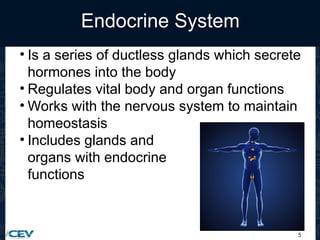
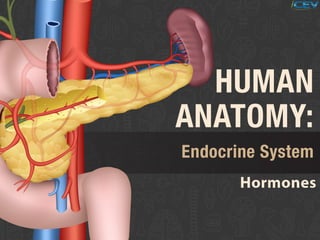
Endocrine System
• Isa series of ductless glands which secrete
hormones into the body
• Regulates vital body and organ functions
• Works with the nervous system to maintain
homeostasis
• Includes glands and
organs with endocrine
functions
6.
6
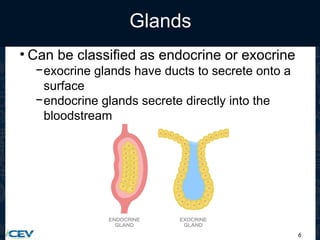
Glands
• Can beclassified as endocrine or exocrine
−exocrine glands have ducts to secrete onto a
surface
−endocrine glands secrete directly into the
bloodstream
7.
7
Exocrine Glands
• Haveducts to secrete directly onto the
surface
• Are not considered a part of the endocrine
system
−do not produce hormones
• Includes:
−sebaceous glands
−sudoriferous glands
−salivary glands
−Brunner’s glands
Body Bonus: Humans have between 2,000,000 to 5,000,000 sweat
glands.
8.
8
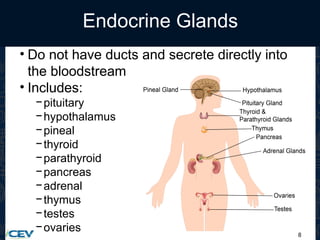
Endocrine Glands
• Donot have ducts and secrete directly into
the bloodstream
• Includes:
−pituitary
−hypothalamus
−pineal
−thyroid
−parathyroid
−pancreas
−adrenal
−thymus
−testes
−ovaries
9.
9
Pituitary Gland
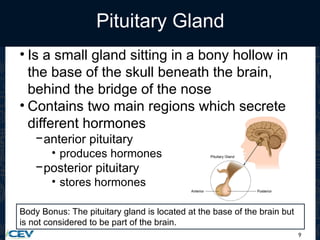
• Isa small gland sitting in a bony hollow in
the base of the skull beneath the brain,
behind the bridge of the nose
• Contains two main regions which secrete
different hormones
−anterior pituitary
• produces hormones
−posterior pituitary
• stores hormones
Body Bonus: The pituitary gland is located at the base of the brain but
is not considered to be part of the brain.
10.
10
Pituitary Gland
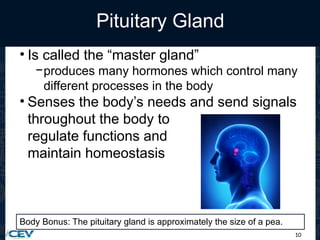
• Iscalled the “master gland”
−produces many hormones which control many
different processes in the body
• Senses the body’s needs and send signals
throughout the body to
regulate functions and
maintain homeostasis
Body Bonus: The pituitary gland is approximately the size of a pea.
11.
11
Hypothalamus
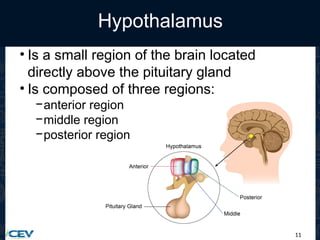
• Is asmall region of the brain located
directly above the pituitary gland
• Is composed of three regions:
−anterior region
−middle region
−posterior region
12.
12
Pituitary-Hypothalamus Complex
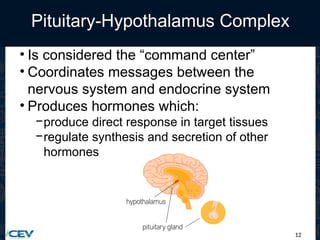
• Isconsidered the “command center”
• Coordinates messages between the
nervous system and endocrine system
• Produces hormones which:
−produce direct response in target tissues
−regulate synthesis and secretion of other
hormones
13.
13
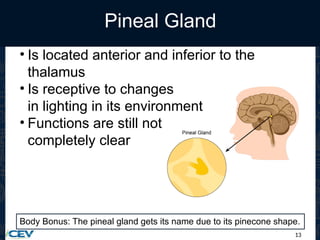
Pineal Gland
• Islocated anterior and inferior to the
thalamus
• Is receptive to changes
in lighting in its environment
• Functions are still not
completely clear
Body Bonus: The pineal gland gets its name due to its pinecone shape.
14.
14
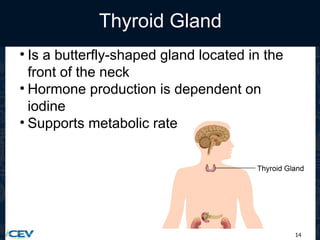
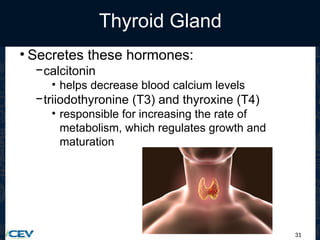
Thyroid Gland
• Isa butterfly-shaped gland located in the
front of the neck
• Hormone production is dependent on
iodine
• Supports metabolic rate
15.
15
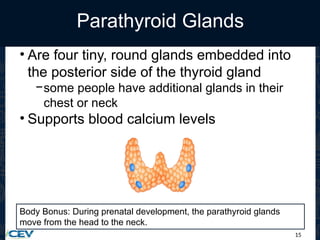
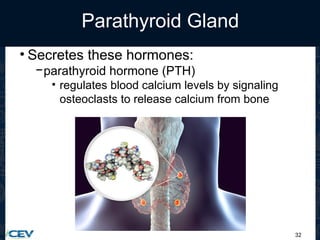
Parathyroid Glands
• Arefour tiny, round glands embedded into
the posterior side of the thyroid gland
−some people have additional glands in their
chest or neck
• Supports blood calcium levels
Body Bonus: During prenatal development, the parathyroid glands
move from the head to the neck.
16.
16
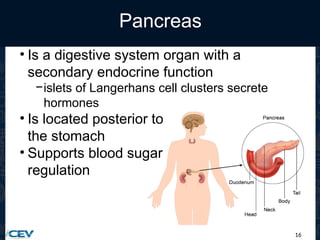
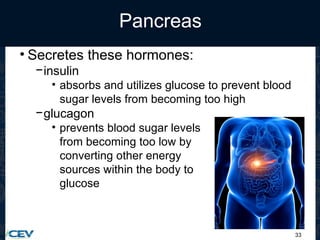
Pancreas
• Is adigestive system organ with a
secondary endocrine function
−islets of Langerhans cell clusters secrete
hormones
• Is located posterior to
the stomach
• Supports blood sugar
regulation
17.
17
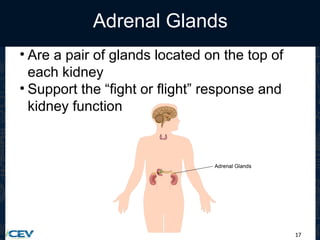
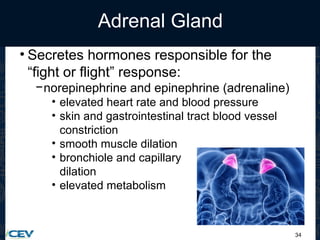
Adrenal Glands
• Area pair of glands located on the top of
each kidney
• Support the “fight or flight” response and
kidney function
18.
18
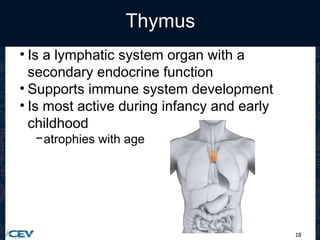
Thymus
• Is alymphatic system organ with a
secondary endocrine function
• Supports immune system development
• Is most active during infancy and early
childhood
−atrophies with age
19.
19
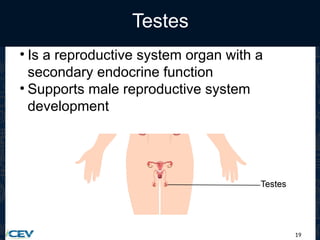
Testes
• Is areproductive system organ with a
secondary endocrine function
• Supports male reproductive system
development
20.
20
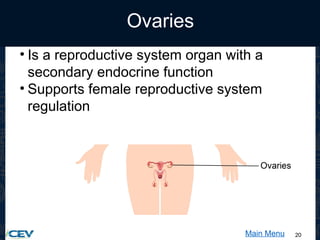
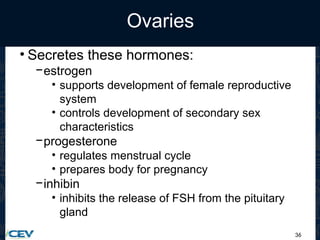
Ovaries
• Is areproductive system organ with a
secondary endocrine function
• Supports female reproductive system
regulation
Main Menu
22.
22
Hormones
• Are chemicalmessengers used to regulate
physiology, functions and behavior
−produced by endocrine glands
• Work together to maintain homeostasis
• Produced by endocrine glands and are
secreted into the bloodstream
−travel via a transport protein
−allows hormones to affect tissues throughout
the body
Body Bonus: The term “hormone” was not officially used until 1902.
23.
23
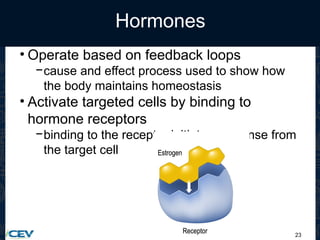
Hormones
• Operate basedon feedback loops
−cause and effect process used to show how
the body maintains homeostasis
• Activate targeted cells by binding to
hormone receptors
−binding to the receptor initiates response from
the target cell
24.
24
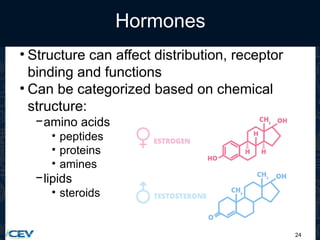
Hormones
• Structure canaffect distribution, receptor
binding and functions
• Can be categorized based on chemical
structure:
−amino acids
• peptides
• proteins
• amines
−lipids
• steroids
25.
25
Anterior Pituitary Gland
•Secretes these hormones:
−growth hormone (GH)
• promotes growth of tissues by increasing
metabolic efficiency
−thyroid stimulating hormone (TSH)
• stimulates the secretion of thyroid hormones
−adrenocorticotropic hormone (ACTH)
• regulates the adrenal gland and its hormone
secretions
Body Bonus: Human Growth Hormone levels peak during puberty and
decline every year after.
26.
26
Anterior Pituitary Gland
•Secretes these hormones:
−follicle-stimulating hormone (FSH)
• controls the development and maintenance of
the reproductive system
−luteinizing hormone (LH)
• regulates the reproductive system and the
secretion of sex hormones
−prolactin (PRL)
• stimulates breast development and milk
production in females
27.
27
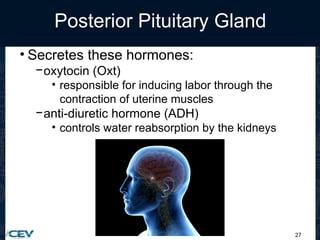
Posterior Pituitary Gland
•Secretes these hormones:
−oxytocin (Oxt)
• responsible for inducing labor through the
contraction of uterine muscles
−anti-diuretic hormone (ADH)
• controls water reabsorption by the kidneys
28.
28
Hypothalamus
• Secretes thesehormones:
−thyrotropin-releasing hormone (TRH)
• regulates the release of thyroid-stimulating
hormone from the pituitary
−somatostatin
• also called growth hormone-inhibiting hormone
(GHIH)
• regulates the release of growth hormone
−gonadotropin-releasing hormone (GnRH)
• regulates the secretion of follicle-stimulating
hormone and luteinizing hormone
29.
29
Hypothalamus
• Secretes thesehormones:
−corticotropin-releasing hormone (CRH)
• regulates the release of adrenocorticotropic
hormone
−prolactin-releasing hormone (PRH)
• stimulates the release of prolactin
−dopamine
• also called prolactin-inhibiting hormone (PIH)
• regulates the decrease of prolactin release
−growth hormone-releasing hormone (GHRH)
• stimulates the release of growth hormone in
the pituitary gland
30.
30
Pineal Gland
• Secretesmelatonin (MEL)
−aides in maintaining the body’s internal clock
−influences the body’s circadian rhythms
−effected by the presence of light
Body Bonus: The pineal gland was once known as the “third eye”.
31.
31
Thyroid Gland
• Secretesthese hormones:
−calcitonin
• helps decrease blood calcium levels
−triiodothyronine (T3) and thyroxine (T4)
• responsible for increasing the rate of
metabolism, which regulates growth and
maturation
32.
32
Parathyroid Gland
• Secretesthese hormones:
−parathyroid hormone (PTH)
• regulates blood calcium levels by signaling
osteoclasts to release calcium from bone
33.
33
Pancreas
• Secretes thesehormones:
−insulin
• absorbs and utilizes glucose to prevent blood
sugar levels from becoming too high
−glucagon
• prevents blood sugar levels
from becoming too low by
converting other energy
sources within the body to
glucose
34.
34
Adrenal Gland
• Secreteshormones responsible for the
“fight or flight” response:
−norepinephrine and epinephrine (adrenaline)
• elevated heart rate and blood pressure
• skin and gastrointestinal tract blood vessel
constriction
• smooth muscle dilation
• bronchiole and capillary
dilation
• elevated metabolism
35.
35
Adrenal Gland
• Secretesthese hormones:
−cortisol
• intensifies metabolism by breaking down fat,
increasing glucose production and increasing
water retention
• also possesses anti-inflammatory and anti-
allergenic properties
−aldosterone
• increases water and sodium absorption, along
with potassium excretion
36.
36
Ovaries
• Secretes thesehormones:
−estrogen
• supports development of female reproductive
system
• controls development of secondary sex
characteristics
−progesterone
• regulates menstrual cycle
• prepares body for pregnancy
−inhibin
• inhibits the release of FSH from the pituitary
gland
37.
37
Testes
• Secretes thesehormones:
−testosterone
• supports development of male reproductive
system
• controls development of secondary sex
characteristics
−inhibin
• inhibits the release of FSH from the pituitary
gland



![ONFH[AVN HIP] -TRIPLE REGIME -A NOVAL SURGICAL CONCEPT .pptx](https://cdn.slidesharecdn.com/ss_thumbnails/onfhavnhip2026koaconcalicutdrgokuldevdrmashraf-260210064517-213ec005-thumbnail.jpg?width=640&height=640&fit=bounds)


![PERI-PROSTHETIC FRACTURE NAIL-PLATE CONSTRUCT [NPC].pptx](https://cdn.slidesharecdn.com/ss_thumbnails/drarunkumardrmohamedashrafperiprostheticfrasturenail-plateconstructnpc-260209164459-7e9d15a1-thumbnail.jpg?width=640&height=640&fit=bounds)