
Public  Relations
Introduction “ The surest way to  kill a bad product is to advertise it.”
DEINITIONS Public Relations is the deliberate, planned and sustained effort to establish and maintain mutual understanding between on organization and its publics.“  Institute of Public  Relations, USA "Public Relations is the attempt by information persuasion and adjustment to engineer public support for an activity, cause, movement or institution." Edward L. Bernays "
DEINITIONS…. Public Relations is a combination of philosophy, sociology, economics, language, psychology, journalism, communication and other knowledges into a system of human understanding" Herbert M. Baus “ Merely human decency which flows from a good heart." Charles Plackard
DEINITIONS… Classic definitions:  Creating an understanding for,or goodwill toward a company, person or product Edward Bernays` definition, I96l:  " The three main elements of public Relations  are practically as old as society: informing people, persuading people, or integrating people with people"
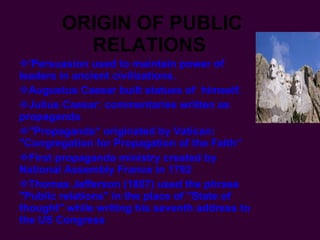
ORIGIN OF PUBLIC RELATIONS   'Persuasion used to maintain power of leaders in ancient civilizations. Augustus Caesar built statues of  himself. Julius Caesar: commentaries written as propaganda "Propaganda“ originated by Vatican: "Congregation for Propagation of the Faith“  First propaganda ministry created by National Assembly France in 1792 Thomas Jefferson (1807) used the phrase "Public relations" in the place of "State of thought" while writing his seventh address to the US Congress
ORIGIN OF PUBLIC RELATIONS…. In India, Great Indian Peninsular Railway Company Limited (GIP Railways) carried on publicity in Public Relations campaign in England for promote tourism to India through mass media and pamphlets.  During the time of First World War a central publicity board was set up at Bombay (now Mumbai) for disseminating war news to the public and press. After Second World War the Public Relations activity gained importance both privates as well as Government started Public Relations campaigns.
SIGNIFICANCE OF PUBLIC RELATIONS   No institution can operate successfully without co-operation of the public and the departmental colleagues and staff. Therefore, the mutual understanding is very much essential.   Public relations plan and take steps to achieve the goodwill of the public, take action to safeguard the reputation, and help in improving internal relationship. For safeguarding reputation, PR looks inward and assists in eliminating such customs and practices which offend the public opinion
SIGNIFICANCE OF PUBLIC RELATIONS… By using PR techniques internally the staff is encouraged to identify their own interests with those of the management. The public relations policy of an organization should include both inward activity and intelligence to assess the policies and behavior of the organization to find out whether any action is necessary to improve the image of the organization by improving its working and informing the public about its activities
NEED FOR PUBLIC RELATIONS   The public Relations is needed for following purposes: to change hostile opinion to create new attitudes to start healthy practices to smoothen the process of change
NEED FOR PUBLIC RELATIONS.. Customer complaints and redressal It is an opportunity to cement relations with the customer Very important in the service and hospitality industry Combating rumours / falsehoods Confront and disclose facts in leading media Give the positive side of the story Capitalise on rumour to your benefit Rumour can be dismissed as ridiculous
FUNCTIONS OF PUBLIC RELATIONS   Promoting goodwill Promoting product, service, corporate image Corporate communications Lobbying Counteracting negative publicity
THE COMPONENTS AND TOOLS OF PUBLIC RELATIONS   " Public" A group of similar individuals; an assortment of persons having the same interests, problems, circumstances, goals; it is from such persons that opinion emanates. Public is a varied creature; it comes in many forms and sizes.  Public has multitude of wants and desires; it has its likes and dislikes, some times, strong likes and strong dislikes. Employers make for a public and employees another public; the government is a public and citizens constitute another public, and so on, each of these groups is a public of the sort, tries to attract a different audience with its own tools and techniques .
THE COMPONENTS AND TOOLS OF PUBLIC RELATIONS.. " Relations" Human wants to create the need to establish relations with one another. The representative wants of the individuals will profoundly affect their relationship. To understand any relationship, therefore, one must understand the wants of those involved. 'Relationships are of all possible types. We have relationship by ran-superior to inferior, inferior to superior, and equal to equal. We have relationship by sentiment-benevolent, Friendly, suspicious, jealous, hostile. A relationship may be active, or it may be passive it may be good or it may be bad, or it may be neutral. At any rate, the relationship is there to be accepted, ignored or altered, as desired.
THE COMPONENTS AND TOOLS OF PUBLIC RELATIONS.. Propaganda: Propaganda is the manipulation of symbols to transmit accepted attitudes and skills. It describes political application of publicity and advertising, also on a large scale, to the end of selling an idea cause or candidate or all three. Campaigns: These consist of concerted, single-purpose publicity programme, usually on amore or less elaborate scale, employing coordinated publicity through a variety of media, aimed, at a number of targets, but focused on specific objectives. A campaign objective may be the election of a candidate, the promotion of political cause or issue, the reaching of a sales goal, or the raising of a quota of funds.
THE COMPONENTS AND TOOLS OF PUBLIC RELATIONS.. Lobbying: It entails the exertion of influence, smooth and measured pressure on other, exercise of persuasion cum-pressure. ln essence, it means a group putting its points of view forward in an attempt to win the other groups support.
Elements of  Public Relations are   A planned effort or management function. The relationship between an organisation and its publics Evaluation of public attitudes and opinions. An organisation's policies, procedures and actions as they relate to said organization's publics. Steps taken to ensure that said policies, procedures and actions are in the public interest and socially responsible. Execution of an action and or communication programme. Development of rapport, goodwill, understanding and acceptance as the chief end result sought by public relations activities
TOOLS OF PUBLIC RELATIONS Press conference (or "news conference")  Selection of time and place Selection of journalists Control over agenda News  releases Written statement distributed to the press Accommodating media requirements News story style Third person Quotes Reference to media contacts Aiming to appropriate gate keeping function from media Speaking  engagements Community  service  programs
PUBLIC RELATIONS SPRING FROM HUMAN RELATIONS   Client seeks satisfaction for his or her very special and private psychological and emotional needs.  A patient has needs for privacy of person at least when he or she is not critically ill  He or she has the need to be informed in general about his or her illness and progress. He or she needs freedom from pain when it occurs  He or she needs to feel the presence of the reassuring nurse who cares about happens to him or her. Depending on its image, a hospital is variously considered as a crisis place, a curing place or a trauma place
PUBLIC RELATIONS SPRING FROM HUMAN RELATIONS.. As a place Canter Considers the nature of the hospital as resultant of the interaction three major influences as under, and suggest that of these should be constructively modified it we seek to humanize the hospital: the physical setting, the activities which take place within, and the conceptions held by users.
SOME POSSIBILITIES THAT WOULD CALL FOR PUBLICRELATIONS   Promotional Opportunity: To inform the new service / policy which call for Public Relations to make wider publicity. Competitive: To over come the resistance (pre-set mind condition). Controversy: To eliminate the contradictory conditions in between the organization and the public. Adverse publicity: To inform the truth or correct issues and thereby removing the misunderstanding. Catastrophe: Announcement of any unfavorable issues. Crisis: Whenever threats arises.
PUBLIC RELATIONS IN GOVERNMENT Public relations role in government: The Government public relations contributes to: l. Implementation of public policy. 2. Assisting the news media in coverage of government activities. 3. Reporting the citizenry on agency activities. 4. Increasing the internal cohesion of the agency. 5. Increasing the agency’s sensitive to its public’s. 6. Mobilization of support for the agency itself
Public Relations for Government (objectives and organizations ) National Objectives : The basic function of the government Public Relations department / agencies is to provide information, education/instruction to the citizens. The effort should also motivate the people directly or indirectly, to discharge these functions in a meaningful and purposeful manner, it is necessary that the Public Relations Department / wing should be clear about the broad objectives which guide their work. The national objective should be non-political, non-controversial, and on which there should be a national consensus. The objectives should further the interests and the well being of the public as a whole and promote the many sided development of the country, The objectives should be long term ones and need not necessarily change with political vagaries.
APPROACHES OF PUBLIC RELATIONS Information-Persuasion approach through mass media. Behavioural approach aimed at inculcating the right attitude among functionaries
Asymmetrical/functional approach  Publics and communications understood as means to achieve organizational ends Purpose is to  generate support, trust, enhance reputation; ultimately to maximise material or other benefits through generating a more conducive social environment Key theorist: Edward Bernays
Quotes (Edward Bernays) ‘ The conscious and intelligent manipulation of the organized habits and opinions of the masses is an important element in democratic society. Those who manipulate this unseen mechanism of society constitute an invisible government which is the true ruling power of our country. ... We are governed, our minds are molded, our tastes formed, our ideas suggested, largely by men we have never heard of. This is a logical result of the way in which our democratic society is organized. Vast numbers of human beings must cooperate in this manner if they are to live together as a smoothly functioning society. ... In almost every act of our daily lives, whether in the sphere of politics or business, in our social conduct or our ethical thinking, we are dominated by the relatively small number of persons ... who understand the mental processes and social patterns of the masses. It is they who pull the wires which control the public mind.’  ‘ If we understand the mechanism and motives of the group mind [it would be possible to] control and regiment the masses according to our will without their knowing it. . . . Theory and practice have combined with sufficient success to permit us to know that in certain cases we can effect some change in public opinion with a fair degree of accuracy by operating a certain mechanism, just as the motorist can regulate the speed of his car by manipulating the flow of gasoline
Symmetrical/co-creational approach Communication, rhetoric and PR understood as joint creation of meaning that involves interested (economic, social, political) actors as well as their publics. ie, Public Relations as relationship-management Publics are partners in the “meaning-making” process, not means to an end Proposing a more ethical approach to PR Key theorists:  Ivy Lee J. Grunig
Quotes ‘ We always tell our clients that honesty is the best policy. […] All our work is done in the open. We aim to supply news. . . . Our plan is, frankly and openly, on behalf of business concerns and public institutions, to supply the press and the public of the United States prompt and accurate information concerning subjects which it is of value and interest to the public to know about.’  (Ivy Lee, Statement of Principles, 1906 ) ‘ symmetrical public relations does not take place in an ideal situation where competing interests come together with goodwill to resolve their differences because they share a goal of social equilibrium and harmony. Rather it takes place in situations where groups come together to protect and enhance their self-interests. Argumentation, debate and persuasion take place. But dialogue, listening, understanding and relationship building also occur because they are more effective in resolving conflict than are one-way attempts at compliance gaining’  (J. Grunig, “Two-Way Symmetrical Public Relations: Past, Present, and Future”, in  Handbook of Public Relations , 2001
PUBLIC RELATION SKILLS   Rapport Skills Making a rapport with others itself is a skill. The first impression makes a lot of impact in starting an effective communication with others. The rapport skill consists of the following. To be able to use certain strategies effectively and  To be able to present the self effectively
PUBLIC RELATION SKILLS… Use of Strategy Recognition of the other person itself is a piece of strategy. Recognition can be expressed verbally or non verbally. A pleasant smile, eye contact etc. form non verbal strategies to impress the visitors. A public relation practitioner who can use the strategies well can motivate the visitor to unfold his personality and to initiate a meaningful interaction
PUBLIC RELATION SKILLS… Empathic skills  Empathic skills denote the ability of a person to perceive the other effectively. While dealing with another person it is necessary to "put oneself into the other person's shoes". It involves an empathic understanding of the other person's views, difficulties and situation.
PUBLIC RELATION SKILLS… The Skill to make a positive response A visitor may bring to the person at. the contact point certain personal problems or experiences which may be irrelevant to the organisation. But it is the duty of the public relations practitioner to give a patient listening to the problems of the visitor. If some solution can be found and the visitor is guided properly, it is an appreciable act. A patient listening itself is a welcome act on the part of the practitioner so as to make the visitor a little relieved of bad feelings. If one is rejecting outright the visitor's expression of personal duties that will cause further escalation of anger and the communication process itself will be a dead end.
PUBLIC RELATION SKILLS… The Listening Skills Listening skill is the capability every public relations practitioner should have to perceive others effectively. It is not just hearing a person. Listening should mean that one is consciously aware of what the other person is saying.  Absolute Listening While you only listen to the visitor and indicate only whether you follow or not, you will discover surprising experience. People unfolds themselves and could tell much more and also find more inside themselves that can never happen in usual interactions. Expressions such as 'yes' or 'I see' or 'Yes. I can see how you feel' will be effective in the process of communication.
PUBLIC RELATION SKILLS… To show that you follow exactly The speaker after presenting his points would like to hear you speak. Some speakers need reassurance that you understand them exactly. It is not just "let them talk" to listening but relate to such thing that they feel, whether it is favourable or unfavourable.
PUBLIC RELATION SKILLS… System Effectiveness - some methods People visit government offices for the purpose of securing certain services. They also expect good behaviour from the functionaries. The service rendered to the people have to be prompt without creating difficulties like repeated visits needed to that service .
PUBLIC RELATION SKILLS… Work Standards FIFO : Whenever a service is given to people "First In First Out" principle is a must Simplification of Forms and Procedures Decentralisation of Authority
Objectives of public relations The general objectives of Public Relations are: To create public awareness of the activities of the organisation. To highlight the services rendered to the public. To bring out the contribution made to the public and to the organisation itself. To emphasize its role in research and development. To spotlight the human aspects
Role of public relations The role of public relations is basically Educational: To educate the public about the main functions of the organisation and the procedures concerning them. Informative: To give information about the various existing services, proposed services, various policies of the organisation, etc. Towards Problem Solving: If any person comes with some problem faced by him about the service being provided by the organisation, the efforts of the concerned employee should be to listen to him in detail and see how he can help him in solving his difficulties.
Expectations from public relations practitioners To take steps to improve mutual understanding between the organisations (i.e., management) and its customers as well as staff based on the understanding of the human behaviour and customer's expectations To take action to discover and eliminate sources of misunderstanding To establish and maintain two way ' communications based on truth, honesty and full information. To study public opinion, attitudes and expectations, and advise the organisation (i.e., management) to take necessary action. To help in building mutual respect and goodwill with customers and employees. To help in building and maintaining proper work culture.
Guide lines for good public relations   Be Presentable   Queries to be answered well   Avoid Loose talk   Affirmative Approach Knowledge about the department   Feedback A good heart
IMAGE BUILDING 'Image' defined for our purpose is the totality of perceptions, feelings and attitudes of the people about an organisation's effectiveness and the faith they have in its usefulness, image can be built up only on the basis of sustained and planned effort towards attaining high standards of performance, i.e., for 90 percent of the time we have to do hard work and 10 percent of the time we could be talking about it. Proper planning, mobilisation of resources, monitoring of the resources in a predetermined time frame to ensure results, etc. are the basic components of hard work.
The major components of behaviour modelling Be punctual to work and assignments. Be polite and empathetic to patients and others. Be a dynamic and democratic leader to subordinates. Be competent with skills in planning and implementation and public relations. Be an androgynous administrator. Be a good team builder.
Positive image of a hospital are: technically competent medical care, a mutual trust between and hospital and its clientele, and goodwill and understanding between patients and the hospital staff
COMPLAINTS RELATING TO PATIENT AND COMMUNITY 1.Indifferent care Lack of "human touch“ 2.Low quality care  Assessed by patients from the qualityof linen, diet, equipment, facilities,cleanliness, etc. 3.Lack of information About facilities and staff, but especially on the patients' diseaseCondition 4.Lack of guidance Sign, posting, boards, oral information 5.Lack of creature  Chairs, benches, drinking water,comfortstoilets, etc.
Cont.. 6.Delays at almost every step 7.Overcrowding 8.Long queues 9.Noise1 0.Poor sanitation 11.Behaviour of staff
GOALS OF PUBLIC RELATIONS To create,  maintain, and protect the organisation reputation To enhance its prestige  To present a favourable image To create good will for the organisation,  it involves functions as employee relations, stock holder, and investor relation, media relations and community relations.
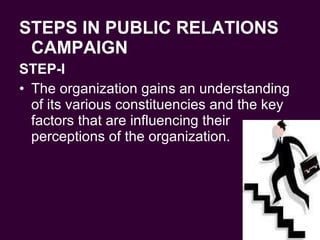
STEPS IN PUBLIC RELATIONS CAMPAIGN STEP-I The organization gains an understanding of its various constituencies and the key factors that are influencing their perceptions of the organization.
Steps….. STEP-2 The organization establishes an overall policy with respect to the campaign.This involves defining goals and desired outcomes as well as the constraints under which the campaign will operate.It is neccesary to establish such policy guide line in order to evaluate proposed strategies and tactics as well as the overall success of the campaign. STEP-3 The organization outlines its strategies and tactics. Using its knowledge of the target audiences and its own established policies the organization develops specific programs to achieve the desired objectives.
Cont…. STEP -4 It involves actual communication with the targeted public. The organization then employs specific public relations techniques such as press conferences or special events to reach the intended audiences. STEP -5 The organization receives feedbacks from its public. How have they reacted to the public relations campaign ? Are there some unexpected developments ? In the final step, the organization assess the program and makes necessary adjustments
AREAS OF PUBLIC RELATIONS PRODUCT PUBLIC RELATIONS Public relations and marketing work together closely when its come to promoting a new or existing products or service. Public relations place an important role in new product introduction by creating awareness differentiating the product from other similar products and even change in consumer behaviour.It can help introduce new products through staging a variety of special events and handling sensitive situations.
AREAS OF PUBLIC RELATIONS.. EMPLOYEE RELATIONS Employee s are one of the most important audiences a company has, and ongoing public relations program is necessary to maintain employee good will as well as to uphold the company image and reputation among its employees. The essence of a good employee relation s program is keeping employees inform and providing them with channels of communication to upper levels of management.
AREAS OF PUBLIC RELATIONS.. COMMUNITY  RELATIONS A comprehensive ,ongoing community relations program can help virtually any organization achieve visibility as a good community  citizen and gain the good will of the community in which it operates.Banks, utilities,radio and television stations, and major retailers are the some of the types of  organizations most likely to have ongoing programs that might include supporting urban renewal,performing arts programs,social and educational ptrograms,childrens programs,community
AREAS OF PUBLIC RELATIONS.. COMMUNITY  RELATIONS…. Organizations have the opportunity to improve good will and demonstrate a commitment to their communities when they open new offices, expand facilities and open new factories. Organization conduct a variety of special programs to improve community relations, including providing  employee volunteers to work on community projects, sponsoring educational and literacy programs, staging open houses and conducting plant tours, celebrating anniversaries and mounting special exhibits
AREAS OF PUBLIC RELATIONS.. FINANCIAL RELATIONS It involves communicating not only with the company stock holders but also with wider community of financial analyst and potential investors. An effective investor relation plan can increase the value of a company stock and  make it easier to raise additional capitals. In some cases special meetings with financial analyst are necessary to overcome adverse publicity , negative perception about a company or investor in difference. Such meetings may take the form of full day briefings, formal presentations or meetings.
AREAS OF PUBLIC RELATIONS.. PUBLIC RELATIONS IN THE PUBLIC INTEREST Organizations  attempt to generate good will and position themselves as responsible citizens  through a variety of programs conducted in the public interest. Some  eg; are environmental programs and antipollution programs. Health and medical programs are sponsored by a wide range of non profit organizations, health care providers and other business and industries. CONSUMER  EDUCATION Organizations have undertaken a variety of programs to educate consumers, building good will and helping avoid misunderstandings in the process. Opportunities for educating consumers might include sponsoring television and radio programs, producing manuals and other printed materials for class room use,and releasing the results of surveys.
AREAS OF PUBLIC RELATIONS.. CRISIS COMMUNICATIONS Public relations practitioners become heavily involved in crisis communications whenever there is a major accident or natural disaster affecting an organization and its community.other types of crises involve  bankruptcy, product failure,and management wrong doing.in some cases,crises call for an organization to become involved in helping potential victims,in other cases, the crises may require rebuilding an organizations image. GOVERNMENT AND POLITICAL RELATIONS It covers a wide range of activities including staging debates,holding seminars for government leaders,influencing proposed legislation and testifying before a congressional committee.Political candidates engage in public relations,as do government agencies as the federal,stateand local levels.
AREAS OF PUBLIC RELATIONS.. OTHER PUBLIC RELATIONS PROGRAMS. Other public relation programs that fall under the umbrella of public relations include corporate identity programs, ranging from name changes and new trade marks  to changing a companies overall image. Special events may be held to call attention to an organization  and focus the publics good will. These include anniversary celebrations, events related  to trade shows, special exhibits, or fairs ,festivals. Speakers bureaus and celebrity  spokespersons are effective  public relation tools for communicating an organizations point of view
ROLE AND RESPONSIBLITIES OF A NUSRE ADMINISTRATOR Advising and counseling CLIENT AND PUBLIC  Early warning system on emerging issues related to organizations Support for other management functions (publicity, promotion, and media relations) Gate keeping between organization and public Strategizing and planning Client or public satisfaction surveys Writing and editing news releases, newsletters, shareholder reports Media relations and placements Research
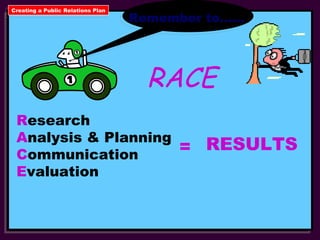
Creating a Public Relations Plan RACE R esearch  A nalysis & Planning C ommunication  E valuation  = RESULTS Remember to……
ROLE OF A PRINCIPAL OF SCHOOL OR COLLEGE OF  NURSING IN PUBLIC RELATIONS takes a leadership role refines and disseminates college/school news develops positive relationships with media establishes open lines of communication  with community formulates plans and policies evaluate outcomes
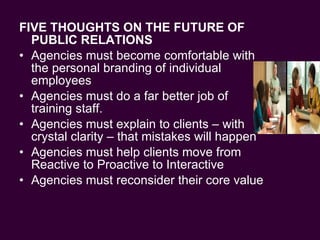
FIVE THOUGHTS ON THE FUTURE OF  PUBLIC RELATIONS Agencies must become comfortable with the personal branding of individual employees Agencies must do a far better job of training staff.  Agencies must explain to clients – with crystal clarity – that mistakes will happen Agencies must help clients move from Reactive to Proactive to Interactive Agencies must reconsider their core value
TWO MYTHS OF PR Bernays’ myth that public opinion could be manufactured for a price, bought and sold like any other commodity Lee’s myth that PR is natural, honorable and honest - part of the "two-way street" process of democratic communications between businesses and their "publics"
SIX FACETS OF THE FUTURE OF PUBLIC RELATIONS  clients expect more: media is transformed: business is a conversation: Information flows in every dimension transparency is a given influence networks are at the heart
NEW TECHNOLOGY IN PUBLIC RELATIONS Videoconferencing: allows large audience at different sites to participate in meetings Tylenol tampering in 1982 (Johnson & Johnson) Reached media in 30 cities  Satellite Media Tours Spokesperson holds one-on-one dialog with broadcasters via Satellite with out having to travel. Video News Releases (VNR)  Video version of traditional news release, sent to local TV stations .
Future of PUBLIC RELATIONS  IN INDIA  After the independence it was realised that PR is necessary in order to communicate for development and to create a bridge between the public and the government .  Public Relations began to increase in India in the early 1990s when the government opened the economy and multinational corporations began to enter the country Specialization has become increasingly important and firms are demanding higher qualifications and skill sets from workers.
CONCLUSION While communication is the essence of public relations, an effective public relations campaign is based on action as well as words. Whether it is practiced formally or informally, public relations is  an essential function for the survival of any organization. Public relations are not only a summation of individual relations, but much more. These relations have their origin in the acts and attitudes of every worker and staff member who collectively mould the image of the hospital in the community. Current and ex-patients are the best (or worst) advertisement for a hospital. People cannot resist telling their friends and neighbors about a hospital experience, and from this emerges a series of pictures of the hospital which together make up its local image.
BIBLIOGRAPHY BOOKS 1) Dr.Thomas Kochuthresiamma (2010) Nursing administration and management  First edition Medical Work Publication,Kittayam. Pg.No 232 2)Shakharkar BM (2008) Principles of Hospital Administration and Planning First edition Jaepee Brothers publication , Newdelhi Pg.No 251 3) Canter D:  The Psychology of Place  Architectural Press: London, 1977. 4) Lindell MH: Humanisation of the Hospital.  World Hospitals  18  (2): 1982. 5) Ray D B: Nursing behaviour and patient satisfaction.  Joint Seminar on Hospital  Administration  AFMC Pune, 1979. 6)Plouviez, Maggie: Why worry about volunteers.  Hospitals and Health Senvices JOURNALS Nightingale Nursing Times Vol : 2 No: 11 Nov 2006 Nightingale Nursing Times Vol : 2 No. 12 Dec 2006 Next Reference  www. answers.com  www.nursetogether.com  www.keralagov.nic
 

Powerof public1

  • 1.
  • 2.
    Introduction “ Thesurest way to kill a bad product is to advertise it.”
  • 3.
    DEINITIONS Public Relationsis the deliberate, planned and sustained effort to establish and maintain mutual understanding between on organization and its publics.“ Institute of Public Relations, USA "Public Relations is the attempt by information persuasion and adjustment to engineer public support for an activity, cause, movement or institution." Edward L. Bernays "
  • 4.
    DEINITIONS…. Public Relationsis a combination of philosophy, sociology, economics, language, psychology, journalism, communication and other knowledges into a system of human understanding" Herbert M. Baus “ Merely human decency which flows from a good heart." Charles Plackard
  • 5.
    DEINITIONS… Classic definitions: Creating an understanding for,or goodwill toward a company, person or product Edward Bernays` definition, I96l: " The three main elements of public Relations are practically as old as society: informing people, persuading people, or integrating people with people"
  • 6.
    ORIGIN OF PUBLICRELATIONS 'Persuasion used to maintain power of leaders in ancient civilizations. Augustus Caesar built statues of himself. Julius Caesar: commentaries written as propaganda "Propaganda“ originated by Vatican: "Congregation for Propagation of the Faith“ First propaganda ministry created by National Assembly France in 1792 Thomas Jefferson (1807) used the phrase "Public relations" in the place of "State of thought" while writing his seventh address to the US Congress
  • 7.
    ORIGIN OF PUBLICRELATIONS…. In India, Great Indian Peninsular Railway Company Limited (GIP Railways) carried on publicity in Public Relations campaign in England for promote tourism to India through mass media and pamphlets. During the time of First World War a central publicity board was set up at Bombay (now Mumbai) for disseminating war news to the public and press. After Second World War the Public Relations activity gained importance both privates as well as Government started Public Relations campaigns.
  • 8.
    SIGNIFICANCE OF PUBLICRELATIONS No institution can operate successfully without co-operation of the public and the departmental colleagues and staff. Therefore, the mutual understanding is very much essential. Public relations plan and take steps to achieve the goodwill of the public, take action to safeguard the reputation, and help in improving internal relationship. For safeguarding reputation, PR looks inward and assists in eliminating such customs and practices which offend the public opinion
  • 9.
    SIGNIFICANCE OF PUBLICRELATIONS… By using PR techniques internally the staff is encouraged to identify their own interests with those of the management. The public relations policy of an organization should include both inward activity and intelligence to assess the policies and behavior of the organization to find out whether any action is necessary to improve the image of the organization by improving its working and informing the public about its activities
  • 10.
    NEED FOR PUBLICRELATIONS The public Relations is needed for following purposes: to change hostile opinion to create new attitudes to start healthy practices to smoothen the process of change
  • 11.
    NEED FOR PUBLICRELATIONS.. Customer complaints and redressal It is an opportunity to cement relations with the customer Very important in the service and hospitality industry Combating rumours / falsehoods Confront and disclose facts in leading media Give the positive side of the story Capitalise on rumour to your benefit Rumour can be dismissed as ridiculous
  • 12.
    FUNCTIONS OF PUBLICRELATIONS Promoting goodwill Promoting product, service, corporate image Corporate communications Lobbying Counteracting negative publicity
  • 13.
    THE COMPONENTS ANDTOOLS OF PUBLIC RELATIONS " Public" A group of similar individuals; an assortment of persons having the same interests, problems, circumstances, goals; it is from such persons that opinion emanates. Public is a varied creature; it comes in many forms and sizes. Public has multitude of wants and desires; it has its likes and dislikes, some times, strong likes and strong dislikes. Employers make for a public and employees another public; the government is a public and citizens constitute another public, and so on, each of these groups is a public of the sort, tries to attract a different audience with its own tools and techniques .
  • 14.
    THE COMPONENTS ANDTOOLS OF PUBLIC RELATIONS.. " Relations" Human wants to create the need to establish relations with one another. The representative wants of the individuals will profoundly affect their relationship. To understand any relationship, therefore, one must understand the wants of those involved. 'Relationships are of all possible types. We have relationship by ran-superior to inferior, inferior to superior, and equal to equal. We have relationship by sentiment-benevolent, Friendly, suspicious, jealous, hostile. A relationship may be active, or it may be passive it may be good or it may be bad, or it may be neutral. At any rate, the relationship is there to be accepted, ignored or altered, as desired.
  • 15.
    THE COMPONENTS ANDTOOLS OF PUBLIC RELATIONS.. Propaganda: Propaganda is the manipulation of symbols to transmit accepted attitudes and skills. It describes political application of publicity and advertising, also on a large scale, to the end of selling an idea cause or candidate or all three. Campaigns: These consist of concerted, single-purpose publicity programme, usually on amore or less elaborate scale, employing coordinated publicity through a variety of media, aimed, at a number of targets, but focused on specific objectives. A campaign objective may be the election of a candidate, the promotion of political cause or issue, the reaching of a sales goal, or the raising of a quota of funds.
  • 16.
    THE COMPONENTS ANDTOOLS OF PUBLIC RELATIONS.. Lobbying: It entails the exertion of influence, smooth and measured pressure on other, exercise of persuasion cum-pressure. ln essence, it means a group putting its points of view forward in an attempt to win the other groups support.
  • 17.
    Elements of Public Relations are A planned effort or management function. The relationship between an organisation and its publics Evaluation of public attitudes and opinions. An organisation's policies, procedures and actions as they relate to said organization's publics. Steps taken to ensure that said policies, procedures and actions are in the public interest and socially responsible. Execution of an action and or communication programme. Development of rapport, goodwill, understanding and acceptance as the chief end result sought by public relations activities
  • 18.
    TOOLS OF PUBLICRELATIONS Press conference (or "news conference") Selection of time and place Selection of journalists Control over agenda News releases Written statement distributed to the press Accommodating media requirements News story style Third person Quotes Reference to media contacts Aiming to appropriate gate keeping function from media Speaking engagements Community service programs
  • 19.
    PUBLIC RELATIONS SPRINGFROM HUMAN RELATIONS Client seeks satisfaction for his or her very special and private psychological and emotional needs. A patient has needs for privacy of person at least when he or she is not critically ill He or she has the need to be informed in general about his or her illness and progress. He or she needs freedom from pain when it occurs He or she needs to feel the presence of the reassuring nurse who cares about happens to him or her. Depending on its image, a hospital is variously considered as a crisis place, a curing place or a trauma place
  • 20.
    PUBLIC RELATIONS SPRINGFROM HUMAN RELATIONS.. As a place Canter Considers the nature of the hospital as resultant of the interaction three major influences as under, and suggest that of these should be constructively modified it we seek to humanize the hospital: the physical setting, the activities which take place within, and the conceptions held by users.
  • 21.
    SOME POSSIBILITIES THATWOULD CALL FOR PUBLICRELATIONS Promotional Opportunity: To inform the new service / policy which call for Public Relations to make wider publicity. Competitive: To over come the resistance (pre-set mind condition). Controversy: To eliminate the contradictory conditions in between the organization and the public. Adverse publicity: To inform the truth or correct issues and thereby removing the misunderstanding. Catastrophe: Announcement of any unfavorable issues. Crisis: Whenever threats arises.
  • 22.
    PUBLIC RELATIONS INGOVERNMENT Public relations role in government: The Government public relations contributes to: l. Implementation of public policy. 2. Assisting the news media in coverage of government activities. 3. Reporting the citizenry on agency activities. 4. Increasing the internal cohesion of the agency. 5. Increasing the agency’s sensitive to its public’s. 6. Mobilization of support for the agency itself
  • 23.
    Public Relations forGovernment (objectives and organizations ) National Objectives : The basic function of the government Public Relations department / agencies is to provide information, education/instruction to the citizens. The effort should also motivate the people directly or indirectly, to discharge these functions in a meaningful and purposeful manner, it is necessary that the Public Relations Department / wing should be clear about the broad objectives which guide their work. The national objective should be non-political, non-controversial, and on which there should be a national consensus. The objectives should further the interests and the well being of the public as a whole and promote the many sided development of the country, The objectives should be long term ones and need not necessarily change with political vagaries.
  • 24.
    APPROACHES OF PUBLICRELATIONS Information-Persuasion approach through mass media. Behavioural approach aimed at inculcating the right attitude among functionaries
  • 25.
    Asymmetrical/functional approach Publics and communications understood as means to achieve organizational ends Purpose is to generate support, trust, enhance reputation; ultimately to maximise material or other benefits through generating a more conducive social environment Key theorist: Edward Bernays
  • 26.
    Quotes (Edward Bernays)‘ The conscious and intelligent manipulation of the organized habits and opinions of the masses is an important element in democratic society. Those who manipulate this unseen mechanism of society constitute an invisible government which is the true ruling power of our country. ... We are governed, our minds are molded, our tastes formed, our ideas suggested, largely by men we have never heard of. This is a logical result of the way in which our democratic society is organized. Vast numbers of human beings must cooperate in this manner if they are to live together as a smoothly functioning society. ... In almost every act of our daily lives, whether in the sphere of politics or business, in our social conduct or our ethical thinking, we are dominated by the relatively small number of persons ... who understand the mental processes and social patterns of the masses. It is they who pull the wires which control the public mind.’ ‘ If we understand the mechanism and motives of the group mind [it would be possible to] control and regiment the masses according to our will without their knowing it. . . . Theory and practice have combined with sufficient success to permit us to know that in certain cases we can effect some change in public opinion with a fair degree of accuracy by operating a certain mechanism, just as the motorist can regulate the speed of his car by manipulating the flow of gasoline
  • 27.
    Symmetrical/co-creational approach Communication,rhetoric and PR understood as joint creation of meaning that involves interested (economic, social, political) actors as well as their publics. ie, Public Relations as relationship-management Publics are partners in the “meaning-making” process, not means to an end Proposing a more ethical approach to PR Key theorists: Ivy Lee J. Grunig
  • 28.
    Quotes ‘ Wealways tell our clients that honesty is the best policy. […] All our work is done in the open. We aim to supply news. . . . Our plan is, frankly and openly, on behalf of business concerns and public institutions, to supply the press and the public of the United States prompt and accurate information concerning subjects which it is of value and interest to the public to know about.’ (Ivy Lee, Statement of Principles, 1906 ) ‘ symmetrical public relations does not take place in an ideal situation where competing interests come together with goodwill to resolve their differences because they share a goal of social equilibrium and harmony. Rather it takes place in situations where groups come together to protect and enhance their self-interests. Argumentation, debate and persuasion take place. But dialogue, listening, understanding and relationship building also occur because they are more effective in resolving conflict than are one-way attempts at compliance gaining’ (J. Grunig, “Two-Way Symmetrical Public Relations: Past, Present, and Future”, in Handbook of Public Relations , 2001
  • 29.
    PUBLIC RELATION SKILLS Rapport Skills Making a rapport with others itself is a skill. The first impression makes a lot of impact in starting an effective communication with others. The rapport skill consists of the following. To be able to use certain strategies effectively and To be able to present the self effectively
  • 30.
    PUBLIC RELATION SKILLS…Use of Strategy Recognition of the other person itself is a piece of strategy. Recognition can be expressed verbally or non verbally. A pleasant smile, eye contact etc. form non verbal strategies to impress the visitors. A public relation practitioner who can use the strategies well can motivate the visitor to unfold his personality and to initiate a meaningful interaction
  • 31.
    PUBLIC RELATION SKILLS…Empathic skills Empathic skills denote the ability of a person to perceive the other effectively. While dealing with another person it is necessary to "put oneself into the other person's shoes". It involves an empathic understanding of the other person's views, difficulties and situation.
  • 32.
    PUBLIC RELATION SKILLS…The Skill to make a positive response A visitor may bring to the person at. the contact point certain personal problems or experiences which may be irrelevant to the organisation. But it is the duty of the public relations practitioner to give a patient listening to the problems of the visitor. If some solution can be found and the visitor is guided properly, it is an appreciable act. A patient listening itself is a welcome act on the part of the practitioner so as to make the visitor a little relieved of bad feelings. If one is rejecting outright the visitor's expression of personal duties that will cause further escalation of anger and the communication process itself will be a dead end.
  • 33.
    PUBLIC RELATION SKILLS…The Listening Skills Listening skill is the capability every public relations practitioner should have to perceive others effectively. It is not just hearing a person. Listening should mean that one is consciously aware of what the other person is saying. Absolute Listening While you only listen to the visitor and indicate only whether you follow or not, you will discover surprising experience. People unfolds themselves and could tell much more and also find more inside themselves that can never happen in usual interactions. Expressions such as 'yes' or 'I see' or 'Yes. I can see how you feel' will be effective in the process of communication.
  • 34.
    PUBLIC RELATION SKILLS…To show that you follow exactly The speaker after presenting his points would like to hear you speak. Some speakers need reassurance that you understand them exactly. It is not just "let them talk" to listening but relate to such thing that they feel, whether it is favourable or unfavourable.
  • 35.
    PUBLIC RELATION SKILLS…System Effectiveness - some methods People visit government offices for the purpose of securing certain services. They also expect good behaviour from the functionaries. The service rendered to the people have to be prompt without creating difficulties like repeated visits needed to that service .
  • 36.
    PUBLIC RELATION SKILLS…Work Standards FIFO : Whenever a service is given to people "First In First Out" principle is a must Simplification of Forms and Procedures Decentralisation of Authority
  • 37.
    Objectives of publicrelations The general objectives of Public Relations are: To create public awareness of the activities of the organisation. To highlight the services rendered to the public. To bring out the contribution made to the public and to the organisation itself. To emphasize its role in research and development. To spotlight the human aspects
  • 38.
    Role of publicrelations The role of public relations is basically Educational: To educate the public about the main functions of the organisation and the procedures concerning them. Informative: To give information about the various existing services, proposed services, various policies of the organisation, etc. Towards Problem Solving: If any person comes with some problem faced by him about the service being provided by the organisation, the efforts of the concerned employee should be to listen to him in detail and see how he can help him in solving his difficulties.
  • 39.
    Expectations from publicrelations practitioners To take steps to improve mutual understanding between the organisations (i.e., management) and its customers as well as staff based on the understanding of the human behaviour and customer's expectations To take action to discover and eliminate sources of misunderstanding To establish and maintain two way ' communications based on truth, honesty and full information. To study public opinion, attitudes and expectations, and advise the organisation (i.e., management) to take necessary action. To help in building mutual respect and goodwill with customers and employees. To help in building and maintaining proper work culture.
  • 40.
    Guide lines forgood public relations Be Presentable Queries to be answered well Avoid Loose talk Affirmative Approach Knowledge about the department Feedback A good heart
  • 41.
    IMAGE BUILDING 'Image'defined for our purpose is the totality of perceptions, feelings and attitudes of the people about an organisation's effectiveness and the faith they have in its usefulness, image can be built up only on the basis of sustained and planned effort towards attaining high standards of performance, i.e., for 90 percent of the time we have to do hard work and 10 percent of the time we could be talking about it. Proper planning, mobilisation of resources, monitoring of the resources in a predetermined time frame to ensure results, etc. are the basic components of hard work.
  • 42.
    The major componentsof behaviour modelling Be punctual to work and assignments. Be polite and empathetic to patients and others. Be a dynamic and democratic leader to subordinates. Be competent with skills in planning and implementation and public relations. Be an androgynous administrator. Be a good team builder.
  • 43.
    Positive image ofa hospital are: technically competent medical care, a mutual trust between and hospital and its clientele, and goodwill and understanding between patients and the hospital staff
  • 44.
    COMPLAINTS RELATING TOPATIENT AND COMMUNITY 1.Indifferent care Lack of "human touch“ 2.Low quality care Assessed by patients from the qualityof linen, diet, equipment, facilities,cleanliness, etc. 3.Lack of information About facilities and staff, but especially on the patients' diseaseCondition 4.Lack of guidance Sign, posting, boards, oral information 5.Lack of creature Chairs, benches, drinking water,comfortstoilets, etc.
  • 45.
    Cont.. 6.Delays atalmost every step 7.Overcrowding 8.Long queues 9.Noise1 0.Poor sanitation 11.Behaviour of staff
  • 46.
    GOALS OF PUBLICRELATIONS To create, maintain, and protect the organisation reputation To enhance its prestige To present a favourable image To create good will for the organisation, it involves functions as employee relations, stock holder, and investor relation, media relations and community relations.
  • 47.
    STEPS IN PUBLICRELATIONS CAMPAIGN STEP-I The organization gains an understanding of its various constituencies and the key factors that are influencing their perceptions of the organization.
  • 48.
    Steps….. STEP-2 Theorganization establishes an overall policy with respect to the campaign.This involves defining goals and desired outcomes as well as the constraints under which the campaign will operate.It is neccesary to establish such policy guide line in order to evaluate proposed strategies and tactics as well as the overall success of the campaign. STEP-3 The organization outlines its strategies and tactics. Using its knowledge of the target audiences and its own established policies the organization develops specific programs to achieve the desired objectives.
  • 49.
    Cont…. STEP -4It involves actual communication with the targeted public. The organization then employs specific public relations techniques such as press conferences or special events to reach the intended audiences. STEP -5 The organization receives feedbacks from its public. How have they reacted to the public relations campaign ? Are there some unexpected developments ? In the final step, the organization assess the program and makes necessary adjustments
  • 50.
    AREAS OF PUBLICRELATIONS PRODUCT PUBLIC RELATIONS Public relations and marketing work together closely when its come to promoting a new or existing products or service. Public relations place an important role in new product introduction by creating awareness differentiating the product from other similar products and even change in consumer behaviour.It can help introduce new products through staging a variety of special events and handling sensitive situations.
  • 51.
    AREAS OF PUBLICRELATIONS.. EMPLOYEE RELATIONS Employee s are one of the most important audiences a company has, and ongoing public relations program is necessary to maintain employee good will as well as to uphold the company image and reputation among its employees. The essence of a good employee relation s program is keeping employees inform and providing them with channels of communication to upper levels of management.
  • 52.
    AREAS OF PUBLICRELATIONS.. COMMUNITY RELATIONS A comprehensive ,ongoing community relations program can help virtually any organization achieve visibility as a good community citizen and gain the good will of the community in which it operates.Banks, utilities,radio and television stations, and major retailers are the some of the types of organizations most likely to have ongoing programs that might include supporting urban renewal,performing arts programs,social and educational ptrograms,childrens programs,community
  • 53.
    AREAS OF PUBLICRELATIONS.. COMMUNITY RELATIONS…. Organizations have the opportunity to improve good will and demonstrate a commitment to their communities when they open new offices, expand facilities and open new factories. Organization conduct a variety of special programs to improve community relations, including providing employee volunteers to work on community projects, sponsoring educational and literacy programs, staging open houses and conducting plant tours, celebrating anniversaries and mounting special exhibits
  • 54.
    AREAS OF PUBLICRELATIONS.. FINANCIAL RELATIONS It involves communicating not only with the company stock holders but also with wider community of financial analyst and potential investors. An effective investor relation plan can increase the value of a company stock and make it easier to raise additional capitals. In some cases special meetings with financial analyst are necessary to overcome adverse publicity , negative perception about a company or investor in difference. Such meetings may take the form of full day briefings, formal presentations or meetings.
  • 55.
    AREAS OF PUBLICRELATIONS.. PUBLIC RELATIONS IN THE PUBLIC INTEREST Organizations attempt to generate good will and position themselves as responsible citizens through a variety of programs conducted in the public interest. Some eg; are environmental programs and antipollution programs. Health and medical programs are sponsored by a wide range of non profit organizations, health care providers and other business and industries. CONSUMER EDUCATION Organizations have undertaken a variety of programs to educate consumers, building good will and helping avoid misunderstandings in the process. Opportunities for educating consumers might include sponsoring television and radio programs, producing manuals and other printed materials for class room use,and releasing the results of surveys.
  • 56.
    AREAS OF PUBLICRELATIONS.. CRISIS COMMUNICATIONS Public relations practitioners become heavily involved in crisis communications whenever there is a major accident or natural disaster affecting an organization and its community.other types of crises involve bankruptcy, product failure,and management wrong doing.in some cases,crises call for an organization to become involved in helping potential victims,in other cases, the crises may require rebuilding an organizations image. GOVERNMENT AND POLITICAL RELATIONS It covers a wide range of activities including staging debates,holding seminars for government leaders,influencing proposed legislation and testifying before a congressional committee.Political candidates engage in public relations,as do government agencies as the federal,stateand local levels.
  • 57.
    AREAS OF PUBLICRELATIONS.. OTHER PUBLIC RELATIONS PROGRAMS. Other public relation programs that fall under the umbrella of public relations include corporate identity programs, ranging from name changes and new trade marks to changing a companies overall image. Special events may be held to call attention to an organization and focus the publics good will. These include anniversary celebrations, events related to trade shows, special exhibits, or fairs ,festivals. Speakers bureaus and celebrity spokespersons are effective public relation tools for communicating an organizations point of view
  • 58.
    ROLE AND RESPONSIBLITIESOF A NUSRE ADMINISTRATOR Advising and counseling CLIENT AND PUBLIC Early warning system on emerging issues related to organizations Support for other management functions (publicity, promotion, and media relations) Gate keeping between organization and public Strategizing and planning Client or public satisfaction surveys Writing and editing news releases, newsletters, shareholder reports Media relations and placements Research
  • 59.
    Creating a PublicRelations Plan RACE R esearch A nalysis & Planning C ommunication E valuation = RESULTS Remember to……
  • 60.
    ROLE OF APRINCIPAL OF SCHOOL OR COLLEGE OF NURSING IN PUBLIC RELATIONS takes a leadership role refines and disseminates college/school news develops positive relationships with media establishes open lines of communication with community formulates plans and policies evaluate outcomes
  • 61.
    FIVE THOUGHTS ONTHE FUTURE OF PUBLIC RELATIONS Agencies must become comfortable with the personal branding of individual employees Agencies must do a far better job of training staff.  Agencies must explain to clients – with crystal clarity – that mistakes will happen Agencies must help clients move from Reactive to Proactive to Interactive Agencies must reconsider their core value
  • 62.
    TWO MYTHS OFPR Bernays’ myth that public opinion could be manufactured for a price, bought and sold like any other commodity Lee’s myth that PR is natural, honorable and honest - part of the "two-way street" process of democratic communications between businesses and their "publics"
  • 63.
    SIX FACETS OFTHE FUTURE OF PUBLIC RELATIONS clients expect more: media is transformed: business is a conversation: Information flows in every dimension transparency is a given influence networks are at the heart
  • 64.
    NEW TECHNOLOGY INPUBLIC RELATIONS Videoconferencing: allows large audience at different sites to participate in meetings Tylenol tampering in 1982 (Johnson & Johnson) Reached media in 30 cities Satellite Media Tours Spokesperson holds one-on-one dialog with broadcasters via Satellite with out having to travel. Video News Releases (VNR) Video version of traditional news release, sent to local TV stations .
  • 65.
    Future of PUBLICRELATIONS IN INDIA After the independence it was realised that PR is necessary in order to communicate for development and to create a bridge between the public and the government . Public Relations began to increase in India in the early 1990s when the government opened the economy and multinational corporations began to enter the country Specialization has become increasingly important and firms are demanding higher qualifications and skill sets from workers.
  • 66.
    CONCLUSION While communicationis the essence of public relations, an effective public relations campaign is based on action as well as words. Whether it is practiced formally or informally, public relations is an essential function for the survival of any organization. Public relations are not only a summation of individual relations, but much more. These relations have their origin in the acts and attitudes of every worker and staff member who collectively mould the image of the hospital in the community. Current and ex-patients are the best (or worst) advertisement for a hospital. People cannot resist telling their friends and neighbors about a hospital experience, and from this emerges a series of pictures of the hospital which together make up its local image.
  • 67.
    BIBLIOGRAPHY BOOKS 1)Dr.Thomas Kochuthresiamma (2010) Nursing administration and management First edition Medical Work Publication,Kittayam. Pg.No 232 2)Shakharkar BM (2008) Principles of Hospital Administration and Planning First edition Jaepee Brothers publication , Newdelhi Pg.No 251 3) Canter D: The Psychology of Place Architectural Press: London, 1977. 4) Lindell MH: Humanisation of the Hospital. World Hospitals 18 (2): 1982. 5) Ray D B: Nursing behaviour and patient satisfaction. Joint Seminar on Hospital Administration AFMC Pune, 1979. 6)Plouviez, Maggie: Why worry about volunteers. Hospitals and Health Senvices JOURNALS Nightingale Nursing Times Vol : 2 No: 11 Nov 2006 Nightingale Nursing Times Vol : 2 No. 12 Dec 2006 Next Reference www. answers.com www.nursetogether.com www.keralagov.nic
  • 68.