GURU NANAK INSTITUTE OF PHARMACEUTICAL
SCIENCE & TECHNOLOGY
 Introduction
 Phases of the Glycolysis
 Schematic pathway of the Glycolysis
 Stepwise reactions of the Glycolysis
 Fate of the Pyruvate
 Energetics
 Regulation
 Conclusion
 Bibliography
CONTENTS
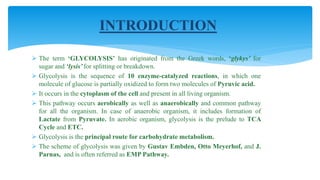
 The term ‘GLYCOLYSIS’ has originated from the Greek words, ‘glykys’ for
sugar and ‘lysis’ for splitting or breakdown.
 Glycolysis is the sequence of 10 enzyme-catalyzed reactions, in which one
molecule of glucose is partially oxidized to form two molecules of Pyruvic acid.
 It occurs in the cytoplasm of the cell and present in all living organism.
 This pathway occurs aerobically as well as anaerobically and common pathway
for all the organism. In case of anaerobic organism, it includes formation of
Lactate from Pyruvate. In aerobic organism, glycolysis is the prelude to TCA
Cycle and ETC.
 Glycolysis is the principal route for carbohydrate metabolism.
 The scheme of glycolysis was given by Gustav Embden, Otto Meyerhof, and J.
Parnas, and is often referred as EMP Pathway.
INTRODUCTION
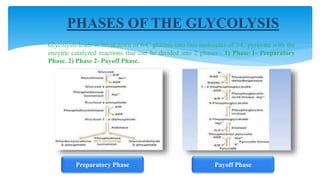
Glycolysis leads to breakdown of 6-C glucose into two molecules of 3-C pyruvate with the
enzyme catalyzed reactions that can be divided into 2 phases:- 1) Phase 1- Preparatory
Phase. 2) Phase 2- Payoff Phase.
PHASES OF THE GLYCOLYSIS
Preparatory Phase Payoff Phase
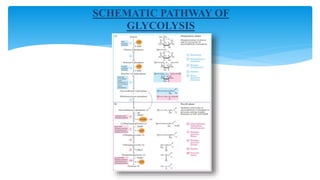
SCHEMATIC PATHWAY OF
GLYCOLYSIS
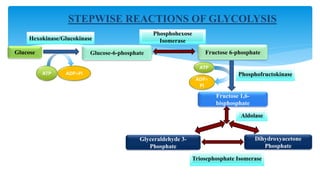
STEPWISE REACTIONS OF GLYCOLYSIS
Glucose Glucose-6-phosphate
Hexokinase/Glucokinase
ATP ADP+Pi
Phosphohexose
Isomerase
Fructose 6-phosphate
Fructose 1,6-
bisphosphate
Phosphofructokinase
ATP
ADP+
Pi
Glyceraldehyde 3-
Phosphate
Dihydroxyacetone
Phosphate
Triosephosphate Isomerase
Aldolase
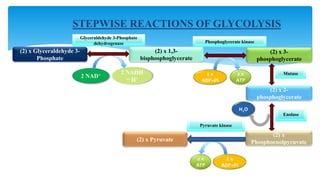
STEPWISE REACTIONS OF GLYCOLYSIS
(2) x Glyceraldehyde 3-
Phosphate
(2) x 1,3-
bisphosphoglycerate
Glyceraldehyde 3-Phosphate
dehydrogenase
2 NAD+ 2 NADH
+ H+
(2) x 3-
phosphoglycerate
Phosphoglycerate kinase
2 x
ATP
2 x
ADP+Pi
(2) x 2-
phosphoglycerate
Mutase
(2) x
Phosphoenolpyruvate
H2O
(2) x Pyruvate
Enolase
Pyruvate kinase
2 x
ATP
2 x
ADP+Pi
 After the formation of Pyruvate, there are two pathways based on the availability of
oxygen:-
 Under anaerobic condition pyruvate is reduced to lactate by lactate dehydrogenase. It is
also reduced to Ethanol (along with CO2) by pyruvate decarboxylase and alcohol
dehydrogenase.
 Under aerobic condition, pyruvate is transported to mitochondria and undergoes oxidative
decarboxylation by pyruvate dehydrogenase to form Acetyl-CoA, then oxidation to
CO2 in the TCA Cycle.
FATE OF THE PYRUVATE
STEP NO. REACTION CONSUMPTION OF
ATP
GAIN OF ATP
1 Glucose Glucose 6-phosphate 1 -
3 Fructose 6-phosphate Fructose 1,6-
phosphate
1 -
6 Glyceraldehyde 3-phosphate 1,3-
bisphosphoglycerate
- (2.5x2)=5
[by respiratory chain
oxidation of 2 NADH]
7 1,3-bisphosphoglycerate 3-
Phosphoglycerate
- (1x2)=2
[by substrate-level
phosphorylation]
10 Phosphoenolpyruvate Pyruvate - (1x2)=2
[by substrate-level
phosphorylation]
TOTAL 2 9
ENERGETICS
*Net gain of ATP = (9-2) = 7
Glycolysis is mainly regulated b:- i) Enzymatic regulation ii) Hormonal regulation.
i) Enzymatic regulation: Three enzymes regulates the glycolysis majorly. They are
Hexokinase/Glucokinase, Phosphofructokinase & Pyruvate kinase. Hexokinase is
allosterically inhibited by Fructose 6- phosphate whereas, Glucokinase is activated by
insulin and inhibited by glucagon. Similarly, Pyruvate kinase is also activated by insulin and
inhibited by glucagon.
ii) Hormonal regulation: Glycolysis is stimulated by insulin whereas, it is inhibited by
glucagon & epinephrine.
REGULATION
 The overall reactions of Glycolysis can be summarized as:
Glucose + 2Pi + 2ADP + 2NAD+ 2Pyruvate + 2NADH + 2ATP + 2H+ + 2H2O
Thus the simultaneous reactions involved in Glycolysis are:
 Glucose is oxidized to Pyruvate.
 NAD+ is reduced to NADH.
 ADP is phosphorylated to ATP.
CONCLUSION
 HARPER’S ILLUSTRATED BIOCHEMISTRY(30TH EDTION)- Victor W. RODWELL,
David A. BENDER, Kathleen M. BOTHAM, Peter J. KENNELLY, P. Anthony WEIL, PAGE
NO 168-174
 LEHNINGER PRINCIPLES OF BIOCHEMISTRY(4TH EDITION)- David L. Nelson,
Michael M. Cox. PAGE NO 522-533
 IMAGES:
• SLIDE-4: https://images.app.goo.gl/7L5iiFFfEn1eARMx9
• SLIDE-5: https://images.app.goo.gl/HZ1eWoCrAm2AGQci9
• SLIDE-8: BIOLOGY- TEXTBOOK FOR CLASS 11- NCERT, PAGE NO:230-231
BIBLIOGRAPHY
POWEPOINT PRESENTATION ON GLYCOLYSIS.pptx

POWEPOINT PRESENTATION ON GLYCOLYSIS.pptx

  • 1.
    GURU NANAK INSTITUTEOF PHARMACEUTICAL SCIENCE & TECHNOLOGY
  • 2.
     Introduction  Phasesof the Glycolysis  Schematic pathway of the Glycolysis  Stepwise reactions of the Glycolysis  Fate of the Pyruvate  Energetics  Regulation  Conclusion  Bibliography CONTENTS
  • 3.
     The term‘GLYCOLYSIS’ has originated from the Greek words, ‘glykys’ for sugar and ‘lysis’ for splitting or breakdown.  Glycolysis is the sequence of 10 enzyme-catalyzed reactions, in which one molecule of glucose is partially oxidized to form two molecules of Pyruvic acid.  It occurs in the cytoplasm of the cell and present in all living organism.  This pathway occurs aerobically as well as anaerobically and common pathway for all the organism. In case of anaerobic organism, it includes formation of Lactate from Pyruvate. In aerobic organism, glycolysis is the prelude to TCA Cycle and ETC.  Glycolysis is the principal route for carbohydrate metabolism.  The scheme of glycolysis was given by Gustav Embden, Otto Meyerhof, and J. Parnas, and is often referred as EMP Pathway. INTRODUCTION
  • 4.
    Glycolysis leads tobreakdown of 6-C glucose into two molecules of 3-C pyruvate with the enzyme catalyzed reactions that can be divided into 2 phases:- 1) Phase 1- Preparatory Phase. 2) Phase 2- Payoff Phase. PHASES OF THE GLYCOLYSIS Preparatory Phase Payoff Phase
  • 5.
  • 6.
    STEPWISE REACTIONS OFGLYCOLYSIS Glucose Glucose-6-phosphate Hexokinase/Glucokinase ATP ADP+Pi Phosphohexose Isomerase Fructose 6-phosphate Fructose 1,6- bisphosphate Phosphofructokinase ATP ADP+ Pi Glyceraldehyde 3- Phosphate Dihydroxyacetone Phosphate Triosephosphate Isomerase Aldolase
  • 7.
    STEPWISE REACTIONS OFGLYCOLYSIS (2) x Glyceraldehyde 3- Phosphate (2) x 1,3- bisphosphoglycerate Glyceraldehyde 3-Phosphate dehydrogenase 2 NAD+ 2 NADH + H+ (2) x 3- phosphoglycerate Phosphoglycerate kinase 2 x ATP 2 x ADP+Pi (2) x 2- phosphoglycerate Mutase (2) x Phosphoenolpyruvate H2O (2) x Pyruvate Enolase Pyruvate kinase 2 x ATP 2 x ADP+Pi
  • 8.
     After theformation of Pyruvate, there are two pathways based on the availability of oxygen:-  Under anaerobic condition pyruvate is reduced to lactate by lactate dehydrogenase. It is also reduced to Ethanol (along with CO2) by pyruvate decarboxylase and alcohol dehydrogenase.  Under aerobic condition, pyruvate is transported to mitochondria and undergoes oxidative decarboxylation by pyruvate dehydrogenase to form Acetyl-CoA, then oxidation to CO2 in the TCA Cycle. FATE OF THE PYRUVATE
  • 9.
    STEP NO. REACTIONCONSUMPTION OF ATP GAIN OF ATP 1 Glucose Glucose 6-phosphate 1 - 3 Fructose 6-phosphate Fructose 1,6- phosphate 1 - 6 Glyceraldehyde 3-phosphate 1,3- bisphosphoglycerate - (2.5x2)=5 [by respiratory chain oxidation of 2 NADH] 7 1,3-bisphosphoglycerate 3- Phosphoglycerate - (1x2)=2 [by substrate-level phosphorylation] 10 Phosphoenolpyruvate Pyruvate - (1x2)=2 [by substrate-level phosphorylation] TOTAL 2 9 ENERGETICS *Net gain of ATP = (9-2) = 7
  • 10.
    Glycolysis is mainlyregulated b:- i) Enzymatic regulation ii) Hormonal regulation. i) Enzymatic regulation: Three enzymes regulates the glycolysis majorly. They are Hexokinase/Glucokinase, Phosphofructokinase & Pyruvate kinase. Hexokinase is allosterically inhibited by Fructose 6- phosphate whereas, Glucokinase is activated by insulin and inhibited by glucagon. Similarly, Pyruvate kinase is also activated by insulin and inhibited by glucagon. ii) Hormonal regulation: Glycolysis is stimulated by insulin whereas, it is inhibited by glucagon & epinephrine. REGULATION
  • 11.
     The overallreactions of Glycolysis can be summarized as: Glucose + 2Pi + 2ADP + 2NAD+ 2Pyruvate + 2NADH + 2ATP + 2H+ + 2H2O Thus the simultaneous reactions involved in Glycolysis are:  Glucose is oxidized to Pyruvate.  NAD+ is reduced to NADH.  ADP is phosphorylated to ATP. CONCLUSION
  • 12.
     HARPER’S ILLUSTRATEDBIOCHEMISTRY(30TH EDTION)- Victor W. RODWELL, David A. BENDER, Kathleen M. BOTHAM, Peter J. KENNELLY, P. Anthony WEIL, PAGE NO 168-174  LEHNINGER PRINCIPLES OF BIOCHEMISTRY(4TH EDITION)- David L. Nelson, Michael M. Cox. PAGE NO 522-533  IMAGES: • SLIDE-4: https://images.app.goo.gl/7L5iiFFfEn1eARMx9 • SLIDE-5: https://images.app.goo.gl/HZ1eWoCrAm2AGQci9 • SLIDE-8: BIOLOGY- TEXTBOOK FOR CLASS 11- NCERT, PAGE NO:230-231 BIBLIOGRAPHY