Identifying
POU5F1
Duy Nguyen
Biomed
Mr. Hyke
What is POU5F1?
• Another name OCT 4 (octamer-binding transcription
  factor 4)
• POU domain, class 5, transcription factor 1
• Transcription factor of the POU protein family
• Required during embryo genesis
• Molecular weight 38,571 Da
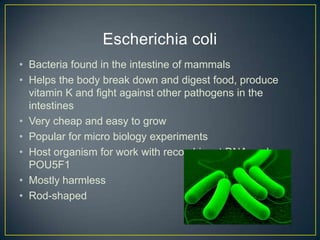
Escherichia coli
• Bacteria found in the intestine of mammals
• Helps the body break down and digest food, produce
  vitamin K and fight against other pathogens in the
  intestines
• Very cheap and easy to grow
• Popular for micro biology experiments
• Host organism for work with recombinant DNA such as
  POU5F1
• Mostly harmless
• Rod-shaped
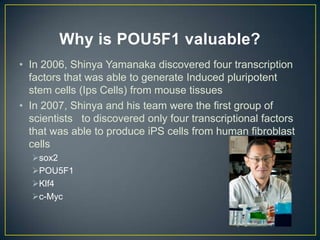
Why is POU5F1 valuable?
• In 2006, Shinya Yamanaka discovered four transcription
  factors that was able to generate Induced pluripotent
  stem cells (Ips Cells) from mouse tissues
• In 2007, Shinya and his team were the first group of
  scientists to discovered only four transcriptional factors
  that was able to produce iPS cells from human fibroblast
  cells
  sox2
  POU5F1
  Klf4
  c-Myc
Purpose/Goal
• Grow 8 colonies of BL21Star E. Coli at different pH level
  (4.0-8.0), then run them through TPP and Western Blot to
  see which E. Coli colony made the most authentic
  POU5F1 gene at the specific pH level
Hypothesis
• My hypothesis is the E. Coli grown at pH 7.0 will be able
  to produce the most authentic POU5F1
Materials
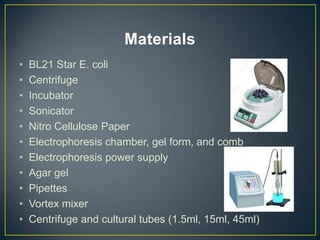
•   BL21 Star E. coli
•   Centrifuge
•   Incubator
•   Sonicator
•   Nitro Cellulose Paper
•   Electrophoresis chamber, gel form, and comb
•   Electrophoresis power supply
•   Agar gel
•   Pipettes
•   Vortex mixer
•   Centrifuge and cultural tubes (1.5ml, 15ml, 45ml)
Materials (buffer, solutions,
               antibodies)
• Phosphate Buffered Saline   •   Transfer Buffer
  (PBS)                       •   Primary Antibody
• Solid Urea                  •   Secondary antibody
• Citrate Phosphate buffer    •   Horseradish peroxidase
• Ammonium sulfate            •   H20
• Kanamycin                   •   BSA Milk
• Lysogeny Broth              •   Standard protein for SDS
• methanol                        PAGE
• Chloroform
• Tris Glycine SDS Buffer
Culturing Bacteria Procedures
1. Mix 1 mL of LB (broth) (4.0-8.0) with1mL Kanamycin
   and pipette it into 15mL cultural tube
2. Label each tube with its LB pH level
3. Get the BL21star agar plates from the freezer storage
4. Use a sterilize tip to touch the surface of each E. coli
   colony
5. Put the tip into the cultural tube and incubate the
   solution at 37° C for 4 days
6. Mix 5mL of kanamycin with 5mL of Lb at each different
   pH levels
7. Discard the tip, then pour the 10mL mixed solution into
   its corresponding Lb pH tube
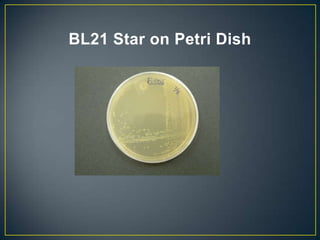
BL21 Star on Petri Dish
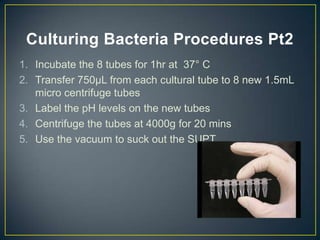
Culturing Bacteria Procedures Pt2
1. Incubate the 8 tubes for 1hr at 37° C
2. Transfer 750µL from each cultural tube to 8 new 1.5mL
   micro centrifuge tubes
3. Label the pH levels on the new tubes
4. Centrifuge the tubes at 4000g for 20 mins
5. Use the vacuum to suck out the SUPT
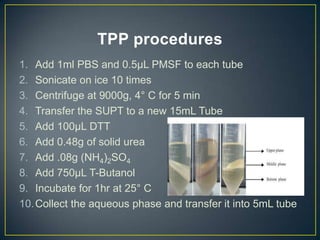
TPP procedures
1. Add 1ml PBS and 0.5µL PMSF to each tube
2. Sonicate on ice 10 times
3. Centrifuge at 9000g, 4° C for 5 min
4. Transfer the SUPT to a new 15mL Tube
5. Add 100µL DTT
6. Add 0.48g of solid urea
7. Add .08g (NH4)2SO4
8. Add 750µL T-Butanol
9. Incubate for 1hr at 25° C
10. Collect the aqueous phase and transfer it into 5mL tube
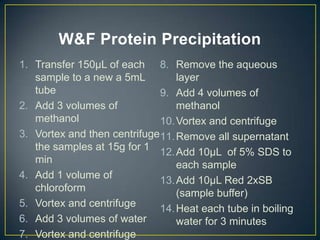
W&F Protein Precipitation
• Prepares for Western Blotting
• buffers, detergents, and salt becomes insoluble and
  change into the organic and aqueous phase
• Makes it possible to remove everything except for
  proteins
W&F Protein Precipitation
1. Transfer 150µL of each 8. Remove the aqueous
   sample to a new a 5mL         layer
   tube                      9. Add 4 volumes of
2. Add 3 volumes of              methanol
   methanol                  10. Vortex and centrifuge
3. Vortex and then centrifuge11. Remove all supernatant
   the samples at 15g for 1 12. Add 10µL of 5% SDS to
   min                           each sample
4. Add 1 volume of           13. Add 10µL Red 2xSB
   chloroform                    (sample buffer)
5. Vortex and centrifuge     14. Heat each tube in boiling
6. Add 3 volumes of water        water for 3 minutes
7. Vortex and centrifuge
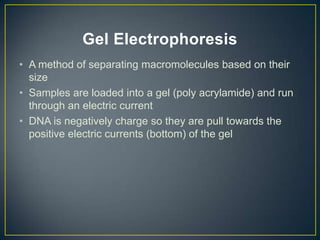
Gel Electrophoresis
• A method of separating macromolecules based on their
  size
• Samples are loaded into a gel (poly acrylamide) and run
  through an electric current
• DNA is negatively charge so they are pull towards the
  positive electric currents (bottom) of the gel
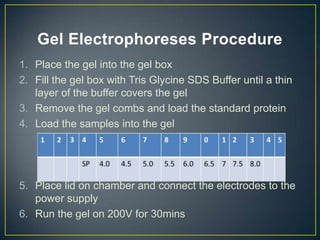
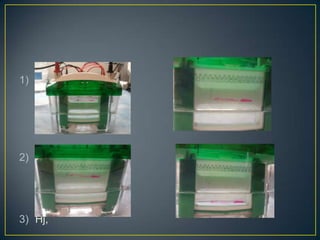
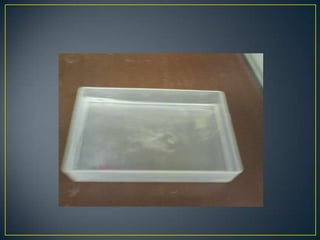
Gel Electrophoreses Procedure
1. Place the gel into the gel box
2. Fill the gel box with Tris Glycine SDS Buffer until a thin
   layer of the buffer covers the gel
3. Remove the gel combs and load the standard protein
4. Load the samples into the gel


5. Place lid on chamber and connect the electrodes to the
   power supply
6. Run the gel on 200V for 30mins
1) Gh


2) ,gj


3) Hj,
Western Blotting
• A technique that transfer the proteins from the gel into a
  nitrocellulose paper so that it can be stained with
  antibodies to specifically target the protein
• The nitrocellulose is then placed with a X-ray film and run
  through the X Ray
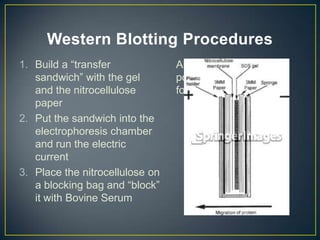
Western Blotting Procedures
1. Build a “transfer             Albumin with non fat
   sandwich” with the gel        powdered milk (liquid
   and the nitrocellulose        form)
   paper
2. Put the sandwich into the
   electrophoresis chamber
   and run the electric
   current
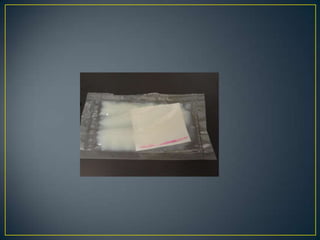
3. Place the nitrocellulose on
   a blocking bag and “block”
   it with Bovine Serum
Western Blot Procedures Cont
4. Let the Nitro cellulose incubate at 4 ° C on a shaker
5. Rinsed the BSA milk off the nitrocellulose with transfer
    buffer and add 1.5µL of Primary Antibodies with 300uL
    transfer buffer
6. Let it incubate on a shaker for 3 days at 4 ° C
7. Wash off the primary antibodies
8. Rinse and remove the primary antibodies
9. Add 1.5µL of the second antibodies and incubate for
    2hrs 4 ° C
10. Rinse the second antibodies
11. Add horseradish peroxidase (reporter enzyme) and
    SuperSignal Chemiluminescent Substrate
Results


      +


=
Results
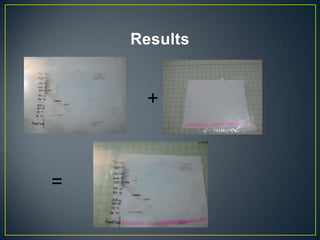
• Since POU5F1 is 38,571Da we can conclude that it is
  nearest 37,000 Da and since it was in the lane with the
  4.5 pH sample, we can conclude that BL 21 Star E. Coli
  grown at pH 4.5 is effective at making the most authentic
  POU5F1 gene
Possible Sources of Error
• Let the nitrocellulose incubate for too long
• Added the wrong amount of a solution that could of skew
  the results
• Didn’t completely wash off the BSA Milk and Antibodies
  on the nitrocellulose paper
Sources
• http://www.youtube.com/watch?v=IWZN_G_pC8U
• http://www.youtube.com/watch?v=6QYgN-toA1A
• http://www.youtube.com/watch?v=v-O103PLhm8
• http://www.youtube.com/watch?v=HddVrI2YdZY
• http://en.wikipedia.org/wiki/Western_blotting
• http://www.piercenet.com/browse.cfm?fldID=8259A7B6-7DA6-41CF-9D55-
  AA6C14F31193
• http://www.sigmaaldrich.com/life-science/cell-biology/antibodies/antibodies-
  application/protocols/western-blotting.html
• http://www.piercenet.com/browse.cfm?fldID=01041101
• http://www.springerimages.com/Images/RSS/1-10.1385_1-59259-056-
  X_173-2
• http://en.wikipedia.org/wiki/SDS_PAGE
• http://en.wikipedia.org/wiki/Gel_electrophoresis
Acknowledgments
•   Dr. Fouad Kandeel
•   Dr. Kevin Ferreri
•   Mr. Hyke
•   Family and Friends

Pou5 f1 copy

  • 1.
  • 2.
    What is POU5F1? •Another name OCT 4 (octamer-binding transcription factor 4) • POU domain, class 5, transcription factor 1 • Transcription factor of the POU protein family • Required during embryo genesis • Molecular weight 38,571 Da
  • 3.
    Escherichia coli • Bacteriafound in the intestine of mammals • Helps the body break down and digest food, produce vitamin K and fight against other pathogens in the intestines • Very cheap and easy to grow • Popular for micro biology experiments • Host organism for work with recombinant DNA such as POU5F1 • Mostly harmless • Rod-shaped
  • 4.
    Why is POU5F1valuable? • In 2006, Shinya Yamanaka discovered four transcription factors that was able to generate Induced pluripotent stem cells (Ips Cells) from mouse tissues • In 2007, Shinya and his team were the first group of scientists to discovered only four transcriptional factors that was able to produce iPS cells from human fibroblast cells sox2 POU5F1 Klf4 c-Myc
  • 5.
    Purpose/Goal • Grow 8colonies of BL21Star E. Coli at different pH level (4.0-8.0), then run them through TPP and Western Blot to see which E. Coli colony made the most authentic POU5F1 gene at the specific pH level
  • 6.
    Hypothesis • My hypothesisis the E. Coli grown at pH 7.0 will be able to produce the most authentic POU5F1
  • 7.
    Materials • BL21 Star E. coli • Centrifuge • Incubator • Sonicator • Nitro Cellulose Paper • Electrophoresis chamber, gel form, and comb • Electrophoresis power supply • Agar gel • Pipettes • Vortex mixer • Centrifuge and cultural tubes (1.5ml, 15ml, 45ml)
  • 8.
    Materials (buffer, solutions, antibodies) • Phosphate Buffered Saline • Transfer Buffer (PBS) • Primary Antibody • Solid Urea • Secondary antibody • Citrate Phosphate buffer • Horseradish peroxidase • Ammonium sulfate • H20 • Kanamycin • BSA Milk • Lysogeny Broth • Standard protein for SDS • methanol PAGE • Chloroform • Tris Glycine SDS Buffer
  • 9.
    Culturing Bacteria Procedures 1.Mix 1 mL of LB (broth) (4.0-8.0) with1mL Kanamycin and pipette it into 15mL cultural tube 2. Label each tube with its LB pH level 3. Get the BL21star agar plates from the freezer storage 4. Use a sterilize tip to touch the surface of each E. coli colony 5. Put the tip into the cultural tube and incubate the solution at 37° C for 4 days 6. Mix 5mL of kanamycin with 5mL of Lb at each different pH levels 7. Discard the tip, then pour the 10mL mixed solution into its corresponding Lb pH tube
  • 10.
    BL21 Star onPetri Dish
  • 11.
    Culturing Bacteria ProceduresPt2 1. Incubate the 8 tubes for 1hr at 37° C 2. Transfer 750µL from each cultural tube to 8 new 1.5mL micro centrifuge tubes 3. Label the pH levels on the new tubes 4. Centrifuge the tubes at 4000g for 20 mins 5. Use the vacuum to suck out the SUPT
  • 12.
    TPP procedures 1. Add1ml PBS and 0.5µL PMSF to each tube 2. Sonicate on ice 10 times 3. Centrifuge at 9000g, 4° C for 5 min 4. Transfer the SUPT to a new 15mL Tube 5. Add 100µL DTT 6. Add 0.48g of solid urea 7. Add .08g (NH4)2SO4 8. Add 750µL T-Butanol 9. Incubate for 1hr at 25° C 10. Collect the aqueous phase and transfer it into 5mL tube
  • 13.
    W&F Protein Precipitation •Prepares for Western Blotting • buffers, detergents, and salt becomes insoluble and change into the organic and aqueous phase • Makes it possible to remove everything except for proteins
  • 14.
    W&F Protein Precipitation 1.Transfer 150µL of each 8. Remove the aqueous sample to a new a 5mL layer tube 9. Add 4 volumes of 2. Add 3 volumes of methanol methanol 10. Vortex and centrifuge 3. Vortex and then centrifuge11. Remove all supernatant the samples at 15g for 1 12. Add 10µL of 5% SDS to min each sample 4. Add 1 volume of 13. Add 10µL Red 2xSB chloroform (sample buffer) 5. Vortex and centrifuge 14. Heat each tube in boiling 6. Add 3 volumes of water water for 3 minutes 7. Vortex and centrifuge
  • 15.
    Gel Electrophoresis • Amethod of separating macromolecules based on their size • Samples are loaded into a gel (poly acrylamide) and run through an electric current • DNA is negatively charge so they are pull towards the positive electric currents (bottom) of the gel
  • 16.
    Gel Electrophoreses Procedure 1.Place the gel into the gel box 2. Fill the gel box with Tris Glycine SDS Buffer until a thin layer of the buffer covers the gel 3. Remove the gel combs and load the standard protein 4. Load the samples into the gel 5. Place lid on chamber and connect the electrodes to the power supply 6. Run the gel on 200V for 30mins
  • 17.
  • 19.
    Western Blotting • Atechnique that transfer the proteins from the gel into a nitrocellulose paper so that it can be stained with antibodies to specifically target the protein • The nitrocellulose is then placed with a X-ray film and run through the X Ray
  • 20.
    Western Blotting Procedures 1.Build a “transfer Albumin with non fat sandwich” with the gel powdered milk (liquid and the nitrocellulose form) paper 2. Put the sandwich into the electrophoresis chamber and run the electric current 3. Place the nitrocellulose on a blocking bag and “block” it with Bovine Serum
  • 22.
    Western Blot ProceduresCont 4. Let the Nitro cellulose incubate at 4 ° C on a shaker 5. Rinsed the BSA milk off the nitrocellulose with transfer buffer and add 1.5µL of Primary Antibodies with 300uL transfer buffer 6. Let it incubate on a shaker for 3 days at 4 ° C 7. Wash off the primary antibodies 8. Rinse and remove the primary antibodies 9. Add 1.5µL of the second antibodies and incubate for 2hrs 4 ° C 10. Rinse the second antibodies 11. Add horseradish peroxidase (reporter enzyme) and SuperSignal Chemiluminescent Substrate
  • 23.
  • 24.
    Results • Since POU5F1is 38,571Da we can conclude that it is nearest 37,000 Da and since it was in the lane with the 4.5 pH sample, we can conclude that BL 21 Star E. Coli grown at pH 4.5 is effective at making the most authentic POU5F1 gene
  • 25.
    Possible Sources ofError • Let the nitrocellulose incubate for too long • Added the wrong amount of a solution that could of skew the results • Didn’t completely wash off the BSA Milk and Antibodies on the nitrocellulose paper
  • 26.
    Sources • http://www.youtube.com/watch?v=IWZN_G_pC8U • http://www.youtube.com/watch?v=6QYgN-toA1A •http://www.youtube.com/watch?v=v-O103PLhm8 • http://www.youtube.com/watch?v=HddVrI2YdZY • http://en.wikipedia.org/wiki/Western_blotting • http://www.piercenet.com/browse.cfm?fldID=8259A7B6-7DA6-41CF-9D55- AA6C14F31193 • http://www.sigmaaldrich.com/life-science/cell-biology/antibodies/antibodies- application/protocols/western-blotting.html • http://www.piercenet.com/browse.cfm?fldID=01041101 • http://www.springerimages.com/Images/RSS/1-10.1385_1-59259-056- X_173-2 • http://en.wikipedia.org/wiki/SDS_PAGE • http://en.wikipedia.org/wiki/Gel_electrophoresis
  • 27.
    Acknowledgments • Dr. Fouad Kandeel • Dr. Kevin Ferreri • Mr. Hyke • Family and Friends