PostgreSQL 10
table partitioning
by Marek Hudyma
Agenda
● What it table partitioning
● Benefits of partitioning
● How to implement it
● Limitations
● Postgres 11 features
● Scanning partitioned tables
Overview
“Table partitioning refers to splitting
what is logically one large table into smaller
physical pieces.”
Methods
● Vertical partitioning
● Horizontal partitioning
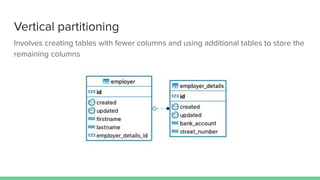
Vertical partitioning
Involves creating tables with fewer columns and using additional tables to store the
remaining columns
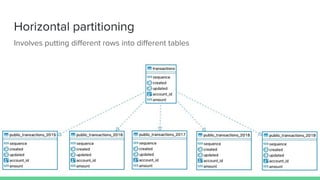
Horizontal partitioning
Involves putting different rows into different tables
Types of horizontal partitioning
● Range partitioning - The table is partitioned into “ranges”
defined by a key column or set of columns, with no overlap
between the ranges of values assigned to different
partitions. For example, one might partition by date ranges
or by ranges of identifiers for particular business objects.
● List Partitioning - The table is partitioned by explicitly
listing which key values appear in each partition.
Benefits of partitioning
● Your SQL queries performance can be improved
dramatically.
● Bulk loads and deletes can be accomplished by adding or
removing partitions.
● Seldom-used data can be migrated to cheaper and slower
storage media.
● For frequently-used data you can create sub-partitions.
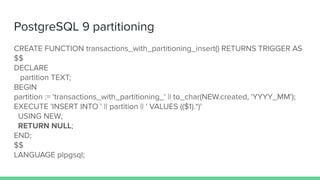
PostgreSQL 9 partitioning
CREATE FUNCTION transactions_with_partitioning_insert() RETURNS TRIGGER AS
$$
DECLARE
partition TEXT;
BEGIN
partition := 'transactions_with_partitioning_' || to_char(NEW.created, 'YYYY_MM');
EXECUTE 'INSERT INTO ' || partition || ' VALUES (($1).*)'
USING NEW;
RETURN NULL;
END;
$$
LANGUAGE plpgsql;
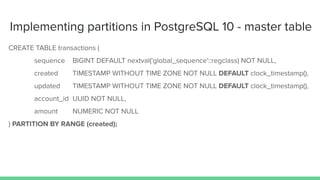
Implementing partitions in PostgreSQL 10 - master table
CREATE TABLE transactions (
sequence BIGINT DEFAULT nextval('global_sequence'::regclass) NOT NULL,
created TIMESTAMP WITHOUT TIME ZONE NOT NULL DEFAULT clock_timestamp(),
updated TIMESTAMP WITHOUT TIME ZONE NOT NULL DEFAULT clock_timestamp(),
account_id UUID NOT NULL,
amount NUMERIC NOT NULL
) PARTITION BY RANGE (created);
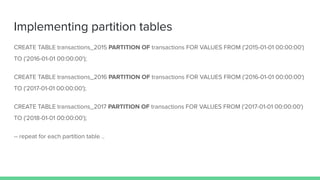
Implementing partition tables
CREATE TABLE transactions_2015 PARTITION OF transactions FOR VALUES FROM ('2015-01-01 00:00:00')
TO ('2016-01-01 00:00:00');
CREATE TABLE transactions_2016 PARTITION OF transactions FOR VALUES FROM ('2016-01-01 00:00:00')
TO ('2017-01-01 00:00:00');
CREATE TABLE transactions_2017 PARTITION OF transactions FOR VALUES FROM ('2017-01-01 00:00:00')
TO ('2018-01-01 00:00:00');
-- repeat for each partition table ..
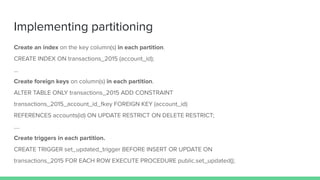
Implementing partitioning
Create an index on the key column(s) in each partition.
CREATE INDEX ON transactions_2015 (account_id);
…
Create foreign keys on column(s) in each partition.
ALTER TABLE ONLY transactions_2015 ADD CONSTRAINT
transactions_2015_account_id_fkey FOREIGN KEY (account_id)
REFERENCES accounts(id) ON UPDATE RESTRICT ON DELETE RESTRICT;
….
Create triggers in each partition.
CREATE TRIGGER set_updated_trigger BEFORE INSERT OR UPDATE ON
transactions_2015 FOR EACH ROW EXECUTE PROCEDURE public.set_updated();
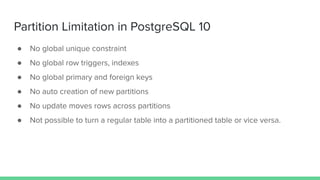
Partition Limitation in PostgreSQL 10
● No global unique constraint
● No global row triggers, indexes
● No global primary and foreign keys
● No auto creation of new partitions
● No update moves rows across partitions
● Not possible to turn a regular table into a partitioned table or vice versa.
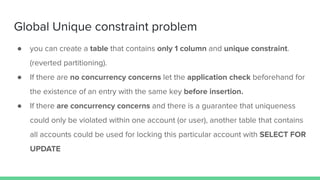
Global Unique constraint problem
● you can create a table that contains only 1 column and unique constraint.
(reverted partitioning).
● If there are no concurrency concerns let the application check beforehand for
the existence of an entry with the same key before insertion.
● If there are concurrency concerns and there is a guarantee that uniqueness
could only be violated within one account (or user), another table that contains
all accounts could be used for locking this particular account with SELECT FOR
UPDATE
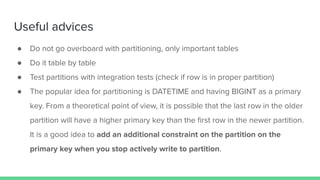
Useful advices
● Do not go overboard with partitioning, only important tables
● Do it table by table
● Test partitions with integration tests (check if row is in proper partition)
● The popular idea for partitioning is DATETIME and having BIGINT as a primary
key. From a theoretical point of view, it is possible that the last row in the older
partition will have a higher primary key than the first row in the newer partition.
It is a good idea to add an additional constraint on the partition on the
primary key when you stop actively write to partition.
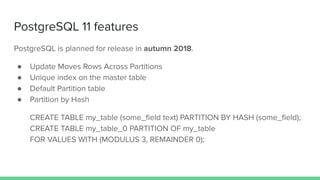
PostgreSQL 11 features
PostgreSQL is planned for release in autumn 2018.
● Update Moves Rows Across Partitions
● Unique index on the master table
● Default Partition table
● Partition by Hash
CREATE TABLE my_table (some_field text) PARTITION BY HASH (some_field);
CREATE TABLE my_table_0 PARTITION OF my_table
FOR VALUES WITH (MODULUS 3, REMAINDER 0);
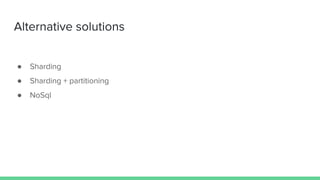
Alternative solutions
● Sharding
● Sharding + partitioning
● NoSql
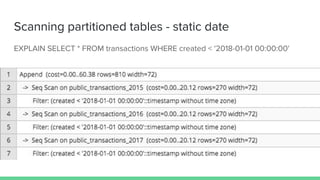
Scanning partitioned tables - static date
EXPLAIN SELECT * FROM transactions WHERE created < '2018-01-01 00:00:00'
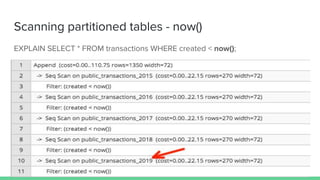
Scanning partitioned tables - now()
EXPLAIN SELECT * FROM transactions WHERE created < now();
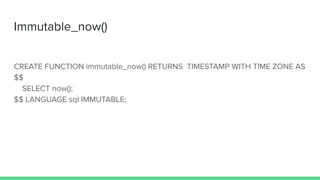
Immutable_now()
CREATE FUNCTION immutable_now() RETURNS TIMESTAMP WITH TIME ZONE AS
$$
SELECT now();
$$ LANGUAGE sql IMMUTABLE;
immutable_now() problem
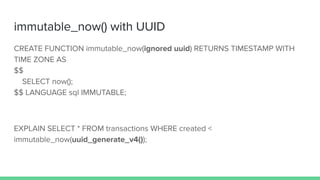
immutable_now() with UUID
CREATE FUNCTION immutable_now(ignored uuid) RETURNS TIMESTAMP WITH
TIME ZONE AS
$$
SELECT now();
$$ LANGUAGE sql IMMUTABLE;
EXPLAIN SELECT * FROM transactions WHERE created <
immutable_now(uuid_generate_v4());
code example
https://github.com/marekhudyma/partitioning
Summary
● Partitioning in PostgreSQL 10 is a big improvement.
● Partitioning is not trivial.
● PostgreSQL 11 will be another gamechanger.
Thank you!
Questions?

Postgre sql 10 table partitioning

  • 1.
  • 2.
    Agenda ● What ittable partitioning ● Benefits of partitioning ● How to implement it ● Limitations ● Postgres 11 features ● Scanning partitioned tables
  • 3.
    Overview “Table partitioning refersto splitting what is logically one large table into smaller physical pieces.”
  • 4.
  • 5.
    Vertical partitioning Involves creatingtables with fewer columns and using additional tables to store the remaining columns
  • 6.
    Horizontal partitioning Involves puttingdifferent rows into different tables
  • 7.
    Types of horizontalpartitioning ● Range partitioning - The table is partitioned into “ranges” defined by a key column or set of columns, with no overlap between the ranges of values assigned to different partitions. For example, one might partition by date ranges or by ranges of identifiers for particular business objects. ● List Partitioning - The table is partitioned by explicitly listing which key values appear in each partition.
  • 8.
    Benefits of partitioning ●Your SQL queries performance can be improved dramatically. ● Bulk loads and deletes can be accomplished by adding or removing partitions. ● Seldom-used data can be migrated to cheaper and slower storage media. ● For frequently-used data you can create sub-partitions.
  • 9.
    PostgreSQL 9 partitioning CREATEFUNCTION transactions_with_partitioning_insert() RETURNS TRIGGER AS $$ DECLARE partition TEXT; BEGIN partition := 'transactions_with_partitioning_' || to_char(NEW.created, 'YYYY_MM'); EXECUTE 'INSERT INTO ' || partition || ' VALUES (($1).*)' USING NEW; RETURN NULL; END; $$ LANGUAGE plpgsql;
  • 10.
    Implementing partitions inPostgreSQL 10 - master table CREATE TABLE transactions ( sequence BIGINT DEFAULT nextval('global_sequence'::regclass) NOT NULL, created TIMESTAMP WITHOUT TIME ZONE NOT NULL DEFAULT clock_timestamp(), updated TIMESTAMP WITHOUT TIME ZONE NOT NULL DEFAULT clock_timestamp(), account_id UUID NOT NULL, amount NUMERIC NOT NULL ) PARTITION BY RANGE (created);
  • 11.
    Implementing partition tables CREATETABLE transactions_2015 PARTITION OF transactions FOR VALUES FROM ('2015-01-01 00:00:00') TO ('2016-01-01 00:00:00'); CREATE TABLE transactions_2016 PARTITION OF transactions FOR VALUES FROM ('2016-01-01 00:00:00') TO ('2017-01-01 00:00:00'); CREATE TABLE transactions_2017 PARTITION OF transactions FOR VALUES FROM ('2017-01-01 00:00:00') TO ('2018-01-01 00:00:00'); -- repeat for each partition table ..
  • 12.
    Implementing partitioning Create anindex on the key column(s) in each partition. CREATE INDEX ON transactions_2015 (account_id); … Create foreign keys on column(s) in each partition. ALTER TABLE ONLY transactions_2015 ADD CONSTRAINT transactions_2015_account_id_fkey FOREIGN KEY (account_id) REFERENCES accounts(id) ON UPDATE RESTRICT ON DELETE RESTRICT; …. Create triggers in each partition. CREATE TRIGGER set_updated_trigger BEFORE INSERT OR UPDATE ON transactions_2015 FOR EACH ROW EXECUTE PROCEDURE public.set_updated();
  • 13.
    Partition Limitation inPostgreSQL 10 ● No global unique constraint ● No global row triggers, indexes ● No global primary and foreign keys ● No auto creation of new partitions ● No update moves rows across partitions ● Not possible to turn a regular table into a partitioned table or vice versa.
  • 14.
    Global Unique constraintproblem ● you can create a table that contains only 1 column and unique constraint. (reverted partitioning). ● If there are no concurrency concerns let the application check beforehand for the existence of an entry with the same key before insertion. ● If there are concurrency concerns and there is a guarantee that uniqueness could only be violated within one account (or user), another table that contains all accounts could be used for locking this particular account with SELECT FOR UPDATE
  • 15.
    Useful advices ● Donot go overboard with partitioning, only important tables ● Do it table by table ● Test partitions with integration tests (check if row is in proper partition) ● The popular idea for partitioning is DATETIME and having BIGINT as a primary key. From a theoretical point of view, it is possible that the last row in the older partition will have a higher primary key than the first row in the newer partition. It is a good idea to add an additional constraint on the partition on the primary key when you stop actively write to partition.
  • 16.
    PostgreSQL 11 features PostgreSQLis planned for release in autumn 2018. ● Update Moves Rows Across Partitions ● Unique index on the master table ● Default Partition table ● Partition by Hash CREATE TABLE my_table (some_field text) PARTITION BY HASH (some_field); CREATE TABLE my_table_0 PARTITION OF my_table FOR VALUES WITH (MODULUS 3, REMAINDER 0);
  • 17.
    Alternative solutions ● Sharding ●Sharding + partitioning ● NoSql
  • 18.
    Scanning partitioned tables- static date EXPLAIN SELECT * FROM transactions WHERE created < '2018-01-01 00:00:00'
  • 19.
    Scanning partitioned tables- now() EXPLAIN SELECT * FROM transactions WHERE created < now();
  • 20.
    Immutable_now() CREATE FUNCTION immutable_now()RETURNS TIMESTAMP WITH TIME ZONE AS $$ SELECT now(); $$ LANGUAGE sql IMMUTABLE;
  • 21.
  • 22.
    immutable_now() with UUID CREATEFUNCTION immutable_now(ignored uuid) RETURNS TIMESTAMP WITH TIME ZONE AS $$ SELECT now(); $$ LANGUAGE sql IMMUTABLE; EXPLAIN SELECT * FROM transactions WHERE created < immutable_now(uuid_generate_v4());
  • 23.
  • 24.
    Summary ● Partitioning inPostgreSQL 10 is a big improvement. ● Partitioning is not trivial. ● PostgreSQL 11 will be another gamechanger.
  • 25.