Rotating Wave Approximation Breakdown in Few Cycle Pulses
                                                            Abhijit Mondal, Amartya Bose, Debabrata Goswami*
                                                            Department of Chemistry, IIT Kanpur, India-208016
                                                                     *Email: dgoswami@iitk.ac.in


                                                   Abstract
Though population evolution with pulsed laser interaction has been very successful with the help of RWA,
however, for a few cycle pulses, the RWA breaks down. This poster elucidates this work mathematically for
model systems. In this poster we have shown how gaussian pulses are used to produce NOT gate and
Hadamard gate, how ineffective the Gate operation becomes in the regime of small electric field frequency of
the gaussian pulse and how ineffective can such short pulses(attosecond) be when it comes to applications in
biology and chemistry.

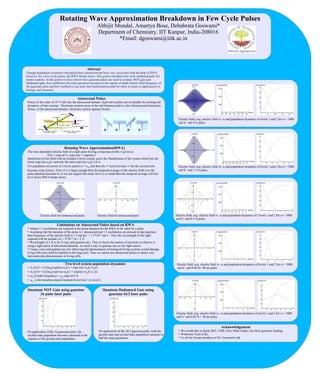
                                           Attosecond Pulses
 Pulses of the order of 10-18s fall into the attosecond domain. Such short pulses are invaluable for probing the
 dynamics of fast systems. Electronic motion occur in the sub-femtosecond to a few femtosecond timescales.
 Hence, in the attosecond domain, electronic motion appears frozen.


                                                                                                                        Electric field, avg. electric field vs. ω and population dynamics of levels 1 and 2 for ω = 1000
                                                                                                                        rad fs-1 and 4 fs pulse.


                                Rotating Wave Approximation(RWA)
 The time dependent electric field of a light pulse having a Gaussian profile is given as:
                  E(t) = exp(-αt2) ( exp(-iωt) + exp(iωt) )
 Interaction of this field with an isolated 2-level system, gives the Hamiltonian of the system which has the
 terms exp(-i(ω-ω0)t ) and also the term exp(-i(ω+ω0)t ) in it.
 For population inversion in 2-level sytems ω = ω0, and thus the 1st term becomes 1, but the second term                Electric field, avg. electric field vs. ω and population dynamics of levels 1 and 2 for ω = 1000
 becomes exp(-i(2ω)t ). Now if ω is large enough then the temporal average of the electric field over the               rad fs-1 and 1.5 fs pulse.
 pulse duration becomes 0, so we can neglect this term, but if ω is small then the temporal average will not
 be 0, hence RWA breaks down.


           Electric field for femtosecond pulse             Electric field for attosecond pulse                       Electric field, avg. electric field vs. ω and population dynamics of levels 1 and 2 for ω = 1000
                                                                                                                      rad fs-1 and 0.5 fs pulse.

                         Limitations on Attosecond Pulses based on RWA
 
   Atleast 1.5 oscillations are required in the pulse duration for the RWA to be valid for a pulse.
 
   Assuming that the duration of the pulse is 1 attosecond and 1.5 oscillations are present in that duartion,
 then frequency of the electric field is 1.5 rad ats-1 = 1.5*1018 rad s-1. Thus the wavelength of the light
 required will be around c/ω = 2*10-10 m = 2 Å.
 
   Wavelength of 2 Å is for X-rays and gamma rays. Thus to freeze the motion of electrons to observe it
 using a light pulse of attosecond duration, we need x-rays or gamma rays as the light source.
 
   Using x-rays and gamma rays for observing fast phenomenon in biological living systems would damage
 living cells and could be harmful in the long term. Thus we cannot use attosecond pulses to detect very
 fast molecular phenomenons in living cells.

                                Two level system population dynamics                                                  Electric field, avg. electric field vs. ω and population dynamics of levels 1 and 2 for ω = 1000
  ∂c1(t)/∂t = (i/2)ωR(exp(i(ω-ω0)t ) + exp(-i(ω+ω0)t ) c2(t)                                                         rad fs-1 and 0.08 fs= 80 ats pulse.
  ∂c (t)/∂t = (i/2)ω (exp(-i(ω-ω )t ) + exp(i(ω+ω )t ) c (t)
      2                R           0               0     1
  ω (t) (rabi frequency) = μ exp(-αt2)/ ħ
    R                           12
  μ    is the transition dipole moment from level 1 to level 2.
     12


 Quantum NOT Gate using gaussian                                   Quantum Hadamard Gate using
       3π pulse laser pulse                                           gaussian 3π/2 laser pulse


                                                                                                                      Electric field, avg. electric field vs. ω and population dynamics of levels 1 and 2 for ω = 1000
                                                                                                                      rad fs-1 and 0.02 fs = 20 ats pulse.


                                                                                                                                                           Acknowledgement
 On application of the 3π gaussian pulse, the                On application of the 3π/2 gaussian pulse, both the        
                                                                                                                          We would like to thank DST, CSIR, New Delhi (India ) for their generous funding.
 excited state population becomes saturated at the           ground state and excited state population saturates at     
                                                                                                                          Wellcome Trust (UK).
 expense of the ground state population                      half the total population                                  
                                                                                                                          To all the Group members of Dr. Goswami's lab

Poster Presentation

  • 1.
    Rotating Wave ApproximationBreakdown in Few Cycle Pulses Abhijit Mondal, Amartya Bose, Debabrata Goswami* Department of Chemistry, IIT Kanpur, India-208016 *Email: dgoswami@iitk.ac.in Abstract Though population evolution with pulsed laser interaction has been very successful with the help of RWA, however, for a few cycle pulses, the RWA breaks down. This poster elucidates this work mathematically for model systems. In this poster we have shown how gaussian pulses are used to produce NOT gate and Hadamard gate, how ineffective the Gate operation becomes in the regime of small electric field frequency of the gaussian pulse and how ineffective can such short pulses(attosecond) be when it comes to applications in biology and chemistry. Attosecond Pulses Pulses of the order of 10-18s fall into the attosecond domain. Such short pulses are invaluable for probing the dynamics of fast systems. Electronic motion occur in the sub-femtosecond to a few femtosecond timescales. Hence, in the attosecond domain, electronic motion appears frozen. Electric field, avg. electric field vs. ω and population dynamics of levels 1 and 2 for ω = 1000 rad fs-1 and 4 fs pulse. Rotating Wave Approximation(RWA) The time dependent electric field of a light pulse having a Gaussian profile is given as: E(t) = exp(-αt2) ( exp(-iωt) + exp(iωt) ) Interaction of this field with an isolated 2-level system, gives the Hamiltonian of the system which has the terms exp(-i(ω-ω0)t ) and also the term exp(-i(ω+ω0)t ) in it. For population inversion in 2-level sytems ω = ω0, and thus the 1st term becomes 1, but the second term Electric field, avg. electric field vs. ω and population dynamics of levels 1 and 2 for ω = 1000 becomes exp(-i(2ω)t ). Now if ω is large enough then the temporal average of the electric field over the rad fs-1 and 1.5 fs pulse. pulse duration becomes 0, so we can neglect this term, but if ω is small then the temporal average will not be 0, hence RWA breaks down. Electric field for femtosecond pulse Electric field for attosecond pulse Electric field, avg. electric field vs. ω and population dynamics of levels 1 and 2 for ω = 1000 rad fs-1 and 0.5 fs pulse. Limitations on Attosecond Pulses based on RWA  Atleast 1.5 oscillations are required in the pulse duration for the RWA to be valid for a pulse.  Assuming that the duration of the pulse is 1 attosecond and 1.5 oscillations are present in that duartion, then frequency of the electric field is 1.5 rad ats-1 = 1.5*1018 rad s-1. Thus the wavelength of the light required will be around c/ω = 2*10-10 m = 2 Å.  Wavelength of 2 Å is for X-rays and gamma rays. Thus to freeze the motion of electrons to observe it using a light pulse of attosecond duration, we need x-rays or gamma rays as the light source.  Using x-rays and gamma rays for observing fast phenomenon in biological living systems would damage living cells and could be harmful in the long term. Thus we cannot use attosecond pulses to detect very fast molecular phenomenons in living cells. Two level system population dynamics Electric field, avg. electric field vs. ω and population dynamics of levels 1 and 2 for ω = 1000  ∂c1(t)/∂t = (i/2)ωR(exp(i(ω-ω0)t ) + exp(-i(ω+ω0)t ) c2(t) rad fs-1 and 0.08 fs= 80 ats pulse.  ∂c (t)/∂t = (i/2)ω (exp(-i(ω-ω )t ) + exp(i(ω+ω )t ) c (t) 2 R 0 0 1  ω (t) (rabi frequency) = μ exp(-αt2)/ ħ R 12  μ is the transition dipole moment from level 1 to level 2. 12 Quantum NOT Gate using gaussian Quantum Hadamard Gate using 3π pulse laser pulse gaussian 3π/2 laser pulse Electric field, avg. electric field vs. ω and population dynamics of levels 1 and 2 for ω = 1000 rad fs-1 and 0.02 fs = 20 ats pulse. Acknowledgement On application of the 3π gaussian pulse, the On application of the 3π/2 gaussian pulse, both the  We would like to thank DST, CSIR, New Delhi (India ) for their generous funding. excited state population becomes saturated at the ground state and excited state population saturates at  Wellcome Trust (UK). expense of the ground state population half the total population  To all the Group members of Dr. Goswami's lab