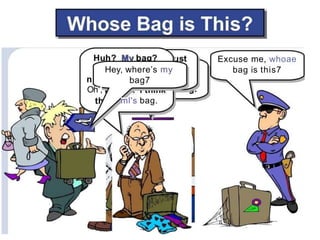
Hey, where’s my
bag7
Oh”,
ml's bag.
Excuse me, whoae
bag is this7
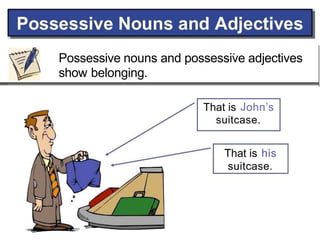
Possessive nouns and possessive adjectives
show belonging.
That is John’s
suitcase.
That is his
suitcase.
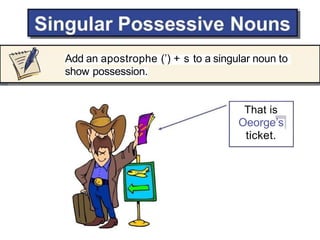
Add an apostrophe (’) + s to a singular noun to
show possession.
That is
Oeorge’s
ticket.
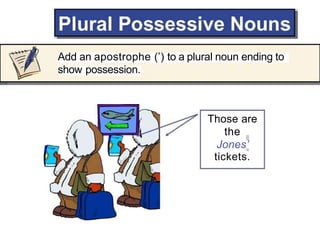
Add an apostrophe (’) to a plural noun ending to
show possession.
Those are
the
Jones’
tickets.
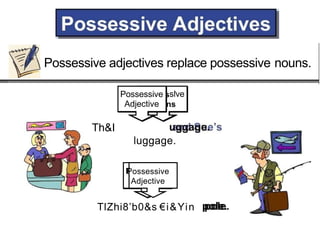
Possessive adjectives replace possessive nouns.
sive
Possessive
Adjective
Th&I
luggage.
Possessive
Adjective
TlZhi8’b0&s €i&Yin
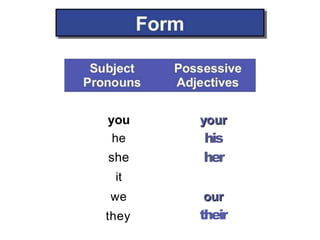
he
she
it
we
they
his
her
their
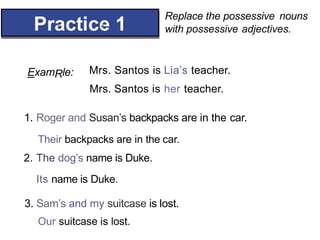
Replace the possessive nouns
with possessive adjectives.
° *
ExamRle: Mrs. Santos is Lia’s teacher.
Mrs. Santos is her teacher.
1. Roger and Susan’s backpacks are in the car.
Their backpacks are in the car.
2. The dog’s name is Duke.
Its name is Duke.
3. Sam’s and my suitcase is lost.
Our suitcase is lost.
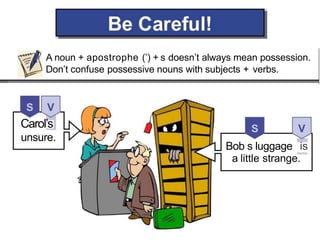
A noun + apostrophe (’) + s doesn’t always mean possession.
Don’t confuse possessive nouns with subjects + verbs.
Carol’s
unsure.
Bob s luggage is
a little strange.
S
S
S
—
V
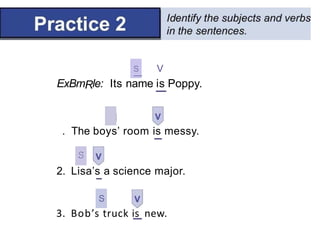
ExBmRle: Its name is Poppy.
. The boys’ room is messy.
2. Lisa’s a science major.
3. Bob’s truck is new.
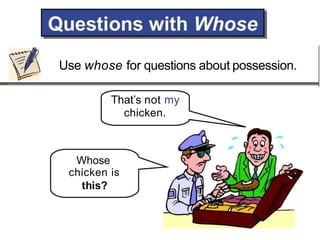
Use whose for questions about possession.
That’s not my
chicken.
Whose
chicken is
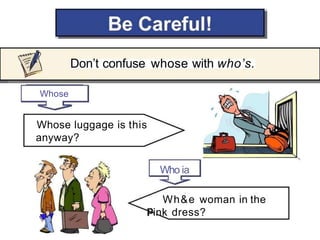
Whose
Whose luggage is this
anyway?
Who ia
Wh&e woman in the
ink dress?
Don’t confuse whose with who’s.
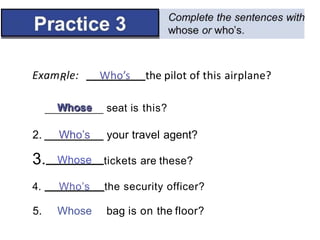
ExamRle: Who’s the pilot of this airplane?
seat is this?
2. Who’s your travel agent?
3. Whose tickets are these?
4. Who’s the security officer?
5. Whose bag is on the floor?
Copyright 2006 Pearson Education a
its Iicensors. All rightsreserved.

Possessive adjectives

  • 2.
    Hey, where’s my bag7 Oh”, ml'sbag. Excuse me, whoae bag is this7
  • 3.
    Possessive nouns andpossessive adjectives show belonging. That is John’s suitcase. That is his suitcase.
  • 4.
    Add an apostrophe(’) + s to a singular noun to show possession. That is Oeorge’s ticket.
  • 5.
    Add an apostrophe(’) to a plural noun ending to show possession. Those are the Jones’ tickets.
  • 6.
    Possessive adjectives replacepossessive nouns. sive Possessive Adjective Th&I luggage. Possessive Adjective TlZhi8’b0&s €i&Yin
  • 7.
  • 8.
    Replace the possessivenouns with possessive adjectives. ° * ExamRle: Mrs. Santos is Lia’s teacher. Mrs. Santos is her teacher. 1. Roger and Susan’s backpacks are in the car. Their backpacks are in the car. 2. The dog’s name is Duke. Its name is Duke. 3. Sam’s and my suitcase is lost. Our suitcase is lost.
  • 9.
    A noun +apostrophe (’) + s doesn’t always mean possession. Don’t confuse possessive nouns with subjects + verbs. Carol’s unsure. Bob s luggage is a little strange.
  • 10.
    S S S — V ExBmRle: Its nameis Poppy. . The boys’ room is messy. 2. Lisa’s a science major. 3. Bob’s truck is new.
  • 11.
    Use whose forquestions about possession. That’s not my chicken. Whose chicken is
  • 12.
    Whose Whose luggage isthis anyway? Who ia Wh&e woman in the ink dress? Don’t confuse whose with who’s.
  • 13.
    ExamRle: Who’s thepilot of this airplane? seat is this? 2. Who’s your travel agent? 3. Whose tickets are these? 4. Who’s the security officer? 5. Whose bag is on the floor?
  • 14.
    Copyright 2006 PearsonEducation a its Iicensors. All rightsreserved.