1
• Emerged in
1950s
• Spread
throughout
the world
• Challenged
“Fine Art”


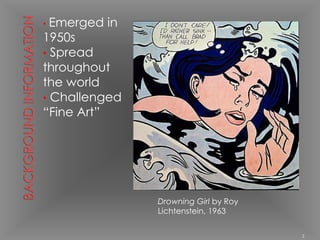
               Drowning Girl by Roy
               Lichtenstein, 1963

                                      2
   Late 1950s
                                  Inspired by popular
                                   culture
                                  Linked to wealth and
                                   prosperity


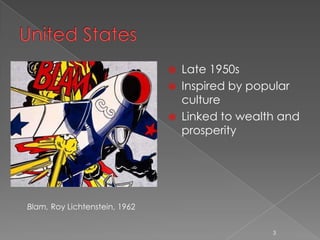
Blam, Roy Lichtenstein, 1962


                                                  3
   Britain’s inspiration
    was American
    culture
   Spain associated
    with “New
    Figurative”
   Japanese enthused
    by anime
   Came to Italy in 1964

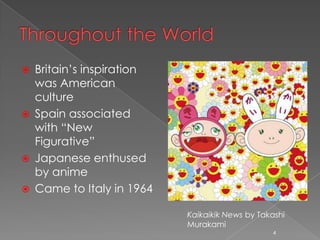
                            Kaikaikik News by Takashi
                            Murakami
                                                 4
 Reaction to
  Abstract
  Expressionism
 Eroded “high art”
  and “low art”
 People understood
  art better


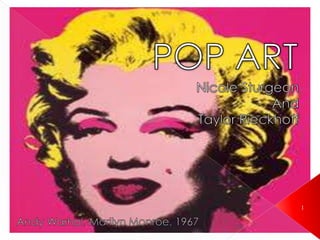
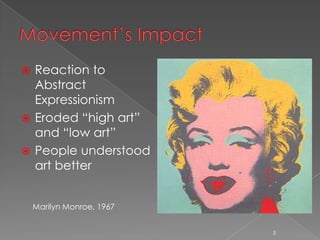
    Marilyn Monroe, 1967


                           5
 All kinds of artists
 First meeting in
  1952
 Challenged
  modernists


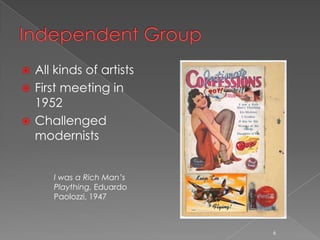
      I was a Rich Man’s
      Plaything, Eduardo
      Paolozzi, 1947


                           6
   Recognizable
    Imagery
   Popular Media and
    Products
   Bright Colors
   Flat Imagery
   Celebrities or
    Fictional Characters

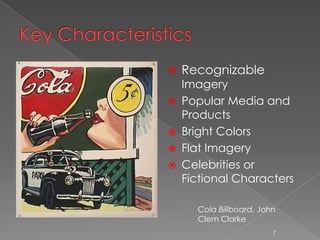
      Cola Billboard, John
      Clem Clarke
                         7
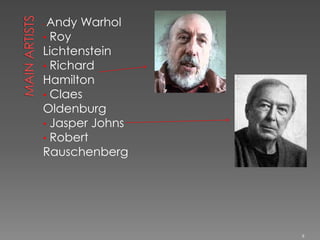
•Andy Warhol
• Roy
Lichtenstein
• Richard
Hamilton
• Claes
Oldenburg
• Jasper Johns
• Robert
Rauschenberg


                 8
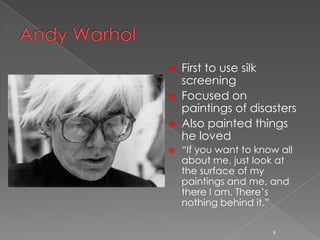
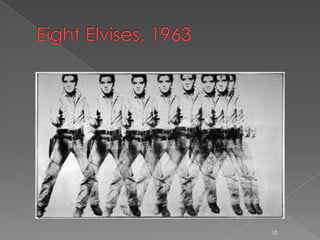
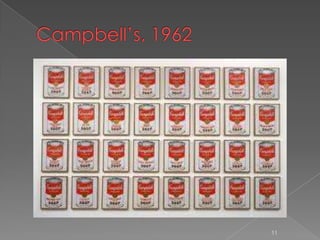
   First to use silk
    screening
   Focused on
    paintings of disasters
   Also painted things
    he loved
   “If you want to know all
    about me, just look at
    the surface of my
    paintings and me, and
    there I am. There’s
    nothing behind it.”

                       9
10
11
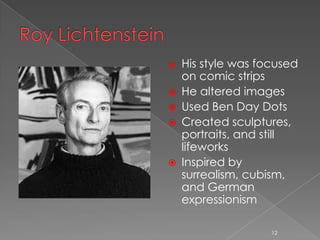
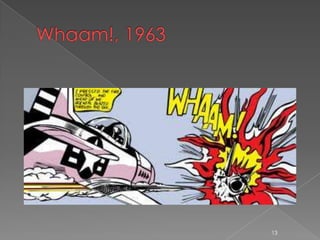
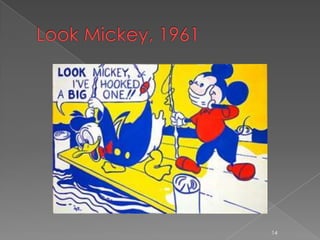
   His style was focused
    on comic strips
   He altered images
   Used Ben Day Dots
   Created sculptures,
    portraits, and still
    lifeworks
   Inspired by
    surrealism, cubism,
    and German
    expressionism

                    12
13
14
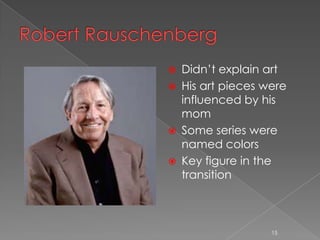
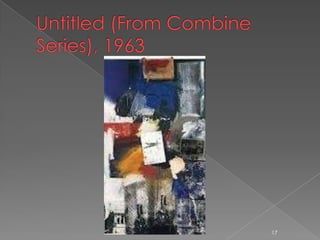
   Didn’t explain art
   His art pieces were
    influenced by his
    mom
   Some series were
    named colors
   Key figure in the
    transition


                    15
16
17
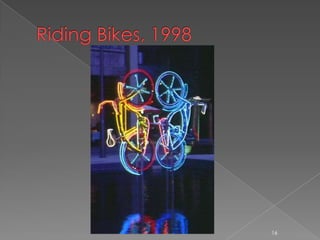
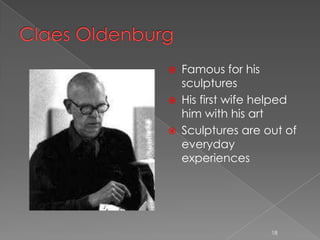
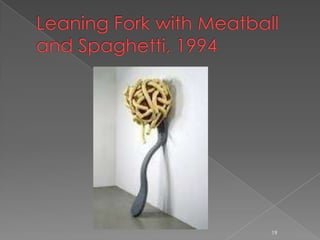
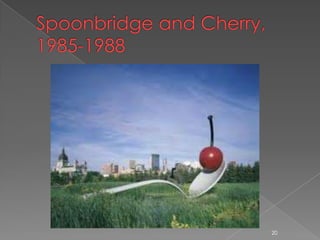
   Famous for his
    sculptures
   His first wife helped
    him with his art
   Sculptures are out of
    everyday
    experiences


                    18
19
20

Pop art 2012.3

  • 1.
  • 2.
    • Emerged in 1950s •Spread throughout the world • Challenged “Fine Art” Drowning Girl by Roy Lichtenstein, 1963 2
  • 3.
    Late 1950s  Inspired by popular culture  Linked to wealth and prosperity Blam, Roy Lichtenstein, 1962 3
  • 4.
    Britain’s inspiration was American culture  Spain associated with “New Figurative”  Japanese enthused by anime  Came to Italy in 1964 Kaikaikik News by Takashi Murakami 4
  • 5.
     Reaction to Abstract Expressionism  Eroded “high art” and “low art”  People understood art better Marilyn Monroe, 1967 5
  • 6.
     All kindsof artists  First meeting in 1952  Challenged modernists I was a Rich Man’s Plaything, Eduardo Paolozzi, 1947 6
  • 7.
    Recognizable Imagery  Popular Media and Products  Bright Colors  Flat Imagery  Celebrities or Fictional Characters Cola Billboard, John Clem Clarke 7
  • 8.
    •Andy Warhol • Roy Lichtenstein •Richard Hamilton • Claes Oldenburg • Jasper Johns • Robert Rauschenberg 8
  • 9.
    First to use silk screening  Focused on paintings of disasters  Also painted things he loved  “If you want to know all about me, just look at the surface of my paintings and me, and there I am. There’s nothing behind it.” 9
  • 10.
  • 11.
  • 12.
    His style was focused on comic strips  He altered images  Used Ben Day Dots  Created sculptures, portraits, and still lifeworks  Inspired by surrealism, cubism, and German expressionism 12
  • 13.
  • 14.
  • 15.
    Didn’t explain art  His art pieces were influenced by his mom  Some series were named colors  Key figure in the transition 15
  • 16.
  • 17.
  • 18.
    Famous for his sculptures  His first wife helped him with his art  Sculptures are out of everyday experiences 18
  • 19.
  • 20.