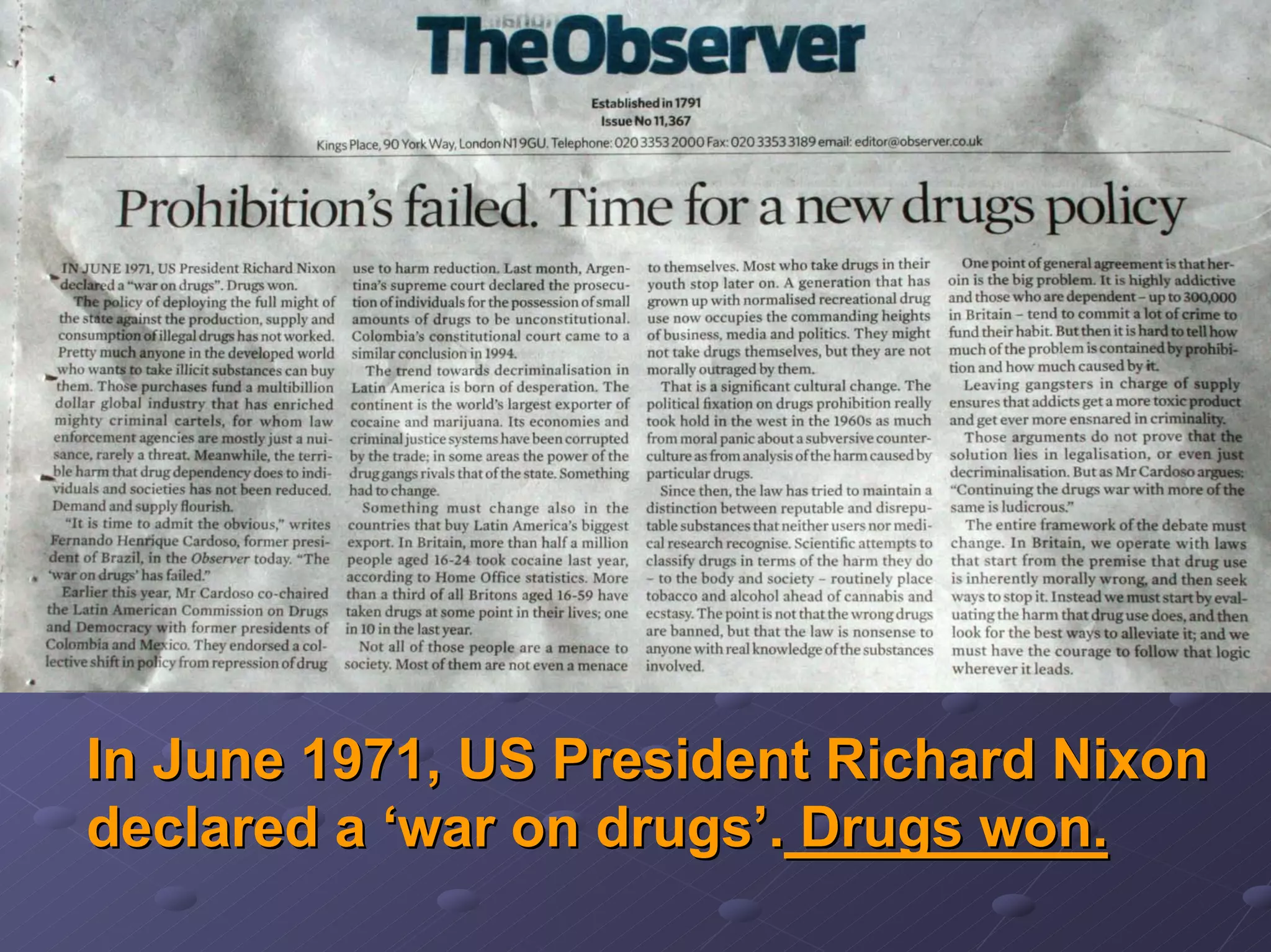
In June 1971, US President Richard Nixon
declared a ‘war on drugs’. Drugs won.
AIMS:
1] Parse and analyse the official language on drugs policy,
both national and international
Because it underplays the role of the criminal law, is confused on
harm reduction and relies on an inadequate economic analogy
(supply and demand reduction).
2] Provide a history and analysis of the drugs problem and the
criminal justice response in Ireland over the last 35 years.
3] Arguing the case for and against prohibition from this evidence
and other theoretical and evidential bases
4] Explain the reluctance to abandon prohibition despite the
overwhelming evidence against it
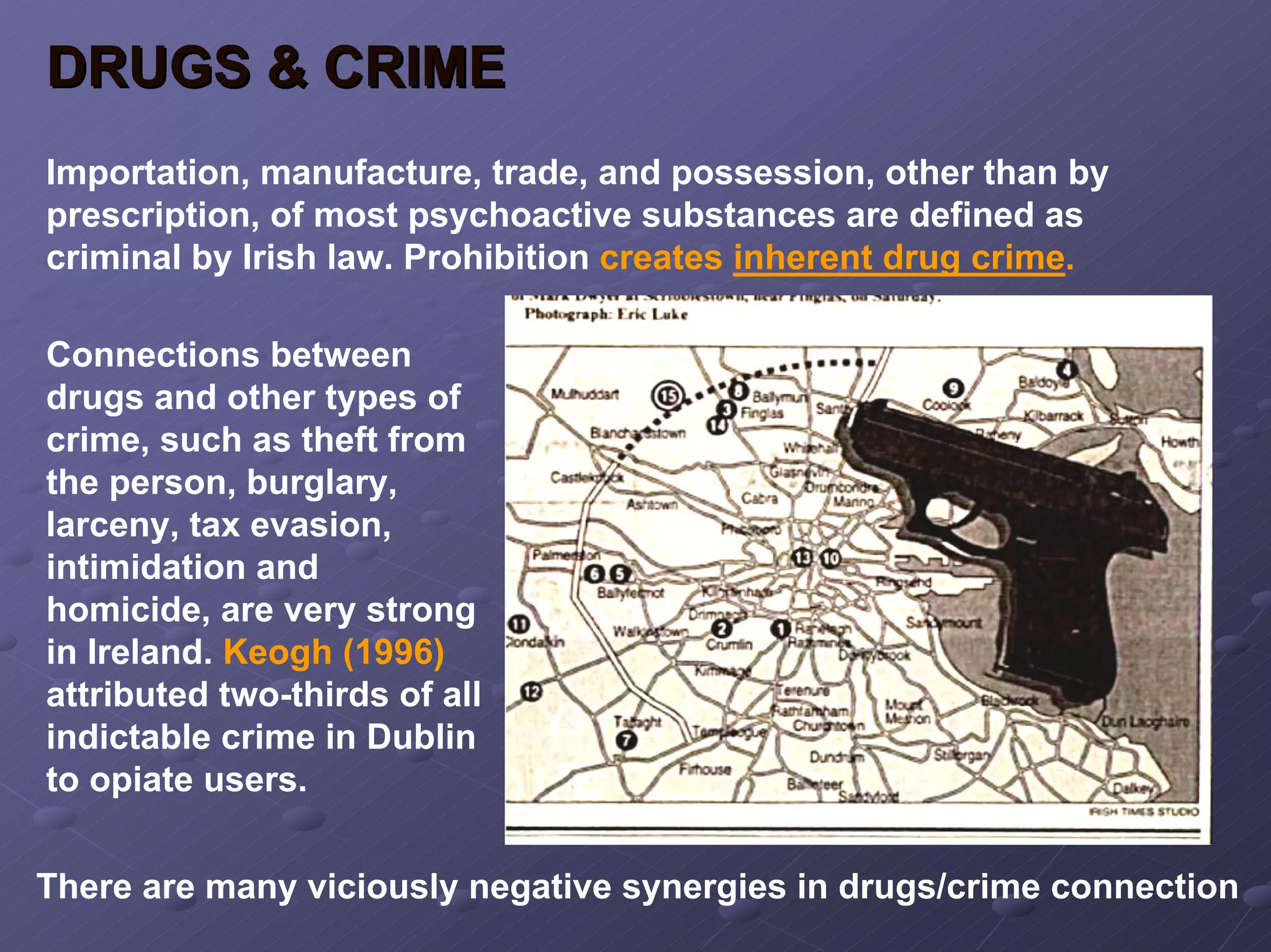
DRUGS & CRIME
Importation, manufacture, trade, and possession, other than by
prescription, of most psychoactive substances are defined as
criminal by Irish law. Prohibition creates inherent drug crime.
Connections between
drugs and other types of
crime, such as theft from
the person, burglary,
larceny, tax evasion,
intimidation and
homicide, are very strong
in Ireland. Keogh (1996)
attributed two-thirds of all
indictable crime in Dublin
to opiate users.
There are many viciously negative synergies in drugs/crime connection
Goldstein (1985) has made a useful distinction
between the ways drugs lead to or increase violent
crime:
1) the direct pharmacological effects of drugs on brain
and behaviour –disinhibition, aggression, paranoia;
2) the ‘economic compulsive’ need to support
continued drug use – financing the next fix through
theft, fraud etc.;
3) the ‘systemic violence’ associated with the control
of markets, transactions, debt collection, and
supply and distribution networks – related to the
potentially huge profits to be made, if you are
prepared to defy the law.
There are also many others types of drug-related
crime:
Criminal damage & degradation of the environment
Tax evasion
Nuisance behaviour and bullying in a locality
Neglect & abuse of children and dependents
Drug-driving
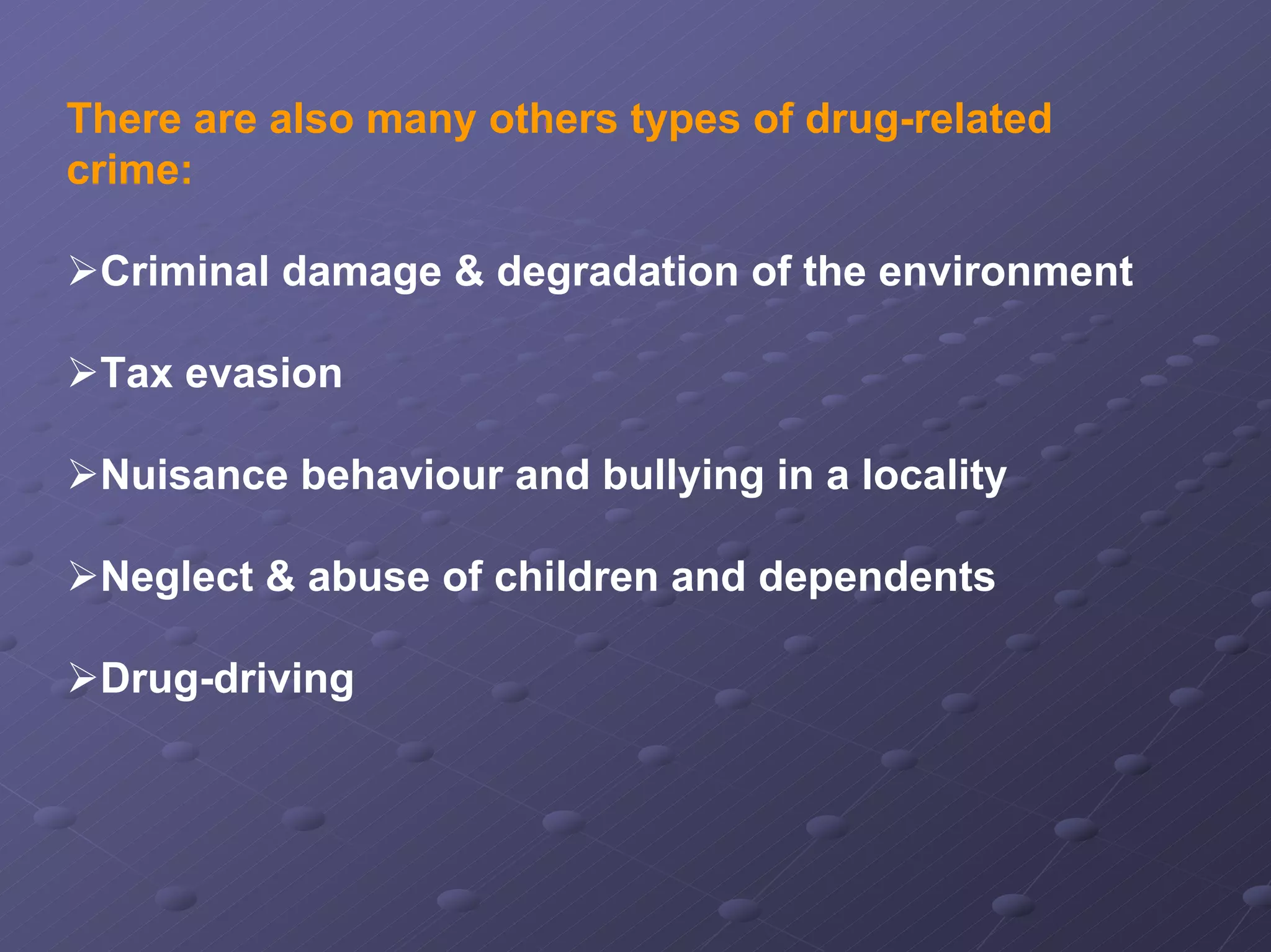
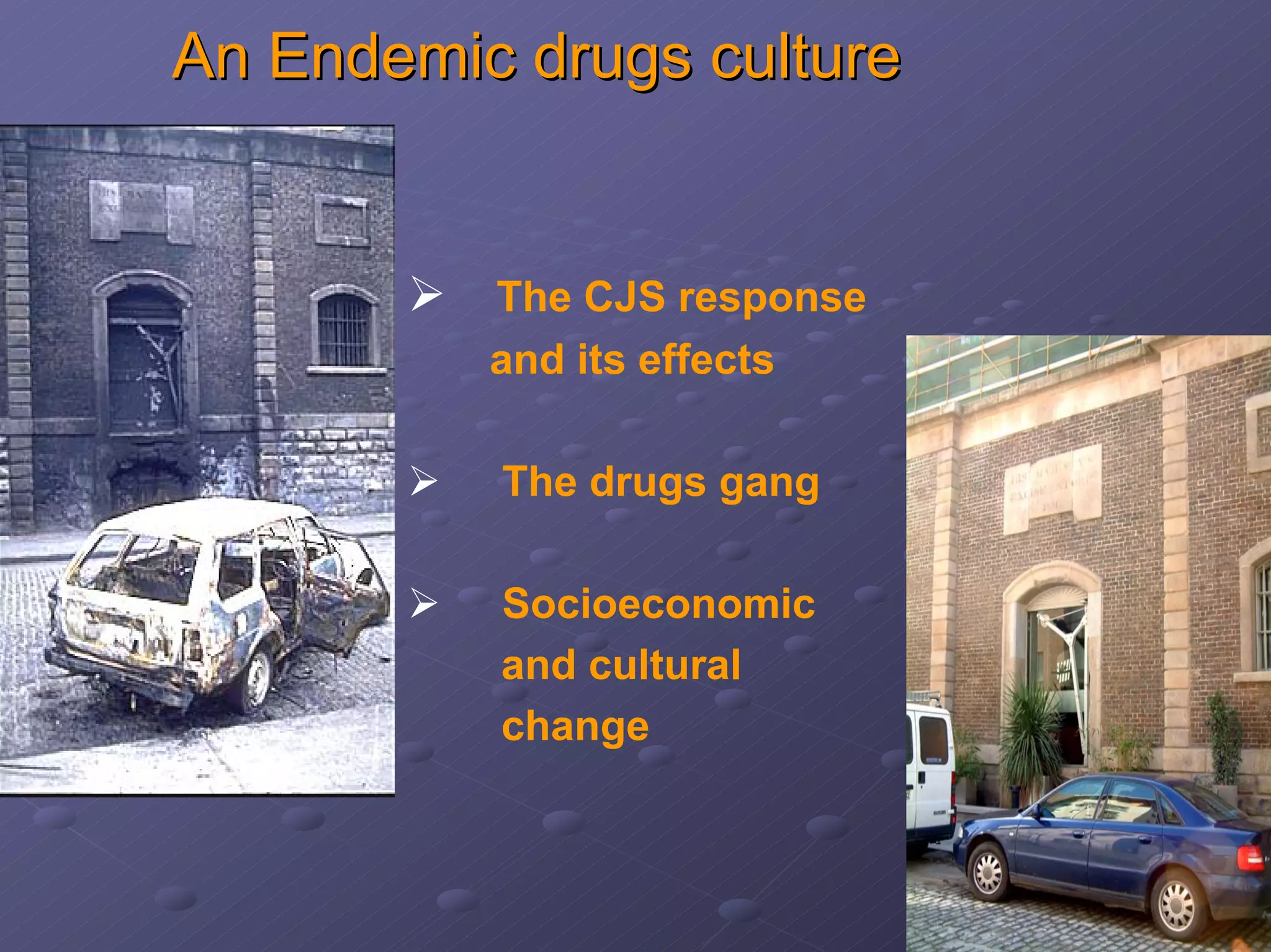
An Endemic drugs culture

The CJS response
and its effects
The drugs gang
Socioeconomic
and cultural
change
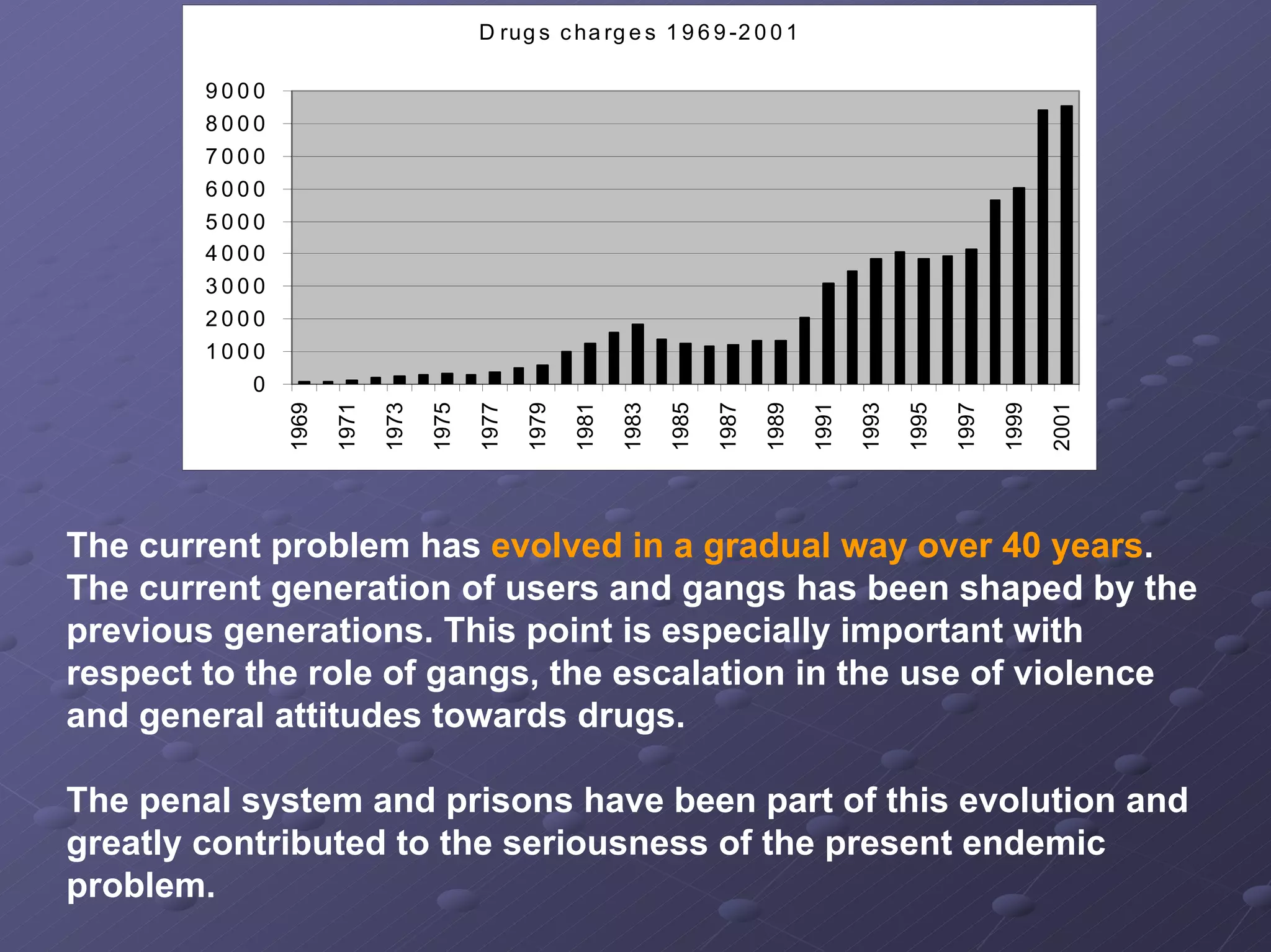
D rug s c ha rg e s 1 9 6 9 -2 0 0 1
9000
8000
7000
6000
5000
4000
3000
2000
1000
2001

1999

1997

1995

1993

1991

1989

1987

1985

1983

1981

1979

1977

1975

1973

1971

1969

0

The current problem has evolved in a gradual way over 40 years.
The current generation of users and gangs has been shaped by the
previous generations. This point is especially important with
respect to the role of gangs, the escalation in the use of violence
and general attitudes towards drugs.
The penal system and prisons have been part of this evolution and
greatly contributed to the seriousness of the present endemic
problem.
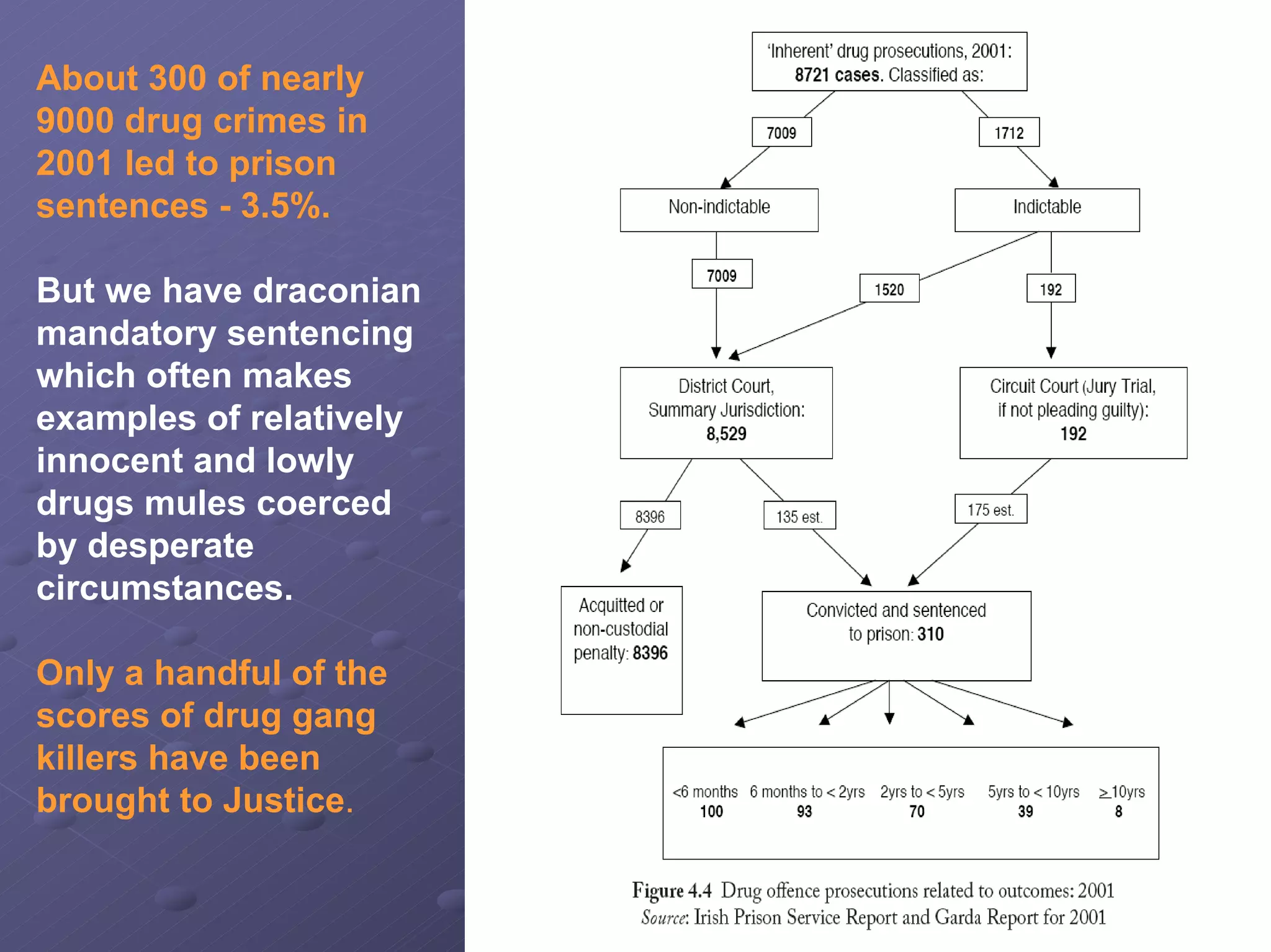
About 300 of nearly
9000 drug crimes in
2001 led to prison
sentences - 3.5%.
But we have draconian
mandatory sentencing
which often makes
examples of relatively
innocent and lowly
drugs mules coerced
by desperate
circumstances.
Only a handful of the
scores of drug gang
killers have been
brought to Justice.
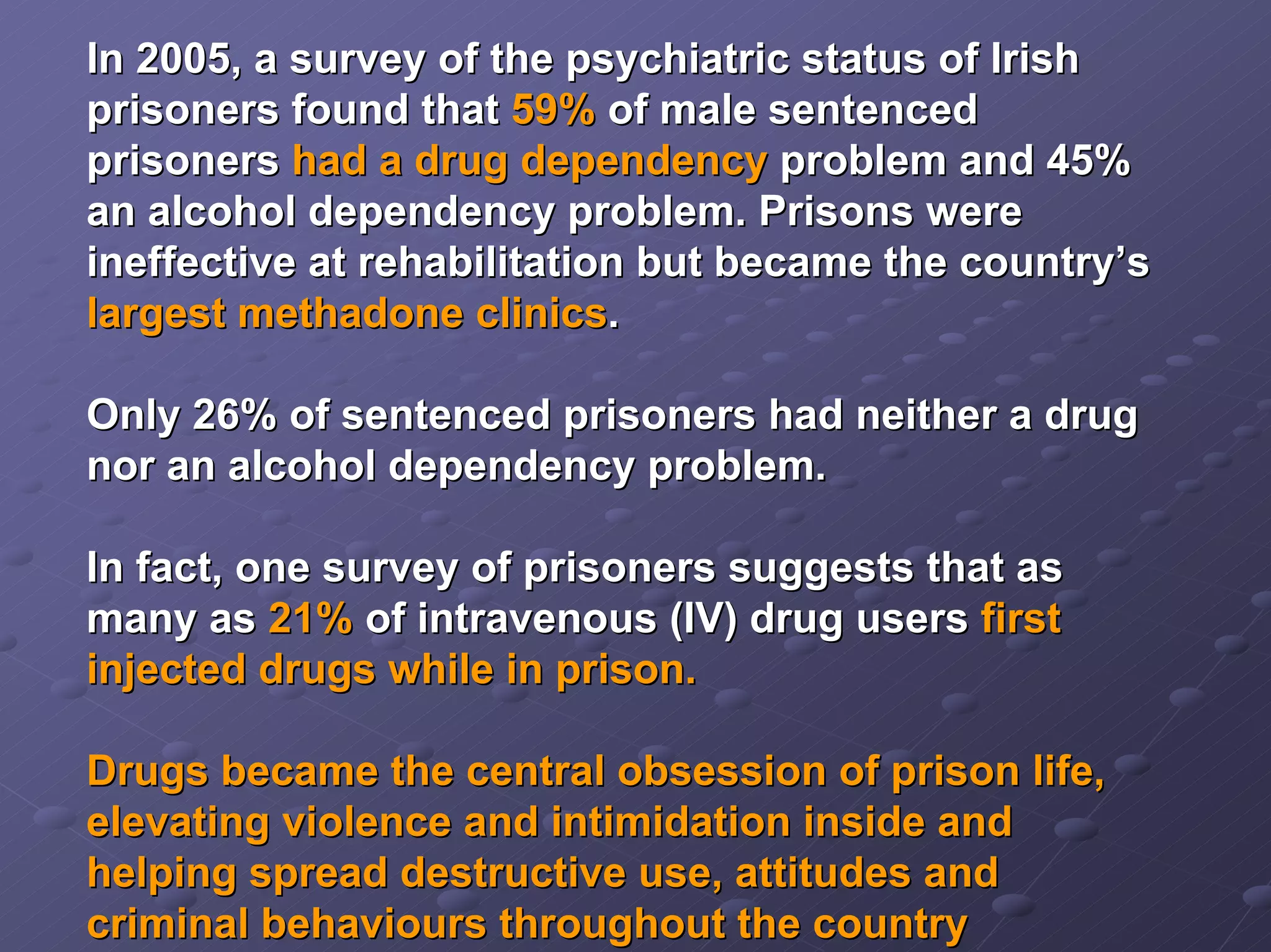
In 2005, a survey of the psychiatric status of Irish
prisoners found that 59% of male sentenced
prisoners had a drug dependency problem and 45%
an alcohol dependency problem. Prisons were
ineffective at rehabilitation but became the country’s
largest methadone clinics.
Only 26% of sentenced prisoners had neither a drug
nor an alcohol dependency problem.
In fact, one survey of prisoners suggests that as
many as 21% of intravenous (IV) drug users first
injected drugs while in prison.
Drugs became the central obsession of prison life,
elevating violence and intimidation inside and
helping spread destructive use, attitudes and
criminal behaviours throughout the country
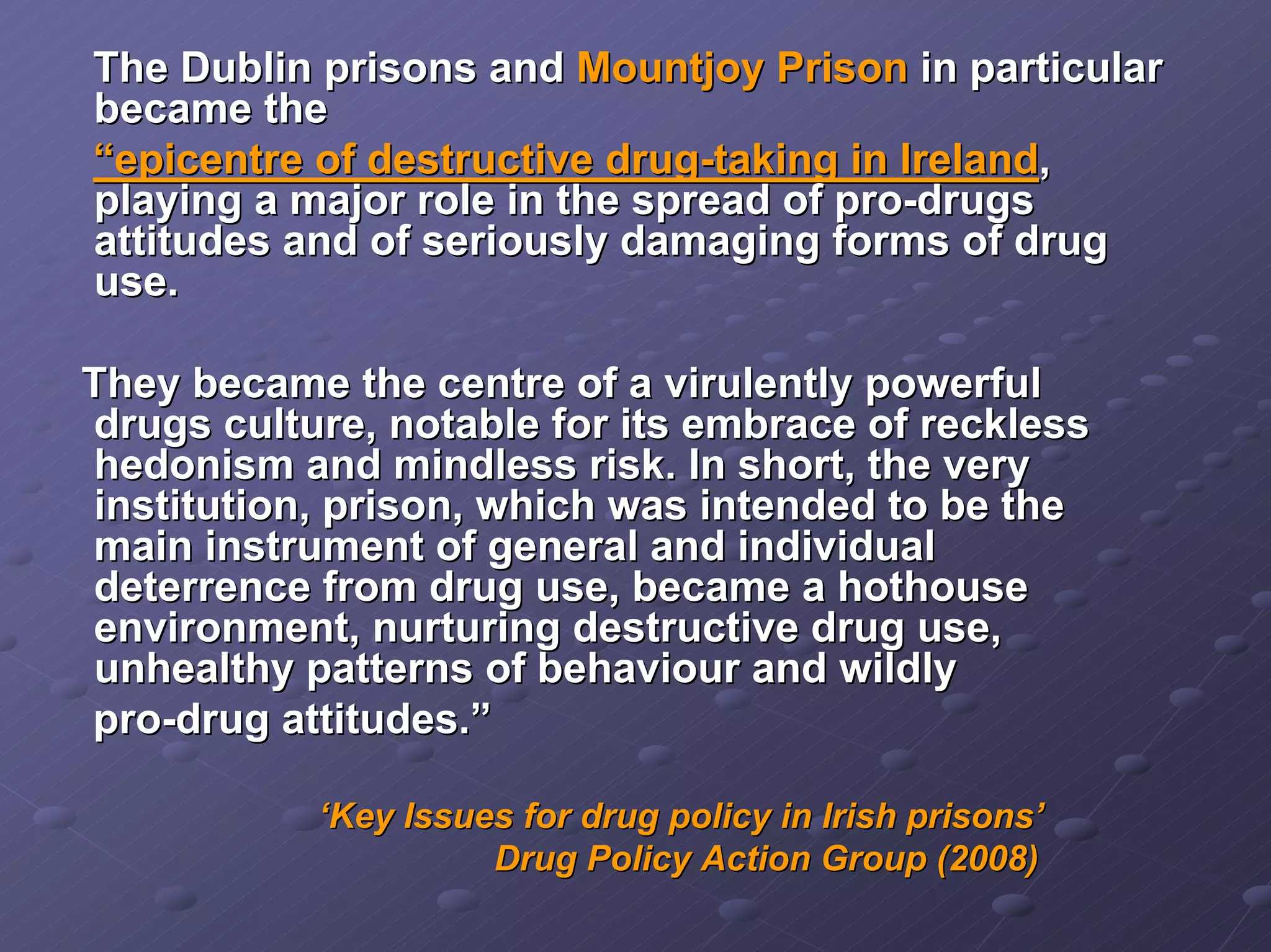
The Dublin prisons and Mountjoy Prison in particular
became the
“epicentre of destructive drug-taking in Ireland,
playing a major role in the spread of pro-drugs
attitudes and of seriously damaging forms of drug
use.
They became the centre of a virulently powerful
drugs culture, notable for its embrace of reckless
hedonism and mindless risk. In short, the very
institution, prison, which was intended to be the
main instrument of general and individual
deterrence from drug use, became a hothouse
environment, nurturing destructive drug use,
unhealthy patterns of behaviour and wildly
pro-drug attitudes.”
‘Key Issues for drug policy in Irish prisons’
Drug Policy Action Group (2008)
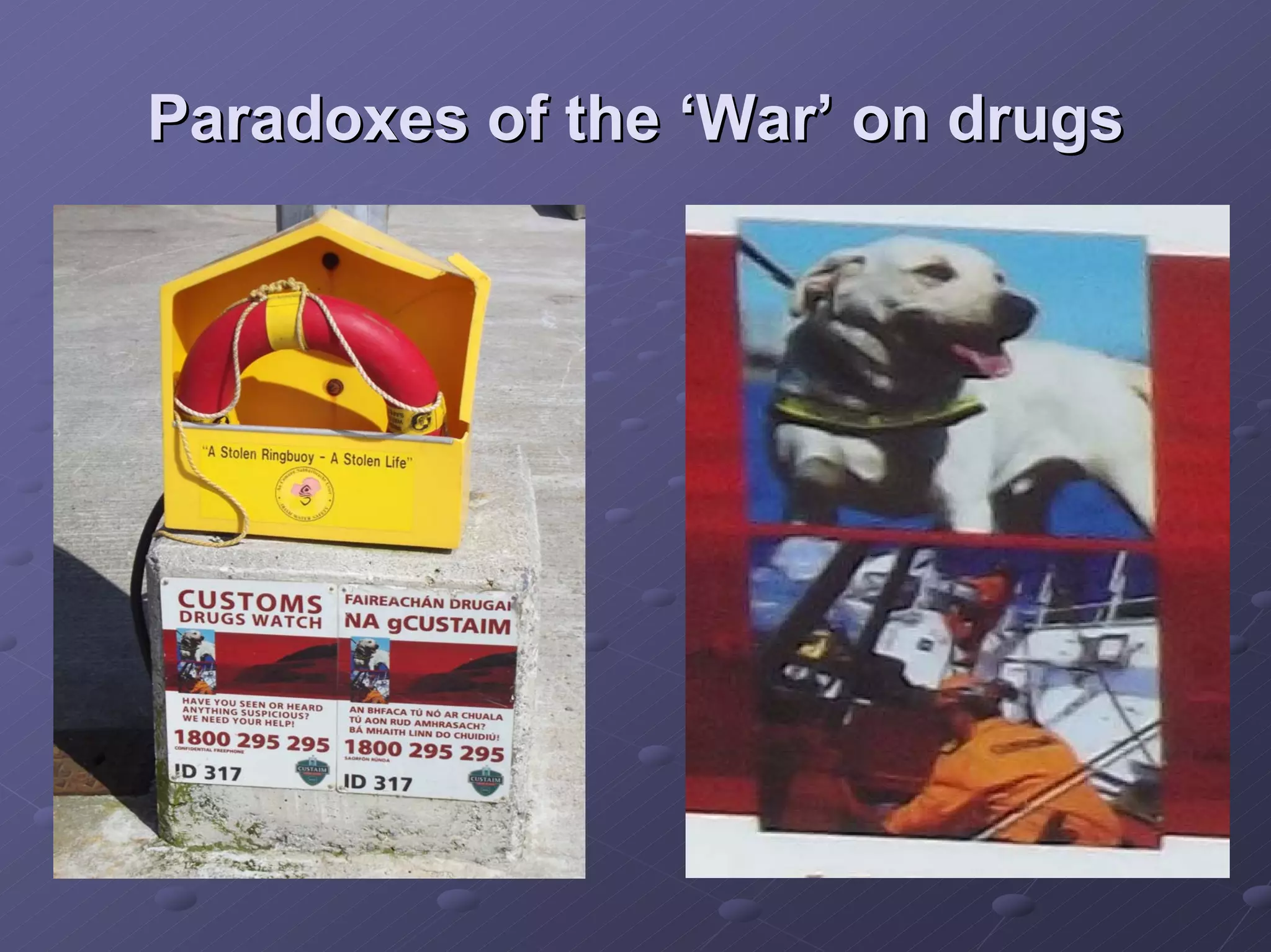
Paradoxes of the ‘War’ on drugs
The drugs gang
Gang culture is a perfect fit for the drugs
business and gang formation is a natural and
ordinary social process
The traditionally family-based ‘criminal’ gang
culture in Ireland has evolved very rapidly through
the drugs era, embracing stigma, criminality and
violence and turning them to their own advantage.
Children in this situation are directly socialised into
criminality.
But many young boys who have been wellparented get caught up in gangs through interaction
with peers and when they venture out into the world
and their awareness of the world expands.
Key motives (particularly strong in teenagers) for
joining a delinquent or antisocial gang include:
1) need for personal identity, independent of family
2) need to belong, get acceptance, attention &
support of peers, substitute family
3) pride – need to gain respect, status and honour
4) fear – need for protection in a dangerous world
5) excitement and challenge – driven by boredom
and sense of helplessness and hopelessness
Steps like joining a gang have an almost
irrevocable momentum.
Antisocial gangs evolve in order to solve problems posed by
the social world in which the members find themselves living.
Tough and unfair conditions create tough and unfair people
(but not always).
Teenagers, who have failed at school and sport, join gangs to
acquire status and hit back at the school and the broader social
system, which have branded them as failures.
Gangs and their members channel their resentment and
frustration into defiance and a hard man lifestyle. Toughness,
domineering attitudes and a readiness to use violence are the
main currency.
Immature brains and personalities are making wrong turns
before they can even read the map of life…. Moral short-circuiting
(they learn to be brutal before fully appreciating what brutal is)
The drugs business is a huge attraction
for gangs, offering pleasure, excitement, proof of
autonomy and toughness as well as a hugely
profitable, ‘negatively glamorous’ occupation.
Over the last 35 years, because of the high
financial stakes and the chaotically self-regulated
nature of the criminal drugs market, which relies
on intimidation, drugs gangs have become
progressively more violent, brutal and callous.
Eventually embracing a macho gun culture.
Hundreds of thousands of basically normal,
essentially non-criminal, Irish citizens collude
with the criminal suppliers, making the criminal
subculture almost immune to the efforts of law
enforcement.
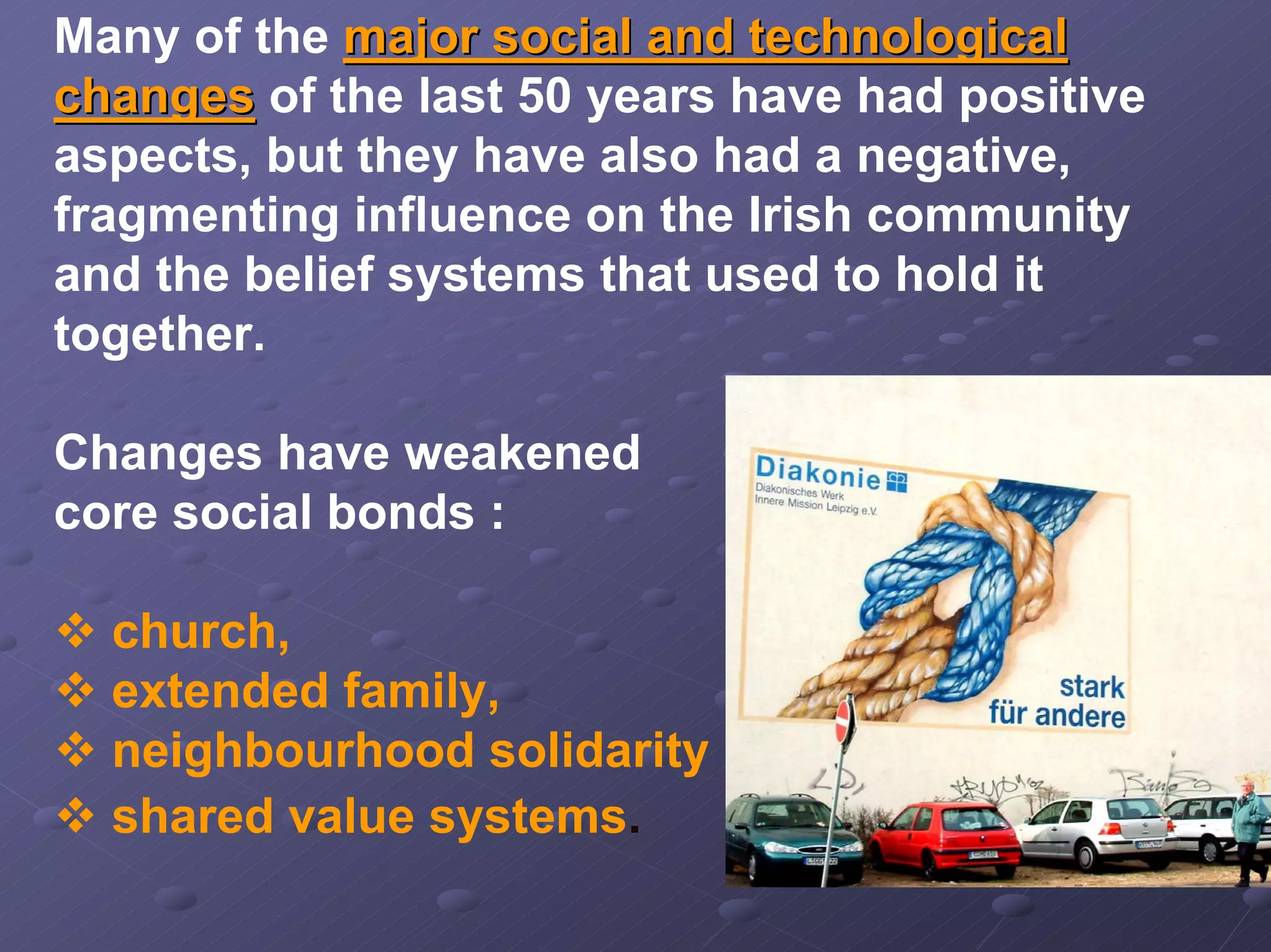
Many of the major social and technological
changes of the last 50 years have had positive
aspects, but they have also had a negative,
fragmenting influence on the Irish community
and the belief systems that used to hold it
together.
Changes have weakened
core social bonds :
church,
extended family,
neighbourhood solidarity
shared value systems.
New stresses have emerged in a more
work, money and ‘success’ focused society.
Consumerist, materialist lifestyle
More competition in education and work
Increased pace and intensity of life (ICT;
commuting/child care)
Massive change in sexual mores (confusion for male
self-image)
Expectations risen enormously (driven by
advertising/PR)
Globalisation: homogenisation of values led by
electronics-base monoculture
All these interacting changes have impacted
dramatically on the way of life and on the quantity
and quality of crime. They help explain why people
in modern Ireland are so susceptible to the allure
of drugs.
Alienation – cynicism about politics and communal
values & lack of awareness of interdependence.
Exclusion - The widening gap between aspiration and
reality for some young people leading to profound
resentment and anger. Social inequality is more powerful
in creating crime than individual factors and is the
aspect most amenable to change.
Hedonistic culture of release, license and excess
(sometimes violent) partly in response to stress,
competition, regulation, alienation and exclusion.
The key question is whether the use of the criminal law
against drugs causes more harm than it prevents.
Prohibition has utterly failed to eliminate or even contain drug
use. On the contrary the last 30 years has witnessed exponential
growth in the use of drugs, in drug-related harms and in prodrug attitudes amongst the young. Drugs are cheaper and more
widely available than ever.
All the dreadful, drug-related harms and the serious drugslinked deterioration in the quality of life in Irish communities
have occurred under a prohibitionist regime.
Prohibition has created a criminal monopoly that enriches those
ruthless enough to use violence and intimidation in order to turn
a profit. Prohibition is a precondition for this criminal culture.
We have an almost universal and almost irrestistible
urge to indulge in mood-altering substances.
We also have an innate predisposition favouring
autonomy; we consider our own bodies and
consciousness as our own business and under
personal control. Young people especially resist
attempts at control.
The developing human rights culture recognises
and supports individual freedom and bodily integrity.
Laws that strain against human nature will
always flounder.

The hypocrisy and self-contradiction of prohibition
(the widespread use of alcohol, medically-prescribed
drugs etc) undermines the effectiveness (credibility)
of education and prevention.
Prohibition encourages a clandestine situation where
criminal pushers and even users have a vested
interest in mystifying drug use and spreading and
maintaining ignorance.
The whole drugs culture takes on a negative glamour
that is very appealing to rebellious youth. Drug use
‘proves’ maturity and independence. The ignorance,
mystique and excitement that surround the clandestine
drugs market greatly diminish people’s natural prudence
and instinct for self-preservation. Forbidden fruit.
The failure of prohibition to distinguish between less
and more dangerous drugs and ways of using them and
between legal and illegal drugs undermines the ability to
educate, warn and dissuade.
Abandoning prohibition promises the benefits of
quality control, regulation, redirecting massive futile
law enforcement expenditure to more productive
treatment and prevention and, most importantly
and essentially, severing the drugs crime link.
Severing the link with crime is a precondition for
successful decriminalization and this implies complete
legal toleration of individual choice for all drugs and
forms of use.
However some drugs and forms of use are so
dangerous and the addiction process is so seductive
that a laissez-faire approach is not an option. Complete
decriminalization is not justified and should not be
undertaken without a massive proactive and constant
campaign of education, prevention and treatment (short
only of coercive – law enforcement activity).
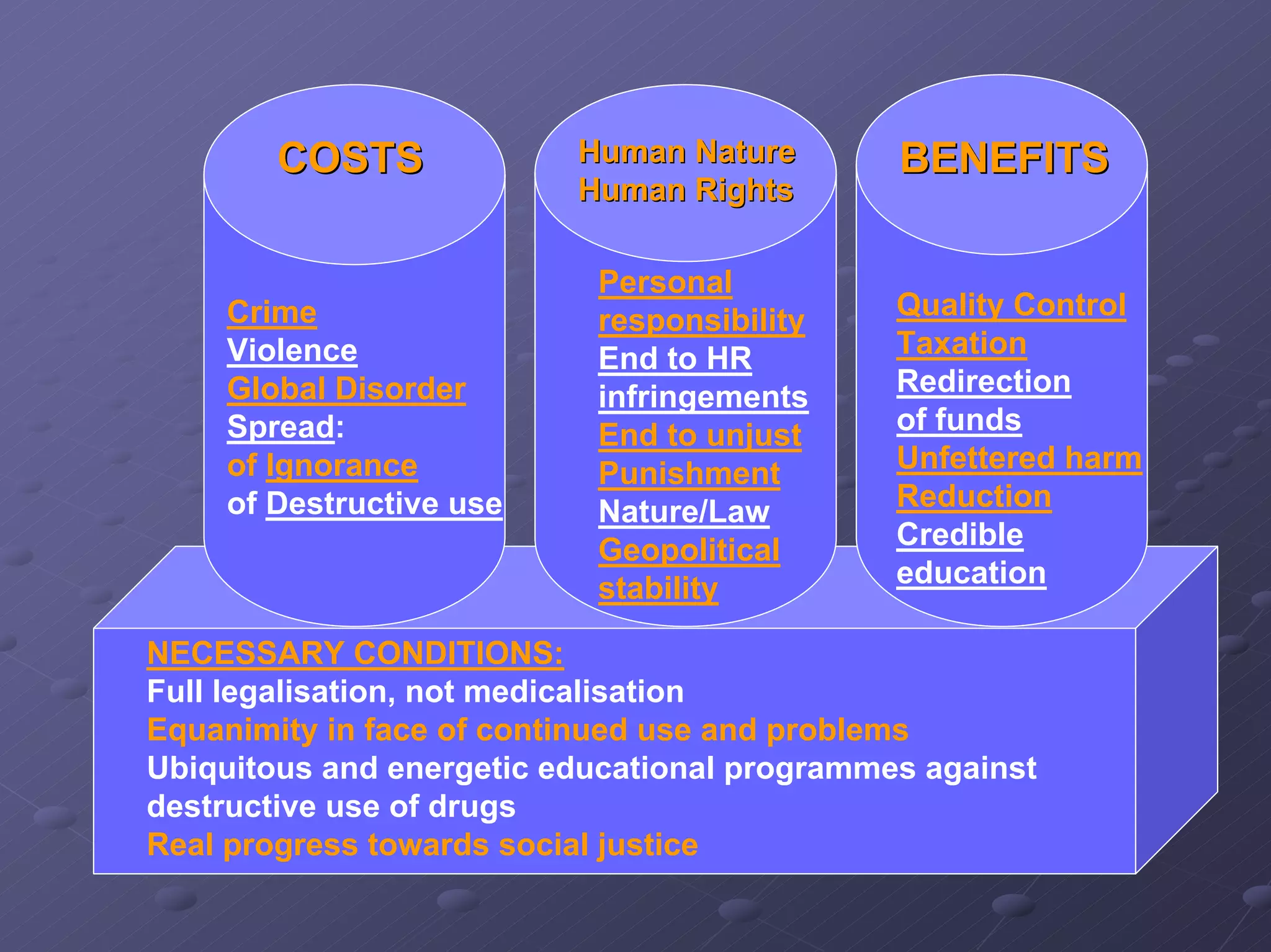
COSTS

Crime
Violence
Global Disorder
Spread:
of Ignorance
of Destructive use

Human Nature
Human Rights
Personal
responsibility
End to HR
infringements
End to unjust
Punishment
Nature/Law
Geopolitical
stability

BENEFITS

Quality Control
Taxation
Redirection
of funds
Unfettered harm
Reduction
Credible
education

NECESSARY CONDITIONS:
Full legalisation, not medicalisation
Equanimity in face of continued use and problems
Ubiquitous and energetic educational programmes against
destructive use of drugs
Real progress towards social justice

The Irish War on Drugs by Paul O' Mahony

  • 2.
    In June 1971,US President Richard Nixon declared a ‘war on drugs’. Drugs won.
  • 3.
    AIMS: 1] Parse andanalyse the official language on drugs policy, both national and international Because it underplays the role of the criminal law, is confused on harm reduction and relies on an inadequate economic analogy (supply and demand reduction). 2] Provide a history and analysis of the drugs problem and the criminal justice response in Ireland over the last 35 years. 3] Arguing the case for and against prohibition from this evidence and other theoretical and evidential bases 4] Explain the reluctance to abandon prohibition despite the overwhelming evidence against it
  • 4.
    DRUGS & CRIME Importation,manufacture, trade, and possession, other than by prescription, of most psychoactive substances are defined as criminal by Irish law. Prohibition creates inherent drug crime. Connections between drugs and other types of crime, such as theft from the person, burglary, larceny, tax evasion, intimidation and homicide, are very strong in Ireland. Keogh (1996) attributed two-thirds of all indictable crime in Dublin to opiate users. There are many viciously negative synergies in drugs/crime connection
  • 5.
    Goldstein (1985) hasmade a useful distinction between the ways drugs lead to or increase violent crime: 1) the direct pharmacological effects of drugs on brain and behaviour –disinhibition, aggression, paranoia; 2) the ‘economic compulsive’ need to support continued drug use – financing the next fix through theft, fraud etc.; 3) the ‘systemic violence’ associated with the control of markets, transactions, debt collection, and supply and distribution networks – related to the potentially huge profits to be made, if you are prepared to defy the law.
  • 6.
    There are alsomany others types of drug-related crime: Criminal damage & degradation of the environment Tax evasion Nuisance behaviour and bullying in a locality Neglect & abuse of children and dependents Drug-driving
  • 7.
    An Endemic drugsculture The CJS response and its effects The drugs gang Socioeconomic and cultural change
  • 8.
    D rug sc ha rg e s 1 9 6 9 -2 0 0 1 9000 8000 7000 6000 5000 4000 3000 2000 1000 2001 1999 1997 1995 1993 1991 1989 1987 1985 1983 1981 1979 1977 1975 1973 1971 1969 0 The current problem has evolved in a gradual way over 40 years. The current generation of users and gangs has been shaped by the previous generations. This point is especially important with respect to the role of gangs, the escalation in the use of violence and general attitudes towards drugs. The penal system and prisons have been part of this evolution and greatly contributed to the seriousness of the present endemic problem.
  • 9.
    About 300 ofnearly 9000 drug crimes in 2001 led to prison sentences - 3.5%. But we have draconian mandatory sentencing which often makes examples of relatively innocent and lowly drugs mules coerced by desperate circumstances. Only a handful of the scores of drug gang killers have been brought to Justice.
  • 10.
    In 2005, asurvey of the psychiatric status of Irish prisoners found that 59% of male sentenced prisoners had a drug dependency problem and 45% an alcohol dependency problem. Prisons were ineffective at rehabilitation but became the country’s largest methadone clinics. Only 26% of sentenced prisoners had neither a drug nor an alcohol dependency problem. In fact, one survey of prisoners suggests that as many as 21% of intravenous (IV) drug users first injected drugs while in prison. Drugs became the central obsession of prison life, elevating violence and intimidation inside and helping spread destructive use, attitudes and criminal behaviours throughout the country
  • 11.
    The Dublin prisonsand Mountjoy Prison in particular became the “epicentre of destructive drug-taking in Ireland, playing a major role in the spread of pro-drugs attitudes and of seriously damaging forms of drug use. They became the centre of a virulently powerful drugs culture, notable for its embrace of reckless hedonism and mindless risk. In short, the very institution, prison, which was intended to be the main instrument of general and individual deterrence from drug use, became a hothouse environment, nurturing destructive drug use, unhealthy patterns of behaviour and wildly pro-drug attitudes.” ‘Key Issues for drug policy in Irish prisons’ Drug Policy Action Group (2008)
  • 12.
    Paradoxes of the‘War’ on drugs
  • 13.
    The drugs gang Gangculture is a perfect fit for the drugs business and gang formation is a natural and ordinary social process The traditionally family-based ‘criminal’ gang culture in Ireland has evolved very rapidly through the drugs era, embracing stigma, criminality and violence and turning them to their own advantage. Children in this situation are directly socialised into criminality. But many young boys who have been wellparented get caught up in gangs through interaction with peers and when they venture out into the world and their awareness of the world expands.
  • 14.
    Key motives (particularlystrong in teenagers) for joining a delinquent or antisocial gang include: 1) need for personal identity, independent of family 2) need to belong, get acceptance, attention & support of peers, substitute family 3) pride – need to gain respect, status and honour 4) fear – need for protection in a dangerous world 5) excitement and challenge – driven by boredom and sense of helplessness and hopelessness Steps like joining a gang have an almost irrevocable momentum.
  • 15.
    Antisocial gangs evolvein order to solve problems posed by the social world in which the members find themselves living. Tough and unfair conditions create tough and unfair people (but not always). Teenagers, who have failed at school and sport, join gangs to acquire status and hit back at the school and the broader social system, which have branded them as failures. Gangs and their members channel their resentment and frustration into defiance and a hard man lifestyle. Toughness, domineering attitudes and a readiness to use violence are the main currency. Immature brains and personalities are making wrong turns before they can even read the map of life…. Moral short-circuiting (they learn to be brutal before fully appreciating what brutal is)
  • 16.
    The drugs businessis a huge attraction for gangs, offering pleasure, excitement, proof of autonomy and toughness as well as a hugely profitable, ‘negatively glamorous’ occupation. Over the last 35 years, because of the high financial stakes and the chaotically self-regulated nature of the criminal drugs market, which relies on intimidation, drugs gangs have become progressively more violent, brutal and callous. Eventually embracing a macho gun culture. Hundreds of thousands of basically normal, essentially non-criminal, Irish citizens collude with the criminal suppliers, making the criminal subculture almost immune to the efforts of law enforcement.
  • 17.
    Many of themajor social and technological changes of the last 50 years have had positive aspects, but they have also had a negative, fragmenting influence on the Irish community and the belief systems that used to hold it together. Changes have weakened core social bonds : church, extended family, neighbourhood solidarity shared value systems.
  • 18.
    New stresses haveemerged in a more work, money and ‘success’ focused society. Consumerist, materialist lifestyle More competition in education and work Increased pace and intensity of life (ICT; commuting/child care) Massive change in sexual mores (confusion for male self-image) Expectations risen enormously (driven by advertising/PR) Globalisation: homogenisation of values led by electronics-base monoculture
  • 19.
    All these interactingchanges have impacted dramatically on the way of life and on the quantity and quality of crime. They help explain why people in modern Ireland are so susceptible to the allure of drugs. Alienation – cynicism about politics and communal values & lack of awareness of interdependence. Exclusion - The widening gap between aspiration and reality for some young people leading to profound resentment and anger. Social inequality is more powerful in creating crime than individual factors and is the aspect most amenable to change. Hedonistic culture of release, license and excess (sometimes violent) partly in response to stress, competition, regulation, alienation and exclusion.
  • 21.
    The key questionis whether the use of the criminal law against drugs causes more harm than it prevents. Prohibition has utterly failed to eliminate or even contain drug use. On the contrary the last 30 years has witnessed exponential growth in the use of drugs, in drug-related harms and in prodrug attitudes amongst the young. Drugs are cheaper and more widely available than ever. All the dreadful, drug-related harms and the serious drugslinked deterioration in the quality of life in Irish communities have occurred under a prohibitionist regime. Prohibition has created a criminal monopoly that enriches those ruthless enough to use violence and intimidation in order to turn a profit. Prohibition is a precondition for this criminal culture.
  • 22.
    We have analmost universal and almost irrestistible urge to indulge in mood-altering substances. We also have an innate predisposition favouring autonomy; we consider our own bodies and consciousness as our own business and under personal control. Young people especially resist attempts at control. The developing human rights culture recognises and supports individual freedom and bodily integrity. Laws that strain against human nature will always flounder. The hypocrisy and self-contradiction of prohibition (the widespread use of alcohol, medically-prescribed drugs etc) undermines the effectiveness (credibility) of education and prevention.
  • 23.
    Prohibition encourages aclandestine situation where criminal pushers and even users have a vested interest in mystifying drug use and spreading and maintaining ignorance. The whole drugs culture takes on a negative glamour that is very appealing to rebellious youth. Drug use ‘proves’ maturity and independence. The ignorance, mystique and excitement that surround the clandestine drugs market greatly diminish people’s natural prudence and instinct for self-preservation. Forbidden fruit. The failure of prohibition to distinguish between less and more dangerous drugs and ways of using them and between legal and illegal drugs undermines the ability to educate, warn and dissuade.
  • 24.
    Abandoning prohibition promisesthe benefits of quality control, regulation, redirecting massive futile law enforcement expenditure to more productive treatment and prevention and, most importantly and essentially, severing the drugs crime link. Severing the link with crime is a precondition for successful decriminalization and this implies complete legal toleration of individual choice for all drugs and forms of use. However some drugs and forms of use are so dangerous and the addiction process is so seductive that a laissez-faire approach is not an option. Complete decriminalization is not justified and should not be undertaken without a massive proactive and constant campaign of education, prevention and treatment (short only of coercive – law enforcement activity).
  • 25.
    COSTS Crime Violence Global Disorder Spread: of Ignorance ofDestructive use Human Nature Human Rights Personal responsibility End to HR infringements End to unjust Punishment Nature/Law Geopolitical stability BENEFITS Quality Control Taxation Redirection of funds Unfettered harm Reduction Credible education NECESSARY CONDITIONS: Full legalisation, not medicalisation Equanimity in face of continued use and problems Ubiquitous and energetic educational programmes against destructive use of drugs Real progress towards social justice