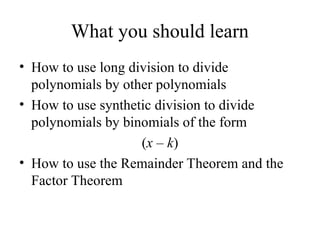
What you shouldlearn
• How to use long division to divide
polynomials by other polynomials
• How to use synthetic division to divide
polynomials by binomials of the form
(x – k)
• How to use the Remainder Theorem and the
Factor Theorem
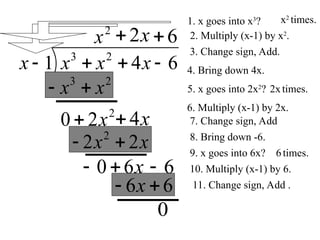
3.
6
4
1 2
3
x
x
x
x
2
x
1.x goes into x3
? x2
times.
2. Multiply (x-1) by x2
.
2
3
x
x
2
2
0 x
x
4
4. Bring down 4x.
5. x goes into 2x2
? 2xtimes.
x
2
6. Multiply (x-1) by 2x.
x
x 2
2 2
x
6
0
8. Bring down -6.
6
9. x goes into 6x?
6
6
6
x
0
3. Change sign, Add.
7. Change sign, Add
6times.
11. Change sign, Add .
10. Multiply (x-1) by 6.
3 2
x x
2
2 2
x x
6 6
x
4.
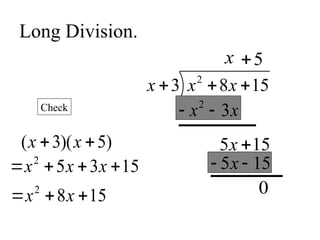
Long Division.
15
8
3 2
x
x
x
x
x
x 3
2
15
5
x
5
15
5
x
0
)
5
)(
3
(
x
x
Check
15
3
5
2
x
x
x
15
8
2
x
x
2
3
x x
5 15
x
5.
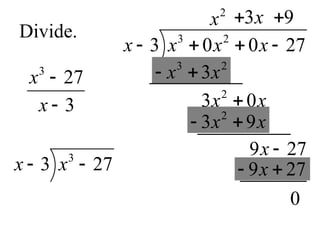
Divide.
3
27
3
x
x
3
3 27
x x
3 2
3 0 0 27
x x x x
2
x
3 2
3
x x
3 2
3
x x
2
3 0
x x
3x
2
3 9
x x
2
3 9
x x
9 27
x
9
9 27
x
9 27
x
0
6.
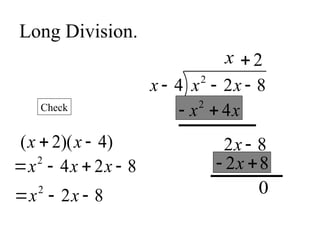
Long Division.
8
2
4 2
x
x
x
x
x
x 4
2
8
2
x
2
8
2
x
0
)
4
)(
2
(
x
x
Check
8
2
4
2
x
x
x
8
2
2
x
x
2
4
x x
2 8
x
7.
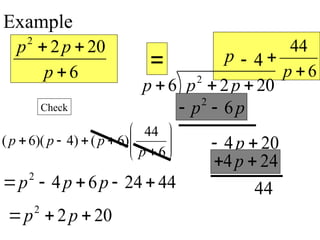
Example
20
2
6 2
p
p
p
p
p
p6
2
20
4
p
4
24
4
p
44
6
44
)
6
(
)
4
)(
6
(
p
p
p
p
Check
44
24
6
4
2
p
p
p
20
2
2
p
p
6
20
2
2
p
p
p
6
44
p
2
6
p p
4 24
p
=
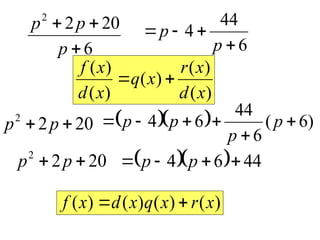
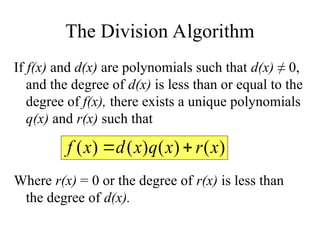
The Division Algorithm
Iff(x) and d(x) are polynomials such that d(x) ≠ 0,
and the degree of d(x) is less than or equal to the
degree of f(x), there exists a unique polynomials
q(x) and r(x) such that
Where r(x) = 0 or the degree of r(x) is less than
the degree of d(x).
)
(
)
(
)
(
)
( x
r
x
q
x
d
x
f
10.
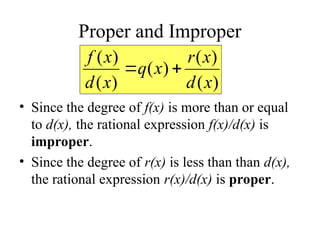
Proper and Improper
•Since the degree of f(x) is more than or equal
to d(x), the rational expression f(x)/d(x) is
improper.
• Since the degree of r(x) is less than than d(x),
the rational expression r(x)/d(x) is proper.
)
(
)
(
)
(
)
(
)
(
x
d
x
r
x
q
x
d
x
f
11.
Synthetic Division
Divide x4
–10x2
– 2x + 4 by x + 3
1 0 -10 -2 4
-3
1
-3
-3
+9
-1
3
1
-3
1
3
4
2
10 2
4
x
x
x
x
3
1
x
1
3 2
3
x
x
x
12.
Long Division.
8
2
3 2
x
x
x
x
x
x 3
2
8
x
1
3
x
5
8
2
)
( 2
x
x
x
f
x
x 3
2
3
x
)
3
(
f 8
)
3
(
2
)
3
( 2
8
6
9
5
1 -2 -8
3
1
3
1
3
-5
13.
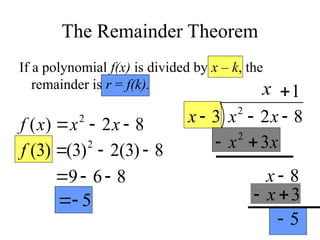
The Remainder Theorem
Ifa polynomial f(x) is divided by x – k, the
remainder is r = f(k).
8
2
)
( 2
x
x
x
f
)
3
(
f 8
)
3
(
2
)
3
( 2
8
6
9
5
8
2
3 2
x
x
x
x
x
x 3
2
8
x
1
3
x
5
x
x 3
2
3
x
14.
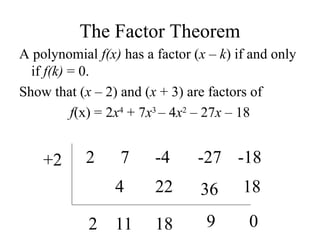
The Factor Theorem
Apolynomial f(x) has a factor (x – k) if and only
if f(k) = 0.
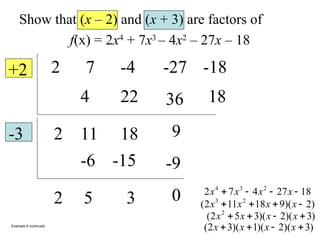
Show that (x – 2) and (x + 3) are factors of
f(x) = 2x4
+ 7x3
– 4x2
– 27x – 18
2 7 -4 -27 -18
+2
2
4
11
22
18
36
9
18
0
15.
Example 6 continued
Showthat (x – 2) and (x + 3) are factors of
f(x) = 2x4
+ 7x3
– 4x2
– 27x – 18
2 7 -4 -27 -18
+2
2
4
11
22
18
36
9
18
-3
2
-6
5
-15
3
-9
0 18
27
4
7
2 2
3
4
x
x
x
x
)
2
)(
9
18
11
2
( 2
3
x
x
x
x
)
3
)(
2
)(
3
5
2
( 2
x
x
x
x
)
3
)(
2
)(
1
)(
3
2
(
x
x
x
x
16.
Uses of theRemainder in Synthetic
Division
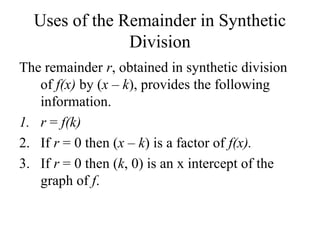
The remainder r, obtained in synthetic division
of f(x) by (x – k), provides the following
information.
1. r = f(k)
2. If r = 0 then (x – k) is a factor of f(x).
3. If r = 0 then (k, 0) is an x intercept of the
graph of f.
17.
Fun with SYNand the TI-83
• Use SYN program to calculate f(-3)
• [STAT] > Edit
• Enter 1, 8, 15 into L1, then [2nd
][QUIT]
• Run SYN
• Enter -3
15
8
)
( 2
x
x
x
f
)
3
(
f
18.
Fun with SYNand the TI-83
• Use SYN program to calculate f(-2/3)
• [STAT] > Edit
• Enter 15, 10, -6, 0, 14 into L1, then [2nd
]
[QUIT]
• Run SYN
• Enter 2/3
14
6
10
15
)
( 2
3
4
x
x
x
x
f



![Fun with SYN and the TI-83
• Use SYN program to calculate f(-3)
• [STAT] > Edit
• Enter 1, 8, 15 into L1, then [2nd
][QUIT]
• Run SYN
• Enter -3
15
8
)
( 2
x
x
x
f
)
3
(
f](https://image.slidesharecdn.com/polynomialandsyntheticdivision-250312083700-e9888df3/85/polynomial_and_synthetic_division-pptpoi-17-320.jpg)
![Fun with SYN and the TI-83
• Use SYN program to calculate f(-2/3)
• [STAT] > Edit
• Enter 15, 10, -6, 0, 14 into L1, then [2nd
]
[QUIT]
• Run SYN
• Enter 2/3
14
6
10
15
)
( 2
3
4
x
x
x
x
f](https://image.slidesharecdn.com/polynomialandsyntheticdivision-250312083700-e9888df3/85/polynomial_and_synthetic_division-pptpoi-18-320.jpg)


![Grade 10 Remainder Theorem [Autosaved].pptx](https://cdn.slidesharecdn.com/ss_thumbnails/3-250826085837-2b228d20-thumbnail.jpg?width=640&height=640&fit=bounds)


