FORENSIC 105
LIE DETECTION
TECHNIQUE
CHAPTER 1
THE DEVELOPMENT OF
POLYGRAPH
UNIT 1
NEED-TO-KNOW
CONCEP
TS
What is Polygraphy?
It is the scientific method of
detecting deception using a
polygraph instrument. This is
incorrectly referred
to
as Lie
Detection.
What is
Polygraph?
Dan instrument for the recording of
changes in blood pressure; pulse rate,
respiration and skin resistance as
indication of emotional disturbances
especially of lying when questioned.
What is
Polygraph?
The term “polygraph” is
composed of two words “poly”
means many and “graph” means
writing and simply means as “many
writings”.
What is
Polygraph?
It is a recorder of a psycho
physiological changes occurring
within the examinee’s body as the
polygraph examiner asks series of
questions.
Is polygraph a Lie Detector?
Lie detector is thepopular but
misleading name of the
Polygraph.
What is the other name of
the polygraph?
“TRUTH VERIFIER”
What are the concepts
of Polygraph
Examination?
Polygraph examination is used to test
an individual for the purpose for
detecting deception or verifying the
truthfulness of his statements.
What are the concepts of
Polygraph Examination ?
It is based on the
theory
that
“a
conscious mental effort on the part of a
normal person to deceive, causes
involuntary physiological changes that
is in effect a body’s reaction to
an imminent danger to its well-being”.
What are the objectives of
a Polygraph
Examination?
1. Obtain additional investigative
leads to the facts of the
case/offenses.
2. Ascertain if a person is
telling the truth
What are the objectives of
a Polygraph
Examination?
3. Locate the fruits or tools of
the crime and where abouts of
wanted persons.
4. Identify other persons
involved (accomplices of
What are the objectives of
a Polygraph
Examination?
5. Obtain the valuable
information from reluctant
witnesses.
6. Eliminate the innocent suspects
Definition of Terms
DEFINITION OF TERMS
FEAR – is emotional response to
specific danger that appears to
beyond a persons defensive power.
DEFINITION OF TERMS
DREACTION – it is an action in mental
attitude evokes by external influence.
DRESPONSE – is any activity or inhibition
of the previous activity of an organism
resulting from stimulation.
DEFINITION OF TERMS
DECEPTION – is an act of deceiving or
misleading usually accompanied by lying.
LYING – the uttering or conveying of
falsehood or creating a false or misleading
information with the intention of
affecting wrongfully the acts and opinion
of other.
DEFINITION OF TERMS
DSPECIFIC RESPONSE – is any deviation
from the normal tracing of the subject.
DNORMAL TRACING – is a tracing on
the chart wherein the subject answered
in the irrelevant question.
DEFINITION OF TERMS
DDETECTION – It is an act of discovery of
existence, presence of fact or
something hidden or obscure.
DPOLYGRAPH EXAMINER – is one
who conducts and administer the test.
DEFINITION OF TERMS
DSUBJECT- refers to any person undergoing
polygraph examination. He/ She may be
the
suspect, complainant, victim, witness,
relative
of the victim/suspect or job aspiring
applicant
( in cases of employment on government
or
private institution undergoing
DEFINITION OF TERMS
Admission- is the voluntary acknowledgement
or by implication by a party in interest or by
another by whose statement he is legally bound,
against his interest, of existence or truth of a
fact in dispute material to the issue.
Confession- is the express declaration of guilt
by the accused on the accusation against
him.
DEFINITION OF TERMS
Emotion- any feeling,especially strong
or intense feelings, as of love, joy,
fear, etc. oftenaccompanied by
complex physiological changes. In
polygraphy, it is the feeling of
fear of detection which
is a factor in the result of the
DEFINITION OF TERMS
Interrogation- is the vigorous
questioning of a person suspected of
having committed an offense or
of a crime, who is reluctant to
make fulldisclosure of information in
his possession which is pertinent
to the investigation
UNIT 2
EARLY METHODS OF
DETECTING
DECEPTION
•Ordeal, Trial or Judicium Dei is a common method of deciding guilt or
innocence and a practice of referring disputed questions to the
judgment of God, determined by various means, particularly by
physical tests.
•It is a semi-magical method of determining guilt of innocence which
goes right back to pre-historic times through many cultures.
•Here are the examples of Ordeals:
RED HOT IRON ORDEAL
•Practiced in the hill tribe of north Bengal. The accused had to carry a
bar of red hot iron in his hands while he walked nine marked paces..
Another is the suspect will run barefooted and blind folded over a
nine red-hot iron, after that the hand or foot will be cover up and
inspected in three days afterward. If the accused had escape unhurt,
the person was pronounce innocent, if hurt, the person was guilty.
ORDEAL BY BALANCE
•Practiced in Vishnu, India. A scale of balance is used, in one end of the
scale the accused is placed and in the other end is a counter balance.
The person will step out of the scale and listen to a judge to deliver
an exhortation on the balance and get back in. If he was found lighter
than before, then he should be acquitted, if not,, if the weight
remains the same or he became heavier, then he is guilty.
ORDEAL BY WATER
•In this type of ordeal, the water was symbolic of the flood of the Old
Testament, washing sin from the face of the Earth, allowing only the
righteous minority to survive.
•There are two kinds of ordeal by water the boiling water and the cold
water.
BOILING WATER ORDEAL
•This ordeal is consisted of lifting a stone out of a boiling water, with
the hand inserted as deep as the wrist. More serious offenses
demanded that arm was submerged up to the elbow. The burn was
bandaged for three days before examination. If the accused had
escape unhurt, the person was pronounce innocent, if hurt, the
person was guilty.
COLD WATER ORDEAL
•In this ordeal, the accused was tied at feet and hands and was
lowered to cold water by rope. This rope is tied around the accused
waist and had a knot in the rope. If both knot and accused dipped
beneath the surface of the water, the accused was proven innocent.
If the knot is dry or if the water refused to receive him, hi is guilty.
ORDEAL BY RICE CHEWING
•It is perform with a kind of rice called sathee,
prepared with various spells. The person on
trial eats the sathee, with the face to the east
and the spits upon a pea leaf. If saliva is mixed
with blood, he is declared to be a liar. Indians
practice this ordeal.
Ordeal by Combat
•The aggrieved party claimed to fight the alleged offender or to pay a
champion to fight for him. The victor is said to win not by his own
strength but because of supernatural powers that had intervened on
the side of the right, in which the judgment of God was thought to
determine the winner. If still alive after the combat, the loser might
be hanged or burned for a criminal offense.
ORDEAL BY CORSNAED (BLESSED BREAD)
•A priest puts a corsnaed or hallowed bread into the mouth of the
accused, with various spoken curse. If the accused swallowed it he
was freed from punishment
TEST OF THE EUCHARIST
•This was applied chiefly among the clergy and monks. When they the
host it was believed that God would smite the guilty with sickness or
death. Others believed that if the accused is innocent, when given a
poisonous drink for him to take in, Angel Gabriel will descend from
heaven to prevent the accused from taking in the poisonous drink.
ORDEAL OF THE BIER
•It was an ancient belief that the slain dead could point out their killer.
In England, it is customarily for the accused to approach the bier
where the corpse lay. In the view of the witness, the wounds of the
victim were observed to see if they began to bleed again. They
believed that murderer is near, which causes the flood to flow out
from the wounds of the victim.
ORDEAL OF THE NEEDLE
•A red hot iron needle was made to pierced the lower lip of the
alleged criminal and if blood flowed from the wound, he was deemed
guilty, but if none, he is innocent. Wanaka, Eastern Africa practiced
this ordeal.
ORDEAL BY HEAT AND FIRE
•The accused walked barefooted over a red hot coals, or was deemed
to walk through fire, if he was unharmed by fire he was considered
innocent.
TRIAL OF THE CROSS
•The accuser and the accused were placed under the cross with their
arms extended or crosswise and the first to move his hands or suffer
them to fall was held guilty or liar.
TRIAL OF THE WAXEN SHIRT
•The accused was dressed in cloth covered with wax and walked
barefooted over burning coals. If he was unhurt by the fire and the
wax did not melt, he was considered innocent.
DONKEY’S TAIL ORDEAL
•As a psychological theory, a donkey is placed in a room alone and
observed. Then one by one, the accused and the accuser will enter
the room. If the donkey cried a judgment of guilt in crimes, is
pressured. It is believed the deep inside one’s conscience, he is guilty.
ORDEAL OF THE TIGER
•The accused and the accuser are placed inside a cage of a tiger, if the
tiger spare one of them hi is considered innocent.
BURMA
•The ordeal being practice by this country is the two contesting party,
the accused and the accuser are furnished with candles with equal
size and lighted simultaneously, the owner of the candle that outlast
the other is the winner.
BORNEO
•The accuser and the accused were presented a shellfish placed on the
plate. An irritating fluid was then poured on the shellfish and the
litigant whose shellfish moved first was adjudged the winner.
GREECE
•A suspended axe was spun in the center of group of suspects. Soon
the axe stopped, whoever was in the line with the axe blade was
supposed to be guilty out by divine providence.
UNIT 3
HISTORICAL
BACKGROUND OF
POLYGRAPH
•In the middle of 19th
century, Dr. Hans Gross defined “search for
truths” as a basis and goal of all criminal investigations. He stated, “a
large part of criminal work is nothing more than a battle against lies.
ANGELO MOSSO (1895)
•He studied fear and its influence on the heart.
•He developed the sphygmomanometer, this instrument was designed
to measure the flow of blood while a person lay on his back in a
prone position.
CESARE LOMBROSO (1936-1909)
•He employed the first scientific instrument to detect deception,
which is known as hydrosphymograph, this instrument measures
changes in pulse and blood pressure when suspects were asked about
their involvement in or knowledge of specific response.
•He was accorded the distinction of being the first person to utilize an
instrument for the purpose of detecting lies.
WILLIAN MOULTON MARSTON (1915)
•He was considered as the father of modern polygraphy. He
experimented the blood pressure, respiration and skin resistance as
the basis for the responses of a person and can be use in detecting
lies.
JOHN LARSON (1921)
•He devised the very first practical polygraph in 1921. His instrument
gave a continuous recording of blood pressure and respiration.
•He devised the first two recording channel polygraph in the history.
LEONARDE KEELER
•He invented the “Keeler Polygraph” which is an improvement of
Larson’s apparatus. This apparatus was with components for
recording, blood pressure, pulse and respiratory changes. A
galvanometer what is known as the galvanic skin reflex generally
referred to as GSR.
VITTORIO BENUSSI (1914)
•He detected deception with a pneumograph, an instrument that
graphically measures the inhalation and exhalation.
•He presented a paper before the second meeting of the Italian
Society for Psychology in Rome, on the subject of his experiments
regarding respiratory symptoms of lying.
HAROLD BURTT (1918)
•He determine that respiratory changes were indication of deception.
He found out that changes in blood pressure were of greater value in
determining deception than in changes in respiratory.
LUIGI GALVANI
•He is an Italian physiologist who was accorded the distinction for
developing galvanic skin reflex (GSR) of the galvanometer, which
records electrical bodily resistance, it reflected emotional changes
by measuring changes in person skin resistance to electricity.
STICKER (1897)
•He made the first suggestion for using galvanograph for detecting
deception based on the works of several predecessors.
SIR JAMES MCKENZIE (1960)
•He invented the ink in the polygraph.
•A famous heart specialist. It was said that polygraph exist as early as
1906 but it is not being used to detect deception.
RICHARD O. ARCHER (1953)
•The first polygraphist to record simultaneously on a regular basis the
chest and abdominal breathing patterns. He was also the first on to
record simultaneously two galvanic skin reflexes.
RICHARD I. GOLDEN (1969)
•He presented a paper at the annual seminar of American polygraph
association at Houston, Texas regarding his experiments using
existing control question techniques but requiring the subject to
answer each question twice. The first time truthfully and the second
time with a lie, for the purpose of requiring additional data from the
examinee by comparing his subjective truthful answer with a known
lie to the same question.
ANTON MESMER
•In 1778, he was the first one to introduce hypnotism as a method of
detecting deception.
ALLEN BELL (1972)
•He is an American inventor who developed a device called
Psychological Stress Evaluator (PSE). This instrument detects slight
trembling in the voice, which may be interpreted to determine if the
person is telling the truth.
CHAPTER 2
LIES AND EQUIPMENTS
UNIT 1
TYPES OF LIAR & LIES
What is
Lie?
•It refers to either untruthful or
falsehood statements; any acts that
deceives or creates false
impression. It is also synonymous
to deceit, deception, or
fabrication.
What is meant by
“Detection?
•This simply refers to the act of
detecting, discovering,
perceiving, finding, or
uncoveringsomething hiddenor
obscure
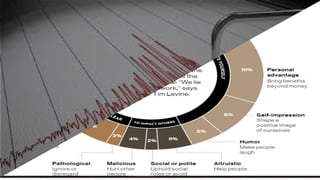
Why do people Lie?
What are Common Types of Liars?
•Lying can be devastating, it does not only
hurt the one who is being lied to, but it
also hurts the one who tells it. Lying
is a common denominatorin many of our
lives and recognizing some of the
different types might help us in
dealing with the liar in our lives.
Panic Liar
•A person who lies in order to avoid
the consequences of confession. He
or she afraid of embarrassment to
loved ones and is a serious blow to
his or her ego.
Occupational Liar
•Is someone who lied for years. This
person is a practical liar and lies
when it has a higher payoff than
telling the truth.
Tournament Liar
•A person who loves to lie and is excited
by the challenge of not being detected.
He views an interview as another
contest to won. He lies because it is the
only weapon remaining with which to
fight.
Ethnological Liar
•A person who was trained not to be
a squealer. This person loves to be
interrogated and has taken a creed
either personal or with others, that
he or she will never reveal the
truth.
Psychopathic Liar
•This type of liar has no
conscience. He shows no regret
for his dishonest actions and
no manifestations of guilt.
Pathological Liar
•A person who cannot distinguish
the right from wrong. This are
those person who is mentally
sick.
Black Liar
•A person who always pretend and a
hypocrite.
Types of Lies
Lie of
Omission
•This is a type of lie that people usually
used because it is simple to tell.
Individuals who will make use of this
type of lie will tell the truth while
omitting details that could create
possible troubles.
Lie of
Fabrication
•This is the most difficult type of lie
that a subject could use in an
interview.
Lie of
Minimization
•In this type of lie individual will accept
that something occurred but downplays
the indication. Lie of minimization could
be used if a subject wanted to stay
close to the truth, however, he covers
the truth for his or her own benefit.
Lie of Exaggeration
•This is a lie often used to exaggerate things
for the hope of obtaining some
advantage. This is also often found on
resume, where applicant exaggerates his
or her experiences, knowledge, skills,
salary, and length of service.
White
Lie
•Used to maintain harmony of friendship ,
harmony of home or office.
UNIT 2
SIGNS AND SYMPTOMS
OF LYING
Signs of
Lying (Verbal
Clues)
Methods of Responding to the
Question
•The way the respondentanswer the
question is clue of deception. In
general truthful people tend to be
direct, untruthful people tend to
be cautious about their answers.
Length of Time before giving response
In general, truthful persons
answer questions immediately
after the question is asked,
untruthful persons take their
time in giving responses.
Repitition of Questions
•The act of repeating the question is another
means for the deceiver to gain time to
frame his or her answer. The question may
be repeated word for word, or the
respondent may frame the answer with a
request to repeat the question?
Fragmented or Incomplete Sentences
•Untruthful person often speak in
disjointed or curtailed sentences. This is
usually because he has started to
answer, then though better of it.
Being Overly Polite
•Untruthful subjects are more likely
to be polite to the accuser, using
pleasing term such as, sir or ma’am,
boss or chief.
Oaths
•Lying persons will frequently utter
oaths, such as, I swear to God I didn’t do
it or I swear on my Father’s grave. Most
truthful people do not need to swear or
affirm, they are confident with their
denials.
Clarity of Response
•Honest people tend to be very clear
in their answers, while untruthful
persons tend to speak softly and
broaden their answers.
Assertiveness
•Truthful person are confident about their
innocence, while deceitful ones are not
confident unless they are practice liars.
Truthful people will respond directly
without waiver or qualifications; while
deceptive people tend to respond indirectly
with waivers and qualifications.
Inconsistencies
•Contradicting testimonies made by
a person is one of the best indicator
of dishonesty.
Pauses
Gap in speech patterns may be one reliable
clue to deception. The examiner should
assess in speech pauses if it is too long, too
frequent, or which occur at inappropriate
places.
Speed of Speech
Persons who are tense or upset
frequently increases the swiftness of
their speech, who tend to run together
and the conversation could be
fragmented.
Signs of Lying
(Non-Verbal
Clues)
Emblems
•They are often performed deliberately,
these are expressions made with the body,
whose meaning are clearly understood.
Here are the example of emblems: Shaking
or nodding of the head, shrugging of
shoulders, the thumb up sign, etc.
Manipulators
•These are usual behavior of touching one’s self. It
encompass grooming of the hair, wringing the hands,
picking imaginary fu from coat. Manipulators may go
on for several minutes or may last for a short time.
Props, like cigarettes, cellphone , pencil can be use as
manipulators. It is usually done by untruthful subject
for them not to focus on the question and answer to
avoid detection, instead they are converting their
attention to other objects.
Breathing
•Although breathing is an involuntary
movement, breathing is very much
affected by stress especially when lying.
Sweating
•This is another uncontrollable body function.
Perspiration occurs with heat as well as with
emotion. Too much sweating could be an
indicator of deception.
Frequent Swallowing
•A dry mouth frequently
accompanies deep emotion.
Increased swallowing that will
lead to dry mouth might
indicate deception.
Facial Muscles
•Facial muscles is not easy to control.
Example: to force a smile is easy, but even
beginners will notice that it is not a genuine
smile. This can be used in detecting
deception
Eyes
•The eyes most likely to express emotion.
The failure to have an eye to eye contact
is a great indicator of deception. This
action indicates that a person is hiding
something.
UNIT 3
The Equipment
(Parts and Functions
of
Polygraph Machine
and
Its
What does polygraph record?
•A standard polygraph records changes in blood pressure, pulse rate,
galvanic skin reflex (sweat gland activity) and upper and lower
breathing patterns. The polygraph records significant changes from
the subject’s norm when specific questions are asked.
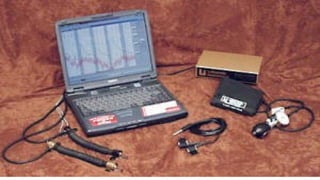
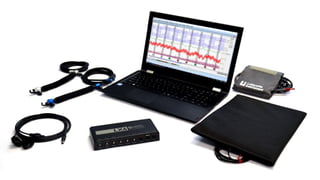
What is Polygraph
Instrument?
•It is an instrument for the recording of changes in blood pressure;
pulse rate, respiration and skin resistance as indication of emotional
disturbances especially of lying when questioned.
Major Parts of Polygraph Machine
•Pneumograph
•Galvanogrpah
•Cardiosphymograph
•Kymograph
Pneumograph
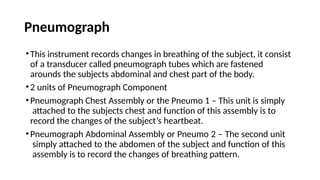
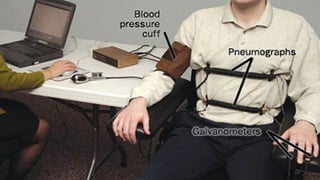
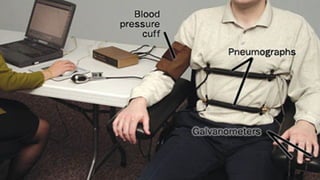
•This instrument records changes in breathing of the subject, it consist
of a transducer called pneumograph tubes which are fastened
arounds the subjects abdominal and chest part of the body.
•2 units of Pneumograph Component
•Pneumograph Chest Assembly or the Pneumo 1 – This unit is simply
attached to the subjects chest and function of this assembly is to
record the changes of the subject’s heartbeat.
•Pneumograph Abdominal Assembly or Pneumo 2 – The second unit
simply attached to the abdomen of the subject and function of this
assembly is to record the changes of breathing pattern.
Galvanograph
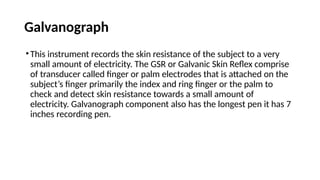
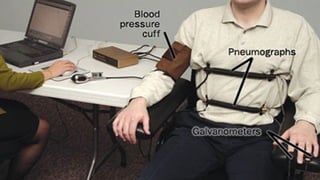
•This instrument records the skin resistance of the subject to a very
small amount of electricity. The GSR or Galvanic Skin Reflex comprise
of transducer called finger or palm electrodes that is attached on the
subject’s finger primarily the index and ring finger or the palm to
check and detect skin resistance towards a small amount of
electricity. Galvanograph component also has the longest pen it has 7
inches recording pen.
Cardiosphygmograph
•This instrument records the changes in blood pressure and pulse rate.
It has a transducer called Arm Cuff, it is placed around the subject’s
arm. It also has a blood pump Assembly , this unit is attached directly
to the arm cuff and it has the sphygmomanometer, this unit is the
basis of determining gauge of the air supplied to the arm cuff while
the pump bulb Assembly supplies air to the arm cuff through
pumping the tube.
•Blood pressure is read at two points: the high point at which the
heart contracts to empty its blood into circulation, called systole; and
the low points at which the heart relaxes to fill with blood returned
by the circulation called diastole.
Kymograph
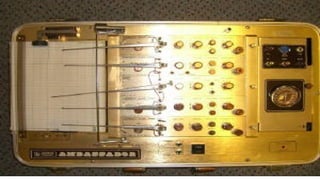
•It is a motor that pulls the chart paper under the recording pen
simultaneously at the rate of 6 to 12 inches per minute. It is
sometimes referred to as chart drive module
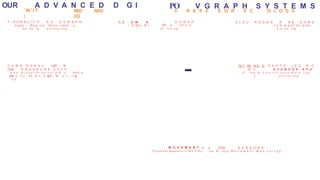
OUR A D V A N C E D D G I
' W ' I T
I
RED AND
CO
PO V G R A P H S Y S T E M S
s R E S E S O R E C O L O G V
T I H O R A C I C P E U O G R A P H
U p p e . . - R e g i o n IRes p iratio.,-y
A c -tiv· t y o n l i t o r i n g
A B O M A
I O ' W e r R -
- ·· ·
O G R A P
Re -p r a t o r y
on i t o r i n g
E L E C R O D E R A S E S O R S
,c e /S w e a 't G I . a n d
o n· t or i ng
C A R: D 1 O V A s c · LAR B
OOD P R E S S U R E C U F F
e a n B l o o d l P r e s s ur ,e /P u
lse
a d P u s e S 1:..-,e n
g th M , o n
" t o
R a i l ! : e
ri n
g - IN F RA R E D P H O T O L E C R C
PLI E H V S M D G R . A P H
P l s e B o o d V o U l ff l l ' l l e R e l a l i v e
C · o n i i t o r i n g
d .OTo, S E N S O R S
M O V E M E N T a
C o u n t e r m e a s u l l l " 8 s P h y · c a B! o d y M o v e m e n t M o n · t o r i n g
Chapter 3
The Examination Proper
Unit 1
The Polygraph Examiner
A polygraph examiner is one who skilled and capable to detect
deception or verify truth of statement through instrumentation or
the use of mechanical device. The instrument or device utilized to
detect deception or verify truthfulness of the statements must meet
the basic instrumentation requirement of being capable of recording
simultaneously on a moving chart the physiological responses.
The following are qualifications and qualities expected of a polygraph
examiner are:
• 1. He must remember that he is an impartial seeker of the truth, conducts his
examination in a professional and ethical manner, and never allow his personal
feelings, sympathies, or prejudice influence the result of the examination.
• 2. He should constantly bears in his mind his primary responsibility to his subject
to give them all possible safeguards against error and never accept the polygraph
examination, any subject whose physical and mental health or states makes him
unfit.
• 3. Technically, he must have a complete knowledge of the instrument and its
potentials and limitations, the most modern polygraph techniques, proficiency
in the conduct of the polygraph examination, test construction and chart
interpretations.
• 4. Morally, he must have a sincere desire to be a polygraph examiner in its
strictest sense, by devoting himself to the polygraph profession through
maintenance of a high personal integrity and increasing personal proficiency
through constant study and research.
Responsibilities of Polygraph Examiner to his
Subject
• 1. The polygraph examiner recognizes the fact that his primary responsibility must
be to the person who has voluntary submitted himself to a polygraph
examination.
• 2. He should never conduct examination on person without first appraisal of the
subject’s constitutional rights.
• 3. He should never perform examination to any person unless the instrument he
is going to utilize is in good working condition and makes a continuous permanent
recording on a moving chart of at least 2 physiological tracing.
• 4. He should never render a certain conclusive verbal and written opinion based
on the chart analysis without having administered at least two or more charts.
• 5. He should not suggest testimony concerning the charts or conclusions
presented by another examiner unless he is methodically familiar with the
techniques and procedures employed.
Responsibilities of the Investigator to the
Examiner.
• 1. He must not wait until the last minute, after all investigative method and
techniques have failed, the test should never be used as a last resort.
• 2. He must not fail to investigate the case before seeking assistance. The
polygraph examination does not establish whether a crime has been
committed or not. Faulty or incomplete investigation places the examiner
in a position to ask weak questions rather than strong and specific one.
• 3. He should not depend on the mass screening of possible suspects to
produce the guilty party except when no reasonable amount of
investigation had produced a likely suspect or materially narrowed down
the number of possible suspects.
• 4. Not to stop investigation if polygraph examination is deferred or
temporarily delayed.
•5. He must not use polygraph as a props, ruse or trickery to secure
confession or for the evaluation of the mental and physical state of
the suspect.
•6. He should not tell to anyone that the polygraph would decide
whether the suspect is innocent or guilty. The court makes the
decision.
•7. He must not think that investigation is over if the test indicated
that the subject lied or confessed. Evidence and testimonies should
be gathered to prove the facts of the offense and the allegation
against the subject.
Responsibility of the Investigator to the
Subject.
• 1. Be knowledgeable about the polygraph so that he can talk openly and
freely to the person about the test. The subject may know very little of may
have been misinformed about it.
• 2. Recommend the test as a means for the subject to indicate his
innocence.
• 3. Stress the test’s capacity for indicating through the recorded response
whether a person is telling the truth.
• 4. Guarantee the subject that the examiner is qualified and impartial to all
persons involve in the case.
• 5. Avoid any claim for the instrument or examiner that is not backed up by
facr.
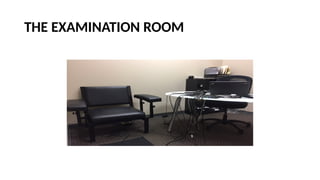
THE EXAMINATION ROOM
• 1. Ideally, polygraph test should be performed in a quiet, private, 90%
soundproof room. Unusual noise, such as ringing of the telephone or
conversation of persons outside the examination room or presence of
investigators or other spectators in the room itself, would bring
disturbances and distractions that in the turn would distort the different
physiological recordings and seriously interfere with a satisfactory
polygraph diagnosis.
• 2. Whenever it is possible to do so, a special equipped and furnished room
should be set aside for polygraph examinations. Such room should be very
conventional as painted walls and furniture. It should contain no
decorations, pictures or other objects that would distract the attention of
the person being examined, If decorations, pictures is desired, they should
not be placed in any part of the room faced by the subject during the
course of the test.
•3. The subject should not face a glass window or another room during
the test because possible outside distractions which may affect the
responses.
•4. It is essential that the examination room be adequately ventilated
with even, comfortable temperature. If existing facilities permit,
there should be “observation room” adjoining the examination room,
in the wall of which there an inserted “one-way mirror” and a
concealed microphone so that a person in the observation room may
hear as weel as see what occurs in the examination room.
Chapter 3
The Examination Proper
Unit II
FOUR (4) PHASES OF POLYGRAPH EXAMINATION
Limitations of the Subject who will
undergo Polygraph Examination
1. The subject must have a goodnight sleep at least 5 hours prior to the test.
2. He must refrain from smoking for at least 2 hours.
3. He should not undergo prolonged interrogation prior to the test.
4. The subject must not have been subjected to physical abuse or body contact.
5.He must refrain from drinking alcoholic beverages, taking sedatives, or
capsule or syrup for at least 12 hours prior to the test.
6.He must not suffering from any temporary illness like headache, toothache,
stomachache, fever, menstruation, severe colds and coughs.
7. He must not hungry
How does the test process works?
• 1. The examiner receives and reviews the facts of the case.
• 2. The examiner explains the test process to the subject and review facts of the case
during pretest interview.
• 3. The examiner designs the specific questions and making sure each one is easily
understood.
• 4. The polygraph instrument is attached on the subject’s body and he is given an
additional instruction.
• 5. The questions are read to the subject while the polygraph sensors are attached on the
subject’s body.
• 6. After chart have been run, the examiner analyzes the charts and develops a numerical
score for the test. This score results in a conclusion of truthful, deceptive or inconclusive.
• 7. The examiner will transmit the test result to the client verbally and a written report
maybe requestd.
FOUR (4) PHASES OF
POLYGRAPH EXAMINATION
Phase 1 – Initial interview with the
Investigator Handling the Case
•It is essential for the examiner to obtain accurate information
concerning all the available facts and circumstances that form the
basis for the suspicion or accusation directed against the person to be
examined in order to conduct a satisfactory polygraph examination.
•It is the phase of examination in which the examiner will gather all
the information needed in order to formulate a questions that can be
used on the other phase of the examination. That is why having a
strong facts and circumstances will result to a strong and satisfactory
polygraph examination while having a weak facts and circumstances
will lead to weak and unsatisfactory polygraph examination
Phase 1 includes:
•1. Acquiring and evaluating facts.
•2. Determining the areas the subject needs to be asked.
•3. The investigator shall furnished the examiner the following:
•A. sworn statement of the suspect, witnesses and victim.
•B. Incident or spot report.
•C. Background Investigation of suspects, witnesses, and victims.
•D. Rough sketch or pictures of the crime scene and other facts.
Phase II – Pre Test Interview
• The examiner conducts pre test interview with the subject prior to the test
is considered essential both for the purpose of conditioning the subject
for the examination and also to provoke and observe indications of guilt
or innocence. The examiner should not hold back any information from
the subject about the instruments, its attachment or recording. This will
serve to increase a lying subject concerned over possible detection.
• The examiner should be friendly to the subject, no accusatory approach will
be made under this phase. The subject behavior himself is usually the best
source of information
• The primary purpose of pre test interview is to prepare or condition the
subject to the test.
This phase includes:
•1. The appraisal of subjects constitutional rights.
•2. Obtains subject’s consent to undergo polygraph test by signing
statement of consent.
•3. The taking of personal data of subject.
•4. Determine the suitability of the subject.
•5. Clinical observation of the subject.
•6. Evaluating the psychological preparation of the subject.
•7. Informing the subject of his involvement of the case.
Rights of the Subject
•1. To be examined by a qualified examiner.
•2. To be determined if fit for examination.
•3. To be informed of the reason for the lie detector test.
•4. To have an explanation of the polygraph machine and what it does.
•5. To give consent to the lie detector test.
•6. Not to be compelled to undergo prolonged questioning.
•7. Not to be expose to oral criticism or abuse.
•8. Not to be exposed to physical, mental or psychological abuse
•9. To refuse to submit to lie detector test.
Phase III- The conduct of Instrumentation or
Actual Test
•After the pre-test interview, the examiner should proceed to place
the attachment on the subject. The first to be attached is
Pneumograph, then the Cardiosphymograph and the Galvanograph.
Review all the questions with the subject before the actual
examination is made. The examiner should discourage any
comments or statement by the subjects. Test instrument must be
given to the subject.
A. Upon completion of the necessary preliminary preparation the instruments is attached to the
subject.
B. The pneumograph tubes will be placed on the subjects chest and abdominal part.
C. The finger of palm electrodes will be placed on the subjects index and ring finger or the hand.
D. The arm cuff will be placed on the subject’s arm.
E. The synchronous motor carrying the paper upon which blood pressure pulse respirations
recording are made is then set in motion, the motor being so timid that the paper moves along
at the rate of a out six inches per minute, then ten to fifteen seconds after the instrument has
been set in motion, the inked filled pens of the instruments are permitted to make their blood
pressure pulse respiration tracings before the question are asked of the subject.
F. During the test period the subject is informed that he will be asked several questions which
should be answered by either yes or no answers, and that they are so brief and to the point.
G. Approximately five to ten seconds after this instruction first question is asked and then the
other questions follows after or at the interval of fifteen or twenty seconds.
PHASE IV – POST–TEST INTERVIEW/
INTERROGATION
This includes all consideration that bears on the examination. This is done just
after the instrument is turned off. If the Polygraph test result indicates deception,
the examiner will then proceed to conduct short interrogation.The purpose of
which is to obtain confession. However, if the Polygraph indicates that the subject
is innocent; the examiner will just release the subject cordially and thanks him/ her
for his/her cooperation.
Can A person be compelled to undergo lie
detector test?
•In as much as the test requires the subject to answer the question
either by “yes or no”, it infers the use of intelligence and attention or
other mental faculty which is self incriminatory. Therefore, you
cannot compel a person to be subjected to the test.
Is there a best time of a day to conduct a
polygraph examination?
•Yes, since it is important that the person tested be capable of the
maximum reactions, that person should be well rested prior to the
test. In other words, testing conducted in the morning will be more
productive than those examinations conducted in the later in the day
and in the evening, these significantly increases the risk of an
inconclusive result. The person should not be tested after the
argument, interrogations or long day of work if possible.
Can someone below the age of 18 take a
polygraph?
•Yes, but the examiner must have first the written consent of the
parent or guardian of the child. However, most examiners will not
test anyone who is less than 12 years age.
Can medication affect the result?
•Yes, any drug or medication that suppresses normal activity of the
Central Nervous System will reduce the strength of reactions found
on the polygraph charts, resulting in a higher likelihood of
inconclusive result.
Can pregnant woman be tested?
•It does not affect the outcome of a polygraph examination to test a
pregnant woman unless the fetus is making excessive movements or
causing pain to the mother during the test. Most examiner will not
test pregnant woman under any circumstances. Some examiner will
only test if there is a note from the woman’s physician stating that
there is no complications from the pregnancy and the stress of taking
a polygraph test would have an impact on the health of the mother or
the fetus.
Chapter 4
FORMULATION OF QUESTIONS
AND
TECHNIQUES
Unit I
FORMULATION OF THE TEST QUESTIONS
Three simple criteria in the formulation of
questions:
1.Short – The questions must be as short as possible to prevent the subject from losing
focus, minimize their impact upon the subject, and to avoid long questions that can
confuse the subject. In other words, formulated questions must be answerable by a
simple YES or NO.
2.Simple – The questions must not contain any legal terminologies and technical terms.
Furthermore, their meanings must be clear and have reference to only one element of
an offense or fact.
3.Direct – The questions must be able to stand alone and not depend on some other
questions. They should focus on factual information not based on opinion. The relevant
test questions should be limited to a single case investigation. The polygraph technique
is not effective for simultaneous testing involving two or more unrelated case
investigation.
General Guidelines
•1. The question must be clear
• In other words, the question that must in the test should be thoroughly
understandable to the subject. There are also isolated cases wherein the
examiner must use the subject’s own dialect to facilitate better
understanding. For example, if the subject does not know any dialect other
than what he has grown up with, the examiner must certainly adjust to the
situation
2. The question must be simply stated
The question must be stated as simply as possible. This means that the
questions must have only one meaning. The sentence must completely avoid
having double meaning. For example, Did you shoot him then run into the
house? In this question, It combines two sets of facts or occurrence, one of
which might be truthfully answerable by YES and other by NO.
•3. Avoid lengthy questions
• Asking long question is not only time consuming but also confusing for the
subject as well. Such a question can also result in a loss of impact on a lying
subject.
4. The test questions should focus on facts.
The polygraph test questions should concern factual information, and
should not be based upon opinions. Opinion question responses cannot be
relied upon in evaluating truth or deception.
Test Questions:
• Relevant questions (leaded/material questions) – these are questions pertaining to the issue
under investigation. It is equally important to limit the number of relevant questions to avoid
discomfort to the subject. Relevant questions must be very specific to obtain an accurate result.
• Irrelevant questions (unleaded/immaterial questions) – these are questions which have no
bearing to the case under investigation.
• Control questions – This question are those that inquire about an act or wrongdoing of the same
general nature as the main incident being investigated and broad as possible. Basically, control
questions must serve as the agitating factors of an innocent subject.
•There are two general types of questions to be constructed and
maybe supplemented by other types of questions:
1. General Question Test – most commonly applied.
2. Peak-of-Tension Test – usually used as supplementary test.
•This consists of a series of Relevant & Irrelevant Questions asked in a
planned order. Questions are so arranged as to make possible a
comparison of responses to relevant questions with a subject’s norm
made during the answering of irrelevant questions. There are other
types of questions asked in the GQT:
THE GENERAL QUESTION TEST
(GTQ)
Relevant questions (leaded/material
questions)
• Sample in Relevant Questions: A case involving a shooting incident:
• Weak Relevant Question – it concern some secondary element of the
crime or problem and deals with mostly in guilty knowledge and partial
involvement.
• Weak Relevant Question: Are you involved in the plan to shoot Pedro Dela
Rosa?
• Strong Relevant Question – it is defined as verbal stimulus of primary
important projected in the form of a question which overcome a
psychological excitement level and causes pneumograph,
cardiosphygmograph, and galvanograph tracings changes from the
subject’s physiological norms.
• Strong Relevant Question: Are you the one who shot Pedro Dela
Rosa?
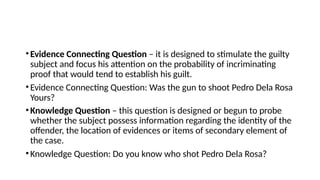
•Evidence Connecting Question – it is designed to stimulate the guilty
subject and focus his attention on the probability of incriminating
proof that would tend to establish his guilt.
•Evidence Connecting Question: Was the gun to shoot Pedro Dela Rosa
Yours?
•Knowledge Question – this question is designed or begun to probe
whether the subject possess information regarding the identity of the
offender, the location of evidences or items of secondary element of
the case.
•Knowledge Question: Do you know who shot Pedro Dela Rosa?
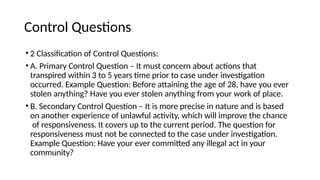
Control Questions
• 2 Classification of Control Questions:
• A. Primary Control Question – It must concern about actions that
transpired within 3 to 5 years time prior to case under investigation
occurred. Example Question: Before attaining the age of 28, have you ever
stolen anything? Have you ever stolen anything from your work of place.
• B. Secondary Control Question – It is more precise in nature and is based
on another experience of unlawful activity, which will improve the chance
of responsiveness. It covers up to the current period. The question for
responsiveness must not be connected to the case under investigation.
Example Question: Have your ever committed any illegal act in your
community?
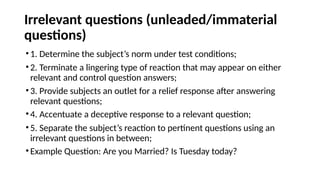
Irrelevant questions (unleaded/immaterial
questions)
•1. Determine the subject’s norm under test conditions;
•2. Terminate a lingering type of reaction that may appear on either
relevant and control question answers;
•3. Provide subjects an outlet for a relief response after answering
relevant questions;
•4. Accentuate a deceptive response to a relevant question;
•5. Separate the subject’s reaction to pertinent questions using an
irrelevant questions in between;
•Example Question: Are you Married? Is Tuesday today?
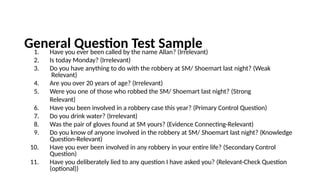
General Question Test Sample
1. Have you ever been called by the name Allan? (Irrelevant)
2. Is today Monday? (Irrelevant)
3. Do you have anything to do with the robbery at SM/ Shoemart last night? (Weak
Relevant)
4. Are you over 20 years of age? (Irrelevant)
5. Were you one of those who robbed the SM/ Shoemart last night? (Strong
Relevant)
6. Have you been involved in a robbery case this year? (Primary Control Question)
7. Do you drink water? (Irrelevant)
8. Was the pair of gloves found at SM yours? (Evidence Connecting-Relevant)
9. Do you know of anyone involved in the robbery at SM/ Shoemart last night? (Knowledge
Question-Relevant)
10. Have you ever been involved in any robbery in your entire life? (Secondary Control
Question)
11. Have you deliberately lied to any question I have asked you? (Relevant-Check Question
(optional))
•Check Question – last question asked in the lie test. It is direct
question that relates to the fact that the subject has told the truth to
all questions asked in the lie test.
PEAK-OF-TENSION TEST (PTT)
The subject may be given this test if he is not yet informed of the details of
the offense for which he is being interrogated by the investigation, or by
other persons or from other sources like the print media. This valid test is
only made possibly when there is no widespread publicity about a crime
where intimate details as to the methods of commission or certain facts of
the case is known from the victim and investigator.
The questions formulated are similar in nature and construction, only one of
which is true and the perpetrator who would naturally be in possession of
such unpublicized knowledge will usually exhibit a rise in the tracing up to
that particular question followed by a decline thereafter, caused by the relief
of knowing that a dreaded question dangerous to his well-being, is past.
Examples of Peak-of-Tension Test:
1. Do you know whether the stolen watch from Allan is a Seiko? (This is an
introductory phrase plus padding question)
2. Is it an Omega? (Padding)
3. Is it a Rolex? (Padding)
4. Is it Timex? (Relevant question)
5. Is it Alba quartz? (Padding)
6. Is it a Citizen? (Padding)
Chapter 4
FORMULATION OF QUESTIONS
AND
TECHNIQUES
Unit II
Test Techniques
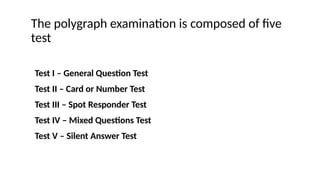
The polygraph examination is composed of five
test
Test I – General Question Test
Test II – Card or Number Test
Test III – Spot Responder Test
Test IV – Mixed Questions Test
Test V – Silent Answer Test
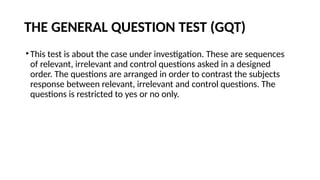
THE GENERAL QUESTION TEST (GQT)
•This test is about the case under investigation. These are sequences
of relevant, irrelevant and control questions asked in a designed
order. The questions are arranged in order to contrast the subjects
response between relevant, irrelevant and control questions. The
questions is restricted to yes or no only.
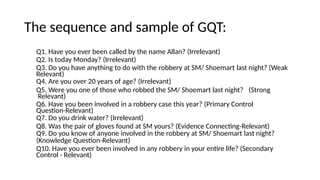
The sequence and sample of GQT:
Q1. Have you ever been called by the name Allan? (Irrelevant)
Q2. Is today Monday? (Irrelevant)
Q3. Do you have anything to do with the robbery at SM/ Shoemart last night? (Weak
Relevant)
Q4. Are you over 20 years of age? (Irrelevant)
Q5. Were you one of those who robbed the SM/ Shoemart last night? (Strong
Relevant)
Q6. Have you been involved in a robbery case this year? (Primary Control
Question-Relevant)
Q7. Do you drink water? (Irrelevant)
Q8. Was the pair of gloves found at SM yours? (Evidence Connecting-Relevant)
Q9. Do you know of anyone involved in the robbery at SM/ Shoemart last night?
(Knowledge Question-Relevant)
Q10. Have you ever been involved in any robbery in your entire life? (Secondary
Control - Relevant)
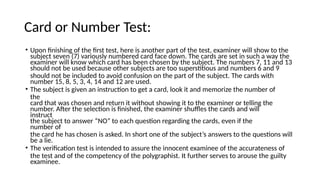
Card or Number Test:
• Upon finishing of the first test, here is another part of the test, examiner will show to the
subject seven (7) variously numbered card face down. The cards are set in such a way the
examiner will know which card has been chosen by the subject. The numbers 7, 11 and 13
should not be used because other subjects are too superstitious and numbers 6 and 9
should not be included to avoid confusion on the part of the subject. The cards with
number 15, 8, 5, 3, 4, 14 and 12 are used.
• The subject is given an instruction to get a card, look it and memorize the number of
the
card that was chosen and return it without showing it to the examiner or telling the
number. After the selection is finished, the examiner shuffles the cards and will
instruct
the subject to answer “NO” to each question regarding the cards, even if the
number of
the card he has chosen is asked. In short one of the subject’s answers to the questions will
be a lie.
• The verification test is intended to assure the innocent examinee of the accurateness of
the test and of the competency of the polygraphist. It further serves to arouse the guilty
examinee.
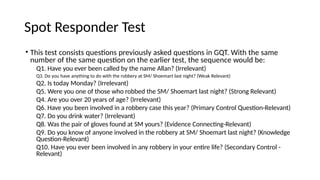
Spot Responder Test
• This test consists questions previously asked questions in GQT. With the same
number of the same question on the earlier test, the sequence would be:
Q1. Have you ever been called by the name Allan? (Irrelevant)
Q3. Do you have anything to do with the robbery at SM/ Shoemart last night? (Weak Relevant)
Q2. Is today Monday? (Irrelevant)
Q5. Were you one of those who robbed the SM/ Shoemart last night? (Strong Relevant)
Q4. Are you over 20 years of age? (Irrelevant)
Q6. Have you been involved in a robbery case this year? (Primary Control Question-Relevant)
Q7. Do you drink water? (Irrelevant)
Q8. Was the pair of gloves found at SM yours? (Evidence Connecting-Relevant)
Q9. Do you know of anyone involved in the robbery at SM/ Shoemart last night? (Knowledge
Question-Relevant)
Q10. Have you ever been involved in any robbery in your entire life? (Secondary Control -
Relevant)
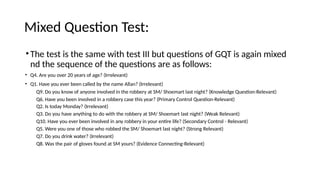
Mixed Question Test:
•The test is the same with test III but questions of GQT is again mixed
nd the sequence of the questions are as follows:
• Q4. Are you over 20 years of age? (Irrelevant)
• Q1. Have you ever been called by the name Allan? (Irrelevant)
Q9. Do you know of anyone involved in the robbery at SM/ Shoemart last night? (Knowledge Question-Relevant)
Q6. Have you been involved in a robbery case this year? (Primary Control Question-Relevant)
Q2. Is today Monday? (Irrelevant)
Q3. Do you have anything to do with the robbery at SM/ Shoemart last night? (Weak Relevant)
Q10. Have you ever been involved in any robbery in your entire life? (Secondary Control - Relevant)
Q5. Were you one of those who robbed the SM/ Shoemart last night? (Strong Relevant)
Q7. Do you drink water? (Irrelevant)
Q8. Was the pair of gloves found at SM yours? (Evidence Connecting-Relevant)
Silent Answer Test
•In this test subject is instructed by the examiner to avoid from giving
any verbal answer to the questions that are to be asked of him during
the test. The subject is instructed to pay attention to each question
and answer the question only by himself, silently. In addition he
should think of truthful answer and give that truthful answer silently
to himself.
Purpose of each Test:
•Test I – The first two irrelevant question s are designed to condition
the subject to have standard tracing and to established truth telling
patterns for the primary part of the record.
•Test II – To check feasible distortion when the selected number is
asked.
•Test III – To determine the responsiveness of the subject to critical
questions and also serve as a check on possibility of spot respond.
•Test IV – To compare the degree of reaction between relevant and
Control Question.
•Test V – To serve as an affirmative check.
Chapter 5
CHART MARKINGS,
SIGNS AND SYMBOLS
(commonly used in Chart
Marking)
Signs and Symbols in Chart Markings.
1. X
- it indicates the beginning or the start of the test.
- Inform the subject that the test is about to begin.
- “X” is placed on the chart below the cardio tracing.
2. XX
- it indicates the end or ending of the test.
- Mark “XX” below the cardio tracing.
-Inform the subject that the test is about to end by giving the instruction to sit
properly, the test is about to end, the blood pressure cuff will be released in a
• 3. / //
• - points where each questions begins and ends. (also called stimulus mark).
• - The single stimulus mark or the vertical line indicates the beginning of the
question and double stimulus mark or the vertical line indicated the
ending of the question.
• 4. + , - , no sign
• - plus sign indicates that the subject answer the question with “YES”, minus
sign indicates that the subject answer with “NO”. No sign should be placed
when the subject fails to answer the question being asked or when “Silent
Answer Test” is conducted.
• - signs are placed below or at the right side of the number of the question.
•5. T
•- If the subject talks instead of answering the single “YES” or “NO”
•T --------- T (draw a horizontal line between the symbols to show the
length of talking.
•6. RQ
•- It is indicated on the chart below the cardio tracing when the
subject requests a repartition of question.
•7. C
•- It is when the subject was coughing.
•8. OSN
•- outside noise is indicated on the chart with letters OSN and shall be
placed on the chart that was disturbed by the outside noise.
•9. S
•- it is indicated on the chart for sigh in the chart and shall be placed in
the pneumo tracing exactly where it took place. Sigh may be
indicative of deception or merely denotes relief, sigh must be
distinguished from deep breath.
•10. PJ
•- It indicates paper jam.
•11. SN
•- it is indicated when the subject sniff and shall be placed in the
pneumo tracing exactly where it took place.
•12. BI
•- It is indicated as breathing instruction. This is done when the subject
is carefully and properly instructed by the examiner to have a deep
breath.
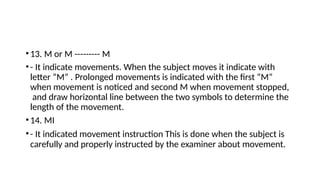
•13. M or M --------- M
•- It indicate movements. When the subject moves it indicate with
letter “M” . Prolonged movements is indicated with the first “M”
when movement is noticed and second M when movement stopped,
and draw horizontal line between the two symbols to determine the
length of the movement.
•14. MI
•- It indicated movement instruction This is done when the subject is
carefully and properly instructed by the examiner about movement.
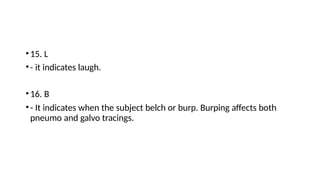
•15. L
•- it indicates laugh.
•16. B
•- It indicates when the subject belch or burp. Burping affects both
pneumo and galvo tracings.
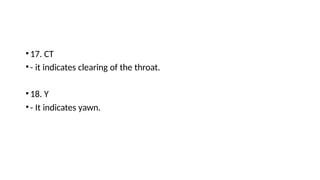
•17. CT
•- it indicates clearing of the throat.
•18. Y
•- It indicates yawn.
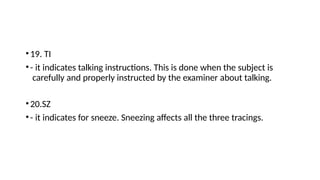
•19. TI
•- it indicates talking instructions. This is done when the subject is
carefully and properly instructed by the examiner about talking.
•20.SZ
•- it indicates for sneeze. Sneezing affects all the three tracings.
Chapter 5
CHART MARKINGS,
Unit 2: Chart Interpretations
Chart Interpretations
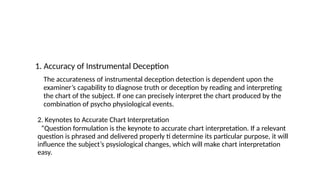
1. Accuracy of Instrumental Deception
The accurateness of instrumental deception detection is dependent upon the
examiner’s capability to diagnose truth or deception by reading and interpreting
the chart of the subject. If one can precisely interpret the chart produced by the
combination of psycho physiological events.
2. Keynotes to Accurate Chart Interpretation
“Question formulation is the keynote to accurate chart interpretation. If a relevant
question is phrased and delivered properly ti determine its particular purpose, it will
influence the subject’s psysiological changes, which will make chart interpretation
easy.
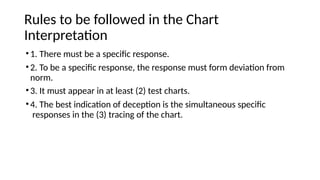
Rules to be followed in the Chart
Interpretation
•1. There must be a specific response.
•2. To be a specific response, the response must form deviation from
norm.
•3. It must appear in at least (2) test charts.
•4. The best indication of deception is the simultaneous specific
responses in the (3) tracing of the chart.
Pneumo Tracings, which may be considered
Indicative of Deception
•1. Change in Rhythm por Regularity.
• The rate or normal breathing is 18 cycles per minute. Generally, the change in
rate will be decrease or increase of amplitude causing an abnormality in the
respiration pattern of different period.
2. Change in amplitude or volume
A normal respiration will have an average of about one pint of air is inhaled
and exhaled during a single cycle, this is known as tidal air. But the lungs are
not completely deflated during normal exhalation there is still residual air
remaining. There is an increase in the residual volume causing the recorded
inspiration stroke to go higher and the expiration stroke lower than in the
normal breathing in a sigh.
•3. Changes in inhalation and exhalation ratio
• The time consumed in inhalation and exhalation has a ration of 3 to 5, which
means that respiration takes only 3/5 for the exhalation in normal
respiration. Researcher established that this ratio changes with emotion.
4. Serrated inhalation/exhalation strokes
Serration maybe recorded in the case the subject is in an intense nervous
state as a result of tremendous breathing. Serration may be signified catching
of the breath when surprised or shocked, coughing, crying or swallowing may
affect the tracing.
•5. Hyperventilation
• The subject attempt to confuse the examiner from making an interpretation
from the pneumo pattern, he resorts to a regular deep breathing in an
attempt to beat the test. It may be caused by prolonged suppression of the
breathing such as loss of oxygen has to compensated when the danger has
passed.
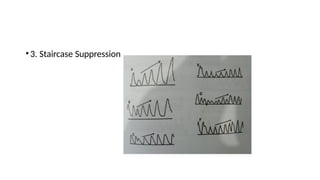
6. Suppression
Suppression or shallow breathing a kind of breathing against expected
shock on an attempt to control to the shock received.
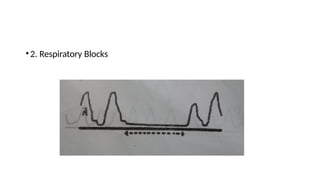
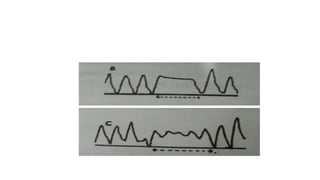
•7. Respiratory Block
• It is an exaggerated form of suppression in which there is strange shortening
of both the inhalation and exhalation stroke.
Cardio Tracings, which may be considered
indicative of deception
•1. Increase or decrease in blood pressure.
• An increase in blood pressure is indicated by a rise and fall in cardio tracing.
2. Increase in blood pressure only
It is shown by a prolonged rise in the blood pressure tracing during a crucial
questions and a return to the norm when the subject is released from that
stimulus by the introduction of irrelevant question.
•3. Decrease only in blood pressure
• It is shown by a prolonged fall in the blood pressure tracing during a crucial
questions and a return to the norm when the subject is released from that
stimulus by the introduction of irrelevant question.
4. An increase and decrease in pulse rate.
Changes in pulse rate will be seen during crucial situations, this changes can
be easily seen by the charts in the instruments.
Galvo Tracings, which may be considered
indicative of deception
•1. Increase in the amount of perspiration produce.
• Perspiration is one of the best indicative of deception, If a person is
confronted with a crucial situation and have a feeling of great emotions,
pores are opening and that will results to the pouring of perspiration of the
body.
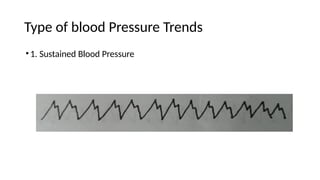
Type of blood Pressure Trends
•1. Sustained Blood Pressure
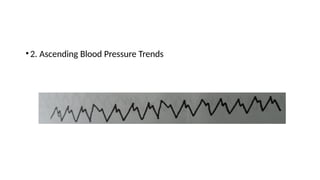
•2. Ascending Blood Pressure Trends
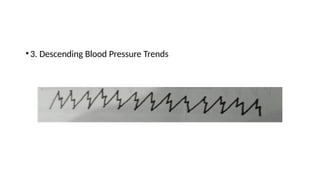
•3. Descending Blood Pressure Trends
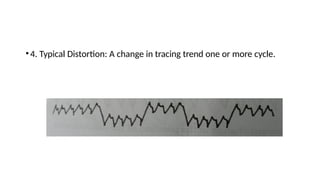
•4. Typical Distortion: A change in tracing trend one or more cycle.
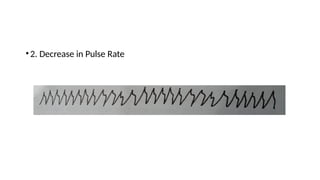
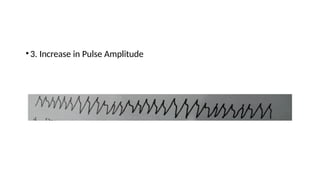
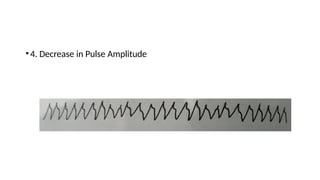
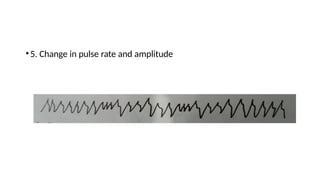
Various Types of Cardio Tracing
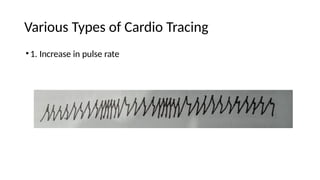
•1. Increase in pulse rate
•2. Decrease in Pulse Rate
•3. Increase in Pulse Amplitude
•4. Decrease in Pulse Amplitude
•5. Change in pulse rate and amplitude
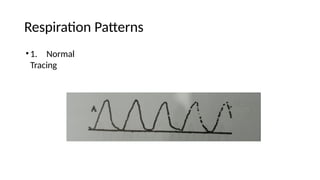
Respiration Patterns
•1. Normal
Tracing
•2. Respiratory Blocks
•3. Staircase Suppression
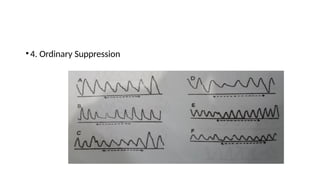
•4. Ordinary Suppression
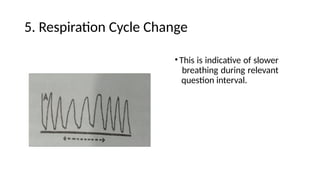
5. Respiration Cycle Change
•This is indicative of slower
breathing during relevant
question interval.
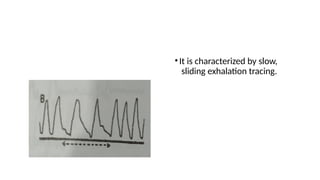
•It is characterized by slow,
sliding exhalation tracing.
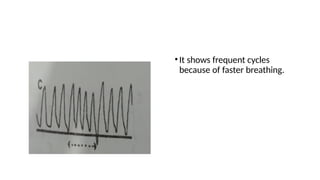
•It shows frequent cycles
because of faster breathing.
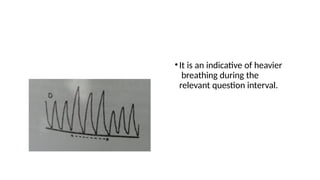
•It is an indicative of heavier
breathing during the
relevant question interval.
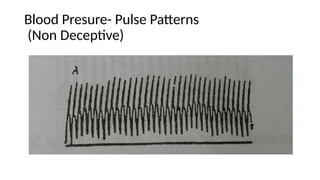
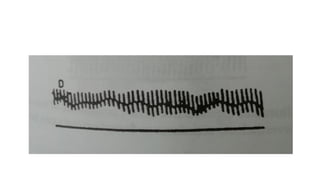
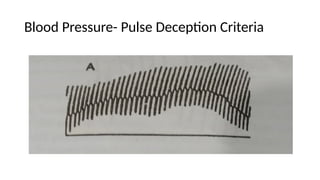
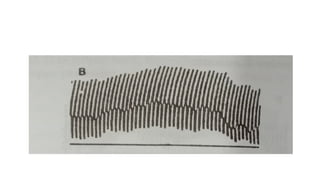
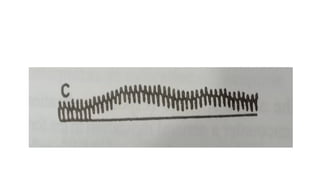
Blood Presure- Pulse Patterns
(Non Deceptive)
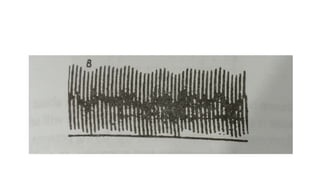
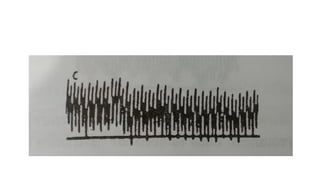
Blood Pressure- Pulse Deception Criteria
Chapter 6
ADMISSIBILITY, ACCURACY OF
POLYGRAPH
EXAMINATION
Admissibility of Polygraph Examination
Is polygraph Examination Result Admissible in Court?
Yes, If allowed by the judge. The judge will unlikely to use polygraph test if
unaccredited and inexperienced examiner administered the test.
Polygraph and expert testimony relating thereto can be admissible under
the following conditions:
1. That the admissibility of the polygraph test result is subject to the decision of
the trial judge like for example, if the trial judge is not persuaded that the
examiner is competent or that the test was conducted under proper condition,
he may reject to accept such evidence.
•2. That if the examiner’s opinion are offered as evidence, the
opposing party shall have the right to cross-examine the examiner
respecting:
•A. the qualification and trainings of examiner;
•B. the condition under which the test was administered;
•C. the restrictions and possibilities for the error of the technique;
•D. at the good judgment of the trial judge, any matter deemed
important to the inquiry.
Cases involving the use of Polygraph
Examination in the Philippines
• A. Criminal Case
• Case 1
• PEOPLE OF THE PHILIPPINES VS. AMADO DANIEL alias AMADO ATO
Case 2
The subject case was docketed as Criminal Case no. 92-7817 for Illegal Possession of
Firearms, against DANILO J. BAJAS, before the National Judicial Region, Regional Trial Court,
Branch 146, Metro Manila
Case 3
The subject was filed by JUDITH ASILO, charging a crime of estafa against MELANIO
M. SPORAS, VIRGINIA L. SPORAS and ELENA FALZON, before the National Judicial Region,
Regional Trial Court of the City of Makati, Brach 146, Metro Manila, docketed as Criminal
Case No. 94-6985.
•B. Civil Case
•Case 1
• The subject case was docketed as civil case no. 58092 was filed by CRESENCIA
ISAGUIRRE against ELVIRA ISAGUIRRE, et. Al., for Sum of Money, before the
National Capital Judicial Region, Regional Trial Court of Pasig, Branch 162,
Metro Manila.
Case 2
The subject was docketed as Civil Case no. 91-3453 was filed by JESUSA
REYES and CONRADO B. REYES for Sum of Money against Bank of Philippine
Islands, National Capital Judicial Region, Regional Trial Court of Makati, Branch
142, Metro Manila.
Factors Affecting Polygraph Examination
Validity
• A. Examiner
• It has long been recognized that the examiner’s skill has an important effect on the
validity of polygraph tests. Their experience and trainings.
. Experience
Examiners experience is an essential element reported by investigators and has
often been used to explain differences in accuracy rates. There are some data to
indicate that experienced examiners have better accuracy rates.
. Training
In recognition with this outcome, training has been accorded a high priority both
within the and outside Government agencies that conduct polygraph examinations
and by polygraph examiner groups.
• B. Subject
• Those diagnostic categories and subjects variables are gender, intelligence, ethnic and group
differences may also affect validity.
Gender
One of the most obvious subject differences is gender. Males and Females may have different
patterns of physiological response, and such differences may affect polygraph testing validity.
Intelligence
The ability of intelligent subject to anticipate questions may affect polygraph accuracy. One
possibility is that intelligent subjects are less detectable because, if trained they are bale to anticipate
questions and employ countermeasures.
Ethnic and group differences
Research conducted cross culturally indicates that there are ethnic differences in response to
stress. Such differences may in turn affect detection of deception.
•C. Settings
• Polygraph examination takes place in a number of settings, ranging from
facilities specifically designed for this purpose to motel rooms. Specifically
designed facilities usually include one-way mirrors for observation and audio
recording capabilities, and are located so as to prevent interruptions during
the examination. It is reasonable to assume that the setting may interact both
with subject and examiner characteristics to affect the validity of polygraph
tests.
polygraphy_complete_(1)(2).pptx...........

polygraphy_complete_(1)(2).pptx...........

  • 1.
  • 2.
  • 3.
  • 4.
    What is Polygraphy? Itis the scientific method of detecting deception using a polygraph instrument. This is incorrectly referred to as Lie Detection.
  • 5.
    What is Polygraph? Dan instrumentfor the recording of changes in blood pressure; pulse rate, respiration and skin resistance as indication of emotional disturbances especially of lying when questioned.
  • 6.
    What is Polygraph? The term“polygraph” is composed of two words “poly” means many and “graph” means writing and simply means as “many writings”.
  • 7.
    What is Polygraph? It isa recorder of a psycho physiological changes occurring within the examinee’s body as the polygraph examiner asks series of questions.
  • 8.
    Is polygraph aLie Detector? Lie detector is thepopular but misleading name of the Polygraph.
  • 9.
    What is theother name of the polygraph? “TRUTH VERIFIER”
  • 10.
    What are theconcepts of Polygraph Examination? Polygraph examination is used to test an individual for the purpose for detecting deception or verifying the truthfulness of his statements.
  • 11.
    What are theconcepts of Polygraph Examination ? It is based on the theory that “a conscious mental effort on the part of a normal person to deceive, causes involuntary physiological changes that is in effect a body’s reaction to an imminent danger to its well-being”.
  • 12.
    What are theobjectives of a Polygraph Examination? 1. Obtain additional investigative leads to the facts of the case/offenses. 2. Ascertain if a person is telling the truth
  • 13.
    What are theobjectives of a Polygraph Examination? 3. Locate the fruits or tools of the crime and where abouts of wanted persons. 4. Identify other persons involved (accomplices of
  • 14.
    What are theobjectives of a Polygraph Examination? 5. Obtain the valuable information from reluctant witnesses. 6. Eliminate the innocent suspects
  • 15.
  • 16.
    DEFINITION OF TERMS FEAR– is emotional response to specific danger that appears to beyond a persons defensive power.
  • 17.
    DEFINITION OF TERMS DREACTION– it is an action in mental attitude evokes by external influence. DRESPONSE – is any activity or inhibition of the previous activity of an organism resulting from stimulation.
  • 18.
    DEFINITION OF TERMS DECEPTION– is an act of deceiving or misleading usually accompanied by lying. LYING – the uttering or conveying of falsehood or creating a false or misleading information with the intention of affecting wrongfully the acts and opinion of other.
  • 19.
    DEFINITION OF TERMS DSPECIFICRESPONSE – is any deviation from the normal tracing of the subject. DNORMAL TRACING – is a tracing on the chart wherein the subject answered in the irrelevant question.
  • 20.
    DEFINITION OF TERMS DDETECTION– It is an act of discovery of existence, presence of fact or something hidden or obscure. DPOLYGRAPH EXAMINER – is one who conducts and administer the test.
  • 21.
    DEFINITION OF TERMS DSUBJECT-refers to any person undergoing polygraph examination. He/ She may be the suspect, complainant, victim, witness, relative of the victim/suspect or job aspiring applicant ( in cases of employment on government or private institution undergoing
  • 22.
    DEFINITION OF TERMS Admission-is the voluntary acknowledgement or by implication by a party in interest or by another by whose statement he is legally bound, against his interest, of existence or truth of a fact in dispute material to the issue. Confession- is the express declaration of guilt by the accused on the accusation against him.
  • 23.
    DEFINITION OF TERMS Emotion-any feeling,especially strong or intense feelings, as of love, joy, fear, etc. oftenaccompanied by complex physiological changes. In polygraphy, it is the feeling of fear of detection which is a factor in the result of the
  • 24.
    DEFINITION OF TERMS Interrogation-is the vigorous questioning of a person suspected of having committed an offense or of a crime, who is reluctant to make fulldisclosure of information in his possession which is pertinent to the investigation
  • 25.
    UNIT 2 EARLY METHODSOF DETECTING DECEPTION
  • 26.
    •Ordeal, Trial orJudicium Dei is a common method of deciding guilt or innocence and a practice of referring disputed questions to the judgment of God, determined by various means, particularly by physical tests. •It is a semi-magical method of determining guilt of innocence which goes right back to pre-historic times through many cultures. •Here are the examples of Ordeals:
  • 27.
    RED HOT IRONORDEAL •Practiced in the hill tribe of north Bengal. The accused had to carry a bar of red hot iron in his hands while he walked nine marked paces.. Another is the suspect will run barefooted and blind folded over a nine red-hot iron, after that the hand or foot will be cover up and inspected in three days afterward. If the accused had escape unhurt, the person was pronounce innocent, if hurt, the person was guilty.
  • 28.
    ORDEAL BY BALANCE •Practicedin Vishnu, India. A scale of balance is used, in one end of the scale the accused is placed and in the other end is a counter balance. The person will step out of the scale and listen to a judge to deliver an exhortation on the balance and get back in. If he was found lighter than before, then he should be acquitted, if not,, if the weight remains the same or he became heavier, then he is guilty.
  • 29.
    ORDEAL BY WATER •Inthis type of ordeal, the water was symbolic of the flood of the Old Testament, washing sin from the face of the Earth, allowing only the righteous minority to survive. •There are two kinds of ordeal by water the boiling water and the cold water.
  • 30.
    BOILING WATER ORDEAL •Thisordeal is consisted of lifting a stone out of a boiling water, with the hand inserted as deep as the wrist. More serious offenses demanded that arm was submerged up to the elbow. The burn was bandaged for three days before examination. If the accused had escape unhurt, the person was pronounce innocent, if hurt, the person was guilty.
  • 31.
    COLD WATER ORDEAL •Inthis ordeal, the accused was tied at feet and hands and was lowered to cold water by rope. This rope is tied around the accused waist and had a knot in the rope. If both knot and accused dipped beneath the surface of the water, the accused was proven innocent. If the knot is dry or if the water refused to receive him, hi is guilty.
  • 32.
    ORDEAL BY RICECHEWING •It is perform with a kind of rice called sathee, prepared with various spells. The person on trial eats the sathee, with the face to the east and the spits upon a pea leaf. If saliva is mixed with blood, he is declared to be a liar. Indians practice this ordeal.
  • 33.
    Ordeal by Combat •Theaggrieved party claimed to fight the alleged offender or to pay a champion to fight for him. The victor is said to win not by his own strength but because of supernatural powers that had intervened on the side of the right, in which the judgment of God was thought to determine the winner. If still alive after the combat, the loser might be hanged or burned for a criminal offense.
  • 34.
    ORDEAL BY CORSNAED(BLESSED BREAD) •A priest puts a corsnaed or hallowed bread into the mouth of the accused, with various spoken curse. If the accused swallowed it he was freed from punishment
  • 35.
    TEST OF THEEUCHARIST •This was applied chiefly among the clergy and monks. When they the host it was believed that God would smite the guilty with sickness or death. Others believed that if the accused is innocent, when given a poisonous drink for him to take in, Angel Gabriel will descend from heaven to prevent the accused from taking in the poisonous drink.
  • 36.
    ORDEAL OF THEBIER •It was an ancient belief that the slain dead could point out their killer. In England, it is customarily for the accused to approach the bier where the corpse lay. In the view of the witness, the wounds of the victim were observed to see if they began to bleed again. They believed that murderer is near, which causes the flood to flow out from the wounds of the victim.
  • 37.
    ORDEAL OF THENEEDLE •A red hot iron needle was made to pierced the lower lip of the alleged criminal and if blood flowed from the wound, he was deemed guilty, but if none, he is innocent. Wanaka, Eastern Africa practiced this ordeal.
  • 38.
    ORDEAL BY HEATAND FIRE •The accused walked barefooted over a red hot coals, or was deemed to walk through fire, if he was unharmed by fire he was considered innocent.
  • 39.
    TRIAL OF THECROSS •The accuser and the accused were placed under the cross with their arms extended or crosswise and the first to move his hands or suffer them to fall was held guilty or liar.
  • 40.
    TRIAL OF THEWAXEN SHIRT •The accused was dressed in cloth covered with wax and walked barefooted over burning coals. If he was unhurt by the fire and the wax did not melt, he was considered innocent.
  • 41.
    DONKEY’S TAIL ORDEAL •Asa psychological theory, a donkey is placed in a room alone and observed. Then one by one, the accused and the accuser will enter the room. If the donkey cried a judgment of guilt in crimes, is pressured. It is believed the deep inside one’s conscience, he is guilty.
  • 42.
    ORDEAL OF THETIGER •The accused and the accuser are placed inside a cage of a tiger, if the tiger spare one of them hi is considered innocent.
  • 43.
    BURMA •The ordeal beingpractice by this country is the two contesting party, the accused and the accuser are furnished with candles with equal size and lighted simultaneously, the owner of the candle that outlast the other is the winner.
  • 44.
    BORNEO •The accuser andthe accused were presented a shellfish placed on the plate. An irritating fluid was then poured on the shellfish and the litigant whose shellfish moved first was adjudged the winner.
  • 45.
    GREECE •A suspended axewas spun in the center of group of suspects. Soon the axe stopped, whoever was in the line with the axe blade was supposed to be guilty out by divine providence.
  • 46.
  • 47.
    •In the middleof 19th century, Dr. Hans Gross defined “search for truths” as a basis and goal of all criminal investigations. He stated, “a large part of criminal work is nothing more than a battle against lies.
  • 48.
    ANGELO MOSSO (1895) •Hestudied fear and its influence on the heart. •He developed the sphygmomanometer, this instrument was designed to measure the flow of blood while a person lay on his back in a prone position.
  • 49.
    CESARE LOMBROSO (1936-1909) •Heemployed the first scientific instrument to detect deception, which is known as hydrosphymograph, this instrument measures changes in pulse and blood pressure when suspects were asked about their involvement in or knowledge of specific response. •He was accorded the distinction of being the first person to utilize an instrument for the purpose of detecting lies.
  • 50.
    WILLIAN MOULTON MARSTON(1915) •He was considered as the father of modern polygraphy. He experimented the blood pressure, respiration and skin resistance as the basis for the responses of a person and can be use in detecting lies.
  • 51.
    JOHN LARSON (1921) •Hedevised the very first practical polygraph in 1921. His instrument gave a continuous recording of blood pressure and respiration. •He devised the first two recording channel polygraph in the history.
  • 52.
    LEONARDE KEELER •He inventedthe “Keeler Polygraph” which is an improvement of Larson’s apparatus. This apparatus was with components for recording, blood pressure, pulse and respiratory changes. A galvanometer what is known as the galvanic skin reflex generally referred to as GSR.
  • 53.
    VITTORIO BENUSSI (1914) •Hedetected deception with a pneumograph, an instrument that graphically measures the inhalation and exhalation. •He presented a paper before the second meeting of the Italian Society for Psychology in Rome, on the subject of his experiments regarding respiratory symptoms of lying.
  • 54.
    HAROLD BURTT (1918) •Hedetermine that respiratory changes were indication of deception. He found out that changes in blood pressure were of greater value in determining deception than in changes in respiratory.
  • 55.
    LUIGI GALVANI •He isan Italian physiologist who was accorded the distinction for developing galvanic skin reflex (GSR) of the galvanometer, which records electrical bodily resistance, it reflected emotional changes by measuring changes in person skin resistance to electricity.
  • 56.
    STICKER (1897) •He madethe first suggestion for using galvanograph for detecting deception based on the works of several predecessors.
  • 57.
    SIR JAMES MCKENZIE(1960) •He invented the ink in the polygraph. •A famous heart specialist. It was said that polygraph exist as early as 1906 but it is not being used to detect deception.
  • 58.
    RICHARD O. ARCHER(1953) •The first polygraphist to record simultaneously on a regular basis the chest and abdominal breathing patterns. He was also the first on to record simultaneously two galvanic skin reflexes.
  • 59.
    RICHARD I. GOLDEN(1969) •He presented a paper at the annual seminar of American polygraph association at Houston, Texas regarding his experiments using existing control question techniques but requiring the subject to answer each question twice. The first time truthfully and the second time with a lie, for the purpose of requiring additional data from the examinee by comparing his subjective truthful answer with a known lie to the same question.
  • 60.
    ANTON MESMER •In 1778,he was the first one to introduce hypnotism as a method of detecting deception.
  • 61.
    ALLEN BELL (1972) •Heis an American inventor who developed a device called Psychological Stress Evaluator (PSE). This instrument detects slight trembling in the voice, which may be interpreted to determine if the person is telling the truth.
  • 62.
  • 63.
    UNIT 1 TYPES OFLIAR & LIES
  • 65.
    What is Lie? •It refersto either untruthful or falsehood statements; any acts that deceives or creates false impression. It is also synonymous to deceit, deception, or fabrication.
  • 66.
    What is meantby “Detection? •This simply refers to the act of detecting, discovering, perceiving, finding, or uncoveringsomething hiddenor obscure
  • 67.
  • 69.
    What are CommonTypes of Liars? •Lying can be devastating, it does not only hurt the one who is being lied to, but it also hurts the one who tells it. Lying is a common denominatorin many of our lives and recognizing some of the different types might help us in dealing with the liar in our lives.
  • 70.
    Panic Liar •A personwho lies in order to avoid the consequences of confession. He or she afraid of embarrassment to loved ones and is a serious blow to his or her ego.
  • 71.
    Occupational Liar •Is someonewho lied for years. This person is a practical liar and lies when it has a higher payoff than telling the truth.
  • 72.
    Tournament Liar •A personwho loves to lie and is excited by the challenge of not being detected. He views an interview as another contest to won. He lies because it is the only weapon remaining with which to fight.
  • 73.
    Ethnological Liar •A personwho was trained not to be a squealer. This person loves to be interrogated and has taken a creed either personal or with others, that he or she will never reveal the truth.
  • 74.
    Psychopathic Liar •This typeof liar has no conscience. He shows no regret for his dishonest actions and no manifestations of guilt.
  • 75.
    Pathological Liar •A personwho cannot distinguish the right from wrong. This are those person who is mentally sick.
  • 76.
    Black Liar •A personwho always pretend and a hypocrite.
  • 77.
  • 78.
    Lie of Omission •This isa type of lie that people usually used because it is simple to tell. Individuals who will make use of this type of lie will tell the truth while omitting details that could create possible troubles.
  • 79.
    Lie of Fabrication •This isthe most difficult type of lie that a subject could use in an interview.
  • 80.
    Lie of Minimization •In thistype of lie individual will accept that something occurred but downplays the indication. Lie of minimization could be used if a subject wanted to stay close to the truth, however, he covers the truth for his or her own benefit.
  • 81.
    Lie of Exaggeration •Thisis a lie often used to exaggerate things for the hope of obtaining some advantage. This is also often found on resume, where applicant exaggerates his or her experiences, knowledge, skills, salary, and length of service.
  • 82.
    White Lie •Used to maintainharmony of friendship , harmony of home or office.
  • 83.
    UNIT 2 SIGNS ANDSYMPTOMS OF LYING
  • 84.
  • 85.
    Methods of Respondingto the Question •The way the respondentanswer the question is clue of deception. In general truthful people tend to be direct, untruthful people tend to be cautious about their answers.
  • 86.
    Length of Timebefore giving response In general, truthful persons answer questions immediately after the question is asked, untruthful persons take their time in giving responses.
  • 87.
    Repitition of Questions •Theact of repeating the question is another means for the deceiver to gain time to frame his or her answer. The question may be repeated word for word, or the respondent may frame the answer with a request to repeat the question?
  • 88.
    Fragmented or IncompleteSentences •Untruthful person often speak in disjointed or curtailed sentences. This is usually because he has started to answer, then though better of it.
  • 89.
    Being Overly Polite •Untruthfulsubjects are more likely to be polite to the accuser, using pleasing term such as, sir or ma’am, boss or chief.
  • 90.
    Oaths •Lying persons willfrequently utter oaths, such as, I swear to God I didn’t do it or I swear on my Father’s grave. Most truthful people do not need to swear or affirm, they are confident with their denials.
  • 91.
    Clarity of Response •Honestpeople tend to be very clear in their answers, while untruthful persons tend to speak softly and broaden their answers.
  • 92.
    Assertiveness •Truthful person areconfident about their innocence, while deceitful ones are not confident unless they are practice liars. Truthful people will respond directly without waiver or qualifications; while deceptive people tend to respond indirectly with waivers and qualifications.
  • 93.
    Inconsistencies •Contradicting testimonies madeby a person is one of the best indicator of dishonesty.
  • 94.
    Pauses Gap in speechpatterns may be one reliable clue to deception. The examiner should assess in speech pauses if it is too long, too frequent, or which occur at inappropriate places.
  • 95.
    Speed of Speech Personswho are tense or upset frequently increases the swiftness of their speech, who tend to run together and the conversation could be fragmented.
  • 96.
  • 97.
    Emblems •They are oftenperformed deliberately, these are expressions made with the body, whose meaning are clearly understood. Here are the example of emblems: Shaking or nodding of the head, shrugging of shoulders, the thumb up sign, etc.
  • 98.
    Manipulators •These are usualbehavior of touching one’s self. It encompass grooming of the hair, wringing the hands, picking imaginary fu from coat. Manipulators may go on for several minutes or may last for a short time. Props, like cigarettes, cellphone , pencil can be use as manipulators. It is usually done by untruthful subject for them not to focus on the question and answer to avoid detection, instead they are converting their attention to other objects.
  • 99.
    Breathing •Although breathing isan involuntary movement, breathing is very much affected by stress especially when lying.
  • 100.
    Sweating •This is anotheruncontrollable body function. Perspiration occurs with heat as well as with emotion. Too much sweating could be an indicator of deception.
  • 101.
    Frequent Swallowing •A drymouth frequently accompanies deep emotion. Increased swallowing that will lead to dry mouth might indicate deception.
  • 102.
    Facial Muscles •Facial musclesis not easy to control. Example: to force a smile is easy, but even beginners will notice that it is not a genuine smile. This can be used in detecting deception
  • 103.
    Eyes •The eyes mostlikely to express emotion. The failure to have an eye to eye contact is a great indicator of deception. This action indicates that a person is hiding something.
  • 104.
    UNIT 3 The Equipment (Partsand Functions of Polygraph Machine and Its
  • 105.
    What does polygraphrecord? •A standard polygraph records changes in blood pressure, pulse rate, galvanic skin reflex (sweat gland activity) and upper and lower breathing patterns. The polygraph records significant changes from the subject’s norm when specific questions are asked.
  • 106.
    What is Polygraph Instrument? •Itis an instrument for the recording of changes in blood pressure; pulse rate, respiration and skin resistance as indication of emotional disturbances especially of lying when questioned.
  • 109.
    Major Parts ofPolygraph Machine •Pneumograph •Galvanogrpah •Cardiosphymograph •Kymograph
  • 110.
    Pneumograph •This instrument recordschanges in breathing of the subject, it consist of a transducer called pneumograph tubes which are fastened arounds the subjects abdominal and chest part of the body. •2 units of Pneumograph Component •Pneumograph Chest Assembly or the Pneumo 1 – This unit is simply attached to the subjects chest and function of this assembly is to record the changes of the subject’s heartbeat. •Pneumograph Abdominal Assembly or Pneumo 2 – The second unit simply attached to the abdomen of the subject and function of this assembly is to record the changes of breathing pattern.
  • 112.
    Galvanograph •This instrument recordsthe skin resistance of the subject to a very small amount of electricity. The GSR or Galvanic Skin Reflex comprise of transducer called finger or palm electrodes that is attached on the subject’s finger primarily the index and ring finger or the palm to check and detect skin resistance towards a small amount of electricity. Galvanograph component also has the longest pen it has 7 inches recording pen.
  • 114.
    Cardiosphygmograph •This instrument recordsthe changes in blood pressure and pulse rate. It has a transducer called Arm Cuff, it is placed around the subject’s arm. It also has a blood pump Assembly , this unit is attached directly to the arm cuff and it has the sphygmomanometer, this unit is the basis of determining gauge of the air supplied to the arm cuff while the pump bulb Assembly supplies air to the arm cuff through pumping the tube. •Blood pressure is read at two points: the high point at which the heart contracts to empty its blood into circulation, called systole; and the low points at which the heart relaxes to fill with blood returned by the circulation called diastole.
  • 116.
    Kymograph •It is amotor that pulls the chart paper under the recording pen simultaneously at the rate of 6 to 12 inches per minute. It is sometimes referred to as chart drive module
  • 118.
    OUR A DV A N C E D D G I ' W ' I T I RED AND CO PO V G R A P H S Y S T E M S s R E S E S O R E C O L O G V T I H O R A C I C P E U O G R A P H U p p e . . - R e g i o n IRes p iratio.,-y A c -tiv· t y o n l i t o r i n g A B O M A I O ' W e r R - - ·· · O G R A P Re -p r a t o r y on i t o r i n g E L E C R O D E R A S E S O R S ,c e /S w e a 't G I . a n d o n· t or i ng C A R: D 1 O V A s c · LAR B OOD P R E S S U R E C U F F e a n B l o o d l P r e s s ur ,e /P u lse a d P u s e S 1:..-,e n g th M , o n " t o R a i l ! : e ri n g - IN F RA R E D P H O T O L E C R C PLI E H V S M D G R . A P H P l s e B o o d V o U l ff l l ' l l e R e l a l i v e C · o n i i t o r i n g d .OTo, S E N S O R S M O V E M E N T a C o u n t e r m e a s u l l l " 8 s P h y · c a B! o d y M o v e m e n t M o n · t o r i n g
  • 119.
    Chapter 3 The ExaminationProper Unit 1 The Polygraph Examiner
  • 120.
    The Polygraph Examiner Apolygraph examiner is one who skilled and capable to detect deception or verify truth of statement through instrumentation or the use of mechanical device. The instrument or device utilized to detect deception or verify truthfulness of the statements must meet the basic instrumentation requirement of being capable of recording simultaneously on a moving chart the physiological responses.
  • 121.
    The following arequalifications and qualities expected of a polygraph examiner are: • 1. He must remember that he is an impartial seeker of the truth, conducts his examination in a professional and ethical manner, and never allow his personal feelings, sympathies, or prejudice influence the result of the examination. • 2. He should constantly bears in his mind his primary responsibility to his subject to give them all possible safeguards against error and never accept the polygraph examination, any subject whose physical and mental health or states makes him unfit. • 3. Technically, he must have a complete knowledge of the instrument and its potentials and limitations, the most modern polygraph techniques, proficiency in the conduct of the polygraph examination, test construction and chart interpretations. • 4. Morally, he must have a sincere desire to be a polygraph examiner in its strictest sense, by devoting himself to the polygraph profession through maintenance of a high personal integrity and increasing personal proficiency through constant study and research.
  • 122.
    Responsibilities of PolygraphExaminer to his Subject • 1. The polygraph examiner recognizes the fact that his primary responsibility must be to the person who has voluntary submitted himself to a polygraph examination. • 2. He should never conduct examination on person without first appraisal of the subject’s constitutional rights. • 3. He should never perform examination to any person unless the instrument he is going to utilize is in good working condition and makes a continuous permanent recording on a moving chart of at least 2 physiological tracing. • 4. He should never render a certain conclusive verbal and written opinion based on the chart analysis without having administered at least two or more charts. • 5. He should not suggest testimony concerning the charts or conclusions presented by another examiner unless he is methodically familiar with the techniques and procedures employed.
  • 123.
    Responsibilities of theInvestigator to the Examiner. • 1. He must not wait until the last minute, after all investigative method and techniques have failed, the test should never be used as a last resort. • 2. He must not fail to investigate the case before seeking assistance. The polygraph examination does not establish whether a crime has been committed or not. Faulty or incomplete investigation places the examiner in a position to ask weak questions rather than strong and specific one. • 3. He should not depend on the mass screening of possible suspects to produce the guilty party except when no reasonable amount of investigation had produced a likely suspect or materially narrowed down the number of possible suspects. • 4. Not to stop investigation if polygraph examination is deferred or temporarily delayed.
  • 124.
    •5. He mustnot use polygraph as a props, ruse or trickery to secure confession or for the evaluation of the mental and physical state of the suspect. •6. He should not tell to anyone that the polygraph would decide whether the suspect is innocent or guilty. The court makes the decision. •7. He must not think that investigation is over if the test indicated that the subject lied or confessed. Evidence and testimonies should be gathered to prove the facts of the offense and the allegation against the subject.
  • 125.
    Responsibility of theInvestigator to the Subject. • 1. Be knowledgeable about the polygraph so that he can talk openly and freely to the person about the test. The subject may know very little of may have been misinformed about it. • 2. Recommend the test as a means for the subject to indicate his innocence. • 3. Stress the test’s capacity for indicating through the recorded response whether a person is telling the truth. • 4. Guarantee the subject that the examiner is qualified and impartial to all persons involve in the case. • 5. Avoid any claim for the instrument or examiner that is not backed up by facr.
  • 126.
  • 127.
    • 1. Ideally,polygraph test should be performed in a quiet, private, 90% soundproof room. Unusual noise, such as ringing of the telephone or conversation of persons outside the examination room or presence of investigators or other spectators in the room itself, would bring disturbances and distractions that in the turn would distort the different physiological recordings and seriously interfere with a satisfactory polygraph diagnosis. • 2. Whenever it is possible to do so, a special equipped and furnished room should be set aside for polygraph examinations. Such room should be very conventional as painted walls and furniture. It should contain no decorations, pictures or other objects that would distract the attention of the person being examined, If decorations, pictures is desired, they should not be placed in any part of the room faced by the subject during the course of the test.
  • 128.
    •3. The subjectshould not face a glass window or another room during the test because possible outside distractions which may affect the responses. •4. It is essential that the examination room be adequately ventilated with even, comfortable temperature. If existing facilities permit, there should be “observation room” adjoining the examination room, in the wall of which there an inserted “one-way mirror” and a concealed microphone so that a person in the observation room may hear as weel as see what occurs in the examination room.
  • 129.
    Chapter 3 The ExaminationProper Unit II FOUR (4) PHASES OF POLYGRAPH EXAMINATION
  • 130.
    Limitations of theSubject who will undergo Polygraph Examination 1. The subject must have a goodnight sleep at least 5 hours prior to the test. 2. He must refrain from smoking for at least 2 hours. 3. He should not undergo prolonged interrogation prior to the test. 4. The subject must not have been subjected to physical abuse or body contact. 5.He must refrain from drinking alcoholic beverages, taking sedatives, or capsule or syrup for at least 12 hours prior to the test. 6.He must not suffering from any temporary illness like headache, toothache, stomachache, fever, menstruation, severe colds and coughs. 7. He must not hungry
  • 131.
    How does thetest process works? • 1. The examiner receives and reviews the facts of the case. • 2. The examiner explains the test process to the subject and review facts of the case during pretest interview. • 3. The examiner designs the specific questions and making sure each one is easily understood. • 4. The polygraph instrument is attached on the subject’s body and he is given an additional instruction. • 5. The questions are read to the subject while the polygraph sensors are attached on the subject’s body. • 6. After chart have been run, the examiner analyzes the charts and develops a numerical score for the test. This score results in a conclusion of truthful, deceptive or inconclusive. • 7. The examiner will transmit the test result to the client verbally and a written report maybe requestd.
  • 132.
    FOUR (4) PHASESOF POLYGRAPH EXAMINATION
  • 133.
    Phase 1 –Initial interview with the Investigator Handling the Case •It is essential for the examiner to obtain accurate information concerning all the available facts and circumstances that form the basis for the suspicion or accusation directed against the person to be examined in order to conduct a satisfactory polygraph examination. •It is the phase of examination in which the examiner will gather all the information needed in order to formulate a questions that can be used on the other phase of the examination. That is why having a strong facts and circumstances will result to a strong and satisfactory polygraph examination while having a weak facts and circumstances will lead to weak and unsatisfactory polygraph examination
  • 134.
    Phase 1 includes: •1.Acquiring and evaluating facts. •2. Determining the areas the subject needs to be asked. •3. The investigator shall furnished the examiner the following: •A. sworn statement of the suspect, witnesses and victim. •B. Incident or spot report. •C. Background Investigation of suspects, witnesses, and victims. •D. Rough sketch or pictures of the crime scene and other facts.
  • 135.
    Phase II –Pre Test Interview • The examiner conducts pre test interview with the subject prior to the test is considered essential both for the purpose of conditioning the subject for the examination and also to provoke and observe indications of guilt or innocence. The examiner should not hold back any information from the subject about the instruments, its attachment or recording. This will serve to increase a lying subject concerned over possible detection. • The examiner should be friendly to the subject, no accusatory approach will be made under this phase. The subject behavior himself is usually the best source of information • The primary purpose of pre test interview is to prepare or condition the subject to the test.
  • 136.
    This phase includes: •1.The appraisal of subjects constitutional rights. •2. Obtains subject’s consent to undergo polygraph test by signing statement of consent. •3. The taking of personal data of subject. •4. Determine the suitability of the subject. •5. Clinical observation of the subject. •6. Evaluating the psychological preparation of the subject. •7. Informing the subject of his involvement of the case.
  • 137.
    Rights of theSubject •1. To be examined by a qualified examiner. •2. To be determined if fit for examination. •3. To be informed of the reason for the lie detector test. •4. To have an explanation of the polygraph machine and what it does. •5. To give consent to the lie detector test. •6. Not to be compelled to undergo prolonged questioning. •7. Not to be expose to oral criticism or abuse. •8. Not to be exposed to physical, mental or psychological abuse •9. To refuse to submit to lie detector test.
  • 138.
    Phase III- Theconduct of Instrumentation or Actual Test •After the pre-test interview, the examiner should proceed to place the attachment on the subject. The first to be attached is Pneumograph, then the Cardiosphymograph and the Galvanograph. Review all the questions with the subject before the actual examination is made. The examiner should discourage any comments or statement by the subjects. Test instrument must be given to the subject.
  • 139.
    A. Upon completionof the necessary preliminary preparation the instruments is attached to the subject. B. The pneumograph tubes will be placed on the subjects chest and abdominal part. C. The finger of palm electrodes will be placed on the subjects index and ring finger or the hand. D. The arm cuff will be placed on the subject’s arm. E. The synchronous motor carrying the paper upon which blood pressure pulse respirations recording are made is then set in motion, the motor being so timid that the paper moves along at the rate of a out six inches per minute, then ten to fifteen seconds after the instrument has been set in motion, the inked filled pens of the instruments are permitted to make their blood pressure pulse respiration tracings before the question are asked of the subject. F. During the test period the subject is informed that he will be asked several questions which should be answered by either yes or no answers, and that they are so brief and to the point. G. Approximately five to ten seconds after this instruction first question is asked and then the other questions follows after or at the interval of fifteen or twenty seconds.
  • 140.
    PHASE IV –POST–TEST INTERVIEW/ INTERROGATION This includes all consideration that bears on the examination. This is done just after the instrument is turned off. If the Polygraph test result indicates deception, the examiner will then proceed to conduct short interrogation.The purpose of which is to obtain confession. However, if the Polygraph indicates that the subject is innocent; the examiner will just release the subject cordially and thanks him/ her for his/her cooperation.
  • 141.
    Can A personbe compelled to undergo lie detector test? •In as much as the test requires the subject to answer the question either by “yes or no”, it infers the use of intelligence and attention or other mental faculty which is self incriminatory. Therefore, you cannot compel a person to be subjected to the test.
  • 142.
    Is there abest time of a day to conduct a polygraph examination? •Yes, since it is important that the person tested be capable of the maximum reactions, that person should be well rested prior to the test. In other words, testing conducted in the morning will be more productive than those examinations conducted in the later in the day and in the evening, these significantly increases the risk of an inconclusive result. The person should not be tested after the argument, interrogations or long day of work if possible.
  • 143.
    Can someone belowthe age of 18 take a polygraph? •Yes, but the examiner must have first the written consent of the parent or guardian of the child. However, most examiners will not test anyone who is less than 12 years age.
  • 144.
    Can medication affectthe result? •Yes, any drug or medication that suppresses normal activity of the Central Nervous System will reduce the strength of reactions found on the polygraph charts, resulting in a higher likelihood of inconclusive result.
  • 145.
    Can pregnant womanbe tested? •It does not affect the outcome of a polygraph examination to test a pregnant woman unless the fetus is making excessive movements or causing pain to the mother during the test. Most examiner will not test pregnant woman under any circumstances. Some examiner will only test if there is a note from the woman’s physician stating that there is no complications from the pregnancy and the stress of taking a polygraph test would have an impact on the health of the mother or the fetus.
  • 146.
    Chapter 4 FORMULATION OFQUESTIONS AND TECHNIQUES Unit I FORMULATION OF THE TEST QUESTIONS
  • 147.
    Three simple criteriain the formulation of questions: 1.Short – The questions must be as short as possible to prevent the subject from losing focus, minimize their impact upon the subject, and to avoid long questions that can confuse the subject. In other words, formulated questions must be answerable by a simple YES or NO. 2.Simple – The questions must not contain any legal terminologies and technical terms. Furthermore, their meanings must be clear and have reference to only one element of an offense or fact. 3.Direct – The questions must be able to stand alone and not depend on some other questions. They should focus on factual information not based on opinion. The relevant test questions should be limited to a single case investigation. The polygraph technique is not effective for simultaneous testing involving two or more unrelated case investigation.
  • 148.
    General Guidelines •1. Thequestion must be clear • In other words, the question that must in the test should be thoroughly understandable to the subject. There are also isolated cases wherein the examiner must use the subject’s own dialect to facilitate better understanding. For example, if the subject does not know any dialect other than what he has grown up with, the examiner must certainly adjust to the situation 2. The question must be simply stated The question must be stated as simply as possible. This means that the questions must have only one meaning. The sentence must completely avoid having double meaning. For example, Did you shoot him then run into the house? In this question, It combines two sets of facts or occurrence, one of which might be truthfully answerable by YES and other by NO.
  • 149.
    •3. Avoid lengthyquestions • Asking long question is not only time consuming but also confusing for the subject as well. Such a question can also result in a loss of impact on a lying subject. 4. The test questions should focus on facts. The polygraph test questions should concern factual information, and should not be based upon opinions. Opinion question responses cannot be relied upon in evaluating truth or deception.
  • 150.
    Test Questions: • Relevantquestions (leaded/material questions) – these are questions pertaining to the issue under investigation. It is equally important to limit the number of relevant questions to avoid discomfort to the subject. Relevant questions must be very specific to obtain an accurate result. • Irrelevant questions (unleaded/immaterial questions) – these are questions which have no bearing to the case under investigation. • Control questions – This question are those that inquire about an act or wrongdoing of the same general nature as the main incident being investigated and broad as possible. Basically, control questions must serve as the agitating factors of an innocent subject.
  • 151.
    •There are twogeneral types of questions to be constructed and maybe supplemented by other types of questions: 1. General Question Test – most commonly applied. 2. Peak-of-Tension Test – usually used as supplementary test.
  • 152.
    •This consists ofa series of Relevant & Irrelevant Questions asked in a planned order. Questions are so arranged as to make possible a comparison of responses to relevant questions with a subject’s norm made during the answering of irrelevant questions. There are other types of questions asked in the GQT: THE GENERAL QUESTION TEST (GTQ)
  • 153.
    Relevant questions (leaded/material questions) •Sample in Relevant Questions: A case involving a shooting incident: • Weak Relevant Question – it concern some secondary element of the crime or problem and deals with mostly in guilty knowledge and partial involvement. • Weak Relevant Question: Are you involved in the plan to shoot Pedro Dela Rosa? • Strong Relevant Question – it is defined as verbal stimulus of primary important projected in the form of a question which overcome a psychological excitement level and causes pneumograph, cardiosphygmograph, and galvanograph tracings changes from the subject’s physiological norms. • Strong Relevant Question: Are you the one who shot Pedro Dela Rosa?
  • 154.
    •Evidence Connecting Question– it is designed to stimulate the guilty subject and focus his attention on the probability of incriminating proof that would tend to establish his guilt. •Evidence Connecting Question: Was the gun to shoot Pedro Dela Rosa Yours? •Knowledge Question – this question is designed or begun to probe whether the subject possess information regarding the identity of the offender, the location of evidences or items of secondary element of the case. •Knowledge Question: Do you know who shot Pedro Dela Rosa?
  • 155.
    Control Questions • 2Classification of Control Questions: • A. Primary Control Question – It must concern about actions that transpired within 3 to 5 years time prior to case under investigation occurred. Example Question: Before attaining the age of 28, have you ever stolen anything? Have you ever stolen anything from your work of place. • B. Secondary Control Question – It is more precise in nature and is based on another experience of unlawful activity, which will improve the chance of responsiveness. It covers up to the current period. The question for responsiveness must not be connected to the case under investigation. Example Question: Have your ever committed any illegal act in your community?
  • 156.
    Irrelevant questions (unleaded/immaterial questions) •1.Determine the subject’s norm under test conditions; •2. Terminate a lingering type of reaction that may appear on either relevant and control question answers; •3. Provide subjects an outlet for a relief response after answering relevant questions; •4. Accentuate a deceptive response to a relevant question; •5. Separate the subject’s reaction to pertinent questions using an irrelevant questions in between; •Example Question: Are you Married? Is Tuesday today?
  • 157.
    General Question TestSample 1. Have you ever been called by the name Allan? (Irrelevant) 2. Is today Monday? (Irrelevant) 3. Do you have anything to do with the robbery at SM/ Shoemart last night? (Weak Relevant) 4. Are you over 20 years of age? (Irrelevant) 5. Were you one of those who robbed the SM/ Shoemart last night? (Strong Relevant) 6. Have you been involved in a robbery case this year? (Primary Control Question) 7. Do you drink water? (Irrelevant) 8. Was the pair of gloves found at SM yours? (Evidence Connecting-Relevant) 9. Do you know of anyone involved in the robbery at SM/ Shoemart last night? (Knowledge Question-Relevant) 10. Have you ever been involved in any robbery in your entire life? (Secondary Control Question) 11. Have you deliberately lied to any question I have asked you? (Relevant-Check Question (optional))
  • 158.
    •Check Question –last question asked in the lie test. It is direct question that relates to the fact that the subject has told the truth to all questions asked in the lie test.
  • 159.
    PEAK-OF-TENSION TEST (PTT) Thesubject may be given this test if he is not yet informed of the details of the offense for which he is being interrogated by the investigation, or by other persons or from other sources like the print media. This valid test is only made possibly when there is no widespread publicity about a crime where intimate details as to the methods of commission or certain facts of the case is known from the victim and investigator. The questions formulated are similar in nature and construction, only one of which is true and the perpetrator who would naturally be in possession of such unpublicized knowledge will usually exhibit a rise in the tracing up to that particular question followed by a decline thereafter, caused by the relief of knowing that a dreaded question dangerous to his well-being, is past.
  • 160.
    Examples of Peak-of-TensionTest: 1. Do you know whether the stolen watch from Allan is a Seiko? (This is an introductory phrase plus padding question) 2. Is it an Omega? (Padding) 3. Is it a Rolex? (Padding) 4. Is it Timex? (Relevant question) 5. Is it Alba quartz? (Padding) 6. Is it a Citizen? (Padding)
  • 161.
    Chapter 4 FORMULATION OFQUESTIONS AND TECHNIQUES Unit II Test Techniques
  • 162.
    The polygraph examinationis composed of five test Test I – General Question Test Test II – Card or Number Test Test III – Spot Responder Test Test IV – Mixed Questions Test Test V – Silent Answer Test
  • 163.
    THE GENERAL QUESTIONTEST (GQT) •This test is about the case under investigation. These are sequences of relevant, irrelevant and control questions asked in a designed order. The questions are arranged in order to contrast the subjects response between relevant, irrelevant and control questions. The questions is restricted to yes or no only.
  • 164.
    The sequence andsample of GQT: Q1. Have you ever been called by the name Allan? (Irrelevant) Q2. Is today Monday? (Irrelevant) Q3. Do you have anything to do with the robbery at SM/ Shoemart last night? (Weak Relevant) Q4. Are you over 20 years of age? (Irrelevant) Q5. Were you one of those who robbed the SM/ Shoemart last night? (Strong Relevant) Q6. Have you been involved in a robbery case this year? (Primary Control Question-Relevant) Q7. Do you drink water? (Irrelevant) Q8. Was the pair of gloves found at SM yours? (Evidence Connecting-Relevant) Q9. Do you know of anyone involved in the robbery at SM/ Shoemart last night? (Knowledge Question-Relevant) Q10. Have you ever been involved in any robbery in your entire life? (Secondary Control - Relevant)
  • 165.
    Card or NumberTest: • Upon finishing of the first test, here is another part of the test, examiner will show to the subject seven (7) variously numbered card face down. The cards are set in such a way the examiner will know which card has been chosen by the subject. The numbers 7, 11 and 13 should not be used because other subjects are too superstitious and numbers 6 and 9 should not be included to avoid confusion on the part of the subject. The cards with number 15, 8, 5, 3, 4, 14 and 12 are used. • The subject is given an instruction to get a card, look it and memorize the number of the card that was chosen and return it without showing it to the examiner or telling the number. After the selection is finished, the examiner shuffles the cards and will instruct the subject to answer “NO” to each question regarding the cards, even if the number of the card he has chosen is asked. In short one of the subject’s answers to the questions will be a lie. • The verification test is intended to assure the innocent examinee of the accurateness of the test and of the competency of the polygraphist. It further serves to arouse the guilty examinee.
  • 166.
    Spot Responder Test •This test consists questions previously asked questions in GQT. With the same number of the same question on the earlier test, the sequence would be: Q1. Have you ever been called by the name Allan? (Irrelevant) Q3. Do you have anything to do with the robbery at SM/ Shoemart last night? (Weak Relevant) Q2. Is today Monday? (Irrelevant) Q5. Were you one of those who robbed the SM/ Shoemart last night? (Strong Relevant) Q4. Are you over 20 years of age? (Irrelevant) Q6. Have you been involved in a robbery case this year? (Primary Control Question-Relevant) Q7. Do you drink water? (Irrelevant) Q8. Was the pair of gloves found at SM yours? (Evidence Connecting-Relevant) Q9. Do you know of anyone involved in the robbery at SM/ Shoemart last night? (Knowledge Question-Relevant) Q10. Have you ever been involved in any robbery in your entire life? (Secondary Control - Relevant)
  • 167.
    Mixed Question Test: •Thetest is the same with test III but questions of GQT is again mixed nd the sequence of the questions are as follows: • Q4. Are you over 20 years of age? (Irrelevant) • Q1. Have you ever been called by the name Allan? (Irrelevant) Q9. Do you know of anyone involved in the robbery at SM/ Shoemart last night? (Knowledge Question-Relevant) Q6. Have you been involved in a robbery case this year? (Primary Control Question-Relevant) Q2. Is today Monday? (Irrelevant) Q3. Do you have anything to do with the robbery at SM/ Shoemart last night? (Weak Relevant) Q10. Have you ever been involved in any robbery in your entire life? (Secondary Control - Relevant) Q5. Were you one of those who robbed the SM/ Shoemart last night? (Strong Relevant) Q7. Do you drink water? (Irrelevant) Q8. Was the pair of gloves found at SM yours? (Evidence Connecting-Relevant)
  • 168.
    Silent Answer Test •Inthis test subject is instructed by the examiner to avoid from giving any verbal answer to the questions that are to be asked of him during the test. The subject is instructed to pay attention to each question and answer the question only by himself, silently. In addition he should think of truthful answer and give that truthful answer silently to himself.
  • 169.
    Purpose of eachTest: •Test I – The first two irrelevant question s are designed to condition the subject to have standard tracing and to established truth telling patterns for the primary part of the record. •Test II – To check feasible distortion when the selected number is asked. •Test III – To determine the responsiveness of the subject to critical questions and also serve as a check on possibility of spot respond. •Test IV – To compare the degree of reaction between relevant and Control Question. •Test V – To serve as an affirmative check.
  • 170.
  • 171.
    SIGNS AND SYMBOLS (commonlyused in Chart Marking)
  • 172.
    Signs and Symbolsin Chart Markings. 1. X - it indicates the beginning or the start of the test. - Inform the subject that the test is about to begin. - “X” is placed on the chart below the cardio tracing. 2. XX - it indicates the end or ending of the test. - Mark “XX” below the cardio tracing. -Inform the subject that the test is about to end by giving the instruction to sit properly, the test is about to end, the blood pressure cuff will be released in a
  • 173.
    • 3. /// • - points where each questions begins and ends. (also called stimulus mark). • - The single stimulus mark or the vertical line indicates the beginning of the question and double stimulus mark or the vertical line indicated the ending of the question. • 4. + , - , no sign • - plus sign indicates that the subject answer the question with “YES”, minus sign indicates that the subject answer with “NO”. No sign should be placed when the subject fails to answer the question being asked or when “Silent Answer Test” is conducted. • - signs are placed below or at the right side of the number of the question.
  • 174.
    •5. T •- Ifthe subject talks instead of answering the single “YES” or “NO” •T --------- T (draw a horizontal line between the symbols to show the length of talking. •6. RQ •- It is indicated on the chart below the cardio tracing when the subject requests a repartition of question.
  • 175.
    •7. C •- Itis when the subject was coughing. •8. OSN •- outside noise is indicated on the chart with letters OSN and shall be placed on the chart that was disturbed by the outside noise.
  • 176.
    •9. S •- itis indicated on the chart for sigh in the chart and shall be placed in the pneumo tracing exactly where it took place. Sigh may be indicative of deception or merely denotes relief, sigh must be distinguished from deep breath. •10. PJ •- It indicates paper jam.
  • 177.
    •11. SN •- itis indicated when the subject sniff and shall be placed in the pneumo tracing exactly where it took place. •12. BI •- It is indicated as breathing instruction. This is done when the subject is carefully and properly instructed by the examiner to have a deep breath.
  • 178.
    •13. M orM --------- M •- It indicate movements. When the subject moves it indicate with letter “M” . Prolonged movements is indicated with the first “M” when movement is noticed and second M when movement stopped, and draw horizontal line between the two symbols to determine the length of the movement. •14. MI •- It indicated movement instruction This is done when the subject is carefully and properly instructed by the examiner about movement.
  • 179.
    •15. L •- itindicates laugh. •16. B •- It indicates when the subject belch or burp. Burping affects both pneumo and galvo tracings.
  • 180.
    •17. CT •- itindicates clearing of the throat. •18. Y •- It indicates yawn.
  • 181.
    •19. TI •- itindicates talking instructions. This is done when the subject is carefully and properly instructed by the examiner about talking. •20.SZ •- it indicates for sneeze. Sneezing affects all the three tracings.
  • 182.
    Chapter 5 CHART MARKINGS, Unit2: Chart Interpretations
  • 183.
  • 184.
    1. Accuracy ofInstrumental Deception The accurateness of instrumental deception detection is dependent upon the examiner’s capability to diagnose truth or deception by reading and interpreting the chart of the subject. If one can precisely interpret the chart produced by the combination of psycho physiological events. 2. Keynotes to Accurate Chart Interpretation “Question formulation is the keynote to accurate chart interpretation. If a relevant question is phrased and delivered properly ti determine its particular purpose, it will influence the subject’s psysiological changes, which will make chart interpretation easy.
  • 185.
    Rules to befollowed in the Chart Interpretation •1. There must be a specific response. •2. To be a specific response, the response must form deviation from norm. •3. It must appear in at least (2) test charts. •4. The best indication of deception is the simultaneous specific responses in the (3) tracing of the chart.
  • 186.
    Pneumo Tracings, whichmay be considered Indicative of Deception •1. Change in Rhythm por Regularity. • The rate or normal breathing is 18 cycles per minute. Generally, the change in rate will be decrease or increase of amplitude causing an abnormality in the respiration pattern of different period. 2. Change in amplitude or volume A normal respiration will have an average of about one pint of air is inhaled and exhaled during a single cycle, this is known as tidal air. But the lungs are not completely deflated during normal exhalation there is still residual air remaining. There is an increase in the residual volume causing the recorded inspiration stroke to go higher and the expiration stroke lower than in the normal breathing in a sigh.
  • 187.
    •3. Changes ininhalation and exhalation ratio • The time consumed in inhalation and exhalation has a ration of 3 to 5, which means that respiration takes only 3/5 for the exhalation in normal respiration. Researcher established that this ratio changes with emotion. 4. Serrated inhalation/exhalation strokes Serration maybe recorded in the case the subject is in an intense nervous state as a result of tremendous breathing. Serration may be signified catching of the breath when surprised or shocked, coughing, crying or swallowing may affect the tracing.
  • 188.
    •5. Hyperventilation • Thesubject attempt to confuse the examiner from making an interpretation from the pneumo pattern, he resorts to a regular deep breathing in an attempt to beat the test. It may be caused by prolonged suppression of the breathing such as loss of oxygen has to compensated when the danger has passed. 6. Suppression Suppression or shallow breathing a kind of breathing against expected shock on an attempt to control to the shock received.
  • 189.
    •7. Respiratory Block •It is an exaggerated form of suppression in which there is strange shortening of both the inhalation and exhalation stroke.
  • 190.
    Cardio Tracings, whichmay be considered indicative of deception •1. Increase or decrease in blood pressure. • An increase in blood pressure is indicated by a rise and fall in cardio tracing. 2. Increase in blood pressure only It is shown by a prolonged rise in the blood pressure tracing during a crucial questions and a return to the norm when the subject is released from that stimulus by the introduction of irrelevant question.
  • 191.
    •3. Decrease onlyin blood pressure • It is shown by a prolonged fall in the blood pressure tracing during a crucial questions and a return to the norm when the subject is released from that stimulus by the introduction of irrelevant question. 4. An increase and decrease in pulse rate. Changes in pulse rate will be seen during crucial situations, this changes can be easily seen by the charts in the instruments.
  • 192.
    Galvo Tracings, whichmay be considered indicative of deception •1. Increase in the amount of perspiration produce. • Perspiration is one of the best indicative of deception, If a person is confronted with a crucial situation and have a feeling of great emotions, pores are opening and that will results to the pouring of perspiration of the body.
  • 193.
    Type of bloodPressure Trends •1. Sustained Blood Pressure
  • 194.
    •2. Ascending BloodPressure Trends
  • 195.
    •3. Descending BloodPressure Trends
  • 196.
    •4. Typical Distortion:A change in tracing trend one or more cycle.
  • 197.
    Various Types ofCardio Tracing •1. Increase in pulse rate
  • 198.
  • 199.
    •3. Increase inPulse Amplitude
  • 200.
    •4. Decrease inPulse Amplitude
  • 201.
    •5. Change inpulse rate and amplitude
  • 202.
  • 203.
  • 205.
  • 206.
  • 207.
    5. Respiration CycleChange •This is indicative of slower breathing during relevant question interval.
  • 208.
    •It is characterizedby slow, sliding exhalation tracing.
  • 209.
    •It shows frequentcycles because of faster breathing.
  • 210.
    •It is anindicative of heavier breathing during the relevant question interval.
  • 211.
    Blood Presure- PulsePatterns (Non Deceptive)
  • 215.
    Blood Pressure- PulseDeception Criteria
  • 219.
    Chapter 6 ADMISSIBILITY, ACCURACYOF POLYGRAPH EXAMINATION
  • 220.
    Admissibility of PolygraphExamination Is polygraph Examination Result Admissible in Court? Yes, If allowed by the judge. The judge will unlikely to use polygraph test if unaccredited and inexperienced examiner administered the test. Polygraph and expert testimony relating thereto can be admissible under the following conditions: 1. That the admissibility of the polygraph test result is subject to the decision of the trial judge like for example, if the trial judge is not persuaded that the examiner is competent or that the test was conducted under proper condition, he may reject to accept such evidence.
  • 221.
    •2. That ifthe examiner’s opinion are offered as evidence, the opposing party shall have the right to cross-examine the examiner respecting: •A. the qualification and trainings of examiner; •B. the condition under which the test was administered; •C. the restrictions and possibilities for the error of the technique; •D. at the good judgment of the trial judge, any matter deemed important to the inquiry.
  • 222.
    Cases involving theuse of Polygraph Examination in the Philippines • A. Criminal Case • Case 1 • PEOPLE OF THE PHILIPPINES VS. AMADO DANIEL alias AMADO ATO Case 2 The subject case was docketed as Criminal Case no. 92-7817 for Illegal Possession of Firearms, against DANILO J. BAJAS, before the National Judicial Region, Regional Trial Court, Branch 146, Metro Manila Case 3 The subject was filed by JUDITH ASILO, charging a crime of estafa against MELANIO M. SPORAS, VIRGINIA L. SPORAS and ELENA FALZON, before the National Judicial Region, Regional Trial Court of the City of Makati, Brach 146, Metro Manila, docketed as Criminal Case No. 94-6985.
  • 223.
    •B. Civil Case •Case1 • The subject case was docketed as civil case no. 58092 was filed by CRESENCIA ISAGUIRRE against ELVIRA ISAGUIRRE, et. Al., for Sum of Money, before the National Capital Judicial Region, Regional Trial Court of Pasig, Branch 162, Metro Manila. Case 2 The subject was docketed as Civil Case no. 91-3453 was filed by JESUSA REYES and CONRADO B. REYES for Sum of Money against Bank of Philippine Islands, National Capital Judicial Region, Regional Trial Court of Makati, Branch 142, Metro Manila.
  • 224.
    Factors Affecting PolygraphExamination Validity • A. Examiner • It has long been recognized that the examiner’s skill has an important effect on the validity of polygraph tests. Their experience and trainings. . Experience Examiners experience is an essential element reported by investigators and has often been used to explain differences in accuracy rates. There are some data to indicate that experienced examiners have better accuracy rates. . Training In recognition with this outcome, training has been accorded a high priority both within the and outside Government agencies that conduct polygraph examinations and by polygraph examiner groups.
  • 225.
    • B. Subject •Those diagnostic categories and subjects variables are gender, intelligence, ethnic and group differences may also affect validity. Gender One of the most obvious subject differences is gender. Males and Females may have different patterns of physiological response, and such differences may affect polygraph testing validity. Intelligence The ability of intelligent subject to anticipate questions may affect polygraph accuracy. One possibility is that intelligent subjects are less detectable because, if trained they are bale to anticipate questions and employ countermeasures. Ethnic and group differences Research conducted cross culturally indicates that there are ethnic differences in response to stress. Such differences may in turn affect detection of deception.
  • 226.
    •C. Settings • Polygraphexamination takes place in a number of settings, ranging from facilities specifically designed for this purpose to motel rooms. Specifically designed facilities usually include one-way mirrors for observation and audio recording capabilities, and are located so as to prevent interruptions during the examination. It is reasonable to assume that the setting may interact both with subject and examiner characteristics to affect the validity of polygraph tests.