Political Parties
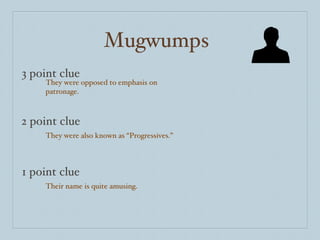
Mugwumps 3 point clue 2 point clue 1 point clue They were opposed to emphasis on patronage. They were also known as “Progressives.” Their name is quite amusing.
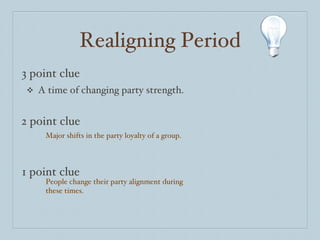
Realigning Period A time of changing party strength. 3 point clue 2 point clue 1 point clue Major shifts in the party loyalty of a group. People change their party alignment during these times.
Political Party 3 point clue 2 point clue 1 point clue George Washington denounced these “factions.”  They represent groups of people with similar ideologies. Nominate candidates to run for election
Split Ticket 3 point clue 2 point clue 1 point clue Between 1960 and 1980 this became more common. Contributed to the decline in party strength. Allowed voting for both parties at once.
Straight Ticket 3 point clue 2 point clue 1 point clue A form of voting no longer in use Also known as the party-column ballot The opposite of split ticket
National Convention 3 point clue 2 point clue 1 point clue Ultimate authority of the party Where the party adopt its official platform Meets every four years to nominate a presidential candidate
National Committee 3 point clue 2 point clue 1 point clue Aids in the development of the party platform Is responsible for organizing the national convention Appointed by the national convention
Party-column ballot 3 point clue 2 point clue 1 point clue Was  the  form of voting in the nineteenth century Known as the “Indiana” ballot Makes voters vote in columns
Office-bloc ballot 3 point clue 2 point clue 1 point clue Progressives persuaded states to adopt this for voting Known as a “Massachusetts” ballot Lists candidates by office
Minor/Third parties 3 point clue 2 point clue 1 point clue They are sometimes accused of “spoiling” elections They can cause Democrats and Republicans to change their platforms If a lot of voters sympathize with their views Are considered a “waste of votes” by many

Political parties chapter key terms

  • 1.
  • 2.
    Mugwumps 3 pointclue 2 point clue 1 point clue They were opposed to emphasis on patronage. They were also known as “Progressives.” Their name is quite amusing.
  • 3.
    Realigning Period Atime of changing party strength. 3 point clue 2 point clue 1 point clue Major shifts in the party loyalty of a group. People change their party alignment during these times.
  • 4.
    Political Party 3point clue 2 point clue 1 point clue George Washington denounced these “factions.” They represent groups of people with similar ideologies. Nominate candidates to run for election
  • 5.
    Split Ticket 3point clue 2 point clue 1 point clue Between 1960 and 1980 this became more common. Contributed to the decline in party strength. Allowed voting for both parties at once.
  • 6.
    Straight Ticket 3point clue 2 point clue 1 point clue A form of voting no longer in use Also known as the party-column ballot The opposite of split ticket
  • 7.
    National Convention 3point clue 2 point clue 1 point clue Ultimate authority of the party Where the party adopt its official platform Meets every four years to nominate a presidential candidate
  • 8.
    National Committee 3point clue 2 point clue 1 point clue Aids in the development of the party platform Is responsible for organizing the national convention Appointed by the national convention
  • 9.
    Party-column ballot 3point clue 2 point clue 1 point clue Was the form of voting in the nineteenth century Known as the “Indiana” ballot Makes voters vote in columns
  • 10.
    Office-bloc ballot 3point clue 2 point clue 1 point clue Progressives persuaded states to adopt this for voting Known as a “Massachusetts” ballot Lists candidates by office
  • 11.
    Minor/Third parties 3point clue 2 point clue 1 point clue They are sometimes accused of “spoiling” elections They can cause Democrats and Republicans to change their platforms If a lot of voters sympathize with their views Are considered a “waste of votes” by many