15th June 2012 – EUI, Florence


   Incentive regulation with bounded regulators

Jean-Michel Glachant, Haikel Khalfallah (FSR-EUI), Yannick Perez (LdP chair-EUI)
       Vincent Rious, Marcelo Saguan (Microeconomix, LdP chair-EUI)


    1st Annual Conference on the Regulation of Infrastructure Industries


                                                                                         1
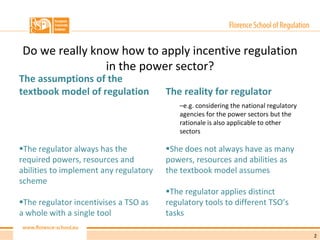
Do we really know how to apply incentive regulation
               in the power sector?
The assumptions of the
textbook model of regulation            The reality for regulator
                                           –e.g. considering the national regulatory
                                           agencies for the power sectors but the
                                           rationale is also applicable to other
                                           sectors

The regulator always has the           She does not always have as many
required powers, resources and          powers, resources and abilities as
abilities to implement any regulatory   the textbook model assumes
scheme
                                        The regulator applies distinct
The regulator incentivises a TSO as    regulatory tools to different TSO’s
a whole with a single tool              tasks

                                                                                       2
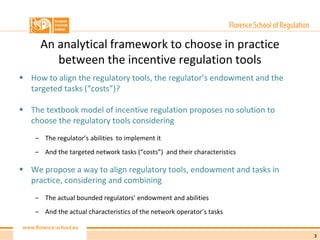
An analytical framework to choose in practice
        between the incentive regulation tools
 How to align the regulatory tools, the regulator’s endowment and the
  targeted tasks (“costs”)?

 The textbook model of incentive regulation proposes no solution to
  choose the regulatory tools considering
    – The regulator’s abilities to implement it
    – And the targeted network tasks (“costs”) and their characteristics

 We propose a way to align regulatory tools, endowment and tasks in
  practice, considering and combining
    – The actual bounded regulators’ endowment and abilities
    – And the actual characteristics of the network operator’s tasks


                                                                           3
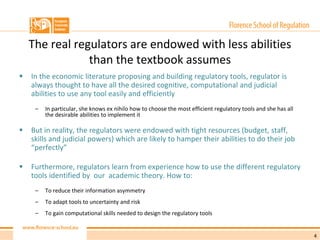
The real regulators are endowed with less abilities
                than the textbook assumes
   In the economic literature proposing and building regulatory tools, regulator is
    always thought to have all the desired cognitive, computational and judicial
    abilities to use any tool easily and efficiently
     –   In particular, she knows ex nihilo how to choose the most efficient regulatory tools and she has all
         the desirable abilities to implement it

   But in reality, the regulators were endowed with tight resources (budget, staff,
    skills and judicial powers) which are likely to hamper their abilities to do their job
    “perfectly”

   Furthermore, regulators learn from experience how to use the different regulatory
    tools identified by our academic theory. How to:
     –   To reduce their information asymmetry
     –   To adapt tools to uncertainty and risk
     –   To gain computational skills needed to design the regulatory tools


                                                                                                                4
The regulatory tools require minimum abilities to be
                 usefully implemented
                                              Regulator’s
                                              abilities


Cost +     Price cap     PBR         Menu      Yardstick


                                                            5
The regulator regulates the network operator for
          various tasks and not for a single task
   The textbook regulator controls the TSO’s tasks (cost) as a whole while there are
    different tasks with different characteristics. The basis tasks for an El. TSO:
     –   Operation of electricity system: Balancing + Reserves + Congestion + Losses + Market Operation
     –   Maintenance of the existing grid
     –   Investment and grid connection: Planning + Construction
     –   Customer relationship

   The network operator may have to undertake new or renewed tasks because of new
    regulatory objectives from
     –   The integration of massive renewables in electricity
     –   Concerns about security of supply
     –   Europeanization of markets with a key TSO role in market building
     +   RD&D in infrastructures and services (“smart” everything)


                                                                                                          6
Regulating a task (a cost) is betting on its controllability,
predictability, & observability to choose appropriate regulatory tool
  Considering the diversity of tasks, systems and environments that TSOs
   may encounter, they should be targeted with distinct regulatory tools in a
   building block approach

  Other things being equal, that is to say with a regulator having all the
   desired abilities to use any tool, the appropriate regulatory tool to choose
   for a given task/cost should depend on the tasks’ regulatory
   characteristics being
     – (Task outcome) Controllability
     – (Task outcome) Predictability
     – (Task outcome) Observability


                                                                                  7
1° The regulator incentivises the TSO on tasks/costs
              that the TSO can control
 Controllability measures the TSO’s ability to control a cost/task or a
  combination of costs/tasks for a given output


                        Input A        NO                         Output A
  Controllable?        AND/OR          internal
                        Input B        process                    Output B


                                            Controllable?
 If the task/cost is not controllable, the regulator should implement a cost plus
  scheme

 If the task/cost is controllable, the regulator could incentivise the TSO
    –   Under the constraints relative to predictability and observability


                                                                                     8
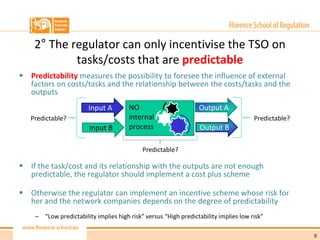
2° The regulator can only incentivise the TSO on
            tasks/costs that are predictable
 Predictability measures the possibility to foresee the influence of external
  factors on costs/tasks and the relationship between the costs/tasks and the
  outputs
                        Input A         NO                         Output A
   Predictable?                         internal                                        Predictable?
                        Input B         process                    Output B

                                             Predictable?

 If the task/cost and its relationship with the outputs are not enough
  predictable, the regulator should implement a cost plus scheme

 Otherwise the regulator can implement an incentive scheme whose risk for
  her and the network companies depends on the degree of predictability
    –   “Low predictability implies high risk” versus “High predictability implies low risk”

                                                                                                       9
3° The regulator can only incentivise the TSO on
            tasks/costs that are observable
 Observability measures the quantity of available information to the regulator
  about efficiency gains on tasks, either in terms of tasks themselves, or inputs
  or outputs
                       Input A        NO                       Output A
   Observable?                        internal                                    Observable?
                       Input B        process                  Output B


                                          Observable?
 The regulatory tool should then be chosen depending on the level of
  observability
    –   When there is no observability, cost plus should be implemented
    –   When input is observable, price cap or a menu of contracts should be implemented
    –   When output is observable, PBR or a menu of contracts should be implemented
    –   When information is available from several network operators, one should benchmark them

                                                                                                  10
A decision tree to align regulatory tools with the tasks’
                    No                                      characteristics …
Controllability?             Cost +


       Yes                               Price cap
                   No


Predictability?
                                                       PBR


                   No
                                                                  Menu
      Yes


Observability?
                                                                         Yardstick

                                                                                 11
… and alignment with the regulator’s abilities
                    No                                                 Regulator’s
Controllability?            Cost +                                        abilities


       Yes                              Price cap
                   No


Predictability?
                                                      PBR


                   No
                                                                Menu
      Yes


Observability?
                                                                       Yardstick

                                                                                12
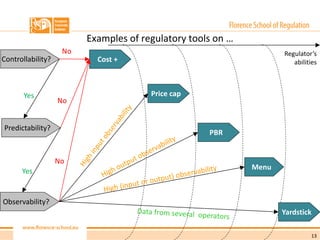
Examples of regulatory tools on …
                    No                                              Regulator’s
Controllability?           Cost +                                      abilities


       Yes                             Price cap
                   No


Predictability?
                                                    PBR


                   No
                                                             Menu
      Yes


Observability?
                                                                    Yardstick

                                                                             13
… example #1 Transmission maintenance
                                                                       Regulator’s
Controllability?             Cost +                                       abilities


       Yes                              Price cap


Predictability?
                                                    PBR


                   No
                                                                Menu
      Yes


Observability?
                                                                       Yardstick

                                                                                14
… example #2a Transmission losses volume in an isolated system
                                                               Regulator’s
Controllability?        Cost +                                    abilities


       Yes


Predictability?
                                              PBR


                   No
                                                        Menu
      Yes


Observability?
                                                               Yardstick

                                                                        15
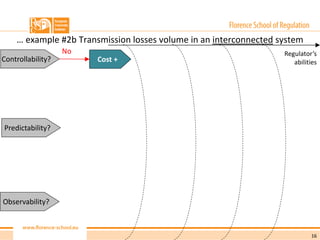
… example #2b Transmission losses volume in an interconnected system
                   No                                              Regulator’s
Controllability?        Cost +                                        abilities


Predictability?


Observability?


                                                                            16
… example #3 RD&D e.g. Meshed DC grid
                                                                       Regulator’s
Controllability?             Cost +                                       abilities


       Yes                              Price cap
                   No


Predictability?
                                                    PBR


                   No
                                                                Menu
      Yes


Observability?
                                                                       Yardstick

                                                                                17
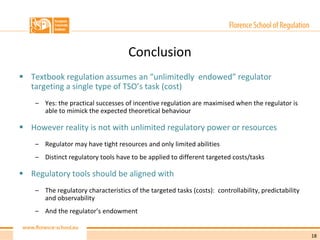
Conclusion
 Textbook regulation assumes an “unlimitedly endowed” regulator
  targeting a single type of TSO’s task (cost)
    – Yes: the practical successes of incentive regulation are maximised when the regulator is
      able to mimick the expected theoretical behaviour

 However reality is not with unlimited regulatory power or resources
    – Regulator may have tight resources and only limited abilities
    – Distinct regulatory tools have to be applied to different targeted costs/tasks

 Regulatory tools should be aligned with
    – The regulatory characteristics of the targeted tasks (costs): controllability, predictability
      and observability
    – And the regulator’s endowment


                                                                                                      18
15th June 2012 – EUI, Florence


   Incentive regulation with bounded regulators

                    Thank you for your attention!

               Comments and questions are welcome

Jean-Michel Glachant, Haikel Khalfallah (FSR-EUI), Yannick Perez (LdP chair-EUI)
       Vincent Rious, Marcelo Saguan (Microeconomix, LdP chair-EUI)


    1st Annual Conference on the Regulation of Infrastructure Industries


                                                                                         19
Appendixes


             21
A reminder of the 5 standard regulatory tools
   Cost +
     –   The network operator is then paid based on its cost-of-service

   Price cap
     –   The network operator has then a maximum allowed tariff level

   Performance (Output) regulation
     –   The network operator has then an efficiency target and is rewarded or penalised depending on its over- or under-
         performance

   Menu of contracts
     –   The regulator proposes different regulatory contracts to the network operator with different degrees of incentives

   Yardstick or benchmarking techniques
     –   These techniques can only be applied if the regulator controls the cost of several homogeneous network companies
     –   The regulator sets the efficiency target to a network company as a function of its performance relative to the other
         network companies’ performance


                                                                                                                                22
The real regulators are not always endowed with a full range of judicial powers
                      The European example before the 3rd directive
                                                                       5

An example of                                                           4 or 4½
evaluation of the
European                                                                3 or 3½
regulators’
abilities
                                                                         0 or 2
                                                                                Ex ante Regulation (=1)
                                                       Independency from government (= 1 or ½ or 0)
                                                                                        TPA setting (=1)
                                                                           Ability to solve conflicts (=1)
                                                                    Ability to acquire information (=1)

  Source : EU, 2004. 3rd Benchmarking Report on implementation of electricity and gas internal market.
            N.B.: Information for Germany is up to date and taken from the German regulator’s website
                                                                                                         23
The real regulators are not always endowed with the highest amount of ressources
                        The example of budget and staff in 2009 (for 100 TWh)


  Legend


Sources: Own calculus and
•Budget & staff from www.iern.net
•Annual load from
http://epp.eurostat.ec.europa.eu/portal/page/portal/energy/data/main_t
ables#
•Power Purchase Parity from
http://data.worldbank.org/indicator/PA.NUS.PRVT.PP
                                                                                             24
The regulator might be unable to distinguish between the effect
       of the network operator’s effort and the effect of uncertainty
    Effect on                                                                                        Effect on
  congestion                                                                                     congestion cost
   cost of the                                                                                    of the effort by
  effort by the                                                                                    the network
    network                                                                                           operator
 operator NOT                                                                                     detectable by
 detectable by
                                                     - - Without any NO’s effort                 the regulator in
the regulator in                                         _ With NO’s effort                      presence of low
  presence of                                                                                       uncertainty
      high
  uncertainty


     0              5            10            15           20   0       5           10          15         20
                   Congestion cost (monetary unit)                     Congestion cost (monetary unit)

                                                                                                                     25

Incentive regulation

  • 1.
    15th June 2012– EUI, Florence Incentive regulation with bounded regulators Jean-Michel Glachant, Haikel Khalfallah (FSR-EUI), Yannick Perez (LdP chair-EUI) Vincent Rious, Marcelo Saguan (Microeconomix, LdP chair-EUI) 1st Annual Conference on the Regulation of Infrastructure Industries 1
  • 2.
    Do we reallyknow how to apply incentive regulation in the power sector? The assumptions of the textbook model of regulation The reality for regulator –e.g. considering the national regulatory agencies for the power sectors but the rationale is also applicable to other sectors The regulator always has the She does not always have as many required powers, resources and powers, resources and abilities as abilities to implement any regulatory the textbook model assumes scheme The regulator applies distinct The regulator incentivises a TSO as regulatory tools to different TSO’s a whole with a single tool tasks 2
  • 3.
    An analytical frameworkto choose in practice between the incentive regulation tools  How to align the regulatory tools, the regulator’s endowment and the targeted tasks (“costs”)?  The textbook model of incentive regulation proposes no solution to choose the regulatory tools considering – The regulator’s abilities to implement it – And the targeted network tasks (“costs”) and their characteristics  We propose a way to align regulatory tools, endowment and tasks in practice, considering and combining – The actual bounded regulators’ endowment and abilities – And the actual characteristics of the network operator’s tasks 3
  • 4.
    The real regulatorsare endowed with less abilities than the textbook assumes  In the economic literature proposing and building regulatory tools, regulator is always thought to have all the desired cognitive, computational and judicial abilities to use any tool easily and efficiently – In particular, she knows ex nihilo how to choose the most efficient regulatory tools and she has all the desirable abilities to implement it  But in reality, the regulators were endowed with tight resources (budget, staff, skills and judicial powers) which are likely to hamper their abilities to do their job “perfectly”  Furthermore, regulators learn from experience how to use the different regulatory tools identified by our academic theory. How to: – To reduce their information asymmetry – To adapt tools to uncertainty and risk – To gain computational skills needed to design the regulatory tools 4
  • 5.
    The regulatory toolsrequire minimum abilities to be usefully implemented Regulator’s abilities Cost + Price cap PBR Menu Yardstick 5
  • 6.
    The regulator regulatesthe network operator for various tasks and not for a single task  The textbook regulator controls the TSO’s tasks (cost) as a whole while there are different tasks with different characteristics. The basis tasks for an El. TSO: – Operation of electricity system: Balancing + Reserves + Congestion + Losses + Market Operation – Maintenance of the existing grid – Investment and grid connection: Planning + Construction – Customer relationship  The network operator may have to undertake new or renewed tasks because of new regulatory objectives from – The integration of massive renewables in electricity – Concerns about security of supply – Europeanization of markets with a key TSO role in market building + RD&D in infrastructures and services (“smart” everything) 6
  • 7.
    Regulating a task(a cost) is betting on its controllability, predictability, & observability to choose appropriate regulatory tool  Considering the diversity of tasks, systems and environments that TSOs may encounter, they should be targeted with distinct regulatory tools in a building block approach  Other things being equal, that is to say with a regulator having all the desired abilities to use any tool, the appropriate regulatory tool to choose for a given task/cost should depend on the tasks’ regulatory characteristics being – (Task outcome) Controllability – (Task outcome) Predictability – (Task outcome) Observability 7
  • 8.
    1° The regulatorincentivises the TSO on tasks/costs that the TSO can control  Controllability measures the TSO’s ability to control a cost/task or a combination of costs/tasks for a given output Input A NO Output A Controllable? AND/OR internal Input B process Output B Controllable?  If the task/cost is not controllable, the regulator should implement a cost plus scheme  If the task/cost is controllable, the regulator could incentivise the TSO – Under the constraints relative to predictability and observability 8
  • 9.
    2° The regulatorcan only incentivise the TSO on tasks/costs that are predictable  Predictability measures the possibility to foresee the influence of external factors on costs/tasks and the relationship between the costs/tasks and the outputs Input A NO Output A Predictable? internal Predictable? Input B process Output B Predictable?  If the task/cost and its relationship with the outputs are not enough predictable, the regulator should implement a cost plus scheme  Otherwise the regulator can implement an incentive scheme whose risk for her and the network companies depends on the degree of predictability – “Low predictability implies high risk” versus “High predictability implies low risk” 9
  • 10.
    3° The regulatorcan only incentivise the TSO on tasks/costs that are observable  Observability measures the quantity of available information to the regulator about efficiency gains on tasks, either in terms of tasks themselves, or inputs or outputs Input A NO Output A Observable? internal Observable? Input B process Output B Observable?  The regulatory tool should then be chosen depending on the level of observability – When there is no observability, cost plus should be implemented – When input is observable, price cap or a menu of contracts should be implemented – When output is observable, PBR or a menu of contracts should be implemented – When information is available from several network operators, one should benchmark them 10
  • 11.
    A decision treeto align regulatory tools with the tasks’ No characteristics … Controllability? Cost + Yes Price cap No Predictability? PBR No Menu Yes Observability? Yardstick 11
  • 12.
    … and alignmentwith the regulator’s abilities No Regulator’s Controllability? Cost + abilities Yes Price cap No Predictability? PBR No Menu Yes Observability? Yardstick 12
  • 13.
    Examples of regulatorytools on … No Regulator’s Controllability? Cost + abilities Yes Price cap No Predictability? PBR No Menu Yes Observability? Yardstick 13
  • 14.
    … example #1Transmission maintenance Regulator’s Controllability? Cost + abilities Yes Price cap Predictability? PBR No Menu Yes Observability? Yardstick 14
  • 15.
    … example #2aTransmission losses volume in an isolated system Regulator’s Controllability? Cost + abilities Yes Predictability? PBR No Menu Yes Observability? Yardstick 15
  • 16.
    … example #2bTransmission losses volume in an interconnected system No Regulator’s Controllability? Cost + abilities Predictability? Observability? 16
  • 17.
    … example #3RD&D e.g. Meshed DC grid Regulator’s Controllability? Cost + abilities Yes Price cap No Predictability? PBR No Menu Yes Observability? Yardstick 17
  • 18.
    Conclusion  Textbook regulationassumes an “unlimitedly endowed” regulator targeting a single type of TSO’s task (cost) – Yes: the practical successes of incentive regulation are maximised when the regulator is able to mimick the expected theoretical behaviour  However reality is not with unlimited regulatory power or resources – Regulator may have tight resources and only limited abilities – Distinct regulatory tools have to be applied to different targeted costs/tasks  Regulatory tools should be aligned with – The regulatory characteristics of the targeted tasks (costs): controllability, predictability and observability – And the regulator’s endowment 18
  • 19.
    15th June 2012– EUI, Florence Incentive regulation with bounded regulators Thank you for your attention! Comments and questions are welcome Jean-Michel Glachant, Haikel Khalfallah (FSR-EUI), Yannick Perez (LdP chair-EUI) Vincent Rious, Marcelo Saguan (Microeconomix, LdP chair-EUI) 1st Annual Conference on the Regulation of Infrastructure Industries 19
  • 21.
  • 22.
    A reminder ofthe 5 standard regulatory tools  Cost + – The network operator is then paid based on its cost-of-service  Price cap – The network operator has then a maximum allowed tariff level  Performance (Output) regulation – The network operator has then an efficiency target and is rewarded or penalised depending on its over- or under- performance  Menu of contracts – The regulator proposes different regulatory contracts to the network operator with different degrees of incentives  Yardstick or benchmarking techniques – These techniques can only be applied if the regulator controls the cost of several homogeneous network companies – The regulator sets the efficiency target to a network company as a function of its performance relative to the other network companies’ performance 22
  • 23.
    The real regulatorsare not always endowed with a full range of judicial powers The European example before the 3rd directive 5 An example of 4 or 4½ evaluation of the European 3 or 3½ regulators’ abilities 0 or 2 Ex ante Regulation (=1) Independency from government (= 1 or ½ or 0) TPA setting (=1) Ability to solve conflicts (=1) Ability to acquire information (=1) Source : EU, 2004. 3rd Benchmarking Report on implementation of electricity and gas internal market. N.B.: Information for Germany is up to date and taken from the German regulator’s website 23
  • 24.
    The real regulatorsare not always endowed with the highest amount of ressources The example of budget and staff in 2009 (for 100 TWh) Legend Sources: Own calculus and •Budget & staff from www.iern.net •Annual load from http://epp.eurostat.ec.europa.eu/portal/page/portal/energy/data/main_t ables# •Power Purchase Parity from http://data.worldbank.org/indicator/PA.NUS.PRVT.PP 24
  • 25.
    The regulator mightbe unable to distinguish between the effect of the network operator’s effort and the effect of uncertainty Effect on Effect on congestion congestion cost cost of the of the effort by effort by the the network network operator operator NOT detectable by detectable by - - Without any NO’s effort the regulator in the regulator in _ With NO’s effort presence of low presence of uncertainty high uncertainty 0 5 10 15 20 0 5 10 15 20 Congestion cost (monetary unit) Congestion cost (monetary unit) 25