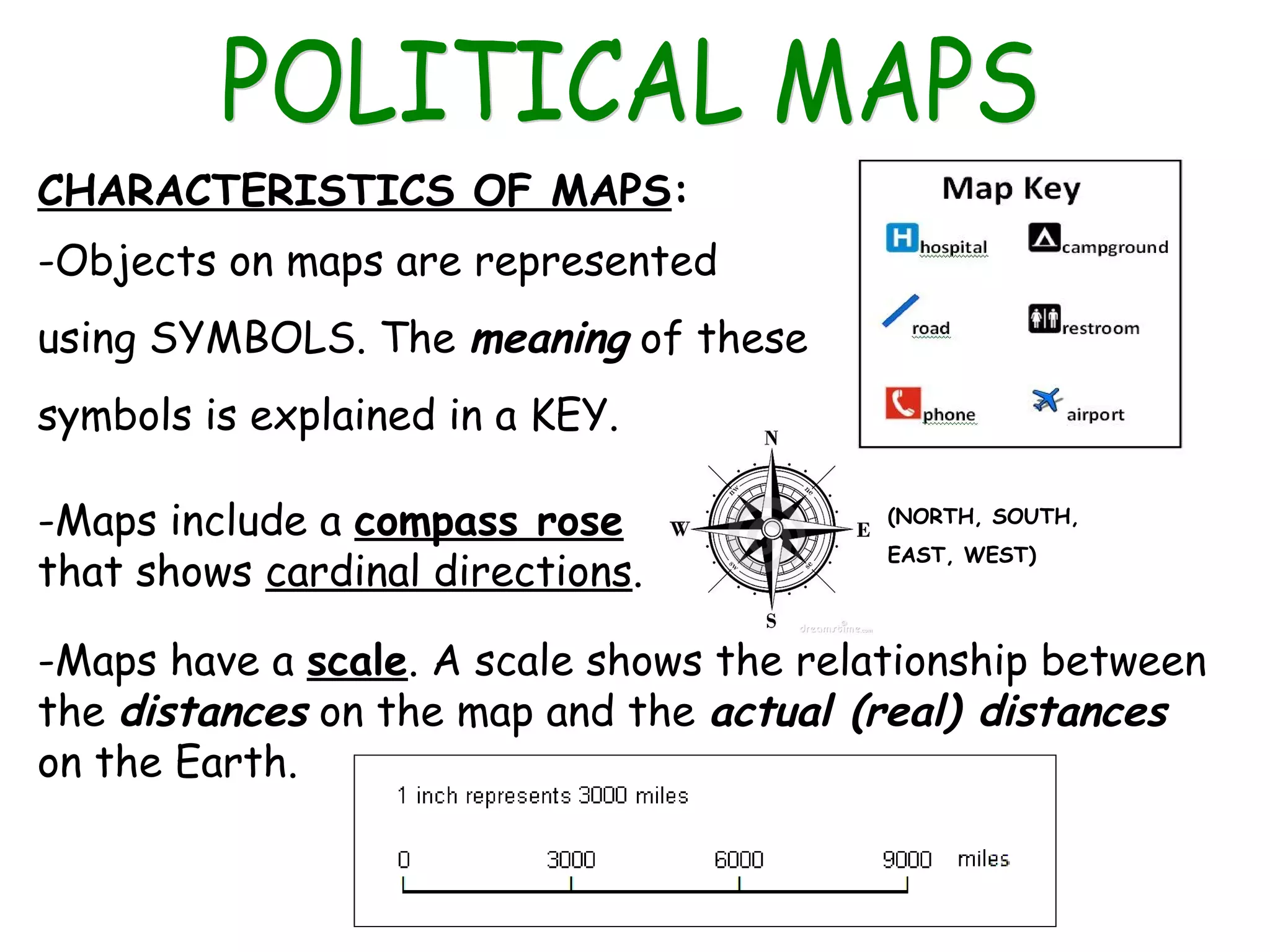
CHARACTERISTICS OF MAPS:
-Objects on maps are represented
using SYMBOLS. The meaning of these
symbols is explained in a KEY.
-Maps include a compass rose
that shows cardinal directions.
-Maps have a scale. A scale shows the relationship between
the distances on the map and the actual (real) distances
on the Earth.
(NORTH, SOUTH,
EAST, WEST)
COMPASS
ROSE
SYMBOLS
& KEY
SCALE
POLITICAL MAPS: they show countries, their borders and
capital cities.
COUNTRIES
BODERS
CAPITAL
CITY
GEOGRAPHIC COORDINATES:
To describe geographical locations on Earth, we use a
system of imaginary lines called parallels and meridians.
Parallels are circular lines that go around the Earth from
East to West. The longest parallel, the Equator, divides
the Earth into the northern hemisphere and the southern
hemisphere. LATITUDE is the distance in degrees from
the Equator (0º).
Meridians are circular lines that go from North to South
and pass throuth the poles. Meridians are the same lenght.
The Prime Meridian, also called the Greenwich Meridian,
divides the Earth into the eastern hemisphere and the
western hemisphere. LONGITUDE is the distance in
degrees from the Prime Meridian (0º).
GLOBES AND WORLD MAPS:
GLOBES are more accurate than MAPS for representing
the Earth, because they are three-dimensional like the
Earth itself. Once you try to reproduce the surface of the
Earth on a flat map, the sizes and shapes get distorted.
Some countries appear larger than they really are.
GLOBES
WORLD MAP
The CONSTITUTION is the most important law in Spain.
It was approved on 6 DECEMBER 1978. It defines:
-The organisation of the Spanish TERRITORY.
-The organisation of the GOVERNMENT. And,
-The Rights and Responsibilities of the citizens.
The Constitution also establishes:
-The FLAG: three horizontal stripes (red, yellow and red).
-The NATIONAL ANTHEM: it’s called the “Marcha Real”
(Royal March) and it has no official lyrics.
-The COAT OF ARMS. It usually appears
on the flag of Spain.
The Constitution establishes Spain as a PARLIAMENTARY
MONARCHY.
This means that the king or queen is the Head of State BUT
Parliament is responsible for making and approving new laws.
Felipe VI is the Head of State. He represents Spain in
international relations. The Crown of Spain is hereditary.
The Constitution establishes THREE POWERS:
1) LEGISLATIVE POWER. The main function is to make or
develop laws. Parliament (Las Cortes Generales) is made up of
two parts:
1-The Congress of Deputies and 2-The Senate.
Citizens of Spain who are 18 years old or over, vote for
members of Parliament in general elections every four years.
2) EXECUTIVE POWER. After the general elections, the
political party with the most votes forms the Government.
The Prime Minister is the head of the Government. The
ministers are appointed by the Prime Minister. They work in
different areas (education, healthcare, defence, economy).
3) JUDICIAL POWER. It belongs to courts and tribunals,
composed by judges and magistrates. They make sure that the
laws are obeyed. The judicial bodies in Spain are:
+ The Supreme Court: it’s the highest court.
+ The Constitutional Court: it decides if laws introduced
by Parliament are in accordance with the Constitution.
AUTONOMOUS COMMUNITIES
Spain is divided into 17 Autonomous Communities and two
Autonomous Cities: Ceuta and Melilla.
Autonomous Communities are made up of one or more
PROVINCES.
Each province is divided into MUNICIPALITIES.
Spain’s unique culture is a result of
its location, as well as the influence
from different civilisations
such as Celts, Visigoths, Romans
and Muslims.
Spanish cuisine is extremely diverse and uses a variety of
different ingredients and techniques.
Each region has its own unique cuisine.
However, there are some dishes which are considered
national dishes such as Spanish omelette, cured ham and
cured pork sausage to name just a few.
Spain’s official language is Spanish, also called Castilian.
Spanish is not the only language spoken in Spain.
Languages such as Catalan, Basque and Galician have co-
official status.
There are also a number of unofficial languages or dialects
that are spoken in certain places.
CHANGING POPULATION
The absolute population of an area is the number of
inhabitants in that area. It’s constantly changing, because of
the birth rates and death rates.
The science that studies these changes is called demography.
NATURAL INCREASE. We call this to the difference
between the number of births and the number of deaths.
natural increase = birth rate – death rate
A positive natural increase means that the birth rate is
higher than the death rate. The absolute population increases.
A negative natural increase means the death rate is higher
than the birth rate. The absolute population decreases.
ACTUAL (REAL) INCREASE. To discover the actual increase
of a population, we add (+) the number of immigrants to the
natural increase and then substract (-) the number of
emigrants. The actual increase can also be positive or negative.
actual increase = natural increase + number of immigrants – number of emigrants
There are many CAUSES of migratory movements: natural
causes (floodings, earthquakes, etc.), social causes (wars,
poverty, etc.), economic causes (job opportunities).
POPULATION DENSITY. It
shows us how populated an area
is. We calculate population
density by dividing (:) the
number of inhabitants by the
size of the area they live in. The
measurement for area is square
kilometres (km2). Population density = population : Km2
SPANISH POPULATION
In 1900, there were approximately 18 million inhabitants in
Spain, Today Spain’s population is about 46 million.
Positive NATURAL increase: like other European countries,
Spain has more elderly people than ever before.
Medical care, hygiene, and nutritious food have improved.
There’s better quality of life, which means people are living
longer.
Positive ACTUAL increase: many more people come to Spain
than leave it. Most come to Spain looking for work and a
better life for themselves and their families.
Life Expectancy: it’s the average number of years that
people life. In 1900, the life expectancy in Spain was 35
years. Now it is about 81 years, although this varies for men
and women.
There are three types of migratory movements:
1) International Emigration. In the first half of the 20th
century, many Spaniards emigrated to North and South
America. In the 1960s and 1970s, people started emigrating
to European countries, such as Germany, the UK and France.
2) International Migration. In the second half of the 20th
century, about four million people from rural areas moved to
cities to find work in factories. This process is known as the
rural exodus.
3) International Immigration. At the end of the 20th
century the situation changed and Spain started receiving
immigrants from other countries. In 2013 there were about
5.6 million immigrants in Spain. Most of them were from
Romania, Morocco, Ecuador, Colombia and the UK.
Political maps, Spanish Institutions/traditions/languages/population-migration

Political maps, Spanish Institutions/traditions/languages/population-migration

  • 1.
    CHARACTERISTICS OF MAPS: -Objectson maps are represented using SYMBOLS. The meaning of these symbols is explained in a KEY. -Maps include a compass rose that shows cardinal directions. -Maps have a scale. A scale shows the relationship between the distances on the map and the actual (real) distances on the Earth. (NORTH, SOUTH, EAST, WEST)
  • 2.
  • 3.
    POLITICAL MAPS: theyshow countries, their borders and capital cities. COUNTRIES BODERS CAPITAL CITY
  • 4.
    GEOGRAPHIC COORDINATES: To describegeographical locations on Earth, we use a system of imaginary lines called parallels and meridians. Parallels are circular lines that go around the Earth from East to West. The longest parallel, the Equator, divides the Earth into the northern hemisphere and the southern hemisphere. LATITUDE is the distance in degrees from the Equator (0º). Meridians are circular lines that go from North to South and pass throuth the poles. Meridians are the same lenght. The Prime Meridian, also called the Greenwich Meridian, divides the Earth into the eastern hemisphere and the western hemisphere. LONGITUDE is the distance in degrees from the Prime Meridian (0º).
  • 6.
    GLOBES AND WORLDMAPS: GLOBES are more accurate than MAPS for representing the Earth, because they are three-dimensional like the Earth itself. Once you try to reproduce the surface of the Earth on a flat map, the sizes and shapes get distorted. Some countries appear larger than they really are. GLOBES WORLD MAP
  • 7.
    The CONSTITUTION isthe most important law in Spain. It was approved on 6 DECEMBER 1978. It defines: -The organisation of the Spanish TERRITORY. -The organisation of the GOVERNMENT. And, -The Rights and Responsibilities of the citizens. The Constitution also establishes: -The FLAG: three horizontal stripes (red, yellow and red).
  • 8.
    -The NATIONAL ANTHEM:it’s called the “Marcha Real” (Royal March) and it has no official lyrics. -The COAT OF ARMS. It usually appears on the flag of Spain. The Constitution establishes Spain as a PARLIAMENTARY MONARCHY. This means that the king or queen is the Head of State BUT Parliament is responsible for making and approving new laws. Felipe VI is the Head of State. He represents Spain in international relations. The Crown of Spain is hereditary.
  • 9.
    The Constitution establishesTHREE POWERS: 1) LEGISLATIVE POWER. The main function is to make or develop laws. Parliament (Las Cortes Generales) is made up of two parts: 1-The Congress of Deputies and 2-The Senate. Citizens of Spain who are 18 years old or over, vote for members of Parliament in general elections every four years. 2) EXECUTIVE POWER. After the general elections, the political party with the most votes forms the Government. The Prime Minister is the head of the Government. The ministers are appointed by the Prime Minister. They work in different areas (education, healthcare, defence, economy).
  • 10.
    3) JUDICIAL POWER.It belongs to courts and tribunals, composed by judges and magistrates. They make sure that the laws are obeyed. The judicial bodies in Spain are: + The Supreme Court: it’s the highest court. + The Constitutional Court: it decides if laws introduced by Parliament are in accordance with the Constitution. AUTONOMOUS COMMUNITIES Spain is divided into 17 Autonomous Communities and two Autonomous Cities: Ceuta and Melilla. Autonomous Communities are made up of one or more PROVINCES. Each province is divided into MUNICIPALITIES.
  • 11.
    Spain’s unique cultureis a result of its location, as well as the influence from different civilisations such as Celts, Visigoths, Romans and Muslims. Spanish cuisine is extremely diverse and uses a variety of different ingredients and techniques. Each region has its own unique cuisine. However, there are some dishes which are considered national dishes such as Spanish omelette, cured ham and cured pork sausage to name just a few.
  • 12.
    Spain’s official languageis Spanish, also called Castilian. Spanish is not the only language spoken in Spain. Languages such as Catalan, Basque and Galician have co- official status. There are also a number of unofficial languages or dialects that are spoken in certain places.
  • 13.
    CHANGING POPULATION The absolutepopulation of an area is the number of inhabitants in that area. It’s constantly changing, because of the birth rates and death rates. The science that studies these changes is called demography. NATURAL INCREASE. We call this to the difference between the number of births and the number of deaths. natural increase = birth rate – death rate A positive natural increase means that the birth rate is higher than the death rate. The absolute population increases. A negative natural increase means the death rate is higher than the birth rate. The absolute population decreases.
  • 14.
    ACTUAL (REAL) INCREASE.To discover the actual increase of a population, we add (+) the number of immigrants to the natural increase and then substract (-) the number of emigrants. The actual increase can also be positive or negative. actual increase = natural increase + number of immigrants – number of emigrants There are many CAUSES of migratory movements: natural causes (floodings, earthquakes, etc.), social causes (wars, poverty, etc.), economic causes (job opportunities). POPULATION DENSITY. It shows us how populated an area is. We calculate population density by dividing (:) the number of inhabitants by the size of the area they live in. The measurement for area is square kilometres (km2). Population density = population : Km2
  • 15.
    SPANISH POPULATION In 1900,there were approximately 18 million inhabitants in Spain, Today Spain’s population is about 46 million. Positive NATURAL increase: like other European countries, Spain has more elderly people than ever before. Medical care, hygiene, and nutritious food have improved. There’s better quality of life, which means people are living longer. Positive ACTUAL increase: many more people come to Spain than leave it. Most come to Spain looking for work and a better life for themselves and their families. Life Expectancy: it’s the average number of years that people life. In 1900, the life expectancy in Spain was 35 years. Now it is about 81 years, although this varies for men and women.
  • 17.
    There are threetypes of migratory movements: 1) International Emigration. In the first half of the 20th century, many Spaniards emigrated to North and South America. In the 1960s and 1970s, people started emigrating to European countries, such as Germany, the UK and France. 2) International Migration. In the second half of the 20th century, about four million people from rural areas moved to cities to find work in factories. This process is known as the rural exodus. 3) International Immigration. At the end of the 20th century the situation changed and Spain started receiving immigrants from other countries. In 2013 there were about 5.6 million immigrants in Spain. Most of them were from Romania, Morocco, Ecuador, Colombia and the UK.