Peffley
PS 475 Politics & Media
   Review questions posted
   Slides posted
   Papers returned: average = 80+
   Conference Friday
   Final: Tuesday
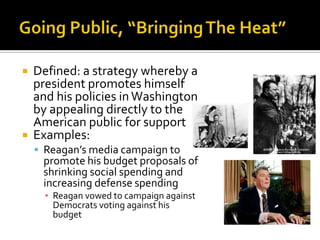
   Defined: a strategy whereby a
    president promotes himself
    and his policies in Washington
    by appealing directly to the
    American public for support
   Examples:
     Reagan’s media campaign to
     promote his budget proposals of
     shrinking social spending and
     increasing defense spending
      ▪ Reagan vowed to campaign against
        Democrats voting against his
        budget
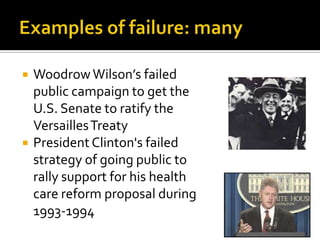
   Woodrow Wilson’s failed
    public campaign to get the
    U.S. Senate to ratify the
    Versailles Treaty
   President Clinton's failed
    strategy of going public to
    rally support for his health
    care reform proposal during
    1993-1994
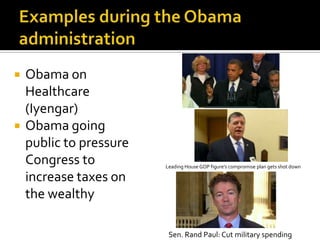
   Obama on
    Healthcare
    (Iyengar)
   Obama going
    public to pressure
    Congress to          Leading House GOP figure's compromise plan gets shot down

    increase taxes on
    the wealthy

                          Sen. Rand Paul: Cut military spending
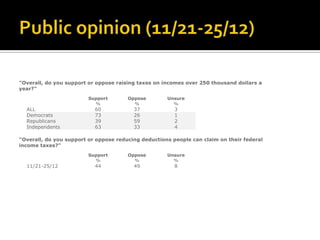
"Overall, do you support or oppose raising taxes on incomes over 250 thousand dollars a
year?"
                         Support       Oppose        Unsure
                           %             %             %
  ALL                      60            37             3
  Democrats                73            26             1
  Republicans              39            59             2
  Independents             63            33             4

"Overall, do you support or oppose reducing deductions people can claim on their federal
income taxes?"
                         Support       Oppose        Unsure
                           %             %             %
  11/21-25/12              44            49             8
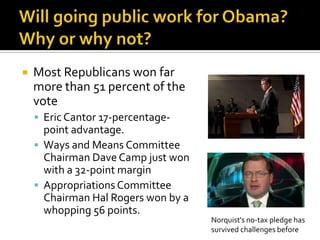
   Most Republicans won far
    more than 51 percent of the
    vote
     Eric Cantor 17-percentage-
      point advantage.
     Ways and Means Committee
      Chairman Dave Camp just won
      with a 32-point margin
     Appropriations Committee
      Chairman Hal Rogers won by a
      whopping 56 points.
                                     Norquist's no-tax pledge has
                                     survived challenges before
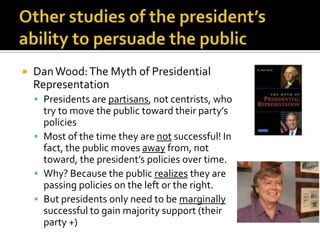
   Dan Wood: The Myth of Presidential
    Representation
     Presidents are partisans, not centrists, who
      try to move the public toward their party’s
      policies
     Most of the time they are not successful! In
      fact, the public moves away from, not
      toward, the president’s policies over time.
     Why? Because the public realizes they are
      passing policies on the left or the right.
     But presidents only need to be marginally
      successful to gain majority support (their
      party +)
   Short time after election
   When the president has very high approval
    levels (which requires a permanent campaign)
   When his party controls other institutions,
    especially Congress
   Presidential press conference?
   News coverage?
   Speechmaking, primetime addresses?
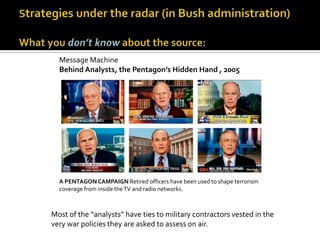
Message Machine
  Behind Analysts, the Pentagon’s Hidden Hand , 2005


  A PENTAGON CAMPAIGN Retired officers have been used to shape terrorism
  coverage from inside the TV and radio networks.


Most of the “analysts” have ties to military contractors vested in the
very war policies they are asked to assess on air.
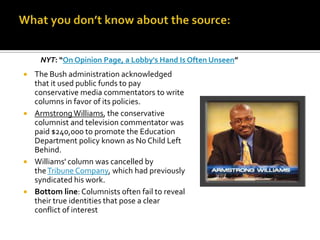
NYT: “On Opinion Page, a Lobby's Hand Is Often Unseen”
 The Bush administration acknowledged
  that it used public funds to pay
  conservative media commentators to write
  columns in favor of its policies.
 Armstrong Williams, the conservative
  columnist and television commentator was
  paid $240,000 to promote the Education
  Department policy known as No Child Left
  Behind.
 Williams' column was cancelled by
  the Tribune Company, which had previously
  syndicated his work.
 Bottom line: Columnists often fail to reveal
  their true identities that pose a clear
  conflict of interest
   So what influences presidential support?
     Merchandising or History?
     News coverage or Events?
   Events
     Inevitable decline?
     Economy
     Battle deaths
     Rally events
   News coverage of domestic vs. foreign affairs
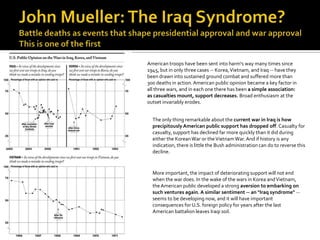
American troops have been sent into harm's way many times since
1945, but in only three cases -- Korea, Vietnam, and Iraq -- have they
been drawn into sustained ground combat and suffered more than
300 deaths in action. American public opinion became a key factor in
all three wars, and in each one there has been a simple association:
as casualties mount, support decreases. Broad enthusiasm at the
outset invariably erodes.


  The only thing remarkable about the current war in Iraq is how
  precipitously American public support has dropped off. Casualty for
  casualty, support has declined far more quickly than it did during
  either the Korean War or the Vietnam War. And if history is any
  indication, there is little the Bush administration can do to reverse this
  decline.


  More important, the impact of deteriorating support will not end
  when the war does. In the wake of the wars in Korea and Vietnam,
  the American public developed a strong aversion to embarking on
  such ventures again. A similar sentiment -- an "Iraq syndrome" --
  seems to be developing now, and it will have important
  consequences for U.S. foreign policy for years after the last
  American battalion leaves Iraqi soil.
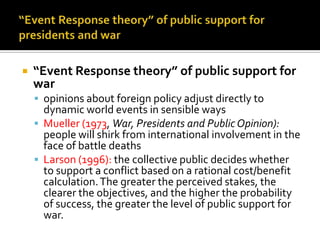
   “Event Response theory” of public support for
    war
     opinions about foreign policy adjust directly to
      dynamic world events in sensible ways
     Mueller (1973, War, Presidents and Public Opinion):
      people will shirk from international involvement in the
      face of battle deaths
     Larson (1996): the collective public decides whether
      to support a conflict based on a rational cost/benefit
      calculation. The greater the perceived stakes, the
      clearer the objectives, and the higher the probability
      of success, the greater the level of public support for
      war.
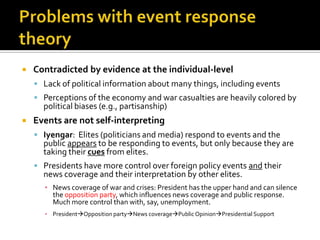
   Contradicted by evidence at the individual-level
     Lack of political information about many things, including events
     Perceptions of the economy and war casualties are heavily colored by
      political biases (e.g., partisanship)
   Events are not self-interpreting
     Iyengar: Elites (politicians and media) respond to events and the
      public appears to be responding to events, but only because they are
      taking their cues from elites.
     Presidents have more control over foreign policy events and their
      news coverage and their interpretation by other elites.
      ▪ News coverage of war and crises: President has the upper hand and can silence
        the opposition party, which influences news coverage and public response.
        Much more control than with, say, unemployment.
      ▪ PresidentOpposition partyNews coveragePublic OpinionPresidential Support

475 going public up

  • 1.
  • 2.
    Review questions posted  Slides posted  Papers returned: average = 80+  Conference Friday  Final: Tuesday
  • 5.
    Defined: a strategy whereby a president promotes himself and his policies in Washington by appealing directly to the American public for support  Examples:  Reagan’s media campaign to promote his budget proposals of shrinking social spending and increasing defense spending ▪ Reagan vowed to campaign against Democrats voting against his budget
  • 6.
    Woodrow Wilson’s failed public campaign to get the U.S. Senate to ratify the Versailles Treaty  President Clinton's failed strategy of going public to rally support for his health care reform proposal during 1993-1994
  • 7.
    Obama on Healthcare (Iyengar)  Obama going public to pressure Congress to Leading House GOP figure's compromise plan gets shot down increase taxes on the wealthy Sen. Rand Paul: Cut military spending
  • 8.
    "Overall, do yousupport or oppose raising taxes on incomes over 250 thousand dollars a year?" Support Oppose Unsure % % % ALL 60 37 3 Democrats 73 26 1 Republicans 39 59 2 Independents 63 33 4 "Overall, do you support or oppose reducing deductions people can claim on their federal income taxes?" Support Oppose Unsure % % % 11/21-25/12 44 49 8
  • 10.
    Most Republicans won far more than 51 percent of the vote  Eric Cantor 17-percentage- point advantage.  Ways and Means Committee Chairman Dave Camp just won with a 32-point margin  Appropriations Committee Chairman Hal Rogers won by a whopping 56 points. Norquist's no-tax pledge has survived challenges before
  • 12.
    Dan Wood: The Myth of Presidential Representation  Presidents are partisans, not centrists, who try to move the public toward their party’s policies  Most of the time they are not successful! In fact, the public moves away from, not toward, the president’s policies over time.  Why? Because the public realizes they are passing policies on the left or the right.  But presidents only need to be marginally successful to gain majority support (their party +)
  • 13.
    Short time after election  When the president has very high approval levels (which requires a permanent campaign)  When his party controls other institutions, especially Congress
  • 14.
    Presidential press conference?  News coverage?  Speechmaking, primetime addresses?
  • 15.
    Message Machine Behind Analysts, the Pentagon’s Hidden Hand , 2005 A PENTAGON CAMPAIGN Retired officers have been used to shape terrorism coverage from inside the TV and radio networks. Most of the “analysts” have ties to military contractors vested in the very war policies they are asked to assess on air.
  • 16.
    NYT: “On OpinionPage, a Lobby's Hand Is Often Unseen”  The Bush administration acknowledged that it used public funds to pay conservative media commentators to write columns in favor of its policies.  Armstrong Williams, the conservative columnist and television commentator was paid $240,000 to promote the Education Department policy known as No Child Left Behind.  Williams' column was cancelled by the Tribune Company, which had previously syndicated his work.  Bottom line: Columnists often fail to reveal their true identities that pose a clear conflict of interest
  • 19.
    So what influences presidential support?  Merchandising or History?  News coverage or Events?
  • 20.
    Events  Inevitable decline?  Economy  Battle deaths  Rally events  News coverage of domestic vs. foreign affairs
  • 21.
    American troops havebeen sent into harm's way many times since 1945, but in only three cases -- Korea, Vietnam, and Iraq -- have they been drawn into sustained ground combat and suffered more than 300 deaths in action. American public opinion became a key factor in all three wars, and in each one there has been a simple association: as casualties mount, support decreases. Broad enthusiasm at the outset invariably erodes. The only thing remarkable about the current war in Iraq is how precipitously American public support has dropped off. Casualty for casualty, support has declined far more quickly than it did during either the Korean War or the Vietnam War. And if history is any indication, there is little the Bush administration can do to reverse this decline. More important, the impact of deteriorating support will not end when the war does. In the wake of the wars in Korea and Vietnam, the American public developed a strong aversion to embarking on such ventures again. A similar sentiment -- an "Iraq syndrome" -- seems to be developing now, and it will have important consequences for U.S. foreign policy for years after the last American battalion leaves Iraqi soil.
  • 22.
    “Event Response theory” of public support for war  opinions about foreign policy adjust directly to dynamic world events in sensible ways  Mueller (1973, War, Presidents and Public Opinion): people will shirk from international involvement in the face of battle deaths  Larson (1996): the collective public decides whether to support a conflict based on a rational cost/benefit calculation. The greater the perceived stakes, the clearer the objectives, and the higher the probability of success, the greater the level of public support for war.
  • 23.
    Contradicted by evidence at the individual-level  Lack of political information about many things, including events  Perceptions of the economy and war casualties are heavily colored by political biases (e.g., partisanship)  Events are not self-interpreting  Iyengar: Elites (politicians and media) respond to events and the public appears to be responding to events, but only because they are taking their cues from elites.  Presidents have more control over foreign policy events and their news coverage and their interpretation by other elites. ▪ News coverage of war and crises: President has the upper hand and can silence the opposition party, which influences news coverage and public response. Much more control than with, say, unemployment. ▪ PresidentOpposition partyNews coveragePublic OpinionPresidential Support