POLI-FLUENTIALS
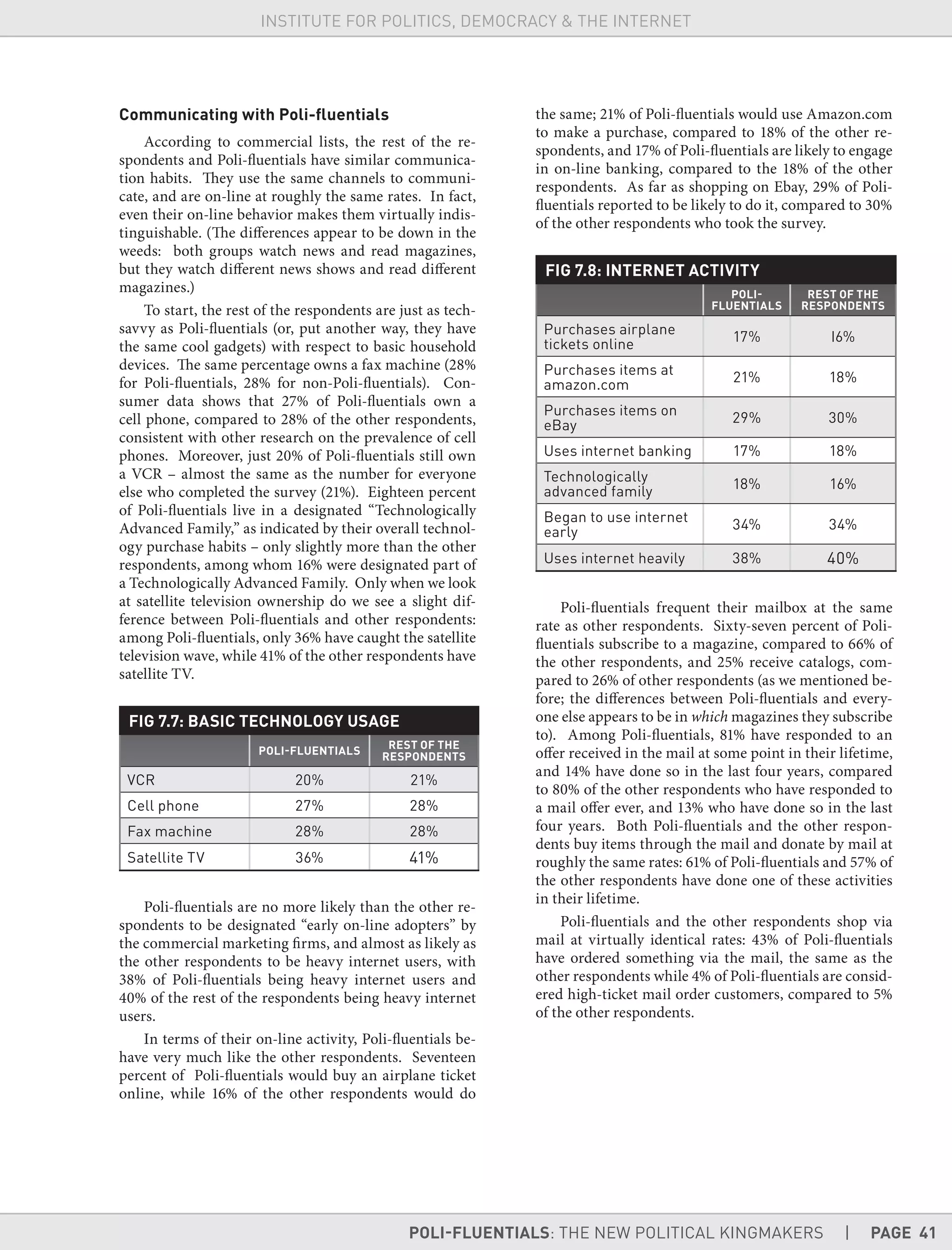
THE NEW POLITICAL KINGMAKERS
Th e G r a d uat e S c h o o l o f Po l i t i c a l M a nag e m e n tS c h o o l o f Po l i t i c a l M a nag e m e n tS P M
POLI-FLUENTIALS: THE NEW POLITICAL KINGMAKERS
INSTITUTE FOR POLITICS, DEMOCRACY & THE INTERNET
The Institute for Politics, Democracy & the Internet
thanks its sponsors, without whose support this publication
would not have been possible.
POLI-FLUENTIALS: THE NEW POLITICAL KINGMAKERS
INSTITUTE FOR POLITICS, DEMOCRACY & THE INTERNET
ACKNOWLEDGEMENTS
Poli-fluentials: The New Political Kingmakers is a publication of GW’s Institute for Politics, De-
mocracy & the Internet.
Carol Darr, former director of the Institute, and Joseph Graf are the principal editors of this
publication. They also assisted with the research and writing. F. Christopher Arterton (Interim Di-
rector, IPDI), Peter Churchill (Center for American Progress), Daniel Bennett (Practitioner-in-Res-
idence), John Purcell (Senior Visiting Fellow), Ed Trelinski, John Neurohr, Riki Parikh and Ryan
Sullivan (former research assistants), and Daniel Martin and Emily Ginsberg (MSHC Partners)
assisted with writing, creating, compiling and editing the study. Chris Brooks (financial manager),
Alex Kellner, Justin Beckley, Sam Levenback and Chris Wimbush (research assistants) provided
additional editing. Additional thanks to Tkeyah Lake and Khadijah Lake for providing additional
research and assistance.
We thank all of our authors: Julie Barko Germany of IPDI; Amy Gershkoff and Hal Malchow
of MSHC Partners; Alan Rosenblatt of the Center for American Progress; Jordan Schlacter of the
Yahoo! Media Sales Research team; and Doris Spielthenner, Neal Gorenflo, and Harald Katzmair
of FAS Research. Their opinions do not necessarily reflect those of the Institute.
We especially thank our sponsors: Adfero; @dvocacy, Inc.; BlogAds; Centro; FAS.research;
Kesem Technology; MSHC Partners; On Deck Communication Studio; John Robert Porter; Salem
Communications; 720 Strategies, the Talk Radio News Service; WashingtonPost.NewsweekInter-
active; and Yahoo!
The project would not have been possible without the advice and assistance of many individu-
als at The George Washington University, including Leody Bojanowski, Joseph Bondi, Elliot Hir-
shman, Anne Hirshfield, William Howard, Virginia Hodges, David Parenti, Linda Schutjer, and
especially Christopher Arterton, Donald Lehman, and Roger Whitaker.
We also wish to thank Roger Stone, Carolyn Carlson, and Vidisha Wahi at @dvocacy, Inc;
Martin Block, James Fountleroy and Sacha Clayton of Kesem Technology; Richard Kosinski, Bet-
tina Cisneros, Theresa LaMontagne, Michele Madansky, and Edwin Wong at Yahoo!, Eileen Krill
at WashingtonPost.NewsweekInteractive, David Shiffman of AOL: Lee Rainie of the Pew Internet
& American Life Project; Mark Naples of WIT Strategies; and Ian Koski of On Deck Communica-
tion Studio.
IPDI is the premier research and advocacy center for the study and promotion of online politics
in a manner that encourages citizen participation and is consistent with democratic principles.
IPDI is non-partisan and non-profit and is part of the Graduate School of Political Management at
the George Washington University. F. Christopher Arterton is dean of the school. For more infor-
mation about the Graduate School of Political Management, visit www.gwu.edu/~gspm.
For more information about the Institute for Politics, Democracy & the Internet, visit http://
www.ipdi.org.
© GW’s Institute for Politics, Democracy & the Internet.
“Poli-fluentials” is a trademark of The George Washington University.
The editors are Carol Darr and Joseph Graf.
The date of publication is October 4, 2007.
POLI-FLUENTIALS: THE NEW POLITICAL KINGMAKERS
INSTITUTE FOR POLITICS, DEMOCRACY & THE INTERNET
POLI-FLUENTIALS: THE NEW POLITICAL KINGMAKERS
INSTITUTE FOR POLITICS, DEMOCRACY & THE INTERNET
INTRODUCTION ................................................................................................................... 1
CHAPTER ONE
Demographics .................................................................................................................... 7
CHAPTER TWO
Party Poli-fluentials: Initial Thoughts on the Differences across Parties......... 13
CHAPTER THREE
News Consumption: Old Media, New Media and Poli-fluentials .....................17
CHAPTER FOUR
Technology Adoption and Poli-fluentials ............................................................ 23
CHAPTER FIVE
Toward a New Paradigm: Understanding Political Influencers........................ 27
CHAPTER SIX
New Possibilities in Mobilizing Political Influencers ......................................... 33
CHAPTER SEVEN
How Poli-fluentials Live Their Lives: Lifestyle, Hobbies, Interests ................... 39
METHODOLOGY .................................................................................................................. 43
CONTRIBUTORS ................................................................................................................. 44
TABLE OF
CONTENTS
POLI-FLUENTIALS: THE NEW POLITICAL KINGMAKERS
INSTITUTE FOR POLITICS, DEMOCRACY & THE INTERNET
PAGE VI | POLI-FLUENTIALS: THE NEW POLITICAL KINGMAKERS
INSTITUTE FOR POLITICS, DEMOCRACY & THE INTERNET
POLI-FLUENTIALS: THE NEW POLITICAL KINGMAKERS | PAGE 1
INSTITUTE FOR POLITICS, DEMOCRACY & THE INTERNET
The purpose of this research is to shed light on the
American adults who will be the most active in the 2008
election – the likeliest to volunteer, donate, promote can-
didates and join causes through both online and word-
of-mouth advocacy. We call this sought-after group of
political activists “Poli-fluentials™” in recognition of
their involvement in politics as well as their influence as
outspoken opinion leaders among their families, friends,
neighbors and colleagues. This research report explains
who these Poli-fluentials are, examines their habits, be-
haviors and preferences, and describes how to commu-
nicate with them as well as how they communicate with
each other.
The survey builds on IPDI’s ground-breaking 2004
survey, Political Influentials Online in the 2004 Presiden-
tial Campaign, which showed that people who partici-
pate in politics over the Internet are almost seven times
more likely to belong to an elite cohort of local opinion
leaders called “Influentials” than the general adult popu-
lation.
The purpose of this new study is to gain a deeper and
more nuanced understanding of these trend setters, who
are the most politically active and most influential, and
to show candidates and advocacy groups where to find
them, how to get their attention, and how to take advan-
tage of their unique characteristics.
We identified this partisan, vocal and active cohort
by a two-pronged test. We first used a narrower defini-
tion of “influential-ness” that measures a person’s will-
ingness to publicly advocate a position on political and
public policy issues (such as by e-mailing public officials,
or writing letters to newspaper editors). We combined
this definition with a second set of questions about
whether the respondent had donated money to candi-
dates, political parties or issue advocacy campaigns, or
volunteered to help them. We then applied the two-part
test to a database of almost 10,000 respondents to an on-
line questionnaire in order to find the strongest advo-
cates and most politically active respondents, whom we
call Poli-fluentials.
We contrasted the habits and behaviors of these Poli-
fluentials with another group of respondents who passed
the first part of the test that measures their influence, but
not the second, political part. We refer to this group as
the Influencers, or sometimes more descriptively as the
non-political Influencers.
Similarly, we also compared the Poli-fluentials to the
respondents who passed the political test, but not the
influential-ness test. We call this group the Politicals, or
sometimes the non-influential Politicals.
The Politicals and the Influencers are different in
their habits, behavior and demographic characteristics
from the group that is both politically active and influ-
ential among their peers, the Poli-fluentials.
Significantly, with respect to Poli-fluentials, we
found that the sum is greater than the parts. They are not
simply a hybrid of Politicals and Influencers. They are
sophisticated, aggressive, opinionated, tech-savvy ac-
tivists with big social and professional networks whose
outsized presence will significantly influence the 2008
election process.
These Poli-fluentials have traits that make them es-
pecially appealing to the candidates, political parties and
advocacy organizations that are lucky or shrewd enough
to attract their support:
Introduction
BY CAROL DARR
FORMERLY OF THE INSTITUTE FOR DEMOCRACY,
POLITICS & THE INTERNET
PAGE 2 | POLI-FLUENTIALS: THE NEW POLITICAL KINGMAKERS
INSTITUTE FOR POLITICS, DEMOCRACY & THE INTERNET
• They are much more likely to volunteer in
a political election. Forty-four percent vol-
unteered in the 2006 election, a rate almost
four times greater than the respondents
who were political (but not influential) or
influential (but not political).
• They are significantly more technologically
savvy than anyone else, and at the cutting
edge, the differences are stark. For exam-
ple, Poli-fluentials are more than six times
more likely to have participated in a politi-
cal event in an online game than someone
who is a Political, and twice as likely to have
created and posted an online video than a
Political or an Influencer.
• Theyaremorevoraciousconsumersofnews,
especially alternative sources of news, and
they seek out the websites of candidates, is-
sue groups and public officials more often
than do the Politicals or the Influencers.
• They have larger social and professional
networks than either the Politicals or the
Influencers, but their networks are less
likely to contain a wide variety of opinions.
In contrast, fewer Politicals and Influenc-
ers have large networks, but the ones who
do are more likely to be moderates and the
people in their circles are more likely to
hold diverse viewpoints.
Our research indicates that volunteers to political
campaigns come almost exclusively from the ranks of
Poli-fluentials. Our study finds that people who make
contributions but who do not actively promote candi-
dates and causes are much less likely to volunteer – only
12% of them did. Similarly, among the people who pub-
licly promote candidates and causes but do not donate to
candidates and causes, only 10% volunteer. Candidates
and causes in search of foot soldiers to perform the ac-
tual work of campaigns would do well to cultivate Poli-
fluentials.
And we also found that Poli-fluentials were more
likely to be Democrats than Republicans (46% vs. 30%).
Similarly, more Poli-fluentials were liberal or very lib-
eral (45%) than were conservative or very conservative
(33%).
This research draws from a large pool of 9,722 in-
dividuals who responded to an online questionnaire
comprising approximately 50 questions between May
and mid-July 2007. These individuals constitute a group
whose names were originally obtained from a list of
about 30 million registered voters, whose e-mailed ques-
tionnaires made it past a daunting gauntlet of spam fil-
ters and into their e-mail boxes, and who opened and
completed the survey.
While the number of surveys is small relative to the
size of the list we started with, it constitutes an unusu-
ally large database for purposes of analysis, made all the
more valuable by additional census, commercial and
voter information that was appended. The data, howev-
er, have not been weighted to correspond to the various
demographic groups’ relative size in the general public.
For these reasons, this was not a random survey, but an
elite study of a large group of online registered voters
willing to participate in the study.
How We Defined Poli-fluentials
As all researchers know, how one defines the subject
population shapes the answers to everything else. In this
study, we chose to define Poli-fluentials by their opinion
leadership as well as their involvement in electoral cam-
paigns and public policy issues. To do so, we categorized
a respondent as an “Influencer” based on answers to sev-
en questions that addressed opinion leadership; and cat-
egorized a respondent as a “Political” based on responses
to three questions about volunteering or making politi-
cal contributions. Poli-fluentials passed both tests.
The first seven questions draw upon methodology
developed by RoperASW that was used in the Political
Influentials Online study four years ago. Some questions
were revised1
to focus more intently on political behav-
ior as well as other advocacy behaviors that inform po-
litical decision-making. For this reason, we refined and
narrowed the earlier influencer questions. Thus, instead
of asking if the respondent has called into a radio or TV
talk show to express an opinion on any topic, the respon-
dents were asked whether they had called in to express a
political opinion. Similarly, we asked if they had given a
speech in the last year on a political topic.
The Influencer Questions
The seven questions used to determine “influential-
ness” as an opinion leader follow below. A person we de-
scribe as an “Influencer” answered “yes” to any THREE
of these:
1. Made a speech on a political topic.
2. Wrote an article for a magazine or newspa-
per on a political topic.
3. Was an active member of an advocacy
group, that is, one that tries to influence
public policy or government.
4. Wrote a letter or sent an e-mail message to
any public official at the state, local or na-
tional level.
5. Wrote a letter or sent an e-mail to the editor
of a newspaper or magazine.
6. Attended a political rally, speech or pro-
test.
7. Called a live radio or TV show to express an
opinion on politics or public policy.
1 “The Influentials” by Ed Keller and Jon Berry
(New York: The Free Press, 2003).
POLI-FLUENTIALS: THE NEW POLITICAL KINGMAKERS | PAGE 3
INSTITUTE FOR POLITICS, DEMOCRACY & THE INTERNET
The Politics Questions
A person that we describe as a Political answered
“yes” to any TWO of these:
1. Leading up to the November 7, 2006, elec-
tion, did you perform volunteer work for a
political campaign?
2. Thinking back to the 2004 presidential elec-
tion, did you donate money to any candi-
date, political party, or a group promoting
or opposing a cause or issue?
3. Leading up to the November 7, 2006, elec-
tion, did you donate money to a candidate,
political party, or a group promoting a po-
litical cause?
The Poli-fluentials responded “yes” to at least three
of the seven influential items and “yes” to at least of the
two of the three questions for being politically active.
These people fall at the top of the scales for being both
influential and politically active.
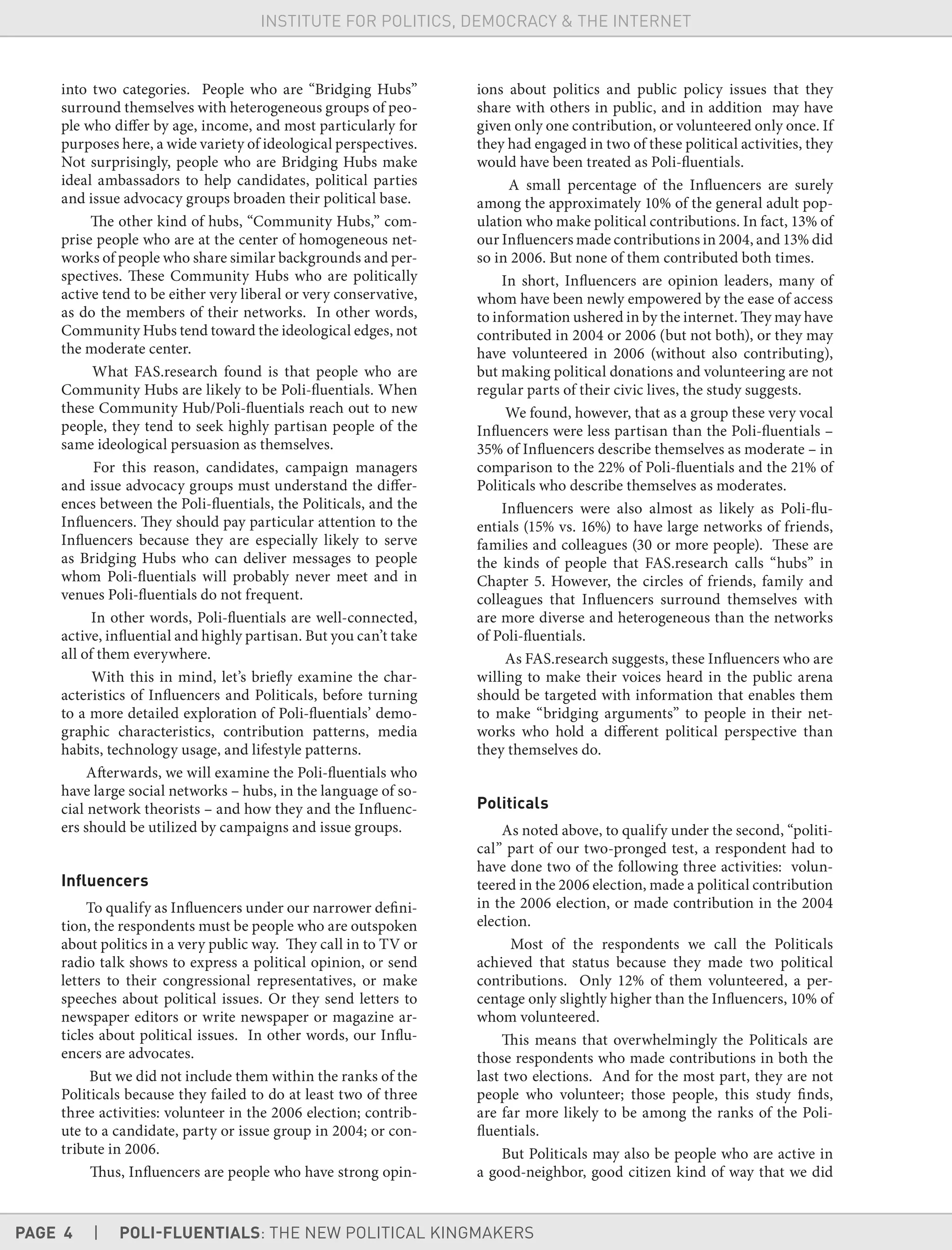
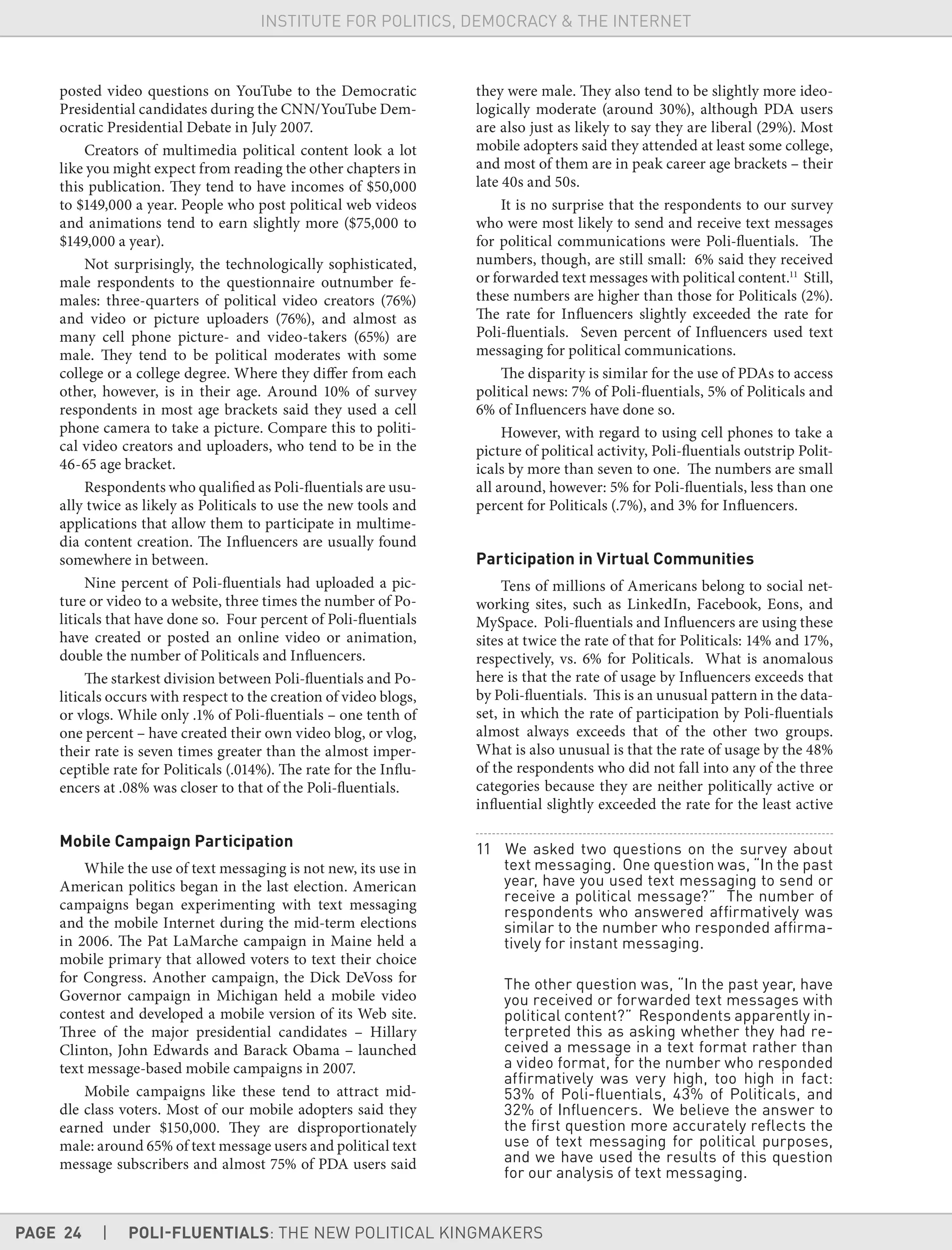
In our sample:
• 20% of respondents were Poli-fluentials,
passing the two-pronged test.
• 19% of respondents are Influencers, passing
the first test for influential-ness but not the
second, political test.
• 13% of respondents are Politicals, passing
the second political test, but not the first,
influential-ness test.
• 48% are of respondents were neither Influ-
encers nor Politicals, passing neither test.
FIG i.1: DISTRIBUTION OF SAMPLE
What’s So Special about
Poli-fluentials?
Poli-fluentials, by definition, possess the characteris-
tics of both Politicals and Influencers. Both Influencers
and Politicals tend to be older, richer, whiter and more
educated than the general population. Politicals tend to
tilt toward the ideological poles rather than toward the
moderate center. It is not surprising, then, that Poli-flu-
entials, who straddle both groups, are demographically
and ideologically similar to both.
Poli-fluentials’ significance lies in the fact that they
are influential and politically active. In fact, they are
more politically active than others who donate and vol-
unteer if you include the panoply of political activities
both online and offline that are crucial to motivating the
electorate, such as forwarding political videos to friends.
In the same vein, Poli-fluentials can be considered more
influential than ordinary Influencers who operate in the
political arena. Across the board, they beat out the other
two groups, even at their own games.
And it goes without saying that Poli-fluentials are
both more active politically and more influential than
the 48% of the respondents – and the vast majority of the
general public – who are neither influential nor political-
ly active. Poli-fluentials left this group of Not-political/
Not-influencers in the dust.
Nonetheless, the data show that Poli-fluentials more
closely resemble Influencers than they do Politicals.
When compared to Influencers, however, they score
higher in almost every behavior. In activity after activ-
ity – from forwarding e-mails pre-written by advocacy
groups to public officials, to leaving comments on blogs,
to using search engines to find political information –
Poli-fluentials out-score the Influencers.
In fact, the activism of Poli-fluentials vis-à-vis the
other groups is so dramatic that it might suggest that
campaign managers and leaders of issue advocacy groups
spend their limited funds targeting and attracting Poli-
fluentials, and ignoring the other categories, depending
on the goal of the outreach.
However, the analysis of the data conducted by
social network analysts at FAS.research shows that the
situation is more nuanced. Some Poli-fluentials are so
partisan that they are useless and even counterproduc-
tive in certain situations. These Poli-fluentials are best
utilized by candidates, political parties and issue advo-
cacy groups to shore up the base, not to win converts to
the other side.
FAS.research first focused on the fact that Poli-
fluentials are disproportionately likely to have large
networks of social and professional contacts. Of the re-
spondents who have networks of 30 or more people with
whom they discuss important political issues (10% of the
sample) almost half (44%) were Poli-fluentials.
FAS.research and other social network theoreticians
call people with large networks “hubs” and divide them
PAGE 4 | POLI-FLUENTIALS: THE NEW POLITICAL KINGMAKERS
INSTITUTE FOR POLITICS, DEMOCRACY & THE INTERNET
into two categories. People who are “Bridging Hubs”
surround themselves with heterogeneous groups of peo-
ple who differ by age, income, and most particularly for
purposes here, a wide variety of ideological perspectives.
Not surprisingly, people who are Bridging Hubs make
ideal ambassadors to help candidates, political parties
and issue advocacy groups broaden their political base.
The other kind of hubs, “Community Hubs,” com-
prise people who are at the center of homogeneous net-
works of people who share similar backgrounds and per-
spectives. These Community Hubs who are politically
active tend to be either very liberal or very conservative,
as do the members of their networks. In other words,
Community Hubs tend toward the ideological edges, not
the moderate center.
What FAS.research found is that people who are
Community Hubs are likely to be Poli-fluentials. When
these Community Hub/Poli-fluentials reach out to new
people, they tend to seek highly partisan people of the
same ideological persuasion as themselves.
For this reason, candidates, campaign managers
and issue advocacy groups must understand the differ-
ences between the Poli-fluentials, the Politicals, and the
Influencers. They should pay particular attention to the
Influencers because they are especially likely to serve
as Bridging Hubs who can deliver messages to people
whom Poli-fluentials will probably never meet and in
venues Poli-fluentials do not frequent.
In other words, Poli-fluentials are well-connected,
active, influential and highly partisan. But you can’t take
all of them everywhere.
With this in mind, let’s briefly examine the char-
acteristics of Influencers and Politicals, before turning
to a more detailed exploration of Poli-fluentials’ demo-
graphic characteristics, contribution patterns, media
habits, technology usage, and lifestyle patterns.
Afterwards, we will examine the Poli-fluentials who
have large social networks – hubs, in the language of so-
cial network theorists – and how they and the Influenc-
ers should be utilized by campaigns and issue groups.
Influencers
To qualify as Influencers under our narrower defini-
tion, the respondents must be people who are outspoken
about politics in a very public way. They call in to TV or
radio talk shows to express a political opinion, or send
letters to their congressional representatives, or make
speeches about political issues. Or they send letters to
newspaper editors or write newspaper or magazine ar-
ticles about political issues. In other words, our Influ-
encers are advocates.
But we did not include them within the ranks of the
Politicals because they failed to do at least two of three
three activities: volunteer in the 2006 election; contrib-
ute to a candidate, party or issue group in 2004; or con-
tribute in 2006.
Thus, Influencers are people who have strong opin-
ions about politics and public policy issues that they
share with others in public, and in addition may have
given only one contribution, or volunteered only once. If
they had engaged in two of these political activities, they
would have been treated as Poli-fluentials.
A small percentage of the Influencers are surely
among the approximately 10% of the general adult pop-
ulation who make political contributions. In fact, 13% of
our Influencers made contributions in 2004, and 13% did
so in 2006. But none of them contributed both times.
In short, Influencers are opinion leaders, many of
whom have been newly empowered by the ease of access
to information ushered in by the internet. They may have
contributed in 2004 or 2006 (but not both), or they may
have volunteered in 2006 (without also contributing),
but making political donations and volunteering are not
regular parts of their civic lives, the study suggests.
We found, however, that as a group these very vocal
Influencers were less partisan than the Poli-fluentials –
35% of Influencers describe themselves as moderate – in
comparison to the 22% of Poli-fluentials and the 21% of
Politicals who describe themselves as moderates.
Influencers were also almost as likely as Poli-flu-
entials (15% vs. 16%) to have large networks of friends,
families and colleagues (30 or more people). These are
the kinds of people that FAS.research calls “hubs” in
Chapter 5. However, the circles of friends, family and
colleagues that Influencers surround themselves with
are more diverse and heterogeneous than the networks
of Poli-fluentials.
As FAS.research suggests, these Influencers who are
willing to make their voices heard in the public arena
should be targeted with information that enables them
to make “bridging arguments” to people in their net-
works who hold a different political perspective than
they themselves do.
Politicals
As noted above, to qualify under the second, “politi-
cal” part of our two-pronged test, a respondent had to
have done two of the following three activities: volun-
teered in the 2006 election, made a political contribution
in the 2006 election, or made contribution in the 2004
election.
Most of the respondents we call the Politicals
achieved that status because they made two political
contributions. Only 12% of them volunteered, a per-
centage only slightly higher than the Influencers, 10% of
whom volunteered.
This means that overwhelmingly the Politicals are
those respondents who made contributions in both the
last two elections. And for the most part, they are not
people who volunteer; those people, this study finds,
are far more likely to be among the ranks of the Poli-
fluentials.
But Politicals may also be people who are active in
a good-neighbor, good citizen kind of way that we did
POLI-FLUENTIALS: THE NEW POLITICAL KINGMAKERS | PAGE 5
INSTITUTE FOR POLITICS, DEMOCRACY & THE INTERNET
not count this time in our definition of influential-ness.
Limiting our definition of Influencers to respondents
who publicly advocate their opinions had the deliberate
effect of excluding people who are civically but not po-
litically active — people, for example, who said they at-
tended a meeting on town or school affairs, or had been
a member of a local club or served on one of its com-
mittees, or had been an officer of any club at the local,
state or national level. In other words, the people we are
describing as Politicals may well be civically active, but
they are not outspoken advocates, and so they did not fit
within the category of Poli-fluentials.
With these brief descriptions in mind, we turn to the
characteristics of Poli-fluentials, as well as thoe of other
respondents to the survey.
PAGE 6 | POLI-FLUENTIALS: THE NEW POLITICAL KINGMAKERS
INSTITUTE FOR POLITICS, DEMOCRACY & THE INTERNET
POLI-FLUENTIALS: THE NEW POLITICAL KINGMAKERS | PAGE 7
INSTITUTE FOR POLITICS, DEMOCRACY & THE INTERNET
• Poli-fluentials are very highly educated,
tend to have higher incomes and are clearly
older than others.
• Men and women are equally likely to be
Poli-fluentials.
• Education is the most important factor in
determining who is an Influencer; age is the
most important factor in determining who
is a Political.
• Poli-fluentials are moving online to make
political contributions at a greater rate than
other respondents.
• People aged 51 and older are the most likely
to report that they regularly discuss poli-
tics.
• Young people were more likely to report be-
ing active in politics online.
• Political activism changes over the course
of a lifetime. While young people are more
likely to volunteer, there remain types of ac-
tivism – such as political donations – that
are the purview of those over 50.
Researchers have identified influentials in many dif-
ferent ways, but the various definitions always describe
them as an elite group with disproportionate influence
within their social networks. Poli-fluentials are politi-
cally active subset of that small group of influentials.
We looked first at the demographic makeup of Poli-
fluentials to see if any particular demographic group was
more likely to be politically influential.
Gender
Researchers who study influentials have argued
that they are pretty equally divided between men and
women. In the 2004 presidential campaign, the Institute
found that people highly engaged with politics online -
dubbed “online political citizens” – were disproportion-
ately male. Nearly 70% of these online political citizens
qualified as influentials, according to the methodology
developed by RoperASW, far more than the 10% to 12%
of Influentials found in the general public.2
However, this
group was an online subset of politically active people,
and at the time there was a greater gender divide among
Internet users. There is reason to believe that the gender
difference has declined.
The respondents to our online survey were dispro-
portionately male (63%), probably reflecting a greater
willingness of men to take the survey. However, men
and women appeared equally likely to qualify as Poli-
fluentials. There were no great differences across gender.
2 Joseph Graf, Grant Reeher, Michael J. Malbin
and Costas Panagopoulos. “Small Donors and
Online Giving: A Study of Donors to the 2004
Presidential Campaigns,” (Washington, D.C.:
Institute for Politics, Democracy & the Inter-
net, 2006).
C H A P T E R 1
DEMOGRAPHICS
BY JOE GRAF
AMERICAN UNIVERSITY
PAGE 8 | POLI-FLUENTIALS: THE NEW POLITICAL KINGMAKERS
INSTITUTE FOR POLITICS, DEMOCRACY & THE INTERNET
Education
Poli-fluentials are extraordinarily well educated.
More than half (55%) reported they had completed at
least some graduate school. More than a quarter of the
Poli-fluentials we studied reported they had graduate de-
grees (28%), another 13% reported they had professional
degrees (such as a medical or law degree) and another
14% reported they had attended graduate school. Hardly
any of the Poli-fluentials (less than 2%) reported having
only a high school diploma or less. Even taking into ac-
count the high level of education within our entire sam-
ple, Poli-fluentials are clearly very well educated. This
finding is consistent with previous research on people
who are influential3
as well as people who are political
donors.
Age
We know that middle-aged people are more likely to
be influential. Many of the concerns that prompt higher
levels of political and civic activity – the hallmarks of an
influential person – take place in middle age. Owning
property, having children in a local school district and
enjoying larger salaries are all events typical of middle
age that may induce greater civic involvement. We also
know that middle-aged people are more likely to be po-
litically active. Despite the media image of young volun-
teers for a political campaign, the age of most volunteers
is typically older and many volunteers are drawn from
the ranks of the retired.
Older people are more likely to vote - despite great
efforts to encourage young voters - and older people are
significantly more likely to donate money to a political
campaign.3
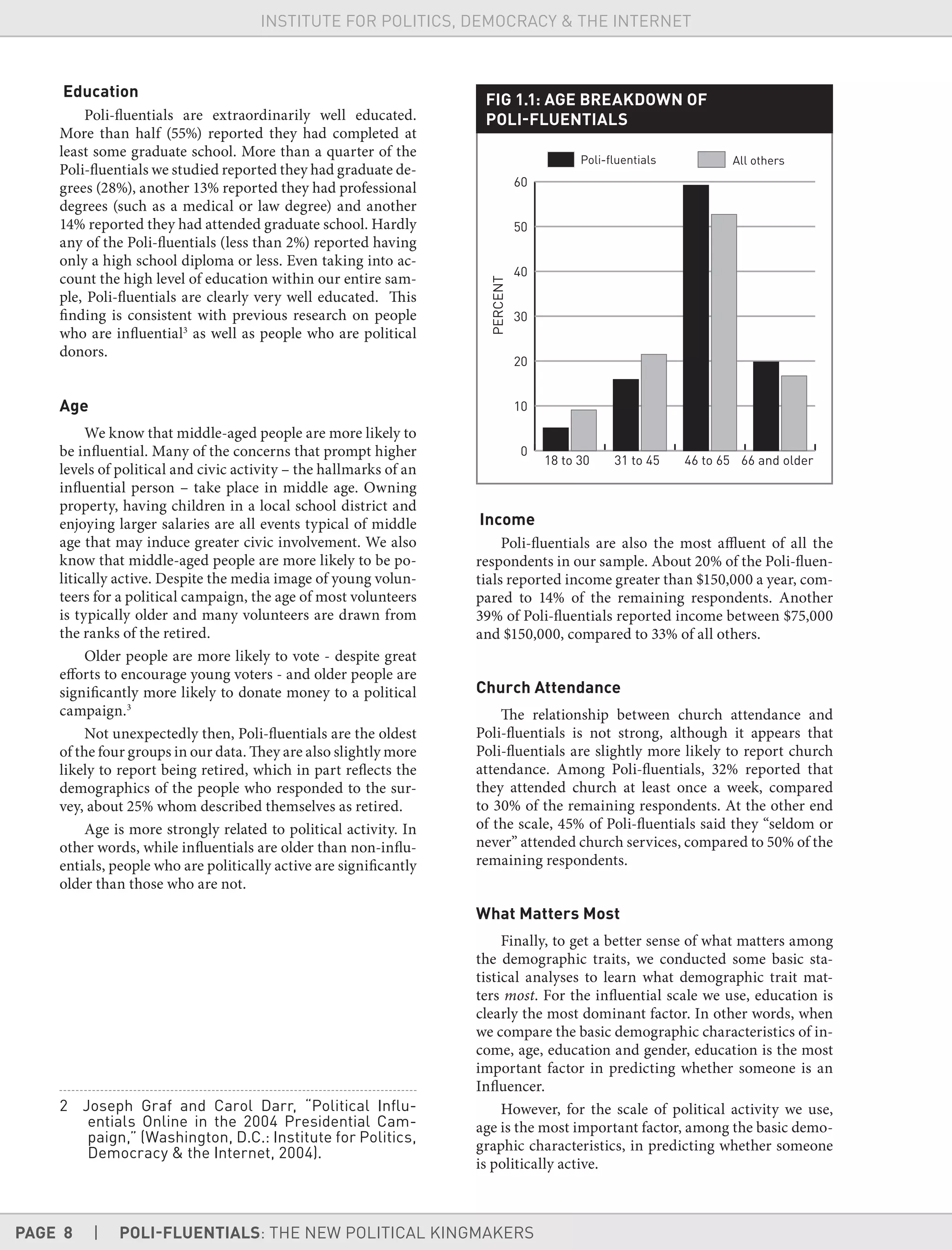
Not unexpectedly then, Poli-fluentials are the oldest
of the four groups in our data. They are also slightly more
likely to report being retired, which in part reflects the
demographics of the people who responded to the sur-
vey, about 25% whom described themselves as retired.
Age is more strongly related to political activity. In
other words, while influentials are older than non-influ-
entials, people who are politically active are significantly
older than those who are not.
2 Joseph Graf and Carol Darr, “Political Influ-
entials Online in the 2004 Presidential Cam-
paign,” (Washington, D.C.: Institute for Politics,
Democracy & the Internet, 2004).
FIG 1.1: AGE BREAKDOWN OF
POLI-FLUENTIALS
Income
Poli-fluentials are also the most affluent of all the
respondents in our sample. About 20% of the Poli-fluen-
tials reported income greater than $150,000 a year, com-
pared to 14% of the remaining respondents. Another
39% of Poli-fluentials reported income between $75,000
and $150,000, compared to 33% of all others.
Church Attendance
The relationship between church attendance and
Poli-fluentials is not strong, although it appears that
Poli-fluentials are slightly more likely to report church
attendance. Among Poli-fluentials, 32% reported that
they attended church at least once a week, compared
to 30% of the remaining respondents. At the other end
of the scale, 45% of Poli-fluentials said they “seldom or
never” attended church services, compared to 50% of the
remaining respondents.
What Matters Most
Finally, to get a better sense of what matters among
the demographic traits, we conducted some basic sta-
tistical analyses to learn what demographic trait mat-
ters most. For the influential scale we use, education is
clearly the most dominant factor. In other words, when
we compare the basic demographic characteristics of in-
come, age, education and gender, education is the most
important factor in predicting whether someone is an
Influencer.
However, for the scale of political activity we use,
age is the most important factor, among the basic demo-
graphic characteristics, in predicting whether someone
is politically active.
POLI-FLUENTIALS: THE NEW POLITICAL KINGMAKERS | PAGE 9
INSTITUTE FOR POLITICS, DEMOCRACY & THE INTERNET
Being an influential and being politically active are
indeed two different things, and it is the unusual person
who is both.
Activism Over the Lifetime
The Poli-fluentials dataset is so large that it enables
us to make comparisons between age groups and exam-
ine the differences in political activity between young
and old. The next analysis looks at these differences in
political activity. Our sample is highly politically active
(and not representative of the general population), but
using the entire dataset, our key comparison here is be-
tween the various age cohorts.
Political activity ebbs and flows throughout a per-
son’s lifetime. Some people are politically active from the
time they become politically aware, usually as teenag-
ers, and others have no interest in politics at any time
in their lives. But for most people, their interest in poli-
tics changes as they go through the stages of their lives.
Young adults may have more time to become involved in
politics and may be surrounded by opportunities to get
involved, such as on some college campuses.
On the other hand, young people are often less
rooted to their communities and lack the resources and
the inclination to get involved. Young people do not do-
nate much money to politics because they do not have
as much disposable income. People in their 30s and 40s
can often be strongly connected to a community as new
property owners and parents of school-age children.
And older people often have the resources, both in time
and money, to become politically involved.
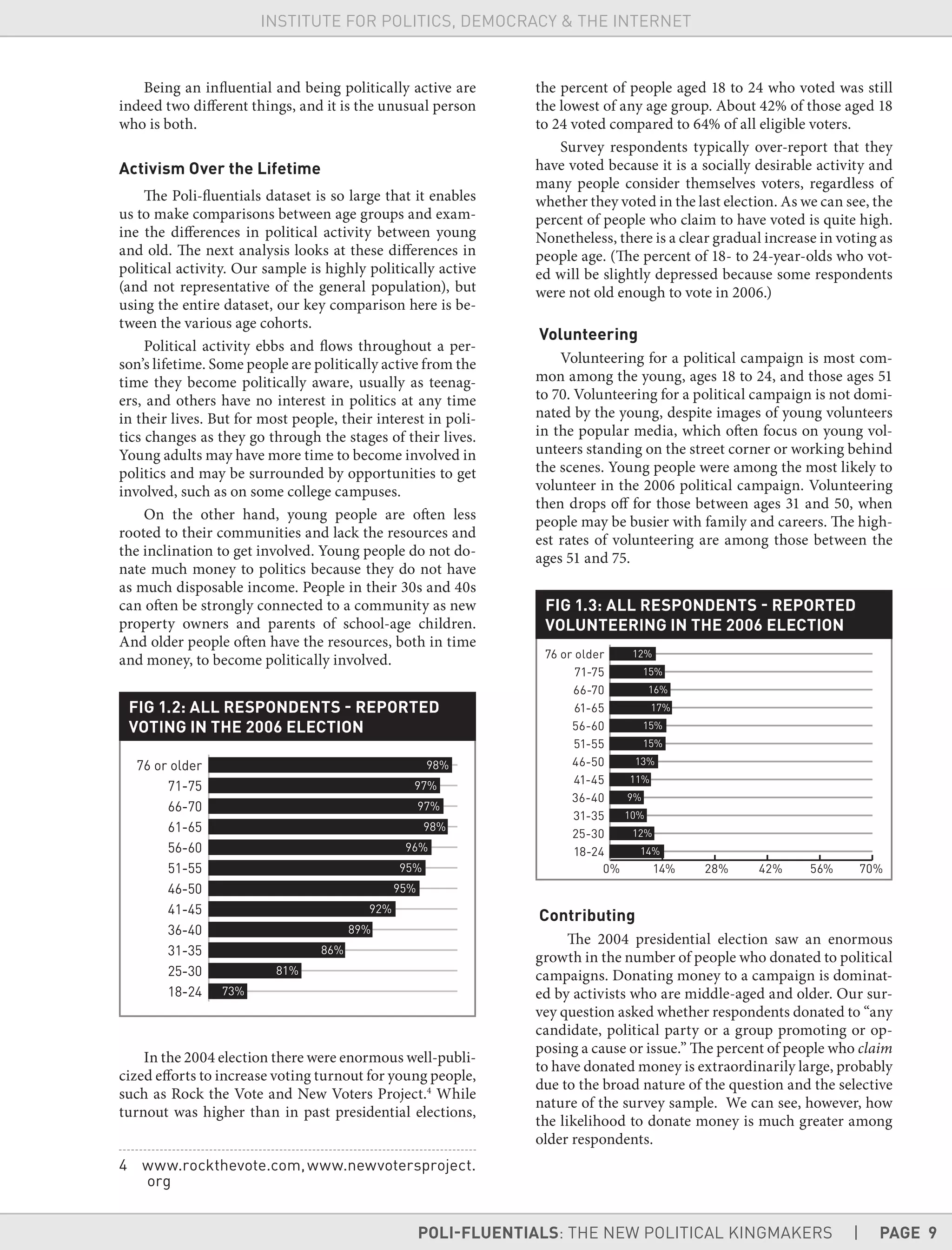
FIG 1.2: ALL RESPONDENTS - REPORTED
VOTING IN THE 2006 ELECTION
In the 2004 election there were enormous well-publi-
cized efforts to increase voting turnout for young people,
such as Rock the Vote and New Voters Project.4
While
turnout was higher than in past presidential elections,
4 www.rockthevote.com,www.newvotersproject.
org
the percent of people aged 18 to 24 who voted was still
the lowest of any age group. About 42% of those aged 18
to 24 voted compared to 64% of all eligible voters.
Survey respondents typically over-report that they
have voted because it is a socially desirable activity and
many people consider themselves voters, regardless of
whether they voted in the last election. As we can see, the
percent of people who claim to have voted is quite high.
Nonetheless, there is a clear gradual increase in voting as
people age. (The percent of 18- to 24-year-olds who vot-
ed will be slightly depressed because some respondents
were not old enough to vote in 2006.)
Volunteering
Volunteering for a political campaign is most com-
mon among the young, ages 18 to 24, and those ages 51
to 70. Volunteering for a political campaign is not domi-
nated by the young, despite images of young volunteers
in the popular media, which often focus on young vol-
unteers standing on the street corner or working behind
the scenes. Young people were among the most likely to
volunteer in the 2006 political campaign. Volunteering
then drops off for those between ages 31 and 50, when
people may be busier with family and careers. The high-
est rates of volunteering are among those between the
ages 51 and 75.
FIG 1.3: ALL RESPONDENTS - REPORTED
VOLUNTEERING IN THE 2006 ELECTION
0% 14% 28% 42% 56% 70%
18-24
25-30
31-35
36-40
41-45
46-50
51-55
56-60
61-65
66-70
71-75
76 or older
Contributing
The 2004 presidential election saw an enormous
growth in the number of people who donated to political
campaigns. Donating money to a campaign is dominat-
ed by activists who are middle-aged and older. Our sur-
vey question asked whether respondents donated to “any
candidate, political party or a group promoting or op-
posing a cause or issue.” The percent of people who claim
to have donated money is extraordinarily large, probably
due to the broad nature of the question and the selective
nature of the survey sample. We can see, however, how
the likelihood to donate money is much greater among
older respondents.
PAGE 10 | POLI-FLUENTIALS: THE NEW POLITICAL KINGMAKERS
INSTITUTE FOR POLITICS, DEMOCRACY & THE INTERNET
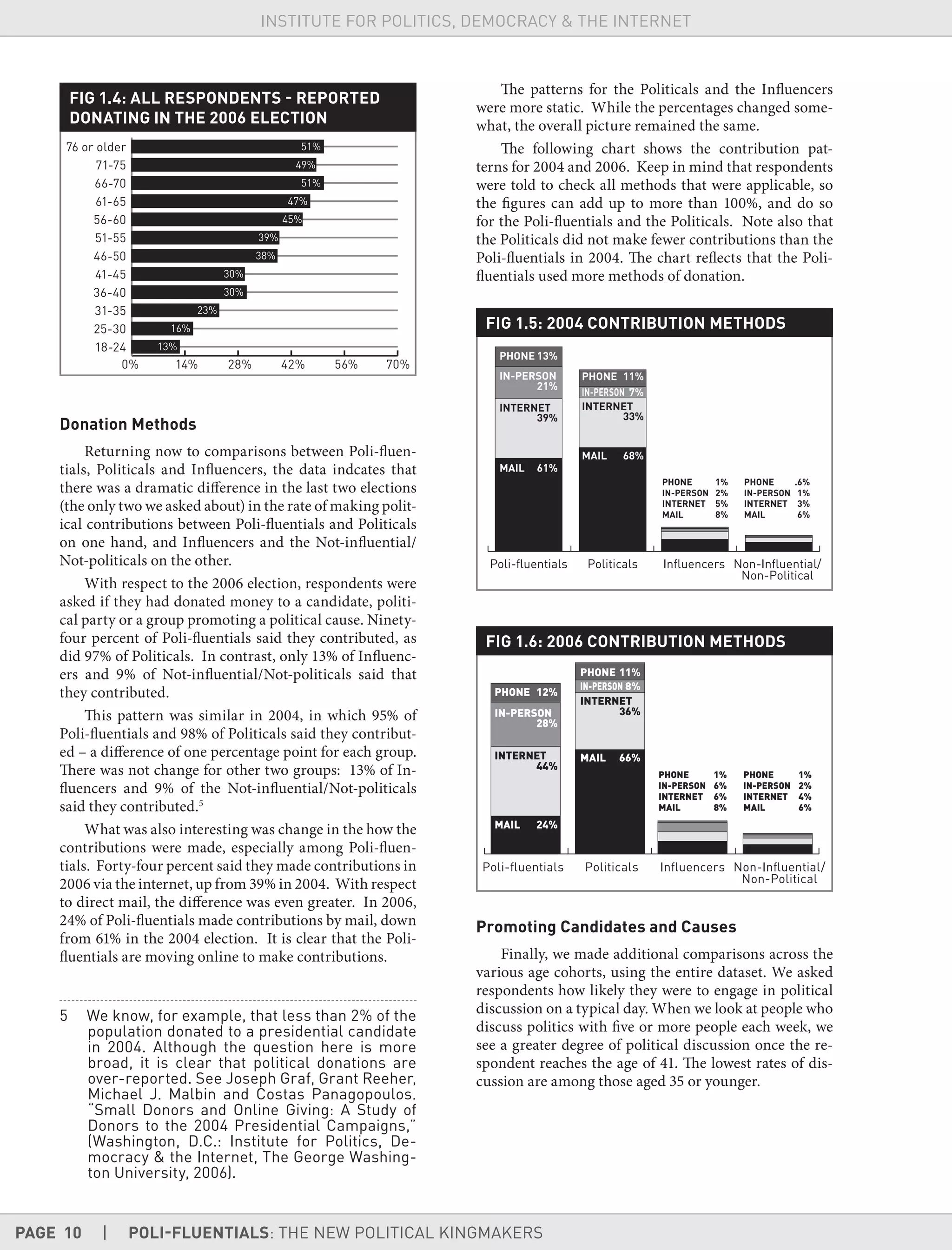
FIG 1.4: ALL RESPONDENTS - REPORTED
DONATING IN THE 2006 ELECTION
0% 14% 28% 42% 56% 70%
18-24
25-30
31-35
36-40
41-45
46-50
51-55
56-60
61-65
66-70
71-75
76 or older
Donation Methods
Returning now to comparisons between Poli-fluen-
tials, Politicals and Influencers, the data indcates that
there was a dramatic difference in the last two elections
(the only two we asked about) in the rate of making polit-
ical contributions between Poli-fluentials and Politicals
on one hand, and Influencers and the Not-influential/
Not-politicals on the other.
With respect to the 2006 election, respondents were
asked if they had donated money to a candidate, politi-
cal party or a group promoting a political cause. Ninety-
four percent of Poli-fluentials said they contributed, as
did 97% of Politicals. In contrast, only 13% of Influenc-
ers and 9% of Not-influential/Not-politicals said that
they contributed.
This pattern was similar in 2004, in which 95% of
Poli-fluentials and 98% of Politicals said they contribut-
ed – a difference of one percentage point for each group.
There was not change for other two groups: 13% of In-
fluencers and 9% of the Not-influential/Not-politicals
said they contributed.5
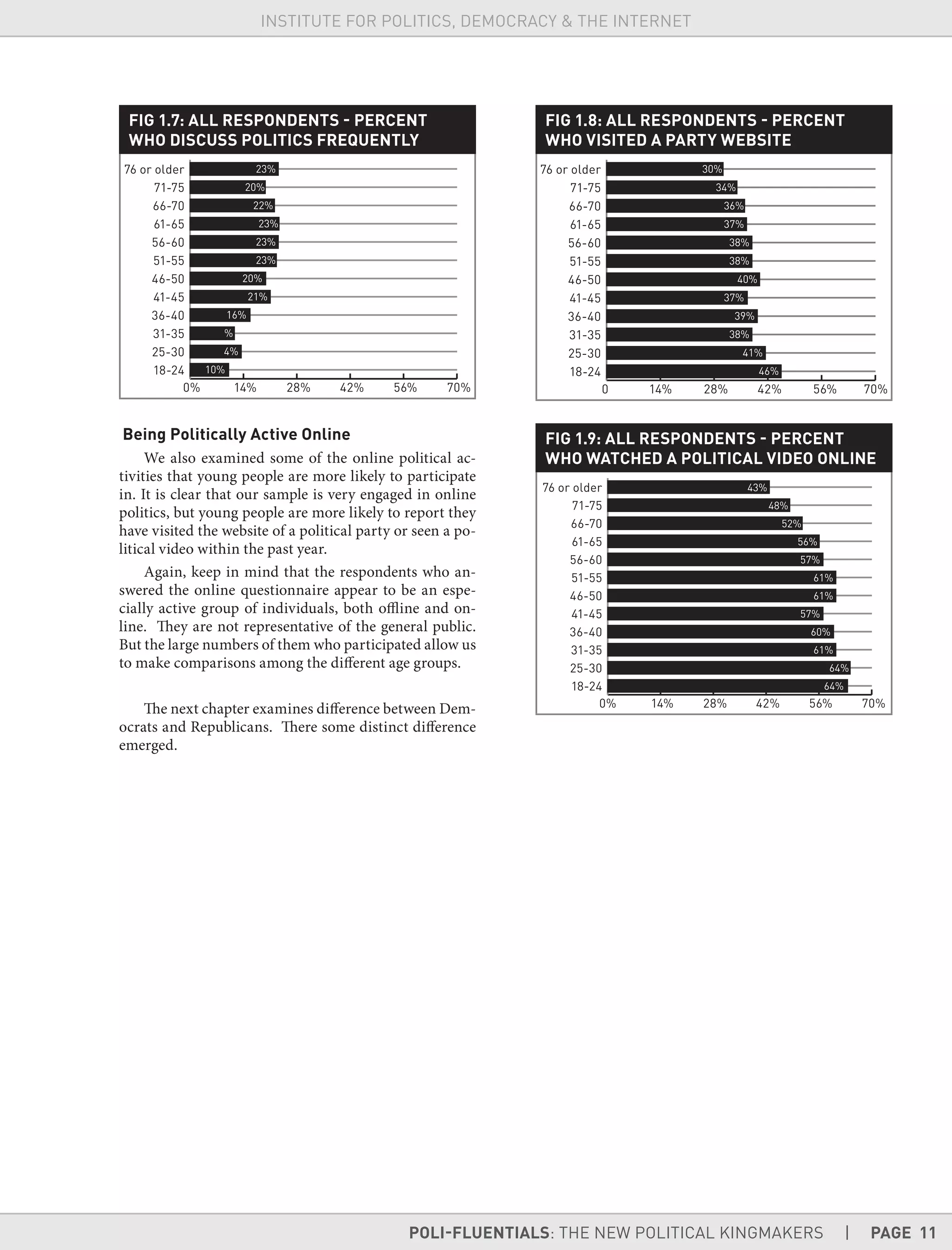
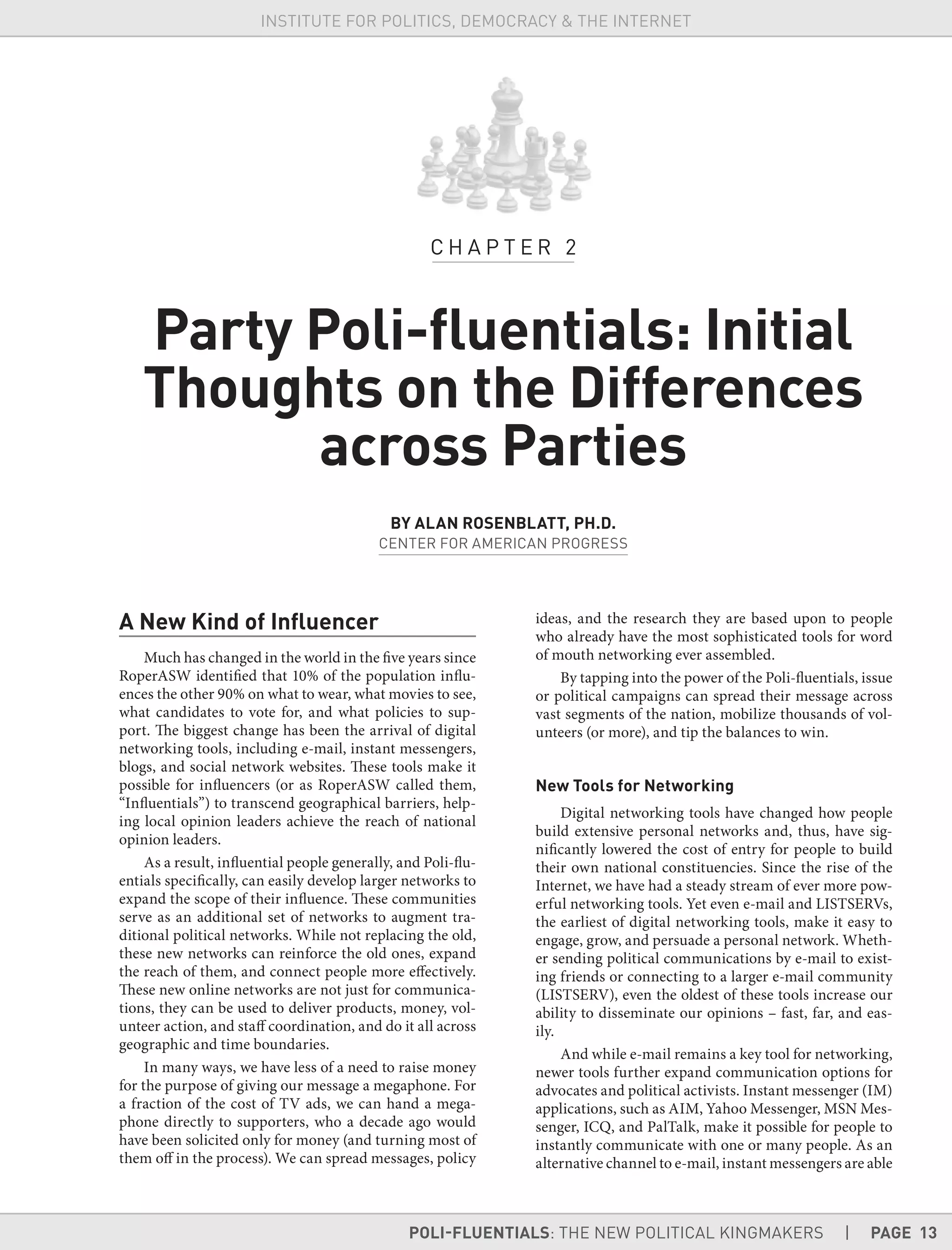
What was also interesting was change in the how the
contributions were made, especially among Poli-fluen-
tials. Forty-four percent said they made contributions in
2006 via the internet, up from 39% in 2004. With respect
to direct mail, the difference was even greater. In 2006,
24% of Poli-fluentials made contributions by mail, down
from 61% in the 2004 election. It is clear that the Poli-
fluentials are moving online to make contributions.
5 We know, for example, that less than 2% of the
population donated to a presidential candidate
in 2004. Although the question here is more
broad, it is clear that political donations are
over-reported. See Joseph Graf, Grant Reeher,
Michael J. Malbin and Costas Panagopoulos.
“Small Donors and Online Giving: A Study of
Donors to the 2004 Presidential Campaigns,”
(Washington, D.C.: Institute for Politics, De-
mocracy & the Internet, The George Washing-
ton University, 2006).
The patterns for the Politicals and the Influencers
were more static. While the percentages changed some-
what, the overall picture remained the same.
The following chart shows the contribution pat-
terns for 2004 and 2006. Keep in mind that respondents
were told to check all methods that were applicable, so
the figures can add up to more than 100%, and do so
for the Poli-fluentials and the Politicals. Note also that
the Politicals did not make fewer contributions than the
Poli-fluentials in 2004. The chart reflects that the Poli-
fluentials used more methods of donation.
FIG 1.5: 2004 CONTRIBUTION METHODS
Politicals
PHONE 13%
IN-PERSON
21%
INTERNET
39%
MAIL 61%
PHONE 11%
IN-PERSON 7%
INTERNET
33%
MAIL 68%
PHONE 1%
IN-PERSON 2%
INTERNET 5%
MAIL 8%
PHONE .6%
IN-PERSON 1%
INTERNET 3%
MAIL 6%
FIG 1.6: 2006 CONTRIBUTION METHODS
Politicals
PHONE 12%
IN-PERSON
28%
INTERNET
44%
MAIL 24%
PHONE 11%
IN-PERSON 8%
INTERNET
36%
MAIL 66%
PHONE 1%
IN-PERSON 6%
INTERNET 6%
MAIL 8%
PHONE 1%
IN-PERSON 2%
INTERNET 4%
MAIL 6%
Promoting Candidates and Causes
Finally, we made additional comparisons across the
various age cohorts, using the entire dataset. We asked
respondents how likely they were to engage in political
discussion on a typical day. When we look at people who
discuss politics with five or more people each week, we
see a greater degree of political discussion once the re-
spondent reaches the age of 41. The lowest rates of dis-
cussion are among those aged 35 or younger.
POLI-FLUENTIALS: THE NEW POLITICAL KINGMAKERS | PAGE 11
INSTITUTE FOR POLITICS, DEMOCRACY & THE INTERNET
FIG 1.7: ALL RESPONDENTS - PERCENT
WHO DISCUSS POLITICS FREQUENTLY
18-24
25-30
31-35
36-40
41-45
46-50
51-55
56-60
61-65
66-70
71-75
76 or older
0% 14% 28% 42% 56% 70%
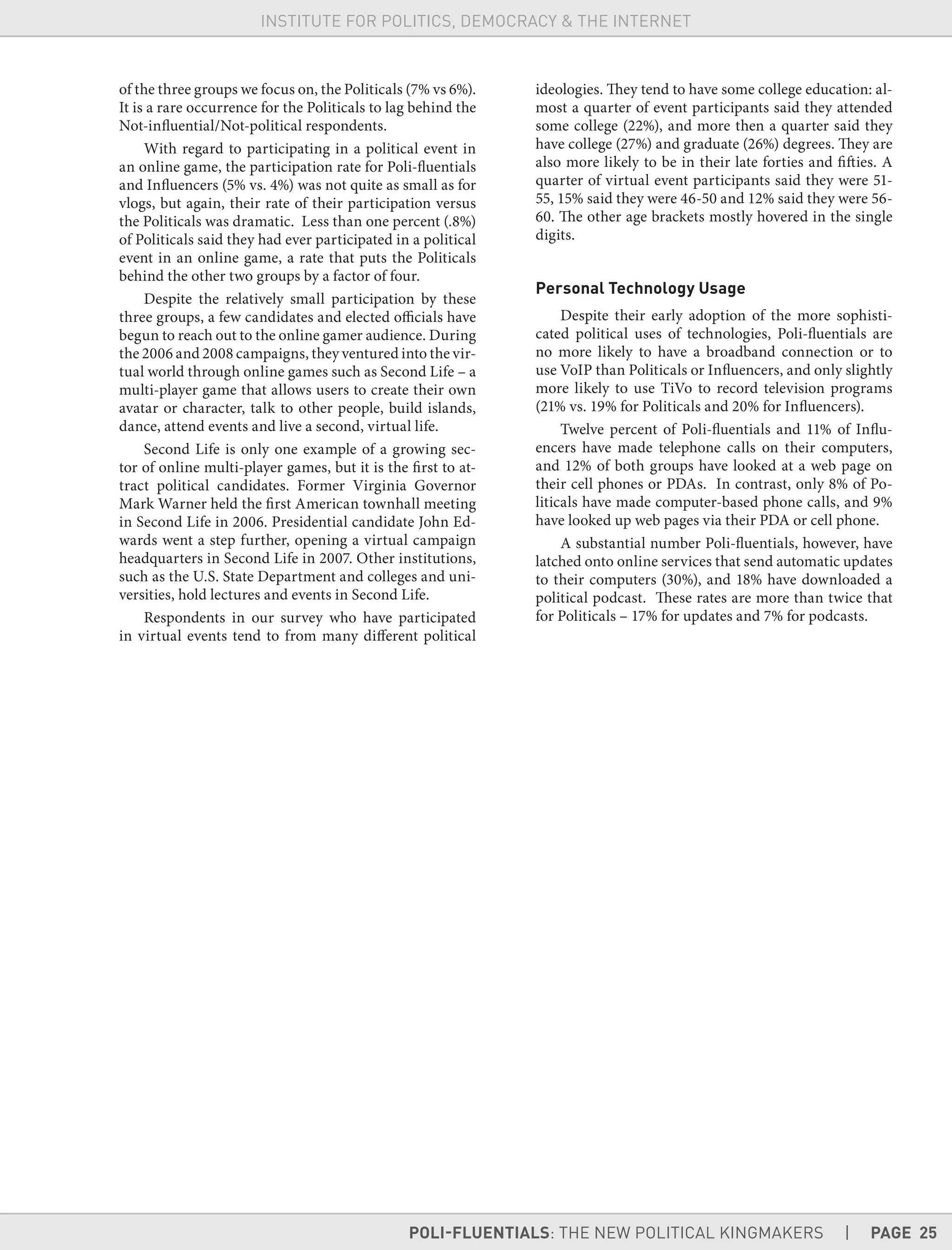
Being Politically Active Online
We also examined some of the online political ac-
tivities that young people are more likely to participate
in. It is clear that our sample is very engaged in online
politics, but young people are more likely to report they
have visited the website of a political party or seen a po-
litical video within the past year.
Again, keep in mind that the respondents who an-
swered the online questionnaire appear to be an espe-
cially active group of individuals, both offline and on-
line. They are not representative of the general public.
But the large numbers of them who participated allow us
to make comparisons among the different age groups.
The next chapter examines difference between Dem-
ocrats and Republicans. There some distinct difference
emerged.
FIG 1.8: ALL RESPONDENTS - PERCENT
WHO VISITED A PARTY WEBSITE
0 14% 28% 42% 56% 70%
18-24
25-30
31-35
36-40
41-45
46-50
51-55
56-60
61-65
66-70
71-75
76 or older
FIG 1.9: ALL RESPONDENTS - PERCENT
WHO WATCHED A POLITICAL VIDEO ONLINE
PAGE 12 | POLI-FLUENTIALS: THE NEW POLITICAL KINGMAKERS
INSTITUTE FOR POLITICS, DEMOCRACY & THE INTERNET
POLI-FLUENTIALS: THE NEW POLITICAL KINGMAKERS | PAGE 13
INSTITUTE FOR POLITICS, DEMOCRACY & THE INTERNET
A New Kind of Influencer
Much has changed in the world in the five years since
RoperASW identified that 10% of the population influ-
ences the other 90% on what to wear, what movies to see,
what candidates to vote for, and what policies to sup-
port. The biggest change has been the arrival of digital
networking tools, including e-mail, instant messengers,
blogs, and social network websites. These tools make it
possible for influencers (or as RoperASW called them,
“Influentials”) to transcend geographical barriers, help-
ing local opinion leaders achieve the reach of national
opinion leaders.
As a result, influential people generally, and Poli-flu-
entials specifically, can easily develop larger networks to
expand the scope of their influence. These communities
serve as an additional set of networks to augment tra-
ditional political networks. While not replacing the old,
these new networks can reinforce the old ones, expand
the reach of them, and connect people more effectively.
These new online networks are not just for communica-
tions, they can be used to deliver products, money, vol-
unteer action, and staff coordination, and do it all across
geographic and time boundaries.
In many ways, we have less of a need to raise money
for the purpose of giving our message a megaphone. For
a fraction of the cost of TV ads, we can hand a mega-
phone directly to supporters, who a decade ago would
have been solicited only for money (and turning most of
them off in the process). We can spread messages, policy
ideas, and the research they are based upon to people
who already have the most sophisticated tools for word
of mouth networking ever assembled.
By tapping into the power of the Poli-fluentials, issue
or political campaigns can spread their message across
vast segments of the nation, mobilize thousands of vol-
unteers (or more), and tip the balances to win.
New Tools for Networking
Digital networking tools have changed how people
build extensive personal networks and, thus, have sig-
nificantly lowered the cost of entry for people to build
their own national constituencies. Since the rise of the
Internet, we have had a steady stream of ever more pow-
erful networking tools. Yet even e-mail and LISTSERVs,
the earliest of digital networking tools, make it easy to
engage, grow, and persuade a personal network. Wheth-
er sending political communications by e-mail to exist-
ing friends or connecting to a larger e-mail community
(LISTSERV), even the oldest of these tools increase our
ability to disseminate our opinions – fast, far, and eas-
ily.
And while e-mail remains a key tool for networking,
newer tools further expand communication options for
advocates and political activists. Instant messenger (IM)
applications, such as AIM, Yahoo Messenger, MSN Mes-
senger, ICQ, and PalTalk, make it possible for people to
instantly communicate with one or many people. As an
alternative channel to e-mail, instant messengers are able
C H A P T E R 2
Party Poli-fluentials: Initial
Thoughts on the Differences
across Parties
BY ALAN ROSENBLATT, PH.D.
CENTER FOR AMERICAN PROGRESS
PAGE 14 | POLI-FLUENTIALS: THE NEW POLITICAL KINGMAKERS
INSTITUTE FOR POLITICS, DEMOCRACY & THE INTERNET
to bypass the distraction of inbox clutter that plagues e-
mail users. The potential for generating rapid response
campaign actions via IM is extraordinary.
Blogs also help cut through the e-mail clutter. By
sharing opinions via a blog, advocates and political ac-
tivists are able to make their opinions available to anyone
visiting their website. And with RSS and similar syndi-
cation tools, blogs can deliver opinions by direct feed to
readers, allowing them to bypass visiting blog websites
directly. RSS readers, moreover, make it possible for peo-
ple to follow many blogs simultaneously.
In addition to bloggers, the readers of blogs, espe-
cially the commenters, are also very likely to be Poli-flu-
entials. In some cases, these reader/commenters can rise
to become as well read as blog owners (as has become
the case for several members of the DailyKos.com com-
munity).
Even the way we deliberately build networks for
networking’s sake, as we do on social network websites,
offers new opportunities to disseminate information,
mobilizing people to action, and building bigger and
wider communities. Social network websites expand the
reach of advocates and political activists even further,
providing tools to grow and cultivate a personal network
within online communities that count as members tens
of millions of people. Websites like MySpace, Facebook,
Care2, LinkedIn, Plaxo, and Change.org make it easy to
meet people, develop online relations with them, and
create a personal community that influencers can influ-
ence. Each of these community platforms has its own set
of tools and demographic niche, but all of these com-
munities are flush with Poli-fluentials who can spread a
campaign message deep and far into any of them.
Surprisingly, the survey data showed that social
networking sites are one of the few tools used more fre-
quently by Influencers than Poli-fluentials. In our study,
17% of Influencers, 14% of Poli-fluentials, and 6% of Po-
liticals said they had visited a social networking site in
the last year.
Party Differences
The use of digital tools to influence the political pro-
cess has become a cottage industry. Advocacy groups,
political parties, public officials, and candidates all use
these tools, to varying degrees, to communicate with
the public and mobilize support for policies and elec-
toral bids. The low barrier to entry for using these tools,
which is a democratizing force, allows anyone to develop
their influence networks. But which citizens are availing
themselves of these tools and opportunities? More spe-
cifically, are citizens who identify with one party more
likely to avail themselves than others?
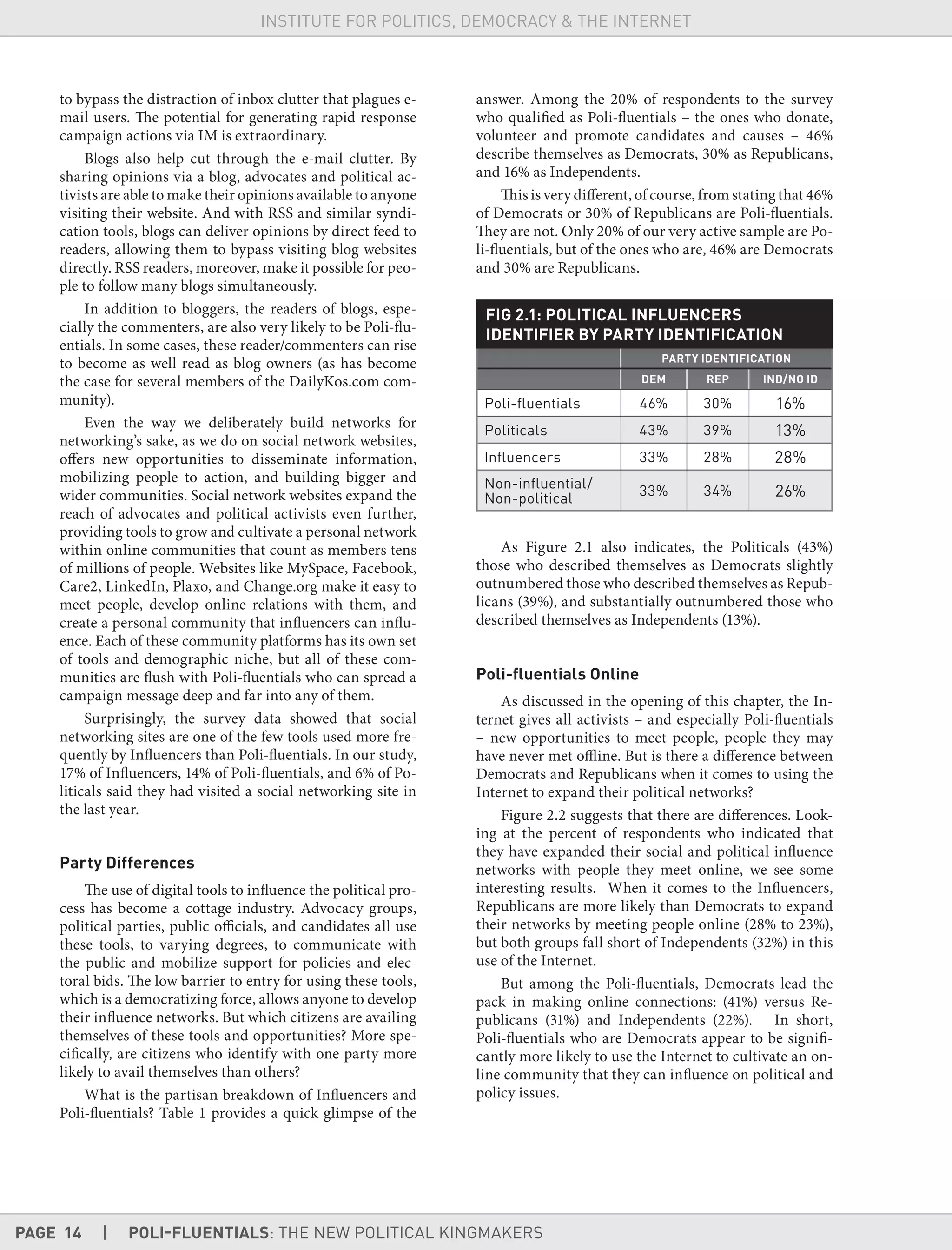
What is the partisan breakdown of Influencers and
Poli-fluentials? Table 1 provides a quick glimpse of the
answer. Among the 20% of respondents to the survey
who qualified as Poli-fluentials – the ones who donate,
volunteer and promote candidates and causes – 46%
describe themselves as Democrats, 30% as Republicans,
and 16% as Independents.
This is very different, of course, from stating that 46%
of Democrats or 30% of Republicans are Poli-fluentials.
They are not. Only 20% of our very active sample are Po-
li-fluentials, but of the ones who are, 46% are Democrats
and 30% are Republicans.
FIG 2.1: POLITICAL INFLUENCERS
IDENTIFIER BY PARTY IDENTIFICATION
PARTY IDENTIFICATION
DEM REP IND/NO ID
Poli-fluentials 46% 30% 16%
Politicals 43% 39% 13%
Influencers 33% 28% 28%
Non-influential/
Non-political
33% 34% 26%
As Figure 2.1 also indicates, the Politicals (43%)
those who described themselves as Democrats slightly
outnumbered those who described themselves as Repub-
licans (39%), and substantially outnumbered those who
described themselves as Independents (13%).
Poli-fluentials Online
As discussed in the opening of this chapter, the In-
ternet gives all activists – and especially Poli-fluentials
– new opportunities to meet people, people they may
have never met offline. But is there a difference between
Democrats and Republicans when it comes to using the
Internet to expand their political networks?
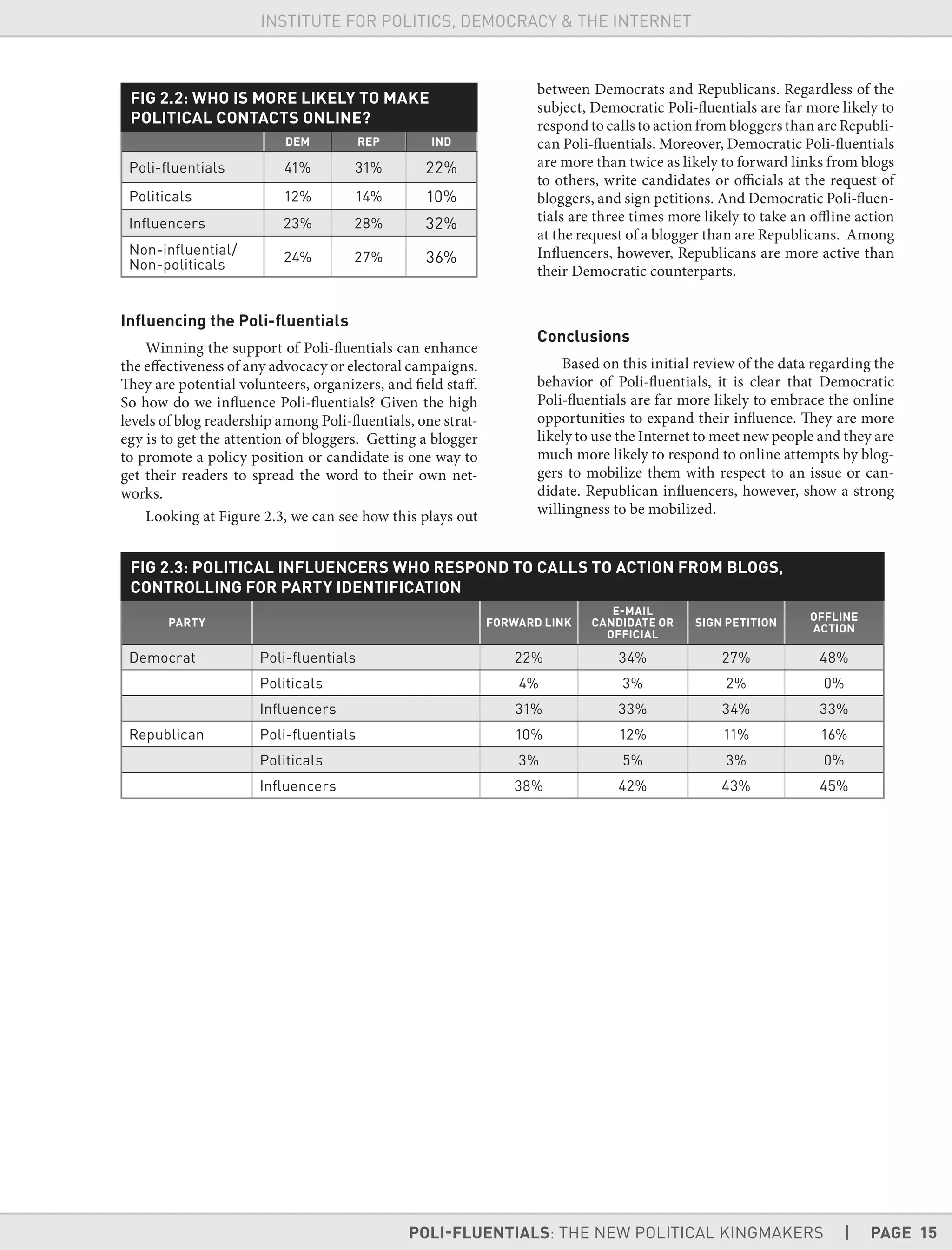
Figure 2.2 suggests that there are differences. Look-
ing at the percent of respondents who indicated that
they have expanded their social and political influence
networks with people they meet online, we see some
interesting results. When it comes to the Influencers,
Republicans are more likely than Democrats to expand
their networks by meeting people online (28% to 23%),
but both groups fall short of Independents (32%) in this
use of the Internet.
But among the Poli-fluentials, Democrats lead the
pack in making online connections: (41%) versus Re-
publicans (31%) and Independents (22%). In short,
Poli-fluentials who are Democrats appear to be signifi-
cantly more likely to use the Internet to cultivate an on-
line community that they can influence on political and
policy issues.
POLI-FLUENTIALS: THE NEW POLITICAL KINGMAKERS | PAGE 15
INSTITUTE FOR POLITICS, DEMOCRACY & THE INTERNET
FIG 2.2: WHO IS MORE LIKELY TO MAKE
POLITICAL CONTACTS ONLINE?
DEM REP IND
Poli-fluentials 41% 31% 22%
Politicals 12% 14% 10%
Influencers 23% 28% 32%
Non-influential/
Non-politicals
24% 27% 36%
Influencing the Poli-fluentials
Winning the support of Poli-fluentials can enhance
the effectiveness of any advocacy or electoral campaigns.
They are potential volunteers, organizers, and field staff.
So how do we influence Poli-fluentials? Given the high
levels of blog readership among Poli-fluentials, one strat-
egy is to get the attention of bloggers. Getting a blogger
to promote a policy position or candidate is one way to
get their readers to spread the word to their own net-
works.
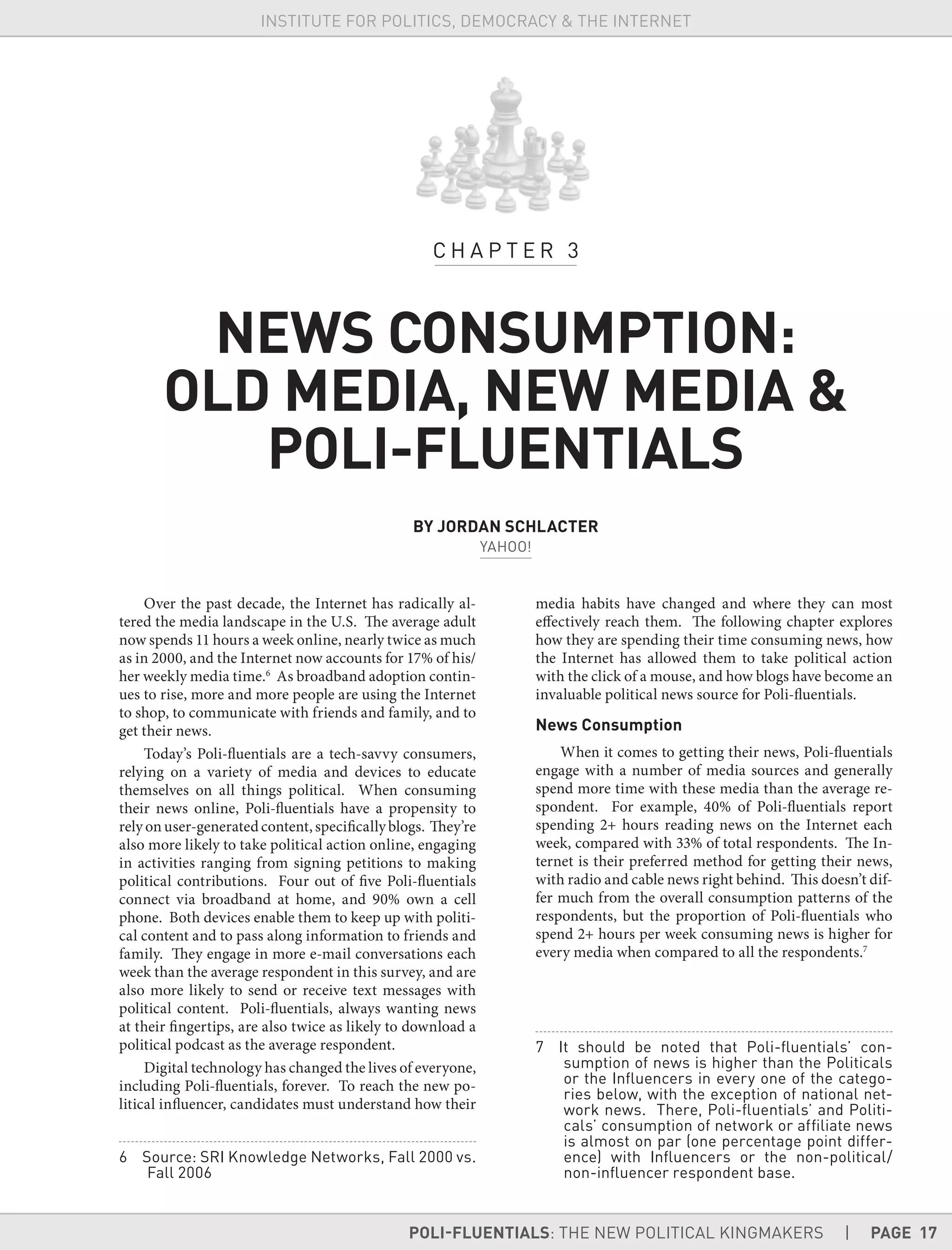
Looking at Figure 2.3, we can see how this plays out
between Democrats and Republicans. Regardless of the
subject, Democratic Poli-fluentials are far more likely to
respond to calls to action from bloggers than are Republi-
can Poli-fluentials. Moreover, Democratic Poli-fluentials
are more than twice as likely to forward links from blogs
to others, write candidates or officials at the request of
bloggers, and sign petitions. And Democratic Poli-fluen-
tials are three times more likely to take an offline action
at the request of a blogger than are Republicans. Among
Influencers, however, Republicans are more active than
their Democratic counterparts.
Conclusions
Based on this initial review of the data regarding the
behavior of Poli-fluentials, it is clear that Democratic
Poli-fluentials are far more likely to embrace the online
opportunities to expand their influence. They are more
likely to use the Internet to meet new people and they are
much more likely to respond to online attempts by blog-
gers to mobilize them with respect to an issue or can-
didate. Republican influencers, however, show a strong
willingness to be mobilized.
FIG 2.3: POLITICAL INFLUENCERS WHO RESPOND TO CALLS TO ACTION FROM BLOGS,
CONTROLLING FOR PARTY IDENTIFICATION
PARTY FORWARD LINK
E-MAIL
CANDIDATE OR
OFFICIAL
SIGN PETITION
OFFLINE
ACTION
Democrat Poli-fluentials 22% 34% 27% 48%
Politicals 4% 3% 2% 0%
Influencers 31% 33% 34% 33%
Republican Poli-fluentials 10% 12% 11% 16%
Politicals 3% 5% 3% 0%
Influencers 38% 42% 43% 45%
PAGE 16 | POLI-FLUENTIALS: THE NEW POLITICAL KINGMAKERS
INSTITUTE FOR POLITICS, DEMOCRACY & THE INTERNET
POLI-FLUENTIALS: THE NEW POLITICAL KINGMAKERS | PAGE 17
INSTITUTE FOR POLITICS, DEMOCRACY & THE INTERNET
Over the past decade, the Internet has radically al-
tered the media landscape in the U.S. The average adult
now spends 11 hours a week online, nearly twice as much
as in 2000, and the Internet now accounts for 17% of his/
her weekly media time.6
As broadband adoption contin-
ues to rise, more and more people are using the Internet
to shop, to communicate with friends and family, and to
get their news.
Today’s Poli-fluentials are a tech-savvy consumers,
relying on a variety of media and devices to educate
themselves on all things political. When consuming
their news online, Poli-fluentials have a propensity to
rely on user-generated content, specificallyblogs. They’re
also more likely to take political action online, engaging
in activities ranging from signing petitions to making
political contributions. Four out of five Poli-fluentials
connect via broadband at home, and 90% own a cell
phone. Both devices enable them to keep up with politi-
cal content and to pass along information to friends and
family. They engage in more e-mail conversations each
week than the average respondent in this survey, and are
also more likely to send or receive text messages with
political content. Poli-fluentials, always wanting news
at their fingertips, are also twice as likely to download a
political podcast as the average respondent.
Digital technology has changed the lives of everyone,
including Poli-fluentials, forever. To reach the new po-
litical influencer, candidates must understand how their
6 Source: SRI Knowledge Networks, Fall 2000 vs.
Fall 2006
media habits have changed and where they can most
effectively reach them. The following chapter explores
how they are spending their time consuming news, how
the Internet has allowed them to take political action
with the click of a mouse, and how blogs have become an
invaluable political news source for Poli-fluentials.
News Consumption
When it comes to getting their news, Poli-fluentials
engage with a number of media sources and generally
spend more time with these media than the average re-
spondent. For example, 40% of Poli-fluentials report
spending 2+ hours reading news on the Internet each
week, compared with 33% of total respondents. The In-
ternet is their preferred method for getting their news,
with radio and cable news right behind. This doesn’t dif-
fer much from the overall consumption patterns of the
respondents, but the proportion of Poli-fluentials who
spend 2+ hours per week consuming news is higher for
every media when compared to all the respondents.7
7 It should be noted that Poli-fluentials’ con-
sumption of news is higher than the Politicals
or the Influencers in every one of the catego-
ries below, with the exception of national net-
work news. There, Poli-fluentials’ and Politi-
cals’ consumption of network or affiliate news
is almost on par (one percentage point differ-
ence) with Influencers or the non-political/
non-influencer respondent base.
C H A P T E R 3
NEWS CONSUMPTION:
OLD MEDIA, NEW MEDIA &
POLI-FLUENTIALS
BY JORDAN SCHLACTER
YAHOO!
PAGE 18 | POLI-FLUENTIALS: THE NEW POLITICAL KINGMAKERS
INSTITUTE FOR POLITICS, DEMOCRACY & THE INTERNET
FIG 3.1: PERCENT THAT SPEND 2+ HOURS
PER WEEK
While Poli-fluentials focus most of their time on
online resources and news radio, programs like the PBS
NewsHour and Sunday morning talk shows also play a
major role in how they keep informed. Compared to all
respondents, Poli-fluentials are 86% more likely to watch
the PBS NewsHour for 2+ hours each week than the av-
erage respondent (13% vs. 7%), and 67% more likely to
be watching Sunday morning talk shows, as indicated by
indexes of 186 and 167, respectively. Because this type of
programming is not as abundant as the other sources we
asked about, such as online news, the actual proportion
of Poli-fluentials who report spending 2+ hours with
these media may seem low. But programs like these of-
fer highly-targeted audiences, as it is far more likely that
the viewers will be Poli-fluentials.
FIG 3.2: POLI-FLUENTIALS THAT SPEND 2+
HOURS EACH WEEK WITH MEDIA
INDEX VS. AVG RESPONDENT
When we focus on the online behaviors of Poli-flu-
entials, it becomes clear why they are spending so much
time consuming news content online. The Internet offers
myriad sources for general news and political informa-
tion, and Poli-fluentials make use of all them. A deeper
dive into their online activity reveals an audience that is
visiting political websites, engaging with blogs, and tak-
ing political action online.
Political Activity Online
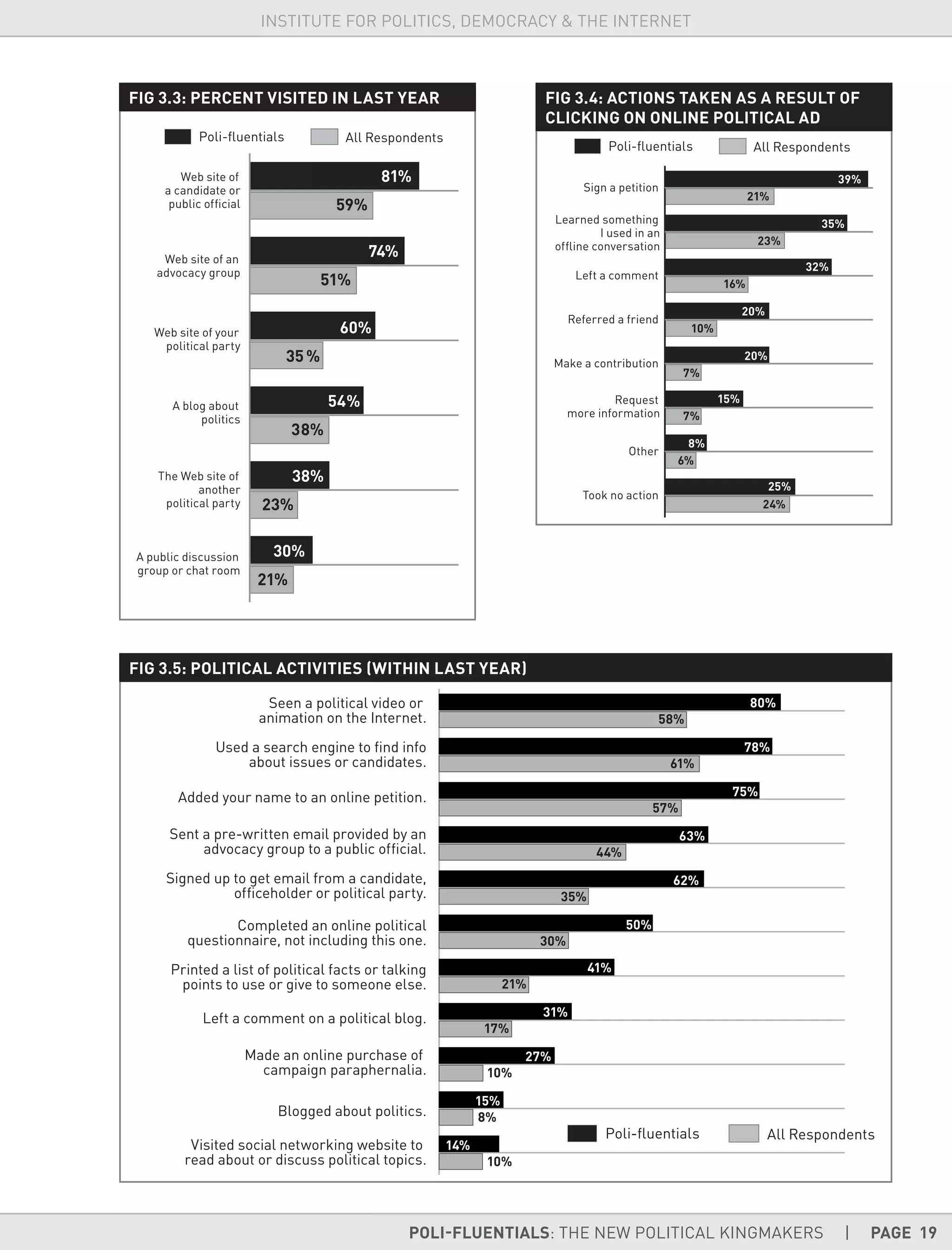
Thewebsitesofpoliticalcandidates,advocacygroups,
and parties are all heavily-trafficked by Poli-fluentials.
In the last year, 81% of Poli-fluentials have visited a can-
didate website, compared to 59% of total respondents,
and three-quarters have visited the site of an advocacy
group, versus 51% of all respondents. Always looking to
share their opinions with others, Poli-fluentials are also
42% more likely to visit a public discussion group or chat
room than the average respondent.
POLI-FLUENTIALS: THE NEW POLITICAL KINGMAKERS | PAGE 19
INSTITUTE FOR POLITICS, DEMOCRACY & THE INTERNET
FIG 3.3: PERCENT VISITED IN LAST YEAR FIG 3.4: ACTIONS TAKEN AS A RESULT OF
CLICKING ON ONLINE POLITICAL AD
FIG 3.5: POLITICAL ACTIVITIES (WITHIN LAST YEAR)
PAGE 20 | POLI-FLUENTIALS: THE NEW POLITICAL KINGMAKERS
INSTITUTE FOR POLITICS, DEMOCRACY & THE INTERNET
Poli-fluentials are engaging in a variety of online ac-
tivities related to politics, beyond visiting political sites.
Seventy-five percent have added their name to an online
petition in the past year, 50% have completed a politi-
cal questionnaire online (excluding this one), and more
than a quarter have made an online purchase of political
paraphernalia (bumper stickers, t-shirts, etc.). They’re
also more receptive to political ads online, and were 17%
more likely to have clicked on an online political adver-
tisement in the past year than all respondents. As a re-
sult of clicking on these ads, many Poli-fluentials took
specific action such as signing petitions, leaving com-
ments, and making contributions. Seventy-five percent
took at least one specific action.
Blogging
Blogs are now mainstream, at least among heavy
news consumers, and many survey respondents are
turning to them for their political news. Sources esti-
mate that there are more than 56 million blogs8
on the
Internet today, and 175,000 new blogs created each day9
.
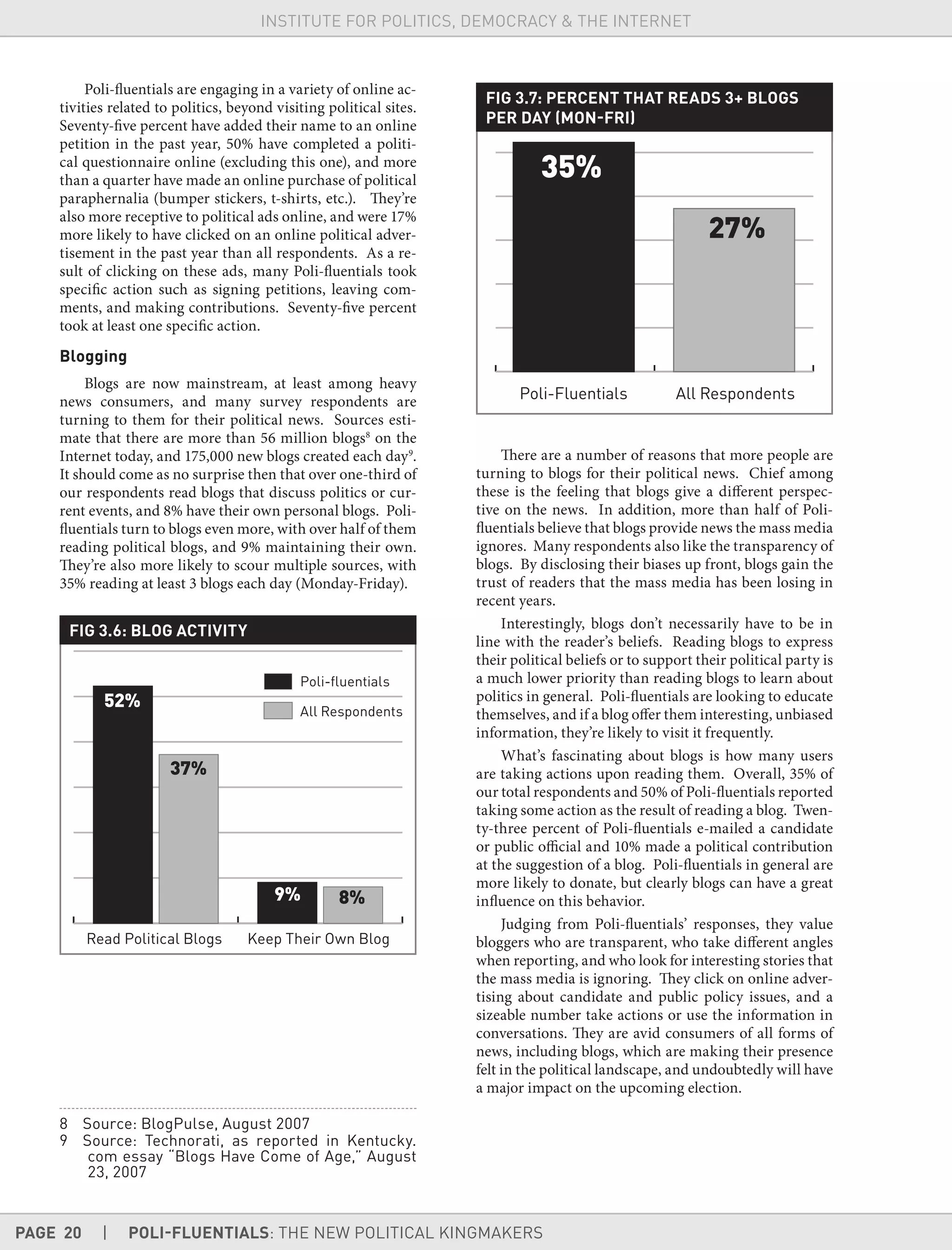
It should come as no surprise then that over one-third of
our respondents read blogs that discuss politics or cur-
rent events, and 8% have their own personal blogs. Poli-
fluentials turn to blogs even more, with over half of them
reading political blogs, and 9% maintaining their own.
They’re also more likely to scour multiple sources, with
35% reading at least 3 blogs each day (Monday-Friday).
FIG 3.6: BLOG ACTIVITY
8 Source: BlogPulse, August 2007
9 Source: Technorati, as reported in Kentucky.
com essay “Blogs Have Come of Age,” August
23, 2007
FIG 3.7: PERCENT THAT READS 3+ BLOGS
PER DAY (MON-FRI)
There are a number of reasons that more people are
turning to blogs for their political news. Chief among
these is the feeling that blogs give a different perspec-
tive on the news. In addition, more than half of Poli-
fluentials believe that blogs provide news the mass media
ignores. Many respondents also like the transparency of
blogs. By disclosing their biases up front, blogs gain the
trust of readers that the mass media has been losing in
recent years.
Interestingly, blogs don’t necessarily have to be in
line with the reader’s beliefs. Reading blogs to express
their political beliefs or to support their political party is
a much lower priority than reading blogs to learn about
politics in general. Poli-fluentials are looking to educate
themselves, and if a blog offer them interesting, unbiased
information, they’re likely to visit it frequently.
What’s fascinating about blogs is how many users
are taking actions upon reading them. Overall, 35% of
our total respondents and 50% of Poli-fluentials reported
taking some action as the result of reading a blog. Twen-
ty-three percent of Poli-fluentials e-mailed a candidate
or public official and 10% made a political contribution
at the suggestion of a blog. Poli-fluentials in general are
more likely to donate, but clearly blogs can have a great
influence on this behavior.
Judging from Poli-fluentials’ responses, they value
bloggers who are transparent, who take different angles
when reporting, and who look for interesting stories that
the mass media is ignoring. They click on online adver-
tising about candidate and public policy issues, and a
sizeable number take actions or use the information in
conversations. They are avid consumers of all forms of
news, including blogs, which are making their presence
felt in the political landscape, and undoubtedly will have
a major impact on the upcoming election.
POLI-FLUENTIALS: THE NEW POLITICAL KINGMAKERS | PAGE 21
INSTITUTE FOR POLITICS, DEMOCRACY & THE INTERNET
FIG 3.8: REASONS FOR READING POLITICAL
BLOGS
PERCENT STRONGLY AGREE/AGREE
FIG 3.9: ACTIONS TAKEN IN LAST YEAR AS A
RESULT OF READING BLOGS
PAGE 22 | POLI-FLUENTIALS: THE NEW POLITICAL KINGMAKERS
INSTITUTE FOR POLITICS, DEMOCRACY & THE INTERNET
POLI-FLUENTIALS: THE NEW POLITICAL KINGMAKERS | PAGE 23
INSTITUTE FOR POLITICS, DEMOCRACY & THE INTERNET
• While Poli-fluentials are at the cutting edge
of using technology for political communi-
cation, a wide gap exists between Poli-fluen-
tials and Politicals. Influencers are usually,
but not always, somewhere in the middle.
• Poli-fluentials and Influencers tend to be
“multimedia content creators” – people
who create, produce, and upload political
pictures, web videos, and animations.
• Poli-fluentials and Influencers send and re-
ceive political text messages at three times
the rate of Politicals.
• Poli-fluentials’ and Influencers’ participa-
tion in virtual political events in online,
multi-player games, such as Second Life, is
very small at this point: 5% and 4% respec-
tively. Even so, their participation rate is
more than quadruple the rate for Politicals.
• Technology adopters tend to be in the mid-
dle income bracket, male, well educated,
and in their 50s.
In early 2007, just as many presidential campaigns
started the race to the White House, the media – and,
for that matter, the American voters – were captivated
not by the campaigns themselves but by the videos and
online content they created. Videos like Vote Different,
which examined Hillary Clinton’s authenticity as a can-
didate, and Obama Girl, which showcased a model sing-
ing about how much she loves Barack Obama, became
the talk of the country.
Americans began participating in politics in a new
way, by creating online multimedia content. Vote Dif-
ferent and Obama Girl represent only two of the tens of
thousands of web videos, not to mention animations,
photos and blog posts, that have been created and posted
online.
Poli-fluentials appear to be among the most active
and prolific in using technology to share their opinions
and voice their support (or disapproval) of candidates in
new ways.
Multimedia Content Creation
Online content creation has become a new pastime
– and a new form of political activism – for many Ameri-
cans. This includes everything from posting content on
a web site to blogging to using web cameras to uploading
pictures. According to a survey conducted by the Pew
Internet & American Life Project in 2003, more than 53
million American adults engage in some form of online
content creation (albeit, not necessarily political content
creation) on a regular basis.10
That number has grown
considerably during the past four years, as technology
adoption has spread and as tools and applications origi-
nally used by either younger Americans or the tech-sav-
vy have trickled into the general population.
Fast forward to the summer of 2007, and the act
of content creation has become animated, videotaped,
mashed-up and virtualized. Thousands of Americans
10 Amanda Lenhart, Deborah Fallows, John Hor-
rigan, “Content Creation Online: 44% of U.S.
Internet users have contributed their thoughts
and their files to the online world,” Pew In-
ternet & American Life Project (http://www.
pewinternet.org/pdfs/PIP_Content_Creation
_Report.pdf), February 29, 2004.
C H A P T E R 4
Technology Adoption and
Poli-fluentials
BY JULIE BARKO GERMANY
INSTITUTE FOR POLITICS, DEMOCRACY &
THE INTERNET
PAGE 24 | POLI-FLUENTIALS: THE NEW POLITICAL KINGMAKERS
INSTITUTE FOR POLITICS, DEMOCRACY & THE INTERNET
posted video questions on YouTube to the Democratic
Presidential candidates during the CNN/YouTube Dem-
ocratic Presidential Debate in July 2007.
Creators of multimedia political content look a lot
like you might expect from reading the other chapters in
this publication. They tend to have incomes of $50,000
to $149,000 a year. People who post political web videos
and animations tend to earn slightly more ($75,000 to
$149,000 a year).
Not surprisingly, the technologically sophisticated,
male respondents to the questionnaire outnumber fe-
males: three-quarters of political video creators (76%)
and video or picture uploaders (76%), and almost as
many cell phone picture- and video-takers (65%) are
male. They tend to be political moderates with some
college or a college degree. Where they differ from each
other, however, is in their age. Around 10% of survey
respondents in most age brackets said they used a cell
phone camera to take a picture. Compare this to politi-
cal video creators and uploaders, who tend to be in the
46-65 age bracket.
Respondents who qualified as Poli-fluentials are usu-
ally twice as likely as Politicals to use the new tools and
applications that allow them to participate in multime-
dia content creation. The Influencers are usually found
somewhere in between.
Nine percent of Poli-fluentials had uploaded a pic-
ture or video to a website, three times the number of Po-
liticals that have done so. Four percent of Poli-fluentials
have created or posted an online video or animation,
double the number of Politicals and Influencers.
The starkest division between Poli-fluentials and Po-
liticals occurs with respect to the creation of video blogs,
or vlogs. While only .1% of Poli-fluentials – one tenth of
one percent – have created their own video blog, or vlog,
their rate is seven times greater than the almost imper-
ceptible rate for Politicals (.014%). The rate for the Influ-
encers at .08% was closer to that of the Poli-fluentials.
Mobile Campaign Participation
While the use of text messaging is not new, its use in
American politics began in the last election. American
campaigns began experimenting with text messaging
and the mobile Internet during the mid-term elections
in 2006. The Pat LaMarche campaign in Maine held a
mobile primary that allowed voters to text their choice
for Congress. Another campaign, the Dick DeVoss for
Governor campaign in Michigan held a mobile video
contest and developed a mobile version of its Web site.
Three of the major presidential candidates – Hillary
Clinton, John Edwards and Barack Obama – launched
text message-based mobile campaigns in 2007.
Mobile campaigns like these tend to attract mid-
dle class voters. Most of our mobile adopters said they
earned under $150,000. They are disproportionately
male: around 65% of text message users and political text
message subscribers and almost 75% of PDA users said
they were male. They also tend to be slightly more ideo-
logically moderate (around 30%), although PDA users
are also just as likely to say they are liberal (29%). Most
mobile adopters said they attended at least some college,
and most of them are in peak career age brackets – their
late 40s and 50s.
It is no surprise that the respondents to our survey
who were most likely to send and receive text messages
for political communications were Poli-fluentials. The
numbers, though, are still small: 6% said they received
or forwarded text messages with political content.11
Still,
these numbers are higher than those for Politicals (2%).
The rate for Influencers slightly exceeded the rate for
Poli-fluentials. Seven percent of Influencers used text
messaging for political communications.
The disparity is similar for the use of PDAs to access
political news: 7% of Poli-fluentials, 5% of Politicals and
6% of Influencers have done so.
However, with regard to using cell phones to take a
picture of political activity, Poli-fluentials outstrip Polit-
icals by more than seven to one. The numbers are small
all around, however: 5% for Poli-fluentials, less than one
percent for Politicals (.7%), and 3% for Influencers.
Participation in Virtual Communities
Tens of millions of Americans belong to social net-
working sites, such as LinkedIn, Facebook, Eons, and
MySpace. Poli-fluentials and Influencers are using these
sites at twice the rate of that for Politicals: 14% and 17%,
respectively, vs. 6% for Politicals. What is anomalous
here is that the rate of usage by Influencers exceeds that
by Poli-fluentials. This is an unusual pattern in the data-
set, in which the rate of participation by Poli-fluentials
almost always exceeds that of the other two groups.
What is also unusual is that the rate of usage by the 48%
of the respondents who did not fall into any of the three
categories because they are neither politically active or
influential slightly exceeded the rate for the least active
11 We asked two questions on the survey about
text messaging. One question was, “In the past
year, have you used text messaging to send or
receive a political message?” The number of
respondents who answered affirmatively was
similar to the number who responded affirma-
tively for instant messaging.
The other question was, “In the past year, have
you received or forwarded text messages with
political content?” Respondents apparently in-
terpreted this as asking whether they had re-
ceived a message in a text format rather than
a video format, for the number who responded
affirmatively was very high, too high in fact:
53% of Poli-fluentials, 43% of Politicals, and
32% of Influencers. We believe the answer to
the first question more accurately reflects the
use of text messaging for political purposes,
and we have used the results of this question
for our analysis of text messaging.
POLI-FLUENTIALS: THE NEW POLITICAL KINGMAKERS | PAGE 25
INSTITUTE FOR POLITICS, DEMOCRACY & THE INTERNET
of the three groups we focus on, the Politicals (7% vs 6%).
It is a rare occurrence for the Politicals to lag behind the
Not-influential/Not-political respondents.
With regard to participating in a political event in
an online game, the participation rate for Poli-fluentials
and Influencers (5% vs. 4%) was not quite as small as for
vlogs, but again, their rate of their participation versus
the Politicals was dramatic. Less than one percent (.8%)
of Politicals said they had ever participated in a political
event in an online game, a rate that puts the Politicals
behind the other two groups by a factor of four.
Despite the relatively small participation by these
three groups, a few candidates and elected officials have
begun to reach out to the online gamer audience. During
the 2006 and 2008 campaigns, they ventured into the vir-
tual world through online games such as Second Life – a
multi-player game that allows users to create their own
avatar or character, talk to other people, build islands,
dance, attend events and live a second, virtual life.
Second Life is only one example of a growing sec-
tor of online multi-player games, but it is the first to at-
tract political candidates. Former Virginia Governor
Mark Warner held the first American townhall meeting
in Second Life in 2006. Presidential candidate John Ed-
wards went a step further, opening a virtual campaign
headquarters in Second Life in 2007. Other institutions,
such as the U.S. State Department and colleges and uni-
versities, hold lectures and events in Second Life.
Respondents in our survey who have participated
in virtual events tend to from many different political
ideologies. They tend to have some college education: al-
most a quarter of event participants said they attended
some college (22%), and more then a quarter said they
have college (27%) and graduate (26%) degrees. They are
also more likely to be in their late forties and fifties. A
quarter of virtual event participants said they were 51-
55, 15% said they were 46-50 and 12% said they were 56-
60. The other age brackets mostly hovered in the single
digits.
Personal Technology Usage
Despite their early adoption of the more sophisti-
cated political uses of technologies, Poli-fluentials are
no more likely to have a broadband connection or to
use VoIP than Politicals or Influencers, and only slightly
more likely to use TiVo to record television programs
(21% vs. 19% for Politicals and 20% for Influencers).
Twelve percent of Poli-fluentials and 11% of Influ-
encers have made telephone calls on their computers,
and 12% of both groups have looked at a web page on
their cell phones or PDAs. In contrast, only 8% of Po-
liticals have made computer-based phone calls, and 9%
have looked up web pages via their PDA or cell phone.
A substantial number Poli-fluentials, however, have
latched onto online services that send automatic updates
to their computers (30%), and 18% have downloaded a
political podcast. These rates are more than twice that
for Politicals – 17% for updates and 7% for podcasts.
PAGE 26 | POLI-FLUENTIALS: THE NEW POLITICAL KINGMAKERS
INSTITUTE FOR POLITICS, DEMOCRACY & THE INTERNET
POLI-FLUENTIALS: THE NEW POLITICAL KINGMAKERS | PAGE 27
INSTITUTE FOR POLITICS, DEMOCRACY & THE INTERNET
C H A P T E R 5
Toward a New Paradigm:
Understanding Political
Influencers
BY DORIS SPIELTHENNER, NEAL GORENFLO AND HARALD KATZMAIR
FAS.RESEARCH
• Poli-fluentials are far more likely to be
Hubs (to have political networks of 30 or
more people) than Politicals, Influencers or
people who are neither political nor influ-
ential.
• Poli-fluentials are more likely to function
as “Community Hubs,” at the center of
a network of ideologically homogeneous
members who tend to be at the ends of the
ideological spectrum.
• The other three groups, Politicals, Influenc-
ers, and the Non-influential/Non-politicals,
have a greater likelihood of functioning as
“Bridging Hubs.” Their networks are more
diverse.
• Community Hubs and Bridging Hubs oc-
cupy different places in the political spec-
trum. Discovering which role each of the
four groups plays in their networks will
help political organizations better target
and message likely voters.
• Homogeneous Community Hubs (most of
which can also be described as Poli-fluen-
tials) should be used to mobilize the base.
• Heterogeneous Bridging Hubs should be
used to reach out to people of different ideo-
logical persuasions.
Introduction
Politicians understand the importance of attracting
the support of opinion leaders who are able to influence
and mobilize large numbers of other people. For this
reason, they have long courted church leaders with large
congregations, union officials, precinct captains, heads
of issue advocacy groups and anyone else able to act as a
force multiplier by swaying the opinions of their peers.
In different contexts, these people have been called
elites, community leaders, influencers, and most recent-
ly, Influentials. Social scientists such as ourselves who
work in the field of social network analysis look for in-
fluencers in the general public who are not your obvious
community leaders, but who do, however, influence their
peers’ decisions and behavior12
. Opinion leaders with big
personal networks we call by a different name: Hubs.
We describe as political Hubs people who discuss
politics with big networks of friends, family, neighbors,
colleagues, and coworkers. About 85% of such Hubs
say that they are asked “often” or “very often” for their
opinion on political issues. Hubs are very similar to the
people that RoperASW and others call “Influentials.”13
Of the people who completed IPDI’s questionnaire, ap-
12 For a valuable discussion on not only the influ-
encer, but more so -- those being influenced,
see “Influentials, Networks and Public Opinion
Formation” (Journal of Consumer Research,
December 2007) by Peter Sheridan Dodds and
Duncan J. Watts.
13 For a thorough treatment of the characteristics
of people that RoperASW calls “Influentials,”
see “The Influentials” by Ed Keller and Jon
Berry (New York: The Free Press, 2003).
PAGE 28 | POLI-FLUENTIALS: THE NEW POLITICAL KINGMAKERS
INSTITUTE FOR POLITICS, DEMOCRACY & THE INTERNET
proximately 12% are Hubs.
Previous research by us and other social network an-
alysts has shown that there are two kinds of Hubs, Bridg-
ing Hubs and Community Hubs. The IPDI survey data
show that three-fourths of all political Hubs are “Bridg-
ing Hubs.” These individuals exist at the center of het-
erogeneous networks whose members possess many dif-
ferent political beliefs. The other one-fourth of political
Hubs are “Community Hubs,” existing at the center of
an ideological homogeneous network of friends, neigh-
bors and colleagues who have the same political beliefs.
Bridging Hubs are people with large networks who
bridge between different communities. Their personal
and professional networks contain a heterogeneous mix
of all kinds of people – young and old, liberal and con-
servative, educated and less educated. For our purposes
here, we were especially interested in people whose net-
works contain a variety of political perspectives.
As a general rule, people who are Bridging Hubs
tend to be more politically moderate. Bridging Hubs are
usually found near the ideological center and often func-
tion as connectors between voters with different ideolo-
gies. They are good messengers for converting voters of
different ideologies.
The other kind of Hubs are Community Hubs. While
the networks of Community Hubs also contain young
and old, educated and less educated, etc, their members
share a similar outlook and political perspective.
Prior FAS research has shown that most of these po-
litically interested Community Hubs can be found on the
far ends of the ideological continuum, being either very
liberal or very conservative. They are good messengers
for political communications that mobilize like-minded
supporters.
What we have discovered in this research – what is
new here – is that the Community Hubs look very simi-
lar to Poli-fluentials. In other words, almost all Commu-
nity Hubs are very partisan and many of them are the
people that this report describes as Poli-fluentials. The
implication of this is that among people with big net-
works, the people who are the most influential and the
most political people – i.e., the Poli-fluentials – are the
ones most likely to be ensconced in very polarized and
ideologically extreme networks.
This has important ramifications for candidates,
campaign managers and issue advocacy groups, who
need to appreciate the differences in order to take ad-
vantage of the unique talents of each kind of Hub and to
craft their messages and choose their media channels ac-
cordingly. The targeting of influential people, the fram-
ing of messages, the channels used, and the timing of
messages are ripe for reinterpretation through the lens
of a more nuanced view of political influencers and their
networks.
Our research leads us to offer this advice: Communi-
ty Hubs who have consensus or near-consensus in their
political networks should be targeted for stabilizing the
base. Bridging Hubs, on the other hand, are more likely
to be influencers who can win new supporters. These
individuals are the key to winning new, ideologically
dissimilar supporters to a campaign, for their networks
contain a high percentage of members who vote for a dif-
ferent party than the Hub.
As we will discuss in more detail below, the data sug-
gests that likelihood of peer conversion increases when
heterogeneous Hubs who bridge between different par-
tisan communities are empowered with bridging stories
that take into account the personal values of the poten-
tial converts.
Background
For purposes of this report, we are especially inter-
ested in respondents who reported that over the last year
they had ongoing discussions about political issues they
considered important with more than thirty people. As
noted above, 12% of all respondents fell into this cat-
egory.
Social network analysts pay particular attention to
the characteristics of the people within the orbit of these
so-called Hubs, and the nature and structure of their
micro-social environments. We also focus on the degree
to which political opinions within such micro environ-
ments are similar or different. Stated in the language of
social science, we distinguish between ideologically ho-
mogeneous and ideologically heterogeneous Hubs. These
two types of Hubs, which will be discussed in greater
detail below, operate in two different ways and serve two
different functions.
For this study, we looked not only at the level of
partisan homogeneity within such social networks, but
also at the level of agreement on hot political topics. We
found that the level of disagreement on political issues
indicates an intersection between ideologically dissimi-
lar groups and suggests that conversion opportunities
exist using bridging messages. Such messages are high
consensus door openers that can lead moderates to ei-
ther side of the political spectrum.
To examine the implications of Hubs to political
campaign management, FAS.research partnered with
IPDI. Our research approach is informed by the science
of social network analysis - a long established social sci-
ence that provides unique insights into how people are
connected and influence each other – as well as by our
experience applying this science to political campaign
management in several central European elections over
the last five years.
To explore the partisan differences between differ-
ent kinds of Hubs, IPDI included questions designed by
FAS that we strongly suspected from our prior research
and field experience could add to the body of knowl-
edge about political influencers, or Poli-fluentials. Our
analysis is based on the responses to questions designed
to gain insight into the composition of individuals’ per-
sonal networks, especially the degree to which they are
surrounded by people who agree or disagree with them
POLI-FLUENTIALS: THE NEW POLITICAL KINGMAKERS | PAGE 29
INSTITUTE FOR POLITICS, DEMOCRACY & THE INTERNET
ideologically and on key political issues.
While we discuss a number of findings in this ar-
ticle, the key thesis we tested is the idea that there are two
types of influencers, or Hubs, that campaign managers
need focus on – ones that can help convert voters with
differing ideological orientation and ones that can help
mobilize those with the same ideological orientation.
This idea has a fairly rich heritage. Past diffusion
research, not to mention common sense, suggests that
people surrounded by other people just like themselves
– who have little or no access to people of a differing
ideological orientation – have minimal opportunity to
convert them to a different perspective. They only have
the chance to mobilize ideologically similar peers with
conversations that reinforce existing beliefs. Conversely,
those who have access to others with differing ideologi-
cal orientation have an opportunity to convert.
To explore this idea further in the political context,
we studied the network morphology of individuals who
responded to IPDI’s questionnaire who have a political
network size of more than 30 people. As noted earlier,
the data confirmed that 85% of these Hubs are asked for
their opinions about political issues either often or very
often. This is important in establishing that these Hubs
not only discuss politics with a large number of people
but also influence others’ opinions.
We were surprised to find from the data that one
fourth of all Hubs are homogeneous. Given the size of
their networks (30 people or more), we expected more
heterogeneity.
Significantly, the data also shows that Poli-fluentials
are more likely to operate as Community Hubs. Among
the 44% of Poli-fluentials who qualify as Hubs, 32% are
homogeneous compared to an average of 25% among all
respondents.
The opposite is true for influencers with large het-
erogeneous networks: 30% of these Bridging Hubs com-
prise moderates, the largest of five cohorts defined by
ideological orientation (Very Conservative, Conserva-
tive, Moderate, Liberal, and Very Liberal).
The results supported our thesis that two types of
hubs – Community Hubs and Bridging Hubs – have
great applicability to politics. We also found that the
strategic value of an influencer varies from issue to issue
and depends on the network morphology that an influ-
ential is embedded in.
Targeting (WHOM)
Given the novelty of applying this concept to politics
and an equally novel way of categorizing political activ-
ists and influencers, the following section is intended as
a step-by-step guide to our analysis of the basic model
of Community Hubs and Bridging Hubs and the corre-
sponding findings of the IPDI survey.
FIG 5.1: POLITICAL NETWORK SIZE
Size of Political Discussion Network
To determine the size of a respondent’s political dis-
cussion networks, we asked the following question. “If
you look back over the last year, with how many people
in your circle of friends, family and co-workers have you
had ongoing discussion about political issues you con-
sider important.”
Most (58%) respondents reported that they had a
political discussion network of 3-10 people. In contrast,
12% indicated that they had a network size of more than
30. We regard people with a network of more than 30
political discussants as Hubs. Hubs have more outreach
potential than people with smaller networks given the
number of politically interested people they have access
to and the larger potential pool of opinions.
The Relationship between Demographics and
Network Size
Respondents were asked for the typical demographic
information including gender, age, education, household
income, religion and ethnic background. Education was
the key variable determining political network size. This
is also consistent with prior research by FAS.research14
and others, such as the 2004 Great Social Survey,15
that
showed different social morphologies and different
network patterns between working class, middle class
and upper class individuals. People with less education
generally have small but multiple-linked and dense net-
works, meaning that everybody is linked with every-
body else. The reason is that working class people tend
to entertain multiple relations with the same peers. They
14 Katzmair, Harald, et al., “The Social and Politi-
cal Morphology of Austria” (paper presented at
the 23rd annual International Sunbelt Confer-
ence, Cancun, Mexico, 2003)
15 McPherson, Miller, Lynn Smith-Lovin and Mat-
thew E. Brashears, “Social Isolation in Ameri-
ca: Changes in Core Discussion Networks Over
Two Decades,” American Sociological Review,
Vol. 71 (2006): 353-375.
PAGE 30 | POLI-FLUENTIALS: THE NEW POLITICAL KINGMAKERS
INSTITUTE FOR POLITICS, DEMOCRACY & THE INTERNET
work together, spend their leisure time together and dis-
cuss important matters, including political matters, with
each other. Middle class networks tend to have a network
size of 6-30 and are less densely linked. The underlying
data from the Poli-fluentials study supports this view.
For example, every sixth person with some graduate
school or more has a political network size of more than
thirty and can be described as Hubs. In contrast, only
one out of every 14 people with high school diploma has
a political network size more than 30. Those with some
graduate school, a graduate degree, or a professional de-
gree had the highest network size.
FIG 5.2: NETWORK SIZE
AND POLITICAL OPINION
NETWORK SIZE
VERY
OFTEN
OFTEN SELDOM NEVER
One to Two 1.5 12.3 70.4 15.7
Three to Five 2.7 27.8 65.9 3.7
Six to Ten 6.3 47.6 44.0 2.0
11 to 30 14.7 58.4 26.5 0.3
More than 30 37.9 47.3 14.2 0.6
None 55.8 44.2
Political Network Size and How Often Hubs are
Asked for Advice
To understand if someone with a large political dis-
cussion network of family, friends and co-workers is also
influential on his or her peers’ opinion formation we
tested the relationship between Hubs’ political network
size and the frequency with which people asked them for
their opinion on a political issue. We asked, “How often
are you asked for your opinion with regard to political
issues?”
Among the Hubs, 85% claim to have been asked “of-
ten” or “very often” for their opinion on political issues.
In contrast, those with the average network size (6-10)
were asked for opinions “often” or “very often” only 54%
of the time. This shows that Hubs are significantly much
more likely to have an influence on their peers’ opinion
formation than respondents with smaller networks.
It is well established in the field of Social Network
Analysis that an individual’s influence is direct and de-
rives from their informal status as someone who is well
informed, trusted, or simply well connected. We assume
that the people asking for advice are part of the Hub’s
political discussion network and that Hubs have an in-
fluence on these people’s opinion formation process.
Political Network Size and Distribution of Poli-
fluentials
To ensure that what we describe about influential
Hubs also is true for Poli-fluentials as defined by IPDI,
we studied how Poli-fluentials are distributed over small,
medium and large networks. And, indeed, we found that
44% of all Poli-fluentials have large networks with a size
of 30 and more. About 29% of Poli-fluentials have a po-
litical network size of 11-30.
In contrast, the Non-Influential/Non-political re-
spondents in the study account for 77% of all 1-2 person
networks. Thus, most respondents who act as Hubs are
Poli-fluentials. Another 28% of respondents who act as
Hubs are Influencers.
Segmentation of Targets: The Degree of
Partisan Diversity in Networks
Campaign managers who wish to segment their
targets and deliver the right messages to them must
understand the degree of partisan diversity of anyone’s
network, but in particular – because of their outsized in-
fluence – the degree of partisan diversity in the network
of a Hub/Poli-fluential.
The first question to ask is about party affiliation:
Is the Hub a Democrat or a Republican or a member of
FIG 5.3
IPDI DEFINITION 1-2 3-5 6-10 11-30 MORE THAN 30 NONE
Poli-fluentials 4% 10% 18% 29% 44% -
Politicals 9% 14% 15% 14% 8% 7%
Influencers 10% 15% 21% 22% 28% 5%
Not Influential/
Not Political
77% 61% 46% 35% 19% 88%
Total 100% 100% 100% 100% 100% 100%
POLI-FLUENTIALS: THE NEW POLITICAL KINGMAKERS | PAGE 31
INSTITUTE FOR POLITICS, DEMOCRACY & THE INTERNET
another political party? The second question – since we
want the Hub to become our advocate – is whether the
Hub talks to like-minded people (i.e. Is the Hub a Demo-
crat influencing a group of Democrats?) or is the Hub
bridging into different partisan communities (a Demo-
crat influencing Independents, Liberals, Green Party
members or Republicans). Common sense tells us an in-
fluential Democrat among Democrats will mobilize and
stabilize the base, whereas empowering an influential
Democrat within a circle of differing partisan leanings
can help to expand the base.
In a first step we determined the degree of diversity
with regard to party affiliation in any respondent’s net-
work, irrespective of whether somebody indicated that
he or she discusses politics with two or more than thirty
people. We can generally distinguish between homoge-
neous and heterogeneous networks.
To make this determination, we asked, “How many
of these people vote for the same political party as you.”
Of all respondents, 29% indicated that all or almost all
of their peers voted for the same political party. Respon-
dents who indicated that “all” or “almost all” of their
networks were made up of discussants with the same
party preference we classified as homogeneous networks.
Fifty-four percent of all respondents said that more than
half, about half, less than half or none voted for a differ-
ent party. These were classified as having heterogeneous
networks. The remaining 17% indicated that they didn’t
know their peers’ party preference.
Having determined the degree of diversity with re-
gard to party affiliation in a respondent’s network, we
then analyzed how Poli-fluentials differ from the gen-
eral respondent with regard to their partisan network
composition. We found that regardless of whether re-
spondents indicated that they have a political discus-
sion network of two or thirty people, Poli-fluentials have
a significantly higher degree of homogenous networks
(37.1%) as compared to the average respondent complet-
ing the survey (29%).
In a second step, which will be shown in more detail
below, is to determine the degree of partisan diversity for
our main targets, the Hubs. And there again, we looked
at whether Poli-fluential Hubs had more homogeneous
or heterogeneous networks.
Targeting Hubs
In analyzing the data, we found that there are three
times more heterogeneous Bridging Hubs than there are
homogeneous Community Hubs. Specifically, homoge-
neous Community Hubs (in which all or almost all of
their peers voted for the same political party) account
for 25% of all Hubs, and Heterogeneous Bridging Hubs
(in which at least half of their peers voted for a different
party) account for 75%.
Since the vast majority of all Hubs are bridging be-
tween different partisan communities and can be used to
open doors for expanding the voter base let us describe
what a Bridging Hub might look like in real life. While
we do not know the ideological leaning or partisan pref-
erence of each of the peers in a Bridging Hub’s network,
we do know that many of them vote for a different party
than the Hubs themselves. A Bridging Hub could be a
Libertarian with a political network of other Libertar-
ians but also Democrats and Republicans. A Bridging
Hub could also be a Republican with a network of fellow
Republicans, Green Party voters and Independents.
FIG 5.4: HOMOGENEOUS OR HETEROGENEOUS NETWORKS
0
5
10
15
20
25
Don't knowNoneLess than halfAbout halfMore than halfAlmost AllAll
n = 4156
homogenous heterogenoushomogeneous heterogeneous
How many people voted for the same political party as you?
PAGE 32 | POLI-FLUENTIALS: THE NEW POLITICAL KINGMAKERS
INSTITUTE FOR POLITICS, DEMOCRACY & THE INTERNET
Distribution of Poli-fluentials over Community
and Bridging Hubs
A key interest for us was whether Poli-fluentials,
who make up 44% of all Hubs, are functioning as a
stabilizer for the existing voter base or as bridges into
different partisan communities. We found that Poli-
fluential Hubs are more homogeneous than the average
Hub. Keeping in mind that 25% of all Hubs are Com-
munity Hubs, Poli-fluential Hubs are significantly more
homogeneous (32%). We assume that in real life Poli-
fluentials are individuals with a strong political identity,
meaning they lend their voices and dedicate their time
and money to a very specific political cause. Poli-fluen-
tial Hubs are not just politically interested or knowl-
edgeable people with a large political network size, they
are also very active, and thus important to stabilizing
and motivating the existing base of supporters.
FIG 5.5: POLI-FLUENTIALS AND HUB TYPE
Segmentation of Targets: The Distribution
of Hubs Over the Ideological and Partisan
Spectrums
One key question that should be of major interest to
political candidates and their campaign managers still
remains to be addressed: What is the partisan preference
of the Hubs being targeted, who are identified as either
Community Hubs or Bridging Hubs? What side are
they on? We find that an astounding number of Com-
munity Hubs not only have a clear partisan preference
for either Democrats (46%) or Republicans (36%) we also
find that Community Hubs are significantly more likely
to be found on the extreme poles (45%) of the political
spectrum.
Knowing that Poli-fluentials represent classic Com-
munity Hubs and knowing also of their political engage-
ment and interest this is not surprising. It also supports
our previous studies and other scientific research, which
suggests strong homophily effects, meaning that birds of
a feather flock together, among people with a strong and
clear political orientation.
Such individuals, however large their network, pre-
fer to remain among themselves and within their shared
frame of reference. Such networks have an echo chamber
effect where political opinions tend to be reinforced. The
prevalence of Community Hubs in clearly declared par-
tisan groups or extreme ideological groups is well illus-
trated by the example of the Green Party. Hubs among
Green Party supporters are almost three times more
likely to have a homogeneous network. In this way, they
are similar to those who are very conservative or very
liberal.
Quite the opposite is true for Bridging Hubs, who are
distributed more evenly among Democrats (37%), Re-
publicans (32%), and Independents (24%). In addition,
they cluster around the ideological center. This indicates
that moderate Hubs are three times more likely to have
a diverse network and broker to the political left or right
than stay among themselves (11% vs. 31%). It also indi-
cates that moderate Hubs are the ideal targets to empow-
er for voter conversion.
FIG 5.6: HUBS AND POLITICAL AFFILIATION
COMMUNITY
HUBS
(HOMOGENEOUS
HUBS)
BRIDGING HUBS
(HETEROGENEOUS
HUBS)
Democrat 46.4 37.2
Republican 36.4 31.9
Independent 9.1 24.1
Libertarian 1.8 3.4
Green Party 5.5 1.9
Other third
party 0.9 1.5
FIG 5.7: HUBS AND IDEOLOGY
COMMUNITY
HUBS
(HOMOGENEOUS
HUBS)
BRIDGING HUBS
(HETEROGENEOUS
HUBS)
Very
Conservative
15.3 6.9
Conservative 22.5 29.0
Moderate 10.8 31.2
Liberal 21.6 21.2
Very Liberal 29.7 11.8
POLI-FLUENTIALS: THE NEW POLITICAL KINGMAKERS | PAGE 33
INSTITUTE FOR POLITICS, DEMOCRACY & THE INTERNET
Framing the Story (WHAT)
As we explained in the previous section, messaging
must take into account not only the opinion of the tar-
get, but also the opinion of the people who surround the
influencer – especially the degree of consensus or dissent
over a particular issue. Why?
The answer is that disagreement in political discus-
sion networks can be dangerous for a political cam-
paign because it can disrupt the initial communication
strategy. Developing a message or a candidate’s image
takes time, research and money. Eventually, the message
leaves the safe harbor of the political war room. Once it
enters the political market place, usually through media,
advocates or the candidates themselves, people discuss
the message, possibly changing the original intent and
content.
At this point a political campaign manager loses a
large measure of control. Voters don’t just accept a mes-
sage passively. Interpretations by the media, but even
more so individuals, as they engage in political discus-
sions with family, friends and co-workers, create new
meanings and sometimes mutilate the hard work of the
candidate.
FAS.research and other network analysts studied
how to manage disagreement within political commu-
nications networks. Huckfeldt and his colleagues found
that some people are located, either by intent or by acci-
dent, within closed social cells of politically like-minded
associates.16
Others find themselves within politically
diverse networks of communication where participants
with little political interest deftly avoid political topics in
an effort at keeping the peace. Still others within these
politically heterogeneous networks resemble the moth
and the flame – incapable of resisting the temptation to
address politics, even though a cacophony of dissenting
voices is the inevitable result.
Opinion formation is a group process – and the level
of disagreement on political issues suggests conversion
opportunities. While consensus is more easily found
in homogeneous communities, the level of dissent in-
creases at the edge of a closed-off community or within
heterogeneous groups.
A vital political discussion, even if somebody makes
a strong argument for a certain cause, will not be enough
to expand the voter base unless the influencer can bridge
his or her argument with their oppositional discussants’
viewpoint. A political discussion over a controversial
topic will always leave the party with the weaker argu-
ment destabilized and only in rare cases influenced.
What can be done to cross this chasm between dif-
ferent groups to allow for the story to be passed on? Since
only stories that get passed on are good stories, the ideal
16 Huckfeldt, Robert, Paul E. Johnson and Robert
Sprague, Political Disagreement. The Survival
of Diverse Opinions within Communication
Networks (New York: Cambridge University
Press, 2004).
C H A P T E R 6
New Possibilities in
Mobilizing Political
Influencers
BY DORIS SPIELTHENNER, NEAL GORENFLO AND HARALD KATZMAIR
FAS.RESEARCH
PAGE 34 | POLI-FLUENTIALS: THE NEW POLITICAL KINGMAKERS
INSTITUTE FOR POLITICS, DEMOCRACY & THE INTERNET
place to seed the story and the person who can carry
the story across the chasm has to be found. A better ap-
proach to messaging is possible by using an index that
measures cleavages within and across partisan or ideo-
logical groups.
Based on the survey data and previous research, FAS.
research has developed an index that helps define which
topics are suitable to convert potential supporters, mo-
bilize the existing base, or demobilize supporters of the
opposing party. The index can help campaigners develop
the right bridging stories for each community.
The existence of strong dissent within communities
of the same political preference – meaning they are po-
larized and unbalanced – offers a good opportunity to
either expand the voter base within this community or
demobilize those who can’t be converted. For those who
can’t be converted, you can increase the cleavage in their
partisan group.
We reiterate that opinion formation is not an in-
dividual decision process; it’s a group process. Most
decisions are formed by exchanging opinions about
something within core personal networks. Since voting
decisions are also formed in group processes, we asked
questions about:
1. Size and Composition of Respondents’
Political Discussion Networks
• Level of dissent in political discussions
within ideological groups.
• Level of dissent in political discussion with-
in the group of homogeneous and heteroge-
neous Hubs.
• Level of agreement over key political issues
within and across partisan groups.
• Level of agreement over key political issues
within and across ideological groups.
2. Level of Dissent in Political Discussions
within Ideological Groups
To understand the level of agreement or disagree-
ment in the respondents’ political discussion networks,
we asked, “When you discuss political topics with these
people, is there often a lively discussion and disagree-
ment over issues, or not?” and cross-tabbed it against
ideological orientation.
We found that 58% of the sample agrees or agrees
somewhat with people in their political networks. We
also examined whether the average level of agreement
was higher or lower within ideological groups compared
with the overall average. Those who self-identified as
very liberal stood out by reporting a very strong consen-
sus, 11% above average, followed by those whose orienta-
tions are very conservative, 5% above average.
High levels of agreement within particular groups
lead to strong reinforcement of community members’
views. Those self-identifying as very conservative or very
liberal experienced up to 11% higher consensus in their
political networks than the overall population, which
leads to strong reinforcement of their views. In com-
parison, moderates find themselves much more often in
the line of fire of conflicting arguments. According to
Huckfeldt this suggests that moderates with only little
political interest are likely to change the conversation to
less conflicting topics. Moderates however, who do have
a strong political interest and influence, like Bridging
Hubs, won’t be able to resist the temptation of a passion-
ate political discussion. However, to help a candidate to
broaden the political base, the discussion not only has
to be passionate but inviting and convincing. Therefore
Bridging Hubs need to be empowered with stories that
reveal and foster common ground and offer mutually ac-
ceptable solutions.
FIG 6.1: LEVEL OF AGREEMENT OF IDEOLOGICAL GROUPS COMPARED TO AVERAGE
-6
-4
-2
0
2
4
6
8
10
12
Very liberalLiberalModerateConservativeVery conservative
POLI-FLUENTIALS: THE NEW POLITICAL KINGMAKERS | PAGE 35
INSTITUTE FOR POLITICS, DEMOCRACY & THE INTERNET
3. Level of Dissent in Political Discussions
Within Homogenous and Heterogeneous Hubs
Since we consider Hubs to be key targets for mobi-
lization campaigns, we explored variances in the level
of dissent between Bridging Hubs (heterogeneous) and
Community Hubs (homogeneous).
We found that an astonishing 81% of all Community
Hubs experience consensus in their political discussion
networks. This level of agreement is 37% higher than the
level of agreement among Bridging Hubs, 25% higher
than the level of agreement in the overall study sample’s
networks, and 20% higher than the level of agreement
among Hubs in general. Given the fact that the major-
ity of Community Hubs are distributed strongly over
the extremes of the ideological spectrum, these findings
again underscore the echo chamber or reinforcement ef-
fect in such groups.
Looking at it from the opposite perspective, this
means that 56% of all Bridging Hubs experience dissent
in their networks and underscores the need for bridging
stories if they are to be successful at voter conversion.
FIG 6.2: LEVEL OF AGREEMENT/HUB TYPE
AGREE | AGREE
SOMEWHAT
DISAGREE
SOMEWHAT |
DISAGREE
Community Hubs 80.9% 19.1%
Bridging Hubs 44.3% 55.7%
Total 60.5% 39.5%
4. Level of Agreement over Key Political Issues
Within and Across Ideological and Partisan
Groups
To construct a consensus/dissent index that could
help guide the creation of bridging stories, we measured
the level of agreement on key political issues within each
ideological category (Very Conservative, Conservative,
Moderate, Liberal, Very Liberal).
The index serves as a guide for targeted messaging
by making clear which topics are best suited for tell-
ing bridging stories and what elements bridging stories
should have. The large number of respondents in this
survey provided valuable information about which is-
sues provoked the largest dissent within each ideological
and party category, and how this would differ across the
spectrum for the exact same issue.
To illustrate our approach, let’s examine moderates’
response to the “Abortions should be restricted” claim.
It’s a low-consensus issue, with nearly an equal number
of people who agree and disagree. For instance, if the
claim split the group 50/50, the difference would be zero,
indicating maximum dissent. A score of 8% means that
Moderates are split and nearly equally divided on this
issue. Given this split, a bridging story might be effec-
tive in luring some of these voters to either site of the
political spectrum. In contrast, the group Very Liberal
has high consensus on this topic with a score of 92%. It’s
a high consensus issue within the Very Liberal group. It
would be very difficult for a conservative candidate to
attract voters using a bridging story in this group with
this topic.
“The government should provide health insurance
for the uninsured,” shows a similar contrast, this time
with party affiliation. This hot button issue found strong
agreement and little divide among Democrats (71%). It
helps to stabilize discourse within the group while at the
same time it splits Republicans even more than Inde-
pendents. For Republicans, this is a low consensus issue.
Messaging this topic in channels of liberal voters would
likely stabilize Democratic voters. However, messaging
this topic in conservative channels would likely provoke
a spirited discussion among conservatives and have a de-
stabilizing effect. Independents can be won with bridg-
ing stories since they are nearly evenly split, as was the
case with Moderates on the abortion issue.
Example Bridging Story
To draw high dissent Moderate voters on the crime/
personal security issue to a Liberal candidate, one might
design a viral bridging story about the relationship be-
tween security (where there is high dissent with Mod-
erates) and access to opportunity (which there is high
consensus with Liberals). A story such as “zero tolerance
against the roots of crime” could be told by a heteroge-
neous Bridging Hub to bring moderate peers into liberal
ideological terrain.
Channels (HOW)
Part of the formula for creating campaign momen-
tum is deciding how to mobilize both Community and
Bridging Hubs. As we have indicated, Community Hubs
should be used to mobilize the base and Bridging Hubs
should be used to win swing voters. When considering
the appropriate channels to reach Hubs, one must con-
sider the network morphology and partisan composi-
tion.
In the case of Community Hubs, the survey results
have little to add to the discussion of channels. The use
of appropriate partisan media outlets to mobilize the
base is well understood. However, the data offers use-
ful insights into how to reach Bridging Hubs. Based on
the survey results from prior FAS.research studies, we
suggest that campaigners consider the following when
designing a media strategy to mobilize Bridging Hubs,
as well as Figure 6.3 below.
PAGE 36 | POLI-FLUENTIALS: THE NEW POLITICAL KINGMAKERS
INSTITUTE FOR POLITICS, DEMOCRACY & THE INTERNET
• They are educated, seek information from
a variety of sources, and tend to be more
influenced by what they read than by their
peers.
• They are less influenced by their peers than
working class voters.
• Their networks are large, but not as densely
linked as those of working class voters.
• Their networks are ideologically diverse.
• They tend to be moderates.
• They tend to be middle-to-upper class.
To understand which specific media channels might
be effective in mobilizing Bridging Hubs, we used so-
cial network analysis algorithms to identify media that
connects Moderates to Liberals and Moderates to Con-
servatives. To find the bridging media, we asked respon-
dents their ideological orientation and their media con-
sumption habits. For instance, if a Moderate respondent
claimed to read The New York Times Online and a Lib-
eral respondent also claimed to read it, then the below
illustration shows a link connection between the Mod-
erate base and the Liberal base through The New York
Times Online. The more respondents from the Moderate
and Liberal or Conservative sides were linked through a
particular media channel, the more likely this channel
would be effective in reaching Bridging Hubs.
As Figure 6.4 indicates, Bridging Hubs consume
media that link moderates with conservatives (USA To-
day, US News & World Report, Yahoo News, Chicago
Tribune Online, etc.) as well as moderates with liberals
(Time Magazine, Newsweek, CNN.com, MSNBC.com,
etc.).
As can be expected, media consumed by Commu-
nity Hubs is clustered around the polarized ideological
views, which link Conservatives with Very Conserva-
tives (The Wall Street Journal, Fox News.com, Drudge.
com, etc.) or Liberals with Very Liberals (BBC.co.uk,
Wired, The New Yorker, etc.)
FIG 6.3: LEVEL OF AGREEMENT WITHIN IDEOLOGICAL GROUPS, HIGH CONSENSUS VERSUS LOW
CONSENSUS TOPICS.
HOT BUTTON ISSUES
VERY
LIBERAL
LIBERAL MODERATE CONSERVATIVE
VERY
CONSERVATIVE
TOTAL
The government should provide
health insurance for the uninsured.
82% 76% 35% -22% -48% 27%
The government should do more
about a widening economic divide
between the rich and the poor.
41% 43% 37% 44% 32% 40%
The government should ensure the
Social Security fund can continue
to provide pensions to all eligible
retirees.
95% 86% 36% -45% -73% 23%
The government should not allow
gay marriage.
-95% -87% -43% 50% 70% -24%
Winning the Iraq War is necessary
for the future of the U.S. -75% -60% -24% 37% 64% -14%
Abortions should be restricted. 92% 70% 8% -66% -79% 4%
The eavesdropping associated with
the War on Terror erodes the civil
liberties of American citizens.
-51% -42% -54% -34% -30% -43%
There should be a third political
party that competes against
Democrats and Republicans.
86% 79% 41% -17% -42% 32%
(The higher the number, the greater the level of agreement within a party. Negative numbers represent
disagreement; the higher the number, the greater the disagreement.)
POLI-FLUENTIALS: THE NEW POLITICAL KINGMAKERS | PAGE 37
INSTITUTE FOR POLITICS, DEMOCRACY & THE INTERNET
FIG 6.4: BRIDGING HUBS AND THE MEDIA
PAGE 38 | POLI-FLUENTIALS: THE NEW POLITICAL KINGMAKERS
INSTITUTE FOR POLITICS, DEMOCRACY & THE INTERNET
POLI-FLUENTIALS: THE NEW POLITICAL KINGMAKERS | PAGE 39
INSTITUTE FOR POLITICS, DEMOCRACY & THE INTERNET
As stated in previous chapters, political influentials
hail from every sector of society; thus, influentials are
representative of society in a variety of ways. We find
this is especially true when it comes to lifestyle, con-
sumer behaviors, and hobbies – influentials really do
look just like everyone else. Furthermore, it appears that
Poli-fluentials can be communicated with through es-
sentially the same channels as the rest of the respondents
– TV, radio, newspapers, and the Internet.
In examining more than 800 indicators of lifestyle –
everything from where people eat, to what they buy (on-
line and off-line), to what sports they follow, to what gad-
gets they have, to what they do for a living, to whether
or not they exercise – there were virtually no differences
between Poli-fluentials and non-influentials.
Bear in mind that the findings below are limited to
those who took the survey, completed the survey, and
were able to be matched to the commercial data file,
and therefore may not reflect the entire population. Not
everyone who took the survey could be matched to the
commercial file because not every adult in the popula-
tion shows up in commercial databases. That said, the
match rate was fairly high, giving us confidence that the
results herein are fairly robust.
Lifestyle
A Poli-fluential’s house looks just like any other
home. You’ll find that 13% of Poli-fluentials have chil-
dren, as do 14% of the rest of the respondents. In the
same vein, according to commercial data, 44% of Poli-
fluentials have pets (17% have dogs, 14% have cats, and
13% have another type of pet), compared to 44% of other
respondents (17% have dogs, 15% have cats, and 12%
have another type of pet).
FIG 7.1: HAS CHILDREN
POLI-
FLUENTIALS
REST OF THE
RESPONDENTS
Has children under 17 13% 14%
FIG 7.2: PET OWNERS
POLI-
FLUENTIALS
REST OF THE
RESPONDENTS
Cat owner 14% 15%
Dog owner 17% 17%
Another type of pet 13% 12%
Poli-fluentials are not all upper-class executives in
suits: they hail from all sectors of the workforce, work-
ing in every sector of society – blue collar, white collar,
and everything in between. Among Poli-fluentials, 29%
have blue collar jobs like construction or repair, com-
pared to 29% of the other respondents; 29% have clerical
jobs, compared to 34% of other respondents; 20% have
professional occupations, compared to 17% of the other
C H A P T E R 7
How Poli-fluentials Live
Their Lives: Lifestyle,
Hobbies, Interests
BY AMY GERSHKOFF AND HAL MALCHOW
MSHC PARTNERS
PAGE 40 | POLI-FLUENTIALS: THE NEW POLITICAL KINGMAKERS
INSTITUTE FOR POLITICS, DEMOCRACY & THE INTERNET
respondents, and 27% are executives, compared to 28%
of other respondents. Some Poli-fluentials work from
home (20%) – almost the same percentage as the other
respondents (16%). So in terms of occupation, Poli-flu-
entials look just like the rest of America.
FIG 7.3: OCCUPATION
POLI-
FLUENTIALS
REST OF THE
RESPONDENTS
Executive 27% 28%
Construction/repair 29% 29%
Professional 20% 17%
Work at home 20% 16%
Clerical 29% 34%
Except when it comes to political causes, Poli-flu-
entials and the other respondents are equally likely to
donate to charities of various kinds. The most popular
kind of contribution for both Poli-fluentials and the oth-
er respondents is to donate to a health-related cause: 21%
of Poli-fluentials and 22% of the other respondents have
done this. Religious contributions are also common: 8%
of both Poli-fluentials and the other respondents have
made donations to religious organizations in recent
years. Thirteen percent of Poli-fluentials have made do-
nations to another type of charity, compared to 10% of
the rest of the respondents. As expected, Poli-fluentials
donate in much higher rates to political causes: 14% of
Poli-fluentials have done this (according to commercial
data), compared to just 8% of the other respondents.
FIG 7.4: DONATIONS
POLI-
FLUENTIALS
REST OF THE
RESPONDENTS
Health Contributor 21% 22%
Religious Contributor 8% 8%
Contributor to
another type of
charity
13% 10%
In terms of lifestyle, Poli-fluentials behave just like
everyone else. They are no more into diet and exercise
than your average American, nor are they any more or
less likely to drink sports drinks like Gatorade or Propel
Fitness Water. Poli-fluentials even consume vitamins
at the same rate as non-influentials. Poli-fluentials are
no more or less likely to smoke than other respondents.
Both Poli-fluentials and the other respondents are equal-
ly likely to have medical insurance.
FIG 7.5: HEALTH AND LIFESTYLE
POLI-
FLUENTIALS
REST OF THE
RESPONDENTS
Healthy diet 9% 8%
Fitness 32% 31%
Moderate to heavy
smoker
9% 10%
Uses vitamins
regularly or often
34% 32%
Drinks sports
drinks regularly or
often
31% 28%
Has health
insurance
34% 32%
Poli-fluentials and the other respondents even like
the same sports! Twelve percent of Poli-fluentials are
baseball fans, compared to 15% of the other respon-
dents, while 13% of Poli-fluentials (and 11% of the other
respondents) enjoy basketball. Equal percentages of
Poli-fluentials and the other respondents can be found
watching Monday Night Football. The same percent-
age of Poli-fluentials as the other respondents practice
their golf swing, their tennis serve, and their soccer kick.
There are no differences in winter sports either: roughly
the same number of Poli-fluentials and the other respon-
dents like to ski and similar numbers of Poli-fluentials
and other respondents enjoy watching ice hockey games.
(There might be some differences in which teams they
root for, but we have no way of distinguishing between
Yankees and Red Sox fans or Redwings fans and Rangers
fans in our database).
FIG 7.6: SPORTS
POLI-
FLUENTIALS
REST OF THE
RESPONDENTS
Baseball 12% 15%
Basketball 13% 11%
Football 18% 19%
Golf 16% 16%
Hockey 4% 6%
Ski 6% 4%
Soccer 0% 0%
Tennis 2% 2%
Thus, in terms of lifestyle, Poli-fluentials look nearly
identical to the other respondents: they have similar
family structures, similar home lives, the same health
and fitness habits and the same vices .
POLI-FLUENTIALS: THE NEW POLITICAL KINGMAKERS | PAGE 41
INSTITUTE FOR POLITICS, DEMOCRACY & THE INTERNET
Communicating with Poli-fluentials
According to commercial lists, the rest of the re-
spondents and Poli-fluentials have similar communica-
tion habits. They use the same channels to communi-
cate, and are on-line at roughly the same rates. In fact,
even their on-line behavior makes them virtually indis-
tinguishable. (The differences appear to be down in the
weeds: both groups watch news and read magazines,
but they watch different news shows and read different
magazines.)
To start, the rest of the respondents are just as tech-
savvy as Poli-fluentials (or, put another way, they have
the same cool gadgets) with respect to basic household
devices. The same percentage owns a fax machine (28%
for Poli-fluentials, 28% for non-Poli-fluentials). Con-
sumer data shows that 27% of Poli-fluentials own a
cell phone, compared to 28% of the other respondents,
consistent with other research on the prevalence of cell
phones. Moreover, just 20% of Poli-fluentials still own
a VCR – almost the same as the number for everyone
else who completed the survey (21%). Eighteen percent
of Poli-fluentials live in a designated “Technologically
Advanced Family,” as indicated by their overall technol-
ogy purchase habits – only slightly more than the other
respondents, among whom 16% were designated part of
a Technologically Advanced Family. Only when we look
at satellite television ownership do we see a slight dif-
ference between Poli-fluentials and other respondents:
among Poli-fluentials, only 36% have caught the satellite
television wave, while 41% of the other respondents have
satellite TV.
FIG 7.7: BASIC TECHNOLOGY USAGE
POLI-FLUENTIALS
REST OF THE
RESPONDENTS
VCR 20% 21%
Cell phone 27% 28%
Fax machine 28% 28%
Satellite TV 36% 41%
Poli-fluentials are no more likely than the other re-
spondents to be designated “early on-line adopters” by
the commercial marketing firms, and almost as likely as
the other respondents to be heavy internet users, with
38% of Poli-fluentials being heavy internet users and
40% of the rest of the respondents being heavy internet
users.
In terms of their on-line activity, Poli-fluentials be-
have very much like the other respondents. Seventeen
percent of Poli-fluentials would buy an airplane ticket
online, while 16% of the other respondents would do
the same; 21% of Poli-fluentials would use Amazon.com
to make a purchase, compared to 18% of the other re-
spondents, and 17% of Poli-fluentials are likely to engage
in on-line banking, compared to the 18% of the other
respondents. As far as shopping on Ebay, 29% of Poli-
fluentials reported to be likely to do it, compared to 30%
of the other respondents who took the survey.
FIG 7.8: INTERNET ACTIVITY
POLI-
FLUENTIALS
REST OF THE
RESPONDENTS
Purchases airplane
tickets online
17% I6%
Purchases items at
amazon.com
21% 18%
Purchases items on
eBay
29% 30%
Uses internet banking 17% 18%
Technologically
advanced family
18% 16%
Began to use internet
early
34% 34%
Uses internet heavily 38% 40%
Poli-fluentials frequent their mailbox at the same
rate as other respondents. Sixty-seven percent of Poli-
fluentials subscribe to a magazine, compared to 66% of
the other respondents, and 25% receive catalogs, com-
pared to 26% of other respondents (as we mentioned be-
fore; the differences between Poli-fluentials and every-
one else appears to be in which magazines they subscribe
to). Among Poli-fluentials, 81% have responded to an
offer received in the mail at some point in their lifetime,
and 14% have done so in the last four years, compared
to 80% of the other respondents who have responded to
a mail offer ever, and 13% who have done so in the last
four years. Both Poli-fluentials and the other respon-
dents buy items through the mail and donate by mail at
roughly the same rates: 61% of Poli-fluentials and 57% of
the other respondents have done one of these activities
in their lifetime.
Poli-fluentials and the other respondents shop via
mail at virtually identical rates: 43% of Poli-fluentials
have ordered something via the mail, the same as the
other respondents while 4% of Poli-fluentials are consid-
ered high-ticket mail order customers, compared to 5%
of the other respondents.
PAGE 42 | POLI-FLUENTIALS: THE NEW POLITICAL KINGMAKERS
INSTITUTE FOR POLITICS, DEMOCRACY & THE INTERNET
FIG 7.9: MAIL COMMUNICATION
POLI-
FLUENTIALS
REST OF THE
RESPONDENTS
Magazine subscriber 77% 66%
Mail order buyer 32% 34%
Catalog 25% 26%
Mail order buyer and
donor
39% 43%
Magazine subscriber or
participant in survey or
sweepstakes
76% 68%
Responded to mail 19% 20%
Responded to mail
within past 4 years
86% 87%
Used mail order 43% 43%
Purchases expensive
items over mail
4% 5%
Conclusions
In most respects, Poli-fluentials and the rest of the
respondents lead very similar lives. They purchase the
same items, eat the same food, have the same habits, and
even follow the same sports. What separates Poli-fluen-
tials from the other respondents is their zest for politics.
While it is surprising not to find more differences
between Poli-fluentials and the other respondents in
terms of lifestyle, this fits nicely with the previous re-
search on this topic. The Influentials theory states that
“one American in ten tells the other nine how to vote,
where to eat, and what to buy” (Keller and Berry 2003).
If that is true, then Influentials ought to be just like all
other Americans in most respects – they ought to eat the
same food they convince others to eat, wearing the same
clothes they are convincing others to wear, and enjoying
the same sports they are encouraging others to watch.
Influential people ought to have the same gadgets they
have told everyone else to buy, and ought to have the
same on-line habits as their less influential counterparts.
Thus the minimal lifestyle differences between Poli-flu-
entials and the other respondents are, in some sense, not
very surprising.
What sets Poli-fluentials apart from the other re-
spondents then? It is the role that politics plays in their
lives. While both Poli-fluentials and the other respon-
dents may care about the environment, perhaps only a
Poli-fluential cares enough to write to her member of
Congress and organize a protest designed to pressure
the local government into enforcing toxic waste regula-
tions.
Thus, from the outside, Poli-fluentials and the oth-
er respondents look very much alike. But as everyone
knows, it’s what’s on the inside that counts.
POLI-FLUENTIALS: THE NEW POLITICAL KINGMAKERS | PAGE 43
INSTITUTE FOR POLITICS, DEMOCRACY & THE INTERNET
METHODOLOGY
BY CAROL DARR
FORMERLY OF THE INSTITUTE FOR DEMOCRACY,
POLITICS & THE INTERNET
IPDI was initially offered the use of a list containing the e-mail addresses of ap-
proximately 30 million registered voters by @dvocacy, Inc., in 2006. After careful
consideration by university officials at The George Washington University and with
their permission, we used a subset of the list, the e-mail addresses of registered voters
in California, to distribute a survey on blog readership in the summer of 2006. This
e-mail distribution constituted a trial run to determine if a larger, nationwide survey
was feasible. The resulting study, The Audience for Political Blogs: New Research on
Blog Readership, by Joseph Graf, was published in October 2006 and is available on
our Web site at www.ipdi.org.
After further consultations with university officials, including the Institutional
Review Board (IRB), which oversees research on human subjects, IPDI was permit-
ted to undertake a national online survey using the entire list. In May 2007, Kesem
Technology began distributing the questionnaires on a state-by-state basis. By July
16, 2007, 9,722 completed surveys had been received. We attempted to append ad-
ditional data to these surveys, and were successful with 8,233 of them. The survey
remained in the field until September 15, 2007. This project was conducted in accor-
dance with state and federal laws prohibiting e-mail spam.
The Appending of Additional Data
To preserve the privacy of the respondents, the completed questionnaires were
assigned a unique numeric identifier upon receipt, and kept in a secure file. The
e-mail addresses, along with their corresponding unique identifiers, were kept in a
separate secure file. Thus, the only means of connecting the e-mail addresses and
the completed questionnaires, and later, the appended data, was through the unique
numeric identifier. Subsequently, voter information, which is a matter of public re-
cord, was added to the database, as were census data and a number of commercially
available lists.
At no time did any file that could be traced back to an individual respondent,
through an e-mail address or otherwise, contain both the completed surveys and
appended data. As we promised the respondents, they are not, and cannot, be identi-
fied in the dataset we assembled for this study. And while much is known about these
faceless individuals, they remain completely anonymous.
Surveys
We randomly distributed two different questionnaires to the respondents in or-
der to obtain as much information as possible from such a large group of people.
Each questionnaire contained approximately 50 multi-part questions, and took 15-
20 minutes to complete. About half the questions were unique to each questionnaire;
the other half ( e.g., demographic questions) appeared on both surveys. The two
complete questionnaires are available on IPDI’s website at:
HTTP://WWW.IPDI.ORG/UPLOADEDFILES/POLIFLUENTIALSSURVEYS.PDF
PAGE 44 | POLI-FLUENTIALS: THE NEW POLITICAL KINGMAKERS
INSTITUTE FOR POLITICS, DEMOCRACY & THE INTERNET
Carol C. Darr is the former director of Institute for
Politics, Democracy & the Internet, where she is a mem-
ber of the adjunct faculty of the Graduate School of Po-
litical Management. She is currently a Visiting Adjunct
Lecturer in Public Policy at Harvard’s Kennedy School
of Government. She has spent most of her career in na-
tional politics and government, and served as the Gen-
eral Counsel to the Democratic National Committee
in the 1992 election. During the Clinton-Gore Admin-
istration, she served as the Acting General Counsel of
the U.S. Department of Commerce and as the Associate
Administrator of NTIA for the Office of International
Affairs. She was the Chief Counsel to the 1988 Duka-
kis/Bentsen Committee and Deputy Counsel to the 1980
Carter/Mondale Presidential Committee. She received
an M.Litt in History from Christ’s College, Cambridge
University, and a J.D. and a B.A. from the University of
Memphis. She is the co-author with Joe Graf of Political
Influentials Online in the 2004 Presidential Election, as
well as several other IPDI publications.
Julie Barko Germany is the Deputy Director of the
Institute for Politics, Democracy & the Internet at The
George Washington University’s Graduate School of
Political Management. She is the principal author and
editor of several of IPDI’s publications, including Con-
stituent Relationship Management: The New Little Black
Book of Politics, Person-to-Person-to-Person: Harnessing
the Political Power of Online Social Networks and User-
Generated Content, as well as The Politics-to-Go-Hand-
book: A Guide to Using Mobile Technology in Politics and
The Political Consultants’ Online Fundraising Primer.
She co-authored Putting Online Influentials to Work for
Your Campaign. She has appeared in national and inter-
national newspapers, magazines, and media, including
MSNBC, C-SPAN, Fox, CBS, and NBC. She is a found-
ing board member of Young Champions, a non-profit
that addresses youth health issues, and a co-founder
of Mobile Monday DC, the local chapter of an interna-
tional community of mobile technology experts and en-
thusiasts. As an undergraduate, she studied Literature,
Philosophy and Classics at Messiah College. She also
studied at Keble College, Oxford University, as well as in
Edinburgh, Scotland. She was a Pew Younger Scholar of
Literature at the University of Notre Dame. She received
an M.A. from The George Washington University, where
she was a University Fellow.
Amy R. Gershkoff received her Ph.D. in political
science from Princeton University and is now Director
of Analytics at MSHC Partners, where she develops mi-
cro-targeting strategies for political campaigns and non-
profit organizations. Prior to joining MSHC Partners,
she worked as a polling consultant, providing strategic
advice to campaigns and advocacy groups, and taught
at Princeton University and the City University of New
York. Gershkoff’s articles have been published in nu-
merous media outlets and academic journals, including
the Washington Post, Christian Science Monitor, Perspec-
tives on Politics, PS: Political Science and Politics, and The
Democratic Strategist. Gershkoff has been recognized as
an “up and coming” leader in survey research by Public
Opinion Pros, and was the recipient of the American As-
sociation of Public Opinion Research Seymour Sudman
Award in 2005.
Neal Gorenflo is the Vice President for Client Ser-
vices of FAS.research. Before joining FAS.research in
March 2007, Neal helped to grow Care2.com, a social
networking site for green consumers, as Director of Busi-
ness Development. Neal supports FAS.research in creat-
ing learning environments for clients and spreading the
gospel of social network analysis (SNA) to business and
community leaders from Silicon Valley. Neal received
his Master with honors from Georgetown University in
Communication, Culture & Technology. He also holds
Bachelor degrees from George Mason University in
English Literature and American Studies. Mr. Gorenflo
serves on the Board of Directors of Forest Ethics, a for-
est protection nonprofit, and Independent Arts & Media,
which promotes a culture of democracy. Neal lives in
Palo Alto, California with his wife Andrea.
Joseph Graf is an assistant professor in the School
of Communication at American University. He is the
former research director for the Institute for Politics,
Democracy & the Internet at The George Washington
University. While at the Institute he was author or co-
author of several publications, including The Audience
for Political Blogs: New Research on Blog Readership,
Small Donors and Online Giving: A Study of Donors to the
2004 Presidential Campaigns, Pioneers in Online Politics:
Nonpartisan Political Web Sites in the 2000 Campaign,
and Political Influentials Online in the 2004 Presidential
Campaign. He has published in political communica-
CONTRIBUTORS
POLI-FLUENTIALS: THE NEW POLITICAL KINGMAKERS | PAGE 45
INSTITUTE FOR POLITICS, DEMOCRACY & THE INTERNET
tion and online politics and focuses on the intersection
of civic involvement and new media. He has a master’s
degree in journalism and mass communication from
The Ohio State University.
Harald Katzmair is the founder and CEO of FAS.
research, which has offices in San Francisco, CA and Vi-
enna, Austria. Established in 1997 as a spin-out of the
University for Economics and Business Administration,
Vienna, where Dr. Katzmair was a Research Associate at
the Institute for Economics for many years, FAS.research
has pioneered the business and political campaign uses
of social network analysis -- a powerful scholarly disci-
plinethathasrevolutionaryapplications in management,
political targeting, marketing and strategic campaign
development. FAS.research has served a wide variety
of clientele -- from national and transnational govern-
ment agencies to political parties and corporations such
as Pfizer, e-bay, and T-Mobile. Harald Katzmair received
his Ph.D. with honors from the University of Vienna, So-
ciology and Philosophy. He is a native of Vienna, Austria
and lives in San Francisco, CA.
Hal Malchow, president of MSHC Partners, is one
of the seminal figures in persuasion mail marketing. An
ex-lawyer who tired of a life spent reading nothing but
fine print, Hal’s creative work has won numerous awards
from the International Direct Marketing Association,
the Direct Marketing Association of Washington and
the American Association of Political Consultants. In
the area of targeting, Hal pioneered the application of
statistical modeling and data mining techniques in the
political arena. These developments are described in his
book, The New Political Targeting, published by Cam-
paigns & Elections.
In 2005, Hal received the Sisk Award for pioneering
vision that has shaped the direct marketing industry.
The last two recipients were the marketing director at
NIKE and the National Geographic Society.
Before entering the direct mail business in 1985, he
managed four major campaigns including the first Sen-
ate campaign of Al Gore. Hal holds a law degree from the
University of the Pacific where he was named outstand-
ing graduate of his class.
He and his family live in Arlington, Virginia. If
you’re looking for him there, however, Hal’s wife says
that you can usually find him - regardless of the weather
- outside tending to the needs of his garden
Alan Rosenblatt, Ph.D. is the Associate Director for
OnlineAdvocacyatCAPAF. Heisafrequentspeakerand
author on digital media, advocacy, and politics, includ-
ing social networking, blogging, grassroots, and mobile
advocacy strategies. He is the founder of the Internet
Advocacy Center; an adjunct professor at Georgetown
and American Universities, where he teaches Media and
Politics in the Digital Age, Internet Politics, and Internet
Advocacy Communications; and a blogger at TechPresi-
dent.com and DrDigiPol.com. Alan is also a founding
team member of Media Bureau Networks (MBN), a pio-
neer in streaming media services; a contributing editor
to Politics Online; and serves on the editorial boards of
several scholarly journals dedicated to the study of the
internet, politics, and government. He taught Political
Science at George Mason University for nine years. Alan
Rosenblatt has a Ph.D. in Political Science from Ameri-
can University, an M.A. in Political Science from Boston
College, and a B.A. in Political Science and Philosophy
from Tufts University. He lives in Arlington, Virginia.
Jordan Schlachter has been a member of the Ya-
hoo! Media Sales Research team since November of
2004. Prior to working at Yahoo!, he was a consumer
researcher at Time Inc, monitoring reader behavior for
FORTUNE and Business 2.0 Magazine. He has a BS/BA
in Marketing from NYU’s Stern School of Business, and
is currently earning his MBA through Stern’s Langone
program for part-time students.
Doris Spielthenner is one of the founders and Vice
President of Business Development of FAS.research. Es-
tablished in 1997 as a spin-out of the University for Eco-
nomics and Business Administration, Vienna, With her
background in international business, communications
and psychology, Spielthenner anchors social network
analysis in real-world campaign and marketing applica-
tions, and has a passion for filling the sociometric data
and network visualizations with life by reading the sto-
ries behind the social structures of our communities and
markets. FAS is both a think-tank developing new and
useful models, tools, software, etc., based on social net-
work analysis and a consulting firm. Doris Spielthenner
received her two Master degrees with honors from the
University of Vienna and the University of Business Ad-
ministration in Vienna. Doris Spielthenner is a native of
Vienna, Austria and lives in San Francisco, CA.
POLI-FLUENTIALS: THE NEW POLITICAL KINGMAKERS
INSTITUTE FOR POLITICS, DEMOCRACY & THE INTERNET
SPONSORED BY
INSTITUTE FOR POLITICS
DEMOCRACY & THE INTERNET
WWW.IPDI.ORG
THE GEORGE WASHINGTON UNIVERSIT Y
THE GR ADUATE SCHO OL OF
POLITICAL MANAGEMENT
The Institute for Politics Democracy & the Internet
The Graduate School of Political Management
The George Washington University
805 21st St., NW, Suite 401
Washington, DC 20052
202.994.1003 ipdi@ipdi.org

Polifluentials Report

  • 1.
    POLI-FLUENTIALS THE NEW POLITICALKINGMAKERS Th e G r a d uat e S c h o o l o f Po l i t i c a l M a nag e m e n tS c h o o l o f Po l i t i c a l M a nag e m e n tS P M
  • 2.
    POLI-FLUENTIALS: THE NEWPOLITICAL KINGMAKERS INSTITUTE FOR POLITICS, DEMOCRACY & THE INTERNET The Institute for Politics, Democracy & the Internet thanks its sponsors, without whose support this publication would not have been possible.
  • 3.
    POLI-FLUENTIALS: THE NEWPOLITICAL KINGMAKERS INSTITUTE FOR POLITICS, DEMOCRACY & THE INTERNET
  • 4.
    ACKNOWLEDGEMENTS Poli-fluentials: The NewPolitical Kingmakers is a publication of GW’s Institute for Politics, De- mocracy & the Internet. Carol Darr, former director of the Institute, and Joseph Graf are the principal editors of this publication. They also assisted with the research and writing. F. Christopher Arterton (Interim Di- rector, IPDI), Peter Churchill (Center for American Progress), Daniel Bennett (Practitioner-in-Res- idence), John Purcell (Senior Visiting Fellow), Ed Trelinski, John Neurohr, Riki Parikh and Ryan Sullivan (former research assistants), and Daniel Martin and Emily Ginsberg (MSHC Partners) assisted with writing, creating, compiling and editing the study. Chris Brooks (financial manager), Alex Kellner, Justin Beckley, Sam Levenback and Chris Wimbush (research assistants) provided additional editing. Additional thanks to Tkeyah Lake and Khadijah Lake for providing additional research and assistance. We thank all of our authors: Julie Barko Germany of IPDI; Amy Gershkoff and Hal Malchow of MSHC Partners; Alan Rosenblatt of the Center for American Progress; Jordan Schlacter of the Yahoo! Media Sales Research team; and Doris Spielthenner, Neal Gorenflo, and Harald Katzmair of FAS Research. Their opinions do not necessarily reflect those of the Institute. We especially thank our sponsors: Adfero; @dvocacy, Inc.; BlogAds; Centro; FAS.research; Kesem Technology; MSHC Partners; On Deck Communication Studio; John Robert Porter; Salem Communications; 720 Strategies, the Talk Radio News Service; WashingtonPost.NewsweekInter- active; and Yahoo! The project would not have been possible without the advice and assistance of many individu- als at The George Washington University, including Leody Bojanowski, Joseph Bondi, Elliot Hir- shman, Anne Hirshfield, William Howard, Virginia Hodges, David Parenti, Linda Schutjer, and especially Christopher Arterton, Donald Lehman, and Roger Whitaker. We also wish to thank Roger Stone, Carolyn Carlson, and Vidisha Wahi at @dvocacy, Inc; Martin Block, James Fountleroy and Sacha Clayton of Kesem Technology; Richard Kosinski, Bet- tina Cisneros, Theresa LaMontagne, Michele Madansky, and Edwin Wong at Yahoo!, Eileen Krill at WashingtonPost.NewsweekInteractive, David Shiffman of AOL: Lee Rainie of the Pew Internet & American Life Project; Mark Naples of WIT Strategies; and Ian Koski of On Deck Communica- tion Studio. IPDI is the premier research and advocacy center for the study and promotion of online politics in a manner that encourages citizen participation and is consistent with democratic principles. IPDI is non-partisan and non-profit and is part of the Graduate School of Political Management at the George Washington University. F. Christopher Arterton is dean of the school. For more infor- mation about the Graduate School of Political Management, visit www.gwu.edu/~gspm. For more information about the Institute for Politics, Democracy & the Internet, visit http:// www.ipdi.org. © GW’s Institute for Politics, Democracy & the Internet. “Poli-fluentials” is a trademark of The George Washington University. The editors are Carol Darr and Joseph Graf. The date of publication is October 4, 2007. POLI-FLUENTIALS: THE NEW POLITICAL KINGMAKERS INSTITUTE FOR POLITICS, DEMOCRACY & THE INTERNET
  • 5.
    POLI-FLUENTIALS: THE NEWPOLITICAL KINGMAKERS INSTITUTE FOR POLITICS, DEMOCRACY & THE INTERNET
  • 6.
    INSTITUTE FOR POLITICS,DEMOCRACY & THE INTERNET INTRODUCTION ................................................................................................................... 1 CHAPTER ONE Demographics .................................................................................................................... 7 CHAPTER TWO Party Poli-fluentials: Initial Thoughts on the Differences across Parties......... 13 CHAPTER THREE News Consumption: Old Media, New Media and Poli-fluentials .....................17 CHAPTER FOUR Technology Adoption and Poli-fluentials ............................................................ 23 CHAPTER FIVE Toward a New Paradigm: Understanding Political Influencers........................ 27 CHAPTER SIX New Possibilities in Mobilizing Political Influencers ......................................... 33 CHAPTER SEVEN How Poli-fluentials Live Their Lives: Lifestyle, Hobbies, Interests ................... 39 METHODOLOGY .................................................................................................................. 43 CONTRIBUTORS ................................................................................................................. 44 TABLE OF CONTENTS POLI-FLUENTIALS: THE NEW POLITICAL KINGMAKERS INSTITUTE FOR POLITICS, DEMOCRACY & THE INTERNET
  • 7.
    PAGE VI |POLI-FLUENTIALS: THE NEW POLITICAL KINGMAKERS INSTITUTE FOR POLITICS, DEMOCRACY & THE INTERNET
  • 8.
    POLI-FLUENTIALS: THE NEWPOLITICAL KINGMAKERS | PAGE 1 INSTITUTE FOR POLITICS, DEMOCRACY & THE INTERNET The purpose of this research is to shed light on the American adults who will be the most active in the 2008 election – the likeliest to volunteer, donate, promote can- didates and join causes through both online and word- of-mouth advocacy. We call this sought-after group of political activists “Poli-fluentials™” in recognition of their involvement in politics as well as their influence as outspoken opinion leaders among their families, friends, neighbors and colleagues. This research report explains who these Poli-fluentials are, examines their habits, be- haviors and preferences, and describes how to commu- nicate with them as well as how they communicate with each other. The survey builds on IPDI’s ground-breaking 2004 survey, Political Influentials Online in the 2004 Presiden- tial Campaign, which showed that people who partici- pate in politics over the Internet are almost seven times more likely to belong to an elite cohort of local opinion leaders called “Influentials” than the general adult popu- lation. The purpose of this new study is to gain a deeper and more nuanced understanding of these trend setters, who are the most politically active and most influential, and to show candidates and advocacy groups where to find them, how to get their attention, and how to take advan- tage of their unique characteristics. We identified this partisan, vocal and active cohort by a two-pronged test. We first used a narrower defini- tion of “influential-ness” that measures a person’s will- ingness to publicly advocate a position on political and public policy issues (such as by e-mailing public officials, or writing letters to newspaper editors). We combined this definition with a second set of questions about whether the respondent had donated money to candi- dates, political parties or issue advocacy campaigns, or volunteered to help them. We then applied the two-part test to a database of almost 10,000 respondents to an on- line questionnaire in order to find the strongest advo- cates and most politically active respondents, whom we call Poli-fluentials. We contrasted the habits and behaviors of these Poli- fluentials with another group of respondents who passed the first part of the test that measures their influence, but not the second, political part. We refer to this group as the Influencers, or sometimes more descriptively as the non-political Influencers. Similarly, we also compared the Poli-fluentials to the respondents who passed the political test, but not the influential-ness test. We call this group the Politicals, or sometimes the non-influential Politicals. The Politicals and the Influencers are different in their habits, behavior and demographic characteristics from the group that is both politically active and influ- ential among their peers, the Poli-fluentials. Significantly, with respect to Poli-fluentials, we found that the sum is greater than the parts. They are not simply a hybrid of Politicals and Influencers. They are sophisticated, aggressive, opinionated, tech-savvy ac- tivists with big social and professional networks whose outsized presence will significantly influence the 2008 election process. These Poli-fluentials have traits that make them es- pecially appealing to the candidates, political parties and advocacy organizations that are lucky or shrewd enough to attract their support: Introduction BY CAROL DARR FORMERLY OF THE INSTITUTE FOR DEMOCRACY, POLITICS & THE INTERNET
  • 9.
    PAGE 2 |POLI-FLUENTIALS: THE NEW POLITICAL KINGMAKERS INSTITUTE FOR POLITICS, DEMOCRACY & THE INTERNET • They are much more likely to volunteer in a political election. Forty-four percent vol- unteered in the 2006 election, a rate almost four times greater than the respondents who were political (but not influential) or influential (but not political). • They are significantly more technologically savvy than anyone else, and at the cutting edge, the differences are stark. For exam- ple, Poli-fluentials are more than six times more likely to have participated in a politi- cal event in an online game than someone who is a Political, and twice as likely to have created and posted an online video than a Political or an Influencer. • Theyaremorevoraciousconsumersofnews, especially alternative sources of news, and they seek out the websites of candidates, is- sue groups and public officials more often than do the Politicals or the Influencers. • They have larger social and professional networks than either the Politicals or the Influencers, but their networks are less likely to contain a wide variety of opinions. In contrast, fewer Politicals and Influenc- ers have large networks, but the ones who do are more likely to be moderates and the people in their circles are more likely to hold diverse viewpoints. Our research indicates that volunteers to political campaigns come almost exclusively from the ranks of Poli-fluentials. Our study finds that people who make contributions but who do not actively promote candi- dates and causes are much less likely to volunteer – only 12% of them did. Similarly, among the people who pub- licly promote candidates and causes but do not donate to candidates and causes, only 10% volunteer. Candidates and causes in search of foot soldiers to perform the ac- tual work of campaigns would do well to cultivate Poli- fluentials. And we also found that Poli-fluentials were more likely to be Democrats than Republicans (46% vs. 30%). Similarly, more Poli-fluentials were liberal or very lib- eral (45%) than were conservative or very conservative (33%). This research draws from a large pool of 9,722 in- dividuals who responded to an online questionnaire comprising approximately 50 questions between May and mid-July 2007. These individuals constitute a group whose names were originally obtained from a list of about 30 million registered voters, whose e-mailed ques- tionnaires made it past a daunting gauntlet of spam fil- ters and into their e-mail boxes, and who opened and completed the survey. While the number of surveys is small relative to the size of the list we started with, it constitutes an unusu- ally large database for purposes of analysis, made all the more valuable by additional census, commercial and voter information that was appended. The data, howev- er, have not been weighted to correspond to the various demographic groups’ relative size in the general public. For these reasons, this was not a random survey, but an elite study of a large group of online registered voters willing to participate in the study. How We Defined Poli-fluentials As all researchers know, how one defines the subject population shapes the answers to everything else. In this study, we chose to define Poli-fluentials by their opinion leadership as well as their involvement in electoral cam- paigns and public policy issues. To do so, we categorized a respondent as an “Influencer” based on answers to sev- en questions that addressed opinion leadership; and cat- egorized a respondent as a “Political” based on responses to three questions about volunteering or making politi- cal contributions. Poli-fluentials passed both tests. The first seven questions draw upon methodology developed by RoperASW that was used in the Political Influentials Online study four years ago. Some questions were revised1 to focus more intently on political behav- ior as well as other advocacy behaviors that inform po- litical decision-making. For this reason, we refined and narrowed the earlier influencer questions. Thus, instead of asking if the respondent has called into a radio or TV talk show to express an opinion on any topic, the respon- dents were asked whether they had called in to express a political opinion. Similarly, we asked if they had given a speech in the last year on a political topic. The Influencer Questions The seven questions used to determine “influential- ness” as an opinion leader follow below. A person we de- scribe as an “Influencer” answered “yes” to any THREE of these: 1. Made a speech on a political topic. 2. Wrote an article for a magazine or newspa- per on a political topic. 3. Was an active member of an advocacy group, that is, one that tries to influence public policy or government. 4. Wrote a letter or sent an e-mail message to any public official at the state, local or na- tional level. 5. Wrote a letter or sent an e-mail to the editor of a newspaper or magazine. 6. Attended a political rally, speech or pro- test. 7. Called a live radio or TV show to express an opinion on politics or public policy. 1 “The Influentials” by Ed Keller and Jon Berry (New York: The Free Press, 2003).
  • 10.
    POLI-FLUENTIALS: THE NEWPOLITICAL KINGMAKERS | PAGE 3 INSTITUTE FOR POLITICS, DEMOCRACY & THE INTERNET The Politics Questions A person that we describe as a Political answered “yes” to any TWO of these: 1. Leading up to the November 7, 2006, elec- tion, did you perform volunteer work for a political campaign? 2. Thinking back to the 2004 presidential elec- tion, did you donate money to any candi- date, political party, or a group promoting or opposing a cause or issue? 3. Leading up to the November 7, 2006, elec- tion, did you donate money to a candidate, political party, or a group promoting a po- litical cause? The Poli-fluentials responded “yes” to at least three of the seven influential items and “yes” to at least of the two of the three questions for being politically active. These people fall at the top of the scales for being both influential and politically active. In our sample: • 20% of respondents were Poli-fluentials, passing the two-pronged test. • 19% of respondents are Influencers, passing the first test for influential-ness but not the second, political test. • 13% of respondents are Politicals, passing the second political test, but not the first, influential-ness test. • 48% are of respondents were neither Influ- encers nor Politicals, passing neither test. FIG i.1: DISTRIBUTION OF SAMPLE What’s So Special about Poli-fluentials? Poli-fluentials, by definition, possess the characteris- tics of both Politicals and Influencers. Both Influencers and Politicals tend to be older, richer, whiter and more educated than the general population. Politicals tend to tilt toward the ideological poles rather than toward the moderate center. It is not surprising, then, that Poli-flu- entials, who straddle both groups, are demographically and ideologically similar to both. Poli-fluentials’ significance lies in the fact that they are influential and politically active. In fact, they are more politically active than others who donate and vol- unteer if you include the panoply of political activities both online and offline that are crucial to motivating the electorate, such as forwarding political videos to friends. In the same vein, Poli-fluentials can be considered more influential than ordinary Influencers who operate in the political arena. Across the board, they beat out the other two groups, even at their own games. And it goes without saying that Poli-fluentials are both more active politically and more influential than the 48% of the respondents – and the vast majority of the general public – who are neither influential nor political- ly active. Poli-fluentials left this group of Not-political/ Not-influencers in the dust. Nonetheless, the data show that Poli-fluentials more closely resemble Influencers than they do Politicals. When compared to Influencers, however, they score higher in almost every behavior. In activity after activ- ity – from forwarding e-mails pre-written by advocacy groups to public officials, to leaving comments on blogs, to using search engines to find political information – Poli-fluentials out-score the Influencers. In fact, the activism of Poli-fluentials vis-à-vis the other groups is so dramatic that it might suggest that campaign managers and leaders of issue advocacy groups spend their limited funds targeting and attracting Poli- fluentials, and ignoring the other categories, depending on the goal of the outreach. However, the analysis of the data conducted by social network analysts at FAS.research shows that the situation is more nuanced. Some Poli-fluentials are so partisan that they are useless and even counterproduc- tive in certain situations. These Poli-fluentials are best utilized by candidates, political parties and issue advo- cacy groups to shore up the base, not to win converts to the other side. FAS.research first focused on the fact that Poli- fluentials are disproportionately likely to have large networks of social and professional contacts. Of the re- spondents who have networks of 30 or more people with whom they discuss important political issues (10% of the sample) almost half (44%) were Poli-fluentials. FAS.research and other social network theoreticians call people with large networks “hubs” and divide them
  • 11.
    PAGE 4 |POLI-FLUENTIALS: THE NEW POLITICAL KINGMAKERS INSTITUTE FOR POLITICS, DEMOCRACY & THE INTERNET into two categories. People who are “Bridging Hubs” surround themselves with heterogeneous groups of peo- ple who differ by age, income, and most particularly for purposes here, a wide variety of ideological perspectives. Not surprisingly, people who are Bridging Hubs make ideal ambassadors to help candidates, political parties and issue advocacy groups broaden their political base. The other kind of hubs, “Community Hubs,” com- prise people who are at the center of homogeneous net- works of people who share similar backgrounds and per- spectives. These Community Hubs who are politically active tend to be either very liberal or very conservative, as do the members of their networks. In other words, Community Hubs tend toward the ideological edges, not the moderate center. What FAS.research found is that people who are Community Hubs are likely to be Poli-fluentials. When these Community Hub/Poli-fluentials reach out to new people, they tend to seek highly partisan people of the same ideological persuasion as themselves. For this reason, candidates, campaign managers and issue advocacy groups must understand the differ- ences between the Poli-fluentials, the Politicals, and the Influencers. They should pay particular attention to the Influencers because they are especially likely to serve as Bridging Hubs who can deliver messages to people whom Poli-fluentials will probably never meet and in venues Poli-fluentials do not frequent. In other words, Poli-fluentials are well-connected, active, influential and highly partisan. But you can’t take all of them everywhere. With this in mind, let’s briefly examine the char- acteristics of Influencers and Politicals, before turning to a more detailed exploration of Poli-fluentials’ demo- graphic characteristics, contribution patterns, media habits, technology usage, and lifestyle patterns. Afterwards, we will examine the Poli-fluentials who have large social networks – hubs, in the language of so- cial network theorists – and how they and the Influenc- ers should be utilized by campaigns and issue groups. Influencers To qualify as Influencers under our narrower defini- tion, the respondents must be people who are outspoken about politics in a very public way. They call in to TV or radio talk shows to express a political opinion, or send letters to their congressional representatives, or make speeches about political issues. Or they send letters to newspaper editors or write newspaper or magazine ar- ticles about political issues. In other words, our Influ- encers are advocates. But we did not include them within the ranks of the Politicals because they failed to do at least two of three three activities: volunteer in the 2006 election; contrib- ute to a candidate, party or issue group in 2004; or con- tribute in 2006. Thus, Influencers are people who have strong opin- ions about politics and public policy issues that they share with others in public, and in addition may have given only one contribution, or volunteered only once. If they had engaged in two of these political activities, they would have been treated as Poli-fluentials. A small percentage of the Influencers are surely among the approximately 10% of the general adult pop- ulation who make political contributions. In fact, 13% of our Influencers made contributions in 2004, and 13% did so in 2006. But none of them contributed both times. In short, Influencers are opinion leaders, many of whom have been newly empowered by the ease of access to information ushered in by the internet. They may have contributed in 2004 or 2006 (but not both), or they may have volunteered in 2006 (without also contributing), but making political donations and volunteering are not regular parts of their civic lives, the study suggests. We found, however, that as a group these very vocal Influencers were less partisan than the Poli-fluentials – 35% of Influencers describe themselves as moderate – in comparison to the 22% of Poli-fluentials and the 21% of Politicals who describe themselves as moderates. Influencers were also almost as likely as Poli-flu- entials (15% vs. 16%) to have large networks of friends, families and colleagues (30 or more people). These are the kinds of people that FAS.research calls “hubs” in Chapter 5. However, the circles of friends, family and colleagues that Influencers surround themselves with are more diverse and heterogeneous than the networks of Poli-fluentials. As FAS.research suggests, these Influencers who are willing to make their voices heard in the public arena should be targeted with information that enables them to make “bridging arguments” to people in their net- works who hold a different political perspective than they themselves do. Politicals As noted above, to qualify under the second, “politi- cal” part of our two-pronged test, a respondent had to have done two of the following three activities: volun- teered in the 2006 election, made a political contribution in the 2006 election, or made contribution in the 2004 election. Most of the respondents we call the Politicals achieved that status because they made two political contributions. Only 12% of them volunteered, a per- centage only slightly higher than the Influencers, 10% of whom volunteered. This means that overwhelmingly the Politicals are those respondents who made contributions in both the last two elections. And for the most part, they are not people who volunteer; those people, this study finds, are far more likely to be among the ranks of the Poli- fluentials. But Politicals may also be people who are active in a good-neighbor, good citizen kind of way that we did
  • 12.
    POLI-FLUENTIALS: THE NEWPOLITICAL KINGMAKERS | PAGE 5 INSTITUTE FOR POLITICS, DEMOCRACY & THE INTERNET not count this time in our definition of influential-ness. Limiting our definition of Influencers to respondents who publicly advocate their opinions had the deliberate effect of excluding people who are civically but not po- litically active — people, for example, who said they at- tended a meeting on town or school affairs, or had been a member of a local club or served on one of its com- mittees, or had been an officer of any club at the local, state or national level. In other words, the people we are describing as Politicals may well be civically active, but they are not outspoken advocates, and so they did not fit within the category of Poli-fluentials. With these brief descriptions in mind, we turn to the characteristics of Poli-fluentials, as well as thoe of other respondents to the survey.
  • 13.
    PAGE 6 |POLI-FLUENTIALS: THE NEW POLITICAL KINGMAKERS INSTITUTE FOR POLITICS, DEMOCRACY & THE INTERNET
  • 14.
    POLI-FLUENTIALS: THE NEWPOLITICAL KINGMAKERS | PAGE 7 INSTITUTE FOR POLITICS, DEMOCRACY & THE INTERNET • Poli-fluentials are very highly educated, tend to have higher incomes and are clearly older than others. • Men and women are equally likely to be Poli-fluentials. • Education is the most important factor in determining who is an Influencer; age is the most important factor in determining who is a Political. • Poli-fluentials are moving online to make political contributions at a greater rate than other respondents. • People aged 51 and older are the most likely to report that they regularly discuss poli- tics. • Young people were more likely to report be- ing active in politics online. • Political activism changes over the course of a lifetime. While young people are more likely to volunteer, there remain types of ac- tivism – such as political donations – that are the purview of those over 50. Researchers have identified influentials in many dif- ferent ways, but the various definitions always describe them as an elite group with disproportionate influence within their social networks. Poli-fluentials are politi- cally active subset of that small group of influentials. We looked first at the demographic makeup of Poli- fluentials to see if any particular demographic group was more likely to be politically influential. Gender Researchers who study influentials have argued that they are pretty equally divided between men and women. In the 2004 presidential campaign, the Institute found that people highly engaged with politics online - dubbed “online political citizens” – were disproportion- ately male. Nearly 70% of these online political citizens qualified as influentials, according to the methodology developed by RoperASW, far more than the 10% to 12% of Influentials found in the general public.2 However, this group was an online subset of politically active people, and at the time there was a greater gender divide among Internet users. There is reason to believe that the gender difference has declined. The respondents to our online survey were dispro- portionately male (63%), probably reflecting a greater willingness of men to take the survey. However, men and women appeared equally likely to qualify as Poli- fluentials. There were no great differences across gender. 2 Joseph Graf, Grant Reeher, Michael J. Malbin and Costas Panagopoulos. “Small Donors and Online Giving: A Study of Donors to the 2004 Presidential Campaigns,” (Washington, D.C.: Institute for Politics, Democracy & the Inter- net, 2006). C H A P T E R 1 DEMOGRAPHICS BY JOE GRAF AMERICAN UNIVERSITY
  • 15.
    PAGE 8 |POLI-FLUENTIALS: THE NEW POLITICAL KINGMAKERS INSTITUTE FOR POLITICS, DEMOCRACY & THE INTERNET Education Poli-fluentials are extraordinarily well educated. More than half (55%) reported they had completed at least some graduate school. More than a quarter of the Poli-fluentials we studied reported they had graduate de- grees (28%), another 13% reported they had professional degrees (such as a medical or law degree) and another 14% reported they had attended graduate school. Hardly any of the Poli-fluentials (less than 2%) reported having only a high school diploma or less. Even taking into ac- count the high level of education within our entire sam- ple, Poli-fluentials are clearly very well educated. This finding is consistent with previous research on people who are influential3 as well as people who are political donors. Age We know that middle-aged people are more likely to be influential. Many of the concerns that prompt higher levels of political and civic activity – the hallmarks of an influential person – take place in middle age. Owning property, having children in a local school district and enjoying larger salaries are all events typical of middle age that may induce greater civic involvement. We also know that middle-aged people are more likely to be po- litically active. Despite the media image of young volun- teers for a political campaign, the age of most volunteers is typically older and many volunteers are drawn from the ranks of the retired. Older people are more likely to vote - despite great efforts to encourage young voters - and older people are significantly more likely to donate money to a political campaign.3 Not unexpectedly then, Poli-fluentials are the oldest of the four groups in our data. They are also slightly more likely to report being retired, which in part reflects the demographics of the people who responded to the sur- vey, about 25% whom described themselves as retired. Age is more strongly related to political activity. In other words, while influentials are older than non-influ- entials, people who are politically active are significantly older than those who are not. 2 Joseph Graf and Carol Darr, “Political Influ- entials Online in the 2004 Presidential Cam- paign,” (Washington, D.C.: Institute for Politics, Democracy & the Internet, 2004). FIG 1.1: AGE BREAKDOWN OF POLI-FLUENTIALS Income Poli-fluentials are also the most affluent of all the respondents in our sample. About 20% of the Poli-fluen- tials reported income greater than $150,000 a year, com- pared to 14% of the remaining respondents. Another 39% of Poli-fluentials reported income between $75,000 and $150,000, compared to 33% of all others. Church Attendance The relationship between church attendance and Poli-fluentials is not strong, although it appears that Poli-fluentials are slightly more likely to report church attendance. Among Poli-fluentials, 32% reported that they attended church at least once a week, compared to 30% of the remaining respondents. At the other end of the scale, 45% of Poli-fluentials said they “seldom or never” attended church services, compared to 50% of the remaining respondents. What Matters Most Finally, to get a better sense of what matters among the demographic traits, we conducted some basic sta- tistical analyses to learn what demographic trait mat- ters most. For the influential scale we use, education is clearly the most dominant factor. In other words, when we compare the basic demographic characteristics of in- come, age, education and gender, education is the most important factor in predicting whether someone is an Influencer. However, for the scale of political activity we use, age is the most important factor, among the basic demo- graphic characteristics, in predicting whether someone is politically active.
  • 16.
    POLI-FLUENTIALS: THE NEWPOLITICAL KINGMAKERS | PAGE 9 INSTITUTE FOR POLITICS, DEMOCRACY & THE INTERNET Being an influential and being politically active are indeed two different things, and it is the unusual person who is both. Activism Over the Lifetime The Poli-fluentials dataset is so large that it enables us to make comparisons between age groups and exam- ine the differences in political activity between young and old. The next analysis looks at these differences in political activity. Our sample is highly politically active (and not representative of the general population), but using the entire dataset, our key comparison here is be- tween the various age cohorts. Political activity ebbs and flows throughout a per- son’s lifetime. Some people are politically active from the time they become politically aware, usually as teenag- ers, and others have no interest in politics at any time in their lives. But for most people, their interest in poli- tics changes as they go through the stages of their lives. Young adults may have more time to become involved in politics and may be surrounded by opportunities to get involved, such as on some college campuses. On the other hand, young people are often less rooted to their communities and lack the resources and the inclination to get involved. Young people do not do- nate much money to politics because they do not have as much disposable income. People in their 30s and 40s can often be strongly connected to a community as new property owners and parents of school-age children. And older people often have the resources, both in time and money, to become politically involved. FIG 1.2: ALL RESPONDENTS - REPORTED VOTING IN THE 2006 ELECTION In the 2004 election there were enormous well-publi- cized efforts to increase voting turnout for young people, such as Rock the Vote and New Voters Project.4 While turnout was higher than in past presidential elections, 4 www.rockthevote.com,www.newvotersproject. org the percent of people aged 18 to 24 who voted was still the lowest of any age group. About 42% of those aged 18 to 24 voted compared to 64% of all eligible voters. Survey respondents typically over-report that they have voted because it is a socially desirable activity and many people consider themselves voters, regardless of whether they voted in the last election. As we can see, the percent of people who claim to have voted is quite high. Nonetheless, there is a clear gradual increase in voting as people age. (The percent of 18- to 24-year-olds who vot- ed will be slightly depressed because some respondents were not old enough to vote in 2006.) Volunteering Volunteering for a political campaign is most com- mon among the young, ages 18 to 24, and those ages 51 to 70. Volunteering for a political campaign is not domi- nated by the young, despite images of young volunteers in the popular media, which often focus on young vol- unteers standing on the street corner or working behind the scenes. Young people were among the most likely to volunteer in the 2006 political campaign. Volunteering then drops off for those between ages 31 and 50, when people may be busier with family and careers. The high- est rates of volunteering are among those between the ages 51 and 75. FIG 1.3: ALL RESPONDENTS - REPORTED VOLUNTEERING IN THE 2006 ELECTION 0% 14% 28% 42% 56% 70% 18-24 25-30 31-35 36-40 41-45 46-50 51-55 56-60 61-65 66-70 71-75 76 or older Contributing The 2004 presidential election saw an enormous growth in the number of people who donated to political campaigns. Donating money to a campaign is dominat- ed by activists who are middle-aged and older. Our sur- vey question asked whether respondents donated to “any candidate, political party or a group promoting or op- posing a cause or issue.” The percent of people who claim to have donated money is extraordinarily large, probably due to the broad nature of the question and the selective nature of the survey sample. We can see, however, how the likelihood to donate money is much greater among older respondents.
  • 17.
    PAGE 10 |POLI-FLUENTIALS: THE NEW POLITICAL KINGMAKERS INSTITUTE FOR POLITICS, DEMOCRACY & THE INTERNET FIG 1.4: ALL RESPONDENTS - REPORTED DONATING IN THE 2006 ELECTION 0% 14% 28% 42% 56% 70% 18-24 25-30 31-35 36-40 41-45 46-50 51-55 56-60 61-65 66-70 71-75 76 or older Donation Methods Returning now to comparisons between Poli-fluen- tials, Politicals and Influencers, the data indcates that there was a dramatic difference in the last two elections (the only two we asked about) in the rate of making polit- ical contributions between Poli-fluentials and Politicals on one hand, and Influencers and the Not-influential/ Not-politicals on the other. With respect to the 2006 election, respondents were asked if they had donated money to a candidate, politi- cal party or a group promoting a political cause. Ninety- four percent of Poli-fluentials said they contributed, as did 97% of Politicals. In contrast, only 13% of Influenc- ers and 9% of Not-influential/Not-politicals said that they contributed. This pattern was similar in 2004, in which 95% of Poli-fluentials and 98% of Politicals said they contribut- ed – a difference of one percentage point for each group. There was not change for other two groups: 13% of In- fluencers and 9% of the Not-influential/Not-politicals said they contributed.5 What was also interesting was change in the how the contributions were made, especially among Poli-fluen- tials. Forty-four percent said they made contributions in 2006 via the internet, up from 39% in 2004. With respect to direct mail, the difference was even greater. In 2006, 24% of Poli-fluentials made contributions by mail, down from 61% in the 2004 election. It is clear that the Poli- fluentials are moving online to make contributions. 5 We know, for example, that less than 2% of the population donated to a presidential candidate in 2004. Although the question here is more broad, it is clear that political donations are over-reported. See Joseph Graf, Grant Reeher, Michael J. Malbin and Costas Panagopoulos. “Small Donors and Online Giving: A Study of Donors to the 2004 Presidential Campaigns,” (Washington, D.C.: Institute for Politics, De- mocracy & the Internet, The George Washing- ton University, 2006). The patterns for the Politicals and the Influencers were more static. While the percentages changed some- what, the overall picture remained the same. The following chart shows the contribution pat- terns for 2004 and 2006. Keep in mind that respondents were told to check all methods that were applicable, so the figures can add up to more than 100%, and do so for the Poli-fluentials and the Politicals. Note also that the Politicals did not make fewer contributions than the Poli-fluentials in 2004. The chart reflects that the Poli- fluentials used more methods of donation. FIG 1.5: 2004 CONTRIBUTION METHODS Politicals PHONE 13% IN-PERSON 21% INTERNET 39% MAIL 61% PHONE 11% IN-PERSON 7% INTERNET 33% MAIL 68% PHONE 1% IN-PERSON 2% INTERNET 5% MAIL 8% PHONE .6% IN-PERSON 1% INTERNET 3% MAIL 6% FIG 1.6: 2006 CONTRIBUTION METHODS Politicals PHONE 12% IN-PERSON 28% INTERNET 44% MAIL 24% PHONE 11% IN-PERSON 8% INTERNET 36% MAIL 66% PHONE 1% IN-PERSON 6% INTERNET 6% MAIL 8% PHONE 1% IN-PERSON 2% INTERNET 4% MAIL 6% Promoting Candidates and Causes Finally, we made additional comparisons across the various age cohorts, using the entire dataset. We asked respondents how likely they were to engage in political discussion on a typical day. When we look at people who discuss politics with five or more people each week, we see a greater degree of political discussion once the re- spondent reaches the age of 41. The lowest rates of dis- cussion are among those aged 35 or younger.
  • 18.
    POLI-FLUENTIALS: THE NEWPOLITICAL KINGMAKERS | PAGE 11 INSTITUTE FOR POLITICS, DEMOCRACY & THE INTERNET FIG 1.7: ALL RESPONDENTS - PERCENT WHO DISCUSS POLITICS FREQUENTLY 18-24 25-30 31-35 36-40 41-45 46-50 51-55 56-60 61-65 66-70 71-75 76 or older 0% 14% 28% 42% 56% 70% Being Politically Active Online We also examined some of the online political ac- tivities that young people are more likely to participate in. It is clear that our sample is very engaged in online politics, but young people are more likely to report they have visited the website of a political party or seen a po- litical video within the past year. Again, keep in mind that the respondents who an- swered the online questionnaire appear to be an espe- cially active group of individuals, both offline and on- line. They are not representative of the general public. But the large numbers of them who participated allow us to make comparisons among the different age groups. The next chapter examines difference between Dem- ocrats and Republicans. There some distinct difference emerged. FIG 1.8: ALL RESPONDENTS - PERCENT WHO VISITED A PARTY WEBSITE 0 14% 28% 42% 56% 70% 18-24 25-30 31-35 36-40 41-45 46-50 51-55 56-60 61-65 66-70 71-75 76 or older FIG 1.9: ALL RESPONDENTS - PERCENT WHO WATCHED A POLITICAL VIDEO ONLINE
  • 19.
    PAGE 12 |POLI-FLUENTIALS: THE NEW POLITICAL KINGMAKERS INSTITUTE FOR POLITICS, DEMOCRACY & THE INTERNET
  • 20.
    POLI-FLUENTIALS: THE NEWPOLITICAL KINGMAKERS | PAGE 13 INSTITUTE FOR POLITICS, DEMOCRACY & THE INTERNET A New Kind of Influencer Much has changed in the world in the five years since RoperASW identified that 10% of the population influ- ences the other 90% on what to wear, what movies to see, what candidates to vote for, and what policies to sup- port. The biggest change has been the arrival of digital networking tools, including e-mail, instant messengers, blogs, and social network websites. These tools make it possible for influencers (or as RoperASW called them, “Influentials”) to transcend geographical barriers, help- ing local opinion leaders achieve the reach of national opinion leaders. As a result, influential people generally, and Poli-flu- entials specifically, can easily develop larger networks to expand the scope of their influence. These communities serve as an additional set of networks to augment tra- ditional political networks. While not replacing the old, these new networks can reinforce the old ones, expand the reach of them, and connect people more effectively. These new online networks are not just for communica- tions, they can be used to deliver products, money, vol- unteer action, and staff coordination, and do it all across geographic and time boundaries. In many ways, we have less of a need to raise money for the purpose of giving our message a megaphone. For a fraction of the cost of TV ads, we can hand a mega- phone directly to supporters, who a decade ago would have been solicited only for money (and turning most of them off in the process). We can spread messages, policy ideas, and the research they are based upon to people who already have the most sophisticated tools for word of mouth networking ever assembled. By tapping into the power of the Poli-fluentials, issue or political campaigns can spread their message across vast segments of the nation, mobilize thousands of vol- unteers (or more), and tip the balances to win. New Tools for Networking Digital networking tools have changed how people build extensive personal networks and, thus, have sig- nificantly lowered the cost of entry for people to build their own national constituencies. Since the rise of the Internet, we have had a steady stream of ever more pow- erful networking tools. Yet even e-mail and LISTSERVs, the earliest of digital networking tools, make it easy to engage, grow, and persuade a personal network. Wheth- er sending political communications by e-mail to exist- ing friends or connecting to a larger e-mail community (LISTSERV), even the oldest of these tools increase our ability to disseminate our opinions – fast, far, and eas- ily. And while e-mail remains a key tool for networking, newer tools further expand communication options for advocates and political activists. Instant messenger (IM) applications, such as AIM, Yahoo Messenger, MSN Mes- senger, ICQ, and PalTalk, make it possible for people to instantly communicate with one or many people. As an alternative channel to e-mail, instant messengers are able C H A P T E R 2 Party Poli-fluentials: Initial Thoughts on the Differences across Parties BY ALAN ROSENBLATT, PH.D. CENTER FOR AMERICAN PROGRESS
  • 21.
    PAGE 14 |POLI-FLUENTIALS: THE NEW POLITICAL KINGMAKERS INSTITUTE FOR POLITICS, DEMOCRACY & THE INTERNET to bypass the distraction of inbox clutter that plagues e- mail users. The potential for generating rapid response campaign actions via IM is extraordinary. Blogs also help cut through the e-mail clutter. By sharing opinions via a blog, advocates and political ac- tivists are able to make their opinions available to anyone visiting their website. And with RSS and similar syndi- cation tools, blogs can deliver opinions by direct feed to readers, allowing them to bypass visiting blog websites directly. RSS readers, moreover, make it possible for peo- ple to follow many blogs simultaneously. In addition to bloggers, the readers of blogs, espe- cially the commenters, are also very likely to be Poli-flu- entials. In some cases, these reader/commenters can rise to become as well read as blog owners (as has become the case for several members of the DailyKos.com com- munity). Even the way we deliberately build networks for networking’s sake, as we do on social network websites, offers new opportunities to disseminate information, mobilizing people to action, and building bigger and wider communities. Social network websites expand the reach of advocates and political activists even further, providing tools to grow and cultivate a personal network within online communities that count as members tens of millions of people. Websites like MySpace, Facebook, Care2, LinkedIn, Plaxo, and Change.org make it easy to meet people, develop online relations with them, and create a personal community that influencers can influ- ence. Each of these community platforms has its own set of tools and demographic niche, but all of these com- munities are flush with Poli-fluentials who can spread a campaign message deep and far into any of them. Surprisingly, the survey data showed that social networking sites are one of the few tools used more fre- quently by Influencers than Poli-fluentials. In our study, 17% of Influencers, 14% of Poli-fluentials, and 6% of Po- liticals said they had visited a social networking site in the last year. Party Differences The use of digital tools to influence the political pro- cess has become a cottage industry. Advocacy groups, political parties, public officials, and candidates all use these tools, to varying degrees, to communicate with the public and mobilize support for policies and elec- toral bids. The low barrier to entry for using these tools, which is a democratizing force, allows anyone to develop their influence networks. But which citizens are availing themselves of these tools and opportunities? More spe- cifically, are citizens who identify with one party more likely to avail themselves than others? What is the partisan breakdown of Influencers and Poli-fluentials? Table 1 provides a quick glimpse of the answer. Among the 20% of respondents to the survey who qualified as Poli-fluentials – the ones who donate, volunteer and promote candidates and causes – 46% describe themselves as Democrats, 30% as Republicans, and 16% as Independents. This is very different, of course, from stating that 46% of Democrats or 30% of Republicans are Poli-fluentials. They are not. Only 20% of our very active sample are Po- li-fluentials, but of the ones who are, 46% are Democrats and 30% are Republicans. FIG 2.1: POLITICAL INFLUENCERS IDENTIFIER BY PARTY IDENTIFICATION PARTY IDENTIFICATION DEM REP IND/NO ID Poli-fluentials 46% 30% 16% Politicals 43% 39% 13% Influencers 33% 28% 28% Non-influential/ Non-political 33% 34% 26% As Figure 2.1 also indicates, the Politicals (43%) those who described themselves as Democrats slightly outnumbered those who described themselves as Repub- licans (39%), and substantially outnumbered those who described themselves as Independents (13%). Poli-fluentials Online As discussed in the opening of this chapter, the In- ternet gives all activists – and especially Poli-fluentials – new opportunities to meet people, people they may have never met offline. But is there a difference between Democrats and Republicans when it comes to using the Internet to expand their political networks? Figure 2.2 suggests that there are differences. Look- ing at the percent of respondents who indicated that they have expanded their social and political influence networks with people they meet online, we see some interesting results. When it comes to the Influencers, Republicans are more likely than Democrats to expand their networks by meeting people online (28% to 23%), but both groups fall short of Independents (32%) in this use of the Internet. But among the Poli-fluentials, Democrats lead the pack in making online connections: (41%) versus Re- publicans (31%) and Independents (22%). In short, Poli-fluentials who are Democrats appear to be signifi- cantly more likely to use the Internet to cultivate an on- line community that they can influence on political and policy issues.
  • 22.
    POLI-FLUENTIALS: THE NEWPOLITICAL KINGMAKERS | PAGE 15 INSTITUTE FOR POLITICS, DEMOCRACY & THE INTERNET FIG 2.2: WHO IS MORE LIKELY TO MAKE POLITICAL CONTACTS ONLINE? DEM REP IND Poli-fluentials 41% 31% 22% Politicals 12% 14% 10% Influencers 23% 28% 32% Non-influential/ Non-politicals 24% 27% 36% Influencing the Poli-fluentials Winning the support of Poli-fluentials can enhance the effectiveness of any advocacy or electoral campaigns. They are potential volunteers, organizers, and field staff. So how do we influence Poli-fluentials? Given the high levels of blog readership among Poli-fluentials, one strat- egy is to get the attention of bloggers. Getting a blogger to promote a policy position or candidate is one way to get their readers to spread the word to their own net- works. Looking at Figure 2.3, we can see how this plays out between Democrats and Republicans. Regardless of the subject, Democratic Poli-fluentials are far more likely to respond to calls to action from bloggers than are Republi- can Poli-fluentials. Moreover, Democratic Poli-fluentials are more than twice as likely to forward links from blogs to others, write candidates or officials at the request of bloggers, and sign petitions. And Democratic Poli-fluen- tials are three times more likely to take an offline action at the request of a blogger than are Republicans. Among Influencers, however, Republicans are more active than their Democratic counterparts. Conclusions Based on this initial review of the data regarding the behavior of Poli-fluentials, it is clear that Democratic Poli-fluentials are far more likely to embrace the online opportunities to expand their influence. They are more likely to use the Internet to meet new people and they are much more likely to respond to online attempts by blog- gers to mobilize them with respect to an issue or can- didate. Republican influencers, however, show a strong willingness to be mobilized. FIG 2.3: POLITICAL INFLUENCERS WHO RESPOND TO CALLS TO ACTION FROM BLOGS, CONTROLLING FOR PARTY IDENTIFICATION PARTY FORWARD LINK E-MAIL CANDIDATE OR OFFICIAL SIGN PETITION OFFLINE ACTION Democrat Poli-fluentials 22% 34% 27% 48% Politicals 4% 3% 2% 0% Influencers 31% 33% 34% 33% Republican Poli-fluentials 10% 12% 11% 16% Politicals 3% 5% 3% 0% Influencers 38% 42% 43% 45%
  • 23.
    PAGE 16 |POLI-FLUENTIALS: THE NEW POLITICAL KINGMAKERS INSTITUTE FOR POLITICS, DEMOCRACY & THE INTERNET
  • 24.
    POLI-FLUENTIALS: THE NEWPOLITICAL KINGMAKERS | PAGE 17 INSTITUTE FOR POLITICS, DEMOCRACY & THE INTERNET Over the past decade, the Internet has radically al- tered the media landscape in the U.S. The average adult now spends 11 hours a week online, nearly twice as much as in 2000, and the Internet now accounts for 17% of his/ her weekly media time.6 As broadband adoption contin- ues to rise, more and more people are using the Internet to shop, to communicate with friends and family, and to get their news. Today’s Poli-fluentials are a tech-savvy consumers, relying on a variety of media and devices to educate themselves on all things political. When consuming their news online, Poli-fluentials have a propensity to rely on user-generated content, specificallyblogs. They’re also more likely to take political action online, engaging in activities ranging from signing petitions to making political contributions. Four out of five Poli-fluentials connect via broadband at home, and 90% own a cell phone. Both devices enable them to keep up with politi- cal content and to pass along information to friends and family. They engage in more e-mail conversations each week than the average respondent in this survey, and are also more likely to send or receive text messages with political content. Poli-fluentials, always wanting news at their fingertips, are also twice as likely to download a political podcast as the average respondent. Digital technology has changed the lives of everyone, including Poli-fluentials, forever. To reach the new po- litical influencer, candidates must understand how their 6 Source: SRI Knowledge Networks, Fall 2000 vs. Fall 2006 media habits have changed and where they can most effectively reach them. The following chapter explores how they are spending their time consuming news, how the Internet has allowed them to take political action with the click of a mouse, and how blogs have become an invaluable political news source for Poli-fluentials. News Consumption When it comes to getting their news, Poli-fluentials engage with a number of media sources and generally spend more time with these media than the average re- spondent. For example, 40% of Poli-fluentials report spending 2+ hours reading news on the Internet each week, compared with 33% of total respondents. The In- ternet is their preferred method for getting their news, with radio and cable news right behind. This doesn’t dif- fer much from the overall consumption patterns of the respondents, but the proportion of Poli-fluentials who spend 2+ hours per week consuming news is higher for every media when compared to all the respondents.7 7 It should be noted that Poli-fluentials’ con- sumption of news is higher than the Politicals or the Influencers in every one of the catego- ries below, with the exception of national net- work news. There, Poli-fluentials’ and Politi- cals’ consumption of network or affiliate news is almost on par (one percentage point differ- ence) with Influencers or the non-political/ non-influencer respondent base. C H A P T E R 3 NEWS CONSUMPTION: OLD MEDIA, NEW MEDIA & POLI-FLUENTIALS BY JORDAN SCHLACTER YAHOO!
  • 25.
    PAGE 18 |POLI-FLUENTIALS: THE NEW POLITICAL KINGMAKERS INSTITUTE FOR POLITICS, DEMOCRACY & THE INTERNET FIG 3.1: PERCENT THAT SPEND 2+ HOURS PER WEEK While Poli-fluentials focus most of their time on online resources and news radio, programs like the PBS NewsHour and Sunday morning talk shows also play a major role in how they keep informed. Compared to all respondents, Poli-fluentials are 86% more likely to watch the PBS NewsHour for 2+ hours each week than the av- erage respondent (13% vs. 7%), and 67% more likely to be watching Sunday morning talk shows, as indicated by indexes of 186 and 167, respectively. Because this type of programming is not as abundant as the other sources we asked about, such as online news, the actual proportion of Poli-fluentials who report spending 2+ hours with these media may seem low. But programs like these of- fer highly-targeted audiences, as it is far more likely that the viewers will be Poli-fluentials. FIG 3.2: POLI-FLUENTIALS THAT SPEND 2+ HOURS EACH WEEK WITH MEDIA INDEX VS. AVG RESPONDENT When we focus on the online behaviors of Poli-flu- entials, it becomes clear why they are spending so much time consuming news content online. The Internet offers myriad sources for general news and political informa- tion, and Poli-fluentials make use of all them. A deeper dive into their online activity reveals an audience that is visiting political websites, engaging with blogs, and tak- ing political action online. Political Activity Online Thewebsitesofpoliticalcandidates,advocacygroups, and parties are all heavily-trafficked by Poli-fluentials. In the last year, 81% of Poli-fluentials have visited a can- didate website, compared to 59% of total respondents, and three-quarters have visited the site of an advocacy group, versus 51% of all respondents. Always looking to share their opinions with others, Poli-fluentials are also 42% more likely to visit a public discussion group or chat room than the average respondent.
  • 26.
    POLI-FLUENTIALS: THE NEWPOLITICAL KINGMAKERS | PAGE 19 INSTITUTE FOR POLITICS, DEMOCRACY & THE INTERNET FIG 3.3: PERCENT VISITED IN LAST YEAR FIG 3.4: ACTIONS TAKEN AS A RESULT OF CLICKING ON ONLINE POLITICAL AD FIG 3.5: POLITICAL ACTIVITIES (WITHIN LAST YEAR)
  • 27.
    PAGE 20 |POLI-FLUENTIALS: THE NEW POLITICAL KINGMAKERS INSTITUTE FOR POLITICS, DEMOCRACY & THE INTERNET Poli-fluentials are engaging in a variety of online ac- tivities related to politics, beyond visiting political sites. Seventy-five percent have added their name to an online petition in the past year, 50% have completed a politi- cal questionnaire online (excluding this one), and more than a quarter have made an online purchase of political paraphernalia (bumper stickers, t-shirts, etc.). They’re also more receptive to political ads online, and were 17% more likely to have clicked on an online political adver- tisement in the past year than all respondents. As a re- sult of clicking on these ads, many Poli-fluentials took specific action such as signing petitions, leaving com- ments, and making contributions. Seventy-five percent took at least one specific action. Blogging Blogs are now mainstream, at least among heavy news consumers, and many survey respondents are turning to them for their political news. Sources esti- mate that there are more than 56 million blogs8 on the Internet today, and 175,000 new blogs created each day9 . It should come as no surprise then that over one-third of our respondents read blogs that discuss politics or cur- rent events, and 8% have their own personal blogs. Poli- fluentials turn to blogs even more, with over half of them reading political blogs, and 9% maintaining their own. They’re also more likely to scour multiple sources, with 35% reading at least 3 blogs each day (Monday-Friday). FIG 3.6: BLOG ACTIVITY 8 Source: BlogPulse, August 2007 9 Source: Technorati, as reported in Kentucky. com essay “Blogs Have Come of Age,” August 23, 2007 FIG 3.7: PERCENT THAT READS 3+ BLOGS PER DAY (MON-FRI) There are a number of reasons that more people are turning to blogs for their political news. Chief among these is the feeling that blogs give a different perspec- tive on the news. In addition, more than half of Poli- fluentials believe that blogs provide news the mass media ignores. Many respondents also like the transparency of blogs. By disclosing their biases up front, blogs gain the trust of readers that the mass media has been losing in recent years. Interestingly, blogs don’t necessarily have to be in line with the reader’s beliefs. Reading blogs to express their political beliefs or to support their political party is a much lower priority than reading blogs to learn about politics in general. Poli-fluentials are looking to educate themselves, and if a blog offer them interesting, unbiased information, they’re likely to visit it frequently. What’s fascinating about blogs is how many users are taking actions upon reading them. Overall, 35% of our total respondents and 50% of Poli-fluentials reported taking some action as the result of reading a blog. Twen- ty-three percent of Poli-fluentials e-mailed a candidate or public official and 10% made a political contribution at the suggestion of a blog. Poli-fluentials in general are more likely to donate, but clearly blogs can have a great influence on this behavior. Judging from Poli-fluentials’ responses, they value bloggers who are transparent, who take different angles when reporting, and who look for interesting stories that the mass media is ignoring. They click on online adver- tising about candidate and public policy issues, and a sizeable number take actions or use the information in conversations. They are avid consumers of all forms of news, including blogs, which are making their presence felt in the political landscape, and undoubtedly will have a major impact on the upcoming election.
  • 28.
    POLI-FLUENTIALS: THE NEWPOLITICAL KINGMAKERS | PAGE 21 INSTITUTE FOR POLITICS, DEMOCRACY & THE INTERNET FIG 3.8: REASONS FOR READING POLITICAL BLOGS PERCENT STRONGLY AGREE/AGREE FIG 3.9: ACTIONS TAKEN IN LAST YEAR AS A RESULT OF READING BLOGS
  • 29.
    PAGE 22 |POLI-FLUENTIALS: THE NEW POLITICAL KINGMAKERS INSTITUTE FOR POLITICS, DEMOCRACY & THE INTERNET
  • 30.
    POLI-FLUENTIALS: THE NEWPOLITICAL KINGMAKERS | PAGE 23 INSTITUTE FOR POLITICS, DEMOCRACY & THE INTERNET • While Poli-fluentials are at the cutting edge of using technology for political communi- cation, a wide gap exists between Poli-fluen- tials and Politicals. Influencers are usually, but not always, somewhere in the middle. • Poli-fluentials and Influencers tend to be “multimedia content creators” – people who create, produce, and upload political pictures, web videos, and animations. • Poli-fluentials and Influencers send and re- ceive political text messages at three times the rate of Politicals. • Poli-fluentials’ and Influencers’ participa- tion in virtual political events in online, multi-player games, such as Second Life, is very small at this point: 5% and 4% respec- tively. Even so, their participation rate is more than quadruple the rate for Politicals. • Technology adopters tend to be in the mid- dle income bracket, male, well educated, and in their 50s. In early 2007, just as many presidential campaigns started the race to the White House, the media – and, for that matter, the American voters – were captivated not by the campaigns themselves but by the videos and online content they created. Videos like Vote Different, which examined Hillary Clinton’s authenticity as a can- didate, and Obama Girl, which showcased a model sing- ing about how much she loves Barack Obama, became the talk of the country. Americans began participating in politics in a new way, by creating online multimedia content. Vote Dif- ferent and Obama Girl represent only two of the tens of thousands of web videos, not to mention animations, photos and blog posts, that have been created and posted online. Poli-fluentials appear to be among the most active and prolific in using technology to share their opinions and voice their support (or disapproval) of candidates in new ways. Multimedia Content Creation Online content creation has become a new pastime – and a new form of political activism – for many Ameri- cans. This includes everything from posting content on a web site to blogging to using web cameras to uploading pictures. According to a survey conducted by the Pew Internet & American Life Project in 2003, more than 53 million American adults engage in some form of online content creation (albeit, not necessarily political content creation) on a regular basis.10 That number has grown considerably during the past four years, as technology adoption has spread and as tools and applications origi- nally used by either younger Americans or the tech-sav- vy have trickled into the general population. Fast forward to the summer of 2007, and the act of content creation has become animated, videotaped, mashed-up and virtualized. Thousands of Americans 10 Amanda Lenhart, Deborah Fallows, John Hor- rigan, “Content Creation Online: 44% of U.S. Internet users have contributed their thoughts and their files to the online world,” Pew In- ternet & American Life Project (http://www. pewinternet.org/pdfs/PIP_Content_Creation _Report.pdf), February 29, 2004. C H A P T E R 4 Technology Adoption and Poli-fluentials BY JULIE BARKO GERMANY INSTITUTE FOR POLITICS, DEMOCRACY & THE INTERNET
  • 31.
    PAGE 24 |POLI-FLUENTIALS: THE NEW POLITICAL KINGMAKERS INSTITUTE FOR POLITICS, DEMOCRACY & THE INTERNET posted video questions on YouTube to the Democratic Presidential candidates during the CNN/YouTube Dem- ocratic Presidential Debate in July 2007. Creators of multimedia political content look a lot like you might expect from reading the other chapters in this publication. They tend to have incomes of $50,000 to $149,000 a year. People who post political web videos and animations tend to earn slightly more ($75,000 to $149,000 a year). Not surprisingly, the technologically sophisticated, male respondents to the questionnaire outnumber fe- males: three-quarters of political video creators (76%) and video or picture uploaders (76%), and almost as many cell phone picture- and video-takers (65%) are male. They tend to be political moderates with some college or a college degree. Where they differ from each other, however, is in their age. Around 10% of survey respondents in most age brackets said they used a cell phone camera to take a picture. Compare this to politi- cal video creators and uploaders, who tend to be in the 46-65 age bracket. Respondents who qualified as Poli-fluentials are usu- ally twice as likely as Politicals to use the new tools and applications that allow them to participate in multime- dia content creation. The Influencers are usually found somewhere in between. Nine percent of Poli-fluentials had uploaded a pic- ture or video to a website, three times the number of Po- liticals that have done so. Four percent of Poli-fluentials have created or posted an online video or animation, double the number of Politicals and Influencers. The starkest division between Poli-fluentials and Po- liticals occurs with respect to the creation of video blogs, or vlogs. While only .1% of Poli-fluentials – one tenth of one percent – have created their own video blog, or vlog, their rate is seven times greater than the almost imper- ceptible rate for Politicals (.014%). The rate for the Influ- encers at .08% was closer to that of the Poli-fluentials. Mobile Campaign Participation While the use of text messaging is not new, its use in American politics began in the last election. American campaigns began experimenting with text messaging and the mobile Internet during the mid-term elections in 2006. The Pat LaMarche campaign in Maine held a mobile primary that allowed voters to text their choice for Congress. Another campaign, the Dick DeVoss for Governor campaign in Michigan held a mobile video contest and developed a mobile version of its Web site. Three of the major presidential candidates – Hillary Clinton, John Edwards and Barack Obama – launched text message-based mobile campaigns in 2007. Mobile campaigns like these tend to attract mid- dle class voters. Most of our mobile adopters said they earned under $150,000. They are disproportionately male: around 65% of text message users and political text message subscribers and almost 75% of PDA users said they were male. They also tend to be slightly more ideo- logically moderate (around 30%), although PDA users are also just as likely to say they are liberal (29%). Most mobile adopters said they attended at least some college, and most of them are in peak career age brackets – their late 40s and 50s. It is no surprise that the respondents to our survey who were most likely to send and receive text messages for political communications were Poli-fluentials. The numbers, though, are still small: 6% said they received or forwarded text messages with political content.11 Still, these numbers are higher than those for Politicals (2%). The rate for Influencers slightly exceeded the rate for Poli-fluentials. Seven percent of Influencers used text messaging for political communications. The disparity is similar for the use of PDAs to access political news: 7% of Poli-fluentials, 5% of Politicals and 6% of Influencers have done so. However, with regard to using cell phones to take a picture of political activity, Poli-fluentials outstrip Polit- icals by more than seven to one. The numbers are small all around, however: 5% for Poli-fluentials, less than one percent for Politicals (.7%), and 3% for Influencers. Participation in Virtual Communities Tens of millions of Americans belong to social net- working sites, such as LinkedIn, Facebook, Eons, and MySpace. Poli-fluentials and Influencers are using these sites at twice the rate of that for Politicals: 14% and 17%, respectively, vs. 6% for Politicals. What is anomalous here is that the rate of usage by Influencers exceeds that by Poli-fluentials. This is an unusual pattern in the data- set, in which the rate of participation by Poli-fluentials almost always exceeds that of the other two groups. What is also unusual is that the rate of usage by the 48% of the respondents who did not fall into any of the three categories because they are neither politically active or influential slightly exceeded the rate for the least active 11 We asked two questions on the survey about text messaging. One question was, “In the past year, have you used text messaging to send or receive a political message?” The number of respondents who answered affirmatively was similar to the number who responded affirma- tively for instant messaging. The other question was, “In the past year, have you received or forwarded text messages with political content?” Respondents apparently in- terpreted this as asking whether they had re- ceived a message in a text format rather than a video format, for the number who responded affirmatively was very high, too high in fact: 53% of Poli-fluentials, 43% of Politicals, and 32% of Influencers. We believe the answer to the first question more accurately reflects the use of text messaging for political purposes, and we have used the results of this question for our analysis of text messaging.
  • 32.
    POLI-FLUENTIALS: THE NEWPOLITICAL KINGMAKERS | PAGE 25 INSTITUTE FOR POLITICS, DEMOCRACY & THE INTERNET of the three groups we focus on, the Politicals (7% vs 6%). It is a rare occurrence for the Politicals to lag behind the Not-influential/Not-political respondents. With regard to participating in a political event in an online game, the participation rate for Poli-fluentials and Influencers (5% vs. 4%) was not quite as small as for vlogs, but again, their rate of their participation versus the Politicals was dramatic. Less than one percent (.8%) of Politicals said they had ever participated in a political event in an online game, a rate that puts the Politicals behind the other two groups by a factor of four. Despite the relatively small participation by these three groups, a few candidates and elected officials have begun to reach out to the online gamer audience. During the 2006 and 2008 campaigns, they ventured into the vir- tual world through online games such as Second Life – a multi-player game that allows users to create their own avatar or character, talk to other people, build islands, dance, attend events and live a second, virtual life. Second Life is only one example of a growing sec- tor of online multi-player games, but it is the first to at- tract political candidates. Former Virginia Governor Mark Warner held the first American townhall meeting in Second Life in 2006. Presidential candidate John Ed- wards went a step further, opening a virtual campaign headquarters in Second Life in 2007. Other institutions, such as the U.S. State Department and colleges and uni- versities, hold lectures and events in Second Life. Respondents in our survey who have participated in virtual events tend to from many different political ideologies. They tend to have some college education: al- most a quarter of event participants said they attended some college (22%), and more then a quarter said they have college (27%) and graduate (26%) degrees. They are also more likely to be in their late forties and fifties. A quarter of virtual event participants said they were 51- 55, 15% said they were 46-50 and 12% said they were 56- 60. The other age brackets mostly hovered in the single digits. Personal Technology Usage Despite their early adoption of the more sophisti- cated political uses of technologies, Poli-fluentials are no more likely to have a broadband connection or to use VoIP than Politicals or Influencers, and only slightly more likely to use TiVo to record television programs (21% vs. 19% for Politicals and 20% for Influencers). Twelve percent of Poli-fluentials and 11% of Influ- encers have made telephone calls on their computers, and 12% of both groups have looked at a web page on their cell phones or PDAs. In contrast, only 8% of Po- liticals have made computer-based phone calls, and 9% have looked up web pages via their PDA or cell phone. A substantial number Poli-fluentials, however, have latched onto online services that send automatic updates to their computers (30%), and 18% have downloaded a political podcast. These rates are more than twice that for Politicals – 17% for updates and 7% for podcasts.
  • 33.
    PAGE 26 |POLI-FLUENTIALS: THE NEW POLITICAL KINGMAKERS INSTITUTE FOR POLITICS, DEMOCRACY & THE INTERNET
  • 34.
    POLI-FLUENTIALS: THE NEWPOLITICAL KINGMAKERS | PAGE 27 INSTITUTE FOR POLITICS, DEMOCRACY & THE INTERNET C H A P T E R 5 Toward a New Paradigm: Understanding Political Influencers BY DORIS SPIELTHENNER, NEAL GORENFLO AND HARALD KATZMAIR FAS.RESEARCH • Poli-fluentials are far more likely to be Hubs (to have political networks of 30 or more people) than Politicals, Influencers or people who are neither political nor influ- ential. • Poli-fluentials are more likely to function as “Community Hubs,” at the center of a network of ideologically homogeneous members who tend to be at the ends of the ideological spectrum. • The other three groups, Politicals, Influenc- ers, and the Non-influential/Non-politicals, have a greater likelihood of functioning as “Bridging Hubs.” Their networks are more diverse. • Community Hubs and Bridging Hubs oc- cupy different places in the political spec- trum. Discovering which role each of the four groups plays in their networks will help political organizations better target and message likely voters. • Homogeneous Community Hubs (most of which can also be described as Poli-fluen- tials) should be used to mobilize the base. • Heterogeneous Bridging Hubs should be used to reach out to people of different ideo- logical persuasions. Introduction Politicians understand the importance of attracting the support of opinion leaders who are able to influence and mobilize large numbers of other people. For this reason, they have long courted church leaders with large congregations, union officials, precinct captains, heads of issue advocacy groups and anyone else able to act as a force multiplier by swaying the opinions of their peers. In different contexts, these people have been called elites, community leaders, influencers, and most recent- ly, Influentials. Social scientists such as ourselves who work in the field of social network analysis look for in- fluencers in the general public who are not your obvious community leaders, but who do, however, influence their peers’ decisions and behavior12 . Opinion leaders with big personal networks we call by a different name: Hubs. We describe as political Hubs people who discuss politics with big networks of friends, family, neighbors, colleagues, and coworkers. About 85% of such Hubs say that they are asked “often” or “very often” for their opinion on political issues. Hubs are very similar to the people that RoperASW and others call “Influentials.”13 Of the people who completed IPDI’s questionnaire, ap- 12 For a valuable discussion on not only the influ- encer, but more so -- those being influenced, see “Influentials, Networks and Public Opinion Formation” (Journal of Consumer Research, December 2007) by Peter Sheridan Dodds and Duncan J. Watts. 13 For a thorough treatment of the characteristics of people that RoperASW calls “Influentials,” see “The Influentials” by Ed Keller and Jon Berry (New York: The Free Press, 2003).
  • 35.
    PAGE 28 |POLI-FLUENTIALS: THE NEW POLITICAL KINGMAKERS INSTITUTE FOR POLITICS, DEMOCRACY & THE INTERNET proximately 12% are Hubs. Previous research by us and other social network an- alysts has shown that there are two kinds of Hubs, Bridg- ing Hubs and Community Hubs. The IPDI survey data show that three-fourths of all political Hubs are “Bridg- ing Hubs.” These individuals exist at the center of het- erogeneous networks whose members possess many dif- ferent political beliefs. The other one-fourth of political Hubs are “Community Hubs,” existing at the center of an ideological homogeneous network of friends, neigh- bors and colleagues who have the same political beliefs. Bridging Hubs are people with large networks who bridge between different communities. Their personal and professional networks contain a heterogeneous mix of all kinds of people – young and old, liberal and con- servative, educated and less educated. For our purposes here, we were especially interested in people whose net- works contain a variety of political perspectives. As a general rule, people who are Bridging Hubs tend to be more politically moderate. Bridging Hubs are usually found near the ideological center and often func- tion as connectors between voters with different ideolo- gies. They are good messengers for converting voters of different ideologies. The other kind of Hubs are Community Hubs. While the networks of Community Hubs also contain young and old, educated and less educated, etc, their members share a similar outlook and political perspective. Prior FAS research has shown that most of these po- litically interested Community Hubs can be found on the far ends of the ideological continuum, being either very liberal or very conservative. They are good messengers for political communications that mobilize like-minded supporters. What we have discovered in this research – what is new here – is that the Community Hubs look very simi- lar to Poli-fluentials. In other words, almost all Commu- nity Hubs are very partisan and many of them are the people that this report describes as Poli-fluentials. The implication of this is that among people with big net- works, the people who are the most influential and the most political people – i.e., the Poli-fluentials – are the ones most likely to be ensconced in very polarized and ideologically extreme networks. This has important ramifications for candidates, campaign managers and issue advocacy groups, who need to appreciate the differences in order to take ad- vantage of the unique talents of each kind of Hub and to craft their messages and choose their media channels ac- cordingly. The targeting of influential people, the fram- ing of messages, the channels used, and the timing of messages are ripe for reinterpretation through the lens of a more nuanced view of political influencers and their networks. Our research leads us to offer this advice: Communi- ty Hubs who have consensus or near-consensus in their political networks should be targeted for stabilizing the base. Bridging Hubs, on the other hand, are more likely to be influencers who can win new supporters. These individuals are the key to winning new, ideologically dissimilar supporters to a campaign, for their networks contain a high percentage of members who vote for a dif- ferent party than the Hub. As we will discuss in more detail below, the data sug- gests that likelihood of peer conversion increases when heterogeneous Hubs who bridge between different par- tisan communities are empowered with bridging stories that take into account the personal values of the poten- tial converts. Background For purposes of this report, we are especially inter- ested in respondents who reported that over the last year they had ongoing discussions about political issues they considered important with more than thirty people. As noted above, 12% of all respondents fell into this cat- egory. Social network analysts pay particular attention to the characteristics of the people within the orbit of these so-called Hubs, and the nature and structure of their micro-social environments. We also focus on the degree to which political opinions within such micro environ- ments are similar or different. Stated in the language of social science, we distinguish between ideologically ho- mogeneous and ideologically heterogeneous Hubs. These two types of Hubs, which will be discussed in greater detail below, operate in two different ways and serve two different functions. For this study, we looked not only at the level of partisan homogeneity within such social networks, but also at the level of agreement on hot political topics. We found that the level of disagreement on political issues indicates an intersection between ideologically dissimi- lar groups and suggests that conversion opportunities exist using bridging messages. Such messages are high consensus door openers that can lead moderates to ei- ther side of the political spectrum. To examine the implications of Hubs to political campaign management, FAS.research partnered with IPDI. Our research approach is informed by the science of social network analysis - a long established social sci- ence that provides unique insights into how people are connected and influence each other – as well as by our experience applying this science to political campaign management in several central European elections over the last five years. To explore the partisan differences between differ- ent kinds of Hubs, IPDI included questions designed by FAS that we strongly suspected from our prior research and field experience could add to the body of knowl- edge about political influencers, or Poli-fluentials. Our analysis is based on the responses to questions designed to gain insight into the composition of individuals’ per- sonal networks, especially the degree to which they are surrounded by people who agree or disagree with them
  • 36.
    POLI-FLUENTIALS: THE NEWPOLITICAL KINGMAKERS | PAGE 29 INSTITUTE FOR POLITICS, DEMOCRACY & THE INTERNET ideologically and on key political issues. While we discuss a number of findings in this ar- ticle, the key thesis we tested is the idea that there are two types of influencers, or Hubs, that campaign managers need focus on – ones that can help convert voters with differing ideological orientation and ones that can help mobilize those with the same ideological orientation. This idea has a fairly rich heritage. Past diffusion research, not to mention common sense, suggests that people surrounded by other people just like themselves – who have little or no access to people of a differing ideological orientation – have minimal opportunity to convert them to a different perspective. They only have the chance to mobilize ideologically similar peers with conversations that reinforce existing beliefs. Conversely, those who have access to others with differing ideologi- cal orientation have an opportunity to convert. To explore this idea further in the political context, we studied the network morphology of individuals who responded to IPDI’s questionnaire who have a political network size of more than 30 people. As noted earlier, the data confirmed that 85% of these Hubs are asked for their opinions about political issues either often or very often. This is important in establishing that these Hubs not only discuss politics with a large number of people but also influence others’ opinions. We were surprised to find from the data that one fourth of all Hubs are homogeneous. Given the size of their networks (30 people or more), we expected more heterogeneity. Significantly, the data also shows that Poli-fluentials are more likely to operate as Community Hubs. Among the 44% of Poli-fluentials who qualify as Hubs, 32% are homogeneous compared to an average of 25% among all respondents. The opposite is true for influencers with large het- erogeneous networks: 30% of these Bridging Hubs com- prise moderates, the largest of five cohorts defined by ideological orientation (Very Conservative, Conserva- tive, Moderate, Liberal, and Very Liberal). The results supported our thesis that two types of hubs – Community Hubs and Bridging Hubs – have great applicability to politics. We also found that the strategic value of an influencer varies from issue to issue and depends on the network morphology that an influ- ential is embedded in. Targeting (WHOM) Given the novelty of applying this concept to politics and an equally novel way of categorizing political activ- ists and influencers, the following section is intended as a step-by-step guide to our analysis of the basic model of Community Hubs and Bridging Hubs and the corre- sponding findings of the IPDI survey. FIG 5.1: POLITICAL NETWORK SIZE Size of Political Discussion Network To determine the size of a respondent’s political dis- cussion networks, we asked the following question. “If you look back over the last year, with how many people in your circle of friends, family and co-workers have you had ongoing discussion about political issues you con- sider important.” Most (58%) respondents reported that they had a political discussion network of 3-10 people. In contrast, 12% indicated that they had a network size of more than 30. We regard people with a network of more than 30 political discussants as Hubs. Hubs have more outreach potential than people with smaller networks given the number of politically interested people they have access to and the larger potential pool of opinions. The Relationship between Demographics and Network Size Respondents were asked for the typical demographic information including gender, age, education, household income, religion and ethnic background. Education was the key variable determining political network size. This is also consistent with prior research by FAS.research14 and others, such as the 2004 Great Social Survey,15 that showed different social morphologies and different network patterns between working class, middle class and upper class individuals. People with less education generally have small but multiple-linked and dense net- works, meaning that everybody is linked with every- body else. The reason is that working class people tend to entertain multiple relations with the same peers. They 14 Katzmair, Harald, et al., “The Social and Politi- cal Morphology of Austria” (paper presented at the 23rd annual International Sunbelt Confer- ence, Cancun, Mexico, 2003) 15 McPherson, Miller, Lynn Smith-Lovin and Mat- thew E. Brashears, “Social Isolation in Ameri- ca: Changes in Core Discussion Networks Over Two Decades,” American Sociological Review, Vol. 71 (2006): 353-375.
  • 37.
    PAGE 30 |POLI-FLUENTIALS: THE NEW POLITICAL KINGMAKERS INSTITUTE FOR POLITICS, DEMOCRACY & THE INTERNET work together, spend their leisure time together and dis- cuss important matters, including political matters, with each other. Middle class networks tend to have a network size of 6-30 and are less densely linked. The underlying data from the Poli-fluentials study supports this view. For example, every sixth person with some graduate school or more has a political network size of more than thirty and can be described as Hubs. In contrast, only one out of every 14 people with high school diploma has a political network size more than 30. Those with some graduate school, a graduate degree, or a professional de- gree had the highest network size. FIG 5.2: NETWORK SIZE AND POLITICAL OPINION NETWORK SIZE VERY OFTEN OFTEN SELDOM NEVER One to Two 1.5 12.3 70.4 15.7 Three to Five 2.7 27.8 65.9 3.7 Six to Ten 6.3 47.6 44.0 2.0 11 to 30 14.7 58.4 26.5 0.3 More than 30 37.9 47.3 14.2 0.6 None 55.8 44.2 Political Network Size and How Often Hubs are Asked for Advice To understand if someone with a large political dis- cussion network of family, friends and co-workers is also influential on his or her peers’ opinion formation we tested the relationship between Hubs’ political network size and the frequency with which people asked them for their opinion on a political issue. We asked, “How often are you asked for your opinion with regard to political issues?” Among the Hubs, 85% claim to have been asked “of- ten” or “very often” for their opinion on political issues. In contrast, those with the average network size (6-10) were asked for opinions “often” or “very often” only 54% of the time. This shows that Hubs are significantly much more likely to have an influence on their peers’ opinion formation than respondents with smaller networks. It is well established in the field of Social Network Analysis that an individual’s influence is direct and de- rives from their informal status as someone who is well informed, trusted, or simply well connected. We assume that the people asking for advice are part of the Hub’s political discussion network and that Hubs have an in- fluence on these people’s opinion formation process. Political Network Size and Distribution of Poli- fluentials To ensure that what we describe about influential Hubs also is true for Poli-fluentials as defined by IPDI, we studied how Poli-fluentials are distributed over small, medium and large networks. And, indeed, we found that 44% of all Poli-fluentials have large networks with a size of 30 and more. About 29% of Poli-fluentials have a po- litical network size of 11-30. In contrast, the Non-Influential/Non-political re- spondents in the study account for 77% of all 1-2 person networks. Thus, most respondents who act as Hubs are Poli-fluentials. Another 28% of respondents who act as Hubs are Influencers. Segmentation of Targets: The Degree of Partisan Diversity in Networks Campaign managers who wish to segment their targets and deliver the right messages to them must understand the degree of partisan diversity of anyone’s network, but in particular – because of their outsized in- fluence – the degree of partisan diversity in the network of a Hub/Poli-fluential. The first question to ask is about party affiliation: Is the Hub a Democrat or a Republican or a member of FIG 5.3 IPDI DEFINITION 1-2 3-5 6-10 11-30 MORE THAN 30 NONE Poli-fluentials 4% 10% 18% 29% 44% - Politicals 9% 14% 15% 14% 8% 7% Influencers 10% 15% 21% 22% 28% 5% Not Influential/ Not Political 77% 61% 46% 35% 19% 88% Total 100% 100% 100% 100% 100% 100%
  • 38.
    POLI-FLUENTIALS: THE NEWPOLITICAL KINGMAKERS | PAGE 31 INSTITUTE FOR POLITICS, DEMOCRACY & THE INTERNET another political party? The second question – since we want the Hub to become our advocate – is whether the Hub talks to like-minded people (i.e. Is the Hub a Demo- crat influencing a group of Democrats?) or is the Hub bridging into different partisan communities (a Demo- crat influencing Independents, Liberals, Green Party members or Republicans). Common sense tells us an in- fluential Democrat among Democrats will mobilize and stabilize the base, whereas empowering an influential Democrat within a circle of differing partisan leanings can help to expand the base. In a first step we determined the degree of diversity with regard to party affiliation in any respondent’s net- work, irrespective of whether somebody indicated that he or she discusses politics with two or more than thirty people. We can generally distinguish between homoge- neous and heterogeneous networks. To make this determination, we asked, “How many of these people vote for the same political party as you.” Of all respondents, 29% indicated that all or almost all of their peers voted for the same political party. Respon- dents who indicated that “all” or “almost all” of their networks were made up of discussants with the same party preference we classified as homogeneous networks. Fifty-four percent of all respondents said that more than half, about half, less than half or none voted for a differ- ent party. These were classified as having heterogeneous networks. The remaining 17% indicated that they didn’t know their peers’ party preference. Having determined the degree of diversity with re- gard to party affiliation in a respondent’s network, we then analyzed how Poli-fluentials differ from the gen- eral respondent with regard to their partisan network composition. We found that regardless of whether re- spondents indicated that they have a political discus- sion network of two or thirty people, Poli-fluentials have a significantly higher degree of homogenous networks (37.1%) as compared to the average respondent complet- ing the survey (29%). In a second step, which will be shown in more detail below, is to determine the degree of partisan diversity for our main targets, the Hubs. And there again, we looked at whether Poli-fluential Hubs had more homogeneous or heterogeneous networks. Targeting Hubs In analyzing the data, we found that there are three times more heterogeneous Bridging Hubs than there are homogeneous Community Hubs. Specifically, homoge- neous Community Hubs (in which all or almost all of their peers voted for the same political party) account for 25% of all Hubs, and Heterogeneous Bridging Hubs (in which at least half of their peers voted for a different party) account for 75%. Since the vast majority of all Hubs are bridging be- tween different partisan communities and can be used to open doors for expanding the voter base let us describe what a Bridging Hub might look like in real life. While we do not know the ideological leaning or partisan pref- erence of each of the peers in a Bridging Hub’s network, we do know that many of them vote for a different party than the Hubs themselves. A Bridging Hub could be a Libertarian with a political network of other Libertar- ians but also Democrats and Republicans. A Bridging Hub could also be a Republican with a network of fellow Republicans, Green Party voters and Independents. FIG 5.4: HOMOGENEOUS OR HETEROGENEOUS NETWORKS 0 5 10 15 20 25 Don't knowNoneLess than halfAbout halfMore than halfAlmost AllAll n = 4156 homogenous heterogenoushomogeneous heterogeneous How many people voted for the same political party as you?
  • 39.
    PAGE 32 |POLI-FLUENTIALS: THE NEW POLITICAL KINGMAKERS INSTITUTE FOR POLITICS, DEMOCRACY & THE INTERNET Distribution of Poli-fluentials over Community and Bridging Hubs A key interest for us was whether Poli-fluentials, who make up 44% of all Hubs, are functioning as a stabilizer for the existing voter base or as bridges into different partisan communities. We found that Poli- fluential Hubs are more homogeneous than the average Hub. Keeping in mind that 25% of all Hubs are Com- munity Hubs, Poli-fluential Hubs are significantly more homogeneous (32%). We assume that in real life Poli- fluentials are individuals with a strong political identity, meaning they lend their voices and dedicate their time and money to a very specific political cause. Poli-fluen- tial Hubs are not just politically interested or knowl- edgeable people with a large political network size, they are also very active, and thus important to stabilizing and motivating the existing base of supporters. FIG 5.5: POLI-FLUENTIALS AND HUB TYPE Segmentation of Targets: The Distribution of Hubs Over the Ideological and Partisan Spectrums One key question that should be of major interest to political candidates and their campaign managers still remains to be addressed: What is the partisan preference of the Hubs being targeted, who are identified as either Community Hubs or Bridging Hubs? What side are they on? We find that an astounding number of Com- munity Hubs not only have a clear partisan preference for either Democrats (46%) or Republicans (36%) we also find that Community Hubs are significantly more likely to be found on the extreme poles (45%) of the political spectrum. Knowing that Poli-fluentials represent classic Com- munity Hubs and knowing also of their political engage- ment and interest this is not surprising. It also supports our previous studies and other scientific research, which suggests strong homophily effects, meaning that birds of a feather flock together, among people with a strong and clear political orientation. Such individuals, however large their network, pre- fer to remain among themselves and within their shared frame of reference. Such networks have an echo chamber effect where political opinions tend to be reinforced. The prevalence of Community Hubs in clearly declared par- tisan groups or extreme ideological groups is well illus- trated by the example of the Green Party. Hubs among Green Party supporters are almost three times more likely to have a homogeneous network. In this way, they are similar to those who are very conservative or very liberal. Quite the opposite is true for Bridging Hubs, who are distributed more evenly among Democrats (37%), Re- publicans (32%), and Independents (24%). In addition, they cluster around the ideological center. This indicates that moderate Hubs are three times more likely to have a diverse network and broker to the political left or right than stay among themselves (11% vs. 31%). It also indi- cates that moderate Hubs are the ideal targets to empow- er for voter conversion. FIG 5.6: HUBS AND POLITICAL AFFILIATION COMMUNITY HUBS (HOMOGENEOUS HUBS) BRIDGING HUBS (HETEROGENEOUS HUBS) Democrat 46.4 37.2 Republican 36.4 31.9 Independent 9.1 24.1 Libertarian 1.8 3.4 Green Party 5.5 1.9 Other third party 0.9 1.5 FIG 5.7: HUBS AND IDEOLOGY COMMUNITY HUBS (HOMOGENEOUS HUBS) BRIDGING HUBS (HETEROGENEOUS HUBS) Very Conservative 15.3 6.9 Conservative 22.5 29.0 Moderate 10.8 31.2 Liberal 21.6 21.2 Very Liberal 29.7 11.8
  • 40.
    POLI-FLUENTIALS: THE NEWPOLITICAL KINGMAKERS | PAGE 33 INSTITUTE FOR POLITICS, DEMOCRACY & THE INTERNET Framing the Story (WHAT) As we explained in the previous section, messaging must take into account not only the opinion of the tar- get, but also the opinion of the people who surround the influencer – especially the degree of consensus or dissent over a particular issue. Why? The answer is that disagreement in political discus- sion networks can be dangerous for a political cam- paign because it can disrupt the initial communication strategy. Developing a message or a candidate’s image takes time, research and money. Eventually, the message leaves the safe harbor of the political war room. Once it enters the political market place, usually through media, advocates or the candidates themselves, people discuss the message, possibly changing the original intent and content. At this point a political campaign manager loses a large measure of control. Voters don’t just accept a mes- sage passively. Interpretations by the media, but even more so individuals, as they engage in political discus- sions with family, friends and co-workers, create new meanings and sometimes mutilate the hard work of the candidate. FAS.research and other network analysts studied how to manage disagreement within political commu- nications networks. Huckfeldt and his colleagues found that some people are located, either by intent or by acci- dent, within closed social cells of politically like-minded associates.16 Others find themselves within politically diverse networks of communication where participants with little political interest deftly avoid political topics in an effort at keeping the peace. Still others within these politically heterogeneous networks resemble the moth and the flame – incapable of resisting the temptation to address politics, even though a cacophony of dissenting voices is the inevitable result. Opinion formation is a group process – and the level of disagreement on political issues suggests conversion opportunities. While consensus is more easily found in homogeneous communities, the level of dissent in- creases at the edge of a closed-off community or within heterogeneous groups. A vital political discussion, even if somebody makes a strong argument for a certain cause, will not be enough to expand the voter base unless the influencer can bridge his or her argument with their oppositional discussants’ viewpoint. A political discussion over a controversial topic will always leave the party with the weaker argu- ment destabilized and only in rare cases influenced. What can be done to cross this chasm between dif- ferent groups to allow for the story to be passed on? Since only stories that get passed on are good stories, the ideal 16 Huckfeldt, Robert, Paul E. Johnson and Robert Sprague, Political Disagreement. The Survival of Diverse Opinions within Communication Networks (New York: Cambridge University Press, 2004). C H A P T E R 6 New Possibilities in Mobilizing Political Influencers BY DORIS SPIELTHENNER, NEAL GORENFLO AND HARALD KATZMAIR FAS.RESEARCH
  • 41.
    PAGE 34 |POLI-FLUENTIALS: THE NEW POLITICAL KINGMAKERS INSTITUTE FOR POLITICS, DEMOCRACY & THE INTERNET place to seed the story and the person who can carry the story across the chasm has to be found. A better ap- proach to messaging is possible by using an index that measures cleavages within and across partisan or ideo- logical groups. Based on the survey data and previous research, FAS. research has developed an index that helps define which topics are suitable to convert potential supporters, mo- bilize the existing base, or demobilize supporters of the opposing party. The index can help campaigners develop the right bridging stories for each community. The existence of strong dissent within communities of the same political preference – meaning they are po- larized and unbalanced – offers a good opportunity to either expand the voter base within this community or demobilize those who can’t be converted. For those who can’t be converted, you can increase the cleavage in their partisan group. We reiterate that opinion formation is not an in- dividual decision process; it’s a group process. Most decisions are formed by exchanging opinions about something within core personal networks. Since voting decisions are also formed in group processes, we asked questions about: 1. Size and Composition of Respondents’ Political Discussion Networks • Level of dissent in political discussions within ideological groups. • Level of dissent in political discussion with- in the group of homogeneous and heteroge- neous Hubs. • Level of agreement over key political issues within and across partisan groups. • Level of agreement over key political issues within and across ideological groups. 2. Level of Dissent in Political Discussions within Ideological Groups To understand the level of agreement or disagree- ment in the respondents’ political discussion networks, we asked, “When you discuss political topics with these people, is there often a lively discussion and disagree- ment over issues, or not?” and cross-tabbed it against ideological orientation. We found that 58% of the sample agrees or agrees somewhat with people in their political networks. We also examined whether the average level of agreement was higher or lower within ideological groups compared with the overall average. Those who self-identified as very liberal stood out by reporting a very strong consen- sus, 11% above average, followed by those whose orienta- tions are very conservative, 5% above average. High levels of agreement within particular groups lead to strong reinforcement of community members’ views. Those self-identifying as very conservative or very liberal experienced up to 11% higher consensus in their political networks than the overall population, which leads to strong reinforcement of their views. In com- parison, moderates find themselves much more often in the line of fire of conflicting arguments. According to Huckfeldt this suggests that moderates with only little political interest are likely to change the conversation to less conflicting topics. Moderates however, who do have a strong political interest and influence, like Bridging Hubs, won’t be able to resist the temptation of a passion- ate political discussion. However, to help a candidate to broaden the political base, the discussion not only has to be passionate but inviting and convincing. Therefore Bridging Hubs need to be empowered with stories that reveal and foster common ground and offer mutually ac- ceptable solutions. FIG 6.1: LEVEL OF AGREEMENT OF IDEOLOGICAL GROUPS COMPARED TO AVERAGE -6 -4 -2 0 2 4 6 8 10 12 Very liberalLiberalModerateConservativeVery conservative
  • 42.
    POLI-FLUENTIALS: THE NEWPOLITICAL KINGMAKERS | PAGE 35 INSTITUTE FOR POLITICS, DEMOCRACY & THE INTERNET 3. Level of Dissent in Political Discussions Within Homogenous and Heterogeneous Hubs Since we consider Hubs to be key targets for mobi- lization campaigns, we explored variances in the level of dissent between Bridging Hubs (heterogeneous) and Community Hubs (homogeneous). We found that an astonishing 81% of all Community Hubs experience consensus in their political discussion networks. This level of agreement is 37% higher than the level of agreement among Bridging Hubs, 25% higher than the level of agreement in the overall study sample’s networks, and 20% higher than the level of agreement among Hubs in general. Given the fact that the major- ity of Community Hubs are distributed strongly over the extremes of the ideological spectrum, these findings again underscore the echo chamber or reinforcement ef- fect in such groups. Looking at it from the opposite perspective, this means that 56% of all Bridging Hubs experience dissent in their networks and underscores the need for bridging stories if they are to be successful at voter conversion. FIG 6.2: LEVEL OF AGREEMENT/HUB TYPE AGREE | AGREE SOMEWHAT DISAGREE SOMEWHAT | DISAGREE Community Hubs 80.9% 19.1% Bridging Hubs 44.3% 55.7% Total 60.5% 39.5% 4. Level of Agreement over Key Political Issues Within and Across Ideological and Partisan Groups To construct a consensus/dissent index that could help guide the creation of bridging stories, we measured the level of agreement on key political issues within each ideological category (Very Conservative, Conservative, Moderate, Liberal, Very Liberal). The index serves as a guide for targeted messaging by making clear which topics are best suited for tell- ing bridging stories and what elements bridging stories should have. The large number of respondents in this survey provided valuable information about which is- sues provoked the largest dissent within each ideological and party category, and how this would differ across the spectrum for the exact same issue. To illustrate our approach, let’s examine moderates’ response to the “Abortions should be restricted” claim. It’s a low-consensus issue, with nearly an equal number of people who agree and disagree. For instance, if the claim split the group 50/50, the difference would be zero, indicating maximum dissent. A score of 8% means that Moderates are split and nearly equally divided on this issue. Given this split, a bridging story might be effec- tive in luring some of these voters to either site of the political spectrum. In contrast, the group Very Liberal has high consensus on this topic with a score of 92%. It’s a high consensus issue within the Very Liberal group. It would be very difficult for a conservative candidate to attract voters using a bridging story in this group with this topic. “The government should provide health insurance for the uninsured,” shows a similar contrast, this time with party affiliation. This hot button issue found strong agreement and little divide among Democrats (71%). It helps to stabilize discourse within the group while at the same time it splits Republicans even more than Inde- pendents. For Republicans, this is a low consensus issue. Messaging this topic in channels of liberal voters would likely stabilize Democratic voters. However, messaging this topic in conservative channels would likely provoke a spirited discussion among conservatives and have a de- stabilizing effect. Independents can be won with bridg- ing stories since they are nearly evenly split, as was the case with Moderates on the abortion issue. Example Bridging Story To draw high dissent Moderate voters on the crime/ personal security issue to a Liberal candidate, one might design a viral bridging story about the relationship be- tween security (where there is high dissent with Mod- erates) and access to opportunity (which there is high consensus with Liberals). A story such as “zero tolerance against the roots of crime” could be told by a heteroge- neous Bridging Hub to bring moderate peers into liberal ideological terrain. Channels (HOW) Part of the formula for creating campaign momen- tum is deciding how to mobilize both Community and Bridging Hubs. As we have indicated, Community Hubs should be used to mobilize the base and Bridging Hubs should be used to win swing voters. When considering the appropriate channels to reach Hubs, one must con- sider the network morphology and partisan composi- tion. In the case of Community Hubs, the survey results have little to add to the discussion of channels. The use of appropriate partisan media outlets to mobilize the base is well understood. However, the data offers use- ful insights into how to reach Bridging Hubs. Based on the survey results from prior FAS.research studies, we suggest that campaigners consider the following when designing a media strategy to mobilize Bridging Hubs, as well as Figure 6.3 below.
  • 43.
    PAGE 36 |POLI-FLUENTIALS: THE NEW POLITICAL KINGMAKERS INSTITUTE FOR POLITICS, DEMOCRACY & THE INTERNET • They are educated, seek information from a variety of sources, and tend to be more influenced by what they read than by their peers. • They are less influenced by their peers than working class voters. • Their networks are large, but not as densely linked as those of working class voters. • Their networks are ideologically diverse. • They tend to be moderates. • They tend to be middle-to-upper class. To understand which specific media channels might be effective in mobilizing Bridging Hubs, we used so- cial network analysis algorithms to identify media that connects Moderates to Liberals and Moderates to Con- servatives. To find the bridging media, we asked respon- dents their ideological orientation and their media con- sumption habits. For instance, if a Moderate respondent claimed to read The New York Times Online and a Lib- eral respondent also claimed to read it, then the below illustration shows a link connection between the Mod- erate base and the Liberal base through The New York Times Online. The more respondents from the Moderate and Liberal or Conservative sides were linked through a particular media channel, the more likely this channel would be effective in reaching Bridging Hubs. As Figure 6.4 indicates, Bridging Hubs consume media that link moderates with conservatives (USA To- day, US News & World Report, Yahoo News, Chicago Tribune Online, etc.) as well as moderates with liberals (Time Magazine, Newsweek, CNN.com, MSNBC.com, etc.). As can be expected, media consumed by Commu- nity Hubs is clustered around the polarized ideological views, which link Conservatives with Very Conserva- tives (The Wall Street Journal, Fox News.com, Drudge. com, etc.) or Liberals with Very Liberals (BBC.co.uk, Wired, The New Yorker, etc.) FIG 6.3: LEVEL OF AGREEMENT WITHIN IDEOLOGICAL GROUPS, HIGH CONSENSUS VERSUS LOW CONSENSUS TOPICS. HOT BUTTON ISSUES VERY LIBERAL LIBERAL MODERATE CONSERVATIVE VERY CONSERVATIVE TOTAL The government should provide health insurance for the uninsured. 82% 76% 35% -22% -48% 27% The government should do more about a widening economic divide between the rich and the poor. 41% 43% 37% 44% 32% 40% The government should ensure the Social Security fund can continue to provide pensions to all eligible retirees. 95% 86% 36% -45% -73% 23% The government should not allow gay marriage. -95% -87% -43% 50% 70% -24% Winning the Iraq War is necessary for the future of the U.S. -75% -60% -24% 37% 64% -14% Abortions should be restricted. 92% 70% 8% -66% -79% 4% The eavesdropping associated with the War on Terror erodes the civil liberties of American citizens. -51% -42% -54% -34% -30% -43% There should be a third political party that competes against Democrats and Republicans. 86% 79% 41% -17% -42% 32% (The higher the number, the greater the level of agreement within a party. Negative numbers represent disagreement; the higher the number, the greater the disagreement.)
  • 44.
    POLI-FLUENTIALS: THE NEWPOLITICAL KINGMAKERS | PAGE 37 INSTITUTE FOR POLITICS, DEMOCRACY & THE INTERNET FIG 6.4: BRIDGING HUBS AND THE MEDIA
  • 45.
    PAGE 38 |POLI-FLUENTIALS: THE NEW POLITICAL KINGMAKERS INSTITUTE FOR POLITICS, DEMOCRACY & THE INTERNET
  • 46.
    POLI-FLUENTIALS: THE NEWPOLITICAL KINGMAKERS | PAGE 39 INSTITUTE FOR POLITICS, DEMOCRACY & THE INTERNET As stated in previous chapters, political influentials hail from every sector of society; thus, influentials are representative of society in a variety of ways. We find this is especially true when it comes to lifestyle, con- sumer behaviors, and hobbies – influentials really do look just like everyone else. Furthermore, it appears that Poli-fluentials can be communicated with through es- sentially the same channels as the rest of the respondents – TV, radio, newspapers, and the Internet. In examining more than 800 indicators of lifestyle – everything from where people eat, to what they buy (on- line and off-line), to what sports they follow, to what gad- gets they have, to what they do for a living, to whether or not they exercise – there were virtually no differences between Poli-fluentials and non-influentials. Bear in mind that the findings below are limited to those who took the survey, completed the survey, and were able to be matched to the commercial data file, and therefore may not reflect the entire population. Not everyone who took the survey could be matched to the commercial file because not every adult in the popula- tion shows up in commercial databases. That said, the match rate was fairly high, giving us confidence that the results herein are fairly robust. Lifestyle A Poli-fluential’s house looks just like any other home. You’ll find that 13% of Poli-fluentials have chil- dren, as do 14% of the rest of the respondents. In the same vein, according to commercial data, 44% of Poli- fluentials have pets (17% have dogs, 14% have cats, and 13% have another type of pet), compared to 44% of other respondents (17% have dogs, 15% have cats, and 12% have another type of pet). FIG 7.1: HAS CHILDREN POLI- FLUENTIALS REST OF THE RESPONDENTS Has children under 17 13% 14% FIG 7.2: PET OWNERS POLI- FLUENTIALS REST OF THE RESPONDENTS Cat owner 14% 15% Dog owner 17% 17% Another type of pet 13% 12% Poli-fluentials are not all upper-class executives in suits: they hail from all sectors of the workforce, work- ing in every sector of society – blue collar, white collar, and everything in between. Among Poli-fluentials, 29% have blue collar jobs like construction or repair, com- pared to 29% of the other respondents; 29% have clerical jobs, compared to 34% of other respondents; 20% have professional occupations, compared to 17% of the other C H A P T E R 7 How Poli-fluentials Live Their Lives: Lifestyle, Hobbies, Interests BY AMY GERSHKOFF AND HAL MALCHOW MSHC PARTNERS
  • 47.
    PAGE 40 |POLI-FLUENTIALS: THE NEW POLITICAL KINGMAKERS INSTITUTE FOR POLITICS, DEMOCRACY & THE INTERNET respondents, and 27% are executives, compared to 28% of other respondents. Some Poli-fluentials work from home (20%) – almost the same percentage as the other respondents (16%). So in terms of occupation, Poli-flu- entials look just like the rest of America. FIG 7.3: OCCUPATION POLI- FLUENTIALS REST OF THE RESPONDENTS Executive 27% 28% Construction/repair 29% 29% Professional 20% 17% Work at home 20% 16% Clerical 29% 34% Except when it comes to political causes, Poli-flu- entials and the other respondents are equally likely to donate to charities of various kinds. The most popular kind of contribution for both Poli-fluentials and the oth- er respondents is to donate to a health-related cause: 21% of Poli-fluentials and 22% of the other respondents have done this. Religious contributions are also common: 8% of both Poli-fluentials and the other respondents have made donations to religious organizations in recent years. Thirteen percent of Poli-fluentials have made do- nations to another type of charity, compared to 10% of the rest of the respondents. As expected, Poli-fluentials donate in much higher rates to political causes: 14% of Poli-fluentials have done this (according to commercial data), compared to just 8% of the other respondents. FIG 7.4: DONATIONS POLI- FLUENTIALS REST OF THE RESPONDENTS Health Contributor 21% 22% Religious Contributor 8% 8% Contributor to another type of charity 13% 10% In terms of lifestyle, Poli-fluentials behave just like everyone else. They are no more into diet and exercise than your average American, nor are they any more or less likely to drink sports drinks like Gatorade or Propel Fitness Water. Poli-fluentials even consume vitamins at the same rate as non-influentials. Poli-fluentials are no more or less likely to smoke than other respondents. Both Poli-fluentials and the other respondents are equal- ly likely to have medical insurance. FIG 7.5: HEALTH AND LIFESTYLE POLI- FLUENTIALS REST OF THE RESPONDENTS Healthy diet 9% 8% Fitness 32% 31% Moderate to heavy smoker 9% 10% Uses vitamins regularly or often 34% 32% Drinks sports drinks regularly or often 31% 28% Has health insurance 34% 32% Poli-fluentials and the other respondents even like the same sports! Twelve percent of Poli-fluentials are baseball fans, compared to 15% of the other respon- dents, while 13% of Poli-fluentials (and 11% of the other respondents) enjoy basketball. Equal percentages of Poli-fluentials and the other respondents can be found watching Monday Night Football. The same percent- age of Poli-fluentials as the other respondents practice their golf swing, their tennis serve, and their soccer kick. There are no differences in winter sports either: roughly the same number of Poli-fluentials and the other respon- dents like to ski and similar numbers of Poli-fluentials and other respondents enjoy watching ice hockey games. (There might be some differences in which teams they root for, but we have no way of distinguishing between Yankees and Red Sox fans or Redwings fans and Rangers fans in our database). FIG 7.6: SPORTS POLI- FLUENTIALS REST OF THE RESPONDENTS Baseball 12% 15% Basketball 13% 11% Football 18% 19% Golf 16% 16% Hockey 4% 6% Ski 6% 4% Soccer 0% 0% Tennis 2% 2% Thus, in terms of lifestyle, Poli-fluentials look nearly identical to the other respondents: they have similar family structures, similar home lives, the same health and fitness habits and the same vices .
  • 48.
    POLI-FLUENTIALS: THE NEWPOLITICAL KINGMAKERS | PAGE 41 INSTITUTE FOR POLITICS, DEMOCRACY & THE INTERNET Communicating with Poli-fluentials According to commercial lists, the rest of the re- spondents and Poli-fluentials have similar communica- tion habits. They use the same channels to communi- cate, and are on-line at roughly the same rates. In fact, even their on-line behavior makes them virtually indis- tinguishable. (The differences appear to be down in the weeds: both groups watch news and read magazines, but they watch different news shows and read different magazines.) To start, the rest of the respondents are just as tech- savvy as Poli-fluentials (or, put another way, they have the same cool gadgets) with respect to basic household devices. The same percentage owns a fax machine (28% for Poli-fluentials, 28% for non-Poli-fluentials). Con- sumer data shows that 27% of Poli-fluentials own a cell phone, compared to 28% of the other respondents, consistent with other research on the prevalence of cell phones. Moreover, just 20% of Poli-fluentials still own a VCR – almost the same as the number for everyone else who completed the survey (21%). Eighteen percent of Poli-fluentials live in a designated “Technologically Advanced Family,” as indicated by their overall technol- ogy purchase habits – only slightly more than the other respondents, among whom 16% were designated part of a Technologically Advanced Family. Only when we look at satellite television ownership do we see a slight dif- ference between Poli-fluentials and other respondents: among Poli-fluentials, only 36% have caught the satellite television wave, while 41% of the other respondents have satellite TV. FIG 7.7: BASIC TECHNOLOGY USAGE POLI-FLUENTIALS REST OF THE RESPONDENTS VCR 20% 21% Cell phone 27% 28% Fax machine 28% 28% Satellite TV 36% 41% Poli-fluentials are no more likely than the other re- spondents to be designated “early on-line adopters” by the commercial marketing firms, and almost as likely as the other respondents to be heavy internet users, with 38% of Poli-fluentials being heavy internet users and 40% of the rest of the respondents being heavy internet users. In terms of their on-line activity, Poli-fluentials be- have very much like the other respondents. Seventeen percent of Poli-fluentials would buy an airplane ticket online, while 16% of the other respondents would do the same; 21% of Poli-fluentials would use Amazon.com to make a purchase, compared to 18% of the other re- spondents, and 17% of Poli-fluentials are likely to engage in on-line banking, compared to the 18% of the other respondents. As far as shopping on Ebay, 29% of Poli- fluentials reported to be likely to do it, compared to 30% of the other respondents who took the survey. FIG 7.8: INTERNET ACTIVITY POLI- FLUENTIALS REST OF THE RESPONDENTS Purchases airplane tickets online 17% I6% Purchases items at amazon.com 21% 18% Purchases items on eBay 29% 30% Uses internet banking 17% 18% Technologically advanced family 18% 16% Began to use internet early 34% 34% Uses internet heavily 38% 40% Poli-fluentials frequent their mailbox at the same rate as other respondents. Sixty-seven percent of Poli- fluentials subscribe to a magazine, compared to 66% of the other respondents, and 25% receive catalogs, com- pared to 26% of other respondents (as we mentioned be- fore; the differences between Poli-fluentials and every- one else appears to be in which magazines they subscribe to). Among Poli-fluentials, 81% have responded to an offer received in the mail at some point in their lifetime, and 14% have done so in the last four years, compared to 80% of the other respondents who have responded to a mail offer ever, and 13% who have done so in the last four years. Both Poli-fluentials and the other respon- dents buy items through the mail and donate by mail at roughly the same rates: 61% of Poli-fluentials and 57% of the other respondents have done one of these activities in their lifetime. Poli-fluentials and the other respondents shop via mail at virtually identical rates: 43% of Poli-fluentials have ordered something via the mail, the same as the other respondents while 4% of Poli-fluentials are consid- ered high-ticket mail order customers, compared to 5% of the other respondents.
  • 49.
    PAGE 42 |POLI-FLUENTIALS: THE NEW POLITICAL KINGMAKERS INSTITUTE FOR POLITICS, DEMOCRACY & THE INTERNET FIG 7.9: MAIL COMMUNICATION POLI- FLUENTIALS REST OF THE RESPONDENTS Magazine subscriber 77% 66% Mail order buyer 32% 34% Catalog 25% 26% Mail order buyer and donor 39% 43% Magazine subscriber or participant in survey or sweepstakes 76% 68% Responded to mail 19% 20% Responded to mail within past 4 years 86% 87% Used mail order 43% 43% Purchases expensive items over mail 4% 5% Conclusions In most respects, Poli-fluentials and the rest of the respondents lead very similar lives. They purchase the same items, eat the same food, have the same habits, and even follow the same sports. What separates Poli-fluen- tials from the other respondents is their zest for politics. While it is surprising not to find more differences between Poli-fluentials and the other respondents in terms of lifestyle, this fits nicely with the previous re- search on this topic. The Influentials theory states that “one American in ten tells the other nine how to vote, where to eat, and what to buy” (Keller and Berry 2003). If that is true, then Influentials ought to be just like all other Americans in most respects – they ought to eat the same food they convince others to eat, wearing the same clothes they are convincing others to wear, and enjoying the same sports they are encouraging others to watch. Influential people ought to have the same gadgets they have told everyone else to buy, and ought to have the same on-line habits as their less influential counterparts. Thus the minimal lifestyle differences between Poli-flu- entials and the other respondents are, in some sense, not very surprising. What sets Poli-fluentials apart from the other re- spondents then? It is the role that politics plays in their lives. While both Poli-fluentials and the other respon- dents may care about the environment, perhaps only a Poli-fluential cares enough to write to her member of Congress and organize a protest designed to pressure the local government into enforcing toxic waste regula- tions. Thus, from the outside, Poli-fluentials and the oth- er respondents look very much alike. But as everyone knows, it’s what’s on the inside that counts.
  • 50.
    POLI-FLUENTIALS: THE NEWPOLITICAL KINGMAKERS | PAGE 43 INSTITUTE FOR POLITICS, DEMOCRACY & THE INTERNET METHODOLOGY BY CAROL DARR FORMERLY OF THE INSTITUTE FOR DEMOCRACY, POLITICS & THE INTERNET IPDI was initially offered the use of a list containing the e-mail addresses of ap- proximately 30 million registered voters by @dvocacy, Inc., in 2006. After careful consideration by university officials at The George Washington University and with their permission, we used a subset of the list, the e-mail addresses of registered voters in California, to distribute a survey on blog readership in the summer of 2006. This e-mail distribution constituted a trial run to determine if a larger, nationwide survey was feasible. The resulting study, The Audience for Political Blogs: New Research on Blog Readership, by Joseph Graf, was published in October 2006 and is available on our Web site at www.ipdi.org. After further consultations with university officials, including the Institutional Review Board (IRB), which oversees research on human subjects, IPDI was permit- ted to undertake a national online survey using the entire list. In May 2007, Kesem Technology began distributing the questionnaires on a state-by-state basis. By July 16, 2007, 9,722 completed surveys had been received. We attempted to append ad- ditional data to these surveys, and were successful with 8,233 of them. The survey remained in the field until September 15, 2007. This project was conducted in accor- dance with state and federal laws prohibiting e-mail spam. The Appending of Additional Data To preserve the privacy of the respondents, the completed questionnaires were assigned a unique numeric identifier upon receipt, and kept in a secure file. The e-mail addresses, along with their corresponding unique identifiers, were kept in a separate secure file. Thus, the only means of connecting the e-mail addresses and the completed questionnaires, and later, the appended data, was through the unique numeric identifier. Subsequently, voter information, which is a matter of public re- cord, was added to the database, as were census data and a number of commercially available lists. At no time did any file that could be traced back to an individual respondent, through an e-mail address or otherwise, contain both the completed surveys and appended data. As we promised the respondents, they are not, and cannot, be identi- fied in the dataset we assembled for this study. And while much is known about these faceless individuals, they remain completely anonymous. Surveys We randomly distributed two different questionnaires to the respondents in or- der to obtain as much information as possible from such a large group of people. Each questionnaire contained approximately 50 multi-part questions, and took 15- 20 minutes to complete. About half the questions were unique to each questionnaire; the other half ( e.g., demographic questions) appeared on both surveys. The two complete questionnaires are available on IPDI’s website at: HTTP://WWW.IPDI.ORG/UPLOADEDFILES/POLIFLUENTIALSSURVEYS.PDF
  • 51.
    PAGE 44 |POLI-FLUENTIALS: THE NEW POLITICAL KINGMAKERS INSTITUTE FOR POLITICS, DEMOCRACY & THE INTERNET Carol C. Darr is the former director of Institute for Politics, Democracy & the Internet, where she is a mem- ber of the adjunct faculty of the Graduate School of Po- litical Management. She is currently a Visiting Adjunct Lecturer in Public Policy at Harvard’s Kennedy School of Government. She has spent most of her career in na- tional politics and government, and served as the Gen- eral Counsel to the Democratic National Committee in the 1992 election. During the Clinton-Gore Admin- istration, she served as the Acting General Counsel of the U.S. Department of Commerce and as the Associate Administrator of NTIA for the Office of International Affairs. She was the Chief Counsel to the 1988 Duka- kis/Bentsen Committee and Deputy Counsel to the 1980 Carter/Mondale Presidential Committee. She received an M.Litt in History from Christ’s College, Cambridge University, and a J.D. and a B.A. from the University of Memphis. She is the co-author with Joe Graf of Political Influentials Online in the 2004 Presidential Election, as well as several other IPDI publications. Julie Barko Germany is the Deputy Director of the Institute for Politics, Democracy & the Internet at The George Washington University’s Graduate School of Political Management. She is the principal author and editor of several of IPDI’s publications, including Con- stituent Relationship Management: The New Little Black Book of Politics, Person-to-Person-to-Person: Harnessing the Political Power of Online Social Networks and User- Generated Content, as well as The Politics-to-Go-Hand- book: A Guide to Using Mobile Technology in Politics and The Political Consultants’ Online Fundraising Primer. She co-authored Putting Online Influentials to Work for Your Campaign. She has appeared in national and inter- national newspapers, magazines, and media, including MSNBC, C-SPAN, Fox, CBS, and NBC. She is a found- ing board member of Young Champions, a non-profit that addresses youth health issues, and a co-founder of Mobile Monday DC, the local chapter of an interna- tional community of mobile technology experts and en- thusiasts. As an undergraduate, she studied Literature, Philosophy and Classics at Messiah College. She also studied at Keble College, Oxford University, as well as in Edinburgh, Scotland. She was a Pew Younger Scholar of Literature at the University of Notre Dame. She received an M.A. from The George Washington University, where she was a University Fellow. Amy R. Gershkoff received her Ph.D. in political science from Princeton University and is now Director of Analytics at MSHC Partners, where she develops mi- cro-targeting strategies for political campaigns and non- profit organizations. Prior to joining MSHC Partners, she worked as a polling consultant, providing strategic advice to campaigns and advocacy groups, and taught at Princeton University and the City University of New York. Gershkoff’s articles have been published in nu- merous media outlets and academic journals, including the Washington Post, Christian Science Monitor, Perspec- tives on Politics, PS: Political Science and Politics, and The Democratic Strategist. Gershkoff has been recognized as an “up and coming” leader in survey research by Public Opinion Pros, and was the recipient of the American As- sociation of Public Opinion Research Seymour Sudman Award in 2005. Neal Gorenflo is the Vice President for Client Ser- vices of FAS.research. Before joining FAS.research in March 2007, Neal helped to grow Care2.com, a social networking site for green consumers, as Director of Busi- ness Development. Neal supports FAS.research in creat- ing learning environments for clients and spreading the gospel of social network analysis (SNA) to business and community leaders from Silicon Valley. Neal received his Master with honors from Georgetown University in Communication, Culture & Technology. He also holds Bachelor degrees from George Mason University in English Literature and American Studies. Mr. Gorenflo serves on the Board of Directors of Forest Ethics, a for- est protection nonprofit, and Independent Arts & Media, which promotes a culture of democracy. Neal lives in Palo Alto, California with his wife Andrea. Joseph Graf is an assistant professor in the School of Communication at American University. He is the former research director for the Institute for Politics, Democracy & the Internet at The George Washington University. While at the Institute he was author or co- author of several publications, including The Audience for Political Blogs: New Research on Blog Readership, Small Donors and Online Giving: A Study of Donors to the 2004 Presidential Campaigns, Pioneers in Online Politics: Nonpartisan Political Web Sites in the 2000 Campaign, and Political Influentials Online in the 2004 Presidential Campaign. He has published in political communica- CONTRIBUTORS
  • 52.
    POLI-FLUENTIALS: THE NEWPOLITICAL KINGMAKERS | PAGE 45 INSTITUTE FOR POLITICS, DEMOCRACY & THE INTERNET tion and online politics and focuses on the intersection of civic involvement and new media. He has a master’s degree in journalism and mass communication from The Ohio State University. Harald Katzmair is the founder and CEO of FAS. research, which has offices in San Francisco, CA and Vi- enna, Austria. Established in 1997 as a spin-out of the University for Economics and Business Administration, Vienna, where Dr. Katzmair was a Research Associate at the Institute for Economics for many years, FAS.research has pioneered the business and political campaign uses of social network analysis -- a powerful scholarly disci- plinethathasrevolutionaryapplications in management, political targeting, marketing and strategic campaign development. FAS.research has served a wide variety of clientele -- from national and transnational govern- ment agencies to political parties and corporations such as Pfizer, e-bay, and T-Mobile. Harald Katzmair received his Ph.D. with honors from the University of Vienna, So- ciology and Philosophy. He is a native of Vienna, Austria and lives in San Francisco, CA. Hal Malchow, president of MSHC Partners, is one of the seminal figures in persuasion mail marketing. An ex-lawyer who tired of a life spent reading nothing but fine print, Hal’s creative work has won numerous awards from the International Direct Marketing Association, the Direct Marketing Association of Washington and the American Association of Political Consultants. In the area of targeting, Hal pioneered the application of statistical modeling and data mining techniques in the political arena. These developments are described in his book, The New Political Targeting, published by Cam- paigns & Elections. In 2005, Hal received the Sisk Award for pioneering vision that has shaped the direct marketing industry. The last two recipients were the marketing director at NIKE and the National Geographic Society. Before entering the direct mail business in 1985, he managed four major campaigns including the first Sen- ate campaign of Al Gore. Hal holds a law degree from the University of the Pacific where he was named outstand- ing graduate of his class. He and his family live in Arlington, Virginia. If you’re looking for him there, however, Hal’s wife says that you can usually find him - regardless of the weather - outside tending to the needs of his garden Alan Rosenblatt, Ph.D. is the Associate Director for OnlineAdvocacyatCAPAF. Heisafrequentspeakerand author on digital media, advocacy, and politics, includ- ing social networking, blogging, grassroots, and mobile advocacy strategies. He is the founder of the Internet Advocacy Center; an adjunct professor at Georgetown and American Universities, where he teaches Media and Politics in the Digital Age, Internet Politics, and Internet Advocacy Communications; and a blogger at TechPresi- dent.com and DrDigiPol.com. Alan is also a founding team member of Media Bureau Networks (MBN), a pio- neer in streaming media services; a contributing editor to Politics Online; and serves on the editorial boards of several scholarly journals dedicated to the study of the internet, politics, and government. He taught Political Science at George Mason University for nine years. Alan Rosenblatt has a Ph.D. in Political Science from Ameri- can University, an M.A. in Political Science from Boston College, and a B.A. in Political Science and Philosophy from Tufts University. He lives in Arlington, Virginia. Jordan Schlachter has been a member of the Ya- hoo! Media Sales Research team since November of 2004. Prior to working at Yahoo!, he was a consumer researcher at Time Inc, monitoring reader behavior for FORTUNE and Business 2.0 Magazine. He has a BS/BA in Marketing from NYU’s Stern School of Business, and is currently earning his MBA through Stern’s Langone program for part-time students. Doris Spielthenner is one of the founders and Vice President of Business Development of FAS.research. Es- tablished in 1997 as a spin-out of the University for Eco- nomics and Business Administration, Vienna, With her background in international business, communications and psychology, Spielthenner anchors social network analysis in real-world campaign and marketing applica- tions, and has a passion for filling the sociometric data and network visualizations with life by reading the sto- ries behind the social structures of our communities and markets. FAS is both a think-tank developing new and useful models, tools, software, etc., based on social net- work analysis and a consulting firm. Doris Spielthenner received her two Master degrees with honors from the University of Vienna and the University of Business Ad- ministration in Vienna. Doris Spielthenner is a native of Vienna, Austria and lives in San Francisco, CA.
  • 53.
    POLI-FLUENTIALS: THE NEWPOLITICAL KINGMAKERS INSTITUTE FOR POLITICS, DEMOCRACY & THE INTERNET
  • 54.
    SPONSORED BY INSTITUTE FORPOLITICS DEMOCRACY & THE INTERNET WWW.IPDI.ORG THE GEORGE WASHINGTON UNIVERSIT Y THE GR ADUATE SCHO OL OF POLITICAL MANAGEMENT The Institute for Politics Democracy & the Internet The Graduate School of Political Management The George Washington University 805 21st St., NW, Suite 401 Washington, DC 20052 202.994.1003 ipdi@ipdi.org