POEMS
Allison Fisher
Chapter 1
POETIC
DEVICES
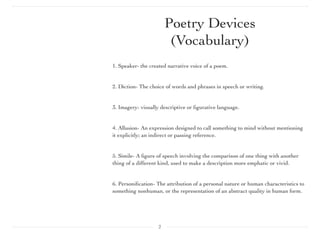
1. Speaker- the created narrative voice of a poem.
2. Diction- The choice of words and phrases in speech or writing.
3. Imagery- visually descriptive or figurative language.
4. Allusion- An expression designed to call something to mind without mentioning
it explicitly; an indirect or passing reference.
5. Simile- A figure of speech involving the comparison of one thing with another
thing of a different kind, used to make a description more emphatic or vivid.
6. Personification- The attribution of a personal nature or human characteristics to
something nonhuman, or the representation of an abstract quality in human form.
2
Poetry Devices
(Vocabulary)
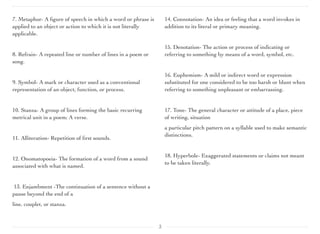
7. Metaphor- A figure of speech in which a word or phrase is
applied to an object or action to which it is not literally
applicable.


8. Refrain- A repeated line or number of lines in a poem or
song.
9. Symbol- A mark or character used as a conventional
representation of an object, function, or process.
10. Stanza- A group of lines forming the basic recurring
metrical unit in a poem; A verse.
11. Alliteration- Repetition of first sounds.
12. Onomatopoeia- The formation of a word from a sound
associated with what is named.
13. Enjambment -The continuation of a sentence without a
pause beyond the end of a
line, couplet, or stanza.
14. Connotation- An idea or feeling that a word invokes in
addition to its literal or primary meaning.
15. Denotation- The action or process of indicating or
referring to something by means of a word, symbol, etc.


16. Euphemism- A mild or indirect word or expression
substituted for one considered to be too harsh or blunt when
referring to something unpleasant or embarrassing.
17. Tone- The general character or attitude of a place, piece
of writing, situation
a particular pitch pattern on a syllable used to make semantic
distinctions.
18. Hyperbole- Exaggerated statements or claims not meant
to be taken literally.


3
CHAPTER 2
∏
POETRY IN MUSIC
Songs involve poetry even if no one realize it. Here
are some examples of poetry definitions found in
Chapter 1 in music.
Here’s the Video!
Poetry in Music
CHAPTER 3
∏
BLACK OUT
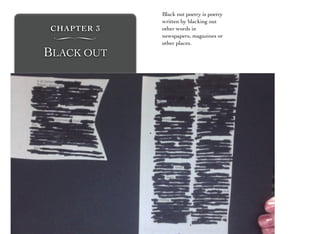
Black out poetry is poetry
written by blacking out
other words in
newspapers, magazines or
other places.
CHAPTER 4
∏
HAIKU
A haiku is a poem normally about
nature that is visual. These poems
normally contain 3 lines that has a
5-7-5 syllables in each line or a total
of 17 syllables in total.
Examples of a Haiku-
I feel the sea breeze
The smell of salt in the air
Water on my legs
- Allison Fisher
The emotion
The unsteadiness of air
the passion that is felt
- Allison Fisher
Write
Write all of your
life!
Interactive 4.1 Writing
CHAPTER 5
∏
I AM
POEMS
I AM
I am intellectual and musical
I wonder how people live
without music
I hear a symphony
I see a burst of color
I want to teach the joy of music
I am intellectual and musical
I pretend to be the best musician ever
I feel that it gives me a type of
confidence that I need
I touch the corners of the page
I worry about it not being the best it could have been
I cry when I don’t give a piece my full potential
I am intellectual and musical
I understand that I am talented
I say that I love who I am
I dream that I am a teacher that
can share the wonders of music
I try to learn as much as I can
I hope I can change as many people’s lives
as I can
I am intellectual and musical
-Allison
8
CHAPTER 6
∏
SONNETS
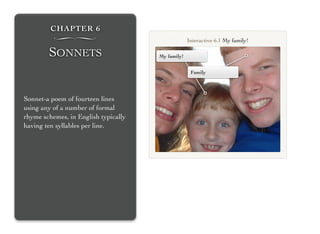
Sonnet-a poem of fourteen lines
using any of a number of formal
rhyme schemes, in English typically
having ten syllables per line.
My family!
Family
Interactive 6.1 My family!
Differences between Shakespearian and Italian Sonnets
Italian sonnets are divided into an octave (8 lines) and a
sestet (6 lines)
Shakespearian separated into 3 quatrain.
 
Italian Sonnets are often about love and
Shakespearian Sonnets are often about a
change or development in idea
rhyming pattern of: a, b, a, b, c, d, c, d, e,
f, e, f. (Shakespearian)
a, b, b, a, a, b, b, a ( Italian)
Similarities
14 lines
rhyming
10 syllables per line
Looks like a square
Credits
10
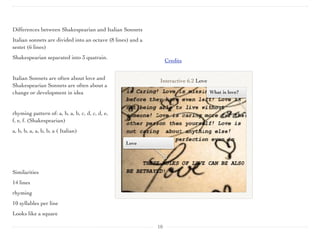
Love
What is love?
Interactive 6.2 Love
11
Wikipedia contributors.
"Petrarch's and
Shakespeare's Sonnets."
Wikipedia, The Free
In what bright realm, what sphere of radiant
thought

Did Nature find the model whence she drew

That delicate dazzling image where we view

Here on this earth what she in heaven
wrought?

What fountain-haunting nymph, what
dryad, sought

In groves, such golden tresses ever threw

Upon the gust? What heart such virtues
knew?—

Though her chief virtue with my death is
frought.

He looks in vain for heavenly beauty, he

Who never looked upon her perfect eyes,

The vivid blue orbs turning brilliantly –

He does not know how Love yields and
denies;

He only knows, who knows how sweetly she

Can talk and laugh, the sweetness of her
sighs.


—Translation[by whom?] of Petrarch,
Sonnet 159
12
For love that gets denied and cannot be
I live for the day that we can become one
All that belongs to me will go to thee
For your eyes are like the lovely autumn sun
I look to the East and to the West
I shall wait for my love so I can live my life
I know it is right, I know it is the best
That one day I will be your wife
We can live together, our lives intertwine
I can’t live another day without you
We will be together, you will be mine
I really hope you feel the same way too
I hope that everything will be fine
That we can be together, then I will be with you
-Allie
CHAPTER 7
∏
CONCRETE
POEMS
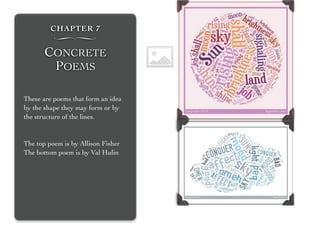
These are poems that form an idea
by the shape they may form or by
the structure of the lines.
The top poem is by Allison Fisher
The bottom poem is by Val Hulin
CHAPTER 8
∏
ACROSTIC POEMS
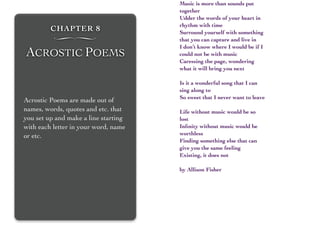
Acrostic Poems are made out of
names, words, quotes and etc. that
you set up and make a line starting
with each letter in your word, name
or etc.
Music is more than sounds put
together
Udder the words of your heart in
rhythm with time
Surround yourself with something
that you can capture and live in
I don’t know where I would be if I
could not be with music
Caressing the page, wondering
what it will bring you next
Is it a wonderful song that I can
sing along to
So sweet that I never want to leave
Life without music would be so
lost
Infinity without music would be
worthless
Finding something else that can
give you the same feeling
Existing, it does not
by Allison Fisher
CHAPTER 9
TYPES OF POEMS
xv
Write for Life
Remember......
Free Verse
Poetry that does not rhyme or have a
regular meter.
Parody Poem
a humorous or satirical imitation of a
serious piece of literature or writing.
Ode- a lyric poem in the form of an
address to a particular subject, often
elevated in style or manner and
written in varied or irregular meter.
CREDIT for Free Verse
xvi
Ex. of Free Verse Desperation
Come and Go
Life moves on
But yet I am still
stuck in this moment
I can’t get passed
You were my life 
and now you are gone
I cant move on,
Help me!
Pull me from this,
This spot of desperation
I'm sinking 
like in quick sand,
I am trapped 
I cant get over you, 
until finally,
I find a glimmer,
a light,
a way out
I reach for it
I grab and grab 
until I finally reach 
I have the smallest handful of light
but that is all I need 
I have light
and with this 
my light can grow from this
to a life full of happiness 
a life 
I want so desperately
by Allison Fisher
xvii
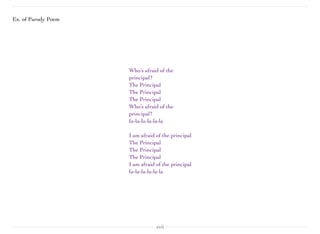
Ex. of Parody Poem
Who’s afraid of the
principal?
The Principal
The Principal
The Principal
Who’s afraid of the
principal?
fa-la-la-la-la-la
I am afraid of the principal
The Principal
The Principal
The Principal
I am afraid of the principal
fa-la-la-la-la-la
xviii
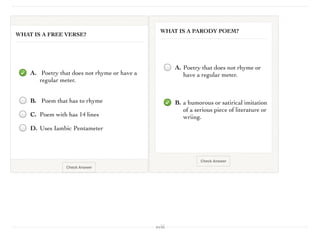
Check Answer
WHAT IS A FREE VERSE?
A. Poetry that does not rhyme or have a
regular meter.
B. Poem that has to rhyme
C. Poem with has 14 lines
D. Uses Iambic Pentameter
Check Answer
WHAT IS A PARODY POEM?
A. Poetry that does not rhyme or
have a regular meter.
B. a humorous or satirical imitation
of a serious piece of literature or
wriing.

Poetry

  • 1.
  • 2.
  • 3.
    1. Speaker- thecreated narrative voice of a poem. 2. Diction- The choice of words and phrases in speech or writing. 3. Imagery- visually descriptive or figurative language. 4. Allusion- An expression designed to call something to mind without mentioning it explicitly; an indirect or passing reference. 5. Simile- A figure of speech involving the comparison of one thing with another thing of a different kind, used to make a description more emphatic or vivid. 6. Personification- The attribution of a personal nature or human characteristics to something nonhuman, or the representation of an abstract quality in human form. 2 Poetry Devices (Vocabulary)
  • 4.
    7. Metaphor- Afigure of speech in which a word or phrase is applied to an object or action to which it is not literally applicable. 8. Refrain- A repeated line or number of lines in a poem or song. 9. Symbol- A mark or character used as a conventional representation of an object, function, or process. 10. Stanza- A group of lines forming the basic recurring metrical unit in a poem; A verse. 11. Alliteration- Repetition of first sounds. 12. Onomatopoeia- The formation of a word from a sound associated with what is named. 13. Enjambment -The continuation of a sentence without a pause beyond the end of a line, couplet, or stanza. 14. Connotation- An idea or feeling that a word invokes in addition to its literal or primary meaning. 15. Denotation- The action or process of indicating or referring to something by means of a word, symbol, etc. 16. Euphemism- A mild or indirect word or expression substituted for one considered to be too harsh or blunt when referring to something unpleasant or embarrassing. 17. Tone- The general character or attitude of a place, piece of writing, situation a particular pitch pattern on a syllable used to make semantic distinctions. 18. Hyperbole- Exaggerated statements or claims not meant to be taken literally. 3
  • 5.
    CHAPTER 2 ∏ POETRY INMUSIC Songs involve poetry even if no one realize it. Here are some examples of poetry definitions found in Chapter 1 in music. Here’s the Video! Poetry in Music
  • 6.
    CHAPTER 3 ∏ BLACK OUT Blackout poetry is poetry written by blacking out other words in newspapers, magazines or other places.
  • 7.
    CHAPTER 4 ∏ HAIKU A haikuis a poem normally about nature that is visual. These poems normally contain 3 lines that has a 5-7-5 syllables in each line or a total of 17 syllables in total. Examples of a Haiku- I feel the sea breeze The smell of salt in the air Water on my legs - Allison Fisher The emotion The unsteadiness of air the passion that is felt - Allison Fisher Write Write all of your life! Interactive 4.1 Writing
  • 8.
  • 9.
    I AM I amintellectual and musical I wonder how people live without music I hear a symphony I see a burst of color I want to teach the joy of music I am intellectual and musical I pretend to be the best musician ever I feel that it gives me a type of confidence that I need I touch the corners of the page I worry about it not being the best it could have been I cry when I don’t give a piece my full potential I am intellectual and musical I understand that I am talented I say that I love who I am I dream that I am a teacher that can share the wonders of music I try to learn as much as I can I hope I can change as many people’s lives as I can I am intellectual and musical -Allison 8
  • 10.
    CHAPTER 6 ∏ SONNETS Sonnet-a poemof fourteen lines using any of a number of formal rhyme schemes, in English typically having ten syllables per line. My family! Family Interactive 6.1 My family!
  • 11.
    Differences between Shakespearianand Italian Sonnets Italian sonnets are divided into an octave (8 lines) and a sestet (6 lines) Shakespearian separated into 3 quatrain.   Italian Sonnets are often about love and Shakespearian Sonnets are often about a change or development in idea rhyming pattern of: a, b, a, b, c, d, c, d, e, f, e, f. (Shakespearian) a, b, b, a, a, b, b, a ( Italian) Similarities 14 lines rhyming 10 syllables per line Looks like a square Credits 10 Love What is love? Interactive 6.2 Love
  • 12.
    11 Wikipedia contributors. "Petrarch's and Shakespeare'sSonnets." Wikipedia, The Free In what bright realm, what sphere of radiant thought
 Did Nature find the model whence she drew
 That delicate dazzling image where we view
 Here on this earth what she in heaven wrought?
 What fountain-haunting nymph, what dryad, sought
 In groves, such golden tresses ever threw
 Upon the gust? What heart such virtues knew?—
 Though her chief virtue with my death is frought.
 He looks in vain for heavenly beauty, he
 Who never looked upon her perfect eyes,
 The vivid blue orbs turning brilliantly –
 He does not know how Love yields and denies;
 He only knows, who knows how sweetly she
 Can talk and laugh, the sweetness of her sighs. 
 —Translation[by whom?] of Petrarch, Sonnet 159
  • 13.
    12 For love thatgets denied and cannot be I live for the day that we can become one All that belongs to me will go to thee For your eyes are like the lovely autumn sun I look to the East and to the West I shall wait for my love so I can live my life I know it is right, I know it is the best That one day I will be your wife We can live together, our lives intertwine I can’t live another day without you We will be together, you will be mine I really hope you feel the same way too I hope that everything will be fine That we can be together, then I will be with you -Allie
  • 14.
    CHAPTER 7 ∏ CONCRETE POEMS These arepoems that form an idea by the shape they may form or by the structure of the lines. The top poem is by Allison Fisher The bottom poem is by Val Hulin
  • 15.
    CHAPTER 8 ∏ ACROSTIC POEMS AcrosticPoems are made out of names, words, quotes and etc. that you set up and make a line starting with each letter in your word, name or etc. Music is more than sounds put together Udder the words of your heart in rhythm with time Surround yourself with something that you can capture and live in I don’t know where I would be if I could not be with music Caressing the page, wondering what it will bring you next Is it a wonderful song that I can sing along to So sweet that I never want to leave Life without music would be so lost Infinity without music would be worthless Finding something else that can give you the same feeling Existing, it does not by Allison Fisher
  • 16.
    CHAPTER 9 TYPES OFPOEMS xv Write for Life Remember...... Free Verse Poetry that does not rhyme or have a regular meter. Parody Poem a humorous or satirical imitation of a serious piece of literature or writing. Ode- a lyric poem in the form of an address to a particular subject, often elevated in style or manner and written in varied or irregular meter. CREDIT for Free Verse
  • 17.
    xvi Ex. of FreeVerse Desperation Come and Go Life moves on But yet I am still stuck in this moment I can’t get passed You were my life  and now you are gone I cant move on, Help me! Pull me from this, This spot of desperation I'm sinking  like in quick sand, I am trapped  I cant get over you,  until finally, I find a glimmer, a light, a way out I reach for it I grab and grab  until I finally reach  I have the smallest handful of light but that is all I need  I have light and with this  my light can grow from this to a life full of happiness  a life  I want so desperately by Allison Fisher
  • 18.
    xvii Ex. of ParodyPoem Who’s afraid of the principal? The Principal The Principal The Principal Who’s afraid of the principal? fa-la-la-la-la-la I am afraid of the principal The Principal The Principal The Principal I am afraid of the principal fa-la-la-la-la-la
  • 19.
    xviii Check Answer WHAT ISA FREE VERSE? A. Poetry that does not rhyme or have a regular meter. B. Poem that has to rhyme C. Poem with has 14 lines D. Uses Iambic Pentameter Check Answer WHAT IS A PARODY POEM? A. Poetry that does not rhyme or have a regular meter. B. a humorous or satirical imitation of a serious piece of literature or wriing.