Terms and Elements

POETRY
SPEAKER

 We refer to the narrator of a poem as the
  speaker.
 The speaker is not necessarily the poet, or
  even a person.
 Who is the speaker in the following example?

But believe me, son
I want to be what I used to be
When I was like you.
LINES AND STANZAS

 A line is the row of words in a poem.
 A stanza is a group of lines forming a unit.


Example:
Open it.
Go ahead, it won’t bite.
Well…maybe a little.
RHYME

   Rhyme is the repetition of the same stressed
    sound in any two or more words.

 Internal rhyme occurs within a line of poetry.
 End rhyme occurs at the end of lines.
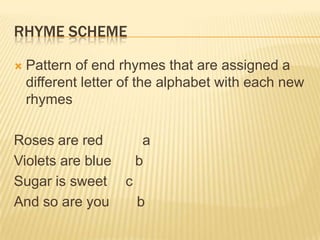
RHYME SCHEME

   Pattern of end rhymes that are assigned a
    different letter of the alphabet with each new
    rhymes

Roses are red     a
Violets are blue b
Sugar is sweet c
And so are you   b
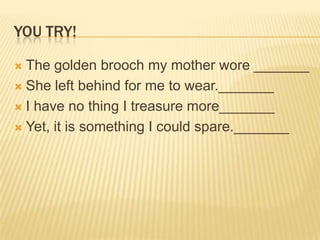
YOU TRY!

 The golden brooch my mother wore _______
 She left behind for me to wear._______

 I have no thing I treasure more_______

 Yet, it is something I could spare._______
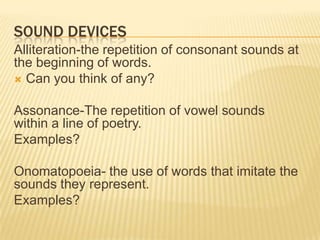
SOUND DEVICES
Alliteration-the repetition of consonant sounds at
the beginning of words.
 Can you think of any?


Assonance-The repetition of vowel sounds
within a line of poetry.
Examples?

Onomatopoeia- the use of words that imitate the
sounds they represent.
Examples?
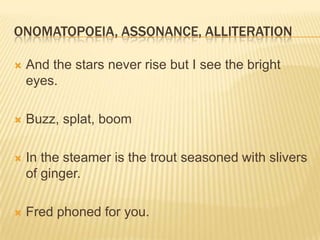
ONOMATOPOEIA, ASSONANCE, ALLITERATION

   And the stars never rise but I see the bright
    eyes.

   Buzz, splat, boom

   In the steamer is the trout seasoned with slivers
    of ginger.

   Fred phoned for you.
PERSONIFICATION/ ANTHROPOMORPHISM

 Personification is giving human
  characteristics to a non-human object.
 Example: The stars danced in the sky.


 Anthropomorphism- Giving human form to a
  non-human object.
 Example: The tree stretched her arms to the
  sky.
IMAGERY

 Descriptive language that appeals to the
  sense.
 How do poets benefit from using poetry?

 Example:

Her knotted hands showing slow blue rivers
Jerked nervously through cornbread frying.
TYPES OF POETRY

 Narrative- is a verse that tells a story
 Lyric- expresses the personal thoughts and
  feelings of the speaker
 Dramatic- usually have one or more
  characters that speak to themselves
  throughout the poem.

Poetry 1

  • 1.
  • 2.
    SPEAKER  We referto the narrator of a poem as the speaker.  The speaker is not necessarily the poet, or even a person.  Who is the speaker in the following example? But believe me, son I want to be what I used to be When I was like you.
  • 3.
    LINES AND STANZAS A line is the row of words in a poem.  A stanza is a group of lines forming a unit. Example: Open it. Go ahead, it won’t bite. Well…maybe a little.
  • 4.
    RHYME  Rhyme is the repetition of the same stressed sound in any two or more words.  Internal rhyme occurs within a line of poetry.  End rhyme occurs at the end of lines.
  • 5.
    RHYME SCHEME  Pattern of end rhymes that are assigned a different letter of the alphabet with each new rhymes Roses are red a Violets are blue b Sugar is sweet c And so are you b
  • 6.
    YOU TRY!  Thegolden brooch my mother wore _______  She left behind for me to wear._______  I have no thing I treasure more_______  Yet, it is something I could spare._______
  • 7.
    SOUND DEVICES Alliteration-the repetitionof consonant sounds at the beginning of words.  Can you think of any? Assonance-The repetition of vowel sounds within a line of poetry. Examples? Onomatopoeia- the use of words that imitate the sounds they represent. Examples?
  • 8.
    ONOMATOPOEIA, ASSONANCE, ALLITERATION  And the stars never rise but I see the bright eyes.  Buzz, splat, boom  In the steamer is the trout seasoned with slivers of ginger.  Fred phoned for you.
  • 9.
    PERSONIFICATION/ ANTHROPOMORPHISM  Personificationis giving human characteristics to a non-human object.  Example: The stars danced in the sky.  Anthropomorphism- Giving human form to a non-human object.  Example: The tree stretched her arms to the sky.
  • 10.
    IMAGERY  Descriptive languagethat appeals to the sense.  How do poets benefit from using poetry?  Example: Her knotted hands showing slow blue rivers Jerked nervously through cornbread frying.
  • 11.
    TYPES OF POETRY Narrative- is a verse that tells a story  Lyric- expresses the personal thoughts and feelings of the speaker  Dramatic- usually have one or more characters that speak to themselves throughout the poem.