2
Digital transformation?!
It is no longer about the shift to digital.
It‘s about why analoge.
3
Back to the future?!
Combining the best of both worlds:
face-to-face and distance learning
to achieve “Future Skills” (Ehlers, 2020)
within blended learning
offerings.
4
How to teach Future Skills?
Picking up, training, reflecting and learning
from each other.
5
PodCasting as a low-threshold learning resource…
…within further training in higher education didactics:
#1: high acceptance and use
#2: easy integration into the common media usage
#3: flexible reception within time and location
6
Concept of Macromedia‘s didactic PodCast
Good practice as accelerator for own teaching
Making in-house competence visible
Communication channel for didactic concepts
use in variable scenarios (occasion for internal exchange)
…Content marketing & employer branding
7
Conditions
Use of existing in-house skills: changing colleagues as experts
Communication at eye level: It is easier to accept something from a known
colleague than from outside
Gender equal choice of guests
Not live and with post-processing: promoting confidence
Compression of content and limitation of time to max. 15 min. to achieve
highest attention: PodCast as “knowledge nuggets“
8
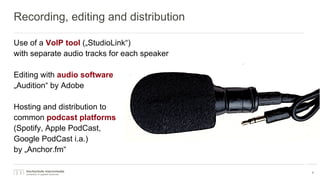
Recording, editing and distribution
Use of a VoIP tool („StudioLink“)
with separate audio tracks for each speaker
Editing with audio software
„Audition“ by Adobe
Hosting and distribution to
common podcast platforms
(Spotify, Apple PodCast,
Google PodCast i.a.)
by „Anchor.fm“
9
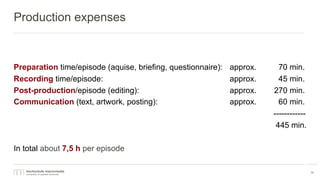
Production expenses
Preparation time/episode (aquise, briefing, questionnaire): approx. 70 min.
Recording time/episode: approx. 45 min.
Post-production/episode (editing): approx. 270 min.
Communication (text, artwork, posting): approx. 60 min.
------------
445 min.
In total about 7,5 h per episode
10
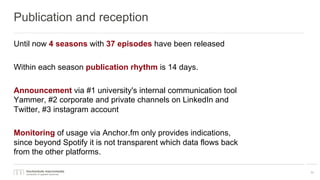
Publication and reception
Until now 4 seasons with 37 episodes have been released
Within each season publication rhythm is 14 days.
Announcement via #1 university's internal communication tool
Yammer, #2 corporate and private channels on LinkedIn and
Twitter, #3 instagram account
Monitoring of usage via Anchor.fm only provides indications,
since beyond Spotify it is not transparent which data flows back
from the other platforms.
11
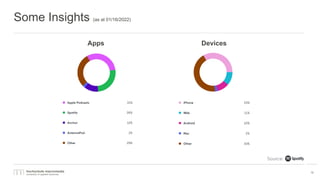
Some Insights (as at 01/16/2022)
12
Apps Devices
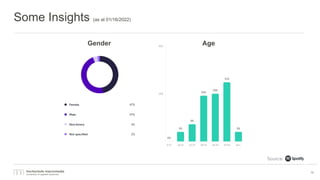
Some Insights (as at 01/16/2022)
13
Gender Age
Our goal
The main aim is to distribute the PodCast within the college…
Furthermore we're also interested in what our colleagues give
across the board as central tips for successful university
teaching.
Indicator for probably high relevant topics within further didactic
training.
14
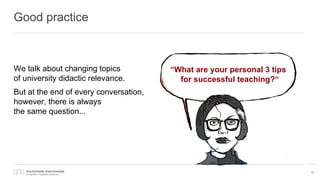
Good practice
We talk about changing topics
of university didactic relevance.
But at the end of every conversation,
however, there is always
the same question...
15
“What are your personal 3 tips
for successful teaching?“
What colleagues notice
#1: Preparation
#2: Teacher-student relationship
#3: Encouragement of student‘s self-activity
Even though we took almost all of the recordings under the impression of
online teaching during the Corona times, technical issues were hardly
addressed:
It's about teaching and learning and the decision how to do best; not about
digital or analog media.
16
Take aways and outlook
Everyone thinks university didactic training is important - but only a minority
participates (because of expected effort, lack of time resources, uncertainty in the
selection of content, etc.)
Here PodCast forms a bridge to a better approach:
Integration in blended learning scenarios.
Asynchronous exchange via annotations and re-annotation of the content in the
sense of "social video learning" (Vohle & Reinmann, 2012; Vohle, 2016) as a further didactic-
methodical option
17
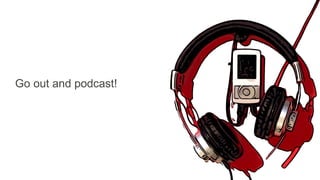
Go out and podcast!
Get in touch
ANDREAS HEBBEL-SEEGER a.hebbel-seeger@macromedia.de
ANNETTE STRAUSS a.strauss@macromedia.de
PODCAST https://anchor.fm/macromedia0
19
References
Ehlers, U.-D. (2020). Future Skills. Lernen der Zukunft – Hochschule der Zukunft. Wiesbaden: Springer VS.
Vohle, F. (2016). Social Video Learning. Eine didaktische Zäsur. In A.-W. Scheer & C. Wachter (Hrsg.), Digitale
Bildungslandschaften (S. 175-185). Saarbrücken: IMC.
Vohle, F. & Reinmann, G. (2012). Förderung professioneller Unterrichtskompetenz mit digitalen Medien: Lehren
lernen durch Videoannotation. In R. Schulz-Zander, B. Eickelmann, H. Moser, H. Niesyto & P. Grell (Hrsg.), Jahrbuch
Medienpädagogik 9 (S. 413-429). Wiesbaden: Springer VS.
20

PodCasting...

  • 1.
  • 2.
    Digital transformation?! It isno longer about the shift to digital. It‘s about why analoge. 3
  • 3.
    Back to thefuture?! Combining the best of both worlds: face-to-face and distance learning to achieve “Future Skills” (Ehlers, 2020) within blended learning offerings. 4
  • 4.
    How to teachFuture Skills? Picking up, training, reflecting and learning from each other. 5
  • 5.
    PodCasting as alow-threshold learning resource… …within further training in higher education didactics: #1: high acceptance and use #2: easy integration into the common media usage #3: flexible reception within time and location 6
  • 6.
    Concept of Macromedia‘sdidactic PodCast Good practice as accelerator for own teaching Making in-house competence visible Communication channel for didactic concepts use in variable scenarios (occasion for internal exchange) …Content marketing & employer branding 7
  • 7.
    Conditions Use of existingin-house skills: changing colleagues as experts Communication at eye level: It is easier to accept something from a known colleague than from outside Gender equal choice of guests Not live and with post-processing: promoting confidence Compression of content and limitation of time to max. 15 min. to achieve highest attention: PodCast as “knowledge nuggets“ 8
  • 8.
    Recording, editing anddistribution Use of a VoIP tool („StudioLink“) with separate audio tracks for each speaker Editing with audio software „Audition“ by Adobe Hosting and distribution to common podcast platforms (Spotify, Apple PodCast, Google PodCast i.a.) by „Anchor.fm“ 9
  • 9.
    Production expenses Preparation time/episode(aquise, briefing, questionnaire): approx. 70 min. Recording time/episode: approx. 45 min. Post-production/episode (editing): approx. 270 min. Communication (text, artwork, posting): approx. 60 min. ------------ 445 min. In total about 7,5 h per episode 10
  • 10.
    Publication and reception Untilnow 4 seasons with 37 episodes have been released Within each season publication rhythm is 14 days. Announcement via #1 university's internal communication tool Yammer, #2 corporate and private channels on LinkedIn and Twitter, #3 instagram account Monitoring of usage via Anchor.fm only provides indications, since beyond Spotify it is not transparent which data flows back from the other platforms. 11
  • 11.
    Some Insights (asat 01/16/2022) 12 Apps Devices
  • 12.
    Some Insights (asat 01/16/2022) 13 Gender Age
  • 13.
    Our goal The mainaim is to distribute the PodCast within the college… Furthermore we're also interested in what our colleagues give across the board as central tips for successful university teaching. Indicator for probably high relevant topics within further didactic training. 14
  • 14.
    Good practice We talkabout changing topics of university didactic relevance. But at the end of every conversation, however, there is always the same question... 15 “What are your personal 3 tips for successful teaching?“
  • 15.
    What colleagues notice #1:Preparation #2: Teacher-student relationship #3: Encouragement of student‘s self-activity Even though we took almost all of the recordings under the impression of online teaching during the Corona times, technical issues were hardly addressed: It's about teaching and learning and the decision how to do best; not about digital or analog media. 16
  • 16.
    Take aways andoutlook Everyone thinks university didactic training is important - but only a minority participates (because of expected effort, lack of time resources, uncertainty in the selection of content, etc.) Here PodCast forms a bridge to a better approach: Integration in blended learning scenarios. Asynchronous exchange via annotations and re-annotation of the content in the sense of "social video learning" (Vohle & Reinmann, 2012; Vohle, 2016) as a further didactic- methodical option 17
  • 17.
    Go out andpodcast!
  • 18.
    Get in touch ANDREASHEBBEL-SEEGER a.hebbel-seeger@macromedia.de ANNETTE STRAUSS a.strauss@macromedia.de PODCAST https://anchor.fm/macromedia0 19
  • 19.
    References Ehlers, U.-D. (2020).Future Skills. Lernen der Zukunft – Hochschule der Zukunft. Wiesbaden: Springer VS. Vohle, F. (2016). Social Video Learning. Eine didaktische Zäsur. In A.-W. Scheer & C. Wachter (Hrsg.), Digitale Bildungslandschaften (S. 175-185). Saarbrücken: IMC. Vohle, F. & Reinmann, G. (2012). Förderung professioneller Unterrichtskompetenz mit digitalen Medien: Lehren lernen durch Videoannotation. In R. Schulz-Zander, B. Eickelmann, H. Moser, H. Niesyto & P. Grell (Hrsg.), Jahrbuch Medienpädagogik 9 (S. 413-429). Wiesbaden: Springer VS. 20