When Digital Archives
Encounter Digital Natives:
The Knowledge Issue
Shih-Chieh Ilya Li
ilyaericlee@gmail.com
2010.12.1 at PNC, HK
2010年12月6日星期
The Stories of Archives
• A bit of myself
• Spatial definition of
archives
• The practices of archives
• Two approaches
• Producer-centered
digital archives
• User-centered digital
archives
http://www.khyentsefoundation.org/chinese/downloads/thumb_digital.gif
2010年12月6日星期
Producer-centered
Digital Archives
• Examination criteria
• Policy-level pre-assumption
• Content analysis: metadata & requirement
• Project execution framework
• Duck test (inductive reasoning):
“If it looks like a duck, swims like a duck, and
quacks like a duck, then it probably is a duck.”
2010年12月6日星期
User-centered Digital Archives
• Avoid the contradictories
• We want a “producer-centered” digital
archives, but we also want “hits”
• Producers could want & contribute more
NYTimes Nov. 16, 2010: Digital Keys for Unlocking the Humanities’ Riches
• User-centered is a neutral method to
leverage participants’ productivity
• Professors vs. digital natives
2010年12月6日星期
Digital Natives
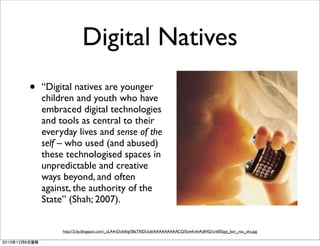
• “Digital natives are younger
children and youth who have
embraced digital technologies
and tools as central to their
everyday lives and sense of the
self – who used (and abused)
these technologised spaces in
unpredictable and creative
ways beyond, and often
against, the authority of the
State” (Shah; 2007).
http://3.bp.blogspot.com/_uLA4nDc6dhg/S8zTRIDUszI/AAAAAAAAACQ/EswKwhAdIHQ/s1600/gyj_bor_rou_sha.jpg
2010年12月6日星期
Closer Look at Digital Natives
• Digital natives beyond “the state”
• Co-evolving with “technologised spaces”
• Against or innovate?
• What are the “technologised spaces”?
• Image-based communication (incl. video)
• Search & other features
• Portable & social media / services
e.g. what is the hashtag of our conf/panel?
2010年12月6日星期
Contradictory Mindsets
• Different mentalities
• open vs. closure
• Inside vs. outside
• Internal vs. external
• Struggles of user behaviors: encountering
2010年12月6日星期
Redefining Archives
• “Movage”(Long Now Foundation)
• Representation of archives (SL)
• Moving images archives & archivists
• Social media as archives / SM’s archives
• Library of congress aiming at preserving
tweets from twitter
2010年12月6日星期
Case Studies
• UltraFilter (MingliYuan / WPIC, 2010)
• zh.wikipedia.org initiative
• provide more means engaging users
• Paper.li (SmallRivers, 2010)
• Twitter app of social relation bot
• Form as a new paper daily service
• On the boundary of SPAM
Archives-Services turn into new
2010年12月6日星期
The Knowledge Issue
• How could our archives (collectively, maybe)
provide us new knowledge we need?
• Collaborative knowledge
• Relational knowledge (dbpedia & link data)
• Migrational / fluid / dynamic knowledge
• Real-time knowledge
• Action-oriented knowledge
2010年12月6日星期
Conclusion
• A long way to go & moving toward:
• Practical “Cloud Culture” (by Charles Leadbeater)
More culture heritage stored in digital form + More accessible to more
people + People better equipped with more tools to add creativity to
the collection = Exponential growth in mass culture expression
• Social technologies and social design for
digital archives
2010年12月6日星期
Thanks for UR Attention!
2010年12月6日星期

Pnc2010 knowledge-talk

  • 1.
    When Digital Archives EncounterDigital Natives: The Knowledge Issue Shih-Chieh Ilya Li ilyaericlee@gmail.com 2010.12.1 at PNC, HK 2010年12月6日星期
  • 2.
    The Stories ofArchives • A bit of myself • Spatial definition of archives • The practices of archives • Two approaches • Producer-centered digital archives • User-centered digital archives http://www.khyentsefoundation.org/chinese/downloads/thumb_digital.gif 2010年12月6日星期
  • 3.
    Producer-centered Digital Archives • Examinationcriteria • Policy-level pre-assumption • Content analysis: metadata & requirement • Project execution framework • Duck test (inductive reasoning): “If it looks like a duck, swims like a duck, and quacks like a duck, then it probably is a duck.” 2010年12月6日星期
  • 4.
    User-centered Digital Archives •Avoid the contradictories • We want a “producer-centered” digital archives, but we also want “hits” • Producers could want & contribute more NYTimes Nov. 16, 2010: Digital Keys for Unlocking the Humanities’ Riches • User-centered is a neutral method to leverage participants’ productivity • Professors vs. digital natives 2010年12月6日星期
  • 5.
    Digital Natives • “Digitalnatives are younger children and youth who have embraced digital technologies and tools as central to their everyday lives and sense of the self – who used (and abused) these technologised spaces in unpredictable and creative ways beyond, and often against, the authority of the State” (Shah; 2007). http://3.bp.blogspot.com/_uLA4nDc6dhg/S8zTRIDUszI/AAAAAAAAACQ/EswKwhAdIHQ/s1600/gyj_bor_rou_sha.jpg 2010年12月6日星期
  • 6.
    Closer Look atDigital Natives • Digital natives beyond “the state” • Co-evolving with “technologised spaces” • Against or innovate? • What are the “technologised spaces”? • Image-based communication (incl. video) • Search & other features • Portable & social media / services e.g. what is the hashtag of our conf/panel? 2010年12月6日星期
  • 7.
    Contradictory Mindsets • Differentmentalities • open vs. closure • Inside vs. outside • Internal vs. external • Struggles of user behaviors: encountering 2010年12月6日星期
  • 8.
    Redefining Archives • “Movage”(LongNow Foundation) • Representation of archives (SL) • Moving images archives & archivists • Social media as archives / SM’s archives • Library of congress aiming at preserving tweets from twitter 2010年12月6日星期
  • 9.
    Case Studies • UltraFilter(MingliYuan / WPIC, 2010) • zh.wikipedia.org initiative • provide more means engaging users • Paper.li (SmallRivers, 2010) • Twitter app of social relation bot • Form as a new paper daily service • On the boundary of SPAM Archives-Services turn into new 2010年12月6日星期
  • 10.
    The Knowledge Issue •How could our archives (collectively, maybe) provide us new knowledge we need? • Collaborative knowledge • Relational knowledge (dbpedia & link data) • Migrational / fluid / dynamic knowledge • Real-time knowledge • Action-oriented knowledge 2010年12月6日星期
  • 11.
    Conclusion • A longway to go & moving toward: • Practical “Cloud Culture” (by Charles Leadbeater) More culture heritage stored in digital form + More accessible to more people + People better equipped with more tools to add creativity to the collection = Exponential growth in mass culture expression • Social technologies and social design for digital archives 2010年12月6日星期
  • 12.
    Thanks for URAttention! 2010年12月6日星期