Rewriting a Plugin Architecture 3 Times
to Harness the API Economy
A couple of Atlassians who are passionate about plugins
Tim Pettersen
Developer Provocateur
@kannonboy
Ian Buchanan
Developer Partisan
@devpartisan
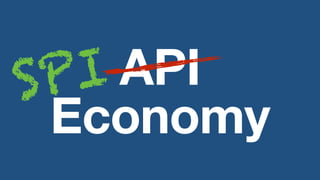
API
Economy
Economy
$50,000,000
*Paid to ISVs to date.
*2011. http://techcrunch.com/2012/04/24/facebook-revenue-share-apps/
15,000,000 paying
users
$1,000,000,000
*Paid to ISVs in 2013. http://www.partner-path.com/2013/12/salesforce-partner-ecosystem/
Blue logos?
REST? OAuth?
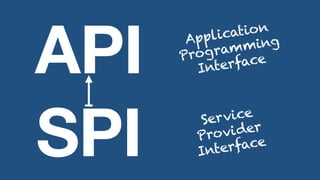
API
Economy
SPI
API Application
Programming
Interface
SPI Service
Provider
Interface
Atlassian
Plugins
(2004)

P2
(2008)
Atlassian
Connect
(2014)
Atlassian
Plugins
(2004)
Open(-ish)
Source
[2001]
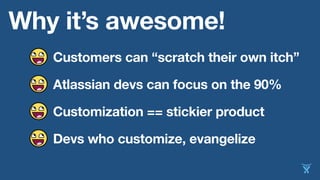
Why it’s awesome!
Customers can “scratch their own itch”
Atlassian devs can focus on the 90%
Customization == stickier product
Devs who customize, evangelize
Why it sucks..
Developer support load
Poor plugin UX == poor product
perception
Pain to build the entire product
Massive barrier to upgrade
Atlassian
Plugins
(2004)
JIRA 3.0
How?
Wherever there is a collection of
type FOO, let the end user inject
their own implementations of FOO.
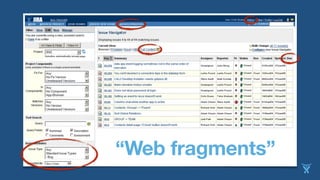
“Web fragments”
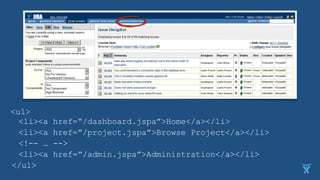
<ul>
</ul>
<li><a href=“/dashboard.jspa”>Home</a></li>
<li><a href=“/project.jspa”>Browse Project</a></li>
<!-- … -->
<li><a href=“/admin.jspa”>Administration</a></li>
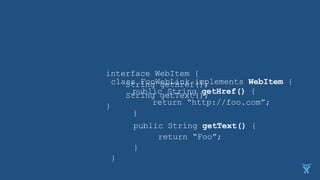
interface WebItem {
String getHref();
String getText();
}
class FooWebLink implements WebItem {
}
public String getHref() {
return “http://foo.com”;
}
public String getText() {
return “Foo”;
}
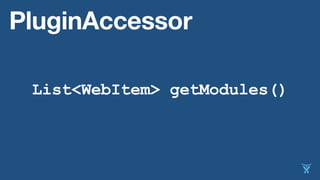
List<WebItem> getModules()
PluginAccessor
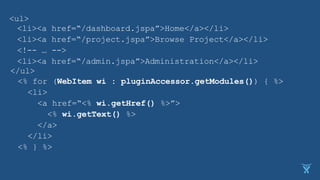
<li><a href=“/dashboard.jspa”>Home</a></li>
<li><a href=“/project.jspa”>Browse Project</a></li>
<!-- … -->
<li><a href=“/admin.jspa”>Administration</a></li>
<ul>
</ul>
<% for (WebItem wi : pluginAccessor.getModules()) { %>
<li>
<a href=“<% wi.getHref() %>”>
<% wi.getText() %>
</a>
</li>
<% } %>
Plugins promote abstraction and enforce
modular architecture!
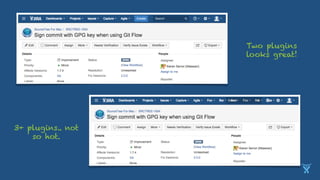
Two plugins
looks great!
3+ plugins.. not
so hot.
Every (pluggable) collection is now potentially
infinitely large.
List<WebItem> getModules()List<Type> getModules(Type)
PluginAccessor
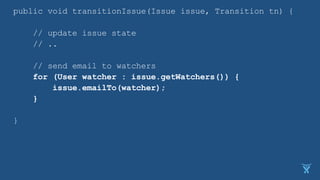
public void transitionIssue(Issue issue, Transition tn) {
// update issue state
// ..
// send email to watchers
for (User watcher : issue.getWatchers()) {
issue.emailTo(watcher);
}
}
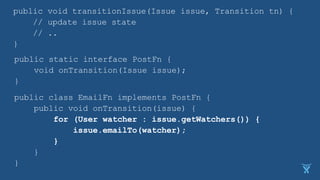
public void transitionIssue(Issue issue, Transition tn) {
// update issue state
// ..
}
public static interface PostFn {
void onTransition(Issue issue);
}
public class EmailFn implements PostFn {
public void onTransition(issue) {
for (User watcher : issue.getWatchers()) {
issue.emailTo(watcher);
}
}
}
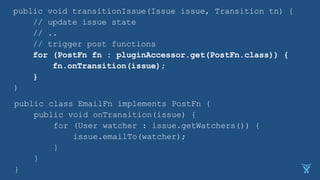
public void transitionIssue(Issue issue, Transition tn) {
// update issue state
// ..
// trigger post functions
for (PostFn fn : pluginAccessor.get(PostFn.class)) {
fn.onTransition(issue);
}
}
public class EmailFn implements PostFn {
public void onTransition(issue) {
for (User watcher : issue.getWatchers()) {
issue.emailTo(watcher);
}
}
}
Adding a new “plugin point” is easy if you
already have good abstraction!
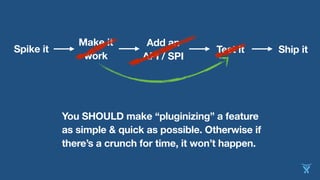
You SHOULD make “pluginizing” a feature
as simple & quick as possible. Otherwise if
there’s a crunch for time, it won’t happen.
Spike it
Make it
work
Test it
Add an
API / SPI
Ship it
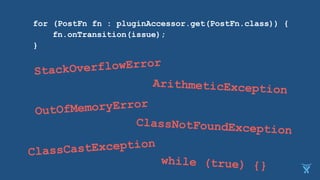
for (PostFn fn : pluginAccessor.get(PostFn.class)) {
fn.onTransition(issue);
}
ArithmeticException
StackOverflowError
while (true) {}
OutOfMemoryError
ClassNotFoundException
ClassCastException
Murphy’s law:
If a plugin can fail, it will.
Horrifically.
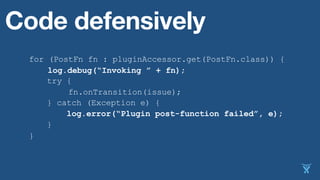
for (PostFn fn : pluginAccessor.get(PostFn.class)) {
fn.onTransition(issue);
}
Code defensively
try {
} catch (Exception e) {
log.error(“Plugin post-function failed”, e);
}
log.debug(“Invoking ” + fn);
Corollary:
If an API is public, it will be used.
Often incorrectly.
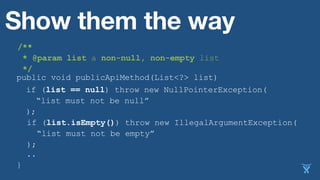
public void publicApiMethod(List<?> list)
..
}
Show them the way
if (list == null) throw new NullPointerException(
“list must not be null”
);
if (list.isEmpty()) throw new IllegalArgumentException(
“list must not be empty”
) );
/**
* @param list a non-null, non-empty list
*/
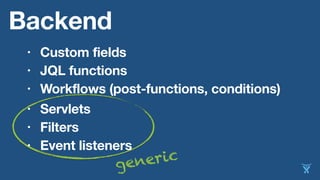
Backend
• Custom fields
• JQL functions
• Workflows (post-functions, conditions)
generic
• Servlets
• Filters
• Event listeners
https://bitbucket.org/atlassian/atlassian-plugins
Source (BSD 3-clause licensed)
Embedding Guide
http://bit.ly/embedding-plugins
Atlassian Plugins
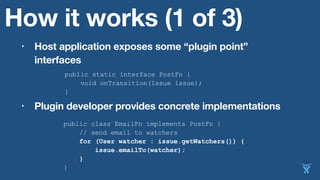
• Host application exposes some “plugin point”
interfaces
public static interface PostFn {
void onTransition(Issue issue);
}
• Plugin developer provides concrete implementations
public class EmailFn implements PostFn {
// send email to watchers
for (User watcher : issue.getWatchers()) {
issue.emailTo(watcher);
}
}
How it works (1 of 3)
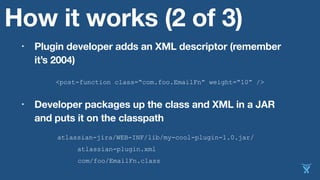
• Plugin developer adds an XML descriptor (remember
it’s 2004)
<post-function class=“com.foo.EmailFn” weight=“10” />
• Developer packages up the class and XML in a JAR
and puts it on the classpath
atlassian-jira/WEB-INF/lib/my-cool-plugin-1.0.jar/
How it works (2 of 3)
atlassian-plugin.xml
com/foo/EmailFn.class
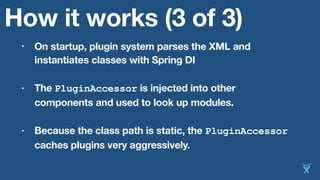
• On startup, plugin system parses the XML and
instantiates classes with Spring DI
• The PluginAccessor is injected into other
components and used to look up modules.
• Because the class path is static, the PluginAccessor
caches plugins very aggressively.
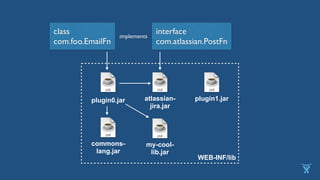
How it works (3 of 3)
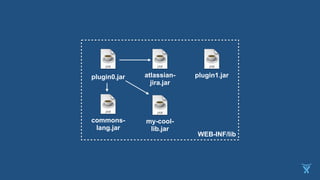
commons-
lang.jar
atlassian-
jira.jar
plugin0.jar plugin1.jar
WEB-INF/lib
interface
com.atlassian.PostFn
class
com.foo.EmailFn
implements
my-cool-
lib.jar
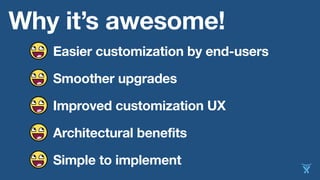
Why it’s awesome!
Easier customization by end-users
Smoother upgrades
Improved customization UX
Architectural benefits
Simple to implement
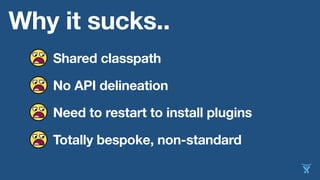
Why it sucks..
Totally bespoke, non-standard
Need to restart to install plugins
No API delineation
Shared classpath
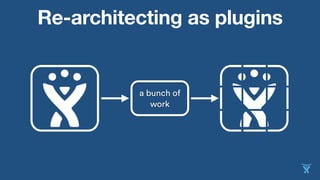
Re-architecting as plugins
a bunch of
work
Dogfooding APIs?
product
manager
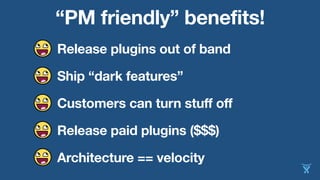
“PM friendly” benefits!
Release plugins out of band
Ship “dark features”
Customers can turn stuff off
Release paid plugins ($$$)
Architecture == velocity
Make sure your plugin
system works.
Nothing turns off a plugin developer like
a broken API or an unstable platform.
P2
(2008)
P2
(2008)
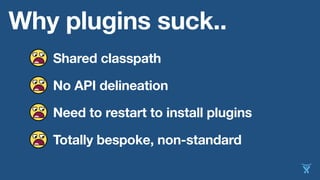
Why plugins suck..
Totally bespoke, non-standard
Need to restart to install plugins
No API delineation
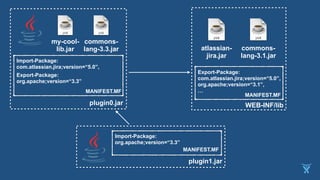
Shared classpath
OSGi
commons-
lang.jar
atlassian-
jira.jar
plugin0.jar plugin1.jar
WEB-INF/lib
my-cool-
lib.jar
commons-
lang-3.1.jar
atlassian-
jira.jar
WEB-INF/lib
Export-Package:
com.atlassian.jira;version=“5.0”,
org.apache;version=“3.1”,
…
MANIFEST.MF
Import-Package:
com.atlassian.jira;version=“5.0”,
MANIFEST.MF
Export-Package:
org.apache;version=“3.3”
plugin1.jar
Import-Package:
org.apache;version=“3.3”
MANIFEST.MF
my-cool-
lib.jar
plugin0.jar
commons-
lang-3.3.jar
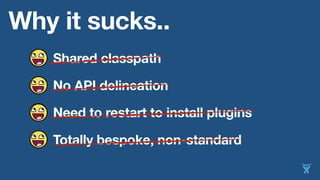
Why it sucks..
Totally bespoke, non-standard
Need to restart to install plugins
No API delineation
Shared classpath
Why it sucks..
OSGi is pretty
complicated
175Kb of text
JIRA Agile’s
MANIFEST.MF
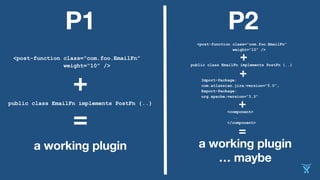
P1 P2
<post-function class=“com.foo.EmailFn”
weight=“10” />
public class EmailFn implements PostFn {..}
+
=
a working plugin
<post-function class=“com.foo.EmailFn”
weight=“10” />
public class EmailFn implements PostFn {..}
Import-Package:
com.atlassian.jira;version=“5.0”,
Export-Package:
org.apache;version=“3.3”
<component>
..
</component>
+
+
+
=
a working plugin
… maybe
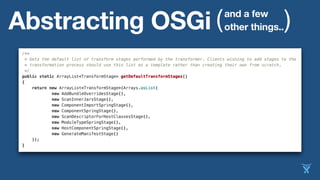
Abstracting OSGi and a few
other things..( )
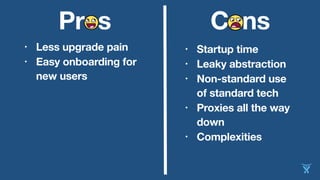
C nsPr s
• Less upgrade pain
• Easy onboarding for
new users
• Startup time
• Leaky abstraction
• Non-standard use
of standard tech
• Proxies all the way
down
• Complexities
Was it
worth it?
Probably.
Supporting
your ecosystem
Photo: Nicholas A. Tonelli
Good for devs!
Paint-by-numbers marketing
Pricing & licensing APIs
Feedback
Tracking & analytics
Good for customers!
Central authority for add-ons
Less fragmented UX
Ratings & reviews
Unified billing
Focus shifts from user to
vendor customization
Building a marketplace is
non-trivial
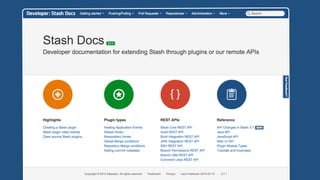
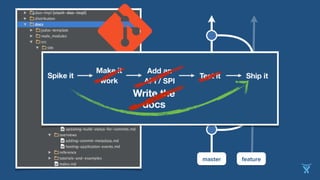
Tim’s top tip for dev docs
Keep your documentation as close to
the code as possible.
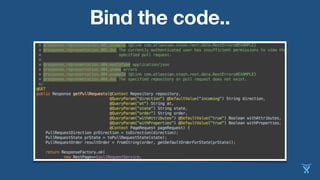
Bind the code..
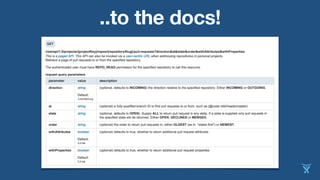
..to the docs!
master feature
Write the
docs
Code talks!
Make sure you have a simple process
for open sourcing and liberally
licensing example add-ons.
Meta-Developer Tools
Photo: Biser Todorov
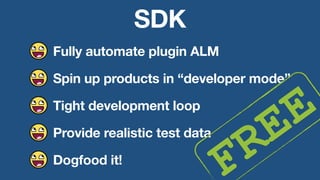
SDK
Fully automate plugin ALM
Spin up products in “developer mode”
Tight development loop
Provide realistic test data
Dogfood it!
FREE
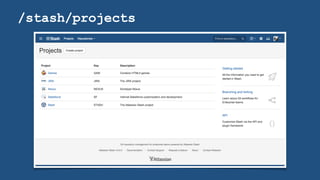
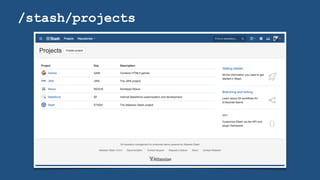
/stash/projects
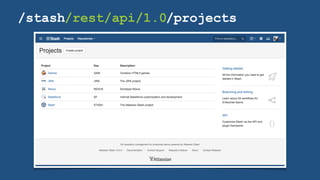
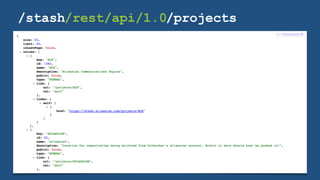
/stash/rest/api/1.0/projects
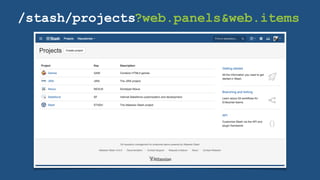
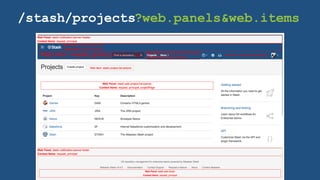
/stash/projects
?web.panels&web.items/stash/projects
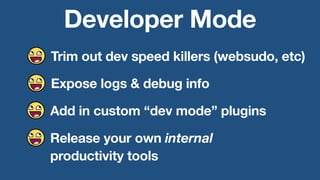
Developer Mode
Trim out dev speed killers (websudo, etc)
Expose logs & debug info
Release your own internal
productivity tools
Add in custom “dev mode” plugins
(2014)
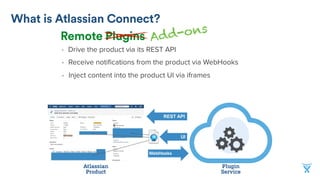
What is Atlassian Connect?
Remote Plugins
REST API
• Drive the product via its REST API
WebHooks
• Receive notifications from the product via WebHooks
• Inject content into the product UI via iframes
UI
Atlassian 

Product
Plugin
Service
Add-ons
Why?
Atlassian Cloud (SaaS)
Run 3rd party code out-of-process
Improved customization UX (yet again)
Architectural benefits
• Connect is a new layer on
top of the older plugin
model.
• Same Marketplace serves
up Connect plugins.
• Same plugins still available
in the Marketplace.
• Same REST APIs still
available for both Server
and Cloud.
• Connect adds a new mode
of integration.
Building up
http://housebeauty.net/dressy-modern-townhouse-design-with-rooftop-garden-and-glass-walls/eye-catching-green-
roofed-penthouse-apartment-rooftop-garden-with-deck-surrounded-by-glass-balustrades/#image-1
How?
Wherever a module is called, 

let a third-party inject a new feature.
remember web fragments
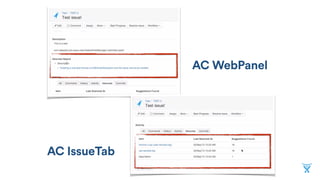
AC WebPanel
AC IssueTab
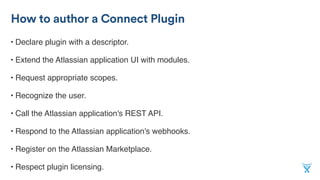
• Declare plugin with a descriptor.
• Extend the Atlassian application UI with modules.
• Request appropriate scopes.
• Recognize the user.
• Call the Atlassian application's REST API.
• Respond to the Atlassian application's webhooks.
• Register on the Atlassian Marketplace.
• Respect plugin licensing.
How to author a Connect Plugin
"name": "Hello World", "description": "…",
"key": "com.example.myaddon", "apiVersion": 1,
"baseUrl": "http://example.com/myaddon",
"modules": {
"generalPages": [{
"name": { "value": "Greeting" }, "key": "hello-world",
"location": "system.top.navigation.bar",
"url": "/helloworld.html"
}]
},
"scopes": [ "read", "write" ],
"authentication": { "type": "jwt" },
"lifecycle": { "installed": "/add-on-installed-callback" }
where it is hosted
which modules it uses
which scopes it needs
recognize the user
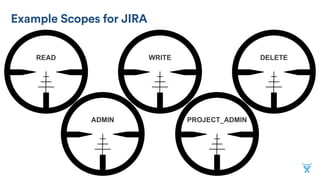
Example Scopes for JIRA
PROJECT_ADMIN
DELETEWRITE
ADMIN
READ
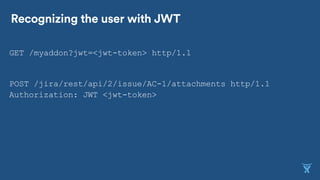
GET /myaddon?jwt=<jwt-token> http/1.1
POST /jira/rest/api/2/issue/AC-1/attachments http/1.1
Authorization: JWT <jwt-token>
Recognizing the user with JWT
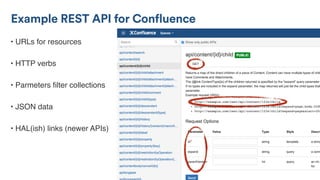
Example REST API for Confluence
• URLs for resources
• HTTP verbs
• Parmeters filter collections
• JSON data
• HAL(ish) links (newer APIs)
Example JIRA WebHooks
• HTTP callback to a URL
• Filtered by JQL
• When specific event occurs
"modules": {
"webhooks": [{
"event": "jira:issue_created",
"url": "/issue-created"
}]
}
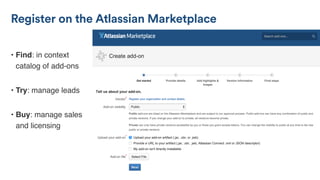
Register on the Atlassian Marketplace
• Find: in context
catalog of add-ons
• Try: manage leads
• Buy: manage sales
and licensing
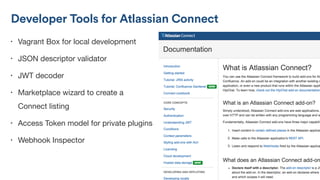
• Vagrant Box for local development

• JSON descriptor validator

• JWT decoder

• Marketplace wizard to create a
Connect listing

• Access Token model for private plugins

• Webhook Inspector
Developer Tools for Atlassian Connect
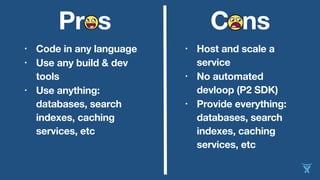
C nsPr s
• Code in any language
• Use any build & dev
tools
• Use anything:
databases, search
indexes, caching
services, etc
• Host and scale a
service
• No automated
devloop (P2 SDK)
• Provide everything:
databases, search
indexes, caching
services, etc
Why it’s awesome!
BYOS (Bring your own stack)
More services, than products
Sandboxing
UI Design
Aligned with microservice thinking
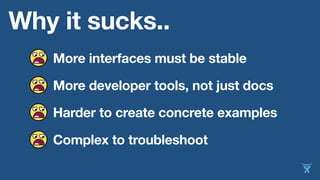
Why it sucks..
Complex to troubleshoot
Harder to create concrete examples
More developer tools, not just docs
More interfaces must be stable
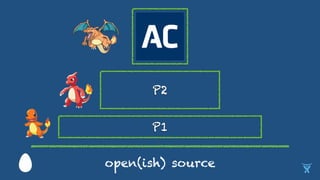
Remember
SPIs?
P1
open(ish) source
P2
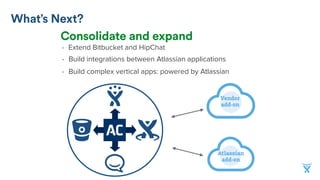
What’s Next?
Consolidate and expand
Vendor
add-on
• Extend Bitbucket and HipChat
• Build complex vertical apps: powered by Atlassian
• Build integrations between Atlassian applications
Atlassian
add-on
Questions?
A couple of Atlassians who are passionate about plugins
Tim Pettersen
Developer Provocateur
@kannonboy
Ian Buchanan
Developer Partisan
@devpartisan

Rewriting a Plugin Architecture 3 Times to Harness the API Economy