CURRICULUM IMPLEMENTATION DIVISION-SDO BATANGAS
Regional Memorandum No. 296, s. 2020
Guidelines on the Preparation of PIVOT ID-
E-A Lesson Exemplars, Section 9 states that
“In line with the preparation for the Opening
of Classes come August 24, 2020 all public
elementary and secondary school teachers
shall prepare their PIVOT Lesson Exemplars
beginning June 8, 2020.
CURRICULUM IMPLEMENTATION DIVISION-SDO BATANGAS
Contents:
1. Paradigm of IDEA and ICLEA
2. IDEA Framework
3. Paradigm of IDEA and 21st Century Skills
4. Comparison of DO 2 s. 2016 and RM 296 s.
2020 with the IDEA MODEL Outline and Key
points for Making the Exemplar
5. 21st century Skills Indicators of Performance
and the suggested assessments to meet for
each part of IDEA
6. 2C 2I R approaches and suggested activities
CURRICULUM IMPLEMENTATION DIVISION-SDO BATANGAS
INSTRUCTIONAL DESIGN USING MULTIMODAL LEARNING DELIVERY
COMMUNICATION
COLLABORATION
Portfolio
Assessment
CURRICULUM IMPLEMENTATION DIVISION-SDO BATANGAS
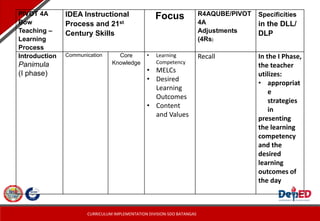
PIVOT 4A
Bow
Teaching –
Learning
Process
IDEA Instructional
Process and 21st
Century Skills
Focus R4AQUBE/PIVOT
4A
Adjustments
(4Rs)
Specificities
in the DLL/
DLP
Introduction
Panimula
(I phase)
Communication Core
Knowledge
• Learning
Competency
• MELCs
• Desired
Learning
Outcomes
• Content
and Values
Recall In the I Phase,
the teacher
utilizes:
• appropriat
e
strategies
in
presenting
the learning
competency
and the
desired
learning
outcomes of
the day
CURRICULUM IMPLEMENTATION DIVISION-SDO BATANGAS
PIVOT 4A
Bow
Teaching –
Learning
Process
IDEA Instructional
Process and 21st
Century Skills
Focus R4AQUBE/PIVOT
4A
Adjustments
(4Rs)
Specificities
in the DLL/
DLP
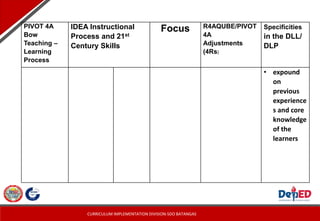
• expound
on
previous
experience
s and core
knowledge
of the
learners
CURRICULUM IMPLEMENTATION DIVISION-SDO BATANGAS
PIVOT 4A
Bow
Teaching –
Learning
Process
IDEA Instructional
Process and 21st
Century Skills
Focus R4AQUBE/PIVOT
4A
Adjustments
(4Rs)
Specificities
in the DLL/
DLP
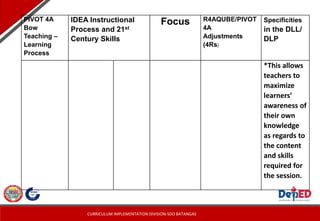
*This allows
teachers to
maximize
learners’
awareness of
their own
knowledge
as regards to
the content
and skills
required for
the session.
CURRICULUM IMPLEMENTATION DIVISION-SDO BATANGAS
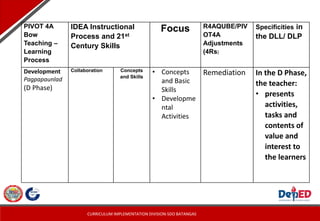
PIVOT 4A
Bow
Teaching –
Learning
Process
IDEA Instructional
Process and 21st
Century Skills
Focus R4AQUBE/PIV
OT4A
Adjustments
(4Rs)
Specificities in
the DLL/ DLP
Development
Pagpapaunlad
(D Phase)
Collaboration Concepts
and Skills
• Concepts
and Basic
Skills
• Developme
ntal
Activities
Remediation In the D Phase,
the teacher:
• presents
activities,
tasks and
contents of
value and
interest to
the learners
CURRICULUM IMPLEMENTATION DIVISION-SDO BATANGAS
PIVOT 4A
Bow
Teaching –
Learning
Process
IDEA Instructional
Process and 21st
Century Skills
Focus R4AQUBE/PI
VOT4A
Adjustments
(4Rs)
Specificities in the
DLL/ DLP
*Most of these
activities and
tasks must
simply and
directly revolved
around the
concepts to
develop and
master the skills
or the
competency
CURRICULUM IMPLEMENTATION DIVISION-SDO BATANGAS
PIVOT 4A
Bow
Teaching –
Learning
Process
IDEA Instructional
Process and 21st
Century Skills
Focus R4AQUBE/PIVO
T4A
Adjustments
(4Rs)
Specificities
in the DLL/
DLP
Engagement
Pakikipag
palihan
(E Phase)
Critical
Thinking
Cognitive
Tasks
-Learning
Opportunities
-Hands-on
Engaging
Activities
-Learning
Points
-Performance
or Output
Reflection In the E Phase,
the teacher:
-allows the
learners to be
engaged in
various tasks
and
opportunities
in building
their KSAVs to
meaningfully
connect their
learnings.
CURRICULUM IMPLEMENTATION DIVISION-SDO BATANGAS
PIVOT 4A Bow
Teaching –
Learning Process
IDEA Instructional
Process and 21st
Century Skills
Focus R4AQUBE/
PIVOT4A
Adjustment
s (4Rs)
Specificities in the
DLL/ DLP
This further
requires
teachers to:
-engage and
expose all
learners to real
life situations
that will ignite
their interests
to meet the
expectations
CURRICULUM IMPLEMENTATION DIVISION-SDO BATANGAS
PIVOT 4A Bow
Teaching –
Learning Process
IDEA Instructional
Process and 21st
Century Skills
Focus R4AQUBE/P
IVOT4A
Adjustment
s (4Rs)
Specificities in the
DLL/ DLP
-make their
performance
satisfactory
or produce a
product or
performance.
CURRICULUM IMPLEMENTATION DIVISION-SDO BATANGAS
PIVOT 4A Bow
Teaching –
Learning Process
IDEA Instructional
Process and 21st
Century Skills
Focus R4AQUBE/PIV
OT4A
Adjustments
(4Rs)
Specificities in the
DLL/ DLP
Assimilation
Paglalapat
(A Phase)
Creativity
and
Innovation
Compet
encies
Core
Values
and
Habits
of Mind
-Learning
Delivery
Outcomes
-New
Skills/New
-
Knowledge/Ide
a
Habits of
Mind
Life Skills
Relearning In the A Phase, the
teacher brings the
learners to a process
where they:
-demonstrate
ideas,
interpretations,
mind set or
values and
CURRICULUM IMPLEMENTATION DIVISION-SDO BATANGAS
PIVOT 4A Bow
Teaching –
Learning Process
IDEA Instructional
Process and 21st
Century Skills
Focus R4AQUBE
/PIVOT4A
Adjustme
nts (4Rs)
Specificities in the
DLL/ DLP
-create pieces
of
information that
will form part of
their knowledge
in reflecting,
relating or
using it
effectively in
any situation or
context.
CURRICULUM IMPLEMENTATION DIVISION-SDO BATANGAS
PIVOT 4A Bow
Teaching –
Learning Process
IDEA Instructional
Process and 21st
Century Skills
Focus R4AQUBE/
PIVOT4A
Adjustmen
ts (4Rs)
Specificities in the
DLL/ DLP
This also requires
teachers to:
-encourage
learners in
creating
conceptual
structures giving
them the avenue
to integrate new
and old learnings.
CURRICULUM IMPLEMENTATION DIVISION-SDO BATANGAS
DO 42, s. 2016 RM 296, s. 2020
I. Objectives
a. Content Standard
b. Performance
Standards
c. Learning
Competencies or
Objectives
I. Objectives
a. Most Essential
Learning
Competencies (MELC)
b. Enabling
Competencies
CURRICULUM IMPLEMENTATION DIVISION-SDO BATANGAS
DO 42, s. 2016
II. Content
RM 296, s. 2020
II. Content
III. Learning Resources
A. References
a. Teacher’s Guide Pages
b. Learner’s Material Pages
c. Textbook Pages
d. Additional Materials from
Learning Resource
B. Other Learning
Resources
III. Learning Resources
A. References
a. Teacher’s Guide Pages
b. Learner’s Material Pages
c. Textbook Pages
d. Additional Materials from
Learning Resource
B. List of Learning Resources
for Development and
Engagement
Activities
CURRICULUM IMPLEMENTATION DIVISION-SDO BATANGAS
IV. Procedures
a. Lesson Review
b. b. Purpose of the Lesson
c. Presentation of Samples
d. Discussion
e. Mastery Development
f. Application
g. Generalization and Abstraction
h. Evaluation
i. Additional Activities or
Remediation
IV. Procedures
a. Introduction
b. Development
c. Engagement
d. Assimilation
a
b
d
c
Comparison of DO 42 s.2016 and RM 296 s. 2020
CURRICULUM IMPLEMENTATION DIVISION-SDO BATANGAS
V. Remarks V. Reflection on the Type
of Formative
Assessment Used for
This Particular Lesson
Comparison of DO 42 s.2016 and RM 296 s. 2020
CURRICULUM IMPLEMENTATION DIVISION-SDO BATANGAS
CLOSER VIEW:
KEY POINTS TO WRITE THE
IDEA EXEMPLAR
CURRICULUM IMPLEMENTATION DIVISION-SDO BATANGAS
I. Objectives
CURRICULUM IMPLEMENTATION DIVISION-SDO BATANGAS
** Containing KSAV
Examples:
• Write clear instructions
• Present an argument for or against an
emotionally charged proposition
• Design a test for scientific questions
CURRICULUM IMPLEMENTATION DIVISION-SDO BATANGAS
II. Content
Content – Living Things
Core Content - Living things that can
move, eat, grow and
reproduce
Learning Context - Characteristics of
living things
CURRICULUM IMPLEMENTATION DIVISION-SDO BATANGAS
III. Learning Resources
A. References
a. Teacher’s Guide Pages
b. Learner’s Material Pages
c. Textbook Pages
d. Additional Materials from Learning Resource
B. List of Learning Resources for Development and
Engagement Activities
CURRICULUM IMPLEMENTATION DIVISION-SDO BATANGAS
Learner’s materials should be the module
and PIVOT 4A LM
Exemplar and Modules are aligned with
one another
Teacher’s material: Lesson Exemplar
CURRICULUM IMPLEMENTATION DIVISION-SDO BATANGAS
IV. Procedures
a. Introduction
b. Development
c. Engagement
d. Assimilation
CURRICULUM IMPLEMENTATION DIVISION-SDO BATANGAS
a. Introduction
CURRICULUM IMPLEMENTATION DIVISION-SDO BATANGAS
How will you present the lesson to all
types of learners?
CURRICULUM IMPLEMENTATION DIVISION-SDO BATANGAS
KEYPOINTS
Introduction:
Take into account the diversity of
learners
Communication Skills are embedded and
communicative skills activated
Must trigger the interest of the learners
CURRICULUM IMPLEMENTATION DIVISION-SDO BATANGAS
consider the principle of authentic learning (prior
knowledge can be based from the experience of the
learners)
make learning objectives obvious and objectives
must be close to achieving the learning outcome
express the context of learning (how they will use it
in real life)
KEYPOINTS
CURRICULUM IMPLEMENTATION DIVISION-SDO BATANGAS
consider the needs of the learners, their
attitudes and values
 appreciate the learners
clear and simple instructions directing
them to specific use in daily life
KEYPOINTS
CURRICULUM IMPLEMENTATION DIVISION-SDO BATANGAS
*Write clear instructions on how to change a
bicycle tire
*Present an argument for or against assisted
suicide
*Design fair test for scientific questions about
preferred habitats or bugs or ants
Examples of objectives in Introduction Phase:
CURRICULUM IMPLEMENTATION DIVISION-SDO BATANGAS
- Acknowledgement of ones abilities, interest and values
Activities in the introduction must be varied to cater different kinds of
learners:
1. Visual learners
2. Kinesthetic learners
3. Auditory learners
4. Stress learners
5. Ease learners
6. Scribble learners
7. Trust learners
8. Teach learners
9. Copy learners
the needs of the learners in the Introduction Phase:
CURRICULUM IMPLEMENTATION DIVISION-SDO BATANGAS
- Appreciation of the learners’ differences
The teachers should be conscious that the way
of teaching and learning now is new and
different from the traditional, so the teachers
should be careful in giving tasks. It must be in
the context of the learners and can be done
independently.
the needs of the learners in the Introduction Phase:
CURRICULUM IMPLEMENTATION DIVISION-SDO BATANGAS
- Clear simple instructions
Make the instructions easier to follow, and simpler to
understand.
Example:
For the first activity, get a piece of paper and a pen. I want
you to write the first three emotions/feelings you have felt
this morning.
Or:
Draw three emoticons that will show the three emotions you
felt this morning. Why did you feel it? Write a sentence
beside each emoticon.
CURRICULUM IMPLEMENTATION DIVISION-SDO BATANGAS
Parts of the Module in the
Introduction:
What I need to know?
What is new?
CURRICULUM IMPLEMENTATION DIVISION-SDO BATANGAS
INTRODUCTION
Core Content: BASIC NEEDS
GRADE LEVEL : GRADE 3 SCIENCE
• MOST ESSENTIAL LEARNING
COMPETENCY
• EXPLAIN THE USE OF WATER FROM
DIFFERENT SOURCES
• CONTEXT OF LEARNING
• SAVES WATER AND OTHER
RESOURCES AT HOME AND AT
SCHOOL IN THE CONTEXT OF
DAILY ACTIVITIES
DEPED CALABARZON - CLMD
Tell the uses of water
Describe the different sources of water
List the sources of water
State the uses of water
PRE REQUISITE SKILLS
CURRICULUM IMPLEMENTATION DIVISION-SDO BATANGAS
b. Development
CURRICULUM IMPLEMENTATION DIVISION-SDO BATANGAS
this part exposes the learner of what he knows, what
he knows but did not understand, and he does not
know
the teacher must expose the learners into three
activities corresponding to what he knew, what he
knew but did not understand, and he did not know
Collaboration is embedded in the development part
CURRICULUM IMPLEMENTATION DIVISION-SDO BATANGAS
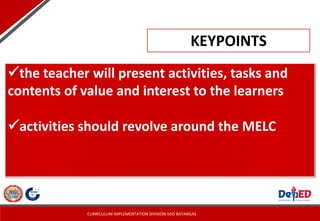
the teacher will present activities, tasks and
contents of value and interest to the learners
activities should revolve around the MELC
KEYPOINTS
CURRICULUM IMPLEMENTATION DIVISION-SDO BATANGAS
in the face to face delivery mode, the learners
should be grouped in such a way that their learning
levels are unidentified. They will work together to
strengthen collaborative work
 in the modular delivery most, it is reiterated that the
learners will deal with the 3 activities
KEYPOINTS
CURRICULUM IMPLEMENTATION DIVISION-SDO BATANGAS
the needs of the learners in the Development Phase:
-Directive assistance (first activity which
corresponds to what they know)
Cues:
In the module, the activity of the teacher must give
clear and simple step by step instruction on how
the activity is to be done
Example:
In the paragraph above, encircle the words you did
not understand
CURRICULUM IMPLEMENTATION DIVISION-SDO BATANGAS
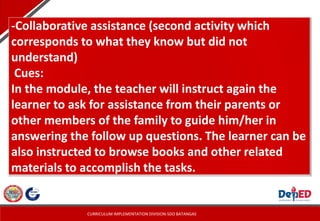
-Collaborative assistance (second activity which
corresponds to what they know but did not
understand)
Cues:
In the module, the teacher will instruct again the
learner to ask for assistance from their parents or
other members of the family to guide him/her in
answering the follow up questions. The learner can be
also instructed to browse books and other related
materials to accomplish the tasks.
CURRICULUM IMPLEMENTATION DIVISION-SDO BATANGAS
Example:
Now, let us play a game, we call it Chain of Knowledge.
Directions:
1. List all the difficult words you found in the paragraph.
2. Once the list is ready, set the timer of your cellphone or any gadget
in 5 minutes.
3. You will go around your house to ask help to discover the meaning
of the difficult words.
4. When the members of the family were able to answer one or some
of the words, give them a hug after saying Thank you.
5. Repeat steps nos. 3 and 4 until all your difficult words are unlocked.
6. Do not forget to set the timer before you start.
CURRICULUM IMPLEMENTATION DIVISION-SDO BATANGAS
Or:
After identifying the words you do not
understand, please ask your parents to assist
you to look for a book or any other reference
that will give you the meaning of the difficult
words.
CURRICULUM IMPLEMENTATION DIVISION-SDO BATANGAS
-Non Directive assistance (third activity which corresponds to what
they do not know)
Cues:
In the module, the teacher must supply other materials to support the
learning to master the MELC
Example:
Now, open the file I sent you with the filename: Activity1_unlockvocab
You will see there a song entitled “Let us Change for the better” by
Teresa Basilan. Read the poem and look for the words similar to the
one you have unlocked earlier. Then answer the questions with at least
2 to 3 sentences.
CURRICULUM IMPLEMENTATION DIVISION-SDO BATANGAS
Or:
Go to youtube using this link:
www.youtube.com/Letuschangeforthebetter
Follow the same instructions.
CURRICULUM IMPLEMENTATION DIVISION-SDO BATANGAS
Parts of the Module for
Development Phase:
What I know
What’s In?
What is it?
CURRICULUM IMPLEMENTATION DIVISION-SDO BATANGAS
c. Engagement
CURRICULUM IMPLEMENTATION DIVISION-SDO BATANGAS
In the old format of DLL, this is the deepening
part.
Critical Thinking is embedded.
The teacher allows the learners to be engaged
in various tasks and opportunities in building
their KSA to meaningfully connect their
learning to real life situations.
KEYPOINTS
CURRICULUM IMPLEMENTATION DIVISION-SDO BATANGAS
Note: the tasks must be connected with the
activities in the D.
The activities and learning of the learners
must be sustained
Follow up activities should be done for what
he knows, what he knows but did not
understand and what he does not know
KEYPOINTS
CURRICULUM IMPLEMENTATION DIVISION-SDO BATANGAS
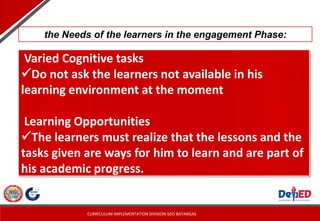
Varied Cognitive tasks
Do not ask the learners not available in his
learning environment at the moment
Learning Opportunities
The learners must realize that the lessons and the
tasks given are ways for him to learn and are part of
his academic progress.
the Needs of the learners in the engagement Phase:
CURRICULUM IMPLEMENTATION DIVISION-SDO BATANGAS
Real or relevant life tasks/ Varied Learning
spaces
 The modules must explicitly express the
reasons why the lessons are being taken
specifically its relevant to the context of real
life.
CURRICULUM IMPLEMENTATION DIVISION-SDO BATANGAS
Parts of the Module for the
Engagement Phase:
What’s more
What I can do
What other enrichment activities can I
engage in
CURRICULUM IMPLEMENTATION DIVISION-SDO BATANGAS
d. Assimilation
CURRICULUM IMPLEMENTATION DIVISION-SDO BATANGAS
Assimilation Phase
The teacher brings the learners to a process where they
develop ideas, interpretations, mindset or values and create
pieces of information that will form part of their knowledge in
reflecting, relating, or using them effectively in any situation or
context.
This phase requires teachers to encourage the learners in
creating conceptual structures giving them the opportunities to
integrate new and old learning.
Maximize their experiences and old learning.
KEYPOINTS
CURRICULUM IMPLEMENTATION DIVISION-SDO BATANGAS
Assimilation Phase
Reflection is strengthened.
Creativity is embedded.
****Realizations must be done in this part whether
directly or indirectly, implicit or explicit.
CURRICULUM IMPLEMENTATION DIVISION-SDO BATANGAS
- Community Contexts
This is the reason why we always mention that the activities from I
– D – E must be continuous, interrelated and connected. It must
lead to community context
-Processing time
Give enough time to the learners to do the tasks and process
them
-Acceptance
It is much easier to see the acceptance in F2F. But the
acceptance in the Modular approach will be reflected in the weekly
portfolio
the needs of the learners in the assimilation phase:
CURRICULUM IMPLEMENTATION DIVISION-SDO BATANGAS
What I have learned
What I can show
Parts of the Module for Assimilation phase:
CURRICULUM IMPLEMENTATION DIVISION-SDO BATANGAS
V. Reflection on the Type of
Formative Assessment Used for
This Particular Lesson
***The teacher will give simple and clear
instruction to accomplish this phase
CURRICULUM IMPLEMENTATION DIVISION-SDO BATANGAS
In the form of open ended statement
Example:
The teacher will ask the learners to write in
their notebook, journal or portfolio their
personal insights about the lesson using the
prompts below.
I understand that ______________.
I realize that __________________.
CURRICULUM IMPLEMENTATION DIVISION-SDO BATANGAS
21st century Skills Indicators of Performance
These are suggested assessments to meet for each part of IDEA
(INTRODUCTION PHASE)
Communication Skills
• Verbal Communications Skills
• Body Language
• Physical Communication
• Writing
• Visual Communication
• Humor
• Quick Wittedness
• Listening
• Presenting/Storytelling
• Interviewing
• Public Speaking
CURRICULUM IMPLEMENTATION DIVISION-SDO BATANGAS
21st century Skills Indicators of Performance
These are suggested assessments to meet for each part of IDEA
(DEVELOPMENT PHASE)
Collaboration Skills
•Leadership
•Team Building
•Strategic Planning
•Coaching and Mentoring
•Delegation
•Diplomacy
Responsiveness
•Influencing
•Selling
•Inspiring
•Persuasion
•Negotiation
•Collaboration
•Decision Making
•Supervising
CURRICULUM IMPLEMENTATION DIVISION-SDO BATANGAS
21st century Skills Indicators of Performance
These are suggested assessments to meet for each part of IDEA
(ENGAGEMENT PHASE)
Critical Thinking
• Networking
• Interpersonal Relationships
• Personal Branding
• Emotional Intelligence
• Self -awareness
• Emotional Management
• Adaptability
• Assertiveness
• Competitiveness
• Resilience
• Self - leadership
CURRICULUM IMPLEMENTATION DIVISION-SDO BATANGAS
21st century Skills Indicators of Performance
These are suggested assessments to meet for each part of IDEA
(ASSIMILATION PHASE)
Creativity
• Analysis
• Open-mindedness
• Problem Solving
• Organization
CURRICULUM IMPLEMENTATION DIVISION-SDO BATANGAS
LESSON EXEMPLAR

Plenary-IDEA-Orientation.pptx

  • 1.
  • 2.
  • 3.
  • 4.
    CURRICULUM IMPLEMENTATION DIVISION-SDOBATANGAS Regional Memorandum No. 296, s. 2020 Guidelines on the Preparation of PIVOT ID- E-A Lesson Exemplars, Section 9 states that “In line with the preparation for the Opening of Classes come August 24, 2020 all public elementary and secondary school teachers shall prepare their PIVOT Lesson Exemplars beginning June 8, 2020.
  • 5.
  • 6.
  • 7.
  • 8.
  • 9.
    CURRICULUM IMPLEMENTATION DIVISION-SDOBATANGAS Contents: 1. Paradigm of IDEA and ICLEA 2. IDEA Framework 3. Paradigm of IDEA and 21st Century Skills 4. Comparison of DO 2 s. 2016 and RM 296 s. 2020 with the IDEA MODEL Outline and Key points for Making the Exemplar 5. 21st century Skills Indicators of Performance and the suggested assessments to meet for each part of IDEA 6. 2C 2I R approaches and suggested activities
  • 10.
  • 11.
  • 12.
    CURRICULUM IMPLEMENTATION DIVISION-SDOBATANGAS INSTRUCTIONAL DESIGN USING MULTIMODAL LEARNING DELIVERY COMMUNICATION COLLABORATION Portfolio Assessment
  • 13.
  • 14.
    CURRICULUM IMPLEMENTATION DIVISION-SDOBATANGAS PIVOT 4A Bow Teaching – Learning Process IDEA Instructional Process and 21st Century Skills Focus R4AQUBE/PIVOT 4A Adjustments (4Rs) Specificities in the DLL/ DLP Introduction Panimula (I phase) Communication Core Knowledge • Learning Competency • MELCs • Desired Learning Outcomes • Content and Values Recall In the I Phase, the teacher utilizes: • appropriat e strategies in presenting the learning competency and the desired learning outcomes of the day
  • 15.
    CURRICULUM IMPLEMENTATION DIVISION-SDOBATANGAS PIVOT 4A Bow Teaching – Learning Process IDEA Instructional Process and 21st Century Skills Focus R4AQUBE/PIVOT 4A Adjustments (4Rs) Specificities in the DLL/ DLP • expound on previous experience s and core knowledge of the learners
  • 16.
    CURRICULUM IMPLEMENTATION DIVISION-SDOBATANGAS PIVOT 4A Bow Teaching – Learning Process IDEA Instructional Process and 21st Century Skills Focus R4AQUBE/PIVOT 4A Adjustments (4Rs) Specificities in the DLL/ DLP *This allows teachers to maximize learners’ awareness of their own knowledge as regards to the content and skills required for the session.
  • 17.
    CURRICULUM IMPLEMENTATION DIVISION-SDOBATANGAS PIVOT 4A Bow Teaching – Learning Process IDEA Instructional Process and 21st Century Skills Focus R4AQUBE/PIV OT4A Adjustments (4Rs) Specificities in the DLL/ DLP Development Pagpapaunlad (D Phase) Collaboration Concepts and Skills • Concepts and Basic Skills • Developme ntal Activities Remediation In the D Phase, the teacher: • presents activities, tasks and contents of value and interest to the learners
  • 18.
    CURRICULUM IMPLEMENTATION DIVISION-SDOBATANGAS PIVOT 4A Bow Teaching – Learning Process IDEA Instructional Process and 21st Century Skills Focus R4AQUBE/PI VOT4A Adjustments (4Rs) Specificities in the DLL/ DLP *Most of these activities and tasks must simply and directly revolved around the concepts to develop and master the skills or the competency
  • 19.
    CURRICULUM IMPLEMENTATION DIVISION-SDOBATANGAS PIVOT 4A Bow Teaching – Learning Process IDEA Instructional Process and 21st Century Skills Focus R4AQUBE/PIVO T4A Adjustments (4Rs) Specificities in the DLL/ DLP Engagement Pakikipag palihan (E Phase) Critical Thinking Cognitive Tasks -Learning Opportunities -Hands-on Engaging Activities -Learning Points -Performance or Output Reflection In the E Phase, the teacher: -allows the learners to be engaged in various tasks and opportunities in building their KSAVs to meaningfully connect their learnings.
  • 20.
    CURRICULUM IMPLEMENTATION DIVISION-SDOBATANGAS PIVOT 4A Bow Teaching – Learning Process IDEA Instructional Process and 21st Century Skills Focus R4AQUBE/ PIVOT4A Adjustment s (4Rs) Specificities in the DLL/ DLP This further requires teachers to: -engage and expose all learners to real life situations that will ignite their interests to meet the expectations
  • 21.
    CURRICULUM IMPLEMENTATION DIVISION-SDOBATANGAS PIVOT 4A Bow Teaching – Learning Process IDEA Instructional Process and 21st Century Skills Focus R4AQUBE/P IVOT4A Adjustment s (4Rs) Specificities in the DLL/ DLP -make their performance satisfactory or produce a product or performance.
  • 22.
    CURRICULUM IMPLEMENTATION DIVISION-SDOBATANGAS PIVOT 4A Bow Teaching – Learning Process IDEA Instructional Process and 21st Century Skills Focus R4AQUBE/PIV OT4A Adjustments (4Rs) Specificities in the DLL/ DLP Assimilation Paglalapat (A Phase) Creativity and Innovation Compet encies Core Values and Habits of Mind -Learning Delivery Outcomes -New Skills/New - Knowledge/Ide a Habits of Mind Life Skills Relearning In the A Phase, the teacher brings the learners to a process where they: -demonstrate ideas, interpretations, mind set or values and
  • 23.
    CURRICULUM IMPLEMENTATION DIVISION-SDOBATANGAS PIVOT 4A Bow Teaching – Learning Process IDEA Instructional Process and 21st Century Skills Focus R4AQUBE /PIVOT4A Adjustme nts (4Rs) Specificities in the DLL/ DLP -create pieces of information that will form part of their knowledge in reflecting, relating or using it effectively in any situation or context.
  • 24.
    CURRICULUM IMPLEMENTATION DIVISION-SDOBATANGAS PIVOT 4A Bow Teaching – Learning Process IDEA Instructional Process and 21st Century Skills Focus R4AQUBE/ PIVOT4A Adjustmen ts (4Rs) Specificities in the DLL/ DLP This also requires teachers to: -encourage learners in creating conceptual structures giving them the avenue to integrate new and old learnings.
  • 25.
  • 26.
    CURRICULUM IMPLEMENTATION DIVISION-SDOBATANGAS DO 42, s. 2016 RM 296, s. 2020 I. Objectives a. Content Standard b. Performance Standards c. Learning Competencies or Objectives I. Objectives a. Most Essential Learning Competencies (MELC) b. Enabling Competencies
  • 27.
    CURRICULUM IMPLEMENTATION DIVISION-SDOBATANGAS DO 42, s. 2016 II. Content RM 296, s. 2020 II. Content III. Learning Resources A. References a. Teacher’s Guide Pages b. Learner’s Material Pages c. Textbook Pages d. Additional Materials from Learning Resource B. Other Learning Resources III. Learning Resources A. References a. Teacher’s Guide Pages b. Learner’s Material Pages c. Textbook Pages d. Additional Materials from Learning Resource B. List of Learning Resources for Development and Engagement Activities
  • 28.
    CURRICULUM IMPLEMENTATION DIVISION-SDOBATANGAS IV. Procedures a. Lesson Review b. b. Purpose of the Lesson c. Presentation of Samples d. Discussion e. Mastery Development f. Application g. Generalization and Abstraction h. Evaluation i. Additional Activities or Remediation IV. Procedures a. Introduction b. Development c. Engagement d. Assimilation a b d c Comparison of DO 42 s.2016 and RM 296 s. 2020
  • 29.
    CURRICULUM IMPLEMENTATION DIVISION-SDOBATANGAS V. Remarks V. Reflection on the Type of Formative Assessment Used for This Particular Lesson Comparison of DO 42 s.2016 and RM 296 s. 2020
  • 30.
    CURRICULUM IMPLEMENTATION DIVISION-SDOBATANGAS CLOSER VIEW: KEY POINTS TO WRITE THE IDEA EXEMPLAR
  • 31.
  • 32.
    CURRICULUM IMPLEMENTATION DIVISION-SDOBATANGAS ** Containing KSAV Examples: • Write clear instructions • Present an argument for or against an emotionally charged proposition • Design a test for scientific questions
  • 33.
    CURRICULUM IMPLEMENTATION DIVISION-SDOBATANGAS II. Content Content – Living Things Core Content - Living things that can move, eat, grow and reproduce Learning Context - Characteristics of living things
  • 34.
    CURRICULUM IMPLEMENTATION DIVISION-SDOBATANGAS III. Learning Resources A. References a. Teacher’s Guide Pages b. Learner’s Material Pages c. Textbook Pages d. Additional Materials from Learning Resource B. List of Learning Resources for Development and Engagement Activities
  • 35.
    CURRICULUM IMPLEMENTATION DIVISION-SDOBATANGAS Learner’s materials should be the module and PIVOT 4A LM Exemplar and Modules are aligned with one another Teacher’s material: Lesson Exemplar
  • 36.
    CURRICULUM IMPLEMENTATION DIVISION-SDOBATANGAS IV. Procedures a. Introduction b. Development c. Engagement d. Assimilation
  • 37.
  • 38.
    CURRICULUM IMPLEMENTATION DIVISION-SDOBATANGAS How will you present the lesson to all types of learners?
  • 39.
    CURRICULUM IMPLEMENTATION DIVISION-SDOBATANGAS KEYPOINTS Introduction: Take into account the diversity of learners Communication Skills are embedded and communicative skills activated Must trigger the interest of the learners
  • 40.
    CURRICULUM IMPLEMENTATION DIVISION-SDOBATANGAS consider the principle of authentic learning (prior knowledge can be based from the experience of the learners) make learning objectives obvious and objectives must be close to achieving the learning outcome express the context of learning (how they will use it in real life) KEYPOINTS
  • 41.
    CURRICULUM IMPLEMENTATION DIVISION-SDOBATANGAS consider the needs of the learners, their attitudes and values  appreciate the learners clear and simple instructions directing them to specific use in daily life KEYPOINTS
  • 42.
    CURRICULUM IMPLEMENTATION DIVISION-SDOBATANGAS *Write clear instructions on how to change a bicycle tire *Present an argument for or against assisted suicide *Design fair test for scientific questions about preferred habitats or bugs or ants Examples of objectives in Introduction Phase:
  • 43.
    CURRICULUM IMPLEMENTATION DIVISION-SDOBATANGAS - Acknowledgement of ones abilities, interest and values Activities in the introduction must be varied to cater different kinds of learners: 1. Visual learners 2. Kinesthetic learners 3. Auditory learners 4. Stress learners 5. Ease learners 6. Scribble learners 7. Trust learners 8. Teach learners 9. Copy learners the needs of the learners in the Introduction Phase:
  • 44.
    CURRICULUM IMPLEMENTATION DIVISION-SDOBATANGAS - Appreciation of the learners’ differences The teachers should be conscious that the way of teaching and learning now is new and different from the traditional, so the teachers should be careful in giving tasks. It must be in the context of the learners and can be done independently. the needs of the learners in the Introduction Phase:
  • 45.
    CURRICULUM IMPLEMENTATION DIVISION-SDOBATANGAS - Clear simple instructions Make the instructions easier to follow, and simpler to understand. Example: For the first activity, get a piece of paper and a pen. I want you to write the first three emotions/feelings you have felt this morning. Or: Draw three emoticons that will show the three emotions you felt this morning. Why did you feel it? Write a sentence beside each emoticon.
  • 46.
    CURRICULUM IMPLEMENTATION DIVISION-SDOBATANGAS Parts of the Module in the Introduction: What I need to know? What is new?
  • 47.
    CURRICULUM IMPLEMENTATION DIVISION-SDOBATANGAS INTRODUCTION Core Content: BASIC NEEDS GRADE LEVEL : GRADE 3 SCIENCE • MOST ESSENTIAL LEARNING COMPETENCY • EXPLAIN THE USE OF WATER FROM DIFFERENT SOURCES • CONTEXT OF LEARNING • SAVES WATER AND OTHER RESOURCES AT HOME AND AT SCHOOL IN THE CONTEXT OF DAILY ACTIVITIES DEPED CALABARZON - CLMD Tell the uses of water Describe the different sources of water List the sources of water State the uses of water PRE REQUISITE SKILLS
  • 48.
  • 49.
  • 50.
  • 51.
    CURRICULUM IMPLEMENTATION DIVISION-SDOBATANGAS this part exposes the learner of what he knows, what he knows but did not understand, and he does not know the teacher must expose the learners into three activities corresponding to what he knew, what he knew but did not understand, and he did not know Collaboration is embedded in the development part
  • 52.
    CURRICULUM IMPLEMENTATION DIVISION-SDOBATANGAS the teacher will present activities, tasks and contents of value and interest to the learners activities should revolve around the MELC KEYPOINTS
  • 53.
    CURRICULUM IMPLEMENTATION DIVISION-SDOBATANGAS in the face to face delivery mode, the learners should be grouped in such a way that their learning levels are unidentified. They will work together to strengthen collaborative work  in the modular delivery most, it is reiterated that the learners will deal with the 3 activities KEYPOINTS
  • 54.
    CURRICULUM IMPLEMENTATION DIVISION-SDOBATANGAS the needs of the learners in the Development Phase: -Directive assistance (first activity which corresponds to what they know) Cues: In the module, the activity of the teacher must give clear and simple step by step instruction on how the activity is to be done Example: In the paragraph above, encircle the words you did not understand
  • 55.
    CURRICULUM IMPLEMENTATION DIVISION-SDOBATANGAS -Collaborative assistance (second activity which corresponds to what they know but did not understand) Cues: In the module, the teacher will instruct again the learner to ask for assistance from their parents or other members of the family to guide him/her in answering the follow up questions. The learner can be also instructed to browse books and other related materials to accomplish the tasks.
  • 56.
    CURRICULUM IMPLEMENTATION DIVISION-SDOBATANGAS Example: Now, let us play a game, we call it Chain of Knowledge. Directions: 1. List all the difficult words you found in the paragraph. 2. Once the list is ready, set the timer of your cellphone or any gadget in 5 minutes. 3. You will go around your house to ask help to discover the meaning of the difficult words. 4. When the members of the family were able to answer one or some of the words, give them a hug after saying Thank you. 5. Repeat steps nos. 3 and 4 until all your difficult words are unlocked. 6. Do not forget to set the timer before you start.
  • 57.
    CURRICULUM IMPLEMENTATION DIVISION-SDOBATANGAS Or: After identifying the words you do not understand, please ask your parents to assist you to look for a book or any other reference that will give you the meaning of the difficult words.
  • 58.
    CURRICULUM IMPLEMENTATION DIVISION-SDOBATANGAS -Non Directive assistance (third activity which corresponds to what they do not know) Cues: In the module, the teacher must supply other materials to support the learning to master the MELC Example: Now, open the file I sent you with the filename: Activity1_unlockvocab You will see there a song entitled “Let us Change for the better” by Teresa Basilan. Read the poem and look for the words similar to the one you have unlocked earlier. Then answer the questions with at least 2 to 3 sentences.
  • 59.
    CURRICULUM IMPLEMENTATION DIVISION-SDOBATANGAS Or: Go to youtube using this link: www.youtube.com/Letuschangeforthebetter Follow the same instructions.
  • 60.
    CURRICULUM IMPLEMENTATION DIVISION-SDOBATANGAS Parts of the Module for Development Phase: What I know What’s In? What is it?
  • 61.
  • 62.
    CURRICULUM IMPLEMENTATION DIVISION-SDOBATANGAS In the old format of DLL, this is the deepening part. Critical Thinking is embedded. The teacher allows the learners to be engaged in various tasks and opportunities in building their KSA to meaningfully connect their learning to real life situations. KEYPOINTS
  • 63.
    CURRICULUM IMPLEMENTATION DIVISION-SDOBATANGAS Note: the tasks must be connected with the activities in the D. The activities and learning of the learners must be sustained Follow up activities should be done for what he knows, what he knows but did not understand and what he does not know KEYPOINTS
  • 64.
    CURRICULUM IMPLEMENTATION DIVISION-SDOBATANGAS Varied Cognitive tasks Do not ask the learners not available in his learning environment at the moment Learning Opportunities The learners must realize that the lessons and the tasks given are ways for him to learn and are part of his academic progress. the Needs of the learners in the engagement Phase:
  • 65.
    CURRICULUM IMPLEMENTATION DIVISION-SDOBATANGAS Real or relevant life tasks/ Varied Learning spaces  The modules must explicitly express the reasons why the lessons are being taken specifically its relevant to the context of real life.
  • 66.
    CURRICULUM IMPLEMENTATION DIVISION-SDOBATANGAS Parts of the Module for the Engagement Phase: What’s more What I can do What other enrichment activities can I engage in
  • 67.
  • 68.
    CURRICULUM IMPLEMENTATION DIVISION-SDOBATANGAS Assimilation Phase The teacher brings the learners to a process where they develop ideas, interpretations, mindset or values and create pieces of information that will form part of their knowledge in reflecting, relating, or using them effectively in any situation or context. This phase requires teachers to encourage the learners in creating conceptual structures giving them the opportunities to integrate new and old learning. Maximize their experiences and old learning. KEYPOINTS
  • 69.
    CURRICULUM IMPLEMENTATION DIVISION-SDOBATANGAS Assimilation Phase Reflection is strengthened. Creativity is embedded. ****Realizations must be done in this part whether directly or indirectly, implicit or explicit.
  • 70.
    CURRICULUM IMPLEMENTATION DIVISION-SDOBATANGAS - Community Contexts This is the reason why we always mention that the activities from I – D – E must be continuous, interrelated and connected. It must lead to community context -Processing time Give enough time to the learners to do the tasks and process them -Acceptance It is much easier to see the acceptance in F2F. But the acceptance in the Modular approach will be reflected in the weekly portfolio the needs of the learners in the assimilation phase:
  • 71.
    CURRICULUM IMPLEMENTATION DIVISION-SDOBATANGAS What I have learned What I can show Parts of the Module for Assimilation phase:
  • 72.
    CURRICULUM IMPLEMENTATION DIVISION-SDOBATANGAS V. Reflection on the Type of Formative Assessment Used for This Particular Lesson ***The teacher will give simple and clear instruction to accomplish this phase
  • 73.
    CURRICULUM IMPLEMENTATION DIVISION-SDOBATANGAS In the form of open ended statement Example: The teacher will ask the learners to write in their notebook, journal or portfolio their personal insights about the lesson using the prompts below. I understand that ______________. I realize that __________________.
  • 74.
    CURRICULUM IMPLEMENTATION DIVISION-SDOBATANGAS 21st century Skills Indicators of Performance These are suggested assessments to meet for each part of IDEA (INTRODUCTION PHASE) Communication Skills • Verbal Communications Skills • Body Language • Physical Communication • Writing • Visual Communication • Humor • Quick Wittedness • Listening • Presenting/Storytelling • Interviewing • Public Speaking
  • 75.
    CURRICULUM IMPLEMENTATION DIVISION-SDOBATANGAS 21st century Skills Indicators of Performance These are suggested assessments to meet for each part of IDEA (DEVELOPMENT PHASE) Collaboration Skills •Leadership •Team Building •Strategic Planning •Coaching and Mentoring •Delegation •Diplomacy Responsiveness •Influencing •Selling •Inspiring •Persuasion •Negotiation •Collaboration •Decision Making •Supervising
  • 76.
    CURRICULUM IMPLEMENTATION DIVISION-SDOBATANGAS 21st century Skills Indicators of Performance These are suggested assessments to meet for each part of IDEA (ENGAGEMENT PHASE) Critical Thinking • Networking • Interpersonal Relationships • Personal Branding • Emotional Intelligence • Self -awareness • Emotional Management • Adaptability • Assertiveness • Competitiveness • Resilience • Self - leadership
  • 77.
    CURRICULUM IMPLEMENTATION DIVISION-SDOBATANGAS 21st century Skills Indicators of Performance These are suggested assessments to meet for each part of IDEA (ASSIMILATION PHASE) Creativity • Analysis • Open-mindedness • Problem Solving • Organization
  • 78.
  • 79.
  • 80.

Editor's Notes

  • #33 Here, teachers will construct objectives for him/her.