Product lifecycle
management
(PLCM) –
part 2
CATEGORISATION OF POST-APPROVAL
CMC CHANGES
ICH Q12
contact : gxpmatters@gmail.com
PRODUCT
LIFECYCLE
MANAGEMENT
(PLCM)
• Content
 Regulatory mechanism
 Regulatory system
 Regulatory categorisation
 Variations categorisation
 Harmonisation of categorisation
REGULATORY MECHANISM
• Timely manage and efficient introduction of CMC changes
• Efficient communication between MAH and regulatory authority
• A well characterised, risk-based categorisation
• Regulatory inspection may require, based on potential risk associated with
change(s)
REGULATORY SYSTEM
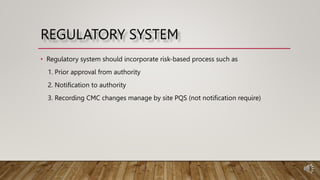
• Regulatory system should incorporate risk-based process such as
1. Prior approval from authority
2. Notification to authority
3. Recording CMC changes manage by site PQS (not notification require)
REGULATORY CATEGORISATION
• Prior Approval:
Potential high-risk changes to product requires prior approval
• Notification:
Moderate to low-risk changes to product requires notification to authority
• Changes within PQS
VARIATION CATEGORISATION
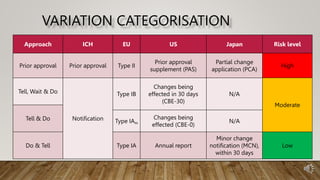
Approach ICH EU US Japan Risk level
Prior approval Prior approval Type II
Prior approval
supplement (PAS)
Partial change
application (PCA)
High
Tell, Wait & Do
Notification
Type IB
Changes being
effected in 30 days
(CBE-30)
N/A
Moderate
Tell & Do Type IAIN
Changes being
effected (CBE-0)
N/A
Do & Tell Type IA Annual report
Minor change
notification (MCN),
within 30 days
Low
HARMONISATION OF CATEGORISATION
• Facilitating the use of tools and enablers
• Lower category for request/notification
• Reporting in same/similar category
Follow gxpmatters

PLCM - Categorisation - ICHQ12.pptx

  • 1.
    Product lifecycle management (PLCM) – part2 CATEGORISATION OF POST-APPROVAL CMC CHANGES ICH Q12 contact : gxpmatters@gmail.com
  • 2.
    PRODUCT LIFECYCLE MANAGEMENT (PLCM) • Content  Regulatorymechanism  Regulatory system  Regulatory categorisation  Variations categorisation  Harmonisation of categorisation
  • 3.
    REGULATORY MECHANISM • Timelymanage and efficient introduction of CMC changes • Efficient communication between MAH and regulatory authority • A well characterised, risk-based categorisation • Regulatory inspection may require, based on potential risk associated with change(s)
  • 4.
    REGULATORY SYSTEM • Regulatorysystem should incorporate risk-based process such as 1. Prior approval from authority 2. Notification to authority 3. Recording CMC changes manage by site PQS (not notification require)
  • 5.
    REGULATORY CATEGORISATION • PriorApproval: Potential high-risk changes to product requires prior approval • Notification: Moderate to low-risk changes to product requires notification to authority • Changes within PQS
  • 6.
    VARIATION CATEGORISATION Approach ICHEU US Japan Risk level Prior approval Prior approval Type II Prior approval supplement (PAS) Partial change application (PCA) High Tell, Wait & Do Notification Type IB Changes being effected in 30 days (CBE-30) N/A Moderate Tell & Do Type IAIN Changes being effected (CBE-0) N/A Do & Tell Type IA Annual report Minor change notification (MCN), within 30 days Low
  • 7.
    HARMONISATION OF CATEGORISATION •Facilitating the use of tools and enablers • Lower category for request/notification • Reporting in same/similar category
  • 8.

Editor's Notes

  • #2 Hello Everyone, Today I will talk ICH Q12 product lifecycle management focusing on – categorisation of post-approval CMC changes in this part 2 video.
  • #3 In this part 2 video, I will talk about regulatory mechanism, regulatory system, regulatory categorisation, variation categorisation and Harmonisation of categorisation
  • #4 A good regulatory mechanism help to timely manage and efficient introduction of CMC changes A good regulatory mechanism set up, works between MAH and regulatory authority to manage the commercial phase CMC changes. A good mechanism helps MAH and Regulatory authority to carry out changes related communication, risk based categorisation and use of regulatory resource CMC changes vary from low to high potential risk with respect to product quality, safety and efficacy The regulatory communication category, supporting information/documentation requirements, and associated time frame for evaluation are commensurate with that potential risk. A regulatory inspection may require depends on the potential risk to product from changes.
  • #5 With these type of risked based changes, Regulatory authority expects associated information from MAH and authority decide timeframe for decision.
  • #6 Prior approval: Changes are considered to have sufficient risk (considered as a high risk) these changes require regulatory authority review and approval prior to implementation. These changes are require suitably detailed regulatory submission by the MAH. Notification: Moderate- to low-risk changes are not require prior approval and require less information to support these change. These changes are communicated to the regulatory authority as a formal notification that takes place within a defined period of time before or after implementation, according to regional requirements. A mechanism for immediate notification is useful when prior approval is not required, but timely awareness of the change by the regulator is considered necessary. PQS: the changes that are not required to be reported to regulators are only managed and documented within the PQS, but may be verified during routine or other inspection.
  • #7 Variation categorisation table shows the risk level of change and related region specific approach. High risk category change require prior approval before implementation of changes. Moderate risk category change require notification to regulatory authority before implementation and may require to wait for regulatory authority response before implementation of change like Type IB and CBE-30 change. Low risk category change only require notification to regulatory authority, this change can be notify after implementation like Type IA, Annual report . All changes should be categorised by risk approach and appropriately communicates with regulatory authority.
  • #8 Harmonisation toward a system of risk-based categorisation of post-approval changes is encouraged as an important step toward achieving the objectives ICHQ12. Such a system provides flexibility in regulatory approach and support additional regulatory opportunities Facilitating the use of tools and enablers are providing a range of request and notification categories available as a target for a lowering of regulatory submission requirements. Detail of each tool and enabler will cover in next few videos. The use of a lower category for request/notification if certain criteria/conditions are met and the relevant supporting documentation is provided as described in regional regulatory guidance; the need for regulatory inspection associated with the change may preclude the ability to use a lower category. Providing options for converging to the same or similar reporting category as that in other jurisdictions.
  • #9 Thank you for watching