ECED4080 Creating Materials for Use by Young Children


              Sample Album of Learning Task Documentation Entry

Learning Task: Play Dough Snake Letters

Description:
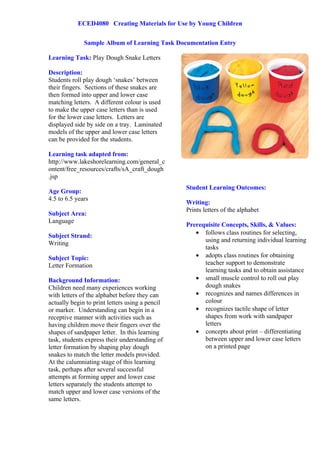
Students roll play dough ‘snakes’ between
their fingers. Sections of these snakes are
then formed into upper and lower case
matching letters. A different colour is used
to make the upper case letters than is used
for the lower case letters. Letters are
displayed side by side on a tray. Laminated
models of the upper and lower case letters
can be provided for the students.

Learning task adapted from:
http://www.lakeshorelearning.com/general_c
ontent/free_resources/crafts/sA_craft_dough
.jsp
                                                 Student Learning Outcomes:
Age Group:
4.5 to 6.5 years
                                                 Writing:
                                                 Prints letters of the alphabet
Subject Area:
Language
                                                 Prerequisite Concepts, Skills, & Values:
                                                    • follows class routines for selecting,
Subject Strand:
                                                       using and returning individual learning
Writing
                                                       tasks
Subject Topic:                                      • adopts class routines for obtaining
Letter Formation                                       teacher support to demonstrate
                                                       learning tasks and to obtain assistance
Background Information:                             • small muscle control to roll out play
Children need many experiences working                 dough snakes
with letters of the alphabet before they can        • recognizes and names differences in
actually begin to print letters using a pencil         colour
or marker. Understanding can begin in a             • recognizes tactile shape of letter
receptive manner with activities such as               shapes from work with sandpaper
having children move their fingers over the            letters
shapes of sandpaper letter. In this learning        • concepts about print – differentiating
task, students express their understanding of          between upper and lower case letters
letter formation by shaping play dough                 on a printed page
snakes to match the letter models provided.
At the calumniating stage of this learning
task, perhaps after several successful
attempts at forming upper and lower case
letters separately the students attempt to
match upper and lower case versions of the
same letters.
ECED4080 Creating Materials for Use by Young Children

                                                    •   Show the child how to overlay
Learning Theory & Instructional                         snake sections to form a letter
Strategy:                                               noting the starting position and
   • the activity follows the constructivist            naming the shapes.
       theory of learning in that the child         •   Say that lines can be straight down,
       learns about letter formation by                 diagonal or form circles.
       actually building the letters
                                                    •   show the child how to move the
       themselves.
                                                        play dough to the tray.
   • the instructional strategy is
       independent learning with self-           Play Dough Recipe:
       correction
                                                    • 250 ml flour
   • the teacher demonstrates the learning
                                                    • 125 ml salt
       task for the child initially, then the
                                                    • 250 ml water
       child works on his or her own
       perhaps working with the same task           • 30 ml vegetable oil
       for several days to reach the mastery        • 30 ml cream of tartar
       level.                                       • food colouring
                                                    • empty plastic containers
Student Characteristics Accommodated:               • parchment paper
   • accommodating both bodily
      kinesthetic and naturalistic               Instructions:
      intelligences underlie the design of       Mix the flour, salt, cream of tartar, and oil
      this activity as student enjoy the         together in a saucepan. Slowly add the
      texture, sight, and smell of the play      water to the mixture. Cook over medium
      dough and observe the shapes and           heat, stirring until the dough becomes stiff.
      patterns of the letters.                   Pour your dough onto a sheet of
   • the activity provides concrete              parchment paper. Set aside to cool. When
      experience leading to the more             the dough is cool, knead it with your hands
      abstract recognition and formation of      until it is pliable but not mushy. Add a
      printed letters.                           few drops of food colouring and knead
   • visually impaired students are aided        again to add colour to the dough.
      with the tactile feel of the letters and
      their large size                           Tools and equipment needed:
   • children only engage in this activity          • measuring utensils
      when it is developmentally                    • stirring spoon
      appropriate for them and are not              • saucepan
      forced to move along with the entire          • eye dropper (pipette)
      class or through the forced                   • stovetop burner
      progression, which is inherent to             • table
      printed workbooks                             • parchment paper

Introduction of the Learning Task:               Laminated Letter Sheets:
    • Show the child how to remove the             • associated file of English or Arabic
      activity tray from the shelf noting the         letters
      placement of each item.                      • computer printout each of the
    • Take the learning task to an open               pages of the file
      space at a table.                            • pages glued to card
    • Demonstrate how to roll a piece of           • letter cards laminated
      play dough between your fingers to
      form a long snake.
ECED4080 Creating Materials for Use by Young Children


Checklist of Tray Items:
   1. tray
   2. container of red play dough
   3. container of blue play dough
   4. container of yellow play dough
   5. laminated sheets of letters

Extension Activities:
   1. Students could go on to use
      paintbrush strokes to form letters of
      their names including a capital letter    Alternate Play Dough Letter Activity:
      at the beginning.                         For students who do not have the motor control
   2. Students could use a wet sponge to        to make play dough snakes into letters they
      form letters on concrete or a             could flatten the play dough into a sheet with a
      chalkboard.                               rolling pin and use cookie cutter letters and
   3. Students could use a large, thick         numbers to help form the letters.
      pencil to form letters and print their
      names.                                    Evaluation Rubric:
                                                  1. Has difficulty rolling play dough into
Enrichment Activities:                               snakes. Forms only a few line
  1. Students could use play dough to                strokes.
      form numerals.                              2. Forms letters with reversal and/or
  2. Students could use play dough snakes            missing strokes.
      to form geometric shapes.                   3. Forms most letters matching the models
  3. Students could use play dough snakes            provided.
      to build layered three-dimensional          4. Form all letters correctly matching the
      sculptures.                                    upper and lower cases.
Assessment Techniques:                          Vocabulary:
   1. Student compares play dough letters       letter, upper case, lower case, play dough,
      with printed models and self corrects.    snake, print, model, blue, red, & yellow.
   2. Instructor observes student while
      working and provides formative            References:
      feedback.                                 http://www.lakeshorelearning.com/general_co
   3. Instructor examines and analyzes          ntent/free_resources/crafts/sA_craft_dough.jsp
      finished product.
                                                Comments, Hints, & Suggestions:
Feedback Suggestions:                           Store play dough in airtight containers so that
   1. How could you make the snakes an          it does not dry out between uses.
      even thickness all the way along?
   2. What is different about this letter       Key Words:
      from the one on the printed sheet?        writing, letter formation, upper case, lower
   3. Which upper/lower case letter is not      case, play dough, self correct, & matching
      the same as the others?
   4. All of the upper/lower case letters are
      correct! Try to make the other set
      now.
   5. What are the upper/lower case
      letterforms for this letter?

Play dough snake letters

  • 1.
    ECED4080 Creating Materialsfor Use by Young Children Sample Album of Learning Task Documentation Entry Learning Task: Play Dough Snake Letters Description: Students roll play dough ‘snakes’ between their fingers. Sections of these snakes are then formed into upper and lower case matching letters. A different colour is used to make the upper case letters than is used for the lower case letters. Letters are displayed side by side on a tray. Laminated models of the upper and lower case letters can be provided for the students. Learning task adapted from: http://www.lakeshorelearning.com/general_c ontent/free_resources/crafts/sA_craft_dough .jsp Student Learning Outcomes: Age Group: 4.5 to 6.5 years Writing: Prints letters of the alphabet Subject Area: Language Prerequisite Concepts, Skills, & Values: • follows class routines for selecting, Subject Strand: using and returning individual learning Writing tasks Subject Topic: • adopts class routines for obtaining Letter Formation teacher support to demonstrate learning tasks and to obtain assistance Background Information: • small muscle control to roll out play Children need many experiences working dough snakes with letters of the alphabet before they can • recognizes and names differences in actually begin to print letters using a pencil colour or marker. Understanding can begin in a • recognizes tactile shape of letter receptive manner with activities such as shapes from work with sandpaper having children move their fingers over the letters shapes of sandpaper letter. In this learning • concepts about print – differentiating task, students express their understanding of between upper and lower case letters letter formation by shaping play dough on a printed page snakes to match the letter models provided. At the calumniating stage of this learning task, perhaps after several successful attempts at forming upper and lower case letters separately the students attempt to match upper and lower case versions of the same letters.
  • 2.
    ECED4080 Creating Materialsfor Use by Young Children • Show the child how to overlay Learning Theory & Instructional snake sections to form a letter Strategy: noting the starting position and • the activity follows the constructivist naming the shapes. theory of learning in that the child • Say that lines can be straight down, learns about letter formation by diagonal or form circles. actually building the letters • show the child how to move the themselves. play dough to the tray. • the instructional strategy is independent learning with self- Play Dough Recipe: correction • 250 ml flour • the teacher demonstrates the learning • 125 ml salt task for the child initially, then the • 250 ml water child works on his or her own perhaps working with the same task • 30 ml vegetable oil for several days to reach the mastery • 30 ml cream of tartar level. • food colouring • empty plastic containers Student Characteristics Accommodated: • parchment paper • accommodating both bodily kinesthetic and naturalistic Instructions: intelligences underlie the design of Mix the flour, salt, cream of tartar, and oil this activity as student enjoy the together in a saucepan. Slowly add the texture, sight, and smell of the play water to the mixture. Cook over medium dough and observe the shapes and heat, stirring until the dough becomes stiff. patterns of the letters. Pour your dough onto a sheet of • the activity provides concrete parchment paper. Set aside to cool. When experience leading to the more the dough is cool, knead it with your hands abstract recognition and formation of until it is pliable but not mushy. Add a printed letters. few drops of food colouring and knead • visually impaired students are aided again to add colour to the dough. with the tactile feel of the letters and their large size Tools and equipment needed: • children only engage in this activity • measuring utensils when it is developmentally • stirring spoon appropriate for them and are not • saucepan forced to move along with the entire • eye dropper (pipette) class or through the forced • stovetop burner progression, which is inherent to • table printed workbooks • parchment paper Introduction of the Learning Task: Laminated Letter Sheets: • Show the child how to remove the • associated file of English or Arabic activity tray from the shelf noting the letters placement of each item. • computer printout each of the • Take the learning task to an open pages of the file space at a table. • pages glued to card • Demonstrate how to roll a piece of • letter cards laminated play dough between your fingers to form a long snake.
  • 3.
    ECED4080 Creating Materialsfor Use by Young Children Checklist of Tray Items: 1. tray 2. container of red play dough 3. container of blue play dough 4. container of yellow play dough 5. laminated sheets of letters Extension Activities: 1. Students could go on to use paintbrush strokes to form letters of their names including a capital letter Alternate Play Dough Letter Activity: at the beginning. For students who do not have the motor control 2. Students could use a wet sponge to to make play dough snakes into letters they form letters on concrete or a could flatten the play dough into a sheet with a chalkboard. rolling pin and use cookie cutter letters and 3. Students could use a large, thick numbers to help form the letters. pencil to form letters and print their names. Evaluation Rubric: 1. Has difficulty rolling play dough into Enrichment Activities: snakes. Forms only a few line 1. Students could use play dough to strokes. form numerals. 2. Forms letters with reversal and/or 2. Students could use play dough snakes missing strokes. to form geometric shapes. 3. Forms most letters matching the models 3. Students could use play dough snakes provided. to build layered three-dimensional 4. Form all letters correctly matching the sculptures. upper and lower cases. Assessment Techniques: Vocabulary: 1. Student compares play dough letters letter, upper case, lower case, play dough, with printed models and self corrects. snake, print, model, blue, red, & yellow. 2. Instructor observes student while working and provides formative References: feedback. http://www.lakeshorelearning.com/general_co 3. Instructor examines and analyzes ntent/free_resources/crafts/sA_craft_dough.jsp finished product. Comments, Hints, & Suggestions: Feedback Suggestions: Store play dough in airtight containers so that 1. How could you make the snakes an it does not dry out between uses. even thickness all the way along? 2. What is different about this letter Key Words: from the one on the printed sheet? writing, letter formation, upper case, lower 3. Which upper/lower case letter is not case, play dough, self correct, & matching the same as the others? 4. All of the upper/lower case letters are correct! Try to make the other set now. 5. What are the upper/lower case letterforms for this letter?