427-347 B.C
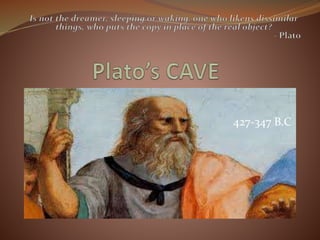
Plato was one of the greatest Philosopher who
conceptualized democracy and wrote it in his book
Republic
Plato was both a writer and a teacher. His writings
are in the form of dialogues, with Socrates as the
principal speaker. This discussion format has
become known as Socratic dialogue.
 The two political Power then were Oligarchies and
Democrats.
 Even today these two parties are known by different
names but they represent the Rich and the well to do
peoples party and the People’s or poor people’s party.
About Plato
The visible world is what surrounds us: what we see, what
we hear, what we experience; this visible world is a world of
change and uncertainty.
The intelligible world is made up of
the unchanging products of human
reason: anything arising from reason
alone, such as abstract definitions or
mathematics, makes up this
intelligible world, which is the world
of reality.
The intelligible world contains the
eternal "Forms" (in Greek, idea ) of
things.
Plato’s theory of Forms
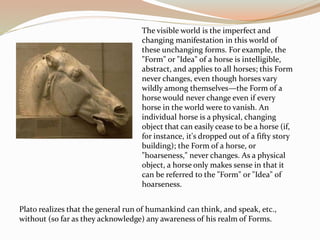
The visible world is the imperfect and
changing manifestation in this world of
these unchanging forms. For example, the
"Form" or "Idea" of a horse is intelligible,
abstract, and applies to all horses; this Form
never changes, even though horses vary
wildly among themselves—the Form of a
horse would never change even if every
horse in the world were to vanish. An
individual horse is a physical, changing
object that can easily cease to be a horse (if,
for instance, it's dropped out of a fifty story
building); the Form of a horse, or
"hoarseness," never changes. As a physical
object, a horse only makes sense in that it
can be referred to the "Form" or "Idea" of
hoarseness.
Plato realizes that the general run of humankind can think, and speak, etc.,
without (so far as they acknowledge) any awareness of his realm of Forms.
Plato’s Allegory
Plato describes in his work Republic an
allegory which is worth understanding.
Initially it may look funny and irrelevant
but the end will be shocking and absolutely
true.
Its relevance to Indian political context is
also Discussed
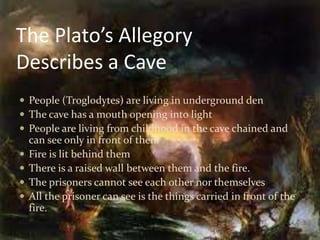
The Plato’s Allegory
Describes a Cave
 People (Troglodytes) are living in underground den
 The cave has a mouth opening into light
 People are living from childhood in the cave chained and
can see only in front of them
 Fire is lit behind them
 There is a raised wall between them and the fire.
 The prisoners cannot see each other nor themselves
 All the prisoner can see is the things carried in front of the
fire.
 In the wall a puppets are moving and its shadow falls on
the wall in front of the Prisoners
 When puppets talk the prisoners think shadows are real
and talking.
 The prisoners are caught in the world of illusion.
 If prisoner is released and forced to turn his neck, the fire
will be a pain in his eyes.
 Will he not be in pain to see those things which are casting
their shadow.
ON THE WALL
WHAT IS
HAPPENING
HERE
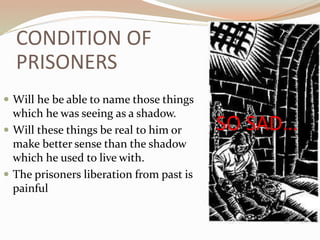
 Will he be able to name those things
which he was seeing as a shadow.
 Will these things be real to him or
make better sense than the shadow
which he used to live with.
 The prisoners liberation from past is
painful
CONDITION OF
PRISONERS
SO SAD…
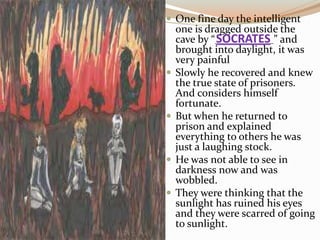
 One fine day the intelligent
one is dragged outside the
cave by “ ” and
brought into daylight, it was
very painful
 Slowly he recovered and knew
the true state of prisoners.
And considers himself
fortunate.
 But when he returned to
prison and explained
everything to others he was
just a laughing stock.
 He was not able to see in
darkness now and was
wobbled.
 They were thinking that the
sunlight has ruined his eyes
and they were scarred of going
to sunlight.
SOCRATES
Meaning of this Allegory.
 The shadow is the Notion of things (Like people living in
foreign and their culture).
 There is no need to check this out in real world. So
everybody thinks that notions are real things.
 When released people can see the puppets and the
shadows and understand the difference.
 When he moves from cave to sunlight then it is dramatic.
Then he gets ideas.
 The world outside the cave is abstract ideas.
 The sunlight according to Socrates symbolizes the intrinsic
beauty or Quality in all object which is more empirical
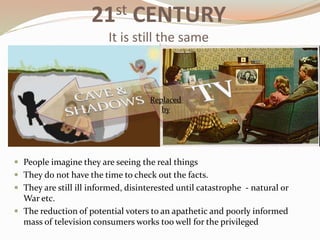
 People imagine they are seeing the real things
 They do not have the time to check out the facts.
 They are still ill informed, disinterested until catastrophe - natural or
War etc.
 The reduction of potential voters to an apathetic and poorly informed
mass of television consumers works too well for the privileged
Replaced
by
21st CENTURY
It is still the same
Troglodytes
Republics view of democratic man
 He lives from day to day indulging the appetite of the
hour, and sometimes he is lapped in drink and strains
of the flute; then he becomes a water-drinker, and tries
to get thin; then he takes a turn at gymnastics;
sometimes idling and neglecting everything, then once
more living the life of a philosopher; often he is busy
with politics, and starts to his feet and says and does
whatever comes into his head; and, if he is emulous of
any one who is a warrior, off he is in that direction, or
of men of business, once more in that. His life has
neither law nor order; and this distracted existence he
terms joy and bliss and freedom; and so he goes on.
Can you believe this book
was written 2500 yrs. Back?
Modern
Political thoughts
 One Party thinks to make us fool by just
presenting an ideal image of future of
INDIA. But that’s not reality.
 On the other hand, Second Party is giving power to
the citizens in form of their “Rights” so that they
can see the actual position or the reality of the
country.
The question whether the demos can and should be
relied upon to make the right decisions in complex
and dangerous situations is still an intriguing one.
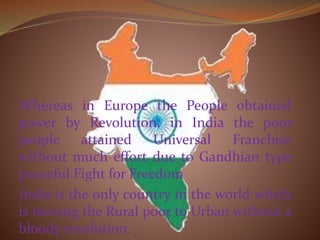
Whereas in Europe the People obtained
power by Revolution, in India the poor
people attained Universal Franchise
without much effort due to Gandhian type
peaceful Fight for Freedom
India is the only country in the world which
is moving the Rural poor to Urban without a
bloody revolution.
The key knowledge issues for us are:
 The world revealed by our senses is not the real
world but only a poor copy of it (our sensory
organs are limited, but also our mental ability to
interpret what the brain receives is limited)
 real world can only be apprehended intellectually
(in our minds)
 this requires active thought: we need to direct our
minds toward what is real and important and to
apprehend it for ourselves (not be shown)
How valuable is this model of knowledge acquisition?
By:- Mr. AkshayMaheshwari
Sec:- K1

Plato's Cave

  • 2.
  • 3.
    Plato was oneof the greatest Philosopher who conceptualized democracy and wrote it in his book Republic Plato was both a writer and a teacher. His writings are in the form of dialogues, with Socrates as the principal speaker. This discussion format has become known as Socratic dialogue.  The two political Power then were Oligarchies and Democrats.  Even today these two parties are known by different names but they represent the Rich and the well to do peoples party and the People’s or poor people’s party. About Plato
  • 4.
    The visible worldis what surrounds us: what we see, what we hear, what we experience; this visible world is a world of change and uncertainty. The intelligible world is made up of the unchanging products of human reason: anything arising from reason alone, such as abstract definitions or mathematics, makes up this intelligible world, which is the world of reality. The intelligible world contains the eternal "Forms" (in Greek, idea ) of things. Plato’s theory of Forms
  • 5.
    The visible worldis the imperfect and changing manifestation in this world of these unchanging forms. For example, the "Form" or "Idea" of a horse is intelligible, abstract, and applies to all horses; this Form never changes, even though horses vary wildly among themselves—the Form of a horse would never change even if every horse in the world were to vanish. An individual horse is a physical, changing object that can easily cease to be a horse (if, for instance, it's dropped out of a fifty story building); the Form of a horse, or "hoarseness," never changes. As a physical object, a horse only makes sense in that it can be referred to the "Form" or "Idea" of hoarseness. Plato realizes that the general run of humankind can think, and speak, etc., without (so far as they acknowledge) any awareness of his realm of Forms.
  • 6.
    Plato’s Allegory Plato describesin his work Republic an allegory which is worth understanding. Initially it may look funny and irrelevant but the end will be shocking and absolutely true. Its relevance to Indian political context is also Discussed
  • 7.
    The Plato’s Allegory Describesa Cave  People (Troglodytes) are living in underground den  The cave has a mouth opening into light  People are living from childhood in the cave chained and can see only in front of them  Fire is lit behind them  There is a raised wall between them and the fire.  The prisoners cannot see each other nor themselves  All the prisoner can see is the things carried in front of the fire.
  • 9.
     In thewall a puppets are moving and its shadow falls on the wall in front of the Prisoners  When puppets talk the prisoners think shadows are real and talking.  The prisoners are caught in the world of illusion.  If prisoner is released and forced to turn his neck, the fire will be a pain in his eyes.  Will he not be in pain to see those things which are casting their shadow. ON THE WALL
  • 10.
  • 11.
     Will hebe able to name those things which he was seeing as a shadow.  Will these things be real to him or make better sense than the shadow which he used to live with.  The prisoners liberation from past is painful CONDITION OF PRISONERS SO SAD…
  • 12.
     One fineday the intelligent one is dragged outside the cave by “ ” and brought into daylight, it was very painful  Slowly he recovered and knew the true state of prisoners. And considers himself fortunate.  But when he returned to prison and explained everything to others he was just a laughing stock.  He was not able to see in darkness now and was wobbled.  They were thinking that the sunlight has ruined his eyes and they were scarred of going to sunlight. SOCRATES
  • 13.
    Meaning of thisAllegory.
  • 14.
     The shadowis the Notion of things (Like people living in foreign and their culture).  There is no need to check this out in real world. So everybody thinks that notions are real things.  When released people can see the puppets and the shadows and understand the difference.  When he moves from cave to sunlight then it is dramatic. Then he gets ideas.  The world outside the cave is abstract ideas.  The sunlight according to Socrates symbolizes the intrinsic beauty or Quality in all object which is more empirical
  • 16.
     People imaginethey are seeing the real things  They do not have the time to check out the facts.  They are still ill informed, disinterested until catastrophe - natural or War etc.  The reduction of potential voters to an apathetic and poorly informed mass of television consumers works too well for the privileged Replaced by 21st CENTURY It is still the same
  • 17.
    Troglodytes Republics view ofdemocratic man  He lives from day to day indulging the appetite of the hour, and sometimes he is lapped in drink and strains of the flute; then he becomes a water-drinker, and tries to get thin; then he takes a turn at gymnastics; sometimes idling and neglecting everything, then once more living the life of a philosopher; often he is busy with politics, and starts to his feet and says and does whatever comes into his head; and, if he is emulous of any one who is a warrior, off he is in that direction, or of men of business, once more in that. His life has neither law nor order; and this distracted existence he terms joy and bliss and freedom; and so he goes on. Can you believe this book was written 2500 yrs. Back?
  • 18.
    Modern Political thoughts  OneParty thinks to make us fool by just presenting an ideal image of future of INDIA. But that’s not reality.  On the other hand, Second Party is giving power to the citizens in form of their “Rights” so that they can see the actual position or the reality of the country. The question whether the demos can and should be relied upon to make the right decisions in complex and dangerous situations is still an intriguing one.
  • 19.
    Whereas in Europethe People obtained power by Revolution, in India the poor people attained Universal Franchise without much effort due to Gandhian type peaceful Fight for Freedom India is the only country in the world which is moving the Rural poor to Urban without a bloody revolution.
  • 20.
    The key knowledgeissues for us are:  The world revealed by our senses is not the real world but only a poor copy of it (our sensory organs are limited, but also our mental ability to interpret what the brain receives is limited)  real world can only be apprehended intellectually (in our minds)  this requires active thought: we need to direct our minds toward what is real and important and to apprehend it for ourselves (not be shown) How valuable is this model of knowledge acquisition?
  • 21.