Planning Training for Distance Running: Part One
Planning Training for Distance Running
Bill Peyton
Jan 27, 2016
"The most important part of the
environment for aspiring distance runners
is the few inches between their ears. The
best thing about having a coach is that they
can tell you when to back off," says the
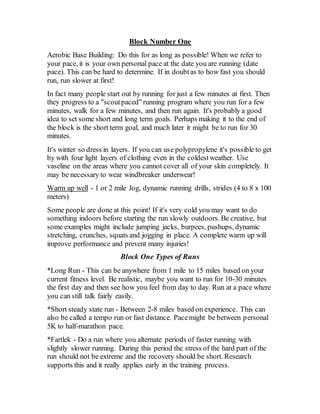
legendary Paul Geis, who ran for Oregon
with Steve Prefontaine and almost beat that
superstar several times. Geis (pronounced
Gis) ran 13:23 for 5000 meters when tracks
were mostly cinder and dirt in 1974!
The following will not be a complete plan
for being a great distance runner. Training
can be simple, but life is not simple, and
certainly cannot be covered in even a large
book!
What we hope to do here is to give you a
basis for study on planning your best
approachto training for running the 800, 1600, 3200, and 5000 meters.
PART ONE: A Simple Plan
Part one is a general consensus of how to train for the whole year. Then part
two has examples and opinions from experts which back up these steps. In
part three you can do your own internet study of various sources to devise
the most brilliant individualized training for winning distance running!
A state champion might, in some cases have to make this harder than it is
laid out. A novice may have to scale it down! Run and stretch every day if
possible while considering that you make the greatest gains during your
recovery. Sleep, eating well, and hydration are also crucial.
Block Number One
Aerobic Base Building: Do this for as long as possible! When we refer to
your pace, it is your own personal pace at the date you are running (date
pace). This can be hard to determine. If in doubtas to how fast you should
run, run slower at first!
In fact many people start out by running for just a few minutes at first. Then
they progress to a "scoutpaced" running program where you run for a few
minutes, walk for a few minutes, and then run again. It's probably a good
idea to set some short and long term goals. Perhaps making it to the end of
the block is the short term goal, and much later it might be to run for 30
minutes.
It's winter so dress in layers. If you can use polypropylene it's possible to get
by with four light layers of clothing even in the coldestweather. Use
vaseline on the areas where you cannot cover all of your skin completely. It
may be necessary to wear windbreaker underwear!
Warm up well - 1 or 2 mile Jog, dynamic running drills, strides (4 to 8 x 100
meters)
Some people are done at this point! If it's very cold you may want to do
something indoors before starting the run slowly outdoors. Be creative, but
some examples might include jumping jacks, burpees, pushups, dynamic
stretching, crunches, squats and jogging in place. A complete warm up will
improve performance and prevent many injuries!
Block One Types of Runs
*Long Run - This can be anywhere from 1 mile to 15 miles based on your
current fitness level. Be realistic, maybe you want to run for 10-30 minutes
the first day and then see how you feel from day to day. Run at a pace where
you can still talk fairly easily.
*Short steady state run - Between 2-8 miles based on experience. This can
also be called a tempo run or fast distance. Pacemight be between personal
5K to half-marathon pace.
*Fartlek - Do a run where you alternate periods of faster running with
slightly slower running. During this period the stress of the hard part of the
run should not be extreme and the recovery should be short. Research
supports this and it really applies early in the training process.
Example of how to do fartlek runs - You could run about 200 meters (the
distance between about three telephone poles) at slightly faster than mile
pace, jog 100 meters, and then run 200 meters again. Repeat this for about 2-
3 miles at first. We try to keep the stress level medium high during the run
and do not allow a lot of recovery time. This is still a hard workout for
beginners and you might have to keep the total distance short, especially if
you make the run phase too hard. One of your goals is to do this so you can
add to the total distance. It does not do much good to run so hard that you
tucker out before getting a good aerobic effect.
Example of how not to do fartlek runs - We do not want to run nearly all out
during the run portion and then have a long recovery. If you ran 100 yards at
200 meter pace, and then followed it with a 600 meter jog, and then
repeated, that would be too hard with too much recovery to be effective for
long distance running. We do have to be careful of ice, though, and if that
means keeping the recovery long sometimes, by all means do it!
*Speed Development - One day per week, if you can find a place indoors,
you can work on true speed development. 10 x 100 meters or shorter with a
walk between is an example of this type of training. Jumping ropemay be a
good idea but save bounding and jumping for soft surfaces.
*Hill Run - One or two days per week include hills in one of the runs that
you do. It is also advantageous to use a hill on the speed development day.
The besttype of hill for a distance runner is one that is not too steep, but
allows for a gradual climb over 100 yards or so. Steep hills are for power
and have their place in a sprinter's program. Al Tappe, former Minnesota
runner claims that down hill running on a gradual hill can improve 400
speed. Watch out for that ice, though!
Warm down well. This is similar to the warm up but it's good to add some
static stretching here.
Block Number Two
Block number one should last at least ten weeks. This means that block two
will not start until the track season begins! If you have to make a choice
between working too hard and under training, take it easy and enjoy your
running. Perhaps you will have to do a lot of jogging in Block One before
the season begins. If you do not do Block One, then you had better take it
easy on some of the coach's work out days!
*Warm up - Do a long warm up as in Block One!
*Long Run - Continue this for the first month of the season. All components
of training are developed if this run is long enough. Do not attempt to speed
this run up and run shorter! It's possible that this run will have to be done on
your own during the weekend.
*Shorter steady state runs - Do these 3-6 mile runs for the first month of the
season. After that you may want to make one of them a tempo run.
*Speed Development Day - Hill running for the first month. The second
month you might begin sprints, bounding, and other power related exercises.
As anything else start out with just a few! In general speed work outdoors
when it's colder than 50 degrees is not recommended.
*Fartlek, Tempo, or Interval day - These should be done with a heavy
emphasis on the aerobic system. We never want to stray far from the aerobic
base.
Block Number Three
With 5 weeks before the big race, we probably want to start doing some
specific training towards our main distance. This training could include the
races the athlete runs.
Many high schoolstudents run too many races. One meet per week is
enough!
Aerobic runs and speed training should continue in this phase but you cut
back a little on the speed training to include another interval/fartlek day. An
interval day could include running repetitions around an unmeasured area,
untimed, without counting the number done. The recovery should be nearly
full and the athlete should quit when they are pleasantly tired. We do not
want to run our best race in practice!
More Articles In Series
Planning Training for Distance Running: Part Two
Planning Training for Distance Running
Bill Peyton
Jan 28, 2016
PART TWO: What experts say about training for distance running
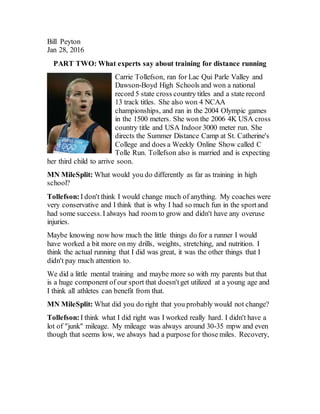
Carrie Tollefson, ran for Lac Qui Parle Valley and
Dawson-Boyd High Schools and won a national
record 5 state cross country titles and a state record
13 track titles. She also won 4 NCAA
championships, and ran in the 2004 Olympic games
in the 1500 meters. She won the 2006 4K USA cross
country title and USA Indoor 3000 meter run. She
directs the Summer Distance Camp at St. Catherine's
College and does a Weekly Online Show called C
Tolle Run. Tollefson also is married and is expecting
her third child to arrive soon.
MN MileSplit: What would you do differently as far as training in high
school?
Tollefson: I don't think I would change much of anything. My coaches were
very conservative and I think that is why I had so much fun in the sportand
had some success.I always had room to grow and didn't have any overuse
injuries.
Maybe knowing now how much the little things do for a runner I would
have worked a bit more on my drills, weights, stretching, and nutrition. I
think the actual running that I did was great, it was the other things that I
didn't pay much attention to.
We did a little mental training and maybe more so with my parents but that
is a huge component of our sport that doesn'tget utilized at a young age and
I think all athletes can benefit from that.
MN MileSplit: What did you do right that you probably would not change?
Tollefson: I think what I did right was I worked really hard. I didn't have a
lot of "junk" mileage. My mileage was always around 30-35 mpw and even
though that seems low, we always had a purposefor those miles. Recovery,
tempo, intervals, long run, and
race day all had a meaning and
it kept me focused and again,
having fun with a sportthat can
be life long.
I also think my coaches and
parents were good about letting
me be a kid at the same time as
being elite. We took it seriously
but we also goofed off, ate cake
after hill repeats, made sure to
have days off and I was
allowed to play lots of other
sports in the off seasons.
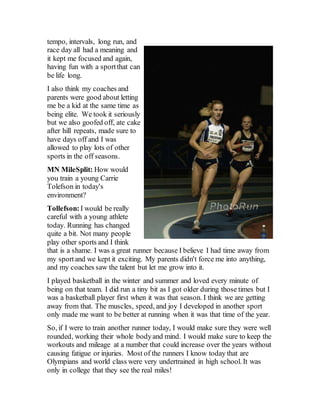
MN MileSplit: How would
you train a young Carrie
Tolefson in today's
environment?
Tollefson: I would be really
careful with a young athlete
today. Running has changed
quite a bit. Not many people
play other sports and I think
that is a shame. I was a great runner because I believe I had time away from
my sportand we kept it exciting. My parents didn't force me into anything,
and my coaches saw the talent but let me grow into it.
I played basketball in the winter and summer and loved every minute of
being on that team. I did run a tiny bit as I got older during those times but I
was a basketball player first when it was that season. I think we are getting
away from that. The muscles, speed, and joy I developed in another sport
only made me want to be better at running when it was that time of the year.
So, if I were to train another runner today, I would make sure they were well
rounded, working their whole bodyand mind. I would make sure to keep the
workouts and mileage at a number that could increase over the years without
causing fatigue or injuries. Most of the runners I know today that are
Olympians and world class were very undertrained in high school. It was
only in college that they see the real miles!
MN MileSplit: What precautions would you give high schoolfemales in
regards to training?
Tollefson: I am about to have my third baby and I have always shared with
coaches and athletes that life after competition is so important. We have to
take care of ourselves. As a girl and woman, we have the ability to have
physical signs that we are healthy and getting enough nutrients each month.
It is really important to stay on top of those signs. Being at a healthy weight
and managing our nutrients is HUGE for both males and females.
But if young girls and women want to be great athletes and become mothers
one day, they have to be smart early on. If we do not have those physical
signs, then we run the risk of injuries or fatigue issues and both of those do
not do anything for our racing and training.
This isn't an easy sport, but it is so rewarding when we stay true to
ourselves, and make sure we are taking care of ourselves. It is not a sportto
abuse in a way that we hurt ourselves and I encourage every athlete, coach,
and parent to be aware of anything that does not feel or look right.
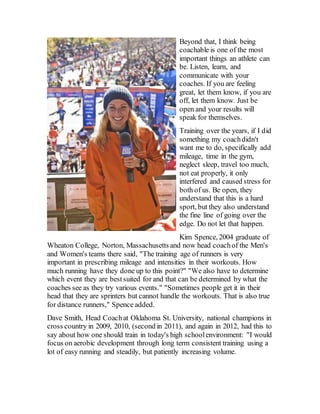
Beyond that, I think being
coachable is one of the most
important things an athlete can
be. Listen, learn, and
communicate with your
coaches. If you are feeling
great, let them know, if you are
off, let them know. Just be
open and your results will
speak for themselves.
Training over the years, if I did
something my coachdidn't
want me to do, specifically add
mileage, time in the gym,
neglect sleep, travel too much,
not eat properly, it only
interfered and caused stress for
both of us. Be open, they
understand that this is a hard
sport, but they also understand
the fine line of going over the
edge. Do not let that happen.
Kim Spence, 2004 graduate of
Wheaton College, Norton, Massachusetts and now head coachof the Men's
and Women's teams there said, "The training age of runners is very
important in prescribing mileage and intensities in their workouts. How
much running have they done up to this point?" "We also have to determine
which event they are bestsuited for and that can be determined by what the
coaches see as they try various events." "Sometimes people get it in their
head that they are sprinters but cannot handle the workouts. That is also true
for distance runners," Spence added.
Dave Smith, Head Coachat Oklahoma St. University, national champions in
cross country in 2009, 2010, (second in 2011), and again in 2012, had this to
say about how one should train in today's high schoolenvironment: "I would
focus on aerobic development through long term consistent training using a
lot of easy running and steadily, but patiently increasing volume.
"I would also work on light quick running in the forms of stride outs, hill
repeats, or repetitions of 200-300 meters with full recovery. I would spend a
lot of time training by feel and less time looking at a watch. I would use a lot
of perceived effort fartleks and tempo runs where the emphasis is never on
actual pace. I wouldn't spend a lot of time on the track grinding out gut
busting workouts."
What coachmeans by "strides outs" are short gradual buildups to a sprint at
a distance short of 100 meters. Watch other runners do these.
In college, Smith worked very hard, running 90-100 miles per week. But it
was not just the mileage. "I always trained with presumption that the harder I
worked, and the more I did, the better I would become. If my coachwrote
down 5 x mile @ 4:40, I would try to run them in 4:30! I constantly made
the mistake of trying to race everything." Unfortunately, even today a lot of
runners make this mistake!
"As a coach, I think I have been much better than I was as an athlete. It's
kind of like the old saying, 'doctorsmake the worst patients.' It's much easier
to look at the athletes I coach from an objective perspective and see what
needs to be done (or in my own case, not done). In my coaching career, I
have focused on a lot of submaximal running and only very rarely, do I have
athletes train at the same intensities with which we expect them to race. Not
every coachsees it that way, and there are a lot of very successfulcoaches
that use more high intensity training than I do. But I would not change the
aspectof the way we do things," Smith concluded.
Smith credits Jack Daniel's bookas having influenced him to train runners
this way: "If your goal is to run a 4:00 mile, do not do 4:00 mile workouts.
Instead, start at your current fitness level which might be 4:20. When you
can do the type of work a 4:20 miler can do then attempt what a 4:15 level
would be."
"A huge part of being a successfuldistance runner is learning how to relax
and concentrate when you are tired. Many runners are often nervous before
and during competition and these emotions can exacerbate fatigue and
discomfort. If you can stay relaxed, poised, and focus on the job at hand you
can beat many runners who have more ability or fitness. Ryan Vail is an
example of this type of runner. This is something that can be learned,
practiced, and perfected. At Okahoma State University we work on it a lot!,"
exclaimed Smith.
"The greatest limiting factor on a distance runner is the aerobic fitness level,
we do not ever want to get far away from that,"said Arthur Lydiard "Speed
must be worked on all year long but be careful of doing too much hard
anaerobic training as you will get injured or sick, " is another of Lydiard's
maxim's.
(Pure speed training is not hard anaerobic training. Whether you run 10 x
100 or 10 x 400, they both would be considered anaerobic, however Lydiard
is talking about 10 x 400 being very tough on the body, especially if you
push the pace. For runners with a base there is a time and place for 10 x 400!
According to Lydiard you do 10 x 100 type training all year.)
Lydiard was known as the "Father of Distance Running." He is from a little
island called New Zealand not much larger than the state of Colorado and
the 76th largest in the world.
Yet this tiny country had two gold medalists; Peter Snell 800 meters, and
Murray Halberg 5000 meters, and Bronze medalist Barry Magee in the
marathon in the 1960 Olympics. In 1964 they did even better with the 5'10"
180' Snell winning both the 800 and 1500, John Davies getting the bronze in
the 1500, and Marise Chamberlain claiming the bronze in the only long
distance event for women, the 800 meters. Between 1956 and 1965 New
Zealand middle and long-distance runners bettered or equaled 23 world
records or world best times.
Lydiard is known the world over and is rumored to have actually coached in
the following countries: New Zealand, Australia, Finland, Mexico,
Venezuela, Japan, Great Britain, South Africa, Kenya, Ethiopia, and the
USA among many other places. The Lydiard Athletics Club in South Africa
is the only athletics club to be named after a coach.
Most experts agree that a beginning runner must first develop a distance
base of many miles before they are ready for the faster running. A high
schoolfreshman starts out at around 10 miles per week. In general a senior
in high schoolis running between 30 to 80 miles per week. A champion
runner will want to run every day. It's not that hard to build a base if one
improves the level by less than 10% per week. This is the way to go if you
expect to be any good.
Ideally what you want to do is develop aerobically and improve speed at the
same time. This can be done if one does not overload the anaerobic system.
Work such as 6 x 800 meters is bestleft for time spent with a coach.
"Arthur Lydiard is highly critical of the American system. He teaches that
by emphasizing hard anaerobic training, we are destroying the potential of
our runners. According to Lydiard, anaerobic activity alters the body's pH
levels (alkaline vs. acid), and leads to a physical breakdown over time.
What's more, he boldly states that anaerobic training does nothing at all to
enhance performance, nor does it increase human speed. (He sees speed
development as a factor of increased muscle strength due to resistance
running such as hill training). Anaerobic training simply teaches how to run
in oxygen debt." John Raucci, TullyRunners.com Author That is a direct
quote but I believe Lydiard means the overdoing of this system!
Please take into consideration that the oxidative (aerobic) need of distance
events are: 400 meters - 30%, 800 meters - 55%, 1600 meters - 70%, 3200
meters - 85%, and 5000 meters - 90%. The oxidative need for an event goes
up if the athlete is slower. Forexample a 2:15 800 is more oxidative than a
1:55 800!
Jeff Jirele was a very good distance runner at Austin, MN High School
having run a 1:56.59 880 and a 4:26 mile. He also ran cross countryand
finished 22nd in the state meet. This was run almost exclusively on an
interval running program. "I needed to lift weights and run in the mornings
when I was in high school," Jirele admitted.
Then at Golden Valley Junior College, Jirele was in a high mileage program
of up to 130 miles per week. This resulted in three individual junior college
titles for him; one in cross country and two in the mile run.
Then he transferred to the University of Illinois and was in a well-rounded
program. He ran 1:51.1 in the 880 and 4:00.3 in the mile. In 1978 the year
after he graduated he ran a 3:58.3 in the mile. "What I needed to do in
college is to have more positive thinking and larger goals," Jirele stated.
Al Tappe ran for New Richland-Hartland High Schoolin the mid-1970s. He
ran 4:22 for the mile as a senior there. In high schoolthey did a lot of fartlek,
long runs, tag, and they did accelerations after almost every practice. Tappe
had an outstanding prep career and said that his coach kept it fun even
though they ran lots of miles. Tappeexperienced continual improvement in
the 440 meter dash in high schoolbecause of the mileage, speed, and
downhill running they did.
Tappesaid, "We always ran against the wind on the way out in our distance
runs and on our return we had the wind at our back. We also ran down a
long, gradual, hill near campus. These things led to our increased speed!"
Tappeincreased his speed in the 440 to 51.4 by the end of his senior year.
Jim Ryun, the former 3:51.1 miler, out of Kansas, was another one who used
improving 440 times to help him out at other distances, including cross
country.
Then at the University of Minnesota Tapperan for Roy Griak, the former
Pan Am Games coach. Under Griak the mileage was about the same as he
ran in high school, but the intensity went up. The fact you ran against better
competition was also a motivating factor. He would have doneeven better if
he didn't occasionally leave his best races in practice! "Garry Bjorkland and
others were so tough in the interval workouts, and it was easy to get pulled
along at their pace, rather than a more reasonable pace," exclaimed Tappe.
Despite this he ran 4:01 for the mile and is still on the All-Time Top Ten for
the 4 x 1600 meter relay.
Sometimes we find that small town kids are intimidated by large school
teams. According to Tappethis is a purely mental thing that can be
overcome. In addition research has shown that runners from Kenya and
Ethiopia do not have any physical advantages. Their culture and
expectations are different. Americans need to quit being intimidated just
because someone is from eastern Africa!
Spence was a good sprinter as a freshman and gained All-American honors
in the 4 x 400 relay early in her running career. She found that she enjoyed
the longer distance workouts so she joined the cross countryteam. After that
she made All-American in the 800 meter run and 3000 meter steeplechase.
Spence said that developing her aerobic system also made her faster in the
shorter distances!
Geis, from Texas originally, was a tennis player in middle school. He feels
that this gave him a base for his eventual running career. When he changed
to cross country and track & field he was trained by a coachwho followed
the Mihaly Igloi system. Igloi's plan usually consisted of running many
different speeds over short distances with very short jogging breaks between.
They did do a few long runs every week and the total volume was
consistently very high.
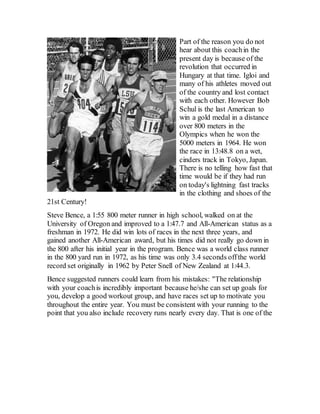
Part of the reason you do not
hear about this coachin the
present day is because of the
revolution that occurred in
Hungary at that time. Igloi and
many of his athletes moved out
of the country and lost contact
with each other. However Bob
Schul is the last American to
win a gold medal in a distance
over 800 meters in the
Olympics when he won the
5000 meters in 1964. He won
the race in 13:48.8 on a wet,
cinders track in Tokyo, Japan.
There is no telling how fast that
time would be if they had run
on today's lightning fast tracks
in the clothing and shoes of the
21st Century!
Steve Bence, a 1:55 800 meter runner in high school, walked on at the
University of Oregon and improved to a 1:47.7 and All-American status as a
freshman in 1972. He did win lots of races in the next three years, and
gained another All-American award, but his times did not really go down in
the 800 after his initial year in the program. Bence was a world class runner
in the 800 yard run in 1972, as his time was only 3.4 seconds offthe world
record set originally in 1962 by Peter Snell of New Zealand at 1:44.3.
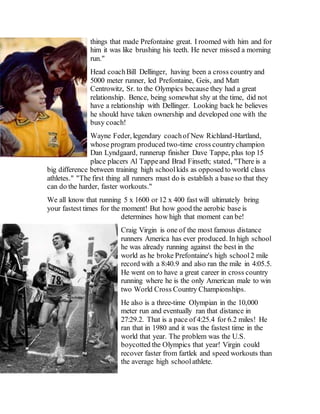
Bence suggested runners could learn from his mistakes: "The relationship
with your coachis incredibly important because he/she can set up goals for
you, develop a good workout group, and have races set up to motivate you
throughout the entire year. You must be consistent with your running to the
point that you also include recovery runs nearly every day. That is one of the
things that made Prefontaine great. I roomed with him and for
him it was like brushing his teeth. He never missed a morning
run."
Head coachBill Dellinger, having been a cross country and
5000 meter runner, led Prefontaine, Geis, and Matt
Centrowitz, Sr. to the Olympics because they had a great
relationship. Bence, being somewhat shy at the time, did not
have a relationship with Dellinger. Looking back he believes
he should have taken ownership and developed one with the
busy coach!
Wayne Feder, legendary coachof New Richland-Hartland,
whose program produced two-time cross countrychampion
Dan Lyndgaard, runnerup finisher Dave Tappe, plus top 15
place placers Al Tappeand Brad Finseth; stated, "There is a
big difference between training high schoolkids as opposed to world class
athletes." "The first thing all runners must do is establish a baseso that they
can do the harder, faster workouts."
We all know that running 5 x 1600 or 12 x 400 fast will ultimately bring
your fastest times for the moment! But how good the aerobic base is
determines how high that moment can be!
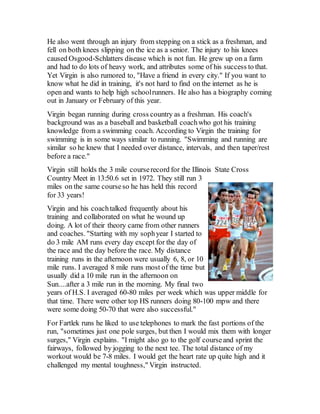
Craig Virgin is one of the most famous distance
runners America has ever produced. In high school
he was already running against the best in the
world as he broke Prefontaine's high school2 mile
record with a 8:40.9 and also ran the mile in 4:05.5.
He went on to have a great career in cross country
running where he is the only American male to win
two World Cross Country Championships.
He also is a three-time Olympian in the 10,000
meter run and eventually ran that distance in
27:29.2. That is a pace of 4:25.4 for 6.2 miles! He
ran that in 1980 and it was the fastest time in the
world that year. The problem was the U.S.
boycotted the Olympics that year! Virgin could
recover faster from fartlek and speed workouts than
the average high schoolathlete.
He also went through an injury from stepping on a stick as a freshman, and
fell on both knees slipping on the ice as a senior. The injury to his knees
caused Osgood-Schlatters disease which is not fun. He grew up on a farm
and had to do lots of heavy work, and attributes some of his success to that.
Yet Virgin is also rumored to, "Have a friend in every city." If you want to
know what he did in training, it's not hard to find on the internet as he is
open and wants to help high schoolrunners. He also has a biography coming
out in January or February of this year.
Virgin began running during cross country as a freshman. His coach's
background was as a baseball and basketball coachwho got his training
knowledge from a swimming coach. According to Virgin the training for
swimming is in some ways similar to running. "Swimming and running are
similar so he knew that I needed over distance, intervals, and then taper/rest
before a race."
Virgin still holds the 3 mile courserecord for the Illinois State Cross
Country Meet in 13:50.6 set in 1972. They still run 3
miles on the same courseso he has held this record
for 33 years!
Virgin and his coachtalked frequently about his
training and collaborated on what he wound up
doing. A lot of their theory came from other runners
and coaches. "Starting with my sophyear I started to
do 3 mile AM runs every day except for the day of
the race and the day before the race. My distance
training runs in the afternoon were usually 6, 8, or 10
mile runs. I averaged 8 mile runs most of the time but
usually did a 10 mile run in the afternoon on
Sun....after a 3 mile run in the morning. My final two
years of H.S. I averaged 60-80 miles per week which was upper middle for
that time. There were other top HS runners doing 80-100 mpw and there
were some doing 50-70 that were also successful."
For Fartlek runs he liked to use telephones to mark the fast portions of the
run, "sometimes just one pole surges, but then I would mix them with longer
surges," Virgin explains. "I might also go to the golf courseand sprint the
fairways, followed by jogging to the next tee. The total distance of my
workout would be 7-8 miles. I would get the heart rate up quite high and it
challenged my mental toughness," Virgin instructed.
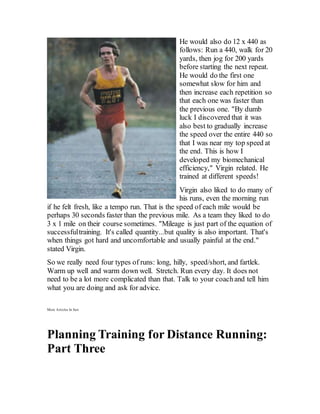
He would also do 12 x 440 as
follows: Run a 440, walk for 20
yards, then jog for 200 yards
before starting the next repeat.
He would do the first one
somewhat slow for him and
then increase each repetition so
that each one was faster than
the previous one. "By dumb
luck I discovered that it was
also best to gradually increase
the speed over the entire 440 so
that I was near my top speed at
the end. This is how I
developed my biomechanical
efficiency," Virgin related. He
trained at different speeds!
Virgin also liked to do many of
his runs, even the morning run
if he felt fresh, like a tempo run. That is the speed of each mile would be
perhaps 30 seconds faster than the previous mile. As a team they liked to do
3 x 1 mile on their course sometimes. "Mileage is just part of the equation of
successfultraining. It's called quantity...but quality is also important. That's
when things got hard and uncomfortable and usually painful at the end."
stated Virgin.
So we really need four types of runs: long, hilly, speed/short, and fartlek.
Warm up well and warm down well. Stretch. Run every day. It does not
need to be a lot more complicated than that. Talk to your coachand tell him
what you are doing and ask for advice.
More Articles In Seri
Planning Training for Distance Running:
Part Three
Planning Training for Distance Running
Bill Peyton
Jan 29, 2016
Part Three: Internet Study
Systems of Distance Running (The dates shown are ballpark figures)
Distance Racing - Late 1800s GreatBritain
Before there were any track meets there were professional races of all types
including walking, distance running, and sprinting. The distance runs were
generally done over great distances like for 1000 miles or 24 hours.
Horse Racing Training - USA 1908-1912
This was mixing fast repetitions with slow ones followed by significant
recovery walks as in horse racing. Athletes included James Lightbody, and
Melvin Shepard. This type of training enabled America to dominate the
early Olympics.
Periodization - Finland 1912-1928 The Flying Fins
The introduction of seasons by coachLauri Pihkala who coached Paavo
Nurmi, Hannes Kolemainen, Ville Ritola, Volmari Iso-Hollo, Taisto Maki.
The Interval Method - Germany 1936-1960also calledGershlerInterval
Training
Professorofphysical Education Woldemar Gerschler and Herbert Reindell
(or Rein Dell)
Originally it was the speed of the run that was most important, they wanted
the athlete to get the heart rate up to 180 and the next repeat would occurat
120 bpm. Later the speed of the repeat was a little less and the recoveries
shortened. Some call that the New Interval Method. Traditionally all of this
occurs with standing between fast runs. Athletes included Rudolph Harbig
- 400-800 and Emil Zatopek of Czechoslovakia - 5K to the marathon.
Fartlek Method - Sweden 1937 alsocalledSpeedplay
This was first developed by GostaHolmer, and
later GostaOlander added Quantity to the runs.
There have been many variations added to what
the Swedes originally did, but it's basically
alternating a fast run with a slower run. Many
different speeds, distances, and intervals are
employed. The original athletes associated were
Gunder Hagg, and Arne Anderson.
Arthur Lydiard - New Zealand 1950 -2004
Long runs/fartlek/speed development/hill
training. Lydiard coached all over the world but
his most impressive work might have happened
in Finland where they had been stuck on interval
training for many decades. They turned out
Lasse Viren, Pekka Vasala, and Olavi
Suomalainen. Cerutty, Igloi, Nurmi, and
Lydiard are often thought of as having
collaborated on a lot of ideas.
Mihaly Igloi - Hungary 1950-1970
The method Igloi used was mostly based on
short runs of various speed between 50-400
meters with very short jogs between. He never timed his runners and
workouts varied quite a bit from day to day. Volume was very high and
long runs were employed every week. This method produced 49 world
records, someat distances no longer raced. Athletes included: Lazlo
Tabori, Istvan Rozsavogi, SandorIlharos of Hungary. Then the 1956
Hungarian Revolution took place and Igloi left Hungary. It's possible this
might have been the besttraining method in the world, but it lost momentum
with the war. Other athletes who employed this method: Bob Schul,
Vladimir Kuts, and Jim Beatty. Paul Geis used this method in high school.
Australian Approach - Australia 1950s/1960s StotanPhilosophyof
PercyCerutty
Cerutty was probably influenced by several coaches but most especially
Lydiard. He was very famous for having his athletes run hilly sand dunes.
He increased the intensity and volumes as the athlete could handle
it. Athletes included Herb Elliot, Ron Clarke, John Landy, Dave Stephens,
Les Perry, and Betty Cuthbert.
OregonSystem - USA 1960s/1970s Hard/Easy BillBowerman/Bill
Dellinger
They are very famous for the 30/40 200 meter run drill. You run 200 meters
in 30 seconds/recoverwith one in 40 seconds/repeatuntil you can't do any
more. Steve Prefontaine held the record at one point at 18. Other
athletes: Alberto Salazar, Rudy Chapa, Steve Bence, Paul Geis, Galen
Rupp, Lisa Martin, Joaquim Cruz, Jordan Hasay.
PeterCoe/Dr. David Martin - 1980sGreatBritain
Popularized the Tempo run and advertized IndoorCircuit Training
Sebastian Coe was supposedto have run only 50 mile weeks but they did not
count his warm ups. Steve Cram and Steve Ovett advertised higher training
volumes.
Jack Daniels Training Formula - 1998 USA
Daniels helped coachJim Ryun to a silver medal in the 1500 altitude in the
1968 Mexico City Olympic games. Daniels plan in it's current form is
meant to optimize training so that the athlete does not have to run more or
harder than necessary. This plan also has complex formulas to follow based
on your current training level. Daniels got his periodization plan from
Lydiard.
The Kenyan Way - Kenya Current CoachesMike Kosgei,Brother
Colm O' Connell, Albert Masai, DannyKibet, Amos Korir.
Culture and Expectations seem to be behind the domination by this
country. At this point most scientific studies cannot find any physiological
reasons. Running at altitude and long hills helps but there are other
countries that have these things, even parts of the USA.
Athletes: Wilson Kiprugut, Kip Keino, Mike Boit, Henry Rono, William
Sigei, Yobes Ondieki, Tegla Loroupe, Edna Kiplagat, Emily Rotich, and
Esther Kiplagat.
No one asks why a local college or high schoolwins year after year. Maybe
it's the culture and expectations!
Ethiopian Era - Ethiopia Current CoachesSentayehuEshetu, Melaku
DeresseBiratu
Ethiopians more than any other nation are historically known for their
finishing speed. Perhaps it is here that Lydiard's training methods have had
the most modern effect.
Lydiard's New Zealand runners were known to be able to rip off a 47 second
quarter mile according to Paul Geis. New Zealand ran lots of hills in
training as a rule but more importantly they did running drills on hills and
often finished practices with fast strides.
No Ethiopian training sessionends without doing some sprint drills. They
also run an incredible amount of short hills (100 meters) fast! The hills they
run are gradual and they run them with good form.
Runners: Miruts "Yifter the Shifter" Yifter was able to finish 10,000 meter
runs with a last 52 second 400, Haile Gebrselassie, once finished a 27:10
10K with a 200 in 25.2!, Kenenisa Bekela, Deratu Tulu, Gete Wami,
Meserat Defar, Turinesh Dibaba, Fatuma Roba.
"African runners tend to be much happier and joyful about running. This is a
generalization, but they thoroughly enjoy what they do."
-Paddy O'Door
"Part of the reason the US in not producing large numbers of great distance
runners is simply that the culture at large doesn'tcare about distance
running-not like we do about basketball and football."
-Jack Dawkins
ADDITIONAL INTERESTING
RUNNERS YOU MIGHT GOOGLE
Mary Decker
Slaney
Rick Wohlhuter Johnny Gray
Lorraine Moller Dave Wottle
Patti Sue
Plumer
Lynn Jennings Francie Larrieu-Smith
Doris Brown-
Heritage
Joan Samuelson Ruth Wysocki Vicki Huber
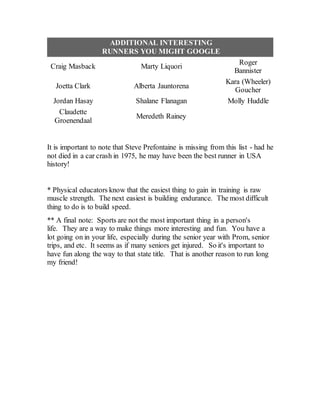
ADDITIONAL INTERESTING
RUNNERS YOU MIGHT GOOGLE
Craig Masback Marty Liquori
Roger
Bannister
Joetta Clark Alberta Jauntorena
Kara (Wheeler)
Goucher
Jordan Hasay Shalane Flanagan Molly Huddle
Claudette
Groenendaal
Meredeth Rainey
It is important to note that Steve Prefontaine is missing from this list - had he
not died in a car crash in 1975, he may have been the best runner in USA
history!
* Physical educators know that the easiest thing to gain in training is raw
muscle strength. The next easiest is building endurance. The most difficult
thing to do is to build speed.
** A final note: Sports are not the most important thing in a person's
life. They are a way to make things more interesting and fun. You have a
lot going on in your life, especially during the senior year with Prom, senior
trips, and etc. It seems as if many seniors get injured. So it's important to
have fun along the way to that state title. That is another reason to run long
my friend!

Planning Training for Distance Running 1

  • 1.
    Planning Training forDistance Running: Part One Planning Training for Distance Running Bill Peyton Jan 27, 2016 "The most important part of the environment for aspiring distance runners is the few inches between their ears. The best thing about having a coach is that they can tell you when to back off," says the legendary Paul Geis, who ran for Oregon with Steve Prefontaine and almost beat that superstar several times. Geis (pronounced Gis) ran 13:23 for 5000 meters when tracks were mostly cinder and dirt in 1974! The following will not be a complete plan for being a great distance runner. Training can be simple, but life is not simple, and certainly cannot be covered in even a large book! What we hope to do here is to give you a basis for study on planning your best approachto training for running the 800, 1600, 3200, and 5000 meters. PART ONE: A Simple Plan Part one is a general consensus of how to train for the whole year. Then part two has examples and opinions from experts which back up these steps. In part three you can do your own internet study of various sources to devise the most brilliant individualized training for winning distance running! A state champion might, in some cases have to make this harder than it is laid out. A novice may have to scale it down! Run and stretch every day if possible while considering that you make the greatest gains during your recovery. Sleep, eating well, and hydration are also crucial.
  • 2.
    Block Number One AerobicBase Building: Do this for as long as possible! When we refer to your pace, it is your own personal pace at the date you are running (date pace). This can be hard to determine. If in doubtas to how fast you should run, run slower at first! In fact many people start out by running for just a few minutes at first. Then they progress to a "scoutpaced" running program where you run for a few minutes, walk for a few minutes, and then run again. It's probably a good idea to set some short and long term goals. Perhaps making it to the end of the block is the short term goal, and much later it might be to run for 30 minutes. It's winter so dress in layers. If you can use polypropylene it's possible to get by with four light layers of clothing even in the coldestweather. Use vaseline on the areas where you cannot cover all of your skin completely. It may be necessary to wear windbreaker underwear! Warm up well - 1 or 2 mile Jog, dynamic running drills, strides (4 to 8 x 100 meters) Some people are done at this point! If it's very cold you may want to do something indoors before starting the run slowly outdoors. Be creative, but some examples might include jumping jacks, burpees, pushups, dynamic stretching, crunches, squats and jogging in place. A complete warm up will improve performance and prevent many injuries! Block One Types of Runs *Long Run - This can be anywhere from 1 mile to 15 miles based on your current fitness level. Be realistic, maybe you want to run for 10-30 minutes the first day and then see how you feel from day to day. Run at a pace where you can still talk fairly easily. *Short steady state run - Between 2-8 miles based on experience. This can also be called a tempo run or fast distance. Pacemight be between personal 5K to half-marathon pace. *Fartlek - Do a run where you alternate periods of faster running with slightly slower running. During this period the stress of the hard part of the run should not be extreme and the recovery should be short. Research supports this and it really applies early in the training process.
  • 3.
    Example of howto do fartlek runs - You could run about 200 meters (the distance between about three telephone poles) at slightly faster than mile pace, jog 100 meters, and then run 200 meters again. Repeat this for about 2- 3 miles at first. We try to keep the stress level medium high during the run and do not allow a lot of recovery time. This is still a hard workout for beginners and you might have to keep the total distance short, especially if you make the run phase too hard. One of your goals is to do this so you can add to the total distance. It does not do much good to run so hard that you tucker out before getting a good aerobic effect. Example of how not to do fartlek runs - We do not want to run nearly all out during the run portion and then have a long recovery. If you ran 100 yards at 200 meter pace, and then followed it with a 600 meter jog, and then repeated, that would be too hard with too much recovery to be effective for long distance running. We do have to be careful of ice, though, and if that means keeping the recovery long sometimes, by all means do it! *Speed Development - One day per week, if you can find a place indoors, you can work on true speed development. 10 x 100 meters or shorter with a walk between is an example of this type of training. Jumping ropemay be a good idea but save bounding and jumping for soft surfaces. *Hill Run - One or two days per week include hills in one of the runs that you do. It is also advantageous to use a hill on the speed development day. The besttype of hill for a distance runner is one that is not too steep, but allows for a gradual climb over 100 yards or so. Steep hills are for power and have their place in a sprinter's program. Al Tappe, former Minnesota runner claims that down hill running on a gradual hill can improve 400 speed. Watch out for that ice, though! Warm down well. This is similar to the warm up but it's good to add some static stretching here. Block Number Two Block number one should last at least ten weeks. This means that block two will not start until the track season begins! If you have to make a choice between working too hard and under training, take it easy and enjoy your running. Perhaps you will have to do a lot of jogging in Block One before the season begins. If you do not do Block One, then you had better take it easy on some of the coach's work out days! *Warm up - Do a long warm up as in Block One!
  • 4.
    *Long Run -Continue this for the first month of the season. All components of training are developed if this run is long enough. Do not attempt to speed this run up and run shorter! It's possible that this run will have to be done on your own during the weekend. *Shorter steady state runs - Do these 3-6 mile runs for the first month of the season. After that you may want to make one of them a tempo run. *Speed Development Day - Hill running for the first month. The second month you might begin sprints, bounding, and other power related exercises. As anything else start out with just a few! In general speed work outdoors when it's colder than 50 degrees is not recommended. *Fartlek, Tempo, or Interval day - These should be done with a heavy emphasis on the aerobic system. We never want to stray far from the aerobic base. Block Number Three With 5 weeks before the big race, we probably want to start doing some specific training towards our main distance. This training could include the races the athlete runs. Many high schoolstudents run too many races. One meet per week is enough! Aerobic runs and speed training should continue in this phase but you cut back a little on the speed training to include another interval/fartlek day. An interval day could include running repetitions around an unmeasured area, untimed, without counting the number done. The recovery should be nearly full and the athlete should quit when they are pleasantly tired. We do not want to run our best race in practice! More Articles In Series Planning Training for Distance Running: Part Two Planning Training for Distance Running
  • 5.
    Bill Peyton Jan 28,2016 PART TWO: What experts say about training for distance running Carrie Tollefson, ran for Lac Qui Parle Valley and Dawson-Boyd High Schools and won a national record 5 state cross country titles and a state record 13 track titles. She also won 4 NCAA championships, and ran in the 2004 Olympic games in the 1500 meters. She won the 2006 4K USA cross country title and USA Indoor 3000 meter run. She directs the Summer Distance Camp at St. Catherine's College and does a Weekly Online Show called C Tolle Run. Tollefson also is married and is expecting her third child to arrive soon. MN MileSplit: What would you do differently as far as training in high school? Tollefson: I don't think I would change much of anything. My coaches were very conservative and I think that is why I had so much fun in the sportand had some success.I always had room to grow and didn't have any overuse injuries. Maybe knowing now how much the little things do for a runner I would have worked a bit more on my drills, weights, stretching, and nutrition. I think the actual running that I did was great, it was the other things that I didn't pay much attention to. We did a little mental training and maybe more so with my parents but that is a huge component of our sport that doesn'tget utilized at a young age and I think all athletes can benefit from that. MN MileSplit: What did you do right that you probably would not change? Tollefson: I think what I did right was I worked really hard. I didn't have a lot of "junk" mileage. My mileage was always around 30-35 mpw and even though that seems low, we always had a purposefor those miles. Recovery,
  • 6.
    tempo, intervals, longrun, and race day all had a meaning and it kept me focused and again, having fun with a sportthat can be life long. I also think my coaches and parents were good about letting me be a kid at the same time as being elite. We took it seriously but we also goofed off, ate cake after hill repeats, made sure to have days off and I was allowed to play lots of other sports in the off seasons. MN MileSplit: How would you train a young Carrie Tolefson in today's environment? Tollefson: I would be really careful with a young athlete today. Running has changed quite a bit. Not many people play other sports and I think that is a shame. I was a great runner because I believe I had time away from my sportand we kept it exciting. My parents didn't force me into anything, and my coaches saw the talent but let me grow into it. I played basketball in the winter and summer and loved every minute of being on that team. I did run a tiny bit as I got older during those times but I was a basketball player first when it was that season. I think we are getting away from that. The muscles, speed, and joy I developed in another sport only made me want to be better at running when it was that time of the year. So, if I were to train another runner today, I would make sure they were well rounded, working their whole bodyand mind. I would make sure to keep the workouts and mileage at a number that could increase over the years without causing fatigue or injuries. Most of the runners I know today that are Olympians and world class were very undertrained in high school. It was only in college that they see the real miles!
  • 7.
    MN MileSplit: Whatprecautions would you give high schoolfemales in regards to training? Tollefson: I am about to have my third baby and I have always shared with coaches and athletes that life after competition is so important. We have to take care of ourselves. As a girl and woman, we have the ability to have physical signs that we are healthy and getting enough nutrients each month. It is really important to stay on top of those signs. Being at a healthy weight and managing our nutrients is HUGE for both males and females. But if young girls and women want to be great athletes and become mothers one day, they have to be smart early on. If we do not have those physical signs, then we run the risk of injuries or fatigue issues and both of those do not do anything for our racing and training. This isn't an easy sport, but it is so rewarding when we stay true to ourselves, and make sure we are taking care of ourselves. It is not a sportto abuse in a way that we hurt ourselves and I encourage every athlete, coach, and parent to be aware of anything that does not feel or look right.
  • 8.
    Beyond that, Ithink being coachable is one of the most important things an athlete can be. Listen, learn, and communicate with your coaches. If you are feeling great, let them know, if you are off, let them know. Just be open and your results will speak for themselves. Training over the years, if I did something my coachdidn't want me to do, specifically add mileage, time in the gym, neglect sleep, travel too much, not eat properly, it only interfered and caused stress for both of us. Be open, they understand that this is a hard sport, but they also understand the fine line of going over the edge. Do not let that happen. Kim Spence, 2004 graduate of Wheaton College, Norton, Massachusetts and now head coachof the Men's and Women's teams there said, "The training age of runners is very important in prescribing mileage and intensities in their workouts. How much running have they done up to this point?" "We also have to determine which event they are bestsuited for and that can be determined by what the coaches see as they try various events." "Sometimes people get it in their head that they are sprinters but cannot handle the workouts. That is also true for distance runners," Spence added. Dave Smith, Head Coachat Oklahoma St. University, national champions in cross country in 2009, 2010, (second in 2011), and again in 2012, had this to say about how one should train in today's high schoolenvironment: "I would focus on aerobic development through long term consistent training using a lot of easy running and steadily, but patiently increasing volume.
  • 9.
    "I would alsowork on light quick running in the forms of stride outs, hill repeats, or repetitions of 200-300 meters with full recovery. I would spend a lot of time training by feel and less time looking at a watch. I would use a lot of perceived effort fartleks and tempo runs where the emphasis is never on actual pace. I wouldn't spend a lot of time on the track grinding out gut busting workouts." What coachmeans by "strides outs" are short gradual buildups to a sprint at a distance short of 100 meters. Watch other runners do these. In college, Smith worked very hard, running 90-100 miles per week. But it was not just the mileage. "I always trained with presumption that the harder I worked, and the more I did, the better I would become. If my coachwrote down 5 x mile @ 4:40, I would try to run them in 4:30! I constantly made the mistake of trying to race everything." Unfortunately, even today a lot of runners make this mistake! "As a coach, I think I have been much better than I was as an athlete. It's kind of like the old saying, 'doctorsmake the worst patients.' It's much easier to look at the athletes I coach from an objective perspective and see what needs to be done (or in my own case, not done). In my coaching career, I have focused on a lot of submaximal running and only very rarely, do I have athletes train at the same intensities with which we expect them to race. Not every coachsees it that way, and there are a lot of very successfulcoaches that use more high intensity training than I do. But I would not change the aspectof the way we do things," Smith concluded. Smith credits Jack Daniel's bookas having influenced him to train runners this way: "If your goal is to run a 4:00 mile, do not do 4:00 mile workouts. Instead, start at your current fitness level which might be 4:20. When you can do the type of work a 4:20 miler can do then attempt what a 4:15 level would be." "A huge part of being a successfuldistance runner is learning how to relax and concentrate when you are tired. Many runners are often nervous before and during competition and these emotions can exacerbate fatigue and discomfort. If you can stay relaxed, poised, and focus on the job at hand you can beat many runners who have more ability or fitness. Ryan Vail is an example of this type of runner. This is something that can be learned, practiced, and perfected. At Okahoma State University we work on it a lot!," exclaimed Smith.
  • 10.
    "The greatest limitingfactor on a distance runner is the aerobic fitness level, we do not ever want to get far away from that,"said Arthur Lydiard "Speed must be worked on all year long but be careful of doing too much hard anaerobic training as you will get injured or sick, " is another of Lydiard's maxim's. (Pure speed training is not hard anaerobic training. Whether you run 10 x 100 or 10 x 400, they both would be considered anaerobic, however Lydiard is talking about 10 x 400 being very tough on the body, especially if you push the pace. For runners with a base there is a time and place for 10 x 400! According to Lydiard you do 10 x 100 type training all year.) Lydiard was known as the "Father of Distance Running." He is from a little island called New Zealand not much larger than the state of Colorado and the 76th largest in the world. Yet this tiny country had two gold medalists; Peter Snell 800 meters, and Murray Halberg 5000 meters, and Bronze medalist Barry Magee in the marathon in the 1960 Olympics. In 1964 they did even better with the 5'10" 180' Snell winning both the 800 and 1500, John Davies getting the bronze in the 1500, and Marise Chamberlain claiming the bronze in the only long distance event for women, the 800 meters. Between 1956 and 1965 New Zealand middle and long-distance runners bettered or equaled 23 world records or world best times. Lydiard is known the world over and is rumored to have actually coached in the following countries: New Zealand, Australia, Finland, Mexico, Venezuela, Japan, Great Britain, South Africa, Kenya, Ethiopia, and the USA among many other places. The Lydiard Athletics Club in South Africa is the only athletics club to be named after a coach. Most experts agree that a beginning runner must first develop a distance base of many miles before they are ready for the faster running. A high schoolfreshman starts out at around 10 miles per week. In general a senior in high schoolis running between 30 to 80 miles per week. A champion runner will want to run every day. It's not that hard to build a base if one improves the level by less than 10% per week. This is the way to go if you expect to be any good. Ideally what you want to do is develop aerobically and improve speed at the same time. This can be done if one does not overload the anaerobic system. Work such as 6 x 800 meters is bestleft for time spent with a coach.
  • 11.
    "Arthur Lydiard ishighly critical of the American system. He teaches that by emphasizing hard anaerobic training, we are destroying the potential of our runners. According to Lydiard, anaerobic activity alters the body's pH levels (alkaline vs. acid), and leads to a physical breakdown over time. What's more, he boldly states that anaerobic training does nothing at all to enhance performance, nor does it increase human speed. (He sees speed development as a factor of increased muscle strength due to resistance running such as hill training). Anaerobic training simply teaches how to run in oxygen debt." John Raucci, TullyRunners.com Author That is a direct quote but I believe Lydiard means the overdoing of this system! Please take into consideration that the oxidative (aerobic) need of distance events are: 400 meters - 30%, 800 meters - 55%, 1600 meters - 70%, 3200 meters - 85%, and 5000 meters - 90%. The oxidative need for an event goes up if the athlete is slower. Forexample a 2:15 800 is more oxidative than a 1:55 800! Jeff Jirele was a very good distance runner at Austin, MN High School having run a 1:56.59 880 and a 4:26 mile. He also ran cross countryand finished 22nd in the state meet. This was run almost exclusively on an interval running program. "I needed to lift weights and run in the mornings when I was in high school," Jirele admitted. Then at Golden Valley Junior College, Jirele was in a high mileage program of up to 130 miles per week. This resulted in three individual junior college titles for him; one in cross country and two in the mile run. Then he transferred to the University of Illinois and was in a well-rounded program. He ran 1:51.1 in the 880 and 4:00.3 in the mile. In 1978 the year after he graduated he ran a 3:58.3 in the mile. "What I needed to do in college is to have more positive thinking and larger goals," Jirele stated. Al Tappe ran for New Richland-Hartland High Schoolin the mid-1970s. He ran 4:22 for the mile as a senior there. In high schoolthey did a lot of fartlek, long runs, tag, and they did accelerations after almost every practice. Tappe had an outstanding prep career and said that his coach kept it fun even though they ran lots of miles. Tappeexperienced continual improvement in the 440 meter dash in high schoolbecause of the mileage, speed, and downhill running they did. Tappesaid, "We always ran against the wind on the way out in our distance runs and on our return we had the wind at our back. We also ran down a
  • 12.
    long, gradual, hillnear campus. These things led to our increased speed!" Tappeincreased his speed in the 440 to 51.4 by the end of his senior year. Jim Ryun, the former 3:51.1 miler, out of Kansas, was another one who used improving 440 times to help him out at other distances, including cross country. Then at the University of Minnesota Tapperan for Roy Griak, the former Pan Am Games coach. Under Griak the mileage was about the same as he ran in high school, but the intensity went up. The fact you ran against better competition was also a motivating factor. He would have doneeven better if he didn't occasionally leave his best races in practice! "Garry Bjorkland and others were so tough in the interval workouts, and it was easy to get pulled along at their pace, rather than a more reasonable pace," exclaimed Tappe. Despite this he ran 4:01 for the mile and is still on the All-Time Top Ten for the 4 x 1600 meter relay. Sometimes we find that small town kids are intimidated by large school teams. According to Tappethis is a purely mental thing that can be overcome. In addition research has shown that runners from Kenya and Ethiopia do not have any physical advantages. Their culture and expectations are different. Americans need to quit being intimidated just because someone is from eastern Africa! Spence was a good sprinter as a freshman and gained All-American honors in the 4 x 400 relay early in her running career. She found that she enjoyed the longer distance workouts so she joined the cross countryteam. After that she made All-American in the 800 meter run and 3000 meter steeplechase. Spence said that developing her aerobic system also made her faster in the shorter distances! Geis, from Texas originally, was a tennis player in middle school. He feels that this gave him a base for his eventual running career. When he changed to cross country and track & field he was trained by a coachwho followed the Mihaly Igloi system. Igloi's plan usually consisted of running many different speeds over short distances with very short jogging breaks between. They did do a few long runs every week and the total volume was consistently very high.
  • 13.
    Part of thereason you do not hear about this coachin the present day is because of the revolution that occurred in Hungary at that time. Igloi and many of his athletes moved out of the country and lost contact with each other. However Bob Schul is the last American to win a gold medal in a distance over 800 meters in the Olympics when he won the 5000 meters in 1964. He won the race in 13:48.8 on a wet, cinders track in Tokyo, Japan. There is no telling how fast that time would be if they had run on today's lightning fast tracks in the clothing and shoes of the 21st Century! Steve Bence, a 1:55 800 meter runner in high school, walked on at the University of Oregon and improved to a 1:47.7 and All-American status as a freshman in 1972. He did win lots of races in the next three years, and gained another All-American award, but his times did not really go down in the 800 after his initial year in the program. Bence was a world class runner in the 800 yard run in 1972, as his time was only 3.4 seconds offthe world record set originally in 1962 by Peter Snell of New Zealand at 1:44.3. Bence suggested runners could learn from his mistakes: "The relationship with your coachis incredibly important because he/she can set up goals for you, develop a good workout group, and have races set up to motivate you throughout the entire year. You must be consistent with your running to the point that you also include recovery runs nearly every day. That is one of the
  • 14.
    things that madePrefontaine great. I roomed with him and for him it was like brushing his teeth. He never missed a morning run." Head coachBill Dellinger, having been a cross country and 5000 meter runner, led Prefontaine, Geis, and Matt Centrowitz, Sr. to the Olympics because they had a great relationship. Bence, being somewhat shy at the time, did not have a relationship with Dellinger. Looking back he believes he should have taken ownership and developed one with the busy coach! Wayne Feder, legendary coachof New Richland-Hartland, whose program produced two-time cross countrychampion Dan Lyndgaard, runnerup finisher Dave Tappe, plus top 15 place placers Al Tappeand Brad Finseth; stated, "There is a big difference between training high schoolkids as opposed to world class athletes." "The first thing all runners must do is establish a baseso that they can do the harder, faster workouts." We all know that running 5 x 1600 or 12 x 400 fast will ultimately bring your fastest times for the moment! But how good the aerobic base is determines how high that moment can be! Craig Virgin is one of the most famous distance runners America has ever produced. In high school he was already running against the best in the world as he broke Prefontaine's high school2 mile record with a 8:40.9 and also ran the mile in 4:05.5. He went on to have a great career in cross country running where he is the only American male to win two World Cross Country Championships. He also is a three-time Olympian in the 10,000 meter run and eventually ran that distance in 27:29.2. That is a pace of 4:25.4 for 6.2 miles! He ran that in 1980 and it was the fastest time in the world that year. The problem was the U.S. boycotted the Olympics that year! Virgin could recover faster from fartlek and speed workouts than the average high schoolathlete.
  • 15.
    He also wentthrough an injury from stepping on a stick as a freshman, and fell on both knees slipping on the ice as a senior. The injury to his knees caused Osgood-Schlatters disease which is not fun. He grew up on a farm and had to do lots of heavy work, and attributes some of his success to that. Yet Virgin is also rumored to, "Have a friend in every city." If you want to know what he did in training, it's not hard to find on the internet as he is open and wants to help high schoolrunners. He also has a biography coming out in January or February of this year. Virgin began running during cross country as a freshman. His coach's background was as a baseball and basketball coachwho got his training knowledge from a swimming coach. According to Virgin the training for swimming is in some ways similar to running. "Swimming and running are similar so he knew that I needed over distance, intervals, and then taper/rest before a race." Virgin still holds the 3 mile courserecord for the Illinois State Cross Country Meet in 13:50.6 set in 1972. They still run 3 miles on the same courseso he has held this record for 33 years! Virgin and his coachtalked frequently about his training and collaborated on what he wound up doing. A lot of their theory came from other runners and coaches. "Starting with my sophyear I started to do 3 mile AM runs every day except for the day of the race and the day before the race. My distance training runs in the afternoon were usually 6, 8, or 10 mile runs. I averaged 8 mile runs most of the time but usually did a 10 mile run in the afternoon on Sun....after a 3 mile run in the morning. My final two years of H.S. I averaged 60-80 miles per week which was upper middle for that time. There were other top HS runners doing 80-100 mpw and there were some doing 50-70 that were also successful." For Fartlek runs he liked to use telephones to mark the fast portions of the run, "sometimes just one pole surges, but then I would mix them with longer surges," Virgin explains. "I might also go to the golf courseand sprint the fairways, followed by jogging to the next tee. The total distance of my workout would be 7-8 miles. I would get the heart rate up quite high and it challenged my mental toughness," Virgin instructed.
  • 16.
    He would alsodo 12 x 440 as follows: Run a 440, walk for 20 yards, then jog for 200 yards before starting the next repeat. He would do the first one somewhat slow for him and then increase each repetition so that each one was faster than the previous one. "By dumb luck I discovered that it was also best to gradually increase the speed over the entire 440 so that I was near my top speed at the end. This is how I developed my biomechanical efficiency," Virgin related. He trained at different speeds! Virgin also liked to do many of his runs, even the morning run if he felt fresh, like a tempo run. That is the speed of each mile would be perhaps 30 seconds faster than the previous mile. As a team they liked to do 3 x 1 mile on their course sometimes. "Mileage is just part of the equation of successfultraining. It's called quantity...but quality is also important. That's when things got hard and uncomfortable and usually painful at the end." stated Virgin. So we really need four types of runs: long, hilly, speed/short, and fartlek. Warm up well and warm down well. Stretch. Run every day. It does not need to be a lot more complicated than that. Talk to your coachand tell him what you are doing and ask for advice. More Articles In Seri Planning Training for Distance Running: Part Three
  • 17.
    Planning Training forDistance Running Bill Peyton Jan 29, 2016 Part Three: Internet Study Systems of Distance Running (The dates shown are ballpark figures) Distance Racing - Late 1800s GreatBritain Before there were any track meets there were professional races of all types including walking, distance running, and sprinting. The distance runs were generally done over great distances like for 1000 miles or 24 hours. Horse Racing Training - USA 1908-1912 This was mixing fast repetitions with slow ones followed by significant recovery walks as in horse racing. Athletes included James Lightbody, and Melvin Shepard. This type of training enabled America to dominate the early Olympics. Periodization - Finland 1912-1928 The Flying Fins The introduction of seasons by coachLauri Pihkala who coached Paavo Nurmi, Hannes Kolemainen, Ville Ritola, Volmari Iso-Hollo, Taisto Maki. The Interval Method - Germany 1936-1960also calledGershlerInterval Training Professorofphysical Education Woldemar Gerschler and Herbert Reindell (or Rein Dell) Originally it was the speed of the run that was most important, they wanted the athlete to get the heart rate up to 180 and the next repeat would occurat 120 bpm. Later the speed of the repeat was a little less and the recoveries shortened. Some call that the New Interval Method. Traditionally all of this occurs with standing between fast runs. Athletes included Rudolph Harbig - 400-800 and Emil Zatopek of Czechoslovakia - 5K to the marathon. Fartlek Method - Sweden 1937 alsocalledSpeedplay
  • 18.
    This was firstdeveloped by GostaHolmer, and later GostaOlander added Quantity to the runs. There have been many variations added to what the Swedes originally did, but it's basically alternating a fast run with a slower run. Many different speeds, distances, and intervals are employed. The original athletes associated were Gunder Hagg, and Arne Anderson. Arthur Lydiard - New Zealand 1950 -2004 Long runs/fartlek/speed development/hill training. Lydiard coached all over the world but his most impressive work might have happened in Finland where they had been stuck on interval training for many decades. They turned out Lasse Viren, Pekka Vasala, and Olavi Suomalainen. Cerutty, Igloi, Nurmi, and Lydiard are often thought of as having collaborated on a lot of ideas. Mihaly Igloi - Hungary 1950-1970 The method Igloi used was mostly based on short runs of various speed between 50-400 meters with very short jogs between. He never timed his runners and workouts varied quite a bit from day to day. Volume was very high and long runs were employed every week. This method produced 49 world records, someat distances no longer raced. Athletes included: Lazlo Tabori, Istvan Rozsavogi, SandorIlharos of Hungary. Then the 1956 Hungarian Revolution took place and Igloi left Hungary. It's possible this might have been the besttraining method in the world, but it lost momentum with the war. Other athletes who employed this method: Bob Schul, Vladimir Kuts, and Jim Beatty. Paul Geis used this method in high school. Australian Approach - Australia 1950s/1960s StotanPhilosophyof PercyCerutty Cerutty was probably influenced by several coaches but most especially Lydiard. He was very famous for having his athletes run hilly sand dunes. He increased the intensity and volumes as the athlete could handle
  • 19.
    it. Athletes includedHerb Elliot, Ron Clarke, John Landy, Dave Stephens, Les Perry, and Betty Cuthbert. OregonSystem - USA 1960s/1970s Hard/Easy BillBowerman/Bill Dellinger They are very famous for the 30/40 200 meter run drill. You run 200 meters in 30 seconds/recoverwith one in 40 seconds/repeatuntil you can't do any more. Steve Prefontaine held the record at one point at 18. Other athletes: Alberto Salazar, Rudy Chapa, Steve Bence, Paul Geis, Galen Rupp, Lisa Martin, Joaquim Cruz, Jordan Hasay. PeterCoe/Dr. David Martin - 1980sGreatBritain Popularized the Tempo run and advertized IndoorCircuit Training Sebastian Coe was supposedto have run only 50 mile weeks but they did not count his warm ups. Steve Cram and Steve Ovett advertised higher training volumes. Jack Daniels Training Formula - 1998 USA Daniels helped coachJim Ryun to a silver medal in the 1500 altitude in the 1968 Mexico City Olympic games. Daniels plan in it's current form is meant to optimize training so that the athlete does not have to run more or harder than necessary. This plan also has complex formulas to follow based on your current training level. Daniels got his periodization plan from Lydiard. The Kenyan Way - Kenya Current CoachesMike Kosgei,Brother Colm O' Connell, Albert Masai, DannyKibet, Amos Korir. Culture and Expectations seem to be behind the domination by this country. At this point most scientific studies cannot find any physiological reasons. Running at altitude and long hills helps but there are other countries that have these things, even parts of the USA. Athletes: Wilson Kiprugut, Kip Keino, Mike Boit, Henry Rono, William Sigei, Yobes Ondieki, Tegla Loroupe, Edna Kiplagat, Emily Rotich, and Esther Kiplagat. No one asks why a local college or high schoolwins year after year. Maybe it's the culture and expectations!
  • 20.
    Ethiopian Era -Ethiopia Current CoachesSentayehuEshetu, Melaku DeresseBiratu Ethiopians more than any other nation are historically known for their finishing speed. Perhaps it is here that Lydiard's training methods have had the most modern effect. Lydiard's New Zealand runners were known to be able to rip off a 47 second quarter mile according to Paul Geis. New Zealand ran lots of hills in training as a rule but more importantly they did running drills on hills and often finished practices with fast strides. No Ethiopian training sessionends without doing some sprint drills. They also run an incredible amount of short hills (100 meters) fast! The hills they run are gradual and they run them with good form. Runners: Miruts "Yifter the Shifter" Yifter was able to finish 10,000 meter runs with a last 52 second 400, Haile Gebrselassie, once finished a 27:10 10K with a 200 in 25.2!, Kenenisa Bekela, Deratu Tulu, Gete Wami, Meserat Defar, Turinesh Dibaba, Fatuma Roba. "African runners tend to be much happier and joyful about running. This is a generalization, but they thoroughly enjoy what they do." -Paddy O'Door "Part of the reason the US in not producing large numbers of great distance runners is simply that the culture at large doesn'tcare about distance running-not like we do about basketball and football." -Jack Dawkins ADDITIONAL INTERESTING RUNNERS YOU MIGHT GOOGLE Mary Decker Slaney Rick Wohlhuter Johnny Gray Lorraine Moller Dave Wottle Patti Sue Plumer Lynn Jennings Francie Larrieu-Smith Doris Brown- Heritage Joan Samuelson Ruth Wysocki Vicki Huber
  • 21.
    ADDITIONAL INTERESTING RUNNERS YOUMIGHT GOOGLE Craig Masback Marty Liquori Roger Bannister Joetta Clark Alberta Jauntorena Kara (Wheeler) Goucher Jordan Hasay Shalane Flanagan Molly Huddle Claudette Groenendaal Meredeth Rainey It is important to note that Steve Prefontaine is missing from this list - had he not died in a car crash in 1975, he may have been the best runner in USA history! * Physical educators know that the easiest thing to gain in training is raw muscle strength. The next easiest is building endurance. The most difficult thing to do is to build speed. ** A final note: Sports are not the most important thing in a person's life. They are a way to make things more interesting and fun. You have a lot going on in your life, especially during the senior year with Prom, senior trips, and etc. It seems as if many seniors get injured. So it's important to have fun along the way to that state title. That is another reason to run long my friend!