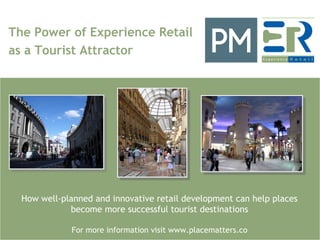
The Power of Experience Retail 
as a Tourist Attractor 
How well-planned and innovative retail development can help places 
become more successful tourist destinations 
For more information visit www.placematters.co
The power of experience retail 
as a tourist attractor? 
Structure of Presentation 
1. What is “experience retail”? 
2. The relevance of experience retail 
3. Case Studies: 
• London’s West End 
• Milan 
• Dubai 
4. Lessons for application to tourism development
Experience Retail 
A concept relevant to existing and 
new tourist destinations
What is “experience retail”? 
Experience retail is shopping-led entertainment 
• Reflecting shopping now being more of a leisure activity… 
• More about fun and entertaining experiences… 
• To be combined with other leisure/recreation activities… 
• Conveniently found in one place, attractive and accessible 
• Responding to increasing consumer time pressures and 
demands 
• Responding to tourist needs and wants 
• Helping to make more places destinations of choice
ER places are destinations with a mix of attractors 
and experiences driving footfall & spend 
 A mix of activity attractors + retail attractors = increased and 
sustained footfall 
 It’s recognising shopping as a form of entertainment 
 With a complementary mix of attractors and lifestyle experiences 
 With a day and evening offer 
 Where people want to stay over to experience the full offer 
 With a constantly evolving offer to keep them coming back
ER destinations have an….. 
Innovative mix of attractors and uses 
 The mix of shops 
 Food and beverage mix 
 Leisure and entertainment mix 
 Culture and heritage mix 
 Hotels and accommodation 
 Offices and Residential 
 Parking and transport
ER destinations have…. 
An innovative mix of attractors to increase footfall, dwell time and spend 
 International brands plus independent/authentic/local retailers 
 Specialist cinemas 
 Leisure and sports facilities 
 Museums and Exhibitions 
 Art Galleries 
 Concert Halls 
 Performance spaces in the public realm
The offer in ER destinations includes events to attract 
footfall: 
 Art demonstrations and creation 
 Dance events – in store and in public realm 
 Fashion shows 
 Activities like cooking school demonstrations related to 
restaurants 
 Music theatre and dance 
 Cultural events
The service in ER destinations has to be great 
 Connecting online to welcoming the person before arrival 
 Collecting deep knowledge about customers 
 Employing staff who truly know their products & services 
 Creating merchandising schools and training courses 
 Providing value added services; e.g. 
-Child care 
-Valet parking, fashion advisers, interior designers 
- Purchase collection
Marketing ER destinations is all about the experience 
Sense Marketing – create sensory experiences - sight, sound, taste, 
smell & aesthetic pleasure Identification of development mix 
Feel Marketing – to positively affect, stimulate and bond 
Think Marketing – to surprise, intrigue and provoke 
Act Marketing – to alter lifestyle, new interactions 
Relate Marketing – to take beyond current reality and experiences 
and create new associations
The relevance of experience retail 
destinations to tourism development 
 Complements and expands the menu of attractions 
 Helps to attract, increase and maintain footfall 
 Increases overall spend 
 Improves viability of places as destinations 
 Increases attractiveness of places as destinations 
 Helps to distinguish places as destinations 
 Expands the market for destinations
Experience retail destinations 
Case Studies 
Milan – An unplanned – naturally 
evolving - retail and cultural 
destination that is a 
tourist magnet 
London’s West End – An 
unplanned retail and 
entertainment destination being 
planned anew as a tourist magnet 
Dubai – A more planned retail 
destination
Case Study – The “Quadrilatero” Milan Fashion District 
 Adjacent to the historic centre with its Duomo and La Scala Milan 
 Centre’d on Via Montenapoleone close to historic centre 
 A concentration of world class fashion brands, many based there 
 Complemented by specialist and authentic local shops 
 Balanced by a sophisticated and local F&B offer 
 With art galleries and classical gardens 
 In an environment of neo classical residences and fine architecture 
 A place to live and create as well as shop and visit
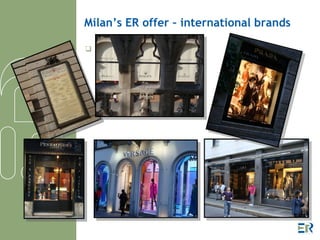
Milan’s ER offer – international brands 

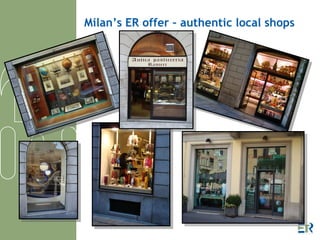
Milan’s ER offer – authentic local shops 

Milan’s ER offer – food and beverage 

Milan’s ER offer – tourist magnets 

Case Study – Milan – Key Characteristics 
 Well designed shop fronts that respect building heritage 
 A place to live and work as well as enjoy, shop and visit 
 A place that’s vibrant and alive with residents and workers 
 A good mix of retail, F&B, cultural, artistic and heritage attractors 
 A place that feels local, authentic and international 
 A complement to the historic core that expands its market
Case Study – London’s “New” West End 
 Focused on Regent St, Oxford St and Bond St in central London 
 Premier retail offer adjacent to major tourist attractions 
 In 2008 25% of 200 million visitors were tourists 
 2008 - “New West End Company” (PPP) created to improve the offer 
 Short term objective to capture Olympic spend in 2012 
 Medium term objective to capture more domestic and tourist spend 
 Longer term objective to help maintain London as a major destination 
 2009 – Locum Consulting appointed to create strategy for improvement
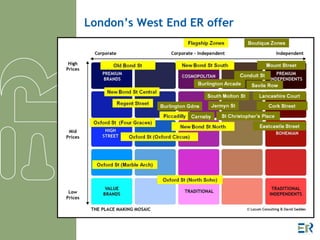
London’s West End ER offer
London’s West End ER offer 

London’s West End ER offer 

London’s West End ER offer – major brands – old 
& new
London’s West End ER offer – food and beverage
London’s West End ER offer – authentic shops
London’s West End ER offer – key 
challenges 
 Bringing retailers together to agree and fund a 
development strategy 
 Create a more distinctive sense of place 
 Moving major retailers and attractors around the 
area to create distinctive offer areas 
 Achieving a mix of international and national 
brands 
 Balancing big brands with authentic local shops 
 Capitalising on Bond Street 
 Upgrading the tourist F&B offer 
 Improving and extending the public realm 
 Introducing more cultural and entertainment 
attractors 
 Creating integrated shopping, culture, heritage and 
entertainment offers 
 Retaining local independent food and beverage
London’s West End ER Flagship Positioning strategy 

London’s “New” West End – Strategic Proposals 
 Create international retail “flagship” areas with distinctive mixes 
 Sub divide flagship areas into distinctive offer destinations 
 Renew and improve the quality of street furniture 
 Remove the “red wall” of buses on Oxford Street 
 Increase pavement restaurant space and the quality of the F&B offer 
 Create piazza style civic spaces with attractor events 
 Improve architecture and create recognisable gateways to the area 
 Better communicate the area’s offer and events
Case Study – Dubai – City of shops plus entertainment 
 The new shopping city of the Middle East reducing dependence on oil 
as a major source of national wealth 
 Where retail is the attractor for F&B and entertainment provision 
 Where shops and entertainment are often all under one roof 
 Where shopping complements the beach and hotel 
 Where malls have become a place of congregation (to escape the heat) 
 Where retail is celebrated in festivals that attract shoppers from the 
region and farther afield – food, fashion, jewelry, ice sports
Dubai Retail Offer – Eight major malls 
 Dubai Festival city – 2.8 msqft/600 big brand shops 
 Deira City Centre – specialist and authentic goods 
 Burjuman – international designer brands 
 Madinat Jumeirah – recreated middle east marketplace 
 Ibn Matuta Mall – six historically themed pavillions 
 Wafi City – F&B, jewelry, culture, meeting places 
 Mall of the Emirates – 400 shops and 6 major department stores 
 Mercato – 90 restaurants, cafes and shops
Dubai’s ER offer – Big Box Retail 

Dubai’s ER offer – Authentic & Replica Retail – the 
Souks 

Dubai’s ER offer - entertainment 

Dubai’s ER offer - Reflections 
 The architecture is adventurous but the retail offer 
has a predictable sameness 
 Experience attractions (like ski-runs and imitation 
souks) are the key differentiators between the malls 
 Retail acts as an attractor where few others exist 
 Retail offers a complement to the beach and hotel 
 Retail brings the offer of London and Milan to the 
expat and local citizen alike 
 An aspirational international outlook market exists 
that supports global brands 
 Dubai is not a model for established cities and tourist 
destinations but elements may be relevant for new 
tourist resorts; e.g. the recreation of the Souk 
and traditional restaurants
ER – Key lessons from case studies 
 Be clear on the brand offer - the experience! 
 The mix of attractors and experiences is key 
 Balance international retail brands with local ones 
 Balance shops with cultural and entertainment 
attractors 
 Integrate and connect attractors within the 
destination and to it 
 Events attract and differentiate the destination 
 Market the experience not just the provision 
 Architecture and high quality public realm and 
landscaping are important – think about “the finish” 
 Preserve existing high quality environments 
 Public/private partnership working is vital
Creating ER Destinations – Conclusions 
for Tourism Development 
 Traditional retail by itself is a limited attractor 
 ER requires a strong mix of attractors 
 ER requires careful and detailed planning of the mix 
 ER requires close working with retailers and operators 
of attractions – realising the mix of the offer 
 Integrated operations are essential e.g. opening hours 
 Integrated marketing is essential - shop/see/play/stay 
 Good public transport access is important 
 Good signage and telecommunications are important 
 ER changes the nature of a destination 
 ER expands the market of a destination 
 ER can make a destination more viable
More Information 
Our Team 
For consultancy advice contact: 
Malcolm Allan Malcolm.allan@placematters.co 
Phone: +44 1342 829 012 
Mobile: +44 7803 356 310 
Twitter: @MalkyAllan 
Blog: Malcolmallan-placebrander.blogspot.co.uk

Placematters presentation on "Experience Retail" areas and developments

  • 1.
    The Power ofExperience Retail as a Tourist Attractor How well-planned and innovative retail development can help places become more successful tourist destinations For more information visit www.placematters.co
  • 2.
    The power ofexperience retail as a tourist attractor? Structure of Presentation 1. What is “experience retail”? 2. The relevance of experience retail 3. Case Studies: • London’s West End • Milan • Dubai 4. Lessons for application to tourism development
  • 3.
    Experience Retail Aconcept relevant to existing and new tourist destinations
  • 4.
    What is “experienceretail”? Experience retail is shopping-led entertainment • Reflecting shopping now being more of a leisure activity… • More about fun and entertaining experiences… • To be combined with other leisure/recreation activities… • Conveniently found in one place, attractive and accessible • Responding to increasing consumer time pressures and demands • Responding to tourist needs and wants • Helping to make more places destinations of choice
  • 5.
    ER places aredestinations with a mix of attractors and experiences driving footfall & spend  A mix of activity attractors + retail attractors = increased and sustained footfall  It’s recognising shopping as a form of entertainment  With a complementary mix of attractors and lifestyle experiences  With a day and evening offer  Where people want to stay over to experience the full offer  With a constantly evolving offer to keep them coming back
  • 6.
    ER destinations havean….. Innovative mix of attractors and uses  The mix of shops  Food and beverage mix  Leisure and entertainment mix  Culture and heritage mix  Hotels and accommodation  Offices and Residential  Parking and transport
  • 7.
    ER destinations have…. An innovative mix of attractors to increase footfall, dwell time and spend  International brands plus independent/authentic/local retailers  Specialist cinemas  Leisure and sports facilities  Museums and Exhibitions  Art Galleries  Concert Halls  Performance spaces in the public realm
  • 8.
    The offer inER destinations includes events to attract footfall:  Art demonstrations and creation  Dance events – in store and in public realm  Fashion shows  Activities like cooking school demonstrations related to restaurants  Music theatre and dance  Cultural events
  • 9.
    The service inER destinations has to be great  Connecting online to welcoming the person before arrival  Collecting deep knowledge about customers  Employing staff who truly know their products & services  Creating merchandising schools and training courses  Providing value added services; e.g. -Child care -Valet parking, fashion advisers, interior designers - Purchase collection
  • 10.
    Marketing ER destinationsis all about the experience Sense Marketing – create sensory experiences - sight, sound, taste, smell & aesthetic pleasure Identification of development mix Feel Marketing – to positively affect, stimulate and bond Think Marketing – to surprise, intrigue and provoke Act Marketing – to alter lifestyle, new interactions Relate Marketing – to take beyond current reality and experiences and create new associations
  • 11.
    The relevance ofexperience retail destinations to tourism development  Complements and expands the menu of attractions  Helps to attract, increase and maintain footfall  Increases overall spend  Improves viability of places as destinations  Increases attractiveness of places as destinations  Helps to distinguish places as destinations  Expands the market for destinations
  • 12.
    Experience retail destinations Case Studies Milan – An unplanned – naturally evolving - retail and cultural destination that is a tourist magnet London’s West End – An unplanned retail and entertainment destination being planned anew as a tourist magnet Dubai – A more planned retail destination
  • 13.
    Case Study –The “Quadrilatero” Milan Fashion District  Adjacent to the historic centre with its Duomo and La Scala Milan  Centre’d on Via Montenapoleone close to historic centre  A concentration of world class fashion brands, many based there  Complemented by specialist and authentic local shops  Balanced by a sophisticated and local F&B offer  With art galleries and classical gardens  In an environment of neo classical residences and fine architecture  A place to live and create as well as shop and visit
  • 14.
    Milan’s ER offer– international brands 
  • 15.
    Milan’s ER offer– authentic local shops 
  • 16.
    Milan’s ER offer– food and beverage 
  • 17.
    Milan’s ER offer– tourist magnets 
  • 18.
    Case Study –Milan – Key Characteristics  Well designed shop fronts that respect building heritage  A place to live and work as well as enjoy, shop and visit  A place that’s vibrant and alive with residents and workers  A good mix of retail, F&B, cultural, artistic and heritage attractors  A place that feels local, authentic and international  A complement to the historic core that expands its market
  • 19.
    Case Study –London’s “New” West End  Focused on Regent St, Oxford St and Bond St in central London  Premier retail offer adjacent to major tourist attractions  In 2008 25% of 200 million visitors were tourists  2008 - “New West End Company” (PPP) created to improve the offer  Short term objective to capture Olympic spend in 2012  Medium term objective to capture more domestic and tourist spend  Longer term objective to help maintain London as a major destination  2009 – Locum Consulting appointed to create strategy for improvement
  • 20.
  • 21.
    London’s West EndER offer 
  • 22.
    London’s West EndER offer 
  • 23.
    London’s West EndER offer – major brands – old & new
  • 24.
    London’s West EndER offer – food and beverage
  • 25.
    London’s West EndER offer – authentic shops
  • 26.
    London’s West EndER offer – key challenges  Bringing retailers together to agree and fund a development strategy  Create a more distinctive sense of place  Moving major retailers and attractors around the area to create distinctive offer areas  Achieving a mix of international and national brands  Balancing big brands with authentic local shops  Capitalising on Bond Street  Upgrading the tourist F&B offer  Improving and extending the public realm  Introducing more cultural and entertainment attractors  Creating integrated shopping, culture, heritage and entertainment offers  Retaining local independent food and beverage
  • 27.
    London’s West EndER Flagship Positioning strategy 
  • 28.
    London’s “New” WestEnd – Strategic Proposals  Create international retail “flagship” areas with distinctive mixes  Sub divide flagship areas into distinctive offer destinations  Renew and improve the quality of street furniture  Remove the “red wall” of buses on Oxford Street  Increase pavement restaurant space and the quality of the F&B offer  Create piazza style civic spaces with attractor events  Improve architecture and create recognisable gateways to the area  Better communicate the area’s offer and events
  • 29.
    Case Study –Dubai – City of shops plus entertainment  The new shopping city of the Middle East reducing dependence on oil as a major source of national wealth  Where retail is the attractor for F&B and entertainment provision  Where shops and entertainment are often all under one roof  Where shopping complements the beach and hotel  Where malls have become a place of congregation (to escape the heat)  Where retail is celebrated in festivals that attract shoppers from the region and farther afield – food, fashion, jewelry, ice sports
  • 30.
    Dubai Retail Offer– Eight major malls  Dubai Festival city – 2.8 msqft/600 big brand shops  Deira City Centre – specialist and authentic goods  Burjuman – international designer brands  Madinat Jumeirah – recreated middle east marketplace  Ibn Matuta Mall – six historically themed pavillions  Wafi City – F&B, jewelry, culture, meeting places  Mall of the Emirates – 400 shops and 6 major department stores  Mercato – 90 restaurants, cafes and shops
  • 31.
    Dubai’s ER offer– Big Box Retail 
  • 32.
    Dubai’s ER offer– Authentic & Replica Retail – the Souks 
  • 33.
    Dubai’s ER offer- entertainment 
  • 34.
    Dubai’s ER offer- Reflections  The architecture is adventurous but the retail offer has a predictable sameness  Experience attractions (like ski-runs and imitation souks) are the key differentiators between the malls  Retail acts as an attractor where few others exist  Retail offers a complement to the beach and hotel  Retail brings the offer of London and Milan to the expat and local citizen alike  An aspirational international outlook market exists that supports global brands  Dubai is not a model for established cities and tourist destinations but elements may be relevant for new tourist resorts; e.g. the recreation of the Souk and traditional restaurants
  • 35.
    ER – Keylessons from case studies  Be clear on the brand offer - the experience!  The mix of attractors and experiences is key  Balance international retail brands with local ones  Balance shops with cultural and entertainment attractors  Integrate and connect attractors within the destination and to it  Events attract and differentiate the destination  Market the experience not just the provision  Architecture and high quality public realm and landscaping are important – think about “the finish”  Preserve existing high quality environments  Public/private partnership working is vital
  • 36.
    Creating ER Destinations– Conclusions for Tourism Development  Traditional retail by itself is a limited attractor  ER requires a strong mix of attractors  ER requires careful and detailed planning of the mix  ER requires close working with retailers and operators of attractions – realising the mix of the offer  Integrated operations are essential e.g. opening hours  Integrated marketing is essential - shop/see/play/stay  Good public transport access is important  Good signage and telecommunications are important  ER changes the nature of a destination  ER expands the market of a destination  ER can make a destination more viable
  • 37.
    More Information OurTeam For consultancy advice contact: Malcolm Allan Malcolm.allan@placematters.co Phone: +44 1342 829 012 Mobile: +44 7803 356 310 Twitter: @MalkyAllan Blog: Malcolmallan-placebrander.blogspot.co.uk