Anar Godjaev
http://anargodjaev.wordpress.com/

PL/SQL Blocks
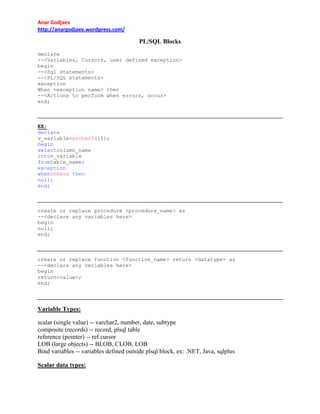
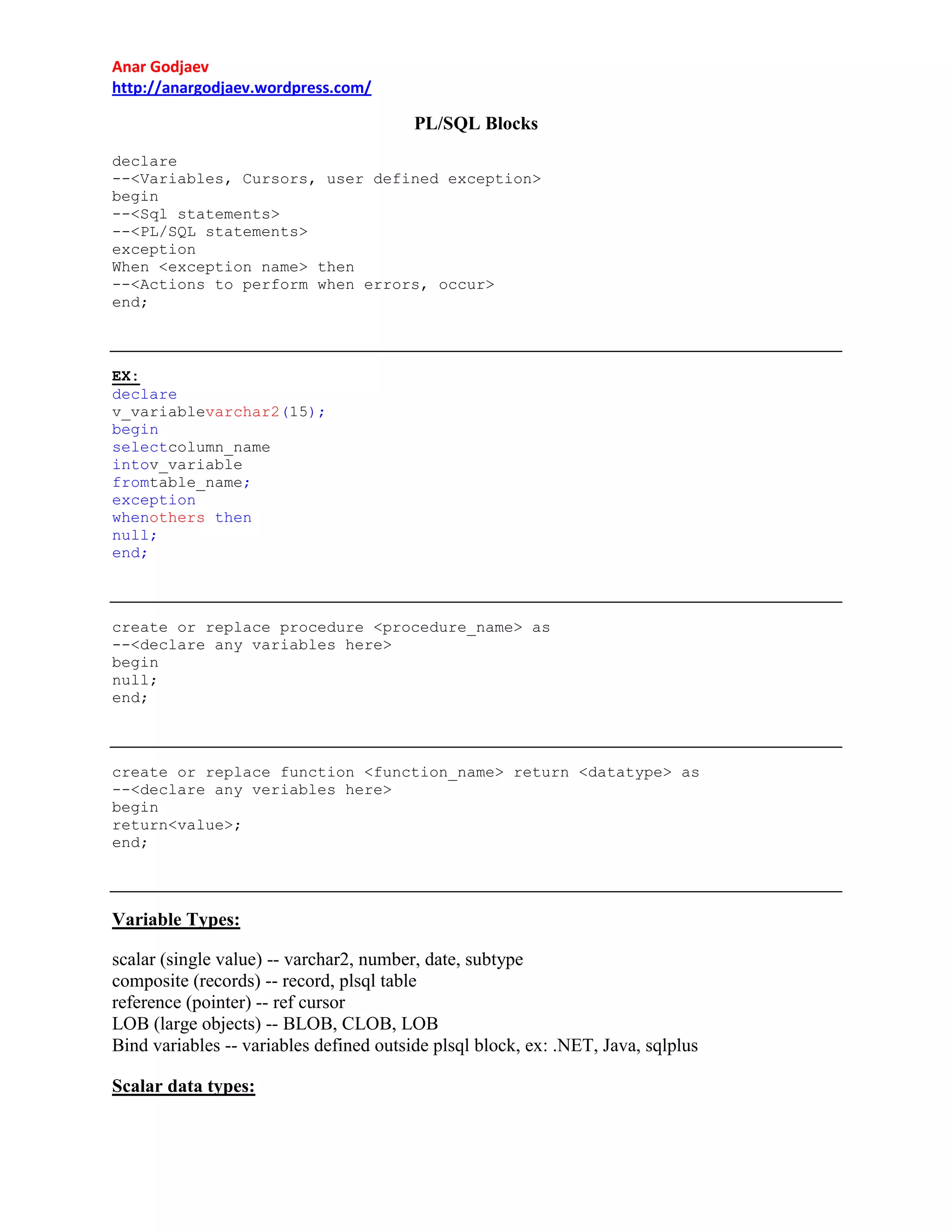
declare
--<Variables, Cursors, user defined exception>
begin
--<Sql statements>
--<PL/SQL statements>
exception
When <exception name> then
--<Actions to perform when errors, occur>
end;

EX:
declare
v_variablevarchar2(15);
begin
selectcolumn_name
intov_variable
fromtable_name;
exception
whenothers then
null;
end;

create or replace procedure <procedure_name> as
--<declare any variables here>
begin
null;
end;

create or replace function <function_name> return <datatype> as
--<declare any veriables here>
begin
return<value>;
end;

Variable Types:
scalar (single value) -- varchar2, number, date, subtype
composite (records) -- record, plsql table
reference (pointer) -- ref cursor
LOB (large objects) -- BLOB, CLOB, LOB
Bind variables -- variables defined outside plsql block, ex: .NET, Java, sqlplus
Scalar data types:
Anar Godjaev
http://anargodjaev.wordpress.com/

Char, varchar2, long, number, binary_integer, boolean, date, timestamp, timestamp
withtimezone, timestamp with local time zone
declare
str_jobvarchar2(15);
int_countbinary_integer := 0;
n_tot_salnumber(9,2);
cons_numconstant number(3,2) := 8.25;
b_validboolean not null default true;
_name employees.last_name%TYPE;
date_dtdate := sysdate+7;
subtypetype_my_varchar varchar2(100);
type_my_charmy_varchar;

EX:
declare
n_deptnonumber(4); --departments.department_no%TYPE
n_location_idnumber(4); --departments.locations_id%TYPE
begin
selectdepartment_id, location_id
intov_deptno, v_location_id
fromdepartments where department_name= 'Sales';
end;

Composite data types:
Records:
rec_tbl_based is table_name%ROWTYPE;
rec_cur_based is cur_name%ROWTYPE;
typetype_rec_var_based is (field1 datatype1, field2 datatype2, .. )
rec_my_recordtype_rec_var_based
selectcol_name into rec_my_record.col_name from table_name;
selectrec_my_record.col_name from dual;
EX:
declare
rec_empemployees%ROWTYPE;
n_employee_numbernumber := 1024;
begin
select* into emp_recfrom employees
whereemployee_id= n_employee_number;
insert into retired_emps
(emp_no, ename, job, mng, hire_date, leave_date, sql, comm, rept_no)
values
(emp_rec.employee_id, emprec.lastname,...);
commit;
end;
Anar Godjaev
http://anargodjaev.wordpress.com/
EX:
declare
typeemp_record_typeis record
(
last_namevarchar2(25),
job_idvarchar2(10),
salarynumber(8,2)
);
emp_recordemp_record_type;
begin
emp_record.last_name:= 'ERGEM';
dbms_output.put_line(emp_record.last_name);
end;

Plsql Tables:
typetype_tbl_city_codes is table of varchar2(50);
typetype_tbl_city_codes is table of t_city.code%TYPE;
typetype_tbl_based_on_cur is table of type_rec_var_based
[index by binary integer];
tbl_city_codestype_tbl_city_codes;
select code into tbl_city_codes(15) from t_city where city_id=15;
selecttbl_city_codes(15) from dual;
typeename_table_type is table of employees.lastname%TYPE
index by binary_integer;
ename_tableename_table_type;

EX:
declare
-- declare the table type
typeename_table_typeis table of
varchar2(100);--employees.last_name%TYPE index by binary integer;
typehiredate_table_typeis table of
dateindex by binary_integer;
-- declare the table type variable
ename_tableename_table_type;
hiredate_tablehiredate_table_type;
begin
-- initialize the table by a call to the constructor
ename_table:= ename_table_type();
-- extend the table
ename_table.extend(1);
-- assign a value
ename_table(1) := 'cameron';
-- indexed tables do not need initializing and extending
Anar Godjaev
http://anargodjaev.wordpress.com/
-- hiredate_table := hiredate_table_type();
-- hiredate_table.extend(10);
hiredate_table(8) := sysdate + 7;
ifename_table.exists(1) then
--insert into ...
dbms_output.put_line(ename_table(1));
dbms_output.put_line(hiredate_table(8));
end if;
end;

Pl/SQL table attributes:
Exists [(n)]
Count
First
Last
Prior [(n)]
Next [(n)]
Trim [(n)] -- rename one element from end table
Delete [(n)] -- remove elements

EX:
declare
typeemp_table_typeis table of employees%ROWTYPE
index by binary_integer;
my_emp_tableemp_table_type;
v_countnumber(3) := 104;
begin
fori in 10.. v_countloop
select* into my_emp_table(i) from employees
whereemployee_id= i;
end loop;
fori in my_emp_table.first .. my_emp_table.last loop
dbms_output.put_line(my_emp_table.lastname(i));
end loop;
end;

Variables in nested blocks:
declare
d_birth_date date;
begin
declare
d_birth_date date;
begin
...
Outer.d_birth_date:=to_Date(’03-NOV-2013’,’DD-MON-YYYY’);
end;
Anar Godjaev
http://anargodjaev.wordpress.com/
...
end;
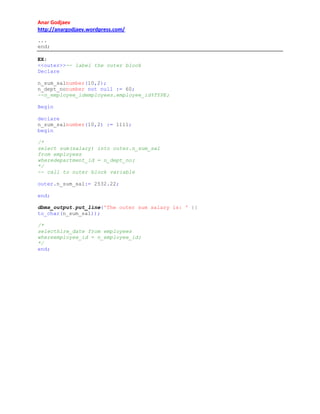
EX:
<<outer>>-- label the outer block
Declare
n_sum_salnumber(10,2);
n_dept_nonumber not null := 60;
--n_employee_idemployees.employee_id%TYPE;
Begin
declare
n_sum_salnumber(10,2) := 1111;
begin
/*
select sum(salary) into outer.n_sum_sal
from employees
wheredepartment_id = n_dept_no;
*/
-- call to outer block variable
outer.n_sum_sal:= 2532.22;
end;
dbms_output.put_line('The outer sum salary is: ' ||
to_char(n_sum_sal));
/*
selecthire_date from employees
whereemployee_id = n_employee_id;
*/
end;

PL/SQL Blocks

  • 1.
    Anar Godjaev http://anargodjaev.wordpress.com/ PL/SQL Blocks declare --<Variables,Cursors, user defined exception> begin --<Sql statements> --<PL/SQL statements> exception When <exception name> then --<Actions to perform when errors, occur> end; EX: declare v_variablevarchar2(15); begin selectcolumn_name intov_variable fromtable_name; exception whenothers then null; end; create or replace procedure <procedure_name> as --<declare any variables here> begin null; end; create or replace function <function_name> return <datatype> as --<declare any veriables here> begin return<value>; end; Variable Types: scalar (single value) -- varchar2, number, date, subtype composite (records) -- record, plsql table reference (pointer) -- ref cursor LOB (large objects) -- BLOB, CLOB, LOB Bind variables -- variables defined outside plsql block, ex: .NET, Java, sqlplus Scalar data types:
  • 2.
    Anar Godjaev http://anargodjaev.wordpress.com/ Char, varchar2,long, number, binary_integer, boolean, date, timestamp, timestamp withtimezone, timestamp with local time zone declare str_jobvarchar2(15); int_countbinary_integer := 0; n_tot_salnumber(9,2); cons_numconstant number(3,2) := 8.25; b_validboolean not null default true; _name employees.last_name%TYPE; date_dtdate := sysdate+7; subtypetype_my_varchar varchar2(100); type_my_charmy_varchar; EX: declare n_deptnonumber(4); --departments.department_no%TYPE n_location_idnumber(4); --departments.locations_id%TYPE begin selectdepartment_id, location_id intov_deptno, v_location_id fromdepartments where department_name= 'Sales'; end; Composite data types: Records: rec_tbl_based is table_name%ROWTYPE; rec_cur_based is cur_name%ROWTYPE; typetype_rec_var_based is (field1 datatype1, field2 datatype2, .. ) rec_my_recordtype_rec_var_based selectcol_name into rec_my_record.col_name from table_name; selectrec_my_record.col_name from dual; EX: declare rec_empemployees%ROWTYPE; n_employee_numbernumber := 1024; begin select* into emp_recfrom employees whereemployee_id= n_employee_number; insert into retired_emps (emp_no, ename, job, mng, hire_date, leave_date, sql, comm, rept_no) values (emp_rec.employee_id, emprec.lastname,...); commit; end;
  • 3.
    Anar Godjaev http://anargodjaev.wordpress.com/ EX: declare typeemp_record_typeis record ( last_namevarchar2(25), job_idvarchar2(10), salarynumber(8,2) ); emp_recordemp_record_type; begin emp_record.last_name:='ERGEM'; dbms_output.put_line(emp_record.last_name); end; Plsql Tables: typetype_tbl_city_codes is table of varchar2(50); typetype_tbl_city_codes is table of t_city.code%TYPE; typetype_tbl_based_on_cur is table of type_rec_var_based [index by binary integer]; tbl_city_codestype_tbl_city_codes; select code into tbl_city_codes(15) from t_city where city_id=15; selecttbl_city_codes(15) from dual; typeename_table_type is table of employees.lastname%TYPE index by binary_integer; ename_tableename_table_type; EX: declare -- declare the table type typeename_table_typeis table of varchar2(100);--employees.last_name%TYPE index by binary integer; typehiredate_table_typeis table of dateindex by binary_integer; -- declare the table type variable ename_tableename_table_type; hiredate_tablehiredate_table_type; begin -- initialize the table by a call to the constructor ename_table:= ename_table_type(); -- extend the table ename_table.extend(1); -- assign a value ename_table(1) := 'cameron'; -- indexed tables do not need initializing and extending
  • 4.
    Anar Godjaev http://anargodjaev.wordpress.com/ -- hiredate_table:= hiredate_table_type(); -- hiredate_table.extend(10); hiredate_table(8) := sysdate + 7; ifename_table.exists(1) then --insert into ... dbms_output.put_line(ename_table(1)); dbms_output.put_line(hiredate_table(8)); end if; end; Pl/SQL table attributes: Exists [(n)] Count First Last Prior [(n)] Next [(n)] Trim [(n)] -- rename one element from end table Delete [(n)] -- remove elements EX: declare typeemp_table_typeis table of employees%ROWTYPE index by binary_integer; my_emp_tableemp_table_type; v_countnumber(3) := 104; begin fori in 10.. v_countloop select* into my_emp_table(i) from employees whereemployee_id= i; end loop; fori in my_emp_table.first .. my_emp_table.last loop dbms_output.put_line(my_emp_table.lastname(i)); end loop; end; Variables in nested blocks: declare d_birth_date date; begin declare d_birth_date date; begin ... Outer.d_birth_date:=to_Date(’03-NOV-2013’,’DD-MON-YYYY’); end;
  • 5.
    Anar Godjaev http://anargodjaev.wordpress.com/ ... end; EX: <<outer>>-- labelthe outer block Declare n_sum_salnumber(10,2); n_dept_nonumber not null := 60; --n_employee_idemployees.employee_id%TYPE; Begin declare n_sum_salnumber(10,2) := 1111; begin /* select sum(salary) into outer.n_sum_sal from employees wheredepartment_id = n_dept_no; */ -- call to outer block variable outer.n_sum_sal:= 2532.22; end; dbms_output.put_line('The outer sum salary is: ' || to_char(n_sum_sal)); /* selecthire_date from employees whereemployee_id = n_employee_id; */ end;