Libraries, Data, and
Publication

25 January 2014
SPARC-ACRL Forum on Emerging Issues in Scholarly Communication
Overview
•
•
•
•

2

Data Services and Libraries
PURR
Data Citation, Identifiers and Article Linking
What can you do?
Data Services and
Libraries

3
Why data for the Purdue Libraries?
• Directive to find ways of making the
Libraries relevant to the campus research
enterprise
• Common theme: Researchers need help
with data management
• Opportunity to work with researchers
directly AND build rich collections of
primary source material
4
Research Data Strategy
• Build relationships and collaborations with
campus faculty
– Conduct research into data behaviors

• Build relationships with OVPR and CIO
• Collaborate on technology projects
– Small-scale prototypes
– HUBzero collaborations

5
Why data for Purdue?
National Science Foundation (NSF) – 2011
“Plans for data management and sharing of the products of research.
Proposals must include a supplementary document of no more than two pages
labeled ‘Data Management Plan’. This supplement should describe how the
proposal will conform to NSF policy on the dissemination and sharing of
research results.”
White House Office of Science and Technology Policy (OSTP) – 2013
“The Office of Science and Technology Policy (OSTP) hereby directs each Federal
agency with over $100 million in annual conduct of research and development
expenditures to develop a plan to support increased public access to the results
of research funded by the Federal Government. Further, each agency plan for
both scientific publications and digital scientific data…”

6
PURR

7
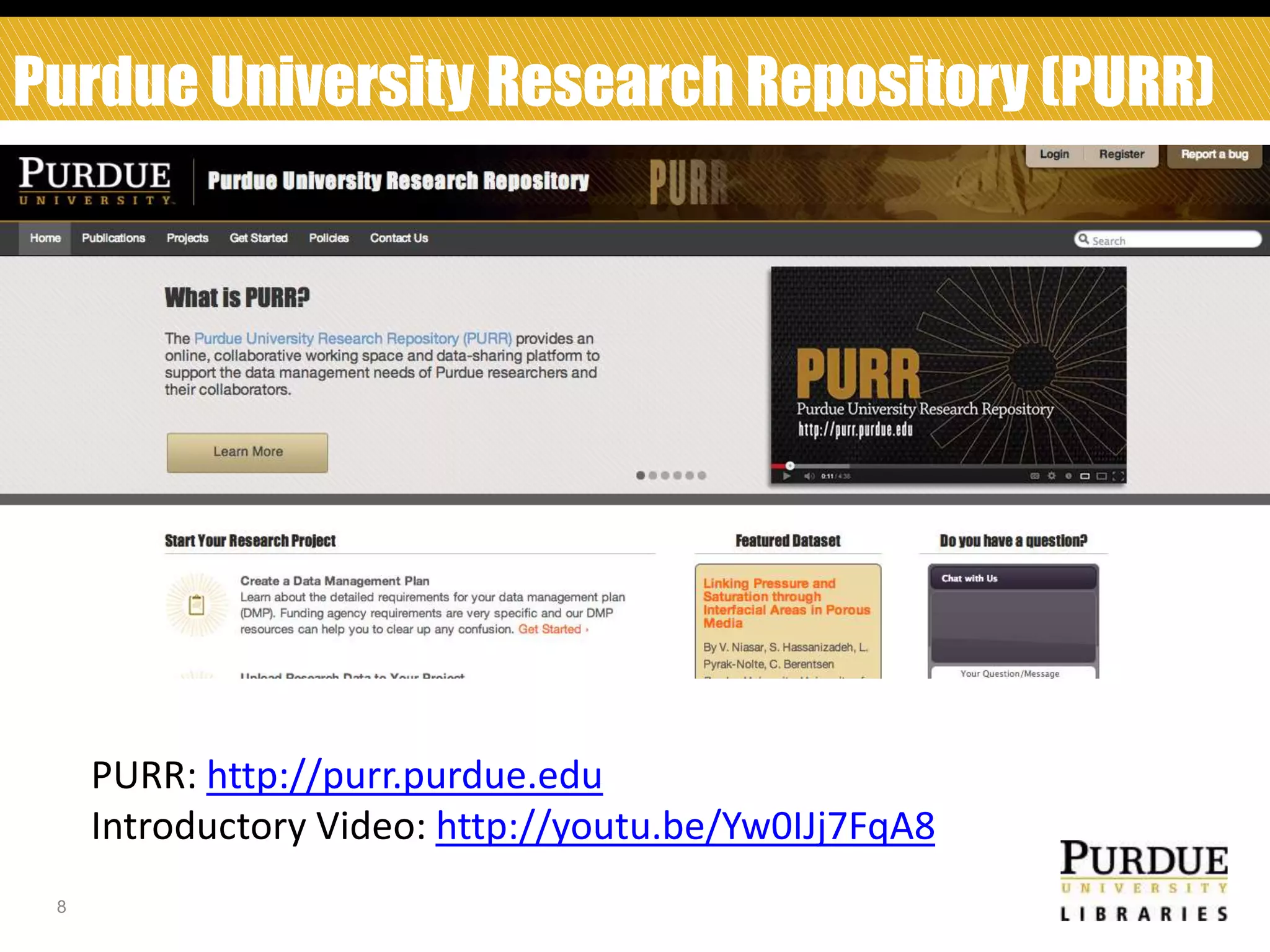
Purdue University Research Repository (PURR)

PURR: http://purr.purdue.edu
Introductory Video: http://youtu.be/Yw0IJj7FqA8
8
What is PURR?
• PURR provides resources for data
management planning
• PURR is a web-based platform for sharing
data and collaborating on research
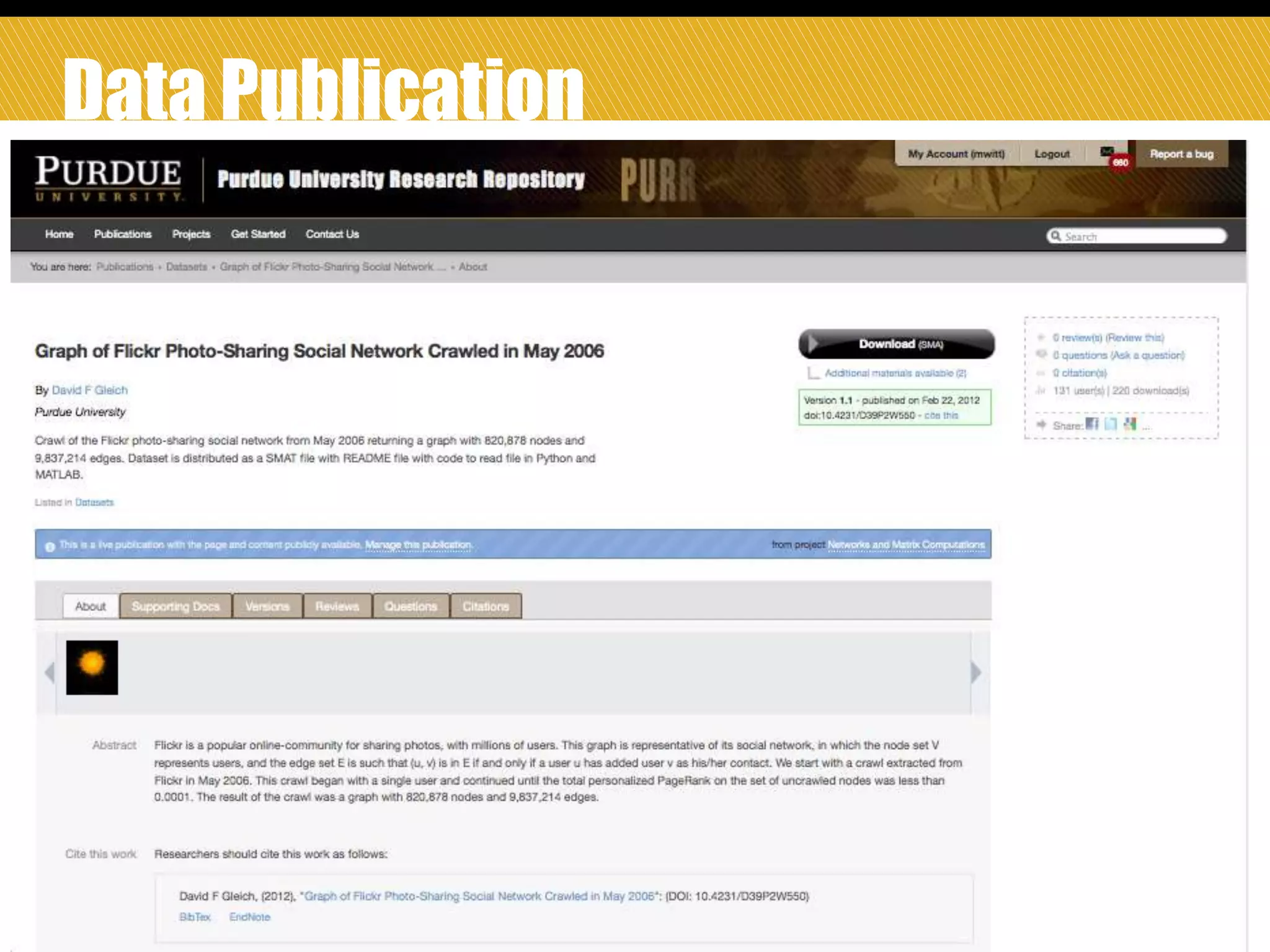
• PURR provides a platform for publishing
datasets with DataCite DOIs
• PURR provides a platform for long-term
archiving of data sets
9
Who can use PURR?
Designed for:
• Purdue University faculty, staff, and graduate
student researchers; their collaborators
• Current and future consumers of their data

10
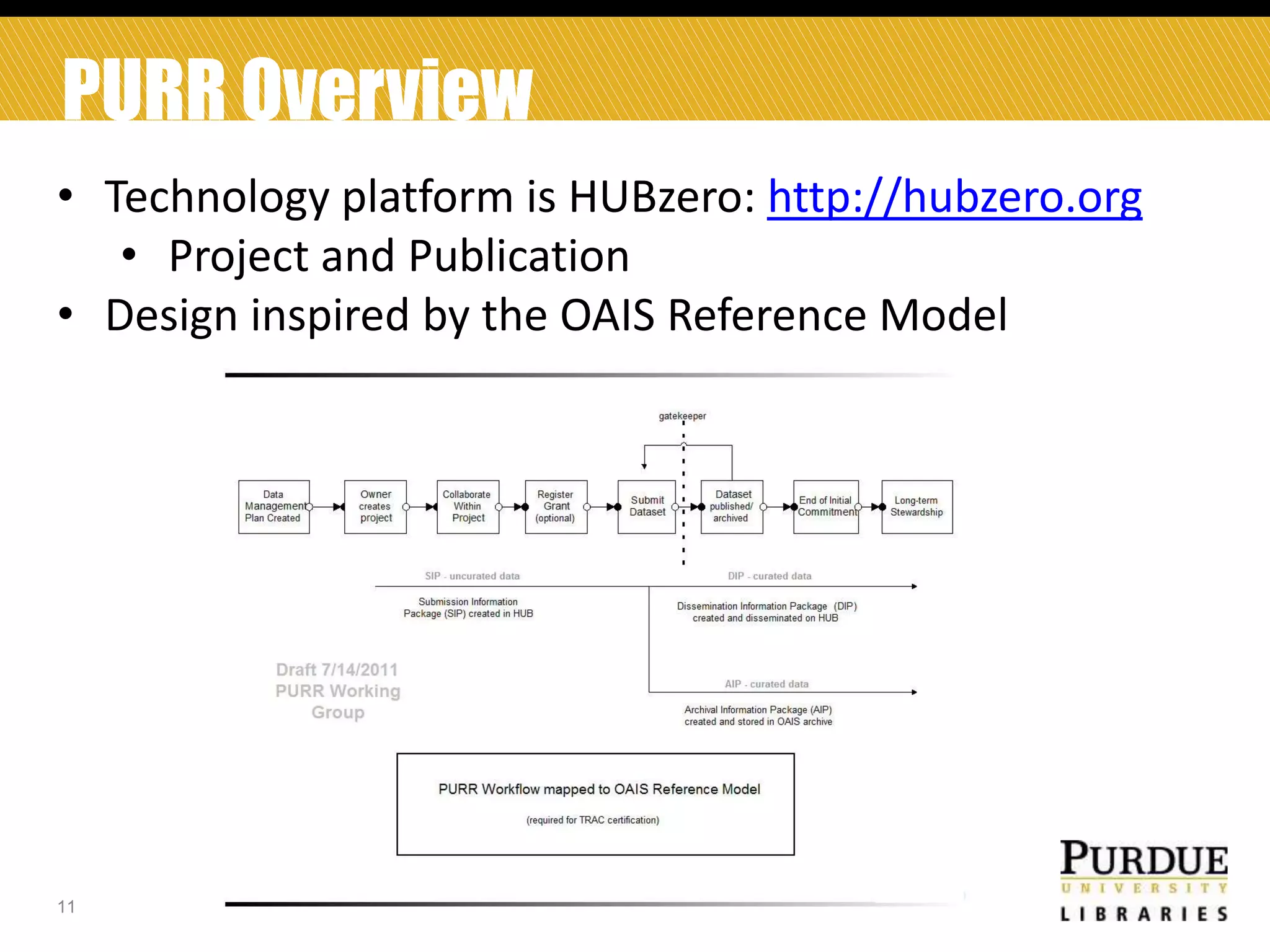
PURR Overview
• Technology platform is HUBzero: http://hubzero.org
• Project and Publication
• Design inspired by the OAIS Reference Model

11
Purdue University Research Repository (PURR)

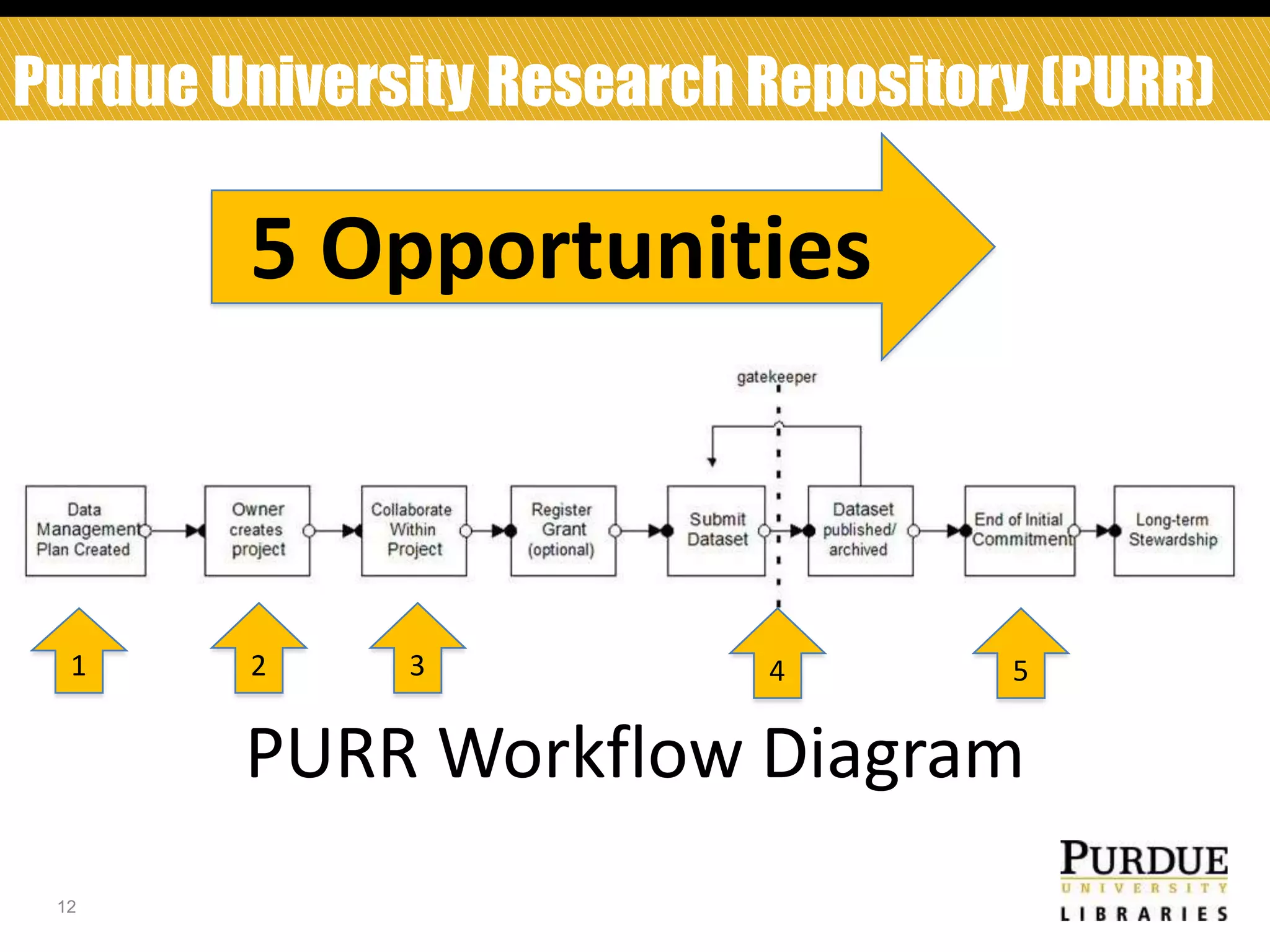
5 Opportunities

1

2

3

4

5

PURR Workflow Diagram
12
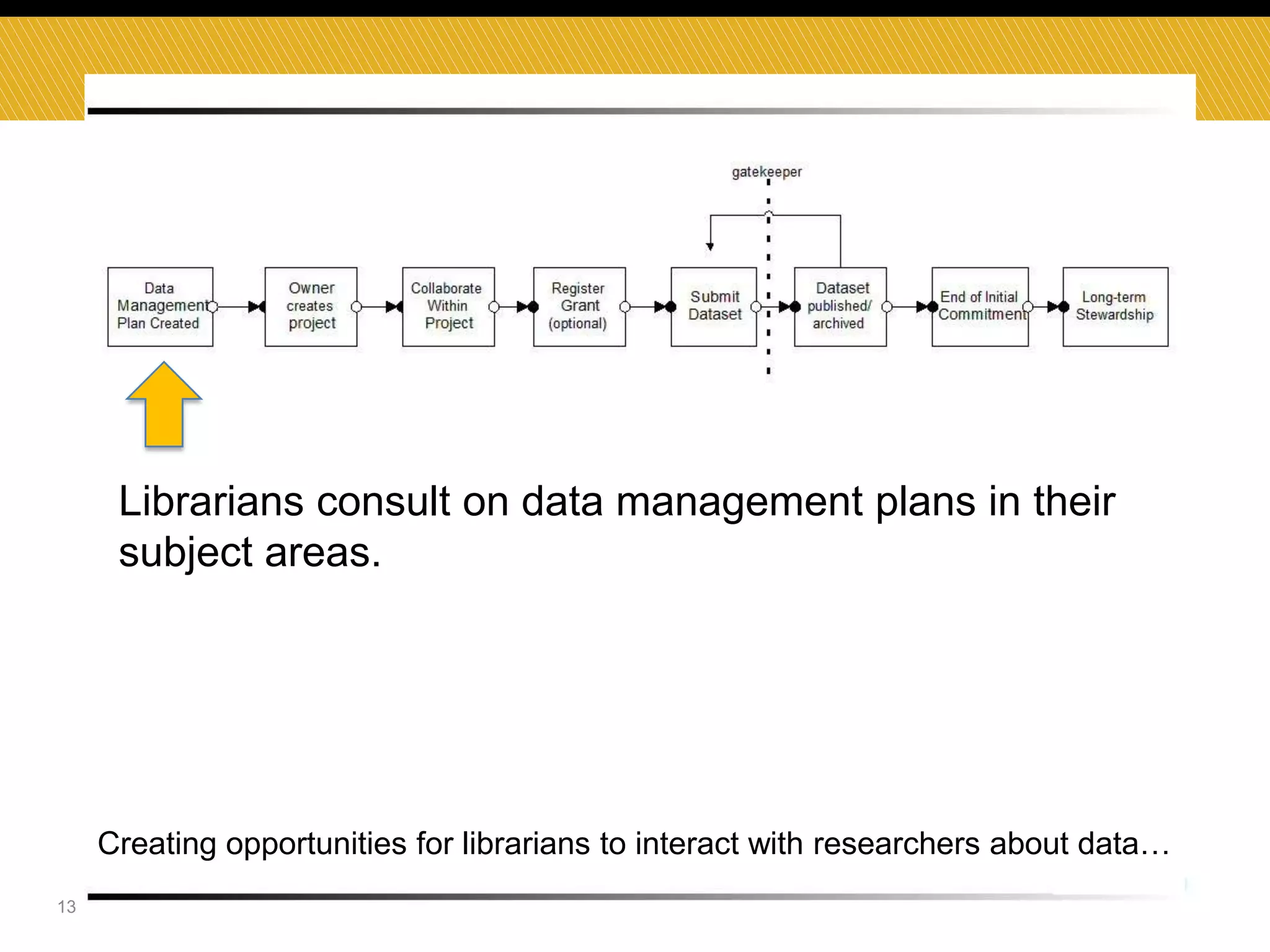
Librarians consult on data management plans in their
subject areas.

Creating opportunities for librarians to interact with researchers about data…
13
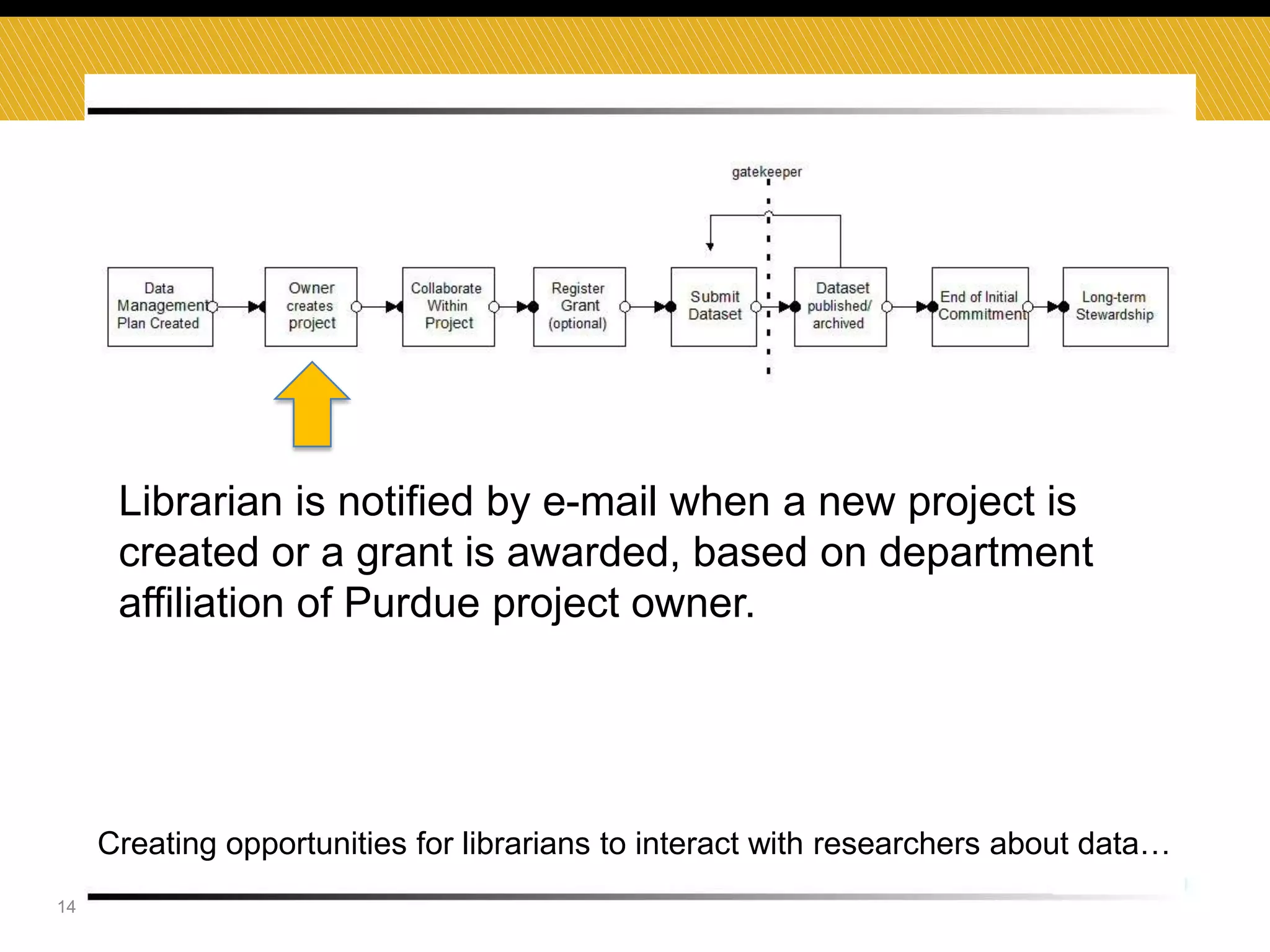
Librarian is notified by e-mail when a new project is
created or a grant is awarded, based on department
affiliation of Purdue project owner.

Creating opportunities for librarians to interact with researchers about data…
14
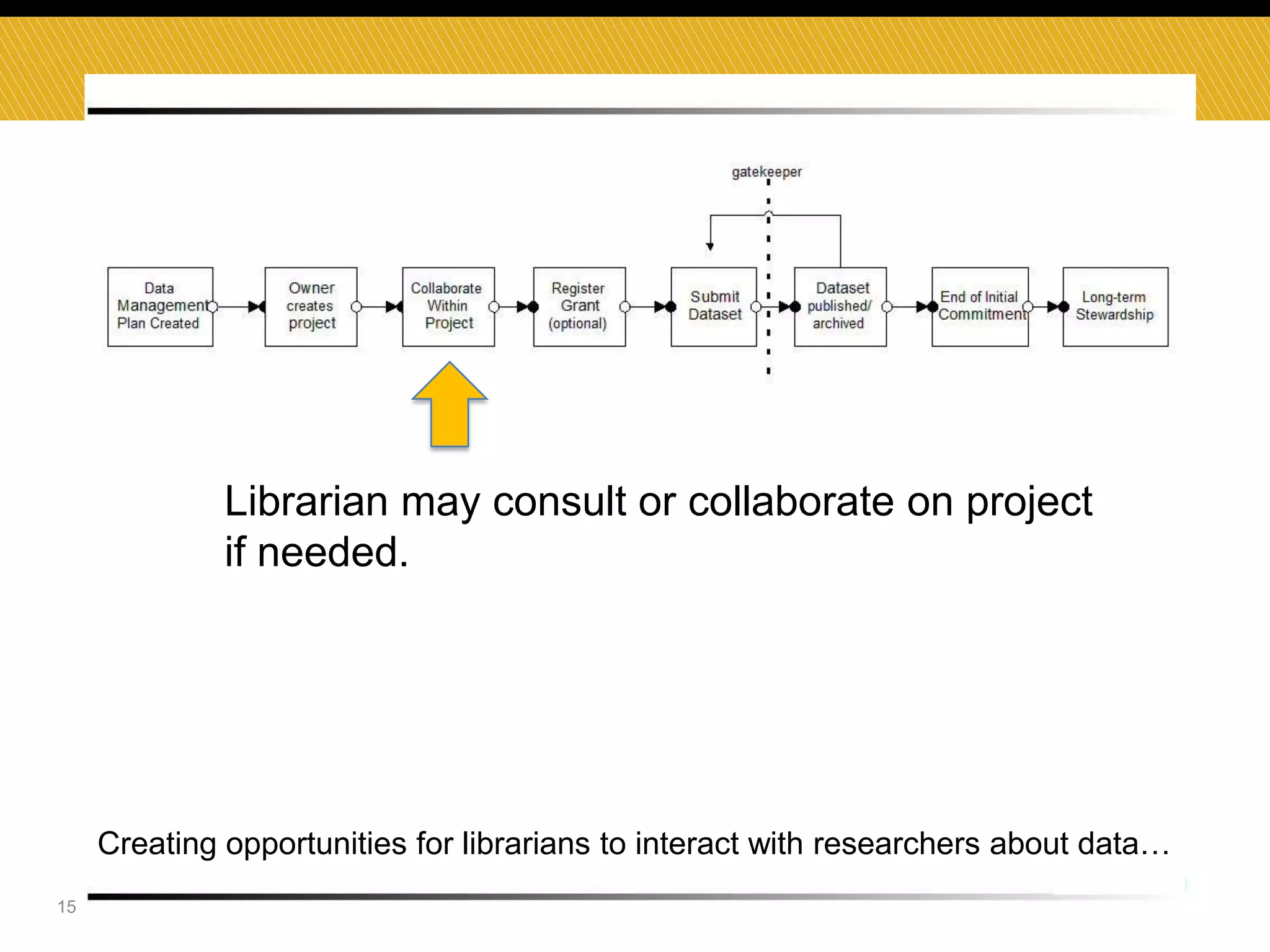
Librarian may consult or collaborate on project
if needed.

Creating opportunities for librarians to interact with researchers about data…
15
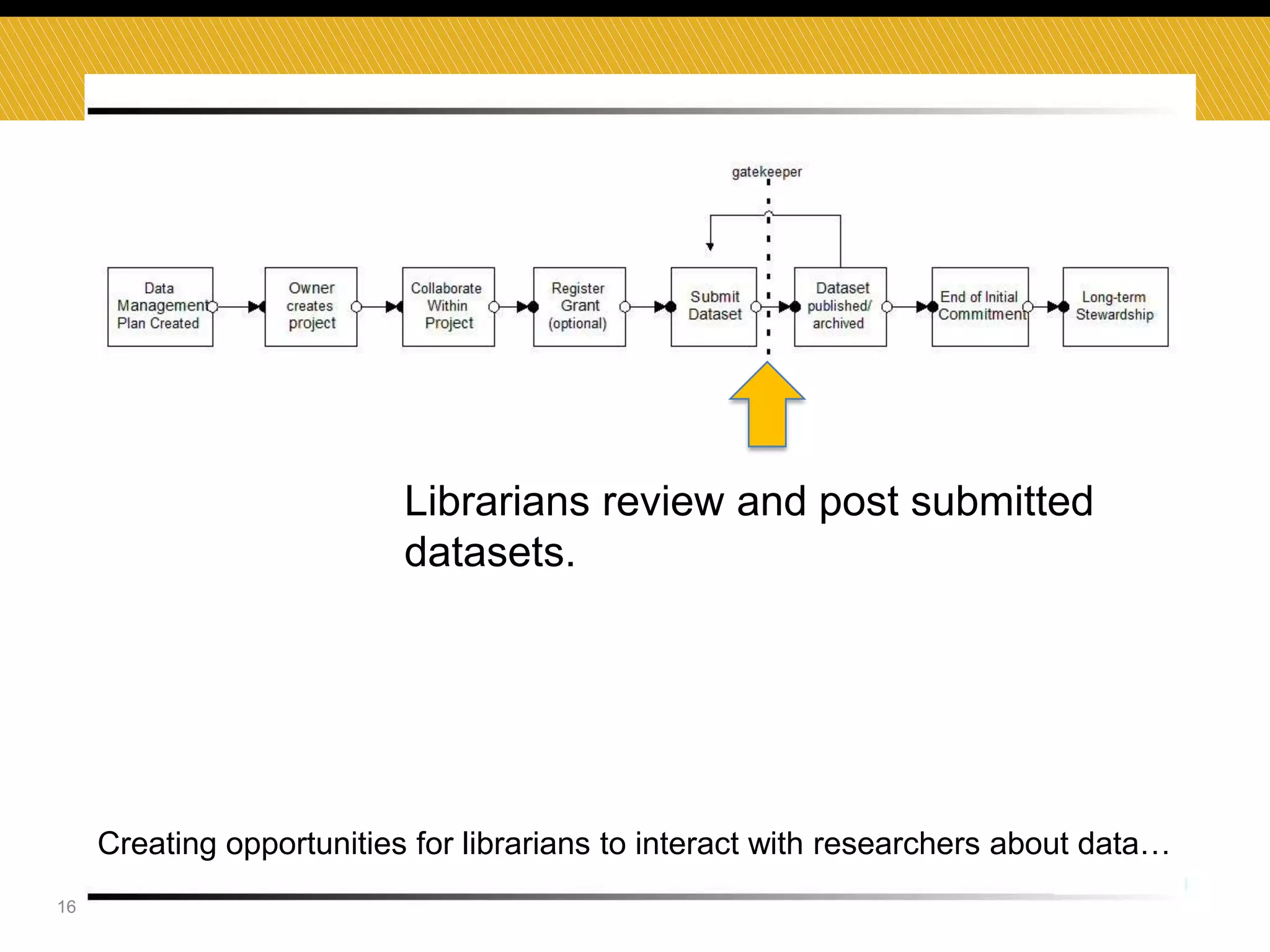
Librarians review and post submitted
datasets.

Creating opportunities for librarians to interact with researchers about data…
16
Data Publication

17
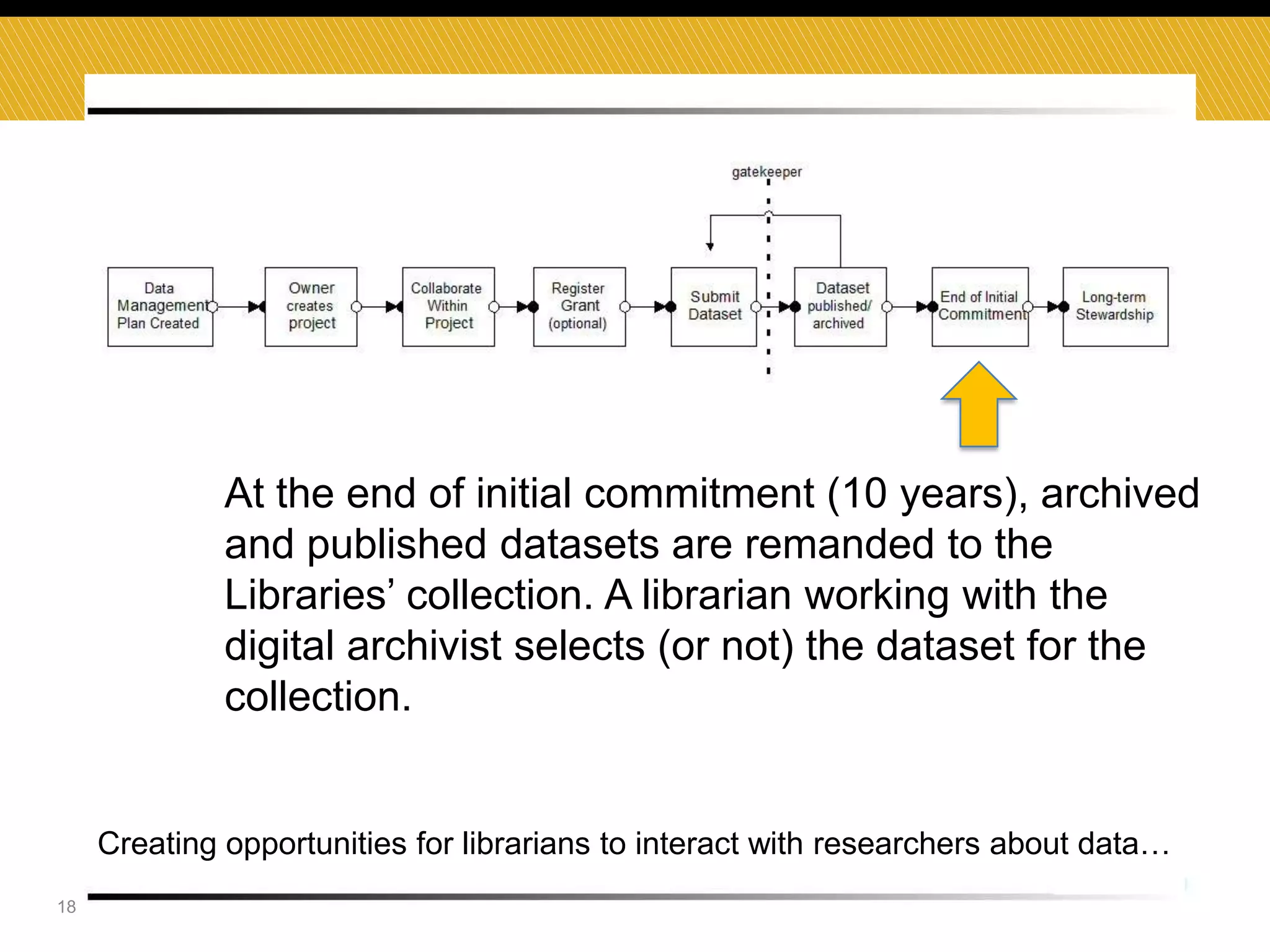
At the end of initial commitment (10 years), archived
and published datasets are remanded to the
Libraries’ collection. A librarian working with the
digital archivist selects (or not) the dataset for the
collection.

Creating opportunities for librarians to interact with researchers about data…
18
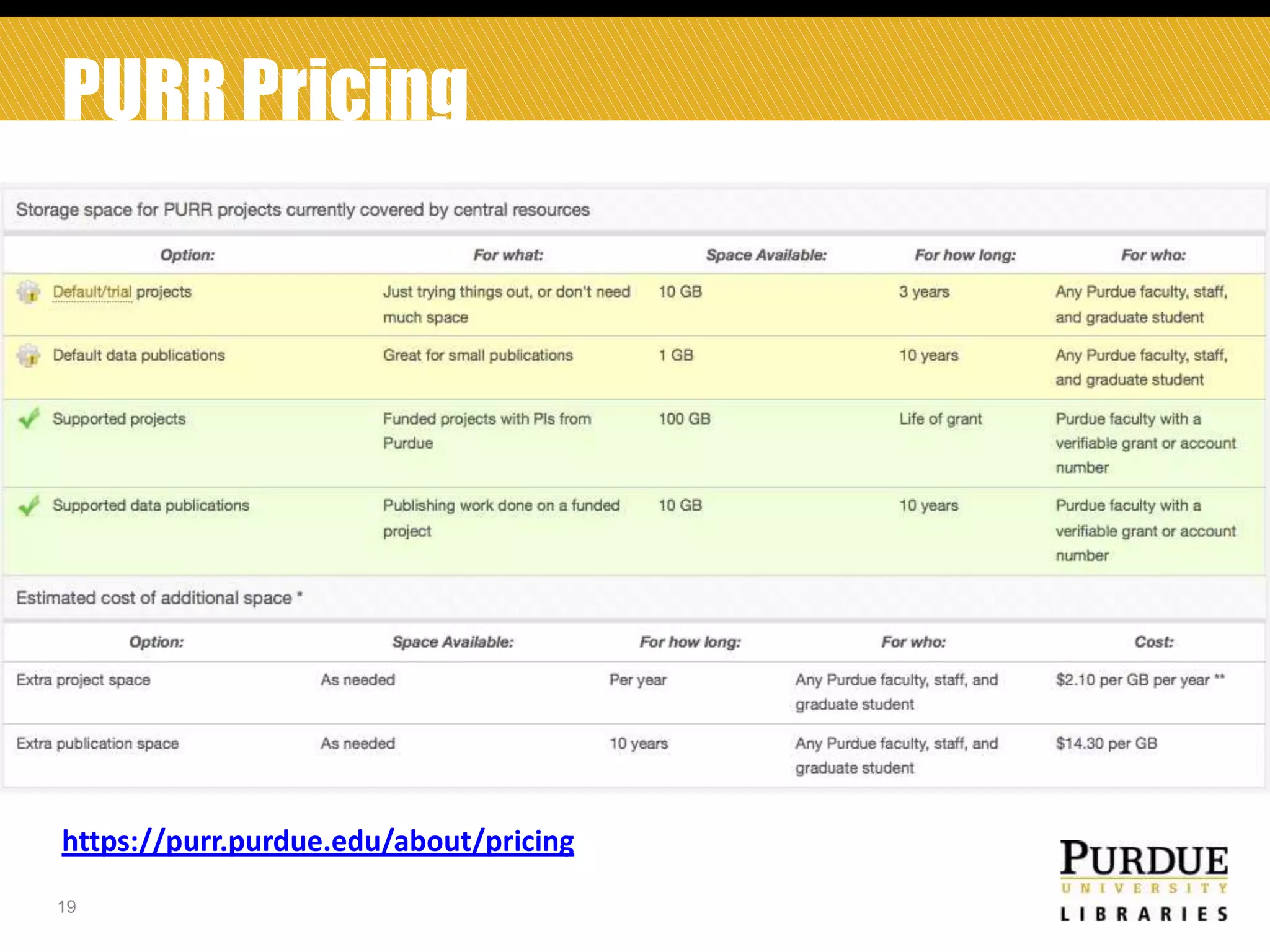
PURR Pricing

https://purr.purdue.edu/about/pricing
19
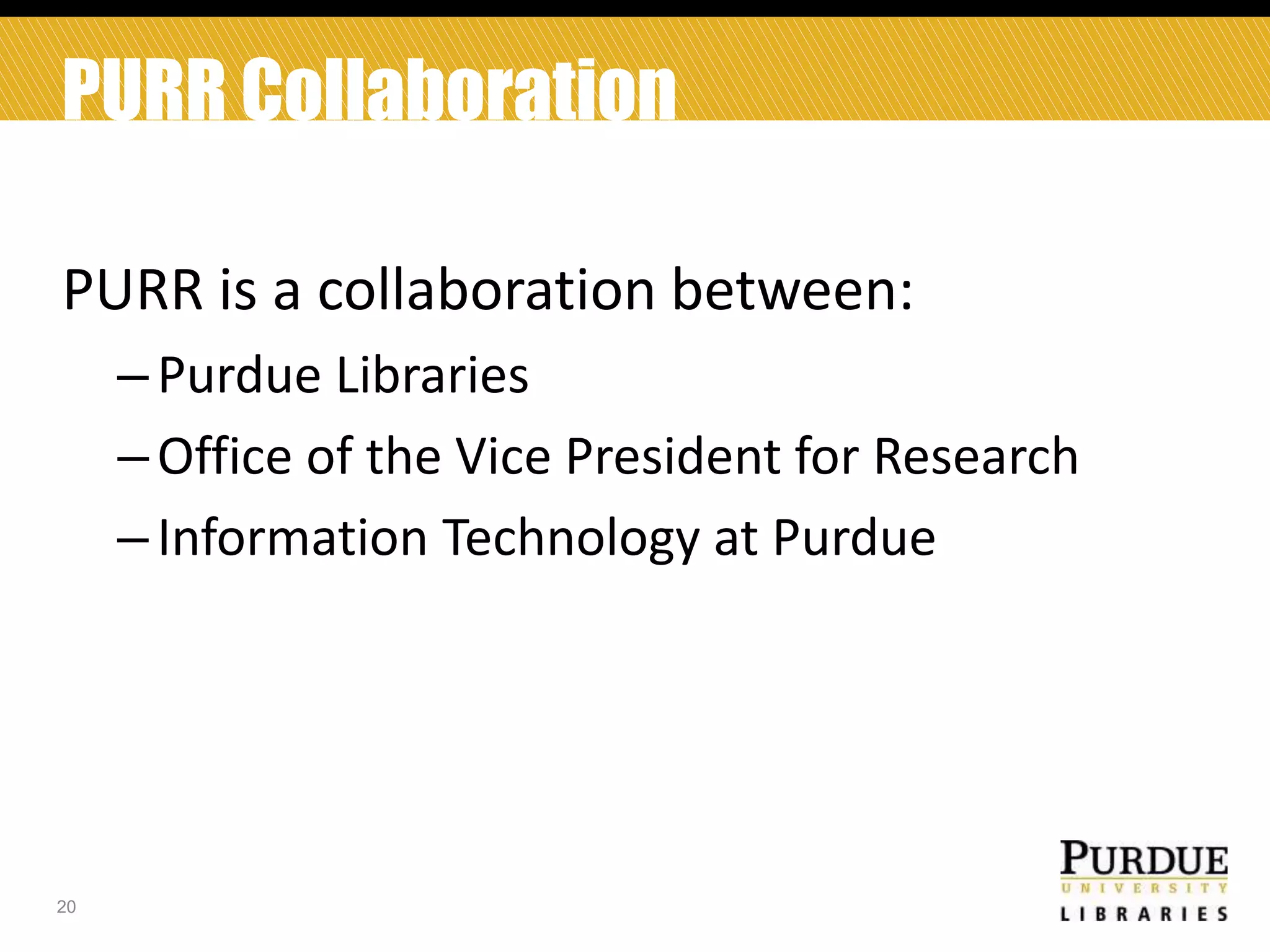
PURR Collaboration
PURR is a collaboration between:
– Purdue Libraries
– Office of the Vice President for Research
– Information Technology at Purdue

20
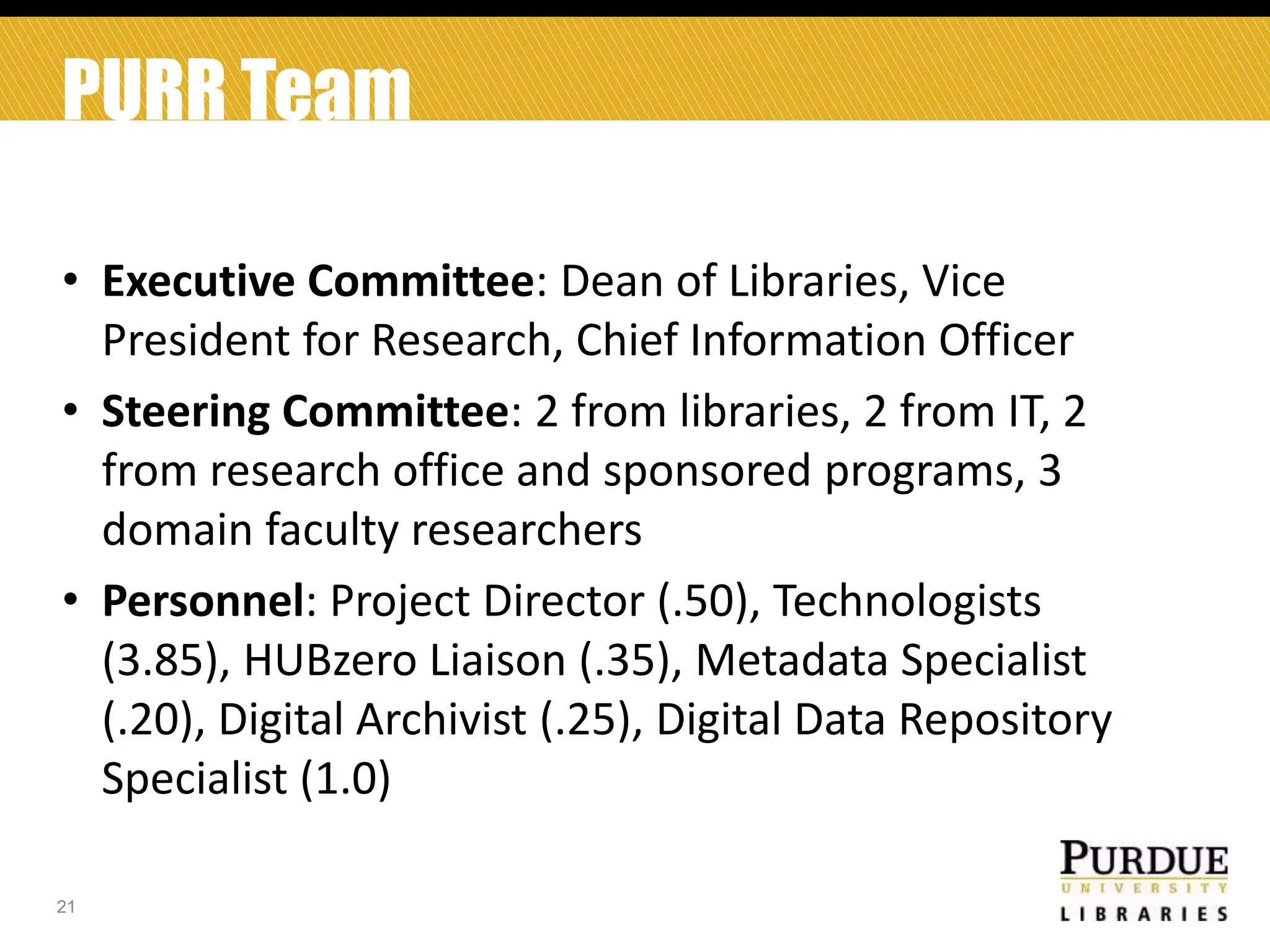
PURR Team
• Executive Committee: Dean of Libraries, Vice
President for Research, Chief Information Officer
• Steering Committee: 2 from libraries, 2 from IT, 2
from research office and sponsored programs, 3
domain faculty researchers
• Personnel: Project Director (.50), Technologists
(3.85), HUBzero Liaison (.35), Metadata Specialist
(.20), Digital Archivist (.25), Digital Data Repository
Specialist (1.0)
21
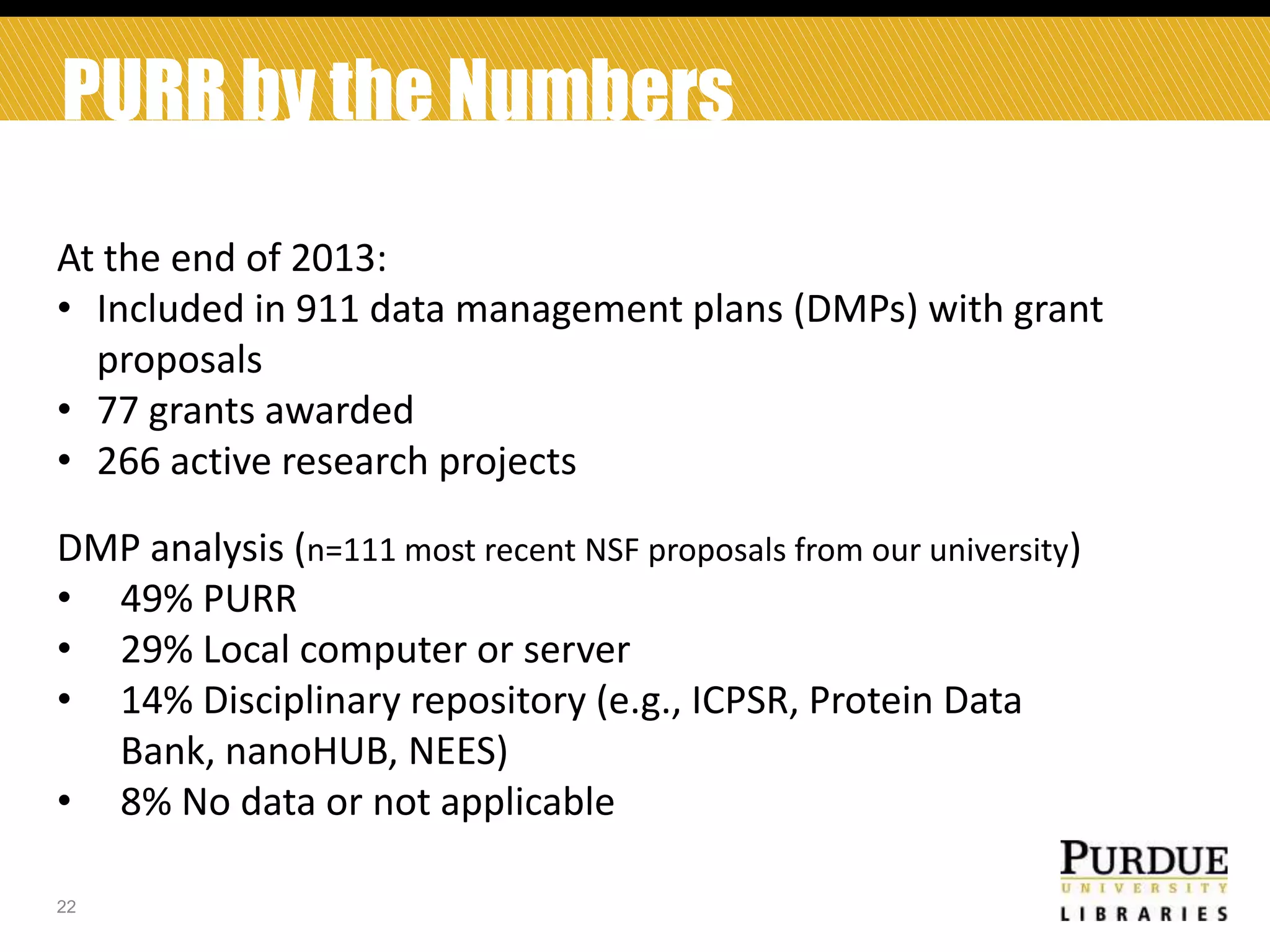
PURR by the Numbers
At the end of 2013:
• Included in 911 data management plans (DMPs) with grant
proposals
• 77 grants awarded
• 266 active research projects
DMP analysis (n=111 most recent NSF proposals from our university)
• 49% PURR
• 29% Local computer or server
• 14% Disciplinary repository (e.g., ICPSR, Protein Data
Bank, nanoHUB, NEES)
• 8% No data or not applicable
22
Data Citation, Identifiers
and Article Linking

23
Data Citation
“The scientist is willing (even eager) to make his data publicly available for a variety of
potential uses on the condition that he receives credit, through a citation, when the
data are used. He is very interested in employing DOIs for his data to enable their
persistence so that the data may be cited.”*1+
“When the data are submitted to the institutional repository the scientist wants a
“how-to-cite” note attached to the record so that users will properly cite the dataset.
Citations or attribution for use of the data is a high priority.
The scientist noted that the ability to connect her datasets with others and the ability
to link the data with publications and other metadata is a high priority.“*2+
“The data collected by the scientist is very tightly tied to the scientist’s publications.
Experimental context is complex, and may not be easily captured other than by linking
publications to the data. “*3+
[1] Carlson, Jake R. (2009) "Traffic Flow - Purdue University," Data Curation Profiles Directory: Vol. 1, Article 4.
DOI: http://dx.doi.org/10.5703/1288284315016
[2] Rutter, Sara. (2011) “Botany/Plant Taxonomy – University of Hawaii,” Data Curation Profiles Directory: Vol. 3, Article 7. DOI:
http://dx.doi.org/10.5703/1288284315000
*3+ Wright, Sarah J. (2012) “Environmental Science/Herbivory – Cornell University.” Data Curation Profiles Directory: Vol. 4, Article 3.
24
DOI: http://dx.doi.org/10.5703/1288284315002
Data Citation
• Attribution and data citation are :
• Essential for linking data to publications and other
scholarly artifacts
• Essential for providing incentive and credit
• Essential for data becoming a first-class citizen of the
scholarly world
• Challenging:
• Creating citable versions of data is not always a simple task
• Culture of citing data has been uneven and slow in its
development

25
DataCite and Identifiers
An International Organization dedicated to:
• Establishing easier access to scientific research data
• Increasing acceptance of research data as legitimate,
citable contributions to the scientific record
• Supporting data archiving that will permit results to
be verified and re-purposed for future study
http://www.datacite.org

26
Data Citation and Library Publishing Services

• DOIs provide credibility – established brand for
faculty
• Exploring emerging publishing models
– Open Access
– Connecting Textual and non-Textual Resources
– Publishing Data (Data Papers, etc.)

27
JTRP Technical Reports Data Project
• Pilot between Purdue Press/Library Publishing
and an Academic Research Center (JTRP) to:
– Develop a unified workflow for producing
published technical reports and data
– Link technical reports to their underlying data
– Link data to technical reports

28
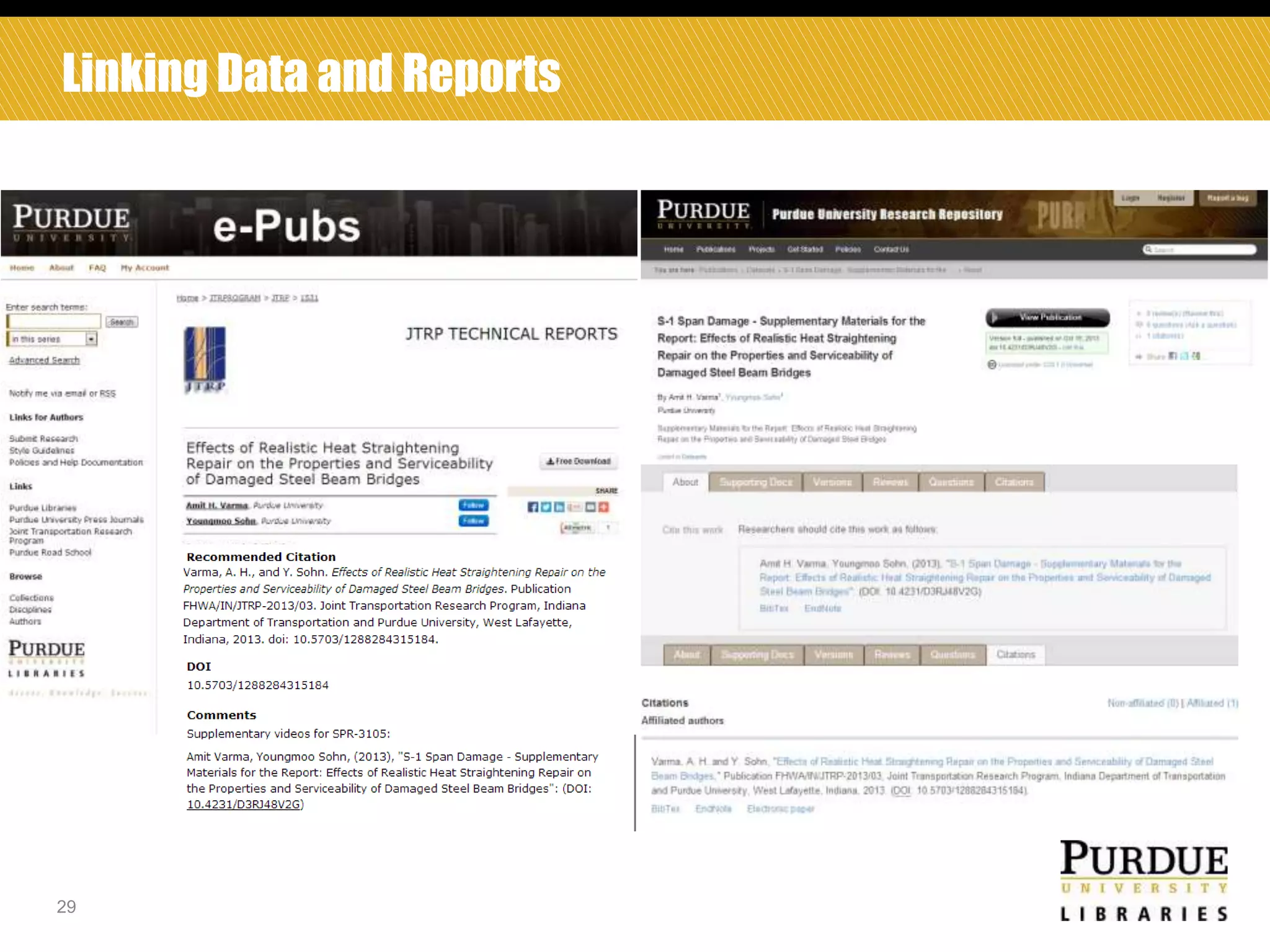
Linking Data and Reports

29
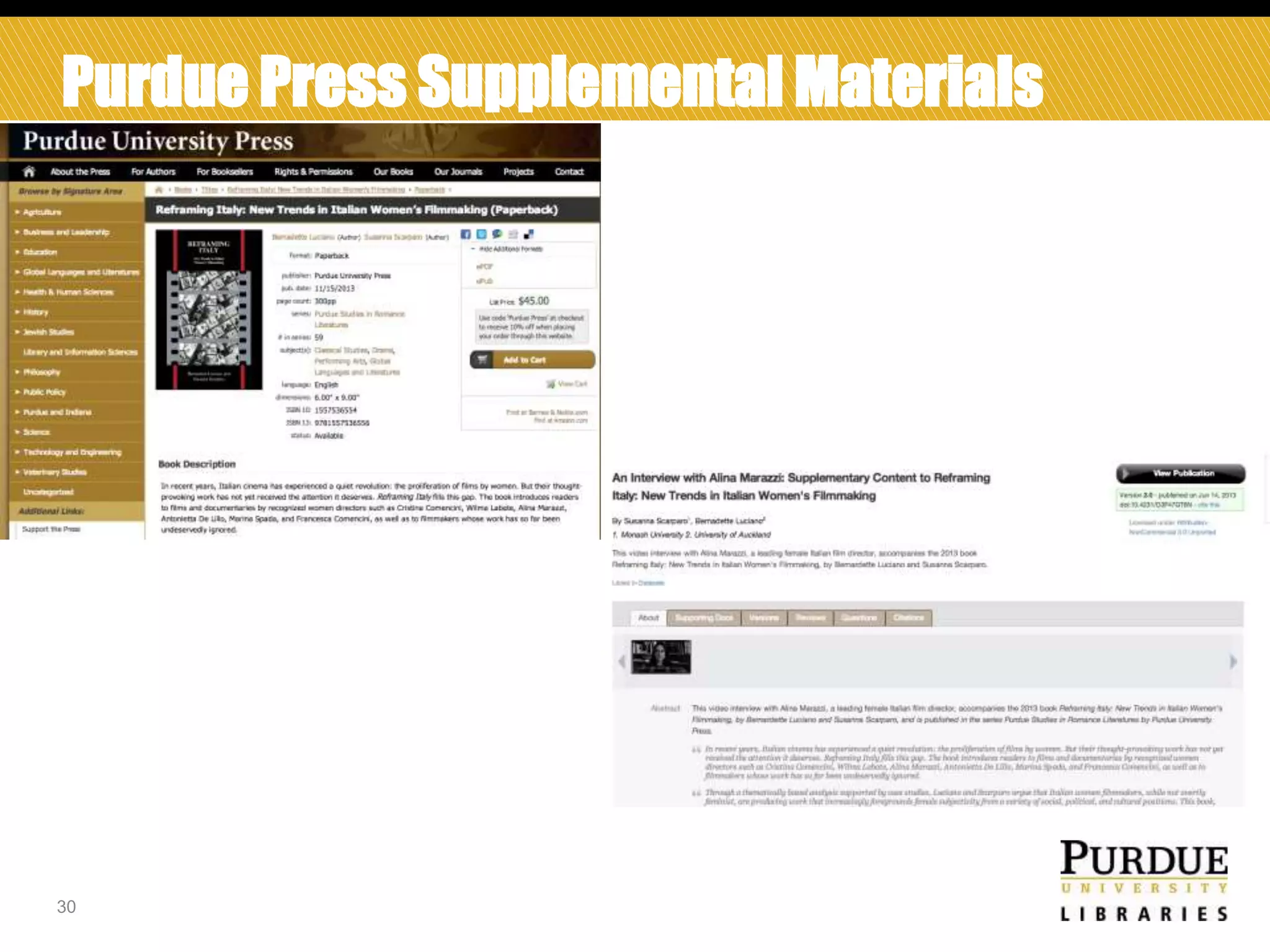
Purdue Press Supplemental Materials

30
What Can You Do?

31
1. Talk to Researchers

32
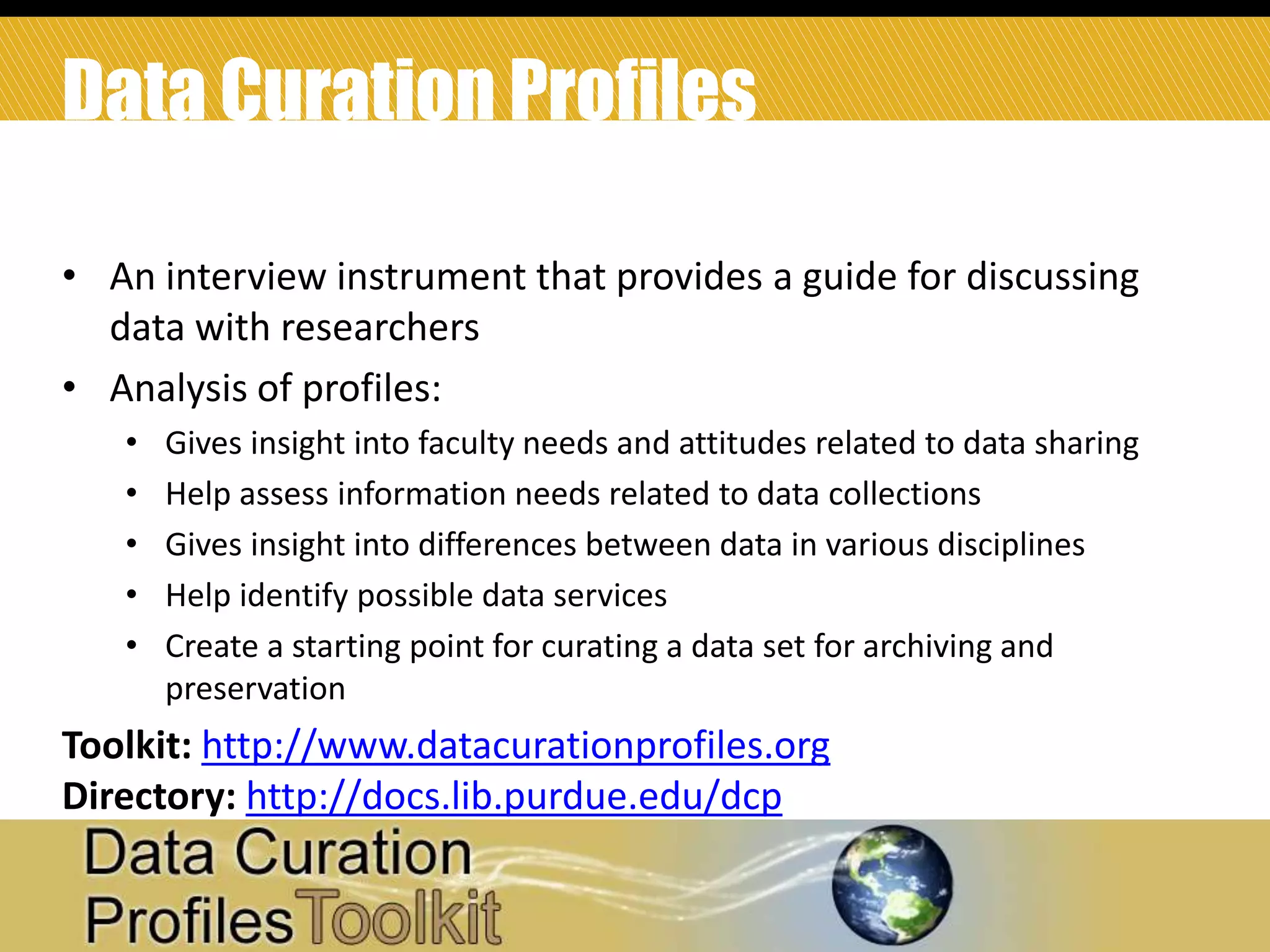
Data Curation Profiles
• An interview instrument that provides a guide for discussing
data with researchers
• Analysis of profiles:
•
•
•
•
•

Gives insight into faculty needs and attitudes related to data sharing
Help assess information needs related to data collections
Gives insight into differences between data in various disciplines
Help identify possible data services
Create a starting point for curating a data set for archiving and
preservation

Toolkit: http://www.datacurationprofiles.org
Directory: http://docs.lib.purdue.edu/dcp
33
2. Understand the
Landscape

34
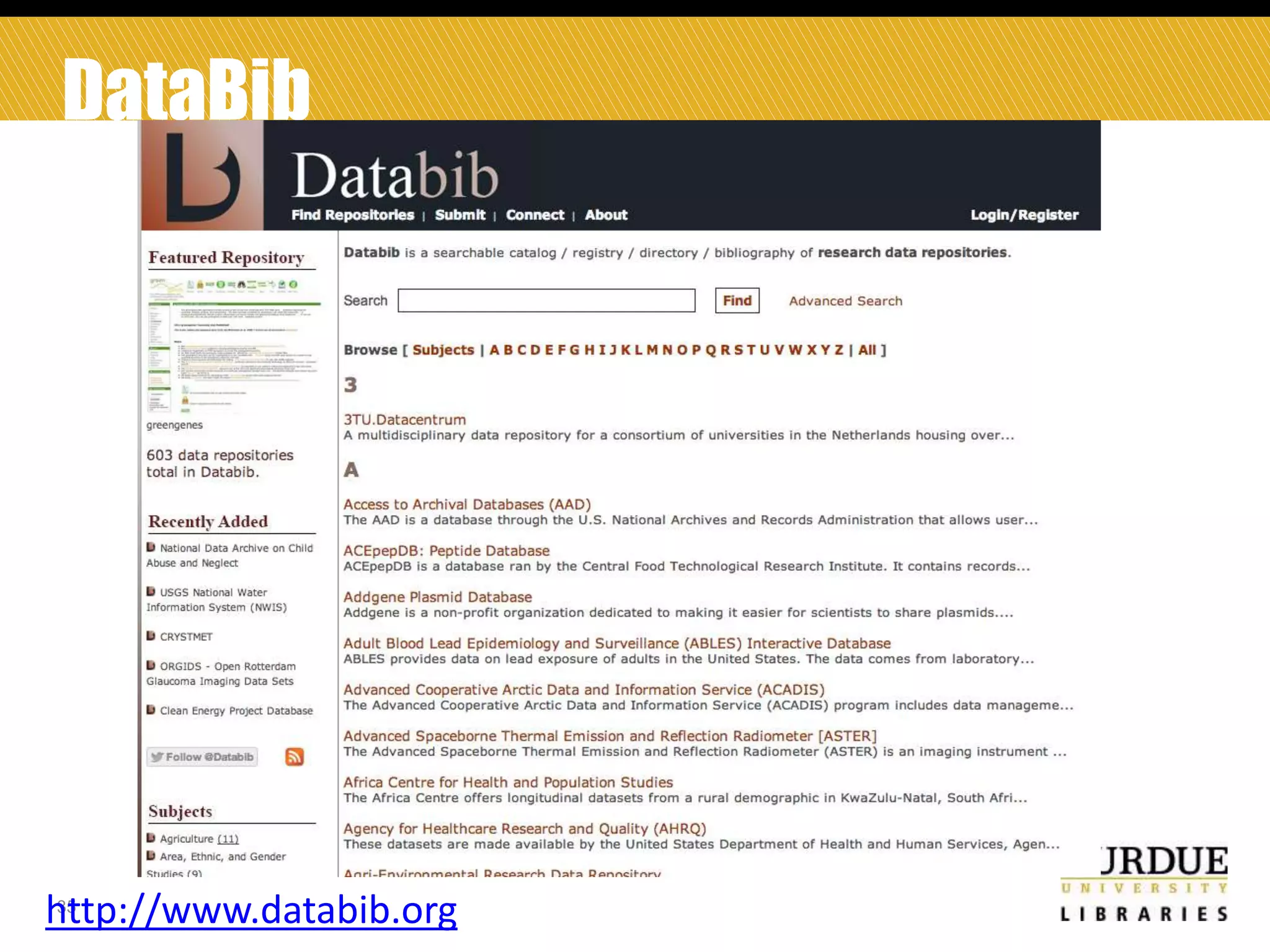
DataBib

35
http://www.databib.org
3. Think About Instruction

36
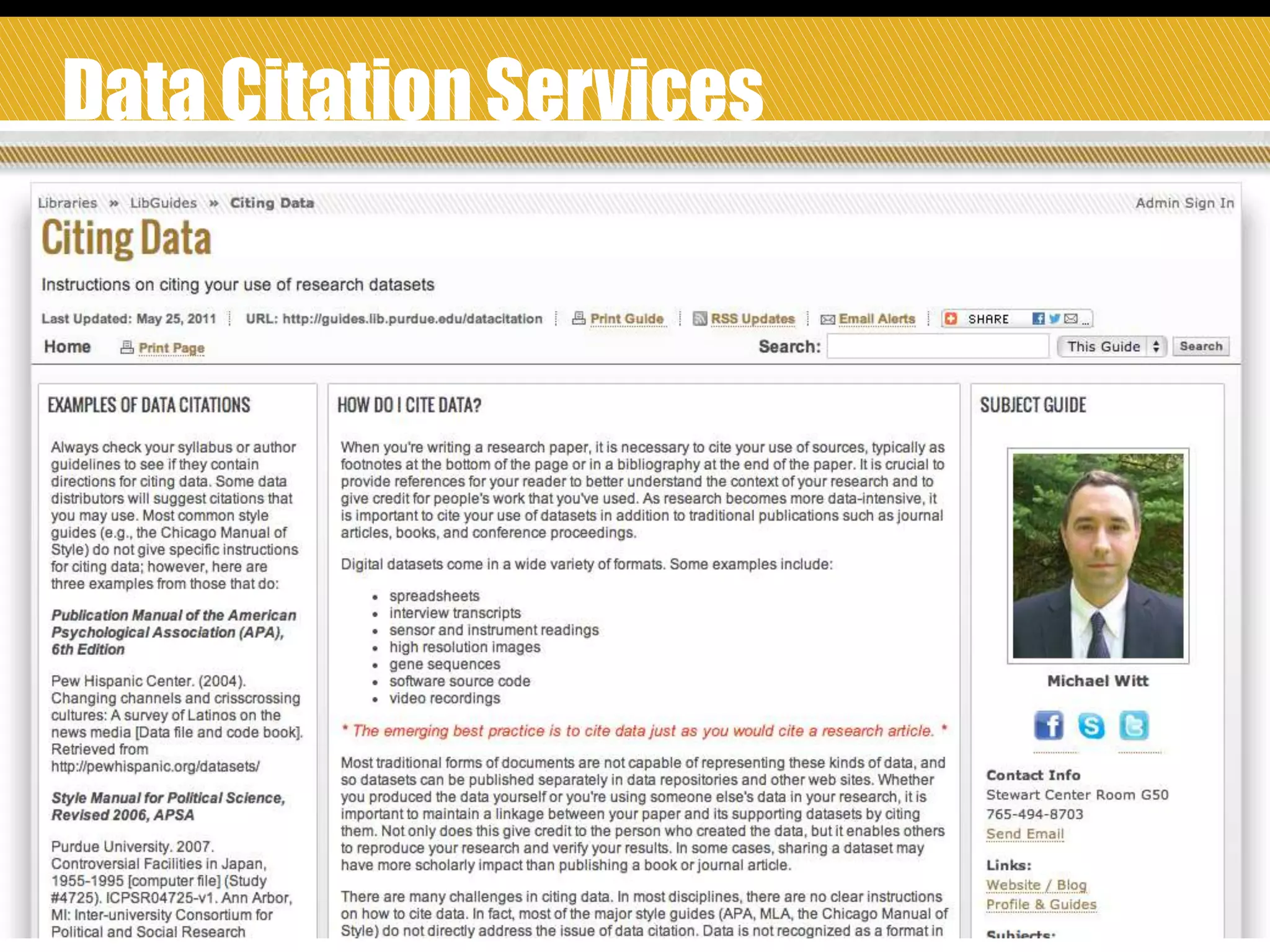
Data Citation Services
• Included in 784 data management plans (DMPs) with grant
proposals
• 68 grants awarded
• 1,063 registered researchers
• 203 active research projects
DMP analysis (n=111 most recent NSF proposals from our university)
• 49% PURR
• 29% Local computer or server
• 14% Disciplinary repository (e.g., ICPSR, Protein Data
Bank, nanoHUB, NEES)
• 8% No data or not applicable
37
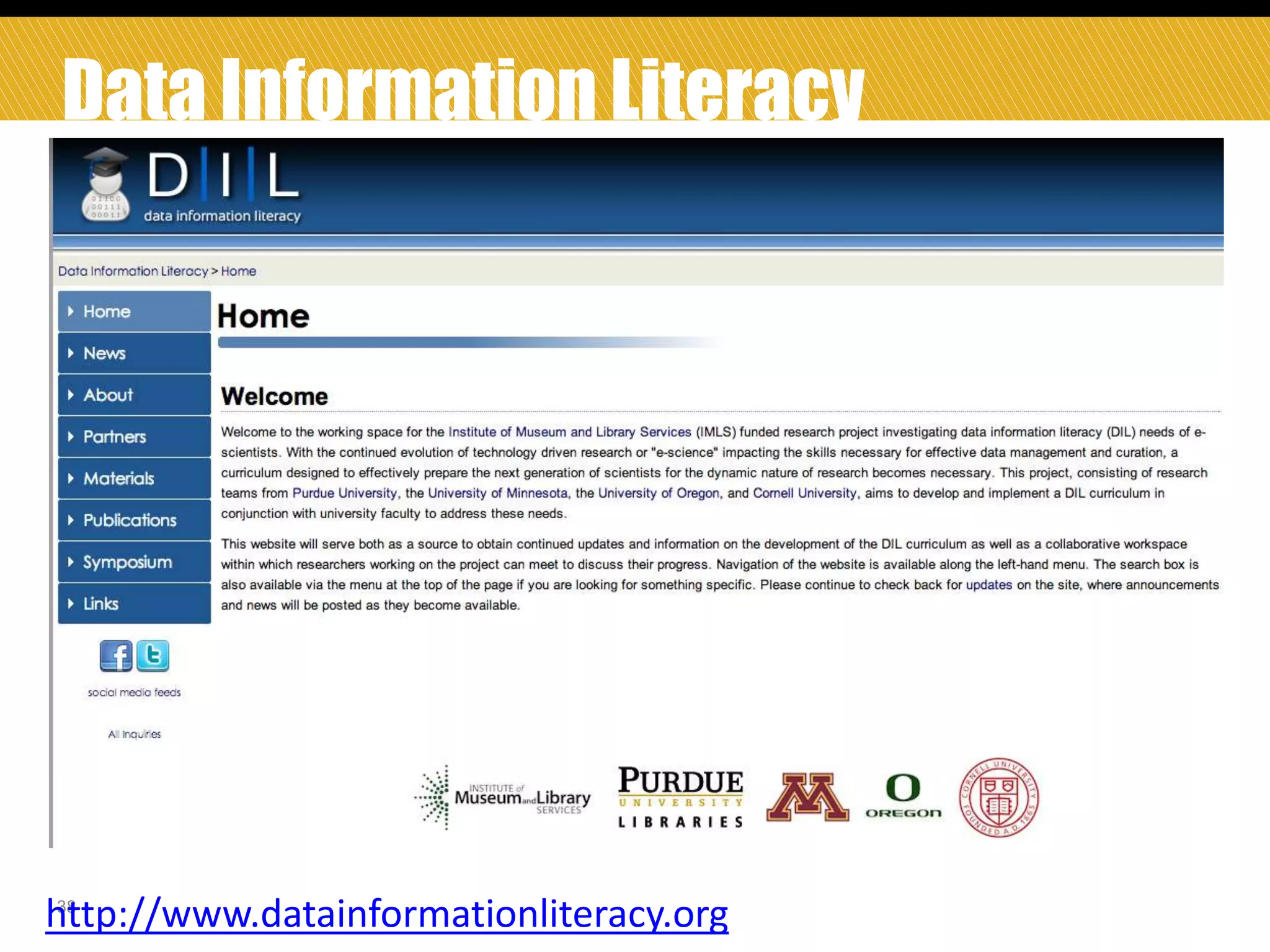
Data Information Literacy

38
http://www.datainformationliteracy.org
Thank You!
pbracke@purdue.edu
@pjbracke
39

2014 ALA MW SPARC-ACRL Forum Talk

  • 1.
    Libraries, Data, and Publication 25January 2014 SPARC-ACRL Forum on Emerging Issues in Scholarly Communication
  • 2.
    Overview • • • • 2 Data Services andLibraries PURR Data Citation, Identifiers and Article Linking What can you do?
  • 3.
  • 4.
    Why data forthe Purdue Libraries? • Directive to find ways of making the Libraries relevant to the campus research enterprise • Common theme: Researchers need help with data management • Opportunity to work with researchers directly AND build rich collections of primary source material 4
  • 5.
    Research Data Strategy •Build relationships and collaborations with campus faculty – Conduct research into data behaviors • Build relationships with OVPR and CIO • Collaborate on technology projects – Small-scale prototypes – HUBzero collaborations 5
  • 6.
    Why data forPurdue? National Science Foundation (NSF) – 2011 “Plans for data management and sharing of the products of research. Proposals must include a supplementary document of no more than two pages labeled ‘Data Management Plan’. This supplement should describe how the proposal will conform to NSF policy on the dissemination and sharing of research results.” White House Office of Science and Technology Policy (OSTP) – 2013 “The Office of Science and Technology Policy (OSTP) hereby directs each Federal agency with over $100 million in annual conduct of research and development expenditures to develop a plan to support increased public access to the results of research funded by the Federal Government. Further, each agency plan for both scientific publications and digital scientific data…” 6
  • 7.
  • 8.
    Purdue University ResearchRepository (PURR) PURR: http://purr.purdue.edu Introductory Video: http://youtu.be/Yw0IJj7FqA8 8
  • 9.
    What is PURR? •PURR provides resources for data management planning • PURR is a web-based platform for sharing data and collaborating on research • PURR provides a platform for publishing datasets with DataCite DOIs • PURR provides a platform for long-term archiving of data sets 9
  • 10.
    Who can usePURR? Designed for: • Purdue University faculty, staff, and graduate student researchers; their collaborators • Current and future consumers of their data 10
  • 11.
    PURR Overview • Technologyplatform is HUBzero: http://hubzero.org • Project and Publication • Design inspired by the OAIS Reference Model 11
  • 12.
    Purdue University ResearchRepository (PURR) 5 Opportunities 1 2 3 4 5 PURR Workflow Diagram 12
  • 13.
    Librarians consult ondata management plans in their subject areas. Creating opportunities for librarians to interact with researchers about data… 13
  • 14.
    Librarian is notifiedby e-mail when a new project is created or a grant is awarded, based on department affiliation of Purdue project owner. Creating opportunities for librarians to interact with researchers about data… 14
  • 15.
    Librarian may consultor collaborate on project if needed. Creating opportunities for librarians to interact with researchers about data… 15
  • 16.
    Librarians review andpost submitted datasets. Creating opportunities for librarians to interact with researchers about data… 16
  • 17.
  • 18.
    At the endof initial commitment (10 years), archived and published datasets are remanded to the Libraries’ collection. A librarian working with the digital archivist selects (or not) the dataset for the collection. Creating opportunities for librarians to interact with researchers about data… 18
  • 19.
  • 20.
    PURR Collaboration PURR isa collaboration between: – Purdue Libraries – Office of the Vice President for Research – Information Technology at Purdue 20
  • 21.
    PURR Team • ExecutiveCommittee: Dean of Libraries, Vice President for Research, Chief Information Officer • Steering Committee: 2 from libraries, 2 from IT, 2 from research office and sponsored programs, 3 domain faculty researchers • Personnel: Project Director (.50), Technologists (3.85), HUBzero Liaison (.35), Metadata Specialist (.20), Digital Archivist (.25), Digital Data Repository Specialist (1.0) 21
  • 22.
    PURR by theNumbers At the end of 2013: • Included in 911 data management plans (DMPs) with grant proposals • 77 grants awarded • 266 active research projects DMP analysis (n=111 most recent NSF proposals from our university) • 49% PURR • 29% Local computer or server • 14% Disciplinary repository (e.g., ICPSR, Protein Data Bank, nanoHUB, NEES) • 8% No data or not applicable 22
  • 23.
  • 24.
    Data Citation “The scientistis willing (even eager) to make his data publicly available for a variety of potential uses on the condition that he receives credit, through a citation, when the data are used. He is very interested in employing DOIs for his data to enable their persistence so that the data may be cited.”*1+ “When the data are submitted to the institutional repository the scientist wants a “how-to-cite” note attached to the record so that users will properly cite the dataset. Citations or attribution for use of the data is a high priority. The scientist noted that the ability to connect her datasets with others and the ability to link the data with publications and other metadata is a high priority.“*2+ “The data collected by the scientist is very tightly tied to the scientist’s publications. Experimental context is complex, and may not be easily captured other than by linking publications to the data. “*3+ [1] Carlson, Jake R. (2009) "Traffic Flow - Purdue University," Data Curation Profiles Directory: Vol. 1, Article 4. DOI: http://dx.doi.org/10.5703/1288284315016 [2] Rutter, Sara. (2011) “Botany/Plant Taxonomy – University of Hawaii,” Data Curation Profiles Directory: Vol. 3, Article 7. DOI: http://dx.doi.org/10.5703/1288284315000 *3+ Wright, Sarah J. (2012) “Environmental Science/Herbivory – Cornell University.” Data Curation Profiles Directory: Vol. 4, Article 3. 24 DOI: http://dx.doi.org/10.5703/1288284315002
  • 25.
    Data Citation • Attributionand data citation are : • Essential for linking data to publications and other scholarly artifacts • Essential for providing incentive and credit • Essential for data becoming a first-class citizen of the scholarly world • Challenging: • Creating citable versions of data is not always a simple task • Culture of citing data has been uneven and slow in its development 25
  • 26.
    DataCite and Identifiers AnInternational Organization dedicated to: • Establishing easier access to scientific research data • Increasing acceptance of research data as legitimate, citable contributions to the scientific record • Supporting data archiving that will permit results to be verified and re-purposed for future study http://www.datacite.org 26
  • 27.
    Data Citation andLibrary Publishing Services • DOIs provide credibility – established brand for faculty • Exploring emerging publishing models – Open Access – Connecting Textual and non-Textual Resources – Publishing Data (Data Papers, etc.) 27
  • 28.
    JTRP Technical ReportsData Project • Pilot between Purdue Press/Library Publishing and an Academic Research Center (JTRP) to: – Develop a unified workflow for producing published technical reports and data – Link technical reports to their underlying data – Link data to technical reports 28
  • 29.
    Linking Data andReports 29
  • 30.
  • 31.
  • 32.
    1. Talk toResearchers 32
  • 33.
    Data Curation Profiles •An interview instrument that provides a guide for discussing data with researchers • Analysis of profiles: • • • • • Gives insight into faculty needs and attitudes related to data sharing Help assess information needs related to data collections Gives insight into differences between data in various disciplines Help identify possible data services Create a starting point for curating a data set for archiving and preservation Toolkit: http://www.datacurationprofiles.org Directory: http://docs.lib.purdue.edu/dcp 33
  • 34.
  • 35.
  • 36.
    3. Think AboutInstruction 36
  • 37.
    Data Citation Services •Included in 784 data management plans (DMPs) with grant proposals • 68 grants awarded • 1,063 registered researchers • 203 active research projects DMP analysis (n=111 most recent NSF proposals from our university) • 49% PURR • 29% Local computer or server • 14% Disciplinary repository (e.g., ICPSR, Protein Data Bank, nanoHUB, NEES) • 8% No data or not applicable 37
  • 38.
  • 39.