(calabar bean)
Dr. Nikunj U. Gamit
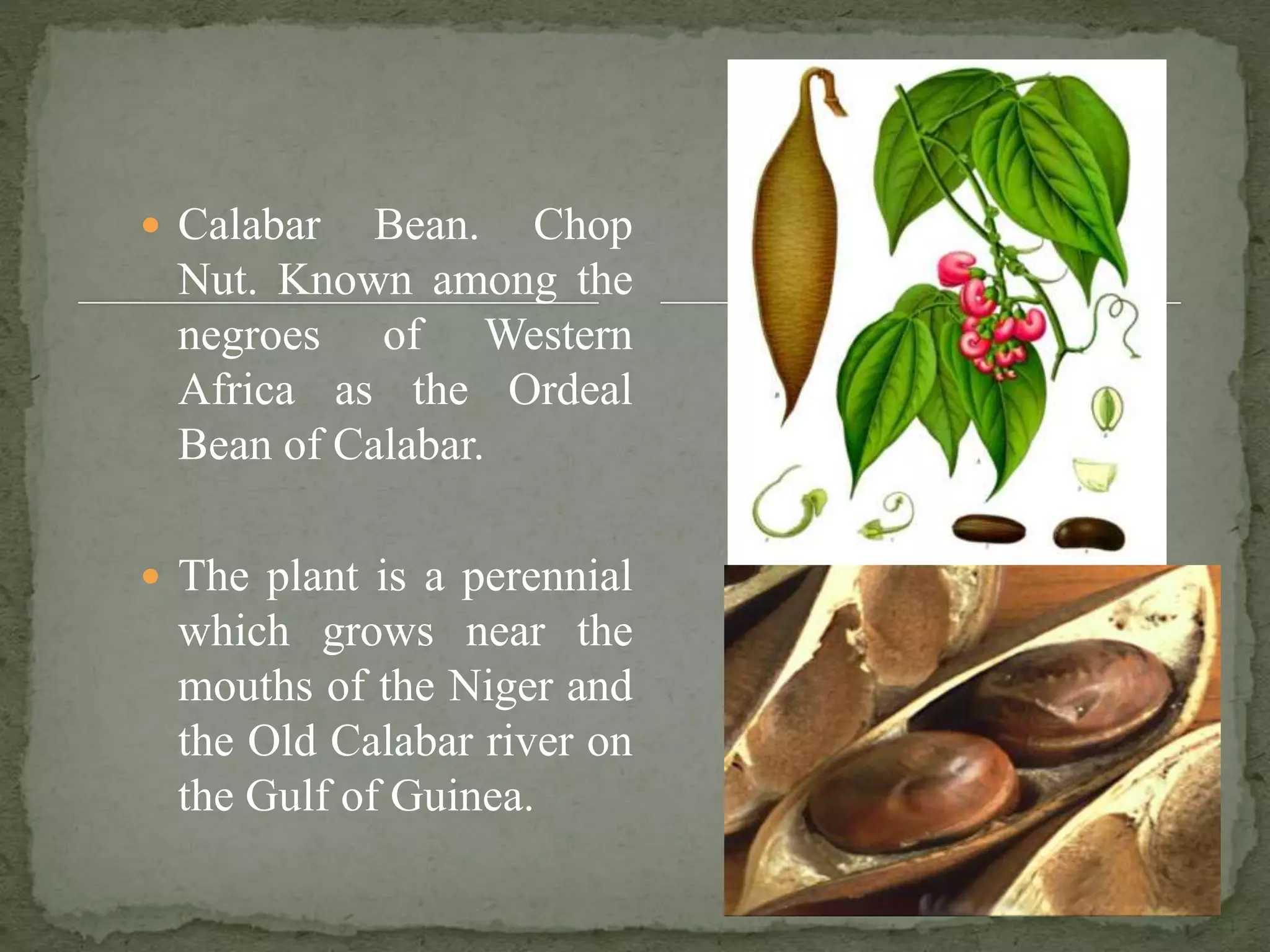
 Calabar Bean. Chop
Nut. Known among the
negroes of Western
Africa as the Ordeal
Bean of Calabar.
 The plant is a perennial
which grows near the
mouths of the Niger and
the Old Calabar river on
the Gulf of Guinea.
Where is the proving of physostigma found?
 In the transactions of the American Institute of
Homoeopathy for 1874 .
What is physostigma?
 It is the Calabar bean , and the tincture is made from
the pulverized bean in the same manner as the Nux
vomica or Ignatia tincture is made.
 The bean is pulverized, weighed, covered with five
parts by weight of alcohol, and allowed to remain eight
days in a well-stoppered bottle, at the ordinary
temperature, in a dark, cool place, being shaken twice
a day. The tincture is then poured off, strained and
filtered.
What is its alkaloid and its principal use?
 Eserin or Physostigmin .
 It produces a specific contraction of the pupil.
 Dose, 1-60 of a grain in solution, applied locally.
What is its general action?
 It irritates the fibres of the third nerve, producing
contraction of the pupil and spasm of accommodation.
 It acts powerfully on the spinal cord, producing motor
paralysis.
In what diseases do we sometimes find it indicated?
 Spinal irritation, tetanus and trismus or lockjaw, but its
use in diseases of the eye such as spasm of the ciliary
muscle, myopia, etc., is most important.
 Post-diphtheritic paralysis.
 Spinal Motor Nerves.
 Eyes.
 Muscles.
 Left Side.
 Astigmatism. (defect in eyes or in a lens - deviation of
curvature of lens)
 Blepharospasm. (involuntary tight closure of the eye lids)
 Chorea.
 Ciliary spasm.
 Climacteric.
 Constipation.
 Coccygodynia. (pain originate from coccyx)
 Dentition.
 Diarrhoea.
 Dyspepsia.
 Epilepsy.
 Eyes, affections of; injuries of; strain of.
 General paralysis.
 Glaucoma.
 Haemorrhoids.
 Headache.
 Heart, affections of.
 Hemiplegia (left).
 Herpes, preputialis.
 Hiccough.
 Hysteria. (Uncontrolable emotions)
 Iris, prolapsed.
 Leucorrhoea.
 Locomotor ataxy.
 Myopia.
 Navel, inflammation of.
 Paralysis, local; agitans; spinal. ( Parkinsons disease)
 Paraplegia.
 Progressive muscular atrophy.
 Prostration; muscular.
 Sleeplessness.
 Spinal irritation.
 Spinal sclerosis.
 Stiff neck.
 Tetanus.
 Throat, sore; fish-bone sensation.
 Water, effects of.
 Wounds.
 Emotions.
 Grief.
 Bathing.
 Injuries.
 Blows.
 Motor nerves through spinal cord are affected by this
remedy; causing fluttering tremors in the muscles; they
do not respond to the will and/or draw into knots; even
the intestines are seen twisted in knots.
 This remedy and its active principle, Eserine, form a
valuable addition to Materia Medica.
 Stimulates heart, raises blood pressure, and increases
peristalsis.
 Causes contraction of the pupil and of the ciliary
muscles.
 Induces a condition of short-sightedness.
 Spinal irritation, loss of motility, prostration, with very
sensitive vertebrae Fibrillary tremors.
 Rigidity of muscles; paralysis.
 Depresses the motor and reflex activity of the cord and
causes loss of sensibility to pain, muscular weakness,
followed by complete paralysis, although muscular
contractility is not impaired.
 Paralysis and tremors, chorea.
 Meningeal irritation, with rigidity of muscles.
 Tetanus and trismus.
 Poliomyelitis anterior.
 Eserine is used locally to produce contraction of pupil.
 This case was cured : Great muscular prostration with
continual inclination to sigh; leucorrhoea agg. by exercising
during the day, especially 4 p.m. ; sighing agg. when
leucorrhoea is agg.; dread of cold water.
 This dread of cold water is a grand keynote of Physo.
 One of the provers (a water drinker) developed a perfect
disgust for cold water and cold drinks; and though used to a
cold morning plunge, was obliged to omit it on account of
his horror.
 Other provers felt uncomfortable after bathing, and had
great reluctance to their bath.
 Weakness was felt on change of weather, and on cold,
bracing days.
 A paralytic state of mind and body from grief has been
cured with Physo.
 Sleeplessness of a peculiar kind occurs in Physo.
 Nash cured with Physo. 12 and 30 persistent sleeplessness
in a patient who had been in an insane asylum, and feared
she would have to go again.
 Her symptom was : "If she chanced to get a nap she awoke
suddenly as if in a fright, and felt no >> from what she had
slept."
 Peculiar sensations are : As if stomach were full.
 As if she must lose her mind.
 As if a ball were coming up throat.
 Lower limbs as if asleep.
 Back as if paralysed.
 Tongue as if burnt (left margin); as if swollen and paralysed.
 Sensations of contraction and tension.
 Wavering in brain.
 Weak feeling in stomach.
 H. L. Chase, one of the provers, had a "very severe
pain in the right popliteal space," and he afterwards
cured a patient who came to him with pain in the same
region two years later.
 (Allen gives the symptom as in the left popliteal
space.)
 The symptoms are agg. by pressure (of finger between
vertebrae causing wincing); by falls and blows.
 agg. Motion; descending stairs (wavering in brain).
 agg. Walking; stepping; jar of misstep.
 >> Lying supine.
 agg. Lying left side; >> lying on right side.
 agg. 4 p.m.
 agg. Night (headache unbearable).
 If pain began at any hour it always continued till 12 o'clock
following, either noon or midnight.
 agg. Cold water; perfect horror of cold drink; cold bath.
 agg. From bathing; from change in weather; on bracing
days.
 agg. In church.
 >> In cool open air.
 agg. On waking.
 >> Closing eyes.
 >> By sleep (hiccough).
 >> Warmth to feet; sinapisms to abdomen.
 Uncommon mental activity.
 Foolish actions, said it made him crazy.
 Exhilarated in morning, gloomy towards noon.
 Nothing was right, too many things in room;
continually counting them.
 Irritable.
 Nervous, cannot endure pain.
 Exhaustion, cannot remember anything.
 Disinclined to work.
 Difficult thinking; cannot concentrate the mind.
 Constant pain on top; vertigo, with constrictive feeling of
head.
 Pain over orbits; cannot bear to raise eyelids.
 Cerebro-spinal meningitis; general tetanic rigidity.
 Spastic conditions of the face-muscles.
 Darting pain in forehead, agg. motion, and in temples.
 Sharp pain in supra-orbital region, running off towards
nose.
 Pain : over right eye, in morning on waking, by noon
pain in whole cerebrum, fulness of blood-vessels of
brain, and contracted feeling in forehead, which
extended to eyelids, causing an effort to open or close
them; in left side at 10 a.m. , with heat in abdomen
and nausea, the pain is heavy at 11, pain over whole
head from 4 till 10 p.m. , with nausea and general
sweat, headache next day with lame, bruised feeling in
region of kidneys.
 Pain in temples; showing from right temple to 2nd
bicuspid.
 In evening headache, agg. forehead and temples.
 One-sided headache with fear of opening eyes lest it
should agg. the pain.
 Inability to stop thinking with headache.
 Sensation of rush of blood to frontal and temporal
regions.
 Sharp, shooting pains in temples.
 Throbbing of temporal and carotid arteries; heart beats
felt in head on lying down.
 Intense, painful pressure in vertex and both temples,
the pressure in vertex extending over to occiput.
 Eyes inflamed, first right, then left; sclerotic dry, red, and
swollen; eyeballs pain and smart; lids feel sore.
 Eyes bloodshot all the forenoon, with burning in them.
 Pain on attempting to use binocular vision, as in reading, so
that one eye must be closed, >> by a weak concave glass.
 Pressure; with muscae volitantes (floating in vitreous humour),
dark and light long worms or snakes, also tremulous vision.
 Bright marks when looking at an object; dark yellowish
spots covering one or two letters when reading.
 Sharp, shooting pains, and drawing, twisting sensation in
eyes.
 Eyes sore and painful when moved from side to side.
 Pain deep in, over top of eyeball, running up from inner
canthus to right frontal eminence, then down obliquely
outward into temple.
 Sharp stitches in right eyeball, >> by motion in open air.
 Eyes convulsed.
 Sight blurred, hazy, or misty, film over eyes; objects
mixed; after which dull pain over the eyes and between
the eyes.
 Aching in posterior part of orbit, extending back into
the brain; agg. on reading, causing nausea.
 Lids (esp. left) heavy; cannot bear to raise them;
twitching of lids (upper, agg. left).
 Contracted sensation in lids with difficulty in opening
them and lachrymation when wide open, difficulty in
keeping left eye open.
 Lids immovable.
 Tight feeling in ciliary region as if something were
creeping about in it, with sharp pain, agg. reading.
 Pupils dilated.
 Pupils contracted when asleep, dilated when aroused.
 Disturbed accommodation : approximation of far point
(myopia) and also of near point.
 Vision abnormally acute; double; dim and indistinct;
blurred, hazy, misty.
 (Lens dislocated by blow.)
 Sharp, shooting pains in the ears.
 Shooting in left ear; in right.
 Pain in right ear when writing.
 Hammering in right in evening, with feeling in external ear as
from a hot wind.
 Painful pressure on tympani.
 Discomfort in right, with inclination to bore in with finger; after
removal of wax some pain; with eructation a sudden pain from
throat along Eustachian tube to middle ear.
 Crawling in left ear.
 Fulness.
 Stopped feeling.
 Partial deafness of right.
 Sensitive to every sound.
 Singing or tuning like escaping steam, at night after
lying down.
 Hissing, buzzing, ringing in the ears.
 Fluent coryza; burning and tingling of nostrils; nose stuffed and
hot.
 Fever-blisters around nostrils.
 Twitchings in nose and involuntary expansion of nostrils.
 Small boil inside right nostril.
 Epistaxis while at supper.
 Smarting at end of nose, it feels as if burnt by hot liquid.
 Tension in skin of nose and forehead.
 Face pale; flushings of the face; heat.
 Neuralgic pain in right side of face.
 Sensation of cramps or spasms in face extending to neck;
with numbness of left hand.
 Sensation of contraction of left side of face, with
numbness.
 Severe pain in right upper jaw like toothache (though all
teeth on that side had been extracted).
 Numbness of lips.
 Tongue feels sore on tip.
 Feeling as if a ball came up throat.
 Dentition : nervous children with vacillating pupils
who have trouble when nursing or taking food; pain in
stomach as soon as they begin, but going off if they
continue to nurse.
 Tongue coated, more heavily at root.
 Numbness and tingling of tongue and lips, with
constant desire to moisten them.
 Bad taste in mouth.
 Profuse salivation; thick, leathery saliva.
 Difficult speech.
 Power of speech retained long after inability to
swallow.
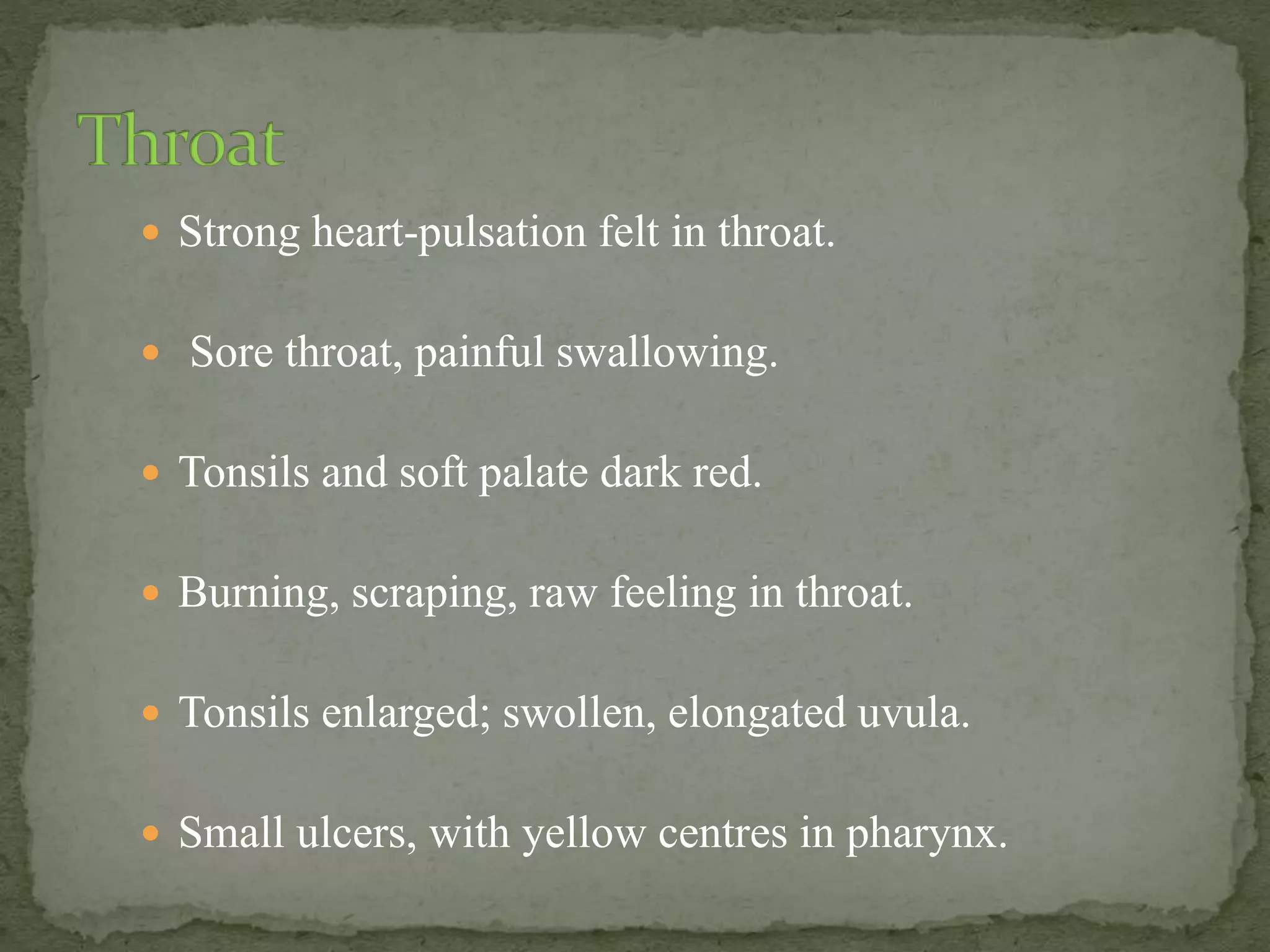
 Strong heart-pulsation felt in throat.
 Sore throat, painful swallowing.
 Tonsils and soft palate dark red.
 Burning, scraping, raw feeling in throat.
 Tonsils enlarged; swollen, elongated uvula.
 Small ulcers, with yellow centres in pharynx.
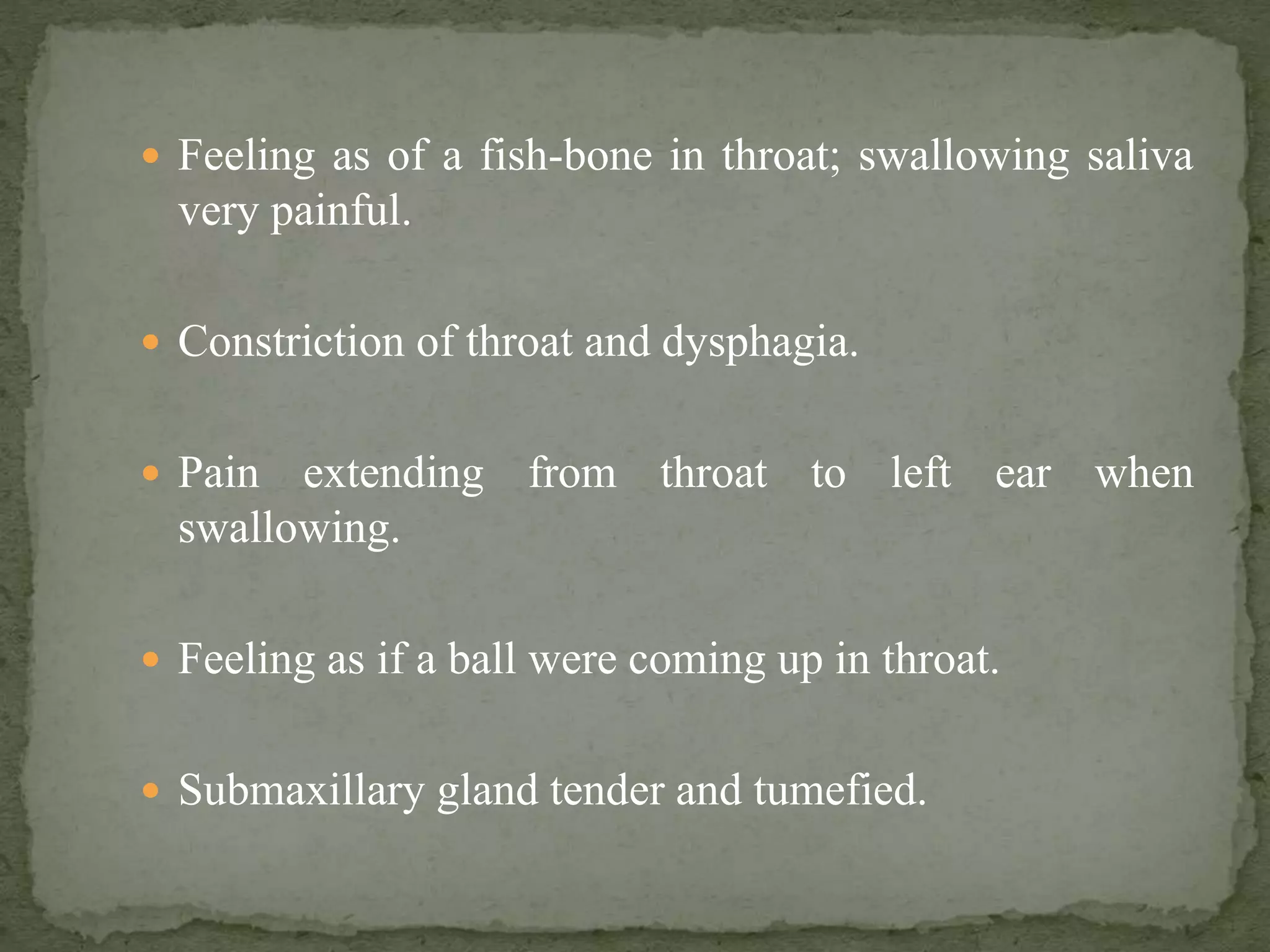
 Feeling as of a fish-bone in throat; swallowing saliva
very painful.
 Constriction of throat and dysphagia.
 Pain extending from throat to left ear when
swallowing.
 Feeling as if a ball were coming up in throat.
 Submaxillary gland tender and tumefied.
 Great pain immediately after eating.
 Sensitive to pressure in epigastric region.
 Pain extends into chest and down arms.
 Gastralgia; chronic constipation.
 Hunger but can find nothing to satisfy it; food has a flat
taste.
 No appetite, disgust for food, tobacco, and coffee; and
esp. for cold drinks.
 Tasteless eructations.
 In stomach : prickling, sharp pains; darting pains, with
paralysed feeling of left side; heaviness and weight, as
if undigested food were lying there; hard pain; griping;
emptiness and weakness; sensation of nervousness and
trembling.
 Soreness in region of stomach.
 Lancinating pains in hypochondria.
 Hard, sore pain in splenic region; descending to groin and
across hypogastrium, agg. by motion.
 Soreness and pain at navel, which was found much
inflamed.
 Severe pain in umbilical region.
 Pain and soreness in umbilical region.
 Stitches in left side of abdomen.
 Much rumbling and distension in abdomen, with
discharge of large quantities of flatus.
 Dull pain in transverse and descending colon.
 Colicky pains, with feeling as if diarrhoea would
occur.
 Shooting pains in left iliac region and down thigh.
 Sharp, cutting pains in lower part of abdomen.
 Dull pains in groins.
 Stools : copious; soft, thin; watery; yellowish; bilious; part
natural, part black like tar; lumpy, mixed with watery discharge;
dark and offensive.
 Constipation; from atony.
 Sphincter ani swollen and rigid; evacuation painful; rectum
protruding, swollen and very sensitive.
 Tenesmus and burning, with diarrhoea; also tenesmus of bladder.
 Stool irregular and loose, anus sore and inclined to protrude;
piles (absent for three years) return.
 Severe piles following childbirth.
 Bruised, sore feeling in region of kidneys.
 Bladder feels distended.
 Frequent desire to urinate, often ineffectual.
 Frequent and copious urination.
 Urine : yellow; high coloured; strong-smelling; clear;
muddy; pale and copious.
 Frequent erections with but slight desire.
 Two emissions without dreams or excitement.
 Strong-smelling sweat about genitals, prepuce tender
and swollen, many small vesicles on glans with
burning itching.
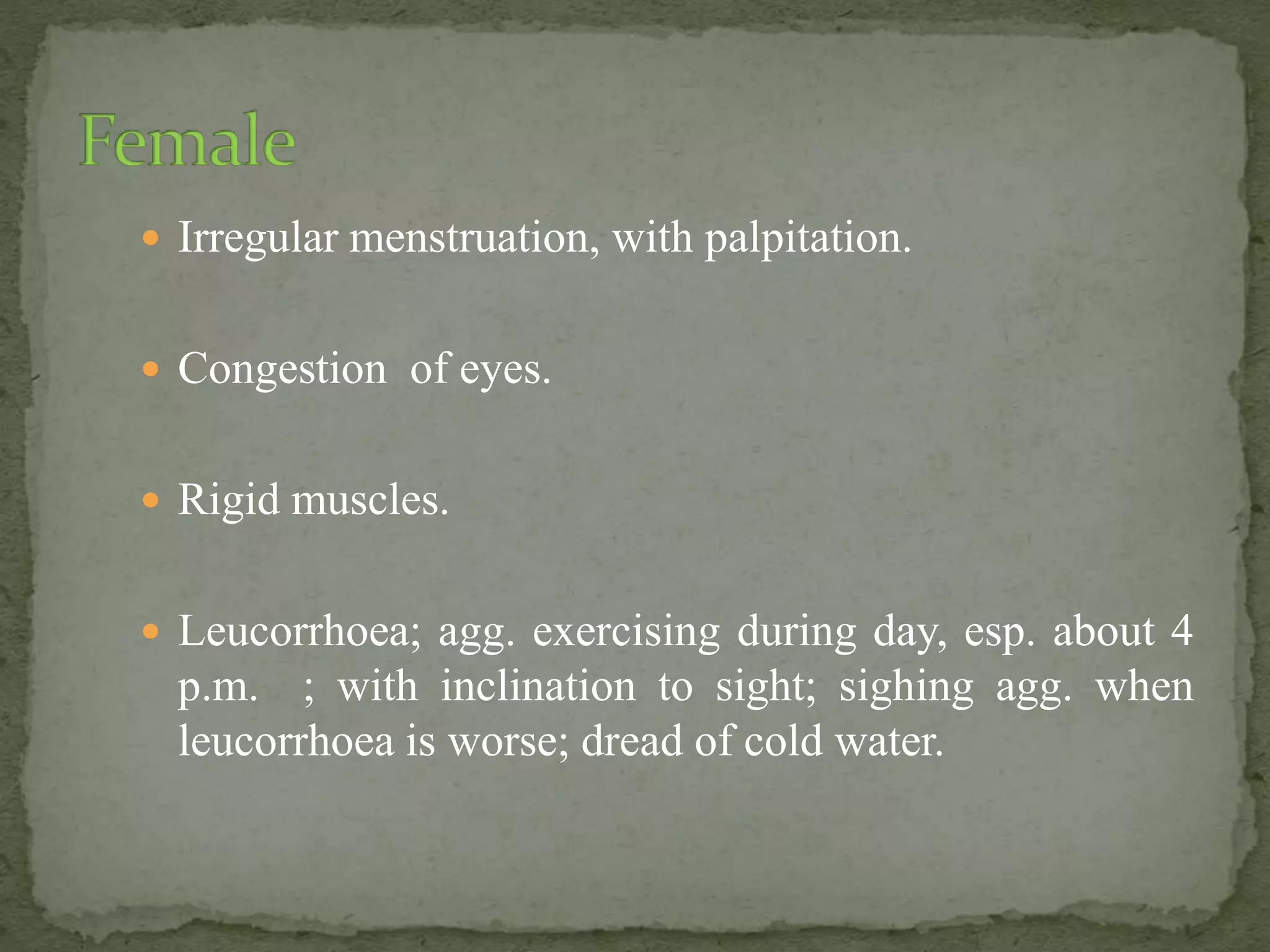
 Irregular menstruation, with palpitation.
 Congestion of eyes.
 Rigid muscles.
 Leucorrhoea; agg. exercising during day, esp. about 4
p.m. ; with inclination to sight; sighing agg. when
leucorrhoea is worse; dread of cold water.
 Cough from tickling in throat.
 Slight constant inclination to cough from filling lungs.
 Laboured, sighing respiration; yawning.
 Feeble pulse; palpitation; spasmodic action, with
feeling pulsation through the whole body.
 Beats of heart distinctly perceptible in chest and head.
 Fluttering of heart felt in throat.
 Fatty degeneration.
 Limbs feel weary, as after great fatigue.
 Numbness in all the limbs; and paralytic feeling.
 Neuralgic pains in the limbs.
 Stiffness or bruised feeling in the joints.
 Staggering gait.
 Cold extremities.
 Upper limbs
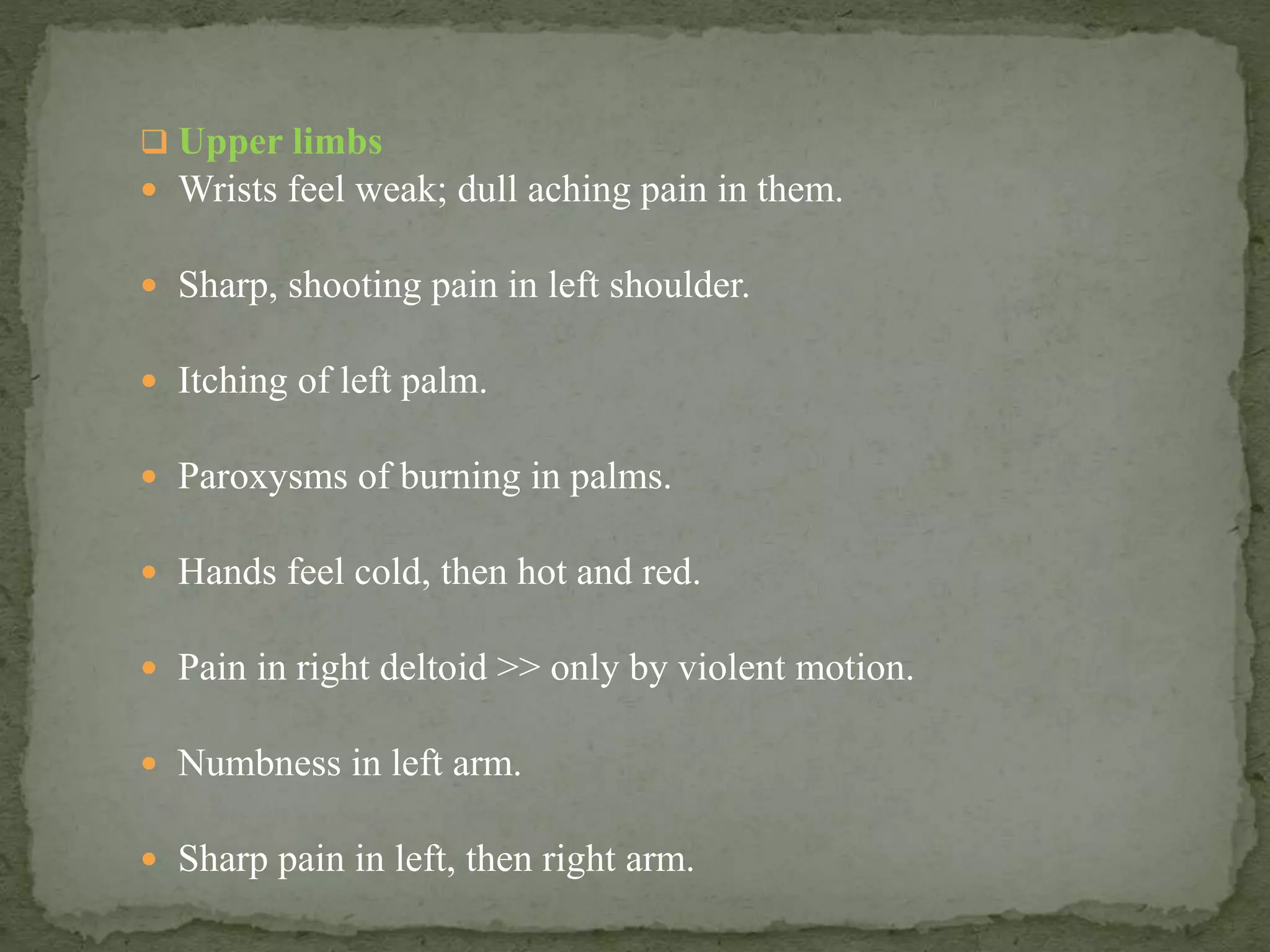
 Wrists feel weak; dull aching pain in them.
 Sharp, shooting pain in left shoulder.
 Itching of left palm.
 Paroxysms of burning in palms.
 Hands feel cold, then hot and red.
 Pain in right deltoid >> only by violent motion.
 Numbness in left arm.
 Sharp pain in left, then right arm.
 Lower limbs
 Unsteadiness from knee downward when walking, esp. with eyes shut.
 Dragging pain in left hip towards back.
 Stiffness in hip and knee.
 Cramp-like pain in left (and right) popliteal space.
 Sensation of a drawing cord behind leg and knee, impeding walking.
 Gnawing in left tibia.
 Legs feel asleep.
 Numbness in left foot.
 Irresistible desire to sleep; soporific sleep.
 Restless sleep with dreams.
 During sleep mind so active was unaware he had been
asleep.
 Falls asleep frequently, but awakes suddenly without
relief; following night scarcely closed eyes in sleep;
thoughts very active; an idea once started kept on with
unusual persistence.
 Creeping, chilly sensation in back; yawning; every movement
and draught shuddering.
 Hands and feet cold.
 Cold, clammy skin.
 Heat in head and face; flushed and hot.
 Heat in face and down back with chilliness of legs.
 Dry burning in hands.
 Perspires very easily.
 Cold sweat in drops over whole body.
 Strong-smelling sweat around genitals.
 Copious sweat all over body.
 Change of temperature.
 Eyestrain.
 Bathing.
 Heat and cold.
 Descending.
 Motion.
 Stepping.
 Jar, misstep.
 Lying on abdomen or with head low.
 Exerting the will.
 Closing eyes.
 Sleep.
Antidotes :
 Atropinum and Chloratum hydratum.
 Camphor suspends the symptoms temporarily.
Compatible : Amyl nitr., Conium, Gelsem.
Compare :
 In eye diseases : Agaricus, Caustic., Chamom., Conium,
Curare.
 In tetanus, Nux vom.
 A drug for myopia (Ruta., Con., Phos., Puls.).
 Idiopathic or traumatic tetanus; brought on or worse by
slightest breath of air from a person passing. (Hyper.,
Lyc.).
 Locomotor ataxia. (Alum., Con., Gels., Nux vom.,
Phos.).
 Uncommon mental activity. (Can. i., Coff., Phos.).
 Floating black spots before eyes (Chin., Cocc., Nat.
mur., Phos., Sep., Sil., Sulph.).
 Profuse Lachrymation (Euphr., Merc.).
 Gastralgia, worse after eating (Calc. phos., Mag.
phos., Nux vom.).
 Jerking limbs. (Bell., Cupr., Hyosc.).
Thank you...

Physostigma venenosum

  • 1.
  • 2.
     Calabar Bean.Chop Nut. Known among the negroes of Western Africa as the Ordeal Bean of Calabar.  The plant is a perennial which grows near the mouths of the Niger and the Old Calabar river on the Gulf of Guinea.
  • 3.
    Where is theproving of physostigma found?  In the transactions of the American Institute of Homoeopathy for 1874 . What is physostigma?  It is the Calabar bean , and the tincture is made from the pulverized bean in the same manner as the Nux vomica or Ignatia tincture is made.  The bean is pulverized, weighed, covered with five parts by weight of alcohol, and allowed to remain eight days in a well-stoppered bottle, at the ordinary temperature, in a dark, cool place, being shaken twice a day. The tincture is then poured off, strained and filtered.
  • 4.
    What is itsalkaloid and its principal use?  Eserin or Physostigmin .  It produces a specific contraction of the pupil.  Dose, 1-60 of a grain in solution, applied locally. What is its general action?  It irritates the fibres of the third nerve, producing contraction of the pupil and spasm of accommodation.  It acts powerfully on the spinal cord, producing motor paralysis.
  • 5.
    In what diseasesdo we sometimes find it indicated?  Spinal irritation, tetanus and trismus or lockjaw, but its use in diseases of the eye such as spasm of the ciliary muscle, myopia, etc., is most important.  Post-diphtheritic paralysis.
  • 6.
     Spinal MotorNerves.  Eyes.  Muscles.  Left Side.
  • 7.
     Astigmatism. (defectin eyes or in a lens - deviation of curvature of lens)  Blepharospasm. (involuntary tight closure of the eye lids)  Chorea.  Ciliary spasm.  Climacteric.  Constipation.  Coccygodynia. (pain originate from coccyx)  Dentition.  Diarrhoea.  Dyspepsia.  Epilepsy.
  • 8.
     Eyes, affectionsof; injuries of; strain of.  General paralysis.  Glaucoma.  Haemorrhoids.  Headache.  Heart, affections of.  Hemiplegia (left).  Herpes, preputialis.  Hiccough.  Hysteria. (Uncontrolable emotions)  Iris, prolapsed.  Leucorrhoea.  Locomotor ataxy.
  • 9.
     Myopia.  Navel,inflammation of.  Paralysis, local; agitans; spinal. ( Parkinsons disease)  Paraplegia.  Progressive muscular atrophy.  Prostration; muscular.  Sleeplessness.  Spinal irritation.  Spinal sclerosis.  Stiff neck.  Tetanus.  Throat, sore; fish-bone sensation.  Water, effects of.  Wounds.
  • 10.
     Emotions.  Grief. Bathing.  Injuries.  Blows.
  • 11.
     Motor nervesthrough spinal cord are affected by this remedy; causing fluttering tremors in the muscles; they do not respond to the will and/or draw into knots; even the intestines are seen twisted in knots.  This remedy and its active principle, Eserine, form a valuable addition to Materia Medica.  Stimulates heart, raises blood pressure, and increases peristalsis.
  • 12.
     Causes contractionof the pupil and of the ciliary muscles.  Induces a condition of short-sightedness.  Spinal irritation, loss of motility, prostration, with very sensitive vertebrae Fibrillary tremors.  Rigidity of muscles; paralysis.  Depresses the motor and reflex activity of the cord and causes loss of sensibility to pain, muscular weakness, followed by complete paralysis, although muscular contractility is not impaired.
  • 13.
     Paralysis andtremors, chorea.  Meningeal irritation, with rigidity of muscles.  Tetanus and trismus.  Poliomyelitis anterior.  Eserine is used locally to produce contraction of pupil.
  • 14.
     This casewas cured : Great muscular prostration with continual inclination to sigh; leucorrhoea agg. by exercising during the day, especially 4 p.m. ; sighing agg. when leucorrhoea is agg.; dread of cold water.  This dread of cold water is a grand keynote of Physo.  One of the provers (a water drinker) developed a perfect disgust for cold water and cold drinks; and though used to a cold morning plunge, was obliged to omit it on account of his horror.  Other provers felt uncomfortable after bathing, and had great reluctance to their bath.
  • 15.
     Weakness wasfelt on change of weather, and on cold, bracing days.  A paralytic state of mind and body from grief has been cured with Physo.  Sleeplessness of a peculiar kind occurs in Physo.  Nash cured with Physo. 12 and 30 persistent sleeplessness in a patient who had been in an insane asylum, and feared she would have to go again.  Her symptom was : "If she chanced to get a nap she awoke suddenly as if in a fright, and felt no >> from what she had slept."
  • 16.
     Peculiar sensationsare : As if stomach were full.  As if she must lose her mind.  As if a ball were coming up throat.  Lower limbs as if asleep.  Back as if paralysed.  Tongue as if burnt (left margin); as if swollen and paralysed.  Sensations of contraction and tension.  Wavering in brain.  Weak feeling in stomach.
  • 17.
     H. L.Chase, one of the provers, had a "very severe pain in the right popliteal space," and he afterwards cured a patient who came to him with pain in the same region two years later.  (Allen gives the symptom as in the left popliteal space.)  The symptoms are agg. by pressure (of finger between vertebrae causing wincing); by falls and blows.  agg. Motion; descending stairs (wavering in brain).  agg. Walking; stepping; jar of misstep.
  • 18.
     >> Lyingsupine.  agg. Lying left side; >> lying on right side.  agg. 4 p.m.  agg. Night (headache unbearable).  If pain began at any hour it always continued till 12 o'clock following, either noon or midnight.  agg. Cold water; perfect horror of cold drink; cold bath.  agg. From bathing; from change in weather; on bracing days.  agg. In church.  >> In cool open air.  agg. On waking.  >> Closing eyes.  >> By sleep (hiccough).  >> Warmth to feet; sinapisms to abdomen.
  • 19.
     Uncommon mentalactivity.  Foolish actions, said it made him crazy.  Exhilarated in morning, gloomy towards noon.  Nothing was right, too many things in room; continually counting them.  Irritable.  Nervous, cannot endure pain.  Exhaustion, cannot remember anything.  Disinclined to work.  Difficult thinking; cannot concentrate the mind.
  • 20.
     Constant painon top; vertigo, with constrictive feeling of head.  Pain over orbits; cannot bear to raise eyelids.  Cerebro-spinal meningitis; general tetanic rigidity.  Spastic conditions of the face-muscles.  Darting pain in forehead, agg. motion, and in temples.  Sharp pain in supra-orbital region, running off towards nose.
  • 21.
     Pain :over right eye, in morning on waking, by noon pain in whole cerebrum, fulness of blood-vessels of brain, and contracted feeling in forehead, which extended to eyelids, causing an effort to open or close them; in left side at 10 a.m. , with heat in abdomen and nausea, the pain is heavy at 11, pain over whole head from 4 till 10 p.m. , with nausea and general sweat, headache next day with lame, bruised feeling in region of kidneys.
  • 22.
     Pain intemples; showing from right temple to 2nd bicuspid.  In evening headache, agg. forehead and temples.  One-sided headache with fear of opening eyes lest it should agg. the pain.  Inability to stop thinking with headache.
  • 23.
     Sensation ofrush of blood to frontal and temporal regions.  Sharp, shooting pains in temples.  Throbbing of temporal and carotid arteries; heart beats felt in head on lying down.  Intense, painful pressure in vertex and both temples, the pressure in vertex extending over to occiput.
  • 24.
     Eyes inflamed,first right, then left; sclerotic dry, red, and swollen; eyeballs pain and smart; lids feel sore.  Eyes bloodshot all the forenoon, with burning in them.  Pain on attempting to use binocular vision, as in reading, so that one eye must be closed, >> by a weak concave glass.  Pressure; with muscae volitantes (floating in vitreous humour), dark and light long worms or snakes, also tremulous vision.
  • 25.
     Bright markswhen looking at an object; dark yellowish spots covering one or two letters when reading.  Sharp, shooting pains, and drawing, twisting sensation in eyes.  Eyes sore and painful when moved from side to side.  Pain deep in, over top of eyeball, running up from inner canthus to right frontal eminence, then down obliquely outward into temple.  Sharp stitches in right eyeball, >> by motion in open air.
  • 26.
     Eyes convulsed. Sight blurred, hazy, or misty, film over eyes; objects mixed; after which dull pain over the eyes and between the eyes.  Aching in posterior part of orbit, extending back into the brain; agg. on reading, causing nausea.  Lids (esp. left) heavy; cannot bear to raise them; twitching of lids (upper, agg. left).
  • 27.
     Contracted sensationin lids with difficulty in opening them and lachrymation when wide open, difficulty in keeping left eye open.  Lids immovable.  Tight feeling in ciliary region as if something were creeping about in it, with sharp pain, agg. reading.  Pupils dilated.
  • 28.
     Pupils contractedwhen asleep, dilated when aroused.  Disturbed accommodation : approximation of far point (myopia) and also of near point.  Vision abnormally acute; double; dim and indistinct; blurred, hazy, misty.  (Lens dislocated by blow.)
  • 29.
     Sharp, shootingpains in the ears.  Shooting in left ear; in right.  Pain in right ear when writing.  Hammering in right in evening, with feeling in external ear as from a hot wind.  Painful pressure on tympani.  Discomfort in right, with inclination to bore in with finger; after removal of wax some pain; with eructation a sudden pain from throat along Eustachian tube to middle ear.
  • 30.
     Crawling inleft ear.  Fulness.  Stopped feeling.  Partial deafness of right.  Sensitive to every sound.  Singing or tuning like escaping steam, at night after lying down.  Hissing, buzzing, ringing in the ears.
  • 31.
     Fluent coryza;burning and tingling of nostrils; nose stuffed and hot.  Fever-blisters around nostrils.  Twitchings in nose and involuntary expansion of nostrils.  Small boil inside right nostril.  Epistaxis while at supper.  Smarting at end of nose, it feels as if burnt by hot liquid.  Tension in skin of nose and forehead.
  • 32.
     Face pale;flushings of the face; heat.  Neuralgic pain in right side of face.  Sensation of cramps or spasms in face extending to neck; with numbness of left hand.  Sensation of contraction of left side of face, with numbness.  Severe pain in right upper jaw like toothache (though all teeth on that side had been extracted).  Numbness of lips.
  • 33.
     Tongue feelssore on tip.  Feeling as if a ball came up throat.  Dentition : nervous children with vacillating pupils who have trouble when nursing or taking food; pain in stomach as soon as they begin, but going off if they continue to nurse.  Tongue coated, more heavily at root.
  • 34.
     Numbness andtingling of tongue and lips, with constant desire to moisten them.  Bad taste in mouth.  Profuse salivation; thick, leathery saliva.  Difficult speech.  Power of speech retained long after inability to swallow.
  • 35.
     Strong heart-pulsationfelt in throat.  Sore throat, painful swallowing.  Tonsils and soft palate dark red.  Burning, scraping, raw feeling in throat.  Tonsils enlarged; swollen, elongated uvula.  Small ulcers, with yellow centres in pharynx.
  • 36.
     Feeling asof a fish-bone in throat; swallowing saliva very painful.  Constriction of throat and dysphagia.  Pain extending from throat to left ear when swallowing.  Feeling as if a ball were coming up in throat.  Submaxillary gland tender and tumefied.
  • 37.
     Great painimmediately after eating.  Sensitive to pressure in epigastric region.  Pain extends into chest and down arms.  Gastralgia; chronic constipation.  Hunger but can find nothing to satisfy it; food has a flat taste.
  • 38.
     No appetite,disgust for food, tobacco, and coffee; and esp. for cold drinks.  Tasteless eructations.  In stomach : prickling, sharp pains; darting pains, with paralysed feeling of left side; heaviness and weight, as if undigested food were lying there; hard pain; griping; emptiness and weakness; sensation of nervousness and trembling.  Soreness in region of stomach.
  • 39.
     Lancinating painsin hypochondria.  Hard, sore pain in splenic region; descending to groin and across hypogastrium, agg. by motion.  Soreness and pain at navel, which was found much inflamed.  Severe pain in umbilical region.  Pain and soreness in umbilical region.  Stitches in left side of abdomen.
  • 40.
     Much rumblingand distension in abdomen, with discharge of large quantities of flatus.  Dull pain in transverse and descending colon.  Colicky pains, with feeling as if diarrhoea would occur.  Shooting pains in left iliac region and down thigh.  Sharp, cutting pains in lower part of abdomen.  Dull pains in groins.
  • 41.
     Stools :copious; soft, thin; watery; yellowish; bilious; part natural, part black like tar; lumpy, mixed with watery discharge; dark and offensive.  Constipation; from atony.  Sphincter ani swollen and rigid; evacuation painful; rectum protruding, swollen and very sensitive.  Tenesmus and burning, with diarrhoea; also tenesmus of bladder.  Stool irregular and loose, anus sore and inclined to protrude; piles (absent for three years) return.  Severe piles following childbirth.
  • 42.
     Bruised, sorefeeling in region of kidneys.  Bladder feels distended.  Frequent desire to urinate, often ineffectual.  Frequent and copious urination.  Urine : yellow; high coloured; strong-smelling; clear; muddy; pale and copious.
  • 43.
     Frequent erectionswith but slight desire.  Two emissions without dreams or excitement.  Strong-smelling sweat about genitals, prepuce tender and swollen, many small vesicles on glans with burning itching.
  • 44.
     Irregular menstruation,with palpitation.  Congestion of eyes.  Rigid muscles.  Leucorrhoea; agg. exercising during day, esp. about 4 p.m. ; with inclination to sight; sighing agg. when leucorrhoea is worse; dread of cold water.
  • 45.
     Cough fromtickling in throat.  Slight constant inclination to cough from filling lungs.  Laboured, sighing respiration; yawning.
  • 46.
     Feeble pulse;palpitation; spasmodic action, with feeling pulsation through the whole body.  Beats of heart distinctly perceptible in chest and head.  Fluttering of heart felt in throat.  Fatty degeneration.
  • 47.
     Limbs feelweary, as after great fatigue.  Numbness in all the limbs; and paralytic feeling.  Neuralgic pains in the limbs.  Stiffness or bruised feeling in the joints.  Staggering gait.  Cold extremities.
  • 48.
     Upper limbs Wrists feel weak; dull aching pain in them.  Sharp, shooting pain in left shoulder.  Itching of left palm.  Paroxysms of burning in palms.  Hands feel cold, then hot and red.  Pain in right deltoid >> only by violent motion.  Numbness in left arm.  Sharp pain in left, then right arm.
  • 49.
     Lower limbs Unsteadiness from knee downward when walking, esp. with eyes shut.  Dragging pain in left hip towards back.  Stiffness in hip and knee.  Cramp-like pain in left (and right) popliteal space.  Sensation of a drawing cord behind leg and knee, impeding walking.  Gnawing in left tibia.  Legs feel asleep.  Numbness in left foot.
  • 50.
     Irresistible desireto sleep; soporific sleep.  Restless sleep with dreams.  During sleep mind so active was unaware he had been asleep.  Falls asleep frequently, but awakes suddenly without relief; following night scarcely closed eyes in sleep; thoughts very active; an idea once started kept on with unusual persistence.
  • 51.
     Creeping, chillysensation in back; yawning; every movement and draught shuddering.  Hands and feet cold.  Cold, clammy skin.  Heat in head and face; flushed and hot.  Heat in face and down back with chilliness of legs.  Dry burning in hands.
  • 52.
     Perspires veryeasily.  Cold sweat in drops over whole body.  Strong-smelling sweat around genitals.  Copious sweat all over body.
  • 53.
     Change oftemperature.  Eyestrain.  Bathing.  Heat and cold.  Descending.  Motion.  Stepping.  Jar, misstep.
  • 54.
     Lying onabdomen or with head low.  Exerting the will.  Closing eyes.  Sleep.
  • 55.
    Antidotes :  Atropinumand Chloratum hydratum.  Camphor suspends the symptoms temporarily. Compatible : Amyl nitr., Conium, Gelsem. Compare :  In eye diseases : Agaricus, Caustic., Chamom., Conium, Curare.  In tetanus, Nux vom.
  • 56.
     A drugfor myopia (Ruta., Con., Phos., Puls.).  Idiopathic or traumatic tetanus; brought on or worse by slightest breath of air from a person passing. (Hyper., Lyc.).  Locomotor ataxia. (Alum., Con., Gels., Nux vom., Phos.).  Uncommon mental activity. (Can. i., Coff., Phos.).  Floating black spots before eyes (Chin., Cocc., Nat. mur., Phos., Sep., Sil., Sulph.).  Profuse Lachrymation (Euphr., Merc.).  Gastralgia, worse after eating (Calc. phos., Mag. phos., Nux vom.).  Jerking limbs. (Bell., Cupr., Hyosc.).
  • 57.