PHP vs Python: Best
Choice for Seamless Web
Development
Exploring the key differences and similarities between
PHP and Python to guide your web development choices.
PHP Overview
PHP is Developed by Rasmus Lerdorf in 1994, PHP
is an open-source scripting language used for
developing dynamic, interactive websites and web
applications.
Initially called "Personal Home Page," it evolved
into "Hypertext Preprocessor" and became a top
choice for building robust web solutions.
Key Features of PHP
 In PHP, code is executed on the server before reaching the client,
enabling complex operations such as user input handling, session
management, and dynamic content generation.
 PHP's ability to connect with various databases, including MySQL,
SQLite, and PostgreSQL, makes it ideal for applications that
demand efficient data management and retrieval.
 As an open-source language, PHP benefits from a large developer
community, enhancing its versatility and reliability.
 It is cross-platform, supporting Windows, Linux, and macOS,
allowing deployment in diverse environments.
 PHP frameworks like Laravel and Symfony improve development
efficiency by offering reusable components.
What is PHP Used For?
PHP is a server-side scripting language embedded in HTML to create
dynamic and interactive web pages. Key use cases include:
 Content Management Systems (CMS): Powers platforms like
WordPress, Joomla, and Drupal.
 E-commerce Websites: Supports platforms like Magento,
WooCommerce, and OpenCart for transactions and product
management.
 Web Applications: Builds custom solutions like social media
platforms and project management tools.
 Data-Driven Websites: Handles database interactions for storing
and retrieving user-generated content.
 APIs and Web Services: Enables data exchange and integration
through API development.
Python Overview
Released in 1991 by Guido van Rossum, Python is
a high-level, fast, and beginner-friendly
programming language known for its simplicity
and readability.
It is widely used in web development, data
analysis, AI, machine learning, automation, and
scientific computing. With an extensive library,
active community, and frameworks like Django,
Flask, and Web2Py, Python is a top choice for
developers across industries.
Key Features of Python
 Python clean and readable syntax, makes it ideal for beginners and
collaborative development.
 Its extensive standard library supports tasks like file I/O, web development,
and data manipulation.
 Python ecosystem includes libraries like NumPy, Pandas, Django, and Flask
for diverse use cases.
 Built-in memory management with garbage collection ensures efficient
resource handling.
 Python simplicity and libraries make it perfect for AI, IoT, and big data
applications.
 Python supports multiple paradigms, automating tasks and saving time for
developers.
 Regular updates by the Python Software Foundation keep it secure and
optimized for trends.
What is Python Used For?
Python is a versatile, high-level programming language widely used
across industries. Key use cases include:
 Web Development: Frameworks like Django and Flask enable secure
and fast development.
 Data Science & Machine Learning: Libraries like NumPy, Pandas, and
TensorFlow power AI and data analysis.
 Automation & Scripting: Ideal for automating tasks like data
scraping, testing, and system administration.
 Software Development: Supports building desktop apps and games
with libraries like Pygame.
 Embedded Systems: MicroPython enables Python to run on
microcontrollers for embedded devices.
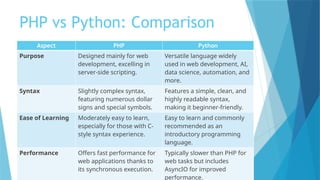
PHP vs Python: Comparison
Aspect PHP Python
Purpose Designed mainly for web
development, excelling in
server-side scripting.
Versatile language widely
used in web development, AI,
data science, automation, and
more.
Syntax Slightly complex syntax,
featuring numerous dollar
signs and special symbols.
Features a simple, clean, and
highly readable syntax,
making it beginner-friendly.
Ease of Learning Moderately easy to learn,
especially for those with C-
style syntax experience.
Easy to learn and commonly
recommended as an
introductory programming
language.
Performance Offers fast performance for
web applications thanks to
its synchronous execution.
Typically slower than PHP for
web tasks but includes
AsyncIO for improved
performance.
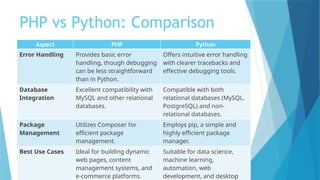
PHP vs Python: Comparison
Aspect PHP Python
Error Handling Provides basic error
handling, though debugging
can be less straightforward
than in Python.
Offers intuitive error handling
with clearer tracebacks and
effective debugging tools.
Database
Integration
Excellent compatibility with
MySQL and other relational
databases.
Compatible with both
relational databases (MySQL,
PostgreSQL) and non-
relational databases.
Package
Management
Utilizes Composer for
efficient package
management.
Employs pip, a simple and
highly efficient package
manager.
Best Use Cases Ideal for building dynamic
web pages, content
management systems, and
e-commerce platforms.
Suitable for data science,
machine learning,
automation, web
development, and desktop
Thank You
Any Question?
Contact Us
Email: info@devacetech.com
Phone: (848) 208-6591

PHP vs Python Best Choice for Seamless Web Development

  • 1.
    PHP vs Python:Best Choice for Seamless Web Development Exploring the key differences and similarities between PHP and Python to guide your web development choices.
  • 2.
    PHP Overview PHP isDeveloped by Rasmus Lerdorf in 1994, PHP is an open-source scripting language used for developing dynamic, interactive websites and web applications. Initially called "Personal Home Page," it evolved into "Hypertext Preprocessor" and became a top choice for building robust web solutions.
  • 3.
    Key Features ofPHP  In PHP, code is executed on the server before reaching the client, enabling complex operations such as user input handling, session management, and dynamic content generation.  PHP's ability to connect with various databases, including MySQL, SQLite, and PostgreSQL, makes it ideal for applications that demand efficient data management and retrieval.  As an open-source language, PHP benefits from a large developer community, enhancing its versatility and reliability.  It is cross-platform, supporting Windows, Linux, and macOS, allowing deployment in diverse environments.  PHP frameworks like Laravel and Symfony improve development efficiency by offering reusable components.
  • 4.
    What is PHPUsed For? PHP is a server-side scripting language embedded in HTML to create dynamic and interactive web pages. Key use cases include:  Content Management Systems (CMS): Powers platforms like WordPress, Joomla, and Drupal.  E-commerce Websites: Supports platforms like Magento, WooCommerce, and OpenCart for transactions and product management.  Web Applications: Builds custom solutions like social media platforms and project management tools.  Data-Driven Websites: Handles database interactions for storing and retrieving user-generated content.  APIs and Web Services: Enables data exchange and integration through API development.
  • 5.
    Python Overview Released in1991 by Guido van Rossum, Python is a high-level, fast, and beginner-friendly programming language known for its simplicity and readability. It is widely used in web development, data analysis, AI, machine learning, automation, and scientific computing. With an extensive library, active community, and frameworks like Django, Flask, and Web2Py, Python is a top choice for developers across industries.
  • 6.
    Key Features ofPython  Python clean and readable syntax, makes it ideal for beginners and collaborative development.  Its extensive standard library supports tasks like file I/O, web development, and data manipulation.  Python ecosystem includes libraries like NumPy, Pandas, Django, and Flask for diverse use cases.  Built-in memory management with garbage collection ensures efficient resource handling.  Python simplicity and libraries make it perfect for AI, IoT, and big data applications.  Python supports multiple paradigms, automating tasks and saving time for developers.  Regular updates by the Python Software Foundation keep it secure and optimized for trends.
  • 7.
    What is PythonUsed For? Python is a versatile, high-level programming language widely used across industries. Key use cases include:  Web Development: Frameworks like Django and Flask enable secure and fast development.  Data Science & Machine Learning: Libraries like NumPy, Pandas, and TensorFlow power AI and data analysis.  Automation & Scripting: Ideal for automating tasks like data scraping, testing, and system administration.  Software Development: Supports building desktop apps and games with libraries like Pygame.  Embedded Systems: MicroPython enables Python to run on microcontrollers for embedded devices.
  • 8.
    PHP vs Python:Comparison Aspect PHP Python Purpose Designed mainly for web development, excelling in server-side scripting. Versatile language widely used in web development, AI, data science, automation, and more. Syntax Slightly complex syntax, featuring numerous dollar signs and special symbols. Features a simple, clean, and highly readable syntax, making it beginner-friendly. Ease of Learning Moderately easy to learn, especially for those with C- style syntax experience. Easy to learn and commonly recommended as an introductory programming language. Performance Offers fast performance for web applications thanks to its synchronous execution. Typically slower than PHP for web tasks but includes AsyncIO for improved performance.
  • 9.
    PHP vs Python:Comparison Aspect PHP Python Error Handling Provides basic error handling, though debugging can be less straightforward than in Python. Offers intuitive error handling with clearer tracebacks and effective debugging tools. Database Integration Excellent compatibility with MySQL and other relational databases. Compatible with both relational databases (MySQL, PostgreSQL) and non- relational databases. Package Management Utilizes Composer for efficient package management. Employs pip, a simple and highly efficient package manager. Best Use Cases Ideal for building dynamic web pages, content management systems, and e-commerce platforms. Suitable for data science, machine learning, automation, web development, and desktop
  • 10.
    Thank You Any Question? ContactUs Email: info@devacetech.com Phone: (848) 208-6591