Advantages and Disadvantages
of Python Programming
Python has grown into one of the most popular and powerful
programming languages. Its simplicity and versatility make it a top
choice in fields like data science, AI, and web development. But like any
language, it has its strengths and limitations. Let’s explore the pros and
cons.
What Is Python Used For?
• Python is a highly versatile and beginner-friendly scripting
language known for its readability and simplicity. It's widely
used in data science for tasks like statistical modeling, data
manipulation, and visualization with libraries such as NumPy
and Pandas.
• In AI and machine learning, Python powers model
development and training through frameworks like
TensorFlow and PyTorch. Beyond that, it's also used in
software development for creating desktop applications, in
finance for data analysis and algorithmic trading, and in
cybersecurity for automation and threat detection.
Advantages of Python Programming
• User-Friendly Language
Python’s clean, readable syntax lowers the learning curve for beginners and
speeds up development for experienced coders. It requires fewer lines of
code compared to languages like Java or C++.
• Comprehensive Libraries & Frameworks
Python offers a rich standard library and third-party packages via PyPI.
Frameworks like Django and Flask streamline API and web app development.
• Cross-Platform Support
Being open-source and compatible with Windows, macOS, and Linux, Python
ensures easy installation, collaboration, and distribution across platforms.
Advantages of Python Programming
• Strong Integration Capabilities
Python integrates smoothly with languages like Java, C++, and R using
tools like Cython, Jython, and SWIG—ideal for hybrid development needs.
• Large Community Support
Python has a massive global community offering forums,
documentation, and constant updates. It’s backed by companies like
Google, Netflix, and Dropbox.
• Multiparadigm Scalability
Python supports multiple paradigms—object-oriented, functional, and
procedural—allowing flexible and efficient problem-solving approaches.
Advantages of Python Programming
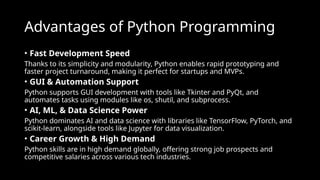
• Fast Development Speed
Thanks to its simplicity and modularity, Python enables rapid prototyping and
faster project turnaround, making it perfect for startups and MVPs.
• GUI & Automation Support
Python supports GUI development with tools like Tkinter and PyQt, and
automates tasks using modules like os, shutil, and subprocess.
• AI, ML, & Data Science Power
Python dominates AI and data science with libraries like TensorFlow, PyTorch, and
scikit-learn, alongside tools like Jupyter for data visualization.
• Career Growth & High Demand
Python skills are in high demand globally, offering strong job prospects and
competitive salaries across various tech industries.
Disadvantages of Python
Programming
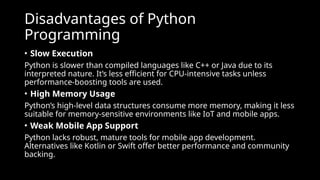
• Slow Execution
Python is slower than compiled languages like C++ or Java due to its
interpreted nature. It’s less efficient for CPU-intensive tasks unless
performance-boosting tools are used.
• High Memory Usage
Python’s high-level data structures consume more memory, making it less
suitable for memory-sensitive environments like IoT and mobile apps.
• Weak Mobile App Support
Python lacks robust, mature tools for mobile app development.
Alternatives like Kotlin or Swift offer better performance and community
backing.
Disadvantages of Python
Programming
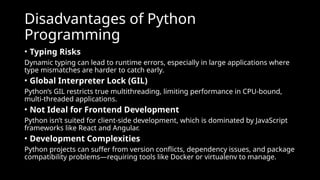
• Typing Risks
Dynamic typing can lead to runtime errors, especially in large applications where
type mismatches are harder to catch early.
• Global Interpreter Lock (GIL)
Python’s GIL restricts true multithreading, limiting performance in CPU-bound,
multi-threaded applications.
• Not Ideal for Frontend Development
Python isn’t suited for client-side development, which is dominated by JavaScript
frameworks like React and Angular.
• Development Complexities
Python projects can suffer from version conflicts, dependency issues, and package
compatibility problems—requiring tools like Docker or virtualenv to manage.
Disadvantages of Python
Programming
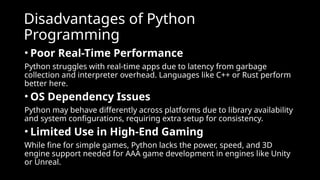
• Poor Real-Time Performance
Python struggles with real-time apps due to latency from garbage
collection and interpreter overhead. Languages like C++ or Rust perform
better here.
• OS Dependency Issues
Python may behave differently across platforms due to library availability
and system configurations, requiring extra setup for consistency.
• Limited Use in High-End Gaming
While fine for simple games, Python lacks the power, speed, and 3D
engine support needed for AAA game development in engines like Unity
or Unreal.
Thank You For Your Time
Any Question? Contact Us
Website: https://www.devacetech.com/
Email: info@devacetech.com
Phone: (848) 208-659

Python Advantages and Disadvantages.pptx

  • 1.
    Advantages and Disadvantages ofPython Programming Python has grown into one of the most popular and powerful programming languages. Its simplicity and versatility make it a top choice in fields like data science, AI, and web development. But like any language, it has its strengths and limitations. Let’s explore the pros and cons.
  • 2.
    What Is PythonUsed For? • Python is a highly versatile and beginner-friendly scripting language known for its readability and simplicity. It's widely used in data science for tasks like statistical modeling, data manipulation, and visualization with libraries such as NumPy and Pandas. • In AI and machine learning, Python powers model development and training through frameworks like TensorFlow and PyTorch. Beyond that, it's also used in software development for creating desktop applications, in finance for data analysis and algorithmic trading, and in cybersecurity for automation and threat detection.
  • 3.
    Advantages of PythonProgramming • User-Friendly Language Python’s clean, readable syntax lowers the learning curve for beginners and speeds up development for experienced coders. It requires fewer lines of code compared to languages like Java or C++. • Comprehensive Libraries & Frameworks Python offers a rich standard library and third-party packages via PyPI. Frameworks like Django and Flask streamline API and web app development. • Cross-Platform Support Being open-source and compatible with Windows, macOS, and Linux, Python ensures easy installation, collaboration, and distribution across platforms.
  • 4.
    Advantages of PythonProgramming • Strong Integration Capabilities Python integrates smoothly with languages like Java, C++, and R using tools like Cython, Jython, and SWIG—ideal for hybrid development needs. • Large Community Support Python has a massive global community offering forums, documentation, and constant updates. It’s backed by companies like Google, Netflix, and Dropbox. • Multiparadigm Scalability Python supports multiple paradigms—object-oriented, functional, and procedural—allowing flexible and efficient problem-solving approaches.
  • 5.
    Advantages of PythonProgramming • Fast Development Speed Thanks to its simplicity and modularity, Python enables rapid prototyping and faster project turnaround, making it perfect for startups and MVPs. • GUI & Automation Support Python supports GUI development with tools like Tkinter and PyQt, and automates tasks using modules like os, shutil, and subprocess. • AI, ML, & Data Science Power Python dominates AI and data science with libraries like TensorFlow, PyTorch, and scikit-learn, alongside tools like Jupyter for data visualization. • Career Growth & High Demand Python skills are in high demand globally, offering strong job prospects and competitive salaries across various tech industries.
  • 6.
    Disadvantages of Python Programming •Slow Execution Python is slower than compiled languages like C++ or Java due to its interpreted nature. It’s less efficient for CPU-intensive tasks unless performance-boosting tools are used. • High Memory Usage Python’s high-level data structures consume more memory, making it less suitable for memory-sensitive environments like IoT and mobile apps. • Weak Mobile App Support Python lacks robust, mature tools for mobile app development. Alternatives like Kotlin or Swift offer better performance and community backing.
  • 7.
    Disadvantages of Python Programming •Typing Risks Dynamic typing can lead to runtime errors, especially in large applications where type mismatches are harder to catch early. • Global Interpreter Lock (GIL) Python’s GIL restricts true multithreading, limiting performance in CPU-bound, multi-threaded applications. • Not Ideal for Frontend Development Python isn’t suited for client-side development, which is dominated by JavaScript frameworks like React and Angular. • Development Complexities Python projects can suffer from version conflicts, dependency issues, and package compatibility problems—requiring tools like Docker or virtualenv to manage.
  • 8.
    Disadvantages of Python Programming •Poor Real-Time Performance Python struggles with real-time apps due to latency from garbage collection and interpreter overhead. Languages like C++ or Rust perform better here. • OS Dependency Issues Python may behave differently across platforms due to library availability and system configurations, requiring extra setup for consistency. • Limited Use in High-End Gaming While fine for simple games, Python lacks the power, speed, and 3D engine support needed for AAA game development in engines like Unity or Unreal.
  • 9.
    Thank You ForYour Time Any Question? Contact Us Website: https://www.devacetech.com/ Email: info@devacetech.com Phone: (848) 208-659