Introduction to PHP
PHPis a popular, open-source scripting language mainly used in web development. It
runs on the server side and generates dynamic content that is displayed on a web
application.
PHP is easy to embed in HTML, and it allows developers to create interactive web pages
and handle tasks like database management, form handling, and user authentication.
PHP code is executed on the server, generating HTML output sent to the client's
browser.
It is a dynamically typed language, allowing variables to change types during execution,
offering flexibility in coding.
3.
PHP isa server-side scripting language that is used to create dynamic webpages. It is
one of the most popular programming languages for web development.
A web-based application is a collection of webpages.
A webpage is mainly created with HTML tags.
HTML consists of different HTML tags which are required to define the appearance
of page elements like text, image, table, etc. Hence, HTML essentially creates a static
webpage.
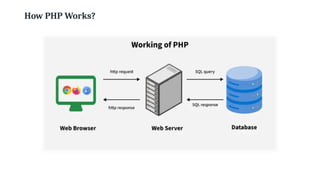
A Web application is hosted on a HTTP server with PHP module installed.
The browser acts as a http client, to establish communication with the server,
following HTTP protocol.
5.
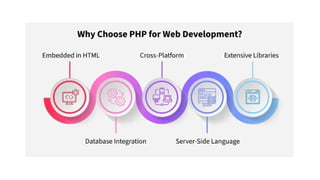
PHP is platform-independent,which means it can run on various operating systems
such as Windows, Linux, and macOS.
PHP supports session management, which allows tracking user activities across
different pages on a website.
A server-side language that generates dynamic content and interacts with databases,
forms, and sessions.
Supports easy interaction with databases like MySQL, enabling efficient data handling.
Runs on multiple operating systems and works with popular web servers like Apache
and Nginx.
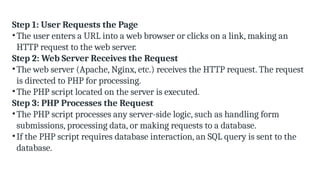
Step 1: UserRequests the Page
•The user enters a URL into a web browser or clicks on a link, making an
HTTP request to the web server.
Step 2: Web Server Receives the Request
•The web server (Apache, Nginx, etc.) receives the HTTP request. The request
is directed to PHP for processing.
•The PHP script located on the server is executed.
Step 3: PHP Processes the Request
•The PHP script processes any server-side logic, such as handling form
submissions, processing data, or making requests to a database.
•If the PHP script requires database interaction, an SQL query is sent to the
database.
8.
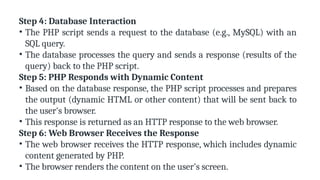
Step 4: DatabaseInteraction
• The PHP script sends a request to the database (e.g., MySQL) with an
SQL query.
• The database processes the query and sends a response (results of the
query) back to the PHP script.
Step 5: PHP Responds with Dynamic Content
• Based on the database response, the PHP script processes and prepares
the output (dynamic HTML or other content) that will be sent back to
the user's browser.
• This response is returned as an HTTP response to the web browser.
Step 6: Web Browser Receives the Response
• The web browser receives the HTTP response, which includes dynamic
content generated by PHP.
• The browser renders the content on the user's screen.
9.
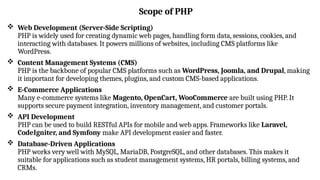
Scope of PHP
Web Development (Server-Side Scripting)
PHP is widely used for creating dynamic web pages, handling form data, sessions, cookies, and
interacting with databases. It powers millions of websites, including CMS platforms like
WordPress.
Content Management Systems (CMS)
PHP is the backbone of popular CMS platforms such as WordPress, Joomla, and Drupal, making
it important for developing themes, plugins, and custom CMS-based applications.
E-Commerce Applications
Many e-commerce systems like Magento, OpenCart, WooCommerce are built using PHP. It
supports secure payment integration, inventory management, and customer portals.
API Development
PHP can be used to build RESTful APIs for mobile and web apps. Frameworks like Laravel,
CodeIgniter, and Symfony make API development easier and faster.
Database-Driven Applications
PHP works very well with MySQL, MariaDB, PostgreSQL, and other databases. This makes it
suitable for applications such as student management systems, HR portals, billing systems, and
CRMs.
10.
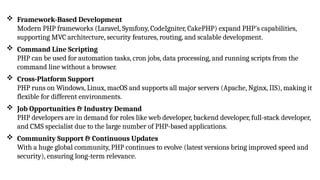
Framework-Based Development
ModernPHP frameworks (Laravel, Symfony, CodeIgniter, CakePHP) expand PHP's capabilities,
supporting MVC architecture, security features, routing, and scalable development.
Command Line Scripting
PHP can be used for automation tasks, cron jobs, data processing, and running scripts from the
command line without a browser.
Cross-Platform Support
PHP runs on Windows, Linux, macOS and supports all major servers (Apache, Nginx, IIS), making it
flexible for different environments.
Job Opportunities & Industry Demand
PHP developers are in demand for roles like web developer, backend developer, full-stack developer,
and CMS specialist due to the large number of PHP-based applications.
Community Support & Continuous Updates
With a huge global community, PHP continues to evolve (latest versions bring improved speed and
security), ensuring long-term relevance.