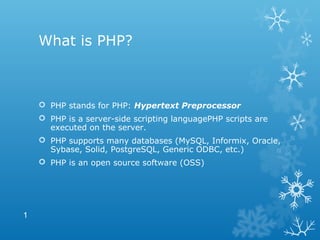
What is PHP?
 PHP stands for PHP: Hypertext Preprocessor
 PHP is a server-side scripting languagePHP scripts are
executed on the server.
 PHP supports many databases (MySQL, Informix, Oracle,
Sybase, Solid, PostgreSQL, Generic ODBC, etc.)
 PHP is an open source software (OSS)
1
Why PHP?
 PHP runs on different platforms (Windows, Linux, Unix, etc.)
 PHP is compatible with almost all servers used today (Apache, IIS,
etc.)
 PHP is FREE to download from the official PHP resource:
www.php.net
 PHP is easy to learn
2
Where to Start?
 Install an Apache server on a Windows or Linux machine
 Install PHP on a Windows or Linux machine
 Install MySQL on a Windows or Linux machine
3
 Download PHP for free here: http://www.php.net/downloads.php
 Download MySQL for free here:
http://www.mysql.com/downloads/index.html
 Download Apache for free here: http://httpd.apache.org/download.cgi
4
Basic PHP Syntax
 A PHP scripting block always
 starts with <?php and
 ends with ?>
 Example
<?php
…….….
………..
?>
5
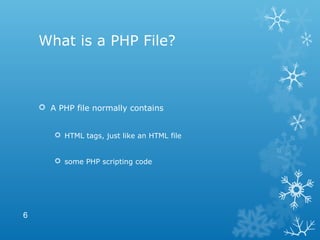
What is a PHP File?
 A PHP file normally contains
 HTML tags, just like an HTML file
 some PHP scripting code
6
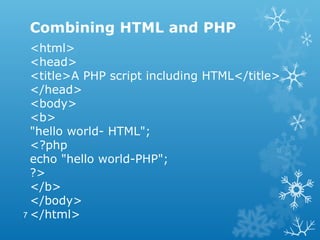
Combining HTML and PHP
<html>
<head>
<title>A PHP script including HTML</title>
</head>
<body>
<b>
"hello world- HTML";
<?php
echo "hello world-PHP";
?>
</b>
</body>
</html>7
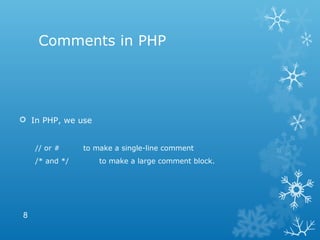
Comments in PHP
 In PHP, we use
// or # to make a single-line comment
/* and */ to make a large comment block.
8
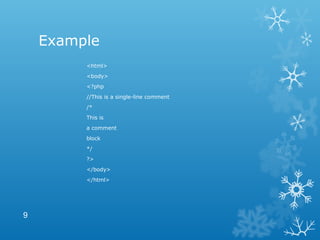
Example
<html>
<body>
<?php
//This is a single-line comment
/*
This is
a comment
block
*/
?>
</body>
</html>
9
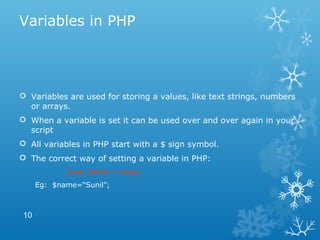
Variables in PHP
 Variables are used for storing a values, like text strings, numbers
or arrays.
 When a variable is set it can be used over and over again in your
script
 All variables in PHP start with a $ sign symbol.
 The correct way of setting a variable in PHP:
$var_name = value;
Eg: $name=“Sunil”;
10
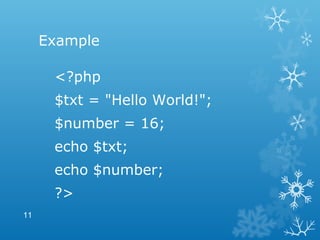
Example
<?php
$txt = "Hello World!";
$number = 16;
echo $txt;
echo $number;
?>
11
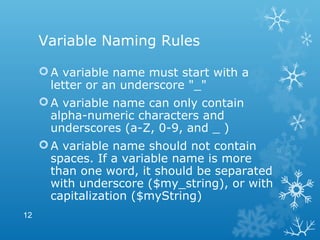
Variable Naming Rules
A variable name must start with a
letter or an underscore "_"
A variable name can only contain
alpha-numeric characters and
underscores (a-Z, 0-9, and _ )
A variable name should not contain
spaces. If a variable name is more
than one word, it should be separated
with underscore ($my_string), or with
capitalization ($myString)
12
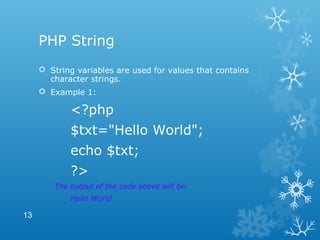
PHP String
 String variables are used for values that contains
character strings.
 Example 1:
<?php
$txt="Hello World";
echo $txt;
?>
The output of the code above will be:
Hello World
13
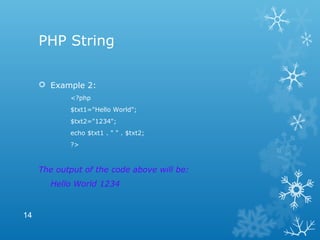
PHP String
 Example 2:
<?php
$txt1="Hello World";
$txt2="1234";
echo $txt1 . " " . $txt2;
?>
The output of the code above will be:
Hello World 1234
14
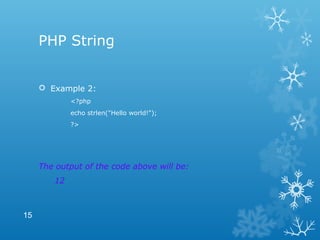
PHP String
 Example 2:
<?php
echo strlen("Hello world!");
?>
The output of the code above will be:
12
15
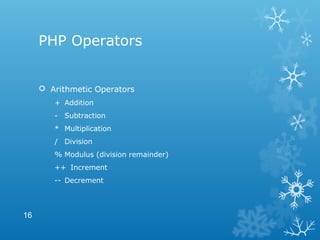
PHP Operators
 Arithmetic Operators
+ Addition
- Subtraction
* Multiplication
/ Division
% Modulus (division remainder)
++ Increment
-- Decrement
16
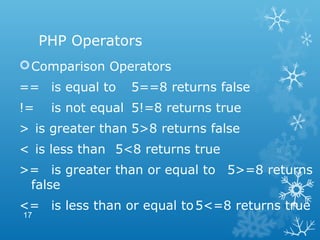
PHP Operators
Comparison Operators
== is equal to 5==8 returns false
!= is not equal 5!=8 returns true
> is greater than 5>8 returns false
< is less than 5<8 returns true
>= is greater than or equal to 5>=8 returns
false
<= is less than or equal to5<=8 returns true
17
Conditional Statements
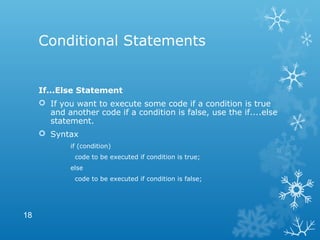
If...Else Statement
 If you want to execute some code if a condition is true
and another code if a condition is false, use the if....else
statement.
 Syntax
if (condition)
code to be executed if condition is true;
else
code to be executed if condition is false;
18
Conditional Statements
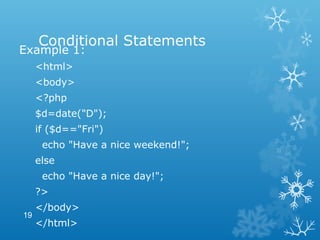
Example 1:
<html>
<body>
<?php
$d=date("D");
if ($d=="Fri")
echo "Have a nice weekend!";
else
echo "Have a nice day!";
?>
</body>
</html>
19
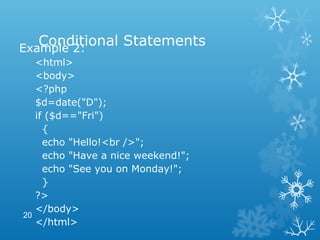
Conditional StatementsExample 2:
<html>
<body>
<?php
$d=date("D");
if ($d=="Fri")
{
echo "Hello!<br />";
echo "Have a nice weekend!";
echo "See you on Monday!";
}
?>
</body>
</html>
20
Conditional Statements
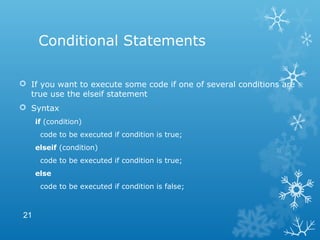
 If you want to execute some code if one of several conditions are
true use the elseif statement
 Syntax
if (condition)
code to be executed if condition is true;
elseif (condition)
code to be executed if condition is true;
else
code to be executed if condition is false;
21
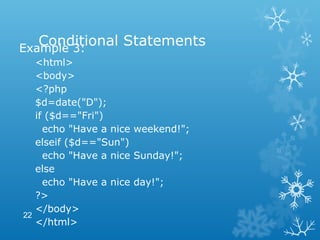
Conditional StatementsExample 3:
<html>
<body>
<?php
$d=date("D");
if ($d=="Fri")
echo "Have a nice weekend!";
elseif ($d=="Sun")
echo "Have a nice Sunday!";
else
echo "Have a nice day!";
?>
</body>
</html>
22
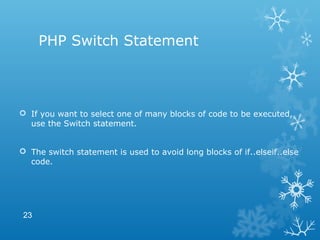
PHP Switch Statement
 If you want to select one of many blocks of code to be executed,
use the Switch statement.
 The switch statement is used to avoid long blocks of if..elseif..else
code.
23
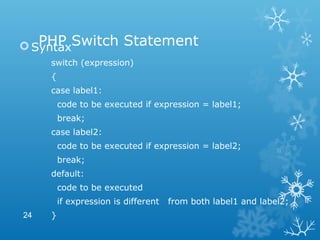
PHP Switch StatementSyntax
switch (expression)
{
case label1:
code to be executed if expression = label1;
break;
case label2:
code to be executed if expression = label2;
break;
default:
code to be executed
if expression is different from both label1 and label2;
}24
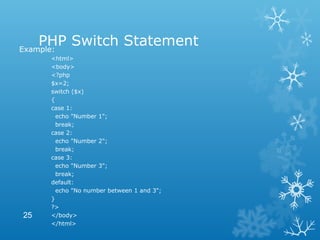
PHP Switch StatementExample:
<html>
<body>
<?php
$x=2;
switch ($x)
{
case 1:
echo "Number 1";
break;
case 2:
echo "Number 2";
break;
case 3:
echo "Number 3";
break;
default:
echo "No number between 1 and 3";
}
?>
</body>
</html>
25
Exercise :
 Assign values to two variables. Use
comparison operators to test whether
the first value is
 The same as the second
 Less than the second
 Greater than the second
 Less than or equal to the second
 Print the result of each test to the
browser.
 Change the values assigned to your test
variables and run the script again.
26
PHP Arrays
What is an array?
 When working with PHP, sooner or later, you might want to
create many similar variables.
 Instead of having many similar variables, you can store the
data as elements in an array.
 Each element in the array has its own ID so that it can be
easily accessed.
27
PHP Arrays : Example 1
<?php
$names[0] = "Peter";
$names[1] = "Quagmire";
$names[2] = "Joe";
echo $names[1] . " and " . $names[2] .
" are ". $names[0] . "'s neighbors";
?>
The code above will output:
Quagmire and Joe are Peter's neighbors
28
PHP Arrays : Example 2
<?php
$names = array("Peter","Quagmire","Joe");
echo $names[1] . " and " . $names[2] .
" are ". $names[0] . "'s neighbors";
?>
The code above will output:
Quagmire and Joe are Peter's neighbors
29
Multidimensional Arrays
 In a multidimensional array,
 each element in the main array can also be an array.
 each element in the sub-array can be an array, and so on
30
Multidimensional Arrays
 In a multidimensional array,
 each element in the main array can also be an array.
 each element in the sub-array can be an array, and so on
31
PHP Looping
Looping statements in
PHP are used to execute
the same block of code a
specified number of
times.
32
PHP Looping
Looping statements in PHP are
used to execute the same block of
code a specified number of times.
In PHP we have the following
looping statements:
 while - loops
 do...while - loops
 for - loops
 foreach - loops33
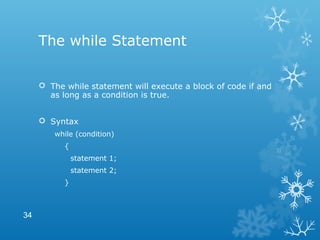
The while Statement
 The while statement will execute a block of code if and
as long as a condition is true.
 Syntax
while (condition)
{
statement 1;
statement 2;
}
34
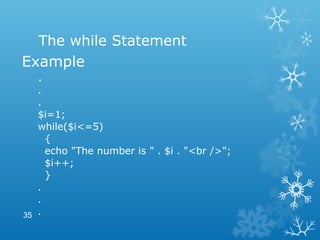
The while Statement
Example
.
.
.
$i=1;
while($i<=5)
{
echo "The number is " . $i . "<br />";
$i++;
}
.
.
.35
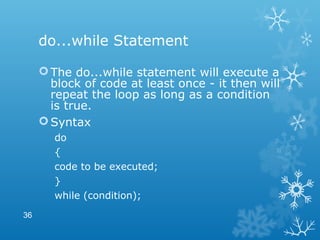
do...while Statement
The do...while statement will execute a
block of code at least once - it then will
repeat the loop as long as a condition
is true.
Syntax
do
{
code to be executed;
}
while (condition);
36
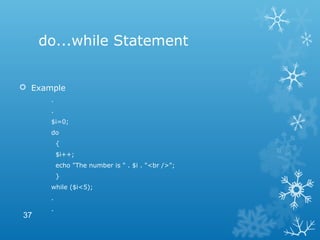
do...while Statement
 Example
.
.
$i=0;
do
{
$i++;
echo "The number is " . $i . "<br />";
}
while ($i<5);
.
.
37
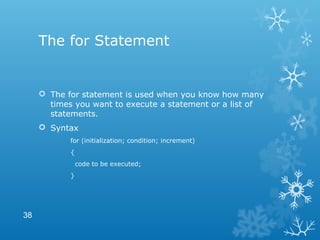
The for Statement
 The for statement is used when you know how many
times you want to execute a statement or a list of
statements.
 Syntax
for (initialization; condition; increment)
{
code to be executed;
}
38
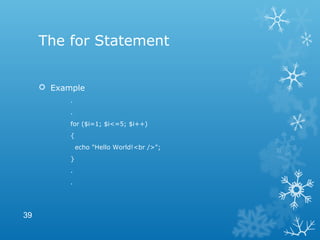
The for Statement
 Example
.
.
for ($i=1; $i<=5; $i++)
{
echo "Hello World!<br />";
}
.
.
39
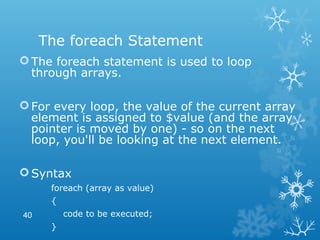
The foreach Statement
The foreach statement is used to loop
through arrays.
For every loop, the value of the current array
element is assigned to $value (and the array
pointer is moved by one) - so on the next
loop, you'll be looking at the next element.
Syntax
foreach (array as value)
{
code to be executed;
}
40
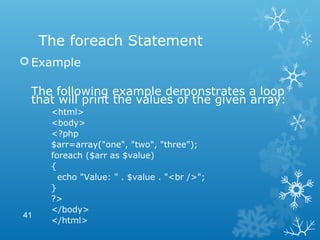
The foreach Statement
Example
The following example demonstrates a loop
that will print the values of the given array:
<html>
<body>
<?php
$arr=array("one", "two", "three");
foreach ($arr as $value)
{
echo "Value: " . $value . "<br />";
}
?>
</body>
</html>
41
PHP Functions
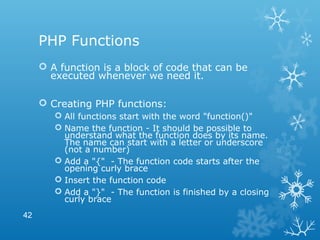
 A function is a block of code that can be
executed whenever we need it.
 Creating PHP functions:
 All functions start with the word "function()"
 Name the function - It should be possible to
understand what the function does by its name.
The name can start with a letter or underscore
(not a number)
 Add a "{" - The function code starts after the
opening curly brace
 Insert the function code
 Add a "}" - The function is finished by a closing
curly brace
42
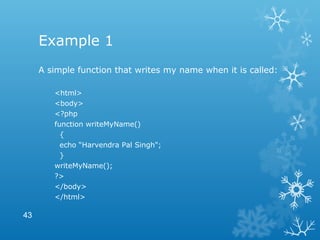
Example 1
A simple function that writes my name when it is called:
<html>
<body>
<?php
function writeMyName()
{
echo “Harvendra Pal Singh";
}
writeMyName();
?>
</body>
</html>
43
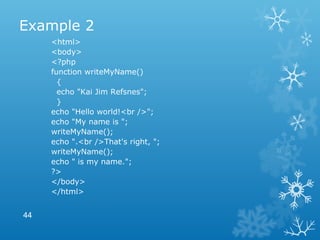
Example 2
<html>
<body>
<?php
function writeMyName()
{
echo "Kai Jim Refsnes";
}
echo "Hello world!<br />";
echo "My name is ";
writeMyName();
echo ".<br />That's right, ";
writeMyName();
echo " is my name.";
?>
</body>
</html>
44
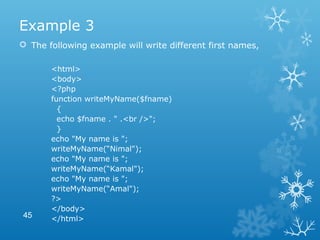
Example 3
 The following example will write different first names,
<html>
<body>
<?php
function writeMyName($fname)
{
echo $fname . " .<br />";
}
echo "My name is ";
writeMyName(“Nimal");
echo "My name is ";
writeMyName(“Kamal");
echo "My name is ";
writeMyName(“Amal");
?>
</body>
</html>45
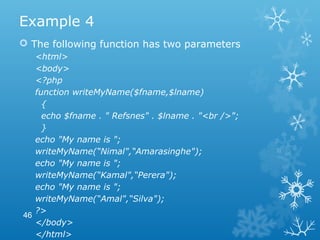
Example 4
 The following function has two parameters
<html>
<body>
<?php
function writeMyName($fname,$lname)
{
echo $fname . " Refsnes" . $lname . "<br />";
}
echo "My name is ";
writeMyName(“Nimal",“Amarasinghe");
echo "My name is ";
writeMyName(“Kamal",“Perera");
echo "My name is ";
writeMyName(“Amal",“Silva");
?>
</body>
</html>
46
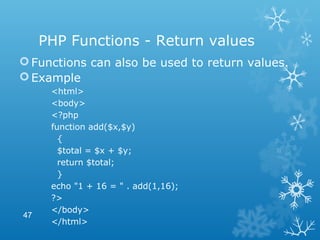
PHP Functions - Return values
Functions can also be used to return values.
Example
<html>
<body>
<?php
function add($x,$y)
{
$total = $x + $y;
return $total;
}
echo "1 + 16 = " . add(1,16);
?>
</body>
</html>
47
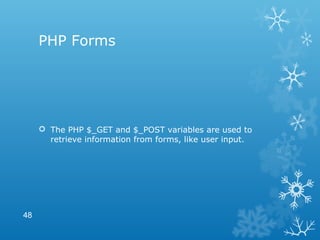
PHP Forms
 The PHP $_GET and $_POST variables are used to
retrieve information from forms, like user input.
48
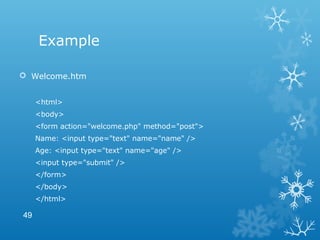
Example
 Welcome.htm
<html>
<body>
<form action="welcome.php" method="post">
Name: <input type="text" name="name" />
Age: <input type="text" name="age" />
<input type="submit" />
</form>
</body>
</html>
49
Example
 welcome.php
<html>
<body>
Welcome <?php echo $_POST["name"]; ?>.<br />
You are <?php echo $_POST["age"]; ?> years old.
</body>
</html>
50
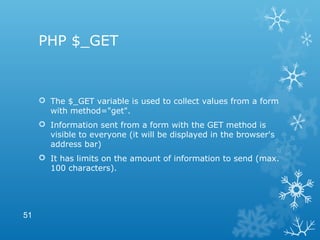
PHP $_GET
 The $_GET variable is used to collect values from a form
with method="get".
 Information sent from a form with the GET method is
visible to everyone (it will be displayed in the browser's
address bar)
 It has limits on the amount of information to send (max.
100 characters).
51
Example
<form action="welcome.php"
method="get">
Name: <input type="text"
name="name" />
Age: <input type="text" name="age" />
<input type="submit" />
</form>
 Welcome.php
Welcome <?php echo $_GET["name"]; ?>.<br />
You are <?php echo $_GET["age"]; ?> years old!
52
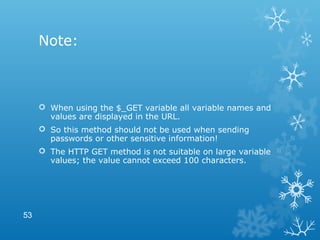
Note:
 When using the $_GET variable all variable names and
values are displayed in the URL.
 So this method should not be used when sending
passwords or other sensitive information!
 The HTTP GET method is not suitable on large variable
values; the value cannot exceed 100 characters.
53
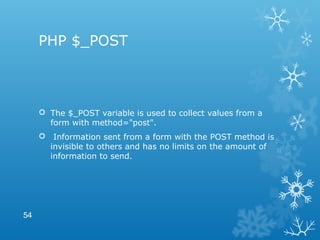
PHP $_POST
 The $_POST variable is used to collect values from a
form with method="post".
 Information sent from a form with the POST method is
invisible to others and has no limits on the amount of
information to send.
54
Example
<form action="welcome.php" method="post">
Enter your name: <input type="text" name="name"
/>
Enter your age: <input type="text" name="age" />
<input type="submit" />
</form>
Welcome.php
Welcome <?php echo $_POST["name"]; ?>.<br />
You are <?php echo $_POST["age"]; ?> years old!55
PHP Database
56
Connecting to a MySQL
Database
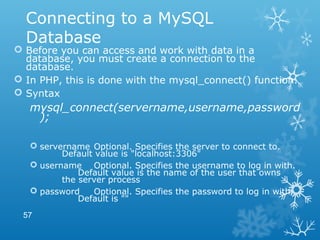
 Before you can access and work with data in a
database, you must create a connection to the
database.
 In PHP, this is done with the mysql_connect() function.
 Syntax
mysql_connect(servername,username,password
);
 servername Optional. Specifies the server to connect to.
Default value is "localhost:3306"
 username Optional. Specifies the username to log in with.
Default value is the name of the user that owns
the server process
 password Optional. Specifies the password to log in with.
Default is ""
57
Example
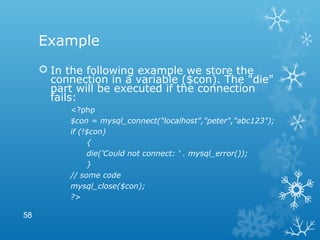
 In the following example we store the
connection in a variable ($con). The "die"
part will be executed if the connection
fails:
<?php
$con = mysql_connect("localhost","peter","abc123");
if (!$con)
{
die('Could not connect: ' . mysql_error());
}
// some code
mysql_close($con);
?>
58
Create MySQLDatabase and
Tables
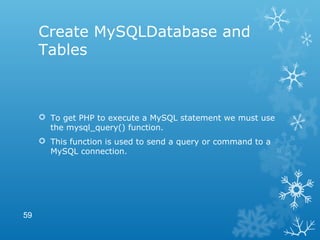
 To get PHP to execute a MySQL statement we must use
the mysql_query() function.
 This function is used to send a query or command to a
MySQL connection.
59
Example
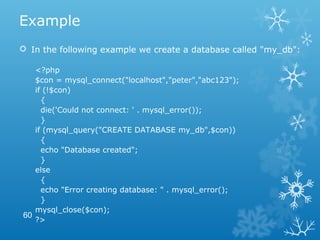
 In the following example we create a database called "my_db":
<?php
$con = mysql_connect("localhost","peter","abc123");
if (!$con)
{
die('Could not connect: ' . mysql_error());
}
if (mysql_query("CREATE DATABASE my_db",$con))
{
echo "Database created";
}
else
{
echo "Error creating database: " . mysql_error();
}
mysql_close($con);
?>
60
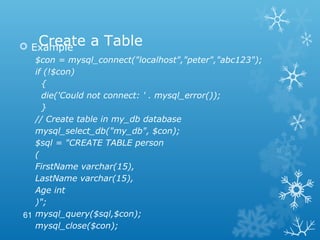
Create a Table Example
$con = mysql_connect("localhost","peter","abc123");
if (!$con)
{
die('Could not connect: ' . mysql_error());
}
// Create table in my_db database
mysql_select_db("my_db", $con);
$sql = "CREATE TABLE person
(
FirstName varchar(15),
LastName varchar(15),
Age int
)";
mysql_query($sql,$con);
mysql_close($con);
61
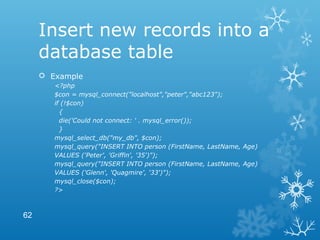
Insert new records into a
database table
 Example
<?php
$con = mysql_connect("localhost","peter","abc123");
if (!$con)
{
die('Could not connect: ' . mysql_error());
}
mysql_select_db("my_db", $con);
mysql_query("INSERT INTO person (FirstName, LastName, Age)
VALUES ('Peter', 'Griffin', '35')");
mysql_query("INSERT INTO person (FirstName, LastName, Age)
VALUES ('Glenn', 'Quagmire', '33')");
mysql_close($con);
?>
62
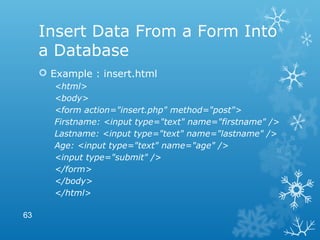
Insert Data From a Form Into
a Database
 Example : insert.html
<html>
<body>
<form action="insert.php" method="post">
Firstname: <input type="text" name="firstname" />
Lastname: <input type="text" name="lastname" />
Age: <input type="text" name="age" />
<input type="submit" />
</form>
</body>
</html>
63
Insert Data From a Form Into
a Database Example : insert.php
<?php
$con = mysql_connect("localhost","peter","abc123");
if (!$con)
{
die('Could not connect: ' . mysql_error());
}
mysql_select_db("my_db", $con);
$sql="INSERT INTO person (FirstName, LastName, Age)
VALUES
('$_POST[firstname]','$_POST[lastname]','$_POST[age]')";
if (!mysql_query($sql,$con))
{
die('Error: ' . mysql_error());
}
echo "1 record added";
mysql_close($con)
?>
64
Thank you.....
Arena Animation Siliguri,
Niladri Karmakar
65
Siliguri

PHP - Web Development

  • 1.
    What is PHP? PHP stands for PHP: Hypertext Preprocessor  PHP is a server-side scripting languagePHP scripts are executed on the server.  PHP supports many databases (MySQL, Informix, Oracle, Sybase, Solid, PostgreSQL, Generic ODBC, etc.)  PHP is an open source software (OSS) 1
  • 2.
    Why PHP?  PHPruns on different platforms (Windows, Linux, Unix, etc.)  PHP is compatible with almost all servers used today (Apache, IIS, etc.)  PHP is FREE to download from the official PHP resource: www.php.net  PHP is easy to learn 2
  • 3.
    Where to Start? Install an Apache server on a Windows or Linux machine  Install PHP on a Windows or Linux machine  Install MySQL on a Windows or Linux machine 3
  • 4.
     Download PHPfor free here: http://www.php.net/downloads.php  Download MySQL for free here: http://www.mysql.com/downloads/index.html  Download Apache for free here: http://httpd.apache.org/download.cgi 4
  • 5.
    Basic PHP Syntax A PHP scripting block always  starts with <?php and  ends with ?>  Example <?php …….…. ……….. ?> 5
  • 6.
    What is aPHP File?  A PHP file normally contains  HTML tags, just like an HTML file  some PHP scripting code 6
  • 7.
    Combining HTML andPHP <html> <head> <title>A PHP script including HTML</title> </head> <body> <b> "hello world- HTML"; <?php echo "hello world-PHP"; ?> </b> </body> </html>7
  • 8.
    Comments in PHP In PHP, we use // or # to make a single-line comment /* and */ to make a large comment block. 8
  • 9.
    Example <html> <body> <?php //This is asingle-line comment /* This is a comment block */ ?> </body> </html> 9
  • 10.
    Variables in PHP Variables are used for storing a values, like text strings, numbers or arrays.  When a variable is set it can be used over and over again in your script  All variables in PHP start with a $ sign symbol.  The correct way of setting a variable in PHP: $var_name = value; Eg: $name=“Sunil”; 10
  • 11.
    Example <?php $txt = "HelloWorld!"; $number = 16; echo $txt; echo $number; ?> 11
  • 12.
    Variable Naming Rules Avariable name must start with a letter or an underscore "_" A variable name can only contain alpha-numeric characters and underscores (a-Z, 0-9, and _ ) A variable name should not contain spaces. If a variable name is more than one word, it should be separated with underscore ($my_string), or with capitalization ($myString) 12
  • 13.
    PHP String  Stringvariables are used for values that contains character strings.  Example 1: <?php $txt="Hello World"; echo $txt; ?> The output of the code above will be: Hello World 13
  • 14.
    PHP String  Example2: <?php $txt1="Hello World"; $txt2="1234"; echo $txt1 . " " . $txt2; ?> The output of the code above will be: Hello World 1234 14
  • 15.
    PHP String  Example2: <?php echo strlen("Hello world!"); ?> The output of the code above will be: 12 15
  • 16.
    PHP Operators  ArithmeticOperators + Addition - Subtraction * Multiplication / Division % Modulus (division remainder) ++ Increment -- Decrement 16
  • 17.
    PHP Operators Comparison Operators ==is equal to 5==8 returns false != is not equal 5!=8 returns true > is greater than 5>8 returns false < is less than 5<8 returns true >= is greater than or equal to 5>=8 returns false <= is less than or equal to5<=8 returns true 17
  • 18.
    Conditional Statements If...Else Statement If you want to execute some code if a condition is true and another code if a condition is false, use the if....else statement.  Syntax if (condition) code to be executed if condition is true; else code to be executed if condition is false; 18
  • 19.
    Conditional Statements Example 1: <html> <body> <?php $d=date("D"); if($d=="Fri") echo "Have a nice weekend!"; else echo "Have a nice day!"; ?> </body> </html> 19
  • 20.
    Conditional StatementsExample 2: <html> <body> <?php $d=date("D"); if($d=="Fri") { echo "Hello!<br />"; echo "Have a nice weekend!"; echo "See you on Monday!"; } ?> </body> </html> 20
  • 21.
    Conditional Statements  Ifyou want to execute some code if one of several conditions are true use the elseif statement  Syntax if (condition) code to be executed if condition is true; elseif (condition) code to be executed if condition is true; else code to be executed if condition is false; 21
  • 22.
    Conditional StatementsExample 3: <html> <body> <?php $d=date("D"); if($d=="Fri") echo "Have a nice weekend!"; elseif ($d=="Sun") echo "Have a nice Sunday!"; else echo "Have a nice day!"; ?> </body> </html> 22
  • 23.
    PHP Switch Statement If you want to select one of many blocks of code to be executed, use the Switch statement.  The switch statement is used to avoid long blocks of if..elseif..else code. 23
  • 24.
    PHP Switch StatementSyntax switch(expression) { case label1: code to be executed if expression = label1; break; case label2: code to be executed if expression = label2; break; default: code to be executed if expression is different from both label1 and label2; }24
  • 25.
    PHP Switch StatementExample: <html> <body> <?php $x=2; switch($x) { case 1: echo "Number 1"; break; case 2: echo "Number 2"; break; case 3: echo "Number 3"; break; default: echo "No number between 1 and 3"; } ?> </body> </html> 25
  • 26.
    Exercise :  Assignvalues to two variables. Use comparison operators to test whether the first value is  The same as the second  Less than the second  Greater than the second  Less than or equal to the second  Print the result of each test to the browser.  Change the values assigned to your test variables and run the script again. 26
  • 27.
    PHP Arrays What isan array?  When working with PHP, sooner or later, you might want to create many similar variables.  Instead of having many similar variables, you can store the data as elements in an array.  Each element in the array has its own ID so that it can be easily accessed. 27
  • 28.
    PHP Arrays :Example 1 <?php $names[0] = "Peter"; $names[1] = "Quagmire"; $names[2] = "Joe"; echo $names[1] . " and " . $names[2] . " are ". $names[0] . "'s neighbors"; ?> The code above will output: Quagmire and Joe are Peter's neighbors 28
  • 29.
    PHP Arrays :Example 2 <?php $names = array("Peter","Quagmire","Joe"); echo $names[1] . " and " . $names[2] . " are ". $names[0] . "'s neighbors"; ?> The code above will output: Quagmire and Joe are Peter's neighbors 29
  • 30.
    Multidimensional Arrays  Ina multidimensional array,  each element in the main array can also be an array.  each element in the sub-array can be an array, and so on 30
  • 31.
    Multidimensional Arrays  Ina multidimensional array,  each element in the main array can also be an array.  each element in the sub-array can be an array, and so on 31
  • 32.
    PHP Looping Looping statementsin PHP are used to execute the same block of code a specified number of times. 32
  • 33.
    PHP Looping Looping statementsin PHP are used to execute the same block of code a specified number of times. In PHP we have the following looping statements:  while - loops  do...while - loops  for - loops  foreach - loops33
  • 34.
    The while Statement The while statement will execute a block of code if and as long as a condition is true.  Syntax while (condition) { statement 1; statement 2; } 34
  • 35.
    The while Statement Example . . . $i=1; while($i<=5) { echo"The number is " . $i . "<br />"; $i++; } . . .35
  • 36.
    do...while Statement The do...whilestatement will execute a block of code at least once - it then will repeat the loop as long as a condition is true. Syntax do { code to be executed; } while (condition); 36
  • 37.
    do...while Statement  Example . . $i=0; do { $i++; echo"The number is " . $i . "<br />"; } while ($i<5); . . 37
  • 38.
    The for Statement The for statement is used when you know how many times you want to execute a statement or a list of statements.  Syntax for (initialization; condition; increment) { code to be executed; } 38
  • 39.
    The for Statement Example . . for ($i=1; $i<=5; $i++) { echo "Hello World!<br />"; } . . 39
  • 40.
    The foreach Statement Theforeach statement is used to loop through arrays. For every loop, the value of the current array element is assigned to $value (and the array pointer is moved by one) - so on the next loop, you'll be looking at the next element. Syntax foreach (array as value) { code to be executed; } 40
  • 41.
    The foreach Statement Example Thefollowing example demonstrates a loop that will print the values of the given array: <html> <body> <?php $arr=array("one", "two", "three"); foreach ($arr as $value) { echo "Value: " . $value . "<br />"; } ?> </body> </html> 41
  • 42.
    PHP Functions  Afunction is a block of code that can be executed whenever we need it.  Creating PHP functions:  All functions start with the word "function()"  Name the function - It should be possible to understand what the function does by its name. The name can start with a letter or underscore (not a number)  Add a "{" - The function code starts after the opening curly brace  Insert the function code  Add a "}" - The function is finished by a closing curly brace 42
  • 43.
    Example 1 A simplefunction that writes my name when it is called: <html> <body> <?php function writeMyName() { echo “Harvendra Pal Singh"; } writeMyName(); ?> </body> </html> 43
  • 44.
    Example 2 <html> <body> <?php function writeMyName() { echo"Kai Jim Refsnes"; } echo "Hello world!<br />"; echo "My name is "; writeMyName(); echo ".<br />That's right, "; writeMyName(); echo " is my name."; ?> </body> </html> 44
  • 45.
    Example 3  Thefollowing example will write different first names, <html> <body> <?php function writeMyName($fname) { echo $fname . " .<br />"; } echo "My name is "; writeMyName(“Nimal"); echo "My name is "; writeMyName(“Kamal"); echo "My name is "; writeMyName(“Amal"); ?> </body> </html>45
  • 46.
    Example 4  Thefollowing function has two parameters <html> <body> <?php function writeMyName($fname,$lname) { echo $fname . " Refsnes" . $lname . "<br />"; } echo "My name is "; writeMyName(“Nimal",“Amarasinghe"); echo "My name is "; writeMyName(“Kamal",“Perera"); echo "My name is "; writeMyName(“Amal",“Silva"); ?> </body> </html> 46
  • 47.
    PHP Functions -Return values Functions can also be used to return values. Example <html> <body> <?php function add($x,$y) { $total = $x + $y; return $total; } echo "1 + 16 = " . add(1,16); ?> </body> </html> 47
  • 48.
    PHP Forms  ThePHP $_GET and $_POST variables are used to retrieve information from forms, like user input. 48
  • 49.
    Example  Welcome.htm <html> <body> <form action="welcome.php"method="post"> Name: <input type="text" name="name" /> Age: <input type="text" name="age" /> <input type="submit" /> </form> </body> </html> 49
  • 50.
    Example  welcome.php <html> <body> Welcome <?phpecho $_POST["name"]; ?>.<br /> You are <?php echo $_POST["age"]; ?> years old. </body> </html> 50
  • 51.
    PHP $_GET  The$_GET variable is used to collect values from a form with method="get".  Information sent from a form with the GET method is visible to everyone (it will be displayed in the browser's address bar)  It has limits on the amount of information to send (max. 100 characters). 51
  • 52.
    Example <form action="welcome.php" method="get"> Name: <inputtype="text" name="name" /> Age: <input type="text" name="age" /> <input type="submit" /> </form>  Welcome.php Welcome <?php echo $_GET["name"]; ?>.<br /> You are <?php echo $_GET["age"]; ?> years old! 52
  • 53.
    Note:  When usingthe $_GET variable all variable names and values are displayed in the URL.  So this method should not be used when sending passwords or other sensitive information!  The HTTP GET method is not suitable on large variable values; the value cannot exceed 100 characters. 53
  • 54.
    PHP $_POST  The$_POST variable is used to collect values from a form with method="post".  Information sent from a form with the POST method is invisible to others and has no limits on the amount of information to send. 54
  • 55.
    Example <form action="welcome.php" method="post"> Enteryour name: <input type="text" name="name" /> Enter your age: <input type="text" name="age" /> <input type="submit" /> </form> Welcome.php Welcome <?php echo $_POST["name"]; ?>.<br /> You are <?php echo $_POST["age"]; ?> years old!55
  • 56.
  • 57.
    Connecting to aMySQL Database  Before you can access and work with data in a database, you must create a connection to the database.  In PHP, this is done with the mysql_connect() function.  Syntax mysql_connect(servername,username,password );  servername Optional. Specifies the server to connect to. Default value is "localhost:3306"  username Optional. Specifies the username to log in with. Default value is the name of the user that owns the server process  password Optional. Specifies the password to log in with. Default is "" 57
  • 58.
    Example  In thefollowing example we store the connection in a variable ($con). The "die" part will be executed if the connection fails: <?php $con = mysql_connect("localhost","peter","abc123"); if (!$con) { die('Could not connect: ' . mysql_error()); } // some code mysql_close($con); ?> 58
  • 59.
    Create MySQLDatabase and Tables To get PHP to execute a MySQL statement we must use the mysql_query() function.  This function is used to send a query or command to a MySQL connection. 59
  • 60.
    Example  In thefollowing example we create a database called "my_db": <?php $con = mysql_connect("localhost","peter","abc123"); if (!$con) { die('Could not connect: ' . mysql_error()); } if (mysql_query("CREATE DATABASE my_db",$con)) { echo "Database created"; } else { echo "Error creating database: " . mysql_error(); } mysql_close($con); ?> 60
  • 61.
    Create a TableExample $con = mysql_connect("localhost","peter","abc123"); if (!$con) { die('Could not connect: ' . mysql_error()); } // Create table in my_db database mysql_select_db("my_db", $con); $sql = "CREATE TABLE person ( FirstName varchar(15), LastName varchar(15), Age int )"; mysql_query($sql,$con); mysql_close($con); 61
  • 62.
    Insert new recordsinto a database table  Example <?php $con = mysql_connect("localhost","peter","abc123"); if (!$con) { die('Could not connect: ' . mysql_error()); } mysql_select_db("my_db", $con); mysql_query("INSERT INTO person (FirstName, LastName, Age) VALUES ('Peter', 'Griffin', '35')"); mysql_query("INSERT INTO person (FirstName, LastName, Age) VALUES ('Glenn', 'Quagmire', '33')"); mysql_close($con); ?> 62
  • 63.
    Insert Data Froma Form Into a Database  Example : insert.html <html> <body> <form action="insert.php" method="post"> Firstname: <input type="text" name="firstname" /> Lastname: <input type="text" name="lastname" /> Age: <input type="text" name="age" /> <input type="submit" /> </form> </body> </html> 63
  • 64.
    Insert Data Froma Form Into a Database Example : insert.php <?php $con = mysql_connect("localhost","peter","abc123"); if (!$con) { die('Could not connect: ' . mysql_error()); } mysql_select_db("my_db", $con); $sql="INSERT INTO person (FirstName, LastName, Age) VALUES ('$_POST[firstname]','$_POST[lastname]','$_POST[age]')"; if (!mysql_query($sql,$con)) { die('Error: ' . mysql_error()); } echo "1 record added"; mysql_close($con) ?> 64
  • 65.
    Thank you..... Arena AnimationSiliguri, Niladri Karmakar 65 Siliguri