
Photosynths as a method for capturing rich visual, qualitative data8th International Qualitative Research Conference 6-8th SeptemberTalbot CampusBournemouth UniversityGavin D. J. HarperThe ESRC Centre for Business Relationships, Accountability, Sustainability and SocietyCardiff University55 Park PlaceCardiffCF10 3ATUnited Kingdomharpergd@cf.ac.uk
‘Widespread analysis that photographs offer a transparent “window on the world” has discouraged critical analysis of the medium.’‘The malleability of photographs has injected formerly secure fields with a healthy dose of circumspection’‘Photographs may not provide us with unbiased objective documentation of the social and material world, but they can show characteristic attributes of people objects and events that often elude even the most skilled wordsmiths.’The Limitations of PhotographyProsser, Jon., Schwartz, Dona., (1998) Photographs within the sociological research processIn: Prosser (1998) Image-based research: a sourcebook for qualitative researchers
A Picture May Tell A Thousand WordsBut How Many Of Those Words Are Fair And True?
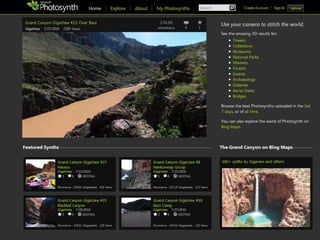
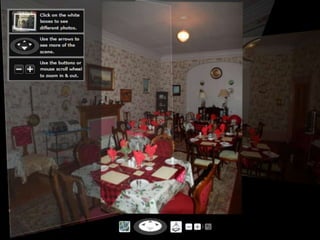
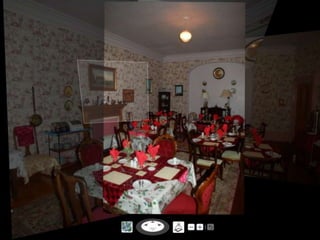
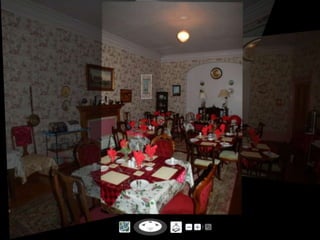
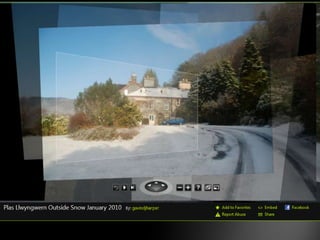
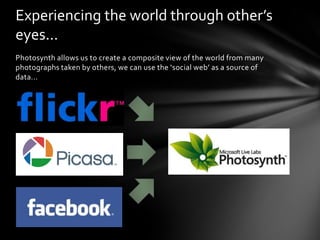
Photosynth takes your photos, mashes them together and recreates a 3D scene out of them that anyone can view and move around in.Different than static photos and video, Photosynth allows you to explore details of places, objects, and events unlike any other media. You can’t stop video, move around and zoom in to check out the smallest details, but with Photosynth you can. And you can’t look at a photo gallery and immediately see the spatial relation between the photos, but with Photosynth you can.Description taken from http://photosynth.net/about.aspxWhat Is                               ?
The idea was originated by Noah Snavelly at the University of Washington (now at Cornell)http://www.cs.cornell.edu/~snavely/His original Ph.D thesis, ‘Phototourism, exploring photo collections in 3D’ http://phototour.cs.washington.edu/History of
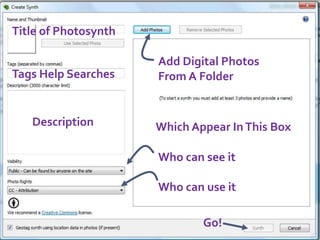
Title of PhotosynthAdd Digital PhotosFrom A FolderTags Help SearchesDescriptionWhich Appear In This BoxWho can see itWho can use itGo!
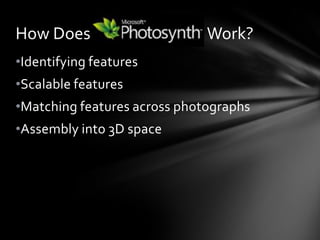
Identifying features
Scalable features
Matching features across photographs
Assembly into 3D spaceHow Does                                 Work?
Exciting visual method
Free software
Works with existing equipment : PC, Digital CameraPhotosynth is a relatively ‘lean’ method of achieving something quite sophisticated; it does not require advanced computation skills from the researcher, yet can be used to achieve something quite complex.Why Is Photosynth Interesting To Qualitative Researchers?
Data can be ‘triangulated’, by feeding a series of photographs of the same scene into Photosynth, which in turn recreates the spatial relationships between different photographs.These can be photographs from:Different perspectives
Contrasting views
Various times and dates
Dissimilar equipment
Individual photographers
Varying ‘levels of detail’Photosynth as a method of “triangulating” photographic data.Photosynth allows the creation of a “gestalt” from a diverse range of photographic source data varying in many different metrics of appraisal and marked by dissimilarity
Photosynth can be used to allow qualitative researchers to experience the visual relationship between objects in a space that they haven’t physically visited.This could be used for example:To recreate historical spaces by fusing ‘current’ photographic data with historical photographs in order to create a space that is navigable where data is presented in context.
To allow the researcher to document and record a given space; providing a model representation using photographic data that is relational or navigable.
To recreate a space, where there is a temporal dimension to the use of that space that needs to be documentedPhotosynth for exploration of space
Free photosynths must be publicly available; this could present ethics / data handling problems in some forms of research.
Data must be handled by a third party (Microsoft) this needs to be considered when getting ethical approval as the researcher cannot maintain “full” control of data.
The data is stored remotely; the “Photosynth” cannot be “downloaded to disk” (but the source files are the record of the data)Limitations of Photosynth(In it’s present implementation)
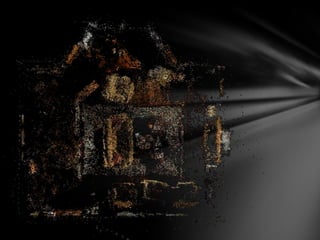
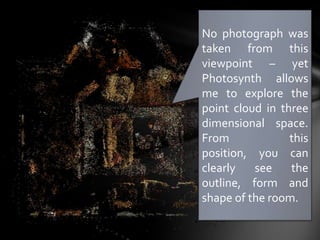
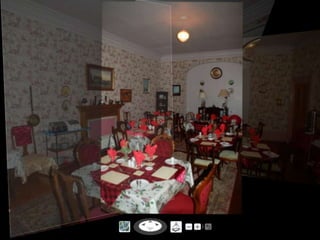
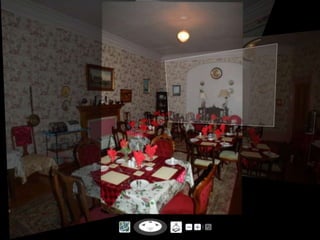
No photograph was taken from this viewpoint – yet Photosynth allows me to explore the point cloud in three dimensional space. From this position, you can clearly see the outline, form and shape of the room.
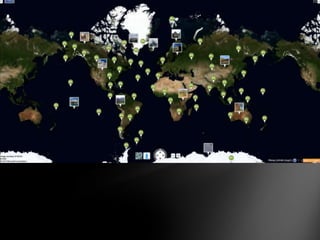
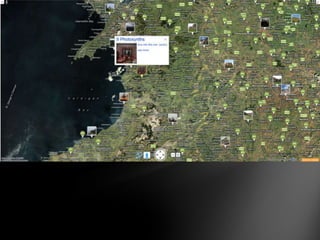
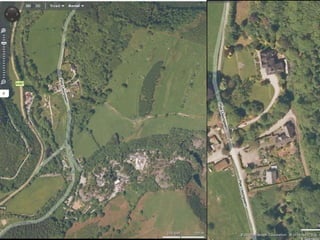
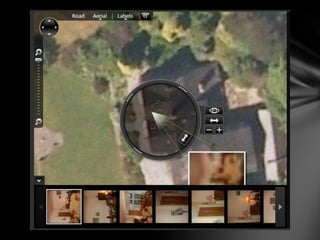
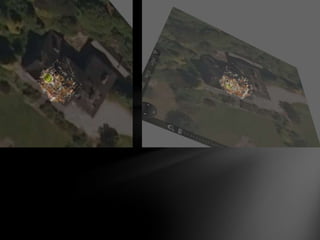
Photosynth data can be mapped onto ‘the world’ by geotagging data.The interface is relatively sophisticated, as it allows data to be ‘scaled’ in relation to satellite imagery and changed in orientation.This results in a fine level of detail regarding the orientation and position of pictures.....maybe in the future it will be possible to record this information when taking the picture (in part it is) and then mine this information during research analysis?Geospatial Data

Photosynths as a method for capturing rich visual, qualitative data

  • 1.
    Photosynths as amethod for capturing rich visual, qualitative data8th International Qualitative Research Conference 6-8th SeptemberTalbot CampusBournemouth UniversityGavin D. J. HarperThe ESRC Centre for Business Relationships, Accountability, Sustainability and SocietyCardiff University55 Park PlaceCardiffCF10 3ATUnited Kingdomharpergd@cf.ac.uk
  • 2.
    ‘Widespread analysis thatphotographs offer a transparent “window on the world” has discouraged critical analysis of the medium.’‘The malleability of photographs has injected formerly secure fields with a healthy dose of circumspection’‘Photographs may not provide us with unbiased objective documentation of the social and material world, but they can show characteristic attributes of people objects and events that often elude even the most skilled wordsmiths.’The Limitations of PhotographyProsser, Jon., Schwartz, Dona., (1998) Photographs within the sociological research processIn: Prosser (1998) Image-based research: a sourcebook for qualitative researchers
  • 3.
    A Picture MayTell A Thousand WordsBut How Many Of Those Words Are Fair And True?
  • 4.
    Photosynth takes yourphotos, mashes them together and recreates a 3D scene out of them that anyone can view and move around in.Different than static photos and video, Photosynth allows you to explore details of places, objects, and events unlike any other media. You can’t stop video, move around and zoom in to check out the smallest details, but with Photosynth you can. And you can’t look at a photo gallery and immediately see the spatial relation between the photos, but with Photosynth you can.Description taken from http://photosynth.net/about.aspxWhat Is ?
  • 5.
    The idea wasoriginated by Noah Snavelly at the University of Washington (now at Cornell)http://www.cs.cornell.edu/~snavely/His original Ph.D thesis, ‘Phototourism, exploring photo collections in 3D’ http://phototour.cs.washington.edu/History of
  • 6.
    Title of PhotosynthAddDigital PhotosFrom A FolderTags Help SearchesDescriptionWhich Appear In This BoxWho can see itWho can use itGo!
  • 7.
  • 8.
  • 9.
  • 10.
    Assembly into 3DspaceHow Does Work?
  • 11.
  • 12.
  • 13.
    Works with existingequipment : PC, Digital CameraPhotosynth is a relatively ‘lean’ method of achieving something quite sophisticated; it does not require advanced computation skills from the researcher, yet can be used to achieve something quite complex.Why Is Photosynth Interesting To Qualitative Researchers?
  • 14.
    Data can be‘triangulated’, by feeding a series of photographs of the same scene into Photosynth, which in turn recreates the spatial relationships between different photographs.These can be photographs from:Different perspectives
  • 15.
  • 16.
  • 17.
  • 18.
  • 19.
    Varying ‘levels ofdetail’Photosynth as a method of “triangulating” photographic data.Photosynth allows the creation of a “gestalt” from a diverse range of photographic source data varying in many different metrics of appraisal and marked by dissimilarity
  • 20.
    Photosynth can beused to allow qualitative researchers to experience the visual relationship between objects in a space that they haven’t physically visited.This could be used for example:To recreate historical spaces by fusing ‘current’ photographic data with historical photographs in order to create a space that is navigable where data is presented in context.
  • 21.
    To allow theresearcher to document and record a given space; providing a model representation using photographic data that is relational or navigable.
  • 22.
    To recreate aspace, where there is a temporal dimension to the use of that space that needs to be documentedPhotosynth for exploration of space
  • 23.
    Free photosynths mustbe publicly available; this could present ethics / data handling problems in some forms of research.
  • 24.
    Data must behandled by a third party (Microsoft) this needs to be considered when getting ethical approval as the researcher cannot maintain “full” control of data.
  • 25.
    The data isstored remotely; the “Photosynth” cannot be “downloaded to disk” (but the source files are the record of the data)Limitations of Photosynth(In it’s present implementation)
  • 28.
    No photograph wastaken from this viewpoint – yet Photosynth allows me to explore the point cloud in three dimensional space. From this position, you can clearly see the outline, form and shape of the room.
  • 29.
    Photosynth data canbe mapped onto ‘the world’ by geotagging data.The interface is relatively sophisticated, as it allows data to be ‘scaled’ in relation to satellite imagery and changed in orientation.This results in a fine level of detail regarding the orientation and position of pictures.....maybe in the future it will be possible to record this information when taking the picture (in part it is) and then mine this information during research analysis?Geospatial Data